Green Baloney, Hype and Fairy Tales in Australia
Viv Forbes writes at Spectator Australia Battery baloney, hydrogen hype, and green fairy tales in Australia. Excerpts in italics with my bolds and added images. H/T John Ray at his blog Greenie Watch.
How low Australia has fallen… Our once-great BHP now has a ‘Vice President for Sustainability and Climate Change’, the number of Australian students choosing physics at high school is collapsing, and our government opposes nuclear energy while pretending we can build and operate nuclear submarines.
Our Green politicians want: ‘No Coal, No Gas, No Nuclear!’ while Our ABC, Our CSIRO, and Our Australian Energy Market Operator (AEMO) are telling us that wind and solar energy (plus a bit of standby gas, heaps of batteries, and new power lines) can power our homes, industries and the mass electrification of our vehicle fleet. This sounds like Australia’s very own great leap backwards.
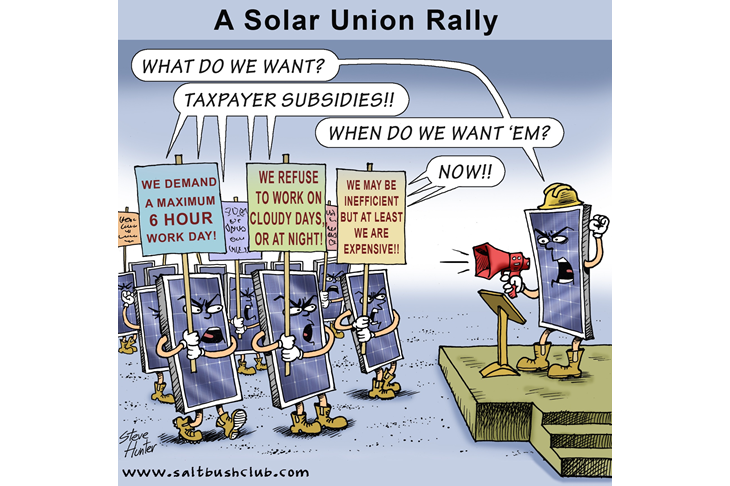
There are two troublesome Green Energy Unions: the Solar Workers down tools every night and cloudy day, and the Turbine Crews stop work if winds are too weak or too strong. And wind droughts can last for days. The reliable Coal and Gas Crews spend sunny days playing cards, but are expected to keep their turbines revving up and down to keep stable power in the lines.

From Duck to Canyon Curve
Magical things are also expected from more rooftop solar. But panel-power has four huge problems:
♦ Zero solar energy is generated to meet peak demand at breakfast and dinner times.
♦ Piddling solar power is produced from many poorly oriented roof panels or from the weak sunshine anywhere south of Sydney.
♦ If too much solar energy pours into the network (say at noon on a quiet sunny Sunday), the grid becomes unstable. Our green engineers have the solution – be ready to charge people for unwanted power they export to the grid, or just use ‘smart meters’ to turn them off.
♦ More rooftop solar means less income and more instability for power utilities so they have to raise electricity charges. This cost falls heaviest on those with no solar panels, or no homes.
Magical things are also expected from batteries.
When I was a kid on a dairy farm in Queensland, I saw our kerosene lamps and beeswax candles replaced by electric lights. We had 16 X 2 volt batteries on the verandah and a big thumping diesel generator in the dairy.
It was a huge relief, years later, when power poles bringing reliable electricity marched up the lane to our house. All those batteries disappeared with the introduction of 24/7 coal power.
Batteries are never a net generator of power – they store energy generated elsewhere, incurring losses on charging and discharging.
There has to be sufficient generating capacity to meet current demand while also recharging those batteries. What provides electricity to power homes, lifts, hospitals, and trains and to recharge all those vehicle batteries after sundown on a still winter night? (Hint: Call the reliable coal/gas/nuclear crews.)

The same remorseless equations apply to all the pumped hydro schemes being dreamed up – everyone is a net consumer of power once losses are covered and the water is pumped back up the hill.
Yet AEMO hopes we will install 16 times our current capacity of batteries and pumped hydro by 2050 – sounds like the backyard steel plans of Chairman Mao or the Soviet Gosplan that constipated initiative in USSR for 70 years. Who needs several Snowy 2 fiascos running simultaneously?
Mother Nature has created the perfect solar battery which holds the energy of sunlight for millions of years. When it releases that energy for enterprising humans, it returns CO2 for plants to the atmosphere from whence it came. It is called ‘Coal’.
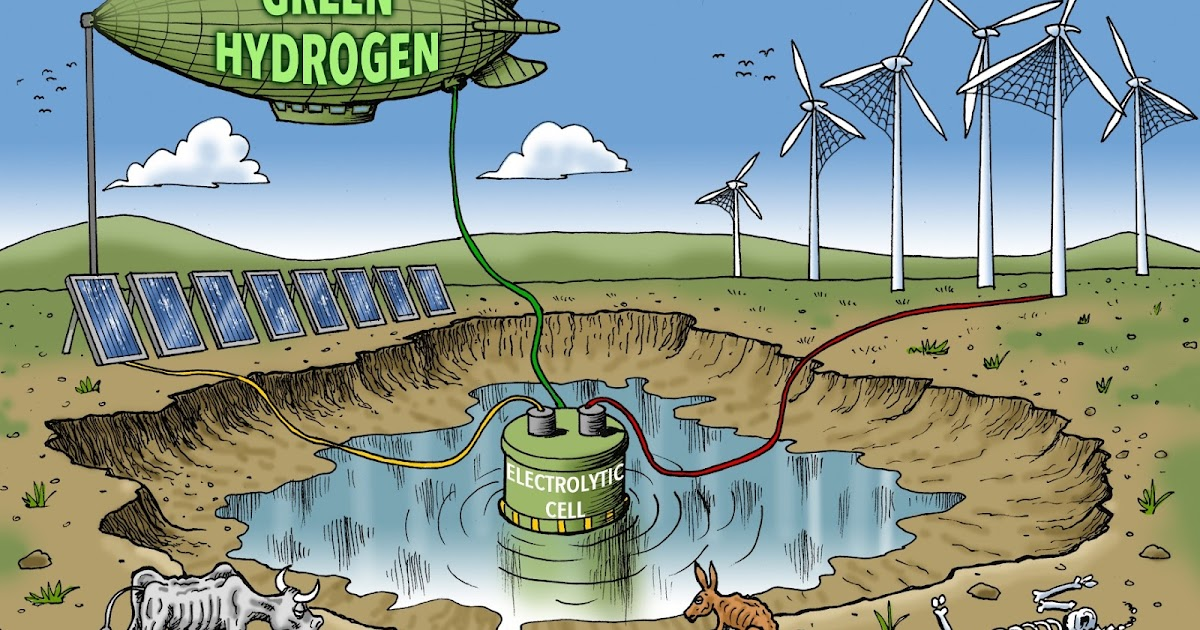
‘Hydrogen’ gets a lot of hype, but it is an elusive and dangerous gas that is rarely found naturally. To use solar energy to generate hydrogen and to then use that hydrogen as a power source is just another silly scheme to waste water and solar energy. It always takes more energy to produce hydrogen than it gives back. Let green billionaires, not taxpayers, spend their money on this merry-go-round.
Who is counting the energy and capital consumed, and the emissions generated, to manufacture, transport, and install a continent being covered by ugly solar panels, bird slicers, high voltage power lines, access roads, and hydro schemes? Now they want to invade our shallow seas. Who is going to clean up this mess in a few years’ time?

As Jo Nova says:
‘No one wants industrial plants in their backyard, but when we have to build 10,000 km of high voltage towers, 40 million solar panels, and 2,500 bird-killing turbines – it’s in everyone’s backyard.’
With all of this planned and managed by the same people who gave us Pink Batts, Snowy 2 hydro, and the NBN/NDIS fiascoes, what could possibly go wrong?

Another big problem is emerging – country people don’t want power lines across their paddocks, whining wind turbines on their hills, and glittering solar panels smothering their flats. And seaside dwellers don’t want to hear or see wind turbines off their beaches. Even whales are confused.
The solution is obvious – build all wind and solar facilities in electorates that vote Green, Teal, and Labor. Those good citizens can then listen to the turbines turning in the night breezes and look out their windows to see shiny solar panels on every roof. This will make them feel good that they are preventing man-made global warming. Those electorates who oppose this silly green agenda should get their electricity from local coal, gas or nuclear plants.

What about the Net Zero targets?
At the same time as Australia struggles to generate enough reliable power for today, governments keep welcoming more migrants, more tourists, more foreign students and planning yet more stadiums, games, and circuses. None of this is compatible with their demand for Net Zero emissions.
Unlike Europe, the Americas, and Asia, Australia has no extension cords to neighbours with reliable power from nuclear, hydro, coal, or gas – we are on our own.
Australia has abundant resources of coal and uranium – we mine and export these energy minerals but Mr Bowen, our Minister for Blackouts, says we may not use our own coal and uranium to generate future electricity here. Someone needs to tell him that no country in the world relies solely on wind, solar, and pumped hydro. Germany tried but soon found they needed French nuclear, Scandinavian hydro, imported gas, and at least 20 coal-fired German power plants are being resurrected or extended past their closing dates to ensure Germans have enough energy to get through the winter.

Australia is the only G20 country in which nuclear power is illegal (maybe no one has told green regulators that we have had a nuclear reactor at Lucas Heights in Sydney since 1958). Australia is prepared to lock navy personnel beside nuclear power plants in our new nuclear-powered submarines but our politicians forbid nuclear power stations in our wide open countryside.
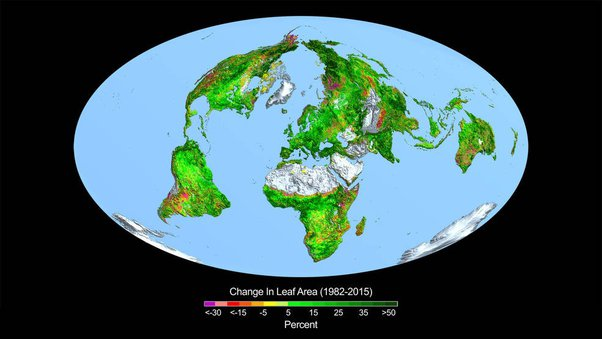
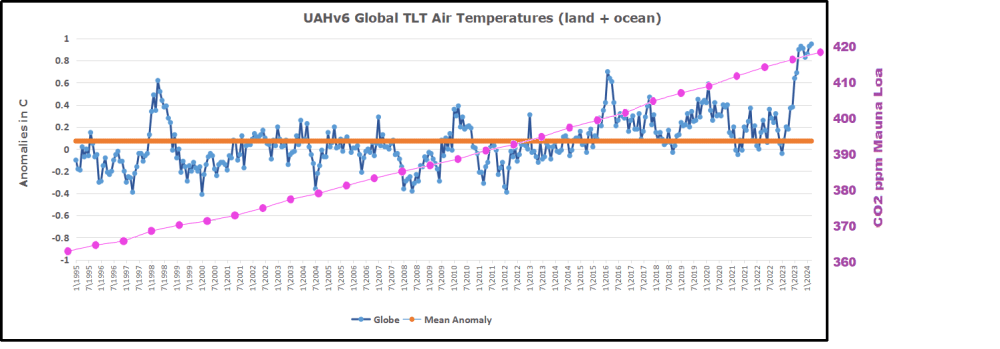
More CO2 in the atmosphere brings great benefits to life on Earth. If man adds to it, the oceans dissolve a swag of it, and what stays in the atmosphere is gratefully welcomed by all plant life.
In 2023, Australia added just 0.025 ppm to the 420 ppm in today’s atmosphere. Most of this probably dissolved in the oceans. If we in Australia turned everything off tomorrow, the climate wouldn’t notice, but our plant life would, especially those growing near power stations burning coal or gas and spreading plant food.
Climate has always changed and a warm climate has never been a problem
on Earth. It is cold that kills. Especially during blackouts.

 The table below shows the distribution of Sea Ice on day 182 across the Arctic Regions, on average, this year and 2007. At this point in the year, Bering and Okhotsk seas are open water and thus dropped from the table.

 Science Matters