Due This Week: EPA Plan for GHG Endangerment Finding
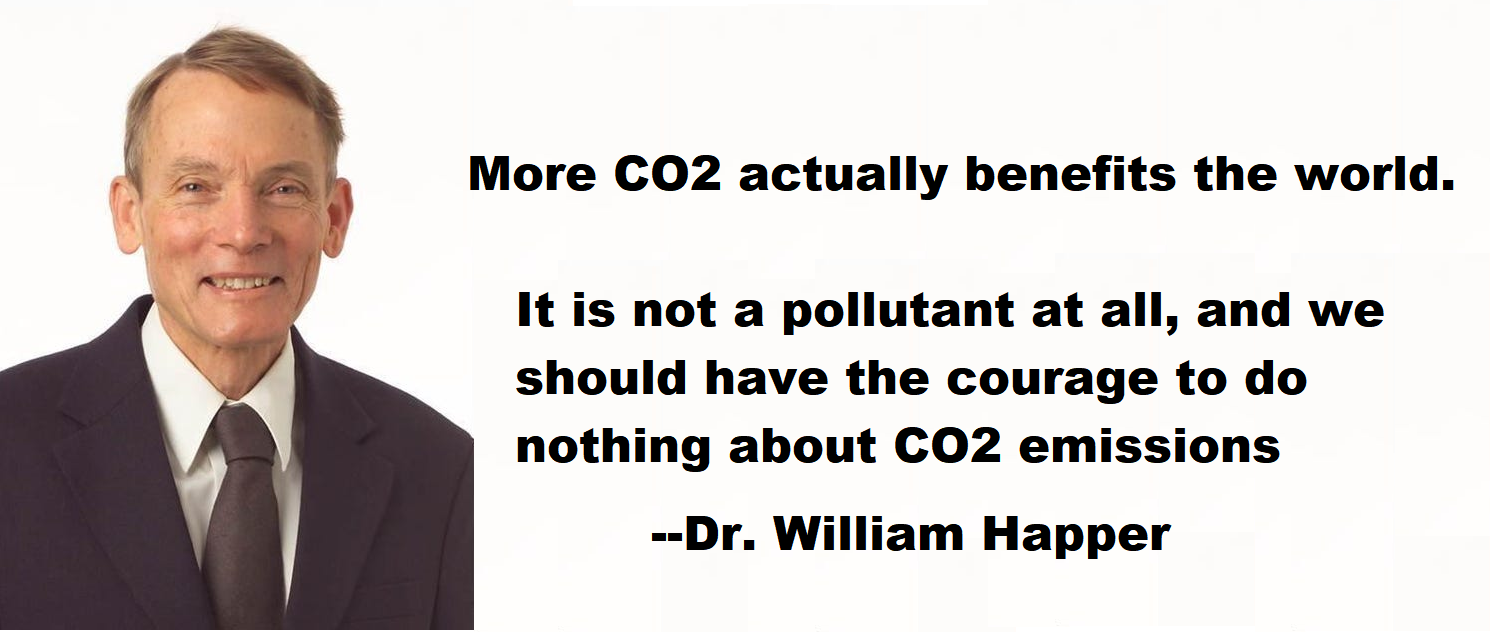
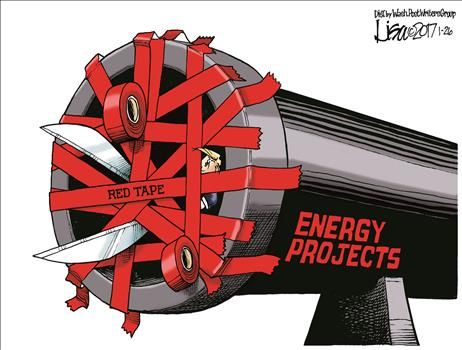
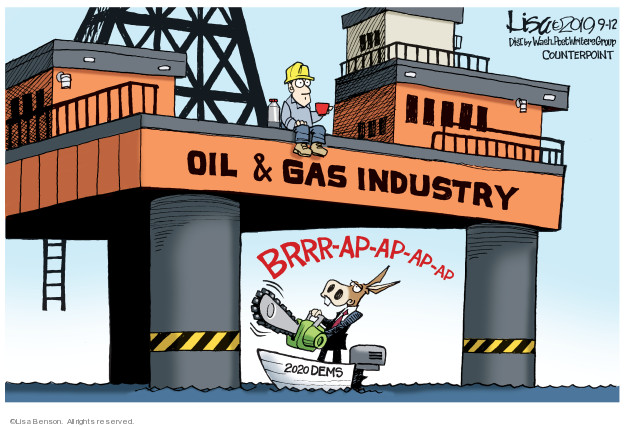
As promised, Trump on day 1 (January 20, 2025) issued an Executive Order challenging the presumption  “greenhouse gases” (GHGs) endanger public health and safety.  The pertinent text is in Section 6 reprinted below with my bolds and added images.

Executive Order 14154 of January 20, 2025 Unleashing American Energy

Sec. 6 . Prioritizing Accuracy in Environmental Analyses. (a) In all Federal permitting adjudications or regulatory processes, all agencies shall adhere to only the relevant legislated requirements for environmental considerations and any considerations beyond these requirements are eliminated. In fulfilling all such requirements, agencies shall strictly use the most robust methodologies of assessment at their disposal and shall not use methodologies that are arbitrary or ideologically motivated.
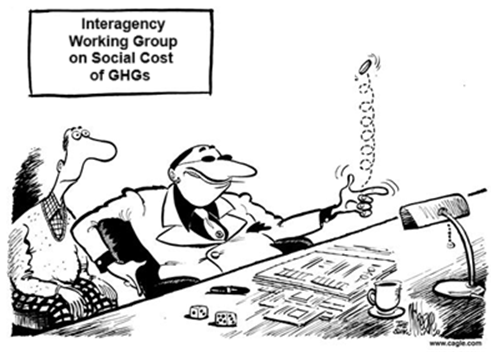
(b) The Interagency Working Group on the Social Cost of Greenhouse Gases (IWG), which was established pursuant to Executive Order 13990, is hereby disbanded, and any guidance, instruction, recommendation, or document issued by the IWG is withdrawn as no longer representative of governmental policy including:

(i) the Presidential Memorandum of January 27, 2021 (Restoring Trust in Government Through Scientific Integrity and Evidence-Based Policymaking);

(ii) the Report of the Greenhouse Gas Monitoring and Measurement Interagency Working Group of November 2023 (National Strategy to Advance an Integrated U.S. Greenhouse Gas Measurement, Monitoring, and Information System);

(iii) the Technical Support Document of February 2021 (Social Cost of Carbon, Methane, and Nitrous Oxide Interim Estimates under Executive Order 13990); and

(iv) estimates of the social cost of greenhouse gases, including the estimates for the social cost of carbon, the social cost of methane, or the social cost of nitrous oxide based, in whole or in part, on the IWG’s work or guidance.

(c) The calculation of the “social cost of carbon” is marked by logical deficiencies, a poor basis in empirical science, politicization, and the absence of a foundation in legislation. Its abuse arbitrarily slows regulatory decisions and, by rendering the United States economy internationally uncompetitive, encourages a greater human impact on the environment by affording less efficient foreign energy producers a greater share of the global energy and natural resource market. Consequently, within 60 days of the date of this order, the Administrator of the EPA shall issue guidance to address these harmful and detrimental inadequacies, including consideration of eliminating the “social cost of carbon” calculation from any Federal permitting or regulatory decision.

(d) Prior to the guidance issued pursuant to subsection (c) of this section, agencies shall ensure estimates to assess the value of changes in greenhouse gas emissions resulting from agency actions, including with respect to the consideration of domestic versus international effects and evaluating appropriate discount rates, are, to the extent permitted by law, consistent with the guidance contained in OMB Circular A-4 of September 17, 2003 (Regulatory Analysis).

(e) Furthermore, the head of each agency shall, as appropriate and consistent with applicable law, initiate a process to make such changes to any rule, regulation, policy or action as may be necessary to ensure consistency with the Regulatory Analysis.

(f) Within 30 days of the date of this order, the Administrator of the EPA, in collaboration with the heads of any other relevant agencies, shall submit joint recommendations to the Director of OMB on the legality and continuing applicability of the Administrator’s findings, “Endangerment and Cause or Contribute Findings for Greenhouse Gases Under Section 202(a) of the Clean Air Act,” Final Rule, 74 FR 66496 (December 15, 2009).

What Might Happen Next

Source E&E News : Trump set a deadline on the endangerment finding. Here’s what might happen.

The finding, issued during President Barack Obama’s first term, holds that greenhouse gas emissions “may reasonably be anticipated to endanger public health or welfare.” It’s the prerequisite for Clean Air Act rules targeting heat-trapping pollutants such as carbon dioxide and methane. The finding originally pertained to climate pollution from vehicles, but it opened the door for regulations on power plants and oil and gas infrastructure. And it could support future regulation on additional sources of climate pollution, such as landfills, refineries and industrial plants.

Getting rid of the finding would make scrapping EPA climate rules a matter of routine paperwork, an expert said. Regulations could be undone through simple, swift rulemakings. No replacement rules would be needed.

“Taking away the 2009 endangerment finding would really make it almost a virtual formality to take down all the greenhouse rules for CO2 and methane,” said Joe Goffman, EPA’s air chief under Biden.

EPA would still need to strip out sector-specific findings from rules written under a key section of the Clean Air Act — known as Section 111 — he said. But when the dust settled, EPA could regulate oil and gas facilities for ozone-forming pollutants alone, and not for methane — greatly reducing requirements for industry. And power plants that burn fossil fuels wouldn’t be regulated for carbon.

Daren Bakst, director of the energy and environment program at the conservative Competitive Enterprise Institute, a think tank that has long advocated getting rid of the endangerment finding, agreed that it would “present legal challenges.”  But he said the risk was worth taking.

“If the EPA finds there is no endangerment, and this survives in court, it would have the important effect of stopping the EPA from regulating greenhouse gases,” he said.

Regarding next week’s deadline, he said Zeldin might submit only preliminary recommendations to the Office of Management and Budget, rather than a full-blown decision to challenge the finding, or pass on it.

Sun Rules Earth Climate

On February 12, 2025, Tom Nelson conducted the above interview with solar physicist Valentina Zharkova: Grand solar minimum is underway. Below is my synopsis  of lightly edited transcript excerpts from the closed captions along with key graphics in her presentation. H/T Chiefio

The full content of the video is:

Time line of segments:
0:00 – Introduction to Valentina
0:35 – Understanding the Solar Cycles
4:25 – Challenges In Measuring Sun
5:10 – Discovering The Background (magnetic fields)
6:00 – Analyzing Magnetic Waves
7:50 – Predicting Solar Activity
14;45 – Grand Solar Minimum
27:25 – Implications of the Grand Solar Minimum
37:55 – CO2 and Temperature Correlation
39:10 – Solar Cycles and Earth’s Temperature
42:45 – Solar Inertial Motion and Climate
48:30 – Future Climate Predictions
1:05:20 – Volcanic Activity and Climate
1:07:30 – Earth’s Magnetic Field
1:12:10 – Concluding Thoughts

Transcript Excerpts

Today we’re talking again about Grand solar minimum but I also speak about a little bit of solar radiation and verification of the new solar activity index we discovered with the existing one which is derived by average Sunspot number.

Understanding the Solar Cycle and Sunspots

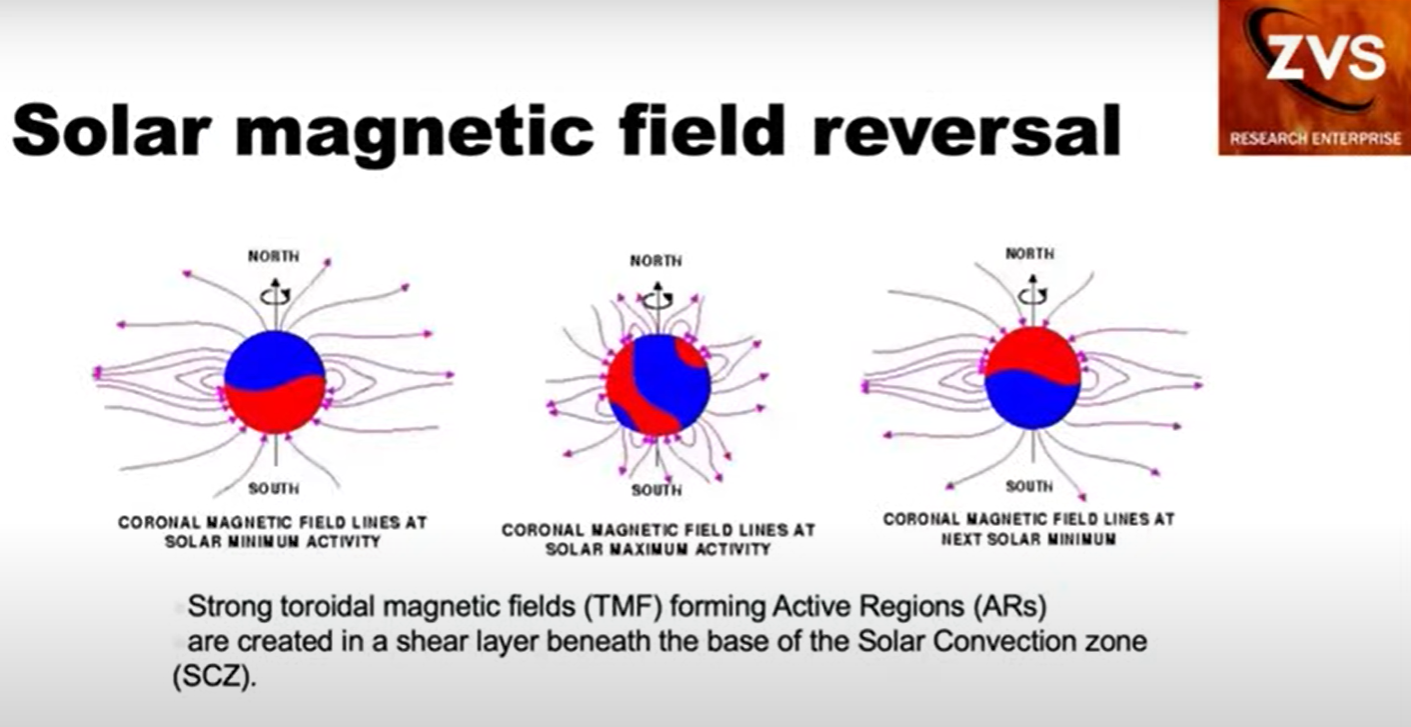
The solar activity cycle is about 11 years and on the Sun it occurs that in the start of the cycle on the left image the sun has Southern polarity.  And during the cycle this polarity slowly migrates in the opposite direction and so the next solar minimum you have polarity changed and this happens approximately every 11 years. so basically what is happening the the loops appear in the Solar surface and the occurring as the active region for forming coronal mass injections flares and different fluxes towards the Earth and other planets.

So in the past we were dealing  with the sunspots.  In the 18th century Wolff discovered that this Sunspot appears on this latitude 30° and migrates slowly towards the equator and basically this is the basic Solar activity index using daily average Sunspot numbers.

Why we love sunspots and why we support this for a couple of centuries is because sunspots actually are Roots which are embedded into the Photosphere (the surface layer of the Sun that gives off light).  And we see them from outside with the naked eye but basically they are the places where magnetic Loops are embedded.

The problem with Sunspots is that we see only a few of them.  Even with this Solar maximum there’s only a small part of the solar surface covered with them. Whatever we use to detect them, always the Sunspot index is defined by people manually.  They agree from different observatories what number of sunspots which configuration Etc.  So the Sunspot number changes during 11 year cycle.

Discovering The Background (magnetic fields)

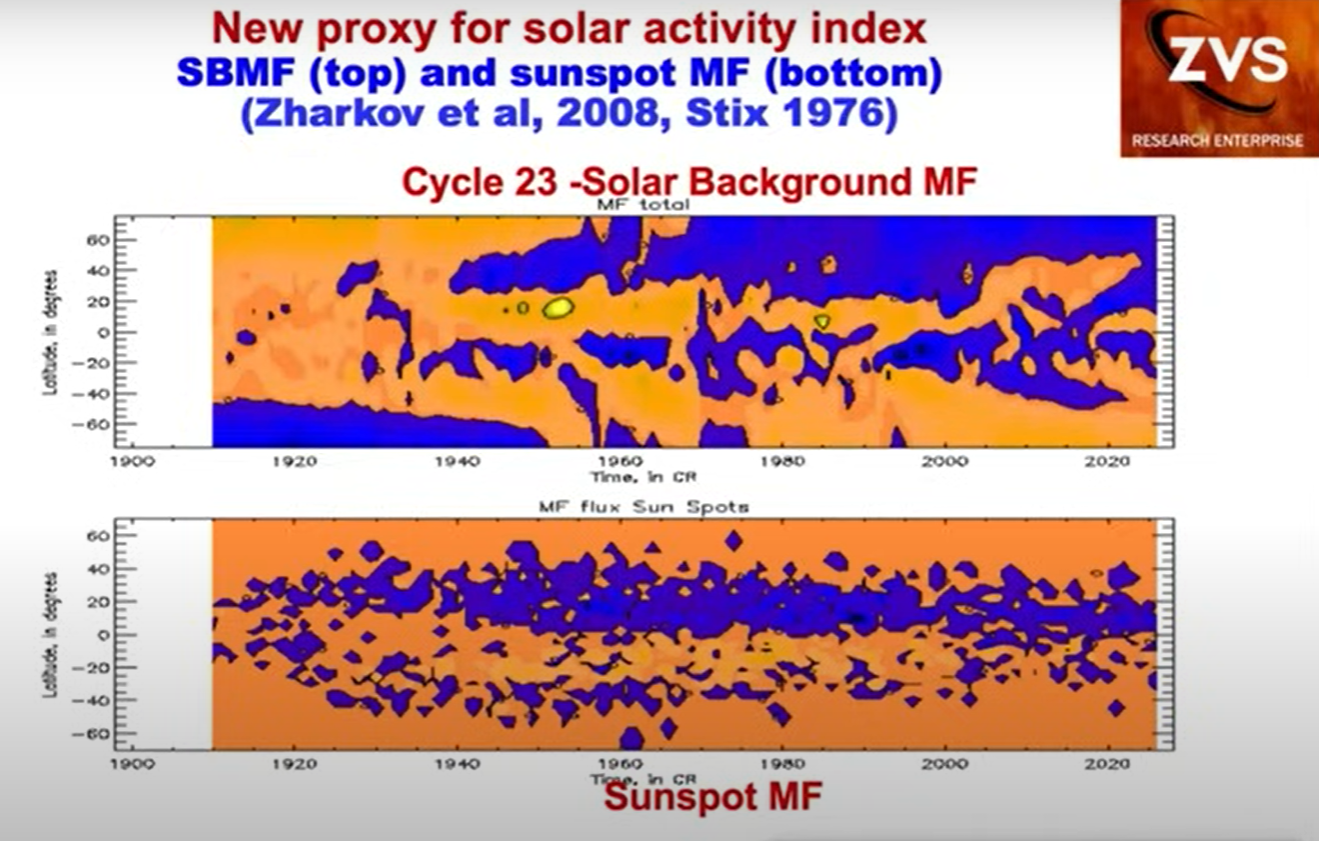
So we decided to look at the background field in which these sunspots are embedded so on the top is the B is the background magnetic field measured at solar observatory in Stanford with orange. So you see clearly that the leading polarity of Sunspot always opposite to the polarity of the background magnetic field in that hemisphere.  It was not only us who detected this it was others as well so it was very encouraging. We decided we can detect solar activity with much better accuracy.

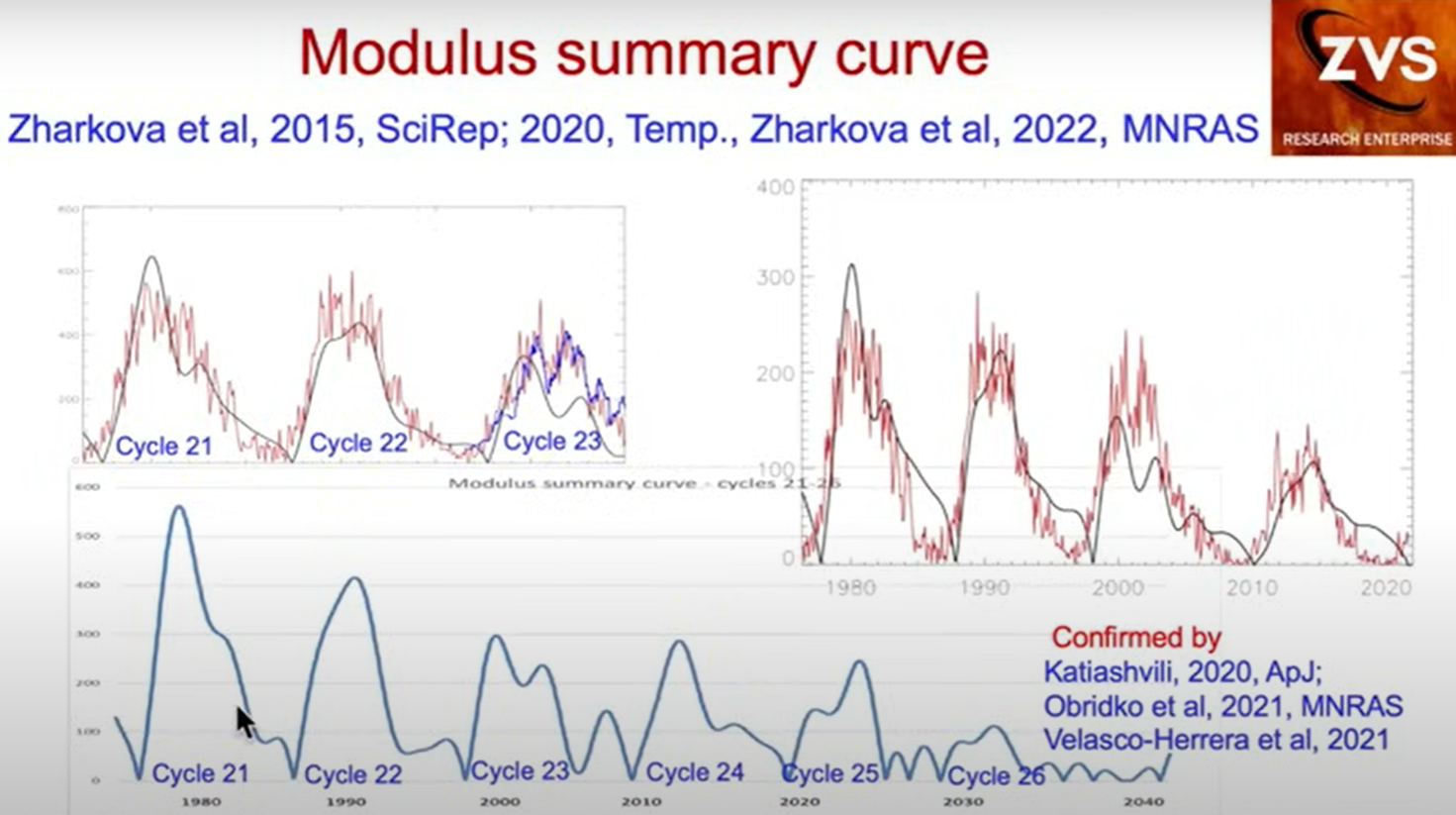
The black curve is our summary modulus summary curve and the red is a  sunspot number and you see that our a Vector summary Eigen vectors will represent this Solar, remembering that our index represents the magnetic field of the background Sun. In 2022 we added Cycle 24 and discovered that our curve still represents Sunspot index.  At the bottom is the summary curve modulus summary curve cycle 25 where we are now,   Here we see our prediction that the maximum will be actually year 23-24 and now there will be a very sharp drop of the activity, and we have two little Maxima before the minimum between cycle 25-26.  Cycle 26 will be have very low amplitude, 70% lower than the previous two cycles.

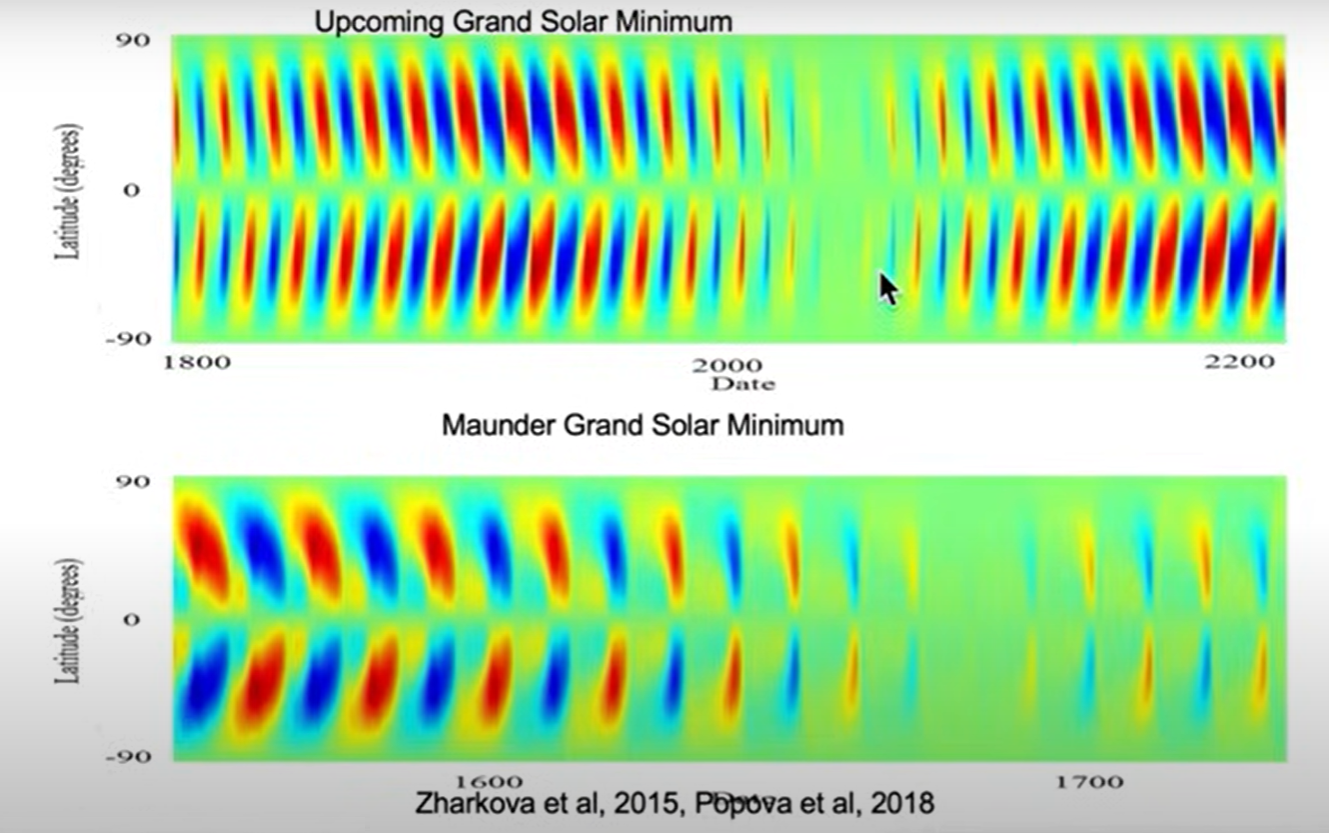
So how it works.   If you have two waves on the top two black waves which are running with the same amplitude but if the face difference is zero you have constructive interference.   In the cycle 26 we can see the amplitudes are going opposite with the resulting amplitude becoming zero.   This is what we observe on the sun and I teach my  first year physics students how they interact.   There’s no miracle, just basic physics of the waves and this effect called beat effect.

Implications of the Grand Solar Minimum

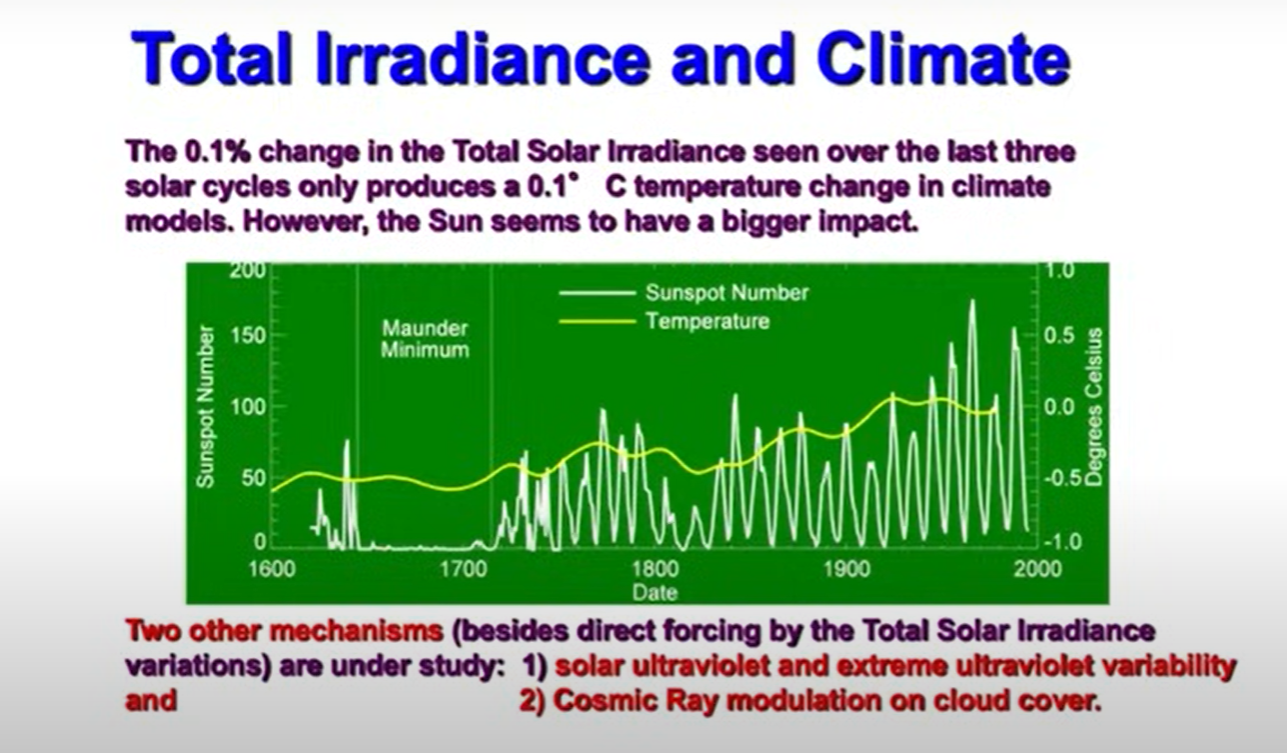
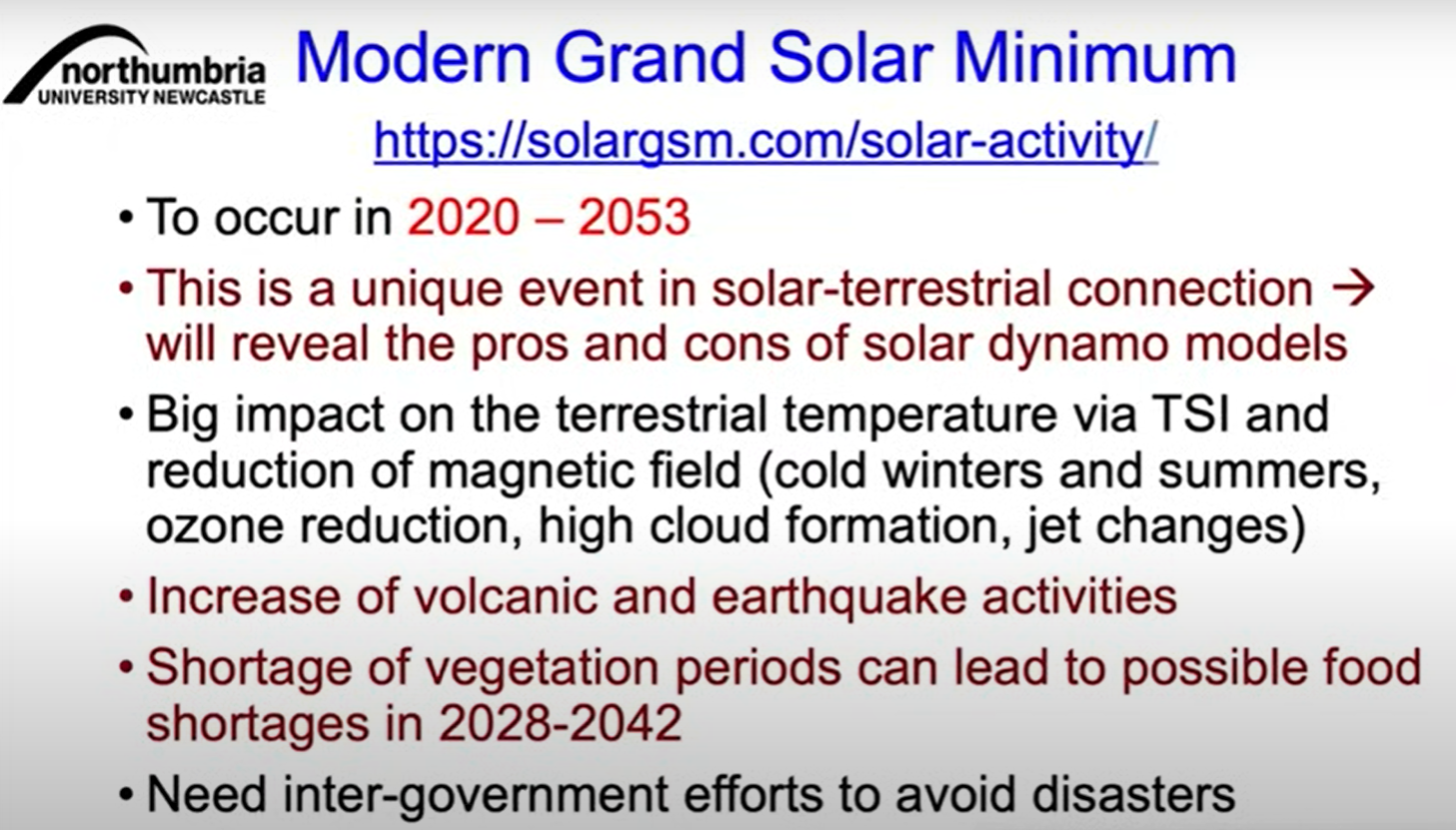
Now we come back to solar radiance and climate so first we now know that we entered into a grand solar minimum, the temperature started decreasing.  But the problem with the grand solar minimum is that during previous Grand solar minimum, which was the Maunder minimum in 17th century,  the Solar Radiance reduced by 3 watts per square meter approximately. But the temperature during Maunder minimum decreased approximately by one degree maximum.

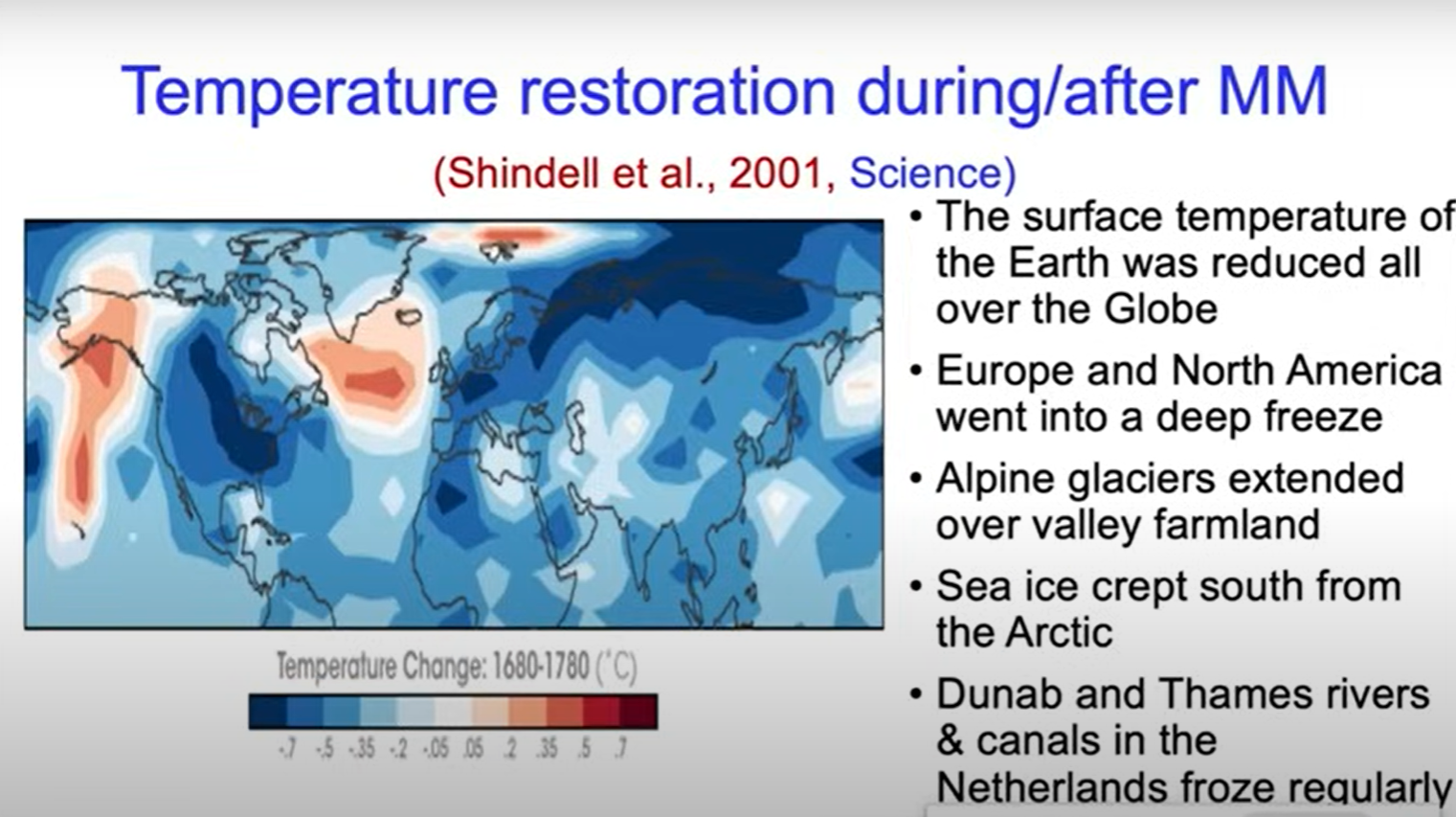
Different investigations show slightly different variations but mostly they all reconstruct temperatures during and after the minimum to find where the surface temperature was reduced on the the globe. So this is what you see for Northern Hemisphere, this is Europe, very dark blue is reduction of temperature by one degree.   And it is mostly all Europe, Russia and Siberia, and also all Northern America and Canada.

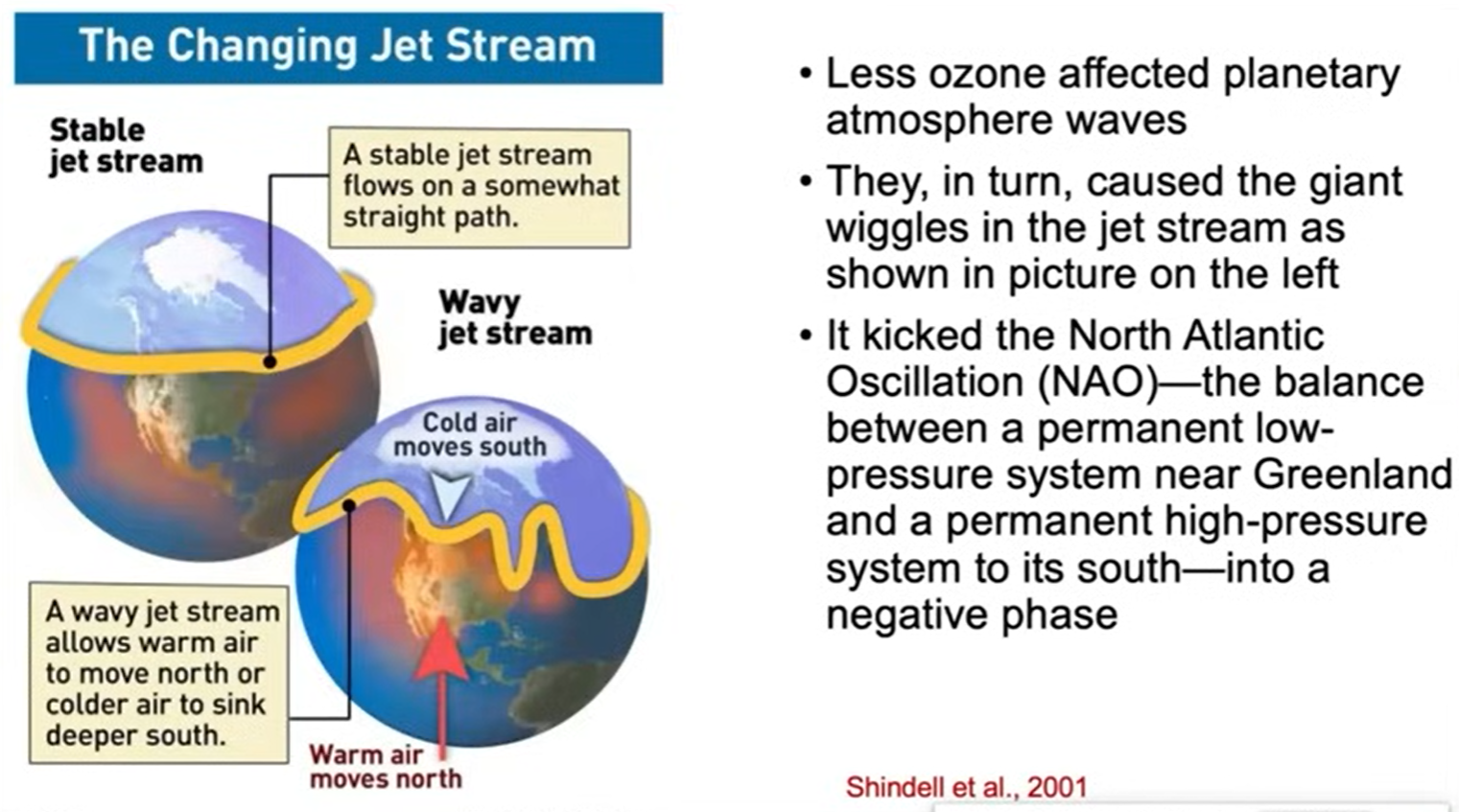
So basically this is probably we are heading towards now.  We have noticed the cold flashes from the drop of the temperature that occurred because drop of abundance of ozone created by solar ultraviolet light in the stratosphere.  If the solar radiation is reduced, this layer abundance of ozone is reduced and it affects planetary atmospheric waves.

In the left image Globe the stable just stream flows somewhere in this path and separate middle latitude from the north Northern latitude, but when ozone layer is reduced it causes giant Wiggles in just stream shown in the right plot called wind from arctics can now penetrate to the southern latitudes as shown on the picture.  It kicks off North Atlantic oscillation and balance between permanent low pressure system near Greenland and permanent high pressure system and the South into Negative PH. It was reported 24 years ago go and it works now.

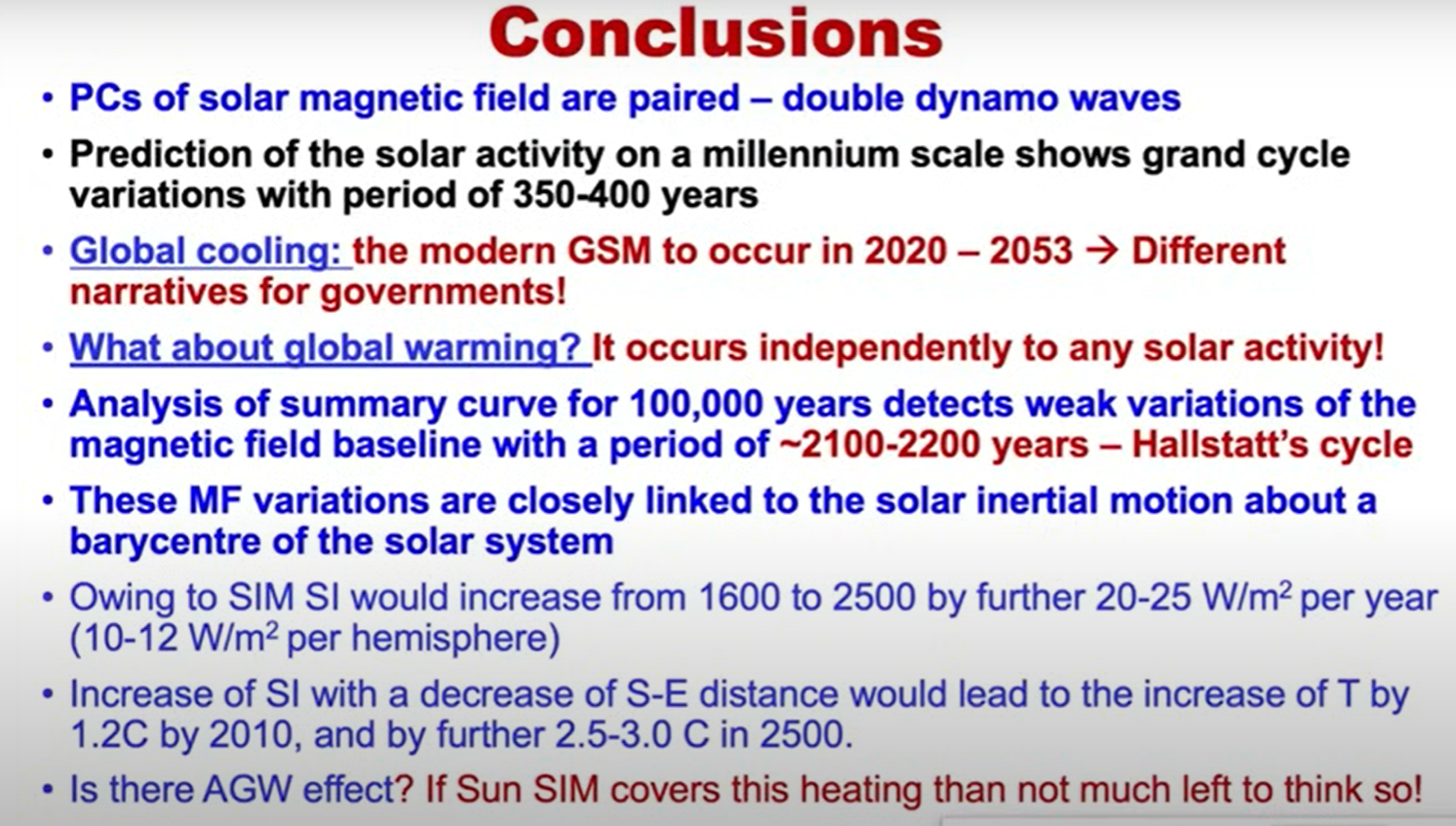
We are trying now to say that the temperature will be increasing because the sun become closer to us but the sun is very humane it gives us this grand solar minimum for 30 years to sort out our understanding how the heating comes through and then prepare for the next stage of heating which come does no matter what we do on Earth; if we stop using fuels, we crawl to the caves and start using I don’t know what energy.   All people will die still the temperature will increase, it doesn’t matter what we do.

So this prediction of the anthropogenic global warming people is not working.  The temperature will be increasing no matter what we do with CO2 because the increase of the temperature comes from the solar inertial motion.   So this my conclusion: We had this global warming–it is real;  it is not caused by humans because human only contribute 6% maximum of all CO2.  And CO2 is a very good gas because it is mostly absorbed by the plants and not by humans.

Global warming is caused by this Solar inertial motion and gravitation of large planets which drag the Sun from the center Body Center closer to the planets and this causes the increase of the  temperature.  And the temperature as I shown in my book will increase by 2.5-3° by 25-2600 years. This is the end of the story.

TN: Thank you it sounds like we’re due for some cooling between now and 2053 but warming in general between then and 2600.  I’m curious, do you think we’re going to see the temperatures freeze over at all?

Yes, I’m confident it will be freezing from 2031 to 2042 for sure.  This will be the worst period of cold air and cold temperature and not only temps.  Rivers and the ponds will be freezing all right and other dramatic things that might happen.  It’s going to be a lot harder to grow wheat in Canada for example, I would guess during that time absolutely.  In 17th century people heated their houses with their own fireplaces, now we have central heating.  If we don’t have electricity even our Central heating is not working, so you need to have the portable generators run from fossil fuel or have a wood stove in your house.  At that time people grew up something in their Gardens, now people don’t know how to grow up anything, so it will be really really difficult.

See Also:

Zharkova on Solar Forcing and Global Cooling

It Must Be Climate Change

Prager U video can be seen at this link: https://www.prageru.com/video/it-must-be-climate-change

Transcript is below in italics with my bolds and some added images.

Have you noticed that every extreme weather event is blamed on climate change formerly known as global warming?

Every. . . Single. . .One. 

Can you think of an exception?

Too hot — climate change.    Too cold – climate change. 

Previously, cold spells were termed “Weather” in contrast to “Global Warming.” Now it’s all “Climate Change.”

Drought – climate change.   Too much rainfall – climate change. 

And there’s always a climate scientist at some university who’s willing to make a statement blaming the current catastrophe on our profligate use of fossil fuel. 

Some years ago, on The Late Show with David Letterman, MSNBC host Rachel Maddow made the definitive statement on this issue. She said, “I think global warming probably means extreme weather events of all kinds.” Naturally, Dave agreed.

What’s behind all these confident assertions? 

As a PhD in geochemistry, former member of the University of Alabama Department of Geological Sciences and someone who has written and lectured widely on the subject of climate and geology, I can tell you that it comes down to two things: 

Obscure metrics and highly speculative models.

Mix these ingredients together and voila! You can get any result you want. The scarier, of course, the better. “Torrential rain” makes a much better headline than “heavy rain.” 

To show you how this works, let’s look at a recent example. 

Here’s the assertion:   Climate change is making air turbulence more volatile and thus air travel more dangerous. 

Scary, right?   But is it true?  No. Not if we look at the observable data; that is, hard data we can easily verify. 

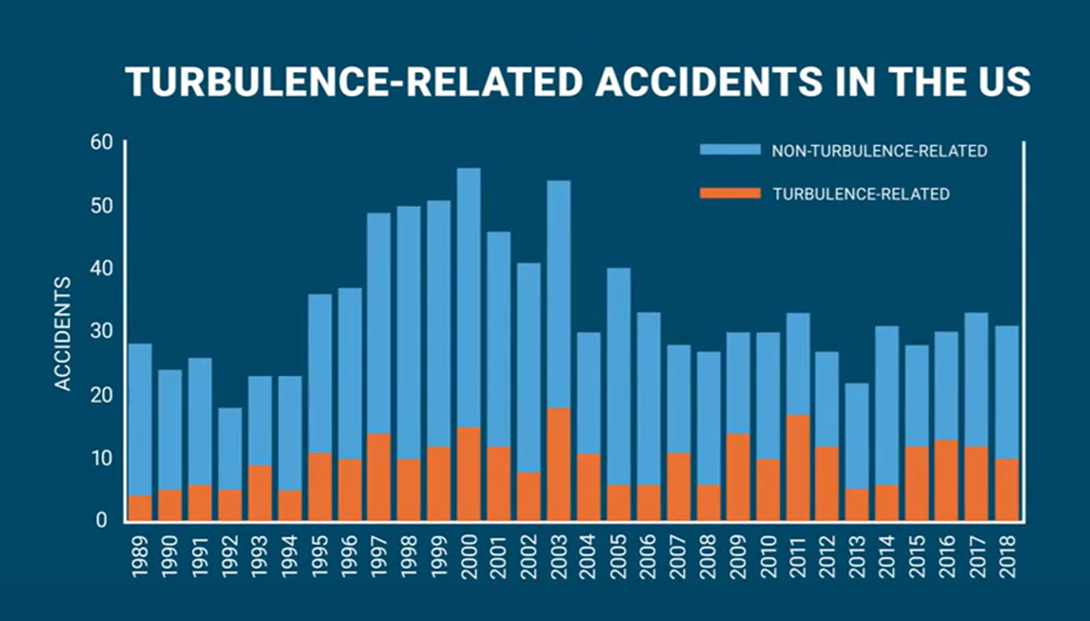
Here’s a chart of the number of turbulence-related accidents in the US from 1989 to 2018. 

Despite the rise in annual US airline passengers from about 400 million in 1989 to nearly one billion by 2018, turbulence-related accidents have remained constant. If climate change were indeed making turbulence significantly worse, we would expect to see a corresponding increase in these accidents.

Yet, the data does not support this assertion. Instead, it suggests that the relationship between turbulence and climate change is either negligible or nonexistent.

In fact, the co-author of the original study cited in a BBC article admitted as much.

“When we add [data back to 2002] to the previous results, the statistical significance assigned to the…North Atlantic winter jet stream…disappears.”

This was conveniently left out of the BBC article.

This disconnect between obscure metrics and highly speculative models, and observable data is not limited to turbulence. 

The broader climate crisis narrative is built on similar shaky foundations. 

Let’s look at three more examples. 

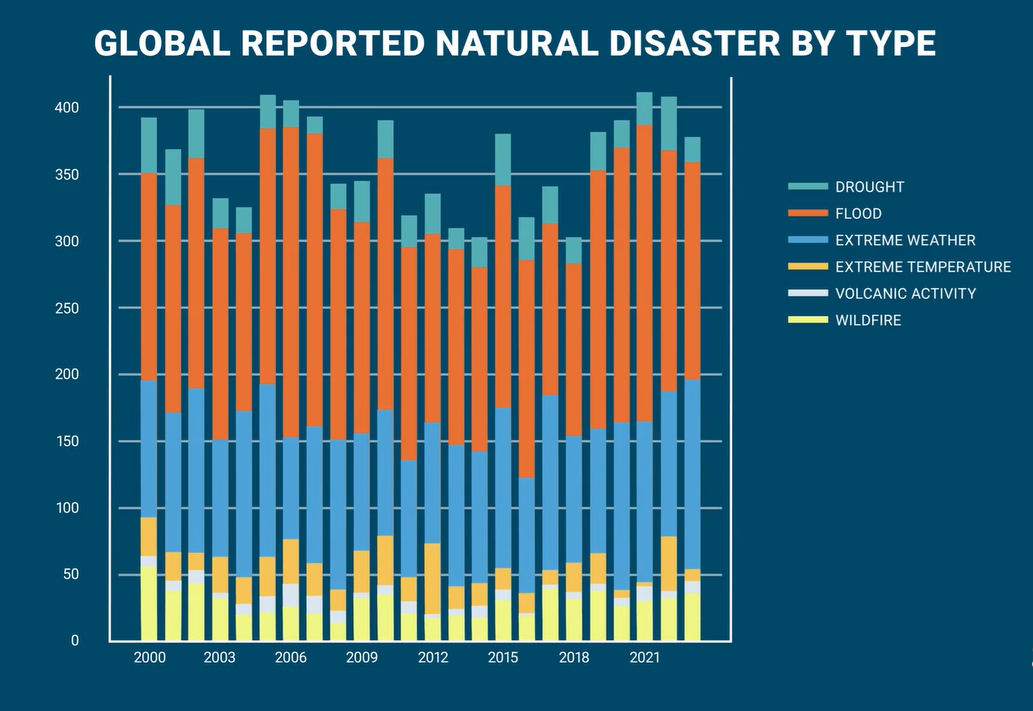
No Increase in Extreme Weather: The number of hydrological, meteorological, and climatological disasters has remained relatively flat since 2000. If climate change were causing more extreme weather events, we would expect to see a clear increase in these numbers. Instead, the data, again, reflects no such increase.

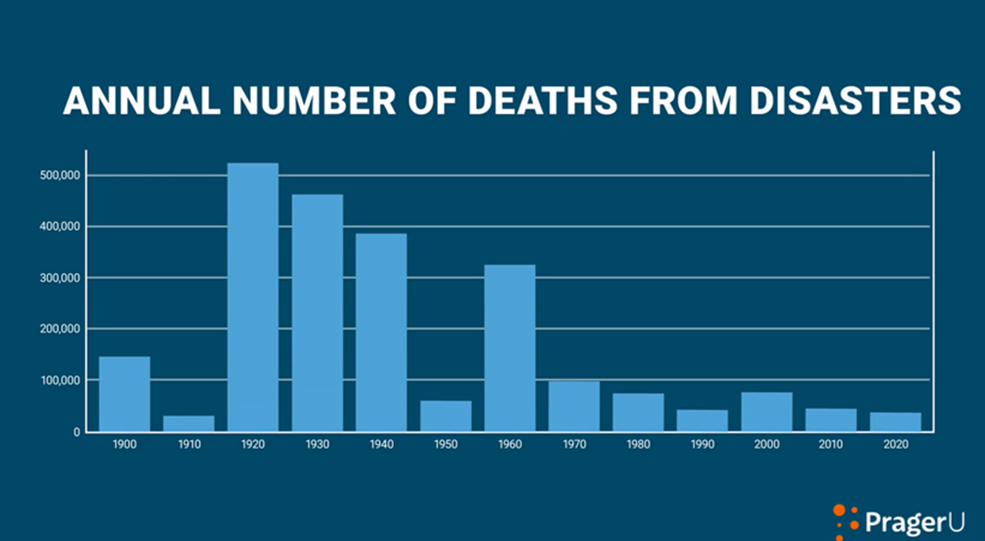
No Increase in Loss of Life: Deaths from meteorological, hydrological, and climatological disasters have not increased. This is a critical metric because it directly reflects the human impact of these events. Despite frequent claims that climate change is making weather more deadly, the data does not bear this out.

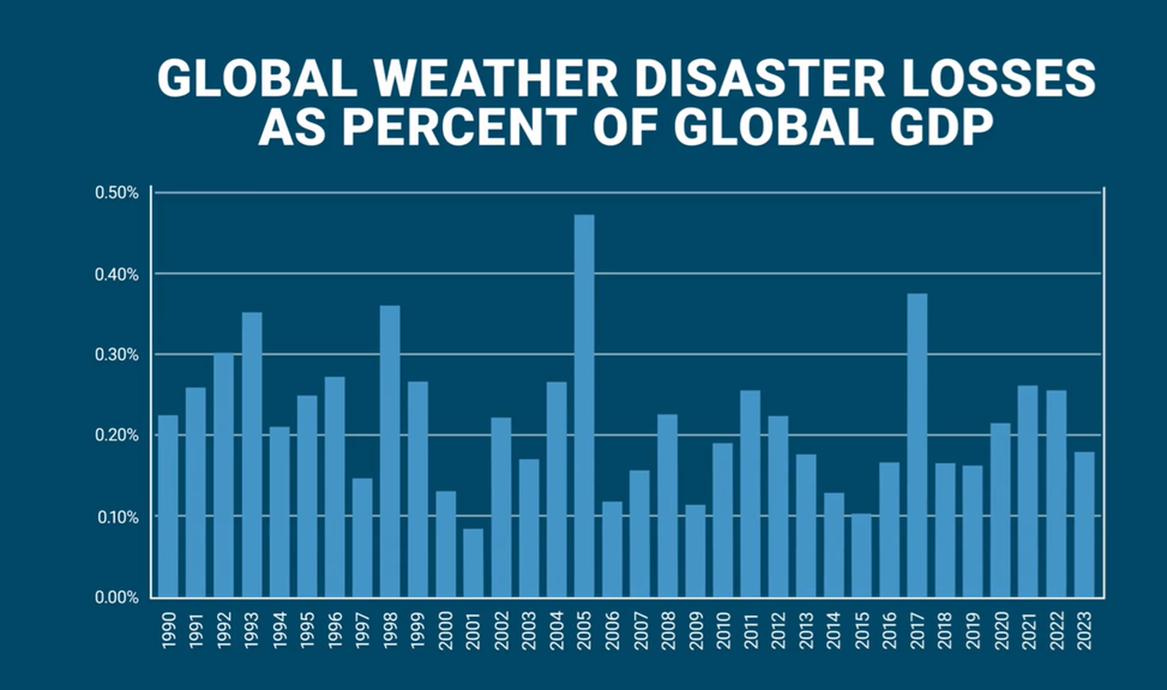
No Increase in Costs: Global weather losses as a percent of global GDP have not risen significantly. This is another crucial metric because it accounts for the economic impact of climate-related disasters. If climate change were truly making these events more severe, we would expect to see a rising trend in economic losses relative to global GDP.

We are left with this conclusion:

The reliance on obscure metrics and highly speculative models
to support the climate crisis narrative often serves
to cloud the truth rather than illuminate it. 

By focusing on projections and models rather than observable data, environmental activists, climate scientists, attention-seeking politicians and click bait media make claims that are difficult to verify and easy to manipulate. 

The fear that fuels the “climate crisis” is simply not justified by the data. That’s why — over and over again — end-of-the-world predictions don’t pan out. 

This does not mean that we should ignore environmental issues. We live on the same planet. We all want clean air and water. 

However, it does mean that we should approach claims of climate catastrophe with a healthy dose of skepticism and demand that assertions be backed up by observable, measurable data. Given that politicians and government agencies are spending tens of billions of our tax dollars every year to “save the planet” that would seem to be the least they could do: give us some hard facts, rather than unproven assertions. 

And the hard facts are, turbulence-related accidents have not increased despite a massive rise in airline passengers. Extreme weather events, loss of life, and economic costs have not shown the dramatic increases that alarmists would have us believe. 

By focusing on observable data we can have a more grounded, rational discussion about our environmental challenges and how best to address them.

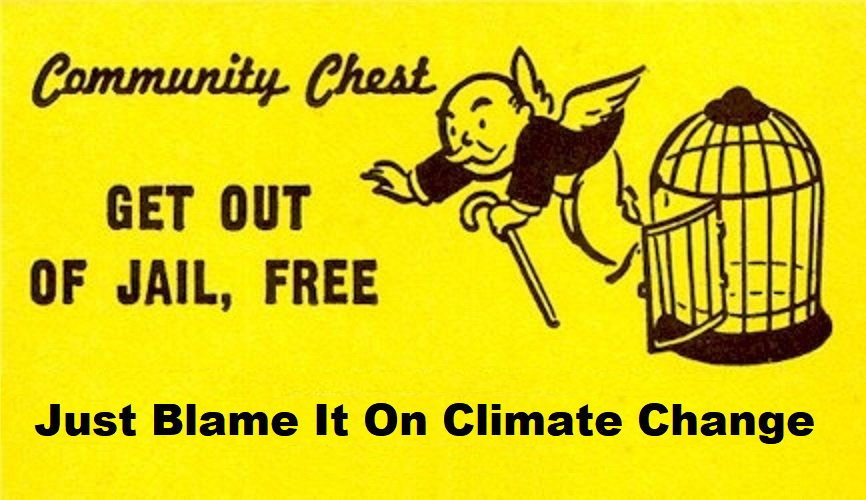
That’s the way to practical, real-world solutions.  The blame game — “it’s climate change” — gets us nowhere. 

I’m Matthew Wielicki for Prager University.

SEC Chair Revokes Illegal Climate Disclosure Rule

Jon McGowan reports at Forbes Acting SEC Chair Says Climate-Related Disclosure Rule Is Illegal.  Excerpts in italics with my bolds and added images.

Background

Following the Paris Agreement in 2015, a series of global initiatives were pursued to reduce the impacts of climate change and reduce overall greenhouse gas emissions to “net zero” by 2050. The goal included a significant reduction in GHG emissions, but also utilized “offsets” that, through technology and protection of natural resources, would result in overall emissions being at a net of zero. This resulted in a carbon credit market that allowed high GHG emitting countries and businesses to purchase credits from underdeveloped countries that produce little emissions.

On the financial side, a multi-prong approach was used to influence and regulate businesses. Large investment firms, like BlackRock, used their influence to drive ESG and sustainability. By 2021, it was standard practice for businesses to release annual ESG and sustainability reports. However, there was no standardization of the practice. Claims were unregulated and content was unclear. As a result, reports were focused on what the business thought mattered to investors and were little more than marketing pieces.

This became problematic in the highly regulated financial industry. Funds that claim to be ESG, green, climate friendly, or sustainable must back up those claims with data. As a result of demand and Paris Agreement based initiatives, international regulators began drafting standards for reporting, marketing, and investments relating to climate change and other green initiatives.

In 2021, the International Sustainability Standards Board drafted the International Financial Reporting Standards Foundation’s Sustainability Disclosure Standards. IFRS is an independent, nonprofit organization that develops financial reporting standards, including international accounting standards. IFRS is not used in the U.S., who uses generally accepted accounting principles, also known as GAAP, but is used in 132 jurisdictions. The IFRS Standards were adopted in June 2023 as the global standard for sustainability and climate change reporting, including greenhouse gas emissions.

The US Securities Exchange Commission Story Regarding ESG

In the U.S., the SEC proposed the development of climate-related reporting standards in March 2022. The final rule, adopted on March 6, 2024, required large publicly traded companies to disclose climate action, GHG emissions, and the financial impacts of severe weather eventsThe Climate-Related Disclosure Rule was initially set to go into effect in 2026. However, it was immediately met with legal challenges and the SEC delayed implementation indefinitely while the cases worked through the judicial process. Now it appears the delay will become permanent.

Rough Seas for Captains of Industry

Under the leadership of Gary Gensler, the U.S. Securities and Exchange Commission saw a wave of regulatory and enforcement actions relating to environmental, social, and governance; sustainability; and climate change. It was clear that his exit, effective the day President Trump took officewould significantly alter the SEC’s approach to those topics.

On February 11, acting SEC Chair Uyeda, a Biden appointee, effectively ended the Climate-Related Disclosure Rule. In the statement, Uyeda said,

The Rule is deeply flawed and could inflict significant harm on the capital markets and our economy.”

“Both Commissioner Peirce and I voted against the Rule’s adoption. Commissioner Peirce said that then-existing disclosure rules were sufficient and that the ‘[R]ule’s anticipated benefits do not outweigh the costs.’ She argued that ‘only a mandate from Congress should put us in the business of facilitating the disclosure of information not clearly related to financial returns.’ I stated that the Commission was ‘without statutory authority or expertise’ to address climate change issues and that ’this [R]ule is climate regulation promulgated under the Commission’s seal.’”

“The Commission’s briefs previously submitted in the cases consolidated in the Eighth Circuit do not reflect my views… I also question whether the agency followed the proper procedures under the Administrative Procedure Act to adopt the Rule.”

As a result, Acting Chair Uyeda has asked the court for a delay in the proceedings while the SEC takes action to rollback the Climate-Related Disclosure Rule. As a result, climate reporting at the national level is effectively dead. The focus now turns to the states and international actions.


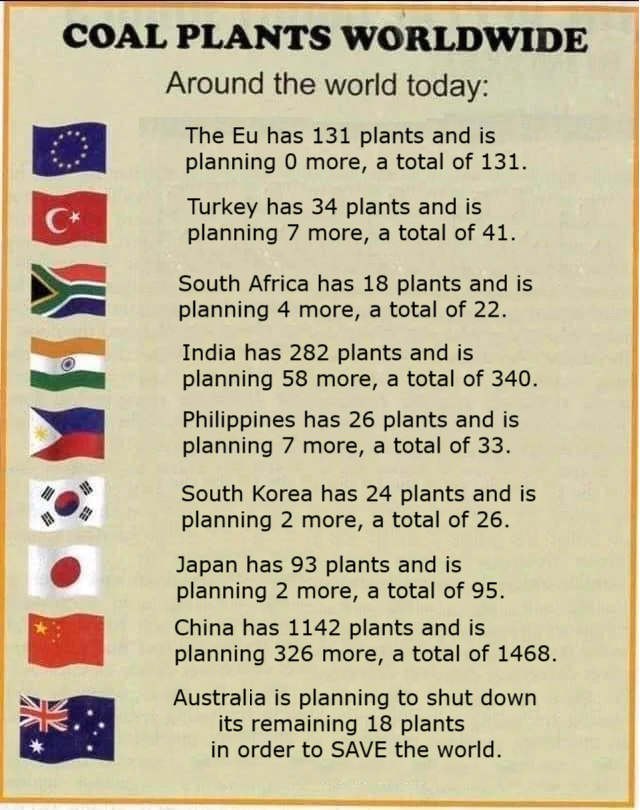
Why Overturning Net Zero Hurts China

As the image suggests, the push for Net Zero burdens western nations, but benefits China and Russia in different ways.  Russia pays lip service to the CO2 phobia, while its scientists and climate modelers know that any global warming will be modest and a boon to their high latitude country.  Thus, any economic and military self-destruction by other powers increases Russia’s position and security.

China’s gains from the Net Zero obsession have been greater and different.  First of all, China is protected from emissions reductions and economic development there can proceed unimpeded.

Secondly, and more significantly China has bet the house to be the dominant global supplier of  “Green” energy hardware like wind turbines, solar panels, electric vehicles and batteries.  Their great success makes them vulnerable should the rest of the world realize these are impractical solutions for an imaginary problem.  Walter Russell Mead explains in his article Trump Outsmarts China on Green Energy.  Excerpts in italics with my bolds and added images.

By dismantling the net-zero agenda, he ramps up economic pressure on Beijing

So much is happening so quickly in Washington these days that Donald Trump’s war on the green climate agenda has passed almost unnoticed. Steps like pulling out of the Paris Agreement, dropping electric-vehicle mandates, ending offshore leasing for wind projects, and fast-tracking fossil-fuel infrastructure would have dominated the news in quieter times.

But Mr. Trump’s climate policy matters for reasons that go beyond the climate debate. China has made Western climate policy a major focus of its economic strategy, and by pulling the rug out from under the global green agenda, the Trump administration is adding significantly to the economic pressure on Beijing.

Call it brilliant Chinese planning or gross Western incompetence, but the only real winner from the green agenda that Western governments have done so much to impose on the world is Beijing. Solar power cells, wind turbines, electric vehicles and the batteries that keep them moving: China has swiftly established dominance in one critical industry and supply chain after another.

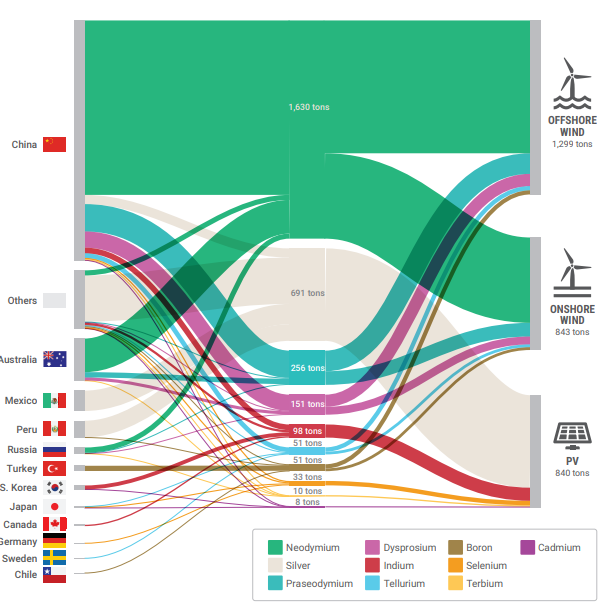
This diagram shows the origin of the metals required for meeting the 2030 goals. The left side of the diagram shows the origin, based on today’s global production of metals. The right side shows the cumulative metal demand for wind and solar technologies until 2030. From study showing tonnage of Dutch demand only.

This was eminently foreseeable. The Chinese Communist Party’s economic planners in Beijing are the most effective technocrats the world has ever known, eclipsing the fumbling Soviet planners of the Khrushchev and Brezhnev eras. Give them a set of targets, a timetable and a list of technologies to promote, and they will coordinate state policy, banking subsidies and market forces to produce world-beating industries in record time.

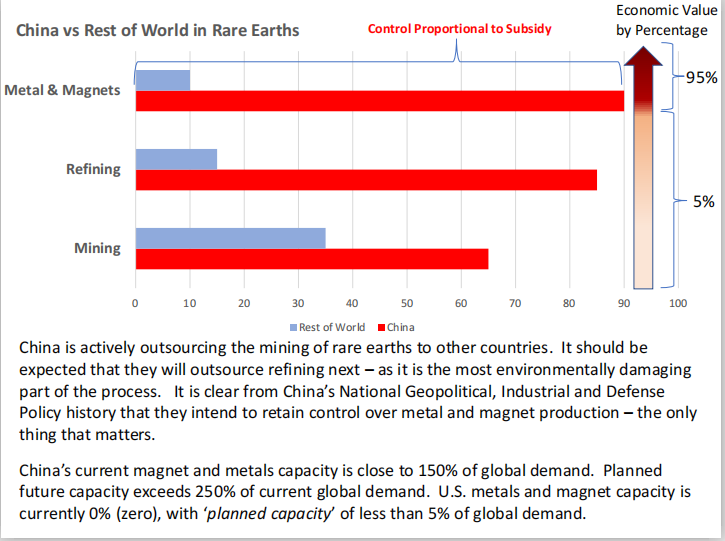
China’s production capacity for these materials and components dwarfs the rest of the world – exceeding global demand in many cases. Source: James Kennedy https://us.docworkspace.com/d/sIAGK_NAjoOC-lAY

The European and American architects of the green transition were
unintentionally creating a playing field ideally suited to China’s core
strengths, and Beijing took full advantage.

But even the most brilliant planners make mistakes. China today is a combination of extraordinary economic and industrial success and monumental failure. The ruinous demographic consequences of its one-child policy, the explosive mix of financial and social pressures wrapped up in the real-estate bubble, and the excess industrial capacity resulting from decades of aggressive state planning loom ever larger over China’s future. Mr. Trump’s proposed upending of global climate policy would transform China’s drive to dominate the energy transition from a major win to an expensive misfire for Beijing.

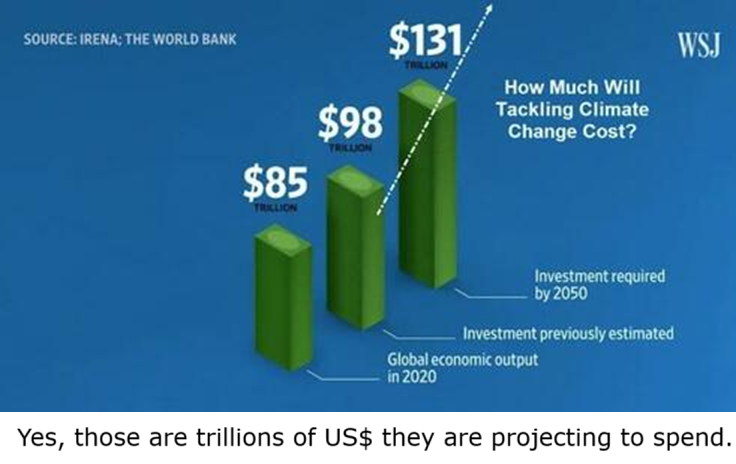
The net-zero agenda, a set of targets and strategies by Western governments and climate diplomats to arrest global warming by limiting emissions, is the most audacious international effort in diplomatic history. It seeks to persuade or compel every country on the planet to make a transition to energy production that does not add carbon dioxide to the atmosphere. The costs of the transition easily run into the trillions of dollars. The social and economic impact will transform everything from agriculture to manufacturing.

An enterprise this ambitious requires enduring political support. As time goes by, the costs of the energy transition inexorably rise, and opposition to the project grows as more interests are affected. Proponents understood this and counted on three factors to ensure that progress toward net zero continued even as opponents dug in their heels.

  1. Blame Natural Disasters on CO2 Emissions

First, as the growing costs of climate change ricocheted through the economy (driving up insurance costs in disaster-prone areas, for example, as weather risks grew), more voters would support net-zero policies.


2. Green Industries Lobby to Protect Their Interests

Second, industries that had invested in climate-friendly technologies (like automobile makers investing billions in EV-producing factories) would lobby politicians to protect their investments by maintaining the regulations and subsidies that made them profitable.

3.  Workers Wanting to protect their Green Jobs.

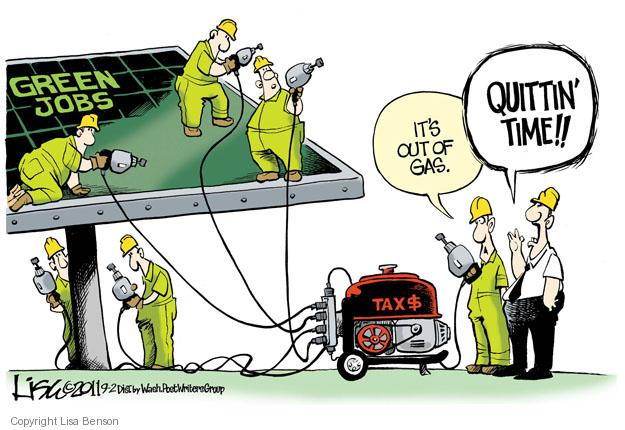
Third, as net-zero-friendly industries employed more workers, these beneficiaries of net-zero policies would support measures that protected their jobs.

Will those be enough to stop the rising wave of energy realism and loss of Net Zero faith?

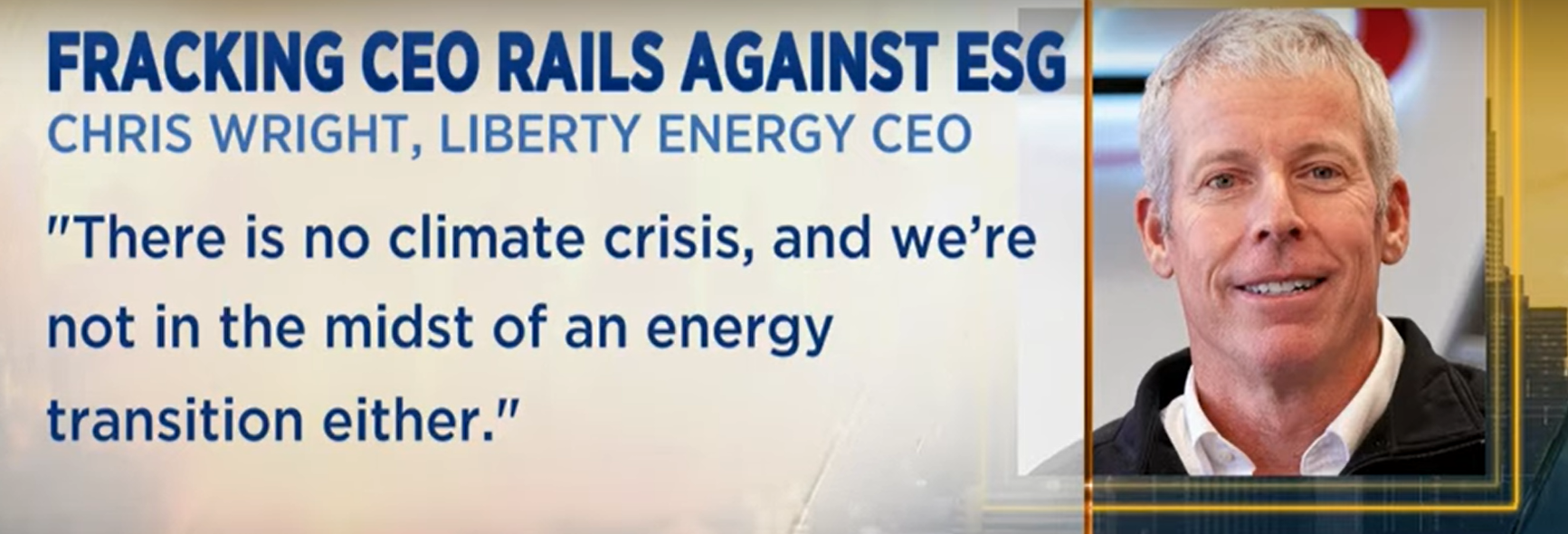
Wright is now confirmed as US Secretary of Energy

EPA priorities Announced by Director Zeldin


Funding for University Wokism Cut

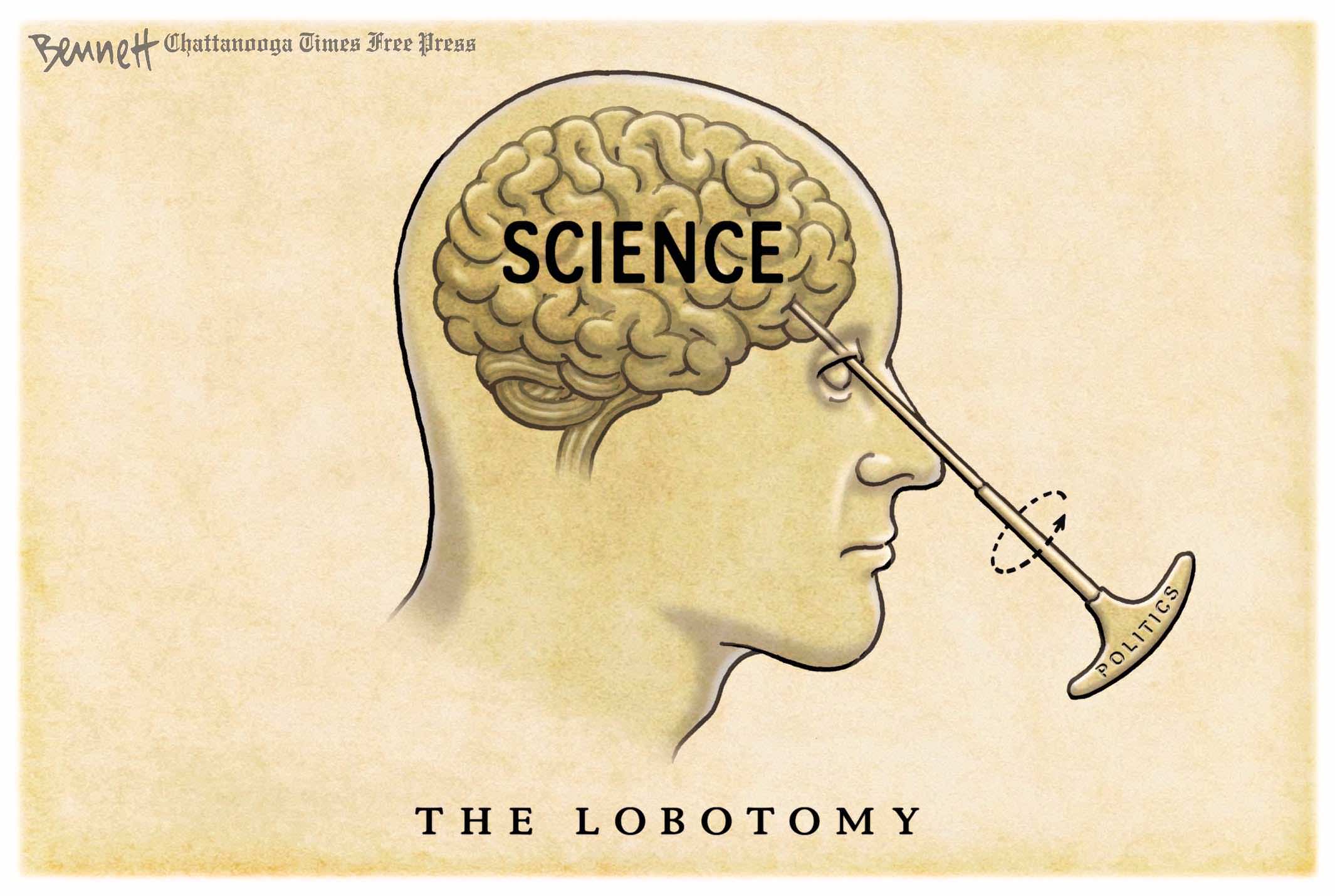
William M Briggs explains in his blog article Trump Slashing The Cancerous “The Science” Bloat: Cut Cut Cut! Excerpts in italics with my bolds and added images.
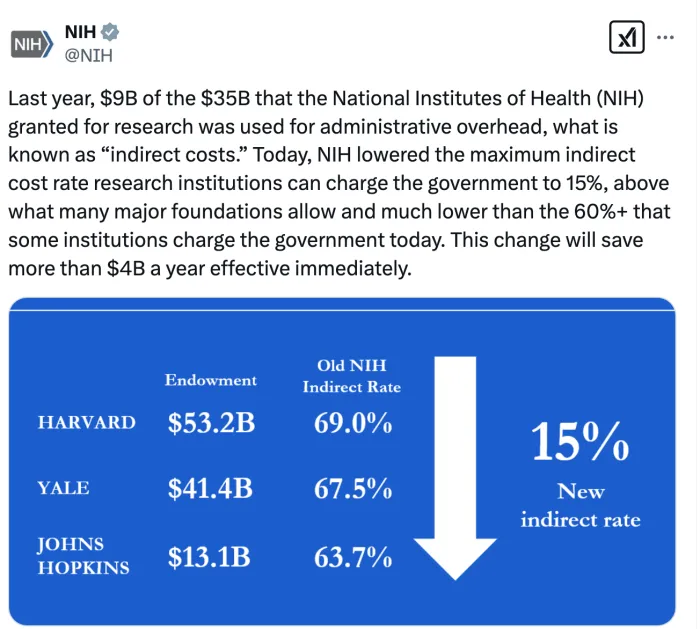
I responded on Twitter (follow me): “You might not know it, but this is a MAJOR VICTORY of outstanding proportions. Overhead is what fed the administrative beast. Overhead paid for DIE. Overhead paid for assistants to the assistants to the assistant Deans for development. Kill the Beast by starving it.”

For those new to grants, the overhead is the amount tacked on by the researchers’ institution to a researcher’s grant. If a Harvard grant is for, say, $1 million, an amount already bloated for all the usual reasons of excess, then the amount NIH pays to Harvard is $1,690,000. That extra $690,000 feeds the Beast. The Beast grows and causes the original grant totals to swell, for reasons not directly related to the research, like increased salaries for all and such like. Bureaucrats are spawned from the overhead funds. They emerge from their pods with gaping maws mewing to be fed—fed—fed! Overhead is a slow-motion monster movie.

(If you want more detail on overhead, this is a good article.)

Now I know this next part will make no sense to you, but not all are taking well the splendiferous news overhead will be treated like a bikinied teenager in a Wes Craven movie. The far-left politics journal Science screamedNIH slashes overhead payments for research, sparking outrage“.

“Outrage”, as we have said many times, is the second of only
two emotions a woke can express. The first being smug self-satisfaction.
They don’t get the first anymore, though.

Or take as representative lead covid panicker Eric Fing-Ding. Through sweet, sweet tears, he tweeted (among other things) that the cuts will “COMPLETELY DECIMATE MEDICAL & PUBLIC HEALTH RESEARCH”.

Bad news, because we’d like the effect to be greater than a mere measly ten percent. We need to whack, with pitiless remorseless brutality, at least half of governmental science funding. The Science article was more hopeful. They said “‘This is a surefire way to cripple lifesaving research and innovation,’ said a statement from the Council on Governmental Relations (COGR)”.
Crippling is much better than decimating.

Bring on the pain. Their pain. Universities have had it good too long. And we’ve had it bad.  It’s not only your old Uncle Sergeant Briggs saying this.

Here’s a ripe pull from “The natural selection of bad science” by Paul E Smaldino and Richard McElreath. These fellas are not critiquing cellar-dwelling simulacra of science, like say sociology, but what’s taken as the good stuff, like medicine.

These are not the only ones on the inside saying these things. The word is out. Science has gone bad: “A 2015 British Academy of Medical Sciences report suggested that the false discovery rate in some areas of biomedicine could be as high as 69 percent.”

Data Republican says: “Universities are among the largest drains on taxpayer money in my dataset. They receive massive funding from NGOs and USAID, and they take more government grants on top of that. Meanwhile, anonymous professors have reported to me that true scientific research is stagnating due to DEI mandates and administrative bloat.”

Understand: universities were ground zero for the DIE zombie invasion. And much worse. A tsunami of bad ideas flowed from universities over the last century. Many of those responsible are still employed there. These people need to be made to go. It’s not only DIE, but the base bloat caused by government micro-managing science. It is government, almost completely, that decided what got funded, and funded to ridiculous levels. This forced consensus-based science upon us. This has stifled much innovation, as we have seen time and again. It must be made to change, for change won’t come from within.

Now that 15% might eventually rise, given the wounded howling coming from universities (an AFMR email said “We have also launched an E-Action Alert to engage the broader scientific community and mobilize support for advocacy efforts to reverse or mitigate these changes.”).  But the rate must fall. The NIH and NSF budgets need to treated like the mess they are.

The only way to rid ourselves of this stuff is to stop feeding those producing it. We need to force a restructuring and rethinking. The old ways need to go. The only way to do this is to cause pain. Minor course corrections are not enough. Cut, cut, and cut some more. Make it sting.

See Also:

Examples of Debased Government Science

Trust Me, I’m a Scientist. Really?

Why Federalized Science is Rotten

US Energy Status Quo and Outlook–Sec. Chris Wright

Three days after he was confirmed as US Secretary of Energy, Chris Wright was interviewed on CNBC Squawk Box by Brian Sullivan.  The video clip above and one at the end provide his view of the way forward for US energy.  For those who prefer to read, I provide a transcript in italics from the closed captions, lightly edited with my bolds and some added images.  Brian refers to interviewer Brian Sullivan and Chris to Secretary Wright.

Brian: Let’s get to the topical issues, price of oil. The president says drill, baby, drill. You’re a guy that ran a fracking company. How do we balance out ringing down the price of gasoline, adding to US production, but yet not destroying the oil and gas investments as well? The CNBC audience talks about and looks at that every day.

Chris: Yeah, of course it’s a business and prices are dictated by supply and demand. But we’ve had four years of an administration that’s done everything it could to raise the cost to produce a barrel of oil. “We’re not sure if you can get a permit to drill here” or “It’s going to take 18 months. You’ve got uncertainty. You’ve got to build pipelines or gathering lines to move that product to market. “Well, we’re not sure if you can do that. You’ve got to do another study, or another this or that.” So when you add to costs of course you hurt the economics.

Now we’re going to have a more efficient operating environment. I think we’re going to see some efficiencies from scale, some efficiencies from certainty and from more credible Capital Markets. We’ve tried to starve the oil and gas industry globally, somehow thinking that’s going to help climate change. There’s been a lot of nonsense. And I think the agenda of this administration, this president, is to bring back common sense.

Brian: Can we have lower oil and gas prices and still have stocks that are not much lower than they are right now?

Chris: Oh, absolutely. Look, if you lower the cost of operations, there’s a lot of fat in the cost of operations. If you lower the cost of operations that’s going to flow through to lower prices but not necessarily lower profits.

Rough Seas for Captains of Industry

Brian: And that margin you think can remain steady and thus hold up because you were the CEO of a publicly traded company and on the board of another publicly traded company, which you have now left.

Chris:  Absolutely. And look, it’s capitalism and business is driven by profit motives that have driven innovation, that have driven efficiency and driven improvements in our system. And that’s exactly what we want going forward in nuclear and natural gas and oil and geothermal, whatever it is.

Brian: Just before this interview we were talking about tariffs and the impact. They were showing health and beauty stocks down 25%. We know there’s a pause on the potential Canada tariffs, there’s 4.4 million barrels a day we bring in from Canada on average. Much of that goes to where you’re from, the Rocky Mountains, the Denver area, the upper Midwest. What is your view on potential 10% tariffs? If it does happen, what is going to happen to US oil and gasoline prices?

Chris: Well, look. Obviously the Canadian energy system is built and integrated with the United States energy system. Those pipelines come to US refineries that are tuned to refine that heavier, more viscous crude that Canada produces. I don’t think we’re going to see that change. As the president has said, this is a drug war. This is about concerns and security at our border. This is to get everyone’s attention and focus on how can we reduce criminals and fentanyl and drugs that are a threat to American security coming in our borders. I think things are moving in a productive direction.

Brian: It doesn’t sound like you think the tariffs would ultimately occur.

Chris: I don’t know what the future will bring there, but I know we’ve got very productive dialogues right now.

Brian: I’m sure you have many friends in Canada, as do I. And you know, they’re angry about this. They said, “Well, you know what? If they want to tariff our oil, let’s just ship it to Vancouver and we’re going to sell it overseas. I would call that the nuclear option. Do you see anything like that occurring if the tariffs were to occur, Mr. Secretary?

Chris: It’s hard to build new pipeline capacity. Canada does have a West Coast pipeline, which is running today and exporting oil to Asia. But that’s 10% or less of Canadian oil production. But look, this president is aggressive. He doesn’t like the status quo. He wants to change things and improve things. We had a lot of noise and sound and fury last time he was president about tariffs and inflation. Inflation averaged less than 2% in the four years he was president.

His agenda is to lower prices and better American lives, and
I don’t see any reason to believe think that’s not going to happen.

Brian: You mentioned climate a couple of minutes ago. Coming into this Administration, one of the big question marks is: What will happen to the loans and the grants and the IRA Inflation Reduction Act monies that may be already committed to wind, to solar. This matters to CNBC’s audience. In the stock market, a lot of these companies have seen their share price decline by a lot. What is your view on the Inflation Reduction Act and wind and solar projects, and the monies that are required to produce them?

Chris: So look, I’m in this chair three days now. One of the things we are doing is looking at all the projects that are out there. Where are the commitments? Where are the uncommitted funds? What’s the best use to grow the supply of affordable, reliable, secure American energy? Tremendous opportunities there. So there’s upside here as well.

But one thing I will say, Brian, we will not follow the German model. And I think the last administration wanted to go down that road. Germany spent a half a trillion dollars, made their electricity 2 to 3 times more expensive, and they produce 20% less electricity today than they did 15 years ago. We’re not going to go down that road.

We want affordable, reliable, secure energy and
reindustrialization of America, not De-industrialization of America.

Brian: Well, that’s something I’ve obviously personally reported on many times for CNBC. Been over there, seen what’s happened. So just to be clear, because let’s be honest, a lot of Wall Street makes a lot of money investing in wind and solar and even nuclear. You were on the board of a nuclear company. So final question. Should we say that that it’s possible big wind and solar projects are still going to be okay, that they’re not going to be starved of Funds under this administration? What’s the what’s the money situation regarding some of these renewable wind and solar and nuclear type energy programs?

Chris: Look, I think you’re going to see continued development in the United States of all of these energy sources. But obviously, a flow of funds from this administration is all going to be about not what the energy technology is, but will it increase the supply of affordable, reliable, secure energy?

Will it better the lives of American consumers and
encourage businesses to build things in America?

Brian: Well, finally, on building things. The first new nuclear plant in the United States just opened up last year in Georgia, took about 20 plus years to build way over budget. You’re a nuclear guy. You were on the board of Anglo until you resigned that seat. What is the future of nuclear in the United States? Some say it’s the future. Others say way too doggone expensive up front, doesn’t pay off.

Chris: I think the future is very bright, very bright. It’s an energy dense technology that gives reliable energy at all times, with a small amount of land and a small amount of materials. Do we need innovation? Do we need some government out of the way to make it work economically? Absolutely. But that’s what America is about.

Brian: Exclusive interview with the new Secretary of Energy on Day three, Christopher Wright. Thank you very much for your time here.


“Green” Agenda is Anything But

Steve Milloy explains the deceptive “Green Agenda” label in his Real Clear Wire article There Is Nothing Green About the ‘Green’ Agenda.  Excerpts in italics with my bolds and added images.
Now that the Democrats have lost their lock grip on power, what’s a green activist to do? It’s almost comical how the climate left is trying to cloak their agenda in terms they think will melt in Republicans’ ears. For example, Jennifer Granholm, energy secretary in the Biden administration recently penned an opinion piece arguing that President Trump is playing right into Communist China’s evil hands by killing off America’s green economy. 

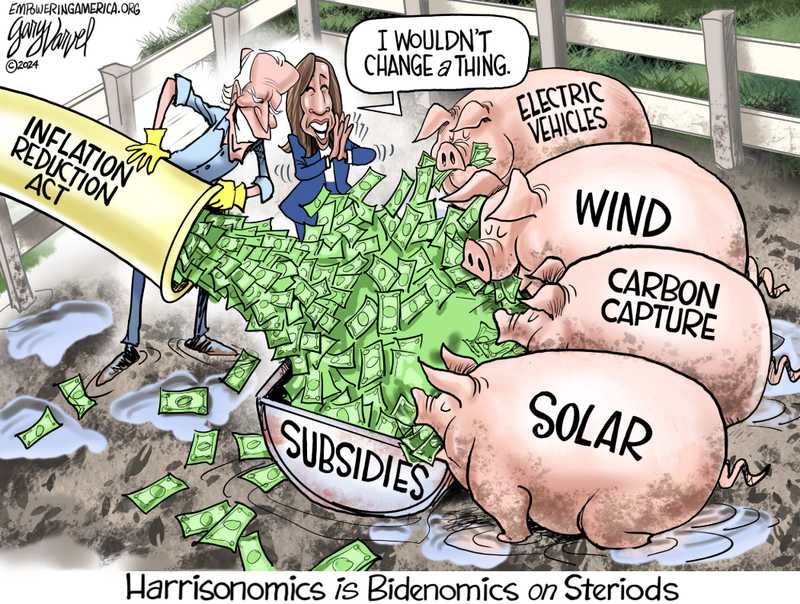
Translation: The left is furious that Trump has halted the flow of billions of taxpayers’ dollars to subsidize electric vehicles that nobody wants and only the well-off can afford. The new president is killing the “green economy,” as Granholm puts it.

There is nothing green about the climate left’s solutions. 

If the climate movement was truly sincere and intellectually honest in its desire to stop actions contributing to global environmental degradation, it would stand fast against solar panels and electric vehicles. There is nothing green about the climate left’s solutions.

There is nothing environmentally friendly about using enslaved children in the Congo to mine cobalt for lithium-ion rechargeable batteries used in EVs. They labor with crude tools and bare hands, breathing in cobalt’s toxic dust in cramped pits. Runoff infused with cobalt and other chemicals contaminate the water supply. Meanwhile, on the other side of the world, green activists sit blithely unaware or unconcerned in the comfort of their own homes. They are saving the world, they smugly assure themselves, while children suffer in an environmental hellhole.

Far removed from U.S. environmental standards, Indonesia is the center of mining and refining nickel, an essential component in EV batteries. Pea soup-thick brown emissions shroud nickel smelting operations in the Indonesian island of Sulawesi as well as the coal-fired plants that fuel them. Processing waste and chemicals potentially leach into the ground. Dust residue from both ubiquitously blanket nearby communities, while waterways tainted by mining operations have red cast.

Whatever else climate activists may try to tell us,
there is nothing green going on here.

In Brazil, near the mouth of the Amazon River, a factory refines bauxite into what eventually becomes aluminum. It had been the source of aluminum in the Ford F-150 Lightening, the company’s now cancelled all-electric pickup truck. A lawsuit alleges that toxic elements, including aluminum and other heavy metals emanating from the refinery, have been responsible for cancer, birth defects, neurological dysfunction, digestive disorders, skin conditions, and increased mortality. How can an EV be called green or good for the environment when it’s making thousands of Brazilians sick?

Elsewhere in Brazil this past Christmas season, Brazilian authorities shuttered construction of an EV factory when it was discovered that its builders were working under “slavery”-like conditions. How is that a green virtue? Perhaps green dogma holds that human worth and dignity are small sacrifices that must be made for the common good.

Solar energy, long the prize pig of the climate crowd, isn’t green either.

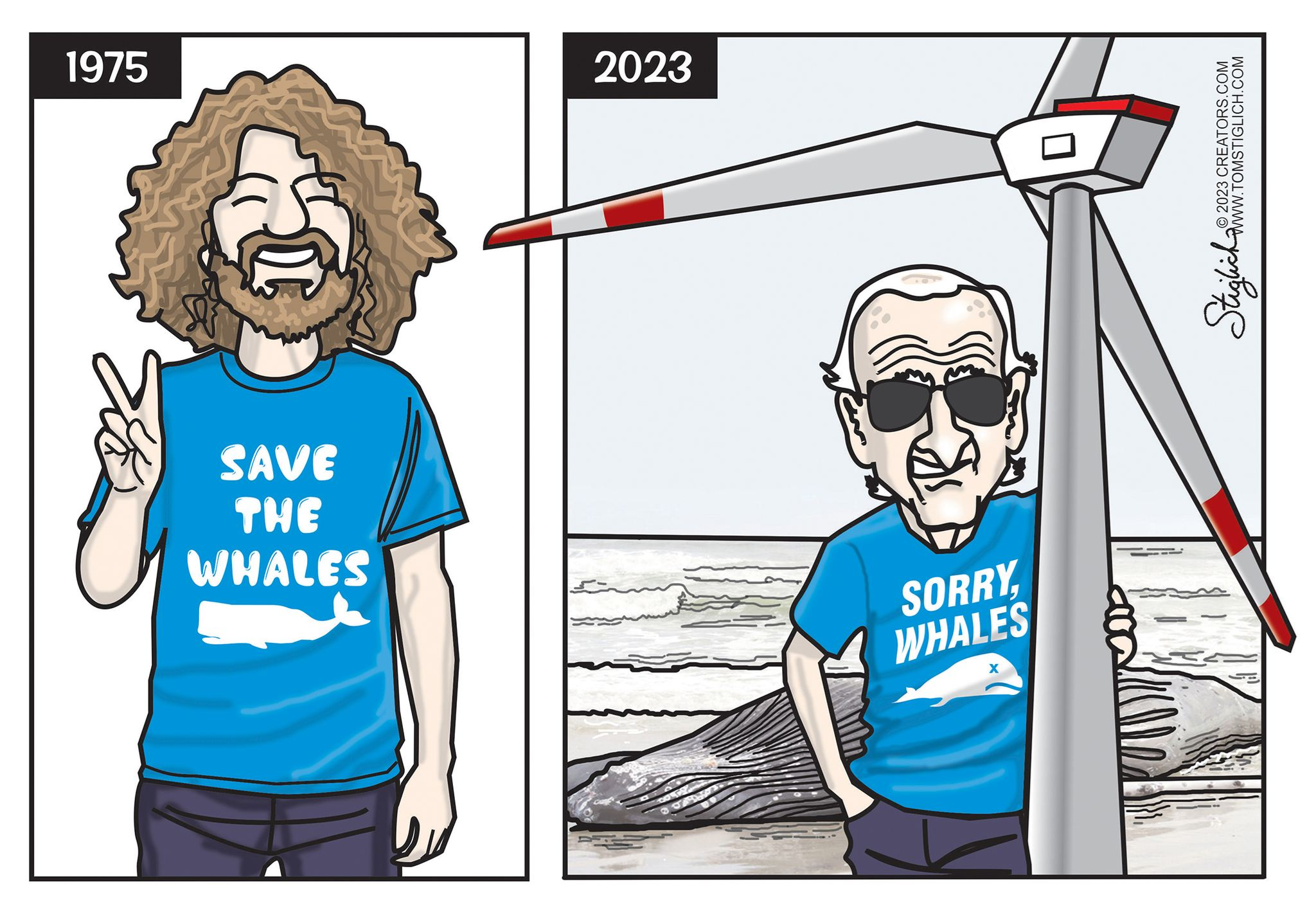
The fact that destroying forest land for solar arrays is bad for the environment should be obvious. Studies have found “the loss of carbon-dioxide gobbling forests for solar installations results in a net increase in greenhouse gas emissions.” Nor should wind farms be considered remotely green when wildlife is being killed and habitats are being disrupted. The same is true offshore, with a number of whale deaths associated with mammoth wind operations.

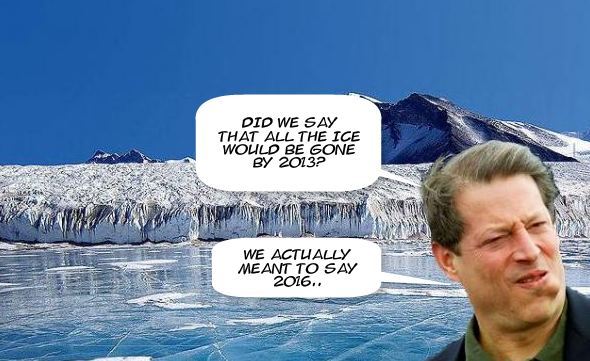
The same folks pushing “green” have been disingenuous from the start. In 1970, they assured us that human activity would cause an ice age by the 21st century and that we’d be under food rationing by 1980. Acid rain was a crisis until it wasn’t. Then global warming became the crisis, with much of New York City to be underwater by 2019. In 2008, Al Gore prophesized that the North polar cap would be gone in five years. It wasn’t. In 2009, UK Prime Minister Gordon Brown proclaimed,” We have fewer than 50 days to save our planet from catastrophe. Spoiler alert: We’re still here and thriving.

Their seemingly endless lies have been accompanied by Orwellian word games, moving from “global warming” to “change.” Now the Newspeak has shifted to “extreme weather and “overheating.

The truth is there is no green energy. No energy is clean. No energy is dirty. There are only challenges, solutions and tradeoffs. At the time of already high energy costs, choosing reliable, fossil fuel-backed energy is of paramount importance. Word sophistry from our friends on the left won’t change that.


Five More Climate Lawsuits Shot Down

Legal Newsline reports the string of climate lawfare defeats in their article Fifth judge agrees with Big Oil, dismisses another climate change case.  Excerpts in italics with my bolds and added images.

TRENTON, N.J. (Legal Newsline) – A New Jersey state court judge refuses to be the one who sets international energy standards and has thrown out a climate change lawsuit brought by the state.

Attorney General Matthew Platkin’s case is one of dozens around the country making state law claims under consumer protection and public nuisance laws, and Mercer County Superior Court judge Douglas Hurd on Feb. 5 tossed it out of court.

Hurd becomes the fifth state court judge to grant motions to dismiss by companies like Chevron and Exxon, targeted by private lawyers who earned contingency fee contracts from government officials. Platkin hired lawyers at Sher Edling for his 200-page 2022 lawsuit.

“This court’s decision is reliant upon and consistent with both federal and state courts across the country that have rejected the availability of state tort law in the climate change context,” Judge Hurd wrote.

“This court agrees that the logic and reasoning of those decisions compel dismissal of claims seeking damages by transboundary emissions.”

Hurd joins two state judges in Maryland, one in Delaware and one in New York in throwing out this type of case. His is the third dismissal since the U.S. Supreme Court declined to take up the issue, which kept Honolulu’s case going past the motion-to-dismiss stage.

The cases allege consumers would not have burned as many fossil fuels
as they did had companies been more forthright about their effects.

The litigation started with a battle over where the cases should be heard. Defendants wanted them in federal court to bolster their defense, and that strategy resulted in federal judges in California and New York granting motions to dismiss. The Second Circuit affirmed the New York dismissal.

But the Supreme Court ultimately ruled the lawsuits belonged in various state courts because plaintiff lawyers had crafted their cases to make state law claims under consumer protection statutes and for public nuisance.

At issue is whether state court judges should have the power to essentially impact the international energy market. Twenty Republican state attorneys general argued the Hawaii case involves questions of interstate and international law that can only be decided by Congress or in federal courts.

Judge Brown, in the Baltimore case, said the litigation goes beyond the limits of Maryland law, or whatever states other cases are filed in. Most municipalities and states that have filed suit are near oceans, though Boulder, Colo., has also sued.

Theodore Boutrous of Gibson, Dunn and Crutcher represents Chevron
says the New Jersey decision joins a “nearly unanimous consensus.”

These types of claims are precluded and preempted by federal law and must be dismissed under clear U.S. Supreme Court precedent. As the Court rightly held, ‘the leading and most persuasive case supporting dismissal is the Second Circuit decision in City of New York. There, the federal appeals court rejected the availability of state tort law in the climate change context.’”

Hurd says the fundamental principles of federalism in the U.S. Constitution show that state law cannot operate in areas of uniquely federal interests.

“The Hawai’i Supreme Court’s decision in City & County of Honolulu v. Sunoco is not persuasive to this court because it does not address this critical point,” he wrote.

“And that point being that ‘state law does not suddenly become presumptively competent to address issues that demand a unified federal standard simply because Congress saw fit to displace a federal court-made standard with a legislative one,'” he added, citing the New York decision.

Summary

So, after several years of waging war in the courtroom without racking up even a single victory, and with a Congress and White House that have expressed a sincere desire to do the things that could actually tackle climate change, why are the proponents of litigation continuing to waste taxpayer resources in this vain effort so a few trial lawyers can hopefully become very rich while accomplishing precisely nothing on climate change?


EPA Priorities Announced

During Trump 1.0 the appointed EPA Director summarized the false dichotomy long plaguing the agency: “If you are for the Environment, you must be against Development; and if you are for Development, you must be against the Environment.” In reality, a balance must be struck, and a new administration intends to find it.  There has been much gnashing of teeth in the legacy media over this month’s dismissal of scientists from EPA advisory boards, without mentioning the same housecleaning happened in 2021 when Biden regime took over.  Now we have an official announcement about the new EPA direction and priorities.  Text in italics with my bolds and added images.

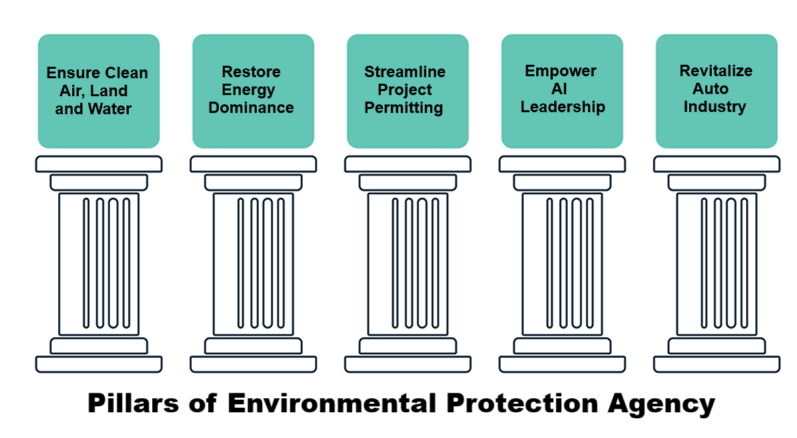
WASHINGTON – On February 4, 2025, U.S. Environmental Protection Agency (EPA) Administrator Lee Zeldin announced the agency’s Powering the Great American Comeback Initiative, to achieve the agency’s mission while energizing the greatness of the American economy. This plan outlines the agency’s priorities under the leadership of President Trump and Administrator Zeldin. The newly announced Powering the Great American Comeback initiative consists of five pillars that will guide the EPA’s work over the first 100 days and beyond:

Pillar 1: Clean Air, Land, and Water for Every American

“Every American should have access to clean air, land, and water. I will ensure the EPA is fulfilling its mission to protect human health and the environment. In his first term, President Trump advanced conservation, reduced toxic emissions in the air, and cleaned up hazardous sites, while fostering economic growth for families across the country. We remain committed to these priorities in this administration, as well as ensuring emergency response efforts are helping Americans get back on their feet in the quickest and safest way possible. We will do so while remaining good stewards of tax dollars and ensuring that every penny spent is going towards advancing this mission,” said Administrator Zeldin.

Pillar 2: Restore American Energy Dominance

“Pursuing energy independence and energy dominance will cut energy costs for everyday Americans who are simply trying to heat their homes and put gas in their cars. This will also allow our nation to stop relying on energy sources from adversaries, while lowering costs for hardworking middle-income families, farmers, and small business owners. I look forward to working with the greatest minds driving American innovation, to ensure we are producing and developing the cleanest energy on the planet,” said Administrator Zeldin.

Pillar 3: Permitting Reform, Cooperative Federalism, and Cross-Agency Partnership

“Any business that wants to invest in America should be able to do so without having to face years-long, uncertain, and costly permitting processes that deter them from doing business in our country in the first place. It will be important for the EPA to work with our partners at the state and federal levels to ensure projects are being approved and companies can invest billions of dollars into our nation. Streamlining these processes, while partnering with businesses to follow the necessary steps to safeguard our environment, will incentivize investment into our economy and create American jobs,” said Administrator Zeldin.

Pillar 4: Make the United States the Artificial Intelligence Capital of the World

“As we rapidly advance into this new age of AI, it is important that the United States lead the world in this field. Those looking to invest in and develop AI should be able to do so in the U.S., while we work to ensure data centers and related facilities can be powered and operated in a clean manner with American-made energy. Under President Trump’s leadership, I have no doubt that we will become the AI capital of the world,” said Administrator Zeldin.

Pillar 5: Protecting and Bringing Back American Auto Jobs

“Our American auto industry is hurting because of the burdensome policies of the past.

Under President Trump, we will bring back American auto jobs and invest in domestic manufacturing to revitalize a quintessential American industry. We will partner with leaders to streamline and develop smart regulations that will allow for American workers to lead the great comeback of the auto industry,” said Administrator Zeldin.

Footnote:

The Trump Administration not only cut “environmental justice” programs at the Environmental Protection Agency, they put nearly 200 staffers on leave.

According to reports, the staffers were called into a meeting on Thursday afternoon where they were informed that they were being placed on leave.

“Effective immediately, you are being placed on administrative leave with full pay and benefits. This administrative leave is not being done for any disciplinary purpose,” the email stated, according to Politico.

“Career staff made determinations on which Office of Environmental Justice employees had statutory duties or core mission functions,” EPA spokesperson Molly Vaseliou said in a statement. “As such, 168 staffers were placed on administrative leave as their function did not relate to the agency’s statutory duties or grant work. EPA is in the process of evaluating new structure and organization to ensure we are meeting our mission of protecting human health and the environment for all Americans.” Source.

Carnage: Trump Cuts ‘Environmental Justice’ Programs, Puts Nearly 200 EPA Staffers on Leave