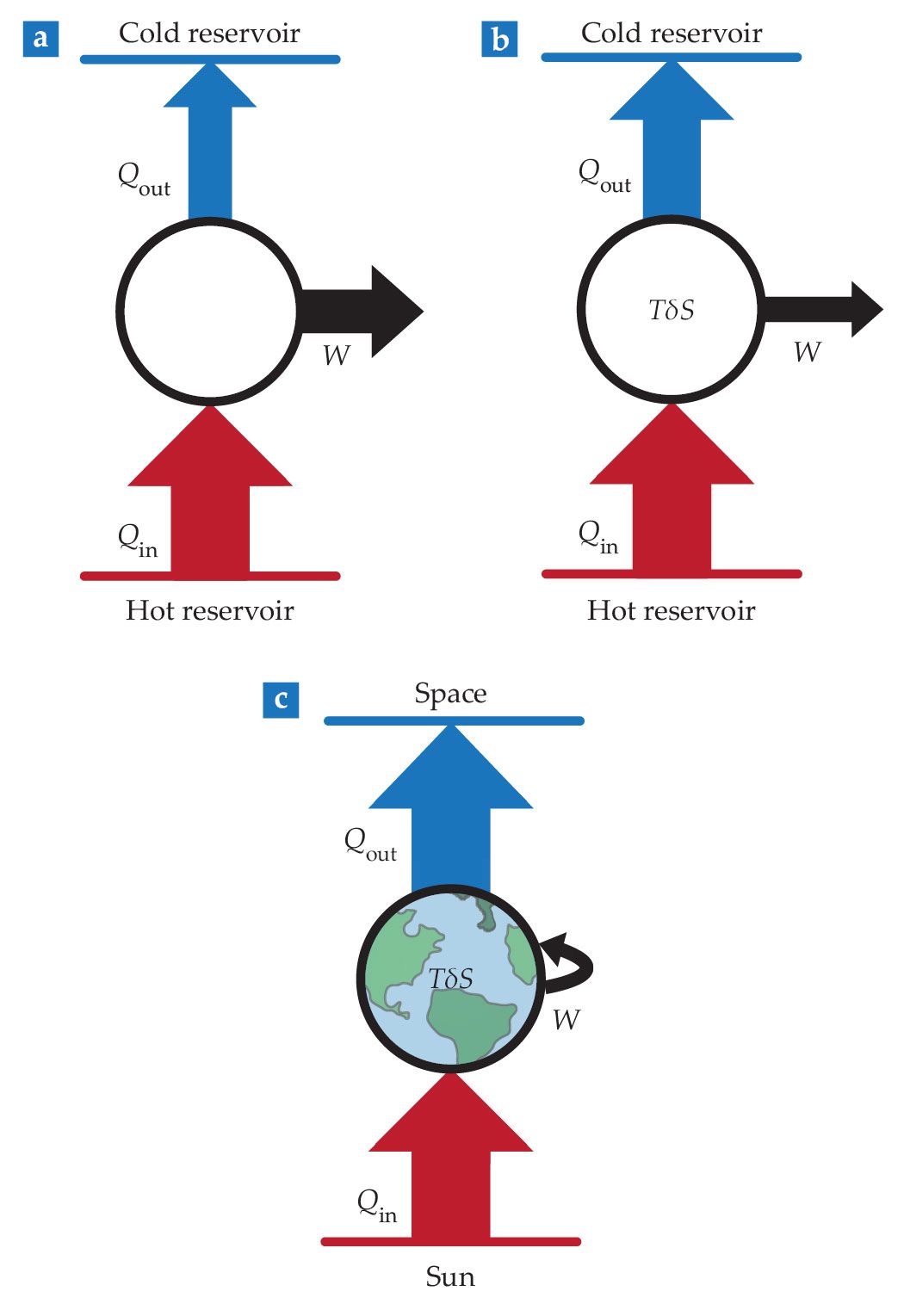
Climate as heat engine. A heat engine produces mechanical energy in the form of work W by absorbing an amount of heat Qin from a hot reservoir (the source) and depositing a smaller amount Qout into a cold reservoir (the sink). (a) An ideal Carnot heat engine does the job with the maximum possible efficiency. (b) Real heat engines are irreversible, and some work is lost via irreversible entropy production TδS. (c) For the climate system, the ultimate source is the Sun, with outer space acting as the sink. The work is performed internally and produces winds and ocean currents. As a result, Qin = Qout.
A previous post presented Michel Thizon’s description of gravity’s effect on the mass of air functioning as a climate thermostat. Some years ago Dr. Murry Salby wrote in detail about the troposphere operating as an heat engine and the stratosphere as a refrigerator. This post consists of excerpts from Salby’s textbook entitled Physics of the Atmosphere and Climate. The title is a link to pdf version of the book Salby (2012). Text in italics with my bolds and added images.
A closed system that performs work through a conversion of heat that is absorbed by it is a heat engine. Conversely, a system that rejects heat through a conversion of work that is performed on it is a refrigerator. In Chap. 6, we will see that individual air parcels comprising the circulation of the troposphere behave as a heat engine. By absorbing heat at the Earth’s surface, through transfers of radiative, sensible, and latent heat, individual parcels perform net work as they evolve through a thermodynamic cycle (2.13). Ultimately realized as kinetic energy, the heat absorbed maintains the circulation against frictional dissipation. It makes the circulation of the troposphere thermally driven.
In contrast, the circulation of the stratosphere behaves as a radiative refrigerator. For motion to occur, individual air parcels must have work performed on them. The kinetic energy produced is eventually converted to heat and rejected to space through LW cooling. It makes the circulation of the stratosphere mechanically driven. Gravity waves and planetary waves that propagate upward from the troposphere are dissipated in the stratosphere. Their absorption exerts an influence on the stratosphere analogous to paddle work. By forcing motion that rearranges air, it drives the stratospheric circulation out of radiative equilibrium, which results in net LW cooling to space. Salby (2012) p. 83.
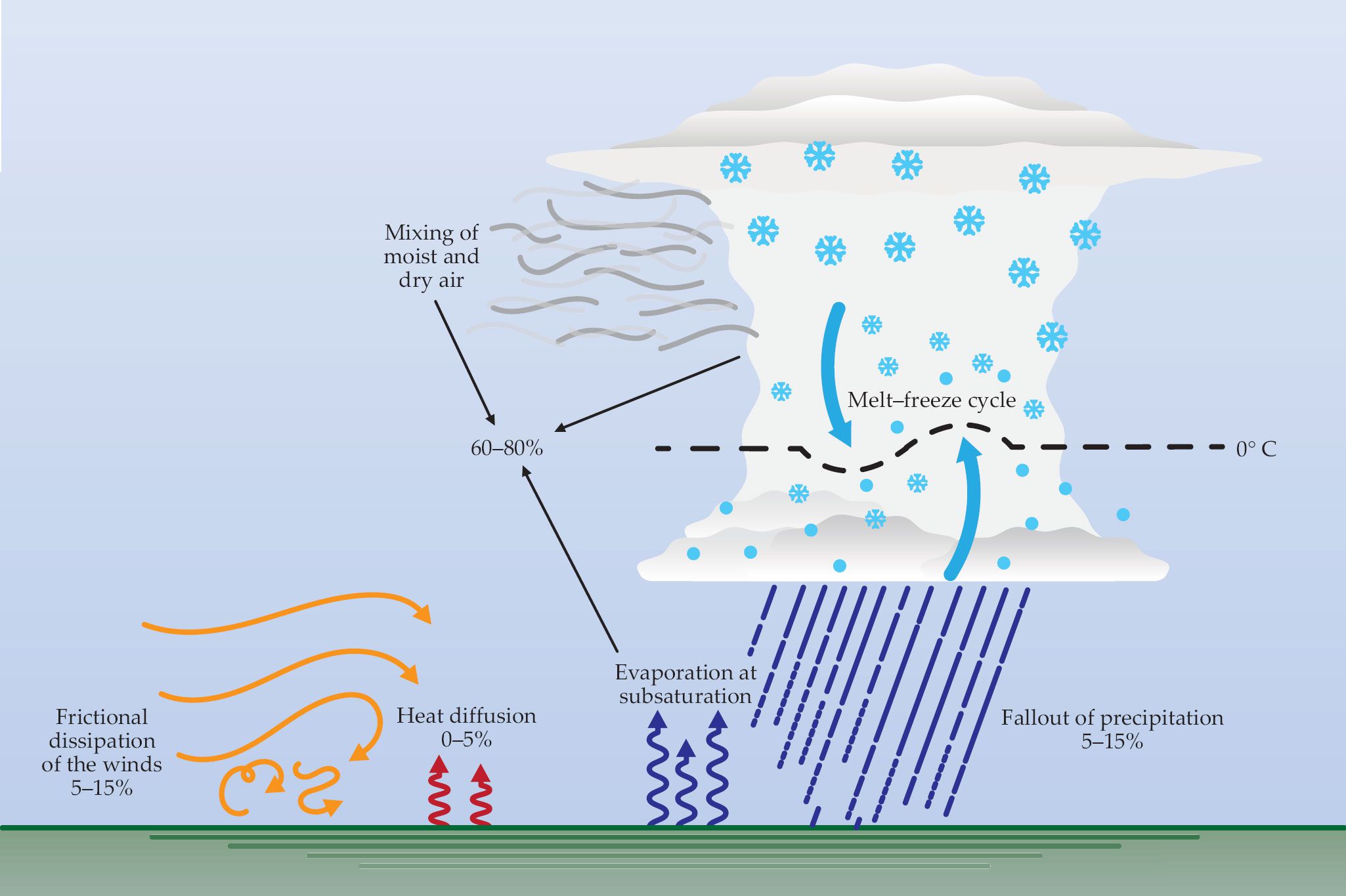
Irreversible processes in the atmosphere. Neglecting radiative processes (not shown here), the largest sources of irreversibility in the atmosphere are those associated with the hydrologic cycle: evaporation, the mixing of moist and dry air, and the melt–freeze cycle (60–80% collectively), and the fallout of precipitation (5–15%). Those contributions limit the entropy generated by frictional dissipation of the winds (5–15%), which ultimately places a limit on the work performed by the atmospheric heat engine in generating circulations. Percentages are estimated based on global climate simulations12 and idealized high-resolution simulations.8
Changes of thermodynamic state that accompany vertical motion follow from the distribution of atmospheric mass, which is determined ultimately by gravity. In the absence of motion, Newton’s second law applied to the vertical reduces to a statement of hydrostatic equilibrium (1.16). Gravity is then balanced by the vertical pressure gradient force. This simple form of mechanical equilibrium is accurate even in the presence of motion because the acceleration of gravity is, almost invariably, much greater than vertical acceleration of individual air parcels. Only inside deep convective towers and other small-scale phenomena is vertical acceleration large enough to invalidate hydrostatic equilibrium.
Because it is such a strong body force, gravity must be treated with some care. Complications arise from the fact that the gravitational acceleration experienced by an air parcel does not act purely in the vertical. It also varies with location. According to the preceding discussion, gravity is large enough to overwhelm other contributions in the balance of vertical forces. The same holds for the balance of horizontal forces. Horizontal components of gravity that are introduced by the Earth’s rotation and other sources must be balanced by additional horizontal forces. Unrelated to air motion, those additional forces unnecessarily complicate the description of atmospheric motion. Salby (2012) p. 150.
The temperature of a dry air parcel decreases with its altitude at the dry adiabatic lapse rate. To a good approximation, the same holds for a moist air parcel under unsaturated conditions – because the trace abundance of water vapor modifies thermal properties of air only slightly. Under saturated conditions, the adiabatic description of air breaks down due to the release of latent heat that accompanies the transformation of water from one phase to another. Latent heat exchanged with the gas phase then offsets adiabatic cooling and warming, which accompany ascending and descending motion. Salby (2012) p. 162
Net heat absorption and work performed by individual air parcels make the general circulation of the troposphere behave as a heat engine, one that is driven thermally by heat transfer at its lower and upper boundaries. Work performed by individual parcels is associated with a redistribution of mass: Air that is effectively warmer and lighter at the lower boundary is exchanged with air that is effectively cooler and heavier at the upper boundary. This redistribution of mass represents a conversion of potential energy into kinetic energy. The conversion of energy maintains the general circulation against frictional dissipation. Salby (2012) p. 163
The idealized behavior just described relies on heat transfer being confined to the lower and upper boundaries of the layer, where an air parcel resides long enough for diabatic influences to become important. Between the boundaries, the time scale of motion is short. For motion that operates on longer time scales, typical of the stratosphere, the evolution of an individual air parcel is not adiabatic.
Radiative transfer is the primary diabatic influence outside the boundary layer and cloud. It is characterized by cooling rates of order 1 K day−1 in the troposphere (see Fig. 8.24). Cooling rates as large as 10 K day−1 occur in the stratosphere and near cloud (Fig. 9.36). (2012) p. 164
Unlike the troposphere, buoyancy in the stratosphere opposes vertical motion because, invariably, warm (high-θ) air overlies cool (low-θ) air. To exchange effectively-heavier air at lower levels with effectively-lighter air at upper levels, work must be performed against the opposition of buoyancy. The rearrangement of mass represents a conversion of kinetic energy (that of the waves driving the motion) into potential energy. Manifest in temperature, the potential energy is dissipated thermally through LW emission to space. (2012) p. 168
See Also
In reading the textbook, I found two main reasons why Salby is skeptical of AGW (anthropogenic global warming) alarm. This knowledgeable book is an antidote to myopic and lop-sided understandings of our climate system.
- CO2 Alarm is Myopic: Claiming CO2 causes dangerous global warming is too simplistic. CO2 is but one factor among many other forces and processes interacting to make weather and climate.

Myopia is a failure of perception by focusing on one near thing to the exclusion of the other realities present, thus missing the big picture. For example: “Not seeing the forest for the trees.” AKA “tunnel vision.”
2. CO2 Alarm is Lopsided: CO2 forcing is too small to have the overblown effect claimed for it. Other factors are orders of magnitude larger than the potential of CO2 to influence the climate system.

Lop-sided refers to a failure in judging values, whereby someone lacking in sense of proportion, places great weight on a factor which actually has a minor influence compared to other forces. For example: “Making a mountain out of a mole hill.”
 Science Matters
3 comments