

Drive Your Car While You Can


Issues & Insights Editorial Board article is Take A Hike: Driving Will Be Verboten.  Excerpts in italics with my bolds and added images.

Anyone who thought electric-vehicle mandates and policies designed to force Americans out of their cars and into public transit or onto early 18th-century technology (bicycles) are intended to protect the environment is either naive or an accomplice in tyranny. The evidence has been helpfully provided by a Massachusetts senator who wants to limit how far people can travel.

We are well past the point of being fed up hearing that the world has to sharply cut greenhouse gas emissions or we’ll scorch our planet. Carbon dioxide produced by man, the fanatics assure us, is an existential threat.

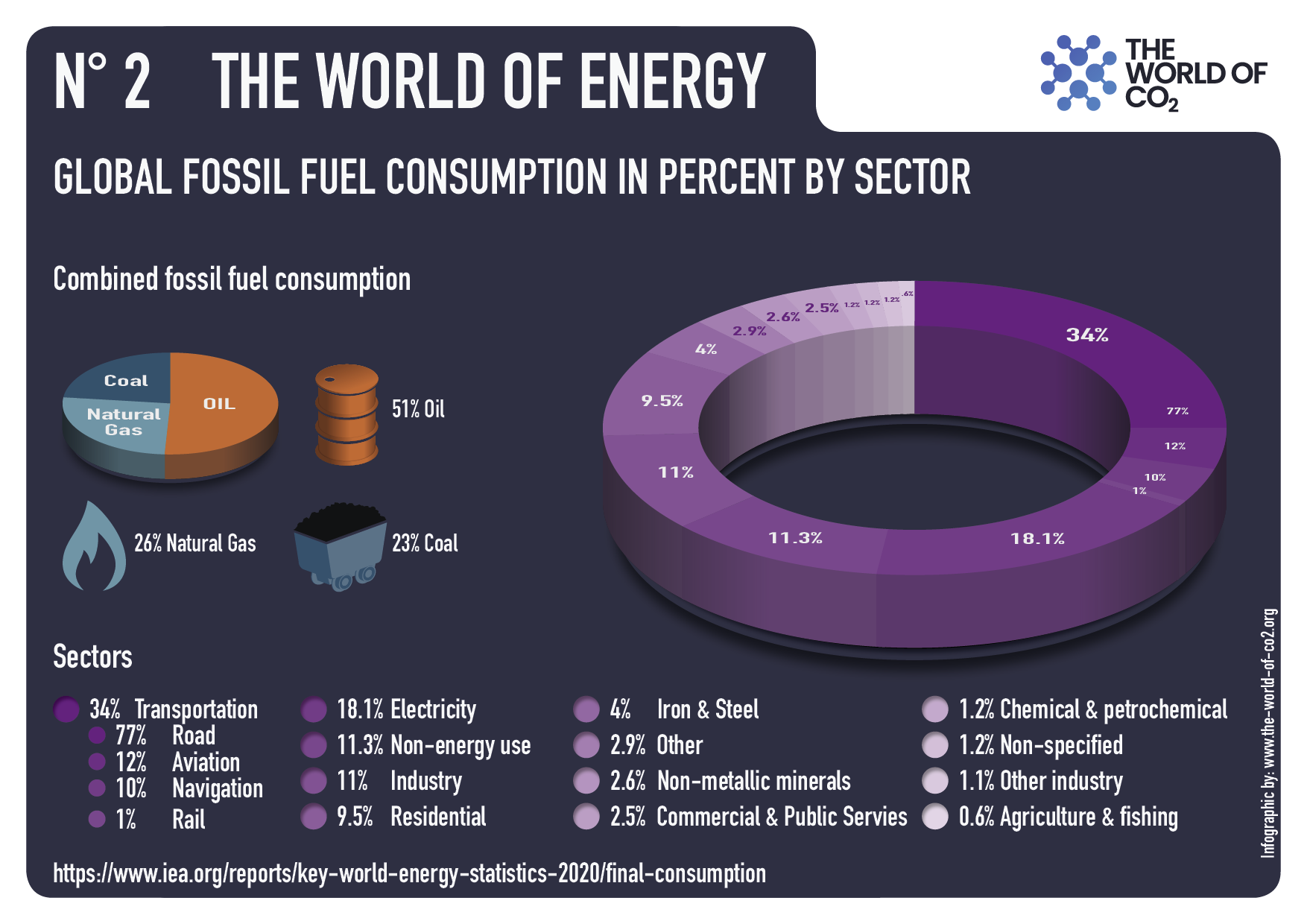
The transportation sector is the largest source of direct greenhouse gas emissions, so of course it is a ripe target for cuts for eco-tyrants. The starting point has largely been a focus on vehicles that burn fossil fuels. They must be replaced with EVs and other “emissions-free” vehicles (there are effectively no true zero-emissions automobiles), public transit, bicycles, and our own feet.

But those are only interim steps to the ultimate goal.

Massachusetts Senate Majority Leader Cynthia Stone Creem believes she knows how to cut emissions. She’s introduced a bill that would “set a statewide vehicle miles traveled reduction goal for the year 2030 and for every fifth year thereafter.” It includes a “a whole-of-government plan to reduce vehicle miles traveled and increase access to transportation options other than personal vehicles.”

It’s an example of “textbook extreme, out-of-touch policymaking,” says the Massachusetts Fiscal Alliance, which suggests that mileage vouchers might be ahead for Bay Staters.

“Creem says EVs aren’t enough – Massachusetts must limit how far you can drive, too,” the organization warns. “Her bill creates a panel to track your mileage and fine you if you go too far. She says just walk or bike instead.

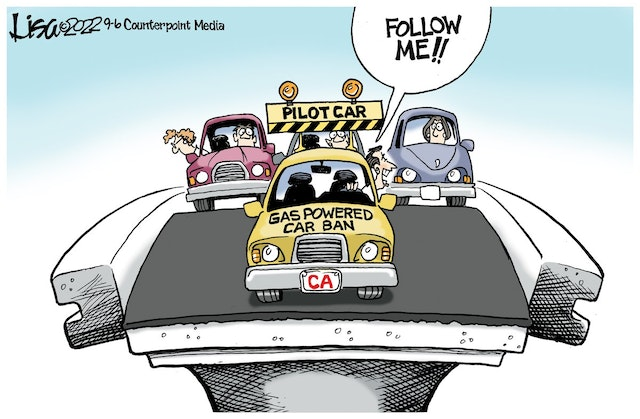
This “new” and “additional” strategy, as Creem calls it, is simply another effort to separate us from our cars in what we could loosely call the autozoic era. Similar actions include:

Do not think we are exaggerating, that there is no war on cars, because there is.

The authoritarian urges behind the assault on unfettered free travel are strong. The social engineering and malign central planning in the service of “sustainability” and “green” initiatives are hostile to freedom.

Naturally, elected officials, their high-ranking staff members, and senior government functionaries won’t have to abide by any limits. They’ll have some privileged equivalent of Zil lanes, the low-traffic VIP avenues that showed Muscovites that while everyone was equal in the Soviet Union, some were more equal than others.

No invention has liberated humanity or boosted economic prosperity more than the automobile. People choose to buy and drive cars out of convenience and need, and for their love of independence. But the political left wants to take away people’s right to make their own decisions because it suits both lower-case and upper-case “d” democrats’ tyrannical impulses. If anyone needs to take a hike, literally and metaphorically, it should be anti-car warriors.

Footnote:  Au Contraire Say the French People

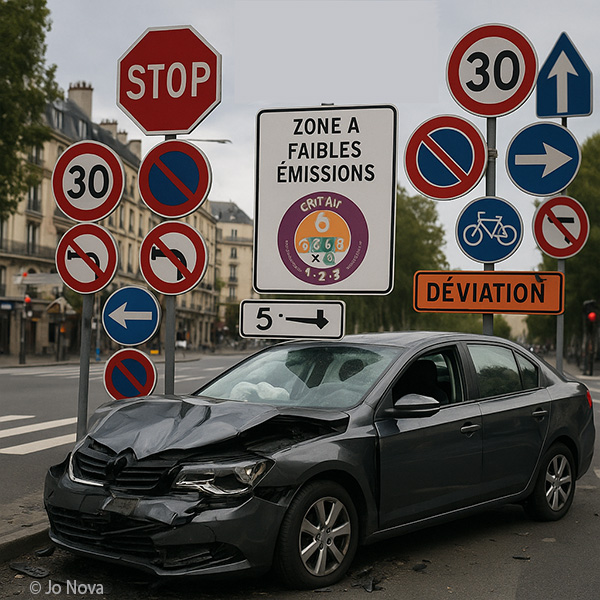
French MPs vote to scrap low-emission zones

BBC

A handful of MPs from Macron’s party joined opposition parties from the right and far right in voting 98-51 to scrap the zones, which have gradually been extended across French cities since 2019.

But it was a personal victory for writer Alexandre Jardin who set up a movement called Les #Gueux (Beggars), arguing that “ecology has turned into a sport for the rich”.

The low-emission zones began with 15 of France’s most polluted cities in 2019 and by the start of 2025 had been extended to every urban area with a population of more than 150,000, with a ban on cars registered before 1997.

Marine Le Pen condemned the ZFEs as “no-rights zones” during her presidential campaign for National Rally in 2022, and her Communist counterpart warned of a “social bomb”.

The head of the right-wing Republicans in the Assembly, Laurent Wauquiez, talked of “freeing the French from stifling, punitive ecology”, and on the far left, Clémence Guetté said green policies should not be imposed “on the backs of the working classes”.

Green Senator Anne Souyris told BFMTV that “killing [the ZFEs] also means killing hundreds of thousands of people” …

The legislation still has to go through the upper house, though it is expected to. And it doesn’t stop tyrant-municipalities from imposing their own small tourist-deterrent zones. But spread the word in case any of our politicians think this idea is not radioactively awful. They need to know it’s been tried and failed so we don’t have to repeat the experiment.

US Supremes Rein In Politicized Environmental Reviews

On May 29, 2025 SCOTUS ruled unanimously that NEPA (National Environmental Protection Act) can no longer be a tool for political activists against development projects.  The report from MSN is US Supreme Court limits environmental reviews in Utah railway ruling.  Excerpts in italics with my bolds and added images.

The U.S. Supreme Court dealt a setback to environmentalists on Thursday by allowing federal agencies to limit the scope of their reviews of the environmental impact of projects they regulate, as the justices bolstered a Utah railway project intended to transport crude oil.

The 8-0 ruling overturned a lower court’s decision that had halted the project and had faulted an environmental impact statement issued by a federal agency called the Surface Transportation Board in approving the railway as too limited in scope. The project was challenged by environmentalists and a Colorado county.

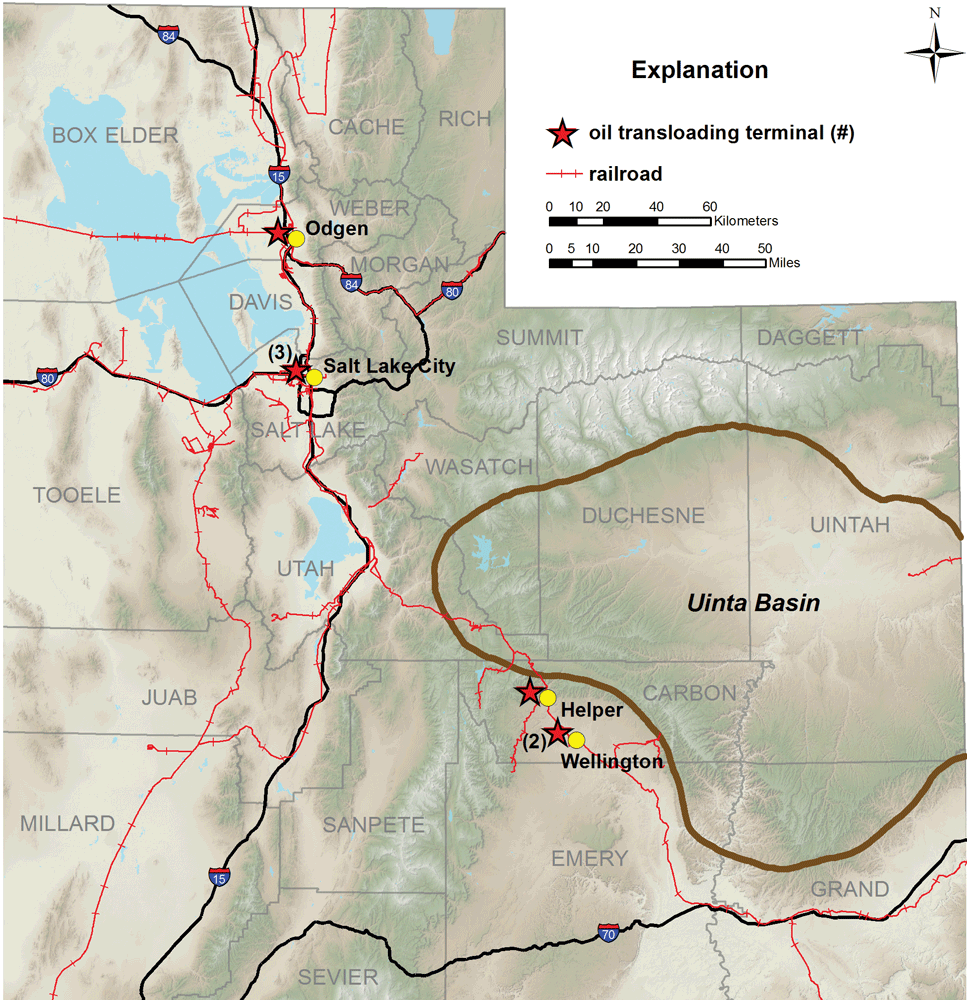
A coalition of seven Utah counties and an infrastructure investment group are seeking to construct an 88-mile (142-km) railway line in northeastern Utah to connect the sparsely populated Uinta Basin region to an existing freight rail network that would be used primarily to transport waxy crude oil.

The case tested the scope of environmental impact studies that federal agencies must conduct under a U.S. law called the National Environmental Policy Act (NEPA), enacted in 1970 to prevent environmental harms that might result from major projects. The law mandates that agencies examine the “reasonably foreseeable” effects of a project.

The ruling, authored by conservative Justice Brett Kavanaugh, was joined by four other conservative justices. The court’s three liberal justices filed a separate opinion concurring in the outcome.

Kavanaugh wrote that agencies need only consider environmental effects of a project at hand and not the “effects from potential future projects or from geographically separate projects,” and that courts must offer agencies “substantial deference” regarding the scope of these assessments.

“NEPA is a procedural cross-check, not a substantive roadblock. The goal of the law is to inform agency decision-making, not to paralyze it,” Kavanaugh wrote.

Background Post: US Supremes Hear Climate Lawfare Case to Stop Oil Railway

IER reports the news from December in article The Supreme Court Takes on a Case Involving the National Environmental Policy Act.  Excerpts in italics with my bolds and added images.

Key Takeaways

The Supreme Court recently heard a major case, Seven County Infrastructure Coalition v. Eagle County, Colorado, that will affect the scope of the National Environmental Policy Act (NEPA). The case concerns the permitting of a proposed Utah railway that would ship oil from the Uinta Basin, potentially quadrupling its oil production. The 88-mile Uinta Basin Railway would connect the oil fields of northeastern Utah to the national rail network running alongside 100 or so miles of the Colorado River to reach oil refineries on the Gulf Coast.  According to The Hill,  at issue is whether and when upstream and downstream environmental impacts should be considered as part of federal environmental reviews. The company behind the railway and a group of Utah counties appealed a lower court decision to the Supreme Court, arguing that those indirect impacts are beyond the scope of the federal reviews.

Background

The case concerns a rail line to support oil development and mineral mining. In 2021, the federal Surface Transportation Board (STB) issued a 3,600-page environmental impact statement to comply with NEPA and approved the rail line. The NEPA mandates that federal agencies assess the environmental effects of projects within their authority. Any major initiative that is managed, regulated, or authorized by the federal government must undergo a NEPA evaluation, a process that can span years and frequently exposes projects to legal challenges.

The STB analyzed the railway’s potential effects on local water resources, air quality, protected species, recreation, local economies, the Ute Indian tribe, and other factors. Environmental groups, however, sued the agency, saying that it failed to examine sufficiently how the railway might affect the risk of accidents on connecting lines hundreds of miles away and to assess emissions in “environmental justice communities” on the Gulf Coast from increased oil shipments, among other supposed shortcomings.

According to the Wall Street Journal editorial board, “a D.C. Circuit Court of Appeals panel sided with the plaintiffs and told the STB it must consider the line’s upstream and downstream effects even if they were hard to predict and beyond the control of the agency and developers. This includes the effects of oil shipments on Gulf Coast refiners and their contributions to climate change.” The appeals court ruling found that the federal STB violated the Endangered Species Act and the Interstate Commerce Commission Termination Act when it permitted the project.

Furthermore, the editorial board also explained that lower court judges—those on the D.C. and Ninth Circuits—ignored the Supreme Court’s past rulings and imposed arbitrary permitting requirements with no limiting principle. The STB lacks authority over Gulf Coast refiners and cannot prevent climate change.

Court Rulings Regarding NEPA

The Supreme Court has heard other related cases and held that agencies need not consider indirect and unpredictable impact, most recently in a 2004 case, Department of Transportation v. Public Citizen. In that case, the Supreme Court held that agencies need only analyze environmental impact with “a reasonably close causal relationship” over which they have “statutory authority” and which they can prevent.

In 2020, the Supreme Court green-lit approval for permits for the Atlantic Coast Pipeline after nearly seven years of litigation, but the pipeline was scrapped due to legal delays that raised project costs significantly. It takes an average of 4.2 years to litigate a NEPA challenge, which adds to the four or more years to obtain a federal permit. These delays are what frustrate investment in new projects, slowing job creation and economic expansion in the United States.

judge struck down a Montana coal mine permit because a federal agency did not consider the climate effects of coal combustion in Asia. Additionally, a 225-mile electric transmission line in Nebraska has been stuck in permitting for 10 years because a lower court invalidated a U.S. Fish and Wildlife permit.

Conclusion

The Supreme Court is tackling a case involving the scope of a federal environmental law, NEPA, that involves a rail line to move oil. In this case, lower courts agreed with environmental groups, who are challenging the government’s permit approval of the rail line. The case is instrumental to the issue of what should be considered when determining potential environmental damages. Congress recognizes that NEPA needs reform as delays over lawsuits have killed projects and dramatically increased their costs and it continues to debate ways to make federal permitting easier and quicker. Until that reform happens, however, Supreme Court Justices need to reign in the environmental limits of NEPA so that needed projects can progress in America.

Again, There is No Right to a Stable Climate

Twenty-two young people from across the country sued the
Trump administration over the executive orders,
which prioritize the expansion of fossil fuels.

The complaint, filed Thursday in the U.S. District Court in Montana, challenges three executive orders: “Unleashing American Energy,” “Declaring a National Energy Emergency” and “Reinvigorating America’s Beautiful Clean Coal Industry.” The lawsuit argues that with the orders, the Trump administration knowingly is advancing an agenda that will increase greenhouse gas pollution that already is stressing the global climate to a dangerous extent.

The litigation argues the situation infringes on the young people’s constitutional rights to life and liberty, as well as falling afoul of other laws approved by Congress that protect public health and the environment. The plaintiffs want the court to declare the executive orders unconstitutional, block their implementation and reaffirm the legal limits on presidential power.

“From day one of the current administration, President Trump has issued directives to increase fossil fuel use and production and block an energy transition to wind, solar, battery storage, energy efficiency, and electric vehicles (“EVs”),” the lawsuit states. “President Trump’s EOs falsely claim an energy emergency, while the true emergency is that fossil fuel pollution is destroying the foundation of Plaintiffs’ lives.”

It’s the same argument from the same people (Our Children’s Trust) that was shot down in flames just a year ago.  There were multiple attempts to undo the damaged legal maneuver to no avail.  Below is why this latest litigation should be put out of its misery at once.

 Appeals Court Rules Against Kids’ Climate Lawsuit, May 1, 2024

Ninth Circuit Court of Appeals grants Federal government’s petition for writ of mandamus in the case of Juliana v. United States, originally filed in 2015.  Ruling excerpts are below in italics with my bolds. 20240501_docket-24-684_order

In the underlying case, twenty-one plaintiffs (the Juliana plaintiffs) claim that—by failing to adequately respond to the threat of climate change—the government has violated a putative “right to a stable climate system that can sustain human life.” Juliana v. United States, No. 6:15-CV-01517-AA, 2023 WL 9023339, at *1 (D. Or. Dec. 29, 2023). In a prior appeal, we held that the Juliana plaintiffs lack Article III standing to bring such a claim. Juliana v. United States, 947 F.3d 1159, 1175 (9th Cir. 2020). We remanded with instructions to dismiss on that basis. Id. The district court nevertheless allowed amendment, and the government again moved to dismiss. The district court denied that motion, and the government petitioned for mandamus seeking to enforce our earlier mandate. We have jurisdiction to consider the petition. See 28 U.S.C. § 1651. We grant it.

In the prior appeal, we held that declaratory relief was “not substantially likely to mitigate the plaintiffs’ asserted concrete injuries.” Juliana, 947 F.3d at 1170. To the contrary, it would do nothing “absent further court action,” which we held was unavailable. Id. We then clearly explained that Article III courts could not “step into the shoes” of the political branches to provide the relief the Juliana plaintiffs sought. Id. at 1175. Because neither the request for declaratory relief nor the request for injunctive relief was justiciable, we “remand[ed] th[e] case to the district court with instructions to dismiss for lack of Article III standing.” Id. Our mandate was to dismiss.

The district court gave two reasons for allowing amendment. First, it concluded that amendment was not expressly precluded. Second, it held that intervening authority compelled a different result. We reject each.
The first reason fails because we “remand[ed] . . . with instructions to dismiss for lack of Article III standing.” Id. Neither the mandate’s letter nor its spirit left room for amendment. See Pit River Tribe, 615 F.3d at 1079.

The second reason the district court identified was that, in its view, there was an intervening change in the law. District courts are not bound by a mandate when a subsequently decided case changes the law. In re Molasky, 843 F.3d 1179, 1184 n.5 (9th Cir. 2016). The case the court identified was Uzuegbunam v. Preczewski, which “ask[ed] whether an award of nominal damages by itself can redress a past injury.” 141 S. Ct. 792, 796 (2021). Thus, Uzuegbunam was a damages case which says nothing about the redressability of declaratory judgments. Damages are a form of retrospective relief. Buckhannon Bd. & Care Home v. W. Va. Dep’t of Health & Human Res., 532 U.S. 598, 608–09 (2001). Declaratory relief is prospective. The Juliana plaintiffs do not seek damages but seek only prospective relief. Nothing in Uzuegbunam changed the law with respect to prospective relief.

We held that the Juliana plaintiffs lack standing to bring their claims and told the district court to dismiss. Uzuegbunam did not change that. The district court is instructed to dismiss the case forthwith for lack of Article III standing, without leave to amend.

Background July 2023: Finally, a Legal Rebuttal on the Merits of Kids’ Climate Lawsuit

As reported last month, the Oregon activist judge invited the plaintiffs in Juliana vs US to reopen that case even after the Ninth Circuit shot it down.  Now we have a complete and thorough Motion from the defendant (US government) to dismiss this newest amended complaint.  Most interesting is the section under the heading starting on page 30.  Excerpts in italics with my bolds and added images.

Plaintiffs’ Claims Fail on the Merits

Because Plaintiffs’ action fails at the jurisdictional threshold, the Ninth Circuit never reached—and this Court need not reach—the merits of the claims. . . Plaintiffs’ second amended complaint, which supersedes the first amended complaint, asserts the same claims that were brought in the first amended complaint, which this Court addressed in orders that the Ninth Circuit reversed. Defendants thus renew their objection that Plaintiffs’ claims fail on the merits and should be dismissed pursuant to Fed. R. Civ. P. 12(b)(6).
A. There is no constitutional right to a stable climate system.

The Supreme Court has repeatedly instructed courts considering novel due process claims
to “‘exercise the utmost care whenever . . . asked to break new ground in this field,’… lest the liberty protected by the Due Process Clause be subtly transformed” into judicial policy preferences. More specifically, the Supreme Court has “regularly observed that the Due Process Clause specially protects those fundamental rights and liberties which are, objectively, ‘deeply rooted in this Nation’s history and tradition.’”  Plaintiffs’ request that this Court recognize an implied fundamental right to a stable climate system contradicts that directive, because such a purported right is without basis in the Nation’s history or tradition.

The proposed right to a “stable climate system” is nothing like any fundamental right ever recognized by the Supreme Court. The state of the climate is a public and generalized issue, and so interests in the climate are unlike the particularized personal liberty or personal privacy interests of individuals the Supreme Court has previously recognized as being protected by fundamental rights.  “[W]henever federal courts have faced assertions of fundamental rights to a ‘healthful environment’ or to freedom from harmful contaminants, they have invariably rejected those claims.”. Plaintiffs’ First Claim for Relief must be dismissed.

B.  Plaintiffs fail to allege a cognizable state-created danger claim.

The First Claim for Relief must also be dismissed because the Constitution does not impose an affirmative duty to protect individuals, and Plaintiffs have failed to allege a cognizable claim under the “state-created danger” exception to that rule.
As a general matter:

[The Due Process Clause] is phrased as a limitation on the State’s power to act, not as a guarantee of certain minimal levels of safety and security. It forbids the State itself to deprive individuals of life, liberty, or property without “due process of law,” but its language cannot fairly be extended to impose an affirmative obligation on the State to ensure that those interests do not come to harm through other means.

Thus, the Due Process Clause imposes no duty on the government to protect persons from harm inflicted by third parties that would violate due process if inflicted by the government.

Plaintiffs contend that the government’s “deliberate actions” and “deliberate indifference” with regard to the dangers of climate change amount to a due process violation under the state-created danger exception.

First, Plaintiffs have identified no harms to their “personal security or bodily integrity” of the kind and immediacy that qualify for the state-created danger exception. . . But here, Plaintiffs allege that general degradation of the global climate has harmed their “dignity, including their capacity to provide for their basic human needs, safely raise families, practice their religious and spiritual beliefs, [and] maintain their bodily integrity” and has prevented them from “lead[ing] lives with access to clean air, water, shelter, and food.”  Those types of harm are unlike the immediate, direct, physical, and personal harms at issue in the above-cited cases.

Second, Plaintiffs identify no specific government actions—much less government actors—that put them in such danger. Instead, Plaintiffs contend that a number of (mostly unspecified) agency actions and inactions spanning the last several decades have exposed them to harm. This allegation of slowly-recognized, long-incubating, and generalized harm by itself conclusively distinguishes their claim from all other state-created danger cases recognized by the Ninth Circuit.

Third, Plaintiffs do not allege that government actions endangered Plaintiffs in particular. . . As explained above, Plaintiffs’ asserted injuries arise from a diffuse, global phenomenon that affects every other person in their communities, in the United States, and throughout the world.

For all these reasons, there is no basis for finding a violation of Plaintiffs’ due process right under the state-created danger doctrine, and Plaintiffs’ corresponding claim must be dismissed.
C. No federal public trust doctrine creates a right to a stable climate system.

Plaintiffs’ Fourth Claim for Relief, asserting public trust claims, should be dismissed for two independent reasons. First, any public trust doctrine is a creature of state law that applies narrowly and exclusively to particular types of state-owned property not at issue here. That doctrine has no application to federal property, the use and management of which is entrusted exclusively to Congress. . .Consequently, there is no basis for Plaintiffs’ public trust claim against the federal government under federal law.

Second, the “climate system” or atmosphere is not within any conceivable federal public trust.

1. No public trust doctrine binds the federal government.

Plaintiffs rely on an asserted public trust doctrine for the proposition that the federal government must “take affirmative steps to protect” “our country’s life-sustaining climate system,” which they assert the government holds in trust for their benefit.  But because any public trust doctrine is a matter of state law only, public trust claims may not be asserted against the federal government under federal law. . . The Supreme Court has without exception treated public trust doctrine as a matter of state law with no basis in the United States Constitution.

2. Any public trust doctrine would not apply to the “climate system” or the atmosphere.

Independently, any asserted public trust doctrine does not help Plaintiffs here. Public trust cases have historically involved state ownership of specific types of natural resources, usually limited to submerged and submersible lands, tidelands, and waterways. . . The climate system or atmosphere is unlike any resource previously deemed subject to a public trust. It cannot be owned and, due to its ephemeral nature, cannot remain within the jurisdiction of any single government. No court has held that the climate system or atmosphere is protected by a public trust doctrine. Indeed, the concept has been widely rejected.

For all these reasons, the Court should dismiss Plaintiffs’ Fourth Claim for Relief.

Background Post Update on Zombie Kids Climate Lawsuits: (Juliana vs. US) (Held vs Montana)

Near Normal Arctic Ice End of May 2025

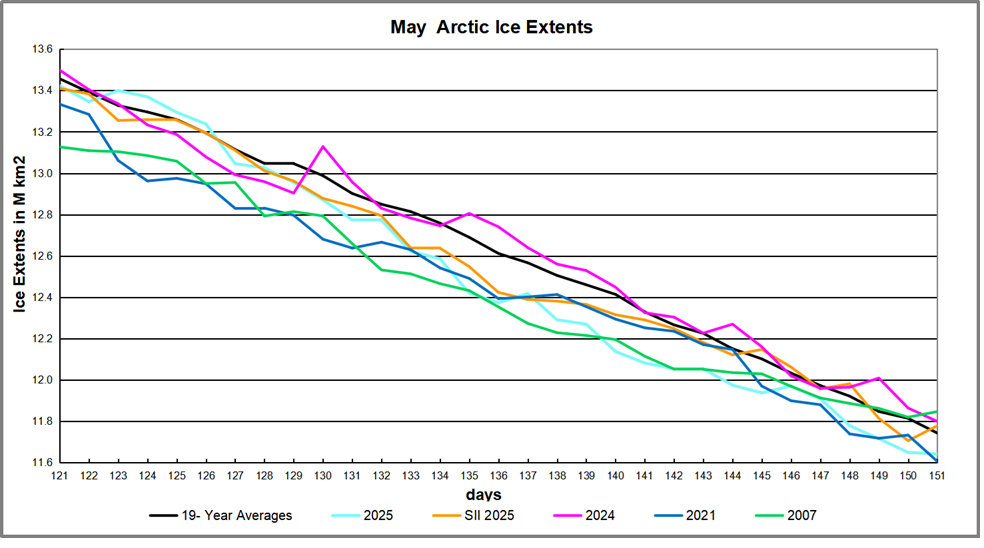
After a sub-par March maximum, in April and now in May 2025, Arctic ice has closed the gap with the 19-year average.

During May the average year loses 1.71 M km2 of ice extent.   MASIE showed 2025 losing slightly more, 1.78 M km2, while SII showed close to average at month end.   Throughout May both MASIE and SII tracked close to the 19 year average with a dipping lower mid month.

The regional distribution of ice extents is shown in the table below.

Region 2025151 Day 151 2025-Ave. 2007151 2025-2007
 (0) Northern_Hemisphere 11641897 11739951 -98055 11846659 -204762
 (1) Beaufort_Sea 1066232 1010120 56112 1059461 6771
 (2) Chukchi_Sea 941331 872869 68462 894617 46714
 (3) East_Siberian_Sea 1074738 1065906 8832 1069198 5540
 (4) Laptev_Sea 779394 828746 -49352 754651 24744
 (5) Kara_Sea 736946 831977 -95031 895678 -158732
 (6) Barents_Sea 291895 315440 -23544 323801 -31906
 (7) Greenland_Sea 670528 584085 86443 591919 78609
 (8) Baffin_Bay_Gulf_of_St._Lawrence 853619 904731 -51112 934257 -80637
 (9) Canadian_Archipelago 843914 812776 31138 818055 25859
 (10) Hudson_Bay 1046462 1081957 -35494 1077744 -31282
 (11) Central_Arctic 3216938 3220915 -3977 3230109.43 -13171
 (12) Bering_Sea 73534 115851 -42316 112352.8 -38819
 (13) Baltic_Sea 0 6015 -6015 0 0
 (14) Sea_of_Okhotsk 44702 175668 -130966 83076 -38375

The table shows  major deficits in the Pacific basins of Okhotsk and Bering combined are 173k km2. On the Atlantic side, Kara and Laptev combined to lose 144k km2.  The other regions are a mix of surpluses and deficits giving an overall result about 100k km2 below average or 0.8%.

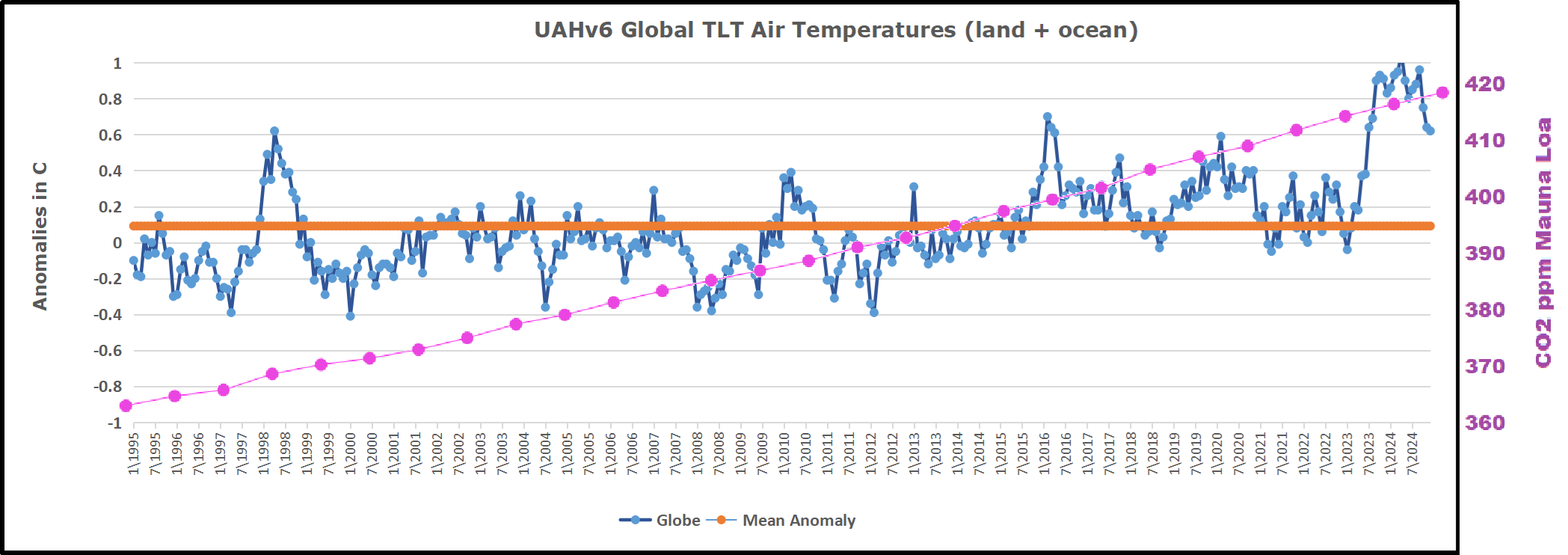
Why is this important?  All the claims of global climate emergency depend on dangerously higher  temperatures, lower sea ice, and rising sea levels.  The lack of additional warming prior to 2023 El Nino is documented in a post April 2025 UAH Temps Little Changed For Now.

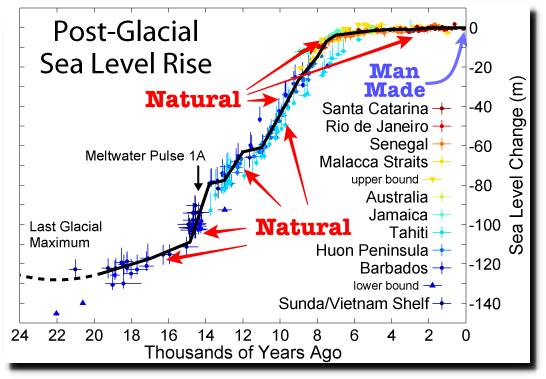
The lack of acceleration in sea levels along coastlines has been discussed also.  See Observed vs. Imagined Sea Levels 2023 Update

Also, a longer term perspective is informative:

post-glacial_sea_level