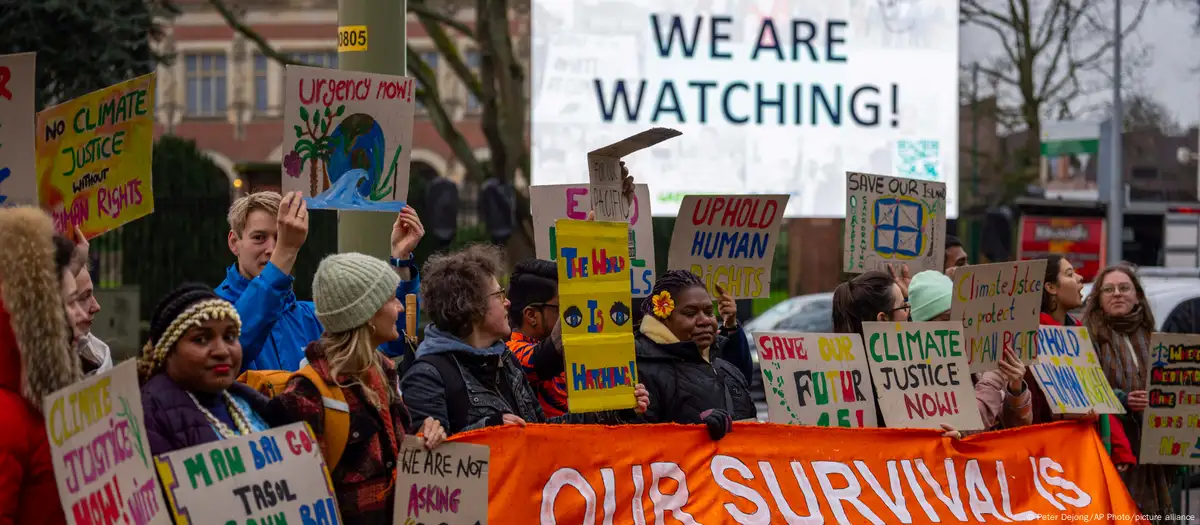
Activists hoping the opinion from the ICJ’s judges will have far-reaching legal consequences in the fight against climate change Image: Peter Dejong/AP Photo/picture alliance
The media is rampant today with headlines like these:
World Court says countries are legally obligated to curb emissions, protect climate, UN News
World’s top court says major polluters may need to pay reparations for climate harm, CNN
UN’s top court says failing to protect planet from climate change could violate international law, CBC
Top UN court says countries can sue each other over climate change, BBC
Top U.N. Court Says Countries Must Act on Climate Change, New York Times
Etc., Etc., Etc.
I asked perplexity.ai: (bolds in answer supplied by perplexity)
Question: How did the ICJ address scientists disputing IPCC reports like Clintel in its climate advice?
Answer: The International Court of Justice (ICJ), in its advisory proceedings on climate change, did not address or give consideration to scientists or groups—such as Clintel—who dispute the findings of the IPCC. Instead, the ICJ relied heavily and explicitly on the IPCC as the authoritative source on climate science throughout the process.
Key points from the available evidence:
-
The ICJ held a private meeting with IPCC scientists just before hearings began, reflecting the Court’s view of the IPCC as the “scientific pillar” of the climate change regime1.
-
This meeting was not part of the formal, public hearings and did not include scientists who dissent from the IPCC—states and organizations participating in the advisory proceedings had no opportunity to question or respond to IPCC scientists1.
-
The process was criticized for lacking transparency and procedural fairness precisely because it favored a single scientific perspective (the IPCC’s), with no indication that alternative scientific viewpoints were admitted or reviewed1.
-
The UN General Assembly’s request for the advisory opinion itself referenced the “utmost concern [for] the scientific consensus expressed” in the IPCC reports, reinforcing the Court’s mandate to treat the IPCC’s findings as the foundation for its analysis13.
-
Available commentaries and summaries of the ICJ process do not mention any engagement with scientists or organizations disputing IPCC conclusions, nor do they report that groups like Clintel were referenced or invited as experts13.
-
While the ICJ has, in rare past cases, consulted technical experts informally, in this climate case it only announced consultation with IPCC figures, reinforcing the exclusion of dissident scientific voices19.
In summary, the ICJ’s approach gave exclusive scientific authority to the IPCC and provided no forum, reference, or weight to scientists disputing its reports, such as those from Clintel13. The Court did not discuss or acknowledge the existence of such scientific disagreement in its process, instead treating the IPCC’s consensus as fact. This approach has been criticized for its lack of transparency and its failure to incorporate procedural safeguards for alternative scientific views19.
Followup Question: Why might the World Court have misunderstood the legal status of the Paris Accord?
Answer: The World Court might have appeared to misunderstand or at least oversimplify the legal status of the Paris Agreement because the Agreement’s nature is complex and somewhat ambiguous under international law, blending legally binding procedural obligations with politically framed, flexible commitments that lack sharp enforcement mechanisms.
Key reasons explaining why the Court could be seen as misunderstanding or glossing over these complexities include:
-
Legal Flexibility and Lack of Enforcement: The Paris Agreement is a treaty with binding procedural obligations but lacks strong accountability measures, sanctions, or punitive mechanisms for non-compliance1. Articles 13 and 15 establish monitoring and compliance mechanisms that are explicitly “non-intrusive” and “non-punitive,” reflecting the Agreement’s flexible, voluntary essence rather than strict legal constraints on outcome1. Courts may struggle to treat such a hybrid treaty as fully binding in the traditional sense.
-
Ambiguity over Obligation Types: The Paris Agreement distinguishes between “obligations of conduct” (procedural duties) versus “obligations of result” (achieving emission cuts). It requires parties to submit NDCs and report on implementation but does not legally bind States to achieve specific emission targets or outcomes34. This ambiguity can lead to varying interpretations of the Agreement’s binding force.
-
Differing State Practices and Interpretations: There remains disagreement among states and experts about whether the Paris Agreement creates firm legal obligations to prevent climate change or is largely aspirational with voluntary commitments6. Some states perceive it as political guidance rather than a hard treaty, influencing how international bodies perceive its weight.
-
Constraints of International Litigation and Court Jurisdiction: International courts like the ICJ have limited jurisdiction and cannot enforce treaty provisions on states unwilling to submit to their authority1. This constrains how formally the Court can treat the Agreement’s legal status, especially when major emitters are outside its compulsory jurisdiction16. The Court’s advisory role means it clarifies law based on existing commitments but cannot enforce or create new obligations.
-
Interaction with Customary International Law: Some legal scholarship suggests that customary international law—independent but related to treaty law—may impose broader climate duties on states, which complicates whether the Court grounds its decisions on the Paris Agreement alone or on evolving international legal norms1.
In sum, the World Court may have been perceived as misunderstanding the Paris Agreement’s legal status because the Agreement is simultaneously a legally binding treaty in form with procedural and transparency obligations, yet it remains politically flexible, non-punitive, and ambiguous regarding enforcement or specific outcome obligations. This hybrid nature poses challenges for courts in characterizing it strictly as a binding treaty imposing strong legal duties, thus potentially giving the appearance of oversimplification or misunderstanding in the Court’s advice.
Therefore, the Court’s approach likely reflects the difficulty of interpreting a treaty designed to maximize participation through flexibility rather than strong binding commitments, rather than a simple misunderstanding of the Paris Agreement’s status1346.
My Summary
Despite the courtroom venue and judges participating in rendering an opinion, this was a political, not a legal process. A court of law seeks truth through an adversarial process whereby parties advocate for two or more viewpoints on the matter at hand, including facts and logic of the arguments. Here there was no hearing and weighing of differing evidence and perspectives, just a preconceived partisan political declaration.


 Science Matters
lack sharp enforcement mechanisms
I suspect this goes back to the USA Obama administration not wanting to put the Paris ‘Agreement’ to a democratic vote for fear of losing.
LikeLike
True, oldbrew. If there were enforcement measures, the accord would be deemed a “treaty” requiring senate approval, not iust a president’s signature.
LikeLiked by 1 person
The actual judgement does not say anything new. For instance take Paragraph 179
a cardinal principle of the climate change treaty framework, which is incorporated in several
provisions of the climate change treaties (see UNFCCC, preamble, Article 3, paragraphs 1 and 2, and Article 4; Kyoto Protocol, Article 10; Paris Agreement, Article 2, paragraph 2, and Article 4,
paragraphs 3, 4 and 19; see also paragraphs 148-151 above)……
The Paris Agreement 2016 Article 4.1 states
Similarly, the UN Framework Convention on Climate Change (UNFCCC) 1994 states in Article 4.7
The extent to which developing country Parties will effectively implement their commitments under the Convention … will take fully into account that economic and social development and poverty eradication are the first and overriding priorities of the developing country Parties.
To put it bluntly, it is only developed countries that are obligated to reduce their emissions drastically in the foreseeable future. If the US is excluded, these countries had less than 15% of global CO2 emissions from according to the Global Carbon Budget (used by the IPCC in AR6 2022. This means that a few countries legally obliged to pursue costly and harmful policies which (even in the beliefs on the climate alarmists) are pretty much useless in tackling the claimed problem. See, for example, the key charts from the UNEP Emission Gap Reports 2018 and 2024. A major change is to increase the 1.5C 2030 target from around 24 GtCO2e to 33 GtCO2e. Note also that the 1.5C and 2C pathways have origins in 2020 and not from 2024 or 2025.
LikeLike