Scare du jour Marine Heat Waves

If you watch legacy media, you must also be wondering after seeing all the current headlines about Marine Heat Waves raising the ocean to its boiling point.

Ocean heatwaves are breaking Earth’s hidden climate engine, Science Daily

The Pacific Ocean is overheated, making fall feel like summer, CBC

The ‘blob’ is back — except this time it stretches across the entire north Pacific, CNN

Record marine heatwaves may signal a permanent shift in the oceans, New Scientist

Global warming drives a threefold increase in persistence and 1 °C rise in intensity of marine heatwaves, PNAS

Etc., etc. etc.

The last one is the paper driving this recent clamor over Ocean SSTs Marcos et al. 2025 From the abstract:

We determine that global warming is responsible for nearly half of these extreme events and that, on a global average, it has led to a three-fold increase in the number of days per year that the oceans experience extreme surface heat conditions. We also show that global warming is responsible for an increase of 1 °C in the maximum intensity of the events. Our findings highlight the detrimental role that human-induced global warming plays on marine heatwaves. This study supports the need for mitigation and adaptation strategies to address these threats to marine ecosystems.

The coordinated media reports are exposed by all of them containing virtually the same claim:

As climate change causes our planet to warm, marine heatwaves are
becoming more frequent, more intense, and longer lasting. 
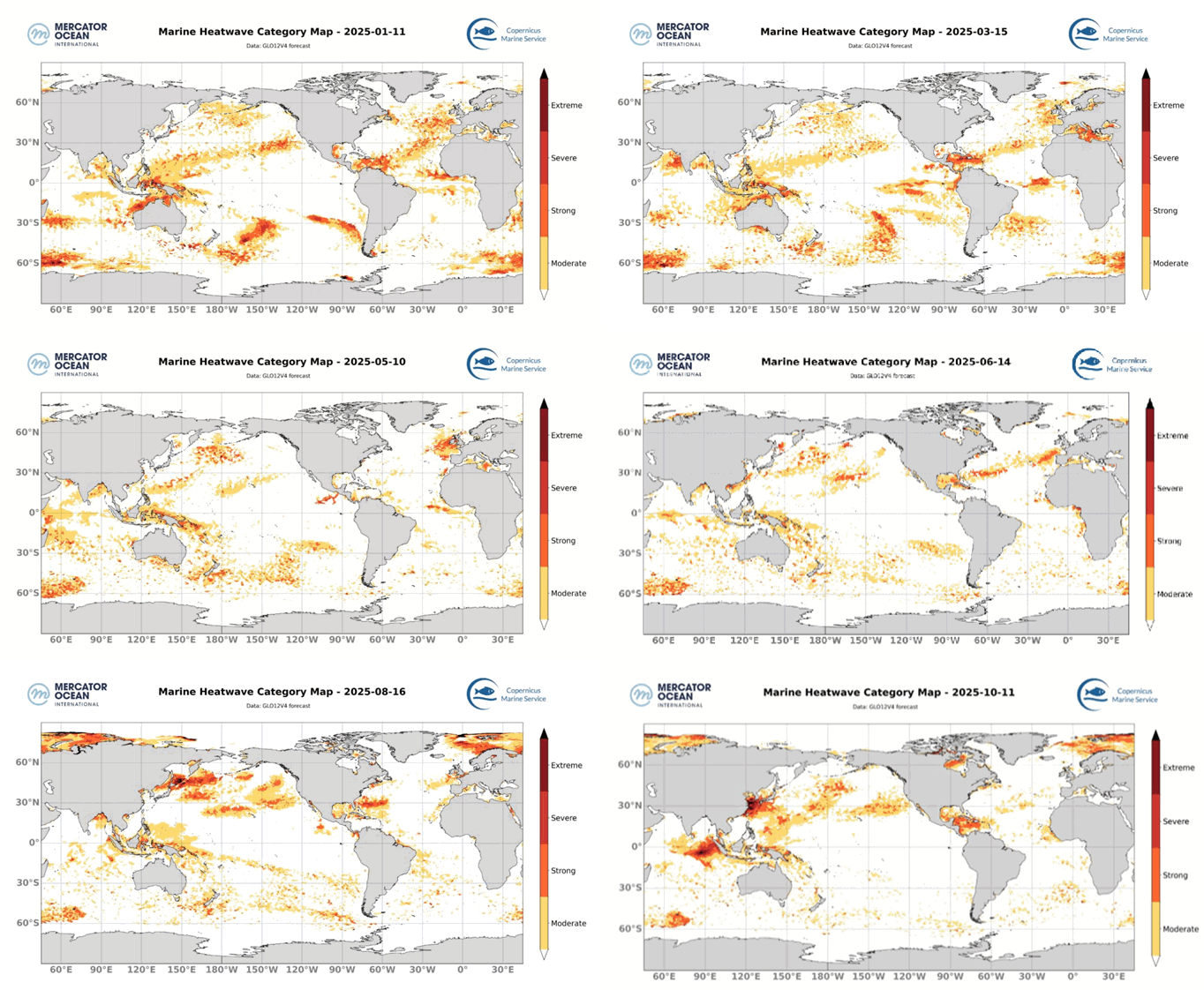
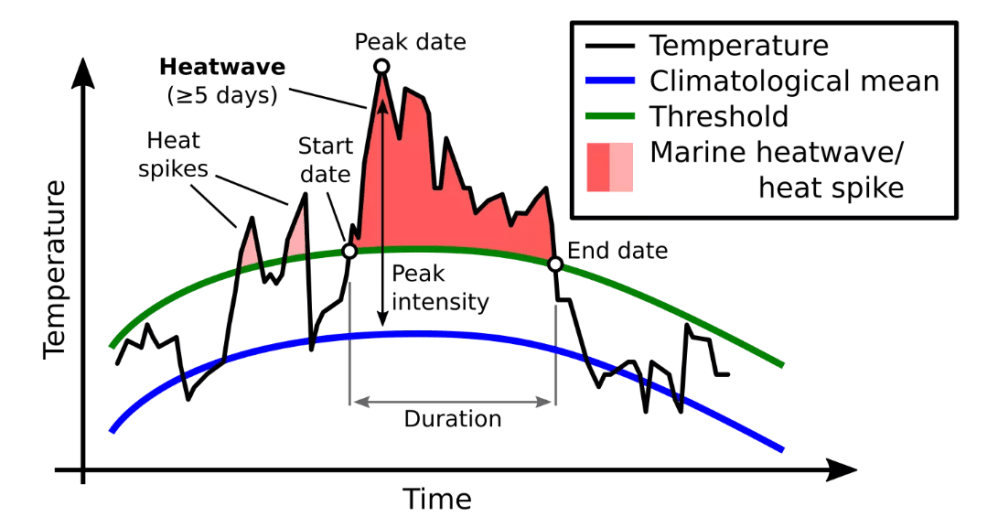
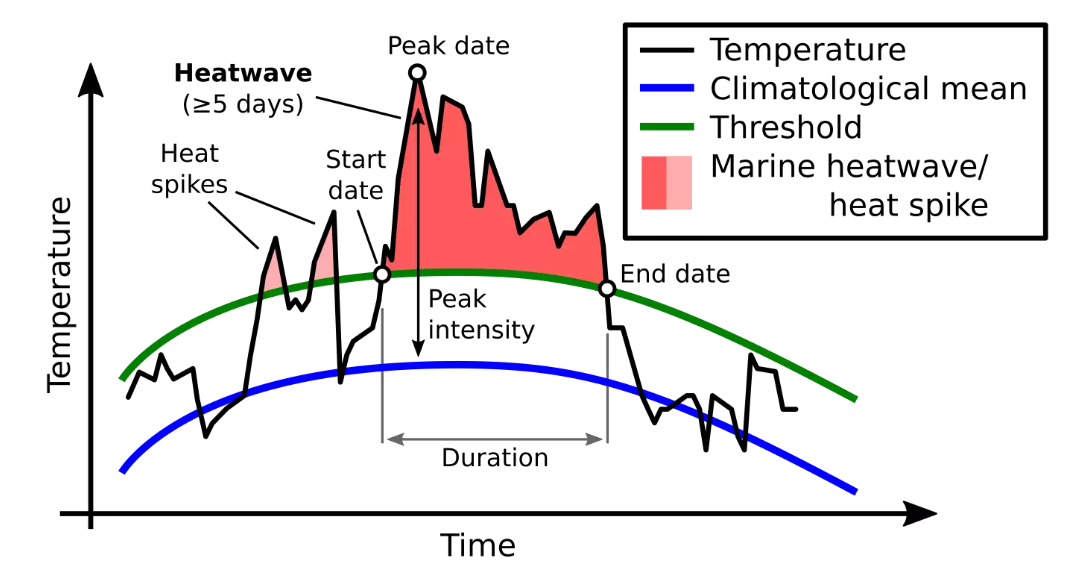
Animation shows locations of moderate to severe MHWs mid-month 2025 January to October. A marine heatwave is defined as one where the measured temperature is within 10% of the maximum values observed (i.e., above the Threshold (90th quantile) , for at least 5 consecutive days. For this, the intensity is compared to the difference between the climatological mean and the 90th percentile value (threshold). A marine heatwave intensity between 1 and 2 times this difference corresponds to a heatwave of moderate category; between 2 and 3 times, to a strong category; between 3 and 4 times, to a severe category; and a difference greater than 4 times corresponds to an extreme category.

First some background context on the phenomena (in italics with my bolds).
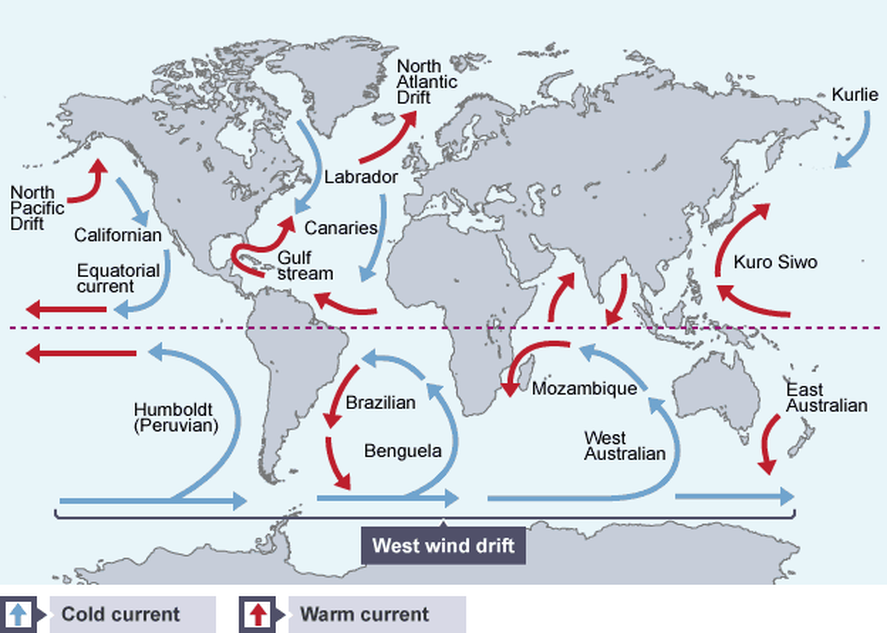
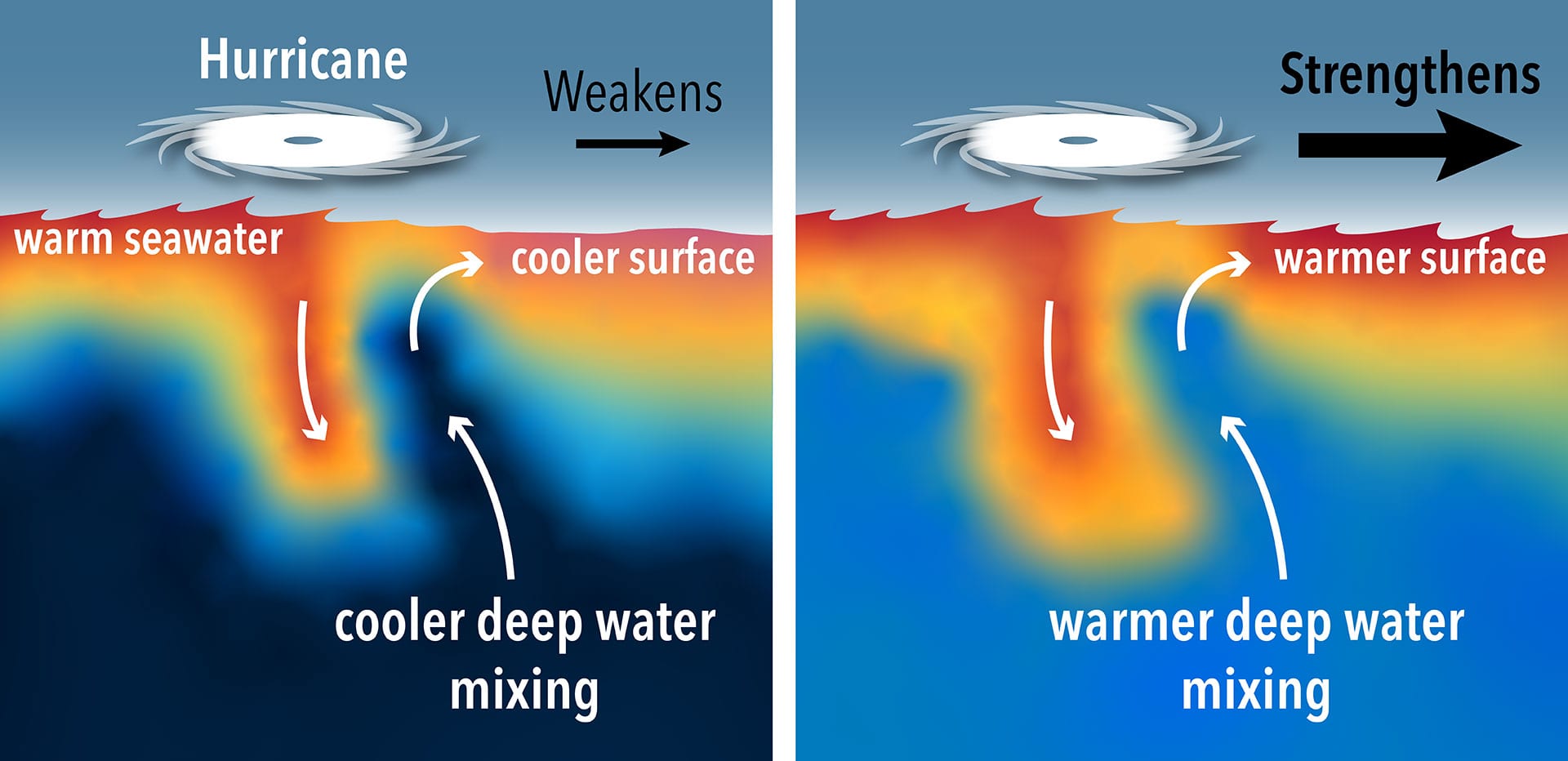
Background from perplexity.ai How Do Warm and Cool Ocean Blobs Circulate?

Warm and cool ocean blobs circulate through distinct oceanic and atmospheric processes, often linked to major currents and atmospheric patterns.

Warm ocean blobs, such as the “warm blob” in the northeast Pacific, form due to atmospheric circulation changes triggered by factors like Arctic warming. This leads to a high-pressure system over the region, weakening westerly winds and reducing ocean heat loss, causing surface waters to warm and creating persistent warm anomalies. The formation of these warm blobs involves a feedback loop between weakened winds, reduced ocean-atmosphere heat exchange, and ocean circulation, which retains heat in the mixed layer of the ocean.

Cool ocean blobs, like the North Atlantic “cold blob,” are influenced by weakening of the Atlantic Meridional Overturning Circulation (AMOC). This circulation moves warm, salty water northward, which cools, sinks, and then the cooler deep water travels southward in a conveyor-belt style flow. The cold blob forms when excess freshwater from ice melt dilutes the salty water, reducing its density and sinking ability, weakening this circulation and causing cooler surface water to persist. This cooling also affects the atmosphere by reducing water vapor, which decreases greenhouse effect locally and amplifies the cold anomaly, creating a coupled ocean-atmosphere feedback loop.

In summary, warm and cool ocean blobs circulate through a combination of ocean current dynamics and atmospheric interactions. Warm blobs form where atmospheric changes reduce ocean heat loss and circulation shifts retain heat, while cool blobs occur where circulation weakens, allowing cooler, less dense waters to persist and affect atmospheric conditions as well.
Then a summary of the issues undermining the alarmists’ claim.

From perplexity.ai What are reasons to doubt climate change is increasing marine heatwaves?

There are several reasons to doubt that climate change is definitively increasing the frequency, intensity, duration, and spatial extent of marine heatwaves, based on some ongoing scientific debates and uncertainties.

Natural Variability and Other Factors

♦  Marine heatwaves are influenced by natural climate variability, such as El Niño, Pacific Decadal Oscillation (PDO), and other oceanic and atmospheric processes. These phenomena can cause fluctuations in sea surface temperatures independent of long-term climate change, leading to periods of warmer ocean conditions that may be mistaken for climate-driven trends.

♦  Some studies emphasize the role of internal ocean variability, which can cause significant short-term temperature anomalies without requiring a direct link to anthropogenic climate change.

Complexity of Attribution

♦  The attribution of marine heatwave trends specifically to climate change involves complex modeling and statistical analysis, which can have uncertainties. Certain models suggest that long-term temperature increases are the primary driver, but the contribution of natural variability remains significant and sometimes difficult to separate clearly from climate signals.

♦  Regional differences and localized oceanic processes can obscure the global patterns, leading some scientists to argue that not all observed phenomena are directly attributable to climate change, particularly in areas with strong natural variability.

Limitations of Climate Models

♦  Climate models predicting future marine heatwave conditions depend heavily on assumptions about greenhouse gas emissions and other factors. These models often have limitations in resolution and in capturing small-scale processes, which could lead to overestimations or underestimations of climate change impacts.

Data Gaps and Uncertainties

♦  Although current observations show increasing trends in marine heatwaves, data gaps exist, especially in remote or deep-sea regions, making comprehensive global assessments challenging. These gaps contribute to uncertainty regarding the full extent and causality of observed changes.

♦  The precise long-term ecological impacts and possible adaptation or resilience mechanisms of marine ecosystems also remain uncertain, complicating the understanding of climate change’s role versus natural variability.

Summary

While a considerable body of evidence supports the role of climate change in increasing marine heatwaves, skepticism persists due to the influence of natural variability, model limitations, regional differences, and data gaps. These factors suggest that attribution is complex, and ongoing research continues to refine our understanding of the relative contributions of human influences and natural climate fluctuations.
Finally, a discussion of a specific example revealing flawed methods supposedly connecting CO2 emissions to marine heatwaves.

Much Ado About Marine Heat Waves

The promotion of this scare was published in 2022 at Nature by Barkhordarian et al. Recent marine heatwaves in the North Pacific warming pool can be attributed to rising atmospheric levels of greenhouse gases.  This post will unpack the reasons to distrust this paper and its claims.  First the Abstract of the subject and their declared findings in italics with my bolds.

Abstract

Over the last decade, the northeast Pacific experienced marine heatwaves that caused devastating marine ecological impacts with socioeconomic implications. Here we use two different attribution methods and show that forcing by elevated greenhouse gases levels has virtually certainly caused the multi-year persistent 2019–2021 marine heatwave. There is less than 1% chance that the 2019–2021 event with ~3 years duration and 1.6 ∘C intensity could have happened in the absence of greenhouse gases forcing. We further discover that the recent marine heatwaves are co-located with a systematically-forced outstanding warming pool, which we attribute to forcing by elevated greenhouse gases levels and the recent industrial aerosol-load decrease. The here-detected Pacific long-term warming pool is associated with a strengthening ridge of high-pressure system, which has recently emerged from the natural variability of climate system, indicating that they will provide favorable conditions over the northeast Pacific for even more severe marine heatwave events in the future.
Background on Ocean Warm Pools

Wang and Enfield study is The Tropical Western Hemisphere Warm Pool Abstract in italics with my bolds.

Abstract

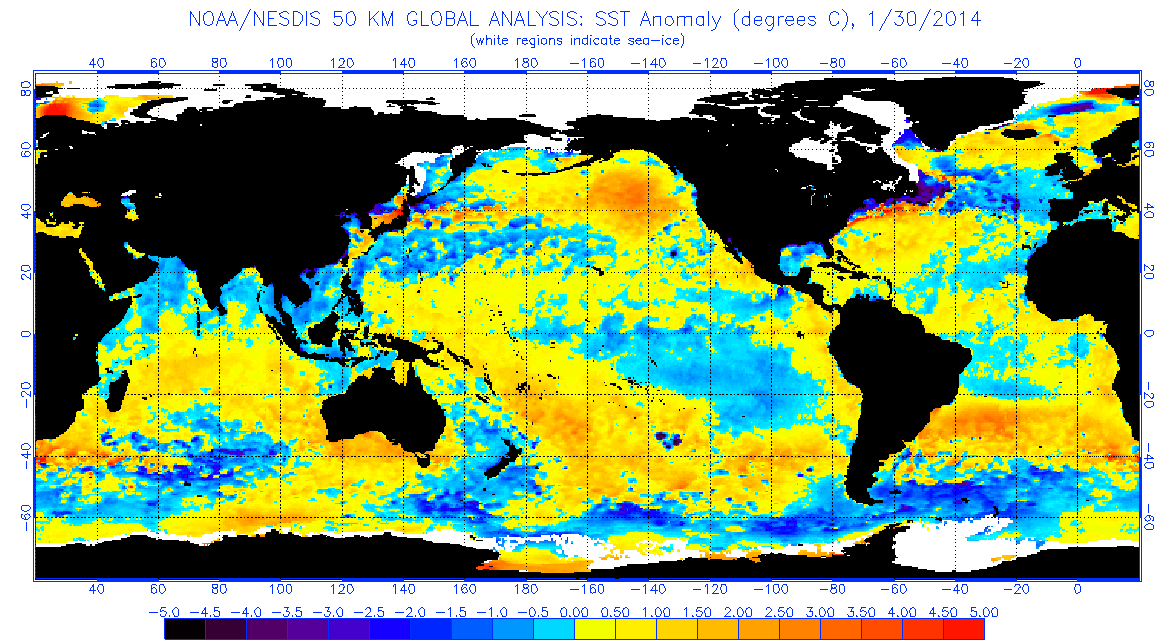
The Western Hemisphere warm pool (WHWP) of water warmer than 28.5°C extends from the eastern North Pacific to the Gulf of Mexico and the Caribbean, and at its peak, overlaps with the tropical North Atlantic. It has a large seasonal cycle and its interannual fluctuations of area and intensity are significant. Surface heat fluxes warm the WHWP through the boreal spring to an annual maximum of SST and areal extent in the late summer/early fall, associated with eastern North Pacific and Atlantic hurricane activities and rainfall from northern South America to the southern tier of the United States. SST and area anomalies occur at high temperatures where small changes can have a large impact on tropical convection. Observations suggest that a positive ocean-atmosphere feedback operating through longwave radiation and associated cloudiness is responsible for the WHWP SST anomalies. Associated with an increase in SST anomalies is a decrease in atmospheric sea level pressure.

Chou and Chou published On the Regulation of the Pacific Warm Pool Temperature:

Abstract

Analyses of data on clouds, winds, and surface heat fluxes show that the transient behavior of basin-wide large-scale circulation has a significant influence on the warm pool sea surface temperature (SST). Trade winds converge to regions of the highest SST in the equatorial western Pacific. The reduced evaporative cooling due to weakened winds exceeds the reduced solar heating due to enhanced cloudiness. The result is a maximum surface heating in the strong convective and high SST regions. The maximum surface heating in strong convective regions is interrupted by transient atmospheric and oceanic circulation. Regions of high SST and low-level convergence follow the Sun. As the Sun moves away from a convective region, the strong trade winds set in, and the evaporative cooling enhances, resulting in a net cooling of the surface. We conclude that the evaporative cooling associated with the seasonal and interannual variations of trade winds is one of the major factors that modulate the SST distribution of the Pacific warm pool.
Comment:

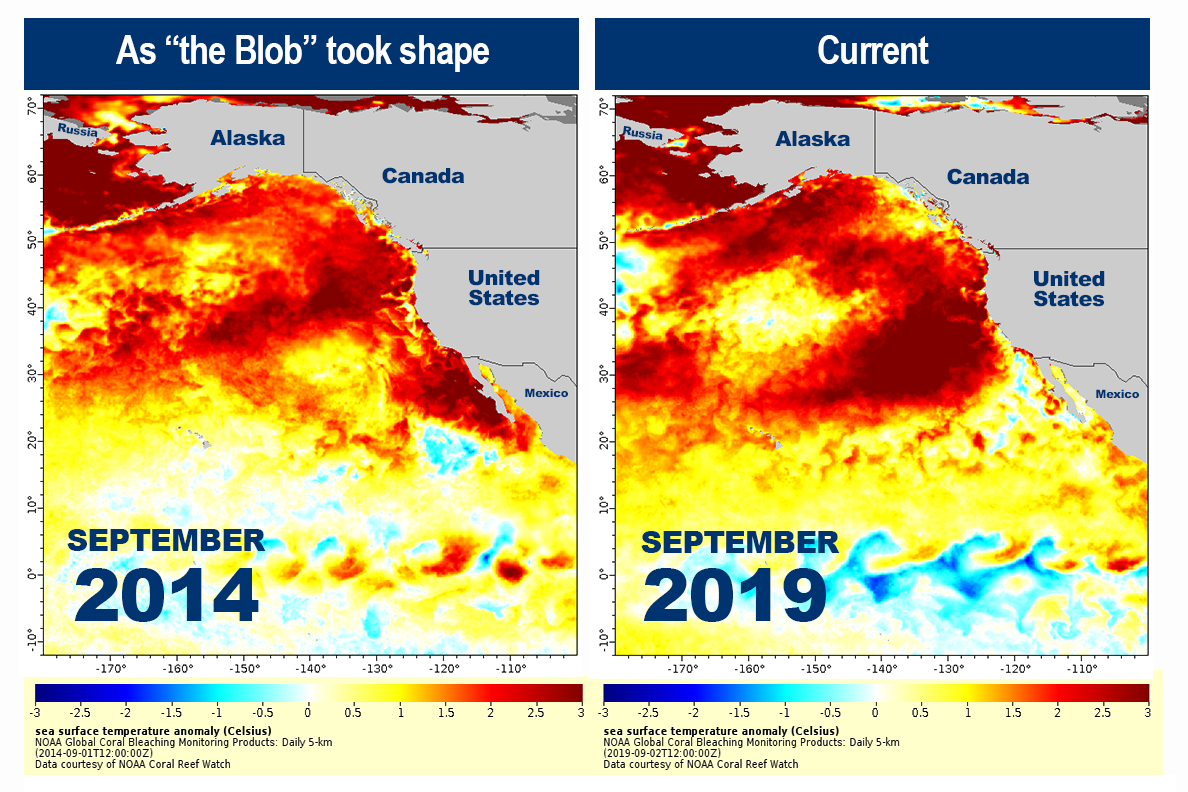
So these are but two examples of oceanographic studies describing natural factors driving the rise and fall of Pacific warm pools.  Yet the Nature paper claims rising CO2 from fossil fuels is the causal factor, waving away natural processes.  Skeptical responses were already lodged upon the first incidence of the North Pacific marine heat wave, the “Blob” much discussed by west coast US meteorologists.  One of the most outspoken against the global warming attributionists has been Cliff Mass of Seattle and University of Washington.  Writing in 2014 and 2015, he observed the rise and fall of the warming blob and then posted a critique of attribution attempts at his blog.  For example, Media Miscommunication about the Blob.  Excerpts in italics with my bolds.

Blob Media Misinformation

One of the most depressing things for scientists is to see the media misinform the public about an important issue.

During the past few days, an unfortunate example occurred regarding the warm water pool that formed over a year ago in the middle of the north Pacific, a.k.a., the blob. Let me show how this communication failure occurred, with various media outlets messed things up in various ways.

The stimulant for the nationwide coverage of the Blob was a very nice paper published by Nick Bond (UW scientist and State Climatologist), Meghan Cronin, Howard Freeland, and Nathan Mantua in Geophysical Research Letters.

This publication described the origin of the Blob, showing that it was the result of persistent ridging (high pressure) over the Pacific. The high pressure, and associated light winds, resulted in less vertical mixing of the upper layer of the ocean; with less mixing of subsurface cold water to the surface. Furthermore, the high pressure reduced horizontal movement of colder water from the north. Straightforward and convincing work.
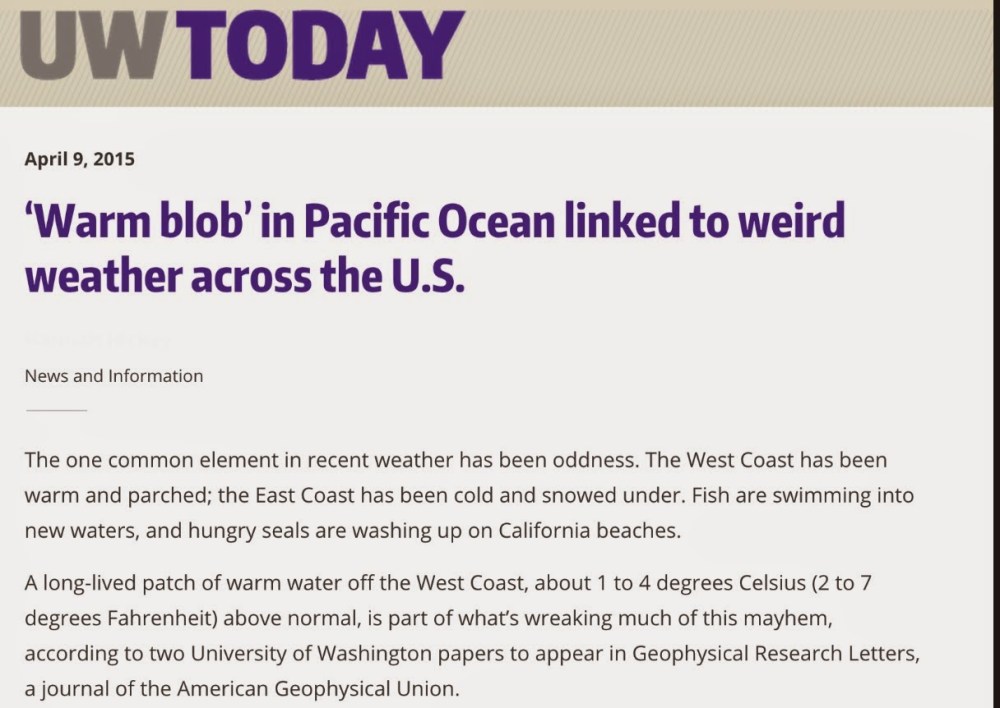
The inaccurate press release then led to a media frenzy, with the story going viral. And unfortunately, many of the media got it wrong.

There were two failure modes. In one, the headline was wrong, but the internal story was correct. . . In the second failure mode, the story itself was essentially flawed, with most claiming that the Blob off of western North America was the cause of the anomalous circulation (big ridge over West Coast, trough over the eastern U.S.). (The truth: the Blob was the RESULT of the anomalous circulations.) That the Blob CAUSED the California drought or the cold wave in the eastern U.S. These deceptive stories were found in major outlets around the country, including the Washington Post, NBC News, and others.

Blob Returns,  Attribution Misinformation

When the Blob returned 2020-2021, Cliff Mass had cause to again lament how the public is misled.  This time misdirection instigated by activist scientists using flawed methods.  His post Miscommunication in Recent Climate Attribution Studies.  Excerpts in italics with my bolds.

This attribution report, and most media stories that covered it, suggested a central role for global warming for the heatwave. As demonstrated in my previous blog, their narrative simply does not hold up to careful examination.

This blog will explain why their basic framing and approach is problematic, leading readers (and most of the media) to incorrect conclusions.

For the heatwave, the attribution folks only examine the statistics of temperatures hitting the record highs (108F in Seattle), but avoid looking at the statistics of temperature exceeding 100F, or even the record highs (like 103F in Seattle). There is a reason they don’t do that. It would tell a dramatically different (and less persuasive) story.

In the attribution studies, the main technology for determining changed odds of extreme weather is to use global climate models. First, they run the models with greenhouse gas forcing (which produces more extreme precipitation and temperature), and then they run the models again without increased greenhouse gases concentrations. By comparing the statistics of the two sets of simulations, they attempt to determine how the odds of extreme precipitation or temperature change.

Unfortunately, there are serious flaws in their approach: climate models fail to produce sufficient natural variability (they underplay the black swans) and their global climate models don’t have enough resolution to correctly simulate critical intense, local precipitation features (from mountain enhancement to thunderstorms). On top of that, they generally use unrealistic greenhouse gas emissions in their models (too much, often using the RCP8.5 extreme emissions scenario) And there is more, but you get the message. ( I am weather/climate modeler, by the way, and know the model deficiencies intimately.)

Vaunted Fingerprinting Attribution Is Statistically Unsound

From Barkhordarian et al.

Unlike previous studies which have focused on linking the SST patterns in the North Pacific to changes in the oceanic circulation and the extratropical/tropical teleconnections2,12,17,18,20,24,26, we here perform two different statistical attribution methodologies in order to identify the human fingerprint in Northeast Pacific SST changes both on multidecadal timescale (changes of mean SST) and on extreme SST events on daily timescale (Marine Heatwaves). Evidence that anthropogenic forcing has altered the base state (long-term changes of mean SST) over the northeast Pacific, which is characterized by strong low-frequency SST fluctuations, would increase confidence in the attribution of MHWs27, since rising mean SST is the dominant driver of increasing MHW frequency and intensity, outweighing changes due to temperature variability1,2.

In this study, we provide a quantitative assessment of whether GHG forcing, the main component of anthropogenic forcings, was necessary for the North Pacific high-impact MHWs (the Blob-like SST anomalies) to occur, and whether it is a sufficient cause for such events to continue to repeatedly occur in the future. With these purposes, we use two high-resolution observed SST datasets, along with harnessing two initial-condition large ensembles of coupled general circulation models (CESM1-LE28,29 with 35 members, and MPI-GE30 with 100 members). These large ensembles can provide better estimates of an individual model’s internal variability and response to external forcing31,32, and facilitate the explicit consideration of stochastic uncertainty in attribution results33. We also use multiple single-forcing experiments from the Detection and Attribution Model Intercomparision Project (DAMIP34) component of Coupled Model Intercomparison Project phase 6 (CMIP635).
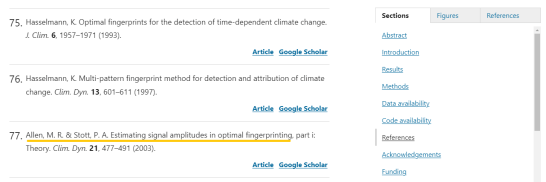
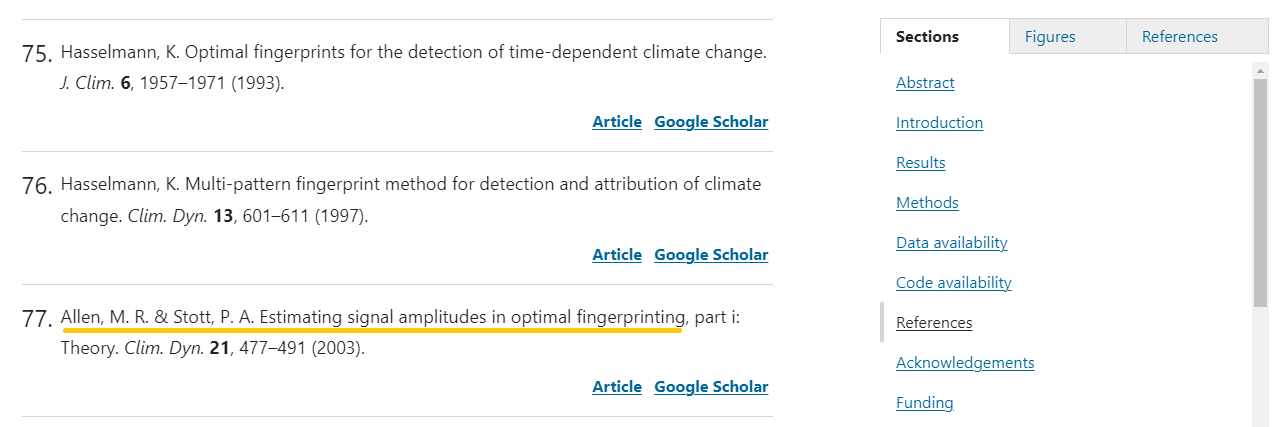
From Barkhordarian et al. References


The IPCC’s attribution methodology is fundamentally flawed

The central paper underpinning the attribution analysis was assessed and found unreliable by statistician Ross McKitrick’s published evaluation. Excerpts in italics with my bolds.

One day after the IPCC released the AR6 I published a paper in Climate Dynamics showing that their “Optimal Fingerprinting” methodology on which they have long relied for attributing climate change to greenhouse gases is seriously flawed and its results are unreliable and largely meaningless. Some of the errors would be obvious to anyone trained in regression analysis, and the fact that they went unnoticed for 20 years despite the method being so heavily used does not reflect well on climatology as an empirical discipline.

My paper is a critique of “Checking for model consistency in optimal fingerprinting” by Myles Allen and Simon Tett, which was published in Climate Dynamics in 1999 and to which I refer as AT99. Their attribution methodology was instantly embraced and promoted by the IPCC in the 2001 Third Assessment Report (coincident with their embrace and promotion of the Mann hockey stick). The IPCC promotion continues today: see AR6 Section 3.2.1. It has been used in dozens and possibly hundreds of studies over the years. Wherever you begin in the Optimal Fingerprinting literature (example), all paths lead back to AT99, often via Allen and Stott (2003). So its errors and deficiencies matter acutely.

Abstract

Allen and Tett (1999, herein AT99) introduced a Generalized Least Squares (GLS) regression methodology for decomposing patterns of climate change for attribution purposes and proposed the “Residual Consistency Test” (RCT) to check the GLS specification. Their methodology has been widely used and highly influential ever since, in part because subsequent authors have relied upon their claim that their GLS model satisfies the conditions of the Gauss-Markov (GM) Theorem, thereby yielding unbiased and efficient estimators.

But AT99:

  • stated the GM Theorem incorrectly, omitting a critical condition altogether,
  • their GLS method cannot satisfy the GM conditions, and
  • their variance estimator is inconsistent by construction.
  • Additionally, they did not formally state the null hypothesis of the RCT nor
  • identify which of the GM conditions it tests, nor
  • did they prove its distribution and critical values, rendering it uninformative as a specification test.

The continuing influence of AT99 two decades later means these issues should be corrected. I identify 6 conditions needing to be shown for the AT99 method to be valid.

In Conclusion,  McKitrick:

One point I make is that the assumption that an estimator of C provides a valid estimate of the error covariances means the AT99 method cannot be used to test a null hypothesis that greenhouse gases have no effect on the climate. Why not? Because an elementary principle of hypothesis testing is that the distribution of a test statistic under the assumption that the null hypothesis is true cannot be conditional on the null hypothesis being false. The use of a climate model to generate the homoscedasticity weights requires the researcher to assume the weights are a true representation of climate processes and dynamics.

The climate model embeds the assumption that
greenhouse gases have a significant climate impact.

Or, equivalently, that natural processes alone cannot generate a large class of observed events in the climate, whereas greenhouse gases can. It is therefore not possible to use the climate model-generated weights to construct a test of the assumption that natural processes alone could generate the class of observed events in the climate.
October Arctic Ice Grows After Pope’s Blessing

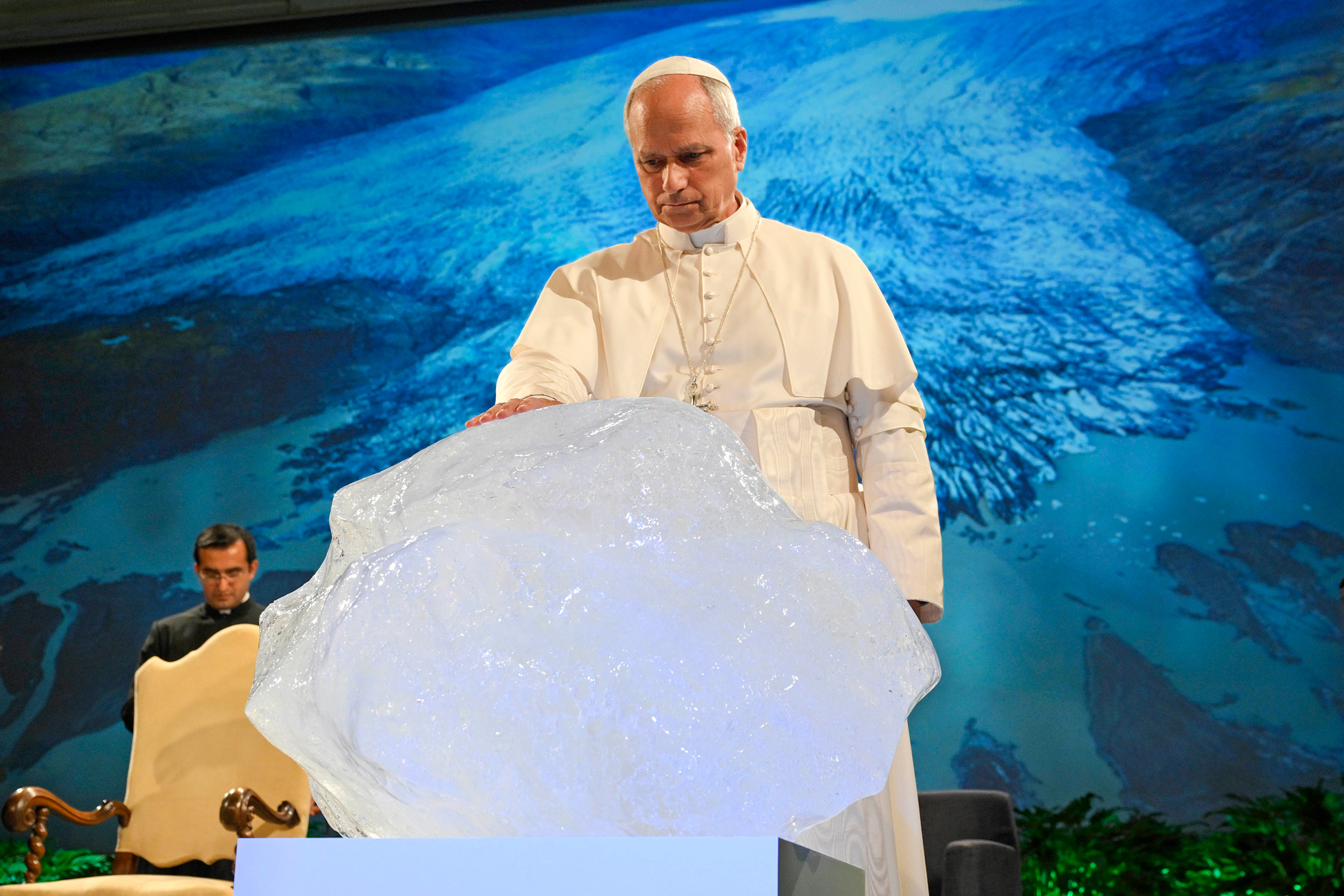
Last Wednesday Pope Leo spoke before a slowly melting chunk of glacial ice in Vatican City in his first address on climate change.  The pontiff addressed a crowd of roughly 1,000 attendees and called on people all over the world to demand action on climate from their governments. This post presents evidence the Arctic is already heeding his call, growing by leaps and bounds. /sarc

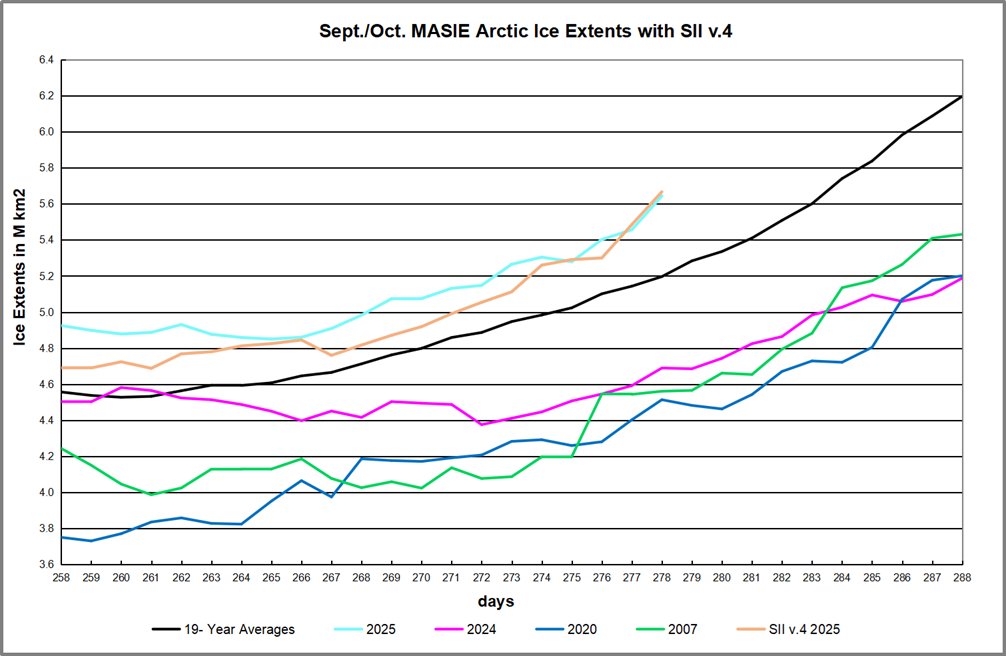
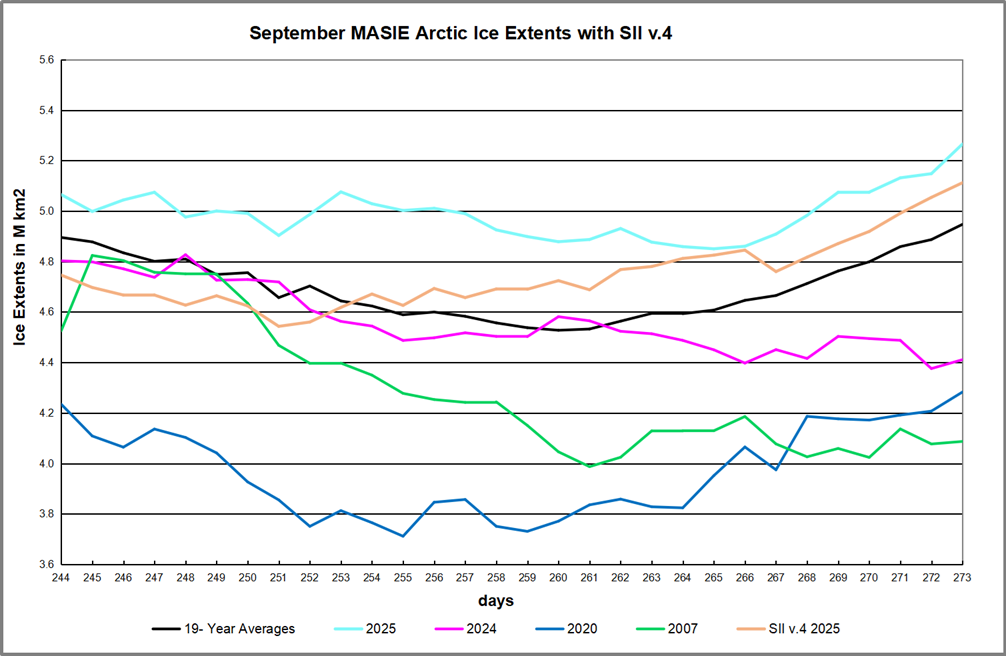
The graph above shows Sept./Oct. daily ice extents for 2025 compared to 19 year averages, and some years of note. Day 260 has been the lowest daily ice extent on average for the last 19 years. Note how in just the last five days, Arctic ice extent has grown by half a wadham or ~0.5M km2!

Why is this important?  All the claims of global climate emergency depend on dangerously higher temperatures, lower sea ice, and rising sea levels.  The lack of additional warming prior to 2023 El Nino, which is now receding, is documented in a post Tropics UAH Temps Cooler August 2025.

The lack of acceleration in sea levels along coastlines has been discussed also.  See Observed vs. Imagined Sea Levels 2023 Update.

Also, a longer term perspective is informative:

post-glacial_sea_levelThe table below shows the distribution of Sea Ice on day 260 across the Arctic Regions, on average, this year and 2007. At this point in the year, Bering and Okhotsk seas are open water and thus dropped from the table. The has grown to 5.64M km2 from 5.14 and the overall surplus to average is 447k km2, ( 9 %). The 2025 ice extent exceeds 2007 by a full wadham.

Region 2025278 Day 278 ave. 2025-Ave. 2007278 2025-2007
 (0) Northern_Hemisphere 5643927 5196640 447286 4560836 1083091
 (1) Beaufort_Sea 781758 582635 199123 590267 191490
 (2) Chukchi_Sea 474277 232765 241512 25934 448343
 (3) East_Siberian_Sea 558888 329424 229465 311 558577
 (4) Laptev_Sea 299904 208865 91039 305220 -5316
 (5) Kara_Sea 1026 45918 -44892 22717 -21691
 (6) Barents_Sea 0 17669 -17669 3580 -3580
 (7) Greenland_Sea 175128 271377 -96248 404376 -229248
 (8) Baffin_Bay_Gulf_of_St._Lawrence 81997 63374 18623 72162 9835
 (9) Canadian_Archipelago 355462 410626 -55164 349687 5775
 (10) Hudson_Bay 1172 2333 -1161 1936 -764
 (11) Central_Arctic 2912747 3030507 -117760 2783370 129376

bathymetric_map_arctic_ocean

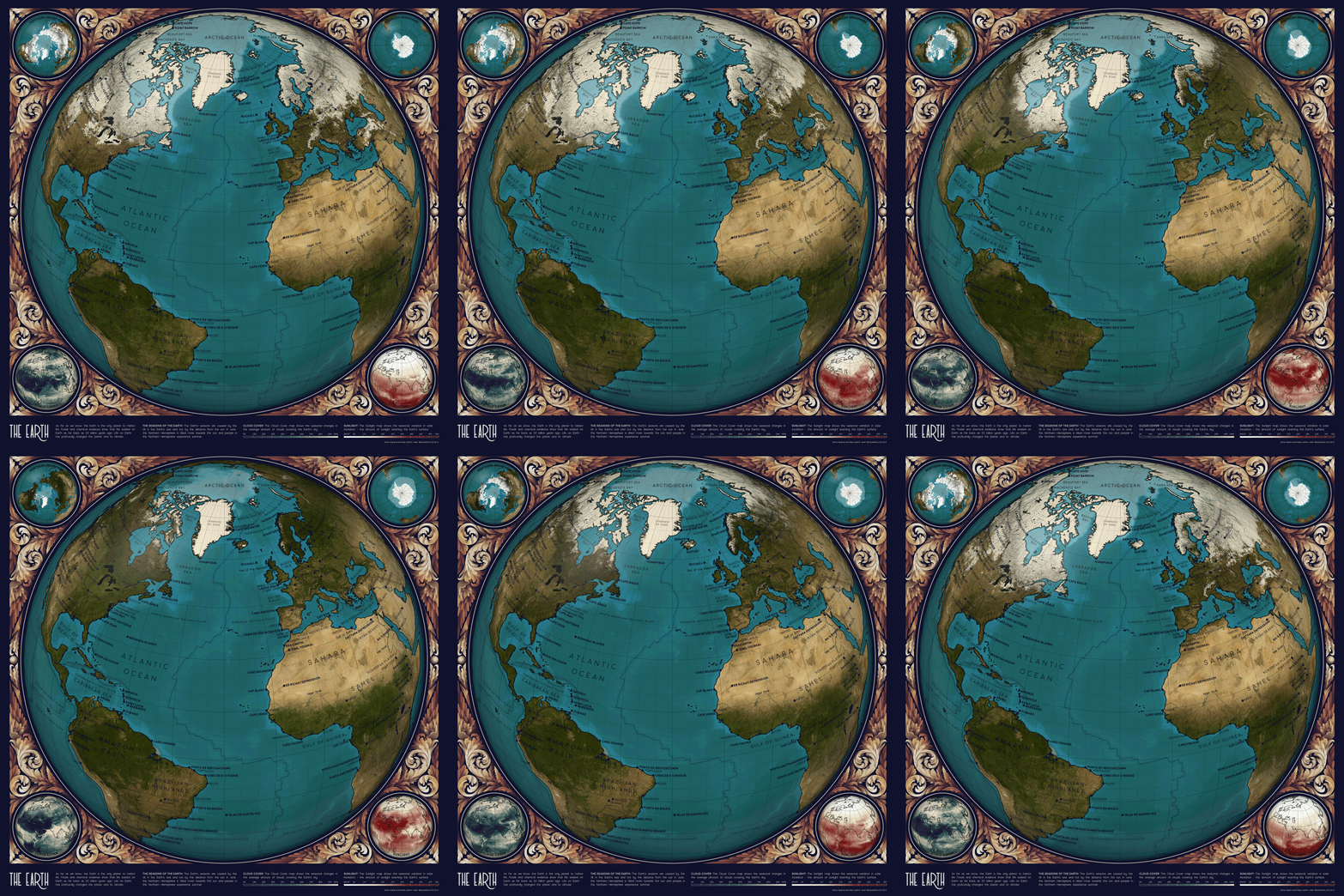
Illustration by Eleanor Lutz shows Earth’s seasonal climate changes. If played in full screen, the four corners present views from top, bottom and sides. It is a visual representation of scientific datasets measuring ice and snow extents.

Javier Vinos Finds Missing Climate Puzzle Pieces

Tom Nelson interviews independent researcher Javier Vinos reporting his discoveries of facts and evidence ignored or forgotten in the rush to judgement against humanity for burning hydrocarbon fuels. When these factors are acknowledged they can be integrated into a more wholistic view of Earth’s climate activity.  For those who prefer reading, below is an excerpted transcript with my bolds along with some images and key exhibits included. TN refers to Tom Nelson and JV to Javer Vinos.

JV: For the past ten years I’ve been studying climate quite in depth with a basic focus on natural climate change, on how the climate changes naturally. I did this because I had a science blog and one day I decided I was going to talk about the science of climate and when I started to read the articles and looking for the information I became very surprised because I do molecular biology and Neuroscience that is experimental science. And climate science is not an experimental science and I was very surprised because they were claiming the evidence was there and it was not.

So I began researching it more and more until I became so involved I started writing books and telling other people what I was finding about climate.

The Scientific Method and Climate Science

One of the elementary principles of the scientific method is that establishing a theory before examining all the evidence leads to error and confirmation bias makes us stick to it.  Has the scientific method been forgotten in the postmodern age?  It seems so, at least in climate science.  Climatology is not an experimental science which is a major handicap.  It is also a very young science compared to the mainstream Sciences of physics, chemistry, geology and biology.  The consensus was reached in 1988 almost without data and wholly based on the Greenhouse Effect and The Coincidence of temperature and CO2 during the Pleistocene in Antarctic Ice cores.

Understanding Albedo and Heat Transport

There are two absolutely essential processes in determining climate that are largely unknown.  The first is albedo or the amount of sunlight reflected back into space.  It’s crucial because it determines the amount of energy the Earth receives.  We ignore why it has the value it has, why it varies so little from year to year, why it varies so much from month to month, why both hemispheres have the same albedo and how the albedo has changed in the past.

As a result of our ignorance, models are unable to adequately reproduce the Earth albedo failing to show its small inter-annual variability, its large seasonal variability and its symmetry between the two hemispheres.   Nevertheless many scientists believe that the models are capable of predicting changes in albedo otherwise they will have to admit that the models cannot predict future climates. Small changes in albedo can produce large climate changes of natural origin and this is the basis of several alternative hypotheses to CO2.

ERBE measurements of radiative imbalance.

I have focused my research on a second essential process and this is what my book is about.  The transport of heat from the equator to the poles also known as meridional heat transport because it runs in the direction of the meridians.  There is much evidence that this is the primary cause of natural climate change.  Heat transport is also an enormously neglected process, we do not know how it works and there is no established Theory to explain it.  We also do not know how it is distributed between the atmosphere and the ocean, how it is divided among the different types of ocean currents, how it changes with the seasons, how it changes from year to year, why Antarctica receives less heat than the Arctic although it should receive more or why heat is transported from the colder hemisphere to the warmer hemisphere.

The models do not understand heat transport because no one understands it,
and that is where the evidence for most natural climate change lies.

In fact we can’t even measure it properly and if we don’t know how heat transport works, it’s obvious that the models don’t either.  They fail miserably at reproducing the amount of heat being transported and reflecting transport changes in the atmosphere and ocean, they do not even correctly reproduce the distribution line, the climatic equator where the trade winds from both hemispheres converge.  Nor do they reproduce seasonal changes since the amount of heat entering and leaving the ocean throughout the year is not known.

If no one understands heat transport, then models cannot understand it either. because they are just a product of our minds with no physical connection to reality.  Even if there are other secondary causes of climate change, including increased CO2, the evidence points to changes in heat transport as the primary way in which the climate changes.  In the end it’s like the joke about the drunk who looks under a street lamp for his lost keys because the light is better there than where he thinks he lost them.

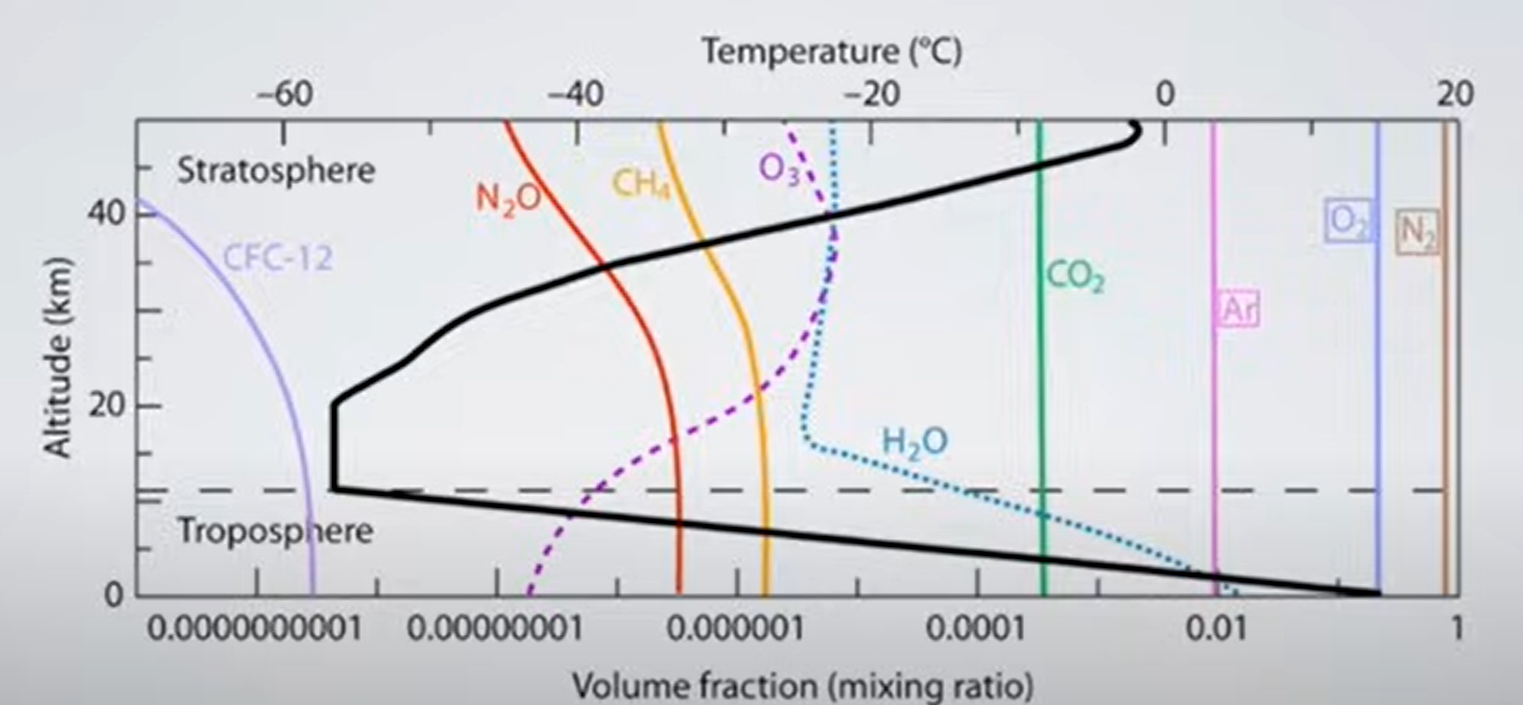
Climatologists look for the answer where the knowledge is better in the greenhouse effect. the culprits are certain gases that together make up 1% of the atmosphere.  In this graph we can see the profile of the gases that make up the atmosphere in different colors showing their abundance on the lower axis with respect to altitude on the vertical axis the gases in the squares do not absorb in the infrared.  Note that water vapor with a blue dotted line is very abundant near the surface but a thousand times less abundant in the stratosphere.  The opposite is true for ozone with a purple dust line which is almost entirely in the stratospheric ozone layer.  The thick black line is the temperature profile which in the troposphere has a positive lapse rate, that is the higher we go the colder it gets. This is fundamental to the greenhouse effect.

The Greenhouse Effect and CO2

What is the greenhouse effect?  In order to return all the energy is received from the Sun and maintain stability, the Earth must keep at a temperature of 23 degrees C below zero.

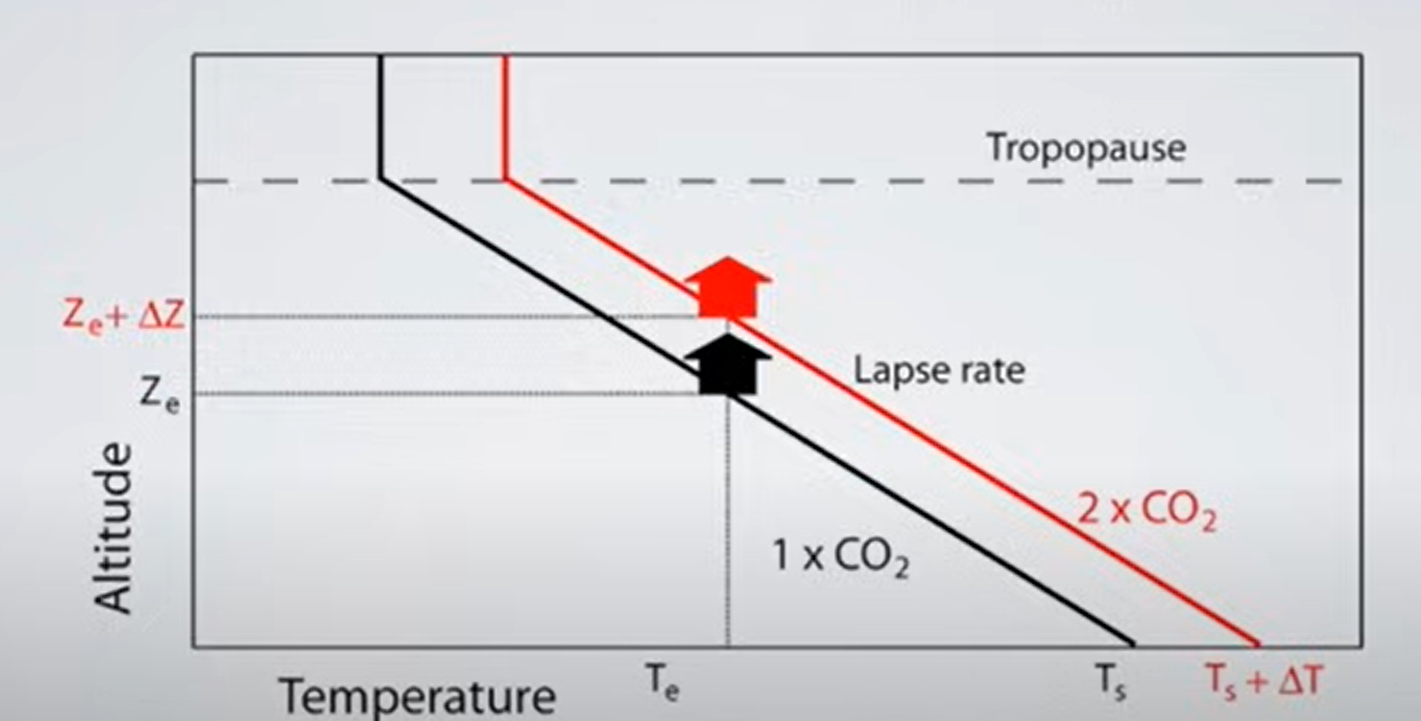
The Greenhouse Effect

Without greenhouse gases this would be the average surface temperature instead of the current 14.5 degrees. The black line in this graph represents the temperature profile of the troposphere and the lapse rate is the slope of that line in the absence of greenhouse gases.  Infrared radiation will be emitted from the surface but greenhouse gases make the atmosphere opaque to infrared radiation, so this radiation is emitted from higher altitudes as shown by The Black Arrow.  Although in reality there is emission from all Heights including the surface the average height of emission is about 6 kilometers. The emission temperature at this height is 23° below zero but the lapse rate of about 6° per kilometer makes the surface about 37° warmer.  If we were to double the CO2 as shown in red, and everything else remains the same, the average emission height would increase by about 150 meters.   As the atmosphere becomes more opaque so the temperature at that height would be 1° cooler it would be necessary for the surface and atmosphere to warm by that degree in order for the earth to return the energy it receives from the sun which is absolutely necessary.

But in the climate system everything is interconnected and when something changes everything changes and nobody knows how much the temperature would change.  So when they tell us that we have to reduce our emissions by a certain amount to avoid some amount of warming they are lying to us because nobody knows that these gases cause the greenhouse effect.  Only the first three are really important. They are trace gases but that does not diminish their importance.  Ozone is a thousand times less abundant than CO2, but its contribution to the greenhouse effect is only five times less.

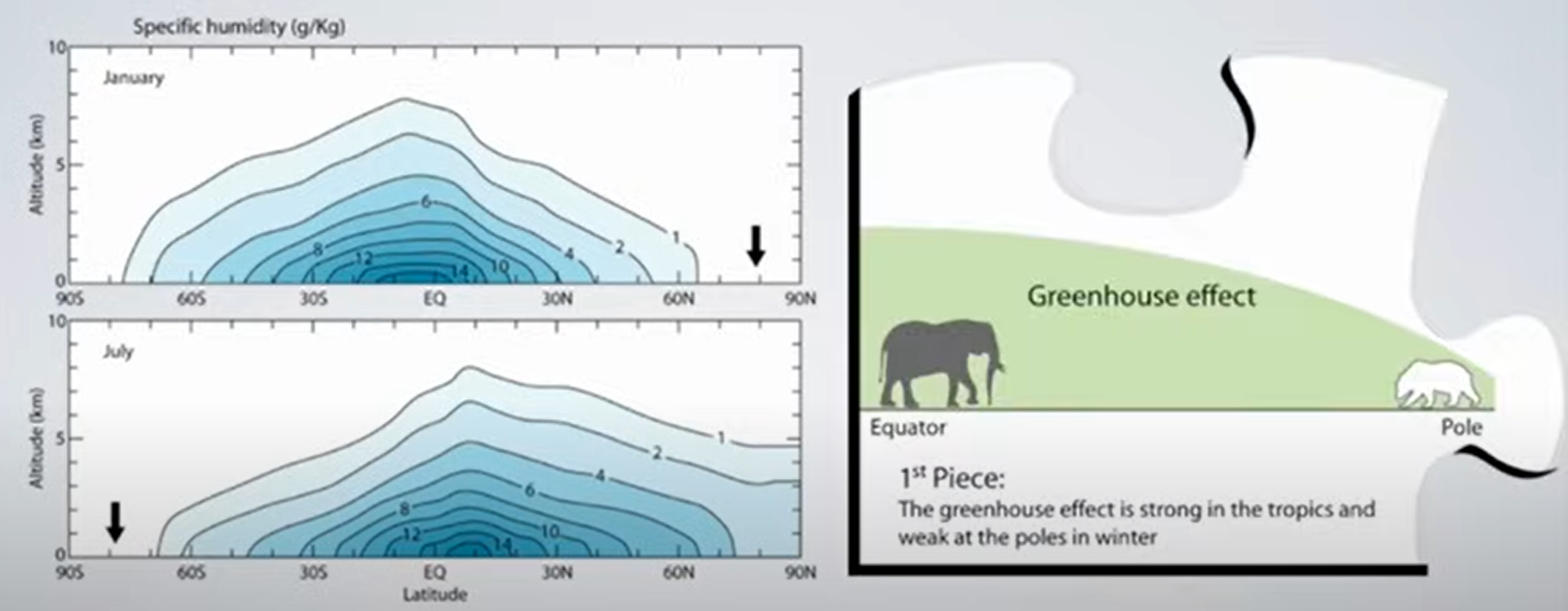
Greenhouse effect is not uniform across the planet.

Look at water vapor in yellow.  Together with the clouds it forms, it is responsible for 3/4 of the greenhouse effect but it’s abundance varies greatly because it depends on temperature.  When the temperature drops it condenses and falls as water or snow.  Because of this the greenhouse effect is highly variable on the planet.  At the poles there is practically no water vapor or clouds in Winter. These are the places on Earth with the driest atmosphere and a much weaker greenhouse effect.  Not much attention is given to this, but it is very important, and I point out in the book it’s one of the pieces that must be used to solve the puzzle.

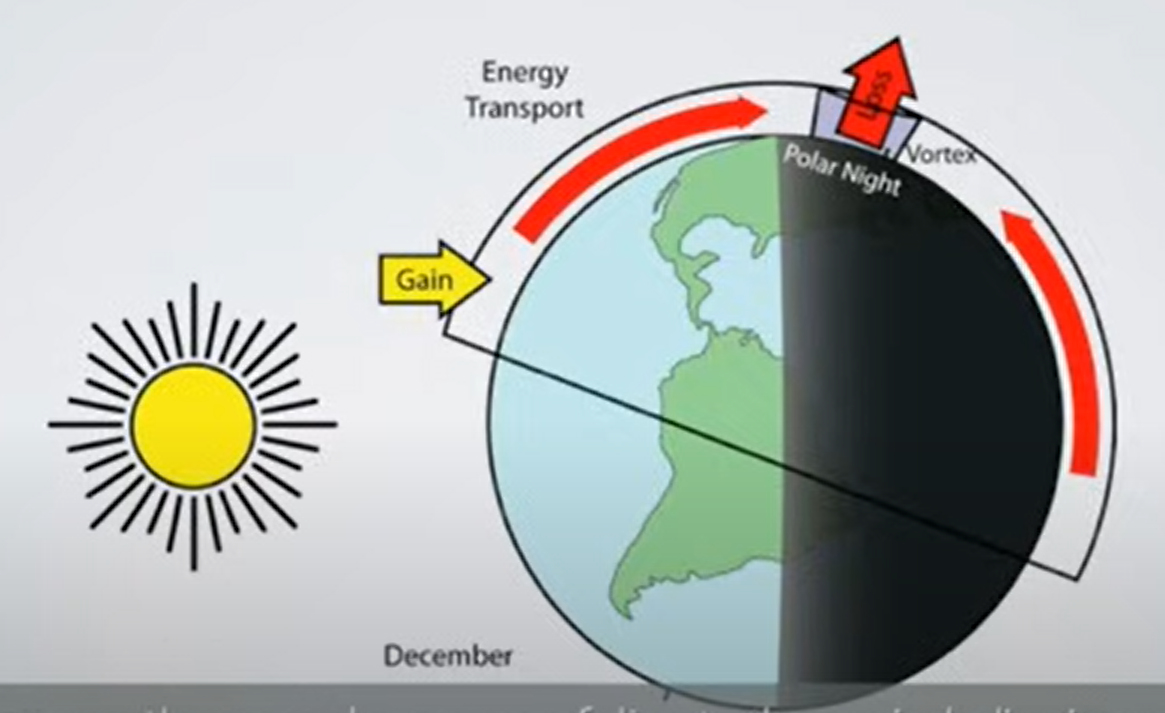
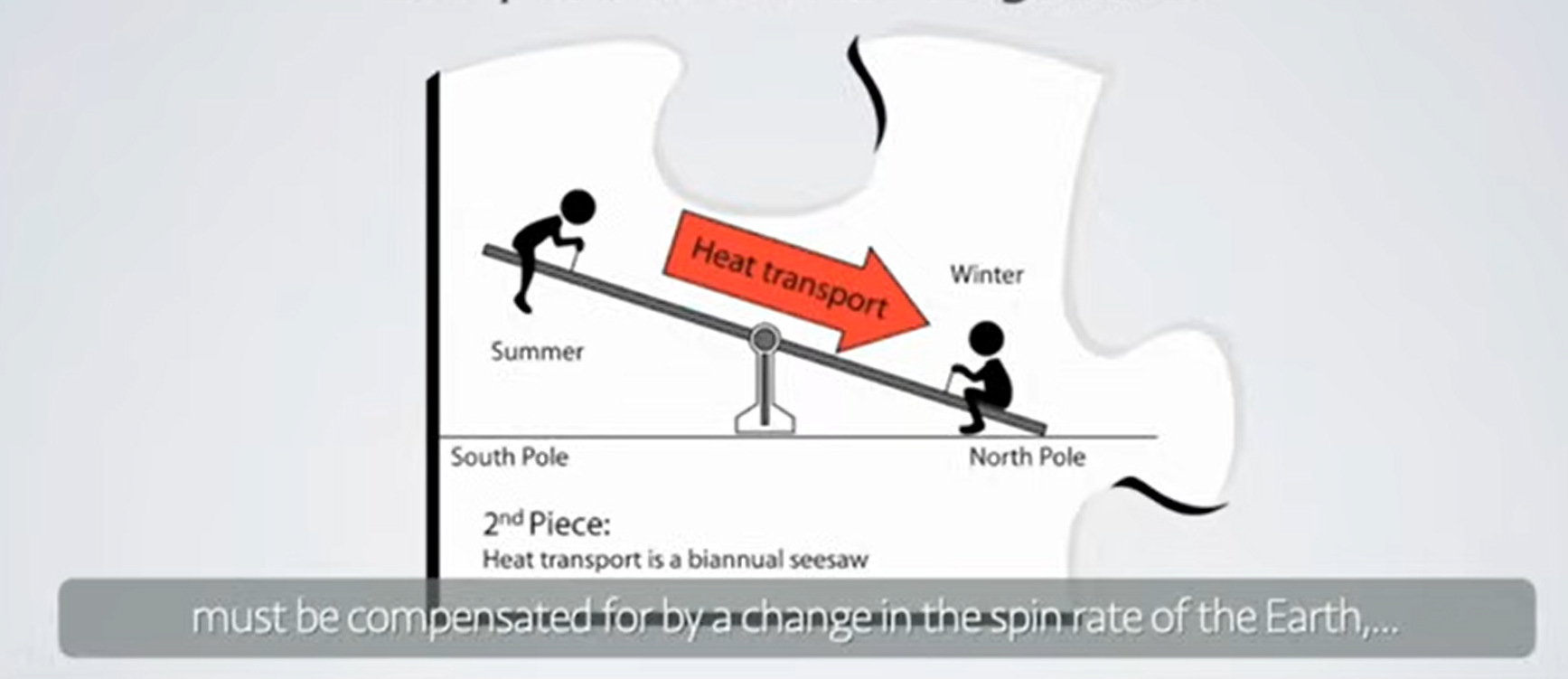
Every year has two winters, and heat transport
to the pole in winter is greater

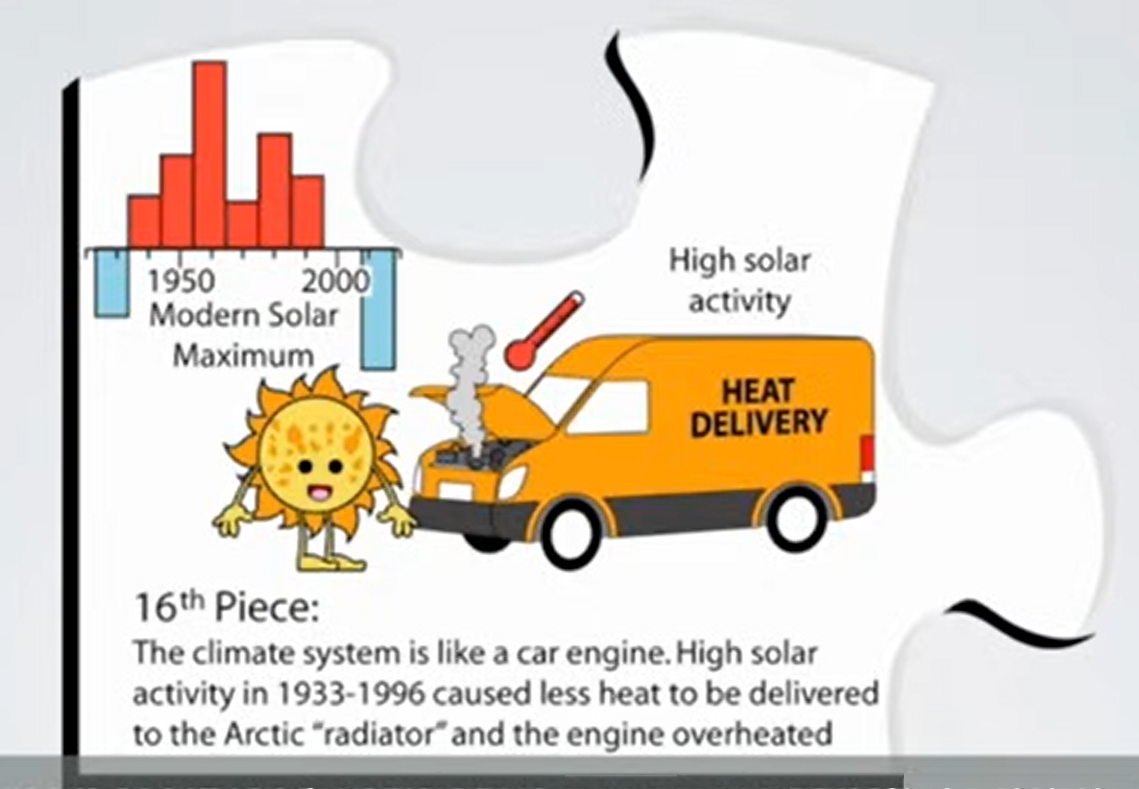
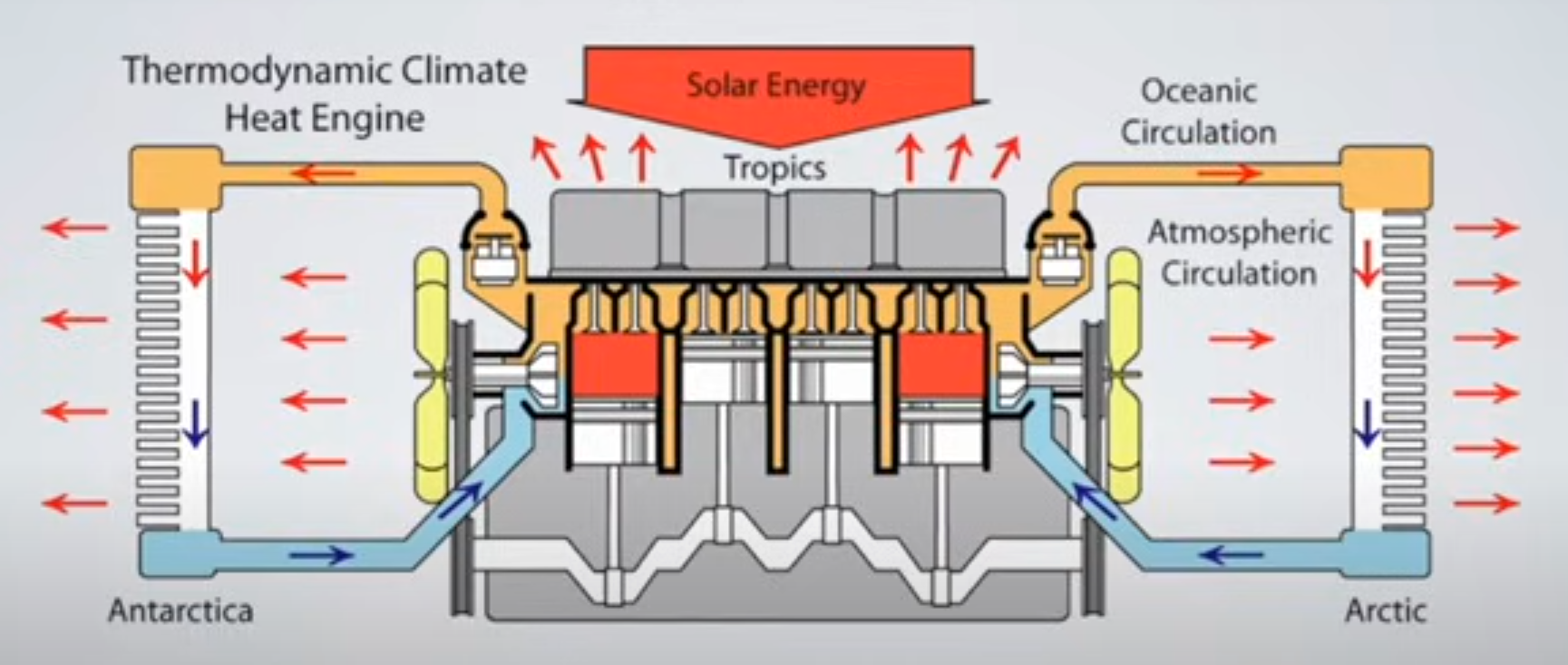
Having such a weak greenhouse effect makes it very easy for heat to escape from the earth through the poles.  The climate works like the internal combustion engine of a car; only instead of one cooling system it has two, one at each pole.  The engine block is the tropics, the hottest part because that is where most of the sun’s energy arrives.  The tropics lose heat by radiation but not enough.  The excess must be transported to the radiators to be radiated to the outside.  And this is done by a fan which is equivalent to the atmosphere and a circuit with a cooling liquid, which is equivalent to the ocean.

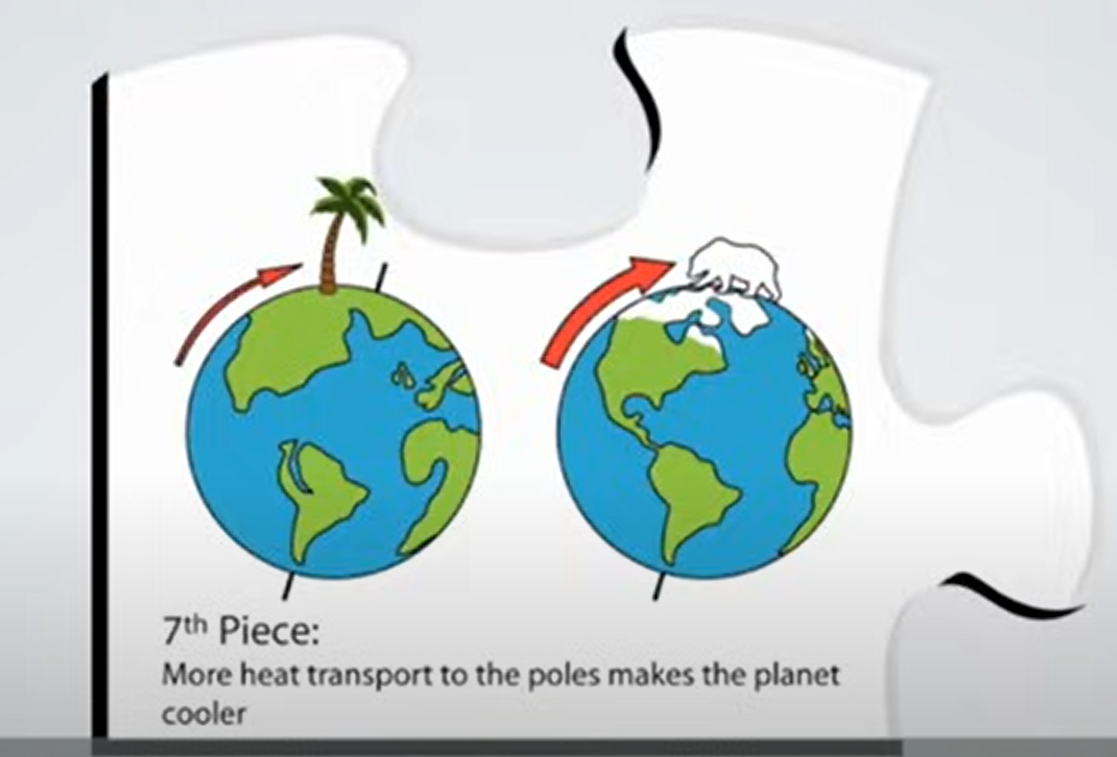
Climatologists do not see it this way, but the other way around.  For them heat transport does not change the temperature of the planet but only warms the poles.  But because of this erroneous view they encounter paradoxes that they cannot resolve. in the early Eocene, at the beginning of the age of mammals, the poles were so temperate that palm trees grew in the Arctic and frogs lived in Antarctica, indicating that the average temperature of the coldest mouth was above freezing. Climatologists do not understand how this was possible because the smaller temperature difference made the heat transport much smaller which prevented the poles from warming.

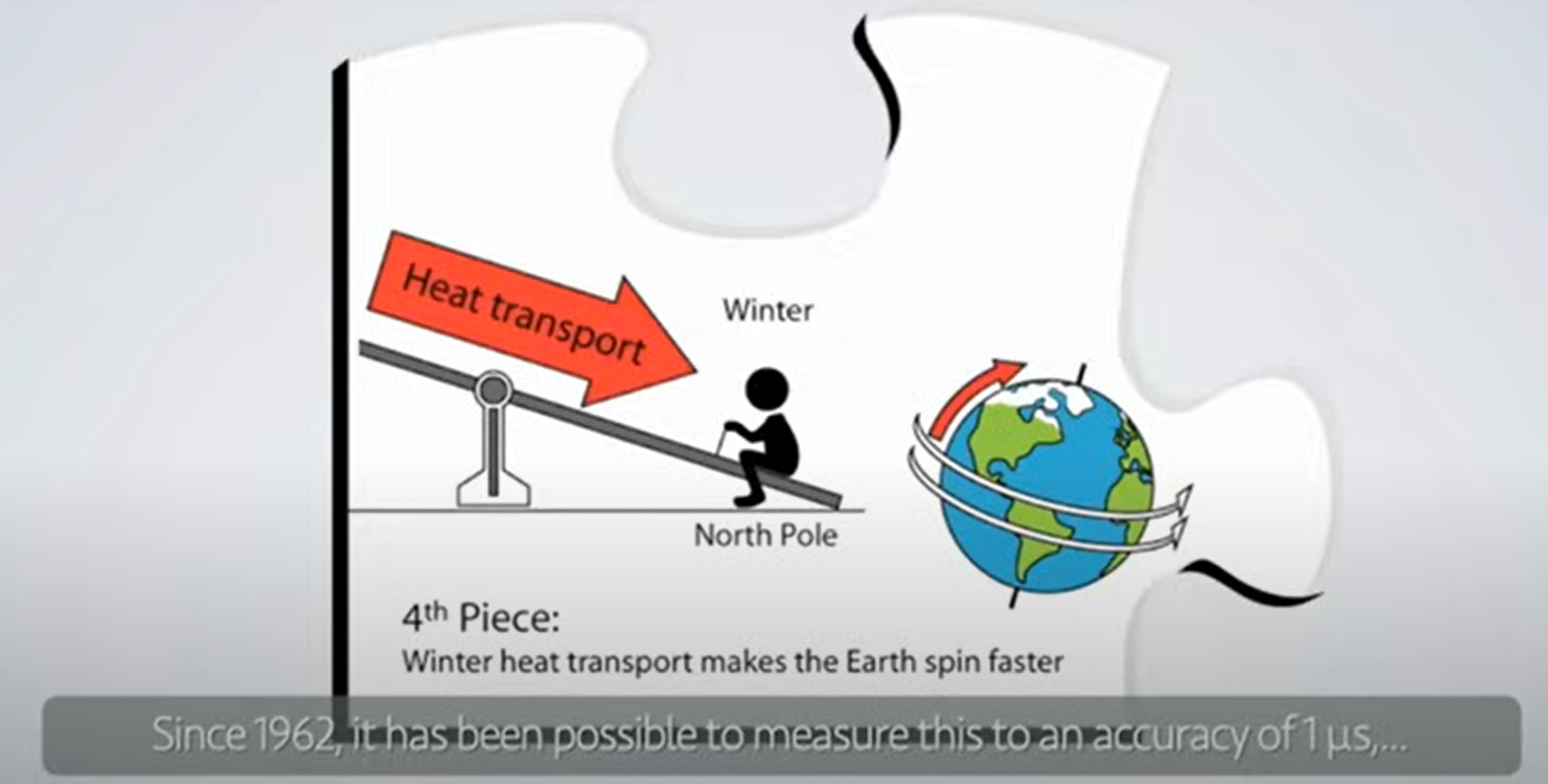
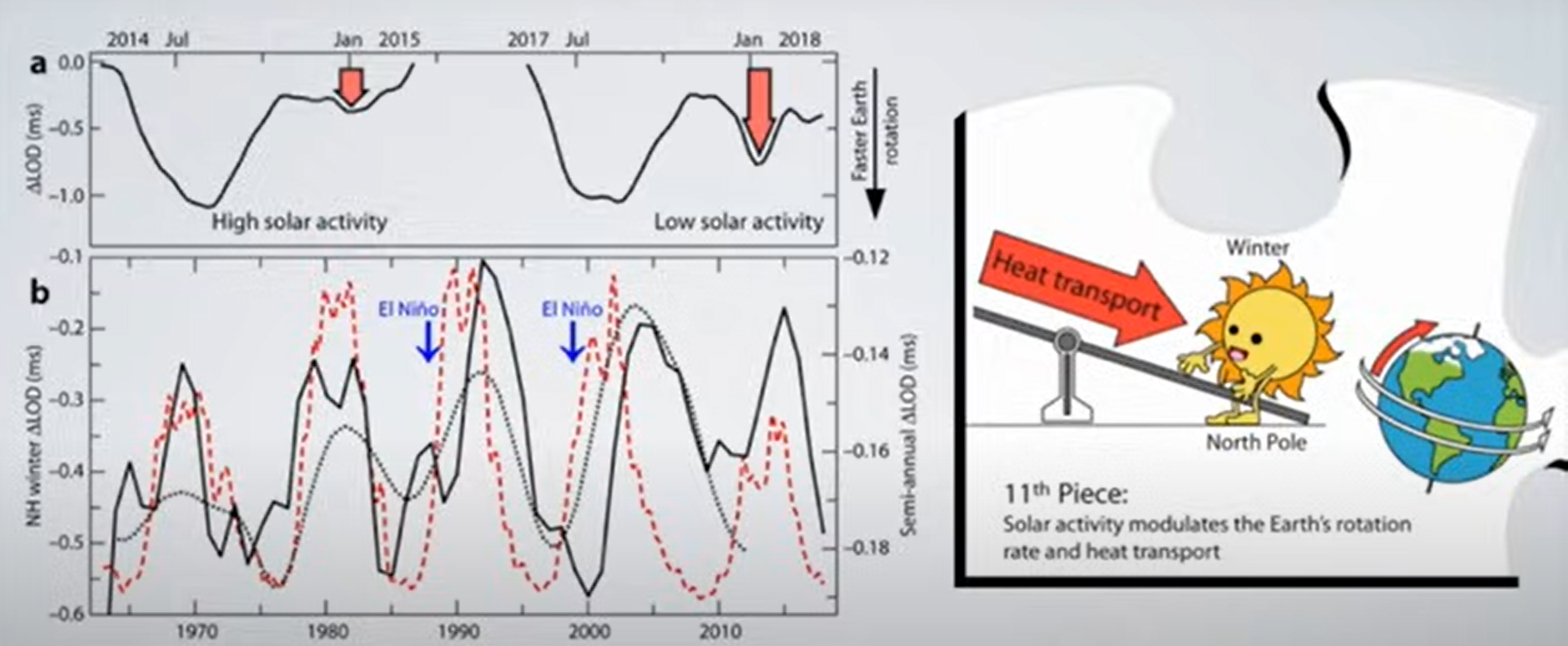
Like all paradoxes it is solved by changing the frame of reference.  It was possible because the smaller heat transport made the planet lose less heat and get warmer, which warmed the poles along with the rest. When it is winter in one hemisphere, the atmosphere transports more heat to that hemisphere.  But the atmosphere also carries angular momentum or rotational inertia since it is a conserved property.  Any change in the angular momentum of the atmosphere must be compensated for by a change in the spin rate of the earth.  Just as ice skaters increases their spin rate rate by bringing their arms closer to the body,  similar to the skater the Earth’s spin rate increases by about 1 millisecond per day as atmospheric circulation and heat transport increase in Winter.  Since 1962 it has been possible to measure this to an accuracy of one microsecond.  Thanks to the invention of the atomic clock and radio astronomy, it is possible to know the exact orientation of the Earth in space, it has been well known since the 1970s.

The Earth spins faster in winter.

The Influence of Solar Activity on Climate

That solar activity affects the Earth’s rotation has been published many times.  The phenomenon is particularly pronounced during the Boreal winter as we can see in the graph above for 2015 a year of high solar activity and 2018 with low activity.  And it is measured by the variation in milliseconds of day length.  In the lower graph we can see the solar activity represented by the sunspot cycle with a red dash line.  The black solid line shows the changes in the Earth’s rotation caused by the Boreal winter.  It shows the same cycle as the sun although the Earth’s rotation is also affected by equatorial stratospheric winds and the El Nino phenomenon.  The dotted line is from a paper published in 2014.

Everyone ignores this phenomenon especially the IPCC which says that the sun does not affect climate.  But if the sun can change the Earth’s rotation speed then it can change the climate.  My research has been like that of Sherlock Holmes looking for clues that have been missed, ignored and forgotten. Studies show the effect of the sun on the rotation of the Earth has been known for 50 years but very few people in the world know about it.

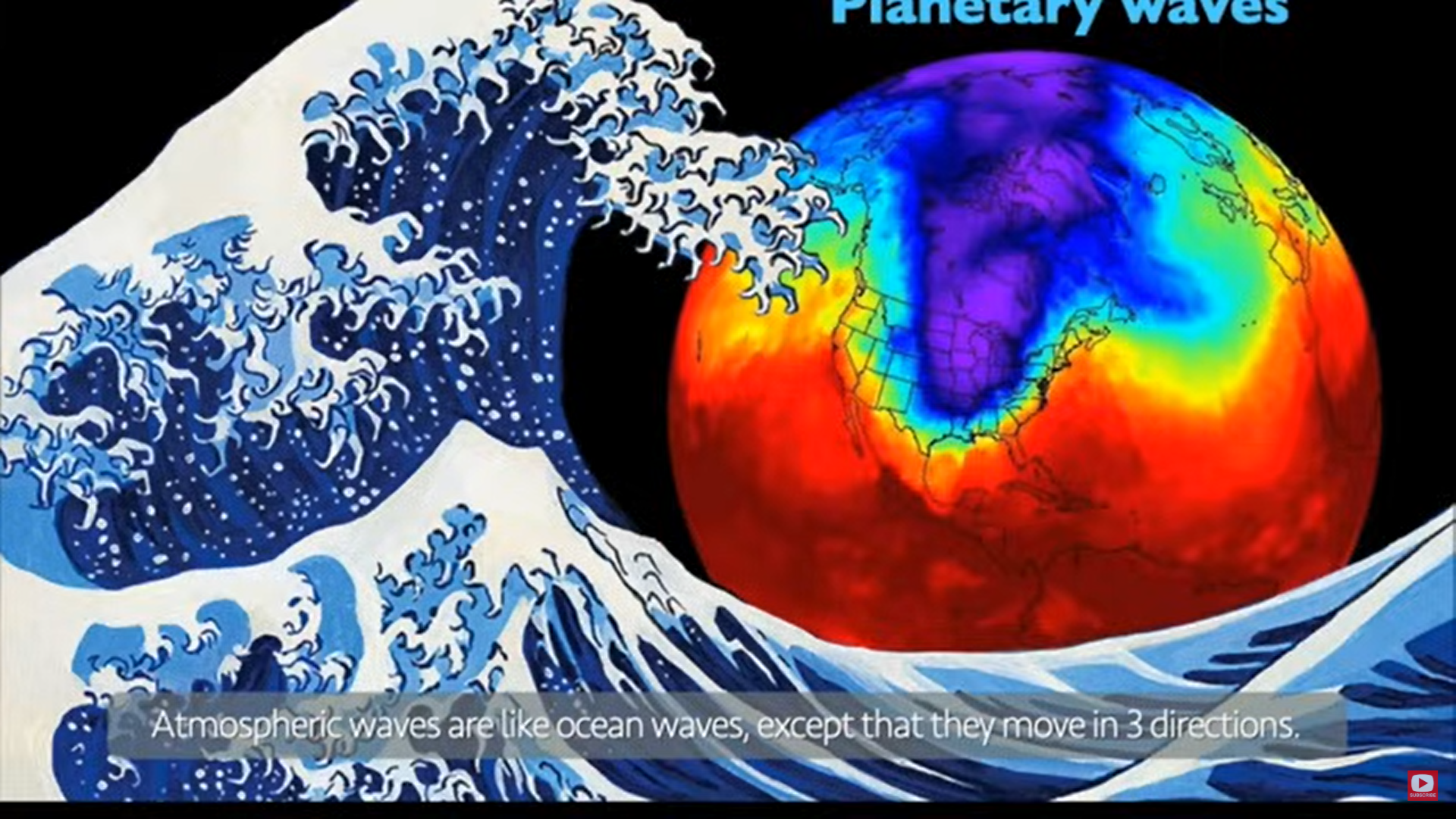
What I have learned about climate science is because I have stood on the shoulder of giants giants like the Canadian atmospheric physicist Colin Hines who explained in a 1974 paper that the sun’s effect on climate could be due to planetary waves.  It was ignored and his theory was forgotten.  Art lovers will recognize the Great Wave print by Hokusai.  Atmospheric waves are like ocean waves except that they move in three directions,  planetary waves are the largest.  Many of you will remember the tsunami that occurred in Indonesia at Christmas 2014.  It reached the coast of Africa 6,000 km away in 8 hours traveling at the speed of an airplane.  Obviously water does not travel, energy travels, and when it is released upon reaching the coast it still causes damage.

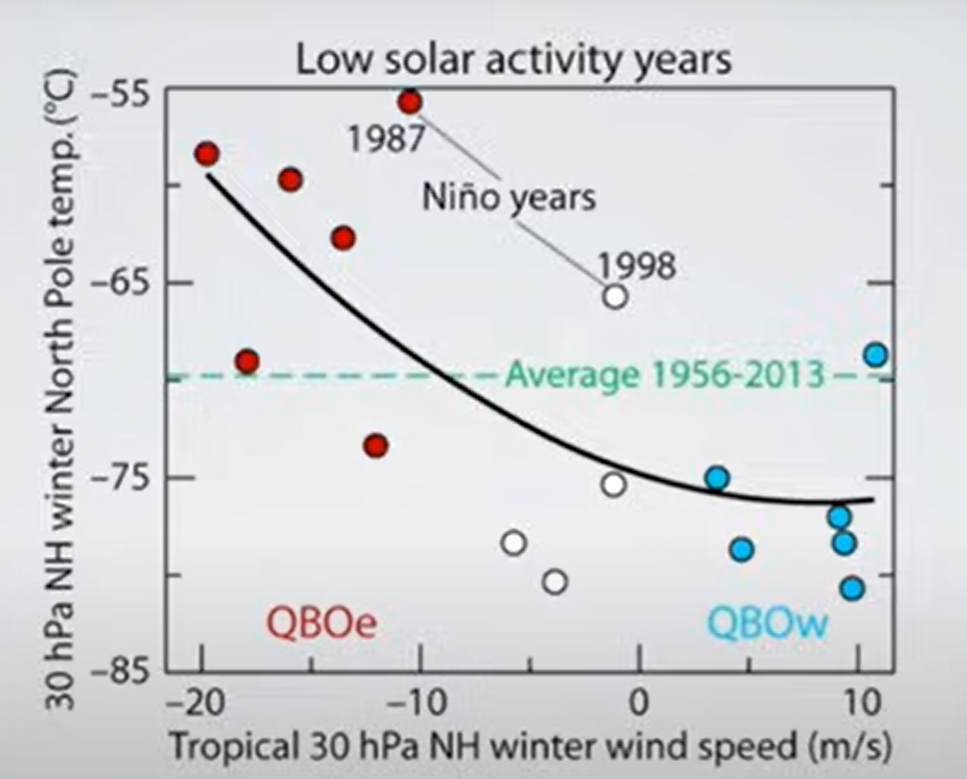
Planetary waves are atmospheric tsunamis that hit the wind walls of the polar vortex and weaken them. It worries us when cold air escapes from the interior because it produces very cold waves and storms.  But the climate is more affected by the heat that is exchanged with that cold, because the planet loses it and cannot compensate for it.  Another Giant on Whose shoulders I stood is Karin Labitzke who in 1987 found a correlation between the temperature of the Polar Stratosphere in Winter and the solar cycle. it is an extraordinary finding because in Winter the sun does not shine on the pole, it is a relationship in the dark not based on solar energy.  It is also extraordinary because it is the first proof of a solar effect on the climate after 190 years of a search began in 1800 by William Herschel the discoverer of Uranus and infrared radiation. Instead of giving her the Nobel Prize she deserved for such a fantastic discovery, her finding was ignored and she’s not even mentioned in climate books.

First evidence of the Sun’s effect on climate

Here I show only the data for years of low solar activity 30 Hectopascals is about 20 km in the stratosphere when the tropical Wind Blows from the West as shown by the blue circles.  The polar stratosphere is very cold, but when it blows from the East as shown by the red circles, the polar Stratosphere warms by about 15°.  In years of high solar activity the effect is reversed as I show in the book The El Nino phenomenon also strongly influences this effect.

For many scientists a solar effect that occurs in the dark, reverses depending on equatorial winds and depend on other phenomena is too complicated to understand and they prefer to ignore it.  But not to me because I have studied Hines.  The propagation of planetary waves into the stratosphere depends on several factors that affect the Dynamics of stratospheric circulation.

How does the Sun influence these Dynamics?

We know that solar activity affects the Earth’s rotation, heat transport and Atmospheric circulation. We also know from Labitzke for the last 35 years that it affects the temperature of the Polar Stratosphere.  And it does so as Hines said 50 years ago by affecting the propagation of planetary waves into the stratosphere.  These waves strike the polar vortex.  This is a gigantic tornado that circles the polar regions in winter with sustained wind speeds of 180 km/ hour.

Planetary waves affect climate through the Polar Vortex

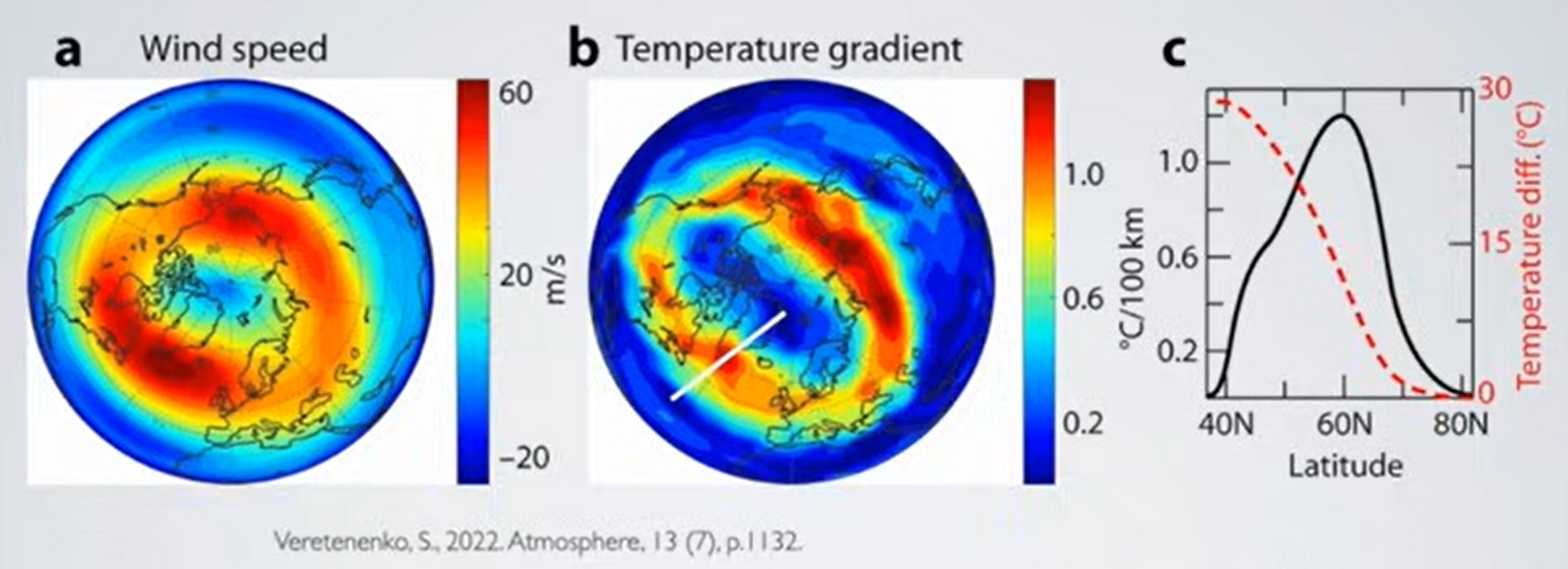
Since heat is carried by the wind, the Warm Winds from the South have a hard time getting through this wall of wind creating a strong temperature gradient as shown in the second image. The black line in the graph shows the profile of this gradient which is a real wall that creates a 30° difference between its two sides as shown by the red dash line.  By weakening the vortex planetary waves allow heat to enter and cold to leave, changing the temperature of the polar region.  As we saw at the beginning, the greenhouse effect inside the vortex is very weak causing the planet to lose unrecoverable energy.

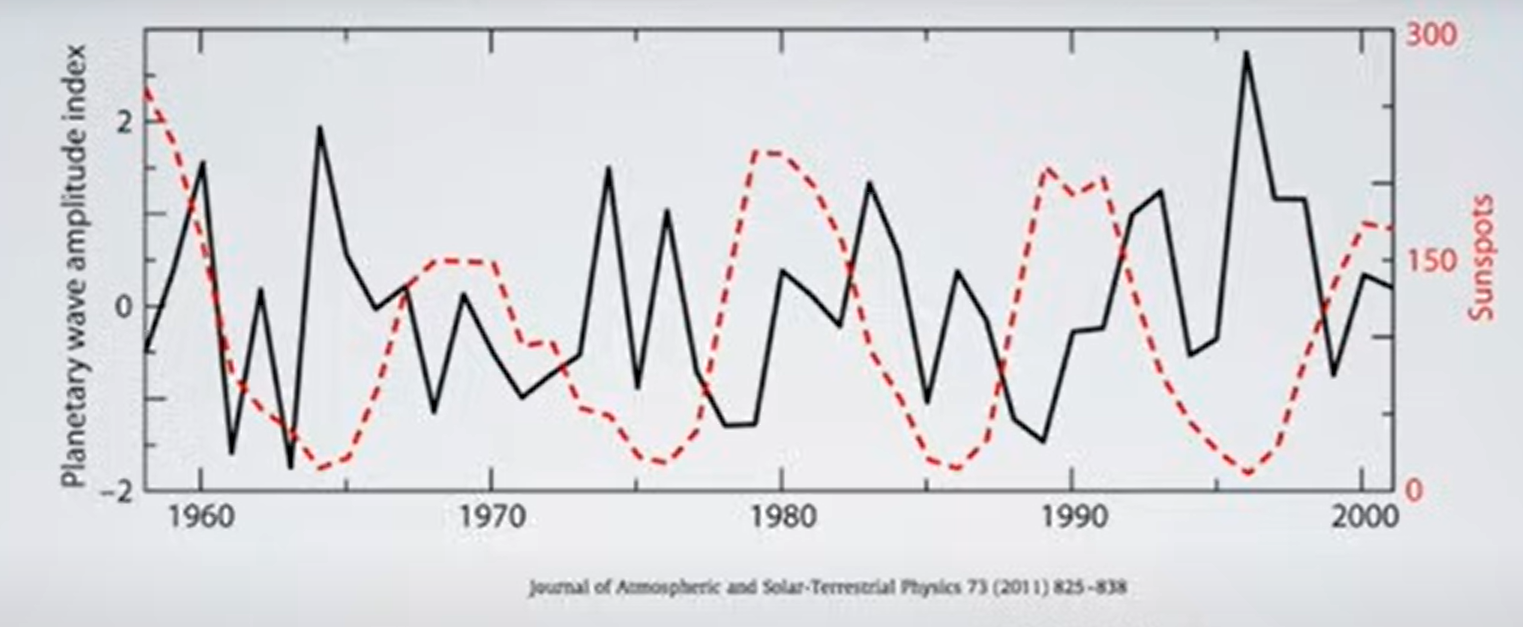
This is how the Sun affects the climate as explained by Hines and Labitzke and I am not just alone saying this, It has been shown.  The study of planetary waves in the stratosphere is extremely difficult because they are invisible and the stratosphere is little known but there is already a study based on measurements that proves it. And the intensity of the planetary waves depends on the solar cycle as its authors defend. The sawtooth appearance of the amplitude of the planetary waves is due to the effect of the tropical winds which change direction every one or two years and to the El Nino effect.

Intensity of planetary waves depends on the solar cycle

My contribution to these studies is to put all the pieces together:  the low polar greenhouse effect, and the effect of the sun on the Earth’s rotation heat transport atmospheric circulation, polar temperatures and planetary waves, and to show the effect that all this has not only on climate but also on climate change.

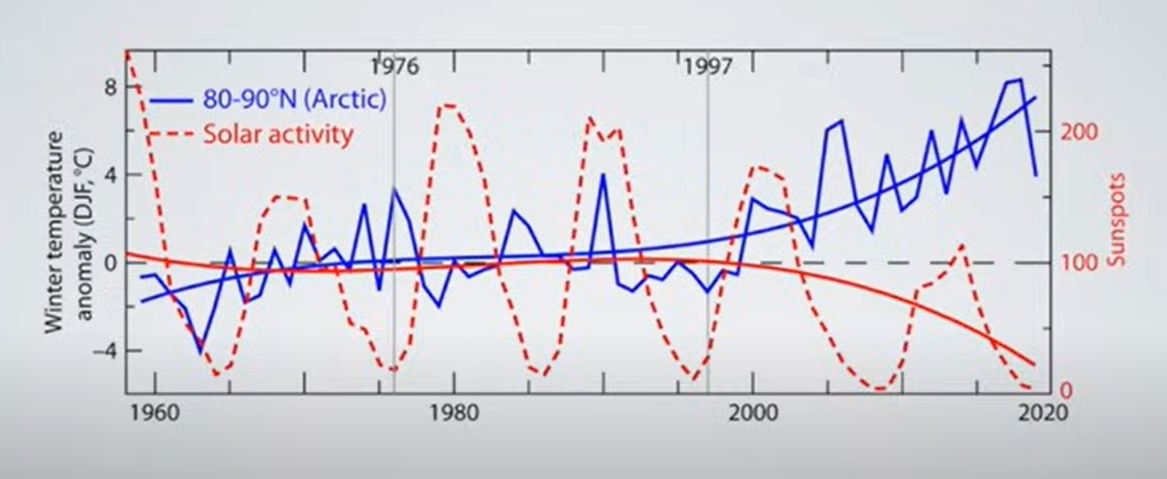
When solar activity is low, the Arctic warms

When there is low solar activity the Arctic warms as is shown in Blue by the temperature of the central Arctic according to data from the Danish meteorological Institute.  Today global warming and Arctic warming are linked in our minds.  We have forgotten that between 1976 and 1997, despite intense global warming, the Arctic not only did not warm but actually experienced a slight Cooling in its central zone.  Just as we have forgotten that the Arctic warmed in a similar way 100 years ago. It was reported at the time and there are scientific studies that support Antarctic warming a century ago similar to today’s in its effect on Greenland’s melting.

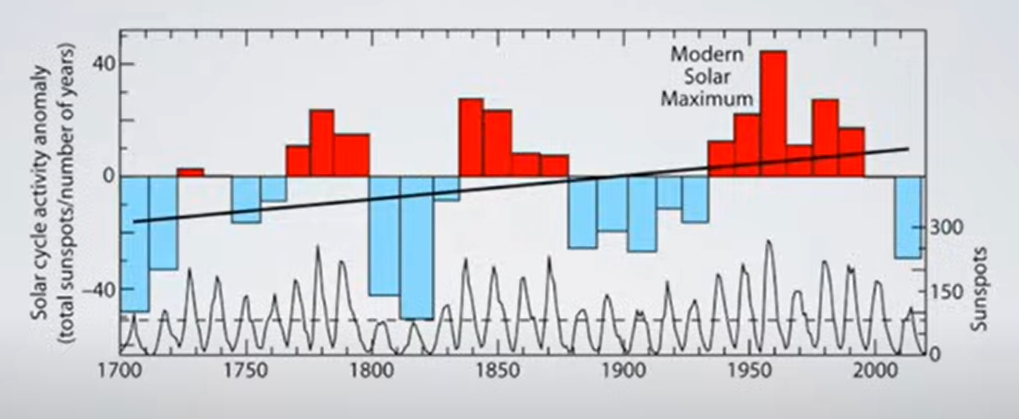
When solar activity is high, the rest of the planet warms

Why did this happen.  It is because solar activity has a cycle of about 100 years this graph shows the level of activity of each solar cycle relative to the average and we can appreciate the Centennial solar cycle shortly after 1700 1800 1900 and 2000 solar activity was below average and the Arctic warmed.  When solar activity is high the opposite happens and the Arctic cools but the rest of the planet warms because it becomes more efficient at conserving energy.

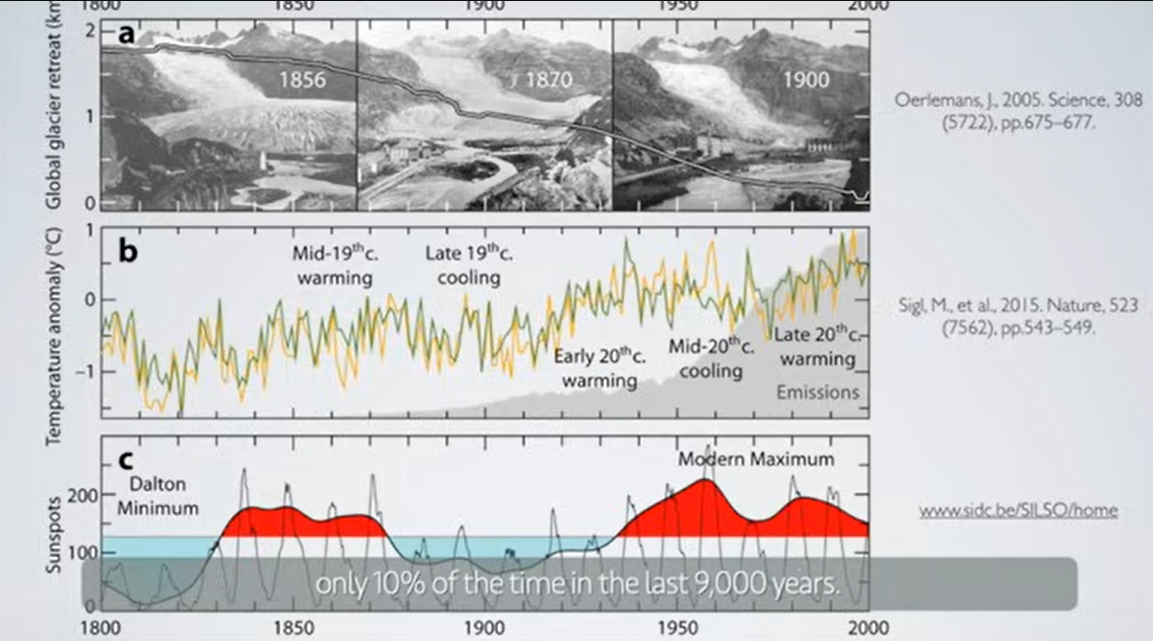
Glaciers and proxies show modern warming before CO2 emissions

The IPCC acknowledges that solar activity in the 20th century was in the top 10% of the last 9,000 years.  In the graph we can see the trend line indicating that solar activity has been increasing for the past 300 years and global warming is 200 years old.  we can see it in the behavior of glaciers which began to shrink worldwide in 1820 as shown by the line in the graph. The photos are from the Rome Glacier in Switzerland which melted enormously between 1850 and 1900.  People didn’t care, on the contrary they built hotels for tourists where the glacier used to be.

Climate proxies show the same thing.  The green line is from tree rings and the orange line is from other proxies, both showing a 30-year oscillation on a long-term warming trend.  In stark contrast, our emissions in Gray were nonexistent until 1900 and low until 1950,  the curves clearly do not match.  A much better match is obtained for solar activity shown in annual data with a thin line and a decade long smoothing that shows in red when it was above average and in blue when it was below average.

Global Warming is largely due to the Modern Solar Maximum

The modern solar maximum is the long 70-year period in the 20th century when it was above average, something that has happened only 10% of the time in the last 9,000 years.  We can therefore conclude that a reduction in the transport of heat to the polls during most of the 20th century is responsible for the planet conserving more energy and warming up contributing greatly to global warming.

And as Sherlock Holmes would say the IPCC has made a capital mistake by establishing a consensus Theory without properly examining all the evidence.  A this and much more is explained in my latest book solving the climate puzzle I want to thank three other scientists for reading my book before its publication and providing positive feedback.  They are William Happer professor emeritus of physics at Princeton University who also wrote the forward to the book,  Judith Curry professor emerita of atmospheric physics at Georgia Institute of Technology and Willie Soon research scientist at the Harvard-Smithsonian center for astrophysics.  I also want to thank Andy May, a writer I have collaborated with on many climate science web articles over the years.  The book has been written at several reading levels and divided into a large number of short chapters to make it more accessible to a general audience despite the inherent complexity of the subject.  It has been translated into five languages of which two have been published and three are in the process of being published.  There are plans to publish it in three more languages including Greta Thunberg’s.

My main interest for the past nine years has been to find out why and how the climate changes on our planet.  It is clear from the evidence that we are missing some essential processes because we don’t understand the majority of past climate changes. There are more scientists who agree on this than is usually acknowledge.  Several new theories have been developed including mine and they should be seriously considered by the IPCC because the CO2 Theory lacks sufficient evidence.  I defend my theory as having more support from evidence than the consensus one, but what is important to everybody is that on top of the IPCC’s Capital mistake of reaching a premature consensus, we don’t make the capital mistake of embarking the global economy on a planned experiment of unforeseeable consequences.

TN: You argue that climate change is largely due to natural causes and in particular you attribute a key role to high solar activity in the 20th century.  How does your theory differ from others who also argue for such a role?

JV: Well the mechanism is different. There is a lot of debate about the role of the sun in climate and over the last 30 years there has been a lot of advances in understanding how solar variability affects the stratosphere and how this effect is transmitted to the surface.  What I add is how these effects change the energy content of the climate system and thus produce climate change.  In my book I present evidence that climate is changing due to changes in the amount of heat that is being transported to the poles and the amount of solar energy that changes is not that important.  So in essence I refute the IPCC’s arguments that dismisses a solar effect on climate based on small changes in solar energy and in the trends in solar activity not being the same as temperature Trends

TN: Okay so how does your work fit with other theories like there’s the role of geothermal heat by Viterito and Kamis and the role of cosmic rays by Svensmark and Shaviv.

JV: It is good that there are all these theories because in science we should always discuss several explanations.  The important point is that the climate is always changing and it is a very complex process, so there is not a single cause for for climate change.  Many of these processes may be contributing to climate change including the the increase in CO2 and it is important to determine which ones are the most important in driving climate change.

We should continue researching and debating these processes.  Any viable Theory should provide a mechanism for changing the energy balance at the top of the atmosphere because this is what changes the energy content of the climate system.  And it should be supported by the more evidence the better.  The theory that I propose meets both requirements, while the theory that it is all due to CO2 lacks evidence.

The Role of Water Vapor and Volcanic Eruptions

TN: What do you think of Joe Bastardi’s views about the importance of water vapor in the climate?

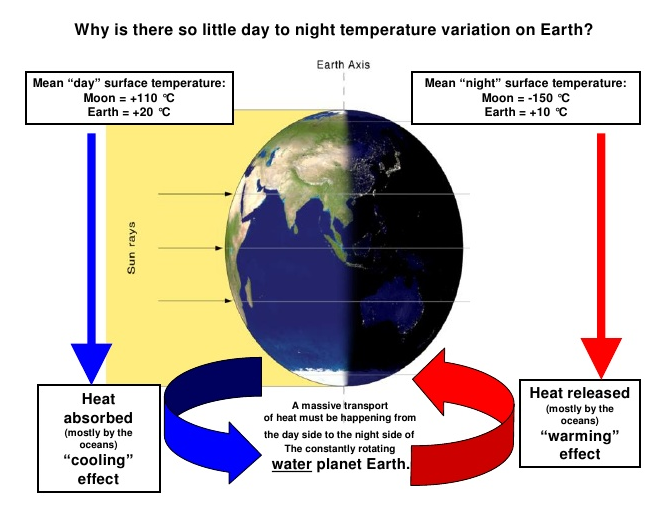
JV: I think it is fundamental because water vapor is the main greenhouse gas and what really defines the Earth is that it is a planet that has a lot of water in its three states,  And I believe that the role of water is to provide stability to The Climate system through its thermal inertia.  This is what explains that for the last 540 million years when everything has happened the temperature of planet has remain compatible with Life.  So I think none of the IPCC’s predictions is going to come true because I think the role of the water is misunderstood and it doesn’t behave the way it is expected to.  I don’t think water increases climate change,  I think it actually decreases it

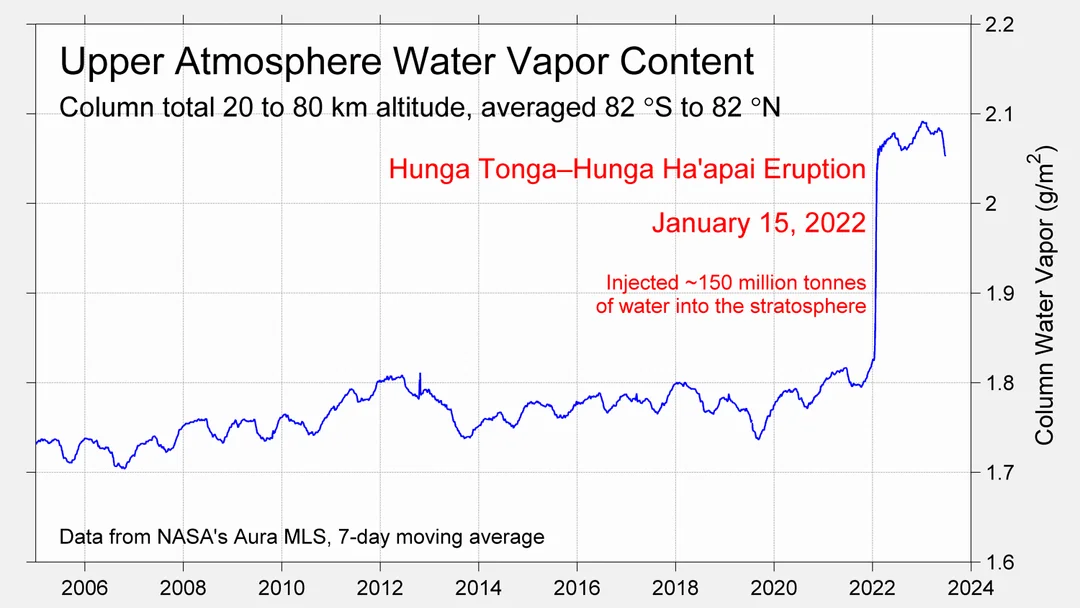
TN: What do you think about the eruption of the hunga Tonga volcano in 2022.  Is that a major reason for the recent temperature Spike?

JV: I think it is very likely.  The volcanic eruption of 2022 was very unusual in that it was underwater so it placed 146,000 tons of water vapor into the stratosphere and the stratosphere is very dry so in a single day the water vapor in the stratosphere increased by 10% and the greenhouse effect is very sensitive to changes in the stratosphere  because it is a lot less opaque to infrared radiation than the troposphere.  So the expected effect from this change as was published in January in natural climate change is a substantial increase in the warming rate so and this is what has been observed. The fact that the onset of this warming has such a delay is normal for volcanic eruptions for example the eruption of the Mount Tambora in April of 1815 produced the year without the summer more than a year later in 1816.   If this explanation is correct we should expect over the next months the warming rate should decrease substantially,  and this increased warming should disappear over the course of four to five years as the extra water vapor leaves the stratosphere.

Concluding Remarks and Future Implications

TN: So if your theory is correct what are the economic implications?

JV: Well if humans are are not primarily responsible for climate change this will have huge implications for the global economy.  We should question the energy transition in the form of urgency that is being made because it is not exempt of risk.  Even if the theory is correct, we should be aware that a lot of people will not be willing to accept it regardless of the evidence.

TN: Other than the economic implications, what are the other consequences if your theory is right?

JV: Well I think people should be very calm.  We are very lucky to be living through a warming period because cooling periods are much worse, usually accompanied by famine and epidemics. Being in a warming period is a lot better. So we should not fear climate and only be concerned when the warming period turns into a cooling period.   That will happen eventually, but we don’t expect it during the 21st century.   So essentially I think we are uh very lucky with respect to climate and as long as the cooling period doesn’t doesn’t start I think the climate is our Ally not our Enemy.


September 2025 Arctic Ice Beats Expectations

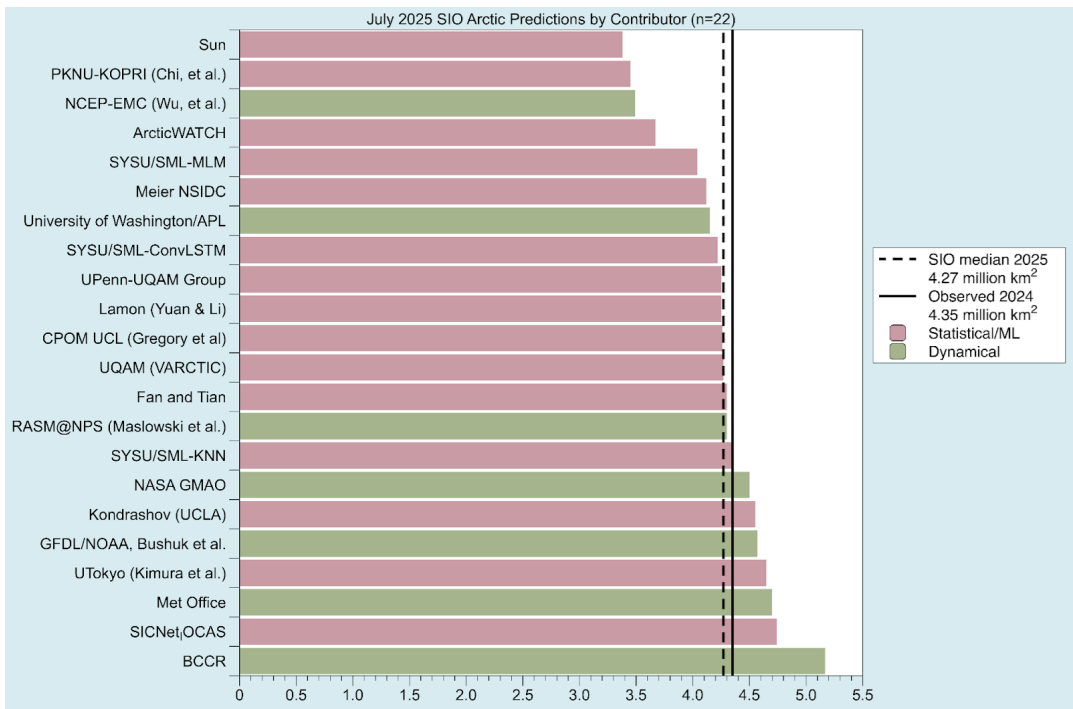
 MI Figure 1. Distribution of SIO contributions for July estimates of September 2025 pan-Arctic sea-ice extent. Public/citizen contributions include Sun.

July 2025 was the final report of the Sea Ice Prediction Network (SIPN) before the actual September monthly extent is reported by NOAA Sea Ice Index (SII). The report (link in red) gave this overview.

2025: July Report from Sea Ice Prediction Network

The July 2025 Outlook received 22 pan-Arctic contributions (Figure 1). This year’s median forecasted value for pan-Arctic September sea-ice extent is 4.27 million square kilometers with an interquartile range of 4.13 to 4.54 million square kilometers. This is lower than observed in 2023 (4.37 million square miles) and 2024 (4.35 million square miles) observed in September. The lowest sea-ice extent forecast is 3.38 million square kilometers, from Sun, which would be a new record low for the satellite period (1979-present); the highest sea-ice extent forecast is 5.17. . . The observed extent values are from the NSIDC Sea Ice Index (Fetterer et al., 2017), based on the NASA Team algorithm sea ice concentration fields distributed by the NASA Snow and Ice Distributed Active Archive Center (DAAC) at NSIDC (DiGirolamo et al., 2022; Meier et al., 2021). 

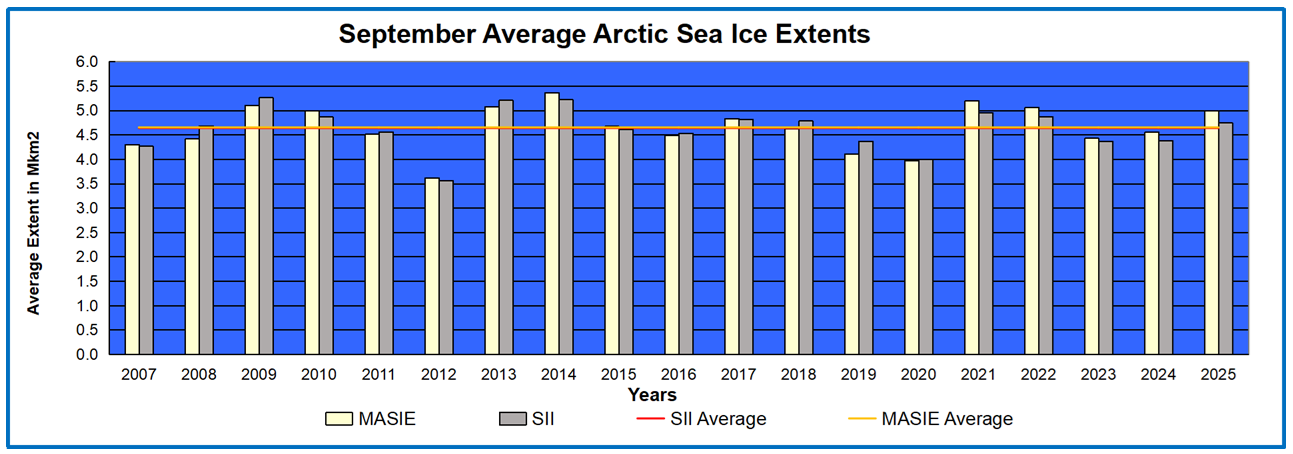
These are predictions as of August 20 for the September 2025 monthly average ice extent reported by NOAA Sea Ice Index (SII). This post provides a look at the 2025 September monthly averages comparing MASIE and SII datasets. (19 year average is 2007 to 2025 inclusive).

To enlarge, open image in new tab.

SIP network predicted SII would be 4.27M km2, and the actual result is 4.7M, while MASIE reported 5.0M km2.

The table below provides the monthly Arctic ice extent averages for comparisons (all are M km2)

Monthly MASIE 2025 SIIv.4 2025 MASIE -SII MASIE-19yr AVE SIIv.4-19yr AVE
Jan 13.206 13.131 0.075 -0.583 -0.470
Feb 13.802 13.745 0.057 -0.878 -0.715
Mar 14.274 14.140 0.134 -0.587 -0.545
Apr 13.846 13.910 -0.063 -0.249 -0.109
May 12.497 12.559 -0.062 -0.119 -0.108
June 10.510 10.485 0.025 -0.306 -0.388
July 7.942 7.660 0.282 -0.345 -0.375
Aug 5.854 5.395 0.459 -0.020 -0.220
Sept 4.990 4.745 0.245 0.298 0.050

The first two data columns are the 2025 YTD shown by MASIE and SII, with the MASIE surpluses in column three.  Column four shows MASIE 2025 compared to MASIE 19 year averages, while column five shows SII 2025 compared to SII 19 year averages.   MASIE started the year in deficits to average but recovered in spring to virtually match average in August, and now 298k km2 above average. SII was below its averages throughout and much lower than MASIE in July, and in August down by nearly half a Wadham. That gap reduced to -245k km2 in September.

Current Arctic Ice Extent Conditions

The month of September shows the annual dip in arctic ice extents, then recovering to end slightly higher than the beginning.  Note MASIE 2025 started 170k km2 above average and ended 316k in surplus. SII v.4 began 319k km2 in deficit to MASIE and ended 153k lower.

The table below shows the distribution of ice over the Arctic regions yesterday September 30, 2025, in comparison with the MASIE average and some other years of note.

Region 2025273 Day 273 ave. 2025-Ave. 2007273 2025-2007
 (0) Northern_Hemisphere 5265296 4947157 318139 4086883 1178413
 (1) Beaufort_Sea 567776 546476 21301 498743 69033
 (2) Chukchi_Sea 382991 220747 162244 51 382940
 (3) East_Siberian_Sea 502004 299345 202660 311 501693
 (4) Laptev_Sea 229451 168694 60758 235245 -5793
 (5) Kara_Sea 992 36279 -35287 15367 -14375
 (6) Barents_Sea 0 13476 -13476 4851 -4851
 (7) Greenland_Sea 170295 239645 -69350 353210 -182915
 (8) Baffin_Bay_Gulf_of_St._Lawrence 77930 55264 22665 42247 35682
 (9) Canadian_Archipelago 379648 370610 9038 307135 72513
 (10) Hudson_Bay 5071 3054 2017 1936 3135
 (11) Central_Arctic 2947568 2992334 -44766 2626511 321057

The massive surpluses in Eurasian basins of Chukchi, E. Siberian and Laptev more than offset smaller deficits in Atlantic basins Kara and Greenland seas. The over surplus was 318k km2 or 6.4%, and exceeded 2007 by 1.2 wadhams of ice extents.

Summary

The experts involved in SIPN expected SII 2025 September to be somewhat lower than recent years, but Arctic ice extents exceeded the 19 year averages.

Footnote:

Some people unhappy with the higher amounts of ice extent shown by MASIE continue to claim that Sea Ice Index is the only dataset that can be used. This is false in fact and in logic. Why should anyone accept that the highest quality picture of ice day to day has no shelf life, that one year’s charts can not be compared with another year? Researchers do this, including Walt Meier in charge of Sea Ice Index. That said, I understand his interest in directing people to use his product rather than one he does not control. As I have said before:

MASIE is rigorous, reliable, serves as calibration for satellite products, and continues the long and honorable tradition of naval ice charting using modern technologies. More on this at my post Support MASIE Arctic Ice Dataset

MASIE: “high-resolution, accurate charts of ice conditions”
Walt Meier, NSIDC, October 2015 article in Annals of Glaciology.