Dr. Wielicki explains at his blog Irrational Fear Excerpts in italics with my bolds and added images.
The most important climate decision in modern U.S. history is quietly being dismantled.
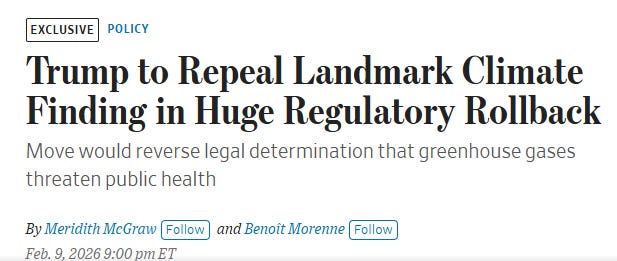
According to reporting by The Wall Street Journal, the Trump administration is moving to repeal the EPA’s 2009 Endangerment Finding — the regulatory keystone that enabled fifteen years of climate rules, vehicle mandates, power-sector controls, and trillions of dollars in compliance costs.
And yet, remarkably, almost no one is talking about the science.
The public conversation is almost entirely about process: whether the repeal will survive legal challenges, whether agencies followed the correct procedures, whether industry benefits too much, and whether courts will intervene. What is missing, again, is a serious discussion of whether the Endangerment Finding was ever scientifically or legally justified in the first place.
That omission is not accidental. It is the defining feature of modern climate policy.
A Decision Made First, Justified Later
The EPA’s Endangerment Finding followed the Supreme Court’s Massachusetts v. EPA decision, which merely allowed greenhouse gases to be considered under the Clean Air Act. It did not require the EPA to declare carbon dioxide a danger to public health or welfare. That judgment was left to the agency.
And the agency chose its answer early.
A recent investigation by the Government Accountability & Oversight Office confirms what many of us suspected at the time: the Endangerment Finding was built around a conclusion that had already been reached. The scientific process that followed was not designed to test whether CO₂ posed an endangerment, but to defend a regulatory outcome deemed politically necessary.
Oversight finding:
“…the Endangerment Finding was treated internally as a ‘decision ready to go,’ with scientific review structured around defending the outcome…”
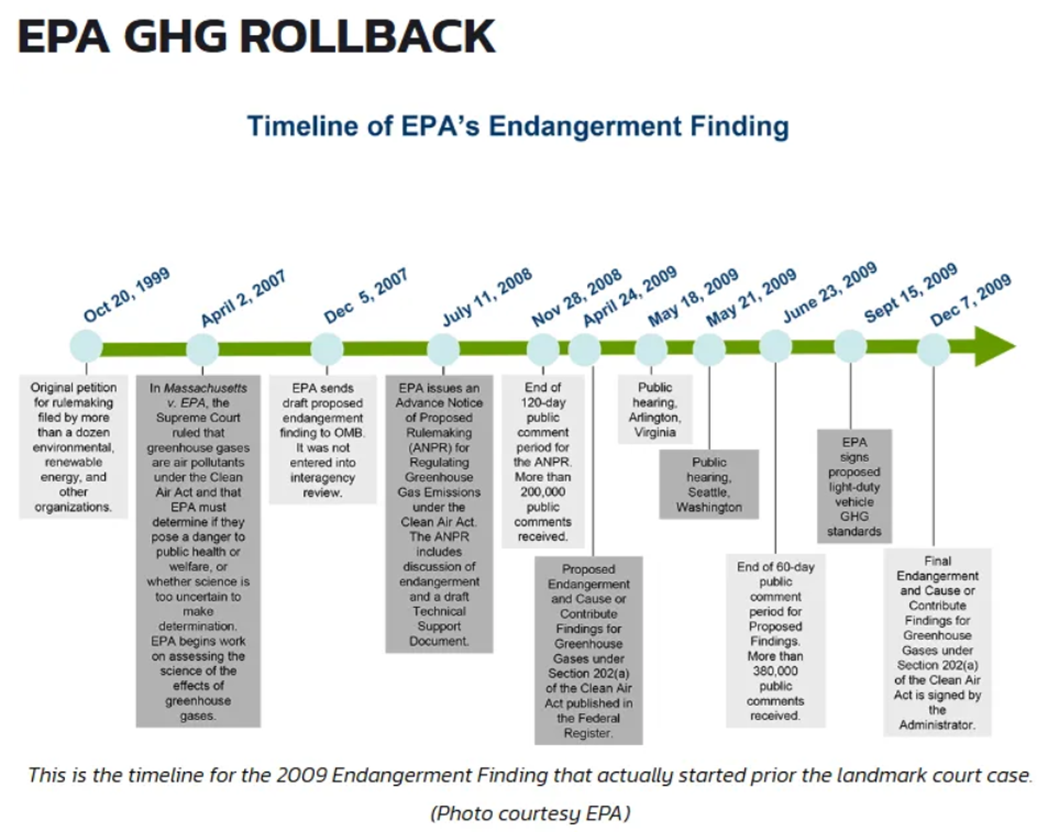
To enlarge, open image in new tab.
This is the core argument I laid out in my earlier Irrational Fear piece, “Mr. Zeldin, Will You Rescue America From the EPA’s Climate Fraud?”, where I traced how a single bureaucratic determination metastasized into economy-wide control over energy and mobility. I expanded that case in “Climate Lawfare”, showing how courts later shielded massive climate spending programs rooted entirely in the Endangerment Finding’s authority.
None of this was hypothetical. It was documented.
It was observable. And it was ignored.
What the Endangerment Finding Never Confronted
A genuine scientific assessment of endangerment would have required confronting inconvenient facts. The 2009 finding did not.
It never seriously addressed the role of natural recovery from the Little Ice Age, a period of unusually cold global conditions that peaked well before industrial CO₂ emissions and from which the planet has been rebounding for more than a century. Treating all post-19th-century warming as unprecedented and dangerous required quietly discarding that context.
It also failed to grapple with the net benefits of modest warming to human societies. Cold is far deadlier than heat. Agricultural productivity improves with longer growing seasons. Energy access reduces vulnerability. These realities undermine the simplistic harm narrative embedded in the finding.
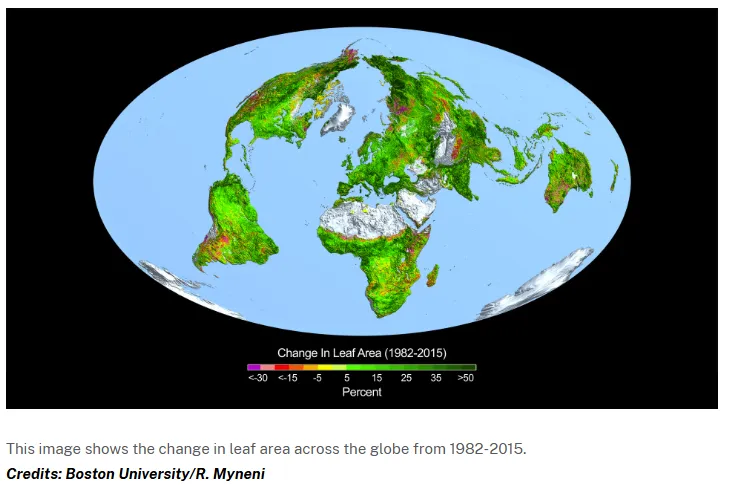
Most conspicuously, the EPA excluded the benefits of CO₂ fertilization, despite mounting observational evidence, now overwhelming, that higher CO₂ concentrations have increased global leaf area, improved plant water-use efficiency, and boosted crop yields. Satellite data did not support a story of planetary decline. They supported one of widespread greening.
The Absurdity of Calling 420 ppm “Unclean Air”
Perhaps the most fundamental flaw in the Endangerment Finding is conceptual.
For most of Earth’s history, atmospheric CO₂ levels were not 280 ppm or 420 ppm, but 1,000 to more than 4,000 ppm. Life did not collapse under those conditions. It flourished. Forests expanded. Biodiversity increased. Entire ecosystems thrived.
Against that backdrop, the claim that today’s atmosphere — at roughly 0.04% CO₂ — constitutes “unclean air” collapses under minimal scrutiny. Carbon dioxide is not mercury. It is not sulfur dioxide. It is not lead. It is an essential molecule for life.
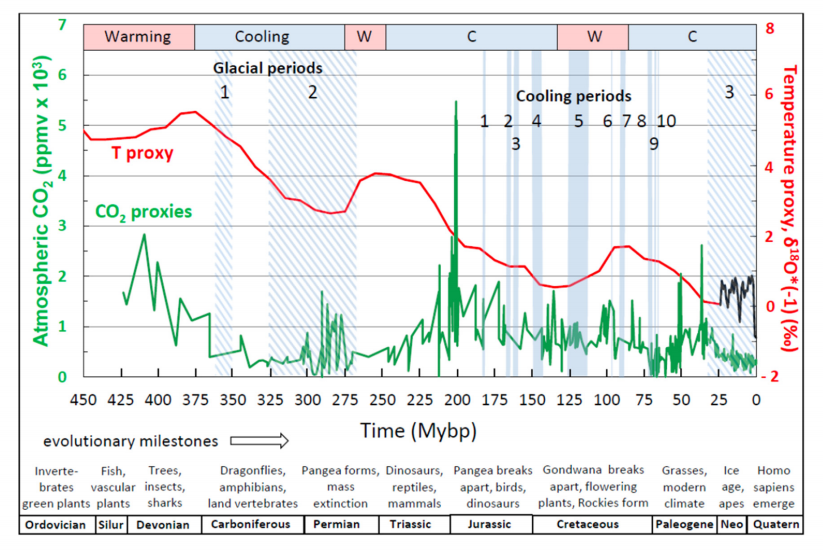
The Relationship between Atmospheric Carbon Dioxide Concentration and Global Temperature for the Last 425 Million Years (Davis 2017)
This figure shows estimates of the changes in carbon dioxide concentrations during the Phanerozoic. This is not an ideological statement. It is basic chemistry. The Endangerment Finding required redefining that chemistry to make regulation possible.
Years of Writing, One Conclusion
At Irrational Fear, I have spent years examining these issues from multiple angles: disaster statistics, sea-level records, hurricane data, climate costs, adaptation, and the repeated failure of model projections to match observations. I submitted those findings formally to the EPA in my public comment supporting reconsideration of the Endangerment Finding, drawing directly on hundreds of prior analyses.
The conclusion has remained consistent: the evidence never supported a finding of endangerment.
What has changed is not the data. What has changed is
the legal and political tolerance for pretending otherwise.
 Science Matters
One comment