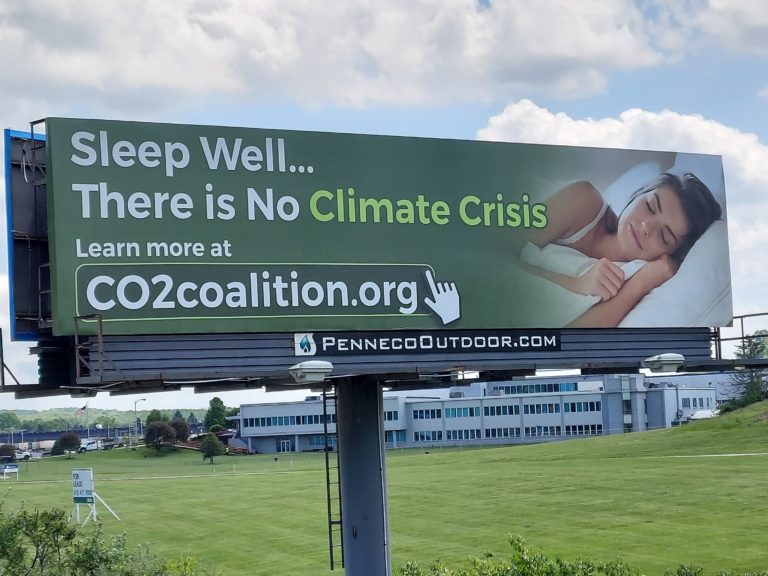
Andrew Weiss explains the cascading effects upon climate obsessed politicians in his Real Clear Energy article After the Endangerment Finding, States Must Prove CO2 Harms. Wisconsin Can’t.. Excerpts in italics with my bolds and added images.
The EPA’s revocation of the 2009 endangerment finding shifts the burden of proof from federal agencies to state capitals. Governors who declared climate emergencies must now demonstrate with regional data that rising carbon dioxide (CO2) endangers their residents. Wisconsin cannot meet that burden.
In 2019, Wisconsin declared climate change a crisis requiring the state’s electricity to be carbon-free by 2050, citing worsening extreme weather as justification. Since then, the state has spent $6 billion on renewable infrastructure while residents pay 15% more for electricity than the Midwest average.
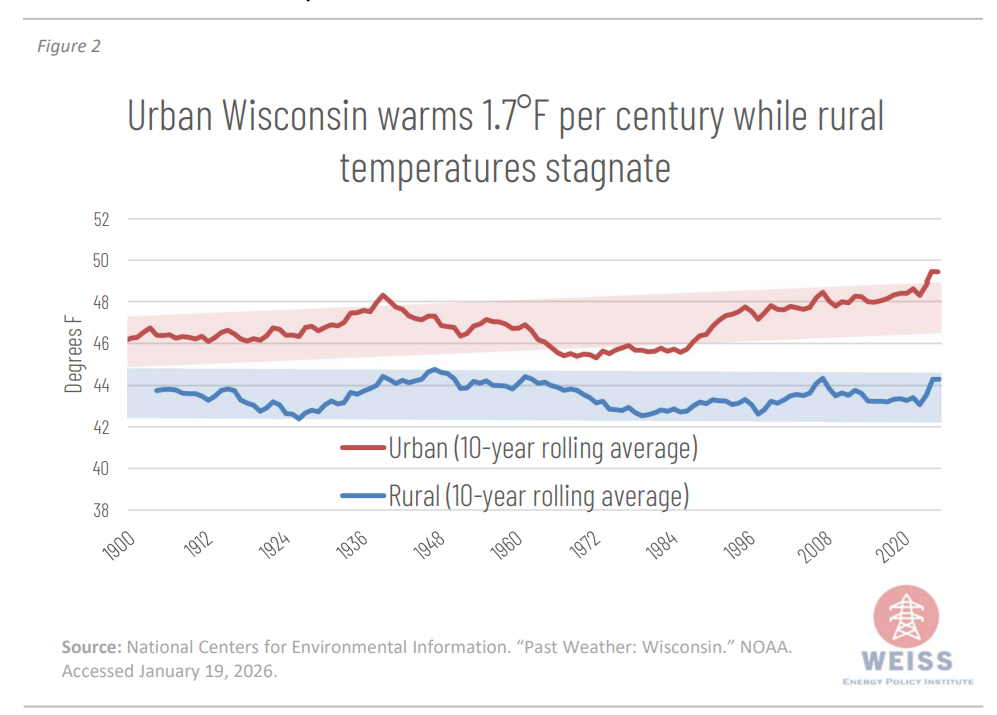
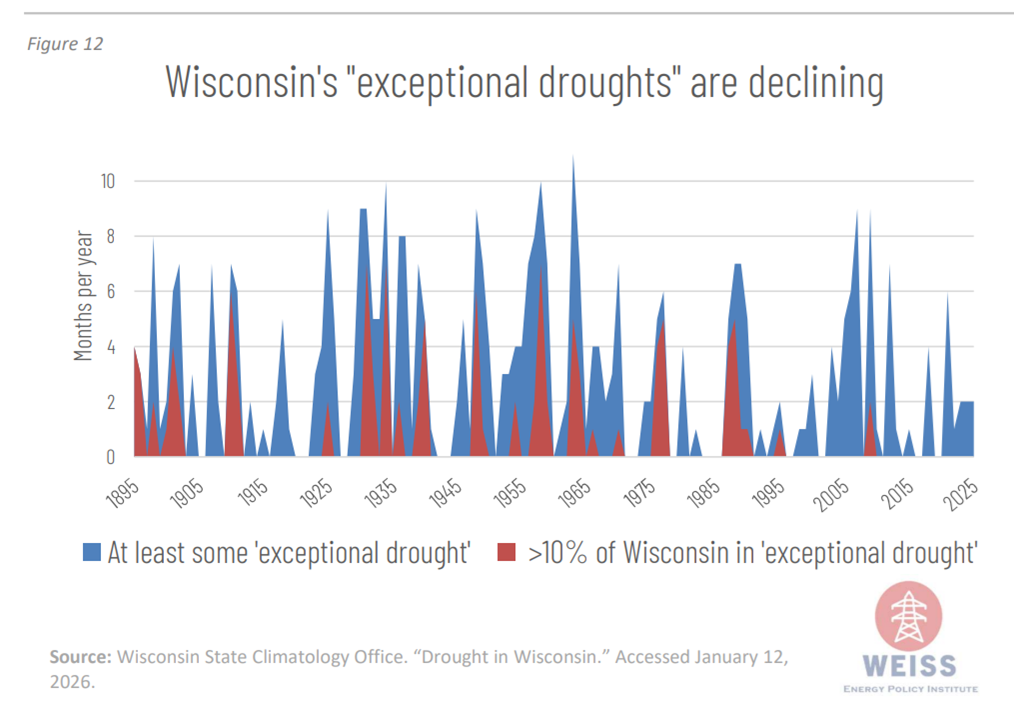
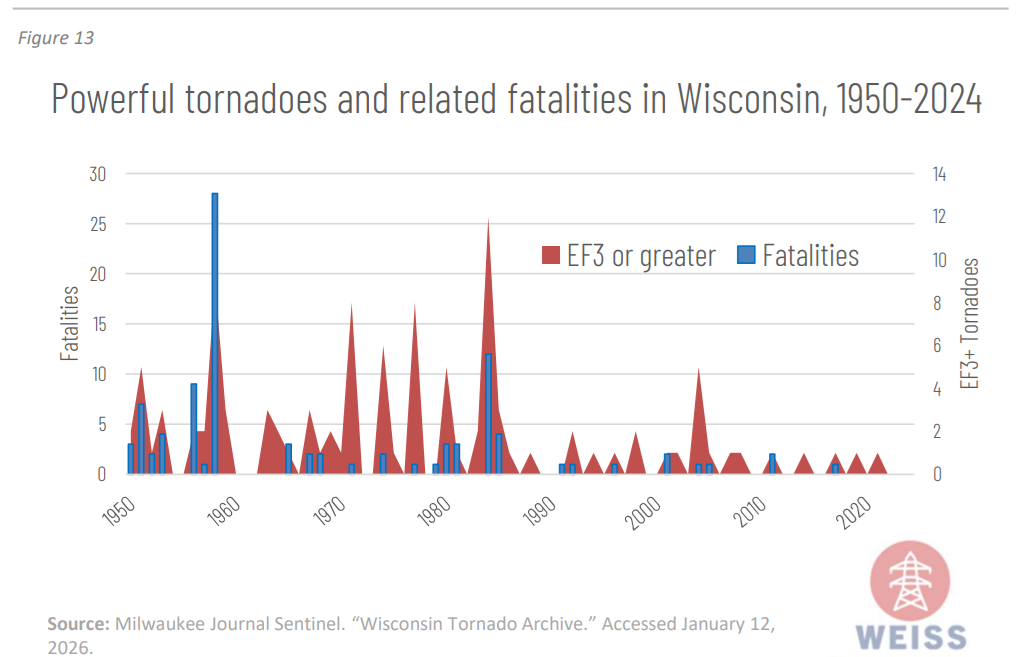
A new report by the Weiss Energy Policy Institute analyzed 130 years of Wisconsin climate data and found that as atmospheric CO2 rose 45%, Wisconsin experienced 63% fewer days over 90°F, heatwaves 71% shorter in duration, powerful tornadoes down 70%, and significant drought decline since 1894.
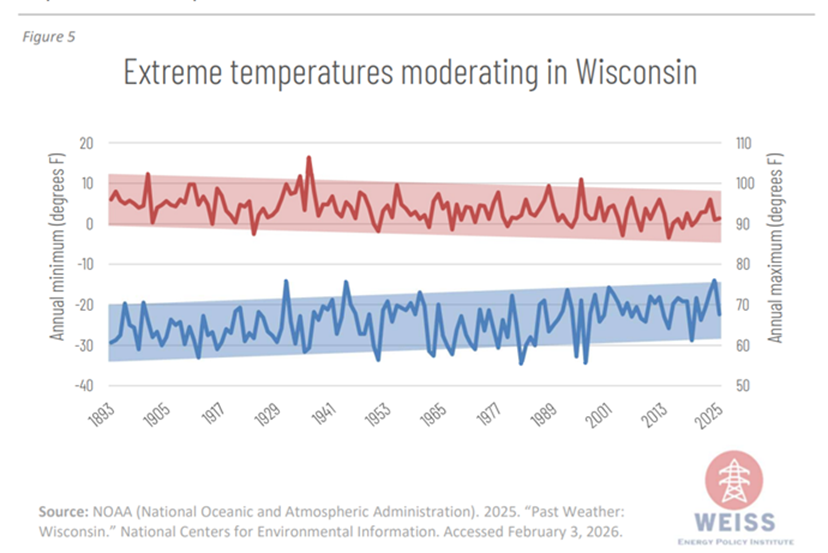
This isn’t just absence of evidence, it’s negative correlation.
As CO2 increased, climate extremes decreased.
In addition to the improving climate, the report also notably found that rural Wisconsin’s average temperature has not changed since 1894. Urban areas, on the other hand, have warmed about 2.2°F since the late nineteenth century. The report finds that this urban warming is nearly entirely due to the Urban Heat Island effect from concrete and development, not CO2. In many measurable ways, Wisconsin’s climate has become more conducive to human flourishing over the past century.
Even if CO2 were causing harm, Wisconsin’s ability to adapt
to climate change far surpasses its ability to influence it.
The Badger State’s 2023 carbon emissions were 22% below its peak of 110 million metric tons in 2005. Despite its reduction, annual global emissions have increased by over 100 times Wisconsin’s entire annual emissions over the same period. In fact, in 2023, Wisconsin’s carbon emissions made up less than 0.25% of the global total.
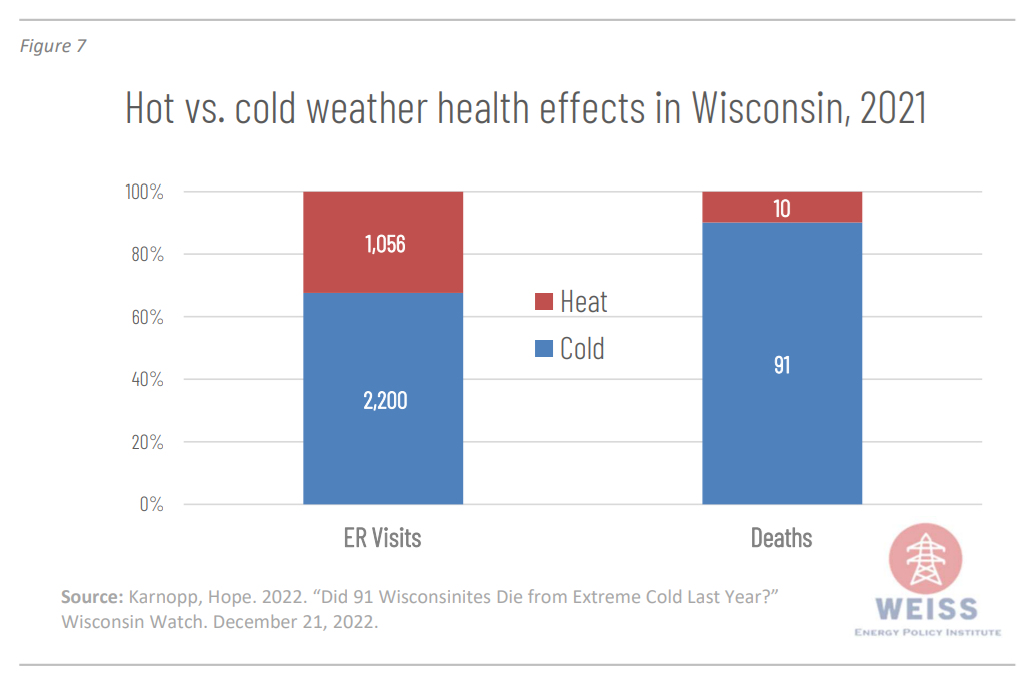
While CO2 has not endangered residents of Wisconsin,
the climate-based policies have.
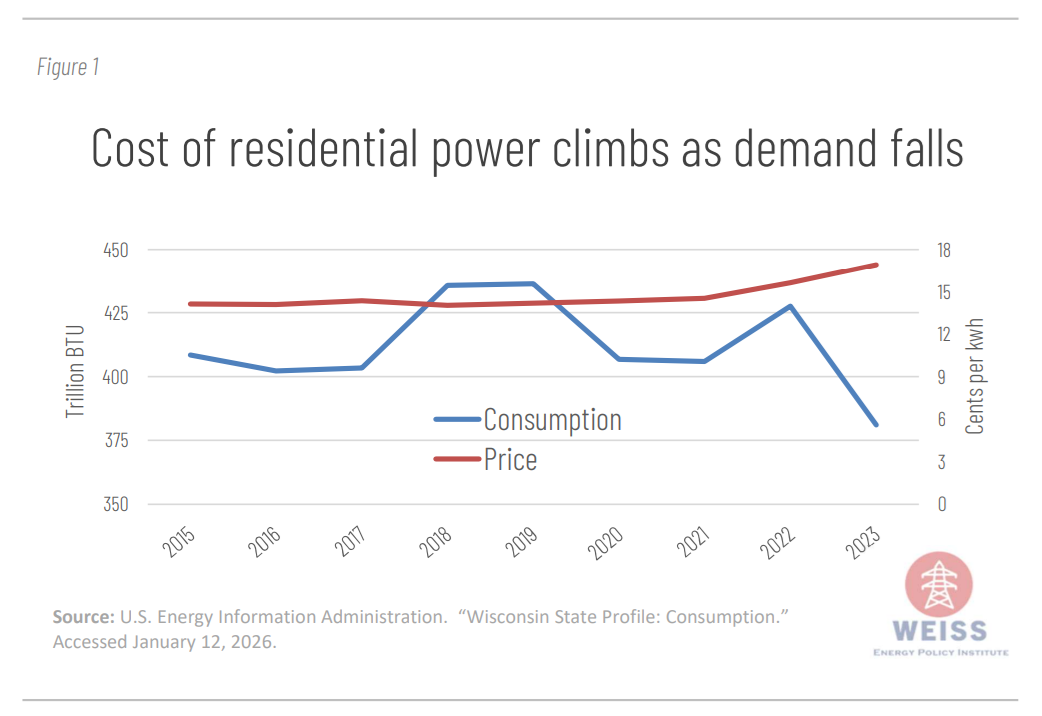
Residential electricity prices continue climbing even as household consumption falls. In fact, Xcel Energy and Alliant Energy have requested cumulative rate hikes approaching 19% over the next two years. Some in Waukesha County are already facing “dramatically higher” energy bills, double from just months earlier. Under Wisconsin’s current policies, this is sure to continue. In fact, Wisconsin is hurtling toward an energy crisis. The latest long term reliability assessment projects the state will enter “high-risk” territory for blackouts by 2028.
This economic burden stems from poor energy policies. Current leadership has forced coal plants into early retirement, blocked critical natural gas infrastructure, mandated carbon targets over grid reliability, vetoed consumer protections against appliance bans, and weaponized the permitting process to strangle traditional energy development.
For example, the state’s climate policies prevented a gas-fired plant that would have brought $1 million in annual tax revenue and 350 construction jobs to northern Wisconsin last year. Its initial permits expired while waiting for more permits.

In the face of unprecedented new energy demand, Wisconsin’s grid might have been able to absorb the new data centers and industrial growth if it weren’t already stressed by climate policy. But solar cannot replace coal megawatt-for-megawatt. In order to replace reliable coal with solar, while maintaining the same reliability, nearly twenty times the capacity must be installed. That means ratepayers pay to build and maintain thousands of acres of solar panels and pay to keep backup plants on standby for when those panels underperform.

Even overturning the carbon mandate won’t be enough to save the grid, because the current regulatory system was not built to accommodate surging industrial demand without punishing ratepayers. Wisconsin lawmakers need to save residents from footing the bill for data center infrastructure by utilizing free markets and private capital rather than heavy-handed subsidies.
This market-oriented solution for Wisconsin is called Consumer-Regulated Electricity (CRE). It allows privately financed utilities to generate and sell power directly to large customers through voluntary contracts, operating independent of the regulated grid. This creates a parallel pathway for new industrial demand, protecting residential ratepayers while giving Wisconsin a competitive advantage over other Midwest states. It attracts industrial capital without subsidies or forcing costs onto families.

The revoked endangerment finding forces a reckoning: will Wisconsin continue its expensive and dangerous energy transition, or will it examine the actual data? New evidence suggests the state should:
♦ rescind its zero-carbon mandate,
♦ restore reliable baseload power to the legacy grid, and
♦ pass Consumer-Regulated Electricity legislation to let private capital serve new industrial demand without burdening ratepayers.
Combined with removing carbon mandates from the legacy grid,
these reforms position Wisconsin a bright energy future.
In the 21st century, affordable and reliable power separates flourishing societies from struggling ones. Wisconsin cannot prove CO2 harms, but its climate policies are already bringing on an energy crisis. Other states that built climate mandates on the endangerment finding should audit their climate data. The burden of proof has shifted to state capitals, and the evidence may not support the mandates.
See also:
 Science Matters
I hope the attorneys fighting to end nut zero take the offensive as well.
Wisconsin products that massively benefit from the increase in CO2 from 250 PPM to 420 PPM –
Corn: Primarily grown for livestock feed and ethanol production.
Soybeans: A major crop used for oil and animal feed.
Dairy: While not a crop, Wisconsin is famous for its dairy products, particularly cheese.
Potatoes: Significant production, especially in the central and northern regions.
Vegetables: Includes carrots, sweet corn, and snap peas, often for local markets.
Fruits: Apples and cranberries are notable, with cranberries being a key specialty crop.
LikeLike
Good points, David. The report did not discuss the agricultural benefits of rising CO2.

Like this:
Figure 1. Corn yield progress (bu/A yr) of top producers in Wisconsin. Data derived from NCGA CYC categories 1983-2016.
LikeLike
That is substantial. No reasonable court would enforce the nut zero guidelines. Alas we have many unreasonable courts.
LikeLike
True, we need more evidence-based judges than we have:
LikeLiked by 1 person
Your illustrated postings have increased greatly. Are you using an AI program?
LikeLike
No, the intelligence is all mine, based on 2 decades of looking for images to make text more meaningful and memorable. Now that last one was my repurposing of a cartoon with different captions, originally by Branco.
LikeLike