About Heather Exner-Pirot My research focuses on Indigenous and northern economic development, energy security, and resource politics and policy. I am currently the Director of Energy, Natural Resources and Environment at the Macdonald-Laurier Institute, a Special Advisor to the Business Council of Canada, and a Research Advisor to the Indigenous Resource Network.
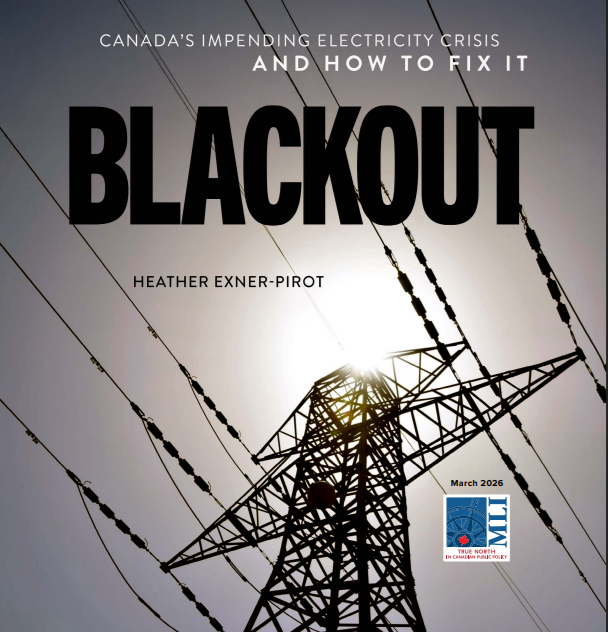
in the brief interview below she explains how Canada has squandered abundance, and is now facing an impending energy crisis. Her recent paper shown above (and linked later below) includes the background research for viewpoints expressed, and presented in the transcript with added bolds and images. JS refers to Jim Csek and HEP to Exner-Pirot.
Does Canada produce enough energy to sustain itself?
JS: British Columbia is now a net importer of electricity. You would think that would be almost impossible. And I remember a couple of years ago when Fortis applied in the Okanagan here to get a peaker plant, an LNG peaker plant, and they were denied and they seem to be going all in on at the time, all in on wind and solar. Now they’re kind of changing their focus to LNG.
The decisions that have been made over the past 10 years in Canada have put us in this place of energy dependence. Do you see light at the end of the tunnel? Do you see that we’re shifting? It’s been a year now with this new BC government, and they said they’re going to build at a speed like never seen before. Yet the NDP seems to be still stuck in its old ways. And we haven’t seen that speed yet.

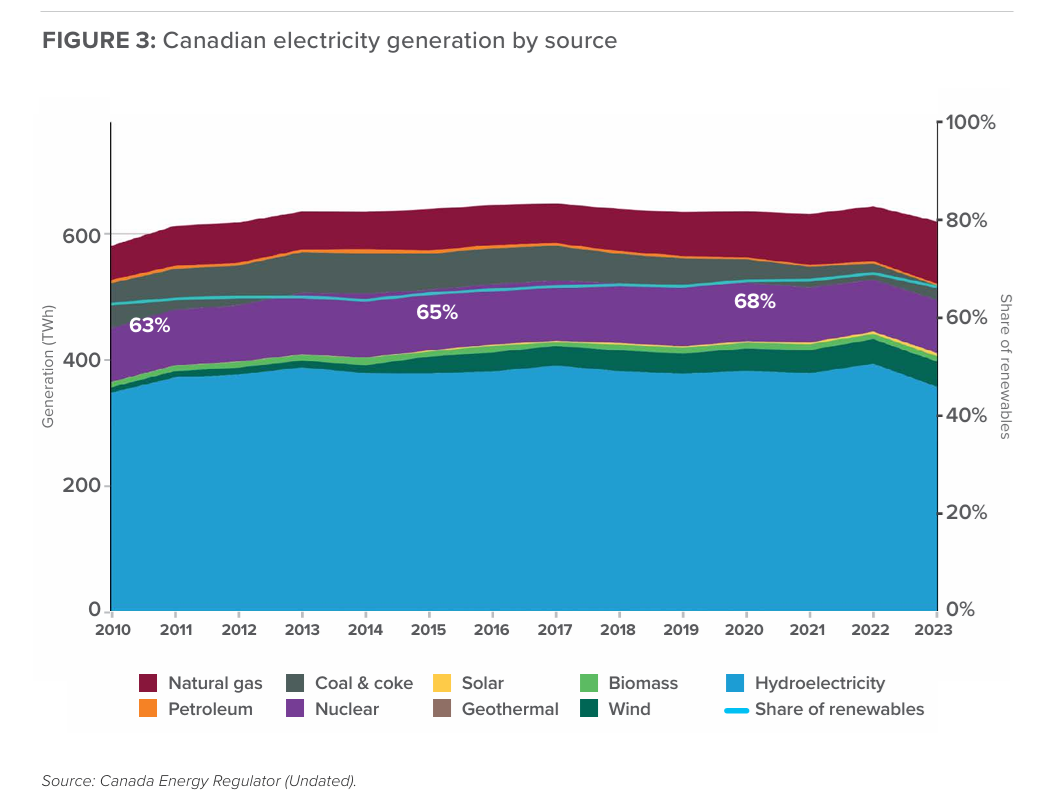
HEP: No, we haven’t seen that speed. And maybe you saw I wrote a paper on electricity and our impending crisis that just came out last month. So when you say, you know, there’s a light at the end of the tunnel, is it is it the light because we’re near death or is there actually some more electricity coming on board? And the one thing I think people don’t appreciate is that Canada’s electricity generation peaked in 2017. And I think everyone knows that we’ve added, I don’t know, six million people since then.
So on a per capita basis, our electricity generation is absolutely in decline. And this is happening as we’re pushing electrification of transportation, electrification of heating. And now we want to electrify everything that takes energy. We want to build more critical minerals production, do more smelting here. That takes electricity. We do not have the electricity to do all the things that we say we’re going to do.
And actually, this week, probably on Wednesday, the prime minister is going to announce a national electricity strategy. We’ll see how serious they are. If it’s all incentives for wind and solar and, you know, intertides from Nova Scotia to Quebec, I will say they’re not very serious. If there’s a lot of funding for nuclear and some carve-outs of the clean electricity regulations, I’ll say that they’re thinking about being serious.
But we’ve had such abundance in this country. In Canada, it always comes down to this, that we had time to squander it. We had way too much time to squander it. And we spent eight or 10 years squandering it. And just now we’re starting to worry. I always say, we’re like the frogs in the boiling water. We’re starting to notice it’s hot. But it’s been getting hot for many years.
And so now the question is, there’s real trade offs, Jim, as you know, in British Columbia, that for three years, actually, you’ve been a net importer of electricity. And now we want to build LNG Canada phase two and Ksi Lisims LNG. And you’re also doing wood fiber and you’re also doing cedar. And there’s also three mines that have been permanent or have expansions. And there’s not enough electricity for all of those things, not to mention all the people. And so it’s crazy that in a place like Kelowna the B.C. regulator is saying no more natural gas for home heating, you know, because we’ll miss our climate targets if we do that.
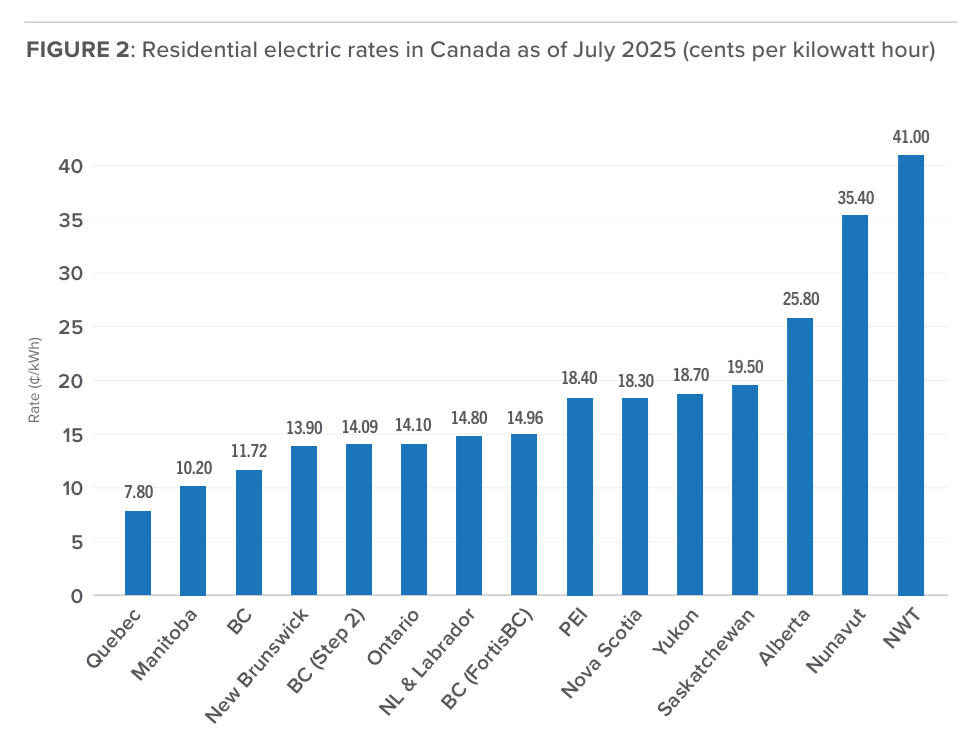
Meaning that people are being pushed with that scarce electricity for their home heating, whereas Kelowna is a beautiful place, but sometimes it does get to minus 25 occasionally. And that’s the exact time where you need to have enough electricity. And that tends to also be when, you know, when when hydro isn’t performing at its peak. And so we focus so much on sustainability and our electricity system these past 10 years that we really did it at the expense of reliability and affordability. And now it’s backtracking to try to balance those.
But I’ve been saying the next trade off is actually going to be between affordability and reliability. You’ll wish we could choose between sustainability and the other two. The choice you’re going to have to make is between affordability and reliability. And that’s not going to be a pleasant place for Canadians to be.
JS: Do you feel like sometimes you’re in a Monty Python skit when they talk about Canada needs to have an all EV mandate? And you know that there’s not enough electricity to do this. And it’s more of a pipe dream than a pipeline. Like, how do we how do we how do you square those two things? You got to drive EVs, yet there’s not enough electricity even for the stuff we have right now.
HEP: And it’s worse than that, Jim. You know, the the subsidies that went into heat pumps in Atlantic Canada, and Atlantic Canada is a big swing jurisdiction. You know, if the liberals can get can sweep Atlantic Canada, OK, they can get a majority. So that’s a very important jurisdiction for them. And they were on heating oil and heating oil is expensive. And heating oil does suck. They don’t have access to natural gas for some reasons of their own making. And so you do want to get off heating oil.
But they push on all these heat pumps and did nothing on the electricity generation side, and you can’t do one part of the equation. If you’re going to change a quarter of households to heat pumps, then you better think about how much electricity you’re going to need for that. Such that now we’ve had emergency applications from the Prince Edward Island utility and from New Brunswick saying we need a new natural gas generation immediately.
We need to be approved right away. This is an emergency. We already saw the cold snap that we had this year. They had to curtail some industrial use. I mean the utilities performed admirably under very difficult circumstances. But the actual situation in that cold snap was that we were not sending very much to the United States. We were importing from New England electricity produced from heating oil, and curtailing generation. And that can be very dangerous when when most of your households are on heat pumps and you have rotating brownouts. That is a very dangerous situation, actually.
Blackout Canada’s impending electricity crisis and how to fix it
Title is link to publication. Some important excerpts below in italics wtih my bolds.
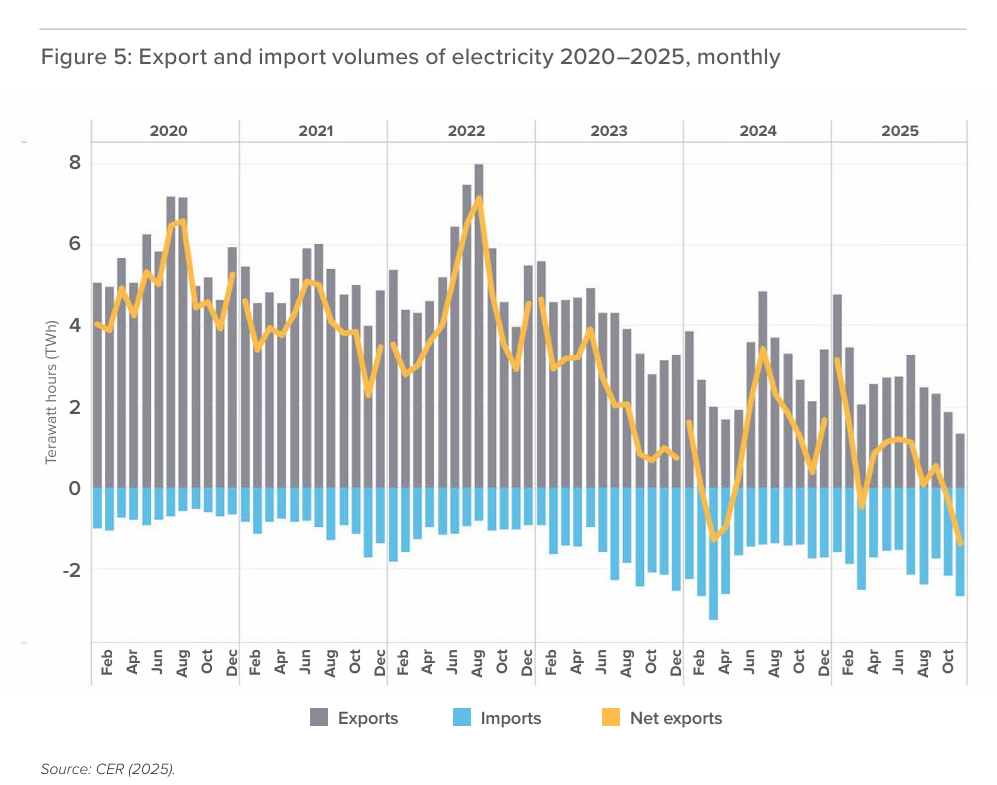
The electricity abundance and affordability that Canada has enjoyed for decades are ending. Generation is down, exports are now imports, and investment is flat. This comes as electricity is increasingly scarce and its availability a competitive advantage. Canada’s impending electricity shortage is not just an affordability crisis; it is an economic and security one as well.
While electricity policy was largely driven by emissions reductions objectives for the past two decades, adequacy, reliability, and affordability are resurging as priorities. Governments that fail to address the issue will be punished at the ballot box: voters are ratepayers.
This paper has sought to outline the growing crisis in Canadian electricity production, describe the policy trajectory that contributed to this state of affairs, identify shifts in policy direction that Canadians should advocate, and understand how to gauge policy improvement, or lack thereof.
Canada’s electricity surplus diminished because we became complacent and took the resource for granted. The sector now demands our attention, and for the sake of all Canadians, we had better respond intelligently.
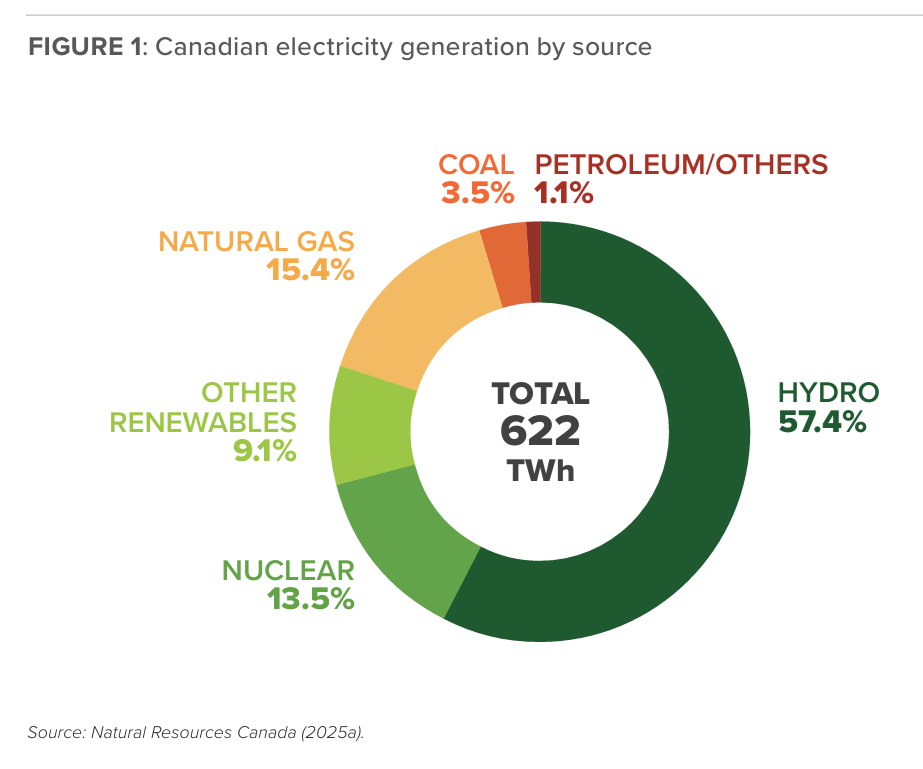
Although demand for electricity is growing, the forecasted growth in generation over the next five years is weak and will be accounted for wholly by intermittent renewables, the majority of which will come from wind. While renewables have their place in the energy mix, their power generation fluctuates based on weather and time of day, rather than conforming to electricity demand. This fundamental mismatch creates reliability, stability, and economic challenges for power grids, which are designed for constant, controllable base-load generation (see Sepulveda 2024). In fact, Canada’s Energy Regulator (CER 2025b) is forecasting that dispatchable capacity (i.e., sources of electricity that can adjust according to demand) will decline in Canada by 1.2 per cent by 2030.
In 2016, Canada sent as much as 64 TWh in net electricity exports annually to the US. However, that number has steadily dwindled due to a combination of drought and the growth in domestic demand. Canada became a net importer of electricity for the first time in modern history in Spring 2024. By the end of 2025, Canada had become a regular net importer of electricity (see Figure 5). In 2025 both BC Hydro and Hydro-Québec were net importers – a previously unthinkable outcome.
Introduced by Environment and Climate Change Canada in 2023 and finalized in December 2024, the CER (Clean Energy Regulations) set federal performance standards to achieve a near-zero emissions electricity grid by 2050 (a change from the initial 2035). The regulations set limits on carbon dioxide emissions from almost all electricity generation units that use fossil fuels beginning in 2035, phase out coal-fired generation, and impose strict limits on emissions from natural gas sources. The CER provides compliance options such as emission reductions at source, carbon credit purchases, and direct investment in clean generation projects. While the CER gives incentives for creating infrastructure for renewables and storage, it also introduces higher capital costs, regulatory complexity, and market uncertainty. With large hydro and nuclear projects becoming too expensive for governments and investors to afford, too longterm, or simply unavailable for many jurisdictions, the CER removed the last best source of firm (i.e. always available) power additions available to many jurisdictions: new natural gas-fired generating units.
Canada’s electricity crunch comes just when a surplus could have been directed to productive capacities. An LNG construction boom, increased oil and gas extraction, significant new mines and expansions in BC, Saskatchewan, Ontario, Yukon, Quebec, and Nunavut, and the implementation of a defence industrial strategy all require significant new generation and transmission. Canada will not reach its goals to double non-US exports without more and affordable electricity.
But the biggest opportunity is in data centres, and the cost of missing out is not only an economic risk, but a security one as well. Electricity is now being selectively rationed in Canada, with data centres facing enhanced scrutiny. This is a problem because data centres are not only at the forefront of global capital investment, but they are also increasingly integral to national security. They are critical infrastructure, essential for the smooth functioning and productivity of an advanced economy, but they are also drivers of economic and military competitiveness. Reliance on foreign infrastructure to train models, store sensitive datasets, or deploy AI systems makes countries vulnerable in much the same way that relying on competitors or adversaries for oil, natural gas, or critical minerals does.
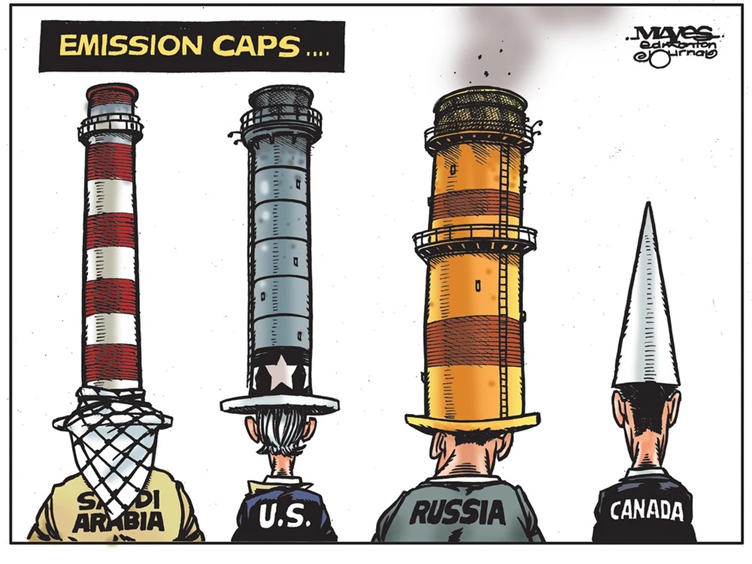
The fact is that Canada’s principal goal guiding electricity policy for the past two decades has been to reduce emissions. Ensuring reliable and affordable electricity has taken a back seat. When those policies were implemented, there was enough abundance in the system that the normal concerns of regulators and producers could fall into the background. That is no longer the case.
The Carney government, which includes senior advisors and Cabinet members with direct experience in the electricity sector, seems better equipped and motivated to tackle the issue than the previous Liberal government, and at the time of writing had announced the imminent release of a National Electricity Strategy. The extent to which it addresses the nuts and bolts of our current dilemma – that the country must find a way to create the conditions to generate, transmit, and distribute more MW at a lower cost, versus investing public dollars in expensive and politically motivated vanity projects with no business case – will determine if, and how fast, we in Canada can extract ourselves from our electricity deficit.
.
 Science Matters