Canada Immunity Testing: Antibodies 8 * Cases

The media announcement is New study offers first glimpse into how widespread COVID-19 antibodies are in Canada’s adult population. Published July 23, 2020.

Initial results indicate fewer than 1 in 100 blood donations have antibodies to the novel coronavirus that causes COVID-19.

The header emphasizes how few blood samples showed antibodies, while the more important finding about reduced lethality of Covid19 requires searching in the fine print.

Context

Today, Canadian Blood Services and Canada’s COVID-19 Immunity Task Force (CITF) are releasing initial results of the first 10,000 blood donor samples assessed for SARS-CoV-2 antibodies. This analysis reveals that over the period May 9 through June 8, 2020, fewer than 1 per cent of the 10,000 samples from blood donors tested positive for antibodies to the novel coronavirus. Antibodies indicate past infection with SARS-CoV-2, and population studies like this one tell us how many people have likely been exposed to the virus.

These results offer a first, high-level glimpse into an ongoing Canadian Blood Services study assessing SARS-CoV-2 antibodies across nine provinces. They will be updated once Canadian Blood Services completes their analysis of the full sample of 37,800 donations made during the months of May and June 2020. In addition, Héma-Québec will have results for Quebec in the near future, which will be important for a complete national picture, given the COVID-19 rates in that province.

“What is clear is that only a small percentage of adult Canadians has been infected by SARS-CoV-2,” Hankins says. “By far, the majority of us remain vulnerable to infection. We need to ramp up testing and tracing capacity across the country to interrupt any chains of transmission quickly to prevent unchecked spread.”

Acknowledging that many more adult Canadians are infected than currently documented, Professor Timothy Evans, CITF Executive Director cautioned against over-interpreting the apparent reduction in risk. “Among adults, the death rate from being infected with SARS-CoV-2 is likely closer to one per cent, as compared to the eight per cent reported to date among those diagnosed with COVID-19. But this is a highly infective virus that could take a huge toll if we allow it to spread, and we are only now learning that many survivors have persistent symptoms.”

This report expands on an earlier result from BC:

As is to  be expected the headline buried the good news Serology study estimates less than 1 per cent of B.C. was infected by first coronavirus wave.  Excerpts in italics with my bolds.

B.C. Centre for Disease Control research also suggests province’s true infection rate is about eight times the rate based on reported cases

The study is the first in Canada to report infection rates based on seroprevalence, which is a measure of the presence in blood samples of antibodies produced to resist the virus. Determining exactly how many people in Canada have been exposed to COVID-19 is a key goal of the immunity task force the federal government set up in April.

Timothy Evans, a member of the task force and director of McGill University’s school of population and global health in Montreal, said the B.C. survey indicates the province’s deft management of the first wave of the pandemic resulted in very low exposure across its population.

“The low prevalence of population immunity suggests that continued vigilance and adherence to best practices to reduce risk of infection will be critical, especially in the context of the second wave of the pandemic,” Dr. Evans said.

He added that the eight-to-one ratio of actual to reported cases is consistent with international studies and that he expected a similar result across Canada. The survey was based on blood samples from more than 1,700 people in two periods, one in mid-March and a second in late May. The data were gathered anonymously from residual blood drawn from individuals at diagnostic clinics in B.C.’s Lower Mainland. The subjects were males and females of varying ages, including children.

Dr. Jha, who is leading a seroprevalence study that aims to sample as many as 10,000 Canadians, also said the individuals in the B.C. study may not be representative of the province’s population. For example, the study may be skewed toward healthy people who were having their blood tested as a precaution, or by those who were already ill.

It also captured the presence of antibodies in blood samples before and after the first wave but not during the peak in April. Another key piece of information the B.C. study does not provide – and was not designed to – is whether the individuals found to have antibodies for COVID-19 are now immune to the coronavirus and, if so, for how long.

My Comment:

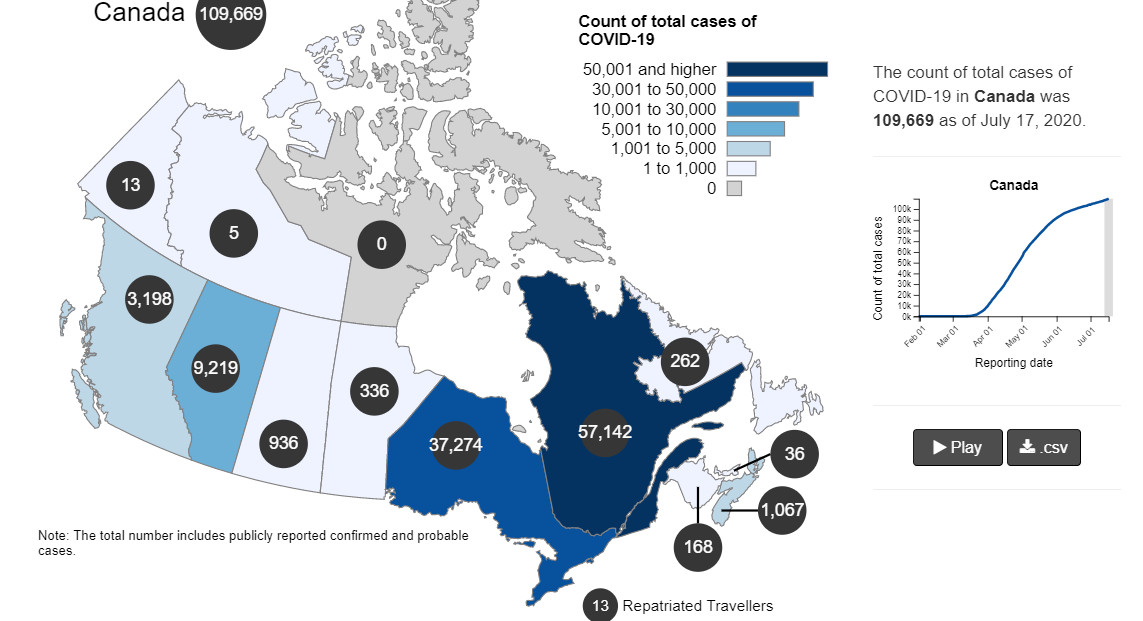
Up to now, we have only been able to estimate the lethality of Covid19 by comparing death rates to confirmed cases. In Canada as of July 17, 2020, there were 8839 deaths of people with Covid19 compared to 109669 confirmed cases, or 8.1%.  If the actual # of infections was 8 times higher, that ratio drops to 1% lethality.  Furthermore, the ratio of deaths/cases ranged as high as 14% early June, and is now down to 3%.  Factoring in the hidden infections reduces the current lethality to 0.4%.

Of course this is preliminary reporting while we await results from the nation-wide study.  I do object to the “second wave” narrative parroted in the media to keep the fears alive. Also the public is never presented the big picture about national mortality.

Canada Pop Ann Deaths Daily Deaths Risk per
Person
2019 37589262 330786 906 0.8800%
Covid 2020 37589262 8839 60 0.0235%

Over the epidemic months, the average Covid daily death rate amounted to 7% of the All Causes death rate. During this time a Canadian had an average risk of 1 in 5000 of dying with SARS CV2 versus a 1 in 114 chance of dying regardless of that infection. As shown later below the risk varied greatly with age, much lower for younger, healthier people. Presently daily Covid deaths are hovering around 10, or 1% of deaths from all causes.

See Canada Succeeds on Key Covid Metric

Four Steps to Take Down a Free Society


Update at end:  July 23, 2020 China Takes the Lead

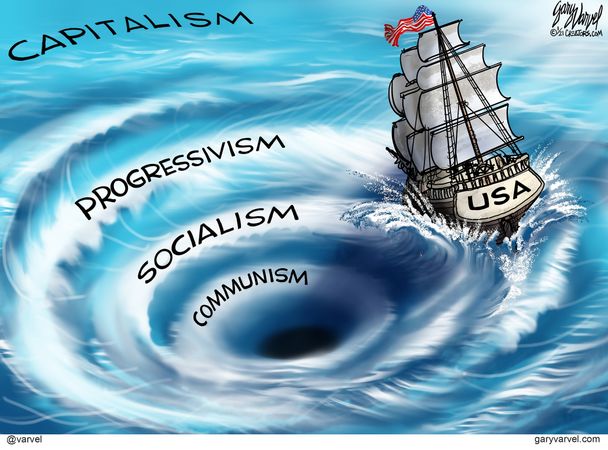
The process is under way most obviously in the USA, but also in Europe, Australia and elsewhere. Scott McKay helpfully writes at American Spectator Four Stages of Marxist Takeover: The Accuracy of Yuri Bezmenov. Excerpts in italics with my bolds.

The journalist and Soviet defector long ago pegged the current left-wing moment.

But it’s also important to understand that the revolution taking place in America is not yet a “kinetic” one. That may come soon, or it may not. The battle taking place presently is a war of information — or disinformation, as the case may be.

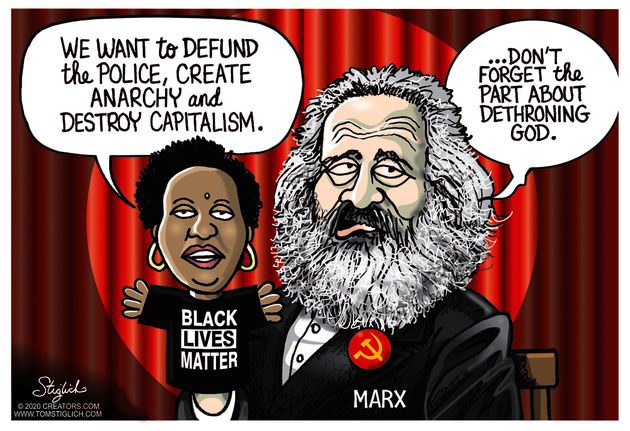
And the revolution is a Marxist revolution. You should make no mistake about that. The groups fomenting it, the intellectuals promoting it, and the money financing it are all quite open about who they are.

This playbook was written long ago. If you think that Bernie Sanders or Kshama Sawant or Alicia Garza are smart enough to dream up a plan for taking down the greatest society the world has ever known, you are out of touch with reality. The only way they could have been as effective as they have so far is to follow somebody else’s plan. Which they are doing.

There is a video interview from a long time ago that you should see if you haven’t already seen it. It’s one of those things that many of our readers may have seen years ago and then forgot about — but all of a sudden it’s incredibly relevant again. The interview dates back to 1984, and it was conducted by the author, filmmaker, and John Birch Society gadfly G. Edward Griffin with a Soviet defector and former KGB operative named Yuri Bezmenov. (Below is a synopsis video)

Forget about Griffin’s background. He was something of an Alex Jones of his time, and he’s still around in his dotage, obsessing about things that cost him his relevance. It’s Bezmenov who matters. The Russian was involved at relatively high levels as a propagandist par excellence before leaving the USSR for Canada, and he laid out in excruciating detail the process by which a free society might be brought to collapse.

Khrushchev and the Soviets weren’t just bragging. What he was talking about was an entire system of Marxist indoctrination and takeover they had perfected and executed in country after country during the 20th century. Eastern Europe. North Korea. North Vietnam, then all of Vietnam. Cuba. Nicaragua. Later, Venezuela. Various African countries, including South Africa, the communist bloom of which has only recently come to pass. Some of those countries went communist because the Soviets rolled the tanks in; most went communist because the pre-communist society collapsed for various reasons. All went communist after they had been infiltrated with Marxist revolutionaries.

The point being that there was a template in place for how to penetrate a society with Marxist ideals and implode it so that the revolutionaries would control the ruins.

Bezmenov, whose father was a high-ranking Soviet military official and who was trained to be an elite KGB overseas operative, was taught the template and put to work in India attempting to infiltrate that country and bring it into the Warsaw Pact. He also worked at the Soviet RIA Novosti news organization, editing and planting propaganda materials into foreign media. The man knew exactly what he was talking about when he outlined how a Marxist revolution might bring America down without firing a shot, just as Khrushchev had predicted.

Bezmenov warned us in 1984 that a free society collapses in four stages, and the first is demoralization.

What he meant by demoralization is a process by which students in schools controlled by disciples of leftist thought would be indoctrinated into a set of values and beliefs foreign to those of the American tradition. Bezmenov said, in 1984, mind you, that this would happen when the 1960s and 1970s student radicals began to control the educational institutions, and their project would be to throw out traditional Judeo-Christian morality, classical education, and American patriotism. Is there any doubt this has happened?

Our young people are the least patriotic in our nation’s history, and the most ignorant of the cultural, intellectual, and ideological patrimony of which they are heirs.

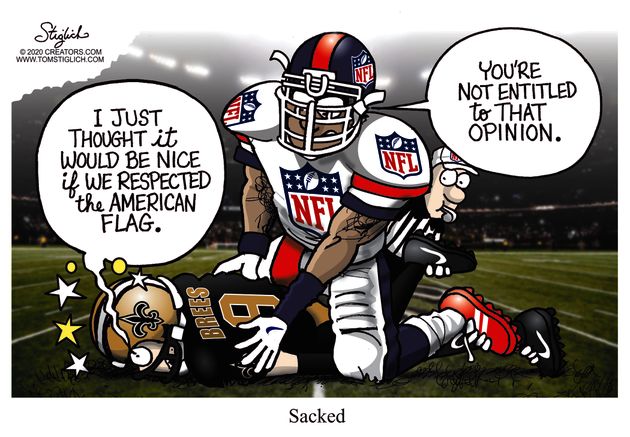
It’s even worse than that, because the cultural Marxist project not just in our schools but in our media and entertainment institutions has poisoned those against the country. Remember when the NFL was an escape from politics? Remember when the movies Hollywood made extolled American values and made viewers feel good about their country?  When was the last time you saw anything from American education or corporate media that made you feel good about your country?

stg072220dapr20200721034602

What’s the second step? Destabilization.

Bezmenov describes that as a rapid decline in the structure of a society — its economy, its military, its international relations. We’ve discussed in this space the unquestionable impetus on the part of Democrats to keep the economy as hamstrung as possible with COVID-19 shutdowns, and those continue despite a precipitous decline in death rates as testing ramps up across the country. It’s clear the virus is no longer a significant threat to the health of Americans who don’t already have serious medical issues, and yet COVID hysteria is increasing, rather than decreasing. Just Wednesday the Ivy League shut down all its sporting events planned for the fall semester, an absurd decision that is nonetheless likely to be copied by other universities dominated by leftist political activists (the Big Ten, ACC, and SEC are all in various stages of planning conference-only schedules this fall, which makes no sense whatsoever).

The virus is the perfect platform by which to impose the economic destabilization the Left has wanted all along.

No, that isn’t a conspiracy theory. They’re telling you it’s what they’re after. Do you believe Ilhan Omar was off-script when she suggested dismantling America’s economy as a system of oppression earlier this week? Ilhan Omar, who paid a political consultant $900,000 in fees last year, money that came from somewhere, isn’t smart enough to say these things without having the script written for her. She’s being trotted out to introduce them because she’s already radioactive and a lightning rod for criticism, and also because she’s (1) black, (2) Muslim, and (3) an immigrant, and even an illegal one. To criticize her statements as cracked bears the signature not of incisive reasoning but rather racism. So when other Democrats join her call you are no longer allowed to object.

That’s destabilization. They’re fully engaged in it, whether you believe they’ve been successful or not. But ask Mark McCloskey, for example, whether or not he thinks it’s outlandish to suggest the American order has been destabilized. McCloskey told Tucker Carlson that after the police told him they couldn’t protect him after the incident where he and his wife used guns to protect their property from a mob of Black Lives Matter trespassers, he called around to private security firms for help and was given advice to get out of his house and let the mob do what they would. Does that sound like a stable society to you?


The third stage is crisis, the catalyzing event that builds on the first two stages to bring on the change the revolutionaries are looking for.

Looking for a crisis? Take your pick. We barely even remember the fact that we just had only the third presidential impeachment in American history half a year ago, a constitutional crisis that was wholly and completely manufactured directly out of thin air. We progressed immediately from that to COVID-19, which was unquestionably a manufactured crisis — not that the virus itself isn’t deadly to a certain portion of the population, but if you think the panic and destruction it’s caused doesn’t smack of manufacture then it’s clear you’ve been demoralized.

And then the George Floyd riots and the paroxysms of violence and virtue-signaling those have brought on, complete with the current campaign to bowdlerize American history and culture in an increasingly indiscriminate fashion. That’s a crisis, everybody, and it’s a completely manufactured one. The speed of the cultural collapse that followed Floyd’s death — when the legal system moved very swiftly against the police officers responsible for it — makes it undeniable this was planned and only needed a catalyst.

What’s the fourth stage? Normalization. As in, a “new normal.”

The statues and monuments are gone, the ball games are out, or at least you aren’t allowed in the stadium to watch them (and you’ve got to watch them on TV interspersed with commercial spots and in-game messaging pushing whatever memes and narratives the ESPNs and NBCs of the world and their Madison Avenue partners wish to implant in your mind), the schools have purged American history and culture, the Universal Basic Income checks have replaced your job, which you can’t do because the small business where you used to work has gone under thanks to the virus.

And Biden is president. For a little while, until it’s clear he’s incapacitated per the 25th Amendment, and then somebody else that you didn’t vote for is in charge of the country.

Out goes Kerensky. In comes … who knows what?

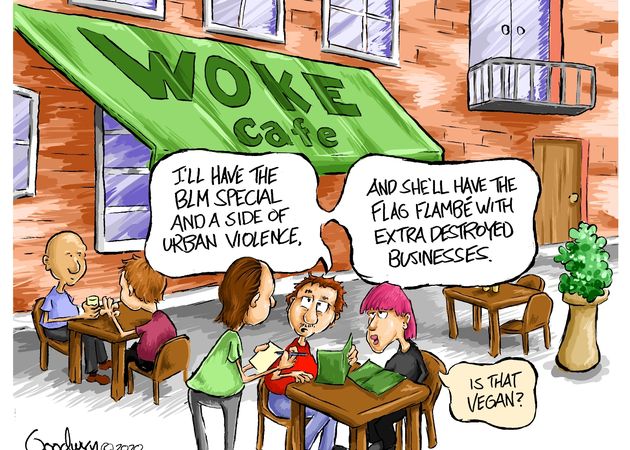
goodwyn_woke_cafe_lr_07272020200727102305

Let’s hope your confidence none of this can happen is well-placed. Let’s hope Bezmenov was a crank like people think G. Edward Griffin is.

But just to be sure, let’s make damned sure Biden and the Democrats take an historic beating in November. We don’t want to find out what’s behind the curtain in Biden’s basement. Too many nasty things are already peeking out at us from there.

Update July 23, 2020: China Takes the Lead

Of course the leading proponent of this geopolitical strategy is China, and they are effectively applying it to the USA. Brian Kennedy writes in his book:

China’s goal is demoralizing the United States to the point where America believes that further resistance is futile.” They can’t succeed without the help of America’s elite.

From Robert Curry’s review: The Chinese are confident that America has grown corrupt, and that its political, financial, and cultural elites are in near-complete sympathy with the globalist project of an interdependent world, with the P.R.C. [the People’s Republic of China] at its head.

I have a story from my own life that illustrates Kennedy’s point. Recalling what it was like before the pandemic panic took total control of American life will help to set the stage. Back then, the media, the celebrities, and the politicians had not yet mastered the talking points of the COVID-19 narrative. During one of those early days, a local radio news personality announced with great excitement that she had secured an interview with a prominent epidemiologist from the most prestigious university in our region. After thanking the professor profusely for granting the interview, the reporter asked the obvious question, the one that was on my mind at that time: “What is the difference between this flu and the Spanish flu of 1918?”

The professor was greatly offended by the question. She admonished the reporter never to use the term “Spanish” with regard to the flu of 1918 and never to use the word “Chinese” with regard to the flu of 2020. The professor simply would not answer the question and, for that matter, she would not address any other question having to do with epidemiology. She confined herself to scolding and reeducating the reporter, making it clear to the reporter and her listeners what was and what was not politically correct to say about the virus.

It was an astonishing performance. The professor did not speak as an epidemiologist; instead, she spoke as a globalist. When she said, in effect, “Don’t you ever call this flu that came from China ‘Chinese,’” she was acting as a spokesperson for the ideology of globalism.

See also: Patriotism Vs. Multiculturalism

First Glimpse of SARS CV2 Seroprevalence in Canada

As is to  be expected the headline buried the good news Serology study estimates less than 1 per cent of B.C. was infected by first coronavirus wave.  Excerpts in italics with my bolds.

B.C. Centre for Disease Control research also suggests province’s true infection rate is about eight times the rate based on reported cases

The study is the first in Canada to report infection rates based on seroprevalence, which is a measure of the presence in blood samples of antibodies produced to resist the virus. Determining exactly how many people in Canada have been exposed to COVID-19 is a key goal of the immunity task force the federal government set up in April.

Timothy Evans, a member of the task force and director of McGill University’s school of population and global health in Montreal, said the B.C. survey indicates the province’s deft management of the first wave of the pandemic resulted in very low exposure across its population.

“The low prevalence of population immunity suggests that continued vigilance and adherence to best practices to reduce risk of infection will be critical, especially in the context of the second wave of the pandemic,” Dr. Evans said.

He added that the eight-to-one ratio of actual to reported cases is consistent with international studies and that he expected a similar result across Canada. The survey was based on blood samples from more than 1,700 people in two periods, one in mid-March and a second in late May. The data were gathered anonymously from residual blood drawn from individuals at diagnostic clinics in B.C.’s Lower Mainland. The subjects were males and females of varying ages, including children.

Dr. Jha, who is leading a seroprevalence study that aims to sample as many as 10,000 Canadians, also said the individuals in the B.C. study may not be representative of the province’s population. For example, the study may be skewed toward healthy people who were having their blood tested as a precaution, or by those who were already ill.

It also captured the presence of antibodies in blood samples before and after the first wave but not during the peak in April. Another key piece of information the B.C. study does not provide – and was not designed to – is whether the individuals found to have antibodies for COVID-19 are now immune to the coronavirus and, if so, for how long.

My Comment:

Up to now, we have only been able to estimate the lethality of Covid19 by comparing death rates to confirmed cases. In Canada as of July 17, 2020, there were 8839 deaths of people with Covid19 compared to 109669 confirmed cases, or 8.1%.  If the actual # of infections was 8 times higher, that ratio drops to 1% lethality.  Furthermore, the ratio of deaths/cases ranged as high as 14% early June, and is now down to 3%.  Factoring in the hidden infections reduces the current lethality to 0.4%.

Of course this is preliminary reporting while we await results from the nation-wide study.  I do object to the “second wave” narrative parroted in the media to keep the fears alive. Also the public is never presented the big picture about national mortality.

Canada Pop Ann Deaths Daily Deaths Risk per
Person
2019 37589262 330786 906 0.8800%
Covid 2020 37589262 8839 60 0.0235%

Over the epidemic months, the average Covid daily death rate amounted to 7% of the All Causes death rate. During this time a Canadian had an average risk of 1 in 5000 of dying with SARS CV2 versus a 1 in 114 chance of dying regardless of that infection. As shown later below the risk varied greatly with age, much lower for younger, healthier people. Presently daily Covid deaths are hovering around 10, or 1% of deaths from all causes.

See Canada Succeeds on Key Covid Metric

Kneeling to Experts Not Advisable

Taking an opinion “under advisement” means seriously considering it but retaining the independence to weigh it against other considerations.  Charles Lipson explains the importance of not bowing to expert recommendations in his article Reopening Schools and the Limits of Expertise.  Excerpts in italics with my bolds.

The last thing you want to hear from your brain surgeon (aside from “Oops”) is “Wow, I’ve always wanted to do one of these.” You’ll feel a lot better hearing, “I’ve done 30 operations like this over the past month and published several articles about them.”

Expertise like that is essential for brain surgery, building rockets, constructing skyscrapers, and much, much more. Our modern world is built upon it. We need such expert advice as we decide whether to open schools this fall, and we should turn to educators, physicians, and economists to get it. But ultimately we, as citizens and the local officials we elect, should make the choices. These are not technical decisions but political ones that incorporate technical issues and projections.

We should hold our representatives, not the experts, responsible for the choices they make.

When we listen to experts, we should remember Clint Eastwood’s comment in “Magnum Force”: “A man’s got to know his limitations.” Even the best authorities have them, and one, ironically, is that they seldom admit them, even to themselves. It is important for us both to appreciate expert advice and to recognize its limits every time we’re told to “be quiet and do what they say.” We should listen, think it over, and then make our own decisions as citizens, parents, teachers, business owners, workers, retirees — and voters.

The best way to understand why we need experts but also why we need to weigh their advice, not swallow it whole and uncooked, is to consider this illustration: Should we build a hydroelectric dam in a beautiful valley? If we construct it, we certainly need the best engineers and construction workers. We need engineering firms to project the cost and economists to project the price of its energy and potable water. Their expertise is essential.

But they cannot tell us whether it is wise to destroy California’s Hetch Hetchy Valley to build that dam. The world’s top experts on wildlife conservation and regional economic growth cannot give us the definitive answer, either. They would give us, at best, different answers, reflecting their different expertise. The conservationist would tell us it is a terrible idea to destroy such beautiful, irreplaceable habitat and kill endangered species. The economist would tell us we need the energy and fresh water if Northern California is to grow. What no economist could have predicted, decades ago, is that the entire world’s income would vastly increase because of technological advances from Silicon Valley, which had the resources needed to grow.

The hydroelectric example illustrates a more general point: complex questions involve experts in multiple fields, but there is no supra-expert to aggregate their differing advice. Even if we assume all experts within a field give similar advice, who can aggregate it across fields? No one. There is no “expert of experts.” In the example of the hydroelectric dam, the policy decision depends on how much we weigh conservation versus growth and how well we can predict future options and alternatives, such as the price of solar power or prospective growth from Palo Alto to San Jose.

Sorting out the answers is ultimately a question for voters and their representatives, not for experts in hydroelectric engineering, wildlife conservation, or regional economics. We need the best advice, but only we, as citizens, can weigh it and make a final decision. In a representative democracy, we elect officials to make those decisions. If democracy is to work, we must hold them accountable. One criticism of the growing regulatory state is that it is impossible to hold the decision makers accountable. Some of that criticism should be directed at legislators, who avoid responsibility by writing vague laws and then off-loading hard decisions onto bureaucrats and judges.

We should be especially skeptical when experts predict distant outcomes.

Their record is none too impressive. We should be skeptical, too, when laws and regulations set one definitive criterion, such as preserving the endangered snail darter, at the expense of all other considerations. That might be the best decision, or it might not, but it is ultimately a political choice. Right now, federal judges have awarded themselves extensive — and unilateral — power to make it.

These problems, which combine technical expertise and political judgment, are essential to understanding our dilemmas about reopening K-12 schools during the COVID-19 pandemic. Epidemiologists are saying, “Resuming in-person instruction too soon could spread the disease. Although children are at low risk, they will bring it home to parents and grandparents.” Pediatricians, by contrast, say it is important for children’s overall health to get them back in school. Online learning is not very effective, they say, and losing a year’s classroom instruction and socialization will be extremely harmful. Economists focus on different issues, such as parents who cannot return to full-time employment because they must care for children at home. That constraint is especially harmful to one-parent households and low-income, hourly workers, whose children also have less access to computers and fast internet connections. Notice that these experts are not the self-interested voices of interest groups such as teachers’ unions or small businesses. They are specialists in economics, education, and public health. Each has its own “silo of expertise.” Each silo produces a different answer because its experts focus on their own subset of issues and weigh them most heavily.

As we listen to these experts, we need to remember that even the best, most disinterested advice has its limitations. Reopening schools, like other big policy questions, involves multiple silos and hundreds of moving parts. It is impossible to predict what all those parts will do, how much weight to give each one, or what effects they might have, now and in the distant future. It was only from trial-and-error that we learned how inadequate online instruction really is. We entered this massive national experiment with some optimism and trudge forward with pessimism.

We should be humble about what we still don’t know.

Our success in reopening schools and businesses depends on things we cannot know with certainty. How quickly will our biotechnology companies discover effective therapeutics and vaccines? How quickly will the American population develop “herd immunity?” How soon will customers return, en masse, to shopping malls, indoor dining, and cross-country travel?

Predicting the secondary and tertiary effects of policy choices is especially hard.

Keeping businesses closed, for instance, sharply reduces local tax revenues, which probably means reducing essential services such as garbage collection and local policing. Those cuts harm public health and safety. But how much? No expert is smart enough to predict all these knock-on effects, much less aggregate them and give an overall conclusion. As it happens, experts are no better at predicting these effects than well-informed laymen. The main difference, according to studies, is that experts are more confident in their (often-wrong) predictions.

The point here is not that experts are irrelevant. We need them, and we need to pay attention to their data, logic, and conclusions. But we also need to remember that

  • Even the best current knowledge has its limits, and
  • There are no “supra-experts” to weigh the best advice from different fields and aggregate them to reach the “definitive” answer.

Sorting out this expert advice is not a technological question. It is a political one. Mayors, governors, and school boards across the country understand that crucial point as they decide whether to open schools this fall for in-person instruction. The voters understand it, too. They should listen to the experts, see what other jurisdictions decide, and check out their varied results. Then, they should walk into the voting booth and hold their representatives to account.

Charles Lipson is the Peter B. Ritzma Professor of Political Science Emeritus at the University of Chicago, where he founded the Program on International Politics, Economics, and Security.

Cal Carbon Market Fails in Practice and in Theory

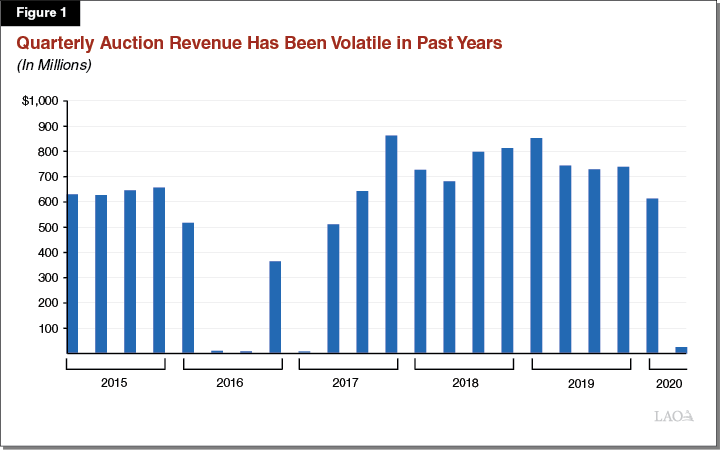
When secondary market prices dropped below minimum auction prices for a few different periods in 2016 and 2017, the state generated $10 million or less in three out of four auctions, as shown in Figure 1. In May 2020, the revenue was only $25M. Source: Cal LAO (Legislative Analyst’s Office)

Severin Borenstein explains at energypost.eu California learns even flexible Emissions Markets won’t guarantee price stability.  Despite the author’s belief in reducing CO2 emissions, cap and trade is failing to deliver.  Excerpts in italics with my bolds.

After California’s May allowance auction settled at the minimum price and generated almost no revenues for the state, the long knives are again out in Sacramento for the state’s cap and trade program. What’s the point of a carbon market, some are asking, if price and revenue volatility make planning nearly impossible?

The disappointing auction has caused proposals for stabilising the market price – such as those from the Independent Emissions Market Advisory Committee (IEMAC) in its 2019 report – to be taken more seriously, as they should be. But the tweaks suggested by the IEMAC and others aren’t likely to live up to the expectations of policymakers. That’s not because the proposed changes are unwise, but because the policymakers’ expectations are unrealistic.

Many California regulators and legislators want cap and trade to guarantee that the state reaches prescribed emissions targets by 2030, while at the same time maintaining a moderate allowance price, not at the floor, but not too high. Only by a stroke of pure luck could the program deliver on both. To see why, let’s revisit the design options for an emissions market.

Carbon prices can rise too high or fall too low

Cap and trade “classic” simply sets a cap on emissions and lets the price do all the work to get us there, with no restrictions. But if the demand for emitting the pollutant is high – which could be driven by a strong economy, cheap fossil fuels, and/or slow progress in low-emissions technologies – the price could spiral to astonishing levels. Cap and trade classic generally would get you to the emissions quantity, but possibly at an unacceptable economic or political cost.

And if the demand for emitting is low – such as results from an economic downturn, expensive fossil fuels, and/or competitive low-carbon alternatives – it is quite possible to end up with a price of zero and no further incentive to ratchet down emissions at all.

The price in cap and trade classic is hard to predict, because the future of the economy, fossil fuels, and emissions reduction technologies are hard to predict.

Emissions taxes: a fixed disincentive has its limitations too

Emissions tax “classic” does the opposite. It sets a fixed price, which establishes a constant incentive to reduce pollution regardless of how much is being emitted. But then polluters emit whatever quantity they choose as long as they are willing to pay the tax. If the demand for emitting is high, the outcome will be high levels of emissions.

In economic parlance, where cap and trade classic creates a vertical supply curve for emissions allowances (at a fixed quantity) and emissions tax classic creates a horizontal supply curve for allowances (at a fixed price), the new and improved cap and trade creates an upward sloping supply curve for allowances, restricting the quantity somewhat when demand and price are low, which prevents the price from going even lower, and expanding the quantity somewhat when they are high, preventing the price from going even higher.

What these modifications do is share the impact of unpredictable emissions demand between quantity adjustment and price adjustment, rather than putting the impact of demand uncertainty all on quantity (emissions tax classic) or all on price (cap and trade classic). What they don’t do is get us to the policymakers’ nirvana of predictable emissions quantity and price. Until someone figures out how to reliably predict both macroeconomic growth and technological progress that won’t be a realistic goal.

That’s not a flaw in emissions pricing. It’s a reality of any type of emissions control policies. Technology mandates – the alternatives to pricing – generally don’t ensure a total level of emissions (usually just emissions intensity), and never ensure the cost of achieving a given level of emissions.

A market based on the non-delivery of a non-good, What could go wrong?  Let us count the ways

Background from Previous Post
Climate stool

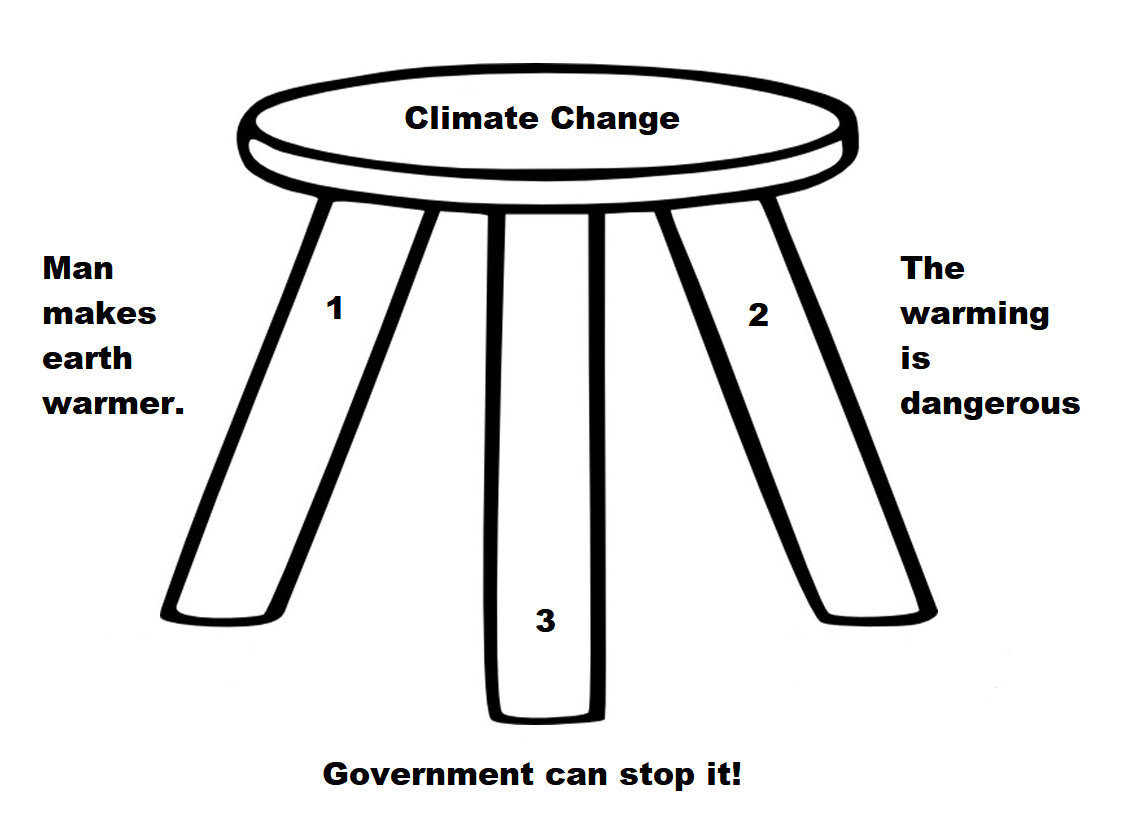
Context: As the image shows, alarmist/activists understand Climate Change (man made assumed) as a concept that depends on three assertions being true.  The first one is the science bit, being the unproven claim that humans make the planet warmer by burning fossil fuels. (See Global Warming Theory and the Tests It Fails)  The second one is the claim from billions of dollars invested into researching any and all negative effects from global warming, from Acne to Zika virus. The third and also necessary leg is the assertion that governments can act to prevent future warming.

From time to time it is instructive to hear from those who buy into the first two, but have lost confidence in the policies proposed as remedies. Jeffrey Ball writes at Science Direct, not questioning climate science or feared impacts, but distraught about the failed efforts to do something to reduce emissions.  His article is Hot Air Won’t Fly: The New Climate Consensus That Carbon Pricing Isn’t Cutting It Excerpts in italics with my bolds.

Jeffrey Ball, a writer whose work focuses on energy and the environment, is the scholar-in-residence at Stanford University’s Steyer-Taylor Center for Energy Policy and Finance and a lecturer at Stanford Law School. He also is a nonresident senior fellow at the Brookings Institution. His writing has appeared in Foreign Affairs, Fortune, Mother Jones, The Atlantic, New Republic, The New York Times, and The Wall Street Journal, among other publications. Ball, previously The Wall Street Journal’s environment editor, focuses his Stanford research on improving the effectiveness of clean-energy investment, particularly in China.

Carbon Pricing Isn’t Cutting It

In the history of climate change, 2018 will go down as a year when certain facts finally hit home, truths inconvenient for partisans on all sides. Those on the right, at least those who have been arguing that greenhouse-gas emissions aren’t a significant problem, were forced to recognize that those emissions are causing real harm to real people right now. Those on the left, at least those who have put their faith in the promise of renewable energy to cool the planet, had to reckon with the reality that, even as those technologies boomed, carbon emissions continued to grow. And those across the political spectrum who had been calling for what seemed in theory a sensible climate policy—putting a price on carbon emissions—had to concede that their supposed solution isn’t helping much at all.

(My comment: Like so many true believers, Ball casts climate change as a political issue between left and right wings.  Note he does think we can all agree that policies are not working.)

No single event can be attributed to climate change, but scientists cite a lengthening list of unfolding events, from wildfires in California to drought in Europe to rising waters along Bangladesh, as evidence of the effects of a warming world. Even the administration of US President Donald Trump, which has rolled back myriad climate policies, noted in a November report, the latest legally mandated US National Climate Assessment, that the effects of climate change “are already being felt in communities across the country”—from intensifying flooding in the nation’s northeast region, to worsening drought in the southwestern part of the country, to rising temperatures and erosion that are damaging buildings in Alaska.

(My comment:  Ball does not acknowledge rebuttals and challenges to the recent NCA document that merely repeated claims from previous editions, and echoed the feverish exhortations from IPCC SR15.  But this  paragraph was aimed at the skeptical on the right, while soothing the believers on the left.  Let’s now get into the meat of it: Is the government stopping it?)

Renewable energy isn’t stopping that. It represented 70% of net new power-generating capacity installed globally in 2017, a stunning share that reflects falling costs and rising penetration.  Yet for all that growth, renewable energy still provided only an estimated 14% of total global energy in 2017, up about 1 percentage point from its share in 2000, because fossil-fuel energy capacity also has been increasing. Indeed, even as renewable-energy capacity hit an all-time high, energy-related carbon emissions did too. They rose 1.6% in 2017, following three years in which they were flat, and they are expected to have risen further in 2018.

Emissions are increasing even though more governments than ever before have imposed prices on carbon emissions, either levying a carbon tax or instituting a cap-and-trade system of pollution permits so that those who emit greenhouse gases have a financial incentive to reduce them. That is little wonder, given that less than 1% of global carbon emissions are subject to a price that economists peg as high enough to meaningfully curb them.

This past June, in an essay in Foreign Affairs, “Why Carbon Pricing Isn’t Working,” I cataloged evidence that carbon pricing is failing to meaningfully reduce carbon emissions around the world—from Europe, where the policy took significant hold, to California, where leading policymakers have embraced it, to China, which is in the early stages of ramping up what will be by far the biggest carbon-pricing regime on the planet. I argued that, though in theory carbon pricing makes sense, in practice it is failing, for two reasons: structurally, carbon pricing tends to constrain emissions mostly in the electricity sector, leaving the transportation and building sectors largely unaffected; and politically, even those governments that have imposed carbon prices have lacked the fortitude to set them high enough to significantly curb even electricity emissions. As a result, I wrote, “a policy prescription widely billed as a panacea is acting as a narcotic. It’s giving politicians and the public the warm feeling that they’re fighting climate change even as the problem continues to grow.” Not just ineffective, carbon pricing is proving counterproductive, because “it is reducing the pressure to adopt other carbon-cutting measures, ones that would hit certain sectors harder and that would produce faster reductions.” Among those other needed measures: phasing out coal as a power source except where it is burned with carbon-capture- and -sequestration technology, which minimizes its emissions; maintaining, rather than closing, nuclear plants; making renewable energy cheaper; and mandating greater energy efficiency.

Would that the half year since that essay was published had proven its assessment too harsh. Unfortunately, recent events and analyses have only bolstered it. Since the summer, and in the lead-up to the latest global climate-policy conference, this month in Poland, studies exploring carbon pricing’s shortcomings have begun piling up. They now amount to a new and sobering climate-literature genre.

Belief in carbon pricing was strong in 2015, when policymakers from some 190 countries issued the Paris Agreement, calling for measures to keep the increase in the average global temperature “well below” 2°C above preindustrial levels and for “pursuing efforts” to keep the rise below 1.5°C.6 Unlike prior climate agreements, notably the Kyoto Protocol, which nearly two decades earlier had pressed for emission cuts only from developed countries, the Paris Agreement included specific emission-reduction pledges even by China, India, and other developing countries, which now produce the bulk of global emissions. But the pledges countries made in Paris were voluntary rather than mandatory, and most were relatively weak. Even if countries made good on them, it was clear, the world would not cut emissions anywhere near enough to avoid crashing through the 2°C threshold.

Coming out of Paris, carbon pricing was a presumption. In 2017, a group of leading economists backed by the World Bank and called the High-Level Commission on Carbon Prices announced that meeting the Paris temperature targets would require carbon prices of US$40 to $80 per metric ton of carbon dioxide by 2020 and of $50 to $100 per ton by 2030.  But in May the World Bank reported that, though the percentage of global greenhouse-gas emissions subject to carbon prices had risen to 20%, only 3% of those emissions were priced at or above the important $40 level.  In other words, fewer than 1% of all global greenhouse-gas emissions are priced at a level likely to constrain them.

Carbon-pricing regimes are spreading, and some are being toughened, but neither is happening quickly enough to make much environmental difference. The Organization for Economic Cooperation and Development (OECD), parsing the numbers somewhat differently than does the World Bank, calculates that 76.5% all energy-related carbon dioxide emissions in OECD and Group of 20 (G20) countries either aren’t priced at all or are priced below 30 euros per metric ton of carbon dioxide, a level the OECD calls “a low-end estimate of the damage that carbon emissions currently cause.” That “carbon gap,” in OECD parlance, has narrowed by just 1 percentage point in each of the past three years—hardly a relevant climate win.

It is against this backdrop that critiques of carbon pricing have begun to accumulate. One of the more notable was published in August by the International Monetary Fund (IMF), whose head, Christine Lagarde, has been an enthusiastic supporter of carbon pricing. She called in 2017 for this response to carbon dioxide: “Price it right, tax it smart, do it now.” As the IMF’s new working paper makes clear, most carbon prices thus far imposed haven’t been right, relying on carbon taxes hasn’t been terribly smart, and, if “it” means a serious response to climate change, the world isn’t doing it now.

The authors of the IMF study used a model to project how carbon prices at two levels by 2030—$35 per metric ton of carbon dioxide and $70 per ton—would affect emissions in the G20 economies. (Few countries have imposed a carbon price anywhere near even the lower of those numbers.) The IMF model clarifies why the world’s largest economies find it so economically and politically difficult to impose a robust price on carbon, just how inadequate were the pledges most countries made in Paris, and how wrenching it will likely be even for countries that made relatively significant Paris pledges to follow through on those promises.

Carbon pricing, as I noted in Foreign Affairs in June, “works well for industries that use a lot of fossil energy, that have technologies available to them to reduce that energy use, and that can’t easily relocate to places where energy is cheaper.” That is why it tends to bite first in the electricity sector. The IMF model underscores this, concluding that the major determinant of how significantly a given carbon price will curb emissions in a given country is the extent to which that country’s electricity sector relies on coal. A $70 carbon tax, the IMF model projects, would cut emissions by significantly more than 30% in coal-dependent China, India, and South Africa; by some 15%–25% in such countries as the United States, Canada, and the United Kingdom; and by less than 15% in coal-light France and Saudi Arabia.9 (That helps explain why, among all these countries, only France has imposed a carbon price above $40 per ton. And even France has difficulty raising the effective price on carbon, as the recent Yellow Vest protests, which led France to suspend a proposed fuel-tax increase, show.)

That carbon pricing hits hardest in coal-reliant places helps explain its political difficulties. The IMF’s modeled carbon tax is particularly regressive—meaning its cost falls particularly heavily on the poorest—in China and the United States, the world’s two top carbon emitters.  (Electricity access in these two coal-heavy nations is broad, meaning the poor there tend to spend a greater portion of their income on carbon-intense power than do the rich.) Although both countries are experimenting with carbon pricing, it is little surprise that the prices in both remain low. In California, carbon prices are higher than in other parts of the United States that have implemented them, but California gets only a small amount of its electricity from coal—and most of that is imported from other states—which bolsters the point. The IMF analysis also helps clarify why China, the world’s top coal burner, proffered a relatively weak Paris pledge. Some governments are trying to counteract the regressive nature of carbon pricing by layering on structures to return all or some of the resulting revenue to consumers—a worthwhile idea. But even those structures have faced opposition in coal-reliant jurisdictions.

Even some countries whose Paris pledges were more robust are likely to have difficulty following through on them. Those pledges “might imply increases in energy prices (and burdens on vulnerable groups) that push the bounds of political acceptability,” the IMF paper notes. A meaningful reduction in carbon emissions, the IMF concludes, would require backstopping countries’ Paris pledges in two ways: by imposing carbon-price floors—levels below which countries decree that their carbon prices will not fall—and by imposing policies other than carbon pricing that force deeper cuts. Inoffensive carbon pricing alone won’t cut it.

Even extraordinarily high carbon prices are failing in important ways to spur significant carbon cuts. A piece published in Energy Policy in late June by Endre Tvinnereim and Michael Mehling explores the uninspiring example of Sweden. The small Scandinavian country has, according to the World Bank, the highest carbon price in the world, at $126 per ton, based on current currency-exchange rates.4 Yet in the quarter century between 1990, when Sweden introduced its carbon tax, and 2015, carbon emissions from Swedish road transportation fell only 4%. Meanwhile, sales in Sweden of new internal-combustion vehicles continue to rise, imposing what the authors call “carbon lock-in” from vehicles likely to remain on the road a decade or more. What’s needed, they argue, are bans on the sale of new internal-combustion cars, bans of the sort that have been proposed in such countries as China, India, France, the United Kingdom, and Norway. Pricing carbon “is useful,” they write, “but far from sufficient to achieve deep decarbonization.”

The authors are right that policies beyond carbon pricing are needed. But clarity about the goal of such policies is key. Some recent critiques of carbon pricing, at least implicitly, construe success in fighting climate change as requiring the near-total replacement of fossil fuels with renewable energy. Plenty of evidence, however, suggests that structuring the climate fight primarily as a pursuit of renewables is neither realistic nor particularly smart.

The goal in fighting climate change is not to end the use of fossil fuels. The goal is to fuel the world while cutting carbon emissions essentially to zero. That will require dramatically lowering the cost and thus boosting the penetration of renewable and other non-fossil energy sources. It also will mean ensuring that the large quantities of fossil fuels that are all but certain to continue to be burned for decades to come are burned using technologies that slash the amount of carbon dioxide their combustion coughs into the atmosphere.

The policies necessary to achieve these twin ends will be complex. A meaningful carbon price would help them, but in most of the world there is little evidence policymakers have the stomach to impose one. Climate change is real. Fighting it demands—from everyone involved—more than rhetoric. That this message is getting across is a good sign.

My Concluding Comment

The graph illustrates the problem very clearly. Since 1994 there have been 24 Conferences of the Parties (COP), along with numerous other meetings. These UNFCCC discussions have utterly failed to reduce CO2 emissions. Yet from 2020, emissions have to drop dramatically, if we are to stand a chance of keeping global warming below 1.5°C.

According to IPCC SR15 this will require an annual average investment of around US$2.4 trillion (at 2010 prices) between 2016 and 2035, representing approximately 2.5% of global gross domestic product (GDP). The cost of inaction and delay, however, will be many times greater. (sic).  Note:  This is referring to increasing investments in renewable energy from current US$335B per year to $2.4T.  Present global spending on Climate Crisis Inc. is estimated at nearly US$2T, not limited to renewables.  So this would double the money wasted spent on this hypothetical problem.

cop planes

After reading Ball’s assessment it is obvious that carbon pricing will only reduce emissions by crashing national economies.  The fear of CO2 leads directly to discussion of stopping modern societies in their tracks.  Talking about policies that “bite” this or that sector equates to intentionally dictating economic decline, industry by industry.  And Ball suggests that ever more intrusive bans and regulations must be added on top of higher carbon prices in order to save the planet from our way of life.

This analysis has been preceded by numerous doomsday deadlines over the decades which we have passed and not suffered in the least.  Can we finally dismiss the illusion that we humans control the temperature of the planet?  Can we stop the crazy schemes to cut our CO2 emissions, and appreciate instead the greening of the biosphere?
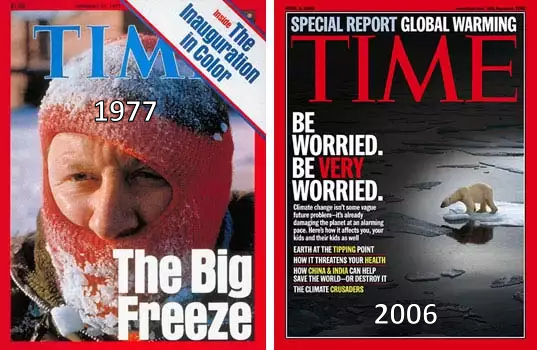
Rational public policymakers can not presume the climate will be unchanging in the future.  Our experience teaches that there will be future periods both warmer and cooler than the present.  History also shows that cold periods are the greater threat to human health and prosperity.  Instead of wasting time and resources trying to control the future weather, we should be preparing to adapt to whatever nature brings.  The priorities should be to ensure affordable and reliable energy and robust infrastructure.

See Also IPCC Freakonomics


Brazil: Early treatment with Covid Kit including HCQ is effective and safe

Palmer Foundation provides an english translation of an interview by Sandro Benites in Portuguese to O Progresso. Brazil: Early treatment with Covid Kit including HCQ is effective and safe, says MS doctor.  Excerpts in italics with my bolds.
Coordinator of the Integrated Toxicological Surveillance Center (Civitox), the toxicologist and nutritionist Sandro Benites is an advocate for the use of the Covid Kit, which includes drugs such as Hydroxychloroquine, Azithromycin, Ivermectin, Zinc and Vitamin D for early treatment of Covid-19.

In Campo Grande he led a group of 300 doctors who convinced Mayor Marquinhos Trad to adopt the service protocol that includes the distribution of the kit, with medical prescription in specific cases. The same protocol was adopted in 12 other Brazilian capitals and is being studied in the others. It was developed based on experiences that worked in countries like Spain and the United States, even before the pandemic reached Brazil, according to the doctor.

In an interview with O PROGRESSO, he was categorical in stating that these drugs are effective in early treatment and do not bring health data, as long as used following medical guidelines.

Read the interview here:

Q: Mayor Marquinhos Trad recently adopted the protocol proposed by you and a group of 300 doctors, which provides for the distribution of Kits against Covid-19. In practice, what changes from now on?

A: What changes is that several doctors were doing this initially in the office very successfully while others did not because they had a hard time supporting themselves. Today this group has the support and the release of the CRM (Regional Council of Medicine), the Medical Association of Mato Grosso do Sul, the Brazilian Medical Association and the Union of Doctors, in other words, it is easier for several colleagues to join. It is one thing for a doctor to act in isolation, another thing for a group of doctors to adopt this protocol together with the highest authority in the municipality, which in the case of Campo Grande is Mayor Marquinhos Trad.

Q: What is the purpose of this protocol?

A: Our goal is to make the population see that they cannot be isolated inside the home with symptoms. What society needs to understand is that a patient who arrives with fever, malaise or a cough, needs to be seen. He must have an x-ray, a blood count and be treated. The medical profession, which until then was acting in a way, needs to rethink this attitude of only attending or interning only if the patient is in a serious situation or with shortness of breath. From now on, like everything in medicine, if you start treatment early, the chance of success is greater. In this way, prevention is simpler, more efficient, more effective and cheaper.

Q: Do these drugs cure the disease?

A: There is no cure for the disease. It is a virus that is not even considered a living being.

These medications are intended to inhibit viral replication within the cell and the disease does not worsen, thus preventing the patient from having to go to an ICU tube, for example. The result of this is that we reduce this chaos that we are experiencing due to the lack of structure in hospitals.

Q: As you evaluate the current protocol used in most of the country, to diagnose the patient and not medicate, just send him to stay at home in isolation. Is that a risk?

A: This is a huge risk. Today the patient who has a headache, malaise and coughing goes home to take dipyrone. I prefer to take hydroxychloroquine. It is a safe medication that we have used in medical practice for over 80 years. I have worked in an intoxication center here in the State for almost 20 years and I have never seen hydroxychloroquine or ivermectin intoxication.

The same happens in other centers in Brazil. As a major in the Brazilian Army, I know that all military personnel in the Armed Forces, whether Navy, Army or Air Force, when the transfer to the Amazon region takes place_ and hundreds of families have been transferred for decades_ they use hydroxychlorquine or even chloroquine. And what risk do they have? None.

Q:How do you evaluate the deaths that occurred in Manaus due to the use of the medication?

A: There was work in Manaus, which in my view is something worthy of a crime.

Toxic doses were given to patients, up to five times more than the therapeutic dose, leading to the death of these people.

This group of scientists proved that when a lethal dose is given to a patient, lethality happens. This fact confused society. The doctor is part of society and when he sees this there, he is not used to using these drugs and this failure ends up happening. The result of this was that we ended up wasting a lot of time and certainly a lot of lives.

Q: What is the profile of the patient who will receive the medication and in what way?

A: It is not for everyone to use. There is no medicine for 200 million inhabitants. Who should use the medication are the professionals in the risk area, who are on the front line of Covid-19, working in CTI, Emergency Room, hospital or UPA. These need to be paid preventively. Another audience that also needs to be medicated is that of people who had contact with someone who had Covid-19 and developed the disease. If your wife, son, father, or mother, for example, developed the disease, you need to take the medication to keep from developing too. I’m talking about the use of Ivermectin, hydroxychloroquine used in a preventive way. However, we are not talking about a medication protocol, since there is no miracle drug. We are talking about a care protocol, which provides, for example, what to be used in phase 1 of the disease, in phase 2a, in phase 2b and in phase 3, for example. The disease has several stages and each medication must be used by the doctor, with a medical prescription. There is no use going out desperate to buy medication, using an unnecessary way. This means that those who really need it end up not having access.

Q: Why is there still no scientific evidence for the effectiveness of these drugs in the case of Covid-19?

A: It is necessary to understand that there are the types of scientific evidence, scientific evidence and scientific evidence required by medical societies. Medical societies, where you find a doctor with a doctorate, post-doctorate, demand in peacetime, that you have to have scientific proof, that is, it takes months and years for a medication to be considered level A, B or C of evidence scientific. These are steps that cannot be skipped. It is logical that there is no scientific evidence of the way that some political and health authorities want. It is an insane thing for you to require scientific proof for nothing. What I’ll do? I’m going to let the patient run low, fold your arms and say you have no proof? Likewise, there is no evidence that if you intubate a patient with Covid-19 he will survive, so why am I not intubating him? There is no scientific evidence for this disease for practically nothing because the treatment framework for Covid-19 is empty.

Someone needs to be bold enough to go there to complement this picture. Either I start to put some medications or I leave the board empty. Bureaucratic medicine loses ground in times of war and in times of pandemic. No living doctor experienced a pandemic 100 years ago. So you need flexibility, boldness, humility, let go of pride and vanity, acknowledge mistakes, start over and that is not easy. Now if you think about the good of the population and the lives that can be saved, this task becomes easier. Look at the privilege we are having! A wonderful geographical privilege! We had this pandemic beginning in Asia, back in China, went to Oceania, Europe, North America and finally arrived here in South America. Many doctors in the world had positive and negative experiences without having time to publish a scientific article in indexed magazine.

This privilege is wonderful because we can see who had a positive result and copy it here. If a Brazilian doctor, Marina Bucar, presented a series of positive results back in Spain, with the same protocol that we have implemented here in Campo Grande, will I refuse to do it and cross my arms?

If the Jewish doctor, Dr. Vlademir Zelenko in New York saved more than 500 people with this protocol, will I say no? Will I wait for the scientific journal? There is no time because the hospitals are getting crowded.

Campo Grande is even more privileged because we are in the middle of the country, since this epidemic first arrived in São Paulo, the financial capital of the country, went to the administrative capital: Brasília, followed to the capital of Tourism: Rio de Janeiro and Manaus , for example. So doctors in those locations had to take action. In Belém do Pará, for example, Unimed made this protocol that we are implementing in Campo Grande when what we call the Health collapse was happening, which is when hospitals close their doors. People were unable to enter hospitals because it was padlocked. They died at the unit’s door. Do we want this for our city? No. When that happened in Belem they adopted this protocol and within a week they solved the problem. If this is not scientific evidence, for me, nothing else will be.

Porto Feliz, in São Paulo, adopted the same measure, that is, more action and less bureaucracy since we have no time to lose.

Q: Are these drugs bad for your health?

A: People are afraid of the possible side effect of the medication. I do not. I’m afraid of the effect of the virus, Covid-19. Let’s say that if I have to take the medication for five days and on the third day I have side effects, what do I do? I stop taking it, just that. The medication is not going to kill me. If I take it and give me diarrhea or vomit I stop. There are people who can’t take contraceptives, others can’t take Dipirona, it’s simple.

Q: Why is there so much resistance on the part of governments to adopt the use of these drugs as a protocol?

A: Do not know. Because it is useless to use rational arguments for something irrational not to adopt the service protocol. If I say that no Intoxication Center has registered the death of someone from the use of these drugs over the age of 35, it is a rational argument. If I say that all military personnel receive hydroxychloroquine and none have died over the past 50 years, it is a rational argument. If I say that the people who have it is lupus, psoriasis they use for years is a rational argument. If I say that if the person has any side effects, just suspend the use, it is a rational argument. So there is no point in using rational arguments for something that is irrational, that I cannot understand.

Q: What are the risks that municipalities like Dourados run in not adopting this protocol?

A; Losing lives that could be saved.

Q: What motivated you to oppose a good part of the medical profession and defend the use of this protocol?

A: What motivated me was the fact that I see that I do not need an indexed scientific journal to take my course, in addition to perceiving other colleagues successfully, listening and having this flexibility and having the courage to do it here in Campo Grande.

I think the moment is not one of nitpicking, but of union. This is not the time for us to be divided. Doctors, population, managers, in short, everyone will benefit from it: managers for saving lives, doctors feeling fulfilled in their profession and the population losing their morbid fear of this virus, knowing that there is an effective treatment. We need to stop this political issue.

My fear cannot be greater than my responsibility as a doctor. It is unthinkable for a health professional to want scientific evidence at the time of tragedy. Medicine has never grown so much in major world wars or pandemics because bureaucrats are losing space. It is time for doctors of action and daring to act. So I think we are blessed, let’s put everything aside and let’s think more about our population. It’s very simple, the people who complicate it. When human beings want to complicate, they complicate.

Postscript:  See Also Local doctor pushing proven treatment of COVID into national debate from the Desert Review, Imperial Valley, California

From Dr. George Fareed’s letter to President Trump and the Task Force:

In my attempts to keep people alive, I have had an opportunity to use many different types of treatments — remdesivir, dexamethasone, convalescent plasma replacement, etc. Yet, by far the best tool beyond supportive care with oxygen has been the combination of hydroxychloroquine (HCQ), with either azithromycin or doxycycline, and zinc. This “HCQ cocktail” (that costs less than $100) has enabled me to prevent patients from being admitted to the hospital, as well as help those patients that are hospitalized.

The key is giving the HCQ cocktail early, within the first five days of the disease.

Not only have I seen outstanding results with this approach, I have not seen any patient exhibit serious side-effects. To be clear — this drug has been used as an anti-malarial and to treat systemic lupus erythematosus as well as rheumatoid arthritis, and has over a 50-year track record for safety. It is shocking that it only now is being characterized as a dangerous drug.

Moreover, I am in my seventies, and I (as well as some other older physicians in the hospital) use hydroxychloroquine and zinc as prophylaxis. None of us have contracted the disease despite our high exposure to COVID patients nor have we experienced any side-effects.

Despite the characterization in the mainstream media as the drug being “ineffective” and “dangerous,” the evidence in the literature tells a different story. I am not only an “MD,” but a former Harvard Medical School assistant professor and UCLA School of Medicine associate professor as well and am very competent at evaluating studies.

There is ample evidence now that the HCQ cocktail is effective and there is no good evidence that there are significant side effects.

I am writing to you out of the frustration of knowing that there is a solution, but watching as our country flounders in dealing with COVID-19. In my opinion, tens of thousands are dying unnecessarily. Our current approach of waiting for these high-risk patients to become ill and then hospitalizing them is failing. The answer is early diagnosis of the high-risk individuals, and then treating them as outpatients with the HCQ cocktail to prevent hospitalization.

So, what I am proposing is a drastic shift from our current approach: we need to ramp up our outpatient efforts of treating COVID-19 to decrease the burden on hospitals and save lives.

Such an approach requires an effective outpatient treatment — we have that in the HCQ cocktail.

Addendum:  Study from Portugal shows persons using HCQ for another condition were protected from coronavirus. Chronic treatment with hydroxychloroquine and SARS-CoV-2 infection.

By analyzing the Portuguese anonymized data on private and public based medical prescriptions we have identified all cases chronically receiving HCQ for the management of diseases such as systemic lupus erythematosus, rheumatoid arthritis, and other autoimmune diseases. Additionally, we have detected all laboratory confirmed cases of SARS-CoV-2 infection and all laboratory confirmed negative cases in the Portuguese population (mandatorily registered in a centrally managed database). Cross linking the two sets of data has allowed us to compare the proportion of HCQ chronic treatment (at least 2 grams per month) in laboratory confirmed cases of SARS-CoV-2 infection with laboratory confirmed negative cases.

Results: Out of 26,815 SARS-CoV-2 positive patients, 77 (0.29%) were chronically treated with HCQ, while 1,215 (0.36%) out of 333,489 negative patients were receiving it chronically (P=0.04). After adjustment for age, sex, and chronic treatment with corticosteroids and/or immunosuppressants, the odds ratio of SARS-CoV-2 infection for chronic treatment with HCQ has been 0.51 (0.37-0.70).

Conclusions: Our data suggest that chronic treatment with HCQ confers protection against SARS-CoV-2 infection.


Messin’ with Texas Covid

This overheated US election cycle is turbocharged with Pandemania, with viral fear weaponized for political advantage. In this context Texas provides a window into the struggle between reason and panic regarding data gathered to inform the public on the spread of this contagion. An example is this recent inflammatory article at partisan The Daily Beast Texas Erases COVID Cases—and Fans Conspiracy Theory Flames.  Excerpts in italics with my bolds.

When health officials quietly removed nearly 3,500 COVID-19 cases from the official Texas total on Wednesday, it launched a deluge of conspiracy theories about inflated and unreliable data in the midst of a surging pandemic.

The 3,484 removed cases were diagnosed using FDA-approved antigen tests. The FDA has said positive results from antigen tests are “highly accurate,” and can be used to diagnose current COVID-19 infections. But state health officials pointed to the definition of a coronavirus case the CDC published in early April to explain why the cases were removed.

“The case data on our website reflect confirmed cases, and cases identified by antigen testing are considered probable cases under the national case definition,” said Chris Van Deusen, a spokesman for the Texas Department of State Health Services.

Under that definition, the CDC only considers cases “confirmed” if they are diagnosed using a molecular, often called PCR, test. Cases that are detected using antigen tests are classified as “probable.” If someone is diagnosed with an antigen test, Texas will not count their case among the state total.

Comment: There was no controversy or data manipulation, except in the Beast’s imagination. Back on May 21, 2020, NBC Dallas explained the policy in an article Texas DSHS Changes the Way It Calculates, Reports COVID-19 Positivity Rating. Excerpts in italics with my bolds.

Texas will now separate viral and antibody tests before calculating positivity rating

With antibody testing on the rise, Texas is changing the way it reports the positivity rating — the percentage representing the number of people who have tested positive for COVID-19 over a given period of time.

The positivity rating is one of a number of metrics used by state officials when they determined how to reopen the state amid the pandemic. In early to mid-April, numbers from the Texas Department of State Health Services showed positivity ratings in Texas were well over 10%.

When Gov. Greg Abbott announced his Open Texas plan in late April, the positivity rating had dropped to about 6%, and he cautioned that should the rating again climb to a sustained trend of around 10% that it would be a “red flag” that state leaders would have to look at.

Now, as the Open Texas plan rolls on, more attention is being given to the rating as an indicator of the continued spread of the 2019 novel coronavirus. Texas, as it turns out, is one of at least four states, including Vermont, Virginia and Georgia, that are combining numbers from two different tests, viral and antibody, to calculate the positivity rating.

Viral tests, performed through a nose or saliva swab, determine if a person is currently fighting the virus. Antibody tests, performed by a blood sample, look for signs a person has been exposed to the virus in the past but are not currently infected.

Some experts said combining the two can provide a misleading picture of the current spread of the virus and overstates the ability to test and track infections, a key consideration as the state eases restrictions put in place to curb the spread of the virus.

Comment: There is already an equivocation fallacy in labeling someone testing positive for SARS CV2 as a case of the Covid19 disease. In the absence of illness, there is only an infection defeated by a person’s immune system. Now they want to inflate case numbers with people who were infected in the past without needing treatment. Those people are better deemed “recoveries” than “cases”, and should in no way be added to the case count.

The Politics driving partisans like those at the Beast are suggested by the graph below.

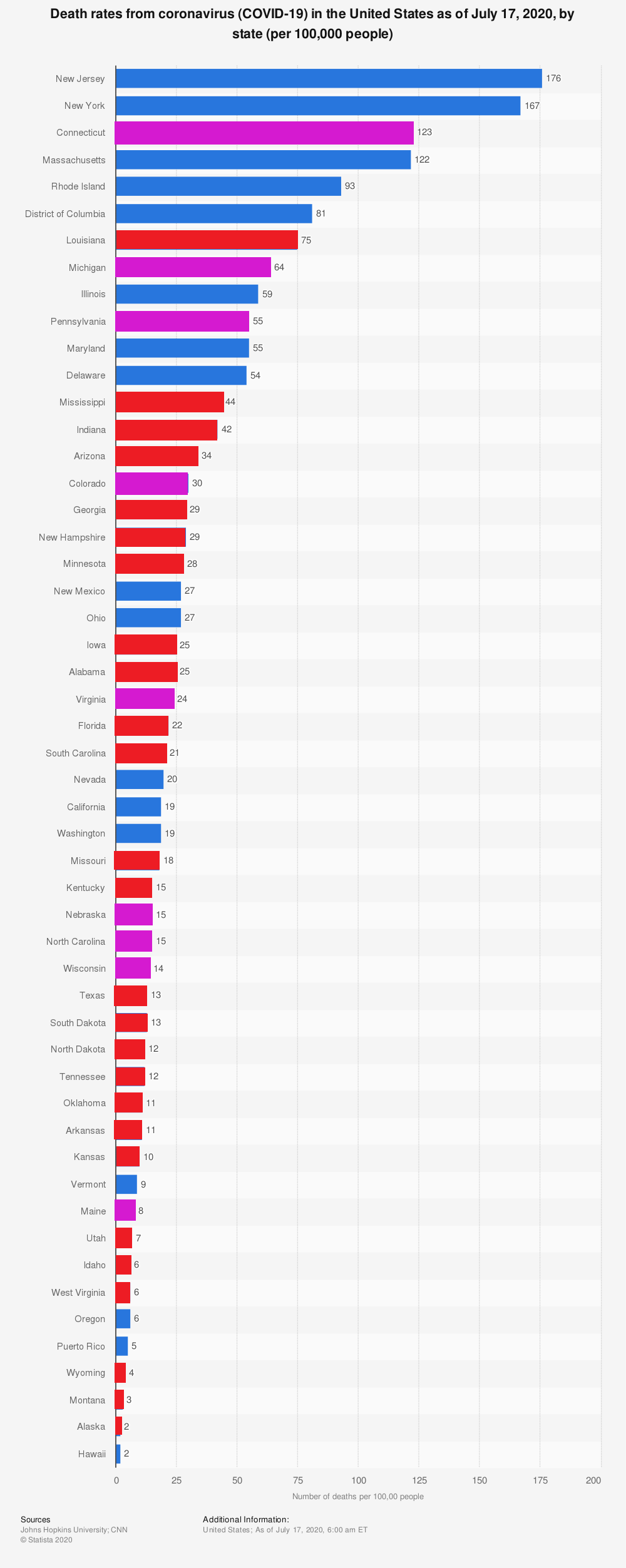
I have colored Blue the states controlled by the Democrat party, Red for Republican strongholds, and Purple for the battleground states.  I did mostly follow the partisan state designations in Wikipedia, though obviously, there is some subjectivity in these evaluations.  For example, Louisiana is traditionally Red, but the current Governor is Democrat John Bel Edwards.  And Minnesota appears Red but is governed by a Democrat. The problem for Democrats seeking to take power by stoking Covid fears is that they are governing the states with the highest death rates.  NY and NJ have death rates well over 100 per 100,000, while Florida counts 22 and Texas sits at 13.  For some reason, west coast Blue states have fared better.  But Texas with its large number of electoral delegates is the political prize, hence the media trickery.

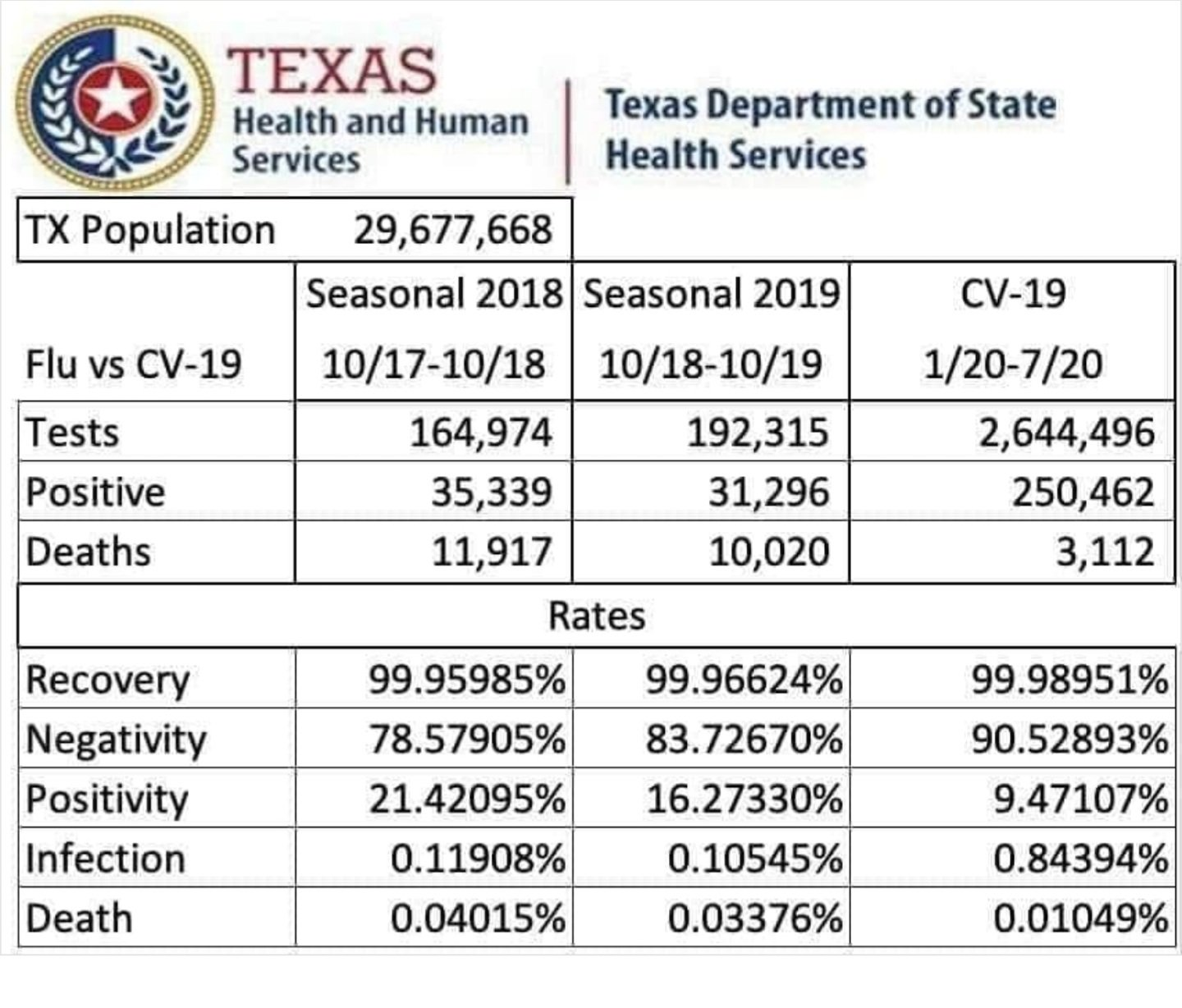
Some controversy was created when a doctor compiled this graphic:

Those wanting not to moderate fears but to amplify panic objected that the chart was not produced by DSHS, and Covid should not be compared to the flu.  But a more detailed comparison confirms what the chart suggests. Doing the math to keep things in proportion.

First Covid death in Texas was on March 23, 2020. 16 weeks later total deaths 3506, or 219 reported Covid19 deaths a week. If that rate continue another 36 weeks ( a big if), Texas would report 11, 394 deaths, comparable to a typical flu year. If Texas gets this back under control like it was pre-July, the number will be lower than a flu year. If not, the total could climb higher.  The present spike in positive tests started July 8, and officials are determined to rein it in, but we shall have to wait and see.

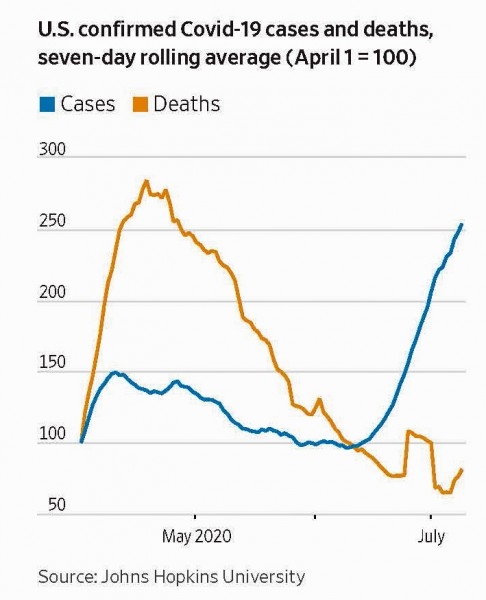
The overall US picture is not discouraging, since more cases have not stopped the decline in deaths:

Canada Succeeds on Key Covid Metric

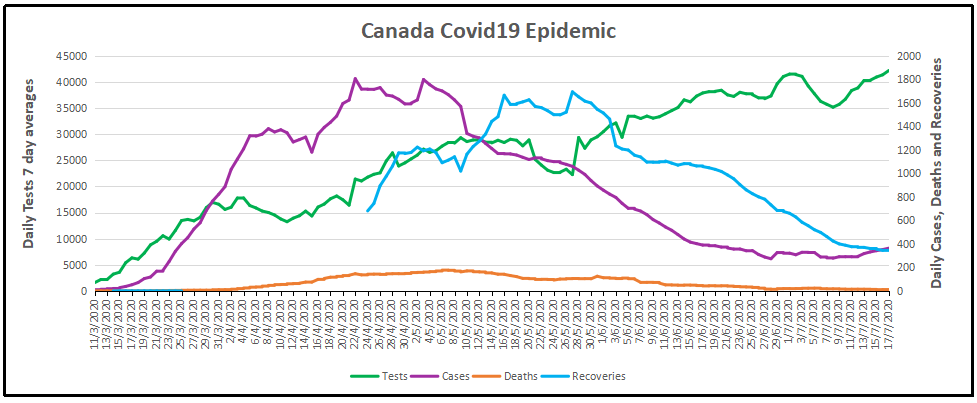
The map shows that in Canada 8839 deaths have been attributed to Covid19, meaning people who died having tested positive for SARS CV2 virus.  This number accumulated over a period of 148 days starting January 31. The daily death rate reached a peak of 177 on May 6, 2020, and is down to 11 as of yesterday.  More details on this below, but first the summary picture. (Note: 2019 is the latest demographic report)

Canada Pop Ann Deaths Daily Deaths Risk per
Person
2019 37589262 330786 906 0.8800%
Covid 2020 37589262 8839 60 0.0235%

Over the epidemic months, the average Covid daily death rate amounted to 7% of the All Causes death rate. During this time a Canadian had an average risk of 1 in 5000 of dying with SARS CV2 versus a 1 in 114 chance of dying regardless of that infection. As shown later below the risk varied greatly with age, much lower for younger, healthier people.

The Key Covid Metric

With easing of lockdowns and increased testing in many places, epidemiologists are focusing on a key metric to inform public policies: Positivity. The positivity metric is the rate (%) of people who test positive out all people sampled. The significance is that (by definition) a presumed case is a person who tests positive once. If a second test comes back positive it is a confirmed case. The metric is not perfect for two reasons.

The first problem is false positives from the testing procedure itself or from errors in the data processing and reporting. For this we have to hope that quality assurance protocols are being followed and mistakes corrected along the way.

The larger issue appeared in Florida recently when officials discovered that numerous batches of samples were reported 100% positive and other batches 100% negative. While the latter result is expected sometimes, all people testing positive seems unlikely. Behind this is the reality that in many situations (eg hospital ICU) a single patient will be tested many times with many positive results in the course of monitoring that individual’s clearing of the virus. Obviously a batch of samples from that ICU might legitimately be 100% positive.

But it is also true that 10 or 20 positive tests from one patient should not be reported as 10 or 20 new cases. In some jurisdictions, officials say they go to the effort to link test results to the individuals tested, and can distinguish between number of cases and number of positives. In other places, cases and positives may be the same number. Thus confirmed cases could be only 1/2 of the total positives, or less.

How is Canada Doing?

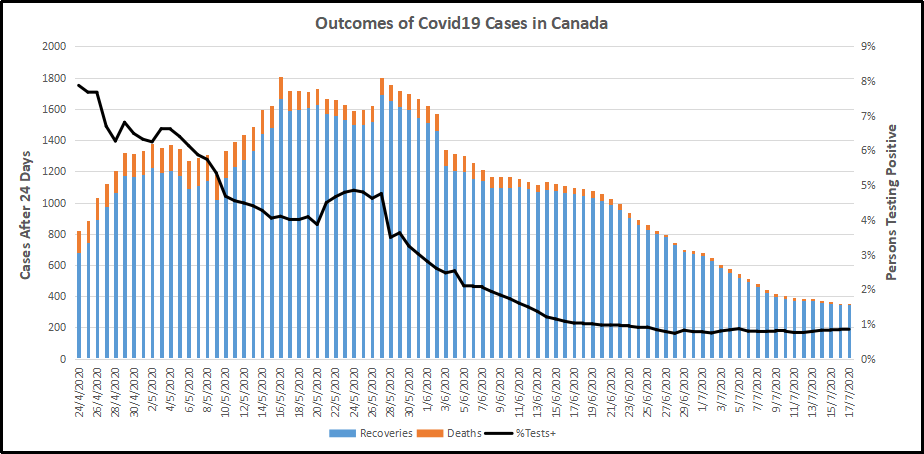
Recoveries are calculated as cases minus deaths with a lag of 24 days. Daily cases and deaths are averages of the seven days ending on the stated date. Recoveries are # of cases from 24 days earlier minus # of daily deaths on the stated date. Since both testing and reports of Covid deaths were sketchy in the beginning, this graph begins with daily deaths as of April 24, 2020 compared to cases reported on March 31, 2020.

The line shows the Positivity metric for Canada starting at nearly 8% for new cases April 24, 2020.  That is, for the 7 day period ending April 24, there were a daily average of 21,772 tests and 1715 new cases reported. Since then the rate of new cases has dropped down, now holding steady at ~1% for the last month. Yesterday, the daily average number of tests was 42,191 with 363 new cases. So despite double the testing, the positivity rate is not climbing.

Another view of the data is shown below.

The scale of testing has increased and is now exceeding 40,000 a day, while positive tests (cases) dwindled to 1%.  The shape of the recovery curve resembles the case curve lagged by 24 days, since death rates are a small portion of cases.  The recovery rate has grown from 83% to 97% steady over the last 3 weeks. This approximation surely understates the number of those infected with SAR CV2 who are healthy afterwards, since antibody studies show infection rates multiples higher than confirmed positive tests. In absolute terms, cases are now down to 363 a day and deaths 11 a day, while estimates of recoveries are 345 a day.

Note: We are expecting an initial report from the National Immunity Task Force any day now regarding a major program of testing random blood samples for SARS CV2 anti-bodies.

Aside:  While preparing this post I was watching CBC channel, and the scroll bar had the text:  Canada passes 100,000 Covid cases.  I thought, what was the point of that? Then I realized:

Canada Mask2

My bad. That is the Health Minister of PEI solemnly announcing in July their first Covid case in two months.

Background Updated from Previous Post

In reporting on Covid19 pandemic, governments have provided information intended to frighten the public into compliance with orders constraining freedom of movement and activity. For example, the above map of the Canadian experience is all cumulative, and the curve will continue upward as long as cases can be found and deaths attributed.  As shown above, we can work around this myopia by calculating the daily differentials, and then averaging newly reported cases and deaths by seven days to smooth out lumps in the data processing by institutions.

A second major deficiency is lack of reporting of recoveries, including people infected and not requiring hospitalization or, in many cases, without professional diagnosis or treatment. The only recoveries presently to be found are limited statistics on patients released from hospital. The only way to get at the scale of recoveries is to subtract deaths from cases, considering survivors to be in recovery or cured. Comparing such numbers involves the delay between infection, symptoms and death. Herein lies another issue of terminology: a positive test for the SARS CV2 virus is reported as a case of the disease COVID19. In fact, an unknown number of people have been infected without symptoms, and many with very mild discomfort.

This discussion takes the assumption that anyone reported as dying from COVD19 tested positive for the virus at some point prior. A recent article by Nic Lewis at Climate Etc. referred to evidence that the average time from infection to symptoms is 5.1 days, and from symptoms to death 18.8 days. A separate issue, of course, is that 95+% of those dying had one or more co-morbidities contributing to the patient’s demise. Setting aside the issue of dying with/from Covid19, it is reasonable to assume that 24 days after testing positive for the virus, survivors can be considered recoveries.

Previous Post May 20, 2020

It is really quite difficult to find cases and deaths broken down by age groups.  For Canadian national statistics, I resorted to a report from Ontario to get the age distributions, since that province provides 69% of the cases outside of Quebec and 87% of the deaths.  Applying those proportions across Canada results in this table. For Canada as a whole nation:

Age  Risk of Test +  Risk of Death Population
per 1 CV death
<20 0.05% None NA
20-39 0.20% 0.000% 431817
40-59 0.25% 0.002% 42273
60-79 0.20% 0.020% 4984
80+ 0.76% 0.251% 398

In the worst case, if you are a Canadian aged more than 80 years, you have a 1 in 400 chance of dying from Covid19.  If you are 60 to 80 years old, your odds are 1 in 5000.  Younger than that, it’s only slightly higher than winning (or in this case, losing the lottery).

As noted above Quebec provides the bulk of cases and deaths in Canada, and also reports age distribution more precisely,  The numbers in the table below show risks for Quebecers.

Age  Risk of Test +  Risk of Death Population
per 1 CV death
0-9 yrs 0.13% 0 NA
10-19 yrs 0.21% 0 NA
20-29 yrs 0.50% 0.000% 289,647
30-39 0.51% 0.001% 152,009
40-49 years 0.63% 0.001% 73,342
50-59 years 0.53% 0.005% 21,087
60-69 years 0.37% 0.021% 4,778
70-79 years 0.52% 0.094% 1,069
80-89 1.78% 0.469% 213
90  + 5.19% 1.608% 62

While some of the risk factors are higher in the viral hotspot of Quebec, it is still the case that under 80 years of age, your chances of dying from Covid 19 are better than 1 in 1000, and much better the younger you are.

Teachers Beware Your Cultural Revolution Turning on You

The protests in city streets of developed countries are coordinated and led by Social Justice Warriors indoctrinated in Western academies of higher education, after elementary school slanted teaching. If neo-Marxist progressive post-moderns take pride in this as accomplishing their agenda, consider what happened in China’s cultural revolution in the 1960s and is repeating itself in 2020.

Background:

It all started in China with educational reform implemented by teachers and administrators. That history is summarized in an article China’s Cultural Revolution: Reforms in the Education System at UK Essays. Excerpts in italics with my bolds.

The implementation of educational reforms was carried out via a decentralized process, as most schools were placed under local management. In fact each school had its own “Revolution in Education’ Committee responsible not only for implementing reforms but also for part of the planning process within its own institution.”[7] So it would seem that local experimentation within the general framework of the new educational policies was encouraged. Experimentation was seen as necessary primarily because of the emphasis on adopting flexible methods to meet the diverse needs of different schools and regions. We will identify below the major guidelines regarding the implementation of the educational reforms, as well as describe some of the different ways the reforms were implemented.

In order to elevate the “political consciousness” of the students, the curriculum was heavily stocked with political education courses. The major texts used were drawn from the works of Mao. Aside from increasing the number of political course, other courses also drew upon Mao’s thoughts to explain various approaches to the analysis of whatever phenomenon was involved.[8] This reliance on Mao’s thoughts was essentially the concept of “putting politics in command of knowledge.” At the same time, “revolutionary mass criticism” and “class struggles” were actively promoted to bring into sharp relief the various contradictions in society from a more personal perspective. The principal means of linking theory and practice in the educational process were to make production labor a major part of the students’ curriculum and to direct research to meet local needs. These methods were based on the concept of “practical training,” although their implementation in China seems to have gone far beyond that practiced by other countries.

What Happened to the Educators

The fate of the teachers is revealed in research conducted by Youqin Wang In her paper Student Attacks Against Teachers: The Revolution of 1966. Excerpts in italics with my bolds.

The author investigated the so-called “Red August” of 1966, the start of large-scale violent persecution during China’s Cultural Revolution. She interviewed hundreds of teachers and students from ninety-six schools and reviewed all available written materials. This article provides a detailed description of how educators were insulted, tortured, and even killed by their students. Mobilized as members of a new youth organization named “Red Guards,” the students attacked the educators for being “capitalist intellectuals.” In those schools, twenty-seven educators were murdered; more committed suicide subsequent to torture. Cruel oppression silenced resistance. Stories about bloody campus persecutions were too politically sensitive following the Cultural Revolution, so have heretofore received scant attention in the historical narrative. As the author shows, given the high regard China has traditionally held for education, the brutalizing of educators in China was an unprecedented act. The objective of this article is to reveal the texture and significance of this underreported and underappreciated part of China’s history.

Not only were the stories of violence not reported by the media at the time of their occurrence, but thirteen years later, in 1979, with the repudiation of the Cultural Revolution reaching the highest circles of the Chinese Communist Party (CCP), the Chinese media only cautiously began to mention the victims as a way of “restoring” their reputation. This sort of publicity was limited to a small number of purged high-ranking cadres, victimized celebrities, and a few ordinary people who were considered “heroes” or “heroines” for resisting the “Gang of Four” (四人幫). The teachers who were victimized in 1966 were not so much as mentioned. None of the three published general histories of the Cultural Revolution (printed in 1986, 1988, and 1995 respectively) covers the brutality against teachers in the summer of 1966.

In general, the brutality of students in colleges and in elementary schools was not as severe as in middle schools, but it was nevertheless serious. At Beijing University, hundreds of people on the “labor reform team of ox-ghosts and snake-demons” were forced to clean the campus with irregularly shaved heads, while wearing boards with their name and title (such as “member of the black gang” or “reactionary academic authority”) around their necks and receiving gratuitous insults from many students who came to “learn revolutionary experiences from Beijing University.”

On August 24, 1966, the Red Guards of the Middle School attached to Qinghua University transported truckloads of Red Guards from twelve middle schools to Qinghua campus, where they beat the administrators and professors. After several persons at the Department of Electronic Engineering were beaten, their blood stained the ground. Someone marked a circle around the blood and wrote “dog blood.” That day Red Guards ordered those on the “ox-ghost and snake-demon team,” under the lashes of whip, kicks, and punches, to pull down a white marble monument which was built in 1905 to commemorate the founding of the school. That night, all school-level cadres at both the university and the attached middle school were detained in the Science Building, and there in a small room, a beating was inflicted upon each of them. No one escaped without serious injury.

Even kindergarten teachers could not escape the violence. Some teachers of Beijing Zhongshan Gongyuan Kindergarten and several kindergartens in Beijing’s Dongcheng District (東城區) were denounced and beaten in the Zhongshan Concert Pavilion; there, students from middle schools beat them and shaved their heads

The “working groups” organized sessions to expose and to criticize teachers and divided all teachers into four categories: good, fair, those with serious errors, and anti-party/anti-socialist “rightists” (右派份子). For example, the working group at the Girls Middle School attached to Beijing Teachers University led an “exposing and denouncing meeting” against vice-principal Bian Zhongyun on June 21 at which all students attended. According to the working group’s record of July 3, 1966, the group put two out of six leading cadres of this school into category IV (the worst one), two in category III, and two in category II. Some teachers, unable to bear the pressure and insults, committed suicide.

When their parents were denounced by the new student organizations, the Red Guards fell victim to the movement that they had started. However, the decline of the original Red Guards did not mean the end of the philosophy of violent attacks. On the contrary, the massive violent persecution that the Red Guards promoted in the so-called “Red August” (紅八月) period of 1966 continued in the following years. In late 1966 and 1967, students in the mass organizations that had dominant status during that period physically attacked the “capitalistroaders with powerful positions in the party.” For example, students beat Peng Dehuai (彭德 懷), the former defense minister, at the “struggle meeting” in Beijing in July of 1967. Two of Peng’s ribs were broken during the beating.47

On June 18, 1968, at Beijing University, about two hundred teachers and cadres, who had been imprisoned on campus for months, were beaten and tortured in very brutal ways during a school-wide action. This date was chosen to celebrate the violent event that had occurred two years previous, on June 18 of 1966, mentioned twice above. In the attack of June 18, 1968, more educators were beaten more viciously than in the previous attack of June 18, 1966. From 1966 to 1968, it was in part this increasing violent persecution that fueled enthusiasm for the Cultural Revolution.

Cultural Tyranny Continues in 2020 China

The present direction in China is not encouraging as reported at Reuters(Beijing) by Huizhong Wu In echo of Mao era, China’s schools in book-cleansing drive. Excerpts in italics with my bolds.

As schools reopened in China after the COVID-19 outbreak, they have thrown themselves into a nationwide exercise to remove books deemed politically incorrect, deepening Chinese President Xi Jinping’s push to instill patriotism and ideological purity in the education system.

A directive from the Ministry of Education last October called on elementary and middle schools to clear out books from their libraries including “illegal” and “inappropriate” works. Now teachers have removed books from schools in at least 30 of mainland China’s 33 provinces and municipalities, according to a Reuters review of social media posts, publicly available school and local government documents, and interviews with teachers.

From western Gansu province to Shanghai, the review of publicly announced measures pointed to books being cleared by the hundreds of thousands.

Censorship in China has been intensifying under Xi, but analysts say this is the first national campaign aimed at libraries in decades. It comes as government employees in Hong Kong last week removed books by pro-democracy activists from public libraries to see whether they violate a new national security law.

“This is the first movement targeted at libraries since the Cultural Revolution,” said Wu Qiang, a political analyst based in Beijing and former political science lecturer at Tsinghua University. In the late 1960s, zealous teenagers driven by Mao Zedong carried out a nationwide campaign targeting libraries and destroying or burning what they could get their hands on, as part of a wider destruction of traditional culture.

My Comment

An old Soviet joke has an university professor of history addressing his students at the end of the term. “Regarding the final exam, I have good news and bad news. The good news is that all the the questions are the same as last year. The bad news: Some of the correct answers have changed.”

The story was shared among the proles as an example of the slogan of the times: The future is certain; only the past keeps changing. I never thought we’d see such thought control appearing in Western democracies in the 21st century. But here it is, demonstrated by the 1619 project promoted by the New York Times, former newspaper of record in the USA. Further the Red Guard, now wearing Black, are roaming and destroying monuments honoring heroes of the past, who though flawed paved the way for our freedoms and prosperity. People guilty of wrongthink are insulted, their reputations denigrated and driven from their livelihoods, just a shade from beatings and murders.

Of course there are differences in 2020 USA from 1966 China. The charismatic Mao called the shots for the purge of dissenters in China, while the woke leadership is more diffuse and hides behind names like “Sunrise Movement.”. “Black Lives Matter,” and “Anti-Fascists.” Clearly the media are broadcasting the “Resistance” playbook, but the directors and financiers are in the shadows. The slow-moving coup is reaching a crescendo, but the citizenry still have a choice to be heard.

Footnote: Summary from the UK Essay at the top

While the drastic educational reform measures have given peasants opportunities to attain basic education in rural areas, as well as agricultural production and political gains, it naturally came with lasting negative impacts that promoted many post-modernist’s critiques. In the beginning of the Cultural Revolution, values like collaboration, diligence, modesty, and respect for elders and teachers were discarded as a result of the purge of the old Chinese cultures and traditions. Many have failed to retain the virtues during the revolution. Second, due to political struggle and line drawn between working classes and intellectuals, as well as political and violent nature of the social revolution, substantial innocent teachers and professionals were subjected to personal attacks and humiliation, some even executed. Third, specific strategies of the reformed curriculum and examination system proved to be misguided and wasted the schooling of many young people. The disconnection between academic achievement and students’ future career, the emphasis on political correctness over academic achievement, and the neglecting of theory learning and over-emphasis on hands-on experiences were all examples of poor decisions. Fourth, the Cultural Revolution both liberated students and dominated them. It liberated students and people because it opened their eyes to the inequality existing in education and society; However, it imposed political control and dominated them because it did not allow real democratic, independent and critical thinking ability.[12] As Freire (1970) put it, “If teachers help students from oppressed communities to read the word but do not also teach them to read the world, students might become literate in a technical sense but will remain passive objects of history rather than active subjects.”

See Also Modern Educayshun

The Everywhere Elsewhere Pandemic

Why # of  +Tests ≠ # of Cases

There are many reasons for lacking confidence in pandemic stats, as the article below will explain.  From the beginning reports contained an equivocation fallacy, ie. when an argument uses a word or phrase with more than one meaning.  Positive tests for the virus, SARS CV2, were presented as though they were cases of people suffering with the disease, Covid19.  In fact, many with enough virus to trigger positive had mild or no symptoms, and required no treatment at all–they were not cases of the disease.  Then it seems that in some, if not many, jurisdictions the number of positive tests were treated as newly infected persons, even when one individual was tested multiple times.

The article Hospital has been pretty much empty for the entire period, written by “Penelope”, an Anonymous Hospital Worker in Surrey, UK. Excerpts in italics with my bolds. H/T Ice Age Now

I am a consultant at a major, regional hospital in Surrey, had agreed to give an interview to an anti lockdown activist in which I would have revealed my identity.

Changed my mind because all staff at all hospitals have been warned that if they make any statements to press/social media we may immediately be suspended without pay. I have a family, dependents.

In my opinion, and that of many of my colleagues, there has been no Covid Pandemic, certainly not in the Surrey region and I have heard from other colleagues this picture is the same throughout the country. Our hospital would normally expect to see around 350,000 out patients a year. Around 95,000 patients are admitted to hospital in a normal year and we would expect to see around a similar figure, perhaps 100,000 patients pass through our A&E [Accident & Emergency] department.

From March to June we would normally expect to see 100,000 out patients, around 30,000 patients admitted, and perhaps 30,000 pass through A&E. This year (and these figures are almost impossible to get hold of) we are over 95% down on all those numbers. In effect, the hospital has been pretty much empty for that entire period.

At the start, staff that questioned this were told that we were being used as ‘redundant’ capacity, kept back for the ‘deluge’ we were told would come. It never did come, and when staff began to question this, comments like, ‘for the greater good’ and to ‘protect the NHS’ came down from above. Now its just along the lines of, ‘Shut up or you don’t get paid’.

Every single test (of the same person) counted as a new case

The few Covid cases that we have had to get repeatedly tested, and every single test counted as a new case. Meaning the figures reported back to ONS/PHE (Office for National Statistics & Public Health England) were almost exponentially inflated. It could be that Covid cases reported by hospitals are between 5 to 10x higher than the real number of cases. There has been no pandemic and this goes a long way to explain why figures for the UK are so much higher than anywhere else in Europe.

They’ve been running empty ambulances during lockdown and are still doing it now. By this I mean ambulances are driving around, with their emergency alert systems active (sirens &/or lights) with no job to go to. When out of public view staff masks come off and distancing is not observed.

Masks are totally ineffective and dangerous

Indeed jokes are made about the measures, and I have heard staff express amazement that despite warnings on packets and at point of sales, telling people masks are totally ineffective and dangerous, the public still buy them, because a politician has told them to.

ALL elective surgery has been cancelled. Non-elective Surgery, this tends to be emergency surgery or that which is deemed urgent has been severely curtailed. People are at best being denied basic medical care and at worst being left to die, in some cases, in much distress and pain.

Staff that are responsible for death certification encouraged where possible to put Covid-19 complications as reason for death, even though the patient may have been asymptomatic and also not even tested for covid, grossly inflating the number of Covid deaths.

Remember Covid-19 itself can not kill. What kills is complications from the virus, typically pneumonia like symptoms.

These complications are in reality incredibly rare but have featured in a large amount of death certificates issued in recent months. As long as Covid-19 appears on a death certificate, that death is counted as Covid-19 in the figures released by the ONS and PHE.

Many death certificates (appear to) have been fraudulently completed

I genuinely believe that many death certificates, especially amongst the older 65+ demographic have been fraudulently completed so as to be counted as Covid-19 deaths when in reality Covid-19 complications did not cause the death.

There have been Thursday nights when I stood, alone in my office and cried as I heard people cheering and clapping outside. It sickens me to see all the ‘Thank You NHS’ signs up everywhere and the stolen rainbow that for me now says one word and word only; fear.

There are many good people in the NHS and whilst I do not plead forgiveness for myself, I do plead for them. Most are on low pay, they joined for the right reasons and I did and have been bullied and threatened that if they don’t ‘stay on message’ they don’t eat. I know that if a way could be found to assure staff within the NHS of safety against reprisals, there would be a tsunami of whistleblowers which I have no doubt would help end this complete and brutal insanity.

I am finding it increasingly hard to live with what I have been involved in and I am sorry this has happened.

To end, I would simply say this. Politicians haven’t changed, the country has just made a fatal mistake and started trusting them without question.