2026 March Arctic Ice Recovery Slowed by Vortex

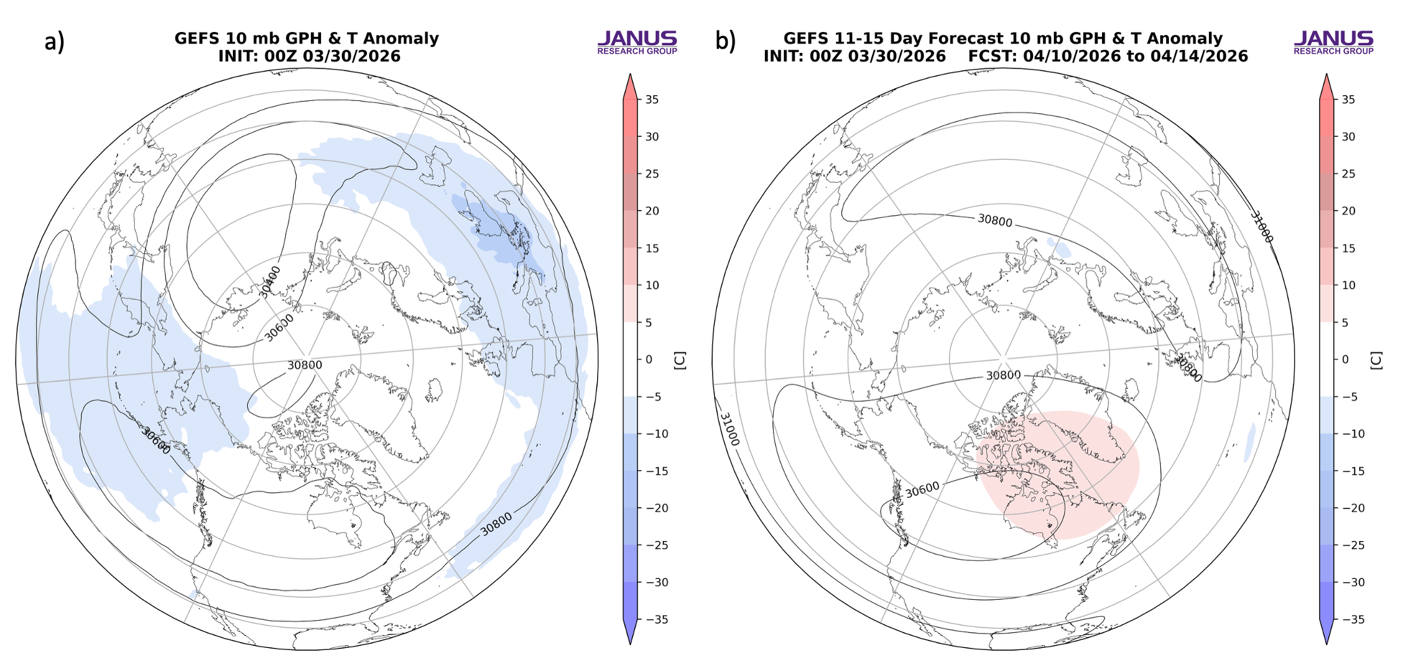
The arctic ice extents are now reported through end of March 2026, the month whose average is taken as the annual maximum.  As noted previously the wavy polar vortex has hampered ice formation with incusions of warmer southern air into the Arctic circle.  This may be changing according to the most recent image from AER PV blog.

Figure 12. Observed 10 mb geopotential heights (dam; contours) and temperature anomalies (°C; shading) across the Northern Hemisphere averaged from 17 Mar. (b) Same as (a) except forecasted averaged from 28 Mar to 1 Apr 2026. The forecasts are from the 00Z 17 Mar 2026 GFS ensemble.

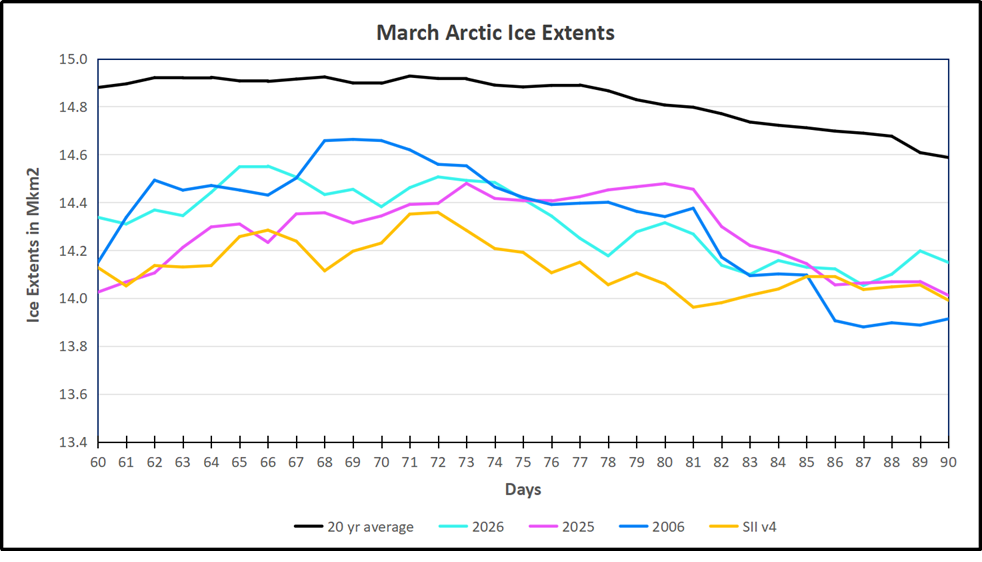
Remarkably, the 2025 annual daily extent maximum of 14.48M km2 was on day 73 of that year.  Arctic ice reached 14.55 on day 63 in 2026, and continued near that level until day 74, before starting the usual decline.

The chart below shows the 20-year averages for Arctic ice extents for March along with 2026, 2025 and 2006 as well as SII v.4.


The 20-year average maximum daily ice extent appears at 14.93M km2 on day 71 before starting to decline. MASIE 2006 and 2026 started this period the same and tracked each other until 2026 ended higher by ~200k km2, and slightly above 2025.

The table below shows the distibution of ice extents on day 90 across regions of the Arctic ocean.

Region 2026090 Day 90 Average 2026-Ave. 2006090 2026-2006
 (0) Northern_Hemisphere 14149101 14587351 -438250 13913402 235699
 (1) Beaufort_Sea 1071070 1070279 791 1068683 2387
 (2) Chukchi_Sea 966006 964325 1681 959091 6915
 (3) East_Siberian_Sea 1087137 1086309 828 1084627 2510
 (4) Laptev_Sea 897845 897135 709 897773 71
 (5) Kara_Sea 930404 918948 11456 922164 8240
 (6) Barents_Sea 582189 653649 -71460 623912 -41723
 (7) Greenland_Sea 569080 667067 -97988 604935 -35856
 (8) Baffin_Bay_Gulf_of_St._Lawrence 1403737 1384371 19366 1026934 376804
 (9) Canadian_Archipelago 854931 853349 1582 851691 3240
 (10) Hudson_Bay 1260887 1255554 5333 1240389 20498
 (11) Central_Arctic 3223020 3234756 -11736 3241074 -18054
 (12) Bering_Sea 819147 705446 113701 662863 156284
 (13) Baltic_Sea 36855 60091 -23235 129348 -92492
 (14) Sea_of_Okhotsk 433109 826350 -393242 588167 -155058

The table shows that most regions are close to or above the 20-year average.  The majority of the 3% overall deficit is from Sea of Okhotsk, down ~400k km2,  Smaller deficits are in Barents and Greenland seas, partly offset by a surplus in Bering sea. All of those regions will be nearly ice-free end of summer.


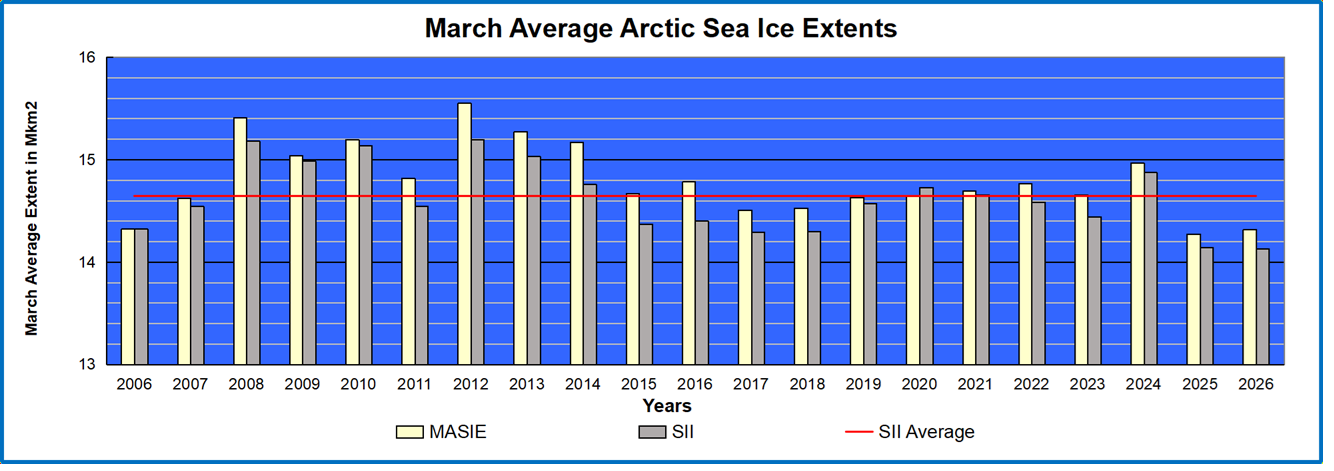
As for the March Monthly Averages, here is the history:

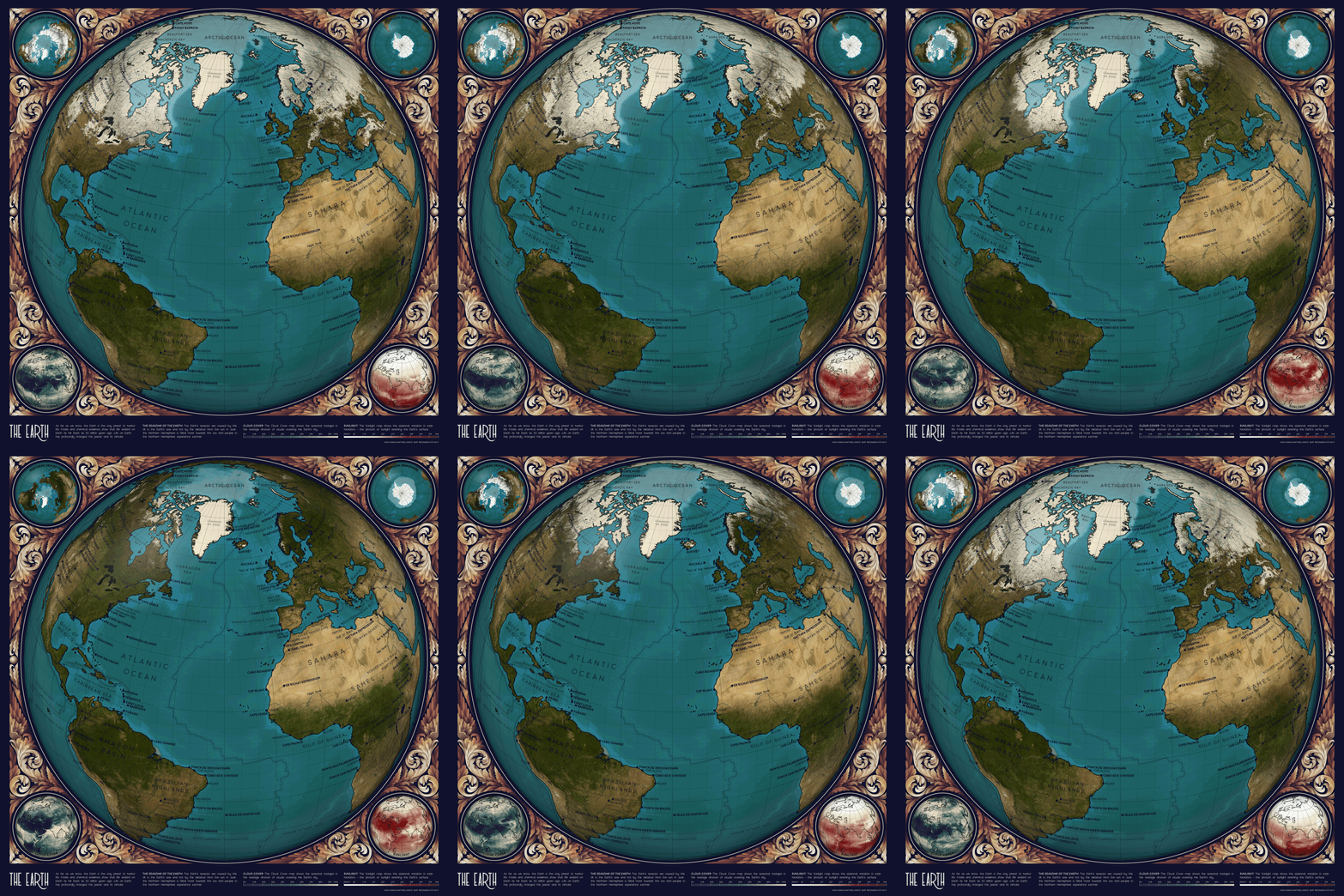
Illustration by Eleanor Lutz shows Earth’s seasonal climate changes. If played in full screen, the four corners present views from top, bottom and sides. It is a visual representation of scientific datasets measuring ice and snow extents.


2026 Mid March Vortex Slows Arctic Ice Recovery

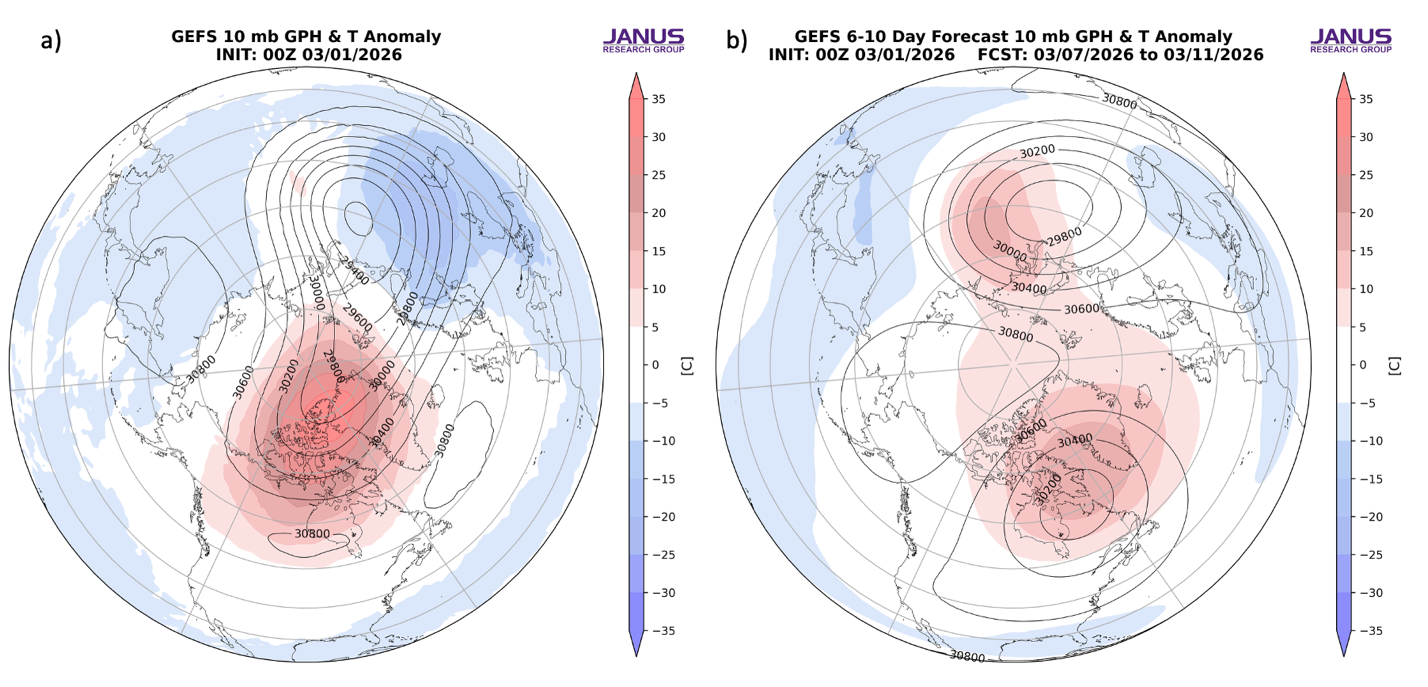
The arctic ice extents are now reported through March 16, 2026, an important date just past the annual daily maximum for Arctic ice extents averaged over the last 20 years. As noted in February, the wavy polar vortex has hampered ice formation with incusions of warmer southern air into the Arctic circle.  For example, here is an image from AER PV blog showing temperatures recently:

Figure 12. Observed 10 mb geopotential heights (dam; contours) and temperature anomalies (°C; shading) across the Northern Hemisphere averaged from 3 Mar. (b) Same as (a) except forecasted averaged from 7 Mar to 11 Mar 2026. The forecasts are from the 00Z 1 Mar 2026 GFS ensemble.

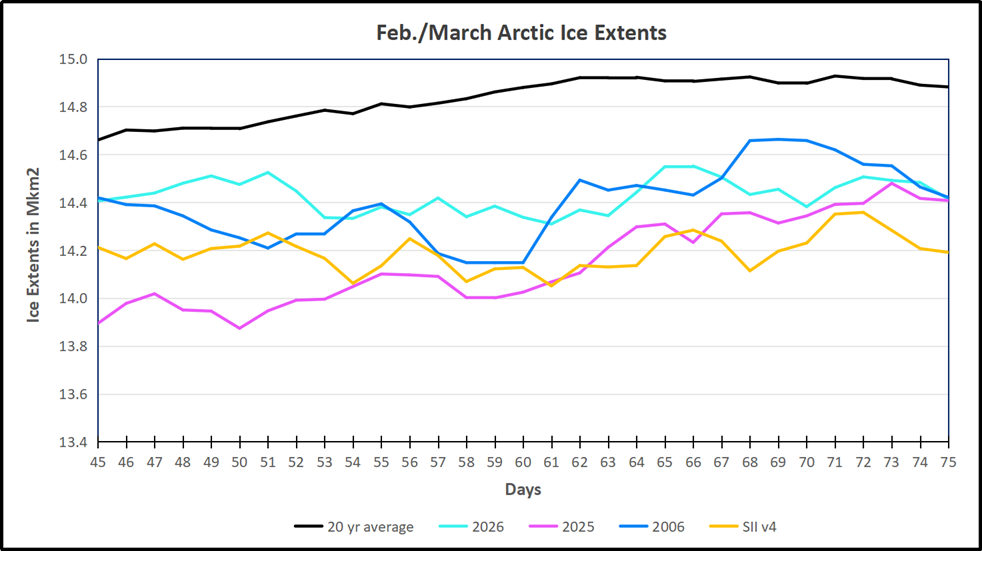
Remarkably, the 2025 annual daily extent maximum of 14.48M km2 was on day 73 of that year.  Arctic ice reached 14.55 on day 63 in 2026, and continued near that level until yesterday, day 75.

The chart below shows the 20-year averages for Arctic ice extents mid-March along with 2026, 2025 and 2006 as well as SII v.4.

The 20-year average maximum daily ice extent appears at 14.93M km2 on day 71 before starting to decline. MASIE 2006 and 2026 started this period the same and ended the same at 14.42M km2. 2025 started much lowered but matched the other two years on day 75.  SII v.4 continues to show lower extents than MASIE,  a deficit on the order of  220k km2 during March and on day 75.

The table below shows the distibution of ice extents on day 75 across regions of the Arctic ocean.

Region 2026075 Average Day 75 2026-Ave. 2006075 2026-2006
 (0) Northern_Hemisphere 14413747 14882167 -468421 14420679 -6932
 (1) Beaufort_Sea 1071070 1070384 686 1069711 1359
 (2) Chukchi_Sea 966006 965902 104 964227 1779
 (3) East_Siberian_Sea 1087137 1087113 24 1086702 435
 (4) Laptev_Sea 897845 897838 7 897773 71
 (5) Kara_Sea 933375 921644 11731 921428 11947
 (6) Barents_Sea 616802 640512 -23710 646196 -29394
 (7) Greenland_Sea 585405 633630 -48225 613161 -27756
 (8) Baffin_Bay_Gulf_of_St._Lawrence 1400707 1511237 -110530 1134817 265890
 (9) Canadian_Archipelago 854931 853379 1551 852715 2215
 (10) Hudson_Bay 1260887 1258334 2553 1251360 9527
 (11) Central_Arctic 3206408 3223651 -17243 3244243 -37835
 (12) Bering_Sea 901252 729963 171289 635252 266000
 (13) Baltic_Sea 89899 77762 12138 175063 -85164
 (14) Sea_of_Okhotsk 522126 992634 -470508 874372 -352247

The table shows that most regions are close to or above the 20-year average.  Two major deficits are in Baffin Bay and Sea of Okhotsk, partly offset by a smaller surplus in Bering sea. The overall 2026 MASIE deficit is 3% of the 20-year average.


Illustration by Eleanor Lutz shows Earth’s seasonal climate changes. If played in full screen, the four corners present views from top, bottom and sides. It is a visual representation of scientific datasets measuring ice and snow extents.


Vortex Slows Arctic Ice Recovery 2026 February End

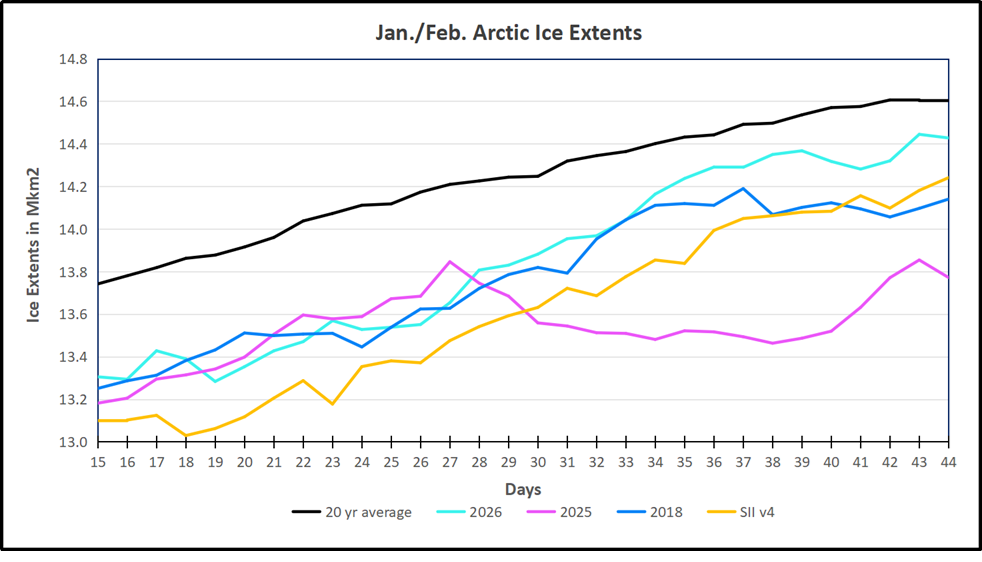
The arctic ice extents are now reported through February 2026, early on showing rising refreezing rates bringing Arctic ice extents within 200k km2 of the 20-year average.  In the last 2 weeks the wavy Polar Vortex pushed cold south and replaced it with warmer southern air.   Remarkably, Arctic ice reached 14.44 on day 43 in 2026, virtually matching the 2025 annual daily extent maximum of 14.48M km2 on day 80 of that year.

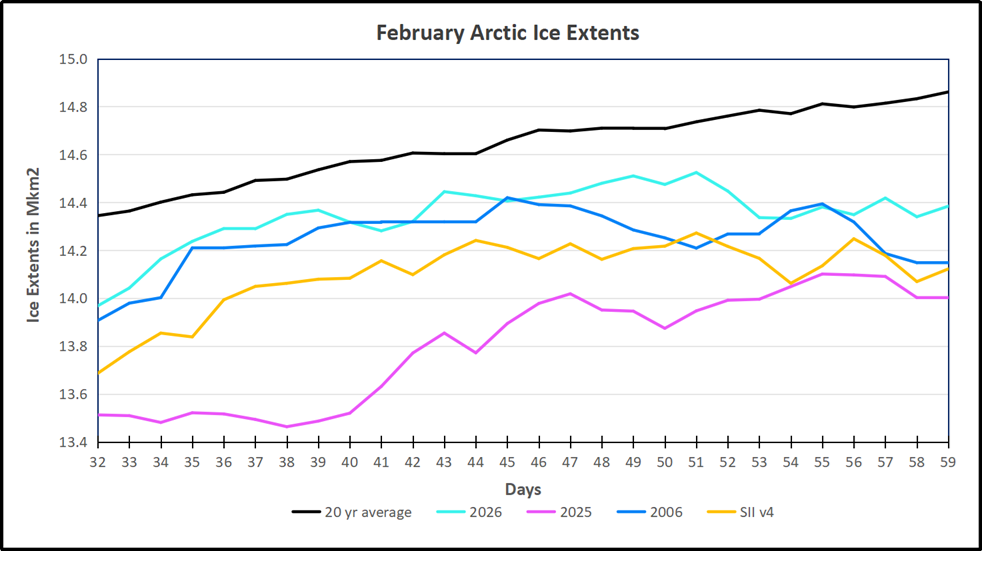
The chart below shows the 20-year averages for Arctic ice extents mid-Febrauary along with 2026 and 2025, as well as SII v.4.

As stated previously, likely due to a wavy polar vortex, MASIE 2026 grew rapidly in February reaching 14.52 M km2 on day 51, surpassing the 2025 max of 14.48 on day 80.  In the last week the extent dropped back down to 14.4 M. Sea Ice Index (SII v4) reported lower extents than MASIE in February, averaging -250k km2 on a daily basis.

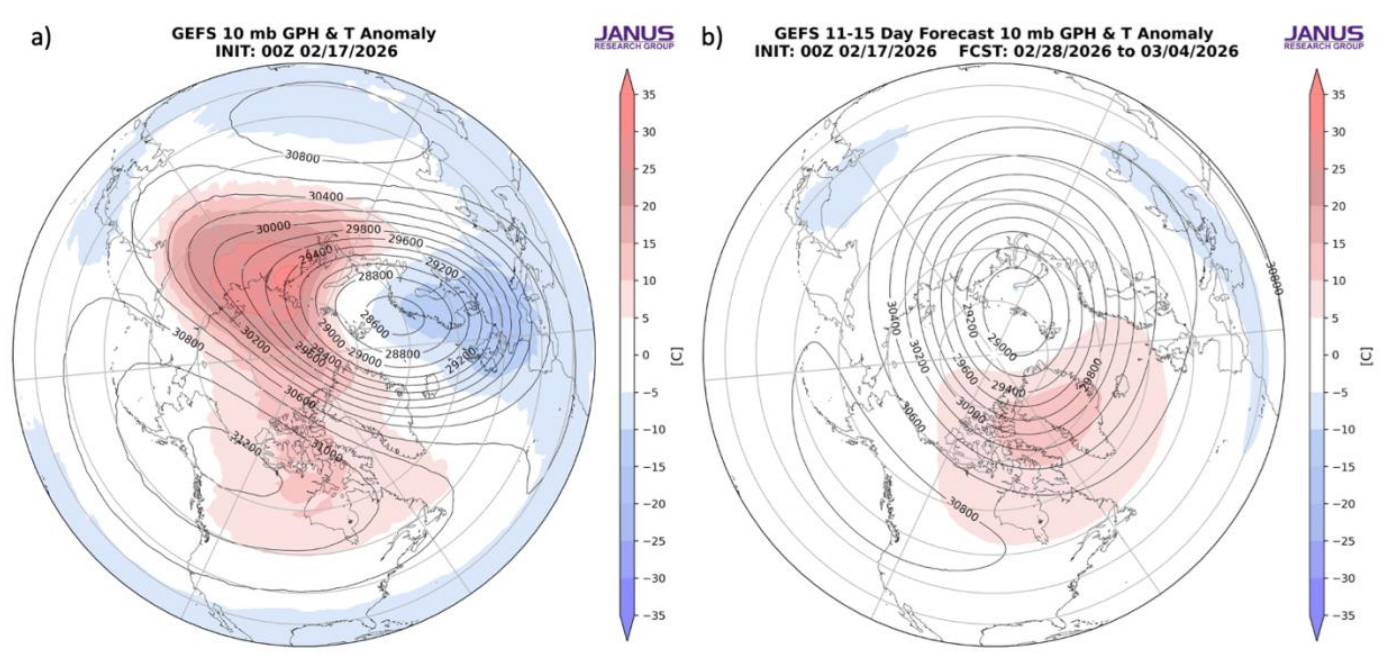
The vortex temperature shifts are shown below in charts from AER AO/PV blog.

Figure 12. (a) Observed 10 mb geopotential heights (dam; contours) and temperature anomalies (°C; shading) across the Northern Hemisphere for 17 Feb 2026. (b) Same as (a) except forecasted averaged from 28 Feb to 4 Mar 2026. The forecasts are from the 00Z 17 Feb 2026 GFS ensemble. Source: AER AO/PV blog.

The table below shows the distibution of ice extents on day 59 across regions of the Arctic ocean.

Region 2026059 Day 59 Average 2026-Ave. 2025059 2026-2025
 (0) Northern_Hemisphere 14384094 14861155 -477061 14000679 383416
 (1) Beaufort_Sea 1071070 1070420 650 1071001 69
 (2) Chukchi_Sea 966006 965473 533 965989 17
 (3) East_Siberian_Sea 1087137 1087111 27 1087137 0
 (4) Laptev_Sea 897845 897837 8 897845 0
 (5) Kara_Sea 914161 922224 -8062 925512 -11351
 (6) Barents_Sea 567312 604234 -36922 361405 205907
 (7) Greenland_Sea 731619 627908 103711 637961 93658
 (8) Baffin_Bay_Gulf_of_St._Lawrence 1264992 1512995 -248004 1357658 -92666
 (9) Canadian_Archipelago 854931 853573 1358 854878 53
 (10) Hudson_Bay 1260870 1260493 377 1260903 -33
 (11) Central_Arctic 3145110 3209967 -64857 3159772 -14663
 (12) Bering_Sea 724115 659010 65105 577908 146207
 (13) Baltic_Sea 136175 92656 43518 40575 95599
 (14) Sea_of_Okhotsk 737815 1057674 -319858 774415 -36599

The table shows that most regions are close to or above the 20-year average.  Two major deficits are in Baffin Bay and Sea of Okhotsk, partly offset by several smaller surpluses, mostly in Greenland Sea, Baltic and Bering seas. The overall 2026 MASIE deficit is 3% of the 20-year average.


Arctic Ice Nearly Average mid-February 2026

The arctic ice extents are now reported through mid-February 2026, showing rising refreezing rates bringing Arctic ice extents within 200k km2 of the 20-year average.  Remarkably, the last two days virtually matched the 2025 annual extent maximum of 14.48M km2 on day 80 of that year, compared to 14.44 on day 43 in 2026.

The chart below shows the 20-year averages for Arctic ice extents mid-Febrauary along with 2026 and 2025, as well as SII v.4.

As stated previously, likely due to a wavy polar vortex, MASIE 2026  refroze slowly in January reaching a deficit of 622k km2 on day 26.  Since then ice grew at a higher rate, ending this period 176k km2 below average, or 1% down. Note that compared to day 44 last year, 2026 ice is more than half a Wadham greater, 656k km2.  And as mentioned above, 2025 will not match yesterday until day 80. Note SII v.4 tracks lower than MASIE throughout, on average in deficit by 242K km2.

Region 2026044 Average day 44 2026-Ave. 2025044 2026-2025
 (0) Northern_Hemisphere 14427481 14603337 -175856 13771518.64 655962
 (1) Beaufort_Sea 1071070 1070384 686 1071000.73 69
 (2) Chukchi_Sea 966006 965785 222 965989.12 17
 (3) East_Siberian_Sea 1087137 1087132 5 1087137.23 0
 (4) Laptev_Sea 897845 897838 7 897844.8 0
 (5) Kara_Sea 935023 909437 25586 911762.37 23261
 (6) Barents_Sea 649606 566421 83185 434920.5 214686
 (7) Greenland_Sea 772110 625671 146439 635758.41 136351
 (8) Baffin_Bay_Gulf_of_St._Lawrence 1040295 1429059 -388764 1335264.28 -294969
 (9) Canadian_Archipelago 854931 853531 1399 854877.96 53
 (10) Hudson_Bay 1260870 1260595 276 1260903.34 -33
 (11) Central_Arctic 3235930 3204874 31056 3195022.33 40907
 (12) Bering_Sea 689769 671512 18256 333643.58 356125
 (13) Baltic_Sea 155657 88990 66666 35593.84 120063
 (14) Sea_of_Okhotsk 742439 914421 -171982 720462 21977

The table shows that most regions are close to or above the 20-year average.  Two major deficits are in Baffin Bay and Sea of Okhotsk, partly offset by several smaller surpluses, mostly in Greenland Sea, Barents and Bering seas.


Arctic Ice Recovering January 2026 Despite Vortex

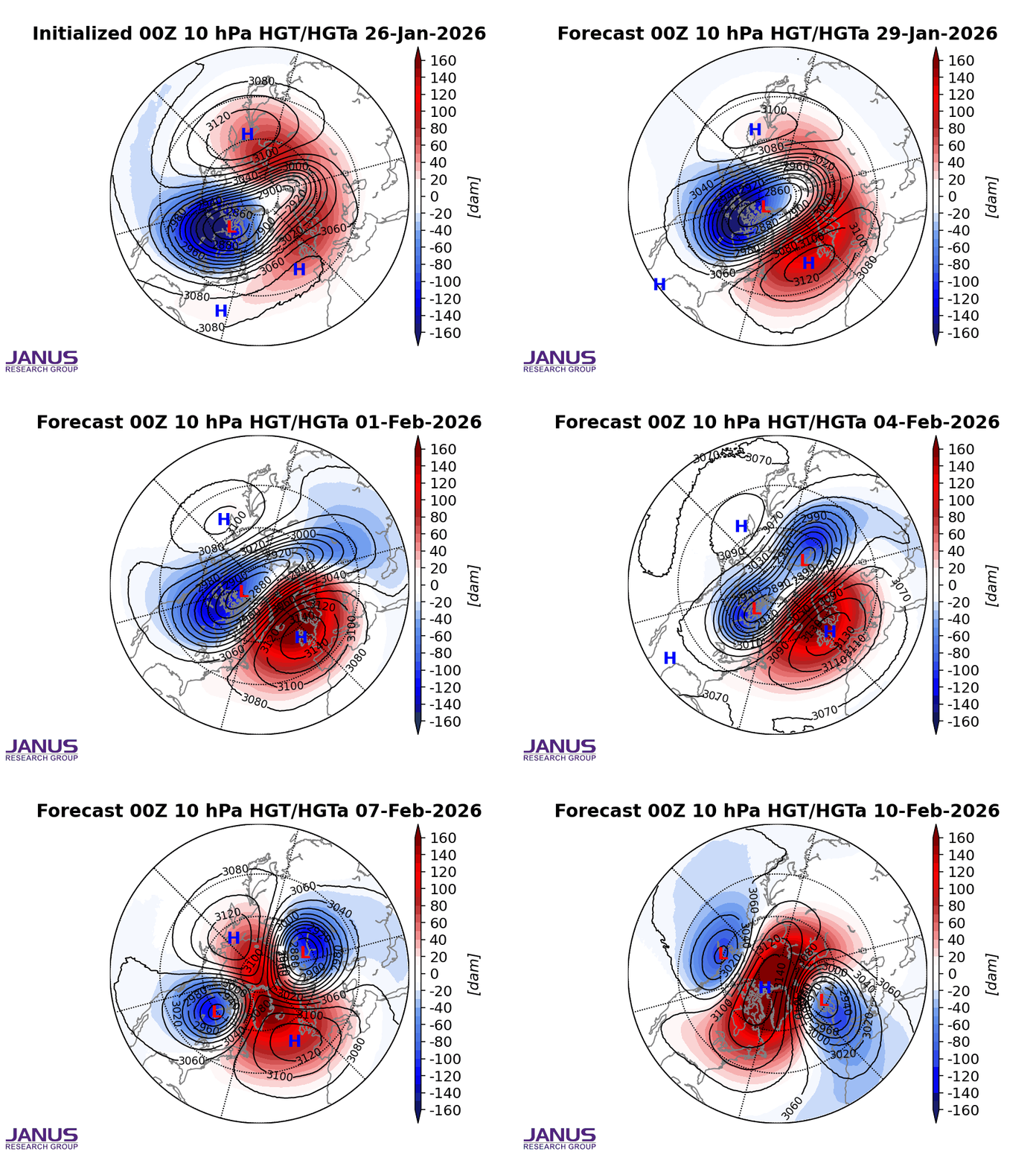
The arctic ice extents are now fully reported for January 2026, showing refreezing rates fluctuating, likely due to a wavy polar vortex sending cold Arctic air to sub-arctic latitudes and replacing it with warmer southern air.

From AER Polar Vortex blog:

As seen in Figure iii (and also Figure 12) the PV has an elongated shape in appearance for much of the next two weeks in contrast to the more circular PV of early January. The PV has a “split” appearance this week and into next week, a character trait or signature of a more extreme stretched PV. I think the more extreme nature of the stretched PV is consistent with the model forecasts of extreme cold in the US and even potential snowstorms. But then at least in this animation there is a clear PV split with two distinct and independent PV centers.

Figure iii. Forecasted average 10 mb geopotential heights (dam; contours) and geopotential height anomalies (m; shading) across the Northern Hemisphere for 19 Jan 2026 and forecasted from 20 Jan 2026 to 03 Feb 2026. The forecasts are from the 00Z 19 Jan 2026 GFS model ensemble.

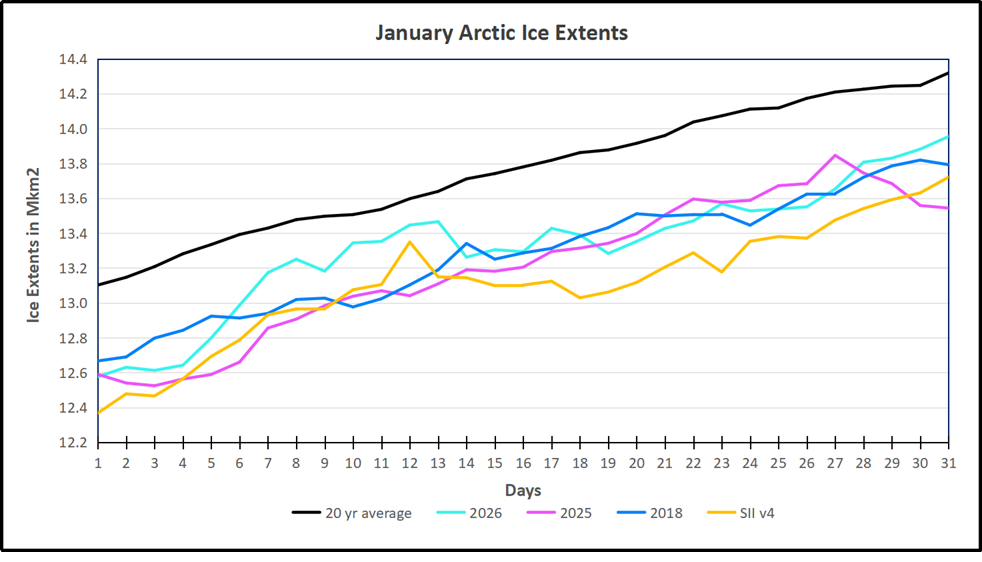
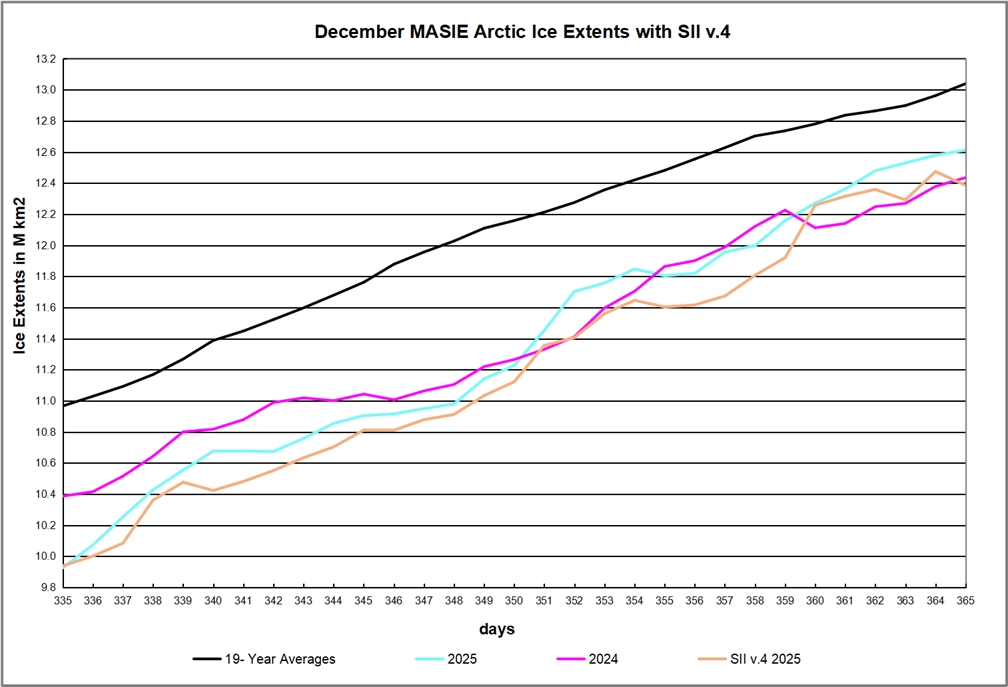
The chart below shows the 20-year averages for Arctic ice extents in January along with 2026 and 2025, as well as SII v.4.

Note MASIE 2025 started 5 to 600k km2 (or half a Wadham) below the 20 year average, but by day 12 cut the deficit to 151k km2, or a gap of 1%. Freezing rate went flat for a week before recovering and ending the month nearly 14M km2, 365k id deficit or 3%.  SII v.4 tracked lower than MASIE throughout January, averaging ~200k km2 lower for the month. The chart below shows the distribution of ice extent across the Arctic regions at January 31, 2026.

Region 2026031 Average Day 31 2026-Ave. 2025031 2026-2025
 (0) Northern_Hemisphere 13954044 14319064 -365020 13543739.54 410305
 (1) Beaufort_Sea 1071070 1070419 651 1071000.73 69
 (2) Chukchi_Sea 966006 965975 31 965989.12 17
 (3) East_Siberian_Sea 1087137 1087067 70 1087137.23 0
 (4) Laptev_Sea 897845 897825 20 897844.8 0
 (5) Kara_Sea 923456 917599 5857 921519.96 1936
 (6) Barents_Sea 582372 556751 25621 428814.24 153558
 (7) Greenland_Sea 663996 613445 50551 614788.59 49207
 (8) Baffin_Bay_Gulf_of_St._Lawrence 1027979 1315356 -287378 1080930.32 -52952
 (9) Canadian_Archipelago 854931 853582 1349 854877.96 53
 (10) Hudson_Bay 1260870 1260784 86 1260903.34 -33
 (11) Central_Arctic 3202511 3210553 -8042 3211378.6 -8867
 (12) Bering_Sea 670583 642788 27795 534452.21 136131
 (13) Baltic_Sea 114996 61637 53359 39333.65 75663
 (14) Sea_of_Okhotsk 549996 809973 -259977 559692 -9696

The table shows that most regions are close to the 20-year average.  Two major deficits are in Baffin Bay and Sea of Okhotsk, partly offset by several smaller surpluses.


Arctic Ice Recovering 2025 Yearend

The Arctic ice extents are now fully reported for 2025, ending the year below average despite a higher rate of growth through December.
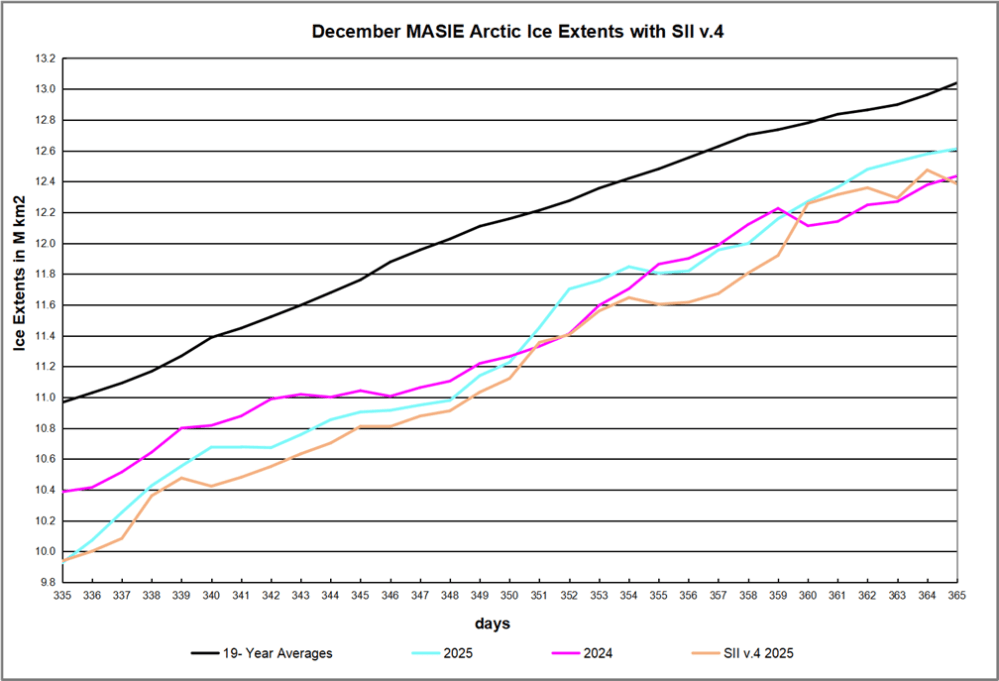
Note MASIE 2025 started 1M km2 (or 1 Wadham) below the 19 year average, but cut the deficit to 428k km2, or a gap of 3%. SII v.4 tracked lower than MASIE during December, drawing closer the last week. The chart below shows the distribution of ice extent across the Arctic regions at yearend 2025.

Region 2025365 Day 365 Average 2025-Ave. 2024365 2025-2024
 (0) Northern_Hemisphere 12611676 13039302 -427626 12435177 176499
 (1) Beaufort_Sea 1071070 1070458 612 1071001 69
 (2) Chukchi_Sea 966006 964771 1235 965989 17
 (3) East_Siberian_Sea 1087137 1087133 4 1087137 0
 (4) Laptev_Sea 897845 897841 4 897845 0
 (5) Kara_Sea 867623 887208 -19585 876527 -8904
 (6) Barents_Sea 254882 423978 -169096 345715 -90832
 (7) Greenland_Sea 668550 595658 72891 574537 94013
 (8) Baffin_Bay_Gulf_of_St._Lawrence 768306 982649 -214343 982716 -214409
 (9) Canadian_Archipelago 854931 853618 1313 854878 53
 (10) Hudson_Bay 1256284 1215695 40589 922416 333868
 (11) Central_Arctic 3174354 3206560 -32206 3207164.49 -32811
 (12) Bering_Sea 350519 403002 -52483 325489.93 25029
 (13) Baltic_Sea 14031 31873 -17843 15271.77 -1241
 (14) Sea_of_Okhotsk 366812 393742 -26929 302941 63871

The major deficits are in Barents Sea and Baffin Bay (Atlantic basins), along with smaller losses in Bering and Okhotsk (Pacific basins).

Background from Previous Post Updated to Year-End 2025

Some years ago reading a thread on global warming at WUWT, I was struck by one person’s comment: “I’m an actuary with limited knowledge of climate metrics, but it seems to me if you want to understand temperature changes, you should analyze the changes, not the temperatures.” That rang bells for me, and I applied that insight in a series of Temperature Trend Analysis studies of surface station temperature records. Those posts are available under this heading. Climate Compilation Part I Temperatures

This post seeks to understand Arctic Sea Ice fluctuations using a similar approach: Focusing on the rates of extent changes rather than the usual study of the ice extents themselves. Fortunately, Sea Ice Index (SII) from NOAA provides a suitable dataset for this project. As many know, SII relies on satellite passive microwave sensors to produce charts of Arctic Ice extents with complete coverages going back to 1989.  Version 3 was more closely aligned than Version 4 with MASIE, the modern form of Naval ice charting in support of Arctic navigation. The SII User Guide is here.

There are statistical analyses available, and the one of interest (table below) is called Sea Ice Index Rates of Change (here). As indicated by the title, this spreadsheet consists not of monthly extents, but changes of extents from the previous month. Specifically, a monthly value is calculated by subtracting the average of the last five days of the previous month from this month’s average of final five days. So the value presents the amount of ice gained or lost during the present month.

These monthly rates of change have been compiled into a baseline for the period 1980 to 2010, which shows the fluctuations of Arctic ice extents over the course of a calendar year. Below is a graph of those averages of monthly changes up to and including this year. Those familiar with Arctic Ice studies will not be surprised at the sine wave form. December end is a relatively neutral point in the cycle, midway between the September Minimum and March Maximum.
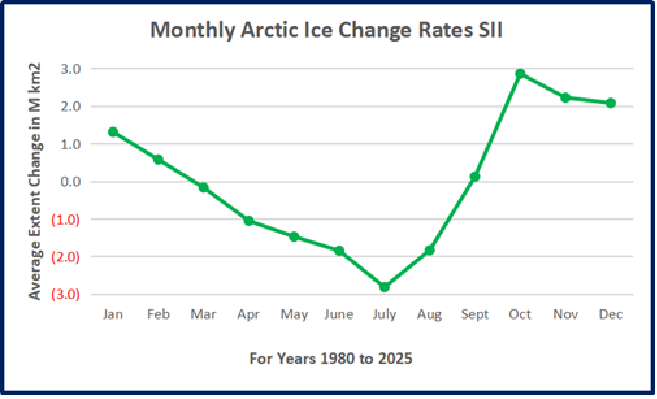
The graph makes evident the six spring/summer months of melting and the six autumn/winter months of freezing.  Note that June-August produce the bulk of losses, while October-December show the bulk of gains. Also the peak and valley months of March and September show very little change in extent from beginning to end.

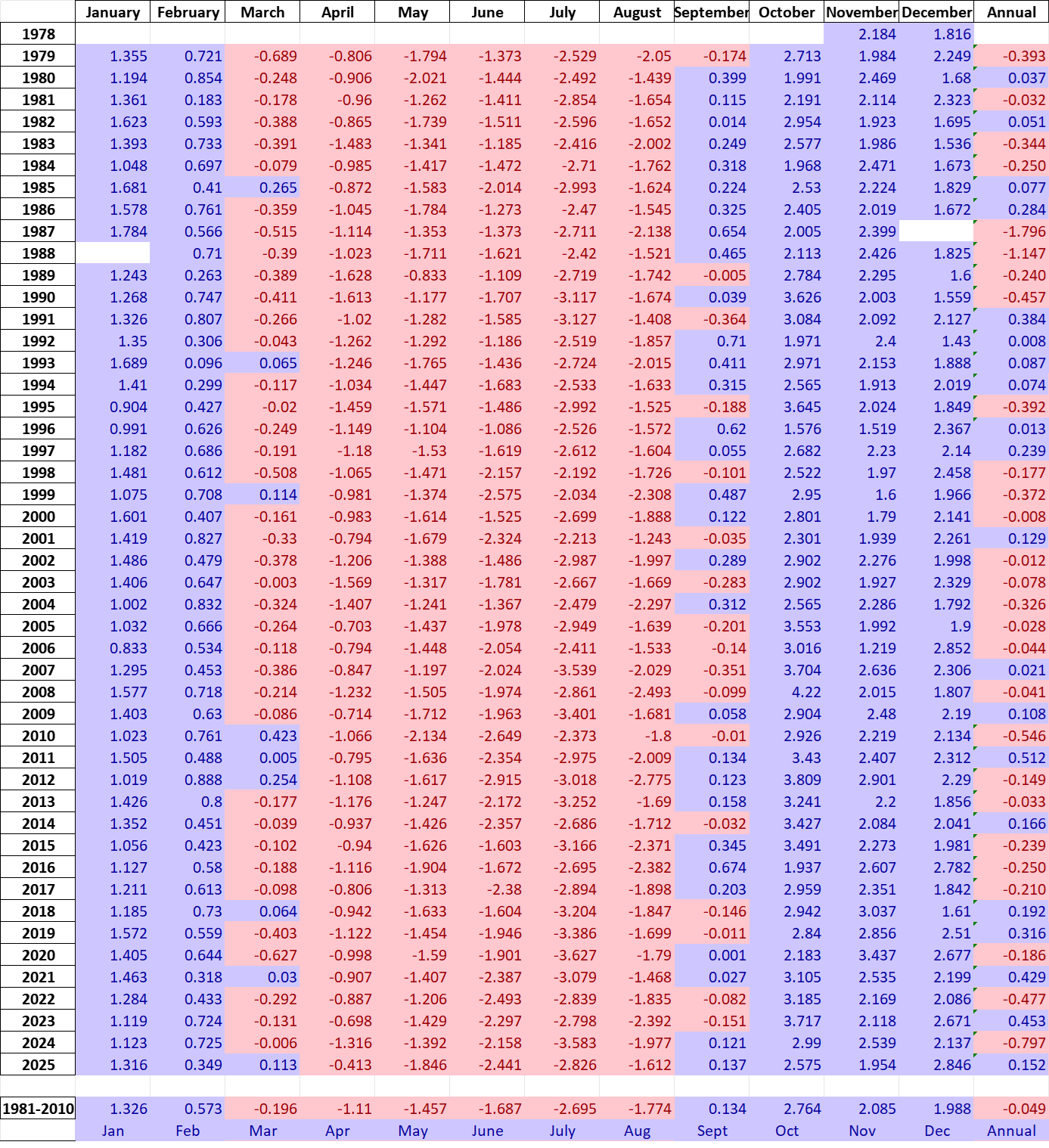
The table of monthly data reveals the variability of ice extents over the last 4 decades, with gains in blue cells and losses in red cells.

The values in January show changes from the end of the previous December, and by summing twelve consecutive months we can calculate an annual rate of change for the years 1980 to 2025.
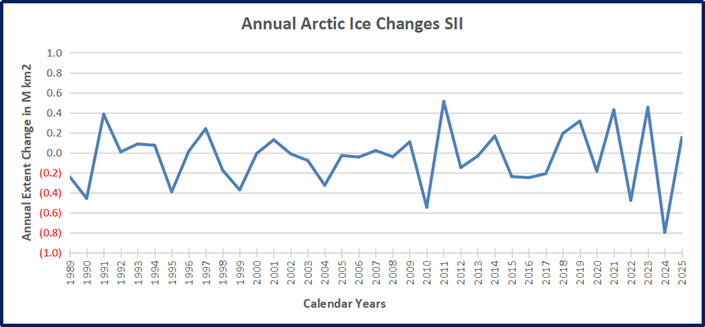
As many know, there has been a decline of Arctic ice extent over these 40 years, averaging 70k km2 per year. But year over year, the changes shift constantly between gains and losses, ranging up to +/- 500k km2, (2024 being exceptional). Since 1989 the average yearend gain/loss is nearly zero, -0.049k km2 to be exact.

Moreover, it seems random as to which months are determinative for a given year. For example, much ado was printed about 2023 losing more ice than usual June through September. But then the final 3 months of 2023 more than made up for those summer losses, resulting in a sizeable gain for the year.

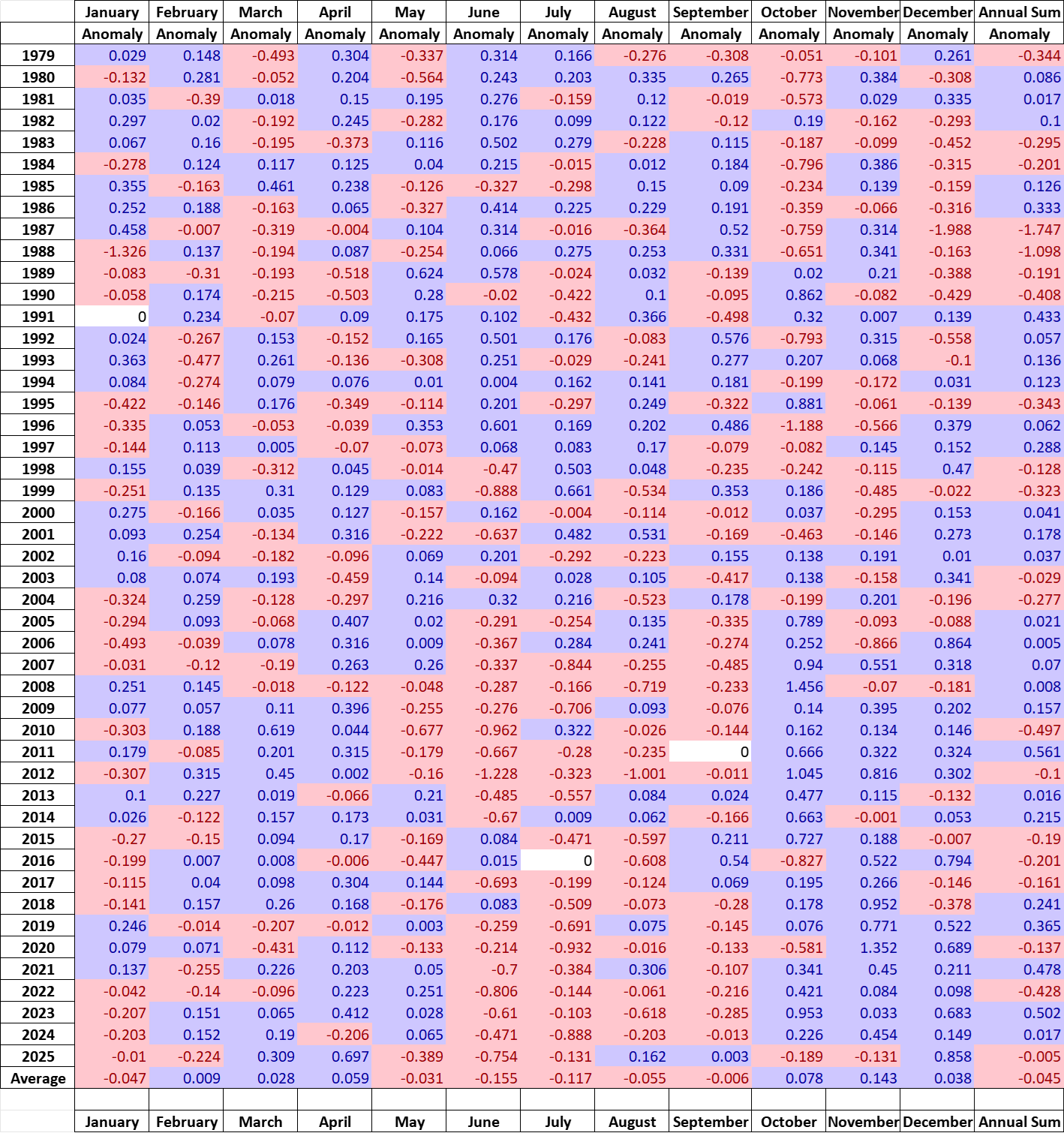
As it happens in this dataset, October has the highest rate of adding ice. The table below shows the variety of monthly rates in the record as anomalies from the 1980-2010 baseline. In this exhibit a red cell is a negative anomaly (less than baseline for that month) and blue is positive (higher than baseline).
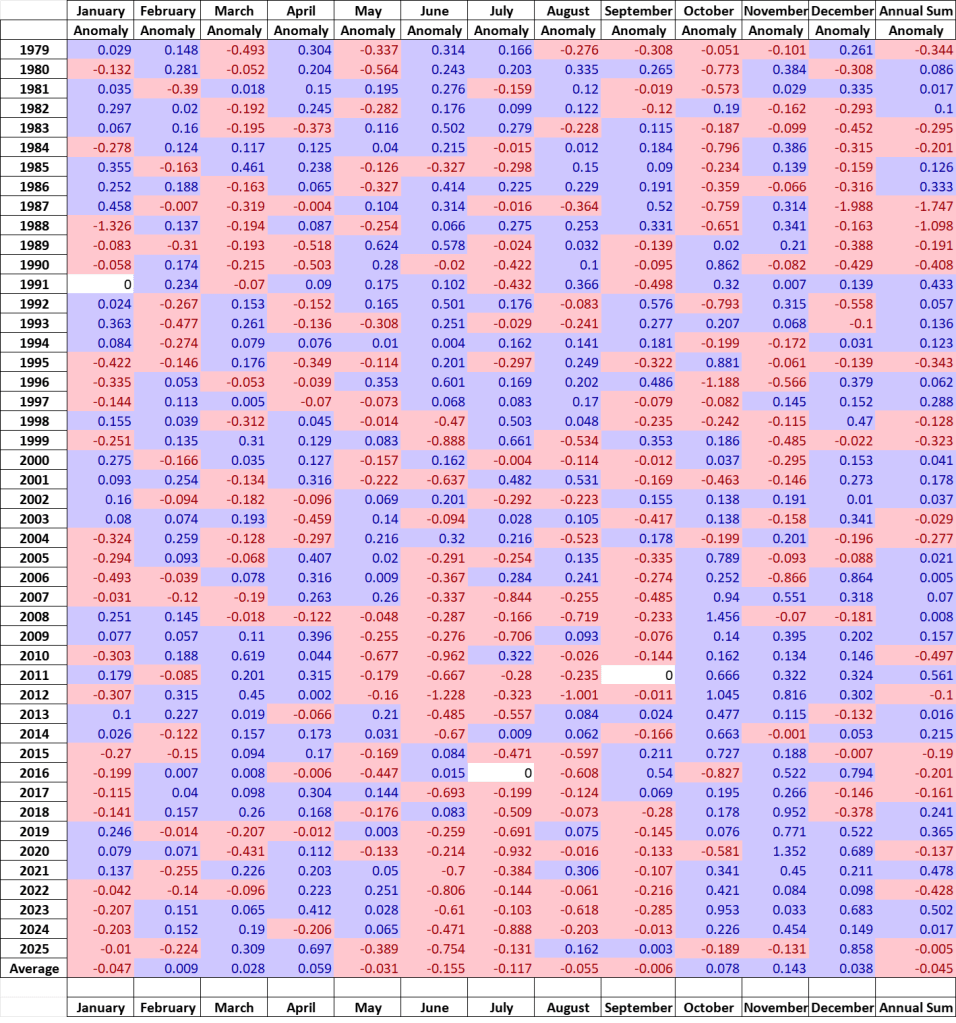
Note that the  +/ –  rate anomalies are distributed all across the grid, sequences of different months in different years, with gains and losses offsetting one another.  As noted earlier,  in 2023 the outlier negative months were June through September where unusual amounts of ice were lost.  Then unusally strong gains in October to December resulted in a large annual gain, compared to the baseline. The bottom line presents the average anomalies for each month over the period 1979-2025.  Note the rates of gains and losses mostly offset, and the average of all months in the bottom right cell is virtually zero.

A final observation: The graph below shows the Yearend Arctic Ice Extents for the last 35 years.

Year-end Arctic ice extents (last 5 days of December) show three distinct regimes: 1989-1998, 1998-2010, 2010-2025. The average year-end extent 1989-2010 is 13.4M km2. In the last decade, 2011 was 13.0M km2, and six years later, 2017 was 12.3M km2. 2021 rose back to 13.0  2024 slipped back to 12.2M, and 2025 is back up to 12.4M. So for all the the fluctuations, the net is virually zero, or a loss of one tenth of a Wadham (0.1M) from 2010. Talk of an Arctic ice death spiral is fanciful.

These data show a noisy, highly variable natural phenomenon. Clearly, unpredictable factors are in play, principally water structure and circulation, atmospheric circulation regimes, and also incursions and storms. And in the longer view, today’s extents are not unusual.


Two Hot Spots Slow Arctic Ice Recovery November 2025


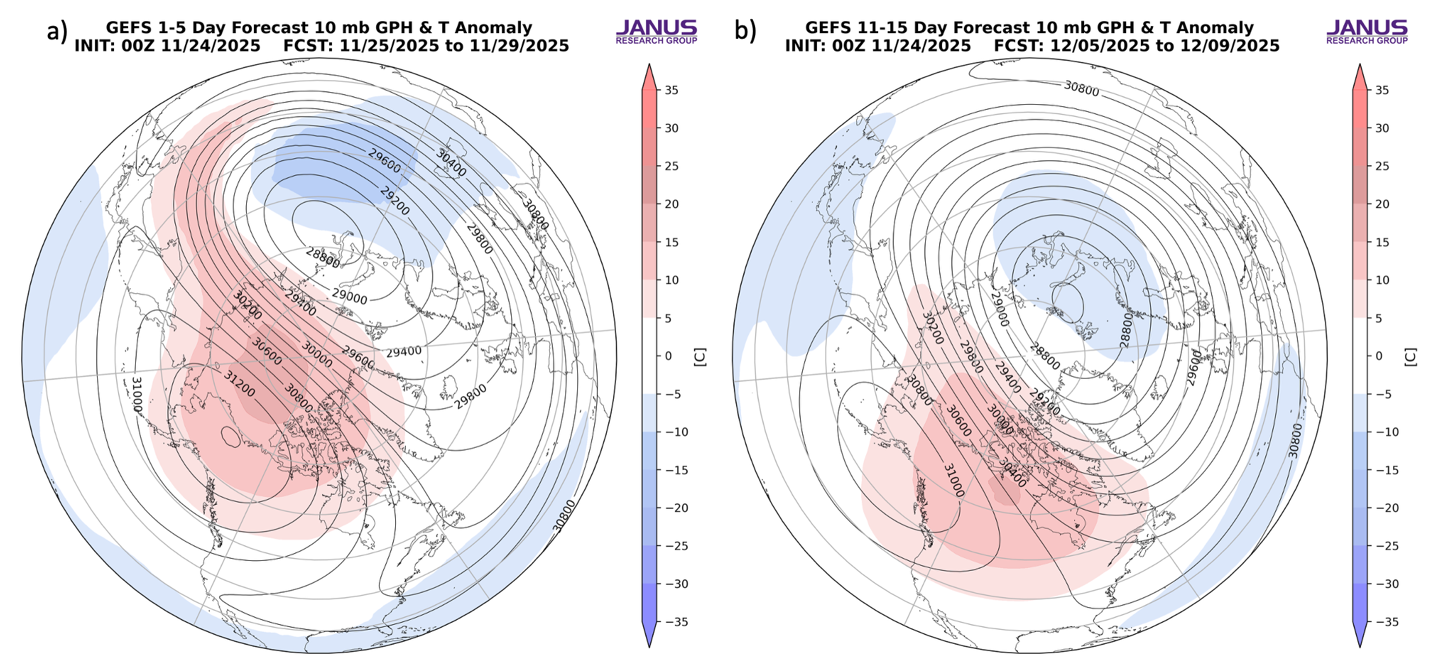
Figure 12. (a) Predicted 10 mb geopotential heights (dam; contours) and temperature anomalies (°C; shading) across the Northern Hemisphere averaged for 25 Nov to 29 Nov 2025. (b) Same as (a) except forecasted averaged from 05 Dec to 09 Dec 2025. The forecasts are from the 00Z 24 November 2025 GFS model ensemble.

The polar vortex is pronounced this year, resulting in warmer temperature over the Arctic ocean, and slowing the normal sea ice recovery.  Dr. Judah Cohen at AER Arctic Oscillation blog provides information like the chart above.

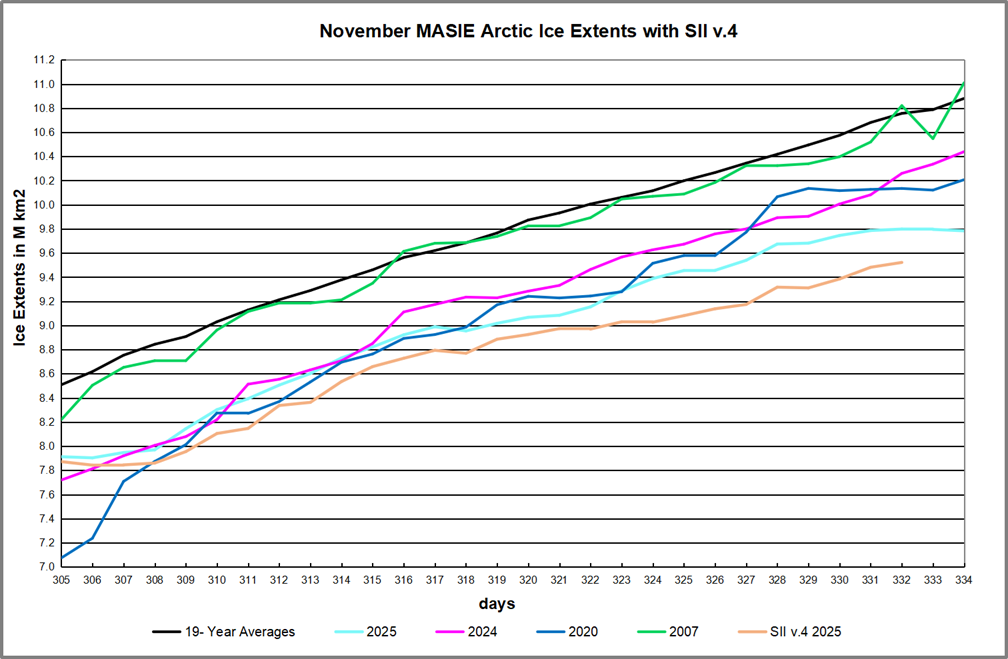
After a pattern of solidly growing sea ice extent in October, a slowdown occurred in November, coincidental with the warm spots shown above.  The graph below shows 2025 compared to the 19 year average (2006 to 2024 inclusive), to SII (Sea Ice Index) and some notable years.

According to MASIE. the average November adds ~2.5M km2 of sea ice extent, which is matched also by 2007.  2024 started below average, but gained steadily to close the gap.  2025 started at the same level, but the refreezing slowed down, ending November in deficit by 1.1M km2.  SII shows even lower ice extents (the last two days not yet reported.)

The table below shows the distribution of ice in the Arctic Ocean basins, suggesting two places where ice recovery is lagging.

Region 2025334 Day 334 Ave. 2025-Ave. 2007334 2025-2007
 (0) Northern_Hemisphere 9784037 10880420 -1096383 11009948 -1225911
 (1) Beaufort_Sea 1071070 1069623 1447 1058872 12198
 (2) Chukchi_Sea 879082 791207 87875 687829 191253
 (3) East_Siberian_Sea 1087137 1083943 3194 1082015 5122
 (4) Laptev_Sea 897845 897824 21 897613 232
 (5) Kara_Sea 565299 792107 -226808 826319 -261020
 (6) Barents_Sea 28050 242740 -214690 216525 -188474
 (7) Greenland_Sea 550413 539687 10726 618844 -68431
 (8) Baffin_Bay_Gulf_of_St._Lawrence 412284 664437 -252153 708497 -296212
 (9) Canadian_Archipelago 854931 853431 1500 850249 4682
 (10) Hudson_Bay 188797 543322 -354525 751382 -562585
 (11) Central_Arctic 3037637 3193296 -155659 3183072.72 -145436
 (12) Bering_Sea 145331 138776 6555 72644.62 72687
 (13) Baltic_Sea 4226 4452 -225 0 4226
 (14) Sea_of_Okhotsk 58288 61277 -2989 53052 5236

Overall ice extent was 1.1M km2 below average or 10%.  About half the deficit comes from the European Atlantic basins, Kara and Barents seas.  The other half is mostly from N. America’s Hudson and Baffin bays. Ice in these regions operate on the LIFO principle, last in and first out.

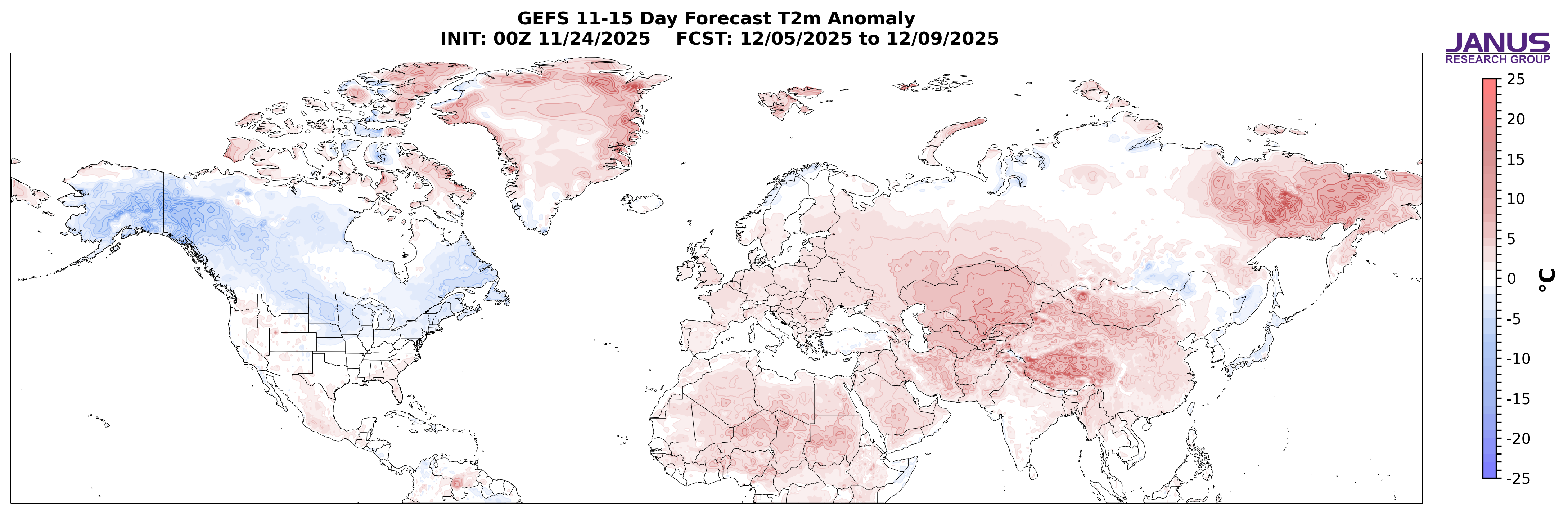
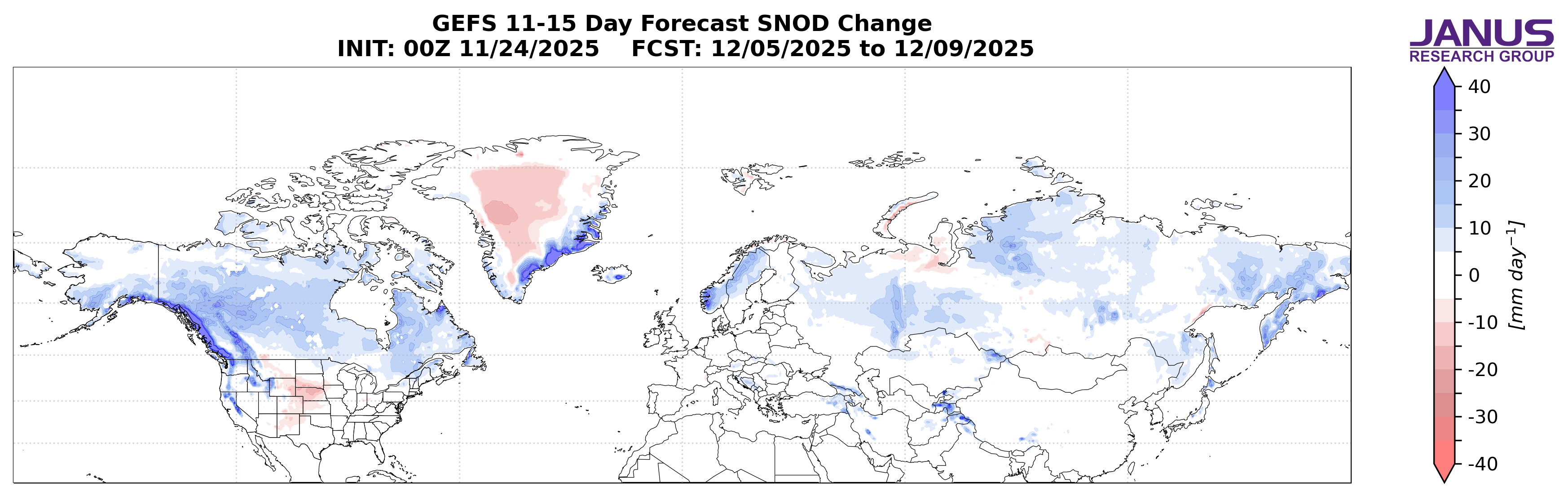
At this point in the year, Arctic ice has grown back to 65% of last March maximum with 2.5 months to catch up.   AER  suggests that things may shift again in December:

Figure 9. Forecasted surface temperature anomalies (°C; shading) from 05 Dec to 09 Dec 2025. The forecasts are from the 00Z 24 Nov 2025 GFS ensemble.

Figure 10. Forecasted snowfall (mm/day; shading) from 05 Dec to 09 Dec 2025. The forecasts are from the 00Z 24 Nov 2025 GFS ensemble.

Illustration by Eleanor Lutz shows Earth’s seasonal climate changes. If played in full screen, the four corners present views from top, bottom and sides. It is a visual representation of scientific datasets measuring ice and snow extents.


Solid Arctic Ice Recovery October 2025

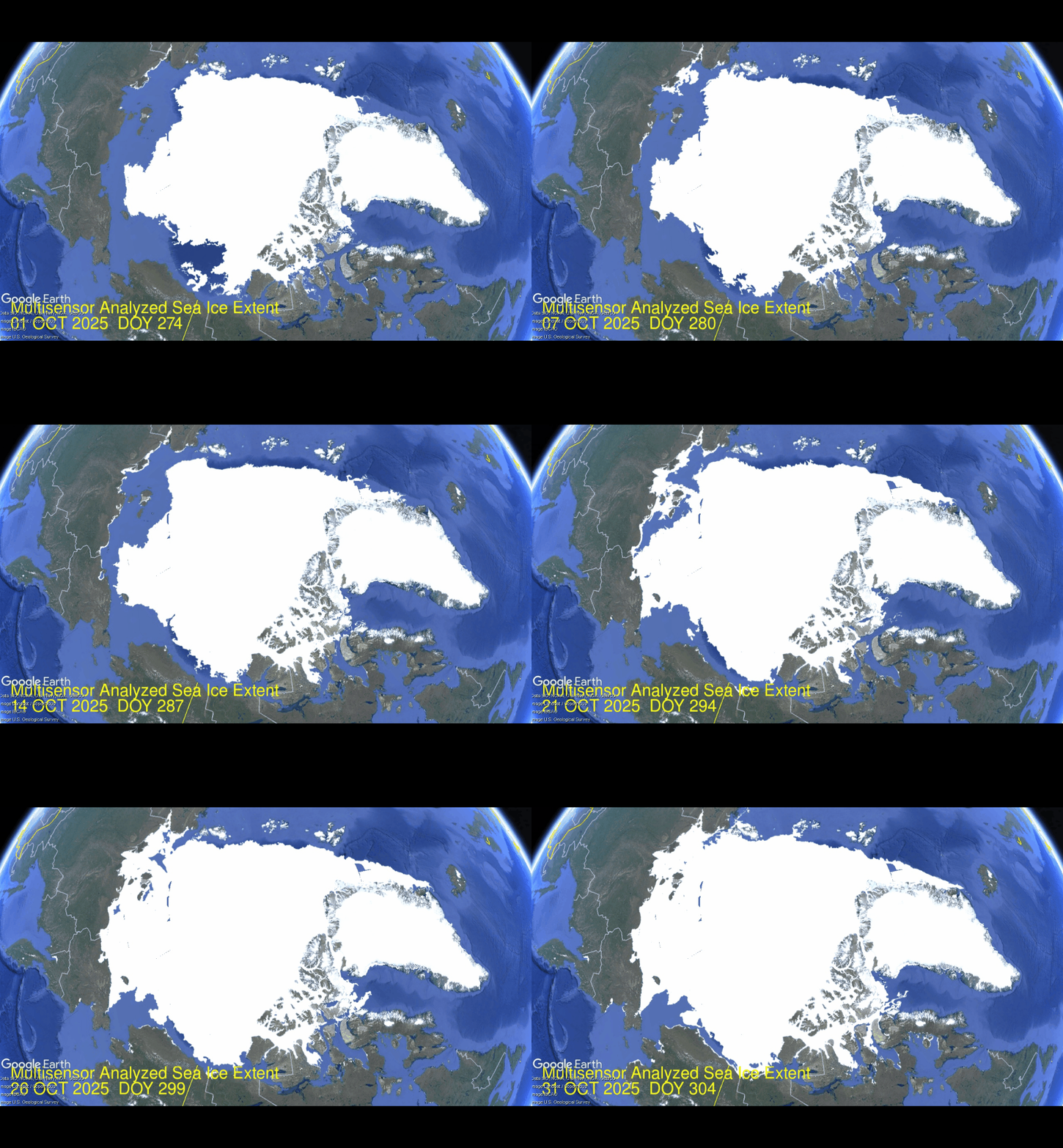
The animation shows the rapid growth of Arctic ice extent during October 2025, from day 274 to day 304, yesterday.  For all of the fuss over the September minimum, little is said about Arctic ice growing 3M km2, that’s 3 Wadhams in one month!.  Look on the left (Russian side) at the complete closing of the Northern Sea Route for shipping.

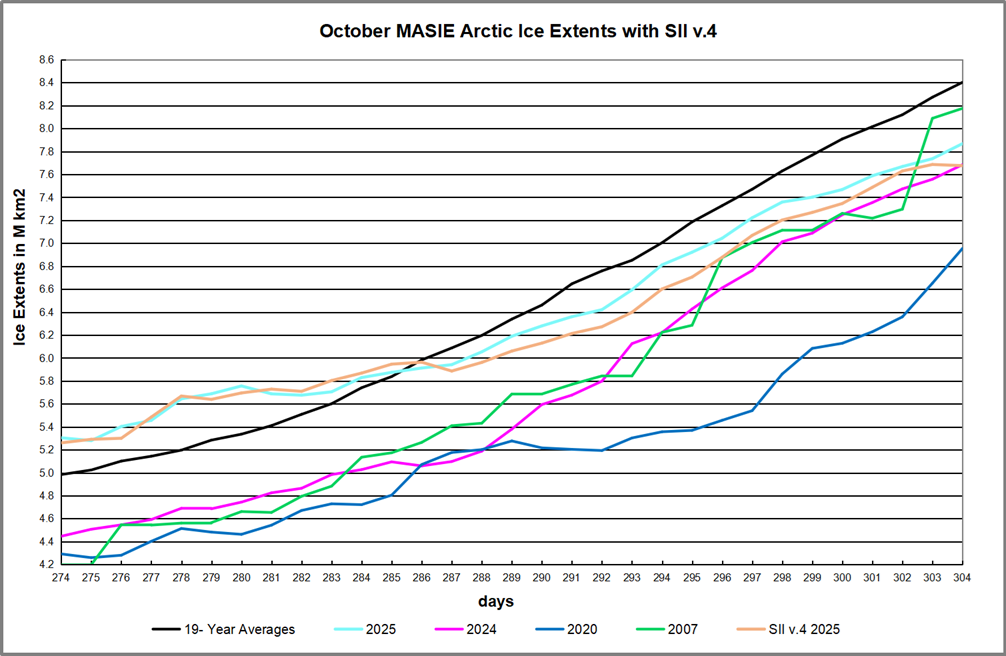
The graph below shows 2025 compared to the 19 year average (2006 to 2024 inclusive), to SII (Sea Ice Index) and some notable years.

This year October added 2.6M km2 from end of September compared to an average October increase of 3.4M km2.  The first two weeks were above average, before the refreezing rate slowed down ending in a deficit of ~0.5M km2.  In other terms the end of October ice extents were four days behind the average, according to MASIE.  SII started the same, but tracked lower in the second half of October.

The table below shows the distribution of ice in the Arctic Ocean basins.

Region 2025304 Day 304 Ave. 2025-Ave. 2007304 2025-2007
 (0) Northern_Hemisphere 7867621 8401977 -534356 8175072 -307451
 (1) Beaufort_Sea 975681 937777 37904 1038126 -62444
 (2) Chukchi_Sea 683493 466318 217175 242685 440809
 (3) East_Siberian_Sea 1087032 952325 134707 835071 251961
 (4) Laptev_Sea 849204 848501 703 887789 -38585
 (5) Kara_Sea 137515 478870 -341355 311960 -174445
 (6) Barents_Sea 1466 81088 -79621 52823 -51356
 (7) Greenland_Sea 351374 418343 -66969 443559 -92184
 (8) Baffin_Bay_Gulf_of_St._Lawrence 128777 247258 -118481 289374 -160596
 (9) Canadian_Archipelago 568663 740190 -171526 817220 -248557
 (10) Hudson_Bay 8609 66501 -57892 48845 -40236
 (11) Central_Arctic 3051977 3153485 -101508 3206345.33 -154368

Overall ice extent was 534k km2 below average or 6%.  Surpluses appear on the Eurasian shelf seas of Beaufort, Chukchi and East Siberian, while sizeable deficits are shown elsewhere on the Atlantic side, especially Kara, Baffin Bay, Canadian Archipelago and Central Arctic.

Illustration by Eleanor Lutz shows Earth’s seasonal climate changes. If played in full screen, the four corners present views from top, bottom and sides. It is a visual representation of scientific datasets measuring ice and snow extents.


October Arctic Ice Grows After Pope’s Blessing

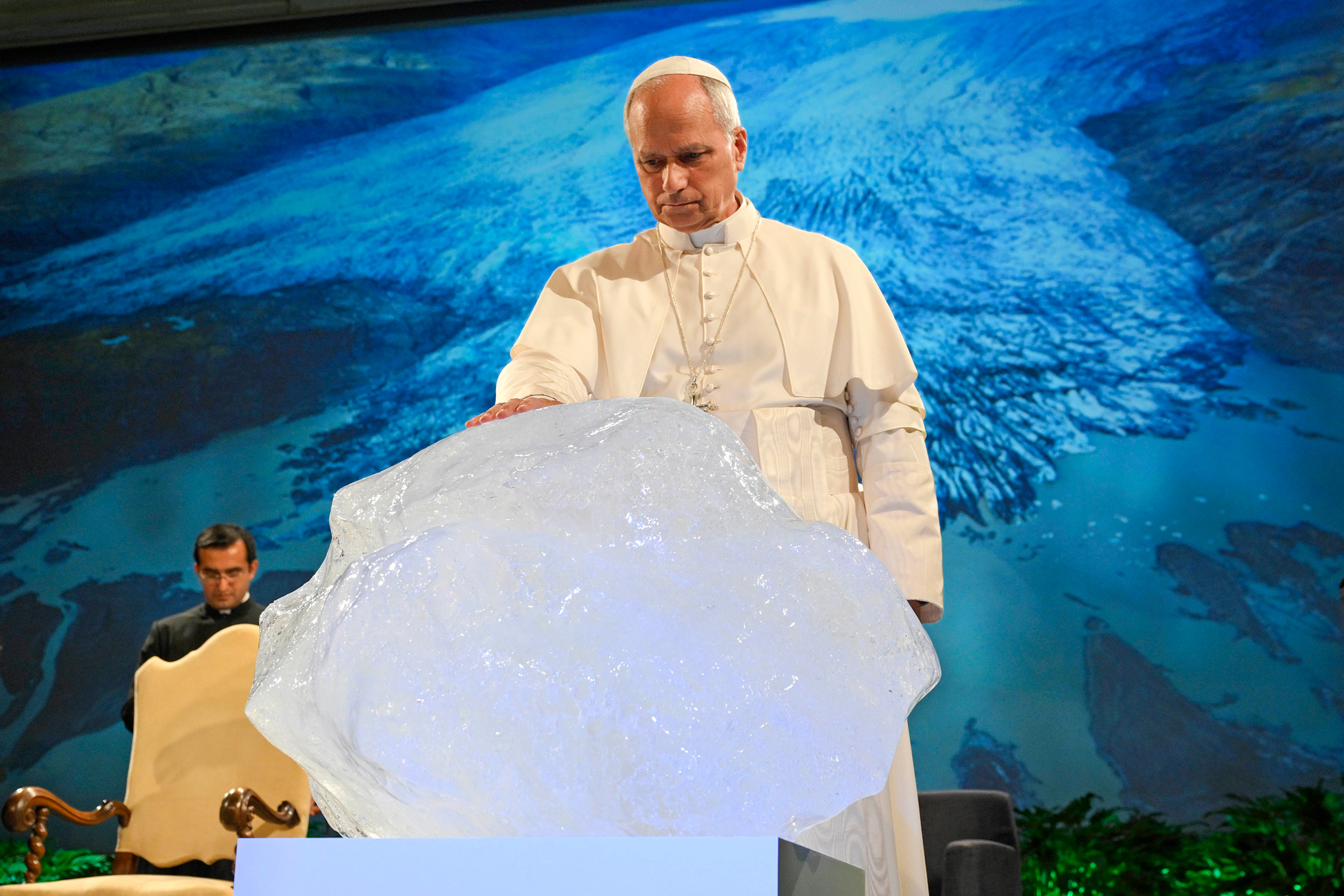
Last Wednesday Pope Leo spoke before a slowly melting chunk of glacial ice in Vatican City in his first address on climate change.  The pontiff addressed a crowd of roughly 1,000 attendees and called on people all over the world to demand action on climate from their governments. This post presents evidence the Arctic is already heeding his call, growing by leaps and bounds. /sarc

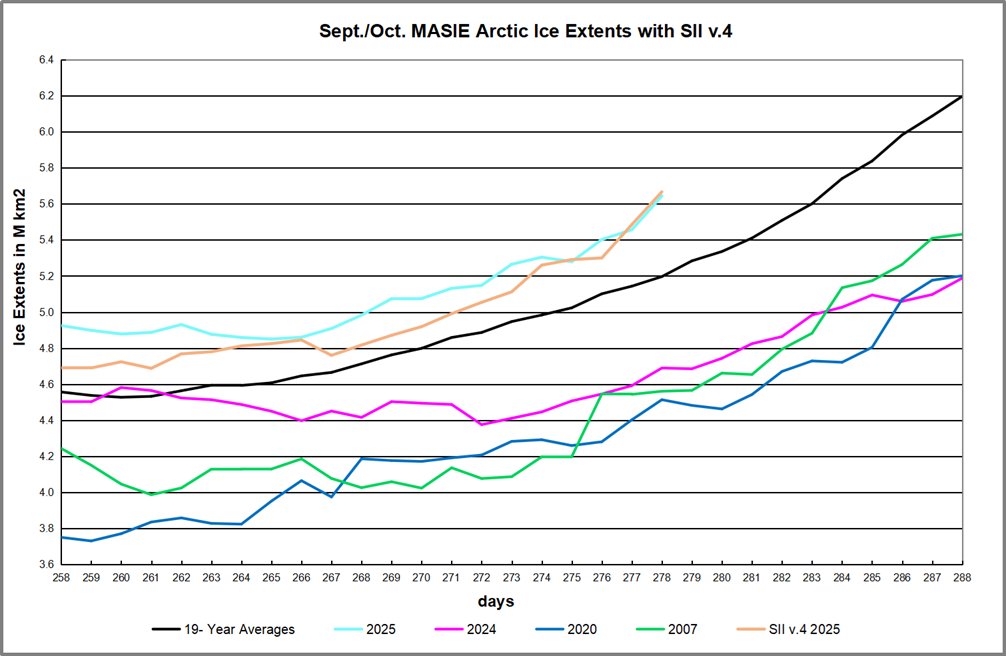
The graph above shows Sept./Oct. daily ice extents for 2025 compared to 19 year averages, and some years of note. Day 260 has been the lowest daily ice extent on average for the last 19 years. Note how in just the last five days, Arctic ice extent has grown by half a wadham or ~0.5M km2!

Why is this important?  All the claims of global climate emergency depend on dangerously higher temperatures, lower sea ice, and rising sea levels.  The lack of additional warming prior to 2023 El Nino, which is now receding, is documented in a post Tropics UAH Temps Cooler August 2025.

The lack of acceleration in sea levels along coastlines has been discussed also.  See Observed vs. Imagined Sea Levels 2023 Update.

Also, a longer term perspective is informative:

post-glacial_sea_levelThe table below shows the distribution of Sea Ice on day 260 across the Arctic Regions, on average, this year and 2007. At this point in the year, Bering and Okhotsk seas are open water and thus dropped from the table. The has grown to 5.64M km2 from 5.14 and the overall surplus to average is 447k km2, ( 9 %). The 2025 ice extent exceeds 2007 by a full wadham.

Region 2025278 Day 278 ave. 2025-Ave. 2007278 2025-2007
 (0) Northern_Hemisphere 5643927 5196640 447286 4560836 1083091
 (1) Beaufort_Sea 781758 582635 199123 590267 191490
 (2) Chukchi_Sea 474277 232765 241512 25934 448343
 (3) East_Siberian_Sea 558888 329424 229465 311 558577
 (4) Laptev_Sea 299904 208865 91039 305220 -5316
 (5) Kara_Sea 1026 45918 -44892 22717 -21691
 (6) Barents_Sea 0 17669 -17669 3580 -3580
 (7) Greenland_Sea 175128 271377 -96248 404376 -229248
 (8) Baffin_Bay_Gulf_of_St._Lawrence 81997 63374 18623 72162 9835
 (9) Canadian_Archipelago 355462 410626 -55164 349687 5775
 (10) Hudson_Bay 1172 2333 -1161 1936 -764
 (11) Central_Arctic 2912747 3030507 -117760 2783370 129376

bathymetric_map_arctic_ocean

Illustration by Eleanor Lutz shows Earth’s seasonal climate changes. If played in full screen, the four corners present views from top, bottom and sides. It is a visual representation of scientific datasets measuring ice and snow extents.

September 2025 Arctic Ice Beats Expectations

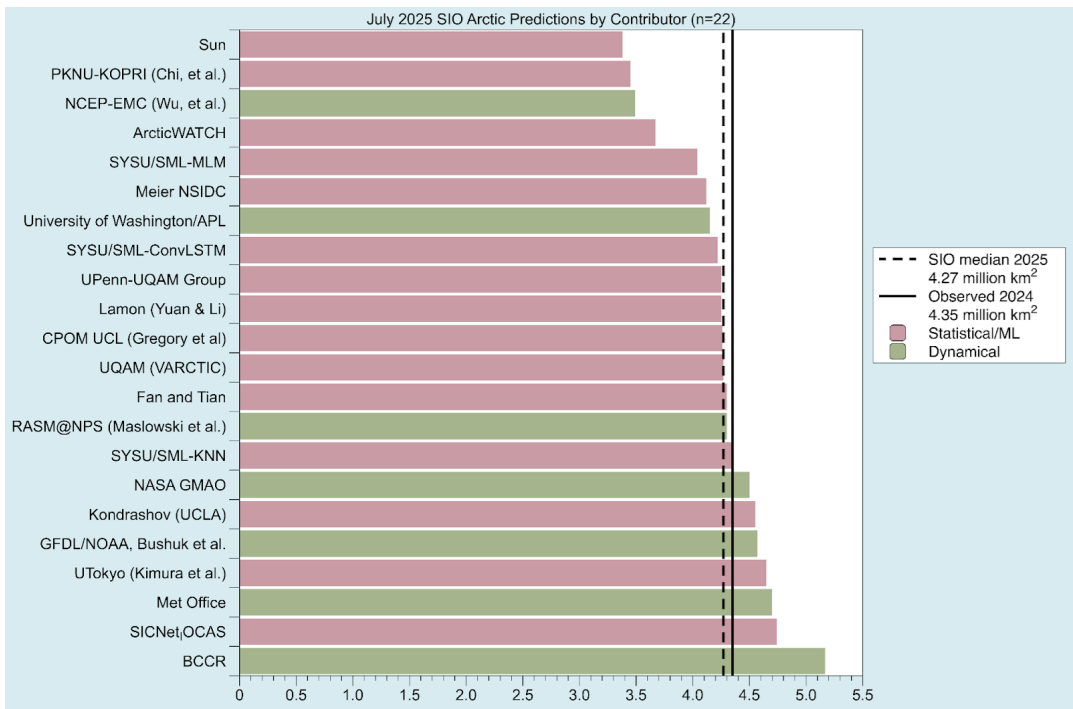
 MI Figure 1. Distribution of SIO contributions for July estimates of September 2025 pan-Arctic sea-ice extent. Public/citizen contributions include Sun.

July 2025 was the final report of the Sea Ice Prediction Network (SIPN) before the actual September monthly extent is reported by NOAA Sea Ice Index (SII). The report (link in red) gave this overview.

2025: July Report from Sea Ice Prediction Network

The July 2025 Outlook received 22 pan-Arctic contributions (Figure 1). This year’s median forecasted value for pan-Arctic September sea-ice extent is 4.27 million square kilometers with an interquartile range of 4.13 to 4.54 million square kilometers. This is lower than observed in 2023 (4.37 million square miles) and 2024 (4.35 million square miles) observed in September. The lowest sea-ice extent forecast is 3.38 million square kilometers, from Sun, which would be a new record low for the satellite period (1979-present); the highest sea-ice extent forecast is 5.17. . . The observed extent values are from the NSIDC Sea Ice Index (Fetterer et al., 2017), based on the NASA Team algorithm sea ice concentration fields distributed by the NASA Snow and Ice Distributed Active Archive Center (DAAC) at NSIDC (DiGirolamo et al., 2022; Meier et al., 2021). 

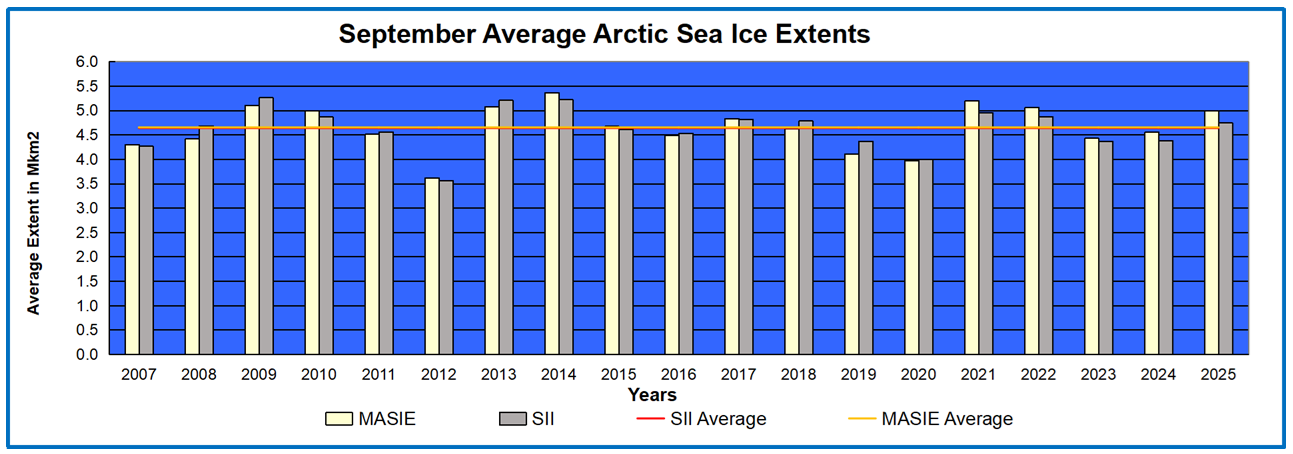
These are predictions as of August 20 for the September 2025 monthly average ice extent reported by NOAA Sea Ice Index (SII). This post provides a look at the 2025 September monthly averages comparing MASIE and SII datasets. (19 year average is 2007 to 2025 inclusive).

To enlarge, open image in new tab.

SIP network predicted SII would be 4.27M km2, and the actual result is 4.7M, while MASIE reported 5.0M km2.

The table below provides the monthly Arctic ice extent averages for comparisons (all are M km2)

Monthly MASIE 2025 SIIv.4 2025 MASIE -SII MASIE-19yr AVE SIIv.4-19yr AVE
Jan 13.206 13.131 0.075 -0.583 -0.470
Feb 13.802 13.745 0.057 -0.878 -0.715
Mar 14.274 14.140 0.134 -0.587 -0.545
Apr 13.846 13.910 -0.063 -0.249 -0.109
May 12.497 12.559 -0.062 -0.119 -0.108
June 10.510 10.485 0.025 -0.306 -0.388
July 7.942 7.660 0.282 -0.345 -0.375
Aug 5.854 5.395 0.459 -0.020 -0.220
Sept 4.990 4.745 0.245 0.298 0.050

The first two data columns are the 2025 YTD shown by MASIE and SII, with the MASIE surpluses in column three.  Column four shows MASIE 2025 compared to MASIE 19 year averages, while column five shows SII 2025 compared to SII 19 year averages.   MASIE started the year in deficits to average but recovered in spring to virtually match average in August, and now 298k km2 above average. SII was below its averages throughout and much lower than MASIE in July, and in August down by nearly half a Wadham. That gap reduced to -245k km2 in September.

Current Arctic Ice Extent Conditions

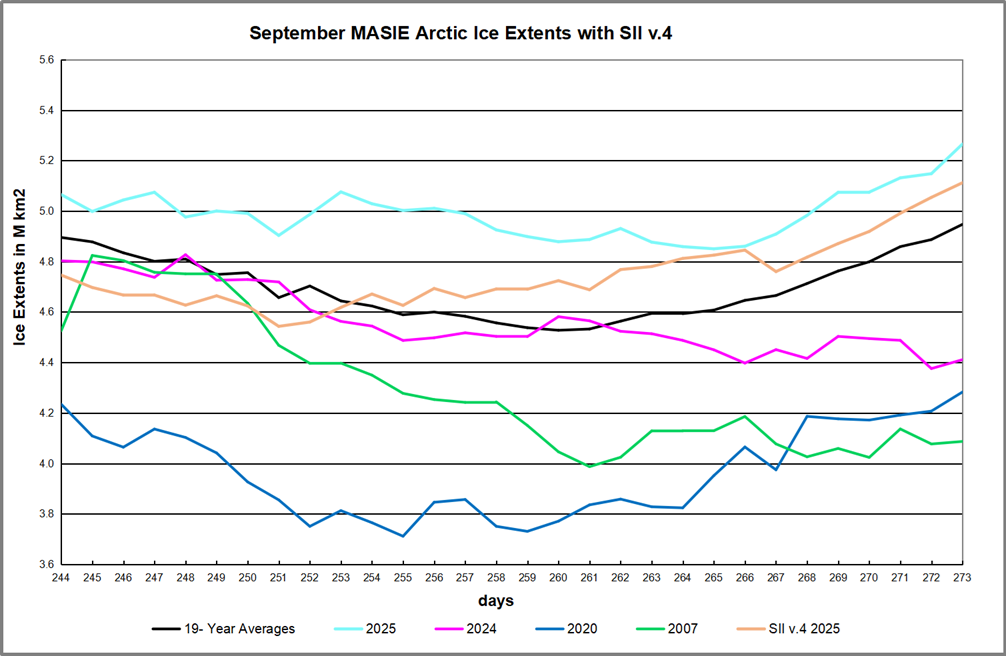
The month of September shows the annual dip in arctic ice extents, then recovering to end slightly higher than the beginning.  Note MASIE 2025 started 170k km2 above average and ended 316k in surplus. SII v.4 began 319k km2 in deficit to MASIE and ended 153k lower.

The table below shows the distribution of ice over the Arctic regions yesterday September 30, 2025, in comparison with the MASIE average and some other years of note.

Region 2025273 Day 273 ave. 2025-Ave. 2007273 2025-2007
 (0) Northern_Hemisphere 5265296 4947157 318139 4086883 1178413
 (1) Beaufort_Sea 567776 546476 21301 498743 69033
 (2) Chukchi_Sea 382991 220747 162244 51 382940
 (3) East_Siberian_Sea 502004 299345 202660 311 501693
 (4) Laptev_Sea 229451 168694 60758 235245 -5793
 (5) Kara_Sea 992 36279 -35287 15367 -14375
 (6) Barents_Sea 0 13476 -13476 4851 -4851
 (7) Greenland_Sea 170295 239645 -69350 353210 -182915
 (8) Baffin_Bay_Gulf_of_St._Lawrence 77930 55264 22665 42247 35682
 (9) Canadian_Archipelago 379648 370610 9038 307135 72513
 (10) Hudson_Bay 5071 3054 2017 1936 3135
 (11) Central_Arctic 2947568 2992334 -44766 2626511 321057

The massive surpluses in Eurasian basins of Chukchi, E. Siberian and Laptev more than offset smaller deficits in Atlantic basins Kara and Greenland seas. The over surplus was 318k km2 or 6.4%, and exceeded 2007 by 1.2 wadhams of ice extents.

Summary

The experts involved in SIPN expected SII 2025 September to be somewhat lower than recent years, but Arctic ice extents exceeded the 19 year averages.

Footnote:

Some people unhappy with the higher amounts of ice extent shown by MASIE continue to claim that Sea Ice Index is the only dataset that can be used. This is false in fact and in logic. Why should anyone accept that the highest quality picture of ice day to day has no shelf life, that one year’s charts can not be compared with another year? Researchers do this, including Walt Meier in charge of Sea Ice Index. That said, I understand his interest in directing people to use his product rather than one he does not control. As I have said before:

MASIE is rigorous, reliable, serves as calibration for satellite products, and continues the long and honorable tradition of naval ice charting using modern technologies. More on this at my post Support MASIE Arctic Ice Dataset

MASIE: “high-resolution, accurate charts of ice conditions”
Walt Meier, NSIDC, October 2015 article in Annals of Glaciology.