Climate Kool-Aid

Climate Kool-Aid

Johnathan DuHamel has another fine article at his blog Wry Heat  The Biden Administration Has Swallowed the Climate Kool-Aid.  Excerpts in italics with my bolds and some images.

The Biden administration thinks they can stop global warming (aka climate change) by eliminating carbon dioxide emissions from burning fossil fuels and switching electrical generation to wind and solar installations. Biden says “follow the science.” If he did follow the science he would realize that there is no physical evidence that carbon dioxide plays a significant role in controlling global temperature (see posts at the end of this article).

Biden wants 80% hydrocarbon-free electricity generation by 2030, 100% by 2035 and elimination of fossil fuels from all sectors of the U.S. economy by 2050.

According to Paul Driessen (senior policy analyst for the Committee For A Constructive Tomorrow), “ this would send the nation’s annual electricity requirement soaring from about 2.7 billion megawatt-hours (the fossil fuel portion of total U.S. electricity) to almost 7.5 billion MWh per year by 2050. Substantial additional generation would be required to constantly recharge backup batteries for windless, sunless days, to safeguard society against blackouts, cyberattacks and wholesale collapse. Generating all that electricity without new nuclear and hydroelectric plants would require tens of thousands of 850-foot-tall offshore wind turbines, hundreds of thousands (perhaps millions) of somewhat smaller onshore turbines, and billions of photovoltaic solar panels. All these turbines, panels, batteries and power lines would require tens of billions of tons of non-renewable iron, copper, aluminum, cobalt, lithium, rare earth elements, plastics, limestone and other materials. That would necessitate mining, crushing, processing, refining and transporting tens of billions of tons of ores – from thousands of mines and quarries, using gigantic gasoline and diesel equipment – followed by smelting and manufacturing, all with fossil fuels.

None of this is clean, green or sustainable.”

So, how is “global warming” doing. We can consult with Dr. Roy Spencer who manages the Advanced Microwave Scanning Radiometer flying on NASA’s Aqua satellite. This satellite system measures global atmospheric temperature daily. The latest results are seen here:

uah_lt_1979_thru_june_2021_v6


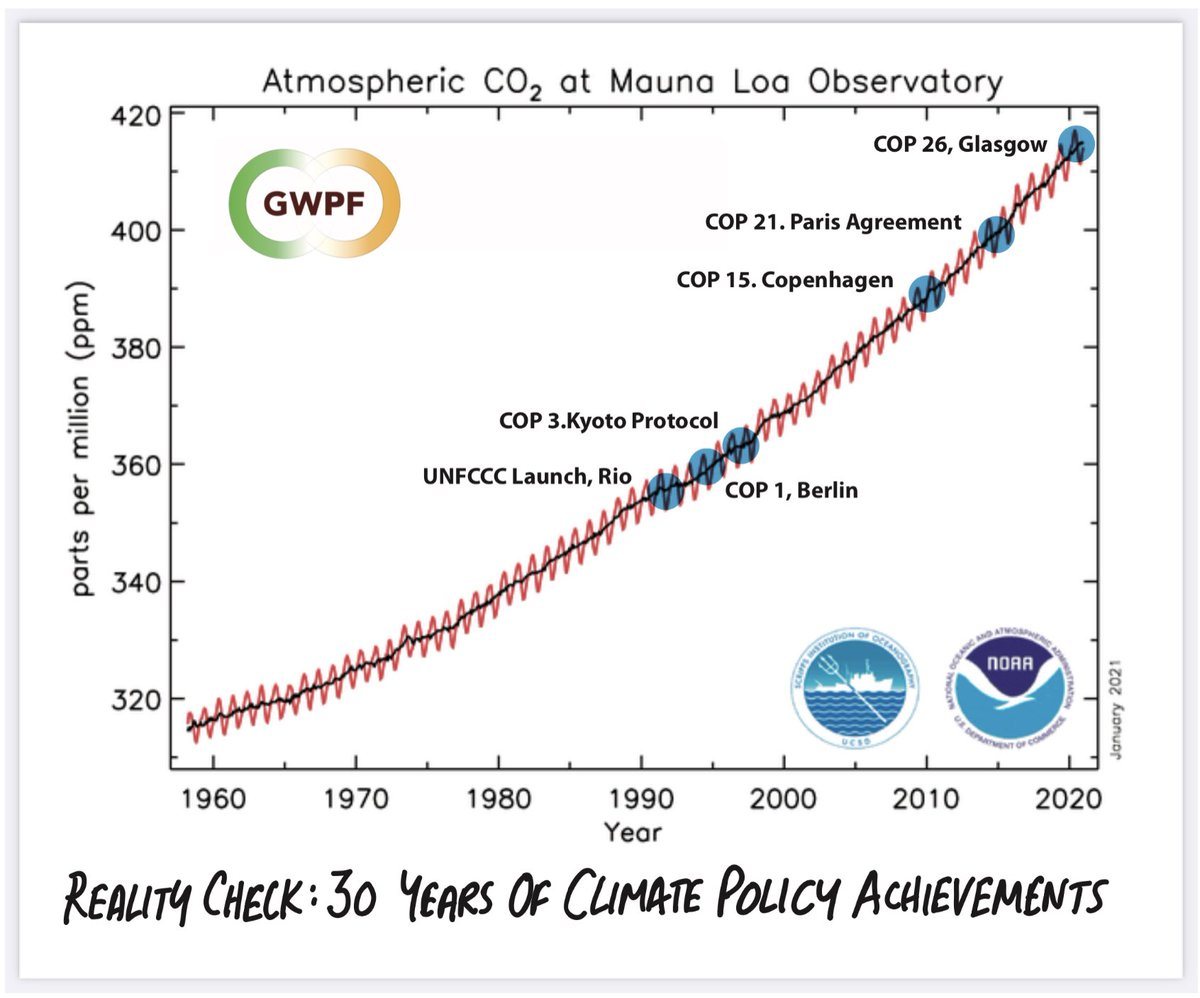
You should notice that global atmospheric temperatures in April, May, and June, 2021, were below the 1991-2020 average and similar to temperatures in 1983. According to the Global Monitoring Laboratory of NOAA at Mauna Loa, Hawaii, atmospheric carbon dioxide was about 340ppm in 1983 versus about 418ppm now. Although there has been deviation from the average due to things like the El Nino-La Nina cycles, there has not been any overall warming in spite of the increase in carbon dioxide.

uah-global-1995to202104-w-co2-overlay

Biden and other climate alarmists have swallowed the climate “Kool-Aid” and claim that reducing just one, small, insignificant factor will be the panacea in controlling global temperature, but it’s not that simple:

“The forcings that drive long-term climate change are not known with an accuracy sufficient to define future climate change.” — James Hansen, “Climate forcings in the Industrial era”, PNAS, Vol. 95, Issue 22, 12753-12758, October 27, 1998.

“In climate research and modeling, we should recognize that we are dealing with a coupled non-linear chaotic system, and therefore that the prediction of a specific future climate state is not possible.” — Final chapter,Third Assessment Report, IPCC 2000.

While controlling CO2 emissions from burning fossil fuels may have some beneficial effects on air quality, it will have no measurable effect on climate, but great detrimental effects on the economy and our standard of living. The greatest danger of climate change is that politicians think they can stop it. But the climate has always been in a state of flux. In my opinion, the debate over global warming is truly a scam designed to control (and tax) production and use of energy from fossil fuels.

The alleged “climate crisis” is just a scam perpetrated for political gain.
“The whole aim of practical politics is to keep the populace alarmed (and hence clamorous to be led to safety) by menacing it with an endless series of hobgoblins, all of them imaginary.” —H. L. Mencken (1880-1956)

(Note to younger readers: The term “Kool-Aid” used in this context refers to cult leader Jim Jones who, on November 18, 1978, instructed all members living in the Jonestown, Guyana compound to commit an act of “revolutionary suicide,” by drinking poisoned punch. Link )

For the real science, see these articles from my blog

See also Biden Climate Agenda Heads into Perfect Storm

gang-green

Green Energy Failures Redux

I was going to end the title of this post with “Deja Vu”, but then changed it to “Redux”, because in this case the return of the past is not an illusion, but an actual imitation of failed policies.  David Blackmon writes in Forbes Biden Seems Determined To Replay Obama Era Green Energy Failures.  Excerpts in italics with my bolds and images.

mrz041312dapr20120413044622

Over the last few weeks, President Joe Biden and members of his administration have mounted a focused effort to sell massive new green energy spending to the American people.

Former Obama-era EPA Administrator Gina McCarthy, now the Biden White House climate adviser, is pushing Congress to include a federal clean electricity standard (CES) to drive investment in renewable energy and billions in subsidies to incentivize changeover further. Secretary of Energy Jenifer Granholm is doing the same.

wind-energy-myth

The fact McCarthy, and an official like Granholm who has a track record of failed green energy subsidies — are leading this effort makes this massive push all the more frustrating. These officials, well-meaning though they may be, should know by now that government energy subsidies overwhelmingly end up financing the well-connected rather than the most innovative, a concern I wrote about in a recent piece. The end result is wasted funds and harm to the sector that the government wants to help.

The trial that Elon Musk’s SolarCity has found itself in this week serves as a timely reminder of just how poorly the Obama-Biden green energy agenda went last time around. Beyond the regulatory and quality assurance issues his space company SpaceX and car company Tesla currently face, including recently violating an FAA launch license, Musk is now actively tangled in a legal battle from the solar panel manufacturer’s merger with Tesla. The billionaire stands accused of defrauding investors by not disclosing that the company was on the verge of bankruptcy and that it was highly risky for Tesla — itself a struggling company at the time — to take on SolarCity’s debt.

cg546ac53103664

SolarCity’s struggles were containable partly because it was awarded federal subsidies and nearly $500 million in Treasury grants. The Obama-Biden administration ended up wasting billions of taxpayer dollars with companies like SolarCity and Solyndra going broke or facing significant trouble soon after receiving the helping hand.

To give you an idea of the program’s effectiveness, the fact that SolarCity still technically exists despite its near-bankruptcy and $29 million settlement with the Department of Justice over the fraud case makes it one of the success stories.

Even when investments turn into actual infrastructure, consumers will be unlikely to reap the benefits. Many have championed the “progress” green energy has made over the last decade in providing a more competitive product, but the facilities are still failing, and the progress has been de minimis in terms of capturing global energy market share.

1l-image-17

Just last year, the Department of Energy watched as Tonopah Solar Energy LLC in Nevada declared bankruptcy after receiving a $737 million loan from one of their green energy programs. If you can’t make solar panels work in present-day Nevada, how do you expect them to fuel the energy needs of places like Colorado, where Sec. Granholm and Senator John Hickenlooper recently toured a solar garden?

4l-image-9

Utility companies that stand to receive billions in subsidies to upgrade their infrastructure support the measure because it will raise rates on consumers while reducing operating costs. Green energy is less efficient and less reliable, so the cost of operations will undoubtedly go up. But with the government covering the costs of setup and repair, it means more revenue with fewer expenses. This will help stockholders far more than working people.

But the calls from the climate change lobby for action are growing louder. Despite not making it into last month’s bipartisan infrastructure deal, many Democrats hope billions of dollars in green subsidies will find their way into a second infrastructure bill that party officials plan to pass through reconciliation. In fact, some Democrats are threatening to withhold their votes for the bipartisan bill unless they receive guarantees of energy provisions.

energy67_05

Tehachapi’s dead turbines

Democrats have to pass these measures by party-line vote not because Republicans hate the environment (the GOP has a climate change caucus) but due to the fact that their plan is so costly and ill-advised that even moderate Republicans like Susan Collins and Mitt Romney can’t devise a rationale to reasonably offer support. The hard truth is that renewable energy technology isn’t currently capable of handling America’s growing energy demands and remains unlikely to do so in the future.

While the idea of renewable energy remains appealing, the reality is that fossil fuels, natural gas, and nuclear power will all be necessary to power our nation for decades to come.

Everyone should support innovation in the energy sector, but the subsidy-heavy plan that Democrats continue to push will only lead to wasted dollars and public backlash against a policy of failed projects. Congress has been down this road before. When the Green New Deal first came up, the bill was seen as so ridiculous that Speaker Pelosi wouldn’t even bring it up for a vote. Congressional Democrats should stick to that past wisdom and avoid falling back into this green subsidy trap.

As REN21, an advocacy group consisting of actors from science, governments, NGOs and industry, recently reported, this is a strategy that, from 2009 through 2019, produced virtually no real gain in overall green energy market share despite trillions of dollars in global targeted subsidies. A replaying of this same failed Obama-era strategy, managed by some of the very same officials, promises only to produce similarly failed results, albeit on an even grander scale.

Footnote Q & A:

Q:  What is the difference between Golf and Government?

A:  In Government you can always improve your lie.

–Anonymous Source

greenjobs

SEC Warned Off Climate Disclosures

Warning banner

David Burton writes to the Securities Exchange Commission explaining the hazards they will be taking on needlessly should they continue desiring to impose Climate Change Disclosures on publicly traded enterprises.  His document was sent to the SEC Chairman entitled Re: Comments on Climate Disclosure.  Excerpts in italics with my bolds.

Summary of Key Points

1. Climate Change Disclosure Would Impede the Commission’s Important Mission.

The important mission of the U.S. Securities and Exchange Commission is to protect investors, maintain fair, orderly, and efficient markets, and facilitate capital formation. Mandatory climate change disclosure would impede rather than further that mission. It would affirmatively harm investors, impede capital formation and do nothing to improve the efficiency of capital markets.

2. Immaterial Climate Change “Disclosure” Would Obfuscate Rather than Inform.

The concept of materiality has been described as the cornerstone of the disclosure system established by the federal securities laws. Disclosure of material climate-related information is already required under ordinary securities law principles and Regulation SK. Mandatory “disclosure” of immaterial, highly uncertain, highly disputable information would obfuscate rather than inform. It will harm rather than hurt investors.

3. Climate Models and Climate Science are Highly Uncertain.

There is a massive amount of variance among various climate models and uncertainty regarding the future of the climate.

4. Economic Modeling of Climate Change Effects is Even More Uncertain.

There is an even higher degree of variance and uncertainty associated with attempts to model or project the economic impact of highly divergent and uncertain climate models. Any estimate of the economic impact of climate change would have to rely on highly uncertain and divergent climate model results discussed below. In addition to this high degree of uncertainty would be added an entirely new family of economic ambiguity and uncertainty. Any economic estimate of the impact of climate change would also have to choose a discount rate to arrive at the present discounted value of future costs and benefits of climate change and to estimate the future costs and benefits of various regulatory or private responses. The choice of discount rate is controversial and important. Estimates would need to be made of the cost of various aspects of climate change (sea level rises, the impact on agriculture, etc.). Estimates would need to be made of the cost of various remediation techniques. Guesses would need to be made about the rate of technological change. Guesses would need to be made about the regulatory, tax and other responses of a myriad of governments. Estimates would need to be made using conventional economic techniques regarding the economic impact of those changes which, in turn, would reflect a wide variety of techniques and in many cases a thin or non-existent empirical literature. Guesses would need to be made of market responses to all of these changes since market participants will not stand idly by and do nothing as markets and the regulatory environment change. Then, after making decisions regarding all of these extraordinarily complex, ambiguous and uncertain issues, issuers would then need to assess the likely impact of climate change on their specific business years into the future – a business that may by then bear little resemblance to the issuers’ existing business.

Then, the Commission would need to assess the veracity of the issuers’ “disclosure” based on this speculative house of cards. The idea that all of this can be done in a way that will meaningfully improve investors’ decision making is not credible.

5. The Commission Does Not Possess the Expertise to Competently Assess Climate Models or the Economic Impact of Climate Change.

The Commission has neither the expertise to assess climate models nor the expertise to assess economic models purporting to project the economic impact of divergent and uncertain climate projections.

6. The Commission Has Neither the Expertise nor the Administrative Ability to Assess the Veracity of Issuer Climate Change Disclosures.

The Commission does not have the expertise or administrative ability to assess the veracity, or lack thereof, of issuer “disclosures”  based on firm-specific speculation regarding the impact of climate change which would be based on firm-specific choices regarding highly divergent and uncertain economic models projecting the economic impact of climate changes based on firm-specific choices regarding highly divergent and uncertain climate models.

7. Commission Resources Are Better Spent Furthering Its Mission.

Imposing these requirements and developing the expertise to police such climate disclosure by thousands of issuers will involve the expenditure of very substantial resources. These resources would be much better spent furthering the Commission’s important mission.

8. The Costs Imposed on Issuers Would be Large.

Requiring all public companies to develop climate modeling expertise, the ability to make macroeconomic projections based on these models and then make firm-specific economic assessments based on these climate and economic models will be expensive, imposing costs that will amount to billions of dollars on issuers. These expenses would harm investors by reducing shareholder returns.

9.Climate Change Disclosure Requirements Would Further Reduce the Attractiveness of Becoming a Public Company,
Harming Ordinary Investors and Entrepreneurial Capital Formation.

Such requirements would further reduce the attractiveness of being a registered, public company. They would exacerbate the decline in the number of public companies and the trend of companies going public later in their life cycle. This, in turn, would deny to ordinary (unaccredited) investors the opportunity to invest in dynamic, high-growth, profitable companies until most of the money has already been made by affluent accredited investors. It would further impede entrepreneurial access to public capital markets.

10. Climate Change Disclosure Requirements Would Create a New Compliance Eco-System and a New Lobby to Retain the Requirements.

The imposition of such requirements would result in the creation of a new compliance eco-system and pro-complexity lobby composed of the economists, accountants, attorneys and compliance officers that live off of the revised Regulation S-K.

11. Climate Change Disclosure Requirements Would Result in Much Litigation.

The imposition of such requirements would result in much higher litigation risk and expense as private lawsuits are filed challenging the veracity of climate disclosures. These lawsuits are virtually assured since virtually no climate models have accurately predicated future climate and the economic and financial projections based on these climate models are even more uncertain. Litigation outcomes would be as uncertain as the underlying climate science, economics and the associated financial projections. This would harm investors and entrepreneurial capital formation.

12. Material Actions by Management in Furtherance of Social and Political Objectives that Reduce Returns must be Disclosed.

Many environmentally constructive corporate actions will occur in the absence of any government mandate or required disclosure. For example, energy conservation measures may reduce costs as well as emissions. No new laws or regulations are necessary to induce firms to take these actions. Assuming they are not utterly pointless, climate change disclosure laws presumably would be designed to induce management to take action that they would not otherwise take. To the extent management takes material actions in furtherance of social and political objectives (including ESG objectives) that reduce shareholder returns, whether induced by climate change disclosure requirements or taken for other reasons, they need to disclose that information. The Commission should ensure that they do so. Absent some drastic change in the underlying law by Congress, this principle would apply to any reduction in returns whether induced by ESG disclosures (climate change related or otherwise) or taken by management on its own initiative to achieve social and political objectives.

13. Fund Managers Attempts to Profit from SRI at the Expense of Investors Should be Policed.

Fund management firms are generally compensated from either sales commissions (often called loads) or investment management fees that are typically based on assets under management. Their compensation is not closely tied to performance. Thus, these firms will often see a financial advantage in selling “socially responsible” products that perform no better and often worse than conventional investments. It is doubtful that this is consistent with Regulation BI. Their newfound interest in socially responsible investing should be taken with the proverbial grain of salt. The Commission should monitor their efforts to profit from SRI at the expense of investors.

14. Duties of Fund Managers Should be Clarified.

The extreme concentration in the proxy advisory and fund management business is cause for concern. As few as 20 firms may exercise effective control over most public companies. The Commission should make it clear that investment advisers managing investment funds, including retirement funds or accounts, have a duty to manage those funds and to vote the shares held by the funds in the financial, economic or pecuniary interest of the millions of small investors that invest in, or are beneficiaries of, those funds and that the funds may not be managed to further the managers’ preferred political or social objectives.

15. Securities Laws are a Poor Mechanism to Address Externalities.

Externalities, such as pollution, should be addressed by either enhancing property rights or, in the case of unowned resources such as the air and waterways, by a regulatory response that carefully assesses the costs and benefits of the regulatory response. Securities disclosure is the wrong place to try to address externalities. Policing externalities is far outside of the scope of Commission’s mission and the purpose of the securities laws.

16. Climate Change Disclosure Requirements Would Have No Meaningful Impact on the Climate.

When all is said and done, climate change disclosure requirements will have somewhere between a trivial impact and no impact on climate change.

17. Efforts to Redefine Materiality or the Broader Purpose of Business should be Opposed.

Simply because some politically motivated investors seek to impose a disclosure requirement on issuers does not make such a requirement material. The effort to redefine materiality in the securities laws is part of an increasingly strident effort to redefine the purpose of businesses more generally to achieve various social or political objectives unrelated to earning a return, satisfying customers, or treating workers or suppliers fairly. This is being done under the banner of social justice; corporate social responsibility (CSR); stakeholder theory; environmental, social and governance (ESG) criteria; socially responsible investing (SRI); sustainability; diversity; business ethics; common-good capitalism; or corporate actual responsibility. The social costs of ESG and broader efforts to repurpose business firms will be considerable. Wages will decline or grow more slowly, firms will be less productive and less internationally competitive, investor returns will decline, innovation will slow, goods and services quality will decline and their prices will increase.

18.  ESG Requirements will Make Management Even Less Accountable.

In large, modern corporations there is a separation of ownership and control. There is a major agent/principal problem because management and the board of directors often, to varying degrees, pursue their own interest rather than the interests of shareholders. Profitability is, however, a fairly clear measure of the success or failure of management and the board. If a firm become unprofitable or lags considerably in profitability, the board may well replace management, shareholders may replace the board or another firm may attempt a takeover. Systematic implementation of regulatory ESG or CSR requirements will make management dramatically less accountable since such requirements will come at the expense of profitability and the metrics relating to success or failure of achieving ESG or CSR requirements will be largely unquantifiable. For that matter, ESG or CSR requirements themselves tend to be amorphous and ever changing.

esg-smoke-and-mirrors

Alex Epstein on Energizing Puerto Rico

The video covers Alex Epstein’s full Congressional testimony on energy in Puerto Rico — including Q&A.  For those who prefer reading text, I provide below a transcript of most of it, with light editing transposing a spoken presentation into a written one.

Thank you for the honor of testifying before this committee.  What I say today will shock many of you. My views on energy are indeed unconventional, but I hope you hear me out with an open mind since we share the same goal: which is a flourishing and prosperous Puerto Rico.

I want to make the case that the one thing that will most help the people of Puerto Rico lift themselves out of crushing poverty is the thing many of you believe should be eliminated; and that’s low-cost reliable fossil fuel energy.

For just a brief moment I’d like to ask all of you to close your eyes. I’d like you to imagine an ambitious young Puerto Rican woman. I’ll call her Mia. Mia studied hard at the Emilio Delgado high school in Corusol. Mia’s passion is artificial intelligence, and she dreams of working at a high-tech startup. Sadly opportunities are sparse because many companies have fled Puerto Rico, and many more avoid it due to high cost and unreliable energy. So Mia applies for a remote job at a silicon valley tech incubator. But during her interview the electricity suddenly cuts out. The screen goes blank; she hopes it comes back quickly but hours go by with no internet as she waits in the sweltering heat with no AC. Think of Mia’s despair in those moments. Think of how much low-cost reliable energy could have helped her when she needed it most.

I know that every member of this committee shares the same goal I do: A healthy, prosperous and flourishing Puerto Rico. In order to help millions of talented and passionate people like Mia, we must look carefully at the full context of facts about Puerto Rico’s energy options. Here are three crucial facts that i almost never hear discussed about Puerto Rico and I want to highlight them.

First, the percentage of Puerto Ricans currently living in poverty is 43 percent.

Second, the cost of energy in Puerto Rico versus the states is up to three times higher

Third, the per capita income in Puerto Rico is $13, 000.

Honorable members does it strike you as fair that someone earning $13,000 per year should be paying three times what you and I pay for the energy that powers our homes? I don’t think that’s fair and I’m guessing you don’t think so either.

So what’s the solution? While we’re told that solar and wind can provide low-cost reliable energy, nothing could be further from the truth. Because solar and wind are unreliable; they don’t replace reliable power plants, they add to the cost of reliable power plants. The more wind and solar that grids use, the higher their electricity prices. German households have seen prices double in 20 years due to wasteful unreliable solar and wind infrastructure. Their electricity prices are three times ours, which are already too high due to solar and wind.

The only way for Puerto Rico to get low-cost reliable electricity anytime soon is using low-cost reliable fossil fuel energy sources like natural gas and coal, along with some massive regulatory reforms. I discuss in my written testimony actions such as scrapping the Jones act. We owe it to the people of Puerto Rico to give them the full context: The benefits and drawbacks of all their options. This includes recognizing any real coal ash problems, but also recognizing that there are many solutions to coal ash used around the world that don’t require shutting down power plants. Giving Puerto Ricans the full context also includes recognizing that fossil fuels CO2 emissions do impact climate. But it also includes being precise not hysterical about that impact. As I explain in my written testimony there is climate change, but not a climate crisis; and certainly not one that justifies condemning generations of Puerto Ricans to endless poverty by denying them low-cost reliable fossil fuel energy.

The stakes could not be higher. I think about Ellaria Davila who was breathing with the help of a mechanical ventilator. During prolonged blackouts her ventilator shut down and tragically she died. Her autopsy noted plainly that a ventilator “does not work without power.” Ladies and gentlemen: Nothing works without power, not the ventilators, not incubators, not farms nor schools. Not the millions of brave and passionate people who want to provide for their families and live lives of dignity and opportunity. You have it in your power today to help Puerto Ricans gain the power, the low-cost reliable power they need to escape crushing poverty.

I hope that any of you who are interested in this mission will join me on a fact-finding trip to Puerto Rico in the coming weeks. We will have an honest open discussion with Puerto Rican energy experts who are all too often left out of important policy discussions like this one. I would be honored to work with all of your offices, Democrat and Republican, to help the people of Puerto Rico flourish. I look forward to your questions and thank you again for the opportunity to share my perspective with you,

Q: Can you describe the benefits that affordable reliable energy has for communities in general?
A: Sure. Energy is the industry that powers every other industry; the lower cost and more reliable energy is the lower cost and more reliable everything is and vice versa. I just want to stress that Puerto Rico’s energy situation is terrible, and one of the reasons I want to testify today is because nobody is talking about that. They’re talking about, How do we maintain the status quo? The status quo is terrible in Puerto Rico. They desperately need more low-cost reliable energy.

And just a further comment. It doesn’t seem that people here know the facts and the percentages I noted about Puerto Ricans’ situation. For instance, I’m really disappointed that representative Ocasio-Cortez talks about shutting down the coal plant tomorrow. I don’t know if anyone knows what percentage of renewables the whole island has. So its’ 2.5%.

This is so disappointing that we’re talking about this so unseriously, when we really need to highlight the value of low-cost reliable energy and really talk about why Puerto Rico needs much more of it.

Q: In your opinion how will the Biden energy policies impact Puerto Rico?
A: It seems they’re going to make the rest of the US like Puerto Rico. I’m in California, and we’re already seeing this. In my work, I had two projects disrupted last year by blackouts.

We’re also seeing it in Texas. I don’t mean to pick on Representative Ocasio-cCortez, but she tweeted the infrastructures failures in Texas are quite literally what happens when you don’t pursue a green new deal. No, in fact plenty of places around the world can deal with hot and cold when they have enough reliable resilient electricity. Texas defunded reliable resilient electricity including winterization to pay tens of billions of dollars for unreliable solar and wind that don’t work when you need them the most. This energy policy is really the existential threat to talk about. It’s a threat to the US and to make Puerto Rico into a truly and consistently third world county.

Q: Mr Epstein in your testimony you noted that the most promising step that can be taken to lower emissions long term is the development of nuclear. Can you explain a little bit further why you believe nuclear energy Is more effective as a good alternative energy choice?

A: Sure.  It is so wrong that when we talk about potential alternatives to fossil fuels that nuclear is ruled out. You saw with the proposal of the green new deal there was anti-nuclear insistence on renewables which in practice means solar and wind. Renewable mandates usually exclude hydro as well.

This is totally the wrong approach if you’re looking for low carbon alternatives you have to be open to everything. And unfortunately the world is so anti-nuclear today that we’re shutting down record amounts of nuclear capacity this year, even though everyone claims to care about CO2 emissions.  In fact, nuclear provides extremely reliable on-demand power. Every grid in the world that works has on-demand power backing up solar and wind, since batteries do not exist anywhere.

If you’re concerned about coal ash, first of all you need to do real scientific studies that are systematic not just anecdotes and correlations. But if there’s a real problem we know how to solve coal ash problems. There are lots of ways to do that and if you don’t want to use coal in a given location, use natural gas or use nuclear. But the idea of mandating these unreliable solar and wind farms that make energy more expensive wherever they’re used, and then just manipulating data to ignore that fact, that policy is just absolutely devastating for Puerto Rico and anywhere else it’s applied.

In my testimony I noted this is being encouraged around the world by the US. We’re telling India to do this, and Indonesia to do this, places in Africa to do this to try to eliminate fossil fuels when that’s what they need to make their lives better. I think that’s really shameful and and I hope it stops.

Q: Mr. Epstein, you mentioned the need to consider the full context as we assess Puerto Rico’s energy generation. What what are the factors we should consider to understand the full context of the consequences that would stem from closing the AES coal plant?

A: Well, in general we just need to recognize that fossil fuels are the only way for them to get low-cost reliable energy for the foreseeable future. They need far more of it and there are very clear well-documented ways of using fossil fuels in a clean and responsible way. So the fact that there may be a problem with this particular plant, and again that needs to be scientifically studied so you come with a solution. It doesn’t mean we should shut it down; it means we should deal with the problems.

But more broadly, get rid of all the bad regulations and limitations that are preventing Puerto Rico from having low-cost reliable energy and flourishing.

Q: Are these things mutually exclusive? Can there be affordable and reliable energy today relying completely on renewable energy? 

A: I approach it a little bit differently because I think the world just undervalues low-cost reliable energy. Again this is fundamental to human flourishing, and this is something desperately needed around the world. Without low-cost reliable energy from fossil fuels people here can’t claim to care about life expectancy and health. These energy sources have driven down the rate of extreme poverty from over 40 percent people making less than two dollars a day to less than 10% in my lifetime. Access to energy is so important, yet billions of people still lack it. Four and a half billion people are living on less than ten dollars a day.

So my view is the world needs way more energy, and yes, we fortunately have modern technology that can produce it more and more cleanly. But to just look at the side effects of fossil fuels and not look at the benefits, you are condemning people to poverty, to suffering, condemning them to danger.

And I want to just remind everyone: A natural environment is not a good environment. Nature doesn’t give us a clean healthy environment, it gives us a very dirty and unhealthy environment. We need low-cost reliable energy to make the world a very livable place, and those of us who benefit from that in the US should really have sympathy for those in Puerto Rico, let alone the rest of the world that’s really really poor. And we should be doing nothing to impede them from using the most cost effective energy they can.

In conclusion, I would really welcome going on a fact-finding mission with many of you to look into the different energy realities. I think that we can see a way to move forward with cleaner coal, natural gas and nuclear instead of having this crazy dogma that we must rely on unreliable renewables. We should use the most cost-effective energy, and Puerto Rico needs far more of it not less.

Don’t Assume Global Warming Blunts Economic Growth

sun0623

In recent years, a strand of economic literature has argued that warming
not only negatively affects the level of economic activity,
but also the rate of income growth. PHOTO BY BLOOMBERG

Ross McKitrick explains in his Financial Post article Why climate change won’t hurt growth.  Excerpts in italics with my bolds.

There is no robust evidence that even the worst-case warming scenarios would cause overall economic losses

It has long been observed that global poverty tends to be concentrated in hot, tropical regions. But persistent poverty in African and South American countries has political and historical roots, especially their embrace of Soviet-backed communism in the 20th century. In places where economic reforms were adopted, like South Asia, growth took off and they quickly converged with the West, despite having tropical climates. So the connection to climate may be coincidental.

But in recent years, a strand of economic literature has argued that warming not only negatively affects the level of economic activity, but also the rate of income growth. This matters because when conducting an analysis over a 100-year time span, small changes in the growth rate can compound over a century and result in large total changes.

A 2012 study led by Melissa Dell of Harvard University presented evidence that warming had insignificant effects on income growth in rich countries, but in poor countries the effect was negative and statistically significant. Another team used this result in a policy model to argue that the “social cost of carbon” was at least 10 times higher than previously thought.

scc-working-group

This was followed up by several studies led by economists Marshall Burke of Stanford and Solomon Hsiang of Berkeley, who reported evidence that warming had significant negative effects on wealthy and poor countries alike. Suddenly a picture emerged that warming is much more harmful than we thought, so it should be full steam ahead on aggressive climate policy. Global policymakers have embraced this belief, in part at the urging of the United Nations Intergovernmental Panel on Climate Change’s (IPCC) 2018 special report on global warming of 1.5 C, which highlighted this research.

But other research tells a different story. One of the challenges in climate economics is that climate data are collected on a grid cell basis (organized in latitude-longitude boxes), while economic data is collected at the national level. To match them up, Dell’s group averaged the climate data up to the national level. There are different ways of doing the averaging, however, and the results are sensitive to the chosen method.

Other teams have begun trying to build economic data sets at the local and regional level so the averaging step can be omitted. One group from Northern Arizona University used grid cell-level economic data from around the world and found, like Dell, that warming temperatures has no effect on growth in rich countries, but they found it has a positive effect in poor countries up to an average temperature of about 17.5 C, which is above the sample average temperature of 14.4 C.

Then a team from Germany developed a regional economic database that lets them account for what economists call “country fixed effects,” namely, unobservable historical and institutional factors specific to each country that are unrelated to, in this case, the climate variables.

When they apply this method, the climate effects on growth and output vanish for rich and poor countries alike.

More recently, a group led by Richard Newell of Resources for the Future raised the issue that the econometric modelling can be done many different ways. Given the same data set, there are lots of decisions to make, such as how many lagged effects to include, whether to use linear or nonlinear equations and whether to use time trends. Altogether, they counted 800 different ways the same data could be analyzed.

In order to determine whether the results depend on the choice of models, they obtained the data set used by the Burke team and used the same country-level averaging method employed by Dell’s team. Then they ran a meta-analysis in which they ran all the possible models and evaluated at how well each one fit the data, in order to identify the best-performing models to reach their conclusions.

Dozens of different models all fit the data about equally well, and they could not rule out that the best ones do not include any role for temperature in economic growth. There was some evidence that warming is good for growth up to 13.4 C, but the positive and negative effects were not statistically significant.

Across the entire range of temperatures in the sample there was no significant influence of climate on either output or growth.

Under the highest-warming scenario, the Burke team had projected a 49 per cent global GDP loss from climate change by 2100, but Newell found the model variant that fits their data best implied a slight global GDP gain. The best growth models as a group project an effect on GDP by 2100 ranging from -84 per cent to +359 per cent, with the central estimates very close to zero. In other words, the effects are too imprecise to say much of anything for certain.

Now we come up against the challenge that policymakers seem to find it easier to deal with gloomy certainty than optimistic uncertainty. In the blink of an eye, a handful of studies in a new research area had become the canonical truth, on which governments swung into a much more aggressive climate policy stance.

But as time has advanced, new data sets, and even reanalysis of the old data sets, has called those results into question and has shown that temperature (and precipitation) changes likely have insignificant effects on GDP and growth, and the effects are as likely to be positive as they are to be negative. This does not mean there aren’t specific regions and specific industries where there are potential losses, especially if the countries don’t adapt. But for the world as a whole, there is no robust evidence that even the worst-case warming scenarios would cause overall economic losses.

It now falls to advisory groups like the IPCC to tell this to world leaders, before they enact any more disastrous climate policies that will do all the harm (and more) that the evidence says climate change itself will not do.

gv020921dapr20210209064505

Footnote:  There are also economists pushing the notion of direct costs from global warming/climate change due to supposed increasing health and prosperity impacts from extreme weather.  This is contrary to IPCC approved studies by economist William Nordhaus.  See IPCC Freakonomics

maxresdefault

Activists Attack Energy Companies, State-owned Producers Benefit

20141206_ldp001_0-1

A previous post reprinted at the bottom warned that the ESG movement is a threat to the free world, as well as endangering supply of cost-effective energy.  Part of the issue is the way private sector energy companies are being undermined by regulations and ESG priorities, and shaming, which shifts market advantage to national producers like Russia and Saudi Arabia, among others.  Tyler Durden explains in his zerohedge article Fossil Fuels Aren’t Dying, They’re Shifting To National And State Backed Companies.  Excerpts in italics with my bolds.

Despite the activist shareholder battles, calls for ESG changes and just outright negative press about fossil fuels, it looks like rumors of oil’s death have been greatly exaggerated. Fossil fuels aren’t dying – rather, their output is just being shifted to national and state owned companies.

Even as the supermajor oil companies shrink in size and adhere to incessant criticism, fossil-fuel demand holds strong, according to Yahoo Finance. Activists have been the busiest they have been in years…

Recent weeks saw Exxon and Chevron rebuked by their own shareholders over climate concerns, while Shell lost a lawsuit in the Hague over the pace of its shift away from oil and gas. . . .and this has been a tailwind for national oil companies (NOCs) and state owned players who aren’t under the same pressure to play ball with activists. The report notes that “Saudi Aramco and Abu Dhabi National Oil Co. are spending billions to boost their respective output capacities”, as is Qatar Petroleum.

NOC’s share of global oil output is expected to rise to 65%, from about 50% today, by 2050. Companies like Exxon and Chevron are keeping output at lows and curtailing future investment in traditional oil and gas infrastructure.

Patrick Heller, an adviser at the Natural Resource Governance Institute, told Yahoo Finance: “We hear government officials and NOC officials say, ‘We look at the divestment of international oil companies from some projects as an opportunity for us to grow. And I do think that’s potentially really risky.”

ffoss

Jason Bordoff, director of the Center on Global Energy Policy at Columbia University’s School of International and Public Affairs, thinks that the shift to government owners could wind up doing just the opposite of what activists are intending on doing.

“A shift in production to major nationally owned companies — such as in Latin America or the Gulf or Russia — carries geopolitical supply risks, while smaller independents have often demonstrated poorer safety and environmental practices,” he said.

Amrita Sen from consultancy Energy Aspects said: “Oil and gas demand is far from peaking and supplies will be needed, but international oil companies will not be allowed to invest in this environment, meaning national oil companies have to step in.”

The Saudis, meanwhile, don’t seem quite as alarmed by the issue of climate change. When The International Energy Agency issued guidance last month to scrap all new oil and gas developments, Saudi Energy Minister Prince Abdulaziz bin Salman responded by stating:

“It (the IEA report) is a sequel of the La La Land movie. Why should I take it seriously? We (Saudi Arabia) are … producing oil and gas at low cost and producing renewables. I urge the world to accept this as a reality: that we’re going to be winners of all of these activities.”

A spokesperson from Gazprom jabbed: “It looks like the West will have to rely more on what it calls ‘hostile regimes’ for its supply”.

“Western oil majors like Shell have dramatically expanded in the last 50 years” as a result of the West trying to cut reliance on Middle Eastern and Russian oil, Reuters notes. Now these producers must balance a growing chorus of criticisms about climate change with continued output.

Nick Stansbury at Legal & General, which manages $1.8 trillion, said: “It is vital that the global oil industry aligns its production to the Paris goals. But that must be done in step with policy, changes to the demand side, and the rebuilding of the world’s energy system. Forcing one company to do so in the courts may (if it is effective at all) only result in higher prices and foregone profits.”

While Saudi Arabia claims to have targets to cut carbon emissions, it isn’t beholden to U.N.-backed targets or activist investors like Western companies are. Gazprom has indicated a shift to natural gas to try and manage its carbon emissions.

Western names account for about 15% of all output globally, while Russia and OPEC make up about 40%. At the same time, global oil consumption has risen to 100 million barrels per day from 65 million barrels per day in 1990.

“The same oil and gas will still be produced. Just with lower ESG standards,” one Middle Eastern oil executive concluded.

Background from Previous Post ESG Movement Threatens Us All

ESG smoke and mirrors

Alex Epstein puts out a stern warning in a twitter thread reprinted below with my headers.

What ESG Really Means

Over the last 5-10 years, “ESG”–standing for Environmental Social Governance–has gone from an acronym that virtually no one knew or cared about, to a cultishly-embraced top priority of financial regulators, markets, and institutions around the world.

The preposterous financial pretense of “ESG investing” is that the promoters of it have so accurately identified universal norms of long-term value creation–Environmental norms, Social norms, and Governance norms–that imposing those norms on every company is justified.

In reality, ESG was a movement cooked up at the UN–not exactly a leading expert in profitable investment–to impose moral and political agendas, largely left-wing ones, on institutions that would not adopt them if left to their own devices.

The number one practical meaning of ESG today is: divest from fossil fuels in every way possible, and associate yourself with “renewable” solar and wind in every way possible. That’s why I call it the “ESG divestment movement.”

Modern ESG’s obsession with unreliable “renewable” solar and wind, reflects its political nature. Any serious concern about CO2 emissions means embracing the only proven, reliable, globally scalable source of non-carbon energy: nuclear. But most ESG does not embrace nuclear.

Divesting from Fossil Fuels is Immoral

Divesting from fossil fuels is immoral because:
1. The world needs much more energy.
2. Fossil fuels are the only way to provide most of that energy for the foreseeable future.
3. Any problems associated with CO2 pale in comparison to problems of energy deprivation.

The world needs much more energy

Low-cost, reliable energy enables billions of people to enjoy the miracle of modern machines that make us productive and prosperous. Yet 800M people have no electricity and 2.6B people are still using wood or dung for heating and cooking.

Fossil fuels are indispensable

Only fossil fuels provide low-cost, reliable, versatile, global-scale energy.
Unreliable solar and wind can’t come close. That’s why fossil fuels continue to grow in the developing world; China and India have 100s of coal plants in development.

CO2 levels matter much less than energy availability.

CO2 emissions have contributed to the warming of the last 170 years, but that warming has been minor and manageable—1 degree C, mostly in cold parts of the world. And life on Earth thrived when CO2 levels were >5X today’s.

Fossil fuels have made climate far safer by powering a highly resilient civilization. That’s why climate disaster deaths—from extreme temps, droughts, wildfires, storms, and floods—have decreased 98% over the last century.

ESG Perpetuates Poverty by Denying Capital for Cost-effective Energy Projects

A moral financial movement would do everything it could to increase capital for all cost-effective energy, including fossil fuels. And including nuclear, which is by far the most promising form of low-carbon energy. Instead, ESG is starving cost-effective energy of capital.

By starving cost-effective energy of capital, the ESG movement is engaging in a fundamental act of mass destruction. Energy is the industry that powers every other industry. By making energy more expensive, ESG makes everything more expensive–hurting the poorest people most.

The most egregious immorality of the ESG movement, led by Larry Fink’s Blackrock, is its effort to destroy vital fossil fuel projects in poor places that desperately need them. This effort is guaranteed to perpetuate poverty.

Example of ESG poverty perpetuation: South Korea canceled new coal plants in South Africa and the Philippines after “Global investors including Blackrock…warned the South Korean utility to drop coal power projects.”

Another example of ESG poverty perpetuation: “International investors are increasingly restricting support to companies involved in extracting or consuming coal, yet nearly 70% of India’s electricity comes from coal plants, and demand for power is set to rise…”

ESG poverty perpetuation is getting worse as activist “investors” with increasing influence on large financial institutions try to stop all fossil fuel projects in poor places.
E.g., HSBC was attacked when it decided to fund 6 new coal power plants in Indonesia and Vietnam.

ESG defunding fossil fuel projects in the poorest parts of the world will mean: more babies die for lack of incubators and other medical equipment, more deaths from lack of water treatment plants and modern sanitation, more deaths from lack of heating and air-conditioning.

Every leading ESG institution should be called out for their genocidal policies toward the poorest parts of the world. They should be shamed for placing their own virtue-signaling above billions of actual human lives. They should lose all moral authority in the realm of energy.

ESG Movement Threatens Free World Security

The ESG movement is also an enormous threat to the security of the free world, because by depriving free countries and poor countries of low-cost, reliable energy, it furthers Communist China’s ambitions to become the world’s superpower using low-cost, reliable fossil fuels.

China has a clear strategy of running its economy on fossil fuels, while encouraging others to run on inferior, unreliable solar and wind — that is made using Chinese fossil fuels, which produce 85% of Chinese energy. China has 247 GW of coal plants (3 TX’s worth) in development.

China dominates the mining and processing of “renewable” materials to a staggering degree. The US does little mining or processing of the needed materials, largely because of “green” regulations. Our dependence on China for “renewables” dwarfs past Mideast oil dependence.

Energy security is national security. When hostile foreign powers can meaningfully cut off our access to energy they can manipulate us politically. Examples: US appeasement of Saudi Arabia and European appeasement of Russia.

Energy security is national security, above all in wartime. War requires continuous high-energy manufacturing and continuous fueling of high-energy mobile machines such as planes and aircraft carriers. Both world wars were won by the side with the most oil, the fuel of mobility.

What does the modern ESG movement do about the danger of an energy-dominant China? Deny reality and serve as “useful idiots.”

Example: Larry Fink’s sole mention of China in his influential letter to CEOs was to praise China’s “historic commitments to achieve net zero emissions”!

Renounce ESG and Commit to Long Term Cost-effective Energy

The ESG divestment movement should be publicly shamed as a virtue-signaling, financially idiotic, and most importantly immoral movement that perpetuates poverty and threatens freedom. All legal pressures to adopt it should be eliminated. ESG should be boycotted wherever possible.

The anti-energy, anti-freedom ESG movement should be replaced with a voluntary *long-term value creation movement*. Creating sustained value for companies’ owners requires a long-term perspective. But a long-term perspective means valuing cost-effective energy, not destroying it


ESG Movement Threatens Us All

ESG smoke and mirrors

Alex Epstein puts out a stern warning in a twitter thread reprinted below with my headers.

What ESG Really Means

Over the last 5-10 years, “ESG”–standing for Environmental Social Governance–has gone from an acronym that virtually no one knew or cared about, to a cultishly-embraced top priority of financial regulators, markets, and institutions around the world.

The preposterous financial pretense of “ESG investing” is that the promoters of it have so accurately identified universal norms of long-term value creation–Environmental norms, Social norms, and Governance norms–that imposing those norms on every company is justified.

In reality, ESG was a movement cooked up at the UN–not exactly a leading expert in profitable investment–to impose moral and political agendas, largely left-wing ones, on institutions that would not adopt them if left to their own devices.

The number one practical meaning of ESG today is: divest from fossil fuels in every way possible, and associate yourself with “renewable” solar and wind in every way possible. That’s why I call it the “ESG divestment movement.”

Modern ESG’s obsession with unreliable “renewable” solar and wind, reflects its political nature. Any serious concern about CO2 emissions means embracing the only proven, reliable, globally scalable source of non-carbon energy: nuclear. But most ESG does not embrace nuclear.

Divesting from Fossil Fuels is Immoral

Divesting from fossil fuels is immoral because:
1. The world needs much more energy.
2. Fossil fuels are the only way to provide most of that energy for the foreseeable future.
3. Any problems associated with CO2 pale in comparison to problems of energy deprivation.

The world needs much more energy

Low-cost, reliable energy enables billions of people to enjoy the miracle of modern machines that make us productive and prosperous. Yet 800M people have no electricity and 2.6B people are still using wood or dung for heating and cooking.

Fossil fuels are indispensable

Only fossil fuels provide low-cost, reliable, versatile, global-scale energy.
Unreliable solar and wind can’t come close. That’s why fossil fuels continue to grow in the developing world; China and India have 100s of coal plants in development.

CO2 levels matter much less than energy availability.

CO2 emissions have contributed to the warming of the last 170 years, but that warming has been minor and manageable—1 degree C, mostly in cold parts of the world. And life on Earth thrived when CO2 levels were >5X today’s.

Fossil fuels have made climate far safer by powering a highly resilient civilization. That’s why climate disaster deaths—from extreme temps, droughts, wildfires, storms, and floods—have decreased 98% over the last century.

ESG Perpetuates Poverty by Denying Capital for Cost-effective Energy Projects

A moral financial movement would do everything it could to increase capital for all cost-effective energy, including fossil fuels. And including nuclear, which is by far the most promising form of low-carbon energy. Instead, ESG is starving cost-effective energy of capital.

By starving cost-effective energy of capital, the ESG movement is engaging in a fundamental act of mass destruction. Energy is the industry that powers every other industry. By making energy more expensive, ESG makes everything more expensive–hurting the poorest people most.

The most egregious immorality of the ESG movement, led by Larry Fink’s Blackrock, is its effort to destroy vital fossil fuel projects in poor places that desperately need them. This effort is guaranteed to perpetuate poverty.

Example of ESG poverty perpetuation: South Korea canceled new coal plants in South Africa and the Philippines after “Global investors including Blackrock…warned the South Korean utility to drop coal power projects.”

Another example of ESG poverty perpetuation: “International investors are increasingly restricting support to companies involved in extracting or consuming coal, yet nearly 70% of India’s electricity comes from coal plants, and demand for power is set to rise…”

ESG poverty perpetuation is getting worse as activist “investors” with increasing influence on large financial institutions try to stop all fossil fuel projects in poor places.
E.g., HSBC was attacked when it decided to fund 6 new coal power plants in Indonesia and Vietnam.

ESG defunding fossil fuel projects in the poorest parts of the world will mean: more babies die for lack of incubators and other medical equipment, more deaths from lack of water treatment plants and modern sanitation, more deaths from lack of heating and air-conditioning.

Every leading ESG institution should be called out for their genocidal policies toward the poorest parts of the world. They should be shamed for placing their own virtue-signaling above billions of actual human lives. They should lose all moral authority in the realm of energy.

ESG Movement Threatens Free World Security

The ESG movement is also an enormous threat to the security of the free world, because by depriving free countries and poor countries of low-cost, reliable energy, it furthers Communist China’s ambitions to become the world’s superpower using low-cost, reliable fossil fuels.

China has a clear strategy of running its economy on fossil fuels, while encouraging others to run on inferior, unreliable solar and wind — that is made using Chinese fossil fuels, which produce 85% of Chinese energy. China has 247 GW of coal plants (3 TX’s worth) in development.

China dominates the mining and processing of “renewable” materials to a staggering degree. The US does little mining or processing of the needed materials, largely because of “green” regulations. Our dependence on China for “renewables” dwarfs past Mideast oil dependence.

Energy security is national security. When hostile foreign powers can meaningfully cut off our access to energy they can manipulate us politically. Examples: US appeasement of Saudi Arabia and European appeasement of Russia.

Energy security is national security, above all in wartime. War requires continuous high-energy manufacturing and continuous fueling of high-energy mobile machines such as planes and aircraft carriers. Both world wars were won by the side with the most oil, the fuel of mobility.

What does the modern ESG movement do about the danger of an energy-dominant China? Deny reality and serve as “useful idiots.”

Example: Larry Fink’s sole mention of China in his influential letter to CEOs was to praise China’s “historic commitments to achieve net zero emissions”!

Renounce ESG and Commit to Long Term Cost-effective Energy

The ESG divestment movement should be publicly shamed as a virtue-signaling, financially idiotic, and most importantly immoral movement that perpetuates poverty and threatens freedom. All legal pressures to adopt it should be eliminated. ESG should be boycotted wherever possible.

The anti-energy, anti-freedom ESG movement should be replaced with a voluntary *long-term value creation movement*. Creating sustained value for companies’ owners requires a long-term perspective. But a long-term perspective means valuing cost-effective energy, not destroying it


OPEC Bullish on Oil Industry

wp1832719

Tyler Durden writes a zerohedge, Russia & OPEC Ministers Blast IEA’s ‘Net Zero By 2050’ Plan As “La-La-Land”  Excerpts in italics with my bolds.

After in recent months crude oil prices have clearly recovered from their COVID-19 slump on steadily increasing demand, Russian Deputy Prime Minister Alexander Novak addressed the much anticipated decision-making at the upcoming OPEC+ conference set for August and the expectation that it will decide to raise output significantly beyond the current pandemic-induced strategy of gradually releasing more barrels into a strengthening oil market.

Novak said in his Thursday remarks at the St Petersburg International Economic Forum that while it remains “premature” to talk about output decisions for August, he affirmed “The current oil price is good enough for Russia,” adding: “Oil prices reflect the balance of supply and demand,” and noted it’s expected the seasonal oil demand will increase in the third quarter of the year. On Wednesday Brent crude futures touched their highest price since September 2019 at $71.99, with the international benchmark gaining 1.6%, following the day prior the benchmark seeing a rise of almost 3%.

Novak confirmed the upcoming OPEC+ conference will address and finalize oil output for August and other months, while stressing that oil prices shooting too high “may force users to switch to other energy sources.”

On that front in particular, he blasted current IEA proposals and a “road map” being pushed which in the end could lead to $200 a barrel oil(!):

If the world were to follow the International Energy Agency’s controversial road map, which said investment in new fields would have to stop immediately to achieve net-zero carbon emissions by 2050, “the price for oil will go to, what, $200? Gas prices will skyrocket,” Novak said.

20141206_ldp001_0

Sheikhs vs. Shale

And naturally Qatar and Saudi Arabia seconded that dire assessment, vowing to continue expanding their oil and gas facilities while pointing the finger at the climate activists for seeking to starve industry cash. Bloomberg presents the Gulf statements Thursday as follows:

The “euphoria” around the transition to clean energy is “dangerous,” Qatar’s Energy Minister Saad Sherida Al Kaabi said at the St Petersburg International Economic Forum in Russia on Thursday.

“When you deprive the business from additional investments, you have big spikes” in prices, he stressed further.

As a reminder, IEA’s roadmap set out in the Paris Accords for achieving net zero carbon emissions by 2050 requires reducing emissions as much as possible then offsetting the rest with “carbon removal” plans financed by carbon credits.

iea

However as we’ve detailed before, with economists expecting global growth to expand at even faster rates thanks to the infusion of stimulus inspired by the pandemic, it follows that energy demand will also increase more quickly. Despite this, many economists and scientists expect that improvements in energy efficiency and the shift to renewables means that global energy demand will be around 8% smaller than it is today in 2050, even though the global economy will be more than twice as large as it is today.

With this in mind, it was perhaps the recent Saudi comments from St. Petersburg which put it best, dismissing the “la-la-land” scenario in an earlier statement…

“Saudi Energy Minister Prince Abdulaziz bin Salman has already dismissed the IEA road map, which would limit the average increase in global temperatures to 1.5 Celsius, calling it a la-la-land scenario,” he said according to Bloomberg. “When asked on Thursday if oil is dead, he responded by saying the kingdom is increasing its production capacity.”

kn121419dapc20191213114523

Energy Industry Fights Off Biden Hostile Takeover

Samuel Allegri explains in his Epoch Times article 15 State Treasurers Warn They Will Pull Assets From Banks That Obstruct the Fossil Fuel Industry.  Excerpts in italics with my bolds.  H/T John Ray.

Fifteen Republican State Treasurers sent a warning that they will pull assets from financial institutions if they give in to Federal pressure to de-carbonize and “refuse to lend to or invest in” the fossil fuel and coal industry.

The letter (pdf), led by West Virginia Treasurer Riley Moore, is directed at Special Presidential Envoy for Climate John Kerry. It expresses concerns over reports that Kerry and other members of the Biden administration have been “privately pressuring” U.S. banks to stifle the fossil fuel industry.

“We are writing today to express our deep concern with recent reports that you, and other members of the Biden Administration, are privately pressuring U.S. banks and financial institutions to refuse to lend to or invest in coal, oil, and natural gas companies, as part of a misguided strategy to eliminate the fossil fuel industry in our country,” the letter reads.

The State Treasurers sent a plain message to financial institutions, telling them not to submit to the present administration’s coercion to deny investment and lending for the natural resources.

Furthermore, they assert that the approaches will “discriminate against law-abiding U.S. energy companies and their employees, impede economic growth, and drive up consumer costs,” adding that the strategy in question would make the free market submit to the will of politicians.

The signees of the letter are representing collectively more than $600 billion in assets, according to Axios.

They are backing some of the largest fossil fuel producers in the country.

“As a collective, we strongly oppose command-and-control economic policies that attempt to bend the free market to the political will of government officials,” they write. “It is simply antithetical to our nation’s position as a democracy and a capitalist economy for the Executive Branch to bully corporations into curtailing legal activities. The Biden Administration’s top-down tactics of picking economic winners and losers deprives the real determinate group in our society—the people—of essential choice and agency.

We refuse to allow the federal government to pick our critical industries as losers, based purely on President Biden’s own radical political preferences and ideologies.

The Obama administration’s previous conflict with American coal and natural gas industries is mentioned as an attack on jobs, tax revenue, and health insurance provided to families across the country, specifically hard-working middle-class families.

“As the chief financial officers of our respective states, we entrust banks and financial institutions with billions of our taxpayers’ dollars. It is only logical that we will give significant weight to the fact that an institution engaged in tactics that will harm the people whose money they are handling before entering into or extending any contract,” they warned.

The Epoch Times reached out to the White House for comment.

Biden Climate Agenda Heads into Perfect Storm

perfectstorm1

Michael Shellenberger writes at Forbes Why Biden’s Climate Agenda Is Falling Apart.  He suggests that there are multiple forces opposing it,  not only political but also laws of physics. Excerpts in italics with my bolds.

The Gathering Storm

Since taking office in January, President Joe Biden and Democrats have projected confidence that they will be able to pass climate infrastructure and budget legislation to expand renewables.

But in recent weeks, that confidence has rapidly faded. “I don’t think the votes are there in a reconciliation bill for the climate infrastructure-type issues,” an insider told the Washington Post.

Senate Democrats are not likely going to be able to use this year’s budget resolution to put together what is known as a reconciliation package. “Senior Democrats privately don’t believe they can finish work on a second reconciliation package,” noted a political reporter, “using the 2021 budget resolution by the end of the fiscal year, which is Sept. 30.”

What that means is that “the debate over [climate] infrastructure could drag well into the fall, which will put it on a collision path with the government funding and debt-limit skirmishes.”

“Liberals and environmental groups are wary that a narrow infrastructure deal now may lead centrist lawmakers to lose interest in advancing other expensive legislation,” wrote the Post, “which could leave climate and other progressive priorities on the cutting-room floor.”

Biden and Democrats may win some federal money for transmission lines and electric car refueling stations, and declare victory, seeking to prosecute the rest of their 100% renewable energy vision at the state level. The White House and Governor Gavin Newsom announced earlier this week plans to build a massive industrial wind energy project along California’s coastline.

And there is strong renewables advocacy within large, multinational corporations. A Dutch court ordered Shell to cut its emissions by 45 percent by 2030. Chevron CVX -1.1% shareholders voted to cut customer emissions. And Exxon, worried about losing directors to a climate activist resolution, halted a shareholder meeting to count late votes.

But the court orders and shareholder activism are, like United Nations treaties, mostly noise. The U.S. reduced emissions more than any other nation in the world between 2000 and 2020, and more than President Obama had promised America would, because of the fracking revolution, not because of the Paris Climate Agreement, which Trump pulled out of.

Nations (and states like California) that cannot for economic reasons meet their climate commitments simply change the target to farther off in time, while adding targets that sound more aggressive to journalists with little awareness of history. Corporations will do the same.

green-jobs

If Shell, Exxon, and Chevron do anything that harms their bottom lines, then they will be punished by shareholders, and other companies will emerge to take over their markets. The vast majority of human beings want high rather than low economic growth, and so politicians ultimately choose policies that make energy cheap, not expensive.

And the limitations of weather-dependent renewables are more visible than ever. If California’s large wind energy project is built, it will provide less than half of the energy of California’s Diablo Canyon nuclear plant Newsom is planning to close in 2025, and it will be unreliable. During the heatwave-driven blackouts last summer, there was little wind in California or other Western states, meaning we can’t count on wind energy when we need it most.

In other words, the Democrats’ climate change and renewable energy agenda is rapidly falling apart, and the reasons have far more to do with physics than with politics.

The Democrats Plan to Increase Energy Dependence

The Biden Administration announced earlier this week that there would not be a significant expansion of lithium, rare earth, and other mining in the U.S. for electric car batteries and renewables, dashing the hopes of labor unions.

Already unions were upset since they stand to lose tens of thousands of members if Congress follows through on Democrats’ plans to switch the country from natural gas and petroleum-powered vehicles, homes, and power plants to ones powered by solar panels made in China and minerals imported from abroad.

gv012621dapr20210126094504

The trouble for Democrats in the U.S. and greens in Europe is that they are not only attempting to make energy significantly more expensive and less reliable, as California and Germany did, they are also proposing to make their economies more dependent on foreign nations. That position was problematic before 2021. Now, it is unethical.

It’s now obvious that China made solar panels cheap not through innovation but rather through heavy subsidies, dirty coal, and enslaved ethnic Muslims, the Uyghur (pronounced ‘we gur’), against whom China’s totalitarian government is committing genocide, according the U.S. State Department and Germany’s parliament, the Bundestag.

Republicans will have little trouble attacking the Democrats’ climate infrastructure agenda on 30-second TV and radio ads, perhaps even paid for by labor unions, in America’s heartland, during the 2022 midterm elections. Moderate Democrats like Pennsylvania’s Conor Lamb knows this, as does Nancy Pelosi.

lb1080703cd_lr

Democratic frustration spilled out into the open on Monday. “You cannot negotiate a climate bill with climate deniers,” tweeted U.S. Senator Edward Markey (D-MA). Markey’s tweet inspired an angry response from Republican Congressman Dan Crenshaw. “You aren’t, you liar. We aren’t denying climate change, we are just pointing out that your ‘solutions’ will hurt people, and do nothing to prevent climate change.

I testified six times before Congress over the last year and not once did a Republican in one of the climate change, science, or agricultural committees deny the reality of climate change or humankind’s contribution to it. When I pointed this out on Twitter, people responded by posting articles claiming to offer evidence of widespread climate denial among Republicans in Congress. But what they call “climate denial” was often Republican denial that weather-dependent renewables can power America.

Without a doubt there are still some Republican climate skeptics in Congress. “Maybe perhaps we live on a ball that rotates around the sun, that flies through the universe, and maybe our climate just changes,” said Rep. Marjorie Taylor Greene. But the vast majority of other Republicans, including all of the ones I interacted with through my testimony, accept the reality that humans are warming the planet.

More problematic for Democrats is that Greene’s energy message is far more popular than the Green New Deal with many Democratic voters. “Our ability to export oil and gas,” she tweeted, “gives the US great negotiating power in the world,” a statement that has the added benefit of being true.

gang-green
The Real Reason They Oppose Nuclear

Meanwhile, efforts by Democrats from Alexandira Ocasio-Cortez to Senator Ed Markey to California Governor Gavin Newsom to shut down nuclear power plants are increasing carbon emissions, which undermines their assertion that climate change is the most important problem in the world.

And conflicts of interest are becoming more visible. “BlackRock recently replaced one departing White House insider with another,” noted Bloomberg. “Paul Bodnar, an Obama-era climate-policy aide, is now the firm’s sustainable investing head, taking over from Brian Deese, who returned to politics as President Joe Biden’s National Economic Council chair. The firm has hired more than a dozen alumni from the Obama administration over the years.”

It is hard not to get the impression that the real reason Democrats, Blackrock BLK 0.0%, and Chinese solar makers don’t like nuclear power is because it means we don’t need renewables to address climate change. While Democrats could get away with using renewables to greenwash their anti-nuclear agenda in the past, those days are coming to an end.

kn121419dapc20191213114523

In November, the European Union’s watchdog ruled that the European Commission had failed to fully consider why BlackRock’s investments in Chinese solar, wind, and electric cars created a financial conflict of interest in its ability to create supposedly objective environmental, social, and governance criteria for so-called “ESG” investing.

It turns out that BlackRock manipulated ESG criteria to favor solar over nuclear, even though solar requires 300 – 400 times more land than nuclear, demands 18 times more steel, and produces 300 times more hazardous waste.

The dark truth about China’s solar panel production should have been enough to force Democrats to seriously reconsider their 100% renewables agenda, but it may require another highly visible defeat in Congress to make them appreciate why increasing America’s reliance on inefficient, weather-dependent, and made-in-China energy sources is bad politics, in addition to being bad physics.

zero-cents