Financial Systems Have Little Risk from Climate

At John Cochrane’s blog readers can access studies showing how activists like Mark Carney are distorting and exploiting imaginary risks to the financial system from global warming/climate change.  Firstly Cochrane discusses a current Federal Reserve research document How Bad Are Weather Disasters for Banks?   Excerpts in italics with my bolds and images are from his blog article Fed Courage

How Bad Are Weather Disasters for Banks?

Kristian S. Blickle, Sarah N. Hamerling, and Donald P. Morgan

Federal Reserve Bank of New York Staff Reports, no. 990 November 2021

Abstract

Not very. We find that weather disasters over the last quarter century had insignificant or small effects on U.S. banks’ performance. This stability seems endogenous rather than a mere reflection of federal aid. Disasters increase loan demand, which offsets losses and actually boosts profits at larger banks. Local banks tend to avoid mortgage lending where floods are more common than official flood maps would predict, suggesting that local knowledge may also mitigate disaster impacts.

Key words: hurricanes, wildfires, floods, climate change, weather disasters, FEMA, banks, financial stability, local knowledge

In addition to the paper’s good analysis, there is a useful literature review,

Our main findings are generally consistent with the few papers that study the bank stability effects of disaster. Looking across countries, Klomp (2014) finds that disasters do not effect default risk of banks in developed countries. Brei et al. (2019) find that hurricanes (the most destructive weather disaster) do not significantly weaken Caribbean banks. Koetter et al. (2019) finds increased lending and profits at German banks exposed to flooding along the Elbe River. The study closest to ours by Noth and Schuewer (2018) finds default risk increases at U.S. banks following disasters but the effects are small and short-lived. Barth et al. (2019) find higher profits and interest spreads at U.S. banks after disasters but did not look at bank risk.

Based on four case studies of extreme disasters and small banks, FDIC (2005) concluded that …”historically, natural disasters did not appear to have a significant negative impact on bank performance.”

This is a courageous paper to write, and to write so clearly. The fantasy of “climate risks to the financial system” is passed around and around in order to justify using financial regulation to implement this Administration’s climate policies, centering on defunding fossil fuel development and subsidizing deployment of particular technologies such as electric cars and windmills. Documenting that this particular emperor has no clothes takes great courage.
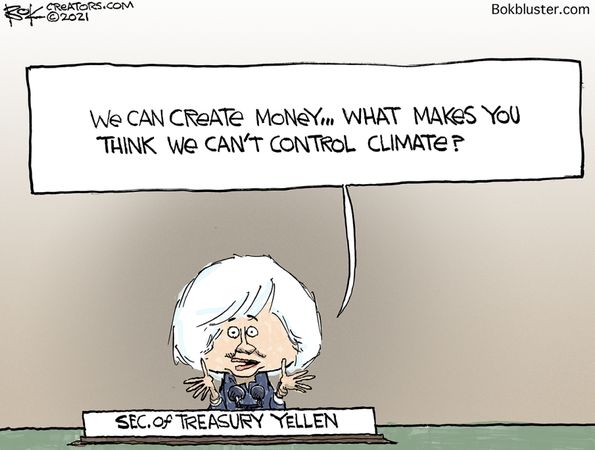
As a small indicator of the forces at work, Treasury Secretary Janet Yellen offered an eloquent summary of a the “whole-of-government’ effort to integrate climate into financial regulation

“FSOC is recognizing that climate change is an emerging and increasing threat to U.S. financial stability. This report puts climate change squarely at the forefront of the agenda of its member agencies..”

News that climate change is not a threat to financial stability will not go down well.

Governor Lael Brainard, currently a leading candidate for Fed Chair, is a strong proponent of “climate risks to the financial system.” = Just read here speeches. Here, for example,

Climate change is projected to have profound effects on the economy and the financial system, and it is already inflicting damage.

We can already see the growing costs associated with the increasing frequency and severity of climate-related events.

Here,

It is increasingly clear that climate change could have important implications for the Federal Reserve … Given the implications of climate change for both individual financial institutions and the financial sector as a whole...,

Climate change and the transition to a sustainable economy also pose risks to the stability of the broader financial system. …

And a hint of the vast institutional commitment to these ideas

To complement the work of the SCC, the Federal Reserve Board is establishing a Financial Stability Climate Committee (FSCC) to identify, assess, and address climate-related risks to financial stability.

“We looked and there is nothing here” is not going to go down well. It’s hard to publish papers and get jobs as climate and finance researchers these days if you come up with the “wrong” answers.

New Zealand Study Confirms Financial System Safety from Climate Change

A commenter at the blog provided a link to another recent NZ study Climate Change and the risk to Financial Stability.  Reality or overreaction? Excerpts in italics with my bolds.

The Reserve Bank is not alone in suggesting that climate change could represent some kind of existential threat to the financial system. Over recent years a number of central banks, supervisors and international financial institutions have made claims that global warming poses a serious risk to financial stability. The Network for Greening the Financial System (NGFS), a club of central banks and supervisors, is pushing a more coordinated international approach. Further, the Ministry for the Environment (MfE) has identified financial stability as one of the two major economic risks in its recent Climate Change Risk Assessment report.

At first sight it is difficult to understand what is driving the Reserve Bank’s concern. The physical risks from climate change to the New Zealand economy are small, and over the period up to 2100 the benefits of a warmer climate may well exceed the costs. While there will be some impacts as the economy adapts to a zero carbon future, economies have always been changing and, with some exceptions, financial systems have been able to accommodate those changes. To cite an obvious example, the US substantially shifted from horse to motorized transport in the space of 20 years, without any one being in charge or worrying about systemic risk to the financial system.

As the physical effects of climate change are slow-moving and relatively predictable over relevant time horizons, we should expect the financial systems to adapt to this changing world, and readily accommodate the impacts of climate events such as a slowly rising sea levels and the occasional stronger storms.

The issue we address in this report is whether climate change is such an exception to this benign adaptation picture, that central banks and supervisors need to respond to the ‘challenge’ with some urgency. Or is this just a case of the Reserve Bank wanting to be seen to be ‘relevant’ and getting into the action in what is one of the biggest issues of our time?

The main purpose of this report is to assess the papers on the Bank’s list and other relevant documents on the impact of climate change on financial systems. We have also focused on climate change risk disclosures, which have become a flavour of the month in regulatory quarters, and are set to become mandatory for larger New Zealand institutions.

The focus of our analysis is on the banking sector, which is the core of the New Zealand financial system. We have paid less attention to risks to the insurance sector because it is generally accepted it can readily manage climate risks by adjusting its exposures and pricing.

Our conclusions are very clear. We have reviewed a large number of documents and despite the best efforts of many supervisors none have been able to come up with convincing evidence that climate change represents a threat, let alone a systemic threat. For example a very recent full scale stress test for France found that the transition costs to a zero carbon economy would at most be four or five basis points and that it did not matter whether the transition was early or late. The physical risks from climate change were so slight that they could not be analysed.

We did find a disturbing pattern of exaggerations and misrepresentations. For example the Bank of England instructed banks, when stress testing, to assume that all river flooding defences would be removed, in an effort to inflate the costs of future flooding events. The United Nations Environment Programme used climate change assumptions for 2100 to assess financial system impacts for 2025 and 2045.

Climate change does not represent some kind of existential threat to the New Zealand financial system.

The Governnor is over-reacting. This climate change ‘hysteria’ is mostly noise, but it might have some efficiency costs for the system, which could be avoided if a more measured approach is taken. The Reserve Bank’s role should be to correct and hose down ill-informed responses, not to create them.

Footnote:

Background from John H. Cochrane writing on central banks mistaken preoccupation with global warming/climate change at post Deception: Climate Financial Risk

Also Cochrane’s remarks at European Central Bank’s Conference on Monetary Policy. Synopsis at post Bankers Should Mind Their Own Business, not the Climate



King Coal is Dead. Long Live the King!

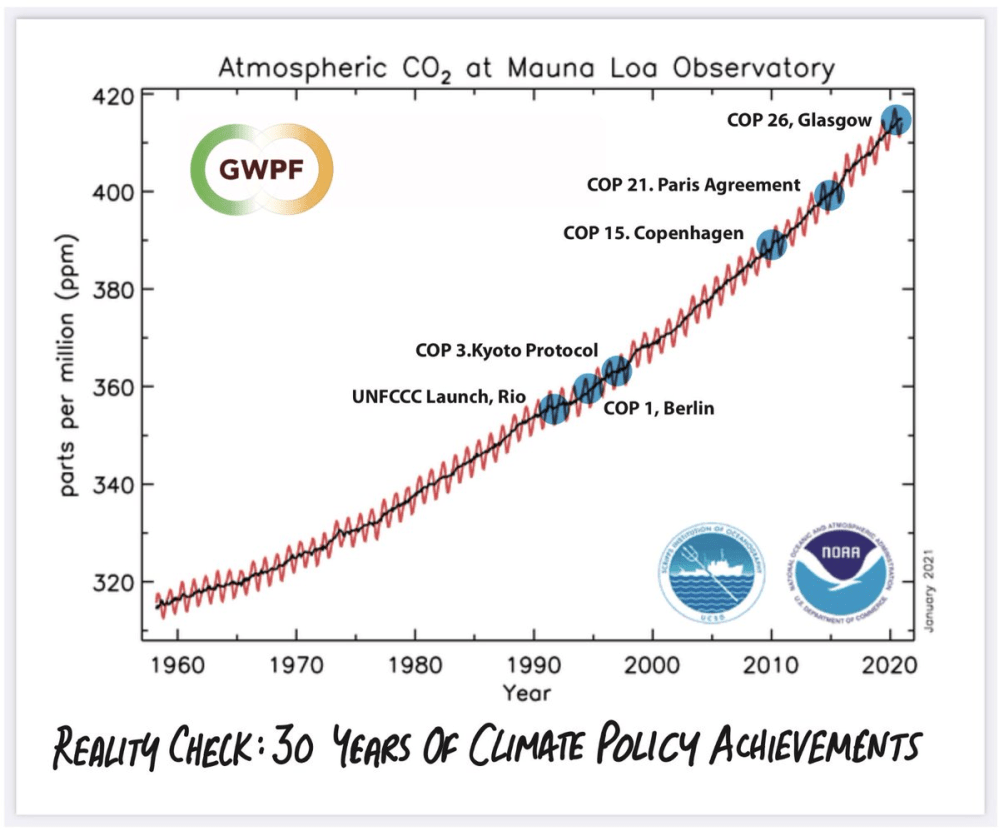
You’ve heard the pronouncements:  “Coal Is Dead and Oil Is Next.”  “Glasgow is the Death Knell for the Coal Industry” (Boris Johnson).  “Coal is declining sharply, as financiers and insurance companies abandon the industry” (Yale360) “Parties to accelerate efforts towards the phase-down of unabated coal power” (COP26 agreement). The unspoken reality is the opposite:  Demonizing coal has increased coal consumption.  MISH explains in his article The Big Green Push to Get Rid of Coal Had the Opposite Effect.  Excerpts in italics with my bolds.

An alleged big win to eliminate coal turned into a bust and then some.

Investors Pushing Mining Giants to Quit Coal is Backfiring

Bloomberg has an interesting story on how Environmentalists Pushing Mining Giants to Quit Coal has backfired.

It was supposed to be a big win for climate activists: another of the world’s most powerful mining companies had caved to investor demands that it stop digging up coal.

Instead, Anglo American Plc’s exit from coal has become a case study for unintended consequences, transforming mines that were scheduled for eventual closure into the engine room for a growth-hungry coal business.

And while it’s a particularly stark example, it’s not the only one. When rival BHP Group was struggling to sell an Australian colliery this year, the company surprised investors by applying to extend mining at the site by another two decades — an apparent attempt to sweeten its appeal to potential buyers.

Now, after years of lobbying blue-chip companies to stop mining the most-polluting fuel, there’s a growing unease among climate activists and some investors that the policy many of them championed could lead to more coal being produced for longer.

BHP may end up holding on to the Australian mine it was battling to sell, Bloomberg reported last week. Earlier this year, Glencore Plc sounded out a major climate investor group before announcing it would increase its ownership of a big Colombian coal mine, according to people familiar with the matter.

India now burns more coal than Europe and the U.S combined and miners are betting on rising demand over the next decade from countries such as Vietnam, Bangladesh and Indonesia, although pollution concerns and cheaper alternatives threaten to derail those plans.

Tough to Eliminate Coal

The push to abandon coal made selling the mines difficult. So companies chose to extend their life.

Developing countries that invested in coal-powered electrical plants that have many years of useful life want reparations to develop new plants.

New wind and solar plants are cheaper but unreliable. And they are not cheaper than plants already built.

Moreover, wind can die for days and solar has on average 12 hours a day of outages.

This places additional capital investment requirements for countries to build energy storage facilities.

China alone is currently building or planning coal power plants that are the equivalent of six times Germany’s entire coal burning capacity.

It’s tough to get rid of coal when you build more coal plants than you retire.

Trudeau: Let’s Limit How Far You can Drive

Brad Salzberg writes Trudeau Considers Restricting Distance of Vehicle Travel For Canadian Citizens.  Excerpts in italics with my bolds.

During the recent COP26 summit, Justin Trudeau hosted a carbon pricing conference showcasing Canada’s carbon policy. He referred to it as “one of the most stringent and ambitious in the world.”

In terms of a domestic carbon program, no emission reduction mandates had thus far been established beyond an agreement between Alberta and Ottawa to limit output at 100 megatonnes per year. Canada emits roughly 730 megatonnes of CO2 equivalent annually. The Trudeau government has now mandated a specific 100-megatonne reduction for our oil and gas sector by the year 2030.

This in itself is not a surprise. What should make the ears of Canadians perk up is one of the proposed restrictions to accomplish the goal. Among other current considerations in the Liberal government’s proposal, we discover the following, as reported by the Calgary Sun this week:

“Limit personal consumption of hydrocarbons by individual Canadians, in terms of allowable miles travelled by motor vehicle, train or air.”

My, my– Canada is certainly filled with surprises these days. Last week delivered another zinger:
“Deliberately coughing at someone during the COVID-19 pandemic constitutes a criminal assault.”

Applying our math skills, that’s two examples of unprecedented forms of draconian social measures in the past two weeks. Not that mainstream media will present it as such. In both cases, the information was ever-so-casually tucked into news articles on a larger theme.Let us understand the potential what is being proposed. There may come a time when the distance Canadians can travel in their vehicles includes a hard cap on mileage. Not only would this apply to their personal vehicle, but also to the time they spend idly reading a newspaper while riding a bus.

All of which conjures up a collective yawn from legacy media. As a result, they will likely never juxtapose this “progressive” policy with what Canada’s Charter of Rights and Freedoms has to say about the matter.

6. (1) Every citizen of Canada has the right to enter, remain in and leave Canada.

(2) Every citizen of Canada and every person who has the status of a permanent resident of Canada has the right:

to move to and take up residence in any province; and
to pursue the gaining of a livelihood in any province.

What would occur in a case where Charter-based mobility rights were violated by Trudeau’s restriction on distance of travel?

A simple question it is. The answer, of course, is nothing at all. Just as it applies to current Charter breaches that result from Covid mandates.

Result: a loss of personal freedom. Predicted extend of exposure from establishment media? Nothing.

Witness as Canada continues to morph into a reasonable facsimile of authoritarian nations of the world.

Footnote:  See also Uh Oh Canada


COP Ignorants Pushing Wrong Agenda

Some reflections by Dick Storm at his blog Glascow, COP-26 Eltists and Special Interests Promote China First, America Last.  Why?  Excerpts in italics with my bolds.

Because savvy engineers were not successful in educating the public and politicians on the true facts.

Well, that is at least one reason we have such a mess of energy policy now.

Once a “War on Carbon”, Has now Morphed into a “War on Freedom”, “War on our Rights”, “War on Capitalism” and an assault on much of What “We the People” Have Worked Hard For. The clowns in Scotland are spending our tax dollars and restricting our freedoms as best they can. Essentially putting China and the rest of the world first, America last. All on our dime.

Two Sides of the Same Coin

America has been a leader by example in reducing carbon. The U.S.A. has reduced our carbon emissions by over 50% since 2005. How? By releasing the power of free markets and American innovation. At the end of President Trump’s term, America was energy independent. He did that in four years only to have Joe Biden reverse his policies.

The War on Fossil Fuels is not new and the intentions have always been to raise energy costs so that “Green Power” will become competitive. Yes, the intentions of President Biden, John Kerry, Al Gore and the rest of the Green Extremists (Reminder, the War on Coal started in the Clinton-Gore Administration. Obama just continued and accellerated anti American energy policies Clinton-Gore began) The war on carbon is intended to make Exploration, Development, Production and use of oil, gas, coal and even nuclear, more expensive and harder to use.

All of this as the world’s people still depend on Fossil Fuels and nuclear together for almost 90% of our total energy. How can our leaders be so ignorant and insensitive? Well, back in the 1990’s when bill Clinton started the “War on Coal”, I did my best to educate the public and the students of public schools and several Colleges on energy and electricity generation. I am proud of my efforts, small as they seem in the grand scheme of things. There is still a need for Energy Engineers to become active in PR for Energy!

Series on World of Hurt from Climate Policies
In support of such educational efforts, here are a series of four posts showing how wrong-headed are climate policies which are actually anti-energy and anti-human. Below are links to articles providing numerous charts exposing how hurtful are these policies, along with one example for each theme.

World of Hurt from Climate Policies-Part 1

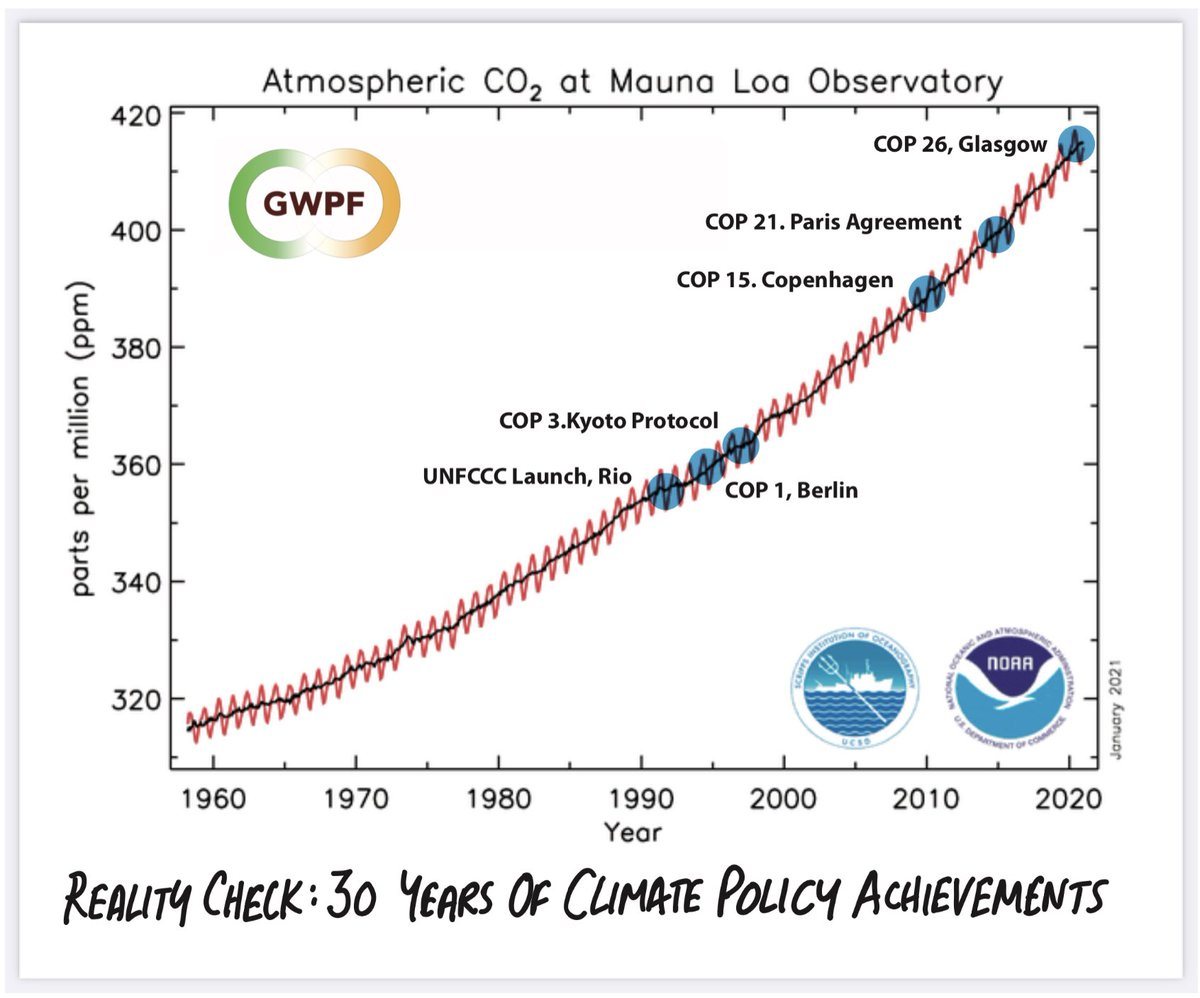
This is a beginning post toward infographics exposing the damaging effects of Climate Policies upon the lives of ordinary people.  And all of the pain is for naught in fighting against global warming/climate change, as shown clearly in the image at bottom.  This post presents graphics to illustrate the first of four themes:
  • Zero Carbon Means Killing Real Jobs with Promises of Green Jobs
  • Reducing Carbon Emissions Means High Cost Energy Imports and Social Degradation
  • 100% Renewable Energy Means Sourcing Rare Metals Off-Planet
  • Leave it in the Ground Means Perpetual Poverty

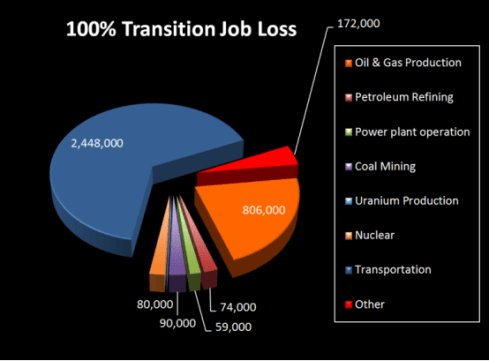
Part 1: Zero Carbon will Decimate US Workforce

EID (Energy in Depth) atudy shows renewable energy transition pushed by climate activists will result in a net 3.8 million lost jobs.
World of Hurt from Climate Policies-Part 2

Part 2: California Exemplifies Ruination from Self-imposed Climate Policies

By blocking domestic production through permit denials, California is playing a shell game with emissions. Overall use of petroleum products has held steady but shifted from energy produced within the state – where the industry is subject to U.S. environmental regulations and supports local workers and companies – to overseas.

California isn’t reducing its dependence on oil; it’s just adding a higher carbon footprint to get it.

World of Hurt from Climate Policies-Part 3

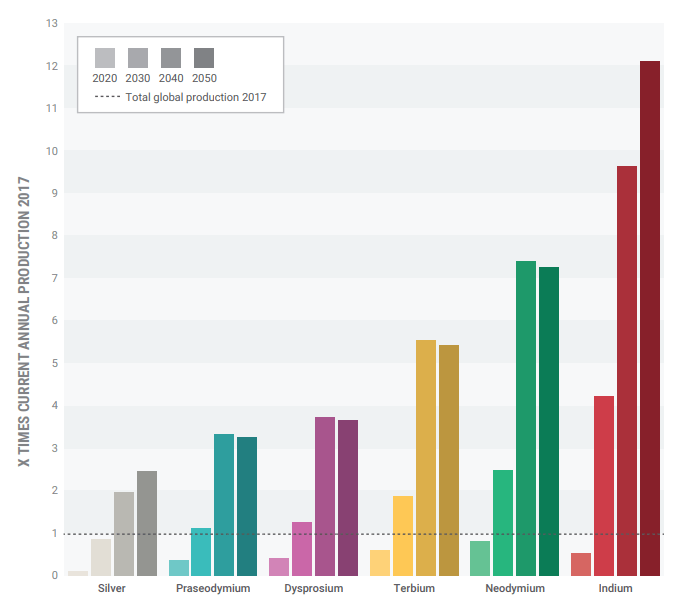
Part 3: Wind and Solar Infrastructure Consumes Rare Metals Far Beyond World Supplies

This graph shows the annual metal demand for the six most critical metals, compared to the annual production. The dotted line represents present-day annual production.  

Conclusions
 Future annual critical metal demands of the energy transition surpass the total annual critical metal production.
• An exponential growth in renewable energy production capacity is not possible with present-day technologies and annual metal production. As an illustration: in 2050, the annual need for Indium (only for solar panel application) will exceed the present-day annual global production twelvefold.

World of Hurt from Climate Policies-Part 4

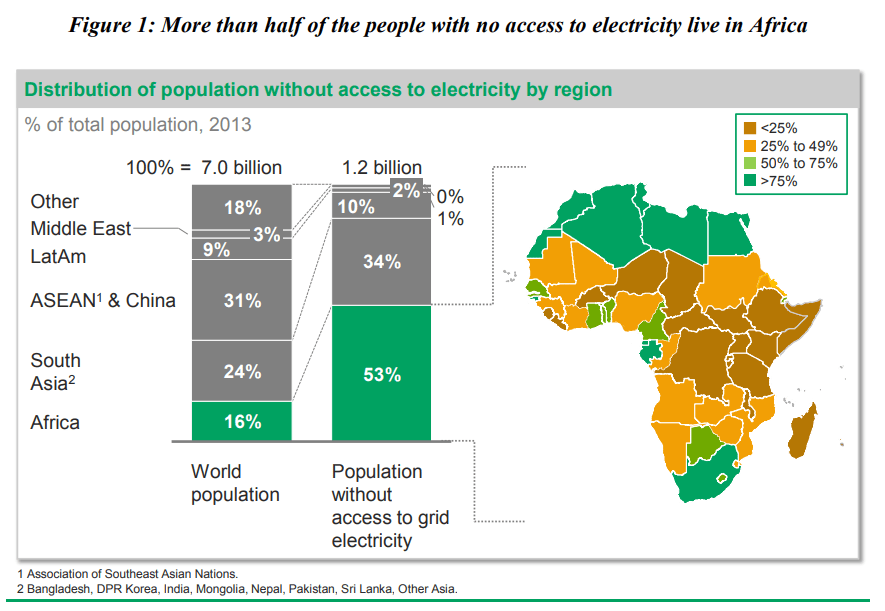
Part 4 The War Against Carbon Emissions Diminishes Efforts to Lift People Out of Poverty

How Climate Policies Keep People Poor

Note that the vision for 100% access to electric power was put forward by the African Development Bank in 2016.  (Above slides come from The Bank Group’s Strategy for The New Deal on Energy for Africa 2016 – 2025).  Instead of making finances available for such a plan, an International Cabal organized to deny any support for coal, the most available and inexpensive way to electrify Africa.

This is an organized campaign to deny coal-fired power anywhere in the world, despite coal being the starting point in the development pathway for every modern society, and currently the success model for Asia, and China in particular.


Climate Lobby Crushed Debate

Tim Black writes at Spiked How the climate lobby crushed debate.  Excerpts in italics with my bolds and added images.

Anyone who dissents from stringent climate policies will be branded an enemy of The Science.

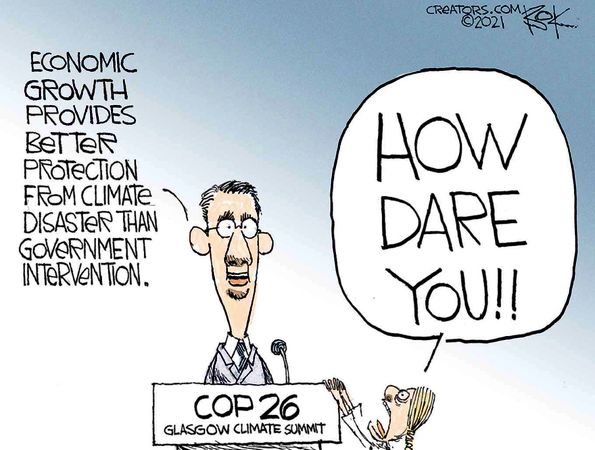
COP26 is an extravaganza of ideological conformity. From the 30,000 delegates and heads of state sequestered in the ‘blue zone’ to the NGOs, academics and green businesses exhibiting in the public ‘green zone’, the message is the same. There is nothing to debate anymore. The climate catastrophe is coming. Now is the time for action.

Similar sentiments abound outside COP26, where the protesters are gathered. There the likes of young eco-millenarian Greta Thunberg also claim that the end is nigh, that the time for debate is over. Or as the Swedish teenager herself put it during a protest on Sunday, there’s no need for any more of this ‘blah, blah, blah’.

This is essentially what all those in and around COP26 are saying. That, in effect, there is nothing to debate anymore. And so, over the next few days, Western-led policymakers, angrily cheered on by protesters, will try to decide our futures for the next few decades. They will regulate, restrict and limit. And they will be able to do so without dissent or debate.

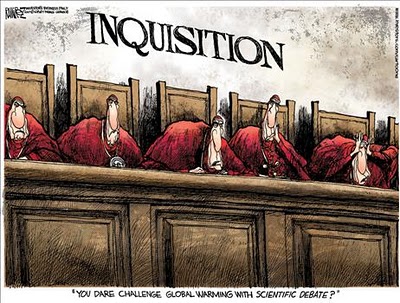
How have we got here? How have we ended up at a point where debating climate change has become nigh-on impossible? The answer lies principally in the use and abuse of the authority of science. The standard justification for shutting down those challenging the alarmist climate-change narrative amounts, effectively, to saying ‘the science has spoken’.

This was clear in the run-up to COP26, when Mark Lynas, a long-time environmentalist campaigner and now a visiting fellow at Cornell University, published a widely reported-on study asserting that the scientific consensus that humans are altering the climate is now agreed upon by 99.9 per cent of scientists. That’s how certain The Science now is. Not just 97 to 98 per cent certain, as it used to be, but 99.9 per cent certain. ‘It is really case closed’, said Lynas. ‘There is nobody of significance in the scientific community who doubts human-caused climate change.’

‘Case closed.’ No ‘doubts’ and no appeal. These are revealing words. Climate change has long since ceased to be an issue to be addressed, or a set of challenges to be overcome. It is now the revealed truth, the God-like judgement around which we must organise the entirety of societal life. To question this truth is tantamount to apostasy. Hence Lynas calls for any remaining heretics to be censored, urging Facebook and Twitter ‘to look at their algorithms and policies’ to root out ‘climate misinformation’.

Indeed, those daring to question any aspect of the alarmist narrative are now routinely dismissed not as heretics, but as ‘deniers’ – a term which morally equates those who question, say, certain decarbonisation policies with anti-Semites who deny that the Holocaust happened.

Take the experience of statistician and sceptical environmentalist, Bjorn Lomborg. Earlier this year he was invited to give a public lecture at Duke University, only to be met by high-profile calls for it to be cancelled from Duke professors and assorted climate activists. Duke held its nerve, and the lecture went ahead, but not without Lomborg being denounced as a ‘professional climate denier’ – and all because he questions the economic wisdom of certain aspects of climate-change policymaking.

Or take the decision of the BBC in 2018 to ban, effectively, any debate over climate change. This decision followed activists’ outcry over its 2014 decision to allow Lord Lawson, a former chancellor of the exchequer and a critic of climate alarmism, to appear on Radio 4’s Today programme. The BBC said it had got its coverage of climate change ‘wrong too often’ and told staff: ‘You do not need a “denier” to balance the debate.’

Now even those who are concerned about climate change, but who ‘downplay’, as the Independent put it, ‘the need for immediate and radical cuts to greenhouse gas emissions’, are being accused of denialism. Apparently, ‘delay is the new denial’.

Indeed, influential climate scientist Michael Mann argues that anyone who inhibits the need for drastic action right this very moment, perhaps by talking hopefully of ‘adaptation’, ‘geoengineering’ or ‘carbon capture’, is just a climate denier in optimist’s clothing. ‘The greatest threat’, concludes one politician, ‘is now posed by those who purport to accept the scientific consensus, but refuse to respond at the pace science demands’.

This demented insistence that The Science has spoken, that it has even issued demands, and that all those not bowing down before it are ‘denying’ its truth, rests on a wilful misunderstanding of science and the role it ought to play in political debate.

All scientific claims should be subject to contestation, even those that many people happen to agree on. After all, there is sometimes a fine line between consensus and groupthink. The views of scientists and policymakers would surely be strengthened, not undermined, by rigorous public debate. But even if everyone takes as read that climate change is real and a problem, that is still not the end of the debate.The numerous branches of scientific inquiry that constitute climate science can tell us many things about our changing environment. They can tell us about the complex interaction of sea and air temperatures. They can tell us about the state of biodiversity in our oceans and on our land. They can tell us about mankind’s impact on the climate.

But they can’t tell us what energy policies to pursue. They can’t tell us what transport policies to implement. They can’t, in short, tell us what we ought to do. That is something only we can decide. And to do so we need to be able to challenge and question the alarmist narrative. We need to be allowed to scrutinise those peddling certain approaches to climate change. And we need to be able to do so without being likened to Holocaust deniers, banned from social media or No Platformed by the BBC.

We need, in short, to be free to debate climate change. We need more ‘blah, blah, blah’.

Two Sides of the Same Coin


COP Cake is Already Baked


Pat Buchanan writes at his blog  Is Failure Baked in the Cake at Glasgow?  Excerpts in italics with my bolds. and added images.

Consider. The world’s largest emitter of carbon dioxide is China, which burns half of the world’s coal and is building new coal-fired plants even as the 30,000 summiteers gather in Glasgow… Neither Chinese President Xi Jinping nor Russian President Vladimir Putin will even be present in Glasgow.

“Colossal Stakes as Leaders Meet to Talk Climate,” ran the headline.  They topped the lead news story in Sunday’s New York Times, the opening line of which set the tone for Glasgow: “The future is on the line.”

“As presidents and prime ministers arrive in Glasgow this week for a pivotal climate summit, the outcome will determine, to a large extent, how the world’s seven billion people will survive on a hotter planet and whether far worse levels of warming can be averted …

“Already, the failure to slow rising temperatures — brought on by the burning of oil, gas and coal — has led to deadly floods, fires, heat, and drought around the world.”

The hype is on. And the establishment media are playing their assigned role — portraying a failure at Glasgow as a guarantee of the looming apocalypse.

The theology of the climate crisis runs like this.

The planet has warmed by 1.1 degree Celsius since the Industrial Revolution. If warming rises to more than 1.5 degrees Celsius above 1900 levels, more and more terrible weather disasters will occur: wildfires, hurricanes of growing severity, droughts, coastal and river flooding, and islands sinking into the sea.

The only way to stave off “climate catastrophe” is for all nations to cut carbon emissions radically now and for the world to reach net zero emissions by midcentury.

A fast phaseout of the major emitters of carbon dioxide — the burning of coal, oil and gas to heat homes, run cars and generate power — and replacement of these fossil fuels with clean energy — solar, wind, nuclear — is a moral and political imperative.

But if such a radical transformation of national economies is the only way to avert the impending crisis, we should brace ourselves and prepare for that crisis. For there is no way the demanded changes in energy consumption are going to be made by 2030.

Consider the Facts on the Ground

The world’s largest emitter of carbon dioxide is China, which burns half of the world’s coal and is building new coal-fired plants even as the 30,000 summiteers gather in Glasgow.

China was given a license in the Paris climate accord of 2015 to burn all the coal it wishes until 2030, after which it has agreed to begin reducing carbon emissions. But the idea that China can or will convert in a few decades to wind, solar and nuclear power to run the world’s largest manufacturing plant seems preposterous.

The U.S., the world’s second largest emitter of carbon dioxide, gets 81% of its energy from oil, coal and natural gas. We depend on those fuels to heat our homes, run our vehicles and power our industry.

In his Build Back Better bill, Biden inserted a provision that would have imposed annually rising taxes on carbon producers and used the revenue to reward companies that reduced their reliance on fossil fuels.  The proposal had to be pulled out, lest it drag Biden’s entire bill down to defeat. Lest we forget, Sen. Joe Manchin is from West Virginia.

India, the world’s third largest emitter of greenhouse gases, is also, like China, dependent on coal. But, though its population is as large as China’s, India is behind China industrially, and the standard of living of its 1.4 billion people is below that of China.

To demand that India begin to end its burning of coal and rely more on solar and wind is to demand that New Delhi accept a future where India’s standard of living remains lower than that of China.

As for Russia, the fourth largest emitter of carbon dioxide, it is rich in fossil fuels and the leading supplier of natural gas to Europe. But Moscow manipulates the supplies of its natural gas to its customers for reasons of both revenue and politics.

Neither Chinese President Xi Jinping nor Russian President Vladimir Putin will even be present in Glasgow.

Saudi Arabia, the Gulf states and other OPEC nations depend for their national income on oil exports. If fossil fuels become forbidden fuels, what is to become of these nations?

Will they accept a future where their primary natural resource is gradually outlawed by the rest of the world? Will they be content to rely on the industrialized world to provide them with windmills and solar panels to power their economies?

The world’s losers from this Glasgow summit are likely to be the billions of people who will never know the benefits of fossil fuels that produced the Industrial Revolution and created the affluent societies of the 20th century.


Supremes to Review EPA Authority Over GHGs

Amy Howe writes at scotusblog Justices agree to review EPA’s authority to regulate greenhouse gases.  Excerpts in italics with my bolds.

Climate change regulation

The litigation over the EPA’s authority comes to the court in a quartet of environmental cases on appeal from the U.S. Court of Appeals for the District of Columbia Circuit. The D.C. Circuit vacated both the Trump administration’s decision to repeal the 2015 Clean Power Plan, which established guidelines for states to limit carbon dioxide emissions from power plants, and the Affordable Clean Energy Rule that the Trump administration issued in its place.

Urging the justices to hear the case, one of the challengers, the North American Coal Corporation, acknowledged that the issue of climate change and how to address it has “enormous importance,” but the company stressed that “[t]hose debates will not be resolved anytime soon.” What the court should resolve, it continued, “as soon as possible is who has the authority to decide those issues on an industry-wide scale — Congress or the EPA.” Unless the justices weigh in, the company warned, “these crucial decisions will be made by unelected agency officials without statutory authority, as opposed to our elected legislators.”

The Biden administration told the justices that there was no need for them to step in now, because the Clean Power Plan “is no longer in effect and EPA does not intend to resurrect it.” Instead, the government explained, it intends to issue a new rule that takes recent changes in the electricity sector into account. “Any further judicial clarification of the scope of EPA’s authority,” the government suggested, “would more appropriately occur” after the agency has actually issued the new rule.

After considering the cases at four consecutive conferences, the justices granted review and ordered the cases to be argued together. The justices’ decision in the case, which is expected by summer 2022, could have an impact well beyond environmental law because it could impose new limits on Congress’ ability to delegate authority to all regulatory agencies.

The lead case is West Virginia v. EPA. It is consolidated with North American Coal Corp. v. EPA, Westmoreland Mining Holdings v. EPA, and North Dakota v. EPA.

Background at previous post 

Latest Court Ruling re EPA and CO2

My comment: I much appreciate Judge Walker’s reprise of the historical journey. After earning my degree in organic chemistry, I am still offended that a bunch of lawyers refer to CO2 as a “pollutant” as though it were an artificial chemical rather than the stuff of life. And it annoys me that the American Lung Association fronted this legal attack, as though CO2 was causing breathing problems in addition to a bit of warming during our present ice age. And that list of ailments solved by reducing CO2 emissions rivals any snake oil poster ever printed.

Observers noted that this ruling produces a kind of limbo: Obama’s Clean Power Plan is out of order, and now Trumps Affordable Clean Energy program is shot down. Likely Biden will try to return to CPP as though Trump never happened, but the same objections will still be raised. Clearly Judge Walker sees the issue headed for the Supreme Court as the stakes are too high for anyone else. After their lack of courage on the 2020 election scandal, who knows what the Supremes will do.

Footnote: See post The Poisonous Tree of Climate Change

The roots of this poisonous tree are found in citing the famous Massachusetts v. E.P.A. (2007) case decided by a 5-4 opinion of Supreme Court justices (consensus rate: 56%). But let’s see in what context lies that reference and whether it is a quotation from a source or an issue addressed by the court. The majority opinion was written by Justice Stevens, with dissenting opinions from Chief Justice Roberts and Justice Scalia. All these documents are available at sureme.justia.com Massachusetts v. EPA, 549 U.S. 497 (2007). The linked post summarized the twisted logic that was applied.

Dutch High on Green Hydrogen–Tulipmania Revival?

Cyril Widdershoven writes at Oil PriceThe Dutch Government Is Gambling Billions On Green Hydrogen.  Excerpts in italics with my bolds.

  • Green hydrogen is making headlines around the world as many consider it a cornerstone of a successful energy transition
  • The Netherlands is ready to spend billions in its attempt to become a global green hydrogen hub, but some observers are becoming increasingly skeptical
  • The economic viability of this new investment is unclear and a growing number of critics see these investments as the government gambling with billions of euros

The future of green hydrogen looks very bright, with the renewable energy source becoming something of a media darling in recent months. The global drive to invest in green or blue hydrogen is picking up steam and investment levels are staggering. Realism and economics, however, seem to be lacking when it comes to planning new green hydrogen projects in NW Europe, the USA, and Australia.

At the same time, blue hydrogen, potentially an important bridge fuel, is being largely overlooked. The Netherlands, formerly a leading natural gas producer and NW-European gas trade and transportation hub, is attempting to establish itself as a main pillar of the European hydrogen economy. According to the Dutch government, the Netherlands is ready to provide whatever is needed to support the set-up of a new green hydrogen hub and transportation network. During the presentation of the 2021-2022 government plans in September (Prinsjesdag), Dutch PM Mark Rutte committed himself to this green hydrogen future.

Without any real assessments of the risks and potential economic threats, plans are being discussed and implemented for a multibillion spending spree on green hydrogen, involving not only the refurbishment of the Dutch natural gas pipeline infrastructure but also the building of major new offshore wind parks, targeting the construction of hundreds of additional windmills. These wind parks are going to be set up and owned by international consortia, such as the NorthH2, involving Royal Dutch Shell, Gasunie (owned by the government), and others.

The optimism about these projects is now being questioned, not only by skeptics but increasingly by parties, such as Gasunie, that are part of the deals.

Dutch public broadcaster NOS reported yesterday that questions are popping up about the feasibility and commercial aspects of these large-scale plans as well as the potential risks of a new “cartel” of offshore wind producers. The multibillion-dollar investment plans, supported by the government, are even being questioned by experts of the Dutch ministry of economy, as it is not clear at all if green hydrogen production in the Netherlands, such as the NorthH2 project in Groningen (formerly known as the Dutch natural gas province), will ever be feasible or take-off.

The commercial viability of green hydrogen is a major issue as it still needs large-scale technical innovation and scaling up of electrolyzers. At the same time, there is uncertainty over demand as industry (the main client) does not appear to be interested at present. Dutch parties are also asking themselves if the current set up of the planned offshore wind parks are not a precursor to a new wind-energy cartel in the making. Some Dutch political parties and even insiders from Gasunie are worried about a monopoly position of the likes of Shell in the future.

The increased criticism by some, such as Gasunie and political parties, with regards to the power position of commercial parties, is also very strange. Some could argue that the current hydrogen strategy of Shell and others is what society and Dutch judges have forced them to do. Shell could and should argue a very simple position “we are doing what the Dutch legal system is forcing us to do”. For parties such as Shell, at least in the Netherlands or the EU, taking up green hydrogen strategies is a new License to Operate. International energy giants such as Shell do not want to be minor players in this market. For an international player, a pivotal position in any market is a must.

In the coming weeks, especially after COP26, as criticism is now being muted by most, a potential storm could be brewing.

If assessments are pointing out that the risks being taken by the Dutch government are too high in light of the benefits, and potential higher bills for customers, potential opposition to green hydrogen plans could be growing. At the same time, the Dutch hydrogen plans are seen by most as pivotal, even in light of the EU Commission’s Green Deal plans. A full-scale backlash to hydrogen could be a reality if Dutch political parties are going to constrain implementation, while other European countries will be more skeptical about their own plans. Billions, or potentially trillions, of euros will be at risk if this new hydrogen infrastructure turns out not to be economically viable. Without the power and technology of existing energy players, especially Shell, Total, BP, or ENI, behind the set-up, the future of this new power source will remain uncertain.

Comment on Hydrogen Fundamentals

What’s Not to Love About Green Hydrogen Energy? Let us count the ways.

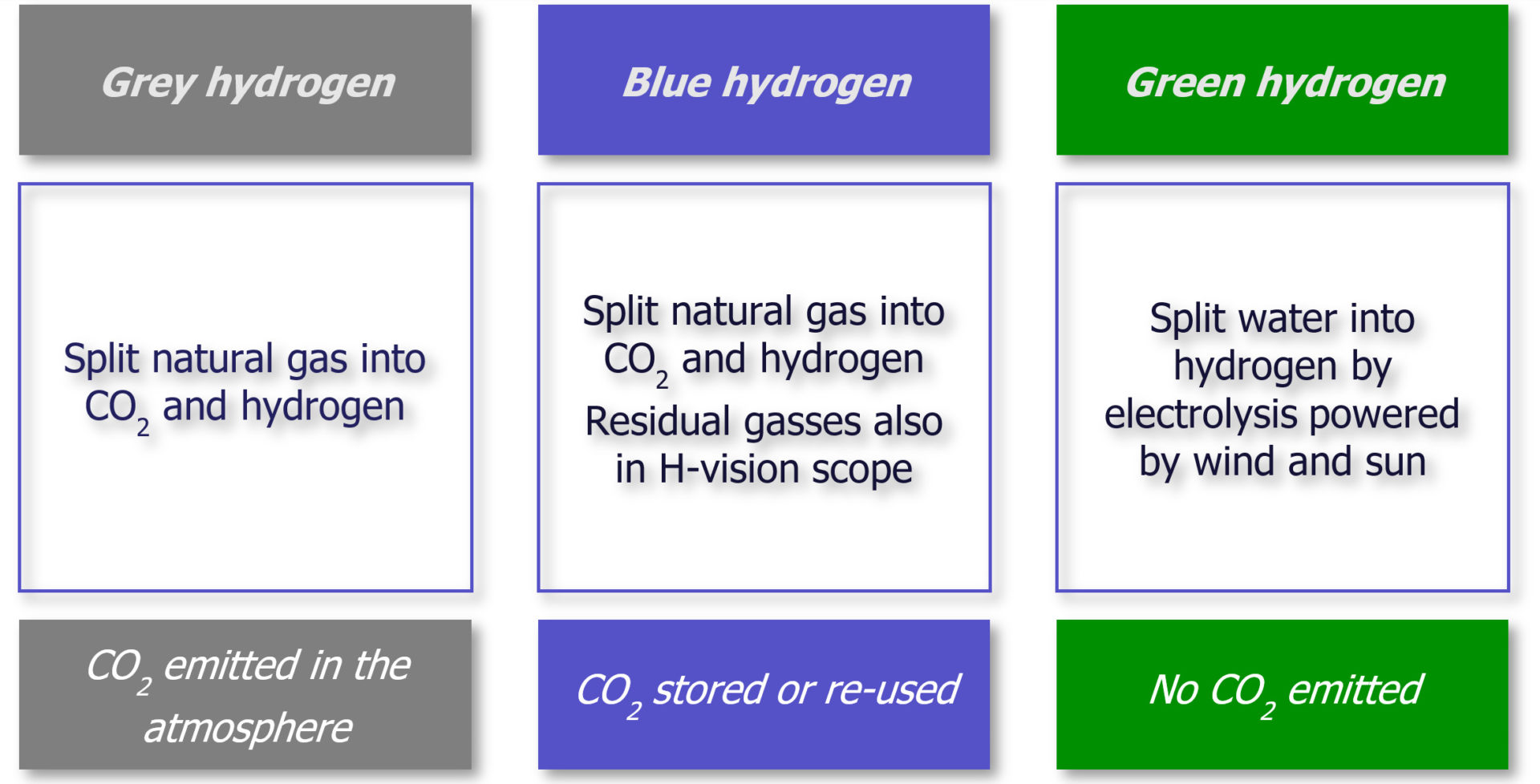
The only cost-efficient way to produce H2 presently is electrolysis of H2O, powered by natural gas. This is called grey hydrogen. Objections: Burning the CH4 to generate the electricity gives off CO2, albeit less emissions than coal would. But because of energy losses in the process, the resulting H2 put into fuel cells delivers less energy than the CH4 that was burned. Better to run the cars using CH4 as fuel directly.

To lower the carbon footprint, some propose blue hydrogen, defined as H2 produced with fossil fuels, but including carbon capture to use or bury the CO2 emitted. Objections: Carbon Capture has not yet been scaled to be commercially viable, and in any case increases the cost of the resulting H2. And it is still less energy output than was input.

The latest dream is green hydrogen, which is H2 produced by electrolysis powered by wind or solar farms. Some proposed that this is a clean way to store intermittent renewable energy for use on demand. Objections: Wind and solar power is not clean or cheap, but involves high tech machinery requiring the extraction, transportation and refining of rare metals. Extensive tracts of land must be allocated to these installations, or else locating them offshore. Transmission lines must be built and maintained, and the panels or windmills depreciate rapidly. As well, the highly flammable H2 must be transported and stored prior to making fuel cells.

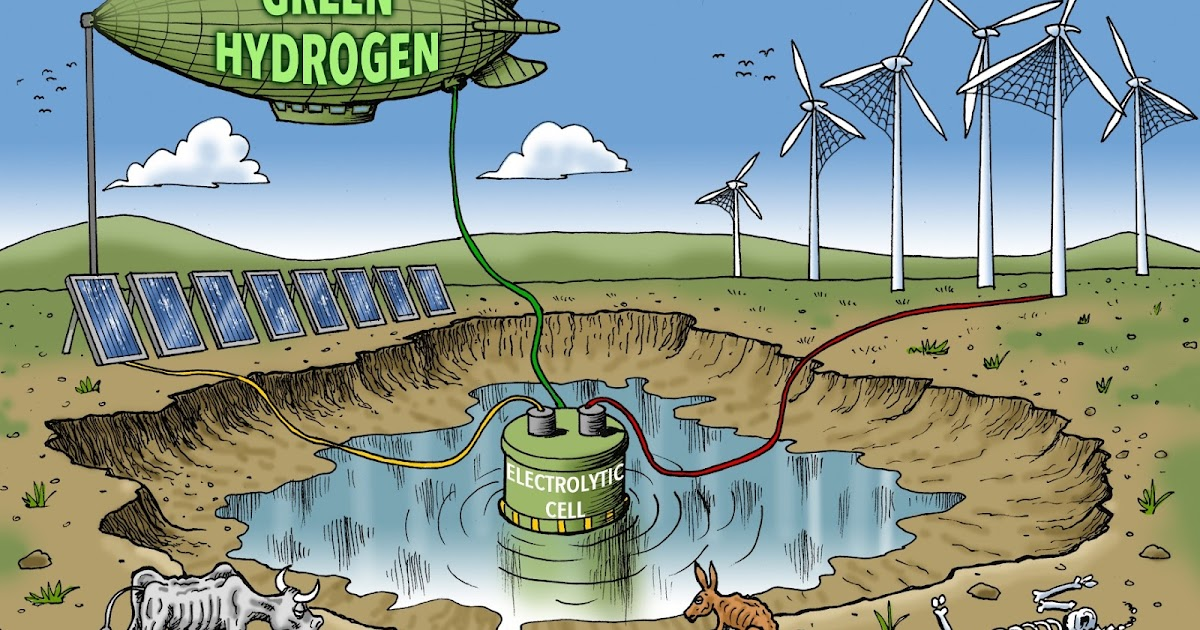
And the elephant in the room: Water is a precious resource.

One industry source told Oilprice that the production of one ton of hydrogen through electrolysis required an average of nine tons of water. But to get these nine tons of water, it would not be enough to just divert a nearby river. The water that the electrolyzer breaks down into constituent elements needs to be purified

The process of water purification, for its part, is rather wasteful. According to the same source, water treatment systems typically require some two tons of impure water to produce one ton of purified water. In other words, one ton of hydrogen actually needs not nine but 18 tons of water.

Accounting for losses, the ratio is closer to 20 tons of water for every 1 ton of hydrogen.

Speaking of water purification, organic chemists explain that the simplest way to do this is by distilling it. This method is cheap because it only needs electricity, but it is not fast. Regarding the electricity cost, distilling a liter of water requires 2.58 megajoules of energy, which translates into 0.717 kWh, on average.

So, providing the right kind of water for hydrolysis costs money, and while $2,400 per ton of hydrogen may not sound like much, the cost of purifying water is not the only water-related expense in the technology that seeks to make hydrogen from renewable sources. Besides being pure, the water to be fed into an electrolyzer has to be transported to it.

Transporting tons upon tons of water to the site of an electrolyzer means more expenses for the logistics.  To cut these, it would make sense to pick a site where water is abundant, such as by a river or the sea, or, alternatively, close to a water treatment facility. This puts a limit on the choice of locations suitable for large-scale electrolyzers. But since an electrolyzer, to be green, needs to be powered by renewable energy, it would also need to be in proximity to a solar or a wind farm. These, as we know, cannot be built just anywhere; solar farms are most cost-effective in places with a lot of sunshine, and wind farms perform best in places where there is sufficient wind.

Not all costs associated with the production of hydrogen from renewable energy sources are the costs of those renewable energy sources. Water is the commodity that the process needs, and it is a little odd that nobody seems willing to discuss the costs of water, including the European Commission’s Green Deal Team.

Summary: We now know it was a big mistake to divert corn from food production into biofuel. Will we make an even worse mistake converting drinking water into hydrogen fuel?

Climatist Insurrection Enters New Phase

Previously the insurrection by climate anti-fossil fuel acitvists took the form of sabotaging oil and gas infrastructure, led notably by the “valve turners”, who were arrested and mostly let off the hook in a series of high profile trials.  This phase broke down after numerous states enacted serious penalties for attacks on energy projects and infrastructure. Also, with the Biden administration climatists hoped for swift federal action to shut down oil and gas production and supply. See Securing Pipelines Against Disrupters

Disappointed with lack of progress on their “leave it in the ground” agenda, activists are now attempting to occupy federal buildings to intimidate public officials into action.  This could be a precursor of more insurrection events far more serious than anything happening on Jan.6, 2021.

Michael Austin reports at The Western Journal  ‘Insurrection’? Climate Change Protesters Attempt to Storm Interior Department Building.  H/T John Ray.  Excerpts in italics with my bolds.

The Jan. 6 Capitol incursion was not an insurrection, as many left-wing politicians and pundits have claimed.  Sure, some of those present during the incursion were rioters who broke the law. They should be punished accordingly.

 On Thursday, Oct. 14,  a large group of climate change protesters tried to enter the Department of the Interior, according to Ellie Silverman, a reporter for The Washington Post.

“Climate protesters are now rallying outside the Department of the Interior. They’re trying to get inside but police are blocking the entrance. I can see a few Indigenous women through the doorway who are sitting on the floor inside the building and linking arms,” Silverman tweeted.

She further noted that “protesters are remaining on the steps and won’t move out of the doorway where several police are blocking passage into the building.”

If these activists happened to be conservatives protesting against vaccine mandates or Bidenflation, the media would be covering it ad nauseam.

Panicky headlines declaring the return of the Jan. 6 “insurrectionists” would spread like wildfire across social media.

But instead, since the protesters happen to be supporting a cause backed by the establishment elite, the media has remained largely silent.

P.S. I don’t think of these protesters or those at the capital 6/1/21 as “insurrectionists.” But if that is the term used to imprison 6/1/21 participants and remove their civil rights, then it should also be applied here. We do not know whether these disturbances will evolve into riots like those in Portland where the Federal Courthouse was vandalized by insurrectionists, never held accountable.

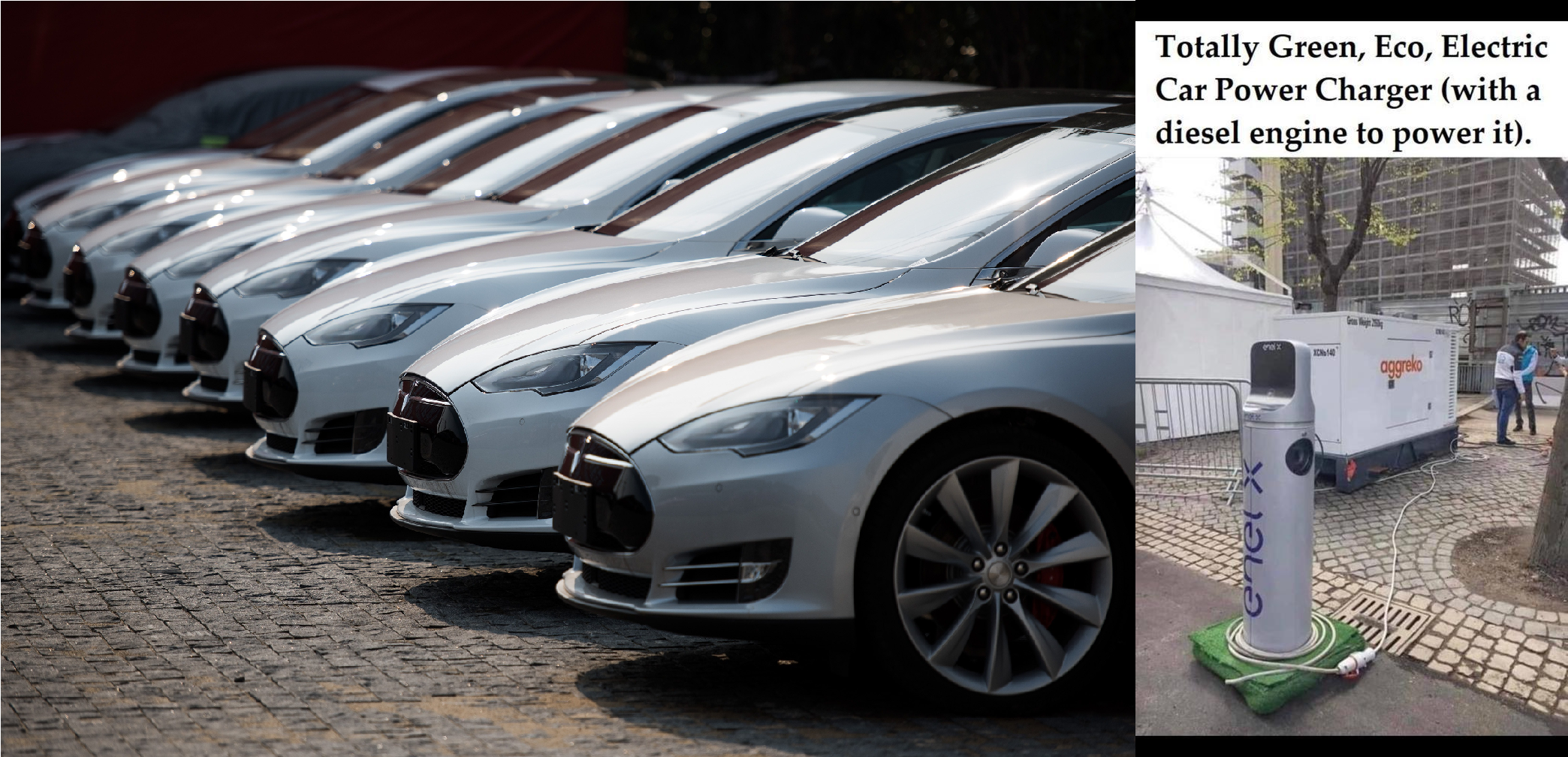
Glasgow COP Has Fleet of Teslas To Be Diesel-Charged

Tyler Durden reports at zerohedge  UN Climate Change Conference Reportedly Using Diesel Generators To Charge Teslas Being Used As Shuttles. Excerpts in italics with my bolds.

We’re not sure we can think of a better analogue for the lunacy behind the climate change hysteria that what is reportedly going on in Glasgow.

As many people know, the Conference of the Parties (COP) Climate Change Conference, hosted by the UK in partnership with Italy, is taking place in Glasgow from October 31 to November 12.

One blogger from Brighton wrote this week that attendees from the conference will be staying at Gleneagles Hotel.

He wrote that there’s 20 Teslas at the hotel to shuttle people back and forth to and from the convention, which is about 75km.

Then, the kicker. Since the hotel only has one Tesla charging station, diesel generators were contracted to help recharge the Teslas overnight.

The stated purpose of the conference is, among other things, “to review the implementation of the Convention, the Kyoto Protocol and the Paris Agreement.”

The climate change conferences now count themselves, according to the UNFCCC’s website, as “among the largest international meetings in the world.”

“The intergovernmental negotiations have likewise become increasingly complex and involve an ever-increasing number of officials from governments all over the world, at all levels, as well as huge numbers of representatives from civil society and the global news media,” the conference’s website says.

Maybe since we’re gathered to talk about the negative effect on the climate, we could at least start by finding a carbon neutral way to shuttle yourself back and forth to the event.

It’s almost like these meetings aren’t really about climate change after all…