Dumb and Dumber Energy Advice from NYT

news-these-days
Benjamin Zycher at Real Clear Markets takes the NYT to task for its stupid article about fossil fuel infrastructure, awarding it The Dumbest New York Times Op-Ed of 2021.  Of course there are many months left for NYT to publish even worse inanities this year.  Excerpts in italics with my bolds. I have reorganized the content to juxtapose the wild claims with sober facts.

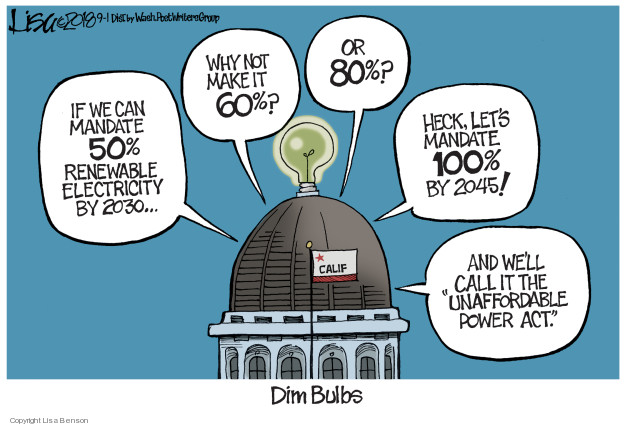
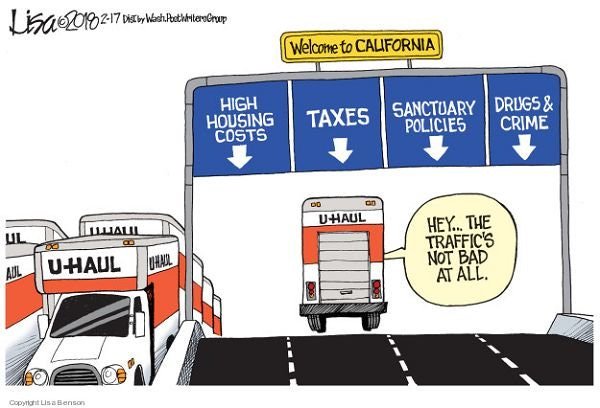
Lisa Benson cartoon

Summer still is weeks away, but already we have a winner in the fierce competition for the coveted title of “Dumbest New York Times opinion column of 2021.” The envelope please… and the winner is “Why Charles Koch Wins When Our Energy System Breaks Down,” by someone named Christopher Leonard. One really does have to read this column to grasp — actually, to marvel at — the inanity of Leonard’s argument, which can be summarized as follows.

Claim:
Our fossil-fuel infrastructure — pipelines in particular, and refineries as well — is “increasingly unreliable” and “dominated by a very small group of very profitable companies.”

Fact:  
Leonard does not tell us what he means in his assertion that U.S. pipelines are “increasingly unreliable” — it is easy to infer that he has no idea — but if we define “reliability” as the annual number of adverse pipeline incidents, there has been no trend since 2002, even as pipeline mileage increased almost 63 percent between 2004 and 2019.

Claim:
The Colonial Pipeline shut down in 2016, and again this month due to a cyberattack, but the five companies that own Colonial “profit handsomely off its operations and earn outsize profits in the face of the bottlenecks and supply squeezes caused by shutdowns.”

Fact:  
That is absurd: The pipeline generates revenue only when it is moving product; if it is not operational it is not generating revenue.

cb051921dapr20210518114504

Claim:
The 2016 shutdown “didn’t seem to hurt the owners’ earnings” in that afterward “Colonial boosted its annual dividends — at least in part because of the Trump administration’s 2017 tax cuts.”  The growth in Colonial’s investments in updating and protecting the pipeline have been “modest, while dividend payments have risen sharply.”

Fact:  
Apart from Leonard’s confusion about whether it is due to the 2016 shutdown or to the 2017 tax cut, he apparently has no concept of the factors addressed by corporate managers as they determine the appropriate dividend. In particular, a dividend change is driven by the evaluation of the after-tax return to shareholders from retaining more financial capital within the firm compared with that from distributing more to the shareholders. An increase in the dividend suggests that the latter has increased relative to the former, presumably in this case because of the nuances of the 2017 tax bill. Were the Kochs responsible for that?

Claim:
Charles Koch “has profited for years off similar energy bottlenecks in the upper Midwest” because of such infrastructure investments as the Pine Bend refinery, which “owes its profitability to its location in the middle of a broken fuel market.” Koch “buys cheap crude” in a market “oversupplied” with Canadian crude oil, after which “Koch then sells its finished fuel into an undersupplied gasoline market in the upper Midwest.”

Fact:  
And about that “oversupplied” (whatever that means) midwestern market for Canadian crude oil: The midwestern refinery market would be far less “oversupplied” had the Keystone XL pipeline been approved at long last, delivering heavy Canadian crude oil to the Gulf coast refineries designed to refine it. Did Charles Koch urge the Biden administration to reject the pipeline? Has Leonard criticized that decision? I can find no record of any such stance on his part.

And then there is Leonard’s assertion that the gasoline market in the upper Midwest is “undersupplied” (whatever that means). The Energy Information Administration divides the U.S. gasoline market into five regions (“PADDs”). As of May 24, Gulf Coast gasoline prices were the lowest, followed by the Midwest, and then (in ascending order) the East Coast, the Rocky Mountain states, and the West Coast, the last of which had the highest prices even excluding California. What is Leonard talking about?

Claim:
Regulatory hurdles have paved the way for these profits for decades.” “The Clean Air Act… made it nearly impossible for competitors to open a refinery near Pine  Bend” to increase competitive pressures.

Fact:  

The comedy highlight of Leonard’s column is the assertion that it is the Clean Air Act, regulatory obstacles to new pipeline investment, and general “regulatory stasis and dysfunction” that have yielded the “outsize profits” enjoyed by the Kochs. Leonard seems actually to believe this: “Just by letting the broken market limp along, Koch Industries reaps extraordinary profits from a broken system.” So the Kochs are vastly more powerful than anyone could imagine, responsible for the regulatory morass, for the ideological leftist political opposition to fossil infrastructure, for NIMBYism, and for allowing the “broken market” to “limp along.” Just as the pipeline owners win whether the pipelines are operating or not, Leonard clearly believes that they earn “outsize profits” whether the regulatory environment is light or dysfunctional. Who knew?

Claim: 
Regulatory fights benefit big refiners that can afford expensive legal experts and lobbyists: “Koch benefits from regulatory stasis and dysfunction.”

Fact:  

The utter stupidity of Leonard’s argument is illustrated by his assertion toward the end of the column that “new wind farms or solar installations could open up a whole new energy market.” Somehow, I was led to believe that Leonard’s argument was about pipelines and refineries and gasoline prices, and the ability of the Kochs to earn large profits no matter what. But no: An endorsement of unconventional electricity, expensive and environmentally destructive, just had to be shoehorned in as an exercise in virtue-signaling par excellence despite the reality that it has nothing to do with Leonard’s silly central argument. Or does he want to argue that more wind farms will reduce gasoline prices in the Midwest?

Conclusion

And so we arrive at the larger reality illustrated by the Leonard column. Misguided, illogical, and at odds with the facts, it is of a piece with the broad opposition of the environmental left to energy infrastructure generally, and pipeline investments in particular. Utter incoherence is the inevitable result of that ideological opposition to fossil fuels, one impervious to facts and analytic rigor, and dependent upon arguments fundamentally inconsistent. That opposition is anti-human at its core because it implies opposition to investment in human capital — education, training, health care, etc. — and the improved human well being that has the effect of increasing the demand for energy and its infrastructure. Forget the Kochs; they are a bogeyman and red herring the mere mention of which is intended to elicit a Pavlovian reaction from the enlightened invitees to the right cocktail parties.

The real bogeymen are the New York Times opinion editors who found such drivel fit to print, a measure of the intellectual depths to which they have sunk.

lb210522c20210521055437

See Also Shellenberger to NYT: Isn’t a correction merited?

Supremes Asked to Rule on EPA Energy Authorities

wrecking_ball_destroyEPABackground from Reed Smith lawyers The fall of Trump’s Affordable Clean Energy Rule and the strengthened EPA authority to regulate greenhouse gases.  Excerpts in italics with my bolds

The Affordable Clean Energy Rule

The EPA promulgated the ACE Rule in 2019 under the CAA, replacing the Obama administration’s 2015 Clean Power Plan (CPP). Both rules sought to reduce GHG emissions from the power sector; but where the CPP implemented broader industry-wide mechanisms, the ACE Rule limited reduction efforts to the actual source power plants.

The 2015 CPP offered “beyond the fenceline” tools for states to reduce emissions by replacing fossil fuels with renewable energy sources and participating in emissions credit-trading programs; however, in February 2016 the U.S. Supreme Court stayed the implementation of the CPP pending litigation in the D.C. Circuit. During the stay and subsequent freeze of litigation, the Trump administration rescinded the CPP and promulgated the ACE Rule.

In promulgating the ACE Rule, the Trump EPA took an alternative view of the CAA than the Obama EPA and reasoned that the CAA expressly limited the EPA’s power to only “at the source” emissions reduction options, such as heat rate improvement technologies. As a result, the Trump administration removed all of the CPP’s “beyond the fenceline” options and limited emissions restrictions to those applied directly to power plants.

DC Circuit Court of Appeal Ruling January 19, 2021

Judges Millett and Pillard of the D.C. Circuit Court disagreed with the (Trump) EPA’s interpretation. In the majority opinion, the Court concluded that there is “no bases—grammatical, contextual, or otherwise—for the EPA’s assertion” that its authority was limited to “at the source” controls. In the end, the Court vacated the ACE Rule and remanded it back to the EPA just in time for the Biden administration to take over.  The Court’s decision appears to clear the way for the Biden administration to regulate GHG emissions from the power sector.

In his first week in office, President Biden has taken a number of actions to undo many of the Trump administration’s environmental policy decisions, including rejoining the Paris Climate Accord. The new Biden EPA has also requested that the Department of Justice have all Trump-era litigation seeking judicial review of any EPA regulation promulgated between January 20, 2017 and January 20, 2021. Based on the Court’s show of support and the Biden Administration’s actions within the first week, we may see some of the Obama-era or similar regulation brought back to life in the coming months.

Petitions to Supreme Court April 29 and 30, 2021

The May Update at Columbia Climate Law Blog reports the latest development bringing the issue to Supreme Court attention:  States and Coal Company Sought Review of D.C. Circuit Decision Vacating Affordable Clean Energy Rule  Excerpts in italics with my bolds.

Two petitions for writ of certiorari were filed in the U.S. Supreme Court seeking review of the D.C. Circuit’s January opinion vacating EPA’s repeal and replacement of the Obama administration’s Clean Power Plan regulations for controlling carbon emissions from existing power plants. The first petition was filed by West Virginia and 18 other states that had intervened to defend the repeal and replacement rule, known as the Affordable Clean Energy rule. The states’ petition presented the question of whether Section 111(d) of the Clean Air Act constitutionally authorizes EPA “to issue significant rules—including those capable of reshaping the nation’s electricity grids and unilaterally decarbonizing virtually any sector of the economy—without any limits on what the agency can require so long as it considers cost, nonair impacts, and energy requirements.” They argued that Congress had not clearly authorized EPA to exercise such “expansive” powers and that the D.C. Circuit majority opinion’s interpretation was foreclosed by the statute and violated separation of powers. The states argued that the Supreme Court’s stay of the Clean Power Plan while it was under review by the D.C. Circuit in 2016 signaled that the legal framework for the Clean Power Plan “hinges on important issues of federal that EPA then—and the court below now—got so wrong this Court was likely to grant review.” The states contended that further delay in the Court’s resolution of these “weighty issues” would have “serious and far-reaching costs.”

The second petition was filed by a coal mining company. The coal company’s petition presented the question of whether Section 111(d) “grants the EPA authority not only to impose standards based on technology and methods that can be applied at and achieved by that existing source, but also allows the agency to develop industry-wide systems like cap-and-trade regimes.” The company argued that the D.C. Circuit erred by “untethering” Section 111(d) standards from the existing source being regulated. Like the states, the company contended that Supreme Court had already recognized the critical importance of this question when it stayed the Clean Power Plan.

The company argued that debates regarding climate change and policies to address climate change “will not be resolved anytime soon” but that “what must be resolved as soon as possible is who has the authority to decide those issues on an industry-wide scale—Congress or the EPA.”

EPA’s response to the petitions is due June 3, 2021. West Virginia v. EPA, No. 20-1530 (U.S. Apr. 29, 2021); North American Coal Corp. v. EPA, No. 20-1531 (U.S. Apr. 30, 2021).

Comment:  The question of decision authority seems especially urgent since no one knows who is the actual decider for the Executive Branch.


Shellenberger to NYT: Isn’t a correction merited?

This exchange became interesting to me since Google somehow blocked my access to the twitchy.com page where the tweet thread was published.  This, even though I was using DuckDuckGo in Dissenter browser, supposedly independent of Google.  TorBrowser saved the day, and here are Shellenberger’s tweets offered to NYT for them to salvage an embarrassing badly warped article.

The National Climate Bank Con

national-climate-bank-1-1536x803-1

At a Hearing April 27, 2021: “Legislative Hearing on S.283, National Climate Bank Act”, Benjamin Zycher provided testimony Summarized at AEI: Statement submitted for the record: Subcommittee on Clean Air, Climate, and Nuclear Safety, Committee on Environment and Public Works.

Summary

This Statement Submitted for the Record offers a critical review of legislation proposed in the 117th Congress, 1st Session, as S. 283, The National Climate Bank Act (hereafter NCBA), the subject of a hearing scheduled for April 27, 2021 before the Subcommittee on Clean Air, Climate, and Nuclear Safety of the Committee on Environment and Public Works. A summary of the arguments presented below is as follows:

  • A National Climate Bank cannot increase the capital resources available to the U.S. economy or to the federal government, and the true economic cost of the outlays envisioned to be made by the National Climate Bank would be almost double the notional budget.
  • The “climate” projects envisioned for the National Climate Bank would be highly inefficient regardless of the assumptions made about climate phenomena and the current and prospective effects of greenhouse gas emissions. This is because the envisioned projects would yield future climate impacts either trivial or undetectable. This explains the failure of the proposed legislation to specify a requirement or to offer a projection of reductions in GHG emissions attendant upon the projects to be funded by the National Climate Bank.
  • The “Findings” in the proposed legislation on current climate phenomena are not supported by the evidence.
  • The “Findings” in the proposed legislation on future climate phenomena are based upon Representative Concentration Pathway 8.5, an extreme scenario of future atmospheric concentrations of greenhouse gases virtually impossible.
  • Because the proponents of the National Climate Bank have based their analytic arguments in substantial part upon the findings and policy proposals presented by the Intergovernmental Panel on Climate Change in its Special Report “Global Warming of 1.5°C,” they implicitly are endorsing a gasoline tax of $28 per gallon by 2030.
  • The obvious underlying purpose of the National Climate Bank is a shift of political responsibility for the inevitable financial losses to be incurred from the Congressional proponents of the legislation to the administrators of the National Climate Bank. Such a shift is inconsistent with the basic constitutional structure of American governance, and thus with essential accountability inherent in our political institutions.
  • The actual results of a National Climate Bank would be substantial resource waste, a less-productive capital stock, lower wages, and an increase in the politicization of economic activity.

Read  the full report  Zycher Statement Senate EPW climate bank

Climate Piggy Bank

The Green Mirage

Mirage (2)

John Constable writes at Civitas The Green Mirage: Why a Low-Carbon Economy May be Further Off Than We Think.  Excerpts in italics with my bolds and images.  h/t Real Clear Public Affairs

Spain renewables

Findings:

  • The prospects for a sustainable, low-carbon economy as the result of current UK national and EU-wide policies are poor.
  • Empirical experience in Spain and Germany shows that the costs of supporting renewable energy generation are too high.
  • Rising employment in the renewable energy sector compared to the wider UK economy stems from unsustainably high subsidies.
  • Renewables are naturally less productive, so as they are relentlessly pursued, a painful rebalancing of the economy will occur, with fewer jobs and less economic growth.

green-and-environment

Bottom Line: The current prospects for a sustainable low-carbon economy are poor in both the UK and across the European Union (EU). Germany and Spain have already clearly shown what happens when state coercion forces such a dramatic shift to less reliable and more costly renewable energy systems: unsustainably high subsidies, fewer jobs, and reduced economic growth.

Whatever the longer-term potential for a viable and prosperous global economy with a low-emissions profile, the present study demonstrates that the prospects for a self-sustaining low-carbon economy as the result of current UK national and EU-wide policies are poor.

The problem is that these policies for such a shift to renewable energy systems demand high levels of state coercion. This has the risk of stagnating economic growth and leading to lower levels of invention and innovation, thus appearing to be a weak preparation for reduced usage of fossil fuels.

In addition, empirical experience in Spain and Germany shows that the costs of supporting renewable energy generation is overly high, compared to low-carbon alternatives, and almost certainly has, over time, net economic effects that are negative both in terms of gross domestic product and employment.

An age of subsistence energy generation appears to be dawning. Overly high subsidies to force renewable energy into the system erode jobs in other sectors of the economy.

Finally, analysis for the EU suggests that the net effects of such policies would only be marginally positive if the EU retains a high share of the world export market in renewable energy technologies – something that appears rather unlikely.

Read the full study here.

Footnote:  Excerpt from the full study:

In an interview with an environmental journalist for Ecoseed in early 2011, a spokesman for the industry body ASIF (Asociación de la Industria Fotovoltaica) remarked ‘The government cheated the solar investors by changing the law after it has lured them to invest their money in PV power plants… If you know that the government would change the law, you will never have invested in that technology and never have put your money in that market’.22 This implicitly concedes that the sector was from the outset likely to be a long-term client of the state, unable to survive without support, and should serve as a warning to other governments hoping to create independent renewables industries through subsidy.

green-octopus-10270


Biden’s EPA Goes Rogue on HFCs

earth_ozone_1
David Wojick writes at CFACT about the reckless move by EPA against vital industrial uses of hydrofluorocarbons  Crazy HFC phaseout is coming Excerpts in italics with my bolds.

In my first article — “Economically destructive cap and trade for HFCs is here” — I looked at the Kigali Amendment part of the American Innovation and Manufacturing Act or AIM. There the big problem is that the HFC cap is based on 8-10 year old data, which is mostly missing and probably inaccurate for today.

However, AIM adds some major rules to Kigali, rules which have their own problems.

In particular AIM singles out 6 industries and applications that use a lot of HFCs for special treatment. They get what are called “mandatory allocations” of allowances. In principle this means they get all the allowances they need for certain uses, for the next five years. Whether this actually happens or not is a serious problem.

The CFACT article goes on to explain how dangerous and reckless is this initiative by Biden’s EPA.  But the intended regulation is also illegal, and may end up in the Supreme Court since the plan is to violate a ruling of the DC Court of Appeals, written by then Judge Brett Kavanaugh.

dc-court-of-appeals

Background from previous post  Gamechanger: DC Appeals Court Denies EPA Climate Rules

A major clarification came today from the DC Court of Appeals ordering EPA (and thus the Executive Branch Bureaucracy) to defer to Congress regarding regulation of substances claimed to cause climate change.  While the issue and arguments are somewhat obscure, the clarity of the ruling is welcome.  Basically, the EPA under Obama attempted to use ozone-depleting authority to regulate HFCs, claiming them as greenhouse gases.  The judges decided that was a stretch too far.

The Court Decision August 8, 2017

The EPA enacted the rule in question in 2015, responding to research showing hydroflourocarbons, or HFCs, contribute to climate change.

The D.C. Circuit Court of Appeals’ 2-1 decision said EPA does not have the authority to enact a 2015 rule-making ending the use of hydrofluorocarbons commonly found in spray cans, automobile air conditioners and refrigerators. The three-judge panel said that because HFCs are not ozone-depleting substances, the EPA could not use a section of the Clean Air Act targeting those chemicals to ban HFCs.

“Indeed, before 2015, EPA itself maintained that Section 612 did not grant authority to require replacement of non ozone-depleting substances such as HFCs,” the court wrote.

“EPA’s novel reading of Section 612 is inconsistent with the statute as written. Section 612 does not require (or give EPA authority to require) manufacturers to replace non ozone-depleting substances such as HFCs,” said the opinion, written by Judge Brett Kavanaugh.

Contextual Background from the Court Document On Petitions for Review of Final Action by the United States Environmental Protection Agency  Excerpts below (my bolds)

In 1987, the United States signed the Montreal Protocol. The Montreal Protocol is an international agreement that has been ratified by every nation that is a member of the United Nations. The Protocol requires nations to regulate the production and use of certain ozone-depleting substances.

As a result, in the 1990s and 2000s, many businesses stopped using ozone-depleting substances in their products. Many businesses replaced those ozone-depleting substances with HFCs. HFCs became prevalent in many products. HFCs have served as propellants in aerosol spray cans, as refrigerants in air conditioners and refrigerators, and as blowing agents that create bubbles in foams.

In 2013, President Obama announced that EPA would seek to reduce emissions of HFCs because HFCs contribute to climate change.

Consistent with the Climate Action Plan, EPA promulgated a Final Rule in 2015 that moved certain HFCs from the list of safe substitutes to the list of prohibited substitutes. . .In doing so, EPA prohibited the use of certain HFCs in aerosols, motor vehicle air conditioners, commercial refrigerators, and foams – even if manufacturers of those products had long since replaced ozonedepleting substances with HFCs. Id. at 42,872-73.

Therefore, under the 2015 Rule, manufacturers that used those HFCs in their products are no longer allowed to do so. Those manufacturers must replace the HFCs with other substances that are on the revised list of safe substitutes.

In the 2015 Rule, EPA relied on Section 612 of the Clean Air Act as its source of statutory authority. EPA said that Section 612 allows EPA to “change the listing status of a particular substitute” based on “new information.” Id. at 42,876. EPA indicated that it had new information about HFCs: Emerging research demonstrated that HFCs were greenhouse gases that contribute to climate change. See id. at 42,879. EPA therefore concluded that it had statutory authority to move HFCs from the list of safe substitutes to the list of prohibited substitutes. Because HFCs are now prohibited substitutes, EPA claimed that it could also require the replacement of HFCs under Section 612(c) of the Clean Air Act even though HFCs are not ozone-depleting substances.

EPA’s current reading stretches the word “replace”  beyond its ordinary meaning. . .
Under EPA’s current interpretation of the word “replace,” manufacturers would continue to “replace” an ozone-depleting substance with a substitute even 100 years or more from now. EPA would thereby have indefinite authority to regulate a manufacturer’s use of that substitute. That boundless interpretation of EPA’s authority under Section 612(c) borders on the absurd.

In any event, the legislative history strongly supports our conclusion that Section 612(c) does not grant EPA continuing authority to require replacement of non-ozone-depleting substitutes.. . In short, although Congress contemplated giving EPA broad authority under Title VI to regulate the replacement of substances that contribute to climate change, Congress ultimately declined.

However, EPA’s authority to regulate ozone-depleting substances under Section 612 and other statutes does not give EPA authority to order the replacement of substances that are not ozone depleting but that contribute to climate change. Congress has not yet enacted general climate change legislation. Although we understand and respect EPA’s overarching effort to fill that legislative void and regulate HFCs, EPA may act only as authorized by Congress. Here, EPA has tried to jam a square peg (regulating non-ozone depleting substances that may contribute to climate change) into a round hole (the existing statutory landscape).

The Supreme Court cases that have dealt with EPA’s efforts to address climate change have taught us two lessons that are worth repeating here. See, e.g., Utility Air Regulatory Group v. EPA, 134 S. Ct. 2427 (2014). First, EPA’s well intentioned policy objectives with respect to climate change do not on their own authorize the agency to regulate. The agency must have statutory authority for the regulations it wants to issue. Second, Congress’s failure to enact general climate change legislation does not authorize EPA to act. Under the Constitution, congressional inaction does not license an agency to take matters into its own hands, even to solve a pressing policy issue such as climate change.

Footnote:  Looks like some judges found their big boy pants and applied US constitutional separation of powers against runaway executive climate actions.  Would such a decision have come without a skeptical President?

Could this be the first breach in the wall of unproven, unwarranted, federally funded climate activism?

Water rushes over damaged primary spillway at Oroville Dam in Northern California

Just One Number Keeps the Lights On

windmill20scam

David Wojick explains how maintaining electricity supply is simple in his CFACT article It takes big energy to back up wind and solar.  Excerpts in italics with my bolds. (H/T John Ray)

Power system design can be extremely complex but there is one simple number that is painfully obvious. At least it is painful to the advocates of wind and solar power, which may be why we never hear about it. It is a big, bad number.

To my knowledge this big number has no name, but it should. Let’s call it the “minimum backup requirement” for wind and solar, or MBR. The minimum backup requirement is how much generating capacity a system must have to reliably produce power when wind and solar don’t.

For most places the magnitude of MBR is very simple. It is all of the juice needed on the hottest or coldest low wind night. It is night so there is no solar. Sustained wind is less than eight miles per hour, so there is no wind power. It is very hot or cold so the need for power is very high.

In many places MBR will be close to the maximum power the system ever needs, because heat waves and cold spells are often low wind events. In heat waves it may be a bit hotter during the day but not that much. In cold spells it is often coldest at night.

Thus what is called “peak demand” is a good approximation for the maximum backup requirement. In other words, there has to be enough reliable generating capacity to provide all of the maximum power the system will ever need. For any public power system that is a very big number, as big as it gets in fact.

Actually it gets a bit bigger, because there also has to be margin of safety or what is called “reserve capacity”. This is to allow for something not working as it should. Fifteen percent is a typical reserve in American systems. This makes MBR something like 115% of peak demand.

We often read about wind and solar being cheaper than coal, gas and nuclear power, but that does not include the MBR for wind and solar.

What is relatively cheap for wind and solar is the cost to produce a unit of electricity. This is often called LCOE or the “levelized cost of energy”. But adding the reliable backup required to give people the power they need makes wind and solar very expensive.

In short the true cost of wind and solar is LCOE + MBR. This is the big cost you never hear about. But if every state goes to wind and solar then each one will have to have MBR for roughly its entire peak demand. That is an enormous amount of generating capacity.

Of course the cost of MBR depends on the generating technology. Storage is out because the cost is astronomical. Gas fired generation might be best but it is fossil fueled, as is coal. If one insists on zero fossil fuel then nuclear is probably the only option. Operating nuclear plants as intermittent backup is stupid and expensive, but so is no fossil fuel generation.

What is clearly ruled out is 100% renewables, because there would frequently be no electricity at all. That is unless geothermal could be made to work on an enormous scale, which would take many decades to develop.

unicorn

It is clear that the Biden Administration’s goal of zero fossil fueled electricity by 2035 (without nuclear) is economically impossible because of the minimum backup requirements for wind and solar. You can’t get there from here.

One wonders why we have never heard of this obvious huge cost with wind and solar. The utilities I have looked at avoid it with a trick.

Dominion Energy, which supplies most of Virginia’s juice, is a good example. The Virginia Legislature passed a law saying that Dominion’s power generation had to be zero fossil fueled by 2045. Dominion developed a Plan saying how they would do this. Tucked away in passing on page 119 they say they will expand their capacity for importing power purchased from other utilities. This increase happens to be to an amount equal to their peak demand.

The plan is to buy all the MBR juice from the neighbors! But if everyone is going wind and solar then no one will have juice to sell. In fact they will all be buying, which does not work. Note that the high pressure systems which cause low wind can be huge, covering a dozen or more states. For that matter, no one has that kind of excess generating capacity today.

To summarize, for every utility there will be times when there is zero wind and solar power combined with near peak demand. Meeting this huge need is the minimum backup requirement. The huge cost of meeting this requirement is part of the cost of wind and solar power. MBR makes wind and solar extremely expensive.

The simple question to ask the Biden Administration, the States and their power utilities is this: How will you provide power on hot or cold low wind nights?

Background information on grid stability is at Beware Deep Electrification Policies

More Technical discussion is On Stable Electric Power: What You Need to Know

cg4bbc1c620f5bf0

Unmasking Biden’s Climate Shakedown

kn121419dapc20191213114523

At Spectator, Real Jean Isaac explains How to End Biden’s Fake Climate Apocalypse.  Excerpts in italics with my bolds and images.

If there’s no pushback against the Left, we’ll see a dramatic drop in our standard of living.

With the wave of executive orders and legislation coming from the Biden administration, and the cultural antics of his woke supporters, Biden’s war on fossil fuels has received insufficient attention. Yet energy is the lifeblood of our economy, and making traditional energy sources vastly more expensive is the single most destructive aspect of Biden’s policies. If this country does not successfully mobilize against these policies, the vast majority will experience a dramatic drop in their standard of living.

mrz012921dbp20210129124515Supposedly the assault on fossil fuels — via regulation; cancellation of pipelines; concocting a huge, wholly imaginary “social cost of carbon”; taxes; and solar and wind mandates — is necessary to save the planet from imminent catastrophe produced by man-made global warming.

But genuine climate scientists, as we know from those who dare to speak up, are amazed and horrified. Richard Lindzen, long at the top of the field as a former professor of atmospheric sciences at MIT, laments that the situation gets sillier and sillier. He told the recent CPAC conference (his message was read by the Heartland Institute’s James Taylor):

“One problem with conveying our message is the difficulty people have in recognizing the absurdity of the alarmist climate message. They can’t believe that something so absurd could gain such universal acceptance. Consider the following situation. Your physician declares that your complete physical will consist in simply taking your temperature. This would immediately suggest something wrong with your physician. He further claims that if your temperature is 98.7F rather than 98.6F you must be put on life support. Now you know he is certifiably insane. The same situation for climate is considered “settled science.”

So how did an absurd message gain such widespread acceptance? The answer is something people find it hard to wrap their heads around: we aren’t dealing with science at all. We confront an apocalyptic movement, the kind of movement, recurring across time and space, that Richard Landes describes in Heaven on Earth: Varieties of the Millennial Experience. Its scientific veneer makes it credible to a modern audience. If today a charismatic leader cried, “Repent. Sacrifice your goods. The end of the earth is nigh,” at best he might attract a few dozen oddball followers. But when essentially the same message is clothed in the language of science, it sweeps the world.

In Roosters of the Apocalypse I point out the uncomfortable similarities between the global warming apocalypse and the apocalypse that led the Xhosa tribe (in today’s South Africa) in 1856 to destroy their economy, which was based on cattle as ours is on energy. Relying on the vision of a 15-year-old orphan girl, the Xhosa killed an estimated half million of their cattle, ceased planting crops, and destroyed their grain stores. In return the girl promised the Xhosa’s ancestors would drive out the British and bring an even greater abundance of cattle and grain. By the end of 1857 a third to a half of the population — between 30,000 and 50,000 souls — had starved to death.

cg5d8c4e469b40d

Even the age of the “prophetic” girl suggests a modern parallel. Greta Thunberg didn’t start the global warming apocalypse, but she was 15 when she began spending her school days in front of the Swedish Parliament carrying a sign reading “School Strike for Climate,” heralding the international children’s crusade against global warming she would lead a year later.

In some ways the current apocalypse is surprising. Landes reports that to be successful, an apocalypse needs to bring elites on board, and elites tend to be a hard sell, especially when prophecies demand a society self-mutilate. But in this case not only have elites been won over with breathtaking ease, but they have proved more susceptible over time than the man in the street. A recent Gallup poll found only 3 percent of the public citing climate as a key concern.

gv020921dapr20210209064505

If people understand the menace that global warming policies pose to their way of life, there should be a huge pool of followers.

Dissent is drowned out as educational, political, media, cultural, and business elites speak with one voice. Even fossil fuel companies have thrown in the towel. The American Petroleum Institute, the oil industry’s top lobbying group, is set to propose setting a price on carbon emissions. Children are being indoctrinated in global warming doctrine from kindergarten on, in humanities as well as science classes. My granddaughter, in sixth grade in a Manhattan public school, has a class in “Clifi” (Climate Fiction), where the children read stories on the dreadful aftermath of a climate apocalypse. Politicians at the state and local level pass mandates for expensive (and unreliable) renewables to replace fossil fuels at ever earlier dates. Even conservatives are caught up in the fever. At the most recent CPAC a group urged Republicans to “get in front” on the issue and outflank the Democrats.

What can be done to prevent the global warming locomotive from steamrolling over our economy?

Thus far efforts have focused on countering global warming science with better science. The Chicago-based Heartland Institute has organized 13 international conferences since 2008. The media has all but blacked out coverage, so neither the conferences nor the steady stream of climate research the Institute publishes receive any notice. The CO2 Coalition, which emphasizes that CO2, far from being a pollutant, is a nutrient vital for life, is given similar short shrift. For example, although the coalition includes distinguished scientists, Wikipedia defines it as “a climate change alarmist denial advocacy organization,” whose claims “are disputed by the vast majority of climate scientists.”

There are also excellent websites, such as Climate Depot, offering space to scientific research casting doubt on apocalyptic claims. Marc Morano, who runs the site, had the distinction in 2009 of being chosen by news outlet Grist as one of only five “criminals against humanity, against planet Earth itself” and in 2012 of being named “Climate Change Misinformer” of the Year by Media Matters.

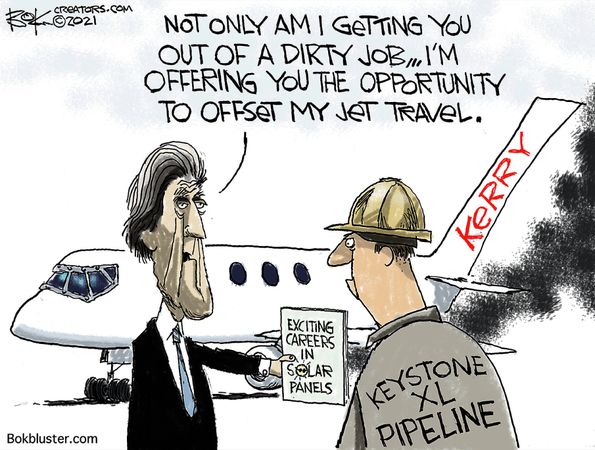
Pitting one scientific study against another hasn’t worked. That’s because most climate scientists are on the global warming grant gravy train, the public can’t follow the abstruse language of academic studies of climate, and the apocalypse is only superficially about climate anyway. Under the circumstances, a mass movement against this folly would seem to be the only way to get through to a larger public. If people understand the menace that global warming policies pose to their way of life, there should be a huge pool of followers. Texas might be a good place to start, given its recent unexpected stay in the freezing dark, and the stark failure of its wind turbines. One advantage of such a movement is that it would cross party lines. Democratic-voting union members stand to lose their well-paid jobs in fossil fuel industries, with workers in China cornering much lower-paid jobs in solar and wind (despite pie-in-the-sky promises by President Biden and newly appointed climateer-in-chief John Kerry).

gv012621dapr20210126094504

The new movement could be titled “Lights On.” Participants should have fun. There was never a claim of “settled science” more ripe for ridicule. How about contests for college students rewarding those who can document the largest number of disproven prophecies of global warming doom (for example, the end of snow, no more Arctic glaciers, U.S. coasts under water, all with specified dates now long past)? In Breitbart, John Nolte recently claimed to have found 44 of them. There can be no shortage of candidates for an award of “False Prophet of the Year.” Or “Global Warming Hypocrite of the Year,” for which John Kerry would be an outstanding candidate with his private jet, yachts, multiple mansions, and cars. And what about an award to a prominent media figure for the most absurd claim for global warming causation? One of Lindzen’s favorites is the Syrian civil war.

And how about reviving the chronicle of Climategate, which almost wiped out faith in the apocalypse before the media buried the scandal? In 2009, a hacker downloaded candid emails among top climate scientists in England and the United States that bemoaned recalcitrant data, described the “tricks” (their term) used to coax the data, reported efforts to keep the views of dissenters out of reputable journals and UN reports, and boasted of deletion of data to make it unavailable to other researchers. “If science is on your side, why do you need to make it up?” would make a good bumper sticker or t-shirt slogan.

cb030221dapr20210302094524

There could be a bumper sticker with comedian George Carlin’s line: “The Planet has been through a lot worse than us.” There could be t-shirts that proclaim, “Wind Is for Sailboats.” There should be songs and cartoons (many of these can already be found on the website WattsUpWithThat.com).

The movement can have fun, but it must also be serious: members will only back politicians prepared to fight to maintain our access to cheap, reliable energy. To the extent solar and wind can someday compete on an even playing field, without subsidies and mandates, they are welcome to the energy mix.

For the current apocalypse to come to an end, the notion that man-made global warming poses an existential threat must come to be seen as ridiculous. Otherwise the policies of shutting down our traditional energy supplies to stave off this absurd end of days will themselves become an existential threat.

Gang Green

Biden’s Bogus Climate Report

scc-working-group

The latest criticism comes from James Broughel writing at Real Clear Politics Biden’s Climate Report Is Based on Personal Values, Not Science. Excerpts in italics with my bolds.

Late last month, the Biden administration quietly released an update of the government’s “social cost of carbon” (SCC) estimate, a metric used to value the benefits of global warming policies, especially regulations. The update hasn’t received much attention yet, but it will be important in justifying the administration’s climate agenda in the months ahead.

There are numerous shortcomings with the Biden team’s calculations. Some may be due to the report being rushed, but others reflect misunderstanding of economic principles, and, more simply, poor judgment.

Biden’s People Get the Units Wrong

First, numerous tables in the document released by the administration are mislabeled. The interagency working group that produced the update claims its primary estimate of the SCC is 51 dollars per ton. But the models the working group uses calculate the figure in terms of social welfare — not dollars. Thus, 51 is a measure of the amount that the current generation’s “welfare” is reduced by carbon pollution. Even assuming that number is credible (and measuring welfare is no easy task), the administration doesn’t get the units right.,

This is a big deal because the numbers in the new report shouldn’t be used in cost-benefit analysis unless further adjustments are made. Cost-benefit analysis is supposed to measure impacts in dollars, not the Biden administration’s social welfare units. So any analysis that tries to compare these numbers to financial costs will be nonsensical. These problems with units extend to estimates of the social cost of methane and of nitrous oxide, which also appear in last month’s report.

Misleading Social Discount Rate

There are other misleading parts of the document. For example, there is extensive discussion about the correct “social discount rate” to use in cost-benefit analysis. The social discount rate describes how much less a future benefit from a policy should count relative to a present benefit. For example, many economists generally assume a life saved in 100 years is far less valuable than a life saved today — which is, of course, controversial and has implications beyond economics.

The report makes a number of dubious claims about the social discount rate, but here are just a few worth highlighting.

First, Biden’s team argues that risk-free market interest rates have declined in recent years, and that this provides a basis for using a lower social discount rate. However, claims like this reflect a misunderstanding of the discounting concept.

The decision of how much to weight future health, wellbeing, and lives saved is an ethical choice. One cannot find the correct social discount rate by opening up the Wall Street Journal and turning to the page on interest rates. Ultimately, we need some philosophical compass to guide our choice. Yes, one could choose to base an ethical decision on market criteria, but one could just as easily choose an alternative paradigm, like introspection. Nor should this issue be conflated with the rate of return on capital, which is a separate issue that is sometimes confused with social discounting.

In fact, it would be just as legitimate to pick any plausible number out of a hat (you might laugh, but some approaches do draw a discount rate from a distribution of rates based on surveys of economists). Whatever method is chosen, the choice of the social discount rate is inevitably a value judgment.

Similarly, the report tries to justify lower discount rates in the future by pointing to “Ramsey discounting,” a method named after the early 20th century mathematician Frank Ramsey. Under this approach, analysts assume a benevolent dictator — a proxy for our whole generation’s social welfare — centrally plans the economy. Economists have concocted various mathematical schemes to estimate how the dictator discounts the future.

Again, because the choice is an ethical one, there is no particular reason to believe this Ramsey discounting approach is wrong. But there’s no reason to believe it’s right, either.

Personal Preferences, Not Science

The problem with the government’s report is that it presents these various approaches as somehow scientific. In fact, they conceal what is fundamentally a question about values and make it appear as though the answer can come from technical measurement.

Perhaps most concerning is that the administration is already violating its own principles of social justice. In a memo signed by President Biden on his first day in office, he identified promoting the interests of future generations as a top priority, which is a noble goal, to be sure.

But the SCC is calculated using a version of the Ramsey model. In it, the present generation functions as the dictator whose welfare is measured, while the welfare of future generations counts for basically nothing. Present citizens may display some empathy for future generations — for example, the administration’s climate policy is probably motivated by their concern for the future — but the analysis doesn’t consider the welfare of future generations in a direct way.

The new social cost of carbon report comes across like an attempt by experts to ram through a political agenda, while trying to pass off their efforts as scientific. But the public should not be fooled. What’s behind the updated numbers is the administration’s personal values, for better or worse, not science.

Background from Previous Post Biden’s Arbitrary Social Cost of Carbon: What You Need to Know

The news on Friday was Biden signing another order, this one restoring the so-called “Social Cost of Carbon” to Obama’s $51 a ton, along with threats to raise it up to $125 a ton.  The whole notion is an exercise in imagination for the sake of adding regulatory costs to everything involving energy,  that is to everything.  A background post below describes the history of how this ruse started and the manipulations and arbitrary assumptions to gin up a number high enough to hobble the economy.

Background from 2018 post: US House Votes Down Social Cost of Carbon

The House GOP on Friday took a step forward in reining in the Obama administration’s method of assessing the cost of carbon dioxide pollution when developing regulations.

The House voted 212-201, along party lines, to include a rider blocking the use of the climate change cost metric to an energy and water spending bill.

The amendment offered by Texas Republican Rep. Louie Gohmert bars any and all funds from being used under the bill to “prepare, propose, or promulgate any regulation that relies on the Social Carbon analysis” devised under the Obama administration on how to value the cost of carbon. (Source Washington Examiner, here)

To clarify: the amendment in question defunds any regulation or guidance from the federal government concerning the social costs of carbon.

Background: 
The Obama administration created and increased its estimates of the “Social Cost of Carbon,” invented by Michael Greenstone, who commented on the EPA Proposed Repeal of CO2 emissions regulations.  A Washington Post article, October 11, 2017, included this:

“My read is that the political decision to repeal the Clean Power Plan was made and then they did whatever was necessary to make the numbers work,” added Michael Greenstone, a professor of economics at the University of Chicago who worked on climate policy during the Obama years.

Activists are frightened about the Clean Power Plan under serious attack along three lines:
1. No federal law governs CO2 emissions.
2. EPA regulates sites, not the Energy Sector.
3. CPP costs are huge, while benefits are marginal.

Complete discussion at CPP has Three Fatal Flaws.

Read below how Greenstone and a colleague did exactly what he now complains about.

Social Cost of Carbon: Origins and Prospects

The Obama administration has been fighting climate change with a rogue wave of regulations whose legality comes from a very small base: The Social Cost of Carbon.

The purpose of the “social cost of carbon” (SCC) estimates presented here is to allow agencies to incorporate the social benefits of reducing carbon dioxide (CO2) emissions into cost-benefit analyses of regulatory actions that impact cumulative global emissions. The SCC is an estimate of the monetized damages associated with an incremental increase in carbon emissions in a given year. It is intended to include (but is not limited to) changes in net agricultural productivity, human health, property damages from increased flood risk, and the value of ecosystem services due to climate change. From the Technical Support Document: -Technical Update of the Social Cost of Carbon for Regulatory Impact Analysis -Under Executive Order 12866

A recent Bloomberg article informs on how the SCC notion was invented, its importance and how it might change under the Trump administration.
How Climate Rules Might Fade Away; Obama used an arcane number to craft his regulations. Trump could use it to undo them. (here). Excerpts below with my bolds.

In February 2009, a month after Barack Obama took office, two academics sat across from each other in the White House mess hall. Over a club sandwich, Michael Greenstone, a White House economist, and Cass Sunstein, Obama’s top regulatory officer, decided that the executive branch needed to figure out how to estimate the economic damage from climate change. With the recession in full swing, they were rightly skeptical about the chances that Congress would pass a nationwide cap-and-trade bill. Greenstone and Sunstein knew they needed a Plan B: a way to regulate carbon emissions without going through Congress.

Over the next year, a team of economists, scientists, and lawyers from across the federal government convened to come up with a dollar amount for the economic cost of carbon emissions. Whatever value they hit upon would be used to determine the scope of regulations aimed at reducing the damage from climate change. The bigger the estimate, the more costly the rules meant to address it could be. After a year of modeling different scenarios, the team came up with a central estimate of $21 per metric ton, which is to say that by their calculations, every ton of carbon emitted into the atmosphere imposed $21 of economic cost. It has since been raised to around $40 a ton.

Trump can’t undo the SCC by fiat. There is established case law requiring the government to account for the impact of carbon, and if he just repealed it, environmentalists would almost certainly sue.

There are other ways for Trump to undercut the SCC. By tweaking some of the assumptions and calculations that are baked into its model, the Trump administration could pretty much render it irrelevant, or even skew it to the point that carbon emissions come out as a benefit instead of a cost.

The SCC models rely on a “discount rate” to state the harm from global warming in today’s dollars. The higher the discount rate, the lower the estimate of harm. That’s because the costs incurred by burning carbon lie mostly in the distant future, while the benefits (heat, electricity, etc.) are enjoyed today. A high discount rate shrinks the estimates of future costs but doesn’t affect present-day benefits. The team put together by Greenstone and Sunstein used a discount rate of 3 percent to come up with its central estimate of $21 a ton for damage inflicted by carbon. But changing that discount just slightly produces big swings in the overall cost of carbon, turning a number that’s pushing broad changes in everything from appliances to coal leasing decisions into one that would have little or no impact on policy.

According to a 2013 government update on the SCC, by applying a discount rate of 5 percent, the cost of carbon in 2020 comes out to $12 a ton; using a 2.5 percent rate, it’s $65. A 7 percent discount rate, which has been used by the EPA for other regulatory analysis, could actually lead to a negative carbon cost, which would seem to imply that carbon emissions are beneficial. “Once you start to dig into how the numbers are constructed, I cannot fathom how anyone could think it has any basis in reality,” says Daniel Simmons, vice president for policy at the American Energy Alliance and a member of the Trump transition team focusing on the Energy Department.

David Kreutzer, a senior research fellow in energy economics and climate change at Heritage and a member of Trump’s EPA transition team, laid out one of the primary arguments against the SCC. “Believe it or not, these models look out to the year 2300. That’s like effectively asking, ‘If you turn your light switch on today, how much damage will that do in 2300?’ That’s way beyond when any macroeconomic model can be trusted.”

Another issue for those who question the Obama administration’s SCC: It estimates the global costs and benefits of carbon emissions, rather than just focusing on the impact to the U.S. Critics argue that this pushes the cost of carbon much higher and that the calculation should instead be limited to the U.S.; that would lower the cost by more than 70 percent, says the CEI’s Mario Lewis.

Still, by narrowing the calculation to the U.S., Trump could certainly produce a lower cost of carbon. Asked in an e-mail whether the new administration would raise the discount rate or narrow the scope of the SCC to the U.S., one person shaping Trump energy and environmental policy replied, “What prevents us from doing both?”

See Also:

Six Reasons to Rescind Social Cost of Carbon

SBC: Social Benefits of Carbon

drain-the-swamp

Beware Woke Financiers Gambling with Your Money

atlantic-casino

Andrew Stuttaford explains how the Biden regime encourages capitalists to spend investors’ wealth on projects favored by progressives for virtue rather than profit. His National Review article is Rule by Regulation. Excerpts in italics with my bolds.

The fondness of the Biden administration for rule by regulation is hardly a secret by now, and, when it comes to telling corporations that they should run themselves according to the precepts of stakeholder capitalism, the regulatory route comes with an added advantage.

To be sure, many companies, particularly larger ones, are already falling into line without any pressure from the state, because it suits the interests of managers (shareholders can be such a demanding bunch) and/or because they have been pushed to do so by a handful of large investment managers who can see the opportunity that “socially responsible” investing (SRI), an investment philosophy intertwined with stakeholder capitalism, represents for them, if not for their clients.

Other managements, however, would prefer to continue to run their businesses for the benefit of the shareholders (a stance, incidentally, that is rather more sophisticated than the usual Gekko caricature). Forcing such businesspeople to change their ways through legislation might be tricky, even in the current political environment. While SRI will continue to spread through the private sector, many in Washington, D.C., would like this “progress” to move forward at a faster clip. If that is to happen, regulation will have to play a central role. Key regulators seem only too happy to oblige. The last few months have seen a “greening” of the Fed that shows little sign of slowing down.

From the Financial Times last month:

After years of silence on the topic, the Fed has started to put climate issues centre stage. Shortly after Biden won the election, the central bank highlighted climate change as a threat to financial stability and moved to join the Network for Greening the Financial System, a consortium of central banks dedicated to supporting the goals of the Paris climate accord.

Now with Trump out of office and the Biden administration pushing hard to make up lost ground in the climate fight, Fed officials are speaking out more explicitly about climate risk and how they intend to take action.

“Financial institutions that do not put in place frameworks to measure, monitor, and manage climate-related risks could face outsized losses on climate-sensitive assets caused by environmental shifts, by a disorderly transition to a low-carbon economy, or by a combination of both,” said Federal Reserve governor Lael Brainard, at the Institute of International Finance’s inaugural climate finance summit yesterday.

Brainard is wrong, but in two different ways. The idea that climate change represents a material risk to the financial system at any time in the reasonably near future is laughable. I will turn, as I so often do, to the talk given by economist John Cochrane to a conference organized by the European Central Bank (ECB) last fall:

Let me point out the unclothed emperor: climate change does not pose any financial risk at the one-, five-, or even ten-year horizon at which one can conceivably assess the risk to bank assets. Repeating the contrary in speeches does not make it so.

Risk means variance, unforeseen events. We know exactly where the climate is going in the next five to ten years. Hurricanes and floods, though influenced by climate change, are well modeled for the next five to ten years. Advanced economies and financial systems are remarkably impervious to weather. Relative market demand for fossil vs. alternative energy is as easy or hard to forecast as anything else in the economy. Exxon bonds are factually safer, financially, than Tesla bonds, and easier to value. The main risk to fossil fuel companies is that regulators will destroy them, as the ECB proposes to do, a risk regulators themselves control. And political risk is a standard part of bond valuation.

That banks are risky because of exposure to carbon-emitting companies; that carbon-emitting company debt is financially risky because of unexpected changes in climate, in ways that conventional risk measures do not capture; that banks need to be regulated away from that exposure because of risk to the financial system—all this is nonsense. (And even if it were not nonsense, regulating bank liabilities away from short term debt and towards more equity would be a more effective solution to the financial problem.) [More on Cochrane’s thinking in linked post at end.]

The real aim of the emerging central-bank game is two-fold. Firstly, to increase the cost of capital for climate sinners by “discouraging” banks from lending to them and secondly, by mandating disclosure of such risks (and you can be sure that claims that they are minimal will not be acceptable) as a means to give climate warriors information that they can then use as a cudgel against financial institutions lending to the wrong sort of clients.

Such a disclosure regime would be designed to help activists, not shareholders. It would have nothing to do with “risk.”

The biggest risk to those climate sinners (specifically the fossil-fuel companies) may well come from the steps that regulators may take against them, a fact with more than a hint of a circular argument about it.

To the extent that they apply to all companies, the underlying aim will be to use disclosure not for the purposes of investor protection, but, one way or another, to ensure that every public company is browbeaten into ideological conformity.

Beyond that, it is easy to see that mandated disclosure of what companies are doing might well become, in time, the basis for setting standards for what they should be doing. And the more that the ability to impose that requirement is within the power of regulators alone (as opposed to having to involve legislators), the greater the likelihood that this will take place.

Then there’s Brainard’s reference to the risk posed by a “disorderly” transition to a low-carbon economy, whatever she means by that. If there is to be a transition to a low-carbon economy it would best be achieved in (so to speak) a “disorderly” fashion, without the command-and-control measures that much of the establishment now appear to favor, measures that are almost guaranteed to prove immensely destructive. Those who think otherwise should take a look at California or Germany’s disastrous Energiewende. The contribution of government should consist of some support for basic research, the odd legislative nudge, and the big bucks should go toward infrastructure programs to toughen our resilience to “weather,” whatever the climate may do: sea defenses for low-lying cities, winterizing the Texas grid, and so on. Much of the spending in that last category would likely pay for itself within a relatively short time.

All in all, this does not look like good news for those shareholders who prefer to focus on profitability, return on capital and other such ancient metrics.

And it won’t be too great for the economy either.

Resources:  John Cochrane’s Central Banking Presentation at post Bankers Should Mind Their Own Business, not the Climate

esg-smoke-and-mirrors

See also:  Financiers Failed Us: Focused on Fake Crisis