Let’s Scrub Away Climate Change

Carbon Dioxide Scrubber

Ross McKitrick says Jeff Bezos has put enough money on the table to vanish climate change concerns, except for those who won’t let go. He writes at Financial Post: It’s never enough with climate activists — even a staggering $10 billion from Jeff Bezos. Excerpts in italics with my bolds.

Observers might conclude activists don’t care about the climate per se but instead want to impose a big-government central planning regime

Jeff Bezos, the mega-billionaire founder/owner of Amazon, just announced he will give US$10 billion to “fight climate change.” According to CNN, this followed immense pressure from his employees to take action. And, as is inevitable with this issue, as soon as he made the announcement his activist employees declared it wasn’t enough.

“We applaud Jeff Bezos’s philanthropy, but one hand cannot give what the other is taking away,” their group sniffed. “Will Jeff Bezos show us true leadership or will he continue to be complicit in the acceleration of the climate crisis, while supposedly trying to help?”

It is never enough with climate activists. Bezos’s US$10 billion is a staggering sum. But it’s also a drop in the bucket compared to what governments have spent over the past two decades on the climate issue. Yet activists keep complaining governments aren’t doing anything, either.

One begins to suspect they are not being up front about what they really want.

Politically minded observers might conclude activists do not care about the climate per se but instead want to impose a big-government central planning regime — for which the supposed climate emergency is merely a pretext. Any response to their demands that leaves the market system intact is therefore inadequate.

So where should Bezos direct his money?

If he really wants to make the world a better place, he should fund the invention of a low-cost carbon scrubber. If ever someone could invent a device that filters carbon dioxide out of a smokestack or tailpipe and turns it into a stable solid that can be cheaply disposed of or even used for another purpose, all for under $5 or $10 per tonne, the entire climate change issue would vanish.

Such a scrubber would mean we could carry on using fossil fuels while decoupling them from greenhouse gas emissions. We would continue getting all the benefits of cheap fossil energy without any climate side-effects. This is what we did with sulphur dioxide. The invention of sulphur scrubbers meant we could keep enjoying the benefits of fossil energy without the harm of acid rain. Now let’s do the same with carbon dioxide.

The only reason climate change is such a big, intractable worldwide issue is precisely that we cannot currently decouple fossil fuel use from carbon dioxide emissions, so trying to achieve deep emission reductions means imposing harsh costs on the world economy. But if carbon dioxide could be cheaply reduced while we continued to burn fossil fuels, that problem would be resolved.

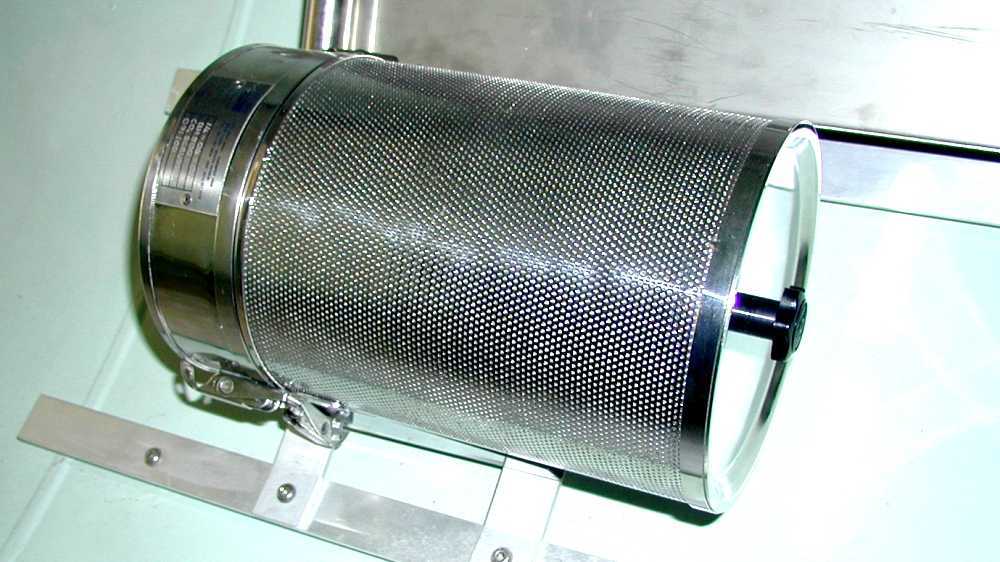
Prototype Anti-smog Device

Once you realize this, you can then complete the thought-experiment by posing the question: Who would be the saddest people in the world if a cheap carbon-scrubber were invented? Answer: climate activists. They would almost certainly be bitterly crestfallen if ever an inexpensive technological fix resolved the climate issue. I say this because they so often give the impression their real motivation is not concern about the climate but rather a strange abhorrence of the modern world. The giveaway is their angry reaction to any information showing climate change isn’t a crisis — even though they of all people should be most cheered when such research appears.

Here is a useful litmus test for whether you or someone you know is an environmentally conscious person who wants to take a responsible stance on the climate issue.

Suppose Bezos funds a project that does invent a cheap carbon-scrubber and he gives away the technology so that overnight the need for climate policy vanishes (other than a requirement to use the scrubber). Our entire apparatus of climate policy would then become unnecessary. Ethanol mandates, electric vehicle subsidies, energy efficiency regulations, pipeline bans, the coal phaseout, natural gas bans for new homes, the oilsands emissions cap, et cetera — all of it could be eliminated and carbon dioxide emissions would plummet nonetheless. The Paris treaty would be redundant. There would be no more “conferences of the parties,” no more UN summits, and an end to the vast climate bureaucracies around the world — all of it replaced by quick, cheap and easy emission reductions. The litmus question:

Would that strike you as wonderful news or leave you bereft, your purpose in life lost?

“Wonderful news” is the correct answer. If you got it wrong, please stop blocking roads and railways and get some psychological help.

Ross McKitrick is a professor of economics at the University of Guelph.

Not to mention no more Fridays for the Future.

US Gas Crushes Wind and Solar

Jude Clemente reports at Forbes The Obvious Reality Of More U.S. Oil And Natural Gas
Excerpts in italics with my bolds.

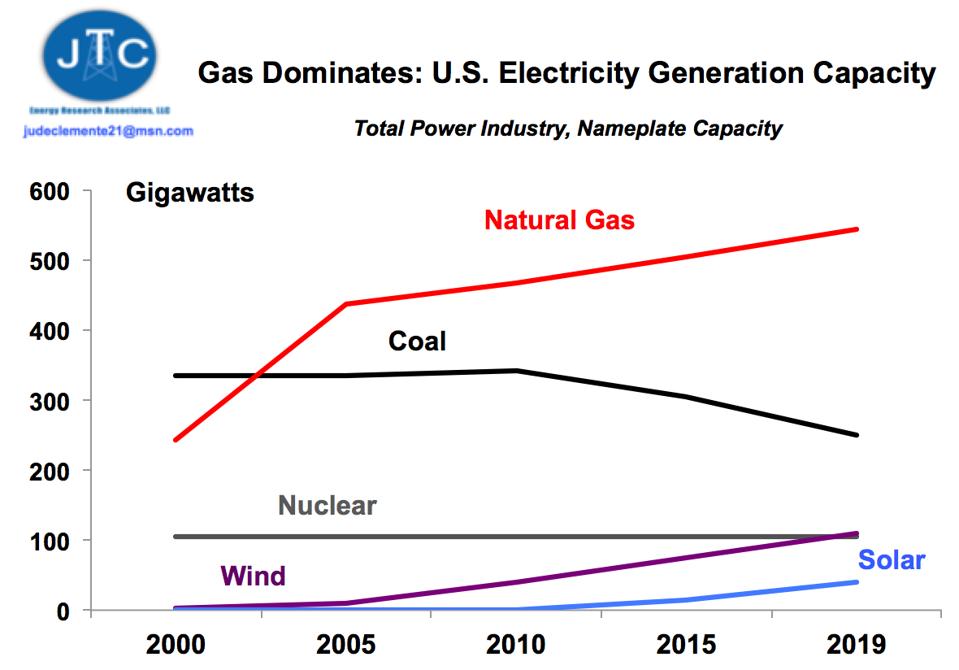
Natural gas overwhelmingly dominates the U.S. electric power system, double second place coal. Gas is cleaner, cheaper, more flexible, and more reliable. Gas will supply over 40% of our power this summer and is racing toward being 50% of total generation capacity. Just think about the scale of that. For every 100 power plants in America that create electricity, 50 of them will run on natural gas (see Figure above). Further, the International Energy Agency has specifically credited the rise of gas in our power system as the reason why we are slashing CO2 emissions faster than any other country ever.

Understanding this reality, we must continue to resist growing “energy unrealism.” More bluntly, a fracking ban would be the worst policy for American economic, energy, and environmental security ever “nightmared” possible. Fracking accounts for some 80% of U.S. gas production and will represent almost all of incremental domestic supply.

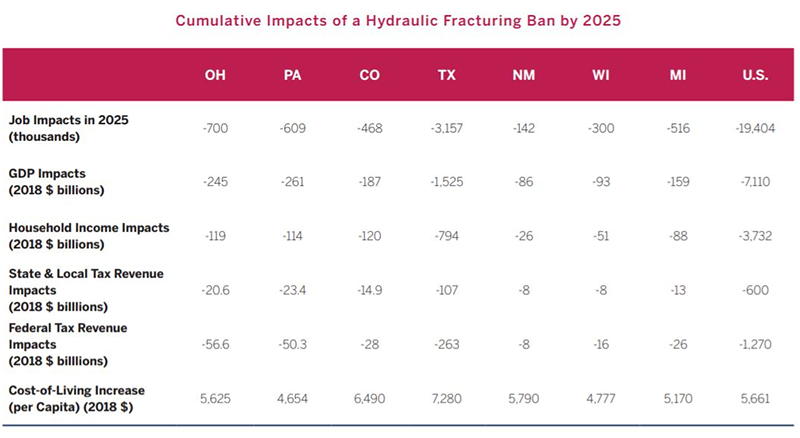
So why do some presidential candidates want to slash $7.1 trillion and 19 million jobs from the U.S. economy from 2021 to 2025?

Indeed, the “shoot yourself in the foot” energy policies of California, New York, and the New England states cannot be allowed to go national. Even though gas is their primary source of electricity, these states have installed anti-production and anti-pipeline policies. Thus, their power prices are 50% or more above the national average and they are addicted to energy imported from other states. Massachusetts has been forced to import natural gas by ship from Russia over the previous two winters.

Too illustrate, like too often eating out at an expensive restaurant, California in some years has been importing a staggering 95% of its gas and 33% of its electricity. Talk about unsustainable. As we saw with the 2018 “Yellow Vest” riots in Paris against carbon taxes, Americans will not stand for such purposely installed expensive energy.

As fracking is set to make the U.S. the world’s largest oil and gas exporter, “Fiona Hill educates Democrats: Fracking hurts Putin.”

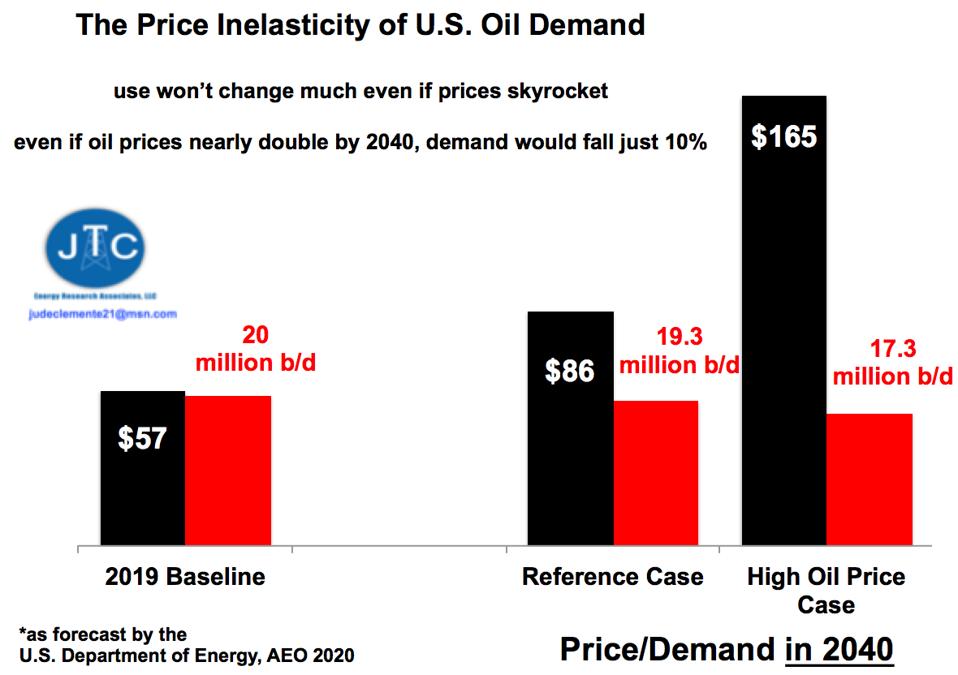
Further, fracking has soared U.S. crude oil production 160% to over 13 million b/d since 2008. This is a huge deal since oil remains our most vital source of energy, lacking any material substitute whatsoever. The U.S. Department of Energy has consistently modeled this to be true: since oil is an inelastic good, even drastic rises in pricing have little impact on demand (see Figure below).

This is hardly a surprise since overly expensive electric cars still account for just 1-2% of annual U.S. passenger car purchases. No kidding. The average Tesla buyer makes $400,000 a year – seven times the national average. Quietly even worse, “Taxpayer subsidies for electric vehicles only help the wealthy,” and “The U.S. Should Ban All Electric Cars in the Interest of National Security.”

The oil industry knows that it must tread lightly these days but is also wisely banking on oil as the ultimate indispensable product: “oil cannot not be used.” As for oil’s much reported on “social license to operate,” a reality check: “Exxon Isn’t the Oil User. You Are.”

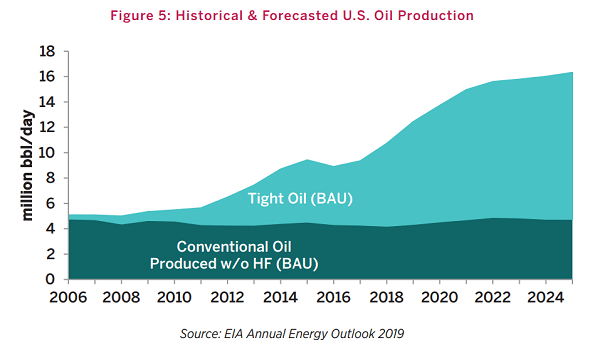
For our own supply, fracking accounts for some 80% of U.S. oil production, and fracking will yield basically all new output for decades to come. The U.S. Department of Energy reports that fracking has the potential to skyrocket U.S. crude output another 50% or so to nearly 20 million b/d.

Indeed, OPEC’s and Vladimir Putin’s worst nightmare come true.

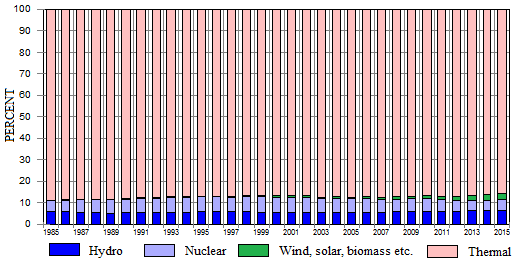
Figure 12: Figure 9 with Y-scale expanded to 100% and thermal generation included, illustrating the magnitude of the problem the G20 countries still face in decarbonizing their energy sectors. (Thermal refers to energy from oil, gas and coal.)

See Also  What If the US Banned Fracking?

Climateers Tilting at Windmills


Extinction Rebels Work on Wall Street

Raising alarms about the climate extincting humans is not only fun, but profitable. Just ask J.P. Morgan who recently put out a treatise pumping up the alarm.  Tyler Durden writes at Zero Hedge “The Human Race Could Go Extinct”: JPMorgan Fearmongers Climate Change Impact In Leaked Report. Excerpts in italics with my bolds.

A new explosive report from JP Morgan was leaked out this week titled “Risky business: the climate and the macroeconomy” warns climate change poses a significant macroeconomic risk to the world economy and could result in a “catastrophic” event.

“The response to climate change should be motivated not only by central estimates of outcomes but also by the likelihood of extreme events (from the tails of the probability distribution). We cannot rule out catastrophic outcomes where human life as we know it is threatened,” the report advised its top clients.

JPM’s David Mackie and Jessica Murray, the authors of the report, said: “climate change would not only impact GDP and welfare directly but would also have indirect effects via morbidity, mortality, famine, water stress, conflict, and migration.”

They said the impact of climate had been underestimated by governments, adding:

“Something will have to change at some point if the human race is going to survive.”

The reason for this elaborate scheme is that after the 2008 financial crisis, where financial elites were bailed out and the middle class was left to rot, convincing the average person that money printing is needed once more would be a difficult task.

So again, financial elites created a fake climate change crisis to offer a policy prescription of money printing to protect their asset bubbles, but simultaneously, make everyone believe that it’s to transform the global economy into a much greener trajectory to save the planet.

“If no steps are taken to change the path of emissions, the global temperature will rise, rainfall pat-terns will change creating both droughts and floods, wildfires will become more frequent and more intense, sea levels will rise, heat-related morbidity and mortality will increase, oceans will become more acidic, and storms and cyclones will become more frequent and more intense.  And as these changes occur, life will become more difficult for humans and other species on the planet.”
–J.P.Morgan

And if you care to read JPM’s leaked report, here it is:


What If the US Banned Fracking?

Other posts have addressed the murky science underneath the claim that burning fossil fuels makes the earth warmer, and the alarmist claims that a warmer world is more dangerous than a colder one. This post takes up the issue that even if rising human CO2 emission were causing dangerous warming, what are the likely consequences of policies to cut down on carbon-based energy. Text below in italics comes from sources listed as links at the end.

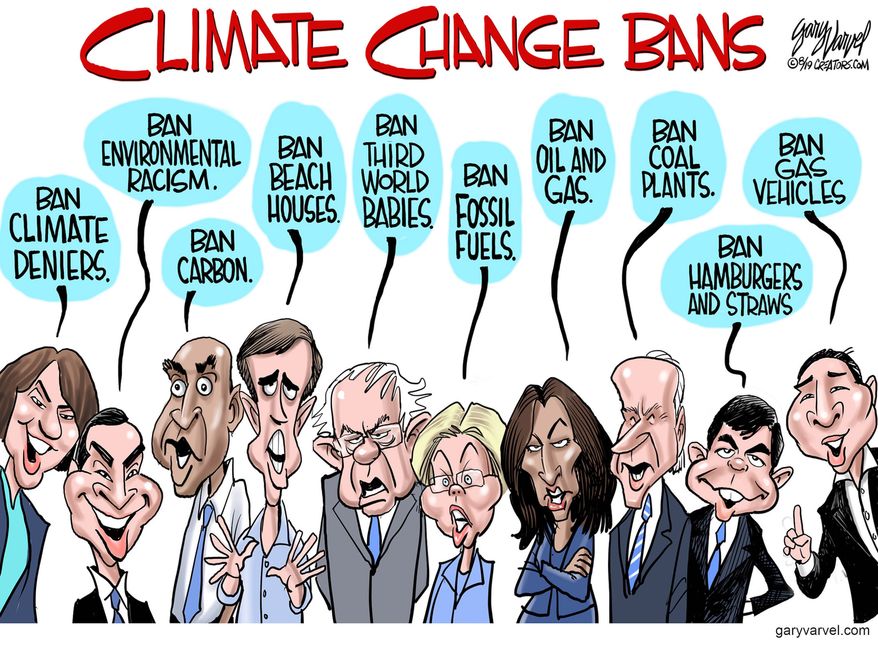
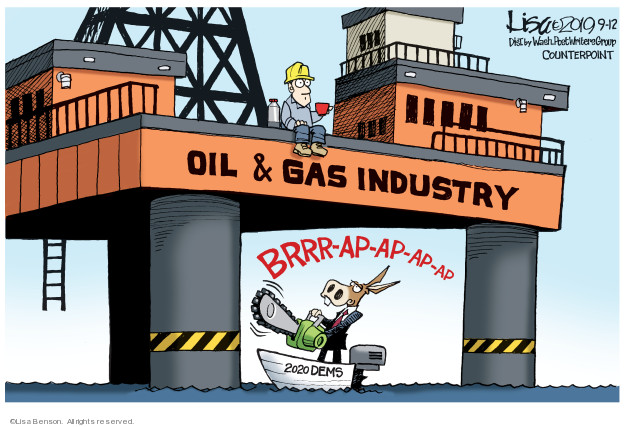
This issue arises in the US context because presidential candidates of leftist stripes have pledged to do away with fracking operations and forego the resulting boom in natural gas and tight oil production.

The Narrative

“I will ban fracking—everywhere.”
— Elizabeth Warren

“Any proposal to avert the climate crisis must include a full fracking ban on public and private lands.”
— Bernie Sanders

“I favor a ban on new fracking and a rapid end to existing fracking.”
— Pete Buttigieg

“I want you to look in my eyes. I guarantee you, I guarantee you we’re gonna end fossil fuel.”
— Joe Biden

And don’t forget the Democratic 2016 nominee whose election was narrowly averted by the Trump surprise:

“So by the time we get through all of my conditions, I do not think there will be many places in America where fracking will continue to take place.”
– Hillary Clinton in 2016

In other words, she declared her intention to follow the Obama program: Regulate anything that moves until it stops moving.
cg5d79e68b834a4

Some skeptics caution against overreacting to electioneering rhetoric, citing the practical limits of presidential authority to implement a ban on fracking. But “elections have consequences,” executive orders have an impact, and few industries have been subjected to such consistent attack and misinformation. It might be hard to imagine serious proposals to ban, say, farming or at least all grain farms, but it would be theoretically possible to do so by radically increasing imports. Administrative agencies can pursue creative interpretations of the labyrinth of rules and issue aggressive “guidances.” A broad and coordinated set of such actions can slow or outright stop all manner of industrial activities up and down supply chains, including, especially, the construction of vital pipelines and ports. And lest one forget, Congress enacted legislation in 1972 and 1982 to ban oil production on about 90% of America’s offshore domains.

A detailed analysis has been performed by the Global Energy Institute. The updated report is What if . . . Hydraulic Fracturing Was Banned?

The Economic Benefits of the Shale Revolution and the Consequences of Ending It.

The Reality

The extraction of oil and gas through the techniques of horizontal drilling and hydraulic fracturing (colloquially, “fracking”) has catapulted the United States into leadership of the world’s energy markets. Since 2007, fracking has doubled U.S. oil production and increased gas production by 60%. Instead of a major importer, America is rapidly becoming the largest exporter of oil and is expected to supply the majority of net new energy traded on global markets over the next two decades.

If the U.S. imposed a fracking ban, the supply disruption would trigger the biggest oil and natural gas price spikes in history—almost certainly by more than 200%—which would, in turn, tip the world into recession. Even the expectation that a ban could be enacted would destabilize markets. U.S. imports and the trade imbalance would soar, as would consumers’ spending on energy. To keep the lights on, America would have to nearly double the quantity of coal burned, as well as import up to 1 million barrels of oil per day for dual-fueled power plants that would lose access to natural gas.
A fracking ban, regardless of motivation, is anchored in magical thinking that non-hydrocarbon energy sources could fill a massive global energy shortfall if the U.S. exited the world stage as a major supplier of oil and natural gas. Both fuels will be critical for the global economy for decades to come. The key issue is not whether wind and solar can supply more energy—they can and will—but whether a future American administration would reverse the progress of the last decade in lowering energy prices and enhancing geopolitical stability.”
—Mark Mills, senior fellow, Manhattan Institute

Supply Impact

The study is based on what GEI calls conservative assumptions. These include the continued use of hydraulic fracturing in non-tight oil and gas plays, and a 23.7% annual decline rate for existing shale plays. GEI also assumes a drop in gas exports to Mexico, and increase in gas imports from Canada, and a shift from LNG exporting to LNG importing—all designed to close the supply/demand gap that would occur as shale gas is phased out.
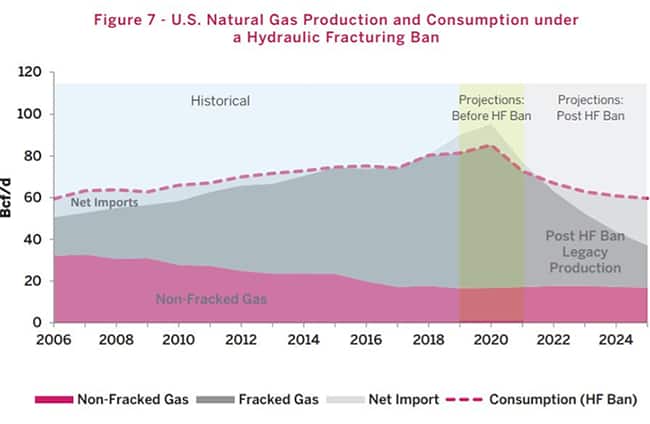
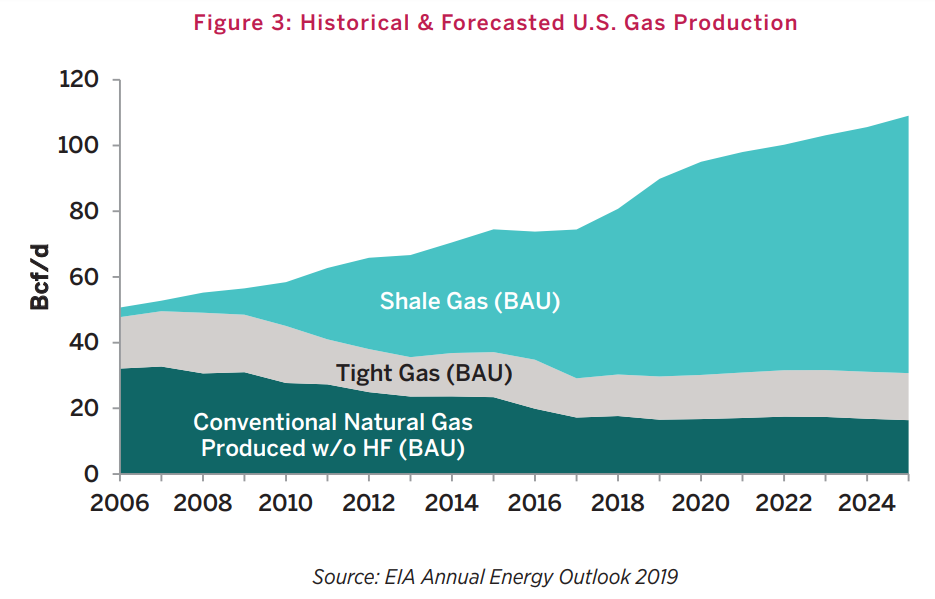
“Currently, shale production is about 50.5 Bcf/d or 62 percent of U.S. production. Under a hydraulic fracturing ban, production from existing sources would drop significantly due to the field production decline rates. Similarly, natural gas production from tight gas formations would drop quickly as well, since they rely on hydraulic fracturing to generate production,” GEI said.

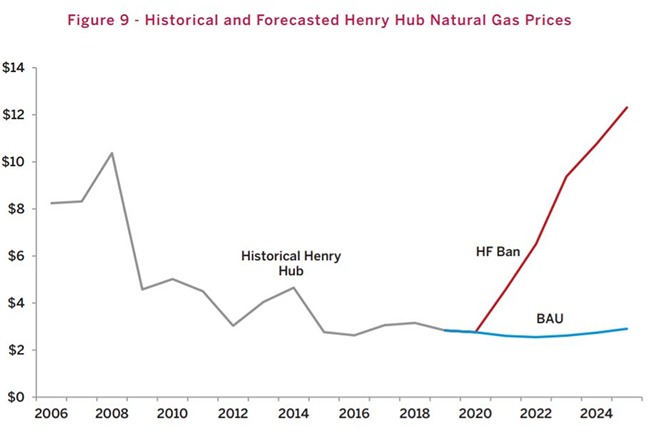
With gas in tighter supply (see graph above), prices would soar to $12/MMBtu by 2025 (2nd graph below).
Economic Impact

With supply for gas and oil constricted, energy prices would rise dramatically. In addition to $12/MMBtu gas, GEI says that West Intermediate crude would reach about $130/bbl by 2025, or more than double today’s price and nearly double the forecast out to 2025.

“In 2025, the U.S. would lose around 19 million jobs and $2.3 trillion in GDP. For comparison, this is roughly three times the economic impact of the Great Recession of the late 2010s,” GEI said. “Disallowing hydraulic fracturing would shrink the size of the U.S. energy industry and eliminate its ability to cushion the economy against large swings in prices. A ban on hydraulic fracturing would essentially be the worst of both worlds – low production as if prices were low, while the rest of the economy (in the form of millions of households and businesses) struggles to adapt to a doubling of oil prices and quadrupling of natural gas prices,” it said.

The economic results for the nation and for key energy-producing states (as well as two, Michigan and Wisconsin, which are considered to be close in the 2020 election) is shown below.
Why a US Self-embargo is Unicorns All the Way Down

The fracking ban campaign is neither new nor connected only to the politics of this presidential election cycle. The movement emerged from the intersection of two global trends: the expansion of hydrocarbon production; and a time when many pundits and policymakers believe that an “energy transition” to something different is urgently needed. For example, some 400 domestic and international environmental leaders and organizations petitioned the United Nations in September to demand “a global ban on fracking.”[14] Essentially all fracking production is done in the United States.

A ban on fracking would end U.S. exports, cause imports to soar, and increase the trade deficit by hundreds of billions of dollars. The more serious impact would come from the shock to global markets. Global oil prices swing widely when markets are surprised by even a 1%–2% change in the supply/demand balance. A fracking ban would entail a loss of 7% of global oil production, comparable to the 7% lost with the infamous 1973 Arab oil embargo—an embargo that drove world oil prices up 400% and triggered a global recession.[25] Similarly, the 1979 Iranian revolution took 5% of oil off global markets. Prices rose more than 200%, sparking another global recession.[26] Today, taking shale production off the market would also constitute an additional 17% loss to global markets in the form of natural gas.[27] Higher energy prices would hit global consumers; Americans would pay more than $100 billion a year at the gas pump alone, an average of $1,000 per household.[28] Even a slow 10-year production phase-out would trigger an estimated two-year recession in America and eliminate $270 billion of private investment.[29] There would be some winners: Russia and OPEC would derive huge revenue and geopolitical benefits.

Losing the share of new electricity generation that is now fueled from natural gas (produced by fracking) would push utilities to increase the use of existing underutilized power plants where they’re available, which are mainly coal-fired.[30] That would increase carbon dioxide emissions by some 600%—more than all emissions avoided from wind and solar on U.S. grids.[31]

Regions heavily dependent on natural gas but with minimal coal capacity would be faced with rolling blackouts—such as New England (where gas currently provides 49% of electricity), the Mid-Atlantic region (38%), and the Pacific coast (30%).[32] Some of that shortfall could come from burning oil in the 130 GW of gas-fired turbines designed to be dual-fueled.[33] If fully utilized, those turbines would burn about 1 mmbd of oil (necessarily imported), a 10-fold increase in U.S. oil-fired power generation.

The Impossibility of Filling the Gap

The central motivation for the movement to ban fracking is the global abundance of hydrocarbons at a time when many pundits and policymakers believe that an “energy transition” is urgently needed. But America’s shale production could not be replaced quickly by alternatives, at any price, regardless of climate-change motivations. To the extent that there is an “energy transition” to new technologies, it is happening in slow motion.

Politically popular wind and solar power have become far less expensive and have enjoyed massive global subsidies; but together, they still provide only 1.8% of global energy. The 5 million electric vehicles on all the world’s roads now displace 0.1% of global oil use.[34]

Replacing the quantity of energy produced by fracking in the U.S. shale fields would entail (in energy-equivalent terms) expanding all of America’s solar and wind production by 2,000% more than what has been added in the past decade.[35] Somehow accomplishing that miracle wouldn’t help the 99% of Americans driving oil-fueled cars. In fact, because the hydrocarbon market is global, the entire world would have to increase global wind and energy supply by 500% to replace the energy that would be lost from an American fracking ban—never mind the additional energy needed to fuel global economic growth.[36]
Resources:

New Study by Global Energy Institute Puts Impact of Fracking Ban at $7.1 Trillion Over Four Years

A Fracking Ban Would Trigger Global Recession

New Chamber Analysis Quantifies Economic Risks of Proposed Fracking Ban

U.S. Chamber of Commerce says proposed fracing ban puts Texas economy at risk
Corrupting Climate and Weather

An article at The Spectator raises the question Do alarmists know the difference between weather and climate?  The author Charles Moore may also be a man for all seasons like Sir Thomas More.  Excerpts in italics with my bolds and images.

A lot of clever people are putting the ‘green’ into ‘greenbacks’

Until recently, those expressing skepticism about climate change catastrophe have been hauled over the coals (or the renewables equivalent) for not understanding the difference between ‘climate’ and ‘weather’. The lack of global warming at the beginning of the 21st century was not to be taken, chided the warmists, as evidence that climate change was not happening. Weather was the passing phenomenon of each day: climate was the real, deep thing.

Now, however, the alarmists themselves have elided the two concepts, using the Australian bush fires as their cue. As Sir David Attenborough puts it: ‘The moment of crisis has come’. They could be right, of course, but how could they really know? In this sense, President Trump is surely justified in warning, at Davos, against the ‘Prophets of Doom’. Prophecy is a different skill from an exact understanding of the here and now.

Mr Trump might usefully have talked about the Profits of Doom too. If the movement can persuade western society that the climate emergency is upon us, there are enormous sums to be made by people who claim to be able to remedy it. Hence the patter now coming out of companies such as Blackrock, BP or Microsoft, fanned by Mammon’s public intellectuals, such as Mark Carney. A lot of clever people are putting the ‘green’ into ‘greenbacks’. A lot of less clever investors are going to get their fingers burnt.

See Also Stoking Big Climate Business

Footnote:  Case in Point:  Green Fraudsters Plead Guilty

Jeff Carpoff, 49, of Martinez, pleaded guilty today to conspiracy to commit wire fraud and money laundering. His wife, Paulette Carpoff, 46, pleaded guilty today to conspiracy to commit an offense against the United States and money laundering. According to court documents, between 2011 and 2018, DC Solar manufactured mobile solar generator units (MSG), solar generators that were mounted on trailers that were promoted as able to provide emergency power to cellphone towers and lighting at sporting events. A significant incentive for investors were generous federal tax credits due to the solar nature of the MSGs.

The conspirators pulled off their scheme by selling solar generators that did not exist to investors, making it appear that solar generators existed in locations that they did not, creating false financial statements, and obtaining false lease contracts, among other efforts to conceal the fraud. In reality, at least half of the approximately 17,000 solar generators claimed to have been manufactured by DC Solar did not exist.

“By all outer appearances this was a legitimate and successful company,” said Kareem Carter, Special Agent in Charge IRS Criminal Investigation. “But in reality it was all just smoke and mirrors — a Ponzi scheme touting tax benefits to the tune of over $900 million. IRS CI is committed to investigating those who take advantage and impact the financial well-being of others for their own personal gain.”

“The Federal Deposit Insurance Corporation, Office of Inspector General (FDIC-OIG) is pleased to join our law enforcement colleagues in announcing these guilty pleas,” stated Special Agent in Charge Wade Walters for the FDIC OIG San Francisco Regional Office. “The defendants conspired with others to create a fraudulent business venture that duped unsuspecting entities, including banks, to invest approximately $1 billion, which the two later used to support a lavish lifestyle.

Source:  https://wattsupwiththat.com/2020/01/27/dc-solar-owners-plead-guilty-to-largest-ponzi-scheme-in-eastern-california-history/

Court Thwarts Seattle Climate Power Play

News today that the Washington state supreme court has blocked a scheme by Governor (and erstwhile candidate for climate President) Inslee from taking over the energy industry.  Washington state is a place where leftist progressives live in large numbers in and around Seattle and impose their virtue signalling ideas on the rest of the population who are more skeptical.

This story is also of interest since the maneuver follows the practice of weaponizing environmental law to overthrow society’s dependence on energy from fossil fuels.  For example, NGO lawyers have attacked permits for infrastructure like pipelines by demanding that the assessment also include emissions from end users burning the gas or oil after it has left the pipeline.  In the Washington state case, Inslee tried to put the Department of Ecology in charge of taxing energy used by the transportation industry under the auspices of a Clean Air Act. This was in fact an end run around the defeat of a state carbon tax in the last election.

The story from the Seattle Times is State Supreme Court limits Gov. Inslee’s rule cutting greenhouse-gas emissions  Excerpts in italics with my bolds.

The Washington State Supreme Court has invalidated key portions of a rule imposed by the administration of Gov. Jay Inslee capping greenhouse-gas emissions by fuel distributors, natural-gas companies and other industries.

In a 5-4 ruling Thursday, the court upheld a 2017 lower-court decision that the state Department of Ecology had exceeded its legal authority in trying to apply clean-air standards to “indirect emitters” that don’t directly burn fossil fuels.

“The issue is not whether man-made climate change is real — it is,” wrote Chief Justice Debra Stephens in the majority opinion. However, Stephens wrote, the department’s efforts to enforce the state Clean Air Act went beyond what had been authorized by the law.
[That is a social opinion not a legal one since IPCC suppositions have not yet been litigated.]

“We are confident that if the State of Washington wishes to expand the definition of emission standards to encompass ‘indirect emitters,’ the Legislature will say so. In the meantime. Ecology may not claim more authority than the Legislature has granted in the Act,” Stephens wrote.

The state had projected the rule would reduce emissions by 20 million metric tons by 2035 — about two-thirds of the target established by the Legislature in 2008. But three-quarters of that reduction would have come from applying the regulation to indirect emitters, according to the court ruling.

[The hypocrisy is striking; people who burn gasoline in their cars and trucks are directly responsible for those emissions, not their suppliers.  Energy products are provided in a free society to those who want and can afford to pay for them.  Those who want to live without such energy are also free to make that choice.  But beware, in modern nations like the G20 nearly 90% of energy comes from burning fossil fuels. CO2 zealots want to shut off the supply for everyone else instead of themselves.  Socialism is another name for shared misery]

Figure 12: Figure 9 with Y-scale expanded to 100% and thermal generation included, illustrating the magnitude of the problem the G20 countries still face in decarbonizing their energy sectors.

During a news conference, Inslee said he disagreed with the court majority’s central conclusion but hasn’t yet decided whether to ask lawmakers to amend the Clean Air Act to include indirect emitters.

State Sen. Doug Ericksen, R-Ferndale, praised the court ruling in a statement calling the clean-air rule “a classic example of government arrogance and overreach.”

A longtime opponent of Inslee’s climate agenda, Ericksen, the ranking Republican member of the state Senate’s environment committee, said the rule would have imposed “onerous new regulations on oil refiners and distributors of natural gas” and passed potentially billions of dollars in costs on to consumers.

Ericksen added he hoped the decision would “quell the enthusiasm of other agencies” to push legal boundaries, citing the Puget Sound Clean Air Agency’s decision to develop a low-carbon fuel regulation.

Frustrated by legislative inaction, Inslee had directed Ecology in 2015 to use executive authority under the Clean Air Act to regulate carbon emissions.

After a lengthy rule-making process, the state issued regulations in 2016 which would have targeted dozens of top emitters, from Skagit County oil refineries to Boeing’s Everett plant and Eastern Washington food processors. The rule required such facilities to cut their carbon footprint by an average of 1.7% a year — either by cleaning up their own facilities or paying for carbon-reduction projects off-site.

But the rule was quickly challenged in a lawsuit by business groups led by the Association of Washington Business. The association’s president, Kris Johnson, said in a statement he welcomed the court’s ruling and intends to work with lawmakers “to find a bipartisan solution” to reduce the state’s carbon emissions.

A trade association for paper mills said its members remain concerned about the effects of even a more limited version of the clean-air rule.

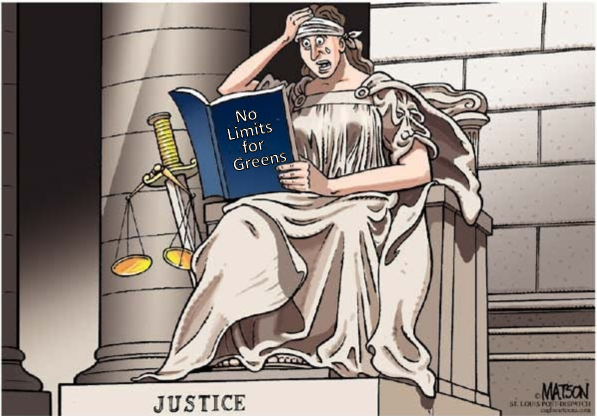
And Justice Wept

Environmentalist judge gives free pass to climate activists.  Where will this lead?

CGTN reports approvingly Climate activists win landmark case over Federer demo at Credit Suisse.  Excerpts in italics with my bolds.

Swiss climate protesters have won a landmark legal battle against investment bank Credit Suisse, which could transform the way that climate activism is prosecuted in Switzerland in future.

A judge ruled on Monday that the danger posed by climate change means activists from the climate group Breakfree were not guilty of trespassing when they occupied a branch of the Swiss investment bank two years ago to demonstrate against the financiers’ funding of fossil fuel projects.

In November 2019, a group of young people wearing tennis kits and wigs staged a tennis-themed sit-in at a Credit Suisse branch in Lausanne. Their goal was to convince Swiss tennis player Roger Federer to end his sponsorship deal with the investment bank and highlight what they said was Credit Suisse’s investments in industries which are seen as adding to climate change.

The group was charged with trespassing and slapped with a 21,600 Swiss franc fine ($22,200), but during their appeal hearing on Monday, Judge Philippe Colelough stated that the activists had acted proportionately and ruled that they did not have to pay the fine.

The judge agreed with the protesters that they had entered the bank in the face of an “imminent danger” from climate change.

Because of the insufficient measures taken to date in Switzerland, whether they be economic or political, the average warming will not diminish nor even stabilize, it will increase,” he said. Adding that: “In view of this, the tribunal considers that the imminence of danger is established.

“The act for which they were incriminated was a necessary and proportional means to achieve the goal they sought.”

The ruling, given in the Lausanne municipality of Renens, was greeted with cheers from the crowded court room. The Swiss state will cover the cost of the fine instead.

“I didn’t think it was possible,” said Beate Thalmann, one of those accused in the trial. “If Switzerland did this, then maybe we have a chance.”

Credit Suisse said last week that, while it respected the protesters’ cause, it considered the occupation of the bank’s property unacceptable.

“Combating global warming is important,” the financier said in a statement. “Credit Suisse respects freedom of expression as a fundamental democratic right. [However,] to protect its clients, employees and branches, it does not tolerate unlawful attacks on its branches, irrespective of the perpetrators and their motives.”

Since the decision from the court, there has been fresh Swiss climate activism.

On Tuesday, protesters dumped coal inside a branch of bank UBS in the same city of Lausanne, while carrying a banner reading: “We will leave when you quit fossil fuels.”

Bullying in the name of Climate is now sanctioned by the courts  How many more times will CO2 Hystericals be allowed to overthrow others’ rights? Thanks a lot Judge Colelough.

Footnote:

Given how much Switzerland depends on the financial industry, this is looking like the barbarians attacking the main gate.  That didn’t work out so well for Rome in 410:

EPA Overhaul Long Overdue

Prudent public officials should anticipate that some future periods will be warmer and other periods cooler than today. They should also affirm that cold is the greater threat to human health and prosperity. Thus investments should place priority on building robust infrastructure and ensuring reliable affordable energy. These things can not be achieved if the planning and approval process is so long and costly that needed developments are discouraged or abandoned.

The worst kept secret in US politics is how effectively environmental activists and lawyers have used EPA regulations to block, impair and frequently kill off projects for energy infrastructure. Some regions like the Northeast are lacking natural gas supply pipelines from US sources and are forced to import from Russia, among other foreign producers. Former EPA administrator made the point that some people believe that if you are for the environment you are against development, and if you are for development you are against the environment. Instead the law and the agency have the mission of ensuring environmentally responsible development, recognizing that natural resources are essential to human flourishing.

Thus I welcome this announcement reported in the Wall Street Journal Trump Seeks Overhaul of Federal Environmental Rules  Of course the subtitle say: Environmentalists criticize proposal, saying it will hamper efforts to slow climate change.  Excerpts in italics with my bolds.

WASHINGTON—President Trump proposed a major overhaul of federal environmental permitting, responding to business complaints of bureaucratic delays to infrastructure projects such as roads and energy pipelines.

“We want to build new roads, bridges and highways bigger and faster,” Mr. Trump said from the White House, adding that the proposal would help create new jobs.

But environmentalists assailed the changes to rules tied to the National Environmental Policy Act, or NEPA, saying they would weaken standards at a time when climate change is making federal review even more critical.

“Forcing federal agencies to ignore environmental threats is a disgraceful abdication of our responsibility to protect the planet for future generations,” Brett Hartl, government affairs director at the Center for Biological Diversity, said this week anticipating the overhaul. He called it a “gift to the fossil-fuel industry.”  The administration sees the move as a broad-based effort to modernize rules that have gone largely untouched for more than 40 years.

The primary aim is to shorten the review process to two years—a drastic change given that assessments can now take a decade or more.

“The step we’re taking today…will hit a home run in delivering better results to the American people by cutting red tape that has paralyzed common-sense decision-making for a generation,” Interior Secretary David Bernhardt said on a call with reporters. “The consequences of the government being stuck in place are far-ranging.”

Some projects that don’t have significant federal government funding or involvement might now become more likely to skirt the process altogether, a change likely aimed at helping pipelines in particular. For projects that do have to go through the NEPA review process, the changes would clarify what environmental effects agencies have to plan for and what future changes to the environment permit reviews will have to consider in advance. The stated goal is to limit reviews to environmental risks more directly associated with a project.

Critics fear that is a major setback for planning around climate change. Administration officials say agencies would still have the option to include climate-change risks in their permitting processes. But infrastructure experts and environmentalists say any weakening in that connection would be a step in the wrong direction as the effects of climate change are becoming more pronounced and society needs stronger rules to adapt to those emerging risks.

Issuing this proposal is an early step in what could be a lengthy process. There will be at least two months of public comment starting when the proposal is published on Friday, administration officials said. Many more months of review will likely follow that before any changes are finalized.

Many expect the administration won’t have enough time to finish an overhaul if Mr. Trump isn’t re-elected in November. Rep. Raúl Grijalva (D., Ariz.), chairman of the House Natural Resources Committee, on Thursday called the rewrite illegal, potentially foreshadowing several lawsuits that could further delay an overhaul.

The president on several occasions has criticized the environmental permitting process as a bureaucratic barrier to economic development. Many lawmakers and economists say that America needs to fix a backlog of infrastructure needs, which the administration has pegged at roughly $1 trillion.

In recent months, the administration has turned its attention to addressing several bedrock environmental laws and changes aimed at jump-start development. A plan to overhaul NEPA would be the latest in a series of moves that have also tried to limit the reach of the Endangered Species Act and Clean Water Act, especially in how much those laws require consideration of risks associated with climate change. The NEPA review process can serve as the ultimate fail-safe on environmentally unsound projects.

But energy companies and manufacturers in particular have argued that NEPA, in recent decades, has become a tool for environmentalists to block progress. Since its last update, major roads and pipeline projects have become harder to complete and a drilling boom has led to an expansion of oil-and-gas production nationwide. Industrial interests have asked for a modernization to improve efficiency and consistency in permitting across federal agencies.

“The administration’s modernization of NEPA removes bureaucratic barriers that were stifling construction of key infrastructure projects needed for U.S. producers to deliver energy in a safe and environmentally protective way,” said Anne Bradbury, chief executive of the American Exploration & Production Council, a trade group for some of the country’s largest independent oil-and-gas companies.

Environmental groups have been concerned that an attempt to streamline NEPA permitting would degrade its ability to protect the environment. They have criticized the Environmental Protection Agency’s 2018 decision to eliminate letter grades that often came as guidance in the process. Such changes can make NEPA reviews less helpful to the public and weaken a process designed to prevent oil spills and other environmental accidents, environmentalists said.

Footnote:  

Convoluted and CO2 obsessive regulations are a large factor leading to the Australian bushfires.  Also, Canada is unable to build a badly needed pipeline expansion that the federal government wants and owns because of the same kind of onerous environmental permitting processes.

2020 Green Obstruction Targets

The remarkable turnaround in the US economy was achieved despite large and expensive Green efforts to stop economic projects and infrastructure. While needed energy pipelines and power plants remain unbuilt in coastal places like New York and California, the heartland will be a battleground for activists wanting to leave the best sources underground in favor of aboveground dilute and intermittent wind and solar power.

Walker Orenstein writes at the Minnesota Post The five environmental stories to watch in 2020. Excerpts in italics with my bolds.

Next year will be a pivotal one for many of Minnesota’s most controversial environmental debates, from mining to climate change and the 2020 elections. Here’s a look at some of the big questions heading into 2020:

File photo courtesy of the Timberjay PolyMet Mining has won state and federal approval to break ground on its $1 billion copper-nickel mine near Hoyt Lakes.

1. Will PolyMet move forward?
PolyMet Mining has won state and federal approval to break ground on its $1 billion copper-nickel mine near Hoyt Lakes. But the project now faces serious questions after Minnesota courts put several permits on hold by this year.

First, The Minnesota Court of Appeals ordered a lower court to examine if state regulators hid concerns the federal government had with a key water safety permit. The Court of Appeals is also investigating whether Glencore, the Swiss mining giant that owns a majority of PolyMet’s shares, should be named on state permits, and whether the plan for a tailings dam at the mine is safe enough.

On top of the permit issues, PolyMet’s majority owner Glencore is now facing a bribery investigation in the United Kingdom and is in the midst of a leadership change.

After a year of turmoil, 2020 could be pivotal for a project that has faced 15 years of environmental review and could bring hundreds of jobs to the Iron Range. If built, it would be the first copper-nickel mine in the state.

2. Will the Line 3 pipeline get built?

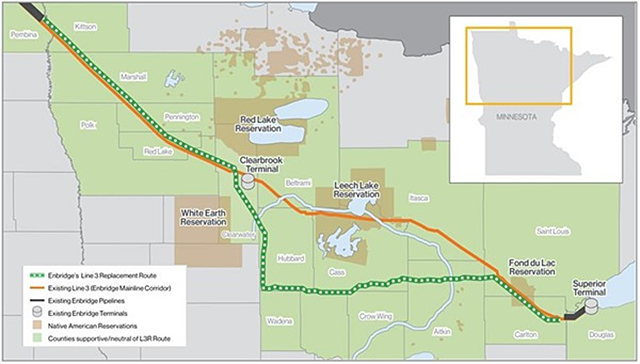
Another controversial project on the brink of construction is Enbridge’s Line 3 oil pipeline. The Canadian energy company is hoping to build a 337-mile pipeline through northern Minnesota to replace an aging and corroding one that is operating at half capacity. State regulators on the Public Utilities Commission granted the $2.6 billion project a Certificate of Need and approved its route.

In July, however, the Court of Appeals ruled the PUC failed to consider the impact an oil spill could have on Lake Superior’s watershed, setting the project back months. A new environmental assessment was completed earlier this month by the Department of Commerce, modeling a spill into a tributary of the St. Louis River. In a worst case-type scenario, the research found oil would be unlikely to reach Lake Superior.

Final Line 3 Replacement Project routek

The five-member PUC now needs to vote again on whether to approve Line 3, which also needs federal permits from the U.S. Army Corps of Engineers, to move forward.

Opponents of Line 3, who argue building new fossil fuel infrastructure would further contribute to climate change, have protested the Walz administration at many public events and have taken steps to disrupt Enbridge’s existing infrastructure. Will wide-scale protests follow if Line 3 does get approved for construction?

3. Will the Legislature pass any climate change policy?

The 2019 session ended with very little new climate and energy policy, despite a Democratic push to make Minnesota’s power grid carbon-free by 2050 and GOP support for a measure to make it tougher to build new fossil fuel projects.

While 2019 was ultimately focused on writing a two-year budget, such debates could find new life at the Legislature in 2020. Especially since lawmakers will have a healthy pot of unused money from Xcel Energy, from the funds the energy company pays to store nuclear waste in Minnesota.

4. Will there be a showdown over the study of mining near the Boundary Waters?

Ever since the Trump administration canceled a study that could have led to a 20-year ban on copper-nickel mining in the Rainy River watershed, some Democrats have tried to finish the research or at least get the federal government to disclose what it found.

While U.S. Rep. Betty McCollum and others have not been successful in Congress, the state Department of Natural Resources has asked for the information to include in its environmental review of a mine Twin Metals Minnesota wants to build just outside the Boundary Waters Canoe Area Wilderness.

The DNR won’t say if it will proceed with its review if the federal government stonewalls the agency. But the state has left open the possibility of a showdown with the pro-mining Trump administration. “We will request the information, we expect to get it,” Barb Naramore, an assistant DNR commissioner, told reporters. “If for some reason it’s not forthcoming we’ll need to evaluate the implications of that at that point in time.”

5. How will environmental issues play in the 2020 elections?

The 2020 elections carry massive stakes for local environmental issues. If Trump is re-elected, his administration is likely to continue support for Twin Metals. Many of the Democratic frontrunners have said they oppose mining in the Rainy River watershed, including Pete Buttigieg, Bernie Sanders and Elizabeth Warren. Joe Biden has not, although the Obama-Biden administration launched the study on a 20-year mining ban in the Rainy River watershed and took other steps to stymie Twin Metals.

Trump has generally supported pipelines, while Warren and Sanders have also opposed Line 3.

At the Legislature, Republicans would likely need to keep a majority in the state Senate to head off the most aggressive parts of Gov. Tim Walz’s climate change agenda in 2021. While not all DFLers support the governor’s measures, minority Democrats in the Senate recently launched a “Clean Energy and Climate Caucus” with an eye on passing some form of Walz’s legislation.

Leaf Blowers Banned (Take that, Greta)

Greta keeps repeating that nothing is being done to reduce emissions, blind to all the imposed policies and regulations.  So today good news out of California, the leader in fighting climate change.  From NBC San Diego Encinitas Leaf Blower Ban Goes Into Effect.  Excerpts in italics with my bolds.

Businesses in Encinitas are no longer allowed to use gas powered leaf blowers as of Friday, Dec. 20.

The Encinitas City Council approved the leaf blower ordinance back in August. Then in September, the ordinance went into effect for city operations.

The goal of the city’s Climate Action Plan is to eventually ban all gas powered leaf blowers by January 20, 2020 in order to reduce the city’s carbon footprint. The next goal is to reduce all greenhouse gas emissions by the year 2030. The city estimates that this leaf blower ban will reduce local green house gas emissions by 128 metric tons of CO2 emissions by the end of 2020, and 142 metric tons by 2030.

Then on January 20, 2020, the ban will go into effect for residents as well.

But, the ordinance also states that electric or battery powered leaf blowers are allowed. So the city is now offering a city-funded rebate program, so that residents and business owners can buy a new electric or battery-powered leaf blower.

The ordinance also lays out a list of rules about the time of day people are allowed to use their leaf blowers.

Now, people in Encinitas are only permitted to use their electric or batter powered leaf blowers between 8 a.m. and 6 p.m. Monday through Saturday, and between 12 noon and 5 p.m. on Sundays.

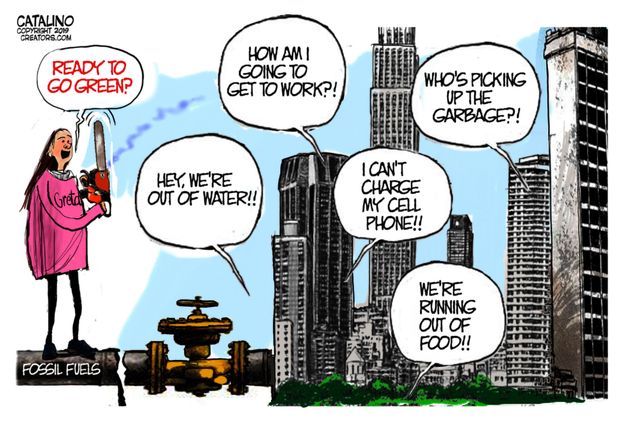
So calm down Greta and show some respect for all the nanny-state rules coming on.