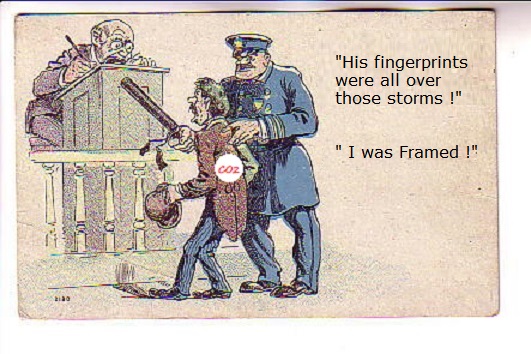
Is Global Warming A Public Nuisance?

I am suing you

Several posts have discussed activist attempts to use legal actions to press their agenda.  Now we have a fine article by Richard A. Epstein of Hoover Institution, published January 15, 2018
Is Global Warming A Public Nuisance?  
Text below in italics with my bolds and images.
H/T Jeffrey Taylor

New York City and a number of California municipalities, including San Francisco and Oakland, have filed law suits against five major oil companies—BP, Chevron, ConocoPhillips, Exxon Mobil, and Royal Dutch Shell—for contributing to the increased risk of global warming. These complaints cite recent scientific reports that project that sea levels will rise from 0.2 meters to 2.0 meters (or 0.66 to 6.6 feet) by 2100, with a major loss of land surface area and serious climate disruptions. They further allege that the “Defendants had full knowledge that the fossil fuels would cause catastrophic harm.” The complaints rely chiefly upon public nuisance law, which prohibits unreasonably interfering with public rights in air and water through discharges of dangerous substances—in this instance, carbon dioxide and other greenhouse gases. These cities are demanding that each oil company named in the complaint contribute to an abatement fund to counteract the perceived future threats to the environment from global warming.

In this essay, I confine my attention to the soundness of the public nuisance theory offered by San Francisco and New York in order to explain why private lawsuits are the wrong instrument for dealing with the global warming threat. In full disclosure, in this essay, I provide my own independent legal analysis of these complaints, which I prepared for the Manufacturer’s Accountability Project, an organization that focuses on the impact of litigation on the manufacturing industry.

The basic law of nuisance is divided into two parts, public and private, which complement each other. Private nuisances require at a minimum “an invasion of another’s interest in the private use and enjoyment of land.” The defendant must release, emit, or discharge the offensive materials—such as filth, odors, or noise—onto the plaintiff’s property. The relevant causal connection has to be so tight that there are no intervening forces between the discharge and the ensuing physical invasion of the plaintiff’s property. So, for example, the supplier of various materials and chemicals is not responsible for the waste that a manufacturer emits from their use.

The typical private nuisance dispute usually involves one party (or a very few) who either makes the discharges or suffers consequences from them. The basic intuition behind this limitation on private suits is that administrative costs balloon out of control when the number of parties who suffer some degree of harm increases, as happens when pollution is discharged into a public waterway used by hundreds of different people. Yet it is a mistake to ignore large pollution discharges simply because private law suits are an ineffective instrument to secure damages, an injunction, or both. As early as 1536, the English judges filled this gap by developing the law of public nuisances that rested, both then and now, on the key distinction between general and special damages. Thus, if the defendant erected an obstruction along a public road, none of the parties delayed by the blockage had a private right of action. But any individual who ran into the obstacle and suffered physical injuries or property damage could recover in tort. Now, the shortfall in deterrence attributable from not compensating the delayed travelers was offset by a fine against the wrongdoer, the money from which could be used to remove the obstacle or placed in the public treasury.

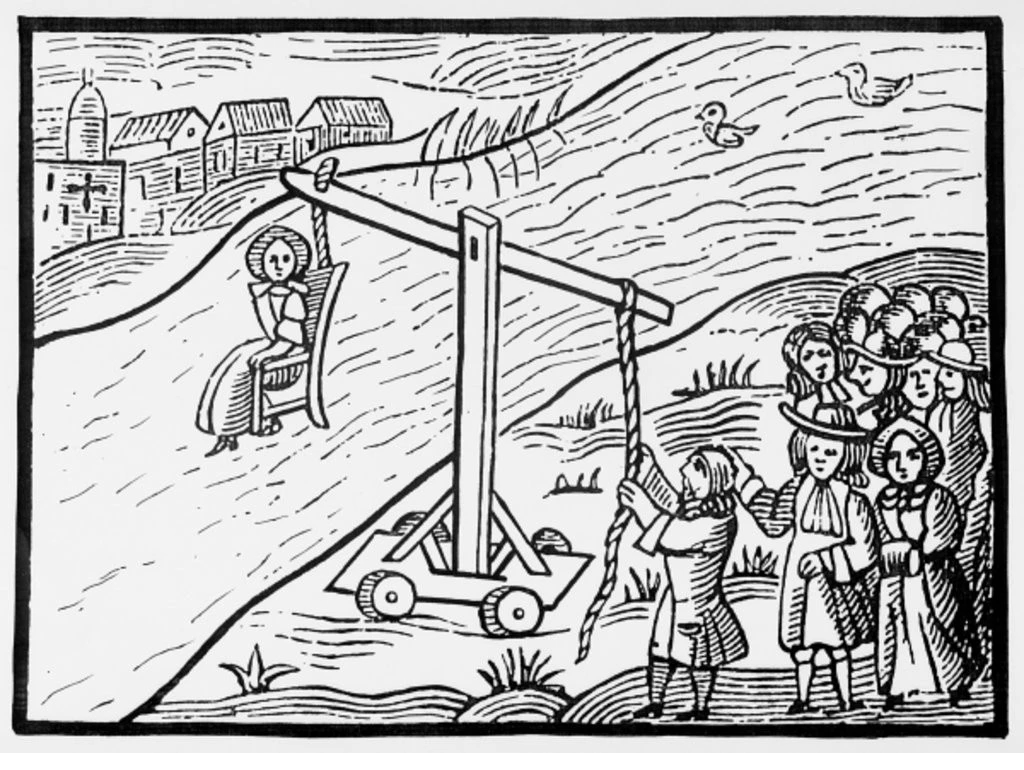
Woman on a ducking stool. Historical punishment for ‘common scold’ – woman considered a public nuisance. (Welsh/English heritage)

It is important to understand the enormous stretch in moving from traditional public nuisances to the modern global warming cases. The first point of difference is that only five companies—but no other carbon-dioxide-emitting polluter in the world—are joined as defendants. That is to say, the cities are apparently seeking to recover virtually all of their alleged abatement costs from the five named oil companies, instead of holding each only for its pro rata share of total emissions from all sources. But just what fraction of total carbon dioxide emissions can be traced to the named defendants? Note first that any release of carbon dioxide into the atmosphere has the same impact on global warming regardless of its source.

These five oil companies are responsible at most for a tiny fraction of the global total of carbon dioxide emissions. First, just looking at the American scene, some good chunk of the carbon dioxide releases are from other oil companies not named in the complaint. Another, probably larger, chunk comes from burning coal, making cement, and human and animal respiration. Carbon dioxide is also released in large quantities by forest fires, including those that recently overwhelmed Northern and Southern California. And that’s just in America; vast amounts of carbon dioxide are released from a similar range of human activities all across the globe.

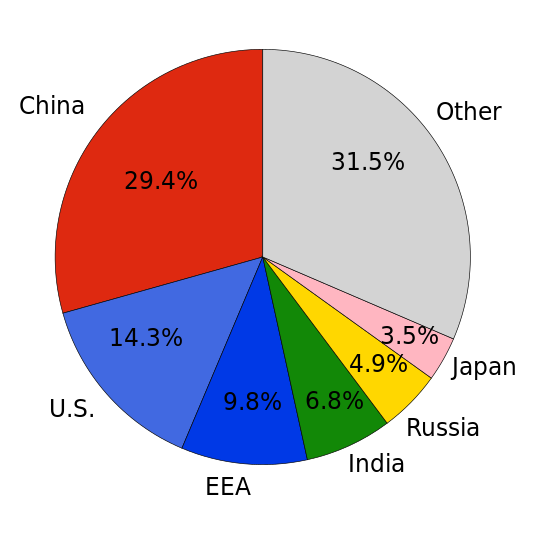
Global Greenhouse Gas Emissions by Source 2013

Here are some numbers: As of 2015, all carbon dioxide emissions from the United States comprised 14.34 percent of the global total, while China’s emissions stood at 29.51 percent. Even if the five oil companies were somehow responsible for, say, 10 percent of the United States’ carbon dioxide emissions, that would be less than one percent of the total human releases. Under standard tort rules, the liability of each defendant must be limited to its own pro rata share of the total harm given that under Section 433A of the Restatement of Torts, there is a “reasonable basis for determining the contribution of each cause to a single harm,” in this instance measured by market shares.
Indeed, these public nuisance lawsuits are especially dubious, given that the oil companies did not by their sales emit any carbon dioxide into the atmosphere. The dangerous releases came from many different parties, both private and public, including the municipalities bringing these lawsuits. These numerous parties used these products in countless different ways, with as much knowledge of their asserted effects on global warming as these five defendants. How could the oil companies have known about the anticipated course of global warming forty years ago when key government studies done today are uncertain about the magnitude of the effects of emissions on sea levels and the economic consequences?

The first paragraph of the New York City complaint ducks these factual complexities by insisting, falsely, that crude oil was “a product causing severe harm when used exactly as intended.” But the end uses of crude oil are so varied (including, for example, the creation of various plastics in common use today) that the effective control of emissions is best done through the regulation of these end users and not the oil companies. Indeed, even for gasoline, the level of carbon dioxide emissions critically depends on the operation and maintenance of the many different types of facilities, equipment, and vehicles, all of which are beyond the direct control of the oil companies. Yet all these end users are already subject to extensive emissions controls under the Clean Air Act and countless other environmental directives, both at the state and federal level.

This sensible distribution of regulatory authority rests on the superior ability of government agencies (at least compared to the courts), often in cooperation with each other, to formulate and maintain coherent policies to regulate the emissions of carbon dioxide, as well as methane, nitrous oxide, and fluorinated gases, which the EPA calculates account for 18 percent of greenhouse gas emissions.

The issues here are especially complex for many technical and logistical reasons. One critical task is to decide the optimal level of emissions. The implicit assumption of the New York and San Francisco lawsuits is that the world would become a better place if all emissions of carbon dioxide were stopped. But that position ignores the enormous benefits that come from the use of fossil fuels, which continue to supply over 80 percent of the nation’s energy needs. No other fuel source could keep manufacturing, transportation, and commerce alive. And it is just exaggeration to claim, as the city plaintiffs do, that these oil companies “have done nearly all they could to create [the] existential threat” of global warming when in fact energy efficiency in the United States has consistently improved, particularly in generating electrical power.

No public nuisance suits for global warming can solve a problem that must be addressed by a coherent regulatory program. Instead, chaos will follow if hundreds of different states, counties, and cities are allowed to bring separate actions under state law. It bears emphasis that in 2011, a unanimous Supreme Court decision in American Electric Power Co. v. Connecticut held that the combination of the Clean Air Act and actions by the Environmental Protection Agency “against carbon-dioxide emitters . . . displace the claims that the plaintiffs seek to pursue” under a public nuisance theory brought under federal law. The Court left open the question of whether the federal regulation at the time preempted any state law cause of action for public nuisance.

Summary

But, as I argued at the time, the only viable solution was for the federal government and the EPA to “orchestrate” the effort to control emissions. The point is doubly true against these remote, upstream defendants who have not emitted anything themselves. The standard analysis of federal preemption has long held that states may not engage in their own remedial efforts, even by actions in tort, when extensive federal regulation occupies the field, or when state activity either frustrates federal action or is in conflict with it. If anything, the scope of federal oversight, actual and prospective, is far more comprehensive than it was when American Electric Power was decided. And so federal preemption alone should block a set of dubious public nuisance claims that should never have been brought in the first place.

Background:  Critical Climate Intelligence for Jurists (and others)

The Children’s Climate Lawsuit Harms The Children

When launching a boomerang, watch out when it comes back on you.

This post provides further perspective and some legal background regarding the lawsuit campaign by Hansen et al fronted by idealistic children.  First an article at Investor’s Business Daily points out how the lawsuit is not in the best interest of present or future generations: The Children’s Climate Lawsuit Against The Children  Excerpts with my bolds below from Benjamin Zycher Jan. 12, 2018

Litigation may be as American as apple pie, but some lawsuits are so destructive that they stand out even among the hugely expensive wreckage wrought by our legal system. The most prominent current example is the “children’s” climate lawsuit (Juliana v U.S.): A group of kids, including “future generations, through their guardian Dr. James Hansen,” claim that the government’s actions and failures to act have caused climate change, thus violating the youngest generation’s constitutional rights to life, liberty and property, and have failed to protect essential public trust resources.

First the Policy Concerns the People’s Interest not the Judges

I leave the numerous legal issues to the lawyers (see backgrounder further on), although precisely how the ineffable Hansen came to be the “guardian” for future generations is a question both fascinating and amusing. Instead, it is crucial to recognize first that the fundamental policy assumption underlying this lawsuit — we can make “the children” better off by making them poorer — is preposterous.

More generally, the lawsuit is a blatant attempt to circumvent democratic processes, in terms of both the Congressional power to make policy and the authority of the president to implement it.

Climate policies — mandated reductions in greenhouse gas (GHG) emissions — by and large are energy policies, and the constitution is silent on which such policies would serve the interests of future generations, or on the appropriate tradeoffs between the interests of “the children” and the adults alive in the here and now.

Those are policy questions, and this attempt to induce judges to interfere with Congress’ legislative powers is deeply destructive of our constitutional institutions. Should “the children” not be concerned about that? Why are “the children” not suing about, say, the national debt?

Second CO2 is Not a Pollutant

The claim about the protection of “essential public trust resources” boils down to an assertion that carbon dioxide is a “pollutant.” No, it is not: A certain minimum atmospheric concentration of it is necessary for life itself. (Merely look at NASA’s time-lapse photo of the earth’s greening over the last 30-plus years.) By far the most important GHG is water vapor; does anyone claim that it is a “pollutant?” Obviously not, and not because ocean evaporation is a natural process; so are volcanic eruptions, and the massive amounts of effluents emitted by volcanoes are pollutants by any definition.

Third Energy Poverty Shortens Lives 

Consider a homo sapiens baby born in a cave some tens of thousands of years ago, in a world with environmental quality effectively untouched by mankind. That child at birth would have had a life expectancy on the order of ten years; had it been able to choose, it is obvious that it willingly would have given up some environmental quality in exchange for better housing, food, water, medical care, safety, ad infinitum. That is, it is obvious that people willingly choose to give up some environmental quality in exchange for a life both longer and wealthier.

The Lawsuit Will Make Future Generations Worse Off

In other words, the children’s lawsuit is inconsistent with actual interests of future generations, as the obvious underlying assumption is that future generations would prefer the purest possible environmental quality. That is not correct: Future generations want to inherit the most valuable possible capital stock in all of its myriad dimensions, among which environmental quality is one important component among many, and among all of which there are tradeoffs that cannot be avoided.

Is it the position of the attorneys representing “the children” that making energy more rather than less expensive unambiguously would make future generations better off? In order for future generations to receive the most valuable possible capital stock, the current generation must consume and invest resources most productively.

If regulatory and other policies implemented by the current generation yield less wealth now and a smaller total capital stock for future generations, then more resource consumption and more emissions of effluents currently would be preferred from the viewpoint of those future generations.

Lawsuit Asserts Facts Not in Evidence

That is only the beginning of the problematic factual assertions and assumptions underlying the children’s lawsuit. The measurable effects of increasing GHG concentrations are far smaller than the climate models would lead one to believe. The degree to which recent warming has been anthropogenic is unsettled in the scientific literature; and the Intergovernmental Panel on Climate Change (IPCC) in its fifth assessment report (AR5) has reduced its estimated range of the effect in 2100 of a doubling of GHG concentrations from 2.0–4.5 to 1.5–4.5 degrees C.

There actually is little evidence of strong climate effects attendant upon increasing GHG concentrations, in terms of sea levels; Arctic and Antarctic sea ice; tornado activity; tropical cyclones; U.S. wildfires; drought; and flooding. IPCC in the AR5 is deeply dubious (Table 12.4) about the various severe effects often hypothesized (or asserted) as future impacts of increasing GHG concentrations.

One might assume that the facts underlying a lawsuit ought to be consistent with its central claims; one would be wrong. And wrong again if one assumes that the policy objective would make an actual difference: The Paris agreement with full U.S. participation would reduce temperatures by 2100 by seventeen one-hundredths of a degree. The U.S. contribution would be fifteen one-thousandths of a degree. Add another one one-hundredth of a degree if you believe that the Obama pseudo-agreement with China is meaningful. (It is not.)

Children Used by Environmental Ideologues

Precisely what is the children’s climate lawsuit trying to achieve? It cannot be protection of our constitutional principles, or protection of future generations, or environmental improvement. Only one possibility remains: It is part of the long-term effort by the environmental left to use any means possible to exert control over other people’s property, economic choices, and lifestyles. The plaintiff attorneys are happy to participate in a litigation process in which “the children” are irrelevant.

Legal Context

For those interested in the legalities Andrew Varcoe provides a Legal Backgrounder published at the Washington Legal Foundation Does the Constitution Provide a Substantive Due-Process Right to a Stable Climate System?  Excepts below with my bolds.

Americans have many views on the causes and severity of climate change—and on the pros and cons of conceivable policy responses. But most Americans would likely react with some measure of surprise to one suggested solution—the notion that individual citizens have a constitutional right, enforceable by judicial diktat, to a stable climate system. Surprising or no, this suggestion has landed in the lap of the U.S. Court of Appeals for the Ninth Circuit. In June, the Department of Justice (DOJ) filed a mandamus petition in that court in Juliana v. United States, a lawsuit pending in federal district court in Oregon.

The Juliana plaintiffs claim a substantive due-process right— a fundamental, unenumerated right—to a stable climate. They also argue that the federal government has an enforceable public-trust duty to protect the atmosphere and other resources from climate change. DOJ’s mandamus petition asks the Ninth Circuit to direct the district court to dismiss the Juliana case. Although the Trump Administration filed the mandamus petition, the Obama Administration had asserted the same basic jurisdictional and merits arguments before the district court.

The Ninth Circuit may rule on the petition soon. While this litigation presents several important questions, this Legal Backgrounder focuses only on the core merits question whether there is a fundamental, unenumerated right to a stable climate system protected by the Due Process Clause of the Fifth Amendment.

1. It seems unlikely that a Ninth Circuit panel would recognize a constitutional right to a stable climate system.

A mandamus petition is a request for extraordinary relief. The Ninth Circuit has various options for ruling on the government’s petition without reaching the merits. That said, if the court were to reach the merits now, it seems likely that the court would hold that there is no fundamental right to be protected against climate change. As a general matter, federal courts are rightly reluctant to create or recognize new fundamental rights protected by substantive due process. As the Supreme Court has said, judges must “exercise the utmost care whenever we are asked to break new ground in this field, lest the liberty protected by the Due Process Clause be subtly transformed” into judges’ “policy preferences,” and place great public questions “outside the arena of public debate and legislative action.

Older lower court decisions are consistent with the view that interests related to pollution and climate change are not protected by substantive due process. See Nat’l Sea Clammers Ass’n v. City of New York, 616 F.2d 1222, 1238 (3d Cir. 1980) (Constitution protects no “right to a pollution-free environment”), vacated in part on other grounds sub nom. Middlesex Cty. Sewerage Auth. v. Nat’l Sea Clammers Ass’n, 453 U.S. 1 (1981).

Prudential factors militate against crafting a new constitutional right in the air pollution context. Congress has already enacted a comprehensive statute to regulate air pollution—the Clean Air Act (CAA)—and has amended it over several decades. After the Supreme Court held that the Act authorizes federal regulation of greenhouse gas (GHG) emissions, see Massachusetts v. EPA, 549 U.S. 497, 532 (2007), the Environmental Protection Agency (EPA) began regulating such emissions. Despite recent political changes, EPA has not proposed to stop regulating GHG emissions.

Congress is free to override federal common law, but not a constitutional precedent. For example, the plaintiffs want the district court to determine “the minimum safe level of atmospheric CO2 concentrations” and the “timeframe” for achieving that level. But what if the court misses the mark in doing so? Congress and the President would have no power to override such an error.

2. It also seems unlikely that the Ninth Circuit would extend the state-created danger doctrine to climate change.

The Juliana plaintiffs invoke a different strand of substantive due process when they rely on the state-created danger doctrine. Under that doctrine, a governmental entity takes on a constitutional duty to an individual whom it places in peril in deliberate indifference to his or her safety.5 The Juliana plaintiffs argue that the defendants or their predecessors assumed such a duty when they “authorized, permitted, and promoted the extraction, transportation, and combustion of fossil fuels for decades with full knowledge that such activities would manifest unique and personalized injuries to individuals.” This argument could be seen as an extrapolation from the constitutional rights to life, liberty, and property. Nonetheless, as applied to climate change, the argument is fundamentally problematic for several reasons.

First, the state-created danger doctrine covers dangers attributable to government actions, not to government omissions. See DeShaney v. Winnebago County Dept. of Social Services, 489 U.S. 189, 195, 197-203 (1989). The doctrine provides no remedy for failures to regulate private activity. Second, even when limited to government actions, the plaintiffs’ argument would expand the state-created danger doctrine so radically as to make it unrecognizable and unworkable. The argument proves too much. Courts have applied the doctrine to government actions that cause direct physical harm to individuals— typically, actions by law enforcement officers or other government agents. But climate change is immeasurably more complex than such incidents. Climate change is a kind of global mass tort, with diffuse and innumerable causes and impacts, involving a very large number of potential wrongdoers and victims.

Andrew R. Varcoe is a Partner with Boyden Gray & Associates, PLLC, in Washington, D.C. The firm’s clients and lawyers have a mix of views on climate change policy issues. Mr. Varcoe thanks his colleagues, and Professor Douglas A. Kysar, for their contributions to the ideas in this Legal Backgrounder; he alone is responsible for any errors.

Footnote:  More on Children’s Trust and Lawsuits see Climate War Human Shields

Pipeline Justice Grinding Slowly

Wheels of justice grind slow but grind fine — Sun Tzu, Art of War

An update on pipeline disruption cases is provided by Blake Nicholson, Associated Press, January 9, 2018, in Great Falls Tribune: Court cases from coordinated 2016 pipeline protest delayed. Excerpts below with my bolds.

BISMARCK, N.D. — Several court cases stemming from a coordinated pipeline protest in four states have been delayed, including one where an appeals court is deciding whether to allow two women to argue their law-breaking was necessary to prevent a greater harm.

Eleven activists with the group Climate Direct Action were arrested on Oct. 11, 2016, when they tried to either shut down pipelines in North Dakota, Minnesota, Montana and Washington state or film the attempts. The activists said they were protesting fossil fuels and supporting people demonstrating against the Dakota Access oil pipeline, which was still under construction.

The activists broke into private property and turned shutoff valves at five pipelines that moved oil from Canada to the U.S.

In Minnesota, prosecutors have asked a state appeals court to reverse a judge’s ruling that would allow two women to use the so-called necessity defense. The defense is popular among environmental activists who argue that global warming caused by fossil fuels is the greater harm, though legal experts say it’s a long-shot defense.

The appeal delayed the December trial of Seattle-area residents Emily Johnston and Annette Klapstein, who are accused of closing valves on two pipelines in northwestern Minnesota. The trial hasn’t been rescheduled, and their attorney said he doesn’t expect a resolution on the appeal until spring.

Sentencing has been delayed for two men who were barred from using necessity-defense arguments. Leonard Higgins of Portland, Oregon, was convicted in November of criminal mischief and trespassing in Montana; his January sentencing was pushed to March 20 after his attorneys asked for more time, according to court documents. Seattle resident Michael Foster also was set for sentencing this month in North Dakota but the hearing was moved to February because of a timing conflict.

A Washington state case was resolved last year when Ken Ward, of Corbett, Oregon, was convicted of burglary and sentenced to two days in jail plus community supervision and community service. He, too, wasn’t allowed to use the necessity defense.

The six other arrested activists were accused of filming the vandalism. Prosecutors dropped charges against two of them in Washington. Trials are pending for two others in Minnesota and one in Montana, and one activist is to be sentenced in North Dakota the same day as Foster.

Summary

Actually, I don’t mind them taking it slow, so long as they get it right.  Still, putting global warming on trial during this winter weather would have provided at least poetic justice, less so in springtime.

Background:

On civil disobedience by climate activists:

A Valve Turner’s Trial: Mostly guilty

Minnesota judge allows ‘necessity defense’ in pipeline case

On the Judiciary unprepared for such cases: Critical Climate Intelligence for Jurists (and others)


Museum Offends Warmists: Tweetstorm Ensues

Correction January 9, 2018:
My terminology in the title is off.  The event is more properly called a “twitstorm.”

Wonderful example of leftist conspiracy ideation explodes when warmists are exposed to historical truth.  At the American Museum of Natural History in New York a plaque in place for 25 years has been attacked as though it were a Confederate statue. The whole story comes from a sympathetic source, the Verge:
The climate change misinformation at a top museum is not a conservative conspiracy.

The article describes a  fine dust-up of political correctness.  (Excerpts below in italics with my bolds.)

Over the weekend, Twitter users — including some climate scientists — were upset by a plaque at the American Museum of Natural History (AMNH) in New York, which seems to be spreading misinformation about climate change. The panel, titled “Recent Climatic Changes and Extinctions,” misstates the role that human emissions of greenhouse gases play in causing global warming. It also says that, although we’re currently living in one of Earth’s warm periods, “there is no reason to believe that another Ice Age won’t come.” But it turns out, the panel was put up 25 years ago, according to the museum, so it contains outdated information that reads very differently today.

From an exhibit on Recent Climatic Changes and Extinctions:

The Offensive Text on the Plaque

Images of the sign were first tweeted by environmental economist Jonah Busch, and were shared over 2,000 times. Busch tweeted that the panel is at the David H. Koch Dinosaur Wing, which was funded by right-wing philanthropist and fossil fuel magnate David H. Koch, and asked the museum to “separate this panel from its donor’s interest.” The tweet sparked outrage among scientists and the general public: “Dear @AMNH I bring my young kids to visit regularly because science & natural history is fascinating, inspiring and fun,” one tweet read. “Please do not misguide their curious minds. If we can’t even trust the AMNH to give us the facts who can we? Very sad.”

But the sign is actually located in the Hall of Advanced Mammals in the Lila Acheson Wallace Wing of Mammals and Their Extinct Relatives, and was installed “many years before David Koch supported the Dinosaur Halls,” says Kendra Snyder, a spokesperson for the AMNH, in an email to The Verge. Busch says he didn’t realize that hall was separate from the dinosaur wing because both are on the same floor. Because some of the permanent exhibitions at the AMNH were funded by Exxon as well as the Koch brothers, which are known funders of climate deniers, “it makes it that much harder to give them the benefit of the doubt,” Busch tells The Verge. But Snyder says that at the AMNH, “scientific and educational content is determined by scientists and educators. That is not the role of donors.”

The sign reflects the scientific data available at the time, Snyder says, adding that today, that same information is “clearly subject to misinterpretation.” “If that label copy were written today it would likely come with a different context and emphasis, including more recent scientific data,” Snyder says. “This happens sometimes in permanent halls and we do review existing content — this is a case where we will do that.”

The journalist adds her spin to the story:
The dinosaur wing at the AMNH still bears his name. But the plaque in question is not in that wing, according to Snyder. The sign explains what causes ice ages, Earth’s cyclical periods when temperatures drop and glaciers spread. The sign says that, “There is no reason to believe that another Ice Age won’t come. In the past, warm cycles lasted about 10,000 years, and it’s been that long since the last cool period.” But that’s probably wrong, based on what we know today. Because we pump heat-trapping greenhouse gases like carbon dioxide into the atmosphere, the world is warming up — and that is messing up Earth’s cycles of cold and warm spells. In fact, our CO2 emissions will delay the onset of the next ice age by at least 100,000 years.

The sign in the dinosaur wing also says that, “Human-made pollutants may also have an effect on the Earth’s climatic cycle.” Today, using the word “may” is misleading: the role our greenhouse gas emissions play in causing climate change is well established. Virtually all scientists agree that human activities, such as the burning of fossil fuels, are to blame for the warming up of our planet. In fact, the entire world — except the United States — is working together to cut emissions in order to curb global warming.

Summary

Such a tragedy that a supposedly safe space like a museum would mention cooling in the future. Our CO2 emissions prohibit anything but a warmer future.  Human CO2 ensures that the next ice age is postponed almost indefinitely, and that should be on a big sign that everyone can see. And wishy-washy words like “may” have no place in the world as warmists know it.

Can anything in the building be trusted?  Everyone be vigilant! (sarc/off)

Will Lawyers Destroy Science?

Justice: Blind and scientifically illiterate. (Credit: Storyblocks)

Several posts on this blog report on legal maneuvers as anti-fossil fuel activists turn to the courts to advance their agenda.  Now we have an article questioning whether legal thinking is relevant to scientific issues.  From Alex Berezow, editor of RealClearScience: (Full text below in italics with my bolds)

Will Lawyers Destroy Science?

Scientists and lawyers do not get along. There’s a reason for that. Simply put, scientists and lawyers do not think alike.

I was smacked in the face by this reality when I was called into jury duty in 2011. The case involved a car accident, and the standard in Washington State for the jury to decide in favor of the plaintiff is a “preponderance of evidence,” which is a fancy way of saying, “51 percent.” Essentially, a coin toss decides if the plaintiff wins a bunch of money.

The judge asked if any of the potential jurors objected to that. I did. “I’m a scientist,” I explained, “and I need more evidence than that.” So, I was shown the door.*

That experience taught me that scientists and lawyers live in two completely different worlds. Scientists want 95% confidence and margins of error; lawyers want 51% confidence. Scientists want all evidence to be considered; lawyers do everything in their power to dismiss evidence they don’t like. Scientists rely on reports written by experts; lawyers often consider them inadmissible hearsay. At their best, scientists pursue truth; at their best, lawyers pursue the truth, so long as it benefits the client.

These are fundamentally irreconcilable worldviews that are forever destined to be in conflict. And the lawyers are winning.

Scales of justice Alaska Commons

Will Lawyers Destroy Science?

Consider Mark Jacobson, the climate scientist who is suing a prestigious journal for $10 million because it hurt his feelings. There is good reason to believe that the lawsuit will be dismissed, but not before lawyers have collected a nice fee for themselves. Jacobson’s attorneys and the journal’s attorneys can both make a lot of money arguing with each other, even if the suit never actually goes to trial. Routinely, lawyers are required to solve problems that they themselves created. If something like this were to occur in any other area of life, it would be called racketeering.

Recently, RealClearScience wrote an article that covered a paper published in the journal Case Reports in Gastrointestinal Medicine about how a particular herbal tea was linked to acute liver failure. The maker of the tea threatened to sue RealClearScience, which pulled the article because it didn’t want to deal with a lawyer.

In both examples, the scientific enterprise is collateral damage. The mere threat of a lawsuit can be used to shut down scientific debate. This is deeply troubling.

A Lawsuit-Happy Nation

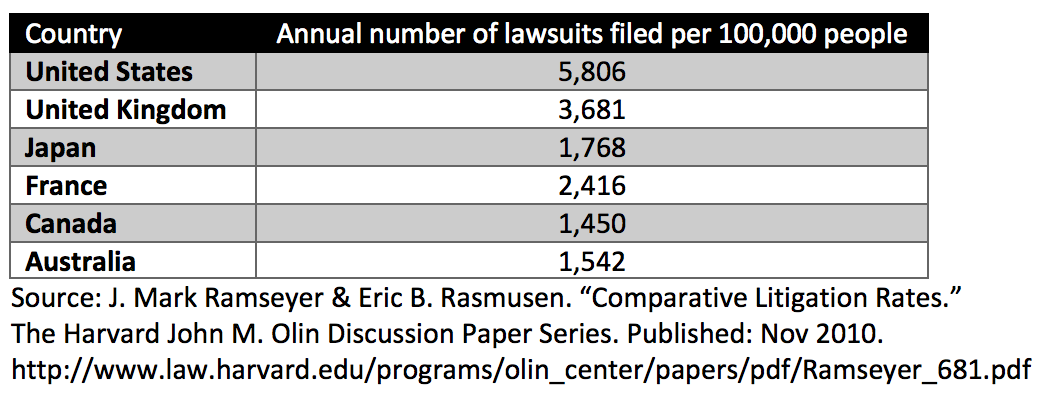
Unfortunately, there are no signs of such lawsuit abuse stopping. Researchers at Harvard’s John M. Olin Center for Law, Economics, and Business published a report that showed that the number of lawsuits filed in the United States far exceeds those of similar countries:

On a per capita basis, the lawsuit rate in the U.S. is higher than Canada (by 4 times), Australia (3.8x), Japan (3.3x), France (2.4x), and the UK (1.6x).

Beware, science. A lawsuit-happy nation turns its eyes to you.

*Note: Mission accomplished. I didn’t want to be there, anyway.

Dr. Alex Berezow is the Founding Editor of RealClearScience and Assistant Editor of RealClearWorld. He also is a member of the USA Today Board of Contributors. Furthermore, he co-authored the book Science Left Behind, which sold more than 5,000 copies. His work regularly appears in USA Today and The Economist, among other publications. In 2010, he earned a Ph.D. in microbiology from the University of Washington.

See Also:

Critical Climate Intelligence for Jurists (and others)

Climate Scientist Sues Over Hurt Feelings


Judge delivers crushing blow to Washington Clean Air Rule

h/t GWPF for breaking this story  The WSJ article is parywalled, so here is an article from the Bellevue Reporter Judge delivers crushing blow to (Governor) Inslee’s Clean Air Rule Full text below with my bolds

Twenty-seven months ago Gov. Jay Inslee set out to curb emission of carbon pollutants through a sweeping rewrite of the state’s clean air rules.

A week ago a Thurston County judge said Inslee’s executive fiat went too far.

Superior Court Judge James Dixon concluded the governor’s Department of Ecology exceeded its authority with the regulatory scheme it developed and had been taking steps to put in place.

Inslee didn’t issue a statement on receiving this legal lump of coal.

His spokeswoman, Jaime Smith, said in an email that the ruling is “disappointing” and they are looking into options the department can pursue.

The rule targeted the state’s largest emitters of greenhouse gases, such as natural gas distributors, petroleum product producers and importers, power plants, metal manufacturers, and landfill operators. Large manufacturing operations, such as the Boeing Co. plant in Everett, also made the list of those expected to be affected at some point in the future.

Inslee wanted to require those large polluters to reduce carbon emissions by an average of 1.7 percent annually. Initially, the rule would apply to those that release at least 100,000 metric tons of carbon a year. Every three years the threshold would drop and as a result more companies would be subject to the requirements.

From the outset, the Association of Washington Business (AWB) opposed the approach as an overreach from the executive branch. Two years and 29,000 pages of legal filings later, a judge agreed.

Dixon, ruling from the bench, concluded the department’s regulatory reach is limited to those companies that directly introduce contaminates into the air, said Bob Battles, AWB’s general counsel. It lacked authority to regulate suppliers of natural gas and petroleum products because they are not an emitting party, he said.

This is a crushing blow for the governor.

The clean air rule is the centerpiece of Inslee’s legislative and political crusade against climate change. He’s called it “the nation’s first Clean Air Rule, to cap and reduce carbon pollution.” He touted it on college campuses around the state and at international conferences around the globe.

Now it’s gone.

There may be an appeal. Ecology’s lawyers want to see if at least the portion of the rule applying to emitters such as refineries can go forward.

But adjudicating this matter further will take time. If there are appeals, it’s unlikely the regulation as now written could be enforced before the end of the governor’s second, and possibly last, term as governor.

At this point, he’s got to be looking to the Legislature or the electorate for an assist.

Democratic lawmakers could provide it by using their majorities in the House and Senate to send him legislation directing new regulations be imposed on carbon polluters.

And it’s probably just a happy coincidence that Dec. 14, one day before the judge put the kibosh on his rule, Inslee said he’ll put forth a new carbon pricing scheme sometime next month which they’ll be able to consider.

But Dems have struggled mightily to agree among themselves on what to do on climate change so don’t count on 2018 being much different.

Voters seem like the best bet at this point.

If environmentalists can get a measure on next November’s ballot and wealthy Inslee friends like billionaire Tom Steyer cq JC pony up enough dough, it could pass.

That certainly would ease the sting of getting the lump of coal.

In olden days kings ruled by fiat, but nowadays you need the people’s consent, disappointing to Obama and now Inslee.

Critical Climate Intelligence for Jurists (and others)

Recently I saw an activist website complaining that jurists were going to seminars led by staff at Antonin Scalia Law School, George Mason University. I wondered what might be on offer different than alarmist materials from Union of Concerned Scientists, National Resources Defense Council, Greenpeace, World Wildlife, and so on. So I went looking to see what was upsetting to the climate faithful, and found some unexpected resources for climate realists, including those serving on the bench.

The Scalia Law School at George Mason University has a long standing Mason Judicial Education Program providing continuing education for jurists. The linked website provides this description:

For over four decades, the LEC’s Judicial Education Program has helped train the nation’s judges and justices in basic economics, accounting, statistics, regulatory analysis, and other related disciplines. The Program offers intellectually rigorous, balanced, and timely education programs to the nation’s judges and justices in the belief that the fundamental principles of a free and just society depend on a knowledgable and well educated judiciary. To date, over 5,000 federal and state judges from all 50 states and the District of Columbia, including three current U.S. Supreme Court Justices, have participated in at least one of the LEC’s judicial education programs. As one JEP participant has put it: the courses have “made us better at our work and improved the administration of justice.”

From time to time there are seminars where jurists discuss cases indicative of newer tendencies in litigation. The school publishes reports of these gatherings as well as studies and articles by legal scholars in its Journal of Law, Economics and Policy. This post relies on excerpts from several essays linked below.

The Basics of Climate Law

Readings in the Journal show that climate legalities are part of environmental law, which is an aspect of the Common Law dimension called Property Rights, in particular a tort called Public nuisance. As described by legal scholar Richard O. Faulk:

Public nuisance consists of a few elements, and they’re not very complicated. First of all, a public right must be involved—a right common to the general public that they have a legal right to enjoy. Second, there must be a substantial interference with that right that causes some sort of damage, or threatens to cause some sort of damage. Two remedies are available in public nuisance litigation. The first is an equitable remedy known as abatement, where a court can, upon finding a public nuisance, order the defendant to stop or to change its activities. The court can also order the defendant to remediate the problems caused by it. Under some circumstances, damages may be awarded. Costs of remediation and other compensatory awards may be available.
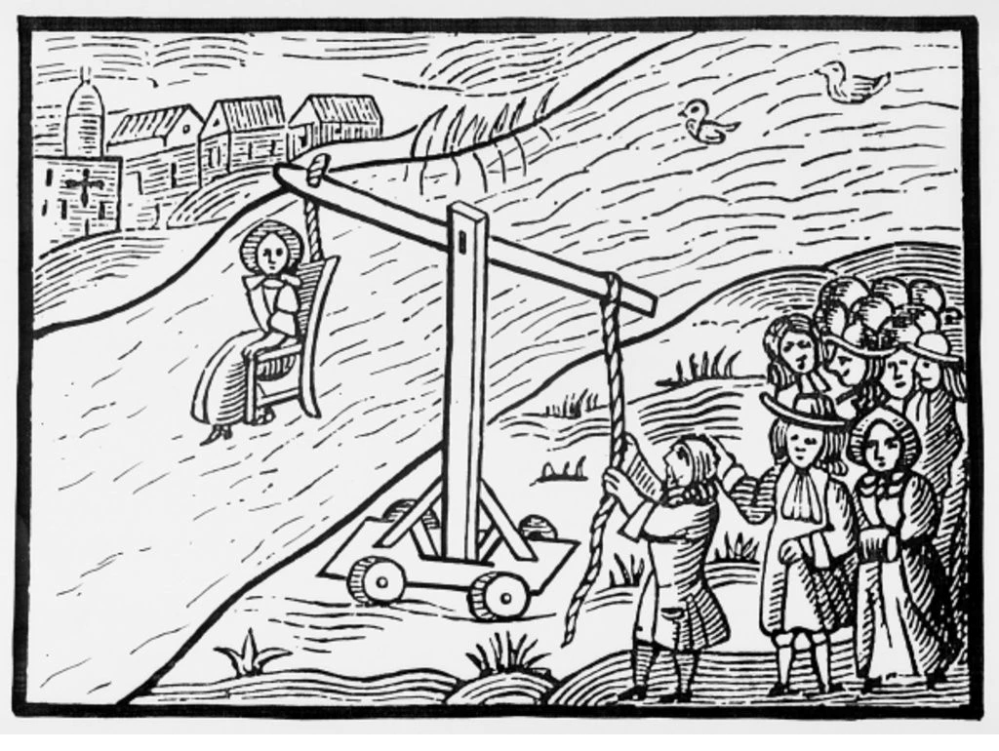
Woman on a ducking stool. Historical punishment for ‘common scold’ – woman considered a public nuisance. (Welsh/English heritage)

Let’s look at a couple of examples. I live in Houston. Let’s say that during Hurricane Ike a tree fell from my property and crashed into my neighbor’s house and damaged his roof. Under those circumstances, no public right is involved. Under those circumstances, it’s simply a private dispute between landowners. It may be private nuisance that he has a tree in his living room, but it’s a matter between us as private land owners, and a public nuisance does not arise.

But let’s say that the tree falls the other way and it blocks the street in front of my house. Under those circumstances, the public has a clear right to go down that road, to navigate it, to deal with whatever errands it needs to run. Since the fallen tree invades a right that’s common to everyone, it’s a public nuisance. The remedy is to order me to remove the tree.

Now, that’s a simple illustration. Let’s look at global warming. Let’s say, for example, that several utility companies in the Northeast burn coal in their plants. Those plants, through their smokestacks, release greenhouse gases—all kinds of things like carbon dioxide, methane, various other things as a result of the combustion of the coal. Let’s say that, for the purposes of argument, science has established that those types of emissions cause or contribute to cause global warming, which is a deleterious thing to human beings.
I don’t think anyone would doubt that the air we breathe is a common resource. So, there probably is a public right involved in these circumstances. But there are other issues. One of them is whether the emissions of these particular defendants are, in fact, substantially contributing or causing the climate change.

Generally in tort cases involving public nuisance, there is a term, which we all know from negligence cases and other torts, called proximate causation. In proximate causation, there is a “but for” test: but for the defendant’s activity, would the injury have happened? Can we say that climate change would not have happened if these power plants, these isolated five power plants, were not emitting greenhouse gases? If they completely stopped, would we still have global warming? If you shut them down completely and have them completely dismantled, would we still have global warming? Is it really their emissions that are causing this, or is it the other billions and billions of things on the planet that caused global warming—such as volcanoes? Such as gases being naturally released through earth actions, through off-gassing?

Is it the refinery down in Texas instead? Is it the elephant on the grasses in Africa? Is it my cows on my ranch in Texas who emit methane every day from their digestive systems? How can we characterize the public utilities’ actions as “but for” causes or “substantial contributions?” So far, the courts haven’t even reached these issues on the merits.

As Faulk says, the courts have not yet considered climate cases on their merits due to preemptive issues, such as standing, damages and liability. And there are additional hurdles before courts can rule on climate change.

separation-of-powers2

What about the separation of constitutional powers?

Joseph F. Speelman:

The idea expressed by the National Resources Defense Counsel and other NGOs was that they didn’t like democracy because it didn’t get them what they wanted, and so they were going to use the courts to run the American political process— fundamentally anti-democratic philosophy that they have consistently maintained—and might I add—relatively successfully.

The theory of public nuisance the way it’s being utilized now, is simply lawlessness—nothing less than pure lawlessness. This is (stated by) the man that wrote the language on public nuisance, but never intended it to be used the way it is being used. It’s being used to try to change society. Is that the law’s job? Or is the law’s job to try to set standards so that people like me can advise clients on how they can obey the law? It’s so much fun to say, “Do the right thing.” What is the right thing?
What about limits to liability?

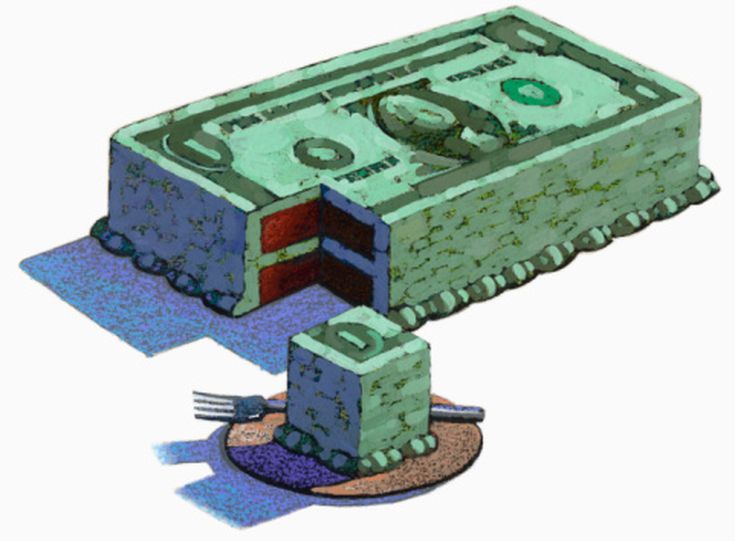
About every two or three years, the people that brought you asbestos and tobacco come up with new ideas; predatory ideas. They’re designed to separate money from people that have it and take it somewhere else. So it is about the money. Now, try to explain that to your client. Put yourself in my posture. The only way I can safely advise a client to avoid liability in this environment is to not make, buy, sell, or insure anything—but that would make it really hard for us to do what the administration asks business to do, which is to hire people.

The circuit court deemed the theory of public nuisance, as it’s being utilized, standardless liability—no standards. No ability for Joe Speelman to advise his client on how to do the right thing to avoid liability. There are no standards. I can’t tell you how to do it. And if I can’t do that, then the entire process by which business operates and makes things and sells things in this country, ultimately comes down—we get to what we really have, which is a casino mentality. So, as I said when I started—from those folks that brought you asbestos, lead litigation, and tobacco—we now have climate change.

What about effective remedies?

Jason S. Johnson:

These are all interstate public nuisance cases. There are plaintiffs in some states suing defendants who, for the most part, are in other states. There is some overlap in some of the cases such as Comer and Kivalina, but generally, the interstate character of these public nuisance actions is very, very important.

Now, what’s the problem with externalization across states? One: it’s very likely that this is going to be an inefficient externalization. That is to say you come up with some award from the court, and the basic idea of economics is we use the liability system, to what? To internalize costs. If people bear the costs of their actions, they have an incentive then to take precautions or take various steps to lower the cost to other people of the actions that they take. The inefficiency of the externalization here is very, very likely. Why? Among other things, there are very real benefits from global warming that can be expected to benefit lots of states and lots of cities.

States that think they’re going to be beneficiaries, or think that they’re going to be real net losers from greenhouse gas emission reduction— because they’re states where a lot of electricity comes from burning coal and/or they mine and produce coal in those states—those states are not at the table in these litigations either. There are a lot of benefits and costs that are not included in this dyadic interstate public nuisance litigation. They’re almost sure to generate inefficient results. Another reason why they’re sure to generate inefficient results is because the benefit of any litigation depends upon the remedy affecting behavior, and behavior affecting the harm that people suffer.

It’s simply a fact that by 2020, China is going to be responsible— forget about India and Brazil—for about 45% of the world’s greenhouse gas emission reduction. So, there’s no remedy in any of these cases that will provide any relief to any of the plaintiffs.

Finally, what’s going to happen? Who knows what’s going to happen at the Supreme Court level. But these are likely to be very ineffective and counterproductive. Remember, for a lot of environmental groups, the reason for bringing these interstate public nuisance cases is they thought they were going to force Congress to act. Well, Congress didn’t act.

Excerpts above come from the Judicial Symposium on Civil Justice Issues: Climate Change Litigation

Climate Law Itself is Changing

A more recent symposium addressed a contextual shift in principles and assumptions, differing from older concepts underlying case law precedents from the past. Briefly put, the environment is no longer seen as static, but is rather dynamic at all time scales. And in parallel, the economic system is now recognized as dynamic and fluid, rather than determinative. Both of these paradigm shifts alter the way jurists and others consider environmental claims and responses to them.

Excerpts below come from Dynamic Ecology and Dynamic Economics,issue 11.2 in the Journal of Law, Economics and Policy

Jonathan H. Adler:

Most of today’s environmental laws and programs are based upon outmoded assumptions about the relative stability of natural systems when free of human interference. Scientists have understood for decades that ecosystems are anything but stable. To the contrary, ecosystems are incredibly dynamic and change over time due to both internal and external forces. An ecosystem is the “paradigmatic complex system,” exhibiting dynamic and discontinuous behavior. To be effective, therefore, environmental management systems must themselves be sufficiently adaptive.

Noted ecologist Daniel Botkin argues that “solving our environmental problems requires a new perspective” of environmental concerns that incorporates contemporary scientific understandings and embraces humanity’s role in environmental management. Recognizing a new perspective is but the first step, however. There is also a need to identify how this perspective can inform environmental policy, not just on the ground but in the very institutional architecture of environmental law and management. Then comes the really hard part, for even if it is possible to conceive of how environmental management should proceed, it may be devilishly difficult to put such ideas into practice. Old habits die hard. Legal and institutional norms die even harder.

Contemporary environmental law embodies archaic assumptions about the natural world. Through the middle of the 20th century, “the predominant theories in ecology either presumed or had as a necessary corollary a very strict concept of a highly structured, ordered, and regulated, steady state ecological system.” Under this view, nature naturally tended toward an equilibrium state—a “balance”—absent human interference. Maintaining and protecting this balance was, in this view, ecologically superior and ultimately better for humanity as well. Contemporary ecological science has “dismissed” these theories and the accompanying notion of a “balance of nature.”

The architecture of contemporary environmental law was erected when the equilibrium paradigm still held sway. As a consequence, the edifice of environmental law sits on an unstable foundation. The equilibrium paradigm justified “a wide range of prohibitions on human activities that alter ‘natural’ land and water systems” and other environmental restrictions on productive activity.

Contemporary ecological science embraces a more dynamic understanding of the natural world and rejects the idea of a “balance of nature” that would exist but for human interference. Two insights about natural systems are essential to the contemporary view. First is the recognition that ecological systems are always in flux. There is no true “natural” state for ecosystems. No “climax” or endpoint toward which ecosystems move or evolve if left undisturbed. Second, in this day and age, there is no part of the globe in which ecosystems exist wholly apart from human influence.

The environmental laws and regulations on the books are “out of date.” As Botkin observes, “whether or not environmental scientists know about geological time and evolutionary biology, their policies ignore them.” Too often environmental policy and protection measures are based upon “nonrational, ideological beliefs instead of rationally derived facts in harmony with modern understanding of the environment.” Yet, many of the most pressing environmental problems today “exhibit the hallmark characteristics of complex adaptive systems.”

Many existing environmental laws impose binary decisions on agencies—either a species is endangered or it is not, a level of pollution may be anticipated to endanger health or it is not, etc. Once such determinations are made, specific regulatory consequences follow automatically. If a species is endangered, it triggers the regulatory requirements of the Endangered Species Act (ESA).  If a pollutant may be reasonably anticipated to threaten health and welfare, certain types of emission controls must be imposed.

Markets are also complex, adaptive, and dynamic systems. Just as it is not always possible to predict the ecological consequences of specific environmental management measures, it is often not possible to predict the market effects of such measures, or—perhaps more importantly—how such interventions will affect the interplay of economic decisions and environmental outcomes. Market actors will often respond to regulatory constraints in unanticipated ways, with unforeseen (and perhaps undesirable) effects.

There are opportunities to improve the adaptive and responsive nature of environmental protection efforts in the United States, but such opportunities are inherently limited so long as environmental protection is dominated by a relatively centralized, top-down administrative structure. Conventional regulatory and administrative systems are not particularly adaptive or responsive to changing environmental conditions, or even to changed understanding of environmental needs. Bureaucratic systems change slowly and are rarely forward looking. This is due, in part, to legal constraints, but also due to the nature of monopolistic bureaucratic systems, and the inherent information limitations that hamper the ability of such systems to acquire and account for relevant information—let alone to encourage the discovery of such information in the first place. Bureaucratic structures are resistant to change, and this is particularly true where such resistance poses few risks. Regulatory agencies do not go out of business when they fail to adapt. To the contrary, a failing agency is more likely to see a budget increase than it is to close its doors. The feedback mechanisms that force private firms to be adaptive and responsive to changing market conditions are largely absent from the administrative state.

So even if agency heads are willing to make the effort, they face a daunting gauntlet of interest group opposition and judicial scrutiny. According to Professor Ruhl, when the Fish and Wildlife Service (FWS) sought to integrate adaptive management into the habitat conservation plan (HCP) permitting process, interest group litigants and courts were quick to challenge the agency’s authority to incorporate greater flexibility into the program.

Due process concerns about adaptive management are greatest where federal agencies are engaged in the regulation of private land or the imposition of restrictions that directly affect private rights, including some rights on federal lands. Adopting adaptive management policies and techniques is far less problematic in the context of managing government lands than where environmental management decisions encroach upon private interests or risk infringing upon private property rights. While there may be political obstacles, including interest group resistance, to reducing the procedural obligations of agencies engaged in resource management decisions, there are less likely to be judicially cognizable property interests of the sort that could implicate Due Process concerns.

Climate Change Seen Through Dynamic Ecology

Daniel Botkin has led the shift in paradigm to Dynamic Ecology, especially in his influential book: Discordant Harmonies: a New Ecology for the Twenty-first Century. 1990 Oxford University Press, New York.

Daniel B. Botkin is Professor Emeritus, University of California, Santa Barbara, in the Department of Ecology, Evolution, and Marine Biology.

In 2014 he shared his view of the climate change issue in Testimony to the House Subcommittee on Science,Space and Technology. The whole document is enlightening, and included point-by-point critique of IPCC statements. His main points are highlighted below, while details and examples are in the full text.

1.I want to state up front that we have been living through a warming trend driven by a variety of influences. However, it is my view that this is not unusual, and contrary to the characterizations by the IPCC and the National Climate Assessment, these environmental changes are not apocalyptic nor irreversible.

2.My biggest concern is that both the reports present a number of speculative, and sometimes incomplete, conclusions embedded in language that gives them more scientific heft than they deserve. The reports are “scientific-sounding” rather than based on clearly settled facts or admitting their lack. Established facts about the global environment exist less often in science than laymen usually think.

3.HAS IT BEEN WARMING? Yes, we have been living through a warming trend, no doubt about that. The rate of change we are experiencing is also not unprecedented, and the “mystery” of the warming “plateau” simply indicates the inherent complexity of our global biosphere. Change is normal, life on Earth is inherently risky; it always has been. The two reports, however, makes it seem that environmental change is apocalyptic and irreversible. It is not.

4.IS CLIMATE CHANGE VERY UNUSUAL? No, it has always undergone changes.

5.ARE GREENHOUSE GASES INCREASING? Yes, CO2 rapidly.

6.IS THERE GOOD SCIENTIFIC RESEARCH ON CLIMATE CHANGE? Yes, a great deal of it.

7.ARE THERE GOOD SCIENTISTS INVOLVED IN THE IPCC 2014 REPORT? Yes, the lead author of the Terrestrial (land) Ecosystem Report is Richard Betts, a coauthor of one my scientific papers about forecasting effects of global warming on biodiversity.

8. ARE THERE SCIENTIFICALLY ACCURATE STATEMENTS AT PLACES IN THE REPORT? Yes, there are.

9. What I sought to learn was the overall take-away that the reports leave with a reader. I regret to say that I was left with the impression that the reports overestimate the danger from human-induced climate change and do not contribute to our ability to solve major environmental problems. I am afraid that an “agenda” permeates the reports, an implication that humans and our activity are necessarily bad and ought to be curtailed.

10. ARE THERE MAJOR PROBLEMS WITH THE REPORTS? Yes, in assumptions, use of data, and conclusions.

11. My biggest concern about the reports is that they present a number of speculative, and sometimes incomplete, conclusions embedded in language that gives them more scientific heft than they deserve. The reports, in other words, are “scientific-sounding,” rather than clearly settled and based on indisputable facts. Established facts about the global environment exist less often in science than laymen usually think.

12. The two reports assume and/or argue that the climate warming forecast by the global climate models is happening and will continue to happen and grow worse. Currently these predictions are way off the reality (Figure 1). Models, like all scientific theory, have to be tested against real-world observations. Experts in model validation say that the climate models frequently cited in the IPCC report are little if any validated. This means that as theory they are fundamentally scientifically unproven.

13. The reports suffer from using the term “climate change” with two meanings: natural and human-induced. These are both given as definitions in the IPCC report and are not distinguished in the text and therefore confuse a reader. (The Climate Change Assessment uses the term throughout including its title, but never defines it.) There are places in the reports where only the second meaning—human induced—makes sense, so that meaning has to be assumed. There are other places where either meaning could be applied.

14. Some of the report conclusions are the opposite of those given in articles cited in defense of those conclusions.

15. Some conclusions contradict and are ignorant of the best statistically valid observations.

16. The report for policy makers on Impacts, Adaptation, and Vulnerability repeats the assertion of previous IPCC reports that “large fraction of species” face “increase extinction risks” (p15). Overwhelming evidence contradicts this assertion. And it has been clearly shown that models used to make these forecasts, such as climate envelope models and species-area curve models, make incorrect assumptions that lead to erroneous conclusions, over-estimating extinction risks. Surprisingly few species became extinct during the past 2.5 million years, a period encompassing several ice ages and warm periods.

17. THE REPORT GIVES THE IMPRESSION THAT LIVING THINGS ARE FRAGILE AND RIGID, unable to deal with change. The opposite is to case. Life is persistent, adaptable, adjustable.

18. STEADY-STATE ASSUMPTION: There is an overall assumption in the IPCC 2014 report and the Climate Change Assessment that all change is negative and undesirable; that it is ecologically and evolutionarily unnatural, bad for populations, species, ecosystems, for all life on planet Earth, including people. This is the opposite of the reality.

19. The summary for policy makers on Impacts, Adaptation, and Vulnerability makes repeated use of the term “irreversible” changes. A species going extinct is irreversible, but little else about the environment is irreversible.

20. The extreme overemphasis on human-induced global warming has taken our attention away from many environmental issues that used to be front and center but have been pretty much ignored in the 21st century.

21. Do the problems with these reports mean that we can or should abandon any concerns about global warming or abandon any research about it? Certainly not, but we need to put this issue within an appropriate priority with other major here-and-now environmental issues that are having immediate effects.

22. The concerns I have mentioned with the IPCC apply as well to the White House’s National Climate Assessment.

Summary

The good news: Some people in the legal community are reflecting analytically about climate claims appearing in litigation, and are speaking out about the failure of facts and logic to support the allegations.

The bad news:  The more I read, the more I fear the judiciary is caught in the past and ill-prepared for the onslaught of cases coming from the anti-fossil fuels activists.  Jason Johnson, one of the above presenters said this on his website:

Legal scholarship has come to accept as true the various pronouncements of the Intergovernmental Panel on Climate Change (IPCC) and other scientists who have been active in the movement for greenhouse gas (ghg) emission reductions to combat global warming. The only criticism that legal scholars have had of the story told by this group of activist scientists – what may be called the climate establishment – is that it is too conservative in not paying enough attention to possible catastrophic harm from potentially very high temperature increases.

Scientists who have been leaders in the process of producing these Assessment Reports (“AR’s”) argue that they provide a “balanced perspective” on the “state of the art” in climate science,with the IPCC acting as a rigorous and “objective assessor” of what is known and unknown in climate science. Legal scholars have accepted this characterization, trusting that the IPCC AR’s are the product of an “exhaustive review process” – involving hundreds of outside reviewers and thousands of comments. Within mainstream environmental law scholarship, the only concern expressed about the IPCC and “consensus” climate change science is that the IPCC’s process has allowed for too much government influence (especially from China and the U.S.), pressure that has caused the IPCC’s future projections to be too cautious – too hesitant to confidently project truly catastrophic climate change.

Thus politicians, environmental law scholars and policymakers have clearly come to have extreme confidence in the opinion of a group of scientists – many of whom play a leading role on the IPCC – who hold that the late twentieth century warming trend in average global surface temperature was caused by the buildup of anthropogenic ghg’s, and that if ghg emissions are not reduced soon, then the 21st century may witness truly catastrophic changes in the earth’s climate. In the legal and the policy literature on global warming, this view – which may be called the opinion of the climate establishment – is taken as a fixed, unalterable truth. It is virtually impossible to find anywhere in the legal or the policy literature on global warming anything like a sustained discussion of the actual state of the scientific literature on ghg emissions and climate change. Instead, legal and policy scholars simply defer to a very general statement of the climate establishment’s opinion (except when it seems too conservative), generally failing even to mention work questioning the establishment climate story, unless to dismiss it with the ad hominem argument that such work is the product of untrustworthy, industry-funded “skeptics” and “deniers.”

This paper constitutes such a cross-examination. As anyone who has served as an expert witness in American litigation can attest, even though an opposing attorney may not have the expert’s scientific training, a well prepared and highly motivated trial attorney who has learned something about the technical literature can ask very tough questions, questions that force the expert to clarify the basis for his or her opinion, to explain her interpretation of the literature, and to account for any apparently conflicting literature that is not discussed in the expert report. My strategy in this paper is to adopt the approach that would be taken by a non-scientist attorney deposing global warming scientists serving as experts for the position that anthropogenic ghg emissions have caused recent global warming and must be halted if serious and seriously harmful future warming is to be prevented – what I have called above the established climate story.

To use legal terms, is the work by the IPCC and establishment story lead scientists a legal brief – intended to persuade – or a legal memo – intended to objectively assess both sides? The second and related objective of this Article is to use the cross examination to identify what seem to be the key, policy-relevant areas of remaining uncertainty in climate science, and to then at least begin to sketch the concrete implications of such remaining uncertainty for the design of legal rules and institutions adopted to respond to perceived climate change risks.

Far from turning up empty, my cross examination has (initially, to my surprise) revealed that on virtually every major issue in climate change science, the IPCC AR’s and other summarizing work by leading climate establishment scientists have adopted various rhetorical strategies that seem to systematically conceal or minimize what appear to be fundamental scientific uncertainties or even disagreements. The bulk of this paper proceeds by cataloguing, and illustrating with concrete climate science examples, the various rhetorical techniques employed by the IPCC and other climate change scientist/advocates in an attempt to bolster their position, and to minimize or ignore conflicting scientific evidence.

There are, to be sure, many chapters in the IPCC Assessment Reports whose authors have chosen to quite fully disclose both what is known as well as what is unknown, and subject to fundamental uncertainty, in their particular field of climate science. Still, the climate establishment story — comprising all of the IPCC Assessment Reports, plus the IPCC’s “Policymaker Summaries,” plus the freelance advocacy efforts of activist climate scientists (exemplified by James Hansen of NASA) – seems overall to comprise an effort to marshal evidence in favor of a predetermined policy preference, rather than to objectively assess both what is known and unknown about climatic variation and its causes.

To his credit Jason Johnson has done his homework on Climate Science and you can see his results in the document Global Warming Advocacy Science: A Cross Examination

How many other jurists have girded themselves for this battleground?

Climate Change No Longer a US Security Threat


The news was reported by the Federalist Trump Admin To Remove Climate Change From List Of National Security Threats. Excerpts below with my bolds.

The Trump administration will reverse course from previous Obama administration policy, eliminating climate change from a list of national security threats. The National Security Strategy to be released on Monday will emphasize the importance of balancing energy security with economic development and environmental protection, according to a source who has seen the document and shared excerpts of a late draft.

“Climate policies will continue to shape the global energy system,” a draft of the National Security Strategy slated to be released on Monday said. “U.S. leadership is indispensable to countering an anti-growth, energy agenda that is detrimental to U.S. economic and energy security interests. Given future global energy demand, much of the developing world will require fossil fuels, as well as other forms of energy, to power their economies and lift their people out of poverty.”

President Obama made climate change, and the burdensome regulations that accompany its focus, a primary focus of his administration, including in his National Security Strategy released in 2015. “[W]e are working toward an ambitious new global climate change agreement to shape standards for prevention, preparedness, and response over the next decade,” that report said.

“In some ways, [climate change] is akin to the problem of terrorism and ISIL,” Obama said at climate talks in Paris in 2015. During a weekly address, Obama said “Today, there is no greater threat to our planet than climate change.”

In September 2016, President Obama released a memorandum requiring federal agencies to consider the effects of climate change in the development of national security-related doctrine, policies, and plans. All of this alarmed critics concerned with more pressing security risks.

By contrast, President Trump’s National Security Strategy will focus on conventional and immediate national security risks. The draft says, in part:

North Korea seeks the capability to kill millions of Americans with nuclear weapons. Iran supports terrorist groups and openly calls for our destruction. Jihadist terrorist organizations such as ISIS and al Qaeda are determined to attack the United States and radicalize Americans with their hateful ideology. States and non-state actors undermine social order with drug and human trafficking networks, which drive violent crimes and cause thousands of American deaths each year…. Strengthening control over our borders and immigration system is central to national security, economic prosperity, and the rule of law. Terrorists, drug traffickers, and criminal cartels exploit porous borders and threaten U.S. security and public safety. These actors adapt quickly to outpace our defenses.

As for climate change, the draft report says “The United States will remain a global leader in reducing traditional pollution, as well as greenhouse gases, while growing its economy. This achievement, which can serve as model to other countries, flows from innovation, technology breakthroughs, and energy efficiency gains –not from onerous regulation.”

See also: Climates Don’t Start Wars, People Do

Everybody Knows (The Climate Fix Is In)

Lyrics:

Everybody knows that the dice are loaded
Everybody rolls with their fingers crossed
Everybody knows that the war is over
Everybody knows the good guys lost
Everybody knows the fight was fixed
The poor stay poor, the rich get rich
Thats how it goes
Everybody knows

Everybody knows that the boat is leaking
Everybody knows that the captain lied
Everybody got this broken feeling
Like their father or their dog just died
Everybody talking to their pockets
Everybody wants a box of chocolates
And a long stem rose
Everybody knows

Everybody knows that you love me baby
Everybody knows that you really do
Everybody knows that you’ve been faithful
Ah give or take a night or two
Everybody knows you’ve been discreet
But there were so many people you just had to meet
Without your clothes
And everybody knows

Everybody knows, everybody knows
Thats how it goes
Everybody knows

And everybody knows that its now or never
Everybody knows that its me or you
And everybody knows that you live forever
Ah when you’ve done a line or two
Everybody knows the deal is rotten
Old black joe’s still pickin’ cotton
For your ribbons and bows
And everybody knows

And everybody knows that the plague is coming
Everybody knows that its moving fast
Everybody knows that the naked man and woman
Are just a shining artifact of the past
Everybody knows the scene is dead
But there’s gonna be a meter on your bed
That will disclose
What everybody knows

And everybody knows that you’re in trouble
Everybody knows what you’ve been through
From the bloody cross on top of calvary
To the beach of Malibu
Everybody knows its coming apart
Take one last look at this sacred heart
Before it blows
And everybody knows

Everybody knows, everybody knows
Thats how it goes
Everybody knows

Footnote:

I doubt Leonard Cohen had climate change in mind when he wrote this masterpiece.  But he did have a pertinent poetic insight; namely, that social proof is an unreliable guide to the truth.

Climate Policies: Real Economic Damage Fighting Imaginary Problem


Sir Ian Byatt describes the self-induced plight of the UK, the nation perhaps most dangerously undermined by ill-advised energy policies supposedly to control future weather. Climate change is not the problem, but policies to fight it are. This blog has noted reports from Australia, Canada, France, Germany, the Netherlands, and the US (links below), with UK now added. H\T to Climate Scepticism for providing the text of his presentation UK Economy mired in Green Aspirations. Excerpts below with my bolds and images.

Successive British governments embrace the official policy consensus. Pressure groups, the environmental NGOs, and the science lobby, including the Royal Society (nullius in verba?) have persuaded the establishment, including the current Prince of Wales, that the UK should be an international example of virtuous behaviour.

The UK is unique in setting targets for reduction in CO2 emissions in legislation, with government claims to be on target to meet them.

Parliament, with cross-party support, passed a Climate Change Act in 2008 stipulating a 60% reduction in CO2 emissions from 1990 levels by 2050. This was increased to 80% during the passage of the Bill. An independent Parliamentary Committee was established to recommend five-yearly carbon budgets designed to achieve these objectives; this committee has recommended a reduction of 57% in CO2 emissions by 2030.

January 2017 actual low carbon generation and demand (top) . Note that the Y-axis scale is daily markers. There are two key observations. The first is that low carbon generation does not yet get close to satisfying 100% of UK demand. Any wind curtailment must therefore be down to local grid congestion, especially in Scotland. The second is that the residual is dominated by the diurnal demand cycle which means that high carbon dispatchable power is not yet adversely challenged by the current level of renewable penetration.

From Energy Matters: Centrally Planned UK Generation Scenarios for 2030

The cost of meeting these targets, in the form of levies, taxes and subsidies, has been estimated by Peter Lilley, one of the handful of MPs who voted against the Bill. He calculates a cumulative cost of over £10,000 per household between 2014 and 2030.[ Peter Lilley £300 Billion: the cost of the Climate Change Act Global Warming Policy Foundation 2016. Already £327 per household, rising to £1390 in 2050.]

These costs, estimated before the shale revolution, and excluding the costs of the EU renewable energy directive, would bear particularly heavily on vulnerable companies and poorer households, while benefitting landowners who rent out their land to suppliers of renewable energy.

Policies are also highly interventionist. Ministers have killed the competitive wholesale market in electricity supply, which, following privatisation, had reduced electricity prices. The choice of electric power generation is now made by ministers not the market; the additional costs being loaded on to customers via higher prices.

Environmental pressure groups provide both the inspiration for the virtuous and the votes for the aspiring politician. They emphasise “the tragedy of the commons”, not the power of innovation. They stress the consensus in science, not its challenges and its search for new information.  With virtue comes certainty; rules crowd out compromises, negating the value of cost-benefit analysis, which has become a tool to convince rather than to question.

We need to change the whole storyline, making environmental and climate policy consistent with the pursuit of higher productivity and higher income for the people. Unhappily, economists are failing to do this.

Such a shift should be supported by a focus on incentives and constraints, particularly institutional incentives and constraints, closely linked to the resolution of political and social conflicts.

This should include more honest calculations of the incremental costs of expanding electrical power networks, fully allowing for all system costs, including back-up power, not just costs of types of generator, and incorporating the incremental costs of transmission and unpredictable intermittency.
Getting economic analysis back into political, social and decision making will involve incorporating the particularities of human behaviour at both the individual and collective levels. This is not an easy task; but a convincing intellectual victory must respect the conflicts and confusions of our fractured world.

Resources:

Killing the Energy Goose

Climate Policies Failure, the Movie

Climate Policies Gouge the Masses

Bonn COP23 Briefing for Realists

Climate Costs in Context

Speaking Truth About Power

Germany’s Green Energy Meltdown