Electrical Madness in Green Ontario

Consumer Price Index: Ontario Electricity compared to all items, from 2004. Chart: Bank of Montreal.

Rising electricity rates in Ontario are hitting residents and businesses hard. They have gone “out of control” as the Liberal provincial government followed through on eliminating coal-fired power stations.

Brian Hill at Global News provides the back story, a frightening and cautionary tale of “fighting climate change” by pricing away your affordable power grid.

ontarios-electricity-mix-2014-300x192-1

The energy mix in Ontario’s electrical sector is dominated by hydro and nuclear, so getting off coal seemed doable.  But in the provincial government’s drive to reduce CO2 emissions and join the California Emissions Trading Scheme, they have hardwired costly energy contracts that Ontarians will pay for through their noses for decades. Meet the Global Adjustment Fee (covering a multitude of sins and mismanagement).

What is the Global Adjustment fee? The mysterious cost Ontario hydro customers must pay by Brian Hill of Global News

A product of Ontario’s 2009 Green Energy Act, the Global Adjustment fee is a charge billed to all hydro customers in the province.

For major manufacturers and large businesses, the fee appears separately on electricity bills. But for residential customers and small businesses, the fee is hidden – appearing on your electricity bill as a part of the per kilowatt hour charge.

According to data obtained by Global News from the Independent Electricity System Operator (IESO), the organization responsible for managing Ontario’s energy system, residential customers and small businesses in Ontario paid an average of 7.9 cents per kilowatt hour in Global Adjustment fees last year.

So for every $100 in usage that appears on your electricity bill, $77 of that is the Global Adjustment fee. Meaning the cost of electricity use is only $23.

What exactly is included in the Global Adjustment fee?

First, there’s the difference between what the IESO pays energy producers for the electricity they produce, known as the contracted rate, and the actual fair market value of this electricity, known as the Hourly Ontario Energy Price, or HOEP.

In 2015, the average HOEP was 2.36 cents per kilowatt hour, while the IESO paid wind producers as much as 13 cents per kilowatt hour. The remaining 11-cent difference was then passed on to the consumer in the form of the Global Adjustment fee.

Solar producers, many of which signed contracts with the government for as long as 20 or 30 years, were paid as much as 80 cents per kilowatt hour for the energy they produced, despite the fact that fair market value for this energy was the same 2.36 cents per kilowatt hour. Here, too, the 78-cent difference was passed on to consumers.

And while the argument can be made that the Global Adjustment fee simply reflects the true cost of producing reliable, green electricity in the province, this ignores the fact that, in 2015 alone, Ontario sold more than 22.6 billion kilowatt hours of electricity – enough to power 2.5 million homes – to places like New York and Michigan at the fair market price of 2.3 cents per kilowatt hour – generating a loss of more than $1.7 billion for Ontario hydro customers.

So while Ontario customers are required to pay for producing green electricity, utility providers in the United States are able to access this same energy source for a fraction of the cost.

In other words, Ontarians pay the Global Adjustment fee, delivery fees, administration fees and HST, while American utility providers pay for the electricity alone.

The Global Adjustment fee also includes what’s known as “curtailing,” when the IESO pays energy producers not to produce electricity out of fear too much production could cause stress on the system and result in a blackout.

But when asked not to generate power, electricity producers must still be paid because the Government of Ontario initially agreed to purchase everything the energy producer’s facilities were capable of putting out.

The Global Adjustment fee also includes certain government conservation programs.

For example, when you receive a tax credit for purchasing new high-efficiency appliances or LED light-bulbs, that’s included within the Global Adjustment fee. When a delivery man takes away an old refrigerator for free, or when they recycle your old computer parts, the cost of these services are all part of the Global Adjustment fee.

Why conservation won’t make a difference

Over the past seven years, Ontario has signed numerous agreements with energy producers guaranteeing minimum levels of revenue regardless of how much energy they produce.

TransCanada, set to open their Napanee Generating Station later this year, signed an agreement with the Ontario Power Authority in 2012 that guaranteed the company would receive a minimum of $13.7 million per month once the plant comes online – even if they produce zero electricity.

“Essentially… TransCanada is being paid nearly $165 million a year to leave their power generating station running on idle,” said Parker Gallant, former vice president of TD Bank and an outspoken critic of the province’s green energy strategy.

With agreements similar to this in place across the province, Gallant thinks it’s no wonder hydro rates in Ontario continue to rise.

The easiest way to explain it, said Gallant, is that when energy consumption drops due to conservation, the Global Adjustment fee must be increased to make up the difference. So the less power Ontarians use, the higher their electricity costs must be in order to cover the minimum revenues energy producers are guaranteed.

What Cost to Reduce CO2

“When it comes to fighting climate change, Ontario has already been at war with the provincial economy, devastating consumers and undermining growth. In a burst of regulatory overkill, the province ordered a shutdown of its coal plants and orchestrated a massive overhaul of the provincial electricity market, at massive cost to consumers. When the plant shutdowns began around 2009, Ontario industry and individual consumers used 139 TWh (trillions of watt hours) of electricity. In 2014, the province used the same amount of electricity coal free, but the total cost has increased from $8.6 billion in 2009 to $12.7 billion in 2014, a jump of $4 billion.”

“That’s expensive carbon reduction. Much of the increased spending comes from Ontario’s feed-in-tariff and other subsidies to allow the installation of wind and solar power and construction of new gas-powered plants. According to government figures, closing the Ontario coal plants reduced annual carbon emissions by maybe 10-million tonnes between 2009 and 2014. Let’s see, back of the envelope, $4 billion divided by 10-million tonnes of carbon, works out to about $400 per tonne of carbon per year. ”
http://business.financialpost.com/fp-comment/terence-corcoran-manufacturing-carbon-hobgoblins

Summary

it really is quite remarkable. Ontario is not trying to do something crazy like South Australia, chasing the dream of 100% renewable energy. No, Ontario energy is cheap, coming from installed nuclear and hydro plants, along with stations fired by gas, quite cheap these days. They only wanted to swap out the sliver of coal electricity for more renewables. And look at the mess they created in pursuing that very limited green energy objective.

No wonder the new UK administration is reconsidering their 30-year price agreement for Hinkley Point electricity.  Going ahead means following Ontario and others down the rabbit hole into Not-So-Wonderland.

A world-wide look at damage from green energy policies is here:  Clean, Green and Catastrophic

Update August 2

A closer reading of Hillary’s energy platform shows the Democrats want to go over the cliff with the others. http://dailycaller.com/2016/07/31/5-problems-with-hillarys-energy-platform-that-could-leave-you-in-the-dark/

Climate Lemmings h/t Beth

Update August 18 2016

In a recent followup article Global News reports on the increasingly unpaid Ontario electricity bills.

The OEB data shows Hydro One’s total amount of ‘write offs’ for eligible low income customer accounts jumped from $327,230 in 2013 to $1,798,531 in 2015, a 450 per cent increase in the utility’s write off totals in those two years.  . . The total amount owing for Hydro One customers behind on their energy bills rose from nearly $54 million in 2013 to $105.5 million in 2015, according to the OEB. The average amount owing for people in arrears was $292 in 2013 and $467 in 2015, representing a 60 per cent increase.
Climate Crisis Inc. Update


cov_en_1Five years ago Jo Nova provided a graphic displaying the workings of the Climate Scare Machine.  The figures are out-dated and this post is to update the growth of the Climate Crisis Industry and its outlook.

From Jo Nova (here) in 2010 dollars:
Climate Change Scare Machine Cycle: see how your tax dollars are converted into alarming messages

The money, power, and influence is vastly larger on the side that benefits from the alarm
On the skeptical side, Exxon chipped in all of $23 million over ten years, but it’s chump-change. The fossil fuel industry doesn’t like carbon legislation, but it’s not life or death, unlike the situation for wind and solar, which would be virtually wiped out without the subsidies provided by the scare.

The US government has poured in $79 billion and then some. But the pro-scare funding is pervasive: for example — the Australian government spent $14 million on a single Ad campaign, and another $90 million every year on a Department of Climate Change. The UK government paid for lobbyists to lobby it, and the BBC “partners” with the lobby groups. The EU doesn’t just subsidize renewables, it also pays them to push for more subsidies. Even the dastardly Exxon paid more than 20 times as much for a single renewables research project than it did to skeptics.

Last year in carbon markets $142 billion dollars turned over, and $243 billion was invested in renewables. If the carbon market idea went global it was projected to reach $2 trillion a year. Every banker and his dog has a bone in this game. Why wouldn’t they?

Industry 2015 Update from Climate Change Business Journal

(reported in Insurance Journal here).

Interest in climate change is becoming an increasingly powerful economic driver, so much so that some see it as an industry in itself whose growth is driven in large part by policymaking.

The $1.5 trillion global “climate change industry” grew at between 17 and 24 percent annually from 2005-2008, slowing to between 4 and 6 percent following the recession with the exception of 2011’s inexplicable 15 percent growth, according to Climate Change Business Journal.

The San Diego, Calif.-based publication includes within that industry nine segments and 38 sub-segments. This encompasses sectors like renewables, green building and hybrid vehicles.

That also includes the climate change consulting market, which a recent report by the journal estimates at $1.9 billion worldwide and $890 million in the U.S.

Included in this sub-segment, which the report shows is one of the fastest growing areas of the climate change industry, are environmental consultants and engineers, risk managers, assurance, as well as legal and other professional services.

Figures for the climate change consulting market are expected to more than double in the next five years, and the report’s authors believe the climate change industry as a whole will have an even steeper and faster growth trajectory than the environmental consulting industry – an industry that in 1976 had billings of $600 million and today generates $27 billion.

Paul Driessen puts the numbers in context (here).

The answer is simple. The annual revenue of the Climate Crisis & Renewable Energy Industry has become a $1.5-trillion-a-year business! That’s equal to the annual economic activity generated by the entire US nonprofit sector, or all savings over the past ten years from consumers switching to generic drugs. By comparison, revenue for the much-vilified Koch Industries are about $115 billion, for ExxonMobil around $365 billion.

According to a 200-page analysis by the Climate Change Business Journal, this Climate Industrial Complex can be divided into nine segments:

  • low carbon and renewable power;
  • carbon capture and storage;
  • energy storage, such as batteries;
  • energy efficiency;
  • green buildings;
  • transportation;
  • carbon trading;
  • climate change adaptation; and
  • consulting and research.

Consulting alone is a $27-billion-per-year industry that handles “reputation management” for companies and tries to link weather events, food shortages and other problems to climate change. Research includes engineering R&D and climate studies.

In other words, the current amount of annual spending is $1.5-trillion in the two boxes of Jo Nova’s diagram: Industrials and Financial Houses.  There’s additional money sloshing around in other boxes of the scare machine.

The $1.5-trillion price tag appears to exclude most of the Big Green environmentalism industry, a $13.4-billion-per-year business in the USA alone. The MacArthur Foundation just gave another $50 million to global warming alarmist groups. Ex-NY Mayor Michael Bloomberg and Chesapeake Energy gave the Sierra Club $105 million to wage war on coal (shortly before the Club began waging war on natural gas and Chesapeake Energy, in what some see as poetic justice). Warren Buffett, numerous “progressive” foundations, Vladimir Putin cronies and countless companies also give endless millions to Big Green.

Our hard-earned tax dollars are likewise only partially included in the CCBJ tally. As professor, author and columnist Larry Bell notes in his new book, Scared Witless: Prophets and profits of climate doom, the U.S. government spent over $185 billion between 2003 and 2010 on climate change items – and this wild spending spree has gotten even worse in the ensuing Obama years. We are paying for questionable to fraudulent global warming studies, climate-related technology research, loans and tax breaks for Solyndra and other companies that go bankrupt, and “climate adaptation” foreign aid to poor countries.

Also not included: the salaries and pensions of thousands of EPA, NOAA, Interior, Energy and other federal bureaucrats who devote endless hours to devising and imposing regulations for Clean Power Plans, drilling and mining bans, renewable energy installations, and countless Climate Crisis, Inc. handouts. A significant part of the $1.9 trillion per year that American businesses and families pay to comply with mountains of federal regulations is also based on climate chaos claims.

Add in the state and local equivalents of these federal programs, bureaucrats, regulations and restrictions, and we’re talking serious money. There are also consumer costs, including the far higher electricity prices families and businesses must pay, especially in states that want to prove their climate credentials.

Summary

Looking into the future, IEA expects additional spending just in the energy sector to meet climate change targets on the order of $35-trillion over the period 2015 to 2030.  All this remarkable growth comes in a market for non-solutions to the non-problem of global warming.  (Note to Lewandowsky:  It is not a conspiracy, it’s a monopoly.)

There also may be a limit to how much can be extracted.

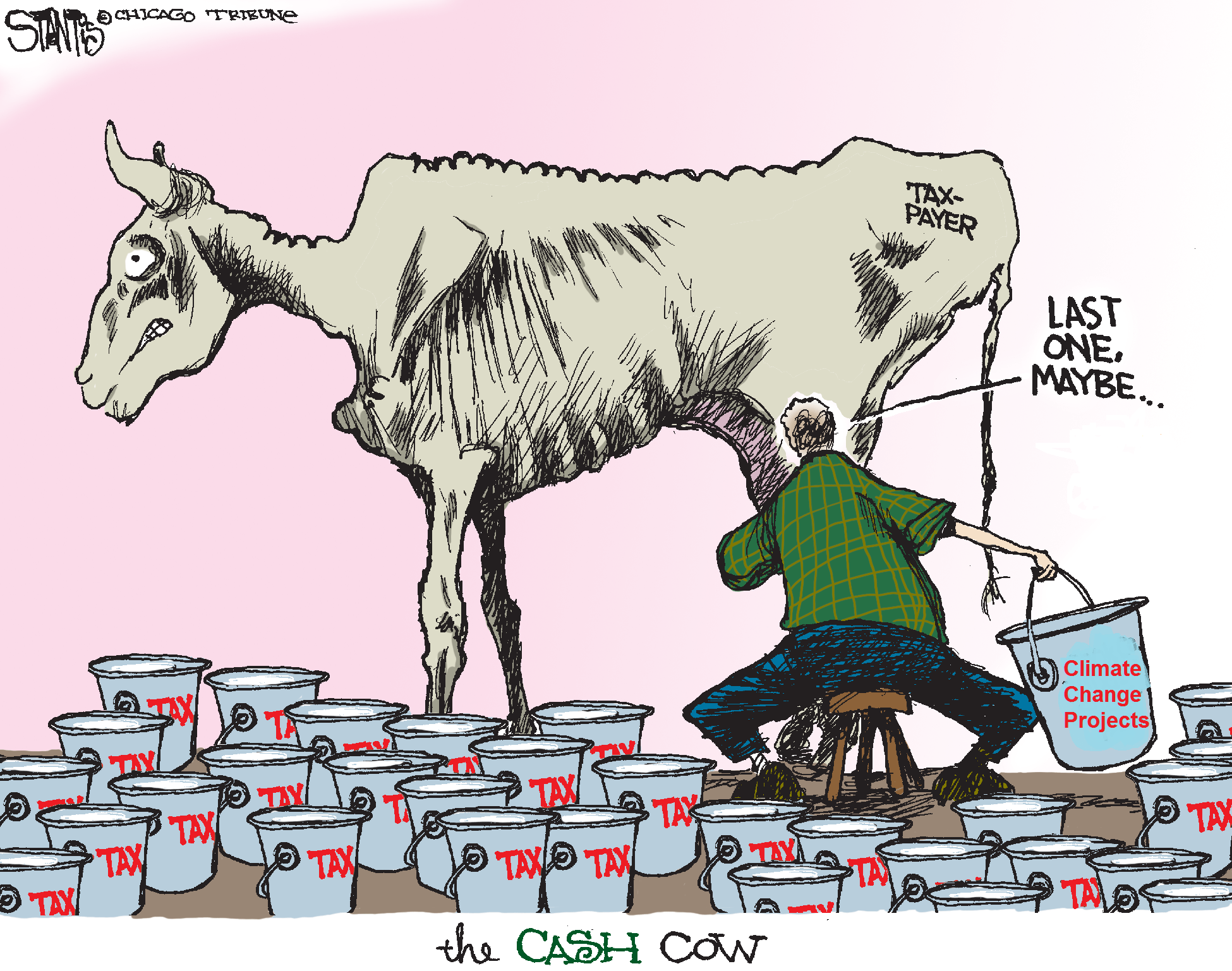
Climate cashCow

Footnotes:

  1.  The Climate Change Business Journal produced the report of 2015 industry revenues and sectors, referenced by the Insurance Journal article.  More recent reports likely show much higher revenues, but I am unwilling to buy a report from CCBJ.

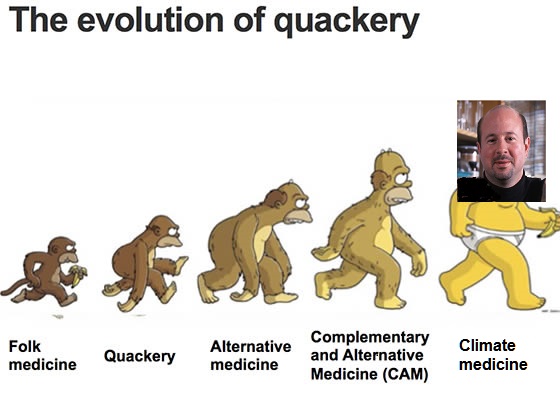
2.  A recent example of the dash for climate cash is the rise of Climate Medicine.


Climate Medicine

Climate Quakery

As Richard Lindzen predicted, everyone wants on the climate bandwagon, because that is where the money is.  Medical scientists are pushing for their share of the pie, as evidenced by last week’s Met office gathering on Assessing the Global Impacts of Climate and Extreme Weather on Health and Well-Being. Not coincidentally, the 2nd Global Conference on Health and Climate was held July 7-8, 2016 in Paris.

The new field of Climate Medicine is evidenced by a slew of new organizations and studies.  In addition to numerous agencies set up within WHO and the UN, and governmental entities (such as the Met Office), there are many NGOs, such as:

Health Care Without Harm
Health and Environment Alliance
Health and Climate Foundation
Climate and Health Council
United States National Association of County and City Health Officials
Care International
Global Gender and Climate Alliance / Women’s Environment and   Development Organization
International Federation of Medical Students’ Associations
Climate Change and Human Health Programme, Columbia U.
Center for Health and the Global Environment, Harvard
National Center for Epidemiology and Population Health, ANC Canberra
Centre for Sustainability and the Global Environment, U of Wisconsin
Environmental Change Institute, Oxford
London School of Tropical Medicine and Hygiene, London, UK
International Human Dimensions Programme on Global Environmental Change, US National Academies of Science
US Climate and Health Alliance
Etc, etc., etc.

Of course, they are encouraged and abetted by the IPCC.

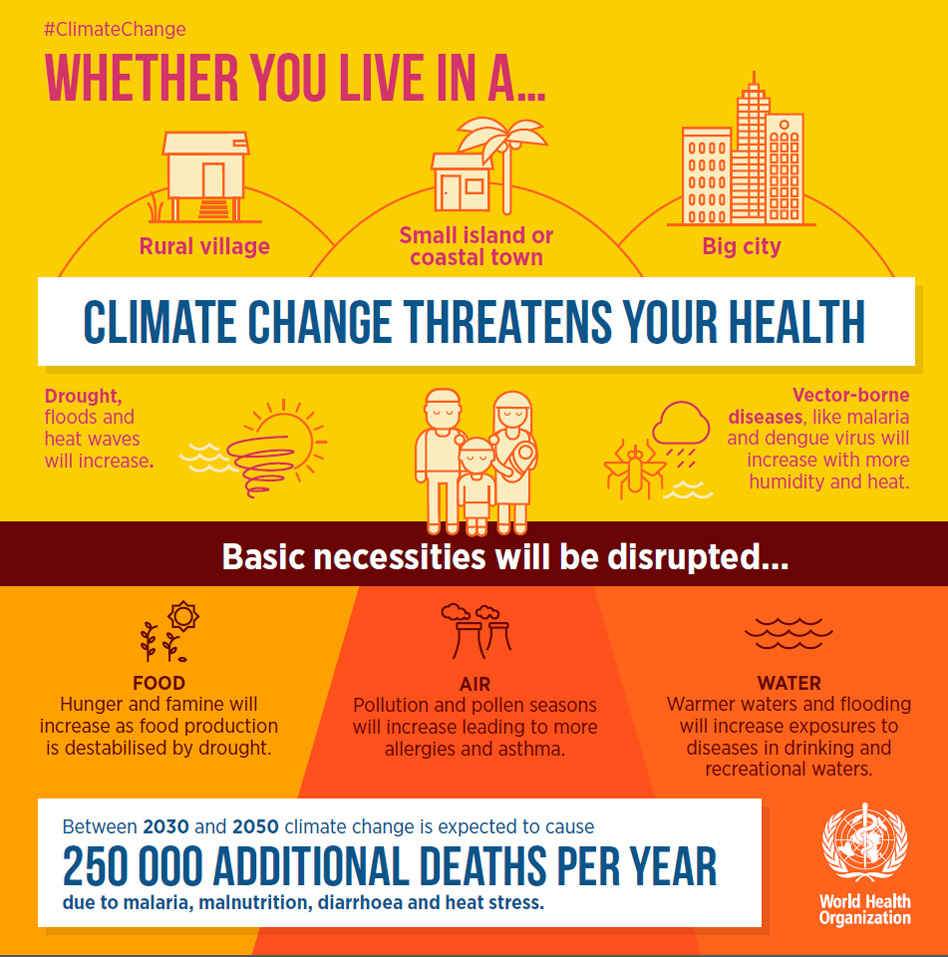
climatechange-infographic2

From the Fifth Assessment Report:

Until mid-century, projected climate change will impact human health mainly by exacerbating health problems that already exist (very high confidence). Throughout the 21st century, climate change is expected to lead to increases in ill-health in many regions and especially in developing countries with low income, as compared to a baseline without climate change (high confidence). By 2100 for RCP8.5, the combination of high temperature and humidity in some areas for parts of the year is expected to compromise common human activities, including growing food and working outdoors (high confidence). {2.3.2}

In urban areas climate change is projected to increase risks for people, assets, economies and ecosystems, including risks from heat stress, storms and extreme precipitation, inland and coastal flooding, landslides, air pollution, drought, water scarcity, sea level rise and storm surges (very high confidence). These risks are amplified for those lacking essential infrastructure and services or living in exposed areas. {2.3.2}

Feared Climate Health Impacts Are Unsupported by Scientific Research

NIPCC has a compendium of peer-reviewed studies on this issue and provides these findings (here)

Key Findings: Human Health
• Warmer temperatures lead to a decrease in temperature-related mortality, including deaths associated with cardiovascular disease, respiratory disease, and strokes. The evidence of this benefit comes from research conducted in every major country of the world.

• In the United States the average person who died because of cold temperature exposure lost in excess of 10 years of potential life, whereas the average person who died because of hot temperature exposure likely lost no more than a few days or weeks of life.

• In the U.S., some 4,600 deaths are delayed each year as people move from cold northeastern states to warm southwestern states. Between 3 and 7% of the gains in longevity experienced over the past three decades was due simply to people moving to warmer states.

• Cold-related deaths are far more numerous than heat-related deaths in the United States, Europe, and almost all countries outside the tropics. Coronary and cerebral thrombosis account for about half of all cold-related mortality.

• Global warming is reducing the incidence of cardiovascular diseases related to low temperatures and wintry weather by a much greater degree than it increases the incidence of cardiovascular diseases associated with high temperatures and summer heat waves.

• A large body of scientific examination and research contradict the claim that malaria will expand across the globe and intensify as a result of CO2 -induced warming.

• Concerns over large increases in vector-borne diseases such as dengue as a result of rising temperatures are unfounded and unsupported by the scientific literature, as climatic indices are poor predictors for dengue disease.

• While temperature and climate largely determine the geographical distribution of ticks, they are not among the significant factors determining the incidence of tick-borne diseases.

• The ongoing rise in the air’s CO2 content is not only raising the productivity of Earth’s common food plants but also significantly increasing the quantity and potency of the many healthpromoting substances found in their tissues, which are the ultimate sources of sustenance for essentially all animals and humans.

• Atmospheric CO2 enrichment positively impacts the production of numerous health-promoting substances found in medicinal or “health food” plants, and this phenomenon may have contributed to the increase in human life span that has occurred over the past century or so.

• There is little reason to expect any significant CO2 -induced increases in human-health-harming substances produced by plants as atmospheric CO2 levels continue to rise.

Source: Chapter 7. “Human Health,” Climate Change Reconsidered II: Biological Impacts (Chicago, IL: The Heartland Institute, 2014).
Full text of Chapter 7 and references on Human health begins pg. 955 of the full report here

Summary

Advances in medical science and public health have  benefited billions of people with longer and higher quality lives.  Yet this crucial social asset has joined the list of those fields corrupted by the dash for climate cash. Increasingly, medical talent and resources are diverted into inventing bogeymen and studying imaginary public health crises.

Economists Francesco Boselloa, Roberto Roson and Richard Tol conducted an exhaustive study called Economy-wide estimates of the implications of climate change: Human health

After reviewing all the research and crunching the numbers, they concluded that achieving one degree of global warming by 2050 will, on balance, save more than 800,000 lives annually.

Not only is the warming not happening, we would be more healthy if it did.

Oh, Dr. Frankenmann, what have you wrought?


Footnote:  More proof against Climate Medicine

From: Gasparrini et al: Mortality risk attributable to high and low ambient temperature: a multicountry observational study. The Lancet, May 2015

Cold weather kills 20 times as many people as hot weather, according to an international study analyzing over 74 million deaths in 384 locations across 13 countries. The findings, published in The Lancet, also reveal that deaths due to moderately hot or cold weather substantially exceed those resulting from extreme heat waves or cold spells.

“It’s often assumed that extreme weather causes the majority of deaths, with most previous research focusing on the effects of extreme heat waves,” says lead author Dr Antonio Gasparrini from the London School of Hygiene & Tropical Medicine in the UK. “Our findings, from an analysis of the largest dataset of temperature-related deaths ever collected, show that the majority of these deaths actually happen on moderately hot and cold days, with most deaths caused by moderately cold temperatures.”


Climategate Redux?

The AAAS (American Association for the Advancement of Science) sent a letter on June 28, 2016 urging the US congress to act on climate change:

There is strong evidence that ongoing climate change is having broad negative impacts on society, including the global economy, natural resources, and human health. For the United States, climate change impacts include greater threats of extreme weather events, sea level rise, and increased risk of regional water scarcity, heat waves, wildfires, and the disturbance of biological systems. The severity of climate change impacts is increasing and is expected to increase substantially in the coming decades.

Those of us with short memories need to be reminded that the Climategate emails were triggered by an appeal to congress in 2009 by the AAAS. Dr. Arnd Bernaerts provides the background and the historical context.

On October 21, 2009 the AAAS letter included this:

Moreover, there is strong evidence that ongoing climate change will have broad impacts on society, including the global economy and on the environment. For the United States, climate change impacts include sea level rise for coastal states, greater threats of extreme weather events, and increased risk of regional water scarcity, urban heat waves, western wildfires, and the disturbance of biological systems throughout the country. The severity of climate change impacts is expected to increase substantially in the coming decades.
Full text provided by Dr. Bernaerts here, along with his response.

The Climategate Emails

2011 Report here
More than 5,000 documents have been leaked online purporting to be the correspondence of climate scientists at the University of East Anglia who were previously accused of ‘massaging’ evidence of man-made climate change.

Following on from the original ‘climategate’ emails of 2009, the new package appears to show systematic suppression of evidence, and even publication of reports that scientists knew to to be based on flawed approaches. 

The leaker of the emails “FOIA” said this in a comment at the time, Nov. 17, 2009:
We feel that climate science is, in the current situation, too important to be kept under wraps.
We hereby release a random selection of correspondence, code, and documents.
Hopefully it will give some insight into the science and the people behind it.

Dr. Bernaerts comments on the current situation:

I had hoped that the “endorsement” by “FOIA said” would give a helpful impulse to my complaint about a science which is not able to define what they are talking about, namely CLIMATE. Those not happy with the AGW discussion should have pressured WMO, IPCC and consorts to demonstrate that they are capable to do what every academic is trained to do, to provide reasonable and workable definitions. Unfortunately that did not materialize. The definition matter remains neglected by AGW supporters and sceptics alike. A great pity. A further conference paper from January 2010, available at: http://www.whatisclimate.com/ explains this in more detail.

What has changed in the world of AAAS and in the field of supporting and opposing views: Much too little. A pity that we cannot ask FOIA what would be his view today.

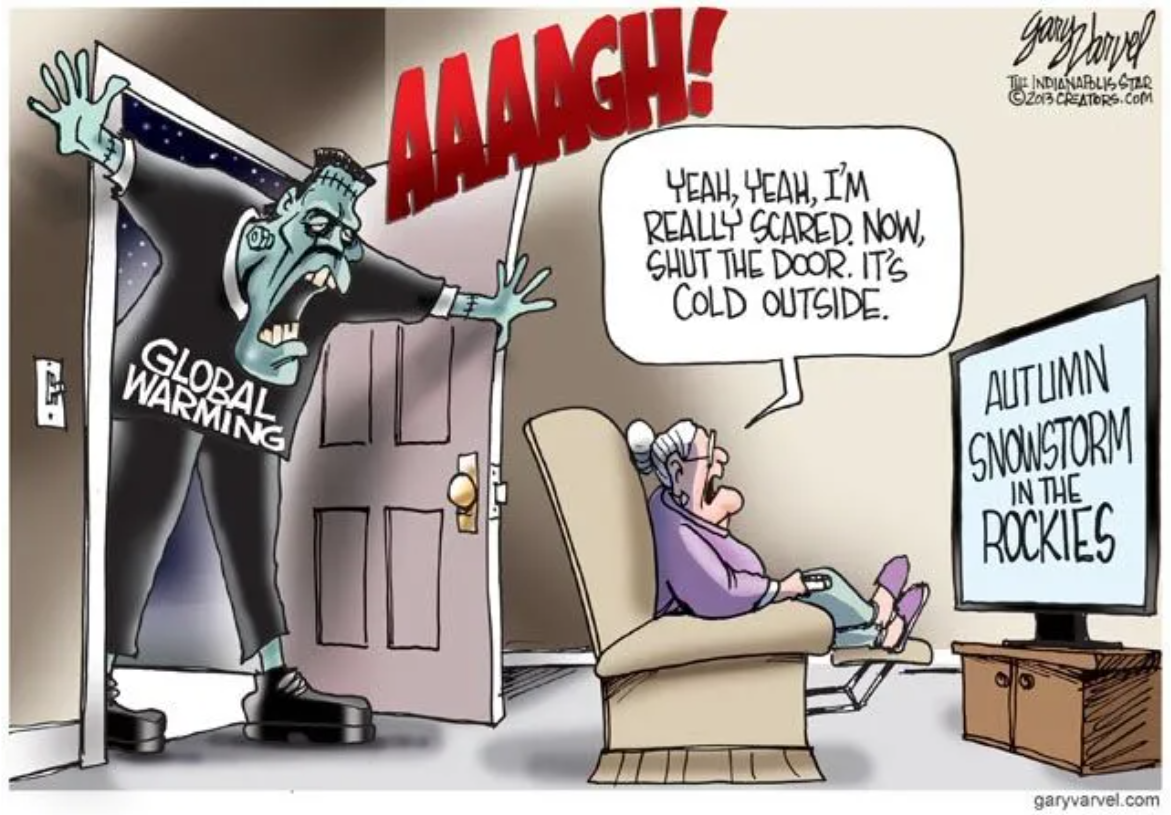
The Climate Lemmings
h/t Beth


Climate War Human Shields

In Massachusetts, four teenagers, the Conservation Law Foundation and the Mass Energy Consumer Alliance brought the climate action case to court. “The global climate change crisis is a threat to the well being of humanity, and to my generation, that has been ignored for too long,” said one of the young prosecutors, Shamus Miller.

On Tuesday, the Massachusetts (MA) Supreme Court mandated the MA Department of Environmental Protection (DEP) to promote impactful climate legislation. The court deemed that the DEP failed to uphold climate change agreements outlined in the Global Warming Solutions Act of 2008 and “requires the department to promulgate regulations that establish volumetric limits on multiple greenhouse gas emissions sources, expressed in carbon dioxide equivalents, and that such limits must decline on an annual basis.”

This case is in accordance with “youth around the country and internationally…bringing their governments to court to secure their rights to a healthy atmosphere and stable climate,” commented Julia Olson, executive director of Our Children’s Trust (an organization that helps youth fight “game-changing” legal battles around the world).Source: Planetexperts 

And who are the adults involved in  Our Children’s Trust?


Supporting Experts (the usual suspects)

Dr. James Hansen
Dr. Ove Hoegh-Guldberg
Dr. Sivan Kartha
Dr. Pushker Kharecha
Dr. David Lobell
Dr. Arjun Makhijani
Dr. Jonathan Overpeck
Dr. Camille Parmeson
Dr. Stefan Rahmstorf
Dr. Steven Running
Dr. James Gustave Speth
Dr. Kevin Trenberth
Dr. Lise Van Susteren
Dr. Paul Epstein (1943-2011)
Etc

Campaign Partners (Allies whose funding depends on CO2 Hysteria)

Climate Reality Project,
Western Environmental Law Center,
Crag Law Center,
Texas Environmental Law Center,
Cottonwood Environmental Law Center,
WildEarth Guardians,
Clean Air Council,
Global Campaign for Climate Action,
Chasing Ice,
Environmental Law Alliance Worldwide,
TERRA,
Sierra Club,
350.org,
Climate Solutions,
Greenwatch,
Center for International Environmental Law..
Greenpeace
etc.

Conclusion

This is as obscene as brainwashing young Muslims to be suicide bombers. Or terrorists hiding among families to deter the drone strikes. The fact that the kids are willing is no excuse.

Think of the children! How will they feel a decade from now when they realize they have been duped and exploited by activists who figured judges would be more sympathetic to young believers?

Gifted kids


Update June 24

Some addition background in response to questions from Frederick Colbourne.

Frederick, they are employing a creative approach to the “Public Trust Doctrine”. From their website:
“Specifically, these court decisions have rejected many legal defenses raised by our opponents, including non-justiciability, standing, separation of powers and sovereign immunity. In support of our youths’ positions, and in face of argument to the contrary, the courts have validated critical climate science and reserved for the courts the exclusive right to determine whether a particular commons resource is protected by the Public Trust Doctrine for benefit of present and future generations, and whether there has been a breach of that trust. Our cases are now progressing to the next phases where the courts will make those determinations relative to our atmosphere.”

Massachusetts is ripe for this legal suit because the state passed legislation endorsing the threat of climate change and subscribing to targets for reducing emissions.

From the Court decision: “the Climate Protection and Green Economy Act, G. L. c. 21N (statute)”
“The act established a comprehensive framework to address the effects of climate change in the Commonwealth by reducing emissions to levels that scientific evidence had suggested were needed to avoid the most damaging impacts of climate change. . .In accordance with these findings, the statute requires that, by 2050, greenhouse gas emissions be reduced by at least eighty per cent below 1990 levels. G. L. c. 21N, § 3 (b).”

Note that it was Massachusetts that acted to get EPA jurisdiction over GHGs. Again from the Court decision: “See also Massachusetts v. Environmental Protection Agency, 549 U.S. 497, 505 (2007) (petition by Massachusetts, with other States, local governments, and private organizations, arguing Environmental Protection Agency abdicated responsibility under Clean Air Act to regulate emissions of four greenhouse gases, including carbon dioxide).”

This legal strategy is along the lines of “Sue and Settle” tactic employed in the past to expand the regulatory scope of the EPA. Part of this latest charade is for the state to offer a token defense so that the court requires them to do what they want to do anyways, but now armed with additional ammunition against resisters.

Note also the bait and switch: Climate change is not at issue, it is all about meeting emissions targets.  It should serve also as a cautionary tale to any jurisdiction that thinks they can pass lip-service legislation and get away with politically-correct posturing.

Footnote for those not aware of Aliases for the Usual Suspects:

James “Death Trains” Hansen
Ove “Reefer Mad” Hoegh-Guldberg
Jonathan “Water Torture” Overpeck
Camille “The Extincter” Parmeson
Stefan “No Tommorow” Rahmstorf
Kevin “Hidden Heat” Trenberth

Circling the Climate Wagons

What to make of this recent Report (here):

An Australian university recently censured marine scientist Paul Ridd for “failing to act in a collegial way and in the academic spirit of the institution,” because he questioned popular claims among environmentalists about coral reefs and global warming.

To understand what is going on, some background in organizational sociology is helpful.

In past decades, researchers looking into organizational behavior concluded that the internal discipline inside the organization had to be stronger than the threats or enticements outside. Thus, an army has high regimentation and command drilling in order that soldiers follow orders and perform in the face of armed enemies trying to kill them. Police units operate in hostile environments and rely on similar training and disciplines.

Slightly different examples include missionaries seeking to convert heathens, without themselves losing their beliefs, religous practices or ethics when surrounded by people of another culture.

When it comes to corporations, most of them have sales departments who have a special camaraderie and rituals that keep them pitching skeptical customers in the face of rejection and losing trades to competitors.

All this is context for recognizing that many scientists in the present research funding market operate as salesmen in order to protect and enhance their revenue streams. If they are prone to exaggerated claims, that goes with the role and territory. And if they are called to account for not having the back of fellow salesmen, that is also to be expected.

The behavior of climate scientists at James Cook University is a case of sales managers attacking the credentials of someone undermining their claims and threatening to dispel the fears upon which government funding is based.

Sadly, this is further evidence of the degradation of climate science, which has been thoroughly vetted by Richard Lindzen:  Climate Science Was Broken


India: Show Us the Climate Money

Playing his cards close to the vest, India’s prime minister first promised they would soon ratify the Paris accord, then said the climate reparation money must be on the table first.  Details are at GWPF:

INDIA LINKS RATIFICATION OF PARIS AGREEMENT TO CLIMATE FINANCE, DENIES IT WILL RATIFY DEAL THIS YEAR

The climate charade reminds me of what Russians said privately during the Soviet era:  “We pretend to work, and they pretend to pay.”

cg565e788a82606

Exxon Shareholders Reject Activists May 25

Update May 26 below

May 25, 2016: A shareholder proposition from global warming alarmists was soundly defeated today at the Annual Meeting. Activists took heart that 38% of shares were voted in favor, larger than previous such actions received. It appears that much of that support came from the Norwegian sovereign wealth fund, which is a story in its own right.

The world’s largest sovereign wealth fund announced Tuesday that it would back shareholder resolutions requiring Chevron and ExxonMobil to report on how climate change could threaten assets during extreme weather events or put revenues at risk due to government efforts to transition from fossil fuels to renewable sources.

The company that manages Norway’s $872 billion fund said the boards of directors for the oil giants should better anticipate those risks — as well as any upsides — and report on them to shareholders. (here)

Anyone visiting Norway (as I did last year) will recognize from the prices of everything and the obvious signs of conspicious consumption that modern Norway is a Petro-state. I don’t have Tesla sales statistics handy, but just walking around Oslo, you can clearly see more of them per capita than anywhere outside of Hollywood. (Huge subsidies and free recharging helps.)

Now the Norwegians deserve credit for putting their enormous profits from North Sea oil into a fund for future generations. Don’t see that in Saudia Arabia or Iran, or most other Petro-States. But their acceptance of CO2 warming dogma is as jarring as the Rockefeller Foundation funding anti-petroleum activists. Why all this guilt over energy resources?

Other major investors promoting the action included: The Church Commissioners for England, Trustee of New York State Common Retirement Fund, Amundi, AXA Investment Management, BNP Paribas, CalPERS, and Legal & General Investment Management.

The proposition itself is based upon a flimsy set of suppositions, as explained here: https://rclutz.wordpress.com/2t016/05/01/behind-the-alarmist-scene/

Update May 26

Some sources give more insight into the activism employed,

From CNBC

Earlier this month, a letter signed by 1,000 professors from over 40 global universities, including Oxford and Ivy League colleges like Harvard, was sent by Positive+Investment — a campaign group launched by Cambridge students — to Exxon and Chevron’s top 20 shareholders urging they pass the resolutions.

But institutional shareholders including Norway’s $872 billion sovereign wealth fund, the Church of England, and the U.S.’s largest state pension fund are already throwing their weight behind the climate cause.

Norges Bank Investment Management (NBIM) publicly disclosed that it plans to vote in favor of climate impact assessment reports for both Chevron and Exxon, telling reporters earlier this month that it would relentlessly push the companies to be more open about their climate change strategies, even if the proposals didn’t pass at this year’s AGM.

According to its 2015 holdings report, NBIM holds a 0.85 percent stake in Chevron worth $1.45 billion, and a 0.78 percent stake in Exxon worth $2.54 billion.

And the push will continue according to Washington Examiner:

“The recommendation by Exxon’s board to outright reject every single climate resolution from shareholders sends an incontestable signal to investors: it’s due time to divest from Exxon’s deception,” said May Boeve, executive director of the group 350.org, a leading proponent of the Keep it in the Ground campaign and movement for pension funds, schools and others to divest from investments in fossil fuels. Many scientists blame the greenhouse gases emitted from the burning of fossil fuels, such as crude oil and coal, for man-made climate change.

ExxonMobil has been targeted because they have not given an inch to demands from alarmists.  But other energy companies all also under attack. Shell shareholders overwhelmingly voted against considering a proposition to convert the company into a renewables business.

Attempts to appease bullies seldom stop them from making more and bigger demands.  Those companies now talking “Green” in order to be politically correct on climate change won’t be left alone to conduct their businesses. ExxonMobil knows this already, and has the subpoenas to prove it.

Behind the Alarmist Scene

fox-theatre-curtain1

Update May 24, 2016: The shareholder vote is scheduled for tomorrow, May 25, according to this article.

We can look into the climate activist mental frame thanks to documents supporting the current strategy using the legal system to implement actions against fossil fuel consumption.

For example, there is this recent text explaining a shareholder proposal to be tabled at ExxonMobil annual meeting. From Attorney Sanford Lewis:

The Proposal states:

“RESOLVED: Shareholders request that by 2017 ExxonMobil publish an annual assessment of long term portfolio impacts of public climate change policies, at reasonable cost and omitting proprietary information. The assessment can be incorporated into existing reporting and should analyze the impacts on ExxonMobil’s oil and gas reserves and resources under a scenario in which reduction in demand results from carbon restrictions and related rules or commitments adopted by governments consistent with the globally agreed upon 2 degree target. The reporting should assess the resilience of the company’s full portfolio of reserves and resources through 2040 and beyond and address the financial risks associated with such a scenario.

Now let’s unbundle the chain of suppositions that comprise this proposal.

  • Supposition 1: A 2C global warming target is internationally agreed.
  • Supposition 2: Carbon Restrictions are enacted by governments to comply with the target.
  • Supposition 3: Demand for oil and gas products is reduced due to restrictions
  • Supposition 4: Oil and gas assets become uneconomic for lack of demand.
  • Supposition 5: Company net worth declines by depressed assets and investors lose value.

1.Suppose an International Agreement to limit global warming to 2C.

From the supporting statement to the above proposal, Sanford Lewis provides these assertions:

Recognizing the severe and pervasive economic and societal risks associated with a warming climate, global governments have agreed that increases in global temperature should be held below 2 degrees Celsius from pre-industrial levels (Cancun Agreement).

Failing to meet the 2 degree goal means, according to scientists, that the world will face massive coastal flooding, increasingly severe weather events, and deepening climate disruption. It will impose billions of dollars in damage on the global economy, and generate an increasing number of climate refugees worldwide.

Climate change and the risks it is generating for companies have become major concerns for investors. These concerns have been magnified by the 21st Session of the Conference of the Parties (COP 21) in Paris, where 195 global governments agreed to restrict greenhouse gas (GHG) emissions to no more than 2 degrees Celsius from pre-industrial levels and submitted plans to begin achieving the necessary GHG emission reductions. In the agreement, signatories also acknowledged the need to strive to keep global warming to 1.5 degrees, recognizing current and projected harms to low lying islands.

Yet a careful reading of UN agreements shows commitment is exaggerated:
David Campbell (here):

Neither 2°C nor any other specific target has ever been agreed at the UN climate change negotiations.

Article 2 of the Paris Agreement in fact provides only that it ‘aims to strengthen the global response to the threat of climate change … including by the holding the increase to well below 2°C’. This is an expression, not of setting a concrete limit, but merely of an aspiration to set such a limit. It is true that Article 2 is expressed in a deplorably equivocatory and convoluted language which fails to convey this vital point, indeed it obscures it. But nevertheless that is what Article 2 means.

Dieter Helm (here):

Nothing of substance has been achieved in the last quarter of a century despite all the efforts and political capital that has been applied. The Paris Agreement follows on from Kyoto. The pledges – in the unlikely event they are met – will not meet the 2C target, shipping and aviation are excluded, and the key developing countries (China and India) are not committed to capping their emission for at least another decade and a half (or longer in India’s case)

None of the pledges is, in any event, legally binding. For this reason, the Paris Agreement can be regarded as the point at which the UN negotiating approach turned effectively away from a top down approach, and instead started to rely on a more country driven and hence bottom up one.

Paul Spedding:

The international community is unlikely to agree any time soon on a global mechanism for putting a price on carbon emissions.

2: Suppose Governments enact restrictions that limit use of fossil fuels.

Despite the wishful thinking in the first supposition, the activists proceed on the basis of aspirations and reporting accountability. Sanford Lewis:

Although the reduction goals are not set forth in an enforceable agreement, the parties put mechanisms in place for transparent reporting by countries and a ratcheting mechanism every five years to create accountability for achieving these goals. U.N. Secretary General Ban Ki-moon summarized the Paris Agreement as follows: “The once Unthinkable [global action on climate change] has become the Unstoppable.”

Now we come to an interesting bait and switch. Since Cancun, IPCC is asserting that global warming is capped at 2C by keeping CO2 concentration below 450 ppm. From Summary for Policymakers (SPM) AR5

Emissions scenarios leading to CO2-equivalent concentrations in 2100 of about 450 ppm or lower are likely to maintain warming below 2°C over the 21st century relative to pre-industrial levels. These scenarios are characterized by 40 to 70% global anthropogenic GHG emissions reductions by 2050 compared to 2010, and emissions levels near zero or below in 2100.

Thus is born the “450 Scenario” by which governments can be focused upon reducing emissions without any reference to temperature measurements, which are troublesome and inconvenient.

Sanford Lewis:

Within the international expert community, “2 degree” is generally used as shorthand for a low carbon scenario under which CO2 concentrations in the earth’s atmosphere are stabilized at a level of 450 parts per million (ppm) or lower, representing approximately an 80% reduction in greenhouse gas emissions from current levels, which according to certain computer simulations would be likely to limit warming to 2 degrees Celsius above pre-industrial levels and is considered by some to reduce the likelihood of significant adverse impacts based on analyses of historical climate variability. Company Letter, page 4.

Clever as it is to substitute a 450 ppm target for 2C, the mathematics are daunting. Joe Romm:

We’re at 30 billion tons of carbon dioxide emissions a year — rising 3.3% per year — and we have to average below 18 billion tons a year for the entire century if we’re going to stabilize at 450 ppm. We need to peak around 2015 to 2020 at the latest, then drop at least 60% by 2050 to 15 billion tons (4 billion tons of carbon), and then go to near zero net carbon emissions by 2100.

And the presumed climate sensitivity to CO2 is hypothetical and unsupported by observations:

3.Suppose that demand for oil and gas products is reduced by the high costs imposed on such fuels.

Sanford Lewis:

ExxonMobil recognized in its 2014 10-K that “a number of countries have adopted, or are considering adoption of, regulatory frameworks to reduce greenhouse gas emissions,” and that such policies, regulations, and actions could make its “products more expensive, lengthen project implementation timelines and reduce demand for hydrocarbons,” but ExxonMobil has not presented any analysis of how its portfolio performs under a 2 degree scenario.

Moreover, the Company’s current use of a carbon proxy price, which it asserts as its means of calculating climate policy impacts, merely amplifies and reflects its optimistic assessments of national and global climate policies. The Company Letter notes that ExxonMobil is setting an internal price as high as $80 per ton; in contrast, the 2014 Report notes a carbon price of $1000 per ton to achieve the 450 ppm (2 degree scenario) and the Company reportedly stated during the recent Paris climate talks that a 1.5 degree scenario would require a carbon price as high as $2000 per ton within the next hundred years.

Peter Trelenberg, manager of environmental policy and planning at Exxon Mobil reportedly told the Houston Chronicle editorial board: Trimming carbon emissions to the point that average temperatures would rise roughly 1.6 degrees Celsius – enabling the planet to avoid dangerous symptoms of carbon pollution – would bring costs up to $2,000 a ton of CO2. That translates to a $20 a gallon boost to pump prices by the end of this century… .

Even those who think emissions should be capped somehow see through the wishful thinking in these numbers. Dieter Helm:

The combination of the shale revolution and the ending of the commodity super cycle probably point to a period of low prices for sometime to come. This is unfortunate timing for current decarbonisation policies, many of which are predicated on precisely the opposite happening – high and rising prices, rendering current renewables economic. Low oil prices, cheap coal, and falling gas prices, and their impacts on driving down wholesale electricity prices, are the new baseline against which to consider policy interventions.

With existing technologies, it is a matter of political will, and the ability to bring the main polluters on board, as to whether the envelope will be breached. There are good reasons to doubt that any top down agreement will work sufficiently well to achieve it.

The end of fossil fuels is not about to happen anytime soon, and will not be caused by running out of any of them. There is more than enough to fry the planet several times over, and technological progress in the extraction of fossil fuels has recently been at least as fast as for renewables. We live in an age of fossil fuel abundance.

We also live in a world where fossil fuel prices have fallen, and where the common assumption that prices will bounce back, and that the cycle of fossil fuel prices will not only reassert itself but also continue on a rising trend, may be seriously misguided. It is plausible to at least argue that the oil price may never regain its peaks in 1979 and 2008 again.

A world with stable or falling fossil fuel prices turns the policy assumptions of the last decade or so on their heads. Instead of assuming that rising prices would ease the transition to low carbon alternatives, many of the existing technologies will probably need permanent subsidies. Once the full system costs are incorporated, current generation wind (especially offshore) and current generation solar may be out of the market except in special locations for the foreseeable future. In any event, neither can do much to address the sheer scale of global emissions.

Primary Energy Demand Projection

4.Suppose oil and gas reserves are stranded for lack of demand.

Sanford Lewis:

Achievement of even a 2 degree goal requires net zero global emissions to be attained by 2100. Achieving net zero emissions this century means that the vast majority of fossil fuel reserves cannot be burned. As noted by Mark Carney, the President of the Bank of England, the carbon budget associated with meeting the 2 degree goal will “render the vast majority of reserves ‘stranded’ – oil, gas, and coal that will be literally unburnable without expensive carbon capture technology, which itself alters fossil fuel economics.”

A concern expressed by some of our stakeholders is whether such a “low carbon scenario” could impact ExxonMobil’s reserves and operations – i.e., whether this would result in unburnable proved reserves of oil and natural gas.

Decisions to abandon reserves are not as simple or have the effects as desired by activists.

Financial Post (here):

The 450 Scenario is not the IEA’s central scenario. At this point, government policies to limit GHG emissions are not stringent enough to stimulate this level of change. However, for discussion purposes let’s use the IEA’s 450 Scenario to examine the question of stranded assets in crude oil investing. Would some oil reserves be “stranded” under the IEA’s scenario of demand reversal?

A considerable amount of new oil projects must be developed to offset the almost 80 per cent loss in legacy production by 2040. This continued need for new oil projects for the next few decades and beyond means that the majority of the value of oil reserves on the books of public companies must be realized, and will not be “stranded”.

While most of these reserves will be developed, could any portion be stranded in this scenario? The answer is surely “yes.” In any industry a subset of the inventory that is comprised of inferior products will be susceptible to being marginalized when there is declining demand for goods. In a 450 ppm world, inferior products in the oil business will be defined by higher cost and higher carbon intensity.

5.Suppose shareholders fear declining company net worth.

Now we come to the underlying rationale for this initiative.

Paul Spedding:

Commodity markets have repeatedly proved vulnerable to expectations that prices will fall. Given the political pressure to mitigate the impact of climate change, smart investors will be watching closely for indications of policies that will lead to a drop in demand and the possibility that their assets will become financially stranded.

Equity markets are famously irrational, and if energy company shareholders can be spooked into selling off, a death spiral can be instigated. So far though, investors are smarter than they are given credit.

Bloomberg:

Fossil-fuel divestment has been a popular issue in recent years among college students, who have protested at campuses around the country. Yet even with the movement spreading to more than 1,000 campuses, only a few dozen schools have placed some restrictions on their commitments to the energy sector. Cornell University, Massachusetts Institute of Technology and Harvard University are among the largest endowments to reject demands to divest.

Stanford Board of Trustees even said:

As trustees, we are convinced that the global community must develop effective alternatives to fossil fuels at sufficient scale, so that fossil fuels will not continue to be extracted and used at the present rate. Stanford is deeply engaged in finding alternatives through its research. However, despite the progress being made, at the present moment oil and gas remain integral components of the global economy, essential to the daily lives of billions of people in both developed and emerging economies. Moreover, some oil and gas companies are themselves working to advance alternative energy sources and develop other solutions to climate change. The complexity of this picture does not allow us to conclude that the conditions for divestment outlined in the Statement on Investment Responsibility have been met.

Update:  Universities are not the exception in finding the alarmist case unconvincing, according to a survey:

Almost half of the world’s top 500 investors are failing to act on climate change — an increase of 6 percent from 236 in 2014, according to a report Monday by the Asset Owners Disclosure Project, which surveys global companies on their climate change risk and management.

The Abu Dhabi Investment Authority, Japan Post Insurance Co Ltd., Kuwait Investment Authority and China’s SAFE Investment Company, are the four biggest funds that scored zero in the survey. The 246 “laggards” identified as not acting hold $14 trillion in assets, the report said.

Summary

Alarmists have failed to achieve their goals through political persuasion and elections. So they are turning to legal and financial tactics. Their wishful thinking appears as an improbable chain of events built upon a Paris agreement without substance.

Last word to David Campbell:

International policy has so far been based on the premise that mitigation is the wisest course, but it is time for those committed to environmental intervention to abandon the idea of mitigation in favour of adaptation to climate change’s effects.

For more on adapting vs. mitigating, see Adapting Works, Mitigating Fails

EventChain

Climate Smoke and Mirrors

(C) SERGEJ SVERDELOV sm7@rambler.ru

What really went down at the Paris climate conference? What are countries signing up to at the UN HQ since April 22? What is actually in the Paris agreement?

Let’s hear from a Professor of Contract Law, David Campbell of Lancaster University Law School, U.K.

Excerpted from his post at GWPF

Neither 2°C nor any other specific target has ever been agreed at the UN climate change negotiations.

Article 2 of the Paris Agreement in fact provides only that it ‘aims to strengthen the global response to the threat of climate change … including by the holding the increase to well below 2°C’. This is an expression, not of setting a concrete limit, but merely of an aspiration to set such a limit. It is true that Article 2 is expressed in a deplorably equivocatory and convoluted language which fails to convey this vital point, indeed it obscures it. But nevertheless that is what Article 2 means.

Far from being an agreement to reduce global emissions, it was an agreement to allow their unbounded increase.

No emissions caps have ever been, are, or can be set on the developing countries, for the good reasons that this is what the Framework Convention, the Kyoto Protocol and now the Paris Agreement provide.

In the Paris Agreement, this disastrous position is actually strengthened by being made explicit. . . Article 4(4) of the Paris Agreement confines ‘absolute emissions reduction targets’ to the developed countries and distinguishes them from the ‘mitigation efforts’ the developing countries might undertake, which will not involve absolute reductions. This provides an explicitly legal permission for developing countries not to make any CO2 reductions and will be the legal basis of continued immense increase in China’s and India’s CO2 emissions.

Only developed countries are expected to limit absolute emissions. All others expect to grow economically to reduce their carbon intensities.

Carbon intensity is a measure of the amount of CO2 which must be emitted to obtain a certain increase in GDP. Broadly speaking, absolute emissions and economic growth are strongly correlated, but, with increasing sophistication of technology, the rate at which growth requires emissions, that is to say, carbon intensity, falls.

China’s growth targets, stated as its ‘strategic goals’ in the INDC, are such that Chinese reductions in carbon intensity will be made, not despite but because of a growth in absolute emissions. China will not retire existing generating capacity and replace it only with an equivalent or smaller capacity generated by lower intensity plant. It will retire older capacity in the course of an immense expansion of overall capacity. China’s extremely ambitious and apparently positive intensity targets actually represent a statement that the increase in its emissions will be vast.

Summary

Those committed to environmental intervention and those who believe Global Warming has been exaggerated can agree on one thing:

Stop wasting time and energy on treaties to mitigate CO2 emissions, and put the resources into adapting to effects of future climate and weather.

Campbell provides more context here:

The major industrialising countries (MICs), such as China and India, are classified as developing countries, which has effectively made global reductions impossible.

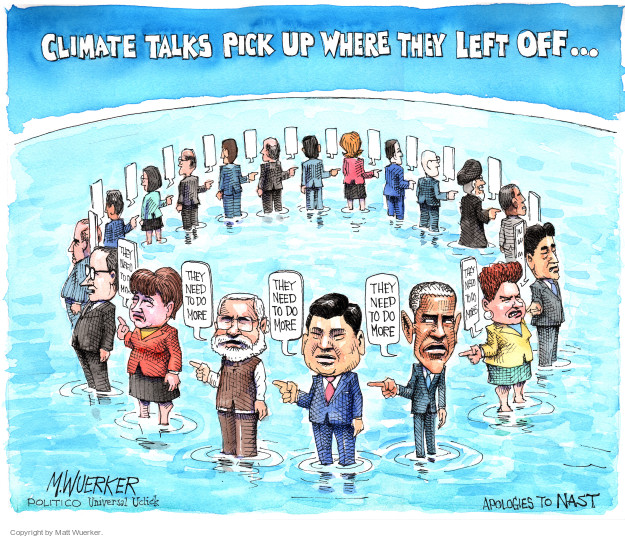
Article 4(7) of the UNFCCC provides that ‘the extent to which developing country parties will effectively implement … the Convention … will take fully into account that economic and social development and poverty eradication are the first and overriding priorities of the developing country parties.’ Since emissions reductions involve immense economic costs, this essentially means that no limits can be placed on the emissions of developing countries. Their responsibility to reduce emissions isn’t ‘differentiated’ so much as non-existent. Subsequent climate change negotiations have reinforced this position, and it is stated as forthrightly as it ever has been in China’s INDC. When the MICs’ refusal to adopt reductions targets became clear at the Copenhagen conference in 2009, people began to realise that directing criticism solely at the developed countries, particularly the US, as a result of its failure to ratify the Kyoto Protocol, was fruitless. But all the MICs have done is stick to what was agreed in 1992.

By insisting once again that they don’t have a responsibility to reduce emissions, China and India have ensured that the Paris conference will not reach the hoped-for agreement. Global emissions reductions have been impossible for more than a quarter-century and will continue to be impossible, for the very good reason that this is what was agreed in the original convention. Numerous near irrelevant agreements and declarations of intent will no doubt be made in Paris, obscuring the failure to reach any agreement on global reductions. International policy has so far been based on the premise that mitigation is the wisest course, but it is time for those committed to environmental intervention to abandon the idea of mitigation in favour of adaptation to climate change’s effects.