Climate Ethics and Religion

This post is background to exploring the ethical and religious dimensions of the climate change movement. It is also important to recognize the human journey regarding morality.

Moral Models

The ethic of Good vs. Evil is a teleological paradigm, going all the way back to Plato, but still a reference for some today. This model asserts that values can be determined as eternal truths, applicable in all times and places.

Most people have moved to an ethic of Right vs. Wrong, a legal paradigm. Here morality is relative to a society that determines what is morally acceptable or not. And of course, there are variations both among different places, and within a single society over time.

Modern ethics has taken an additional step to an ethic of Responsibility vs. Irresponsibility, a contextual paradigm. Now moral behavior seeks the largest possible context: “the greatest good for the greatest number.” This can lead to some strange choices, such as suicide bombers or pro-life advocates who justify murdering abortion clinic doctors.  The perversion arises when an actor excludes some living things, or whole classes of creatures from the context of responsibility.

Summary: Climate Morality

It should be clear that when climate alarmists appeal to saving the planet for future generations, they are applying contextual ethics. Less obvious is the ancient religious notion that by making sacrifices, we humans can assure more favorable weather. These days, fossil fuels have become the sacrificial lamb required by Mother Nature to play nice with human beings.

Br’er Canada and the Tar Baby

Disney animation of “Br’er Rabbit and the Tar Baby” from Songs of the South, a collection of Uncle Remus American folk tales.

On Nov. 6, 2015, President Obama canceled the Keystone XL pipeline. Canada PM Trudeau, just installed and wanting not to offend, politely said he was “disappointed.” Here is the back story that you won’t hear in the media.

background
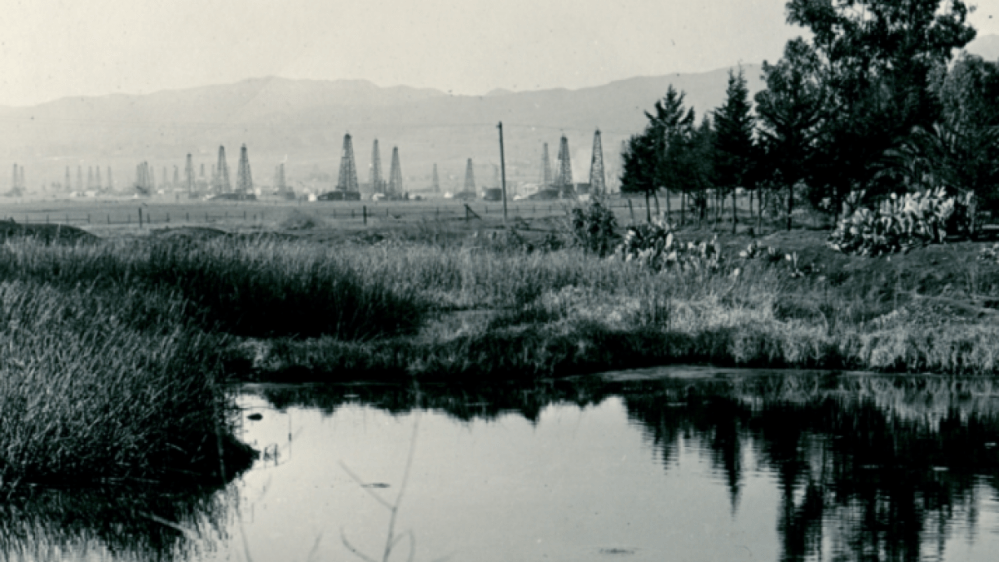
Americans should know all about tar pits. As the traditional folk tale suggests, there have been many tar pools across the US. A famous one is in Los Angeles: La Brea Tar Pit. Pictured above around 1910, it’s an oil spill produced by Nature.  Notice the many oil derricks nearby.

Tar pits are composed of heavy oil fractions called gilsonite, which seeped from the Earth as oil. In Hancock Park, crude oil seeps up along the 6th Street Fault from the Salt Lake Oil Field, which underlies much of the Fairfax District north of the park.[3] The oil reaches the surface and forms pools at several locations in the park, becoming asphalt as the lighter fractions of the petroleum biodegrade or evaporate.

This seepage has been happening for tens of thousands of years. From time to time, the asphalt would form a deposit thick enough to trap animals, and the surface would be covered with layers of water, dust, or leaves. Animals would wander in, become trapped, and eventually die. Predators would enter to eat the trapped animals and also become stuck.

https://en.wikipedia.org/wiki/La_Brea_Tar_Pits

La Brea Tar Pits and Museum today.

Canada’s Tar Baby

So, as you can see, tar pits are hazardous to animal and plant life. In Canada, we have a much greater problem bestowed on us: the Athabasca tar sands in Alberta. The oil deposits are much too large to put fences around it and open it as a museum, as was done in L.A. No, in Alberta the environmentally responsible thing is to clean up the mess Nature left behind.


The cleanup requires a massive effort, but costs can be offset by processing the tar into petroleum products and shipping them to markets who want to use them.  Using those products from syncrude oil liberates CO2 once trapped in bitumen, and in the air becomes available to plants who grow larger and faster from the increased concentration.  The Japanese would call this a “virtuous cycle.”

Br’er America is a neighbor with the facilities to help, but because of CO2 hysteria, the Obama administration is afraid of getting some tar on their hands. Actually a pipeline is the environmentally friendly way of transporting the crude oil, but now trains will be used instead of the pipeline.

The origin of the Alberta oil sands is a debated subject. Two primary theories are asserted:

1.) These sands are the remnants of a once vast reserve of crude oil that, over extremely long periods of time, has escaped or been destroyed microbiologically; thus leaving behind some bitumen and also converting the lighter crude oil into bitumen through bacterial processes.

2.) The bitumen evolved from highly organic cretaceous shales (similar to oil shale). Underground pressure forced the bitumen out of the kerogen rich shales where it soaked into existing silt grade sediments and sand bodies.

In the first theory, petroleum would be formed in the traditional manner, and then converted to bitumen by some additional process.  More description here.

Summary

So whether Nature created the tar mess by bacteria or by underground pressure, it’s up to us humans to clean it up. Canada is doing the heavy lifting, while the Obama administration prefers posing as an innocent bystander.

Objection: Asserting Facts Not in Evidence!

In recent weeks climate activists have turned to the courts to advance their cause. An assembly of international supreme court judges discussed issuing a ruling to establish consensus science as legal fact. The UN proposed agreement for Paris COP includes an International Climate Tribunal “to oversee, control and sanction the fulfilment [sic] of and compliance with the obligations” under the agreement. A letter was sent to US justice officials appealing for RICO law to be used to silence dissenters from consensus climate science. And a plan hatched long ago was activated to catch Exxon in a tobacco-style litigation. More on the latter is here.

Noting these events, Judith Curry had a discussion about the role of the courts regarding climate science. It seems to me that any legal proceeding would bog down at the first testimony by a consensus witness, since any opposing counsel brighter than a fence post should repeatedly object: “Objection, asserting facts not in evidence.” (Probably wishful thinking on my part.)

A separate event yesterday attracted my attention to the topic of climate evidence. At his swearing-in as Canadian Prime Minister, Justin Trudeau appointed a Minister of the Environment and Climate Change portfolio. In his general comments, not specific to that department, he said his government would deliver “evidence-based policy”. Naturally I am wondering what that could mean regarding climate policies.

What does “Evidence-Based” mean?

Robert Sutton has written extensively on the notion of evidence-based management, and says this in the Harvard Business Review here.

We’ve just suggested no less than six substitutes that managers, like doctors, often use for the best evidence—obsolete knowledge, personal experience, specialist skills, hype, dogma, and mindless mimicry of top performers—so perhaps it’s apparent why evidence-based decision making is so rare. At the same time, it should be clear that relying on any of these six is not the best way to think about or decide among alternative practices.

Sutton talks about some of the elements that make up an evidence-based approach. For example,

Start with an Answerable Question:
The decision-making process used at Oxford’s Centre for Evidence-Based Medicine starts with a crucial first step—the situation confronting the practitioner must be framed as an answerable question. That makes it clear how to compile relevant evidence.

Demand Evidence:
When people in the organization see senior executives spending the time and mental energy to unpack the underlying assumptions that form the foundation for some proposed policy, practice, or intervention, they absorb a new cultural norm.

Treat the organization as an unfinished prototype.
For some questions in some businesses, the best evidence is to be found at home—in the company’s own data and experience rather than in the broader-based research of scholars. Companies that want to promote more evidence-based management should get in the habit of running trial programs, pilot studies, and small experiments, and thinking about the inferences that can be drawn from them

Embrace the attitude of wisdom.
Something else, something broader, is more important than any single guideline for reaping the benefits of evidence-based management: the attitude people have toward business knowledge. At least since Plato’s time, people have appreciated that true wisdom does not come from the sheer accumulation of knowledge, but from a healthy respect for and curiosity about the vast realms of knowledge still unconquered.

The approach is summarized here.

Five Principles of EBM

1. Face the hard facts, and build a culture in which people
are encouraged to tell the truth, even if it is unpleasant.
2. Be committed to “fact based” decision making — which
means being committed to getting the best evidence and
using it to guide actions.
3. Treat your organization as an unfinished prototype —
encourage experimentation and learning by doing.
4. Look for the risks and drawbacks in what people recommend
— even the best medicine has side effects.
5. Avoid basing decisions on untested but strongly held beliefs,
what you have done in the past, or on uncritical “benchmarking”
of what winners do.

The Medical Paradigm of Evidence

Throughout this essay you will see references to medical decision making, since the evidence-based idea originated in this arena. The practice of medicine is where the notion took root: treatment choices should be based upon the data of historical results. And in the courts, it was often medical cases where protocols developed for making the case for or against a medicine, treatment or environmental condition causing damage to someone.

I used above the classical image of Justice being blind in weighing evidence, the idea being that the defendant’s wealth or social status has no bearing on the decision of guilt or innocence. Medical science goes one step further to eliminate bias: double-blind randomized controlled trials (RCTs) are the gold standard for evidence.

Rules for Scientific Evidence in Court

A court of law is first and foremost an evidence-based proceeding, and detailed rules are applied when submitting and accepting anything as evidence for the purpose of reaching a decision. Without going into the complexities (I am not a lawyer), it is instructive to see how courts do handle scientific evidence as a background for what a climate case might entail.

Much of the following information comes from Nathan Schachtman here.

Proper epidemiological methodology begins with published study results which demonstrate an association between a drug and an unfortunate effect. Once an association has been found, a judgment as whether a real causal relationship between exposure to a drug and a particular birth defect really exists must be made. This judgment requires a critical analysis of the relevant literature applying proper epidemiologic principles and methods. It must be determined whether the observed results are due to a real association or merely the result of chance. Appropriate scientific studies must be analyzed for the possibility that the apparent associations were the result of chance, confounding or bias. It must also be considered whether the results have been replicated.

Step 1: Establish an association between two variables.
Proper epidemiologic method requires surveying the pertinent published studies that investigate whether there is an association between the medication use and the claimed harm. The expert witnesses must, however, do more than write a bibliography; they must assess any putative associations for “chance, confounding or bias”:

Step 2: Rule out chance as an explanation
The appropriate and generally accepted methodology for accomplishing this step of evaluating a putative association is to consider whether the association is statistically significant at the conventional level.
“Generally accepted methodology considers statistically significant replication of study results in different populations because apparent associations may reflect flaws in methodology.”

Step 3: Rule out bias or confounding factors.
The studies must be structured to analyze and reject other factors or influences, such as non-random sampling, additional intervening variables such as demographic or socio-economic differences.

Step 4: Infer Causation by Applying Accepted Causative Factors
Most often legal proceedings follow the Bradford Hill factors, which are delineated here.

What aspects of that association should we especially consider before deciding that the most likely interpretation of it is causation?

(1) Strength. First upon my list I would put the strength of the association.

(2) Consistency: Next on my list of features to be specially considered I would place the consistency of the observed association. Has it been repeatedly observed by different persons, in different places, circumstances and times?

(3) Specificity: One reason, needless to say, is the specificity of the association, the third characteristic which invariably we must consider. If as here, the association is limited to specific workers and to particular sites and types of disease and there is no association between the work and other modes of dying, then clearly that is a strong argument in favor of causation.

(4) Temporality: My fourth characteristic is the temporal relationship of the association – which is the cart and which is the horse? This is a question which might be particularly relevant with diseases of slow development. Does a particular diet lead to disease or do the early stages of the disease lead to those particular dietetic habits?

(5) Biological gradient: Fifthly, if the association is one which can reveal a biological gradient, or dose-response curve, then we should look most carefully for such evidence.

(6) Plausibility: It will be helpful if the causation we suspect is biologically plausible. But this is a feature I am convinced we cannot demand. What is biologically plausible depends upon the biological knowledge of the day.

(7) Coherence: On the other hand the cause-and-effect interpretation of our data should not seriously conflict with the generally known facts of the natural history and biology of the disease – in the expression of the Advisory Committee to the Surgeon-General it should have coherence.

(8) Experiment: Occasionally it is possible to appeal to experimental, or semi-experimental, evidence. For example, because of an observed association some preventive action is taken. Does it in fact prevent? The dust in the workshop is reduced, lubricating oils are changed, persons stop smoking cigarettes. Is the frequency of the associated events affected? Here the strongest support for the causation hypothesis may be revealed.

(9) Analogy: In some circumstances it would be fair to judge by analogy. With the effects of thalidomide and rubella before us we would surely be ready to accept slighter but similar evidence with another drug or another viral disease in pregnancy.

None of my nine viewpoints can bring indisputable evidence for or against the cause-and-effect hypothesis and none can be required as a sine qua non. What they can do, with greater or less strength, is to help us to make up our minds on the fundamental question – is there any other way of explaining the set of facts before us, is there any other answer equally, or more, likely than cause and effect?

How Does This Apply to Climate Policy?

The legal methodology above is used to decide the causal relationship between two variables. Clearly, in Climate Science the starting question is: Do rising fossil fuel emissions cause temperatures to rise? Those who have been following the issue know that there are many arguments underneath: Are temperatures always rising along with CO2? Has chance been eliminated? Are not natural factors confounding the association? And so on.

But that question is only the beginning when considering an evidence-based climate policy. Daniel Roberts has provided a simple, comprehensive framework of questions, showing that answers to each one impact upon the others.

When governments speak of evidence-based policies, they usually mean allocating scarce public funds to programs that have shown value for money. Cost and benefit analysis is inescapable, along with definitions of outcomes, outputs, service activities, and the metrics to assess performance for the sake of funding priorities. Is that what PM Trudeau has in mind? Will that discipline be applied regarding climate change?

Summary

If I had used a term like “evidence-based” in a schoolboy essay, I would have gotten a red circle with a GG alongside (“Glittering Generality”). I wonder if today’s teachers are as discerning and demanding of rigor, or do they let it go if it is politically correct? Justin Trudeau was formerly a schoolteacher, so I guess we will find out.

For an analysis of the association between fossil fuel emissions and Global Mean Temperature see 2018 Update: Fossil Fuels ≠ Global Warming


Quiet Storm of Lucidity

Lucidity refers to insight: an understanding that arrives in a flash, like lightning or a light bulb overcoming the darkness. It involves seeing things as they are, (not how they should or might be) and how those things fit together into a coherent whole. Socrates and other great teachers down through history saw that lucidity is the coming together of knowledge that is already within but not yet realized.

Turning to our understanding of the climate, we have to ask this question:

Is that light the end of the tunnel or an oncoming train?

In the run up to Paris climate conference, skeptics and the general public are looking into an oncoming train of pressure and propaganda. But lately there are voices pointing to light shining through the fog of consensus climate science. They are not very loud yet compared to the amplified mass media fear-mongering, but it is more pronounced than in the past.  Consider some of the recent media events.

Honest Talk Regarding the Models’ Uncertainties

David Roberts writing here:

Basically, it’s difficult to predict anything, especially regarding sprawling systems like the global economy and atmosphere, because everything depends on everything else. There’s no fixed point of reference.

Grappling with this kind of uncertainty turns out to be absolutely core to climate policymaking. Climate nerds have attempted to create models that include, at least in rudimentary form, all of these interacting economic and atmospheric systems. They call these integrated assessment models, or IAMs, and they are the primary tool used by governments and international bodies to gauge the threat of climate change. IAMs are how policies are compared and costs are estimated.

There is a school of thought that says the whole exercise of IAMs, at least as an attempt to model how things will develop in the far future, is futile. There are so many assumptions, and the outcomes are so sensitive to those assumptions, that what they produce is little better than wild-ass guesses. And the faux-precision of the exercise, all those clean, clear lines on graphs, only serves to mislead policymakers into thinking we have a grasp on it. It makes them think we know exactly how much slack we have, how much we can push before bad things happen, when in fact we have almost no idea.

In the view of these researchers, the quest to predict what climate change (or climate change mitigation) will cost through 2100 ought to be abandoned. It is impossible, computationally intractable, and the IAMs that pretend to do it only serve to distract and confuse.

More CO2 is Good for the Planet

London 12 October: In an important new report published today by the Global Warming Policy Foundation, former IPCC delegate Dr Indur Goklany calls for a reassessment of carbon dioxide, which he says has many benefits for the natural world and for humankind.

Dr Goklany said: “Carbon dioxide fertilises plants, and emissions from fossil fuels have already had a hugely beneficial effect on crops, increasing yields by at least 10-15%. This has not only been good for humankind but for the natural world too, because an acre of land that is not used for crops is an acre of land that is left for nature”.

In the Forward (here), world-renowned physicist Freeman Dyson says this:

“To any unprejudiced person reading this account, the facts should be obvious: that the non-climatic effects of carbon dioxide as a sustainer of wildlife and crop plants are enormously beneficial, that the possibly harmful climatic effects of carbon dioxide have been greatly exaggerated, and that the benefits clearly outweigh the possible damage.”

Dyson also makes this lucid comment:

The people who are supposed to be experts and who claim to understand the science are precisely the people who are blind to the evidence. Those of my scientific colleagues who believe the prevailing dogma about carbon dioxide will not find Goklany’s evidence convincing. . .That is to me the central mystery of climate science. It is not a scientific mystery but a human mystery. How does it happen that a whole generation of scientific experts is blind to obvious facts?

Prominent French Weatherman and Mathematicians Speak Out

Recently France’s best-known TV weatherman, Philippe Verdier, was sacked for publishing a book debunking consensus climate science. And now people wonder what punishment will be visited upon the prestigious Société de Calcul Mathématique (Society for Mathematical Calculation), which recently issued a detailed 195-page White Paper that presents a blistering point-by-point critique of the key dogmas of the global warming. Synopsis is blunt and extremely well documented.

Here are extracts from the opening statements of the first three chapters of the SCM White Paper:

Chapter 1: The crusade is absurd
There is not a single fact, figure or observation that leads us to conclude that the world‘s climate is in any way ‘disturbed.’ It is variable, as it has always been, but rather less so now than during certain periods or geological eras. Modern methods are far from being able to accurately measure the planet‘s global temperature even today, so measurements made 50 or 100 years ago are even less reliable. Concentrations of CO2 vary, as they always have done; the figures that are being released are biased and dishonest. Rising sea levels are a normal phenomenon linked to upthrust buoyancy; they are nothing to do with so-called global warming. As for extreme weather events — they are no more frequent now than they have been in the past. We ourselves have processed the raw data on hurricanes….

Chapter 2: The crusade is costly
Direct aid for industries that are completely unviable (such as photovoltaics and wind turbines) but presented as ‘virtuous’ runs into billions of euros, according to recent reports published by the Cour des Comptes (French Audit Office) in 2013. But the highest cost lies in the principle of ‘energy saving,’ which is presented as especially virtuous. Since no civilization can develop when it is saving energy, ours has stopped developing: France now has more than three million people unemployed — it is the price we have to pay for our virtue….

Chapter 3: The crusade is pointless
Human beings cannot, in any event, change the climate. If we in France were to stop all industrial activity (let’s not talk about our intellectual activity, which ceased long ago), if we were to eradicate all trace of animal life, the composition of the atmosphere would not alter in any measurable, perceptible way. To explain this, let us make a comparison with the rotation of the planet: it is slowing down. To address that, we might be tempted to ask the entire population of China to run in an easterly direction. But, no matter how big China and its population are, this would have no measurable impact on the Earth‘s rotation.

Additional discussion and links are here.

Push Back on the Climate Policy Proposals

Eric Worrall expresses a burst of clarity here:

It’s difficult to know what impact Putin’s overt skepticism will have on the Paris climate meeting. The meeting is reportedly already in a lot of trouble, because even our economically illiterate leaders seem to be balking at the prospect of borrowing money from China, so they can gift the principle they just borrowed back to China as climate development assistance, then repay the loan back to China a second time, with interest.

A Lucid Summary of IPCC Climate Policy:
Borrowing money we don’t have
to pay countries having other pressing needs
for a solution that won’t work
to solve a problem that doesn’t exist
while asserting imaginary legal authority.

Conclusion

Switching metaphors, maybe we are starting to see some damage to the Good Ship Climate Alarm:

Final Word to Charles Mackay

Men, it has been well said, think in herds; it will be seen that they go mad in herds, while they only recover their senses slowly, one by one.

― Charles Mackay, Extraordinary Popular Delusions and the Madness of Crowds

Greenland Is Melting! Really?

The media blitz ahead of the Paris climate conference is well underway and you can expect sources like the New York Times to publish many stories along these lines. This one evokes the WWII headline, Paris is Burning, and it happens now to be all over Facebook.

Greenland Is Melting Away (link)

What you get is not science, but a compelling human interest story with great photos about a team of researchers working to study rivers on the ice sheet, and then an appeal to share in their fears. A scientific report would at least provide some snippets of findings, and then provide contextual facts for people to interpret the significance of observations.

Instead of that, the story makes an incredible claim:

The scientific data he and a team of six other researchers collect here could yield groundbreaking information on the rate at which the melting of the Greenland ice sheet, one of the biggest and fastest-melting chunks of ice on Earth, will drive up sea levels in the coming decades. The full melting of Greenland’s ice sheet could increase sea levels by about 20 feet.

Not only is there no evidence presented, the article is silent about the contextual facts that contradict that claim.

Here is what you need to know, and what they should be telling you:

1.The Greenland ice sheet is massive and has persisted for millennia.

Doing the numbers: Greenland area 2.1 10^6 km2 80% ice cover, 1500 m thick in average- That is 2.5 Million Gton. Simplified to 1 km3 = 1 Gton

200 Gton is 0.008 % of that mass.
Annual snowfall: From the Lost Squadron, we know at that particular spot, the ice increase since 1942 – 1990 was 1.5 m/year ( Planes were found 75 m below surface)
Assume that yearly precipitation is 100 mm / year over the entire surface.
That is 168000 Gton. Yes, Greenland is Big!
Inflow = 168,000Gton. Outflow is 168,200 Gton.

So if that 200 Gton rate continued, an assumption not warranted by observations below, that ice loss would result in a 1% loss of Greenland ice in 800 years. (H/t Bengt Abelsson)

2. The melting and refreezing depend on multiple factors, principally the runoff rate (which these scientists are studying) and the snow accumulation which is poorly understood and not yet predictable.

That’s not surprising since the ice sheet rebuilds during wintertime, the harshest time of year. Because of the difficulty of doing polar research, the emphasis is understandably on the summer observations. But we should also not make the mistake of the drunk looking for his lost car keys under the street lamp because the light is better.

For an ice sheet that neither grows or shrinks, there is at all points averaged over the year a balance between

the amount of snow that falls and is compressed to ice
the amount of snow and ice that melts or evaporates (sublimates) and
the amount of ice that flows away due to the ice motion
The two first contributions make up the surface mass balance. For the ice sheet as a whole, there is a balance between the surface mass balance and the amount of ice that calves into the ocean as icebergs.

3.Greenland ice is the most stable land ice in the world despite its location in the lower latitudes. Greenland ice sits in a bowl with a ring of mountainous edges constraining the runoff and is unlikely to ever completely melt. That is why it is preferred as a site for ice core sampling to study paleoclimates.

Topographic map of Greenland bedrock

4.The changing of Greenland ice mass waxes and wanes over years, decades and centuries. The fastest rates of melting recently were in the 1930s and 40s. Discoveries were made of Medieval Viking settlements showing when it was much warmer than now.

The resumption of melting recently is reported by GRACE, a new technology that is promising, but researchers caution against trusting it until calibrations are completed and the longer record is built.

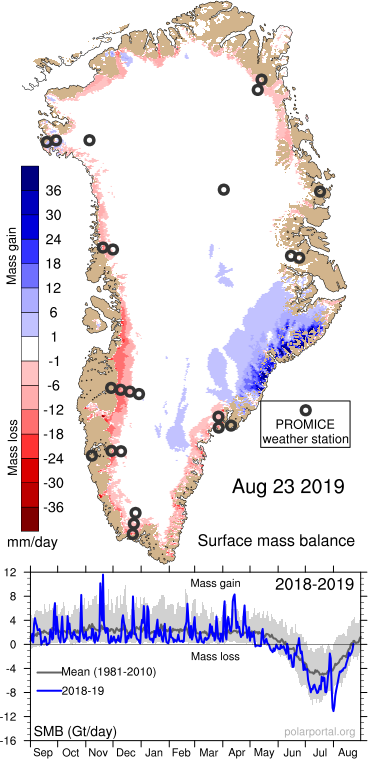
DMI has been studying Greenland for a long time and they report this:
smb_combine_sm_day_en

Greenland’s ice sheet has seen variable growth and losses over the years.  And mass gains and losses fluctuate also during each year.  So far this year is close to the mean growth for 1981 to 2010.

5. Sea levels do rise from melting ice in warm periods such as the Roman era, but this comes mostly from land glaciers not the polar ice caps. For example, Ephesus was a port on the Aegean Sea in biblical times, but is now several kms inland. Many other such examples exist in times when it was much warmer than now and when Greenland ice was still massive.

6.The Danes know and care the most about the Greenland ice sheet, and they are not alarmed.

The Danes originally colonized the place and still subsidize the national government there.  Their scientists have studied the issue and have this to say:

Scientists have long believed that Greenland’s ice sheet is melting with increasing speed and that this will result in considerable rises in water levels in the world’s oceans over the next 100 years.

But the foundation for this view now appears to be completely wrong.

Greenland’s ice mass shrinks periodically. The ice mass around and on Greenland shrinks because of two effects:  Ice melting and the amount of precipitation – these two factors give a negative net result which means Greenland’s ice mass shrinks.
Ice that flows out to sea and calving – ice that breaks off from glaciers. This form of loss of ice mass is called ‘dynamic ice-mass loss’ and it can be many times higher than the loss of ice due to melting.

Until now, researchers have believed that the dynamic ice-mass loss accelerated constantly. Most climate models are based on this belief.

We can see that the dynamic ice-mass loss is not accelerating constantly, as we had believed,” says Shfaqat Abbas Khan, a senior researcher at DTU Space – the National Space Institute.

“It is only periodically that the ice disappears as rapidly as is happening today. We expect that the reduction in Greenland’s ice mass due to the dynamic ice-mass loss will ease over the next couple of years and will reach zero again.”

http://sciencenordic.com/aerial-photos-greenland-topple-climate-models

Conclusion:

Is Greenland ice melting? Maybe. . . Probably a little.

It has melted a lot faster in the past, and only restarted recently, while the ice sheet has persisted over many millennia. No one knows how long it will melt and when it will reverse. Some Greenland ice loss is a good thing, since it means we are still in a warm period and not yet sliding into the next Ice Age.

So it is something interesting to watch, but not a reason to lose sleep. And it is nothing that we can fix.

Additional informative discussion is here:

http://wattsupwiththat.com/2015/10/30/greenland-ice-melt-due-to-global-warming-found-not-so-bad-after-all/

OLYMPUS DIGITAL CAMERA

OLYMPUS DIGITAL CAMERA

IPCC Racketeers Order Hit on Exxon

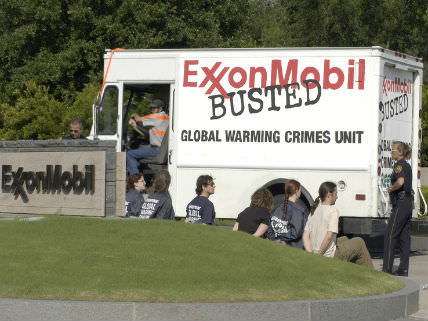
A lot of alarmist voices are charging Exxon with all kinds of misdoings with respect to climate science. The usual suspects are implicated, including Bill McKibben, Naomi Oreskes and Bob Ward.

InsideClimateNews broke the story, with the others piling on. Exxon is fighting back and tell their story here:  http://www.exxonmobilperspectives.com/2015/10/21/when-it-comes-to-climate-change-read-the-documents/

The documents referred to are here.

Exxon’s Position:

“Reading the documents shows that these allegations are based on deliberately cherry-picked statements attributed to various ExxonMobil employees to wrongly suggest definitive conclusions were reached decades ago by company researchers. These statements were taken completely out of context and ignored other readily available statements demonstrating that our researchers recognized the developing nature of climate science at the time which, in fact, mirrored global understanding.

What these documents actually demonstrate is a robust culture of scientific discourse on the causes and risks of climate change that took place at ExxonMobil in the 1970s and ’80s and continues today. They point to corporate efforts to fill the substantial gaps in knowledge that existed during the earliest years of climate change research.

They also help explain why ExxonMobil would work with the Intergovernmental Panel on Climate Change and leading universities like MIT and Stanford on ways to expand climate science knowledge.”

The Royal Society

The list of documents includes an interchange with the Royal Society, and their spokesman, Bob Ward. He criticizes Exxon’s publications for not saying the same things as IPCC documents. He accuses Exxon of funding “organizations that have been misinforming the public about the science of climate change.” That sounds so much like the RICO20 letter.

Kenneth Cohen of ExxonMobil responded in a letter to Lord Rees, President of the Royal Society at that time:

“The Royal Society should welcome the diversity of opinions on all scientific issues. Taking the position that any person or organization that disagrees with the Royal Society on an important scientific issue should be publicly vilified is surely counterproductive for the development of scientific theory, ignores freedom of expression and is hardly consistent with the Society’s stated objective of promoting excellence in science.”

Cohen’s full letter is here:
http://insideclimatenews.org/sites/default/files/documents/Exxon%20Letter%20to%20Royal%20Society%20%282006%29.pdf

Exxon says that they are part of the solution and not the problem, and are asking people to read the documents and decide for themselves.  Sounds reasonable.

Background on RICO and IPCC:

https://rclutz.wordpress.com/2015/09/18/anti-racketeering-initiative/

To My Prime Minister, Justin Trudeau

Congratulations on winning a majority in the election and now to form the government. I voted for Ramez Ayoub, your newly elected MP in my riding north of Montreal.

The point of this letter is to alert you to the issue of climate change. It was little discussed during the campaign, but it will be immediately forced onto your attention due to the conference next month in Paris.

The knee-jerk reaction would be to declare the Conservatives wrong on this issue and that Liberals will demonstrate change by reversing Canada’s position. That would be unfortunate and premature, considering all of the pitfalls and ramifications tied to this.

For an example of how to mismanage this issue, you need only look south to the US self-imposed predicament. President Obama picked a radical environmentalist, John Holdren, as his science adviser. Uncritically following that advice, Obama has now painted himself into an ideological corner, and will find it difficult to deny claims for payment of reparations from dozens of developing countries.

You could make the same mistake by appointing David Suzuki as your science adviser. He is a renowned environmentalist and biologist, but has no expertise in climate science, energy or economics. The so-called climate consensus surveys of scientists carefully excluded anyone not working for government or academia. That sort of unbalanced approach is wrong-headed.

Despite the pressure to make early commitments on this issue, I urge you to keep a cool head, have a scientific curiosity, and pick a team of advisers providing a balance of environmental and industrial perspectives. You might want to make an announcement that your government will respect the scientific and economic realities concerning the climate, including attention to cost-benefit analyses of policy proposals.

Sincerely,

Ronald R. Clutz
Therese-De-Blainville Riding

https://rclutz.wordpress.com/category/science-and-society/


Just Say No!

There was a time when our leaders appealed to reason and common sense:

But today, CO2 Fever is upon us, and there is no CO2 rumor too outrageous to be broadcast, repeated and exaggerated.

Just in the last few hours, we have these headlines (from Google News) threatening global warming:

Climate change clips wings of migratory birds
Miami and New Orleans will sink
Global warming could lead to worldwide wars
Coral reefs are dying
25 million Americans could lose their homes to global warming and rising seas
Ocean food chains will collapse
Climate change major threat to global economic stability
Etc., etc. Etc.

Meanwhile, the good news about CO2 is not mentioned in the press, unless you look very hard for it.

London 12 October: In an important new report published today by the Global Warming Policy Foundation, former IPCC delegate Dr Indur Goklany calls for a reassessment of carbon dioxide, which he says has many benefits for the natural world and for humankind.

Dr Goklany said: “Carbon dioxide fertilises plants, and emissions from fossil fuels have already had a hugely beneficial effect on crops, increasing yields by at least 10-15%. This has not only been good for humankind but for the natural world too, because an acre of land that is not used for crops is an acre of land that is left for nature”.

http://www.thegwpf.org/climate-doomsayers-ignore-benefits-of-carbon-dioxide-emissions/

In the Forward, world-renowned physicist Freeman Dyson says this:

“To any unprejudiced person reading this account, the facts should be obvious: that the non-climatic effects of carbon dioxide as a sustainer of wildlife and crop plants are enormously beneficial, that the possibly harmful climatic effects of carbon dioxide have been greatly exaggerated, and that the benefits clearly outweigh the possible damage.”
The full document can be accessed here:

Click to access benefits1.pdf

CO2 hysteria is addictive. Here’s what it does to your brain:

Just say No!

VW and CO2 Obsession

How wrong-headed EU climate policy led to the VolksWagen debacle


Dominic Lawson explains it clearly in the UK Sunday Times, Sept. 27.

“Recent events have been a result of Europe’s concerted push to get its populations to abandon petrol for diesel as the fuel to power their cars. This is the real story behind the astonishing scandal of VW’s fraud upon the US Environmental Protection Agency. VW had installed software in its newer diesel cars that detected when the vehicles were being tested for noxious emissions and cut most of the smog-forming compounds caused by burning diesel.

When the cars were driven normally on the road by owners, the software “defeated” the pollution control. This greatly enhanced the vehicles’ performance. And so VW could claim — absolutely dishonestly — that it was selling high-performing diesel cars while conforming to stringent American “clean air” requirements.

Yes: America, frequently accused by Europeans of being a laggard in environmental protection, has stricter regulations governing air pollution than the eternally preachy EU. This is because of — and not despite — Europe’s obsession with climate change.

The UK government, after its signing of the Kyoto treaty, set up an incentive through vehicle excise duty to push consumers into buying diesel rather than petrol cars. The point is that diesel produces more oomph per gallon than petrol, so less of it is used for each mile’s driving and hence less CO2 is emitted in the course of any given journey.

However, it has always been known that burning diesel creates much more of the oxides of nitrogen that can cause terrible damage to the human respiratory system: more than 20 times as much of the stuff as burning petrol does. Because in America engine emission controls are related much more to overall air quality than in the EU, VW had a real problem getting its diesel cars into that market. Hence its scam.

The UK national obsession — at least in Whitehall — with CO2 means that British lives have been shortened to save future lives in Africa (the continent thought to be most vulnerable to the consequences of climate change). The developing world, meanwhile, is cracking on with fossil-fuel power generation, since its leaders understand that that is the fastest way to lift their countries out of poverty — and really save lives.”

The article appeared in in the UK Sunday Times:
http://www.thesundaytimes.co.uk/sto/comment/columns/dominiclawson/article1611938.ece

H/t to http://us4.campaign-archive2.com/ who provide the full text with this comment:

The “rush for diesel” might seem an unmatchably counterproductive idiocy on the part of the EU member states, as they sought to prove themselves the saviours of the earth. In fact, it is merely one of a number of catastrophic components in the climate-change policy makers’ hall of infamy.

http://us4.campaign-archive2.com/?u=c920274f2a364603849bbb505&id=ef5e92a067&e=a1aa1ed84d

Speaking Climate Truth to Policymakers

Rational people charged with making national energy policies need an antidote to the biased and alarmist IPCC “Summary for Policy Makers (SPM)”  As most are aware, that document purports to be summarizing the science proving humanity is causing dangerous global warming by using fossil fuels.  Those who understand the IPCC process are also aware that the SPM wording is negotiated among politicians and the scientific reports are adjusted accordingly.

A timely discussion of this issue is provided by someone with experience in briefing governmental officials on issues requiring choices.  Michael Kelly writes in Standpoint Magazine:

“A well-briefed minister knows about the general area in which a decision is sought, and is given four scenarios before any recommendation. Those scenarios are the upsides and the downsides both of doing nothing and of doing something. Those who give only the upside of doing something and the downside of doing nothing are in fact lobbying.”

Turning to Lord Stern’s policy advice, Kelly says:

“In his introduction he makes it clear that he has consulted many scientists, businessmen, philosophers and economists, but in his book I find not a single infrastructure project engineer asked about the engineering reality of any of his propositions, nor a historian of technology about the elementary fact that technological breakthroughs are not pre-programmable. Lord Stern’s description of the climate science is an uncritical acceptance of the worst case put by the International Panel on Climate Change (IPCC), one from which many in the climate science community are now distancing themselves.”

Kelly provides considerable contextual information in his article, which is accessible here:
http://www.standpointmag.co.uk/features-october-2015-michael-kelly-climate-change-poor-pay-the-price

He summarizes this way:

“Those building the biblical Tower of Babel, intending to reach heaven, did not know where heaven was and hence when the project would be finished, or at what cost. Those setting out to solve the climate change problem now are in the same position. If we were to spend 10 or even 100 trillion dollars mitigating carbon dioxide emissions, what would happen to the climate? If we can’t evaluate whether reversing climate change would be value for money, why should we bother, when we can clearly identify many and better investments for such huge resources? The forthcoming Paris meeting on climate change will be setting out to build a modern Tower of Babel.”

Ruth Dixon has also assessed the flaws in the alarmist position which Stern is expressing.

https://rclutz.wordpress.com/2015/09/03/flawed-policies-for-climate-action/