Notes for Sunak: Energy Transition Risk Vs. Climate Change Risk

Two perceptive op eds by Dr. Judith Curry provides thinking pertinent to UK Sunak’s reconsideration of climate policies.  Her articles in December and January for Sky News Australia was The faux urgency of the climate crisis is giving us no time or space to build a secure energy future. and Rapid technological innovation – not harmful renewables policy – key to lighting our energy future.

Note: “faux” means “artificial” or “contrived”–IOW “fake” without any Trumpian overtones.  I referred to Sunak in the title because he is now the man in the barrel for raising energy issues.  But those elected officials who climb down even a little from ruinous Zero Carbon promises will find themselves in the same predicament.  So this messaging would serve many in these dire straits.  Excerpts in italics with my bolds and added images.

There is a growing realisation that emissions and temperature targets
are now detached from the issues of human well-being
and the development of our 21st century world.

For the past two centuries, fossil fuels have fueled humanity’s progress, improving standards of living and increasing the life span for billions of people. In the 21st century, a rapid transition away from fossil fuels has become an international imperative for climate change mitigation, under the auspices of the UN Paris Agreement. As a result, the 21st century energy transition is dominated by stringent targets to rapidly eliminate carbon dioxide emissions. However, the recent COP27 meeting in Egypt highlighted that very few of the world’s countries are on track to meet their emissions reductions commitment.

The desire for cleaner, more abundant, more reliable and
less expensive sources of energy is universal.

However, the goal of rapidly eliminating fossil fuels is at odds with the urgency of providing grid electricity to developing countries. Rapid deployment of wind and solar power has invariably increased electricity costs and reduced reliability, particularly with increasing penetration into the grid. Allegations of human rights abuses in China’s Xinjiang region, where global solar voltaic supplies are concentrated, are generating political conflicts that threaten the solar power industry. Global supply chains of materials needed to produce solar and wind energy plus battery storage are spawning new regional conflicts, logistical problems, supply shortages and rising costs. The large amount of land use required for wind and solar farms plus transmission lines is causing local land use conflicts in many regions.

Given the apocalyptic rhetoric surrounding climate change, does the alleged urgency of reducing carbon dioxide emissions somehow trump these other considerations? Well, the climate ‘crisis’ isn’t what it used to be. The COP27 has dropped the most extreme emissions scenario from consideration, which was the source of the most alarming predictions. Only a few years ago, an emissions trajectory that produced 2 to 3 oC warming was regarded as climate policy success. As limiting warming to 2 oC seems to be in reach, the goal posts were moved to limit the warming target to 1.5 oC. These warming targets are referenced to a baseline at the end of the 19th century; the Earth’s climate has already warmed by 1.1 oC. In context of this relatively modest warming, climate ‘crisis’ rhetoric is now linked to extreme weather events.

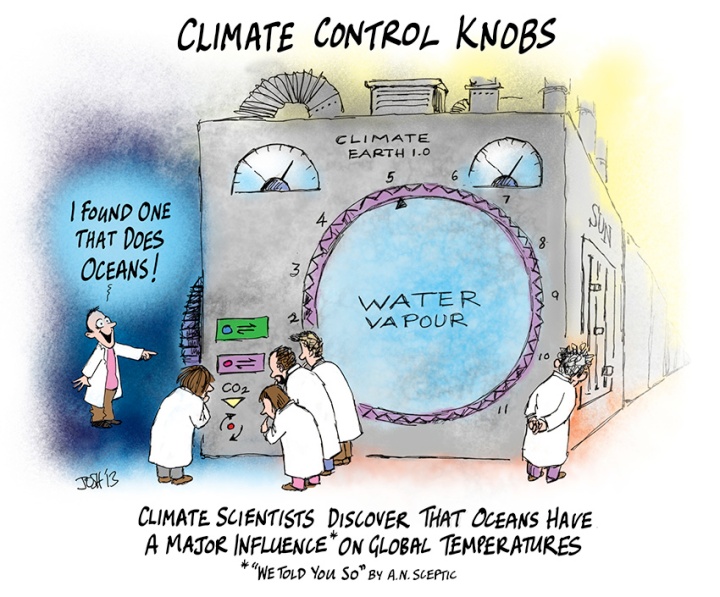
Attributing extreme weather and climate events to global warming can motivate a country to attempt to rapidly transition away from fossil fuels. However, we should not delude ourselves into thinking that eliminating emissions would have a noticeable impact on weather and climate extremes in the 21st century. It is very difficult to untangle the roles of natural weather and climate variability and land use from the slow creep of global warming. Looking back into the past, including paleoclimatic data, there has been more extreme weather everywhere on the planet. Thinking that we can minimize severe weather through using atmospheric carbon dioxide as a control knob is a fairy tale. In particular, Australia is responsible for slightly more than 1% of global carbon emissions. Hence, Australia’s emissions have a minimal impact on global warming as well as on Australia’s own climate.

There is growing realization that these emissions and temperature targets have become detached from the issues of human well-being and development. Yes, we need to reduce CO2 emissions over the course of the 21st century. However once we relax the faux urgency for eliminating CO2 emissions and the stringent time tables, we have time and space to envision new energy systems that can meet the diverse, growing needs of the 21st century. This includes sufficient energy to help reduce our vulnerability to surprises from extreme weather and climate events.

Framework for a robust transition of our energy systems.

In transitioning to cleaner sources of power, we need to acknowledge that the world will need much more energy than it is currently consuming – not just in developing countries, but also in countries with advanced economies. Constructing, operating, and maintaining low-carbon energy systems will itself require substantial amounts of energy, with much of it currently derived from fossil fuels. Increasing adoption of electric vehicles and electric heat pumps will increase electricity demand. More electricity can help reduce our vulnerability to the weather and climate: air conditioners, water desalination plants, irrigation, vertical farming operations, water pumps, coastal defenses, and environmental monitoring systems. Further, abundant electricity is key to innovations in advanced materials, advanced manufacturing, artificial intelligence, robotics, photonics, quantum computing and others that are currently unforeseen or unimagined.

In the near term, laying the foundation for new energy systems is
substantially more important than trying to stamp out fossil fuel use.

This should focus on developing and testing new energy technologies. There will continue to be demand for fossil fuels over the coming decades. Countries that restrict fossil fuel production will not only hurt themselves economically. Paradoxically, restricting fossil fuel production in the near term will actually slow down the energy transition, which itself requires substantial amounts of energy to implement.

The best use of the next three decades is to continue to develop and test a range of options for energy production, storage, transmission and other technologies that support goals of reliable, low-cost energy while lessening environmental impacts and carbon emissions. A more prudent strategy is to use the next two to three decades as a learning period with new technologies, experimentation and intelligent trial and error.

Near-term targets for CO2 emissions, such as 75% renewable energy by 2035, drives the energy transition towards using existing technologies in ways that are counterproductive in the longer term. The perceived urgency of making such a colossal transformation can lead to poor decisions that not only harms the economy and overall human wellbeing, but also slows down progress on reducing carbon emissions.

Rapid technological innovation across all domains of the global energy sector continues to accelerate: long-distance transmission and smart microgrids, energy storage, residential heating, electric vehicles and remarkable progress in advanced nuclear designs. Different countries and locales will use different combinations of these innovations based upon their location, local resources, power needs, and sociopolitical preferences.

In Addition:  Energy Balance Includes Every Energy Source 

Richard O. Faulk explands on the above perspective writing at Forbes: Stop Demonizing Fossil Fuels

If we are going to discuss the climate change movement’s agenda, let’s admit that the underlying problem they seek to resolve is an energy imbalance—one which they attribute to humanity’s excessive reliance on fossil fuels that contribute to global warming. To many members of the movement, the imbalance can only be corrected by reducing our dependence on sources such as coal and oil, and replacing them with others (ie. natural gas, ethanol, solar, wind).

Although this sounds tempting to some, the proportion of each source’s contribution to the new “balance” is elusive—both scientifically and politically. Indeed, many environmentalists largely neglect other important energy sources—such as nuclear energy—even though nuclear power plants produce negligible greenhouse gases. In its haste to “save the Earth,” the climate change movement has failed to appreciate that, for the foreseeable future, every source of energy is essential. We cannot afford to demonize and exclude any resources. Instead, each competing source must be sustained by a balanced energy policy that fosters economic growth, environmental protection and human health.

Moreover, if we are seriously concerned about global environmental issues, this new balance cannot be struck without considering its impact on economic, environmental and health concerns in each nation. This requires open minds regarding how certain resources, such as fossil fuels, can be used in developing nations which cannot reasonably be expected to shift immediately to alternative sources.

The use of coal, for example, as an imported product in such countries should not be disfavored while society diversifies to accommodate cleaner-burning technologies and affordable alternative sources. Encouraging such exports creates markets in developed nations that offset pressures to reduce usage domestically. Without relatively inexpensive imported resources, developing nations cannot develop their economies—and insisting on unaffordable alternatives denies them the opportunities that developed nations have exploited for centuries. The inevitable result will be continued poverty, depressed nutrition, increased disease and premature deaths in developing nations—a scenario that any reasonable climate advocate should find unacceptable.

Nevertheless, many climate activists doggedly argue for policies that will suppress the availability and use of fossil fuels in developing nations—as though renewable and other cleaner-burning sources were already available to meet the needs of their disadvantaged citizens. The insensitivity of such policies is alarming—especially since renewable and alternative fuel sources are not yet widely available and effectively deployed even in wealthier nations, such as the United States. It is irrational and, indeed, cruel to insist that fossil fuel use should be minimized globally when such an approach deprives the world’s most impoverished nations of relatively inexpensive and widely available energy sources.

Fossil fuels offer developing nations a “bridge to the future”
that empowers economic development and, ultimately,
diversification of energy resources.

A “balanced” energy policy therefore must consider much more than the appropriate global blend of energy sources. It must also consider the types of energy that can best be utilized in particular nations according to their financial abilities, technical skills and particular needs. It is naive to insist that renewable or alternative sources replace fossil fuels if those advanced sources are unaffordable, unavailable or otherwise impractical in the locations where energy is needed. Such idealism does nothing to feed the hungry, heat and light their homes, workplaces and schools, or encourage economic and technical development.


Darwall: Sunak’s UK Speech Changes Nothing and Everything

Rupert Darwall writes at Real Clear Energy Rishi Sunak Speaks Sense on Net Zero.  Excerpts in italics with my bolds and added images.

Britain’s prime minister Rishi Sunak was denounced before he’d uttered a word on net zero ahead of his short remarks on Wednesday. Lord Deben, the recently departed chair of the statutory Climate Change Committee, took to the airwaves to accuse the government of stupidity. Lord Zac Goldsmith, son of the billionaire Sir James Goldsmith who resigned from the government earlier this summer, said the prime minister had no mandate to change any net zero commitments and should call an immediate election.

As it turned out, Sunak’s remarks did not substantively change very much. “I’m absolutely committed to reaching Net Zero by 2050,” the prime minister insisted. True, the prime minister pledged that the government wouldn’t force families to rip out their gas-fired boilers and replace them with expensive heat pumps. And he announced that the ban on sales of petrol and diesel cars would be pushed back to 2035, which former prime minister Boris Johnson had brought forward to 2030 in one of his periodic fits of climate jingoism. What Sunak didn’t say was whether the rising quota of electric vehicle (EV) mandates squeezing out sales of conventional vehicles would remain in place.

This, though, would be to miss what the prime minister had done:
politically, everything has changed.

“No one in politics has had the courage to look people in the eye and explain what that involves,” Sunak said of net zero. “That’s wrong – and it changes now.” He promised that his approach to net zero would be pragmatic, proportionate, and realistic.

Of course, net zero by 2050 is none of those things.
It is ideological, disproportionate, and unachievable.

So why the vehemence of the climate lobby’s attacks on Sunak? In their eyes, Sunak has committed the worst crime of all: he has broken the net zero omertà, which enforces a pact of silence on discussing the policy’s true costs. In public, net zero should only be spoken of as the growth opportunity of the century, something that’s good for the economy as well as the planet. That it might inflict cost and hardship must never be said.

Sunak has destroyed this silent agreement. He has made it possible for mainstream political discourse to mention possible downsides to net zero. In this respect, he’s been assisted by his opponent’s reaction. Labor could have closed the issue down by saying it would be counter-productive to bring forward the ban. Instead, Labor leader Sir Keir Starmer immediately pledged to reverse Sunak’s reversal of the 2030 ban on the sale of new petrol and diesel cars. With EV sale mandates still in place, there is very little before and after difference – except Sir Keir now owns the downsides of the net zero anti-car policy.

Commentary on EVs focuses on the user experience – the vehicles’ cost premium, for example, or problems such as range anxiety and the inconvenience of re-charging them compared to filling up with a tank of fuel. These issues make EVs either a luxury purchase for individuals or a tax-efficient purchase made by businesses on behalf of their employees. There’s been much less focus on the implications for the electrical grid of mass EV adoption. As Manhattan Institute senior fellow Mark Mills discusses in a recent paper, “Electric Vehicles for Everyone? The Impossible Dream,” transitioning automotive energy derived from molecules to electrons has enormous implications for the grid and local distribution networks.

It’s not solely about the relative costs of electricity versus liquid hydrocarbons. (Electricity is much more expensive before taxes, a net zero fiscal hole Labor also needs to address.) According to Mills, transporting a unit of electrical energy using wires and transformers is about 20-fold more expensive than transporting the same quantity of energy as oil in pipelines and tankers. When you fill up your tank with gasoline, the same amount of energy per second is going into your car as being generated by four 5-megawatt wind turbines. The electrical grid and local distribution networks are simply not designed to accommodate the enormous increase in electrical power required for mass EV adoption – and the faster the EV charger, the more power it needs.

Upgrading Britain’s electrical network for EVs will cost
many tens of billions of pounds. Who pays?

That’s now a question for Sir Keir and Labor to answer. Will electrical utilities discriminate between electricity used to charge an EV and boil a kettle? Some 55% of British households don’t own a car. Does Labor expect the 55% of non-car owners to subsidize the cost of grid and local network upgrades for the benefit of the small proportion of the 45% of car owners who have EVs? Labor’s green socialism inverts traditional socialism. It envisions less well-off members of the community subsidizing better-off EV owners through their electricity bills.

The prime minister can have had few illusions about the consequences of breaking with the climate consensus to speak of costs and downsides. The climate lobby is well-funded and deeply networked throughout politics and the media. It required courage and conviction for Sunak to have taken this step.

Thanks to him, Britain’s climate policy debate will never be the same.


IPCC Guilty of “Prosecutor’s Fallacy”

IPCC made an illogical argument in a previous report as explained in a new GWPF paper The Prosecutor’s Fallacy and the IPCC Report.  Excerpts in italics with my bolds and added images.

London, 13 September – A new paper from the Global Warming Policy Foundation reveals that the IPCC’s 2013 report contained a remarkable logical fallacy.

The author, Professor Norman Fenton, shows that the authors of the Summary for Policymakers claimed, with 95% certainty, that more than half of the warming observed since 1950 had been caused by man. But as Professor Fenton explains, their logic in reaching this conclusion was fatally flawed.

“Given the observed temperature increase, and the output from their computer simulations of the climate system, the IPCC rejected the idea that less than half the warming was man-made. They said there was less than a 5% chance that this was true.”

“But they then turned this around and concluded that there was a 95% chance
that more than half of observed warming was man-made.”

This is an example of what is known as the Prosecutor’s Fallacy, in which the probability of a hypothesis given certain evidence, is mistakenly taken to be the same as the probability of the evidence given the hypothesis.

As Professor Fenton explains

“If an animal is a cat, there is a very high probability that it has four legs.
However, if an animal has four legs, we cannot conclude that it is a cat.
It’s a classic error, and is precisely what the IPCC has done.”

Professor Fenton’s paper is entitled The Prosecutor’s Fallacy and the IPCC Report.

What the number does and does not mean

Recall that the particular ‘climate change number’ that I was asked to explain was the number 95: specifically, relating to the assertion made in the IPCC 2013 Report of ‘at least 95% degree of certainty that more than half the recent warming is man-made’.  The ‘recent warming’ related to the period 1950–2010. So, the assertion is about the probability of humans causing most of this warming.

Before explaining the problem with this assertion, we need to make clear that (although superficially similar) it is very different to another more widely known assertion (still promoted by NASA) that ‘97% of climate scientists agree that humans are causing global warming and climate change’. That assertion was simply based on a flawed survey of authors of published papers and has been thoroughly debunked.

The 95% degree of certainty is a more serious claim.
But the  case made for it in the IPCC report is also flawed.

[Commment: In the short video above, Norman Fenton explains the fallacy IPCC committed.  Synopsis of example.  A man dies is a very rowdy gathering of young men.  A size 13 footprint is found on the body.  Fred is picked up by the police.  He admits to being there but not to killing anyone, despite wearing size 13 shoes.  Since statistics show that only 1% of young men have size 13 feet, the prosecutor claims a 99% chance Fred is guilty.  The crowd was reported to be on the order of 1000, so  there were likely 10 others with size 13 shoes.  So in fact there is only a 10% chance Fred is guilty.]

The flaw in the IPCC summary report

It turns out that the assertion that ‘at least 95% degree of certainty that more than half the recent warming is man-made’ is  based on the same fallacy. In my article about the programme, I highlighted this concern as follows:

The real probabilistic meaning of the 95% figure. In fact it comes from a classical hypothesis test in which observed data is used to test the credibility of the ‘null hypothesis’. The null hypothesis is the ‘opposite’ statement to the one believed to be true, i.e. ‘Less than half the warming in the last 60 years is man-made’. If, as in this case, there is only a 5% probability of observing the data if the null hypothesis is true, the statisticians equate this figure (called a p-value) to a 95% confidence that we can reject the null hypothesis.

But the probability here is a statement about the data given the hypothesis. It is not generally the same as the probability of the hypothesis given the data (in fact equating the two is often referred to as the ‘prosecutors fallacy’, since it is an error often made by lawyers when interpreting statistical evidence).

IPCC defined ‘extremely likely’ as at least 95% probability.  The basis for the claim is found in Chapter 10 of the detailed Technical Summary, which describes various climate change simulation models, which reject the null hypothesis (that more than half the warming was not man-made) at the 5% significance level. Specifically, in the simulation models, if you assumed that there was little man-made impact, then there was less than 5% chance of observing the warming that has been measured. In other words, the models do not support the null hypothesis of little man-made climate change. The problem is that, even if the models were accurate (and it is unlikely that they are) we cannot conclude that there is at least a 95% chance that more than half the warming was man-made, because doing so is the fallacy of the transposed conditional.

The illusion of confidence in the coin example comes from ignoring (the ‘prior probability’) of how rare the double-headed coins are. Similarly, in the case of climate change there is no allowance made for the prior probability of man-made climate change, i.e. how likely it is that humans rather than other factors such as solar activity cause most of the warming. After all, previous periods of warming certainly could not have been caused by increased greenhouse gases from humans, so it seems reasonable to assume – before we have considered any of the evidence – that the probability humans caused most of the recent increase in temperature to be very low. 

Only the assumptions of the simulation models are allowed,
and other explanations are absent.

In both of these circumstances, classical statistics can then be used to deceive you into presenting an illusion of confidence when it is not justified.

See Also 

Beliefs and Uncertainty: A Bayesian Primer


You pick one unopened door. Monty opens one other door. Do you stay with your choice or switch?

Monty Hall Problem Simulator


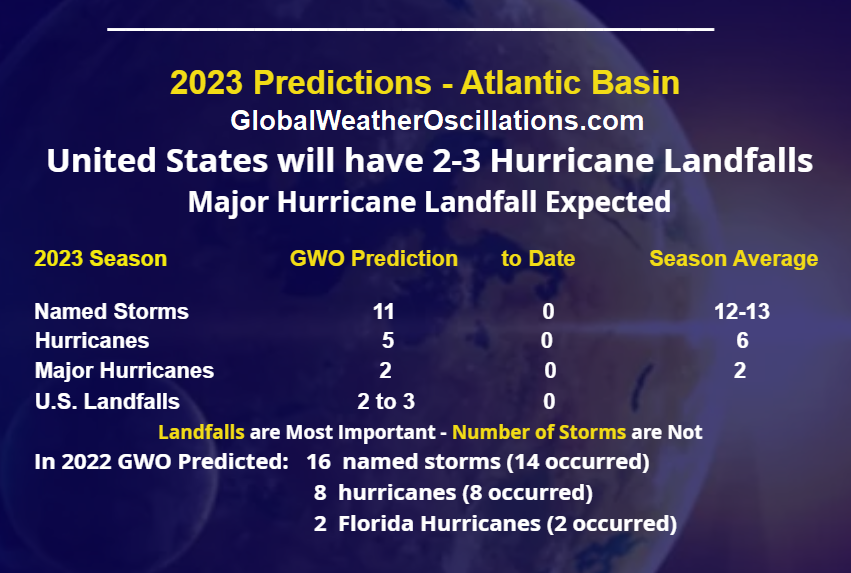
2023 Hurricane Season Outlook


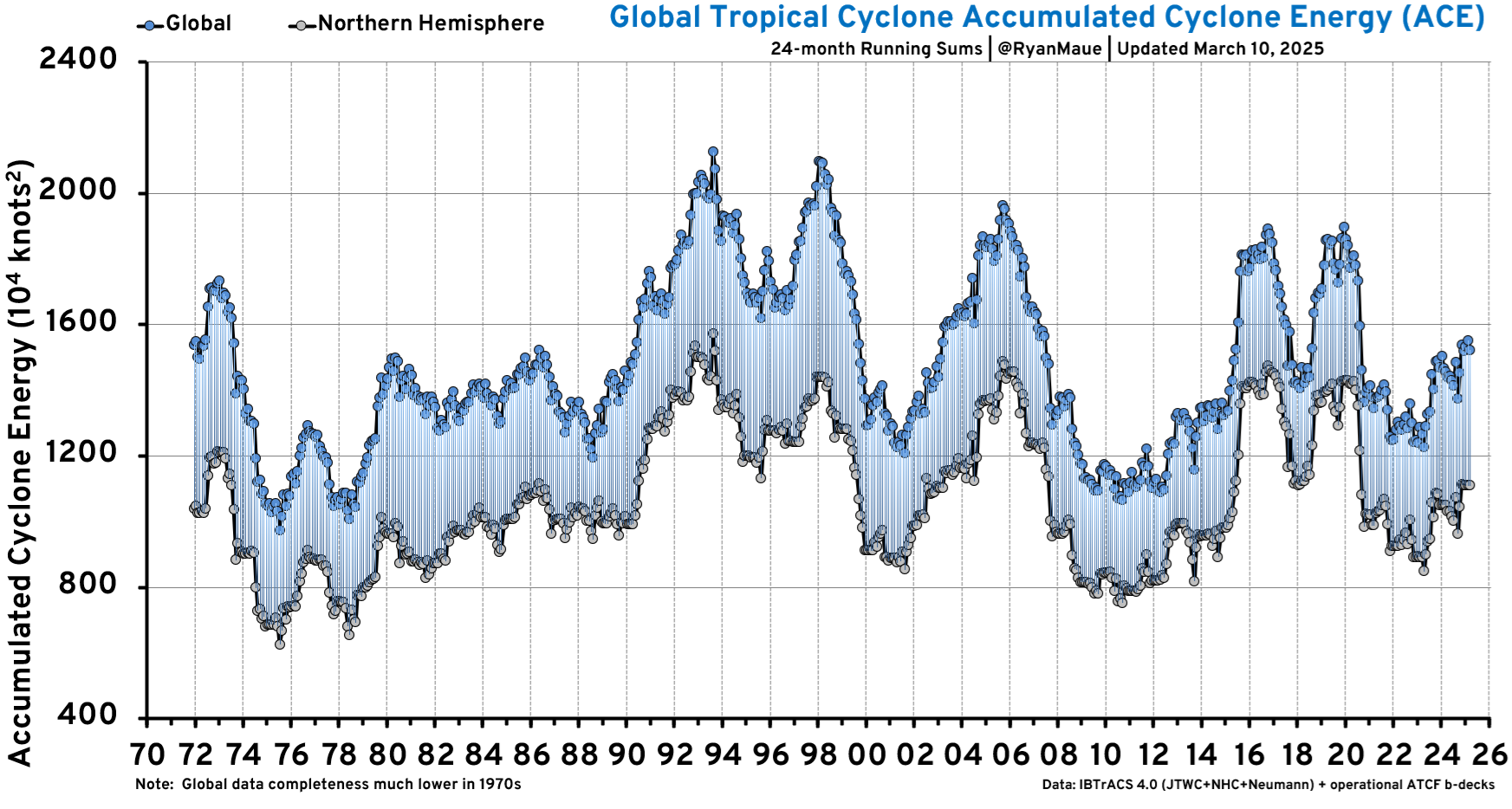
Figure: Last 50-years+ of Global and Northern Hemisphere Accumulated Cyclone Energy: 24 month running sums. Note that the year indicated represents the value of ACE through the previous 24-months for the Northern Hemisphere (bottom line/gray boxes) and the entire global (top line/blue boxes). The area in between represents the Southern Hemisphere total ACE.


Unbelievable Record Heat

Gregory Wrightstone tells it like it is at CO2 Coalition Data Shows We’re NOT Seeing Record Heat.  Excerpts in italics with my bolds and added images.

Hotter Than the Fourth of July!

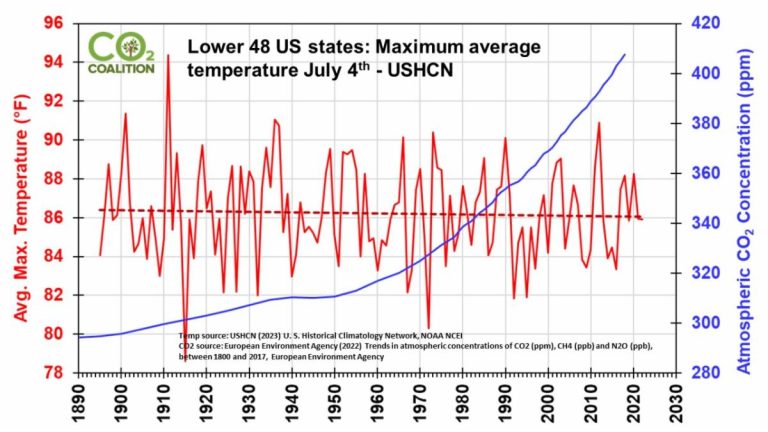
It was widely reported recently that July 4th, 2023 was the hottest day in Earth’s recorded history.

Paulo Ceppi, a climate scientist at London’s Grantham Institute stated: “It hasn’t been this warm since at least 125,000 years ago, which was the previous interglacial.” And, of course, it was reported that it was our fault due to our “sins of emission.”

This didn’t meet the smell test for the scientists at the CO2 Coalition. We know that previous warm periods were warmer than our modern temperatures. For example, during the Roman Warm Period there was citrus being grown in the north of England and barley was grown by Vikings on Greenland 1,000 years ago. Why aren’t they grown there now? It’s quite simple: Lower modern temperatures.

So, here at the CO2 Coalition, we did what scientists are trained to do:

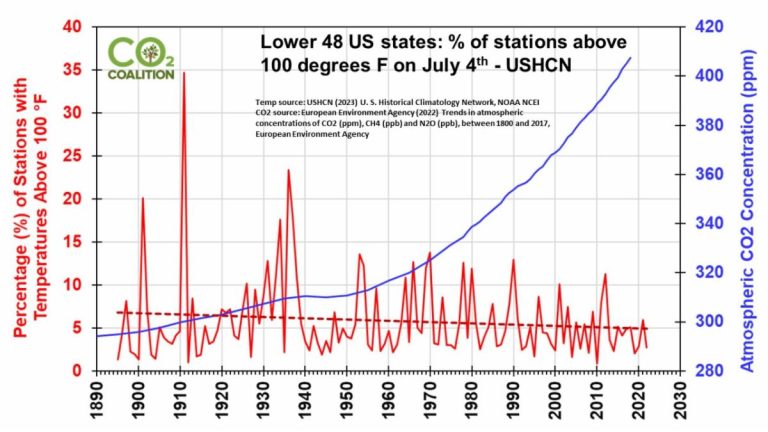
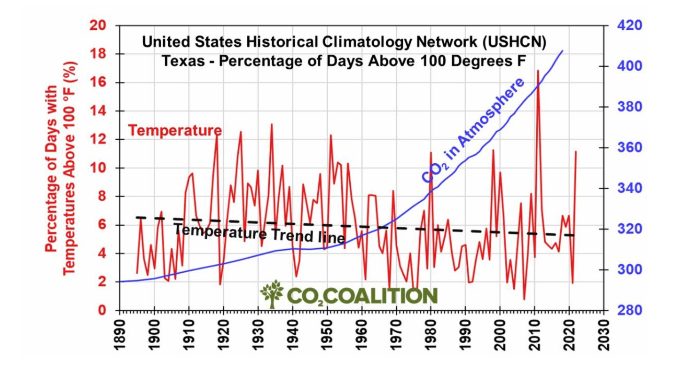
We looked at the available data. Our Science and Research Associate Byron Soepyan reviewed temperature data from the US Historical Climatology Network and found that both the number of weather stations reporting temperature over 100 degrees F and the Maximum Average Temperature for July 4th were slightly declining since the record began in 1895 – not increasing – as Ceppi claimed.

The Great Texas Heat Wave

It is summer. It is hot in Texas. It is not unusual or unprecedented. Below is a chart of the percentage of days in Texas that were above 100 degrees Fahrenheit since 1895. Despite a significant and steady rise in CO2 emissions, there has been a decline in the occurrence of very hot days.

Gregory Wrightstone is a geologist; executive director of the CO2 Coalition, Arlington, VA; and author of Inconvenient Facts: The Science That Al Gore Doesn’t Want You to Know.

Pharma’s War on Ivermectin, People Died

Dr Pierre Kory – On Ivermectin – At Euro Parliament Summit 2023 is the video above.  Below is my transcript with my bolds from closed captions and exhibits from a similar, longer presentation at Rumble.

Thank you I appreciate the invitation. I want to speak about a topic; I don’t think any of the topics today are pleasant, but this one is particularly unpleasant to me. I’m going to talk about the global war on Ivermectin. There was a massive Global disinformation campaign whose only objective is to suppress the evidence of efficacy of this life-saving drug. My colleague Dr Brouqui just referred to the war on Hydroxychloroquine.

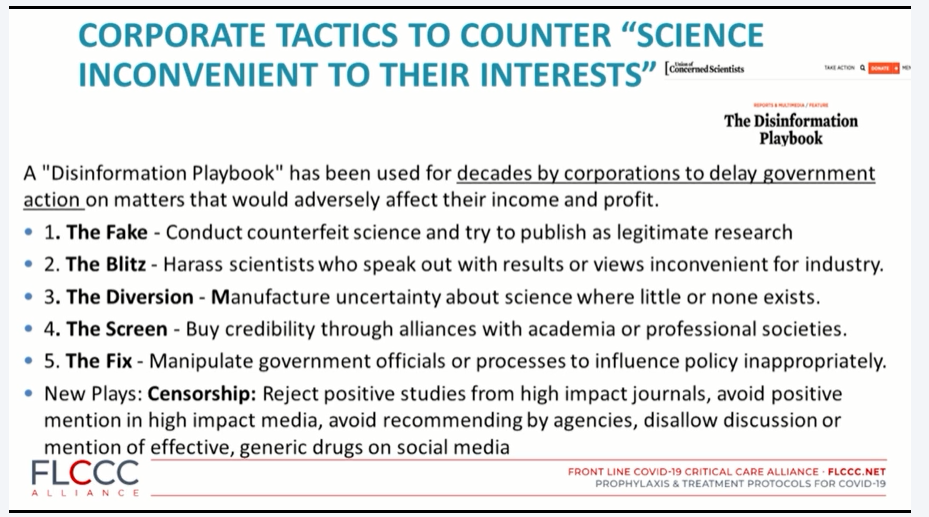
I’m going to take you through this almost like a case study showing what they do. Keep in mind it has nothing to do with Ivermectin, and everything to do with a decades-long war. They’ve been doing these things for decades on any generic off patent drug which threatens their profits.

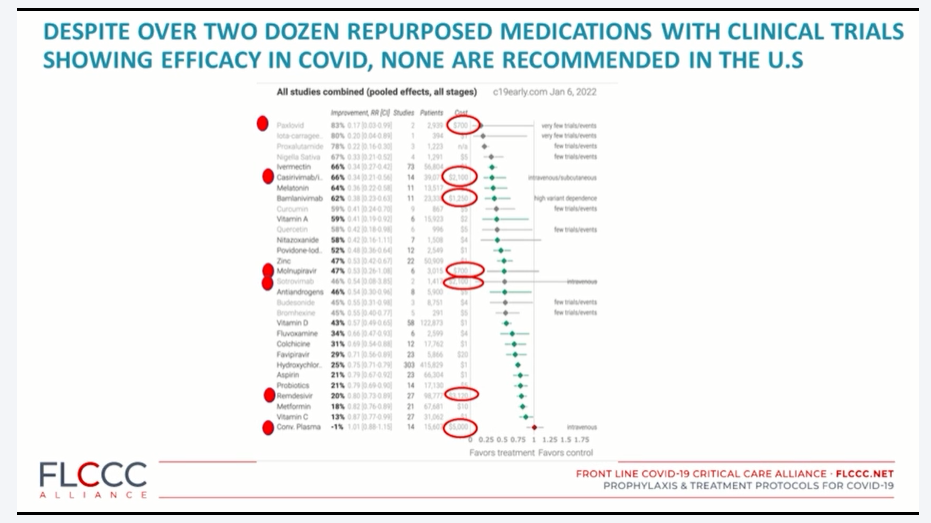
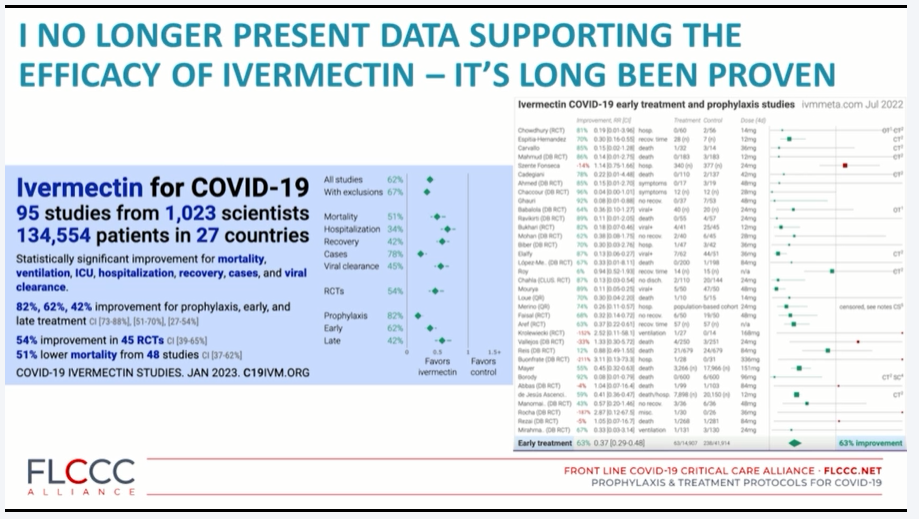
This is a forest plot. On the left are medicines that have trials to show that they’re effective against Covid. We have 43 effective therapies. Likely you’ve not heard of any of them if you live in the United States. The only ones approved are the ones that are circled. They have something in common, which is they’re all absurdly expensive and present massive profits to pharmaceutical companies. Any medicine, no matter how many studies supporting it–if it costs a dollar or two, it will not find regulatory approval in any Advanced Health economy around the world. And as a result people die. They die frequently and in high numbers because there’s a barrier to getting access to these medicines, to having them recommended.   Currently Ivermectin it has the most studies of any therapy, 95 controlled trials, over 40 are randomized and showing a massive evidence of efficacy.

Now why would they attack Ivermectin? Ivermectin probably, and hydroxychloroquine there, I would consider them almost equal presented a massive threat. It would have halted the vaccine campaign. If they were following the rules, which is you can’t have an effective therapy. It would have skyrocketed the Public Enemy Number One, which is something called Vaccine Hesitancy. Because this was all about the vaccine, and so they had to go after these drugs. It also threatens the profits of all of the Therapeutics that they were rushing out and barely improving on manipulated actually fraudulent single Studies by these companies. So if you talk about remdessivir, paxlovid and monopirovir: Billion dollar contracts were written by our government before those studies ever were published. There were press releases issued and contracts signed, and billions of dollars went into the pharmaceutical companies hands. They could not have a competitor.

So how did they do this? Well it’s called disinformation, and I’m going to be speaking specifically to the tactics used by Industries when science emerges that’s inconvenient to their industry interests. Every industry follows this playbook when science emerges that’s threatens their interests. No industry is more skilled at this than the pharmaceutical industry.

In modern times with the consolidation of Media power, they control social media
and they’ve completely captured regulatory Health agencies.

Across Advanced Health economies, they can make you believe that things are true; they can make you believe that things are false. And it makes you complicit in their own device. It’s largely centered around the use of propaganda and censorship, yet their abilities to do both of those things are historically unparalleled. We now have a global media and communication system which allows them to do this propaganda and censorship worldwide.

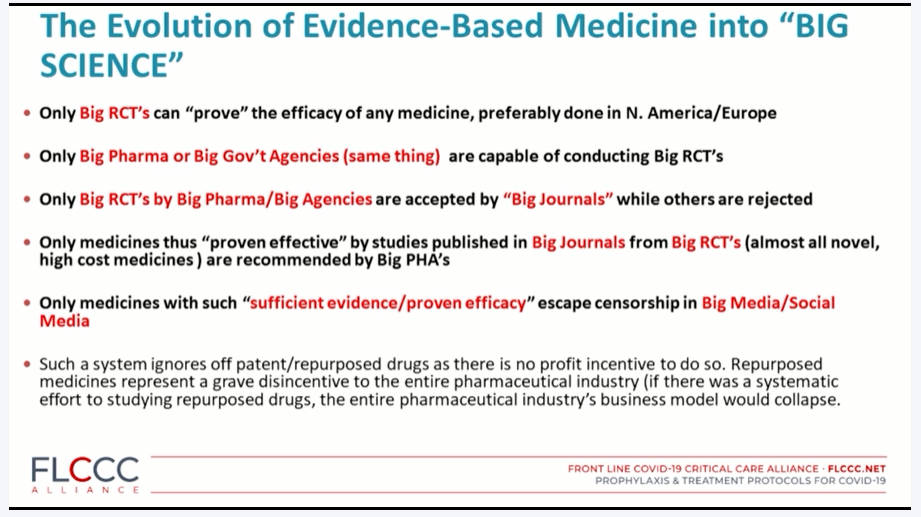
The biggest and the foundation of this entire disinformation campaign, I’m sorry to tell you, occurred at the level of the studies that were done by big agencies. So the biggest and highest funded studies were the most corrupt. And it occurred at the level of the highest impact medical journals in the world as well. The world’s leading Health agencies, one of which is in the US.

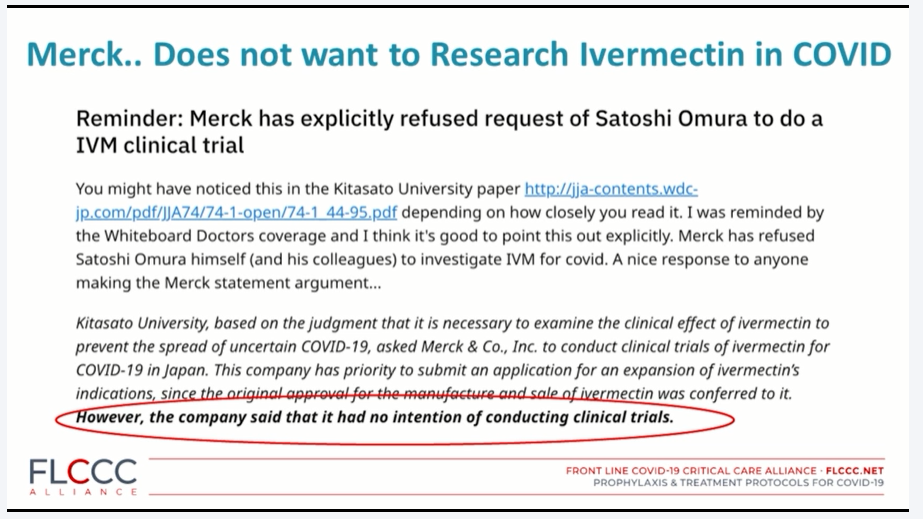
Keep in mind they were they were scared of Ivermectin from the beginning. My colleague Dr Robert Malone and other researchers had already identified Ivermectin as effective against at least a dozen RNA viruses before covid began. They were worried about Ivermectin and its antiviral properties. So when the Nobel prize winning Discoverer Omura asked Merck his old partner: “ I think we should study Ivermectin for covid, what did Merck say? “No thank you.” in the middle of a global pandemic.

Merck went even farther and one night in February of 2021 when there was nothing to support these three statements; I will tell you their public relations team put this on their website.

Now to find that a big big pharmaceutical company would publish lies on their website is completely unsurprising to me. But the surprise in this was the launched media campaigns around the world where media trumpeted over and over started to echo a pharmaceutical company whose three statements are so obviously protecting their profits. And this became a PR campaign that went around the world: “ Merck says that Ivermectin doesn’t work.”

So you could see this started early before there was any evidence to show that it didn’t work. In fact at the time of my testimony two months prior to that statement, I already had 35 controlled trials, 17 of which were randomized controlled trials. There was already an immense amount of evidence showing its efficacy. As of two weeks ago we have 95 controlled trials with 134, 000 patients.

If you look at the forest plot to the side all of the green squares that were going all the way to the left are showing large magnitude estimates of efficacy from dozens and dozens of Trials. These are only the early treatment trials. IVM is the most proven medication in history, yet not one Advanced Health economy around the world recommends it. Almost all hospitals have removed it from their formularies, and if you try to get filled at a pharmacy, any Retail Pharmacy in any of those developed countries, the pharmacist will not do it. They’re scared to death.

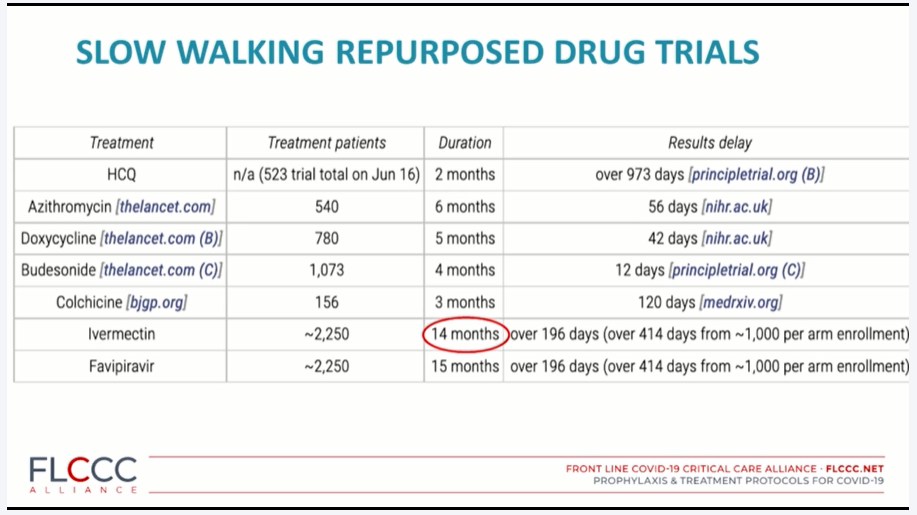
The trials. So how come we have all of these big rigorous large high quality trials? There’s
actually only been six of them, so out of the 95 trials, the only ones you’ve seen on the front pages of your newspapers are what I call the Big Six. Out of that 95 there were six trials that were heavily funded and carried out by investigators; they’re called the largest and high quality trials. What did
they show?

Somehow they concluded, in contradiction to all of the other trials,
that Ivermectin wasn’t effective.

How did they do that? Because they know how to do it and have been doing it for a while. They can design trials to show you something works, they can design trials to show you something doesn’t work. They’ve pulled the same tricks over and over again. All you need to know about those six trials compared to the 95: With one exception those were the only trials where every almost every single investigator was drowning in Financial conflicts of interests with pharmaceutical companies.

Every other trial had no Financial conflicts of interest. So ask yourself: Why they reached conclusions that completely departed from the rest of the evidence base.

These are the big six and they appeared in the highest impact journals in the world: New England Journal of Medicine, the Journal of American Medical Association, British Medical Journal, The Lancet and the Annals of Internal Medicine. Every time they were published, they launched PR campaigns across the world. You saw radio and television stations and newspapers blaring latest high quality study shows that Ivermectin doesn’t work.

And then there’s lots of Trials showing that the Ivermectin Advocates of which I’m one, I will tell you every country in the world has experts on Ivermectin who have had to watch and witness this propaganda campaign.

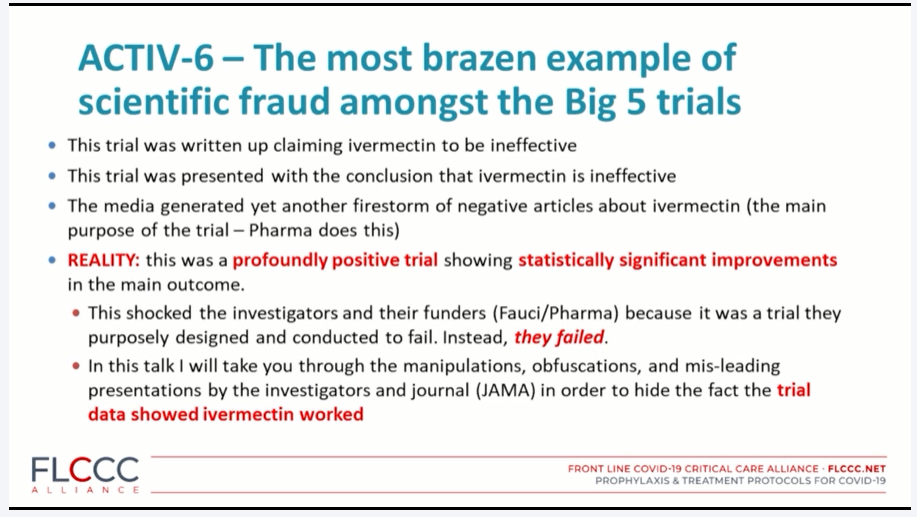
This is one of the more egregious samples. This is my own country, funded by the National Institutes of Health which is our largest research funder. They just did a couple of Trials on Ivermectin in Active-6.

By the way the lead investigator Dr. Susanna Naggie owns stock in a competitor to Ivermectin and she also has conflicts of interest with Gilead which makes as well are Remdesivir and other products that compete with Ivermectin. Do you think that she’s an objective investigator? And do you think it’s an accident she was hired? It is not; she was hired on purpose to do this kind of stuff.

Look at this trial, originally designed to see the difference in symptoms at day 14 which would make sense for an acute viral illness. In the middle of the trial, mysteriously they decided to change the end point from day 14 to day 28. Why would they do that? So look at the results that they found at the posterior P efficacy column in the other table. Anything above 0.95 is a statistically significant result which would show that Ivermectin is superior. In the middle you can see this in the journal; it’s completely public knowledge, yet no one talks about it. Now you can see why they moved it from day 14 to day 28: It was to disappear the statistical significance favoring Ivermetin.

This paper was published in one of the top journals of the world with the conclusion that Ivermectin has no role in the treatment of covid. You know there’s no major differences at day 28, and by the way this are all mild patients. Very few went to the hospital, there was one death and that was in the Ivermectin group. They never got Ivermectin because they died beforehand.

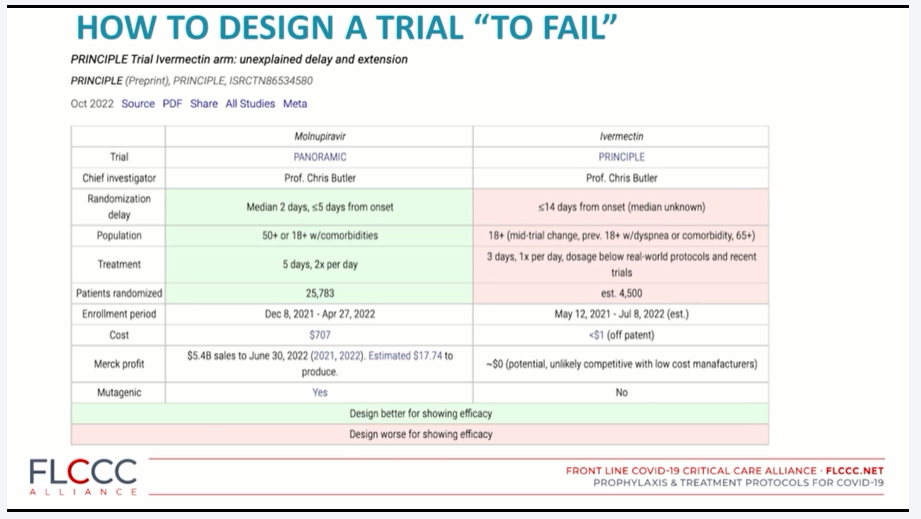
I call it the big six because they were the big ones that were published in the highest impact journals, but it’s really seven. Let’s talk about this seventh one that was started a long time ago by the University of Oxford by the same investigator who did a 25,000 person trial on mobile. Which has been completed and we know the results which shows them when the period doesn’t work.

But it’s a little odd what happened to the Ivermectin trial. It has been 10 months since the trial completed with not one mention of the result. Does anyone find that anomalous or abnormal? When we had to hear results of remdesivir, paxlovid and molnupiravir by press release before the data was available. These people at Oxford are sitting on a positive trial and you know it they won’t publish. They also did other stuff.

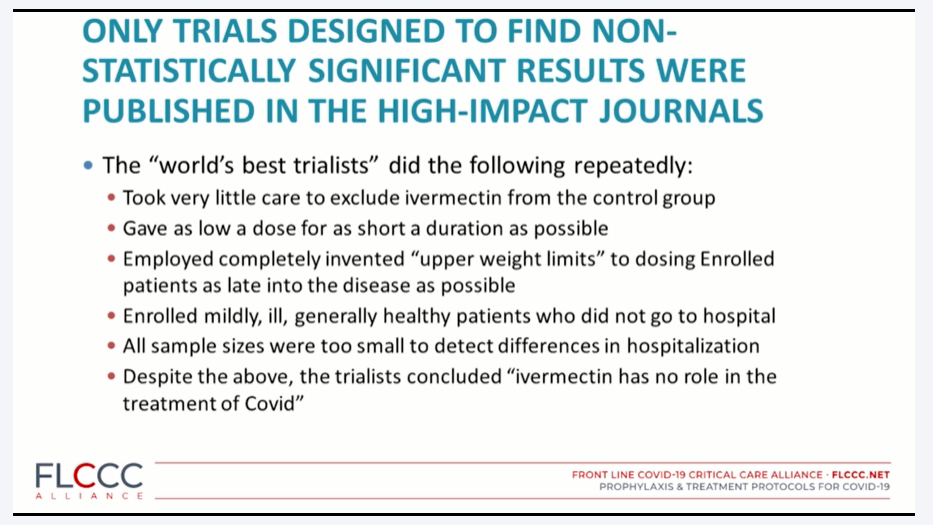
Let’s look at the designs of these trials. This is so Brazen. If you want to show something’s effective, you’re going to make sure to get the study drug into that patient immediately and as early as possible to maximize benefit. So they did a median of two days in a 25, 000 person trial, which is a fantastic achievement. I would love to see that kind of science being practiced everywhere. Only problem was the drug wasn’t effective.

What do they do with Ivermectin? They allow up to 14 days to start the medicine. And we have evidence from some of the participants that they were totally well by the time they got their medicines. This is a fake trial not a real one. But I think they weren’t good enough at what they were doing, because they’re sitting on a positive result. There’s no other explanation why 10 months have gone by and we haven’t heard. They are laying low, sitting quiet because they’ve seen that a lot of us around the world have found all of the fraud and brazen manipulations in the other large trials.

They also did something else. Curiously in the middle of the trial they suddenly announced the halting of the trial and the trialist from Oxford literally claimed to the world that they ran out of ivermectin. Which is so absurd: No self-respecting trials would ever run out of a study drug in the middle. Funny thing is there’s one functioning journalist left in the world and that was at The Epoch Times, and they did they actually did some journalism. They called the pharmaceutical company that was supplying the Ivermectin to Oxford and asked: Hey did you guys run out of ivermectin?”  Their answer: “No we have plenty.” This is the kind of stuff they’re doing.

Beyond the Selective publication of negative trials by pharmaceutical companies’ conflicted researchers, in my book which is soon to be published I have numerous examples of researchers around the world with positive randomized controlled Trials of ivermectin they were uniformly and systematically rejected from publication, from any journal in the first or second tier of medical journals. There is an editorial Mafia that controls our top medical journals. Science has been completely corrupted. Beyond the rejections are those that actually manage to go through peer review and get published, but were suddenly retracted for reasons we’d never heard of in our careers.

Me and my group have published over 150 peer-reviewed articles, never had one retracted. First time in our lives was our Ivermectin paper.

And then we had to read editorial after editorial you know propelling these narratives that circulated in the media relentlessly: “Don’t believe Ivermectin science, the studies are all low quality, too small in different countries, the doses aren’t the same, it can’t be believed, wait for the real signs.” These are the narratives that they’ve used to try to destroy the evidence of efficacy.

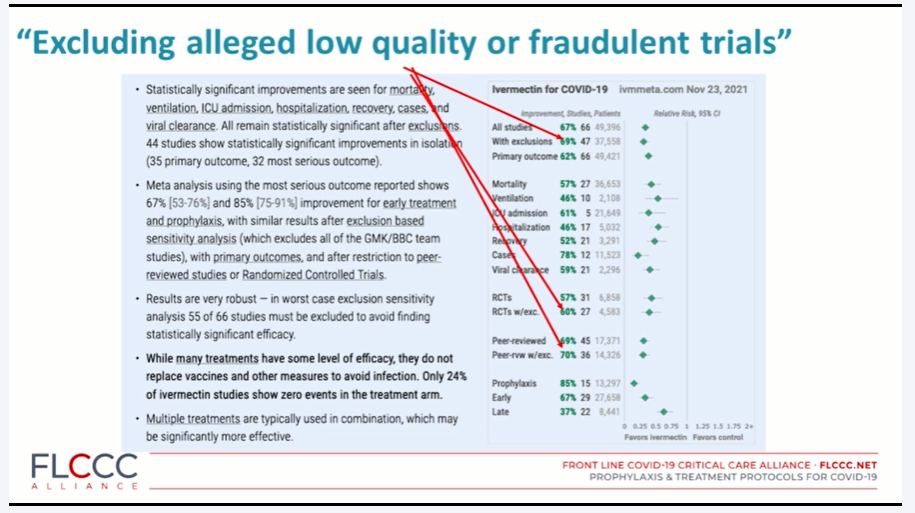
When challenged trials are excluded, Ivermetin efficacy gets even stronger.

This is an example. They picked one trial and they they supposedly found it to be fraudulent. It may or may not have been; there are some unreliable trials in any body of evidence. Researchers say about 20% of Trials will be fraudulent, not unique to Ivermectin. But the world’s leading researcher hired by the WHO in UK published a phenomenally positive meta-analysis which is a summary of 24 randomized control trials which showed statistically significant improvements in mortality, hospitalization time, to clinical recovery and time to viral clearance.

I hadn’t talked to him in a few months and I saw that he published that paper and I couldn’t believe how astoundingly positive that paper was. I could believe it by the fact that the media was silent. It was not carried and then I think the other side got real worried because Andy started behaving very differently. He self-retracted his own paper

And he started removing randomized control trials using invented categories this is from his exact paper it looks like a five-year-old who’s trying to disappear the evidence of efficacy. So he makes up these categories “potentially fraudulent” no definition of what kind of study that is. And then this other category which is “some concerns” So there’s a category of evidence which is when Dr Andrew Hill has some concerns, so he removes and disappears the evidence base to the point where it loses statistical significance. And now he’s claiming it doesn’t work. A bizarre turnaround for this researcher

I’m going to finish with the agencies. We know they control; you cannot work at a health agency without making Pharma happy. Your career is over, you’re off of committees, you don’t graduate from the agencies to get jobs in pharmaceutical unless you do their bidding. They are completely in lockstep. What happened with the Ivermectin story in the United States is that in the middle of August of 2021 Ivermectin prescriptions hit 90,000 a week. They were skyrocketing, everyone was figuring out it was working, everybody was prescribing. In a very short sequence you saw our CDC send out a memo to every State Department of Health which then went to every licensed physician in that state. And that memo said careful of ivermectin we’re seeing overdoses and people are getting injured. They made it out to be a dangerous drug when it’s one of the safest, if not the safest medication we have in history.

And after they said that it was dangerous, all the professional Societies in the United States, without any authority sent out memos to every doctor in the country calling for an immediate cessation of prescribing of ivermectin. What followed was the horse dewormer PR campaign was launched. You can tell a PR campaign in the narrative when it’s two weeks four different channels and that’s what you saw; late night talk show host, News hosts, newspapers, magazines, radio–”Horse dewormer, horse dewormer, horse dewormer. and

At the end of those two weeks no self-respecting doctor would ever prescribe
such a dangerous and ineffective drug and no patient would want to get it.

Do you think that PR campaign was invented in August of 2021, it was not. It was launched in 2021 because they saw they were losing this war against Ivermectin. And here we are at the end of three years and it’s been shut down in most of the advanced health economies around the world. One of the most effective drugs in history, that would have saved millions of lives. This was a humanitarian catastrophe and a crime against humanity yet no one will go to jail for it.

Investors Sour on ESG Activism

Zero Carbon zealots attacking ExxonMobil, here seen without their shareholder disguises.

WSJ reports with a sad tone what is actually good news that investors are pushing back against ESG political correctness. Their article is: ESG Blowback: Exxon, Chevron Investors Reject Climate Measures  Excerpts in italics with my bolds.

An investor-driven climate change push at some of the
world’s largest oil companies has stalled out.

On Wednesday, Exxon Mobil and Chevron’s shareholders struck down a raft of proposals urging the companies to cut greenhouse-gas emissions derived from fuel consumption, put out new reports on climate benchmarks and disclose certain oil-spill risks, among other initiatives.

The votes were abysmal for climate activists. All but two of the 20 shareholder proposals for the two companies garnered less than 25% of investors’ vote, according to preliminary results, with some performing much worse than similar proposals put forward last year.

Among the most controversial proposals were those that would have had the companies adopt targets for reducing emissions including those from third-party consumption of their products, such as when drivers burn gasoline in their cars, also known as Scope 3 emissions. Those received only 11% and 10% of the vote among Exxon and Chevron investors, respectively, compared with 27% and 33% for similar proposals last year.

In recent weeks, similar climate proposals failed to win over most shareholders
at annual meetings of British oil and gas giants BP and Shell in London.

Investment strategies linked to ESG, short for environmental, social and corporate-governance issues, had gained momentum in recent years, particularly following the onset of the pandemic in 2020. Investors pressed oil companies to show how they were working to reduce their climate footprint, set long-term environmental goals and curtail the flaring of unwanted natural gas.

In 2021, investment firm Engine No. 1 prevailed in a historic proxy battle against Exxon, winning three board seats at the company’s annual meeting with the backing of investment firms, Vanguard, State Street and BlackRock. The firm argued that Exxon needed to form a better strategy to prepare for the world’s anticipated energy transition.

After the defeat, Exxon adopted a so-called net zero commitment — a goal to reduce
or offset greenhouse-gas emissions from its operations to zero by 2050.

But Wednesday’s votes demonstrated how some shareholders have backed off pushing major oil companies to embrace certain climate goals. Investors said many voices pushing ESG measures have been drowned out following Russia’s war in Ukraine, which caused oil and gas prices to skyrocket as global supplies were crimped.

Mark van Baal, founder of environmental activist group Follow This, said shareholders missed an opportunity at the annual votes. Investors know that avoiding climate disaster will require global emissions to fall by almost half by 2030, he said, but many are focused on short-term profits. [Note: van Baal is wrong about disaster–see Even 3°C Warming Can’t Stop World Prosperity. ]

The industry and its allies have said some countries, particularly in Europe, were too quick to move away from fossil fuels toward clean energy sources such as solar and wind. A movement against climate activism has gained political traction in the U.S., particularly among Republican voters. Entrepreneur Vivek Ramaswamy, a candidate for the Republican presidential nomination, has made anti-ESG policies a central plank of his campaign.

The pushback against ESG measures has also hit investment firms such as BlackRock,
which have faced potential boycotts in Texas and other red states.

Republican officials in Florida, Texas, Louisiana and South Carolina pulled more than $4 billion in pension and investment funds from BlackRock starting last year. BlackRock brought in $230 billion from U.S. clients in 2022.

It wasn’t immediately clear how BlackRock, State Street and Vanguard voted at the meetings this week.  State Street and BlackRock declined to comment. Vanguard didn’t immediately respond to a request for comment.

Investments in fossil fuels pushed many oil companies to record profits last year, which lured back some investors who had fled after years of meager returns from the industry. Exxon Chief Executive Darren Woods said Wednesday the company had benefited from investing in fossil fuels when others pulled back.

Even in Europe, energy executives have shown a willingness to alienate clean-energy investors to tailor strategies to the thirst for fossil fuels. BP and Shell’s record full-year 2022 profits and hefty returns to investors have attracted new investors, and won back some who were dubious of their energy-transition strategies, executives said.

Shell and BP executives have said their strategies are consistent with targets to lower global emissions, while also helping supply the oil and gas still demanded in coming years globally. Exxon and Chevron have said they support the emissions targets set by the Paris climate accords and reducing emissions from their operations.

But Woods and other industry executives have argued some climate-related proposals would backfire or leave the economy worse off. Woods said several proposals rejected Wednesday would have required the company to assume the world will cut carbon emissions at a much faster pace than observers have projected.

“Some [would] go so far as to force us to decrease oil and gas development,” he said. “This would do nothing to reduce global demand.”

What is actually beyond debate is not that we are in a climate crisis
but that if we don’t stop destroying our conventional energy economy,
we are going to be in a civilizational crisis.


Even 3°C Warming Can’t Stop World Prosperity

The 3°C Scenario: What’s the economic impact of severe global warming?  James Pethokoukis writes at his substack.  Excerpts in italics with my bolds and added images.

Even with an extreme scenario, the world should be richer and more capable in 2050

You may have noticed some concerning climate headlines popping up today in your smartphone notifications:

  • “‘Sounding the alarm’: World on track to breach a critical warming threshold in the next five years” – CNN
  • “Global warming likely to exceed 1.5C within five years, says weather agency” – Financial Times
  • “Global warming set to break key 1.5C limit for first time” – BBC

As the above FT chart neatly shows, the newsy forecast is about breaching the 1.5°C level in a single year, not a permanent increase. That said, the UN’s Intergovernmental Panel on Climate Change says humanity better get used to 1.5° and higher without a drastic shift away from fossil fuels. Current global policies, according to the IPCC, make it “likely that warming will exceed 1.5°C during the 21st century and make it harder to limit warming below 2°C.”

But what if the global heating is more severe than expected? A new analysis by consulting firm Capital Economics looks at a scenario in which the global average temperature rises by more than 3°C from its pre-industrial average and finds that global GDP would still nearly double by 2050.

How could that be possible given all the negative effects predicted by climatologists — which I’m not contesting — such as rising sea levels, more droughts and severe heatwaves, more extreme-weather events such as hurricanes, a loss of biodiversity and ecosystems? From the cautious and meticulous analysis by CE economists David Oxley and Gabriel Ng:

But the key takeaway is that we think global GDP would still nearly double in size between now and mid-century even if the world were to warm by more than we anticipate, largely because developed economies would be affected the least. And even in places where a warmer world would have much bigger impacts on GDP, such as in India and south-east Asia, the physical effects on economic activity would be a headwind to catch-up growth rather than putting economic development in reverse.

(One thing to keep in mind: The firm’s baseline forecast is that the increase in global temperature will be kept just below 2°C thanks to the increasing use of renewable energy sources and other technological improvements, resulting in a ecline in global greenhouse40 percent d gas emissions by 2050. This level of warming is already baked into its economic forecast.)

Caveat:  Decarbonizing Our Energy Platform is the Way to Stop Prosperity

In assembling this forecast, CE highlights some of its key decisions. First, it focused on “physical risks,” such as the impacts of more severe hurricanes and consistently higher temperatures, rather than “transition risks,” the impacts of taxes and regulations meant to mitigate climate change. What’s more, CE also tried to look for economic models that took into account the possibility of non-linear outcomes.

[Note: In ClimateSpeak, mitigation doesn’t have it’s usual meaning.  “Mitigate:  make something, such as a problem, symptom, or punishment, less harsh or severe.” (Mirriam-Webster).  IPCC supporters speak of spending Trillions of $ on schemes to reduce carbon emissions without any guarantee of lowering climate impacts.]

But again: The impacts mentioned here won’t result in either advanced or
emerging economies becoming poorer a generation from now than they are today.

Rather, the physical effects of climate change on economic activity would create headwinds that slow growth. A country suffering some of the biggest impacts from climate change would be Indonesia. Even so, CE still expects the country to become a top-ten economy by 2050. Yet under the 3°C scenario, it would rise to become the eighth largest economy rather than the fifth largest economy under the cooler CE baseline forecast.  Or India: Under both scenarios, it would still be the third largest economy by 2050, but under the 3°C scenario it only be three times as large as fourth place Germany rather than four times in the baseline.

The good news here is even with a rapid and severe climate outcome over the next 25 years, there’s good reason to think humanity will have even more economic resources and technological capabilities to do something about it — while also preparing for a future where more us can use more energy to turn our dreams into reality. Innovation-driven economic growth is what provides true resilience to America and the world.

Summary: 

We have always and will continue to adapt to the effects of changing weather and climate, so long as we have the economic means to prepare and respond to events.  The real threat to society, humanity and the biosphere is climate policies directed against our energy platform.

See Also Series of Posts:   World of Hurt from Climate Policies


More CO2 Good, Less CO2 Bad

Gregory Wrightstone explains at CO2 Coalition More Carbon Dioxide Is Good, Less Is Bad.  Excerpts in italics with my bolds and added images.

People should be celebrating, not demonizing, modern increases in atmospheric carbon dioxide (CO2). We cannot overstate the importance of the gas. Without it, life doesn’t exist.

First, a bit of history: During each of the last four glacial advances, CO2’s concentration fell below 190 parts per million (ppm), less than 50 percent of our current concentration of 420 ppm. When glaciers began receding about 14,000 years ago – a blink in geological time – CO2 levels fell to 182 ppm, a concentration thought to be the lowest in Earth’s history.

Line of Death

Why is this alarming? Because below 150 ppm, most terrestrial plant life dies. Without plants, there are no animals.

In other words, the Earth came within 30 ppm in CO2’s atmospheric concentration of witnessing the extinction of most land-based plants and all higher terrestrial life-forms – nearly a true climate apocalypse. Before industrialization began adding CO2 to the atmosphere, there was no telling whether the critical 150-ppm threshold wouldn’t be reached during the next glacial period.

Contrary to the mantra that today’s CO2 concentration is unprecedentedly high, our current geologic period, the Quaternary, has seen the lowest average levels of carbon dioxide since the end of the Pre-Cambrian Period more than 600 million years ago. The average CO2 concentration throughout Earth’s history was more than 2,600 ppm, nearly seven times current levels.

Beneficial CO2 Increases

CO2 increased from 280 ppm in 1750 to 420 ppm today, most of it after World War II as industrial activity accelerated. The higher concentration has been beneficial because of the gas’s role as a plant food in increasing photosynthesis.

Its benefits include:

— Faster plant growth with less water and larger crop yields.

— Expansion of forests and grasslands.

— Less erosion of topsoil because of more plant growth.

— Increases in plants’ natural insect repellents.

A summary of 270 laboratory studies covering 83 food crops showed that increasing CO2 concentrations by 300 ppm boosts plant growth by an average of 46 percent. Conversely, many studies show adverse effects of low-CO2 environments.

For instance, one indicated that, compared to today, plant growth was eight percent less in the period before the Industrial Revolution, with a low concentration of 280 ppm CO2.

Therefore, attempts to reduce CO2 concentrations are bad for plants, animals and humankind.

Data reported in a recent paper by Dr. Indur Goklany, and published by the CO2 Coalition, indicates that up to 50 percent of Earth’s vegetated areas became greener between 1982-2011.

Researchers attribute 70 percent of the greening to CO2 fertilization from of fossil fuel emissions. (Another nine percent is attributed to fertilizers derived from fossil fuels.)

Dr. Goklany also reported that the beneficial fertilization effect of CO2 – along with the use of hydrocarbon-dependent machinery, pesticides and fertilizers – have saved at least 20 percent of land area from being converted to agricultural purposes – an area 25 percent larger than North America.

The amazing increase in agricultural productivity, partly the result of more CO2, has allowed the planet to feed eight billion people, compared to the fewer than 800,000 inhabitants living a short 300 years ago.

More CO2 in the air means more moisture in the soil. The major cause of water loss in plants is attributable to transpiration, in which the stomata, or pores, on the undersides of the leaves open to absorb CO2 and expel oxygen and water vapor.

With more CO2, the stomata are open for shorter periods, the leaves lose less water, and more moisture remains in the soil. The associated increase in soil moisture has been linked to global decreases in wildfires, droughts and heat waves.

Exaggeration of CO2’s Warming Effect

Alarm over global warming stems from exaggerations of CO2’s potential to retain heat that otherwise would radiate to outer space. As with water vapor, methane and nitrous oxide, CO2 retains heat in the atmosphere by how it reacts to infrared portions of the electromagnetic spectrum.

However, the gas has saturated to a large extent within the infrared range, leaving relatively little potential for increased warming.

Both sides of the climate debate agree that the warming effect of each molecule of CO2 decreases significantly (logarithmically) as the concentration increases.

This is one reason why there was no runaway greenhouse warming when CO2 concentrations approached 20 times that of today. This inconvenient fact, despite its importance, is rarely mentioned because it undermines the theory of a future climate catastrophe.

A doubling of CO2 from today’s level of 420 ppm – an increase estimated to take 200 years to attain – would have an inconsequential effect on global temperature.

Pennsylvania’s solar-powered fossil fuels

CO2 being liberated today from Pennsylvania coal was removed from the atmosphere by the photosynthesis of trees that fed on sunlight and carbon dioxide and then died to have their remains accumulate in the vast coal swamps of the Carboniferous Period.

Pennsylvania Marcellus and Utica shale hydrocarbons being exploited today were also the likely hydrocarbon source of shallower reservoirs producing since the late 1800s.

The source of those hydrocarbons was algae remains that gathered on the bottom of the Ordovician and Devonian seas.

Like the coal deposits, the algae used solar-powered photosynthesis and CO2 (the algal blooms were likely fueled by regular dust storms) to remove vast amounts of CO2 from the air and lock it up as carbon-rich organic matter.

The provenance of these hydrocarbons spawns two novel ideas. First, there is a strong case that these are solar-powered fuels.

Second, the sequestering of carbon during the creation of the hydrocarbons lowered atmospheric concentrations of CO2 to sub-optimum levels for plants. Therefore, the combustion of today’s coal and gas is liberating valuable CO2 molecules that are turbocharging plant growth.

The plain fact of the matter is that the modest warming of less than one degree Celsius since 1900, combined with increasing CO2, is allowing ecosystems to thrive and humanity to prosper.

Additional information on CO2’s benefits and related topics are available at CO2Coalition.org, which includes a number of publications and resources of interest.


Warning: Earth Day Became Polluted

Henry I. Miller and Jeff Stier provide this brieing for 2023 at ACSH Earth Day Has Become Polluted By Ignorance And Political Correctness.  Excerpts in italics with my bolds.

Once a touchy-feely, consciousness-raising New Age experience, it’s now
an occasion for environmental activists to prophesy apocalypse,
dish antitechnology dirt, and allow passion and zeal to trump reality.

Sadly, today’s Earth Day shares much with the current zeitgeist: It reeks of wokeness, political correctness, and virtue-signaling. 

Many of those stumping for Earth Day on April 22 this year will oppose environment-friendly advances in science and technology, such as agricultural biotechnology (“GMOs”), fracking, and nuclear power. A pervasive meta-message will be disdain for the capitalist system that provides the innovation needed for effective environmental protection and conservation. (It’s no coincidence that low-income countries tend to be the most polluted.)

Ironically, the theme of this year’s event, “Invest In Our Planet,” includes a progressive wish list, including reducing your “foodprint.” For those unfamiliar with this neologism, a foodprint “measures the environmental impacts associated with the growing, producing, transporting, and storing our food— from the natural resources consumed to the pollution produced to the greenhouse gases emitted.”

Another of this year’s event topics is “regenerative agriculture,” a favorite concept of the environmentally woke. But as Andrew Porterfield and Jon Entine of the Genetic Literacy Project have written, “it’s a lot like a rebranding of organic farming but with more grandiose claims…Its supporters in the organic community make a multitude of immodest representations about what organic/regenerative agriculture can do, including ‘reversing global warming’ and ‘ending world hunger,’ along with preserving the world’s topsoil.”

The reality is that regenerative agriculture and its sibling, “agroecology,”
promote reliance on primitive, low-yielding agricultural techniques,
the use of which raises food prices and disadvantages the poor.

One of this year’s “52 Ways to Invest in Our Planet” is “Go Pesticide Free.” The organizers don’t spell out how, exactly, we should accomplish this, which is hardly surprising, given that 99.99% of the pesticides in our diets are found naturally in our food. (They enable plants to fend off predators and diseases.)

Another of their “tips” is “eat less meat.” Getting into the spirit of this nonsense was New York City Mayor Eric Adams, who said on April 17th, “It is easy to talk about the emissions that’s [sic] coming from buildings and how it impacts our environment, but we now have to talk about beef,” as part of an effort to steer hospital patients toward vegan meals.

“Education” features prominently in Earth Day activities, as in, “Fifty years ago, the first Earth Day started an environmental revolution. Now, we are igniting an education revolution to save the planet. . . Through our Climate and Environmental Literacy Campaign, we will ensure that students across the world benefit from high-quality education to develop into informed and engaged environmental stewards.”

What might that mean? For a previous Earth Day, seventh graders at a tony private school near San Francisco were given an unusual Earth Day assignment: Make a list of environmental projects that could be accomplished with Bill Gates’s fortune. This approach to environmental awareness fits in well with the progressive worldview that the right to private property is subsidiary to undertakings that enlightened thinkers deem worthwhile.

And how interesting that the resources made “available” for the students’ thought experiment were not, say, the aggregate net worth of the members of Congress but the wealth of one of the nation’s most successful and most innovative entrepreneurs.

Another Earth Day assignment for those same students was to read Rachel Carson’s best-selling 1962 book “Silent Spring,” an emotionally charged but deeply flawed excoriation of the widespread spraying of chemical pesticides to control insects. As described by Roger Meiners and Andy Morriss in their scholarly yet eminently readable 2012 analysis, “Silent Spring at 50: Reflections on an Environmental Classic,” Carson exploited her reputation as a well-known nature writer to advocate and legitimatize “positions linked to a darker tradition in American environmental thinking: neo-Malthusian population control and anti-technology efforts.”

Carson’s proselytizing and advocacy led to the virtual banning of DDT and restrictions on other chemical pesticides even though “Silent Spring” was replete with gross misrepresentations and atrocious scholarship. Carson’s observations about DDT were meticulously rebutted point by point by J. Gordon Edwards, a professor of entomology at San Jose State University, a longtime member of the Sierra Club and the Audubon Society, and a fellow of the California Academy of Sciences. In his stunning 1992 essay, “The Lies of Rachel Carson,” Edwards demolished her arguments and assertions and called attention to critical omissions, faulty assumptions, and outright fabrications.

Meiners and Morriss concluded correctly that the influence of “Silent Spring” “encourages some of the most destructive strains within environmentalism: alarmism, technophobia, failure to consider the costs and benefits of alternatives, and the discounting of human well-being around the world.” Sounds a lot like the Earth Day agenda.

One of the United Kingdom’s great contemporary thinkers, Dick Taverne (Lord Taverne of Pimlico), discusses the shortcomings of New Age philosophy in his iconic book, “The March of Unreason.” Taverne deplores the “new kind of fundamentalism” that has infiltrated many environmentalist campaigns as an undiscriminating back-to-nature movement that views science and technology as the enemy and as a manifestation of an exploitative, rapacious and reductionist attitude toward nature. It is no coincidence, he believes, that eco-fundamentalists are strongly represented in anti-globalization and anti-capitalism movements worldwide.

In this, Taverne echoes the late physician and novelist Michael Crichton, who argued in his much-acclaimed novel “State of Fear” that eco-fundamentalists have reinterpreted traditional Judeo-Christian beliefs and myths and turned environmentalism into a kind of religion. This religion has its own Eden and paradise, where mankind lived in a state of grace and unity with nature until mankind’s fall, which came not after eating a forbidden fruit, but after partaking of the forbidden tree of knowledge – that is, technology. This religion also has a judgment day that will come for us in this polluted world – all of us, that is, except for true environmentalists, who will be saved by achieving “sustainability.”

One of Crichton’s characters argues that since the end of the Cold War, environmental alarmism in Western nations has filled the void left by the disappearance of the terror of communism and nuclear holocaust and that social control is now maintained by highly exaggerated fears about pollution, global warming, chemicals, genetic engineering, and the like. With the military-industrial complex no longer the primary driver of society, the politico-legal-media complex has replaced it.

This cabal peddles fear in the guise of promoting safety. French writer and philosopher Pascal Bruckner captured its tone nicely: “You’ll get what you’ve got coming! That is the death wish that our misanthropes address to us. These are not great souls who alert us to troubles but tiny minds who wish us suffering if we have the presumption to refuse to listen to them. Catastrophe is not their fear but their joy.”

The small-minded misanthropes have enjoyed some dubious “successes.” They have effectively banished agricultural biotechnology from Europe and much of Africa, put the chemical industry on the run and placed the pharmaceutical industry in their crosshairs.

Lord Taverne believes these are ominous trends that are contrary to the principles of the Enlightenment, returning us to an era in which inherited dogma and superstition took precedence over experimental data. Eco-fundamentalism strangles scientific creativity and technological innovation, blocking the availability of products that, used responsibly, could dramatically improve and extend many lives and protect the environment.

Lord Taverne posited that when you defend science and reason,
you defend democracy itself.
Well said, Milord, and happy Earth Day to you.