Diversity Industry Covers Up Failed Affirmative Action

screen-shot-2021-07-09-at-12.17.46-am
Heather Mac Donald explains the origins and preoccupations of Diversity, Inclusion and Equity (DIE).  Whoops, I mean Diversity, Equity and Inclusion (DEI)  which is now an academic degree you can acquire.  Her Quillette article is Almost Four Decades After Its Birth, The Diversity Industry Thrives on Its Own Failures.

The diversity business originated in 1984, when R. Roosevelt Thomas, a Harvard business school graduate, founded the American Institute for Managing Diversity at Morehouse College. Corporations had been practicing affirmative action for years, but the women and minorities whom employers had hired to meet equal-opportunity obligations weren’t advancing up the career ladder in acceptable numbers. Thomas came up with a novel explanation. The problem wasn’t that preferentially admitted recruits were underqualified; the problem was that their supervisors didn’t know how to “manage diversity.” It was those supervisors who needed remedial training—lots of it—not the affirmative-action beneficiaries themselves.

Managerial expectations about merit and performance often reflected cultural prejudices, Thomas and the consultants who followed him insisted. “‘Qualifications’ is a code word in the business world with very negative connotations,” a consultant with the professional-services firm of Towers Perrin (as it was then called) said in 1993. If minorities don’t meet existing employment criteria, then corporations need to expand their definition of what it means to be employable, said Alan Richter, creator of the 1991 board game, The Diversity Game. Promptness, precision, and a cogent communications style were among the attributes that diversity advisors deemed likely expendable.

A lucrative new consulting practice was born, its growth driven by a constant churn in terminology. “Valuing diversity” was different from “managing diversity.” Each newly spawned phrase came with a cadre of high-priced tutors. Lewis Griggs currently offers video trainings in such subjects as “Communicating Across Differences,” “Supervising and Managing Differences,” and “Creating, Managing, Valuing, and Leveraging Diversity,” with each video purporting to contain specialized content appropriate for different parts of an organization.
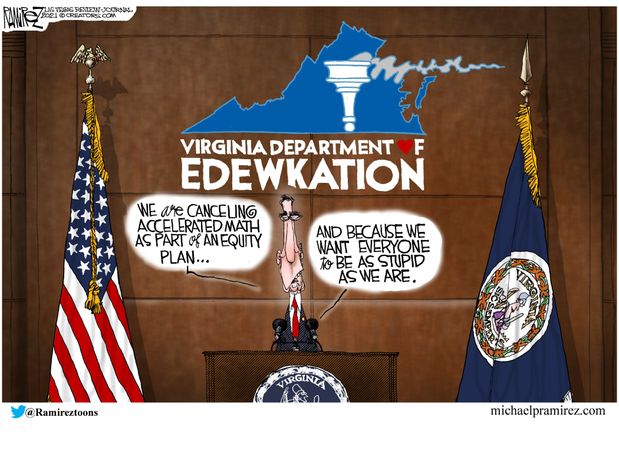
“Diversity” was eventually joined by “inclusion.” “Equity” was then added, thus yielding today’s DEI (Diversity, Equity, and Inclusion) triumvirate (sometimes also going as “EDI”). The most cutting-edge organizations have lately appended a “B” (for Belonging), as at the Juilliard School in New York City. Distinguishing these terms is a core function of diversity training—and now, at Bentley, of diversity scholarship. The university’s new DEI major, the Chronicle of Higher Education reports, will help graduates understand the “nuances of and differences between diversity, equity, inclusion, and justice.”

Even by 1993, half of Fortune 500 companies had a designated diversity officer, and 40 percent of American companies had instituted diversity training. Diversity conferences were occurring regularly, attracting government and business attendees. And yet many reporters, academics, corporate consultants, and activists still insist that managers not only fail to “value diversity,” but remain complicit in creating a dangerous environment for women and racial minorities.

Example: Levi Strauss & Co., which was recognized on Forbes’s list of “Best Employers for Diversity” in 2019. The company itself boasts: “In the 1960s, we integrated our factories a decade before it was required by law. In the early 1980s, we joined the fight against HIV/AIDS early on. Furthermore, our president and CEO, Chip Bergh, was one of the first company leaders to join the CEO Action for Diversity & Inclusion™ [in 2017], and has been on the front lines of efforts to protect Dreamers knowing that diversity and inclusivity makes our company better and our country stronger (after all, Levi Strauss himself was an immigrant).”

And yet the situation for minority employees at Levi Strauss is still so dire that the company has been hosting racially segregated healing sessions with professional mental health experts. As the Washington Free Beacon recently reported, its chief executive for DEI is trying to provide a “safe space for employees to express themselves” without feeling “triggered.”

Bentley University itself has yet to yield dividends from its longstanding diversity efforts. The school has been “working for decades on issues, challenges, and opportunities” pertaining to diversity, according to its Office of Diversity and Inclusion. Over 900 faculty and administrators have attended two-day diversity retreats; numerous committees, departments, and offices have focused on improving the school’s “diversity climate.” Bentley even has its own diversity consulting outfit, the Center for Women and Business, which advises employees and managers on such diversity pitfalls as being a mere “performative ally” of oppressed colleagues (as opposed to an active ally).
And yet, despite this effort, a Bentley Racial Justice Task Force recently found that the campus still did not understand how “race and racism” operate at the university. So difficult is it to be a diverse member of Bentley that the task force, formed in July 2020, began with a moment of “restoration,” providing to all “those who had been traumatized” at the school a “time to heal” and a time to “process the pain of racial injustice.”

One of Bentley’s biggest failings, according to the task force, has been its “false confidence” in “objectivity and meritocracy.” These are the norms of a “historically and predominantly white institution (HWI/PWI),” per the task force members. Typical of HWIs/PWIs, Bentley does not pay sufficient attention to the “systemic inequality” that such white norms engender. Equally dismaying, many students and professors apparently would rather study subjects other than racism, the task force lamented, thereby betraying their “lack of understanding about why the study of race is critical to the creation of a full academic experience.”

Diversity industry proponents would argue that white supremacy is simply too ingrained in America’s institutions to be rooted out within a mere three to four decades of diversity work.

But another possible reason why diversity training has not met its stated goals is that the field is intellectually bankrupt: Its practitioners peddle empty verbiage to fix a problem that is largely imaginary. I asked Bentley’s press office what the difference is between “diversity, equity, and inclusion.” The answer was a dodge: “Rather than give students one particular view of diversity, equity, inclusion and justice, Bentley’s DEI major encourages students to compare and contrast approaches to diversity, equity, inclusion and justice from across disciplines and perspectives and show how they intersect with one another.” Other questions—how the school defines a “real discipline,” what are the core texts of this new discipline, and why Bentley’s decades of diversity work have not lessened the school’s purported racism—were ignored entirely.

Bentley sociologist Gary David says that “more and more studies have shown” that diversity training and DEI perspectives make “good business sense.” But this oft-asserted claim rests on a few studies of dubious experimental design, lacking control groups. The one thing diversity trainees reliably learn is how to answer post-training survey questions “in the way the training said they ‘should,’” reports sociologist Musa al-Gharbi. As for actually changing behaviors in a diversity-approved direction, the training is not only ineffective, it is often counterproductive, according to al-Gharbi.
race-card

Far from being institutionally racist, Bentley University, like virtually every other American college today, is filled with well-meaning adults who want all their students to succeed. Corporations, law firms, Big Tech, and government agencies are bending over backwards to hire and promote as many underrepresented minorities (i.e., blacks and Hispanics) as possible. If the number of those minorities in a college or business organization is not proportional to their population share, that underrepresentation is due first and foremost to the academic skills gap. Mention of the skills gap is taboo in diversity circles, but it is real—repeatedly documented by the National Assessment of Educational Progress exams, the SAT, the LSAT, the GREs, the GMAT, and the MCAT—and it is consequential.

Hiring based on any extraneous selection criterion inevitably lowers the average qualifications of the resulting employee group. Hiring based on race entails a particularly significant deviation from a meritocratic ideal, since the only reason why color-conscious hiring is implemented in the first place is that merit hiring often fails to produce a critical mass of black and Hispanic employees. In essence, the diversity conceit is a perpetual motion machine: If underqualified diversity hires are promoted out of diversity pressure, resentment and obfuscation follow. If they hit a glass ceiling, accusations of bias are inevitable. In either situation, a diversity consultant is waiting in the wings to teach managers that their expectations and standards are racist.

The increasing power of college diversity bureaucrats over academic affairs since the 1990s has been stunning. Diversity vice-chancellors oversee faculty hiring searches, mandate quotas regarding whom search committees may interview, and sometimes even mandate quotas regarding whom they must hire. Chief inclusion officers track departmental race and sex demographics, pressuring department chairs to correct diversity deficits. Associate provosts for diversity coordinate campaigns for required courses on identity and grievance within the curriculum. Deans of inclusion teach students to recognize their place on the great totem pole of victimization. Vice presidents for equity monitor campus speech, on the lookout for punishable microaggressions. Senior advisors on race and community lead crusades against faculty who have allegedly threatened the safety of campus victim groups through non-orthodox statements regarding race and sex.

Now that the fictions underpinning this enterprise are being enshrined as an academic discipline, the possibility that the university will return to its status as an institution dedicated to the unfettered search for knowledge—and even, dare one say it, objectivity and meritocracy—will grow yet more remote.

university lightening

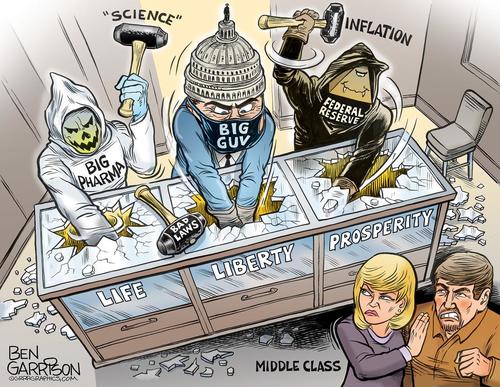
Big Bullies Public Smash and Grab

Ben Garrison explains his image at zerohedge The Smash and Grab Big Government Criminals are Looting Our Country.  Excerpts in italics with my bolds and some added images.

We’ve all seen the recent crime sprees taking place in the Democrat-controlled big cities. Acting in concert, flash mobs showed up to smash glass counters, steal the jewelry inside, and then make a quick getaway.

They are nothing compared to the smash and grab criminals controlling our country.  I’ve drawn three here, but there are many more.

The corporate media, for example. They smash and remove the truth and leave lies behind.

Big Pharma is unaccountable and irresponsible. It claims to own science, but what they really own is greed. Pfizer rakes in over $200 million taxpayer dollars per day for their dangerous and ineffective injections. The corporate media does not say a word about those injured or dying from the so-called vaccines. They don’t mention that thousands who are fully vaccinated not only contract Covid, but also die from the Chinese bioweapon.

Big Government makes laws in order to grow their own power as well as to enrich themselves. The so-called “Patriot Act” is a good example. It had nothing to do with patriotism. It had everything to do with stealing our liberties. Big Guv does this as a matter of routine. It keeps taking until it encounters resistance. Unfortunately they rarely get much push back. Too many people still think Big Guv is on their side and out to do good things for citizens. Nope. Big Guv is more concerned in getting reelected and growing more wealthy as it starts new wars. The latest may be against Russia. Yes, Big Guv wants to use US Troops and even threaten global nuclear war in order to protect the borders of Ukraine. Meanwhile, our southern borders remain wide open.

The Federal Reserve is an expert smash and grabber. It steals by means of currency creation at the flip of a switch. It is spent by the top of the pyramid and those at the bottom pay the hidden tax by means of inflation. The IRS makes sure it finishes the job of wealth confiscation, thereby making the working class poorer.

The criminal government gets away with it because they own a monopoly on force. Try and resist and they will send armed functionaries to arrest you. Resist arrest and you could be murdered. Included in the government mob are Big Pharma and The Federal Reserve. The politicized FBI does as it pleases, too. The CIA has been rogue almost from the start.

They will all continue until they are stopped. They will only stop when there is nothing left to grab. When that happens we will have no freedom, no privacy, and no dignity. We will own nothing and live in a technocratic dictatorship unless the war mongers decide to destroy all life on Earth first by means of a nuclear war.

The time to push back against this tyranny is now.

Two sides of the same coin.

Omicron Tipping Point?

With the arrival of Omicron variant comes the possibility of a civilizational tipping point:  Either descending deeper into hysteria and social internment, or throwing off the chains and embracing individual freedom and responsibility.  Presently, there are responses signaling forces pushing in both directions: one leading to insanity and the other to resurgence.

On the one hand, there’s the fear factor:

U.S. imposes travel ban from eight African countries over Omicron variant Reuters

Omicron is spreading fast. That’s alarming even if it’s mild  CNN

Likely that Omicron will outpace the Delta variant where community transmission occurs WHO

AstraZeneca and Pfizer vaccines won’t protect people against Omicron  Oxford

We’re facing a tidal wave of infection, again in a race between the vaccine and the virus. UK Health Secretary Sajid Javicl

U.K. PM declares Omicron emergency, orders immediate COVID-19 booster shots for entire country  Globe and Mail

Hong Kong Forcing UK, US Arrivals Into Quarantine Camps After Single Asymptomatic Omicron Case South China Morning Post

Dr. Fauci Warned Two Doses of Your Vaccine is Not Enough to Protect Robustly Against Omicron Infection. Three Shots is Best. msn Health

Fourth Covid vaccine doses needed sooner than expected due to omicron Pfizer CEO

On the Other Hand, there are voices urging calm and hope:

Pfizer’s COVID-19 vaccine protects well against severe illness from Omicron, South African study shows  Globe and Mail

Omicron variant highly transmissible but “milder” could  be “best scenario” to boost “natural immunity” and bring the end of the pandemic closer. Norwegian COVID Experts

It’s getting milder, most people will get it, and they will get a natural immunity  Norway state epidemiologist Frode Forland

Omicron variant is highly contagious, but doesn’t cause severe disease. So this may signal the end of Covid-19. Richard Friedland, CEO of Netcare Ltd.South Africa

Is Omicron the vaccine we’ve been waiting for? Jo Nova

The impact of the new Omicron variant is expected to be mild and short-lived, as the world becomes better equipped to manage COVID-19 and its related challenges OPEC

OMG Omicron A Bridge Too Far

A view of the tipping point from Tom Luongo Davos’ Last Stand Flops at the Box Office.  Excerpts in italics with my bolds.

So Davos’ Last Stand hit theatres a couple of weeks ago. Starring OmicronVID-9/11 as the latest unseen killer this was supposed to be the horror movie of a generation.

Sure the overnight preview box office was good. The Dow off 1100 on Opening Day. Gold thwapped. Bitcoin crushed. But then people started talking about the train wreck they’d seen.

The first came from Goldman Sachs: Goldman Slams Omicron Panic: “This Mutation Is Unlikely To Be More Malicious; No Reason For Portfolio Changes”  Excerpts

Two days later, JPM’s Marco Kolanovic went on CNBC BubbleVision with his review, to blow up the idea that we should remain glued to our screens over the latest release from the Maus Haus, scared for our lives. 

Kolanovic was the first of many to say the quiet part out loud; that OmicronVID was so unaffecting as a serial killer it may wind up doing the exact opposite, immunizing the world from the next sequel in the series.

That if anything, Omicron may be, in fact, a better vaccine than anything cooked up by Pfizer, Moderna or even the Russians.

The result has been the fastest week-to-week drop off in box office I’ve seen of a Davos narrative ever.

What was theorized early on about Omicron developing multiple spike proteins to increase transmissibility and infection but lowering its lethality has borne itself out as the data came in. So, the trumped up hysteria intended as shock and awe to play to as wide an audience as possible failed to capture the imaginations of anyone with three brain cells to rub together to make a spark.

Herd immunity to viruses works in a similar way. As variants of the virus evolve, one of them, in this case Omicron, is more transmissible and outcompetes other emergent strains. That one spreads uncontrollably while the others have less chance to infect hosts and propagate.

We all get it, produce the antibodies against it and most, if not all, of the others, and reach herd immunity against all the strains that much faster.

Omicron may be the best form of vaccine against COVID-19 we could have ever produced.

And now you know why Davos were desperate to unleash the fear porn so thoroughly during a holiday weekend when everyone would be glued to their screens.

In case anyone is confused this was a Davos-produced monstrosity, note the only places even remotely trying to leverage Omicron into policy. You guessed it, Europe.

Only Europe reacted as one would expect. They loved Davos’ Last Stand! Then again, have you watched most of the winners from Cannes? *sigh*

Angela Merkel’s last act in office was to issue a full lockdown of unvaccinated Germans.

These things beg the question, if Omicron was such an obvious bomb before release why then even go through with the exercise?

Because we are setting up for a major shift in geopolitics and markets in 2022 since we have policy clarity with the Fed. The markets are finally adjusting themselves to a major shift in global politics which sees the U.S. financial and political elites breaking with Davos completely.

Davos is retreating to its fortress in Brussels while getting its man in the U.S. Biden(Obama) to sue for peace with the Russians. They are still committed to destroying the middle class all across Europe and are willing to starve them to make this happen but their influence here in the U.S. has peaked and the world is now moving past their Coronapocalalyptic narrative.


Brazil Kicks CV19 with Ivermectin

Hospitalizations, Mortality Cut In Half After Brazilian City Offered Ivermectin To Everyone Pre-Vaccine is a report summarizing the experience of  Itajai offering Ivermectin as a prophylaxis against the disease.  H/T Tyler Durden at zerohedge. The preprint study is Ivermectin prophylaxis used for COVID-19 reduces COVID-19 infection and mortality rates: A 220,517-subject, populational-level retrospective citywide. Excerpts below in italics with my bolds.

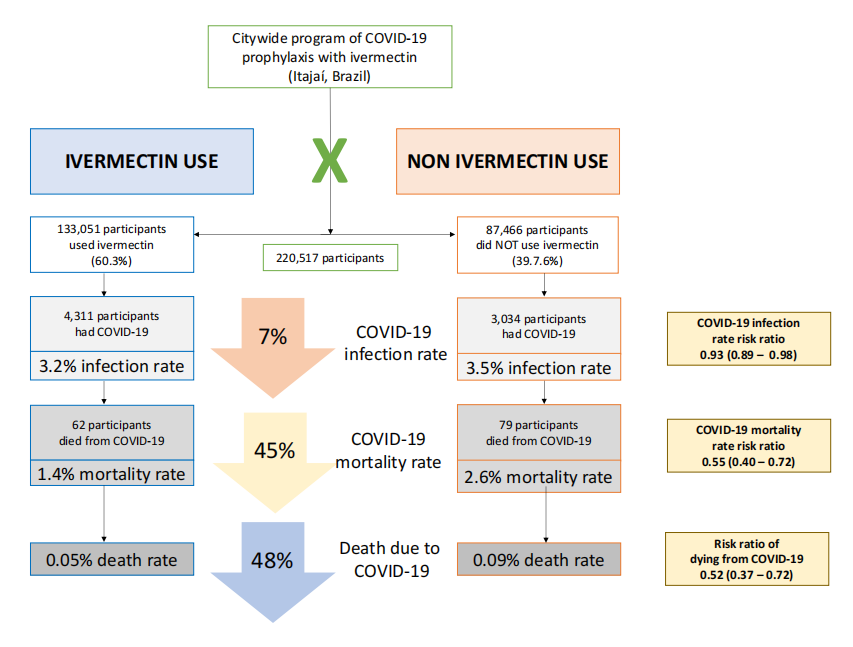
In Itajai, a Southern city of Brazil in the state of Santa Catarina, between July 2020 to December 2020, a citywide study was conducted involving 220,517 people. A total of 133,051 of these people (60.3% of the population) received ivermectin before being infected by COVID-19. A total of 87,466 people (39.7 %) did not receive or did not want to receive the ivermectin during the program, including its use for prophylactic, outpatient, inpatient therapeutical purposes, or after having COVID-19. The use of ivermectin was optional, based on the absence of contraindications, and given upon medical discretion. Due to the uncertainty of reinfection with COVID-19, subjects with a history of previous COVID-19 did not participate in the program, notwithstanding, they were still permitted to use ivermectin prophylactically

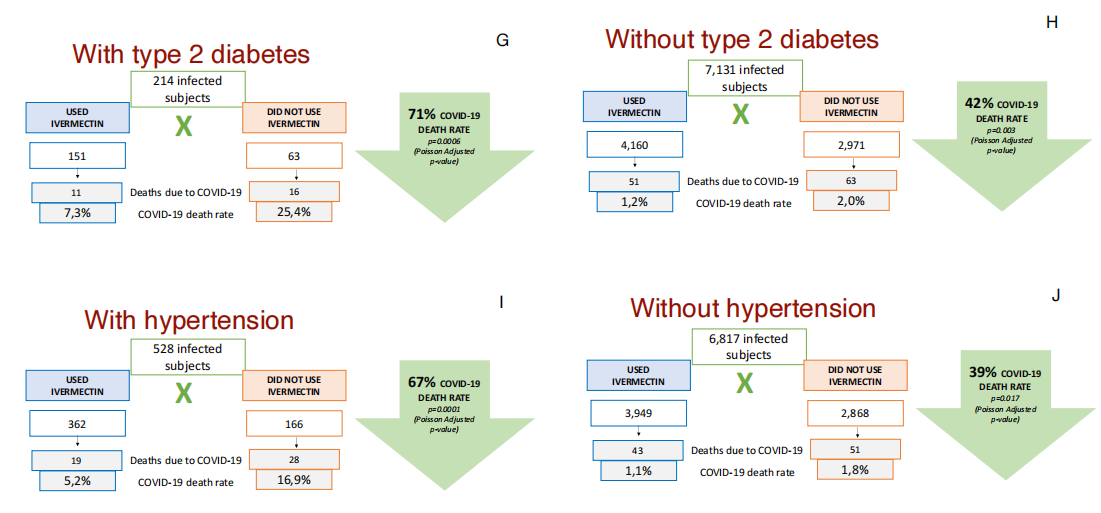
Baseline characteristics of the 9,956 subjects included in the above analysis are described in Table 1. Ivermectin users had a higher percentage of subjects over 50 years old (p < 0.0001), higher prevalence of T2D (Type 2 Diabetes) (p = 0.0004), hypertension (p < 0.0001), CVD (p = 0.03), and had a higher percentage of caucasians (p = 0.004), than non-users.

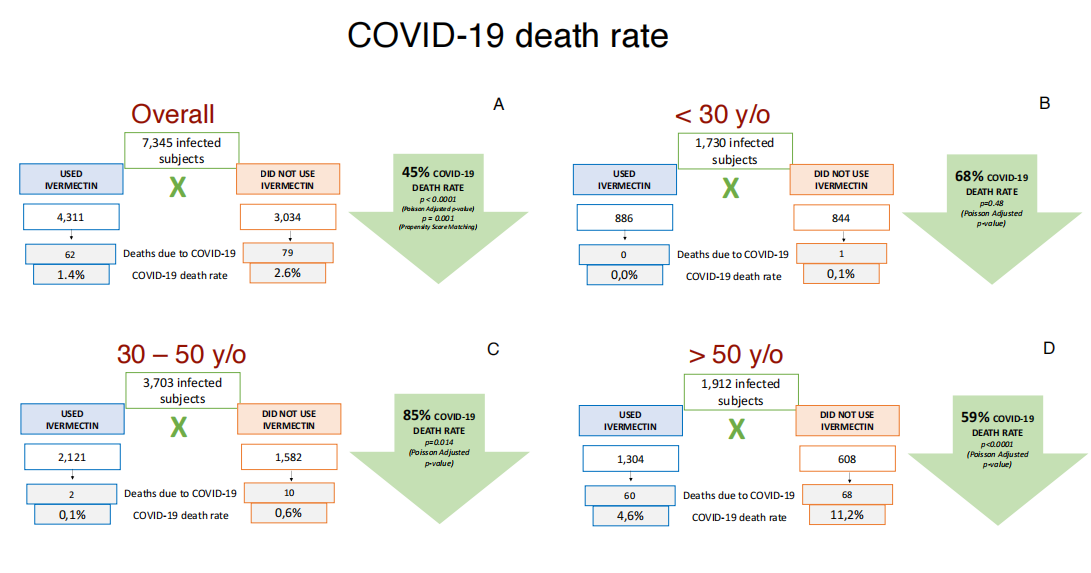
Of the 7,345 subjects with COVID-19, there were 232 hospitalizations (3.16% hospitalization rate). Of the 4,311 ivermectin users, there were 105 hospitalizations (2.43% hospitalization rate), while among the 3,034 ivermectin non-users, there were 127 hospitalizations (4.18% hospitalization rate), with a reduction in hospitalization rate due to COVID-19 of 42% (RR, 0.58; 95%CI, 0.45-0.75; p < 0.0001).

When the overall population is accounted for, the risk of dying from COVID-19 was 0.09% among ivermectin non- users and 0.05% among ivermectin users, with a reduction of 48% of the chances of dying from COVID-19 (RR, 0.52; 95%CI, 0.37 –0.72; p = 0.0001).

The report goes on to note that these positive results are conservative for several reasons. As shown above, persons electing to take IVM  were older and had co-morbidities, yet statistically faired better.  Secondly, the dose and frequency of ivermectin treatment was 0.2mg/kg/day; i.e., giving one 6mg-tablet for every 30kg. for 2 days every 15 days.  This is much less than protocols for sick patients.  Also, the IVM was self-administered and may have been used less than prescribed.  

When analyzed in populational, city level, irrespective of the the percentage of subjects that used ivermectin prophylactically, COVID-19 hospitalization rate decreased from 6.8% before the program with prophylactic use of ivermectin, to 1.8% after its beginning (RR, 0.27; 95%CO, 0.21 – 0.33; p < 0.0001), and in COVID-19 mortality rate, from 3.4% to 1.4% (RR, 0.41; 95%CI 0.31 – 0.55; p < 0.0001).

When compared to all other major cities in the State of Santa Catarina, where Itajaí is located, differences in COVID-19 mortality rate between before July 7, 2020 and between July 7, 2020 and December 21, 2020, Itajaí is ranked number one, and far from the second place. These results indicate that medical-based optional prescription, citywide covered ivermectin can have a positive impact in the healthcare system.

Covid19 is a FUD Pandemic

FUD is a disinformation strategy used by marketing and sales professionals that stands for Fear, Uncertainty, and Doubt. It’s commonly used in the sales, marketing, polling, and public relations fields. FUD is used to influence consumer perception of a competitor’s product by appealing to fear.

Dr. Harvey Risch discusses how the Covid19 pandemic played out as a global disinformation campaign successfully inducing fear, uncertainty and doubt in the world’s populations. Thus authorities were able to exert unprecedented control over public behavior, with severe reductions of individual rights and freedoms.

The interview was conducted by Jan Jekielek of Epoch Times with Dr. Harvey Risch, a professor of epidemiology at the Yale School of Public Health and Yale School of Medicine on November 30, 2021. The website provides a video along with a transcript, excerpted in italics below with my bolds.

A Fabricated Pandemic of Fear
 

Dr. Risch: Overall, I’d say that we’ve had a pandemic of fear, and the fear has affected almost everybody, whereas the infection has affected relatively few. It’s serious in some of those people, as we’ve seen. But by and large, it’s been a very selected pandemic, and predictable. We didn’t know at the beginning how predictable it was. At least we laypeople, so to speak, in the pandemic, didn’t know that.

I’m sure that the pharma companies and countries who had experienced it slightly before us had a better picture than we did, but it was very distinguished between young versus old, healthy versus chronic disease people. We quickly learned who was at risk for the pandemic and who wasn’t.

However, the fear was manufactured for everybody, and that’s what characterized the whole pandemic—is that degree of fear and people’s response to the fear.

I think that the people who were in the nominal positions of authority initially spread a much worse picture of the dire nature of this. That everybody was at risk, everybody could die, everybody needed to find protection. Everybody needed to stay in their homes and not go out, not socialize, and so on—to protect themselves [and] society.

People were quite afraid of that message as anybody would be, because one trusted in those times with the government, authorities, scientific people, medical people in authority, [and] the public health institutions all saying the same message starting in about February, March of last year.

So, we all kind of believed this, and therefore, all of our anxiety levels were raised, and we all made decisions to curtail, to various degrees, our exposures to other people—some more than others. But I think everybody had levels of anxiety that really affected how they carried out their life at that time.

Shock and Awe from China

Dr. Risch: We look at the videos that we got from Wuhan and the surrounding area in retrospect to see what was real about that, and what wasn’t. You have to recognize that almost every year there’s been an epidemic release from the live food markets in China, in various places. What was different about this one is that China has admitted to those right away and tried to fix them, whereas the present one, it did not do that.

It withheld information about it for two months, at least, and that withholding of information is a totally different behavior than how China has been in the past. That appears to be a very significant difference as to why it would do that. We know now that some of those videos were not truthful videos about that man falling over in the street and playing dead and things like that. We have reason to believe that those were artificial videos made to induce fear.

While the virus did get out in Wuhan and the lockdowns were there to suppress it, and they worked, in fact, when you suppress 100 percent of the population, you weld their doors shut and so on, you can do that. We’re not as draconian in the United States, at least haven’t been, and so it’s clear that the virus got out.

Whether there was an intention that it would be controllable on the local, but exportable to the rest of the world, is a risk-benefit equation that had to have been made in China at the time. In other words, China also faced the risk that this could get out and affect the whole country.

It did get to other places besides Wuhan, but I think they calculated that they would be able to control it better than we could. They also knew that chloroquine treated it because they had published on that five or more years in the past. We published on that too from NIAID at NIH, a paper on chloroquine and virus infections. I think it might’ve been SARS1 from 2005 that that was published, so we knew.

People knew. The scientific community knew that these viruses existed—that they were hazardous, they could be treated. But nobody knew exactly the extent, the ramifications of how well the treatment would work, whether that was enough by itself, what the hazards of using that drug were, what the long-term ramifications—all of that was still unknown territory.

War on Therapeutics

Dr. Risch: I started looking at the disparate information in medical and lay media about early treatment, and it just didn’t make sense that hydroxychloroquine was being badmouthed by the media when it was being studied in hospital patients, and saying that it didn’t work for outpatients when it hadn’t been studied in outpatients.

An outpatient disease is totally different from a hospital disease. It’s like night and day. Outpatient disease is like when you get the flu. You have fevers and chills and muscle aches, headache, sore throat, runny nose and cough. That’s a typical flu-like illness, outpatient.

Inpatient is a very severe pneumonia where the immune system debris fills up the lungs, and it’s a totally different disease. The virus is more or less long gone by that time, and it’s the immune system that’s overreacting to create that. So, it’s a different disease, requires different treatment, and yet, this was being pedaled as something that didn’t work in hospital disease, therefore it didn’t work in outpatient disease.

So, I wrote a paper looking at just hydroxychloroquine and remdesivir, which were the two agents that were being talked about in studies at the time in early-mid 2020, and I didn’t expect much to come out of that other than to say, “Look, here’s something that we could be using.”

I came into this. I wrote an op-ed for Newsweek saying, “Here it is. We should use it. There’s no cost, and even if it doesn’t work, it’s 100 percent safe because it’s been used in tens of billions of doses for 60 years in hundreds of millions of people. Even if it doesn’t work, it can’t do any harm.” Then I got pushback from my colleagues saying what do I know about infectious disease and epidemics and so on.

I’m a cancer epidemiologist, but they didn’t do their homework because after medical school I got a Ph.D. on mathematical modeling of infectious epidemics, and I published on that. I had a very clear idea of how epidemics come and go, and what herd immunity is, when it happens and how it happens, and all of that stuff.

The idea about using drugs to treat things is something that I do as just a regular part of my cancer epidemiology studies. So, this was not a great leap for me to be involved in these topics, and for them it was just smear. I didn’t respond to that, which is appropriate. They have their freedom of speech to say what they want to say. I have my freedom of speech to say what I want to say, and let the readers decide which seems the truest or the most accurate.

What Scientists Believe Vs. How Nature Behaves

Dr. Risch: I was thinking of cognitive dissonance. In other words, here I know it’s safe. At that time when I wrote the paper, there were five studies. Within another four or five months, there were 10 studies involving more than 40,000 patients who had been studied, including some national studies in Iran and Saudi Arabia—with tens of thousands of patients that provided very clear fivefold or better protection against mortality with this drug, and that’s not even using the recipe.

That’s just using hydroxychloroquine either by itself or with zinc, by and large, in these studies. It was very clear that the evidence was extremely strong, as strong of evidence as I’ve ever seen in anything in my career in epidemiology for an association, the magnitude of an association.

This is my bread and butter of the field that I understand and how it does these studies. What these studies were purporting to say was accurate, and a very strong signal. So I was nonplussed to find that people were saying, “These are anecdotal.” When Dr. Fauci would come in and say, “Oh, that evidence is anecdotal,” and I’m looking at 40,000 patients.

I’m looking at clinicians who’ve now treated more than 150,000 patients with fewer than two dozen deaths with hydroxychloroquine, and he’s saying it’s anecdotal, and I’m saying, “These 50 doctors all know that it’s not anecdotal. They’ve been using it in their practices for a year or a year-and-a-half.”

So, where is this disconnect? This disconnect has to be on purpose. It’s not an accident. It’s a smear campaign against the drug for a purpose.

Where is the purpose coming from for why one would suppress something that costs 80 cents a day to treat? It’s even cheaper than ivermectin. Ivermectin is $10 a day or whatever it is. Hydroxychloroquine is a tenth of that.

You have to address what’s the economic playing field as to what is causing all of these events and all of these people to be making the arguments that they have, and in fact, without citing data? So, you find that people who disagree with me don’t provide counterevidence.

They say, “The FDA disagrees with you,” or, “The CDC disagrees with you,” or, “The WHO disagrees with you.” But is that evidence? Well, no, and in fact, Karl Popper, the philosopher of science in the 1950s, said studies of what scientists believe do not reflect on studies of how nature behaves.

Manipulation of Mortality

Dr. Risch: We believe that if the mortality numbers are accurate, and there are reasons not to believe that because as I said at the beginning, this has been an epidemic of fear, that agencies have magnified the fear component in order to control behavior.

People have conditions that aren’t really the cause of death that may or may not have been contributory, and this is a whole gray zone. COVID might’ve been the straw that broke the camel’s back, so to speak, or maybe it was just contributory.

We don’t really know the degree to which this was manipulated to make the numbers of deaths larger because of COVID than what really was some other rational way of calculating the numbers of deaths. It’s very hard to understand this. Even with the statistics that we have, it’s very hard to understand.

Dr. Risch: From October to October of 2020 to this year, I think there were 491 deaths in the five-to-11-year range with COVID. Now, that’s the problem. Kids in the hospital with some serious underlying condition that happened to be COVID-positive, that are asymptomatic and tested and found to be battling or infected with the virus, get called dying from COVID. But in fact, in the CDC’s own review slides, they say COVID-associated deaths.

Marty Makary at Johns Hopkins reported on the study from his institution of 48,000 children. He asserted that no healthy children in that study had died from COVID. So, that’s the real bottom line. Are we talking about zero or one or five across the country, or 10? We don’t really know exactly, but those numbers are smaller than the number of children who’ve died from influenza each year in past years when we’ve had flu epidemics, as we usually do, except for last year.

It’s a tenth of the number that die from traffic accidents. It’s lower than the number who get hit by lightning, and certainly lower than what flu does. So, why are we potentially forcing all children to get vaccinated to save approximately zero, since we know, we can tell who are the high-risk children? Why aren’t we vaccinating the high-risk children?

Disrupting the Process of Natural Immunity

People will argue every one of the things that I just said, but in fact, it’s very clear that children do perfectly well with this illness when they get it. Either they’re asymptomatic or they have a headache, they’re a little tired, they sleep a little long for a day or two, and that’s about it. That’s the extent of COVID in young children.

It’s not much different than a light flu or a cold in children, and that is probably how the illness is essentially meant to be manifested in a society where all children get it as little children, get through it without a big ruckus, and go on. Then everybody’s protected after that, and adults don’t have to worry about it because they all had it as children.

That’s most likely how this whole thing would work, but what happened now is we as immunologically naïve adults are exposed to this and react totally differently because we didn’t get it as children, and we don’t have that immunity. Well, some people do.

You have to explain why 75 percent, plus or minus, of people who’ve had COVID had it asymptomatically. That’s the adults who have had COVID. There’s a lot of immunity in the population because of all these people who’ve had it asymptomatically.

What that means is, when a state for example, reports that it’s had 200,000 cases per million, the people with COVID, that’s by testing. So, it’s either symptomatic or people who were screened and got tested. Two hundred thousand cases per million is 20 percent of the population has had COVID by testing or symptomatic. That means if you multiply that by five, essentially, everybody’s had COVID.

If that number is five, between three and seven, I’m just saying if it’s approximately five, then that’s the ballpark for estimating where the real immunity is, and that’s why you see states like North Dakota, South Dakota, other states that have minimal or no lockdowns, where everybody mixed, lots of people got COVID early.

People didn’t get very sick because they had relatively young, healthy populations that were doing most of the mixing, that they built up large amounts of population immunity, what we call herd immunity early on, and so they were largely done.

Now, Delta came. Some of the people, some of that natural immunity might have been not quite enough to deal with the Delta, so they’ve had a very small, low-level bump over the last few months that is probably going down also. But nothing like the states that locked down like Vermont and Hawaii and so on that spent all their time locked down, and with very severe curtailments of mixing.

And now are having these waves of pandemic that are bigger than what they first saw in early 2020 because it was misguided to try to suppress something that was going to be endemic no matter what anybody did.

The realization of when you take measures that just prolong the pandemic, it just gives it more time to build up, and you have more and more waves. If you let the pandemic go through the society in a controlled, safe way in the first waves, and you control how people respond to that infection in a way that minimizes their damage, their personal damage, you get through it, and that was the exact opposite.

That was what we were trying to say early on in April, May, June of 2020. You have to let this get through the population and develop natural immunity, and that is how we would solve it. That didn’t happen because of financial interests for selling products to deal with it instead of letting it happen on its own.

Front-line Doctors Discovered Viral Protection

Dr. Risch: Did people know how to deal with that? Yes and no. It wasn’t the right thing to do, but did they know what tools they might’ve had to set up shelters for infected elderly people instead of putting them back in nursing homes? I don’t know that people knew that was something they could do. They didn’t do that, but at the same time, we weren’t using the medications that could have been used that would’ve saved those people.

Elderly people have frail immune systems, and Dr. George Fareed in Southern California recognized early on that you can’t just give hydroxychloroquine and zinc and vitamin D and antibiotics day four or five, which works for middle-aged people perfectly well. Doesn’t work for frail elderly because the virus has had no immune system growing to try to suppress it because of their age and disabilities.

In them, you have to give it on day one. How do you give it on day one? It means you have to screen them daily. You screen them for a fever and pulse oximeters, the little toys that you buy at the Walgreens for $30, and you can test your blood oxygen levels, and doing that twice a day.

When those people, their oxygens were dropping but they weren’t otherwise symptomatic. Then you found that they already had a fever that you wouldn’t have recognized. You start treating them, and that’s what he did in nursing homes. He was very effective in saving the lives of people in nursing homes because he was getting to them on day one, and this kind of aggressive, safe method of treating people is what works and should’ve been done.

But it requires people who are willing to use what they know in classic medical practice, the way doctors were classically trained, which is each one is the Sherlock Holmes doctor of figuring out what you’re supposed to do and how it works and the best you can do, and treat the patients.

Not formulaic things that your hospital board or your medical practice board says, “These are the drugs you must use, and you can’t veer from this, and we’re telling you how to practice medicine.” Okay? That’s destroyed medicine.

There’s an academic disdain for local docs in general, that academics think that they are at the top of the medical/intellectual world because they’re doing their research, their clinical research. In some respects, it’s good, and for those areas that they actually study, that’s fine.

But for diseases on the front line, the doctors on the front line who are exploring, who are saying, “Well, this treatment works, but maybe I’ll try this in this patient, and that seemed to work a little better. Maybe I’ll try it in a few more patients,” and gradually accrete knowledge about how to treat things is the classical model for how diseases on the front line are managed.

That’s what worked for the doctors who are willing to do that in this pandemic, like all illnesses have dealt with in the past. That’s what brought the realm of knowledge to how we have treatment regimens.

Using a repurposed drug is perfectly reasonable if you believe, as a doctor based on the evidence, that you should use it, that you can try it, that you could help save someone’s life. I imagine that there was some kind of bigger influence or board or organization that would be setting such things. This has been my own learning process.

Medical Bureaucrats Failed in their Public Duty

Dr. Risch: I have to get in a comment about the FDA and its website. This is something that has made me the angriest over this last year-and-a-half. In July of 2020, the FDA mounted a website warning against hydroxychloroquine used for outpatients. The website’s still there.

It says, “Warning, hydroxychloroquine should not be used for outpatient treatments because of risk of cardiac adverse events,” and then in the small print, the fine print underneath that big, bold, black letter warning, it says, “We base this warning on adverse events that we have observed in hospital patients.” This is a fraud.

They used hospital disease, which all medical professionals recognize is a different disease, as I’ve said, than outpatient flu-like illness. That has stood up there. Everyone that says hydroxychloroquine can’t be used points to that website and says, “Here’s the reason why we can’t do it.” The states, the AMA, the pharmacy boards, they all point to that. Foreign countries, their governments all point to that, saying, “We can’t do it because the FDA says not to do it.”

I’ve railed against this in the media that we are a part of, and the way that the propaganda reacts to this is, “Ignore it. Ignore all of this.” I’m saying this now because the general public has to be the one that gets angry.

The general public should be furious at the way people have been treated in the country by suppression of these drugs, by that kind of website that suppresses the ability of doctors to practice medicine.

This is what should’ve been done, and why people should be angry. They should be angry at their government. They should be angry at President Trump for not leading the fight in this when he was in power. They should be angry at the government now for not leading the fight to make these drugs available. These drugs work, there’s no question, and they should’ve been out there, whether or not vaccines are used. There’s a role for vaccines, and I’m not saying that.

There’s no role for universal vaccination, but there is a role for targeted vaccination for people who have reasons to do the risk-benefit analysis and see it’s in their benefit. There’s a reason why those people will still get COVID, because the vaccines are not 100 percent effective.

They still need to have treatment, and these drugs are the treatments of choice. This has to be there, and people need to be angry about this to see why these drugs have been suppressed from them for reasons that have nothing to do with the science and the medicine.

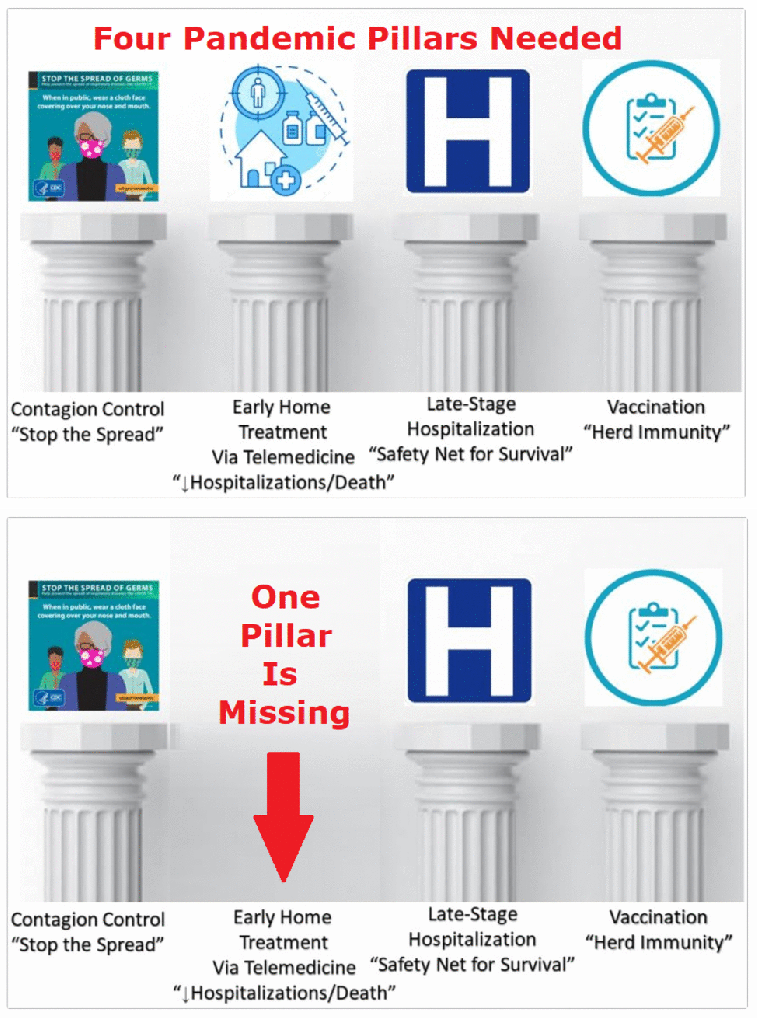
HCQ or IVM protocols including nutritional supplements and antibiotics fill the need for early home treatment, whether people are vaccinated or not.


Pushback on Corrosive Energy Idiocy

Congressman Byron Donalds excoriates the House Oversight and Reform Committee for biting the hands that energize the nation in the five minutes allowed him in video below.  (The settings button on the video allows you to turn on subtitles). For those who prefer reading, my transcript (lightly edited) follows in italics with my bolds and added images.

Chair: The gentleman from Florida Mr. Donalds is recognized for five minutes.

Donalds: Thank you Madam Chair and first of all to the witnesses, the the leaders of Exxon, Chevron, BP, Shell, I know that the climate activists are in twitter world which Dave Chappelle says doesn’t exist. And he’s right because it’s just people who have nothing better to do but type on their keyboards. And we do it too here in congress.

But let’s be very clear. You deserve an apology, because what I witnessed today was just rank intimidation by the chair of this committee, trying to get you to pledge on what you’re going to spend your money, is a gross violation of the first amendment. Just because we’re members of congress, and we’ve got microphones and we passed laws, does not mean that we also have the ability to infringe on your ability to organize, whether it’s API or anybody else, or what you choose to spend your money on. It is disgusting, absolutely disgusting. Somebody needs to go call Merrick Garland to tell them to get in here and watch the intimidation that came from this very panel today.

Because this is not about defending big oil or defending big anything; it’s about defending the ability of people in our country to be free to say what they want, think what they want, spend their money how they choose. And if we’re not going to be any better than the Chinese, how do we ever expect to beat them on the world stage? When we’re cutting our neck when it comes to energy production, while they are burning more coal, burning more oil. They’re increasing their emissions and they’re not showing up in Scotland. And why not?

Because they’re interested in building an economy; they’re interested in becoming the dominant economic player across the globe, in becoming the dominant military player across the globe.

Meanwhile we joke around and mess around intimidating you guys who frankly heat our homes, you cool our fridges and keep our cars going. This is insane. So I’m sorry for you and I’m sorry for the people in our country who have to witness shenanigans like this and witness circuses like this.

One show on HBO or whatever it is, is called the circus because that’s exactly what this is. Madam Chair, I’m requesting that a letter be entered into the record. This is a letter written by ranking member Comer and the other ranking members on this committee that actually speaks to the chilling effect that has come from you Madam Chair, asking you to stop intimidating companies, requesting information that is their first amendment right to have. I ask that letter be admitted into the record under unanimous consent

Chair: Without objection.

Donalds: Thank you Madam Chair.

I have a question for Mr. Sommers, now that we’re done with that. Mr. Sommers, it was asked of the executives if they believe in electronic vehicles. And it’s a noble goal to have, but Mr. Sommers: Where does the energy for electricity production actually come from?

Mike Sommers, President, American Petroleum Institute: Thank you congressman. Before I address that question, I do want to clear up one thing. Having a difference of views on electric vehicles is not climate disinformation. We as an organization support all forms of energy. We support the rapid advancement of electronic vehicles as well. But at the same time we don’t agree that the federal government should be the ones funding the build out of that infrastructure. As we built out service stations across the country, those service stations have been developed not by the federal government but by private industry. And members on this panel themselves are investing in building out that infrastructure, as is appropriate for the private sector.

First of all your question is very very important, which is: Where does that energy come from? In the United States most of the energy comes from natural gas. It has replaced coal as the primary source of energy in this country.

Donalds: Let me ask you this question as a follow-up. So if we don’t have natural gas, and obviously the democrats are against coal, where would we actually get the electricity to power all of these electric cars?

Sommers: Well congressman for most countries, and certainly for the United States, there would be likely be a fuel switch back from natural gas to coal.

Donalds: So real quick Mr. Sommers, I don’t mean to cut you off, because you make a great point, but I have 30 seconds. It is important for the American people to understand that if you follow the idiocy that’s in the bipartisan infrastructure agreement, it is going to make natural gas harder to procure. We’re actually not going to have lower emissions we’re going to have higher emissions because you’re going to have to switch back to coal fire plants.

And just for the record let’s also say the world will always demand energy. if you’re not getting it from us, where we actually do it more safely and more cleanly, you’ll get it from Russia or from China. And they don’t care what the climate activists have to say on twitter.

I yield the floor.


How Liars Figure Fake Covid News

Ted Noel, MD explains in his American Thinker article Multiple Logical Fallacies Elevate COVID Vaccines Over COVID Treatments.  Excerpts in italics with my bolds and added images.

Monday morning, as I did my morning bicycle ride (I live in a safe neighborhood), I listened to Breitbart News host Alex Marlowe interview John Nolte, another Breitbart personality about COVID vaccination hesitancy. By the end of the interview, they’d wandered through several logical fallacies that need to be exposed so people can accurately balance vaccines versus treatments.

Marlowe and Nolte quoted data purporting to show that Washington state counties that Trump won have much higher COVID death rates than counties that Biden won. Vaccination rates are blamed for the difference. Marlowe went on to declare that it’s been proven that Ivermectin is a “dewormer” and should be removed from the conversation. These factoids are so illogical for a so-called conservative outlet that we must have a short refresher.

Figures Don’t Lie, but Liars Can Figure

The key offender here is something called “relative risk.” If there’s a one in a million chance of something happening, that’s a minuscule absolute risk. If it goes up to two in a million, it’s still a minuscule absolute risk that you really won’t get bothered about. But that same difference can be presented as a 100% increase in risk or a doubling, which sounds really awful.

When it comes to COVID, the overall rate of death is in the tenths of a percent in the most vulnerable population. Headlines about Republicans killing off their voter base are simply scaremongering in the decimal points using relative instead of absolute risk. The real rate of death under age 50 for COVID is “indistinguishable from zero” according to the weekly British monitoring service.

Figures Don’t Lie, but Liars Can Figure (Part 2)

Let’s suppose that David Leonhardt is presenting accurate data from Washington State and that red counties are seeing excess deaths. Let’s discount the “overtesting” issue because it is likely the same in all areas. Let’s also assume that the “vaccines” do offer some degree of protection, even though data clearly shows that such protection fades rapidly, with new variants making them even less effective. So, what’s happening?

Here we’re seeing the Fallacy of the Excluded Middle. The loud voices refuse to accept that there’s an option beyond “vaxxed or not vaxxed.” In this case, Marlowe’s blithe “dewormer” comment shows that he’s committing a different logical fallacy, the Appeal to Authority. He has accepted the FDA’s false warning that “you are not a horse, etc.” so you should not take Ivermectin, an extremely safe drug with a wide range of antiviral effects.

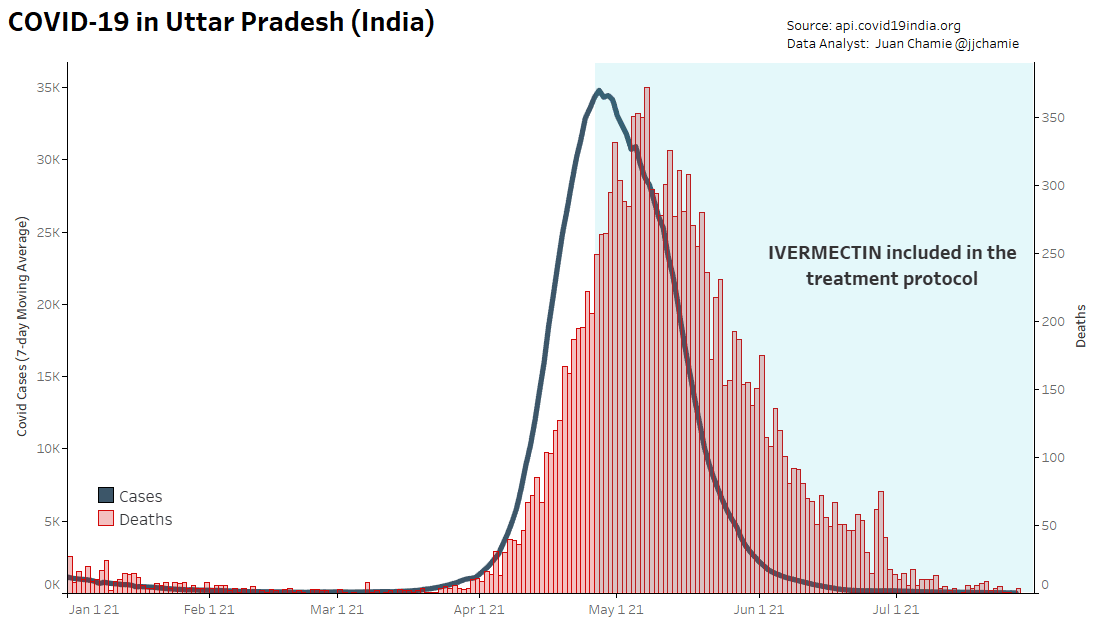
Randomized controlled trials have proven that IVM reduces COVID deaths even better than the vaccine. The state of Uttar Pradesh in India used IVM to wipe out COVID for 241 million people. But those people in Washington’s red counties were ruled by Dark Lord Inslee, making IVM and HCQ unavailable. No medical discussion can be complete without these alternatives.

Liars Can Force You to Behave How They Want You to Behave

As I’ve noted, for you to exercise an option to seek alternative treatment, you must have a physician who is willing to prescribe such medication. But most of those doctors will refuse because, under the dictatorial rule of officials such as Governor Inslee, such prescribing is likely to get that doctor’s license to practice medicine revoked. With such a Sword of Damocles overhead, few prescribers will go near IVM or HCQ. That means they can talk vaxxed or not vaxxed as if those are the only possibilities.

Runny Nose Coronaviruses, Four in Circulation for Decades.

Omicron

This virus is mutating according to Muller’s Ratchet. That is, it’s getting easier to catch, and less likely to make you really sick or dead. It’s affecting young children more than earlier variants. Any benefit of the vaccine is unknown. At the same time, there’s no reason to suspect that IVM and HCQ would not be effective against it.

In other words, Omicron is just one step of COVID-19 becoming another variant of the common cold. Or it may have simply swapped some of its genetic sequence with a common cold virus. That might explain why it’s showing up all over the world at once.

Masks Don’t Help

I feel like I’m beating a dead horse here, but facts are facts. We have dozens of surveillance studies that show that the general public wearing masks has no effect on the transmission of airborne viruses. You either have an easy-to-breathe-through cloth diaper that doesn’t filter or an expensive disposable diaper that filters but that you breathe around. Neither one has any useful effect. A recent study supposedly shows that masks work, but it has so many (scientific) holes that it simply doesn’t hold water.

COVID is a Mild Disease (if you treat it!)

COVID is one of those mild diseases that sends sick people over the edge because they don’t need much of a shove. But for healthy people to die of it, they must be kept away from effective drugs like IVM and HCQ. Having prevented treatment, the Quixotic Quislings of Quarantine can then claim that COVID is far worse than it actually is.

With any of the proven protocols for those drugs, COVID is no worse than the flu. But the billions available in the COVID lottery are so large that it’s hard for anyone to remember that the task of a doctor is to treat the sick, not to keep them away from treatment because they didn’t get a shot that is less effective than the $8 India spent.

Parting Thoughts

The COVID pandemic is a man-caused disaster, and I’m not talking about how the bug was created. In the earliest days, we didn’t know how to treat it but within a couple of months effective HCQ protocols were available. Those protocols, though, contradicted the bureaucrats at NIH/CDC/LSD who were married to their own approach of lockdown, distance, and vaccinate – unless you are one of the elites. They were the smartest people in the room, and anyone who contradicted them was the spawn of the devil.

We have extremely effective protocols that anyone who gets sick should be able to use, but those bureaucrats can punish anyone who prescribes one of them. In short, we are in a concentration camp from sea to shining sea. America the Beautiful is now COVIDia the Rapacious. We are cannon fodder at the command of those who know nothing but do not care.


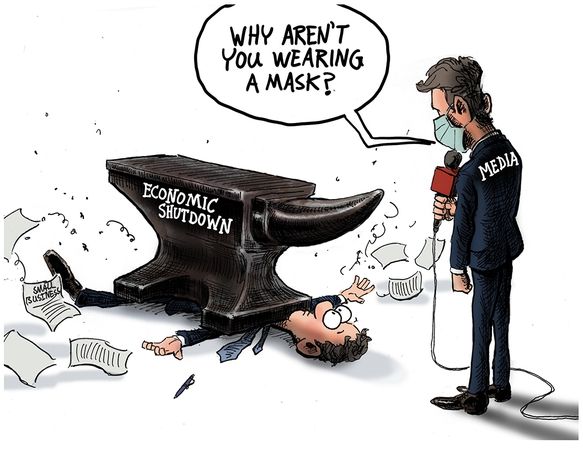
CV19 Lockdowns: High Pain/Gain Ratio

Douglas W. Allen published a study Covid-19 Lockdown Cost/Benefits: A Critical Assessment of the Literature in the International Journal of the Economics of Business. September 29, 2021. H/T Raymond  Excerpts in italics with my bolds and some added images
Abstract

An examination of over 100 Covid-19 studies reveals that many relied on false assumptions that over-estimated the benefits and under-estimated the costs of lockdown. The most recent research has shown that lockdowns have had, at best, a marginal effect on the number of Covid-19 deaths. Generally speaking, the ineffectiveness stemmed from individual changes in behavior: either non-compliance or behavior that mimicked lockdowns. The limited effectiveness of lockdowns explains why, after more than one year, the unconditional cumulative Covid-19 deaths per million is not negatively correlated with the stringency of lockdown across countries. Using a method proposed by Professor Bryan Caplan along with estimates of lockdown benefits based on the econometric evidence, I calculate a number of cost/benefit ratios of lockdowns in terms of life-years saved. Using a mid-point estimate for costs and benefits, the reasonable estimate for Canada is a cost/benefit ratio of 141. It is possible that lockdown will go down as one of the greatest peacetime policy failures in modern history.

Overview

The term ‘lockdown’ is used to generically refer to state actions that imposed various forms of non-pharmaceutical interventions. That is, it is used to include mandatory state-enforced closing of non-essential business, education, recreation, and spiritual facilities; mask and social distancing orders; stay-in-place orders; and restrictions on private social gatherings.

‘Lockdown’ does not refer to cases of ‘isolation,’ where a country was able to engage in an early and sufficient border closure that prevented trans-border transmission, followed by a mandated lockdown that eliminated the virus in the domestic population, which was then followed by perpetual isolation until the population is fully vaccinated. This strategy was adopted by a number of island countries like New Zealand.1 Here I will only consider lockdown as it took place in most of the world; that is, within a country where the virus became established.

The report begins with an examination of four critical assumptions often made within the context of estimating benefits and costs. Understanding these assumptions explains why early studies claimed that the benefits of lockdown were so high, and also explains why the predictions of those studies turned out to be false. Then I examine the major cost/benefit studies in roughly chronological order, and focus on the critical factor in these studies: distinguishing between mandated and voluntary changes in behavior. Preliminary work on the costs of lockdown is reviewed, and finally a simple cost/benefit methodology is used to generate several cost/benefit ratios of lockdown for my home country of Canada.

In no scenario does lockdown pass a cost/benefit test; indeed, the most reasonable estimates suggest that lockdown is a great policy disaster.

Discussion

Over the course of the Covid-19 pandemic, there has been no public evidence that governments around the world have considered both the benefit and cost sides of their policy decisions. To my knowledge, no government has provided any formal cost/benefit analysis of their actions. Indeed, the steady press conferences and news releases almost entirely focus on one single feature of the disease. Although the focus of government announcements has changed over the year, from ‘flattening the curve’, number of Covid-19 deaths, number of Covid19 cases, hospital capacity, and variant transmissions (especially the delta variant), there has seldom been any official mention of the costs of the actions taken to address these concerns.

The counterfactual number of cases/deaths

If lockdown reduces the transmission of the virus, the natural question to ask is ‘by how much?’ In other words, ‘but for the lockdown’ what would the level of infection/transmission/deaths be? What is the counterfactual to lockdowns?

Early in the pandemic the Neil Ferguson et al. (2020) model appeared to drive many lockdown decisions and was widely covered in the media. Figure 1 reproduces a key figure of that paper (Table 2, p. 8), and shows the results of various types of lockdown on occupied ICU beds. The symmetry, smoothness, and orderly appearance of the functions is a result of the mechanical nature of the model. This type of figure is found, in one form or another, in most papers based on a SIR model.

Figure 1 ICU projections from ICL model.

In Figure 1 the black ‘do nothing’ line is the counterfactual, while the other lines are various types of lockdowns. The harsher the lockdown, the ‘flatter’ the case load, with the blue line being the strongest lockdown. The difference between the black line and another line is the benefit of that particular lockdown in terms of cases delayed. Clearly the exponential growth of the ‘do nothing’ counterfactual leads to enormous differences, and makes lockdown look better.

Given the prediction that lockdowns would lower deaths by one-half, the authors made a dramatic recommendation: ‘We therefore conclude that epidemic suppression is the only viable strategy at the current time. The social and economic effects of the measures which are needed to achieve this policy goal will be profound.’ (Ferguson et al. 2020, p. 16). In retrospect it is remarkable that such a conclusion was drawn. The authors recognized that the ‘social and economic effects’ would be ‘profound,’ and that the predictions were based on the ‘unlikely’ behavioral assumption that there would be no change to individual reactions to the virus. However, given the large counterfactual numbers, presumably they felt no lockdown cost could justify remaining open.

Problems with the ICL model were pointed out immediately:

i) the reproduction number (Rt) of 2.4 was too high;
ii) the assumed infection fatality rate (IFR) of 0.9% was too high and not age dependent;
iii) hospital capacity was assumed fixed and unchangeable; and
iv) individuals in the model were assumed to not change behavior in the face of a new virus.

All of these assumptions have the effect of over-estimating the counterfactual number of cases, transmissions, and deaths.

The exogenous behavior assumption

A major reason for the failure of SIR models to predict actual cases and deaths is because they assume no individual in the model ever changes behavior.9 The implication of ignoring individual responses to a viral threat are dramatic. Atkeson (2021) used a standard SIR model (with exogenous behavior) that included seasonal effects and the introduction of a more contagious variant in December 2020 to forecast daily U.S. deaths out to July 2023. The results of this standard model were typical: the model made apocalyptic predictions on deaths that were off by a factor of twelve by the summer of 2020. However, he then used the same model with a simple behavioral adjustment that allowed individuals to change behavior in light of the value of Rt. The new forecast of daily deaths based on this single addition completely changed the model’s predictive power. The model now tracked the actual progression of the daily deaths very closely.

The fact that individuals privately and voluntarily respond to risks has two important implications. First, it influences how any counterfactual outcome is understood with respect to the lockdown. When no voluntary response is assumed, models predict exponential caseloads and deaths without lockdowns. If lockdowns are imposed and cases coincidently fall, the actual number of cases is then compared to a counterfactual that never would have happened.11 Therefore, not accounting for rational, voluntary individual responses within a SIR model drastically over-states any benefit from lockdown.12

Second, any empirical work that considers only the total change in outcomes and does not attempt to separate the mandated effect from the voluntary effect, will necessarily attribute all of the change in outcome to the mandated lockdown. Once again, this will over-estimate the effect, and quite likely by an order of magnitude.

The assumed value of life

Economic value is based on the idea of maximum sacrifice. Thus, when it comes to the value of an individual’s life, this value is determined by the actual individual. In practice, what is measured is the marginal value to extend one’s life a little bit by reducing some type of harm, and then use this to determine a total value of life.

One problem with using the VSL for estimating the benefits of saving lives through lockdown is that it measures the total value of life based on a marginal value. Thus, using a VSL (which is based on observing ordinary people not at the point of death) as a measure of the value of a life of someone about to die, is likely to provide an over-estimate of the value of the life.

In many Covid-19 cost/benefit studies, however, there is another more serious problem with how the VSL is used. Namely, it is often assumed that

i) the VSL is independent of age, and
ii) that the VSL is equal to around $10,000,000.

Both of these claims are not true.

Figure 2. Age related estimates of VSL

To assume that the VSL is constant implies that individuals are indifferent between living one more day or eighty more years. Figure 2 shows more reasonable estimates, with the value of a child being seven times the value of an 85 year old. The VSL of $2,000,000 for an 85 year old is based on the assumption that life expectancy is still ten years. For someone who is 85, in poor health with multiple serious illnesses, the VSL would be much lower.

An issue with lockdown costs

It is common in cost/benefit studies to only use lost GDP as the measure for the cost of lockdown. That is, the reduced value of goods and services caused by lockdown is the only cost of the lockdown considered. For example, US GDP over 2020 fell by 3.5%. If 100% of the fall in GDP (approximately $770 billion) is attributed to the lockdown (that is, the virus directly had no effect on production), then compared to the presumed ‘22 trillion’ dollar savings in lives, lockdown seems like an excellent policy.

This type of comparison, however, is entirely inappropriate.

The VSL is based on the utility of life, and therefore, the costs of lockdown must also be based on the lost utility of lockdown. It has been understood from the very beginning of the pandemic that lockdown caused a broad range of costs through lost civil liberty, lost social contact, lost educational opportunities, lost medical preventions and procedures, increased domestic violence, increased anxiety and mental suffering, and increased deaths due to despair and inability to receive medical attention. If the value of lockdown is measured in utility, then the costs of lockdown must be measured in the same fashion. Excluding the value of lost non-market goods (goods not measured by GDP) grossly under-estimates the cost of lockdown.

Other Costs

Lost educational opportunities. Lost, delayed, or poor education leads to reduced human capital that has life long negative consequences.

Additional effects of school closures. Closing schools creates isolation for children, which is known to increase the risk of mental health conditions.

Increased deaths expected from unemployment. Life expectancy depends on wealth levels. McIntyre and Lee (2020) predict between 418–2114 excess suicides in Canada based on increased unemployment over the pandemic year. 

Increased deaths from overdoses and other deaths of despair. Lockdowns disrupt illegal drug channels, often resulting in a more contaminated drug supply. Lockdowns also increase human isolation, leading to increased depression and suicides.

Increased domestic violence. Chalfin et al. (2021) found that much of the increased domestic violence is related to increased alcohol which increased during lockdown.

Lost non-Covid-19 medical service. In the spring lockdown hospitals cancelled scheduled appointments for screenings and treatments (e.g. London et al. 2020; Garcia et al. 2020), this created fear among individuals who required emergency treatments. Woolf et al. (2020) estimate that in the U.S. about 1/3 of the excess deaths over 2020 are not Covid-19 deaths. 

The opportunity costs of lockdown are widespread across societies, and everyone has faced some type of lockdown consequence. These costs are often non-market and in the future, making them difficult for third parties to measure. They are also unevenly distributed onto the young and the poor who have been unable to mitigate the consequences of lockdown.

These characteristics contribute to the lack of attention given to them, and stand in sharp contrast to Covid-19 case loads and deaths that are measured, highly concentrated, and widely reported.

In light of the nature and measurement problems associated with the costs of lockdown, as of July 2021 no true, standard, cost benefit study has been conducted. All efforts have rested on assumptions and guesses of things not yet known. It will still take time for a systematic, ground-up, attempt to determine the total lost quality of life brought about by lockdown. Even though such studies do not exist, there is still weight to the economic logic that, with negligible benefits and obvious high costs, lockdown is an inefficient policy.

Four stylized facts about covid-19

Atkeson et al.’s (2020) paper ‘Four Stylized Facts About Covid-19’ was a watershed result that appeared six months into the pandemic. Using data from 23 countries and all U.S. states that had experienced at least 1000 cumulative deaths up to July 2020, it discovered important features of the progression of the virus across countries that cast serious doubt that any forms of lockdown had a significant large impact on transmission and death rates.

In particular, they found that across all of the jurisdictions there was an initial high variance in the daily death and transmission rates, but that this ended very rapidly. After 20–30 days of the 25th death the growth rate in deaths fell to close to zero, and the transmission rate hovered around one. Not only did Atkeson et al. find a dramatic drop and stability of the death and transmission rates, but the spread in these rates across jurisdictions was very narrow. That is, across all jurisdictions, after 20–30 days the virus reached a steady state where each infected person transmitted the virus to one other person, and the number of daily deaths from the virus became constant over time.

Atkeson et al. speculated on three reasons for their findings. First, unlike the assumptions made in the SIR models, individuals do not ignore risks, and when a virus enters a population people take mitigating or risky actions based on their own assessments of that risk. Second, again in contrast to the classic SIR model where individuals uniformly interact with each other, actual human networks are limited and this can limit the spread of the virus after a short period. Finally, like other pandemics, there may be natural forces associated with Covid-19 that explain the rapid move to a steady state death and transmission rate.

Voluntary versus mandated lockdown channels

There are, by my count, over twenty studies that distinguish between voluntary and mandated lockdown effects. Although they vary in terms of data, locations, methods, and authors, all of them find that mandated lockdowns have only marginal effects and that voluntary changes in behavior explain large parts of the changes in cases, transmissions, and deaths.

A reasonable conclusion to draw from the sum of lockdown findings on mortality is that a small reduction (benefit) cannot be ruled out for early and light levels of lockdown restrictions. There is almost no consistent evidence that strong levels of lockdown have a beneficial effect, and given the large levels of statistical noise in most studies, a zero (or even negative) effect cannot be ruled out. Maybe lockdowns have a marginal effect, but maybe they do not; a reasonable range of the decline in Covid-19 mortality is 0–20%.

An alternative cost/benefit methodology

Professor Caplan (2020) has suggested a thought experiment that provides a solution for the cost measurement issue. Rather than attempt to measure a long list of costs and add them up, Caplan proposes a method that exploits our willingness to pay to avoid the harms of lockdown. If lockdown imposed net costs of $1000 on a person, then that person would be willing to pay up to $1000 to avoid lockdown. Caplan, however, poses the matter in terms of time rather than dollars.

Professor Caplan’s thought experiment addresses the total costs of all covid prevention as perceived by each person living under it, and therefore is an appropriate utility based cost measure to hold up against the value of lives saved through lockdown: X is the number of months a person is willing to pay to avoid lockdowns, other things equal.

For any random individual, X could take on a wide range of values. For some this past year has been horrific, and perhaps they would have preferred it never happened. Perhaps they suffered violence or abuse that was fueled by frustration and alcohol while locked down during a long stay-at-home order. Or perhaps they lost a business, a major career opportunity, or struggled over a long period of unemployment and induced depression. For these people, X equals 12 — they would have paid 12 months of their life to have avoided this past year. Others might have been willing to pay even more.

For the vast majority of populations, Covid-19 was not a serious health risk. Lockdowns provided no benefits and only costs. Thus, for the vast majority, X likely takes on a value in the order of a few months.

As of March 2021 the pandemic had lasted one year, and by assumption the average Canadian had lost two months of normal life due to lockdown. The population of Canada is 37.7 million people, which means that 6,283,333 years of life were lost due to Canada’s lockdown policy. This number of years can be converted into ‘lives’ using average life expectancy.

The average age of reported Covid-19 deaths in Canada over the first year of the pandemic was 80. In Canada an average 80 year old has a life expectancy of 9.79 years. This means that the 6,283,333 million years of lost life is equivalent to the deaths of 643,513 80 year olds. As of March 22, 2021 Canada had a total of 22,716 deaths due to Covid-19 (or 222,389 lost years of life).

Conclusion

After more than a year of gathering aggregate data, a puzzle has emerged. Lockdowns were brought on with claims that they were effective and the only means of dealing with the pandemic. However, across many different jurisdictions this relationship does not hold when looking at the raw data.

A casual examination of lockdown intensity and the number of cumulative deaths attributed to Covid-19 across jurisdictions shows no obvious relationship. Indeed, often the least intensive locations had equal or better performance. For example, using the OurWorldInData stringency index (SI) as a measure of lockdown, Pakistan (SI: 50), Finland (SI: 52), and Bulgaria (SI: 50) had similar degrees of lockdown, but the cumulative deaths per million were 61, 141, and 1023. Peru (SI: 83) and the U.K. (SI: 78) had some of the most stringent lockdowns, but also experienced some of the largest cumulative deaths per million: 1475 and 1868.

These unconditional observation puzzles are resolved by the research done over the past year. The preconceived success of lockdowns was driven by theoretical models that were based on assumptions that were unrealistic and often false.

The lack of any clear and large lockdown effect is because there isn’t one to be found.


Leftist Energy Ignorance Abounds

Leftists are recognized by having three personality traits:  Know-it-alls, Drama Queens and Control Freaks.  The latest example is Liz Warren blaming rising fuel prices on energy producers rather than on her favored restrictive energy policies.  An article schooling the senator and her constituents is published at the Delaware Valley Journal PA Energy Pros Dismiss Liz Warren’s Complaints: ‘It’s Econ 101, Not Rocket Science’.  H/T Tyler Durden Excerpts in italics with my bolds.
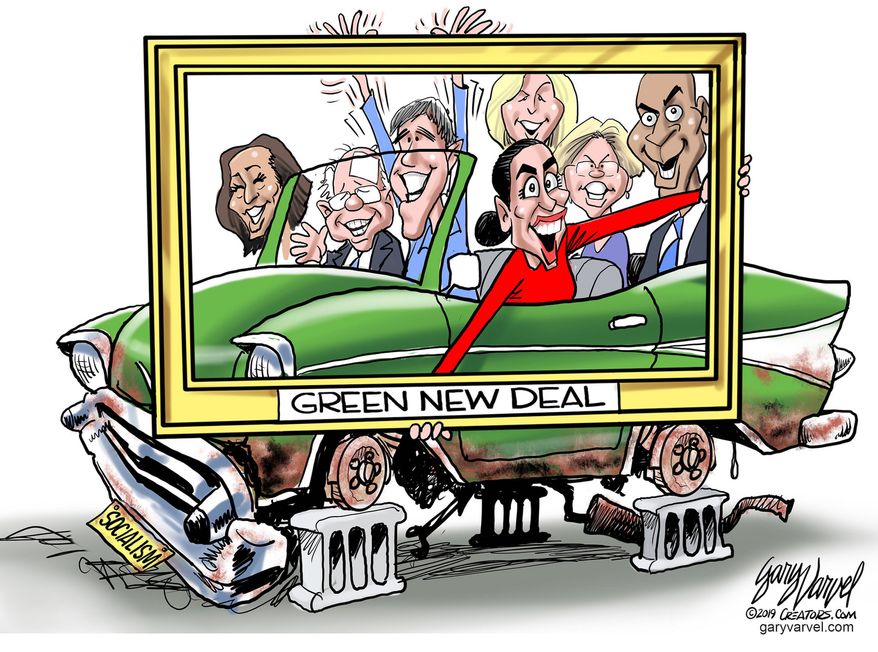
Sen. Elizabeth Warren’s latest attempt to “turn up the heat” on the energy sector sparked a backlash from industry leaders who say the real problem comes from policies the Massachusetts’ Democrat has endorsed.

In recent letters to natural gas producers, Warren blasted what she called their “corporate greed” and demanded an explanation for the record exports of natural gas at the same time prices are rising in the U.S.

Warren wants the industry to respond to questions about “the extent to which these price increases are being driven by energy companies’ corporate greed and profiteering as they moved record amounts of U.S. gas out of the country,” she wrote.

She got a response, but not the one she demanded.

Leaders in the natural gas sector responded with a letter of their own, dismissing Warren’s comments as a diversion, one intended to distract consumers from the impact of the energy policies she’s championed.

“This a misguided and headline-grabbing ploy,” says David E. Callahan, president of the Marcellus Shale Coalition (MSC).

“If she knows anything about these highly complex energy markets, she must know what’s really going on here,” added Callahan, who co-authored a response letter alongside the leaders of the Gas & Oil Association of West Virginia (GO-WV), and Ohio Oil & Gas Association (OOGA). “It’s a commodity market, prices ebb and flow, and the market is responding to those signals.

Warren is an aggressive supporter of the Green New Deal, which would drastically restrict the production of oil and natural gas. In her state of Massachusetts, policies blocking the expansion of natural gas pipelines have resulted in Russian LNG tankers in Boston Harbor bringing fuel to the Bay State.

“She has her constituents to represent and her political affiliation to support,” said Charlie Burd, executive director of GO-WV. “But to be perfectly honest, I just think those comments almost show a complete lack of understanding on how energy is explored for, produced, and transported in this country.”

And those constituents are paying the price, according to Callahan.

“Number one, her region has very high energy costs, and her region is severely capacity-constrained when it comes to pipeline infrastructure,” Callahan said. “A Carnegie Mellon study from within the year pointed out that due to those pipeline constraints, customers in the New England region paid upwards of $1.8 billion in excess energy costs during just one month in 2014.”

“It’s really supply and demand 101,” added Burd. “It’s not rocket science.”

Republican National Committee spokesperson Allie Carroll said Warren’s latest attempt to blame energy companies for the results of Biden and Democrats’ war on energy is an insult to hardworking Pennsylvanians.

“From canceling the Keystone XL pipeline to stripping away our energy independence, Democrats’ reckless anti-energy policies are crippling our country, and turn after turn, Pennsylvania families are paying the price.”

Pennsylvania is the nation’s second-largest producer of natural gas, and attacks on the industry have an impact on the state’s economy.

“Hostility toward the fossil fuel industry ill-serves the American people, including Pennsylvanians who sit atop huge natural gas and coal deposits that provide plentiful and affordable energy to millions of people,” said Gordon Tomb, a senior fellow at Commonwealth Foundation. “The benefits of these resources can hardly be overstated: well-paying jobs and prosperity as well as a foundation for all kinds of business activity and energy security.”

Republican U.S. Senate candidate Dr. Mehmet Oz also pushed back on Warren’s approach.

“The ground under Pennsylvania and surrounding states has almost as much natural gas as Saudi Arabia that is readily accessible through fracking,” Oz said. “We should be using this to make our nation safer, create jobs, and less dependent on China. As the Senator for Pennsylvania, I will fight against any effort to destroy Pennsylvania’s energy leadership and the jobs it supports.”

Meanwhile, Europe is facing fuel scarcity as winter approaches and some of the nations are turning back to coal to meet immediate demands. American exports are vital, experts say.

“Our friends and allies in Europe and Asia, they need natural gas and for a whole host of reasons including over-reliant policies on intermittent renewables,” says Callahan. “The wind is not blowing as hard as they expected it to this year, they find themselves in need of natural gas, and so we’ve been shipping some gas overseas to supply those markets and help our friends.”

Frank Macchiarola, American Petroleum Institute (API) Senior Vice President of Policy, Economics and Regulatory Affairs, also has a message for U.S. policymakers.

“They play a critical role in spurring long-term investment in U.S. natural gas supplies as well as expanded pipeline capacity to deliver the energy America and the world needs while driving down emissions,” says Macchiarola. “Rising natural gas costs reflect an imbalance between supply and demand that is exacerbated in regions like the northeast due to added state-level policy restrictions on building much-needed gas infrastructure that has made the region more reliant on foreign imports.”

Callahan believes Warren should “support infrastructure expansion” to get product where it is needed, domestically and globally.

“We felt the need to set the record straight, that the rhetoric is dangerous,” said Callahan.


Global Warming Theory and the Tests It Fails 2021

The updating of this previous post is timely following on Dr. William Happer’s additional test of Global Warming Theory, the notion that rising CO2 causes dangerous warming of earth’s climate. A synopsis of that presentation is at Climate Change and CO2 Not a Problem.  For the purpose of this discussion I will add at the end Happer’s finding that additional CO2 (from any and all sources) shows negligible effect in the radiative profile of the atmosphere.

Overview

Many people commenting both for and against reducing emissions from burning fossil fuels assume it has been proven that rising GHGs including CO2 cause higher atmospheric temperatures.  That premise has been tested and found wanting, as this post will describe.  First below is a summary of Global Warming Theory as presented in the scientific literature.  Then follows discussion of several unsuccessful attempts to find evidence of the hypothetical effects from GHGs in the relevant datasets.  Concluding is the alternative theory of climate change deriving from solar and oceanic fluctuations.

Scientific Theory of  Global Warming

The theory is well described in an article by Kristian (okulaer) prefacing his analysis of  “AGW warming” fingerprints in the CERES satellite data.  How the CERES EBAF Ed4 data disconfirms “AGW” in 3 different ways  by okulaer November 11, 2018. Excerpts below with my bolds.  Kristian provides more detailed discussion at his blog (title in red is link).

Background: The AGW Hypothesis

For those of you who aren’t entirely up to date with the hypothetical idea of an “(anthropogenically) enhanced GHE” (the “AGW”) and its supposed mechanism for (CO2-driven) global warming, the general principle is fairly neatly summed up here.

I’ve modified this diagram below somewhat, so as to clarify even further the concept of “the raised ERL (Effective Radiating Level)” – referred to as Ze in the schematic – and how it is meant to ‘drive’ warming within the Earth system; to simply bring the message of this fundamental premise of “AGW” thinking more clearly across.
Then we have the “doubled CO2” (t1) scenario, where the ERL has been pushed higher up into cooler air layers closer to the tropopause:

So when the atmosphere’s IR opacity increases with the excess input of CO2, the ERL is pushed up, and, with that, the temperature at ALL ALTITUDE-SPECIFIC LEVELS of the Earth system, from the surface (Ts) up through the troposphere (Ttropo) to the tropopause, directly connected via the so-called environmental lapse rate, i.e. the negative temperature profile rising up through the tropospheric column, is forced to do the same.

The Expected GHG Fingerprints

How, then, is this mechanism supposed to manifest itself?

Well, as the ERL, basically the “effective atmospheric layer of OUTWARD (upward) radiation”, the one conceptually/mathematically responsible for the All-Sky OLR flux at the ToA, and from now on, in this post, dubbed rather the EALOR, is lifted higher, into cooler layers of air, the diametrically opposite level, the “effective atmospheric layer of INWARD (downward) radiation” (EALIR), the one conceptually and mathematically responsible for the All-Sky DWLWIR ‘flux’ (or “the atmospheric back radiation”) to the surface, is simultaneously – and for the same physical reason, only inversely so – pulled down, into warmer layers of air closer to the surface. This latter concept was explained already in 1938 by G.S. Callendar. Feldman et al., 2015, (as an example) confirm that this is still how “Mainstream Climate Science (MCS)” views this ‘phenomenon’:

The gist being that, when we make the atmosphere more opaque to IR by putting more CO2 into it, “the atmospheric back radiation” (all-sky DWLWIR at sfc) will naturally increase as a result, reducing the radiative heat loss (net LW) from the surface up. And do note, it will increase regardless of (and thus, on top of) any atmospheric rise in temperature, which would itself cause an increase. Which is to say that it will always distinctly increase also RELATIVE TO tropospheric temps (which are, by definition, altitude-specific (fixed at one particular level, like ‘the lower troposphere’ (LT))). That is, even when tropospheric temps do go up, the DWLWIR should be observed to increase systematically and significantly MORE than what we would expect from the temperature rise alone. Because the EALIR moves further down.

Conversely, at the other end, at the ToA, the EALOR moves the opposite way, up into colder layers of air, which means the all-sky OLR (the outward emission flux) should rather be observed to systematically and significantly decrease over time relative to tropospheric temps. If tropospheric temps were to go up, while the DWLWIR at the surface should be observed to go significantly more up, the OLR at the ToA should instead be observed to go significantly less up, because the warming of the troposphere would simply serve to offset the ‘cooling’ of the effective emission to space due to the rise of the EALOR into colder strata of air.

What we’re looking for, then, if indeed there is an “enhancement” of some “radiative GHE” going on in the Earth system, causing global warming, is ideally the following:

OLR stays flat, while TLT increases significantly and systematically over time;
TLT increases systematically over time, but DWLWIR increases significantly even more.
Effectively summed up in this simplified diagram.

Figure 4. Note, this schematic disregards – for the sake of simplicity – any solar warming at work.

However, we also expect to observe one more “greenhouse” signature.

If we expect the OLR at the ToA to stay relatively flat, but the DWLWIR at the sfc to increase significantly over time, even relative to tropospheric temps, then, if we were to compare the two (OLR and DWLWIR) directly, we’d, after all, naturally expect to see a fairly remarkable systematic rise in the latter over the former (refer to Fig.4 above).

Which means we now have our three ways to test the reality of an hypothesized “enhanced GHE” as a ‘driver’ (cause) of global warming.


Three Tests for GHG Warming in the Sky

The null hypothesis in this case would claim or predict that, if there is NO strengthening “greenhouse mechanism” at work in the Earth system, we would observe:

1. The general evolution (beyond short-term, non-thermal noise (like ENSO-related humidity and cloud anomalies or volcanic aerosol anomalies))* of the All-Sky OLR flux at the ToA to track that of Ttropo (e.g. TLT) over time;
2. The general evolution of the All-Sky DWLWIR at the surface to track that of Ttropo (Ts + Ttropo, really) over time;
3. The general evolution of the All-Sky OLR at the ToA and the All-Sky DWLWIR at the surface to track each other over time, barring short-term, non-thermal noise.

* (We see how the curve of the all-sky OLR flux at the ToA differs quite noticeably from the TLT and DWLWIR curves, especially during some of the larger thermal fluctuations (up or down), normally associated with particularly strong ENSO events. This is because there are factors other than pure mean tropospheric temperatures that affect Earth’s final emission flux to space, like the concentration and distribution (equator→poles, surface→tropopause/stratosphere) of clouds, water vapour and aerosols. These may (and do) all vary strongly in the short term, significantly disrupting the normal temperature↔flux (Stefan-Boltzmann) connection, but in the longer term, they display a remarkable tendency to even out, leaving the tropospheric temperature signal as the only real factor to consider when comparing the OLR with Ttropo (TLT). Or not. The “AGW” idea specifically contends, resting on the premise, that these other factors (and crucially also including CO2, of course) do NOT even out over time, but rather accrue in a positive (‘warming’) direction.)

Missing Fingerprint #1

The first point above we have already covered extensively. The combined ERBS+CERES OLR record is seen to track the general progression of the UAHv6 TLT series tightly, both in the tropics and near-globally, all the way from 1985 till today (the last ~33 years), as discussed at length both here and here.

Since, however, in this post we’re specifically considering the CERES era alone, this is how the global OLR matches against the global TLT since 2000:
Figure 5.

This is simply the monthly CERES OLR flux data properly scaled (x0.266), enabling us to compare it more directly to temperatures (W/m2→K), and superimposed on the UAH TLT data. Watch how closely the two curves track each other, beyond the obvious noise. To highlight this striking state of relative congruity, we remove the main sources of visual bias in Fig.5 above. Notice, then, how the red OLR curve, after the 4-year period of fairly large ENSO-events (La Niña-El Niño-La Niña) between 2007/2008 and 2011/2012, when the cyan TLT curve goes both much lower (during the flanking La Niñas) and much higher (during the central El Niño), quickly reestablishes itself right back on top of the TLT curve, just where it used to be prior to that intermediate stretch of strong ENSO influence. And as a result, there is NO gradual divergence whatsoever to be spotted between the mean levels of these two curves, from the beginning of 2000 to the end of 2015.

Missing Fingerprint #2

The second point above is just as relevant as the first one, if we want to confirm (or disconfirm) the reality of an “enhanced GHE” at work in the Earth system. We compare the tropospheric temperatures with the DWLWIRsfc ‘flux’, that is, the apparent atmospheric thermal emission to the surface:

Figure 9. Note how the scaling of the flux (W/m2) values is different close to the surface than at the ToA. Here at the DWLWIR level, down low, we divide by 5 (x0.2), while at the OLR level, up high, we divide by 3.76 (x0.266).

We once again observe a rather close match overall. At the very least, we can safely say that there is no evidence whatsoever of any gradual, systematic rise in DWLWIR over the TLT, going from 2000 to 2018. If we plot the difference between the two curves in Fig.9 to obtain the “DWLWIR residual”, this fact becomes all the more evident:

Figure 10.

Remember now how the idea of an “enhanced GHE” requires the DWLWIR to rise significantly more than Ttropo (TLT) over time, and that its “null hypothesis” therefore postulates that such a rise should NOT be seen. Well, do we see such a rise in the plot above? Nope. Not at all. Which fits in perfectly with the impression we got at the ToA, where the TLT-curve was supposed to rise systematically up and away from the OLR-curve over time, but didn’t – no observed evidence there either of any “enhanced GHE” at work.

Missing Fingerprint #3

Finally, the third point above is also pretty interesting. It is simply to verify whether or not the CERES EBAF Ed4 ‘radiation flux’ data products are indeed suggesting a strengthening of some radiatively defined “greenhouse mechanism”. We sort of know the answer to this already, though, from going through points 1 and 2 above. Since neither the OLR at the ToA nor the DWLWIR at the surface deviated meaningfully from the UAHv6 TLT series (the same one used to compare with both, after all), we expect rather by necessity that the two CERES ‘flux products’ also shouldn’t themselves deviate meaningfully overall from one another. And, unsurprisingly, they don’t:

Figure 14.  Difference plot (“DWLWIR residual”)

Again, it is so easy here to allow oneself to be fooled by the visual impact of that late – obviously ENSO-related – peak, and, in this case, also a definite ENSO-based trough right at the start (you’ll plainly recognise it in Fig.14); another perfect example of how one’s perception and interpretation of a plot is directly affected by “the end-point bias”. Don’t be fooled:

If we expect the OLR at the ToA to stay relatively flat, but the DWLWIR at the sfc to increase significantly over time, even relative to tropospheric temps, then, if we were to compare the two (OLR and DWLWIR) directly, we’d […] naturally expect to see a fairly remarkable systematic rise in the latter over the former (refer to Fig.4 above).

Looking at Fig.14, and taking into account the various ENSO states along the way, does such a “remarkable systematic rise” in DWLWIR over OLR manifest itself during the CERES era?

I’m afraid not …

Five Lines of Evidence Against GHG Warming Hypothesis

The lack of GHG warming in the CERES data is added to four previous atmospheric heat radiation studies.


  1.  In 2004 Ferenc MIskolczi studied the radiosonde datasets and found that the optical density at the top of the troposphere does not change with increasing CO2, since reducing H2O maintains optimal radiating efficiency.  His publication was suppressed by NASA, and he resigned from his job there. He has elaborated on his findings in publications as recently as 2014. See:  The Curious Case of Dr. Miskolczi

2.  Ronan and Michael Connolly  studied radiosonde data and concluded in 2014:

“It can be seen from the infra-red cooling model of Figure 19 that the greenhouse effect theory predicts a strong influence from the greenhouse gases on the barometric temperature profile. Moreover, the modeled net effect of the greenhouse gases on infra-red cooling varies substantially over the entire atmospheric profile.

However, when we analysed the barometric temperature profiles of the radiosondes in this paper, we were unable to detect any influence from greenhouse gases. Instead, the profiles were very well described by the thermodynamic properties of the main atmospheric gases, i.e., N 2 and O 2 , in a gravitational field.”

While water vapour is a greenhouse gas, the effects of water vapour on the temperature profile did not appear to be related to its radiative properties, but rather its different molecular structure and the latent heat released/gained by water in its gas/liquid/solid phase changes.

For this reason, our results suggest that the magnitude of the greenhouse effect is very small, perhaps negligible. At any rate, its magnitude appears to be too small to be detected from the archived radiosonde data.” Pg. 18 of referenced research paper

See:  The Physics Of The Earth’s Atmosphere I. Phase Change Associated With Tropopause

3.  An important proof against the CO2 global warming claim was included in John Christy’s testimony 29 March 2017 at the House Committee on Science, Space and Technology. The text and diagram below are from that document which can be accessed here.

IPCC Assessment Reports show that the IPCC climate models performed best versus observations when they did not include extra GHGs and this result can be demonstrated with a statistical model as well.

Figure 5. Simplification of IPCC AR5 shown above in Fig. 4. The colored lines represent the range of results for the models and observations. The trends here represent trends at different levels of the tropical atmosphere from the surface up to 50,000 ft. The gray lines are the bounds for the range of observations, the blue for the range of IPCC model results without extra GHGs and the red for IPCC model results with extra GHGs.The key point displayed is the lack of overlap between the GHG model results (red) and the observations (gray). The nonGHG model runs (blue) overlap the observations almost completely.

4. Update 2021 Finding from William Happer

The full discussion of this slide is in the linked synopsis at the top.  In summary here, Happer points to the black line of CO2 infrared absorption at 400 ppm, compared to CO2 IR absorption at 800 ppm.

The important point here is the red line. This is what Earth would radiate to space if you were to double the CO2 concentration from today’s value. Right in the middle of these curves, you can see a gap in spectrum. The gap is caused by CO2 absorbing radiation that would otherwise cool the Earth. If you double the amount of CO2, you don’t double the size of that gap. You just go from the black curve to the red curve, and you can barely see the difference. The gap hardly changes.

The message I want you to understand, which practically no one really understands, is that doubling CO2 makes almost no difference.

An Alternative Theory of Natural Climate Change

Dan Pangburn is a professional engineer who has synthesized the solar and oceanic factors into a mathematical model that correlates with Average Global Temperature (AGT). On his blog is posted a monograph Cause of Global Climate Change explaining clearly his thinking and the maths.  I provided a post with some excerpts and graphs as a synopsis of his analysis, in hopes others will also access and appreciate his work on this issue.  See  Quantifying Natural Climate Change

Footnote on the status of an hypothetical effect too small to be measured:  Bertrand Russell’s teapot

Open image in new tab to enlarge.

Postscript:  For an explanation why CO2 has negligible effect on thermal properties of the atmosphere, and why all W/m2 are not created equal, see: Light Bulbs Disprove Global Warming