EPA Priorities Announced

During Trump 1.0 the appointed EPA Director summarized the false dichotomy long plaguing the agency: “If you are for the Environment, you must be against Development; and if you are for Development, you must be against the Environment.” In reality, a balance must be struck, and a new administration intends to find it.  There has been much gnashing of teeth in the legacy media over this month’s dismissal of scientists from EPA advisory boards, without mentioning the same housecleaning happened in 2021 when Biden regime took over.  Now we have an official announcement about the new EPA direction and priorities.  Text in italics with my bolds and added images.

WASHINGTON – On February 4, 2025, U.S. Environmental Protection Agency (EPA) Administrator Lee Zeldin announced the agency’s Powering the Great American Comeback Initiative, to achieve the agency’s mission while energizing the greatness of the American economy. This plan outlines the agency’s priorities under the leadership of President Trump and Administrator Zeldin. The newly announced Powering the Great American Comeback initiative consists of five pillars that will guide the EPA’s work over the first 100 days and beyond:

Pillar 1: Clean Air, Land, and Water for Every American

“Every American should have access to clean air, land, and water. I will ensure the EPA is fulfilling its mission to protect human health and the environment. In his first term, President Trump advanced conservation, reduced toxic emissions in the air, and cleaned up hazardous sites, while fostering economic growth for families across the country. We remain committed to these priorities in this administration, as well as ensuring emergency response efforts are helping Americans get back on their feet in the quickest and safest way possible. We will do so while remaining good stewards of tax dollars and ensuring that every penny spent is going towards advancing this mission,” said Administrator Zeldin.

Pillar 2: Restore American Energy Dominance

“Pursuing energy independence and energy dominance will cut energy costs for everyday Americans who are simply trying to heat their homes and put gas in their cars. This will also allow our nation to stop relying on energy sources from adversaries, while lowering costs for hardworking middle-income families, farmers, and small business owners. I look forward to working with the greatest minds driving American innovation, to ensure we are producing and developing the cleanest energy on the planet,” said Administrator Zeldin.

Pillar 3: Permitting Reform, Cooperative Federalism, and Cross-Agency Partnership

“Any business that wants to invest in America should be able to do so without having to face years-long, uncertain, and costly permitting processes that deter them from doing business in our country in the first place. It will be important for the EPA to work with our partners at the state and federal levels to ensure projects are being approved and companies can invest billions of dollars into our nation. Streamlining these processes, while partnering with businesses to follow the necessary steps to safeguard our environment, will incentivize investment into our economy and create American jobs,” said Administrator Zeldin.

Pillar 4: Make the United States the Artificial Intelligence Capital of the World

“As we rapidly advance into this new age of AI, it is important that the United States lead the world in this field. Those looking to invest in and develop AI should be able to do so in the U.S., while we work to ensure data centers and related facilities can be powered and operated in a clean manner with American-made energy. Under President Trump’s leadership, I have no doubt that we will become the AI capital of the world,” said Administrator Zeldin.

Pillar 5: Protecting and Bringing Back American Auto Jobs

“Our American auto industry is hurting because of the burdensome policies of the past.

Under President Trump, we will bring back American auto jobs and invest in domestic manufacturing to revitalize a quintessential American industry. We will partner with leaders to streamline and develop smart regulations that will allow for American workers to lead the great comeback of the auto industry,” said Administrator Zeldin.

Footnote:

The Trump Administration not only cut “environmental justice” programs at the Environmental Protection Agency, they put nearly 200 staffers on leave.

According to reports, the staffers were called into a meeting on Thursday afternoon where they were informed that they were being placed on leave.

“Effective immediately, you are being placed on administrative leave with full pay and benefits. This administrative leave is not being done for any disciplinary purpose,” the email stated, according to Politico.

“Career staff made determinations on which Office of Environmental Justice employees had statutory duties or core mission functions,” EPA spokesperson Molly Vaseliou said in a statement. “As such, 168 staffers were placed on administrative leave as their function did not relate to the agency’s statutory duties or grant work. EPA is in the process of evaluating new structure and organization to ensure we are meeting our mission of protecting human health and the environment for all Americans.” Source.

Carnage: Trump Cuts ‘Environmental Justice’ Programs, Puts Nearly 200 EPA Staffers on Leave

It’s Better to be Outside Paris Accord

Chris Johnson writes at Real Clear Energy to explain Trump’s Withdrawal From the Paris Agreement Won’t Hurt the Climate.  Excerpts in italics with my bolds and added images.

President Donald Trump withdrew from the Paris Agreement. Cue the leftwing meltdown. Though everyone knew the withdrawal was coming, the left and the “international community” are still decrying America’s alleged abdication of leadership on climate.
But toothless agreements window dressed with international
summits and photo ops are not the same as leadership.
The truth is America has led the world in reducing emissions for years not because of the Paris Agreement, but because innovation and the free market facilitate the deployment of cheaper and cleaner energy.  Let’s review the record.
In recent decades, America has achieved unprecedented — and unexpected — energy production thanks to fracking and horizontal drilling. Since the early 2000s when these twin technologies began to be deployed much more expansively, U.S. natural gas production has more than doubled. By 2016, hydraulically fractured gas wells accessed through horizontal drilling accounted for nearly 70% of all oil and natural gas wells.
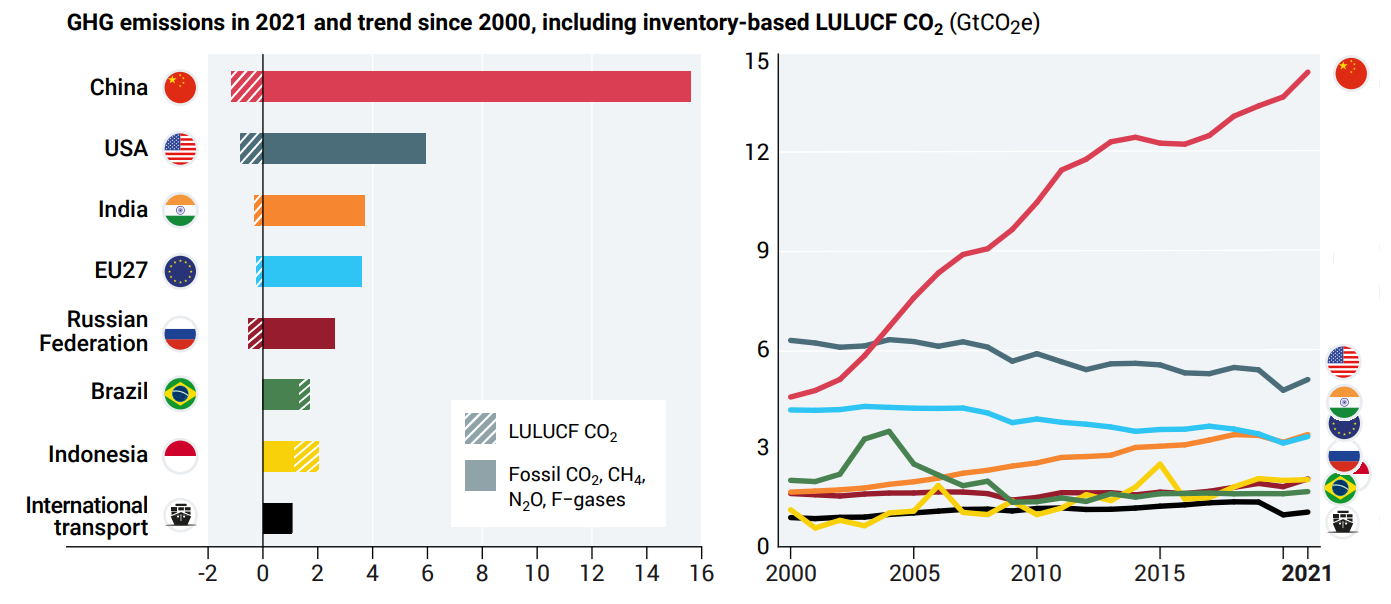
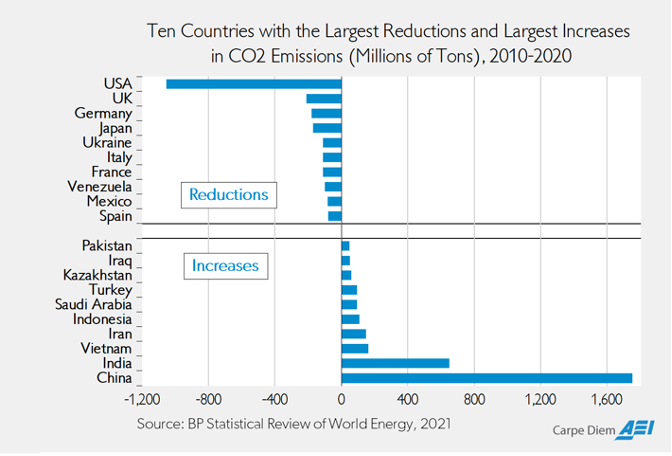
While the left may clutch its pearls at the increased production of a fossil fuel like natural gas, this clean energy source has been a main driver of U.S. emissions reductions. Over the past 15 years when America has massively increased natural gas output, the U.S. reduced carbon emissions more than any other country. We can see this year by year.
For example, from 2022 to 2023, America offset dirtier coal energy generation with natural gas. As coal declined by 121.9 terawatt hours of electric generation over that time, natural gas increased by 118.9 terawatt hours. At the same time, U.S. greenhouse gas emissions declined 1.9%. Notably, 80% of the U.S. carbon emissions reductions were driven by the electric power sector — precisely where natural gas has an outsized impact.
Notice what didn’t cause those emissions reductions? The Paris Agreement.
The American energy sector — powered by innovation and good-old-fashioned free market economics — has been driving down carbon emissions cheaply and effectively before the Paris Agreement was a twinkle in climate activists’ eyes. And it will continue to reduce carbon emissions long after President Trump’s decision to withdraw.
The Paris Agreement is far from the panacea some activists claim it is.
It isn’t even a particularly effective tool to
rally nations toward greater climate success.
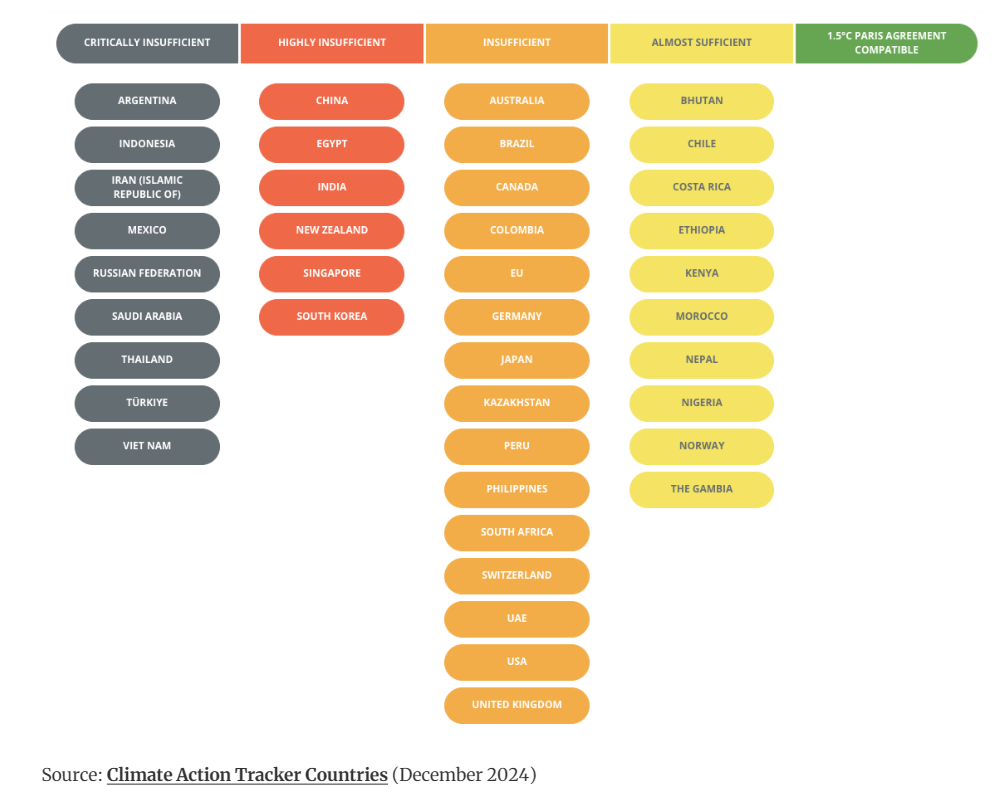
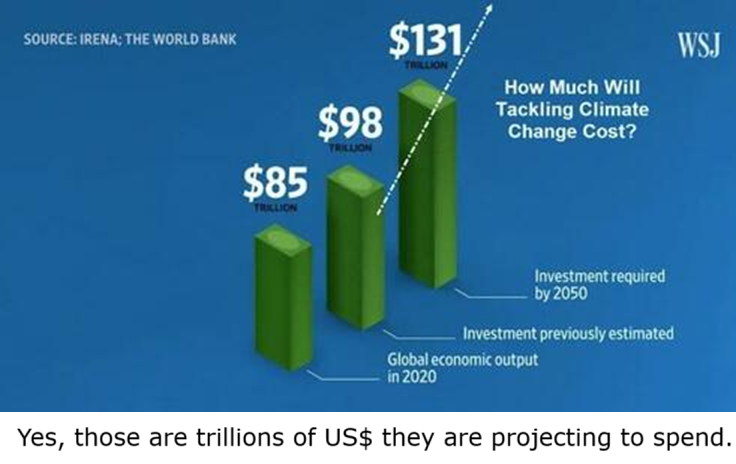
In the middle of the allegedly climate-conscious Biden administration, none of the world’s biggest emitters — America included — had reduced their emissions in accordance with the Paris goals. Apparently, the $1 trillion regulatory and subsidy regime erected by President Biden’s Inflation Reduction Act had little bang for the buck.
What Agreement supporters forget is that no number of high-profile international accords can make command-control tactics work — or instill other nations with the ambition to fulfill their empty promises.

Yes, those are trillions of dollars they are projecting to spend.

The Paris Agreement is the definition of bureaucratic failure, conflating meetings, busyness, and lofty goals as success. Its only achievement is to make climate ideologues and green jetsetters feel good about themselves as they fly to international conferences.
It’s no wonder President Trump withdrew. Talk is cheap. What matters is success. On that metric, the Trump administration is set to actually achieve what Paris Agreement signatories only write on paper.
Trump entered office promising to deregulate the fossil fuel industry, increase permitting for natural gas extraction, approve the construction of energy facilities like natural gas export terminals, and re-establish American energy dominance.
By leaning into America’s carbon advantage and exporting clean American energy abroad, he will boost the U.S. economy, supplant dirty energy from nations like Russia and Venezuela with a clean American alternative, and lower emissions both at home and abroad, all without the jaw-dropping price tag of the failed Biden-era green agenda. We should combine these steps with efforts to actually hold the biggest polluters accountable (which are being discussed by President Trump’s cabinet). This approach would be the antithesis of the Paris Accords’ America-last strategy.
Of course, some are urging President Trump to go further and not just withdraw from the Paris Agreement, but also back out of the UN Framework Convention on Climate Change (UNFCCC). This may seem like an easy choice, seeing as the UNFCCC, like so many UN bodies, acts contrary to American interests. But that’s exactly why America must remain in the UNFCCC.
Climate treaties will be formed whether or not the U.S. is involved, and the UNFCCC will continue to operate as a forum for those negotiations. Staying in the UNFCCC costs America nothing while allowing Trump and his appointees to keep a seat at the table, hold the UN accountable, and counter any deal that would put America at a disadvantage. While the UNFCCC can be harmful, it’s only the Paris Agreement that’s impotent.
The breathless alarm over the withdrawal from the Paris Agreement is overwrought. When President Trump withdrew from the Paris Climate Accord during his first administration, America went on to cut carbon emissions to the lowest level in 25 years. Re-embracing the power of natural gas in his second term, he’ll do it again.
So instead of the UN and international climate activists judging the U.S., we should remind everyone that if you want to put climate first, you should actually put America first.
Chris Johnson is a GOP strategist who organizes the next generation of conservative leaders. He also serves as a senior advisor to the National Federation of College Republicans, focusing on energy issues.


No, Grist, MSN, et al: CO2 Is Not Making Oceans Boil


The Climate Crisis media network is announcing a new claim that rising CO2 is causing recent ocean warming, proving it’s dangerous and must be curtailed.  Examples in the last few days include these:

Finally, an answer to why Earth’s oceans have been on a record hot streak Grist

Ocean warming 4 times faster than in 1980s — and likely to accelerate in coming decades MSN

News spotlight: Fossil fuels behind extreme ocean temperatures, study says. Conservation International

Ocean temperature rise accelerating as greenhouse gas levels keep rising UK Natural History Museum

The surface of our oceans is now warming four times faster than it was in the late 1980s The Independent UK

Oceans Are Warming Four Times Faster as Earth Traps More Energy Bloomberg Law News

All this hype deriving from one study,
and ignoring the facts falsifying that narrative.

Fact:  Historically, ocean natural oscillations drive observed global warming.

The long record of previous warmings prior to the satellite record shows that the entire rise of 0.8C since 1947 is due to oceanic, not human activity.

The animation is an update of a previous analysis from Dr. Murry Salby.  These graphs use Hadcrut4 and include the 2016 El Nino warming event.  The exhibit shows since 1947 GMT warmed by 0.8 C, from 13.9 to 14.7, as estimated by Hadcrut4.  This resulted from three natural warming events involving ocean cycles. The most recent rise 2013-16 lifted temperatures by 0.2C.  Previously the 1997-98 El Nino produced a plateau increase of 0.4C.  Before that, a rise from 1977-81 added 0.2C to start the warming since 1947.

Importantly, the theory of human-caused global warming asserts that increasing CO2 in the atmosphere changes the baseline and causes systemic warming in our climate.  On the contrary, all of the warming since 1947 was episodic, coming from three brief events associated with oceanic cycles.

FactRecent rise in SST was driven by ENSO and N. Atlantic Anomalies.

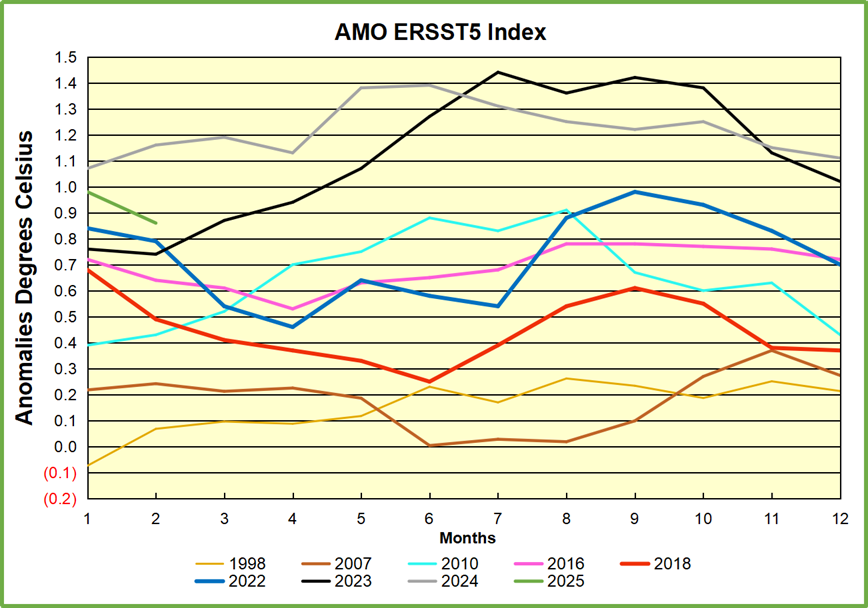
And now in 2024 we have seen an amazing episode with a temperature spike driven by ocean warming in all regions, along with rising NH land temperatures, now dropping below its peak.

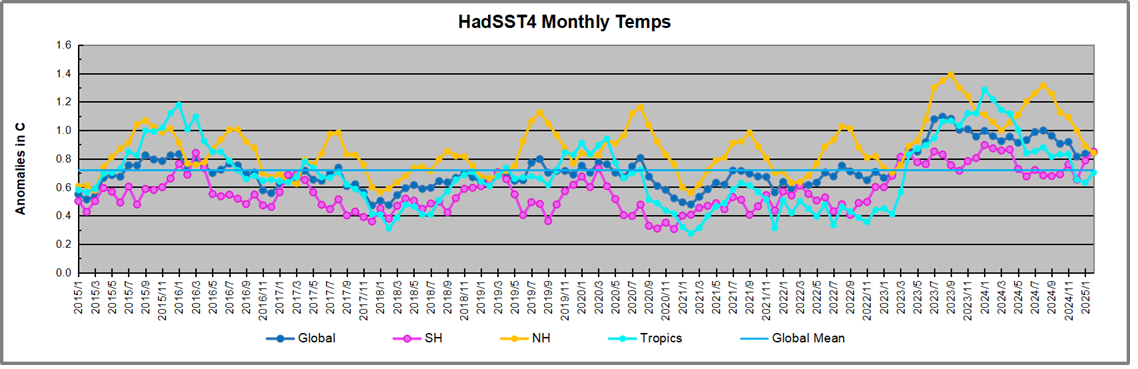
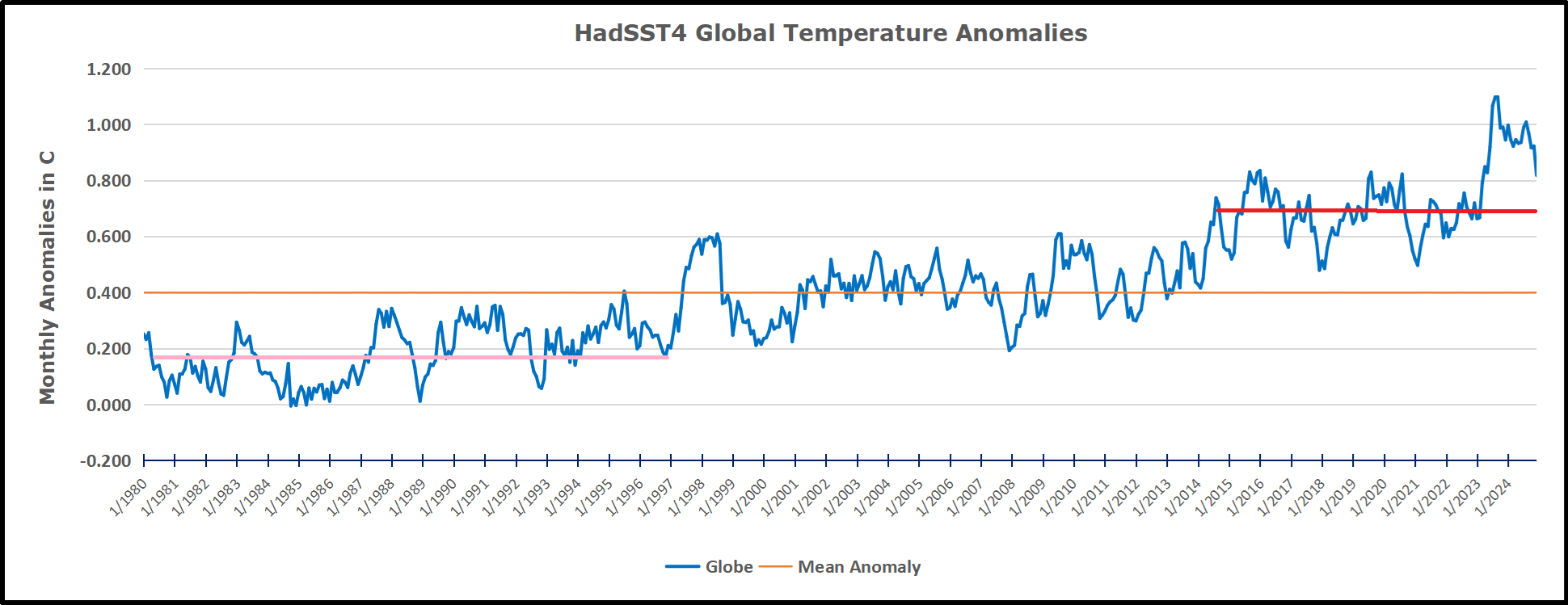
The chart below shows SST monthly anomalies as reported in HadSST4 starting in 2015 through December 2024.  A global cooling pattern is seen clearly in the Tropics since its peak in 2016, joined by NH and SH cycling downward since 2016, followed by rising temperatures in 2023 and 2024.

To enlarge, open image in new tab.

Note that in 2015-2016 the Tropics and SH peaked in between two summer NH spikes.  That pattern repeated in 2019-2020 with a lesser Tropics peak and SH bump, but with higher NH spikes. By end of 2020, cooler SSTs in all regions took the Global anomaly well below the mean for this period.  A small warming was driven by NH summer peaks in 2021-22, but offset by cooling in SH and the tropics, By January 2023 the global anomaly was again below the mean.

Now in 2023-24 came an event resembling 2015-16 with a Tropical spike and two NH spikes alongside, all higher than 2015-16. There was also a coinciding rise in SH, and the Global anomaly was pulled up to 1.1°C last year, ~0.3° higher than the 2015 peak.  Then NH started down autumn 2023, followed by Tropics and SH descending 2024 to the present. After 10 months of cooling in SH and the Tropics, the Global anomaly came back down, led by NH cooling the last 4 months from its peak in August. It’s now about 0.1C higher than the average for this period. Note that the Tropical anomaly has cooled from 1.29C in 2024/01 to 0.66C as of 2024/12.

FactEmpirical measurements show ocean warms the air, not the other way around.

One can read convoluted explanations about how rising CO2 in the atmosphere can cause land surface heating which is then transported over the ocean and causes higher SST. But the interface between ocean and air is well described and measured. Not surprisingly it is the warmer ocean water sending heat into the atmosphere, and not the other way around.

The graph displays measures of heat flux in the sub-tropics during a 21-day period in November. Shortwave solar energy shown above in green labeled radiative is stored in the upper 200 meters of the ocean. The upper panel shows the rise in SST (Sea Surface Temperature) due to net incoming energy. The yellow shows latent heat cooling the ocean, (lowering SST) and transferring heat upward, driving convection. [From An Investigation of Turbulent Heat Exchange in the Subtropics by James B. Edson]

As we see in the graphs ocean circulations change sea surface temperatures which then cause global land and sea temperatures to change. Thus, oceans make climate by making temperature changes.

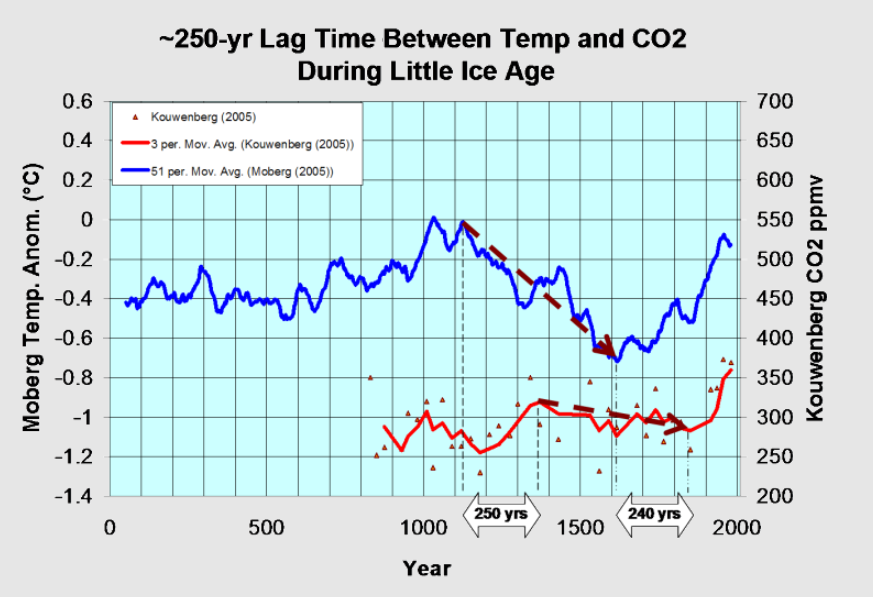
FactOn all time scales, from last month’s observations to ice core datasets spanning millennia, temperature changes first and CO2 changes follow.

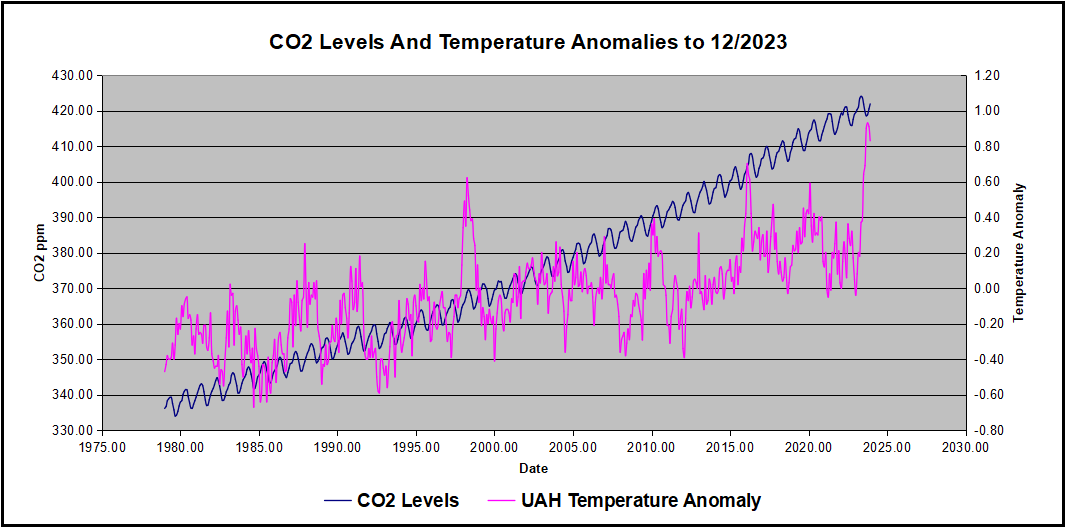
Previously I have demonstrated that changes in atmospheric CO2 levels follow changes in Global Mean Temperatures (GMT) as shown by satellite measurements from University of Alabama at Huntsville (UAH). That background post is included in the posting referenced later below.

My curiosity was piqued by the remarkable GMT spike starting in January 2023 and rising to a peak in April 2024, and then declining afterward.  I also became aware that UAH has recalibrated their dataset due to a satellite drift that can no longer be corrected. The values since 2020 have shifted slightly in version 6.1, as shown in my recent report  Ocean Leads Cooling UAH December 2024.

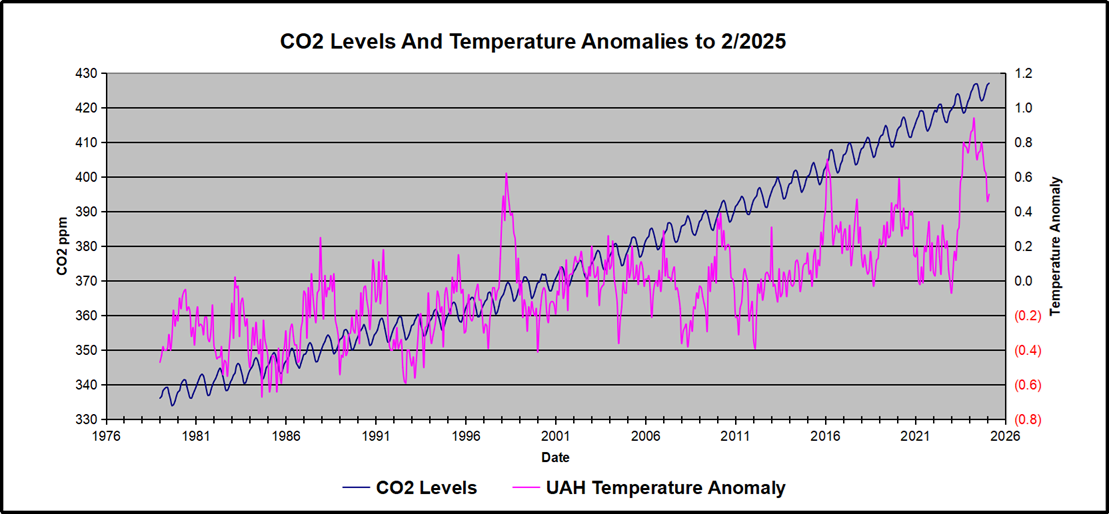
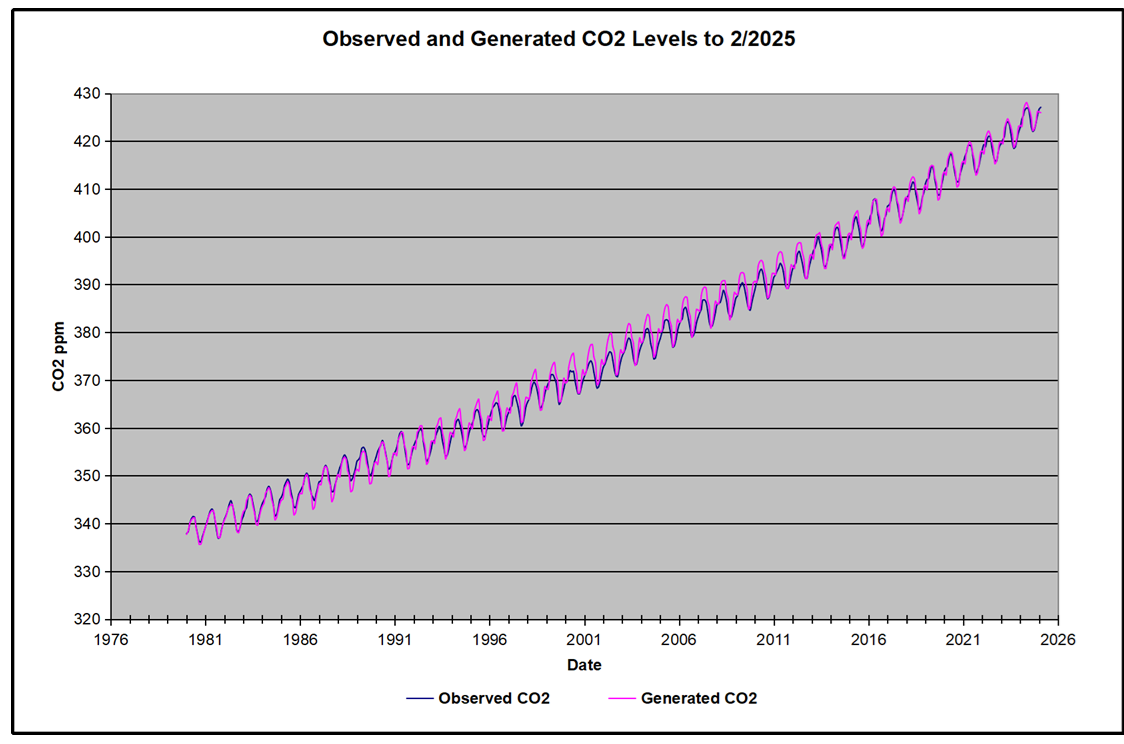
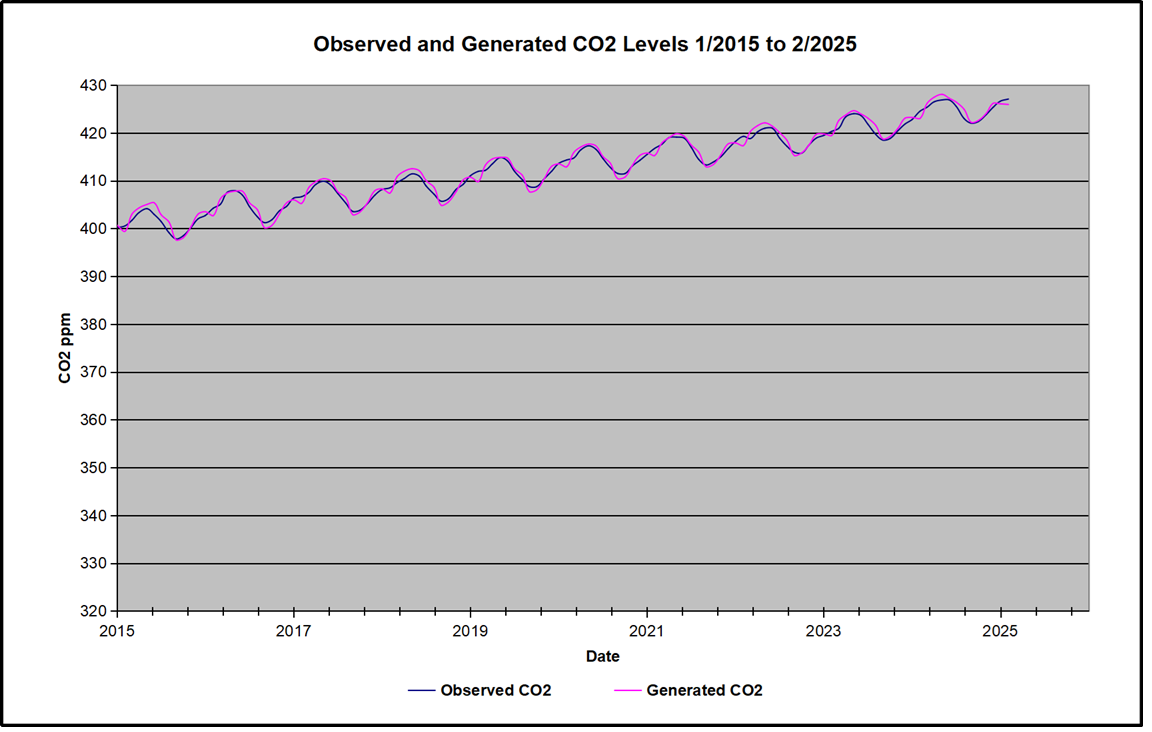
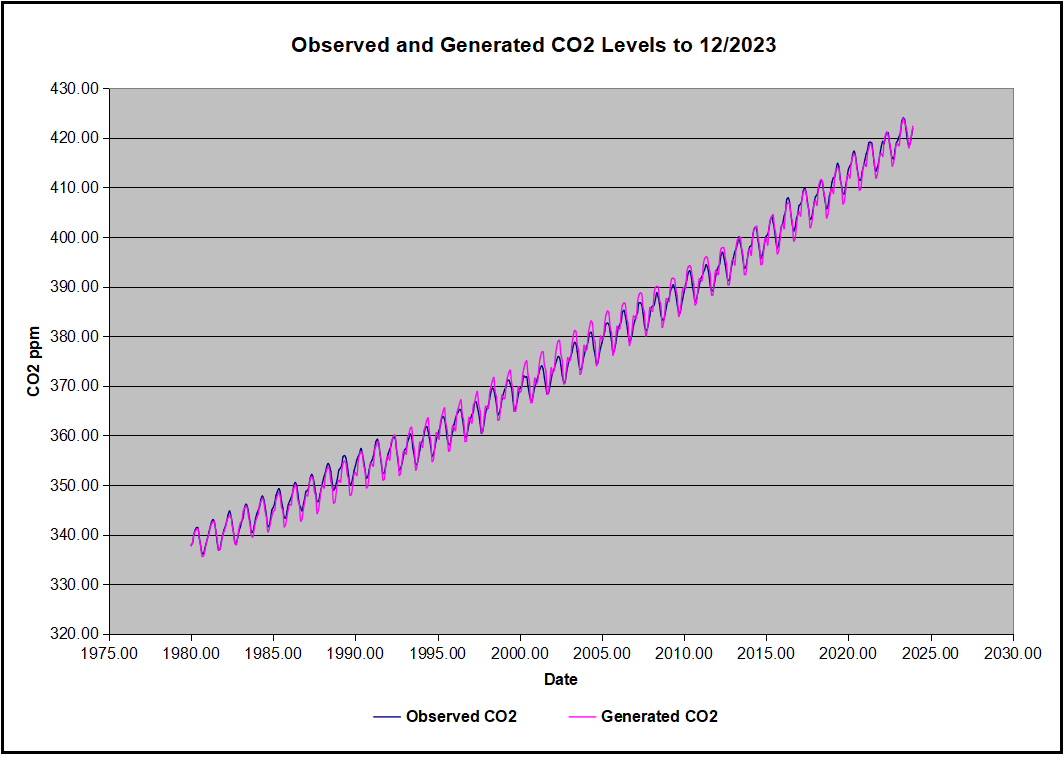
I tested the premise that temperature changes are predictive of changes in atmospheric CO2 concentrations.  The chart above shows the two monthly datasets: CO2 levels in blue reported at Mauna Loa, and Global temperature anomalies in purple reported by UAHv6.1, both through December 2024. Would such a sharp increase in temperature be reflected in rising CO2 levels, according to the successful mathematical forecasting model? Would CO2 levels decline as temperatures dropped following the peak?

The answer is yes: that temperature spike resulted
in a corresponding CO2 spike as expected.
And lower CO2 levels followed the temperature decline.

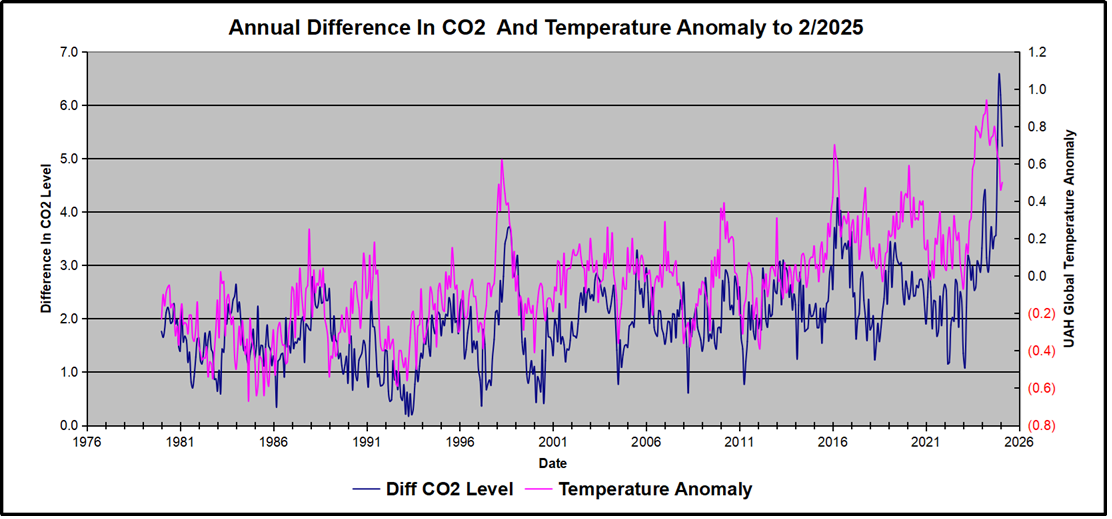
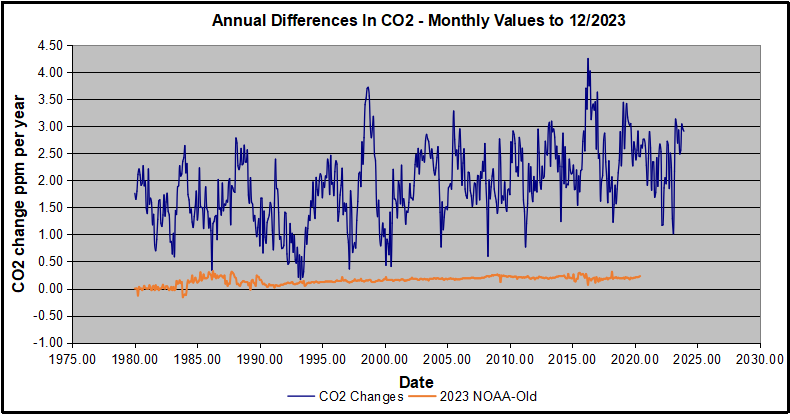
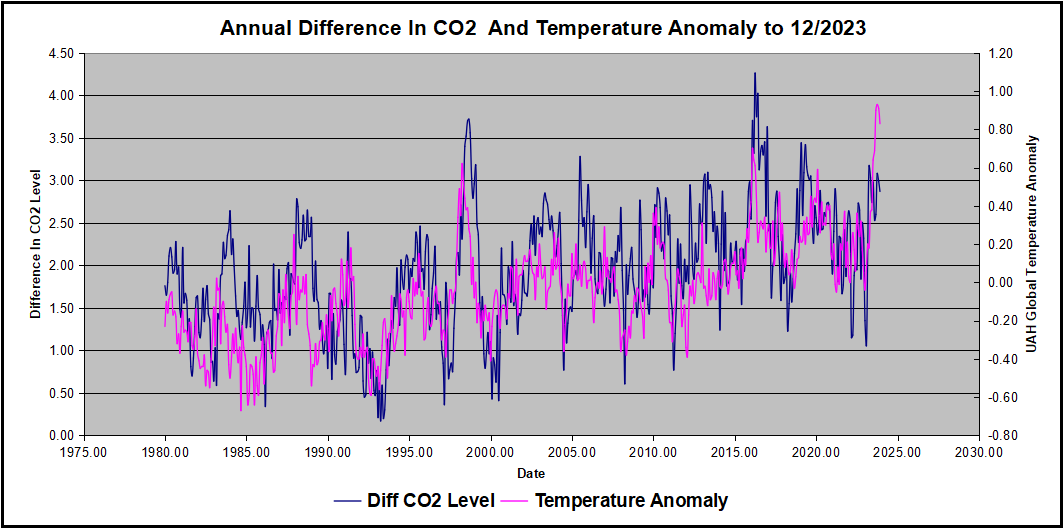
Above are UAH temperature anomalies compared to CO2 monthly changes year over year.

Changes in monthly CO2 synchronize with temperature fluctuations, which for UAH are anomalies now referenced to the 1991-2020 period. CO2 differentials are calculated for the present month by subtracting the value for the same month in the previous year (for example December 2024 minus December 2023).  Temp anomalies are calculated by comparing the present month with the baseline month. Note the recent CO2 upward spike and drop following the temperature spike and drop.

Summary

Changes in CO2 follow changes in global temperatures on all time scales, from last month’s observations to ice core datasets spanning millennia. Since CO2 is the lagging variable, it cannot logically be the cause of temperature, the leading variable. It is folly to imagine that by reducing human emissions of CO2, we can change global temperatures, which are obviously driven by other factors.

12/2024 Update–As Temperature Changes, CO2 Follows


Arctic Ice Recovery Stalls January 2025

Arctic ice recovered more slowly than usual in December and January, likely due to polar vortex pulling freezing air from the Arctic down into lower latitudes, replaced by warmer southern air.  A post at Severe Weather Europe is February 2025 Forecast, describing the dynamics this winter.  

After a mild start, a new Polar Express is looming
for the United States and Canada mid-month.

As January is slowly ending, we can look at preliminary surface temperature data for the month so far. Below is the CDAS analysis, and you can see that January was colder than normal across the entire United States, apart from California and parts of Nevada. But these anomalies do not show the full picture of just how cold some days in the month were, breaking records for several years and even decades in the past.

On the other hand, we can see that Canada had warmer than normal temperatures. This is an expected pattern, as while the colder air was transported further south into the United States, it was replaced by high-pressure and a warmer-than-normal airmass.

The movement of the pressure systems drives these temperature patterns and weather changes. Pairs of pressure systems are also known as Rossby Waves. You can see an example of Rossby waves in the image below by NOAA and how they are all connected and function with the jet stream.

The purple line connecting these pressure systems is called the jet stream. This rapid stream of air is found around 9 to 14 kilometers (6 to 9 miles) above sea level.

In late January, the average temperatures in the northern United States and southern Canada are still around or below freezing, so even a strong positive anomaly does not actually mean warm temperatures in that region. But, it is interesting to see the rapid shift in temperature anomalies as the pressure systems reposition.

February 2025 is about to start, with the latest weather forecasts indicating a very dynamic month over the United States and Canada. After the power struggle between the cold and warmth at the start of the month, another Polar Vortex lobe looms for the United States around mid-month.

Below is the surface temperature anomaly, averaged for next week. You can see the large supply of colder air over the northern United States and western Canada. Another cooler area is forecast for eastern Canada and the northeastern United States.

But most of the central and southern half of the United States is forecast to have above-normal temperatures. We often see such a division in the weather patterns, where the colder and warmer air separate along the jet stream.

Going into the weather trend for the second half of February, we will use the extended-range ensemble forecasts. These forecasts serve as trends that show the prevailing idea of where the pressure systems are positioned and how the airmass is expected to move.

The continuous low-pressure systems over Canada helped to initiate large-scale cold air transport from the Arctic into the United States and Canada, also powered by the Polar Vortex in the stratosphere.

We continue to see the presence of the low-pressure area over Canada in the forecast for February. But the forecast now indicates an interesting core movement of the Polar Vortex in the stratosphere, likely to initiate another deep cold event around mid-month over the United States and Canada.

Impact on Arctic Ice Extents

The 19-year average for January shows Arctic ice extents started at 13.13M km2 and ended the month at 14.36M km2.  2024 started somewhat higher and matched average at the end.  Other recent years have been lower, and 2025 started 540k km2 in deficit and 818k km2 below average at month end. The gap had closed to 400k km2 before losing extents at the end.  SII and MASIE tracked closely this month.

The table below shows year-end ice extents in the various Arctic basins compared to the 19-year averages and some recent years.  2007 seven was close to the average, so 2018 is shown for comparison.

Region 2025031 Ave Day 031 2025-Ave. 2018031 2025-2018
 (0) Northern_Hemisphere 13543740 14362137 -818398 13792271 -248532
 (1) Beaufort_Sea 1071001 1070386 614 1070445 556
 (2) Chukchi_Sea 965989 965974 15 965971 18
 (3) East_Siberian_Sea 1087137 1087063 74 1087120 18
 (4) Laptev_Sea 897845 897824 21 897845 0
 (5) Kara_Sea 921520 917381 4139 895363 26157
 (6) Barents_Sea 428814 563859 -135044 481947 -53133
 (7) Greenland_Sea 614789 613370 1418 501411 113378
 (8) Baffin_Bay_Gulf_of_St._Lawrence 1080930 1328380 -247450 1406903 -325972
 (9) Canadian_Archipelago 854878 853510 1368 853109 1769
 (10) Hudson_Bay 1260903 1260778 125 1260838 66
 (11) Central_Arctic 3211379 3210507 872 3184817 26562
 (12) Bering_Sea 534452 648807  -114354 382206 152245
 (13) Baltic_Sea 39334 62876  -23542 41713.99 -2380
 (14) Sea_of_Okhotsk 559692 823877  -264185 704398 -144707

This year’s ice extent is 818k km2 or 5.7% below average.  About half of the deficit comes from the Pacific basins of Bering and Okhotsk sea.  The other two major losses are in Barents Sea and Baffin Bay.  With the annual maximum typically occurring mid-March, it is likely the ice then will also be lower than usual.   


Illustration by Eleanor Lutz shows Earth’s seasonal climate changes. If played in full screen, the four corners present views from top, bottom and sides. It is a visual representation of scientific datasets measuring Arctic ice extents and NH snow cover.


Devious Climate Attribution Studies

Patrick Brown raises the question Do Climate Attribution Studies Tell the Full Story? Excerpts in italics with my bolds and added images, his analysis concluding thusly:

How a cascade of selection effects bias
the collective output of extreme event attribution studies.

Weather and climate extremes—such as high temperatures, floods, droughts, tropical cyclones, extratropical cyclones, and severe thunderstorms—have always threatened both human and natural systems. Given their significant impacts, there is considerable interest in how human-caused climate change influences these extremes. This is the focus of the relatively new discipline of Extreme Event Attribution (EEA).

Over the past couple of decades, there has been an explosion in EEA studies focusing on (or, “triggered by”) some prior notable weather or climate extreme. Non-peer-reviewed reports from World Weather Attribution (e.g., herehere, and here) represent some of the most notable examples of these kinds of analyses, and many similar studies also populate the peer-reviewed literature. The Bulletin of the American Meteorological Society’s “Explaining Extreme Events From a Climate Perspective” annual series compiles such studies, as does the Sabin Center for Climate Change Law, and they are also synthesized in reports like those from the IPCC (IPCC WG1 AR6 Chapter 11.2.3) and the United States National Climate Assessment.

The collective output of these kinds of studies certainly gives the impression that human-caused climate change is drastically changing the frequency and intensity of all kinds of weather extremes. Indeed, Carbon Brief recently published an extensive summary of the science of EEA studies, which begins with the proclamation, “As global temperatures rise, extreme weather events are becoming more intense and more frequent all around the world.”

However, these numbers cannot be taken as an accurate quantification of the influence of climate change on extreme weather because they are heavily influenced by a cascade of selection biases originating from the physical climate system, as well as researcher and media incentives. Identifying and understanding these biases is a prerequisite for properly interpreting the collective output of EEA studies and, thus, what implications they hold for general scientific understanding, as well as political and legal questions.

The large apparent discrepancy between the size of the influence of human-caused climate change on extreme weather reported in EEA studies (like those compiled by Carbon Brief) compared to more comprehensive systematic analyses (like those compiled by the IPCC) can, in large part, be attributed to the many layers of Selection Biases that influence the EEA literature’s collective output.

Selection Bias is a broad term that refers to any bias that arises from a process that selects data for analysis in a way that fails to ensure that data is representative of the broader population that the study wishes to describe.

Selection biases in the context of EEA studies include those associated with the physical climate system itself, those concerning proclivities and incentives facing researchers/journals, and those concerning the proclivities and incentives facing the media. They include

Occurrence Bias is a bias introduced by the physical climate system. Since EEA studies tend to be triggered by extreme events that have actually occurred, there is reason to believe that these studies will disproportionately sample events that are more likely than average to be exacerbated by climate change because the events occurred in the first place. Essentially, extreme events that are more likely to occur under climate change—and thus more likely to be observed—are going to be overrepresented in EEA studies, and extreme events that are less likely to occur under climate change—and thus less likely to be observed—are going to be underrepresented in EEA studies.

The map below illustrates this phenomenon. It shows changes in the magnitude of extreme drought under climate change. Specifically, it shows the fractional change in the intensity of once-per-50-year droughts (as quantified by monthly soil moisture) between a preindustrial and 21st-century run (SSP2-4.5 emissions) of the highly-regarded NCAR CESM2 Climate Model. Blue areas represent locations where the model simulates that extreme droughts become less frequent and intense with enhanced greenhouse gas concentrations, and red areas represent locations where the model simulates that extreme droughts become more frequent and intense with enhanced greenhouse gas concentrations. It is notable that overall, this model simulates that warming decreases the frequency and intensity of extreme drought in more locations than it increases it (consistent with soil moistening under warming simulated by other models).

Now, here’s the kicker: The black dots show locations where once-per-50-year droughts actually occurred in the 21st-century simulation and thus represent events that would plausibly trigger EEA studies.

What do you notice about where the dots are compared to where the red is? That’s right; the simulated EEA studies overwhelmingly sample areas where droughts are getting more intense and more frequent by the very nature that those are the types of droughts that are more likely to occur in the warming climate. The result is that the EEA sample is majorly biased: warming decreased the intensity of once-per-50-year droughts by about 1% overall, but it increased their intensity within the EEA sample by 18%!

Thus, if you just relied on the EEA sample, you would come away with an
incorrect impression not only on the magnitude of change in extreme droughts
but also on the sign of the direction of change!

Choice Bias arises when researchers use prior knowledge to choose events for EEA studies that are more likely to have been made more severe by climate change. A clear example of Choice Bias pervading the Carbon Brief database is there have been 3.6 times more studies on extreme heat than there have been on extreme winter weather (205 vs. 57). Another example would be the dearth of EEA studies on extratropical cyclones (the kinds of low-pressure systems with cold and warm fronts that are responsible for most of the dramatic weather outside of the tropics). The IPCC states that the number of extratropical cyclones associated with intense surface wind speeds is expected to decrease strongly in the Northern Hemisphere with warming. Yet, it is relatively rare for EEA attribution studies to be done on these types of systems, which results in an exclusion of this good news from the EEA literature.

Publication Bias could be playing a role, too, where researchers are more likely to submit, and journals are likely to publish studies that report significant effects on salient events compared to studies that find null effects.

From Clark et al., 2023

Finally, the climate reporting media ecosystem is characterized by actors whose explicit mission is to raise awareness of the negative impacts of climate change, and thus, there will be a natural Media Coverage Bias with a tendency to selectively highlight EEA studies where climate change is found to be a larger driver than EEA studies that do not reach such a conclusion. These selection biases are apparent at the aggregate level, but there is also strong evidence of their presence in individual studies.

A more recent specific example suggestive of many of these dynamics is a study, Gilford et al. (2024), titled “Human-caused ocean warming has intensified recent hurricanes”. This study was conducted by three researchers at Climate Central, which summarizes the study’s findings with the following infographic:

From Climate Central press release on Gilford et al. (2024).

Essentially, they claim that climate change is enhancing the intensity of all hurricanes and that the enhancement is quite large: Storms today are calculated to be an entire Category stronger than they would have been in a preindustrial climate.

This is a huge effect, and thus, if it were real, it is reasonable to expect to see clear long-term trends in metrics of tropical cyclone (hurricane) intensity like the accumulated number of major (Category 3+) hurricane days or the accumulated cyclone energy from all tropical cyclones (which is proportional to the square of hurricane windspeed accumulated over their lifetimes). However, any long-term trends in such metrics are subtle at best, both globally and over the North Atlantic.

From Colorado State University Department of Atmospheric Science Tropical Meteorology Project.

So, this is a microcosm of the aforementioned apparent discrepancy between more broad quantifications of changes in extremes and their associated EEA counterparts, and again, I’d argue there are several selection biases at play affecting the production and dissemination of the EEA study.

Let’s start with Choice Bias on methodology. Human-caused warming changes the environment in some ways that work to enhance hurricanes and in other ways that diminish them. The main way that hurricanes are enhanced is via the increase in sea surface temperatures (which provides the fundamental fuel for hurricanes), and the main way that hurricanes are diminished is via changes in atmospheric wind shear and humidity.

The net result of these countervailing factors pulling in opposite directions is that we expect fewer hurricanes overall, but when hurricanes are able to form, they can be stronger than they would otherwise. These factors, though, are small relative to natural random variability, and thus, they are difficult to detect in observations.

However, the Climate Central researchers made the methodological choice
to largely exclude the influence of factors that diminish
hurricane development from the study.

Are these Choice Biases in event type and methodology an accident? There are many reasons to believe they are not.

The research paper itself spells out that the motivation of the study is to “connect the dots” between climate change and hurricanes because “landfalling hurricanes with high intensities—can act as ‘focusing events’ that draw public attention” and that “Increased attention during and in wake of storms creates opportunities for public and private discourse around climate and disaster preparedness.”

Then, there is the extensive media coverage of this study. It was picked up by 134 news outlets and ranked in the 99.95th percentile of research articles (across all journals) of similar age in terms of online attention. Further, it was immediately incorporated into seven Wikipedia articles (likely having high leverage on AI queries, which would make its findings indistinguishable from scientific “fact”). This is affected by the aforementioned Media Coverage Bias, but it is also undoubtedly directly influenced by the efforts of Climate Central, which is explicitly an advocacy organization whose self-described specialty is media placement and dissemination. 

The above sheds light on the reasons for certain choice biases in a particular study, but there is plenty of evidence that these selection biases are pervasive in the EEA field. After all, Dr. Myles Allen essentially founded the field with the motivation of answering the question, “Will it ever be possible to sue anyone for damaging the climate?”. This same motivation seems to animate many of the most high-profile scientists in the field today, like Allen’s protege, Dr. Friederike Otto (co-founder and leader of World Weather Attribution). She and her organization are frequently cited as bringing the necessary intellectual authority to credibly sue fossil fuel companies. She states the motivation of her work explicitly:

“Attributing extreme weather events to climate change, as I do
through my work as a climatologist, means we can hold
countries and companies to account for their inaction.”

Given the explicitly stated motivation of those in the EEA field, it is quite reasonable to suppose that there are major selection biases at play, and thus, it is not at all surprising that the collective output of the EEA field would look so different from more broad comprehensive assessments.


Poilievre: On Canada and US Partnership

Last week Jordan Peterson conducted the above interview What Pierre Poilievre Thinks About Donald Trump. Poilievre is the Conservative leader expected to form the next federal government in Canada.  My lightly edited transcript is below in italics with my bolds and added images. JP refers to Peterson and PP to Poilievre.

JP: Trump famously met with Trudeau and seemed to troll him quite hard. First thing, I don’t know to what degree the Canadian press picked up on this, but Trudeau wasn’t invited to stay at Mar-a-Lago and there’s 126 rooms there. So when Trump invites someone he also invites them to stay there. So you know that was a message, and then he trolled him hard. He called him the governor of America’s 51st State and let it be known that he had very little respect for him. And then he announced a 25% tariff on Canadian goods.

So I had two reactions to that. You know, because I’m no fan of Trudeau, one was amused pleasure at Trump’s vicious humor let’s say. And the other one, you know he is the leader of our primary ally and a G7 nation, and so maybe that verged on contempt. I’m not exactly sure what to make of that and I’m curious about your response, and also how you feel about negotiating a new relationship with the Americans and with the Trump Administration in particular.

PP: Well I won’t spend a lot of time on how I feel about it other than to say Trudeau is a weak leader who leads a weakened economy with a weakened dollar and a weakened border. And president Trump has a strong mandate and he he spent his life as a highly successful businessman in the most cutthroat economic environment in the world, New York City. So in construction yeah and in Chicago. This is a former businessman who can spot weakness a mile away and act on it. So it’s just humiliating for all Canadians to witness something like that, because this is our country.

But what am I going to do about it? Look, first and foremost we need to show up with strength. We have an American president who has always put America First, he’s very blunt about it. I’ll put Canada First. The good news is that there’s immense overlap in the two countries respective interests and values. We’re both liberal democracies, we both value Freedom, we both share a geography. We have our enemies and our risks and our threats are the same, so there’s no reason why we can’t both win. If you look at the history of President Trump, he negotiates very aggressively and he likes to win, but in the end he doesn’t appear to have a problem if his counterparty also wins. So I think that we can get a great deal that will make both countries safer, richer and stronger. That’s the goal that I’ll be coming with into these negotiations.

JP: Okay, so what would a great deal look like as far as you’re concerned with the Americans on the energy side. One of the things that Trump pointed to was Canada’s Trade Surplus with the US at 1 billion was his estimate.

PP: It depends how you measure it, other estimates have it at around 40 billion, but he’s right, there is a Canadian Trade Surplus with the states. And from a mercantilist point of view you can say that America has been ripped off by China and Mexico. You can see examples of a factory closing in Ohio or Pennsylvania to open in Mexico or in China. But that’s not the nature of the Canadian Trade Surplus. It’s not a matter of the Canadian economy taking American jobs, far from it.

The nature of our Trade Surplus with America is that while it is a ripoff,
it’s Canada ripping itself off and let me explain.

Our entire Trade Surplus and more is due to oil and gas because we export about $120 billion of oil and gas to the United States at enormous discounts to market price because we have been so stupid and our bureaucrats have been so obstructive and woke activists have been so fanatical that we have not been able to develop the infrastructure to refine and transport our own energy to World Markets. So we are stuck with the US; depending on the time we sell a barrel oil to the Americans for 10% up to 30 or 40% cheaper than the world price. There’s a price called western Canada select and it’s significantly lower than WTI.

Until recently at least 99% of our oil exports to America where they then get to upgrade it and resell it at enormous profits with their welders, pipe fitters and engineers making the six figure salaries that go along with that. We give all of our natural gas exports to the United States because we don’t have an an operating liquefaction terminal to send it away ourselves so they get our natural gas at massive discounts. And then they can decide if they want to liquefy and ship it off to world markets at literally five times higher.

Trudeau’s “Just Transition” to Net Zero

So that is that is the trade surplus he’s talking about. Now if he were to stop that today it would mean that American workers at refineries and in other value added places would lose their jobs and Americans would pay higher energy prices. So that would not be good for America in the long run.

Being very blunt, I intend to approve refineries and LNG plants and
hopefully pipelines so that I could bring that production
back to Canada and make us more energy independent.

But in the short run if president Trump wants to make America richer the last thing he should want to do is block the underpriced Canadian energy from going into his Marketplace. In fact I would encourage him to approve the Keystone Pipeline so that we can create jobs for American workers who will build and install it, but also create much more wealth for Alberta and Saskatchewan and have their product reach tide water in the US Gulf Coast and get World prices.

So that’s an economic win. Also it’s not just oil and gas though. We have in Canada the Strategic minerals that are necessary for Warfare and for the modern digital economy that we could be exporting to the United States breaking both of our dependencies on China. We have the energy, a major Surplus of electricity, a surplus that we could even grow further that could be used for data centers that America cannot build fast enough.

So there’s enormous opportunities for both of us to get vastly richer if
we actually deepen our trade relationship rather than blocking it.

JP: Right, well it seems highly probable to me that that would be the direction that the Trump Administration would turn in if they were negotiating with people who were playing a straight game and were actually aiming for something like economic Prosperity instead of whatever the hell it is that Trudeau’s aiming for. Now you made brief reference to something quite shocking in its full import which didn’t really strike me until your comments. For example, Trudeau turned away the chancellor of Germany and the leader of Japan when they came cap in hand to Canada asking for increased Natural Gas exports over the long run. Given that we refused them, we ended up maintaining our low cost contracts with the United States and selling them all our resources at a discount.

PP: Yes, it’s enormously stupid. That’s the business case Trudeau couldn’t make. And I hate to say this, but because we have blocked LG plants and pipelines and other energy infrastructure, and because we’re giving therefore our gas to America at like a 70 or 80% discount to European and Asian prices and our oil at a discount of 20 or 30%, we’re effectively throwing money out a window. What do you do when someone throws money out a window? Stand next to the window yeah right.

So that is the true story, the pathetic story of our Trade Surplus is
that we’re actually handing over our resources stupidly.

It’s not The Americans’ fault, it’s our fault. We’re stupid and we’re going to stop being stupid when I’m prime minister. We’re going to build this infrastructure ourselves but in the meantime it would be it would be bad for American workers and consumers for the president to tariff our oil and gas.

And look, we have an integrated economy; I think an automobile crosses the Border something like eight or nine times between Ontario and the manufacturing states of the US before it becomes a finished product. Why interrupt those Supply chains? Also why not allow Americans just to have access to buying our minerals? Or better yet why don’t we process improve them here in Canada before we sell them to the United States to break dependence on hostile foreign powers?

By the way I would say to president Trump that the gains that Canada gets from increased access to the United States, I would spend largely on our Continental defense, on a more powerful Canadian military that truly secures the Arctic that protects us against terrorists and against intercontinental ballistic missiles, against threats, God forbid, from other parts of the world. We could have a bigger and more powerful military with a bigger and more powerful economy and so our interests overlap overwhelmingly.

That’s the case I would make to the incoming president
who has proven that he likes to make deals and
is good at it.


Left Coast Climate Delusion Ends in Flames

Satellite images of wildfires burning in Southern California By NBC Staff • Published January 11, 2025

Holman W. Jenkins, Jr. writes in Wall Street Journal End of a Climate Delusion.  Excerpts in italics with my bolds and added images.

Amid California’s fires, voters wake up from the dream that green pork is a solution.

CO2 emitted into the atmosphere is rapidly and, for all practical purposes, uniformly distributed around the planet.

I may be stating the obvious but it needs to be pointed out. Voters and even political leaders are surprisingly poorly informed on this point. Emissions cuts in California don’t have any significant effect on California’s climate. They also have no global effect. California’s cuts are too small relative to the global whole; they also are largely illusory.

Emitting industries leave the state. They don’t stop emitting. If California imports Canadian hydro to charge its electric vehicles, consumers elsewhere have to burn more coal and gas. If Californians drive EVs, more gasoline is free to be burned by others, releasing more CO2 that influences climate change in California and everywhere else.

Green-energy subsidies do not reduce emissions. This will be news to millions of California voters. It contradicts a central tenet of state policy. It isn’t news to the actual enactors of these subsidies. A National Research Council study sponsored by congressional Democrats in 2008 concluded that such handouts were a “poor tool for reducing greenhouse gases” and called for carbon taxes instead.

Unfortunately, the incoming Obama administration quickly discovered it favored climate taxes only when Republicans were in charge. Backers would later engage in flagrant lying to promote Joe Biden’s Inflation Reduction Act, knowingly citing bogus predictions that its trillion-dollar spending profusion would reduce emissions.

A 2019 University of Oregon study had already revealed the empirical truth: Green energy doesn’t replace fossil fuels, it enables more energy consumption overall. That same year the EPA calculated that the potential emissions savings from subsidizing electric vehicles had been offset five times over by the pickup truck and SUV boom Team Obama facilitated to assure the success of its auto bailout.

American Association for the Advancement of Science study finds that of 1,500 “climate” policies announced around the world, a mere 63, or 4%, produce any reduction in emissions.

Last year, the premier journal Science put a nail in the question: 96% of policies supported worldwide as “reducing” emissions failed to do so, consisting mostly of handouts to green-energy interests.

And yet certain Journal readers still assail me with the epithet “denier.” They confuse my criticism of Democratic hypocrisy with my imagined views on climate science. As I’ve written back to many, “Don’t think politicians haven’t figured this out about you. That’s why they can give us unsustainable corporate welfare boondoggles and call it climate policy.”

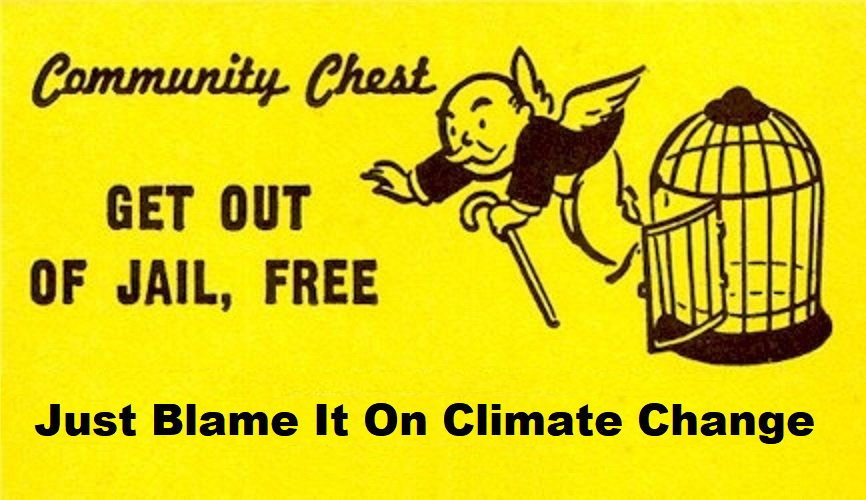
A CNN moderator Saturday urged viewers to vote in an online poll on whether the California disaster should be blamed on climate change or poor leadership. Notice the non sequitur: as if climate change is an excuse for not acting against fire risk.

By all means, let politicians proclaim a “climate crisis” or any other rhetorical flourish if it helps mobilize support for public actions that actually serve a useful purpose. But a prerevolutionary situation has been building in California for two decades, starting with the Third World blackouts in late 2000 not because of any shortage of power but because of large helpings of political cowardice.

A decision in 2019 authorized yet more Third World blackouts instead of reasonably shielding utilities from lawsuit risk over fires their power lines might be accused of contributing to. One result, predictably, has been a proliferation of backyard generators, which increase fire risk.

Californians are stuck adapting in the ways left open to them. Since 2017, half a million have fled Los Angeles County.

Two social technologies might help but the state has been intent on denying itself their advantages. One is a functioning insurance market. If you can’t afford the insurance, you can’t afford the house. Get ready, instead, for a torrent of federal and state money to help residents, some of them wealthy, rebuild in high-risk fire zones.

The other is a functioning market in water. Five gallons to produce a walnut probably isn’t tenable under any realistic system of water pricing. If water were properly valued, municipalities would also rapidly discover the logic of building aquifers to capture seasonal runoff. A thousand things would change if water were priced to flow to its most highly valued uses.

Here’s another concept: Climate change can exist and yet be an insignificant variable.

In Southern California’s Mediterranean climate, anytime 100-mile-an-hour winds start blowing embers toward densely packed housing developments, a conflagration is certain. The only answer then is to have the manpower and resources ready to put fires out as quickly as they start.

I’ve written repeatedly about climate and energy policies in the Western world being a colossal example of “sophisticated state failure,” in which attempts to address complex problems yield only a succession of boondoggles and economic crises. If California voters don’t wise up now, they never will.


Koonin: Reckless Claim of Climate Emergency

Transcript

Hubris is a Greek word that means dangerously overconfident. Based on my research, hubris fairly describes our current response to the issue of climate change.

Here’s what many people believe:

One: The planet is warming catastrophically because of certain human behaviors.
Two: Thanks to powerful computers we can project what the climate will be like
20, 40, or even 100 years from now.
Three: That if we eliminate just one behavior, the burning of fossil fuels,
we can prevent the climate from changing for as long we like.

Each of these presumptions—together, the basis of our hubris regarding the changing climate—is either untrue or so far off the mark as to be useless.

Yes, it’s true that the globe is warming, and that humans are exerting a warming influence upon it. But beyond that, to paraphrase a line from the classic movie The Princess Bride, “I do not think ‘The Science’ says what you think it says.”

For example, government reports state clearly that heat waves in the US are now no more common than they were in 1900.

Hurricane activity is no different than it was a century ago.

Floods have not increased across the globe over more than seventy years.

Source: Voice of International Affairs

Greenland’s ice sheet isn’t shrinking any more rapidly today than it was 80 years ago.

Why aren’t these reassuring facts better known?

Because the public gets its climate information almost exclusively from the media.

And from a media perspective, fear sells.

“Things aren’t that bad” doesn’t sell.

Very few people, and that includes journalists who report on climate news, read the actual science. I have. And what the data—the hard science—from the US government and UN Climate reports say is that… “things aren’t that bad.”

Nor does the public understand the questionable basis of all catastrophic climate change projections: computer modeling.

Projecting future climate is excruciatingly difficult. Yes, there are human influences, but the climate is complex. Anyone who says that climate models are “just physics” either doesn’t understand them or is being deliberately misleading. I should know: I wrote one of the first textbooks on computer modeling.

While modelers base their assumptions upon both fundamental physical laws and observations of the climate, there is still considerable judgment involved. And since different modelers will make different assumptions, results vary widely among different models.

Let’s just take one simple, but significant assumption modelers must make: the impact of clouds on the climate.

Natural fluctuations in the height and coverage of clouds have at least as much of an impact on the flows of sunlight and heat as do human influences. But how can we possibly know global cloud coverage say 10, let alone 50 years from now? Obviously, we can’t. But to create a climate model, we have to make assumptions. That’s a pretty shaky foundation on which to transform the world’s economy.

By the way, creating more accurate models isn’t getting any easier. In fact, the more we learn about the climate system, the more we realize how complex it is.

Rather than admit this complexity, the media, the politicians, and a good portion of the climate science community attribute every terrible storm, every flood, every major fire to “climate change.” Yes, we’ve always had these weather events in the past, the narrative goes, but somehow “climate change” is making everything “worse.”

Even if that were true, isn’t the relevant question, how much worse? Not to mention that “worse” is not exactly a scientific term.  And how would we make it better?  For the alarmists, that’s easy: we get rid of fossil fuels.

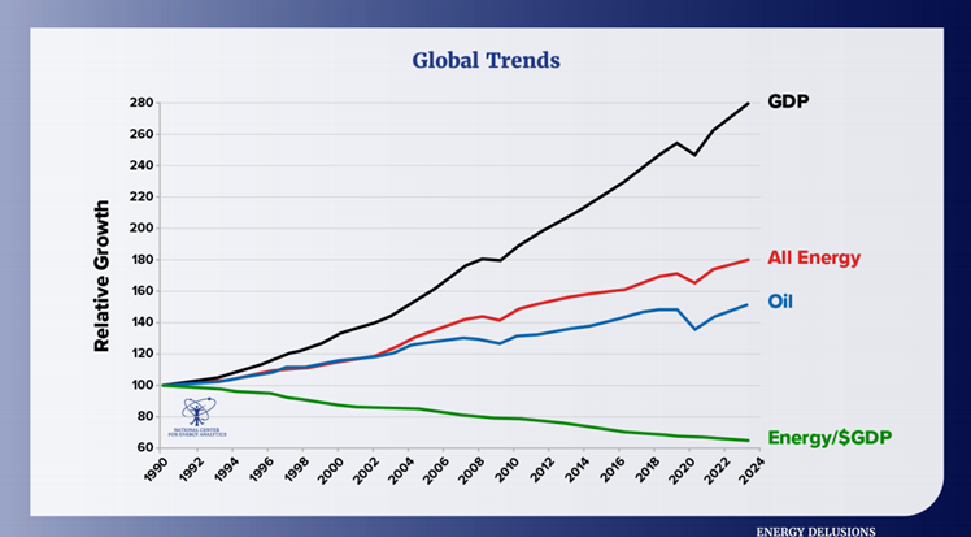
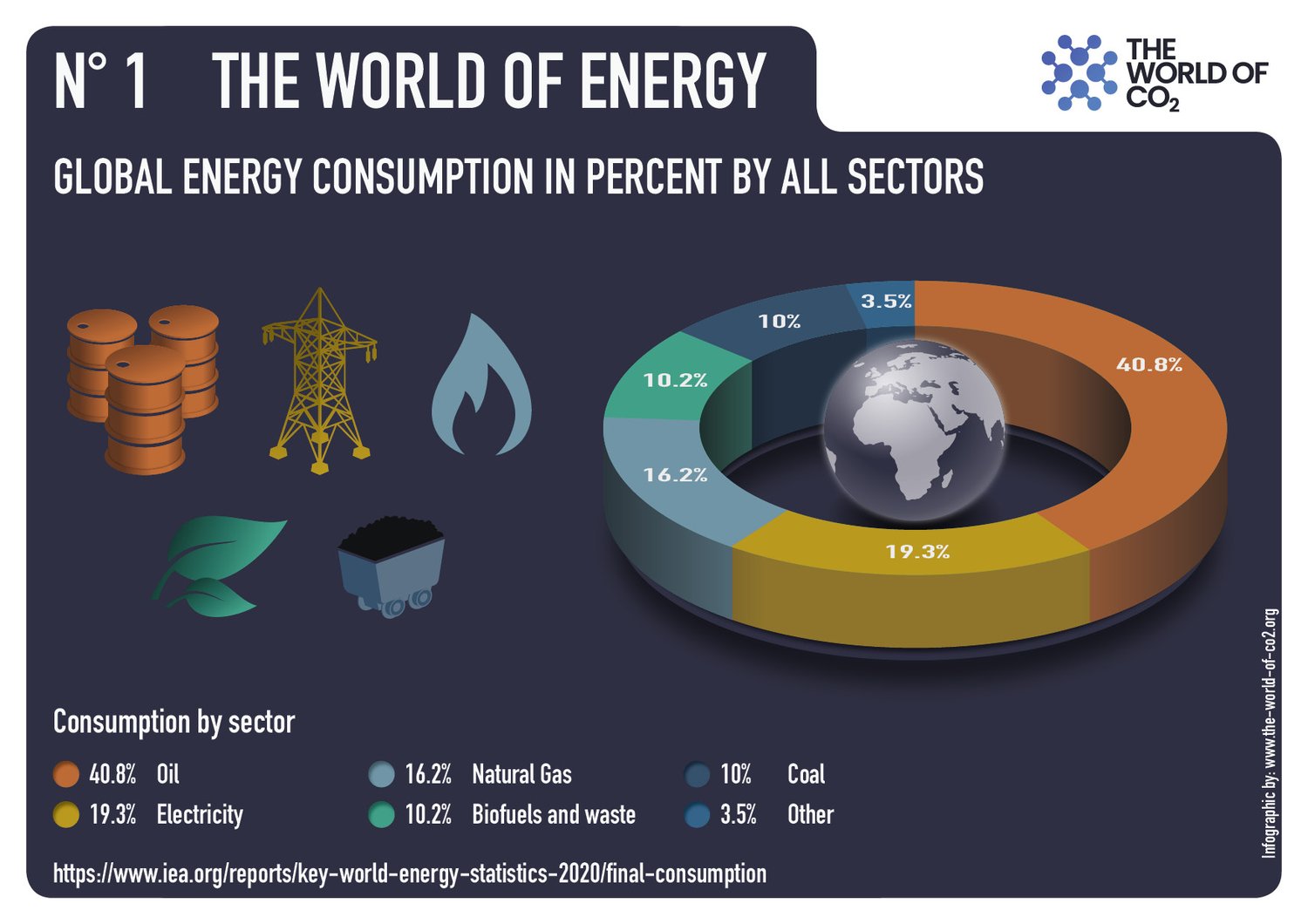
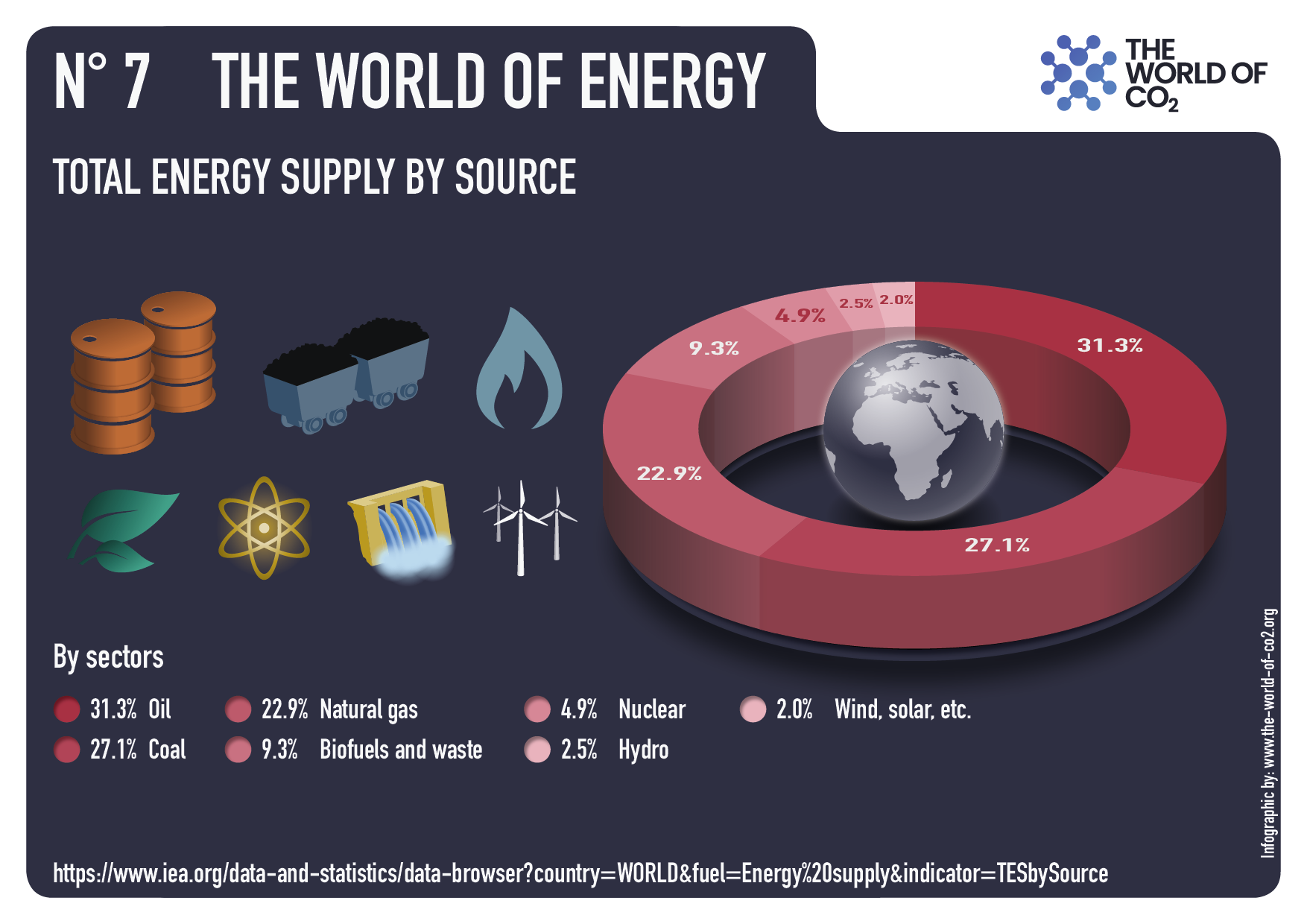
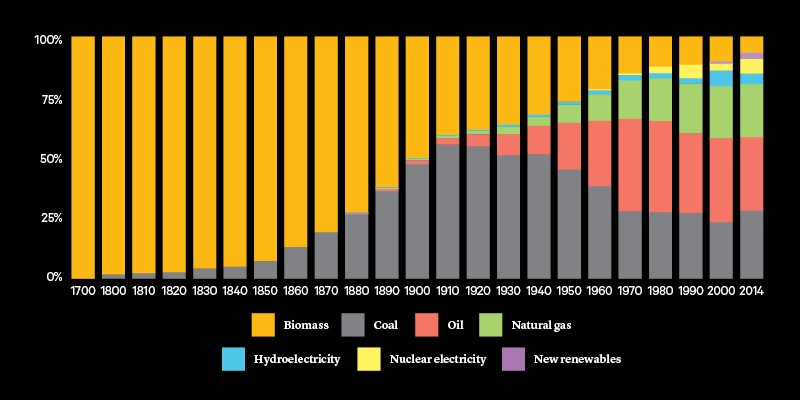
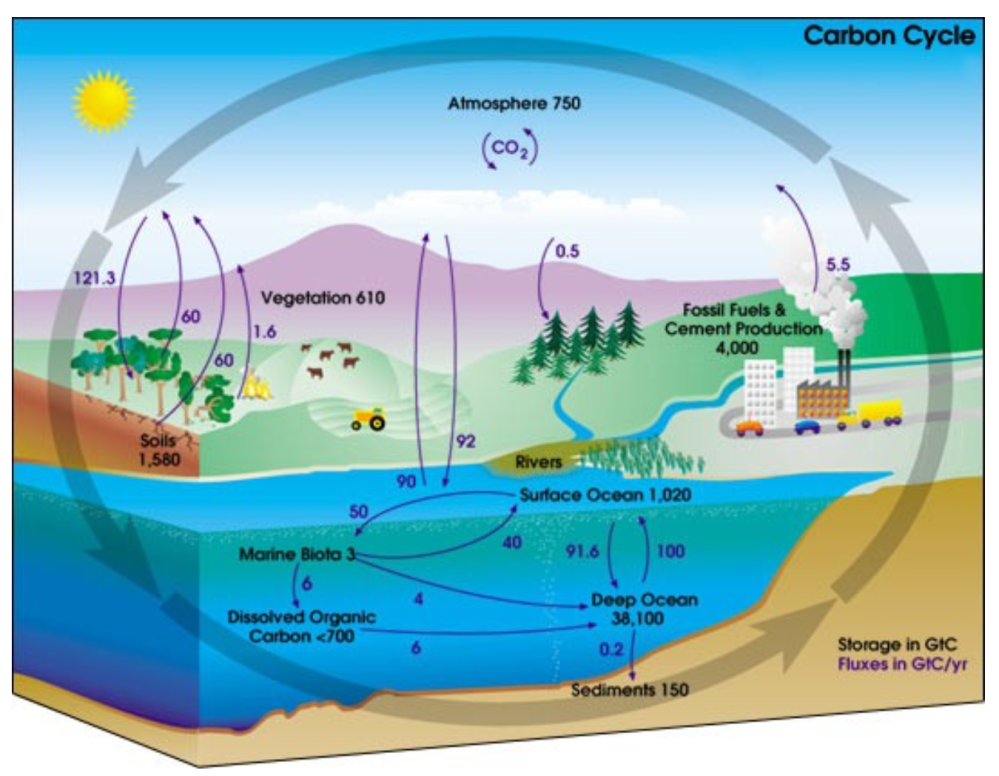
Not only is this impractical—we get over 80% of the world’s energy from fossil fuels—it’s not scientifically possible. That’s because CO2 doesn’t disappear from the atmosphere in a few days like, say, smog. It hangs around for a really long time.

About 60 percent of any CO2 that we emit today will remain in the atmosphere 20 years from now, between 30 and 55 percent will still be there after a century, and between 15 and 30 percent will remain after one thousand years.

In other words, it takes centuries for the excess carbon dioxide to vanish from the atmosphere. So, any partial reductions in CO2 emissions would only slow the increase in human influences—not prevent it, let alone reverse it.

CO2 is not a knob that we can just turn down to fix everything. We don’t have that ability. To think that we do is… hubris.

Hubris leads to bad decisions.  A little humility and
a little knowledge would lead to better ones.

I’m Steve Koonin, former Undersecretary for Science in the Obama Administration, and author of Unsettled: What Climate Science Tells Us, What It Doesn’t, and Why It Matters, for Prager University.

Addendum  Fossil Fuels and Greenhouse Gases (GHGs) Climate Science

Professors Lindzen, Happer and Koonin CO2 Coalition Paper April 2024

Table of Contents

I. THERE WILL BE DISASTROUS CONSEQUENCES FOR THE POOR, PEOPLE WORLDWIDE, FUTURE GENERATIONS AND THE WEST IF FOSSIL FUELS, CO2 AND OTHER GHG EMISSIONS ARE REDUCED TO “NET ZERO”

A. CO2 is Essential to Our Food, and Thus to Life on Earth
B. More CO2, Including CO2 from Fossil Fuels, Produces More Food.
C. More CO2 Increases Food in Drought-Stricken Areas.
D. Greenhouse Gases Prevent Us from Freezing to Death
E. Enormous Social Benefits of Fossil Fuels
F. “Net Zeroing” Fossil Fuels Will Cause Massive Human Starvation by Eliminating Nitrogen Fertilizer

II. THE IPCC IS GOVERNMENT CONTROLLED AND THUS ONLY ISSUES GOVERNMENT OPINIONS, NOT SCIENCE

III. SCIENCE DEMONSTRATES FOSSIL FUELS, CO2 AND OTHER GHGs WILL NOT CAUSE CATASTROPHIC GLOBAL WARMING AND EXTREME WEATHER

A. Reliable Science is Based on Validating Theoretical Predictions With Observations, Not Consensus, Peer Review, Government Opinion or Cherry-Picked or Falsified Data
B. The Models Predicting Catastrophic Warming and Extreme Weather Fail the Key Scientific Test: They Do Not Work, and Would Never Be Used in Science.
C. 600 Million Years of CO2 and Temperature Data Contradict the Theory That High Levels of CO2 Will Cause Catastrophic Global Warming.
D. Atmospheric CO2 Is Now “Heavily Saturated,” Which in Physics Means More CO2 Will Have Little Warming Effect.
E. The Theory Extreme Weather is Caused by Fossil Fuels, CO2 and Other GHGs is Contradicted by the Scientific Method and Thus is Scientifically Invalid


Canada’s Choice: Elite Globalist or Common Sense Canadian

Trump will soon fill a 4-year WH vacancy known as the “Biden/Harris Administration.” Meanwhile federal governance in Ottawa is shut down by Trudeau resigning without leaving but also suspending parliament.  There being no one at the helm is eerily similar to the US adrift, and a fitting close to the Trudeau decade. Jamie Sarkonak goes to the core of the upcoming election in his National Post article It doesn’t matter to Mark Carney if Canada survives.  Excerpts in italics with my bolds and added images

As a member of the global elite, he will always be free
from the consequences of his political actions.

The problem Mark Carney, likely Liberal leader-to-be, will always run into is this: his fate doesn’t depend on a successful Canada.
Carney announced his leadership run Thursday. Odds are good he’s going to win. He’s not as recognizable as his only real competition, potential candidate and former finance minister Chrystia Freeland, but he doesn’t share her bruised record of inflating the deficit to multi-billion dollar highs, and last week’s polling shows that more people are open to voting for him than for her.

I hope he wins the party’s support. The Liberals aren’t likely to resonate with the population by running an out-of-touch cabinet minister in the next federal election — and they’re certainly less likely to do so by running an out-of-touch global elite who left small-time federal politics behind for a career at the pinnacle of international poshdom.

Yes, Carney is Canadian. But he’s also a citizen of Ireland,
and through it the European Union,
as well as a national of the United Kingdom.

He can leave this country any time he wants, and he already has: after serving as governor of the Bank of Canada from 2008 to 2013, he moved on to head the Bank of England. Now, he’s embedded in the international ecosystem as a climate finance adviser at the United Nations (among other things, he’s a strong advocate for mandatory climate disclosures by banks).

Oh, and according to his World Economic Forum bio — another mark of borderless eliteness — he is also the following: “an external member of the Board of Stripe, a member of the Global Advisory Board of PIMCO, Harvard University, Rideau Hall Foundation, Bilderberg, the boards of Bloomberg Philanthropies, the Peterson Institute for International Economics, the Hoffman Institute for Global Business and Society at INSEAD, Cultivo, as well as Senior Counsellor of the MacroAdvisory Partners, Advisor of the Watershed, and Chair of Chatham House, the Group of Thirty and also Advisory Board Chair for Canada 2020.”  Us rubes have no idea what most of that even means.

Carney might call himself an “outsider,” and it’ll be true — in the sense that he is not currently in the Trudeau government’s cabinet. But he’s still very much an elite, one who has advised the Liberal party, and one whose well-being doesn’t depend on local happiness and prosperity.

And everyone filling out a ballot next election will know it.

Different people have different terms for this. Freeland wrote a book on the new richesse mondiale, calling them plutocrats. Circa 2013, she was warning the rest of us that the global plutocracy might one day end up turning into a system of crony capitalist “insiders”; perhaps an aristocracy. Carney’s not Bill-Gates rich, but he’s still part of the global upper class.

Chrystia Freeland is also a Trustee on the WEF Board.

Former prime minister Stephen Harper put it in more digestible terms in his 2018 book, “Right Here, Right Now”: there are people who live “anywhere,” and there are people who live “somewhere.” “Anywheres” are cosmopolitan types who usually have professional, internationally oriented careers. “Somewheres” live and work closer to where they grew up, and share more of their values with people of a similar, localized background. The former tends to look down on nationalism; the latter depends on it.

Carney counts among the “anywheres” of Canadian society; yes, he’s got the passport, but he’s got more in common with a foreign banking executive who makes an annual Davos pilgrimage than he does with regular Superstore-shopping Canadians.

We “somewheres,” on the other hand, can’t just up and leave
in the face of turmoil because our entire life is here.

Our friends and families are here. Our savings and investments (if we have them) are in CAD; our partly-paid mortgages are tied to Canadian land; our children’s education depends on the quality of Canadian schools; our safety depends on Canadian laws; our job prospects suffer when low-wage foreign labour is allowed to flood our local markets. We’re not being forced to leave, but the price of relocating is prohibitively high.

Carney’s Monday appearance on Jon Stewart’s Daily Show was revealing in that way: he targeted his pre-audition pitch to the world through an American late-night show that treated him with the same humorous fascination as it would a fuzzy exotic animal. It was a soft and unserious interview because the people our former central banker is campaigning toward aren’t Canadian and aren’t witnessing the country’s dire situation firsthand.

Poilievre’s appearances on Dr. Jordan Peterson’s American-produced podcast were of a whole different category; both men are Canadian and can talk about Canadian issues with the weight and care they deserve.

None of this is to say that the upper crust of society should stay out of politics — many great leaders come from the elite class, including on the conservative side of politics. But after years of regular Canadians being the low-priority afterthought of a trust-fund supported, second-generation prime minister who seemed happiest at G7 photoshoots and Gavin-Newsom meetups, the animal spirits are hungering for a leader who truly has skin in the game.

And yes, I’d count Conservative Leader Pierre Poilievre among the “somewheres.” He’s had an entirely Canadian career, he isn’t gunning for CV-padding UN advisory roles, his ongoing career doesn’t depend on pleasing the moral sensibilities of the world’s politically active, post-national liberals, and he doesn’t seem to think that pre-election media courting should be performed for an international audience.

If the ship that is Canada starts sinking — and it’s been sitting alarmingly low in recent years most of us are going down with it. Not Carney, who has and always will have a premium life raft, ready to isolate him from the consequences of his political actions. Which is exactly why I can’t wait to see him run.