Sorting (Again) Climate and Weather Changes

Brian C. Joondeph asks in his American Thinker Article When Did Changing Weather Become Climate Change? Excerpts in italics with my bolds and added images.
What’s the difference between weather and climate? Let’s ask the expert class, the governmental National Weather Service.

Weather is defined as the state of the atmosphere at a given time and place, with respect to variables such as temperature, moisture, wind speed and direction, and barometric pressure.

Climate is defined as the expected frequency of specific states of the atmosphere, ocean, and land, including variables such as temperature, salinity, soil moisture, wind speed and direction, and current strength and direction. It encompasses the weather over different periods of time and also relates to mutual interactions between the components of the earth system (e.g., atmospheric composition, volcanic eruptions, changes in the earth’s orbit around the sun, and changes in the energy from the sun itself).

That’s a mouthful, a typical governmental explanation. Simply put, weather is short-term, meaning days or a few weeks, while climate is long-term, meaning years, centuries, or longer. [Comment: I prefer a baseball analogy: Weather is like the batter swinging in the box, and climate is the batting statistics, hits, walks, RBIs etc.]

It’s sunny and unseasonably warm where I am today, but a week ago, it was snowy and unseasonably cold. A climate warrior might label the former as global warming, the latter as global cooling, or the composite as climate change. A rational person would call it weather.

The United Nations (UN) defines climate change,

Climate change refers to long-term shifts in temperatures and weather patterns. Such shifts can be natural, due to changes in the sun’s activity or large volcanic eruptions. But since the 1800s, human activities have been the main driver of climate change, primarily due to the burning of fossil fuels like coal, oil and gas.

The first sentence is undeniably true. The Great Lakes were once covered by mile-thick ice sheets that disappeared when the glaciers retreated 10,000 years ago. This is not long ago, considering the Earth’s 4.5 billion-year age.

Somehow, the climate cooled and warmed long before any significant human activity existed. And how many additional times did this happen in the past 4.5 billion years?

But the UN believes humans are the “main driver of climate change” since the 1800s, not explaining how climate changed so drastically 10,000 years ago to melt a mile-thick ice sheet during a time of minuscule human activity.

The UN relies on the Intergovernmental Panel on Climate Change (IPCC), that reports in a scary fashion,

Many of the changes observed in the climate are unprecedented in thousands, if not hundreds of thousands of years, and some of the changes already set in motion—such as continued sea level rise—are irreversible over hundreds to thousands of years.

Is today’s climate “unprecedented”? Do they know the temperatures hundreds of thousands of years ago? They should, as this data is readily available, published in the prestigious journal Science.

Researchers reconstructed global mean surface temperature using data assimilation, integrating geological data with climate model simulations. They discovered that “the Earth’s temperature has varied more dynamically than previously thought.”

PhanDA global mean surface temperature across the last 485 million years. The gray shading corresponds to different confidence levels, and the black line shows the average solution. The colored bands along the top reflect the climate state, with cooler colors indicating icehouse (coolhouse and coldhouse) climates, warmer colors indicating greenhouse (warmhouse and hothouse) climates, and the gray representing a transitional state. Source: Judd et al 2024

Today’s global temperature is low. It was last this cold 300 million years ago. According to the chart, Planet Earth has been cooling for the past 50 million years. Any man-made warming would be helpful now.

Scientists should know better, as should corporate media.
But obviously, they don’t.

I reference a few articles from this year in The Guardian, a two-hundred-year-old British newspaper considered a “newspaper of record in the UK” (along with the London Times), much like The New York Times in America. As a British newspaper, the Guardian has observed climate change firsthand, reporting on it cooling, then warming, then cooling again.

Another record is the recent (in geological terms) history of the Thames River. Between 1309 and 1814, it froze at least 23 times. There was a “frost fair” in 1608 when the river froze for over six weeks.

What caused this freeze? London’s activity in the 1600s was mainly overcrowding, disease, and crime, not air conditioners, internal combustion engines, and backyard grills.

More recently, the river froze over in 1963 and again partially in 2021. This seems to be normal cyclic climate change, far from the “man-made global warming” the UN and IPCC warn about.

The Guardian ran two stories this year without a bit of irony. In February of this year, their headline was “What will Spain look like when it runs out of water? Barcelona is giving us a glimpse.” In October, the new headline was “Spain floods: number killed passes 150 as scientists say climate change ‘most likely explanation’ – as it happened.”

From running out of water to flooding, all within a few months. It’s dry, then it’s wet. It’s cold, then it’s warm. And vice versa. It’s also normal. But The Guardian wants it both ways. It’s all climate change, in their view.

A month ago, the paper wrote, “Spain’s deadly floods and droughts are two faces of the climate crisis coin.” In other words, all forms of weather are climate change.

CNN wants it both ways, too. In December 2023, it ran a headline, “Winter is here, but it’s losing its cool.” One year later, without a bit of irony or introspection, it reversed itself with this headline, “It’s about to get dangerously cold, even for winter.”

Much like racism, when everything is considered racist, then nothing is. The same is true for climate change. Psychologists call this confirmation bias,

People display this bias when they select information that supports their views, ignoring contrary information, or when they interpret ambiguous evidence as supporting their existing attitudes. The effect is strongest for desired outcomes, for emotionally charged issues, and for deeply entrenched beliefs.

It is also hubris to believe that we can predict, much less control, the climate. The IPCC readily admits, “The climate system is a coupled non-linear chaotic system, and therefore, the long-term prediction of future climate states is impossible.”

Yet Al Gore, Greta Thunberg, John Kerry, and other “climate experts” claim to know exactly how many years it will be until the Earth is uninhabitable.

Speaking of Al Gore, I recommend Joel Gilbert’s new film, “The Climate According to AI Al Gore,” where Joel interviews an AI Gore, debunking Gore’s conviction, expertise, and the entire climate emergency of the left.

To the fearmongering, climate-catastrophizing left, it’s all humans’ fault, and with ever-increasing command-and-control diktats, rules, regulations, and taxes, we can affect forces beyond our comprehension and control.

The climate is indeed changing—it always has and always will. Temperatures will likely rise from their current 500 million-year low regardless of what the so-called experts, activists, or any world government agencies say or do.

In their attempts to regulate and tinker with Mother Nature, they may inadvertently destroy everything they are attempting to save—unless that’s the plan.

Previous Post: Corrupting Climate and Weather

An article at The Spectator raises the question Do alarmists know the difference between weather and climate?  The author Charles Moore may also be a man for all seasons like Sir Thomas More.  Excerpts in italics with my bolds and images.

A lot of clever people are putting the ‘green’ into ‘greenbacks’

Until recently, those expressing skepticism about climate change catastrophe have been hauled over the coals (or the renewables equivalent) for not understanding the difference between ‘climate’ and ‘weather’. The lack of global warming at the beginning of the 21st century was not to be taken, chided the warmists, as evidence that climate change was not happening. Weather was the passing phenomenon of each day: climate was the real, deep thing.

Now, however, the alarmists themselves have elided the two concepts, using the Australian bush fires as their cue. As Sir David Attenborough puts it: ‘The moment of crisis has come’. They could be right, of course, but how could they really know? In this sense, President Trump is surely justified in warning, at Davos, against the ‘Prophets of Doom’. Prophecy is a different skill from an exact understanding of the here and now.

Mr Trump might usefully have talked about the Profits of Doom too. If the movement can persuade western society that the climate emergency is upon us, there are enormous sums to be made by people who claim to be able to remedy it. Hence the patter now coming out of companies such as Blackrock, BP or Microsoft, fanned by Mammon’s public intellectuals, such as Mark Carney. A lot of clever people are putting the ‘green’ into ‘greenbacks’. A lot of less clever investors are going to get their fingers burnt.

See Also Stoking Big Climate Business

Footnote:  Case in Point:  Green Fraudsters Plead Guilty

Jeff Carpoff, 49, of Martinez, pleaded guilty today to conspiracy to commit wire fraud and money laundering. His wife, Paulette Carpoff, 46, pleaded guilty today to conspiracy to commit an offense against the United States and money laundering. According to court documents, between 2011 and 2018, DC Solar manufactured mobile solar generator units (MSG), solar generators that were mounted on trailers that were promoted as able to provide emergency power to cellphone towers and lighting at sporting events. A significant incentive for investors were generous federal tax credits due to the solar nature of the MSGs.

The conspirators pulled off their scheme by selling solar generators that did not exist to investors, making it appear that solar generators existed in locations that they did not, creating false financial statements, and obtaining false lease contracts, among other efforts to conceal the fraud. In reality, at least half of the approximately 17,000 solar generators claimed to have been manufactured by DC Solar did not exist.

“By all outer appearances this was a legitimate and successful company,” said Kareem Carter, Special Agent in Charge IRS Criminal Investigation. “But in reality it was all just smoke and mirrors — a Ponzi scheme touting tax benefits to the tune of over $900 million. IRS CI is committed to investigating those who take advantage and impact the financial well-being of others for their own personal gain.”

“The Federal Deposit Insurance Corporation, Office of Inspector General (FDIC-OIG) is pleased to join our law enforcement colleagues in announcing these guilty pleas,” stated Special Agent in Charge Wade Walters for the FDIC OIG San Francisco Regional Office. “The defendants conspired with others to create a fraudulent business venture that duped unsuspecting entities, including banks, to invest approximately $1 billion, which the two later used to support a lavish lifestyle.

Source:  https://wattsupwiththat.com/2020/01/27/dc-solar-owners-plead-guilty-to-largest-ponzi-scheme-in-eastern-california-history/

Unsettled Science: How Sun’s Fluxes Affect Our Climate

John Green writes at American Thinker Why are we studying the sun, if the science is settled? Excerpts in italics with my bolds and added images.

NASA’s Parker solar probe just completed one of its primary multi-year mission objectives, with the closest ever approach to the Sun. On Christmas Eve, the probe flew through the Sun’s corona at a blistering (literally and figuratively) 430,000 mph. For aircraft buffs, that’s Mach 560 — fast enough to circle the earth in about 3 minutes!

NASA’s Closest Approach to the Sun’s Fiery Surface Achieved by Parker Probe

A faint signal from Parker indicates that it survived its scorching flyby, and scientists are expecting it to download a treasure trove of data later this month. It turns out there’s a lot the guys with the PhDs don’t understand about the sun. As NASA states:

The NASA Parker Solar Probe mission is a mission designed to help humanity better understand the Sun, where changing conditions can propagate out into the solar system, affecting Earth and other worlds. As such, the primary goals are to examine the acceleration of solar wind through the movement of heat and energy in the Sun’s corona in addition to study solar energetic particles.

They’re hoping data collected while flying through the Sun’s corona will provide a few answers and make it a bit more predictable.

I confess I’m just a lowly engineer, and many of the mysteries they’re trying to unravel are well beyond my college physics courses. But reading about the Parker probe got me wondering: Doesn’t the Sun have something to do with our weather? I mean it’s warm on sunny days, and plants grow better when the earth’s surface is the closest to the Sun.

Those observations may sound obtuse, but they’re no more obtuse than “experts” saying that “climate science is settled” — when they don’t understand how the freaking Sun works! (Looking at you “Science Guy” Bill Nye.)

The science can only be settled when the smart guys understand all the factors that affect our climate — and how they interact — well enough to predict outcomes. The Sun imparts about 342 watts of energy on every square meter of the earth’s surface (according to NASA). That’s the equivalent of 44 million average electric power plants (700 times what the world has) — yet we don’t understand its fluctuations.

That’s a rather big unpredictable factor for this supposedly “settled science” — no?

One can only conclude that when highly educated people — who should know better — claim climate science is settled, they’re lying. Perhaps that’s why multiple predictions that the polar bears would be extinct and New York would be underwater by now have all been wrong. It might also explain why the greenies avoid discussion of ice ages and interglacial periods when assuring us that our cars are delivering planetary doom – while their private jets are perfectly fine.

Given what little we know about the Sun, the anthropogenic climate change “experts” are either:

  • Ignorant men, succumbing to irrational fears — placing superstition above science, or
  • Evil men — profiting by scaring us into irrational behavior.

We should keep that in mind when they insist that we halt progress, live in destitution, and scare our children that apocalypse is imminent. Our only rational response is to ignore them … and cut off their funding.

Yes, IPCC, Our Climate Responds to Our Sun

John Gideon Hartnett writes at Spectator Australia The sun is in control of our oceans. Text is from John Ray at his blog, excerpts in italics with my bolds and added images.

In recent years, there has been observed an increase in ocean temperature. Those who adhere to the Climate Change version of events say that the oceans are getting warmer because of trapped carbon dioxide (CO2) in the atmosphere causing a massive greenhouse effect leading to boiling oceans.

Well, anyone who has a brain knows that the oceans are not boiling, but let’s assume that is just hyperbole. When actual research – when actual measurements were taken – reality turns out to be the exact opposite.

New research shows that the temperature of our oceans are controlled by incident radiation from the Sun. Who would have guessed?

And as a consequence of the oceans warming, dissolved carbon dioxide gas is released due to reduced is solubility in ocean water. This means the warming of the oceans would lead (or cause) an increase in CO2 concentration in the atmosphere.  One of the researchers in the study wrote on X.com:

A decrease in cloud cover and albedo means more short wavelength (SW) solar radiation reaches the oceans. Albedo is the reflectivity of the Earth. Lower albedo means more sunlight reaching the land and oceans and more warming by the Sun.

Figure 8. Comparison between observed global temperature anomalies and CERES-reported changes in the Earth’s absorbed solar flux. The two data series representing 13-month running means are highly correlated with the absorbed SW flux explaining 78% of the temperature variation (R2 = 0.78). The global temperature lags the absorbed solar radiation between 0 and 9 months, which indicates that climate change in the 21st Century was driven by solar forcing.

I mean to say that this is so obvious. The Sun heats Earth’s surface of which 71% is covered by the oceans! Basic physics!

The energy from the Sun powers all life on the planet and causes all Earth changes. Every second, the Earth receives the equivalent energy of 42 megatons of TNT in radiation from the Sun. That cannot be ignored. 

Climate Change, the ideological movement which I prefer to call a cult, views all evidence through the lens of their religious belief that the Earth is warmed by human activity. That activity releases carbon dioxide gas, which has been observed to be increasing. Their belief is that CO2 traps heat in a giant greenhouse effect. That is the dogma anyway. And I must add, we all are the carbon they want to eliminate.

But how much of that observed increase in CO2 is actually from natural causes and not from human activity? At least 94 per cent is. This new evidence now suggests it could be even more than that.

If the oceans emit CO2 gas following changes in the water temperature, which this research shows is due to the amount (flux) of solar radiation reaching the surface, then more CO2 comes from natural causes.

It is basic physics that as you heat water the dissolved gases are released due to a decrease in gas solubility. This means as the solar flux increases CO2 gas is released from the warmer ocean water.

Thus an ocean temperature increase leads to an increase in CO2 in the atmosphere, and not the other way around.

Space weather impacts the ionosphere in this animation. Credits: NASA/GSFC/CIL/Krystofer Kim

Simpleton’s Guide to Climate Alarmist Protests

Rex Murphy wrote a National Post article in 2023 The simpleton’s guide to climate alarmist protest.  Excerpts in italics with my bolds and added images.
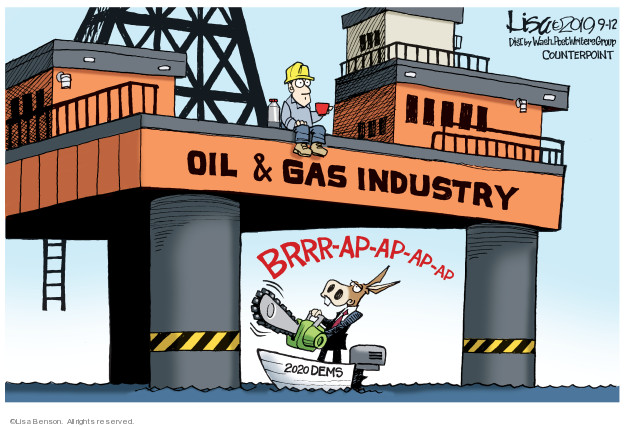
Glue yourself to a masterpiece or throw paint on a building.
If that doesn’t hold off climate Armageddon, what will?

The quality of truth in an existential cause may be measured by the quality of the intellects of its most committed followers. Allow me to illustrate.

Imagine the fumings of a climate alarmist. Here, a representation of what goes on in the alarmist mind.

The world is in deep imminent threat.

It may end.

Our beautiful, blue, penguin-marching-David Attenborough-marble may be no more.

All life will disappear. Farewell soy milk. Farewell shocking pink hair dye. Farewell all.

Climate activists in front of police officers during the Extinction Rebellion protest in London [Henry Nicholls/Reuters]

What can I do?

Why, I can call out from every hollow my comrade eco-warriors. Come in a black mask, or strip to your unsightly nudity when you get there, will be the summons.

And what is the plan that I and my fellow eco-doomsters have to avert planetary extinction?

We are, above all, strategists and tacticians. We know what earns quality
and never-challenged coverage on NPR and festivals of authentication from CBC
.

Protesters march on Russell Street in Melbourne, Australia [Darrian Traynor/Getty Images]

That is why we organize the type of protests that we do. Direct actions and exhibitionist displays — stripping down at awards shows — that speak to the farmer, the logger, the fisherman, the movie star falling from favour, or the sad professor who does not have Jordan Peterson’s reach and fame.

Our protests are aimed at persuasion, credibility, their appeal to Steven Guilbeault. Before Steven became our environment minister, he once climbed atop then-premier Ralph Klein’s home in Calgary to “install” solar panels. Even though it terrified Klein’s wife, who thought it was a home invasion, it was a great moment in the history of climate protest and an example for us even today. Steven, you are a hero, and you looked so good in those orange overalls. Greenpeace forever!

So when we want to avert the gravest challenge humanity has ever had to face, that is why we select actions that will — in the words of a very great writer — “strike home to every bosom.”

Is there a Monet or a Goya or a Munch or a Botticelli or a van Gogh in your city’s art gallery? Well, off to the hardware store and the supermarket. There is glue to be bought and cans of tomato soup to drop into the backpack.

Glue yourselves to the painting or throw the tomato soup over it. Doesn’t matter which.

When the world, on TV and the internet, sees these brave assaults on western art at its highest, you know everyone, just everyone, will park their cars, turn off the heat, refuse to buy anything with a petroleum base and insist that all the heads of oil companies and plastic manufacturers be put on trial for genocide, and Hollywood liberals will forsake their mansions and move to caves.

One of our very keenest moves happened over the weekend in Ottawa. An eco-warrior threw a bucket of pink paint on the Prime Minister’s Office and padlocked herself to a rail after the ritual half-undressing. A whole bucket of pink paint — if that doesn’t hold off climate Armageddon, what will?

A climate activist from On2Ottawa threw a bucket of pink paint on the entrance to the Prime Minister’s Office in Ottawa before chaining herself topless to the office door on April 18, 2023. Photo by On2Ottawa / Twitter

All on camera. So bold.

She did not — it is most necessary to add — honk! End of musing.

California-funded eco-activists sprayed orange paint on Christmas trees in seven German cities in a protest against government inaction on climate change. (2023)

We should measure the value of high-order environmental activism — IPCC stuff, Davos effluvia, anything Al Gore or David Suzuki so stridently say — by the quality of the minds and actions of their most intense supporters.

Climate protesters block traffic on the FDR during the morning commute Oct. 25, 2021 (Credit: Extinction Rebellion NYC)

By which I mean the “gluers” on paintings, the neuron-challenged street-blockaders, simpletons who smear soup on masterpieces, and — a great example — the dimwit(s) who think throwing paint on the PM’s office amounts to a persuasive, consciousness-raising tactic.

Instead of what everyone else knows it to be: a display of desperate intellectual incapacity, delusionary arrogance, and the “Hey-I’m-saving-the-world-so-I-can-be-as-stupid-and-supremely-annoying-to-anyone-as-I-f—-ing-well-choose” attitude of such world saviours.

Climate change protesters block downtown D.C. streets in hours-long protest (2019)

That’s the level of non-thought that supports most energetically and egregiously the high priests and savants of the net-zero fantasy. Measured by the standard of its pathetic protests, environmental alarmism is the religion of children, a sandbox for narcissists — regardless of how old they are.

US Supremes Hear Climate Lawfare Case to Stop Oil Railway

IER reports the news from December in article The Supreme Court Takes on a Case Involving the National Environmental Policy Act.  Excerpts in italics with my bolds and added images.

Key Takeaways

The Supreme Court recently heard a major case, Seven County Infrastructure Coalition v. Eagle County, Colorado, that will affect the scope of the National Environmental Policy Act (NEPA). The case concerns the permitting of a proposed Utah railway that would ship oil from the Uinta Basin, potentially quadrupling its oil production. The 88-mile Uinta Basin Railway would connect the oil fields of northeastern Utah to the national rail network running alongside 100 or so miles of the Colorado River to reach oil refineries on the Gulf Coast.  According to The Hill,  at issue is whether and when upstream and downstream environmental impacts should be considered as part of federal environmental reviews. The company behind the railway and a group of Utah counties appealed a lower court decision to the Supreme Court, arguing that those indirect impacts are beyond the scope of the federal reviews.

Background

The case concerns a rail line to support oil development and mineral mining. In 2021, the federal Surface Transportation Board (STB) issued a 3,600-page environmental impact statement to comply with NEPA and approved the rail line. The NEPA mandates that federal agencies assess the environmental effects of projects within their authority. Any major initiative that is managed, regulated, or authorized by the federal government must undergo a NEPA evaluation, a process that can span years and frequently exposes projects to legal challenges.

The STB analyzed the railway’s potential effects on local water resources, air quality, protected species, recreation, local economies, the Ute Indian tribe, and other factors. Environmental groups, however, sued the agency, saying that it failed to examine sufficiently how the railway might affect the risk of accidents on connecting lines hundreds of miles away and to assess emissions in “environmental justice communities” on the Gulf Coast from increased oil shipments, among other supposed shortcomings.

According to the Wall Street Journal editorial board, “a D.C. Circuit Court of Appeals panel sided with the plaintiffs and told the STB it must consider the line’s upstream and downstream effects even if they were hard to predict and beyond the control of the agency and developers. This includes the effects of oil shipments on Gulf Coast refiners and their contributions to climate change.” The appeals court ruling found that the federal STB violated the Endangered Species Act and the Interstate Commerce Commission Termination Act when it permitted the project.

Furthermore, the editorial board also explained that lower court judges—those on the D.C. and Ninth Circuits—ignored the Supreme Court’s past rulings and imposed arbitrary permitting requirements with no limiting principle. The STB lacks authority over Gulf Coast refiners and cannot prevent climate change.

Court Rulings Regarding NEPA

The Supreme Court has heard other related cases and held that agencies need not consider indirect and unpredictable impact, most recently in a 2004 case, Department of Transportation v. Public Citizen. In that case, the Supreme Court held that agencies need only analyze environmental impact with “a reasonably close causal relationship” over which they have “statutory authority” and which they can prevent.

In 2020, the Supreme Court green-lit approval for permits for the Atlantic Coast Pipeline after nearly seven years of litigation, but the pipeline was scrapped due to legal delays that raised project costs significantly. It takes an average of 4.2 years to litigate a NEPA challenge, which adds to the four or more years to obtain a federal permit. These delays are what frustrate investment in new projects, slowing job creation and economic expansion in the United States.

judge struck down a Montana coal mine permit because a federal agency did not consider the climate effects of coal combustion in Asia. Additionally, a 225-mile electric transmission line in Nebraska has been stuck in permitting for 10 years because a lower court invalidated a U.S. Fish and Wildlife permit.

Conclusion

The Supreme Court is tackling a case involving the scope of a federal environmental law, NEPA, that involves a rail line to move oil. In this case, lower courts agreed with environmental groups, who are challenging the government’s permit approval of the rail line. The case is instrumental to the issue of what should be considered when determining potential environmental damages. Congress recognizes that NEPA needs reform as delays over lawsuits have killed projects and dramatically increased their costs and it continues to debate ways to make federal permitting easier and quicker. Until that reform happens, however, Supreme Court Justices need to reign in the environmental limits of NEPA so that needed projects can progress in America.

Ocean Leads Cooling UAH December 2024

The post below updates the UAH record of air temperatures over land and ocean. Each month and year exposes again the growing disconnect between the real world and the Zero Carbon zealots.  It is as though the anti-hydrocarbon band wagon hopes to drown out the data contradicting their justification for the Great Energy Transition.  Yes, there was warming from an El Nino buildup coincidental with North Atlantic warming, but no basis to blame it on CO2.  

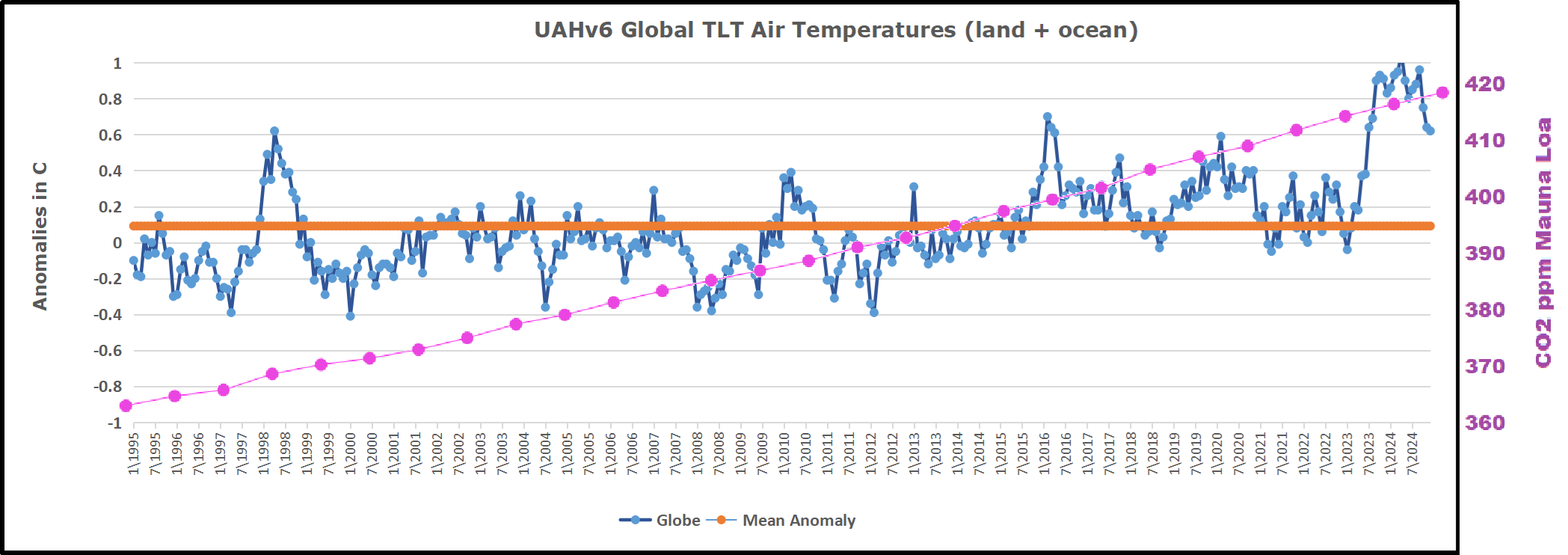
As an overview consider how recent rapid cooling  completely overcame the warming from the last 3 El Ninos (1998, 2010 and 2016).  The UAH record shows that the effects of the last one were gone as of April 2021, again in November 2021, and in February and June 2022  At year end 2022 and continuing into 2023 global temp anomaly matched or went lower than average since 1995, an ENSO neutral year. (UAH baseline is now 1991-2020). Now we have had an usual El Nino warming spike of uncertain cause, unrelated to steadily rising CO2 and now dropping steadily.

For reference I added an overlay of CO2 annual concentrations as measured at Mauna Loa.  While temperatures fluctuated up and down ending flat, CO2 went up steadily by ~60 ppm, a 15% increase.

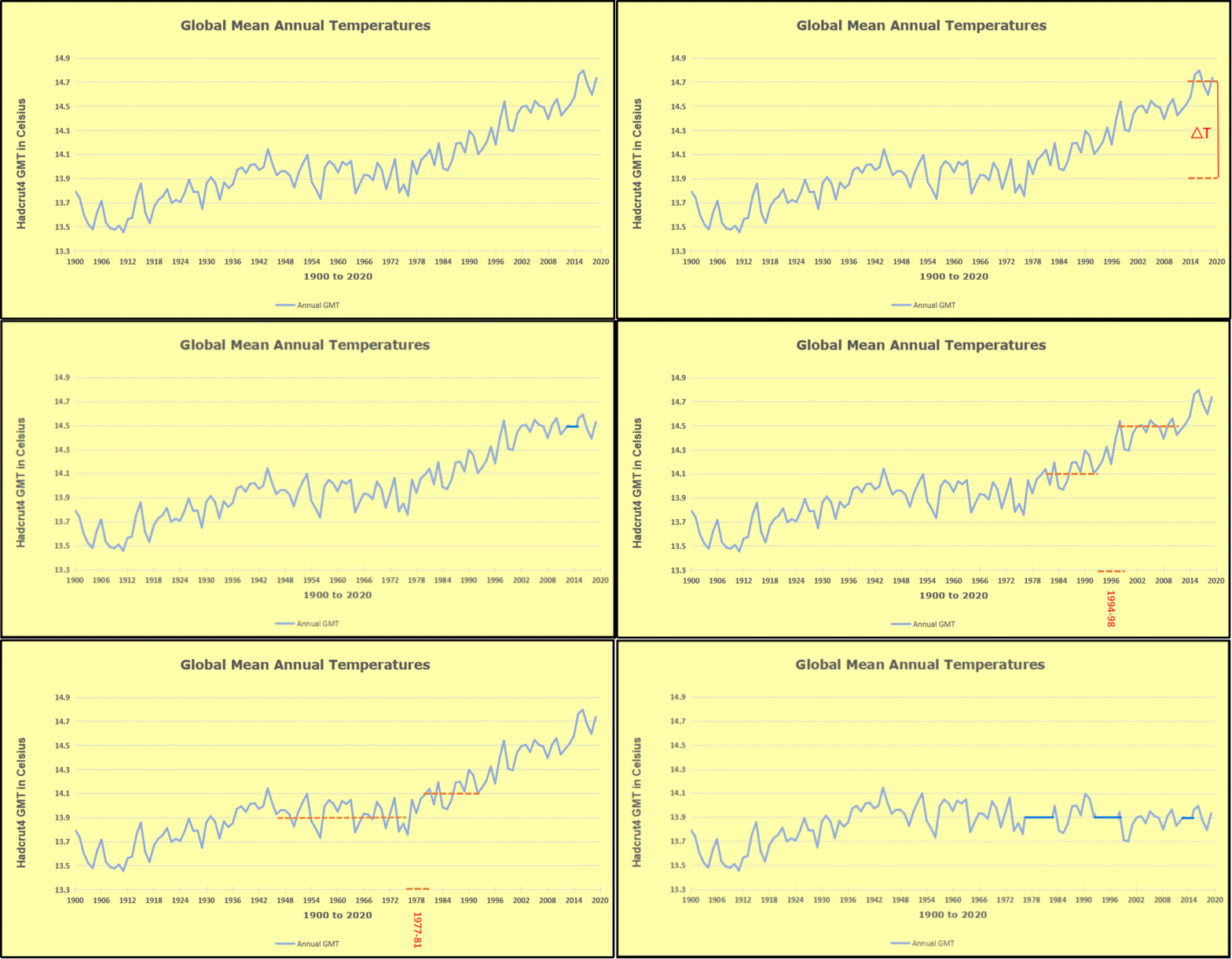
Furthermore, going back to previous warmings prior to the satellite record shows that the entire rise of 0.8C since 1947 is due to oceanic, not human activity.

gmt-warming-events

The animation is an update of a previous analysis from Dr. Murry Salby.  These graphs use Hadcrut4 and include the 2016 El Nino warming event.  The exhibit shows since 1947 GMT warmed by 0.8 C, from 13.9 to 14.7, as estimated by Hadcrut4.  This resulted from three natural warming events involving ocean cycles. The most recent rise 2013-16 lifted temperatures by 0.2C.  Previously the 1997-98 El Nino produced a plateau increase of 0.4C.  Before that, a rise from 1977-81 added 0.2C to start the warming since 1947.

Importantly, the theory of human-caused global warming asserts that increasing CO2 in the atmosphere changes the baseline and causes systemic warming in our climate.  On the contrary, all of the warming since 1947 was episodic, coming from three brief events associated with oceanic cycles. And now in 2024 we have seen an amazing episode with a temperature spike driven by ocean air warming in all regions, along with rising NH land temperatures, now dropping below its peak.

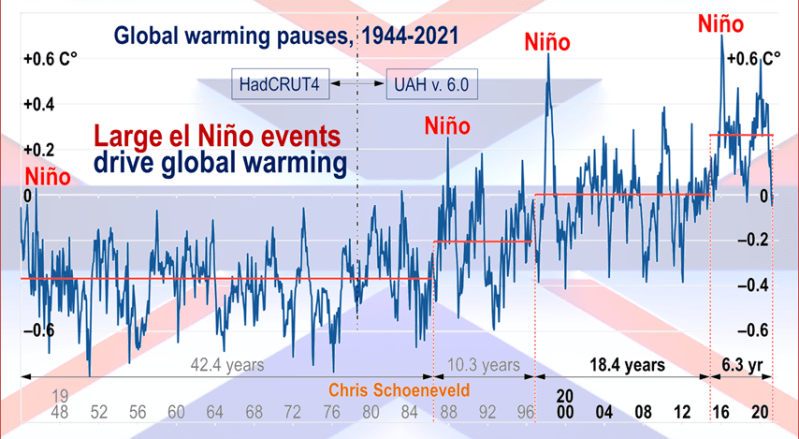
Chris Schoeneveld has produced a similar graph to the animation above, with a temperature series combining HadCRUT4 and UAH6. H/T WUWT

image-8


mc_wh_gas_web20210423124932

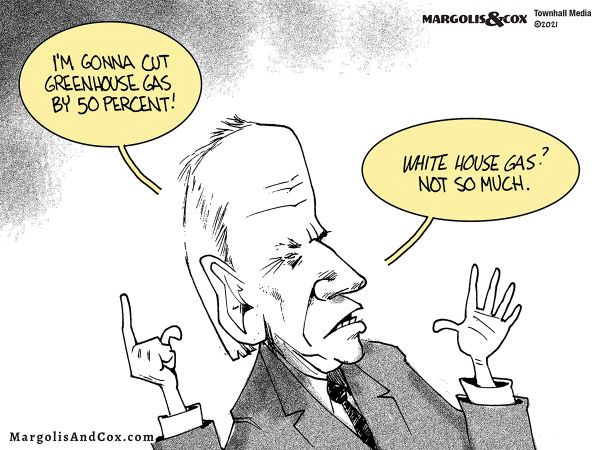
See Also Worst Threat: Greenhouse Gas or Quiet Sun?

December 2024 Ocean Leads Global Cooling banner-blog

With apologies to Paul Revere, this post is on the lookout for cooler weather with an eye on both the Land and the Sea.  While you heard a lot about 2020-21 temperatures matching 2016 as the highest ever, that spin ignores how fast the cooling set in.  The UAH data analyzed below shows that warming from the last El Nino had fully dissipated with chilly temperatures in all regions. After a warming blip in 2022, land and ocean temps dropped again with 2023 starting below the mean since 1995.  Spring and Summer 2023 saw a series of warmings, continuing into October, followed by cooling in November and December.

UAH has updated their TLT (temperatures in lower troposphere) dataset for December 2024. Due to one satellite drifting more than can be corrected, the dataset has been recalibrated and retitled as version 6.1 Graphs here contain this updated 6.1 data.  Posts on their reading of ocean air temps this month are ahead of the update from HadSST4.  I posted recently on SSTs Ocean Remains Cooler November 2024. These posts have a separate graph of land air temps because the comparisons and contrasts are interesting as we contemplate possible cooling in coming months and years.

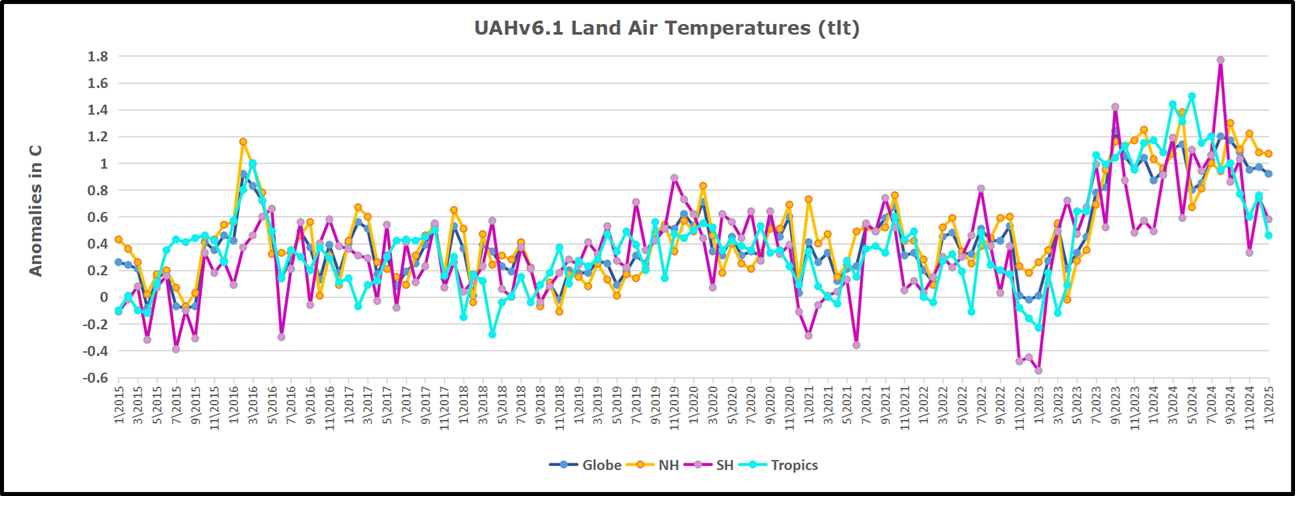
Sometimes air temps over land diverge from ocean air changes. In July 2024 all oceans were unchanged except for Tropical warming, while all land regions rose slightly. In August we saw a warming leap in SH land, slight Land cooling elsewhere, a dip in Tropical Ocean temp and slightly elsewhere.  September showed a dramatic drop in SH land, overcome by a greater NH land increase. In October, ocean and land temps in both NH and Tropics dropped, pulling the global anomaly down. Now in November and December there was cooling everywhere, except only SH and Tropics land temps.

Note:  UAH has shifted their baseline from 1981-2010 to 1991-2020 beginning with January 2021.   v6.1 data was recalibrated also starting with 2021. In the charts below, the trends and fluctuations remain the same but the anomaly values changed with the baseline reference shift.

Presently sea surface temperatures (SST) are the best available indicator of heat content gained or lost from earth’s climate system.  Enthalpy is the thermodynamic term for total heat content in a system, and humidity differences in air parcels affect enthalpy.  Measuring water temperature directly avoids distorted impressions from air measurements.  In addition, ocean covers 71% of the planet surface and thus dominates surface temperature estimates.  Eventually we will likely have reliable means of recording water temperatures at depth.

Recently, Dr. Ole Humlum reported from his research that air temperatures lag 2-3 months behind changes in SST.  Thus cooling oceans portend cooling land air temperatures to follow.  He also observed that changes in CO2 atmospheric concentrations lag behind SST by 11-12 months.  This latter point is addressed in a previous post Who to Blame for Rising CO2?

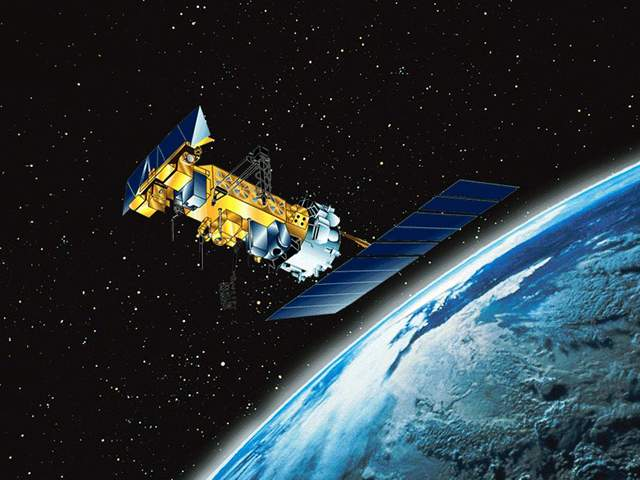
After a change in priorities, updates are now exclusive to HadSST4.  For comparison we can also look at lower troposphere temperatures (TLT) from UAHv6.1 which are now posted for December.  The temperature record is derived from microwave sounding units (MSU) on board satellites like the one pictured above. Recently there was a change in UAH processing of satellite drift corrections, including dropping one platform which can no longer be corrected. The graphs below are taken from the revised and current dataset.

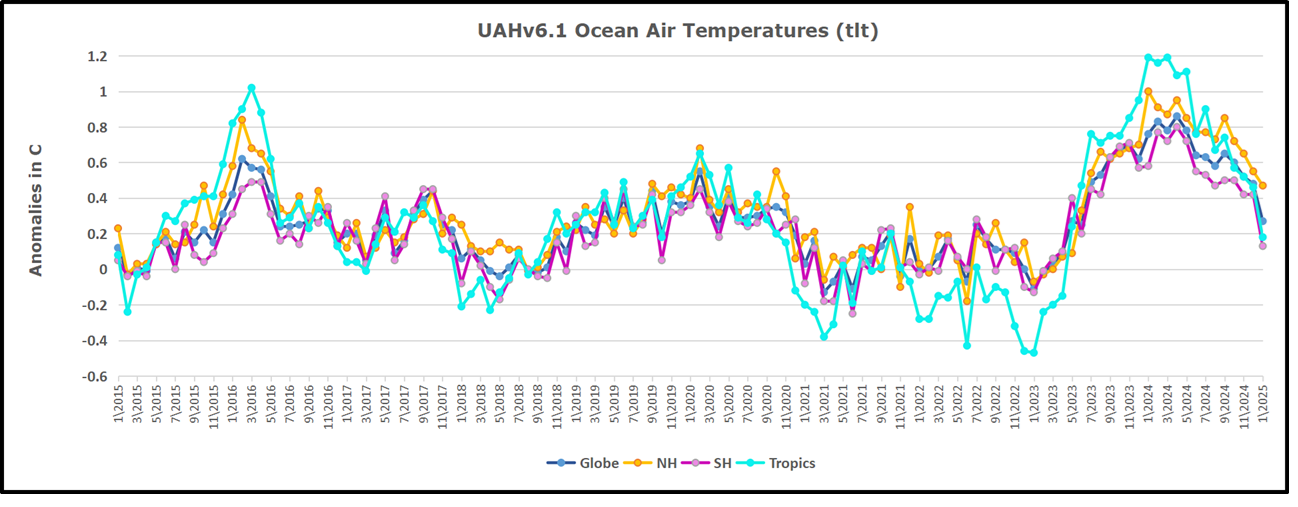
The UAH dataset includes temperature results for air above the oceans, and thus should be most comparable to the SSTs. There is the additional feature that ocean air temps avoid Urban Heat Islands (UHI).  The graph below shows monthly anomalies for ocean air temps since January 2015.

In 2021-22, SH and NH showed spikes up and down while the Tropics cooled dramatically, with some ups and downs, but hitting a new low in January 2023. At that point all regions were more or less in negative territory. 

After sharp cooling everywhere in January 2023, there was a remarkable spiking of Tropical ocean temps from -0.5C up to + 1.2C in January 2024.  The rise was matched by other regions in 2024, such that the Global anomaly peaked at 0.95C in May, Since then the Tropics and the Global anomaly have cooled down to 0.5C, as well as SH dropping down to 0.4C in December.

Land Air Temperatures Tracking in Seesaw Pattern

We sometimes overlook that in climate temperature records, while the oceans are measured directly with SSTs, land temps are measured only indirectly.  The land temperature records at surface stations sample air temps at 2 meters above ground.  UAH gives tlt anomalies for air over land separately from ocean air temps.  The graph updated for December is below.

Here we have fresh evidence of the greater volatility of the Land temperatures, along with extraordinary departures by SH land.  The seesaw pattern in Land temps is similar to ocean temps 2021-22, except that SH is the outlier, hitting bottom in January 2023. Then exceptionally SH goes from -0.6C up to 1.4C in September 2023 and 1.8C in  August 2024, with a large drop in between.  In November, SH and the Tropics pulled the Global Land anomaly further down despite a bump in NH land temps. December showed an upward rebound in SH and Tropics land temps, offset by a NH drop, leaving the Global land anomaly little changed.

The Bigger Picture UAH Global Since 1980

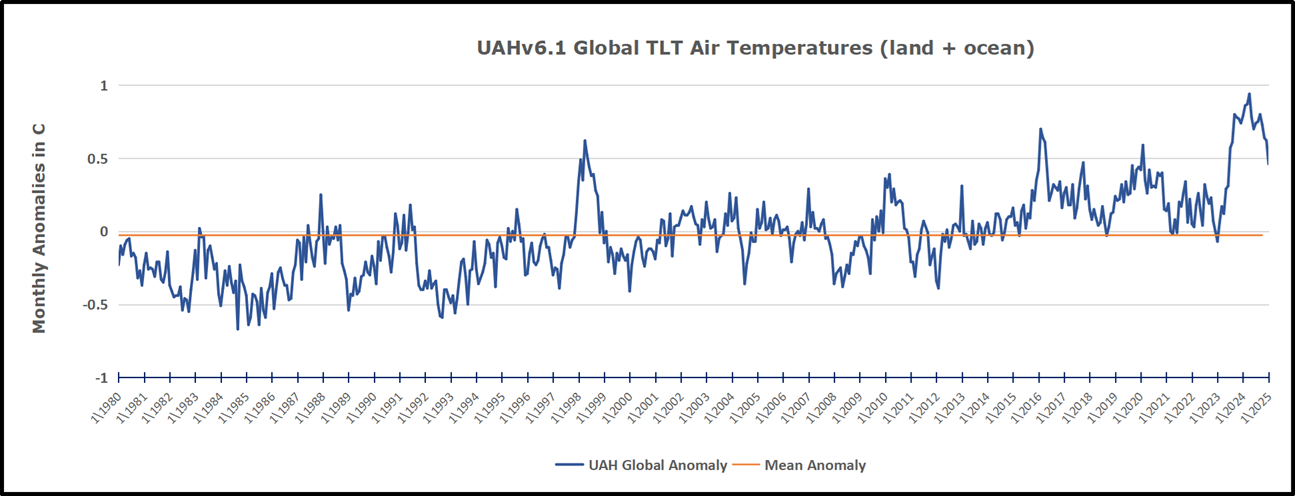
The chart shows monthly Global Land and Ocean anomalies starting 01/1980 to present.  The average monthly anomaly is -0.03, for this period of more than four decades.  The graph shows the 1998 El Nino after which the mean resumed, and again after the smaller 2010 event. The 2016 El Nino matched 1998 peak and in addition NH after effects lasted longer, followed by the NH warming 2019-20.   An upward bump in 2021 was reversed with temps having returned close to the mean as of 2/2022.  March and April brought warmer Global temps, later reversed

With the sharp drops in Nov., Dec. and January 2023 temps, there was no increase over 1980. Then in 2023 the buildup to the October/November peak exceeded the sharp April peak of the El Nino 1998 event. It also surpassed the February peak in 2016. In 2024 March and April took the Global anomaly to a new peak of 0.94C.  The cool down started with May dropping to 0.9C, and in June a further decline to 0.8C.  October went down to 0.7C,  November and December dropped to 0.6C. 

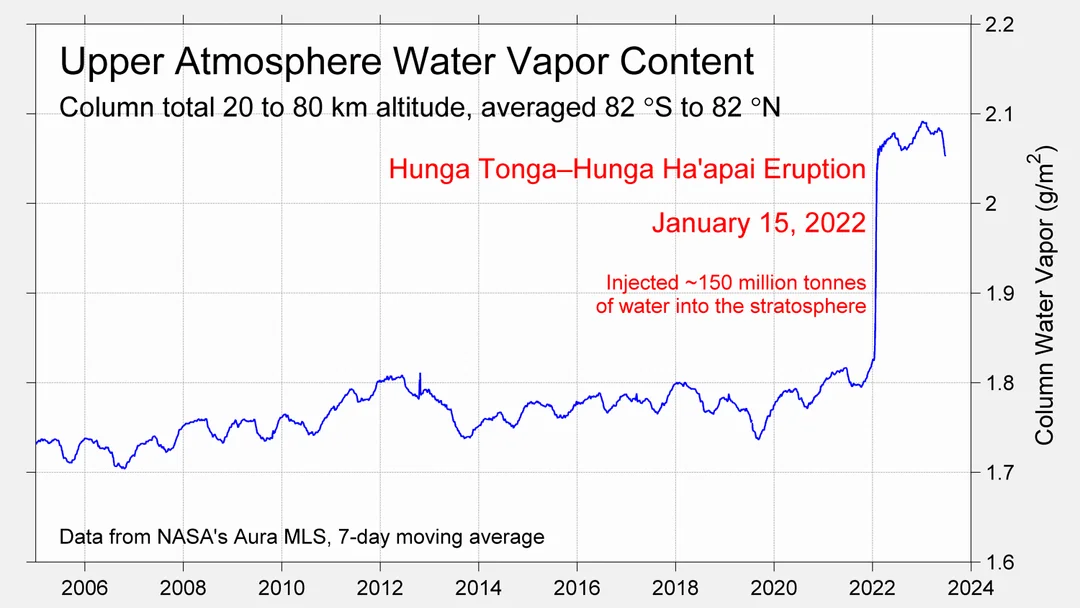
The graph reminds of another chart showing the abrupt ejection of humid air from Hunga Tonga eruption.

TLTs include mixing above the oceans and probably some influence from nearby more volatile land temps.  Clearly NH and Global land temps have been dropping in a seesaw pattern, nearly 1C lower than the 2016 peak.  Since the ocean has 1000 times the heat capacity as the atmosphere, that cooling is a significant driving force.  TLT measures started the recent cooling later than SSTs from HadSST4, but are now showing the same pattern. Despite the three El Ninos, their warming had not persisted prior to 2023, and without them it would probably have cooled since 1995.  Of course, the future has not yet been written.


Lacking Data, Climate Models Rely on Guesses

A recent question was posed on  Quora: Say there are merely 15 variables involved in predicting global climate change. Assume climatologists have mastered each variable to a near perfect accuracy of 95%. How accurate would a climate model built on this simplified system be?  Keith Minor has a PhD in organic chemistry, PhD in Geology, and PhD in Geology & Paleontology from The University of Texas at Austin.  He responded with the text posted below in italics with my bolds and added images.

I like the answers to this question, and Matthew stole my thunder on the climate models not being statistical models. If we take the question and it’s assumptions at face value, one unsolvable overriding problem, and a limit to developing an accurate climate model that is rarely ever addressed, is the sampling issue. Knowing 15 parameters to 99+% accuracy won’t solve this problem.

The modeling of the atmosphere is a boundary condition problem. No, I’m not talking about frontal boundaries. Thermodynamic systems are boundary condition problems, meaning that the evolution of a thermodynamic system is dependent not only on the conditions at t > 0 (is the system under adiabatic conditions, isothermal conditions, do these conditions change during the process, etc.?), but also on the initial conditions at t = 0 (sec, whatever). Knowing almost nothing about what even a fraction of a fraction of the molecules in the atmosphere are doing at t = 0 or at t > 0 is a huge problem to accurately predicting what the atmosphere will do in the near or far future. [See footnote at end on this issue.]

Edward Lorenz attempted to model the thermodynamic behavior of the atmosphere by using models that took into account twelve variables (instead of fifteen as posed by the questioner), and found (not surprisingly) that there was a large variability in the models. Seemingly inconsequential perturbations would lead to drastically different results, which diverged (euphemism for “got even worse”) the longer out in time the models were run (they still do). This presumably is the origin of Lorenz’s phrase “the butterfly effect”. He probably meant it to be taken more as an instructive hypothetical rather than a literal effect, as it is too often taken today. He was merely illustrating the sensitivity of the system to the values of the parameters, and not equating it to the probability of outcomes, chaos theory, etc., which is how the term has come to be known. This divergence over time is bad for climate models, which try to predict the climate decades from now. Just look at the divergence of hurricane “spaghetti” models, which operate on a multiple-week scale.

The sources of variability include:

♦  the inability of the models to handle water (the most important greenhouse gas in the atmosphere, not CO2) and processes related to it;
♦  e.g., models still can’t handle the formation and non-formation of clouds;
♦  the non-linearity of thermodynamic properties of matter (which seem to be an afterthought, especially in popular discussions regarding the roles that CO2 plays in the atmosphere and biosphere), and
♦  the always-present sampling problem.

While in theory it is possible to know what a statistically significant number of the air and water molecules are doing at any point in time (that would be a lot of atoms and molecules!), a statistically significant sample of air molecules is certainly not being sampled by releasing balloons twice a day from 90 some odd weather stations in the US and territories, plus the data from commercial aircraft, plus all of the weather data from around the World. Doubling this number wouldn’t help, i.e wouldn’t make any difference. Though there are some blind spots, such as northeast Texas that might benefit from having a radar in the area. So you have to weigh the cost of sampling more of the atmosphere versus the 0% increase in forecasting accuracy (within experimental error) that you would get by doing so.

I’ll go out on a limb and say that the NWS (National Weather Service) is actually doing pretty good job in their 5-day forecasts with the current data and technologies that they have (e.g., S-band radar), and the local meteorologists use their years of experience and judgment to refine the forecasts to their viewing areas. The old joke is that a meteorologist’s job is the one job where you can be wrong more than half the time and still keep your job, but everyone knows that they go to work most, if not all, days with one hand tied behind their back, and sometimes two! The forecasts are not that far off on average, and so meteorologists get my unconditional respect.

In spite of these daunting challenges, there are certainly a number of areas in weather forecasting that can be improved by increased sampling, especially on a local scale. For example, for severe weather outbreaks, the CASA project is being implemented using multiple, shorter range radars that can get multiple scan directions on nearby severe-warned cells simultaneously. This resolves the problem caused by the curvature of the Earth as well as other problems associated with detecting storm-scale features tens or hundreds of miles away from the radar. So high winds, hail, and tornadoes are weather events where increasing the local sampling density/rate might help improve both the models and forecasts.

Prof. Wurman at OU has been doing this for decades with his pioneering work with mobile radar (the so-called “DOW’s”). Let’s not leave out the other researchers who have also been doing this for decades. The strategy of collecting data on a storm from multiple directions at short distances, coupled with supercomputer capabilities, has been paying off for a number of years. As a recent example, Prof. Orf at UW Madison, with his simulation of the May 24th, 2011 El Reno, OK tornado (you’ve probably seen it on the Internet), has shed light on some of the “black box” aspects to how tornadoes form. [Video below is Leigh Orf 1.5 min segment for 2018 Blue Waters Symposium plenary session. This segment summarizes, in 90 seconds, some of the team’s accomplishments on the Blue Waters supercomputer over the past five years.]

Prof. Orf’s simulation is just that, and the resolution is around ~10 m (~33 feet), but it illustrates how increased targeted sampling can be effective in at least understanding the complex, thermodynamic processes occurring within a storm. Colleagues have argued that the small improvements in warning times in the last couple of decades are really due more to the heavy spotter presence these days rather than case studies of severe storms. That may be true. However, in test cases of the CASA system, it picked out the subtle boundaries along which the storms fired that did go unnoticed with the current network of radars. So I’m optimistic about increased targeted sampling for use in an early warning system.

These two examples bring up a related problem-too much data! As commented on by a local meteorologist at a TESSA meeting, one of the issues with CASA that will have to be resolved is how to handle/process the tremendous amounts of data that will be generated during a severe weather outbreak. This is different from a research project where you can take your data back to the “lab”. In a real-time system, such as CASA, you need to have the ability to process the volumes of data rapidly so a meteorologist can quickly make a decision and get that life-saving info to the public. This data volume issue may be less of a problem for those using the data to develop climate models.

So back to the Quora question, with regard to a cost-effective (cost-effect is the operational term) climate model or models (say an ensemble model) that would “verify” say 50 years from now, the sampling issue is ever present, and likely cost-prohibitive at the level needed to make the sampling statistically significant. And will the climatologist be around in 50 years to be “hoisted with their own petard” when the climate model is proven to be wrong? The absence of accountability is the other problem with these long-range models into which many put so much faith.

But don’t stop using or trying to develop better climate models. Just be aware of what variables they include, how well they handle the parameters, and what their limitations are. How accurate would a climate model built on this simplified system [edit: of 15 well-defined variables (to 95% confidence level)] be? Not very!

My Comment

As Dr. Minor explains, powerful modern computers can process detailed observation data to simulate and forecast storm activity.  There are more such tools for preparing and adapting to extreme weather events which are normal in our climate system and beyond our control.  He also explains why long-range global climate models presently have major limitations for use by policymakers.

Footnote Regarding Initial Conditions Problem

What About the Double Pendulum?

Trajectories of a double pendulum

comment by tom0mason at alerted me to the science demonstrated by the double compound pendulum, that is, a second pendulum attached to the ball of the first one. It consists entirely of two simple objects functioning as pendulums, only now each is influenced by the behavior of the other.

Lo and behold, you observe that a double pendulum in motion produces chaotic behavior. In a remarkable achievement, complex equations have been developed that can and do predict the positions of the two balls over time, so in fact the movements are not truly chaotic, but with considerable effort can be determined. The equations and descriptions are at Wikipedia Double Pendulum

Long exposure of double pendulum exhibiting chaotic motion (tracked with an LED)

But here is the kicker, as described in tomomason’s comment:

If you arrive to observe the double pendulum at an arbitrary time after the motion has started from an unknown condition (unknown height, initial force, etc) you will be very taxed mathematically to predict where in space the pendulum will move to next, on a second to second basis. Indeed it would take considerable time and many iterative calculations (preferably on a super-computer) to be able to perform this feat. And all this on a very basic system of known elementary mechanics.

Our Chaotic Climate System


Ocean Remains Cooler November 2024

The best context for understanding decadal temperature changes comes from the world’s sea surface temperatures (SST), for several reasons:

  • The ocean covers 71% of the globe and drives average temperatures;
  • SSTs have a constant water content, (unlike air temperatures), so give a better reading of heat content variations;
  • Major El Ninos have been the dominant climate feature in recent years.

HadSST is generally regarded as the best of the global SST data sets, and so the temperature story here comes from that source. Previously I used HadSST3 for these reports, but Hadley Centre has made HadSST4 the priority, and v.3 will no longer be updated.  HadSST4 is the same as v.3, except that the older data from ship water intake was re-estimated to be generally lower temperatures than shown in v.3.  The effect is that v.4 has lower average anomalies for the baseline period 1961-1990, thereby showing higher current anomalies than v.3. This analysis concerns more recent time periods and depends on very similar differentials as those from v.3 despite higher absolute anomaly values in v.4.  More on what distinguishes HadSST3 and 4 from other SST products at the end. The user guide for HadSST4 is here.

The Current Context

The chart below shows SST monthly anomalies as reported in HadSST4 starting in 2015 through November 2024.  A global cooling pattern is seen clearly in the Tropics since its peak in 2016, joined by NH and SH cycling downward since 2016, followed by rising temperatures in 2023 and 2024.

Note that in 2015-2016 the Tropics and SH peaked in between two summer NH spikes.  That pattern repeated in 2019-2020 with a lesser Tropics peak and SH bump, but with higher NH spikes. By end of 2020, cooler SSTs in all regions took the Global anomaly well below the mean for this period.  A small warming was driven by NH summer peaks in 2021-22, but offset by cooling in SH and the tropics, By January 2023 the global anomaly was again below the mean.

Now in 2023-24 came an event resembling 2015-16 with a Tropical spike and two NH spikes alongside, all higher than 2015-16. There was also a coinciding rise in SH, and the Global anomaly was pulled up to 1.1°C last year, ~0.3° higher than the 2015 peak.  Then NH started down autumn 2023, followed by Tropics and SH descending 2024 to the present. After 10 months of cooling in SH and the Tropics, the Global anomaly was back down, led by NH cooling the last 3 months from its peak in August.

Comment:

The climatists have seized on this unusual warming as proof their Zero Carbon agenda is needed, without addressing how impossible it would be for CO2 warming the air to raise ocean temperatures.  It is the ocean that warms the air, not the other way around.  Recently Steven Koonin had this to say about the phonomenon confirmed in the graph above:

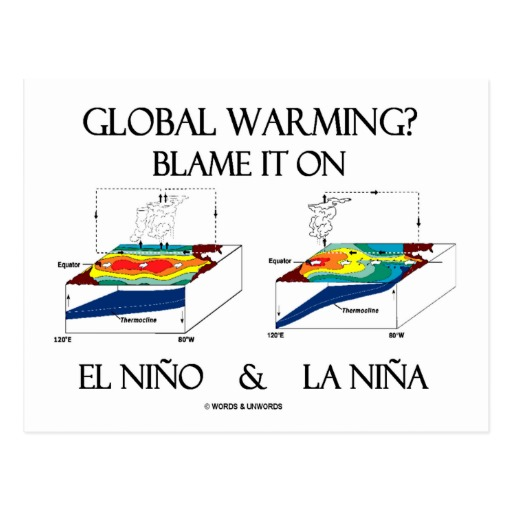
El Nino is a phenomenon in the climate system that happens once every four or five years.  Heat builds up in the equatorial Pacific to the west of Indonesia and so on.  Then when enough of it builds up it surges across the Pacific and changes the currents and the winds.  As it surges toward South America it was discovered and named in the 19th century  It iswell understood at this point that the phenomenon has nothing to do with CO2.

Now people talk about changes in that phenomena as a result of CO2 but it’s there in the climate system already and when it happens it influences weather all over the world.   We feel it when it gets rainier in Southern California for example.  So for the last 3 years we have been in the opposite of an El Nino, a La Nina, part of the reason people think the West Coast has been in drought.

It has now shifted in the last months to an El Nino condition that warms the globe and is thought to contribute to this Spike we have seen. But there are other contributions as well.  One of the most surprising ones is that back in January of 2022 an enormous underwater volcano went off in Tonga and it put up a lot of water vapor into the upper atmosphere. It increased the upper atmosphere of water vapor by about 10 percent, and that’s a warming effect, and it may be that is contributing to why the spike is so high.

A longer view of SSTs

Open image in new tab to enlarge.

The graph above is noisy, but the density is needed to see the seasonal patterns in the oceanic fluctuations.  Previous posts focused on the rise and fall of the last El Nino starting in 2015.  This post adds a longer view, encompassing the significant 1998 El Nino and since.  The color schemes are retained for Global, Tropics, NH and SH anomalies.  Despite the longer time frame, I have kept the monthly data (rather than yearly averages) because of interesting shifts between January and July. 1995 is a reasonable (ENSO neutral) starting point prior to the first El Nino. 

The sharp Tropical rise peaking in 1998 is dominant in the record, starting Jan. ’97 to pull up SSTs uniformly before returning to the same level Jan. ’99. There were strong cool periods before and after the 1998 El Nino event. Then SSTs in all regions returned to the mean in 2001-2. 

SSTS fluctuate around the mean until 2007, when another, smaller ENSO event occurs. There is cooling 2007-8,  a lower peak warming in 2009-10, following by cooling in 2011-12.  Again SSTs are average 2013-14.

Now a different pattern appears.  The Tropics cooled sharply to Jan 11, then rise steadily for 4 years to Jan 15, at which point the most recent major El Nino takes off.  But this time in contrast to ’97-’99, the Northern Hemisphere produces peaks every summer pulling up the Global average.  In fact, these NH peaks appear every July starting in 2003, growing stronger to produce 3 massive highs in 2014, 15 and 16.  NH July 2017 was only slightly lower, and a fifth NH peak still lower in Sept. 2018.

The highest summer NH peaks came in 2019 and 2020, only this time the Tropics and SH were offsetting rather adding to the warming. (Note: these are high anomalies on top of the highest absolute temps in the NH.)  Since 2014 SH has played a moderating role, offsetting the NH warming pulses. After September 2020 temps dropped off down until February 2021.  In 2021-22 there were again summer NH spikes, but in 2022 moderated first by cooling Tropics and SH SSTs, then in October to January 2023 by deeper cooling in NH and Tropics.  

Then in 2023 the Tropics flipped from below to well above average, while NH produced a summer peak extending into September higher than any previous year.  Despite El Nino driving the Tropics January 2024 anomaly higher than 1998 and 2016 peaks, following months cooled in all regions, and the Tropics continued cooling in April, May and June along with SH dropping.  After July and August NH warming again pulled the global anomaly higher, September and October resumed cooling in all regions.

What to make of all this? The patterns suggest that in addition to El Ninos in the Pacific driving the Tropic SSTs, something else is going on in the NH.  The obvious culprit is the North Atlantic, since I have seen this sort of pulsing before.  After reading some papers by David Dilley, I confirmed his observation of Atlantic pulses into the Arctic every 8 to 10 years.

Contemporary AMO Observations

Through January 2023 I depended on the Kaplan AMO Index (not smoothed, not detrended) for N. Atlantic observations. But it is no longer being updated, and NOAA says they don’t know its future.  So I find that ERSSTv5 AMO dataset has current data.  It differs from Kaplan, which reported average absolute temps measured in N. Atlantic.  “ERSST5 AMO  follows Trenberth and Shea (2006) proposal to use the NA region EQ-60°N, 0°-80°W and subtract the global rise of SST 60°S-60°N to obtain a measure of the internal variability, arguing that the effect of external forcing on the North Atlantic should be similar to the effect on the other oceans.”  So the values represent sst anomaly differences between the N. Atlantic and the Global ocean.

The chart above confirms what Kaplan also showed.  As August is the hottest month for the N. Atlantic, its variability, high and low, drives the annual results for this basin.  Note also the peaks in 2010, lows after 2014, and a rise in 2021. Then in 2023 the peak was holding at 1.4C before declining.  An annual chart below is informative:

Note the difference between blue/green years, beige/brown, and purple/red years.  2010, 2021, 2022 all peaked strongly in August or September.  1998 and 2007 were mildly warm.  2016 and 2018 were matching or cooler than the global average.  2023 started out slightly warm, then rose steadily to an  extraordinary peak in July.  August to October were only slightly lower, but by December cooled by ~0.4C.

Then in 2024 the AMO anomaly started higher than any previous year, then leveled off for two months declining slightly into April.  Remarkably, May showed an upward leap putting this on a higher track than 2023, and rising slightly higher in June.  In July, August and September 2024 the anomaly declined, and despite a small rise in October, is now lower than the peak reached in 2023.

The pattern suggests the ocean may be demonstrating a stairstep pattern like that we have also seen in HadCRUT4. 

The purple line is the average anomaly 1980-1996 inclusive, value 0.18.  The orange line the average 1980-202404, value 0.39, also for the period 1997-2012. The red line is 2013-202409, value 0.69. As noted above, these rising stages are driven by the combined warming in the Tropics and NH, including both Pacific and Atlantic basins.

See Also:

2024 El Nino Collapsing

Curiosity:  Solar Coincidence?

The news about our current solar cycle 25 is that the solar activity is hitting peak numbers now and higher  than expected 1-2 years in the future.  As livescience put it:  Solar maximum could hit us harder and sooner than we thought. How dangerous will the sun’s chaotic peak be?  Some charts from spaceweatherlive look familar to these sea surface temperature charts.

Summary

The oceans are driving the warming this century.  SSTs took a step up with the 1998 El Nino and have stayed there with help from the North Atlantic, and more recently the Pacific northern “Blob.”  The ocean surfaces are releasing a lot of energy, warming the air, but eventually will have a cooling effect.  The decline after 1937 was rapid by comparison, so one wonders: How long can the oceans keep this up? And is the sun adding forcing to this process?

Space weather impacts the ionosphere in this animation. Credits: NASA/GSFC/CIL/Krystofer Kim

Footnote: Why Rely on HadSST4

HadSST is distinguished from other SST products because HadCRU (Hadley Climatic Research Unit) does not engage in SST interpolation, i.e. infilling estimated anomalies into grid cells lacking sufficient sampling in a given month. From reading the documentation and from queries to Met Office, this is their procedure.

HadSST4 imports data from gridcells containing ocean, excluding land cells. From past records, they have calculated daily and monthly average readings for each grid cell for the period 1961 to 1990. Those temperatures form the baseline from which anomalies are calculated.

In a given month, each gridcell with sufficient sampling is averaged for the month and then the baseline value for that cell and that month is subtracted, resulting in the monthly anomaly for that cell. All cells with monthly anomalies are averaged to produce global, hemispheric and tropical anomalies for the month, based on the cells in those locations. For example, Tropics averages include ocean grid cells lying between latitudes 20N and 20S.

Gridcells lacking sufficient sampling that month are left out of the averaging, and the uncertainty from such missing data is estimated. IMO that is more reasonable than inventing data to infill. And it seems that the Global Drifter Array displayed in the top image is providing more uniform coverage of the oceans than in the past.

uss-pearl-harbor-deploys-global-drifter-buoys-in-pacific-ocean

USS Pearl Harbor deploys Global Drifter Buoys in Pacific Ocean


What Keeps “Energy Transition” Going? $ $ $

Robert Gauthier answered posting on a Quora topic How could we reverse the damage done by the “green energy” global scam that brought less efficient and highly polluting energy producing projects and high energy prices? Excerpts in italics with my bolds and added images.

Wind and solar power has provided politicians with an excuse to dispense favours—including taxpayer-funded subsidies and tax preferences to a supposedly “green” industry—while appearing to do something for the environment. And yet, despite more than two decades of massive subsidies, tax preferences and purchasing mandates from governments, wind and solar power still represent barely more than a rounding error of global energy production. In jurisdictions where renewables enjoyed strong but ill-considered political support, consumers and taxpayers now face much higher electricity bills and less-reliable power. And despite promises to the contrary, countries such as Germany, which have significantly increased wind and solar electricity production, have seen no meaningful reduction of greenhouse gas emissions.

Far from being a miracle cure-all for the shortcomings of conventional power generation, wind and solar power exaggerate the symptoms they pretend to address. Added up over the past two decades, the cumulative subsidies across the world for biofuels, wind, and solar approach about $5 trillion, all of that to supply roughly 5% of global energy.

The whole justification for the falling costs of wind generation rested on the assumption that much bigger turbines would produce more output at lower capex cost per megawatt, without the large costs of generational change. Now we have confirmation that such optimism is entirely unjustified – the whole development process has been a case of too far, too fast. Again, this was both predictable and predicted. The idea that wind turbines are immune to the factors that affect other types of power engineering was always absurd. The consequence is that both capital and operating costs for wind farms will not fall as rapidly as claimed and may not fall significantly at all. It follows that current energy policies in the West are based on foundations of sand – naïve optimism reinforced by enthusiastic lobbying divorced from engineering reality.

In the end, however, politicians cannot defy the laws of physics and economics. The promise of wind and solar power will always clash with the need for electricity that is low cost and reliable. That’s why voters routinely punish politicians who pursue flawed renewable energy policies. Rising electricity costs due to increased wind and solar power damage the economy by making businesses that consume significant volumes of electricity less competitive and by leaving less money in the pockets of consumers.

In Ontario, Canada during the run of the Green Energy Act there which attempted to replace coal and nuclear with wind and solar the upshot was a 138% increase in the price of electricity at the meter for the consumers. This led to the government that brought in this legislation to lose the next election so badly that they were no longer recognized as a party in the legislature. Naturally the government that replaced them killed the program and started refurbishing the nuclear reactor fleet there.

Unfortunately, solar and wind technologies require huge amounts of land to deliver relatively small amounts of energy, disrupting natural habitats. The real estate that wind and solar energy demand led the Nature Conservancy to issue a report last year critical of “energy sprawl,” including tens of thousands of miles of high-voltage transmission lines needed to carry electricity from wind and solar installations to distant cities.

Land required for wind farms to power London UK

Building a single 100-MW wind farm—never mind thousands of them—requires some 30,000 tons of iron ore and 50,000 tons of concrete, as well as 900 tons of nonrecyclable plastics for the huge blades. With solar hardware, the tonnage in cement, steel, and glass is 150% greater than for wind, for the same energy output

Take batteries. It is estimated that current battery manufacturing capabilities will need to be in the order of 500-700 times bigger than now to support an all-electric global transport system. The materials needed just to allow the UK to transition to all electric transport involve amounts of materials equal to 200% the annual global production of cobalt, 75% of lithium carbonate, 100% of neodymium and 50% of copper. Scaling by a factor of 50 for world transport, and you see what is now a showstopper. The materials demands just for batteries are beyond known reserves.

And that’s just one of the issues. Others include vast costs constituting a multiple of current energy costs; the environmental impact of mining and transporting huge amounts of materials; need for vast amounts of rare elements, far beyond known world reserves; incredibly huge amounts of material to recycle when facilities wear out; and on and on.

Spend enough time researching this stuff and you gradually realize that almost everything you read about green energy shows that at best it’s really a dark shade of brown.

DEI Days are Numbered in Ivory Towers

Leigh Revers writes at National Post Canada Universities better get prepared for Poilievre’s anti-woke agenda.  Excerpts in italics with my bolds and added images.

‘Even the dullest minds in the upper administrations of Canada’s top universities
— and trust me, they are spectacularly dull — must see the writing on the wall’

Conservative Leader Pierre Poilievre leaves after a meeting with Prime Minister Justin Trudeau and fellow opposition leaders on Parliament Hill in early December. Photo by Sean Kilpatrick/The Canadian Press

The recent spectacular and decisive presidential election victory by Donald Trump — a self-styled benevolent “dictator” swept to power with an unequivocal mandate from U.S. voters — has become what can only be described as a political tsunami for left-leaning observers.

Vast change is in the offing. The political tectonic plates have shifted, prompting shattering eruptions along a number of predictable fault lines.

One such fiery volcano is gender ideology, a demonstrable fantasy that, mercifully, will soon be banished from American institutions, its many purveyors quickly to be bankrupted by Trump’s proposed state-assisted lawsuits brought by the swelling ranks of detransitioners.

A second is education, a metaphorical marshmallow that is no longer merely the artificially-sweetened confection promised to so many young people, but has instead become more like a skewered and charred husk grilled remorselessly on the three-pronged toasting fork of diversity, equity and inclusion (DEI).

Americans need worry no longer, however. In a recent post on X, Elon Musk shared Donald Trump’s radical vision of a reformed college education system — one that demands the eradication of all DEI and its apparatchiks, and even threatens uncompliant institutions with severe taxation or complete forfeiture of their sprawling endowments. Inevitably, we will witness brazen back-peddling by the cadre of top-tier administrators desperate to remain gainfully employed. Harvard’s board, sitting on a treasure horde of US$53.2B (C$74.8B), will doubtless respond accordingly.

How will Canadian universities survive? While plunging needles into voodoo dolls of Pierre Poilievre, the left will eschew the ‘scary’ stateside politics, make accusations of neo-fascism, and point to Canada as a progressive retreat, a haven for the many orphans of woke ideology who, even now, are threatening on their social feeds to lay siege to our border, waving their American passports.

But what is far more likely, judging from predictions by even the state-sponsored CBC which suggest with 99 per cent certainty a Conservative win in 2025, is that the Canadian government in a year’s time will follow suit. Even the dullest minds in the upper administrations of Canada’s top universities — and trust me, they are spectacularly dull — must see the writing on the wall.

Here is the unvarnished reality in Canada in higher education in 2024. Students are being ripped off. Their degrees have been continuously devalued by the twin cudgels of enrolment inflation, as ballooning cohorts are funnelled through our universities, and the softening of standards in the face of academic appeasement and growing accommodations.

You might raise an eyebrow at that last remark. Academic accommodations are a form of concessionism where, according to a recent report at Queen’s University, nearly one in four students (22 per cent) gain some kind of benefit, usually in the shape of extended time allotments for examinations, to correct for what is often a largely imagined state of mental impairment.

In short, if you get anxious, the university concedes that you deserve more time than everyone else. This hardly constitutes quality education, and it inevitably dilutes academic standards. Obsequious compassion is showered on the deserving minorities; but if you are a hard-working student with no stakes in the victimhood game, well, you just have to suck it up.

Universities have consequently become expensive pre-adulthood training grounds that now choose to deride diligence, talent, and commitment in favour of equitable practices that attempt to champion anyone choosing to identify into minorities defined by inherent characteristics — gender, race, and sexuality. Indeed, their compulsive obsession with “belonging” — cited a mere 27 times, for example, in UofT’s most recent 17-page DEI report — has all the allure of a brain hemorrhage.

It will be interesting to see how they adapt to this new, inclement climate. For instance, in my own department, there are 40 staffers who support a suite of professional graduate programs.  Based on published United Steel Workers’ pay scales and benefit rates, this costs the university — a taxpayer-funded enterprise — well in excess of $3.5M per year. For a typical program, a quarter of the allotted budget is sucked up by administrative overhead. All of the appointees would doubtless declare graduate-school exceptionalism and, in the same breath, grouse about the ever-present patriarchy. But inspection shows only 24 per cent are men, and 40 per cent are, unsurprisingly, white women.

Now, sandwiched between provincial funding cuts and a collapse in international student admissions, campuses like mine will have to muster major savings as budget holes dilate in an ever-gloomier climate. Punitive financial incentives imposed by an incoming Conservative government will doubtless see a rapid turnaround as academics and administrators alike rush to gaslight everyone claiming that woke waste — characterized so effectively by journalist Charlotte Gill in Britain — was all “unintentional.”

Pull the other one. Recent propaganda sheets such as The Bulletin of the Canadian Association of University Teachers and Academic Matters, the journal of the Ontario Confederation of University Faculty Associations, which purport to represent professors like myself, are awash with racist DEI and tout a slavish fealty to obsessive and damaging social justice ideology. If you belong to the editorial team of either of these absurd political pamphlets, please drop me from your mailing list.

There is hope for students. Jordan Peterson has lately launched his academy, which, though limited to the social sciences so far, has breached the universities’ monopoly and comes at a bargain price. And the content is excellent, featuring such stellar authorities as Andrew Roberts, James Orr, John Vervaeke, Eric Kaufmann and a host of others. I’ve signed up.

Time is running out for legacy universities across Canada. I have a fancy next year we will see the same wave of comedy meltdowns that followed Trump’s re-election, just this time by an army of capitulating academics. “We didn’t mean to indoctrinate you with our untested ideology — Please give us more money.” Clink-clink. Too bad. It’s not in the cards.

Leigh Revers is associate professor with the Institute for Management and Innovation at the University of Toronto.


Best 2024 Review Is By Satirist Dave Barry

Raygun of Team Australia right before she wowed the crowd with her signature move, “The Sprinkler.” Anthony Behar/Sipa USA

This was published in the Miami Herald (link in red title below) and needs no additional highlights from anyone, so is reprinted below for its many amusing observations.  Barry is a true court jester, siding with no one, and unsparingly on target describing current foibles stranger than fiction.

Dave Barry Year in Review: 2024 was an exciting year,
and by ‘exciting,’ we mean ‘stupid’

How stupid was 2024? Let’s start with the art world, which over the centuries has given humanity so many beautiful, timeless masterpieces. This year, the biggest story involving art, by far, was that a cryptocurrency businessman paid $6.2 million at a Sotheby’s auction for . . .
A banana. Which he ate. ”It’s much better than other bananas,” he told the press.

And that was not the stupidest thing that happened in 2024. It might not even crack the top ten. Because this was also a year when:
—The Olympics awarded medals for breakdancing.
—Fully grown adults got into fights in Target stores over Stanley brand drinking cups, which are part of the national obsession with hydration that causes many Americans to carry large-capacity beverage containers at all times, as if they’re setting off on a trek across the Sahara instead of going to Trader Joe’s.
—Despite multiple instances of property damage, injury and even death, expectant couples continued to insist on revealing the genders of their unborn children by blowing things up, instead of simply telling people.
—The number of people who identify as “influencers” continued to grow exponentially, which means that unless we find a cure, within ten years everybody on the planet will be trying to make a living by influencing everybody else.
—Hundreds of millions of Americans set all their clocks ahead in March, then set them all back in November, without having the faintest idea why. (Granted, Americans do this every year; we’re just pointing out that it’s stupid.)

But what made 2024 truly special, in terms of sustained idiocy, was that it was an election year. This meant that day after day, month after month, the average American voter was subjected to a relentless gushing spew of campaign messaging created by political professionals who—no matter what side they’re on—all share one unshakeable core belief, which is that the average American voter has the intellectual capacity of a potted fern.

It was a brutal, depressing slog, and it felt as though it would never end. In fact it may still be going on in California, a state that apparently tabulates its ballots on a defective Etch-a-Sketch. For most of us, though, the elections, and this insane year, are finally over. But before we move on to whatever (God help us) lies ahead, let’s ingest our anti-nausea medication and take one last cringing look back at the events of 2024, starting with

… JANUARY …

when the nation finds itself trapped in a 1970s slasher movie, the kind in which some teenagers — played by the major political parties—are in a creepy house, being pursued by a terrifying entity, played by a rerun of the 2020 presidential election.

The only sane thing for the teenagers to do is get the hell out of there, but instead they pause by the dark, scary-looking doorway leading down to the basement, and despite the fact that the theater audience—played by the American public—is shouting “DON’T GO DOWN THERE! JUST LEAVE THE HOUSE YOU IDIOTS!”, the teenagers decide to go down into the basement, only to find “OH GOD NOOOOOO…”

And so, thanks to our political system—under which the nominees for the most powerful office in the world are chosen by approximately 73 people in approximately four rural states while the vast majority of Americans are still taking down their Christmas decorations—we once again find ourselves facing a choice between Joe Biden and Donald Trump.

Both candidates carry baggage. Trump is wanted on criminal charges in something like 23 states and, if elected, could become the first president to govern from a secret hideout. His speeches are sounding increasingly unhinged, which is no small feat since he did not sound particularly hinged in the first place.
For his part, President Biden keeps saying words that do not appear in any known human language and gives the impression that any day now he’s going to shuffle into a state dinner wearing only a bathrobe. But not necessarily his bathrobe.

In other words, we have one candidate who lost the last election but claims he won it, and another candidate who won the last election but might not remember what year that was. America, the choice is yours!

Meanwhile the nation is facing a number of serious problems. Foremost among them is the situation on the border with Mexico, which at one time was a legally separate nation from the United States but is now basically functioning as a vestibule. This has resulted in a tense confrontation between the federal government and Texas, which is alarming because, in the words of one military analyst, “Texas has way more guns.”

In government news, the Pentagon is harshly criticized for taking more than three days to notify the White House that Defense Secretary Lloyd J. Austin III had been hospitalized. This prompts the administration to check up on the rest of the cabinet, only to discover that at least four other secretaries are missing, and the Secretary of Commerce apparently died three years ago.

Abroad, fighting continues to rage in both Ukraine and Gaza, although these conflicts are no longer getting a ton of attention in the U.S. media because of all the news being generated by Taylor Swift.

In a troubling aviation incident, an Alaska Airlines Boeing 737 Max 9 flying at 16,000 feet suddenly develops a refrigerator-sized hole in the fuselage when an improperly attached panel blows off, terrifying passengers who have reason to wonder whether the airline crew, instead of making a big deal about the position of everybody’s tray table, should maybe be checking to see if the plane has been correctly bolted together. As a safety precaution, the Federal Aviation Administration grounds all Max 9s and advises passengers on other Boeing aircraft to “avoid sitting near windows.” For its part, Boeing states that “at least the plane didn’t lose a really important part, like one of the whaddycallits, wings.”

Here’s a rare shot of a Boeing 737 in flight with all the parts still attached. Jeremy Dwyer-Lindgren/Special to USA TODAY

Speaking of big corporations making questionable products, in

… FEBRUARY …

Apple launches the much-anticipated “Vision Pro,” a virtual-reality headset costing more than your grandfather paid (Just ask him!) for his first car. But it’s worth it, because when you put it on, thanks to a revolutionary “spatial computing” system coupled with 12 cameras and a 23-million pixel display, you look like an idiot.

Special counsel Robert Hur concludes his year-long investigation into Joe Biden’s handling of classified documents by releasing a 388-page report concluding that Biden “does not appear to have all his oars in the water.” An angry Biden immediately holds a press conference, during which he heatedly denies Hur’s assertion and (this really happened) refers to Egyptian leader Abdel Fattah el-Sisi as the “president of Mexico.”

In other White House news, CNN, after reviewing documents obtained through the Freedom of Information Act, reports that the Biden family’s German shepherd, Commander, bit Secret Service personnel in at least 24 incidents, eclipsing the record previously held by Dick Cheney.

Moments after this picture was taken, the photographer was eaten by Commander, the Official White House Pet. Sipa USA

Meanwhile Donald Trump, who is appearing in court more often than Perry Mason, is found guilty by a New York civil judge on charges of financial fraud, aiding and abetting, aggravated contempt, disorderly obstruction, second-degree vagrancy and loitering with intent to conspire. The judge fines Trump nearly half a billion dollars and bans him for the next three years from riding in any motorcade more than six cars long. Two days later a defiant Trump attends an event called “Sneaker Con,” where (this also really happened) he unveils a line of footwear, including the gold-colored Never Surrender High Top Sneaker (Actual Marketing Slogan: “your rally cry in shoe form”).

In a highly controversial decision, the Alabama Supreme Court rules that frozen embryos are, for legal purposes, children, and therefore must immediately be thawed out and provided with iPhones.

Tucker Carlson conducts a two-hour interview with Vladimir Putin, offering westerners a rare opportunity to find out what the Russian leader really thinks. It turns out he thinks Tucker Carlson is a useful idiot.

In a Super Bowl for the ages, two teams compete against each other under the watchful gaze of Taylor Swift. Speaking of spectacles, in

… MARCH …

President Biden, seeking to dispel persistent rumors that he is an elderly man, delivers a State of the Union Address consisting almost entirely of shouting. This performance does not significantly improve his poll numbers, but it’s a big hit with members of the Washington press corps, several hundred of whom decide, independently, to describe the speech as “fiery.”

In their response, the Republicans, always looking for new ways to demonstrate their incompetence, elect to have Alabama Sen. Katie Britt deliver a disturbingly melodramatic talk from (Why not?) her kitchen, where she gives the impression that she has just ingested a wide range of pharmaceuticals, and nobody, least of all Sen. Britt, knows which one is going to kick in next.

Yet another federal budget crisis is averted at the last minute when Congress passes a $1.2 trillion spending bill, which will enable the government to keep spending insanely more money than it takes in. The U.S. debt is now growing at the rate of a trillion dollars every 100 days, but fortunately this is not a problem because it will be taken care of by future generations. “No problem! Just put it on our tab!” is the view of future generations, and that is why we love them.

In other high-finance news, Donald Trump’s lawyers tell a New York court that he cannot raise the nearly half-billion dollars he needs for an appeal bond, having been turned down by more than 30 bond companies and an individual known as Anthony “Tony Three Nostrils” Avocado. Trump gets a break when an appeals court lowers the amount to $175 million, which Trump says he definitely has, although he left it in his other pants.

In a possibly related development, Trump announces that he is selling—we are not making this up—“God Bless the USA” Bibles for $59.95 a pop. “It’s my favorite book,” he states, moments before being struck by lightning. No, that did not happen and you are a bad person for even fantasizing about it.

Donald Trump says this is his favorite book, despite the fact that he didn’t write it. GREG LOVETT/THE PALM BEACH POST / USA TODAY NETWORK

In aviation news, a Boeing plane flying from Australia to New Zealand suddenly goes into a nosedive, injuring 50 people. Another Boeing plane, taking off from the San Francisco airport, loses a piece of landing gear. A Boeing spokesperson says that the company, after conducting an in-depth review, has tentatively identified the root cause of the recent problems.

“We think it’s gravity,” said the spokesperson. “It seems to be getting worse.” As a safety precaution, Boeing is advising pilots to avoid taking off, and simply taxi the planes from city to city, which the spokesperson says “may result in delays, especially to overseas destinations.” Speaking of exciting things happening in the sky, in

… APRIL …

the nation is enthralled by a total eclipse, a rare celestial occurrence in which the earth, sun and moon align in such a way as to cause a large number of people to deliberately travel to Indianapolis. Huge crowds in the path of the totality watch excitedly as the sky gradually turns completely dark—a spectacular sight that most people will never witness again in their lifetimes, unless they’re still around at sunset.

In other natural phenomena, a magnitude 4.8 earthquake with an epicenter in central New Jersey rattles the northeast. New York City is completely paralyzed, although not because of the earthquake; it’s always completely paralyzed. But for a few seconds there is slightly less honking.

New York remains in the news with the onset of the single most exciting thing ever to happen to CNN: yet another trial of Donald Trump. In this one he’s charged with falsifying business records as part of a scheme to guarantee that every single human being on the planet, including members of primitive tribes in the Amazon jungle, would be aware that Trump had a one-night stand with porn star Stormy Daniels. At least that’s how it worked out.

True Fact: The first witness called by the prosecution is a man named “David Pecker.”

Trump was in court more often than Perry Mason. Jeenah Moon/Pool via USA TODAY NETWORK

South Dakota Gov. Kristi Noem, a contender to be Trump’s running mate, bolsters her case with a new book in which she reveals— apparently on the advice of the same public-relations firm used by Boeing—that she once shot and killed her family dog, Cricket. Many people are appalled by this revelation, although Noem’s supporters note that she would be a handy person to have around the White House if Commander ever comes back.

Speaking of commanders: President Biden, campaigning in Pennsylvania, suggests—twice—that his uncle was eaten by cannibals after his plane went down off the New Guinea coast during World War II. The prime minister of Papua New Guinea objects to the president’s cannibal story on the nitpicky grounds that it is not true. Nevertheless the president seems to sincerely believe that it happened, and it was HIS uncle, dammit.

As the tragic situation in Gaza worsens, American college students on a growing number of campuses engage in protests and other dramatic actions intended to draw attention to the single most important issue facing the world: the feelings of American college students. Speaking of drama, in

… MAY …

Stormy Daniels tells a New York jury in explicit detail about her encounter with Donald Trump during a 2006 celebrity golf tournament, testifying that when she came out of the bathroom in Trump’s hotel suite, he was waiting for her wearing only a T-shirt and boxer shorts, and before she could stop him he proceeded—without wearing a condom—to falsify business records.

True Trivia Fact: Trump finished 62nd in that celebrity tournament. The golfer who finished 43rd was Dan Quayle.

On weekends, when he’s not in court, Trump continues to campaign for president. While discussing immigration policy at a rally in New Jersey, he makes the following statement, printed here verbatim: ”Silence of the Lambs. Has anyone ever seen ‘The Silence of the Lambs’? The late, great Hannibal Lecter is a wonderful man. He often times would have a friend for dinner. Remember the last scene? ‘Excuse me. I’m about to have a friend for dinner,’ as this poor doctor walked by. ‘I’m about to have a friend for dinner.’ But Hannibal Lecter. Congratulations. The late, great Hannibal Lecter.”

This statement raises a number of questions, including:
1.What?
2. Seriously, what?
3. Is it possible that it was actually Hannibal Lecter who ate Joe Biden’s uncle?

Speaking of Joe Biden, his poll numbers continue to be bad as voters express their unhappiness about the economy, especially inflation. This is very frustrating for White House spokespersons, who are constantly pointing out that inflation is no longer a problem on whatever planet it is that White House spokespersons live on. Unfortunately it’s still a problem here on Earth, where prices are significantly higher for basic needs such as food, gas, housing and tickets to the Met Gala, which cost only $50,000 last year but jumped to $75,000 this year, leaving many attendees so broke that they are forced to attend wearing what appear to be Halloween costumes.

In other presidential news, Robert F. Kennedy Jr., seeking to set himself apart from the two flawed major-party candidates and offer voters a rational alternative, tells the New York Times that doctors found a dead worm in his brain.

RFK Jr. could become the first cabinet member with a dead worm in his brain. Al Diaz adiaz@miamiherald.com

Meanwhile in a spectacular, much-anticipated natural phenomenon, trillions of cicadas emerge from the ground, watch 15 minutes of cable TV news, and elect to die.

As the month draws to a close, Trump is found guilty on all 34 felony counts of whatever it is that he was charged with. The convictions deal a fatal blow to his candidacy.

Ha ha! We are of course joking. The convictions, like all the other legal actions against Trump, are a massive boost for his candidacy, energizing his supporters and generating tens of millions of dollars in donations, an outcome that could have been predicted by anybody with a rudimentary understanding of Trump’s appeal, although it apparently did not occur to the geniuses behind this particular legal strategy. Speaking of strategies that do not work out as planned, in

… JUNE …

the Biden re-election campaign struggles to change the public perception—largely created by videos showing the president looking lost and confused—that the president is sometimes lost and confused. Democrats insist that these videos are “cheap fakes,” and that in fact Biden is sharp as a tack, but unfortunately the public never sees this because he only exhibits this sharpness when there are no cameras around to capture it, kind of like Bigfoot.

So there’s a lot on the line when Biden and Trump square off in a much-anticipated prime-time debate, which was proposed by the Biden campaign, apparently on the advice of the Boeing Corp.

The debate went smoothly for Joe Biden until it started. Jack Gruber / USA TODAY NETWORK

It’s obvious from the start of the debate that the president is struggling. He has trouble finishing, or even starting, his sentences; he spends much of the debate staring vacantly into the distance like a man who’s trying to remember where he put the remote control, unaware of the fact that he is holding it. In short, it’s a very bad night for Biden.

Q.How bad is it? A. It’s so bad that, by comparison, Donald Trump seems, at times, to be almost lucid.

Actually, it’s worse than that. It’s so bad that even professional journalists can see how bad it is. In fact suddenly everybody in Washington is acutely aware of the president’s decline, which previously had been apparent to only the entire rest of the world population. And so as we move into

… JULY …

the Democrats are in a state of panic. Behind the scenes, party leaders desperately want to get Biden off the ticket, but he repeatedly insists that he’s going to be the candidate. This leads to an awkward national conversation:
BIDEN: I’m staying in the race.
PARTY LEADERS: You have our full support, Mr. President! Whatever you decide!
BIDEN: OK, as I said, I’m staying in the race.
PARTY LEADERS: It’s your call, sir! Run, or don’t run! It’s totally up to you!
BIDEN: Again, I’m definitely running.
PARTY LEADERS: Whether you stay in or drop out, we fully support either choice! Including dropping out!
BIDEN: I SAID I’M RUNNING DAMMIT.
PARTY LEADERS: We await your decision, sir!
And so on.

Just when it appears that the presidential race cannot get any more insane, Trump goes to Butler, Pa., to hold a campaign rally, for which the security has apparently been outsourced to the Boeing Corp. Trump is shot in the ear by a man who is somehow able to climb, unimpeded, with a rifle, onto the roof of a building that not only is within range of the speaker’s platform, but also has three police snipers stationed inside it. Really.

Other than that, it was an uneventful rally. Evan Vucci AP

The attempted assassination shocks the nation but also bolsters Trump’s popularity. He has a commanding lead in the polls as, a few days later, he accepts the presidential nomination at the Republican convention (Theme: “TRUMP!”) with a triumphant speech lasting slightly longer than veterinary school.

The Democrats are now in utter despair. Biden continues to insist that he’s running; the party has no choice but to renominate him and face almost-certain defeat in November.

Then, in a sudden reversal, Biden announces that he’s quitting the race after reassessing the situation and waking up next to the severed head of a thoroughbred racehorse. Party leaders lavishly praise Biden for saving democracy, then decide, via what is undoubtedly a democratic process, to replace him with Kamala Harris.

Other than that, it’s a quiet month in politics.

In other news, a massive worldwide Internet disruption paralyzes global air travel, along with banks, hotels, hospitals and other industries, when Arnold A. Frinkledorp, an 87-year-old retiree who is attempting to send an email to his sister from his AOL account, accidentally presses the ALT, backslash, left arrow, F3, ampersand and right parenthesis keys simultaneously—which apparently nobody has ever done before—thereby triggering a Windows glitch that causes more than 8.5 million computers to crash. The disruption winds up costing businesses an estimated $5 billion, although on the plus side, Mr. Frinkledorp’s email—a meme of a cat wearing sunglasses—is successfully delivered to his sister, who accidentally deletes it.

As the Olympic Games get under way in Paris, tens of millions of viewers tune in to NBC to watch three action-packed weeks of Snoop Dogg reacting to French things. The Games take full advantage of the city’s scenic venues, including the Seine River, which is used for the swimming leg of the triathlon race after health authorities assure competitors that intensive cleanup efforts have removed “the vast majority” of the turds. Speaking of competition, in

… AUGUST …

the race for the presidency kicks into high gear as fired-up Democrats hold their convention in Chicago. The first-day highlight is a grateful and heartfelt farewell to President Biden, who speaks in the prestigious 2:30 a.m. timeslot and is never heard from again. The focus then shifts to the nomination of Kamala Harris, who is running on a platform of joy, and being joyful, and a general vibe of joyfulness, as well as a set of policies to be specified later that will take America in a new, completely different direction, in stark contrast to the policies of whoever is running the country now.

The convention gives Harris an immediate boost in the polls, and suddenly Trump faces a serious challenge, to which he responds, during a two-hour speech to a rally in Wilkes-Barre, Pa.: “I say that I’m much better looking than her. Much better. Much better. I’m a better-looking person than Kamala.” Fox News confirms this.

The Democratic convention was a joyful time of joyous joyfulness. Josh Morgan, Josh Morgan / USA TODAY NETWORK

Meanwhile the two vice-presidential candidates, Tim Walz and J.D. Vance, engage in a spirited exchange on the issues, reminiscent of the Lincoln-Douglas debates:

WALZ: You’re weird.
VANCE: I’M not weird. YOU’RE weird.
WALZ: No, YOU’RE weird.
VANCE: No YOU’RE weird.
WALZ: No YOU’RE…

Speaking of weird: Independent candidate Robert F. Kennedy Jr., following up on the revelation that he has a dead worm in his brain, reveals that he once picked up a roadkill bear, which he later—we’ve all done it—left under a bicycle in Central Park as a prank. Three weeks later Kennedy suspends his campaign and urges his followers to vote for Trump, assuming they are able to chew through their restraints.

Two astronauts are stuck aboard the International Space Station when the Starliner spacecraft that was supposed to return them to Earth develops mechanical problems. You will never in a million years guess the name of the company that built this spacecraft. Meanwhile down here on Earth things are also not going so great as we move into

… SEPTEMBER …

when suddenly, with no advance warning, the biggest issue in the presidential election is the question of whether Haitian immigrants in Springfield, Ohio, are eating people’s pets. They are not, but this fact does not prevent Trump from raising the issue in a televised debate with Harris, during which Trump gives the impression that his debate prep consisted entirely of getting his hair dyed a slightly more believable color. ”In Springfield, they’re eating the dogs,” he states, “The people that came in, they’re eating the cats. They’re eating, they’re eating the pets of the people that live there.”

For her part, Harris repeatedly stresses the message that she is a regular middle-class person from the middle class who totally relates to the problems faced by middle-class people like herself, and she definitely intends to fix these problems once she is elected to high government office.

Harris is widely considered to be the winner of the debate, on top of which she is endorsed by Taylor Swift, which is a big deal because Swift has more than 280 million Instagram followers and 53 votes in the Electoral College.

Both Taylor Swift and her cat endorsed Kamala Harris. Screenshot from Instagram

A week after the debate, police capture a would-be assassin who was spotted with a rifle on a golf course where Trump was playing. There was a time in America when this event—the second serious assassination attempt on a major presidential candidate in two months—would be considered a big story, but in the hellscape that is 2024 politics it dominates the headlines for considerably less time than the mythical pet-eating Haitians.

As the election draws closer emotions are running high. It’s also an increasingly tense time in the Middle East, where Israel and Iran appear to be on the verge of all-out war.

But the good news is that at least the hurricane season has been relatively peacef… OK, scratch that. In late September, Hurricane Helene causes horrendous devastation in six southeastern states, and then in

… OCTOBER …

Hurricane Milton ravages Florida. It’s a brutally difficult time for millions of Americans, but the good news is that at least nobody tries to politicize the disasters or use them to spread idiotic conspiracy theories about sinister forces controlling the weath… OK, scratch that also.

In presidential election news, Trump makes a campaign appearance at a Pennsylvania McDonald’s, during which he wears an apron and serves some people at the drive-thru window. This is the kind of hokey photo-op stunt that politicians have been doing forever, so you’d think this would be no big deal, right?

Wrong. It is a huge deal. Thanks to Trump’s uncanny ability—it is his superpower—to drastically reduce the functional IQ of professional journalists, this event dominates the national political coverage for days. Newsweek runs a story headlined “Was Donald Trump’s McDonald’s Shift ‘Staged’?” The New York Times runs six—that’s right, six—stories about it, including one asserting that, among other infractions, Trump “shoveled a scoopful of fries the wrong way” and “committed what appeared to be a number of health code violations.”

Professional journalists were able to prove, using journalism, that this was a photo op. Pool TNS

Somehow Trump survives all this journalism. He continues to crisscross the nation promising tax breaks for pretty much every category of U.S. resident including domestic animals, and giving increasingly improvisational speeches during which every thought fragment that seeps into his brain spurts instantly from his mouth without any kind of review. For example: Speaking to a rally in Latrobe, Pa., Trump informs the crowd that their beloved hometown hero, the late Arnold Palmer, had an unusually large putter. (We don’t know whether the New York Times assigned a team of reporters to investigate this claim, but we would not rule it out.)

In another suave outreach move, the Trump campaign, ever sensitive to accusations of racism, holds a rally in Madison Square Garden featuring a comedian who jokes that—prepare for hilarity—Puerto Rico is garbage.

On the Democratic side, the Kamala Harris campaign, which has spent more than a billion dollars but is still struggling to clearly define the candidate’s vision for the presidency, settles on an upbeat closing message: “Whoever She Is, She’s Not Donald Trump.” At exactly the same time Harris is making her big final pitch to voters, Joe Biden, who is still technically the president, somehow gains access to Zoom and lends the Harris campaign a helping hand by declaring, in response to the Trump-rally Puerto Rico joke, that roughly half of the U.S. electorate is garbage. Thanks, Joe!

Meanwhile, in an issue that neither party talks about because fixing it would require political courage, the national debt goes over $35 trillion, moving the nation still closer to the inevitable financial catastrophe that will leave future generations completely screwed. Fortunately, as we have noted, future generations are fine with this. “Don’t worry about it!” they would say, if they could speak to our current political leadership. “We know you’re busy leading!”

On a happier note, for the 14th consecutive year the World Series is won by a team other than the Yankees.

In space, a large communications satellite unexpectedly explodes, creating debris that threatens other satellites. In the spirit of mercy we will not name the company that made the defective satellite, other than to say it rhymes with “blowing.” Speaking of unexpected, in

… NOVEMBER …

the voters finally go to the polls for the most important American election since at least the dawn of time. All the expert political analysts and professional pollsters using scientific methodology agree that the race is extremely tight, a tossup, a dead heat, especially in the crucial battleground states. It’s too close to call! The experts are certain of this.

On election night, the TV networks are teeming with political commentators prepared to analyze and dissect and crunch the numbers far into the night as the nation settles in for the long, grueling process of determining the winner, a process that everyone agrees could go on for days, possibly even weeks, because of the extreme razor-thin closeness of the…

Never mind. In roughly the same amount of time it takes to air a Geico commercial, the networks determine that Donald Trump has decisively won the election, including all of the so-called battleground states and four Canadian provinces. It’s a stunning result and a massive failure by the expert political analysts, who humbly admit that they had no idea what was happening, and promise that from now on they will be more aware of their limitations.

We are of course joking. In a matter of seconds these experts pivot from being spectacularly clueless about what was going to happen in the election to confidently explaining what happened in the election.

One theory is that it was not a great idea for the Democrats to insist that President Biden was fine until it was embarrassingly obvious that he was not, then replace him, via a secret process, with a candidate who was not great at talking and did not run in a single primary and who previously advocated positions that many Americans were not crazy about, which is why they voted, sometimes reluctantly, for Donald Trump.

One branch of the Democratic party accepts this theory and begins the painful but necessary process of self-examination. Another branch prefers to believe that the party is fine and the real problem is that most Americans are sexist racist pro-fascist morons, which may not be a winning message for the Democrats going forward, but it does enable this branch to feel better about itself.

For his part, Donald Trump has no doubt whatsoever that the American people have given him a mandate to deport anywhere up to 60 percent of the U.S. population and—in his words—“turn this great nation around by appointing wildly unqualified individuals to the cabinet.”

OK, he didn’t actually say that, but he did nominate Matt Gaetz to be attorney general, which is like nominating Jeffrey Dahmer to be surgeon general. Gaetz is soon forced to withdraw his name from consideration after Trump is informed that the U.S. Senate, for all its shortcomings, is not completely insane.

Another controversial Trump nomination, this one for secretary of the Department of Health and Human Services, is Robert F. “Roadkill” Kennedy Jr., who used to think Trump was basically Hitler but now thinks he’s great. Kennedy is deeply suspicious of vaccines, Big Pharma, the CIA, fluoride, seed oils, WiFi, Froot Loops and chemicals in general. He also wants to make America healthy again by reducing the consumption of the overprocessed junk foods that have turned many Americans into big fat waddling tubs of lard, like… OK, like many Americans.

In environmental news, 70,000 world leaders, politicians, bureaucrats, aides, activists, consultants, celebrities, media people, caterers, chauffeurs, bodyguards, grifters, masseurs, masseuses, and private-jet pilots gather for COP29, the massive conference held every year by the United Nations to solve the pesky problem of global climate change. This year’s host nation is Azerbaijan, which, as a corrupt authoritarian state whose main source of income is selling billions of dollars worth of oil and gas, naturally wants everybody to stop using so darned much oil and gas. The conference is once again a huge success as measured in metric tons of hors d’oeuvres consumed, and everybody agrees to gather again for COP30 next year, on the off chance that global climate change is still going on.

Speaking of comically futile gestures: The Australian senate passes a law banning children under 16 from social media. This law will be enforced by adults who have to ask their children for technical support when they accidentally lock themselves out of their iPhones. Speaking of protecting children, in

… DECEMBER …

Joe Biden, who repeatedly promised that he would not pardon his son Hunter, cements his legacy as the most Joe Biden president ever by pardoning his son Hunter, thus forcing the Democratic party to change its mantra from “Nobody Is Above the Law!” to “Hey, It’s Complicated.” The wording of the pardon document is quite broad, covering “all offenses committed between 2014 and 2024, including any currently unsolved bank robberies, not that we are suggesting anything.”

The pardon outrages many Republicans who would be fine with it if Trump did it, while it’s fine with many Democrats who would be outraged if Trump did it. For that is how our system of checks and balances works.

Meanwhile Trump is acting as though he’s already the president—meeting with foreign leaders, signing treaties, vetoing legislation, authorizing drone strikes and ordering the beheading of “Peach” and “Blossom,” the two turkeys Biden pardoned for Thanksgiving.

Helping Trump with the transition is his new best billionaire friend Elon Musk, the genius tech visionary who’s going to make the federal government efficient by implementing “outside the box” measures such as:
—Having veterinarians install locator chips in all federal employees.
—Replacing both the Air Force and the Internal Revenue Service with laser-equipped orbital space robots.
—Combining the departments of Energy, Transportation, Labor, Agriculture, Interior and Justice into a single agency called “The Guv,” which will be physically located in Taiwan but accessible via an app.
—Renting Hawaii out for proms.

Trump and his new best billionaire bud envision the future. Brad Penner-Imagn Images

It’s an exciting time to be alive, as post-election America begins to discover, with varying degrees of excitement, what it voted for.

After numerous sightings of mysterious lights in the sky over New Jersey, government officials seek to calm an increasingly alarmed public. ”We’ve investigated these lights, and there’s absolutely nothing to worry about,” states Homeland Security Secretary Alejandro Mayorkas, who adds, “on an unrelated note, people should keep their children indoors.”

In other news, a horrific crime on a New York City sidewalk leads to a national conversation about the U.S. healthcare system, which reveals that a truly disturbing number of people believe the following three things:
1.The healthcare system is bad.
2.Therefore, murder is OK.
3.Especially if the murderer is cute.

Clearly, this year needs to end. Which is why we’re looking forward to New Year’s Eve—when, in a beloved tradition, thousands of revelers will gather in Times Square to say goodbye to 2024, and welcome 2025. We like to think that on that night, as the seconds tick down to zero and that giant ball starts to descend, the people gazing up at it will all be united, if only for a moment, by a common hope —a hope shared by the millions of us watching on television—specifically, the hope that the giant ball was not manufactured by the Boeing Corp.

Also, while we’re hoping, let’s hope that 2025 will be a better year. How could it be worse?
Try not to think about it.