
Surplus Arctic Ice Persists to End of August 2025

After a sub-par March maximum, by end of May 2025 Arctic ice closed the gap with the 19-year average. Then in June the gap reopened and in July the melting pace matched the average, abeit four days in advance of average. In mid-August MASIE showed the Arctic ice extent matching the 19-year average.  Mid month Arctic ice went above average and remained in surplus, ranging from a high of +231k km2 to +160k km2 at end of August.

During August the average year loses 1.9M km2 of ice extent.  MASIE on day 213 was 308k km2 down, and the gap closed steadily, going into surplus on day 230. Note 2020 and 2024 were well  below average mid-August.  2024 ended nearly average, while 2020 went down almost off the chart. Meanwhile SII v.4 started August ~400k km2 lower than MASIE, increasing to -690k mid month, before drawing closer to MASIE (-200k km2) on the last reported day 242. More on what happened to SII in footnote.

The regional distribution of ice extents is shown in the table below. (Bering and Okhotsk seas are excluded since both are now virtually open water.)

Region 2025243 Day 243 Ave. 2025-Ave. 2020243 2025-2020
 (0) Northern_Hemisphere 5112372 4952249 160123 4345398 766974
 (1) Beaufort_Sea 646546 569909 76637 763281 -116735
 (2) Chukchi_Sea 400517 284622 115895 212438 188079
 (3) East_Siberian_Sea 563058 360155 202902 176996 386062
 (4) Laptev_Sea 172574 175114 -2540 1029 171545
 (5) Kara_Sea 2579 48983 -46404 23958 -21379
 (6) Barents_Sea 0 15952 -15952 0 0
 (7) Greenland_Sea 106688 167723 -61035 192361 -85673
 (8) Baffin_Bay_Gulf_of_St._Lawrence 61034 27656 33378 5016 56019
 (9) Canadian_Archipelago 278943 298169 -19226 273116 5827
 (10) Hudson_Bay 8604 20611 -12006 23611 -15007
 (11) Central_Arctic 2870279 2982526 -112247 2672903.81 197375

The table shows large surpluses in Eurasian basins  Beaufort, Chukchi and E. Siberian, more than offsetting deficits in Central Arctic, Kara and Greenland seas. Hudson Bay is mostly open water at this time of year. 2025 exceeds the average ice extents by 160k km2, or 3%, and is 767k km2 greater than 2020, or nearly 0.8 Wadhams of ice extent.

September monthly average ice extent is considered the annual minimum for climate purposes.  Note also that typically the lowest daily value occurs mid September, with a small positive gain between the end of August and end of September.

Why is this important?  All the claims of global climate emergency depend on dangerously higher  temperatures, lower sea ice, and rising sea levels.  The lack of additional warming prior to 2023 El Nino is documented in a post SH Drives UAH Temps Cooler July 2025.

The lack of acceleration in sea levels along coastlines has been discussed also.  See Observed vs. Imagined Sea Levels 2023 Update

Also, a longer term perspective is informative:

post-glacial_sea_level

Footnote Regarding  SII v.4

NSDIC acknowledged my query regarding the SII (Sea Ice Index) dataset. While awaiting an explanation I investigated further. My last download of the SII Daily Arctic Ice Extents was on July 30, meaning that the most recent data in that file was day 210, July 29. The header on that file was Sea_Ice_Index_Daily_Extent_G02135_v3.

Then on August 1, the downloaded file had the heading Sea_Ice_Index_Daily_Extent_G02135_v4. So it appears that these are now the values from a new version of SII. As I wrote in my query, since March 14 all of the values for Arctic Ice Extents are lower in this new record. The graph above shows the implications for August as an example of estimates from SIIv.4.

In the past, SIIv.3 tracked MASIE with slightly lower values.  But with v.4, larger monthly average deficits to MASIE were reported in July 2025 ( -282k km2) and in August (-440k km2).

The change started in January 2025 and will be the basis for future reporting.  The logic for this is presented in this document: Sea Ice Index Version 4 Analysis

In June 2025, NSIDC was informed that access to data from the Special Sensor Microwave
Imager/Sounder (SSMIS) onboard the Defense Meteorological Satellite Program (DMSP)
satellites would end on July 31 (NSIDC, 2025). To prepare for this, we rapidly developed version
4 of the Sea Ice Index. This new version transitions from using sea ice concentration fields
derived from SSMIS data as input to using fields derived from the Advanced Microwave
Scanning Radiometer 2 (AMSR2) sensor onboard the Global Change Observation Mission – W1
(GCOM-W1) satellite.  On 29 July 2025, we learned that the Defense Department decision to terminate access to DMSP data had been reversed and that data will continue to be available until September 2026.

We are publishing Version 4, however, for these reasons:

• The SSMIS instruments are well past their designed lifespan and a transition to
AMSR2 is inevitable. Unless the sensors fail earlier, the DoD will formally end the
program in September 2026.
• Although access of SSMIS will continue through September 2026, the Fleet
Numerical Meteorology and Oceanography Center (FNMOC), where SSMIS data
from the DMSP satellite are downloaded, made an announcement that “Support
will be on a best effort basis and should be considered data of opportunity.” This
means that SSMIS data will likely contain data gaps.
• We have developer time to make this transition now and may not in the future.
• We are confident that Version 4 data are commensurate in accuracy to those
provided by Version 3.

Noble Climate Cause Corruption: PIK exemplar

Thomas Kolbe explains the sordid history in his American Thinker article Potsdam climate researchers under fire. Excerpts in italics with my bolds and added images.

Critics of climate policy have long pointed to the problematic dominance of politics in climate science. A recent study from the Potsdam Institute for Climate Impact Research (PIK), which systematically exaggerated the economic consequences of climate change, has reignited the debate over scientific standards and political manipulation in the field.

On April 17, 2024, the science journal Nature published a study by PIK researchers Maximilian Kotz, Anders Levermann, and Leonie Wenz. They calculated that global GDP would shrink by 19% by 2050 due to climate change, regardless whether future emissions were reduced. This projection corresponds to an annual output loss of around $38 trillion — an economic apocalypse, given that no society has the resilience to absorb such a dramatic collapse.

A Solution Delivered Alongside the Doom

The authors also provided a ready-made “solution”: according to their math, the costs of climate damage would be at least six times higher than the expenses required to keep global warming below 2°C. The implication is clear:

This was less a scientific exercise than a political directive for policymakers
to accelerate the fight against alleged man-made climate change.

A year later, the material was “corrected” and republished with slightly toned-down results. The timing was not coincidental: peer review — the scientific quality control process — loomed in the background and threatened to spark controversy.

Peer Review Delivers a Devastating Blow

That controversy soon arrived. Three U.S.-based scientists who reviewed the PIK paper identified serious methodological flaws and faulty data — problems that had been known for over a year. According to their report, PIK’s methodology had no scientific foundation. One reviewer wrote: “I have major concerns about the uncertainty and validity of the empirical model they built and used for the forecasts. It would help this study not to follow the often-exaggerated claims found in the literature.” From the Abstract of paper  by Bearpark et al (link in red above):

Kotz, Levermann and Wenz1 (henceforth, KLW) analysed how subnational gross domestic product (GDP) growth responds to year-to-year changes in temperature and precipitation. They reported that if historical relationships continue to hold, global GDP would be lowered by roughly 62% (central estimate) in 2100 under the Representative Concentration Pathway 8.5 ‘high emissions’ scenario, an impact roughly 3 times larger than similar previous estimates,2,3. Here we show that (1) data anomalies arising from one country in KLW’s underlying GDP dataset, Uzbekistan, substantially bias their predicted impacts of climate change, (2) KLW underestimate statistical uncertainty in their future projections of climate impacts, and (3) additional data-quality concerns in KLW’s subnational GDP data warrant further investigation. When Uzbekistan’s data are removed and statistical uncertainty is corrected to account for spatial correlations, KLW’s central estimate aligns closely with previous literature and their results are no longer statistically distinguishable from mitigation costs at any time this century.

Such devastating words cast doubt not just on PIK’s work, but on the broader foundations of climate science itself. Yet papers like this are routinely used to justify green transformation policies, with their web of subsidies, NGOs, regulations, and deep intrusions into economic life.

Finance Dragged Into the Climate Matrix

The significance of this critique lies not only in the study’s flaws but also in the murky financing behind it. These alarmist reports are not just shaping public opinion; they are the cornerstone of a new “climate economy.” The goal is to channel capital flows so that state funds and private wealth are merged into politically favored projects — a carefully orchestrated fusion of financial power and ideology.

International organizations and political institutions amplify these narratives, embedding them into economic governance. The “Network for Greening the Financial System” (NGFS) — closely tied to PIK and consisting of central banks and regulators — projects future climate costs and uses them as a basis for political and financial decisions. The European Central Bank relies on such scenarios for stress tests on banks, forcing higher capital buffers and restricting lending — with direct consequences for growth.

Networks, Obfuscation, and Propaganda

Additional funding flows through organizations like Climate Works, which bankrolls both NGFS and PIK while paying for the calculation of key scenarios. This blurring of lines between sponsor and reviewer, between science and political agenda, opens the door to propaganda. Genuine public debate becomes nearly impossible under such conditions of institutionalized opacity.

The end result is soulless landscapes scarred by wind turbines, the shutdown of modern power plants, and intrusive state regulation extending into private households. The energy sector is sacrificed, home ownership turned into an ideological experiment — all justified by the apocalyptic narrative of man-made climate collapse.

The Origins of CO2 Politics

The roots of this orthodoxy can be traced back to 2009, when the Obama administration declared CO2 a “dangerous pollutant” via the EPA’s Endangerment Finding. This politically-driven decision, made without congressional approval, laid the groundwork for carbon pricing, emissions trading, and sweeping regulatory interventions.

Europe embraced the same model, perhaps even spearheaded it. As an energy-poor continent, the EU saw an opportunity: by making fossil fuels expensive and heavily regulated, it could level the playing field and prevent resource-rich competitors from exploiting their natural energy advantages.

Donald Trump briefly broke with this orthodoxy, scrapping central EPA rules, declassifying CO2 as an existential threat, and freeing coal, gas, and oil. It was a signal to the world: growth and sovereignty take precedence over panic-driven climate politics.

Politicized Science

The PIK case highlights the dangers of academia’s fusion with state agendas. The old saying applies: “Whose bread I eat, his song I sing.” It was only a matter of time before such politically tailored studies surfaced.

Just as with government-influenced modeling during the COVID crisis, climate research now faces the urgent task of disentangling politics from science. On the back of the man-made climate narrative, an entire apparatus of subsidies, NGOs, and Brussels bureaucracy has entrenched itself. Untangling this nexus is no longer just a scientific issue — it is a historic necessity.

Footnote On the Failings of PIK GDP Study

Climate study from Potsdam – how questionable forecasts misled politics and business

A controversial climate study by the Potsdam Institute for Climate Impact Research (PIK) is one of the biggest scientific scandals of recent years. Media outlets like “Tagesschau” and “Spiegel” made it headlines in 2024. “Scientifically completely invalid,” economist Richard Rosen declared. However, politicians and the financial world made far-reaching decisions based on the PIK study. The alleged annual economic damage of $38 trillion shaped global debates. (welt: 25.08.25)

The publication of the PIK study by “Nature” lent its brilliance. But internal documents show that all four reviewers reported serious deficiencies. One expert wrote: “The statistical methodology … [has] no scientific basis whatsoever.” Another emphasized that the forecasts seemed “unintuitively large.”

Roger Pielke Jr. calls it a scandal. Incorrect figures have been known for over a year, yet they continue to shape climate policy and financial decisions. Weinkle criticizes that “Nature” has “turned into a doormat.” This is how science loses credibility.

Just a few weeks after publication, Christof Schötz of the Technical University of Munich presented a detailed critique. He made it clear that the results “do not provide the robust empirical evidence required for climate policy.” Nevertheless, Nature suppressed the analysis for months.

Other researchers from Princeton and the Bank Policy Institute responded. Gregory Hopper describes his unsuccessful attempts to submit comments. Rosen described the PIK study as “completely scientifically invalid.” It has since become clear that while the criticism was suppressed, the NGFS continued to use the data. This resulted in massive economic and political damage.

Under pressure, the PIK researchers published a new version. In this “preprint,” they claimed their core findings remained intact. However, they had to swap methods to produce similar results. For Pielke, this is “a tacit admission… that the original analysis is no longer valid.”

Hopper is even more critical of the new version. “The revised climate damage model is even more flawed,” he explains. The statistical problems persist. This demonstrates that science is serving politics here rather than providing objective results.

More Evidence Temperatures Drive CO2 Levels, Not the Reverse

Robbins, 2025 Figure 2: Global tropic SSTs overlaid onto monthly atmospheric CO2 increases (Mauna Loa)

Kenneth Richard posted a No Tricks Zone article: Another New Study Suggests Most – 80% – Of The Modern CO2 Increase Has Been Natural.  Excerpts in italics with my bolds and added images.

CO2 concentration increases are not the cause of rising temperature,
but an effect of rising temperature.

The 2025 paper by Bernard Robbins is Atmospheric CO2: Exploring the Role of Sea Surface Temperatures and the Influence of Anthropogenic CO2.  Excerpts in italics with my bolds and added images.

Abstract

Close examination of the small perturbations within the atmospheric CO2 trend, as measured at Mauna Loa, reveals a strong correlation with variations in sea surface temperatures (SSTs), most notably with those in the tropics. The temperature-dependent process of CO2 degassing and absorption via sea surfaces is well-documented, and changes in SSTs will also coincide with changes in terrestrial temperatures, and temperature-dependent changes in the marine and terrestrial biospheres with their associated carbon cycles.

Using SST and Mauna Loa datasets, three methods of analysis are presented that seek to identify and estimate the anthropogenic and, by default, natural components of recent increases in atmospheric CO2, an assumption being that changes in SSTs coincide with changes in nature’s influence, as a whole, on atmospheric CO2 levels. The findings of the analyses suggest that an anthropogenic component is likely to be around 20 %, or less, of the total increase since the start of the industrial revolution.

The inference is that around 80 % or more of those increases are of natural origin, and indeed the findings suggest that nature is continually working to maintain an atmospheric/surface CO2 balance, which is itself dependent on temperature. A further pointer to this balance may come from chemical measurements that indicate a brief peak in atmospheric CO2 levels centred around the 1940s, and that coincided with a peak in global SSTs.

Source: The phase relation between atmospheric carbon dioxide and global temperature OleHumlum, KjellStordahl, Jan-ErikSolheim.

Introduction

Research into the influence SSTs have on changes in atmospheric CO2 includes the work by Humlum et al. (2013). When examining phase relationships, they found a maximum correlation for changes in atmospheric CO2 lagging 11-12 months behind those of global SSTs [1]. A paper by the late Fred Goldberg (2008) noted their correlation by examining El Niño events [2]. He also considered Henry’s law [3] in relation to SSTs, i.e. a temperature-dependent equilibrium between atmospheric CO2 and its solubility in seawater. Spencer (2008) also noted similarities between surface temperature variations with changes in atmospheric CO2 [4].

For the oceans specifically, areas of surface CO2 absorption and degassing are shown in maps provided by NOAA [5] and ESA [6] for example. These maps show that colder sea surfaces towards the poles are net absorbers of CO2 whilst the warmer surface waters of the tropics are net emitters. An analogy often cited is the greater ability of carbonated drinks to retain CO2 at cooler temperatures; this ability drops as the drinks get warmer.

Figure 1: Deseasonalised atmospheric CO2 data (Mauna Loa).

A strong correlation between changes in atmospheric CO2 and SSTs can be readily discerned from the relevant datasets. To illustrate, the upper graph in Fig. 1 plots atmospheric CO2 in parts per million (ppm) as measured at Mauna Loa, Hawaii, since 1982. The data [7] has been ‘deseason-alised’ by NOAA to remove natural annual CO2 cycles.

The similarity between the two traces is striking: short-term fluctuations in CO2 readings at Mauna Loa appear particularly sensitive to tropic conditions (if tropic SSTs are substituted for global SSTs in Fig. 2, the correlation is less strong). Warm tropical seas, with surface temperatures typically around 25-30 oC, cover almost one third of the earth’s surface. The most prominent peaks in the figure coincide with strong El Niño events. Taken at face value, and ignoring any influence from anthropogenic emissions, Fig. 2  suggests that if the tropic SST anomaly dropped to around -1 oC (with related drops globally) then the concentration of CO2 in the atmosphere, as measured at Mauna Loa, would level off.

Robbins, 2025 Figure 2: Global tropic SSTs overlaid onto monthly atmospheric CO2 increases (Mauna Loa)

An important point is that changes in SSTs will coincide with those of terrestrial temperatures, temperature-dependent changes to both terrestrial and marine carbon cycles and, taking into consideration the research by Humlum et al. (2013) who found that changes in atmospheric CO2 followed changes in SSTs, an assumption in the work presented here is that nature’s influence on atmospheric CO2 levels, as a whole, follows on from changes in SSTs.

Discussion

The techniques used in Analyses 1 and 2, aimed at discerning and estimating the human contribution to recent increases in atmospheric CO2, are based on processing of monthly data from both SST and atmospheric CO2 datasets. Using the technique described in Analysis 1, no contribution from human emissions to the measured increases in atmospheric CO2, since 1995, was discerned. Given an approximate 60 % increase in annual human emissions since 1995 this suggests, by itself, that any human contribution to the measured increases is likely to be relatively small compared to nature’s contribution.

For the technique described in Analysis 2, a figure of ~27 ppm was estimated for a possible human contribution out of a total increase of 143 ppm since 1850, equating to around 19 % of the total increase in atmospheric CO2 since the start of the industrial revolution. Thus the results of these two analyses, taken together, suggest that nature appears to account for around 80 % or more of increases in atmospheric CO2 since 1995.

The technique described in Analysis 3 examines the relationship between longer-term trends in SST datasets and atmospheric CO2 measurements. This data analysis goes as far back as the late 1950s, when the ongoing acquisition of atmospheric CO2 measurements began at Mauna Loa. The resulting three graphs show an apparent almost-linear long-term relationship between SSTs and atmospheric CO2. Linear trend lines fitted to these graphs produce gradients of between ~120 and ~145 ppm/ 0C for the three SST datasets examined.

Figure 15: Atmospheric CO2 as a function of global SST trend since 1958

As for anthropogenic CO2, published figures (e.g. GCB data) suggest a roughly linear relationship between cumulative anthropogenic emissions as a function of time, and atmospheric CO2 measurements from Mauna Loa. If it’s reasoned that this mostly accounts for the linear trends as calculated in Analysis 3, this reasoning would not fit with the findings of the first two analysis methods that suggest 80 % or more of recent atmospheric CO2 increases are of natural origin.

Conclusions

Analyses of SST and atmospheric CO2 data, acquired since 1995, produce an estimated atmospheric CO2 increase, possibly attributed to human emissions, of around 20 %, or less, of the total increase since the industrial revolution, thus inferring that around 80 % or more of the increase is of natural origin.

Further data examination points to an almost linear longer-term relationship between SSTs and atmospheric CO2 since at least the late 1950s, and is suggestive of nature working to maintain a temperature-dependent atmosphere/surface CO2 balance. Recent historical evidence of such a balance may come from chemical measurements that indicate a brief peak in atmospheric CO2 levels centred around the 1940s, and that coincided with a peak in global SSTs.

Human emissions of CO2 are about 1/20-th of the natural turnover, and the findings of the analyses presented here suggest that this relatively-small human contribution is being readily incorporated into nature’s carbon cycles as they continually adjust to our constantly-changing climate.

As for surface temperatures, the research by Humlum et al. concluded that changes in atmospheric temperature are an ‘effect’ of changes in SSTs and not a ‘cause’ as some might advocate. And Humlum’s ‘take home’ message from a recent presentation was:

‘What controls the ocean surface temperature, controls the global climate’ [33]. He suggests the sun would be a good candidate, modulated with the cloud cover.

See Also

June 2025 Update–Temperature Falls, CO2 Follows

Killer Climate Lawsuit on Shaky Ground

Washington Free Beacon reports on shaky case to make climate change a killer First-Of-Its-Kind Lawsuit Blaming Oil Companies for Woman’s Heat-Wave Death Failed to Mention Her Heart Disease. Excerpts in italics with my bolds and added images.

‘The diagnosis and likely treatment for it is highly relevant,’
doctor tells Free Beacon

A first-of-its-kind lawsuit accusing some of the nation’s largest oil companies of causing global warming and therefore causing a Washington woman’s 2021 heat-wave death left out one critical detail: she had been diagnosed with heart disease.

Juliana Leon’s death certificate, obtained by the Washington Free Beacon, shows she had been diagnosed with hypertensive cardiovascular disease, a condition that stems from unmanaged high blood pressure and increases the risks of heart failure and sudden cardiac death. The medical examiner for King County, Wash., determined that the condition contributed to her death, meaning it wasn’t the direct cause of death, but made her more vulnerable to it.

The wrongful death lawsuit Leon’s daughter filed earlier this year against oil companies, however, failed to make a single mention of her underlying condition. It instead focused entirely on the direct cause of death: hyperthermia.

The revelation, which has not been reported until now, is relevant because it could explain why Leon succumbed to the high temperatures that hit the Pacific Northwest in June 2021, according to doctors interviewed by the Free Beacon. And it is important too because of the lawsuit’s potentially wide-reaching impact. If successful, the lawsuit could lead to dozens of similar wrongful death suits and even future criminal homicide prosecutions against the oil industry.

The lawsuit—the first instance of a case attempting to put oil companies on the hook for heat-related wrongful death—is part of a coordinated effort nationwide to use the courts to cripple the oil industry and usher in a green energy transition. Activists say such litigation will hold the industry accountable, while critics say it is designed to bankrupt the industry, something that would have devastating economic impacts.

“The main reasons for hyperthermia under these conditions include medications or skin conditions impairing the ability to sweat. People with hypertensive cardiovascular disease are likely to be taking such medicines,” said Jane Orient, the executive director of the Association of American Physicians and Surgeons and a clinical lecturer at the University of Arizona College of Medicine.

“I think the diagnosis and likely treatment for it are highly relevant,” she continued. “A body temperature as high as 110 is extremely unlikely without impairment in the body’s temperature-regulating mechanism, at least under the circumstances here. Most people will have dehydration, but not heat stroke, during a heat wave. This lady likely had both.”

Jeffrey Singer, a senior fellow at the Cato Institute and the founder of a private surgical practice in Arizona, agreed that the diagnosis could be relevant.  Singer told the Free Beacon:

“Having hypertension and its cardiovascular stigmata, depending on severity, might affect a person’s risk of succumbing to hyperthermia. But it’s the hyperthermia that kills,”

Lawyers representing Leon’s estate and daughter did not respond to requests for comment.

Leon died on June 28, 2021, during an extreme heat wave, which ultimately claimed the lives of 100 people in Washingtonstate data show. According to the wrongful death lawsuit, Leon died in her car after the vehicle’s air conditioning system broke and as outside temperature exceeded 105 degrees Fahrenheit. Her internal temperature rose to 110 degrees Fahrenheit right before she died.

Two weeks earlier, Leon had undergone bariatric surgery, a weight-loss surgery that helps reduce the risk of heart disease and high blood pressure. As a result, she had been on a liquid diet in the two weeks leading up to her death. In fact, Leon died in her car on her drive home from the doctor’s office where she was informed that morning that she may begin to eat soft foods again.

Still, the lawsuit blames seven oil companies for her death, arguing that they knew their products caused global warming decades ago, but continued selling them anyway. The lawsuit states that the 2021 heat wave in the Pacific Northwest wouldn’t have occurred without human-caused global warming.

study published in the American Meteorological Society’s journal Weather and Forecasting last year found that there is “little evidence” greenhouse gases amplified the heat wave and emphasized that weather forecasts for the event were “highly accurate.” “Global warming may have made a small contribution, but an extreme heat wave, driven by natural variability, would have occurred in any case,” it concluded.  Singer told the Free Beacon:

“You don’t need climate change to have a heat wave. Humans have been experiencing heat spells since the beginning of recorded history,”

The Free Beacon reported last week that an environmental group funded by the powerful Rockefeller Family Fund is quietly steering the wrongful death suit. According to legal filings, Leon’s daughter quietly appointed a climate activist to serve as the agent for her deceased mother’s estate. Those documents were authored by lawyers at the Rockefeller-backed Center for Climate Integrity, a nonprofit leading the coordinated, nationwide plan to “drive divestment” from and “delegitimize” the oil industry through litigation.

Beware Claims Attributing Extreme Events to Hydrocarbons

RIP. You did good science and for that we are grateful.

Roger Pielke Jr. alerts us to a dangerous development in the IPCC effort claiming loss and damage from using hydrocarbons.  His blog article is A Takeover of the IPCC.

The IPCC’s longstanding framework for detection and attribution looks DOA in AR7

Pielke:  The Intergovernmental Panel on Climate Change (IPCC) has just released the names of its authors for its seventh assessment report (AR7). The author list for its Chapter 3 — Changes in regional climate and extremes, and their causes — suggests strongly that the IPCC will be shifting from its longstanding focus on detection and attribution (D&A) of extreme events to a focus on “extreme event attribution” (EEA).

The IPCC AR6 was decidedly lukewarm to freezing cold on the notion of EEA, and emphasized the traditional D&A framework. Those days may now be over.  World Weather Attribution (WWA) co-founder Frederika Otto has been put in charge of the chapter, along with another academic who focuses on extreme event attribution.

Pielke has a series of articles taking exception to EEA methods and claims.  This post is a synopsis of work by Patrick Brown on the same issue, which is likely to be featured by climatists in the days and months ahead.

How Climate Attribution Studies Become Devious and Untrustworthy

Patrick Brown raises the question Do Climate Attribution Studies Tell the Full Story? Excerpts in italics with my bolds and added images, his analysis concluding thusly:

How a cascade of selection effects bias
the collective output of extreme event attribution studies.

Weather and climate extremes—such as high temperatures, floods, droughts, tropical cyclones, extratropical cyclones, and severe thunderstorms—have always threatened both human and natural systems. Given their significant impacts, there is considerable interest in how human-caused climate change influences these extremes. This is the focus of the relatively new discipline of Extreme Event Attribution (EEA).

Over the past couple of decades, there has been an explosion in EEA studies focusing on (or, “triggered by”) some prior notable weather or climate extreme. Non-peer-reviewed reports from World Weather Attribution (e.g., herehere, and here) represent some of the most notable examples of these kinds of analyses, and many similar studies also populate the peer-reviewed literature. The Bulletin of the American Meteorological Society’s “Explaining Extreme Events From a Climate Perspective” annual series compiles such studies, as does the Sabin Center for Climate Change Law, and they are also synthesized in reports like those from the IPCC (IPCC WG1 AR6 Chapter 11.2.3) and the United States National Climate Assessment.

The collective output of these kinds of studies certainly gives the impression that human-caused climate change is drastically changing the frequency and intensity of all kinds of weather extremes. Indeed, Carbon Brief recently published an extensive summary of the science of EEA studies, which begins with the proclamation, “As global temperatures rise, extreme weather events are becoming more intense and more frequent all around the world.”

However, these numbers cannot be taken as an accurate quantification of the influence of climate change on extreme weather because they are heavily influenced by a cascade of selection biases originating from the physical climate system, as well as researcher and media incentives. Identifying and understanding these biases is a prerequisite for properly interpreting the collective output of EEA studies and, thus, what implications they hold for general scientific understanding, as well as political and legal questions.

The large apparent discrepancy between the size of the influence of human-caused climate change on extreme weather reported in EEA studies (like those compiled by Carbon Brief) compared to more comprehensive systematic analyses (like those compiled by the IPCC) can, in large part, be attributed to the many layers of Selection Biases that influence the EEA literature’s collective output.

Selection Bias is a broad term that refers to any bias that arises from a process that selects data for analysis in a way that fails to ensure that data is representative of the broader population that the study wishes to describe.

Selection biases in the context of EEA studies include those associated with the physical climate system itself, those concerning proclivities and incentives facing researchers/journals, and those concerning the proclivities and incentives facing the media. They include

Occurrence Bias is a bias introduced by the physical climate system. Since EEA studies tend to be triggered by extreme events that have actually occurred, there is reason to believe that these studies will disproportionately sample events that are more likely than average to be exacerbated by climate change because the events occurred in the first place. Essentially, extreme events that are more likely to occur under climate change—and thus more likely to be observed—are going to be overrepresented in EEA studies, and extreme events that are less likely to occur under climate change—and thus less likely to be observed—are going to be underrepresented in EEA studies.

The map below illustrates this phenomenon. It shows changes in the magnitude of extreme drought under climate change. Specifically, it shows the fractional change in the intensity of once-per-50-year droughts (as quantified by monthly soil moisture) between a preindustrial and 21st-century run (SSP2-4.5 emissions) of the highly-regarded NCAR CESM2 Climate Model. Blue areas represent locations where the model simulates that extreme droughts become less frequent and intense with enhanced greenhouse gas concentrations, and red areas represent locations where the model simulates that extreme droughts become more frequent and intense with enhanced greenhouse gas concentrations. It is notable that overall, this model simulates that warming decreases the frequency and intensity of extreme drought in more locations than it increases it (consistent with soil moistening under warming simulated by other models).

Now, here’s the kicker: The black dots show locations where once-per-50-year droughts actually occurred in the 21st-century simulation and thus represent events that would plausibly trigger EEA studies.

What do you notice about where the dots are compared to where the red is? That’s right; the simulated EEA studies overwhelmingly sample areas where droughts are getting more intense and more frequent by the very nature that those are the types of droughts that are more likely to occur in the warming climate. The result is that the EEA sample is majorly biased: warming decreased the intensity of once-per-50-year droughts by about 1% overall, but it increased their intensity within the EEA sample by 18%!

Thus, if you just relied on the EEA sample, you would come away with an
incorrect impression not only on the magnitude of change in extreme droughts
but also on the sign of the direction of change!

Choice Bias arises when researchers use prior knowledge to choose events for EEA studies that are more likely to have been made more severe by climate change. A clear example of Choice Bias pervading the Carbon Brief database is there have been 3.6 times more studies on extreme heat than there have been on extreme winter weather (205 vs. 57). Another example would be the dearth of EEA studies on extratropical cyclones (the kinds of low-pressure systems with cold and warm fronts that are responsible for most of the dramatic weather outside of the tropics). The IPCC states that the number of extratropical cyclones associated with intense surface wind speeds is expected to decrease strongly in the Northern Hemisphere with warming. Yet, it is relatively rare for EEA attribution studies to be done on these types of systems, which results in an exclusion of this good news from the EEA literature.

Publication Bias could be playing a role, too, where researchers are more likely to submit, and journals are likely to publish studies that report significant effects on salient events compared to studies that find null effects.

From Clark et al., 2023

Finally, the climate reporting media ecosystem is characterized by actors whose explicit mission is to raise awareness of the negative impacts of climate change, and thus, there will be a natural Media Coverage Bias with a tendency to selectively highlight EEA studies where climate change is found to be a larger driver than EEA studies that do not reach such a conclusion. These selection biases are apparent at the aggregate level, but there is also strong evidence of their presence in individual studies.

A more recent specific example suggestive of many of these dynamics is a study, Gilford et al. (2024), titled “Human-caused ocean warming has intensified recent hurricanes”. This study was conducted by three researchers at Climate Central, which summarizes the study’s findings with the following infographic:

From Climate Central press release on Gilford et al. (2024).

Essentially, they claim that climate change is enhancing the intensity of all hurricanes and that the enhancement is quite large: Storms today are calculated to be an entire Category stronger than they would have been in a preindustrial climate.

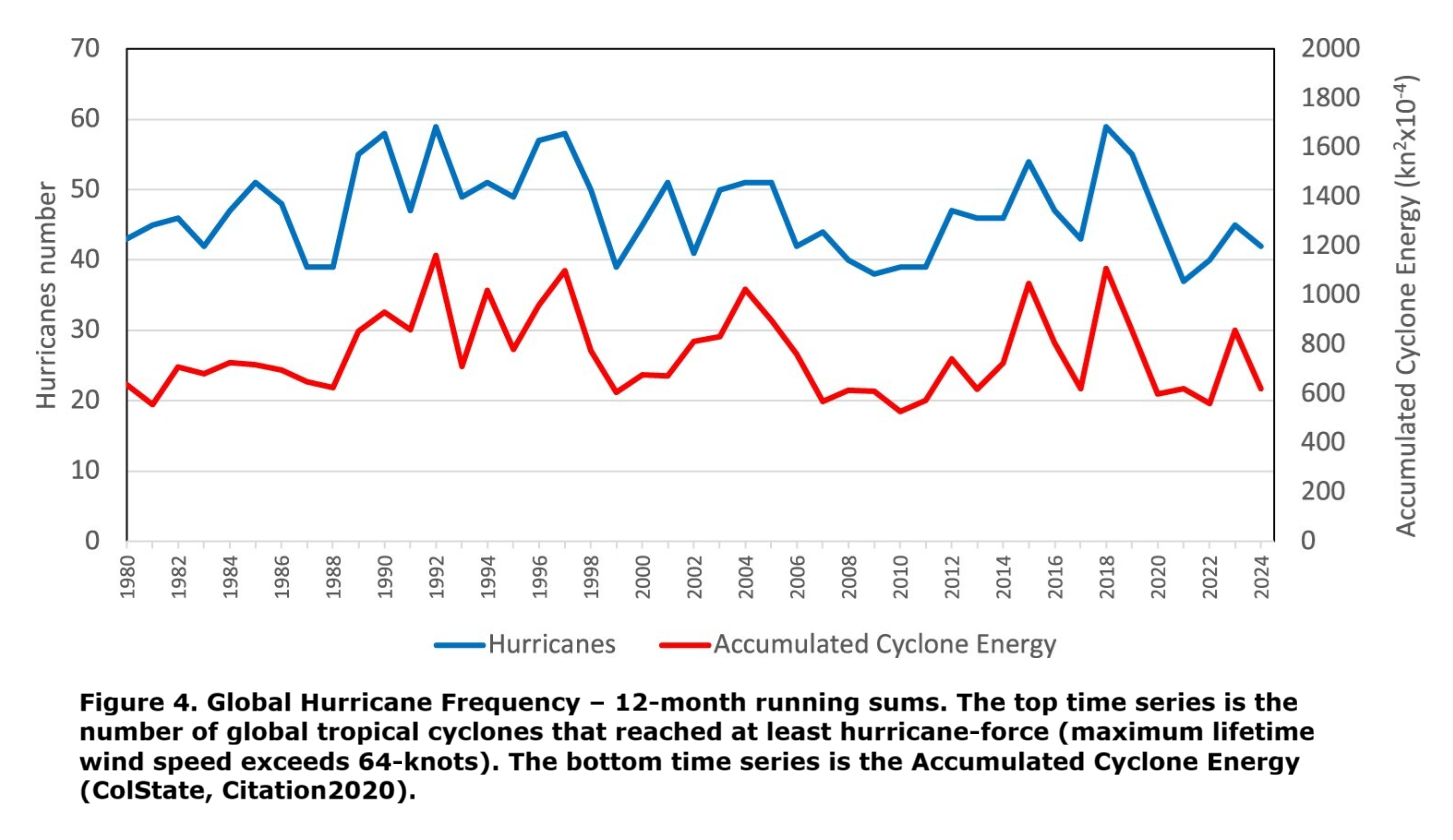
This is a huge effect, and thus, if it were real, it is reasonable to expect to see clear long-term trends in metrics of tropical cyclone (hurricane) intensity like the accumulated number of major (Category 3+) hurricane days or the accumulated cyclone energy from all tropical cyclones (which is proportional to the square of hurricane windspeed accumulated over their lifetimes). However, any long-term trends in such metrics are subtle at best, both globally and over the North Atlantic.

From Colorado State University Department of Atmospheric Science Tropical Meteorology Project.

So, this is a microcosm of the aforementioned apparent discrepancy between more broad quantifications of changes in extremes and their associated EEA counterparts, and again, I’d argue there are several selection biases at play affecting the production and dissemination of the EEA study.

Let’s start with Choice Bias on methodology. Human-caused warming changes the environment in some ways that work to enhance hurricanes and in other ways that diminish them. The main way that hurricanes are enhanced is via the increase in sea surface temperatures (which provides the fundamental fuel for hurricanes), and the main way that hurricanes are diminished is via changes in atmospheric wind shear and humidity.

The net result of these countervailing factors pulling in opposite directions is that we expect fewer hurricanes overall, but when hurricanes are able to form, they can be stronger than they would otherwise. These factors, though, are small relative to natural random variability, and thus, they are difficult to detect in observations.

However, the Climate Central researchers made the methodological choice
to largely exclude the influence of factors that diminish
hurricane development from the study.

Are these Choice Biases in event type and methodology an accident? There are many reasons to believe they are not.

The research paper itself spells out that the motivation of the study is to “connect the dots” between climate change and hurricanes because “landfalling hurricanes with high intensities—can act as ‘focusing events’ that draw public attention” and that “Increased attention during and in wake of storms creates opportunities for public and private discourse around climate and disaster preparedness.”

Then, there is the extensive media coverage of this study. It was picked up by 134 news outlets and ranked in the 99.95th percentile of research articles (across all journals) of similar age in terms of online attention. Further, it was immediately incorporated into seven Wikipedia articles (likely having high leverage on AI queries, which would make its findings indistinguishable from scientific “fact”). This is affected by the aforementioned Media Coverage Bias, but it is also undoubtedly directly influenced by the efforts of Climate Central, which is explicitly an advocacy organization whose self-described specialty is media placement and dissemination. 

The above sheds light on the reasons for certain choice biases in a particular study, but there is plenty of evidence that these selection biases are pervasive in the EEA field. After all, Dr. Myles Allen essentially founded the field with the motivation of answering the question, “Will it ever be possible to sue anyone for damaging the climate?”. This same motivation seems to animate many of the most high-profile scientists in the field today, like Allen’s protege, Dr. Friederike Otto (co-founder and leader of World Weather Attribution). She and her organization are frequently cited as bringing the necessary intellectual authority to credibly sue fossil fuel companies. She states the motivation of her work explicitly:

“Attributing extreme weather events to climate change, as I do
through my work as a climatologist, means we can hold
countries and companies to account for their inaction.”

Given the explicitly stated motivation of those in the EEA field, it is quite reasonable to suppose that there are major selection biases at play, and thus, it is not at all surprising that the collective output of the EEA field would look so different from more broad comprehensive assessments.

2025 Update: Pushing for Climate Diversity

Update: 

WUWT just published a graph regarding a study of Ocean Air Sheltered (OAS) station records compared to higher temperatures at ocean affected places.  The diversity of microclimates is often lost in the concern over global climate change.  So this post is pertinent to understanding these complexities.

Background

Amidst all the concerns for social diversity, let’s raise a cry for scientific diversity. No, I am not referring to the gender or racial identities of people doing science, but rather acknowledging the diversity of climates and their divergent patterns over time. The actual climate realities affecting people’s lives are hidden within global averages and abstractions. A previous post Concurrent Warming and Cooling presented research findings that on long time scales maritime climates can shift toward inland patterns including both colder winters and warmer summers.

It occurred to me that Frank Lansner had done studies on weather stations showing differences depending on exposure to ocean breezes or not. That led me to his recent publication Temperature trends with reduced impact of ocean air temperature Lansner and Pederson March 21, 2018. Excerpts in italics with my bolds.

Abstract

Temperature data 1900–2010 from meteorological stations across the world have been analyzed and it has been found that all land areas generally have two different valid temperature trends. Coastal stations and hill stations facing ocean winds are normally more warm-trended than the valley stations that are sheltered from dominant oceans winds.

Thus, we found that in any area with variation in the topography, we can divide the stations into the more warm trended ocean air-affected stations, and the more cold-trended ocean air-sheltered stations. We find that the distinction between ocean air-affected and ocean air-sheltered stations can be used to identify the influence of the oceans on land surface. We can then use this knowledge as a tool to better study climate variability on the land surface without the moderating effects of the ocean.

We find a lack of warming in the ocean air sheltered temperature data – with less impact of ocean temperature trends – after 1950. The lack of warming in the ocean air sheltered temperature trends after 1950 should be considered when evaluating the climatic effects of changes in the Earth’s atmospheric trace amounts of greenhouse gasses as well as variations in solar conditions.

As a contrast to the OAS stations, we compare with what we designate as ocean air affected (OAA) stations, which are more exposed to the influence of the ocean, see Figure 1. The optimal OAA locations are defined as positions with potential first contact with ocean air. In general, stations where the location offers no shelter in the directions of predominant winds are best categorized as OAA stations.

Conversely, the optimal OAS area is a lower point surrounded by mountains in all directions. In this case, the existence of predominant wind directions is not needed. Only in locations with a predominant wind direction, the leeward side of the mountains can also form an OAS region.

Figure 2. The optimal OAA and OAS locations with respect to dominating wind direction.

A total of 10 areas were chosen for this work to present the temperature trends of OAS areas (typically valley areas) and OAA areas from Scandinavia, Central Siberia, Central Balkan, Midwest USA, Central China, Pakistan/North India, the Sahel Area, Southern Africa, Central South America, and Southeast Australia. In this work, we have only considered an area as “OAS” or “OAA” if it comprises at least eight independent temperature sets. In the following, temperature data 1900–2010 from individual areas are discussed.

As an example, we show in Figure 3 the results for the Scandinavian area where we have used a total of 49 OAS stations and 18 OAA stations. The large number of stations available is due to the use of meteorological yearbooks as supplement to data sources such as ECA&D climate data and Nordklim database.

Figure 3. OAS and OAA temperature stations, Scandinavia.

The upper set of curves is from the OAS areas: Here the blue lines show one-year mean temperature averages for each temperature station, the red lines show the average of all stations of the area, and the thick black line is a five-year running mean of the station average. The reference period is 1951–1980. The middle set of curves is from the OAA areas. Here the orange lines show one-year mean temperature averages for each temperature station, the red lines show average of the stations of the area, and the thick black line is a five-year running mean of the station average. The reference period is 1951–1980.

On the lower set of curves labeled “OAS vs. OAA areas,” a comparison of the two data sets of stations is shown. The blue lines are the one-year average of OAS stations of the area and the red lines are the one-year average of OAA stations of the area. The reference period is 1995–2010. We note that these Scandinavian OAS stations are not well shielded from easterly winds.

Although easterly winds are not frequent (see Figure 2), the OAS area used cannot be characterized as an optimal OAS area. Despite this, we find a difference between the OAS and OAA area temperature data. While the general five-year running mean temperature curves (left panel in Figure 3) show resemblance in warming/cooling cycles, the OAA stations show less variation than the OAS stations.

We also find the absolute temperature anomalies for the Scandinavian OAS areas deviate from the OAA area with the OAS stations showing less warming than the OAA stations during the 20th century. For the years 1920–1950, we thus find temperatures in the OAS area to be up to 1 K warmer than temperature in the OAA area. In recent years, there is a closer agreement between OAS and OAA trends and even though the Scandinavian OAS data generally are warmer than OAA data for 1920–1950, we also note that in some very cold years, OAS temperatures are slightly colder than the OAA temperatures.

The paper presents all ten regions analyzed, but I will include here the USA example to see how it compares with other depictions of US regions. For example, see the map at the top shows the dramatic difference between temperature records in Eastern versus Western US stations. Here is the assessment from Lansner and Pederson. Note the topographical realities.

For the USA (Figure 6), we defined the OAS area as consisting of eight boxes, each of size 5° X 5°. The boxes were defined as 40–45N X 100–95 W, 40–45N  X 95–90W, 35– 40N X 100–95W, 35–40N X 95–90 W, 35–40N X 90–85W, 35–30N X 100– 95W, 35–30N X 95–90W, and 35–30N X 90–85W. A total of 236 temperature stations were used from this area. Full 5 X 5 grids were not found to be suited as OAA areas, but 27 stations indicated on the map were used for the OAA data set. All data were taken from GHCN v2 raw data. The OAS area in the US Midwest is well protected against westerly oceanic (Pacific) winds due to the Rocky Mountains. The US Midwest is also to some degree sheltered against easterly winds due to the Appalachian mountain range. Again the temperature trends from the OAS area as defined above show the 1920–1955 period in most years to be around 1 K warmer than temperature trends from the OAA areas.

Summation

Figure 13. OAS and OAA temperature averages, Northern Hemisphere.

In Figure 13 we have combined average temperature trends for all seven NH OAS areas (blue curves) and OAA areas (brown curves) were areas are divided into low (0–45N) and high (45–90N) latitudes (dark colors are used for low and light colors for high latitudes). Both for the OAS areas and the OAA areas we see that the seven NH areas have similar development of temperature trends for 1900–2010. The larger variation in data from high latitudes (45–90N) is likely to reflect the Arctic amplification of temperature variations. OAS temperature stations further away from the Arctic (0–45N) seem to show less temperature increase during 1980–2010 than the OAS areas most affected by the Arctic (45– 90N). The NH OAS data all reveal a period of heating of the Earth surface 1920–1950 that the OAA data do not reflect well.

Figure 19. OAS and OAA temperatures, all regions.

Conclusion

Bromley et al. raise shifts in seasonality as a factor in climate change. Now Lansner and Pederson show differences in temperature trends due to ocean exposure, and also greater fluctuations with higher latitudes. Note that the cooling in the USA is replicated in the pattern shown worldwide in OAS regions. The key factor is the hotter temperatures prior to 1950s appearing in OAS records but not in OAA records.

Despite all the clamor about global warming (or recently global cooling since the hiatus), it all depends on where you are.  Recognizing the diversity of local and regional climates is the sort of climate justice I can support.

Footnote:

I do not subscribe to Arctic “Amplification” to explain latitudinal differences.  Since earth’s climate system is always working to transport energy from the equator to poles, any additional heat shows up in higher latitudes by meridional transport.  Previous posts have noted how anomalies give a distorted picture since temperatures are more volatile at higher (colder) NH latitudes.

See: Temperature Misunderstandings

Clive Best provides this animation of recent monthly temperature anomalies which demonstrates how most variability in anomalies occur over northern continents.

Green Energy Companies Going Down the Drain

Three reports provide data on hollowing out the alternative energy (non-hydrocarbon) sector.  Firstly an update from E2 $22 Billion in Clean Energy Projects Cancelled in First Half of 2025; $6.7 Billion Cancelled in June.  Excerpts in italics with my bolds and added images.

Clean Economy Works | total projects cancelled, closed,
downsized by sector Aug. 2022-June 2025

*totals will not match overall figures as some projects are categorized into multiple sectors

Businesses canceled, closed, and scaled back more than $22 billion worth of new factories and clean energy projects in the first half of 2025 after cancelling another $6.7 billion in June alone, according to E2’s latest monthly analysis of clean energy projects tracked by E2 and the Clean Economy Tracker.

The latest wave of cancellations — affecting five battery, storage, and electric vehicle factories in Colorado, Indiana, Michigan, New York, and Oregon — follows growing uncertainty among businesses as Congress was making the final push to effectively end federal clean energy tax credits. More than 5,000 jobs were lost to the cancellations and scales backs in June, bringing the total number of jobs lost to abandoned projects in 2025 to 16,500.

June’s cancellations were led by major automakers scaling back electric vehicle production investments. General Motors cancelled a $4.3 billion plan to expand its Orion plant in Michigan to build new electric pickups and instead shift its investments there to build 8-cylinder gas vehicles. Additionally, Toyota scaled back a $2.2 billion plan to retool a manufacturing plant in Indiana that was going to build a new three-row electric SUV, consolidating production to its Georgetown, Kentucky plant instead.

Cancellations, Closures, Downsizes

This tracking includes all projects, plants, operations, or expansions that were cancelled or closed since passage of the IRA in August 2022. This does not include announced layoffs that are not associated with a project downsizing unless there is a stated decease in production output. This list also does not include the transfer of project ownership, if production will continue under the new ownership, power purchasing agreements, or other similar type of announcements. Project delays or idling of facilities are not included unless there in an announced decrease in production or investment or unless the project will need to be restarted to proceed in the future.

A second report is from Big Green Machine  CLEAN ENERGY MANUFACTURING: TRUMP 47+ 7 MONTHS.  Excerpts in italics with my bolds and added images.

What has happened to investment in US clean energy manufacturing and supply chains since Trump took office on January 20, 2025?  Our Trump + 7 month tracker below was updated on August 20, 2025. You can also read our 6-month report below or download the report.

The Big Green Machine: Trump + 6 months report (released on July 29, 2025, based on data through July 20, 2025).

Since Donald Trump took office on January 20, 2025, newly announced investments in clean energy manufacturing projects have slowed dramatically, while the number of projects that have been paused, canceled, or closed has skyrocketed. Projects are being paused, cancelled, and closed at a rate 6 times more than during the same period in 2024 and 30 times more than during the same period in 2023.

The Big Green Machine tracks investments in the supply chain, from mine to factory, in the wind, solar, batteries, and electric vehicle industries. Over the past six months, 26 projects, totaling $27.6 billion in capital investment and creating 18,849 jobs, have been paused, canceled, or closed. During the same period, 29 new projects were announced, adding up to $3.0 billion in capital investment and 8,334 jobs.

This marks a dramatic reversal from the first six months of 2024. During that period, 54 new projects adding up to $15.9 billion in capital investment and 25,942 new jobs were announced. In comparison, 8 projects adding up to $4.1 billion in capital investment and 3,820 jobs were paused, canceled, or closed during the first six months of 2024.

That does not mean all activity in the clean energy sector has stopped. Since Trump took office, many previously announced projects have broken ground, started pilot production, or moved into full production. By our count, 39 projects adding up to $21.1 billion in capital investment and 25,269 jobs have advanced in the past six months. But the projects that are advancing are, on average, smaller in size than the projects that are slowing.

Other patterns are emerging with respect to which projects are advancing or slowing. Not surprisingly, projects counting on federal support in the form of loans and grants are more likely to be slowing. In addition, our tracking shows that projects located in communities with lower median household incomes and communities classified as disadvantaged are seeing a higher proportion of slowed projects, meaning that communities in need of opportunity are losing out.

Unlike the two above reports focusing on 2025 contractions, the third report from Canary media details the green energy bloodbath last year The cleantech companies that didn’t make it through 2024. Excerpts in italics with my bolds and added images.

From carbon removal startups to solar icons, the climate world saw a number of corporate flameouts this year. Here are some takeaways and lessons learned.

Examples included (among many others)

Solar sunsets

Arguably the most shocking cleantech corporate demise of 2024 was that of SunPower, a solar industry icon that grew from humble startup roots to a valuation in the billions, only to file for bankruptcy in August. Even as solar installations smash records in the U.S. and the federal government channels capital into onshoring solar panel production, SunPower found itself undone by China’s industrial policy might and its own boardroom missteps. High interest rates and other policy headwinds, like California’s NEM 3.0, didn’t help.  Also Ubiquitous Energy, Toledo Solar

Solar installer bloodbath

High interest rates and rooftop solar incentive shifts in leading states rippled through the long tail of residential solar installers and led to scores of bankruptcies in the past two years, an unprecedented collapse.

Here are a few of the larger casualties from this year: Sunworks, a residential and commercial solar installer, filed for bankruptcy in February. Founded in 2002, Sunworks had developed 224 megawatts of solar projects across 15 states and employed 640 people. Titan Solar operated in 16 states and abruptly shut down its operations in June. Utah-based residential solar company Lumio filed for bankruptcy in September.

Energy storage setbacks 

Armed with billions in investor capital, scores of storage startups have been aiming to dethrone energy stalwarts like lithium-ion and diesel generators — but in the words of The Wire’s Omar Little, ​If you come at the king, you best not miss.”

These companies missed.  Sweden’s Northvolt, once valued by investors at almost $12 billion, filed for bankruptcy in November in the year’s biggest battery bust.  Ambri, an energy storage aspirant with technology based on the research of MIT professor Donald Sadoway, declared bankruptcy in May.  Richmond, California–based Moxion Power laid off 101 workers in June and shuttered its doors, following a wave of hype for its 75-kilowatt portable lithium-ion batteries that it hoped would replace diesel generators.  Two other notable failures in the storage sector:  Ionic Materials, a 40-person MIT spin-out developing battery materials, Australian flow battery firm Redflow.

Removing carbon one VC dollar at a time 

Running Tide was the largest marine carbon-removal startup and the first to sell ocean carbon credits. Its initial plan of removing carbon dioxide from the atmosphere and sequestering it in the ocean by growing and sinking kelp morphed into sinking wood chips coated with lime-kiln dust. Running Tide announced that it was folding in June after raising more than $54 million.

Unsustainable aviation

Chasing a clean fuels breakthrough, Fulcrum BioEnergy promised to transform municipal waste into sustainable aviation fuel through a low-emissions gasification process. Instead, the company incinerated hundreds of millions in funding from BP, United Airlines, Cathay Pacific, and Japan Airlines — and hundreds of millions more in municipal bondsThe firm ceased operations in May.  Also Universal Hydrogen 

Charger bankruptcy

Tritium, a major provider of high-speed EV chargers, went bust in April but found a buyer for its insolvent business in India-based Exicom, which claims it will keep Tritium’s U.S. factory in business. Tritium has sold roughly 13,000 chargers in 47 countries and claimed a 30 percent U.S. market share for direct-current fast chargers in 2023.

Zero to 60 and back to zero with EVs

Luxury EV maker Fisker went bankrupt again; electric-van maker Arrival went bankrupt and sold its assets to another struggling EV maker, Canoo, which is currently furloughing employees; Cake, a Swedish e-motorcycle startup, sold 6,000 bikes but filed for bankruptcy in February after raising more than $75 million.

ArcimotoFaraday FutureMullen Automotive, and Workhorse Group are publicly traded EV companies but are facing delisting warnings, paltry revenue, and valuations that are rapidly approaching zero. Nikola stock is down by 90 percent year to date.

Comment

These reports are from green energy enthusiasts and promoters, expressing concerns without questioning the so-called transition to zero carbon.  They really do want to pave farmland over with solar and wind installations.  The rest of us understand that the whole green economy notion is delusional and needs dismantling ASAP.  The creative destruction of these misbegotten enterprises is a step in the right direction.

Canada Provinces Defy Climatists, Opt for Energy Freedom

BREAKING! Alberta DROPS BOMBSHELL After Canada REJECTS U.S. Pipeline Deal!  The video explains how ordinary Canadians are taking action to reject climatism ideology in favor of energy realism and freedom. The transcript is below in italics with my bolds and added images.

What happens when a single province challenges an entire nation? Alberta just dropped a political bombshell after Ottawa rejected its 10 billion US dollar pipeline deals.

“Today marks an important step forward in uniting our country as Saskatchewan jumps on board with Alberta and Ontario to pursue our shared goals of economic growth, opportunity, and prosperity.” Alberta Premier Danielle Smith

But Premier Danielle Smith isn’t backing down. She’s fighting back with her crossborder energy corridor, striking partnerships with US states and challenging the decision and power of Ottawa.

“Today, we’re signing a memorandum of understanding that makes Saskatchewan an official signatory and partner as we work together on building oil and gas pipelines and expanding trade corridors to global markets.”

This fight isn’t about a single pipeline anymore. It’s a full-blown showdown over the economic soul of Canada. Who really controls the future? Federal climate crusaders in Ottawa or the oil-driven defiance in Alberta? It started quietly. For months Alberta had been negotiating with US refiners and private investors on a bold plan, a new pipeline corridor linking the oil sands to refineries in Montana, North Dakota, and ultimately to the Gulf Coast.

This wasn’t a revival of Keystone XL, but the logic was the same: move more bitumen and synthetic crude, cut rail dependency, and deliver secure Canadian energy to the hungry markets in America. The numbers told the story. This agreement will see our three provinces advance pipelines and pathways to boost exports of homegrown energy, potash, critical minerals, and agricultural products to markets across Canada and across the world.

The proposed cost was between 8 and 10 billion, almost entirely financed by private industry. There were no bailouts and no federal funding. All Alberta asked from Ottawa was a green light on crossborder approval. For Premier Danielle Smith, this wasn’t just about energy. It was about survival.

And if Prime Minister Mark Carney doesn’t want to work with us, it’s not just myself and Scott Moe he’ll have to worry about. He’ll also have to contend with Premier Doug Ford, who has said many times he’ll be all over him like an 800lb gorilla.

So, it’s time to get rid of the bad laws that have harmed Canada’s ability to grow the energy sector and other industries such as mining and manufacturing. The economy of Alberta is built on oil exports. But without enough pipeline capacity, producers were forced to rely on rail. Rail is slower, more expensive, and more dangerous. The delay of one day meant millions lost. Thousands of jobs at risk, and the Albertan communities paying the price.

Industry leaders were optimistic. US refiners in the Midwest and Gulf were eager for Canadian heavy crude, a more stable and cleaner alternative compared to politically volatile suppliers abroad. The environmental analysts even argued the project would cut per barrel emissions by replacing rail transport with efficient modern pipelines. Everything was lined up perfectly.

But then Ottawa said no. The Canadian Prime Minister Mark Carney rejected the deal outright. He made it clear no new crossborder pipelines would be approved. But why? The answer was climate. Carney and his government had pledged to lead Canada into a net zero future. New pipelines, federal ministers argued, would lock in emissions, heavy oil production for decades. That was incompatible with the climate commitments and international reputation of Canada.

Behind the scenes, politics also played a role. Quebec and large parts of Ontario, crucial bases of support for federal liberals and centrists, have long opposed the construction of new fossil fuel infrastructure. The approval of pipeline in Alberta risked urban climate conscious voters in Montreal, Toronto, and Ottawa.

Rejecting it sent a signal the energy future of Canada will be hydrogen,
renewables, and critical minerals, not the oil sands in Alberta.

For Alberta, the message was brutal. It wasn’t just a policy decision. It was a blockade. But Danielle Smith didn’t wait. Within 48 hours, she called an emergency press conference. Standing beside industry leaders and ministers, she declared Alberta would move ahead with or without Ottawa. Smith announced a bold new plan, a provincially backed pipeline corridor fast-tracked under Albertan jurisdiction, financed by private investors, and supported by 1.2 $2 billion in provincial loan guarantees. The construction preparation is expected to begin within 12 months.

Danielle Smith revealed exploratory agreements with the governors of Montana and North Dakota to coordinate crossborder energy projects, trade facilitation, and infrastructure planning. In short, if Ottawa won’t help, Alberta will work directly with the states in the United States. The message was clear. Alberta wasn’t asking anymore. It was acting.

The stakes are enormous. Albertian oil sands directly support over 140,000 jobs and billions of dollars in export earnings. Without pipelines, producers such as Suncor, Cenovis, and Meg Energy face rising transportation costs, reduced competitiveness, and shrinking investment. For workers, the uncertainty is devastating. Thousands of pipe fitters, welders, truck drivers, and construction crews were counting on jobs tied to the $10 billion project. The communities along potential routes were preparing for growth. Now they’re caught between the rejection of Ottawa and Albertan defiance.

But the ripple effects don’t stop in Canada. Smith framed it bluntly. This wasn’t ideology. It was survival. Alberta wasn’t going to stand by while Ottawa, in her words, choked our future. Once she doubled down by raising the stakes even higher. Alberta would consider tapping the Alberta pension plan to finance its energy infrastructure. The logic? If Ottawa won’t support their priorities, then Albertans’ money should.

The bombshell ignited fury across the West. Saskatchewan and Ontario quickly signed memorandums of understanding with Alberta, pledging to expand pipelines, rail exports, and energy trade. Wexit groups, which had been dormant for a long time, roared back online. Conservative premiers in Saskatchewan and BC echoed the defiance of Smith, accusing Ottawa of sabotaging resource provinces. The Ottawan response was predictable. Federal ministers doubled down on climate goals. So, no more pipelines and no more fossil expansion, only renewables, critical minerals, and electrification. The Canadian government painted Albertan response as reckless and accused Smith of manufacturing a crisis for political gain.

But here’s the truth. This isn’t just a policy dispute anymore. It’s a battle for the Canadian economic soul. The question is, how far will this go? Because what happens next could reshape Canada forever. The fallout is already shaking the political map of Canada. In Western Canada, calls for autonomy are louder than ever. Saskatchewan’s premier joined Smith in declaring that energy independence is no longer optional. It’s survival. Even Ontario, often aligned with Ottawa, signed agreements to boost pipeline and mineral trade with Alberta.
For many, this is more than economics. It’s about fairness. Albertans see the wealth of their province generated from oil exports funding national programs while Ottawa refuses to support the very industry that creates that wealth. The rejection crystallized a long-standing grievance that the federal government takes from Alberta but never gives back.

The tension is spilling into Parliament. Conservative MPs accused Carney of abandoning Canadian workers to please foreign investors and climate lobbyists. They warned that the stance of Ottawa weakens national unity and strengthens separatist sentiment. Meanwhile, Block Quebecois MPs cheered the rejection, saying Alberta should stop holding Canada hostage with oil. The divide is sharper than ever.
South of the border, the reaction is more pragmatic. Governors in Montana and North Dakota see opportunity. By partnering directly with Alberta, they can secure stable energy supplies and create jobs in pipeline construction, refining, and logistics. Quietly, US officials are already signaling support.

But this puts Ottawa in a bind. If Alberta succeeds in striking crossborder deals without federal blessing, it challenges the very structure of Canadian federalism. The energy and trade are constitutionally shared powers. But what happens if a province pushes ahead anyway? The legal challenges are inevitable. Ottawa may try to block Alberta in court, but that could trigger an even deeper political backlash.

So, for now, Ottawa is betting on a green future. Alberta is betting on oil. Both sides are digging in. If Alberta pulls this off, it could change the balance of power in Canada forever. If it fails, the province risks isolation, lost investment, and a deeper rift with Ottawa.

Surplus Arctic Ice late August 2025

After a sub-par March maximum, by end of May 2025 Arctic ice closed the gap with the 19-year average. Then in June the gap reopened and in July the melting pace matched the average, abeit four days in advance of average. In mid-August MASIE showed the Arctic ice extent matching the 19-year average. Now with a week to go Arctic ice has been above average for the last five days, by over +200k km2 yesterday.

During August the average year loses 1.9M km2 of ice extent.  MASIE on day 213 was 308k km2 down, and the gap closed steadily, going into surplus on day 230. Note 2020 and 2024 were well  below average mid-August.  2024 ended nearly average, while 2020 went down almost off the chart. Meanwhile SII v.4 started August ~400k km2 lower than MASIE, increasing to 600k km2 yesterday.  More on what happened to SII in footnote.

The regional distribution of ice extents is shown in the table below. (Bering and Okhotsk seas are excluded since both are now virtually open water.)

Region 2025234 Ave. Day 234 2025-Ave. 2020234 2025-2020
 (0) Northern_Hemisphere 5665223 5452280 212942 4947191 718032
 (1) Beaufort_Sea 912878 636530 276349 802063 110815
 (2) Chukchi_Sea 456078 382204 73873 382512 73565
 (3) East_Siberian_Sea 597683 465057 132626 248241 349443
 (4) Laptev_Sea 210514 216232 -5718 36330 174184
 (5) Kara_Sea 3533 70094 -66561 23616 -20083
 (6) Barents_Sea 0 18103 -18103 342 -342
 (7) Greenland_Sea 124456 195018 -70562 227692 -103236
 (8) Baffin_Bay_Gulf_of_St._Lawrence 63370 40548 22822 13063 50308
 (9) Canadian_Archipelago 371460 348507 22954 356783 14677
 (10) Hudson_Bay 21111 34968 -13858 35329 -14218
 (11) Central_Arctic 2902590 3043900 -141310 2820550 82040

The table shows large surpluses in Eurasian basins  Beaufort, Chukchi and E. Siberian, more than offsetting deficits in Central Arctic, Kara and Greenland seas. Hudson Bay is mostly open water at this time of year. 2025 exceeds the average ice extents by 212k km2, or 4%, and is 718k km2 greater than 2020, or 0.7 Wadhams of ice extent.

Why is this important?  All the claims of global climate emergency depend on dangerously higher  temperatures, lower sea ice, and rising sea levels.  The lack of additional warming prior to 2023 El Nino is documented in a post SH Drives UAH Temps Cooler July 2025.

The lack of acceleration in sea levels along coastlines has been discussed also.  See Observed vs. Imagined Sea Levels 2023 Update

Also, a longer term perspective is informative:

post-glacial_sea_level

Footnote Regarding  SII v.4

NSDIC acknowledged my query regarding the SII (Sea Ice Index) dataset. While awaiting an explanation I investigated further. My last download of the SII Daily Arctic Ice Extents was on July 30, meaning that the most recent data in that file was day 210, July 29. The header on that file was Sea_Ice_Index_Daily_Extent_G02135_v3.

Then on August 1, the downloaded file had the heading Sea_Ice_Index_Daily_Extent_G02135_v4. So it appears that these are now the values from a new version of SII. As I wrote in my query, since March 14 all of the values for Arctic Ice Extents are lower in this new record. The graph above shows the implications for August as an example of estimates from SIIv.4

The change started in January 2025 and will be the basis for future reporting.  The logic for this is presented in this document: Sea Ice Index Version 4 Analysis

In June 2025, NSIDC was informed that access to data from the Special Sensor Microwave
Imager/Sounder (SSMIS) onboard the Defense Meteorological Satellite Program (DMSP)
satellites would end on July 31 (NSIDC, 2025). To prepare for this, we rapidly developed version
4 of the Sea Ice Index. This new version transitions from using sea ice concentration fields
derived from SSMIS data as input to using fields derived from the Advanced Microwave
Scanning Radiometer 2 (AMSR2) sensor onboard the Global Change Observation Mission – W1
(GCOM-W1) satellite.  On 29 July 2025, we learned that the Defense Department decision to terminate access to DMSP data had been reversed and that data will continue to be available until September 2026.

We are publishing Version 4, however, for these reasons:

• The SSMIS instruments are well past their designed lifespan and a transition to
AMSR2 is inevitable. Unless the sensors fail earlier, the DoD will formally end the
program in September 2026.
• Although access of SSMIS will continue through September 2026, the Fleet
Numerical Meteorology and Oceanography Center (FNMOC), where SSMIS data
from the DMSP satellite are downloaded, made an announcement that “Support
will be on a best effort basis and should be considered data of opportunity.” This
means that SSMIS data will likely contain data gaps.
• We have developer time to make this transition now and may not in the future.
• We are confident that Version 4 data are commensurate in accuracy to those
provided by Version 3.