Green Energy Companies Going Down the Drain

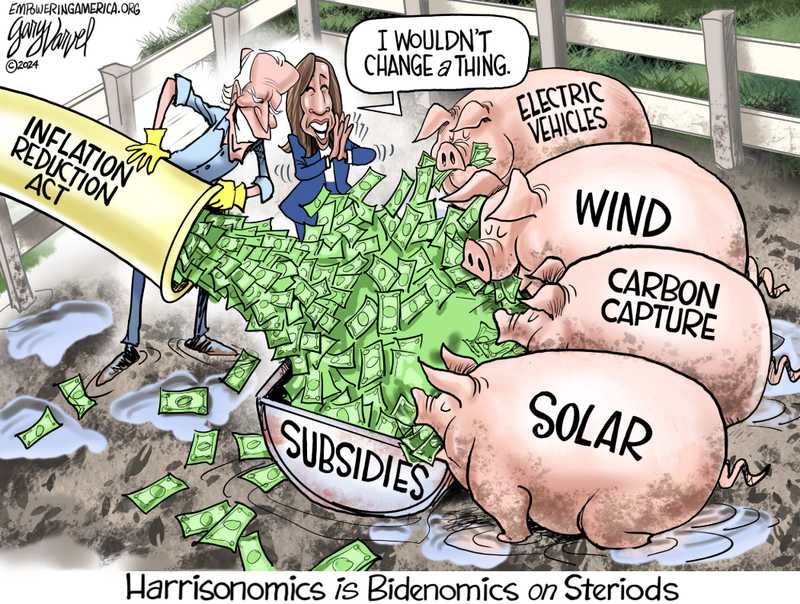
Three reports provide data on hollowing out the alternative energy (non-hydrocarbon) sector.  Firstly an update from E2 $22 Billion in Clean Energy Projects Cancelled in First Half of 2025; $6.7 Billion Cancelled in June.  Excerpts in italics with my bolds and added images.

Clean Economy Works | total projects cancelled, closed,
downsized by sector Aug. 2022-June 2025

*totals will not match overall figures as some projects are categorized into multiple sectors

Businesses canceled, closed, and scaled back more than $22 billion worth of new factories and clean energy projects in the first half of 2025 after cancelling another $6.7 billion in June alone, according to E2’s latest monthly analysis of clean energy projects tracked by E2 and the Clean Economy Tracker.

The latest wave of cancellations — affecting five battery, storage, and electric vehicle factories in Colorado, Indiana, Michigan, New York, and Oregon — follows growing uncertainty among businesses as Congress was making the final push to effectively end federal clean energy tax credits. More than 5,000 jobs were lost to the cancellations and scales backs in June, bringing the total number of jobs lost to abandoned projects in 2025 to 16,500.

June’s cancellations were led by major automakers scaling back electric vehicle production investments. General Motors cancelled a $4.3 billion plan to expand its Orion plant in Michigan to build new electric pickups and instead shift its investments there to build 8-cylinder gas vehicles. Additionally, Toyota scaled back a $2.2 billion plan to retool a manufacturing plant in Indiana that was going to build a new three-row electric SUV, consolidating production to its Georgetown, Kentucky plant instead.

Cancellations, Closures, Downsizes

This tracking includes all projects, plants, operations, or expansions that were cancelled or closed since passage of the IRA in August 2022. This does not include announced layoffs that are not associated with a project downsizing unless there is a stated decease in production output. This list also does not include the transfer of project ownership, if production will continue under the new ownership, power purchasing agreements, or other similar type of announcements. Project delays or idling of facilities are not included unless there in an announced decrease in production or investment or unless the project will need to be restarted to proceed in the future.

A second report is from Big Green Machine  CLEAN ENERGY MANUFACTURING: TRUMP 47+ 7 MONTHS.  Excerpts in italics with my bolds and added images.

What has happened to investment in US clean energy manufacturing and supply chains since Trump took office on January 20, 2025?  Our Trump + 7 month tracker below was updated on August 20, 2025. You can also read our 6-month report below or download the report.

The Big Green Machine: Trump + 6 months report (released on July 29, 2025, based on data through July 20, 2025).

Since Donald Trump took office on January 20, 2025, newly announced investments in clean energy manufacturing projects have slowed dramatically, while the number of projects that have been paused, canceled, or closed has skyrocketed. Projects are being paused, cancelled, and closed at a rate 6 times more than during the same period in 2024 and 30 times more than during the same period in 2023.

The Big Green Machine tracks investments in the supply chain, from mine to factory, in the wind, solar, batteries, and electric vehicle industries. Over the past six months, 26 projects, totaling $27.6 billion in capital investment and creating 18,849 jobs, have been paused, canceled, or closed. During the same period, 29 new projects were announced, adding up to $3.0 billion in capital investment and 8,334 jobs.

This marks a dramatic reversal from the first six months of 2024. During that period, 54 new projects adding up to $15.9 billion in capital investment and 25,942 new jobs were announced. In comparison, 8 projects adding up to $4.1 billion in capital investment and 3,820 jobs were paused, canceled, or closed during the first six months of 2024.

That does not mean all activity in the clean energy sector has stopped. Since Trump took office, many previously announced projects have broken ground, started pilot production, or moved into full production. By our count, 39 projects adding up to $21.1 billion in capital investment and 25,269 jobs have advanced in the past six months. But the projects that are advancing are, on average, smaller in size than the projects that are slowing.

Other patterns are emerging with respect to which projects are advancing or slowing. Not surprisingly, projects counting on federal support in the form of loans and grants are more likely to be slowing. In addition, our tracking shows that projects located in communities with lower median household incomes and communities classified as disadvantaged are seeing a higher proportion of slowed projects, meaning that communities in need of opportunity are losing out.

Unlike the two above reports focusing on 2025 contractions, the third report from Canary media details the green energy bloodbath last year The cleantech companies that didn’t make it through 2024. Excerpts in italics with my bolds and added images.

From carbon removal startups to solar icons, the climate world saw a number of corporate flameouts this year. Here are some takeaways and lessons learned.

Examples included (among many others)

Solar sunsets

Arguably the most shocking cleantech corporate demise of 2024 was that of SunPower, a solar industry icon that grew from humble startup roots to a valuation in the billions, only to file for bankruptcy in August. Even as solar installations smash records in the U.S. and the federal government channels capital into onshoring solar panel production, SunPower found itself undone by China’s industrial policy might and its own boardroom missteps. High interest rates and other policy headwinds, like California’s NEM 3.0, didn’t help.  Also Ubiquitous Energy, Toledo Solar

Solar installer bloodbath

High interest rates and rooftop solar incentive shifts in leading states rippled through the long tail of residential solar installers and led to scores of bankruptcies in the past two years, an unprecedented collapse.

Here are a few of the larger casualties from this year: Sunworks, a residential and commercial solar installer, filed for bankruptcy in February. Founded in 2002, Sunworks had developed 224 megawatts of solar projects across 15 states and employed 640 people. Titan Solar operated in 16 states and abruptly shut down its operations in June. Utah-based residential solar company Lumio filed for bankruptcy in September.

Energy storage setbacks 

Armed with billions in investor capital, scores of storage startups have been aiming to dethrone energy stalwarts like lithium-ion and diesel generators — but in the words of The Wire’s Omar Little, ​If you come at the king, you best not miss.”

These companies missed.  Sweden’s Northvolt, once valued by investors at almost $12 billion, filed for bankruptcy in November in the year’s biggest battery bust.  Ambri, an energy storage aspirant with technology based on the research of MIT professor Donald Sadoway, declared bankruptcy in May.  Richmond, California–based Moxion Power laid off 101 workers in June and shuttered its doors, following a wave of hype for its 75-kilowatt portable lithium-ion batteries that it hoped would replace diesel generators.  Two other notable failures in the storage sector:  Ionic Materials, a 40-person MIT spin-out developing battery materials, Australian flow battery firm Redflow.

Removing carbon one VC dollar at a time 

Running Tide was the largest marine carbon-removal startup and the first to sell ocean carbon credits. Its initial plan of removing carbon dioxide from the atmosphere and sequestering it in the ocean by growing and sinking kelp morphed into sinking wood chips coated with lime-kiln dust. Running Tide announced that it was folding in June after raising more than $54 million.

Unsustainable aviation

Chasing a clean fuels breakthrough, Fulcrum BioEnergy promised to transform municipal waste into sustainable aviation fuel through a low-emissions gasification process. Instead, the company incinerated hundreds of millions in funding from BP, United Airlines, Cathay Pacific, and Japan Airlines — and hundreds of millions more in municipal bondsThe firm ceased operations in May.  Also Universal Hydrogen 

Charger bankruptcy

Tritium, a major provider of high-speed EV chargers, went bust in April but found a buyer for its insolvent business in India-based Exicom, which claims it will keep Tritium’s U.S. factory in business. Tritium has sold roughly 13,000 chargers in 47 countries and claimed a 30 percent U.S. market share for direct-current fast chargers in 2023.

Zero to 60 and back to zero with EVs

Luxury EV maker Fisker went bankrupt again; electric-van maker Arrival went bankrupt and sold its assets to another struggling EV maker, Canoo, which is currently furloughing employees; Cake, a Swedish e-motorcycle startup, sold 6,000 bikes but filed for bankruptcy in February after raising more than $75 million.

ArcimotoFaraday FutureMullen Automotive, and Workhorse Group are publicly traded EV companies but are facing delisting warnings, paltry revenue, and valuations that are rapidly approaching zero. Nikola stock is down by 90 percent year to date.

Comment

These reports are from green energy enthusiasts and promoters, expressing concerns without questioning the so-called transition to zero carbon.  They really do want to pave farmland over with solar and wind installations.  The rest of us understand that the whole green economy notion is delusional and needs dismantling ASAP.  The creative destruction of these misbegotten enterprises is a step in the right direction.

Canada Provinces Defy Climatists, Opt for Energy Freedom

BREAKING! Alberta DROPS BOMBSHELL After Canada REJECTS U.S. Pipeline Deal!  The video explains how ordinary Canadians are taking action to reject climatism ideology in favor of energy realism and freedom. The transcript is below in italics with my bolds and added images.

What happens when a single province challenges an entire nation? Alberta just dropped a political bombshell after Ottawa rejected its 10 billion US dollar pipeline deals.

“Today marks an important step forward in uniting our country as Saskatchewan jumps on board with Alberta and Ontario to pursue our shared goals of economic growth, opportunity, and prosperity.” Alberta Premier Danielle Smith

But Premier Danielle Smith isn’t backing down. She’s fighting back with her crossborder energy corridor, striking partnerships with US states and challenging the decision and power of Ottawa.

“Today, we’re signing a memorandum of understanding that makes Saskatchewan an official signatory and partner as we work together on building oil and gas pipelines and expanding trade corridors to global markets.”

This fight isn’t about a single pipeline anymore. It’s a full-blown showdown over the economic soul of Canada. Who really controls the future? Federal climate crusaders in Ottawa or the oil-driven defiance in Alberta? It started quietly. For months Alberta had been negotiating with US refiners and private investors on a bold plan, a new pipeline corridor linking the oil sands to refineries in Montana, North Dakota, and ultimately to the Gulf Coast.

This wasn’t a revival of Keystone XL, but the logic was the same: move more bitumen and synthetic crude, cut rail dependency, and deliver secure Canadian energy to the hungry markets in America. The numbers told the story. This agreement will see our three provinces advance pipelines and pathways to boost exports of homegrown energy, potash, critical minerals, and agricultural products to markets across Canada and across the world.

The proposed cost was between 8 and 10 billion, almost entirely financed by private industry. There were no bailouts and no federal funding. All Alberta asked from Ottawa was a green light on crossborder approval. For Premier Danielle Smith, this wasn’t just about energy. It was about survival.

And if Prime Minister Mark Carney doesn’t want to work with us, it’s not just myself and Scott Moe he’ll have to worry about. He’ll also have to contend with Premier Doug Ford, who has said many times he’ll be all over him like an 800lb gorilla.

So, it’s time to get rid of the bad laws that have harmed Canada’s ability to grow the energy sector and other industries such as mining and manufacturing. The economy of Alberta is built on oil exports. But without enough pipeline capacity, producers were forced to rely on rail. Rail is slower, more expensive, and more dangerous. The delay of one day meant millions lost. Thousands of jobs at risk, and the Albertan communities paying the price.

Industry leaders were optimistic. US refiners in the Midwest and Gulf were eager for Canadian heavy crude, a more stable and cleaner alternative compared to politically volatile suppliers abroad. The environmental analysts even argued the project would cut per barrel emissions by replacing rail transport with efficient modern pipelines. Everything was lined up perfectly.

But then Ottawa said no. The Canadian Prime Minister Mark Carney rejected the deal outright. He made it clear no new crossborder pipelines would be approved. But why? The answer was climate. Carney and his government had pledged to lead Canada into a net zero future. New pipelines, federal ministers argued, would lock in emissions, heavy oil production for decades. That was incompatible with the climate commitments and international reputation of Canada.

Behind the scenes, politics also played a role. Quebec and large parts of Ontario, crucial bases of support for federal liberals and centrists, have long opposed the construction of new fossil fuel infrastructure. The approval of pipeline in Alberta risked urban climate conscious voters in Montreal, Toronto, and Ottawa.

Rejecting it sent a signal the energy future of Canada will be hydrogen,
renewables, and critical minerals, not the oil sands in Alberta.

For Alberta, the message was brutal. It wasn’t just a policy decision. It was a blockade. But Danielle Smith didn’t wait. Within 48 hours, she called an emergency press conference. Standing beside industry leaders and ministers, she declared Alberta would move ahead with or without Ottawa. Smith announced a bold new plan, a provincially backed pipeline corridor fast-tracked under Albertan jurisdiction, financed by private investors, and supported by 1.2 $2 billion in provincial loan guarantees. The construction preparation is expected to begin within 12 months.

Danielle Smith revealed exploratory agreements with the governors of Montana and North Dakota to coordinate crossborder energy projects, trade facilitation, and infrastructure planning. In short, if Ottawa won’t help, Alberta will work directly with the states in the United States. The message was clear. Alberta wasn’t asking anymore. It was acting.

The stakes are enormous. Albertian oil sands directly support over 140,000 jobs and billions of dollars in export earnings. Without pipelines, producers such as Suncor, Cenovis, and Meg Energy face rising transportation costs, reduced competitiveness, and shrinking investment. For workers, the uncertainty is devastating. Thousands of pipe fitters, welders, truck drivers, and construction crews were counting on jobs tied to the $10 billion project. The communities along potential routes were preparing for growth. Now they’re caught between the rejection of Ottawa and Albertan defiance.

But the ripple effects don’t stop in Canada. Smith framed it bluntly. This wasn’t ideology. It was survival. Alberta wasn’t going to stand by while Ottawa, in her words, choked our future. Once she doubled down by raising the stakes even higher. Alberta would consider tapping the Alberta pension plan to finance its energy infrastructure. The logic? If Ottawa won’t support their priorities, then Albertans’ money should.

The bombshell ignited fury across the West. Saskatchewan and Ontario quickly signed memorandums of understanding with Alberta, pledging to expand pipelines, rail exports, and energy trade. Wexit groups, which had been dormant for a long time, roared back online. Conservative premiers in Saskatchewan and BC echoed the defiance of Smith, accusing Ottawa of sabotaging resource provinces. The Ottawan response was predictable. Federal ministers doubled down on climate goals. So, no more pipelines and no more fossil expansion, only renewables, critical minerals, and electrification. The Canadian government painted Albertan response as reckless and accused Smith of manufacturing a crisis for political gain.

But here’s the truth. This isn’t just a policy dispute anymore. It’s a battle for the Canadian economic soul. The question is, how far will this go? Because what happens next could reshape Canada forever. The fallout is already shaking the political map of Canada. In Western Canada, calls for autonomy are louder than ever. Saskatchewan’s premier joined Smith in declaring that energy independence is no longer optional. It’s survival. Even Ontario, often aligned with Ottawa, signed agreements to boost pipeline and mineral trade with Alberta.

For many, this is more than economics. It’s about fairness. Albertans see the wealth of their province generated from oil exports funding national programs while Ottawa refuses to support the very industry that creates that wealth. The rejection crystallized a long-standing grievance that the federal government takes from Alberta but never gives back.

The tension is spilling into Parliament. Conservative MPs accused Carney of abandoning Canadian workers to please foreign investors and climate lobbyists. They warned that the stance of Ottawa weakens national unity and strengthens separatist sentiment. Meanwhile, Block Quebecois MPs cheered the rejection, saying Alberta should stop holding Canada hostage with oil. The divide is sharper than ever.

South of the border, the reaction is more pragmatic. Governors in Montana and North Dakota see opportunity. By partnering directly with Alberta, they can secure stable energy supplies and create jobs in pipeline construction, refining, and logistics. Quietly, US officials are already signaling support.

But this puts Ottawa in a bind. If Alberta succeeds in striking crossborder deals without federal blessing, it challenges the very structure of Canadian federalism. The energy and trade are constitutionally shared powers. But what happens if a province pushes ahead anyway? The legal challenges are inevitable. Ottawa may try to block Alberta in court, but that could trigger an even deeper political backlash.

So, for now, Ottawa is betting on a green future. Alberta is betting on oil. Both sides are digging in. If Alberta pulls this off, it could change the balance of power in Canada forever. If it fails, the province risks isolation, lost investment, and a deeper rift with Ottawa.

Surplus Arctic Ice late August 2025

After a sub-par March maximum, by end of May 2025 Arctic ice closed the gap with the 19-year average. Then in June the gap reopened and in July the melting pace matched the average, abeit four days in advance of average. In mid-August MASIE showed the Arctic ice extent matching the 19-year average. Now with a week to go Arctic ice has been above average for the last five days, by over +200k km2 yesterday.

During August the average year loses 1.9M km2 of ice extent.  MASIE on day 213 was 308k km2 down, and the gap closed steadily, going into surplus on day 230. Note 2020 and 2024 were well  below average mid-August.  2024 ended nearly average, while 2020 went down almost off the chart. Meanwhile SII v.4 started August ~400k km2 lower than MASIE, increasing to 600k km2 yesterday.  More on what happened to SII in footnote.

The regional distribution of ice extents is shown in the table below. (Bering and Okhotsk seas are excluded since both are now virtually open water.)

Region 2025234 Ave. Day 234 2025-Ave. 2020234 2025-2020
 (0) Northern_Hemisphere 5665223 5452280 212942 4947191 718032
 (1) Beaufort_Sea 912878 636530 276349 802063 110815
 (2) Chukchi_Sea 456078 382204 73873 382512 73565
 (3) East_Siberian_Sea 597683 465057 132626 248241 349443
 (4) Laptev_Sea 210514 216232 -5718 36330 174184
 (5) Kara_Sea 3533 70094 -66561 23616 -20083
 (6) Barents_Sea 0 18103 -18103 342 -342
 (7) Greenland_Sea 124456 195018 -70562 227692 -103236
 (8) Baffin_Bay_Gulf_of_St._Lawrence 63370 40548 22822 13063 50308
 (9) Canadian_Archipelago 371460 348507 22954 356783 14677
 (10) Hudson_Bay 21111 34968 -13858 35329 -14218
 (11) Central_Arctic 2902590 3043900 -141310 2820550 82040

The table shows large surpluses in Eurasian basins  Beaufort, Chukchi and E. Siberian, more than offsetting deficits in Central Arctic, Kara and Greenland seas. Hudson Bay is mostly open water at this time of year. 2025 exceeds the average ice extents by 212k km2, or 4%, and is 718k km2 greater than 2020, or 0.7 Wadhams of ice extent.

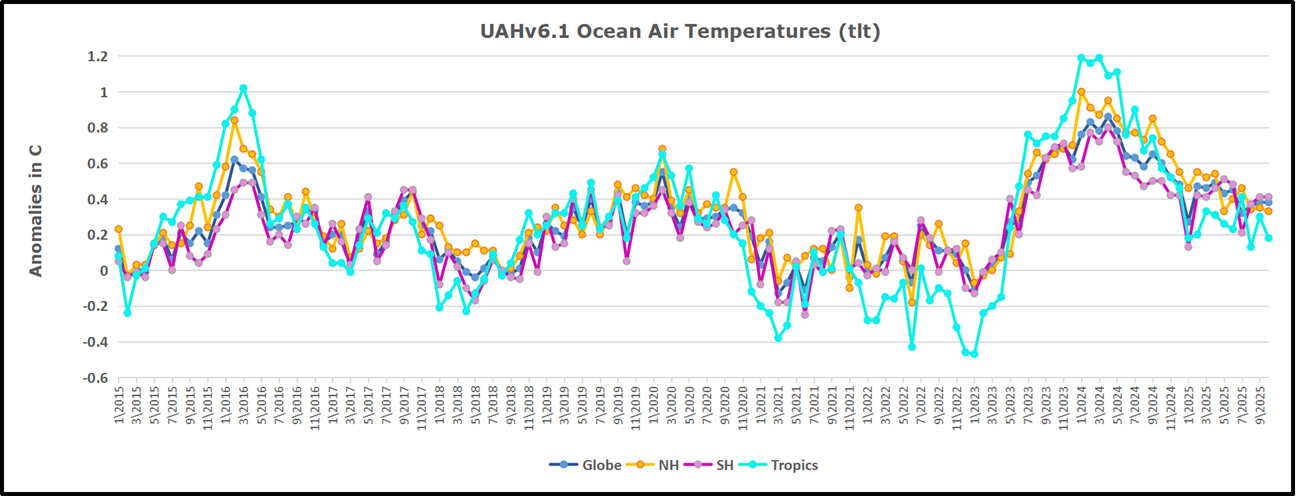
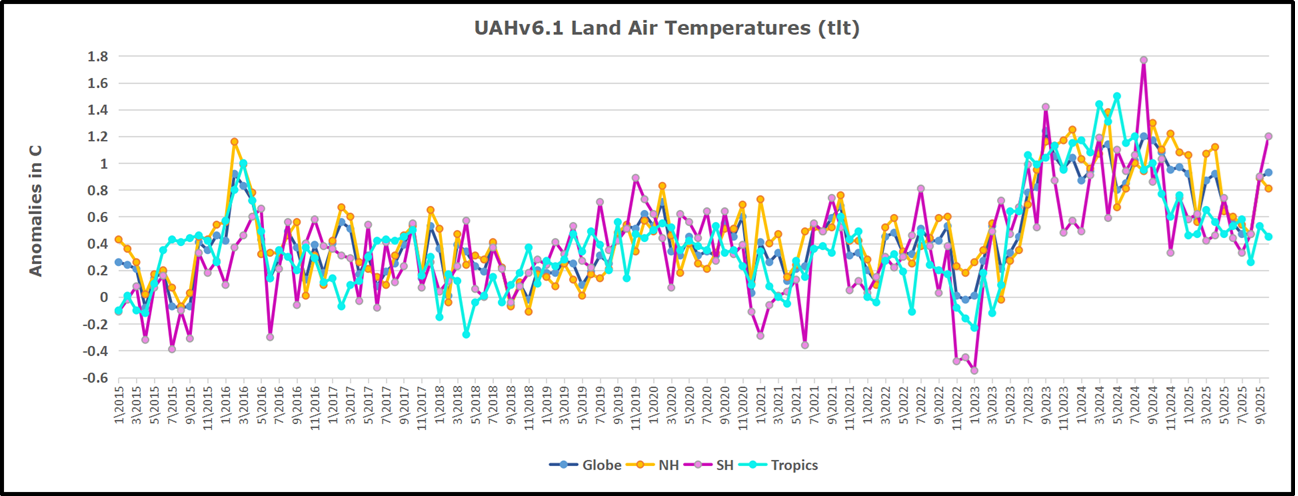
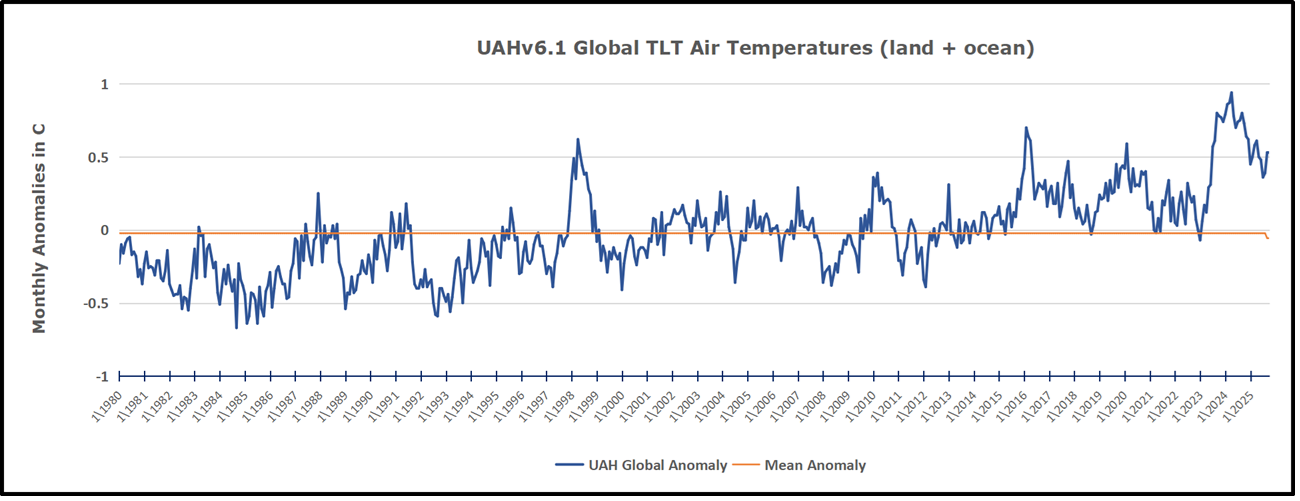
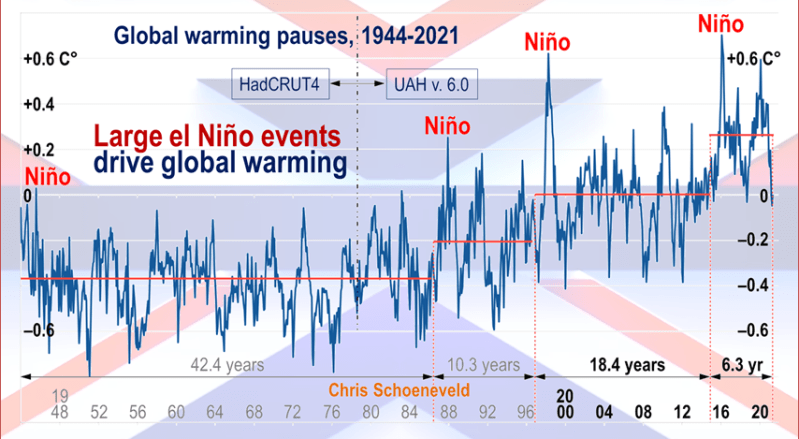
Why is this important?  All the claims of global climate emergency depend on dangerously higher  temperatures, lower sea ice, and rising sea levels.  The lack of additional warming prior to 2023 El Nino is documented in a post SH Drives UAH Temps Cooler July 2025.

The lack of acceleration in sea levels along coastlines has been discussed also.  See Observed vs. Imagined Sea Levels 2023 Update

Also, a longer term perspective is informative:

post-glacial_sea_level

Footnote Regarding  SII v.4

NSDIC acknowledged my query regarding the SII (Sea Ice Index) dataset. While awaiting an explanation I investigated further. My last download of the SII Daily Arctic Ice Extents was on July 30, meaning that the most recent data in that file was day 210, July 29. The header on that file was Sea_Ice_Index_Daily_Extent_G02135_v3.

Then on August 1, the downloaded file had the heading Sea_Ice_Index_Daily_Extent_G02135_v4. So it appears that these are now the values from a new version of SII. As I wrote in my query, since March 14 all of the values for Arctic Ice Extents are lower in this new record. The graph above shows the implications for August as an example of estimates from SIIv.4

The change started in January 2025 and will be the basis for future reporting.  The logic for this is presented in this document: Sea Ice Index Version 4 Analysis

In June 2025, NSIDC was informed that access to data from the Special Sensor Microwave
Imager/Sounder (SSMIS) onboard the Defense Meteorological Satellite Program (DMSP)
satellites would end on July 31 (NSIDC, 2025). To prepare for this, we rapidly developed version
4 of the Sea Ice Index. This new version transitions from using sea ice concentration fields
derived from SSMIS data as input to using fields derived from the Advanced Microwave
Scanning Radiometer 2 (AMSR2) sensor onboard the Global Change Observation Mission – W1
(GCOM-W1) satellite.  On 29 July 2025, we learned that the Defense Department decision to terminate access to DMSP data had been reversed and that data will continue to be available until September 2026.

We are publishing Version 4, however, for these reasons:

• The SSMIS instruments are well past their designed lifespan and a transition to
AMSR2 is inevitable. Unless the sensors fail earlier, the DoD will formally end the
program in September 2026.
• Although access of SSMIS will continue through September 2026, the Fleet
Numerical Meteorology and Oceanography Center (FNMOC), where SSMIS data
from the DMSP satellite are downloaded, made an announcement that “Support
will be on a best effort basis and should be considered data of opportunity.” This
means that SSMIS data will likely contain data gaps.
• We have developer time to make this transition now and may not in the future.
• We are confident that Version 4 data are commensurate in accuracy to those
provided by Version 3.


No Climate Crisis in Texas

CO2 Coalition analyzed the data and concluded that Texas has no climate crisis to fear.  The report is Texas and Climate Change: No Climate Crisis in the Lone Star State.  Excerpts in italics with my bolds and added images.

EXECUTIVE SUMMARY

This report will examine the scientific basis for claims of harmful effects from climate change in Texas. Assertions have been made that many areas around the world are experiencing negative impacts from unusual and unprecedented warming driven by increasing human emissions of carbon dioxide (CO2). Texas is no different. Promotion of the need to achieve “net zero” emissions is predicated on fear of existing and future devastating calamities resulting from CO2-enhanced warming.

The Fifth National Climate Assessment (NCA5) report (USGCRP, 2023) says that climate change is “putting us at risk from climate hazards that degrade our lands and waters, quality of life, health and well-being, and cultural interconnectedness.” The NCA5 report lists “warmer temperatures, more erratic precipitation, and sea level rise,” as well as “drier conditions” and “extreme heat and high humidity,” as the “climate hazards” affecting the Southern Great Plains, which encompasses the State of Texas (Figure 1).

In addition, Texas A&M University has published a Texas-specific report, Future Trends of Extreme Weather in Texas (Nielsen-Gammon et al., 2024), which warns of future harm to the citizens of Texas from man-made climate change. Predicted effects include increasing temperature, precipitation, drought, floods, storms, sea-level rise and wildfires.

Within this report, we analyze scientific data from various sources, including the National Oceanic and Atmospheric Administration (NOAA), the United States Environmental Protection Agency (U.S. EPA), the National Aeronautics and Space Administration (NASA), the United States Department of Agriculture (USDA) and reports published in peer-reviewed journals.

Based on these data, we arrived at the following key findings:

  • The temperature in Texas has shown no unprecedented or unusual warming, despite
    increasing atmospheric carbon dioxide (CO2). Recent temperatures in Texas are similar
    to those found more than 100 years ago.
  • The annual number of 100 °F days in Texas has an overall decreasing trend.
  • Texas has had a modest increase of 0.0245 inches per year of precipitation during 1850–
    2023, which means that Texas is in no immediate danger of becoming drier.
  • Droughts in Texas are not becoming more severe or numerous.
  • Tornadoes, hurricanes, and floods are not becoming more frequent in Texas.
  • Sea-level rise and coastal subsidence are not threatening or inundating the Texan coast.
  • Wildfires are not becoming more frequent or severe in the United States.
  • Air quality in the United States is generally good and getting better.
  • Agriculture in Texas is thriving.
  • Carbon dioxide (CO2) is essential and beneficial for life on Earth, as CO2 greens the Earth
    and more CO2 allows plants to grow bigger, produce more food and better resist
    drought.

The evidence presented here is clear: there is no climate crisis in Texas. Not only is CO2 beneficial, but it is essential for life on Earth. Therefore, any measures for combating a purported climate crisis and for reducing CO2 emissions are not only unnecessary and costly but would also cause considerable harm to agriculture with no benefit.

The complete publication is Texas and Climate Change which includes exhibits like these:

July 2025 Ocean SSTs: NH Warms Slightly

The best context for understanding decadal temperature changes comes from the world’s sea surface temperatures (SST), for several reasons:
  • The ocean covers 71% of the globe and drives average temperatures;
  • SSTs have a constant water content, (unlike air temperatures), so give a better reading of heat content variations;
  • A major El Nino was the dominant climate feature in recent years.

Previously I used HadSST3 for these reports, but Hadley Centre has made HadSST4 the priority, and v.3 will no longer be updated. I’ve grown weary of waiting each month for HadSST4 updates, so this report is based on data from OISST2.1.  This dataset uses the same in situ sources as HadSST along with satellite indicators.  Importantly, it produces daily anomalies from baseline period 1982-2010.  The data is available at Climate Reanalyzer (here).  Product guide is (here).  The charts and analysis below is produced from the current data.

The Current Context

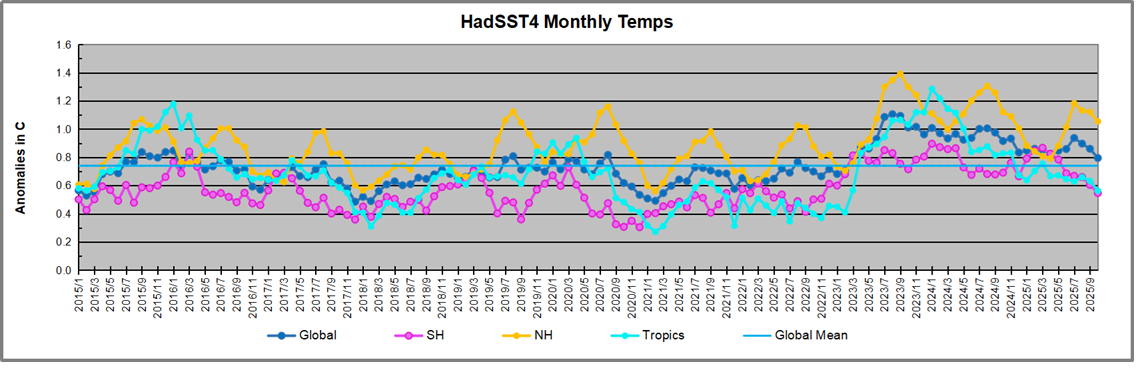
The chart below shows SST monthly anomalies as reported in OISST2.1 starting in 2015 through July 2025. A global cooling pattern is seen clearly in the Tropics since its peak in 2016, joined by NH and SH cycling downward since 2016, followed by rising temperatures in 2023 and 2024 and cooling in 2025.

Note that in 2015-2016 the Tropics and SH peaked in between two summer NH spikes.  That pattern repeated in 2019-2020 with a lesser Tropics peak and SH bump, but with higher NH spikes. By end of 2020, cooler SSTs in all regions took the Global anomaly well below the mean for this period.  A small warming was driven by NH summer peaks in 2021-22, but offset by cooling in SH and the tropics, By January 2023 the global anomaly was again below the mean.

Then in 2023-24 came an event resembling 2015-16 with a Tropical spike and two NH spikes alongside, all higher than 2015-16. There was also a coinciding rise in SH, and the Global anomaly was pulled up to 0.8°C in 2023, ~0.2° higher than the 2015 peak.  Then NH started down autumn 2023, followed by Tropics and SH descending 2024 to the present. During 2 years of cooling in SH and the Tropics, the Global anomaly came back down, led by NH cooling the last 12 months from its 1.0°C peak last August, down to 0.5C in April this year..  Further declines in Tropics and SH offset NH warming in May and June, and now in July 2025 a slight upward bump in Global anomaly over 0.6°C.

Comment:

The climatists have seized on this unusual warming as proof their Zero Carbon agenda is needed, without addressing how impossible it would be for CO2 warming the air to raise ocean temperatures.  It is the ocean that warms the air, not the other way around.  Recently Steven Koonin had this to say about the phonomenon confirmed in the graph above:

El Nino is a phenomenon in the climate system that happens once every four or five years.  Heat builds up in the equatorial Pacific to the west of Indonesia and so on.  Then when enough of it builds up it surges across the Pacific and changes the currents and the winds.  As it surges toward South America it was discovered and named in the 19th century  It iswell understood at this point that the phenomenon has nothing to do with CO2.

Now people talk about changes in that phenomena as a result of CO2 but it’s there in the climate system already and when it happens it influences weather all over the world.   We feel it when it gets rainier in Southern California for example.  So for the last 3 years we have been in the opposite of an El Nino, a La Nina, part of the reason people think the West Coast has been in drought.

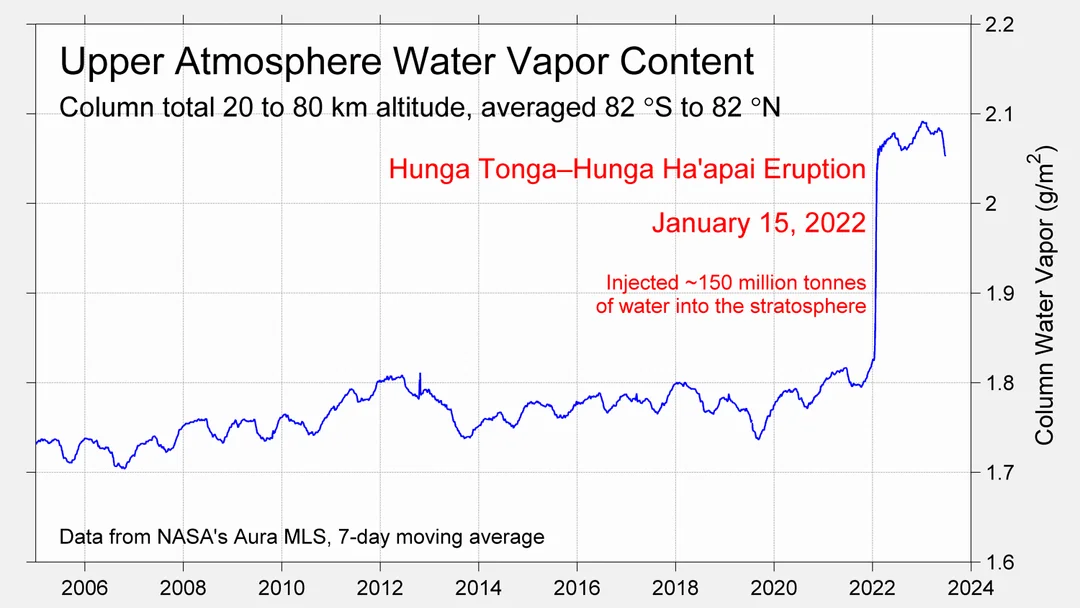
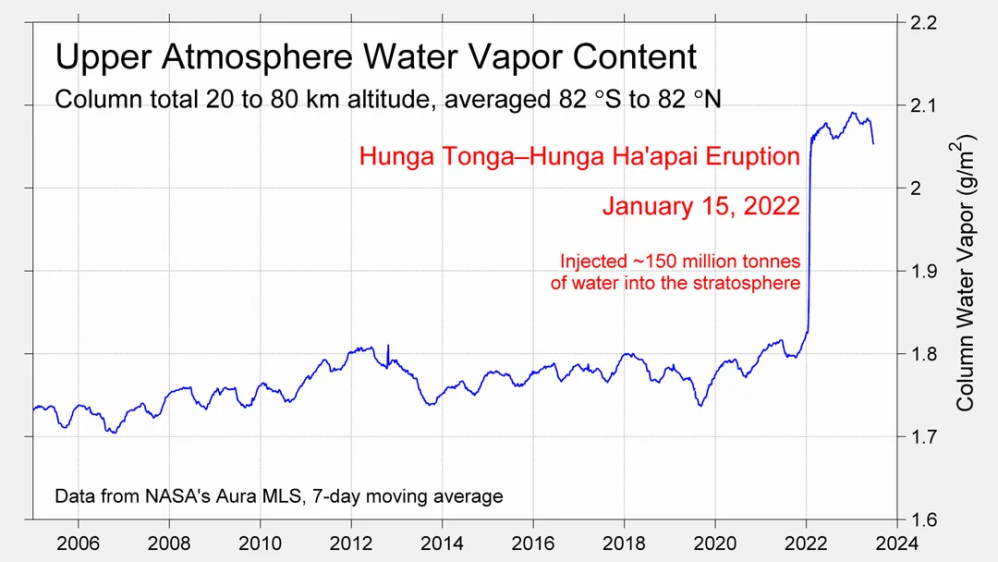
It has now shifted in the last months to an El Nino condition that warms the globe and is thought to contribute to this Spike we have seen. But there are other contributions as well.  One of the most surprising ones is that back in January of 2022 an enormous underwater volcano went off in Tonga and it put up a lot of water vapor into the upper atmosphere. It increased the upper atmosphere of water vapor by about 10 percent, and that’s a warming effect, and it may be that is contributing to why the spike is so high.

A longer view of SSTs

To enlarge, open image in new tab.

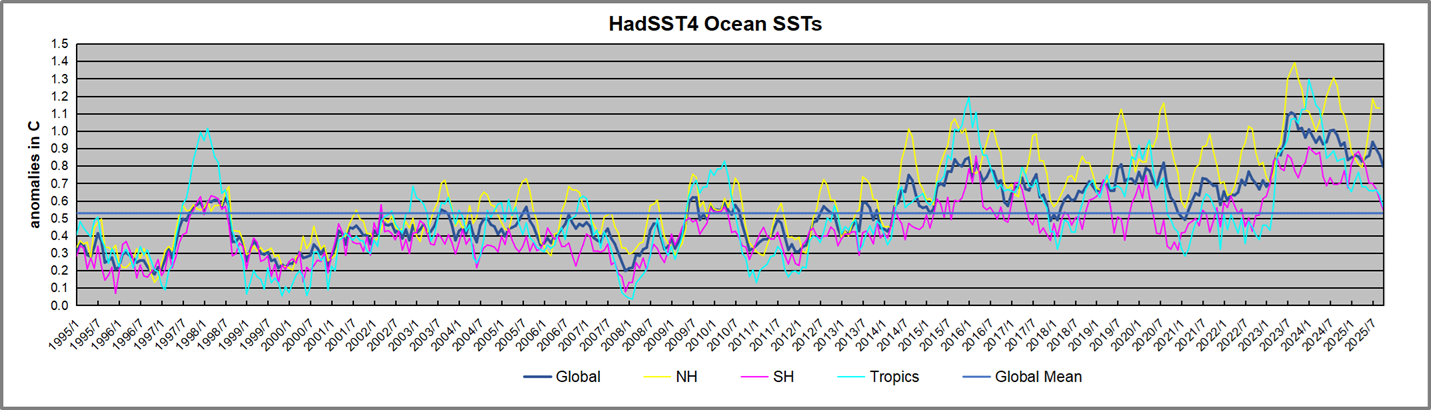
The graph above is noisy, but the density is needed to see the seasonal patterns in the oceanic fluctuations.  Previous posts focused on the rise and fall of the last El Nino starting in 2015.  This post adds a longer view, encompassing the significant 1998 El Nino and since.  The color schemes are retained for Global, Tropics, NH and SH anomalies.  Despite the longer time frame, I have kept the monthly data (rather than yearly averages) because of interesting shifts between January and July. 1995 is a reasonable (ENSO neutral) starting point prior to the first El Nino.

The sharp Tropical rise peaking in 1998 is dominant in the record, starting Jan. ’97 to pull up SSTs uniformly before returning to the same level Jan. ’99. There were strong cool periods before and after the 1998 El Nino event. Then SSTs in all regions returned to the mean in 2001-2.

SSTS fluctuate around the mean until 2007, when another, smaller ENSO event occurs. There is cooling 2007-8,  a lower peak warming in 2009-10, following by cooling in 2011-12.  Again SSTs are average 2013-14.

Now a different pattern appears.  The Tropics cooled sharply to Jan 11, then rise steadily for 4 years to Jan 15, at which point the most recent major El Nino takes off.  But this time in contrast to ’97-’99, the Northern Hemisphere produces peaks every summer pulling up the Global average.  In fact, these NH peaks appear every July starting in 2003, growing stronger to produce 3 massive highs in 2014, 15 and 16.  NH July 2017 was only slightly lower, and a fifth NH peak still lower in Sept. 2018.

The highest summer NH peaks came in 2019 and 2020, only this time the Tropics and SH were offsetting rather adding to the warming. (Note: these are high anomalies on top of the highest absolute temps in the NH.)  Since 2014 SH has played a moderating role, offsetting the NH warming pulses. After September 2020 temps dropped off down until February 2021.  In 2021-22 there were again summer NH spikes, but in 2022 moderated first by cooling Tropics and SH SSTs, then in October to January 2023 by deeper cooling in NH and Tropics.

Then in 2023 the Tropics flipped from below to well above average, while NH produced a summer peak extending into September higher than any previous year.  Despite El Nino driving the Tropics January 2024 anomaly higher than 1998 and 2016 peaks, following months cooled in all regions, and the Tropics continued cooling in April, May and June along with SH dropping.  After July and August NH warming again pulled the global anomaly higher, September through January 2025 resumed cooling in all regions, continuing February through April 2025, with little change in May,June and July despite upward bumps in NH.

What to make of all this? The patterns suggest that in addition to El Ninos in the Pacific driving the Tropic SSTs, something else is going on in the NH.  The obvious culprit is the North Atlantic, since I have seen this sort of pulsing before.  After reading some papers by David Dilley, I confirmed his observation of Atlantic pulses into the Arctic every 8 to 10 years.

Contemporary AMO Observations

Through January 2023 I depended on the Kaplan AMO Index (not smoothed, not detrended) for N. Atlantic observations. But it is no longer being updated, and NOAA says they don’t know its future.  So I find that ERSSTv5 AMO dataset has current data.  It differs from Kaplan, which reported average absolute temps measured in N. Atlantic.  “ERSST5 AMO  follows Trenberth and Shea (2006) proposal to use the NA region EQ-60°N, 0°-80°W and subtract the global rise of SST 60°S-60°N to obtain a measure of the internal variability, arguing that the effect of external forcing on the North Atlantic should be similar to the effect on the other oceans.”  So the values represent SST anomaly differences between the N. Atlantic and the Global ocean.

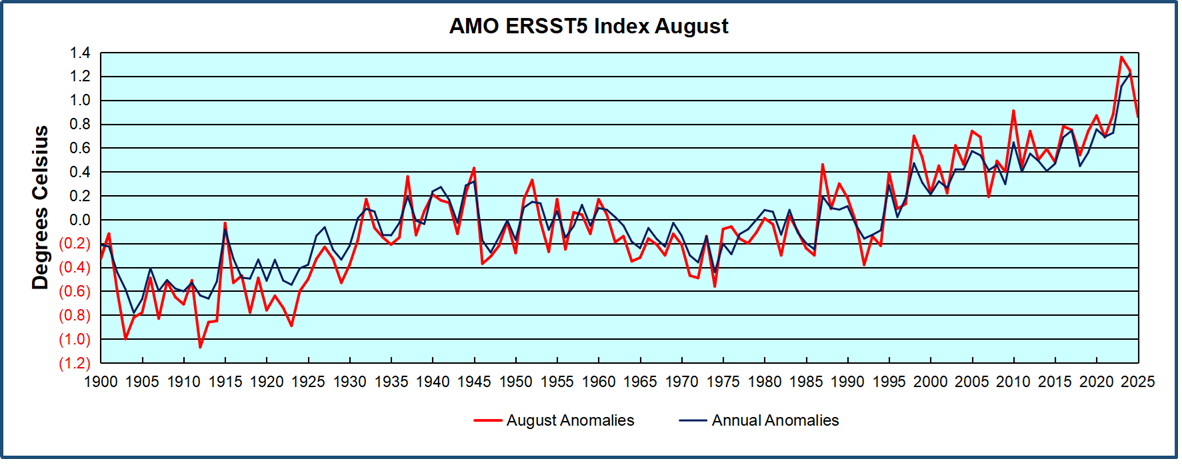
The chart above confirms what Kaplan also showed.  As August is the hottest month for the N. Atlantic, its variability, high and low, drives the annual results for this basin.  Note also the peaks in 2010, lows after 2014, and a rise in 2021. Then in 2023 the peak was holding at 1.4C before declining.  An annual chart below is informative:

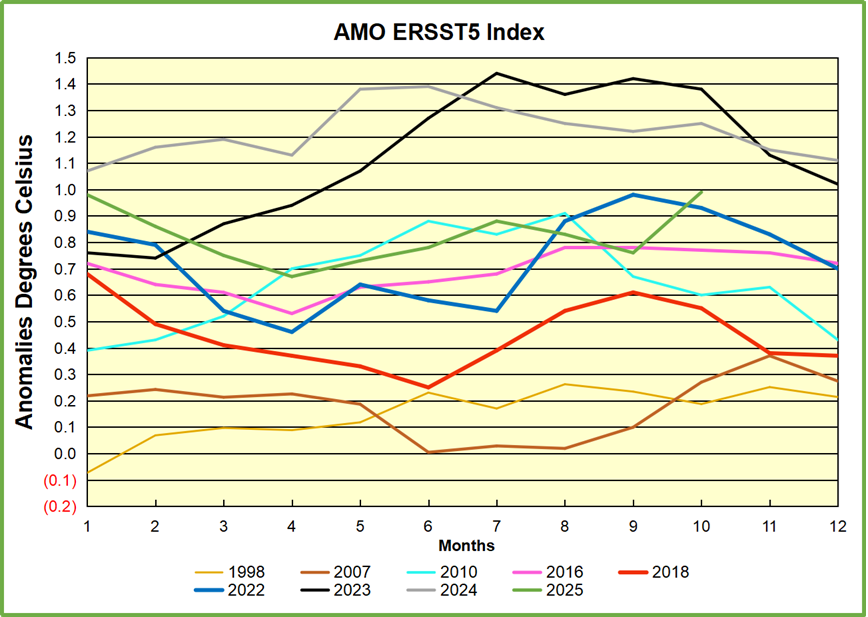
Note the difference between blue/green years, beige/brown, and purple/red years.  2010, 2021, 2022 all peaked strongly in August or September.  1998 and 2007 were mildly warm.  2016 and 2018 were matching or cooler than the global average.  2023 started out slightly warm, then rose steadily to an  extraordinary peak in July.  August to October were only slightly lower, but by December cooled by ~0.4C.

Then in 2024 the AMO anomaly started higher than any previous year, then leveled off for two months declining slightly into April.  Remarkably, May showed an upward leap putting this on a higher track than 2023, and rising slightly higher in June.  In July, August and September 2024 the anomaly declined, and despite a small rise in October, ended close to where it began.  Note 2025 started much lower than the previous year and headed sharply downward, well below the previous two years, then in May, June and now July aligning with 2010.

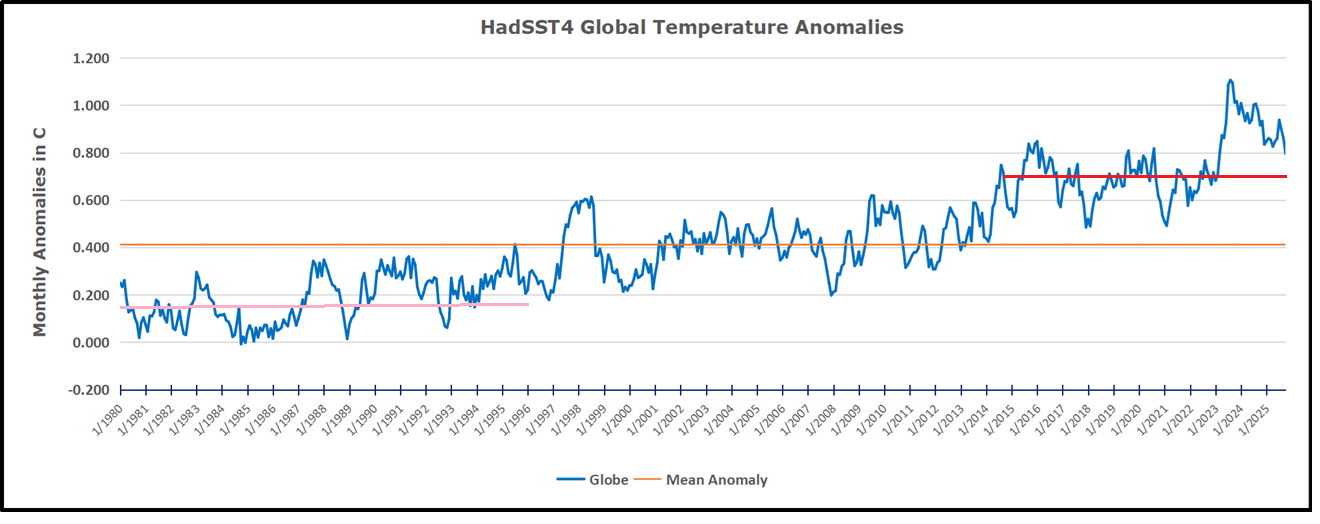
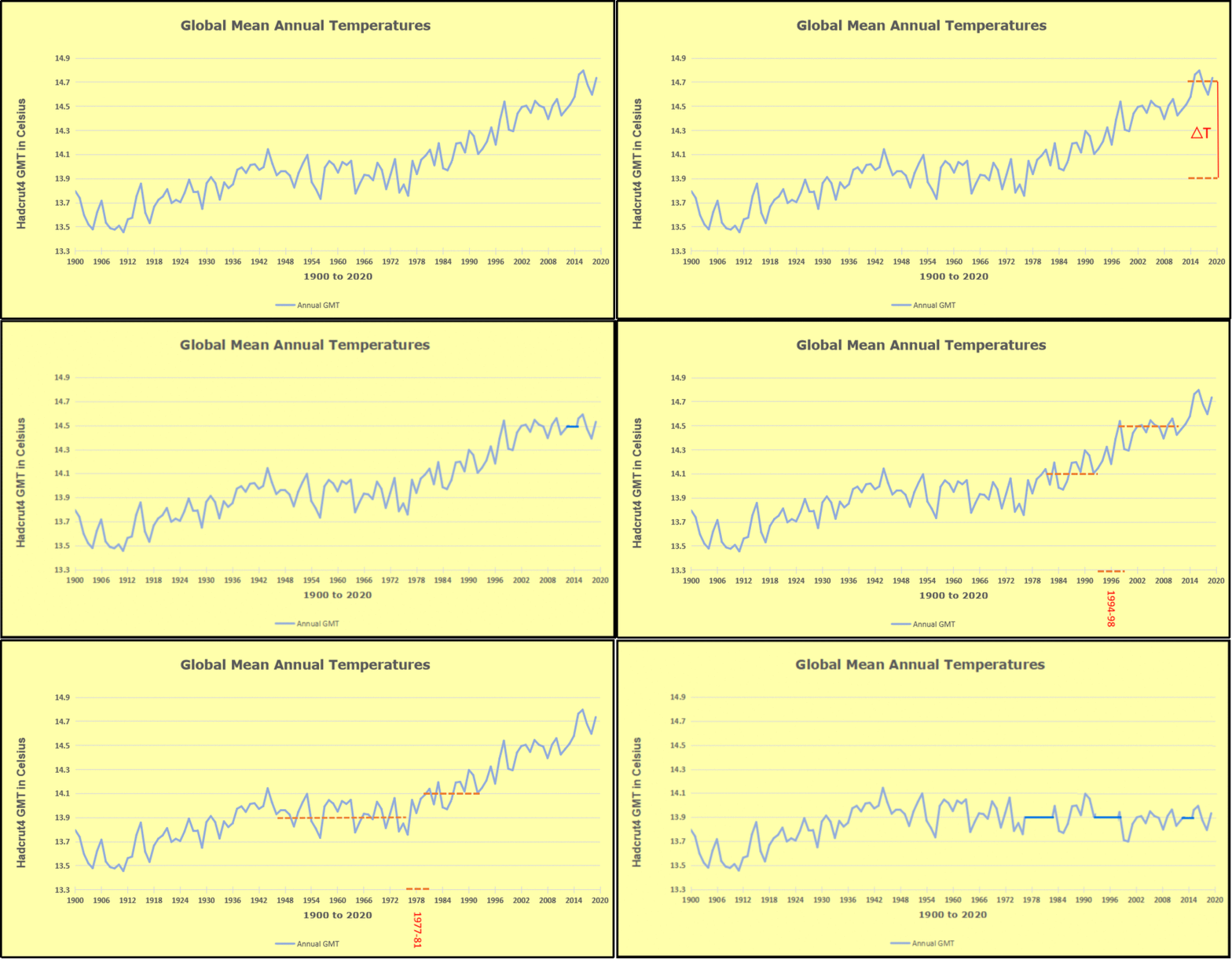
The pattern suggests the ocean may be demonstrating a stairstep pattern like that we have also seen in HadCRUT4.

The rose line is the average anomaly 1982-1996 inclusive, value -0.10.  The orange line the average 1982-2025, value 0.13, also for the period 1997-2012. The red line is 2015-2025, value 0.46. As noted above, these rising stages are driven by the combined warming in the Tropics and NH, including both Pacific and Atlantic basins.

Curiosity:  Solar Coincidence?

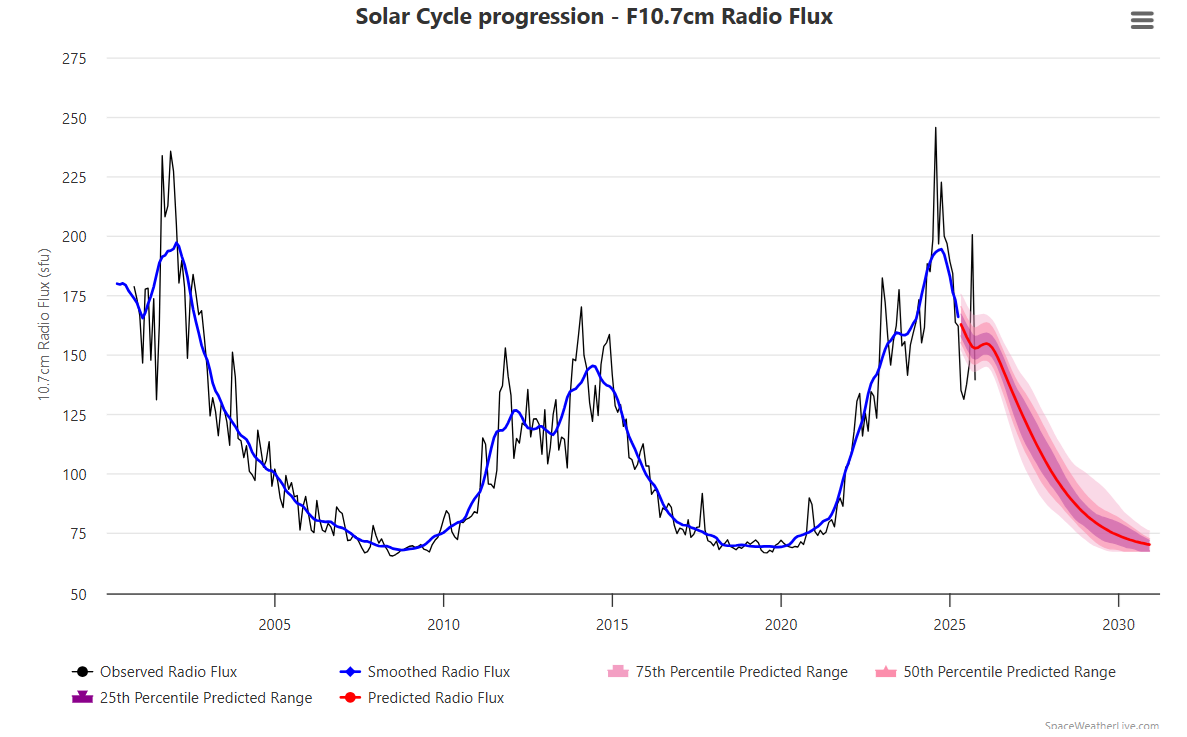
The news about our current solar cycle 25 is that the solar activity is hitting peak numbers now and higher  than expected 1-2 years in the future.  As livescience put it:  Solar maximum could hit us harder and sooner than we thought. How dangerous will the sun’s chaotic peak be?  Some charts from spaceweatherlive look familar to these sea surface temperature charts.

Summary

The oceans are driving the warming this century.  SSTs took a step up with the 1998 El Nino and have stayed there with help from the North Atlantic, and more recently the Pacific northern “Blob.”  The ocean surfaces are releasing a lot of energy, warming the air, but eventually will have a cooling effect.  The decline after 1937 was rapid by comparison, so one wonders: How long can the oceans keep this up? And is the sun adding forcing to this process?
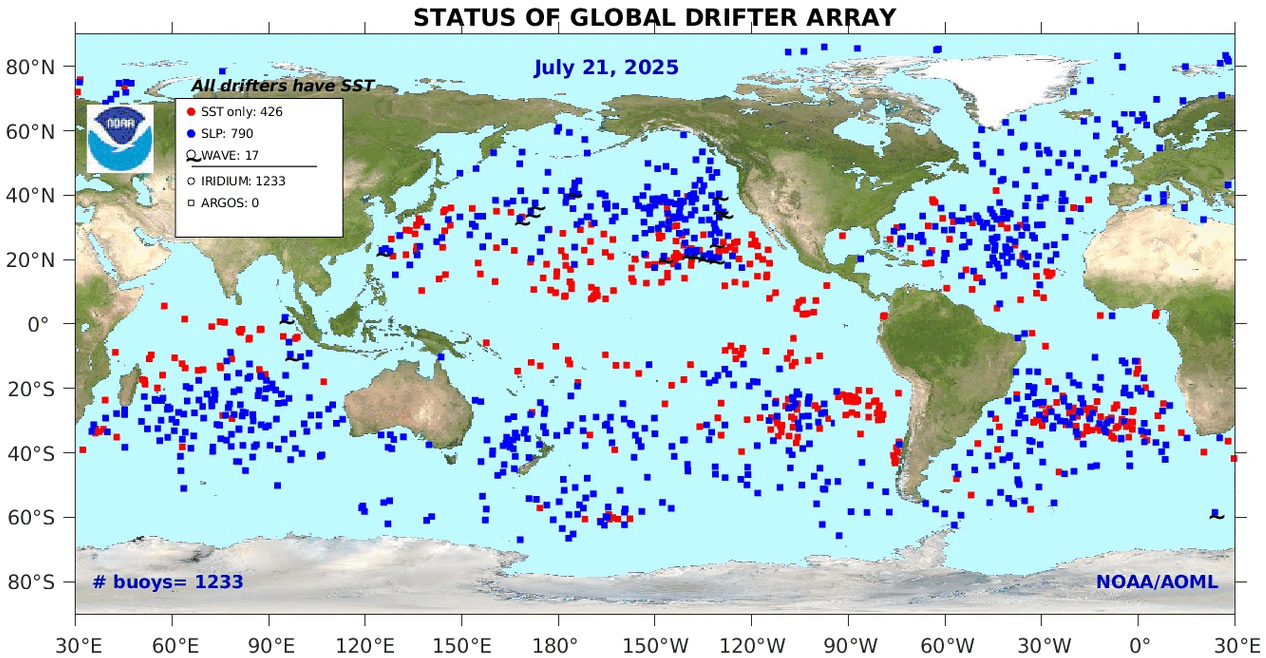
uss-pearl-harbor-deploys-global-drifter-buoys-in-pacific-ocean

USS Pearl Harbor deploys Global Drifter Buoys in Pacific Ocean

About That Annoying DOE Climate Review

When it comes to the recent DOE Climate Review, legacy media coverage is lop-sided and limited to declarations of disgust and dismissal from climate insiders.  Andrew Bolt in Australia is an exception, interested as he is in why climatists find the study so annoying.  So his interview with one of the authors explores the controversy and why the media is averting their attention.

For those preferring to read, below is a transcript from the closed captions in italics wtih my bolds and added images. AB refers to Bolt and SK to Koonin

AB: I’m amazed how little attention the media has given to a new report on global warming I mentioned last week. I’m not that surprised to be honest. I mean, I’ve seen how the media ignores proof that the warming scare is grossly exaggerated, but I think you deserve to know more about this report.
In the United States, Chris Wright is the brilliant gas tycoon who now leads the US Department of Energy. He hired five very prominent climate experts to report back to the government on what the climate was really doing and whether we could trust predictions by the most popular climate models that we’re facing dangerous warming of at least 3 degrees this century and we’re already copying all sorts of climate disasters.

Well, the authors’ conclusion was that the climate models are actually unreliable. They’re all over the shop. They predict probably one degree more warming than is likely and we aren’t getting many of the predicted climate disasters. Plus, global warming also has benefits that are often ignored, especially a big increase in trees and crops that we’ve been seeing, a greening of the planet.

And in this report, the authors sum it all up like this. models, the climate models and experience suggests that carbon dioxide induced warming may be less damaging economically than commonly believed and excessively aggressive mitigation policies, you might include our own net zero schemes, could prove more detrimental than beneficial.  [See DOE Climate Team: Twelve Keys in Assessing Climate Change]

So, you can understand why the authors have since been absolutely trashed for daring to doubt the climate scare and upsetting the climate industry. They’ve been called all sorts of names painted as fools, frauds, Donald Trump Toadies, even Stalinists, would you believe? But don’t be fooled by the abuse because the five authors are in fact very prominent experts. Professor emeritus Judith Curry has published 192 peer-reviewed papers on the climate. Dr. Roy Spencer, NASA senior scientist runs probably the most accurate measure of world temperature. Professor Ross McKitrick is an expert reviewer of the last three reports of the IPCC (intergovernmental panel on climate change). And distinguished professor John Christie, is a former lead author of an IPCC report. I mean, these are very serious people.

Plus Steven Koonin. He’s a physicist and former under secretary of science for President Barack Obama, a Democrat. And I am joined by Steven, Steve thank you so much for your time. Why did you and the other four experts behind this report actually agree to do it when you must have known the climate industry and the media would really go after you?

SK: Indeed. But you know, all five of us scientists have long felt that the science was misrepresented to the public and the decision makers, and we wanted to do our best to set the record straight.

AB: Well, on many points your report agrees with what I’ll call the consensus, the alarmist position, perhaps the position of the United Nations Intergovernmental Panel on Climate Change. You say, “Yes, global warming is real. Yes, it’s a problem. Yes, it’s caused in part by humans.” Now, tell us where you disagree with this consensus.

SK: Well, you know, people have said 95% of our report agrees with or is taken right out of the IPCC. It’s just that there are aspects of what the consensus says that do not find their way to the public. For example:

♦  There are no detectable trends in the great majority of extreme weather types.

♦  The models that we use to project climates into the future are demonstrably deficient. They’re in               many ways all over the place in terms of their projections. And,

♦  The projected impacts of future climate change, even using those deficient models, are minimal.

These are very important central points that are there in the report
but do not make their way into the public discussion.

AB: You actually point out that the models tend to run hot, as in predict more warming than we’ve had. They’re unreliable. A number of basing false assumptions of how much emissions we’re going to get. You actually predict almost one degree less warming over the century than the IPCC model consensus. How important is that?

SK: Well, to be clear, we don’t predict. We simply cite and assess the work of others. But certainly, if the warming is a degree less than what the IPCC consensus says, that’s a big deal.

AB: And what about the climate disasters? I mean, every time like we’ve got it right now, you know, we’ve got some algae blooming off the South Australian coast. Global warming. We get heavy rain, global warming. We get a drought, global warming. How much influence has man-made warming really had from the work that you’ve done in this report? How much has it really influenced the natural disasters we tend to see?

SK: Yeah, you know, people have a very short memory for weather disasters. There’s a lovely example that turned up at the beginning of July, having to do with the floods in Texas that we that were a terrible tragedy. But if you look back in the records, you can find the same kind of event happening in the same place in 1900. And of course, human influences on the climate were much smaller in 1900. And so you have a very hard time to logically attributing the recent disaster to carbon dioxide.

The same is true for many other severe weather phenomena.
They happened in the past. They’re just relatively rare. And so
we get surprised when we see them happen in the present day.

AB: Yeah. I noticed for instance in your report you say the number of heat waves in America actually peaked nearly 100 years ago.

SK: The number of heat waves that were striking America at the time, and what we see now is much less, you know. The damning thing about the heat waves is that we really don’t understand why the 30s were so much warmer than it has been in many subsequent decades. And that speaks to our rather poor understanding of the ways in which the climate varies.

AB: I think the real thing about your report that’s annoying so many people in the climate industry is this. You say the warming will be less than what most people are claiming. You say the disasters from the warming we’ve seen are basically exaggerated.  They’re not that many that you can point to. And the the attempts we make to stop all this are very expensive. And well, do they really work? Isn’ it the takeaway here, that it might not actually be worth trying to stop what isn’t the the climate disaster that many claim.

SK: Absolutely. You know, in deciding what to do, we have to balance the hazards, the certainties and uncertainties in the changing climate against other considerations. Like the world needs more and more energy, and in deciding what to do you have to look at the costs. Are they going to be effective? What about equity between generations, between countries, and so on. It’s not simply that, oh my god, we’ve broken the climate and we’ve got to fix it. And I do think some people get annoyed when we start to expose those nuances of the situation.

AB: Oh yes. So you’ve really offended in the church of climate. And of course you also stress what’s undeniably true. The greening of the planet is actually a benefit of extra carbon dioxide in the atmosphere. More trees, more plants, more food.

SK: Agricultural yields have in fact doubled over the last 60 years or so. And a good fraction of that, NASA says 75% is attributable to higher carbon dioxide levels. You know, if you look inside a hot house, we put the carbon dioxide levels typically up to about 1,200 parts per million, which is just about three times what you find in the atmosphere even now.

AB: Now, you’ve come under massive attack, of course, Steve Koonin. I mean, environmental groups are even suing to censor the report. You’ve got media outlets of the left demonizing you, running so-called fact checks. I’ve had a look at a few, and they’re not persuasive. Some climate scientists are abusing you, claiming, you know, the group of you are just handpicked skeptics, even though you used to be with the Obama administration.  Have there been any criticisms of your report that you think, “Yep, that’s fairenough. we’ve goofed here or we haven’t taken this into consideration. Any criticism you think you can you should take on the chin?

SK: Well, we’ve seen one already that we basically made a a typographical error in one of the footnotes. We have acknowledged that to the person who pointed it out and of course we will fix it. But you know, we’re refraining right now from looking in detail at the criticisms till they come in over the next couple weeks through the public portal. Then as we have promised, we will deal with every serious criticism seriously and like good scientists we will modify the report as might be warranted from those criticisms.

AB: Steve Koonin, you’ve been fighting the alarmism for some time now. I think this is your your weightiest blow against the scaremongering. So congratulations and thank you so much for your time.

Happer & Wrightstone: Get Real and Stop Blaming CO2

The above interview was conducted by NTD news with CO2 Coalition founder William Happer (WH) and Executive Director Gregory Wrightstone (GW).  For those preferring to read, below is a transcript from the closed captions in italics with my bolds and added images.

NTD: The Environmental Protection Agency’s Lee Z eldin announced a proposal earlier this week to overturn a 16-year-old scientific finding from the Obama administration. It allowed three administrations to regulate greenhouse gas emissions like CO2. If successful, this would roll back climate rules on cars, undo $1 trillion in regulatory costs, and save over $54 billion each year. With the public comment period now open, here to break down what all of this means are two guests. William Happer, professor emeritus at Princeton University department of physics, and Gregory Wrightstone, geologist and executive director of the CO2 coalition. Thank you both so much for being here.

Now, first, how big of a deal would this be, repealing the 2009 endangerment finding? Who has benefited under it so far?

WH: Well, I’m not sure who you asked this question, but I will answer it and Greg can add to what I say. This is something that was long overdue. I mean, it was a ridiculous regulation that purported that carbon dioxide, which all of us breathe out, is a pollutant. I mean, I can’t think of anything dumber than that, but that’s what it was. And so finally there’s been an administration with the courage to tell the truth, that it isn’t a pollutant at all and it’s actually good for the earth to have more carbon dioxide.

NTD: What is the likely legal process of repealing this? And Gregory, this finding was the legal prerequisite used by the Obama and Biden administrations to regulate new car and engine emissions. What is the likely legal process of repealing this now?

GW: Well, this right now is just dealing with cars and light trucks and vehicles, but it’s sure to extend into the other things. Your viewers have had their freedom systematically eroded using the endangerment finding. With this endangerment finding, they’ve been able to tell you what car kind of car to drive. Look at the ceiling fan over your head, regulate that. All these electrical devices, your washer, dryer, dishwasher. the only ones you can buy today are government approved devices because of the endangerment finding. So what this does is to actually liberate Americans for freedom to choose what kind of appliances they want. If they want to buy a dishwasher that’s very efficient in terms of washing dishes, not in terms of how much electricity you use. That should be my choice and your choice and all of your viewers’ choices. So, this is really liberation day for America and restoring a lot of the freedoms that were lost based on this failed endangerment finding.

NTD: Expanding on that, William, what about the science needed to decide whether or not this will get repealed? Besides the legal angle, break down for us the science that’s needed to decide whether or not this will get repealed.

GW: Well, the science is quite clear. Understand what they did in 2009, they excluded any contrary science. By contrary science, anything that indicated that CO2 was not a pollutant. But the Supreme Court rulings in 2024 now say you have to consider all of the science. And there’s just a huge amount of of science right now that that disputes endangerment, that actually confirms carbon dioxide has hugely beneficial aspects. Greening the earth, vegetation growth, crop production is exploding. And Dr. Happer can perhaps talk about how the the greenhouse gas warming potential is not at all what they say it is.

NTD: Will CO2 cause dangerous warming? On that note, will you break down that aspect for us ?

WH: Well, as Greg said, the accusation against CO2 is that it would cause dangerous warming of the earth. And as usual there’s a grain of truth that CO2 will cause some warming, but the warming will be trivial. It will almost certainly be beneficial to most of the earth. The reason it warms is CO2 is a greenhouse gas. It lets sunlight come through and warm the surface of the earth. But it retards the cooling of the earth by infrared radiation to space. And it’s the balance of those two that determines the earth’s temperature.

But it’s a very inefficient greenhouse gas. It doesn’t much matter if you double CO2. You only change the cooling radiation into space by 1%, a tiny effect. And so, it’s amazing they’ve managed to blow up this molehill into this mountainous threat. It’s not a threat at all. It’s a benefit.

NTD: On that note, Gregory, in terms of how we got to the endangerment finding, was contradictory science a factor in that decision?

Well, actually, no. There was no contradictory science. And again, now bear in mind things are different today than they were even just two years ago. with two Supreme Court rulings last year. In Ohio vs. state farm case the US Supreme Court ruled that these regulatory agencies like the DOE, EPA, DOT, all of these alphabet soup regulatory bodies need to consider all significant science that affects their judgment which EPA in the endangerment finding did not do.

And the evidence we say is is entirely overwhelming. We see by almost every metric you look at, we find that Earth’s ecosystems are thriving and prospering, and the human conditions are improving because of increases in CO2. It’s really the greatest untold story of the 21st century, that of a thriving earth and the benefits to humanity. It’s a feel-good story, but they’ve turned this into fear-mongering where children can’t sleep at night because they’re being lied to by this the promoters we call the climate industrial complex.

Let’s get back to true science, the scientific method. Enough of this consensus science and group think. We support the scientific method and critical thinking which has been removed from many of these government agencies for 30 years or longer.

Climate models

NTD: And William, on that note, there is a big focus on climate change or climate alarm as some might say. Talk to us about some of the climate models that are used. What did these models get wrong?

WH: Well, I think the main thing the models get wrong is that they they know perfectly well that the direct effects of carbon dioxide will cause a very small warming of the earth if there are no other effects. If you double CO2 100% increase, which would take more than a century by the way, that would only warm the earth by a little less than one degree centigrade. It’s a trivial amount and we may never double it anyway.

So here’s what they’ve done. They’ve taken this trivial warming is agreed by most people who understand how this works, and they’ve multiplied it by factors three, four, five and saying that there’s these enormous positive feedbacks on the direct warming. That’s completely crazy because most feedbacks in nature are negative. With most other systems in nature, the first thing you calculate is usually too big, not too small. It’s even got a fancy name. It’s called Chatelier’s principle.

And so everything they’ve done violates Chatelier’s principle that works for everything else in nature, but it apparently doesn’t work for climate alarmists.

China

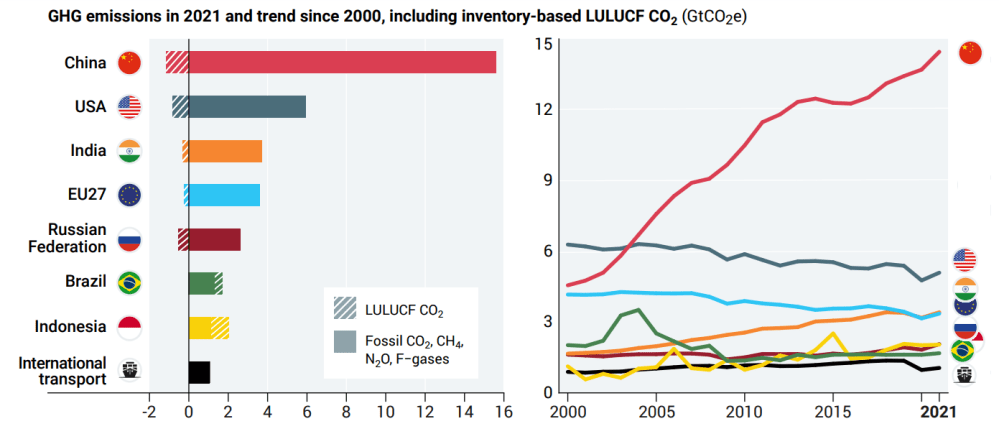
NTD: And staying with you, William, we often hear the US and Europe talking about cutting emissions, whether that’s in cars or cows even. But at the same time, the carbon brief notes that China is the world’s largest annual greenhouse gas emitter and leads in coal use. How should we look at this if the argument is global warming and not regional?

WH: Well, of course, China has built lots of very efficient new coal plants in the last 10 years. they’re ultra supercritical plants many of them. They’re really good plants and so they’ve raised the standard of living there. Part of their policy is is quite okay and the CO2 they’re emitting is good for the earth you know.

I’m not supporting any of the political things that they do but I don’t think there’s a thing wrong with releasing carbon dioxide. More power to them for that.

CO2 Coalition

NTD: On that note, Gregory, you’re the executive director of the CO2 coalition. Give us a sense of what this coalition does and how this fits in with environmental discussions.

GW: We’re 10 years old now. It was founded in 2015 by Dr. William Happer, our chair that was just on here. And we’re some 200 of the top experts and scientists in the world that don’t buy into the company line on climate change. We don’t believe that increases in human emissions of CO2 are leading to harmful warming. Rather just the opposite, we see huge benefits. Crop growth records are being broken year after year and they attribute 70% of that to increasing CO2. Crop growth and crop productivity is outpacing population growth. That’s a good thing, a really good thing.

We are in a warming trend. Yes, we are. It’s been warming for more than 300 years. But you know what that does? That means since 1900, our growing seasons in the continental United States have increased by more than two weeks. That’s a really good thing for agriculture. Your farmers will tell you they love that. So at the CO2 Coalition, our unofficial motto is: We love CO2 and so should you.

Arctic Ice Returns to Mean Mid-August 2025

After a sub-par March maximum, by end of May 2025 Arctic ice closed the gap with the 19-year average. Then in June the gap reopened and in July the melting pace matched the average, abeit four days in advance of average. Now mid-August MASIE shows the Arctic ice extent matching the 19-year average.

During this period the average year loses ~2.4M km2 of ice extent.   MASIE on day 197 was 287k km2 down, and the gap increased to 460k km2 by July 27 (day 208). In August 2025 the melt rate slowed, erasing the deficit to average the last 3 days. Note 2007 and 2024 were ~200k km2 below average mid-August.  Meanwhile SII v.4 is showing much lower ice extents than previously, ranging from -200k km2 to -550k km2 below MASIE extents.

The regional distribution of ice extents is shown in the table below. (Bering and Okhotsk seas are excluded since both are now virtually open water.)

Region 2025227 Day 227 2025-Ave. 2020227 2025-2020
 (0) Northern_Hemisphere 5881998 5894299 -12301 5162062 719936
 (1) Beaufort_Sea 932422 706128 226294 838854 93568
 (2) Chukchi_Sea 527504 438457 89047 410757 116747
 (3) East_Siberian_Sea 622184 563120 59064 276845 345339
 (4) Laptev_Sea 252320 243841 8479 24033 228287
 (5) Kara_Sea 10947 94167 -83220 22002 -11055
 (6) Barents_Sea 0 22056 -22056 3285 -3285
 (7) Greenland_Sea 115125 223328 -108202 265814 -150688
 (8) Baffin_Bay_Gulf_of_St._Lawrence 75407 56928 18479 12720 62688
 (9) Canadian_Archipelago 392776 404096 -11320 366453 26323
 (10) Hudson_Bay 25381 65298 -39917 53142 -27761
 (11) Central_Arctic 2927007 3075808 -148801 2887486.48 39520

The table shows large surpluses in Eurasian basins  Beaufort, Chukchi and E. Siberian, offset by deficits in Central Arctic, Kara and Greenland seas. Hudson Bay is mostly open water at this time of year. 2025 exceeds the ice extents in 2020 by 720k km2.

Why is this important?  All the claims of global climate emergency depend on dangerously higher  temperatures, lower sea ice, and rising sea levels.  The lack of additional warming prior to 2023 El Nino is documented in a post SH Drives UAH Temps Cooler July 2025.

The lack of acceleration in sea levels along coastlines has been discussed also.  See Observed vs. Imagined Sea Levels 2023 Update

Also, a longer term perspective is informative:

post-glacial_sea_level

Postscript Re. SII v.4

Update: Strange Sea Ice Data July End 2025


How the End of USAID Becomes a Good Thing

Zainab Usman describes the opportunity to reconstruct the effort addressing world poverty and social deprivation in his Foreign Affairs article The End of the Global Aid Industry.  Below is a synopsis of his vision in italics with my bolds and added images.  Following that is a previous post discussing how benevolence can go astray.

USAID’s Demise Is an Opportunity to Prioritize Industrialization Over Charity

Every decade or so, the global aid industry finds that it must transform to survive. During these periods of change, donor countries restructure their aid agencies, shrink or expand their assistance budgets, and lobby for the creation or dissolution of a UN initiative or two. Typically, once the aid industry conforms to the whims of donor countries, the crisis is averted and business continues as usual. Since U.S. President Donald Trump began his second term, the aid industry has found itself at another inflection point. The Trump administration has gutted USAID, the world’s largest development agency, ending 86 percent of its programs, shuttering its headquarters, and terminating nearly all its 10,000 employees. At the same time, the Trump administration has slashed funding for various multilateral initiatives on climate, global health, and education.

Today’s crisis, however, is different from those that came before: this could truly be the end of foreign aid as we know it. For decades, global development—that is, the attempt to improve and save lives of the poor—has been driven mostly by foreign assistance provided by wealthy governments. Some scholars and analysts deride this process as the “aid-industrial complex.” But even advocates of foreign aid have come to see it as an industry, including in their efforts to reform it, which approach its defects as matters of business inefficiency. And now that governments in many rich countries have sharply lurched to the right and taken more skeptical stances on aid, this industry is collapsing. As a result, many charity workers, researchers, and academics will be out of jobs. More important, millions of poor people around the world will suffer.

Proponents of global development now face a choice. They can wait for attitudes in donor countries to shift back toward support for foreign aid at some point in the distant future. Or they can reimagine the entire concept of global development, detaching it from aid and rooting it instead in industrial transformation: helping countries shift from subsistence farming, informal employment, and primary commodity production toward manufacturing and services. In truth, the aid industry was already adrift. Its interventions had become spread too thin and often failed to address the key obstacles that poorer countries faced as they tried to upskill their workers, build energy and transport infrastructure, and access new markets. Raising people out of poverty in Africa, South Asia, and parts of Latin America will not only improve their lives but also allow rich countries to maintain their prosperity by creating new markets, and by now, industrial transformation has a strong track record for improving economies. If proponents of global development do not adjust its methods with the times, it will lose its relevance to rich and poor countries alike.

AID AND ABET?

The foreign-aid industry’s primary commodity is official development assistance (ODA), or money from donors that flows to governments, individuals, or groups in poorer places, either directly—such as through budget support to struggling governments—or through projects run by organizations such as Save the Children, Oxfam, or FHI 360. Governments in rich countries are the primary purveyors of ODA. According to the Organization for Economic Cooperation and Development (OECD), in 2023, governments spent $230 billion on development assistance, compared with $11 billion spent by private foundations. Like any industry, foreign aid has middlemen. But in this business, the middlemen are particularly conspicuous. Third-party entities known as “implementing partners” include international nongovernmental organizations, large private contractors, and consulting firms. If the U.S. government wanted, for example, to distribute fertilizers to small-scale farmers in Bangladesh, they might contract Chemonics, a U.S.-based development contractor, to do it. Indeed, in 2023, Chemonics received the most USAID funds of any of the organization’s contractors: over $1 billion.

To take advantage of network effects and economies of scale, implementing partners cluster around the main sites of production of foreign aid, the capitals of the major donor countries: Berlin, Geneva, London, Paris, Rome, and Washington. As a result, very little aid is distributed by organizations or people in poor countries. In 2020, less than nine percent of U.S. aid was administered by recipient governments or firms based in recipient countries, according to Charles Kenny and Scott Morris, researchers at the Center for Global Development. The visibility of middlemen based in rich countries has long provided fodder to detractors who claim that the aid industry operates inefficiently or even unjustly. There is some truth to this critique. According to an analysis by Devex, a news organization, 47 of USAID’s top 50 contractors are located in the United States.

In the United States, successive Democratic and Republican administrations maintained a broad commitment to foreign aid, although arguments also simmered, even within the industry itself, about the proper goal of aid. Since 2000, when 189 countries agreed to the UN’s Millennium Development Goals, the industry’s main objective has been to reduce poverty; after the Paris Agreement was signed in 2015, many governments embraced the idea that, in addition, aid should also be directed toward fighting climate change.

SUPPLY CRISIS

But behind these recent debates lurked a massive shift in the politics and public norms that had allowed the industry to survive. If one sees aid as a form of philanthropy, then rich countries appear as donors and poor ones as beneficiaries. But if one sees aid as an industry, then rich countries appear as sellers and poor ones as buyers. With their development assistance, rich countries are providing a set of projects and institutional norms to achieve a set of expected outcomes: improvements in material conditions in developing countries that will eventually boost their own economies and security—or, failing that, at least a sense on the part of rich countries that they have tried to make a difference.

The role of poor countries is to consume these development projects
in the hope of achieving desired outcomes—or, failing that,
at least a sense that they might be possible someday.

Now this market is experiencing an unprecedented supply crisis. Around the world, people and politicians in the rich countries that had long bought into the basic idea that providing aid is valuable have become skeptical. The aid industry has, for decades, undergone boom and bust cycles resulting from shifts in the domestic politics of donor countries. What is different this time is a deepening disaffection about the prevailing economic model and the aid paradigm associated with it. Since the global financial crisis of 2008, many donor countries have experienced economic stagnation, slow productivity growth, declining competitiveness, and widening inequality. Citizens of rich countries who no longer feel economically secure are questioning why scarce public funds should be devoted to causes abroad when there are needs at home.

This doubt goes beyond the Trump administration. The United States is not the only donor that is cutting foreign aid: in 2024, eight of the top ten donors within the OECD’s Development Assistance Committee reduced their foreign aid budgets and announced their intention to align international development programs more squarely with their national interests—such as by ensuring that development projects use goods and services produced in the donor country. In 2024, Germany, the world’s second-largest bilateral aid donor, announced a $5.3 billion reduction to its foreign-assistance budget. In February, the United Kingdom announced a 40 percent reduction to its aid budget so that it could focus on defense spending. In March 2025, the Netherlands said it would cut 37 percent of its bilateral aid over five years and scale down its financial contributions to some UN agencies.

Many right-leaning voters in rich countries now see foreign aid as wasteful and excessively focused on promoting causes they perceive as linked to the left, such as climate action, gender equality, or democracy promotion. Voters are more dubious of technocrats, policy wonks, and academics committed to foreign aid. Consequently, even left-leaning politicians, such as the Labour government in the United Kingdom, are slashing aid in response to popular sentiment. According to a February 2025 YouGov poll, 65 percent of Britons are in favor of increasing defense spending at the expense of foreign aid.

BLEEDING OUT

The speed and scale of the policy changes make the crisis facing the aid industry existential. Donor governments are fast destroying the industry’s marketplace of actors in irreversible ways. In January, Trump issued an executive order to freeze all U.S. foreign aid, ostensibly so that the secretary of state could review it to make sure that it is aligned with U.S. interests. Within weeks of the order, the world’s largest bilateral development agency, USAID, functionally ceased to exist, and its destruction unleashed a domino effect.

Dozens of small and midsize nongovernmental organizations are folding. Large organizations that implemented projects for USAID, such as FHI 360, Chemonics, and DAI Global, have terminated some country programs, announced the closure of field offices, and laid off hundreds of staffers worldwide. Multilateral organizations are also suffering from U.S. aid cuts. UN agencies such as the International Organization for Migration, the Joint United Nations Program on HIV and AIDS, the UN High Commissioner for Refugees, and the World Health Organization rely on the United States for 20 to 40 percent of their funding and have been forced to downsize.

GET RICH QUICK

Foreign aid has rapidly become a sunset industry. But that does not mean that rich countries should give up fighting poverty entirely. It is in the interest of wealthy states to reduce the pressure of migration by trying to improve the economies and stability of countries in Africa, Latin America, and South Asia. Therefore, policy experts, intellectuals, activists, philanthropists, and humanitarians must save global development by decoupling it from the aid industry and anchoring it in a strategy of industrial transformation. A country becomes industrialized when it adopts technology that allows it to mechanize and digitize, leading to increases in productivity and the skills of its labor force. Eventually, an industrialized country’s workers shift from subsistence agriculture toward higher-productivity sectors such as electronics, pharmaceuticals, green technologies, and digital services. And closely associated with higher incomes and employment in these modern industries are social changes such as more women working in formal jobs, more girls in schools, and fewer child marriages.

Industrialization has transformed many once poor societies into prosperous ones. Over the course of several hundred years, countries including China, Germany, Japan, Poland, Singapore, South Korea, the United Kingdom, and the United States got rich by industrializing. Today, Thailand and Vietnam are undergoing industrialization thanks to foreign direct investment in manufacturing industries, good connectivity infrastructure, skilled labor, and expanded access to export markets.

Part of the problem with the aid industry is that its benefits have been spread too thinly across a multitude of domains and not focused enough on productivity-enhancing sectors. To this end, advocates of global development should focus on enabling poorer countries to access cheap development financing for targeted investments in sectors that connect people, such as electricity, telecommunications, and mass transit. Development financing must include efforts to stem illicit financial flows. African countries, for example, lose a combined total of about $90 billion every year to elite corruption, illicit capital flight, and tax evasion by multinational corporations. That is more money than the $60 billion of aid that donor governments used to send to the continent annually. Such waste could be reduced if rich countries tightened their regulations on tax havens and offshore financial centers and if the 138 signatories of the global tax treaty—an agreement reached in 2023 that sets a minimum rate of tax for large corporations—accelerated its implementation.

Poorer countries also need a stable trading environment to thrive. They need access to export markets in wealthy countries for goods and services they produce. And decades of evidence shows that neither poor nor wealthy countries ultimately prosper from protectionism or autarky. Firms in rich countries, especially those in rapidly changing fields such as artificial intelligence, batteries, drones, and renewable energy hardware, need to be able to sell to growing markets in Africa, Latin America, and South Asia.

Professionals who work in global development will need new codes to guide their efforts to support industrial transformation. These may entail creating new rules to regulate the scramble for critical resources that wealthy countries need to manufacture electronics, such as cobalt from the Democratic Republic of the Congo or copper from Zambia. Ethicists and social scientists around the world must help craft rules for the limits of artificial intelligence, drone warfare, and other ways that new technologies directly interface with human societies.

If proponents of global development embrace industrial transformation as their lodestar, they can help lift people out of destitution while avoiding political blowback. If poor countries industrialize, the entire world will benefit. Global development has the best chance of surviving—and delivering results—if it is seen as more than just charity.

From Previous Post Beware the Benevolence Bandwagon

Benevolence is a curious mental or characterological attribute. It is, as the philosopher David Stove observed, less a virtue than an emotion. To be benevolent means—what? To be disposed to relieve the misery and increase the happiness of others. Whether your benevolent attitude or action actually has that effect is beside the point. Yes, “benevolence, by the very meaning of the word,” Stove writes, “is a desire for the happiness, rather than the misery, of its object.” But here’s the rub:

the fact simply is that its actual effect is often the opposite of the intended one. The adult who had been hopelessly ‘spoilt’ in childhood is the commonest kind of example; that is, someone who is unhappy in adult life because his parents were too successful, when he was a child, in protecting him from every source of unhappiness.

It’s not that benevolence is a bad thing per se. It’s just that, like charity, it works best the more local are its aims. Enlarged, it becomes like that “telescopic philanthropy” Dickens attributes to Mrs. Jellyby in Bleak House. Her philanthropy is more ardent the more abstract and distant its objects. When it comes to her own family, she is hopeless.

The sad truth is that theoretical benevolence is compatible
with any amount of practical indifference or even cruelty.

You feel kindly towards others. That is what matters: your feelings. The effects of your benevolent feelings in the real world are secondary, or rather totally irrelevant. Rousseau was a philosopher of benevolence. So was Karl Marx. Yet everywhere that Marx’s ideas have been put into practice, the result has been universal immiseration. But his intention was the benevolent one of forging a more equitable society by abolishing private property and, to adopt a famous phrase from Barack Obama, by spreading the wealth around.

An absolute commitment to benevolence, like the road that is paved with good intentions, typically leads to an unprofitable destination.

Just so with the modern welfare state. It doesn’t matter that the welfare state actually creates more of the poverty and dependence it was instituted to abolish. The intentions behind it are benevolent. Which is one of the reasons it is so seductive. It flatters the vanity of those who espouse it even as it nourishes the egalitarian ambitions that have always been at the center of Enlightened thought. This is why Stove describes benevolence as “the heroin of the Enlightened.” It is intoxicating, addictive, expensive, and ultimately ruinous.

The intoxicating effects of benevolence help to explain the growing appeal of politically correct attitudes about everything from “the environment” to the fate of the Third World. Why does the consistent failure of statist policies not disabuse their advocates of the statist agenda? One reason is that statist policies have the sanction of benevolence. They are “against poverty,” “against war,” “against oppression,” “for the environment.” And why shouldn’t they be? Where else are the pleasures of smug self-righteousness to be had at so little cost?

The intoxicating effects of benevolence—what Rousseau called the “indescribably sweet” feeling of virtue—also help to explain why unanchored benevolence is inherently expansionist. The party of benevolence is always the party of big government.

The imperatives of benevolence are intrinsically opposed to
the pragmatism that underlies the allegiance to limited government.

The modern welfare state is one result of the triumph of abstract benevolence. Its chief effects are to institutionalize dependence on the state while also assuring the steady growth of the bureaucracy charged with managing government largess. Both help to explain why the welfare state has proved so difficult to dismantle.

Is there an alternative? Stove quotes Thomas Malthus’ observation, from his famous Essay on the Principle of Population, that “we are indebted for all the noblest exertions of human genius, for everything that distinguishes the civilised from the savage state,” to “the laws of property and marriage, and to the apparently narrow principle of self-interest which prompts each individual to exert himself in bettering his condition.” The apparently narrow principle of self-interest, mind.

Contrast that robust, realistic observation with Robert Owen’s blather about replacing the “individual selfish system” with a “united social” system that, he promised, would bring forth a “new man.”

Stove observes that Malthus’ arguments for the genuinely beneficent effects of “the apparently narrow principle of self-interest” “cannot be too often repeated.” Indeed. Even so, a look around at the childish pretended enthusiasm for socialism makes me think that, for all his emphasis, David Stove understated the case. Jim Carrey and Alexandria Ocasio-Cortez (and a college student near you) would profit by having a closer acquaintance with the clear-eyed thinking of Thomas Malthus.

Why Climate Doomsters Can’t Recant

Ted Nordhaus writes at The EcoModernist Why I Stopped Being a Climate Catastrophist,
And why so many climate pragmatists can’t quit catastrophism.  Excerpts in italics with my bolds and added images.

In the book Break Through, Michael Shellenberger and I argued that if the world kept burning fossil fuels at current rates, catastrophe was virtually assured.  I no longer believe this hyperbole. Yes, the world will continue to warm as long as we keep burning fossil fuels. And sea levels will rise. About 9 inches over the last century, perhaps another 2 or 3 feet over the course of the rest of this century. But the rest of it? Not so much.

There is little reason to think that the Amazon is at risk of collapsing over the next 50 years. Agricultural yield and output will almost certainly continue to rise, if not necessarily at the same rate as it has over the last 50 years. There has been no observable increase in meteorological drought globally that might trigger the resource wars that the Pentagon was scenario planning back then.

Figure 3: CMIP6 GCM ensemble mean simulations spanning from 1850 to 2100, employing historical effective radiative forcing functions from 1850 to 2014 (see Figure 1C) and the forcing functions based on the SSP scenarios 1-2.6, 2-4.5, 3-7.0, and 5-8.5. Curve colors are scaled according to the equilibrium climate sensitivity (ECS) of the models. The right panels depict the risks and impacts of climate change in relation to various global Reasons for Concern (RFCs) (IPCC, 2023). (Adapted from Scafetta, 2024).

At the time that we published Break Through, I, along with most climate scientists and advocates, believed that business as usual emissions would lead to around five degrees of warming by the end of this century. As Zeke Hausfather, Glen Peters, Roger Pielke Jr, and Justin Richie have demonstrated over the last decade or so, that assumption was never plausible.  The class of scenarios upon which it was based assumed very high population growth, very high economic growth, and slow technological change. None of these trends individually track at all with actual long term global trends.

Fertility rates have been falling, global economic growth slowing,
and the global economy decarbonizing for decades.

As a result of these dynamics, most estimates of worst case warming by the end of the century now suggest 3 degrees or less. But as consensus around these estimates has shifted, the reaction to this good news among much of the climate science and advocacy community has not been to become less catastrophic. Rather, it has been to simply shift the locus of catastrophe from five to three degrees of warming. Climate advocates have arguably become more catastrophic about climate change in recent years, not less.

When Is Weather Climate Change?

For me, the cognitive dissonance began as I became familiar with Roger Pielke Jr’s work on normalized hurricane losses, in the late 2000s. This was around the time that a lot of messaging from the climate advocacy community had started to focus on extreme weather events, not just as harbingers for the storms of our grandchildren, to borrow the title of James Hansen’s 2009 book, but as being fueled by climate change in the present.

If you want to know why Pielke has been so demonized over the last
15 years by climate activists and activist climate scientists,
it’s because he got in the way of this new narrative.

Integrated Storm Activity Annually over the Continental U.S. (ISAAC)

Pielke’s work, going back to the mid-1990s showed, again and again, that the normalized economic costs of climate related disasters weren’t increasing, despite the documented warming of the climate. And unlike a lot of researchers who sometimes produce studies that cut against the climate movement’s chosen narratives, he wasn’t willing to be quiet about it. Pielke got in the way of the advocacy community at the moment that it was determined to argue that present day disasters were driven by climate change and got run over.

Put these two factors together—the outsized influence that exposure and vulnerability have on the cost of extreme climate and weather phenomena, and the very modest intensification that climate change contributes to these events, when it plays any role at all—and what should be clear is that climate change is contributing very little to present day disasters. It is a relatively small factor in the frequency and intensity of climate hazards that are experienced by human societies, which in turn play a small role in the human and economic costs of climate related disasters compared to non-climate factors.

This also means that the scale of anthropogenic climate change that would be necessary to very dramatically intensify those hazards, such that they overwhelm the non-climate factors in determining the consequences of future climate related events, is implausibly large. 

A Sting in the Tail?

For a long time, even after I had come to terms with the fundamental disconnect between what climate advocates were saying about extreme events and the role that climate change could conceivably be playing, I held on to the possibility of catastrophic climate futures based upon uncertainty. The sting, as they say, is in the tail, meaning so-called fat tails in the climate risk distribution. These are tipping points or similar low probability, high consequence scenarios that aren’t factored into central estimates. The ice sheets could collapse much faster than we understand or the gulf stream might shut down, bringing frigid temperatures to western Europe, or permafrost and methane hydrates frozen in the sea floor might rapidly melt, accelerating warming.

But like the supposed collapse of the Amazon, once you look more closely at these risks they don’t add up to catastrophic outcomes for humanity.  While sensationalist news stories frequently refer to the collapse of the gulf stream, what they are really referring to is the slowing of the Atlantic Meridian Overturning Circulation (AMOC). AMOC helps transport warm water to the North Atlantic and moderates winter temperatures across western Europe. But its collapse, much less its slowing, would not result in a hard freeze across all of Europe. Indeed, under plausible conditions in which it might significantly slow, it would act as a negative feedback, counterbalancing warming, which is happening faster across the European continent than almost any place else in the world.

Permafrost and methane hydrate thawing, meanwhile, are slow processes not fast ones. Even irreversible melting would occur over millennial timescales, fast in geological terms but very slow in human terms. The same is true of accelerated melting of ice caps. Even under very high warming scenarios, broadly acknowledged today as improbable, the Greenland and West Antarctic ice sheets contribute around a meter of sea level rise by the end of this century. Those processes would continue far into the future. But even very accelerated scenarios for rapid disintegration of ice sheets unfold over many centuries, not decades.

Moreover, the problem with grounding strong precautionary claims in these known unknowns is that doing so demands strong remedies in the present in response to future risks that are both unquantifiable and unfalsifiable, a problem made even worse by the fact that “fat tail” proponents generally then proceed to ignore the fact that the unknown, unquantifiable, and unfalsifiable risks they are referring to are incredibly low probability and instead set about centering them in the climate discourse.

Clean Energy Without Catastrophism

Why do so many smart people, most trained as scientists, engineers, lawyers, or public policy experts, and all who will tell you, and I say this not ironically, that they “believe in science,” get the science of climate risk so badly wrong?

There are, in my view, several reasons. The first is that highly educated people with high levels of science literacy are no less likely to get basic scientific issues wrong than anyone else when the facts conflict with their social identities and ideological commitments. Yale Law Professor Dan Kahan has shown that people who are highly concerned about climate change actually have less accurate views about climate change overall than climate skeptics and that this remains true even among partisans with high levels of education and general science literacy. Elsewhere, Kahan and others have demonstrated that on many issues, highly educated people are often more likely to stubbornly hold onto erroneous beliefs because they are more expert at defending their political views and ideological commitments.

The second reason is that there are strong social, political, and professional incentives if you make a living doing left of center climate and energy policy to get climate risk wrong. The capture of Democratic and progressive politics by environmentalism over the last generation has been close to total. There is little tolerance on the Left for any expression of materialist politics that challenge foundational claims of the environmental movement.  Meanwhile the climate movement has effectively conflated consensus science about the reality and anthropogenic origins of climate change with catastrophist claims about climate risk for which there is no consensus whatsoever.

Whether you are an academic researcher, a think tank policy wonk, a program officer at an environmental or liberal philanthropy, or a Democratic Congressional staffer, there is simply no benefit and plenty of downside to questioning, much less challenging, the central notion that climate change is an existential threat to the human future. It’s a good way to lose friends or even your job. It won’t help you get your next job or your next grant. And so everyone, mostly falls in line. Better to go along to get along.

Finally, there is a widespread belief that one can’t make a strong case for clean energy and technological innovation absent the catastrophic specter of climate change. “Why bother with nuclear power or clean energy if climate change is not a catastrophic risk,” is a frequent response. And this view simply ignores the entire history of modern energy innovation. Over the last two centuries, the world has moved inexorably from dirtier and more carbon intensive technologies to cleaner ones. Burning coal, despite its significant environmental impacts, is cleaner than burning wood and dung. Burning gas is cleaner than coal. And obviously producing energy with wind, solar, and nuclear is cleaner than doing so with fossil fuels.

There is a view among most climate and clean energy advocates that the risk of climate change both demands and is necessary to justify a much faster transition toward cleaner energy technologies. But as a practical matter, there is no evidence whatsoever that 35 years of increasingly dire rhetoric and claims about climate change have had any impact on the rate at which the global energy system has decarbonized and by some measure, the world decarbonized faster over the 35 years prior to climate change emerging as a global concern than it did in the 35 years since.

Despite some tonal, tactical, and strategic differences, this basic view of climate risk, and corresponding demand for a rapid transformation of the global energy economy is broadly shared by the climate activists and the pragmatists. The impulse is millenarian, not meliorist.

Underneath the real politik, technocratic wonkery, and appeals
to scientific authority is a desire to remake the world.

For all its worldly and learned affect, what that has resulted in is the creation of an insular climate discourse on the Left that may be cleverer by half than right wing dismissals of climate change but is no less prone to making misleading claims about the subject, ignoring countervailing evidence, and demonizing dissent. And it has produced a politics that is simultaneously grandiose and maximalist and, increasingly, deeply out of touch with popular sentiment.