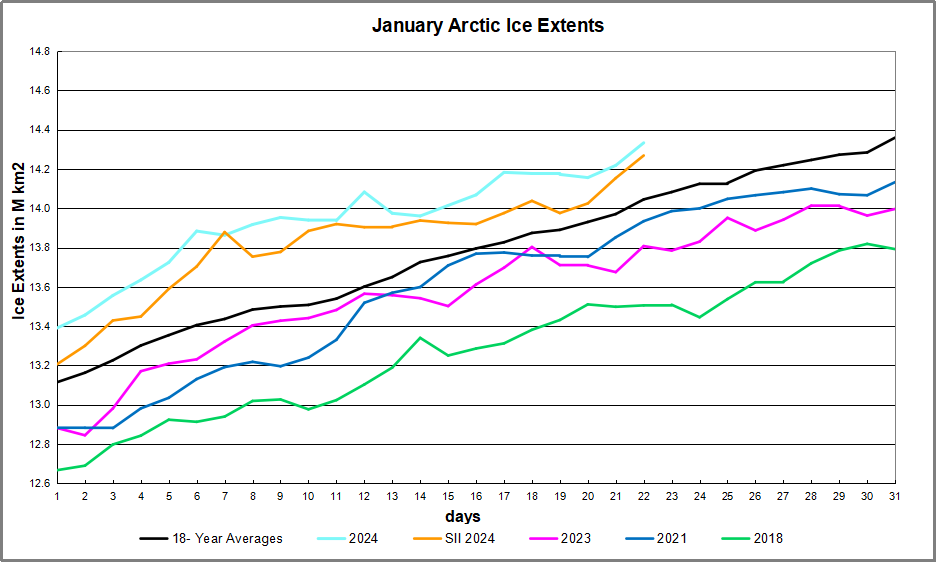
Fear Not for Arctic Ice New Year 2024

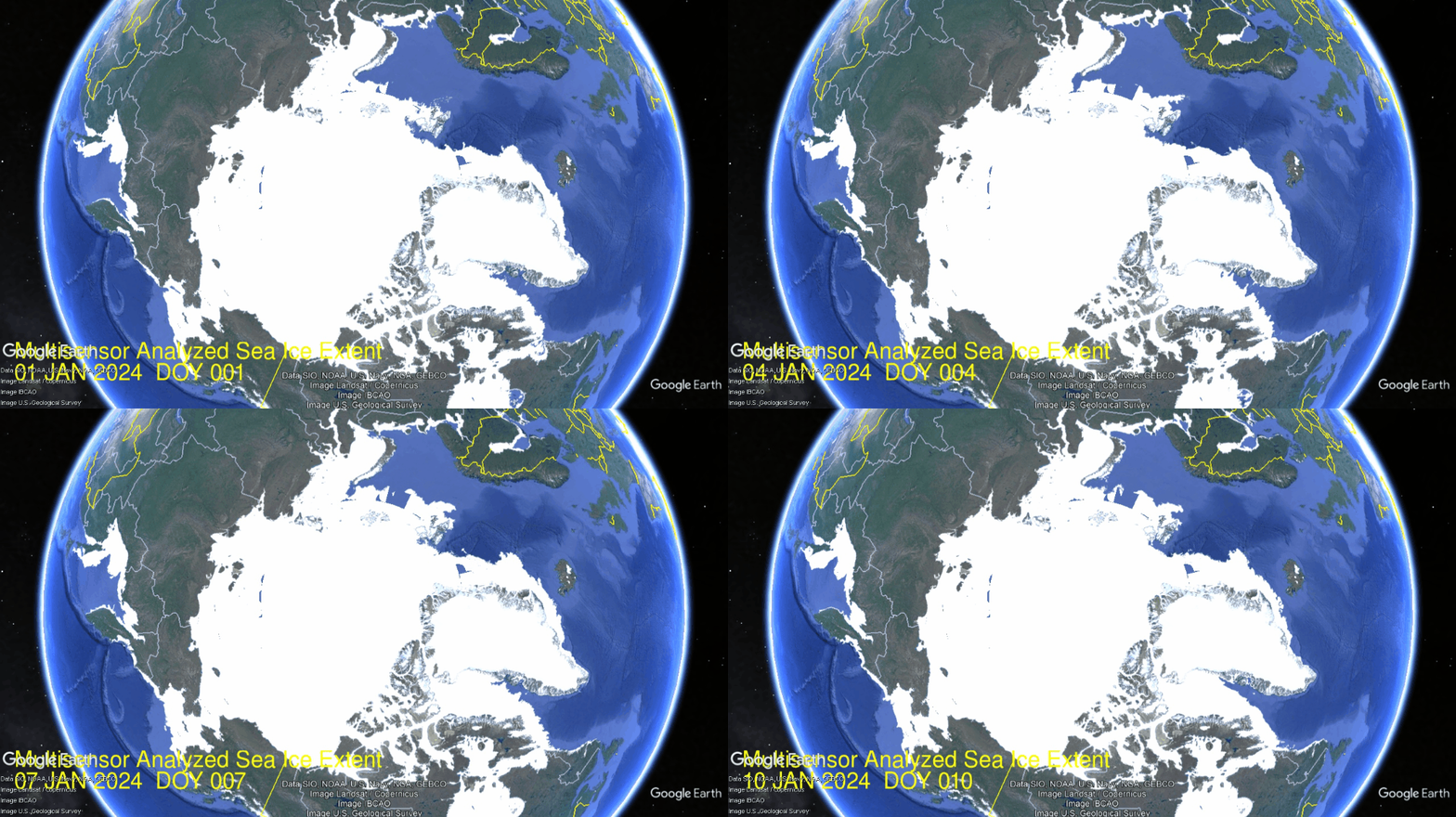
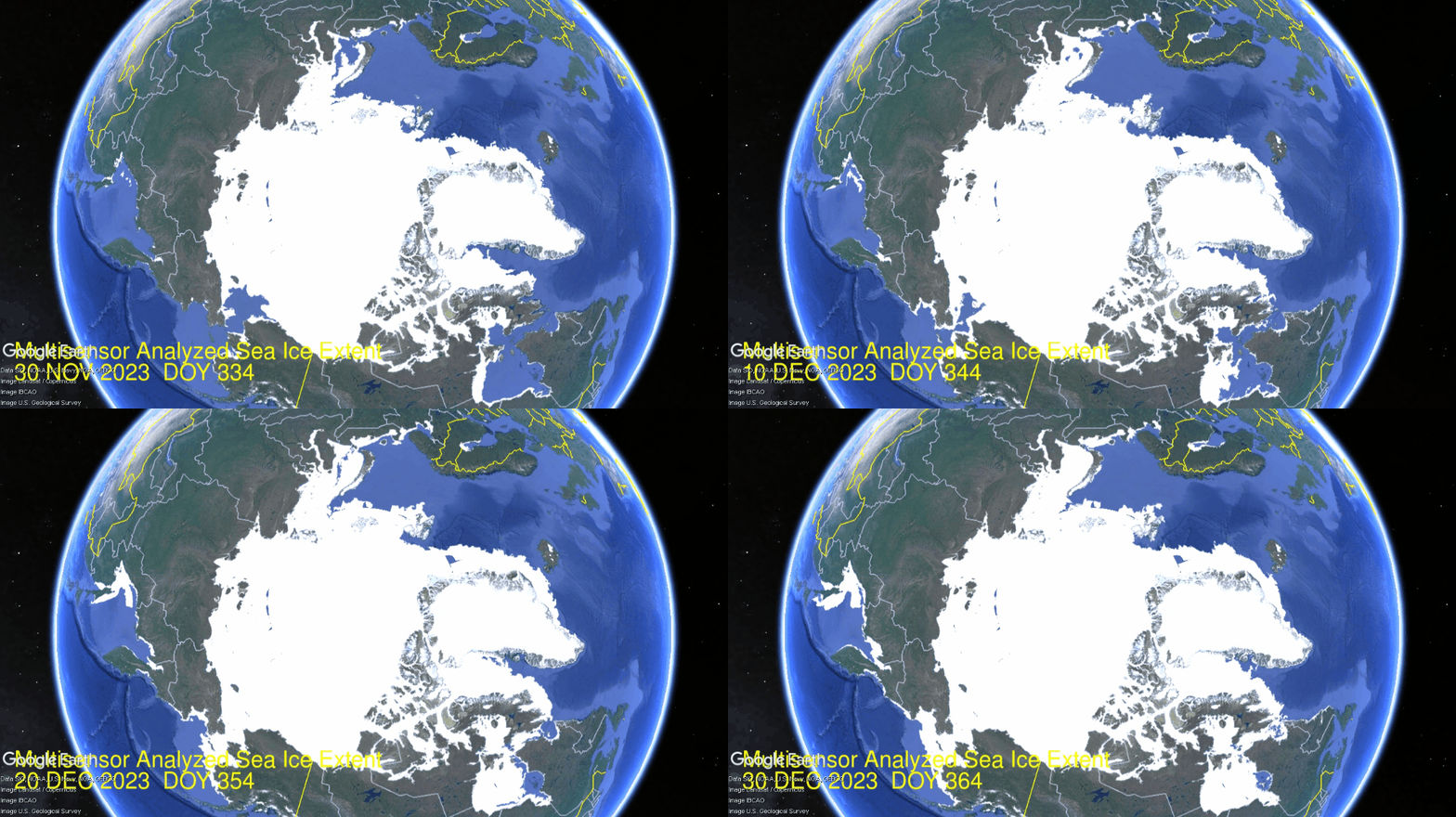
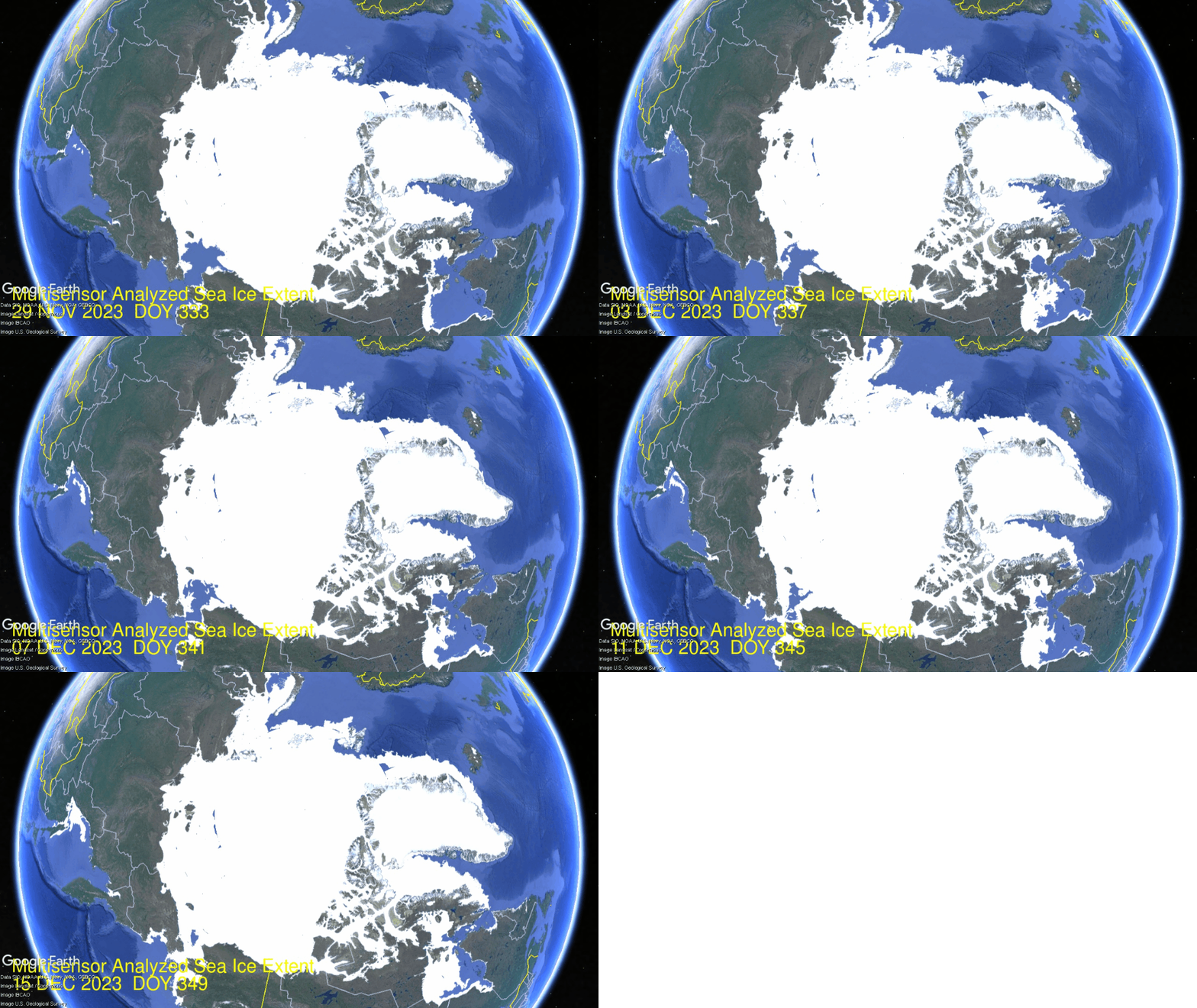
Impressive Arctic ice recovery continued in December as seen in the animation below:

The month of December 2023 shows Hudson Bay (lower right) starting with some western shore ice and ending 92% ice covered, adding in that basin ~800k km2. Just above Hudson, you can see the Gulf of St. Lawrence icing over, and Baffin Bay adding ice as well, now up to 50% of its annual maximum.

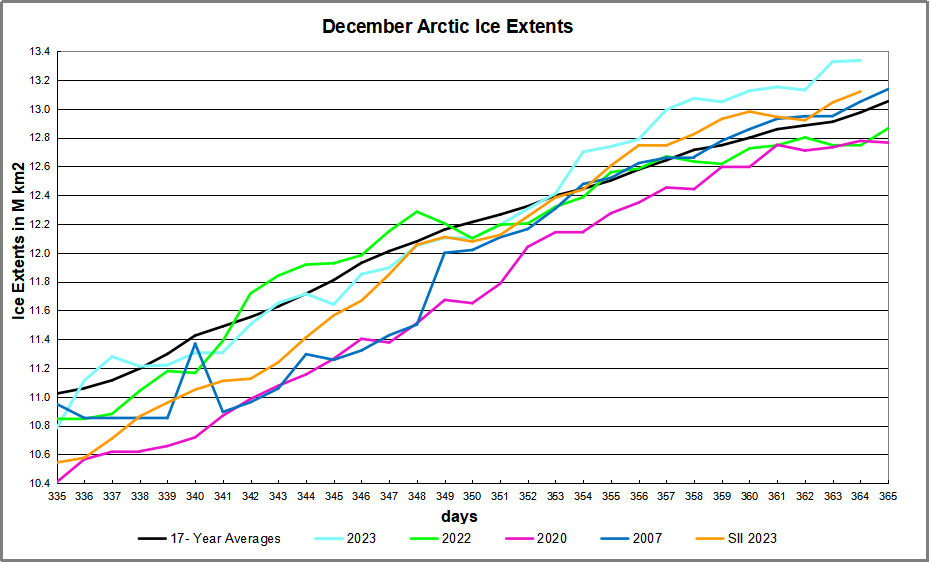
At the extreme and lower left, Okhotsk and Bering Seas also start with little shore ice. Okhotsk grew ice extent from 57k km2 up to 530k, 62% of its max last March.  Bering grew from 48k up to 478k km2, 56% of its max.  At the top Kara freezes over and Barents and Greenland Seas add ice to their margins. The graph below shows the December ice recovery. (Day 365 coming, and may be delayed by holiday.)

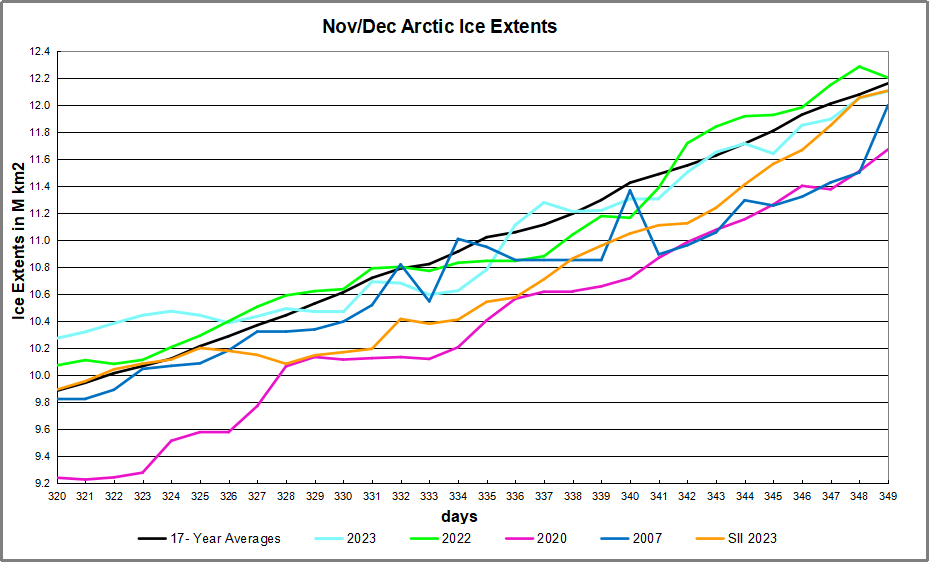
Note the average year adds 2M km2 while 2023 added ~2.5M, now 361k km2 above average. SII started 200k km2 lower than MASIE and ended up with the same deficit. Note that the other years are not far from the 17-year average at year end.

The table below shows year-end ice extents in the various Arctic basins compared to the 17-year averages and some recent years.

Region 2023364 Day 364 2023-Ave. 2007364 2023-2007
 (0) Northern_Hemisphere 13335688 12974817  360871  13049737 285951 
 (1) Beaufort_Sea 1070966 1070352  614  1069711 1255 
 (2) Chukchi_Sea 966006 963344  2662  965971 35 
 (3) East_Siberian_Sea 1087137 1087133  1087120 17 
 (4) Laptev_Sea 897845 897841  897845
 (5) Kara_Sea 923106 880831  42275  871851 51255 
 (6) Barents_Sea 423772 415592  8179  334577 89194 
 (7) Greenland_Sea 739662 579776  159886  666135 73528 
 (8) Baffin_Bay_Gulf_of_St._Lawrence 911691 965051  -53360  1074827 -163136 
 (9) Canadian_Archipelago 854860 853421  1439  852556 2304 
 (10) Hudson_Bay 1165656 1234412  -68757  1260856 -95201 
 (11) Central_Arctic 3218074 3205662  12412  3199726 18348 
 (12) Bering_Sea 472476 391321  81155  373942 98534 
 (13) Baltic_Sea 44969 27442  17527  9972 34997 
 (14) Sea_of_Okhotsk 530117 377911  152206  371241 158876 

This year’s ice extent is 361k km2 or 2.8% above average.  Only Baffin Bay and Hudson have deficits to average, more than offset by surpluses elsewhere, espcially Greenland, Bering and Okhotsk seas. Many of the others are already maxed out.

Comparing Arctic Ice at End of Years

At  the bottom is a discussion of statistics on year-end Arctic Sea Ice extents.  The values are averages of the last five days of each year.  End of December is a neutral point in the melting-freezing cycle, midway between September minimum and March maximum extents.

Background from Previous Post Updated to Year-End 2023

Some years ago reading a thread on global warming at WUWT, I was struck by one person’s comment: “I’m an actuary with limited knowledge of climate metrics, but it seems to me if you want to understand temperature changes, you should analyze the changes, not the temperatures.” That rang bells for me, and I applied that insight in a series of Temperature Trend Analysis studies of surface station temperature records. Those posts are available under this heading. Climate Compilation Part I Temperatures

This post seeks to understand Arctic Sea Ice fluctuations using a similar approach: Focusing on the rates of extent changes rather than the usual study of the ice extents themselves. Fortunately, Sea Ice Index (SII) from NOAA provides a suitable dataset for this project. As many know, SII relies on satellite passive microwave sensors to produce charts of Arctic Ice extents going back to 1979.  The current Version 3 has become more closely aligned with MASIE, the modern form of Naval ice charting in support of Arctic navigation. The SII User Guide is here.

There are statistical analyses available, and the one of interest (table below) is called Sea Ice Index Rates of Change (here). As indicated by the title, this spreadsheet consists not of monthly extents, but changes of extents from the previous month. Specifically, a monthly value is calculated by subtracting the average of the last five days of the previous month from this month’s average of final five days. So the value presents the amount of ice gained or lost during the present month.

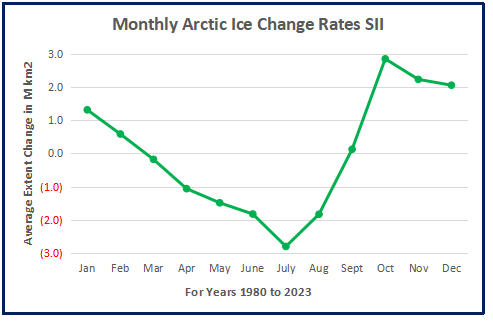
These monthly rates of change have been compiled into a baseline for the period 1980 to 2010, which shows the fluctuations of Arctic ice extents over the course of a calendar year. Below is a graph of those averages of monthly changes up to and including this year. Those familiar with Arctic Ice studies will not be surprised at the sine wave form. December end is a relatively neutral point in the cycle, midway between the September Minimum and March Maximum.

The graph makes evident the six spring/summer months of melting and the six autumn/winter months of freezing.  Note that June-August produce the bulk of losses, while October-December show the bulk of gains. Also the peak and valley months of March and September show very little change in extent from beginning to end.

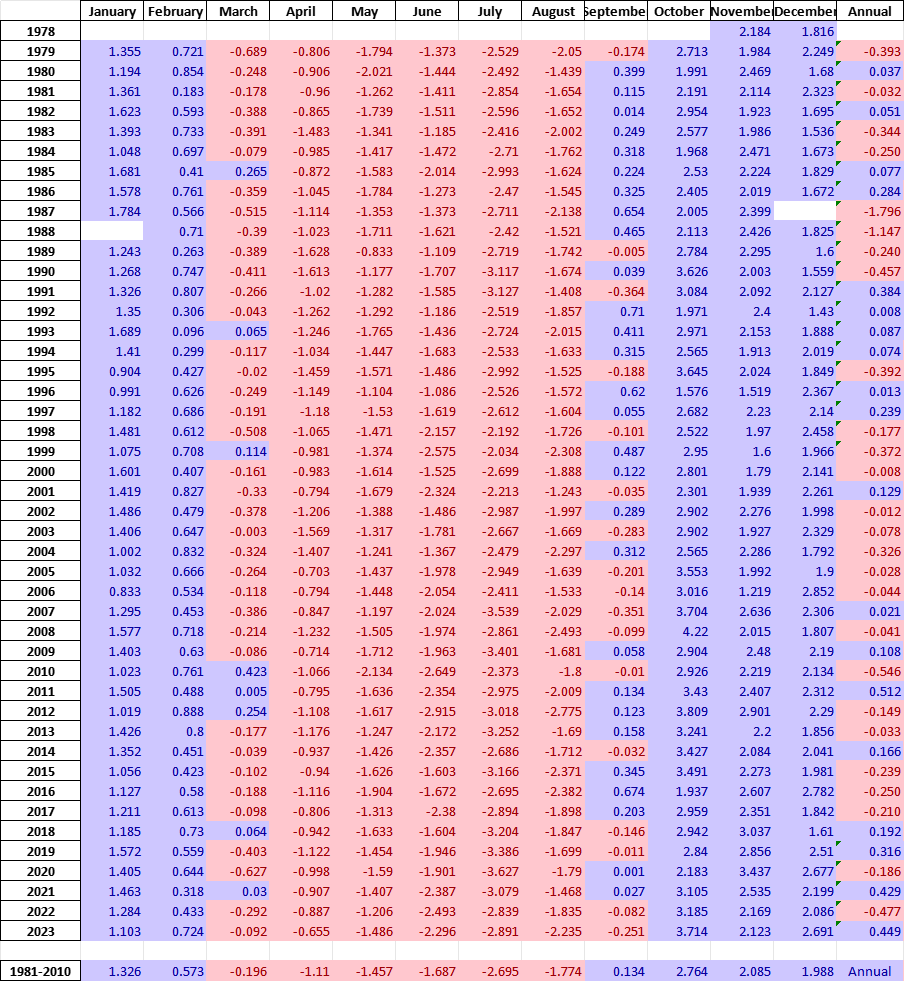
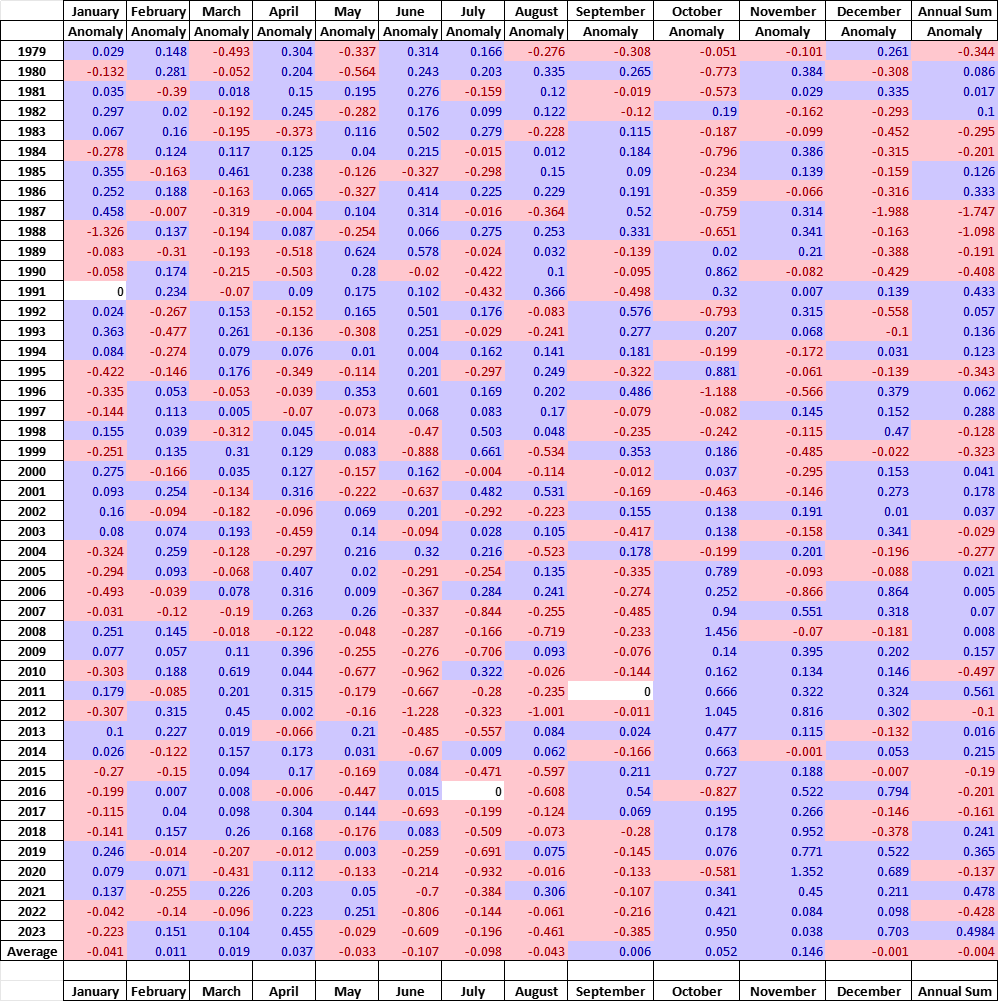
The table of monthly data reveals the variability of ice extents over the last 4 decades.

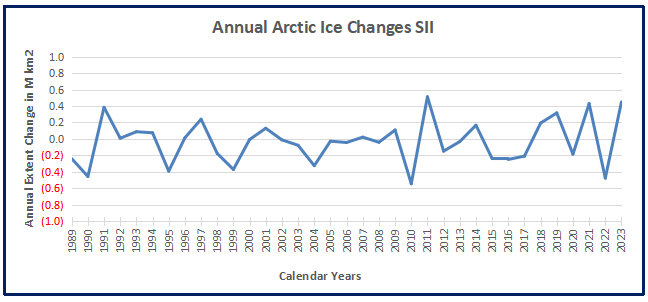
The values in January show changes from the end of the previous December, and by summing twelve consecutive months we can calculate an annual rate of change for the years 1979 to 2023.

As many know, there has been a decline of Arctic ice extent over these 40 years, averaging 70k km2 per year. But year over year, the changes shift constantly between gains and losses, ranging up to +/- 500k km2.  Since 1989 the average yearend gain/loss is nearly zero, -0.033k km2 to be exact.

Moreover, it seems random as to which months are determinative for a given year. For example, much ado was printed about 2023 losing more ice than usual June through September. But then the final 3 months of 2023 more than made up for those summer losses, resulting in a sizeable gain for the year.

As it happens in this dataset, October has the highest rate of adding ice. The table below shows the variety of monthly rates in the record as anomalies from the 1980-2010 baseline. In this exhibit a red cell is a negative anomaly (less than baseline for that month) and blue is positive (higher than baseline).

Note that the  +/ –  rate anomalies are distributed all across the grid, sequences of different months in different years, with gains and losses offsetting one another.  As noted earlier,  in 2023 the outlier negative months were June through September where unusual amounts of ice were lost.  Then unusally strong gains in October and December resulted in a large annual gain, compared to the baseline. The bottom line presents the average anomalies for each month over the period 1979-2021.  Note the rates of gains and losses mostly offset, and the average of all months in the bottom right cell is virtually zero.

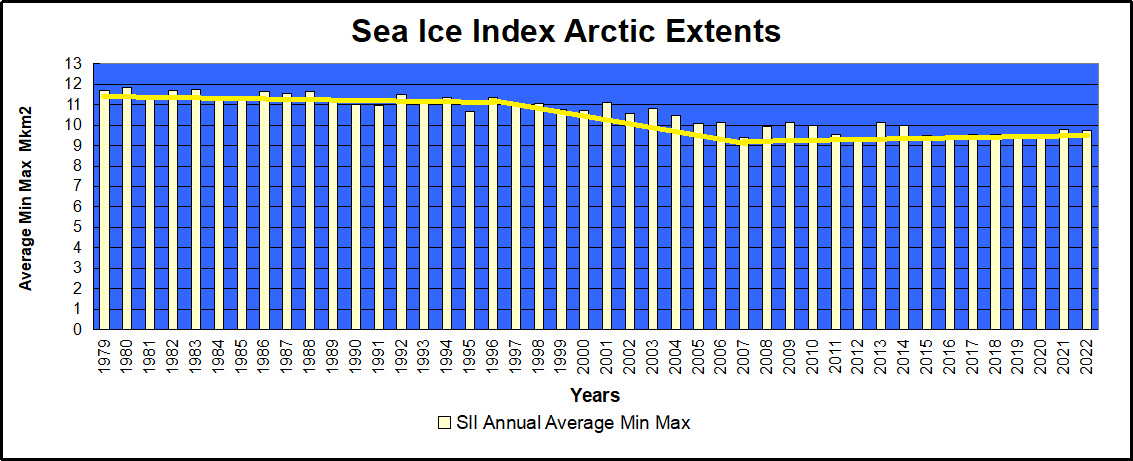
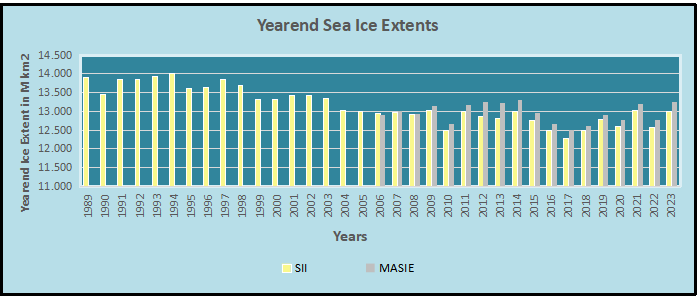
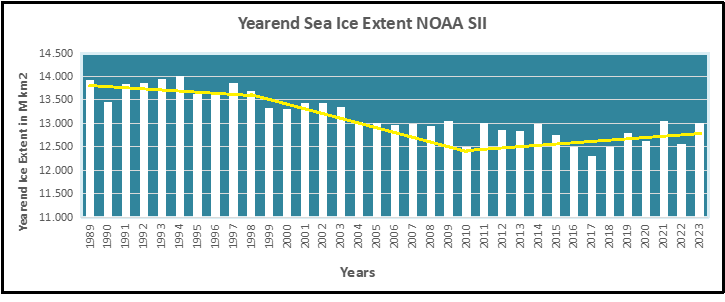
A final observation: The graph below shows the Yearend Arctic Ice Extents for the last 34 years.

Year-end Arctic ice extents (last 5 days of December) show three distinct regimes: 1988-1998, 1998-2010, 2010-2022. The average year-end extent 1989-2010 is 13.4M km2. In the last decade, 2011 was 13.0M km2, and six years later, 2017 was 12.3M km2. 2021 rose back to 13.06  2022 slipped back to 12.6M, and 2023 is back up to 13.0M. So for all the the fluctuations, the net is zero, or a gain of half a Wadham (0.5M) from 2010. Talk of an Arctic ice death spiral is fanciful.

These data show a noisy, highly variable natural phenomenon. Clearly, unpredictable factors are in play, principally water structure and circulation, atmospheric circulation regimes, and also incursions and storms. And in the longer view, today’s extents are not unusual.


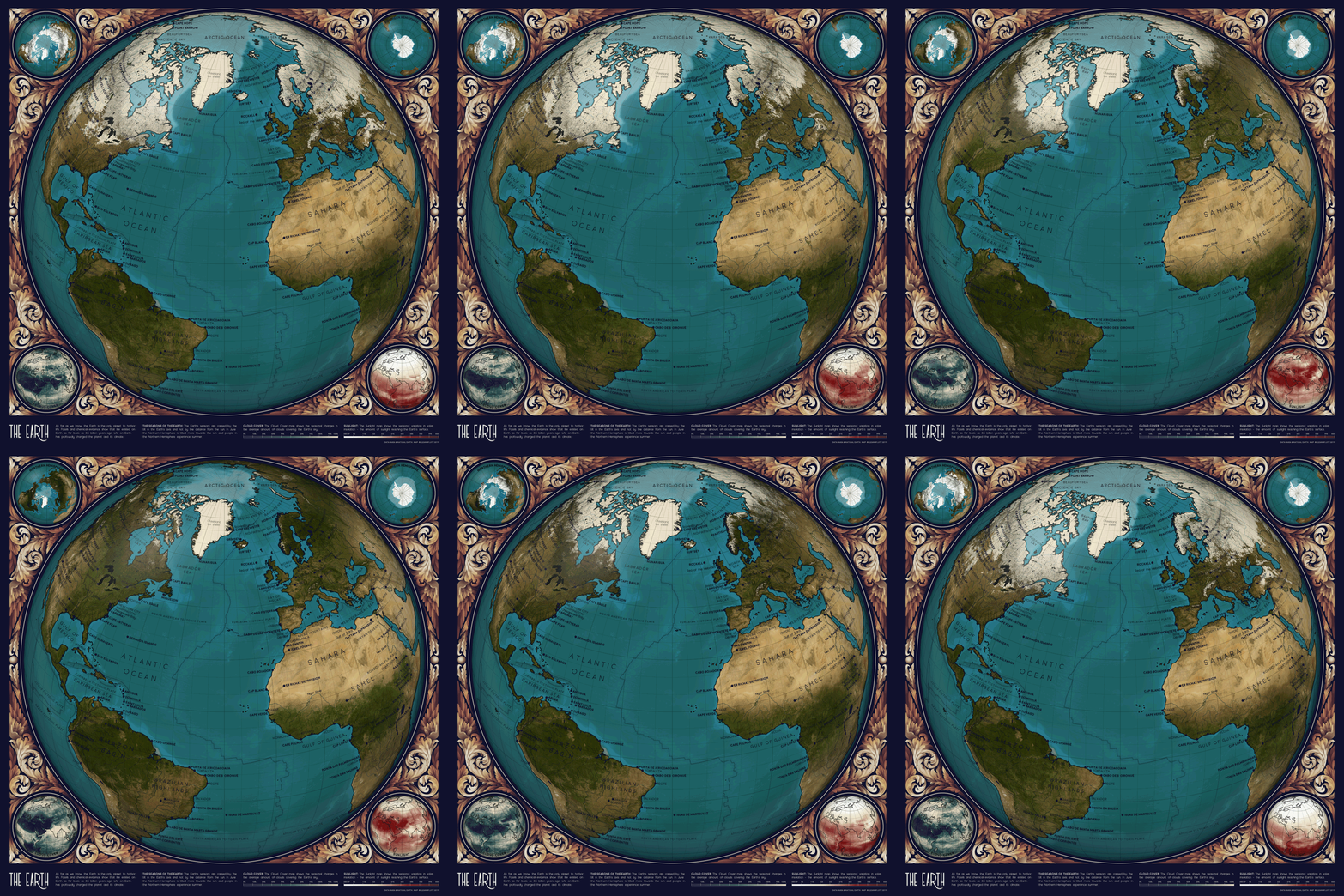
Illustration by Eleanor Lutz shows Earth’s seasonal climate changes. If played in full screen, the four corners present views from top, bottom and sides. It is a visual representation of scientific datasets measuring Arctic ice extents.


COP28 Stabilizes Mid-Dec. Arctic Ice


As COP28 began, Arctic ice extrent grew rapidly and by its end the Arctic was completely normal. On lower left, Chukchi sea filled in and below Bering sea started serious freezing. Lower right Hudson Bay more than doubled up to 800k km2, 2/3 of its maximum extent.  Center right Baffin Bay grew to 45% of max.

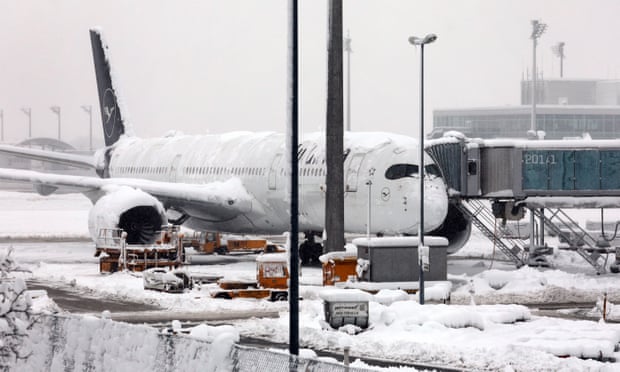
A Lufthansa aircraft at the snow-covered Munich airport on Saturday. Photograph: Karl-Josef Hildenbrand/AP

Coincidently, COP28 also triggered heavy snow bringing chaos to southern Germany causing Munich to suspend flights to anywhere, including Dubai.

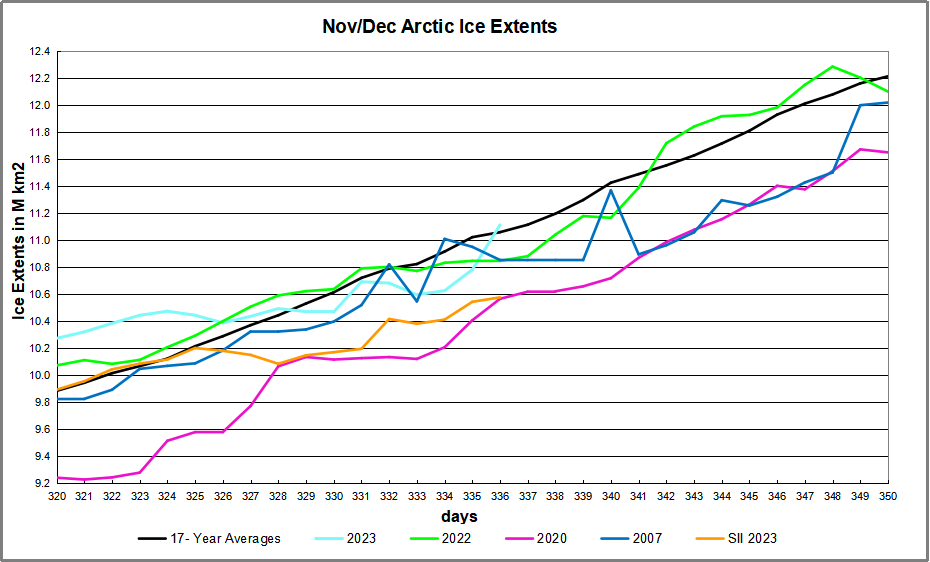
The graph below shows the gains in ice extent mid-November to Mid December for 2023, the 17 year average and some other recent years, as well as SII (Sea Ice Index)

MASIE showed 2023 and 2022 tracking the 17 year average and ending very close together.  2007 fluctuated a lot, well below average in December before rising at the end.  SII tracked ~400k km2 lower most of this period, before rising to match MASIE in the last few days.


The table below shows the distribution of ice in the Arctic Ocean basins.

Region 2023349 Day 349 2023-Ave. 2007349 2023-2007
 (0) Northern_Hemisphere 12104311 12162108  -57797  12000124 104187 
 (1) Beaufort_Sea 1070966 1070103  863  1069711 1255 
 (2) Chukchi_Sea 948805 934827  13978  796459 152347 
 (3) East_Siberian_Sea 1087137 1086539  598  1077192 9945 
 (4) Laptev_Sea 897845 897835  897845
 (5) Kara_Sea 826874 847433  -20559  842174 -15300 
 (6) Barents_Sea 370088 335870  34218  285179 84909 
 (7) Greenland_Sea 688238 546548  141690  571916 116322 
 (8) Baffin_Bay_Gulf_of_St._Lawrence 819365 824803  -5438  852443 -33079 
 (9) Canadian_Archipelago 854860 853420  1440  852556 2304 
 (10) Hudson_Bay 800760 1101080  -300320  1248305 -447546 
 (11) Central_Arctic 3212059 3204043  8016  3192331 19728 
 (12) Bering_Sea 226652 236725  -10073  93340 133312 
 (13) Baltic_Sea 55323 11920  43403  10353 44970 
 (14) Sea_of_Okhotsk 231640 200090  31550  206342 25297 

Note that Arctic ice now exceeds 12M km2, or 80% of last March maximum.  As shown in the table above, the main deficit to average is in Hudson Bay, likely to be overcome with the current rapid growth. Offsetting are surpluses elsewhere, mostly in Greenland sea, along with Barents and Baltic seas.


COP28 Triggers Leap in Arctic Ice

The animation shows remarkable growth of Arctic ice extent just since COP28 began.  As noted in the previous Arctic ice post, Hudson Bay (lower right) was a lagging region, but freezing accelerated there. At the top, Barents and Greenland sea added ice. As well, both Bering and Okhotsk seas (far left) added fast ice on coastlines. In all, half a Wadham, 517k km2 of ice extent was added in just three days.

A Lufthansa aircraft at the snow-covered Munich airport on Saturday. Photograph: Karl-Josef Hildenbrand/AP

Coincidently, COP28 also triggered heavy snow bringing chaos to southern Germany causing Munich to suspend flights to anywhere, including Dubai.

The graph below shows the gains in ice extent erasing a brief deficit to average.

MASIE shows a gain of ~0.5M km2 from day 334 to 336, now exceeding average after being lower briefly.  SII (Sea Ice Index) also rose but is still estimating ice extent ~500k km2 lower.

The table below shows the distribution of ice in the Arctic Ocean basins.

Region 2023336 Day 336 2023-Ave. 2007336 2023-2007
 (0) Northern_Hemisphere 11113626 11059843  53782  10853632 259993 
 (1) Beaufort_Sea 1070966 1069301  1665  1054586 16380 
 (2) Chukchi_Sea 765844 797154  -31311  607874 157970 
 (3) East_Siberian_Sea 1087137 1080765  6372  1023256 63882 
 (4) Laptev_Sea 897845 897835  897845
 (5) Kara_Sea 812779 796332  16446  829462 -16683 
 (6) Barents_Sea 350616 259899  90717  222769 127847 
 (7) Greenland_Sea 711570 538651  172919  541176 170393 
 (8) Baffin_Bay_Gulf_of_St._Lawrence 571757 697517  -125760  755390 -183633 
 (9) Canadian_Archipelago 854860 853409  1451  852556 2304 
 (10) Hudson_Bay 553841 636088  -82247  812965 -259124 
 (11) Central_Arctic 3220281 3198662  21619  3177278 43003 
 (12) Bering_Sea 82391 154107  -71716  27916 54475 
 (13) Baltic_Sea 23276 4889  18387  2898 20378 
 (14) Sea_of_Okhotsk 106202 70731  35471  46377 59826 

Note that Arctic ice now exceeds 11M km2, or 74% of last March maximum.  As shown in the table above, the main deficits to average are in Hudson and Baffin Bays, along with less ice in Bering Sea. Offsetting are surpluses elsewhere, especially in Barents and Greenland seas.


November 2023 Arctic Ice Doing Well

The animation shows the continuing growth of Arctic ice extent during November 2023, from day 305 to yesterday, day 334.  For all of the fuss over the September minimum, little is said about Arctic ice growing back rapidly; that’s 4 Wadhams in October, plus another 2,2M in Nov to total 10.6M km2, or 10.6 Wadhams.  The Russian side on the left froze over in October, and now at the center bottom you can see Beaufort sea and Canadian Archipelago icing over completely. At top center Kara and Barents are adding normal ice extents. On the right side are the two lagging basins: Baffin and Hudson Bays, though freezing has started in Hudson bay in the last ten days.  That basin is shallow and likely to freeze over in the next two weeks.

The graph below shows the 30 days of November 2023 compared to the 17 year average (2006 to 2022 inclusive), to SII (Sea Ice Index) and some notable years.


Taking the average extent for the final 5 days of October 2023 compared to same for end of November, the added ice extent is 2.2M km2.  The growth slowed at the end resulting in a 290k km2 deficit to average.  Sea Ice Index (SII) is ~200k km2 lower than MASIE. 

The table below shows the distribution of ice in the Arctic Ocean basins.

Region 2023334 Day 334 2023-Ave. 2007334 2023-2007
 (0) Northern_Hemisphere 10626375 10921303  -294928  11009948 -383574 
 (1) Beaufort_Sea 1070966 1069463  1503  1058872 12094 
 (2) Chukchi_Sea 722477 788533  -66056  687829 34649 
 (3) East_Siberian_Sea 1087137 1083567  3570  1082015 5122 
 (4) Laptev_Sea 897845 897822  23  897613 232 
 (5) Kara_Sea 799640 792930  6710  826319 -26679 
 (6) Barents_Sea 262074 248861  13213  216525 45549 
 (7) Greenland_Sea 607148 533255  73893  618844 -11696 
 (8) Baffin_Bay_Gulf_of_St._Lawrence 591970 671268  -79298  708497 -116527 
 (9) Canadian_Archipelago 854826 853266  1560  850249 4577 
 (10) Hudson_Bay 379047 574308  -195261  751382 -372335 
 (11) Central_Arctic 3220511 3192296  28215  3183073 37438 
 (12) Bering_Sea 47829 145731  -97902  72645 -24816 
 (13) Baltic_Sea 16936 3593  13343  0 16936 
 (14) Sea_of_Okhotsk 63947 62153  1794  53052 10895 

As shown in the table above, the deficit is due to lagging growth in Hudson and Baffin Bays, along with less ice in Chukchi and Bering Seas. Typically these basins are among the last to freeze.


Mid-Nov. 2023 Arctic Ice Grows to 10 Wadhams

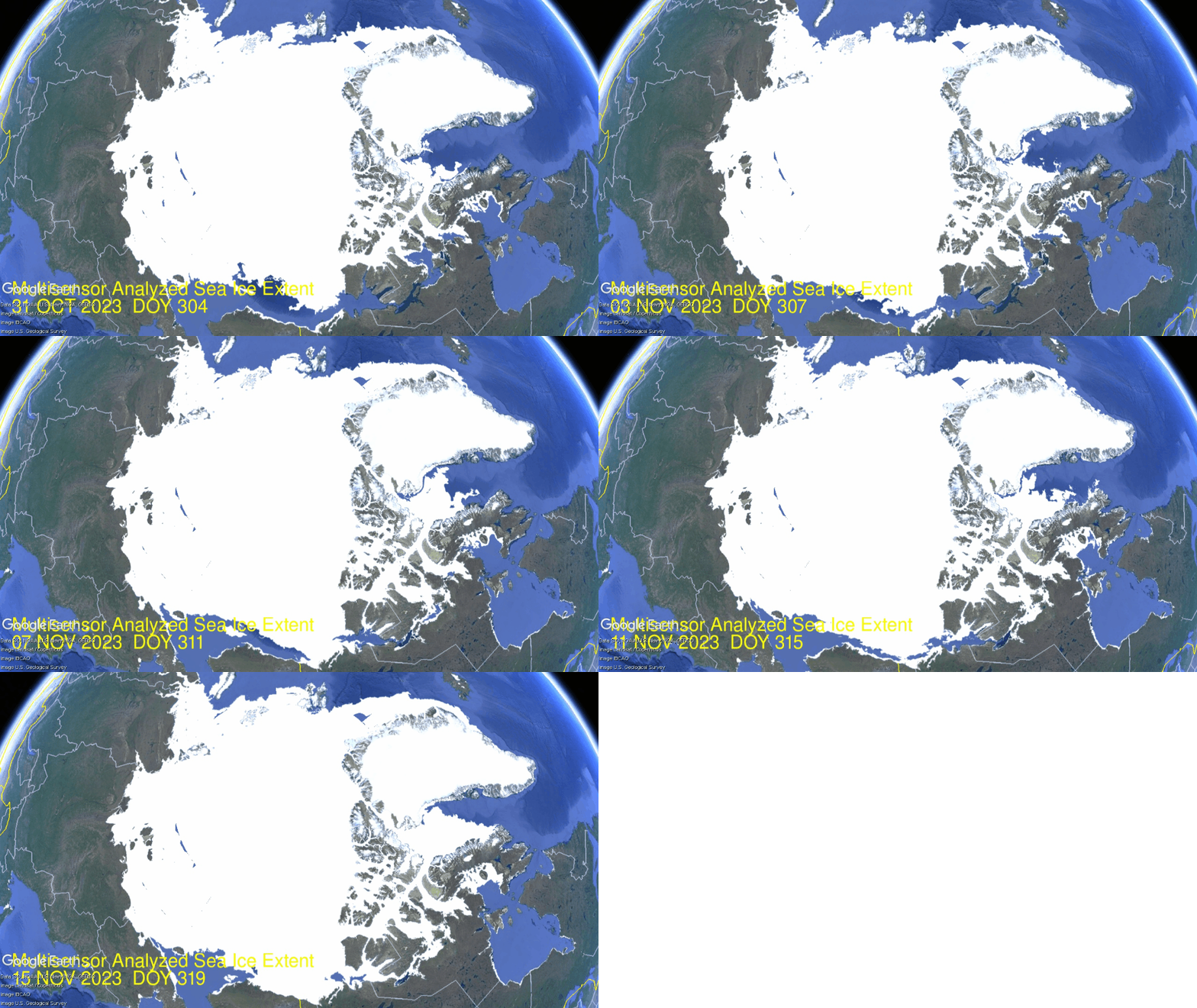
The animation shows the rapid growth of Arctic ice extent during November 2023, from day 304 to yesterday, day 319.  For all of the fuss over the September minimum, little is said about Arctic ice growing back rapidly; that’s 4 Wadhams in October, plus another 1.3M in Nov to total 10M km2, or 10 Wadhams.  The Russian side on the left froze over in October, and now at the center bottom you can see Beaufort sea and Canadian Archipelago icing up. Center right is Baffin Bay growing ice as well.

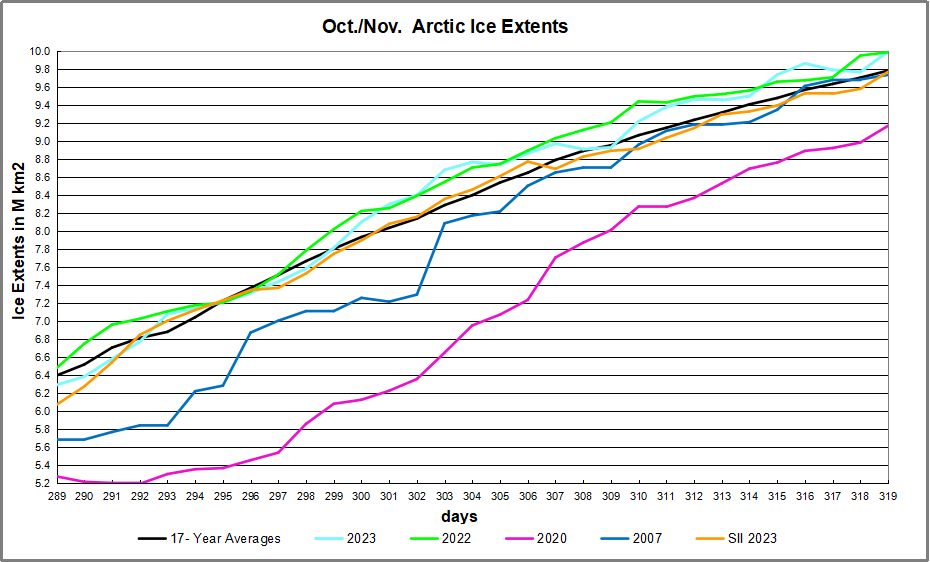
The graph below shows the last 30 days of 2023 compared to the 17 year average (2006 to 2022 inclusive), to SII (Sea Ice Index) and some notable years.


From Mid October to Mid November 2023, MASIE shows NH ice extent growing from 6.3 M km2 to 10M.  That matches 2022 and exceeds the 17 year average by more than 200K km2.   SII (Sea Ice Index) is only slightly lower.

The table below shows the distribution of ice in the Arctic Ocean basins.

Region 2023319 Day 319 Ave. 2023-Ave. 2007319 2023-2007
 (0) Northern_Hemisphere 9997068 9784253  212815  9737614 259454 
 (1) Beaufort_Sea 1051194 1063450  -12257  1053727 -2533 
 (2) Chukchi_Sea 596947 629695  -32748  503783 93164 
 (3) East_Siberian_Sea 1064913 1075985  -11072  1043952 20960 
 (4) Laptev_Sea 897845 897217  628  897845
 (5) Kara_Sea 696199 658489  37710  765376 -69177 
 (6) Barents_Sea 245998 154920  91078  145438 100560 
 (7) Greenland_Sea 613312 460620  152692  527575 85737 
 (8) Baffin_Bay_Gulf_of_St._Lawrence 536576 526706  9870  533931 2645 
 (9) Canadian_Archipelago 841536 850736  -9200  852539 -11003 
 (10) Hudson_Bay 161371 234076  -72704  231544 -70173 
 (11) Central_Arctic 3236821 3174741  62081  3156228 80594 

Overall ice extent has 212k km2 above average or 2%.  The only sizeable deficit is in Hudson Bay,  more than offset by surpluses elsewhere, especiallly in Greenland and Barents seas, along with the Central Arctic.


October 2023 Arctic Ice Grows by Leaps

The animation shows the rapid growth of Arctic ice extent during October 2023, from day 274 to day 304, yesterday.  For all of the fuss over the September minimum, little is said about Arctic ice growing 4M km2, that’s 4 Wadhams in one month!.  Look on the left (Russian side) at the complete closing of the Northern Sea Route for shipping.

The graph below show 2023 compared to the 17 year average (2006 to 2022 inclusive), to SII (Sea Ice Index) and some notable years.

This year October added 3.95M km2 from end of September compared to an average October increase of 3.45M km2.  As of yesterday NH ice extent is 368k km2 above average and nearly 600k km2 greater than 2007.
The table below shows the distribution of ice in the Arctic Ocean basins.

Region 2023304 Ave. Day 304 2023-Ave. 2007304 2023-2007
 (0) Northern_Hemisphere 8768573 8422636  345938  8175072 593501 
 (1) Beaufort_Sea 780946 957189  -176243  1038126 -257180 
 (2) Chukchi_Sea 535578 454974  80604  242685 292894 
 (3) East_Siberian_Sea 1078989 936944  142045  835071 243917 
 (4) Laptev_Sea 897845 842696  55149  887789 10055 
 (5) Kara_Sea 655623 473780  181843  311960 343664 
 (6) Barents_Sea 121748 83466  38282  52823 68925 
 (7) Greenland_Sea 528448 412774  115675  443559 84890 
 (8) Baffin_Bay_Gulf_of_St._Lawrence 243512 256243  -12731  289374 -45861 
 (9) Canadian_Archipelago 629955 762429  -132474  817220 -187265 
 (10) Hudson_Bay 82242 69487  12754  48845 33396 
 (11) Central_Arctic 3207724 3161034  46690  3206345 1379 

Overall ice extent has 346k km2 above average or 4%.  Sizeable deficits are in Beaufort Sea and Canadian Archipelago, more than offset by surpluses in Chukchi, East Siberian, Kara and Greenland seas.


Mid October 2023 Arctic Ice Recovering Rapidly


The animation shows Arctic ice rapidly growing from September 30 to yesterday October 16.  Despite much ado about September minimums, in fact the ice recovers quickly from its annual low extent.  Several days exceeded the 17 year average with yesterday slightly in deficit. The graph below shows the distribution of ice across the Arctic Regions with 2023 compare to average, to some notable years and to estimates from SII (Sea Ice Index)

Note that refreezing starts mid September and accelerates upward.  October has already added 1.4M km2 and will likely end up 3M higher than end of September. As the table below shows, the ice extents are tracking the 17 year average and 600k km2 greater than 2007.

Region 2023289 Day 289 2023-Ave. 2007289 2023-2007
 (0) Northern_Hemisphere 6291575 6397434  -105859  5685365 606210 
 (1) Beaufort_Sea 545048 740358  -195309  815519 -270471 
 (2) Chukchi_Sea 399345 309528  89817  98615 300730 
 (3) East_Siberian_Sea 495351 569412  -74061  32547 462804 
 (4) Laptev_Sea 578928 453308  125620  553919 25009 
 (5) Kara_Sea 178575 148145  30430  170928 7647 
 (6) Barents_Sea 22291 42524  -20233  25377 -3086 
 (7) Greenland_Sea 422335 341130  81206  446006 -23670 
 (8) Baffin_Bay_Gulf_of_St._Lawrence 103295 100033  3262  92878 10416 
 (9) Canadian_Archipelago 362514 583556  -221042  502605 -140091 
 (10) Hudson_Bay 208 10894  -10686  1936 -1729 
 (11) Central_Arctic 3179853 3096957  82896  2943760 236093 

Yesterday the overall extent was ~6.30M km2, ~100k km2 below average (2%).  Deficits were mostly in Beaufort Sea and CAA, offset by surpluses in Chukchi,Laptev, and Greenland seas, along with Central Arctic.

Previous post:  2023 September Arctic Outlook and Results Not Scary

The graph above shows the monthly averages for September Arctic ice extents including 2023 compared to previous years back to 2007.  This year is slightly below the 17 year average of 4.63M km2;  MASIE shows 4.43M and SII shows 4.37.  For comparison the 2007 September values were 4.30M for MASIE and 4.27M for SII.  The predictions below refer to the SII value.

2023: August Report from Sea Ice Prediction Network

The August median forecasted value for pan-Arctic September sea-ice extent is 4.60 million square kilometers with interquartile values of 4.35 and 4.80 million square kilometers, while individual forecasts range from 2.88 to 5.47 million square kilometers. We note that the lowest two forecasts predict a new record September sea-ice extent value (current record is September 2012, with a sea-ice extent of 3.57 million square kilometers), but these forecasts are outliers relative to the other contributions.

These are predictions for the September 2023 monthly average ice extent as reported by NOAA Sea Ice Index (SII). This post provides a look at the 2023 Year To Date (YTD) based on monthly averages comparing MASIE and SII datasets. (17 year average is 2006 to 2022 inclusive).

The graph puts 2023 into recent historical perspective. Note how 2023 was slightly below the 17-year average for the first 5 months, then recovered to match average in May and has maintained or exceeded average through August. September was below average slightly and above 2007. The outlier 2012 provided the highest March maximum as well as the lowest September minimum, coinciding with the Great Arctic Cyclone that year.  2007 began the period with the lowest minimum except for 2012.  SII 2023 was running below MASIE except for May/June and is currently just below MASIE and above 2007 and 2012.


October 2023 Arctic Ice Flash Freezing

The animation shows the rapid refreezing of Arctic ice from September 30 to yesterday October 9.  Despite much ado about September minimums, in fact the ice recovers quickly from its annual low extent.  As of yesterday, Day 282, this year has again exceeded the 17 year average.

Previous post:  2023 September Arctic Outlook and Results Not Scary

The graph above shows the monthly averages for September Arctic ice extents including 2023 compared to previous years back to 2007.  This year is slightly below the 17 year average of 4.63M km2;  MASIE shows 4.43M and SII shows 4.37.  For comparison the 2007 September values were 4.30M for MASIE and 4.27M for SII.  The predictions below refer to the SII value.

2023: August Report from Sea Ice Prediction Network

The August median forecasted value for pan-Arctic September sea-ice extent is 4.60 million square kilometers with interquartile values of 4.35 and 4.80 million square kilometers, while individual forecasts range from 2.88 to 5.47 million square kilometers. We note that the lowest two forecasts predict a new record September sea-ice extent value (current record is September 2012, with a sea-ice extent of 3.57 million square kilometers), but these forecasts are outliers relative to the other contributions.

These are predictions for the September 2023 monthly average ice extent as reported by NOAA Sea Ice Index (SII). This post provides a look at the 2023 Year To Date (YTD) based on monthly averages comparing MASIE and SII datasets. (17 year average is 2006 to 2022 inclusive).

The graph puts 2023 into recent historical perspective. Note how 2023 was slightly below the 17-year average for the first 5 months, then recovered to match average in May and has maintained or exceeded average through August. September was below average slightly and above 2007. The outlier 2012 provided the highest March maximum as well as the lowest September minimum, coinciding with the Great Arctic Cyclone that year.  2007 began the period with the lowest minimum except for 2012.  SII 2023 was running below MASIE except for May/June and is currently just below MASIE and above 2007 and 2012.

The table below provides the numbers for comparisons (all are M km2)

Monthly MASIE 2023 SII 2023 MASIE -SII MASIE 2023-17 YR AVE SII 2023-17 YR AVE MASIE 2023-2007
Jan 13.579 13.347 0.232 -0.207 -0.250 -0.183
Feb 14.481 14.177 0.304 -0.207 -0.292 -0.171
Mar 14.655 14.440 0.215 -0.212 -0.248 0.032
Apr 13.979 13.992 -0.013 -0.120 -0.025 0.283
May 11.866 12.159 -0.293 -0.742 -0.492 -0.561
June 11.044 10.963 0.081 0.242 0.099 0.218
July 8.431 8.183 0.248 0.152 0.150 0.439
Aug 5.825 5.561 0.264 -0.062 -0.083 0.241
Sept 4.430 4.371 0.059 -0.285 -0.360 0.132

The first two columns are the 2023 YTD shown by MASIE and SII, with the MASIE surpluses in column three.  Column four shows MASIE 2023 compared to MASIE 17 year average, while column five shows SII 2023 compared to SII 17 year average.  YTD September both MASIE and SII ~300k km2 below average. The last column shows MASIE 2023 holding a September surplus of 132k km2 over 2007.

Summary and Update

The experts involved in SIPN were expecting SII 2023 September to be higher than 2007 and somewhat lower than 2022.  The way it came out MASIE September was 285k km2 below average and 132 above 2007.  The Chart below shows the October ice recovery is well under way, now exceeding the average. 

The table shows Day 282 (October 9) ice extents for NH overall and the regions, comparing 2023 to average and several years.

Region 2023282 Day 282 2023-Ave. 2007282 2023-2007
 (0) Northern_Hemisphere 5663965 5537300  126665  4794178 869787 
 (1) Beaufort_Sea 473472 641789  -168317  639935 -166464 
 (2) Chukchi_Sea 323215 255140  68075  14061 309154 
 (3) East_Siberian_Sea 257832 407159  -149327  35 257797 
 (4) Laptev_Sea 471460 252642  218818  340943 130518 
 (5) Kara_Sea 117555 66310  51245  82407 35148 
 (6) Barents_Sea 29729 22272  7457  12933 16796 
 (7) Greenland_Sea 424861 289801  135061  400747 24115 
 (8) Baffin_Bay_Gulf_of_St._Lawrence 90677 67480  23197  73481 17195 
 (9) Canadian_Archipelago 305206 485343  -180137  424350 -119144 
 (10) Hudson_Bay 104 5030  -4926  4163 -4059 
 (11) Central_Arctic 3167292 3043182  124110  2799828 367464 

On Day 282 Arctic ice was 127k km2 above average and nearly 870k km2 above 2007. The major deficits were in Beaufort, East Siberian seas and Canadian Archipelago.  They were more than offset by surpluses in Laptev, Greenland sea and Central Arctic as well as smaller surpluses elsewhere.  From previous years we can expect that October 2023 will gain more than 3M km2 of ice extent over the ending extent in September.


2023 September Arctic Outlook and Results Not Scary

The graph above shows the monthly averages for September Arctic ice extents including 2023 compared to previous years back to 2007.  This year is slightly below the 17 year average of 4.63M km2;  MASIE shows 4.43M and SII shows 4.37.  For comparison the 2007 September values were 4.30M for MASIE and 4.27M for SII.  The predictions below refer to the SII value.

2023: August Report from Sea Ice Prediction Network

The August median forecasted value for pan-Arctic September sea-ice extent is 4.60 million square kilometers with interquartile values of 4.35 and 4.80 million square kilometers, while individual forecasts range from 2.88 to 5.47 million square kilometers. We note that the lowest two forecasts predict a new record September sea-ice extent value (current record is September 2012, with a sea-ice extent of 3.57 million square kilometers), but these forecasts are outliers relative to the other contributions.

These are predictions for the September 2023 monthly average ice extent as reported by NOAA Sea Ice Index (SII). This post provides a look at the 2023 Year To Date (YTD) based on monthly averages comparing MASIE and SII datasets. (17 year average is 2006 to 2022 inclusive).

The graph puts 2023 into recent historical perspective. Note how 2023 was slightly below the 17-year average for the first 5 months, then recovered to match average in May and has maintained or exceeded average through August. September was below average slightly and above 2007. The outlier 2012 provided the highest March maximum as well as the lowest September minimum, coinciding with the Great Arctic Cyclone that year.  2007 began the period with the lowest minimum except for 2012.  SII 2023 was running below MASIE except for May/June and is currently just below MASIE and above 2007 and 2012.

The table below provides the numbers for comparisons (all are M km2)

Monthly MASIE 2023 SII 2023 MASIE -SII MASIE 2023-17 YR AVE SII 2023-17 YR AVE MASIE 2023-2007
Jan 13.579 13.347 0.232 -0.207 -0.250 -0.183
Feb 14.481 14.177 0.304 -0.207 -0.292 -0.171
Mar 14.655 14.440 0.215 -0.212 -0.248 0.032
Apr 13.979 13.992 -0.013 -0.120 -0.025 0.283
May 11.866 12.159 -0.293 -0.742 -0.492 -0.561
June 11.044 10.963 0.081 0.242 0.099 0.218
July 8.431 8.183 0.248 0.152 0.150 0.439
Aug 5.825 5.561 0.264 -0.062 -0.083 0.241
Sept 4.430 4.371 0.059 -0.285 -0.360 0.132

The first two columns are the 2023 YTD shown by MASIE and SII, with the MASIE surpluses in column three.  Column four shows MASIE 2023 compared to MASIE 17 year average, while column five shows SII 2023 compared to SII 17 year average.  YTD September both MASIE and SII ~300k km2 below average. The last column shows MASIE 2023 holding a September surplus of 132k km2 over 2007.

Summary and Update

The experts involved in SIPN were expecting SII 2023 September to be higher than 2007 and somewhat lower than 2022.  The way it came out MASIE September was 285k km2 below average and 132 above 2007.  The Chart below shows the October ice recovery is well under way, reaching average briefly.

The table shows Day 281 (October 8) ice extents for NH overall and the regions, comparing 2023 to average and several years.

Region 2023281 Day 281 2023-Ave. 2007281 2023-2007
 (0) Northern_Hemisphere 5349225 5448341 -99116 4653544 695681
 (1) Beaufort_Sea 429938 633800 -203862 618242 -188304
 (2) Chukchi_Sea 301437 249878 51559 27562 273875
 (3) East_Siberian_Sea 180747 397106 -216358 311 180436
 (4) Laptev_Sea 423091 235120 187971 302924 120168
 (5) Kara_Sea 97994 54598 43396 22717 75277
 (6) Barents_Sea 15003 21167 -6164 3580 11423
 (7) Greenland_Sea 414298 285893 128405 414576 -278
 (8) Baffin_Bay_Gulf_of_St._Lawrence 74944 64730 10214 71399 3545
 (9) Canadian_Archipelago 266487 468946 -202459 408841 -142354
 (10) Hudson_Bay 744 4166 -3423 1936 -1193
 (11) Central_Arctic 3142582 3031785 110797 2780181 362401

On Day 281 Arctic ice was 100k km2 below average and nearly 700k km2 above 2007. The major deficits were in Beaufort, East Siberian seas and Canadian Archipelago.  Offsetting were surpluses in Laptev, Greenland sea and Central Arctic as well as smaller surpluses elsewhere.  From previous years we can expect that October 2023 will gain more than 3M km2 of ice extent over the ending extent in September.


Arctic Ice Recovery Starts Sept. 2023

The animation above shows the minimum daily extent for 2023 occurred on September 15.  In the next six days ~450k km2 of ice extent was added (nearly half a Wadham). The Arctic ice extent yesterday was 4.53M km2 approaching the 17 year average for the day.

The graph for September shows the first two weeks 2023 was well below the average and tracking with 2007. After hitting bottom day 258, a sharp recovery lifted extents close to average and much higher than 2007.  (SII  has not yet posted a value for day 264).

Note that typically September ends the month slightly higher than it begins, though 2023 is already matching its Sept. 1 value.  If this year’s ice growth continued at the same rate of losses during the first two weeks of September (50k per day), the extent would reach  ~5M km2 at month end.  That would result in a 2023 September monthly average of 4.5M km2.  Such extent would be close to the median prediction, somewhat lower than 2022, but much higher than 2007 or 2020, and 800k km2 higher than 2012 (the year of the great August Cyclone.)

The table for day 264 shows how the ice extent is distributed across the Arctic regions, in comparison to 17 year average and 2007.

Region 2023264 264 Average 2023-Ave. 2007264 2023-2007
 (0) Northern_Hemisphere 4530862 4603044  -72183  4129308 401554 
 (1) Beaufort_Sea 353539 514036  -160497  507235 -153697 
 (2) Chukchi_Sea 135936 167774  -31839  30316 105620 
 (3) East_Siberian_Sea 48471 262691  -214220  311 48160 
 (4) Laptev_Sea 381662 127644  254018  223595 158067 
 (5) Kara_Sea 43989 34853  9136  27950 16038 
 (6) Barents_Sea 2394 14654  -12260  4851 -2457 
 (7) Greenland_Sea 273632 202253  71379  336388 -62756 
 (8) Baffin_Bay_Gulf_of_St._Lawrence 66853 34768  32085  31731 35122 
 (9) Canadian_Archipelago 177101 302976  -125875  237555 -60454 
 (10) Hudson_Bay 0 4119  -4119  2270 -2270 
 (11) Central_Arctic 3046145 2936249  109896  2725832 320313 

The table shows the main deficits are in Beaufort, East Siberian seas and CAA.  Offsetting surpluses are in Laptev, Greenland and Central Arctic seas. The total deficit on this day is 72k km2 or 1.6%.  Note that 2007 did not add more ice as September ended.

Illustration by Eleanor Lutz shows Earth’s seasonal climate changes. If played in full screen, the four corners present views from top, bottom and sides. It is a visual representation of scientific datasets measuring Arctic ice extents and snow cover.