Matt Ridley explains the demise of climatism in his recent video The Great Climate Climbdown is finally here – How can we undo the Damage Caused? For those preferring to read, there is a transcript below with my bolds and some helpful images.
I’m going to try and give you my perspective on which arguments have made the difference in terms of changing people’s minds on climate, and therefore the kinds of evidence and arguments that we should be pushing in order to try to win this battle. The genesis for this was this article I wrote in The Spectator saying that I really do think the climate emergency talk has peaked, and we are seeing a significant change. If you live in the British Isles, that’s not immediately apparent.
Climate Lemmings
It’s still a huge issue in Britain and Ireland, and most of Europe. But if you spend any time in America now, or even in Asia, you are seeing a very, very different debate where the affordability of energy is much more important than decarbonisation, where the demands of AI, etc., have trumped the requirement to cut carbon dioxide emissions. I think Britain and Ireland are getting left behind here, and we need to get with the conversation that’s happening elsewhere.
I think the images are covering the latter half of that graph, so you can’t see, but there has been a decline in newspaper coverage. There’s all sorts of straws in the wind, like I mentioned Bill Gates closing down the advocacy office, the Banking Alliance for Climate Change has closed down. A lot of companies are tiptoeing away from this issue, and it therefore is a moment when it might die out.
More likely, it will go quiet for a while, and then we’ll have more air pumped into the balloon at some point in some form or other. There’s such a gigantic vested interest these days in climate alarm that one can’t ever write it off completely. But here are 10 reasons I think why it’s fading, and I’ll run through them in more detail, but I’ll just quickly list them here.
I think it’s important not to underestimate the degree to which the COVID pandemic has left people mistrustful of science and of experts, and that has significantly damaged trust in science, and that is infecting the climate debate. Of course, over-claiming and some degree of fraud have been a problem in the climate science arena for even longer, but I think you are getting traction now because of COVID. Most important, of course, is that we were told that the decarbonization of the world energy system would pay for itself, would be profitable.
That is clearly not the case. It’s proving costly, inconvenient, and regressive in that poor people are paying more than rich people for this transition, and that I think is why a lot of ordinary people are beginning to see through the alarm. The transition to wind and solar, which I call unreliable because there are lots of renewable energies, but the distinguishing feature of wind and solar is that you can’t rely on them.
The transition to them is simply failing to materialize, I will argue. I don’t fully understand why, if you’re worried about what’s happening to climate change, you are automatically passionately in favor of wind and solar power. It just doesn’t necessarily follow, in my view.
I think it’s important not to underestimate how much the shale revolution has changed everything. Until 15 years ago, it was still easily possible to talk about oil and gas running out and therefore getting more expensive, and that would therefore necessitate a switch from hydrocarbons. That changed with the discovery of how to get gas and oil out of shale, and the effect on America’s position as a gas and oil producer and as an energy consumer is extraordinary, I think, and many people outside America just don’t realize this.
We’re so indoctrinated with the idea that the big energy transition of our time is windmills and solar panels that we don’t notice that the big energy transition of our time is actually shale. The fact that the AI industry needs reliable, affordable power has led much of tech to become much more realistic and pragmatic about energy, and getting it from shale gas power stations is now the top priority for most of the companies rushing into AI and data centers.
On the science, I’m somebody who thinks it is getting warmer. Springs are getting nicer, winters are getting milder, summer’s not much different, but I don’t think it’s getting worse, and I think that is what most people are now beginning to realize after 50 years of being told that the future is going to be horrible. We’re living in that future, and it ain’t too bad. One of the reasons for that is because the models are still running too hot and have been consistently, because they’re assuming higher climate sensitivity than the science now supports.
I think that there is now so much evidence that the recent past, by which I mean the current interglacial, the Holocene period, starting about 9,000 years ago, has been much, much warmer in its first half than it is today. That evidence is getting harder and harder to hide, deny, or ignore. Therefore, we are a long way from living in unprecedented temperatures.
The fact that we’re unprecedented compared with the 19th century is not really the relevant comparison. For me, one of the big stories is that the effect of carbon dioxide on green vegetation is much greater than scientists expected or predicted. They did not think it was a limiting factor in most ecosystems, and yet it’s turning out to be an enormous effect, much more measurable, actually, than the effect of carbon dioxide on warming.
If carbon dioxide is a problem, we ought to be able to measure its cost and then tell ourselves how much this generation should pay for a cost that’s going to fall on a future generation, how much we discount the future. That calculation, it seems to me, if done honestly, is more and more playing against alarm. Just to the first point about overclaiming and fraud, which is damaging trust in science, the record of predictions about what’s going to happen in the climate and the chickens that are coming home to roost on this are more and more helpful, I think, to the argument.
Al Gore is known now more for predicting that the Arctic would be ice-free within five years in 2009 than he is for some of the other things he’s said. It has damaged the reputation of people like that. I enjoyed this quote from Ted Turner, that within 30-40 years, no crops will grow, most people will have died, and the rest of us will be cannibals.
It’s quite extraordinary what people have been getting away with saying in order to get noticed in this debate. The UN Secretary General standing up to his knees on a beach in Tuvalu makes great cover for Time magazine, but I think this kind of thing no longer cuts through to people, partly because people now realize that islands like Tuvalu are not sinking, they’re actually gaining land area because of wave action. You can’t see it because it’s on the corner there, but I’ve included Andrew Montford’s hockey stick delusion here because I do think that the hockey stick story is one of significant scientific malpractice, and that ought to be better known.
This picture just sums up a lot of what went wrong in recent years, and I don’t think you’re going to see this kind of uniparty consensus again. Here is the environment secretary or shadow secretaries of the British government, the Tory party, the Liberal Democrat party, and the Labour party all standing up and giving a round of applause to Greta Thunberg. Greta Thunberg is saying, unfortunately I can’t quite read what she’s saying because it’s hidden behind the thing for me, I hope it is for you, but that we’re setting off an irreversible trend that will end civilization by 2030.
That’s what she actually said in parliament in Westminster that day. Michael Gove, the Tory, said your voice is still calm, it’s the voice of our conscience, we feel great admiration, and Ed Miliband said you’ve woken us up. So this kind of political consensus has been a huge problem.
The fact that no party has been prepared to rock the boat, that is changing even in Britain now. We have the Reform Party and the Conservative Party both being much more skeptical on climate and energy issues. The degree to which electricity and gas prices have exceeded those in America now, in Europe and in the UK in particular, and in Ireland, is more and more striking.
Figure 4 – International Domestic Electricity Prices (p per kWh). UK has the highest domestic electricity prices in the IEA.
And paying four times as much for your energy, whether it’s gas or electricity, is not compatible with remaining competitive. And we are seeing Britain losing its fertilizer, chemical, pharmaceutical, motor, steel, many many other industries at a terrifying rate. Not only that, we are cutting ourselves off from being able to take part in a significant way in the AI industry and some of the other industries of the future, some of the robotics industries and so on.
So this really is where it’s going to hurt ordinary people to have been so far ahead of everyone else in trying to decarbonize our economy. The electric car revolution has been forced on consumers, it’s relatively unpopular for lots of reasons, reliability, cost, charging times. And if you do the analysis on a Chinese electric grid, it’s hard to see how they save any emissions at all, because it’s basically a coal car when you’re running an electric car in China.
Less so in Europe, where most of the electricity comes from gas. But even there, it takes many tens of miles before you’ve really saved any emissions at all, or saved significant quantities of emissions. And at that point, the battery is probably nearly dead anyway, so you’re about to replace it.
So to replace a functioning industry, quite a successful industry in the UK, the motor industry, with one that is really struggling, is a bad thing in itself. And to do so at significant cost and inconvenience to the consumer really is an own goal. I’d say the same kind of thing about heat pumps, replacing gas-fired boilers, fine if it’s a new-build house, much harder if you’re adapting an existing house and have to change the insulation and everything.
And even if it works for the same price, you’re removing a system before the end of its useful life and replacing it with one that’s no better. Therefore, there is no growth in economic terms, and you are effectively stranding assets in doing that. And refusing to build a third runway, trying to limit how much people fly, and telling people that they shouldn’t eat meat is not only counterproductive in political terms, this is backfiring quite significantly even in Europe, much more so in Asia and America.
The big one, as far as the electricity system is concerned, is of course the dash for renewables, for unreliables, in particular solar and wind, where it’s not just the unreliability, the intermittency, but the extreme cost of a system based on that. Britain is producing, well, it has the capacity to produce 21% more electricity now than 15 years ago, but it consumes 24% less electricity than 15 years ago. Now, doing less with more is the very definition of degrowth or impoverishment, and that is a real problem that we are creating for ourselves in this country.
You can’t see the end of this chart, but the global direct primary energy consumption is still vastly dominated by the hydrocarbons around the world. That has not changed. They’re all still breaking records, all three of them.
And if you zoom in to the top corner of that graph, you can just about see the contribution that solar and wind are making to the world economy. It is infinitesimal, and yet it’s around 6%, I think, now if you add them both up, and yet the coverage of the energy industry is dominated by these two rather medieval technologies. Talking of medieval, this is a book about the crop yields of the manors belonging to the Bishop of Winchester in the 1300s.
You may wonder why I brought it up, but if you zoom in on it, you’ll see that most of these manors were producing between one and four grains of wheat per grain they sowed in the ground, an energy return on energy invested of about between one and four. And of course, you’ve got to keep one grain back to sow next year’s crop. So in a year when you only produce one grain, you’ve got almost nothing to feed people with.
And that is the motor for most of the work done in society by people, and in terms of oats, the same for horses. On my farm in Northumberland today, I would expect to get about 100 grains of wheat for each grain that I sowed in the ground. This energy return on energy invested calculation is, I think, an absolutely critical one, and the one that the unreliable industry is really, really struggling on.
Again, you can’t see the right-hand side of the graph, but you can see this is a calculation of the energy return on energy invested. And if you buffer it by reliability, by the fact that you have to back up wind and solar, it’s hard to see how these reach the economic threshold. Because if you’re producing four units for every unit of energy that goes in, then you’re effectively recreating the medieval economy.
EROI = Total Energy Output / Total Energy Input
And the problem with the medieval economy was that it could only make a few bishops rich, and nobody else could get rich at all. Because otherwise, when you get down to a ratio of three or four energy return on energy invested, a significant proportion of your industry has to be spent making energy. You don’t have much left over to do other things with.
So I think this is the measure that really needs to be rammed home. But on solar, it is just worth pointing out that according to the World Bank, Britain is the second worst country in the world to build solar because of its cloud cover and the cost of land. The only worst country, I’m sorry to say, is Ireland.
Again, it’s disappointing that you can’t see this graph. I hadn’t realized that all these pictures would be on the right-hand side covering it. But the point of this graph is to show that America was a static or declining producer of gas until the early 2000s. It is now by far the biggest gas producer in the world, equal to Russia and Qatar put together. That’s an extraordinary transformation. The same for oil.
Luckily, you can see it here. Everybody, it was said, and it was conventional wisdom, it was groupthink, that America was a played-out declining oil basin, that it would decline steadily from the 1970s onwards. And there was no gain saying that.
And then along came the shale pioneers and turned that around. America now produces more oil than Saudi Arabia and Iraq put together. That’s an extraordinary transformation.
So no one now talks about peak oil, about oil and gas running out in the rest of the world, and therefore about expensive oil. Yes, geopolitics can affect oil and gas prices, but usually only temporarily. The AI revolution is largely fueled by gas and coal with some nuclear. Solar and wind are not the go-to uses for this power, as I mentioned.
What about the climate itself? Well, it is getting warmer. These are early Humlum’s analysis of the five different ways of measuring global average temperature, going up at the rate of, well, going up pretty slowly, heading for about a degree of warming after about 50 years.
But do we believe the numbers?
Because I do think that we need to keep talking about the adjustments that are made to temperature records. I mean, here is a graph that early Humlum produces in which he points out that the GISS estimate of what the temperature was in January 2000 has been adjusted upwards, particularly in September 2013. Maybe that’s fair enough. Maybe they had a reason for doing that. But in the same month, they adjusted the temperature for January 1910 significantly downwards. How can they possibly have had a good reason for doing that?
I think one is quite right to be suspicious of this. Cooling the past in order to warm, in order to increase the rate of warming is just too tempting for the people who are in charge of these statistics. And I haven’t touched on the urban heat island effect and the unreliable thermometer stations and so on, but there’s plenty of those issues too. But the real point, as far as the man in the street is concerned, is the weather getting worse? Yes, it’s getting warmer, but is it getting worse? And no, it’s not.
The global tropical cyclones are not getting more frequent or more lethal. Drought is showing no trend in upwards or downwards, really. And as Roger Pielke has summarized, for most of the significant weather effects, except heat waves and perhaps heavy precipitation, then there is no detection or attribution as stated by the Intergovernmental Panel on Climate Change reports.
This is from AR7, their latest report. And of course, the point which Bjorn Lomborg has made, among others, that higher temperatures, sorry, heat kills far more people, cold kills far more people than heat, and if we have higher temperatures, we will have slightly more people killed by heat, but a lot fewer people killed by cold. So we are genuinely saving lives through global warming.
My Mind is Made Up, Don’t Confuse Me with the Facts. H/T Bjorn Lomborg, WUWT
Generally, deaths from climate change, as many of you will know, are down significantly, whereas deaths from earthquakes, tsunamis and volcanoes are not. That’s a remarkable statistic, which is not because weather’s getting safer, but because we’re getting better at forecasting, predicting and sheltering people from bad weather. People get very worked up about sea ice decline, but it’s slow.
And the Arctic hasn’t broken a sea ice low record since 2012. Antarctica has seen a recent slight downward trend, but there is no evidence that we’re getting anything like an Arctic, an ice-free period in the Arctic summer, which was quite routine 8,000 or 9,000 years ago.
Sea level rise, significant, but no sign of acceleration. The linear trend since 2010 is higher than the linear trend since 2005, but the linear trend since 2015 is lower again. So it’s going up and down, but it’s around a foot and a half per century, which is easily something we can cope with. I won’t go into the details, but I think Nick Lewis in particular and Judith Currie have done a very good job of showing in the peer-reviewed literature that the estimates of climate sensitivity that are going into the models have broadly been too high and they need to come steadily downwards.
And that would explain why the models have been running too hot compared with the global temperature. I think the Holocene Thermal Maximum is a very important point that we need to keep stressing because the temperature of Greenland and the Makassar Strait, two different datasets here, was significantly higher 6,000 BC, 8,000 years ago, than they are today. This data is coming in now from many different types of paleo temperature records showing the Holocene Climate Optimum.
Fig. 1. Climate change in the Holocene, adapted from Palacios et al. (2024a) and modified: warm periods are in yellow and less warm in pale yellow, and cold in blue; Bond Events are after Bond et al. (1997, 2001) and geochronology after Walker et al. (2019).
I was looking, for example, at evidence that in the Indian Ocean, sea levels were considerably higher than they are today. It used to be the consensus that they’d been going up steadily since the Ice Age, or rapidly and then steadily. It’s now reckoned that they may have been up to two meters higher in the period when the first pharaohs were already appearing in Egypt. So that’s not that long ago. And that Holocene Optimum was a period of considerable wetness in the Sahara, lakes and hippos in the Sahara region. So this was a period within human history, in the early period of human history, when we were experiencing much warmer and damper temperatures.
But I think global greening is the big one. Here we have considerable evidence from a number of different directions that there’s 15% more green vegetation on the planet after 30 years because of carbon dioxide fertilization. And that is in all ecosystems, particularly arid ones, but in tropical ones and arctic ones as well, and in marine ones as well as terrestrial ones. That is a really significant effect. If you add the effect it’s had on agricultural yields alone, it comes to trillions of dollars of benefit for mankind. But then let’s add in the benefit for grasshoppers and gazelles and all the other creatures that eat green vegetation.
Now, I published an article about this in 2013, when I first got wind that the satellite data had been analyzed and was showing this global greening. Before then, there were other measures for picking up, but it hadn’t been analyzed from satellite data. And this annoyed the professor whose work I was reporting very much indeed, so much so that when he published his work, the press release from Boston University named me personally, along with Rupert Murdoch, as being the kind of person who mustn’t be allowed to misinterpret this result.
Well, I call that a win, actually, if I’m getting a name checked in the press release. Now, on the social cost of carbon, Britain doesn’t use the social cost of carbon. They can’t make it add up. They simply can’t get an estimate of it that’s high enough to justify the money we’re spending on decarbonization. America did use a high one during the Biden administration, but Ross McKitrick has basically demolished the argument behind that. It largely left out the carbon dioxide fertilization effect.
And his own estimates of the social cost of carbon are that it’s pretty small, that it’s of the order of $5 to $10 per ton of carbon. That’s the total future harm done by each ton of carbon dioxide we produce today. Well, the cost of decarbonization is way higher than that.
So it just doesn’t make sense to pay a fortune for something that will save a penny. Worse than that, they are claiming to help wealthy future people by asking poor people today to make sacrifices, poor people within countries where energy policies tend to be regressive, between countries where we are on the whole denying cheap energy to many poor countries, and of course, between generations as well. I won’t look at those quotes.
So these are the five economic scenarios that IASA did for the IPCC showing what might happen to global GDP per capita. And it’s worth just looking at the one they call taking the highway fossil fuel development. This is the one in which we really let rip and continue to use hydrocarbons on a significant basis and end up with quite a lot of warming as a result.
It’s a scenario in which per capita income is roughly 10 times what it is today, 10 times. Globally, everybody on planet Earth is earning 10 times as much. Imagine what they could do with that, in which the Gini coefficient is down significantly from 0.6 to 0.1, which population falls faster than expected, whether that’s a good thing or a bad thing, in which there is rapid technological progress, strong investment in health and education, effective management of ecological systems.
This is not a terrible world. It sounds like rather a good world. And if, yes, there’s a lot of warming, then we’re 10 times as rich to deal with it. Surely the warming will have done economic harm. Yes, it will. How much harm? It will have reduced the wealth of your grandchildren. Instead of being 10.4 times as rich, they will be 9.8 times as rich. Is that really an existential catastrophe? There’s a reason why we use a discount rate. Lord Stern persuaded us in the mid-2000s that we should not use a discount rate about the future because we’re looking after our grandchildren. We should care about them just as much as we care about ourselves. But if they’re going to be 10 times as rich, then it doesn’t make sense to hurt poor people today to make them not quite 10 times as rich.
So, just to end, what are we still up against?
Massive subsidies and funding for climate alarm.
You can’t underestimate the power of money.Widespread bias and censorship still in the media. Some doubling down on the point that solar power doesn’t come through the Strait of Hormuz.
Doesn’t this crisis prove that we should wean ourselves off fossil fuels? Climate is a very good excuse for politicians. Again and again you’ve seen people like the governor of California saying yes the Palisades fire burned a lot of people’s homes but there’s nothing I can do about it because it was caused by climate change. There was something you could do about it. You could have done prescribed burning but climate change gets you off the hook as a politician.
I do believe that it’s a mistake to go too far in skepticism and call it things like a hoax. That does tend to put people off. But the problem with our side of the argument is we can’t be bothered to sit on these committees and get stuck into the detail and do all the really boring leg work and go to these awful conferences. And that’s what we ought to be better at. And that’s about the only thing I can say that we are the in criticism of the skeptical side of the debate. Thank you very much.
The post below updates the UAH record of air temperatures over land and ocean. Each month and year exposes again the growing disconnect between the real world and the Zero Carbon zealots. It is as though the anti-hydrocarbon band wagon hopes to drown out the data contradicting their justification for the Great Energy Transition. Yes, there was warming from an El Nino buildup coincidental with North Atlantic warming, but no basis to blame it on CO2.
As an overview consider how recent rapid cooling completely overcame the warming from the last 3 El Ninos (1998, 2010 and 2016). The UAH record shows that the effects of the last one were gone as of April 2021, again in November 2021, and in February and June 2022 At year end 2022 and continuing into 2023 global temp anomaly matched or went lower than average since 1995, an ENSO neutral year. (UAH baseline is now 1991-2020). Then there was an usual El Nino warming spike of uncertain cause, unrelated to steadily rising CO2, and now dropping steadily back toward normal values.
For reference I added an overlay of CO2 annual concentrations as measured at Mauna Loa. While temperatures fluctuated up and down ending flat, CO2 went up steadily by ~66 ppm, an 18% increase.
Furthermore, going back to previous warmings prior to the satellite record shows that the entire rise of 0.8C since 1947 is due to oceanic, not human activity.
The animation is an update of a previous analysis from Dr. Murry Salby. These graphs use Hadcrut4 and include the 2016 El Nino warming event. The exhibit shows since 1947 GMT warmed by 0.8 C, from 13.9 to 14.7, as estimated by Hadcrut4. This resulted from three natural warming events involving ocean cycles. The most recent rise 2013-16 lifted temperatures by 0.2C. Previously the 1997-98 El Nino produced a plateau increase of 0.4C. Before that, a rise from 1977-81 added 0.2C to start the warming since 1947.
Importantly, the theory of human-caused global warming asserts that increasing CO2 in the atmosphere changes the baseline and causes systemic warming in our climate. On the contrary, all of the warming since 1947 was episodic, coming from three brief events associated with oceanic cycles. And in 2024 we saw an amazing episode with a temperature spike driven by ocean air warming in all regions, along with rising NH land temperatures, now dropping well below its peak.
Chris Schoeneveld has produced a similar graph to the animation above, with a temperature series combining HadCRUT4 and UAH6. H/T WUWT
March 2026 UAH Temps: SH Ocean Warms, NH Land Cools
With apologies to Paul Revere, this post is on the lookout for cooler weather with an eye on both the Land and the Sea. While you heard a lot about 2020-21 temperatures matching 2016 as the highest ever, that spin ignores how fast the cooling set in. The UAH data analyzed below shows that warming from the last El Nino had fully dissipated with chilly temperatures in all regions. After a warming blip in 2022, land and ocean temps dropped again with 2023 starting below the mean since 1995. Spring and Summer 2023 saw a series of warmings, continuing into 2024 peaking in April, then cooling off to the present.
UAH has updated their TLT (temperatures in lower troposphere) dataset for March 2026. Due to one satellite drifting more than can be corrected, the dataset has been recalibrated and retitled as version 6.1 Graphs here contain this updated 6.1 data. Posts on their reading of ocean air temps this month are ahead the update from HadSST4. I posted recently on February 2026 NH and Tropic SSTs Warm Slightly. These posts have a separate graph of land air temps because the comparisons and contrasts are interesting as we contemplate possible cooling in coming months and years.
Sometimes air temps over land diverge from ocean air changes. In July 2024 all oceans were unchanged except for Tropical warming, while all land regions rose slightly. In August we saw a warming leap in SH land, slight Land cooling elsewhere, a dip in Tropical Ocean temp and slightly elsewhere. September showed a dramatic drop in SH land, overcome by a greater NH land increase. 2025 has shown a sharp contrast between land and sea, first with ocean air temps falling in January recovering in February. Then in November and December SH land temps spiked while ocean temps showed litle change. In February 2026 NH land temps doubled, from Dec. 0.53C up to 1.14C last month. Despite SH land changing little, and Tropical land cooling, the Global land anomaly jumped up from 0.53 to 0.93C. That reversed in March with both NH land and Global land anomaly back down to 0.63C. That cooling offset SH Ocean warming doubling from 0.19C to 0.38C.
Note: UAH has shifted their baseline from 1981-2010 to 1991-2020 beginning with January 2021. v6.1 data was recalibrated also starting with 2021. In the charts below, the trends and fluctuations remain the same but the anomaly values changed with the baseline reference shift.
Presently sea surface temperatures (SST) are the best available indicator of heat content gained or lost from earth’s climate system. Enthalpy is the thermodynamic term for total heat content in a system, and humidity differences in air parcels affect enthalpy. Measuring water temperature directly avoids distorted impressions from air measurements. In addition, ocean covers 71% of the planet surface and thus dominates surface temperature estimates. Eventually we will likely have reliable means of recording water temperatures at depth.
Recently, Dr. Ole Humlum reported from his research that air temperatures lag 2-3 months behind changes in SST. Thus cooling oceans portend cooling land air temperatures to follow. He also observed that changes in CO2 atmospheric concentrations lag behind SST by 11-12 months. This latter point is addressed in a previous post Who to Blame for Rising CO2?
After a change in priorities, updates are now exclusive to HadSST4. For comparison we can also look at lower troposphere temperatures (TLT) from UAHv6.1 which are now posted for March 2026. The temperature record is derived from microwave sounding units (MSU) on board satellites like the one pictured above. Recently there was a change in UAH processing of satellite drift corrections, including dropping one platform which can no longer be corrected. The graphs below are taken from the revised and current dataset.
The UAH dataset includes temperature results for air above the oceans, and thus should be most comparable to the SSTs. There is the additional feature that ocean air temps avoid Urban Heat Islands (UHI). The graph below shows monthly anomalies for ocean air temps since January 2015.
After sharp cooling everywhere in January 2023, there was a remarkable spiking of Tropical ocean temps from -0.5C up to + 1.2C in January 2024. The rise was matched by other regions in 2024, such that the Global anomaly peaked at 0.86C in April. Since then all regions have cooled down sharply to a low of 0.27C in January. In February 2025, SH rose from 0.1C to 0.4C pulling the Global ocean air anomaly up to 0.47C, where it stayed in March and April. In May drops in NH and Tropics pulled the air temps over oceans down despite an uptick in SH. At 0.43C, ocean air temps were similar to May 2020, albeit with higher SH anomalies. In November/December all regions were cooler, led by a sharp drop in SH bringing the Global ocean anomaly down to 0.02C. January and February saw continued Tropical cooling and NH cooling as well pulling Global ocean air temps lower. Now in March 2026 SH ocean warmed pulling up the Global ocean air anomaly.
Land Air Temperatures Tracking in Seesaw Pattern
We sometimes overlook that in climate temperature records, while the oceans are measured directly with SSTs, land temps are measured only indirectly. The land temperature records at surface stations sample air temps at 2 meters above ground. UAH gives tlt anomalies for air over land separately from ocean air temps. The graph updated for March is below.
Here we have fresh evidence of the greater volatility of the Land temperatures, along with extraordinary departures by SH land. The seesaw pattern in Land temps is similar to ocean temps 2021-22, except that SH is the outlier, hitting bottom in January 2023. Then exceptionally SH goes from -0.6C up to 1.4C in September 2023 and 1.8C in August 2024, with a large drop in between. In November, SH and the Tropics pulled the Global Land anomaly further down despite a bump in NH land temps. February showed a sharp drop in NH land air temps from 1.07C down to 0.56C, pulling the Global land anomaly downward from 0.9C to 0.6C. Some ups and downs followed with returns close to February values in August. A remarkable spike in October was completely reversed in November/December, along with NH dropping sharply bringing the Global Land anomaly down to 0.52C, half of its peak value of 1.17C 09/2024. In January and February Global land rebounded up to 1.14C, led by a NH warming spike. That was reversed in March back down to 0.63C despits some SH land warming.
The Bigger Picture UAH Global Since 1980
The chart shows monthly Global Land and Ocean anomalies starting 01/1980 to present. The average monthly anomaly is -0.02 for this period of more than four decades. The graph shows the 1998 El Nino after which the mean resumed, and again after the smaller 2010 event. The 2016 El Nino matched 1998 peak and in addition NH after effects lasted longer, followed by the NH warming 2019-20. An upward bump in 2021 was reversed with temps having returned close to the mean as of 2/2022. March and April brought warmer Global temps, later reversed
With the sharp drops in Nov., Dec. and January 2023 temps, there was no increase over 1980. Then in 2023 the buildup to the October/November peak exceeded the sharp April peak of the El Nino 1998 event. It also surpassed the February peak in 2016. In 2024 March and April took the Global anomaly to a new peak of 0.94C. The cool down started with May dropping to 0.9C, later months declined steadily until August Global Land and Ocean was down to 0.39C. then rose slightly to 0.53 in October, before dropping to 0.3C in December, and slightly higher now in February and March 2026.
The graph reminds of another chart showing the abrupt ejection of humid air from Hunga Tonga eruption.
TLTs include mixing above the oceans and probably some influence from nearby more volatile land temps. Clearly NH and Global land temps have been dropping in a seesaw pattern, nearly 1C lower than the 2016 peak. Since the ocean has 1000 times the heat capacity as the atmosphere, that cooling is a significant driving force. TLT measures started the recent cooling later than SSTs from HadSST4, but are now showing the same pattern. Despite the three El Ninos, their warming had not persisted prior to 2023, and without them it would probably have cooled since 1995. Of course, the future has not yet been written.
The assumed level three million years ago of CO2 was around 400 ppm, a convenient mark that has been used to explain the subsequent ice age and a drop to 250 ppm. Due to the recently published paper, this explanation has become more problematic and natural climate variation is correctly noted to have occurred with the temperature changes. Alas, similar explanations are mostly ignored in discussing today’s climate changes in the interests of promoting the Net Zero fantasy. Some cling desperately to a dominant CO2 role, including one of the authors of the findings published in Nature. The co-author states that the results suggest even greater climate sensitivity to the warming effect of CO2. In short, there is a great deal of applying the laws of physics and chemistry to one era, but failing to extend the same courtesy to another.
Critics seeking to downplay ice core evidence often suggest it is too imprecise to provide a wholly accurate record of gas levels and temperature. But it is accurate enough to give a broad cyclical insight. It remains the source of some of the best data we have on the past climate. It is undoubtedly more accurate than most proxy evidence from millions of years ago. But whatever the evidence used, it is hard to detect any obvious and continuous link between CO2 and temperature across the entire geological record going back 600 million years to the start of abundant life on Earth. Certainly none to justify the political notion that humans control the climate thermostat by burning hydrocarbons.
In fact the evidence is so slim that Les Hatton, Emeritus Professor in Computer Science at Kingston University, was recently able to determine from ice core records that 100-year rises of 1.1°C in the current interglacial, which started 20,000 years ago, have occurred in one in six centuries. Going back 150,000 years, the frequency was around one in six to one in 20 centuries.
None of these findings suggest that current warming is either unusual or
primarily caused by human activity. Needless to say, none of these findings
trouble the headline writers in narrative-addicted mainstream media.
Much public discourse in global warming centres around the oft-quoted rise in temperature of approximately 1.1°C in global average temperature in the post-industrial period. This is considered in some quarters to constitute a “Climate Emergency” demanding “Climate Action”. In this paper we first dissect the background behind this number and what it means. Second, we use the Epica-Vostok Ice core dataset, a single proxy dataset for temperature data sampled every century for the last 800,000 years or so.
And ask the question “Is a 1.1°C temperature rise in a century unusual in this dataset?” The answer is surprising.
By considering interglacial onsets and decays as well as intermediating Ice Ages, it turns out that a rise of this amount would have been considered unusual more than 200,000 years ago, but this rise is not unusual in the current interglacial which started some 20,000 years ago with around 16% of all centuries since the last Ice Age exhibiting a temperature rise of at least 1.1°C. None of these could have anthropogenic components as they pre-dated the industrial era.
This result suggests that attempts to partition the current rise
into anthropogenic and nonanthropogenic components
are questionable given that it is not even unusual.
The last 20,000 years
It is important to note that we live in an Interglacial rise, a period of generally rising temperature. As can be seen in Fig. 2, temperatures have climbed by about 12°C since we emerged from the last Ice Age some 20,000 years ago. In other words, on average they have increased by about 12/200 = 0.06°C per century. Just after the Ice Age ended, the rate of increase was almost twice as high at around 0.1°C per century. Since then it has continued to rise but more slowly although with considerable century on century variability.
Conclusions
The Vostok Ice Core data contains numerous interesting features which can be confirmed by anybody as the data is open. We can conclude the following:
♦ A rise of 1.1°C in a century is not unusual in the current interglacial. In fact 16% of the centuries since the end of the last Ice age show a rise at least as big as the current century and none of these could have been affected by anthropogenic action.
♦ A rise of 1.1°C in a century would have been considered unusual any time more than 200,000 years ago. For some unknown reason nothing to do with us, the temperature has become more volatile in century on century changes in the last 200,000 years. Whether this is a physical effect or an artifact of isotopic smoothing with time is unknown although there is no evidence for the latter on the peaks of the last four interglacials and there is an abrupt change in magnitude of about 4°C in between the last 5 interglacials and the preceding 4 which is atypical of a continuous smoothing process.
♦ The current interglacial is nothing special. It is currently still more than 3°C cooler than the peak of the last one about 130,000 years ago (which was by assumption entirely free of anthropogenic effect) and the degree of variability in this data is much the same now as then.
Given then that a rise of 1.1°C is quite commonplace in this current interglacial and that none of the earlier occurrences could have been affected by anthropogenic activity, this raises the question of why we are trying to attribute the current rise to anthropogenic effects as if it was unusual.
In the above brief interview Nobel Laureate John Clauser explains simply and clearly why CO2 climate hysteria is bogus. For those preferring to read, below is a transcript in italics with my bolds and added images.
Nobel Laureate John Clauser: Climate Models Miss Key Variable
I think one of the more important things that’s happened recently is a gentleman, Steve Koonin, who was Barack Obama’s science advisor, recently published a very important seminal book called Unsettled, What Climate Science Tells Us, What It Doesn’t, and Why It Matters. It’s a very important book, and his basic message is that the IPCC has 40 different computer models, all of which are making predictions, and all of which are being quoted by the press as predicting a climate crisis apocalypse. The problem is they all are in total disagreement, violent disagreement with each other in their predictions, and not one of them is capable of predicting retroactively, of explaining the history of the Earth’s climate for the last hundred years.
He finds this very distressing, and he then correspondingly says or believes that there is an important piece of physics that is missing in virtually all of these computer models. So what I’m adding to the mix here is I believe I have the missing piece of the puzzle, if you will, that has been left out in virtually all of these computer programs, and that is the effect of clouds. The 2003 National Academy report totally admitted that they didn’t understand it, and they made a whole series of mistaken statements regarding the effects of clouds.
If you look at Al Gore’s movie, he insists on talking about a cloud-free Earth, and the only way he can do this, he generates one from the mosaic of photos. Each one taken on a cloudless day for covering the whole Earth. That’s a totally artificial Earth, and is a totally artificial case for using a model, and this is pretty much what the IPCC and others use is a cloud-free Earth.
If you look at pictures of the Earth in visible light, i.e. real sunlight, which is sunlight is the stuff that heats the Earth. The infrared re-radiation is the stuff that that cools the Earth, and it’s the balance between these two that controls the Earth’s temperature, and the important piece of the puzzle that has been left out is trying to do this all with a cloud-free Earth, when the real Earth is shrouded in clouds. I have some pictures, I don’t know if you can show them, of satellite pictures of the Earth.
These are all freely available on NASA’s website, and they show cloud cover variations anywhere from 5 to 95 percent. Typically, the Earth is shrouded in clouds at least between a third of its area to two-thirds of its area, and it fluctuates, the cloud cover fraction fluctuates quite dramatically on daily, weekly time scales. We call this weather.
You can’t have weather without having clouds, and it is this fluctuation in cloud cover of the Earth that causes what I would refer to as sunlight reflectivity thermostat that controls the climate, controls the temperature of the Earth, and stabilizes it very powerfully and very dramatically. This mechanism, totally heretofore unnoticed, and I call it kind of an elephant in the room, hiding in plain sight that nobody seems to have noticed. I can’t imagine why not, but there were similar elephants in the room in quantum mechanics that I discovered.
So the variation in the cloud cover, the importance in the actual power balance is 200 times more powerful than the effect, the small effect by comparison of CO2. And I might add also of methane. Methane and CO2 are comparable in the total heat loss.
So let me give you an example of how this mechanism works. Okay, first off, you have to notice that the Earth is two-thirds ocean, and that’s where most of the importance of the clouds comes in. Sunlight is the heating mechanism.
Clouds appear bright white. Ground, oceans, etc. are very dark and reflect very little light. But clouds reflect 90% of the sunlight that hits them, gets reflected back out into space, where it no longer comes to the Earth, no longer heats the Earth. Say you only got a third of a cloud cover. So you now have lots and lots of sunlight.
Sunlight impinging on the ocean evaporates seawater. Seawater forms water vapor. The water vapor floats up into the sky and forms clouds. It forms lots and lots of clouds because the cloud creation rate is very high. But we started out with too low set of clouds, and now we have an increasing number. So now we end up with very high cloud coverage.
Okay, so now say it’s two-thirds. Well, let me give you an example. If you want to try to read a book on an overcast day indoors without turning the lights on, it’s just too dark. You can’t do it without turning the lights off. The question is, where did all that sunlight go? It’s coming in scattered light coming in through the window, but boy, it’s a lot darker now. So where did it go? There’s only one place.
It got scattered back out into space where it’s no longer hitting the Earth. So, okay, so we now have the total power input coming to the Earth is now much, much smaller. Okay, well, this is happening on the oceans too. If you have large cloud cover, you have a lot of shadows. Clouds create shadows. You can see this by standing and watching clouds pass over. Well, the oceans are now shadowed. The shadows don’t have enough energy to evaporate anywhere near as much water. So we have too much cloud cover.
Then we reduce the evaporation rate of water, and so that then reduces the production of cloud. So we now have these two competing clouds. Okay, so the power loss is like 104 watts per square meterwhen we only have a third cloud cover, and 208 watts per square meter of surface area of the Earth when we have a very low cloud cover.
Figure 10. This graph is the cloud fraction and is set forth on the left vertical axis. The temperature is on the right vertical axis and the horizontal axis represents the observation year. The information was extrapolated from figures prepared by Hans-Rolf Dubal and Fritz Vahrenholt [37]. Source: Nelson & Nelson (2024;)
So the difference between those is the order of 104 watts per square meter of surface area. That needs to be compared with this minuscule half a watt per square meter of surface area that CO2 contributes. So the power in this thermostat, in terms of what they refer to as radiative forcing, these are the how many watts per square meter of surface area are involved, is 200 times more powerful than the effect of CO2 and also methane, by the way.
So I then assert that this is so powerful. I mean, it’s like your house has a huge furnace with a very accurate thermostat controlling its temperature, and somebody leaves a minor, a small bathroom window, and there’s a small heat leak. Would the rest of the house notice a change in temperature? None if your thermostat is working very well.
This is clearly the most important, the controlling mechanism for the Earth’s temperature and climate, and it dwarfs the effect of CO2 and methane. All the government programs that are designed to limit CO2 and methane should be immediately dropped. We’re spending trillions of dollars on this, and it’s sort of like Everett Dirksen’s famous line, you know, a trillion here, a trillion there, and pretty soon you’re talking real money.
The best context for understanding decadal temperature changes comes from the world’s sea surface temperatures (SST), for several reasons:
The ocean covers 71% of the globe and drives average temperatures;
SSTs have a constant water content, (unlike air temperatures), so give a better reading of heat content variations;
A major El Nino was the dominant climate feature in recent years.
Previously I used HadSST3 for these reports, but Hadley Centre has made HadSST4 the priority, and v.3 will no longer be updated. This February report is based on HadSST 4, but with a twist. The data is slightly different in the new version, 4.2.0.0 replacing 4.1.1.0. Product page is here.
The Current Context
The chart below shows SST monthly anomalies as reported in HadSST 4.2 starting in 2015 through February 2026. A global cooling pattern is seen clearly in the Tropics since its peak in 2016, joined by NH and SH cycling downward since 2016, followed by rising temperatures in 2023 and 2024 and cooling in 2025, now with a small bump upward in 2026.
Note that in 2015-2016 the Tropics and SH peaked in between two summer NH spikes. That pattern repeated in 2019-2020 with a lesser Tropics peak and SH bump, but with higher NH spikes. By end of 2020, cooler SSTs in all regions took the Global anomaly well below the mean for this period. A small warming was driven by NH summer peaks in 2021-22, but offset by cooling in SH and the tropics, By January 2023 the global anomaly was again below the mean.
Then in 2023-24 came an event resembling 2015-16 with a Tropical spike and two NH spikes alongside, all higher than 2015-16. There was also a coinciding rise in SH, and the Global anomaly was pulled up to 1.1°C in 2023, ~0.3° higher than the 2015 peak. Then NH started down autumn 2023, followed by Tropics and SH descending 2024 to the present. During 2 years of cooling in SH and the Tropics, the Global anomaly came back down, led by Tropics cooling from its 1.3°C peak 2024/01, down to 0.6C in September this year. Note the smaller peak in NH in July 2025 now declining along with SH and the Global anomaly cooler as well. In December the Global anomaly exactly matched the mean for this period, with all regions converging on that value, led by a 6 month drop in NH. Essentially, all the warming since 2015 was gone, with a slight warming starting 2026.
Comment:
The climatists have seized on this unusual warming as proof their Zero Carbon agenda is needed, without addressing how impossible it would be for CO2 warming the air to raise ocean temperatures. It is the ocean that warms the air, not the other way around. Recently Steven Koonin had this to say about the phonomenon confirmed in the graph above:
El Nino is a phenomenon in the climate system that happens once every four or five years. Heat builds up in the equatorial Pacific to the west of Indonesia and so on. Then when enough of it builds up it surges across the Pacific and changes the currents and the winds. As it surges toward South America it was discovered and named in the 19th century It iswell understood at this point that the phenomenon has nothing to do with CO2.
Now people talk about changes in that phenomena as a result of CO2 but it’s there in the climate system already and when it happens it influences weather all over the world. We feel it when it gets rainier in Southern California for example. So for the last 3 years we have been in the opposite of an El Nino, a La Nina, part of the reason people think the West Coast has been in drought.
It has now shifted in the last months to an El Nino condition that warms the globe and is thought to contribute to this Spike we have seen. But there are other contributions as well. One of the most surprising ones is that back in January of 2022 an enormous underwater volcano went off in Tonga and it put up a lot of water vapor into the upper atmosphere. It increased the upper atmosphere of water vapor by about 10 percent, and that’s a warming effect, and it may be that is contributing to why the spike is so high.
A longer view of SSTs
To enlarge, open image in new tab.
The graph above is noisy, but the density is needed to see the seasonal patterns in the oceanic fluctuations. Previous posts focused on the rise and fall of the last El Nino starting in 2015. This post adds a longer view, encompassing the significant 1998 El Nino and since. The color schemes are retained for Global, Tropics, NH and SH anomalies. Despite the longer time frame, I have kept the monthly data (rather than yearly averages) because of interesting shifts between January and July. 1995 is a reasonable (ENSO neutral) starting point prior to the first El Nino.
The sharp Tropical rise peaking in 1998 was dominant in the record, starting Jan. ’97 to pull up SSTs uniformly before returning to the same level Jan. ’99. There were strong cool periods before and after the 1998 El Nino event. Then SSTs in all regions returned to the mean in 2001-2.
SSTS fluctuate around the mean until 2007, when another, smaller ENSO event occurs. There is cooling 2007-8, a lower peak warming in 2009-10, following by cooling in 2011-12. Again SSTs are average 2013-14.
Now a different pattern appears. The Tropics cooled sharply to Jan 11, then rise steadily for 4 years to Jan 15, at which point the most recent major El Nino takes off. But this time in contrast to ’97-’99, the Northern Hemisphere produces peaks every summer pulling up the Global average. In fact, these NH peaks appear every July starting in 2003, growing stronger to produce 3 massive highs in 2014, 15 and 16. NH July 2017 was only slightly lower, and a fifth NH peak still lower in Sept. 2018.
The highest summer NH peaks came in 2019 and 2020, only this time the Tropics and SH were offsetting rather adding to the warming. (Note: these are high anomalies on top of the highest absolute temps in the NH.) Since 2014 SH has played a moderating role, offsetting the NH warming pulses. After September 2020 temps dropped off down until February 2021. In 2021-22 there were again summer NH spikes, but in 2022 moderated first by cooling Tropics and SH SSTs, then in October to January 2023 by deeper cooling in NH and Tropics.
Then in 2023 the Tropics flipped from below to well above average, while NH produced a summer peak extending into September higher than any previous year. Despite El Nino driving the Tropics January 2024 anomaly higher than 1998 and 2016 peaks, following months cooled in all regions, and the Tropics continued cooling in April, May and June along with SH dropping. After July and August NH warming again pulled the global anomaly higher, September through January 2025 resumed cooling in all regions, continuing February through April 2025, with little change in May,June and July despite upward bumps in NH. Now temps in all regions have cooled led by NH from August through December 2025. A slight warming in 2026 is led by SH and Tropics.
What to make of all this? The patterns suggest that in addition to El Ninos in the Pacific driving the Tropic SSTs, something else is going on in the NH. The obvious culprit is the North Atlantic, since I have seen this sort of pulsing before. After reading some papers by David Dilley, I confirmed his observation of Atlantic pulses into the Arctic every 8 to 10 years.
Contemporary AMO Observations
Through January 2023 I depended on the Kaplan AMO Index (not smoothed, not detrended) for N. Atlantic observations. But it is no longer being updated, and NOAA says they don’t know its future. So I find that ERSSTv5 AMO dataset has current data. It differs from Kaplan, which reported average absolute temps measured in N. Atlantic. “ERSST5 AMO follows Trenberth and Shea (2006) proposal to use the NA region EQ-60°N, 0°-80°W and subtract the global rise of SST 60°S-60°N to obtain a measure of the internal variability, arguing that the effect of external forcing on the North Atlantic should be similar to the effect on the other oceans.” So the values represent SST anomaly differences between the N. Atlantic and the Global ocean.
The chart above confirms what Kaplan also showed. As August is the hottest month for the N. Atlantic, its variability, high and low, drives the annual results for this basin. Note also the peaks in 2010, lows after 2014, and a rise in 2021. Then in 2023 the peak reached 1.4C before declining to 0.9 August 2026. An annual chart below is informative:
Note the difference between blue/green years, beige/brown, and purple/red years. 2010, 2021, 2022 all peaked strongly in August or September. 1998 and 2007 were mildly warm. 2016 and 2018 were matching or cooler than the global average. 2023 started out slightly warm, then rose steadily to an extraordinary peak in July. August to October were only slightly lower, but by December cooled by ~0.4C.
Then in 2024 the AMO anomaly started higher than any previous year, then leveled off for two months declining slightly into April. Remarkably, May showed an upward leap putting this on a higher track than 2023, and rising slightly higher in June. In July, August and September 2024 the anomaly declined, and despite a small rise in October, ended close to where it began. Note 2025 started much lower than the previous year and headed sharply downward, well below the previous two years, then since April through September aligning with 2010. In October there was an unusual upward spike, now reversed down to match 2022 and 2016. The orange 2026 line continues downward and is visible on top of 2016 purple line.
The pattern suggests the ocean may be demonstrating a stairstep pattern like that we have also seen in HadCRUT4.
The rose line is the average anomaly 1982-1996 inclusive, value 0.18. The orange line the average 1982-2025, value 0.41 also for the period 1997-2012. The red line is 2015-2025, value 0.74. As noted above, these rising stages are driven by the combined warming in the Tropics and NH, including both Pacific and Atlantic basins.
The oceans are driving the warming this century. SSTs took a step up with the 1998 El Nino and have stayed there with help from the North Atlantic, and more recently the Pacific northern “Blob.” The ocean surfaces are releasing a lot of energy, warming the air, but eventually will have a cooling effect. The decline after 1937 was rapid by comparison, so one wonders: How long can the oceans keep this up? And is the sun adding forcing to this process?
USS Pearl Harbor deploys Global Drifter Buoys in Pacific Ocean
After a recent squabble with a pack of Net Zero zealots, I realized that interested people should have access to a number of CO2 science facts that are hidden from public view, and certainly won’t appear in the AI bots programmed to repeat IPCC slogans. Below is a compendiums of important contemporary findings everyone needs to know, not to be duped by the climatists. The titles are links to published research papers along with brief highlights of their importance and some pertinent graphics. There are many more skeptical findings, but these show the different analyses revealing numerous holes in IPCC swiss cheese “consensus science.”
World Atmospheric CO2, Its 14CSpecific Activity, Non-fossil Component, Anthropogenic Fossil Component, and Emissions (1750–2018)
We determined that in 2018, atmospheric anthropogenic fossil CO2 represented 23% of the total emissions since 1750 with the remaining 77% in the exchange reservoirs. Our results show that the percentage of the total CO2 due to the use of fossil fuels from 1750 to 2018 increased from 0% in 1750 to 12% in 2018, much too low to be the cause of global warming. [My snyopsis: On CO2 Sources and Isotopes]
The graph above is produced from Skrable et al. dataset Table 2. World atmospheric CO2, its C‐14 specific activity, anthropogenic‐fossil component, non fossil component, and emissions (1750 ‐ 2018). The purple line shows reported annual concentrations of atmospheric CO2 from Energy Information Administration (EIA) The starting value in 1750 is 276 ppm and the final value in this study is 406 ppm in 2018, a gain of 130 ppm.
The red line is based on EIA estimates of human fossil fuel CO2 emissions starting from zero in 1750 and the sum slowly accumulating over the first 200 years. The estimate of annual CO2 emitted from FF increases from 0.75 ppm in 1950 up to 4.69 ppm in 2018. The sum of all these annual emissions rises from 29.3 ppm in 1950 (from the previous 200 years) up to 204.9 ppm (from 268 years). These are estimates of historical FF CO2 emitted into the atmosphere, not the amount of FF CO2 found in the air.
Atmospheric CO2 is constantly in two-way fluxes between multiple natural sinks/sources, principally the ocean, soil and biosphere. The annual dilution of carbon 14 proportion is used to calculate the fractions of atmospheric FF CO2 and Natural CO2 remaining in a given year. The blue line shows the FF CO2 fraction rising from 4.03 ppm in 1950 to 46.84 ppm in 2018. The cyan line shows Natural CO2 fraction rising from 307.51 in 1950 to 358.56 in 2018.
Despite an estimated 205 ppm of FF CO2 emitted since 1750, only 46.84 ppm (23%) of FF CO2 remains, while the other 77% is distributed into natural sinks/sources. As of 2018 atmospheric CO2 was 405, of which 12% (47 ppm) originated from FF. And the other 88% (358 ppm) came from natural sources: 276 prior to 1750, and 82 ppm since. Natural CO2 sources/sinks continue to drive rising atmospheric CO2, presently at a rate of 2 to 1 over FF CO2.
Residence Time vs. Adjustment Time of Carbon Dioxide in the Atmosphere
We study the concepts of residence time vs. adjustment time time for carbon dioxide in the atmosphere. The system is analyzed with a two-box first-order model. Using this model, we reach three important conclusions: (1) The adjustment time is never larger than the residence time and can, thus, not be longer than about 5 years. (2) The idea of the atmosphere being stable at 280 ppm in pre-industrial times is untenable. (3) Nearly 90% of all anthropogenic carbon dioxide has already been removed from the atmosphere. [My synopsis: CO2 Fluxes Not What IPCC Telling You]
Figure 3. (a) Yearly global CO 2 emissions from fossil fuels. (b) Cumulative emissions (integral of left plot). The yellow curve is the remainder of the anthropogenic CO 2 in the atmosphere if we assume a residence time in the sink much longer than the 5-year residence time in the atmosphere; in this case τs=50τa was used. (Source of data: Our World In Data [8]).
In these years, the amount of CO2 in the atmosphere has risen from 280 ppm (2268 Gt) to 420 ppm (3403 Gt), an increment of 1135 Gt. Of these, 202.3 Gt (17.8%) would be attributable to humans and the rest, 932.7 Gt (82.2%), must be from natural sources.
In view of this, curbing carbon emissions seems rather fruitless; even if we destroy the fossil-fuel-based economy (and human wealth with it), we would only delay the inevitable natural scenario by a couple of years.
The Scientific Case Against Net Zero: Falsifying the Greenhouse Gas Hypothesis
There is a suggestion (IPCC) that the residence time of CO2 in the atmosphere is different for anthropogenic CO2 and naturally occurring CO2. This breaks a fundamental scientific principle, the Principle of Equivalence. That is: if there is equivalence between two things, they have the same use, function, size, or value (Collins English Dictionary, online). Thus, CO2 is CO2 no matter where it comes from, and each molecule will behave physically and react chemically in the same way.
The results imply that the effect of man-made CO2 emissions does not appear to be sufficiently strong to cause systematic changes in the pattern of the temperature fluctuations. In other words, our analysis indicates that with the current level of knowledge, it seems impossible to determine how much of the temperature increase is due to emissions of CO2. Dagsvik et al. 2024
It is well-known that the residence time of CO2 in the atmosphere is approximately 5 years (Boehmer-Christiansen, 2007: 1124; 1137; Kikuchi, 2010). Skrable et al., (2022), show thataccumulated human CO2 is 11% of CO2 in air or ~46.84ppmv based on modelling studies. Berry (2020, 2021) uses the Principle of Equivalence (which the IPCC violates by assuming different timescales for the uptake of natural and human CO2) and agrees with Harde (2017a) that human CO2 adds about 18ppmv to the concentration in air. These are physically extremely small concentrations of CO2 which suggest most CO2 arises from natural sources. It can be concluded that the IPCC models are wrong and human CO2 will have little effect on the temperature. [My synopsis: Straight Talk on Climate Science and Net Zero]
Better calculations of the human contribution to atmospheric CO2 concentrations are available and it is small ~18ppmv (Skrable et al., 2022; Berry, 2020; Harde 2017a & 2017b; Harde, 2019; Harde 2014). The phase relation between temperature and CO2 concentration changes are now clearly understood; temperature increases are followed by increases in CO2 likely from outgassing from the ocean and increased biological activity (Davis , 2017; Hodzic and Kennedy, 2019; Humlum, 2013; Salby, 2012; Koutsoyiannis et al, 2023 & 2024).
Historical data were reviewed from three different time periods spanning 500 million years. It showed that the curves and trends were too dissimilar to establish a connection. Observations from CO2/temp ratios showed that the CO2 and the temperature moved in opposite directions 42% of the time. Many ratios displayed zero or near zero values, reflecting a lack of response. As much as 87% of the ratios revealed negative or near zero values, which strongly negate a correlation.
The fact that the curves were wildly divergent suggests there were major factors in play that were not considered. Excluding water vapor from the analysis may be one reason, as explained in sections 4 and 5. The list of other contributing factors is extensive. For example, changes in the orbital paths of the sun and planets, as suggested by the Milankovitch Cycles, may have had an effect. Changes in the sun’s radiation intensity may play a role. The Earth’s volcanism, nuclear fission at its core, radioactive decay, or changes in the magnetic fields may have an effect over millions of years. These are only a few possibilities not considered in the hypothesis.
Figure 10. This graph is the cloud fraction and is set forth on the left vertical axis. The temperature is on the right vertical axis and the horizontal axis represents the observation year. The information was extrapolated from figures prepared by Hans-Rolf Dubal and Fritz Vahrenholt [37].
Studies have reported that the rise in the CO2 concentration lagged behind temperature increases by 400 to 1000 years [6]. In 2007 the IPCC stated at page 105 [7] “However, it now appears that the initial climatic change preceded the change in CO2 but was enhanced by it (Section 6.4)” But there was no proof provided in section 6.4 supporting the enhancement theory. They stated on page 442 “it may be the result of increased ocean heat transports due to either an enhanced thermohaline circulation” (citations) “or increased flow of surface ocean currents.” A lagging CO2 concentration after the temperature changes contradicts the Greenhouse-CO2 hypothesis, i.e. a rise in CO2 concentration results in warming.
The Relationship between Atmospheric Carbon Dioxide Concentration and Global Temperature for the Last 425 Million Years
“Assessing human impacts on climate and biodiversity requires an understanding of the relationship between the concentration of carbon dioxide (CO2) in the Earth’s atmosphere and global temperature (T). Here I explore this relationship empirically using comprehensive, recently-compiled databases of stable-isotope proxies from the Phanerozoic Eon (~540 to 0 years before the present) and through complementary modeling using the atmospheric absorption/transmittance code MODTRAN. Atmospheric CO2 concentration is correlated weakly but negatively with linearly-detrended T proxies over the last 425 million years. … This study demonstrates that changes in atmospheric CO2 concentration did not cause temperature change in the ancient climate.”
Figure 5. Temperature (T) and atmospheric carbon dioxide (CO2) concentration proxies during the Phanerozoic Eon. Davis (2017)
Reconstruction of Atmospheric CO2 Background Levels since 1826 from Direct Measurements near Ground
The data also suggest higher levels in the first half of the 19th century than reconstructed from commonly used ice cores. Using modern MLO CO2 data, we can calculate a centennial average for the 20th century 1901–2000 of 331.38 ppm and of a MBL [Marine Boundary Level samples]in the 19th century (1826–1900) of 322.67. This is a growth rate of +2.6 % in contrast to about 30 % as derived from ice cores and therefore within measurement variability. Analysing the new series of directly measured CO2 MBL levels from 1926 to 2010 suggests a possible cyclic behaviour. The CO2 MBL levels since 1826 to 2008 show a good correlation to the global SST (Kaplan, KNMI; see Figure 26) with a CO2 lag of 1 year after SST from cross correlation (Figure 26a). Kuo et al. (1990) had derived 5 months lag from MLO data alone.
Stomata data confirm the CO2 MBL reconstruction as well as the raw data showing high CO2-levels in the 1930s and 40s at higher temperatures. This is the pre-condition for the inverse stomata/CO2 relation.
About Historical CO2-Data since 1826: Explanation of the Peak around 1940 Hermann Harde
An extensive compilation of almost 100.000 historical data about CO2 concentration measurements between 1826 and 1960 has been published as post mortem memorial edition of the late Ernst-Georg Beck (Beck 2022). Different to the widely used interpretation of proxy data, Beck’s compilation contains direct measurements of chemically analysed air samples with much higher accuracy and time resolution than available from ice core or tree ring data.
Beck already found a high correlation of the CO2 level data to the global Sea Surface Temperature (SST) series of the Royal Netherlands Meteorological Institute (Kaplan, KNMI). Supported by different observations of CO2 enriched air at the coast (North Sea, Barents Sea, Northern Atlantic) he suggested that warmer ocean currents over the Northern Atlantic are the sources of the enhanced CO2-levels.
Figure 26. Annual atmospheric CO2 background level 1856–2008 compared to SST (Kaplan, KNMI); red ine: CO2 MBL reconstruction 1826–1959 (Beck), 1960–2008 (MLO); blue line: Annual SST (Kaplan) 1856 –2003; a) cross correlation of SST and CO2 MBL showing correlation of r=0.668 and a lag of 1 year for CO2 after global SST. Beck 2010
In this contribution we compare the temperature sensitivity of oceanic and land emissions and their expected contributions to the atmospheric CO2 mixing ratio. Our simulations with a land-air temperature series (Soon et al. 2015) alone, or in combination with sea surface data (HadSST4, Kennedy et al. 2019) can well reproduce the increased mixing ratio over the 30s to 40s, the consecutive decline over the 50s and the additional rise up to 2010. This stronger variation cannot be explained only by fossil fuel emissions, which show a monotonic increase over the Industrial Era.
Atmospheric CO2: Exploring the Role of Sea Surface Temperatures and the Influence of Anthropogenic CO2 Bernard Robbins
“ Using SST and Mauna Loa datasets, three methods of analysis are presented that seek to identify and estimate the anthropogenic and, by default, natural components of recent increases in atmospheric CO2, an assumption being that changes in SSTs coincide with changes in nature’s influence, as a whole, on atmospheric CO2 levels.
Figure 16: Atmospheric CO2 measurements, shown in Blue (chemical measurements to 1960 and Mauna Loa measurements from 1960) and global SSTs (shown in Violet). The error margins and confidence intervals are as supplied with the chemical CO2 and SST datasets.
The findings of the analyses suggest that an anthropogenic component is likely to be around 20 %, or less, of the total increase since the start of the industrial revolution. The inference is that around 80 % or more of those increases are of natural origin, and indeed the findings suggest that nature is continually working to maintain an atmospheric/surface CO2 balance, which is itself dependent on temperature.”
Multivariate Analysis Rejects the Theory of Human-caused Atmospheric Carbon Dioxide Increase: The Sea Surface Temperature Rules
“The main factor governing the annual increase in atmospheric CO2 concentration is the SST [sea surface temperature] rather than human emissions.” – Ato, 2024
Another day, another new scientific paper has been published reporting efforts to curb anthropogenic CO2 emissions are “meaningless.” In this study multiple linear regression analysis was performed comparing SST versus anthropogenic CO2 emissions as explanatory factors and the annual changes in atmospheric CO2 as the objective variable over the period 1959-2022.
The model using the SSTs (NASA, NOAA, UAH) best explained the annual CO2 change (regression coefficient B = 2.406, P = <0.0002), whereas human emissions were not shown to be an explanatory factor at all in annual CO2 changes (regression coefficient B = 0.0027, P = 0.863). Most impressively, the predicted atmospheric CO2 concentration using the regression equation derived from 1960-2022 SSTs had an extremely high correlation coefficient of r = 0.9995.
Thus, not only is the paradigm that says humans drive atmospheric CO2 changes wrong, but “the theory that global warming and climate change are caused by human-emitted CO2 is also wrong.”
“SST has been the determinant of the annual changes in atmospheric CO2 concentrations and […] anthropogenic emissions have been irrelevant in this process, by head-to-head comparison.”
Revisiting the greenhouse effect – a hydrological perspective
“As the formulae used for the greenhouse effect quantification were introduced 50-90 years ago, we examine whether these are still representative or not, based on eight sets of observations, distributed in time across a century. We conclude that the observed increase of the atmospheric CO2 concentration has not altered, in a discernible manner, the greenhouse effect, which remains dominated by the quantity of water vapour in the atmosphere, and that the original formulae used in hydrological practice remain valid. Hence, there is no need for adaptation due to increased CO2 concentration.”
Net Isotopic Signature of Atmospheric CO2 Sources and Sinks: No Change since the Little Ice Age
This is a follow-on to the paper above, which received more than 1,000 comments on Judith Curry’s blog. He revisits the calculations and claims that the CO2 in the atmosphere today, and the rise during the last 100 years or so, is natural and there is no “signature” from humans.
Figure 1. Typical ranges of isotopic signatures δ13C for each of the pools interacting with atmospheric CO2, and related exchange processes.
The results of the analyses in this paper provide negative answers to the research questions posed in the Introduction. Specifically:
♦ From modern instrumental carbon isotopic data of the last 40 years, no signs of human (fossil fuel) CO2 emissions can be discerned; ♦ Proxy data since the Little Ice Agesuggest that the modern period of instrumental data does not differ, in terms of the net isotopic signature of atmospheric CO2 sources and sinks, from earlier centuries.
Comment and Declaration on the SEC’s Proposed Rule “The Enhancement and Standardization of Climate-Related Disclosures for Investors”
The Logarithmic Forcing from CO2 Means that Its Contributions to Global Warming is Heavily Saturated, Instantaneously Doubling CO2 Concentrations from 400 ppm to 800 ppm, a 100% Increase, Would Only Diminish the Thermal Radiation to Space by About 1.1%, and therefore tiny changes of Earth’s surface temperature, on the order of 1° C (about 2° F). Thus Confirming There is No Reliable Scientific Evidence Supporting the Proposed Rule.
This means that from now on our emissions from burning fossil fuels could have little impact on global warming. There is no climate emergency. No threat at all. We could emit as much CO2 as we like, with little warming effect.
Saturation also explains why temperatures were not catastrophically high over the hundreds of millions of years when CO2 levels were 10-20 times higher than they are today.
Further, saturation also provides another reason why reducing the use of fossil fuels to“net zero” by 2050 would have a trivial impact on climate, contradicting the theory there is a climate related risk from fossil fuel and CO2 emissions.
Laws of Physics Define the Insignificant Warming of Earth by CO2
The authors use real-world data (not models or simulations) to determine that at the tropics, water vapor does virtually all the work of the greenhouse effect, and at the poles, where it is very dry, carbon dioxide plays no measurable role. They show that almost three-quarters of the atmosphere’s water molecules are in the Tropics, which is where the greenhouse effect takes place. They don’t say this, but the CO2 at the poles can’t cause any heating simply because there is no greenhouse effect at the poles. In fact, CO2 at the poles causes cooling.
Calculating the increase in the heat content of the atmosphere caused by increased CO2 is the method for determining the rise in Earth’s temperature. An increase from 311 ppm to 418 ppm causes a maximum rise of 0.006oC from McMurdo to Taoudenni, Mali, in the Sahara Desert. This value indicates the temperature increase is too small to measure, i.e., negligible [15].
This study is a significant step forward in the science of the Earth’s atmosphere. It provides robust quantitative evidence that the overall warming by CO2 is insignificant, and water vapor is the most significant greenhouse gas.
Footnote: Clashing CO2 Paradigms
For insight into the two conflicting viewpoints regarding CO2 and temperatures, see:
The post below updates the UAH record of air temperatures over land and ocean. Each month and year exposes again the growing disconnect between the real world and the Zero Carbon zealots. It is as though the anti-hydrocarbon band wagon hopes to drown out the data contradicting their justification for the Great Energy Transition. Yes, there was warming from an El Nino buildup coincidental with North Atlantic warming, but no basis to blame it on CO2.
As an overview consider how recent rapid cooling completely overcame the warming from the last 3 El Ninos (1998, 2010 and 2016). The UAH record shows that the effects of the last one were gone as of April 2021, again in November 2021, and in February and June 2022 At year end 2022 and continuing into 2023 global temp anomaly matched or went lower than average since 1995, an ENSO neutral year. (UAH baseline is now 1991-2020). Then there was an usual El Nino warming spike of uncertain cause, unrelated to steadily rising CO2, and now dropping steadily back toward normal values.
For reference I added an overlay of CO2 annual concentrations as measured at Mauna Loa. While temperatures fluctuated up and down ending flat, CO2 went up steadily by ~66 ppm, an 18% increase.
Furthermore, going back to previous warmings prior to the satellite record shows that the entire rise of 0.8C since 1947 is due to oceanic, not human activity.
The animation is an update of a previous analysis from Dr. Murry Salby. These graphs use Hadcrut4 and include the 2016 El Nino warming event. The exhibit shows since 1947 GMT warmed by 0.8 C, from 13.9 to 14.7, as estimated by Hadcrut4. This resulted from three natural warming events involving ocean cycles. The most recent rise 2013-16 lifted temperatures by 0.2C. Previously the 1997-98 El Nino produced a plateau increase of 0.4C. Before that, a rise from 1977-81 added 0.2C to start the warming since 1947.
Importantly, the theory of human-caused global warming asserts that increasing CO2 in the atmosphere changes the baseline and causes systemic warming in our climate. On the contrary, all of the warming since 1947 was episodic, coming from three brief events associated with oceanic cycles. And in 2024 we saw an amazing episode with a temperature spike driven by ocean air warming in all regions, along with rising NH land temperatures, now dropping well below its peak.
Chris Schoeneveld has produced a similar graph to the animation above, with a temperature series combining HadCRUT4 and UAH6. H/T WUWT
February 2026 UAH Temps: NH Land Spikes with Cooling Elsewhere
With apologies to Paul Revere, this post is on the lookout for cooler weather with an eye on both the Land and the Sea. While you heard a lot about 2020-21 temperatures matching 2016 as the highest ever, that spin ignores how fast the cooling set in. The UAH data analyzed below shows that warming from the last El Nino had fully dissipated with chilly temperatures in all regions. After a warming blip in 2022, land and ocean temps dropped again with 2023 starting below the mean since 1995. Spring and Summer 2023 saw a series of warmings, continuing into 2024 peaking in April, then cooling off to the present.
UAH has updated their TLT (temperatures in lower troposphere) dataset for February 2026. Due to one satellite drifting more than can be corrected, the dataset has been recalibrated and retitled as version 6.1 Graphs here contain this updated 6.1 data. Posts on their reading of ocean air temps this month are ahead the update from HadSST4 or OISST2.1. I posted recently on SSTs January 2026 Ocean SSTs Warm Slightly These posts have a separate graph of land air temps because the comparisons and contrasts are interesting as we contemplate possible cooling in coming months and years.
Sometimes air temps over land diverge from ocean air changes. In July 2024 all oceans were unchanged except for Tropical warming, while all land regions rose slightly. In August we saw a warming leap in SH land, slight Land cooling elsewhere, a dip in Tropical Ocean temp and slightly elsewhere. September showed a dramatic drop in SH land, overcome by a greater NH land increase. 2025 has shown a sharp contrast between land and sea, first with ocean air temps falling in January recovering in February. Then in November and December SH land temps spiked while ocean temps showed litle change. Now in February 2026 NH land temps doubled, from Dec. 0.53C up to 1.14C last month. Despite SH land changing little, and Tropical land cooling, the Global land anomaly jumped up from 0.53 to 0.93C. Meanwhile ocean air temps dropped markedly in NH, and changed little elsewhere.
Note: UAH has shifted their baseline from 1981-2010 to 1991-2020 beginning with January 2021. v6.1 data was recalibrated also starting with 2021. In the charts below, the trends and fluctuations remain the same but the anomaly values changed with the baseline reference shift.
Presently sea surface temperatures (SST) are the best available indicator of heat content gained or lost from earth’s climate system. Enthalpy is the thermodynamic term for total heat content in a system, and humidity differences in air parcels affect enthalpy. Measuring water temperature directly avoids distorted impressions from air measurements. In addition, ocean covers 71% of the planet surface and thus dominates surface temperature estimates. Eventually we will likely have reliable means of recording water temperatures at depth.
Recently, Dr. Ole Humlum reported from his research that air temperatures lag 2-3 months behind changes in SST. Thus cooling oceans portend cooling land air temperatures to follow. He also observed that changes in CO2 atmospheric concentrations lag behind SST by 11-12 months. This latter point is addressed in a previous post Who to Blame for Rising CO2?
After a change in priorities, updates are now exclusive to HadSST4. For comparison we can also look at lower troposphere temperatures (TLT) from UAHv6.1 which are now posted for February 2026. The temperature record is derived from microwave sounding units (MSU) on board satellites like the one pictured above. Recently there was a change in UAH processing of satellite drift corrections, including dropping one platform which can no longer be corrected. The graphs below are taken from the revised and current dataset.
The UAH dataset includes temperature results for air above the oceans, and thus should be most comparable to the SSTs. There is the additional feature that ocean air temps avoid Urban Heat Islands (UHI). The graph below shows monthly anomalies for ocean air temps since January 2015.
After sharp cooling everywhere in January 2023, there was a remarkable spiking of Tropical ocean temps from -0.5C up to + 1.2C in January 2024. The rise was matched by other regions in 2024, such that the Global anomaly peaked at 0.86C in April. Since then all regions have cooled down sharply to a low of 0.27C in January. In February 2025, SH rose from 0.1C to 0.4C pulling the Global ocean air anomaly up to 0.47C, where it stayed in March and April. In May drops in NH and Tropics pulled the air temps over oceans down despite an uptick in SH. At 0.43C, ocean air temps were similar to May 2020, albeit with higher SH anomalies. In November/December all regions were cooler, led by a sharp drop in SH bringing the Global ocean anomaly down to 0.02C. January and February saw continued Tropical cooling and NH cooling as well pulling Globa ocean air temps lower.
Land Air Temperatures Tracking in Seesaw Pattern
We sometimes overlook that in climate temperature records, while the oceans are measured directly with SSTs, land temps are measured only indirectly. The land temperature records at surface stations sample air temps at 2 meters above ground. UAH gives tlt anomalies for air over land separately from ocean air temps. The graph updated for February is below.
Here we have fresh evidence of the greater volatility of the Land temperatures, along with extraordinary departures by SH land. The seesaw pattern in Land temps is similar to ocean temps 2021-22, except that SH is the outlier, hitting bottom in January 2023. Then exceptionally SH goes from -0.6C up to 1.4C in September 2023 and 1.8C in August 2024, with a large drop in between. In November, SH and the Tropics pulled the Global Land anomaly further down despite a bump in NH land temps. February showed a sharp drop in NH land air temps from 1.07C down to 0.56C, pulling the Global land anomaly downward from 0.9C to 0.6C. Some ups and downs followed with returns close to February values in August. A remarkable spike in October was completely reversed in November/December, along with NH dropping sharply bringing the Global Land anomaly down to 0.52C, half of its peak value of 1.17C 09/2024. Now in January and February Global land rebounded up to 1.14C, led by a NH warming spike.
The Bigger Picture UAH Global Since 1980
The chart shows monthly Global Land and Ocean anomalies starting 01/1980 to present. The average monthly anomaly is -0.02 for this period of more than four decades. The graph shows the 1998 El Nino after which the mean resumed, and again after the smaller 2010 event. The 2016 El Nino matched 1998 peak and in addition NH after effects lasted longer, followed by the NH warming 2019-20. An upward bump in 2021 was reversed with temps having returned close to the mean as of 2/2022. March and April brought warmer Global temps, later reversed
With the sharp drops in Nov., Dec. and January 2023 temps, there was no increase over 1980. Then in 2023 the buildup to the October/November peak exceeded the sharp April peak of the El Nino 1998 event. It also surpassed the February peak in 2016. In 2024 March and April took the Global anomaly to a new peak of 0.94C. The cool down started with May dropping to 0.9C, later months declined steadily until August Global Land and Ocean was down to 0.39C. then rose slightly to 0.53 in October, before dropping to 0.3C in December, and slightly higher now in February 2026.
The graph reminds of another chart showing the abrupt ejection of humid air from Hunga Tonga eruption.
TLTs include mixing above the oceans and probably some influence from nearby more volatile land temps. Clearly NH and Global land temps have been dropping in a seesaw pattern, nearly 1C lower than the 2016 peak. Since the ocean has 1000 times the heat capacity as the atmosphere, that cooling is a significant driving force. TLT measures started the recent cooling later than SSTs from HadSST4, but are now showing the same pattern. Despite the three El Ninos, their warming had not persisted prior to 2023, and without them it would probably have cooled since 1995. Of course, the future has not yet been written.
Climate as heat engine. A heat engine produces mechanical energy in the form of work W by absorbing an amount of heat Qin from a hot reservoir (the source) and depositing a smaller amount Qout into a cold reservoir (the sink). (a) An ideal Carnot heat engine does the job with the maximum possible efficiency. (b) Real heat engines are irreversible, and some work is lost via irreversible entropy production TδS. (c) For the climate system, the ultimate source is the Sun, with outer space acting as the sink. The work is performed internally and produces winds and ocean currents. As a result, Qin = Qout.
Taking on the climate establishment with research that debunks the media narrative.
Science is on the side of the Trump administration’s efforts to unwind the U.S. from costly climate regulations—much to the consternation of major media platforms that peddle unfounded, politically motivated assertions.
That’s why fresh research and updated findings into the impact of carbon dioxide emissions should figure more prominently into an otherwise laudatory and audacious White House strategy to repeal the 2009 endangerment finding. In my new book, Climate Porn: How and Why Anti-Population Zealots Fabricate Science, while Targeting American Capitalism, Freedom, and Independence, I review the science and common sense that reiterates CO2 is a naturally occurring, highly beneficial compound. Indeed, it is critical to life on Earth. And yet, the Obama administration saw fit to declare CO2 a “pollutant” in its endangerment finding, which found that CO2 poses a threat to public health and welfare. This enabled the EPA to unleash a wave of costly climate regulations.
Trump, Zeldin, Wright, and crew should not just rely on legal arguments,but rather double down on the science as they take on the endangerment finding. Posterity will thank them.
Recent Research Discredits Climatists’ Fearful Claims
In light of the above context, I am posting a recent and significant rebuttal of the IPCC “consensus” science that is full of holes like swiss cheese. Ad Huijser recently published a paper explaining why IPCC claims about global warming are contradicted by observations of our Earth thermal system including a number of internal and external subsytems. The title Global Warming and the “impossible” Radiation Imbalance links to the pdf. This post is a synopsis to present the elements of his research findings, based on the rich detail, math and references found in the document. Excerpts in italics with my bolds and added images. H/T Kenneth Richard and No Tricks Zone.
Abstract
Any perturbation in the radiative balance at the top of the atmosphere (TOA) that induces a net energy flux into- or out of Earth’s thermal system will result in a surface temperature response until a new equilibrium is reached. According to the Anthropogenic Global Warming (AGW) hypothesis which attributes global warming solely to rising concentrations of Greenhouse gases (GHGs), the observed increase in Earth’s radiative imbalance is entirely driven by anthropogenic GHG-emissions.
However, a comparison of the observed TOA radiation imbalance with the assumed GHG forcing trend reveals that the latter is insufficient to account for the former. This discrepancy persists even when using the relatively high radiative forcing values for CO2 adopted by the Intergovernmental Panel on Climate Change (IPCC), thereby challenging the validity of attributing recent global warming exclusively to human-caused GHG emissions.
In this paper, Earth’s climate system is analyzed as a subsystem of the broader Earth Thermal System, allowing for the application of a “virtual balance” approach to distinguish between anthropogenic and other, natural contributions to global warming. Satellite-based TOA radiation data from the CERES program (since 2000), in conjunction with Ocean Heat Content (OHC) data from the ARGO float program (since 2004), indicate that natural forcings must also play a significant role. Specifically, the observed warming aligns with the net increase in incoming shortwave solar radiation (SWIN), likely due to changes in cloud cover and surface albedo. Arguments suggesting that the SWIN trend is merely a feedback response to GHG-induced warming are shown to be quantitatively insufficient.
This analysis concludes that approximately two-thirds of the observed global warming must be attributed to natural factors that increase incoming solar radiation, with only one-third attributable to rising GHG-concentrations. Taken together, these findings imply a much lower climate sensitivity than suggested by IPCC-endorsed Global Circulation Models (GCMs).
Introduction
On a global scale and over longer periods of time, the average surface temperature of our climate system reacts similarly to that of a thermal system such as a pot of water on a stove: when the incoming heat is steady and below boiling, the system stabilizes when the heat loss (via radiation and convection) equals the input. Analogously, Earth’s surface-atmosphere interface is the main absorber and emitter of heat. Reducing the “flame” (solar input) leads to cooling, regardless of the total heat already stored in the system. The system’s average temperature will drop as well, as soon as the heating stops. So, no sign of any “warming in the pipeline” for such a simple system.
The two transport mechanisms, air and ocean, operate on different timescales. Air has a low specific heat capacity, but high wind speeds make it a fast medium for heat transfer. Oceans, by contrast, have a high specific heat capacity but move more slowly. The Atlantic Meridional Overturning Circulation (AMOC) with the well-known Gulf Stream carrying warm water from south to north, can reach speeds up to about 3 m/s. But its warm current remains largely confined to surface layers due to limited solar radiation penetration and gravity-induced stratification. With a path-lengths of up to 8,000 km and an average speed of 1.5 m/s, ocean heat takes approximately 2 months to travel from the Gulf of Mexico to the Arctic. This is comparable to the 1 to 2 months delay between solar input and temperature response in the annual cycle, suggesting that oceanic heat transport is part of the climate system’s normal operation. Climate adaptation times from anthropogenic influences are estimated at 3 to 5 years. If “warming in the pipeline” exists, it must be buried in the much colder, deeper ocean layers.
ARGO float data since 2004 show substantial annual increases in Ocean Heat Content (OHC), sometimes expressed in mind-boggling terms such as 10²² joules per year (see Fig.1). While this may sound alarming [1,2], when converted to flux, it represents less than 1 W/m², a mere 0.6% of the average 160 W/m² of absorbed solar energy at the surface. All the rest is via evaporation, convection and ultimately by radiation sent back to space after globally being redistributed by wind and currents.
Fig. 1. Ocean Heat Content (OHC) anomaly from 0–2000 meters over time, shown as 3-month and annual moving averages (CMAA), along with their time derivatives. Notable are the relatively large variations, likely reflecting the influence of El Niño events. The average radiative imbalance at the top of the atmosphere (TOA), estimated at 0.85 W/m², corresponds approximately to the midpoint of the time series (around 2015). Data: https://www.ncei.noaa.gov/access/global-ocean-heat-content/basin_heat_data.html [7].
This raises the question: Why would extra GHGs that have only a limited effect on the 99.4% of the outgoing flux, have affected this 0.6% residue during a couple of decennia in such a way that we should be scared about all that “warming in the pipeline” as Hansen et al. [2] are warning us for? In the following sections, we examine data showing that observed trends in the radiation imbalance and OHC are better explained by the internal dynamics of the Earth’s thermal system and natural forcings such as from increasing solar radiation, rather than solely by GHG emissions.
Estimating our climate’s thermal capacity CCL
The rather fast responses of our climate indicates that the thermal capacity of our climate must be much less than the capacity of the entire Earth thermal system. This climate heat capacity CCL depends on how sunlight is being absorbed, how that heat is transferred to the atmosphere and which part of it is being stored in either land or ocean.
At continental land-area, sunlight is absorbed only at the very surface where the generated heat is also in direct contact with the atmosphere. Seasonal temperature variations don’t penetrate more than 1 to 2 meters deep in average and as a consequence, storage of heat is relatively small. Sunlight can penetrate pure water to several hundred meters deep, but in practice, penetration in the oceans is limited by scattering and absorption of organic and inorganic material. A good indication is the depth of the euphotic zone where algae and phytoplankton live, which need light to grow. In clear tropical waters where most of the sunlight hits our planet, this zone is 80 to 100 m deep [12].
Another important factor in our climate’s heat capacity is how this ocean layer of absorbed heat is in contact with the atmosphere. Tides, wind, waves and convection continuously mix the top layer of our oceans, by which heat is easily exchanged with the atmosphere. This mixed-layer is typically in the order of 25 – 100 m, dependent on season, latitude and on the definition of “well mixed” [13]. Below this ~100 m thick top-layer, where hardly any light is being absorbed and the mixing process has stopped, ocean temperatures drop quickly with depth. As the oceans’ vertical temperature gradient at that depth doesn’t support conductive nor convective heat flows going upward, climate processes at the surface will thus become isolated from the rest of the Earth’ thermal system.
Figure 4 with the Change in Ocean Heat Content vs. Depth over the period 2004 – 2020 obtained via the ARGO-floats [6,14], offers a good indication for the average climate capacity CCL. It shows the top layer with a high surface temperature change according to the observed global warming rate of about 0.015 K/year, and a steep cut off at about 100 m depth in line with the explanation above. Below the top layer, temperature effects are small and difficult to interpret, probably due to averaging over all kinds of temperature/depth profiles in the various oceans ranging from Tropical- to Polar regions.
In case of a “perfect” equilibrium (N = 0, dTS/dt = 0), all of the absorbed sunlight up to about 100 m deep, has to leave on the ocean-atmosphere interface again. However, deep oceans are still very cold with a stable, negative temperature gradient towards the bottom. This gradient will anyhow push some of the absorbed heat downwards. Therefore, even at a climate equilibrium with dTS/dt= 0, we will observe N > 0. With the large heat capacity of the total ocean volume, that situation will not change easily, as it takes about 500 years with today’s N ≈ +1 W/m2 to raise its average temperature just 1°C.
The Earth’s climate system can thus be regarded as a subset of the total Earth’s thermal system (ETS) responding to different relaxation times. The climate relaxes to a new equilibrium within 3–5 years, while the deeper oceans operate on multidecadal or even longer timescales, related to their respective thermal capacities C for the ETS, and CCL for the climate system.
The (near) “steady state” character of current climate change
Despite the ongoing changes in climate, the current state can be considered a “near” steady-state. The GHG forcing trend has been pretty constant for decades. Other forcings, primarily in the SW channel, are also likely to change slowly and can be approximated as having constant trends over decadal timescales. Similarly, despite yearly fluctuations, the surface temperature trend has remained fairly stable since 2000.
This analysis strengthens the conclusion that the increase in both N(t) and N0(t) are not a direct consequence of greenhouse gas emissions, but rather of enhanced forcing in the SW-channel.
The preceding analysis highlights how the IPCC’s assumptions diverge significantly from observed reality. While the IPCC model components may collectively reproduce the observed warming trend, they fail to individually align with key observational data, in particular the Ocean Heat Content.
Figure 6 also illustrates that changes in cloudiness are more pronounced on the Northern Hemisphere, especially at mid-latitudes and over Western Europe. For example, the Dutch KNMI weather-station at Cabauw (51.87°N, 4.93oE), where all ground-level radiation components are monitored every 10 minutes, recorded an increase in solar radiation of almost +0.5 W/m²/year since 2000 [26]. Applying the 0.43 net-CRE factor (conservative for this latitude), we estimate a local forcing trend dFSW/dt ≈ 0.2 W/m²/year. This is an order of magnitude larger than the GHG forcing (0.019–0.037 W/m²/year). Even with the IPCC values, GHGs can just account for about 16% of the warming at this station. The average temperature trend for this rural station located in a polder largely covered by grassland, is with ~ +0.043 K/year almost 3x the global average. This, nor the other trends mentioned above can be adequately explained by the IPCC’s GHG-only model.
The IPCC places strong emphasis on the role of climate feedbacks in amplifying the warming effect of greenhouse gases (GHGs) [8]. These feedbacks are considered secondary consequences of Anthropogenic Global Warming, driven by the initial temperature increase from GHGs. Among them, Water-Vapor feedback is the most significant. A warmer atmosphere holds more water vapor (approximately +7%/K) and since water vapor is a potent GHG, even a small warming from CO2 can amplify itself through enhanced evaporation.
Other feedbacks recognized by the IPCC include Lapse Rate, Surface Albedo, and Cloud feedbacks [8], all of which are inherently tied to the presence and behavior of water in its various phases. Therefore, these feedbacks are natural responses to temperature changes, regardless of the original cause of warming, be it GHGs, incoming solar variability, or internal effects. They are not additive components to natural climate sensitivity, as treated by the IPCC, but rather integral parts of it [4].
This analysis reinforces a fundamental point: climate feedbacks are not external modifiers of climate sensitivity; rather, they are inherent to the system. Their combined effect is already embedded in the climate response function. The IPCC’s treatment of feedbacks as additive components used to “explain” high sensitivities in GCMs is conceptually flawed. Physically, Earth’s climate is governed by the mass balance of water in all its phases: ice, snow, liquid, vapor, and clouds. The dynamics between these phases are temperature-sensitive, and they constitute the feedback processes. Feedbacks aren’t just add-ons to the climate system, they are our climate.
Ocean Heat Content increase
In the introduction, the “heat in the pipeline” concept: the idea that heat stored in the deep, cold ocean layers could later resurface to significantly influence surface temperatures, was challenged. Without a substantial decrease in surface temperatures to reverse ocean stratification, this seems highly unlikely. Large and rapid temperature fluctuations during the pre-industrial era with rates up to plus, but also minus 0.05 K/year over several decennia as recorded in the Central England Temperature (CET) series [27], more than three times the rate observed today, further undermine the notion of a slow-release heat mechanism dominating surface temperature trends.
Ocean Heat Content must be related to solar energy. It is the prime source of energy heating the Earth thermal system. Almost 1 W/m2 of that 240 W/m2 solar flux that is in average entering the system, is presently remaining in the oceans. This is an order of magnitude larger than the estimated 0.1 W/m2 of geothermal heat upwelling from the Earth inner core [11]. Extra greenhouse gasses don’t add energy to the system, but just obstruct cooling. As shown in Section 5.3, this accounts for a radiation imbalance offset τ dFGHG/dt, or equivalent to a contribution to dOHC/dt of only about 0.08 W/m2. . As redistribution of “heat in the pipeline” will not change the total OHC, roughly 3/4 of the observed positive trend in OHC must at least be attributed to rising solar input. The oceans act in this way as our climate system’s thermal buffer. It will mitigate warming during periods of increased solar input and dampen cooling when solar input declines, underscoring its critical role in Earth’s climate stability.
The strong downwards slope in the OHC before 1970 confirms the observation in Section 5.4 and expressed by (12) that around the turning point t = ζ, the forcing trend in the SW-channel had to be negative. Moreover, the rather slowly increasing 700-2000m OHC data in Fig.7 indicate that most of the fluctuations have occurred relatively close to the surface. Heat from e.g. seafloor volcanism as “warming from below”, is expected to show up more pronounced in this 700-2000m OHC-profile. Although we cannot rule out geothermal influences [29], this observation makes them less likely.
ERBE measurements of radiative imbalance.
As the OHC seems to be primarily coupled to SWIN, the most plausible cause would involve rapid changes in SW-forcing. A sudden drop in cloud-cover might explain such changes, but no convincing observations could be found for the 1960-1980 period. Alternatively, changes in the latitudinal distribution of cloud-cover as illustrated by Fig.6, can result in similar radiative impacts due to the stark contrast between a positive radiation imbalance in the Tropics and a very negative imbalance at the Poles. The ENSO-oscillations in the Pacific Ocean around the equator are a typical example for such influences, as also illustrated in Fig.3 [10]. Shifts in cloud distribution are linked to changes in wind patterns and/or ocean currents, reinforcing the idea as indicated in Section 1, that even minor disruptions in horizontal heat transport can trigger major shifts in our climate’s equilibrium [29, 30]. Sharp shifts in Earth’s radiation imbalance like the one around 1970 as inferred from Fig.7, may even represent one of those alleged tipping points. But in this case, certainly not one triggered by GHGs. Ironically, some climate scientists in the early 1970s predicted an impending (Little) Ice Age [31].
While additional data (e.g. radiation measurements) are needed to draw firm conclusions, the available evidence already challenges the prevailing GHG-centric narrative again. GHG emissions, with their near constant forcing rate, cannot account for the timing nor the magnitude of historical OHC trends, as NOAA explicitly suggests [32]. Similarly, claims by KNMI that “accelerations” in radiation imbalance trends are GHG-driven [1], are not supported by data. And finally, the alarms around “heat in the pipeline” must be exaggerated if not totally misplaced. Given the similarities in radiation imbalance and GHG forcing rates around 1970 with today’s situation, we must conclude that this assumed heat manifested itself at that time apparently as “cooling in the pipeline”.
However, warnings for continued warming even if we immediately stop now with emitting GHGs are nevertheless, absolutely justified. Only, it isn’t warming then from that heat in the pipeline due to historical emissions that will boost our temperatures. Warming will continue to go on as long as natural forcings will be acting. These are already today’s dominant drivers behind global temperature trends. And unfortunately, they will not be affected by the illusion of stopping global warming as created by implementing Net-Zero policies.
Summary and conclusions
This analysis demonstrates that a global warming scenario driven solely by greenhouse gases (GHGs) is inconsistent with more than 20 years of observations from space and of Ocean Heat Content. The standard anthropogenic global warming (AGW) hypothesis, which attributes all observed warming to rising GHG concentrations, particularly CO2, cannot explain the observed trends. Instead, natural factors, especially long-term increase in incoming solar radiation, appear to play a significant and likely dominant role in global warming since the mid-1970s.
The observed increase in incoming solar radiation cannot be accounted for by the possible anthropogenic side effects of Albedo- and Cloud-feedback. All evidence points to the conclusion that this “natural” forcing with a trend of about 0.035 W/m2/year is equal to, or even exceeds the greenhouse gas related forcing of about 0.019 W/m2/year. Based on these values, only 1/3rd of the observed temperature trend can be of anthropogenic origin. The remaining 2/3rd must stem from natural changes in our climate system, or more broadly, in our entire Earth’ thermal system.
Moreover, the observed increase in Earth’s radiation imbalance appears to be largely unrelated to GHGs. Instead, it correlates strongly with natural processes driving increased incoming solar radiation. Claims of “acceleration” in the radiation imbalance due to GHG emissions are not supported by the trend in accurately measured GHG concentrations. If any acceleration in global warming is occurring, it is almost certainly driven by the increasing flux of solar energy—an inherently natural phenomenon not induced by greenhouse gases.
In summary, this analysis challenges the notion that GHGs are the primary drivers of recent climate change. It underscores the importance of accounting for natural variability, especially in solar input, when interpreting warming trends and evaluating climate models.
Note: Dr. Ad Huijser, physicist and former CTO of Philips and director of the Philips Laboratories, describes himself as “amateur climatologist”. However his approach to climate physics is quite professional, I think.
The best context for understanding decadal temperature changes comes from the world’s sea surface temperatures (SST), for several reasons:
The ocean covers 71% of the globe and drives average temperatures;
SSTs have a constant water content, (unlike air temperatures), so give a better reading of heat content variations;
A major El Nino was the dominant climate feature in recent years.
Previously I used HadSST3 for these reports, but Hadley Centre has made HadSST4 the priority, and v.3 will no longer be updated. This January report is based on HadSST 4, but with a twist. The data is slightly different in the new version, 4.2.0.0 replacing 4.1.1.0. Product page is here.
The Current Context
The chart below shows SST monthly anomalies as reported in HadSST 4.2 starting in 2015 through January 2026. A global cooling pattern is seen clearly in the Tropics since its peak in 2016, joined by NH and SH cycling downward since 2016, followed by rising temperatures in 2023 and 2024 and cooling in 2025, now with a small bump upward.
Note that in 2015-2016 the Tropics and SH peaked in between two summer NH spikes. That pattern repeated in 2019-2020 with a lesser Tropics peak and SH bump, but with higher NH spikes. By end of 2020, cooler SSTs in all regions took the Global anomaly well below the mean for this period. A small warming was driven by NH summer peaks in 2021-22, but offset by cooling in SH and the tropics, By January 2023 the global anomaly was again below the mean.
Then in 2023-24 came an event resembling 2015-16 with a Tropical spike and two NH spikes alongside, all higher than 2015-16. There was also a coinciding rise in SH, and the Global anomaly was pulled up to 1.1°C in 2023, ~0.3° higher than the 2015 peak. Then NH started down autumn 2023, followed by Tropics and SH descending 2024 to the present. During 2 years of cooling in SH and the Tropics, the Global anomaly came back down, led by Tropics cooling from its 1.3°C peak 2024/01, down to 0.6C in September this year. Note the smaller peak in NH in July 2025 now declining along with SH and the Global anomaly cooler as well. In December the Global anomaly exactly matched the mean for this period, with all regions converging on that value, led by a 6 month drop in NH. Essentially, all the warming since 2015 was gone, with a slight warming starting 2026.
Comment:
The climatists have seized on this unusual warming as proof their Zero Carbon agenda is needed, without addressing how impossible it would be for CO2 warming the air to raise ocean temperatures. It is the ocean that warms the air, not the other way around. Recently Steven Koonin had this to say about the phonomenon confirmed in the graph above:
El Nino is a phenomenon in the climate system that happens once every four or five years. Heat builds up in the equatorial Pacific to the west of Indonesia and so on. Then when enough of it builds up it surges across the Pacific and changes the currents and the winds. As it surges toward South America it was discovered and named in the 19th century It iswell understood at this point that the phenomenon has nothing to do with CO2.
Now people talk about changes in that phenomena as a result of CO2 but it’s there in the climate system already and when it happens it influences weather all over the world. We feel it when it gets rainier in Southern California for example. So for the last 3 years we have been in the opposite of an El Nino, a La Nina, part of the reason people think the West Coast has been in drought.
It has now shifted in the last months to an El Nino condition that warms the globe and is thought to contribute to this Spike we have seen. But there are other contributions as well. One of the most surprising ones is that back in January of 2022 an enormous underwater volcano went off in Tonga and it put up a lot of water vapor into the upper atmosphere. It increased the upper atmosphere of water vapor by about 10 percent, and that’s a warming effect, and it may be that is contributing to why the spike is so high.
A longer view of SSTs
To enlarge, open image in new tab.
The graph above is noisy, but the density is needed to see the seasonal patterns in the oceanic fluctuations. Previous posts focused on the rise and fall of the last El Nino starting in 2015. This post adds a longer view, encompassing the significant 1998 El Nino and since. The color schemes are retained for Global, Tropics, NH and SH anomalies. Despite the longer time frame, I have kept the monthly data (rather than yearly averages) because of interesting shifts between January and July. 1995 is a reasonable (ENSO neutral) starting point prior to the first El Nino.
The sharp Tropical rise peaking in 1998 was dominant in the record, starting Jan. ’97 to pull up SSTs uniformly before returning to the same level Jan. ’99. There were strong cool periods before and after the 1998 El Nino event. Then SSTs in all regions returned to the mean in 2001-2.
SSTS fluctuate around the mean until 2007, when another, smaller ENSO event occurs. There is cooling 2007-8, a lower peak warming in 2009-10, following by cooling in 2011-12. Again SSTs are average 2013-14.
Now a different pattern appears. The Tropics cooled sharply to Jan 11, then rise steadily for 4 years to Jan 15, at which point the most recent major El Nino takes off. But this time in contrast to ’97-’99, the Northern Hemisphere produces peaks every summer pulling up the Global average. In fact, these NH peaks appear every July starting in 2003, growing stronger to produce 3 massive highs in 2014, 15 and 16. NH July 2017 was only slightly lower, and a fifth NH peak still lower in Sept. 2018.
The highest summer NH peaks came in 2019 and 2020, only this time the Tropics and SH were offsetting rather adding to the warming. (Note: these are high anomalies on top of the highest absolute temps in the NH.) Since 2014 SH has played a moderating role, offsetting the NH warming pulses. After September 2020 temps dropped off down until February 2021. In 2021-22 there were again summer NH spikes, but in 2022 moderated first by cooling Tropics and SH SSTs, then in October to January 2023 by deeper cooling in NH and Tropics.
Then in 2023 the Tropics flipped from below to well above average, while NH produced a summer peak extending into September higher than any previous year. Despite El Nino driving the Tropics January 2024 anomaly higher than 1998 and 2016 peaks, following months cooled in all regions, and the Tropics continued cooling in April, May and June along with SH dropping. After July and August NH warming again pulled the global anomaly higher, September through January 2025 resumed cooling in all regions, continuing February through April 2025, with little change in May,June and July despite upward bumps in NH. Now temps in all regions have cooled led by NH from August through December 2025.
What to make of all this? The patterns suggest that in addition to El Ninos in the Pacific driving the Tropic SSTs, something else is going on in the NH. The obvious culprit is the North Atlantic, since I have seen this sort of pulsing before. After reading some papers by David Dilley, I confirmed his observation of Atlantic pulses into the Arctic every 8 to 10 years.
Contemporary AMO Observations
Through January 2023 I depended on the Kaplan AMO Index (not smoothed, not detrended) for N. Atlantic observations. But it is no longer being updated, and NOAA says they don’t know its future. So I find that ERSSTv5 AMO dataset has current data. It differs from Kaplan, which reported average absolute temps measured in N. Atlantic. “ERSST5 AMO follows Trenberth and Shea (2006) proposal to use the NA region EQ-60°N, 0°-80°W and subtract the global rise of SST 60°S-60°N to obtain a measure of the internal variability, arguing that the effect of external forcing on the North Atlantic should be similar to the effect on the other oceans.” So the values represent SST anomaly differences between the N. Atlantic and the Global ocean.
The chart above confirms what Kaplan also showed. As August is the hottest month for the N. Atlantic, its variability, high and low, drives the annual results for this basin. Note also the peaks in 2010, lows after 2014, and a rise in 2021. Then in 2023 the peak reached 1.4C before declining to 0.9 last month. An annual chart below is informative:
Note the difference between blue/green years, beige/brown, and purple/red years. 2010, 2021, 2022 all peaked strongly in August or September. 1998 and 2007 were mildly warm. 2016 and 2018 were matching or cooler than the global average. 2023 started out slightly warm, then rose steadily to an extraordinary peak in July. August to October were only slightly lower, but by December cooled by ~0.4C.
Then in 2024 the AMO anomaly started higher than any previous year, then leveled off for two months declining slightly into April. Remarkably, May showed an upward leap putting this on a higher track than 2023, and rising slightly higher in June. In July, August and September 2024 the anomaly declined, and despite a small rise in October, ended close to where it began. Note 2025 started much lower than the previous year and headed sharply downward, well below the previous two years, then since April through September aligning with 2010. In October there was an unusual upward spike, now reversed down to match 2022 and 2016. An orange dot on the left axis represents the value of 0.71C for January 2026
The pattern suggests the ocean may be demonstrating a stairstep pattern like that we have also seen in HadCRUT4.
The rose line is the average anomaly 1982-1996 inclusive, value 0.18. The orange line the average 1982-2025, value 0.41 also for the period 1997-2012. The red line is 2015-2025, value 0.74. As noted above, these rising stages are driven by the combined warming in the Tropics and NH, including both Pacific and Atlantic basins.
The oceans are driving the warming this century. SSTs took a step up with the 1998 El Nino and have stayed there with help from the North Atlantic, and more recently the Pacific northern “Blob.” The ocean surfaces are releasing a lot of energy, warming the air, but eventually will have a cooling effect. The decline after 1937 was rapid by comparison, so one wonders: How long can the oceans keep this up? And is the sun adding forcing to this process?
USS Pearl Harbor deploys Global Drifter Buoys in Pacific Ocean
The post below updates the UAH record of air temperatures over land and ocean. Each month and year exposes again the growing disconnect between the real world and the Zero Carbon zealots. It is as though the anti-hydrocarbon band wagon hopes to drown out the data contradicting their justification for the Great Energy Transition. Yes, there was warming from an El Nino buildup coincidental with North Atlantic warming, but no basis to blame it on CO2.
As an overview consider how recent rapid cooling completely overcame the warming from the last 3 El Ninos (1998, 2010 and 2016). The UAH record shows that the effects of the last one were gone as of April 2021, again in November 2021, and in February and June 2022 At year end 2022 and continuing into 2023 global temp anomaly matched or went lower than average since 1995, an ENSO neutral year. (UAH baseline is now 1991-2020). Then there was an usual El Nino warming spike of uncertain cause, unrelated to steadily rising CO2, and now dropping steadily back toward normal values.
For reference I added an overlay of CO2 annual concentrations as measured at Mauna Loa. While temperatures fluctuated up and down ending flat, CO2 went up steadily by ~66 ppm, an 18% increase.
Furthermore, going back to previous warmings prior to the satellite record shows that the entire rise of 0.8C since 1947 is due to oceanic, not human activity.
The animation is an update of a previous analysis from Dr. Murry Salby. These graphs use Hadcrut4 and include the 2016 El Nino warming event. The exhibit shows since 1947 GMT warmed by 0.8 C, from 13.9 to 14.7, as estimated by Hadcrut4. This resulted from three natural warming events involving ocean cycles. The most recent rise 2013-16 lifted temperatures by 0.2C. Previously the 1997-98 El Nino produced a plateau increase of 0.4C. Before that, a rise from 1977-81 added 0.2C to start the warming since 1947.
Importantly, the theory of human-caused global warming asserts that increasing CO2 in the atmosphere changes the baseline and causes systemic warming in our climate. On the contrary, all of the warming since 1947 was episodic, coming from three brief events associated with oceanic cycles. And in 2024 we saw an amazing episode with a temperature spike driven by ocean air warming in all regions, along with rising NH land temperatures, now dropping well below its peak.
Chris Schoeneveld has produced a similar graph to the animation above, with a temperature series combining HadCRUT4 and UAH6. H/T WUWT
February 2026 UAH Temps: NH Land Spikes with Cooling Elsewhere
With apologies to Paul Revere, this post is on the lookout for cooler weather with an eye on both the Land and the Sea. While you heard a lot about 2020-21 temperatures matching 2016 as the highest ever, that spin ignores how fast the cooling set in. The UAH data analyzed below shows that warming from the last El Nino had fully dissipated with chilly temperatures in all regions. After a warming blip in 2022, land and ocean temps dropped again with 2023 starting below the mean since 1995. Spring and Summer 2023 saw a series of warmings, continuing into 2024 peaking in April, then cooling off to the present.
UAH has updated their TLT (temperatures in lower troposphere) dataset for February 2026. Due to one satellite drifting more than can be corrected, the dataset has been recalibrated and retitled as version 6.1 Graphs here contain this updated 6.1 data. Posts on their reading of ocean air temps this month are ahead the update from HadSST4 or OISST2.1. I posted recently on SSTs January 2026 Ocean SSTs Warm Slightly These posts have a separate graph of land air temps because the comparisons and contrasts are interesting as we contemplate possible cooling in coming months and years.
Sometimes air temps over land diverge from ocean air changes. In July 2024 all oceans were unchanged except for Tropical warming, while all land regions rose slightly. In August we saw a warming leap in SH land, slight Land cooling elsewhere, a dip in Tropical Ocean temp and slightly elsewhere. September showed a dramatic drop in SH land, overcome by a greater NH land increase. 2025 has shown a sharp contrast between land and sea, first with ocean air temps falling in January recovering in February. Then in November and December SH land temps spiked while ocean temps showed litle change. Now in February 2026 NH land temps doubled, from Dec. 0.53C up to 1.14C last month. Despite SH land changing little, and Tropical land cooling, the Global land anomaly jumped up from 0.53 to 0.93C. Meanwhile ocean air temps dropped markedly in NH, and changed little elsewhere.
Note: UAH has shifted their baseline from 1981-2010 to 1991-2020 beginning with January 2021. v6.1 data was recalibrated also starting with 2021. In the charts below, the trends and fluctuations remain the same but the anomaly values changed with the baseline reference shift.
Presently sea surface temperatures (SST) are the best available indicator of heat content gained or lost from earth’s climate system. Enthalpy is the thermodynamic term for total heat content in a system, and humidity differences in air parcels affect enthalpy. Measuring water temperature directly avoids distorted impressions from air measurements. In addition, ocean covers 71% of the planet surface and thus dominates surface temperature estimates. Eventually we will likely have reliable means of recording water temperatures at depth.
Recently, Dr. Ole Humlum reported from his research that air temperatures lag 2-3 months behind changes in SST. Thus cooling oceans portend cooling land air temperatures to follow. He also observed that changes in CO2 atmospheric concentrations lag behind SST by 11-12 months. This latter point is addressed in a previous post Who to Blame for Rising CO2?
After a change in priorities, updates are now exclusive to HadSST4. For comparison we can also look at lower troposphere temperatures (TLT) from UAHv6.1 which are now posted for February 2026. The temperature record is derived from microwave sounding units (MSU) on board satellites like the one pictured above. Recently there was a change in UAH processing of satellite drift corrections, including dropping one platform which can no longer be corrected. The graphs below are taken from the revised and current dataset.
The UAH dataset includes temperature results for air above the oceans, and thus should be most comparable to the SSTs. There is the additional feature that ocean air temps avoid Urban Heat Islands (UHI). The graph below shows monthly anomalies for ocean air temps since January 2015.
After sharp cooling everywhere in January 2023, there was a remarkable spiking of Tropical ocean temps from -0.5C up to + 1.2C in January 2024. The rise was matched by other regions in 2024, such that the Global anomaly peaked at 0.86C in April. Since then all regions have cooled down sharply to a low of 0.27C in January. In February 2025, SH rose from 0.1C to 0.4C pulling the Global ocean air anomaly up to 0.47C, where it stayed in March and April. In May drops in NH and Tropics pulled the air temps over oceans down despite an uptick in SH. At 0.43C, ocean air temps were similar to May 2020, albeit with higher SH anomalies. In November/December all regions were cooler, led by a sharp drop in SH bringing the Global ocean anomaly down to 0.02C. January and February saw continued Tropical cooling and NH cooling as well pulling Globa ocean air temps lower.
Land Air Temperatures Tracking in Seesaw Pattern
We sometimes overlook that in climate temperature records, while the oceans are measured directly with SSTs, land temps are measured only indirectly. The land temperature records at surface stations sample air temps at 2 meters above ground. UAH gives tlt anomalies for air over land separately from ocean air temps. The graph updated for February is below.
Here we have fresh evidence of the greater volatility of the Land temperatures, along with extraordinary departures by SH land. The seesaw pattern in Land temps is similar to ocean temps 2021-22, except that SH is the outlier, hitting bottom in January 2023. Then exceptionally SH goes from -0.6C up to 1.4C in September 2023 and 1.8C in August 2024, with a large drop in between. In November, SH and the Tropics pulled the Global Land anomaly further down despite a bump in NH land temps. February showed a sharp drop in NH land air temps from 1.07C down to 0.56C, pulling the Global land anomaly downward from 0.9C to 0.6C. Some ups and downs followed with returns close to February values in August. A remarkable spike in October was completely reversed in November/December, along with NH dropping sharply bringing the Global Land anomaly down to 0.52C, half of its peak value of 1.17C 09/2024. Now in January and February Global land rebounded up to 1.14C, led by a NH warming spike.
The Bigger Picture UAH Global Since 1980
The chart shows monthly Global Land and Ocean anomalies starting 01/1980 to present. The average monthly anomaly is -0.02 for this period of more than four decades. The graph shows the 1998 El Nino after which the mean resumed, and again after the smaller 2010 event. The 2016 El Nino matched 1998 peak and in addition NH after effects lasted longer, followed by the NH warming 2019-20. An upward bump in 2021 was reversed with temps having returned close to the mean as of 2/2022. March and April brought warmer Global temps, later reversed
With the sharp drops in Nov., Dec. and January 2023 temps, there was no increase over 1980. Then in 2023 the buildup to the October/November peak exceeded the sharp April peak of the El Nino 1998 event. It also surpassed the February peak in 2016. In 2024 March and April took the Global anomaly to a new peak of 0.94C. The cool down started with May dropping to 0.9C, later months declined steadily until August Global Land and Ocean was down to 0.39C. then rose slightly to 0.53 in October, before dropping to 0.3C in December, and slightly higher now in February 2026.
The graph reminds of another chart showing the abrupt ejection of humid air from Hunga Tonga eruption.
TLTs include mixing above the oceans and probably some influence from nearby more volatile land temps. Clearly NH and Global land temps have been dropping in a seesaw pattern, nearly 1C lower than the 2016 peak. Since the ocean has 1000 times the heat capacity as the atmosphere, that cooling is a significant driving force. TLT measures started the recent cooling later than SSTs from HadSST4, but are now showing the same pattern. Despite the three El Ninos, their warming had not persisted prior to 2023, and without them it would probably have cooled since 1995. Of course, the future has not yet been written.


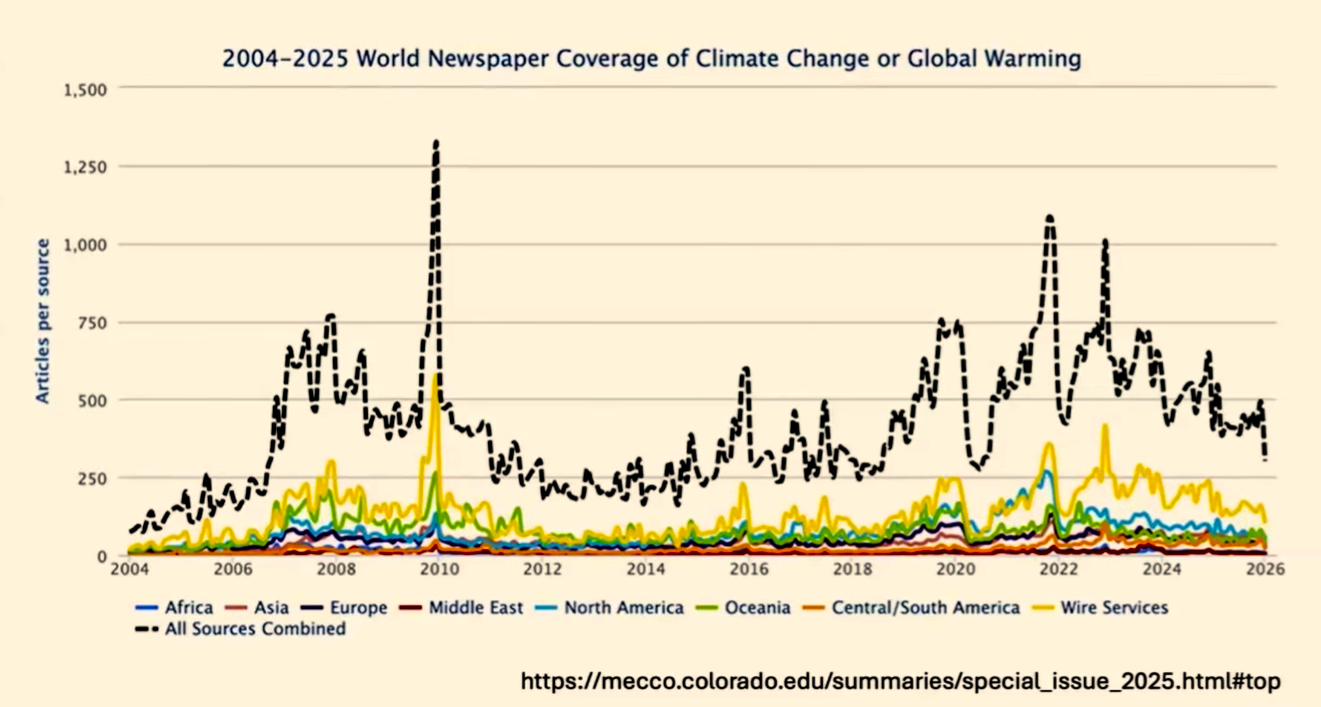

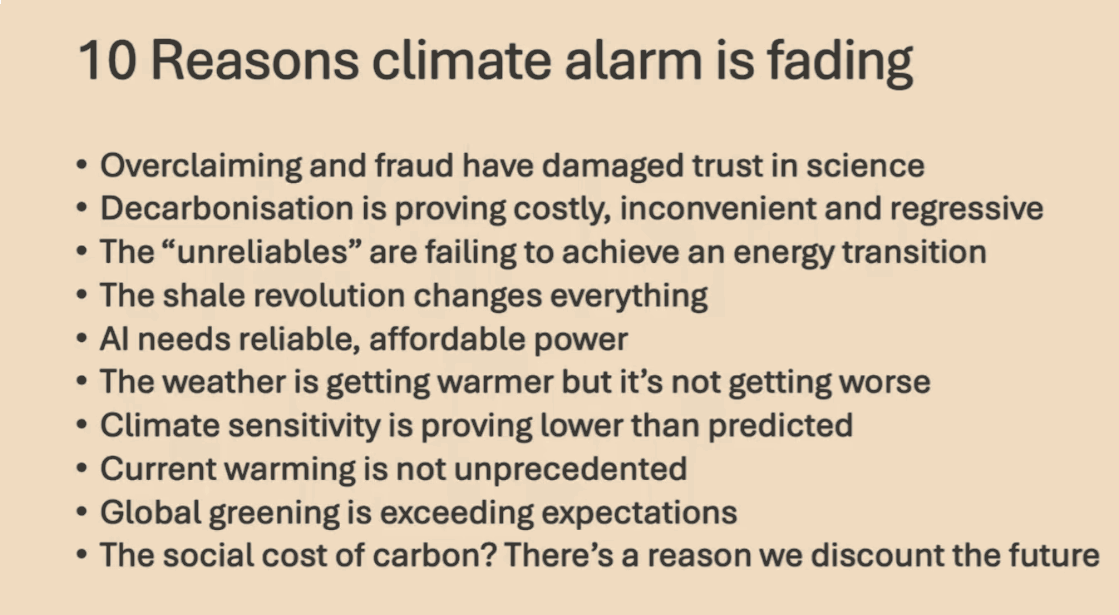
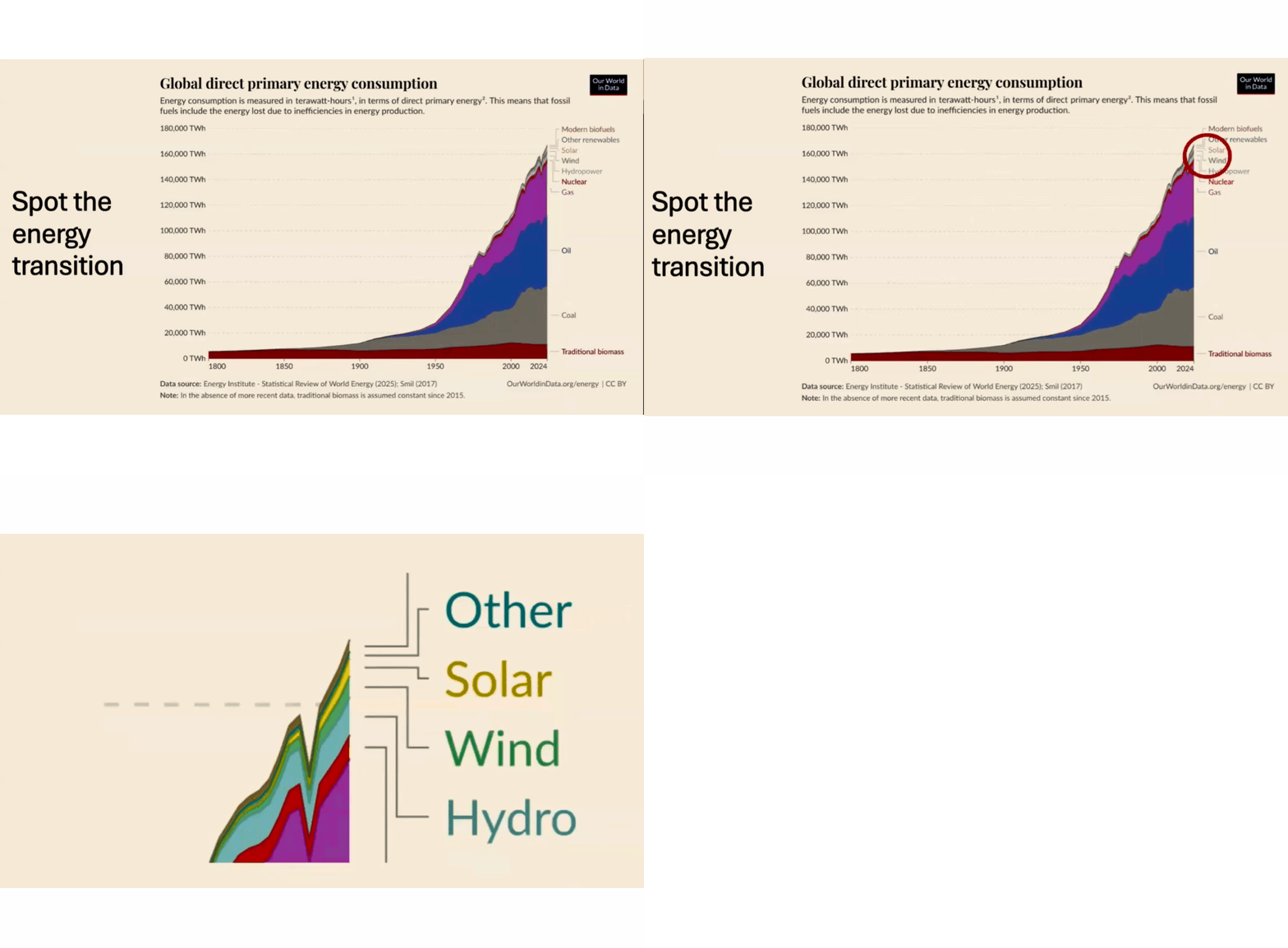
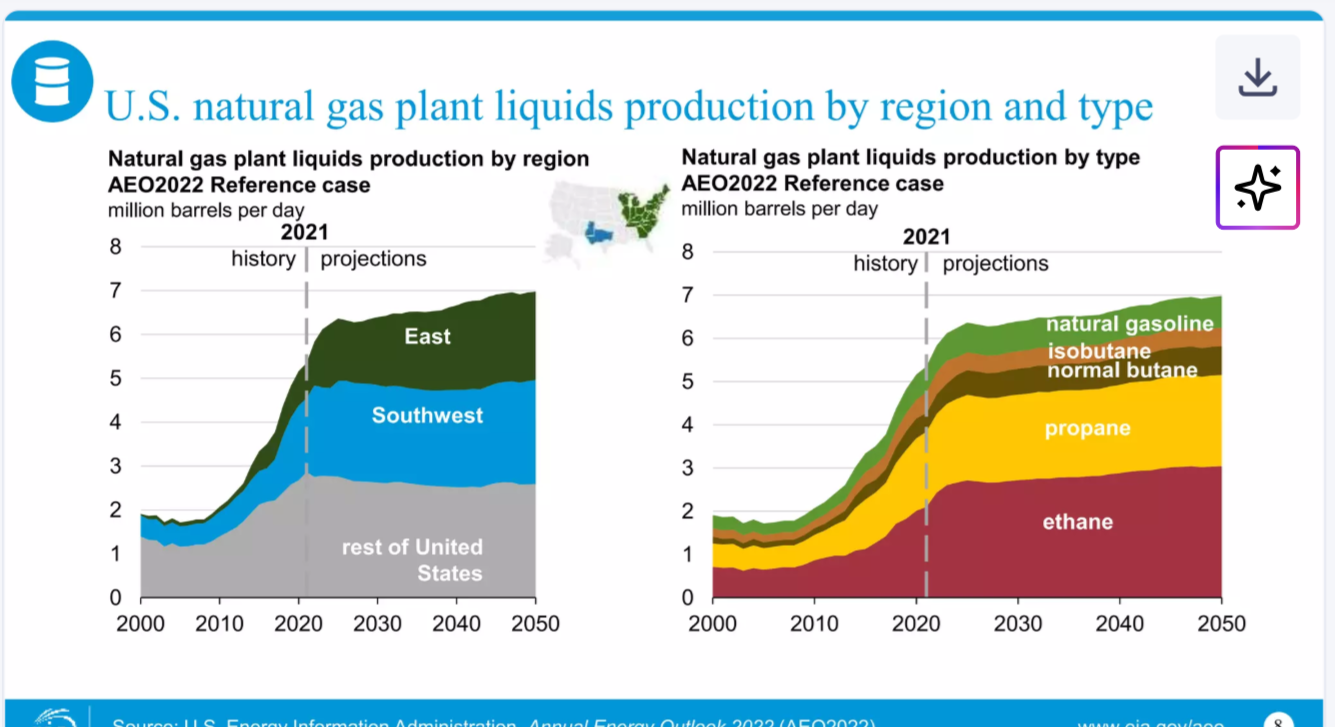


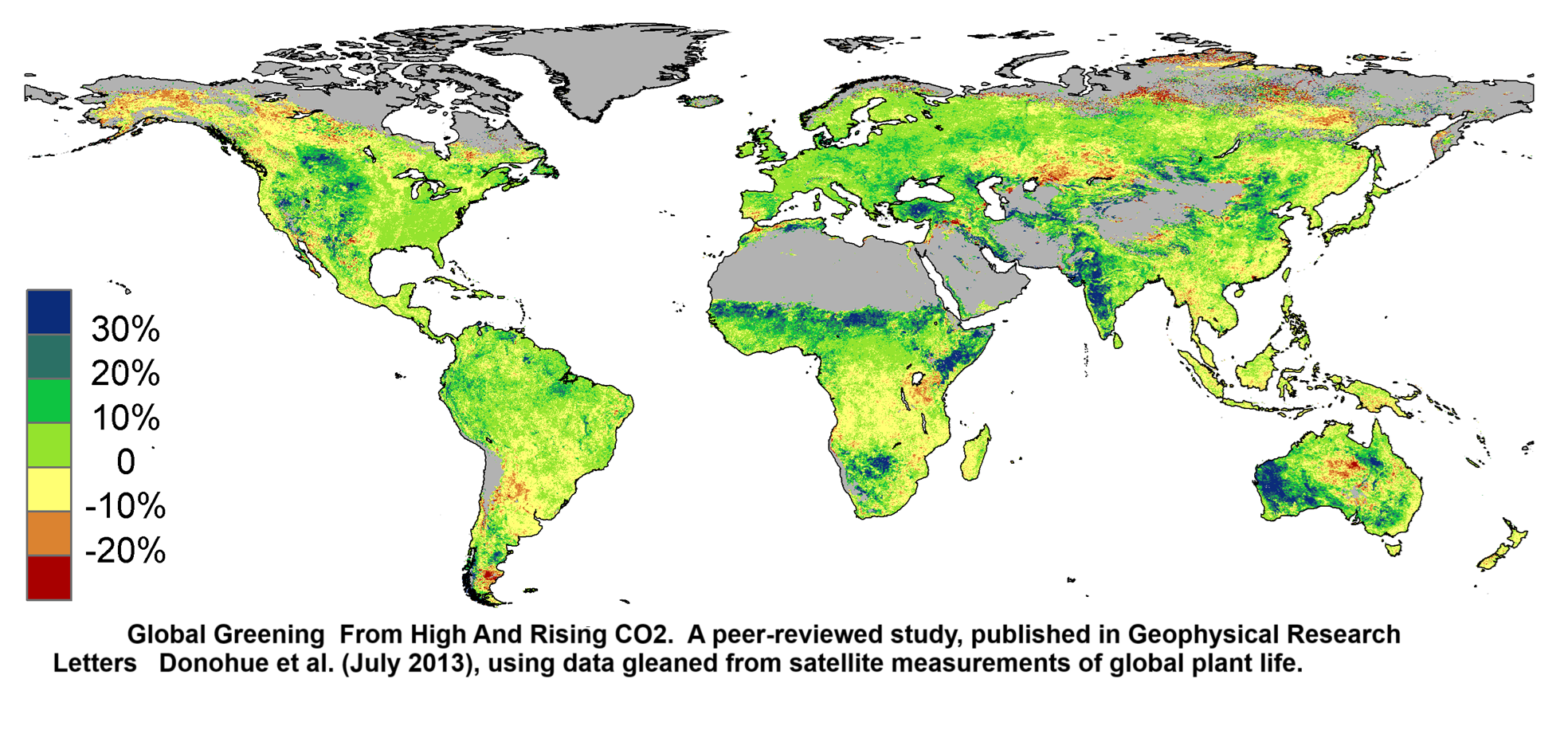


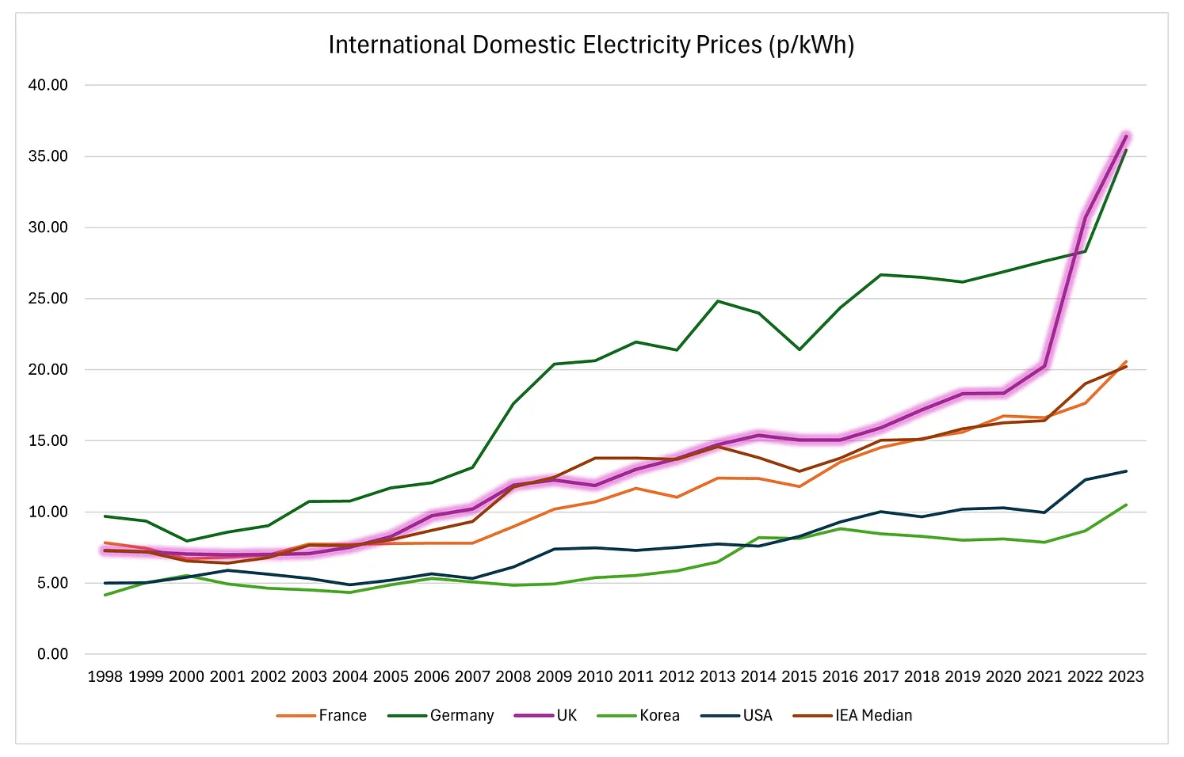

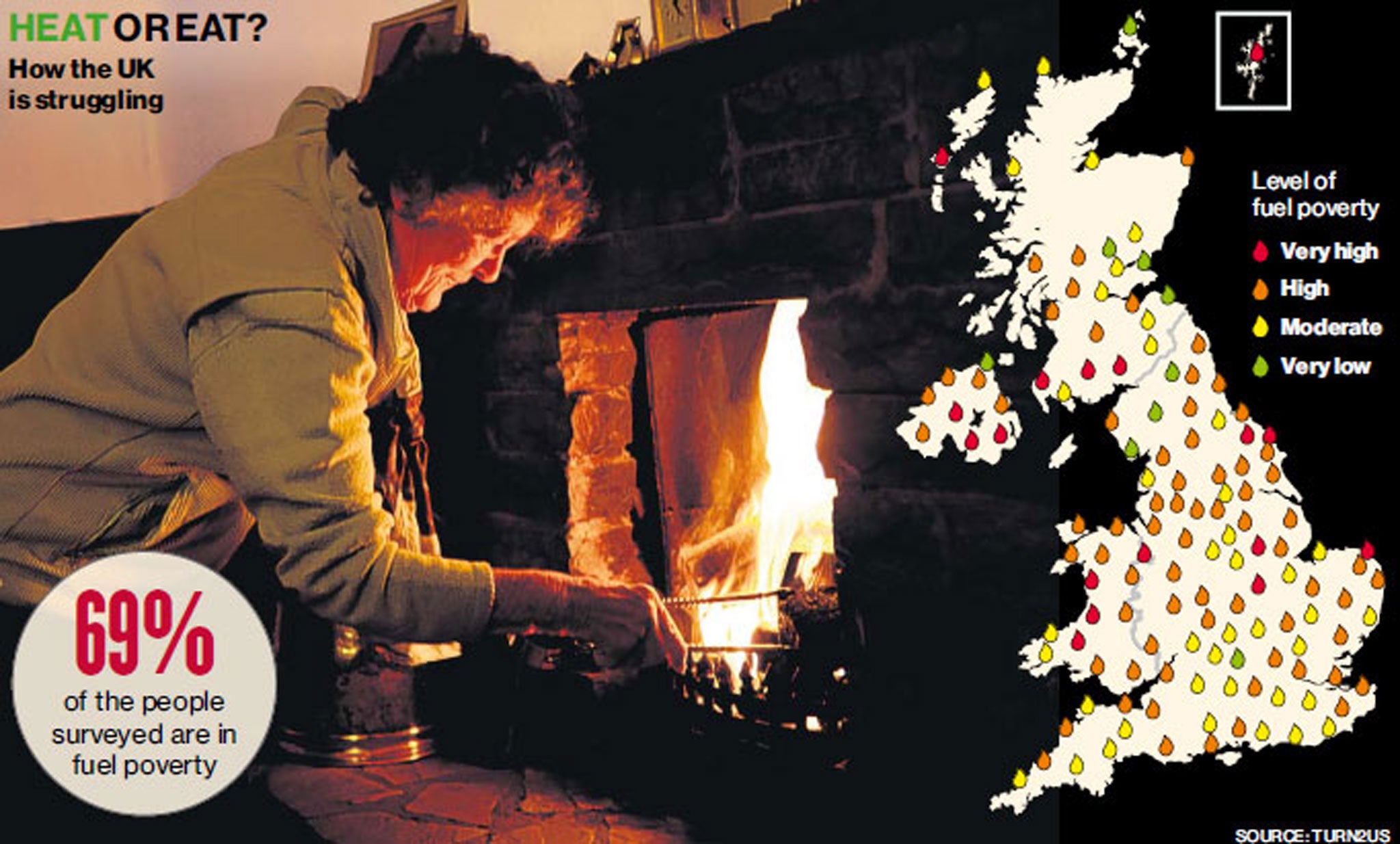
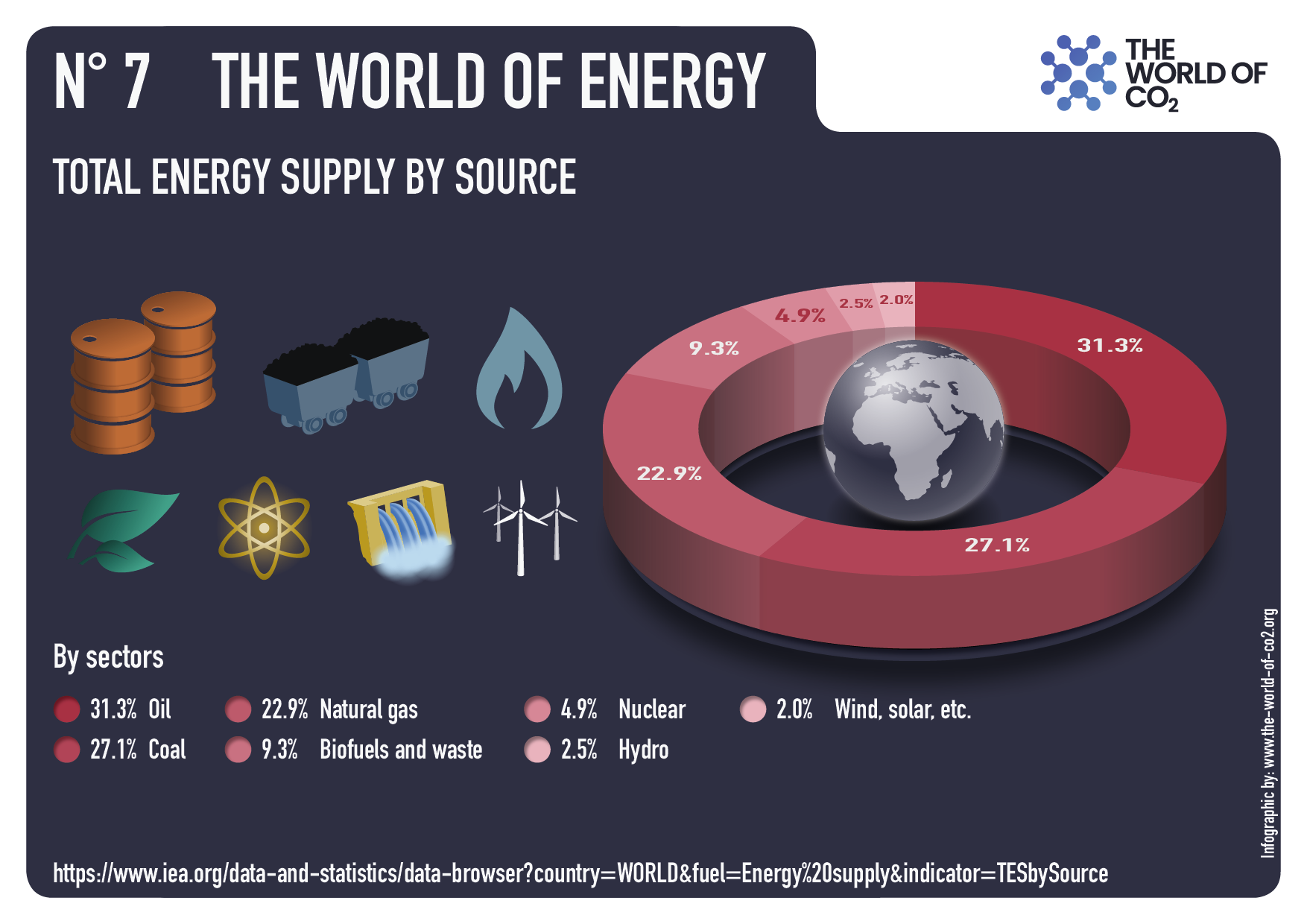
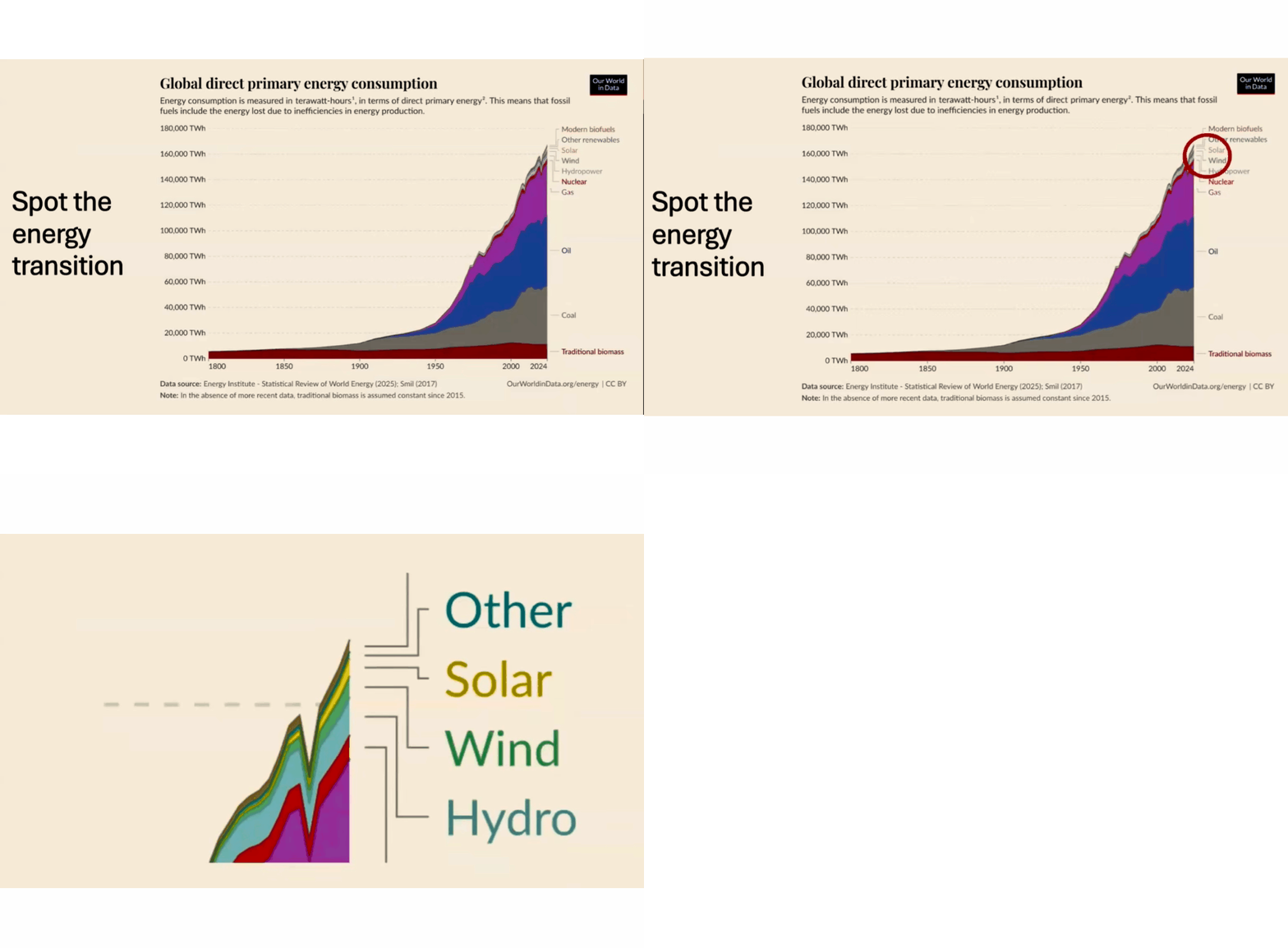

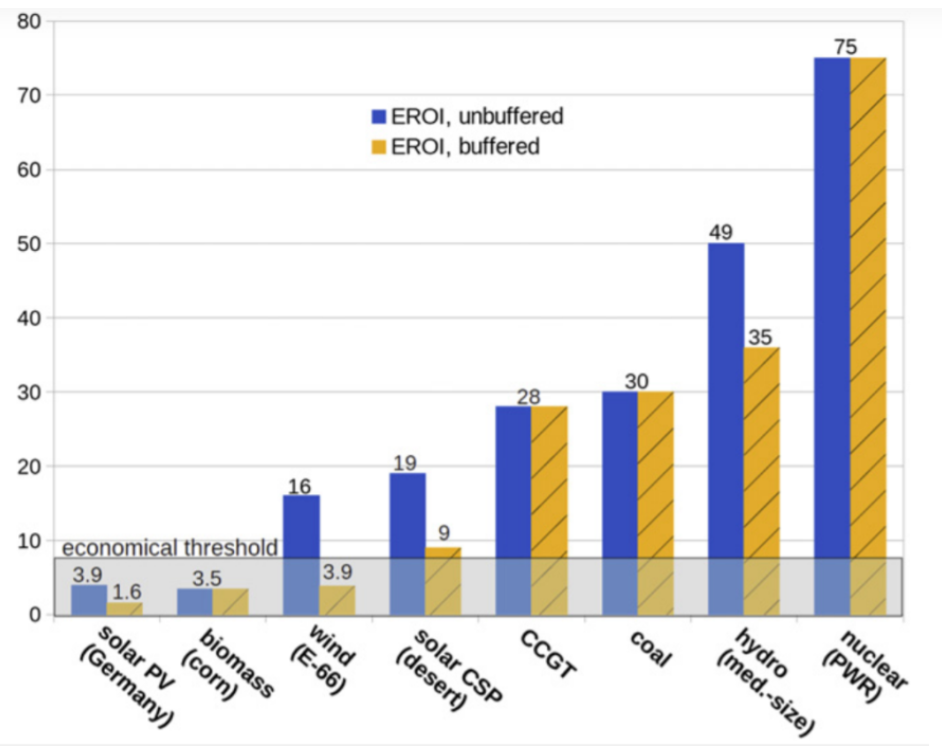
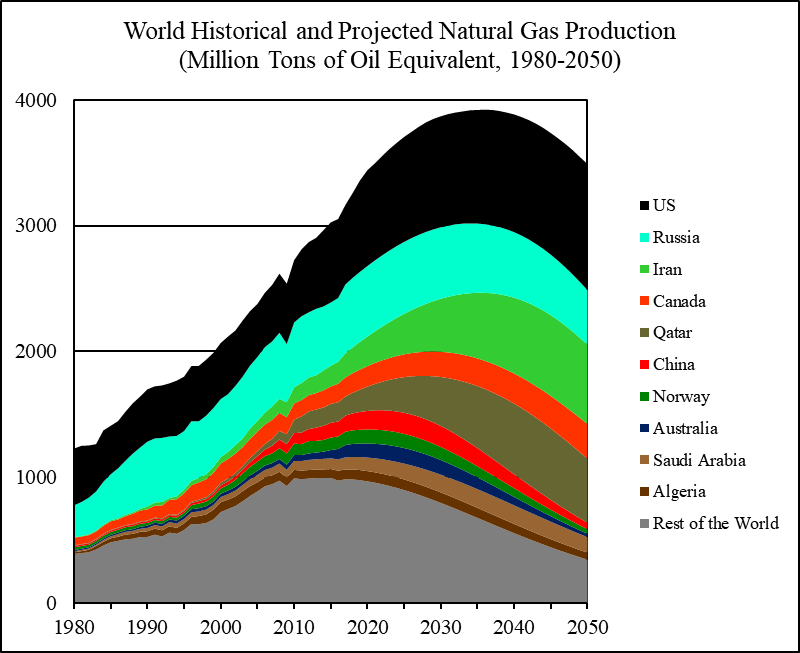

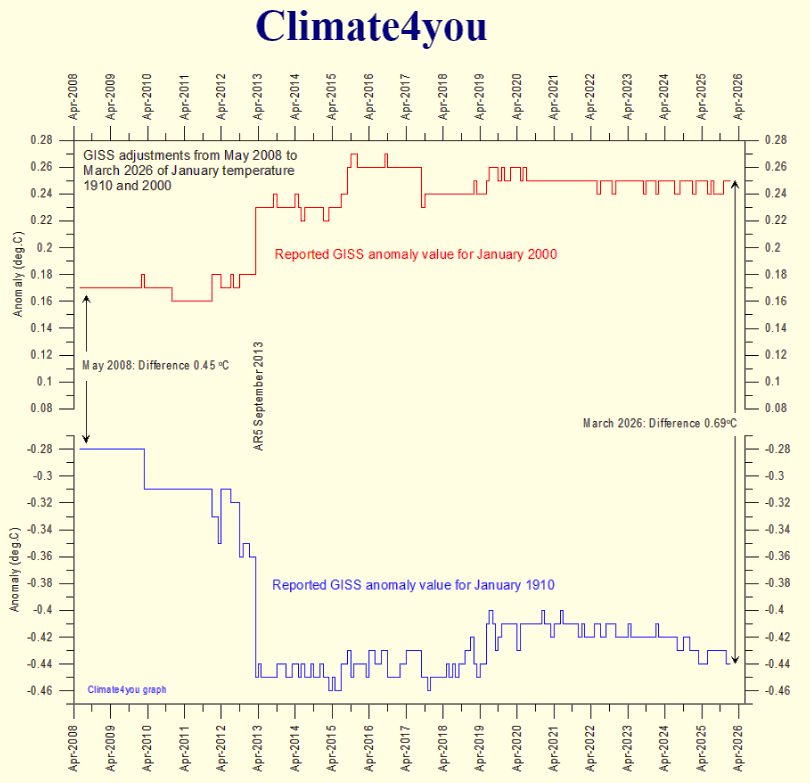
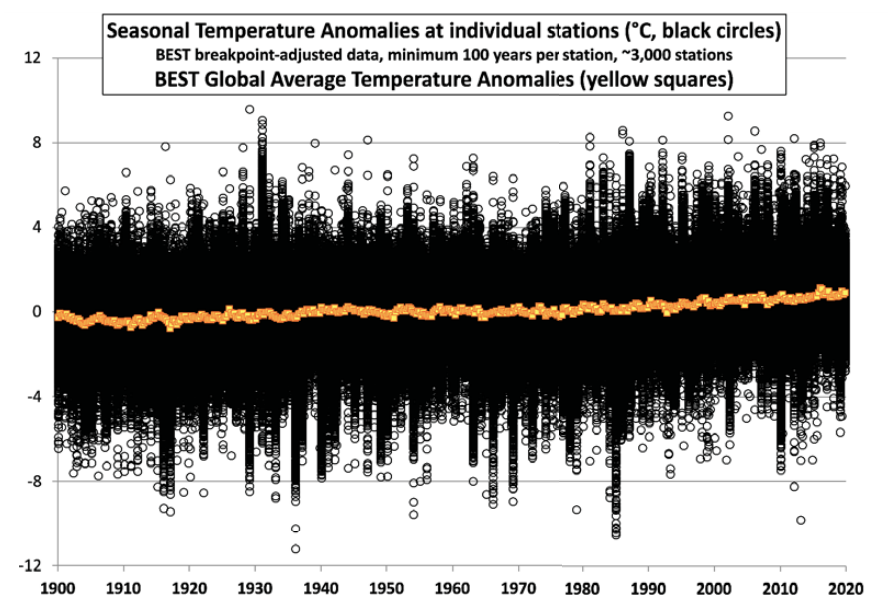
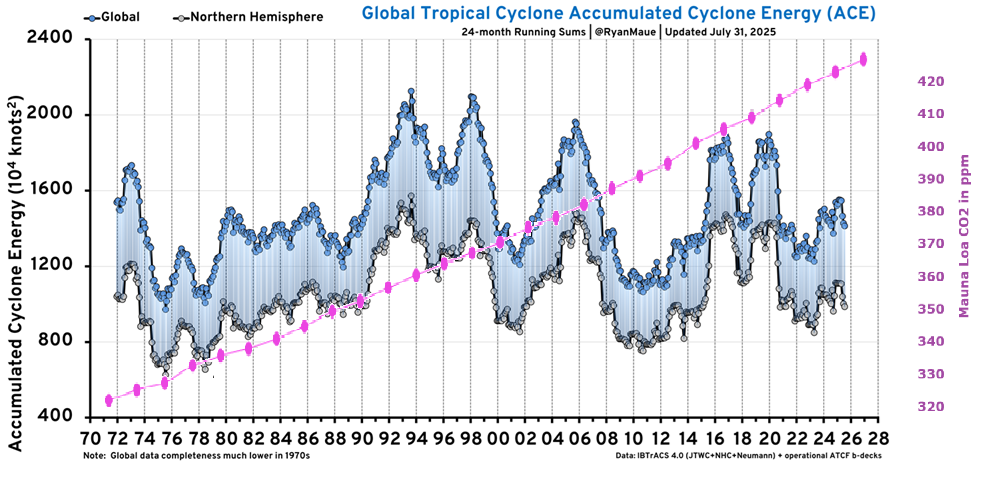
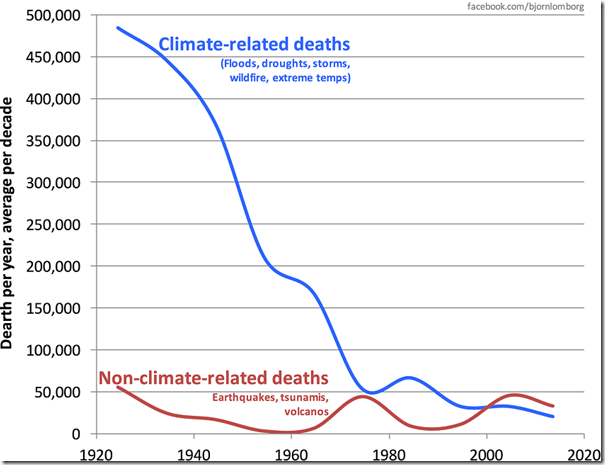

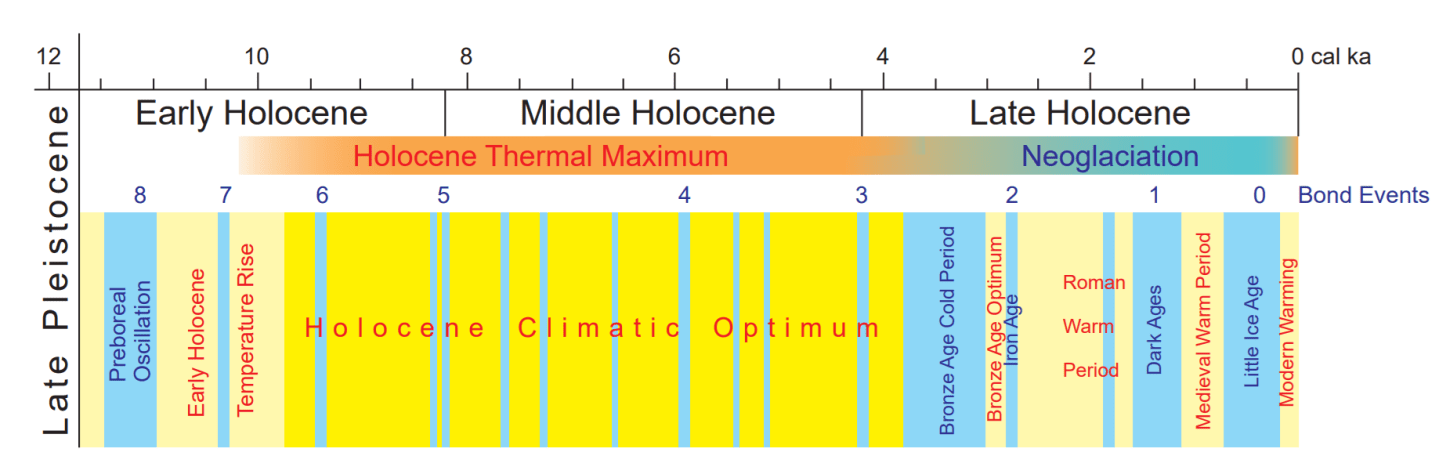
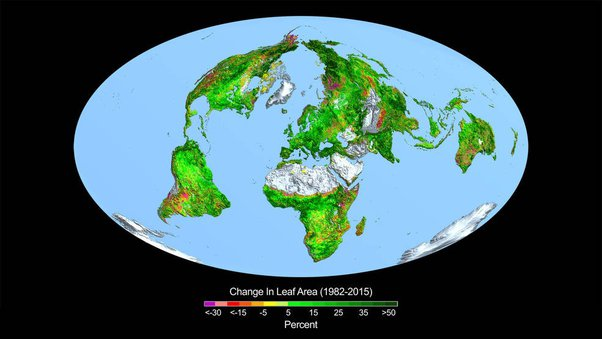
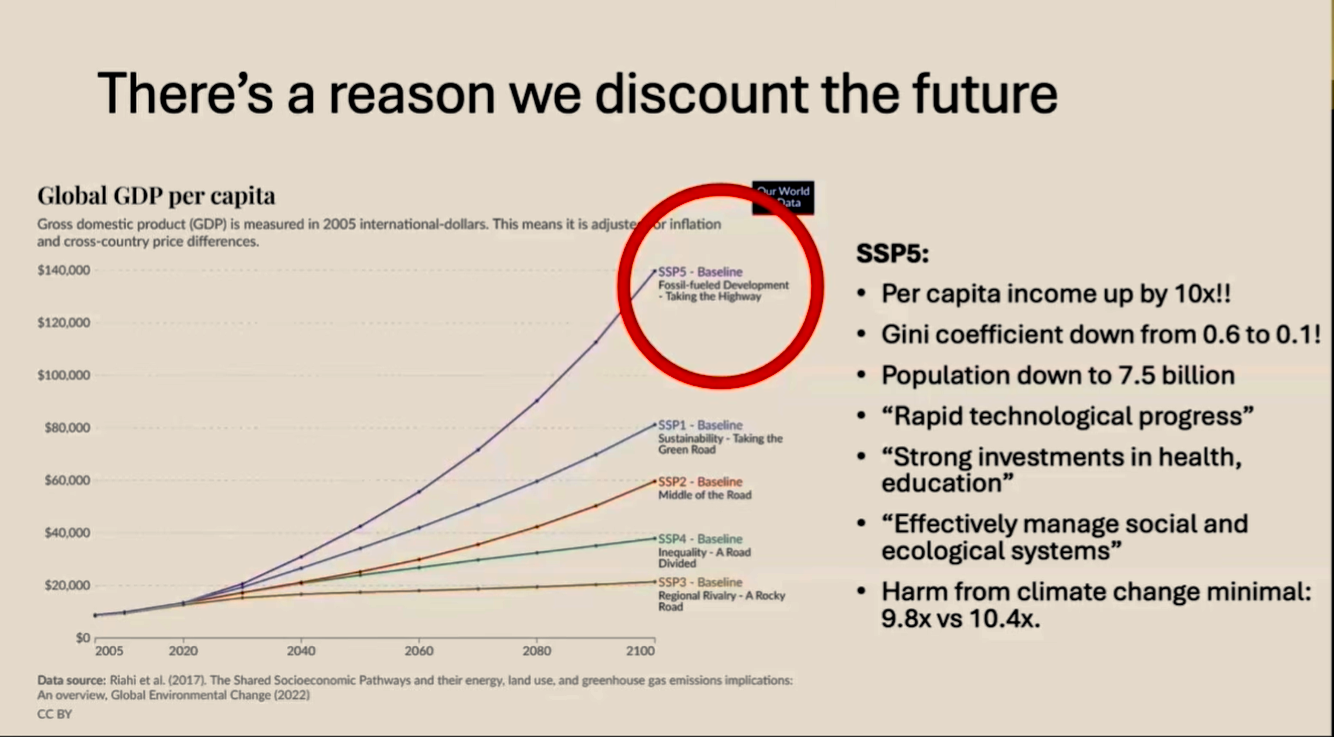



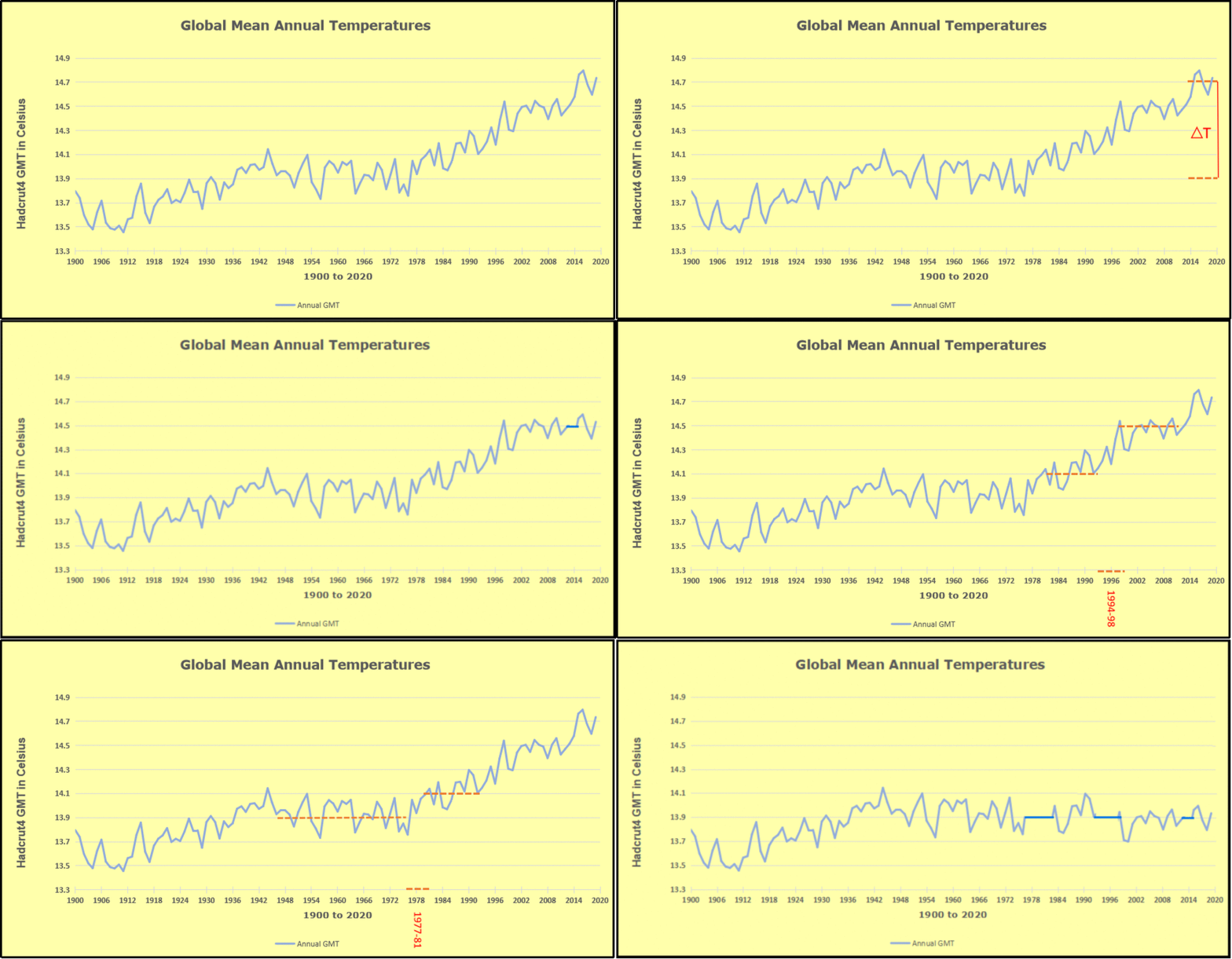
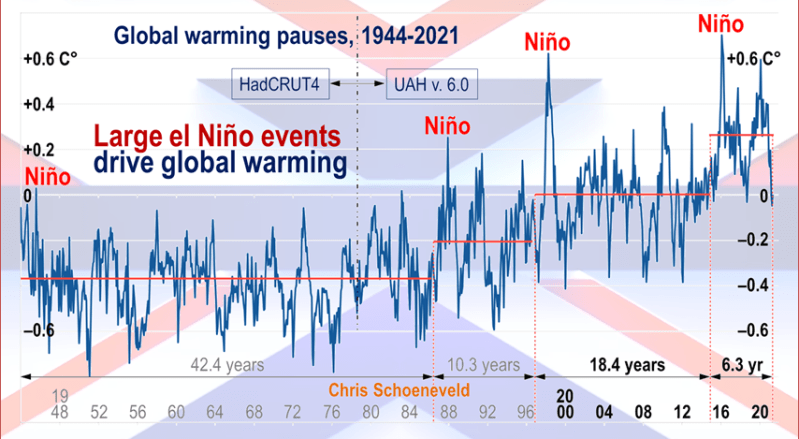


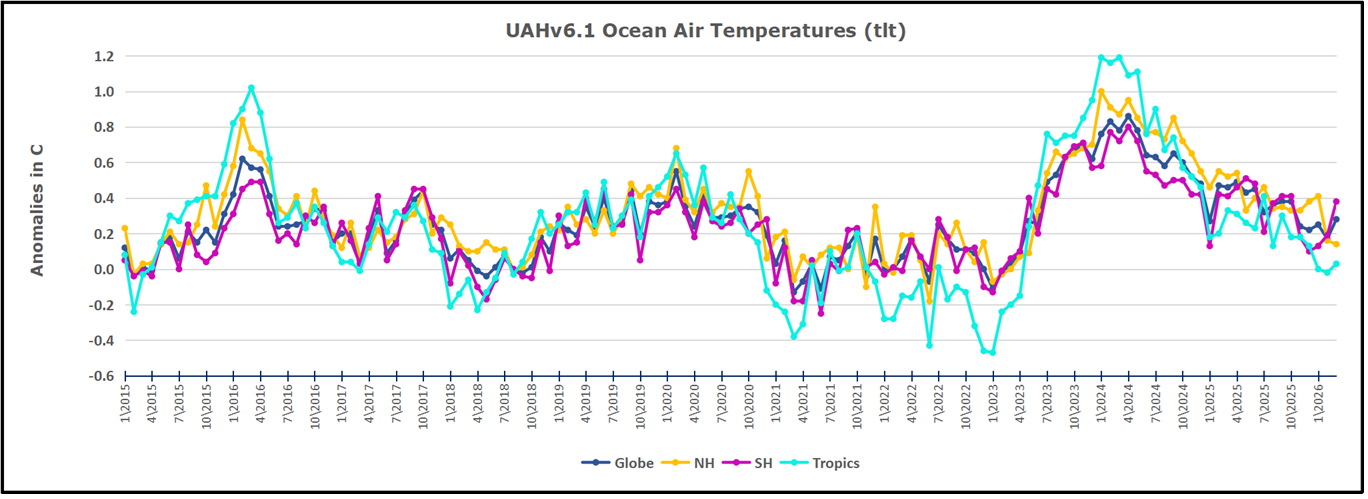
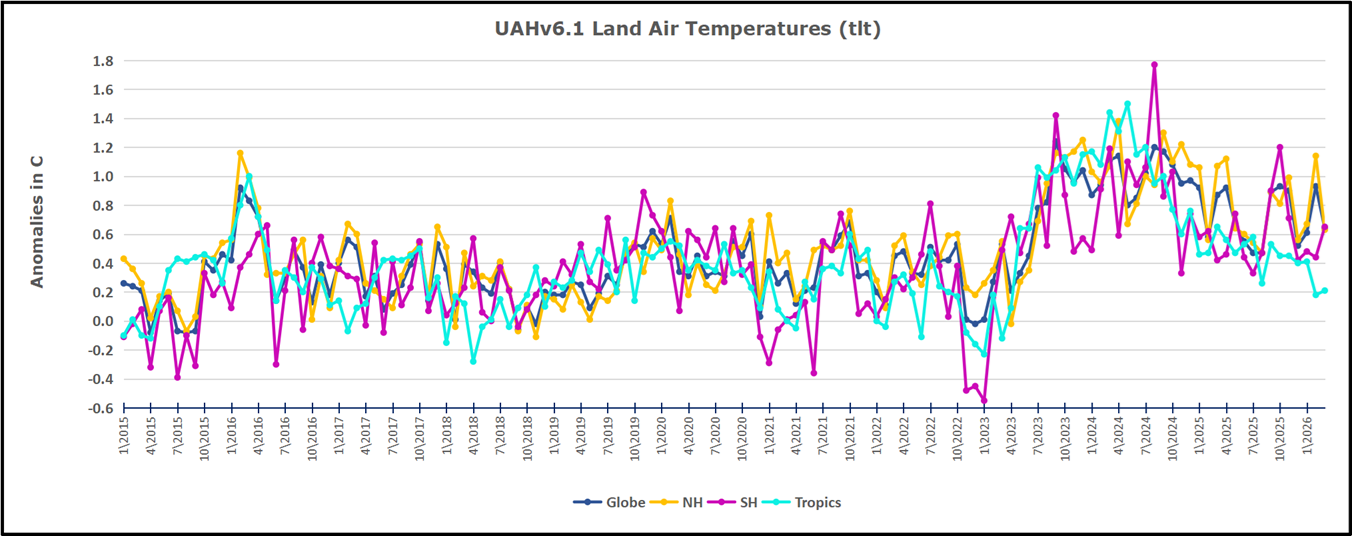
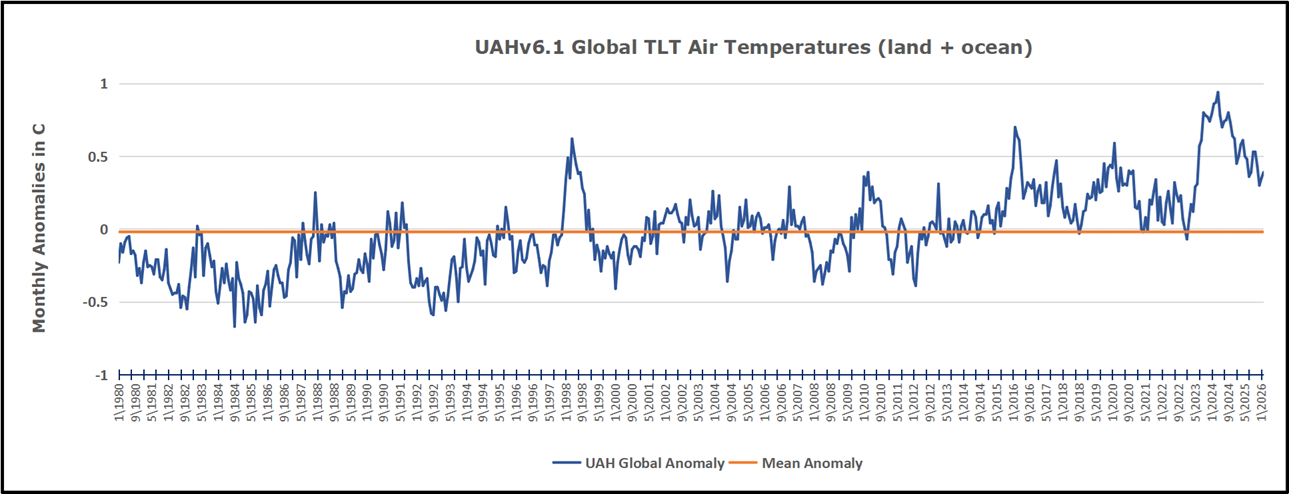
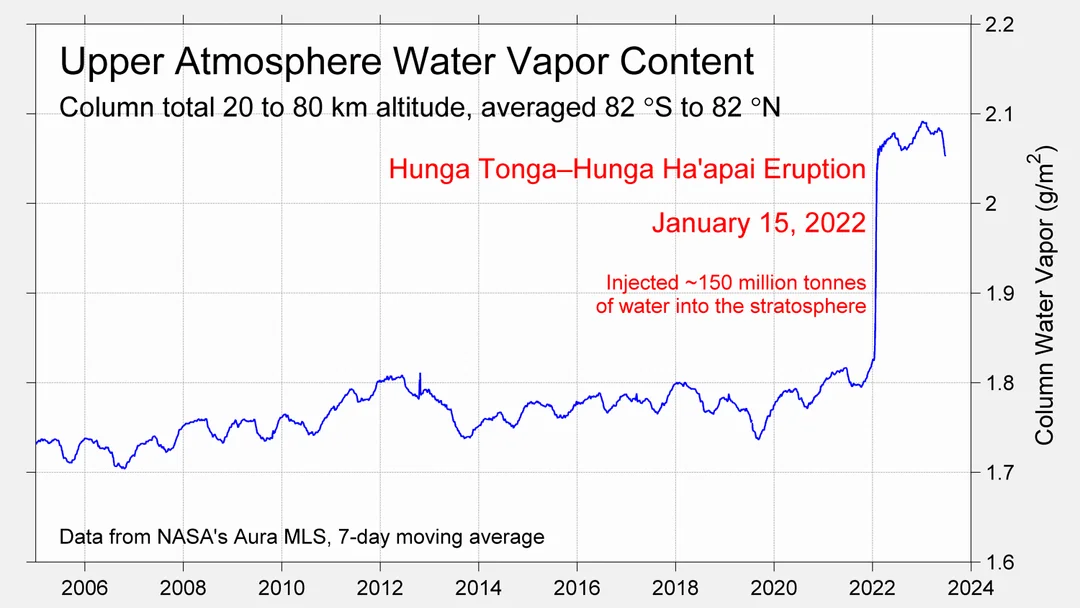

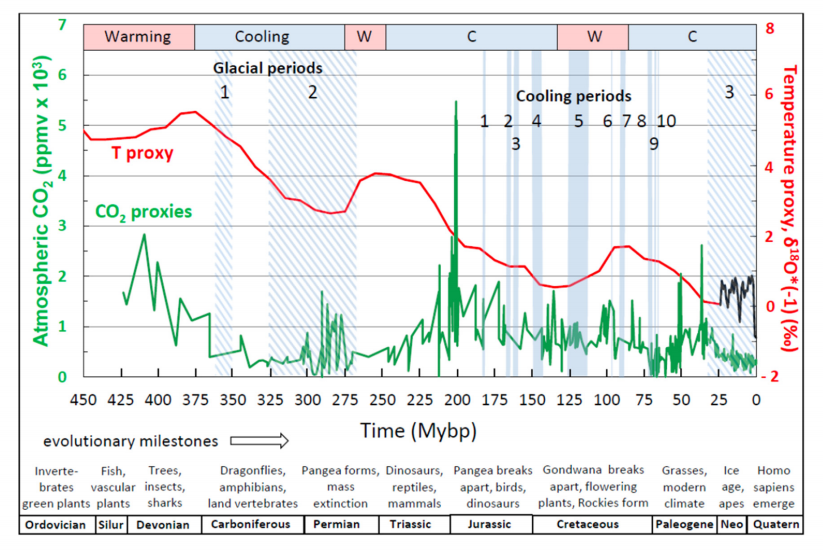
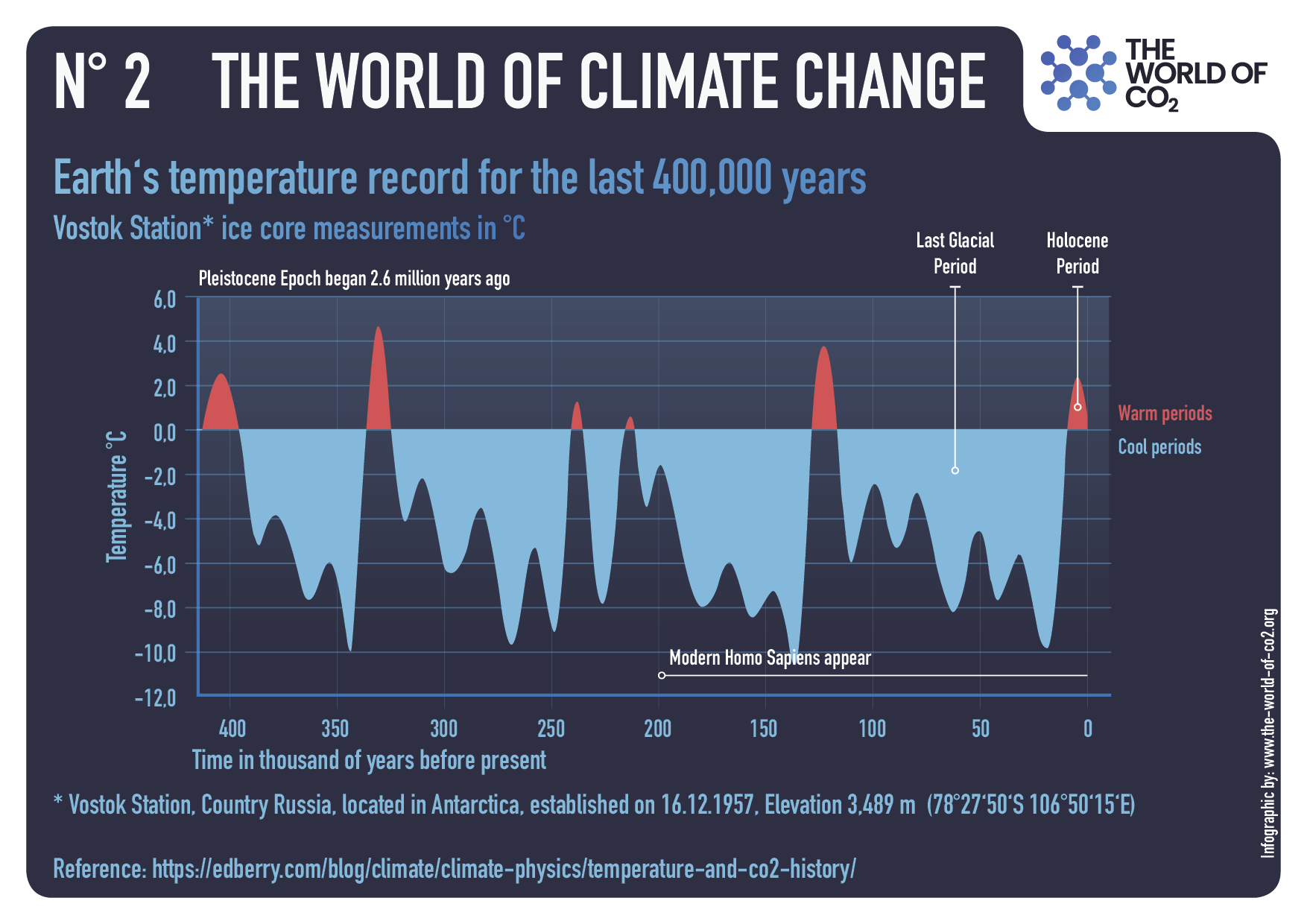
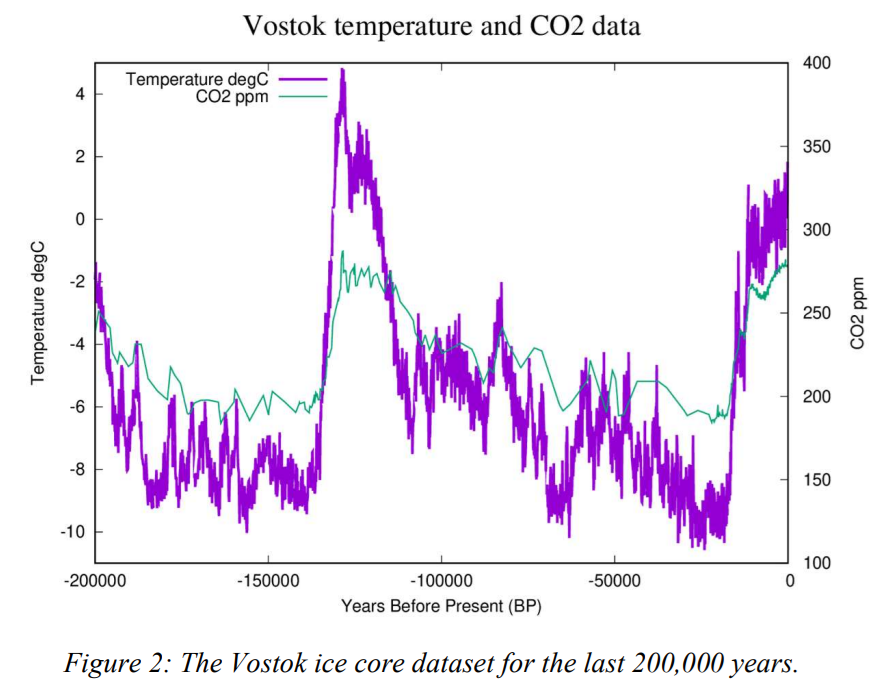
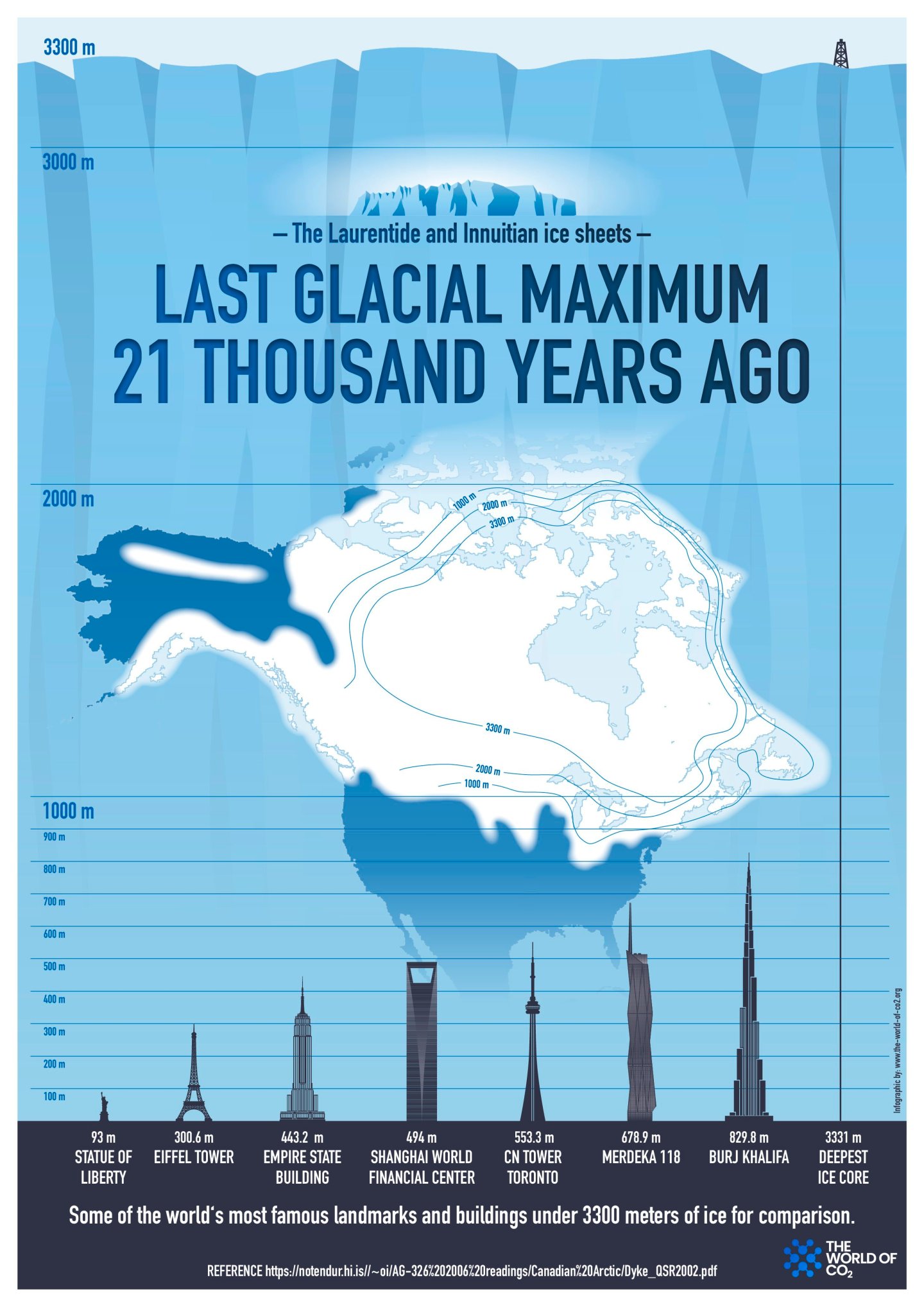

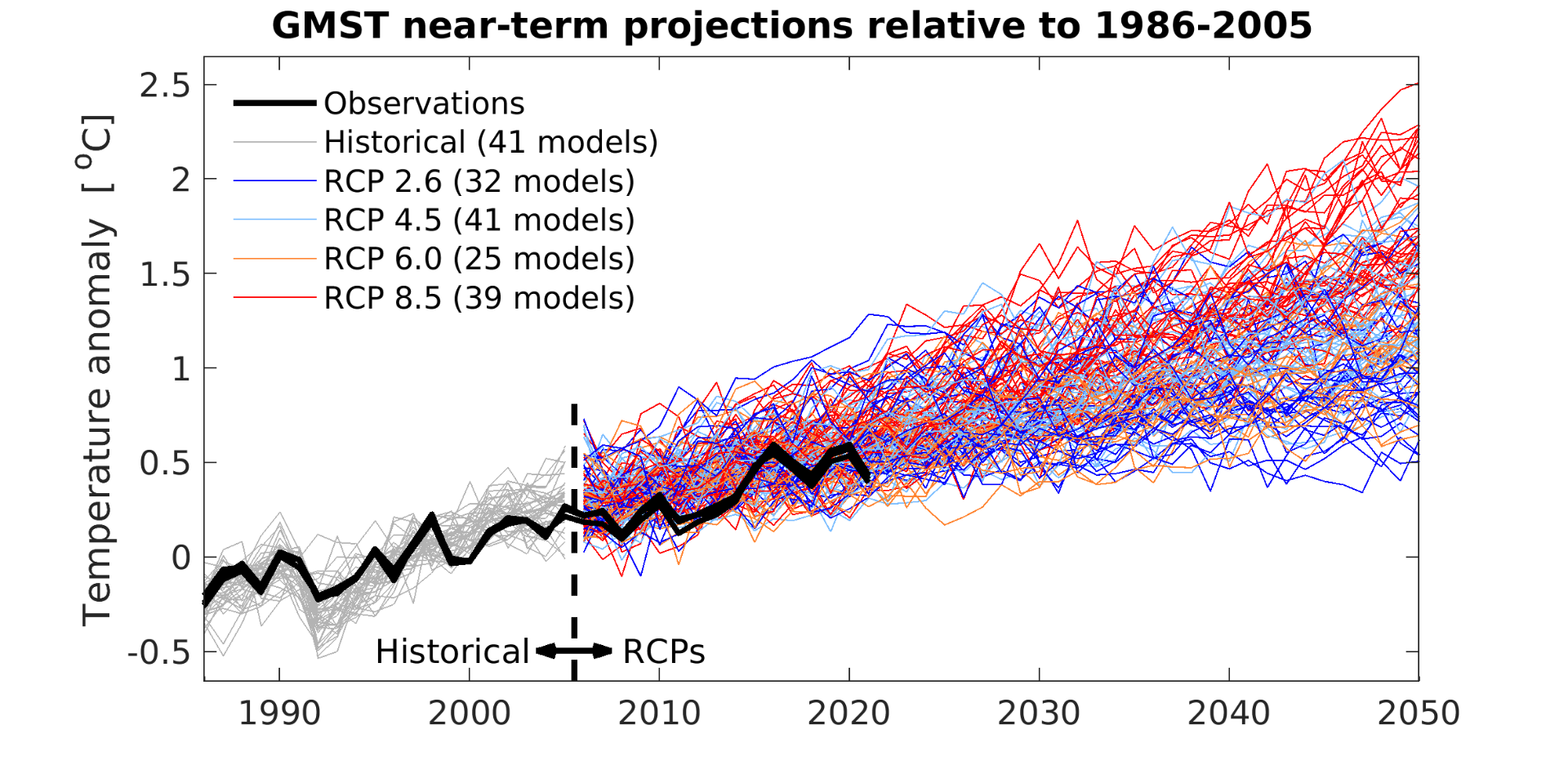
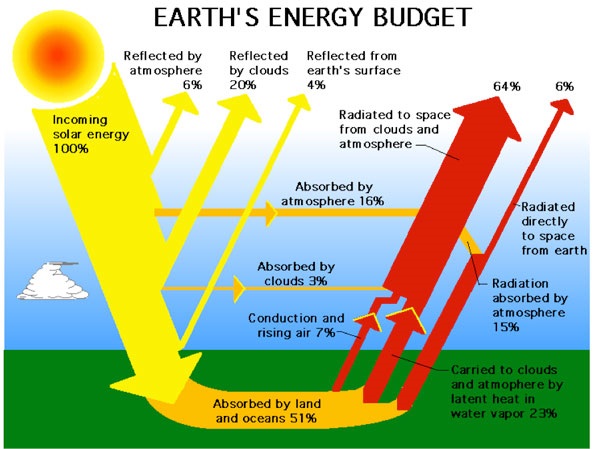
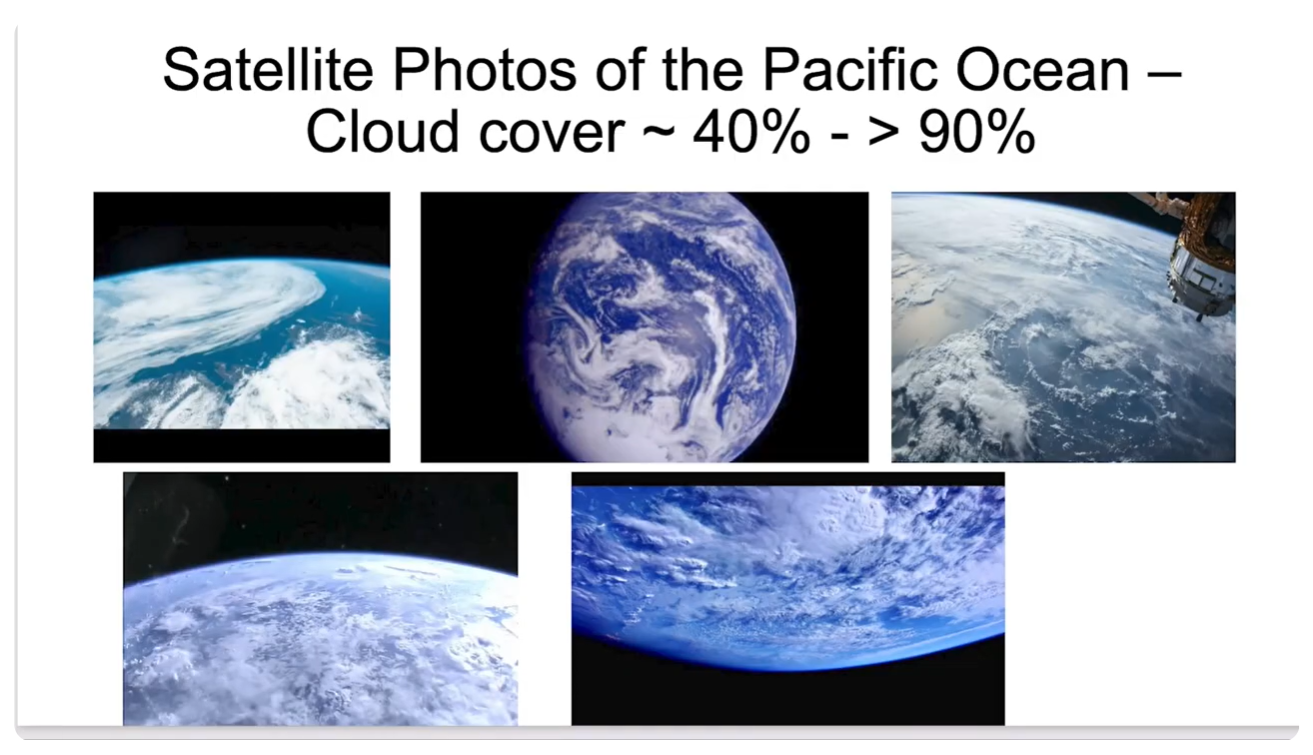

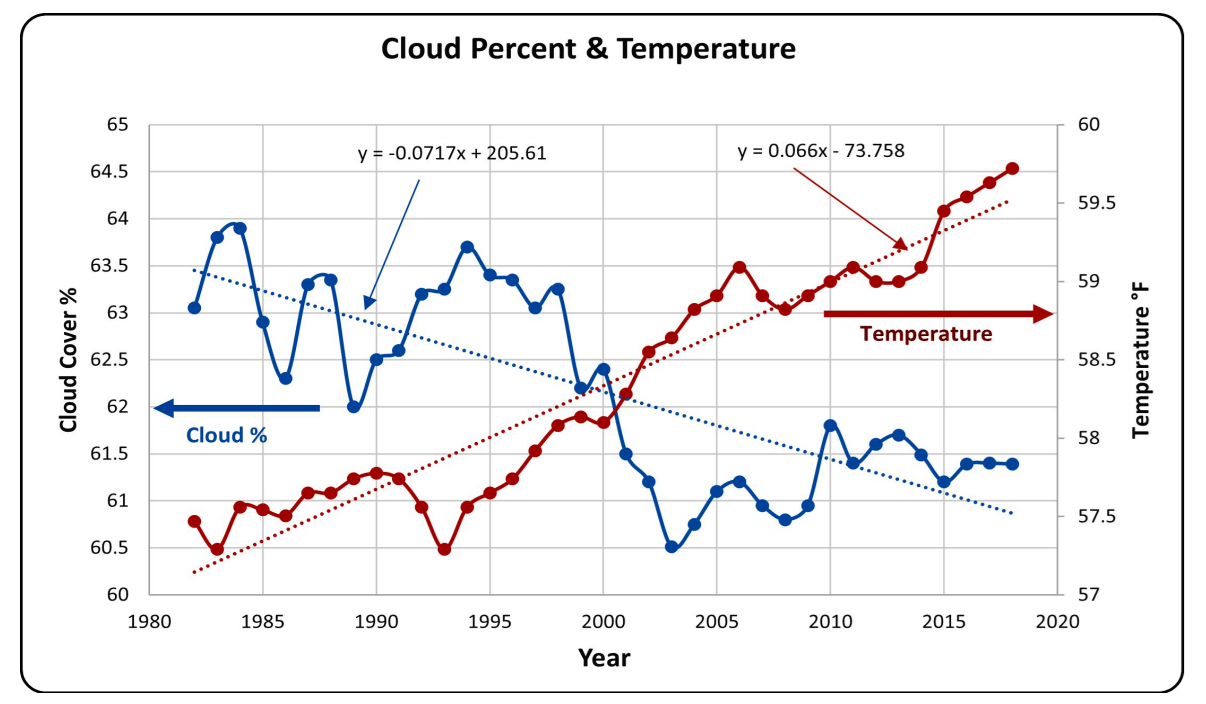
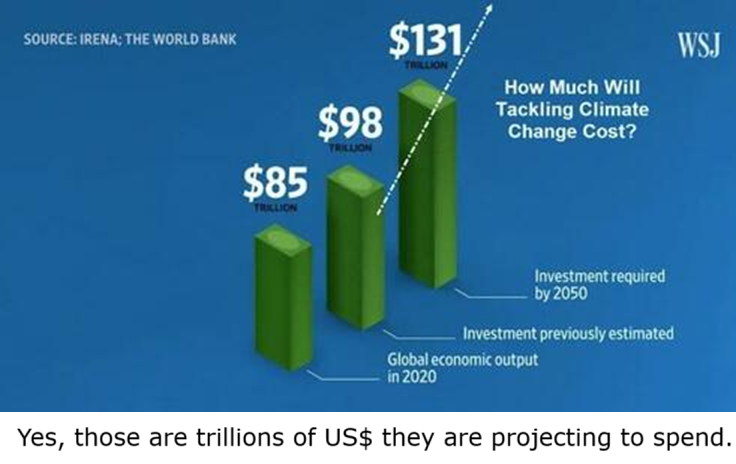

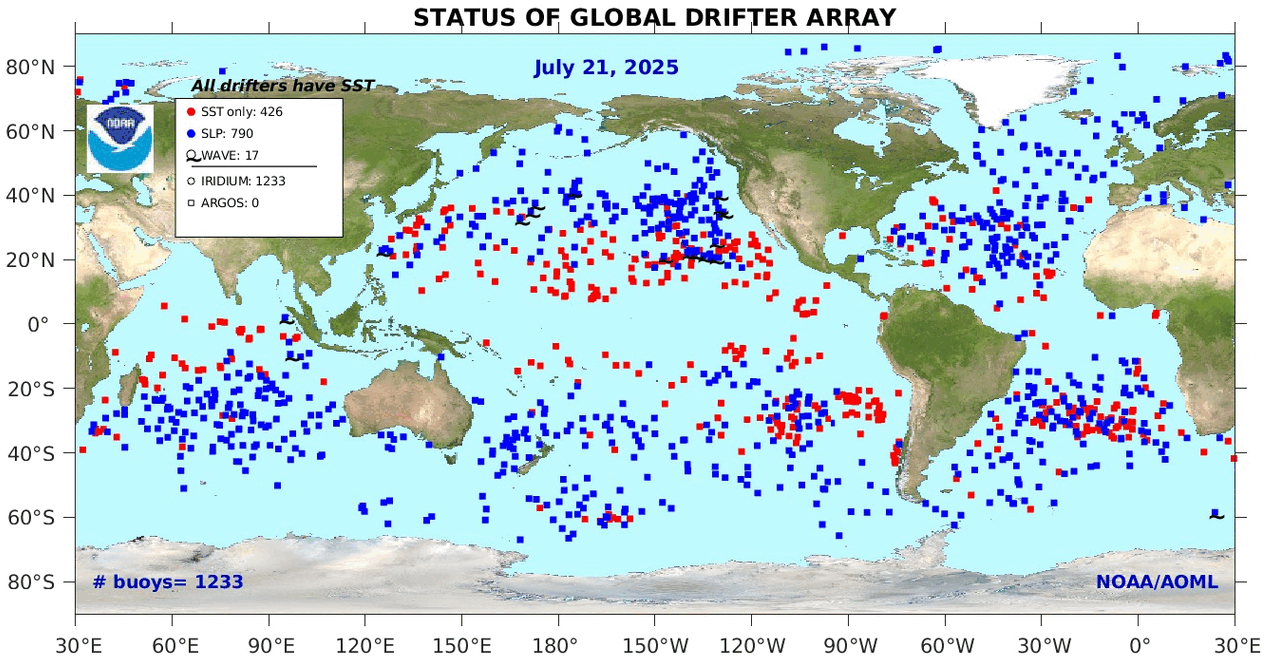 The best context for understanding decadal temperature changes comes from the world’s sea surface temperatures (SST), for several reasons: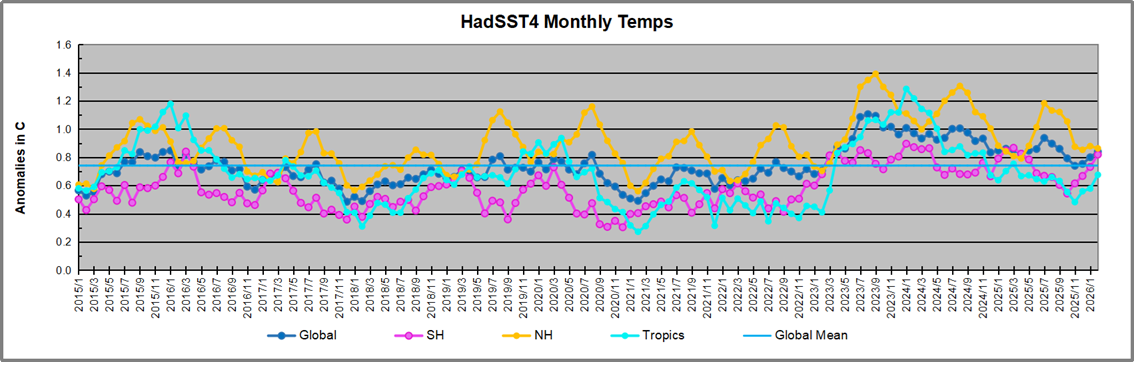
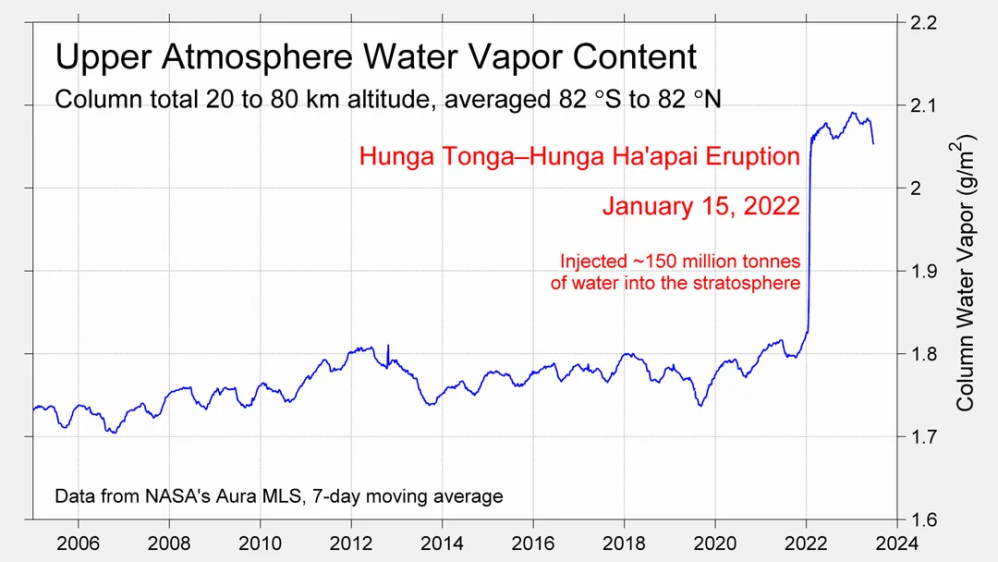
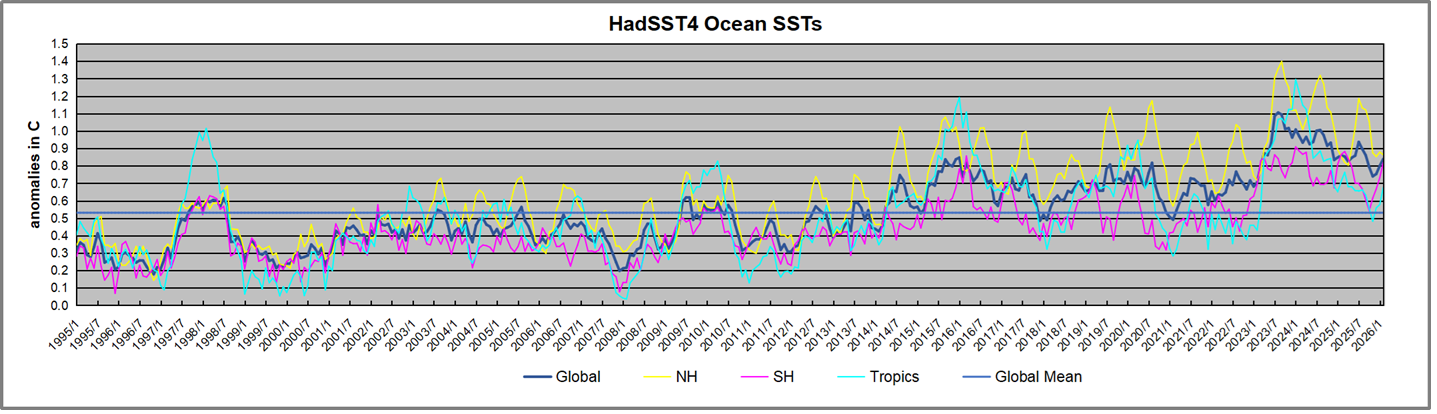
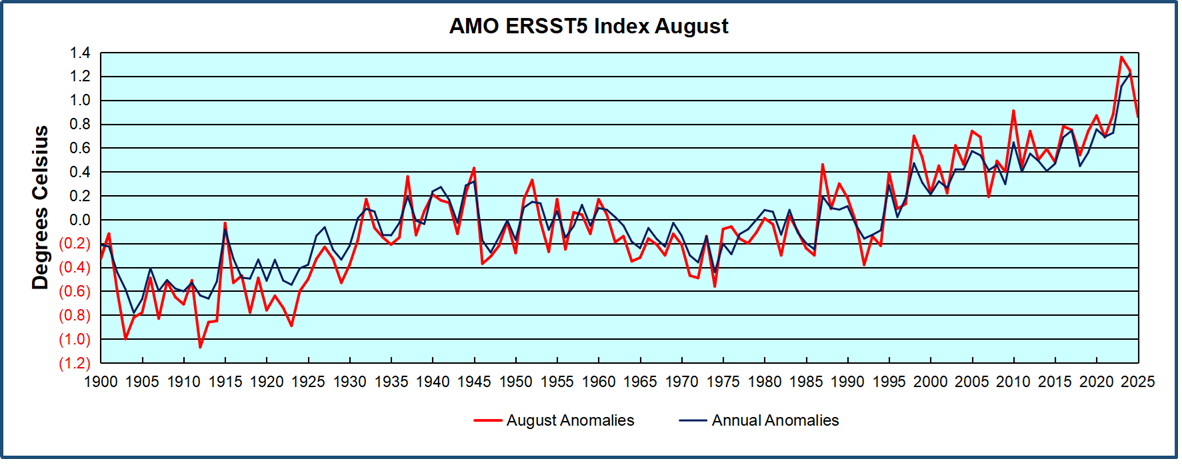
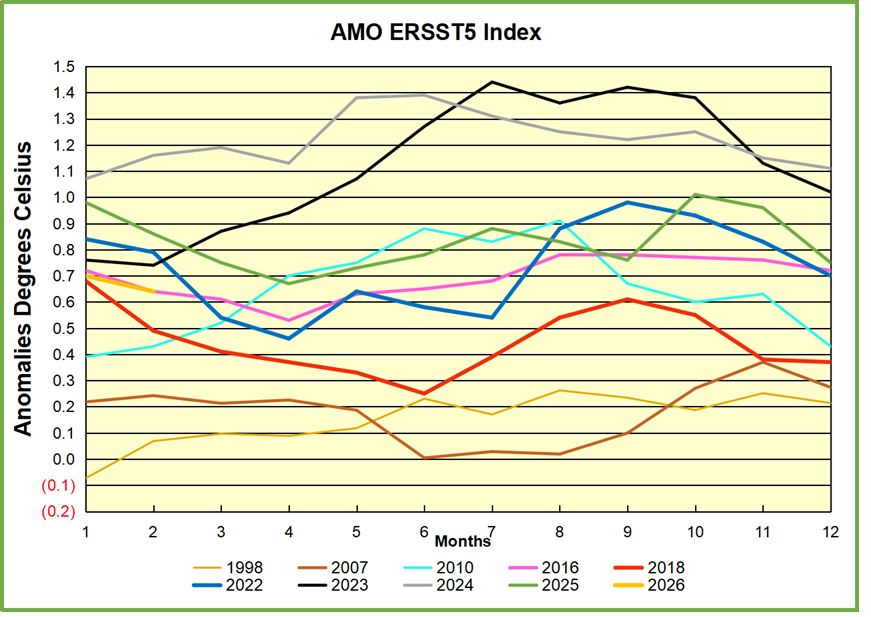
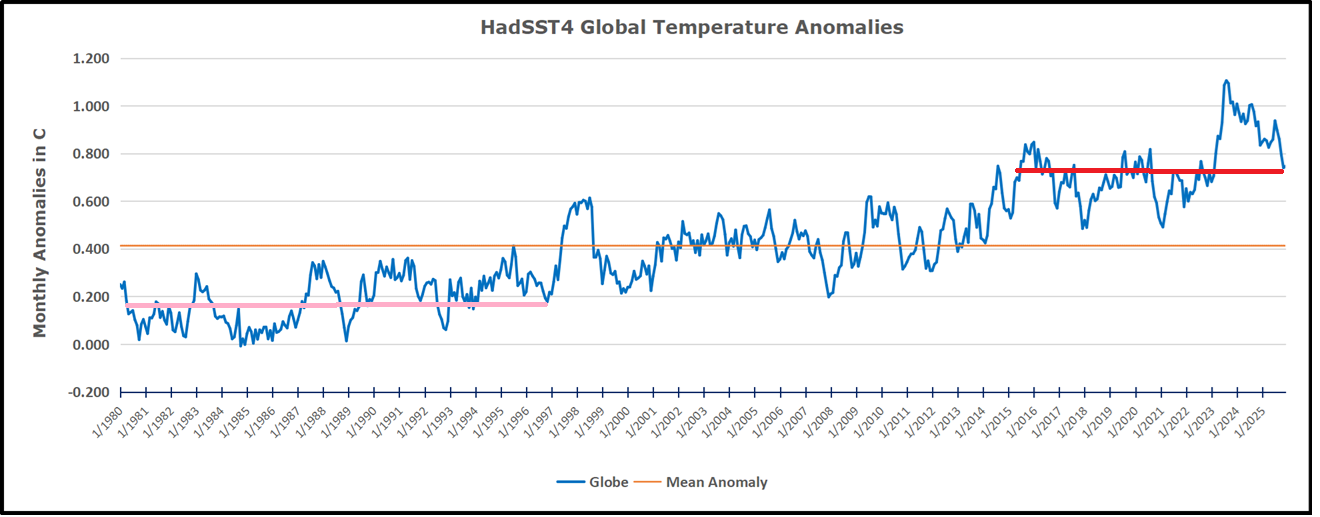
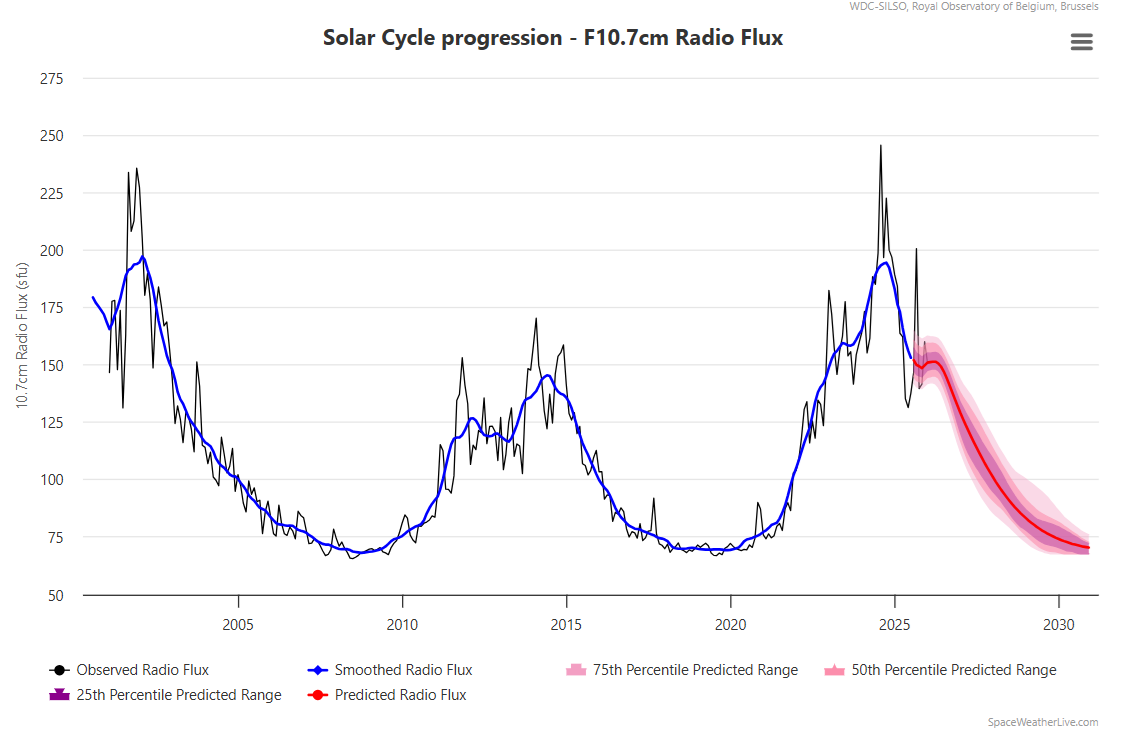


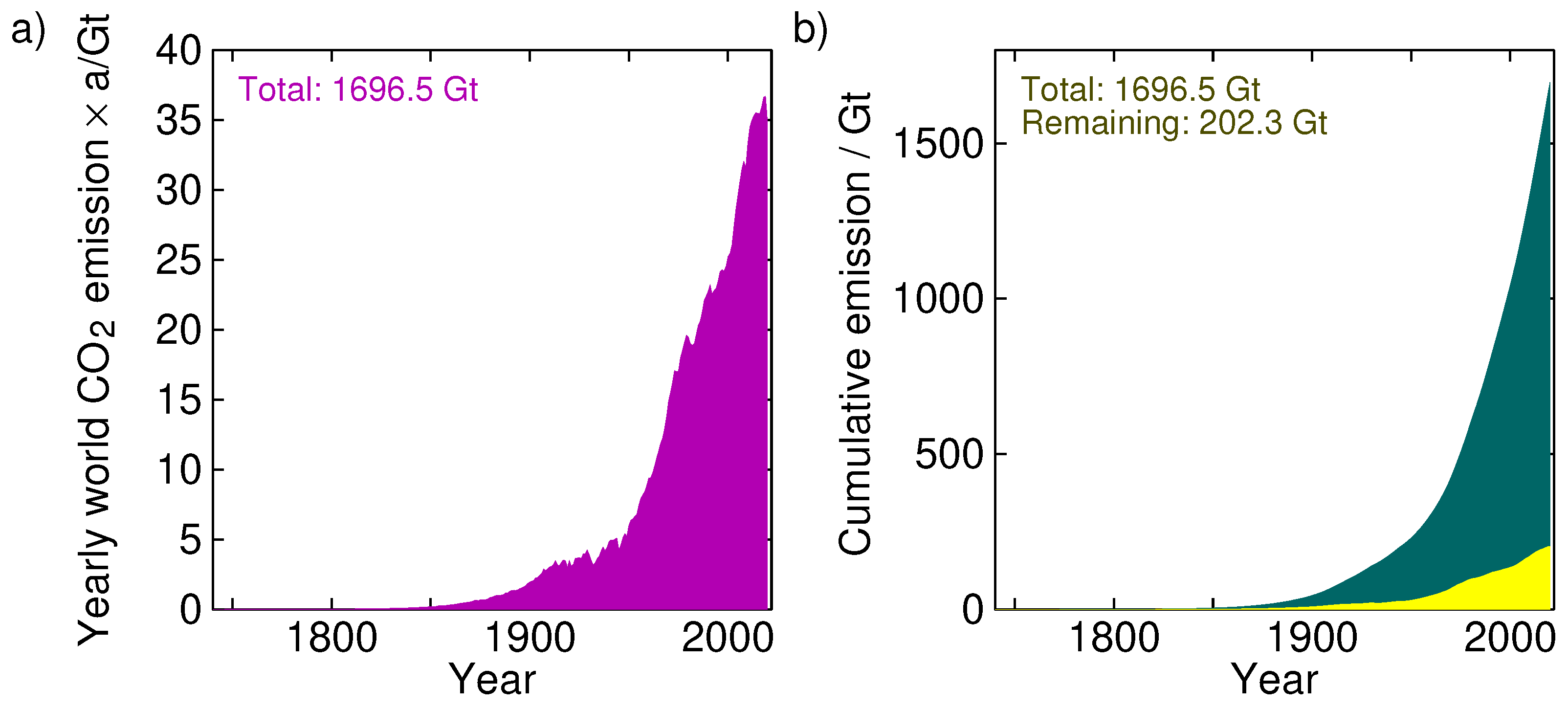

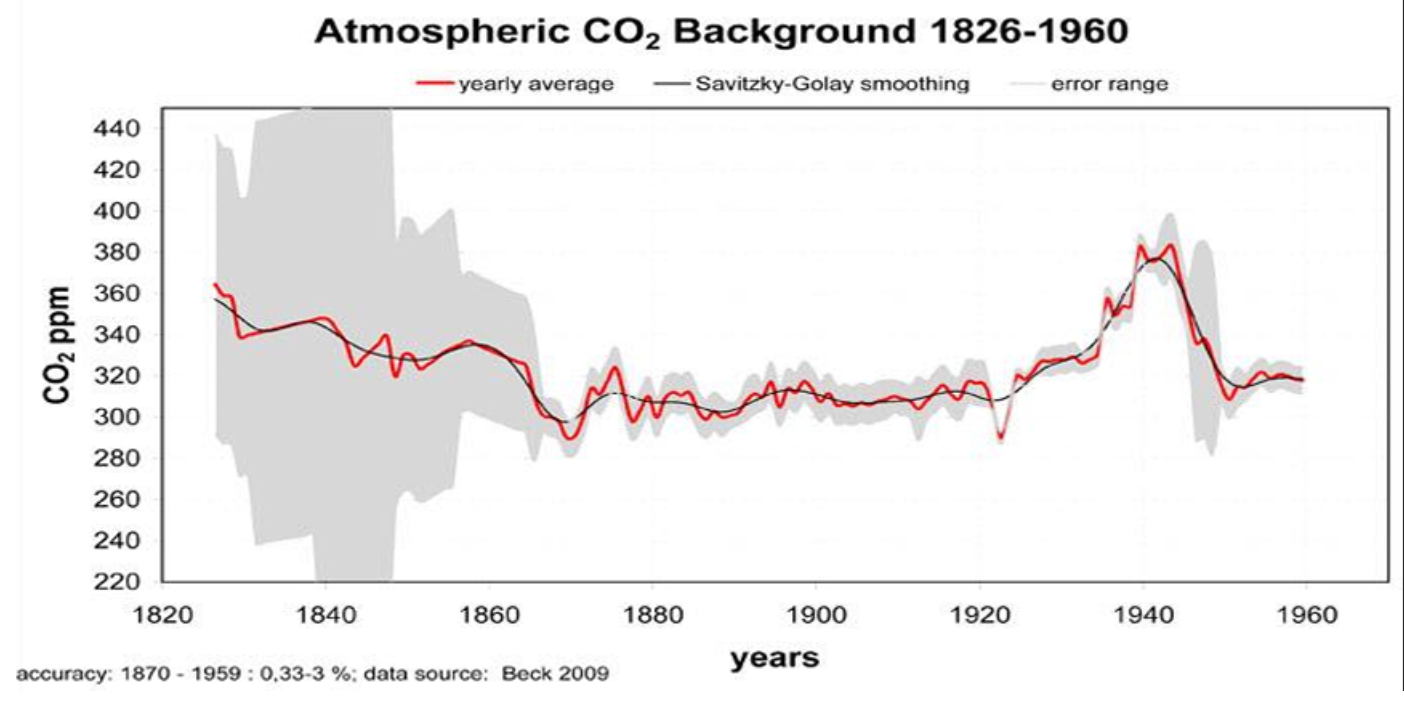

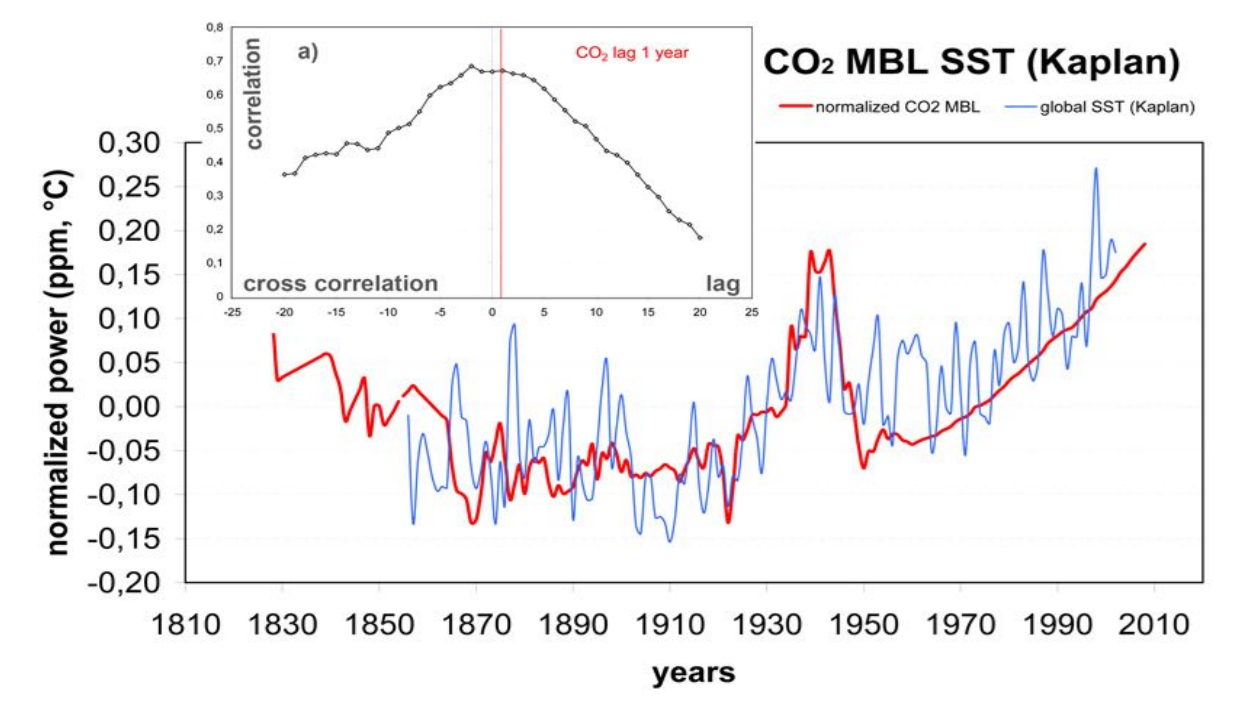
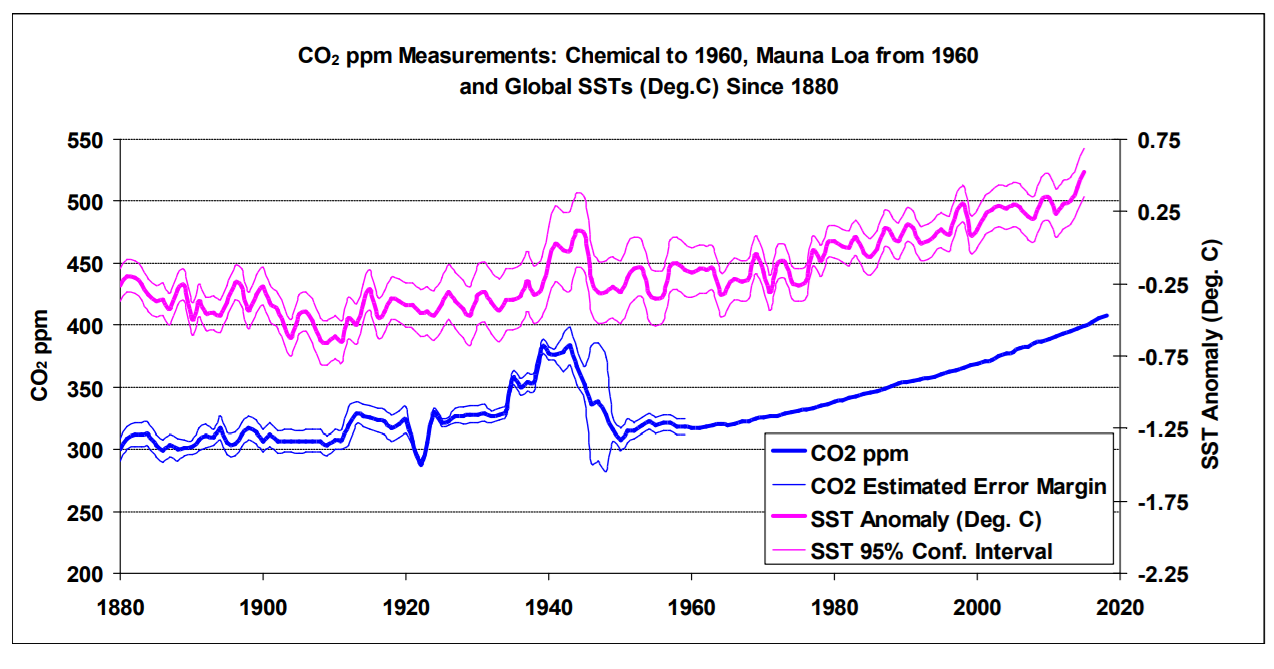
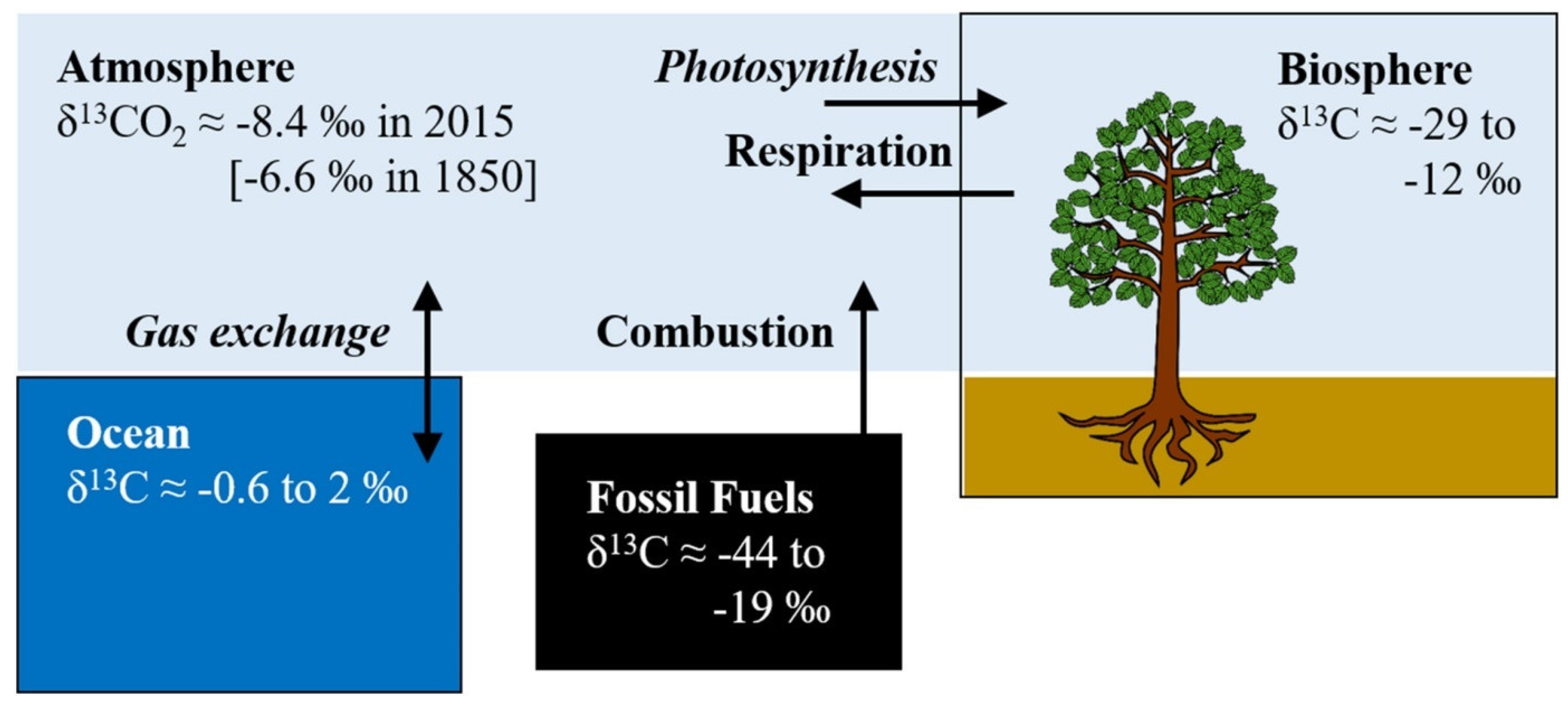
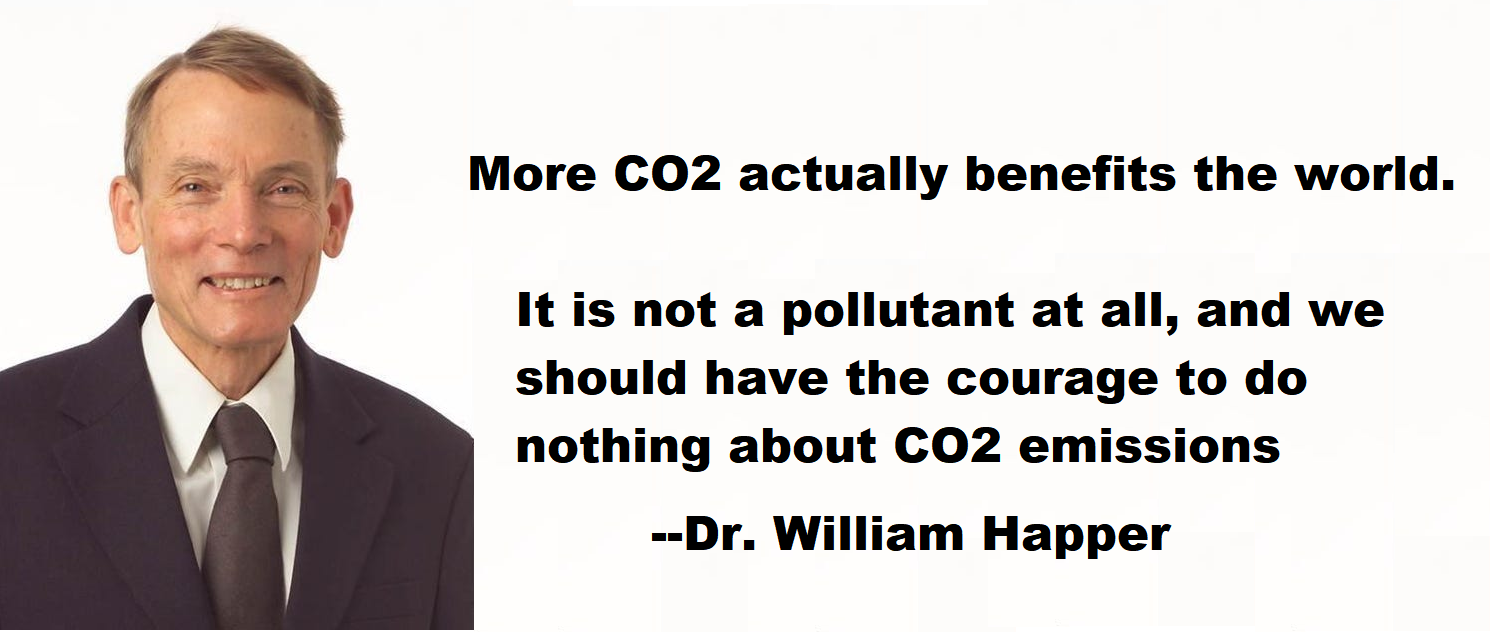
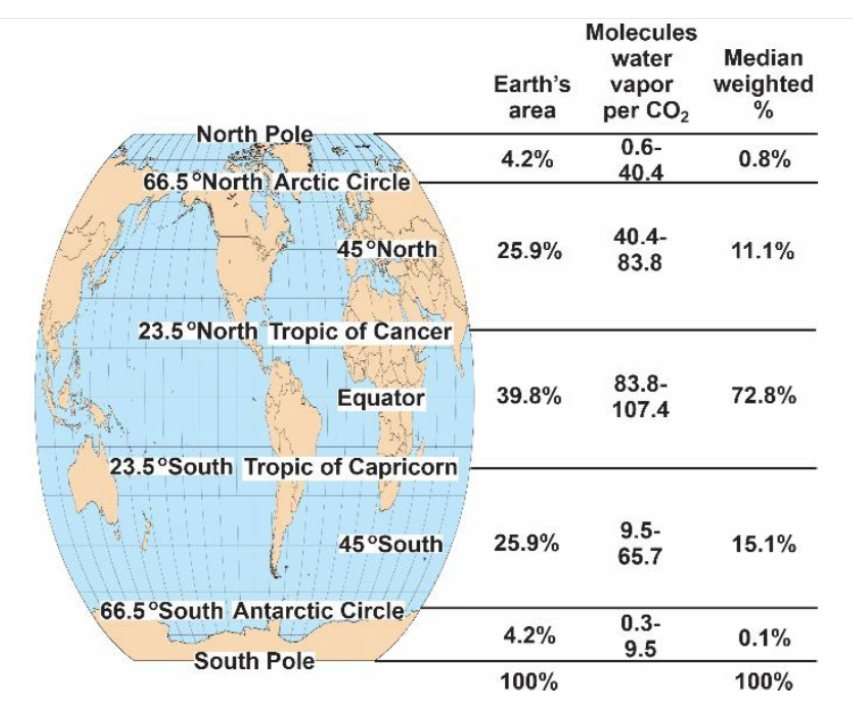



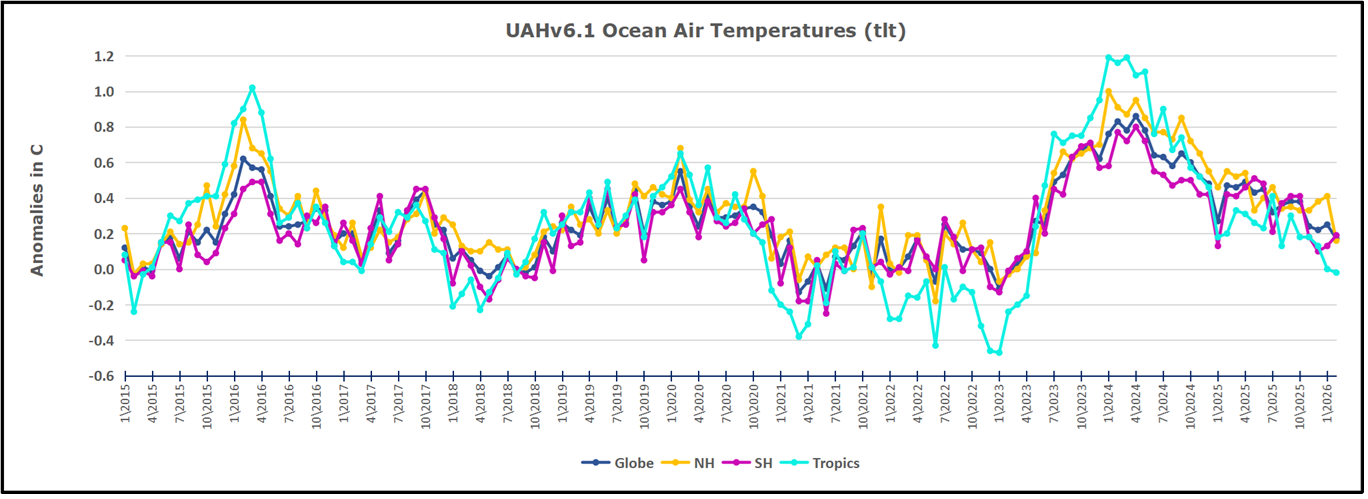
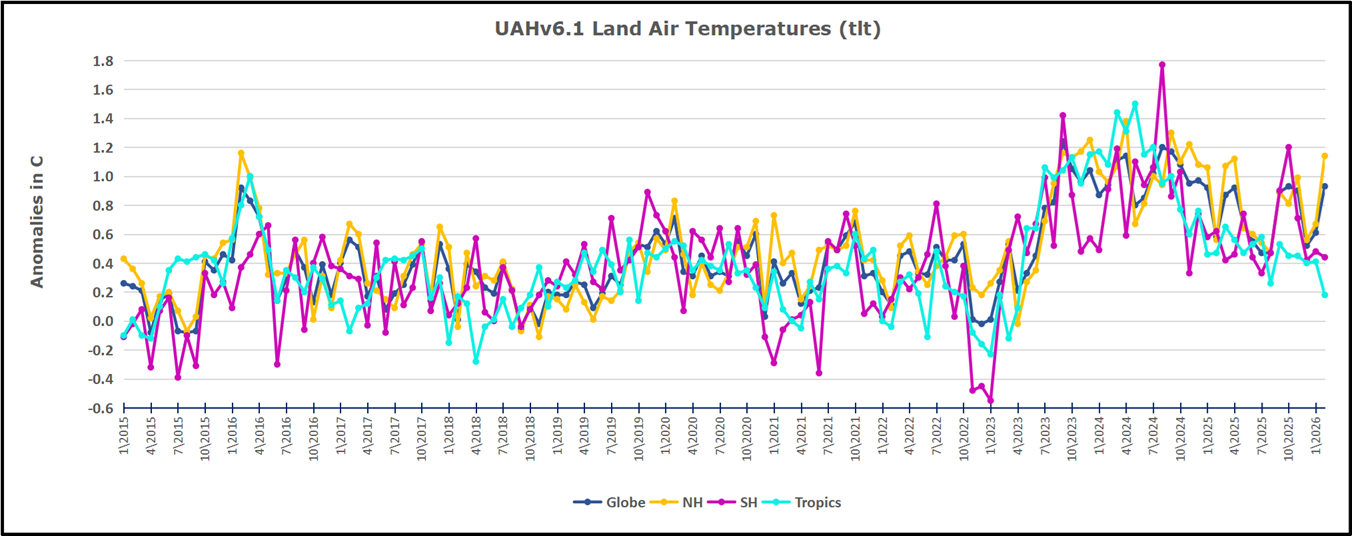
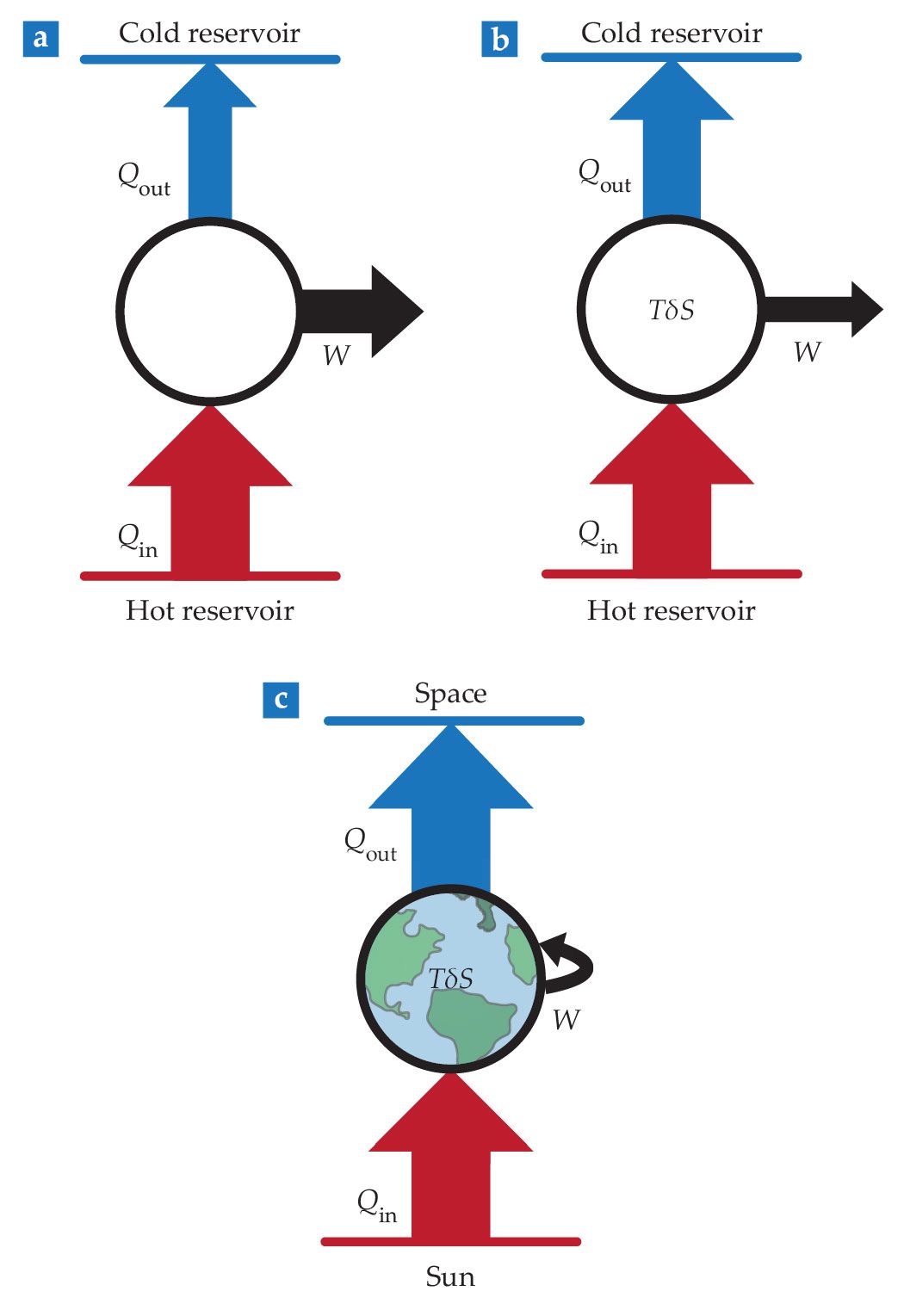
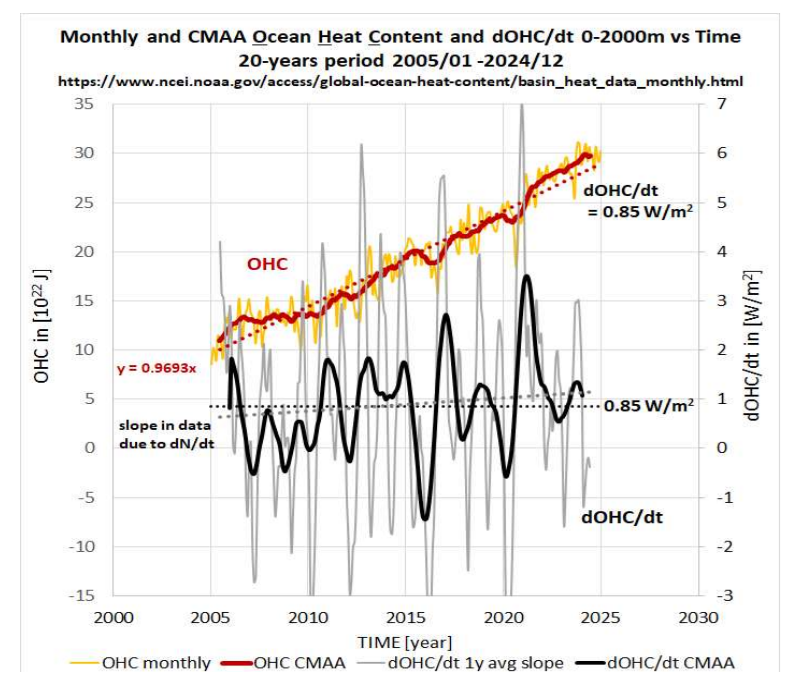
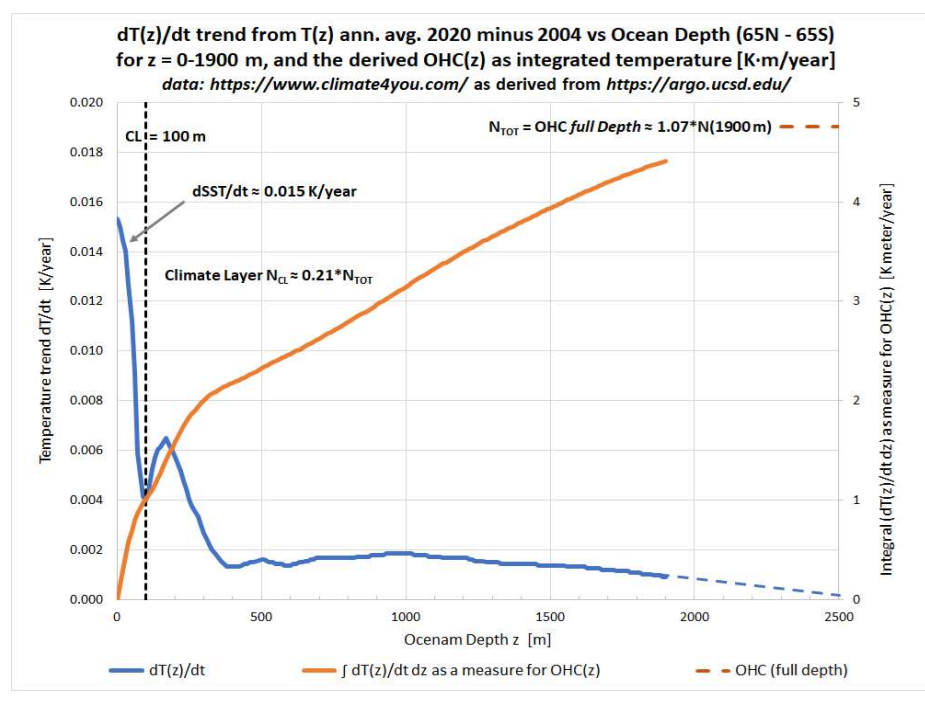
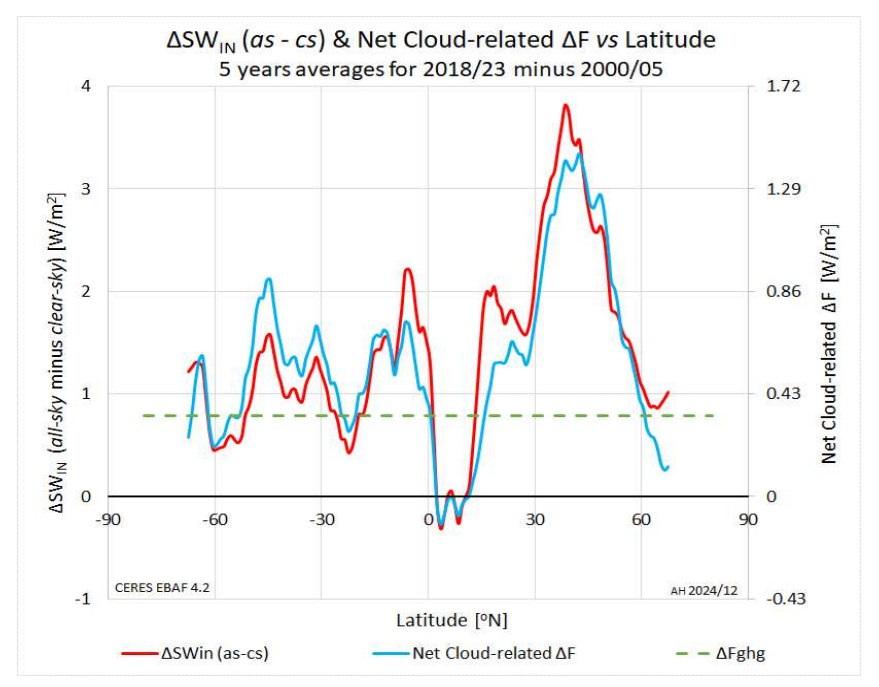
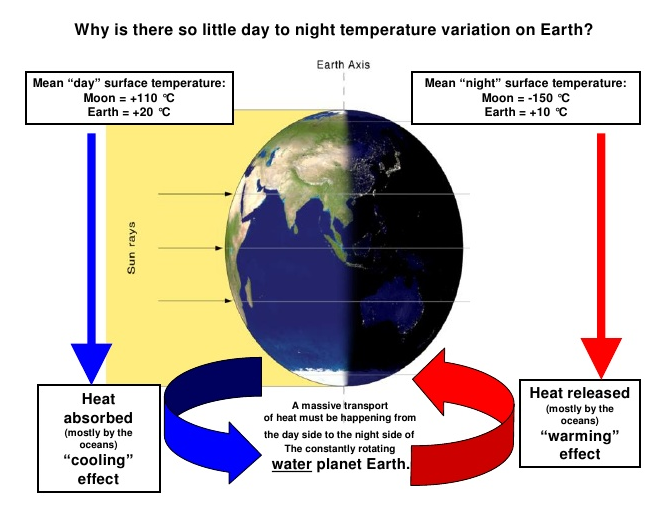
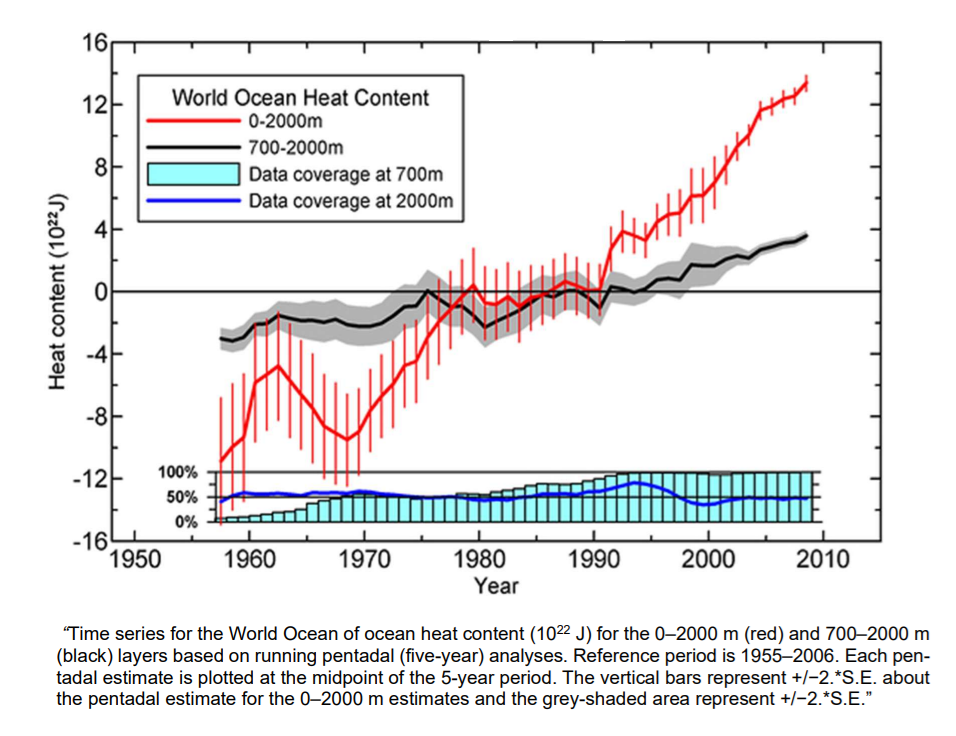

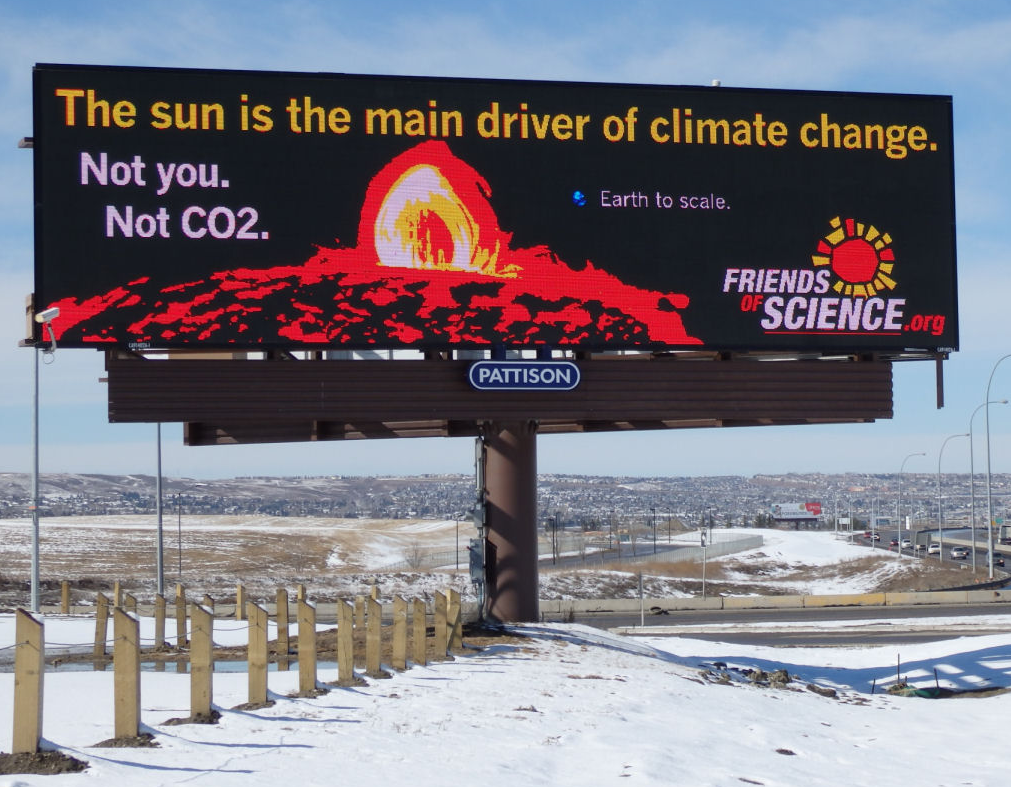
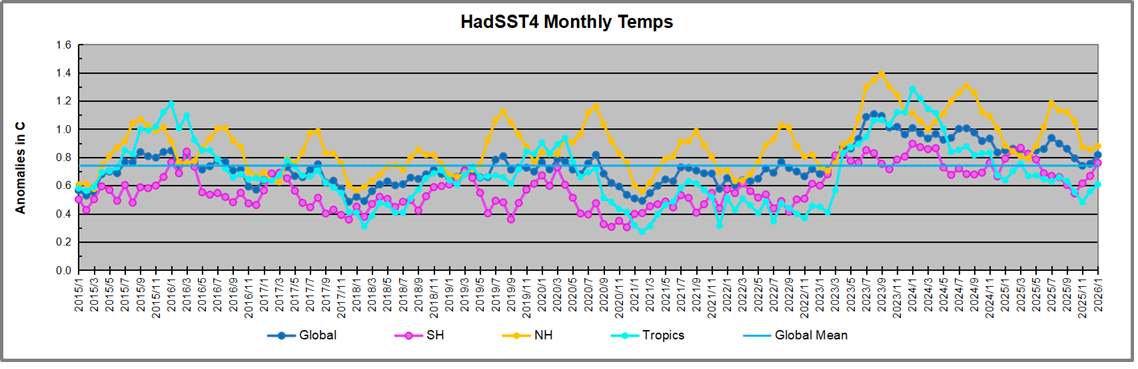
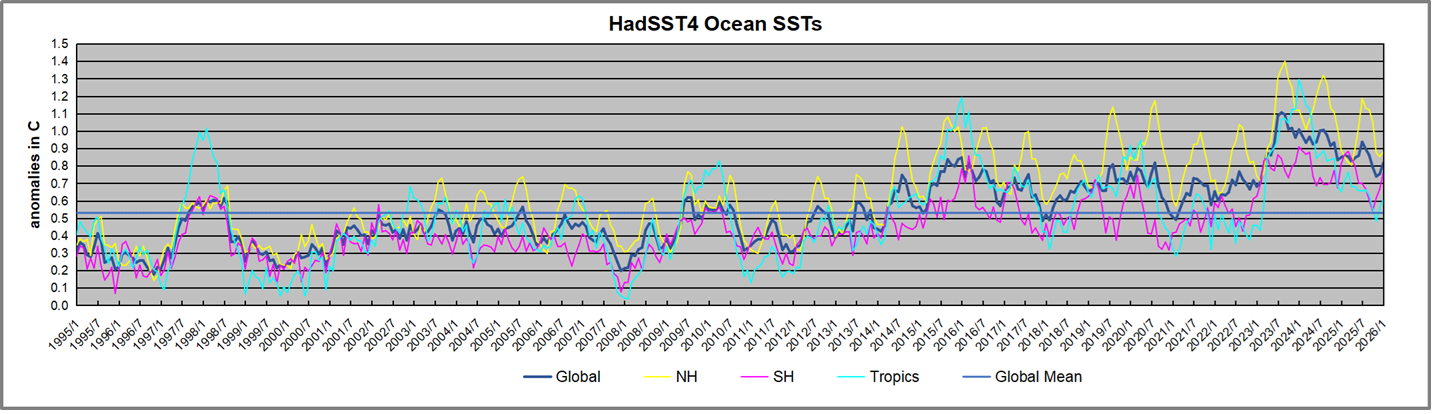
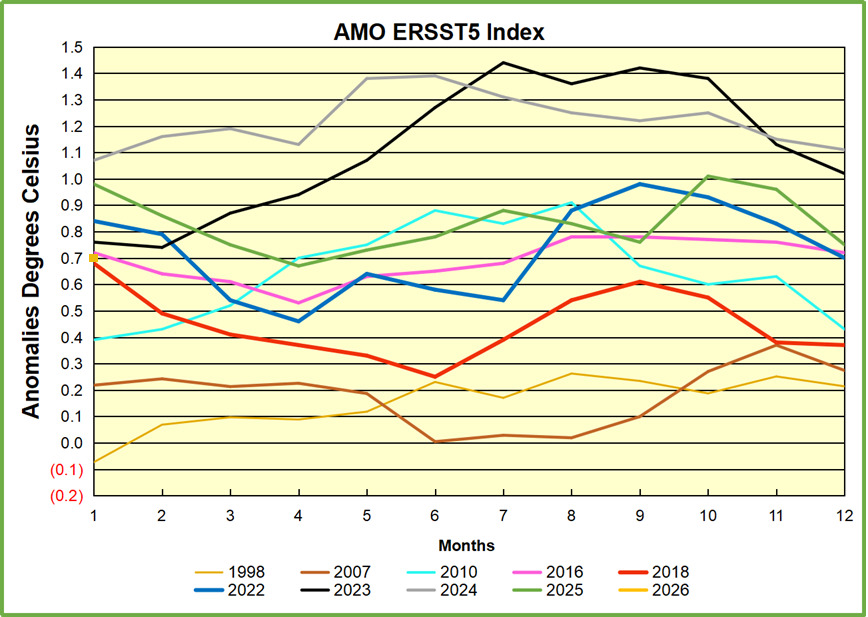
 Science Matters