Methane False Alarm, Microbes Are to Blame

Home fireplace burning Nat Gas, which is 75% methane (CH4).

Jo Nova explains at her blog Mysterious record methane surge since 2020 was not fossil fuels but “90% due to microbes”.  Excerpts in italics with my bolds and added images.

Nobody checked the carbon-13 ratios!

Wouldn’t you know it — 150 nations signed the Global Methane Pledge without even bothering to check if the methane was man-made.

Methane — the second most hated Greenhouse gas — spiked to record historic levels in the last few years, over 1,900 parts per billion.  In 2019, even the WEF scientists admitted they couldn’t explain the baffling rise, and then in 2020, the world of methane went into the twilight zone.  We shut down the modern world due to the pandemic, and methane levels rose even faster.

It seems many have been blaming fossil fuels for the global
surge in emissions, but forgot to check the C13 isotopes.

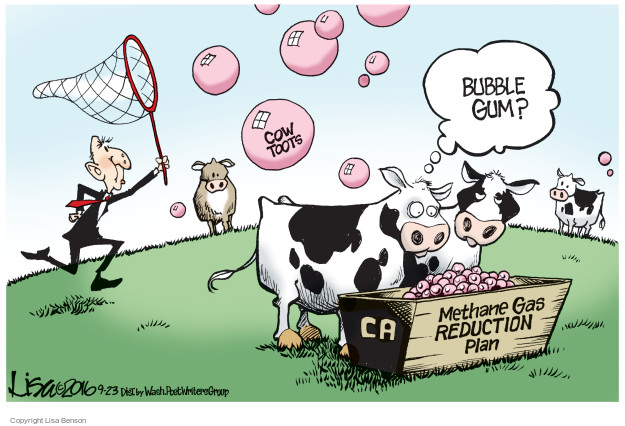
Somehow we spend millions on breathalysing cows, measuring their burps, and feeding them seaweed, but didn’t think to do the basic chemistry. How could that be, you might wonder… 158 nations agreed to cut methane emissions by 30% by 2030, but none of them audited the science even though very strange things were happening. (The point was obviously the “pledge”, the junkets, the captive industries and subsidies, anything but the science).

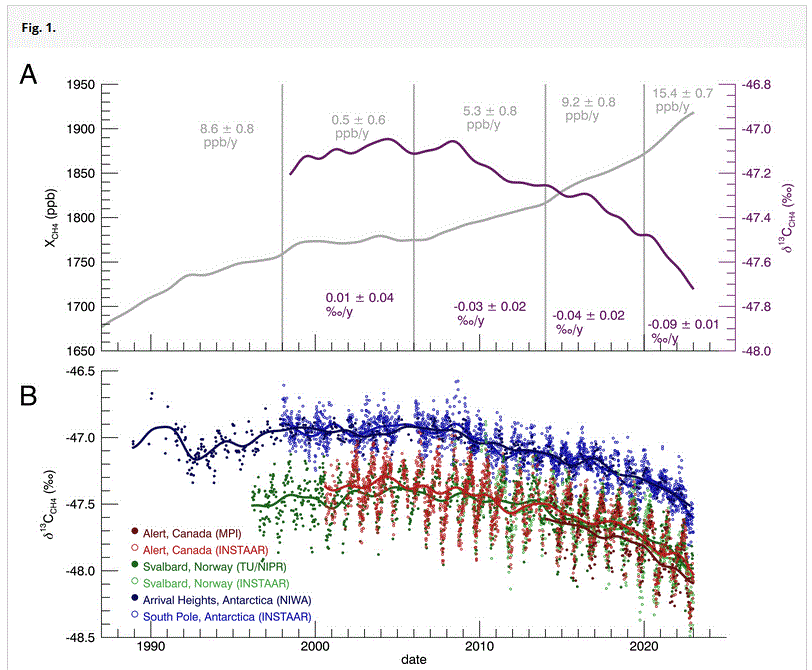
Methane from fossil fuels has a higher carbon-13 ratio, but even though fossil fuel use was rising, the carbon-13 levels of atmospheric methane was rolling down a hill. Indeed this new study shows it’s been falling for 17 years.

It’s not like this snuck up on us….  any inquiring mind should have seen this coming a decade ago. The lab has been recording C13 in methane since 1998 and gets air samples from 22 sites around the world every week or two.

From the press release:

Microbes in environment drove methane emissions more than fossil fuels between 2020 and 2022, analysis finds

They found that between 2020 and 2022, the drastic increase in atmospheric methane was driven almost entirely by microbial sources. Since 2007, scientists have observed microbes playing a significant role in methane emissions, but their contribution has surged to over 90% starting in 2020.

“Some prior studies have suggested that human activities, especially fossil fuels, were the primary source of methane growth in recent years,” said Xin (Lindsay) Lan…

“These studies failed to look at the isotope profile of methane

They go on to mention that in a warmer world, bacteria have a higher metabolism, which means they are happier and work faster. Thus, like CO2, if the world warms for any reason at all, methane will rise — and there is nothing we can do about it.

The one last straw they could clutch is that maybe the microbes were “man-made” :  It remains unclear whether the increased microbial emissions came from natural sources like wetlands or human-driven sources, such as landfills and agriculture. The team plans to delve deeper to identify the exact source of methane.

As if somehow there was a surge in landfill, rice paddies
or cows in the last few years that no one had noticed.

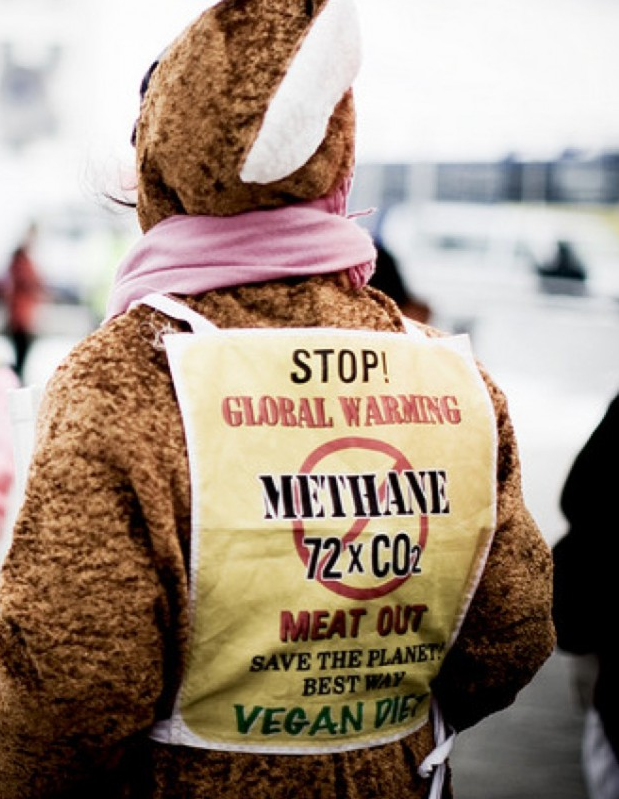
This is a pretty big dealmethane has supposedly caused about 30% of our current temperature rise (says the broken climate models) yet 90% of that recent rise was microbes. It’s yet another slice of the climate we aren’t controlling, but we’re still designing burgers with mealworms and bacon from fungus, in the hope of reducing methane emissions and controlling the weather.  Then it turns out every swamp and square meter of soil is working against us.

Methane concentrations in the air have almost tripled since the 1700s, but that was the Little Ice Age.  It’s easy to believe that as the world warmed up, the planet’s wetlands and soil microbes have just been returning to normal business for the last 300 years.

We skeptics told the experts long ago it was mostly not man-made, Tom Quirk showed that methane rises and falls in time with El Ninos, and was thus largely a natural phenomenon. Willie Soon also pointed out that one of Saturn’s moons has more methane than all the oil and gas deposits on Earth, but has no dinosaurs, cows or leaky wells.

REFERENCE

Michel, Sylvia Englund, et al (2024) Rapid shift in methane carbon isotopes suggests microbial emissions drove record high atmospheric methane growth in 2020–2022, Proceedings of the National Academy of Sciences. DOI: 10.1073/pnas.2411212121

Give Daisy a Break!


Global Warming Abates in Autumn 2024

Hot, Hot, Hot.  You will have noticed that the term “climate change” is now synonymous with “summer”.  Since the northern hemisphere is where most of the world’s land, people and media are located, two typical summer months and a hot European August have been depicted as the fires of hell awaiting any and all who benefit from fossil fuels. If you were wondering what the media would do, apart from obsessing over the many small storms this year, you are getting the answer.

Fortunately, Autumn is on the way and already bringing cooler evenings in Montreal where I live. Once again open windows provide fresh air for sleeping, while mornings are showing condensation, and frost sometimes. This year’s period of “climate change” is winding down.  Unless of course, we get some hurricanes the next two months.  Below is a repost of seasonal changes in temperature and climate for those who may have been misled by the media reports of a forever hotter future.

geese-in-v-formation

Autumnal Climate Change

Seeing a lot more of this lately, along with hearing the geese  honking. And in the next week or two we expect that trees around here will lose their leaves. It definitely is climate change of the seasonal variety.

Interestingly, the science on this is settled: It is all due to reduction of solar energy because of the shorter length of days (LOD). The trees drop their leaves and go dormant because of less sunlight, not because of lower temperatures. The latter is an effect, not the cause.

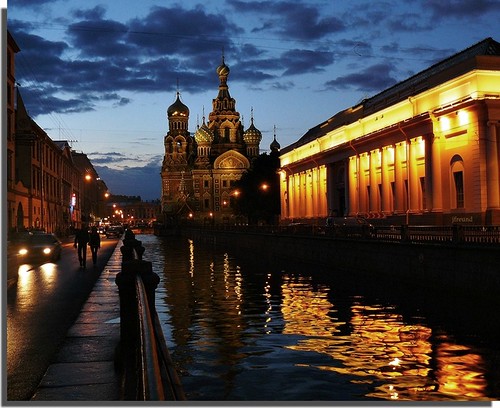
Of course, the farther north you go, the more remarkable the seasonal climate change. St. Petersburg, Russia has their balmy “White Nights” in June when twilight is as dark as it gets, followed by the cold, dark winter and a chance to see the Northern Lights.

And as we have been monitoring, the Arctic ice has been melting from sunlight in recent months, but is already building again in the twilight, to reach its maximum in March under the cover of darkness.

We can also expect in January and February for another migration of millions of Canadians (nicknamed “snowbirds”) to fly south in search of a summer-like climate to renew their memories and hopes. As was said to me by one man in Saskatchewan (part of the Canadian wheat breadbasket region): “Around here we have Triple-A farmers: April to August, and then Arizona.” Here’s what he was talking about: Quartzsite Arizona annually hosts 1.5M visitors, mostly between November and March.

Of course, this is just North America. Similar migrations occur in Europe, and in the Southern Hemisphere, the climates are changing in the opposite direction, Springtime currently. Since it is so obviously the sun causing this seasonal change, the question arises: Does the sunlight vary on longer than annual timescales?

The Solar-Climate Debate

And therein lies a great, enduring controversy between those (like the IPCC) who dismiss the sun as a driver of multi-Decadal climate change, and those who see a connection between solar cycles and Earth’s climate history. One side can be accused of ignoring the sun because of a prior commitment to CO2 as the climate “control knob”.

The other side is repeatedly denounced as “cyclomaniacs” in search of curve-fitting patterns to prove one or another thesis. It is also argued that a claim of 60-year cycles can not be validated with only 150 years or so of reliable data. That point has weight, but it is usually made by those on the CO2 bandwagon despite temperature and CO2 trends correlating for only 3 decades during the last century.

One scientist in this field is Nicola Scafetta, who presents the basic concept this way:

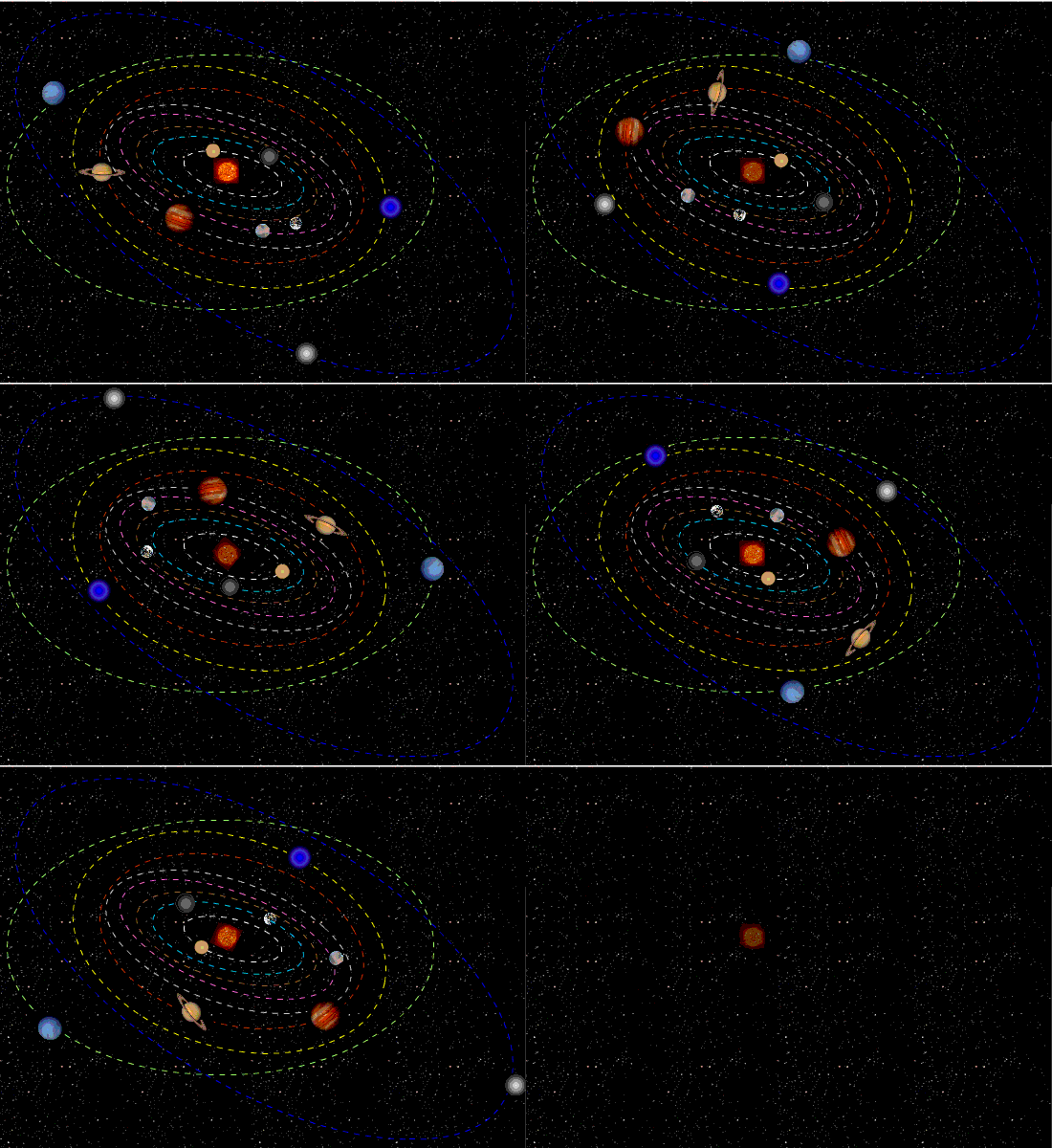
“The theory is very simple in words. The solar system is characterized by a set of specific gravitational oscillations due to the fact that the planets are moving around the sun. Everything in the solar system tends to synchronize to these frequencies beginning with the sun itself. The oscillating sun then causes equivalent cycles in the climate system. Also the moon acts on the climate system with its own harmonics. In conclusion we have a climate system that is mostly made of a set of complex cycles that mirror astronomical cycles. Consequently it is possible to use these harmonics to both approximately hindcast and forecast the harmonic component of the climate, at least on a global scale. This theory is supported by strong empirical evidences using the available solar and climatic data.”

He goes on to say:

“The global surface temperature record appears to be made of natural specific oscillations with a likely solar/astronomical origin plus a noncyclical anthropogenic contribution during the last decades. Indeed, because the boundary condition of the climate system is regulated also by astronomical harmonic forcings, the astronomical frequencies need to be part of the climate signal in the same way the tidal oscillations are regulated by soli-lunar harmonics.”

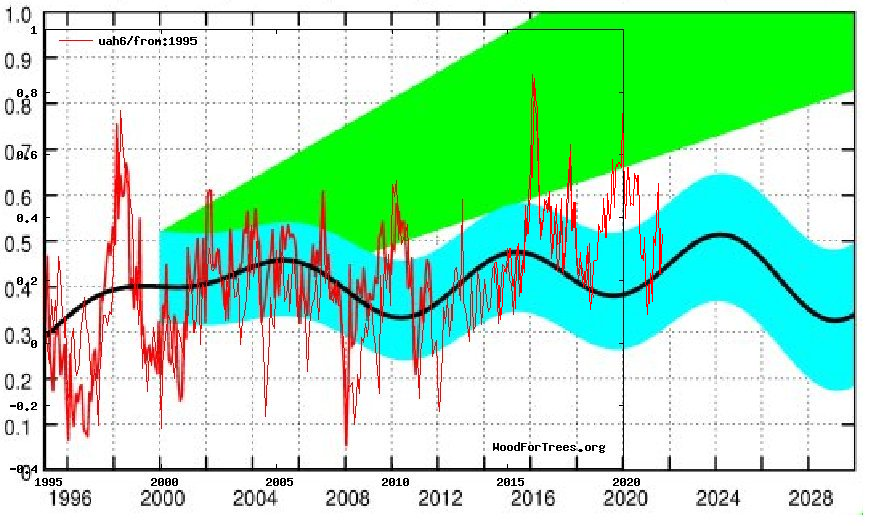
He has concluded that “at least 60% of the warming of the Earth observed since 1970 appears to be induced by natural cycles which are present in the solar system.” For the near future he predicts a stabilization of global temperature and cooling until 2030-2040. Note that several El Nino spikes have temporarily taken the GMT (Global Mean Temperature) anomaly outside the forecasted bounds.

For more see Scafetta vs. IPCC: Dueling Climate Theories

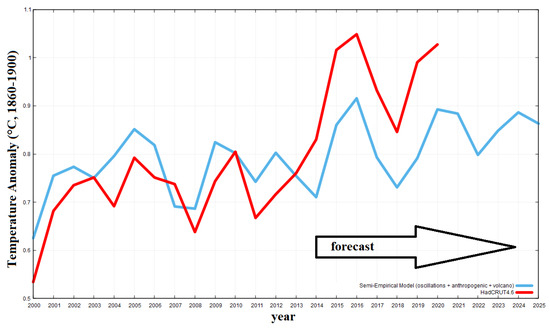
A more recent Scafetta publication is Reconstruction of the Interannual to Millennial Scale Patterns of the Global Surface Temperature in the journal atmosphere.  There is provided this exhibit comparing his semi-empirical forecast to HadCRUT4

A Deeper, but Accessible Presentation of Solar-Climate Theory

I have found this presentation by Ian Wilson to be persuasive while honestly considering all of the complexities involved.

The author raises the question: What if there is a third factor that not only drives the variations in solar activity that we see on the Sun but also drives the changes that we see in climate here on the Earth?

The linked article is quite readable by a general audience, and comes to a similar conclusion as Scafetta above: There is a connection, but it is not simple cause and effect. And yes, length of day (LOD) is a factor beyond the annual cycle.

Click to access IanwilsonForum2008.pdf

It is fair to say that we are still at the theorizing stage of understanding a solar connection to earth’s climate. And at this stage, investigators look for correlations in the data and propose theories (explanations) for what mechanisms are at work. Interestingly, despite the lack of interest from the IPCC, solar and climate variability is a very active research field these days.

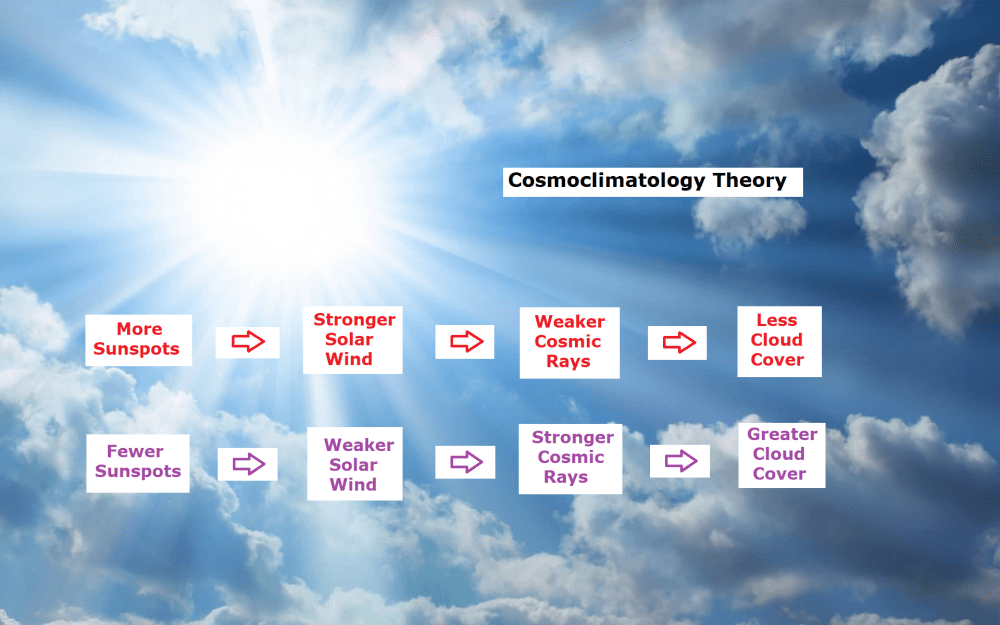
For example Svensmark has now a Cosmosclimatology theory supported by empirical studies described in more detail in the red link.

A summary of recent studies is provided at NoTricksZone: Since 2014, 400 Scientific Papers Affirm A Strong Sun-Climate Link

Ian Wilson has much more to say at his blog: http://astroclimateconnection.blogspot.com.au/

Once again, it appears that the world is more complicated than a simple cause and effect model suggests.


Fluctuations in observed global temperatures can be explained by a combination of oceanic and solar cycles.  See engineering analysis from first principles Quantifying Natural Climate Change.

For everything there is a season, a time for every purpose under heaven.

What has been will be again, what has been done will be done again;
there is nothing new under the sun.
(Ecclesiastes 3:1 and 1:9)

Footnote:

jimbob child activist

Methane Madness Strikes Again

The latest comes from Australia by way of John Ray at his blog Methane cuts on track for 2030 emissions goal.  Excerpts in italics with my bolds and added images.

Australia’s methane emissions have decreased over the past two decades, according to a new report by a leading global carbon research group.

While the world’s methane emissions grew by 20 per cent, meaning two thirds of methane in the atmosphere is from human activity, Australasia and Europe emitted lower levels of the gas.

It puts Australia in relatively good stead, compared to 150 other signatories, to meet its non-binding commitments to the Global Methane Pledge, which aims to cut methane emissions by 30 per cent by the end of the decade.

The findings were revealed in the fourth global methane budget, published by the Global Carbon Project, with contributions from 66 research institutions around the world, including the CSIRO.

According to the report, agriculture contributed 40 per cent of global methane emissions from human activities, followed by the fossil fuel sector (34 per cent), solid waste and waste­water (19 per cent), and biomass and biofuel burning (7 per cent).

Pep Canadell, CSIRO executive director for the Global Carbon Project, said government policies and a smaller national sheep flock were the primary reasons for the lower methane emissions in Australasia.

“We have seen higher growth rates for methane over the past three years, from 2020 to 2022, with a record high in 2021. This increase means methane concentrations in the atmosphere are 2.6 times higher than pre-­industrial (1750) levels,” Dr Canadell said.

The primary source of methane emissions in the agriculture sector is from the breakdown of plant matter in the stomachs of sheep and cattle.

It has led to controversial calls from some circles for less red meat consumption, outraging the livestock industry, which has lowered its net greenhouse gas emissions by 78 per cent since 2005 and is funding research into methane reduction.

Last week, the government agency advising Anthony Albanese on climate change suggested Australians could eat less red meat to help reduce emissions. And the government’s official dietary guidelines will be amended to incorporate the impact of certain foods on climate change.

There is ongoing disagreement among scientists and policymakers about whether there should be a distinction between biogenic methane emitted by livestock, which already exists in a balanced cycle in plants and soil and the atmosphere, and methane emitted from sources stored deep underground for millennia.

“The frustration is that methane, despite its source, gets lumped into one bag,” Cattle Australia vice-president Adam Coffey said. “Enteric methane from livestock is categorically different to methane from coal-seam gas or mining-related fossil fuels that has been dug up from where it’s been stored for millennia and is new to the atmosphere.

“Why are we ignoring what modern climate science is telling us, which is these emissions are inherently different?”  Mr Coffey said the methane budget report showed the intense focus on the domestic industry’s environmental credent­ials was overhyped.

“I think it’s based mainly on ideology and activism,” Mr Coffey said.

This concern about methane is nonsense.
Water vapour blocks all the frequencies that methane does
so the presence of methane adds nothing

Technical Background

Methane alarm is one of the moles continually popping up in the media Climate Whack-A-Mole game. An antidote to methane madness is now available to those inquiring minds who want to know reality without the hype.

Methane and Climate is a paper by W. A. van Wijngaarden (Department of Physics and Astronomy, York University, Canada) and W. Happer (Department of Physics, Princeton University, USA) published at CO2 Coalition November 22, 2019. Below is a summary of the more detailed publication. Excerpts in italics with my bolds.

Overview

Atmospheric methane (CH4) contributes to the radiative forcing of Earth’s atmosphere. Radiative forcing is the difference in the net upward thermal radiation from the Earth through a transparent atmosphere and radiation through an otherwise identical atmosphere with greenhouse gases. Radiative forcing, normally specified in units of W m−2 , depends on latitude, longitude and altitude, but it is often quoted for a representative temperate latitude, and for the altitude of the tropopause, or for the top of the atmosphere.

For current concentrations of greenhouse gases, the radiative forcing at the tropopause, per added CH4 molecule, is about 30 times larger than the forcing per added carbon-dioxide (CO2) molecule. This is due to the heavy saturation of the absorption band of the abundant greenhouse gas, CO2. But the rate of increase of CO2 molecules, about 2.3 ppm/year (ppm = part per million by mole), is about 300 times larger than the rate of increase of CH4 molecules, which has been around 0.0076 ppm/year since the year 2008.

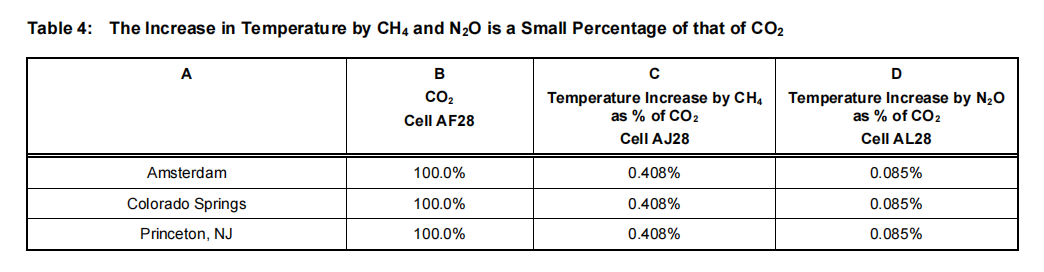
So the contribution of methane to the annual increase in forcing is one tenth (30/300) that of carbon dioxide. The net forcing increase from CH4 and CO2 increases is about 0.05 W m−2 year−1 . Other things being equal, this will cause a temperature increase of about 0.012 C year−1 . Proposals to place harsh restrictions on methane emissions because of warming fears are not justified by facts.

The paper is focused on the greenhouse effects of atmospheric methane, since there have recently been proposals to put harsh restrictions on any human activities that release methane. The basic radiation-transfer physics outlined in this paper gives no support to the idea that greenhouse gases like methane, CH4, carbon dioxide, CO2 or nitrous oxide, N2O are contributing to a climate crisis. Given the huge benefits of more CO2 to agriculture, to forestry, and to primary photosynthetic productivity in general, more CO2 is almost certainly benefitting the world. And radiative effects of CH4 and N2O, another greenhouse gas produced by human activities, are so small that they are irrelevant to climate.

Transmission of shortwave solar irradiation and long wavelength radiation from the Earth’s surface through atmosphere, as permitted by Rohde [2]. Note absorption wavelengths of CH4 and N2O are already covered by H2O and CO2.

Radiative Properties of Earth Atmosphere

On the left of Fig. 2 we have indicated the three most important atmospheric layers for radiative heat transfer. The lowest atmospheric layer is the troposphere, where parcels of air, warmed by contact with the solar-heated surface, float upward, much like hot-air balloons. As they expand into the surrounding air, the parcels do work at the expense of internal thermal energy. This causes the parcels to cool with increasing altitude, since heat flow in or out of parcels is usually slow compared to the velocities of ascent of descent.

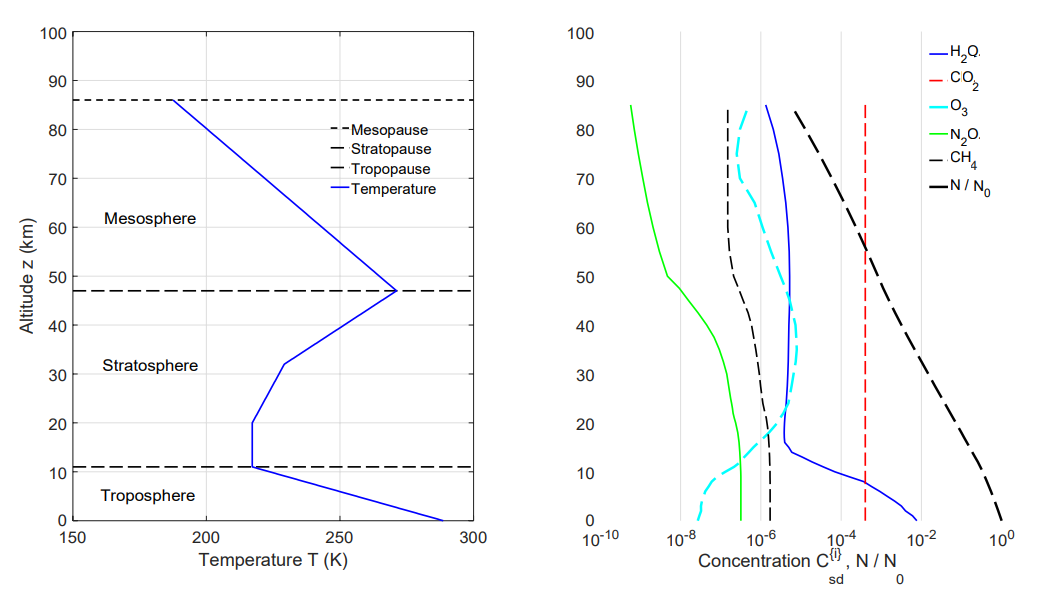
Figure 2: Left. A standard atmospheric temperature profile[9], T = T (z). The surface temperature is T (0) = 288.7 K . Right. Standard concentrations[10], C {i} = N {i}/N for greenhouse molecules versus altitude z. The total number density of atmospheric molecules is N . At sea level the concentrations are 7750 ppm of H2O, 1.8 ppm of CH4 and 0.32 ppm of N2O. The O3 concentration peaks at 7.8 ppm at an altitude of 35 km, and the CO2 concentration was approximated by 400 ppm at all altitudes. The data is based on experimental observations.

If the parcels consisted of dry air, the cooling rate would be 9.8 C km−1 the dry adiabatic lapse rate[12]. But rising air has usually picked up water vapor from the land or ocean. The condensation of water vapor to droplets of liquid or to ice crystallites in clouds, releases so much latent heat that the lapse rates are less than 9.8 C km−1 in the lower troposphere. A representative lapse rate for mid latitudes is dT/dz = 6.5 K km−1 as shown in Fig. 2.

The tropospheric lapse rate is familiar to vacationers who leave hot areas near sea level for cool vacation homes at higher altitudesin the mountains. On average, the temperature lapse rates are small enough to keep the troposphere buoyantly stable[13]. Tropospheric air parcels that are displaced in altitude will oscillate up and down around their original position with periods of a few minutes. However, at any given time, large regions of the troposphere (particularly in the tropics) are unstable to moist convection because of exceptionally large temperature lapse rates.

The vertical radiation flux Z, which is discussed below, can change rapidly in the troposphere and stratosphere. There can be a further small change of Z in the mesosphere. Changes in Z above the mesopause are small enough to be neglected, so we will often refer to the mesopause as “the top of the atmosphere” (TOA), with respect to radiation transfer. As shown in Fig. 2, the most abundant greenhouse gas at the surface is water vapor, H2O. However, the concentration of water vapor drops by a factor of a thousand or more between the surface and the tropopause. This is because of condensation of water vapor into clouds and eventual removal by precipitation. Carbon dioxide, CO2, the most abundant greenhouse gas after water vapor, is also the most uniformly mixed because of its chemical stability. Methane, the main topic of this discussion is much less abundant than CO2 and it has somewhat higher concentrations in the troposphere than in the stratosphere where it is oxidized by OH radicals and ozone, O3. The oxidation of methane[8] is the main source of the stratospheric water vapor shown in Fig. 2.

Future Forcings of CH4 and CO2

Methane levels in Earth’s atmosphere are slowly increasing.  If the current rate of increase, about 0.007 ppm/year for the past decade or so, were to continue unchanged it would take about 270 years to double the current concentration of C {i} = 1.8 ppm. But, as one can see from Fig.7, methane levels have stopped increasing for years at a time, so it is hard to be confident about future concentrations. Methane concentrations may never double, but if they do, WH[1] show that this would only increase the forcing by 0.8 W m−2. This is a tiny fraction of representative total forcings at midlatitudes of about 140 W m−2 at the tropopause and 120 W m−2 at the top of the atmosphere.

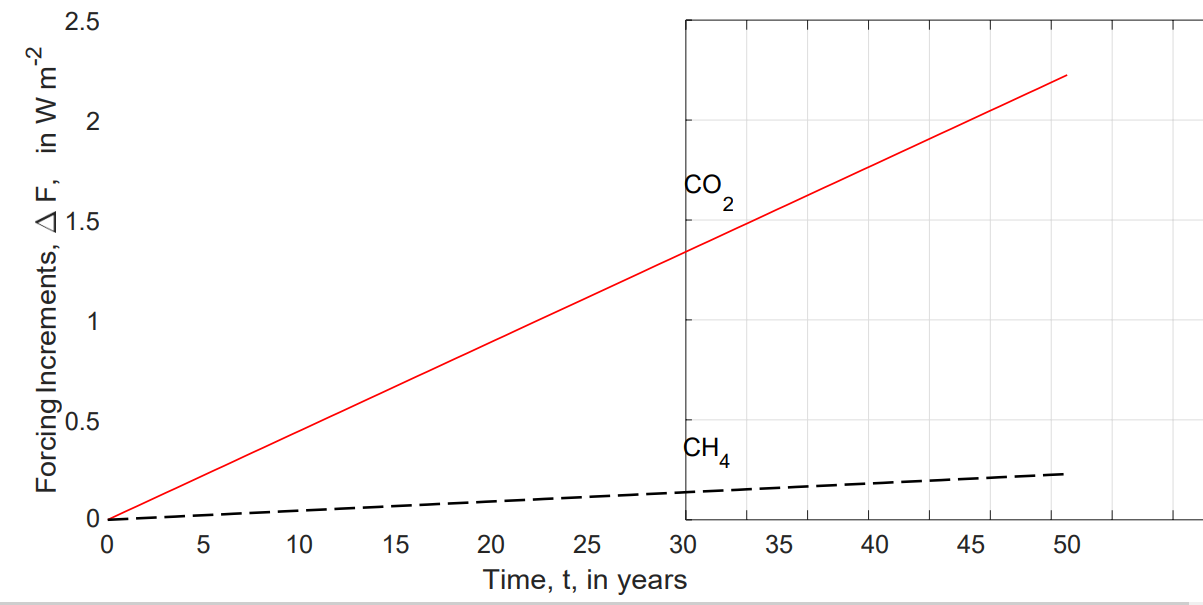
Figure 9: Projected mid-latitude forcing increments at the tropopause from continued increases of CO2 and CH4 at the rates of Fig. 7 and Fig. 8 for the next 50 years. The projected forcings are very small, especially for methane, compared to the current tropospheric forcing of 137 W m−2.

The per-molecule forcings P {i} of (13) and (14) have been used with the column density Nˆ of (12) and the concentration increase rates dC¯{i}/dt, noted in Fig. 7 and Fig. 8, to evaluate the future forcing (15), which is plotted in Fig. 9. Even after 50 years, the forcing increments from increased concentrations of methane (∆F = 0.23 W m−2), or the roughly ten times larger forcing from increased carbon dioxide (∆F = 2.2 W m−2) are very small compared to the total forcing, ∆F = 137 W m−2, shown in Fig. 3. The reason that the per-molecule forcing of methane is some 30 times larger than that of carbon dioxide for current concentrations is “saturation” of the absorption bands. The current density of CO2 molecules is some 200 times greater than that of CH4 molecules, so the absorption bands of CO2 are much more saturated than those of CH4. In the dilute“optically thin” limit, WH[1] show that the tropospheric forcing power per molecule is P {i} = 0.15 × 10⁻²² W for CH4, and P {i} = 2.73 × 10⁻²² W for CO2. Each CO2 molecule in the dilute limit causes about 5 times more forcing increase than an additional molecule of CH4, which is only a ”super greenhouse gas” because there is so little in the atmosphere, compared to CO2.

Methane Summary

Natural gas is 75% Methane (CH4) which burns cleanly to carbon dioxide and water. Methane is eagerly sought after as fuel for electric power plants because of its ease of transport and because it produces the least carbon dioxide for the most power. Also cars can be powered with compressed natural gas (CNG) for short distances.

In many countries CNG has been widely distributed as the main home heating fuel. As a consequence, in the past methane has leaked to the atmosphere in large quantities, now firmly controlled. Grazing animals also produce methane in their complicated stomachs and methane escapes from rice paddies and peat bogs like the Siberian permafrost.

It is thought that methane is a very potent greenhouse gas because it absorbs some infrared wavelengths 7 times more effectively than CO2, molecule for molecule, and by weight even 20 times. As we have seen previously, this also means that within a distance of metres, its effect has saturated, and further transmission of heat occurs by convection and conduction rather than by radiation.

Note that when H20 is present in the lower troposphere, there are few photons left for CH4 to absorb:

Even if the IPCC radiative greenhouse theory were true, methane occurs only in minute quantities in air, 1.8ppm versus CO2 of 390ppm. By weight, CH4 is only 5.24Gt versus CO2 3140Gt (on this assumption). If it truly were twenty times more potent, it would amount to an equivalent of 105Gt CO2 or one thirtieth that of CO2. A doubling in methane would thus have no noticeable effect on world temperature.

However, the factor of 20 is entirely misleading because absorption is proportional to the number of molecules (=volume), so the factor of 7 (7.3) is correct and 20 is wrong. With this in mind, the perceived threat from methane becomes even less.

Further still, methane has been rising from 1.6ppm to 1.8ppm in 30 years (1980-2010), assuming that it has not stopped rising, this amounts to a doubling in 2-3 centuries. In other words, methane can never have any measurable effect on temperature, even if the IPCC radiative cooling theory were right.

Because only a small fraction in the rise of methane in air can be attributed to farm animals, it is ludicrous to worry about this aspect or to try to farm with smaller emissions of methane, or to tax it or to trade credits.

The fact that methane in air has been leveling off in the past two decades, even though we do not know why, implies that it plays absolutely no role as a greenhouse gas.  (From Sea Friends (here):

More information at The Methane Misconceptions by Dr. Wilson Flood (UK) here.

Climatists Aim Forks at Our Food Supply

Latest INM Climate Model Projections Triggered by Scenario Inputs

The latest climate simulation from the Russian INM was published in April 2024: Simulation of climate changes in Northern Eurasia by two versions of the INM RAS Earth system model. The paper includes discussing how results are driven greatly by processing of cloud factors.  But first for context readers should be also aware of influences from scenario premises serving as model input, in this case  SSP3-7.0.

Background on CIMP Scenario  SSP3-7.0

A recent paper reveals peculiarities with this scenario.  Recognizing distinctiveness of SSP3-7.0 for use in impact assessments by Shiogama et al (2024).  Excerpts in italics with my bolds and added images.

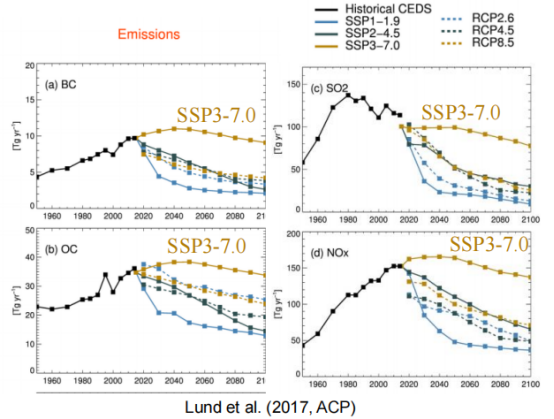
Because recent mitigation efforts have made the upper-end scenario of the future GHG concentration (SSP5-8.5) highly unlikely, SSP3-7.0 has received attention as an alternative high-end scenario for impacts, adaptation, and vulnerability (IAV) studies. However, the ‘distinctiveness’ of SSP3-7.0 may not be well-recognized by the IAV community. When the integrated assessment model (IAM) community developed the SSP-RCPs, they did not anticipate the limelight on SSP3-7.0 for IAV studies because SSP3-7.0 was the ‘distinctive’ scenario regarding to aerosol emissions (and land-use land cover changes). Aerosol emissions increase or change little in SSP3-7.0 due to the assumption of a lenient air quality policy, while they decrease in the other SSP-RCPs of CMIP6 and all the RCPs of CMIP5. This distinctive high-aerosol-emission design of SSP3-7.0 was intended to enable climate model (CM) researchers to investigate influences of extreme aerosol emissions on climate.

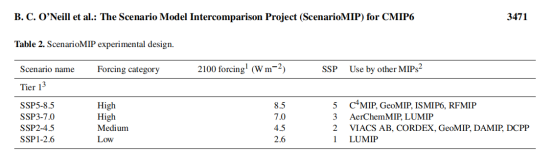
SSP3-7.0 Prescribes High Radiative Forcing

SSP3-7.0 Presumes High Aerosol Emissions

Aerosol Emissions refer to Black Carbon, Organic Carbon, SO2 and NOx.

•  Aerosol emissions increase or change little in SSP3-7.0 due to the assumption of a lenient air quality policy, while they decrease in the other SSP-RCPs of CMIP6 and all the RCPs of CMIP5.

• This distinctive high-aerosol-emission design of SSP3- 7.0 was intended to enable AerChemMIP to investigate the consequences of continued high levels of aerosol emissions on climate.

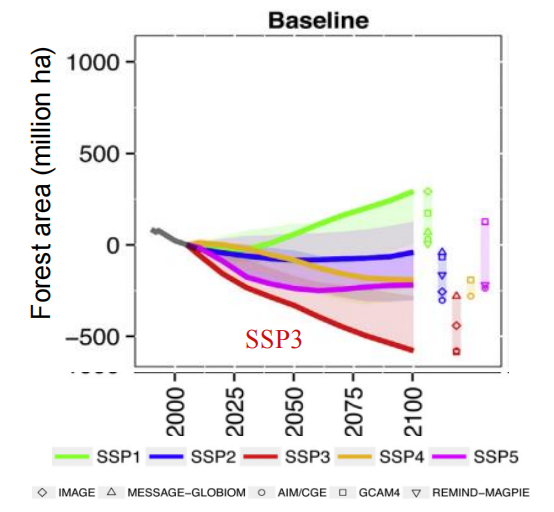
SSP3-7.0 Supposes Forestry Deprivation

• Decreases in forest area were also substantial in SSP3- 7.0, unlike in the other SSP-RCPs.
• This design enables LUMIP to analyse the climate influences of extreme land-use and land-cover changes.

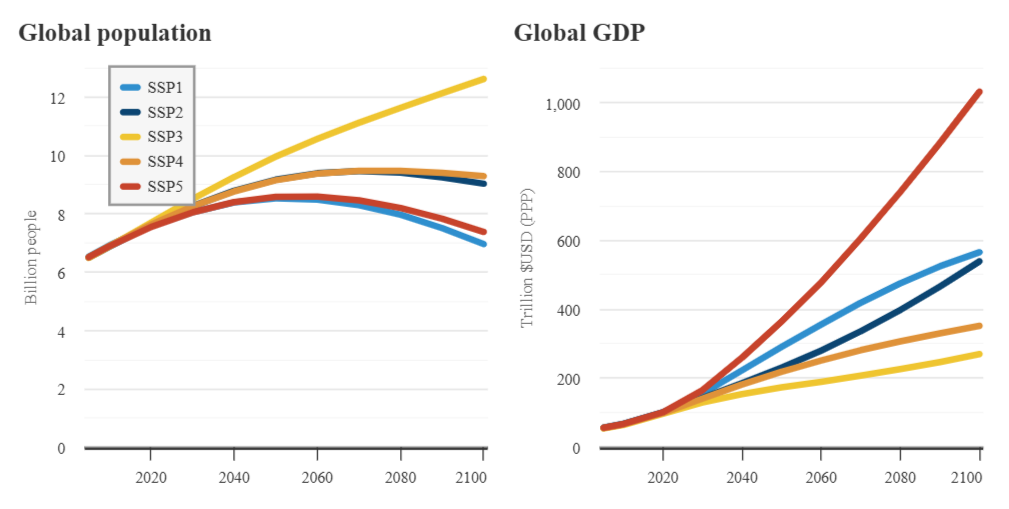
SSP3-7.0 Projects High Population Growth in Poorer Nations

Global population (left) in billions and global gross domestic product (right) in trillion US dollars on a purchasing power parity (PPP) basis. Data from the SSP database; chart by Carbon Brief using Highcharts.

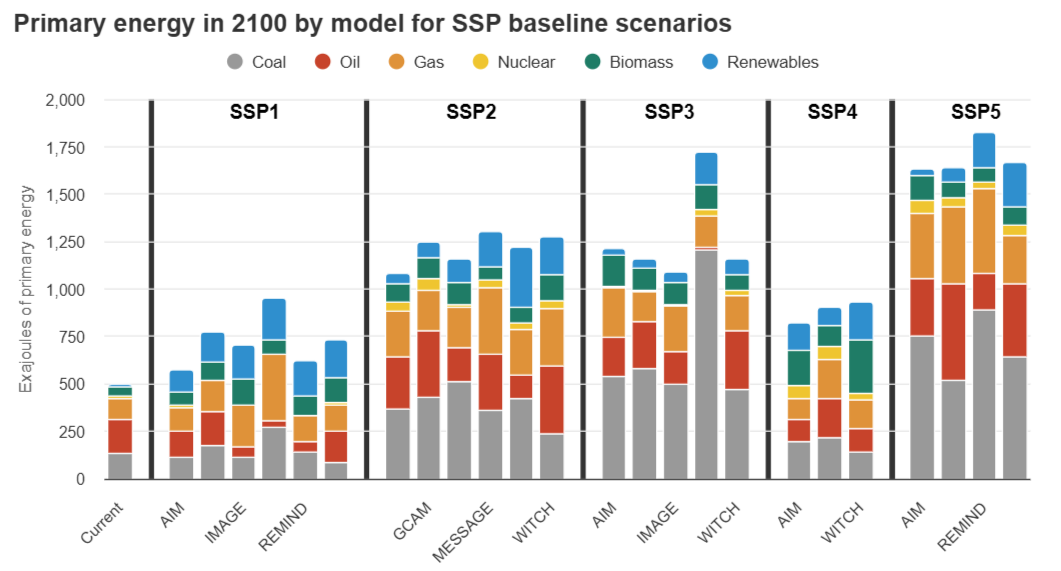
SSP3-7.0 Projects Growing Use of Coal Replacing Gas and Some Nuclear

My Summary:  Using this scenario presumes high CO2 Forcing (Wm2), high aerosol emissions and diminished forest area, as well as much greater population and coal consumption. Despite claims to the contrary, this is not a “middle of the road” scenario, and a strange choice for simulating future climate metrics due to wildly improbable assumptions.

How Two Versions of a Reasonable INM Climate Model Respond to SSP3-7.0

The preceding information regarding the input scenario provides a context for understanding the output projections from INMCM5 and INMCM6.  Simulation of climate changes in Northern Eurasia by two versions of the INM RAS Earth system model. Excerpts in italics with my bolds and added images.

Introduction

The aim of this paper is the evaluation of climate changes during last several decades in the Northern Eurasia, densely populated region with the unprecedentedly rapid climate changes, using the INM RAS climate models. The novelty of this work lies in the comparison of model climate changes based on two versions of the same model INMCM5 and INMCM6, which differ in climate sensitivities ECS and TCR, with data from available observations and reanalyses. By excluding other factors that influence climate reproduction, such as different cores of GCM components, major discrepancies in description of physical process or numerical schemes, the assessment of ECS and TCR role in climate reproduction can be the exclusive focus. Also future climate projections for the middle and the end of 21st century in both model versions are given and compared.

After modification of physical parameterisations, in the model version INMCM6 ECS increased from 1.8K to 3.7K (Volodin, 2023), and TCR increased from 1.3K to 2.2K. Simulation of present-day climate by INMCM6 Earth system model is discussed in Volodin (2023). A notable increase in ECS and TCR is likely to cause a discrepancy in the simulation of climate changes during last decades and the simulation of future climate projections for the middle and the end of 21st century made by INMCM5 and INMCM6.

About 20% of the Earth’s land surface and 60% of the terrestrial land cover north of 40N refer to Northern Eurasia (Groisman et al, 2009). The Hoegh-Guldberg et al (2018) states that the topography and climate of the Eurasian region are varied, encompassing a sharply continental climate with distinct summer and winter seasons, the northern, frigid Arctic environment and the alpine climate on Scandinavia’s west coast. The Atlantic Ocean and the jet stream affect the climate of western Eurasia, whilst the Mediterranean region, with its hot summers, warm winters, and often dry spells, influences the climate of the southwest. Due to its location, the Eurasian region is vulnerable to a variety of climate-related natural disasters, including heatwaves, droughts, riverine floods, windstorms, and large-scale wildfires.

Historical Runs

One of the most important basic model experiments conducted within the CMIP project in order to control the model large-scale trends is piControl (Eyring et al, 2016). With 1850 as the reference year, PiControl experiment (Eyring et al, 2016) is conducted in conditions chosen to be typical of the period prior to the onset of large-scale industrialization. Perturbed state of the INMCM model at the end of the piControl is taken as the initial condition for historical runs. The historical experiment is conducted in the context of changing external natural and anthropogenic forcings. Prescribed time series include:

♦  greenhouse gases concentration,
♦  the solar spectrum and total solar irradiance,
♦  concentrations of volcanic sulfate aerosol in the stratosphere, and
♦  anthropogenic emissions of SO2, black, and organic carbon.

The ensemble of historical experiments consists of 10 members for each model version. The duration of each run is 165 model years from 1850 to 2014.

SSP3-7.0 Scenario

Experiments are designed to simulate possible future pathways of climate evolution based on assumptions about human developments including: population, education, urbanization, gross domestic product (GDP), economic growth, rate of technological developments, greenhouse gas (GHG) and aerosol emissions, energy supply and demand, land-use changes, etc. (Riahi et al, 2016). Shared Socio-economic Pathways or “SSP” vary from very ambitious mitigation and increasing shift toward sustainable practices (SSP1) to fossil-fueled development (SSP5) (O’Neill et al, 2016).

Here we discuss climate changes for scenario SSP3-7.0 only, to avoid presentation large amount of information. The SSP3-7.0 scenario reflects the assumption on the high GHG emissions scenario and priority of regional security, leading to societies that are highly vulnerable to climate change, combined with relatively high forcing level (7.0 W/m2 in 2100). On this path, by the end of the century, average temperatures have risen by 3.0–5.5◦C above preindustrial values (Tebaldi et al, 2021). The ensembles of historical runs with INMCM5 and INMCM6 were prolonged for 2015-2100 using scenario SSP3-7.0.

Observational data and data processing

Model near surface temperature and specific humidity changes were compared with ERA5 reanalysis data (Hersbach et al, 2020), precipitation data were compared with data of GPCP (Adler et al, 2018), sea ice extent and volume data were compared with satellite obesrvational data NSIDC (Walsh et al, 2019) and the Pan-Arctic Ice Ocean Modeling and Assimilation System (PIOMAS) (Schweiger et al, 2011) respectively, land snow area was compared with National Oceanic and Atmospheric Administration Climate Data Record (NOAA CDR) of Snow Cover Extent (SCE) reanalysis (Robinson et al, 2012) based on the satellite observational dataset Estilow et al (2015). Following Khan et al (2024) Northern Eurasia is defined as land area lying within boundaries of 35N–75N, 20E–180E. Following IPCC 6th Assessment Report (Masson-Delmotte et al, 2021), the following time horizons are distinguished: the recent past (1995– 2014), near term (2021–2040), mid-term (2041–2060), and long term (2081–2100). To compare observed and model temperature and specific humidity changes in the recent past, data for years 1991–2020 were compared with data for years 1961–1990.

Near surface air temperature change

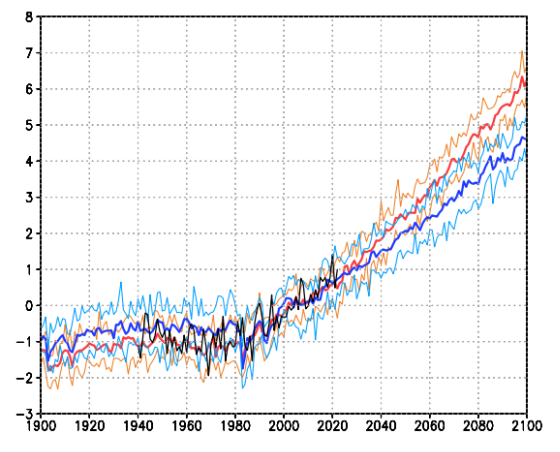
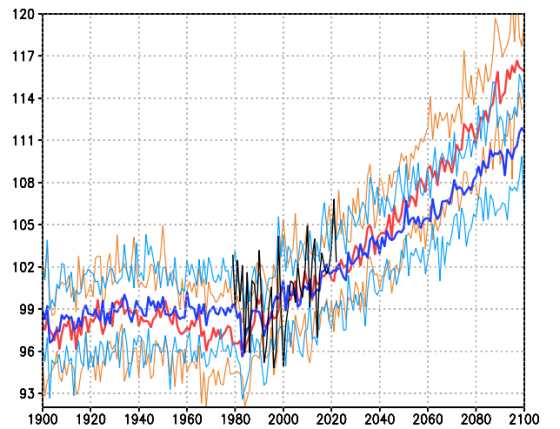
Fig. 1 Annual near surface air temperature change in Northern Eurasia with respect to 1995–2014 for INMCM6 (red), INMCM5 (blue) and ERA5 reanalysis (Hersbach et al, 2020)(black), K. Orange and lightblue lines show ensemble spread.

Despite different ECS, both model versions show (Fig. 1) approximately the same warming over Northern Eurasia by 2010–2015, similar to observations. However, projections of Northern Eurasia temperature after year 2040 differ. By 2100, the difference in 2-m air temperature anomalies between two model versions reaches around 1.5 K. The greater value around 6.0 K is achieved by a model with higher sensitivity. This is consistent with Huusko et al (2021); Grose et al (2018); Forster et al (2013), which confirmed that future projections show a stronger relationship than historical ones between warming and climate sensitivity. In contrast to feedback strength, which is more important in forecasting future temperature change, historical warming is more associated with model forcing. Both INMCM5 and INMCM6 show distinct seasonal warming patterns. Poleward of about 55N the seasonal warming is more pronounced in winter than in summer (Fig. 2). That means the smaller amplitude of the seasonal temperature cycle in 1991– 2020 compared to 1961–1990. The same result was shown in Dwyer et al (2012) and Donohoe and Battisti (2013). The opposite situation is observed during the hemispheric summer, where stronger warming is observed over the Mediterranean region (Seager et al, 2014; Kr¨oner et al, 2017; Brogli et al, 2019), subtropics and midlatitudinal regions of the Pacific Ocean, leading to an amplification of the seasonal cycle. The spatial patterns of projected warming in winter and summer in model historical experiments for 1991-2020 relative to 1961-1990 are in a good agreement with ERA5 reanalysis data, although for ERA5 the absolute values of difference are greater.

East Atlantic/West Russia (EAWR) Index

The East Atlantic/West Russia (EAWR) pattern is one of the most prominent large-scale modes of climate variability, with centers of action on the Caspian Sea, North Sea, and northeast China. The EOF-analysis identifies the EAWR pattern as the tripole with different signs of pressure (or 500 hPa geopotential height) anomalies encompassing the aforementioned region.

In this study, East Atlantic/ West Russia (EAWR) index was calculated as the projection coefficient of monthly 500 hPa geopotential height anomalies to the second EOF of monthly reanalysis 500 hPa geopotential height anomalies over the region 20N–80N, 60W–140E.

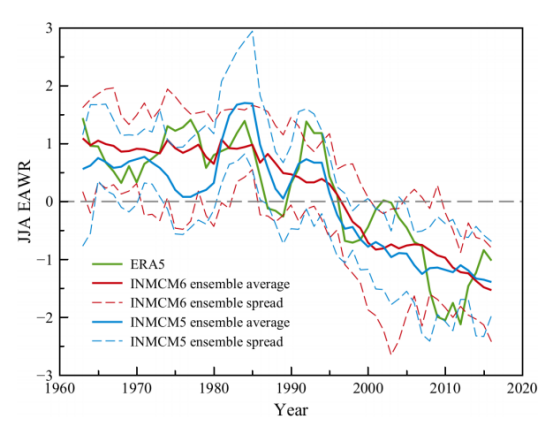
Fig. 5 Time series of June-July-August 5-year mean East Atlantic/ West Russia (EAWR) index. Maximum and minimum of the model ensemble are shown as a dashed lines. INMCM6 and INMCM5 ensemble averaged indices are plotted as a red and blue solid lines, respectively.  The ERA5 (Hersbach et al, 2020) EAWR index is shown in green.

[Note: High EAWR index indicates low pressure and cooler over Western Russia, high pressure and warmer over Europe. Low EAWR index is the opposite–high pressure and warming over Western Russia, low pressure and cooling over Europe.]

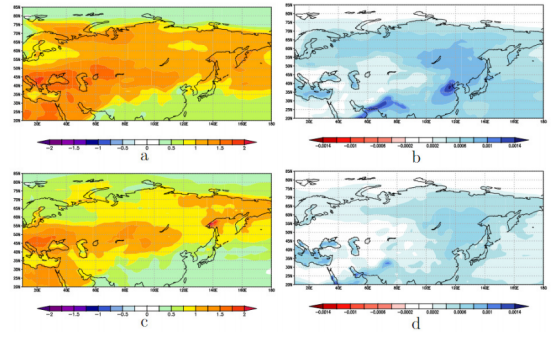
East Atlantic/ West Russia (EAWR) index Time series of EAWR index can be seen in Fig. 5. Since the middle of 1990s the sign of EAWR index has changed from positive to negative according to reanalysis data. Both versions of the INMCM reproduce the change in the sign of EAWR index. Therefore, the corresponding climate change in the Mediterranean and West Russia regions should be expected. Actually, the difference in annual mean near-surface temperature and specific humidity between 2001–2020 and 1961–1990 shows warmer and wetter conditions spreading from the Eastern Mediterranean to European Russia both for INMCM6 and INMCM5 with the largest difference being observed for the new version of model.

Fig. 6 Annual mean near surface temperature, K (left) and specific humidity, kg/kg (right) in 2001– 2020 with respect to 1961–1990 for INMCM6 (a,b) and INMCM5 (c,d).

Fig. 7 Annual precipitation change (% with respect to 1995–2014) in Northern Eurasia for INMCM6 (red), INMCM5 (blue) and GPCP analysis (Adler et al, 2018) (black). Orange and lightblue lines show ensemble spread.

Discussion and conclusions

Climate changes during the last several decades and possible climate changes until 2100 over Northern Eurasia simulated with climate models INMCM5 and INMCM6 are considered. Two model versions differ in parametrisations of cloudiness, aerosol scheme, land snow cover and atmospheric boundary layer, isopycnal diffusion discretisation and dissipation scheme of the horizontal components of velocity. These modifications in atmosphere and ocean blocks of the model have led to increase of ECS to 3.7 K and TCR to 2.2 K, mainly due to modification of cloudiness parameterisation.

Comparison of model data with available observations and reanalysis show that both models simulate observed recent temperature and precipitation changes consistently with observational datasets. The decrement of seasonal temperature cycle amplitude poleward of about 55N and its increase over the Mediterranean region, subtropics, and mid-latitudinal Pacific Ocean regions are two distinct seasonal warming patterns that are displayed by both INMCM5 and INMCM6. In the long-term perspective, the amplification of difference in projected warming during June-JulyAugust (JJA) and December-January-February (DJF) increases. Both versions of the INMCM reproduce the observed change in the sign of EAWR index from positive to negative in the middle of 1990s, that allows to expect correct reproduction of the corresponding climate change in the Mediterranean and West Russia regions.

Specifically, the enhanced precipitation in the North Eurasian region since the mid-1990s has led to increased specific humidity over the Eastern Mediterranean and European Russia, which is simulated by the INMCM5 and INMCM6 models. Both versions of model correctly reproduce the precipitation change and continue its increasing trend onwards.

Both model versions simulate similar temperature, precipitation, Arctic sea ice extent in 1990–2040 in spite of INMCM5 having much smaller ECS and TCR than INMCM6. However, INMCM5 and INMCM6 show differences in the long-term perspective reproduction of climate changes. After 2040, model INMCM6 simulated stronger warming, stronger precipitation change, stronger Arctic sea ice and land snow extent decrease than INMCM5.

My Comment

So both versions of the model replicate well the observed history.  And when fed the SSP3-7.0 inputs, both project a warmer, wetter world out to 2100; INMCM5 reaches 4.5C and INMCM6 gets to 6.0C.  The scenario achieves the desired high warming, and the cloud enhancements in version 6 amplify it.  I would like to see a similar experiment done with the actual medium scenario SSP2-4.5.

The Original Sin of GHG Theory

In reality, Water only spontaneously flows down a
pressure gradient (downhill).
Energy only spontaneously flows
down an energy density gradient (from high to low).

In the domain of theology, original sin refers to Adam and Eve choosing to trust the serpent’s lies rather than natural truth placed by God in the Garden of Eden.  In legal proceedings, a similar concept concerns evidence obtained under false pretences.  “The fruit of a poisonous tree” refers to analyses, interpretations or conclusions that must be excluded because they started with a falsehood.

This post delves into a fraud at the root of consensus Climate Science™, illustrated by the image above showing how both water and energy flow down their respective gradients.  William Happer alluded to the problem in a recent presentation: (See Happer: Cloud Radiation Matters, CO2 Not So Much)

As we shall see below, mischief is a very polite term for a math and science error that has poisoned most all thinking and discussion about changes in climate and weather.  In a previous post, I summarized an important empirical experiment by Thomas Allmendinger proving that a parcel of pure CO2 and a parcel of ordinary air warm exactly the same when exposed to both SW and LW radiation.  (See Experimental Proof Nil Warming from GHGs).

So we know the notion is empirically wrong, now let’s discuss how GHG theory went off the rails from the beginning.  For that I provide below a synopsis of commentary by blogger Morpheus which he posted at Tallbloke’s Talkshop.  Excerpts in italics with my bolds and added images. (Title in red is link to blog)

CAGW (Catastrophic Anthropogenic Global Warming, due to CO2)
is nothing more than a complex mathematical scam.

The takeaways:

1) The climatologists have conflated their purported “greenhouse effect” with the Kelvin-Helmholtz Gravitational Auto-Compression Effect (aka the lapse rate).

2) The climatologists purport the causative agent for their purported “greenhouse effect” to be “backradiation”.

3) The Kelvin-Helmholtz Gravitational Auto-Compression Effect’s causative agent is, of course, gravity.

4) “Backradiation” is physically impossible because energy cannot spontaneously flow up an energy density gradient.

5) The climatologists misuse the Stefan-Boltzmann (S-B) equation, using the idealized blackbody form of the equation upon graybody objects, which manufactures out of thin air their purported “backradiation”. It is only a mathematical artifact due to that aforementioned misuse of the S-B equation. It does not and cannot actually exist. Its existence would imply rampant violations of the fundamental physical laws.

6) Polyatomic molecules are net atmospheric radiative coolants, not “global warming” gases. Far from the ‘global warming gas’ claimed by the climatologists, water acts as a literal refrigerant (in the strict ‘refrigeration cycle’ sense) below the tropopause. CO2 is the most prevalent atmospheric radiative coolant above the tropopause and the second-most prevalent (behind water vapor) below the tropopause. Peer reviewed studies corroborating this are referenced in the paper at the end of this post.

As you can see, there are two forms of the Stefan-Boltzmann (S-B) equation… one for idealized blackbody objects, one for graybody objects.

The idealized blackbody form of the S-B equation assumes emission to 0 K and ε = 1 by the very definition of idealized blackbody objects. ( ε is the term for emissivity from 0 to 1).

Idealized Blackbody Object (assumes emission to 0 K and ε = 1 by definition):
q_bb = ε σ (T_h^4 – T_c^4) A_h
1 σ (T_h^4 – 0 K) 1 m^2
=    σ  T^4

The graybody form of the S-B equation assumes emission to > 0 K and ε < 1.

Graybody Object (assumes emission to > 0 K and ε < 1):
q_gb = ε σ (T_h^4 – T_c^4) A_h

The ‘A_h’ term is merely a multiplier, used if one is calculating for an area larger than unity [for instance: >1 m^2], which converts the result from radiant exitance (W m-2, radiant flux per unit area) to radiant flux (W).

One can see from the immediately-above equation that the Stefan-Boltzmann (S-B) equation is all about subtracting the radiation energy density of the cooler object from the radiation energy density of the warmer object.

So radiant exitance at its most simplified (and thus the S-B equation at its most simplified) is just the emissivity of the warmer object (because emissivity only applies to objects which are emitting, and only the warmer object will be emitting… the colder object will be unable to emit in the direction of the warmer object because energy cannot spontaneously flow up an energy density gradient) multiplied by the speed of light in vacua, multiplied by the energy density differential, all divided by 4.

For graybody objects, it is the radiation energy density differential between warmer object and cooler object which determines warmer object radiant exitance. Warmer objects don’t absorb radiation from cooler objects (a violation of 2LoT in the Clausius Statement sense and Stefan’s Law); the lower radiation energy density gradient between warmer and cooler objects (as compared to between warmer object and 0 K) lowers radiant exitance of the warmer object (as compared to its radiant exitance if it were emitting to 0 K). The radiation energy density differential between objects manifests a radiation energy density gradient, each surface’s radiation energy density manifesting a proportional radiation pressure.

The climatologists use:   q = σ T^4on graybody objects, and sometimes slap ε<1 onto that,
when they should be using:  q = ε σ (T_h^4 – T_c^4)

This has the effect of artificially inflating radiant exitance of all calculated-upon objects.

Essentially, the climatologists are treating real-world graybody objects as though they are idealized blackbody objects… with emission to 0 K and emissivity of 1 (sometimes… other times they slap emissivity onto the idealized blackbody form of the S-B equation while still assuming emission to 0 K… which is still a misuse of the S-B equation, for graybody objects).

This essentially isolates each object into its own system so it cannot interact with other objects via the ambient EM field, which grossly inflates radiant exitance of all objects, necessitating that the climatologists carry these incorrect values through their calculation and cancel them on the back end (to get their equation to balance) by subtracting a wholly-fictive ‘cooler to warmer’ energy flow from the real (but far too high because it was calculated for emission to 0 K) ‘warmer to cooler’ energy flow.

That wholly-fictive ‘cooler to warmer’ energy flow is otherwise known as ‘backradiation’... it is nothing more than a mathematical artifact due to that aforementioned misuse of the S-B equation.

As I show here and in the below-linked paper, the correct usage of the S-B equation for graybody objects is via subtracting cooler object energy density from warmer object energy density to arrive at the energy density gradient, which determines radiant exitance of the warmer object.

So we’re talking about the same concept as water only spontaneously flowing down a pressure gradient (ie: downhill) when we talk of energy (of any form) only spontaneously flowing down an energy density gradient. Energy density is pressure, an energy density gradient is a pressure gradient… for energy.

It’s a bit more complicated for gases because they can convert that energy density to a change in volume (1 J m-3 = 1 Pa), for constant-pressure processes, which means the unconstrained volume of a gas will change such that its energy density (in J m-3) will tend toward being equal to pressure (in Pa). This is the underlying mechanism for convection. It should also have clued the climatologists in to the fact that it is solar insolation and atmospheric pressure which ‘sets’ temperature, not any ‘global warming’ gases.

Since a warmer object will have higher radiation energy density at all wavelengths than a cooler object (because remember, temperature is a measure of radiation energy density, equal to the fourth root of radiation energy density divided by Stefan’s Constant):

… ‘backradiation’ can do nothing to warm the surface because energy cannot spontaneously radiatively flow from lower to higher radiation energy density, and thus CAGW is nothing more than a complex mathematical scam perpetrated to obtain multiple billions of dollars in funding for trough-grubbing line-toeing ‘scientists’ and by perfidious politicians.

“But how does that make CAGW a scam?”, some may ask… well, because we’re being lied to, based upon an unscientific premise.

The climatologists have misused the Stefan-Boltzmann (S-B) equation (and the fundamental physical laws), and in the process, have practically flipped reality on its headpolyatomics (CO2, H2O, etc.) are not “global warming gases”, they are net atmospheric radiative coolants (radiative emission to space being the only way that Earth can shed energy); monoatomics (Ar) are not inert gases that have no effect upon climate, they are the actual “greenhouse gases” (because they cannot emit IR, and thus cannot shed energy to space… they dilute the radiative coolant gases); homonuclear diatomics (N2, O2) are somewhere in between… they can radiatively emit IR (and thus shed energy from the system known as ‘Earth’), but only under certain conditions (collisional perturbation of their net-zero electric dipole, which is why homonuclear diatomic vibrational mode quantum states are meta-stable and relatively long-lived. Collisions happen exponentially less frequently as altitude increases), and thus are “greenhouse gases” like the monoatomics, just not to the same extent.

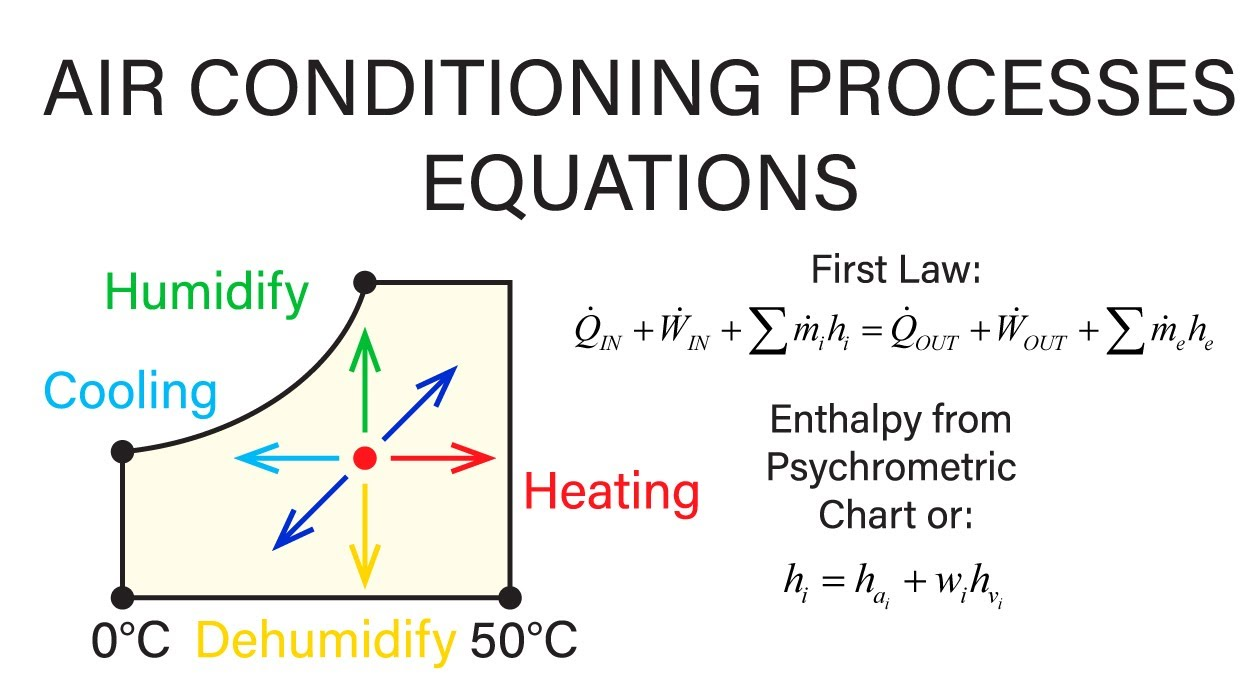
We live, at the planet’s surface, in what can be analogized to the evaporator section of a world-sized AC unit, with polyatomics being net atmospheric radiative coolants (a higher concentration of them increases thermodynamic coupling between heat source (surface) and sink (space)), and with monoatomics and homonuclear diatomics playing the same role as non-condensable gases would play in an AC unit… diluting the polyatomic radiative gases which transit the majority of the energy, thus reducing the efficiency at which energy is transited from surface to upper atmosphere, then radiatively emitted to space.

Think about it this way… we all know the air warms up during the daytime as the planet’s surface absorbs energy from the sun. Conduction of that energy when air contacts the planet’s surface is the major reason air warms up.

How does that ~99% of the atmosphere (N2, O2, Ar) cool down? It cannot effectively radiatively emit.

Convection moves energy around in the atmosphere, but it cannot shed energy to space. Conduction depends upon thermal contact with other matter and since space is essentially a vacuum, conduction cannot shed energy to space… this leaves only radiative emission. The only way our planet can shed energy is via radiative emission to space. Fully ~76.2% of all surface energy is removed via convection, advection and evaporation. The surface only radiatively emits ~23.8% of all surface energy to space. That ~76.2% must be emitted to space by the atmosphere.

ERBE Earth Radiation Budget Experiment

Thus, common sense dictates that the thermal energy of the constituents of the atmosphere which cannot effectively radiatively emit (N2, O2, Ar) must be transferred to the so-called ‘greenhouse gases’ (CO2 being a lesser contributor below the tropopause and the largest contributor above the tropopause, water vapor being the main contributor below the tropopause) which can radiatively emit and thus shed that energy to space. Peer-reviewed studies corroborating this are referenced in the linked file below.

So, far from being ‘greenhouse gases’ which ‘trap heat’ in the atmosphere, those polyatomic radiative gases actually shed energy from the atmosphere to space. They are net atmospheric radiative coolants.

In short, in an atmosphere sufficiently dense such that collisional energy transfer can significantly occur, all polyatomic radiative molecules play the part of atmospheric radiative coolants at and above the temperature at which the combined translational mode energy of two colliding particles (atoms or molecules) exceeds the lowest excited vibrational mode quantum state energy of the radiative molecule. Below this temperature, they act to warm the atmosphere via thermalization (the mechanism the climate alarmists claim happens all the time), but if that occurs below the tropopause, the net result is an increase of Convective Available Potential Energy, which increases convection, which is a net cooling process. It is a gradation… as temperature increases, so too does the population of vibrationally excited polyatomics, and thus increases radiative emission. For CO2, that ‘transition temperature’ (the temperature at which the molecule transitions from being ‘net warmant’ to ‘net coolant’ and vice versa) is ~288 K.

The climatologists only told people half the story (thermalization by CO2 via vibrational mode to translation mode (v-t) collisional energy transfer processes). They didn’t tell anyone about the inverse (translational mode to vibrational mode (t-v) collisional energy transfer processes, (then that energy being radiatively emitted to space)), which is a cooling process. That didn’t fit their doomsaying narrative, so they left it out.

In other words, the climatologists only told people about the warming part (thermalization), not the cooling part. In order to hew to the fundamental physical laws, one must consider energy flow both to and from the CO2 molecule.

This doesn’t just apply to CO2, however. It applies to all atmospheric polyatomic molecules. In fact, far from the ‘global warming gas’ claimed by the climatologists, water acts as a literal refrigerant (in the strict ‘refrigeration cycle’ sense) below the tropopause:

That’s why, after all, the humid adiabatic lapse rate (~3.5 to ~6.5 K km-1) is lower than the dry adiabatic lapse rate (~9.81 K km-1).

You will note that the dry adiabatic lapse rate is due to the monoatomics and homonuclear diatomics... we’ve removed in this case the predominant polyatomic which reduces lapse rate.

Remember that an actual greenhouse works by hindering convection of energy out of the greenhouse.

In an atmosphere consisting of solely monoatomics and homonuclear diatomics (ie: no polyatomic radiative molecules), the atoms / molecules could pick up energy via conduction by contacting the surface, just as the polyatomics do; they could convect just as the polyatomics do… but once in the upper atmosphere, they could not as effectively radiatively emit that energy, the upper atmosphere would warm, lending less buoyancy to convecting air, thus hindering convection… and that’s how an actual greenhouse works, by hindering convection.

For homonuclear diatomics, there would be some collisional perturbation of their net-zero electric dipole and thus some emission in the atmosphere, but by and large the atmosphere could not effectively emit (especially at higher altitudes, because the probability of collision decreases exponentially with altitude).

Thus the surface would have to radiatively emit that energy (which is currently ~76.2% of all energy removed from the surface via radiation, convection and evaporation) instead… and a higher surface radiant exitance implies a higher surface temperature.

On the contrary, in our actual atmosphere, as temperature increases, (t-v) (translational mode -to- vibrational mode) collisional energy transfer processes increase and thus spectral emission increases only because CO2 is a net atmospheric radiative coolant (transferring translational mode energy to vibrational mode energy, then radiatively emitting it). So they are attempting to claim that CO2 is a “global warming gas” and simultaneously a net atmospheric radiative coolant, a contradiction… which is why their claims make no sense upon close examination.

In fact, removing CO2 would increase upper atmosphere temperature (due to fewer emitters in the upper atmosphere), which would set the starting point of the lapse rate higher, which translates down through the lapse rate to a warmer surface. That doesn’t occur with Ar, because it is a monoatomic, has no vibrational mode quantum states and thus cannot emit (nor absorb) IR in any case, and thus it only dilutes the radiative polyatomics, reducing the efficiency by which energy is transited from surface to space.

Because we don’t live in a ‘greenhouse’ as the climatologists claim… we live in what can be analogized to a world-sized AC unit… the surface is akin to the AC unit’s evaporator section (ie: the heat source); the atmosphere is akin to the AC unit’s working fluid; space is akin to the AC unit’s condenser section (ie: the heat sink); convection is akin to the AC unit’s compressor (ie: the motive force to move the working fluid).

These concepts used to be common knowledge. Somewhere along the way, the concepts got skewed to fit a particular narrative. Eventually, the concepts described herein will be common knowledge again, whereupon CAGW and its offshoots will be dumped on the midden heap of bad scientific ideas.


Happer: Cloud Radiation Matters, CO2 Not So Much

Earlier this month William Happer spoke on Radiation Transfer in Clouds at the EIKE conference, and the video is above.  For those preferring to read, below is a transcript from the closed captions along with some key exhibits.  I left out the most technical section in the latter part of the presentation. Text in italics with my bolds.

William Happer: Radiation Transfer in Clouds

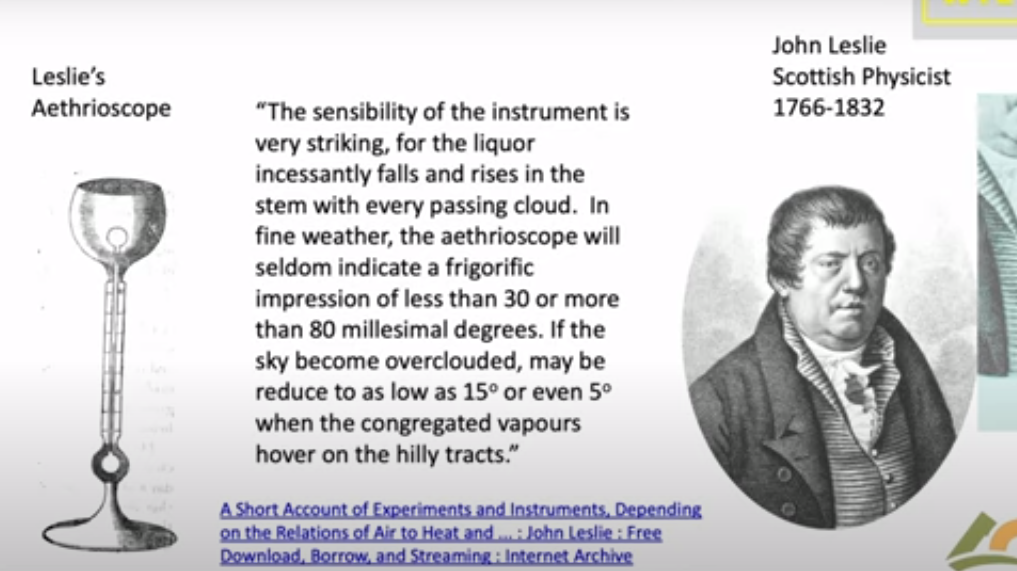
People have been looking at Clouds for a very long time in in a quantitive way. This is one of the first quantitative studies done about 1800. And this is John Leslie,  a Scottish physicist who built this gadget. He called it an Aethrioscope, but basically it was designed to figure out how effective the sky was in causing Frost. If you live in Scotland you worry about Frost. So it consisted of two glass bulbs with a very thin capillary attachment between them. And there was a little column of alcohol here.

The bulbs were full of air, and so if one bulb got a little bit warmer it would force the alcohol up through the capillary. If this one got colder it would suck the alcohol up. So he set this device out under the clear sky. And he described that the sensibility of the instrument is very striking. For the liquor incessantly falls and rises in the stem with every passing cloud. in fine weather the aethrioscope will seldom indicate a frigorific impression of less than 30 or more than 80 millesimal degrees. He’s talking about how high this column of alcohol would go up and down if the sky became overclouded. it may be reduced to as low as 15 refers to how much the sky cools or even five degrees when the congregated vapours hover over the hilly tracks. We don’t speak English that way anymore but I I love it.

The point was that even in 1800 Leslie and his colleagues knew very well that clouds have an enormous effect on the cooling of the earth. And of course anyone who has a garden knows that if you have a clear calm night you’re likely to get Frost and lose your crops. So this was a quantitative study of that.

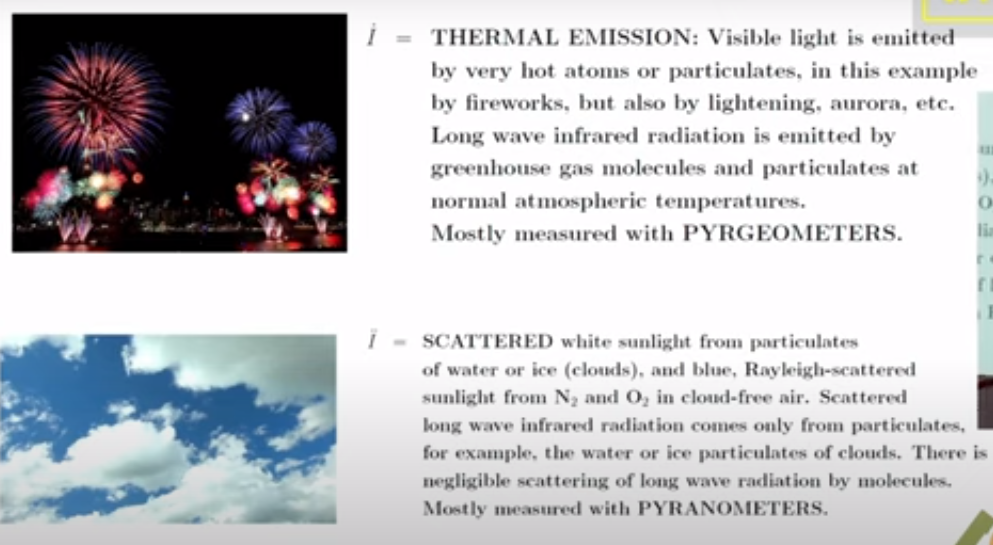
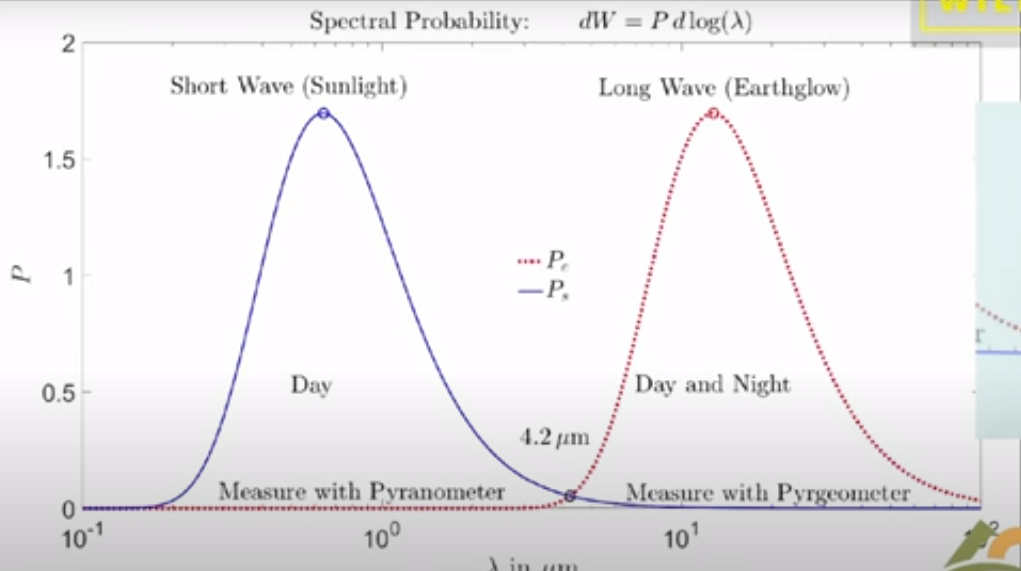
Now it’s important to remember that if you go out today the atmosphere is full of two types of radiation. There’s sunlight which you can see and then there is the thermal radiation that’s generated by greenhouse gases, by clouds and by the surface of the Earth. You can’t see thermal radiation but you you can feel it if it’s intense enough by its warming effect. And these curves practically don’t overlap so we’re really dealing with two completely different types of radiation.

There’s sunlight which scatters very nicely and off of not only clouds but molecules; it’s the blue sky the Rayleigh scattering. Then there’s the thermal radiation which actually doesn’t scatter at all on molecules so greenhouse gases are very good at absorbing thermal radiation but they don’t scatter it. But clouds scatter thermal radiation and plotted here is the probability that you will find Photon of sunlight between you know log of its wavelength and the log of in this interval of the wavelength scale.

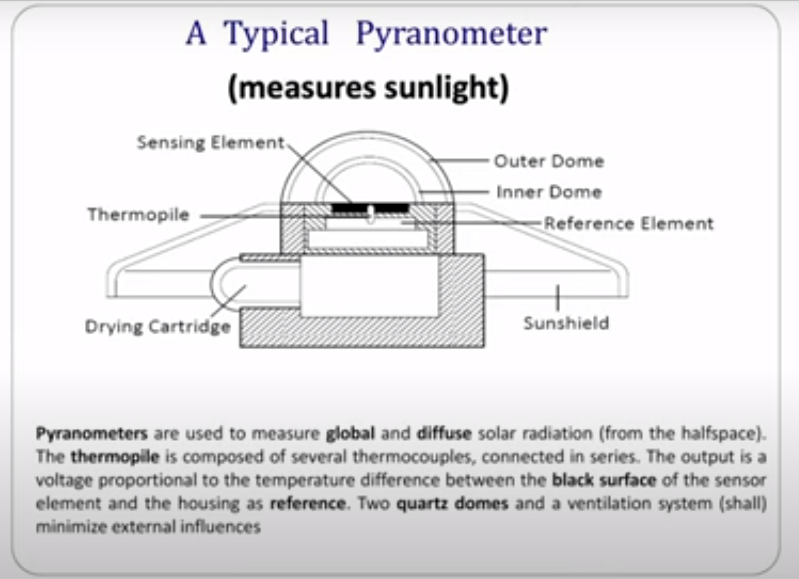
Since Leslie’s day two types of instruments have been developed to do what he did more precisely. One of them is called a pyranometer and this is designed to measure sunlight coming down onto the Earth on a day like this. So you put this instrument out there and it would read the flux of sunlight coming down. It’s designed to see sunlight coming in every direction so it doesn’t matter which angle the sun is shining; it’s uh calibrated to see them all.

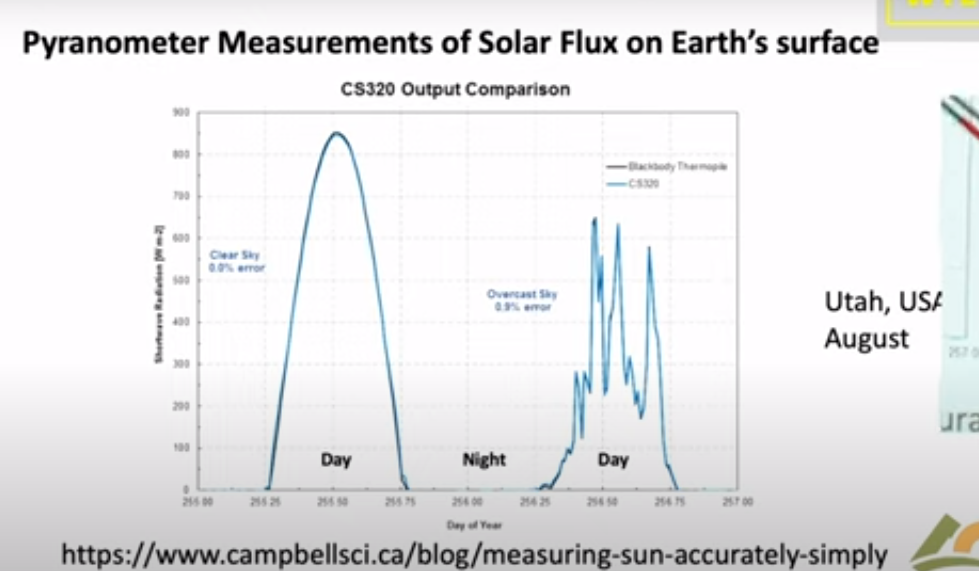
Let me show you a measurement by a pyranometer. This is a actually a curve from a sales brochure of a company that will sell you one of these devices. It’s comparing two types of detectors and as you can see they’re very good you can hardly tell the difference. The point is that if you look on a clear day with no clouds you see sunlight beginning to increase at dawn it peaks at noon and it goes down to zero and there’s no sunlight at night. So half of the day over most of the Earth there’s no sunlight in the in the atmosphere.

Here’s a day with clouds, it’s just a few days later shown by days of the year going across. You can see every time a cloud goes by the intensity hitting the ground goes down. With a little clear sky it goes up, then down up and so on. On average at this particular day you get a lot less sunlight than you did on the clear day.

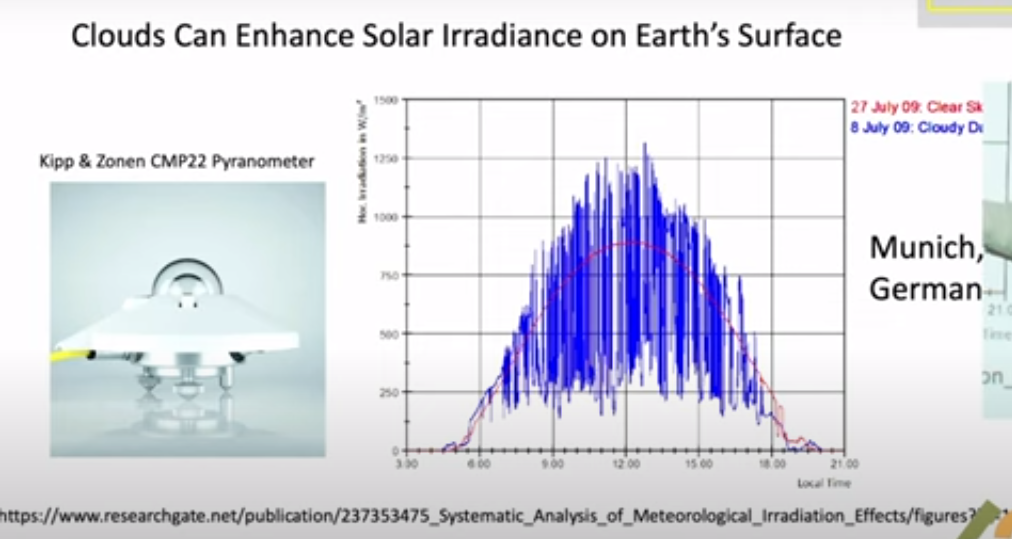
But you know nature is surprising. Einstein had this wonderful quote: God is subtle but he’s not malicious. He meant that nature does all of sorts of things you don’t expect, and so let me show you what happens on a partly cloudy day. Here so this is data taken near Munich. The blue curve is the measurement and the red curve is is the intensity on the ground if there were no clouds. This is a partly cloudy day and you can see there are brief periods when the sunlight is much brighter on the detector on a cloudy day than it is on the clear day. And that’s because coming through clouds you get focusing from the edges of the cloud pointing down toward your detector. That means somewhere else there’s less radiation reaching the ground. But this is rather surprising to most people. I was very surprised to learn about it but it just shows that the actual details of climate are a lot more subtle than you might think.

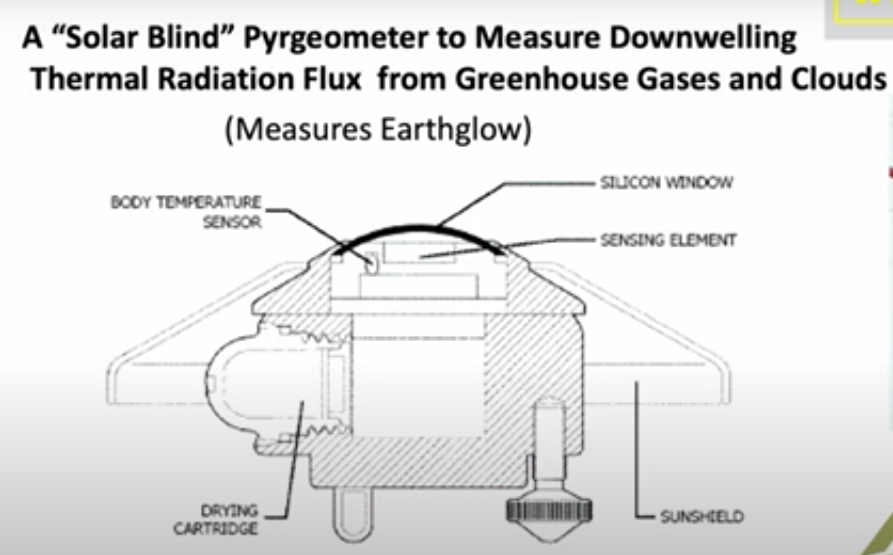
We knnow that visible light only happens during the daytime and stops at night. There’s a second type of important radiation which is the thermal radiation which is measured by a similar divice. You have a silicon window that passes infrared, which is below the band gap of silicon, so it passes through it as though transparent. Then there’s some interference filters here to give you further discrimination against sunlight. So sunlight practically doesn’t go through this at all, so they call it solar solar blind since it doesn’t see the Sun.

But it sees thermal radiation very clearly with a big difference between this device and the sunlight sensing device I showed you. Because actually most of the time this is radiating up not down. Out in the open air this detector normally gets colder than the body of the instrument. And so it’s carefully calibrated for you to compare the balance of down coming radiation with the upcoming radiation. Upcoming is normally greater than downcoming.

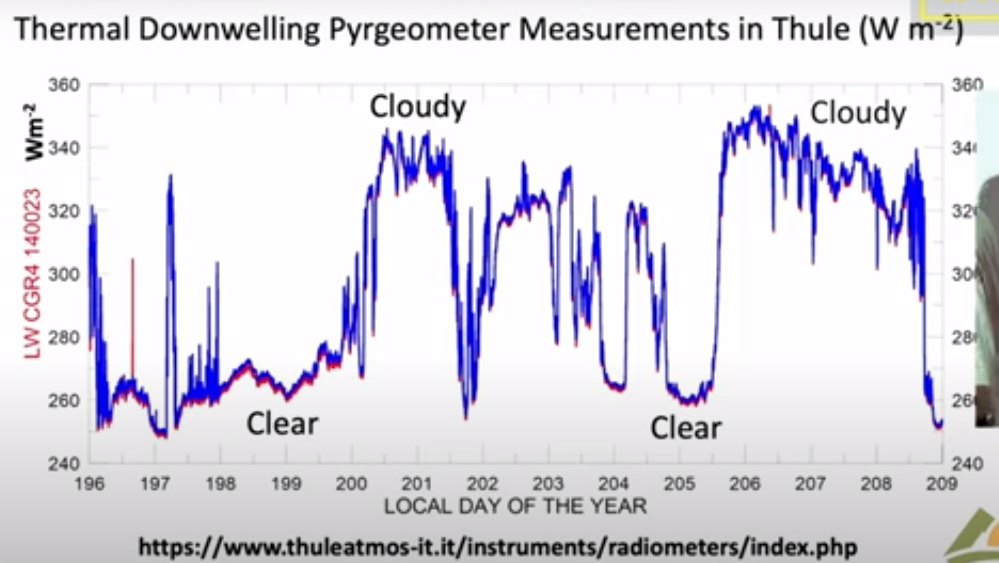
I’ll show you some measurements of the downwelling flux here; these are actually in Greenland in Thule and these are are watts per square meter on the vertical axis here. The first thing to notice is that the radiation continues day and night you can you if you look at the output of the pyrgeometer you can’t tell whether it’s day or night because the atmosphere is just as bright at night as it is during the day. However, the big difference is clouds: on a cloudy day you get a lot more downwelling radiation than you do on a clear day. Here’s a a near a full day of clear weather there’s another several days of clear weather. Then suddenly it gets cloudy. Radiation rises because the bottoms of the clouds are relatively warm at least compared to the clear sky. I think if you put the numbers In, this cloud bottom is around 5° Centigrade so it was fairly low Cloud. it was summertime in Greenland and this compares to about minus 5° for the clear sky.

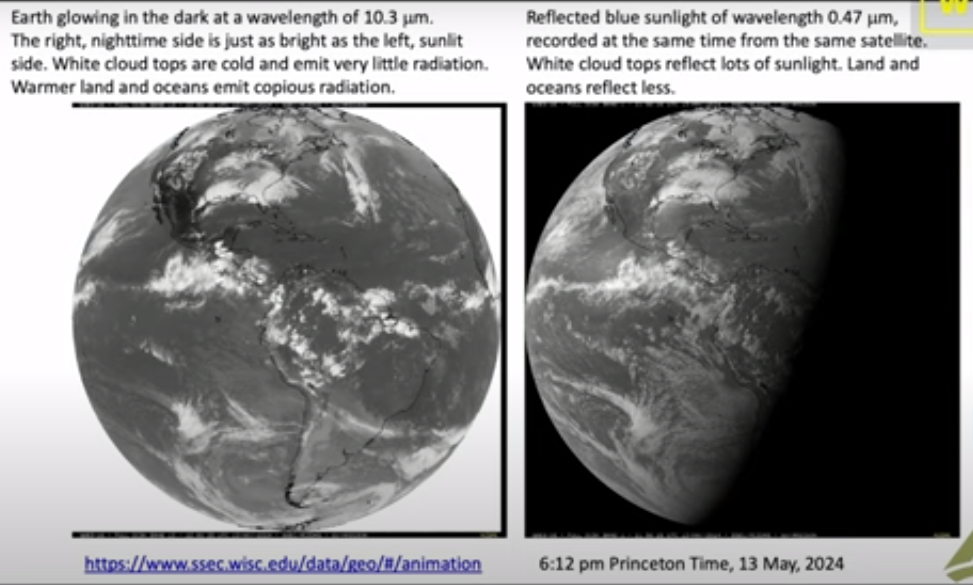
So there’s a lot of data out there and there really is downwelling radiation there no no question about that you measure it routinely. And now you can do the same thing looking down from satellites so this is a picture that I downloaded a few weeks ago to get ready for this talk from Princeton and it was from Princeton at 6 PM so it was already dark in Europe. So this is a picture of the Earth from a geosynchronous satellite that’s parked over Ecuador. You are looking down on the Western Hemisphere and this is a filtered image of the Earth in Blue Light at 47 micrometers. So it’s a nice blue color not so different from the sky and it’s dark where the sun has set. There’s still a fair amount of sunlight over the United States and the further west.

Here is exactly the same time and from the same satellite the infrared radiation coming up at 10.3 which is right in the middle of the infrared window where there’s not much Greenhouse gas absorption; there’s a little bit from water vapor but very little, trivial from CO2.

As you can see, you can’t tell which side is night and which side is day. So even though the sun has set over here it is still glowing nice and bright. There’s sort of a pesky difference here because what you’re looking at here is reflected sunlight over the intertropical Convergence Zone. There are lots of high clouds that have been pushed up by the convection in the tropics and uh so this means more visible light here. You’re looking at emission of the cloud top so this is less thermal light so white here means less light, white there means more light so you have to calibrate your thinking. to

But the Striking thing about all of this: if you can see the Earth is covered with clouds, you have to look hard to find a a clear spot of the earth. Roughly half of the earth maybe is clear at any given time but most of it’s covered with clouds. So if anything governs the climate it is clouds and and so that’s one of the reasons I admire so much the work that Svensmark and Nir Shaviv have done. Because they’re focusing on the most important mechanism of the earth: it’s not Greenhouse Gases, it’s Clouds. You can see that here.

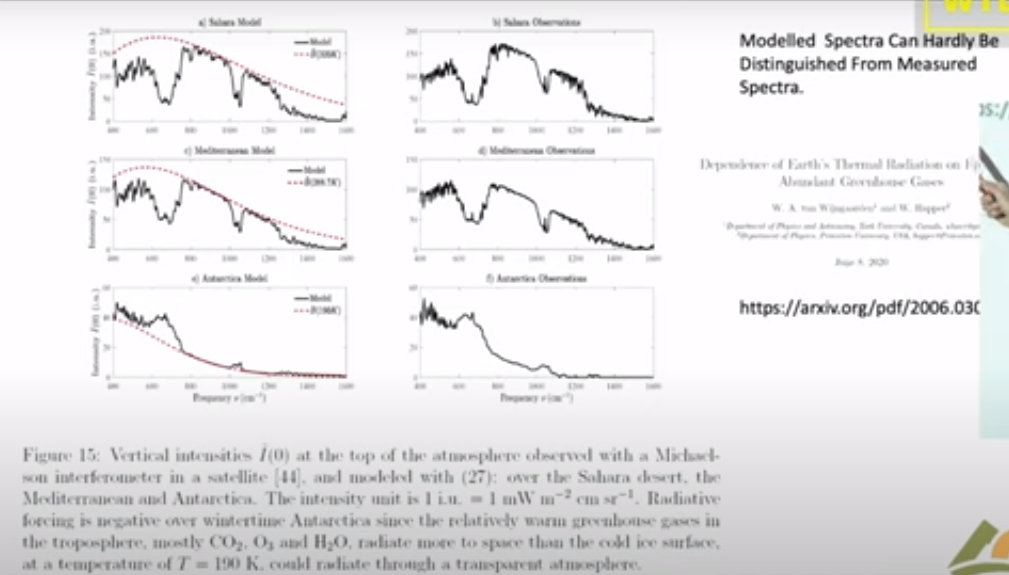
Now this is a single frequency let me show you what happens if you look down from a satellite and do look at the Spectrum. This is the spectrum of light coming up over the Sahara Desert measured from a satellite. And so here is the infrared window; there’s the 10.3 microns I mentioned in the previous slide it’s it’s a clear region. So radiation in this region can get up from the surface of the Sahara right up to outer space.

Notice that the units on these scales are very different; over the Sahara the top unit is 200, 150 over the Mediterranean and it’s only 60 over the South Pole. But at least the Mediterranean and the Sahara are roughly similar so the right side here these three curves on the right are observations from satellites and the three curves on the left are are calculations modeling that we’ve done. The point here is that you can hardly tell the difference between a model calculation and observed radiation.

So it’s really straightforward to calculate radiation transfer. If someone quotes you a number in watts per square centimeter you should take it seriously; that probably a good number. If they tell you a temperature you don’t know what to make about it. Because there’s a big step between going from watts per square centimeter to a temperature change. All the mischief in the whole climate business is going from watts per square centimeter to to Centigrade or Kelvin.

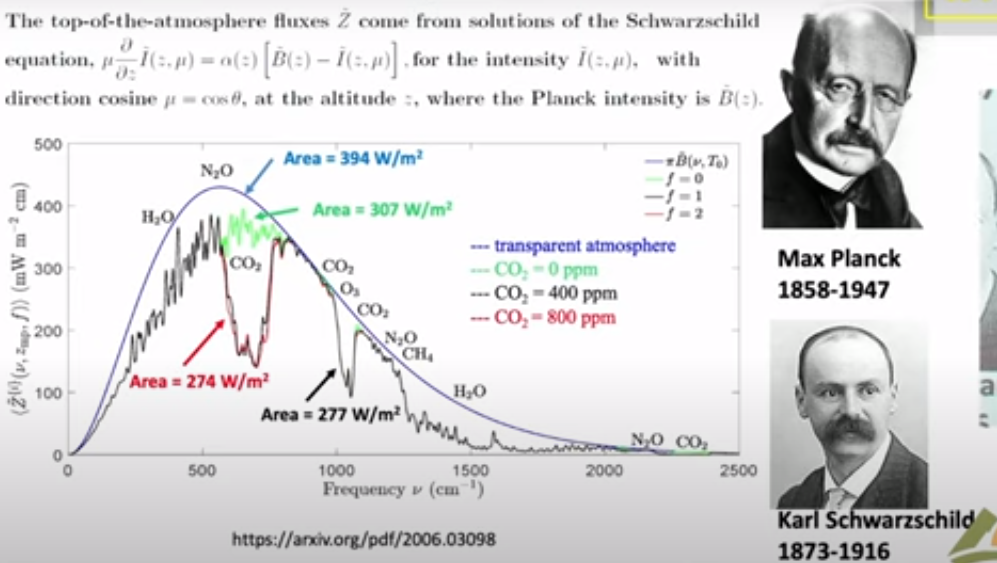
Now I will say just a few words about clear sky because that is the simplest. Then we’ll get on to clouds, the topic of this talk. This is a calculation with the same codes that I showed you in the previous slide which as you saw work very well. It’s worth spending a little time because this is the famous Planck curve that was the birth of quantum mechanics. There is Max Planck who figured out what the formula for that curve is and why it is that way. This is what the Earth would radiate at 15° Centigrade if there were no greenhouse gases. You would get this beautiful smooth curve the Planck curve. If you actually look at the Earth from the satellites you get a raggedy jaggedy black curve. We like to call that the Schwarzchild curve because Carl Schwarzchild was the person who showed how to do that calculation. Tragically he died during World War I, a Big Big loss to science.

There are two colored curves that I want to draw your attention. The green curve is is what Earth would radiate to space if you took away all the CO2 so it only differs from the black curve you know in the CO2 band here this is the bending band of CO2 which is the main greenhouse effect of CO2. There’s a little additional effect here which is the asymmetric stretch but it it doesn’t contribute very much. Then here is a red curve and that’s what happens if you double CO2.

So notice the huge asymmetry. If taking all 400 parts per million of CO2 away from the atmosphere causes this enormous change 30 watts per square meter, the difference between this green 307 and and the black 277, that’s 30 watts per square meter. But if you double CO2 you practically don’t make any change. This is the famous saturation of CO2. At the levels we have now doubling CO2, a 100% Increase of CO2 only changes the radiation to space by 3 watts per square meter. The difference between 274 for the red curve and 277 for the curve for today. So it’s a tiny amount: for 100% increase in CO2 a 1% decrease of radiation to space.

That allows you to estimate the feedback-free climate sensitivity in your head. I’ll talk you through the feedback-free climate free sensitivity. So doubling CO2 is a 1% decrease of radiation to space. If that happens then the Earth will start to warm up. But it will radiate as the fourth power of the temperature. So temperature starts to rise but if you’ve got a fourth power, the temperature only has to rise by one-quarter of a percent absolute temperature. So a 1% forcing in watts per square centimeter is a one-quarter percent of temperature in Kelvin. Since the ambient Kelvin temperature is about 300 Kelvin (actually a little less) a quarter of that is 75 Kelvin. So the feedback free equilibrium climate sensitivity is less than 1 Degree. It’s 0.75 Centigrade. It’s a number you can do in your head.

So when you hear about 3 centigrade instead of .75 C that’s a factor of four, all of which is positive feedback. So how is there really that much positive feedback? Because most feedbacks in nature are negative. The famous Le Chatelier principle which says that if you perturb a system it reacts in a way to to dampen the perturbation not increase it. There are a few positive feedback systems that were’re familiar with for example High explosives have positive feedback. So if the earth’s climate were like other positive feedback systems, all of them are highly explosive, it would have exploded a long time ago. But the climate has never done that, so the empirical observational evidence from geology is that the climate is like any other feedback system it’s probably negative Okay so I leave that thought with you and and let me stress again:

This is clear skies no clouds; if you add clouds all this does is
suppress the effects of changes of the greenhouse gas.

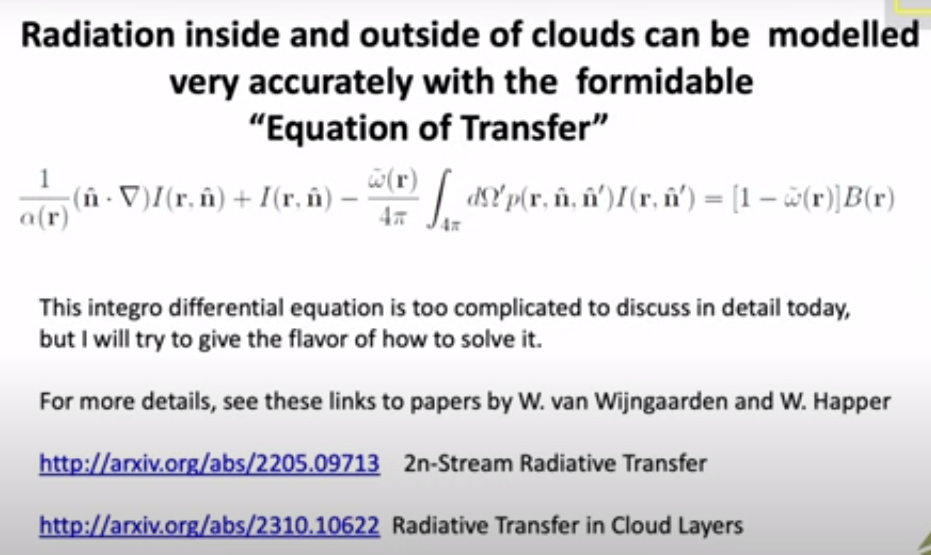
So now let’s talk about clouds and the theory of clouds, since we’ve already seen clouds are very important. Here is the formidable equation of transfer which has been around since Schwarzchild’s day. So some of the symbols here relate to the intensity, another represents scattering. If you have a thermal radiation on a greenhouse gas where it comes in and immediately is absorbed, there’s no scattering at all. If you hit a cloud particle it will scatter this way or that way, or some maybe even backwards.

So all of that’s described by this integral so you’ve got incoming light at One Direction and you’ve got outgoing light at a second Direction. And then at the same time you’ve got thermal radiation so the warm particles of the cloud are are emitting radiation creating photons which are coming out and and increasing the Earth glow the and this is represented by two parameters. Even a single cloud particle has an albedo, this is is the fraction of radiation that hits the cloud that is scattered as opposed to absorbed and being converted to heat. It’s a very important parameter for visible light and white clouds, typically 99% of the encounters are scattered. But for thermal radiation it’s much less. So water scatters thermal radiation only half as efficiently as shorter wavelengths.

The big problem is that in spite of all the billions of dollars that we have spent, these things which should be known and and would have been known if there hadn’t been this crazy fixation on carbon dioxide and greenhouse gases. And so we’ve neglected working on these areas that are really important as opposed to the trivial effects of greenhouse gases. Attenuation in a cloud is both scattering and absorption. Of course you have to solve these equations for every different frequency of the light because especially for molecules, there’s a strong frequency dependence.

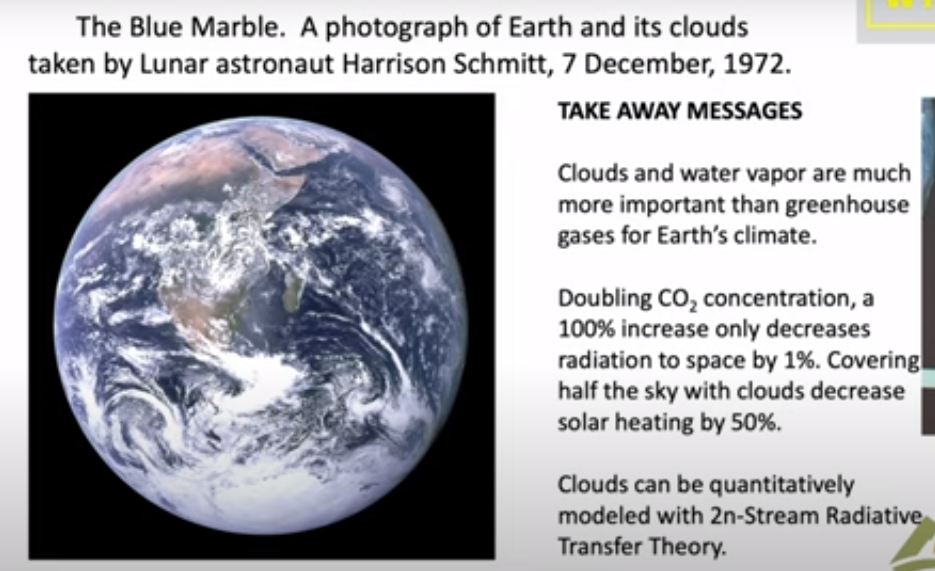
In summary,  let me show you this photo which was taken by Harrison Schmitt who was a friend of mine on one of the first moonshots. It was taken in December and looking at this you can see that they were south of Madagascar when the photograph was taken. You can see it was Winter because here the Intertropical Convergence Zone is quite a bit south of the Equator; it’s moved Way South of India and Saudi Arabia. By good luck they had the sun behind them so they had the whole earth Irradiated.

There’s a lot of information there and and again let me draw your attention to how much of the Earth is covered with clouds. So only very small parts of the Earth can actually be directly affected by greenhouse gases, of the order of half. The takeaway message is that clouds and water vapor are much more important than greenhouse gases for earth’s climate. The second point is the reason they’re much more important: doubling CO2 as I indicated in the middle of the talk only causes a 1% difference of radiation to space. It is a very tiny effect because of saturation. You know people like to say that’s not so, but you can’t really argue that one, even the IPCC gets the same numbers that we do.

And you also know that covering half of the sky with clouds will decrease solar heating by 50%. So for clouds it’s one to one, for greenhouse gases it’s a 100 to one. If you really want to affect the climate, you want to do something to the clouds. You will have a very hard time making any difference with Net Zero with CO2 if you are alarmed about the warmings that have happened.

So one would hope that with all the money that we’ve spent trying to turn CO2 into a demon that some good science has come out of it. Fom my point of view this is a small part of it, this scattering theory that I think will be here a long time after the craze over greenhouse gases has gone away. I hope there will be other things too. You can point to the better instrumentation that we’ve got, satellite instrumentation as well as ground instrumentation. So that’s been a good investment of money. But the money we’ve spent on supercomputers and modeling has been completely wasted in my view.


Redressing Antarctic Glacier Porn

With the potential to raise global sea levels, Antarctica’s Thwaites Glacier has been widely nicknamed the ‘Doomsday Glacier’

Climate alarmists are known to recycle memes to frighten the public into supporting their agenda. The climate news control desk calls the plays and the media fills the air and print with the scare du jour.

‘Doomsday glacier’ rapid melt could lead to higher sea level rise than thought: study
Vancouver Sun on MSN.com

Thwaites ‘Doomsday Glacier’ in Antarctica is melting much faster than predicted
USA Today

For the first time, there’s visual evidence warm sea water is pushing under doomsday glacier: Study
CBC.ca 

‘Doomsday Glacier’ Explained: Why Scientists Believe It Predicts Devastating Sea Levels—Which Might Happen Faster Than Thought
Forbes on MSN.com

Scientists worry so-called “Doomsday Glacier” is near collapse, satellite data reveals
Yahoo

The doomsday glacier is undergoing “vigorous ice melt” that could reshape sea level rise projections
CBS News on MSN.com

We’ve underestimated the ‘Doomsday’ glacier – and the consequences could be devastating
The Independent on MSN.com

Etc., Etc., Etc.,

This torrent of concern was on the front burner in 2022, rested for awhile, and now it’s back.  Below is what you need to know and not be bamboozled.

A Primer on Antarctic Ice Shelves Including Thwaites Glacier

William D. Balgord explains the glacier dynamics in his Townhall article Fracturing Thwaites Ice-Shelf–Just a Normal Function of Nature.  Excerpts in italics with my bolds and added images.

The West Antarctic ice sheet and its subsidiary Thwaites glacier overlie an active volcanic region of the Earth’s crust. Volcanoes are observed, from seismic observations, to be venting beneath the surface of the glacial ice. This fact is conveniently ignored by the authors.

Independent studies have implicated, not so much the impinging sea currents, but geothermal heat rising upward through the crust from the mantle below as the likely cause of the observed melting of the ice shelf and anticipated calving of another large block of ice. Once freed from grounding and afloat, it will be referred to as an “ice berg.”

But the process of melting at the terminus of a glacier, whether it be on land or at the edge of the ocean needs to be properly understood. Glacial ice flows (very slowly) down gradient under the influence of gravity (it behaves somewhat akin to a viscous fluid). In the instance of glaciers in Antarctica and Greenland, they continue their downhill courses until meeting the ocean where melting and calving of icebergs occur.

On arrival at the shoreline, the outward flow of ice, urged oceanward by additional glacial ice arriving behind it, forms an ice shelf often extending some distance out over the adjoining sea. The glacier behind continues to push outward until a portion of the shelf finally weakens and develops a crack. The crack deepens and a block of ice, if not securely grounded to land, breaks free and floats away as an iceberg. The ‘berg then melts in warmer water as it is carried along toward the Equator by ocean currents. One such iceberg, after breaking free from Greenland in the North Atlantic, brought down the Titanic in April 1912.

The mass of ice (water) lost by calving is continuously being made up
by sparse snowfall that falls across the broad expanse of
highlands in the interior of the continent.

In fact, if the polar climate were to warm somewhat, the relative humidity would increase, inducing a higher precipitation rate over the interior. During past warmer periods (speaking relatively for Antarctica) increased snowfall is documented from the ice-core samples taken at the interior Vostok station operated by Russian scientists.

The overwhelming portion of Antarctica’s landed ice is currently (and permanently) resident on the main continent that accounts for some 90% of all landed ice on the planet. Only the melting of landed ice would contribute to sea-level rise.

The Vostok corings also show that at no time during the past 600,000 years has Antarctica been ice free despite several prolonged interglacial periods when temperatures around the globe exceeded those experienced during the previous 10,000 years of the Holocene up to the present.

It is highly unlikely that any temperature rise that can be reasonably anticipated during the next century or two would be sufficient to cause significant melting of the main body of ice now covering Antarctica. The UN/IPCC climate models are shown to be not up to the task of making reliably accurate predictions and should be discounted.

Background Post: OMG! Doomsday Glacier Melting. Again.

Climate alarms often involve big numbers in far away places threatening you in your backyard.  Today’s example of such a scare comes from Daily Mail  Antarctica’s ‘Doomsday Glacier’ is melting at the fastest rate for 5,500 YEARS – and could raise global sea levels by up to 11 FEET, study warns.  Excerpts in italics with my bolds.

Although these vulnerable glaciers were relatively stable during the past few millennia, their current rate of retreat is accelerating and already raising global sea level,’ said Dr Dylan Rood of Imperial’s Department of Earth Science and Engineering, who co-authored the study.

The West Antarctic Ice Sheet (WAIS) is home to the Thwaites and Pine Island glaciers, and has been thinning over the past few decades amid rising global temperatures.  The Thwaites glacier currently measures 74,131 square miles (192,000 square kilometres) – around the same size as Great Britain.  Meanwhile, at 62,662 square miles (162,300 square kilometres), the Pine Island glacier is around the same size as Florida.  Together, the pair have the potential to cause enormous rises in global sea level as they melt.

‘These currently elevated rates of ice melting may signal that those vital arteries from the heart of the WAIS have been ruptured, leading to accelerating flow into the ocean that is potentially disastrous for future global sea level in a warming world,’ Dr Rood said.

‘We now urgently need to work out if it’s too late to stop the bleeding.’

On the Contrary

From Volcano Active Foundation:  West Antarctica hides almost a hundred volcanoes under the ice:

The colossal West Antarctic ice sheet hides what appears to be the largest volcanic region on the planet, according to the results of a study carried out by researchers at the University of Edinburgh (UK) and reported in the journal Geological Society.

Experts have discovered as many as 91 volcanoes under Antarctic ice, the largest of which is as high as Switzerland’s Eiger volcano, rising 3,970 meters above sea level.

“We found 180 peaks, but we discounted 50 because they didn’t match the other data,” explains Robert Bingham, co-author of the paper. They eventually found 138 peaks under the West Antarctic ice sheet, including 47 volcanoes already known because their peaks protrude through the ice, leaving the figure of 91 newly discovered.

Source: volcanofoundation with glacier locations added

The media narrative blames glacier changes on a “warming world,” code for our fault for burning fossil fuels.  And as usual, it is lying by omission.  Researcher chaam jamal explains in his article A Climate Science Obsession with the Thwaites Glacier.  Excerpts in italics with my bolds.

It appears that costly and sophisticated research by these very dedicated climate scientists has made the amazing discovery that maps the deep channels on the seafloor bathymetry by which warm water reaches the underside of the Thwaites glacier and thus explains how this Doomsday glacier melts.

Yet another consideration, not given much attention in this research, is the issue not of identifying the channels by which the deep ocean waters flow to the bottom of the Doomsday Glacier, but of identifying the source of the heat that makes the water warm. Only if that source of heat is anthropogenic global warming caused by fossil fuel emissions that can be moderated by taking climate action, can the observed melt at the bottom of the Thwaites glacier be attributed to AGW climate change.

However, no such finding is made in this research project possibly because these researchers know, as do most researchers who study Antarctica, that this region of Antarctica is extremely geologically active. It is located directly above the West Antarctic Rift system with 150 active volcanoes on the sea floor and right in the middle of the Marie Byrd Mantle Plume with hot magma seeping up from the mantle.

Ralph Alexander updates the situation in 2022 with his article No Evidence That Thwaites Glacier in Antarctica Is about to Collapse.  Excerpts in italics with my bolds.

Contrary to recent widespread media reports and dire predictions by a team of earth scientists, Antarctica’s Thwaites Glacier – the second fastest melting glacier on the continent – is not on the brink of collapse. The notion that catastrophe is imminent stems from a basic misunderstanding of ice sheet dynamics in West Antarctica.

Because the ice shelf already floats on the ocean, collapse of the shelf itself and release of a flotilla of icebergs wouldn’t cause global sea levels to rise. But the researchers argue that loss of the ice shelf would speed up glacier flow, increasing the contribution to sea level rise of the Thwaites Glacier – often dubbed the “doomsday glacier” – from 4% to 25%.

But such a drastic scenario is highly unlikely, says geologist and UN IPCC expert reviewer Don Easterbrook. The misconception is about the submarine “grounding” of the glacier terminus, the boundary between the glacier and its ice shelf extending out over the surrounding ocean, as illustrated in the next figure.

A glacier is not restrained by ice at its terminus. Rather, the terminus is established by a balance between ice gains from snow accumulation and losses from melting and iceberg calving. The removal of ice beyond the terminus will not cause unstoppable collapse of either the glacier or the ice sheet behind it.

Other factors are important too, one of which is the source area of Antarctic glaciers. Ice draining into the Thwaites Glacier is shown in the right figure above in dark green, while ice draining into the Pine Island glacier is shown in light green; light and dark blue represent ice draining into the Ross Sea to the south of the two glaciers.

The two glaciers between them drain only a relatively small portion of the West Antarctic ice sheet, and the total width of the Thwaites and Pine Island glaciers constitutes only about 170 kilometers (100 miles) of the 4,000 kilometers (2,500) miles of West Antarctic coastline.

Of more importance are possible grounding lines for the glacier terminus. The retreat of the present grounding line doesn’t mean an impending calamity because, as Easterbrook points out, multiple other grounding lines exist. Although the base of much of the West Antarctic ice sheet, including the Thwaites glacier, lies below sea level, there are at least six potential grounding lines above sea level, as depicted in the following figure showing the ice sheet profile. A receding glacier could stabilize at any of these lines, contrary to the claims of the recent research study.

As can be seen, the deepest parts of the subglacial basin lie beneath the central portion of the ice sheet where the ice is thickest. What is significant is the ice thickness relative to its depth below sea level. While the subglacial floor at its deepest is 2,000 meters (6,600 feet) below sea level, almost all the subglacial floor in the above profile is less than 1,000 meters (3,300 feet) below the sea. Since the ice is mostly more than 2,500 meters (8,200 ft) thick, it couldn’t float in 1,000 meters (3,300 feet) of water anyway.

Climatists Deny Natural Warming Factors

After a recent contretemps at Climate Etc. with CO2 warmists, I was again reminded how insistent are zero carbon zealots to deny multiple natural climate factors, in order to attribute all modern warming to humans burning hydrocarbons. A large part of this blindness comes from constraints dictated by the IPCC to climate model builders.  Simply put, natural causes of warming (and cooling) are systematically excluded from CIMP models for the sake of the narrative blaming humans for all climate activity: “Climate Change is real, dangerous and man-made.”  A previous post later on analyzes how models deceive by excluding natural forcings.

Let’s start with a paper that seeks objectively to consider both internal and external climate forcings, including human and natural processes.  The paper by Bokuchava & Semenov was published last October and is behind a paywall at Springer.  An open access copy is here:  Factors of natural climate variability contributing to the Early 20th Century Warming in the Arctic.  Excerpt in italics with my bolds and added images.

Abstract

The warming in the first half of the 20th century in the Northern Hemisphere (NH) (early 20th century warming (ETCW)) was comparable in magnitude to the current warming, but occurred at a time when the growth rate of the greenhouse gas (GG) concentration in the atmosphere was 4–5 times slower than in recent decades. The mechanisms of the early warming are still a subject of discussion. The ETCW was most pronounced in the high latitudes of the NH, and the recent reconstructions consistently indicate a significant negative anomaly of the Arctic sea ice area during early warming period linked with enhanced Atlantic water inflow to the Arctic and amplified warming in high latitudes of the NH.

Assessing the contributions of internal variability and external natural and anthropogenic factors to this climatic anomaly is key for understanding historical and modern climate dynamics. This paper considers mechanisms of ETCW associated with various internal variability and external anthropogenic and natural factors. An analysis of the findings on the topic of long-term studies of climate variations in the NH during the period of instrumental observations does not allow one to attribute the ETCW to one particular mechanism of internal climate variability or external forcing of the climate.

Most likely, this event was caused by a combined effect of long-term climatic fluctuations in the North Atlantic and the North Pacific with a noticeable contribution of external radiative forcing associated with a decrease in volcanic activity, changes in solar activity, and an increase in GG concentration in the atmosphere due to anthropogenic emissions. Furthermore, this climate variation in high latitudes of the NH has been enhanced by a number of positive feedbacks. An overview of existing research is given, as are the main mechanisms of internal and external climate variability in the NH in the early 20th century. Despite the fact that the internal variability of the climate system is apparently the main mechanism that explains the ETCW, the quantitative assessment of the contribution of each factor remains uncertain, since it significantly depends on the initial conditions in the models and the lack of instrumental data in the early 20th century, especially in polar latitudes.
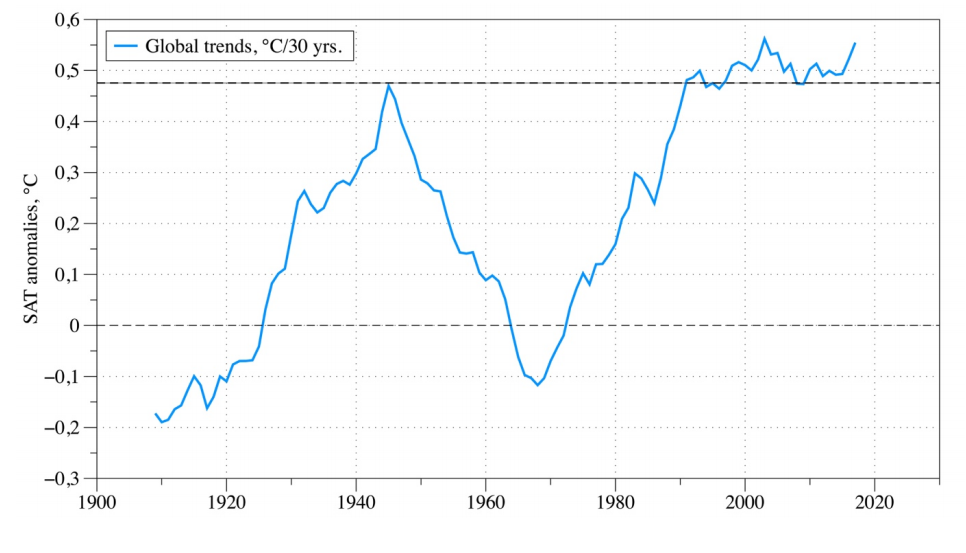
Figure 1. 30-year moving trends in global surface air temperature
(°C / 30 years) according to Berkley dataset [4]

The main cause of the recent warming is considered to be due to the anthropogenic forcing  primarily the carbon dioxide (CO2) concentration growth causing a greenhouse effect [5]. But the role of CO2 for ETCW could not be as important since this period precedes the time of the accelerating growth of radiative forcing by greenhouse gases (GHG). This GHG increase after 1950s is also inconsistent with the global SAT decline from 1940s to 1970s.

Numerical experiments with different climate model generations [6,7] show that modern warming is well reproduced when averaged over model ensembles (indicating external influence as major factor). The ETCW amplitude, despite the increasing accuracy of model simulations, still differs significantly in climate models. This may indicate the important role of internal climate variability [2], as well as the uncertainty of results of model experiments due to incorrectly specified forcing.

The majority of studies [8,9] agree that such a strong warming can be explained by a combination of internal climate system variability as quasi-periodic oscillation or random climate fluctuation with increasing global temperature in the background associated with external anthropogenic and natural forcings (increased GHGs emissions and a pause in volcanic eruptions, in particular).

This paper provides an overview of the existing hypotheses that may explain ECTW, describes the main mechanisms of internal climate variability during the twentieth century, in particular in the Arctic region.

Figure 2. Average annual SAT (°C) anomalies in the period 1900-2015,
according to Berkley observational dataset (5-year running mean), global (black curve),
Northern Hemisphere (blue curve), Southern Hemisphere (orange curve),
NH high latitudes (60°-90° N) (red curve), and NH high latitudes
without 5-yr running mean smoothing (gray curve)

Internal variability in the Arctic can be enhanced by positive radiation feedbacks [12], including surface albedo – temperature feedback, which can strongly impact the absorption of solar shortwave radiation. This mechanism manifests itself during prolonged warm periods, mainly in autumn, when a growing ice-free ocean surface with low albedo absorbs more solar radiation and warms the upper ocean layer that leads to further sea ice melting [10]. This positive radiation feedback contributes to the faster temperature increase in the Arctic. This phenomenon is now well-known as “Arctic (or Polar) Amplification”.

However, other positive feedbacks also play major roles in the Arctic Amplification. There are positive feedbacks related to long-wave radiation, for instance, an increase of water vapor content and cloud cover leads to a greenhouse effect, which is more pronounced at high latitudes [13], as well as dynamic feedbacks, which imply strengthened oceanic and atmospheric ocean heat transfer to the Arctic in the conditions of the shrinking sea ice extent [14,15].

Arctic Amplification may also be a consequence of non-local mechanisms such as enhanced northward latent heat transfer in the warmer atmosphere [16] Quasi-periodic fluctuations of North Atlantic sea surface temperature (SST) of 60-80 year time scale [17] suggest a possible role of oceanic heat transfer as a driver of long-term SAT anomalies in the Arctic that can be enhanced by positive feedbacks [18].

Thus, the amplitude of SST oscillations in the NH polar latitudes can be a combination of both regional response to global climate change and the formation of internal oscillations in the ocean atmosphere system.

Natural internal factors – ocean-atmosphere system variability
Atmosphere circulation variability

Figure 3. Winter Arctic (60°-90°N) SAT anomalies for according to
Berkley observations (5-year running mean) (black curve); NAO index (pink curve),
PNA index (blue curve) according to HadSLP2.0 dataset [25]

The North Atlantic Oscillation (NAO) and the closely related Arctic Oscillation (AO) is the dominant mode of large-scale winter atmospheric variability in the North Atlantic, characterized by sea level pressure dipole with one center over Greenland (Icelandic minimum) and another center of the opposite sign in the North Atlantic mid latitudes (Azores maximum). NAO controls the strength and direction of westerly winds and the position of storm tracks in the North Atlantic sector, thus crucially impacting the European climate [23].

During the first two decades of the 20th century, the positive phase of NAO was expressed in a stronger than usual zonal circulation over the North Atlantic (Fig. 3). The long-term dominance of these atmospheric circulation pattern led to an advection of heat to the northeastern part of the North Atlantic. However, the NAO transition to the negative phase after 1920s and in general inconsistency between NAO and Arctic SAT variations in the first half of the 20th century do not support an hypothesis of NAO contribution to the ETCW warming [24].

The Pacific North American Oscillation index (PNA) characterizes the pressure gradient between the North Pacific (Aleutian minimum) and the East of North America (Canadian maximum) and is related to fluctuations of North Pacific zonal flow. An important feature of PNA in the context of the ETCW is that both (positive and negative) PNA phases may contribute to atmospheric heat advection to the Arctic. In the 1930s and 1950s, the negative phase (Fig. 3) led to the transfer of warm air masses to the pole across the northwestern Pacific Ocean, and the positive phase of the 1940s forced increased zonal transfer to the Western coast of Canada and Alaska [8]. PNA is strongly influenced by the Pacific Southern Oscillation (El Nino Southern Oscillation – ENSO) – the positive index phase is associated with the El Nino phenomena, and the negative with La Niña events.

Atmospheric circulation in the mid-latitudes of the Pacific Ocean may also depend on fluctuations of the Pacific trade winds [28]. The trade winds weakening is manifested in the SAT growth in Pacific mid-latitudes, which coincides on the time scale with the warming of 1910-1940s in the high Arctic latitudes and in the lowering of temperatures during the cooling period between 1940s and 1970s when the strength of the trade winds had been increasing.

Ocean circulation variability

Figure 4. Winter Arctic (60°-90°N) SAT anomalies according to
Berkley dataset (5-year running mean, black curve); AMO index (pink curve),
PDO index (blue curve) according to HadiSST2.0 dataset [37]

Arctic Amplification in the 20th century, including ETCW period can be associated not only with an increase of atmospheric heat transport, but also with an enhancement of ocean heat inflow in the North Atlantic to the extratropical latitudes of the NH from its equatorial part [30].

Instrumental data show that SST variability in the North Atlantic during the 20th century was dominated by cyclic fluctuations on time scales of 50-80 years, showing two warm periods in the 1930s-1940s and at the end of the 20th century and two cold periods in the beginning of the century and in the 1960s-1970s. SST oscillations in the North Atlantic are called Atlantic Multidecadal Oscillation (AMO). The observational data also indicate AMO-like cycles in the Arctic SAT (Fig. 4).

Paleo-reconstructions of AMO [33] demonstrate that strong, low-frequency (60-100 years) SSTnvariability is a robust feature of the North Atlantic climate over the past five centuries. There are also indications of a significant correlation between Arctic sea ice area and AMO index including a sharp change during ECTW period [34].

There is another pronounced internal climate variability that may act synchronously with AMO. This is the Pacific Decadal Oscillation (PDO), which reflects a variability of the Pacific SSTs north of 20° N and has 20-40 years periodicity [35]. PDO might have played an equally important role in the heat advection to the Arctic in the middle of the century. Several current studies [36,29] suggest the synchronous phase shift of AMO and PDO largely contributed to the accelerated Arctic warming, both the ongoing and ETCW.

Сonclusions

Understanding the mechanisms of ETCW and subsequent cooling is a key to determine the relative contribution of internal natural variability to global climate change on multi-decadal time scale. Studies of climate changes in high latitudes in the mid-twentieth century allows us to identify a number of possible mechanisms involving natural variability and positive feedbacks in the Arctic climate system that may partially explain ETCW.

Based on the recent literature it can be concluded that internal oceanic variability, together with additional impact of natural atmospheric circulation variations are important factors for ETCW. Recently, a number of results indicating the Pacific Ocean as a source of multidecadal fluctuation both on a global scale and in high latitudes has increased. Howewer, assessment of a relative contribution to ETCW in the Atlantic and Pacific sectors remains uncertain.

Climate model simulations [9,43,44] argue that the internal variability of the ocean-atmosphere system cannot explain the entire amplitude of temperature fluctuations in the first half of the 20th century as a single factor, and must act in combination with external forcings (solar and volcanic activity), positive feedbacks in the Arctic climate system, and anthropogenic factors. Quantifying the contribution of each factor still remains a matter of debate.

Climate Deception:  Models Hide the Paleo Incline
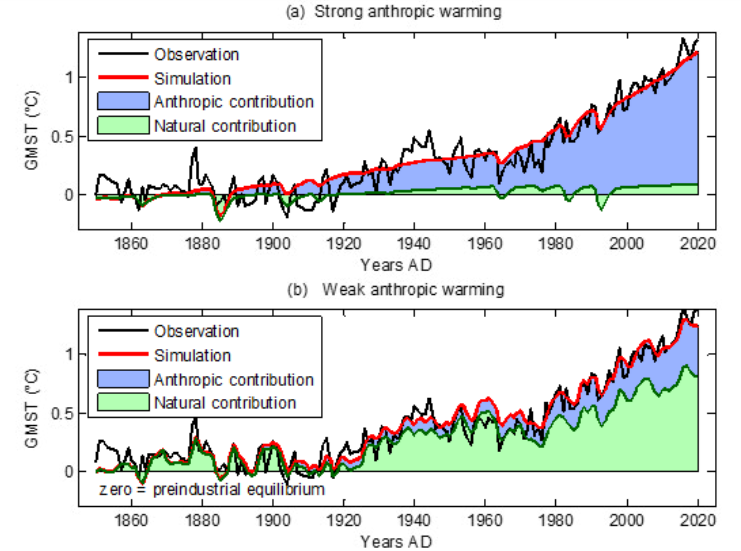
Figure 1. Anthropgenic and natural contributions. (a) Locked scaling factors, weak Pre Industrial Climate Anomalies (PCA). (b) Free scaling, strong PCA

In  2009, the iconic email from the Climategate leak included a comment by Phil Jones about the “trick” used by Michael Mann to “hide the decline,” in his Hockey Stick graph, referring to tree proxy temperatures  cooling rather than warming in modern times.  Now we have an important paper demonstrating that climate models insist on man-made global warming only by hiding the incline of natural warming in Pre-Industrial times.  The paper is From Behavioral Climate Models and Millennial Data to AGW Reassessment by Philippe de Larminat.  H/T No Tricks Zone. Excerpts in italics with my bolds.

Abstract

Context. The so called AGW (Anthropogenic Global Warming), is based on thousands of climate simulations indicating that human activity is virtually solely responsible for the recent global warming. The climate models used are derived from the meteorological models used for short-term predictions. They are based on the fundamental and empirical physical laws that govern the myriad of atmospheric and oceanic cells integrated by the finite element technique. Numerical approximations, empiricism and the inherent chaos in fluid circulations make these models questionable for validating the anthropogenic principle, given the accuracy required (better than one per thousand) in determining the Earth energy balance.

Aims and methods. The purpose is to quantify and simulate behavioral models of weak complexity, without referring to predefined parameters of the underlying physical laws, but relying exclusively on generally accepted historical and paleoclimate series.

Results. These models perform global temperature simulations that are consistent with those from the more complex physical models. However, the repartition of contributions in the present warming depends strongly on the retained temperature reconstructions, in particular the magnitudes of the Medieval Warm Period and the Little Ice Age. It also depends on the level of the solar activity series. It results from these observations and climate reconstructions that the anthropogenic principle only holds for climate profiles assuming almost no PCA neither significant variations in solar activity. Otherwise, it reduces to a weak principle where global warming is not only the result of human activity, but is largely due to solar activity.

Discussion

GCMs (short acronym for AOCGM: Atmosphere Ocean General Circulation Models, or for Global Climate model) are fed by series related to climate drivers. Some are of human origin: fossil fuel combustion, industrial aerosols, changes in land use, condensation trails, etc. Others are of natural origin: solar and volcanic activities, Earth’s orbital parameters, geomagnetism, internal variability generated by atmospheric and oceanic chaos. These drivers, or forcing factors, are expressed in their own units: total solar irradiance (W m–2), atmospheric concentrations of GHG (ppm), optical depth of industrial or volcanic aerosols (dimless), oceanic indexes (ENSO, AMO…), or by annual growth rates (%). Climate scientists have introduced a metric in order to characterize the relative impact of the different climate drivers on climate change. This metric is that of radiative forcings (RF), designed to quantify climate drivers through their effects on the terrestrial radiation budget at the top of the atmosphere (TOA).

However, independently of the physical units and associated energy properties of the RFs, one can recognize their signatures in the output and deduce their contributions. For example, volcanic eruptions are identifiable events whose contributions can be quantified without reference to either their assumed radiative forcings, or to physical modeling of aerosol diffusion in the atmosphere. Similarly, the Preindustrial Climate Anomalies (PCA) gathering the Medieval Warm Period (MWP) and the Little Ice Age (LIA), shows a profile similar to that of the solar forcing reconstructions. Per the methodology proposed in this paper, the respective contributions of the RF inputs are quantified through behavior models, or black-box models.

Now, Figures 1-a and 1-b presents simulations obtained from the models identified under two different sets of assumptions, detailed in sections 6 and 7 respectively.

Figure 1. Anthropgenic and natural contributions. (a) Locked scaling factors, weak Pre Industrial Climate Anomalies (PCA). (b) Free scaling, strong PCA

In both cases, the overall result for the global temperature simulation (red) fits fairly well with the observations (black).  Curves also show the forcing contributions to modern warming (since 1850). From this perspective, the natural (green) and anthropogenic (blue) contributions are in strong contradiction between panels (a) and (b). This incompatibility is at the heart of our work.

Simulations in panel (a) are calculated per section 6, where the scaling multipliers planned in the model are locked to unity, so that the radiative forcing inputs are constrained to strictly comply with the IPCC quantification. The remaining parameters of the black-box model are adjusted in order to minimize the deviation between the observations (black curve) and the simulated outputs (red). Per these assumptions, the resulting contributions (blue vs. green) comply with the AGW principle. Also, the conformity of the results with those of the CMIP supports the validity of the type of behavioral model adopted for our simulations.

Paleoclimate Temperatures

Although historically documented the Medieval Warm Period (MWP) and the Little Ice Age (LIA) don’t make consensus about their amplitudes and geographic extensions [2, 3]. In Fig. 7.1-c of the First Assessment Report of IPCC, a reconstruction from showed a peak PCA amplitude of about 1.2 °C [4]. Then later on, a reconstruction by the so-called ‘hockey stick graph’, was reproduced five times in the IPCC Third Assessment Report (2001), wherein there was no longer any significant MWP [5].

After, 2003 controversies reference to this reconstruction had disappeared from subsequent IPCC reports:it is not included among the fifteen paleoclimate reconstructions covering the millennium period listed in the fifth report (AR5, 2013) [6]. Nevertheless, AR6 (2021) revived a hockey stick graph reconstruction from a consortium initiated by a network “PAst climate chanGES” [7,8]. The IPCC assures (AR6, 2.3.1.1.2): “this synthesis is generally in agreement with the AR5 assessment”.

Figure 2 below puts this claim into perspective. It shows the fifteen reconstructions covering the preindustrial period accredited by the IPCC in AR5 (2013, Fig. 5.7 to 5.9, and table 5.A.6), compiled (Pangaea database) by [7]. Visibly, the claimed agreement of the PAGES2k reconstruction (blue) with the AR5 green lines does not hold.
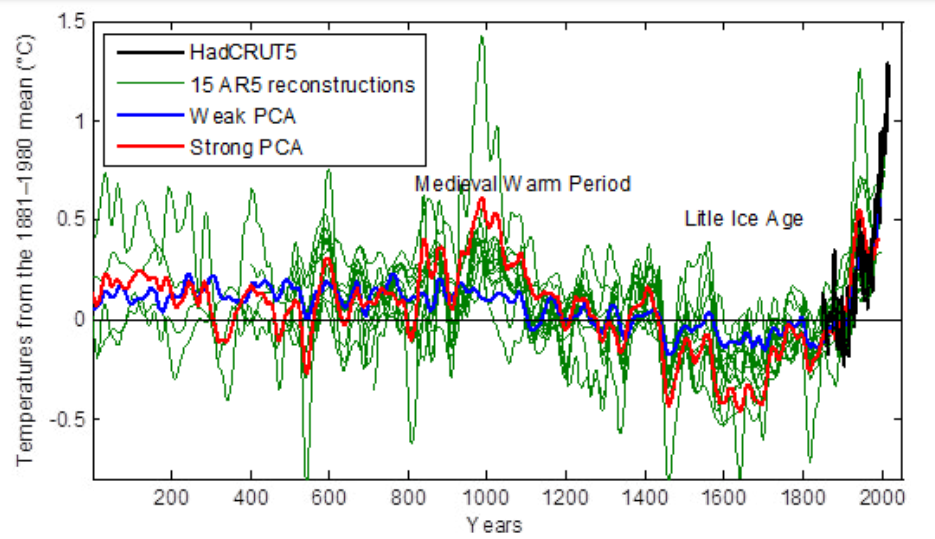
Figure 2. Weak and strong preindustrial climate anomalies, respectively from AR5 (2013) in green and AR6 (2021) in blue.

Conclusion

In section 8 above, a set of consistent climate series is explored, from which solar activity appears to be the main driver of climate change. To eradicate this hypothesis, the anthropogenic principle requires four simultaneous assessments:

♦  A strong anthropogenic forcing, able to account for all of the current warming.
♦  A low solar forcing.
♦  A low internal variability.
♦  The nonexistence of significant pre-industrial climate anomalies, which could indeed be explained by strong solar forcing or high internal variability.

None of these conditions is strongly established, neither by theoretical knowledge nor by historical and paleoclimatic observations. On the contrary, our analysis challenges them through a weak complexity model, fed by accepted forcing profiles, which are recalibrated owning to climate observations. The simulations show that solar activity contributes to current climate warming in proportions depending on the assessed pre-industrial climate anomalies.

Therefore, adherence to the anthropogenic principle requires that when reconstructing climate data, the Medieval Warming Period and the Little Ice Age be reduced to nothing, and that any series of strongly varying solar forcing be discarded. 

Background on Disappearing Paleo Global Warming

The first graph appeared in the IPCC 1990 First Assessment Report (FAR) credited to H.H.Lamb, first director of CRU-UEA. The second graph was featured in 2001 IPCC Third Assessment Report (TAR) the famous hockey stick credited to M. Mann.

Rise and Fall of the Modern Warming Spike


Doomsday Glacier 2024 Hot News (again)

With the potential to raise global sea levels, Antarctica’s Thwaites Glacier has been widely nicknamed the ‘Doomsday Glacier’

Climate alarmists are known to recycle memes to frighten the public into supporting their agenda. The climate news control desk calls the plays and the media fills the air and print with the scare du jour.

‘Doomsday glacier’ rapid melt could lead to higher sea level rise than thought: study
Vancouver Sun on MSN.com (3 hours ago)

Thwaites ‘Doomsday Glacier’ in Antarctica is melting much faster than predicted
USA Today (10 hours ago)

For the first time, there’s visual evidence warm sea water is pushing under doomsday glacier: Study
CBC.ca  (11 hours ago)

‘Doomsday Glacier’ Explained: Why Scientists Believe It Predicts Devastating Sea Levels—Which Might Happen Faster Than Thought
Forbes on MSN.com (4 days ago)

Scientists worry so-called “Doomsday Glacier” is near collapse, satellite data reveals
Yahoo (2 days ago)

The doomsday glacier is undergoing “vigorous ice melt” that could reshape sea level rise projections
CBS News on MSN.com (3 days ago)

We’ve underestimated the ‘Doomsday’ glacier – and the consequences could be devastating
The Independent on MSN.com (4 days ago)

Etc., Etc., Etc.,

This torrent of concern was on the front burner in 2022, rested for awhile, and now it’s back.  Below is what you need to know and not be bamboozled.

OMG! Doomsday Glacier Melting. Again.

Climate alarms often involve big numbers in far away places threatening you in your backyard.  Today’s example of such a scare comes from Daily Mail  Antarctica’s ‘Doomsday Glacier’ is melting at the fastest rate for 5,500 YEARS – and could raise global sea levels by up to 11 FEET, study warns.  Excerpts in italics with my bolds.

Although these vulnerable glaciers were relatively stable during the past few millennia, their current rate of retreat is accelerating and already raising global sea level,’ said Dr Dylan Rood of Imperial’s Department of Earth Science and Engineering, who co-authored the study.

The West Antarctic Ice Sheet (WAIS) is home to the Thwaites and Pine Island glaciers, and has been thinning over the past few decades amid rising global temperatures.  The Thwaites glacier currently measures 74,131 square miles (192,000 square kilometres) – around the same size as Great Britain.  Meanwhile, at 62,662 square miles (162,300 square kilometres), the Pine Island glacier is around the same size as Florida.  Together, the pair have the potential to cause enormous rises in global sea level as they melt.

‘These currently elevated rates of ice melting may signal that those vital arteries from the heart of the WAIS have been ruptured, leading to accelerating flow into the ocean that is potentially disastrous for future global sea level in a warming world,’ Dr Rood said.

‘We now urgently need to work out if it’s too late to stop the bleeding.’

On the Contrary

From Volcano Active Foundation:  West Antarctica hides almost a hundred volcanoes under the ice:

The colossal West Antarctic ice sheet hides what appears to be the largest volcanic region on the planet, according to the results of a study carried out by researchers at the University of Edinburgh (UK) and reported in the journal Geological Society.

Experts have discovered as many as 91 volcanoes under Antarctic ice, the largest of which is as high as Switzerland’s Eiger volcano, rising 3,970 meters above sea level.

“We found 180 peaks, but we discounted 50 because they didn’t match the other data,” explains Robert Bingham, co-author of the paper. They eventually found 138 peaks under the West Antarctic ice sheet, including 47 volcanoes already known because their peaks protrude through the ice, leaving the figure of 91 newly discovered.

Source: volcanofoundation with glacier locations added

The media narrative blames glacier changes on a “warming world,” code for our fault for burning fossil fuels.  And as usual, it is lying by omission.  Researcher chaam jamal explains in his article A Climate Science Obsession with the Thwaites Glacier.  Excerpts in italics with my bolds.

It appears that costly and sophisticated research by these very dedicated climate scientists has made the amazing discovery that maps the deep channels on the seafloor bathymetry by which warm water reaches the underside of the Thwaites glacier and thus explains how this Doomsday glacier melts.

Yet another consideration, not given much attention in this research, is the issue not of identifying the channels by which the deep ocean waters flow to the bottom of the Doomsday Glacier, but of identifying the source of the heat that makes the water warm. Only if that source of heat is anthropogenic global warming caused by fossil fuel emissions that can be moderated by taking climate action, can the observed melt at the bottom of the Thwaites glacier be attributed to AGW climate change.

However, no such finding is made in this research project possibly because these researchers know, as do most researchers who study Antarctica, that this region of Antarctica is extremely geologically active. It is located directly above the West Antarctic Rift system with 150 active volcanoes on the sea floor and right in the middle of the Marie Byrd Mantle Plume with hot magma seeping up from the mantle.

Ralph Alexander updates the situation in 2022 with his article No Evidence That Thwaites Glacier in Antarctica Is about to Collapse.  Excerpts in italics with my bolds.

Contrary to recent widespread media reports and dire predictions by a team of earth scientists, Antarctica’s Thwaites Glacier – the second fastest melting glacier on the continent – is not on the brink of collapse. The notion that catastrophe is imminent stems from a basic misunderstanding of ice sheet dynamics in West Antarctica.

Because the ice shelf already floats on the ocean, collapse of the shelf itself and release of a flotilla of icebergs wouldn’t cause global sea levels to rise. But the researchers argue that loss of the ice shelf would speed up glacier flow, increasing the contribution to sea level rise of the Thwaites Glacier – often dubbed the “doomsday glacier” – from 4% to 25%.

But such a drastic scenario is highly unlikely, says geologist and UN IPCC expert reviewer Don Easterbrook. The misconception is about the submarine “grounding” of the glacier terminus, the boundary between the glacier and its ice shelf extending out over the surrounding ocean, as illustrated in the next figure.

A glacier is not restrained by ice at its terminus. Rather, the terminus is established by a balance between ice gains from snow accumulation and losses from melting and iceberg calving. The removal of ice beyond the terminus will not cause unstoppable collapse of either the glacier or the ice sheet behind it.

Other factors are important too, one of which is the source area of Antarctic glaciers. Ice draining into the Thwaites Glacier is shown in the right figure above in dark green, while ice draining into the Pine Island glacier is shown in light green; light and dark blue represent ice draining into the Ross Sea to the south of the two glaciers.

The two glaciers between them drain only a relatively small portion of the West Antarctic ice sheet, and the total width of the Thwaites and Pine Island glaciers constitutes only about 170 kilometers (100 miles) of the 4,000 kilometers (2,500) miles of West Antarctic coastline.

Of more importance are possible grounding lines for the glacier terminus. The retreat of the present grounding line doesn’t mean an impending calamity because, as Easterbrook points out, multiple other grounding lines exist. Although the base of much of the West Antarctic ice sheet, including the Thwaites glacier, lies below sea level, there are at least six potential grounding lines above sea level, as depicted in the following figure showing the ice sheet profile. A receding glacier could stabilize at any of these lines, contrary to the claims of the recent research study.

As can be seen, the deepest parts of the subglacial basin lie beneath the central portion of the ice sheet where the ice is thickest. What is significant is the ice thickness relative to its depth below sea level. While the subglacial floor at its deepest is 2,000 meters (6,600 feet) below sea level, almost all the subglacial floor in the above profile is less than 1,000 meters (3,300 feet) below the sea. Since the ice is mostly more than 2,500 meters (8,200 ft) thick, it couldn’t float in 1,000 meters (3,300 feet) of water anyway.

IPCC Uses Overblown Global Warming Potentials

H. Douglas Lightfoot and Gerald Ratzer published their paper Reliable Physics Demand Revision of the IPCC Global Warming Potentials in Environmental Science April 15, 2024.  Excerpts in italics with my bolds and added images.  H\T Patrick Moore.

Abstract

The Global Warming Potentials (GWP) of the Intergovernmental Panel on Climate Change (IPCC) in Table 2.14 of the Fourth Assessment Report (AR4) show the increase in warming by methane (CH4) and nitrous oxide (N2O) is 21 and 310 times respectively that of CO2. There has been wide acceptance of these values since publishing in 2007. Nevertheless, they are inaccurate.

This study uses accurate methods to calculate the impacts of CO2, CH4, and N2O on the warming of the atmosphere. For example, this quantitative analysis from reliable physics shows the contribution of CO2 to warming at Amsterdam is 0.0083°C out of a difference of 26°C. The warming effect of CH4 on the Earth’s atmosphere is 0.408% of that of CO2, and the warming by N2O is 0.085% of that of CO2.

Thus, the warming effects of CO2, CH4, and N2O are too small to measure. The invalidity of the methane and nitrous oxide values indicates the GWPs of the remaining approximately sixty chemicals in the Table 2.14 list are also invalid. A recommendation is that the IPCC consider revising or retracting the GWP values in Table 2.14.

Introduction

The purpose of this paper is to examine the Global Warming Potentials (GWPs) in Table 2.14 of the Fourth Assessment Report [1] of the Intergovernmental Panel on Climate Change (IPCC), Figure 1.The Global Warming Potentials (GWP) of methane and nitrous oxide calculated by the IPCC in Table2.14 have profoundly affected the decisions made by elected officials worldwide.

Nitrogen fertilizers have been restricted or banned in several countries because they emit a small amount of nitrous oxide. Nitrogen fertilizers are essential for the growth of plants, and nitrogen is often the limiting nutrient [2]. Restricting their use affects food production adversely and can cause food shortages. The IPCC claims that nitrous oxide has up to 310 times the warming effect of CO2. This value is so significant that we must determine whether or not this value of 310 is valid.

A similar situation occurs with methane, which is claimed to have 21 times the warming effect of CO2. Natural gas is virtually all methane transported widely by pipelines and pumping stations. The claim is that methane leaks from natural gas pipeline systems and processing are warming the Earth. Periodically, a scientist will quote Table 2.14 and raise the alarm about methane and the possibility of significant methane releases from the Arctic Tundra caused by the warming of the Earth [3].

The methodology of this study answers the question: “Of the temperature difference between two weather stations, how many degrees Celsius do CO2, CH4, and N2O contribute?” Four weather stations—Pond Inlet, Amsterdam, Colorado Springs, and Princeton, NJ—were selected to provide the answers. The temperature and relative humidity are recorded within the same.

Calculations for Table 2 Column D

In Row 5, the grams of CO2 per kilogram (kg) of dry air is (0.00041806 x 44 x (1000/29) = 0.630, where 44 and 29 are the molecular weights of CO2 and air, respectively. In Row 9, the grams of CH4 per kg of dry air are (0.000001927 x 16 x (1000/29)) = 0.001063, where 16 is the molecular weight of methane. Similarly, in Row 12, Column E, the grams of N2O per kg of dry air are (0.00000033675 x 44 x (1000/29) = 0.000511, where 44 is the molecular weight of nitrous oxide.There are 0.630/0.00106 = 594 grams of CO2 per gram of methane. Thus, there are (594 x 44)/16) = 1634 molecules of CO2 per methane molecule. Thus, because the molecular weights of CO2 and N2O are the same at 44, there are (0.630/0.000511) = 1235 molecules of CO2 for each molecule of N2O in the Earth’s atmosphere. Thus, in September 2023, CO2 molecules outnumber CH4 molecules by 1634 and N2O molecules by 1235.

Measuring the Contribution of CO2, CH4 and N2O to Temperature in the Earth’s Atmosphere

It is essential to understand that the measured and recorded temperature is the sum of all the factors affecting Earth’s temperature. These include warming caused by radiation from the Sun absorbed by CO2, CH4, N2O, feedback, and other warming or cooling effects. These factors also apply to temperature differences. The recorded temperature is input to the Humidair psychrometric program, which includes these factors in the heat content (enthalpy) and specific volume.

The following method quantifies the contribution of carbon dioxide, methane, and nitrous oxide to the difference in temperature between three weather stations and Pond Inlet.Table 3 is a summary of the Excel calculations. The file for the Excel calculations is: “Excel calculations for GWP Mar 102024.xlsx.” From the Excel spreadsheet, Column H, the temperatures measured at Pond Inlet, Amsterdam, Colorado Springs, and Princeton on December 30, 2023, were -18°C, 8°C, 3°C, and 4°C, respectively. We set the recorded level of CO2 at 418.06 at the location with the lowest of the four temperatures, i.e., at Pond Inlet. This is because the number of molecules of CO2 per cubic meter falls as the temperature rises.

The grams of CO2 per kg of dry air in the Pond Inlet row of Table 3 are the same as in Column D of Table 2. The temperature contributions of CO2, CH4, and N2O to the difference in temperature in °C between Pond Inlet and the weather stations in Column A are in Columns G, H, and I. The total is in Column J. The upper lines in the titles of the columns are the locations in the Excel spreadsheet calculations. Note that the average CO2 for Table 2 was 418.06 in August 2023, and the level of CO2 during the recording of the values for the Excel spreadsheet was 422.3 ppm. The difference of 4.24 ppm has no significant effect on the results of this study.

As shown in Table 4, the temperature increase caused by CH4 and N2O is a small percentage of the temperature rise caused by CO2.The warming effect of CO2 is too small to measure [9, 10].Thus, the warming effects of CH4 and N2O are also too small. The data in IPCC Table 2.14, showing that CH4 has 21 times the warming effect of CO2 and that N2O has 310 times the warming effect of CO2, are grossly incorrect.

Summary and Conclusions

This study provides evidence that the IPCC Global Warming Potentials are incorrect. It starts with the levels of carbon dioxide (CO2), methane (CH4), and nitrous oxide (N2O) measured as molecules per million molecules of dry air, which is the molar fraction. Then, quantitative results from reliable physics establish the enthalpy and specific volume at four weather stations. Chemistry determines the grams of each gas per kg of dry air. The increase in the temperature bycurrent levels of methane (CH4) and nitrous (N2O) in the Earth’s atmosphere isa small percentage of that of CO2.Conclusions 6.1, 6.2, and 6.3 answer, “Of the temperature difference between two weather stations, how many degrees Celsius do CO2, CH4, and N2O contribute?”

6.1.In this study, the difference in temperature between Pond Inlet and Amsterdam is 26°C. The contribution of CO2 to this difference is 0.0083°C, but this amount is too small to measure.

6.2.The contribution of CH4 to the 26°C difference between Pond Inlet and Amsterdam is 0.0000338°C.This current level of methane in the atmosphere increases the temperature by 0.408% of that of CO2. It does not have 21 times the warming of CO2 as claimed by the IPCC.

6.3.N2O’s contribution to the 26°C difference between Pond Inlet and Amsterdam is 0.00000705oC. This is 0.085% of that of CO2. It does not have 310 times the warming of CO2, as claimed by the IPCC

6.4.The total contribution of all three gases to the 26°C difference between Pond Inlet and Amsterdam is 0.00833oC. This is a typical result; this difference is too small to measure.

6.5.The warming of the Earth’s atmosphere by CH4 and N2O is 0.408% and 0.085% respectively of that of CO2.

6.6.The warming by CH4 and N2O is so tiny in the Earth’s atmosphere that the IPCC estimates of warming by GWP over several years are irrelevant.

6.7.It is reasonable for the IPCC to consider revising or withdrawing Table 2.14 in the Fourth Assessment Report

Footnote:  

If like me you are new to the term “psychrometrics”, it refers to an engineering method for assessing the thermodynamic properties of moist air.  From Understanding The Psychrometric Chart

The psychrometric chart is a tool commonly used in the field of engineering to understand and analyze the properties of air. This chart provides valuable information about the thermodynamic properties of moist air, which is crucial for various applications such as heating, ventilation, and air conditioning (HVAC) systems. By understanding the psychrometric chart, engineers can make more informed decisions and optimize their designs for enhanced efficiency and comfort.
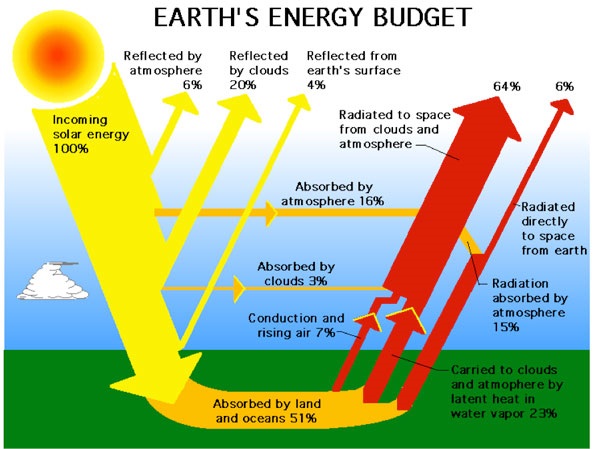
In addition to temperature, the psychrometric chart also includes other properties such as humidity ratio, enthalpy, and specific volume. The humidity ratio represents the mass of moisture present in the air per unit mass of dry air, while enthalpy is the total heat content of the air including both sensible and latent heat. Specific volume, on the other hand, is the volume occupied by a unit mass of air. Together, these properties provide a comprehensive understanding of the thermodynamic behavior of moist air.