Counting Climate Dollars: Who Controls the Debate?


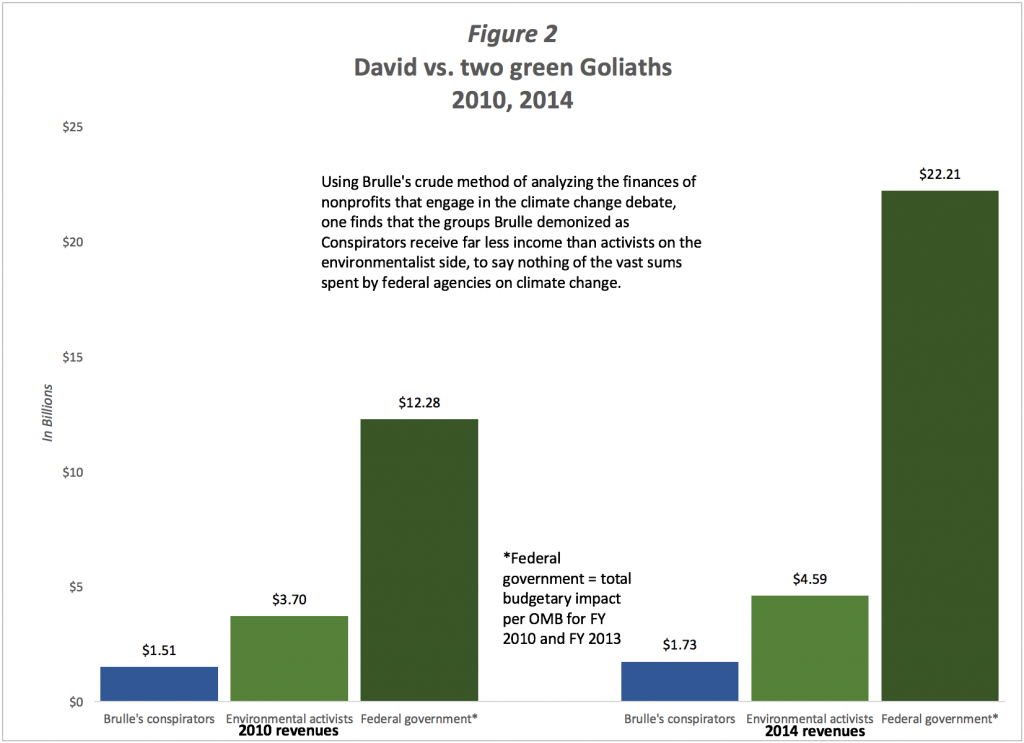
Thanks to an opinion piece in Washington Post, I discovered the work of a serious skeptical thinktank called Capital Research Center. This short video explains how global warming/climate change activists have repeatedly distorted how public communications on the issue are funded, and how dominant are the alarmist dollars.

The full study and numerous other resources are at Climate Dollars

The WP article is A Climate Hysteric’s Fake Enemies List which can also be accessed at Climate Dollars org. link above.


Banking on Climate Alarm

The media are again amping up claims of bad weather to be feared from “climate change.” It is Whack-A-Mole time again, so here is a complete debunking of such media reports, compiled to refute a particularly bad speech by Mark Carney Governor of the Bank of England. H/T Friends of Science

Fact Checking Mark Carney’s Climate Claims is a useful reference document written by Steven Kopits of Princeton Energy Advisors. A few examples below show his systematic dismantling of the alarmist narrative by referencing publically available sources, many of them on government or corporate sites.

Temperatures Rising


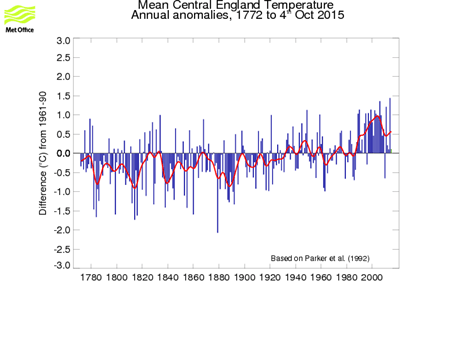
We do have long-time series data for Central England, extending back to 1772. To the extent this measurement is reliable and can be extrapolated to hemispheric averages, it shows a step-up of about 1 deg Celsius from 1980 to 2005, which supports Governor Carney’s assertions. On other hand, it also shows a drop of 0.5 deg Celsius from 2005 to the present—which does not.

Sea Levels

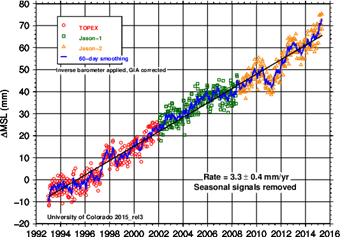
As with just about every other metric the Governor mentions, we have data. Sea level is measured by tide gauges, and also by satellites. Satellite measurements suggest that sea level has been rising steadily by roughly 3 mm / year, which equates to about 1 foot per century.

Weather-related Insurance Losses

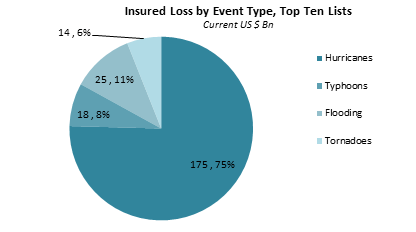
SOURCE: MUNICH RE NATCAT SERVICE

Hurricanes account for 75% of catastrophic losses, with typhoons representing an additional 8%. Thus, hurricanes and typhoons represent $6 of every $7 paid out in ‘top ten’ catastrophic weather-related insurance claims.

And this in turn tells us a great deal about the nature of insurance. Where do insured hurricane losses occur? Principally in the United States. Where do insured typhoon losses occur? Principally in Japan and Taiwan. Why these places? Because all of these are wealthy countries. Hurricane and typhoon losses will be greater where there is, first, a concentration of physical assets, and second, where those assets are valuable. In other words, in the advanced countries exposed to hurricanes and typhoons.

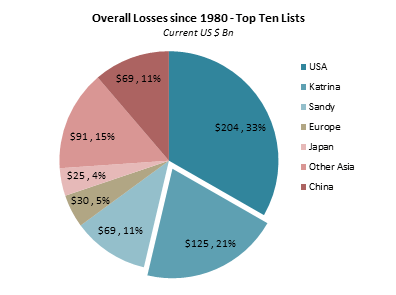
In this, no country is more exposed than the United States. Of overall losses due to top ten catastrophic weather events, nearly 2/3 occurred in the United States alone.

Insured Weather-related Losses

SOURCE: MUNICH RE NATCAT SERVICE

Indeed, if we restrict this to insured losses (including floods and tornadoes), the US accounts for 84% by itself.  Thus, if we are speaking of insured weather-related losses, as a practical matter we are speaking of hurricane damage in the US.  The rest is largely incidental.  For example, Superstorm Sandy caused more insured losses in one event than the cumulative and collective top ten catastrophic, weather-related losses from Europe, China, and Japan since 1980.  And Sandy was only the second worst insurance event in recent times. 

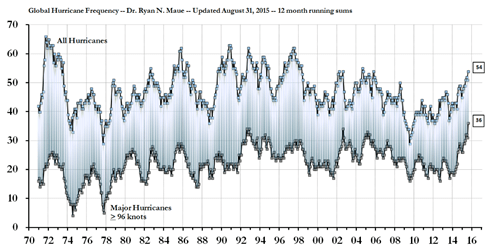
Now, why are US losses so great? Is it due to the number or strength of storms making landfall in the United States?

GLOBAL HURRICANE FREQUENCY SOURCE: RYAN MAUE

In fact, there is no such pattern discernible in the data. Indeed, the last few years have seen fewer than average hurricanes globally, with a recovery to up-cycle numbers in the last year or so.

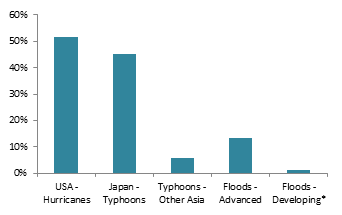
Rather, reinsurance data hints at the source of losses: higher payouts for assets in harm’s way. 

INSURED LOSSES AS A PERCENT OF OVERALL LOSSES, TOP TEN LISTS, 1980-2014 SOURCE: MUNICH RE NATCAT SERVICE

Further, more and more expensive assets are exposed to hurricanes in particular.  In the US, for example, ever more people are living on the coasts, and beach front property has become prized and expensive.  One need only look out the window on a flight approaching Miami International Airport to be appalled at the sheer concertation of high-end housing built just above sea level on islands dotting Florida’s Atlantic Coast.   How long until a hurricane wipes a good number of these off their foundations?  And what kind of insurance losses will that involve?

Indeed, an examination of catastrophic losses suggests a decisive role for government policy.  Hurricane Katrina, which destroyed New Orleans in 2005, represents alone more than one-quarter of all insured top ten losses globally since 1980.  In just one event. 

The article goes on to deal with other claims regarding Floods, Droughts, Tornadoes, and Wildfires before reaching this conclusion.

Summing Up

In his speech to London’s insurance community, Mark Carney, Governor of the Bank of England, asserted a series of claims about climate change. Some of these are widely accepted. The climate does change. The world has warmed. Atmospheric CO2 has increased, half of the increment due to human activities.

Beyond this, there is no consensus, and indeed, the available data in many cases directly refutes the Governor’s more extreme assertions. There is no consensus that humans are the primary drivers of climate change. As we can see, sea levels, for example, were rising well before the 1950s date Carney gives as the start of modern anthropogenic warming.

Importantly, the increase in losses since the 1980s is more likely to reflect expanded insurance coverage, increasing payouts as a percent of losses incurred, and an increased number of assets with higher values placed in harm’s way. Losses increases have not occurred due to increases in hurricane, tornado, flooding, drought or fire frequency or strength, at least not in the United States, which represents the lion’s share of insurance claims. In many cases, either frequency or intensity of weather-related events has actually declined. Sea level rise has not accelerated, not as measured by either satellites or tide gauges. Sea level has been rising for well over 100 years, and continues on that pace.

Like so many other economists, Governor Carney seems to operate under the assumption that current CO2 levels are just on the edge of some catastrophic acceleration. For some reason, 320 ppm of atmospheric CO2 is safe, but 540 ppm is not, because there is some precipice—an inflection point or boundary—between here and there. The limit is not 1,000 ppm, or 5,000 ppm, or 42,448 ppm, but right here, right now. A little more CO2, a trace more of a harmless trace gas, and we are doomed.

The climate is complex and the future uncertain. It is possible the worst fears may prove correct. Nevertheless, such an assertion is not supported by the historical data, not for US droughts, floods, tornados, hurricanes or fires. But it does show up. In politics. If sea levels were 20 cm higher in New York and this contributed to the damage from Superstorm Sandy, well, any middling analyst could have predicted the rise back in 1940, just as we can predict today that sea levels will be one foot higher a century hence. The failure was not of CO2 emissions, but squarely a failure of governance. And that goes doubly so for the fate of New Orleans. If Governor Carney wanted to make a constructive proposal, he should have called for Lloyds to create macro audits of risk zones and censure or refuse to insure jurisdictions where governance is not up to par. If insurers had refused to insure New Orleans unless the levees were sound, they could have saved themselves $30 bn in payouts and probably twice that in losses.

As an analyst, I find Mr. Carney’s speech is truly dismaying. For the Governor of the Bank to claim that climate change is leading to rapidly rising insurance claims is, at best, a critical failure of analysis. As discussed above, insurance claims are a function of a number of factors, including the type and country of the weather event, as well as the extent of insurance coverage and payout ratios. A hurricane in the US may see one hundred times the payouts of a major flood in India. Payouts will rise as a function of nominal GDP, as both inflation and the value and concentration of assets will play a crucial role in overall losses. The specific path of a storm can also be decisive for global averages. It goes without saying that a storm which strikes in Philadelphia, marches up the New Jersey coast, slams into the Manhattan and turns towards New Haven is going to cost a bundle. That same storm hitting, say, rural Mississippi would cause a fraction of the monetary damages. And this matters, because Superstorm Sandy caused more insured damages than all the leading weather events in Europe, Japan, and China combined. Single events can move long-term global averages.

If the Bank missed this, it is not because the necessary data is hard to find. Information on weather-related events is readily and publicly accessible on the internet. Almost every graph I use above relating to hurricanes, tornadoes, floods and droughts comes from the US government itself. Apparently, the Bank of England could not be bothered to consult the underlying climate data before making hyperbolic claims. Thus, at best, the Bank was careless with data analysis.

A worse interpretation of events suggests that Mr. Carney was willing to blindly accept the conventional wisdom, the ‘consensus of scientists’ regarding global warming, without any will or curiosity to dig deeper and form a personal view. One can only hope that monetary policy in the UK is not informed by such superficiality or passivity.

The very worst interpretation is that Mr. Carney is in fact aware of the source data, but chose to make hysterical claims to promote a personal political agenda. I cannot imagine a more ill-considered idea. For those of us who consider central bank independence sacred, the appearance of a national bank taking sides in a highly charged political debate—and doing so with scant regard for the underlying data—will establish the Bank of England as partisan and the political opponent of conservative politicians. Given that Janet Yellen, the Chairman of the US Federal Reserve Bank, hails from Berkeley, a hot bed of climate activism, should the Republican Party consider the Fed also its opponent? If so, I can assure you, the Republicans will find some support to ‘audit’ the institution.

At the end of the day, political neutrality is a pre-condition for central bank independence. If a political party deems the central bank to be an opponent, then it will take measures to gain political control over the bank, with the result that monetary policy itself may become politicized. If the Bank nevertheless feels compelled to champion a particular side in a political debate, its analysis must be water-tight and its communication, impartial. That Governor Carny violated both dictums is simply stunning and a huge blow to the prestige of the Bank of England. It was a very bad call indeed.

More anti-alarmist information at Climate Whack-A-Mole
https://rclutz.wordpress.com/2016/07/28/climate-whack-a-mole/

Update: EU Leads in Climate Blame and Shame

Update February 15, 2017

The EU is already loading climate reporting requirements onto pension funds.

On December 8th, 2016 the EU adopted a new regulation regarding Pension Funds, the IORP II Directive — the successor of the Institutions for Occupational Retirement Provision Directive adopted in 2003.

A key feature of the directive is the consideration of environmental, social and governance (ESG) factors as part of pension providers’ investment. In particular, pension providers are now required to carry out their own risk assessment, including climate change-related risks, as well as risks caused by the use of resources and regulatory changes.

IORP II applies to all the 14,358 registered EU pension funds, among which 160 have cross-border activities.

Member States (EU countries) have until January 13, 2019 to transpose IORP II into their national law, which was published early January in the Official Journal of the European Union. According to current projections, the implementation deadline should therefore fall before Brexit, an important fact considering that the UK accounts for 50 percent of the EU occupational pension fund sector, followed by the Netherlands (33 percent).

New EU Directive Requires Pension Funds to Assess Climate-related Risks

The Climate Disclosure Standards Board provides an insight into the expanding bureaucracy working to impose climatism on financial and business institutions around the world. Since Paris COP agreement is not legally binding, the effort is on forcing reporting on national commitments and pointing fingers at laggards.

At the microeconomic level, the mission is to load regulatory requirements onto corporations and investors to force them into statements of belief and responsibility for mythical changes in future weather and climate.

The Mission is presented in Making Climate Disclosure the New Norm in Business

In short, the Task Force Recommendations report encourages all financial organizations, ranging from banks, insurance companies, to asset managers and asset owners, and companies with public debt or equity, to disclose in a transparent and consistent way their financial risks and opportunities associated with climate change.

Image: Recommendations of the Task Force on Climate-related Financial Disclosures

The report is the result of one year of work by the Task Force on climate-related financial disclosures, a business and investors-led initiative, launched at the COP21 climate negotiations in Paris, and convened by the Financial Stability Board.

The aim of the initiative is to drive the adoption of the recommendations across the G20 countries, as the final version of the report will be released in July and presented to the G20 leaders gathering in Hamburg. Having the support of the governments of the largest economies in the world would be the ultimate step to make climate disclosure the new norm.

The CDSB Board of Directors (all carrying climate activist resumes)

Pankaj Bhatia Director of GHG Protocol Initiative, World Resources Institute

Henry Derwent Honorary Vice President, International Emissions Trading Association

Dr Rodney Irwin Managing Director, Redefining Value & Education, World Business Council for Sustainable Development

Mindy S. Lubber JD, MBA President, Ceres Director, Investor Network on Climate Risk

David Rosenheim Executive Director, The Climate Registry

Damian Ryan Acting CEO, The Climate Group

Richard Samans (Chairman) Managing Director and Member of the Managing Board, World Economic Forum

Paul Simpson Chief Executive Officer, CDP (formerly Carbon Disclosure Project)

Gordon Wilson Senior Manager PwC, Chairman, Technical Working Group, Climate Disclosure Standards Board

Rough seas ahead for Captains of Industry


Climate Blame and Shame

Update February 15, 2017

The EU is already loading these reporting requirements onto pension funds.

IORP II applies to all the 14,358 registered EU pension funds, among which 160 have cross-border activities.

Member States (EU countries) have until January 13, 2019 to transpose IORP II into their national law, which was published early January in the Official Journal of the European Union. According to current projections, the implementation deadline should therefore fall before Brexit, an important fact considering that the UK accounts for 50 percent of the EU occupational pension fund sector, followed by the Netherlands (33 percent).

New EU Directive Requires Pension Funds to Assess Climate-related Risks

The Climate Disclosure Standards Board provides an insight into the expanding bureaucracy working to impose climatism on businesses around the world. Since Paris COP agreement is not legally binding, the effort is on forcing reporting on national commitments and pointing fingers at laggards.

At the microeconomic level, the mission is to load regulatory requirements onto corporations to force them into statements of belief and responsibility for mythical changes in future weather and climate.

The Mission is presented in Making Climate Disclosure the New Norm in Business

In short, the Task Force Recommendations report encourages all financial organizations, ranging from banks, insurance companies, to asset managers and asset owners, and companies with public debt or equity, to disclose in a transparent and consistent way their financial risks and opportunities associated with climate change.

Image: Recommendations of the Task Force on Climate-related Financial Disclosures

The report is the result of one year of work by the Task Force on climate-related financial disclosures, a business and investors-led initiative, launched at the COP21 climate negotiations in Paris, and convened by the Financial Stability Board.

The aim of the initiative is to drive the adoption of the recommendations across the G20 countries, as the final version of the report will be released in July and presented to the G20 leaders gathering in Hamburg. Having the support of the governments of the largest economies in the world would be the ultimate step to make climate disclosure the new norm.

The CDSB Board of Directors (all carrying climate activist resumes)

Pankaj Bhatia Director of GHG Protocol Initiative, World Resources Institute

Henry Derwent Honorary Vice President, International Emissions Trading Association

Dr Rodney Irwin Managing Director, Redefining Value & Education, World Business Council for Sustainable Development

Mindy S. Lubber JD, MBA President, Ceres Director, Investor Network on Climate Risk

David Rosenheim Executive Director, The Climate Registry

Damian Ryan Acting CEO, The Climate Group

Richard Samans (Chairman) Managing Director and Member of the Managing Board, World Economic Forum

Paul Simpson Chief Executive Officer, CDP (formerly Carbon Disclosure Project)

Gordon Wilson Senior Manager PwC, Chairman, Technical Working Group, Climate Disclosure Standards Board

Rough seas ahead for Captains of Industry


Climate Costs in Context

400px-unbalanced_scales-svg-climate

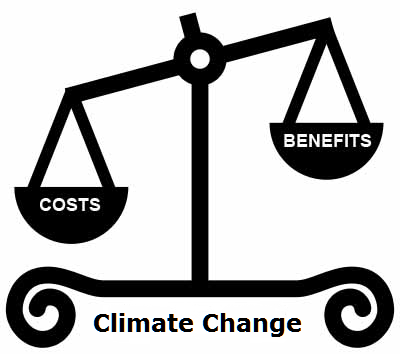
A recent publication by the Manhattan Institute looks at the costs of proposed climate change policies versus the estimated benefits.  Note that positive effects from warming are not included, only the benefits of reduced damages from assumed future warming.  Even on that narrow basis, the costs of “fighting” climate change are vastly greater than simply adapting to a changing climate.  The paper is entitled: Climate Costs in Context (here).  Excerpts below

Uncertain Greenhouse Effects

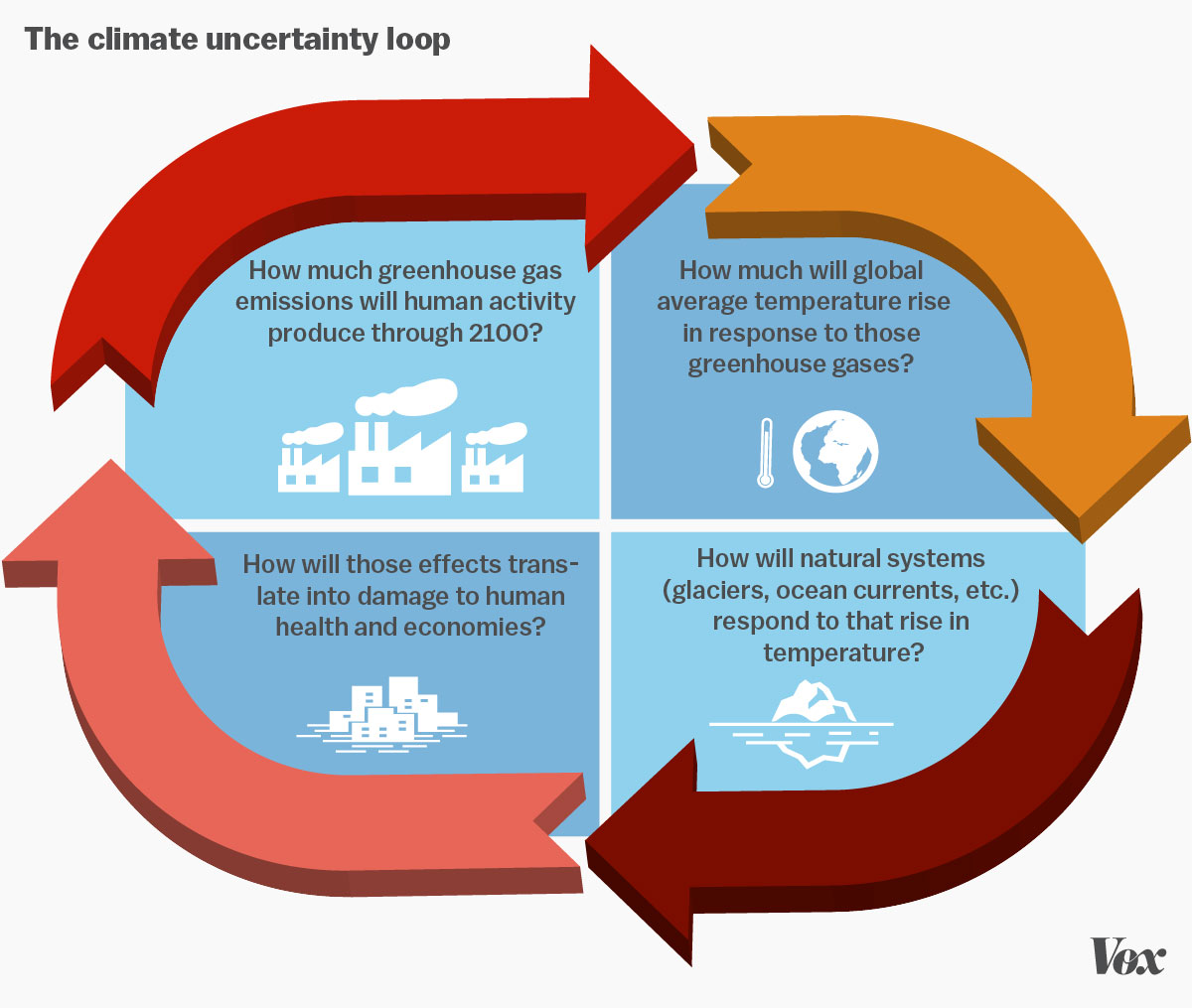
.The chain of causation from greenhouse gas emissions to human impacts is lengthy: economic growth, the energy intensity of economic activity, and the emissions profile of energy use all combine to determine emissions levels. Those emissions then produce a concentration of greenhouse gases in the atmosphere, from which climate models can offer projections of temperature increase. Other models must translate any given temperature increase into estimates of natural-world effects, such as sea-level rise, drought, or ecosystem disruption. And another set of models and qualitative analyses must try to estimate how those changes in the natural world will affect the society that emitted the greenhouse gases in the first place.

Scientific assessments vary widely at each of these steps. However, climate researchers have settled broadly on an expected temperature increase of 3 to 4 degrees Celsius by the year 2100 if efforts are not made to reduce emissions.

Climate Costs According to IPCC

To estimate the economic cost of warming, researchers use “Integrated Assessment Models” (IAMs), which translate a given level of warming into estimates of natural-world impacts and then economic costs. Such analysis requires as much art as science, and, especially for larger temperature increases, the results are highly speculative. Still, they offer the best available estimates and should indicate at least the relative magnitude of the threat.

These models indicate that for 3°–4°C of warming, global GDP in the year 2100 will be 1%–4% lower than in a world with no warming.

These are large costs—all three models estimate that global GDP will have grown to at least $500 trillion by 2100 versus a 2015 total of approximately $75 trillion. So if climate change reduces GDP in 2100 by 3%, that would represent $15 trillion—nearly the size of the entire American economy today. But by the standards of 2100, the cost is manageable.

Exaggerated Popular Notions of Climate Impacts

Such modest economic estimates seem incompatible with the severe disruptions popularly assumed to accompany climate change. However, it is generally the popular assumption rather than the detailed economic research that is in error. For instance, while descriptions of sea-level rise often depict large scale melting in Greenland and Antarctica producing several meters of sea-level rise, such scenarios are forecast to play out only over the course of several centuries or even millennia.

The IPCC itself offered an estimate of what this might cost: “Some low-lying developing countries and small island states are expected to face very high impacts that, in some cases, could have associated damage and adaptation costs of several percentage points of GDP.”In other words, even for those poorest and most vulnerable countries, damage still amounts to only the small share of future wealth forecast in the economic models.

The pattern repeats itself across other potential effects of climate change. For instance, researchers call attention to the prospect of widespread ecosystem disruption and species extinction. The IPCC emphasizes: “With 4°C warming, climate change is projected to become an increasingly important driver of impacts on ecosystems.” But the actual magnitude of these impacts will only “becom[e] comparable with land-use change”—the disruption the world is already experiencing from human development. That disruption has not been costless—in either economic or less tangible terms—but neither has it produced widespread or insurmountable challenges to continued growth and prosperity.

Conclusion: Adapt Rather than Fight

Analyses consistently show that the costs of climate change are real but manageable. For instance, the prosperity that the world might achieve in 2100 without climate change may instead be delayed until 2102.

All these costs—both economic and noneconomic—are substantial and have the potential to cause significant damage and disruption. Policymakers should take them seriously and seek to reduce or prepare for them when the expected benefit of action exceeds the cost. However, none are outside the range of other challenges facing society, and none support the apocalyptic rhetoric of many politicians and activists.

Footnote:

The world is currently spending a lot fighting climate change:

  • UN and governmental agencies and conferences;
  • Research funding to claim alarming impacts;
  • Advocacy by foundations and NGOs;
  • Subsidies for renewable energy and low carbon technologies.

This climate alarm industry, Climate Crisis Inc., is estimated to cost at least 1.5 trillion US$ each year.  That is 2% of present global GDP, and alarmist leaders say it isn’t making a difference.

Looking into the future, IEA expects additional spending just in the energy sector to meet climate change targets on the order of $35-trillion over the period 2015 to 2030. All this remarkable growth comes in a market for non-solutions to the non-problem of global warming.

For more on Uncertainties of Integrated Assessment Models:
https://rclutz.wordpress.com/2015/10/31/quiet-storm-of-lucidity/

Further comments by Oren Cass, author of the Mannhatton paper:

http://www.nationalreview.com/corner/442685/climate-costs-context

Updated Ontario Jammed by Rent-Seekers and Ratepayers

October 14, 2016 Update

Windstream Energy awarded damages after Ontario cancels wind farm project
from the Globe and Mail

Looking at the leaked news from the NAFTA tribunal, the damages of $25M plus $3M legal costs are much less than the $568M claimed by Windstream (US company) following a 2011 cancellation of a Lake Ontario wind farm. As has been discussed in a previous post Electrical Madness in Green Ontario, the long-term costs from these ill-advised renewable energy projects far exceed the costs of this judgment, if it stands as reported.

Post from Sept. 24, 2016

Green economics was on full display this week when the Ontario provincial government decided to cancel contracts for additional electrical power from renewables, such as those previously offered in March 2016.

Definition of Rent-Seeking, noun (economics):

the act or process of using one’s assets and resources to increase one’s share of existing wealth without creating new wealth.

(specifically) the act or process of exploiting the political process or manipulating the economic environment to increase one’s revenue or profits.

Definition of Ratepayer:

a person who pays a regular charge for the use of a public utility, as gas or electricity, usually based on the quantity consumed.

The background of this predicament is here Electrical Madness in Green Ontario.

Ratepayers are Fed Up

Feed-in tariffs for 20-year renewable power contracts have the ratepayers outraged, as voiced by the opposition (CBC):

“This government has plowed ahead for years signing contracts for energy we simply do not need,” said Opposition Leader Patrick Brown. “The premier has become the best minister of economic development that Pennsylvania and New York has ever seen.”

The Tories used virtually all their time in question period talking about individuals and business owners struggling with soaring electricity rates, and claimed Thibeault’s cancellation announcement was an admission by the Liberals that their green energy policies were misguided.

“It’s bad policy,” said Brown. “I just wish at this point, now that they’ve acknowledged that they’ve made a mistake, that they would apologize. They made a huge mistake on the energy file and everyone in Ontario is paying for it.”

Mr. Thibeault said contracts signed in an earlier green-energy procurement will be honoured. In March, the province reached 16 deals with 11 firms to build wind, solar and hydroelectric projects for a total of 455 megawatts of new capacity. The negotiated prices were much lower than earlier fixed-price contracts for renewables because of the competitive bidding.

Ontario already has more than 4,000 MW of wind capacity and 2,000 of solar power.

The Liberal government has been under pressure from the opposition and rural residents who oppose wind farms to scale back its renewable plans and to find a way to trim increases in electricity prices.

Rent-Seekers Push Back

Renewables lobbyists are defending their interests (Globe and Mail):

But the cancellation was a shock to the renewable-energy industry, which was counting on the new program, which would have awarded contracts for about 1,000 MW of projects in 2018.

John Gorman, president of the Canadian Solar Industries Association, said the decision could hurt manufacturers and installers of solar product in the province just as they are becoming significant global competitors.

Robert Hornung, president of the Canadian Wind Energy Association, said the wind industry is “shocked and extremely disappointed.”

Lobby group Environmental Defence called the cancellation “short-sighted” and said this is “exactly the wrong time to put the brakes on renewable energy.”

Etc., Etc.

Summary

Several rent-seekers as well as the Energy Minister said renewable prices were coming down, but didn’t say they are still several multiples of the $23/MWh Ontario wholesale price. Nor did anyone point out the cancellation is only avoiding a future rate increase, not bringing rates down.  The politics have forced the administration into promising an 8% cut in consumer electricity rates, and it can only come from reducing the subsidies. Hence the howling.

286fd-7_50286

For More on Wind Power problems:  Climateers Tilting at Windmills

Climate Policies Gouge the Masses

There is still no empirical proof from the real world that burning fossil fuels causes temperatures to rise, despite those claiming the “Science is Settled”.

“There is no scientific proof that human emissions of carbon dioxide are the dominant cause of the minor warming of the Earth’s atmosphere over the past 100 years. If there were such a proof it would be written down for all to see. No actual proof, as it is understood in science, exists.”
Patrick Moore, co-founder of Greenpeace, Senate Testimony 2014

Beyond the lack of scientific support for the claims, there is the further problem with the proposed and already enacted climate policies intending to reduce carbon emissions and lower future warming. The policies themselves are ill-advised even if scientific proof existed.

David R. Henderson, public policy economist at the Stanford Hoover Institution, puts the issue this way:

Claims that human-caused global warming will raise average temperatures by 2o C to 5o C over the next 100 years and cause serious harm to society are controversial. However, assuming that global warming will be a big problem, there are two important questions: (1) What should be done about it? and (2) When should it be done?

Hypothetical: Assuming global warming is real and caused by fossil fuel emissions, what should we do about it?

Proposition #1: Put a price on Carbon by taxing it.

Henderson comments:
But carbon already has a price, or, more exactly, multiple prices. Natural gas has a price; oil has a price; coal has a price. And their prices are related to the valuable carbon component of those fuels because it’s carbon that makes those fuels valuable. Just as there’s no such thing as a free lunch, carbon is not free.

So why does Professor Gordon claim that taxing carbon means “putting a price on carbon?”
I can only speculate because I don’t know him, but here’s what I’m willing to bet dollars to doughnuts on: he calls a tax a price in order to lull the reader into thinking that it’s not a tax. Later in the piece he admits that it’s a tax but in his first mention, which sets the stage, he doesn’t.

Proposition #2: A carbon tax simply replaces complex regulations.

Henderson:
If a carbon tax is implemented, it will likely be on top of the extensive regulation Canadians now contend with. Who’s offering to end regulation on carbon usage? Who’s offering to legalize certain kinds of incandescent light bulbs? Who’s offering to end the government’s mandates on energy efficiency in cars, trucks, washers, driers, refrigerators, air conditioners and other appliances? Who’s offering to get rid of expensive, market-distorting subsidies to solar and wind power? Anyone? Anyone? 

As economists well know, adding to the price of energy functions as a regressive consumption tax, with greatest impacts on poor families who have the least amount of discretionary income.

Hypothetical: Assuming global warming is real and caused by fossil fuel emissions, when should we do something about it?

Proposition 3#: Acting now is cheaper than delaying.

Here’s where Henderson really shines, dissecting the phoney economics underlying climate policies, and revealing the reverse Robin Hood effect of mitigation proposals. For in fact, economists know that we are richer today than our forefathers, and it is likely future generations will be richer than us. The whole point of using discount rates in cost/benefit studies is to recognize the advantages of building wealth today while delaying spending until later.

Henderson:

The two main approaches are to make major adjustments now or gradually through time to reduce warming or mitigate its effects. Thus, thinking about efforts to combat global warming requires comparing costs today with potential benefits 100 years or more in the future. Immediate Action versus Waiting. Acting now might slow global warming so that major adjustments will not be needed later.

But there are two huge disadvantages. First, actions today will be based on current technology. Because technology will almost certainly improve, solutions implemented in the future are likely to be more efficient — more effective per unit of cost. By comparison, solutions implemented today would use cruder, more expensive technology.

Second, money spent now to offset global warming could instead be invested in ways that would increase national income and wealth, creating more options to deal with any future negative effects of a warmer world. Future generations will likely be wealthier than present generations, just as the people living today are wealthier than past generations. Imposing large costs today to create environmental benefits for future generations would sacrifice current potential consumption for people in the future who will almost certainly have higher living standards.

What is the right Discount Rate for Taxing Carbon

There is much debate about what discount rate to use when comparing environmental costs and benefits.  Generally, the more one values today’s dollars over tomorrow’s, the higher is one’s discount rate.  At one extreme, an infinitely high discount rate would imply that we place almost no value on future consumption.  Conversely, using a discount rate of zero means that benefits today are no more valuable than benefits 100 years from now..

However, the choice of which discount rate to use is not about the weight given to the well-being of future generations but about opportunity costs. Investments people make today are likely to increase the wealth of their descendants, giving future generations greater resources to exercise their preferences regarding environmental protection.

The higher the rate of return that can be earned by investing a dollar today, the more wealth future generations are deprived of if the money is spent now.  Thus, Kevin Murphy of the University of Chicago argues that we should use the market interest rate as the discount rate because that is the opportunity cost of climate mitigation. Interestingly, even Stern’s own model assumes that people 200 years from now will have real incomes that are more than 10 times incomes today.  This means that if the government taxes people today explicitly or through regulations to reduce climate change 200 years from now, the government will be taxing the poor to help the rich. 

How does using the interest rate as the discount rate work in practice?  Imagine that the damage from continued use of CO2-emitting fossil fuels is $300 per ton of emissions 100 years from now.  In 100 years, a $300 per ton tax on carbon emissions would reflect their social cost.  What this tax should be in the intervening years depends upon the interest rate that could be earned if money were invested.

Thus, beginning today, at a 6 percent interest rate, a tax of 88 cents per ton would pay the social costs of one ton of emissions in a century.  If the tax were implemented 80 years from now, the rate would be $93.54 per ton.  To put these numbers in perspective, a $1.00 tax per ton of carbon translates into a one-third cent per gallon tax on gasoline. On that basis:

  • A $300 per ton carbon tax 100 years from now would be equivalent to a tax of three-tenths of a cent per gallon today at an interest rate of 6 percent.
  • It would be two cents per gallon at an interest rate of 4 percent. 

Today, the actual federal tax is 18.4 cents per gallon.  Thus, if the correct carbon tax 100 years from now is $300, this implies that the gasoline tax today is much higher than the rate required to reflect the social costs of global warming, regardless of whether the right interest rate is 6 percent or 4 percent.

Conclusion.

If the government limits carbon emissions now through taxes or direct caps, it is taxing the poor today to benefit wealthier future generations. Perversely, such limits would also deprive future generations of the additional capital that would accumulate if the money were invested in the market instead of being used to combat climate change.

David R. Henderson is a research fellow with the Hoover Institution (here). He is also an associate professor of economics at the Naval Postgraduate School in Monterey, California.

Henderson’s writing focuses on public policy. His specialty is in making economic issues and analyses clear and interesting to general audiences. Two themes emerge from his writing: (1) that the unintended consequences of government regulation and spending are usually worse than the problems they are supposed to solve and (2) that freedom and free markets work to solve people’s problems.

Quotations from David Henderson come from these sources:

A carbon tax is not a ‘price’

Climate Economists Base Their Alarm on Their Own Ethical Judgments

Climate Change: Should We Tax the Poor to Help the Rich?

extortion2

Global Warming Extortion

Climate Crisis Inc. Update


cov_en_1Five years ago Jo Nova provided a graphic displaying the workings of the Climate Scare Machine.  The figures are out-dated and this post is to update the growth of the Climate Crisis Industry and its outlook.

From Jo Nova (here) in 2010 dollars:
Climate Change Scare Machine Cycle: see how your tax dollars are converted into alarming messages

The money, power, and influence is vastly larger on the side that benefits from the alarm
On the skeptical side, Exxon chipped in all of $23 million over ten years, but it’s chump-change. The fossil fuel industry doesn’t like carbon legislation, but it’s not life or death, unlike the situation for wind and solar, which would be virtually wiped out without the subsidies provided by the scare.

The US government has poured in $79 billion and then some. But the pro-scare funding is pervasive: for example — the Australian government spent $14 million on a single Ad campaign, and another $90 million every year on a Department of Climate Change. The UK government paid for lobbyists to lobby it, and the BBC “partners” with the lobby groups. The EU doesn’t just subsidize renewables, it also pays them to push for more subsidies. Even the dastardly Exxon paid more than 20 times as much for a single renewables research project than it did to skeptics.

Last year in carbon markets $142 billion dollars turned over, and $243 billion was invested in renewables. If the carbon market idea went global it was projected to reach $2 trillion a year. Every banker and his dog has a bone in this game. Why wouldn’t they?

Industry 2015 Update from Climate Change Business Journal

(reported in Insurance Journal here).

Interest in climate change is becoming an increasingly powerful economic driver, so much so that some see it as an industry in itself whose growth is driven in large part by policymaking.

The $1.5 trillion global “climate change industry” grew at between 17 and 24 percent annually from 2005-2008, slowing to between 4 and 6 percent following the recession with the exception of 2011’s inexplicable 15 percent growth, according to Climate Change Business Journal.

The San Diego, Calif.-based publication includes within that industry nine segments and 38 sub-segments. This encompasses sectors like renewables, green building and hybrid vehicles.

That also includes the climate change consulting market, which a recent report by the journal estimates at $1.9 billion worldwide and $890 million in the U.S.

Included in this sub-segment, which the report shows is one of the fastest growing areas of the climate change industry, are environmental consultants and engineers, risk managers, assurance, as well as legal and other professional services.

Figures for the climate change consulting market are expected to more than double in the next five years, and the report’s authors believe the climate change industry as a whole will have an even steeper and faster growth trajectory than the environmental consulting industry – an industry that in 1976 had billings of $600 million and today generates $27 billion.

Paul Driessen puts the numbers in context (here).

The answer is simple. The annual revenue of the Climate Crisis & Renewable Energy Industry has become a $1.5-trillion-a-year business! That’s equal to the annual economic activity generated by the entire US nonprofit sector, or all savings over the past ten years from consumers switching to generic drugs. By comparison, revenue for the much-vilified Koch Industries are about $115 billion, for ExxonMobil around $365 billion.

According to a 200-page analysis by the Climate Change Business Journal, this Climate Industrial Complex can be divided into nine segments:

  • low carbon and renewable power;
  • carbon capture and storage;
  • energy storage, such as batteries;
  • energy efficiency;
  • green buildings;
  • transportation;
  • carbon trading;
  • climate change adaptation; and
  • consulting and research.

Consulting alone is a $27-billion-per-year industry that handles “reputation management” for companies and tries to link weather events, food shortages and other problems to climate change. Research includes engineering R&D and climate studies.

In other words, the current amount of annual spending is $1.5-trillion in the two boxes of Jo Nova’s diagram: Industrials and Financial Houses.  There’s additional money sloshing around in other boxes of the scare machine.

The $1.5-trillion price tag appears to exclude most of the Big Green environmentalism industry, a $13.4-billion-per-year business in the USA alone. The MacArthur Foundation just gave another $50 million to global warming alarmist groups. Ex-NY Mayor Michael Bloomberg and Chesapeake Energy gave the Sierra Club $105 million to wage war on coal (shortly before the Club began waging war on natural gas and Chesapeake Energy, in what some see as poetic justice). Warren Buffett, numerous “progressive” foundations, Vladimir Putin cronies and countless companies also give endless millions to Big Green.

Our hard-earned tax dollars are likewise only partially included in the CCBJ tally. As professor, author and columnist Larry Bell notes in his new book, Scared Witless: Prophets and profits of climate doom, the U.S. government spent over $185 billion between 2003 and 2010 on climate change items – and this wild spending spree has gotten even worse in the ensuing Obama years. We are paying for questionable to fraudulent global warming studies, climate-related technology research, loans and tax breaks for Solyndra and other companies that go bankrupt, and “climate adaptation” foreign aid to poor countries.

Also not included: the salaries and pensions of thousands of EPA, NOAA, Interior, Energy and other federal bureaucrats who devote endless hours to devising and imposing regulations for Clean Power Plans, drilling and mining bans, renewable energy installations, and countless Climate Crisis, Inc. handouts. A significant part of the $1.9 trillion per year that American businesses and families pay to comply with mountains of federal regulations is also based on climate chaos claims.

Add in the state and local equivalents of these federal programs, bureaucrats, regulations and restrictions, and we’re talking serious money. There are also consumer costs, including the far higher electricity prices families and businesses must pay, especially in states that want to prove their climate credentials.

Summary

Looking into the future, IEA expects additional spending just in the energy sector to meet climate change targets on the order of $35-trillion over the period 2015 to 2030.  All this remarkable growth comes in a market for non-solutions to the non-problem of global warming.  (Note to Lewandowsky:  It is not a conspiracy, it’s a monopoly.)

There also may be a limit to how much can be extracted.

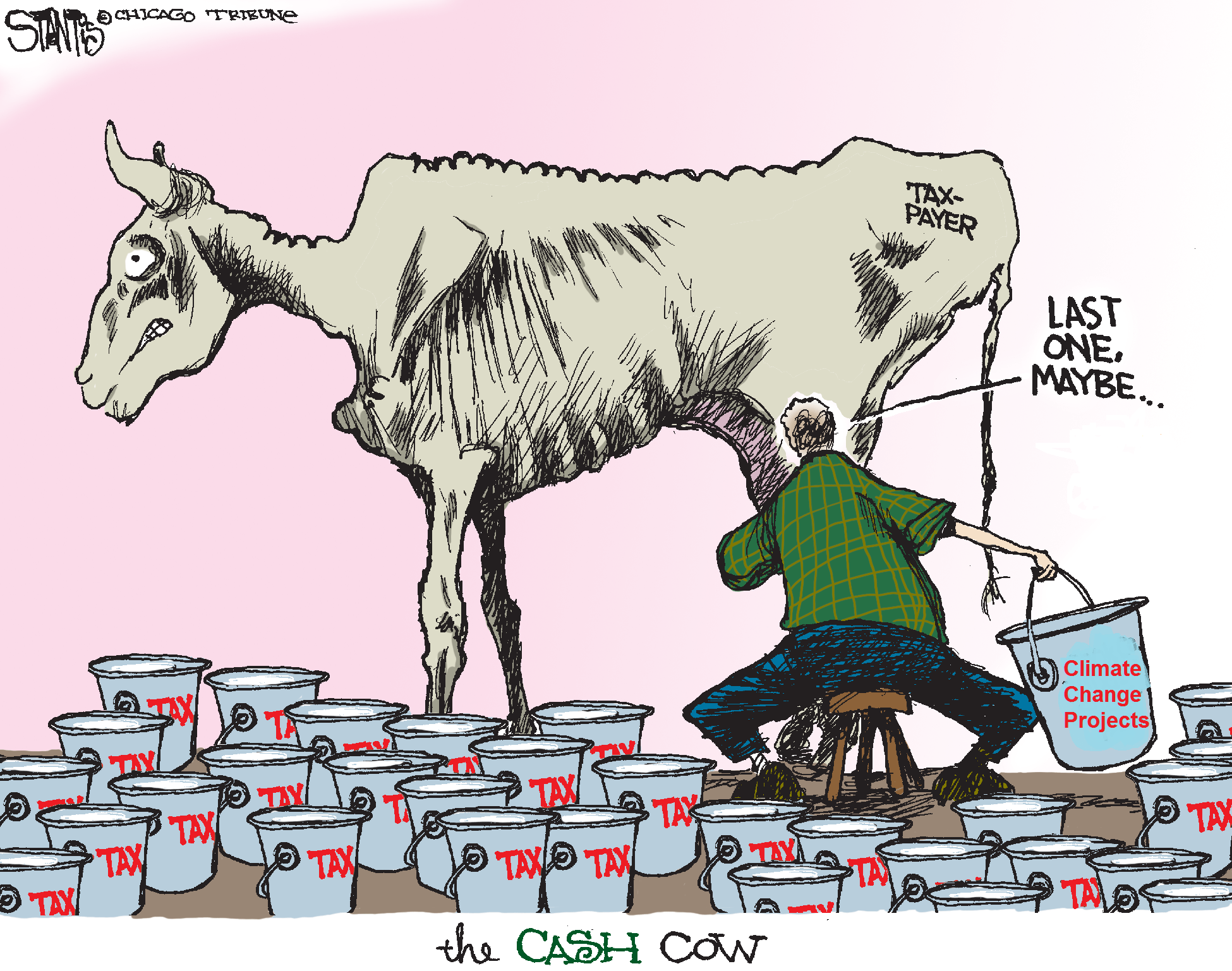
Climate cashCow

Footnotes:

  1.  The Climate Change Business Journal produced the report of 2015 industry revenues and sectors, referenced by the Insurance Journal article.  More recent reports likely show much higher revenues, but I am unwilling to buy a report from CCBJ.

2.  A recent example of the dash for climate cash is the rise of Climate Medicine.


Exxon Shareholders Reject Activists May 25

Update May 26 below

May 25, 2016: A shareholder proposition from global warming alarmists was soundly defeated today at the Annual Meeting. Activists took heart that 38% of shares were voted in favor, larger than previous such actions received. It appears that much of that support came from the Norwegian sovereign wealth fund, which is a story in its own right.

The world’s largest sovereign wealth fund announced Tuesday that it would back shareholder resolutions requiring Chevron and ExxonMobil to report on how climate change could threaten assets during extreme weather events or put revenues at risk due to government efforts to transition from fossil fuels to renewable sources.

The company that manages Norway’s $872 billion fund said the boards of directors for the oil giants should better anticipate those risks — as well as any upsides — and report on them to shareholders. (here)

Anyone visiting Norway (as I did last year) will recognize from the prices of everything and the obvious signs of conspicious consumption that modern Norway is a Petro-state. I don’t have Tesla sales statistics handy, but just walking around Oslo, you can clearly see more of them per capita than anywhere outside of Hollywood. (Huge subsidies and free recharging helps.)

Now the Norwegians deserve credit for putting their enormous profits from North Sea oil into a fund for future generations. Don’t see that in Saudia Arabia or Iran, or most other Petro-States. But their acceptance of CO2 warming dogma is as jarring as the Rockefeller Foundation funding anti-petroleum activists. Why all this guilt over energy resources?

Other major investors promoting the action included: The Church Commissioners for England, Trustee of New York State Common Retirement Fund, Amundi, AXA Investment Management, BNP Paribas, CalPERS, and Legal & General Investment Management.

The proposition itself is based upon a flimsy set of suppositions, as explained here: https://rclutz.wordpress.com/2t016/05/01/behind-the-alarmist-scene/

Update May 26

Some sources give more insight into the activism employed,

From CNBC

Earlier this month, a letter signed by 1,000 professors from over 40 global universities, including Oxford and Ivy League colleges like Harvard, was sent by Positive+Investment — a campaign group launched by Cambridge students — to Exxon and Chevron’s top 20 shareholders urging they pass the resolutions.

But institutional shareholders including Norway’s $872 billion sovereign wealth fund, the Church of England, and the U.S.’s largest state pension fund are already throwing their weight behind the climate cause.

Norges Bank Investment Management (NBIM) publicly disclosed that it plans to vote in favor of climate impact assessment reports for both Chevron and Exxon, telling reporters earlier this month that it would relentlessly push the companies to be more open about their climate change strategies, even if the proposals didn’t pass at this year’s AGM.

According to its 2015 holdings report, NBIM holds a 0.85 percent stake in Chevron worth $1.45 billion, and a 0.78 percent stake in Exxon worth $2.54 billion.

And the push will continue according to Washington Examiner:

“The recommendation by Exxon’s board to outright reject every single climate resolution from shareholders sends an incontestable signal to investors: it’s due time to divest from Exxon’s deception,” said May Boeve, executive director of the group 350.org, a leading proponent of the Keep it in the Ground campaign and movement for pension funds, schools and others to divest from investments in fossil fuels. Many scientists blame the greenhouse gases emitted from the burning of fossil fuels, such as crude oil and coal, for man-made climate change.

ExxonMobil has been targeted because they have not given an inch to demands from alarmists.  But other energy companies all also under attack. Shell shareholders overwhelmingly voted against considering a proposition to convert the company into a renewables business.

Attempts to appease bullies seldom stop them from making more and bigger demands.  Those companies now talking “Green” in order to be politically correct on climate change won’t be left alone to conduct their businesses. ExxonMobil knows this already, and has the subpoenas to prove it.

Behind the Alarmist Scene

fox-theatre-curtain1

Update May 24, 2016: The shareholder vote is scheduled for tomorrow, May 25, according to this article.

We can look into the climate activist mental frame thanks to documents supporting the current strategy using the legal system to implement actions against fossil fuel consumption.

For example, there is this recent text explaining a shareholder proposal to be tabled at ExxonMobil annual meeting. From Attorney Sanford Lewis:

The Proposal states:

“RESOLVED: Shareholders request that by 2017 ExxonMobil publish an annual assessment of long term portfolio impacts of public climate change policies, at reasonable cost and omitting proprietary information. The assessment can be incorporated into existing reporting and should analyze the impacts on ExxonMobil’s oil and gas reserves and resources under a scenario in which reduction in demand results from carbon restrictions and related rules or commitments adopted by governments consistent with the globally agreed upon 2 degree target. The reporting should assess the resilience of the company’s full portfolio of reserves and resources through 2040 and beyond and address the financial risks associated with such a scenario.

Now let’s unbundle the chain of suppositions that comprise this proposal.

  • Supposition 1: A 2C global warming target is internationally agreed.
  • Supposition 2: Carbon Restrictions are enacted by governments to comply with the target.
  • Supposition 3: Demand for oil and gas products is reduced due to restrictions
  • Supposition 4: Oil and gas assets become uneconomic for lack of demand.
  • Supposition 5: Company net worth declines by depressed assets and investors lose value.

1.Suppose an International Agreement to limit global warming to 2C.

From the supporting statement to the above proposal, Sanford Lewis provides these assertions:

Recognizing the severe and pervasive economic and societal risks associated with a warming climate, global governments have agreed that increases in global temperature should be held below 2 degrees Celsius from pre-industrial levels (Cancun Agreement).

Failing to meet the 2 degree goal means, according to scientists, that the world will face massive coastal flooding, increasingly severe weather events, and deepening climate disruption. It will impose billions of dollars in damage on the global economy, and generate an increasing number of climate refugees worldwide.

Climate change and the risks it is generating for companies have become major concerns for investors. These concerns have been magnified by the 21st Session of the Conference of the Parties (COP 21) in Paris, where 195 global governments agreed to restrict greenhouse gas (GHG) emissions to no more than 2 degrees Celsius from pre-industrial levels and submitted plans to begin achieving the necessary GHG emission reductions. In the agreement, signatories also acknowledged the need to strive to keep global warming to 1.5 degrees, recognizing current and projected harms to low lying islands.

Yet a careful reading of UN agreements shows commitment is exaggerated:
David Campbell (here):

Neither 2°C nor any other specific target has ever been agreed at the UN climate change negotiations.

Article 2 of the Paris Agreement in fact provides only that it ‘aims to strengthen the global response to the threat of climate change … including by the holding the increase to well below 2°C’. This is an expression, not of setting a concrete limit, but merely of an aspiration to set such a limit. It is true that Article 2 is expressed in a deplorably equivocatory and convoluted language which fails to convey this vital point, indeed it obscures it. But nevertheless that is what Article 2 means.

Dieter Helm (here):

Nothing of substance has been achieved in the last quarter of a century despite all the efforts and political capital that has been applied. The Paris Agreement follows on from Kyoto. The pledges – in the unlikely event they are met – will not meet the 2C target, shipping and aviation are excluded, and the key developing countries (China and India) are not committed to capping their emission for at least another decade and a half (or longer in India’s case)

None of the pledges is, in any event, legally binding. For this reason, the Paris Agreement can be regarded as the point at which the UN negotiating approach turned effectively away from a top down approach, and instead started to rely on a more country driven and hence bottom up one.

Paul Spedding:

The international community is unlikely to agree any time soon on a global mechanism for putting a price on carbon emissions.

2: Suppose Governments enact restrictions that limit use of fossil fuels.

Despite the wishful thinking in the first supposition, the activists proceed on the basis of aspirations and reporting accountability. Sanford Lewis:

Although the reduction goals are not set forth in an enforceable agreement, the parties put mechanisms in place for transparent reporting by countries and a ratcheting mechanism every five years to create accountability for achieving these goals. U.N. Secretary General Ban Ki-moon summarized the Paris Agreement as follows: “The once Unthinkable [global action on climate change] has become the Unstoppable.”

Now we come to an interesting bait and switch. Since Cancun, IPCC is asserting that global warming is capped at 2C by keeping CO2 concentration below 450 ppm. From Summary for Policymakers (SPM) AR5

Emissions scenarios leading to CO2-equivalent concentrations in 2100 of about 450 ppm or lower are likely to maintain warming below 2°C over the 21st century relative to pre-industrial levels. These scenarios are characterized by 40 to 70% global anthropogenic GHG emissions reductions by 2050 compared to 2010, and emissions levels near zero or below in 2100.

Thus is born the “450 Scenario” by which governments can be focused upon reducing emissions without any reference to temperature measurements, which are troublesome and inconvenient.

Sanford Lewis:

Within the international expert community, “2 degree” is generally used as shorthand for a low carbon scenario under which CO2 concentrations in the earth’s atmosphere are stabilized at a level of 450 parts per million (ppm) or lower, representing approximately an 80% reduction in greenhouse gas emissions from current levels, which according to certain computer simulations would be likely to limit warming to 2 degrees Celsius above pre-industrial levels and is considered by some to reduce the likelihood of significant adverse impacts based on analyses of historical climate variability. Company Letter, page 4.

Clever as it is to substitute a 450 ppm target for 2C, the mathematics are daunting. Joe Romm:

We’re at 30 billion tons of carbon dioxide emissions a year — rising 3.3% per year — and we have to average below 18 billion tons a year for the entire century if we’re going to stabilize at 450 ppm. We need to peak around 2015 to 2020 at the latest, then drop at least 60% by 2050 to 15 billion tons (4 billion tons of carbon), and then go to near zero net carbon emissions by 2100.

And the presumed climate sensitivity to CO2 is hypothetical and unsupported by observations:

3.Suppose that demand for oil and gas products is reduced by the high costs imposed on such fuels.

Sanford Lewis:

ExxonMobil recognized in its 2014 10-K that “a number of countries have adopted, or are considering adoption of, regulatory frameworks to reduce greenhouse gas emissions,” and that such policies, regulations, and actions could make its “products more expensive, lengthen project implementation timelines and reduce demand for hydrocarbons,” but ExxonMobil has not presented any analysis of how its portfolio performs under a 2 degree scenario.

Moreover, the Company’s current use of a carbon proxy price, which it asserts as its means of calculating climate policy impacts, merely amplifies and reflects its optimistic assessments of national and global climate policies. The Company Letter notes that ExxonMobil is setting an internal price as high as $80 per ton; in contrast, the 2014 Report notes a carbon price of $1000 per ton to achieve the 450 ppm (2 degree scenario) and the Company reportedly stated during the recent Paris climate talks that a 1.5 degree scenario would require a carbon price as high as $2000 per ton within the next hundred years.

Peter Trelenberg, manager of environmental policy and planning at Exxon Mobil reportedly told the Houston Chronicle editorial board: Trimming carbon emissions to the point that average temperatures would rise roughly 1.6 degrees Celsius – enabling the planet to avoid dangerous symptoms of carbon pollution – would bring costs up to $2,000 a ton of CO2. That translates to a $20 a gallon boost to pump prices by the end of this century… .

Even those who think emissions should be capped somehow see through the wishful thinking in these numbers. Dieter Helm:

The combination of the shale revolution and the ending of the commodity super cycle probably point to a period of low prices for sometime to come. This is unfortunate timing for current decarbonisation policies, many of which are predicated on precisely the opposite happening – high and rising prices, rendering current renewables economic. Low oil prices, cheap coal, and falling gas prices, and their impacts on driving down wholesale electricity prices, are the new baseline against which to consider policy interventions.

With existing technologies, it is a matter of political will, and the ability to bring the main polluters on board, as to whether the envelope will be breached. There are good reasons to doubt that any top down agreement will work sufficiently well to achieve it.

The end of fossil fuels is not about to happen anytime soon, and will not be caused by running out of any of them. There is more than enough to fry the planet several times over, and technological progress in the extraction of fossil fuels has recently been at least as fast as for renewables. We live in an age of fossil fuel abundance.

We also live in a world where fossil fuel prices have fallen, and where the common assumption that prices will bounce back, and that the cycle of fossil fuel prices will not only reassert itself but also continue on a rising trend, may be seriously misguided. It is plausible to at least argue that the oil price may never regain its peaks in 1979 and 2008 again.

A world with stable or falling fossil fuel prices turns the policy assumptions of the last decade or so on their heads. Instead of assuming that rising prices would ease the transition to low carbon alternatives, many of the existing technologies will probably need permanent subsidies. Once the full system costs are incorporated, current generation wind (especially offshore) and current generation solar may be out of the market except in special locations for the foreseeable future. In any event, neither can do much to address the sheer scale of global emissions.

Primary Energy Demand Projection

4.Suppose oil and gas reserves are stranded for lack of demand.

Sanford Lewis:

Achievement of even a 2 degree goal requires net zero global emissions to be attained by 2100. Achieving net zero emissions this century means that the vast majority of fossil fuel reserves cannot be burned. As noted by Mark Carney, the President of the Bank of England, the carbon budget associated with meeting the 2 degree goal will “render the vast majority of reserves ‘stranded’ – oil, gas, and coal that will be literally unburnable without expensive carbon capture technology, which itself alters fossil fuel economics.”

A concern expressed by some of our stakeholders is whether such a “low carbon scenario” could impact ExxonMobil’s reserves and operations – i.e., whether this would result in unburnable proved reserves of oil and natural gas.

Decisions to abandon reserves are not as simple or have the effects as desired by activists.

Financial Post (here):

The 450 Scenario is not the IEA’s central scenario. At this point, government policies to limit GHG emissions are not stringent enough to stimulate this level of change. However, for discussion purposes let’s use the IEA’s 450 Scenario to examine the question of stranded assets in crude oil investing. Would some oil reserves be “stranded” under the IEA’s scenario of demand reversal?

A considerable amount of new oil projects must be developed to offset the almost 80 per cent loss in legacy production by 2040. This continued need for new oil projects for the next few decades and beyond means that the majority of the value of oil reserves on the books of public companies must be realized, and will not be “stranded”.

While most of these reserves will be developed, could any portion be stranded in this scenario? The answer is surely “yes.” In any industry a subset of the inventory that is comprised of inferior products will be susceptible to being marginalized when there is declining demand for goods. In a 450 ppm world, inferior products in the oil business will be defined by higher cost and higher carbon intensity.

5.Suppose shareholders fear declining company net worth.

Now we come to the underlying rationale for this initiative.

Paul Spedding:

Commodity markets have repeatedly proved vulnerable to expectations that prices will fall. Given the political pressure to mitigate the impact of climate change, smart investors will be watching closely for indications of policies that will lead to a drop in demand and the possibility that their assets will become financially stranded.

Equity markets are famously irrational, and if energy company shareholders can be spooked into selling off, a death spiral can be instigated. So far though, investors are smarter than they are given credit.

Bloomberg:

Fossil-fuel divestment has been a popular issue in recent years among college students, who have protested at campuses around the country. Yet even with the movement spreading to more than 1,000 campuses, only a few dozen schools have placed some restrictions on their commitments to the energy sector. Cornell University, Massachusetts Institute of Technology and Harvard University are among the largest endowments to reject demands to divest.

Stanford Board of Trustees even said:

As trustees, we are convinced that the global community must develop effective alternatives to fossil fuels at sufficient scale, so that fossil fuels will not continue to be extracted and used at the present rate. Stanford is deeply engaged in finding alternatives through its research. However, despite the progress being made, at the present moment oil and gas remain integral components of the global economy, essential to the daily lives of billions of people in both developed and emerging economies. Moreover, some oil and gas companies are themselves working to advance alternative energy sources and develop other solutions to climate change. The complexity of this picture does not allow us to conclude that the conditions for divestment outlined in the Statement on Investment Responsibility have been met.

Update:  Universities are not the exception in finding the alarmist case unconvincing, according to a survey:

Almost half of the world’s top 500 investors are failing to act on climate change — an increase of 6 percent from 236 in 2014, according to a report Monday by the Asset Owners Disclosure Project, which surveys global companies on their climate change risk and management.

The Abu Dhabi Investment Authority, Japan Post Insurance Co Ltd., Kuwait Investment Authority and China’s SAFE Investment Company, are the four biggest funds that scored zero in the survey. The 246 “laggards” identified as not acting hold $14 trillion in assets, the report said.

Summary

Alarmists have failed to achieve their goals through political persuasion and elections. So they are turning to legal and financial tactics. Their wishful thinking appears as an improbable chain of events built upon a Paris agreement without substance.

Last word to David Campbell:

International policy has so far been based on the premise that mitigation is the wisest course, but it is time for those committed to environmental intervention to abandon the idea of mitigation in favour of adaptation to climate change’s effects.

For more on adapting vs. mitigating, see Adapting Works, Mitigating Fails
EventChain