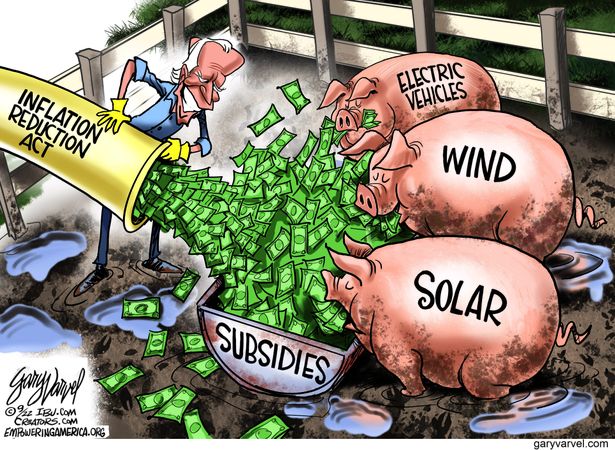
Biden’s EV Boondoggle Enriches Himself
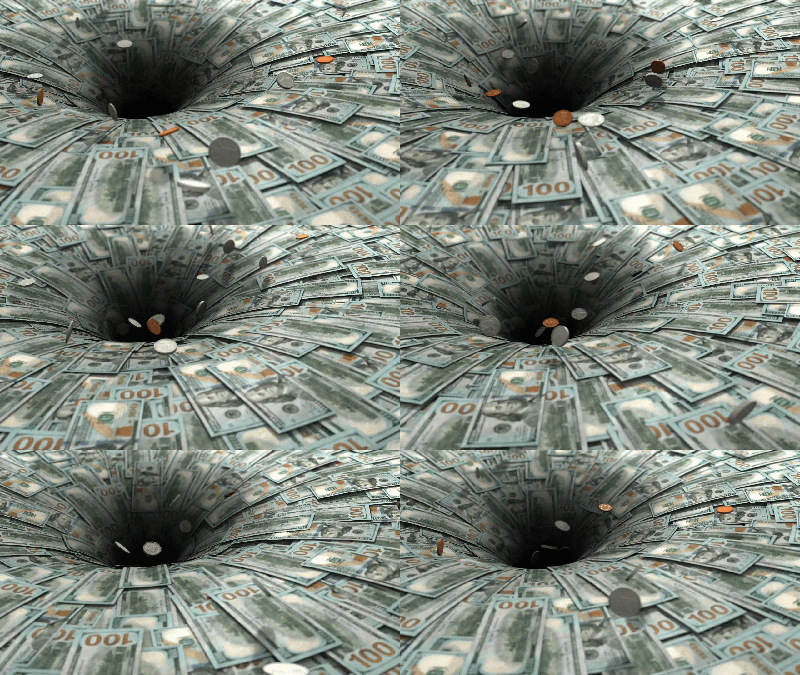
The Greenest thing about the New Green Deal is the Money.

The spending on “Green Energy Projects” is enormous and uncontrolled.  Larry Behrens explains at Real Clear Energy Too Favored to Fail:” Taxpayers Bailout Biden’s Green Friends.  Excerpts in italics wtih my bolds.

While America struggles to buy groceries, President Joe Biden has a
green slush fund worth billions of dollars, and he’s not afraid to use it.

Billions Disappear with Rivian Bankruptcy

Recent revelations uncovered that the CEO and lobbyists of Rivian, an electric vehicle manufacturer, held a quiet meeting at the White House with Biden’s Climate Czar, John Podesta. That’s right, the same John Podesta who served as chairman of Hillary Clinton’s ill-fated 2016 presidential campaign before being pulled from the ranks of profitable green consulting to oversee distribution of $369 billion from the Inflation Reduction Act (IRA). Biden selected a political operative with green company ties to dole out the goodies from one of the largest slush funds in history. Now green CEOs who are hemorrhaging cash are beating a path to his White House office, presumedly with hat in hand.
According to media reports, Rivian is deep in the red. Last year, they lost $6.8 billion. In 2021, it was $4.7 billion, which is in addition to the $1 billion lost in 2020. These massive losses happened as EV manufacturers enjoyed large subsidies both to build and sell their vehicles. In fact, President Biden went out of his way to praise Rivian in early 2022, even though their stock had already lost half its value on its way to losing 87% of its value since 2021. Losing over $12 billion in less than three years would normally be a problem in the business world, but in the upside-down reality of Biden’s green agenda, that gets you a meeting at the White House.

Tax dollars are flowing from the IRA so quickly that the Department
of Energy’s Inspector General (IG) may be running out of adjectives.

Earlier this month in testimony before the Senate, the IG said, “the current situation brings tremendous risk to the taxpayers.” Red flags about American dollars flowing to foreign companies or just being wasted here at home are going up, yet according to budget watchdogs, their concerns are met with deaf ears by senior Biden Administration officials. The IG notes there were “billions and billions of dollars lost or stolen” from federal Covid funds, and Biden’s slush fund is even bigger. To put it bluntly, the green vault is wide open and the grifters are lining up.

“Green Banks” Dole Out Taxpayer Cash

Here’s a particular galling example. One little known aspect of the IRA are so-called “green banks.” For greenies, the scheme is simple: regular banks will not fund their boondoggles, so they need a taxpayer backed entity to dole out cash. Unlike regular banks, these green banks do not need to make a profit to stay afloat because the government is their funder.

New Mexico Governor Michelle Lujan Grisham was caught trying to set up a green bank without the trouble of going through the elected legislature. The board of the bank will be green non-profits who will be in charge because as the New Mexico climate czar put it, “We’re talking about hundreds of millions of dollars…This greenhouse gas reduction fund is a remarkable little beast.” Recently, Grisham announced the green bank anyway. The slush fund is open for business, and everyone has their hand out.

Congress is watching the “green bank” scheme because they know it is ripe for abuse. The problem is clear: The White House put a political operative in charge of what is nothing more than a political fund. For Barack Obama, they were too big to fail, but Joe Biden is taking it further. When it comes to his failed agenda, his green boondoggles are “too favored to fail.”

Biden’s Wasted EV Subsidies Eclipse Solyndra

Helen Raleigh reports at The Federalist The Biden Administration’s Electric Vehicle Subsidies Are Becoming Another Solyndra.  Excerpts in italics wtih my bolds.

Energy Secretary Jennifer Granholm made $1.6 million from
an electric car company the Biden administration boosted
that just went bankrupt.

Proterra, an electric bus and battery company that President Joe Biden touted as a success of his green energy initiative, filed for bankruptcy in August. Last week, it finally sold its embattled battery business at a rock-bottom price as part of the bankruptcy proceeding. The rise and fall of Proterra demonstrates once again that politicians should refrain from betting taxpayers’ money on business ventures to advance their political agenda.

According to the Wall Street Journal, Proterra has sold only 550 electric transit buses since its founding in 2004. Most of the sales were underwritten by government agencies with federal grants. Proterra’s electric buses were plagued with mechanical defects and other performance issues, such as limited range and long charging times. Besides government subsidies, the company only survived as long as it had due to powerful political connections. Former Michigan governor Jennifer Granholm, Biden’s energy secretary, served on its board.

Despite all the quality issues of its EV buses, Proterra went public in January 2021 and raised $650 million, more than three times its annual revenue. A month after the company’s IPO, Biden tapped Granholm as his energy secretary. Proterra’s political connection to the Biden administration paid off in many ways.

Surviving on Grants and Tax Credits

In April 2021, Biden took a virtual tour of a Proterra facility to promote his infrastructure plan. The proposal included $6.5 billion in grants to help replace diesel-powered school and transit buses with electric ones. During the tour, Biden lauded Proterra for “getting us in the game.” He predicted that Proterra and other electric vehicle companies would “end up owning the future.”

Biden’s 2022 Inflation Reduction Act further enriched Proterra’s coffer. The law had little to do with reducing inflation, but it gave massive government handouts to the green energy sector. For instance, IRA includes a $40,000 per vehicle tax credit for purchasing electric commercial vehicles and an additional tax credit for EV batteries.

Proterra admitted in its quarterly report that “the availability of this new unprecedented level of government funding for our customers, suppliers, and competitors to help fund purchases of commercial electric vehicles and battery systems will remain an important factor in our company’s growth prospects.” Proterra’s political profile rose even more after Biden appointed Gareth Joyce, CEO of Proterra, to serve on the President’s Export Council in February this year.

Backed by Biden, Buried by Biden

Excessive government spending under Biden has sparked high inflation rates that were last seen in the 1970s. To bring inflation rates down, the Federal Reserve has aggressively raised interest rates. Higher rates increased production and operations costs for many companies. As legendary investor Warren Buffett famously said, “Only when the tide goes out do you learn who has been swimming naked.” Proterra was one of those companies that had been caught “swimming naked” in this new environment.

The company struggled because it had difficulty passing rising costs on to its existing customers, since most were government agencies with little budget flexibility. Nor could Proterra outsource its production overseas or import components at lower costs. Receiving government grants comes with strings attached. One requirement is that companies like Proterra must produce at least 70 percent of their EV components in America. Proterra couldn’t afford to cut the prices of its EVs to drum up sales.

Finally, Proterra filed for bankruptcy in August. Government subsidies could not offset the financial pressure of rising inflation, higher interest rates, and falling sales. Last week, a Swedish automobile manufacturer, Volvo, bought Proterra’s battery business for $210 million, a great deal considering Proterra was valued at $1.6 billion a year ago.

Another party who got an excellent deal was Granholm. She sold her Proterra shares for $1.6 million last year. They would have been worth nothing if she had held on to her Proterra shares until this

August. The biggest loser of the whole Proterra saga is American taxpayers.

No Good News for Electric Vehicles

Proterra was not the only EV company that went under. Michigan-based Electric Last Mile declared bankruptcy in June 2022. Ohio-based Lordstown Motors went bankrupt a year later. Ironically, these companies benefited from the Biden administration’s climate handouts, but the economic consequences of the same policies eventually doomed them. Even large automobile companies’ EV units are struggling. Ford estimates it will lose $3 billion this year on its EV business. The company relies on sales of gas-powered vehicles and government subsidies to keep the EV business afloat. 

What’s In This for the Bidens?

Fred Lucas explain in his Daily Signal article Hunter Biden’s Cobalt Deal With China Increases Cost of His Father’s Push for Electric Cars.  Excerpts in italics with my bolds.

Presidential son Hunter Biden’s most recent controversy—assisting a Chinese company’s purchase of a large cobalt mine—is linked directly to a top Biden administration policy of promoting electric vehicles.

Cobalt, a relatively rare and expensive mineral, is an essential part of batteries used to power electric automobiles. The COVID-19 pandemic also made U.S. officials and the public much more aware of Communist China’s control of the supply chain for drugs and other products.

The younger Biden, 51, is a one-time partner in China-based Bohai Harvest RST, known as BHR, and reportedly remains a stakeholder

The New York Times first reported over the weekend that BHR facilitated mining company China Molybdenum’s $2.65 billion purchase of a cobalt and copper mine from an American company, Freeport-McMoRan. 

Rep. Ken Buck, R-Colo. told The Daily Signal,

The latest news [that] he assisted a Chinese company purchase one of the largest cobalt mines is another example of Hunter Biden using his influence to line his pockets and help a foreign adversary. Conducting oversight of Hunter Biden’s questionable ethics and dealings that undermine our national security will continue to be a top priority for Oversight [Committee] Republicans.

The committee’s ranking Republican, Rep. James Comer, R-Ky., tweeted: “By helping Chinese companies mine rare minerals in Congo, Hunter Biden is helping Communist China corner the Electric Vehicle market that @POTUS is subsidizing here at home.” 

Summary:

The campaign is to force electric vehicles upon Americans who otherwise do not want them.  And why?  It’s not about climate change, not about the environment.  It’s about greed not green.


Green Crash Ahead

Duggan Flanakin writes at Real Clear Energy Climate Enron May Be Heading for a Crash.  Excerpts in italics with my bolds and added images.

Today, the collapse of FTX and the recent criminal conviction of founder and CEO Sam Bankman-Fried (who is facing a lifetime behind bars) brings Enron, Skilling, and Lay to mind. But, despite the magnitude of SBF’s fraud, it pales in comparison to the ongoing fraud being perpetrated mostly on America and its Western allies in the name of “climate change.”

A bit like FTX, but unlike Enron, there are plenty of warning signs that the “Green Revolution” is about to come tumbling down and its loudest advocates brought to account. The main thing keeping the mirages afloat today is the massive egos and their investments in folly that may leave them going down with the ship.

While the “Green Revolution” has been under way for decades, it is the Biden Administration that has imposed mandates, attacked popular energy sources and transportation options, and waged war against traditional industrial development. Europeans and states like California had earlier imposed their own mandates with supposedly “hard” deadlines for abolishing the use of oil, natural gas, coal, and every tool or vehicle that uses them.

The green war on fossil fuels, as fleshed out in the “Net Zero” campaign,
is perhaps history’s greatest example of philosophical fraud.

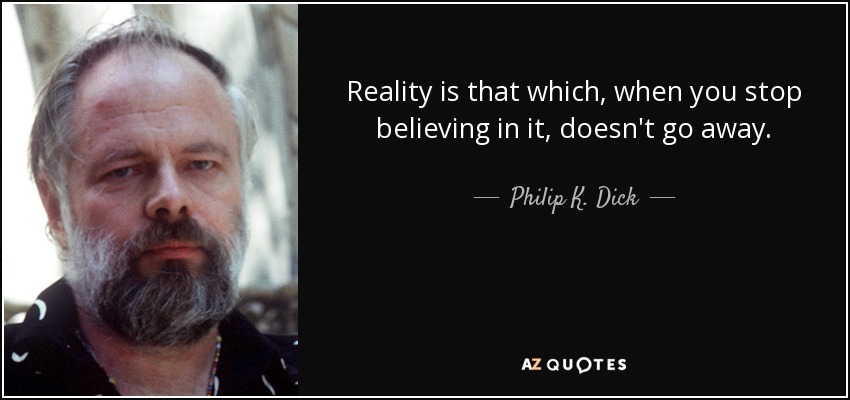
And the corollary: Reality is also that which happens instead of what you wanted and expected. 

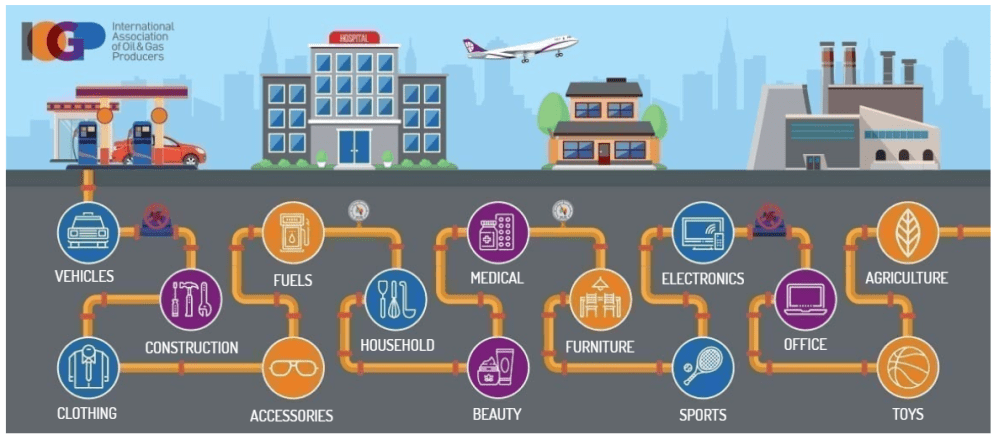
“To dream the impossible dream” and turn it into reality would mean sacrificing an estimated 6,000 useful products that rely on byproducts from crude oil refineries – products that range from asphalt for highways to fertilizers, cosmetics, synthetic rubber, medicines and medical devices, cleaning products, plastics, so many more. The 3 billion who live without the benefits fossil fuels have provided are also the poorest, sickest, and most vulnerable humans on the planet.

Cracks are already developing in the “Net Zero” world, what with countries backing away from the mandates they so recently touted while marching around like peacocks in mating season. In March the European Union reached an agreement with Germany to formally back away from its total ban on internal combustion engines in 2035.

Still, 30 countries are signatories to the Glasgow Declaration that would force all vehicles sold by 2040 to have zero carbon dioxide emissions, and 21 others have crafted plans to ban new ICE vehicle sales earlier than 2040. Dozens of major cities and states, most notably California and the California clone states, intend to disallow new ICE vehicles by 2035.

Several problems stand in the way of their utopian dream. Even EV advocates are now admitting the “EV-olution” has to overcome “serious issues” – like the use of child labor in lithium mining, the woefully inadequate EV charging infrastructure, and an unprepared power grid. Yet the biggest obstacle is that a majority of the Earth’s people object to having EVs – or heat pumps, or electric stoves, and so on — shoved down their throats.

EVs may be fine for short-trip urban travel but not for construction equipment, airplanes, or even urban buses, as evidenced by the recent horrific scene in San Francisco when a Google-operated electric bus lost power and slid backwards downhill into nine vehicles. Today’s EVs are wholly impractical for mountain and prairie residents or others making long trips (worse with children).

Like Ken Lay with Enron, the Green revolution has relied heavily on government subsidies and a “revolution always” business philosophy aimed at making pariahs of anyone who dares oppose the grandiose – but fatally flawed – plan.

During the Obama Administration, Solyndra went under despite a $535 million government-guaranteed loan, none of which was paid back. Forbes, citing OpenTheBooks.com, noted that taxpayers were left holding the notes for $400 million given to Abound Solar, $280 million wasted by CaliSolar, $193 million doled out to Fisker Automotive (with another $336 million canceled), and $132 million to A123 Systems (a failed battery maker).

Undaunted, the Biden Administration’s $2.3 trillion “jobs” package was rife with more subsidies for technologies that by their own admission are unsustainable. Yet despite all the free money, Ford, General Motors, and many other automakers are backing away from multibillion-dollar investments in new EV factories as new EV sales have slowed despite increased rebates.

Ford in March projected a loss of $3 billion on electric vehicles in 2023, offsetting profits of as much as $14 billion from its other divisions. Ford also admitted losses of $900 million in 2021 and $2.1 billion in 2022 in its EV division. Ford and GM believe their EV fortunes will turn around by 2025, but those rosy scenarios seem wholly dependent upon Biden (or an even “greener” Democrat) winning the White House next November.

Even with a Green win in 2024, reality will still bite the EV dream. China has been quietly moving toward total dominance in the global EV marketplace – largely because it controls the lithium battery market. Financial Times wrote in September that China is so far ahead in the EV market that its competitors are trailing in the dust.

Biden’s reliance on huge subsidies to underwrite the “Green Revolution” has brought soaring inflation to the U.S. that is taking away purchasing power faster than it can increase subsidies and Mafia-style “incentives” (you will buy what we want you to buy, or else!).

Lay died of a heart attack shortly after his trial, leaving behind “a legacy of shame” characterized by “mismanagement and dishonesty” that led Politico to rank him as the third-worst American CEO of all time.

America’s doddering President Biden, now facing pre-impeachment hearings for other alleged mistakes, may not live to see his name smeared as Lay’s once was. But does anyone truly believe Biden is calling all the shots here?

Who will, then, get the blame if America’s forced march to
EV subservience to Xi’s China brings an end to
America’s hegemony on the world stage?

SEC Rule on ESG Reporting: Going Too Far?

Based on a non-fiction book of the same name by historian Cornelius Ryan, A Bridge Too Far is a 1977 epic war film depicting Operation Market Garden, a failed Allied operation using paratroopers to secure three bridges over three key rivers in Nazi-occupied Netherlands during World War II.  The phrase has come to mean “a long shot”, or an overly ambitious plan.

The metaphor can now be applied to 2023 regarding the onslaught of ESG bureaucratic regulation burdening enterprises around the world. Jon McGowan explains in his Forbes article The SEC’s New Rule May Inadvertently Kill ESG Funds.  Excerpts in italics with my bolds and added images.

 Securities and Exchange Commission recently announced a rule requiring environmental, social, and governance funds to be 80% aligned with the fund’s stated goals. This could reveal a long-held secret of ESG funds: to be competitive, they are packed with more profitable investments that are not green.
ESG is a type of investing where non-financial factors
are considered in the decision-making process.

ESG has grown quickly over the past few years, pushed by global action to meet the net zero goals of the Paris Accords. Globally, those non-financial factors are primarily focused on sustainability. However, in the US there has been an added focus relating to LGBTQ+ issues that some have deemed political, causing controversy.

The growth of ESG has sparked regulation for sustainable reporting standards for businesses. The European Union was the first, with the European Sustainability Reporting Standards that were approved in July and set to go into effect January 1. The ESRS will require publicly traded and large privately held companies to report greenhouse gas emissions, actions taken by the entity to reduce GHG emissions, and other green policies. Eventually it will expand to small and medium-sized enterprises. While reporting will be mandatory, no environmentally friendly action is required. The SEC is set to release similar standards for the US in October.

[Note: Bloomberg reports this week Banks May Escape EU’s Toughest ESG Regulation So Far  Lawmakers, member states are negotiating due diligence rule
Firms face new civil liability, large fines under the proposal

and EU Exchanges Face Delistings as ESG Rules Hit Multinationals
Non-EU firms are waking up to January compliance deadline
EU’s corporate reporting rules have met widespread opposition]

The increased interest in ESG caused fund managers and businesses to adjust their practices. This sudden shift raised concerns of greenwashing, or the exaggeration of environmentally friendly initiatives to appear greener than they actually are. A new term, climate washing, has recently developed that is specific to the exaggeration of climate change initiatives.

Greenwashing for marketing purposes, while misleading, rarely met the standard of a regulatory violation. However, when greenwashing is directed at investors it could violate financial regulations and fall under the authority of the SEC. The SEC recently fined Deutsche Bank’s investment arm, DWS, $19 million for “materially misleading statements” relating to greenwashing in ESG funds. However, enforcement is problematic as the threshold for what constitutes greenwashing was not previously defined.

That changed when the SEC announced a new rule that requires ESG funds to match at least 80% of their portfolio with the stated goals of the fund. This new rule came just weeks after the SEC issued a round of subpoenas to an unknown number of fund managers relating to their ESG fund practices.

While the 80% requirement will settle greenwashing concerns,
it could be problematic for the viability of ESG funds.

Environmentalist and aligned organizations have frequently expressed concerns that some ESG funds were stacked with investments that were contrary to sustainable goals. A 2022 study by ESG Book found that ESG funds on average produced 14% higher GHG emissions than traditional funds. The same study found ESG funds investing in mining and fossil fuels, including Shell, Exxon Mobile, and BHP Group. The ESG Book study is not alone or new. Multiple studies have been released by environmental think tanks chastising ESG funds for not being sustainable.

Fund managers are placed in a precarious position of trying to offer
environmentally friendly funds, while also
meeting their fiduciary duty to maximize returns.

In doing so, they are forced to offset the underperformance of sustainable investments with investments in companies that are high profit, but contrary to the green goals. The result is funds that are not truly green, but greenish.

The new SEC rule will force fund managers to limit that practice to 20% of the fund. The unsettled question is how that will impact returns. ESG funds already underperform compared to traditional funds, the 80% rule may make them no longer a viable investment.

Background:

SEC Warned Off Climate Disclosures


Follow the Climate Money Updated

To enlarge, open image in new tab.

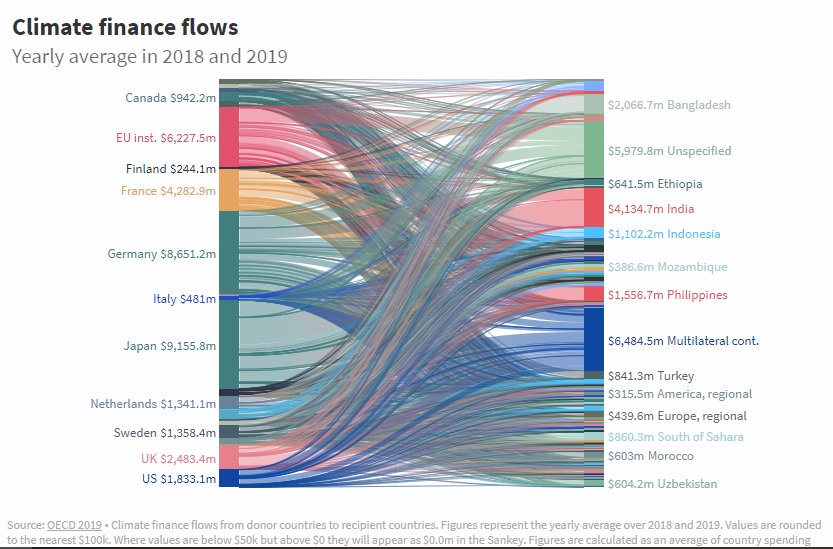
Why climate-finance ‘flows’ are falling short of $100bn pledge  is an informative article from CarbonBrief.  Excerpts below in italics followed by a comment from Bjorn Lomborg.

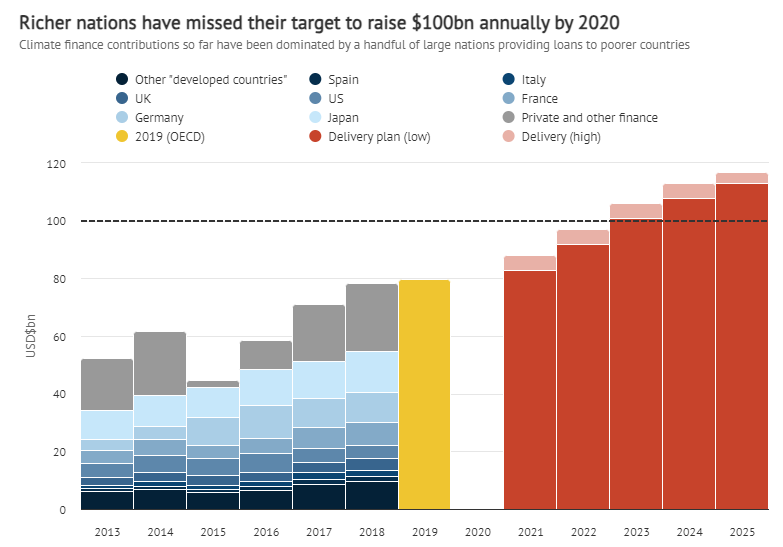
One of the biggest and most contentious issues in climate politics is the provision of money to help poorer countries cut emissions and protect themselves from climate impacts.  In 2009, wealthy nations pledged to “mobilise” $100bn in “climate finance” annually by 2020 to help vulnerable nations deal with climate change.  As the title notes, even now the target has not been met.

Politicians and observers have warned that this failure could undermine trust between nations as they head into negotiations in Dubai. What is more, there are widespread concerns about the quality of finance being offered, with questions surrounding the use of loans instead of grants, different definitions of “climate finance” and insufficient funding for adaptation efforts.

In this article, which updates and builds on a previous analysis published in 2018, Carbon Brief assesses the state of international climate finance as nations prepare for the next COP.  It uses the latest numbers collated by the Organisation for Economic Co-operation and Development (OECD), a club of mostly wealthy nations, many of which are responsible for contributing climate finance.

The OECD, a Paris-based intergovernmental economic organisation, asks its 36 member countries to report on their foreign aid, including climate finance. The data captures climate finance that is both bilateral (country to country) and multilateral (via international institutions) It also gives detailed information about funded projects. (The OECD calls this database “climate-related development finance” rather than strictly climate finance).

Key takeaways from 2015-2016 Report
  • Donor governments gave climate finance totalling $34bn in 2015 and $37bn in 2016, according to OECD estimates (note that this is not a full estimate of money counting towards the $100bn pledge – see below for more).
  • Japan was the largest donor, giving $10.3bn per year (bn/yr) on average over the two years. It was followed, in order, by Germany, France, the UK and the US.
  • India was the largest recipient on average, receiving $2.6bn/yr. It was followed, in order, by Bangladesh, Vietnam, the Philippines and Thailand
  • The single largest “country-to-country” flow was an average yearly $1.6bn from Japan to India.
  • The US was the top contributor to the multilateral Green Climate Fund (GCF) in 2016. (However, the US has now ended its support for the GCF).
  • Around $16bn/yr went to mitigation-only projects, compared to $9bn for adaptation-only projects.
    Around 42% of the finance consisted of “debt instruments”, such as loans.

Key takeaways from 2018-2019 Report
  • In 2019, the OECD found that climate finance had reached $79.6bn, up just 2% from 2018, and while official figures for 2020 are not yet available, Bloomberg reported that rich countries reckon they had raised $88-90bn, as of October 2021.
  • The shares attributed to countries are based on analysis by the World Resources Institute (WRI) of bilateral and multilateral development funds that can be traced to Annex II nations. These roughly align with the OECD’s figures, which are not broken down by country but, like the WRI’s, are partly derived from Annex II nations’ reports to the UNFCCC.
  • The remaining finance, indicated by the grey bars in the chart above, is made up of export credits, additional outflows from multilateral institutions and, most of all, private contributions by businesses and philanthropic groups (this is an approximation based on the OECD’s total values with the WRI estimates removed).
  • Private funds count towards the $100bn target, but the WRI did not include them in its analysis as the data is less complete and difficult to attribute to individual nations. The OECD estimates that annual private finance has been stable at around $14bn since 2017.
  • The top five finance providers – Japan, Germany, France, the UK and the US – have remained the same since Carbon Brief’s last analysis for 2015/16. These five nations contributed more than 60% of the 2018/19 finance.  While Japan, Germany and France appear to be by far the biggest contributors, the WRI warns that the lack of clarity around climate finance reporting means the numbers should be approached with caution.
  • As in Carbon Brief’s previous analysis, India was by far the biggest recipient of climate finance, with more than double the funds received by the next largest, Bangladesh. Japan and Germany provided about 94% of the funds to India, almost all in the form of loans.
Implications

Climate finance figures are widely contested, with many global-south nations questioning how much funding is new and not simply diverted from other development funds. Criticism has also been levelled at the overreliance on loans and the inclusion of support for “high-efficiency” coal plants by Japan and Australia.

A recent assessment prepared by the UNFCCC’s Standing Committee on Finance concluded that developing countries require $5.8-5.9tn up to 2030 in order to fund less than half of the actions outlined in their official climate plans – although some of this would be funded domestically.

This year’s negotiations are likely to spark calls for a significant scaling up of finance, although the slow pace of proceedings means that, for the time being, the focus of new goal discussions will primarily be on agreeing a framework for future talks.

Nevertheless, there are various issues that could be on the table during this next phase, including ensuring that more money is spent on adaptation.

The Paris Agreement specifies that climate finance should aim for an even split between these two categories, but funding has long been skewed towards mitigation. According to Jan Kowalzig, a senior policy adviser at Oxfam, governments often tend to view such projects as more attractive investments:

“Since [mitigation projects] often have to do with energy, they seem to be more directly linked to a country‘s development, even though, of course, this is a huge misconception given the central (but, for politicians, often less visible) role of adaptation.”

Of the roughly $40bn average for the 2018/19 period, 39% of money went on mitigation, while just 25% went on adaptation – a slightly more even split than was recorded in Carbon Brief’s previous analysis for 2015/16.

However, other estimates, including the OECD’s own climate finance report, suggest a more pronounced split, with around three times as much finance going to mitigation than adaptation in 2018 and 2019.

This imbalance is a major concern amid rapidly escalating climate costs. The UN Environment Programme places current annual adaptation costs for “developing countries” at $70bn, but says they will reach $140-300bn by 2030.

Ensuring adequate adaptation finance in the coming years is, therefore, seen by many vulnerable nations as a key priority for post-2025 climate finance plans as they are developed.

Climate Money Could Be Better Spent

Bjorn Lomborg When it comes to climate change, let’s get our priorities straight

We must also bear in mind that global warming is not the planet’s only challenge. We often hear that it is the defining issue of our time, but it is no such thing. By the 2070s, the IPCC — the U.N. climate change panel — estimates that warming will cost between 0.2 and 2 percent of global GDP. This is certainly a problem, but not the end of world.

Speaking of climate change in catastrophic terms easily makes us ignore bigger problems, including malnutrition, tuberculosis, malaria and corruption. The World Health Organization estimates that climate change since the 1970s causes about 140,000 additional deaths each year, and toward the middle of the century will kill 250,000 people annually, mostly in poor countries. This pales in comparison with much deadlier environmental problems such as indoor air pollution, claiming 4.3 million lives annually, outdoor air pollution killing 3.7 million and lack of water and sanitation killing 760,000. Outside of environment, the problems are even bigger: Poverty arguably kills 18 million each year.

Every dollar spent on climate change could instead help save many more people from these more tractable problems. The current approach to subsidize solar and wind arguably saves one life across the century for every $4 million spent — the same expenditure on vaccinations could save 4,000 lives. Each person — and the next president — needs to decide his or her legacy.

Postscript: Financing for Climate Aid is a Fraction of the Full Cost of Climate Crisis Inc.

A fuller accounting of the climate crisis industry more likely exceeds 2,000,000,000,000 US$ per year (2 Trillion)
See Climate Crisis Inc. Update

What’s Wrong with ESG Investing? Plenty

Investors Sour on ESG Activism

Andy Puzder explains how bogus and damaging is ESG investing.  Perhaps others are getting the memo.  WSJ reports with a sad tone what is actually good news that investors are pushing back against ESG political correctness. Their article is: ESG Blowback: Exxon, Chevron Investors Reject Climate Measures  Excerpts in italics with my bolds.

An investor-driven climate change push at some of the
world’s largest oil companies has stalled out.

On Wednesday, Exxon Mobil and Chevron’s shareholders struck down a raft of proposals urging the companies to cut greenhouse-gas emissions derived from fuel consumption, put out new reports on climate benchmarks and disclose certain oil-spill risks, among other initiatives.

The votes were abysmal for climate activists. All but two of the 20 shareholder proposals for the two companies garnered less than 25% of investors’ vote, according to preliminary results, with some performing much worse than similar proposals put forward last year.

Zero Carbon zealots attacking ExxonMobil, here seen without their shareholder disguises.

Among the most controversial proposals were those that would have had the companies adopt targets for reducing emissions including those from third-party consumption of their products, such as when drivers burn gasoline in their cars, also known as Scope 3 emissions. Those received only 11% and 10% of the vote among Exxon and Chevron investors, respectively, compared with 27% and 33% for similar proposals last year.

In recent weeks, similar climate proposals failed to win over most shareholders
at annual meetings of British oil and gas giants BP and Shell in London.

Investment strategies linked to ESG, short for environmental, social and corporate-governance issues, had gained momentum in recent years, particularly following the onset of the pandemic in 2020. Investors pressed oil companies to show how they were working to reduce their climate footprint, set long-term environmental goals and curtail the flaring of unwanted natural gas.

In 2021, investment firm Engine No. 1 prevailed in a historic proxy battle against Exxon, winning three board seats at the company’s annual meeting with the backing of investment firms, Vanguard, State Street and BlackRock. The firm argued that Exxon needed to form a better strategy to prepare for the world’s anticipated energy transition.

After the defeat, Exxon adopted a so-called net zero commitment — a goal to reduce
or offset greenhouse-gas emissions from its operations to zero by 2050.

But Wednesday’s votes demonstrated how some shareholders have backed off pushing major oil companies to embrace certain climate goals. Investors said many voices pushing ESG measures have been drowned out following Russia’s war in Ukraine, which caused oil and gas prices to skyrocket as global supplies were crimped.

Mark van Baal, founder of environmental activist group Follow This, said shareholders missed an opportunity at the annual votes. Investors know that avoiding climate disaster will require global emissions to fall by almost half by 2030, he said, but many are focused on short-term profits. [Note: van Baal is wrong about disaster–see Even 3°C Warming Can’t Stop World Prosperity. ]

The industry and its allies have said some countries, particularly in Europe, were too quick to move away from fossil fuels toward clean energy sources such as solar and wind. A movement against climate activism has gained political traction in the U.S., particularly among Republican voters. Entrepreneur Vivek Ramaswamy, a candidate for the Republican presidential nomination, has made anti-ESG policies a central plank of his campaign.

The pushback against ESG measures has also hit investment firms such as BlackRock,
which have faced potential boycotts in Texas and other red states.

Republican officials in Florida, Texas, Louisiana and South Carolina pulled more than $4 billion in pension and investment funds from BlackRock starting last year. BlackRock brought in $230 billion from U.S. clients in 2022.

It wasn’t immediately clear how BlackRock, State Street and Vanguard voted at the meetings this week.  State Street and BlackRock declined to comment. Vanguard didn’t immediately respond to a request for comment.

Investments in fossil fuels pushed many oil companies to record profits last year, which lured back some investors who had fled after years of meager returns from the industry. Exxon Chief Executive Darren Woods said Wednesday the company had benefited from investing in fossil fuels when others pulled back.

Even in Europe, energy executives have shown a willingness to alienate clean-energy investors to tailor strategies to the thirst for fossil fuels. BP and Shell’s record full-year 2022 profits and hefty returns to investors have attracted new investors, and won back some who were dubious of their energy-transition strategies, executives said.

Shell and BP executives have said their strategies are consistent with targets to lower global emissions, while also helping supply the oil and gas still demanded in coming years globally. Exxon and Chevron have said they support the emissions targets set by the Paris climate accords and reducing emissions from their operations.

But Woods and other industry executives have argued some climate-related proposals would backfire or leave the economy worse off. Woods said several proposals rejected Wednesday would have required the company to assume the world will cut carbon emissions at a much faster pace than observers have projected.

“Some [would] go so far as to force us to decrease oil and gas development,” he said. “This would do nothing to reduce global demand.”

What is actually beyond debate is not that we are in a climate crisis
but that if we don’t stop destroying our conventional energy economy,
we are going to be in a civilizational crisis.

Insurers Playing the Climate Card

You’re probably seeing headlines like this one from The Hill Insurers pull back as US climate catastrophes intensify.   H/T Mark Krebs.  As usual, the Climate Card is a coverup for others who really are to blame for losses.  The linked article starts to look under the carpet, and I will dig deeper in this post.

Firstly, they label weather events as climate castastrophes in order to blame them on everyone else.  

From The Hill:

This month Farmers Insurance announced that it will no longer write new property insurance policies in Florida, citing “catastrophe costs … at historically high levels.” AIG also recently stopped issuing policies along the Sunshine State’s hurricane-vulnerable coastline.

State Farm, meanwhile, said in May, that it would impose a moratorium on new policies in California due to “rapidly growing catastrophe exposure.”

Mark Friedlander, director of corporate communications at the Insurance Information Institute, said that dozens of firms have reduced their presence in Louisiana, including 50 that have stopped writing new policies in the state’s hurricane-prone parishes.

Then in the article details, there are other factors causing claims, including bad governance

He noted that while Farmers made headlines, it’s the 15th insurer to stop writing new policies in Florida in the last 18 months. Although most of those companies have not pulled out of the state outright, he added, three have.

“Insurers are in many ways the first movers” in response to trends like extreme weather and natural disasters, Keys said. “They have a significant amount of money at stake, so they’re very exposed to the downside.”

Florida is in a unique position, Friedlander said, because of a combination of high fraud rates and widespread litigation, which both compound the cost of insurance on top of the climate risks. A state law enacted this year creates a backstop for property insurance in hopes of alleviating some costs, but it’s not yet clear how effectively it will counteract those factors, which have been building for years.

“The difference is in California and Louisiana, [insurance costs are] primarily climate-driven,” he said. “They don’t have the manmade factors we have here in Florida.”

“There isn’t an equivalent for wildfires in California, so the risks in California are borne much more directly. [Note:  Refers to California wildfires, which are uniquely a problem in that woke state which refuses to apply forestry management best practices.]

Insurance Industry Intends to Leverage Climate Fear

“The industry’s taking the approach now of what’s called predict and prevent, meaning being proactive to address climate risk and make sure insurance coverage reflects that and make sure homes and business take preventative action,” Friedlander told The Hill.

Keys also noted that the decisions don’t mean the insurers will never write policies or operate in the state again. Rather, he said, they should be understood as a way for insurers to negotiate, both on what they can charge in premiums and what factors they can weigh.

“It’s not that [insurers] don’t want to do business in your state, it’s that [they]
don’t want to do business at the current premiums [they] can charge.” 

Soaring School Insurance Costs Show How This Works

From Education Week Schools’ Insurance Costs Are Soaring—And Climate Change Isn’t the Only Reason.  Excerpts in italics with my bolds.

School districts are just like homeowners, renters, drivers, and small businesses—they need insurance, even as it’s become prohibitively expensive.

The 900-student Davis district in southern Oklahoma spent $61,000, or roughly $68 per student, on liability insurance for the 2019-20 school year. Last school year, the cost for the same coverage was $150,000, or $167 per student.  Next school year, it’ll be $261,000, or $290 per student. That’s a 328 percent jump just in two years.

Why is the cost of insurance rising so precipitously? Several factors provide clues.

For one, climate change is causing more frequent natural disasters that affect school district operations and require insurance companies to pay out. And it’s not only districts in hard-hit areas that see higher premiums as a result.

Districts’ coverage costs are increasingly determined by what’s happening nationally, not just in their own communities, said Kelli Hanson, executive director of the Schools Insurance Group, which provides insurance to schools in California.

“The more hurricanes we have in Florida, we’re impacted. The more flooding in the Midwest, we’re impacted,” Hanson said.  [Cashing in on Climate?]

Meanwhile, new laws allowing more lawsuits over sexual abuse are putting school districts in an unflattering legal spotlight—while also contributing to higher insurance premiums because of the added legal liability. In California, for instance, a new law passed in 2019 dramatically extends the statute of limitations for plaintiffs to sue over child sexual abuse, including in schools.

The growing frequency of cybercrimes is another factor putting districts at risk. The Shanksville-Stonycreek district in southwestern Pennsylvania saw cybersecurity insurance costs triple after a hacker got access to some of the district’s files in 2019, said Sidney Clark, the district’s business manager and board secretary.

And some districts have adopted controversial policies that are alienating their providers altogether. In Iowa, at least two districts nearly lost insurance coverage recently after they announced that they would be allowing teachers to carry guns on campus. After consulting with other providers who also wouldn’t commit to coverage, both districts have since nixed the policy.

In Oklahoma, one of two main providers of school property and casualty insurance shut down during the pandemic. As a result, Moring said, he has no choice but to sign up with the Oklahoma School Insurance Group (OSIG), no matter what its coverage plan looks like.

In turn, OSIG has struggled to keep rates down for the hundreds of districts in its membership, said Rick Thomas, a retired superintendent who has served as OSIG’s executive director for the last school year.

Over the last three years, Thomas said, OSIG has raised from $14 million to $30 million the amount of money it pays out to districts directly before seeking reimbursement from re-insurers—external companies that charge higher premiums.

School districts aren’t entirely powerless to stop insurance costs from swelling. In many cases, providers want to see that districts are proactively preparing for the unlikeliest scenarios.

Schools with safety plans with details on how they’ll deal with wildfires—what they’re doing to keep shrubbery away from buildings, how they’ll evacuate if necessary, for instance—are more likely to receive favorable insurance coverage, Hanson said.

Background from Previous Post Banking on Climate Alarm

The media are again amping up claims of bad weather to be feared from “climate change.” It is Whack-A-Mole time again, so here is a complete debunking of such media reports, compiled to refute a particularly bad speech by Mark Carney Governor of the Bank of England. H/T Friends of Science

Fact Checking Mark Carney’s Climate Claims is a useful reference document written by Steven Kopits of Princeton Energy Advisors. A few examples below show his systematic dismantling of the alarmist narrative by referencing publically available sources, many of them on government or corporate sites.

Temperatures Rising


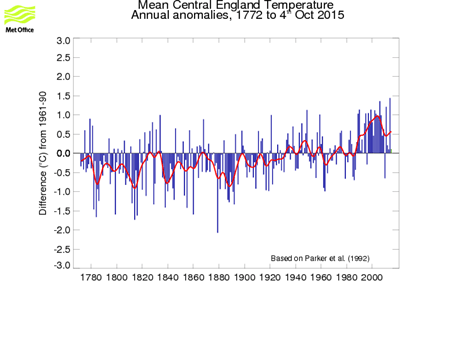
We do have long-time series data for Central England, extending back to 1772. To the extent this measurement is reliable and can be extrapolated to hemispheric averages, it shows a step-up of about 1 deg Celsius from 1980 to 2005, which supports Governor Carney’s assertions. On other hand, it also shows a drop of 0.5 deg Celsius from 2005 to the present—which does not.

Sea Levels

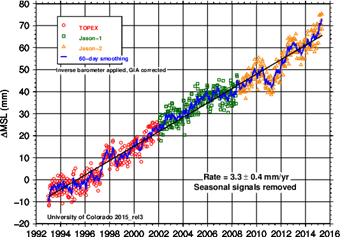
As with just about every other metric the Governor mentions, we have data. Sea level is measured by tide gauges, and also by satellites. Satellite measurements suggest that sea level has been rising steadily by roughly 3 mm / year, which equates to about 1 foot per century.

Weather-related Insurance Losses

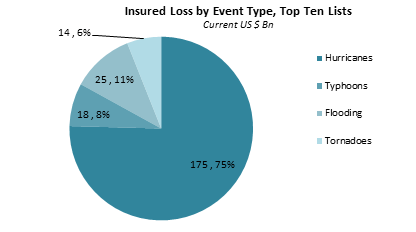
SOURCE: MUNICH RE NATCAT SERVICE

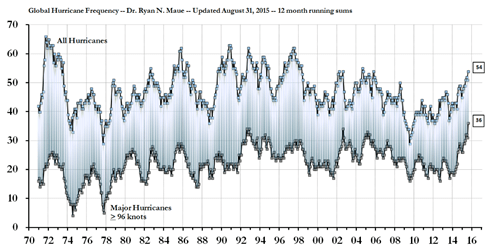
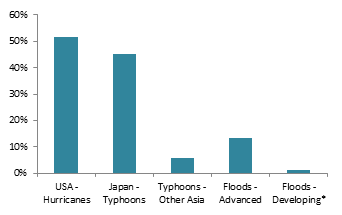
Hurricanes account for 75% of catastrophic losses, with typhoons representing an additional 8%. Thus, hurricanes and typhoons represent $6 of every $7 paid out in ‘top ten’ catastrophic weather-related insurance claims.

And this in turn tells us a great deal about the nature of insurance. Where do insured hurricane losses occur? Principally in the United States. Where do insured typhoon losses occur? Principally in Japan and Taiwan. Why these places? Because all of these are wealthy countries. Hurricane and typhoon losses will be greater where there is, first, a concentration of physical assets, and second, where those assets are valuable. In other words, in the advanced countries exposed to hurricanes and typhoons.

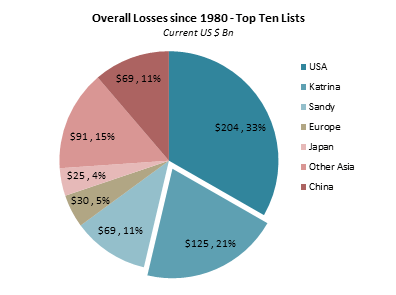
In this, no country is more exposed than the United States. Of overall losses due to top ten catastrophic weather events, nearly 2/3 occurred in the United States alone.

Insured Weather-related Losses

SOURCE: MUNICH RE NATCAT SERVICE

Indeed, if we restrict this to insured losses (including floods and tornadoes), the US accounts for 84% by itself.  Thus, if we are speaking of insured weather-related losses, as a practical matter we are speaking of hurricane damage in the US.  The rest is largely incidental.  For example, Superstorm Sandy caused more insured losses in one event than the cumulative and collective top ten catastrophic, weather-related losses from Europe, China, and Japan since 1980.  And Sandy was only the second worst insurance event in recent times. 

Now, why are US losses so great? Is it due to the number or strength of storms making landfall in the United States?

GLOBAL HURRICANE FREQUENCY SOURCE: RYAN MAUE

In fact, there is no such pattern discernible in the data. Indeed, the last few years have seen fewer than average hurricanes globally, with a recovery to up-cycle numbers in the last year or so.

Rather, reinsurance data hints at the source of losses: higher payouts for assets in harm’s way. 

INSURED LOSSES AS A PERCENT OF OVERALL LOSSES, TOP TEN LISTS, 1980-2014 SOURCE: MUNICH RE NATCAT SERVICE

Further, more and more expensive assets are exposed to hurricanes in particular.  In the US, for example, ever more people are living on the coasts, and beach front property has become prized and expensive.  One need only look out the window on a flight approaching Miami International Airport to be appalled at the sheer concertation of high-end housing built just above sea level on islands dotting Florida’s Atlantic Coast.   How long until a hurricane wipes a good number of these off their foundations?  And what kind of insurance losses will that involve?

Indeed, an examination of catastrophic losses suggests a decisive role for government policy.  Hurricane Katrina, which destroyed New Orleans in 2005, represents alone more than one-quarter of all insured top ten losses globally since 1980.  In just one event. 

The article goes on to deal with other claims regarding Floods, Droughts, Tornadoes, and Wildfires before reaching this conclusion.

Summing Up

In his speech to London’s insurance community, Mark Carney, Governor of the Bank of England, asserted a series of claims about climate change. Some of these are widely accepted. The climate does change. The world has warmed. Atmospheric CO2 has increased, half of the increment due to human activities.

Beyond this, there is no consensus, and indeed, the available data in many cases directly refutes the Governor’s more extreme assertions. There is no consensus that humans are the primary drivers of climate change. As we can see, sea levels, for example, were rising well before the 1950s date Carney gives as the start of modern anthropogenic warming.

Importantly, the increase in losses since the 1980s is more likely to reflect expanded insurance coverage, increasing payouts as a percent of losses incurred, and an increased number of assets with higher values placed in harm’s way. Losses increases have not occurred due to increases in hurricane, tornado, flooding, drought or fire frequency or strength, at least not in the United States, which represents the lion’s share of insurance claims. In many cases, either frequency or intensity of weather-related events has actually declined. Sea level rise has not accelerated, not as measured by either satellites or tide gauges. Sea level has been rising for well over 100 years, and continues on that pace.

Like so many other economists, Governor Carney seems to operate under the assumption that current CO2 levels are just on the edge of some catastrophic acceleration. For some reason, 320 ppm of atmospheric CO2 is safe, but 540 ppm is not, because there is some precipice—an inflection point or boundary—between here and there. The limit is not 1,000 ppm, or 5,000 ppm, or 42,448 ppm, but right here, right now. A little more CO2, a trace more of a harmless trace gas, and we are doomed.

The climate is complex and the future uncertain. It is possible the worst fears may prove correct. Nevertheless, such an assertion is not supported by the historical data, not for US droughts, floods, tornados, hurricanes or fires. But it does show up. In politics. If sea levels were 20 cm higher in New York and this contributed to the damage from Superstorm Sandy, well, any middling analyst could have predicted the rise back in 1940, just as we can predict today that sea levels will be one foot higher a century hence. The failure was not of CO2 emissions, but squarely a failure of governance. And that goes doubly so for the fate of New Orleans. If Governor Carney wanted to make a constructive proposal, he should have called for Lloyds to create macro audits of risk zones and censure or refuse to insure jurisdictions where governance is not up to par. If insurers had refused to insure New Orleans unless the levees were sound, they could have saved themselves $30 bn in payouts and probably twice that in losses.

As an analyst, I find Mr. Carney’s speech is truly dismaying. For the Governor of the Bank to claim that climate change is leading to rapidly rising insurance claims is, at best, a critical failure of analysis. As discussed above, insurance claims are a function of a number of factors, including the type and country of the weather event, as well as the extent of insurance coverage and payout ratios. A hurricane in the US may see one hundred times the payouts of a major flood in India. Payouts will rise as a function of nominal GDP, as both inflation and the value and concentration of assets will play a crucial role in overall losses. The specific path of a storm can also be decisive for global averages. It goes without saying that a storm which strikes in Philadelphia, marches up the New Jersey coast, slams into the Manhattan and turns towards New Haven is going to cost a bundle. That same storm hitting, say, rural Mississippi would cause a fraction of the monetary damages. And this matters, because Superstorm Sandy caused more insured damages than all the leading weather events in Europe, Japan, and China combined. Single events can move long-term global averages.

If the Bank missed this, it is not because the necessary data is hard to find. Information on weather-related events is readily and publicly accessible on the internet. Almost every graph I use above relating to hurricanes, tornadoes, floods and droughts comes from the US government itself. Apparently, the Bank of England could not be bothered to consult the underlying climate data before making hyperbolic claims. Thus, at best, the Bank was careless with data analysis.

A worse interpretation of events suggests that Mr. Carney was willing to blindly accept the conventional wisdom, the ‘consensus of scientists’ regarding global warming, without any will or curiosity to dig deeper and form a personal view. One can only hope that monetary policy in the UK is not informed by such superficiality or passivity.

The very worst interpretation is that Mr. Carney is in fact aware of the source data, but chose to make hysterical claims to promote a personal political agenda. I cannot imagine a more ill-considered idea. For those of us who consider central bank independence sacred, the appearance of a national bank taking sides in a highly charged political debate—and doing so with scant regard for the underlying data—will establish the Bank of England as partisan and the political opponent of conservative politicians. Given that Janet Yellen, the Chairman of the US Federal Reserve Bank, hails from Berkeley, a hot bed of climate activism, should the Republican Party consider the Fed also its opponent? If so, I can assure you, the Republicans will find some support to ‘audit’ the institution.

At the end of the day, political neutrality is a pre-condition for central bank independence. If a political party deems the central bank to be an opponent, then it will take measures to gain political control over the bank, with the result that monetary policy itself may become politicized. If the Bank nevertheless feels compelled to champion a particular side in a political debate, its analysis must be water-tight and its communication, impartial. That Governor Carny violated both dictums is simply stunning and a huge blow to the prestige of the Bank of England. It was a very bad call indeed.

More anti-alarmist information at Climate Whack-A-Mole

Social Cost of Carbon Game

Ross McKitrick writes at Financial Post Junk Science Week —The Social Cost of Carbon game.  H/T John Ray Excerpts in italics with my bolds.

Estimates of the SCC championed by Guilbeault are not science

Environment Minister Steven Guilbeault recently announced that the Social Cost of Carbon (SCC), or the dollar value of supposed damages associated with each tonne of carbon dioxide emissions, is about $247, nearly five times higher than the old estimate of $54. He made it sound like a discovery, as if a bunch of experts had finally been able to measure something they previously only guessed at.

Like when scientists were finally able to measure the mass of an electron or the age
of the Earth, now finally we can measure the SCC.

But in reality there has been no breakthrough in economics comparable to those physics breakthroughs. Countless SCC estimates already exist ranging from small negative amounts (i.e. carbon dioxide emissions are beneficial) to many thousands of dollars per tonne. Every such estimate is like a complex “if-then” statement: if the following assumptions hold, then the SCC is $X. Yale economist William Nordhaus won the 2018 Nobel Memorial Prize in economics for developing some of the first methods for combining all the “if” statements into systems called Integrated Assessment Models or IAMs. And using conventional economic and climate modelling methods, he tended to get pretty low SCC values over the years, which has long been a sore point among climate activists and the politicians who share their agenda.

But economists are on the case. The $247 figure referenced by Guilbeault comes from a new report from the Biden administration that tossed out all the previous models, including Nordhaus’s, and instead cobbled together a set of new models that when run together yield much higher SCC values.

In many ways the new models are just like the old ones.

For example they persist in using an Equilibrium Climate Sensitivity of 3 degrees C. This refers to the warming expected from doubling the amount of CO2 in the atmosphere. The authors cite the Sixth Assessment Report of the Intergovernmental Panel on Climate Change as the basis for this decision, apparently unaware that that estimate has already been shown in the climate literature to be flawed. Using the IPCC’s own method on updated data yields a sensitivity estimate of about 2.2 C or less, and as I have shown in a recent publication this is enough to cause the SCC estimate in a standard model to drop to nearly zero.

The biggest boosts to the new SCC figure hailed by Guilbeault come from revisions to agricultural productivity impacts and mortality costs from climate warming. The evidence for large negative agricultural impacts comes from a 2017 article by Frances Moore and co-authors that looked at the combined effects of CO2 fertilization and warming, concluding the net effect would harm global agriculture. Oddly, they used the same data as a 2014 study by Andrew Challinor and co-authors who had found the opposite: the combination of increased CO2 and warming would have much more benign, and in some cases even beneficial, results.

How did Moore et al. get different results from the same data? They used a different statistical model but unfortunately didn’t provide evidence showing it is better than the one Challinor used, so it’s unclear whose results are stronger. But we know whose are more popular. The Biden administration team referred only to the Moore study and left out any mention of the Challinor one, and it is a safe assumption that the reviewers didn’t notice the omission. See how the game is played?

Regarding the mortality effect, the report relies on evidence innew study that apparently shows that warming will mean fewer deaths from cold and more from heat, and the combined effect globally is a much larger overall death toll than previously thought. The study is by an impressive team led by economist Tamma Carleton and 15 co-authors. In their preface they thank 17 research assistants, four project managers, 13 reviewers and seminar participants at 20 prestigious academic institutions around the world. It’s a high-quality piece of work, but like tens of thousands of other splashy climate impacts studies it relies for its headline conclusions on the discredited RCP8.5 emissions scenario.

How did all those prestigious researchers and reviewers miss this flaw?

The authors compiled mortality data from selected countries around the world and matched them to temperature records, then built a statistical model to extrapolate over the entire world. They used some clever economic modelling to estimate the beneficial effects of adaptive behaviour (like installing air conditioning) as well as the costs. Then they estimated a “mortality function” that spits out the number of additional deaths between now and the year 2300 attributable to each additional tonne of emissions, both from warming itself and the costs of adaptation. To compute this number the authors needed emissions and income projections out to 2300.

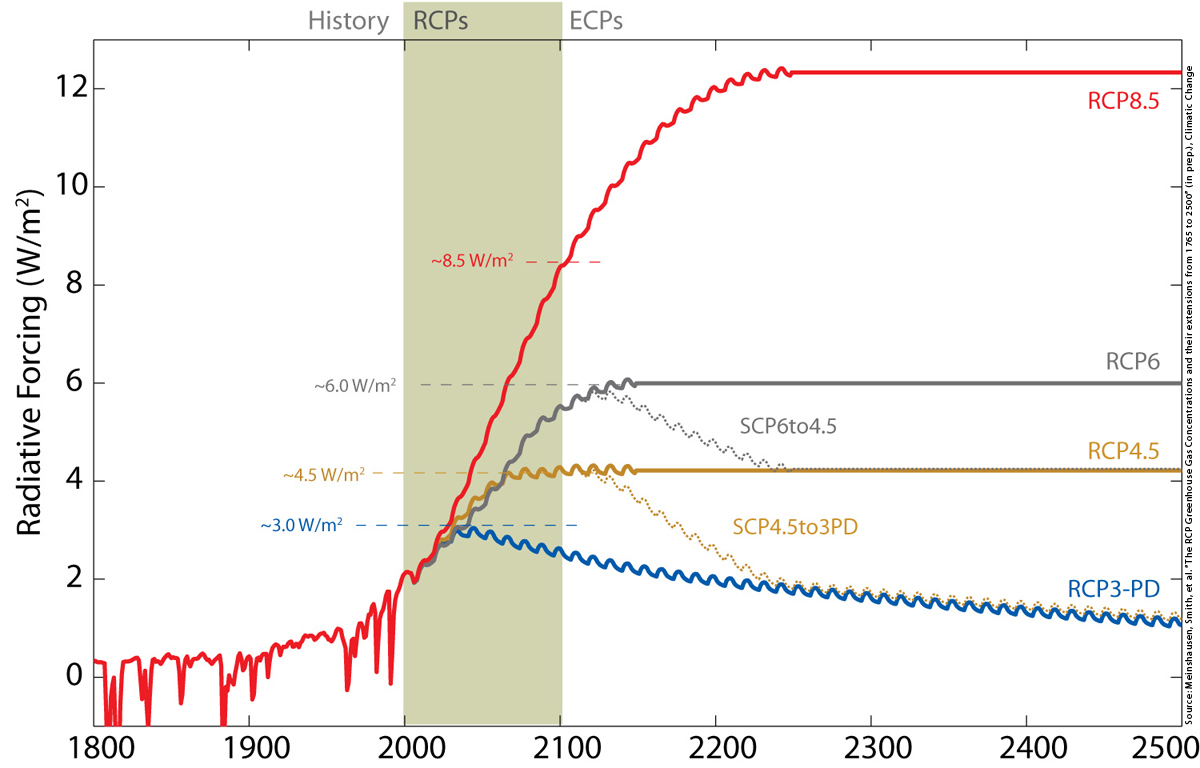
No uncertainty ranges are shown and reported, as for creating the recommendation datasets for CMIP5, central estimates have been assumed closely in line with central estimates in IPCC AR4. (SCP45to3PD). No uncertainty ranges are shown and reported, as for creating the recommendation datasets for CMIP5, central estimates have been assumed closely in line with central estimates in IPCC AR4. https://www.pik-potsdam.de/~mmalte/rcps/

For this they used two scenarios: the extreme, coal-blackened Dickensian fiction called RCP8.5, and a mid-range emissions projection called RCP4.5. In my 2020 JSW column I discussed the efforts of climate analysts to convince their colleagues to stop using the RCP8.5 scenario because of its unrealistic assumptions. Interestingly the Biden administration report moves away from both RCP scenarios and focuses on a new one from Resources for the Future (RFF) which, through most of the rest of this century, projects emissions even below RCP4.5.

But in the main text of the Carleton paper it highlights mortality estimates associated with an RCP8.5 future. Basically we all die a fiery death. If you want to know what the results are using RCP4.5, you will need to track down the 113-page online-only appendix and navigate to page A75, then transfer a table full of numbers to a spreadsheet so you can compare the outcomes.

The two figures on this page summarize what they show. With no adaptation, under the RCP8.5 emissions scenario each tonne of CO2 kills 221 people per hundred thousand (100k) between now and 2300, with the uncertainty range shown by the whisker line. Under RCP4.5 each tonne kills 40 people per 100k. I estimated what their model would yield using the RFF scenario: the effect drops further to 18 people per 100k, and the number is not significantly different from zero.

The second figure reports results if adaptive behaviour is assumed. Under RCP8.5 the mortality rate per 100k drops to 85 people, under RCP4.5 it drops to 14 and under the RFF scenario it drops to five, and the latter two estimates are not significantly different from zero, which means that there is no statistically valid reason to add the mortality effect to an SCC model.

Another step in the analysis is to place a value on these deaths, which depends on things like age and income in every place. Digging further into the online appendix (p. A100), if they stick with RCP4.5 but use a variant that predicts higher income growth the value of the mortality effect goes negative, which means taking account of the lives saved or lost due to warming leads to a lower SCC.

No mention of this in Guilbeault’s announcement.

Thus I reiterate that SCC estimates are if-then statements. They are not intrinsically true or false: what matters is the credibility of the assumptions.

♦  If emissions follow the RCP8.5 scenario (which they won’t), and
♦  if people don’t adapt to climate change (which they will), and
♦  if CO2 and warm weather stop being good for plants (which is unlikely),
    then the SCC could be five times larger than previously thought.

More likely it isn’t, and very well could be much smaller.

See Also Biden’s Arbitrary Social Cost of Carbon: What You Need to Know


Green Schemes Broken by Reality

James E. Hanley provides a roundup of failed Green expensive ventures in his Real Clear Policy article Green Projects Hit Iron Wall.  Excerpts in italics with my bolds and added images.

Developers looking to build thousands of wind turbines off the Mid-Atlantic and New England coast are coming up against a force even more relentless than the Atlantic winds: the Iron Law of Megaprojects, offering a warning of the trouble ahead for green-energy projects.

The Iron Law, coined by Oxford Professor Bent Flyvbjerg, says that “megaprojects” — which cost billions of dollars, take years to complete, and are socially transformative — reliably come in over budget, over time, over and over.

From Boston’s Big Dig to California’s high-speed rail to
New York’s 12 years-overdue and 300% over-budget East Side Access rail project,
big boondoggles routinely demonstrate the validity of the rule.

Offshore wind projects are not immune to the Iron Law, regularly experiencing vast cost overruns before a single watt is generated.

The New York state government, looking to replace oil- and gas-fired powerplants with hundreds of wind towers off Long Island, set out in 2019 to create an offshore wind supply chain from scratch, beginning with a massive state-funded turbine fabrication facility about 100 miles north of New York City on the Hudson River.

Port of Albany factory’s fate at stake as leaders race for a solution The $700 million-plus project is expected to create work for generations, but hopes are dwindling that more funding will become available

Ground still hasn’t even been broken, but the budget certainly has: The price of that Port of Albany facility has already doubled from $350 million to $700 million. An additional $100 million may be needed for equipment costs, raising the final price tag to $800 million.

It’s been billed the future hub for wind power infrastructure. So far, though, the only thing that continues to get billed over and over in recent years is the Connecticut taxpayer.

A similar situation is playing out in New London, Connecticut, where a state-funded pier facility being built to support that state’s offshore wind buildout has more than doubled in price from an original estimate of $95 million to $250 million.

Commonwealth Wind Declares that the largest offshore wind farm in the state’s pipeline “cannot be financed and built” under existing contracts,

And in Massachusetts, developer Commonwealth Wind has asked the state to scrap its power purchase guarantees and rebid the project, arguing that inflation and supply chain problems mean the project is not financially viable under its current contracts.

Big projects tend to exceed their cost projections for many reasons. One is the unanticipated, and sometimes unprecedented, complexity of these projects. Further uncertainties and costs arise from the challenge of navigating the red tape of the modern regulatory state. In addition, there is the risk of inflation for projects that take years, sometimes decades, to develop.

Underlying all these is often a failure to spend enough time on careful planning
that treats reality as a fundamental constraint.

But sometimes project sponsors may simply worry that accurate cost projections could scare away public support at the outset, and choose to employ what Prof. Flyvbjerg politely calls “strategic misrepresentation.”

As former San Francisco Mayor Willie Brown said, “If people knew the real cost from the start, nothing would ever be approved. . . . Start digging a hole and make it so big, there’s no alternative to coming up with the money to fill it in.”

If that sounds too cynical, note that the current Chair of the Connecticut Port Authority has admitted that when officials first proposed the pier facility, they already knew it would cost more than they were claiming.

Ironically, the New York and Connecticut projects aren’t even big enough to be considered megaprojects, and yet even they have run into the Iron Law of being over budget and behind schedule. The challenges won’t diminish with bigger and more ambitious green energy projects.

In New York, the state’s huge Climate Leadership and Community Protection Act — of which the Port of Albany project is the first substantial investment — is projected to cost between $270 and $290 billion. At that price it is a gigaproject composed of numerous individual megaprojects.

The benefits, mostly in the form of greenhouse gas reductions, are supposed to be up to $415 billion. But if the overall cost of the policy climbs by merely 55 percent, which is in the normal range for megaprojects (and much less than the Port of Albany cost overrun), the costs will exceed the benefits, creating a net loss for New Yorkers.

If costs balloon to twice the initial estimates, which is not uncommon, the state stands to spend more than more than a hundred billion dollars more than gained in benefits That would be a loss of over $30,000 per New York household by 2050.

And that’s assuming the benefits are as good as promised. It gets even worse if,
as is common, the benefits have been overstated.

The tale of megaprojects is a cautionary one for the whole country as we attempt to transition away from fossil fuels. Cost estimates for a nationwide transition span from $4.7 trillion to over $60 trillion – almost three times U.S. GDP. Such uncertainty should give us pause for thought before jumping wildly into the financial unknown.

If we’re not careful, we may be digging Willie Brown-style holes, and politically and financially we may find ourselves in too deep to ever get ourselves out.

NYT Makes 12 out of 12 False Claims Against Lomborg’s Book

Bjorn Lomborg set the record straight at LinkedIn The New York Times’ stunningly false and deceptive hit piece to preserve climate alarmism.  Excerpts in italics with my bolds.

The piece consists of Stiglitz enumerating four specific and compounding mistakes that I apparently make, and then another six separate observations. I will go through all of them below, starting with the four mistakes.

My first “mistake”

My first mistake is that I draw “heavily on the work of William Nordhaus of Yale University, who came up with an estimate of the economic cost to limiting climate change to 1.5 to 2 degrees Celsius above preindustrial levels.” Instead the High-Level Commission on Carbon Prices, which Stiglitz co-authored, showed that 1.5°C-2°C goals “could be achieved at a moderate price.”

This is triply wrong. I don’t rely on Nordhaus for the cost on limiting temperature rise for 1.5°C to 2°C, simply because Nordhaus does not make that estimate. Nordhaus explicitly writes, as Stiglitz would know had he read Nordhaus or my book: “A limit of 2°C appears to be infeasible with reasonably accessible technologies even with very ambitious abatement strategies.”

Secondly, Stiglitz claims that his report estimates “a moderate price” for reaching the Paris agreement. This is false. There is no estimate of the total economic cost of a 2°C or 1.5°C target in his High-Level Commission on Carbon Prices.

Compounding Stiglitz’ error is the fact that the background report for his high-level commission does indeed list the UN Climate Panel cost estimate for reaching 1.5-2°C at more than 4% of GDP by 2100 (p2), which makes Nordhaus’ 1.38% GDP economic cost at the lowest temperature scenario of 2.35°C by 2100 substantially smaller (not larger, as Stiglitz claims).

Stiglitz throughout his piece neglects to inform the reader that Nordhaus is not just any old economist, but actually the only climate economist to get the Nobel prize for his work on climate economics. For reference, Stiglitz got his Nobel prize in economics for analyses of markets with asymmetric information like the selling and buying of used cars.

For the first mistake, Stiglitz makes two false claims and no correct, relevant claims.

My second “mistake”

My second mistake is “Nordhaus’s and Lomborg’s underestimation of the damage associated with climate change.” Stiglitz is in reality informing us that he knows much better than the world’s only climate Nobel economist.

But curiously, Stiglitz never tells us what the right cost is. As such, Stiglitz makes an absurd claim, essentially asserting he knows better than the best peer-reviewed evidence — but just couldn’t be bothered to share that knowledge publicly.

Stiglitz gives one indication of his knowledge on this matter. He claims that a significant part of the cost of climate change “includes more extreme weather events — more intense hurricanes, more droughts, more floods, with all the devastation to life, livelihood and property that accompanies them. Yet, again, he seems to have forgotten to actually acquaint himself with the best evidence on the science and economics of extreme weather events. As the leading researcher on economic impacts of extreme weather events says, Stiglitz is “just wrong.

But more importantly, Stiglitz is just cherry-picking and ignoring the actual data. He picked the costliest recent data point and he neglects that the trend for the US (and similarly for the world) is declining.
Stiglitz is simply doubly wrong on his only indication of how Nobel Laureate Nordhaus and I should be wrong, so for the second mistake, Stiglitz makes two false, one unsubstantiated and no correct, relevant claims.

My third “mistake”

Stiglitz suggests that “A third critical mistake, compounding the second, is not taking due account of risk.”  Ah, if only the world’s only actual Nobel laureate in climate economics had thought of incorporating risks.

Of course, Stiglitz could still have quibbled about a different way to model risk, and added his own take on this. But he does not. He simply — and falsely — suggests that Nordhaus or I have not taken this obvious point into consideration.

Specifically, Stiglitz assuredly tells us that the best damage estimates are underestimates because “as we learn more about climate change these best estimates keep getting revised, and, typically, in only one direction — more damage and sooner than had been expected.”   No, they do not. This is the kind of claim one makes if one gets most of one’s climate information from news media.

For the third mistake, Stiglitz makes two false, one unsubstantiated and no correct, relevant claims.

My fourth “mistake”

Stiglitz seems to claim that Nordhaus and I use a discount parameter that is too low for his liking. I cite the whole paragraph, because it is unclear what his actual point is except a rant against the Trump administration:

Stiglitz apparently suggests that Nordhaus and I use a 7 percent discount rate to spew out the numbers that are in my book. This is demonstrably false. Perhaps Stiglitz knows he’s fibbing, given that he settles for criticizing Trump and then conflating the 7% with the “models Lomborg loves.”

Instead, Nordhaus’ discount rate is calibrated to the real interest rates, meaning a 4.8% discount rate in 2015, declining to 3.5% in 2100.

As he would know, having been World Bank chief economist, it is one thing what rich, liberals in Manhattan want for a discount rate. Most of the rest of the world has much higher discount rates. When we worked with the government of Haiti, the central bank decided on 12% (even contemplating 20%), while Ghana decided 8%.

For the fourth mistake, Stiglitz makes one false and no correct, relevant claims.

Other claims

Media drives alarmism

He seems to brush off my points that the hyperventilating media is one of the main causes of alarmism simply by saying “fake news”: 

For example, I outline how New York Times claims that South Vietnam by 2050 will “all but disappear” because it will be “underwater at high tide.”  While the story was reported in almost all media, it was clearly incorrect. Because almost all of South Vietnam is already under the high tide mark today, and almost all of South Vietnam is already well-protected today:

Regulation

Stiglitz claim that I miss discussing good regulations as a way to tackle climate.  

More importantly, Stiglitz seems to have missed at least the last third of my book. Here I talk about

1. Innovation: how we should invest $100 billion per year in green R&D (regulation, not taxation)

2. Adaptation: regulation like zoning, building regulation and more pervious city surfaces (to ensure less flooding)

3. Geoengineering: which will be almost entirely a regulatory approach

4. Prosperity: mostly about better policies including regulatory policies

Stiglitz’ claim that I ignore regulation is blatantly false.

Wall Street underwater

Almost bizarrely, Stiglitz chides me for not including in my book that Wall Street could be underwater by 2100:

The research very clearly shows that at least when an area has sufficient value (as Wall St and surrounding areas certainly have) all will be safeguarded through adaptive policies (like sea walls etc.).  I even show this in a graph in the book, based on this paper. We only see significant flooding when we disregard adaptation:

So when Stiglitz chides me for not including that Wall Street might be underwater in my book, it is because such a claim would be false. His is a good example of bad information from hyperventilating media.

Copenhagen Consensus

Stiglitz writes a slyly derogatory paragraph about the think tank I work for, Copenhagen Consensus:

The paragraph doesn’t seem to say anything but that the experts are conservative and that we didn’t include any “true experts” on climate science.

On his first claim, we have worked with more than 300 of the world’s top economists and seven Nobel Laureates. Our main focus is all the world’s problems, not just climate change, so many are experts in the economics of malaria, infrastructure, water, education etc.   We certainly don’t have a ‘conservative’ bias — we’ve actually invited Stiglitz to be a member of several eminent panels together with his Nobel colleagues. But it also shows that Stiglitz seems to be suggesting that only liberal economists such as himself can be trusted to help set priorities for the world.

On his second claim, we have worked with many climate economists, and when we did our big climate consensus, we worked with 27 of the world’s top climate economists, publishing the results as a book with Cambridge University Press, which even got a favorable quote from the IPCC’s chairman (“This book provides not only a reservoir of information on the reality of human induced climate change, but raises vital questions and examines viable options on what can be done to meet the challenge.”).

Stiglitz’ derogatory two claims are simply incorrect.

Lack of prioritization

One of the key points of my book (and the Copenhagen Consensus’ work) is that we have to prioritize. No matter the amount of resources available, there is never enough to do everything, and hence we have to make sure we spend resources where they can do the most good first.  The allocation of scarce resources with alternative uses, of course, is the key definition of economics.

Obviously, money from a tax can be used on many things (some of which I’m sure Stiglitz wouldn’t like), but they can still only be used once. And the point is, that with more stringent climate policies, GDP will be slightly lower, hence there will be less in total to spend.

The new IPCC report shows end-of-world

Stiglitz finally claims that because I cite the UN Climate Panel so often, one could believe I might be right. But, he comforts his readers, “nothing could be further from the truth”:

What I say in the book is also what is in the IPCC 2018 1.5°C report.

Then Stiglitz goes on to make the exact scare scenario in which the media excels and that I have criticized. The 60 feet sea level rise is from a world in an entirely different part of the state space. He knows very well that such statistics are only meant to scare but not informative for what will happen for us, in this part of the state space. That, of course, is exactly what the IPCC reports are about. They talk about a high outcome of 3 feet of sea level rise by 2100. The only reason to throw out 60 feet is to scare people silly.

Summary

Making 12 substantial criticisms of my book and that they are all false, is quite an achievement. It is hard not to conclude that Stiglitz’ review of my book is a deceptive and false hit piece. It is perhaps not surprising that Stiglitz actually said that he was going to give the book a bad review even before he read it. In many ways, it seems like he still hasn’t read it.

I have asked New York Times to rectify this terrible article. 


ESG Battle Over Italian Energy Giant

Enel, Italy’s largest energy utility is in the news with conflict over appointing a new CEO because  aspirations differ between ESG investors and the Italian government.   There are headlines like these:

Norway’s oil fund rejects Rome’s candidate for Enel chair, Financial Times

Wanted! Investors demand Italy hire renewable expert, global networker to run Enel, Zawya

Government board nominations for Enel run into opposition, msn

Enel confirms 2023 guidance, enters press blackout on nominations, Reuters

MILAN (Reuters) – Italy’s biggest utility, Enel, confirmed its full-year guidance and entered a press blackout period ahead of a May 10 shareholder vote on a challenged board shake-up.

The group, whose main shareholder is Italy’s Treasury with nearly a 24%-stake, is at the centre of a governance row that will be decided at the AGM scheduled for next Wednesday.

The Treasury has proposed a new management, putting forward a slate of six new candidates and ousting current Enel CEO Francesco Starace, who has been at the helm since 2014.

Hedge fund Covalis, which holds around 1% in Enel, presented an alternative list of nominees, criticising the process under which the government picked its candidates.  Covalis said the system that led to the government’s nominations “undermines investor confidence, erodes value and is out of line with international standards of best practice in shareholder democracy”.[Would those best practices be ESG?]

Proxy adviser Frontis Governance has urged shareholders to back the candidates promoted by Covalis and reject names put forward by the Treasury, in a report tailored for Switzerland’s Ethos, a group of pension funds and other investors.

On the financial side, Enel’s ordinary earnings before interest, taxes, depreciation and amortization (EBITDA) in the first quarter rose 22% to 5.5 billion euros above an analyst consensus of 5.4 billion euros.  Net debt at the end of March was 58.9 billion euros, down from 60.1 billion euros at the end of last year.

Starace described the results in the first three months of 2023 as outstanding and said the group had already exceeded half of its 21 billion euro ($23 billion) asset sale target unveiled last November.

The state-controlled group intends to focus its business on the core markets of Italy, Spain, the United States, Brazil, Chile and Colombia.

Wanted! Investors demand Italy hire renewable expert, global networker to run Enel,  Zawya

Expertise in renewables and an international focus are what investors want to see from a new head of state-controlled Enel, as Italy’s government screens candidates to replace the energy group’s long-serving chief executive.

Prime Minister Giorgia Meloni’s administration is determined to oust current CEO Francesco Starace, several sources told Reuters. In charge since 2014, Starace is in the crosshairs of Meloni’s inner circle as he is deemed too independent.

Meloni’s office is also concerned about the group’s debt pile. But sources familiar with the matter said that head hunters hired by the Treasury are finding it tricky to put forward potential successors with the broad range of skills required to run one of Europe’s largest utilities.

With almost 60 Gigawatt of installed capacity, Enel is one
of the world’s biggest players in renewable energy

Starace won plaudits for his commitment to green energy. However, investors and the government grew restless over a debt pile that had grown to around 60 billion euros ($65.40 billion) in 2022 from 45.5 billion in 2020, when Starace was reappointed for a third term.

The company, which has been hit by soaring gas prices and government measures capping bills to shield consumers, saw net profit slip to 5.4 billion euros last year, from 5.6 billion euros in 2021.

The new CEO should not sacrifice the group’s exposure to North America and confirm its dividend policy, a number of investors said.

“People in Italy may prefer that Enel focuses on making things as much as possible in its home country and not investing so much abroad, but the company has no choice… if it wants to attract foreign investors,” said Vincent McEntegart, multi-asset investment manager at Aegon Asset Management, an Enel shareholder with assets under management worth $311 billion.

For Enel, U.S. President Joe Biden’s green energy subsidy package could mean double digit returns in North America compared with single digit in Europe, McEntegart said, adding such returns would underpin the group’s attractive dividend policy.

Since Starace was appointed CEO in May 2014, Enel has increased its
installed renewable energy capacity to 59 GW from 36 GW at the end of 2013.

Starace’s mantra has been electrification of consumption and digitalisation of grids and he said last year he wanted to leverage a renewed focus on energy security around the world to accelerate the group’s exit from natural gas. The group currently plans to become carbon free in 2040.

“My priorities for the new CEO would be to continue to roll out renewables and accelerate the exit from gas,” Simone Siliani, the director for Italy’s Fondazione Finanza Etica, told Reuters.  Finanza Etica, which is an active investor on ESG issues, has been holding a tiny stake in Enel since 2008.

“Enel can make the difference if Italy wants to meet its decarbonisation goals,” added Siliani.

Summary: 

Once again we have climatist financiers using ESG to push zero carbon against the mission of providing secure and affordable energy that citizens need.