Fast Track to Poverty: Green Energy

At his blog, Matt Ridley explains How the Green Energy Transition Makes You Poorer.
Excerpts in italics with my bolds and added images.

Crony capitalism at work

A leaked government analysis has found that Net Zero could crash the economy, reducing GDP by a massive 10% by 2030. Yet the spectacular thing about this analysis is that it expects this to happen not if Net Zero fails—but if it succeeds. In effect, it is saying that if the government really does force us to give up petrol cars, gas boilers, foreign holidays, and beef, then there would be perfectly workable things left idle, such as cars, boilers, planes, and cows. Idling—or stranding—your assets in this way is an expensive economic disaster.

Even more intriguing was the government’s economically illiterate response to the leak. A spokesman said: “Net zero is the economic opportunity of the twenty-first century, and will deliver good jobs, economic growth and energy security as part of our Plan for Change.”

Do they really think that economic growth is the same thing
as spending money? Because it isn’t.

Imagine the government saying that it is going to require the entire population to throw out all their socks and buy new ones by next Thursday. Under the logic it espouses for Net Zero, this would result in a tremendous burst of economic growth. Think of all the jobs created in the sock industry and the shops! They would be better off. Ah, but you, the consumer, would be poorer. You would have as many socks as before but less money. This is the broken window fallacy, explained by Frédéric Bastiat nearly 200 years ago: going around breaking windows makes work for glaziers but does not create growth.

Net Zero is a project to replace an existing set of technologies with another set of technologies: power stations with wind farms, petrol cars with electric cars, gas boilers with heat pumps, plane trips in the sun with caravan trips in the rain, cows with lentils. The output from these technologies is intended to be the same: electricity, transport, holidays, food.

Suppose, for the sake of argument, that these new technologies and activities require exactly as much money to build and run as the old ones. What have you gained? Less than nothing because you have retired existing devices early, losing the latter half of their lives. It would be like replacing all the socks in your drawers long before they needed replacing but with identical socks. Does that make you richer? No, poorer.

If the new technologies are more efficient than the old ones, fine. LED light bulbs use about 90% less electricity than incandescent bulbs did. So yes, it does make sense to throw out your old bulbs before they expire, stranding those assets, to save electricity and money. Is the same true of a wind farm or a heat pump? No, they are demonstrably more expensive and less reliable at producing the same electricity than the devices they are replacing. They are worse, not better.

That’s why they need subsidies. We have spent £100 billion so far subsidising “green” energy in the past few decades, money we could have spent on something else: tax cuts, for example. So, the green energy transition has made us poorer, not richer. It has given us the most expensive electricity in the entire developed world.

It has made some people richer, for sure. Dale Vince, an eco-tycoon, has made a fortune out of building unreliable energy. So have lots of fat cats in the City of London, lots of big landowners in the Highlands of Scotland, and lots of manufacturers in China. I have lost count of the number of times wealthy people have told me I am wrong to criticise the unreliable energy industry because “my son Torquil’s fund has done rather well.”

Net Zero crony capitalism is efficient at one thing:
transferring money from poor people to rich people.

This government has forgotten that its job is not to champion the interests of producers, but consumers. So did the last government, though Kemi Badenoch’s speech on Tuesday showed a welcome return to thinking about consumers. Electricity is not an end in itself; it is a means to an end, an essential input allowing us to do the one and only thing that does, really does, represent growth—achieving more output with less input.

Right now, the Net Zero transition is doing the very opposite.

\


Climate Crisis Talk Obscures Reality

Edward Ring writes at American Greatness Challenging the Climate Crisis Narrative.  Excerpts in italics with my bolds and added images.

The climate crisis narrative ignores real issues like
poor infrastructure and overpopulation, pushing costly policies
that hurt economies while failing to improve resilience
.

According to the United Nations, “Climate change is a global emergency that goes beyond national borders.” From the World Economic Forum, “Urgent global action must be taken to reduce emissions and safeguard human health from the multi-pronged negative impacts of climate change globally.”

From every multinational institution in the world, we hear the same message. From the World Bank, “The world is battling a perfect storm of climate, conflict, economic, and nature crises.” From the World Health Organization, “Between 2030 and 2050, climate change is expected to cause approximately 250,000 additional deaths per year from malnutrition, malaria, diarrhea, and heat.”

A major problem with all this unanimity over this “emergency” is the fact that for at least half of all people living in Western nations in 2025, the UN, WEF, WHO, and World Bank have no credibility. We don’t want to “own nothing and be happy” as our middle class is crushed. We don’t want the only politically acceptable way to maintain national economic growth to rely on population replacement. And with only the slightest numeracy, we see apocalyptic proclamations as lacking substance.

Top Ten Causes of Death Globally 2021

For example, while 250,000 “additional deaths per year” is tragic, worldwide estimates of total deaths are not quite 70 million per year. These “additional deaths” constitute a 0.36 percent increase over that baseline, just over one-third of one percent. Not even a rounding error.

Source NASA

Similarly, an alarmist prediction from NASA is that “Antarctica is losing ice mass (melting) at an average rate of about 150 billion tons per year, and Greenland is losing about 270 billion tons per year, adding to sea level rise.” Let’s unpack that a bit. A billion tons is a gigaton, equivalent in volume to one cubic kilometer. So Antarctica is losing 150 cubic kilometers of ice per year. But Antarctica has an estimated total ice mass of 30 million cubic kilometers. Which means Antarctica is losing about one twenty-thousandth of one percent of its total ice mass per year. That is well below the accuracy of measurement. It is an estimate, and the conclusion it suggests is of no significance.

One may wonder about Greenland, with “only” 2.9 million cubic kilometers of ice, melting at an estimated rate of 270 gigatons per year. But that still yields a rate of loss of less than one one-hundredth of one percent per year, which is almost certainly below the ability to actually gauge total ice mass and total annual ice loss.

What about sea level rise? Here again, basic math yields underwhelming conclusions. The total surface area of the world’s oceans is 361 million square kilometers. If you spread 420 gigatons over that surface (Greenland and Antarctica’s melting combined), you get a sea level rise of not quite 1.2 millimeters per year. This is, again, so insignificant that it is below the threshold of our ability to measure.

These fundamental facts will turn anyone willing
to do even basic fact-checking into a cynic.

What’s really going on? We get at least a glimpse of truth from the above quotation from the World Bank, where they ascribe the challenges of humanity to several causes: “climate, conflict, economic, and nature crises.” There’s value in the distinctions they make. They list “nature crisis” as distinct from “climate,” and at least explicitly, “climate” is not cited as resulting from some anthropogenically generated trend of increasing temperatures and increasingly extreme weather. They just say “climate.”

Which brings us to the point: Conflict and economic crises are far bigger sources of human misery, and we face serious environmental challenges that have little to do with climate change and more to do with how we manage our industry, our wilderness, and our natural resources. And we are face “climate” challenges even when catastrophic climate events have nothing to do with any alleged “climate crisis.”

A perfect example of how the climate “crisis” narrative is falsely applied when, in fact, the climate-related catastrophe would have happened anyway is found in the disastrous floods that devastated Pakistan in 2022. Despite the doomsday spin from PBS (etc.), these floods were not abnormal because of “climate change.” They were an abnormal catastrophe because in just 60 years, the population of that nation has grown from 45 million to 240 million people. They’ve channelized their rivers, built dense new settlements onto what were once floodplains and other marginal land, they’ve denuded their forests, which took away the capacity to absorb runoff, and they’ve paved thousands of square miles, creating impervious surfaces where water can’t percolate. Of course, a big storm made a mess. The weather didn’t change. The nation changed.

The disaster story repeats everywhere. Contrary to the narrative, the primary cause is not “climate change.” Bigger tsunamis? Maybe it’s because coastal aquifers were overdrafted, which caused land subsidence, or because previously uninhabited tidelands were settled because the population quintupled in less than two generations, and because coastal mangrove forests were destroyed, which used to attenuate big waves. What about deforestation? Perhaps because these nations have been denied the ability to develop natural gas and hydroelectric power, they’re stripping away the forests for fuel to cook their food. In some cases, they’re burning their forests to make room for biofuel plantations, in a towering display of irony and corruption.

In California, our nation’s epicenter of climate crisis fearmongering and the subsequent commercial opportunism, the emphasis on crisis instead of resilience has led to absurd policies. Instead of bringing back the timber industry to thin the state’s overgrown forests, the governor mandates exclusive sales of EVs by 2035. Instead of responsibly drilling oil in California’s ample reserves of crude, California imports 75 percent of its oil, and its economy still relies on oil for half the energy that the state consumes.

Worldwide, these mistakes multiply. Biofuel plantations consume half a million square miles in order to replace a mere two percent of transportation fuel. A mad scramble across every continent to increase mining by an order of magnitude to meet the demand for raw materials to manufacture batteries, wind turbines, and solar panels. Denial of funds for natural gas development in Africa, condemning over a billion people to ongoing energy poverty.

Simple truths are obscured by the climate crisis narrative. We need to rebuild our infrastructure for climate resilience because much of it is over a century old, at the same time as the US population has tripled. Floods and hurricanes cause more damage because there are more people, and more of them live in areas that have always been hit by floods and hurricanes.

The truths are as endless as they are repressed. We can’t possibly lift all of humanity into a middle-class lifestyle without at least doubling energy production worldwide, and we can’t possibly accomplish that while also reducing our use of coal, oil, and gas. Renewables aren’t renewable (here’s a must-read on that topic). Offshore wind is an environmental disaster, as is biofuel, as is the explosion of totally unregulated mining to feed the renewables industry. On the other hand, extreme environmental laws and regulations are harming economic growth, freedom, and, in no small irony, the innovation and investment that would give us the wealth we need to better protect the environment. And the prevailing economic, environmental, and cultural challenge in the world is not the climate but crashing birthrates among developing nations at the same time as the population of the world’s most undeveloped nations continues to explode exponentially.

We need climate resilience in order to properly protect a global population that has quadrupled to 8 billion in just the last century, spreading to every corner of the earth. That goal would be easier if once-trusted global institutions would allow for honest debate and practical infrastructure development. Instead, they continue to spew transparently misleading climate crisis propaganda, adhering to a mission that can only be described as repressive on all fronts—culturally, economically, and environmentally.


McKitrick: New PM Carney Tried for Years to Defund Canada

Mark Carney, governor of the Bank of England (BOE), reacts during a news conference at the United Nations COP21 climate summit at Le Bourget in Paris, France, on Friday, Dec. 4, 2015. Photo by Chris Ratcliffe/Bloomberg

Ross McKitrick writes at National Post Carney to lead Canada after trying for years to defund it.  Excerpts in italics with my bolds and added images.

The soon-to-be prime minister’s plan for net-zero banking
would have devastated the country

Conservative leader Pierre Poilievre is very concerned about financial conflicts of interest that new Liberal leader (and our next prime minister) Mark Carney may be hiding. But I’m far more concerned about the one out in the open: Carney is now supposed to act for the good of the country after lobbying to defund and drive out of existence Canada’s oil and gas companies, steel companies, car companies and any other sector dependent on fossil fuels. He’s done this through the Glasgow Financial Alliance for Net Zero (GFANZ), which he founded in 2021.

Carney is a climate zealot. He may try to fool Canadians into thinking he wants new pipelines, liquified natural gas (LNG) terminals and other hydrocarbon infrastructure, but he doesn’t. Far from it. He wants half the existing ones gone by 2030 and the rest soon after.

He has said so, repeatedly and emphatically. He believes that the world “must achieve about a 50 per cent reduction in emissions by 2030” and “rapidly scale climate solutions to provide cleaner, more affordable, and more reliable replacements for unabated fossil fuels.” (By “unabated” he means usage without full carbon capture, which in practice is virtually all cases.) And since societies don’t seem keen on doing this, Carney created GFANZ to pressure banks, insurance companies and investment firms to cut off financing for recalcitrant firms.

“This transition to net zero requires companies across the whole economy to change behaviors through application of innovative technologies and new ways of doing business” he wrote in 2022 with his GFANZ co-chairs, using bureaucratic euphemisms to make his radical agenda somehow seem normal.

The GFANZ plan they articulated that year put companies into four categories. Those selling green technologies or engaged in work that displaces fossil fuels would be rewarded with financing from member institutions. Those still using fossil fuels, or have investments in others that do, but are committed to being “climate leaders” and have set a path to net-zero, would also still be eligible for financing, as would those that do business with “high-emitting firms” but plan to reach net-zero targets on approved timelines. Companies that own or invest in high-emitting assets, however, would operate under a “managed phaseout” regime and could even be cut off from investment capital.

What are “high-emitting assets”? Carney’s group hasn’t released a complete list, but a June 2022 report listed some examples: coal mines, fossil-fuel power stations, oil fields, gas pipelines, steel mills, ships, cement plants and consumer gasoline-powered vehicles. GFANZ envisions a future in which the finance sector either severs all connections to such assets or puts them under a “managed phaseout” regime, which means exactly what it sounds like.

So when Carney jokingly suggested it won’t matter if his climate plan drives up costs for steel mills because people don’t buy steel, he could have added that there likely won’t be any steel mills before long anyway. If his work as prime minister echoes his work as GFANZ chair, we can expect steel mills to be phased out, along with cars, gas-fired power plants, pipelines, oil wells and so forth.

Mark Carney, former Co-Chair of GFANZ, accompanied by (from left) Ravi Menon, Loh Boon Chye, and Yuki Yasui, at the Singapore Exchange, for the GFANZ announcement on the formation of its Asia-Pacific (APAC) Network.

GFANZ boasts at length about its members strong-arming clients into embracing net-zero. For instance, it extols British insurance multinational Aviva for its climate engagement escalation program: “Aviva is prepared to send a message to all companies through voting actions when those companies do not have adequate climate plans or do not act quickly enough.”

To support these coercive goals, Carney’s lobbying helped secure a requirement in Canada for banks, life insurance companies, trust and loan companies and others to develop and file reports disclosing their “climate transition risk,” set out by the federal Office of the Superintendent of Financial Institutions (OSFI).

The rule, Guideline B-15 on Climate Risk Management, was initially published in 2023 and requires federally regulated financial institutions (other than foreign bank branches) to conduct extensive and costly research into their holdings to determine whether value may be at risk from future climate policies. The vagueness and potential liabilities created by this menacing set of expectations could push Canada’s largest investment firms to eventually decide it’s easier to divest altogether from fossil fuel and heavy industry sectors, furthering Carney’s ultimate goal.

Yet Carney will become prime minister just when Canadians face a trade crisis that requires the construction of new coastal energy infrastructure to ensure our fossil fuel commodities can be exported without going through the United States. He has said he would take emergency measures to support “energy projects,” but I assume he means windmills and solar panels. He has not (to my knowledge) said he supports pipelines, LNG terminals, fracking wells or new refineries. Unless he disowns everything he has said for years, we must assume he doesn’t.

Canadian journalists should insist he clear this up. Ask Carney if he supports the repeal of OSFI’s Climate Risk Management guideline. Show Carney his GFANZ report. Ask him, “Do you still endorse the contents of this document?” If he says yes, ask him how we can build new pipelines and LNG terminals, expand our oil and gas sector, run our electricity grid using Canadian natural gas, heat our homes and put gasoline in our cars if banks are to phase out these activities.

If he tries to claim he no longer endorses it,
ask him when he changed his mind,
and why we should believe him now.

The media must not allow Carney to be evasive or ambiguous on these matters. We don’t have time for a bait-and-switch prime minister. If Carney still believes the rhetoric he published through GFANZ, he should say so openly, so Canadians can assess whether he really is the right man to address our current crisis.

Pushback Against EU World-wide ESG Rules

As Bloomberg reported, EU is attempting to force climate risk and ESG reporting on the whole world, not just its member nations.  

As trans-Atlantic relations grow increasingly fraught, Europe’s ESG regulations are becoming yet another flashpoint that threatens to sour ties.

The American Chamber of Commerce to the European Union (AmCham EU) says proposed revisions to the bloc’s environmental, social and governance rules don’t adequately protect US interests. The complaint is part of a growing US response to Europe’s ESG framework. Republican lawmakers call the rules “hostile” and warn that America’s jurisdictional sovereignty is at stake, while Commerce Secretary Howard Lutnick has said he’s willing to consider “trade tools” to retaliate.

The European Commission proposed changes last week that would rein in the scope of two major ESG laws: the Corporate Sustainability Reporting Directive and the Corporate Sustainability Due Diligence Directive. However, big international companies with business in the EU would still have to comply.

The upshot is that non-EU companies risk being ensnared by the bloc’s ESG rules, even for products that aren’t sold in the EU, said Kim Watts, senior policy manager for AmCham EU, whose members include Ford Motor Co., Exxon Mobil Corp. and Amazon.com Inc.

AmCham is worried that the EU “is going too far on extraterritoriality,” she said in an interview.

It’s a complaint that’s being backed up in even stronger terms by GOP members of Congress. In a letter sent shortly after the European Commission published its proposed revisions to the bloc’s ESG rules, the US lawmakers wrote to Treasury Secretary Scott Bessent and National Economic Council Director Kevin Hassett, warning of the “profound” implications of Europe’s due diligence directive for US businesses.

The lawmakers stated: “CSDDD imposes stringent due diligence requirements on in-scope companies, mandating the evaluation of supply chains to identify, mitigate, and eliminate human rights and environmental abuses as defined by United Nations (UN) and Organisation for Economic Cooperation and Development (OECD) principles.

“Furthermore, US firms will face increased litigation risks and potential enforcement actions from EU member states, with penalties under the Directive reaching up to 5% of a company’s global turnover.

“However, these principles have not been ratified by Congress, raising concerns about the legitimacy of EU enforcement against US companies based on these principles. Additionally, small businesses that supply larger companies will also be affected, even if their operations are solely within the US compliance efforts will require significant resource allocation, diverting funds away from critical areas such as research and development, talent acquisition, and investment.

SEC Climate Risk Rule is Entrapment

Stone Washington and William Happer explain the nefarious and ill-advised decree in their article SEC’s Climate Risk Disclosure Rule Would Compel Companies to Make Scientifically False and Misleading Disclosures.  Excerpts in italics with my bolds and added images.

In March last year, the Securities and Exchange Commission issued its climate risk disclosure rule, called “The Enhancement and Standardization of Climate-Related Disclosures for Investors.” 

It requires companies to report enormously costly and voluminous data on their carbon dioxide and other greenhouse gas (GHG) emissions. With this rule, the SEC seeks “to achieve the primary benefits of GHG emissions disclosure” for investors, including disclosure of “risks associated” with regulations such as President Biden’s “commitments to reduce economy-wide net greenhouse gas emissions … to reach net zero emissions by 2050.”

It will flood investors with pages upon pages of information. As to costs, the SEC’s own numbers found that the proposed rule would increase annual compliance costs from $3.8 billion to $10.2 billion, a $6.4 billion rise — more than all the accumulated SEC disclosure rules’ costs from SEC’s initiation in the 1930s to date – combined. Even though the final rule’s cost is less, the numbers indicate the order of magnitude. It may signal what the ultimate cost of future environmental disclosures would be, in addition to the ensuing fossil fuel divestment. 

The SEC assumes, like many, the Intergovernmental Panel on Climate Change claim the “evidence is clear that carbon dioxide (CO2) is the main driver of climate change,” including, the SEC asserts, “higher temperatures, sea level rise, and drought”, as well as “hurricanes, floods, tornadoes, and wildfires.”

However, the little-known accurate science is totally contrary to the SEC’s and IPCC’s premise. Co-author William Happer, an emeritus physics professor at Princeton, explains below how carbon dioxide and other GHGs do not cause any increased climate related risks. The SEC’s and IPCC’s claim is scientifically false. 

Thus, the SEC rule would compel companies to disclose scientifically false and misleading information about carbon dioxide and other GHG’s role in climate-related risks to investors. Accordingly, the SEC rule must be rescinded by the Trump Administration or ruled invalid by the courts, whichever is sooner.

Co-author Happer explains the accurate science in detail in a 28 page comment on the proposed SEC rule with Richard Lindzen, an emeritus physics professor at MIT. The comment explains why there are no added climate related risks caused by carbon dioxide. (The other greenhouse gases such as methane and nitrous oxide are too small to have any significant effect on the environment).

The SEC totally ignored and did not respond to the comment. Three of the many scientific reasons elaborated in the comment are:

First, Carbon Dioxide Now and at Higher Levels is a Weak Greenhouse Gas, So Reducing It to Net Zero Will Have a Negligible Effect on Temperatures

As a GHG, carbon dioxide’s ability to raise Earth’s temperature decreases rapidly as the atmospheric concentration increase.   The science is complex, but the scientific conclusion is simple. At today’s level of about 400 parts per million (ppm) and higher, large increases of carbon dioxide will cause negligible warming of the Earth.

The well-established theory of atmospheric heat transfer allows computing what happens when carbon dioxide’s concentration in the atmosphere increases, for example, doubling from today’s approximately 400 ppm to 800 ppm.   As to temperature, the result would be only a minuscule effect on temperature because carbon dioxide is now, and at higher levels, a weak greenhouse gas. Lindzen and Happer state:

“From now on … we could emit as much CO2 as we like, with little warming effect.” This also means that “our emissions from burning fossil fuels could have little impact on global warming. There is no climate emergency. No threat at all.” 

As to food, carbon dioxide creates more food when its level in the atmosphere increases. Doubling carbon dioxide from 400 ppm to 800 ppm would increase the amount of food available to people worldwide by roughly 40%, with a negligible effect on temperature.

Further, never mentioned, is that reducing carbon dioxide to Net Zero will reduce the amount of food available worldwide.

Second. The EPA’s MAGICC Model Confirms Carbon Dioxide Now and at Higher Levels is a Weak Greenhouse Gas, So Reducing It to Net Zero Will Have a Negligible Effect on Temperatures

The Environmental Protection Agency often uses a model for predicting temperature effects called the Model for Assessment of Greenhouse Gas-Induced Climate Change (MAGICC).  Our comment explains the MAGICC model confirms our conclusion:

“Reducing the current 40 Gigaton CO2 annual emissions worldwide and the 6 Gigaton annual U.S. CO2 emissions to ‘net zero’ would cause only tiny changes of … Earth’s surface temperature.”

Third. 600 Million Years of Carbon Dioxide Data Also Confirms Carbon Dioxide Now and at Higher Levels is a Weak Greenhouse Gas, So Reducing It to Net Zero Will Have a Negligible Effect on Temperatures

Our comment presents 600 million years of data on temperature and carbon dioxide levels that shows an inverse relationship most of the time. “For hundreds of millions of years, temperatures were low when CO2 levels were high, and temperatures were high when CO2 levels were low.”

“When CO2 was record high of about 7,000 ppm, temperatures were at a record low.”

Thus 600 million years of data also confirms carbon dioxide is now a weak greenhouse gas that cannot and does not drive climate change.

Finally, our comment details why the rule if adopted would help cause disastrous consequences for the poor, people worldwide, and future generations of Americans because it would reduce the amount of carbon dioxide in the atmosphere and the use of fossil fuels.

Therefore, science contradicts the SEC and IPCC’s premise that carbon dioxide and other greenhouse gases introduce climate-related risks. Such assumptions are scientifically false. Thus requiring companies to report their GHG data to investors interested in climate change would require them to report false and misleading information.

Accordingly, the new SEC leadership should immediately rescind its climate-related risks disclosure rule, or the courts should rule it invalid, whichever is sooner.

Finally, there are, of course, nature caused climate-related risks. For nature, the SEC explained, “it has required disclosure of certain environmental matters for the past 50 years,” including “disclosure of climate-related risks and their impacts on a registrant’s business or financial condition.”

Thus, the SEC has already taken care of them. Nothing else need be done.


On Energy, Carney the Wrong Man at the Worst Time

Geoff Russ explains at his National Post article When it comes to energy, Carney is the wrong man at the worst time.  Excerpts in italics with my bolds and added images.

The world is moving on from global climate goals to more pressing matters

Even if only for a matter of weeks, Mark Carney is likely to become prime minister of Canada when this Liberal leadership race concludes. His vision for the country is rife with climate strategies and schemes belonging to a world most can remember, but that no longer exists.

The world has moved on. International accords such as the 2015 Paris Agreement, cooperation between financial institutions on climate goals, and more carbon pricing are no longer priorities for Canada in 2025. Canada is not a superpower, no serious person would say differently, and we have to swim in the global current of change.

Trudeau was not prepared for Trump’s bargaining style.

This doesn’t mean bowing to the whims of an unpredictable strongman, but it does require recognizing that the Obama world of liberal internationalism and high-minded ideals is gone. Whatever chance it had of enduring died with Joe Biden’s presidency.

Russia’s invasion of Ukraine in 2022 had already scrambled world energy supply lines, and Trump’s return to the White House, along with the rise of AI technology, have changed everything.

AI in particular has been one of the biggest shifts since Carney’s days as a central banker. The astonishing and rapid growth of AI has resulted in eye-popping demands for energy, with data centres set to consume more electricity than entire cities.

Grids will be pushed to their limits. This spells danger for Canadian provinces like British Columbia, whose hydroelectricity regime can no longer reliably supply its economy and population. For consecutive years now, BC Hydro has been forced to import energy from Alberta and the U.S., the latter of which may soon be subject to counter-tariffs and other heightened costs.

Carney’s ideas about the climate and the so-called “energy transition” are at odds with his promises to grow the use of AI in the public service and future economy. Canada will have to build many data centres to keep up with other G7 countries, but where will their energy come from?

Nuclear energy is the most commonly cited solution, and several American big-tech giants have made plans to use small modular reactors (SMRs) to power the data centres. Once built, nuclear power provides an abundance of cheap, low-emitting, and reliable energy.

B.C. has standing laws that prohibit the building of nuclear generators, and the provincial NDP government unambiguously rejected the possibility of changing that. In the meantime, wind and solar will not cut it, both being subject to weather patterns that make them unreliable and insufficient.

The best alternative is natural gas, 1,368 trillion cubic feet of which sits beneath the feet of Canadians and can serve as an abundant source of power for the modern economy. Unfortunately, Carney’s ideas about carbon pricing would fall directly on the producers, making it far more expensive while deterring investment.

Trump is an unabashed economic nationalist, and Canada needs
to make itself competitive and attractive to
both energy and technological investment.

Canadian natural gas is more important than ever, both for the country and the world. After Russia invaded Ukraine, EU countries had to rapidly seek new, stable suppliers of energy to replace the massive Russian gas imports that supplied much of the EU.

The war revealed how energy security amongst friends and allies was just as important as emissions reductions, if not more so. Canada’s first opportunity was squandered when the Liberal government rebuffed European calls for Canadian LNG as having “no business case”.

Germany has been forced to turn back to coal as a power source as energy bills surge, driving German automobile manufacturers to close down some of their plants. Canadian LNG exports need to be prioritized for domestic use and exports abroad, and insisting on slapping punitive carbon taxes on the industry is against Canada’s interests.

Another challenge to Canada’s economic future is the recently proposed, $44 billion USD LNG project in Alaska. Envisioned as a joint US-Japanese, the project would establish Alaska as the leading LNG exporter to Japan, one of the world’s largest importers of natural gas.

If completed, the Alaska LNG project would be a direct threat to BC’s natural gas industry. One of the major projects, Cedar LNG in Kitimat, is set to come online in 2028, followed by two more in Squamish and near Prince Rupert. B.C. has a good head start, but the US and Japan plowing ahead with $44 billion LNG deals should be a wakeup call to Ottawa.

An LNG export deal with Japan of similar value should be completed while American LNG still has to pass through the Panama Canal to get to Japan, not after it starts being shipped from Alaska. Taxing natural gas producers will slow potential projects down and make Canada less competitive.

Canada cannot diversify its trading partners if the U.S. is allowed to overtake our industries and slowing it down with carbon taxes and Canada’s onerous regulatory regime in the name of outdated climate movements is a gift to President Trump.

Like it or not, major international initiatives live or die
depending on American involvement. This was true of the
Trans-Pacific Partnership (TPP), and it is true of NATO.

Mark Carney’s own attempts to forge agreements such as the Glasgow Financial Alliance for Net Zero (GFANZ), which has been abandoned by major American and Canadian banks and financial institutions, have collapsed. Canada needs to prioritize building up our own internal energy infrastructure and making it as competitive and attractive to investors as possible.

This is the age of nationalism, and we should recognize the opportunities it will bring to Canada. If Carney’s pledge to make Canadians “masters of our own house” means trying to captain toothless climate accords and drive away investment, then he should not be the head of our house.

Sorting (Again) Climate and Weather Changes

Brian C. Joondeph asks in his American Thinker Article When Did Changing Weather Become Climate Change? Excerpts in italics with my bolds and added images.

What’s the difference between weather and climate? Let’s ask the expert class, the governmental National Weather Service.

Weather is defined as the state of the atmosphere at a given time and place, with respect to variables such as temperature, moisture, wind speed and direction, and barometric pressure.

Climate is defined as the expected frequency of specific states of the atmosphere, ocean, and land, including variables such as temperature, salinity, soil moisture, wind speed and direction, and current strength and direction. It encompasses the weather over different periods of time and also relates to mutual interactions between the components of the earth system (e.g., atmospheric composition, volcanic eruptions, changes in the earth’s orbit around the sun, and changes in the energy from the sun itself).

That’s a mouthful, a typical governmental explanation. Simply put, weather is short-term, meaning days or a few weeks, while climate is long-term, meaning years, centuries, or longer. [Comment: I prefer a baseball analogy: Weather is like the batter swinging in the box, and climate is the batting statistics, hits, walks, RBIs etc.]

It’s sunny and unseasonably warm where I am today, but a week ago, it was snowy and unseasonably cold. A climate warrior might label the former as global warming, the latter as global cooling, or the composite as climate change. A rational person would call it weather.

The United Nations (UN) defines climate change,

Climate change refers to long-term shifts in temperatures and weather patterns. Such shifts can be natural, due to changes in the sun’s activity or large volcanic eruptions. But since the 1800s, human activities have been the main driver of climate change, primarily due to the burning of fossil fuels like coal, oil and gas.

The first sentence is undeniably true. The Great Lakes were once covered by mile-thick ice sheets that disappeared when the glaciers retreated 10,000 years ago. This is not long ago, considering the Earth’s 4.5 billion-year age.

Somehow, the climate cooled and warmed long before any significant human activity existed. And how many additional times did this happen in the past 4.5 billion years?

But the UN believes humans are the “main driver of climate change” since the 1800s, not explaining how climate changed so drastically 10,000 years ago to melt a mile-thick ice sheet during a time of minuscule human activity.

The UN relies on the Intergovernmental Panel on Climate Change (IPCC), that reports in a scary fashion,

Many of the changes observed in the climate are unprecedented in thousands, if not hundreds of thousands of years, and some of the changes already set in motion—such as continued sea level rise—are irreversible over hundreds to thousands of years.

Is today’s climate “unprecedented”? Do they know the temperatures hundreds of thousands of years ago? They should, as this data is readily available, published in the prestigious journal Science.

Researchers reconstructed global mean surface temperature using data assimilation, integrating geological data with climate model simulations. They discovered that “the Earth’s temperature has varied more dynamically than previously thought.”

PhanDA global mean surface temperature across the last 485 million years. The gray shading corresponds to different confidence levels, and the black line shows the average solution. The colored bands along the top reflect the climate state, with cooler colors indicating icehouse (coolhouse and coldhouse) climates, warmer colors indicating greenhouse (warmhouse and hothouse) climates, and the gray representing a transitional state. Source: Judd et al 2024

Today’s global temperature is low. It was last this cold 300 million years ago. According to the chart, Planet Earth has been cooling for the past 50 million years. Any man-made warming would be helpful now.

Scientists should know better, as should corporate media.
But obviously, they don’t.

I reference a few articles from this year in The Guardian, a two-hundred-year-old British newspaper considered a “newspaper of record in the UK” (along with the London Times), much like The New York Times in America. As a British newspaper, the Guardian has observed climate change firsthand, reporting on it cooling, then warming, then cooling again.

Another record is the recent (in geological terms) history of the Thames River. Between 1309 and 1814, it froze at least 23 times. There was a “frost fair” in 1608 when the river froze for over six weeks.

What caused this freeze? London’s activity in the 1600s was mainly overcrowding, disease, and crime, not air conditioners, internal combustion engines, and backyard grills.

More recently, the river froze over in 1963 and again partially in 2021. This seems to be normal cyclic climate change, far from the “man-made global warming” the UN and IPCC warn about.

The Guardian ran two stories this year without a bit of irony. In February of this year, their headline was “What will Spain look like when it runs out of water? Barcelona is giving us a glimpse.” In October, the new headline was “Spain floods: number killed passes 150 as scientists say climate change ‘most likely explanation’ – as it happened.”

From running out of water to flooding, all within a few months. It’s dry, then it’s wet. It’s cold, then it’s warm. And vice versa. It’s also normal. But The Guardian wants it both ways. It’s all climate change, in their view.

A month ago, the paper wrote, “Spain’s deadly floods and droughts are two faces of the climate crisis coin.” In other words, all forms of weather are climate change.

CNN wants it both ways, too. In December 2023, it ran a headline, “Winter is here, but it’s losing its cool.” One year later, without a bit of irony or introspection, it reversed itself with this headline, “It’s about to get dangerously cold, even for winter.”

Much like racism, when everything is considered racist, then nothing is. The same is true for climate change. Psychologists call this confirmation bias,

People display this bias when they select information that supports their views, ignoring contrary information, or when they interpret ambiguous evidence as supporting their existing attitudes. The effect is strongest for desired outcomes, for emotionally charged issues, and for deeply entrenched beliefs.

It is also hubris to believe that we can predict, much less control, the climate. The IPCC readily admits, “The climate system is a coupled non-linear chaotic system, and therefore, the long-term prediction of future climate states is impossible.”

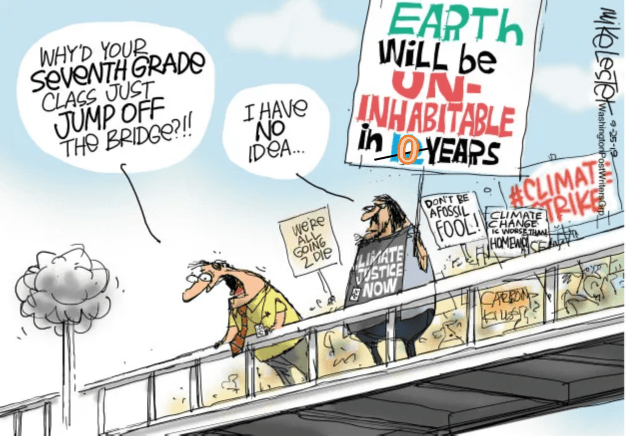
Yet Al Gore, Greta Thunberg, John Kerry, and other “climate experts” claim to know exactly how many years it will be until the Earth is uninhabitable.

Speaking of Al Gore, I recommend Joel Gilbert’s new film, “The Climate According to AI Al Gore,” where Joel interviews an AI Gore, debunking Gore’s conviction, expertise, and the entire climate emergency of the left.

To the fearmongering, climate-catastrophizing left, it’s all humans’ fault, and with ever-increasing command-and-control diktats, rules, regulations, and taxes, we can affect forces beyond our comprehension and control.

The climate is indeed changing—it always has and always will. Temperatures will likely rise from their current 500 million-year low regardless of what the so-called experts, activists, or any world government agencies say or do.

In their attempts to regulate and tinker with Mother Nature, they may inadvertently destroy everything they are attempting to save—unless that’s the plan.

Previous Post: Corrupting Climate and Weather

An article at The Spectator raises the question Do alarmists know the difference between weather and climate?  The author Charles Moore may also be a man for all seasons like Sir Thomas More.  Excerpts in italics with my bolds and images.

A lot of clever people are putting the ‘green’ into ‘greenbacks’

Until recently, those expressing skepticism about climate change catastrophe have been hauled over the coals (or the renewables equivalent) for not understanding the difference between ‘climate’ and ‘weather’. The lack of global warming at the beginning of the 21st century was not to be taken, chided the warmists, as evidence that climate change was not happening. Weather was the passing phenomenon of each day: climate was the real, deep thing.

Now, however, the alarmists themselves have elided the two concepts, using the Australian bush fires as their cue. As Sir David Attenborough puts it: ‘The moment of crisis has come’. They could be right, of course, but how could they really know? In this sense, President Trump is surely justified in warning, at Davos, against the ‘Prophets of Doom’. Prophecy is a different skill from an exact understanding of the here and now.

Mr Trump might usefully have talked about the Profits of Doom too. If the movement can persuade western society that the climate emergency is upon us, there are enormous sums to be made by people who claim to be able to remedy it. Hence the patter now coming out of companies such as Blackrock, BP or Microsoft, fanned by Mammon’s public intellectuals, such as Mark Carney. A lot of clever people are putting the ‘green’ into ‘greenbacks’. A lot of less clever investors are going to get their fingers burnt.

See Also Stoking Big Climate Business

Footnote:  Case in Point:  Green Fraudsters Plead Guilty

Jeff Carpoff, 49, of Martinez, pleaded guilty today to conspiracy to commit wire fraud and money laundering. His wife, Paulette Carpoff, 46, pleaded guilty today to conspiracy to commit an offense against the United States and money laundering. According to court documents, between 2011 and 2018, DC Solar manufactured mobile solar generator units (MSG), solar generators that were mounted on trailers that were promoted as able to provide emergency power to cellphone towers and lighting at sporting events. A significant incentive for investors were generous federal tax credits due to the solar nature of the MSGs.

The conspirators pulled off their scheme by selling solar generators that did not exist to investors, making it appear that solar generators existed in locations that they did not, creating false financial statements, and obtaining false lease contracts, among other efforts to conceal the fraud. In reality, at least half of the approximately 17,000 solar generators claimed to have been manufactured by DC Solar did not exist.

“By all outer appearances this was a legitimate and successful company,” said Kareem Carter, Special Agent in Charge IRS Criminal Investigation. “But in reality it was all just smoke and mirrors — a Ponzi scheme touting tax benefits to the tune of over $900 million. IRS CI is committed to investigating those who take advantage and impact the financial well-being of others for their own personal gain.”

“The Federal Deposit Insurance Corporation, Office of Inspector General (FDIC-OIG) is pleased to join our law enforcement colleagues in announcing these guilty pleas,” stated Special Agent in Charge Wade Walters for the FDIC OIG San Francisco Regional Office. “The defendants conspired with others to create a fraudulent business venture that duped unsuspecting entities, including banks, to invest approximately $1 billion, which the two later used to support a lavish lifestyle.

Source:  https://wattsupwiththat.com/2020/01/27/dc-solar-owners-plead-guilty-to-largest-ponzi-scheme-in-eastern-california-history/

What Keeps “Energy Transition” Going? $ $ $

Robert Gauthier answered posting on a Quora topic How could we reverse the damage done by the “green energy” global scam that brought less efficient and highly polluting energy producing projects and high energy prices? Excerpts in italics with my bolds and added images.

Wind and solar power has provided politicians with an excuse to dispense favours—including taxpayer-funded subsidies and tax preferences to a supposedly “green” industry—while appearing to do something for the environment. And yet, despite more than two decades of massive subsidies, tax preferences and purchasing mandates from governments, wind and solar power still represent barely more than a rounding error of global energy production. In jurisdictions where renewables enjoyed strong but ill-considered political support, consumers and taxpayers now face much higher electricity bills and less-reliable power. And despite promises to the contrary, countries such as Germany, which have significantly increased wind and solar electricity production, have seen no meaningful reduction of greenhouse gas emissions.

Far from being a miracle cure-all for the shortcomings of conventional power generation, wind and solar power exaggerate the symptoms they pretend to address. Added up over the past two decades, the cumulative subsidies across the world for biofuels, wind, and solar approach about $5 trillion, all of that to supply roughly 5% of global energy.

The whole justification for the falling costs of wind generation rested on the assumption that much bigger turbines would produce more output at lower capex cost per megawatt, without the large costs of generational change. Now we have confirmation that such optimism is entirely unjustified – the whole development process has been a case of too far, too fast. Again, this was both predictable and predicted. The idea that wind turbines are immune to the factors that affect other types of power engineering was always absurd. The consequence is that both capital and operating costs for wind farms will not fall as rapidly as claimed and may not fall significantly at all. It follows that current energy policies in the West are based on foundations of sand – naïve optimism reinforced by enthusiastic lobbying divorced from engineering reality.

In the end, however, politicians cannot defy the laws of physics and economics. The promise of wind and solar power will always clash with the need for electricity that is low cost and reliable. That’s why voters routinely punish politicians who pursue flawed renewable energy policies. Rising electricity costs due to increased wind and solar power damage the economy by making businesses that consume significant volumes of electricity less competitive and by leaving less money in the pockets of consumers.

In Ontario, Canada during the run of the Green Energy Act there which attempted to replace coal and nuclear with wind and solar the upshot was a 138% increase in the price of electricity at the meter for the consumers. This led to the government that brought in this legislation to lose the next election so badly that they were no longer recognized as a party in the legislature. Naturally the government that replaced them killed the program and started refurbishing the nuclear reactor fleet there.

Unfortunately, solar and wind technologies require huge amounts of land to deliver relatively small amounts of energy, disrupting natural habitats. The real estate that wind and solar energy demand led the Nature Conservancy to issue a report last year critical of “energy sprawl,” including tens of thousands of miles of high-voltage transmission lines needed to carry electricity from wind and solar installations to distant cities.

Land required for wind farms to power London UK

Building a single 100-MW wind farm—never mind thousands of them—requires some 30,000 tons of iron ore and 50,000 tons of concrete, as well as 900 tons of nonrecyclable plastics for the huge blades. With solar hardware, the tonnage in cement, steel, and glass is 150% greater than for wind, for the same energy output

Take batteries. It is estimated that current battery manufacturing capabilities will need to be in the order of 500-700 times bigger than now to support an all-electric global transport system. The materials needed just to allow the UK to transition to all electric transport involve amounts of materials equal to 200% the annual global production of cobalt, 75% of lithium carbonate, 100% of neodymium and 50% of copper. Scaling by a factor of 50 for world transport, and you see what is now a showstopper. The materials demands just for batteries are beyond known reserves.

And that’s just one of the issues. Others include vast costs constituting a multiple of current energy costs; the environmental impact of mining and transporting huge amounts of materials; need for vast amounts of rare elements, far beyond known world reserves; incredibly huge amounts of material to recycle when facilities wear out; and on and on.

Spend enough time researching this stuff and you gradually realize that almost everything you read about green energy shows that at best it’s really a dark shade of brown.

Trump to Bury Already Dead ESG

John  Authers explains the demise of ESG in his Bloomberg article Trump Will Bury ESG, But It Was Already Dead. Excerpts in italics with my bolds and added images.

The green investing revolution never stood a chance in the US once
ensnared by the culture wars, but that wasn’t the only cause of death.

Ever So Gone

As was obvious even before voters went to the polls, ESG was already a decisive loser in the US. The concept of Environmental, Social and Governance investing became hopelessly entangled with the culture war agenda, failed to deliver on its promises, and went into retreat. Rather than attempt a technocratic, clean, green way of changing capitalism, America has opted for something more nationalist, even mercantilist.

ESG as a term has been demonized by politicians on the right, to the point that BlackRock’s Larry Fink said that it had been “weaponized” and should no longer be used. Because of Fink’s stand on ESG issues, BlackRock has become a lightning rod for conservative attacks lumped in with identity politics. Startlingly, the company shows up in a list of “decadent and rootless” institutions that should be burned to the ground in a new book by Kevin Roberts, the head of the Heritage Foundation, a distinction it bizarrely shares with the Boy Scouts of America and the Chinese Communist Party.

Supporters of the concept were already disillusioned that ESG had become little more than a marketing wheeze, and several big fund managers, including WisdomTree and Invesco, have faced fines in the US for “greenwashing” (claiming their products were greener than they really were). In France, BlackRock is under fire over allegations that 18 of its funds sold as sustainable are in fact investing in fossil fuels.

Regulator attitudes differ starkly across the Atlantic. In Europe, regulators have raised the ante by telling fund managers that they must reach minimum thresholds for environmental impact before they can use the ESG label — a move that makes it hard for them to keep investing in the US, where the best returns are, and requires them to become more active than is currently the case for many.

In the US, the Securities and Exchange Commission (SEC) has watered down its requirements on companies to disclose ESG statistics — and the whole concept is close to unworkable unless everyone has to disclose standardized statistics. In September, it quietly disbanded its task force on ESG enforcement. Now, the Trump administration is likely to make dismantling such rules one of its first acts in office.

That will complete a retreat that has largely already taken place. A look at the total market cap of BlackRock’s flagship ETFs covering the global energy and clean energy sectors shows that after a boom in 2021, the clean energy fund has steadily dwindled, and is now worth slightly less than the main energy fund:

Investors Wash Their Hands of Clean Energy
There has been an exodus from clean energy stocks in the last two years

Much of this is driven by the declining share prices of clean energy stocks. However, if we look at the number of shares in the ETF, it’s clear that there were huge inflows during the pandemic, and much of that money has now been withdrawn.

Investors are losing interest in the concept, and claims that ESG would reduce
global warming, or starve fossil fuel groups of capital, look overblown.

Interest among the public has waned in the US — although not elsewhere. Google Trends shows that US searches for ESG and its synonyms tanked over the last two years, while continuing at much the same level elsewhere. The rest of the world still seems happy to give it a try, but America is no longer going along for the ride.

The pattern recurs in the news media. Counting stories published on the Bloomberg terminal from all sources shows interest peaking in 2016, when Donald Trump was first elected, and long before the flow of money went into reverse. By the time that Fink said ESG had been “weaponized,” interest was barely a third its 2016 level and has continued to dwindle.

Critically from the point of view of how capitalism is operating, the same pattern shows up in earnings call transcripts. Bloomberg’s Document Search function shows that executives — not just Larry Fink — no longer want to talk about it. This is our quarter-by-quarter measure of mentions of ESG and its various synonyms since 2010. Mentions exploded after the pandemic, and have tumbled since 2022. With this earning season roughly 90% over, interest from executives in ESG looks to be right back to pre-pandemic levels’.

This is at least in part because fund managers are no longer forcing the issue. BlackRock is admirably transparent about the way it votes its shares, and produces regular reports; here is the latest. As this chart from the report (which is worth a read) demonstrates, the amount of support from shareholders for environmental and social proposals has declined markedly over the last three years:

BlackRock itself upped its support for corporate governance proposals, but only backed 4% of social and environmental proposals (down from 20% two years earlier). It also declined to support any of the various anti-ESG proposals that were put forward, and complained that many of them were duplicative or poorly drafted. But the notion that ESG was going to change the way companies operate seems to be in retreat.

Once Trump is back in the White House in January, we’ll learn much more about how his economic nationalism will work. Fine-tuning capitalism to make it more long-termist and take into account more than the narrowly defined interests of shareholders — the big ESG idea — has been comprehensively defeated. Now we wait to see what version of mercantilism comes in its stead.

Footnote: Fundamental Reasons People Reject ESG Were Not Addressed by Author


False Premises for Hague Climate Reparations Hearing

Public hearings at the International Court of Justice in The Hague on the request for an advisory opinion on the Obligations of States in respect of Climate Change, December 2024 (Photo: International Court of Justice)

After one week of the hearing at International Court of Justice (ICJ) the thrust of the event is clear.  It is an attempt to redistribute wealth from nations who developed and prospered from basing their societies on hydrocarbons to other nations who have not done so as successfully.  The “victims” claim compensation because burning hydrocarbons caused global warming which will raise sea levels and flood island nations.  This is called “Climate Justice.”

The parties, including presumably the judges, take this premise without question, so the whole proceeding is based on PR without scientific foundation.

Recently green campaigners were warning that small Pacific islands would drown as sea levels rose. In 2019 United Nations Secretary-General António Guterres flew all the way to Tuvalu, in the South Pacific, for a Time magazine cover shot. Wearing a suit, he stood up to his thighs in the water behind the headline “Our Sinking Planet.” The accompanying article warned the island—and others like it—would be struck “off the map entirely” by rising sea levels.

Earlier this year, the New York Times finally shared what it called “surprising” climate news: Almost all atoll islands are stable or increasing in size. In fact, scientific literature has documented this for more than a decade. While rising sea levels do erode land, additional sand from old coral is washed up on low-lying shores. Extensive studies have long shown this accretion is stronger than climate-caused erosion, meaning the land area of Tuvalu and many other small islands is increasing.

These appeals were made previously by the Maldives and Fiji, who co-hosted the Madrid COP.  But stubborn facts undermine the credibility of the premise.

It is a widely accepted climate view—based on wild speculations from some op/ed writers and partisan politicians–is that average sea levels are increasing dangerously and rationalize an immediate governmental response. But as we shall demonstrate below, this perspective is simply not accurate.

There is a wide scientific consensus (based on satellite laser altimeter readings since 1993) that the rate of increase in overall sea levels has been approximately .12 inches per year.

To put that increase in perspective, the average sea level nine years from now (in 2029) is likely to be approximately one inch higher than it is now (2020). One inch is roughly the distance from the tip of your finger to the first knuckle. Even by the turn of the next century (in 2100), average ocean levels (at that rate of increase) should be only a foot or so higher than they are at present.


None of this sounds particularly alarming for the general society and little of it can justify any draconian regulations or costly infrastructure investments. The exception might be for very low- lying ocean communities or for properties (nuclear power plants) that, if flooded, would present a wide-ranging risk to the general population. But even here there is no reason for immediate panic. Since ocean levels are rising in small, discrete marginal increments, private and public decision makers would have reasonable amounts of time to prepare, adjust and invest (in flood abatement measures, etc.) if required.

But are sea levels actually rising at all? Empirical evidence of any substantial increases taken from land-based measurements has been ambiguous. This suggests to some scientists that laser and tidal-based measurements of ocean levels over time have not been particularly accurate.

For example, Professor Niles-Axel Morner (Stockholm University) is infamous in climate circles for arguing–based on his actual study of sea levels in the Fiji Islands–that “there are no traces of any present rise in sea levels; on the contrary, full stability.” And while Morner’s views are controversial, he has at least supplied peer reviewed empirical evidence to substantiate his nihilist position on the sea-level increase hypothesis.

The world has many important societal problems and only a limited amount of resources to address them. What we don’t need are overly dramatic climate-change claims that are unsubstantiated and arrive attached to expensive public policies that, if enacted, would fundamentally alter the foundations of our economic system.

See Also:

Fear Not For Fiji

Islands Adapting to Change: Tuvalu