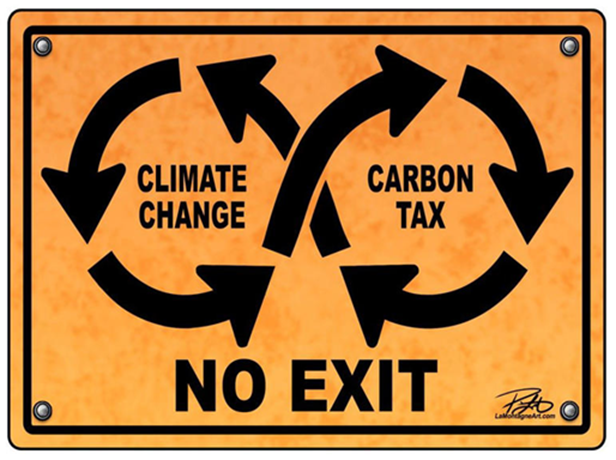
Carney Directs Canada Pipeline Charade

Q: Do Leopards Change Their Spots? A: No,
because it’s chamouflage concealing their real motives.

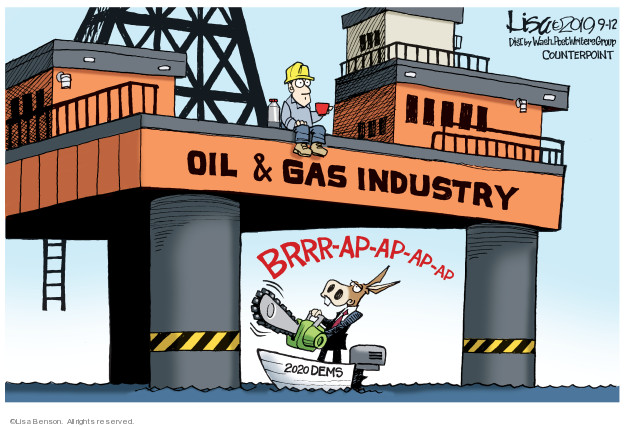
This National Post editorial gives the game away: The Carney-Smith pipeline of uncertainty.  Excerpts in italics with my bolds and added images.

MOU adds as many roadblocks as it clears away

Prime Minister Mark Carney, right, signs an MOU with Alberta Premier Danielle Smith in Calgary, Alta., Thursday, Nov. 27, 2025. THE CANADIAN PRESS/Jeff McIntosh

Had the Great Smith-Carney Pipelines and Climate Pact of 2025 emerged say, five years ago, it would have been considered squarely within the realm of Liberal environmentalism. Instead, because former prime minister Justin Trudeau brought in several anti-business policies, the current prime minister is being feted/scorned as being pro-energy industry by disappointed Liberals and relieved conservatives alike. While Mark Carney deserves credit for negotiating this deal with Alberta Premier Danielle Smith, and bringing a rival onside, we’re skeptical at the chances a pipeline ever gets built.

There are definitely some positives in the deal that Smith can present at the UCP annual general meeting this weekend in an attempt to quell the separatist uprising within her governing party. Ottawa has officially committed to “Increasing production of Alberta oil and gas” and to the approval and construction of “one or more private sector constructed and financed pipelines.” The Liberals promise they “will not implement the Oil and Gas Emissions Cap” and will exempt Alberta from the government’s clean energy regulations. They would also consider a temporary exemption to the west coast tanker ban.

All of these regulations have been points of contention for Alberta, so it is to Smith’s credit that she was able to persuade Carney to budge.  But it’s possible this will not accomplish much more than to remove extra layers of regulation, which were unnecessary even by environmental standards. Under the Trudeau Liberals, there was to be a consumer carbon tax, industrial carbon tax, as well as the clean energy regulations and emissions cap. And it did not end there, as the Impact Assessment Act, also brought in under Trudeau, mandates onerous environmental and social review, including the consideration of “Indigenous knowledge” alongside scientific assessment, as well as considering the “intersection of sex and gender with other identity factors.”

If Carney is at all serious about kickstarting investment in Canada,
he should at minimum be willing to clear away some of these extra rules.

Ultimately, it seems that environmental policies and expectations are merely being shifted around. Because what is being asked of Alberta would appear to provide only the narrowest of paths for the construction of a new pipeline to the West coast. Under the memorandum of understanding between Smith and Carney, the province would have to raise its industrial carbon tax from $95/tonne to a minimum of $130/tonne, and reduce methane emissions, produced by the energy industry and farmers, to 75 per cent below 2014 levels. And in addition to the duty to consult Indigenous communities, any pipeline must have Indigenous co-ownership.

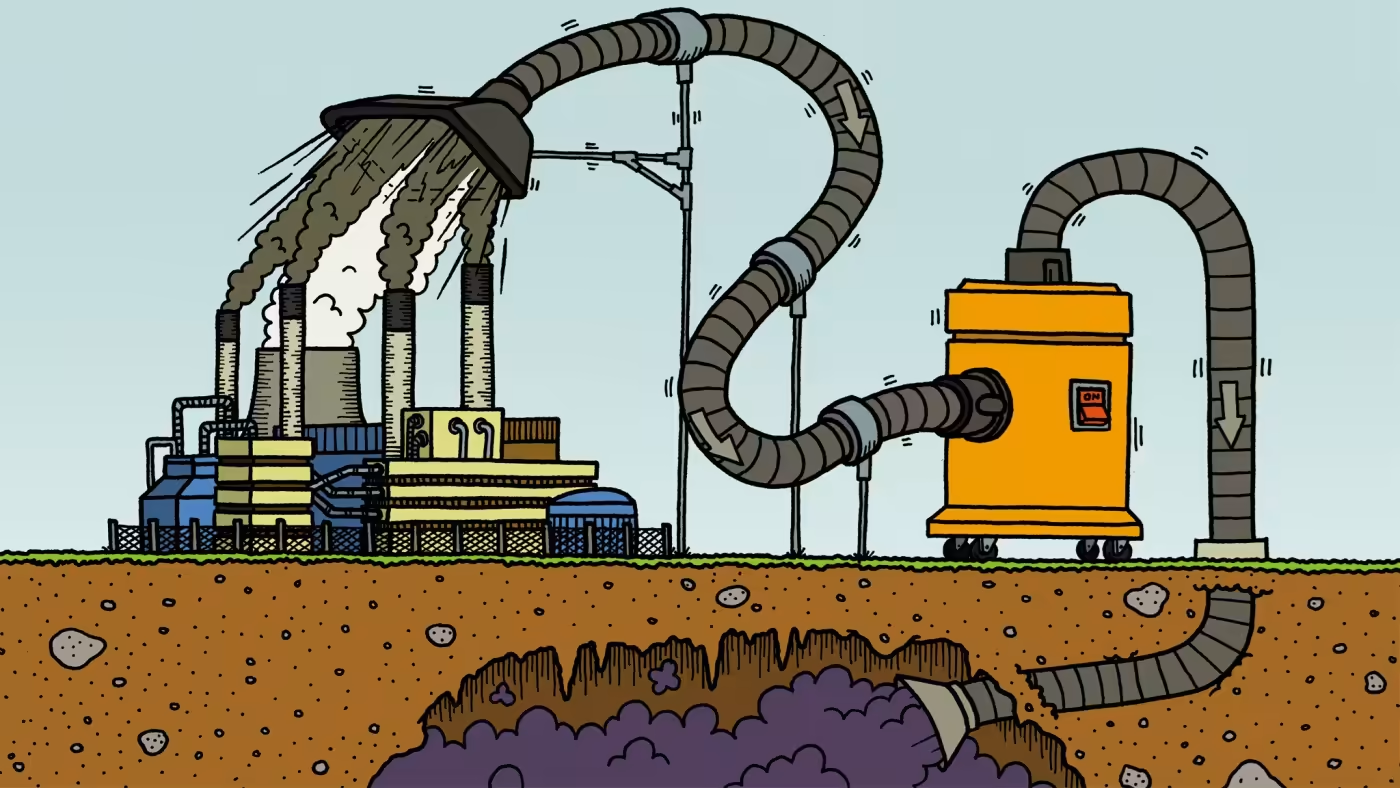
Further to that, the construction of a pipeline is entirely contingent on the simultaneous construction of a massive carbon capture project, presumably so Carney can claim the new pipeline is moving only “low emission” barrels of bitumen. Finally, while the MOU does not explicitly give B.C. a veto, that province is to be included “immediately” in a “trilateral discussion” on the project. B.C. Premier David Eby is opposed to a pipeline and was highly critical of the deal, claiming it would take priority away from other projects, specifically B.C. projects Eby supports. [

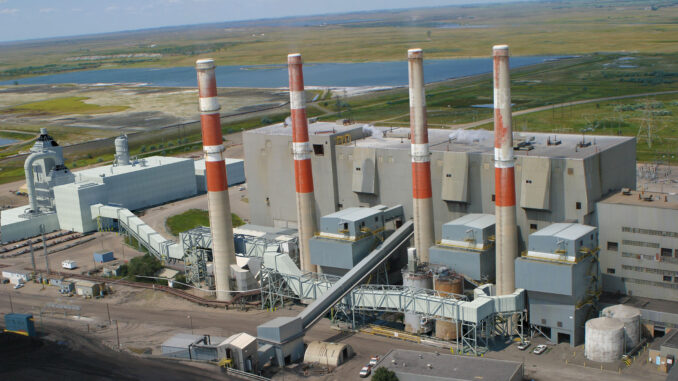
April 30, 2024 (IEEFA) – More than CAD1 billion were spent retrofitting the Boundary Dam 3 (BD3) coal plant in Saskatchewan to add carbon capture technology. After nine years, the project has a consistent history of capturing far less than the 90 per cent promised when the project was built—and all the carbon dioxide (CO2) captured at the plant is used for enhanced oil recovery (EOR) that injects captured CO2 into the ground to extract more oil..Carbon capture at Boundary Dam 3 still an underperforming failure

And the roadblocks to a new pipeline don’t end there. While it would be approved through the Major Projects Office, it isn’t at all clear what purpose that will serve. Carney’s Liberals gave themselves the authority to suspend regulatory review to expedite projects in the national interest. However, the office is electing not to use this power so far, stating on its website that “Projects will continue to be subject to all regulatory review processes.”

So being approved through the MPO may give the pipeline certainty that
it will be approved — eventually. That means every investment killing
process under the Impact Assessment Act will have to be passed.

What the Smith-Carney deal does accomplish is to buy both of them time to each satisfy their base. For Smith that is conservatives flirting with separatism, and for Carney, it is environmentalist Liberals, some of whom see this deal as a betrayal, such as former environment minister Steven Guilbeault who quit cabinet in protest. We applaud genuine attempts from Ottawa to work with, as opposed to against, Alberta, but we’re not confident this plan will deliver what is promised.

See Also:

Canada PM Carney Floats Imaginary “Decarbonized Oil” Pipeline

On Energy, Carney the Wrong Man at the Worst Time

EU Climatists Backpedaling

Thomas Kolbe explains the turnabout against European climatists, weakening their power over the EU agenda. His American Thinker article is Climate Policy Turning Point.  Excerpts in italics with my bolds and added images.

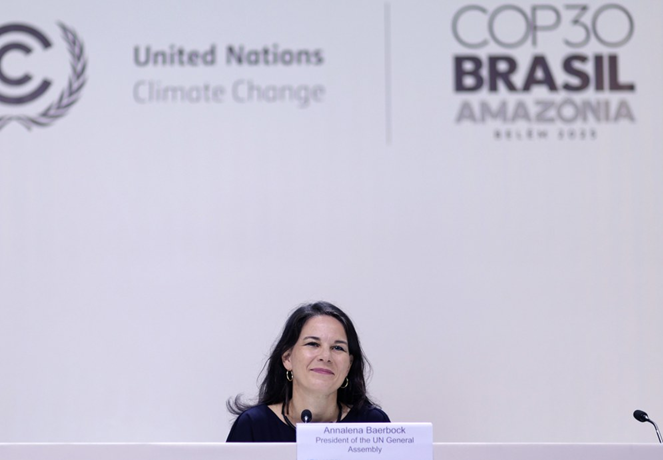
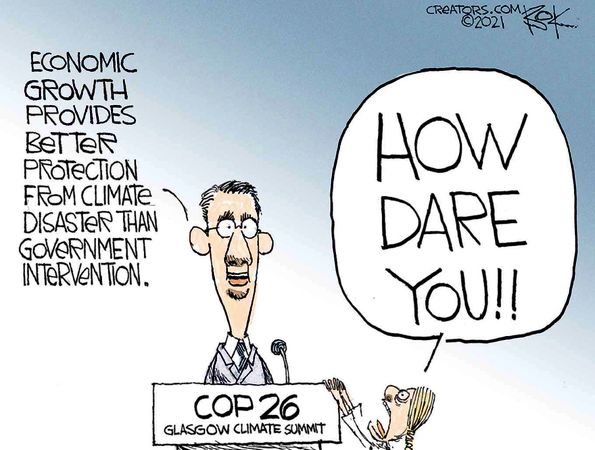
While former German Foreign Minister Annalena Baerbock calls for a fight against climate-driven global apocalypse at COP30, Brussels is being forced into political restraint by pressure from the U.S. and Qatar. On the horizon, the end of the EU’s grand climate machinations is becoming visible.

““This is a new form of multilateralism — let us join forces,” said Annalena Baerbock, President of the 80th session of the United Nations General Assembly. Photo: Rafa Pereira/COP30

November 13, 2025, could mark a turning point in European Union history. We may have witnessed the beginning of the end of European climate socialism. Media coverage of the day in Parliament downplayed its significance, focusing instead on the reform of the supply chain law, while fundamental changes unfolded at a different level.

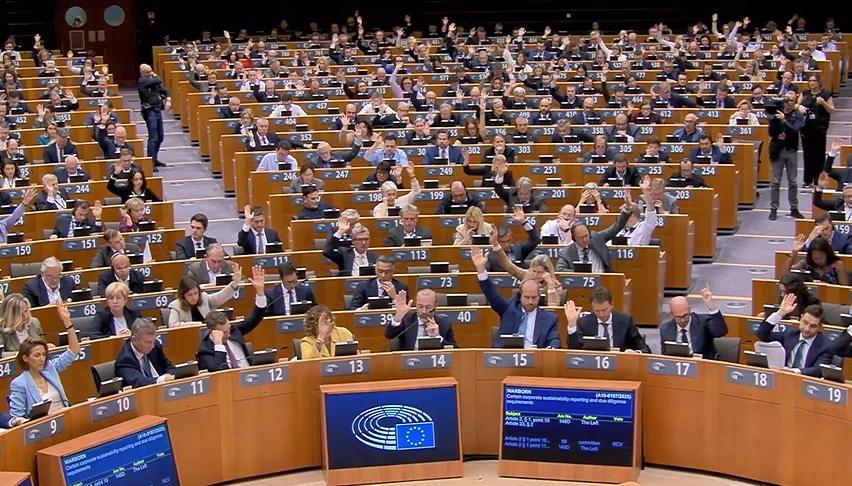
Lawmakers in the European Parliament agreed today, Nov. 13, 2025, to dramatic cuts to the EU’s sustainability reporting and due diligence laws, including significant reductions in the number of companies to be covered by the Corporate Sustainability Reporting Directive (CSRD) and Corporate Sustainability Due Diligence Directive (CSDDD), and the elimination of the obligation for companies to prepare climate transition plans. The vote, was 382 MEPs in favor and 249 opposed,

Politically, the event cannot be overstated; perhaps it should even be called a singularity in recent EU policy: The European Parliament paved the way for a dramatic dilution of corporate reporting obligations under the Corporate Sustainability Reporting Directive (CSRD) and the so-called due diligence rules (CSDDD). The unstoppable march toward a climate dictatorship has been abruptly halted.

The End of the ESG Machine

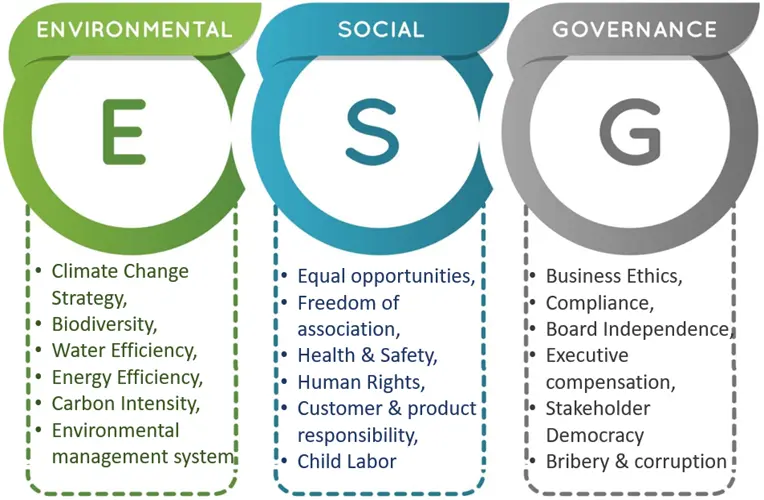
Advocates of the ESG doctrine — under which private industry is forced by lawmakers to integrate party-circulated environmental and social standards into corporate governance — suffered their first major setback. Reporting and due diligence obligations for companies have been so weakened that previously required climate-aligned transition plans at the corporate level are now eliminated. Responsibility for violations of the remaining rules now rests with national authorities, not Brussels, freeing multinational supply chains from massive oversight.

The economy can, to some extent, escape the regulators’ grip — good news.

Rough Seas for Captains of Industry

For companies in the fossil energy sector, new market incentives emerge: exports to Europe can be conducted more easily, as regulatory hurdles are lowered and bureaucratic reporting requirements drastically reduced. Overall, the adjustment allows companies greater flexibility in supply chains, reduces the compulsion to invest in renewable or CO2-neutral projects, and makes European markets more attractive to fossil energy exporters.

Reality Check

The EU Commission has recently faced mounting pressure from both Washington and the key LNG supplier, Qatar. U.S. trade secretary Howard Lutnick had months earlier called on U.S. companies to simply ignore Europe’s ESG framework if it significantly impeded operations — a direct affront to Ursula von der Leyen, who likes to portray herself as the morally superior, untouchable guardian of EU trade.

Together, these forces launched an offensive to bring Brussels’ climate defense to its knees, where cognitive dissonance had taken hold and the undeniable drift of geopolitical power was being ignored.

We have clearly entered the era of resource dominance. Europe imports roughly 60% of its required energy. Its irrational war on baseload energy sources such as nuclear and coal has only deepened dependence.

In Brussels and EU branch capitals, the lesson is now unavoidable: being a resource-poor trading partner in negotiations reveals how Europe’s capital base has been massively weakened by EU policy. Europe has lost its historic dominant position. President Trump, during negotiations with the EU, merely displayed what behind closed doors was already clear to everyone.

Fear Wins in the End

Ultimately, Brussels’ capitulation to Washington was a logical consequence of this dependence. The post-colonial extraction era — when France accessed uranium cheaply or Europe leveraged its Middle East dominance — is definitively over. Resource-rich regions now set the rules. Europe must comply, seek alliances, and become economically more robust if it wants a role in the future. Its path into eco-socialism was an illusion that has now burst. Germany’s crisis, its accelerated deindustrialization, is only the beginning — a snapshot of the global economic realignment.

In the end, political fear of street unrest prevailed. A Europe facing regular blackouts would simply be ungovernable, with chaos in the streets, lawlessness, and near-civil war conditions, reminiscent of recurring riots in French banlieues.

Baerbock Plays Climate Theater

While reality has long arrived in Brussels and officials are forced to make initial concessions, former German Foreign Minister Annalena Baerbock — now UN General Assembly President — continues to play the unshakable lead role in the disillusioned climate theater.

On Saturday in Belém, Brazil, at COP30, Baerbock performed with maximum emphasis, trying to give legs to a footsore, limp climate club. She proclaimed that “the climate crisis is the greatest threat of our time,” and that “3.6 billion people — almost half of the global population — are currently highly vulnerable to the effects of climate change.” Droughts, floods, extreme heat, and resulting supply insecurity deepen the “vicious cycle of hunger, poverty, displacement, instability, and conflict.”

A bit of Thunberg-style climate apocalypse, performed for a select audience — climate profiteers among themselves. The theater now smells of a support group, struggling to maintain mutual rhetoric reinforcement. Of the purported 3.6 billion sufferers, few are likely interested in the climate club unless they are tied to its subsidy mechanism.

No one doubts that drastic climate changes throughout history caused massive upheavals — migrations, famine, misery. Yet it is high time to end the current CO2 circus, a carousel revolving around an artificially constructed world with vanishing relevance to everyday life.

The climate business was designed as a classic insider-outsider model. Profiteers of the climate subsidy machine tolerate the occasionally bizarre, childlike savior attitude of Baerbock and other symbolic figures — or even actively side with them. In this sense, Baerbock could indeed be considered a UN ambassador — of those shaping the global climate extraction economy. They pursue policies knowingly destabilizing societies.

The Double Standard of Green Extraction Politics

Perhaps Baerbock can explain to indigenous participants at COP30, protesting deforestation, why Europe’s green lobby cuts entire forests to install uneconomic wind turbines.

She could also offer an economic seminar on how systematic taxation of productive society members — leading only to poverty and relocation of production — supposedly lowers global temperatures. Historical indulgences offer a handy argumentative analogy.

Baerbock’s moral punch has likely suffered due to Brussels’ gradual retreat
from climate orthodoxy. No coercion for Qatar, none for Washington
— but the small corner bakery is milked with climate levies until closure.

Internally, pressure; externally, bowing. That is the new EU strategy. For those still not seeing it: this fight is not about saving the world’s climate. It is about legislatively sanctioned, corporately executed extraction of wealth — and the U.S. has repeatedly shown the red card.

In Baerbock’s words: the U.S. forces the EU into a 360-degree climate volte-face.


How the Kooky Climate Crisis Crumbles

Historian Victor Davis Hanson explains the collapse of climate hysteria in his Daily Signal video AI is Challenging Climate Orthodoxy:

For those who prefer reading, below is a lightly edited transcript from the closed captions in italics with my bolds and added images.

Hello, this is Victor Davis Hanson for the daily signal. For most of my life, at least for the last 35 years, we have accepted the climate change orthodoxy. We used to be global warming and then when things were not always warming but they were cooling. They changed the name to climate change to suggest whatever the temperature extreme was it was all due to carbon emissions caused in general  by humans, but in particular westerners who were polluting the planet with heat.

That was the dominant narrative. I didn’t think in my lifetime that I would see an end to that dominance, even though there were inconsistencies. The planet is 4 billion years old and man has only been here for 300,000 years. And we only have accurate record keeping of temperature fluctuations for the last 150 years. And even within that period, we have cyclical changes between decades of abnormal temperatures, whether too hot or too cold.  And before the industrial revolution in some cases by tree rings and ice sampling in the Arctic.

So there was always debate but the dominant narrative said:
No we have to radically change our economy and move away from
fossil fuels to renewable and that was usually wind and solar.

And then something’s happened lately. King Gustaf the16th the hereditary monarch of Sweden, is a symbolic figure  not an actual person in power.   He’s known as a rabid environmentalist, but kind of mused openly the other day, saying essentially:  Why are we ruining the economy of Europe by having exorbitant power cost, electricity cost, when we only contribute to 6% of global warming worldwide?  Then Bill Gates shocked the world when said he never he no longer believes that there is an impending climate change crisis. This was followed by a lot of other people who said let’s take a different look at this.

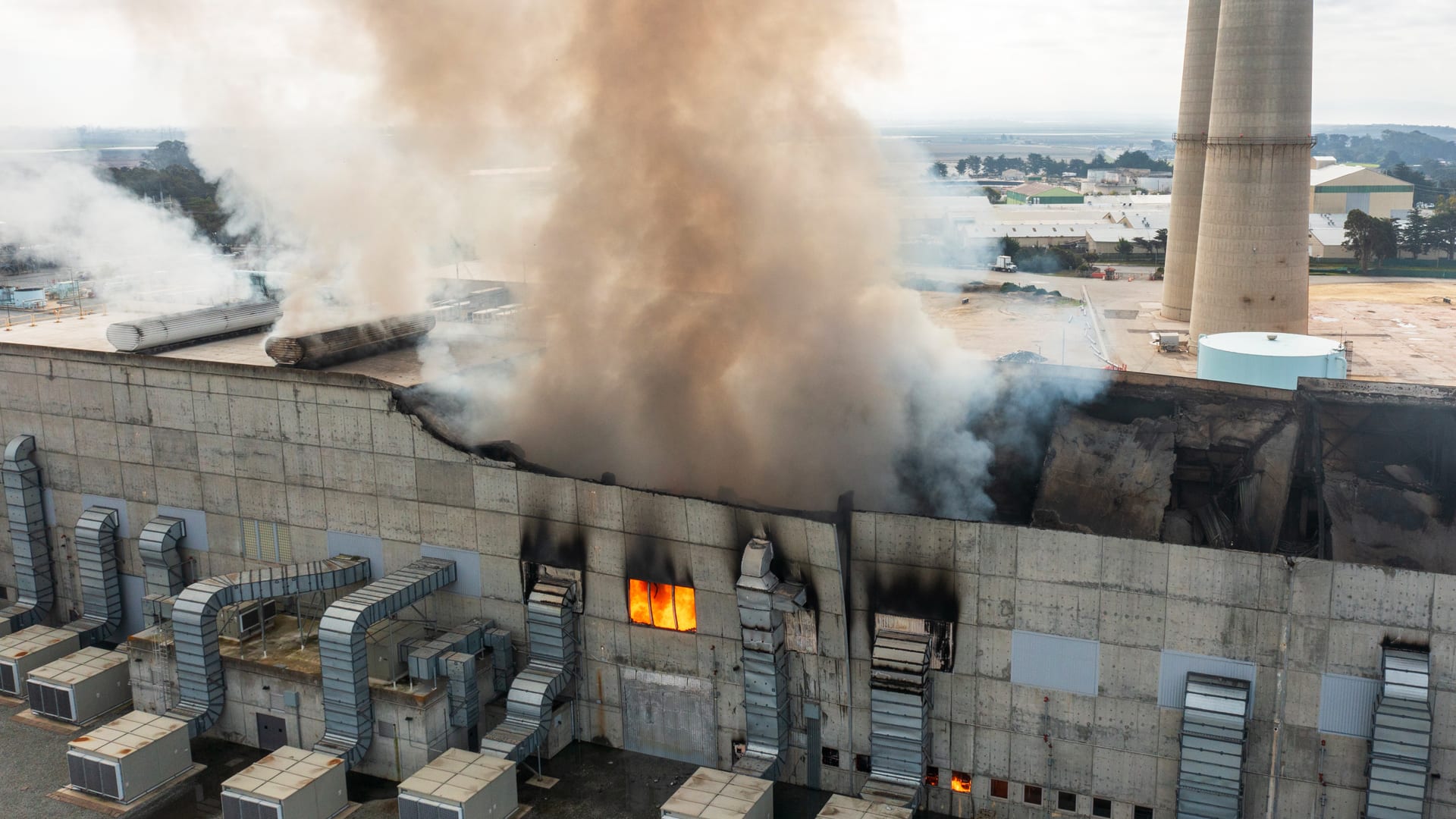
And of course the second tenure of Donald Trump has people in energy, interior,  treasury who are saying, you know, we’re not going to subsidize this anymore. And this is collated with disasters that were caused by worries over climate change worries or global Armageddon.  There was the highspeed rail program in California that was supposed to replace automobiles, $15 billion, $20 billion, not one foot of track laid.  And the solar plant down in the desert of California that is being dismantled or the battery storage in Moss Landing near Monterey that has caught fire twice.

Moss Landing battery fire 02/2025

Moss Landing on fire 02/2025

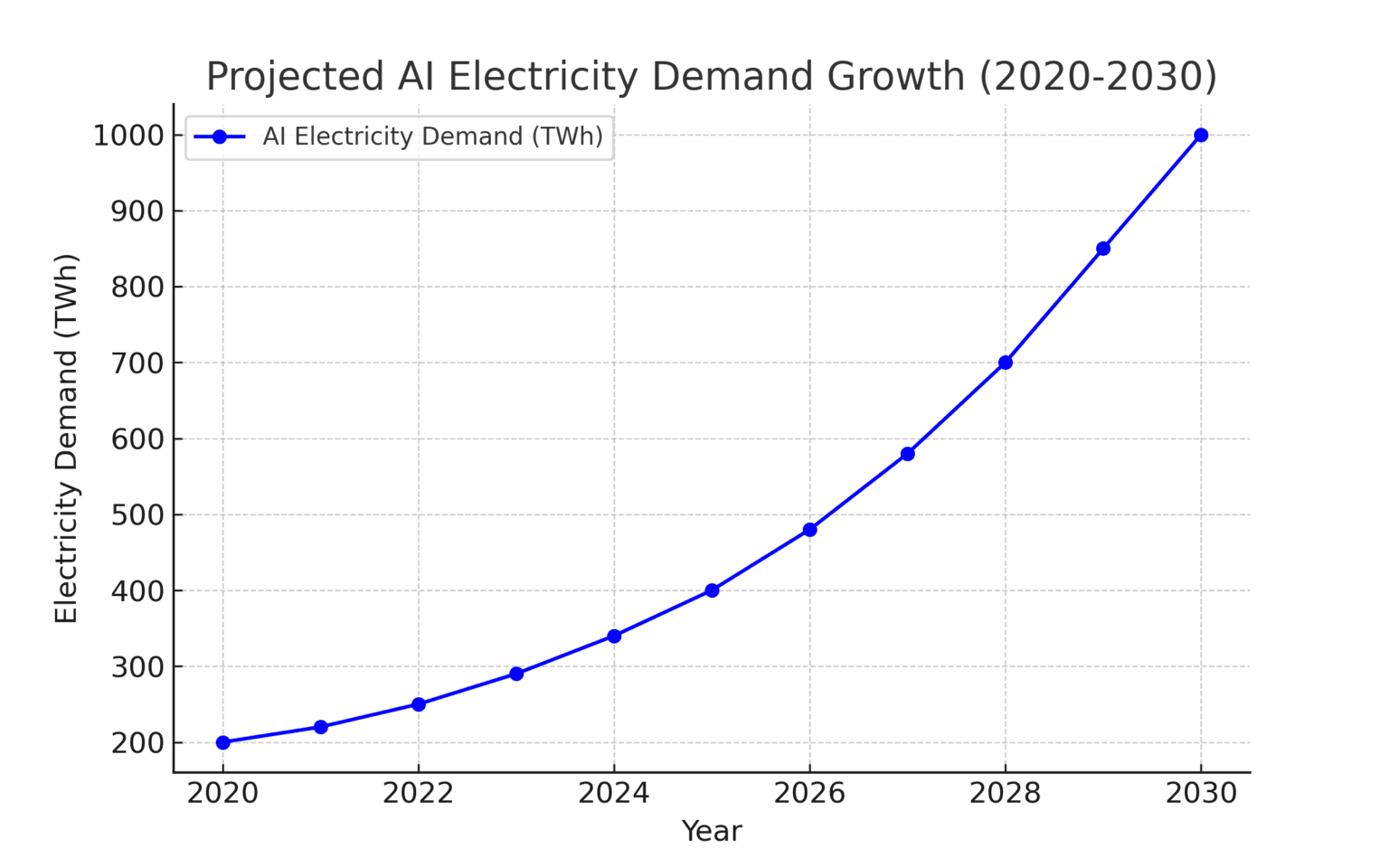
I could go on. So there was a lot of skepticism both by individuals who were influential and by the general public for good cause. So what is causing this? Well,  in reference to Bill Gates the first thing is artificial intelligence. It’s going to require a unprecedented level of electrical generation. It takes huge amounts of electricity. We don’t have it and we will not get it by subsidizing wind turbines and solar panels.

There are 1000 Gigawatts in 1 Terrawatt.

Sam Altman, one of the pioneers of artificial intelligence said,  If the United States wants to achieve preeminence in the field, and this seems to be the greatest technological breakthrough since the industrial revolution,  we’re going to have to build plants producing AI of one gigawatt a week.  That’s the size of a large nuclear reactor, one thousand megawatts. We’re going to have to build, he says, a 100 per year or the equivalent of clean coal or natural gas.  So that influenced Bill Gates, that shook him up. That’s not compatible with his prior green idea that we’re going to supplant fossil fuels.

MW refer to 1,000,000 watts of power, rate of energy generated or consumed in an instant by a system, mechanical, thermal, etc. MWe refers specifically to Megawatts of electricity.

Another reason is geostrategic. People are starting to become aware that Russia is a bad actor and Iran is a bad actor.  Since they depend on oil exports, therefore the high price of oil to fuel their military ambitions. When the United States became the largest producer of fossil fuels during the first Trump administration, then Biden for all of his green rhetoric, pivoted in his third and fourth year so he could win the election and began pumping oil again. Donald Trump took that 12 to 13 million barrels and has increased it to 14 million.  And the price of world oil is going down,  and that hurts Iran and hurts Russia.  That benefits our allies like Europe and Japan that would like more liquefied national natural gas shipped from the United States.

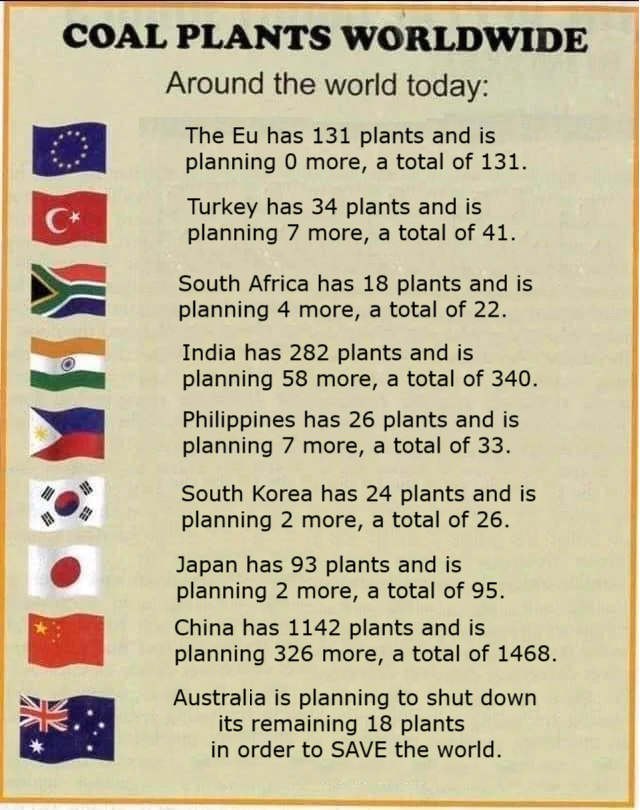
And so there were geostrategic reasons. Let’s be frank. Everybody has sort of seen what China is doing. It’s playing the West. It talks a great game about global warming. You guys, we all have to reduce our emissions. And then what does it do? Two things. It subsidizes cheap export of solar panels and wind turbines below the cost of production to bankrupt competing industries in Europe, the United States, to get the West hooked on solar and wind even though it is a very expensive andunreliable source of electricity.  Meanwhile, as we get hooked on Chinese exports, they build two to three coal or nuclear plants per month. Affordable energy that will give them a competitive hedge over the west.

Then there’s the third world that has been telling us for the last 20 years that we are culpable for global warming even though the two greatest heat emission areas in the world are China and India. Nonetheless, governments in Latin America, Africa, and Asia say, “You people owe us because you started the industrial revolution in the mid-19th century, and you’ve been polluting the planet ever since.  And you create all of your industries and your affluent lifestyles by burning fossil fuels. And therefore, you should pay us, not we pay you.” And we don’t have to cut back. We’re late to the game.
We should say to them, “Wait, wait, wait, wait, wait. We burned more fossil fuels in the past because we created the industrial revolution and we do today. We provide you the cars. We provide you the industrial plants. We provide you the plastics. If you want us to stop, we won’t export it to you and then maybe we’ll pay reparations and you can do your own industrialization. So then, don’t take stuff from us requiring fossil fuels, stuff that’s essential to your economies, and then tell us that we have to pay an added tax on it because we’re warming up the planet, as if it’s only for our purposes as well as yours.

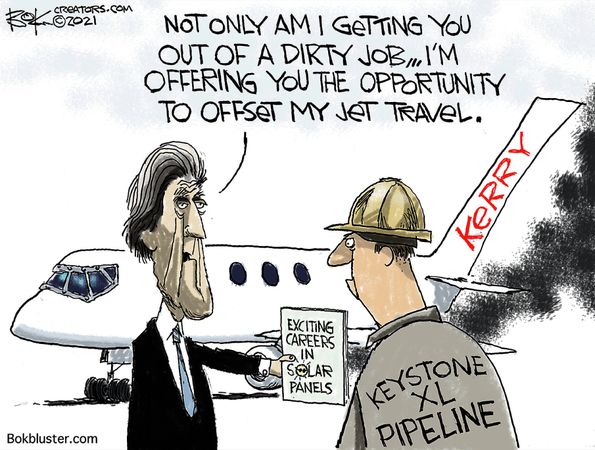
Then there’s the hypocrisy, I guess we would call it. The people who have been the avatars of climate change never suffer the consequences of their own ideology. Barack Obama said the planet would be inundated pretty soon if we didn’t address global climate change. Why would he buy a seaside estate at Martha’s Vineyard or one on the beach of Hawaii, if he really did believe that the oceans would rise and flood his multi-million dollar investment? Why would John Kerry fly all over the world on a private plane and then tell the rest of us that we’re flying too much commercial, when his carbon imprint was a thousand times more than the individual Americans? Why would people on the California coast say we have to have wind and solar and we have to get electricity up to 40 cents a kilowatt because we want to use less fossil fuels.  Meanwhile, the temperature from La Jolla to Berkeley is between what, 65 and 75F year round, where here in Bakersfield or Fresno or Sacramento it can be 105 and poor people can’t afford to run their air conditioners.

Add it all up, the inconsistency of the global warming narrative, the self-interest in the people who promote it, and the logic that they have presented no convincing empirical evidence that we have to radically transform our economies on the wishes of a few elites that do not have the evidence, but do have a lot of hypocrisy in the process.

Thank you very much.  This is Victor Davis Hanson for the Daily Signal.


Woke and Green Fading Away

Philip Cross writes at Financial Post Woke and Green are departing the scene.  Excerpts in italics with my bolds and added image.

2025 may mark the end for such policies as unsubsidized EV sales
collapse and impatience with DEI rises

This year is shaping up as a turning point in restoring sanity to public policy. Nowhere is the change more evident than in attitudes to green energy policies, once the rallying cry for left-wing parties in North America. Support has collapsed for three pillars of green energy advocacy:

♦  building electric vehicles to eliminate our need for oil pipelines and refineries;

♦  using the financial clout of the Net-Zero Banking Alliance to force firms
to eliminate carbon emissions; and

♦  legally mandating the shift from fossil fuels to green energy.

This turning away from green energy policies is reflected in how industrial policy underpinning electric vehicles (EV) has been discredited over the past year. Companies are delaying or abandoning the building of EV assembly and battery plants, mainly because EV sales are slumping following withdrawal of the artificial stimulus of government subsidies in both Canada and the U.S. Walking away from these investments leaves governments on the hook for billions of dollars they rashly pledged in support of EV projects.

In Quebec, Northvolt stopped work on a $7-billion battery plant, electric bus manufacturer Lion Electric filed for bankruptcy, and the Ultium CAM consortium paused plans to expand production of materials for batteries to be used in GM vehicles, which in turn led the giant mining company Vale to cancel plans for a nickel sulfate plant to supply these batteries. In Ontario, Honda delayed $15 billion of investments to build EV assembly plants and supply them with batteries, while Ford postponed its EV assembly plant plans after its EV division posted losses of $12 billion over the past two and a half years. Just last week, GM stopped producing electric delivery vans at its Ingersoll plant due to slack demand that had “nothing to do with tariffs or trade,” according to GM Canada’s president.

As investment in EV and battery plants collapses into full retreat, the outlook for fossil fuel demand improves. The International Energy Agency has reversed course and now projects demand will rise by 2.5 million barrels a day between 2024 and 2030. The under-investment in petroleum refining resulting from our having bought into the narrative that oil was past peak pushed the industry’s capacity utilization rate to 94.1 per cent in July, the highest of any industry in Canada that month. The prospect of demand exceeding capacity spurred the industry to boost investment to over $3 billion last year, double its average over the previous two decades.

The shift in public attitudes to fossil fuels provoked an abrupt about-face in Prime Minister Mark Carney’s stance on energy policy. In 2021 Carney spearheaded the launch of the Net-Zero Banking Alliance, which proposed to use access to credit to push firms to adopt policies that eliminated greenhouse gas emissions. But last month, after the world’s largest banks left it, including Canada’s, the alliance shut down. Even as it did, Carney’s government revived the Keystone XL pipeline proposal to carry Canada’s bitumen to U.S. refineries looking to replace dwindling heavy oil shipments from Mexico and Venezuela.

The tide is also turning against climate-change activists in the legal world. Just last week, a U.S. federal court ruled against claims by a group of young people that the Trump administration’s gutting of green energy initiatives violated their human rights. The court concluded such an important policy issue should be resolved at the ballot box and not in the courts, a precedent we should all hope helps Ontario courts reach the same conclusion in a similar case brought by teenagers.

The setbacks for green energy policies are reflected in disarray among left-wing parties in Canada and the U.S. In the U.S., The New York Times reports, registration of Democratic voters has fallen by two million since last year’s elections, despite high disapproval of Trump’s economic policies. While the radical left rejoices in the candidacy of self-styled Democratic Socialist Zohran Mamdani for mayor of New York, more centrist Democrats, fearing his radical agenda will hurt the party in next year’s midterm elections, have been slow to endorse him. In Canada, the NDP lost official party status in this spring’s federal election as its vote share plumbed historic lows, revealing the folly of Leap manifesto leaders forcing out Thomas Mulcair as NDP leader in 2017 because they wanted more aggressive opposition to fossil fuels.

Policies such as the Green New Deal are not the left’s only vulnerability. Support for woke social movements such as DEI (“diversity, equity and inclusion”) has also become a liability. A fundamental problem associated with both the green and woke movements is that advocates are so convinced of the righteousness of their causes that they refuse to countenance debate.

Because neither developed arguments that resonated with the public,
that same public is not alarmed to see these policies dismantled.


October Arctic Ice Grows After Pope’s Blessing

Last Wednesday Pope Leo spoke before a slowly melting chunk of glacial ice in Vatican City in his first address on climate change.  The pontiff addressed a crowd of roughly 1,000 attendees and called on people all over the world to demand action on climate from their governments. This post presents evidence the Arctic is already heeding his call, growing by leaps and bounds. /sarc

The graph above shows Sept./Oct. daily ice extents for 2025 compared to 19 year averages, and some years of note. Day 260 has been the lowest daily ice extent on average for the last 19 years. Note how in just the last five days, Arctic ice extent has grown by half a wadham or ~0.5M km2!

Why is this important?  All the claims of global climate emergency depend on dangerously higher temperatures, lower sea ice, and rising sea levels.  The lack of additional warming prior to 2023 El Nino, which is now receding, is documented in a post Tropics UAH Temps Cooler August 2025.

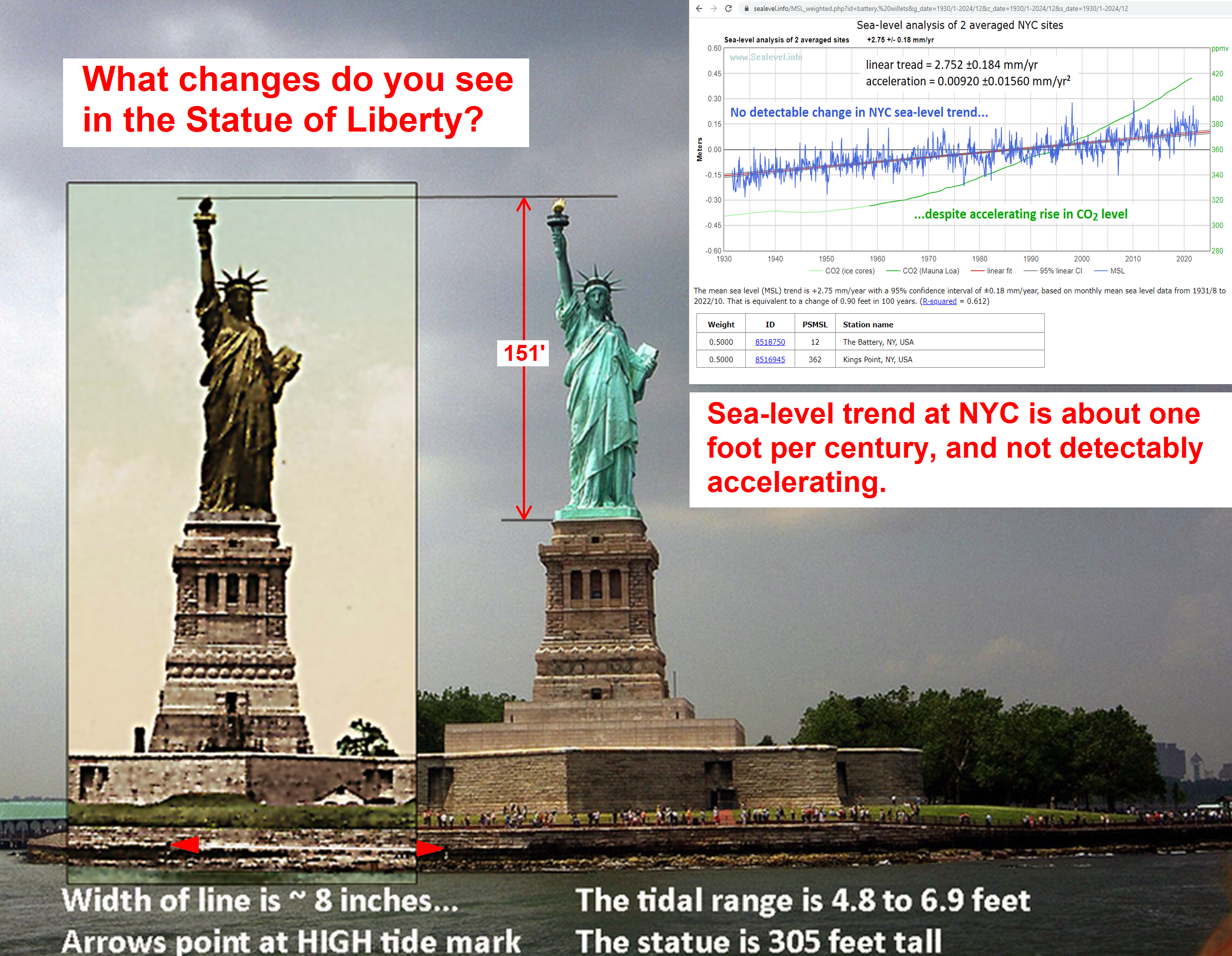
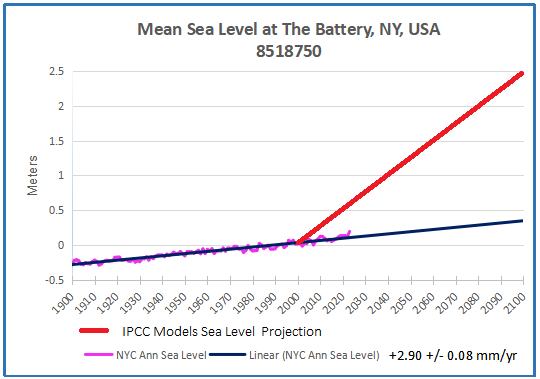
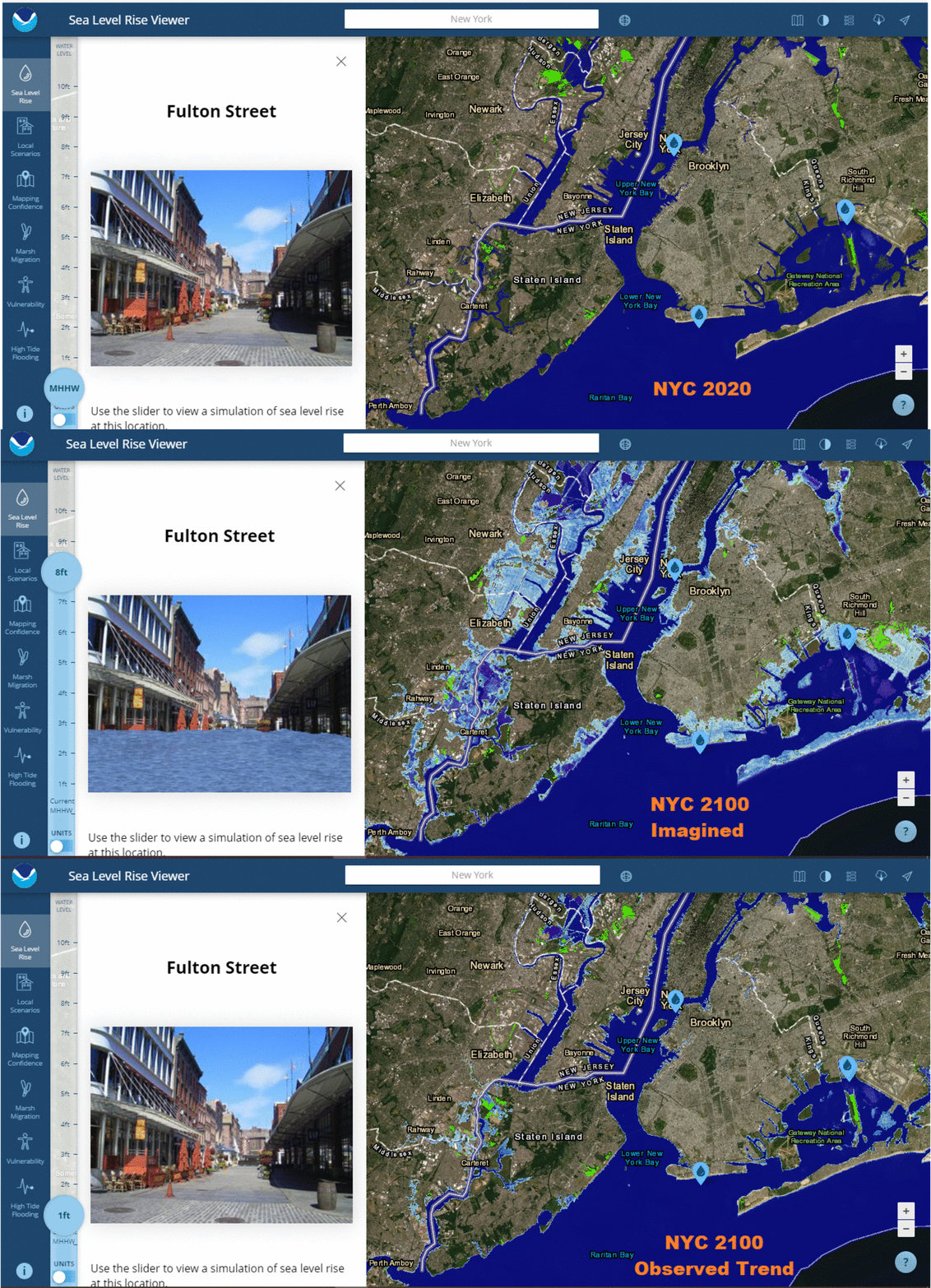
The lack of acceleration in sea levels along coastlines has been discussed also.  See Observed vs. Imagined Sea Levels 2023 Update.

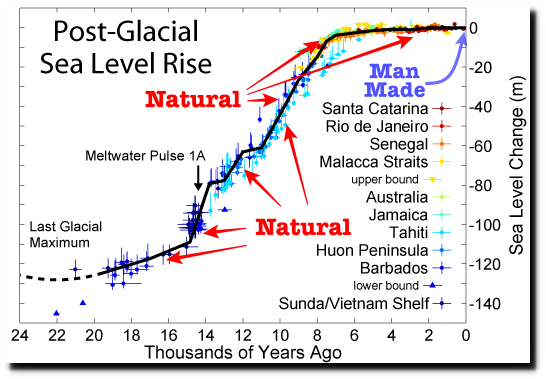
Also, a longer term perspective is informative:

post-glacial_sea_levelThe table below shows the distribution of Sea Ice on day 260 across the Arctic Regions, on average, this year and 2007. At this point in the year, Bering and Okhotsk seas are open water and thus dropped from the table. The has grown to 5.64M km2 from 5.14 and the overall surplus to average is 447k km2, ( 9 %). The 2025 ice extent exceeds 2007 by a full wadham.

Region 2025278 Day 278 ave. 2025-Ave. 2007278 2025-2007
 (0) Northern_Hemisphere 5643927 5196640 447286 4560836 1083091
 (1) Beaufort_Sea 781758 582635 199123 590267 191490
 (2) Chukchi_Sea 474277 232765 241512 25934 448343
 (3) East_Siberian_Sea 558888 329424 229465 311 558577
 (4) Laptev_Sea 299904 208865 91039 305220 -5316
 (5) Kara_Sea 1026 45918 -44892 22717 -21691
 (6) Barents_Sea 0 17669 -17669 3580 -3580
 (7) Greenland_Sea 175128 271377 -96248 404376 -229248
 (8) Baffin_Bay_Gulf_of_St._Lawrence 81997 63374 18623 72162 9835
 (9) Canadian_Archipelago 355462 410626 -55164 349687 5775
 (10) Hudson_Bay 1172 2333 -1161 1936 -764
 (11) Central_Arctic 2912747 3030507 -117760 2783370 129376

bathymetric_map_arctic_ocean

Illustration by Eleanor Lutz shows Earth’s seasonal climate changes. If played in full screen, the four corners present views from top, bottom and sides. It is a visual representation of scientific datasets measuring ice and snow extents.

How Sun and Cosmic Rays Make Our Climate Change


Dr. Henrik Svensmark: Sun and Cosmic Rays Drive Climate, Not CO₂

Danish astrophysicist Henrik Svensmark explains how the changes in solar activity and cosmic rays can influence cloud formation and therefore our climate on Earth. Title above is link to podcast video at Freedom Research.  Below is the transcript lightly edited with my bolds and added images. FR refers to Freedom Research interviewer Hannes Sarv, and HS refers to Henrik Svensmark.

Hello, welcome. This is the Freedom Research Podcast and my name is Hannes Sarv. My guest today is a researcher from Denmark, an astrophysicist, Henrik Svensmark. He’s well known for his research on the relationship between cosmic rays and Earth’s climate. He has proposed that the variations in cosmic radiation influence cloud formation and consequently global temperature and biodiversity. Of course, we’re going to talk about climate change, cosmic rays and supernovas and how they affect Earth’s climate and biodiversity well here on Earth. So first of all, thank you, Henrik, for taking the time for this interview.

Firstly, I would actually like to ask a question. Simple, simple question, which can be puzzling, at least to a lot of people. I mean, if you’re being told that you’re living in a constant climate crisis, then probably most of the people probably fear it or they might get afraid. So if someone says to you that today there is a climate crisis. What is your answer to that?

HS: Well, it’s a very political subject and the idea that the climate is in a crisis, I don’t think that that’s actually the case. It’s much less I mean, the climate disasters and so on, I mean, they’re not really increasing at all. And, of course, the temperature has gone up a little bit, but it has not, you know, made a serious crisis that we cannot handle. So, I actually think the idea that we are in a crisis is actually not correct.

FR: So you think, probably It depends on where you live, right? If the temperature goes up, it gets warmer and well, as I have understood most of the places or the larger part of the population actually benefits from higher temperatures.  What is your take?

HS: Certainly, there are places where you actually benefit from it. And in many cases, it’s not because it actually gets warmer. It’s more like it’s climate’s getting milder, meaning that it’s the colder temperatures, you know, at night and in the winter that goes slightly up, which is actually a good thing.  I mean, here in Denmark, we haven’t had very severe winters for a long time. which is also good. It’s good for the economy. It’s good for many things because a cold climate is much, much worse than a warmer climate. I think that, I mean, you also know that You also talk about people, you can have people dying from warm weather, but we know that it’s mainly cold weather that is the real killer of people. I think there’s almost a factor of 10 in difference. So slightly milder weather is not a problem. I mean, it’s certainly not a disaster.

FR:This is kind of puzzling also to many people, if they’re being told that the planet is going to be inhabitable.  Then there’s talk of sea level rise and all those other apocalyptic things that make good movies. But the actual truth there is at least a bit more complex, would you say?

HS: Yes, there’s been so many claims. I think also people should get tired of all the predictions that are wrong. I mean, that there would be no ice in the Arctic and Greenland is melting and so on. And, you know, the islands in the Pacific should be subsiding because of the rising sea levels.  And it’s not really happening, any of these things. And all these predictions, which I mean, it gets everybody’s attention, of course, because we are sort of prone to react when we hear about disasters, or coming disasters. They are not really happening fortunately. I mean, it’s actually a good thing that it’s actually not occurring.

FR: So when we look at a longer time frame, it should be brought out that there have been many such crises that have threatened all life and human life. So can you just maybe make a comparison here to today’s climate?

HS: When we talk about global warming, we say that the temperature might have got up by one degree or something like that. But if we look at geological time scales, the climate changes are much, much more severe. I mean, you have periods where you have glaciations, that is, ice almost down to the equator, and perhaps even most of the Earth is covered by ice, and you have periods where there’s no ice caps at all, and the temperature is much, much higher.  I mean, you have had… Beobab trees in Antarctica, and you had alligators at the latitude of Greenland.

So you have had much, much warmer, at least 10 degrees warmer climate back in time. So if we look at geological timescales, we have had enormous changes in climate. And of course, all of this is completely natural. And the question is, why did we have such big climate changes? And this is some of my work trying to understand why we have such large climate changes even back in time.

FR: So let’s talk about that. This is interesting that we’ve been told that the climate change today is anthropogenic. So let’s talk about your perspective on that and what does your research show?

HS: There’s no doubt that CO2 is a greenhouse gas and it has some effect on the temperature.The issue has to do with climate sensitivity. How big is the climate sensitivity? And it turns out that it’s probably around one degree if you double CO2.  So it’s a relatively benign effect of CO2. So, I’ve been working trying to understand why there are climate changes. When you look at climate changes, for instance, over the last 10,000 years, you can actually see that if you compare the climate changes with changes in solar activity, you actually find a very nice correlation.

Fig. (3). (Color online) Upper panel: Global record G7 (grey), running 31 year average of G7 (blue), sine representation of G7 with three sine functions of the periods 1003, 463, and 188 years (green), with four sine functions including the period ~60 years (red), continued to AD 2200. The parameters of the sine functions are given in Table 3. The Pearson correlation between the 31 year running average of G7 and the three-sine representation (green) is 0.84, for the four-sine representation (red) 0.85. Lower panel: G7 (grey) together with the sine functions of 1003, 463, and 188 – year periods continued until AD 2200 (equal sine amplitudes for clarity) Source: Ludecke & Weiss 2019

There are so many studies that show that you had, for instance, the Little Ice Age And you have the medieval warm period. And the medieval warm period is when you had a high solar activity. The little ice age is when the solar activity was low. And the question is, why should there be such a correlation?
How can the solar activity actually affect climate? And the simplest idea that has been put forward was that the output from the sun in the form of radiation, I mean the sunlight, that is changing. But it turns out that these changes are probably too small to explain what the climate changes you’re seeing.

So something else is going on, something is amplifying the solar activity and the idea that I came up with this now, actually 30 years ago, was that maybe solar activity is somehow regulating the Earth’s cloud cover. And initially, I took data from satellites that looked at the Earth’s cloud cover and I looked at it over a solar cycle that’s about 11 years and compared the changes in the solar cycle with changes in the Earth’s cloud cover. There seems to be a correlation between the two. So one can say that the idea, I mean, it looked as if it was something worth pursuing. But of course, it was just a correlation at that time.

Cosmic rays interacting with the Earth’s atmosphere producing ions that helps turn small aerosols into cloud condensation nuclei — seeds on which liquid water droplets form to make clouds. A proton with energy of 100 GeV interact at the top of the atmosphere and produces a cascade of secondary particles who ionize molecules when traveling through the air. One 100 GeV proton hits every m2 at the top of the atmosphere every second.

And I couldn’t say why there should be such a connection. So the general idea has to do with the formation of clouds. How are you actually forming clouds? And it turns out it’s the ionization that is happening in the atmosphere.  There’s typically about a thousand ions per cubic centimeter. So if you have a small cubic centimeter, you might have on the order of a thousand ions per cubic centimeter. And these ions are in general mainly produced because of very energetic particles that come from the Milky Way that is outside our solar system.

And they move in through the solar wind and then enter into the top of the atmosphere, where they then ionize the atmosphere. And the story is these small ions help stabilizing small molecular clusters. So you get what we call aerosols. These very small aerosols, which then grow up to a certain size. In order to make a cloud droplet, you have to have some kind of surface on which water vapor can condense. These small aerosols are actually providing these surfaces.

Cosmic Ray, Aerosol, Cloud Link

The idea is that if you have more cosmic rays coming into the atmosphere, you’re producing more of the small aerosols. They grow to become what we call cloud condensation nuclei, so they can affect the clouds, so water waves can condense and become cloud droplets. So if you have more cloud droplets, you have a more white cloud. And a more white cloud actually reflects the sunlight out to space again.
That is, of course, extremely important for the Earth’s energy balance. So that is the main idea behind the theory that I have been working on.

FR: Okay. And so if there is more clouds and reflect the sunlight back to space, I’m just gonna ask, I’m a lay person, not a scientist. Maybe I’m not, you know, a bit stupid question in that sense. But if it reflects more sunlight out, then well, logically, we get the cooler climate, right?

HS: Yes, exactly. Observations are one of the ways we can verify that it works. So on relatively rare occasions, there are some explosions at the sun. They’re called coronal mass ejections. It’s when the magnetic field lines sort of open up and the sun is throwing out a large magnetic plasma. And this magnetic plasma works more or less like an umbrella or a shield against the cosmic rays. So within a week, the cosmic rays are dropping, and they can drop maybe up to 30% or something like that. And that is like a natural experiment with the whole Earth.

And so you can actually then see if anything is happening with the Earth’s cloud cover. And this is something that we have investigated. So, for instance, we can also look at the aerosols that are produced after these events, and we can see that there is a big drop in the aerosols. And then we see a drop in the clouds following these events. And it’s not just the cloud fraction, it’s also the optical properties of clouds. So we can actually see changes in the cloud’s microphysics under these events.

So in some sense, we see the whole chain from the explosive events and the sun to changes in the cosmic rays to changes in the aerosols and then changes in the clouds. And there is a slight delay on a few days in the reaction. That’s simply because it takes about five days for the small aerosols to grow to become cloud condensation nuclei. So everything seems to be fitting very beautifully with respect to this idea.

FR: Okay. But, well, how frequently does it happen, what’s the correlation here? I mean, how frequently it happens to change the climate in that sense?

HS: I talked about this event with the explosions at the sun, which is something that happens during a week. So it’s too much too short to affect climate. But the solar activity modulates the cosmic rays. And that’s simply because the solar activity translates into changes in the solar wind. And the solar wind is covering the whole solar system and all the planets. That works like it’s a magnetic shield that screens against the cosmic rays.

So when the solar activity is high, you can say that it’s screening better against the cosmic rays. That means you get fewer cosmic rays in to the atmosphere. So solar activity can regulate the amount of cosmic rays that comes into the atmosphere. So that regulates in the cloud cover. And we can then estimate, I mean, how much it changes the cloud cover during an 11-year cycle.

And from that, we can calculate what would be the effect on the temperature in the oceans. And there you actually see that we get about on the order of one to one and a half watt per square meter more energy in when you have a solar maximum than when you have a solar minimum.

And you can actually observe that in the ocean’s temperatures. You can see that in the heat content of the ocean. And you can even see it in the volume, because the heat goes in and out of the ocean. So when you get heat into the ocean, it expands a little bit.  So in the sea level, you can actually see an 11-year cycle in the sea level. And all of this, you can quantify how much energy goes in and out of the ocean.

And it fits very beautifully with what you expect from changes in the cloud cover over a solar cycle. And it’s interesting that the solar irradiance is almost a factor of 10 too small to explain it. So there is some kind of amplification mechanism. And the idea is that it’s clouds that are responsible for this. And this is something that you should takeway with respect to the ocean temperatures and the energy that goes in and out of the ocean he has been looking at.

FR: Okay. But how does it fit this idea? How does it fit the historical records?

Figure 4. The millennial solar-climate cycle over the past 2000 years. The anomaly in 14C production levels (black curve), a proxy for solar activity, is compared to iceberg activity in the North Atlantic (dashed blue curve), a climate proxy. The pink sine curve shows the millennial frequency. It defines two warm and two cold periods, supported by a large amount of evidence, some of which are represented by red and blue bars (see main text). Source: Javier Vinos

HS: Well,If you look at solar activity going back in time, we talked about the Little Ice Age, which is from around 1300 to 1850. And then you had the medieval warm period for 900 until maybe 1200. that these changes, they fit very beautifully with changes in cosmic rays. So when it’s cold, you have more cosmic rays coming in. And when it’s warm, you have less cosmic rays entering into the atmosphere. And we know these changes in cosmic rays because when cosmic rays enter the atmosphere, They are actually producing new elements like carbon-14, which is a radioactive form of carbon. It’s slightly heavier than carbon-12.

I guess many people know that you can use carbon-14 for dating things. But this carbon becomes CO2, the heavy form from carbon, and it goes into trees. And then you can look at the annual rings of the tree rings and measure how much carbon-14 you have relative to carbon-12.  And you can then measure that for all the tree rings going back in time and you can actually reproduce solar activity almost 20,000 years back in time. And if you look at these changes and you compare with how climate has been changing over that period, there is beautiful correlations again.

So it is near certain that there is a connection between solar activity and climate. And you can also quantify some of these changes and they are relatively big and it seems as if that, you know, changes in clouds is a very good candidate for explaining this. And when we look about the last 10,000 years, then the modulation of the cosmic rays, it’s caused by solar activity.

FR: Okay. Let me just ask you about those cosmic rays again. You did say, but again, I’m not that bright in your field. You did say it comes from Milky Way. Okay. Why does it come from there? Or what is it? What sends it here?

HS: Cosmic rays are very energetic particles. It’s mainly atomic nuclear, 90% is protons. So that’s the core of the hydrogen atom. So the energetic particles that we are interested in are mainly produced in what we call supernova. And a supernova, the case that we are interested in, is when you have a massive star that is maybe eight times or more massive than the sun. It only lives a relatively short period of time, you know, from maybe three million years to 40 million years.

So it’s a large star and it’s very heavy, and then in the process of burning, it burns so fast and it ends its life in a very, very violent explosion, which is called a supernova. And this supernova, when it explodes, it produces a shock front that is moving out from where the star was located. And this shock front, it works as, you can call it, a cosmic accelerator.

So it accelerates particles that move back and forth over this shock front and move them to extremely high energies. And the energies that you can obtain by this process is much higher than we can produce in any accelerator here on Earth artificially. And these particles, they are then moving in the interstellar space in the Milky Way.

And they are moving in the magnetic fields that are in between stars. So they are sort of moving like what we call diffusion. They are sort of randomly moving around, being bent by the magnetic fields. And then some of them will be outside, you know, arrive outside our solar system.

We have the heliosphere and then they move in and they feel the magnetic field from the sun. And some of them will then enter into the top of the atmosphere. And then you have maybe one proton that comes in with extremely high energy. And then it works a little bit like billiard ball where you have one particle hitting the molecules or the atoms in the atmosphere and it makes a shower, sort of a cascade of particles that goes down through the atmosphere. And these particles are called secondary particles. And so you can have one particle coming in that becomes millions and even billions of particles that move down through the atmosphere.

These particles are completely invisible to our naked eye.  While we are sitting here, we are penetrated by these secondary particles that go through my body and your body all the time. And so every 24 hours, maybe 20 million particles will go through your body and you don’t really experience this.  This is something that has happened since the formation of our galaxy. And of course, here on Earth, we have been showered with these particles for four and a half million years.

FR: Well, since you can explain past events with solar activity and how many cosmic rays are coming towards Earth, probably you can basically model what will happen as well, right? So, I mean, the question is, where are we now in terms of changing climate? Because I’ve also talked, for example, to Professor Zharkova. She said to me that we are entering another ice age soon.

HS: There’s no doubt that we will get an ice age. We have had a number of ice ages back in time. I don’t know if you’re talking about a real ice age or you’re talking about a little ice age, which is just a colder period.

FR: She was talking about the little ice age. I understood.

HS: So a little ice age. I know there are some predictions that the solar activity will go down and we might get a slightly colder period. I’m not sure it will be a little ice age, but it’s not something that I have looked at in any details. At the same time, of course we have had some heating from the CO2 increase in CO2. And then solar activity would then go the opposite way if the solar activity goes down. The problem with these predictions is that it’s extremely difficult to predict solar activity in the future.

Source: spaceweatherlive

We can’t even predict the next solar cycle, whether it’s going to be high or low. There are some really amazing examples where this last solar cycle was predicted and the predictions were sort of all over the place. So it is really difficult to know because we don’t understand solar activity in a detail where we can predict what the next solar cycle will be. But that might come at some point. So something special has to happen. I think if we’re going to have a real cold period where the temperature drops by one or two degrees, that would be very special. I’m not sure that we’re going to see that, but I know that Zharkova is predicting that.

FR: Okay, yes. Anyhow, the thing is that still almost, well, all of it indicates that climate change is, there are some other factors than humans leading the climate change. But what is your opinion? What is the role of us on climate?

HS:  Oh, the anthropogenic CO2? Yeah. So as I said, it is a greenhouse gas. So you can see if you look at the outgoing long-wave spectrum, you can actually see there is a drop in the outgoing long-wave spectrum, which has to do with CO2, which means that it is a greenhouse gas.  The question is, how important is it? Is it so important that it’s changing temperature, you know, in a dramatic way? And I think there’s so much research now that seems to indicate that the climate sensitivity is on the order of, you know, one, maybe a little more than one degree for a doubling of CO2.

And that is much smaller than what you get from these climate models, which gives you between three and four degrees of that order, but at least a few times larger than what you get just from CO2 alone. Because in the climate models, the reason they get between three and four degrees is because they assume that it would be less cloudy, for instance, in the future climate. So you might have one degree from CO2, but then you get on the order of one or two degrees extra from what we call positive feedbacks. And that is something like more water vapour in the atmosphere or less clouds in a future climate.

And the problem is that water vapour and clouds are really the most uncertain thing about any prediction of climate. Clouds and aerosols are really what makes climate predictions so extremely difficult. And it’s because it’s all happening at length scales that are much, much smaller than what you can resolve in climate models.  You have to remember that you have maybe, you know, 50 to 100 kilometers between two grid points in a global numerical model.

And that means that, you know, if we just take Denmark, you have maybe one or two grid points over Denmark. And in each of these grid points, you have to determine, you know, what are the clouds actually just from temperature, humidity and pressure. So you have to do some kind of a parameterization of all the physics. So you’re not resolving clouds at all, but you are trying to use, you know, temperature and pressure to say what will the cloud look like for these variables. And this is basically impossible. I mean, it’s pure guesswork.

FR: So what do you think about those climate models? I mean, are they useful then at all?

HS: Of course, they’re useful for some things, but they’re not useful to say if the climate is going up by some fractions of degrees. And I don’t think you can use them for predicting future climate.

FR: But this is what they are used for, isn’t it?

HS: Yes, but I think also that there are some kind of a consensus that climate models are not doing well, I mean, that they have real problems in predicting and saying what is going to happen in the future. So they are not a crystal ball that can tell us about the future with very much accuracy.  Well, it depends on how you ask the questions, of course, but I think just recently there were some statements from people who are doing these models saying that they were running too warm.

So they are, you know, exaggerating the warmth. And I think in one of them, there was because they updated their cloud scheme. So they changed the perameters of clouds. And all of a sudden, it was running slightly warmer than before. So again, it just points to the severe problem of clouds.  I should also say that if you take out clouds of the models, then the model results start agreeing with each other. Whereas when you have all the clouds in the models, then you get very different results from various models. I mean, it’s not like in particle physics where you have a standard model that you can use.

I mean, here you have a whole ensemble of the different models and they all give slightly different results. And then you make an ensemble average of all these models and try to say that that is the future. It’s, of course, not really satisfying.

FR: Of course. So what do you think about the reports that the UN IPCC puts forward, the scientific reports? Are they something that are, you know, accurate?

HS: I looked at it with respect to the things that I’m doing. One of the things that, you know, struck me was that if you look at the effect of the sun over the last hundred years, there is no effect whatsoever. I mean, it is so small that, I mean, they’re saying essentially that there’s no effect of changes in solar activity. really a shame in the sense that I mean, for instance, we see in the present climate that we’ve had over the last 50 years, you can see solar cycle variations in the ocean heat content and so on, which we talked about just before.

So the solar activity seems to be 10 times larger than what you get from solar irradiance. And in The reason that they get such a small effect of the sun is because they are only considering changes in solar irradiance, which has to do with the solar constant. The solar constant is changing, you know, about one tenth of one percent.  So that is so, so small that it does not have any effect on climate. However, the changes in… In clouds, if we take the ideas that I have been working with Nir Shaviv we will get that over the last century, over 120 years, I think at least one watt per square meter has entered because of solar activity.

Solar activity does not seem to have been completely negative as well. over the last 10 years.
So when we think about how the issue is approached, the issue of climate change in society now, well now there’s the new administration in the United States that actually approaches it somewhat different, but in the EU, for example, Mrs. von der Leyen said that she’s still determined to go to net zero and so on.

So what I mean here is the somewhat hysterical tone that this issue is approached with and also the predictions of doom. So my question is if it’s the same in the academia or not. I mean scientists are in my opinion, at least, they seem very rational and fact-based.  So, is it somewhat different in the inside, I mean, if you talk to your peers?

HS:  I usually say that climate science is not normal science. There’s so much politics involved, even in academia. There is a sort of self-censorship. It’s a bad career move to go against the idea that CO2 is the main driver or to say what i’m saying right now so it’s not good for your career to to do that it has implications, I mean first of all it’s the only research that is being financed that can be done, if you don’t get a grant or anything, you cannot do any research.

And that’s also why I think many people will not rock the boat, because it’s a good way of getting financing for the research that you want to do. However, if you try to do things which I have done, which is perceived as controversial and not according to the general ideas, it becomes very, very difficult to obtain funding and to survive in this system. And people are very emotional about this because some people think that they are trying to save the world from a disaster. And, you know they think everybody else has really bad motives, maybe hidden motives, your multinational oil companies or something like that.

So it’s really difficult to be in opposition to these ideas. So that it’s very, very difficult for me to obtain any funding. Some people are very upset, you know, if you have been invited for giving a talk and some people find out who you are. and so on. So there’s many, many strange things happening.

FR: It’s really happening, right? I mean, it has happened to you that you’re invited to give a talk to talk about your research and there are activists who are coming to cancel you. Did I understand correctly?

Antifa thugs outside Munich Conference Center at 2019 Climate Meeting.

HS: Yes. I’ve also given talks in Germany, where the whole conference had to have police protection because of the demonstrators that tried to storm the place. Another time, on the building, they printed that we were Nazis and they put glue in the locks and so on.  Yes, so one couldn’t get in. I mean, it’s just sometimes it’s very, very, very strange how emotional it is. And there’s nothing rational about it because it’s not something that you can have a discussion about. I mean, you also heard people saying that, you know, the science has been done. Now it’s only action that is needed.

FR: Yes, yes. Well, it’s being parroted all the time. I don’t know, is it 100% already or last time I checked it was 99% of climate scientists agree on something.

HS: But all of these things are simply propaganda of some kind. It has no sort of basis in reality. It’s just some talking points that are being spread out. And some people believe them and other people know that they’re not entirely correct. And that’s how it is.

But the good thing is that I tried to survive in this system. Then I started to look at very, very long timescales. And I think, I mean, maybe we should I should tell you just a few words about that, because I think it’s a completely fascinating result that has come out. Absolutely.

So we talked about these supernovas that goes off, and they are producing the cosmic rays. So you can say supernovas are the source of cosmic rays. And the interesting thing is that our solar system it is actually moving around the Milky Way galaxy. So we are in a spiral galaxy, so it’s like a flat thing.
And we are moving around the center of the galaxy, the whole solar system, within 240 million years or 230 million years it takes. Our Milky Way is a spiral galaxy. And in these spiral arms, that’s actually where you have a lot of star formation. And star formation is where you also produce the large, heavy stars that explode.

Cosmic radiation and temperature through Phanerozoic according to Nir Shaviv and Jan Veizer. Blue columns refer to Milky Way Spiral arms.

So that means that when the solar system goes through a spiral arm, it actually in an area with much higher cosmic rays, Whereas when you are in between spiral arms, you have much lower. And the changes are not 10, 20% like we have from solar activity.

Now we are talking about several hundred percent of changes in the cosmic rays. So you can say that this is a completely independent way of testing the cosmic ray climate mechanism. Because if these changes in cosmic rays are important for climate, as we see in the present time, maybe they should also be important when we go back in time. It’s something that Nir Shviv actually looked at around 2001.

And what you find is that when you are in a spiral arm, it tends to be extremely cold on Earth. So the glaciations that we have had on Earth on cold periods fit beautifully when we were in spiral arms. And when we were in between the spiral arms, it was extremely warm. The temperature changes and the climate changes we are talking about are now, you know, from what we call an ice house, that is the glaciation, very severe glaciations, that is the large ice sheets on the Earth, to where they are completely melted and, you know, the sea level has gone up maybe by 100 meters or something like that. So it’s enormous changes.

What I looked for was to see if it has implications for life on Earth. And it turns out that you can actually indirectly look at how big the biomass has been at certain times in the ocean. And that is because you can look at organic material. So when you have the ocean and you have organic material, some of the dead material falls down at the bottom. And you can actually say something about the fraction of organic carbon relative to inorganic carbon in sediments.

So when you have sedimented mountains, you can go and measure this ratio of organic carbon to inorganic carbon. And it says something about the fraction of organic material that has been buried in sediments. And it turns out when you look at this fraction as a function of time, It fits beautifully with changes in reconstructed changes in supernovae.

And you can actually see it in fairly high details over the last 500 million years. And it turns out that you can actually extend it. So from geology, you have this fraction of organic material almost four and a half billion years back in time. And even here, it fits beautifully with the changes in the cosmic rays that have happened over the whole history of the Earth. It’s completely astounding that you have this correlation over four and a half billion years. So it says that the biomass seems to have been following things which are thousands of light years away from our solar system.

So this star formation has actually influenced the conditions for life. And it’s even more interesting because when you bury organic material, the organic material is made because of photosynthesis. And photosynthesis, that is, you know, the algaes, the green algaes produce oxygen.  So you have CO2 and water and sunlight that becomes, you know, sugar and oxygen. But in order for the reaction not to go back again, so the oxygen becomes CO2, you actually have to take the organic material and then have the oxygen and you bury the organic material in the sediments.

That’s the way you get the oxygen. So these variations in the organic material, these variations, they are actually also the production of oxygen that we have had over the whole history of the Earth. So supernovas have therefore indirectly produced or been responsible for changing the oxygen at Earth and all complex life.  I mean, in order to get complex life, we need oxygen. So it’s really been a very important part. So it seems to say that the Earth is really a part of an ecosystem, you know, where it really involves most of the galaxy. So here we see that it fits beautifully with the changes in cosmic rays or supernova frequency over most of the history of the Earth.

Source: Phanerozoic_Biodiversity.png Author: SVG version by Albert Mestre

I did another thing where I looked at the diversity of life, and just to cut the thing relatively short, it turns out that there’s a beautiful signal of the supernova frequency, even in the frequency, in the diversity of life, where you can see a very, very beautiful correlation over the last 500 million years. So it suggests that somehow the changes in the supernova  change the climate. And by changing the climate, if it’s colder, you have a larger temperature difference between equator and polar regions.

That means you have stronger winds. And if the wind is stronger, then you have more mixing in the oceans. And what it is mixing is the nutrients that life actually needs. I mean, a lot of the nutrients, they run out from rivers because of rain. And you have, you know, phosphorus and iron and oxygen. and other important elements for life. But they are then transported so life can uptake these nutrients. And the idea is that when you have more nutrients, then you can also have a higher diversity and you also get the higher biomass and you get more sediments. So everything seems to be connected in that way. I hope this was not too complicated.

FR: Well, I mean, yes, I think it wasn’t too complicated, but it’s really interesting to actually hear about the research, yes, and to think about the connections that you pointed out there. So, the only thing I would like to ask here is that, so it’s a hypothesis, of course, and again, how… how it is welcomed in your circles? I mean, is there any discussion about it or how it is approached?

HS: I think in geology and geologists, there’s a lot of geologists that really like it because many of them, they have seen how climate is changing over these long timescales and, you know, some of them, they know that CO2 does not appear to be the driver of climate changes on these long timescales. But I should also say that even in geology, there are people who are promoting that everything should be CO2, that CO2 is also driving climate on these very long timescales. But there are many places where it simply does not fit. So I don’t think that… I don’t think it’s a good theory.

I mean, you typically hear about, for instance, having extremely high CO2 levels at the same time that you had an ice age. And there are some problems also within the last 30 million years where CO2 actually dropped a lot. There are periods where temperature actually goes up and so you don’t have this correlation over many million years and some of it is called a climate paradox. There are some problems.

FR: Yes, of course, of course. Yes. So, I mean, it has been really nice talking to you, but I can see that our time for today is almost running out. I mean, thank you really for this interesting conversations and for the insights and for talking about your research in detail.  I hope my audience also listens and can hear some, well, good ideas, but they’re not only ideas because, well, this is what science actually must look like, ask questions and try to find answers, correct?

HS: Yes, I agree, that’s what we try to do.


Climate Alarmism: Not Science, But Superstition

Brian C. Joondeph writes at American Thinker, CO2 Alarmism: Science or Superstition? Excerpts in italics with my bolds and added images.

When Americans hear about carbon dioxide (CO2), it’s often shown as a harmful pollutant that threatens the planet. Politicians, activists, and media outlets warn that if we don’t reduce emissions right away, disaster will happen.

Preeminent “climate scientist” Al Gore told Congress in 2007, “The science is settled. Carbon dioxide emissions – from cars, power plants, buildings, and other sources – are heating the Earth’s atmosphere.” He continued warning, “The planet has a fever.”

What if the fever is instead a cold plunge? As CNN reminded us earlier this year, “Record-breaking cold: Temperatures to plunge to as much as 50 degrees below normal.”

The Weather Channel posted on Facebook last week, “Record-breaking cold temperatures for the month of August provide many their first taste of fall.” What happened to global warming?

Let’s not focus on the last year or the last fifty years. Instead, let’s look at the past 600 million years. From this perspective, the story looks very different.

Dr. Patrick Moore, cofounder of Greenpeace, authored a policy paper in 2016 titled, “The positive impact of CO2 emissions on the survival of life on earth.” Note the organization he cofounded. This is not some far-right, anti-science, fascist, Nazi, white supremacist organization, as the left would characterize anyone questioning “settled” climate science. Since its founding in 1971, Greenpeace has promoted environmental activism.

Dr. Moore, in his paper, presented this graph.  The graph caption indicates that temperature and atmospheric CO2 are only loosely correlated, if at all.  It’s a graph of global temperature and atmospheric CO2 concentration over the past 600 million years. Note both temperature and CO2 are lower today than they have been during most of the era of modern life on Earth since the Cambrian Period. Also, note that this does not indicate a lockstep cause-effect relationship between the two parameters.

The main point from the graph is that current CO2 levels are not dangerously high. In fact, they are quite the opposite, being some of the lowest in history. For most of Earth’s history, CO2 concentrations were many times higher than today’s 420 ppm. Even during the Cretaceous period, when dinosaurs roamed, levels were about four times higher than today.

From a geological view, our current CO2 levels are among the lowest in history. Yet climate advocates focus on a tiny rise in CO2 in recent years, ignoring the previous half billion years.

Alarmists scream that 420 ppm is unprecedented and endangers the planet’s survival. However, the reality is nearly the opposite: we could be experiencing a CO2 drought.

To my knowledge, dinosaurs didn’t drive gas-guzzling SUVs, run the air conditioner, or cook on gas stoves. Yet, miraculously, the Earth neither burned up nor became uninhabitable, as Al Gore and other climate alarmists currently predict. Instead, life thrived, diversified, and expanded to the point that I can write this article on my laptop, in the comfort of my air-conditioned home, before I fire up the grill for dinner.

What stands out is not correlation but complexity. Temperature and CO2 did not move in lockstep. Sometimes, CO2 was high during cooling periods, and other times, CO2 decreased while temperatures rose. The “lockstep causation” story falls apart when viewed over millions of years. Earth’s climate is influenced by many factors, such as solar cycles, orbital changes, volcanic activity, and ocean currents, not just a single trace gas.

CO2 makes up only 0.04% of the atmosphere, less than one part per thousand. The complexity is summarized by the Intergovernmental Panel on Climate Change (IPCC):

If CO2 has in the past reached ten times current levels without causing a runaway greenhouse effect, how can today’s modest increase be seen as an existential threat? The Earth system is more resilient than many activists admit. That resilience, demonstrated over hundreds of millions of years of survival, should humble today’s doom prophets.

Fortunately, policymakers are beginning to see that climate alarmism is based on shaky ground. As ZeroHedge reported, Trump’s EPA plans to remove greenhouse gases from the list of regulated pollutants, recognizing that treating CO₂ like sulfur dioxide or mercury isn’t scientifically justified.  They summarized the rationale well.

Trump’s reversal of EPA standards and deregulation will help the U.S. economy.  More importantly, it starts the much-needed process of removing climate change brainwashing from the federal government’s vernacular.  It’s time for Western civilization to abandon the climate hoax and move on.

Published February, 2025

More recently, the New York Times reported a more significant development: The EPA is now revoking its Endangerment Finding on greenhouse gases. That 2009 decision served as the legal, though not scientific, foundation for the federal government’s climate policy.

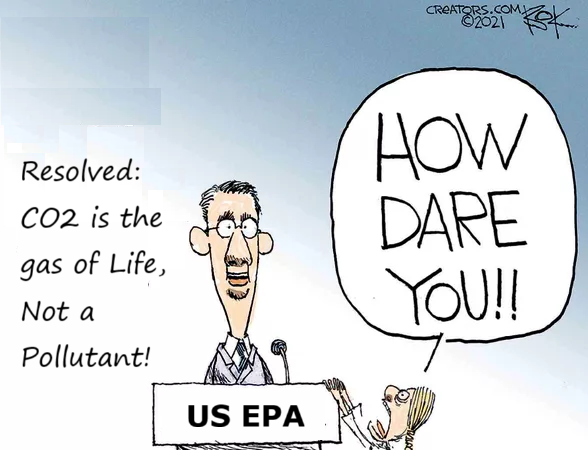
By rescinding it, the agency admits what skeptics have claimed all along. CO2 is not a poison but a natural part of the biosphere, essential for plant life, agriculture, and human survival. Simply put, CO2 is plant food and vital for life on Earth.

When even the EPA admits that the case against CO2 isn’t as strong as claimed, why should the rest of us accept the narrative of “settled science,” whether it’s about CO2 or COVID-era masks, vaccines, distancing, and lockdowns?

Perhaps the most troubling result of climate panic isn’t faulty science but poor policymaking. Fear opens the door to authoritarian control. We saw this during COVID lockdowns when extreme restrictions were justified in the name of “public health.” Climate alarmists now use the same tactics, claiming that global warming is “an existential threat.”

As HotAir recently reported, three Canadian provinces have implemented sweeping bans on entering woodland areas, citing wildfire risks and climate change. Violators face heavy fines or jail time. Critics quickly pointed out the striking similarity to so-called “climate lockdowns,” once dismissed as conspiracy theories. Yet here they are, with citizens barred from a common outdoor activity in the name of climate policy.

This isn’t environmental stewardship; it’s authoritarian social control. A government willing to close forests today will be willing to restrict cars, air travel, or even personal diets tomorrow, all justified as part of a “climate emergency.”

Once rights are limited in the name of carbon, what boundaries remain? After all, humans exhale CO2, making all human activity a threat to the species, activities that should be restricted or stopped at any cost. In other words, population control by any means necessary.

None of this is to deny that climate science involves uncertainty. Proxy data are imperfect, and today’s industrial society introduces variables that weren’t present millions of years ago. Climate sensitivity to CO2, although debated, may not be zero, but is probably negligible and not worth imposing overwhelming socioeconomic regulations and burdens on working families and developing nations.

But uncertainty cuts both ways. If the science is uncertain, then the justification for strict, top-down rules collapses. Policy should demonstrate humility, not arrogance. Instead of harsh restrictions, we should focus on balanced adaptation, resilient infrastructure, responsible energy choices, and innovation, all while maintaining freedom and prosperity.

The real irony is that the more you zoom out, the less CO2 seems to be the “control knob” of climate. Over 600 million years, CO2 levels were much higher than today’s, yet Earth stayed habitable and life flourished. If anything, our current levels could be too low, raising worries about agricultural productivity and plant growth in a CO2-deficient atmosphere, which might cause starvation and desolation.

We are told to fear things that could actually be helpful. Higher CO2 levels increase crop yields, support reforestation, and restore dry lands. Calling it “pollution” goes against biology itself. CO2 is plant food, and without it, humans might face extinction like the dinosaurs.

It’s time to replace fear with perspective. Instead of shutting down people, destroying industries, or labeling farmers as villains, we should understand that CO2 is not our enemy. Climate alarmism is. Believing otherwise isn’t science; it’s superstition.


The Sea is Not Coming to Get You

Issues and Insights Editorial Board published Another Crack Appears In The Global Warming Narrative.  Excerpts in italics with my bolds and added images.

Al Gore famously warned that sea level rise caused by man’s use of fossil fuels was going to kill us. Barack Obama implied that he had magic powers that would control surging sea levels. A fresh study shows just how dishonest this pair and the many others who did their best to misinform the public have been.

Gore’s 2006 propaganda film told us to beware of sea levels rising by 20 feet, devastating New York and Florida. The uber-narcissistic Obama promised an adoring crowd that his nomination to be the Democratic Party’s 2008 presidential nominee “was the moment when the rise of the oceans began to slow and our planet began to heal.” California Gov. Jerry Brown predicted a little more than a decade ago that collapsing glaciers would submerge both the Los Angeles and San Francisco international airports.

These of course are just three of many examples of alarmists, hacks, globalist busybodies, NASA eggheads, academic ideologues and true believers fear-mongering over sea-level rise.

Obama, no climate refugee he, was later roasted for buying oceanfront compounds in Martha’s Vineyard and Hawaii. The purchases clearly show he didn’t believe what he said – he was just another political hack appealing for votes and hoping to burnish a legacy before he even set foot in the White House.

But how can we know it’s just fear-mongering?

Actual science, not Gore’s junk variety, now tells us that “approximately 95% of the suitable locations” researchers looked at showed “no statistically significant acceleration of the rate of sea level rise.” This “suggests that local, non-climatic phenomena are a plausible cause of the accelerated sea level rise observed at the remaining 5% of the suitable locations.”

“On average,” the European paper says, “the rate of rise projected by the IPCC is biased upward with approximately 2 mm per year in comparison with the observed rate.”

As it turns out:

The majority of the local causes of rapid sea level rise (or drop) appear to be geologic. Tectonic motion explains sudden changes of sea level rise found in a few places. More gradual but rapid rise (or fall) of sea level is mostly caused by glacial isostatic adjustment and in a few isolated cases by an excessive sediment load.

What else do we know about the oceans? It’s been well established that sea levels, like Earth’s climate, have been constantly changing without any human influence.

We acknowledge that we live in an era of rising sea levels, just as we live in a time in which we are escaping the lower temperatures of the Little Ice Age that lasted until the late 19th century, if not, according to some researchers, the early 20th century. But the rise we’re seeing is slow, not remotely catastrophic, and not outside of historical norms (even though the hysterics continue to claim the rise is “accelerating” and is “unprecedented”).

The climate cranks, warming crackpots, and those possessed of Marxphilia won’t be deterred by this or any other scientific evidence. But it’s news that can help persuade larger swaths of voters that the global warming scare is a con. As more Americans learn the truth, the radicals and zealots who perpetuate the fiction will fade into the oblivion they deserve.

See Also

Observed vs. Imagined Sea Levels 2023 Update

Fear Not For Fiji

No Climate Crisis in Texas

CO2 Coalition analyzed the data and concluded that Texas has no climate crisis to fear.  The report is Texas and Climate Change: No Climate Crisis in the Lone Star State.  Excerpts in italics with my bolds and added images.

EXECUTIVE SUMMARY

This report will examine the scientific basis for claims of harmful effects from climate change in Texas. Assertions have been made that many areas around the world are experiencing negative impacts from unusual and unprecedented warming driven by increasing human emissions of carbon dioxide (CO2). Texas is no different. Promotion of the need to achieve “net zero” emissions is predicated on fear of existing and future devastating calamities resulting from CO2-enhanced warming.

The Fifth National Climate Assessment (NCA5) report (USGCRP, 2023) says that climate change is “putting us at risk from climate hazards that degrade our lands and waters, quality of life, health and well-being, and cultural interconnectedness.” The NCA5 report lists “warmer temperatures, more erratic precipitation, and sea level rise,” as well as “drier conditions” and “extreme heat and high humidity,” as the “climate hazards” affecting the Southern Great Plains, which encompasses the State of Texas (Figure 1).

In addition, Texas A&M University has published a Texas-specific report, Future Trends of Extreme Weather in Texas (Nielsen-Gammon et al., 2024), which warns of future harm to the citizens of Texas from man-made climate change. Predicted effects include increasing temperature, precipitation, drought, floods, storms, sea-level rise and wildfires.

Within this report, we analyze scientific data from various sources, including the National Oceanic and Atmospheric Administration (NOAA), the United States Environmental Protection Agency (U.S. EPA), the National Aeronautics and Space Administration (NASA), the United States Department of Agriculture (USDA) and reports published in peer-reviewed journals.

Based on these data, we arrived at the following key findings:

  • The temperature in Texas has shown no unprecedented or unusual warming, despite
    increasing atmospheric carbon dioxide (CO2). Recent temperatures in Texas are similar
    to those found more than 100 years ago.
  • The annual number of 100 °F days in Texas has an overall decreasing trend.
  • Texas has had a modest increase of 0.0245 inches per year of precipitation during 1850–
    2023, which means that Texas is in no immediate danger of becoming drier.
  • Droughts in Texas are not becoming more severe or numerous.
  • Tornadoes, hurricanes, and floods are not becoming more frequent in Texas.
  • Sea-level rise and coastal subsidence are not threatening or inundating the Texan coast.
  • Wildfires are not becoming more frequent or severe in the United States.
  • Air quality in the United States is generally good and getting better.
  • Agriculture in Texas is thriving.
  • Carbon dioxide (CO2) is essential and beneficial for life on Earth, as CO2 greens the Earth
    and more CO2 allows plants to grow bigger, produce more food and better resist
    drought.

The evidence presented here is clear: there is no climate crisis in Texas. Not only is CO2 beneficial, but it is essential for life on Earth. Therefore, any measures for combating a purported climate crisis and for reducing CO2 emissions are not only unnecessary and costly but would also cause considerable harm to agriculture with no benefit.

The complete publication is Texas and Climate Change which includes exhibits like these: