Noah Rothman writes at Commentary:Climate Hysterics and Their Advocates Satisfying histrionics never solved anything. Excerpts in italics with my bolds.
Exhuming this [fourth National Climate Assessment] report from its early grave, NBC’s “Meet the Press” focused on it extensively—probing lawmakers about the issue and devoting a panel segment to the political implications of its findings. American Enterprise Institute scholar Danielle Pletka attracted an unusual amount of attention for her remarks on the subject. In a brief soliloquy, she said that she doesn’t believe “we can have any doubt” about the existence of climate change, though we can join the scientific community in speculating about the precise degree to which human activity contributes to that change.
Pletka went on to note mitigating phenomena that, in her view, don’t receive due attention. The last two years were typified by the “biggest drop in global temperatures that we have had since the 1980s,” she said. Pletka added that carbon dioxide emissions in the U.S. are declining even after America pulled out of the Paris accords, and American industry has shifted away from burning so-called “dirty coal,” unlike its European counterparts.
The AEI scholar’s critics noted that extreme temperature fluctuation doesn’t tell us much about the climate, which is fair. But “dirty coal” burning in America is declining at a terminal rate despite the loosening regulatory climate, and the United States has led the world in CO2 emissions reductions even without a non-binding international treaty compelling it to do so. Pletka observed in closing that this was the work of industry, consumer preference, and capitalist innovation, and not oppressive central planning (which is entirely correct).
“We shouldn’t be hysterical” about the problem of climate change, Pletka concluded. You’d think she shot someone’s dog on live television.
On Twitter, investigative reporter Alex Kotch insisted that this “non-scientist” perspective was advanced in service to “the biggest fossil fuel polluters in the world, Koch Industries.” Attorney Max Kennerly contended that it was “inexcusable” to allow Pletka to opine at all on this subject. “This is PR for polluters, not journalism,” he barked. “This is crazy,” ABC News analyst Matt Dowd said. “Balance shouldn’t be the goal, truth should.” “People tune in to be informed not be subjected to propaganda,” former Think Progress founder Judd Legum tweeted. Former Vermont Gov. Howard Dean, Hawaii Sen. Brian Schatz, and controversial climatologist Michael Mann all attacked the network for giving Pletka a platform to discuss climate as it relates to public policy.
There was no such outrage over the response from Pletka’s counterpart, New York Times columnist and fellow “non-scientist” Helene Cooper, which tells you all you need to know about this ginned-up controversy. “I actually think we should be hysterical,” she said. “I think anybody who has children or anybody who can imagine having children and grandchildren, how can you look at them and think this is the kind of world that through our own inaction and our inability to do something, that we’re going to leave them?”
It’s a struggle to think of a long-term public policy crisis that was mitigated by mass hysteria, which is perhaps why Pletka’s many detractors can’t explain why Cooper’s brand of lay advocacy is more acceptable than her counterpart’s. Cooper also said that it was time for the political class to “force corporate leadership” to do something about climate change, demonstrating that she either hadn’t heard a word Pletka said or couldn’t refute her claims. But none of the usual suspects have expressed so much as a hint of disapproval over the gauzy sentimentalism and histrionics expressed by Cooper. That sort of dilettantism serves their purposes.
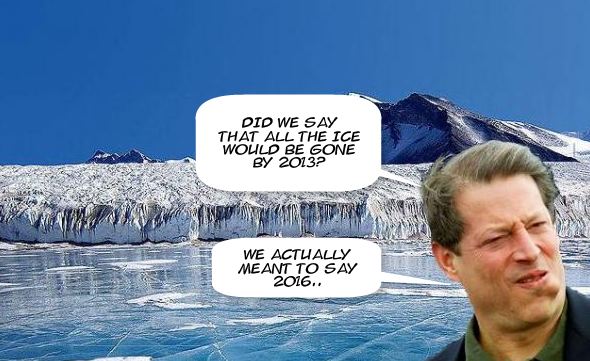
For Pletka’s detractors, the likely source of consternation wasn’t her professional expertise but her refusal to accept a straight-line projection at face value. That is, however, the only prudent course considering how many climate-related prognostications have not panned out. In 1990, the Intergovernmental Panel on Climate Change’s First Assessment Report’s predictions related to rates of warming and temperature changes were erroneous. The IPCC’s 2001 assessment that climate change would reduce the severity of snow storms did not materialize. The Arctic should be ice-free by now if climate scientists’ predictions were always accurate. As Abe Greenwald noted just last week, the scientific consensus around the rate of oceanic warming was successfully challenged not by the deliberate process of peer review but by a freelancing skeptic with time enough to critically parse the data. Given the failure of these near-term predictions to manifest, it’s only reasonable not to lend too much credence to a projection that takes us nearly 100 years into the future.
You might see now why some advocates prefer hysteria to caution and skepticism, and why those who shatter the serenity of the echo chamber are so valuable.
Michael Walsh writes The Late Great (Again) Planet Earth in PJ Media. Excerpts in italics with my bolds. (Indented text is from George Monbiot, infamous alarmist).
Unexamined Premises
George Monbiot, the man who gave his name to the term “moonbat,” is back, like some hair-shirted lunatic screaming on a street corner, saying that we’re all doomed:
It was a moment of the kind that changes lives. At a press conference held by climate activists Extinction Rebellion last week, two of us journalists pressed the organisers on whether their aims were realistic. They have called, for example, for UK carbon emissions to be reduced to net zero by 2025. Wouldn’t it be better, we asked, to pursue some intermediate aims?
A young woman called Lizia Woolf stepped forward. She hadn’t spoken before, but the passion, grief and fury of her response was utterly compelling. “What is it that you are asking me as a 20-year-old to face and to accept about my future and my life? … This is an emergency. We are facing extinction. When you ask questions like that, what is it you want me to feel?” We had no answer.
Softer aims might be politically realistic, but they are physically unrealistic. Only shifts commensurate with the scale of our existential crises have any prospect of averting them. Hopeless realism, tinkering at the edges of the problem, got us into this mess. It will not get us out.
Now that there is some prime moonbattery, even by Monbiot’s soaring standards. What a 20-year-old female knows about anything is moot, but her notion that she is “facing extinction” is beyond delusional; in fact, it’s the product of having her head stuffed with the most self-evidently arrant nonsense of the modern era: “climate change.”
Since at least 1970, when the not-yet-late great Hal Lindsey told us we were all going to die in The Late Great Planet Earth, snake-oil salesmen and Chicken Littles around the world have joined forces to convince the rubes and the suckers that the Earth is, so to speak, on her last legs unless we do something right now. Lindsey’s book employed Bible “prophecy” to limn our destruction at the hands of the Antichrist and the return of Jesus sometime in the 1980s.
Well, you can’t go wrong betting against religious crackpots, and while the climate-change freaks are ostensibly secular, their approach to their unalterable dogma has all the hallmarks of a particularly nutty faith. Never mind that the data to which they so fearfully cling is either bogus or misinterpreted; combine that with the natural human tendency to think that the world as we know it began, and will end, with us — that everything is, to use one of their favorite words, “unprecedented” (if you pay no attention to history) — and you have a rich field for superstition wedded to calls for (what else?) immediate governmental action.
How Have Predictions on Catastrophic Climate Change Held Up Over the Last 30 Years?
So this was a bummer:
Researchers with UC San Diego’s Scripps Institution of Oceanography and Princeton University recently walked back scientific findings published last month that showed oceans have been heating up dramatically faster than previously thought as a result of climate change.
In a paper published Oct. 31 in the journal Nature, researchers found that ocean temperatures had warmed 60 percent more than outlined by the United Nation’s Intergovernmental Panel on Climate Change. However, the conclusion came under scrutiny after mathematician Nic Lewis, a critic of the scientific consensus around human-induced warming, posted a critique of the paper on the blog of Judith Curry, another well-known critic.
“The findings of the … paper were peer reviewed and published in the world’s premier scientific journal and were given wide coverage in the English-speaking media,” Lewis wrote. “Despite this, a quick review of the first page of the paper was sufficient to raise doubts as to the accuracy of its results.”
Co-author Ralph Keeling, climate scientist at the Scripps Institution of Oceanography, took full blame and thanked Lewis for alerting him to the mistake. “When we were confronted with his insight it became immediately clear there was an issue there,” he said. “We’re grateful to have it be pointed out quickly so that we could correct it quickly.”
Keeling said they have since redone the calculations, finding the ocean is still likely warmer than the estimate used by the IPCC. However, that increase in heat has a larger range of probability than initially thought — between 10 percent and 70 percent, as other studies have already found.
In other words, never mind. But that won’t stop the moonbats from flapping ever more vigorously. I just shoveled six inches of global warming off my patio here in rural New England, while California continues to burn — but all weather and weather-related events are of a piece with the Unified Field Theory of Everything: evil mankind (white, male, middle-aged) is killing Mother Gaia. Hence, the calls for “environmental justice,” which like all modified forms of “justice” equals punishment and payback.
Guru Monbiot again:
Public figures talk and act as if environmental change will be linear and gradual. But the Earth’s systems are highly complex, and complex systems do not respond to pressure in linear ways. When these systems interact (because the world’s atmosphere, oceans, land surface and lifeforms do not sit placidly within the boxes that make study more convenient), their reactions to change become highly unpredictable. Small perturbations can ramify wildly. Tipping points are likely to remain invisible until we have passed them. We could see changes of state so abrupt and profound that no continuity can be safely assumed.
Only one of the many life support systems on which we depend – soils, aquifers, rainfall, ice, the pattern of winds and currents, pollinators, biological abundance and diversity – need fail for everything to slide. For example, when Arctic sea ice melts beyond a certain point, the positive feedbacks this triggers (such as darker water absorbing more heat, melting permafrost releasing methane, shifts in the polar vortex) could render runaway climate breakdown unstoppable. When the Younger Dryas period ended 11,600 years ago, temperatures rose 10C within a decade.
Okay, George, who’s to blame?
The oligarchic control of wealth, politics, media and public discourse explains the comprehensive institutional failure now pushing us towards disaster. Think of Donald Trump and his cabinet of multi-millionaires; the influence of the Koch brothers in funding rightwing organisations; the Murdoch empire and its massive contribution to climate science denial; or the oil and motor companies whose lobbying prevents a faster shift to new technologies.
Sort of gives the game away, doesn’t it?
Two tasks need to be performed simultaneously: throwing ourselves at the possibility of averting collapse, as Extinction Rebellion is doing, slight though this possibility may appear; and preparing ourselves for the likely failure of these efforts, terrifying as this prospect is. Both tasks require a complete revision of our relationship with the living planet.
Because we cannot save ourselves without contesting oligarchic control, the fight for democracy and justice and the fight against environmental breakdown are one and the same. Do not allow those who have caused this crisis to define the limits of political action. Do not allow those whose magical thinking got us into this mess to tell us what can and cannot be done.
In other words, the sky is falling so we need nothing short of a Leftist political revolution to save ourselves, and even then it may be too late. As I often say on Twitter, I never take political advice from small children, and certainly not from 20-year-old hysterics. Besides, the world has weathered worse patches than this before: (from Harvard professor Michael McCormick )
Bubonic plague, famine, war and flu pandemics have made some periods of human history infamous for death and suffering but one year stands above the rest in terms of misery; 536 AD. According to research from a Harvard professor, it is a prime candidate for the unfortunate accolade of the worst year in the entirety of recorded history.
Europe, the Middle East, and parts of Asia were plunged into 18 months of solid darkness by a mysterious fog. It caused snowfall in China, continental-scale crop failure, extreme drought, famine and disease throughout most of the northern hemisphere. The bleak year was triggered by a cataclysmic Icelandic eruption, scientists say, and was an ominous omen for a bleak century of suffering and death.
The eerie fog created a drab world with darkness residing over the northern hemisphere for 18 months, with an unrelenting dusk persevering through day and night. Effects on the climate were so severe that the Irish chronicles tell of ‘a failure of bread from the years 536–539’. Temperatures in the summer of 536 fell between 1.5°C (2.7°F) and 2.5°C (4.5°F), initiating the coldest decade in the past 2,300 years.
And nary an SUV or a fossil fuel to blame, unless you count wood and turf. The blackout seems to have been caused (as subsequent, similar events like the 1816 “year without a summer” were) by a volcanic eruption, this one in Iceland. Amazing what climatological havoc Gaia can wreak when she puts her mind to it.
God knows whom or what the poor sods living in the ruins of the Roman Empire in the 6th century blamed for the weather — probably God, possible cow farts — but today’s True Believers no longer believe in God; rather, they believe in Man, as both the root of all evil and the last best hope of Earth, if only Man would have the decency to kill himself. Or at least kill the conservatives, so that poor little Lizia Woolf may thrive without fear of imminent extinction or another Orson Welles documentary.
Just in time for Halloween, the United Nations’ Intergovernmental Panel on Climate Change has released yet another in a 30-year stream of spooky stories: Global Warming of 1.5 Degree Celsius, an IPCC special report on the impacts of global warming of 1.5°C above pre-industrial levels.
Like its five predecessors, it makes terrifying predictions about human-caused climate catastrophes that are always just about to occur, unless governments reduce the level of the harmless trace gas carbon dioxide in the atmosphere from its current four-hundredths of one percent to the three hundredths it was before industrialization.
Notice that the title chosen by the UN gives the game away. It presents correlation as causation by implying that all the warming since pre-industrial times has been caused by industry. There’s no room here for a natural oscillation back from the well-documented lows of the 1700s, which themselves were rebounds from a higher temperature period in the 1400s. (See this NOAA chart).
So how will the UN engender so much fear that the public will agree to stop using fossil-fueled electricity to halt “climate change?” After all, the phrase in itself is benign and natural. With enough repetition as images of hurricanes play on the screen, however, climate change has come to be short-hand for fossil-fueled, civilization-threatening storms, droughts, and destruction of coastal cities and islands, a dubious hypothesis on which we are hilariously told “the debate is over.”
For years I assigned statistics students to pick any apocalyptic climate claim in the media and trace it back through the UN reports to its genesis in a scientific study. I knew they would discover that these reports are not scientific documents based on the peer review process, but political documents “approved by governments” and intended to scare the public into supporting constraints on the production and use of energy.
A powerful publicity machine magnifies the alarm, bombarding citizens with exaggerations and claims of certainty that are proven wrong as you dig down to their underlying scientific studies:
Public figures, news editors, and commentators make claims that are more alarmist than what individual IPCC authors say at the release of the report.
Individual IPCC authors make claims at the release of the report that are more alarmist than what the official press release says.
The official press release makes claims that are more alarmist than what the report’s summary for policy-makers says.
The summary for policy-makers makes claims that are more alarmist than the various chapters of the reports.
The chapters of the report make claims that are more alarmist than the studies they reference in the footnotes.
The studies referenced in the footnotes are often actually peer-reviewed and generally make cautious claims about a possible trend spotted in one or a small number of locations or in a global computer model.
Both types of studies are more speculative than definitive because, as they always acknowledge in the fine print, they are based on highly-uncertain measurements of highly-complex phenomena with many interacting causes, of which warming gasses generated by human activity are only one, and often a minor component.
For governments to make policy on such a hierarchy of exaggeration brings to mind James Madison’s warning: “A popular Government, without popular information, or the means of acquiring it, is but a Prologue to a Farce or a Tragedy; or perhaps both.”
The serial release of UN reports obscures the fact that the climate catastrophes they predict never occur. As the data contained deep in the bowels of this latest report again acknowledge, Mother Nature is simply not cooperating with the UN There has been no positive trend in hurricanes, floods, and droughts as carbon dioxide levels continue to rise.
Even the average global temperature (whose rise is supposed to increase disasters) has barely budged, only rising a third of the amount that has been repeatedly been predicted by the IPCC computer models.
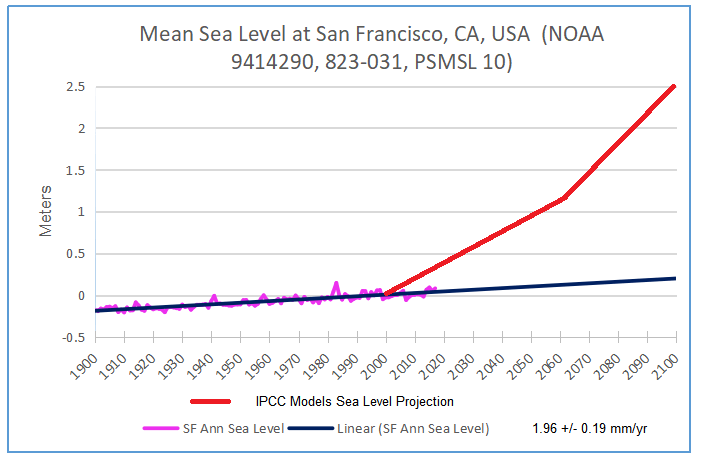
Sea levels, which are very difficult to measure due to human use of land and even to the natural rise and fall of land itself, chugs along at the same inch-per-decade that it has for thousands of years – not the terrifying 10 feet in a century warned about in previous reports. The islands and polar ice that we were repeatedly told would be gone by now are still there, and no closer to destruction.
The UN’s response to its failed predictions is simply to move the goal-posts, and make new dire predictions for some future date – in this case 2030. There is no reason to believe that this speculation will be any more accurate the ones that predicted human-induced climate catastrophes by certain dates, now passed.
But don’t be too frightened: the same governments who authorize the UN reports never take the steps needed to reduce the supposedly horrifying carbon dioxide level. Hidden behind their teeth-chattering fear of fossil fuels is their awareness that oil, gas, and coal have helped bring dramatic improvements in health, welfare, and life expectancy, and that alternative methods of generating power are currently available only at unacceptable economic (and hence political) cost.
Happy Halloween!
Caleb Rossiter, Ph.D., is the director of the American Exceptionalism Media Project, a fellow at The Texas Public Policy Foundation, and a former professor of statistics at American University.
The latest unguided missile IPCC report came out of a South Korea meeting, and surprisingly the first media response was silence. Could it be some of them actually considered that these new claims and demands are so over the top that their audiences will guffaw and break with their media masters once and for all?
The graph illustrates the problem very clearly. Since 1992, the UN Framework Convention on Climate Change has met 23 times. These UNFCCC discussions have utterly failed to reduce CO2 emissions. Yet from 2020, emissions have to drop dramatically, if we are to stand a chance of keeping global warming below 1.5°C.
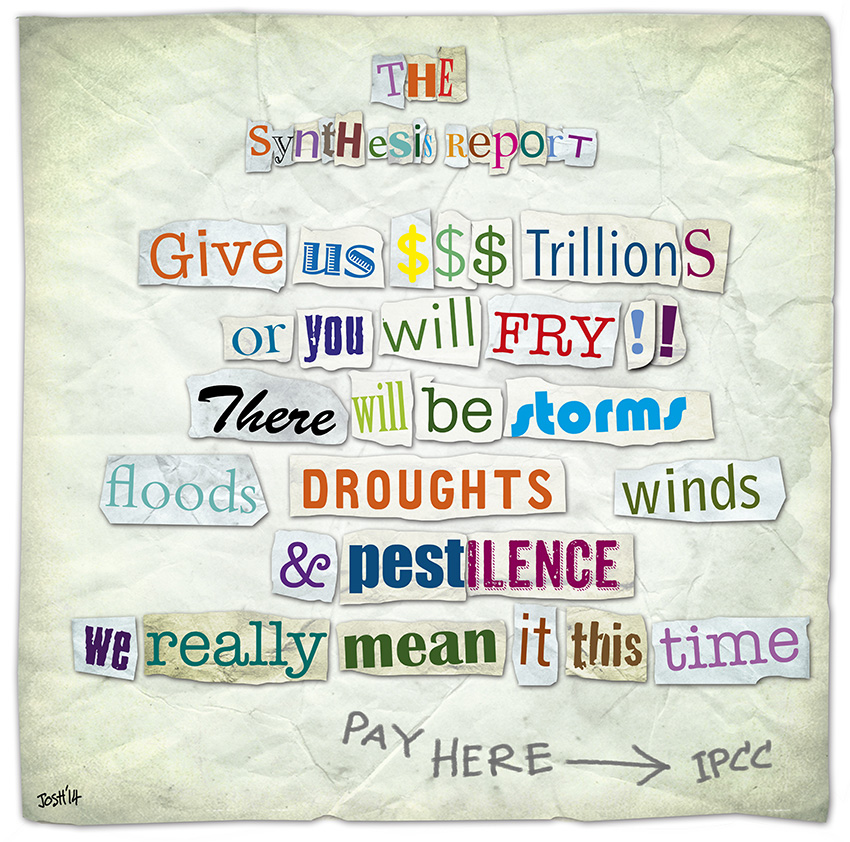
According to IPCC SR15 this will require an annual average investment of around US$2.4 trillion (at 2010 prices) between 2016 and 2035, representing approximately 2.5% of global gross domestic product (GDP). The cost of inaction and delay, however, will be many times greater. (sic). Note: This is referring to increasing investments in renewable energy from current US$335B per year to $2.4T. Present global spending on Climate Crisis Inc.is estimated at nearly US$2T, not limited to renewables. So this would double the money wasted spent on this hypothetical problem.
After their initial shock, like the lemmings they are, the news and opinion makers filled their pages and screens with end of the world proclamations, and continue to do so.
Elsewhere I have posted on the disconnect between reality and the IPCC scientific claims. The focus in this post is on the appalling economics piled on top. At IER Robert Murphy writes The IPCC Should Heed the Work of Nobel Laureate William Nordhaus. Excerpts in italics with my bolds.
One of the recurring themes of my work on the economics of climate change is that the very people who lecture the world on the dangers of “science denial” don’t actually follow their own advice. The recent announcement of the Nobel Prize in Economics, along with the release of the UN’s latest IPCC (Intergovernmental Panel on Climate Change) report, illustrates my claim perfectly. Specifically, William Nordhaus just won the Nobel for his work on basically inventing the economics of climate change. But while Nordhaus’ model shows that even a ceiling of 2° Celsius is too aggressive—with the costs outweighing the benefits—the media breathlessly tells the world that the latest “science” from the IPCC shows humanity that we have about a decade to implement draconian measures if we are going to achieve the goal of limiting warming to 1.5°Celsius.
The Media Announcements
From the Guardian: We have 12 years to limit climate change catastrophe, warns UN Urgent changes needed to cut risk of extreme heat, drought, floods and poverty, says IPCC
The following quotation comes from the New York Times article announcing this year’s joint winners of the Nobel (Memorial) Prize in Economics, namely William Nordhaus and Paul Romer. Note how the piece ties Nordhaus to the virtually simultaneous release of the latest IPCC report:
The 2018 Nobel Memorial Prize in Economic Science was awarded on Monday to the American economists William D. Nordhaus and Paul M. Romer for reshaping the understanding of the long-term determinants of economic growth.
Mr. Nordhaus was cited for his work on the implications of environmental factors, including climate change. Mr. Romer was cited for his work on the importance of technological change.
Mr. Nordhaus, a professor of economics at Yale University, pioneered the economic analysis of climate change. He is also a leading proponent of the use of carbon taxation to reduce emissions, a policy approach preferred by many economists.
The announcement of the award came the same day that a United Nations panel on climate change released a report warning of dire consequences from climate change and urging governments to respond to the problem with greater urgency. The report builds on and cites Mr. Nordhaus’s work. [New York Times, bold added.]
Now, any normal citizen reading the above two samples from our major media—who ostensibly are all up-to-speed on the “consensus” and would never dream of letting ideology get in the way of the empirical evidence—would be quite certain that William Nordhaus’ work supports the IPCC’s call to limit global warming to 1.5°C. And yet, as I’ll show in the next section, this is utterly false. Nordhaus’ work shows that such an ambitious climate change goal is far too aggressive.
Nordhaus on Proper Climate Policy
Now to be clear, I am a critic of Nordhaus’ work on climate change economics. Back in 2009 I wrote a peer-reviewed article criticizing his “DICE” model, and here at IER I’ve written articles (such as this one) arguing that Nordhaus misled the public in one of his popular articles on climate “skeptics.”
However, what I want to do in the current post is simply show that the guy who just won the Nobel Prize for his work on climate change economics does NOT support anything close to the IPCC’s latest announcement. This should show that, far from being “settled science,” the ever-increasing stridency of the calls for global action to combat climate change are more and more based on ideology and/or arbitrary decisions not tied to reasoned analysis.
For starters (and I thank David R. Henderson for reminding me of this salient point), as of DICE-2007 (i.e., Nordhaus’ model back in 2007), the climate goal of limiting global warming to 1.5°C was a horrible policy, which would make humanity $14 trillion (in present-value terms, in 2005 US$) poorer than doing nothing at all. (See Table 4 of my articleto see the details.)
Now it’s true that the numbers have changed since 2007, and Nordhaus’ model would no longer give such a pessimistic assessment. However, back in 2013 Nordhaus argued in his then-new book on climate change that the optimal policy (depending on assumptions regarding participation among the world’s governments, etc.) would limit global warming from 2.3°C up to nearly 4°C, as Paul Krugman admits in his review of the book.
Please re-read my last sentence: As of 2013, William Nordhaus—who just won the Nobel Prize for his work on the economics of climate change—was saying the optimal path of global warming would allow for temperature increases of at least 2.3°C and possibly close to 4°C. Yet the IPCC’s media people are telling the world that we should really shoot for 1.5°C of warming to avoid catastrophe, and that the difference between 1.5°C versus 2.0°C is huge.
Chain of suppositions comprising Integrated Assessment Models.
Conclusion
I have serious reservations about the work of William Nordhaus and the other creators of so-called Integrated Assessment Models (IAMs), which are used to calculate the “social cost of carbon.” Yet to the extent that we are going to take IAMs at face value—and the major media touting Nordhaus’ Nobel certainly do—then they should give pause to those clamoring for aggressive government action. Although Nordhaus favors a carbon tax, his work shows that the recent goals announced by the IPCC are ludicrously aggressive, and would likely cause far more damage to economic growth than they would alleviate in terms of climate change.
In this article I will provide more details of just how Orwellian it is, that some pundits and reporters are linking Nordhaus with the IPCC’s latest announcement. More generally, this whole episode underscores the farce of the “social cost of carbon” (SCC) concept. The Obama Administration and academics like Nordhaus go through all of this work to generate estimates of the quantitative damage caused by carbon dioxide emissions, and then the United Nations goes ahead and recommends policies that aren’t even in the same ZIP code as what those “scientific” estimates entail. If anybody in this debate is a “denier,” it is the people claiming the IPCC’s latest pronouncements have anything to do with the peer-reviewed economics literature.
Robert Murphy also has this video clip of a presentation on climate economics (H/T Jim Rose)
Far from being a catastrophe, population growth and carbon fuel-based development are the best means to lift people out of poverty, the authors write.NASA
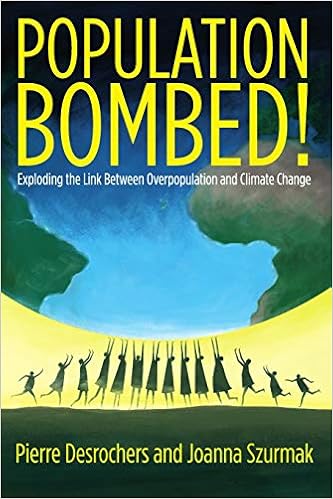
A recent book explains what’s mistaken about climate alarmists/activists thinking human numbers must be reduced in order to save the planet from us (H/T Master Resource). The Title is Population Bombed! by Pierre Desrochers and Joanna Szurmak who provide an introduction to their assessment in an article at Financial Post For 200 years pessimists have predicted we’d ruin the planet. They’re still wrong. Excerpts in italics with my bolds.
In Avengers: Infinity War, the villain Thanos said: “If life is left unchecked, life will cease to exist.” Johns Hopkins University philosopher Travis N. Rieder apparently agrees, as he views each new child as an environmental externality putting “irreparable stress on the planet” in a way that “exacerbates … the threat of catastrophic climate change.” Similar ideas have been expressed by the likes of Al Gore, Hillary Clinton and Bill Gates. Feminist icon Gloria Steinem put it best: “What causes climate deprivation is population. If we had not been systematically forcing women to have children … for over the 500 years of patriarchy, we wouldn’t have the climate problems that we have.”
Population-growth catastrophism has been around for centuries. In the English-speaking world it is generally associated with economist Thomas Robert Malthus’ 1798 edition of his Essay on the Problem of Population and U.S. biologist Paul Ehrlich’s 1968 bestseller The Population Bomb. Ehrlich and his co-author and wife Anne predicted imminent environmental collapse followed by mass starvation. What they didn’t see coming was that, to the contrary, hundreds of millions of people would soon be lifted out of grinding poverty while parts of the planet became greener and cleaner in the process.
In our new book Population Bombed! Exploding the Link between Overpopulation and Climate Change we mark the 50th anniversary of the Ehrlichs’ book by explaining that their predictions bombed because their basic assumptions are flawed.
First, the Ehrlichs assume that human numbers cannot exceed the limits set by a finite system. Bacteria in a test tube of food are used to model such a system: Since the levels of food and waste limit bacterial growth, human population growth, by analogy, ultimately cannot exceed the carrying capacity of test tube Earth.
Second, they assume that wealth and development unavoidably come with larger environmental damage. This assumption is still at the core of pessimistic frameworks, which maintain that physical resource throughputs, not outcomes, matter. So, countries such as Haiti where deforestation and wildlife extermination are rampant are inherently more “sustainable” than richer and cleaner countries like Sweden and Switzerland.
Third, Ehrlich does not acknowledge that, unique among this planet’s species, modern humans: transmit information and knowledge between individuals and through time; innovate by combining existing things in new ways; become efficient through specialization; and engage in long-distance trade, thus achieving, to a degree, a decoupling from local limits called the “release from proximity.” And the more brains there are, the more solutions. This is why, over time, people in market economies produce more things while using fewer resources per unit of output. Corn growers now produce five or six times more output on the same plot of land as a century ago while using less fertilizer and pesticide than a few decades ago.
Fourth, the Ehrlichs and other pessimists also fail to understand the uniquely beneficial roles played by prices, profits, and losses in the spontaneous and systematic generation of more sustainable — or less problematic — outcomes. When the supply of key resources fails to meet actual demand, their prices increase. This encourages people to use such resources more efficiently, look for more of them, and develop substitutes. Meanwhile, far from rewarding pollution of the environment, the profit motive encourages people to create useful by-products out of waste (our modern synthetic world is largely made out of former petroleum-refining waste products). True, in some cases dealing with pollution came at a cost — building sewage-treatment plants, for example — but these are the types of solutions only a developed society can afford.
Fifth, pessimists are also oblivious to the benefits of unlocking wealth from underground materials such as coal, petroleum, natural gas and mineral resources. Using these spares vast quantities of land. It should go without saying that even a small population will have a much greater impact on its environment if it must rely on agriculture for food, energy and fibres, raise animals for food and locomotion, and harvest wild animals for everything from meat to whale oil. By replacing resources previously extracted from the biosphere with resources extracted from below the ground, people have reduced their overall environmental impact while increasing their standard of living.
Why is it then that after two centuries of evidence to the contrary, the pessimistic narrative still dominates academic and popular debates? Why are so many authors and academicsstill focusing on the Malthusian collapse scenario — now bound to come from carbon dioxide emissions and the teeming populations that produce them?
The prevalence of apocalyptic rhetoric may be, arguably, due to factors ranging from financial incentives among academics and activists to behavioural heuristics that dictate why worrying is a motivator, and why even well-meaning people rarely change their mind given new evidence. Short-termism may also take some of the blame: Population control and climate activists take for granted the non-scalable benefits of a carbon-fuel economy in which large numbers of people collaborate and innovate. The cognitive biases at the root of our thinking may shape, and in the end distort, the impulse to question “consensus,” particularly in an intellectual climate lacking the motivation to achieve what social psychologist Jonathan Haidt called “institutional disconfirmation.”
Far from being the catastrophe that Thanos, the Ehrlichs and other pessimists would have us believe, population growth and carbon fuel-based development in the context of human creativity and free enterprise are the best means to lift people out of poverty, to build resilience against any climate damage that increased anthropogenic greenhouse gas emissions might have, and to make possible a sustained reduction of humanity’s impact on the biosphere.
Pierre Desrochers, a geography professor at the University of Toronto Mississauga, and Joanna Szurmak, a doctoral candidate at York University, are the authors of Population Bombed! Exploding the Link Between Overpopulation and Climate Change. The book was launched at an event on Oct. 15th in Toronto.
Master Resource just posted an interview with Desrochers (here)
What we need in order to fight environmental degradation is to make sure that people in less advanced parts of the world can also be the beneficiaries of these processes. There is no doubt in my mind that these beneficial substitutions will happen more quickly the cheaper carbon fuels are. Of course, the argument is even more powerful when you think of the social consequences of less affordable energy.
Now, as with everything else, bad political institutions in some parts of the world will result in greater pollution as more carbon fuels are burned. The solution, however, is not to ban or tax everything from coal to plastic bags, but rather to improve standards of living and public governance. In my opinion, our guiding principle as far as carbon fuels are concerned should be the creation of lesser problems than those that existed before.
Thanks to an insightful post at Climate Scepticism (here), we have a recent quote from former US President Obama:
“You have to believe in facts. Without facts there’s no basis for cooperation. If I say this is a podium and you say this is an elephant, it’s going to be hard for us to cooperate…I can’t find common ground if somebody says climate change is just not happening, when almost all of the world’s scientists tell us it is.”
This statement is the starting point for that poster to explore ways that even the most accomplished scientists have in the past shared beliefs that were valid only as fashionable at the time. In this post, I want to consider first why a lawyer like Obama gets science wrong, and secondly to consider the moral and religious confusion regarding our climate.
Science is Trial And Error, not Case Law
In the legal world, cases are judged and rulings become precedent for later cases that arise. Thus principles become established, settled facts for jurists to follow. Scientists operate in a different world, one where experiments provide evidence that an assumption successfully predicts how things work in nature. But that premise can be overturned by subsequent experiments, so scientific laws are always tentative.
In short, lawyers proceed by deduction, going from the accepted generality to the particular instance. Scientists refer to generalities, but induction is their primary method of discovery. Science proceeds from the particular to arrive at general conclusions, sometimes overturning a previous generality.
A previous post Degrees of Climate Truth was based upon work by Andy May in discussing how climate assertions can be seen in various stages of development toward scientific truth.
In Table 1 we can see that the comparison of man-made climate change and the possibility of a man-made climate catastrophe are not really comparable to the theories of gravity and evolution. Man-made climate change is more than an idea, it is based on some observations and reasonable models of the process have been developed and can be tested. But, none of the models have successfully predicted any climatic events. Thus, they are still a work-in-progress and not admissible as evidence supporting a scientific theory.
Ethical and Religious Dimensions
Climate assertions come from people based on moral and religious frameworks.
This post is background to exploring the ethical and religious dimensions of the climate change movement. It is also important to recognize the human journey regarding morality.
Moral Models
The ethic of Good vs. Evilis a teleological paradigm, going all the way back to Plato, but still a reference for some today. This model asserts that values can be determined as eternal truths, applicable in all times and places.
Most people have moved to an ethic of Right vs. Wrong, a legal paradigm. Here morality is relative to a society that determines what is morally acceptable or not. And of course, there are variations both among different places, and within a single society over time.
Modern ethics has taken an additional step to an ethic of Responsibility vs. Irresponsibility, a contextual paradigm. Now moral behavior seeks the largest possible context: “the greatest good for the greatest number.” This can lead to some strange choices, such as suicide bombers or pro-life advocates who justify murdering abortion clinic doctors. The perversion arises when an actor excludes some living things, or whole classes of creatures from the context of responsibility.
Summary: Climate Morality
Some climate activists/alarmists are operating with a good vs. evil model, in which their understanding of good separates people into sheep and goats. Describing others as “deniers” shows this clearly. And in the recent US senate supreme court nomination hearings we have an additional stark reminder that members of even advanced societies can seek to disqualify others as human beings, not simply block them from positions of responsibility.
Obama is clearly operating in the right vs. wrong model, as expected given his legalistic education. Since laws and legal principles are relative to a social framework and heritage, social proof is all that is required for him to accept climate assertions as true. At the same time, that mentality requires dismissing and demeaning the viewpoints contrary to the consensus. Such tribalism is contrary to scientific discourse, and in the extreme case like Rwanda the others can be considered “cockroaches” and exterminated.
It should be clear that when climate alarmists appeal to saving the planet for future generations, they are applying contextual ethics. Less obvious is the ancient religious notion that by making sacrifices, we humans can assure more favorable weather. These days, fossil fuels have become the sacrificial lamb required by Mother Nature to play nice with human beings. In the past, people made images and worshiped them, thinking that they could control nature in that way. These days, we make computer models whose projections are sure to scare the bejesus out of us.
Image is from Honey, I Shrunk the Kids, a 1989 American science fiction family film produced by Walt Disney Pictures.
Repeated robotically by alarmist websites, this week’s climate scare says that burning fossil fuels is causing the earth to wobble in its spin.
Earth is Wobbling and Climate Change is to Blame Newsweek
Humans Are Causing Earth to Wobble Popular Mechanics
Human-Driven Climate Change Is Literally Making Earth ‘Wobble’ Motherboard
Earth’s rotation wobbles. NASA says humans partly to blame. Big Think
Earth’s Axis Is Drifting Inches Every Year In Part Because Of Human-Driven Climate Change IFLScience
Planet Earth Wobbles As It Spins, and Now Scientists Know Why Live Science The case as made in the Live Science article,
Since 1899, the Earth’s axis of spin has shifted about 34 feet (10.5 meters). Now, research quantifies the reasons why and finds that a third is due to melting ice and rising sea levels, particularly in Greenland — placing the blame on the doorstep of anthropogenic climate change.
Another third of the wobble is due to land masses expanding upward as the glaciers retreat and lighten their load. The final portion is the fault of the slow churn of the mantle, the viscous middle layer of the planet.
Earth wobbles irregularly over time, which means it does not always spin on an axis running through its poles. Its axis has been drifting towards North America during most of the last century (green arrow). That direction has changed dramatically due to changes in water mass on Earth. (Image: NASA/JPS-Caltech)
After a little investigation, there are several reasons not to be alarmed about this finding.
1.The Wobble is ancient.
Scientists have long known that the distribution of mass around the Earth determines its spin, much like how the shape and weight distribution of a spinning top determines how it moves. Also, Earth’s spin isn’t perfectly even, as scientists know thanks to slight wiggles in the movements of the stars across the night sky that have been recorded for thousands of years, said Erik Ivins, a study co-author and a senior research scientist at JPL. Since the 1990s, space-based measurements have also confirmed that the Earth’s axis of rotation drifts by a few centimeters a year, generally toward Hudson Bay in northeastern Canada.
Researchers knew that a proportion of this wobble was caused by glacial isostatic adjustment, an ongoing process since the end of the last ice age 16,000 years ago. As the glaciers retreat, they relieve the land underneath of their mass. Gradually, over thousands of years, the land responds to this relief by rising like bread dough. (In some places on the edges of the ancient ice sheets, the land might also collapse because the ice had forced it to bulge upward.)
2. Wobbling results from multiple causes.
“We have provided evidence for more than one single process that is the key driver” for altering the Earth’s axis, said Surendra Adhikari, an Earth system scientist at NASA’s Jet Propulsion Laboratory in Pasadena, California, and a lead researcher on the new study.
But in the new research, published in the November issue of the journal Earth and Planetary Science Letters, Adhikari and his colleagues found that glacial isostatic adjustment was only responsible for about 1.3 inches (3.5 centimeters) of axis wobble per year. That was only about a third of the wobble — 4 inches (10.5 cm) — observed each year over the 20th century.
To fill in the gap, the research team built a computer model of the physics of Earth’s spin, feeding in data about changes in the balance of land-based ice and ocean waters over the 20th century. The researchers also accounted for other shifts in land and water, such as groundwater depletion and the building of artificial reservoirs, all part of humanity’s terraforming of the planet.
The results revealed that these environmental processes cause another 1.7 inches (4.3 cm) of wobble each year. The melting of the Greenland ice sheet was a particularly important contributor, the researchers found. That’s because Greenland has released a large amount of water that was once locked up on land into the oceans, where its mass has been redistributed, Ivins told Live Science. Mountain glaciers and small ice caps elsewhere have also contributed to sea-level rise, he said; but they aren’t as concentrated, and their effects on the Earth’s rotation often cancel each other out.
3. The mantle itself is always moving.
The glaciers and the ice melt still left a third of the wobble unaccounted for, so Adhikari and his team looked inward. The Earth’s mantle is not static, he said, but moves by the process of convection: Hotter material from closer to the core rises and cooler material sinks in a cycle of vertical motion. By including convection in the model of Earth’s wobble, the researchers had accounted for the last third of the changes in the spin over the 20th century.
4. The Wobble is not menacing.
It’s important to realize that this wobble isn’t the prelude to any sort of environmental calamity, Ivins and Adhikari said. It doesn’t affect agriculture or climate in and of itself, and any small impact on navigational equipment is easy to correct for.
“The amount [of drift] is not a huge amount,” Adhikari said.
5. Greenland ice sheet is affected by many natural factors.
A recent paper looked into unusually extensive melting in 2012. The implication of nonradiative energy fluxes dominating Greenland ice sheet exceptional ablation area surface melt in 2012 by Robert S. Fausto et al. Excerpts in italics with my bolds.
The surface energy budget consists of nonradiative (sensible, latent, rain, and subsurface) and radiative (shortwave and longwave) energy fluxes. Distinguishing the contribution of nonradiative and radiative energy fluxes in melt over the Greenland ice sheet is important to understand ice sheet surface climate sensitivity, especially in the ablation area, where the majority of melt occurs [e.g., Fausto et al., 2012a].
Ablation varies with elevation, but there are also considerable latitudinal differences as the Greenland ice sheet stretches from the upper midlatitudes (~60°N) to the high Arctic (~82°N). The largest total observed ice ablation in 2012 was 8.5 m ice eq. at QAS_L, which was 9% less than the 2010 value. This interannual variability may be attributed to larger winter snow accumulation in 2012, which maintained high surface albedo by delaying bare ice exposure during the melt season.
Given that absorbed solar radiation is the primary energy source of melt on an annual basis, the influence of intra‐annual and interannual variability in air temperature and other variables on ablation is of secondary importance [Van den Broeke et al., 2011]. Yetduring the two melt episodes we focus on, which together resulted in ~14% of annual ice ablation (Table 1), the nonradiative (sensible, latent, rain, and subsurface) energy fluxes were the primary control of melt with a contribution of 53 ± 16% and 66 ± 8%, respectively, averaged for the eight western AWSs for episodes E1 and E2, respectively (Tables 1).
During the two episodes, the large longitudinal contrast in nonradiative energy fluxes contribution to surface melt stem from anomalously warm and moist southern air flow being transferred onto the western ice sheet by atmospheric flow (Figure 2b) [Neff et al., 2014; Bonne et al., 2015], while east Greenland was dominated by stable weather with relatively low cloud cover and high solar radiation (Figure 2c) [Fettweis et al., 2013; Tedesco et al., 2013].
More broadly, data from the two episodes presented here demonstrate that exceptional melt can occur during periods characterized by cloudy skies and transient atmospheric flow, with melt being dominated by nonradiative, rather than radiative fluxes in the ablation area.
Conclusions
We find that year 2012 Greenland ice sheet melt was marked not only by widespread interior surface melting [Nghiem et al., 2012] but also by an increased nonradiative (sensible, latent, and rain) energy flux contributing to melt in the ablation area of the southern and western ice sheet. Latent and sensible energy advection governed two exceptional melt episodes in July 2012 [Neff et al., 2014]. The two episodes which lasted just ~6% of the ablation period in June–August were responsible for ~14% of the annual 2012 ablation average for all PROMICE measurement sites (Table 1). At all PROMICE sites during the two exceptional melt episodes the combined sensible, latent, rain, and subsurface energy fluxes (i.e., nonradiative energy fluxes) comprised 60% of the melt energy on average (Figure 1 and Table S1).
Summary
Earth has wobbled a bit in its rotation since the beginning, and continues to do so. The movement is not large or menacing. The three causes appear to be shifting material in the mantle, land rebounding when glaciers retreat, and changes in Greenland ice sheet balance.
The latter is attributed to human activity, even though major melting events result primarily from nonradiative factors: sensible, latent, rain and subsurface energy fluxes. If you buy the notion that burning fossil fuels causes Greenland ice sheet to melt, then please contact me about my bridge in Brooklyn that I am selling.
Alarmists are circling the wagons against any and all who raise questions about their beliefs, or who dare to take a different view of earth’s climate system and future weather trends. The latest example comes from Portugal as reported approvingly by DesmogUK Santander Forced To Distance Itself From Climate Science Denial Conference Excerpts in italics with my bolds
Santander has been forced to distance itself from a climate science denial conference after its logo was published on the event’s website without the bank’s knowledge.
The bank, which is one of the world’s biggest, told DeSmog UK it was not a sponsor of the climate science denial conference taking place in Porto, Portugal, at the end of this week.
However, Santander admitted giving money to the University of Porto, where the conference is being held, to “support investigation and research” but added that it did not oversee how the money was spent.
The conference, called “Basic science of a changing climate: How processes in the sun, atmosphere and ocean affect weather and climate” says it is “open to different opinions and interpretations of changing climate”.
Held at the University of Porto’s Faculty of Humanities, the conference has been organised by Maria Assunção Araújo, a professor at the geography department, who is due to address the conference on sea level rise in Portugal and ice retreat in Greenland.
Speakers include prominent climate science deniers Piers Corbyn, Philip Foster, Christopher Essex, Nils-Axel Mörner and Christopher Monckton, who will give the two-day conference closing speech before participants are invited to take part in a “cheese and port mingle”.
The conference also includes a session for students to ask speakers questions.
Santander’s logo is featured on the conference’s website, alongside the University of Porto’s logo.
A spokesman for the Univeristy of Porto told DeSmog UK that the conference was notorganised by the university despite being held on its premises and that views expressed at the conference “do not refelect the official position of the University of Porto about the subject”.
He added that the conference had been organised at the initiative of one of the faculty’s professors who applied to a programme sponsored by Santander aimed at supporting international events being held at the university.
The spokesman said the programme “demands that such events exhibit the source of funding, which explains the presence of the Santander logo on the website”.
“It is our conviction that the universities should be a space of open debate and discussion, where the presentation of conflicting ideas and perspectives should be valued. We also believe that censorship of opinions — even the ones that we do not agree with — should not be part of the activities of any university and it is in this context that the University of Porto will host this conference,” he said, adding that this “does not conflict with the university’s commitment to fight against climate change”.
In an email to DeSmog UK, Santander said it supported the University of Porto as part of its universities programme but that it was not aware that its logo had been used on the conference’s website.
“Santander is not a sponsor of this conference,” a spokeswoman told DeSmog UK.
“Santander has always and continues to do all it can to support sustainable growth and combat the impact of climate change, which is undoubtedly one of the greatest challenges we face.”
She added that the money Santander gave the university could be used in any way the university saw fit.
“We do not instruct Porto University how to use funds it receives from Santander. It can use funding resources to support investigation and research at their sole discretion and decision, to respect the university’s academic independence,” she said.
In its climate change policy, Banco Santander — the parent company of the Santander group — states that “climate change and resource scarcity are two of the biggest challenges faced by society”.
It adds that the group’s efforts to protect the environment were based on the Paris Agreement and the United Nations Framework Conventions on Climate Change (UNFCCC) now re-branded as the UN Climate Change.
Summary
Increasingly climate alarmists/activists employ religious tactics of denunciation, censorship, shunning and excommunication to ward off any unorthodox views of climate and weather. This extends to compelling people like corporate spokespersons to say the party line, or face defamation. In this case, the University is brave enough to host the conference, even while declaring their institutional orthodoxy. Let’s see if SJWs attempt to prevent the event. Let’s also see how well such tactics are viewed by the public if and when cooling sets in. BTW Scientific American is already reminding us that the coming winter is to be regarded as weather and not climate change (unlike the summer now ending).
It wasn’t supposed to be this way. The EU bureaucratic wheels were turning and needed a routine submission from the Committee on Agriculture and Rural Development as input for the Committee on the Environment, Public Health and Food Safety regarding a programme rule change.
The Rapporteur for opinion happened to be UKIP member John Stuart Agnew, who actually knows something about climate matters and agriculture, and drafted a submission accordingly. The full document is here,( H/T WUWT) and his case is put admirably. Excerpts below in italics with my bolds.
The LIFE program is due for renewal in 2020. It has hitherto used its funding to act as a test bed for small projects which are expected to improve the environment. Examples have included management techniques to improve numbers of wild species or maintenance of wetlands. The success of such innovations can be quantified and demonstrated. The funding comes direct from Brussels.
If such projects are successful, they become popular with farmers who then make these investments using the Pillar 2 grants from their member states. The addition of the words ‘Climate Action’ in the present LIFEregime has added an entirely new concept to the way that taxpayer’s money should be used. The term has also occurred in the latest proposal from Commissioner Hogan on CAP reform. The addition of the term ‘Climate Action’ coincides with a 60% increase to the budget of the LIFE Programme. What is conspicuously missing are definitions of the actions required and the outcomes that are desired.
If the words ‘Climate Action’ had been substituted with the words ‘Pollution Action’, then it would be possible to measure air, soil and water pollution and measure the effectiveness of strategies to alleviate these problems, against a target figure for each of the three elements. A war to reduce pollution can be won, using the weapons of technology and legislation. A war against the world’s weather will never end, because ‘victory’ cannot be defined.
The Rapporteur has met the team of four from the Commission who between them have had varying levels of input into this proposal. The Rapporteur asked them what outcome would be considered desirable, as a consequence of financial investment. The answer was – ‘a reduction in CO2 emissions’.
By mentioning the concept that reducing CO2 levels will serve to take action against an unsatisfactory climate, the Commission is ignoring the factors that really do change our climate. 1. The galaxy: in the form of Cosmic Ray fluctuations. Can induce changes of 10 o C over millions of years. 2. The solar system: Gravitational pulls can induce changes of 2-3 o C. 3. The sun: Its variations of orbit and tilt along with its five separate documented cycles can the cause earth’s temperature to vary by up to 5o C. 4. Ocean Currents. 5. The ‘Greenhouse’ gas: Water Vapour, in the form of cloud cover.
The other Greenhouse gases, CO2, Methane and Nitrous Oxide have a negligible effect on our climate.CO2 is, however, an irreplaceable plant food. Methane degrades into CO2 and H2O; NOx gases eventually change into Nitrates.
If the effect of CO2 levels on our climate is negligible, the effect of human activity on changing those CO2 levels is also negligible.
The two world maps below perfectly demonstrate this.
Calculated areas of higher CO2 concentrations due to human emissions
– Actual areas of higher CO2 concentration
– SCIAMACHY observations on the ENVISAT satellite (agree with Japan’s IBUKU data)
The predictions of the experts and the measurements by satellite are contradictory. The total absence of CO2 hotspots over Europe indicates there is no problem for the Commission to solve. The only potential risk of a major CO2 event in Europe is an erupting volcano.
The naturally high concentrations of CO2 above our natural rainforests create an interesting dilemma for those who want one without the other. This is not made any easier when it is realised that rainforests are also major emitters of methane and water vapour.
Ever since the Rapporteur joined the Parliament in 2009, it has been fashionable for MEPs in AGRI and ENVI to work the phrase “tackling Climate Change” into their speeches. It sounds worthy and virtuous. It is based on predictions made in the 1980s of rapidly rising world temperatures and sea levels that never ultimately occurred. The Commission has listened to these speeches as opposed to observing the reality. At some stage somebody has to say “The king isn’t wearing an invisible suit, he’s just not wearing any clothes!” The Rapporteur is presenting this opportunity to his colleagues.
Some MEPs have been elected solely because of their antipathy to CO2. They will not change their views.
The Rapporteur urges other colleagues though to reflect on the fact that the precedent of ‘Climate Action’ in the LIFE Programme is setting the stage for ‘Climate Action’ in agriculture, where 40% of future budgets is destined to be spent fighting CO2, one of agriculture’s greatest friends.
The Rapporteur has amended the proposal to delete all references to “clean energy” as this implies “CO2 free” energy, as well as the references to ‘climate change mitigation’ but incorporated the term ‘climate change adaptation’ into the text of the legislative proposal. There is a big difference. We need to prepare for the next ‘Maunder Minimum’ or mini ice age – which might last 200-300 years. Some solar physicists believe this cycle has technically already started.
Footnote Regarding Future Cooling
Both the Pacific (PDO) and the Atlantic (AMO) are due for a cooling phase. If that happens coincidental with diminished solar input (indicated by the lower sunspot proxy), we are looking at planetary cooling as suggested by some solar physicists.
The situation reminds of governmental failure in North America to manage the educational system to match demographic shifts. The bureaucratic response comes too late to cope with the current reality. After WWII came the baby boom, and many schools became overcrowded and new ones built. Then the sexual revolution and female liberation produced a baby bust due to smaller families, so schools emptied with surplus capacity. Just as the government got serious about closing schools came the baby echo, unanticipated by the authorities. Despite smaller families, there were many more of them, these being the married adult boomers. Echo babies were a new pulse of children hitting a school system undergoing downsizing in response to the previous baby bust.
Similarly, the climatists would have us assume endless warming and require cessation of reliable affordable energy just as we enter a mini ice age.
The UN is more up front than ever with its world governance agenda. The latest proclamation was solicited from the BIOS Research Unit in Helsinki Finland Global Sustainable Development Report
The background paper commissioned by the UN Secretary-General’s IGS states that biophysical realities are driving the transition to postcapitalism by the decline of what made ‘endless growth capitalism’ possible in the first place: abundant, cheap energy.
The UN’s Global Sustainable Development Report is being drafted by an independent group of scientists (IGS) appointed by the UN Secretary-General. The IGS is supported by a range of UN agencies including the UN Secretariat, the UN Educational, Scientific and Cultural Organization, the UN Environment Programme, the UN Development Programme, the UN Conference on Trade and Development and the World Bank.
The section titles express the themes favored by these “ecological economists.”
GOVERNANCE OF ECONOMIC TRANSITION
New economic thinking for the turbulent years ahead
What needs to be done – in social and material terms?
The new geopolitical order during and after transition governance
It is a blatant call for a supra-national new world order necessitated by climate change.
Pointing to the susceptibility of democratic governments to interest groups that have an economic stake in maintaining the status quo, these environmentalists doubt democracy is up to the challenge of climate change at all. Others note that human inertia is so great that, barring a catastrophic event, the best democratic governments can do is to adapt to climate change — i.e., building sea walls around vulnerable cities. More of them are saying that, to make the hard decisions needed to deal effectively with climate change, it may be eventually be necessary to put democracy on hold, opting instead for some kind of environmental authoritarianism.
But why should we believe such radical concentration of power would be good for the planet? What is the evidence for such claims?
As it happens we have empirical evidence to test this assertion that socialism is superior to capitalism for saving the natural environment. David Legates points out recent historical examples where two modern societies were split, one part to develop for 50 years under a socialist autocracy and the other part under a free market democracy. What can we learn from these two experiments: North/South Korea and East/West Germany? Excerpts in italics with my bolds.
With growing alarmism over carbon dioxide-induced climate change, many activists have turned toward socialism as a viable way to limit carbon-dioxide emissions. The collectivist model is perfect for top-down control over the general public as, supposedly, the government can then enact legislation to defend the environment and protect against climate change. Capitalism, it is argued, is a system based on greed, and its economic bottom line trumps the need for clean air and clean water. By contrast, the socialist model should provide a much cleaner environment as pollution (including carbon dioxide by its erroneous inclusion as a pollutant by alarmists) is anathema to the collective whole.
In a nutshell, the argument is that capitalism cannot provide the ingenuity and resilience necessary to provide a sustainable environment. The only hope, therefore, is the limitation to growth that socialism provides. Li laments that the core of the environmental movement lies in the upper middle classes of capitalist societies who erroneously believe that technology can provide a solution to climate alarmism. In his view, the real problem, of course, is the capitalist lifestyle, which is unsustainable as it requires unlimited economic growth. By contrast, socialism provides the perfect solution in which growth can be limited by a benevolent government whose sole interest lies in protecting the collective whole. Indeed, the term eco-socialism (or Hospice Earth) has been coined to describe the concept that socialism can “replace capitalism’s need for endless material growth with more environmentally sustainable alternatives of production to meet genuine human needs.” It is argued that eco-socialism can transform energy production such that the global society can avoid declines in human populations and all sociopolitical conflicts.
So how does this relate to The Experiment? If this line of reasoning is to be believed, then the socialist-oriented countries should be better suited to environmental preservation and sustainability than their capitalist counterparts. Or at the very least, the plans should have been in place for a cleaner environment, if the effect of other socio-economic maladies had not taken precedence. What are the facts?
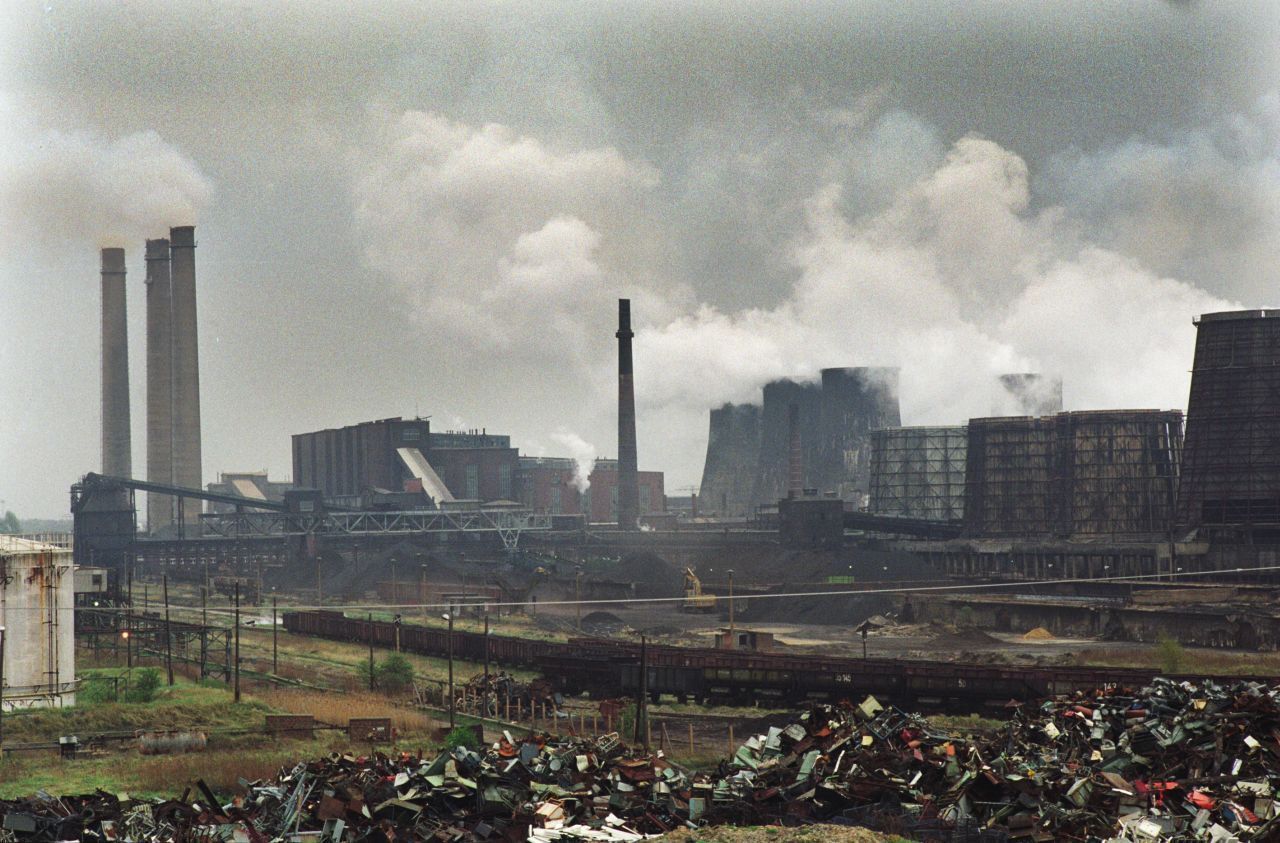
Bitterfeld, East Germany
The merger of East and West Germany exposed the truth about environmentalism under socialism. Estimates suggest that 42 percent of East German rivers and streams were unable to be processed for drinking water, and almost half of East German lakes were unable to sustain fish or other higher forms of life. At most a third of industrial sewage and half of domestic sewage was treated before being dumped into rivers and lakes, while 40 percent of the population lived in conditions for which West Germany would have issued smog warnings. Only one East German power plant had sulfur-scrubbing capabilities for its stack. Even the East German Environment Minister admitted in 1990 that their environmental policy “did not exist.”
In 1990, Greenpeace labeled Bitterfeld, East Germany, as “the dirtiest place in the most polluted country in the world.”40 Sulfur dioxide permeated the air at levels five times that of West Germany, and 75 percent of the trees were dead. A Bitterfeld chemical plant put 10 times as much mercury into the Saale River each day as a comparable West German plant would dump into the Rhine River in a year. Unfortunately, the situation in East Germany was not unique; most Soviet satellite countries in Eastern Europe experienced the same environmental degradation.
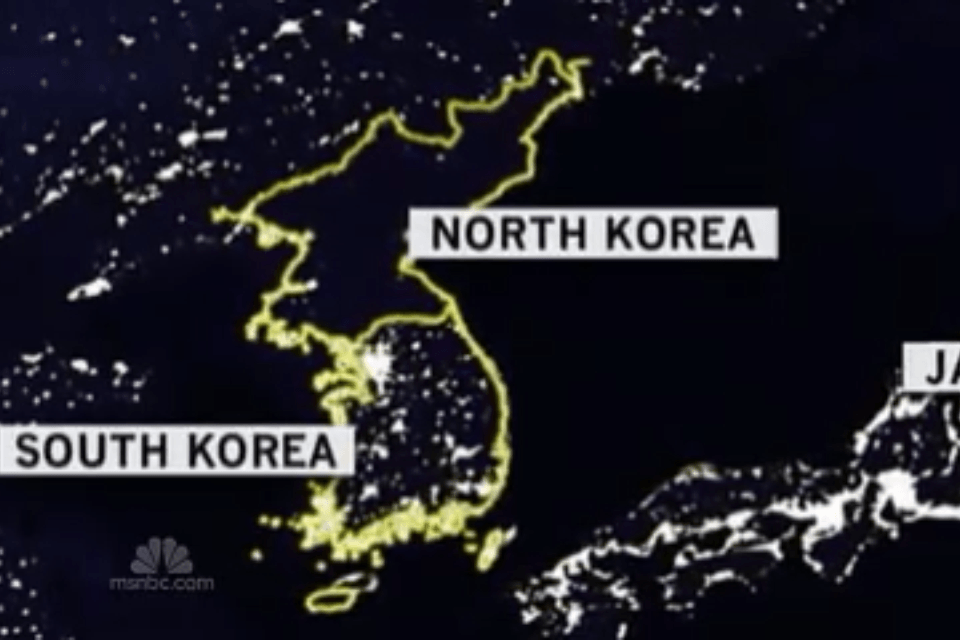
The two Koreas seen from space at night.
North Korea has not fared any better under its brand of socialism. Environmental disasters plague the North, whereas South Korea thrives in abundance. Air pollution is extreme due to both the extensive combustion of coal without sulfur scrubbers and winds that blow polluted air in from China. Cutting of firewood for home heating and cooking has led to serious deforestation and concomitant soil erosion. Large cities have sewage treatment, but wastewater in rural areas is still deposited untreated into rivers. Any effort at environmental protection becomes subservient to production and the desire for full employment. Despite 25 years of technological advancement since the end of East Germany, present-day conditions in North Korea are really no better.
So why doesn’t the environmental movement see that capitalist societies are cleaner than socialist countries and gravitate toward capitalist solutions? Some environmentalists do; however, the concern over carbon dioxide has subverted common sense.Capitalist nations emit fewer pollutants but more carbon dioxide. By contrast, socialist societies are less technologically developed and, consequently, they emit less carbon dioxide. For example, per capita emissions of carbon dioxide in South Korea are almost four times as great as in North Korea. In a world in which carbon dioxide is the only currency, environmentalists are enamored with the small carbon-dioxide footprint that socialism affords. When carbon-dioxide emissions are labeled as the greatest threat to humanity, North Korea becomes a world leader in environmental sustainability, and socialism is the tool by which global compliance can be afforded.
Socialism works for the environmentalist because of several qualities. First, socialism is a collective state, thereby making personal preferences subservient to the state’s determination of what is good for the collective. Moreover, property rights are held only by the state, and individuals must surrender all they own to the state. This actually has an additional backhanded benefit in that if no one owns that polluting factory or that river into which toxic waste is being dumped, there is no one to blame. The state will not self accuse.
Moreover, the authoritarian underpinnings of socialism allow no tolerance for dissent to be raised about what the state is—or isn’t—doing to protect the environment. Coercion is a necessary ingredient for socialism, and concomitantly many environmental policies, to be advanced. Further, its authoritarian base allows it to dictate policy, the outcome that environmentalists desire.
But the real issue is that socialism lags behind capitalist societies in the production of both wealth and technology. Socialists inherently see the restriction of energy and its availability as necessary to further their collective ideals. Without affordable, abundant energy, democracy may never have developed in Europe and Southeast Asia and led to Western Europe, Japan, South Korea, and the United States becoming leaders in innovative thinking. Availability of inexpensive energy leads to remarkable increases in industry and worker efficiency, in wages and available free time, and in living standards and human health. Ultimately, this has allowed capitalists to develop the ability to be good environmental stewards. Indeed, the air and water in capitalist countries are much cleaner than in their socialist counterparts.
It stands to reason that the availability of free time afforded by capitalism has allowed civilization to become more environmentally conscious. Environmental issues are the least of one’s concerns if one is in dire need of food, clothing, shelter, and safety. The abject poverty of many nations is looked upon with admiration by some environmentalists, even though poor countries pay little attention to their environmental health. It is criminal that environmentalists are willing to pay poor countries to remain in their current condition rather than develop the technology to further expand their economies and lift themselves from poverty. Remember, carbon dioxide is environmentalists’ currency, and delimiting its emission is their overarching goal.
The irony is that the model touted by these so-called eco-socialists is the biggest obstruction to environmental stewardship. While socialism purports to enhance the wellbeing of its citizenry, it in reality does just the opposite. Even advocates of socialism admit to its environmental failures. As James Wanliss eloquently wrote:
The environment under socialism fares no better. It is incontestable that pollution is horrendous in many of the poorest countries with the lowest levels of political and economic freedom. By contrast, countries with the greatest levels of political and economic liberty tend to be the cleanest and the wealthiest.
With merger of the two Germanys and the failure of Soviet communism, the appeal of ecologically motivated authoritarianism waned, although the ideas remained. It has re-emerged today and is modeled after modern day China rather than the Soviet Union. Although they eschew full centralized control, environmentalists see an authoritarian state as the key to allow governments to subordinate individual rights and democratic methods. Unfortunately, this type of regime can only return a society to the environmental degradation of East Germany or North Korea. Since greenhouse gases such as carbon dioxide are now the only concern of most environmentalists, they ignore the filth and degradation that actually accompany socialist societies.
The Importance of Freedom
The key ingredient that separated West from East Germany and still separates South from North Korea is freedom. Freedom is the elixir that fuels innovation, supports a diversity of thought, and allows people to become who they want to be, not what the state demands they must be. When the government guarantees equality of outcomes, it also stifles the creativity, diversity, ingenuity, and reward systems that allow people and countries to grow, develop, and prosper.
Energy availability is a necessary ingredient for freedom. Oppression—and indeed socialism is an oppressive political economic system—flourishes when citizens remain poor and deprived of technology. Freedom thrives when citizens have both the time and the ability to travel, communicate, innovate, and organize to better their lives or to fight a common enemy.
Both versions of The Experiment have proven this. Unfortunately, forgetful, unobservant, and ideological politicians in the U.S. are again touting the supposed benefits of socialism. They believe that capitalism is greedy and evil—and socialism, if “properly implemented,” will take us forward to realizing a better future. “Trust me, this time it will be different,” they say.
The next experiment is underway—in Venezuela. It is showing, once again, that those who turn toward the sirencall of socialism always crash upon its rocks.












 The graph illustrates the problem very clearly. Since 1992, the UN Framework Convention on Climate Change has met 23 times. These UNFCCC discussions have utterly failed to reduce CO2 emissions. Yet from 2020, emissions have to drop dramatically, if we are to stand a chance of keeping global warming below 1.5°C.


/cdn0.vox-cdn.com/uploads/chorus_asset/file/4192727/climate-change-uncertainty-loop.0.jpg)










 Science Matters