Control Population, Control the Climate. Not.

Far from being a catastrophe, population growth and carbon fuel-based development are the best means to lift people out of poverty, the authors write.NASA

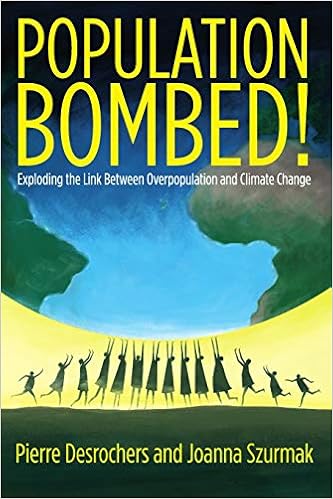
A recent book explains what’s mistaken about climate alarmists/activists thinking human numbers must be reduced in order to save the planet from us (H/T Master Resource). The Title is Population Bombed! by Pierre Desrochers and Joanna Szurmak who provide an introduction to their assessment in an article at Financial Post For 200 years pessimists have predicted we’d ruin the planet. They’re still wrong.  Excerpts in italics with my bolds.
In Avengers: Infinity War, the villain Thanos said: “If life is left unchecked, life will cease to exist.” Johns Hopkins University philosopher Travis N. Rieder apparently agrees, as he views each new child as an environmental externality putting “irreparable stress on the planet” in a way that “exacerbates … the threat of catastrophic climate change.” Similar ideas have been expressed by the likes of Al Gore, Hillary Clinton and Bill Gates. Feminist icon Gloria Steinem put it best: “What causes climate deprivation is population. If we had not been systematically forcing women to have children … for over the 500 years of patriarchy, we wouldn’t have the climate problems that we have.”

Population-growth catastrophism has been around for centuries. In the English-speaking world it is generally associated with economist Thomas Robert Malthus’ 1798 edition of his Essay on the Problem of Population and U.S. biologist Paul Ehrlich’s 1968 bestseller The Population Bomb. Ehrlich and his co-author and wife Anne predicted imminent environmental collapse followed by mass starvation. What they didn’t see coming was that, to the contrary, hundreds of millions of people would soon be lifted out of grinding poverty while parts of the planet became greener and cleaner in the process.

In our new book Population Bombed! Exploding the Link between Overpopulation and Climate Change we mark the 50th anniversary of the Ehrlichs’ book by explaining that their predictions bombed because their basic assumptions are flawed.

First, the Ehrlichs assume that human numbers cannot exceed the limits set by a finite system. Bacteria in a test tube of food are used to model such a system: Since the levels of food and waste limit bacterial growth, human population growth, by analogy, ultimately cannot exceed the carrying capacity of test tube Earth.

Second, they assume that wealth and development unavoidably come with larger environmental damage. This assumption is still at the core of pessimistic frameworks, which maintain that physical resource throughputs, not outcomes, matter. So, countries such as Haiti where deforestation and wildlife extermination are rampant are inherently more “sustainable” than richer and cleaner countries like Sweden and Switzerland.

Third, Ehrlich does not acknowledge that, unique among this planet’s species, modern humans: transmit information and knowledge between individuals and through time; innovate by combining existing things in new ways; become efficient through specialization; and engage in long-distance trade, thus achieving, to a degree, a decoupling from local limits called the “release from proximity.” And the more brains there are, the more solutions. This is why, over time, people in market economies produce more things while using fewer resources per unit of output. Corn growers now produce five or six times more output on the same plot of land as a century ago while using less fertilizer and pesticide than a few decades ago.

Fourth, the Ehrlichs and other pessimists also fail to understand the uniquely beneficial roles played by prices, profits, and losses in the spontaneous and systematic generation of more sustainable — or less problematic — outcomes. When the supply of key resources fails to meet actual demand, their prices increase. This encourages people to use such resources more efficiently, look for more of them, and develop substitutes. Meanwhile, far from rewarding pollution of the environment, the profit motive encourages people to create useful by-products out of waste (our modern synthetic world is largely made out of former petroleum-refining waste products). True, in some cases dealing with pollution came at a cost — building sewage-treatment plants, for example — but these are the types of solutions only a developed society can afford.

Fifth, pessimists are also oblivious to the benefits of unlocking wealth from underground materials such as coal, petroleum, natural gas and mineral resources. Using these spares vast quantities of land. It should go without saying that even a small population will have a much greater impact on its environment if it must rely on agriculture for food, energy and fibres, raise animals for food and locomotion, and harvest wild animals for everything from meat to whale oil. By replacing resources previously extracted from the biosphere with resources extracted from below the ground, people have reduced their overall environmental impact while increasing their standard of living.

Why is it then that after two centuries of evidence to the contrary, the pessimistic narrative still dominates academic and popular debates? Why are so many authors and academics still focusing on the Malthusian collapse scenario — now bound to come from carbon dioxide emissions and the teeming populations that produce them?

The prevalence of apocalyptic rhetoric may be, arguably, due to factors ranging from financial incentives among academics and activists to behavioural heuristics that dictate why worrying is a motivator, and why even well-meaning people rarely change their mind given new evidence. Short-termism may also take some of the blame: Population control and climate activists take for granted the non-scalable benefits of a carbon-fuel economy in which large numbers of people collaborate and innovate. The cognitive biases at the root of our thinking may shape, and in the end distort, the impulse to question “consensus,” particularly in an intellectual climate lacking the motivation to achieve what social psychologist Jonathan Haidt called “institutional disconfirmation.”

Far from being the catastrophe that Thanos, the Ehrlichs and other pessimists would have us believe, population growth and carbon fuel-based development in the context of human creativity and free enterprise are the best means to lift people out of poverty, to build resilience against any climate damage that increased anthropogenic greenhouse gas emissions might have, and to make possible a sustained reduction of humanity’s impact on the biosphere.

Pierre Desrochers, a geography professor at the University of Toronto Mississauga, and Joanna Szurmak, a doctoral candidate at York University, are the authors of Population Bombed! Exploding the Link Between Overpopulation and Climate Change. The book was launched at an event on Oct. 15th in Toronto.

More at their website: Population Bombed!

Update October 17,2018

Master Resource just posted an interview with Desrochers (here)

What we need in order to fight environmental degradation is to make sure that people in less advanced parts of the world can also be the beneficiaries of these processes. There is no doubt in my mind that these beneficial substitutions will happen more quickly the cheaper carbon fuels are. Of course, the argument is even more powerful when you think of the social consequences of less affordable energy.

Now, as with everything else, bad political institutions in some parts of the world will result in greater pollution as more carbon fuels are burned. The solution, however, is not to ban or tax everything from coal to plastic bags, but rather to improve standards of living and public governance. In my opinion, our guiding principle as far as carbon fuels are concerned should be the creation of lesser problems than those that existed before.

Climate Science, Ethics and Religion

Thanks to an insightful post at Climate Scepticism (here), we have a recent quote from former US President Obama:

“You have to believe in facts. Without facts there’s no basis for cooperation. If I say this is a podium and you say this is an elephant, it’s going to be hard for us to cooperate…I can’t find common ground if somebody says climate change is just not happening, when almost all of the world’s scientists tell us it is.”

This statement is the starting point for that poster to explore ways that even the most accomplished scientists have in the past shared beliefs that were valid only as fashionable at the time.  In this post, I want to consider first why a lawyer like Obama gets science wrong, and secondly to consider the moral and religious confusion regarding our climate.

Science is Trial And Error, not Case Law

In the legal world, cases are judged and rulings become precedent for later cases that arise.  Thus principles become established, settled facts for jurists to follow.  Scientists operate in a different world, one where experiments provide evidence that an assumption successfully predicts how things work in nature.  But that premise can be overturned by subsequent experiments, so scientific laws are always tentative.


In short, lawyers proceed by deduction, going from the accepted generality to the particular instance.  Scientists refer to generalities, but induction is their primary method of discovery.  Science proceeds from the particular to arrive at general conclusions, sometimes overturning a previous generality.

A previous post Degrees of Climate Truth was based upon work by Andy May in discussing how climate assertions can be seen in various stages of development toward scientific truth.

072516_1631_factsandthe1

In Table 1 we can see that the comparison of man-made climate change and the possibility of a man-made climate catastrophe are not really comparable to the theories of gravity and evolution. Man-made climate change is more than an idea, it is based on some observations and reasonable models of the process have been developed and can be tested. But, none of the models have successfully predicted any climatic events. Thus, they are still a work-in-progress and not admissible as evidence supporting a scientific theory.

Ethical and Religious Dimensions

Climate assertions come from people based on moral and religious frameworks.

This post is background to exploring the ethical and religious dimensions of the climate change movement. It is also important to recognize the human journey regarding morality.

Moral Models

The ethic of Good vs. Evil is a teleological paradigm, going all the way back to Plato, but still a reference for some today. This model asserts that values can be determined as eternal truths, applicable in all times and places.

Most people have moved to an ethic of Right vs. Wrong, a legal paradigm. Here morality is relative to a society that determines what is morally acceptable or not. And of course, there are variations both among different places, and within a single society over time.

Modern ethics has taken an additional step to an ethic of Responsibility vs. Irresponsibility, a contextual paradigm. Now moral behavior seeks the largest possible context: “the greatest good for the greatest number.” This can lead to some strange choices, such as suicide bombers or pro-life advocates who justify murdering abortion clinic doctors.  The perversion arises when an actor excludes some living things, or whole classes of creatures from the context of responsibility.

Summary: Climate Morality

Some climate activists/alarmists are operating with a good vs. evil model, in which their understanding of good separates people into sheep and goats.  Describing others as “deniers” shows this clearly.  And in the recent US senate supreme court nomination hearings we have an additional stark reminder that members of even advanced societies can seek to disqualify others as human beings, not simply block them from positions of responsibility.

Obama is clearly operating in the right vs. wrong model, as expected given his legalistic education.  Since laws and legal principles are relative to a social framework and heritage, social proof is all that is required for him to accept climate assertions as true.  At the same time, that mentality requires dismissing and demeaning the viewpoints contrary to the consensus. Such tribalism is contrary to scientific discourse, and in the extreme case like Rwanda the others can be considered “cockroaches” and exterminated.

It should be clear that when climate alarmists appeal to saving the planet for future generations, they are applying contextual ethics. Less obvious is the ancient religious notion that by making sacrifices, we humans can assure more favorable weather. These days, fossil fuels have become the sacrificial lamb required by Mother Nature to play nice with human beings.  In the past, people made images and worshiped them, thinking that they could control nature in that way.  These days, we make computer models whose projections are sure to scare the bejesus out of us.

See also: What’s wrong with the legal brief on climate change Facts Omitted by Climatists

mrz092215dapr_s878x638

Honey, I Made the Earth Wobble! Not.


Image is from Honey, I Shrunk the Kids, a 1989 American science fiction family film produced by Walt Disney Pictures.

Repeated robotically by alarmist websites, this week’s climate scare says that burning fossil fuels is causing the earth to wobble in its spin.

Earth is Wobbling and Climate Change is to Blame Newsweek

Humans Are Causing Earth to Wobble Popular Mechanics

Human-Driven Climate Change Is Literally Making Earth ‘Wobble’ Motherboard

Earth’s rotation wobbles. NASA says humans partly to blame. Big Think

Earth’s Axis Is Drifting Inches Every Year In Part Because Of Human-Driven Climate Change IFLScience

Planet Earth Wobbles As It Spins, and Now Scientists Know Why Live Science  The case as made in the Live Science article,

Since 1899, the Earth’s axis of spin has shifted about 34 feet (10.5 meters). Now, research quantifies the reasons why and finds that a third is due to melting ice and rising sea levels, particularly in Greenland — placing the blame on the doorstep of anthropogenic climate change.

Another third of the wobble is due to land masses expanding upward as the glaciers retreat and lighten their load. The final portion is the fault of the slow churn of the mantle, the viscous middle layer of the planet.

Earth wobbles irregularly over time, which means it does not always spin on an axis running through its poles. Its axis has been drifting towards North America during most of the last century (green arrow). That direction has changed dramatically due to changes in water mass on Earth. (Image: NASA/JPS-Caltech)

After a little investigation, there are several reasons not to be alarmed about this finding.

1.The Wobble is ancient.

Scientists have long known that the distribution of mass around the Earth determines its spin, much like how the shape and weight distribution of a spinning top determines how it moves. Also, Earth’s spin isn’t perfectly even, as scientists know thanks to slight wiggles in the movements of the stars across the night sky that have been recorded for thousands of years, said Erik Ivins, a study co-author and a senior research scientist at JPL. Since the 1990s, space-based measurements have also confirmed that the Earth’s axis of rotation drifts by a few centimeters a year, generally toward Hudson Bay in northeastern Canada.

Researchers knew that a proportion of this wobble was caused by glacial isostatic adjustment, an ongoing process since the end of the last ice age 16,000 years ago. As the glaciers retreat, they relieve the land underneath of their mass. Gradually, over thousands of years, the land responds to this relief by rising like bread dough. (In some places on the edges of the ancient ice sheets, the land might also collapse because the ice had forced it to bulge upward.)

2. Wobbling results from multiple causes.

“We have provided evidence for more than one single process that is the key driver” for altering the Earth’s axis, said Surendra Adhikari, an Earth system scientist at NASA’s Jet Propulsion Laboratory in Pasadena, California, and a lead researcher on the new study.

But in the new research, published in the November issue of the journal Earth and Planetary Science Letters, Adhikari and his colleagues found that glacial isostatic adjustment was only responsible for about 1.3 inches (3.5 centimeters) of axis wobble per year. That was only about a third of the wobble — 4 inches (10.5 cm) — observed each year over the 20th century.

To fill in the gap, the research team built a computer model of the physics of Earth’s spin, feeding in data about changes in the balance of land-based ice and ocean waters over the 20th century. The researchers also accounted for other shifts in land and water, such as groundwater depletion and the building of artificial reservoirs, all part of humanity’s terraforming of the planet.

The results revealed that these environmental processes cause another 1.7 inches (4.3 cm) of wobble each year. The melting of the Greenland ice sheet was a particularly important contributor, the researchers found. That’s because Greenland has released a large amount of water that was once locked up on land into the oceans, where its mass has been redistributed, Ivins told Live Science. Mountain glaciers and small ice caps elsewhere have also contributed to sea-level rise, he said; but they aren’t as concentrated, and their effects on the Earth’s rotation often cancel each other out.

3. The mantle itself is always moving.

The glaciers and the ice melt still left a third of the wobble unaccounted for, so Adhikari and his team looked inward. The Earth’s mantle is not static, he said, but moves by the process of convection: Hotter material from closer to the core rises and cooler material sinks in a cycle of vertical motion. By including convection in the model of Earth’s wobble, the researchers had accounted for the last third of the changes in the spin over the 20th century.

4. The Wobble is not menacing.

It’s important to realize that this wobble isn’t the prelude to any sort of environmental calamity, Ivins and Adhikari said. It doesn’t affect agriculture or climate in and of itself, and any small impact on navigational equipment is easy to correct for.

“The amount [of drift] is not a huge amount,” Adhikari said.

5. Greenland ice sheet is affected by many natural factors.

A recent paper looked into unusually extensive melting in 2012. The implication of nonradiative energy fluxes dominating Greenland ice sheet exceptional ablation area surface melt in 2012 by Robert S. Fausto et al. Excerpts in italics with my bolds.

The surface energy budget consists of nonradiative (sensible, latent, rain, and subsurface) and radiative (shortwave and longwave) energy fluxes. Distinguishing the contribution of nonradiative and radiative energy fluxes in melt over the Greenland ice sheet is important to understand ice sheet surface climate sensitivity, especially in the ablation area, where the majority of melt occurs [e.g., Fausto et al., 2012a].

Ablation varies with elevation, but there are also considerable latitudinal differences as the Greenland ice sheet stretches from the upper midlatitudes (~60°N) to the high Arctic (~82°N). The largest total observed ice ablation in 2012 was 8.5 m ice eq. at QAS_L, which was 9% less than the 2010 value. This interannual variability may be attributed to larger winter snow accumulation in 2012, which maintained high surface albedo by delaying bare ice exposure during the melt season.

Given that absorbed solar radiation is the primary energy source of melt on an annual basis, the influence of intra‐annual and interannual variability in air temperature and other variables on ablation is of secondary importance [Van den Broeke et al., 2011]. Yet during the two melt episodes we focus on, which together resulted in ~14% of annual ice ablation (Table 1), the nonradiative (sensible, latent, rain, and subsurface) energy fluxes were the primary control of melt with a contribution of 53 ± 16% and 66 ± 8%, respectively, averaged for the eight western AWSs for episodes E1 and E2, respectively (Tables 1).

During the two episodes, the large longitudinal contrast in nonradiative energy fluxes contribution to surface melt stem from anomalously warm and moist southern air flow being transferred onto the western ice sheet by atmospheric flow (Figure 2b) [Neff et al., 2014; Bonne et al., 2015], while east Greenland was dominated by stable weather with relatively low cloud cover and high solar radiation (Figure 2c) [Fettweis et al., 2013; Tedesco et al., 2013].

More broadly, data from the two episodes presented here demonstrate that exceptional melt can occur during periods characterized by cloudy skies and transient atmospheric flow, with melt being dominated by nonradiative, rather than radiative fluxes in the ablation area.

Conclusions

We find that year 2012 Greenland ice sheet melt was marked not only by widespread interior surface melting [Nghiem et al., 2012] but also by an increased nonradiative (sensible, latent, and rain) energy flux contributing to melt in the ablation area of the southern and western ice sheet. Latent and sensible energy advection governed two exceptional melt episodes in July 2012 [Neff et al., 2014]. The two episodes which lasted just ~6% of the ablation period in June–August were responsible for ~14% of the annual 2012 ablation average for all PROMICE measurement sites (Table 1). At all PROMICE sites during the two exceptional melt episodes the combined sensible, latent, rain, and subsurface energy fluxes (i.e., nonradiative energy fluxes) comprised 60% of the melt energy on average (Figure 1 and Table S1).

Summary

Earth has wobbled a bit in its rotation since the beginning, and continues to do so. The movement is not large or menacing. The three causes appear to be shifting material in the mantle, land rebounding when glaciers retreat, and changes in Greenland ice sheet balance.

The latter is attributed to human activity, even though major melting events result primarily from nonradiative factors: sensible, latent, rain and subsurface energy fluxes. If you buy the notion that burning fossil fuels causes Greenland ice sheet to melt, then please contact me about my bridge in Brooklyn that I am selling.

Fear and Loathing of Climate Dissent


Alarmists are circling the wagons against any and all who raise questions about their beliefs, or who dare to take a different view of earth’s climate system and future weather trends. The latest example comes from Portugal as reported approvingly by DesmogUK Santander Forced To Distance Itself From Climate Science Denial Conference  Excerpts in italics with my bolds

Santander has been forced to distance itself from a climate science denial conference after its logo was published on the event’s website without the bank’s knowledge.

The bank, which is one of the world’s biggest, told DeSmog UK it was not a sponsor of the climate science denial conference taking place in Porto, Portugal, at the end of this week.

However, Santander admitted giving money to the University of Porto, where the conference is being held, to “support investigation and research” but added that it did not oversee how the money was spent.

The conference, called “Basic science of a changing climate: How processes in the sun, atmosphere and ocean affect weather and climate” says it is “open to different opinions and interpretations of changing climate”.

Held at the University of Porto’s Faculty of Humanities, the conference has been organised by Maria Assunção Araújo, a professor at the geography department, who is due to address the conference on sea level rise in Portugal and ice retreat in Greenland.

Speakers include prominent climate science deniers Piers Corbyn, Philip Foster, Christopher Essex, Nils-Axel Mörner and Christopher Monckton, who will give the two-day conference closing speech before participants are invited to take part in a “cheese and port mingle”.

The conference also includes a session for students to ask speakers questions.

Santander’s logo is featured on the conference’s website, alongside the University of Porto’s logo.

A spokesman for the Univeristy of Porto told DeSmog UK that the conference was not organised by the university despite being held on its premises and that views expressed at the conference “do not refelect the official position of the University of Porto about the subject”.

He added that the conference had been organised at the initiative of one of the faculty’s professors who applied to a programme sponsored by Santander aimed at supporting international events being held at the university.

The spokesman said the programme “demands that such events exhibit the source of funding, which explains the presence of the Santander logo on the website”.

“It is our conviction that the universities should be a space of open debate and discussion, where the presentation of conflicting ideas and perspectives should be valued. We also believe that censorship of opinions — even the ones that we do not agree with — should not be part of the activities of any university and it is in this context that the University of Porto will host this conference,” he said, adding that this “does not conflict with the university’s commitment to fight against climate change”.

In an email to DeSmog UK, Santander said it supported the University of Porto as part of its universities programme but that it was not aware that its logo had been used on the conference’s website.

“Santander is not a sponsor of this conference,” a spokeswoman told DeSmog UK.

“Santander has always and continues to do all it can to support sustainable growth and combat the impact of climate change, which is undoubtedly one of the greatest challenges we face.”

She added that the money Santander gave the university could be used in any way the university saw fit.

“We do not instruct Porto University how to use funds it receives from Santander. It can use funding resources to support investigation and research at their sole discretion and decision, to respect the university’s academic independence,” she said.

In its climate change policy, Banco Santander — the parent company of the Santander group — states that “climate change and resource scarcity are two of the biggest challenges faced by society”.

It adds that the group’s efforts to protect the environment were based on the Paris Agreement and the United Nations Framework Conventions on Climate Change (UNFCCC) now re-branded as the UN Climate Change.

Summary

Increasingly climate alarmists/activists employ religious tactics of denunciation, censorship, shunning and excommunication to ward off any unorthodox views of climate and weather. This extends to compelling people like corporate spokespersons to say the party line, or face defamation.  In this case, the University is brave enough to host the conference, even while declaring their institutional orthodoxy. Let’s see if SJWs attempt to prevent the event.  Let’s also see how well such tactics are viewed by the public if and when cooling sets in. BTW Scientific American is already reminding us that the coming winter is to be regarded as weather and not climate change (unlike the summer now ending).


EU Sub Committee Aims to Open Closed Climate Minds

It wasn’t supposed to be this way.  The EU bureaucratic wheels were turning and needed a routine submission from the Committee on Agriculture and Rural Development as input for the Committee on the Environment, Public Health and Food Safety regarding a programme rule change.

The Rapporteur for opinion happened to be UKIP member John Stuart Agnew, who actually knows something about climate matters and agriculture, and drafted a submission accordingly.  The full document is here,( H/T WUWT)  and his case is put admirably.  Excerpts below in italics with my bolds.

The LIFE program is due for renewal in 2020. It has hitherto used its funding to act as a test bed for small projects which are expected to improve the environment. Examples have included management techniques to improve numbers of wild species or maintenance of wetlands. The success of such innovations can be quantified and demonstrated. The funding comes direct from Brussels.

If such projects are successful, they become popular with farmers who then make these investments using the Pillar 2 grants from their member states. The addition of the words ‘Climate Action’ in the present LIFE regime has added an entirely new concept to the way that taxpayer’s money should be used. The term has also occurred in the latest proposal from Commissioner Hogan on CAP reform. The addition of the term ‘Climate Action’ coincides with a 60% increase to the budget of the LIFE Programme. What is conspicuously missing are definitions of the actions required and the outcomes that are desired.

If the words ‘Climate Action’ had been substituted with the words ‘Pollution Action’, then it would be possible to measure air, soil and water pollution and measure the effectiveness of strategies to alleviate these problems, against a target figure for each of the three elements. A war to reduce pollution can be won, using the weapons of technology and legislation. A war against the world’s weather will never end, because ‘victory’ cannot be defined.

The Rapporteur has met the team of four from the Commission who between them have had varying levels of input into this proposal. The Rapporteur asked them what outcome would be considered desirable, as a consequence of financial investment. The answer was – ‘a reduction in CO2 emissions’.

By mentioning the concept that reducing CO2 levels will serve to take action against an unsatisfactory climate, the Commission is ignoring the factors that really do change our climate.
1. The galaxy: in the form of Cosmic Ray fluctuations. Can induce changes of 10 o C over millions of years.
2. The solar system: Gravitational pulls can induce changes of 2-3 o C.
3. The sun: Its variations of orbit and tilt along with its five separate documented cycles can the cause earth’s temperature to vary by up to 5o C.
4. Ocean Currents.
5. The ‘Greenhouse’ gas: Water Vapour, in the form of cloud cover.

The other Greenhouse gases, CO2, Methane and Nitrous Oxide have a negligible effect on our climate. CO2 is, however, an irreplaceable plant food. Methane degrades into CO2 and H2O; NOx gases eventually change into Nitrates.

If the effect of CO2 levels on our climate is negligible, the effect of human activity on changing those CO2 levels is also negligible.

The two world maps below perfectly demonstrate this.

Calculated areas of higher CO2 concentrations due to human emissions

– Actual areas of higher CO2 concentration
– SCIAMACHY observations on the ENVISAT satellite (agree with Japan’s IBUKU data)

The predictions of the experts and the measurements by satellite are contradictory. The total absence of CO2 hotspots over Europe indicates there is no problem for the Commission to solve. The only potential risk of a major CO2 event in Europe is an erupting volcano.

The naturally high concentrations of CO2 above our natural rainforests create an interesting dilemma for those who want one without the other. This is not made any easier when it is realised that rainforests are also major emitters of methane and water vapour.

Ever since the Rapporteur joined the Parliament in 2009, it has been fashionable for MEPs in AGRI and ENVI to work the phrase “tackling Climate Change” into their speeches. It sounds worthy and virtuous. It is based on predictions made in the 1980s of rapidly rising world temperatures and sea levels that never ultimately occurred. The Commission has listened to these speeches as opposed to observing the reality. At some stage somebody has to say “The king isn’t wearing an invisible suit, he’s just not wearing any clothes!” The Rapporteur is presenting this opportunity to his colleagues.

Some MEPs have been elected solely because of their antipathy to CO2. They will not change their views.

The Rapporteur urges other colleagues though to reflect on the fact that the precedent of ‘Climate Action’ in the LIFE Programme is setting the stage for ‘Climate Action’ in agriculture, where 40% of future budgets is destined to be spent fighting CO2, one of agriculture’s greatest friends.

The Rapporteur has amended the proposal to delete all references to “clean energy” as this implies “CO2 free” energy, as well as the references to ‘climate change mitigation’ but incorporated the term ‘climate change adaptation’ into the text of the legislative proposal. There is a big difference. We need to prepare for the next ‘Maunder Minimum’ or mini ice age – which might last 200-300 years. Some solar physicists believe this cycle has technically already started.

Footnote Regarding Future Cooling

Both the Pacific (PDO) and the Atlantic (AMO) are due for a cooling phase. If that happens coincidental with diminished solar input (indicated by the lower sunspot proxy), we are looking at planetary cooling as suggested by some solar physicists.

The situation reminds of governmental failure in North America to manage the educational system to match demographic shifts. The bureaucratic response comes too late to cope with the current reality. After WWII came the baby boom, and many schools became overcrowded and new ones built. Then the sexual revolution and female liberation produced a baby bust due to smaller families, so schools emptied with surplus capacity. Just as the government got serious about closing schools came the baby echo, unanticipated by the authorities. Despite smaller families, there were many more of them, these being the married adult boomers. Echo babies were a new pulse of children hitting a school system undergoing downsizing in response to the previous baby bust.

Similarly, the climatists would have us assume endless warming and require cessation of reliable affordable energy just as we enter a mini ice age.

Socialist Snow Job

The UN is more up front than ever with its world governance agenda. The latest proclamation was solicited from the BIOS Research Unit in Helsinki Finland Global Sustainable Development Report

The background paper commissioned by the UN Secretary-General’s IGS states that  biophysical realities are driving the transition to postcapitalism by the decline of what made ‘endless growth capitalism’ possible in the first place: abundant, cheap energy.

The UN’s Global Sustainable Development Report is being drafted by an independent group of scientists (IGS) appointed by the UN Secretary-General. The IGS is supported by a range of UN agencies including the UN Secretariat, the UN Educational, Scientific and Cultural Organization, the UN Environment Programme, the UN Development Programme, the UN Conference on Trade and Development and the World Bank.

The section titles express the themes favored by these “ecological economists.”

GOVERNANCE OF ECONOMIC TRANSITION

  • New economic thinking for the turbulent years ahead
  • What needs to be done – in social and material terms?
  • Rapid economic transition requires proactive governance – markets cannot accomplish the task
  • Economic theory to support transition governance
  • The new geopolitical order during and after transition governance

It is a blatant call for a supra-national new world order necessitated by climate change.

Pointing to the susceptibility of democratic governments to interest groups that have an economic stake in maintaining the status quo, these environmentalists doubt democracy is up to the challenge of climate change at all. Others note that human inertia is so great that, barring a catastrophic event, the best democratic governments can do is to adapt to climate change — i.e., building sea walls around vulnerable cities. More of them are saying that, to make the hard decisions needed to deal effectively with climate change, it may be eventually be necessary to put democracy on hold, opting instead for some kind of environmental authoritarianism.

But why should we believe such radical concentration of power would be good for the planet? What is the evidence for such claims?

As it happens we have empirical evidence to test this assertion that socialism is superior to capitalism for saving the natural environment. David Legates points out recent historical examples where two modern societies were split, one part to develop for 50 years under a socialist autocracy and the other part under a free market democracy. What can we learn from these two experiments: North/South Korea and East/West Germany? Excerpts in italics with my bolds.

The Experiment: Capitalism versus Socialism

With growing alarmism over carbon dioxide-induced climate change, many activists have turned toward socialism as a viable way to limit carbon-dioxide emissions. The collectivist model is perfect for top-down control over the general public as, supposedly, the government can then enact legislation to defend the environment and protect against climate change. Capitalism, it is argued, is a system based on greed, and its economic bottom line trumps the need for clean air and clean water. By contrast, the socialist model should provide a much cleaner environment as pollution (including carbon dioxide by its erroneous inclusion as a pollutant by alarmists) is anathema to the collective whole.

In a nutshell, the argument is that capitalism cannot provide the ingenuity and resilience necessary to provide a sustainable environment. The only hope, therefore, is the limitation to growth that socialism provides. Li laments that the core of the environmental movement lies in the upper middle classes of capitalist societies who erroneously believe that technology can provide a solution to climate alarmism.  In his view, the real problem, of course, is the capitalist lifestyle, which is unsustainable as it requires unlimited economic growth. By contrast, socialism provides the perfect solution in which growth can be limited by a benevolent government whose sole interest lies in protecting the collective whole. Indeed, the term eco-socialism (or Hospice Earth) has been coined to describe the concept that socialism can “replace capitalism’s need for endless material growth with more environmentally sustainable alternatives of production to meet genuine human needs.”  It is argued that eco-socialism can transform energy production such that the global society can avoid declines in human populations and all sociopolitical conflicts.

So how does this relate to The Experiment? If this line of reasoning is to be believed, then the socialist-oriented countries should be better suited to environmental preservation and sustainability than their capitalist counterparts. Or at the very least, the plans should have been in place for a cleaner environment, if the effect of other socio-economic maladies had not taken precedence. What are the facts?

Bitterfeld, East Germany

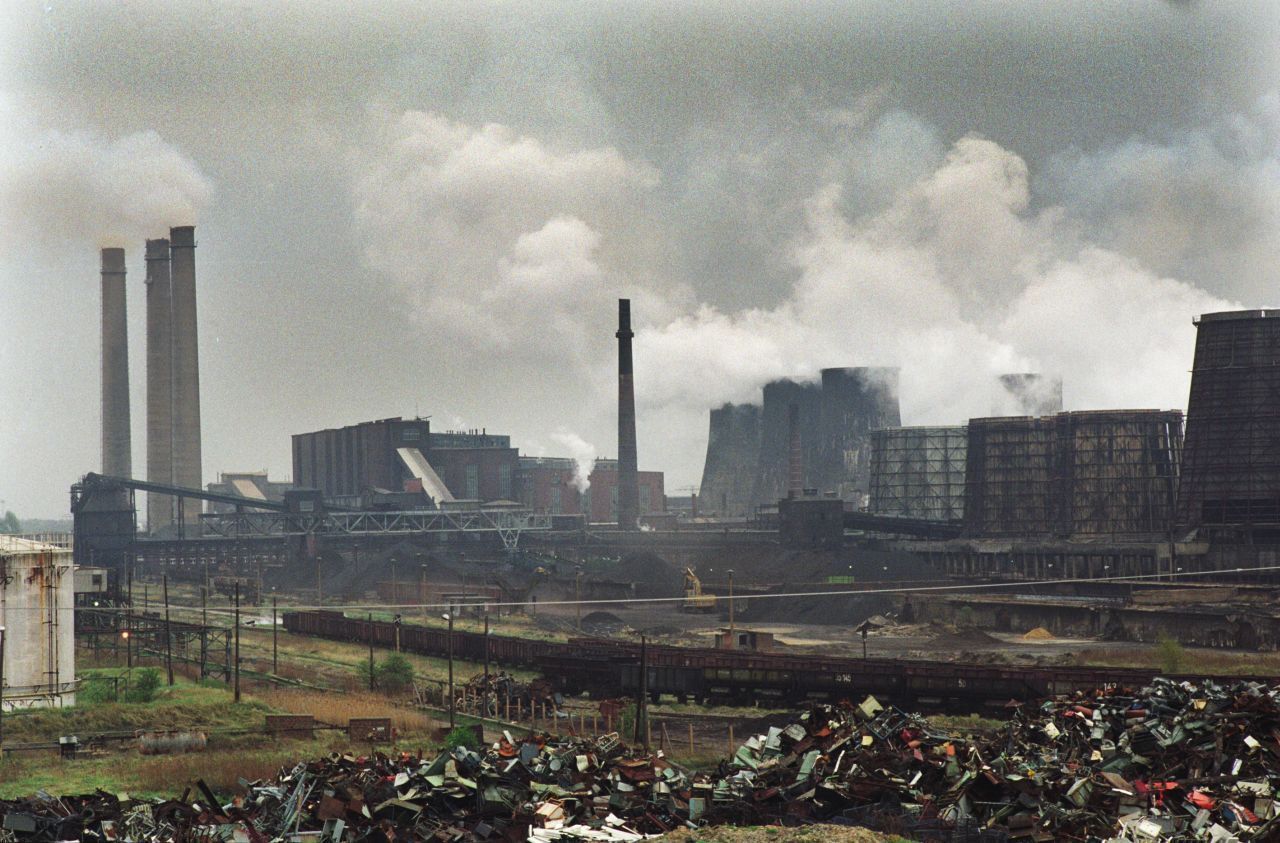
The merger of East and West Germany exposed the truth about environmentalism under socialism. Estimates suggest that 42 percent of East German rivers and streams were unable to be processed for drinking water, and almost half of East German lakes were unable to sustain fish or other higher forms of life. At most a third of industrial sewage and half of domestic sewage was treated before being dumped into rivers and lakes, while 40 percent of the population lived in conditions for which West Germany would have issued smog warnings. Only one East German power plant had sulfur-scrubbing capabilities for its stack. Even the East German Environment Minister admitted in 1990 that their environmental policy “did not exist.”

In 1990, Greenpeace labeled Bitterfeld, East Germany, as “the dirtiest place in the most polluted country in the world.”40 Sulfur dioxide permeated the air at levels five times that of West Germany, and 75 percent of the trees were dead. A Bitterfeld chemical plant put 10 times as much mercury into the Saale River each day as a comparable West German plant would dump into the Rhine River in a year. Unfortunately, the situation in East Germany was not unique; most Soviet satellite countries in Eastern Europe experienced the same environmental degradation.

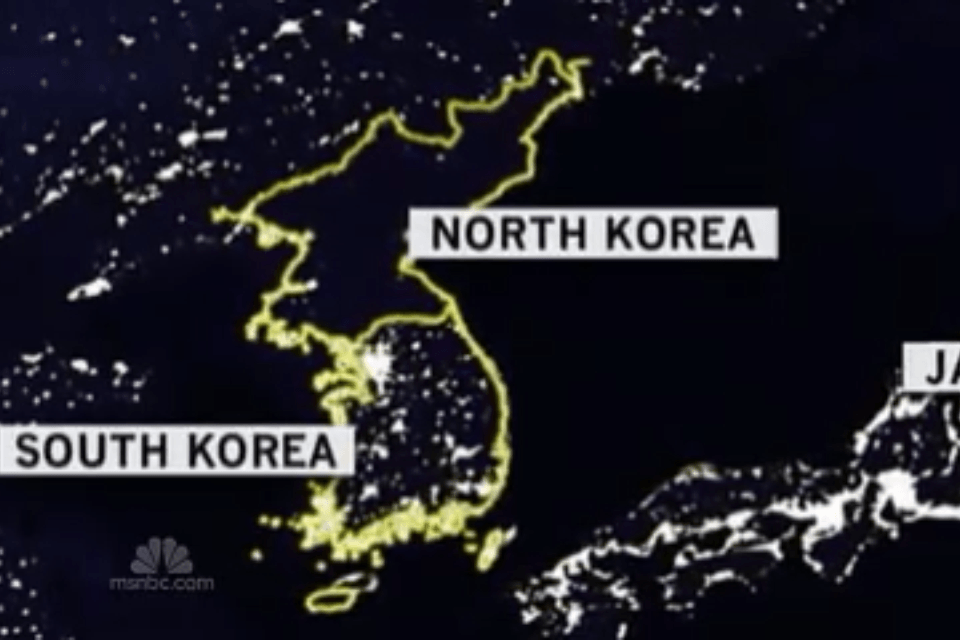
The two Koreas seen from space at night.

North Korea has not fared any better under its brand of socialism. Environmental disasters plague the North, whereas South Korea thrives in abundance. Air pollution is extreme due to both the extensive combustion of coal without sulfur scrubbers and winds that blow polluted air in from China. Cutting of firewood for home heating and cooking has led to serious deforestation and concomitant soil erosion. Large cities have sewage treatment, but wastewater in rural areas is still deposited untreated into rivers. Any effort at environmental protection becomes subservient to production and the desire for full employment. Despite 25 years of technological advancement since the end of East Germany, present-day conditions in North Korea are really no better.

So why doesn’t the environmental movement see that capitalist societies are cleaner than socialist countries and gravitate toward capitalist solutions? Some environmentalists do; however, the concern over carbon dioxide has subverted common sense. Capitalist nations emit fewer pollutants but more carbon dioxide. By contrast, socialist societies are less technologically developed and, consequently, they emit less carbon dioxide. For example, per capita emissions of carbon dioxide in South Korea are almost four times as great as in North Korea. In a world in which carbon dioxide is the only currency, environmentalists are enamored with the small carbon-dioxide footprint that socialism affords. When carbon-dioxide emissions are labeled as the greatest threat to humanity, North Korea becomes a world leader in environmental sustainability, and socialism is the tool by which global compliance can be afforded.

Socialism works for the environmentalist because of several qualities. First, socialism is a collective state, thereby making personal preferences subservient to the state’s determination of what is good for the collective.  Moreover, property rights are held only by the state, and individuals must surrender all they own to the state. This actually has an additional backhanded benefit in that if no one owns that polluting factory or that river into which toxic waste is being dumped, there is no one to blame. The state will not self accuse.

Moreover, the authoritarian underpinnings of socialism allow no tolerance for dissent to be raised about what the state is—or isn’t—doing to protect the environment. Coercion is a necessary ingredient for socialism, and concomitantly many environmental policies, to be advanced. Further, its authoritarian base allows it to dictate policy, the outcome that environmentalists desire.

But the real issue is that socialism lags behind capitalist societies in the production of both wealth and technology. Socialists inherently see the restriction of energy and its availability as necessary to further their collective ideals. Without affordable, abundant energy, democracy may never have developed in Europe and Southeast Asia and led to Western Europe, Japan, South Korea, and the United States becoming leaders in innovative thinking. Availability of inexpensive energy leads to remarkable increases in industry and worker efficiency, in wages and available free time, and in living standards and human health. Ultimately, this has allowed capitalists to develop the ability to be good environmental stewards. Indeed, the air and water in capitalist countries are much cleaner than in their socialist counterparts.

It stands to reason that the availability of free time afforded by capitalism has allowed civilization to become more environmentally conscious. Environmental issues are the least of one’s concerns if one is in dire need of food, clothing, shelter, and safety. The abject poverty of many nations is looked upon with admiration by some environmentalists, even though poor countries pay little attention to their environmental health. It is criminal that environmentalists are willing to pay poor countries to remain in their current condition rather than develop the technology to further expand their economies and lift themselves from poverty. Remember, carbon dioxide is environmentalists’ currency, and delimiting its emission is their overarching goal.

The irony is that the model touted by these so-called eco-socialists is the biggest obstruction to environmental stewardship. While socialism purports to enhance the wellbeing of its citizenry, it in reality does just the opposite. Even advocates of socialism admit to its environmental failures. As James Wanliss eloquently wrote:

The environment under socialism fares no better. It is incontestable that pollution is horrendous in many of the poorest countries with the lowest levels of political and economic freedom. By contrast, countries with the greatest levels of political and economic liberty tend to be the cleanest and the wealthiest.

With merger of the two Germanys and the failure of Soviet communism, the appeal of ecologically motivated authoritarianism waned, although the ideas remained. It has re-emerged today and is modeled after modern day China rather than the Soviet Union. Although they eschew full centralized control, environmentalists see an authoritarian state as the key to allow governments to subordinate individual rights and democratic methods. Unfortunately, this type of regime can only return a society to the environmental degradation of East Germany or North Korea. Since greenhouse gases such as carbon dioxide are now the only concern of most environmentalists, they ignore the filth and degradation that actually accompany socialist societies.

The Importance of Freedom

The key ingredient that separated West from East Germany and still separates South from North Korea is freedom. Freedom is the elixir that fuels innovation, supports a diversity of thought, and allows people to become who they want to be, not what the state demands they must be. When the government guarantees equality of outcomes, it also stifles the creativity, diversity, ingenuity, and reward systems that allow people and countries to grow, develop, and prosper.

Energy availability is a necessary ingredient for freedom. Oppression—and indeed socialism is an oppressive political economic system—flourishes when citizens remain poor and deprived of technology. Freedom thrives when citizens have both the time and the ability to travel, communicate, innovate, and organize to better their lives or to fight a common enemy.

Both versions of The Experiment have proven this. Unfortunately, forgetful, unobservant, and ideological politicians in the U.S. are again touting the supposed benefits of socialism. They believe that capitalism is greedy and evil—and socialism, if “properly implemented,” will take us forward to realizing a better future. “Trust me, this time it will be different,” they say.

The next experiment is underway—in Venezuela. It is showing, once again, that those who turn toward the sirencall of socialism always crash upon its rocks.

And let’s not forget Brazil

Why the Left Coast is Burning

It is often said that truth is the first casualty in the fog of war. That is especially true of the war against fossil fuels and smoke from wildfires. The forests are burning in California, Oregon and Washington, all of them steeped in liberal, progressive and post-modern ideology. There are human reasons that fires are out of control in those places, and it is not due to CO2 emissions. As we shall see, Zinke is right and Brown is wrong. Some truths the media are not telling you in their drive to blame global warming/climate change. Text below is excerpted from sources linked at the end.

1. The World and the US are not burning.

The geographic extent of this summer’s forest fires won’t come close to the aggregate record for the U.S. Far from it. Yes, there are some terrible fires now burning in California, Oregon, and elsewhere, and the total burnt area this summer in the U.S. is likely to exceed the 2017 total. But as the chart above shows, the burnt area in 2017 was less than 20% of the record set way back in 1930. The same is true of the global burnt area, which has declined over many decades.

In fact, this 2006 paper reported the following:

“Analysis of charcoal records in sediments [31] and isotope-ratio records in ice cores [32] suggest that global biomass burning during the past century has been lower than at any time in the past 2000 years. Although the magnitude of the actual differences between pre-industrial and current biomass burning rates may not be as pronounced as suggested by those studies [33], modelling approaches agree with a general decrease of global fire activity at least in past centuries [34]. In spite of this, fire is often quoted as an increasing issue around the globe [11,26–29].”

People have a tendency to exaggerate the significance of current events. Perhaps the youthful can be forgiven for thinking hot summers are a new phenomenon. Incredibly, more “seasoned” folks are often subject to the same fallacies. The fires in California have so impressed climate alarmists that many of them truly believe global warming is the cause of forest fires in recent years, including the confused bureaucrats at Cal Fire, the state’s firefighting agency. Of course, the fires have given fresh fuel to self-interested climate activists and pressure groups, an opportunity for greater exaggeration of an ongoing scare story.

This year, however, and not for the first time, a high-pressure system has been parked over the West, bringing southern winds up the coast along with warmer waters from the south, keeping things warm and dry inland. It’s just weather, though a few arsonists and careless individuals always seem to contribute to the conflagrations. Beyond all that, the impact of a warmer climate on the tendency for biomass to burn is considered ambiguous for realistic climate scenarios.

2. Public forests are no longer managed due to litigation.

According to a 2014 white paper titled; ‘Twenty Years of Forest Service Land Management Litigation’, by Amanda M.A. Miner, Robert W. Malmsheimer, and Denise M. Keele: “This study provides a comprehensive analysis of USDA Forest Service litigation from 1989 to 2008. Using a census and improved analyses, we document the final outcome of the 1125 land management cases filed in federal court. The Forest Service won 53.8% of these cases, lost 23.3%, and settled 22.9%. It won 64.0% of the 669 cases decided by a judge based on cases’ merits. The agency was more likely to lose and settle cases during the last six years; the number of cases initiated during this time varied greatly. The Pacific Northwest region along with the Ninth Circuit Court of Appeals had the most frequent occurrence of cases. Litigants generally challenged vegetative management (e.g. logging) projects, most often by alleging violations of the National Environmental Policy Act and the National Forest Management Act. The results document the continued influence of the legal system on national forest management and describe the complexity of this litigation.”

There is abundant evidence to support the position that when any forest project posits vegetative management in forests as a pretense for a logging operation, salvage or otherwise, litigation is likely to ensue, and in addition to NEPA, the USFS uses the Property Clause to address any potential removal of ‘forest products’. Nevertheless, the USFS currently spends more than 50% of its total budget on wildfire suppression alone; about $1.8 billion annually, while there is scant spending for wildfire prevention.

3. Mega fires are the unnatural result of fire suppression.

And what of the “mega-fires” burning in the West, like the huge Mendocino Complex Fire and last year’s Thomas Fire? Unfortunately, many decades of fire suppression measures — prohibitions on logging, grazing, and controlled burns — have left the forests with too much dead wood and debris, especially on public lands. From the last link:

“Oregon, like much of the western U.S., was ravaged by massive wildfires in the 1930s during the Dust Bowl drought. Megafires were largely contained due to logging and policies to actively manage forests, but there’s been an increasing trend since the 1980s of larger fires.

Active management of the forests and logging kept fires at bay for decades, but that largely ended in the 1980s over concerns too many old growth trees and the northern spotted owl. Lawsuits from environmental groups hamstrung logging and government planners cut back on thinning trees and road maintenance.

[Bob] Zybach [a forester] said Native Americans used controlled burns to manage the landscape in Oregon, Washington and northern California for thousands of years. Tribes would burn up to 1 million acres a year on the west coast to prime the land for hunting and grazing, Zybach’s research has shown.

‘The Indians had lots of big fires, but they were controlled,’ Zybach said. ‘It’s the lack of Indian burning, the lack of grazing’ and other active management techniques that caused fires to become more destructive in the 19th and early 20th centuries before logging operations and forest management techniques got fires under control in the mid-20th Century.”

4. Bad federal forest administration started in 1990s.

Bob Zybach feels like a broken record. Decades ago he warned government officials allowing Oregon’s forests to grow unchecked by proper management would result in catastrophic wildfires.

While some want to blame global warming for the uptick in catastrophic wildfires, Zybach said a change in forest management policies is the main reason Americans are seeing a return to more intense fires, particularly in the Pacific Northwest and California where millions of acres of protected forests stand.

“We knew exactly what would happen if we just walked away,” Zybach, an experienced forester with a PhD in environmental science, told The Daily Caller News Foundation.

Zybach spent two decades as a reforestation contractor before heading to graduate school in the 1990s. Then the Clinton administration in 1994 introduced its plan to protect old growth trees and spotted owls by strictly limiting logging.  Less logging also meant government foresters weren’t doing as much active management of forests — thinnings, prescribed burns and other activities to reduce wildfire risk.

Zybach told Evergreen magazine that year the Clinton administration’s plan for “naturally functioning ecosystems” free of human interference ignored history and would fuel “wildfires reminiscent of the Tillamook burn, the 1910 fires and the Yellowstone fire.”

Between 1952 and 1987, western Oregon saw only one major fire above 10,000 acres. The region’s relatively fire-free streak ended with the Silver Complex Fire of 1987 that burned more than 100,000 acres in the Kalmiopsis Wilderness area, torching rare plants and trees the federal government set aside to protect from human activities. The area has burned several more times since the 1980s.

“Mostly fuels were removed through logging, active management — which they stopped — and grazing,” Zybach said in an interview. “You take away logging, grazing and maintenance, and you get firebombs.”

Now, Oregonians are dealing with 13 wildfires engulfing 185,000 acres. California is battling nine fires scorching more than 577,000 acres, mostly in the northern forested parts of the state managed by federal agencies.

The Mendocino Complex Fire quickly spread to become the largest wildfire in California since the 1930s, engulfing more than 283,000 acres. The previous wildfire record was set by 2017’s Thomas Fire that scorched 281,893 acres in Southern California.

While bad fires still happen on state and private lands, most of the massive blazes happen on or around lands managed by the U.S. Forest Service and other federal agencies, Zybach said. Poor management has turned western forests into “slow-motion time bombs,” he said.

A feller buncher removing small trees that act as fuel ladders and transmit fire into the forest canopy.

5. True environmentalism is not nature love, but nature management.

While wildfires do happen across the country, poor management by western states has served to turn entire regions into tinderboxes. By letting nature play out its course so close to civilization, this is the course California and Oregon have taken.

Many in heartland America and along the Eastern Seaboard often see logging and firelines if they travel to a rural area. This is part and parcel of life outside of the city, where everyone knows that because of a few minor eyesores their houses and communities are safer from the primal fury of wildfires.

In other words, leaving the forests to “nature,” and protecting the endangered Spotted Owl created denser forests––300-400 trees per acre rather than 50-80–– with more fuel from the 129 million diseased and dead trees that create more intense and destructive fires. Yet California spends more than ten times as much money on electric vehicle subsidies ($335 million) than on reducing fuel in a mere 60,000 of 33 million acres of forests ($30 million).

Rancher Ross Frank worries that funding to fight fires in Western communities like Chumstick, Wash., has crowded out important land management work. Rowan Moore Gerety/Northwest Public Radio

Once again, global warming “science” is a camouflage for political ideology and gratifying myths about nature and human interactions with it. On the one hand, progressives seek “crises” that justify more government regulation and intrusion that limit citizen autonomy and increase government power. On the other, well-nourished moderns protected by technology from nature’s cruel indifference to all life can afford to indulge myths that give them psychic gratification at little cost to their daily lives.

As usual, bad cultural ideas lie behind these policies and attitudes. Most important is the modern fantasy that before civilization human beings lived in harmony and balance with nature. The rise of cities and agriculture began the rupture with the environment, “disenchanting” nature and reducing it to mere resources to be exploited for profit. In the early 19thcentury, the growth of science that led to the industrial revolution inspired the Romantic movement to contrast industrialism’s “Satanic mills” and the “shades of the prison-house,” with a superior natural world and its “beauteous forms.” In an increasingly secular age, nature now became the Garden of Eden, and technology and science the signs of the fall that has banished us from the paradise enjoyed by humanity before civilization.

The untouched nature glorified by romantic environmentalism, then, is not our home. Ever since the cave men, humans have altered nature to make it more conducive to human survival and flourishing. After the retreat of the ice sheets changed the environment and animal species on which people had depended for food, humans in at least four different regions of the world independently invented agriculture to better manage the food supply. Nor did the American Indians, for example, live “lightly on the land” in a pristine “forest primeval.” They used fire to shape their environment for their own benefit. They burned forests to clear land for cultivation, to create pathways to control the migration of bison and other game, and to promote the growth of trees more useful for them.

Remaining trees and vegetation on the forest floor are more vigorous after removal of small trees for fuels reduction.

And today we continue to improve cultivation techniques and foods to make them more reliable, abundant, and nutritious, not to mention more various and safe. We have been so successful at managing our food supply that today one person out of ten provides food that used to require nine out of ten, obesity has become the plague of poverty, and famines result from political dysfunction rather than nature.

That’s why untouched nature, the wild forests filled with predators, has not been our home. The cultivated nature improved by our creative minds has. True environmentalism is not nature love, but nature management: applying skill and technique to make nature more useful for humans, at the same time conserving resources so that those who come after us will be able to survive. Managing resources and exploiting them for our benefit without destroying them is how we should approach the natural world. We should not squander resources or degrade them, not because of nature, but because when we do so, we are endangering the well-being of ourselves and future generations.

Conclusion

The annual burnt area from wildfires has declined over the past ninety years both in the U.S. and globally. Even this year’s wildfires are unlikely to come close to the average burn extent of the 1930s. The large wildfires this year are due to a combination of decades of poor forest management along with a weather pattern that has trapped warm, dry air over the West. The contention that global warming has played a causal role in the pattern is balderdash, but apparently that explanation seems plausible to the uninformed, and it is typical of the propaganda put forward by climate change interests.

Sources: 

https://www.frontpagemag.com/fpm/271044/junk-science-and-leftist-folklore-have-set-bruce-thornton

https://www.4baseball.com/westernjournal.com/after-libs-blame-west-coast-fires-on-global-warming-forester-speaks-out/

https://sacredcowchips.net/tag/bob-zybach/

https://www.horsetalk.co.nz/2017/10/13/ecological-imbalance-wildfires-us-rangelands/

http://dailycaller.com/2018/08/08/mismanagement-forests-time-bombs/

Footnote:  So how do you want your forest fires, some small ones now or mega fires later?


Breaking the Climate Spell


Rupert Darwall is one of the more knowledgeable people concerning how the world came under the spell of global warming/climate change. This post features his recent article regarding how the worldwide delusion may be losing its power. Breaking the Climate Spell. appeared today in the Weekly Standard.  Excerpts below in italics with my bolds.

Getting out of the Paris Agreement was just the first step on the road to a realist global energy policyThirteen years ago, a Republican president who had pulled the United States out of an onerous climate treaty faced isolation at the annual gathering of Western leaders. “Tony Blair is contemplating an unprecedented rift with the U.S. over climate change at the G8 summit next week, which will lead to a final communiqué agreed by seven countries with President George Bush left out on a limb,” the Guardian reported of the meeting at Glen­eagles, Scotland. France and Germany preferred an unprecedented split communiqué to a weak one, the article said.

George W. Bush, who had pulled the country out of the Kyoto Protocol in 2003, blinked and agreed to an official document that affirmed global warming was occurring and that “we know enough to act now.” The 2005 G8 put the United States back on the path that ultimately led through the Copenhagen climate summit—when China and India thwarted U.S.-led attempts at a global climate treaty—to the Paris Agreement 11 years later.

There was a very different American president this June at the Charlevoix G7 (as it has been since Russia’s suspension in 2014). Had it not been for the row with Justin Trudeau, when the Canadian prime minister responded to President Trump’s steel and aluminum tariffs with retaliatory tariffs of his own, the big story would have been the climate split. Where 15 years ago the mere possibility of isolation pushed Bush to compromise, Trump embraced the isolation and inserted an America-only paragraph into the summit communiqué outlining a position fundamentally contradicting the rest of the group’s.

Donald Trump with G7 leaders in Charlevoix, Canada, June 9. Credit: Jesco Denzel / Bundesregierung / Getty

“The United States believes sustainable economic growth and development depends on universal access to affordable and reliable energy resources,” it reads, going on to offer a manifesto for global energy realism. That single paragraph is more definitive than the president’s announcement last August that the United States would be withdrawing from the Paris treaty. After all, George W. Bush nixed the Kyoto Protocol that Bill Clinton signed. And Trump, when announcing the Paris withdrawal, left the door open to U.S. participation in a renegotiated climate deal. At Charlevoix, he closed it. Unlike in 2005, it’s very hard now to see any way back.

This is about far more than process. Trump is breaking the spell of inevitability of the transition to renewable energy. The impression of irresistible momentum has been one of the most potent tools in enforcing compliance with the climate catechism. Like socialism, the clean-energy transition will fail because it doesn’t work. But it requires strong leadership to avoid the ruin that will disprove the false promise of cost-free decarbonization.

That reality is already hurting those countries that are farther down the renewable-energy path of ruin than the United States—and, when offered the chance, voters are taking it out on politicians. In March, a fanatically pro-wind and solar energy Labor government in South Australia, one of the eight states and territories that make up the country, decided to make the state elections a referendum on renewable energy. With some of the world’s most expensive electricity and a serious blackout in 2016, South Australia voters kicked out Labor and voted in a government vowing to repeal the state’s renewable-energy target.

Days before Justin Trudeau took the center of the global stage as host of the G7 summit, his Liberal party was trounced in provincial elections in Ontario. The province’s party had won four consecutive terms in office and had pressed virtually every pro-renewable, anti-hydrocarbon policy imaginable. In the June 7 elections, they took just seven seats in the 124-seat legislature. “I made a promise to the people that we would take immediate action to scrap the cap-and-trade carbon tax and bring their gas prices down,” newly elected premier Doug Ford announced.


Nowhere has confrontation with the physical and economic realities of renewable energy been more painful than Germany, the birthplace of renewable-energy ideology. As party leaders negotiated a new coalition agreement after the September 2017 elections, they acknowledged for the first time that Germany was going to miss the sacrosanct 2020 target to cut greenhouse gas emissions by 40 percent from 1990 levels. This had been set in 2007, and the first 20 percent had been easy. Thanks to German reunification, the former East Germany had seen its industries collapse, and there were plenty of inefficient power stations to close. It had always been clear, Angela Merkel declared three weeks after the September federal elections, that it was not going to be easy to cut the other 20 percent “at a time of relatively strong economic growth.” Note: Stronger growth equals higher emissions.

Launching the German renewables transition in 2004, energy minister Jürgen Trittin promised that it would put no more than the cost of an ice cream on monthly electricity bills. Nine years later, his successor, Peter Alt­maier, admitted that the costs could amount to $1.34 trillion by the end of the 2030s. At a meeting in June of E.U. energy ministers, Germany ran up the white flag. Altmaier shocked fellow E.U. energy ministers by rejecting higher renewable-energy targets. “We’re not going to manage that,” he told them. “Nowhere in Europe is going to manage that. Even if we did manage to get enough electric cars, we wouldn’t have enough renewable energy to keep them on the road.”

No country has a greater abundance of hydrocarbon energy than the United States. The corollary is that no country was as big a loser from participating in the Paris Agreement and its intention to progressively decarbonize the world’s hydrocarbon superpower. On July 10, the Energy Information Administration forecast that next year, the United States will produce 12 million barrels of oil a day and overtake Saudi Arabia to be the world’s number-one producer. When it comes to the politics of energy, the interests of the United States and European green ideology are irreconcilable.

Donald Trump understands this. “Our country is blessed with extraordinary energy abundance, which we didn’t know of even 5 years ago and certainly 10 years ago,” the president said in 2017. Those remarks were not only a paean to America’s energy resources, they were a full-dress rejection of the policies of his predecessor and of the Democrats’ goal of Europeanizing American energy policy.

“We have nearly 100 years’ worth of natural gas and more than 250 years’ worth of clean, beautiful coal. We are a top producer of petroleum and the number-one producer of natural gas. We have so much more than we ever thought possible. We are really in the driving seat. And you know what? We don’t want to let other countries take away our sovereignty and tell us what to do and how to do it. That’s not going to happen. With these incredible resources, my administration will seek not only American energy independence that we’ve been looking for for so long, but American energy dominance. And we’re going to be an exporter—exporter. We will be dominant. We will export American energy all over the world, all around the globe. These energy exports will create countless jobs for our people, and provide true energy security to our friends, partners, and allies all across the globe.”

For the first time since 1992, when George H.W. Bush went to the Rio Earth Summit, an American president was outlining a global energy strategy diametrically opposed to the tenets underlying the U.N. climate process. Trump was establishing a rival pole based on energy realism and energy abundance.

The Rio Summit was the brainchild of Canadian ­Maurice Strong, and he understood that what most motivates political leaders, bureaucrats, and corporate CEOs is the fear of being left out. “The process is the policy,” Strong said, and the annual climate conferences that have been held since the U.N. Framework Convention on Climate Change was adopted in Rio created a sense of irresistible momentum. It’s that spell Trump is now breaking. Countries around the world are being damaged by the anti-hydrocarbon policies encouraged by the U.N., but leaving the Paris Agreement was a step only the United States was strong enough to take. Now it is up to the Trump administration to help other countries act in their economic interests.

Energy secretary Rick Perry has talked of U.S. willingness to lead a global alliance of countries wanting to make fossil fuels cleaner rather than abandoning them. Of the G7, Japan has traditionally been most leery of decarbonization, and after the 2011 Fukushima accident Japan decided to expand its coal-fired generating capacity by half, building 45 new coal power stations.

Poland is another coal-based economy that has no intention of phasing out coal. Of all energy-realist nations, Poland is the one that sees eye to eye with the Trump administration. During the Brezhnev years, Poland—alone of the Eastern Bloc nations—refused to sign up to sulphur-emission cuts designed to isolate the U.K. and the United States at the height of the acid rain scare. As host of the next round of U.N. climate talks, at Katowice in December, Poland is more than usually important as a U.S. energy ally. Australia, the world’s largest coal exporter, is another obvious U.S. partner.

Where the United States can make the biggest difference, though, is with the developing nations who depend on overseas finance to build out their electrical grids and need the cheap, reliable energy only coal can supply. Last September, Southeast Asian energy ministers, noting the rising use of coal in the region, called for greater promotion of clean coal. In June, India struck a strategic energy partnership with the United States, described by Perry as an “amazing opportunity for U.S. energy” to sell clean coal, nuclear technology, oil, and gas.

In October 2016, Nigeria’s finance minister, Kemi Adeosun, railed against the West’s energy imperialism and the hypocrisy of using coal to industrialize and then denying it to Africans. “By telling us not to use coal they are pushing us into the destructive cycle of underdevelopment; while you have the competitive advantages, you tie our hands behind us,” she said.

Denying the world’s poor cheap electricity is the official policy of the World Bank. In 2012, Barack Obama agreed to the appointment of Jim Yong Kim as president of the World Bank, and the next year, the bank stopped the financing of coal-fired generation. Although the Trump administration publicly opposes the coal ban and the United States has the largest number of votes at the World Bank, the institution is doubling down on its anti-fossil-fuel agenda. At Emmanuel Macron’s climate summit in December 2017, Kim announced the bank was extending the financing ban to upstream oil and gas. Here is the first order of business for a global energy alliance—to pressure the World Bank to lift its hydrocarbon financing bans and serve the world’s poor rather than sacrifice them to a regressive climate agenda.

As it is, China is the biggest winner from the World Bank’s energy policies. A June 2017 World Bank report notes China’s “global dominance” in the supply of materials needed by renewable energy technologies. In addition to China’s control over the supply of base and rare-earth metals, last year 7 of the top 10 global suppliers of solar panels were headquartered in China. An eighth is in Hong Kong and a ninth in Canada, but with Chinese links. For as long as the World Bank’s hydrocarbon-financing bans remain, American taxpayers will be funding a war on American coal and subsidizing China’s solar industry. If this seems an unappealing prospect, the Trump administration should move fast to assemble the necessary votes ahead of the World Bank meeting in October.

Domestically, the climate caravan keeps rolling. At the beginning of June, 13 Republican senators wrote to the president urging him to submit the Kigali Amendment to the Montreal Protocol, described by the U.N. as “another global commitment to stop climate change,” for the Senate’s advice and consent. Two weeks later, the New York Times carried a report and associated op-ed by former senators Trent Lott and John Breaux on a new group, Americans for Carbon Dividends, which has hired the bipartisan pair to lobby for a carbon tax. “We must put a meaningful price on carbon,” they wrote, arguing for a $40 per ton tax “high enough to encourage a turn to cleaner energy sources.”

Former Fed chair Janet Yellen, another member of the group, told the Times that taxing carbon emissions is “absolutely standard textbook economics.” The textbook actually teaches that a carbon tax would be efficient if it replaced all the tax credits, subsidies, portfolio standards, and regulations supporting the expansion of uneconomic wind and solar energy. Their inherent defect is that the amount of energy they produce depends on the weather, not on demand. Because of the way the electrical grid works, they dump their intermittency costs on other generators, particularly the reliable coal and nuclear plants. It is not surprising that the backers of Americans for Carbon Dividends and its seven-figure annual budget include First Solar, Inc. and the American Wind Energy Association.

Only a small portion of the putative climate benefits of a carbon tax would ever flow back to the United States in the form of avoided climate impacts. Insofar as cutting greenhouse gas emissions creates environmental benefits, it’s a vast foreign aid program in which costs are incurred domestically and most of the benefits go abroad. Worse still, federal government estimates of the social costs of carbon still rely on climate models using computer-simulated data. These produce higher values than estimates based on actual climate data. According to a 2017 paper by the economists Kevin Dayaratna, Ross McKitrick, and David Kreutzer, a $37 per ton carbon tax using model-based estimates for the climate sensitivity of carbon dioxide would be halved if based on empirical data. Dayaratna, a fellow at the Heritage Foundation, has also noted that one of the impact assessment models used by the Obama administration even produces a negative estimate for the social cost of carbon under “very reasonable assumptions.” A negative carbon tax—subsidizing carbon emissions—is hardly what First Solar and the American Wind Energy Association are funding some of Washington’s most expensive lobbyists for.

For all the energy revolution so far, the Trump administration’s energy agenda remains incomplete. The Clean Power Plan is being rolled back, but the EPA’s 2009 greenhouse-gas endangerment finding on which it stood remains in place. There has been talk from the administration of creating red and blue opposing teams of climate scientists to give politicians and the public a more balanced view of our understanding of climate. On energy policy, Rick Perry’s grid-security study can be extended to examine how wind and solar subsidies distort the costs of electricity. That way, Americans will begin to see the true price of renewables and the extra they’ll have to pay to keep the lights on thanks to the intermittency problem of generating energy from the winds and the sun.

Exiting Paris was the first step. The president has also ended his predecessor’s war on coal. Globally, the administration’s continued advocacy for energy realism can win friends among the world’s poor and make allies of some of the world’s most dynamic economies. The geostrategic potential of American energy is already being felt. American gas is being shipped to Poland and American coal to Ukraine—reducing the region’s dependence on Russian gas. As the president pointed out at the NATO summit in early July, Germany’s pipeline will see it paying “billions of dollars” a year to Russia, although he subsequently undercut the strategic logic of his argument at the disastrous press conference with Vladimir Putin in Helsinki on July 16. The Trump administration should now formalize its ties with other energy-realistic nations and show the world the benefits of America’s energy exceptionalism—jobs at home, booming exports, and an escape from dismal energy policies predicated on bogus resource shortages. Having broken the spell, America and its friends around the world can reap the benefits.

Rupert Darwall is the author of Green Tyranny: Exposing the Totalitarian Roots of the Climate Industrial Complex.

Climatist Revolutionaries


Obama and other Western political leaders have been saying that Climate Change is the biggest threat to modern society. I am coming around to agree, but not in the way they are thinking. I mean there is fresh evidence that we can defeat radical Islam, but radical climatism is already eroding the foundations of our modern societies.  I refer to climate alarm and activism, which has come to dominate the environmental movement and impose an agenda for social re-engineering.  At the end of this post is my understanding of their revolutionary game plan, but first a new report on the strategy and current events in the campaign.

A fresh confirmation of my insights from two years ago regarding the motives and tactics of the radical anti-fossil fuel movement is provided in The Conversation article All the battles being waged against fossil fuel infrastructure are following a single strategy Excerpts in italics with my bolds

Keep it in the ground

The overarching aim is to prevent as much new fossil fuel infrastructure as possible from being built and shutting down as many operations as possible. It’s all part of a “keep it in the ground” strategy with “it” referencing fossil fuels.

This wide-ranging attempt to block oil, gas and coal infrastructure emerged after the American political system tried and failed to deal with climate change.

Many of this movement’s rank-and-file members reached two main conclusions regarding this failure. Real climate action, they decided, would require a broad-based, grassroots social movement. And the oil, gas and coal industries’ influence over the nation’s political system, through financial donations to politicians and other activities, was to blame for the lack of climate action in the U.S.

As one movement strategist at a prominent climate advocacy organization told me, a large number of climate activists at that point became determined to bring about what they called the managed decline of the fossil fuel industries.

They are trying to expedite the demise of the oil, gas and coal businesses through a death-by-a-thousand-cuts approach that includes several strategies. One is getting investors, including university endowments and public sector pension funds, to stop investing in fossil fuel stocks and other assets. When I researched this divestment movement with journalism professor Jill Hopke, we found that activists were trying to chip away at the moral legitimacy of the oil, gas and coal industries. Another is fighting new fossil fuel infrastructure through civil disobedience and litigation.

celts-storm-exxon

Climate Activists storm the bastion of Exxon Mobil, here seen without their shareholder disguises.

The Trump effect
The keep it in the ground movement has gained a new sense of urgency during the Trump administration.

Because of this new political climate, activists have concentrated harder than ever on local actions, such as fighting pipelines and other infrastructure projects, wherever they believe they can make a difference during the Trump years. This stands in contrast to their strategy of only a few years ago that focused at least to some degree on influencing national policies.

The Climatist Game Plan

Mission: Deindustrialize Civilization

Goal: Drive industrial corporations into Bankruptcy

Strategy: Cut off the Supply of Cheap, Reliable Energy

Tactics:

  • Raise the price of fossil fuels
  • Force the power grid to use expensive, unreliable renewables
  • Demonize Nuclear energy
  • Spread fear of extraction technologies such as fracking
  • Increase regulatory costs on energy production
  • Scare investors away from carbon energy companies
  • Stop pipelines because they are too safe and efficient
  • Force all companies to account for carbon usage and risk

Progress:

  • UK steel plants closing their doors.
  • UK coal production scheduled to cease this year.
  • US coal giant Peabody close to shutting down.
  • Smaller US oil companies going bankrupt in record numbers.
  • Etc.

Collateral Damage:

  • 27,000 extra deaths in UK from energy poverty.
  • Resource companies in Canada cut 17,000 jobs in a single month.
  • Ontario green energy policy results in highest NA electricity rates and largest debt among the world’s sub-sovereign borrowers.
  • EU farmers now growing more biofuels instead of food crops.
  • Etc.

Summary:

Radical climatism is playing the endgame while others are sleeping, or discussing the holes in the science. Truly, the debate is over (not ever having happened) now that all nations have signed up to the Paris COP doctrine. Political leaders are willing, even enthusiastic dupes, while climatist tactics erode the foundations of industrial society.  Deaths and unemployment are unavoidable, but then the planet already has too many people anyway.

ISIS is an immediate threat, but there is a deeper and present danger already doing damage to the underpinnings of Life As We Know It. It is the belief in Climate Change and the activists executing their game plan.  Make no mistake: they are well-funded, well-organized and mean business.  And the recent behavior of valve-turners, acting illegally to shut off supplies of fossil fuel energy, shows they are willing to go very far to impose their will upon the rest of us.

See Also:  Upping the Stakes for Ecoterrorists

636364932821107959-170724-03-iubprotest-bp


Heat Wave AGW Hysteria Not So Much. Why?

An editorial at Investor’s Business Daily poses the question: Why Hasn’t The California Heat Wave Sparked The Usual Global Warming Hysteria?  Excerpts in italics with my bolds.

It wasn’t long ago when the mainstream press took every opportunity, no matter how weak the connection, to blame bad things on global warming. So far, at least, we haven’t found one major story using the heat wave gripping the southwest to sound the alarm about global warming.

This lack of alarmism has not gone unnoticed.

Writing at the New Republic this week, Emily Atkin complained that despite record-breaking heat and a wildfire season that, she says, is already worse than usual, “there’s no climate connection to be found in much news coverage, even in historically climate-conscious outlets like NPR and The New York Times.”

When Atkin contacted NPR for an explanation, the network’s science editor said “You don’t just want to be throwing around, ‘This is due to climate change, that is due to climate change.‘”

Wow.

Also this week, Chris Hayes of the uber-liberal MSNBC responded to a complaint on Twitter that his network wasn’t clanging the global warming alarm bells loudly enough or regularly enough with this tweet:

“every single time we’ve covered it’s been a palpable ratings killer. so the incentives are not great.”

So why this sudden outburst of common sense among the mainstream press?

Perhaps they’ve come to the realization that after decades of end-of-the-world predictions and oversaturation coverage, during which time global temperatures have barely budged, the public has stopped paying attention. You can only predict the end of the world so many times, after all, before people start to get skeptical.

The attempts by scientists and environmental activists to blame everything on global warming has probably increased public skepticism as well. Case in point is a video running on the Weather Channel app about a study that claims to have found a link between suicides and climate change. Even an uninformed public will start to question the validity of all these wild claims.

The public may also have noticed that the most vocal preachers of climate change doom — Al Gore, Leonardo DiCaprio, etc. — don’t act like there’s any crisis whatsoever. They still own huge energy sucking mansions and party on massive gas guzzling yachts.

They aren’t the only global warming hypocrites. A survey earlier this year by researchers at the University of Michigan and Cornell University found that those who said they were “highly concerned” about global warming were the least likely to take individual action. Skeptics were more likely to do the things the alarmist demand: recycle, use public transportation and so forth.

How big a crisis can climate change be if those who scream the loudest about it can’t be bothered to change their own behavior?

Whatever the cause of the climate ennui, it’s clear that years of proselytizing about the “existential threat” posed by a warmer planet has failed to win many converts.

In fact, a recent Gallup survey asked people to name the most important problems facing the country today. Neither “climate change” nor “global warming” even showed up on the list of more than 45 items. Just 2% named “environment/pollution.”

We’d say the public has it right. But don’t be surprised if the media returns to its climate change obsession, if only to take a break from its Trump obsession.

Update July 28:

As if on cue the mainstream media is now awash with headlines claiming AGW is causing heat waves and forest fires.

Summary

The editors are referring to major mainstream media not rising to the bait as usual.  Of course, the activist alarmist websites and blogs have been going crazy with this momentary weather situation.  I noticed, however, on one of the twitter threads comments from a few climate researchers confiding that they don’t speak out lest they be branded as Alarmists.

Now that is progress if scientists are taking to heart the need to be balanced and objective conveying information.  Fame and fortune may still await a breakthrough scary climate finding, but now responses will include skeptical voices. The public is not as naive and gullible as before, having been spoofed too often.

See Also:  On climate polling trickery The Art of Rigging Climate Polls

And why climate and suicides do not mix Stanford Jumps Suicide Climate Shark