Your Climate Beliefs Are About to be Nudged

Social psychologists are coming to the fore as the mad scientists of our age. Case in point is a recently published guide for intervening in public discourse regarding global warming/climate change. The title is a link to the paper Leveraging cognitive consistency to nudge conservative climate change beliefs by Gehlbach et al. December 12, 2018. Excerpts below with my bolds, followed by my modest suggestion for improvement.

The Rationale (Abstract)

People feel motivated to maintain consistency across many domains in life. When it comes to climate change, many find themselves motivated to maintain consistency with others, e.g., by doubting climate change to cohere with friends’ and neighbors’ beliefs. The resulting climate skepticism has derailed discussions to address the issue collectively in the United States. To counteract these social consistency pressures, we developed a cognitive consistency intervention for climate skeptics. We first demonstrated that most people share substantial faith in a variety of scientific findings, across disciplines ranging from medicine to astronomy. Next, we show that conservative participants who first acknowledge several general contributions of science subsequently report significantly stronger beliefs in climate science (as compared to conservatives who are asked only about their climate science beliefs). These findings provide an encouraging proof-of-concept for how an inclusive climate conversation might be initiated across the political divide.

The Methodology

Below are the two sets of questions put to participants, firstly on mainstream fields of science, and secondly on assertions from climate scientists.

Instructions: Please give us your opinions and thoughts about the contributions of different branches of science. (Responses on a scale of 1 to 7: 1 meaning Not at all, 7 meaning Extremely or Completely)

To what degree do you think the science of astronomy has helped us identify what other planets exist in our solar system?

How helpful do you think medical science is in advancing society’s understanding of what makes people sick?

How confident are you that the field of engineering is advanced enough to keep you safe when traveling on bridges?

How certain are you that physicists‘ theory of gravity accurately explains why objects fall when dropped?

How useful is neuroscience in helping understand the role of different areas of the brain?

To what degree do you agree with public health experts that smoking causes cancer?

How credible is the medical data that germs are a primary cause of disease?

Instructions: Please give us your opinions regarding different aspects of what scientists have concluded about climate change and global warming. (Responses on a scale of 1 to 7: 1 meaning Not at all, 7 meaning Extremely or Completely)

With how much precision has the science of climate change been able to identify the causes behind rising sea levels?

How helpful do you think climate science is in advancing society’s understanding of why the earth is getting hotter?

How confident are you that climate science is right in their theory of how greenhouse gases
trap heat?

How certain are you that global warming explains many of the new weather patterns we are seeing today?

To what extent do you agree with climate experts that humans burning fossil fuels is the major cause of our changing climate?

How useful are climate models in helping to predict how many species are likely to go extinct in the coming years?

How accurately do you think climate scientists will predict the exact number of degrees the average global temperature will change between now and the year 2050?*

How credible is the climate science data that ocean temperatures are rising?

(*Note. Questioners put the next to last question as a trap. They expected people answering honestly to be skeptical on that one.)

Results

For science in general, researchers found that regardless of social attitudes and self-identifying along a liberal/conservative axis, people of all stripes averaged about 6 on the 7 point scale. In other words, generally people expressed “very much” or “a great deal” of confidence or certainty in the assertions from various fields of science. When people were presented only the questions on global warming/climate change, the responses differed accordingly to social/political leanings:

A spotlight analysis (Spiller, Fitzsimons, Lynch, & McClelland, 2013)—with 95% confidence intervals—examining each possible political orientation shows that the treatment had a small effect on politically moderate participants’ climate science beliefs; the impact was larger formore conservative participants.

They found that liberals were accepting of global warming assertions at the same level as other scientific fields, 6 out of 7, meaning “very much” or “a great deal” of conviction. While conservatives averaged 4 out of 7, a so-so response meaning “somewhat” credible or helpful.

The big news was that conservatives could be nudged toward greater acceptance of climate assertions if they were first questioned about other science fields (where they accept at a 6 level), followed by the climate questions. In that treatment, they become more certain about climate, the theory being cognitive dissonance arises when accepting in many fields, but skeptical in one.

Nudging is a Two-Way Street

Armed with these insights, let’s see if we can nudge people toward using their critical intelligence on scientific matters. All we need are some slight improvements in the questions. Below are my proposed questionnaires to help the public with these issues.

Instructions: Please give us your opinions and thoughts about the contributions of different branches of science. (Responses on a scale of 1 to 7: 1 meaning Not at all, 7 meaning Extremely or Completely)

To what degree do you think that astrology has helped us identify how other planets affect our lives?

How helpful do you think nutritional science is in advancing society’s understanding of what are healthy and unhealthy foods?

How confident are you that the field of engineering is advanced enough to keep you safe riding in a driverless car?

How certain are you that physicists’ big bang theory accurately explains the origins of the universe?

How useful is neuroscience in helping understand human consciousness and autonomy?

To what degree do you agree with public health experts that smoking causes cancer in non-smokers?

How credible is the medical data that genes are a primary cause of disease?

(*Note. Questioners put the first question as a trap. They expect honest responders to know the difference between astrology and astronomy.)

Instructions: Please give us your opinions regarding different aspects of what scientists have concluded about climate change and global warming. (Responses on a scale of 1 to 7: 1 meaning Not at all, 7 meaning Extremely or Completely)

With how much precision has the science of climate change been able to identify the causes behind rising sea levels?

How helpful do you think climate science is in advancing society’s understanding of why the earth got hotter for awhile and then stopped?

How confident are you that climate science is right in their theory of how greenhouse gases
trap heat?

How certain are you that global warming explains many of the new weather patterns we are seeing today?

To what extent do you agree with climate experts that humans burning fossil fuels is the major cause of our changing climate?

How useful are climate models in helping to predict how many species are likely to go extinct in the coming years?

How accurately do you think climate scientists have measured the degrees of warming since 1850, the end of the Little Ice Age?*

How credible is the climate science data that ocean temperatures are rising?

(*Note. Questioners put the next to last question as a trap. They expect people to be fairly certain on that one.)

Summary

Note that none of this is about scientific reasoning. It is all about adding climate assertions into a broader set of beliefs engendered by scientists. In other words, this is not an attempt to factually prove global warming/climate change, but rather an exercise in social manipulation. As I have remarked before, Leonard Cohen explains poetically why social proof is an uncertain guide to the truth.

Lyrics:

Everybody knows that the dice are loaded
Everybody rolls with their fingers crossed
Everybody knows that the war is over
Everybody knows the good guys lost
Everybody knows the fight was fixed
The poor stay poor, the rich get rich
Thats how it goes
Everybody knows

Everybody knows that the boat is leaking
Everybody knows that the captain lied
Everybody got this broken feeling
Like their father or their dog just died
Everybody talking to their pockets
Everybody wants a box of chocolates
And a long stem rose
Everybody knows

Everybody knows that you love me baby
Everybody knows that you really do
Everybody knows that you’ve been faithful
Ah give or take a night or two
Everybody knows you’ve been discreet
But there were so many people you just had to meet
Without your clothes
And everybody knows

Everybody knows, everybody knows
Thats how it goes
Everybody knows

And everybody knows that its now or never
Everybody knows that its me or you
And everybody knows that you live forever
Ah when you’ve done a line or two
Everybody knows the deal is rotten
Old black joe’s still pickin’ cotton
For your ribbons and bows
And everybody knows

And everybody knows that the plague is coming
Everybody knows that its moving fast
Everybody knows that the naked man and woman
Are just a shining artifact of the past
Everybody knows the scene is dead
But there’s gonna be a meter on your bed
That will disclose
What everybody knows

And everybody knows that you’re in trouble
Everybody knows what you’ve been through
From the bloody cross on top of calvary
To the beach of Malibu
Everybody knows its coming apart
Take one last look at this sacred heart
Before it blows
And everybody knows

Everybody knows, everybody knows
Thats how it goes
Everybody knows

Footnote:

I doubt Leonard Cohen had climate change in mind when he wrote this masterpiece. But he did have a pertinent poetic insight; namely, that social proof is an unreliable guide to the truth.

Climate Derangement in NYC

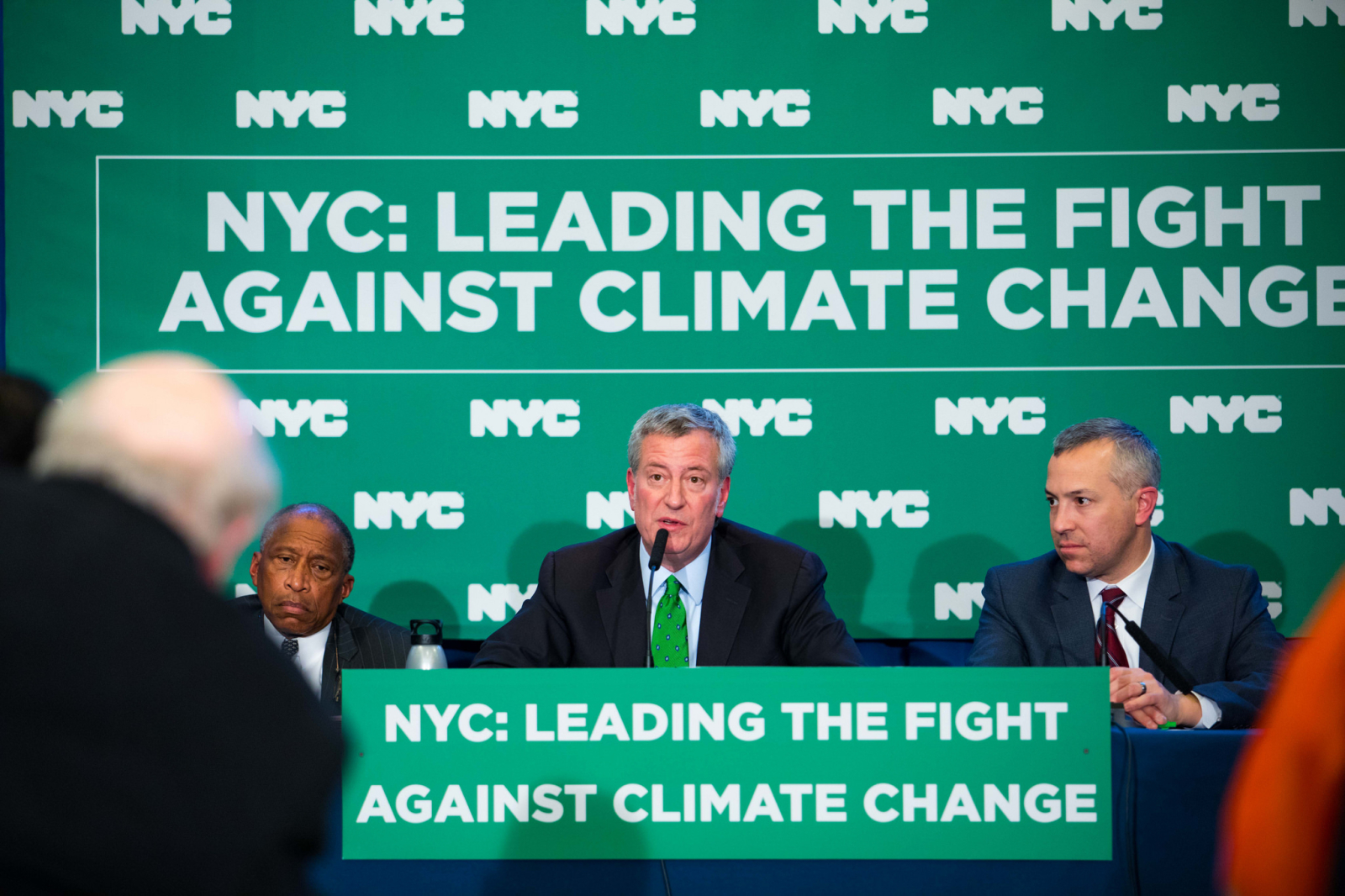
Jude Clemente writes at Real Clear Energy One Year Later, NYC’s Climate Lawsuit Wastes Taxpayer Money Excerpts below in italics with my bolds.
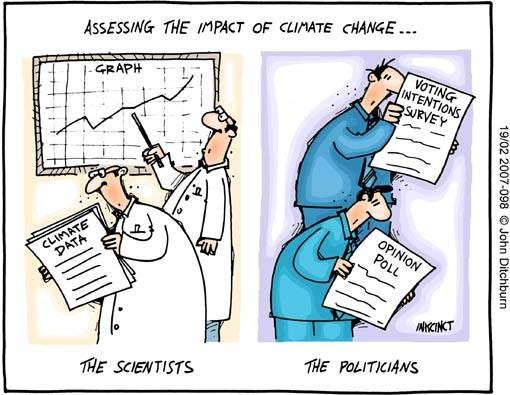
On January 10, 2018, New York City Mayor Bill de Blasio announced that he was suing five energy companies, seeking damages to pay for harm the city has faced as a result of climate change. In conjunction, the city also announced that it planned to divest its pension fund from fossil fuels. A year later, the city is seeking to revamp its legal strategy after the lawsuit’s swift dismissal in federal court and is no closer to divesting than it was before its big announcement.

While New York City has failed to achieve actionable results on these fronts, Mayor de Blasio has succeeded in one regard: boosting his liberal credentials as he contemplates a 2020 presidential run, a goal that may have been the motivation behind both announcements in the first place.

U.S. District Judge John Keenan dismissed New York City’s lawsuit shortly after it was filed, in part citing the hypocrisy of the city suing companies for producing a product it continues to rely on. “Does the city have clean hands?” Judge Keenan asked the city’s attorney, noting that Mayor de Blasio’s government, too, produces the emissions they say are responsible for the city’s climate change-related impacts.

Judge Keenan was not the first to rule in favor of the energy companies either. Less than one month before the New York City judge made his decision, U.S. District Court Judge William Alsup dismissed nearly identical lawsuits brought in California by the cities of San Francisco and Oakland. All three lawsuits are now being heard on appeal. Although, a recent change of counsel in California suggests that the New York case could stand less of chance now than it did the first time around.

In late November, the plaintiffs’ firm representing all three cities when they first filed their cases, Hagens Berman, was fired by San Francisco and Oakland and replaced with Sher Edling, Hagens Berman’s direct competitor in the climate litigation space. Mayor de Blasio, meanwhile, has continued to retain Hagens Berman, perhaps unconcerned with the final result of his case, so long as it attracts positive headlines praising his “climate leadership.”

That’s the take of at least one group who issued a statement critical of Mayor de Blasio on the anniversary of his announcement. “City officials, including Mayor de Blasio, have made clear that the true purpose of the lawsuit is to attack manufacturers and manufacturing workers,” said Linda Kelly, Senior Vice President and General Counsel of the National Association of Manufacturers.

Indeed, shortly after the city filed its climate lawsuit, Mayor de Blasio appeared as a guest on U.S. Senator Bernie Sanders’s (D-VT) podcast where he spoke about the case. “Let’s help bring the death knell to this industry that’s done so much harm,” Mayor de Blasio said of the recent announcements. His sentiments were echoed by New York City’s chief environmental lawyer, Susan Amron, who told a friendly crowd at last year’s Climate Week NYC, “[R]eally what we’re trying to do is affect the bottom line – the financial equation for the use of fossil fuels.”

This language – both from Mayor de Blasio and Amron – would seem to contradict the language of the city’s lawsuit. The case’s complaint reads, “The City does not seek to impose liability on Defendants for their direct emissions of greenhouse gases, and does not seek to restrain Defendants from engaging in their business operations.” New York City’s lawsuit explicitly denies that the city is seeking to restrict ongoing business operations, but Mayor de Blasio and Amron have both made comments publicly that imply otherwise.

Speculation that Mayor de Blasio has larger political aspirations – including a run for the White House – in his sights has been a through line throughout his tenure- a fact New Yorkers were quick to note at the time that his lawsuit was filed, calling it “more posturing than substance.” Before he seeks out Pennsylvania Avenue, however, Mayor de Blasio reportedly has room to focus on fulfilling the duties of his current office.

A recent article from The New York Times slammed “New York’s Vanishing Mayor” for being absent from work, finding that he averaged ten days in City Hall per month in 2018 and consequently “the practical mechanics of government are running less smoothly.” De Blasio responded by saying he has a “huge, ambitious agenda,” which he was working “at a great level of intensity…to get it done.”

There’s no doubt about the mayor’s ambitions, but attacking the energy companies that will keep his constituents warm through the winter and fuel his caravan of SUVs is a misguided approach to tackling climate change. There are many actions that can be taken to mitigate and address its effects. Spending taxpayer money to boost Mayor de Blasio’s national profile surely isn’t one of them.

Jude Clemente is the Editor at RealClearEnergy.

At this rate we are all going to freeze in the dark.

“Hottest Year” Misdirection

Once again Joe Public comes out smarter than politically correct opinion surveyors, fact checkers and journalists.  The latest evidence of elite blindness comes from a smart-alecky reporter writing at GlobalNews Survey says Canadians think Earth beat its heat record in only 10 of the last 18 years. They’re wrong Excerpts in italics with my bolds.

Ipsos polling agency released “Perils of Perception” on Wednesday.

It’s an annual international survey conducted in 37 countries that looks at whether respondents have accurate, or inaccurate ideas about major issues.

This one ranked Canada 11th out of 37 countries when it came to accurate understandings of major issues.

One area of misunderstanding — climate change.

The survey found that Canadians are underestimating the number of years that the planet Earth has set heat records over the last two decades.  Canadians estimated that Earth set heat records in 10 out of the last 18 years.

It also found that Canadians are overestimating the share of energy that they consume from renewable resources.

I’ll save the renewables issue for another day. (See Exaggerating  Green Energy Supply) This post will show the reporter’s dog ate his homework, because there are large holes in his information.  He didn’t do professional due diligence so I will investigate to put the record straight for him and anyone else misled by the press.

What Ipsos Asked and Thought Was the Right Answer

Q. The World Meteorological Organization collects annual global temperatures, to see whether they are rising or falling across the world. How many of the last 18 years have been the hottest for the world as a whole since they began collecting data in 1961?

A.  17 of the past 18 years have been the hottest since records began. However, every country in the study underestimates the global temperature rise over the past 18 years. The average estimate across the study was 9 years.

Misdirection #1  Framing the Question to Exclude Undesired Data

Note the question context:  The World Meteorological Organization collects annual global temperatures (. . . began collecting data in 1961), to see whether they are rising or falling across the world. When you go looking for the data, WMO directs you to three datasets produced by others:  Hadcrut (UK Met Office), NOAA (US agency) and Gistemp (NASA, US agency).  So the frame serves to exclude satellite-based datasets, and limit the expected answer to three land+ocean products.  And as many will know, those records go back to late 1800s, far earlier than 1961.  Apparently, the surveyors wanted to put anyone off from thinking temperatures were warmer in the 1930s or 40s.

Misdirection #2  Failing to Do the Math

Getting data right now out of US federal agencies is problematic since websites are shut down.  It seems many federal employees are taking leave in order to help reduce the government deficit.  Fortunately, the Met Office has a site ( here) providing the relevant annual global temperature anomalies from the three sources. I compiled a table which makes the asked for comparisons.

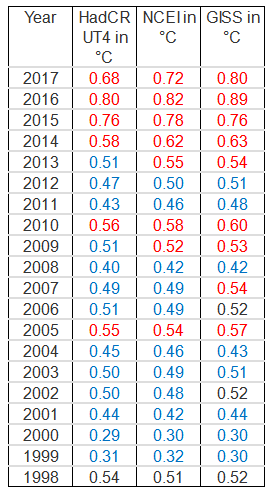
The table shows 1998 was the hottest of all preceding years in the record, with slightly different values in the three datasets.  Years in blue were cooler than 1998, while years in red were reported hotter than 1998.  The math says in the last two decades, compared to the previous record year 1998, there were 6 hotter years in Hadcrut4, 8 hotter years in NOAA (NCEI), and 9 hotter years in GISS. Considering “hottest” to mean hotter than all previous years, the table shows exactly 5 hottest years in the last 18 years, with 2016 setting the record.

Ipsos says 17 of the last 18 were the hottest. Really?  Epic Fail: That so-called “correct” answer is three times too high!  Around the world people said 9, and that’s much closer to the truth. Canadians said 10, perhaps biased higher by all the fake news around.

Misdirection #3  Failing to Do the Statistics

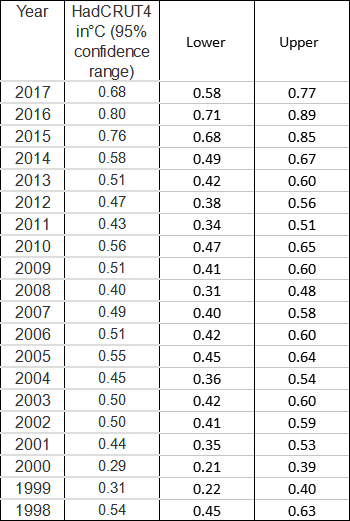
Now it may have occurred to you that some of the hotter years were not much warmer.  When you consider the 95% confidence intervals, some years fall out of the list.  For example, Hadcrut also provides each year a calculation of the upper and lower bounds on the error range, combining bias, measurement uncertainty and coverage uncertainty.

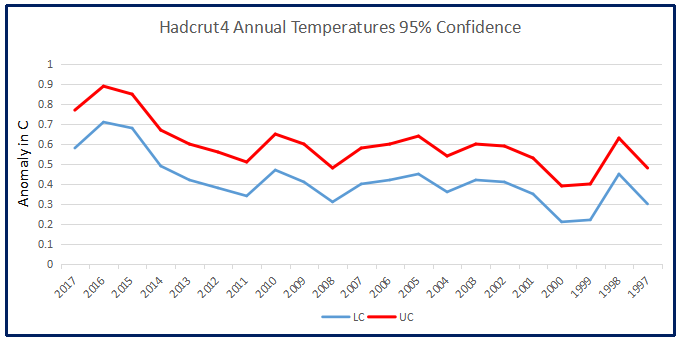
As the table shows, they estimate about +/- 0.09 for a typical year.  So for  1998, they say with 95% confidence the true anomaly lies between 0.45C and 0.63C.  Graphically the error range looks like this:

The chart shows that after considering the estimated uncertainty, it is actually the last three years that were hotter than 1998 in Hadcrut4.  The other land+ocean datasets have similar uncertainties and results (five hotter years in NOAA and GISS).

When it comes to UAH satellite dataset, we have this analysis:
University of Alabama Huntsville  Summary:
Globally, 2016 edged out 1998 by +0.02 C to become the warmest year in the 38-year satellite temperature record, according to scientists. Because the margin of error is about 0.10 C, this would technically be a statistical tie, with a higher probability that 2016 was warmer than 1998. The main difference was the extra warmth in the Northern Hemisphere in 2016 compared to 1998. Source: https://www.sciencedaily.com/releases/2017/01/170104130257.htm

No wonder they wanted UAH excluded.  And others say the confidence ranges are much larger than these estimates, which consider processing uncertainties not including errors of the instruments themselves.

Such characterizations are absurd, according to Richard Lindzen, a meteorology professor at MIT and one of the world’s foremost skeptics that global warming represents an existential threat.

“It’s typical misleading nonsense,” Lindzen said in an e-mail. “We’re talking about less than a tenth of degree with an uncertainty of about a quarter of a degree. Moreover, such small fluctuations – even if real – don’t change the fact that the trend for the past 20 years has been much less than models have predicted.”


Blame Everything on Climate Change

A recent editorial from Investor’s Business Daily Is There Anything Environmentalists Won’t Blame On Climate Change?  As you will see, experience shows the question is rhetorical.  Excerpts below with my bolds.

Climate Change: CNN published a huge story saying the source of the migrant caravan wasn’t so much corrupt Central American governments, violence or lousy economic policies. It was climate change. This is just the latest attempt by environmentalists to blame any and all bad news — even acne and animal bites — on climate change.

The CNN story, complete with pictures, videos and charts, claims that climate change is responsible for the drought in parts of Honduras, Guatemala, El Salvador and Nicaragua that forced thousands to flee for the U.S.

Well, not “responsible,” exactly. The author admits part way through that “Studies have not definitively tied this particular drought to climate change.”

Story Is Bunk
In other words, the entire premise of story is pretty much bunk. The best the CNN reporter could come up with is that “computer models show droughts like the one happening now are becoming more common as the world warms.”

Why would you need computer models to tell you what is supposedly happening right now? Probably because in the U.S., at least, there’s been no increase in droughts since the 1890s.

Unfortunately, playing fast and loose with the facts and jumping to wild conclusions is now the standard operating procedure when it comes to global warming.

This week also saw a bold headline declaring that “climate change was behind 15 weather disasters in 2017.” Again, not exactly. These events were “influenced” by it, the story said.

That’s a bit hard to swallow, too. Every adverse weather event is now somehow attributable to climate change. Whether it’s a big snowstorm, heavy rains, a dry spell, unusually cold weather, unusually hot weather, or anything that can be labeled as “unusual.”

At least those have something to do with the weather. These days, virtually anything bad that happens gets blamed on climate change.

Blaming Climate
Pick a topic and add “climate change” to it in a Google search and you’re likely to find some article or study suggesting a connection between the two.

This week, CNN ran another blame-climate-change-first story. This one claimed that the rate of animal bites “has increased over the past 10 years, according to Dr. Joseph Forrester, one of the authors of the study published Tuesday in the BMJ. He anticipates that it will continue to rise, partially because of climate change.”

Time magazine blamed mental health problems on climate change. “Trauma, post-traumatic stress disorder and depression all rank among the ailments linked to climate change,” the story said

Another story argued that global warming was connected to sexual violence.

EcoWatch warned pet owners that climate change was probably the reason their dogs have fleas because “climate change is creating an ideal habitat for pests.”

The Denver Post claimed that climate change was partly responsible for the decline in fertility rates.

Another article claimed a few years ago that “various skin disorders such as acne scars are the result of global warming and climate change.”

One website had collected examples of just about everything that’s been connected to global warming. There were hundreds of examples.

Why The Avalanche?
A beer shortage, a building collapse in England, the creation of ISIS, rising insurance premiums, kidney stones, prostitution, teenage drinking and homelessness are but a few.

Why the avalanche of such claims? One obvious reason: If you want to get attention to your story or cause, the best way to do so is to claim there’s some climate change connection.

Yet despite these endless tales of woe, the public remains indifferent. France had to back down on a modest increase in fuel taxes it had imposed specifically to fight global warming, after protests consumed the nation. Liberal Washington state overwhelmingly rejected a carbon tax. Countries that made solemn pledges to cut CO2 emissions three years ago as part of the Paris climate change agreement aren’t close to living up to them. Fighting climate change continues to rank at the bottom of the public’s list of priorities.

Common Sense
Most likely that’s because the public has far more common sense than environmentalists or the mainstream media. They know that bad things have always happened. There were devastating hurricanes, floods, droughts, starvation, deprivation, wars and other terrible tragedies — including acne — long before mankind started burning fossil fuel.

They also know that the climate is always changing. (Take a trip to the Grand Canyon if you don’t believe it.)

And the public knows that not everything bad that is happening today can possibly be the result of a less-than-1-degree Celsius increase in average global temperatures over the past 100 years.

Trying to convince people otherwise just exposes what a hoax the whole climate change mania has become.

Obsessing Over Global Temperatures


Reification is the Fallacy of Misplaced Concreteness. It is a mental process by which someone comes to believe that an abstraction (idea or concept) is a material, physical object in the real world. Mike Hulme observes that many people are obsessing over global temperatures, not realizing they are abstractions and not things to be feared. He provides calm and sensible views regarding global temperature reporting. The post at his blog is Climatism and the Reification of Global Temperature. Excerpts in italics with my bolds.

Over the last 40 years global-mean surface air temperature – ‘global temperature’ for short – has gained an extraordinary role in the science, politics and public discourse of climate change. What was once a number crudely calculated through averaging together a few dozen reasonably well-spaced meteorological time series, has become reified as an objective entity that simultaneously measures Earth System behaviour, reveals the future, regulates geopolitical negotiations and disciplines the human imagination. Apart perhaps from GDP rarely can so constructed an abstract entity have gained such power over the human world.

All of this is very nicely illustrated in a new paper published in the journal Geophysical Research Letters, titled ‘Predicted chance that global warming will temporarily exceed 1.5°C’. Doug Smith and 32 colleagues set out to develop a new capability to predict the likelihood that global temperature will exceed 1.5°C above pre-industrial levels, for a variety of durations upwards from a month, in the coming five years. The assumed importance of the study is suggested by the author team mobilising climate modelling and analysis capabilities at 17 institutions in 9 different countries.

But why is such an early warning system deemed necessary or useful? What power is being imputed to small increments of global temperature to alert future danger?

Smith and colleagues argue that forewarning of temporary excursions of global temperature above a certain threshold—1.5°C is the normative threshold aspired to in the Paris Agreement on Climate Change, even though 2°C is the threshold formally agreed—for periods even a little as a month is relevant for policy-makers. To make such a claim requires an extraordinary degree of abstraction.

Global temperature does not cause anything to happen. It has no material agency. It is an abstract proxy for the aggregated accumulation of heat in the surface boundary layer of the planet. It is far removed from revealing the physical realities of meteorological hazards occurring in particular places. And forecasts of global temperature threshold exceedance are even further removed from actionable early warning information upon which disaster risk management systems can work.

Global temperature offers the ultimate view of the planet—and of meteorological hazard—from nowhere.

I have argued elsewhere about the dangers of climate reductionism, a form of reasoning that lends disproportionate power in political and social discourse to climate model-based descriptions of the future. The adoption of forecasts of global temperature exceedance as an early warning index is a clear case of the related phenomenon of climatism. Similar to explanations of scientism—“the phenomenon whereby authority is implicitly granted to scientific and technical experts to define the meaning, scope and, by extension, [the] solution for public policy concerns”—climatism grants authority to an abstracted global climate, in this case to global temperature, to guide, direct and discipline human actions in the world.

The authors of this new study claim to have developed an operational system with annually updated forecasts of the likelihood of near-term global temperature threshold exceedance. The value of such forecasts is claimed to lie in the general media and public interest they would generate. Issuing such forecasts to the world at large may or may not generate public interest. But they would certainly reinforce the growing ideology of climatism. It is another step toward putting abstract and unsituated descriptions of a globalised climate at the heart of world affairs.

Offering forecasts of global temperature threshold exceedance as an operational proxy for risk and disaster management seems bizarre. Such early warnings would seem to assume that small fluctuations in global temperature contain meaningful and actionable information. But why is it significant to know that the chance of global temperature exceeding 1.5C for two months during the period 2019-2023 is, say, 25% rather than 10%?

Such nuanced differences in the likelihood of a threshold exceedance tell us nothing about the likelihood of real meteorological hazards faced by real people and structures in real places. At the very least the proposed forecasts fail to discriminate between the different causes of global temperature fluctuations—e.g. greenhouse gas accumulation, aerosol loading, ENSO events, solar variability. Each of these causes carry very different implications for the geographical distribution of meteorological hazards, even if global temperature is identical.

Humans are now agents of significant influence in the Earth System and human development trajectories carry a range of profound implications. But offering annual forecasts of near-term global temperature fluctuations as early warnings to (re-)direct these trajectories fails to recognise the situated and differentiated polities, values and visions that shape the world.

GDP has acquired the power to account for the economic health of nations and for the implied well-being of individuals. It has become the hegemonic index which national policies seek to maximise and an index which in turn passes judgement on the performance of governments. In a similar way, the ideology of climatism—aided by the reification of global temperature—narrows actions by the world’s governments to minimise this one index of planetary health.

This new paper by Smith et al. reinforces this reductionist move and discloses the powerful performativity of global temperature in the contemporary world.

Mike Hulme, 24 October 2018

Mike Hulme has been studying climate change for over thirty years and is today one of the most distinctive and recognisable voices speaking internationally about climate change in the academy, in public and in the media. He is currently Professor of Human Geography at the University of Cambridge and Fellow of Pembroke College. Previously, Mike Hulme was professor of climate change in the Science, Society and Sustainability (3S) Group in the School of Environmental Sciences at the University of East Anglia. He is author of Why We Disagree About Climate Change (2009) and Exploring Climate Change Through Science and In Society (2013). Website: http://www.mikehulme.org.

See also his common sense review of the science attributing extreme weather events to human agency. X-Weather is Back! Kerala edition

See Also Climate Reductionism

Brazil’s Brave Eco-Realism

Ricardo de Aquino Salles, former São Paulo’s Secretary of Environment, has been appointed by Jair Bolsonaro to head the Ministry of Environment Divulgação

Climate Change Is a Secondary Issue, Says Future Minister Of Environment is published at Folha de S.Paulo, December 8 2018. Excerpts in italics with my bolds.

Ricardo Salles says that until now, Brazilian environment policy decisions have been based on “guesswork”

Appointed on Sunday (9th) by president-elect Jair Bolsonaro (PSL), the future Minister of Environment Ricardo Salles classifies the debate around climate change as “pointless” at the moment.

Salles, a lawyer, told Folha that his goal is to “develop Brazil. We will preserve the environment with no ideology and in a very reasonable matter.”

“We will respect all those who work and bring Brazil forth, not only in farming but also in all industries, including infrastructure,” he said.

The future minister also said that there are practical issues to be addressed at the beginning of the administration, such as the preservation of soil and water, and recovering areas affected by deforestation. However, he declined to talk about climate change. “Right now this debate is pointless.”

Salles ran for House Representative for right-wing party Partido Novo in the 2018 elections but didn’t gain a seat. He is one of the founders of the conservative movement “Endireita Brasil” (Straighten Up, Brazil). When asked about how his relationship with environmentalists, Salles said: “Everyone will be respected and heard.”

Bolsonaro’s ideas for the Ministry of the Environment have been the target of controversy even before the election. During the campaign, he promised to merge the department with the Ministry of Agriculture but eventually backed out of the idea after pressure from environmentalists and ruralists.

Salles appointment comes in the wake of negative repercussions generated by the Brazilian government’s withdrawal from hosting the UN Climate Conference COP25 in 2019. Although the Ministry of Foreign Affairs has declared that the reason was lack of budget, Folha reported that those issues had already been resolved.

Footnote from Climate Home:

Salles served as secretary of environment in Sao Paulo state government, when centrist Geraldo Alckmin was governor and had ample support from Brazilian industry and agriculture groups to become minister. He leads a business-friendly organisation in Brazil called Movimento Endireita Brasil, that backs less bureaucracy and lower taxes.

The ministry of environment oversees hundreds of protected areas, which encompass almost 10% of Brazil’s territory. Most of them are in the Amazon. It also controls Ibama, an environmental agency which acts as a police force and is also in charge of the licensing process for oil wells, federal highways and hydroelectric plants.

Asked if Bolsonaro’s government would abandon the Paris Agreement, Salles said: “Let’s examine carefully the most sensitive points and, once the analysis is over [we will make the decision], remembering that national sovereignty over territory is non-negotiable”.

Salles ministry does not directly oversee Brazil’s participation in the Paris Agreement, but it works closely with the foreign office on the issue.

The appointed minister Salles said defending the environment was of “unquestionable value”. But said protections must comply with the rule of law and due legal process, echoing Bolsonaro’s view that the ministry of environment is controlled by a “militant ideology” that persecutes agribusiness.

Postscript:

This reminds of the uproar after Scott Pruitt was appointed to lead the US EPA.  In his hearings he rejected the false dichotomy:  If you are for the environment, you are against development; and if you are for development, you are against the environment.  Eventually Pruitt was forced out, partly due to his own missteps, but mostly due to his ideological enemies.  Let’s see how Salles fares against the same unbending opposition.


Don’t Base Policies on Climate Hysteria

Noah Rothman writes at Commentary: Climate Hysterics and Their Advocates
Satisfying histrionics never solved anything. Excerpts in italics with my bolds.

Exhuming this [fourth National Climate Assessment] report from its early grave, NBC’s “Meet the Press” focused on it extensively—probing lawmakers about the issue and devoting a panel segment to the political implications of its findings. American Enterprise Institute scholar Danielle Pletka attracted an unusual amount of attention for her remarks on the subject. In a brief soliloquy, she said that she doesn’t believe “we can have any doubt” about the existence of climate change, though we can join the scientific community in speculating about the precise degree to which human activity contributes to that change.

Pletka went on to note mitigating phenomena that, in her view, don’t receive due attention. The last two years were typified by the “biggest drop in global temperatures that we have had since the 1980s,” she said. Pletka added that carbon dioxide emissions in the U.S. are declining even after America pulled out of the Paris accords, and American industry has shifted away from burning so-called “dirty coal,” unlike its European counterparts.

The AEI scholar’s critics noted that extreme temperature fluctuation doesn’t tell us much about the climate, which is fair. But “dirty coal” burning in America is declining at a terminal rate despite the loosening regulatory climate, and the United States has led the world in CO2 emissions reductions even without a non-binding international treaty compelling it to do so. Pletka observed in closing that this was the work of industry, consumer preference, and capitalist innovation, and not oppressive central planning (which is entirely correct).

“We shouldn’t be hysterical” about the problem of climate change, Pletka concluded. You’d think she shot someone’s dog on live television.

On Twitter, investigative reporter Alex Kotch insisted that this “non-scientist” perspective was advanced in service to “the biggest fossil fuel polluters in the world, Koch Industries.” Attorney Max Kennerly contended that it was “inexcusable” to allow Pletka to opine at all on this subject. “This is PR for polluters, not journalism,” he barked. “This is crazy,” ABC News analyst Matt Dowd said. “Balance shouldn’t be the goal, truth should.” “People tune in to be informed not be subjected to propaganda,” former Think Progress founder Judd Legum tweeted. Former Vermont Gov. Howard Dean, Hawaii Sen. Brian Schatz, and controversial climatologist Michael Mann all attacked the network for giving Pletka a platform to discuss climate as it relates to public policy.

There was no such outrage over the response from Pletka’s counterpart, New York Times columnist and fellow “non-scientist” Helene Cooper, which tells you all you need to know about this ginned-up controversy. “I actually think we should be hysterical,” she said. “I think anybody who has children or anybody who can imagine having children and grandchildren, how can you look at them and think this is the kind of world that through our own inaction and our inability to do something, that we’re going to leave them?”

It’s a struggle to think of a long-term public policy crisis that was mitigated by mass hysteria, which is perhaps why Pletka’s many detractors can’t explain why Cooper’s brand of lay advocacy is more acceptable than her counterpart’s. Cooper also said that it was time for the political class to “force corporate leadership” to do something about climate change, demonstrating that she either hadn’t heard a word Pletka said or couldn’t refute her claims. But none of the usual suspects have expressed so much as a hint of disapproval over the gauzy sentimentalism and histrionics expressed by Cooper. That sort of dilettantism serves their purposes.

For Pletka’s detractors, the likely source of consternation wasn’t her professional expertise but her refusal to accept a straight-line projection at face value. That is, however, the only prudent course considering how many climate-related prognostications have not panned out. In 1990, the Intergovernmental Panel on Climate Change’s First Assessment Report’s predictions related to rates of warming and temperature changes were erroneous. The IPCC’s 2001 assessment that climate change would reduce the severity of snow storms did not materialize. The Arctic should be ice-free by now if climate scientists’ predictions were always accurate. As Abe Greenwald noted just last week, the scientific consensus around the rate of oceanic warming was successfully challenged not by the deliberate process of peer review but by a freelancing skeptic with time enough to critically parse the data. Given the failure of these near-term predictions to manifest, it’s only reasonable not to lend too much credence to a projection that takes us nearly 100 years into the future.

You might see now why some advocates prefer hysteria to caution and skepticism, and why those who shatter the serenity of the echo chamber are so valuable.

See also: The Problem with Climate Chicken Littles

Climate Tipping Points Quiz

The Problem with Climate Chicken Littles

Michael Walsh writes The Late Great (Again) Planet Earth in PJ Media. Excerpts in italics with my bolds. (Indented text is from George Monbiot, infamous alarmist).

Unexamined Premises

George Monbiot, the man who gave his name to the term “moonbat,” is back, like some hair-shirted lunatic screaming on a street corner, saying that we’re all doomed:

It was a moment of the kind that changes lives. At a press conference held by climate activists Extinction Rebellion last week, two of us journalists pressed the organisers on whether their aims were realistic. They have called, for example, for UK carbon emissions to be reduced to net zero by 2025. Wouldn’t it be better, we asked, to pursue some intermediate aims?

A young woman called Lizia Woolf stepped forward. She hadn’t spoken before, but the passion, grief and fury of her response was utterly compelling. “What is it that you are asking me as a 20-year-old to face and to accept about my future and my life? … This is an emergency. We are facing extinction. When you ask questions like that, what is it you want me to feel?” We had no answer.

Softer aims might be politically realistic, but they are physically unrealistic. Only shifts commensurate with the scale of our existential crises have any prospect of averting them. Hopeless realism, tinkering at the edges of the problem, got us into this mess. It will not get us out.

Now that there is some prime moonbattery, even by Monbiot’s soaring standards. What a 20-year-old female knows about anything is moot, but her notion that she is “facing extinction” is beyond delusional; in fact, it’s the product of having her head stuffed with the most self-evidently arrant nonsense of the modern era: “climate change.”

Since at least 1970, when the not-yet-late great Hal Lindsey told us we were all going to die in The Late Great Planet Earth, snake-oil salesmen and Chicken Littles around the world have joined forces to convince the rubes and the suckers that the Earth is, so to speak, on her last legs unless we do something right now. Lindsey’s book employed Bible “prophecy” to limn our destruction at the hands of the Antichrist and the return of Jesus sometime in the 1980s.

Well, you can’t go wrong betting against religious crackpots, and while the climate-change freaks are ostensibly secular, their approach to their unalterable dogma has all the hallmarks of a particularly nutty faith. Never mind that the data to which they so fearfully cling is either bogus or misinterpreted; combine that with the natural human tendency to think that the world as we know it began, and will end, with us — that everything is, to use one of their favorite words, “unprecedented” (if you pay no attention to history) — and you have a rich field for superstition wedded to calls for (what else?) immediate governmental action.

How Have Predictions on Catastrophic Climate Change Held Up Over the Last 30 Years?

So this was a bummer:

Researchers with UC San Diego’s Scripps Institution of Oceanography and Princeton University recently walked back scientific findings published last month that showed oceans have been heating up dramatically faster than previously thought as a result of climate change.

In a paper published Oct. 31 in the journal Nature, researchers found that ocean temperatures had warmed 60 percent more than outlined by the United Nation’s Intergovernmental Panel on Climate Change. However, the conclusion came under scrutiny after mathematician Nic Lewis, a critic of the scientific consensus around human-induced warming, posted a critique of the paper on the blog of Judith Curry, another well-known critic.

“The findings of the … paper were peer reviewed and published in the world’s premier scientific journal and were given wide coverage in the English-speaking media,” Lewis wrote. “Despite this, a quick review of the first page of the paper was sufficient to raise doubts as to the accuracy of its results.”

Co-author Ralph Keeling, climate scientist at the Scripps Institution of Oceanography, took full blame and thanked Lewis for alerting him to the mistake. “When we were confronted with his insight it became immediately clear there was an issue there,” he said. “We’re grateful to have it be pointed out quickly so that we could correct it quickly.”

Keeling said they have since redone the calculations, finding the ocean is still likely warmer than the estimate used by the IPCC. However, that increase in heat has a larger range of probability than initially thought — between 10 percent and 70 percent, as other studies have already found.

In other words, never mind. But that won’t stop the moonbats from flapping ever more vigorously. I just shoveled six inches of global warming off my patio here in rural New England, while California continues to burn — but all weather and weather-related events are of a piece with the Unified Field Theory of Everything: evil mankind (white, male, middle-aged) is killing Mother Gaia. Hence, the calls for “environmental justice,” which like all modified forms of “justice” equals punishment and payback.

Guru Monbiot again:

Public figures talk and act as if environmental change will be linear and gradual. But the Earth’s systems are highly complex, and complex systems do not respond to pressure in linear ways. When these systems interact (because the world’s atmosphere, oceans, land surface and lifeforms do not sit placidly within the boxes that make study more convenient), their reactions to change become highly unpredictable. Small perturbations can ramify wildly. Tipping points are likely to remain invisible until we have passed them. We could see changes of state so abrupt and profound that no continuity can be safely assumed.

Only one of the many life support systems on which we depend – soils, aquifers, rainfall, ice, the pattern of winds and currents, pollinators, biological abundance and diversity – need fail for everything to slide. For example, when Arctic sea ice melts beyond a certain point, the positive feedbacks this triggers (such as darker water absorbing more heat, melting permafrost releasing methane, shifts in the polar vortex) could render runaway climate breakdown unstoppable. When the Younger Dryas period ended 11,600 years ago, temperatures rose 10C within a decade.

Okay, George, who’s to blame?

The oligarchic control of wealth, politics, media and public discourse explains the comprehensive institutional failure now pushing us towards disaster. Think of Donald Trump and his cabinet of multi-millionaires; the influence of the Koch brothers in funding rightwing organisations; the Murdoch empire and its massive contribution to climate science denial; or the oil and motor companies whose lobbying prevents a faster shift to new technologies.

Sort of gives the game away, doesn’t it?

Two tasks need to be performed simultaneously: throwing ourselves at the possibility of averting collapse, as Extinction Rebellion is doing, slight though this possibility may appear; and preparing ourselves for the likely failure of these efforts, terrifying as this prospect is. Both tasks require a complete revision of our relationship with the living planet.

Because we cannot save ourselves without contesting oligarchic control, the fight for democracy and justice and the fight against environmental breakdown are one and the same. Do not allow those who have caused this crisis to define the limits of political action. Do not allow those whose magical thinking got us into this mess to tell us what can and cannot be done.

In other words, the sky is falling so we need nothing short of a Leftist political revolution to save ourselves, and even then it may be too late. As I often say on Twitter, I never take political advice from small children, and certainly not from 20-year-old hysterics. Besides, the world has weathered worse patches than this before: (from Harvard professor Michael McCormick )

Bubonic plague, famine, war and flu pandemics have made some periods of human history infamous for death and suffering but one year stands above the rest in terms of misery; 536 AD. According to research from a Harvard professor, it is a prime candidate for the unfortunate accolade of the worst year in the entirety of recorded history.

Europe, the Middle East, and parts of Asia were plunged into 18 months of solid darkness by a mysterious fog. It caused snowfall in China, continental-scale crop failure, extreme drought, famine and disease throughout most of the northern hemisphere. The bleak year was triggered by a cataclysmic Icelandic eruption, scientists say, and was an ominous omen for a bleak century of suffering and death.

The eerie fog created a drab world with darkness residing over the northern hemisphere for 18 months, with an unrelenting dusk persevering through day and night. Effects on the climate were so severe that the Irish chronicles tell of ‘a failure of bread from the years 536–539’. Temperatures in the summer of 536 fell between 1.5°C (2.7°F) and 2.5°C (4.5°F), initiating the coldest decade in the past 2,300 years.

And nary an SUV or a fossil fuel to blame, unless you count wood and turf. The blackout seems to have been caused (as subsequent, similar events like the 1816 “year without a summer” were) by a volcanic eruption, this one in Iceland. Amazing what climatological havoc Gaia can wreak when she puts her mind to it.

God knows whom or what the poor sods living in the ruins of the Roman Empire in the 6th century blamed for the weather — probably God, possible cow farts — but today’s True Believers no longer believe in God; rather, they believe in Man, as both the root of all evil and the last best hope of Earth, if only Man would have the decency to kill himself. Or at least kill the conservatives, so that poor little Lizia Woolf may thrive without fear of imminent extinction or another Orson Welles documentary.

See Also Climate Horror Show


UN Horror Show

Published at RealClearEnergy, Caleb Rossiter offers his review of the recently released UN horror movie The UN’s Terrifying, But Ever-Receding, Human-Caused Climate Catastrophe.  Excerpts below with my bolds.

Just in time for Halloween, the United Nations’ Intergovernmental Panel on Climate Change has released yet another in a 30-year stream of spooky stories: Global Warming of 1.5 Degree Celsius, an IPCC special report on the impacts of global warming of 1.5°C above pre-industrial levels.

Like its five predecessors, it makes terrifying predictions about human-caused climate catastrophes that are always just about to occur, unless governments reduce the level of the harmless trace gas carbon dioxide in the atmosphere from its current four-hundredths of one percent to the three hundredths it was before industrialization.

Notice that the title chosen by the UN gives the game away. It presents correlation as causation by implying that all the warming since pre-industrial times has been caused by industry. There’s no room here for a natural oscillation back from the well-documented lows of the 1700s, which themselves were rebounds from a higher temperature period in the 1400s. (See this NOAA chart).


So how will the UN engender so much fear that the public will agree to stop using fossil-fueled electricity to halt “climate change?” After all, the phrase in itself is benign and natural. With enough repetition as images of hurricanes play on the screen, however, climate change has come to be short-hand for fossil-fueled, civilization-threatening storms, droughts, and destruction of coastal cities and islands, a dubious hypothesis on which we are hilariously told “the debate is over.”

For years I assigned statistics students to pick any apocalyptic climate claim in the media and trace it back through the UN reports to its genesis in a scientific study. I knew they would discover that these reports are not scientific documents based on the peer review process, but political documents “approved by governments” and intended to scare the public into supporting constraints on the production and use of energy.

A powerful publicity machine magnifies the alarm, bombarding citizens with exaggerations and claims of certainty that are proven wrong as you dig down to their underlying scientific studies:

  • Public figures, news editors, and commentators make claims that are more alarmist than what individual IPCC authors say at the release of the report.
  • Individual IPCC authors make claims at the release of the report that are more alarmist than what the official press release says.
  • The official press release makes claims that are more alarmist than what the report’s summary for policy-makers says.
  • The summary for policy-makers makes claims that are more alarmist than the various chapters of the reports.
  • The chapters of the report make claims that are more alarmist than the studies they reference in the footnotes.

The studies referenced in the footnotes are often actually peer-reviewed and generally make cautious claims about a possible trend spotted in one or a small number of locations or in a global computer model.

Both types of studies are more speculative than definitive because, as they always acknowledge in the fine print, they are based on highly-uncertain measurements of highly-complex phenomena with many interacting causes, of which warming gasses generated by human activity are only one, and often a minor component.

For governments to make policy on such a hierarchy of exaggeration brings to mind James Madison’s warning: “A popular Government, without popular information, or the means of acquiring it, is but a Prologue to a Farce or a Tragedy; or perhaps both.”

The serial release of UN reports obscures the fact that the climate catastrophes they predict never occur. As the data contained deep in the bowels of this latest report again acknowledge, Mother Nature is simply not cooperating with the UN There has been no positive trend in hurricanes, floods, and droughts as carbon dioxide levels continue to rise.

Even the average global temperature (whose rise is supposed to increase disasters) has barely budged, only rising a third of the amount that has been repeatedly been predicted by the IPCC computer models.

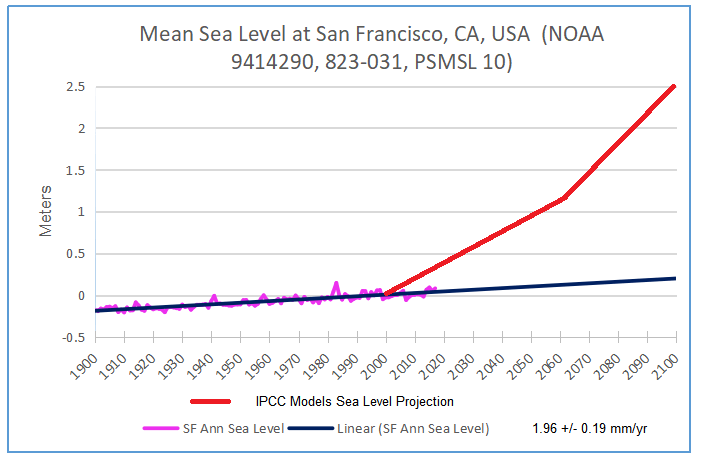
Sea levels, which are very difficult to measure due to human use of land and even to the natural rise and fall of land itself, chugs along at the same inch-per-decade that it has for thousands of years – not the terrifying 10 feet in a century warned about in previous reports. The islands and polar ice that we were repeatedly told would be gone by now are still there, and no closer to destruction.

The UN’s response to its failed predictions is simply to move the goal-posts, and make new dire predictions for some future date – in this case 2030. There is no reason to believe that this speculation will be any more accurate the ones that predicted human-induced climate catastrophes by certain dates, now passed.

But don’t be too frightened: the same governments who authorize the UN reports never take the steps needed to reduce the supposedly horrifying carbon dioxide level. Hidden behind their teeth-chattering fear of fossil fuels is their awareness that oil, gas, and coal have helped bring dramatic improvements in health, welfare, and life expectancy, and that alternative methods of generating power are currently available only at unacceptable economic (and hence political) cost.

Happy Halloween!

Caleb Rossiter, Ph.D., is the director of the American Exceptionalism Media Project, a fellow at The Texas Public Policy Foundation, and a former professor of statistics at American University.


IPCC Freakonomics

The latest unguided missile IPCC report came out of a South Korea meeting, and surprisingly the first media response was silence. Could it be some of them actually considered that these new claims and demands are so over the top that their audiences will guffaw and break with their media masters once and for all?

The graph illustrates the problem very clearly. Since 1992, the UN Framework Convention on Climate Change has met 23 times. These UNFCCC discussions have utterly failed to reduce CO2 emissions. Yet from 2020, emissions have to drop dramatically, if we are to stand a chance of keeping global warming below 1.5°C.
According to IPCC SR15 this will require an annual average investment of around US$2.4 trillion (at 2010 prices) between 2016 and 2035, representing approximately 2.5% of global gross domestic product (GDP). The cost of inaction and delay, however, will be many times greater. (sic).  Note:  This is referring to increasing investments in renewable energy from current US$335B per year to $2.4T.  Present global spending on Climate Crisis Inc. is estimated at nearly US$2T, not limited to renewables.  So this would double the money wasted spent on this hypothetical problem.

After their initial shock, like the lemmings they are, the news and opinion makers filled their pages and screens with end of the world proclamations, and continue to do so.

Elsewhere I have posted on the disconnect between reality and the IPCC scientific claims. The focus in this post is on the appalling economics piled on top. At IER Robert Murphy writes The IPCC Should Heed the Work of Nobel Laureate William Nordhaus. Excerpts in italics with my bolds.

One of the recurring themes of my work on the economics of climate change is that the very people who lecture the world on the dangers of “science denial” don’t actually follow their own advice. The recent announcement of the Nobel Prize in Economics, along with the release of the UN’s latest IPCC (Intergovernmental Panel on Climate Change) report, illustrates my claim perfectly. Specifically, William Nordhaus just won the Nobel for his work on basically inventing the economics of climate change. But while Nordhaus’ model shows that even a ceiling of 2° Celsius is too aggressive—with the costs outweighing the benefits—the media breathlessly tells the world that the latest “science” from the IPCC shows humanity that we have about a decade to implement draconian measures if we are going to achieve the goal of limiting warming to 1.5°Celsius.

The Media Announcements

From the Guardian:  We have 12 years to limit climate change catastrophe, warns UN
Urgent changes needed to cut risk of extreme heat, drought, floods and poverty, says IPCC

The following quotation comes from the New York Times article announcing this year’s joint winners of the Nobel (Memorial) Prize in Economics, namely William Nordhaus and Paul Romer. Note how the piece ties Nordhaus to the virtually simultaneous release of the latest IPCC report:

The 2018 Nobel Memorial Prize in Economic Science was awarded on Monday to the American economists William D. Nordhaus and Paul M. Romer for reshaping the understanding of the long-term determinants of economic growth.

Mr. Nordhaus was cited for his work on the implications of environmental factors, including climate change. Mr. Romer was cited for his work on the importance of technological change.

Mr. Nordhaus, a professor of economics at Yale University, pioneered the economic analysis of climate change. He is also a leading proponent of the use of carbon taxation to reduce emissions, a policy approach preferred by many economists.

The announcement of the award came the same day that a United Nations panel on climate change released a report warning of dire consequences from climate change and urging governments to respond to the problem with greater urgency. The report builds on and cites Mr. Nordhaus’s work. [New York Times, bold added.]

Now, any normal citizen reading the above two samples from our major media—who ostensibly are all up-to-speed on the “consensus” and would never dream of letting ideology get in the way of the empirical evidence—would be quite certain that William Nordhaus’ work supports the IPCC’s call to limit global warming to 1.5°C. And yet, as I’ll show in the next section, this is utterly false. Nordhaus’ work shows that such an ambitious climate change goal is far too aggressive.

Nordhaus on Proper Climate Policy

Now to be clear, I am a critic of Nordhaus’ work on climate change economics. Back in 2009 I wrote a peer-reviewed article criticizing his “DICE” model, and here at IER I’ve written articles (such as this one) arguing that Nordhaus misled the public in one of his popular articles on climate “skeptics.”

However, what I want to do in the current post is simply show that the guy who just won the Nobel Prize for his work on climate change economics does NOT support anything close to the IPCC’s latest announcement. This should show that, far from being “settled science,” the ever-increasing stridency of the calls for global action to combat climate change are more and more based on ideology and/or arbitrary decisions not tied to reasoned analysis.

For starters (and I thank David R. Henderson for reminding me of this salient point), as of DICE-2007 (i.e., Nordhaus’ model back in 2007), the climate goal of limiting global warming to 1.5°C was a horrible policy, which would make humanity $14 trillion (in present-value terms, in 2005 US$) poorer than doing nothing at all. (See Table 4 of my article to see the details.)

Now it’s true that the numbers have changed since 2007, and Nordhaus’ model would no longer give such a pessimistic assessment. However, back in 2013 Nordhaus argued in his then-new book on climate change that the optimal policy (depending on assumptions regarding participation among the world’s governments, etc.) would limit global warming from 2.3°C up to nearly 4°C, as Paul Krugman admits in his review of the book.

Please re-read my last sentence: As of 2013, William Nordhaus—who just won the Nobel Prize for his work on the economics of climate change—was saying the optimal path of global warming would allow for temperature increases of at least 2.3°C and possibly close to 4°C. Yet the IPCC’s media people are telling the world that we should really shoot for 1.5°C of warming to avoid catastrophe, and that the difference between 1.5°C versus 2.0°C is huge.

Chain of suppositions comprising Integrated Assessment Models.

Conclusion

I have serious reservations about the work of William Nordhaus and the other creators of so-called Integrated Assessment Models (IAMs), which are used to calculate the “social cost of carbon.” Yet to the extent that we are going to take IAMs at face value—and the major media touting Nordhaus’ Nobel certainly do—then they should give pause to those clamoring for aggressive government action. Although Nordhaus favors a carbon tax, his work shows that the recent goals announced by the IPCC are ludicrously aggressive, and would likely cause far more damage to economic growth than they would alleviate in terms of climate change.

Footnote:  Robert Murphy has a follow up article with additional analyses at MISES William Nordhaus vs. the U.N. on Climate Change Policy

In this article I will provide more details of just how Orwellian it is, that some pundits and reporters are linking Nordhaus with the IPCC’s latest announcement. More generally, this whole episode underscores the farce of the “social cost of carbon” (SCC) concept. The Obama Administration and academics like Nordhaus go through all of this work to generate estimates of the quantitative damage caused by carbon dioxide emissions, and then the United Nations goes ahead and recommends policies that aren’t even in the same ZIP code as what those “scientific” estimates entail. If anybody in this debate is a “denier,” it is the people claiming the IPCC’s latest pronouncements have anything to do with the peer-reviewed economics literature.

Robert Murphy also has this video clip of a presentation on climate economics (H/T Jim Rose)