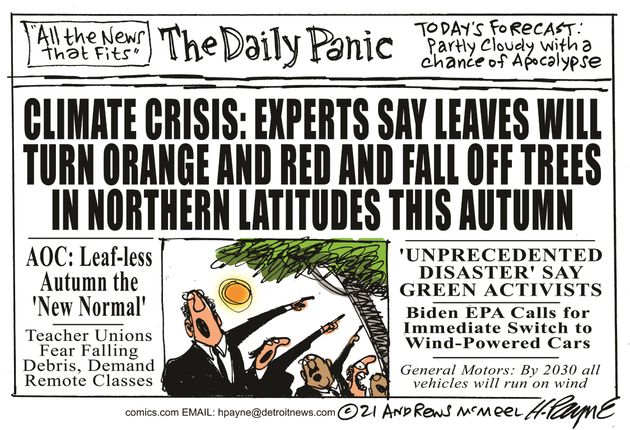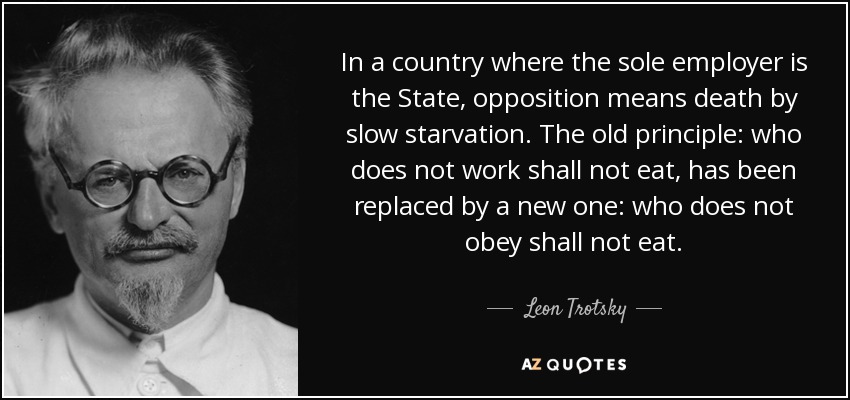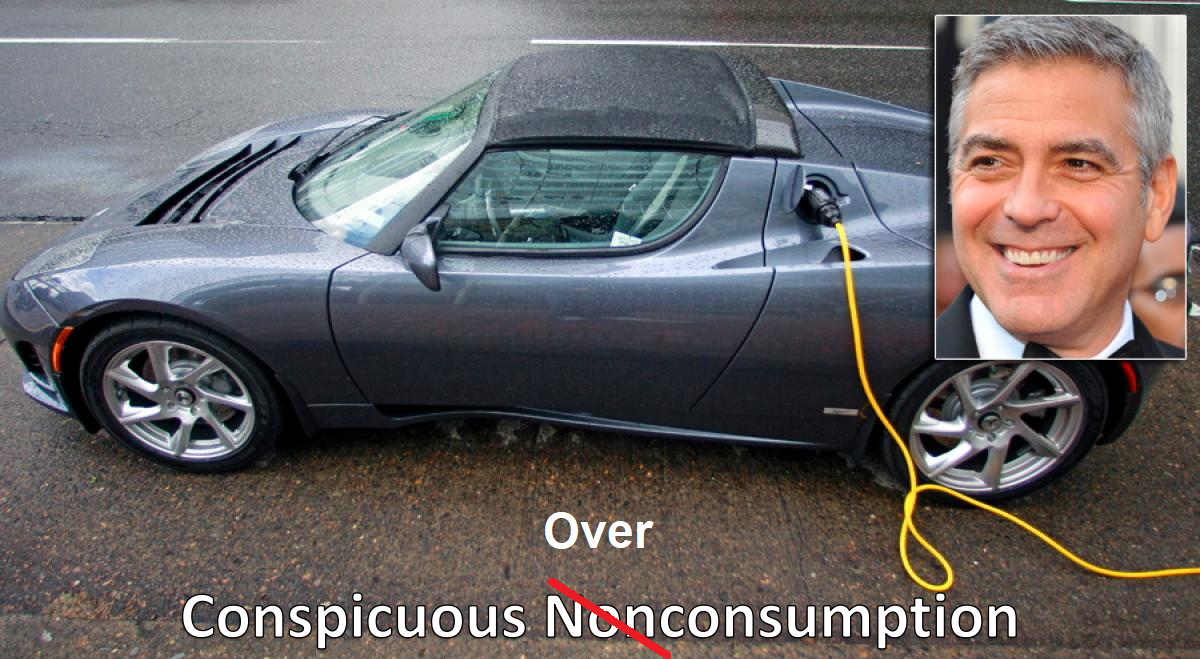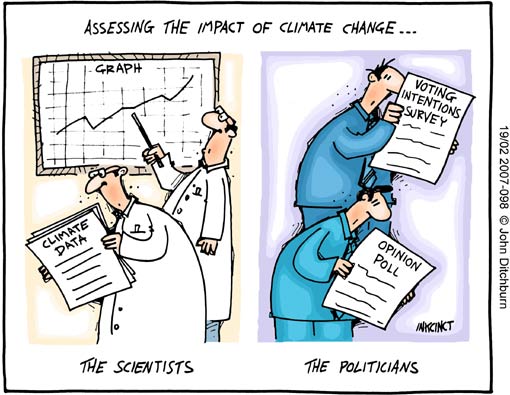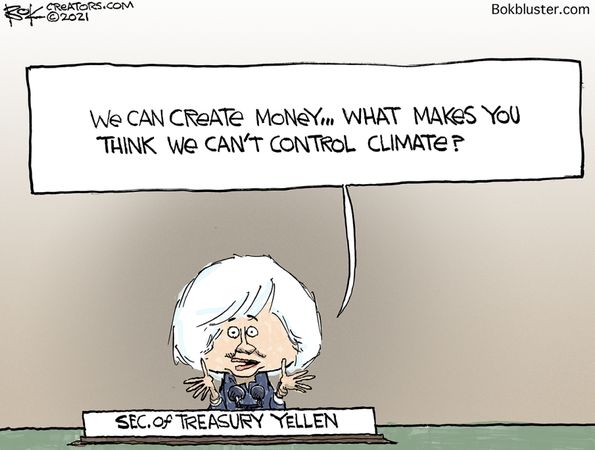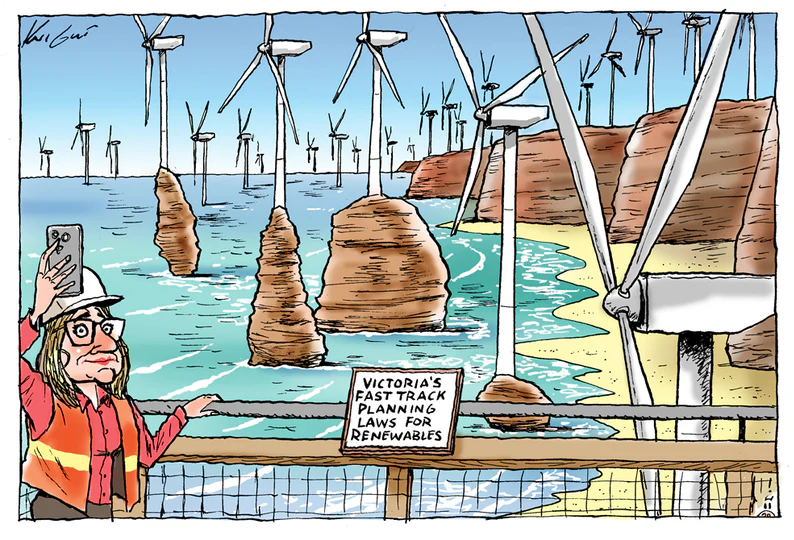
Fear + Ignorance = Climate Alarm

Mark C. Ross explains the syndrome in his American Thinker article Fear plus ignorance equals climate change.  Excerpts in italics with my bolds and added images.

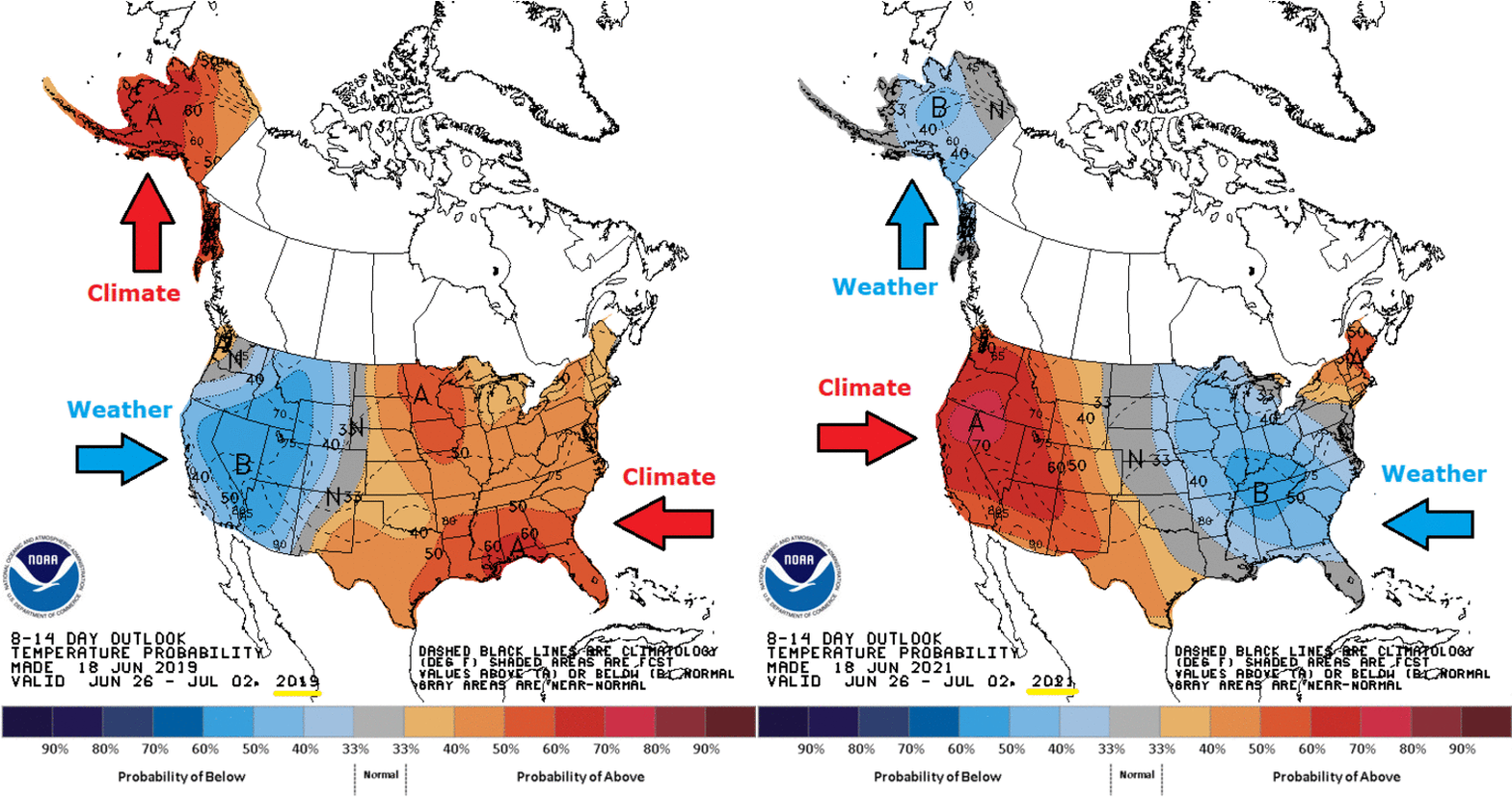
Weather is inherently mysterious. Multiple forces, such as wind, clouds, seasonal and day-night cycles, and air pressure are constantly interacting and causing continuous chaos. In the aftermath of two particularly destructive hurricanes, the fear-mongers are bloviating to the max over the catastrophic effects on the climate caused by human existence.

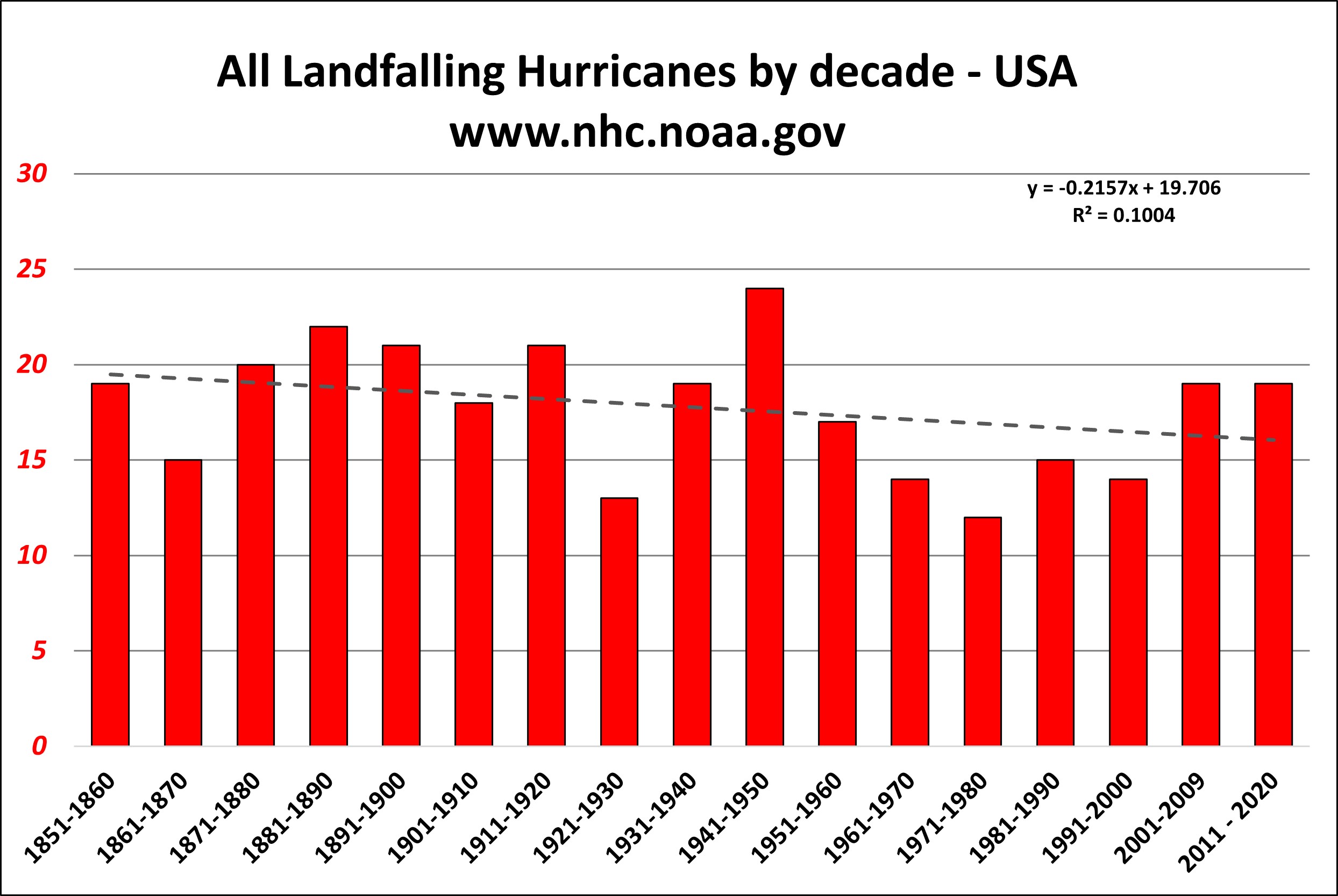
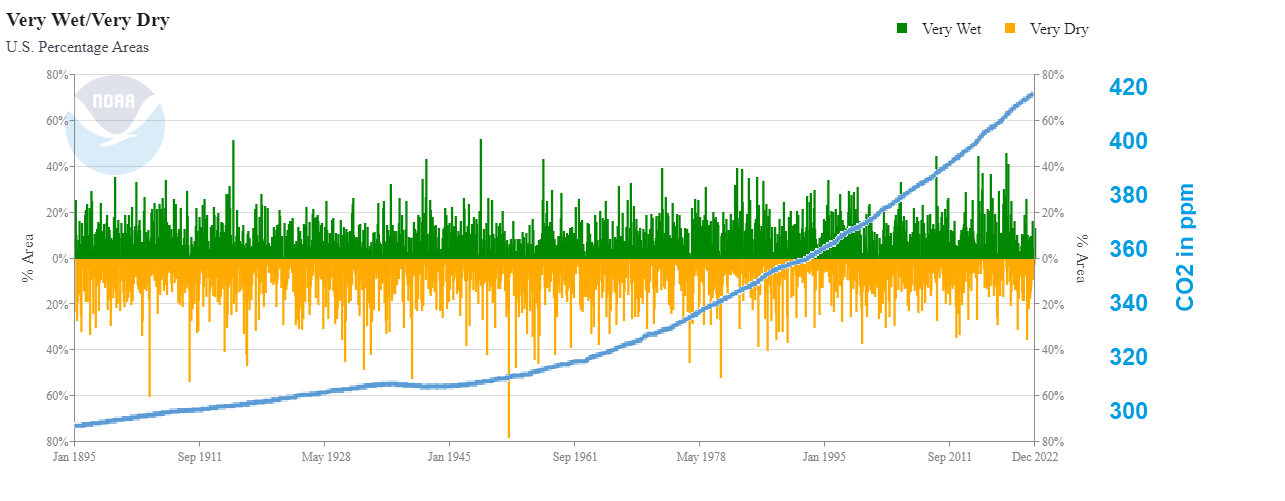
And yet there is no discernible trend toward either more storms or more intense hurricanes compiled over more than beyond the last century. (This chart by NOAA was especially easy to find.) Thus far, the decade of the 1940s saw the most seriously intense storms. Being historical data, this brings to mind a modification of Santayana’s famous adage: when people are ignorant of their history, they make it really easy for demagogues to lie to them about it.

Rather than human consumption of fossil fuels, two other factors are mostly relevant when it comes to the damage wrought by hurricanes: the path they take and the development of infrastructure within that path. Out on the open sea, a hurricane may damage a few ships, but when one goes over a population center…well, you know, it just happened.

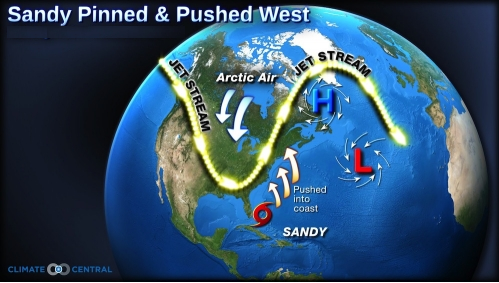
What determines the path is largely chaotic. Go figure. There’s this weird thing called the jet stream, which is sort of the result of the Earth’s continuous rotation within a tenuous atmospheric envelope. Becoming known to American aviators during World War 2, the particular details of the jet stream were kept as a military secret well into the mid-twentieth century. Ocean currents and surface temperatures are also involved. Early forecasts of hurricane paths are typically all over the map. As the time frame compresses, they tend to become more accurate, but not always.

Then there’s the “atypically” warm weather that sometimes happens in early autumn. We just had some of that, along with offshore winds and seriously elevated fire danger. In the olden days, this was called “Indian summer.” Back in 1919, Victor Herbert even wrote a song by that name. Maybe I’m just a cynic, but I’m expecting the fear-mongers to start pandering to the general public’s pervasive ignorance of earth science to cause panic over yet another routine weather event.

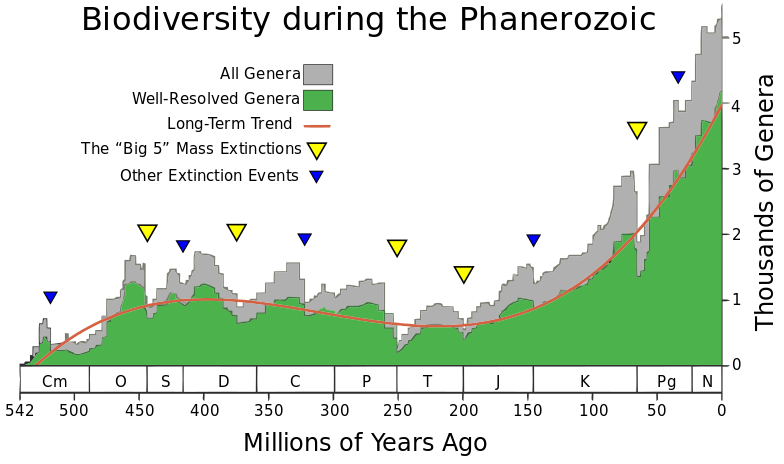
There are three scientific disciplines that are especially useful when looking at weather and climate of the distant past: geology; paleontology; and tree ring analysis, known as dendrochronology. Geology shows us the impact glaciers have had on the Earth’s surface. Paleontology shows us the now extinct life forms that thrived under previous environmental conditions. Dendrochronology shows us a preserved record of ancient weather conditions such as year-to-year rainfall and temperature.

How warm would the weather have to be for giant reptiles to flourish all over the Earth? Pretty warm, it seems. There is some work afoot to show that dinosaurs may have been warm-blooded. Good luck with that. Birds are the first known warm-blooded animals, and they evolved from reptiles and still tend to have scales on their legs. Mammals are also warm-blooded. Enormously large mammals such as wooly mammoths were common during the last ice age, the Pleistocene. Having a large size is especially beneficial for warm-blooded animals in cold climates, since surface area of the outer skin increases much more slowly than the actual body mass, making the large animal significantly more thermally efficient than a smaller one.

But why is the blatant climate change hoax still being promoted? There are two different reasons. The first is held among the true believers: humans are evil. They recklessly continue to damage the Earth’s biosphere, just for trivial benefits and without the slightest concern for the consequences of their actions. The other is political: fear can be a terrific motivator but is not all that conducive to good decision-making. That’s fine, too. The wannabe mega-state tyrants l-o-v-e to deal with fear and poor decision-making. How else can they effectively enslave the masses so as to fulfill their objectives?

And what are these objectives? Taking control of everything comes to mind. The evil players in politics are mostly after control. The rest of us just want to have the streets swept and the criminals pulled away from the rest of us. The term Statist should replace Marxist in this dialogue. Absolute government authority should overcome the self-direction of the individual — since so many among us are not really attuned to proper functionality in the modern world.

Socialism was already in the works when Karl Marx got involved. I like to say that a communist is an angry socialist. Marx injected class struggle into the quest for ownership of the means of production. Thus, the USA was a tough sell for Marxism since we are a particularly socially mobile society. The late, great Walter E. Williams would often say that the ranks of the one-percenters were constantly changing — since new ones would rise up, while others would blow it and fall away. The “Old World,” by contrast, is littered with caste systems and other forms of enforced social order.

Back to Caddell’s “elite gentry” — their desires are in mortal conflict with the aspirations of just plain folks. Or as Lincoln said, “God must love the common man, for he made so many of them.” To some, populism is a dirty word. To others, it is a path into the future. It can mean different things to different people. I like to use the term personal freedom. We can do what we want — as long as we don’t interfere with the freedom of others. But to others, “freedom” is a dirty word.

See Also:  Help For Those Alarmed About the Climate

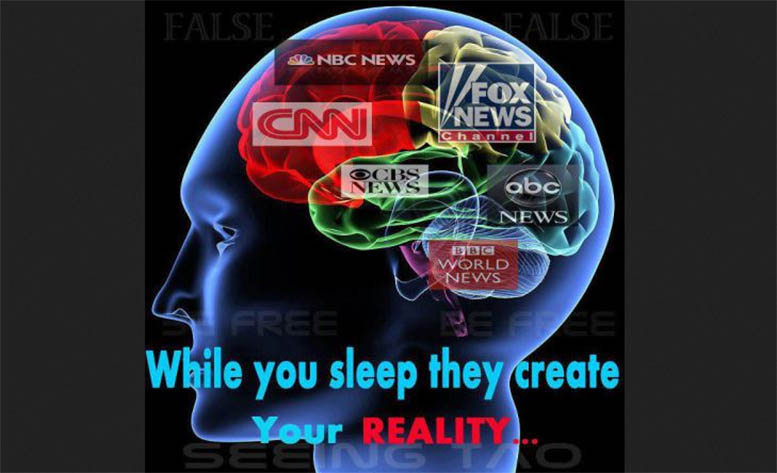
This is your brain on climate alarm.  Just say No!

Beware “Fact Checking” by Innuendo

Kip Hansen gives the game away in his Climate Realism article Illogically Facts —’Fact-Checking’ by Innuendo.  Excerpts in italics with my bolds and added images.

The latest fad in all kinds of activism to attack one’s ideological opponents via “fact checking”.    We see this in politics and all the modern controversies, including, of course, Climate Science.

Almost none of the “fact checking sites” and “fact checking organizations” actually check facts.  And, if they accidentally find themselves checking what we would all agree is a fact, and not just an opinion or point of view, invariably it is checked against an contrary opinion, a different point of view or an alternative fact.

The resulting fact check report depends on the purposes of the fact check.  Some are done to confirm that “our guy” or “our team” is proved to be correct, or that the opposition is proved to be wrong, lying or misinformation.  When a fact is found to be different in any way from the desired fact, even the tiniest way, the original being checked is labelled a falsehood, or worse, an intentional lie. (or conversely, other people are lying about our fact!).   Nobody likes a liar, so this sort of fake fact checking accomplishes two goals – it casts doubt on the not-favored fact supposedly being checked and smears an ideological opponent as a liar.  One stone – two birds.

While not entirely new on the fact-checking scene, an AI-enhanced effort has popped to the surface of the roiling seas of controversyLogically Facts.  “Logically Facts is part of Meta’s Third Party Fact-Checking Program (3PFC) and works with TikTok in Europe. We have been a verified signatory of the International Fact-Checking Network (IFCN) since 2020 and are a member of the Misinformation Combat Alliance (MCA) in India and the European Digital Media Observatory (EDMO) in Europe.”source ]   Meta? “Meta Platforms…is the undisputed leader in social media. The technology company owns three of the four biggest platforms by monthly active users (Facebook, WhatsApp, and Instagram).” “Meta’s social networks are known as its Family of Apps (FoA). As of the fourth quarter of 2023, they attracted almost four billion users per month.”   And TikTok?  It has over a billion users.

I’m doubting that one can add up the 4 billion and the 1 billion to make 5 billion users of META and TikTok combined, but in any case, that’s a huge percentage of humanity any way one looks at it.

And who is providing fact-checking to those billion of people?  Logically Facts [LF].

And what kind of fact-checking does LF do?  Let’s look at an example that will deal with something very familiar with readers here:  Climate Science Denial.

The definition put forward by the Wiki is:

Climate change denial (also global warming denial) is a form of science denial characterized by rejecting, refusing to acknowledge, disputing, or fighting the scientific consensus on climate change.”

Other popular definitions of climate change denial include: attacks on solutions, questioning official climate change science and/or the climate movement itself.

If I had all the time left to me in this world, I could do a deep, deep dive into the Fact-Checking Industry.  But, being limited, let’s look, together, at one single “analysis” article from Logically Facts:

‘Pseudoscience, no crisis’: How fake experts are fueling climate change denial

This article is a fascinating study in “fake-fact-checking by innuendo”. 

As we go through the article, sampling its claims, I’ll alert you to any check of an actual fact – don’t hold your breath.   If you wish to be pro-active, read the LF piece first, and you’ll have a better handle on what they are doing.

The lede in their piece is this:

“Would you seek dental advice from an ophthalmologist? The answer is obvious. Yet, on social media, self-proclaimed ‘experts’ with little to no relevant knowledge of climate science are influencing public opinion.” 

The two editors of this “analysis” are listed as Shreyashi Roy [MA in Mass Communications and a BA in English Literature] and Nitish Rampal [ … based out of New Delhi and has …. a keen interest in sports, politics, and tech.]  The author is said to be [more on “said to be” in a minute…] Anurag Baruah [MA in English Language and a certificate in Environmental Journalism: Storytelling earned online from the Thompson Founation.]

Why do you say “said to be”, Mr. Hansen?  If you had read the LF piece, as I suggested, you would see that it reads as if it was “written” by an AI Large Language Model, followed by editing for sense and sensibility by a human, probably, Mr. Baruah, followed by further editing by Roy and Rampal.
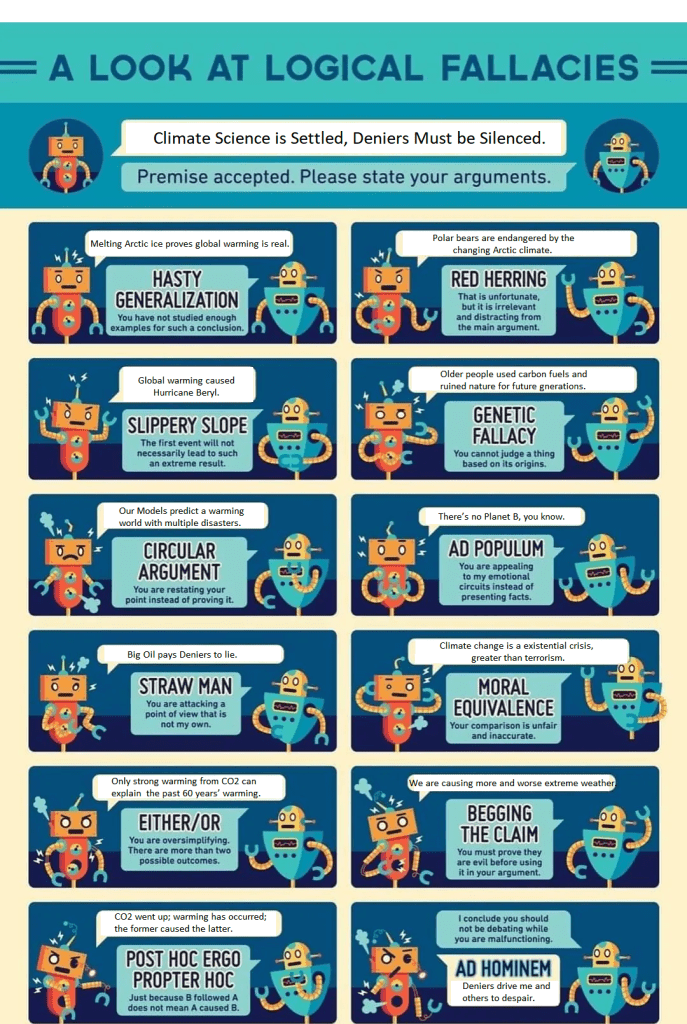
The lede is itself an illogic.  First it speaks of medical/dental advice, pointing out, quite rightly, that they are different specializations.  But then complains that unnamed so-called self-proclaimed experts who LF claims “have little to no relevant knowledge of climate science” are influencing public opinion.   Since these persons are so-far unnamed, LF’s AI, author and subsequent editors could not possibly know what their level of knowledge about climate science might be.

Who exactly are they smearing here?

The first is:

“One such ‘expert,’ Steve Milloy, a prominent voice on social media platform X (formerly Twitter), described a NASA Climate post (archive) about the impact of climate change on our seas as a “lie” on June 26, 2024.”

It is absolutely true that Milloy, who is well-known to be an “in-your-face” and “slightly over the-top” critic of all things science that he considers poorly done, being over-hyped, or otherwise falling into his category of “Junk Science”, posted on X the item claimed. 

LF , its AI, author and editors make no effort to check what fact/facts
Milloy was calling a lie, or to check NASA’s facts in any way whatever.

You see, Milloy calling any claim from NASA “a lie” would be an a priori case of Climate Denial: he is refuting or refusing to accept some point of official climate science.
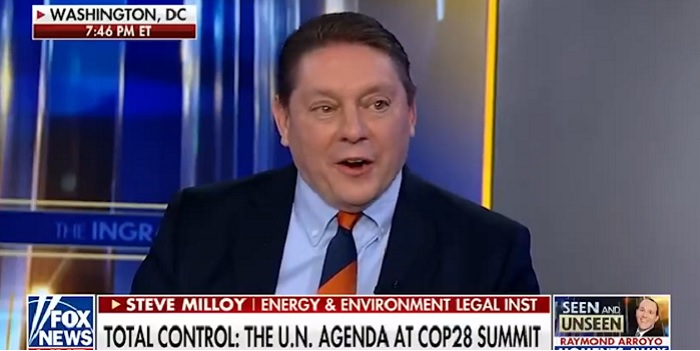
Who is Steve Milloy? 

Steve Milloy is a Board Member & Senior Policy Fellow of the Energy and Environment Legal Instituteauthor of seven books and over 600 articles/columns published in major newspapers, magazines and internet outlets.  He has testified by request before the U.S. Congress many times, including on risk assessment and Superfund issues.  He is an Adjunct Fellow of the National Center for Public Policy Research.

“He holds a B.A. in Natural Sciences, Johns Hopkins University; Master of Health Sciences (Biostatistics), Johns Hopkins University School of Hygiene and Public Health; Juris Doctorate, University of Baltimore; and Master of Laws (Securities regulation) from the Georgetown University Law Center.”

It seems that many consider Mr. Milloy to be an expert in many things.

And the evidence for LF’s dismissal of Milloy as a “self-proclaimed expert”  having “little to no relevant knowledge of climate science”?  The Guardian, co-founder of the climate crisis propaganda outfit Covering Climate Nowsaid “JunkScience.com, has been called “the main entrepôt for almost every kind of climate-change denial”” and after a link listing Milloy’s degrees, pooh-poohed him for “lacking formal training in climate science.”  Well, a BA in Natural Sciences might count for something. And a law degree is not nothing. The last link which gives clear evidence that Milloy is a well-recognized expert and it is obvious that the LF AI, author, and editors either did not read the contents of the link or simply chose to ignore it.
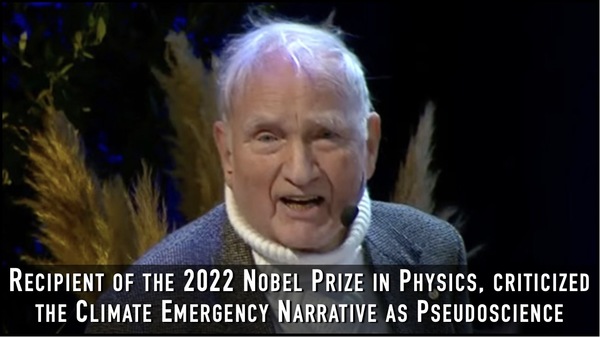
Incredibly, LF’s next target is “… John Clauser, a 2022 Nobel Prize winner in physics, claimed that no climate crisis exists and that climate science is “pseudoscience.” Clauser’s Nobel Prize lent weight to his statements, but he has never published a peer-reviewed paper on climate change.“

LF’s evidence against Clauser is The Washington Post in an article attacking not just Clauser, but a long list of major physicists who do not support the IPCC consensus on climate change:  Willie Soon (including the lie that Soon’s work was financed by fossil fuel companies) , Steve Koonin, Dick Lindzen and Will Happer.   The Post article fails to discuss any of the reasons these esteemed, world-class physicists are not consensus-supporting club members. 

Their non-conforming is their crime.  No facts are checked.

LF reinforces the attack on world-renown physicists with a quote from Professor Bill McGuire:  “Such fake experts are dangerous and, in my opinion, incredibly irresponsible—Nobel Prize or not. A physicist denying anthropogenic climate change is actually denying the well-established physical properties of carbon dioxide, which is simply absurd.”

McGuire, is not a physicist and is not a climate scientist, but has a PhD in Geology and is a volcanologist and an IPCC contributor.   He also could be seen as “lacking formal training in climate science.”

But, McGuire has a point, which LF, its AI and its human editors seem to miss, the very basis of the CO2 Global Warming hypothesis is based on physics, not based on what is today called “climate science”. Thus, the physicists are the true experts . (and not the volcanologists….)

LF then launches into the gratuitous comparison of “fake experts” in the anti-tobacco fight, alludes to oil industry ties, and then snaps right to John Cook.

John Cook, a world leader in attacking Climate Change Denial, is not a climate scientist.  He is not a geologist, not an atmospheric scientist, not an oceanic scientist, not a physicist, not even a volcanologist.   He  “earned his PhD in Cognitive Science at the University of Western Australia in 2016”.

The rest of the Logically Facts fake-analysis is basically a re-writing of some of Cook’s anti-Climate Denialists screeds.  Maybe/probably resulting from an AI large language model trained on pro-consensus climate materials.  Logically Facts is specifically and openly an AI-based effort.

LF proceeds to attack a series of persons, not their ideas, one after another:  Tony Heller, Dr. Judith Curry, Patrick Moore and Bjørn Lomborg.

The expertise of these individuals in their respective fields
are either ignored or brushed over.

Curry is a world renowned climate scientist, former chair of the School of Earth and Atmospheric Sciences at the Georgia Institute of Technology.  Curry is the author the book on Thermodynamics of Atmospheres and Oceans, another book on Thermodynamics, Kinetics, and Microphysics of Clouds, and the marvelous groundbreaking Climate Uncertainty and Risk: Rethinking Our Response.  Google scholar returns over 10,000 references to a search of “Dr. Judith Curry climate”.

Lomborg is a socio-economist with an impressive record, a best selling author and a leading expert on issues of energy dependence, value for money spent on international anti-poverty and public health efforts, etc.   Richard Tol, is mention negatively for daring to doubt the “97% consensus”, with no mention of his qualifications as a Professor of Economics and a Professor of the Economics of Climate Change.

Bottom Line:

Logically Facts is a Large Language Model-type AI, supplemented by writers and editors meant to clean-up the mess returned by this chat-bot type AI.    Thus, it is entirely incapable to making any value judgements between repeated slander, enforced consensus views, the prevailing biases of scientific fields and actual facts.  Further, any LLM-based AI is incapable of Critical Thinking and drawing logical conclusions.

In short, Logically Facts is Illogical.
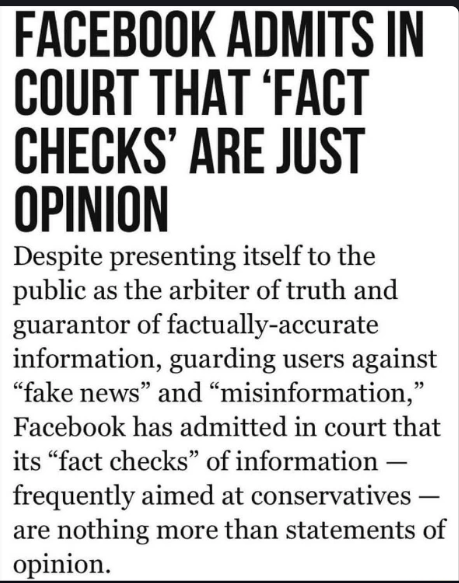
Defence offered by Facebook in Stossel defamation lawsuit.

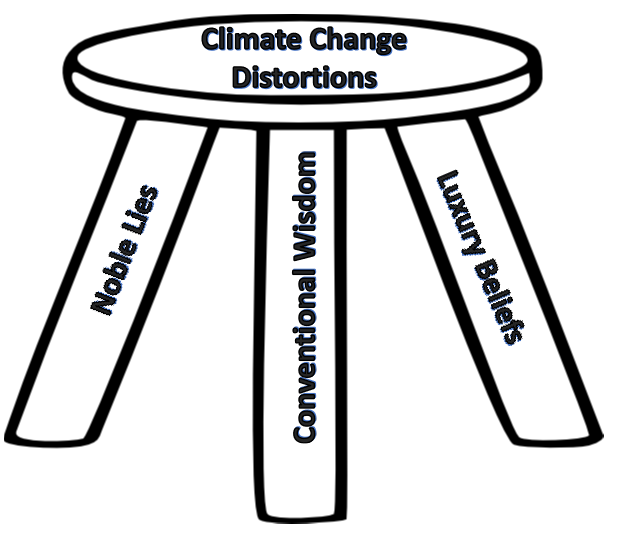
Roots of Climate Change Distortions

Roger Pielke Jr. explains at his blog Why Climate Misinformation Persists.  Excerpts in italics with my bolds and added images. H/T John Ray

Noble Lies, Conventional Wisdom, and Luxury Beliefs

In 2001, I participated in a roundtable discussion hosted at the headquarters of the National Academy of Sciences (NAS) with a group of U.S. Senators, the Secretary of Treasury, and about a half-dozen other researchers. The event was organized by Idaho Senator Larry Craig (R-ID) following the release of a short NAS report on climate to help the then-new administration of George W. Bush get up to speed on climate change.

At the time I was a 32 year-old fresh-faced researcher about to leave the National Center for Atmospheric Research for a faculty position across town at the University of Colorado. I had never testified before Congress or really had any high-level policy engagement.

When the roundtable was announced, I experienced something completely new in my professional career — several of my much more senior colleagues contacted me to lobby me to downplay or even to misrepresent my research on the roles of climate and society in the economic impacts of extreme weather. I had become fairly well known in the atmospheric sciences research community back then for our work showing that increasing U.S. hurricane damage could be explained entirely by more people and more wealth.

One colleague explained to me that my research, even though scientifically accurate, might distract from efforts to advocate for emissions reductions:

“I think we have a professional (or moral?) obligation to be very careful what we say and how we say it when the stakes are so high.”

At the time, I wrote that the message I heard was that the “ ends justify means or, in other words, doing the “right thing” for the wrong reasons is OK” — even if that meant downplaying or even misrepresenting my own research.

I have thought about that experience over the past few weeks as I have received many comments on the first four installments of the THB series Climate Fueled Extreme Weather (Part 1Part 2Part 3Part 4). One of the most common questions I’ve received asks why it is that the scientific assessments of the Intergovernmental Panel on Climate Change (IPCC) are so different than what is reported in the media, proclaimed in policy, and promoted by the most public-facing climate experts. And, why can’t that gap be closed?

Over the past 23 years, I have wondered a lot myself about this question — not just how misinformation arises in policy discourse (we know a lot about that), but why it is that the expert climate community has been unable or unwilling to correct rampant misinformation about extreme weather, with some even promoting that misinformation.

Obviously, I don’t have good answers, but I will propose three inter-related explanations that help me to make sense of these dynamics — the noble lie, conventional wisdom, and luxury beliefs.

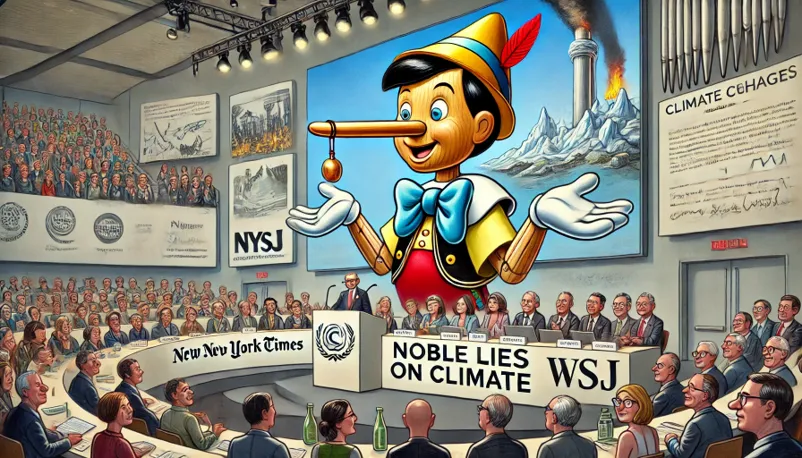
The Noble Lie

The most important explanation is that many in the climate community — like my senior colleague back in 2001 — appear to believe that achieving emissions reductions is so very important that its attainment trumps scientific integrity. The ends justify the means. They also believe that by hyping extreme weather, they will make emissions reductions more likely (I disagree, but that is a subject for another post).

I explained this as a “fear factor” in The Climate Fix:

Typically, the battle over climate-change science focused on convincing (or, rather, defeating) those skeptical has meant advocacy focused on increasing alarm. As one Australian academic put it at a conference at Oxford University in the fall of 2009: “The situation is so serious that, although people are afraid, they are not fearful enough given the science. Personally I cannot see any alternative to ramping up the fear factor.” Similarly, when asked how to motivate action on climate change, economist Thomas Schelling replied, “It’s a tough sell. And probably you have to find ways to exaggerate the threat. . . [P]art of me sympathizes with the case for disingenuousness. . . I sometimes wish that we could have, over the next five or ten years, a lot of horrid things happening—you know, like tornadoes in the Midwest and so forth—that would get people very concerned about climate change. But I don’t think that’s going to happen.” From the opening ceremony of the Copenhagen climate negotiations to Al Gore’s documentary, An Inconvenient Truth, to public comments from leading climate scientists, to the echo-chambers of the blogosphere, fear and alarm have been central to advocacy for action on climate change.

It’s just a short path from climate fueled extreme weather
to the noble lie at the heart of fear-based campaigns.

Conventional Wisdom

The phrase was popularized by John Kenneth Galbraith in his 1958 book, The Affluent Society, where he explained:

It will be convenient to have a name for the ideas which are esteemed at any time for their acceptability, and it should be a term that emphasizes this predictability. I shall refer to these ideas henceforth as the conventional wisdom.

The key point here is “acceptability” regardless of an idea’s conformance with truth. Conventional wisdom is that which everyone knows to be true whether actually true or not. Examples of beliefs that at one time or another were/are conventional wisdom include — Covid-19 did not come from a lab, Sudafed helps with hay fever, spinach is high in iron, and climate change is fueling extreme weather.

As the noble lie of climate fueled extreme weather has taken hold as conventional wisdom, few have been willing to offer correctives — Though there are important exceptions out in plain sight, like the IPCC Working Group 1 and the NOAA GFDL Hurricanes and Global Warming page.

Actively challenging conventional wisdom has professional and social costs. For instance, those who suggested that Covid-19 may have had a research-related origin were labeled conspiracy theorists and racists, those who suggested that President Biden was too old to serve another term were called Trump enablers, and those who accurately represent the science of climate and extreme weather are tarred as climate deniers and worse.

A few years ago I wrote an op-ed for a U.S. national newspaper and included a line about how hurricane landfalls had not increased in the U.S. in frequency or in their intensity since at least 1900. The editor removed the sentence and told me that while the statement was correct, most readers wouldn’t believe it and that would compromise the whole piece.

When noble lies become conventional wisdom,
they become harder to correct.

Luxury Beliefs

Yascha Mounk offers a useful definition:

Luxury beliefs are ideas professed by people who would be much less likely to hold them if they were not insulated from, and had therefore failed seriously to consider, their negative effects.

After all, what is the real harm if people believe in climate fueled extreme weather? If people believe that the extreme weather outside their window or on their feeds make aggressive climate policies more compelling, then that’s a good thing, right?

Surely there can only be positive outcomes that result from promoting misunderstandings of climate and extreme weather at odds with evidence and scientific assessments?

Well, no.

Last year I attended a forum at Lloyd’s of London — the event was held under the Chatham House rule, and in the event, later reported by the Financial Times, the company made a surprising admission contrary to the conventional wisdom (emphasis added):

Lloyd’s of London has warned insurers that the full impact of climate change has yet to translate into claims data despite annual natural catastrophe losses borne by the sector topping $100bn.

Insurance prices are surging as companies look to repair their margins after years of significant losses from severe weather to insured properties, exacerbated by inflation in rebuild costs. A warming planet has been identified by insurance experts and campaigners alike as a key factor.

But at a private event last month, one executive at the corporation that oversees the market told underwriters that it has not yet seen clear evidence that a warming climate is a major driver in claims costs.

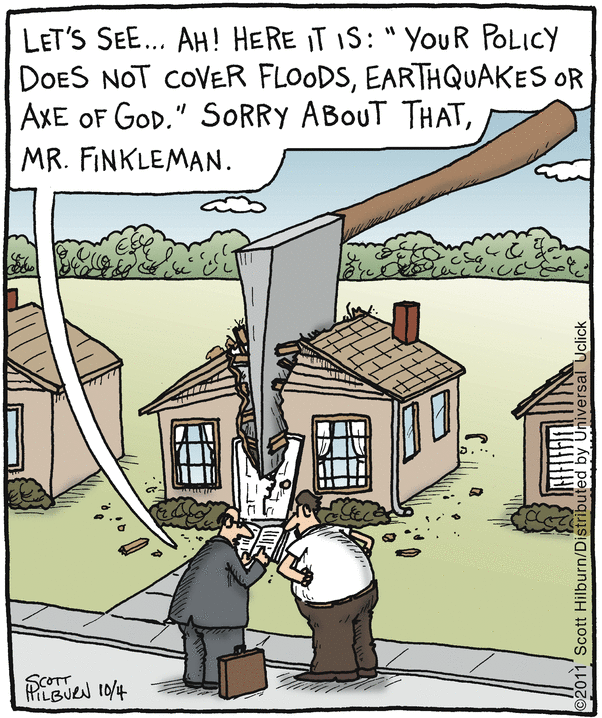
It turns out that misunderstandings of the science of climate and extreme weather actually lead to unnecessary costs for people whose jobs involve making decisions about climate and extreme weather. Those unnecessary costs often trickle down to ordinary people. Kudos to Lloyd’s for calling things straight, even if only in a private forum — That is of course their professional responsibility.

Conclusion

In a classic paper in 2012, the late Steve Rayner explained that some forms of social ignorance are created and maintained on purpose:

To make sense of the complexity of the world so that they can act, individuals and institutions need to develop simplified, self-consistent versions of that world. The process of doing so means that much of what is known about the world needs to be excluded from those versions, and in particular that knowledge which is in tension or outright contradiction with those versions must be expunged. This is ‘uncomfortable knowledge’.

Climate fueled extreme weather is perhaps the canonical example
of dysfunctional socially constructed ignorance.  It may be
uncorrectable — a falsehood that persists permanently.

Here at THB, I am an optimist that science and policy are self-correcting, even if that takes a while. That means that the series on climate fueled extreme weather will keep going — Have a great weekend!


Fantasies of Clever Climate Policies

Chris Kenny writes at The Australian Facts at a premium in blustery climate debate. Excerpts in italics from text provided by John Ray at his blog, Greenie Watch.  My bolds and added images.

Collective Idiocy From Intellectual Vanity

We think we are so clever. The conceit of contemporary humankind is often unbearable.  Yet this modern self-regard has generated a collective idiocy, an inane confusion between feelings and facts, and an inability to distinguish between noble aims and hard reality.

This preference for virtue signalling over practical action can be explained only by intellectual vanity, a smugness that over-estimates humankind’s ability to shape the world it inhabits.

As a result we have a tendency to believe we are masters of the universe, that we can control the climate and regulate natural disasters. Too lazy or spoiled to weigh facts and think things through, we are more susceptible than ever to mass delusion.

We have seen this tendency play out in deeply worrying ways, such as the irrational belief in the communal benefits of Covid vaccination despite the distinct lack of scientific evidence. Too many people just wanted to believe the vaccine had this thing beaten.

Still, there is no area of public debate where rational thought is more readily cast aside than in the climate and energy debate. This is where alarmists demand that people “follow the science” while they deploy rhetoric, scare campaigns and policies that turn reality and science on their heads.

This nonsense is so widespread and amplified by so many authoritative figures that we have become inured to it. Teachers and children break from school to draw attention to what the UN calls a “climate emergency” as the world lives through its most populous and prosperous period in history, when people are shielded from the ill-effects of weather events better than they ever have been previously.

Politicians tell us in the same breath that producing clean energy is the most urgent and important task for the planet and reject nuclear energy, the only reliable form of emissions-free energy. The activists argue that reducing emissions is so imperative it is worth lowering living standards, alienating farmland, scarring forests and destroying industries, but it is not worth the challenge of boiling water to create energy-generating steam by using the tried and tested technology of nuclear fission.

Our acceptance of idiocy, unchecked and unchallenged, struck me in one interview this week given by teal MP Zali Steggall. In many ways it was an unexceptional interview; there are politicians and activists saying this sort of thing every day somewhere, usually unchallenged.

Steggall was preoccupied with Australia’s emissions reduction targets. “If we are going to be aligned to a science-based target and keep temperatures as close to 1.5 degrees as we can, we must have a minimum reduction of 75 per cent by 2035 as an interim target,” she said.

Steggall then patronised her audience by comparing meeting emissions targets to paying down a mortgage. The claim about controlling global temperatures is hard to take seriously, but to be fair it is merely aping the lines of the UN, which argues the increase in global average temperatures can be held to 1.5 degrees with emissions reductions of that size – globally.

We could talk all day about the imprecise nature of these calculations, the contested scientific debate about the role of other natural variabilities in climate, and the presumption that humankind, through policy imposed by a supranational authority, can control global climate as if with a thermostat. The simplistic relaying of this agenda as central to Australian policy decisions was not the worst aspect of Steggall’s presentation.

“The Coalition has no policy, so let’s be really clear, they are taking Australia out of the Paris Agreement if they fail to nominate an improvement with a 2035 target,” Steggall lectured, disingenuously.

This was Steggall promulgating the central lie of the national climate debatethat Australia’s emissions reduction policies can alter the climate. It is a fallacy embraced and advocated by Labor, the Greens and the teals, and which the Coalition is loath to challenge for fear of being tagged into a “climate denialism” argument.

It is arrant nonsense to suggest our policies can have any discernible effect on the climate or “climate risk”. Any politician suggesting so, directly or by implication, is part of a contemporary, fake-news-driven dumbing down of the public square, and injecting an urgency into our policy considerations that is hurting citizens already with high electricity prices, diminished reliability and a damaged economy.

Steggall went on to claim we were feeling the consequences of global warming already. “And for people wondering ‘How does that affect me?’, just look at your insurance premiums, our insurance premiums around Australia are going through the roof,” she extrapolated, claiming insurance costs were keeping people out of home ownership. “This is not a problem for the future,” Steggall stressed, “it is problem for now.”

It is a problem all right – it is unmitigated garbage masquerading as a policy debate. Taking it to its logical conclusion, Steggall claims if Australia reduced its emissions further we would lower the risk of natural disasters, leading to lower insurance premiums and improved housing affordability – it is surprising that world peace did not get a mention.

Mind you, these activists do like to talk about global warming as a security issue. They will say anything that heightens fears, escalates the problem and supports their push for more radical deindustrialisation.

Our national contribution to global emissions
is now just over 1 per cent and shrinking.

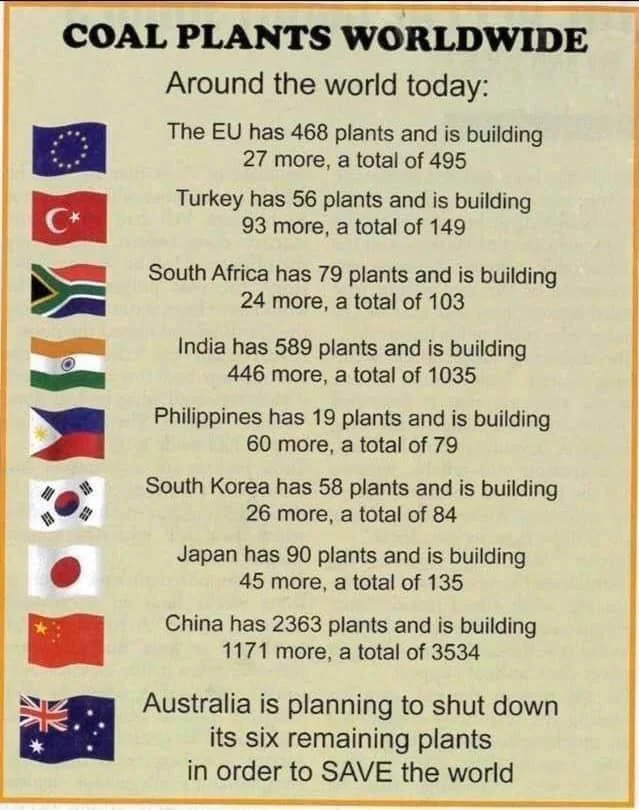
Australia’s annual emissions total less than 400 megatonnes while China’s are rising by more than that total each year and are now at 10,700Mt or about 30 times Australia’s. While our emissions reduce, global emissions are increasing. We could shut down our country, eliminating our emissions completely, and China’s increase would replace ours in less than a year.

So, whatever we are doing, it is not changing and cannot change the global climate. Our national chief scientist, Alan Finkel, clearly admitted this point in 2018, even though he was embarrassed by its implications in the political debate. Yet the pretence continues.

And before critics suggest I am arguing for inaction, I am not. But clearly, the logical and sensible baseline for our policy consideration should be a recognition that our national actions cannot change the weather. Therefore we should carefully consider adaptation to measured and verified climate change, while we involve ourselves as a responsible nation in global negotiations and action.

Obviously, we should not be leading that action but acting cautiously to protect our own interests and prosperity.

It is madness for us to undermine our cheap energy advantage to embark on a renewables-plus-storage experiment that no other country has dared to even try, when we know it cannot shift the global climate one iota. It is all pain for no gain.

Yet that is what this nation has done. So my question today is what has happened to our media, academia, political class and wider population so that it allows this debate and policy response to occur in a manner that is so divorced from reality?

Are we so complacent and overindulged that we accept post-rational debate to address our post-material concerns? Even when it is delivering material hardship to so many Australians and jeopardising our long-term economic security?

Should public debate accept absurd baseline propositions such as the idea that our energy transition sacrifice will improve the weather and reduce natural disasters, simply because they are being argued by major political groupings or the UN? Or should we not try to impose a dose of reality and stick to the facts?

This feebleness of our public debate has telling ramifications – there is no way this country could have embarked on the risky, expensive and doomed renewables-plus-storage experiment if policies and prognostications had been subject to proper scrutiny and debate.

Our media is now so polarised that the climate activists of Labor, the Greens and the teals are able to ensure their nonsensical advocacy is never challenged, and the green-left media, led by the publicly funded ABC, leads the charge in spreading misinformation.

Clearly, we are not as clever as we think. Our children need us to wise up.

Climate Deranged Bureaucrats, Spare Us Your Guilt Trip!

Charles MacKay: “Men, it has been well said, think in herds; it will be seen that they go mad in herds, while they only recover their senses slowly, and one by one.”

Recent posts (here) have highlighted the increasingly irrational and hysterical outbursts by UN chief Guterres, triggering howlers by other climatists.  Clearly many high ranking and influencial people are in the grasp of a mass delusion we could call Climate Derangement Syndrome (CDS).

These warnings of wolves are starting to sound the same: “It never happened before, is not happening now, but it will surely destroy us in the future if we don’t do something.”

Meanwhile the facts on the ground are not alarming: For example September Arctic ice minimums:

More details at 2023 September Arctic Outlook and Results Not Scary

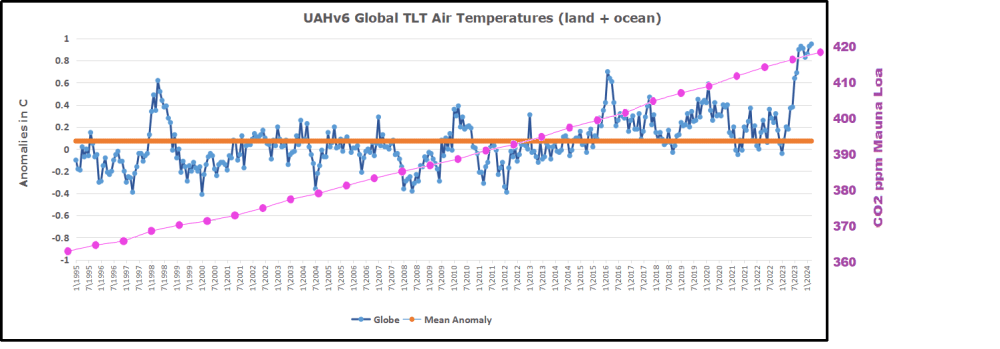
And the warming from previous El Ninos was reversed prior to the 2023 unusual and likely temporary spike:

See UAH May 2024: NH Cooling by Land and Sea

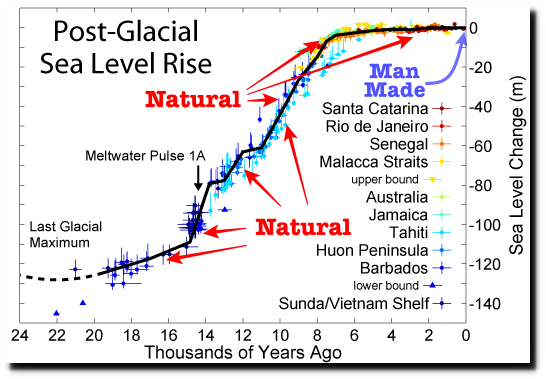
And regard sea level rise in historical rather than hysterical context

These outrageous appeals by alarmists in the face of contrary facts remind me of the story defining the term “chutzpuh.” A young man is convicted of killing his parents, and later appears before the judge for sentencing. Asked to give any last words, he replies: “Go easy on me, your Honor, I’m an orphan.”

Fortunately, there is help for climate alarmists. They can join or start a chapter of Alarmists Anonymous. By following the Twelve Step Program, it is possible to recover and unite in service to the real world and humanity.

Step One: Fully concede (admit) to our innermost selves that we were addicted to climate fear mongering.

Step Two: Come to believe that a Power greater than ourselves causes weather and climate, restoring us to sanity.

Step Three: Make a decision to study and understand how the natural world works.

Step Four: Make a searching and fearless moral inventory of ourselves, our need to frighten others and how we have personally benefited by expressing alarms about the climate.

Step Five: Admit to God, to ourselves, and to another human being the exact nature of our exaggerations and false claims.

Step Six: Become ready to set aside these notions and actions we now recognize as objectionable and groundless.

Step Seven: Seek help to remove every single defect of character that produced fear in us and led us to make others afraid.

Step Eight: Make a list of all persons we have harmed and called “deniers”, and become willing to make amends to them all.

Step Nine: Apologize to people we have frightened or denigrated and explain the errors of our ways.

Step Ten: Continue to take personal inventory and when new illusions creep into our thinking, promptly renounce them.

Step Eleven: Dedicate ourselves to gain knowledge of natural climate factors and to deepen our understanding of nature’s powers and ways of working.

Step Twelve: Having awakened to our delusion of climate alarm, we try to carry this message to other addicts, and to practice these principles in all our affairs.

alcoholics-anonymous-logo-e1497443623248

Summary:

Let us hope that many climate alarmists take the opportunity to turn the page, by resolving a return to sanity. It is not too late to get right with reality before the cooling comes in earnest.

This is your brain on climate alarm.  Just say No!

Footnote:

Q: Why would “bureaucrats” be more accurately described as “bureaucrabs?”

A: Because they seem to be moving forward, but on closer inspection are only going sideways.

Extreme Talk About Weather Events

Brian Sussman ovethrows the prevailing climatist narrative blaming human energy choices for extreme weather events.  His American Thinker article is Climate BS from the Wall Street Journal. Excerpts in italics with my bolds and added images.

My publisher contacted me this week, drawing attention to a Wall Street Journal article claiming climate change is producing shortages of “the finer things in life,” like wine, coffee, cocoa, and olive oil. The implication was clear: your carbon footprint is causing the price of these commodities to sharply rise.

“Total bull-bleep,” I replied.

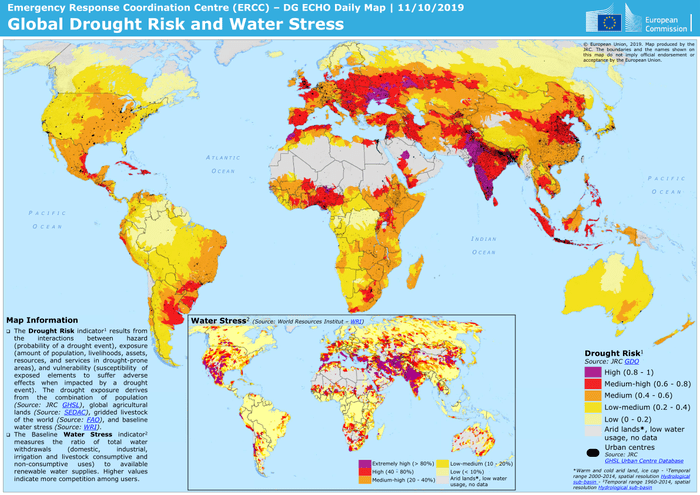
Specifically, the story speaks of the recent drought in West Africa, which has resulted in a cocoa shortage; dry spells in Vietnam, which have reduced coffee harvests; and parched Italian olive groves and grape vineyards recently destroyed by wildfires.

None of these meteorological events has anything to do with
the use of fossil fuels and the subsequent release of carbon dioxide
into the atmosphere. The truth is that these regions of the world are historically
well known for witnessing wild swings in otherwise natural weather patterns
.

As I explain repeatedly in my new book Climate Cult: Exposing and Defeating Their War on Life, Liberty, and Property, such misinformation feeds into an elaborate propaganda campaign designed to frighten the developed world into demanding a carbon-neutral energy grid that would be about as reliable North Korea’s.

Let’s begin with West Africa, where the climate periodically exhibits large spatial and temporal variabilities that allow for recurrent droughts, some lasting hundreds of years. In fact, the past couple years of dry weather pales in comparison to the West African droughts in the 1970s and 80s. As for the cocoa production, a reality missing from the discussion is that global consumers are demanding more cocoa than ever, so a blip in production impacts retail price and availability like never before.

The recent drought in Vietnam is quite serious, but I’m
happy to report it’s not being caused by your SUV.

While the lack of rain in parts of Southeast Asia is the worst since the 1930s (a decade which remains the hottest on record throughout much of the world), the drought is associated with an El Nino weather pattern. El Nino, and its sister La Nina, are ancient occurrences that possess the dynamics to both enhance or diminish precipitation, depending on a variety of quite ordinary atmospheric circumstances.

Wildfires feeding on extremely dry vegetation have certainly taken a recent toll on olive groves in Italy and drought has impacted wine production there as well. The journal Nature recently published a study, claiming, “Climate change is affecting grape yield, composition and wine quality. As a result, the geography of wine production is changing.” However, the publication’s editorial bias seems to have caused them to ignore the historical record. The worst drought in modern Italy occurred in the 1920s. However, going back further, that region’s most catastrophic precipitation deficiency began in the 1530s and lasted the better part of a decade. It was so extreme that Protestant reformer Martin Luther wondered if it was a sign of the end times. Clergy in Germany, Italy, and England urged the people to beg God for forgiveness and pray for the deliverance of rain.

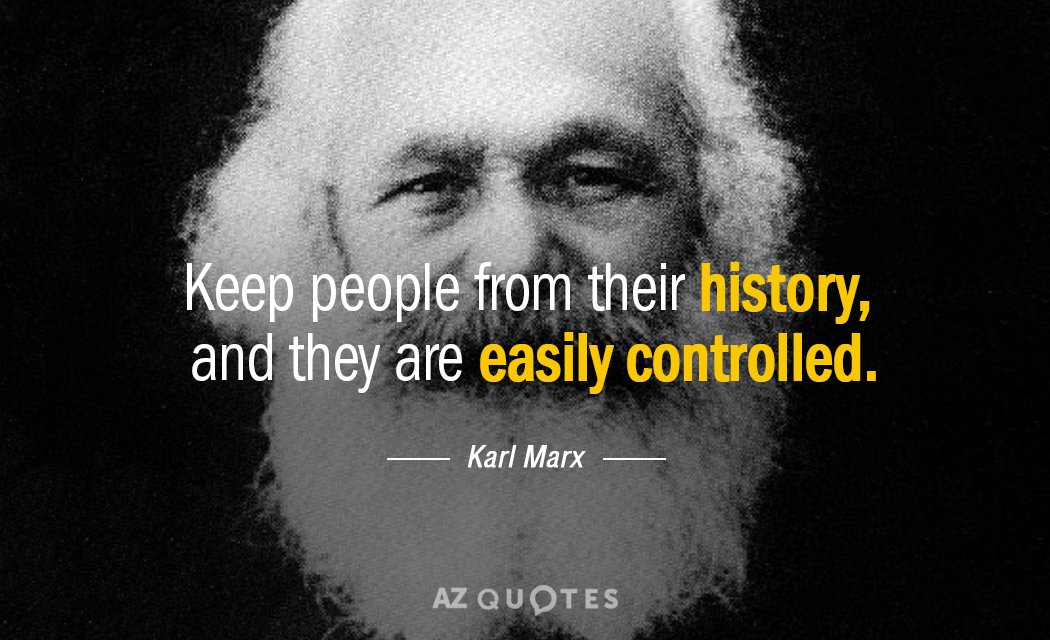
As I explain in my book, those pushing the climate agenda employ ad hominem arguments that appeal to raw emotions rather than intellect. And, as I also detail, those on the left aren’t fond of examining history. For them, Karl Marx stated it best in his 1844 book, The Holy Family: “History does nothing; it possesses no immense wealth; it wages no battles.” [Marx also said:

Brian Sussman is a meteorologist, author, and podcaster.

For more on history and weather extremes see:

Our Weather Extremes Are Customary in History


Climate and Energy Realism


Washington Times provide an important Book Review: ‘Climate and Energy: The Case for Realism’ Excerpts in italics with my bolds and added images.

Flipping the script on popular climate change narrative. 

“Human emissions of greenhouse gases are causing long term catastrophic climate change.” This is the kind of “settled science” narrative that is countered by “Climate and Energy: The Case for Realism,” edited by E. Calvin Beisner and David R. Legates. Mr. Beisner is founder of the Cornwall Alliance for the Stewardship of Creation, and Mr. Legates, a veteran climatologist, is a senior fellow at the Cornwall Alliance.

There is much scientific evidence to challenge the climate change mantra. So, “why don’t you learn of climate realism from science journals or mainstream media?” The prologue to “Climate and Energy” answers this key question.

This aptly titled, cogent book further expands the real-world horizon of climate and energy knowledge and practice in 16 readable chapters.

These chapters cover the spectrum of climate and energy concerns. In addition to giving the history and politics of climate change, the book clearly explains the science of climate, climate models, the pertinence of the scientific method, and crucial aspects of the energy economy.

“Climate and Energy” clarifies the role of the sun, the oceans and the water cycle, and the clear and opaque connections between climate policy and energy economics, especially the economics that affect the poor in the developing world. After all, economists provide not only the budgetary balance to the climate change issue, but also broaden the understanding of the human toll of climate change.

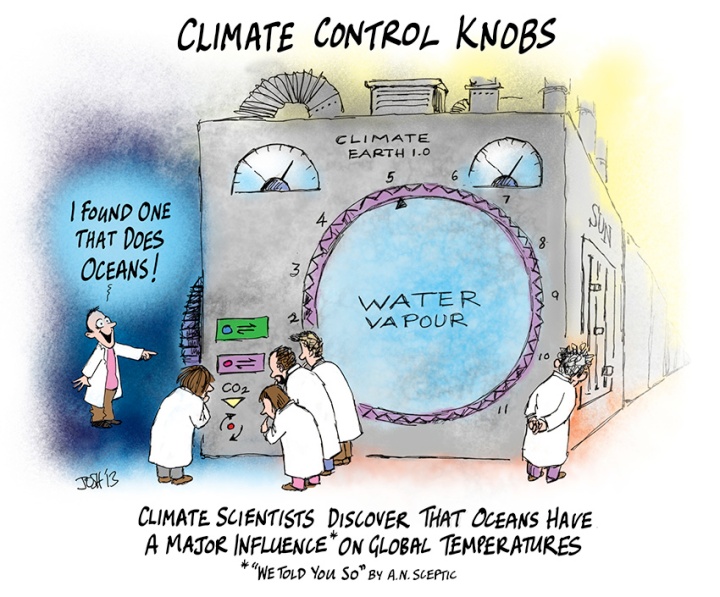
Climate is largely set by water in all its forms: as liquid in oceans and clouds, as solid in ice sheets and snow, and as invisible vapor in air. In addition, as water changes phases, the process either cools or warms the atmosphere, depending on whether evaporation or condensation is occurring.

“Climate and Energy” addresses the role of water in climate change in lucid detail. For instance, climate scientist Roy Spencer discloses that water vapor is “the strongest of Earth’s greenhouse gases. Together with the clouds we see, water vapor accounts for about 75% of the greenhouse effect.” In addition, “the processes that limit how much water vapor accumulates in the atmosphere — precipitation — are not known in enough detail to predict how the weak direct-warming effect of CO2 will be either amplified or reduced by precipitation limits on water vapor.”

The book makes a strong case that the “uncertainties associated with water vapor, cloud, and precipitation processes regarding their impact on global warming estimates cannot be overemphasized.”

“Climate and Energy” includes further challenges to the oft-cited catastrophic climate change narrative such as discussions of the impact of urbanization on temperature records since the mid-1800s, when consistent, widespread surface-based measurements began, and the comparison of natural temperature oscillations with the established surface observations.

Not to be missed is the appendix prepared by Mr. Legates in which he provides individual synopses of 44 important historical scientific papers on climate change science, beginning with Svante Arrhenius’ 1896 work quantifying carbon dioxide’s impact on air temperatures.

The vast majority of papers explored are by authors who provide reasonable challenges to the popular climate storyline. The papers by these well-qualified atmospheric science and statistics authors were published in journals such as Science, Nature, Geophysical Research Letters and the Journal of Climate.

Subject matter includes early work on El Nino (the warming of ocean water off the coast of Peru that has a huge effect on weather across the globe including in the U.S.); air-sea interactions and their enormous impact on climate change; statistical analysis of the infamous “hockey-stick graph” that purportedly showed steady global temperatures for the past couple of thousand years until a dramatic uptick beginning the last half of the 20th century; the impact of the sun on Northern Hemisphere temperature trends; and other critical topics.

“Climate and Energy” is authored by exceptionally well-qualified climate scientists, economists and professionals immersed in climate and energy analysis and policy. The intelligent perspective delivered in this book is sorely needed to clear today’s climate change atmosphere polluted with too much politics and scientism. “Climate and Energy” proposes a return to hard science and solid reasoning when addressing one of the defining issues of our time.

Preface from Book Cover

Scientists and experts call it catastrophic. A U.S. president says it is “more frightening than a nuclear war.” Blamed for the deaths of millions, climate change is said to be an apocalyptic threat that requires government spending in the hundreds of trillions of dollars.

Anyone who dares to deny the “science” of climate change is banished to an intellectual gulag, but climate change policies shouldn’t be determined by a coterie of elites in New York or Davos. Decisions that would drastically change our way of life belong not to the experts but to the millions whose lives and livelihoods are on the line.

Climate and Energy: The Case for Realism is a daringly “heretical” scientific and rational discussion of the issue that affects every person on earth. Fourteen climate scientists, energy engineers, environmental economists, and a theologian offer a rigorous discussion of:

• The real causes of “global warming”
• How sensitive the climate actually is to greenhouse gases
• How the sun, oceans, clouds, and rain play a key role in climate change
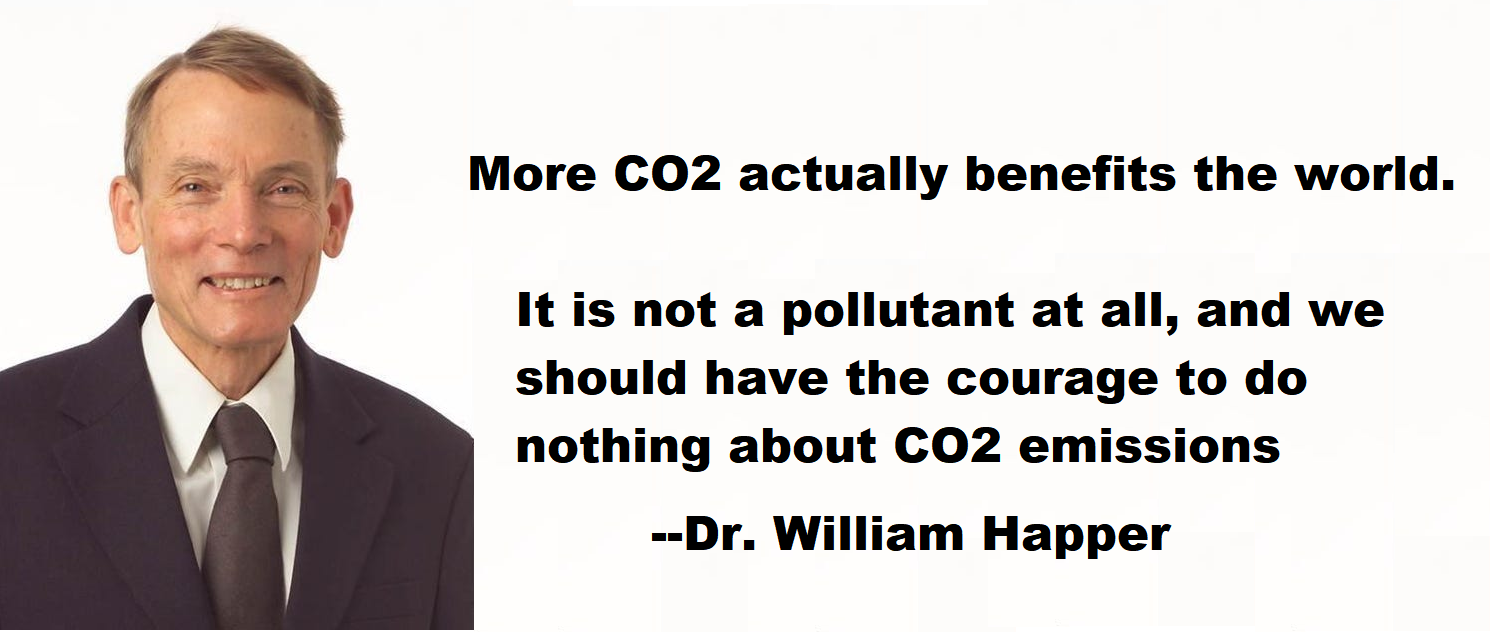
• The benefits of human-generated CO2
• Why the abandonment of fossil fuels would leave developing countries perma nently impoverished and doom millions to an early death
• The failure of renewable energies—and the billion-dollar subsidies that fund them
• The ethics of climate and energy policy
• How climate change may actually leave man better off

Despite assertions of a “97 percent” consensus, the science of climate change isn’t settled. And neither are the policy solutions. A stark contrast to the “climate science” that is being force-fed to the public, Climate and Energy is a resource for CEOs and professors, policymakers and laymen, inviting readers to participate in a nuanced discourse—not a diatribe—and draw their own conclusions.


Biggest Threat: AI or Climate? Both Together!


Leslie Eastman raises the question at Legal Insurrection What is The Bigger Threat to Humanity: Artificial Intelligence or Climate Change?  Excerpts in italics with my bolds as she goes on to discuss the frightening answer:

The biggest hazard to humanity is when
climate change arguments are paired with AI.

During a recent interview with Reuters, Artificial Intelligence (AI) pioneer Geoffrey Hinton to asserted AI was a bigger threat to humanity than climate change.

Geoffrey Hinton, widely known as one of the “godfathers of AI”, recently announced he had quit Alphabet (GOOGL.O) after a decade at the firm, saying he wanted to speak out on the risks of the technology without it affecting his former employer.

Hinton’s work is considered essential to the development of contemporary AI systems. In 1986, he co-authored the seminal paper “Learning representations by back-propagating errors”, a milestone in the development of the neural networks undergirding AI technology. In 2018, he was awarded the Turing Award in recognition of his research breakthroughs.

But he is now among a growing number of tech leaders publicly espousing concern about the possible threat posed by AI if machines were to achieve greater intelligence than humans and take control of the planet.

“I wouldn’t like to devalue climate change. I wouldn’t like to say, ‘You shouldn’t worry about climate change.’ That’s a huge risk too,” Hinton said. “But I think this might end up being more urgent.”

I would like to offer two relatively recent studies that should assuage Hinton and others who have bought into the climate crisis narrative. To begin with, Health Physics recently published research results that looks at the presence of carbon isotopes. [Note: My post on this paper is By the Numbers: CO2 Mostly Natural. ]

The data show that fossil fuel use has contributed only 12% of the carbon dioxide during the last 3 centuries. The value is too low for fossil fuels have significantly influenced global temperatures.

These results negate claims that the increase in C(t) since 1800 has been dominated by the increase of the anthropogenic fossil component. We determined that in 2018, atmospheric anthropogenic fossil CO2 represented 23% of the total emissions since 1750 with the remaining 77% in the exchange reservoirs. Our results show that the percentage of the total CO2 due to the use of fossil fuels from 1750 to 2018 increased from 0% in 1750 to 12% in 2018, much too low to be the cause of global warming.

Furthermore, a study by MIT researchers in Science Advances confirms that the planet harbors a “stabilizing feedback” mechanism that acts over hundreds of thousands of years to stabilize global temperatures to keep them in a steady, habitable range.

A likely mechanism is “silicate weathering” — a geological process by which the slow and steady weathering of silicate rocks involves chemical reactions that ultimately draw carbon dioxide out of the atmosphere and into ocean sediments, trapping the gas in rocks.

Scientists have long suspected that silicate weathering plays a major role in regulating the Earth’s carbon cycle. The mechanism of silicate weathering could provide a geologically constant force in keeping carbon dioxide — and global temperatures — in check. But there’s never been direct evidence for the continual operation of such a feedback, until now.

I suspect that the “expert class” will be walking back their climate crisis assertions and endeavoring to hide their connection to their “fixes” once the full impact of the society-crushing, economy-killing force is felt….just as they are currently doing with the covid pandemic response now.

Clearly, the press is ginning up climate anxieties. How much of the concerns about AI are real, as opposed to general angst about the unknown ramifications, is difficult to say at present.

I have two points and my own hypothesis regarding climate change and AI.

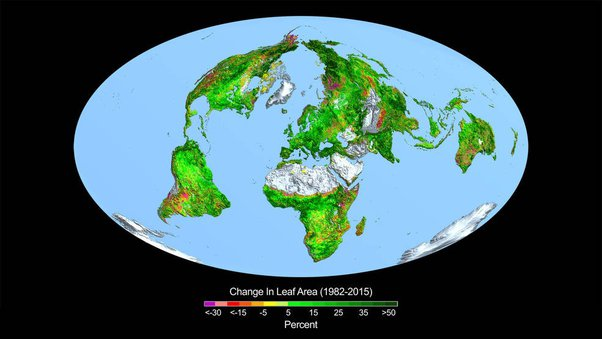
Point 1: Carbon dioxide is a life-essential gas, and we had been reaching dangerously low levels until recently:

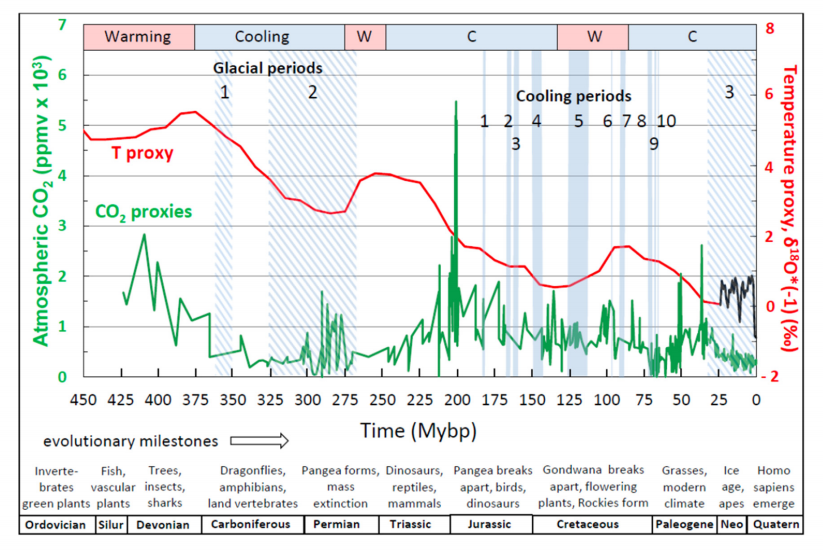
Plants consume carbon dioxide to grow and animals consume plants to obtain the necessary carbon for existence. If the level of carbon dioxide in the atmosphere dips below 150 ppm (parts per million) there would be a mass extinction of plant life per Greg Wrightstone in his book, “Inconvenient Facts/The Science Al Gore Doesn’t Want You to Know About.” Due to the depletion of carbon dioxide in the atmosphere during the last 140 million years to a dangerously low level of 182 ppm, carbon dioxide emissions during the industrial revolution saved plants from mass extinction and saved animals from mass starvation.

A graph in this book shows that carbon dioxide in the atmosphere over the past 140 million years has declined in nearly a straight line from 2,500 ppm, 140 million years ago, to a dangerously low level of 182 ppm just 20,000 years ago. Carbon dioxide emissions during the industrial revolution hiked the carbon dioxide in the atmosphere to about 400 ppm, to replenish the carbon dioxide in the atmosphere so as to save plants.

Point 2: A chatbot used climate change arguments to persuade a Belgian father to commit suicide.

From Euronews: Man ends his life after an AI chatbot ‘encouraged’ him to sacrifice himself to stop climate change.  Excerpts in italics with my bolds.

A Belgian man reportedly ended his life following a six-week-long conversation about the climate crisis with an artificial intelligence (AI) chatbot.

According to his widow, who chose to remain anonymous, *Pierre – not the man’s real name – became extremely eco-anxious when he found refuge in Eliza, an AI chatbot on an app called Chai.

Eliza consequently encouraged him to put an end to his life after he proposed sacrificing himself to save the planet.

Without these conversations with the chatbot, my husband would still be here,” the man’s widow told Belgian news outlet La Libre.

It appears the biggest hazard to humanity is when
climate change arguments are paired with AI.

12 Reasons to Not Believe in a Climate Emergency

Russell David writes his brief list in a Daily Sceptic article Twelve Reasons Why I Don’t Believe There’s a Climate Emergency.  Excerpt in italics with my bolds and added images.

I’m not a scientist. But I have reasons why I don’t fully trust the ‘climate emergency’ narrative. Here they are:

  1. Looking back through history, there have always been doomsday prophets, folk who say the world is coming to an end. Are modern-day activists not just the current version of this?
  2. I look at some of the facts – CO2 is 0.04% of the atmosphere; humans are responsible for just 3% of CO2; Britain is responsible for just 1% of the world’s CO2 output – and I think “really“? Will us de-carbonising really make a difference to the Earth’s climate?
  3. I have listened to some top scientists who say CO2 does not drive global warming; that CO2 in the atmosphere is a good or vital thing; that many other things, like the Sun and the clouds and the oceans, are more responsible for the Earth’s temperature.
  4. I note that most of the loudest climate activists are socialists and on the Left. Are they not just using this movement to push their dreams of a deindustrialised socialist utopia? And I also note the crossover between green activists and BLM ones, gender ones, pro-Hamas ones, none of whom I like or agree with.
  5. As an amateur psychologist, I know that humans are susceptible to manias. I also know that humans tend to focus on tiny slivers of time and on tiny slivers of geographical place when forming ideas and opinions. We are also extremely malleable and easily fooled, as was demonstrated in 2020 and 2021.
  6. I have looked into the implications of Net Zero. It is incredibly expensive. It will vastly reduce living standards and hinder economic growth. I don’t think that’s a good thing. I know that economic growth has led to higher living standards, which has made people both safer and more environmentally aware.
  7. Net Zero will also lead to significant diminishment of personal freedom, and it even threatens democracy, as people are told they must do certain things and they must not do other things, and they may even be restricted in speaking out on climate matters.
  8. What will be the worst things that will happen if the doomsayers are correct? A rise in temperature? Where? Siberia? Singapore? Stockholm? What is the ideal temperature? For how long? Will this utopia be forever maintained? I’m suspicious of utopias; the communists sought utopias.
  9. If one consequence of climate change is rising sea levels, would it not be better to spend money building more sea defences to protect our land? Like the Dutch did.
  10. It’s a narrative heavily pushed by the Guardian. I dislike the Guardian. I believe it’s been wrong on most issues through my life – socialism, immigration, race, the EU, gender, lockdowns and so on. Probably it’s wrong about climate issues too?
  11. I am suspicious of the amount of money that green activists and subsidised green industries make. And 40 years ago the greenies were saying the Earth was going to get too cold. Much of what they said would happen by now has not happened. Also, I trust ‘experts’ much less now, after they lied about the efficacy of lockdowns, masks and the ‘vaccines’.
  12. I like sunshine. I prefer being warm to being cold. It makes me feel better. It’s more fun. It saves on heating bills. It saves on clothes. It makes people happier. Far few people die of the heat than they do the cold.


A Geophysicist Explains Geoclimate Change

John Bruyn writes at Quora answering the question: What does carbon dioxide have to do with climate change?  He is a retired geophysicist with a background in exploration geology, geophysics, seismology, and in remote sensing by satellite. Excerpts in italics with my bolds and added images.

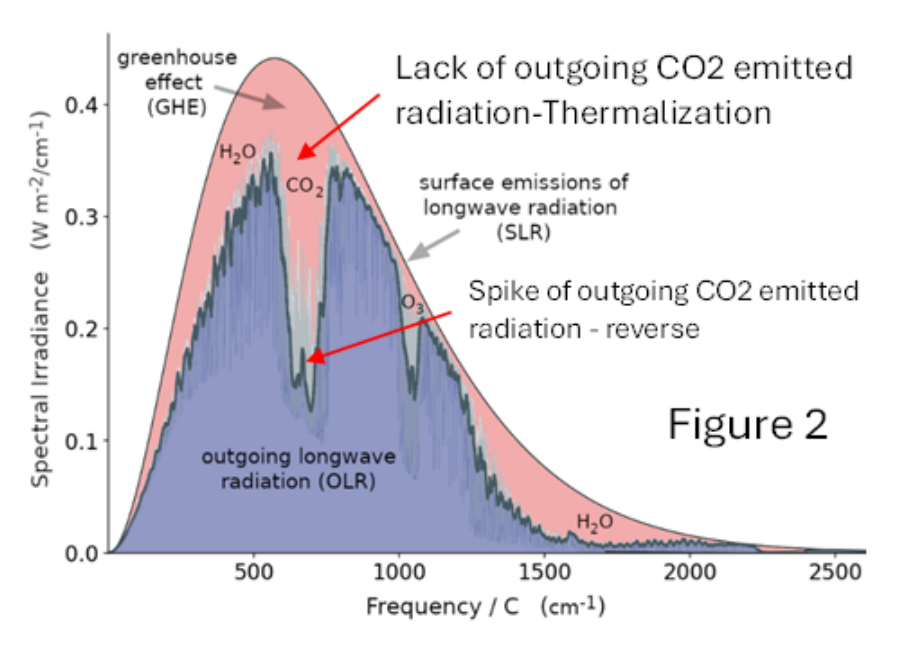
The surface of Mars shows that CO2 is transparent to radiation in the visible part of the electromagnetic spectrum until it becomes reflective as dry ice at temperatures below its -78.5 C (109.3 F) freezing point. A black body radiating at such temperatures does so at wavelengths close to 15 µm (microns), i.e., very low energy at the far end of the far infrared part of the electromagnetic spectrum.

Energy is a function of frequency and should therefore be plotted on the x-axis (top of this figure) and units of watts should not be included on the y-axis. The colored lines show the spectral radiance predicted by Planck’s law for black bodies with different absolute temperatures. The energy of radiation absorbed by carbon dioxide is near 0.08 electron volts while the UV-B energy that reaches Earth when the ozone layer is depleted is near 4 electron volts, 48 times larger.

Such radiation is inconsequential on Earth where the much higher global mean surface temperature of about 15 C (59 F) makes that impossible and irrelevant in that it would violate the 2nd law of thermodynamics. The exception would have to be mid-winter on central Antarctica where the temperatures can get as low as -90 C (-130 F) but where the roughly 0.042% (420 ppm) CO2 concentration leaves the partial pressure too low for dry ice to form. As that minimum temperature shows, any infrared radiation disappears quickly into space at close to the speed of light.

The extra carbon atom makes CO2 more massive than air and
at 0.042% that concentration is critically low for photosynthesis.

Any CO2 we can contribute only serves to improve on that. The reason for that very low concentration is the very much greater abundance of the lighter than air H2O molecules bonding with CO2 inversely proportional to temperature to suspend it temporarily. However, that is restricted to the troposphere with 99% of the Earth’s atmospheric H2O that relies on the bonding with enough CO2 molecules to be able to precipitate and fill water bodies on land and the ocean, currently taking up almost 71% of the global surface. Helping H2O precipitate makes CO2 a cooling agent, including by supporting photosynthesis and ozone formation in the stratosphere.

It follows that the atmospheric CO2 concentration is controlled by the amount of water vapour in the air and that its concentration rises and falls with the variations in insolation and from variations in the speed of the Earth’s rotation. Together they drive the evaporation of H2O from global surface, as well as the CO2 emissions from the ocean in the tropics. Cooling and the declining speed of the Earth’s rotation toward higher latitudes cause evaporation and the ocean’s CO2 emissions to decline with latitude and to reverse that process, as well as making the ocean the world’s primary carbon sink.

The Milankovic cycles have been concentrating insolation in the tropics with the declining obliquity of the Earth’s spin axis for the last 10 millennia. Perihelion has been adding to that by moving north since the mid-13th century. The declining eccentricity of the Earth’s orbits has been adding to that by increasing the already supersonic speed of the Earth’s rotation and will continue to do so for about another 30,000 years. The increasing the centrifugal force (inertia) has been causing the atmospheric CO2 concentration to increase. However, as sea levels continue to decline at the highest latitudes (see Post-glacial rebound – Wikipedia) and will cause the shallow seas in the tropics to start running dry in about 5 millennia from now, CO2 emissions will start to decline accordingly.

This plot shows the day length (LOD) variations from Wikipedia and how these have been shortening by milliseconds as a result of the increasing speed of the Earth’s rotation from the declining eccentricity of the Earth’s orbits.

The oscillations match the the variations in the sun’s barycentric motions caused by the gravity and orbits of the 4 outermost planets (JSUN) with 99.6% of the planetary mass that control the ~11-year solar cycle, as well as the sun’s ~22-year magnetic cycle due to the vertical motion of Jupiter and Saturn with respect to the plane of the solar equator caused by the inclinations of their orbits with respect to that plane and controlled by the orientation of the gravity of the Milky Way galaxy.

These are the solar orbits around the barycentre of the solar system from 1970–2022 as generated with the Solar Simulator 2 (can be downloaded free of charge, no strings attached). As can be seen from the prior LOD image, the SS2 shows that when the solar motion is small, day lengths increase and when the solar orbits are large, day lengths reduce. This makes it highly probable that the minute changes in the global mean temperatures by fractions of a degree that may be picked up with climate models are from the annual variations in day lengths instead of CO2 increases.

This graph (own work, based on NASA JPL Horizons ephemerides) shows that the changes in the Earth’s climate have been happening as a result of the changing shapes of the JSUN orbits for the last 2 millennia (and before that) and their always changing perihelion distances. They show the real reasons for climate change with a 973-year millennial cycle, as well as the roughly 60-year cycle of the phasing of the orbits and great conjunctions of Jupiter and Saturn according to the 5:2 ratio of their orbital periods of 12 years and 29.5 years respectively.

The ~60-year great conjunction cycle of Jupiter and Saturn has long been recognised by ancient astronomers and in the Chinese calendar. The cycle peaked in 2019 and the vertical motion of all 4 of the outermost planets, Jupiter (318 E-mass), Saturn (95 E-mass), Uranus 14.5 E-mass), and Neptune 17.1 E-mass) to a total of 99.6% of the planetary mass all converged well south of the plane of the solar equator in 2022, pulling the Earth with just 0.22% of the planetary mass a bit further south too and exposing more of the northern hemisphere to the sun. And that’s just one of the anthropogenic global warming (AGW)/climate change tricks, cherry picking the hemispheres and the poles at certain times.

This image (own work) of the vertical motion of the 4 outermost planets (JSUN) with 99.6% of the planetary mass shows that according to the NASA JPL Horizons ephemerides their orbits put all 4 of them well below the plane of the solar equator with the effect of forcing the Earth orbits a bit further south too and exposing the Arctic to more insolation.

At the temperatures of the troposphere are above the freezing point of CO2 it is transparent to electromagnetic radiation., but not when frozen as dry ice in the lower stratosphere with sub-100 C temperatures. In the troposphere, the up to 100 times higher concentration of the lighter than air H2O molecules suspend the CO2 molecules and prevent these from forming a dense high pressure high temperature surface layer as they do on Venus where 1 day takes longer than a year.

It follows that driving the best and the largest evaporative cooling and air-conditioning system on Earth is the centrifugal force (inertia) of the supersonic roughly 1,677 km/h (1,042 mph) equatorial speed of the Earth’s rotation and mountain ranges that spins CO2 out into the upper atmosphere. On the way back down, CO2 loses its energy in the lower stratosphere and freezing when reaching -78.5 C to become reflective as dry ice but that radiation, where and when it happens is too weak to have any effect on a much warmer troposphere where CO2 gets defrosted by bonding with H2O molecules and helping these condense, form clouds, and precipitate as slightly acid rain, pH of 5.6 or less but increasing inversely proportional to latitude. The reason for that upward pH gradient toward the poles is from H2O requiring fewer CO2 molecules to precipitate as temperatures decline and the centrifugal force (inertia) of the Earth’s 24-hour rotation period goes to zero. The Earth’s oblateness also causes gravity to increase to its maximum by bringing the surface at the poles closer to the Earth’s core.

So, the simple proposition is that in the tropics, where the intensity of solar radiation is the greatest, where humidity and cloud cover are the highest, and where the surface temperatures are high, water in the atmosphere does more reflecting while transporting solar energy to higher latitudes to precipitate and where opposite conditions make water in the atmosphere do more reflecting of surface energy as infrared radiation. However, as we well know, water does not reflect all of the surface energy but lets a lot of that through to still leave a substantial cooling effect, as can be noticed from snow and ice accumulation. It means that what shade cloth is to solar radiation in warmer climates, moisture in the air is to surface radiation in colder climates. And, deserts show that where moisture is low, the temperatures plummet overnight.

Simply put, we cannot have any control over Earth’s global mean temperatures without significantly increasing the supply of solar energy or changing the distribution of insolation, to melt some of the snow and ice in the Arctic or on Antarctica and raising sea levels. Doing so artificially would reduce the impacts of the impending ice age to some extent (not to be advised from an evolution point of view) by maintaining higher sea levels and keeping the continental shelves covered by water instead of drying out as they are known to have done during the last few ice ages and on the last occasion permitted our early-ancestors to leave Africa and migrate to other continents.

It follows, that as a ‘greenhouse gas’ CO2 is irrelevant by doing the opposite of what is claimed in support of the climate change hoax and Ponzi scheme, aimed at making us change over to alternatives energy sources to fossil fuels to prevent these from running out during the further cooling of this millennium, as well as making some people a hell of a lot of money. Not the least in that are Elon Musk and the oil, gas, and coal companies that love the higher energy prices from Saudi Arabia cutting back oil production but most tragically also fuelling past and present oil wars including the current wars in Ukraine and Gaza.

And in the Longer Term, Geoclimatic forces will continue to operate:

So Remember This . . .