Supremes Look at Kids Lawsuit

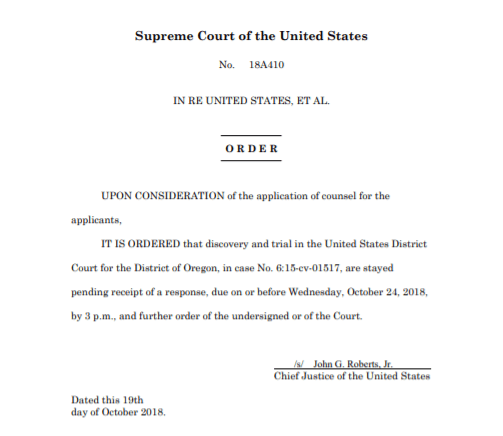
An Oregon liberal judge is determined to put climate change on trial in Juliana vs US, scheduled to start on October 29, 2018.  But now another pitfall stands in the way.  The Trump administration has asked the Supreme Court to review the legitimacy of the scope of the kids’ claims they have a right to an unchanging favorable climate provided to them by the federal government.  Here is the update from Scotusblog by Amy Howe Government returns in climate change lawsuit  Excerpts in italics with my bolds.

In July, the Supreme Court declined to intervene in a lawsuit filed by a group of 21 children and teenagers who allege that they have a constitutional right to a “climate system capable of sustaining human life.” The justices rejected the federal government’s request to block discovery and a trial until the U.S. Court of Appeals for the 9th Circuit could rule on the government’s petition seeking to have the case dismissed or, at a minimum, to block discovery and the trial temporarily. Today the Trump administration returned to the Supreme Court, asking it once again to put discovery and the trial – now scheduled for the end of October – on hold.

The case was originally filed in 2015 against the Obama administration. The plaintiffs argue that the federal government’s actions are causing a “dangerous climate system,” and they have asked a federal district court in Oregon to order various federal agencies to prepare and implement a remedial plan to phase out fossil-fuel emissions.

When the government asked the justices to step in over the summer, they rejected the request, which they described as “premature.” But the justices also seemed to express some skepticism about the “breadth” of the plaintiffs’ claims, calling them “striking” and observing that there are “substantial grounds for difference of opinion” on whether those claims belong in court at all. The justices instructed the district court to “take these concerns into account in assessing the burdens of discovery and trial, as well as the desirability of a prompt ruling on the” federal government’s other pending motions, which could result in dismissal of some or all of the plaintiffs’ claims.

The government is now back at the court, telling the justices that earlier this week the district court “declined to meaningfully narrow” the plaintiffs’ claims, instead rejecting various government motions that would have ended the case. The government is now asking the court to order the district court to “end this profoundly misguided suit” or, at the very least, review the district court’s rulings allowing the case to go forward; moreover, the government again urges, the Supreme Court should put discovery and the trial on hold while it considers these requests. There would be no real harm to the plaintiffs from doing so, the government stresses, because the plaintiffs are claiming that they have been harmed by the cumulative effects of carbon dioxide emissions over several decades.

The government’s request, signed by U.S. solicitor general Noel Francisco, goes to Chief Justice John Roberts, who currently serves as the circuit justice for the 9th Circuit. Roberts can act on the government’s application immediately or refer it to the full court.

Economist Joseph Stiglitz writes of climate change: “There is a point at which, once this harm occurs, it cannot be undone at any reasonable cost or in any reasonable period of time. Based on the best available science, our country is close to approaching that point.” Credit: Win McNamee/Getty Images

For an insight into the claims being made on behalf of the kids, here is a reprint of a previous post analyzing a brief filed by an IPCC insider.

Climatists Make Their Case by Omitting Facts

One of the world’s top economists has written an expert court report that forcefully supports a group of children and young adults who have sued the federal government for failing to act on climate change. (Source: Inside Climate News  here) Excerpts in italics with my bolds.

Stiglitz, a Columbia University economics professor and former World Bank chief economist, concludes that increasing global warming will have huge costs on society and that a fossil fuel-based system “is causing imminent, significant, and irreparable harm to the Youth Plaintiffs and Affected Children more generally.” He explains in a footnote that his analysis also examines impacts on “as-yet-unborn youth, the so-called future generations.”

But, he says, acting on climate change now—by imposing a carbon tax and cutting fossil fuel subsidies, among other steps—is still manageable and would have net-negative costs. He argues that if the government were to pursue clean energy sources and energy-smart technologies, “the net benefits of a policy change outweigh the net costs of such a policy change.”

“Defendants must act with all deliberate speed and immediately cease the subsidization of fossil fuels and any new fossil fuel projects, and implement policies to rapidly transition the U.S. economy away from fossil fuels,” Stiglitz writes. “This urgent action is not only feasible, the relief requested will benefit the economy.”

Stiglitz has been examining the economic impact of global warming for many years. He was a lead author of the 1995 report of the UN’s Intergovernmental Panel on Climate Change, an authoritative assessment of climate science that won the IPCC the 2007 Nobel Peace Prize, shared with Al Gore.

The Stiglitz expert report submitted to the court is here.

An Example of Intentional Omissions

Since this is a legal proceeding, Stiglitz wrote a brief telling the plaintiffs’ side of the story. In a scientific investigation, parties would assert theories attempting to explain all of the evidence at hand. Legal theories have no such requirement to incorporate all the facts, but rather present conclusions informed by the evidence deemed strongest and most pertinent to one party’s interests.

While the Pope accuses us with the Sin of Emissions, we counter with the Sins of Omissions by him and his fellow activists.

Let’s consider the Stiglitz brief according to the three suppositions comprising the Climatist (Activists and Alarmists) position. Climate change is a bundle that depends on all three assertions to be true.

Supposition 1: Humans make the climate warmer.

As an economist, Stiglitz defers to the IPCC on this scientific point, with references to reports by those deeply involved and committed to Paris Accord and other UN climate programs. In the recent California District Court case (Cities suing Big Oil companies), both sides in a similar vein stipulated their acceptance of IPCC reports as authoritative regarding global warming/climate change.

Skeptical observers must attend to the nuances of what is referenced and what is hidden or omitted in these testimonies. For example, Chevron’s attorney noted that IPCC’s reports express various opinions over time as to human influence on the climate. They noted that even today, the expected temperature effect from doubling CO2 ranges widely from 1.5C to 4.5C. No mention is made that several more recent estimates from empirical data (rather than GCMs) are at the low end or lower.

In addition, there is no mention that GCMs projections are running about twice as hot as observations. Omitted is the fact GCMs correctly replicate tropospheric temperature observations only when CO2 warming is turned off. In the effort to proclaim scientific certainty, neither Stiglitz nor IPCC discuss the lack of warming since the 1998 El Nino, despite two additional El Ninos in 2010 and 2016.

Figure 5. Simplification of IPCC AR5 shown above in Fig. 4. The colored lines represent the range of results for the models and observations. The trends here represent trends at different levels of the tropical atmosphere from the surface up to 50,000 ft. The gray lines are the bounds for the range of observations, the blue for the range of IPCC model results without extra GHGs and the red for IPCC model results with extra GHGs.The key point displayed is the lack of overlap between the GHG model results (red) and the observations (gray). The nonGHG model runs (blue) overlap the observations almost completely.

Further they exclude comparisons between fossil fuel consumption and temperature changes. The legal methodology for discerning causation regarding work environments or medicine side effects insists that the correlation be strong and consistent over time, and there be no confounding additional factors. As long as there is another equally or more likely explanation for a set of facts, the claimed causation is unproven. Such is the null hypothesis in legal terms: Things happen for many reasons unless you can prove one reason is dominant.

Finally, Stiglitz and IPCC are picking on the wrong molecule. The climate is controlled not by CO2 but by H20. Oceans make climate through the massive movement of energy involved in water’s phase changes from solid to liquid to gas and back again. From those heat transfers come all that we call weather and climate: Clouds, Snow, Rain, Winds, and Storms.

Esteemed climate scientist Richard Lindzen ended a very fine recent presentation with this description of the climate system:

I haven’t spent much time on the details of the science, but there is one thing that should spark skepticism in any intelligent reader. The system we are looking at consists in two turbulent fluids interacting with each other. They are on a rotating planet that is differentially heated by the sun. A vital constituent of the atmospheric component is water in the liquid, solid and vapor phases, and the changes in phase have vast energetic ramifications. The energy budget of this system involves the absorption and reemission of about 200 watts per square meter. Doubling CO2 involves a 2% perturbation to this budget. So do minor changes in clouds and other features, and such changes are common. In this complex multifactor system, what is the likelihood of the climate (which, itself, consists in many variables and not just globally averaged temperature anomaly) is controlled by this 2% perturbation in a single variable? Believing this is pretty close to believing in magic. Instead, you are told that it is believing in ‘science.’ Such a claim should be a tip-off that something is amiss. After all, science is a mode of inquiry rather than a belief structure.

Supposition 2: The Warming is Dangerous

Billions of dollars have been spent researching any and all negative effects from a warming world: Everything from Acne to Zika virus. Stiglitz links to a recent Climate Report that repeats the usual litany of calamities to be feared and avoided by submitting to IPCC demands. The evidence does not support these claims.

Stiglitz: It is scientifically established that human activities produce GHG emissions, which accumulate in the atmosphere and the oceans, resulting in warming of Earth’s surface and the oceans, acidification of the oceans, increased variability of climate, with a higher incidence of extreme weather events, and other changes in the climate.

Moreover, leading experts believe that there is already more than enough excess heat in the climate system to do severe damage and that 2C of warming would have very significant adverse effects, including resulting in multi-meter sea level rise.

Experts have observed an increased incidence of climate-related extreme weather events, including increased frequency and intensity of extreme heat and heavy precipitation events and more severe droughts and associated heatwaves. Experts have also observed an increased incidence of large forest fires; and reduced snowpack affecting water resources in the western U.S. The most recent National Climate Assessment projects these climate impacts will continue to worsen in the future as global temperatures increase.

Alarming Weather and Wildfires

But: Weather is not more extreme.
And Wildfires were worse in the past.
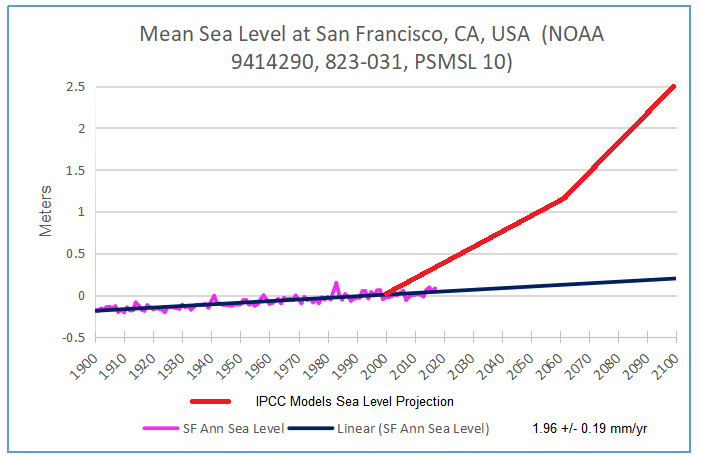
But: Sea Level Rise is not accelerating.
Litany of Changes

Seven of the ten hottest years on record have occurred within the last decade; wildfires are at an all-time high, while Arctic Sea ice is rapidly diminishing.

We are seeing one-in-a-thousand-year floods with astonishing frequency.

When it rains really hard, it’s harder than ever.

We’re seeing glaciers melting, sea level rising.

The length and the intensity of heatwaves has gone up dramatically.

Plants and trees are flowering earlier in the year. Birds are moving polewards.

We’re seeing more intense storms.

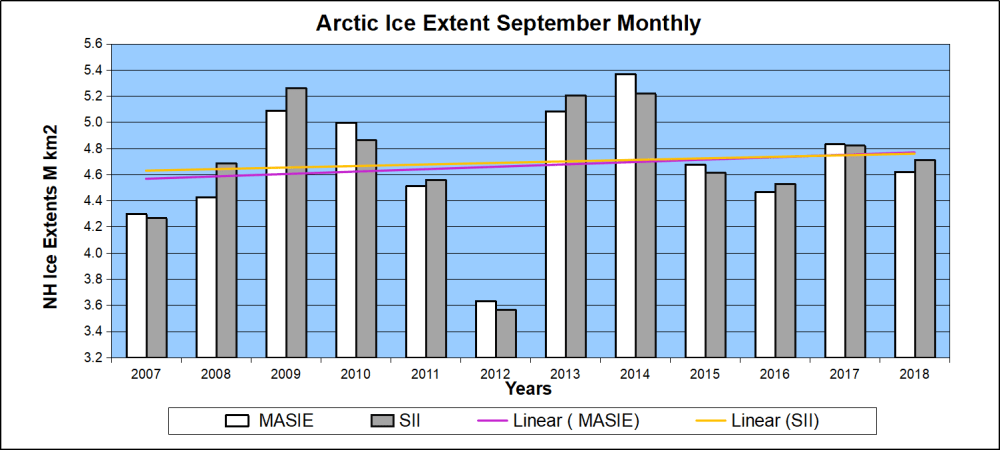
But: Arctic Ice has not declined since 2007.
arctic-sept-2007-to-20181

But: All of these are within the range of past variability.

In fact our climate is remarkably stable.
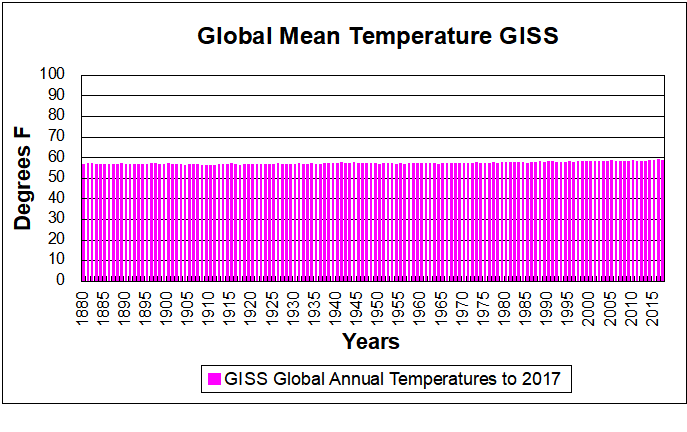
And many aspects follow quasi-60 year cycles.

Climate is Changing the Weather

Stiglitz:  Other potential examples include agricultural losses. Whether or not insurance
reimburses farmers for their crops, there can be food shortages that lead to higher food
prices (that will be borne by consumers, that is, Youth Plaintiffs and Affected Children).
There is a further risk that as our climate and land use pattern changes, disease vectors
may also move (e.g., diseases formerly only in tropical climates move northward).36 This
could lead to material increases in public health costs

But: Actual climate zones are local and regional in scope, and they show little boundary change.


But: Ice cores show that it was warmer in the past, not due to humans.

Supposition 3:  Government Can Stop it!

Here it is blithely assumed that the court can rule the seas to stop rising, heat waves to cease, and Arctic ice to grow (though why we would want that is debatable).  All this will be achieved by leaving fossil fuels in the ground and powering civilization with windmills and solar panels.  While admitting that our way of life depends on fossil fuels, they ignore the inadequacy of renewable energy sources at their present immaturity.

Stiglitz: Conclusion
The choice between incurring manageable costs now and the incalculable, perhaps even
irreparable, burden Youth Plaintiffs and Affected Children will face if Defendants fail to
rapidly transition to a non-fossil fuel economy is clear. While the full costs of the climate
damages that would result from maintaining a fossil fuel-based economy may be
incalculable, there is already ample evidence concerning the lower bound of such costs,
and with these minimum estimates, it is already clear that the cost of transitioning to a
low/no carbon economy are far less than the benefits of such a transition. No rational
calculus could come to an alternative conclusion. Defendants must act with all deliberate
speed and immediately cease the subsidization of fossil fuels and any new fossil fuel
projects, and implement policies to rapidly transition the U.S. economy away from fossil
fuels.

But CO2 relation to Temperature is Inconsistent.

But: The planet is greener because of rising CO2.

But: Modern nations (G20) depend on fossil fuels for nearly 90% of their energy.

But: Renewables are not ready for prime time.

People need to know that adding renewables to an electrical grid presents both technical and economic challenges.  Experience shows that adding intermittent power more than 10% of the baseload makes precarious the reliability of the supply.  South Australia is demonstrating this with a series of blackouts when the grid cannot be balanced.  Germany got to a higher % by dumping its excess renewable generation onto neighboring countries until the EU finally woke up and stopped them. Texas got up to 29% by dumping onto neighboring states, and some like Georgia are having problems.

But more dangerous is the way renewables destroy the economics of electrical power.  Seasoned energy analyst Gail Tverberg writes:

In fact, I have come to the rather astounding conclusion that even if wind turbines and solar PV could be built at zero cost, it would not make sense to continue to add them to the electric grid in the absence of very much better and cheaper electricity storage than we have today. There are too many costs outside building the devices themselves. It is these secondary costs that are problematic. Also, the presence of intermittent electricity disrupts competitive prices, leading to electricity prices that are far too low for other electricity providers, including those providing electricity using nuclear or natural gas. The tiny contribution of wind and solar to grid electricity cannot make up for the loss of more traditional electricity sources due to low prices.

These issues are discussed in more detail in the post Climateers Tilting at Windmills

Footnote regarding mention of “multi-meter” sea level rise.  It is all done with computer models.  For example, below is San Francisco.  More at USCS Warnings of Coastal Floodings
sf-ca-past-projected

dilbert-sins-of-omission-and-comission

Minnesota Valve Turners Case Dismissed Without Necessity Defense

“Stunning”: State Court Silences Climate Experts Set to Testify in Valve Turners’ Necessity Defense Trial  “Four days before trial, for no apparent reason, the court eviscerated our defense, and essentially overruled itself.” Excerpts below in italics with my bolds.

Minneapolis October 8, 2018 In an eleventh hour decision, a Minnesota court “eviscerated” the defense of three activists—whose landmark trial began Monday for their 2016 multi-state #ShutItDown action that temporarily disabled tar sands pipelines crossing the U.S.-Canada border—by barring experts from testifying that their civil disobedience was necessary because fossil fuels are driving the global climate crisis.

While all charges against Steve Liptay, who filmed the Minnesota action, have been dropped, valve turners Emily Nesbitt Johnston and Annette Klapstein, along with their support person, Benjamin Joldersma, are still facing felony charges under Minnesota state law. Their legal team will now have to present their “necessity defense” without the slate of experts who had agreed to explain the climate crisis and the impact of civil disobedience to the jury.

This “stunning” reversal came after an appeals court ruled in April that they could present a necessity defense, a decision upheld by the Minnesota Supreme Court in June. The rulings were celebrated by climate activists and experts nationwide as courts in Washington, North Dakota, and Montana blocked requests from fellow valve turners’ on trial for the 2016 action to present such a defense.

“We were looking forward to entrusting this case to a Minnesota jury of our peers to decide after hearing expert scientists and social scientists discuss the facts of climate change and public policy,” said Klapstein, a retired attorney.

“By requiring us to establish the necessity defense, without allowing us to use our planned expert testimony to do so, the court has placed an overwhelming burden on us,” she added. “I’m baffled by the surreal nature of this court’s decision and timing.”

“Four days before trial, for no apparent reason, the court eviscerated our defense, and essentially overruled itself,” said Johnston. “It is impossible for us to properly defend ourselves without expert testimony.”

Experts that had planned to testify include climate scientists Dr. Jim Hansen, Dr. Mark Seeley, and Dr. Peter Reich; public health expert Dr. Bruce Synder; Princeton professor Dr. Martin Gilens; Harvard Law professor Lawrence Lessig; nonviolent direct action historian and Albert Einstein Institution executive director Jamila Raqib; 350.org co-founder Bill McKibben; and oil infrastructure expert Dr. Anthony Ingraffea.

Minnesota District Court Judge Robert Tiffany claimed their testimonies would be confusing to the jury, Climate Direct Action said in a statement on Monday.

“The irony is that the judge may be proving our point—we acted as we did because we know that the paralysis and myopia of the executive and legislative branches with regard to climate change mean that the political system itself must be shaken up if there is to be any hope for all of us,” Johnston noted. “We were hoping that the judiciary might show the way.”

Minnesota judge tosses charges midtrial against 3 activists 
Excerpts in italics with my bolds.

MINNEAPOLIS (AP) October 9, 2018 A Minnesota judge abruptly dismissed charges against three climate change activists during their trial on Tuesday, saying prosecutors failed to prove that the protesters’ attempt to shut down two Enbridge Energy oil pipelines caused any damage.

Clearwater County District Judge Robert Tiffany threw the case out after prosecutors rested their case and before the protesters could use their defense: that the threat of climate change from using crude oil drilled from Canadian tar sands was so imminent that the activists’ actions were not only morally right, but necessary.

The attorneys had long fought to use a “necessity defense” during the trial of the three Seattle-area residents, two of whom admitted turning the emergency shut-off valves on the northwest Minnesota pipelines in 2016 as part of a coordinated action in four states. Such a defense has been used by other activists protesting pipelines.

Their attorney, Lauren Regan, acknowledged outside the courthouse in Bagley that she and her clients were surprised that the judge granted their motion to dismiss the case. The three defendants faced felony charges involving criminal damage to critical public service facilities. They could have faced up to a year in jail, according to prosecutors.

“I’m very relieved the state of Minnesota acknowledged that we did no damage and intended to do no damage,” defendant Emily Johnston said. “I also admit that I am disappointed that we did not get to put on the trial that we hoped for.”

Clearwater County Attorney Alan Rogalla declined to comment afterward.

Climate change activists have increasingly turned to direct actions against oil and gas pipelines, with mixed legal success . Valve-turner cases in other states resulted in convictions that are under appeal. A Massachusetts judge in March cleared 13 gas pipeline protesters who used a necessity defense. While the cases generally have not set binding legal precedents, activists are hoping they help legitimize direct action as a tactic against climate change.

In the Minnesota case, Johnston and Annette Klapstein readily acknowledged turning the emergency shut-off valves on two Enbridge Energy pipelines on Oct. 11, 2016, near Leonard, about 210 miles (338 kilometers) northwest of Minneapolis. A third defendant, Ben Joldersma, called in a warning to Enbridge. Charges were earlier dropped against a fourth defendant.

They did it as part of a coordinated action by Climate Direct Action activists to shut down five Canadian tar sands crude pipelines in Minnesota, North Dakota, Montana and Washington state. A total of 11 activists were charged in the four states.

Calgary, Alberta-based Enbridge temporarily shut down the two pipelines as a precaution before any damage occurred. The company issued a statement Tuesday saying the protest was “reckless and dangerous.”

“The individuals involved in these activities claimed to be protecting the environment, but they did the opposite and put the environment and the safety of people at risk — including themselves, first responders and neighboring communities and landowners,” the company said.

The defendants insisted there was never any danger.

“We did everything in our power to make sure this was a safe action, and we did this to protect our children and all of your children from the devastating effects of climate change,” Klaptstein said at the activists’ news conference afterward.

While the judge took the unusual step of allowing allowed the necessity defense in a ruling last October, he said the defendants had to clear a high legal bar to succeed. He said the defense applies “only in emergency situations where the peril is instant, overwhelming, and leaves no alternative but the conduct in question.”

The valve turners had hoped to put climate change itself on trial by presenting expert witnesses who would have backed up their claims that climate change was making natural disasters worse, and that the threat of climate change from Canadian tar sands crude — which generates more climate-damaging carbon dioxide than other forms of oil — was so imminent that they had no legal alternatives. But they never got the chance.

Summary

I am not sure what to make of this.  The rejection of expert climatists is encouraging since the courts are in no position to judge scientific positions.  The dismissal of the charges in a way avoided a messy situation for the court.  If no damage was done, it was the easy way out to dismiss the charges before going through a show trial before a jury, and as an additional benefit preventing grandstanding by professional activists.

Preview of Minnesota Pipeline Trial

pipeline-sectionalising-valves

Previous posts reported on the series of trials of climate activist “valve turners” who sabotaged pipelines transporting crude oil from Canada.  The last remaining trial proceeds on October 8, 2018 in Minnesota, and it is one where defendants will be allowed to mount a “necessity defense.”  For insight into the implications, here is a timely article Invoking the ‘Necessity Defense’ in Pipeline Sabotage Prosecutions. It was written by Troutman Sanders Pipeline Practice.  Excerpts below in italics with my bolds.

Opposition to new pipeline construction has grown in recent years, moving from public comment to litigation to physical protest and vandalism. In 2016 alone, several coordinated actions led to trespass and vandalism of pipelines and pipeline facilities in multiple states, some of which were prosecuted as felony criminal acts. The defendants in several of these cases have raised a “necessity defense” to their actions, and two courts have now allowed that defense to proceed.

The necessity defense derives from old common law (i.e., not established by statute, although many states have now codified the defense by statute). A necessity defense is not often invoked, in part because the initial element of the defense is to admit that a crime was committed. A defendant must then persuade the court that the otherwise criminal act was required to prevent a greater harm. The requisite showing is typically that (1) there was a significant threat of imminent hazard; (2) there was an immediate need to act; (3) no other alternative was available to prevent the harm; and (4) no greater harm was caused by the prohibited act(s). Examples of successful invocations of the necessity defense include commandeering a private car to carry victims to a hospital, taking food to keep a child from starving, escaping jail because it was on fire, etc. In order to use the defense successfully, the defendant bears a heavy burden to show that no practical alternative to the criminal act was available, and that the criminal act did not create a greater harm.

In a Minnesota case, four individuals were criminally charged for turning valves on a crude oil pipeline, in an attempt to stop the flow of crude oil. The defendants admitted that their acts violated state law, but then claimed the necessity defense. The trial court allowed the defendants to assert the defense and present evidence at trial of the ‘greater harm’ presented by oil pipelines, in the form of climate change. Prosecutors appealed that ruling, and on April 23, 2018, the Minnesota Court of Appeals in a split decision rejected the prosecution’s challenge and agreed that the defendants should be allowed to present the defense. Minnesota v. Klapstein, No. A17-1649 (Minn. Ct. App. Apr. 23, 2018). The dissenting judge stated that ‘there is no direct, causal connection between defendants’ criminal trespass and global warming.’ A court in Massachusetts has similarly allowed defendants who trespassed and/or vandalized pipeline property to present a necessity defense. Other courts in Montana, North Dakota and Washington have rejected the defense. See, e.g., Montana v. Higgins, DC-16-18 (Mont. Dist. Ct. Nov. 22, 2017).

Allowing defendants to present evidence in support of a necessity defense does not mean the defendants have been excused from criminal conduct; they are simply allowed to make that argument at trial. No case has yet accepted the necessity defense to exonerate criminal acts involving pipelines, although some cases have been downgraded to civil fines and resolved after a necessity defense was presented. The burden on the defense remains high, not only to show that no other practical alternative existed, but also to establish a causal connection between a specific pipeline and global climate change. The same week that the Minnesota Court of Appeals allowed a necessity defense to proceed, API and AOPL released their “2018 Annual Liquids Pipeline Report”, documenting the continuing reduction in number and scope of incidents releasing oil to the environment. Similarly, as natural gas pipelines continue to replace coal for electric generation, the amount of greenhouse gas emissions has gone down.

Pipeline opponents have turned to direct acts of vandalism targeting pipelines in the past few years, although those actions present the risk of causing an incident and may result in criminal convictions. Federal law enforcement agencies are monitoring these activities under laws related to Homeland Security and terrorism, beyond state laws for criminal trespass [see prior Pipelaws.com post on November 27, 2017]. In furtherance of that approach, the same week that Minnesota allowed pipeline activists to proceed with a necessity defense, the adjacent State of Iowa signed into law a more strict felony provision applicable to interference with pipelines and other ‘critical energy infrastructure.’ The new law is called the ‘Critical Infrastructure Sabotage’ act, and carries potential penalties of up to 25 years in prison and fines of $100,000.

Sabotage or vandalism of pipelines presents a significant risk of causing substantial harm that could result in killing or injuring people or damaging the environment. Admitting to a crime – particularly a felony criminal act – is a steep price to pay for a defense to those acts. The stakes are high, as are the consequences

Background:  Wheels of Pipeline Justice Grind Slowly.

Wheels of justice grind slow but grind fine — Sun Tzu, Art of War

An update on pipeline disruption cases is provided by Blake Nicholson, Associated Press, January 9, 2018, in Great Falls Tribune: Court cases from coordinated 2016 pipeline protest delayed. Excerpts below with my bolds.

BISMARCK, N.D. — Several court cases stemming from a coordinated pipeline protest in four states have been delayed, including one where an appeals court is deciding whether to allow two women to argue their law-breaking was necessary to prevent a greater harm.

Eleven activists with the group Climate Direct Action were arrested on Oct. 11, 2016, when they tried to either shut down pipelines in North Dakota, Minnesota, Montana and Washington state or film the attempts. The activists said they were protesting fossil fuels and supporting people demonstrating against the Dakota Access oil pipeline, which was still under construction.

The activists broke into private property and turned shutoff valves at five pipelines that moved oil from Canada to the U.S.

In Minnesota, prosecutors have asked a state appeals court to reverse a judge’s ruling that would allow two women to use the so-called necessity defense. The defense is popular among environmental activists who argue that global warming caused by fossil fuels is the greater harm, though legal experts say it’s a long-shot defense.

The appeal delayed the December trial of Seattle-area residents Emily Johnston and Annette Klapstein, who are accused of closing valves on two pipelines in northwestern Minnesota. The trial hasn’t been rescheduled, and their attorney said he doesn’t expect a resolution on the appeal until spring.

Sentencing has been delayed for two men who were barred from using necessity-defense arguments. Leonard Higgins of Portland, Oregon, was convicted in November of criminal mischief and trespassing in Montana; his January sentencing was pushed to March 20 after his attorneys asked for more time, according to court documents. Seattle resident Michael Foster also was set for sentencing this month in North Dakota but the hearing was moved to February because of a timing conflict.

A Washington state case was resolved last year when Ken Ward, of Corbett, Oregon, was convicted of burglary and sentenced to two days in jail plus community supervision and community service. He, too, wasn’t allowed to use the necessity defense.

The six other arrested activists were accused of filming the vandalism. Prosecutors dropped charges against two of them in Washington. Trials are pending for two others in Minnesota and one in Montana, and one activist is to be sentenced in North Dakota the same day as Foster.

Summary

Actually, I don’t mind them taking it slow, so long as they get it right.  Still, putting global warming on trial during this winter weather would have provided at least poetic justice, less so in springtime.

Background:

On civil disobedience by climate activists:

A Valve Turner’s Trial: Mostly guilty

Minnesota judge allows ‘necessity defense’ in pipeline case

On the Judiciary unprepared for such cases: Critical Climate Intelligence for Jurists (and others)


Securing Pipelines Against Disrupters

Native American protestors were confronted by security and armed law enforcement during demonstrations in 2016 against the Dakota Access Pipeline. Credit: Robyn Beck/AFP/Getty Images

Keystone XL pipeline is expected to draw protests from indigenous and environmental activists when construction begins, and many activists are worried law enforcement agencies may be planning surveillance and a militarized response. Now, the American Civil Liberties Union is accusing federal agencies of trying to hide the extent of these preparations, which the group says are clearly underway.

The story comes comes from Inside Climate News, who support leaving fossil fuels in the ground. ACLU Fears Protest Crackdowns, Surveillance Already Being Planned for Keystone XL Excerpts in italics with my bolds.

As more states consider harsh anti-protest laws, law enforcement trainings are raising red flags. The group accuses U.S. agencies of trying to hide the extent of it.

The ACLU and its Montana affiliate sued several federal agencies this week, including the Departments of Justice, Defense and Homeland Security, saying the agencies are withholding documents that discuss planning for the expected protests and any coordination among state and local authorities and private security contractors.

Fears about the law enforcement response follow the 2016 armed crackdown on people protesting the Dakota Access Pipeline, where authorities used tear gas and turned water cannons on protesters in freezing temperatures. Since then, dozens of bills and executive orders have been introduced in at least 31 states to clamp down on protests. Activists say the bills are part of a concerted campaign by energy companies and their allies in government to suppress these protests by increasing criminal penalties for minor violations and in some cases trying to use anti-terrorism laws against activists.

The ACLU says documents it obtained from state agencies in Montana suggest law enforcement agencies have begun extensive trainings in preparation for the Keystone XL project, and that federal agencies are involved.

Documents that have been released suggest federal and state agencies have created an interagency team and have been conducting trainings for local law enforcement on how to handle the protests. One email from an intelligence specialist in the U.S. Attorney’s Office in Montana to a state official said the office would be hosting an anti-terrorism training event in August.

A January email from David Loewen, head of the law enforcement division of Montana Fish, Wildlife and Parks, said the state’s Division of Criminal Investigations had been in touch with officials in North Dakota “to learn what worked and what didn’t” at Standing Rock during the Dakota Access Pipeline protests. The email noted that while “man-camps” to house workers would come along with pipeline construction and bring law enforcement challenges, “the primary enforcement focus is protest activity.”

In an interview, Loewen said the ACLU’s concerns about law enforcement agencies suppressing protests were “a bit silly.

Our job is to prepare and train, that’s what law enforcement does all the time,” he said. “If we have a protest coming, chances are things are going to be peaceful and fine and dandy. But on the outside chance that they’re not, we want to be prepared.”

The Department of Justice did not respond to questions about the records or the anti-terrorism training.

Environmental and indigenous activists have describe harsh treatment by law enforcement and security officers in Louisiana, where at least 13 people have been arrested under a new law since it went into effect on Aug. 1, including four activists who were detained on Tuesday.  The law created a felony charge with up to five years in prison for anyone who trespasses on a pipeline easement.

The records obtained by the ACLU in Montana echo others in Oklahoma, Louisiana, Virginia and other states that have shown law enforcement agencies focusing anti-terrorism resources on environmental activists and, in some cases, cooperating with private security companies employed by pipeline companies to surveil and arrest protesters.

In a blog post announcing the organization’s lawsuit, Jacob Hutt of the ACLU said the organization hopes to determine from the documents its requested how and whether federal agencies are “thwarting, surveilling, and otherwise engaging with indigenous and environmental activists” opposed to Keystone XL.

“The First Amendment protects political speech from the threat of undue government scrutiny, and the extent of such scrutiny is currently unknown,” he wrote. “If the government is planning to prevent or monitor indigenous and environmental protests, the activists involved have a right to know about it.”

Summary

OMG! Law enforcers are actually preparing for an orderly construction of a vital energy infrastructure project and are not giving their plans to disrupters. Even more alarming, the states affected are passing laws with felony penalties for trespassing and vandalism.  Moreover, public and private agencies responsible for pipeline security are collaborating and coordinating their efforts in advance.

It all seems like an organized effort to build and operate a pipeline to provide reliable affordable energy to people who want and need it.  Taking note that some crackpots have declared war against fossil fuels, they are putting defenses in place.  I call that “Good Governance”

Why Climatists Fear Kavanaugh

blinders

If Senators were not blinded by ideology, they would welcome the opportunity for an originalist Supreme Court to restore their congressional power, currently usurped by numerous executive branch agencies. Or maybe those opposed to Kavanaugh are happy to be derelict in their duties, feeling their progressive agenda has been well served by lawmakers’ acquiescence.  One estimate came to the number of 300,000 for criminal behaviors and penalties created by regulators and not by Congress.

Brett Kananaugh said yesterday in the first day of Q&A at his nomination hearing:  “I’m not a skeptic of regulation at all,” he said. “I am a skeptic of unauthorized regulation, of illegal regulation, of regulation that’s outside the bounds of what the laws passed by Congress have said.”

A ruling written by Justice Kavanaugh at DC Court of Appeals shows what that means for environmental law, and more specifically for climate activism.

A Majority Kavanaugh EPA Opinion

Last year DC Court of Appeals struck down EPA rules regarding HFCs and Judge Kavanaugh wrote the majority opinion:

“EPA’s novel reading of Section 612 is inconsistent with the statute as written. Section 612 does not require (or give EPA authority to require) manufacturers to replace non ozone-depleting substances such as HFCs,” said the opinion, written by Judge Brett Kavanaugh.

“In any event, the legislative history strongly supports our conclusion that Section 612(c) does not grant EPA continuing authority to require replacement of non-ozone-depleting substitutes.. . In short, although Congress contemplated giving EPA broad authority under Title VI to regulate the replacement of substances that contribute to climate change, Congress ultimately declined.”

“However, EPA’s authority to regulate ozone-depleting substances under Section 612 and other statutes does not give EPA authority to order the replacement of substances that are not ozone depleting but that contribute to climate change. Congress has not yet enacted general climate change legislation. Although we understand and respect EPA’s overarching effort to fill that legislative void and regulate HFCs, EPA may act only as authorized by Congress. Here, EPA has tried to jam a square peg (regulating non-ozone depleting substances that may contribute to climate change) into a round hole (the existing statutory landscape).”

More at Gamechanger: DC Appeals Court Denies EPA Climate Rules


Adam J. White wrote in Real Clear Policy July 31, 2018 Brett Kavanaugh’s Past Opinions Endorsed by Supreme Court  Excerpts below in italics with my bolds.

If all goes according to plan, Brett Kavanaugh will soon join the Supreme Court. But his ideas arrived at the Court well before him.

For 12 years, Judge Kavanaugh has served on the U.S. Court of Appeals for the D.C. Circuit, often considered the “second-highest court in the land” because of its heavy portion of constitutional and regulatory cases. On those issues, Kavanaugh has become the intellectual leader of his generation of judges on the lower courts. And the best evidence of this are those cases in which Judge Kavanaugh’s analysis was adopted by the Supreme Court even after Kavanaugh’s colleagues on the D.C. Circuit rejected it.

Through eloquent judicial opinions and nuanced law review articles, Kavanaugh has challenged, in particular, today’s increasingly unaccountable administrative state. His uncanny ability to identify fundamental threats to our Constitution’s republican institutions, and to anticipate the Supreme Court’s own eventual response, is exemplified by three cases.

The first involved so-called “independent” agencies. Since the New Deal, the Supreme Court has recognized Congress’s discretion to create agencies with a measure of insulation against day-to-day presidential control. But when Congress attempted to layer one independent agency within another — i.e., the Sarbanes-Oxley Act’s creation of the Public Company Accounting Oversight Board, inside the SEC — Kavanaugh recognized that a line must be drawn.

“By restricting the President’s authority over the Board,” he wrote in a 2008 case, “the Act renders this Executive Branch agency unaccountable and divorced from Presidential control to a degree not previously countenanced in our constitutional structure.” Recognizing that “upholding the PCAOB here would green-light Congress to create a host of similar entities,” Kavanaugh dissented from his colleagues’ decision affirming the agency. The Supreme Court then reversed the D.C. Circuit, largely adopting Kavanaugh’s approach.

The second case involved an agency’s assertion of immense power in lieu of — or even contrary to — the laws enacted by Congress. When the Environmental Protection Agency imposed its initial suite of regulations for greenhouse gas emissions, the agency attempted to “tailor” the Clean Air Act to suit its climate policy. The EPA recognized that applying various parts of the Act to GHG emissions would lead to “absurd” results that Congress specifically sought to avoid when it created the Act in the first place. So the agency attempted simply to nullify those parts of the Act in order to maintain its climate policy.

As Kavanaugh explained in a dissenting opinion, the EPA was putting the regulatory cart before the legislative horse. If the EPA’s climate policy didn’t fit the Clean Air Act, then the EPA needed to change its policy, not the Act. Once again, Kavanaugh’s colleagues disagreed — and once again, the Supreme Court reversed the D.C. Circuit, largely adopting his approach in a 2014 case.

The third case involves judicial deference to an agency’s implausible and self-serving statutory interpretation. The Clean Air Act allows the EPA to impose certain air quality regulations when the agency concludes that such regulations are “appropriate.” When the EPA created new mercury restrictions for utilities, it refused to consider the enormous cost of those rules, claiming that such costs have no bearing on whether the rules are “appropriate.” Citing many scholars and judges, Kavanaugh concluded that it “is entirely unreasonable for EPA to exclude consideration of costs in determining whether” the regulation is “appropriate.” His colleagues rejected his approach and deferred instead to the agency. But in 2015 the Supreme Court reversed the D.C. Circuit and followed Kavanaugh.

In each of these cases, Kavanaugh sensed that the administrative state was pushing matters to a breaking point. Each time, his circuit colleagues rejected his approach, but the Supreme Court embraced it.

If Kavanaugh’s nomination succeeds and he winds up joining the Court, where his ideas already have had such influence, there are at least three places where he will likely have significant impact in reforming and modernizing the judicial doctrines surrounding the administrative state.

First, Kavanaugh has expressed reservations about the degree of “deference” that courts now give agencies’ legal interpretations. (The best example of this is his 2016 article in the Harvard Law Review.) This is an increasingly common theme among conservative judges — indeed, the justice whom Kavanaugh would replace (and for whom he once clerked), Justice Kennedy, raised the same concerns in one of his own last judicial opinions.

Second, and relatedly, Kavanaugh has been called on courts to be more skeptical of agencies’ assertions of power over the most significant economic and political issues of our times. In an opinion dissenting from the D.C. Circuit’s deference to the Obama FCC’s “net neutrality” rules, Kavanaugh argued that courts should presume that Congress did not commit such vast regulatory powers to bureaucratic agencies, absent a clear statement to the contrary. In this respect, Kavanaugh echoes Chief Justice Roberts’s own un-deferential opinion in one of the Affordable Care Act cases, where Roberts — joined by the Court’s four liberal justices — agreed with the Obama administration but expressly refused to approach the case with any interpretive “deference” to the agencies’ claims of authority.

Finally, Kavanaugh raises serious questions about novel forms of agency “independence.” In a case involving the Consumer Financial Protection Bureau, Kavanaugh wrote a majority opinion holding the CFPB’s structure unconstitutional. The reason? The Dodd-Frank Act gave the CFPB an unprecedented measure of independence without the usual multimember agency structure that disperses in independent agency’s power among more deliberative body (as in the Federal Trade Commission). Kavanaugh’s majority opinion — which echoed themes raised by Chief Justice Roberts in an earlier Supreme Court cases — was eventually vacated by the full D.C. Circuit, where Democratic appointees enjoy a strong majority. But even then, Kavanaugh’s intellectual influence among other judges was made evident when his approach to the CFPB case was adopted by the federal district court in Manhattan in a different challenge to the CFPB. Even more recently, the U.S. Court of Appeals for the Fifth Circuit applied a similar analysis to the Federal Housing Finance Agency, holding the FHFA’s structure unconstitutional with a judicial opinion replete with citations to Kavanaugh.

At the Scalia Law School, I direct the Center for the Study of the Administrative State. It is no exaggeration to say that for the past decade, to study the administrative state has been, in no small part, to study Judge Kavanaugh’s D.C. Circuit opinions. With an appointment to the Supreme Court, his official title will finally match his real-world influence.

Adam J. White is research fellow at the Hoover Institution, and director of the C. Boyden Gray Center for the Study of the Administrative State. Previously, as a lawyer, he participated in some of the mentioned cases.

Footnote:

More and more likely we are witnessing a return to Constitutional separation of powers.


States Cracking Down on Energy Disrupters

Anti-fossil fuel activists and pipeline protesters are dismayed as the penalties for obstructing lawful commerce are getting serious in the case of energy infrastructure. The story of developments in several US states is reported in the pro-protester website truthout Under Louisiana Bill, Peaceful Protesters Could Face 20 Years in Prison Excerpts in italics with my bolds.

On April 12, 2018, in the chambers of the Louisiana State House of Representatives, Rep. Major Thibaut Jr. stepped up to the microphone before the Speaker to introduce seemingly benign House Bill 727. According to his testimony, the bill was humble — almost technical — in scope and aimed primarily to add “pipelines” to the list of what the state considers “critical infrastructure.” It had faced no opposition in committee, Thibaut added, and had “over sixty-something authors.”

“It’s a good bill,” he said, then motioned for favorable passage. Ninety-seven legislators voted yay, three voted nay, and just like that, all 4.6 million residents of Louisiana took a step toward losing their First Amendment rights. Should the bill become law, it would impose severe penalties on peaceful protesters engaged in nonviolent civil disobedience actions at sites considered “critical infrastructure” by Thibaut’s bill. In fact, simply planning to take such an action, considered “conspiracy” by HB 727, could be punishable by fees of up to $10,000 and prison sentences as long as 20 years.

With the crack of a gavel, Louisiana joined the growing number of states across the nation with similar “critical infrastructure” bills moving swiftly through the courts and onto governors’ desks.

The first appeared in Oklahoma in May 2017. According to the bill’s author, Rep. Mark McBride, it was an attempt to keep Oklahoma from paying costs related to any Diamond Pipeline protests. The law beefed up penalties for protesters who trespassed on property containing a “critical infrastructure facility.” The definition of such facilities varies by state but tends to include energy-industry sites like pipelines, refineries and electrical power facilities.

Shortly after Oklahoma signed the bill into law, the American Legislative Exchange Council (ALEC), a corporate-funded group that holds annual meetings with state legislators and lobbyists to vote on “model” legislation, took the measure up itself at its summit in Nashville, Tennessee, in December 2017. ALEC calls its model bill “The Critical Infrastructure Protection Act,” claiming the bill drew its “inspiration” from laws enacted in 2017 by the State of Oklahoma.

Since the ALEC Summit, bills like Louisiana’s HB 727 have cropped up all over the country. In Ohio, where construction on the Rover pipeline resulted in repeated spills of toxic drilling material, Senate Bill 250 suddenly appeared. Its language reflects the ALEC-inspired bill, aiming to “prohibit criminal mischief … on a critical infrastructure facility.” It would also impose fines on organizations “complicit” with said activity.

In Iowa, Senate Study Bill 3062 penalizes those who’d commit “sabotage” of critical infrastructure facilities with fines of up to $100,000 and 25 years in jail.

In March 2018, lawmakers in Minnesota introduced HF 3693, which would, among other things, criminalize anyone who “recruits, trains, aids, advises, hires, counsels, or conspires with” a trespasser at an infrastructure site. Minnesota courts could use the law to punish these “conspirator” groups or individuals with a full year in jail and/or a $3,000 fine.

Louisiana House Bill 727, introduced in late March, is even more severe than the original ALEC-inspired legislation. If enacted, the law could potentially penalize people who never even set foot on one of its protected sites. Under the bill as written, simply discussing a possible trespass action could result in prison sentences of five years and fines up to $10,000. Actually damaging pipeline infrastructure could lead to 15 years in jail, and it could lead to 20 years if the damage interrupts construction site operations or endangers human life.

It remains unclear how the conspiracy clause of this bill would be enforced in Louisiana, should the measure become law. In a phone interview with Truthout, Alicia Cooke of the volunteer climate activist group 350 New Orleans wondered aloud, “How do you prove that someone is conspiring to trespass on property? Versus conspiring to gather near property?”

Now that the Louisiana bill has passed through the House, it will travel to the Senate for debate. Meanwhile, in Ohio, Iowa and Minnesota, state lawmakers are pushing their versions of the ALEC-inspired bill through committees and legislative chambers.

Protester Alicia Cooke is arrested at a Bayou Bridge Pipeline construction site in St. James Parish on Thursday, May 24. (Louisiana Bucket Brigade)

“It’s the ultimate irony,” said Cooke. “We’re considering critical infrastructure to be pipelines, oil refineries, and oil wells. But we’re not considering our own water, our own forests, our own wetlands to be critical infrastructure.”

Cooke, who continues to organize with 350 New Orleans against the bill, said she felt sad about it all, adding, “It just shows what we’ve chosen to prioritize in Louisiana.”

Rolfes, however, sees reason for hope. “Resistance to fossil fuels in general and oil specifically is growing,” she said. “Although it’s disheartening to see these bills, it shows you the status of their industry. Their future is on shaky footing.

August 22, 2018  First Felony Arrests Near Bayou Bridge Construction Made Under New Louisiana Law Penalizing Pipeline Trespass  Source: DeSmogBlog

Comment

Protesters intend to stop fossil fuel usage because of their belief in global warming/climate change.  Acts of civil disobedience are by definition legal transgressions and incur penalties.  Energy infrastructure is essential to our civilized society, and everyone is at risk if supply of fuels and power are restricted or blocked.

The problem here is people disrupting others’ lives due to their fears of the future (unfounded IMO). There are rules  and places for legal protests to attempt to convince others of your concerns.  The First Amendment does not permit trespassing on property where access is prohibited, and penalties are appropriate since the possibility of vandalism is involved. States are wise to prepare against eco-terrorism until CO2 hysteria loses its grip on impassioned believers.

See also: Upping the Stakes for Ecoterrorists

Children’s Climate Lawsuit Tossed

Now this is interesting. This week another children’s climate lawsuit has been dismissed, this time in Seattle Washington, hotbed of climatists as rabid as California. According to AP, Judge Michael Scott gave away his personal bias by telling the plaintiffs not to be discouraged by his ruling granting the motion to dismiss from defendant Governor Inslee. Methinks that leftward justices in the lower courts are realizing they can no longer make policy from the bench and expect higher courts to let it pass. With Gorsuch sitting on the highest court, and Kavanaugh soon to be added, liberal grandstanding opinions may become much rarer.

The story from Washington Examiner Washington judge throws out children’s climate change lawsuit Excerpts in italics with my bolds.

A judge in Washington state on Tuesday dismissed a climate change lawsuit filed against the state by a group of child activists.

King County Superior Court Judge Michael Scott ruled in favor of the State of Washington’s motion to dismiss the lawsuit, Aji P. v. State of Washington. The 13 young activists in the suit argue that the state is violating their constitutional rights through actions that cause climate change.

Judge Scott ruled that issues brought up in the case are political questions that cannot be resolved by a court, and must be addressed by Congress and the president.

Attorneys representing the children said they would make a formal statement on the judge’s decision on Wednesday morning. An initial statement by Our Children’s Trust, the group representing the children, suggested Judge Scott erred in his decision.

“Given the significance of the Court’s decision and the pronounced departures from proper judicial procedure and consideration of Plaintiffs’ claims, Our Children’s Trust will issue a formal statement regarding the decision tomorrow,” the initial statement read.

The child plaintiffs in the lawsuit said they were both “saddened” and heartbroken” by the judge’s decision.

The same group of child activists has also sued the federal government on the same constitutional grounds in Juliana v. United States. But that lawsuit has had better luck in federal appeals court, which rejected the Trump administration’s several attempts to have the case thrown out.

More recently, the Supreme Court rejected a last-ditch attempt by the Trump administration to block the climate change lawsuit filed by children, meaning the lawsuit will have its day in court later this fall.

“The Government’s request for relief is premature and is denied without prejudice,” read the high court’s decision.

The case will be heard in federal district court in October.

Note: The article omits the caution directed by the supremes in their decision not to intervene.  The brief unsigned order said the Trump administration’s request was premature. The court did, however, note that the claims made in the ambitious lawsuit are “striking” and the question of whether they can be considered by a jury “presents substantial grounds for difference of opinion.”  As such, the lower court should take those concerns into account in handling the case, the order said.

“Without prejudice” suggests the highest court is open to hearing the case should the lower court get it wrong.

Footnote: The Fable of Political Success

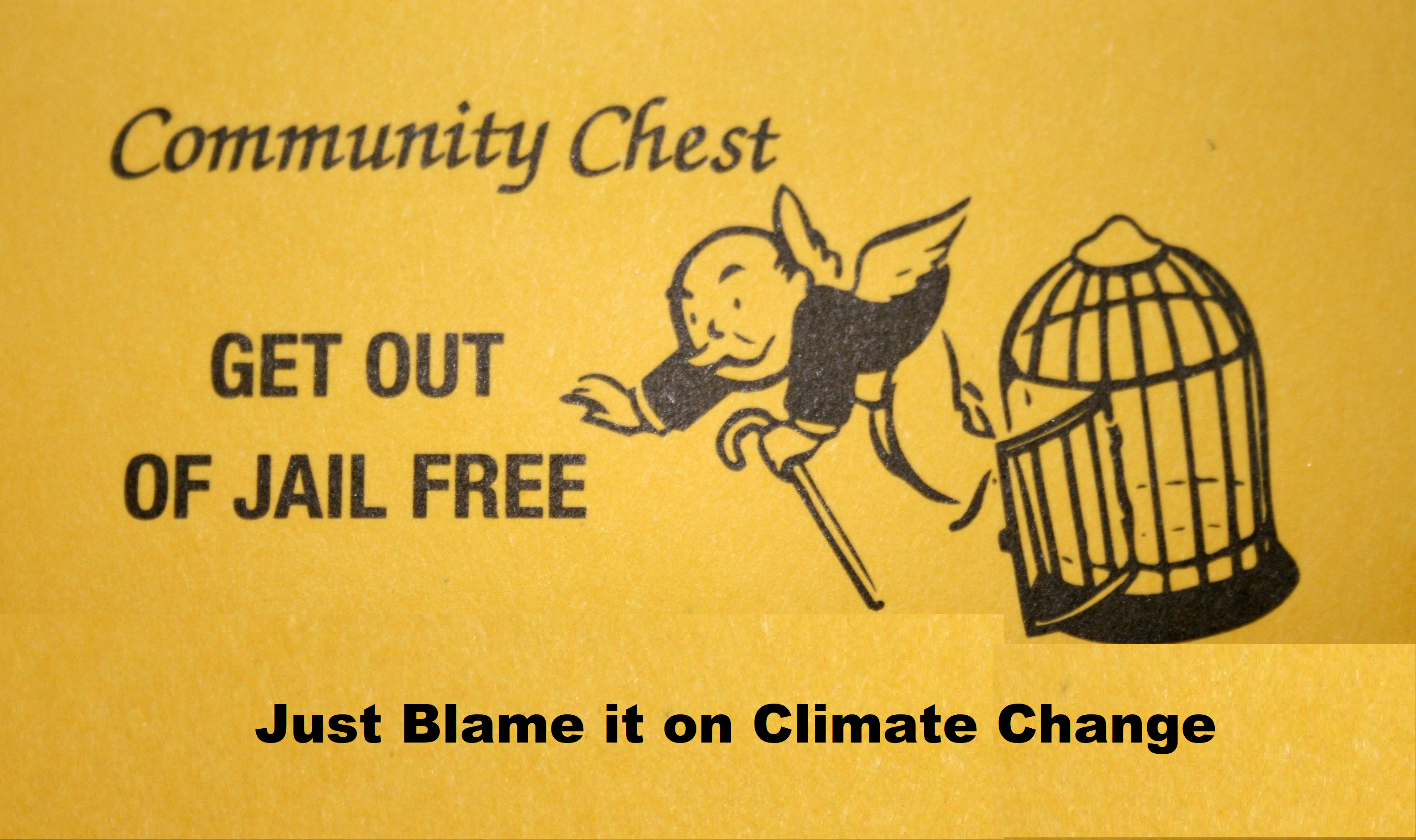
A provincial political leader won the parliamentary election and on the day to take the oath was greeted by the outgoing premier.  Wishing him well, his predecessor gave him three envelopes, explaining it was a tradition.  The envelopes contained advice to be consulted later on if difficulties were encountered.

Not long after taking office, criticisms started up, and the new premier opened the first envelope.  It explained:  “Blame it on the previous administration.”  He followed that advice pointing to past financial mismanagement, and the difficulty undoing bad policies and programs he had inherited.

That calmed things down for awhile, but a year later the excuses were wearing thin.  So he turned to the second envelope which gave the advice:  “Blame it on the federal government.”  A new campaign of announcements focused on delays and shortfalls of federal funding, poor coordination and liaison by federal counterparts, and counterproductive federal policies.

This quieted critics for more than a year, but alas it too began to fall on deaf ears.  It was time to open the third envelope:  ” Blame it on climate change, or else prepare three envelopes.”


UK High Court Refuses to Set Carbon Targets


ITV reports Environmental campaigners lose High Court battle over carbon target. Excerpts in italics below with my bolds.

Environmental campaigners have lost their High Court challenge against the Government over its policy for tackling climate change.

Charity Plan B Earth brought legal action against the Government’s stance on the 2050 carbon target, set under the Climate Change Act 2008.

The charity and 11 UK citizens aged nine to 79 – including publisher Dame Carmen Callil – wanted to bring a judicial review against Business Secretary Greg Clark over the policy.

But Mr Justice Supperstone rejected Plan B Earth’s case on Friday, saying it was “unarguable”.

Lawyers for the charity previously argued the Government should have, in light of the current scientific consensus, gone further than its original target of reducing carbon levels by 2050 to 80% of those present in 1990.

They said the decision not to amend the 2050 target put the UK in breach of its international obligations under the Paris Agreement on Climate Change and was influenced by the Government’s belief that a “more ambitious target was not feasible”.

At a hearing on July 4, Jonathan Crow QC told the court: “The Secretary of State’s belief that he needs to have regard to what is feasible, rather than what is necessary, betrays a fundamental misunderstanding of the scheme of the 2008 Act and must be quashed.

“All of the individual claimants are deeply concerned about climate change.”

The barrister argued the Secretary of State’s “continuing refusal” to amend the 2050 target means the UK is playing “Russian roulette with two bullets, instead of one”.

But, refusing permission for a full hearing, Mr Justice Supperstone said Plan B Earth’s arguments were based on an “incorrect interpretation” of the Paris Agreement.

He said: “In my view the Secretary of State was plainly entitled … to refuse to change the 2050 target at the present time.

“I do not consider it arguable that the Secretary of State’s refusal to amend the 2050 target is an unlawful exercise of his discretion.”

Plan B Earth director Tim Crosland said the charity was “surprised and disappointed” by the ruling and plans to appeal.

He said: “We consider it clear and widely accepted that the current carbon target is not compatible with the Paris Agreement.

“Neither the Government nor the Committee on Climate Change suggested during our correspondence with them prior to the claim that the target was compatible.

“Indeed, it was only in January of this year that the Committee published a report accepting that the Paris Agreement was ‘likely to require’ a more ambitious 2050 target.

“Moreover the Government acknowledged in these proceedings that it was uncontroversial’ that the 2050 target was insufficient to meet the 1.5C target, one of the key aspects of the Paris commitment.

“As with other legal campaigns confronting powerful vested interests it takes time to break through, and time is not on our side.

“We’ll be doing everything possible to accelerate the process. Wildfires raging in the Arctic Circle must surely be a wake-up call.”

Regarding wildfires in the Arctic, I recommend he read my post Arctic Hockey Stick Extends Lead

NYC Lawsuit Against Big Oil: Fugget about it!

Washington Examiner has the story: Federal judge dismisses New York City’s climate change lawsuit against Big Oil Excerpts below in italics with my bolds.

A federal judge Thursday dismissed New York City’s lawsuit against major oil companies for their contribution to climate change, the latest in a string of suits filed by cities to be tossed aside.

“Global warming and solutions thereto must be addressed by the two other branches of government,” U.S. District Court Judge John Keenan ruled in dismissing the city’s climate lawsuit, saying the matter should not be handled by the courts. He added that Congress has already delegated to the Environmental Protection Agency the authority to regulate greenhouse gas emissions, so it’s not the job of the courts.

Keenan, of the U.S. District Court for the Southern District of New York, is an appointee of former President Ronald Reagan, a Republican.

In January, New York City sued Exxon Mobil, Chevron Corp., BP, Shell, and ConocoPhillips to help pay for the costs of climate change, trying to hold them responsible for any damage to the city caused by global warming.

Just last week, U.S. District Court Judge William Alsup dismissed similar lawsuits filed by the cities of San Francisco and Oakland, stating in an order: “No plaintiff has ever succeeded in bringing a nuisance claim based on global warming.”

Alsup, of the U.S. District Court for the Northern District of California, is an appointee of former President Bill Clinton, a Democrat.

The cities have argued that big oil companies have promoted fossil fuel use and deliberately concealed that they knew climate change could harm coastal cities, meaning they should have to pay for seawalls and other infrastructure to protect against rising sea levels.

Oil companies say that courts cannot rule on broad and speculative issues such as the impact of business decisions on climate change.

Despite the setbacks, environmentalists continue to increase the pressure for similar lawsuits, seeing them as a key tactic to publicly criticize the industry for its role in producing energy that exacerbates climate change.

Earlier this month, Rhode Island became the first state to file such a lawsuit. Rhode Island Attorney General Peter F. Kilmartin filed the lawsuit in state court against 21 companies that included Exxon Mobil, Chevron, and BP.

JOHN F. KEENAN, United States District Judge Ruling July 19, 2018 Excerpts below in italics with my bolds give the flavor of the judge’s thinking.

Although the amended complaint contains extensive allegations regarding Defendants’ past attempts to deny or downplay the effects of fossil fuel use on climate change, in their motion to dismiss, Defendants do not dispute the scientific consensus that greenhouse gas emissions from fossil fuel use have contributed to global warming.

The City alleges that Defendants’ ongoing conduct continues to exacerbate global warming and cause recurring injuries to NewYork City. (Id. ¶ 9.) Defendants continue to produce, market, distribute, and sell fossil fuels in massive quantities; to promote fossil fuel consumption in these massive quantities; and to downplay the threat posed by climate change. (Id. ¶ 131.) This ongoing conduct will cause increasingly severe injuries to New York City, including new and more significant encroachments upon and interferences with City property, and increasingly severe threats to public health.

NYC claims of damages rest upon IPCC models projections of sea level rise 8 times beyond what has been observed.

The City requests compensatory damages for past and future costs incurred by the City to protect its infrastructure and property, and to protect the public health, safety, and property of its residents from the impacts of climate change.

However, regardless of the manner in which the City frames its claims in its opposition brief, the amended complaint makes clear that the City is seeking damages for global-warming related injuries resulting from greenhouse gas emissions, and not only the production of Defendants’ fossil fuels.

From BP Brief: If ever a problem cried out for a uniform and comprehensive solution, it is the geophysical problem described by the complaints, a problem centuries in the making (and studying) with causes ranging from volcanoes, to wildfires, to deforestation to stimulation of other greenhouse gases—and, most pertinent here, to the combustion of fossil fuels.

As an initial matter, it is not clear that Defendants’ fossil fuel production and the emissions created therefrom have been an “unlawful invasion” in New York City, as the City benefits from and participates in the use of fossil fuels as a source of power, and has done so for many decades. More importantly, Congress has expressly delegated to the EPA the determination as to what constitutes a reasonable amount of greenhouse gas emission under the Clean Air Act.

The Court recognizes that the City, and many other governmental entities around the United States and in other nations, will be forced to grapple with the harmful impacts of climate change in the coming decades. However, the immense and complicated problem of global warming requires a comprehensive solution that weighs the global benefits of fossil fuel use with the gravity of the impending harms. To litigate such an action for injuries from foreign greenhouse gas emissions in federal court would severely infringe upon the foreign-policy decisions that are squarely within the purview of the political branches of the U.S.Government. Accordingly, the Court will exercise appropriate caution and decline to recognize such a cause of action.

CONCLUSION
For the reasons stated above, the U.S.-based Defendants’ motion to dismiss is GRANTED and the City’s amended complaint is dismissed with prejudice in its entirety.

Note:  With prejudice indicates NYC cannot file an amended complaint again in this court.  They can appeal to a higher court, but that seems unlikely.  OTOH should one federal district court cave in to climate plaintiffs, then an appeal by the oil companies is highly likely.

Facts Omitted by Climatists


Economist Joseph Stiglitz writes of climate change: “There is a point at which, once this harm occurs, it cannot be undone at any reasonable cost or in any reasonable period of time. Based on the best available science, our country is close to approaching that point.” Credit: Win McNamee/Getty Images

One of the world’s top economists has written an expert court report that forcefully supports a group of children and young adults who have sued the federal government for failing to act on climate change. (Source: Inside Climate News  here) Excerpts in italics with my bolds.

Stiglitz, a Columbia University economics professor and former World Bank chief economist, concludes that increasing global warming will have huge costs on society and that a fossil fuel-based system “is causing imminent, significant, and irreparable harm to the Youth Plaintiffs and Affected Children more generally.” He explains in a footnote that his analysis also examines impacts on “as-yet-unborn youth, the so-called future generations.”

But, he says, acting on climate change now—by imposing a carbon tax and cutting fossil fuel subsidies, among other steps—is still manageable and would have net-negative costs. He argues that if the government were to pursue clean energy sources and energy-smart technologies, “the net benefits of a policy change outweigh the net costs of such a policy change.”

“Defendants must act with all deliberate speed and immediately cease the subsidization of fossil fuels and any new fossil fuel projects, and implement policies to rapidly transition the U.S. economy away from fossil fuels,” Stiglitz writes. “This urgent action is not only feasible, the relief requested will benefit the economy.”

Stiglitz has been examining the economic impact of global warming for many years. He was a lead author of the 1995 report of the UN’s Intergovernmental Panel on Climate Change, an authoritative assessment of climate science that won the IPCC the 2007 Nobel Peace Prize, shared with Al Gore.

The Stiglitz expert report submitted to the court is here.

An Example of Intentional Omissions

Since this is a legal proceeding, Stiglitz wrote a brief telling the plaintiffs’ side of the story. In a scientific investigation, parties would assert theories attempting to explain all of the evidence at hand. Legal theories have no such requirement to incorporate all the facts, but rather present conclusions informed by the evidence deemed strongest and most pertinent to one party’s interests.

While the Pope accuses us with the Sin of Emissions, we counter with the Sins of Omissions by him and his fellow activists.

Let’s consider the Stiglitz brief according to the three suppositions comprising the Climatist (Activists and Alarmists) position. Climate change is a bundle that depends on all three assertions to be true.

Supposition 1: Humans make the climate warmer.

As an economist, Stiglitz defers to the IPCC on this scientific point, with references to reports by those deeply involved and committed to Paris Accord and other UN climate programs. In the recent California District Court case (Cities suing Big Oil companies), both sides in a similar vein stipulated their acceptance of IPCC reports as authoritative regarding global warming/climate change.

Skeptical observers must attend to the nuances of what is referenced and what is hidden or omitted in these testimonies. For example, Chevron’s attorney noted that IPCC’s reports express various opinions over time as to human influence on the climate. They noted that even today, the expected temperature effect from doubling CO2 ranges widely from 1.5C to 4.5C. No mention is made that several more recent estimates from empirical data (rather than GCMs) are at the low end or lower.

metofffig3iIn addition, there is no mention that GCMs projections are running about twice as hot as observations. Omitted is the fact GCMs correctly replicate tropospheric temperature observations only when CO2 warming is turned off. In the effort to proclaim scientific certainty, neither Stiglitz nor IPCC discuss the lack of warming since the 1998 El Nino, despite two additional El Ninos in 2010 and 2016.

Figure 5. Simplification of IPCC AR5 shown above in Fig. 4. The colored lines represent the range of results for the models and observations. The trends here represent trends at different levels of the tropical atmosphere from the surface up to 50,000 ft. The gray lines are the bounds for the range of observations, the blue for the range of IPCC model results without extra GHGs and the red for IPCC model results with extra GHGs.The key point displayed is the lack of overlap between the GHG model results (red) and the observations (gray). The nonGHG model runs (blue) overlap the observations almost completely.

Further they exclude comparisons between fossil fuel consumption and temperature changes. The legal methodology for discerning causation regarding work environments or medicine side effects insists that the correlation be strong and consistent over time, and there be no confounding additional factors. As long as there is another equally or more likely explanation for a set of facts, the claimed causation is unproven. Such is the null hypothesis in legal terms: Things happen for many reasons unless you can prove one reason is dominant.

Finally, Stiglitz and IPCC are picking on the wrong molecule. The climate is controlled not by CO2 but by H20. Oceans make climate through the massive movement of energy involved in water’s phase changes from solid to liquid to gas and back again. From those heat transfers come all that we call weather and climate: Clouds, Snow, Rain, Winds, and Storms.

Esteemed climate scientist Richard Lindzen ended a very fine recent presentation with this description of the climate system:

I haven’t spent much time on the details of the science, but there is one thing that should spark skepticism in any intelligent reader. The system we are looking at consists in two turbulent fluids interacting with each other. They are on a rotating planet that is differentially heated by the sun. A vital constituent of the atmospheric component is water in the liquid, solid and vapor phases, and the changes in phase have vast energetic ramifications. The energy budget of this system involves the absorption and reemission of about 200 watts per square meter. Doubling CO2 involves a 2% perturbation to this budget. So do minor changes in clouds and other features, and such changes are common. In this complex multifactor system, what is the likelihood of the climate (which, itself, consists in many variables and not just globally averaged temperature anomaly) is controlled by this 2% perturbation in a single variable? Believing this is pretty close to believing in magic. Instead, you are told that it is believing in ‘science.’ Such a claim should be a tip-off that something is amiss. After all, science is a mode of inquiry rather than a belief structure.

Supposition 2: The Warming is Dangerous

Billions of dollars have been spent researching any and all negative effects from a warming world: Everything from Acne to Zika virus. Stiglitz links to a recent Climate Report that repeats the usual litany of calamities to be feared and avoided by submitting to IPCC demands. The evidence does not support these claims.

Stiglitz: It is scientifically established that human activities produce GHG emissions, which accumulate in the atmosphere and the oceans, resulting in warming of Earth’s surface and the oceans, acidification of the oceans, increased variability of climate, with a higher incidence of extreme weather events, and other changes in the climate.

Moreover, leading experts believe that there is already more than enough excess heat in the climate system to do severe damage and that 2C of warming would have very significant adverse effects, including resulting in multi-meter sea level rise.

Experts have observed an increased incidence of climate-related extreme weather events, including increased frequency and intensity of extreme heat and heavy precipitation events and more severe droughts and associated heatwaves. Experts have also observed an increased incidence of large forest fires; and reduced snowpack affecting water resources in the western U.S. The most recent National Climate Assessment projects these climate impacts will continue to worsen in the future as global temperatures increase.

Alarming Weather and Wildfires

But: Weather is not more extreme.
And Wildfires were worse in the past.
But: Sea Level Rise is not accelerating.
Litany of Changes

Seven of the ten hottest years on record have occurred within the last decade; wildfires are at an all-time high, while Arctic Sea ice is rapidly diminishing.

We are seeing one-in-a-thousand-year floods with astonishing frequency.

When it rains really hard, it’s harder than ever.

We’re seeing glaciers melting, sea level rising.

The length and the intensity of heatwaves has gone up dramatically.

Plants and trees are flowering earlier in the year. Birds are moving polewards.

We’re seeing more intense storms.

But: Arctic Ice has not declined since 2007.Sept Arctic ice 2007 to 2019 full

But: All of these are within the range of past variability.

US Wet Dry CO2rev

In fact our climate is remarkably stable.

GISS GMT to 2018 w CO2

And many aspects follow quasi-60 year cycles.

Climate is Changing the Weather

Stiglitz:  Other potential examples include agricultural losses. Whether or not insurance
reimburses farmers for their crops, there can be food shortages that lead to higher food
prices (that will be borne by consumers, that is, Youth Plaintiffs and Affected Children).
There is a further risk that as our climate and land use pattern changes, disease vectors
may also move (e.g., diseases formerly only in tropical climates move northward).36 This
could lead to material increases in public health costs

But: Actual climate zones are local and regional in scope, and they show little boundary change.


But: Ice cores show that it was warmer in the past, not due to humans.

Supposition 3:  Government Can Stop it!

Here it is blithely assumed that the court can rule the seas to stop rising, heat waves to cease, and Arctic ice to grow (though why we would want that is debatable).  All this will be achieved by leaving fossil fuels in the ground and powering civilization with windmills and solar panels.  While admitting that our way of life depends on fossil fuels, they ignore the inadequacy of renewable energy sources at their present immaturity.

Stiglitz: Conclusion
The choice between incurring manageable costs now and the incalculable, perhaps even
irreparable, burden Youth Plaintiffs and Affected Children will face if Defendants fail to
rapidly transition to a non-fossil fuel economy is clear. While the full costs of the climate damages that would result from maintaining a fossil fuel-based economy may be
incalculable, there is already ample evidence concerning the lower bound of such costs,
and with these minimum estimates, it is already clear that the cost of transitioning to a
low/no carbon economy are far less than the benefits of such a transition. No rational
calculus could come to an alternative conclusion. Defendants must act with all deliberate
speed and immediately cease the subsidization of fossil fuels and any new fossil fuel
projects, and implement policies to rapidly transition the U.S. economy away from fossil
fuels.

But CO2 relation to Temperature is Inconsistent.

But: The planet is greener because of rising CO2.

But: Modern nations (G20) depend on fossil fuels for nearly 90% of their energy.

But: Renewables are not ready for prime time.

People need to know that adding renewables to an electrical grid presents both technical and economic challenges.  Experience shows that adding intermittent power more than 10% of the baseload makes precarious the reliability of the supply.  South Australia is demonstrating this with a series of blackouts when the grid cannot be balanced.  Germany got to a higher % by dumping its excess renewable generation onto neighboring countries until the EU finally woke up and stopped them. Texas got up to 29% by dumping onto neighboring states, and some like Georgia are having problems.

But more dangerous is the way renewables destroy the economics of electrical power.  Seasoned energy analyst Gail Tverberg writes:

In fact, I have come to the rather astounding conclusion that even if wind turbines and solar PV could be built at zero cost, it would not make sense to continue to add them to the electric grid in the absence of very much better and cheaper electricity storage than we have today. There are too many costs outside building the devices themselves. It is these secondary costs that are problematic. Also, the presence of intermittent electricity disrupts competitive prices, leading to electricity prices that are far too low for other electricity providers, including those providing electricity using nuclear or natural gas. The tiny contribution of wind and solar to grid electricity cannot make up for the loss of more traditional electricity sources due to low prices.

These issues are discussed in more detail in the post Climateers Tilting at Windmills

Footnote regarding mention of “multi-meter” sea level rise.  It is all done with computer models.  For example, below is San Francisco.  More at USCS Warnings of Coastal Floodings

sf-ca-past-projected

dilbert-sins-of-omission-and-comission