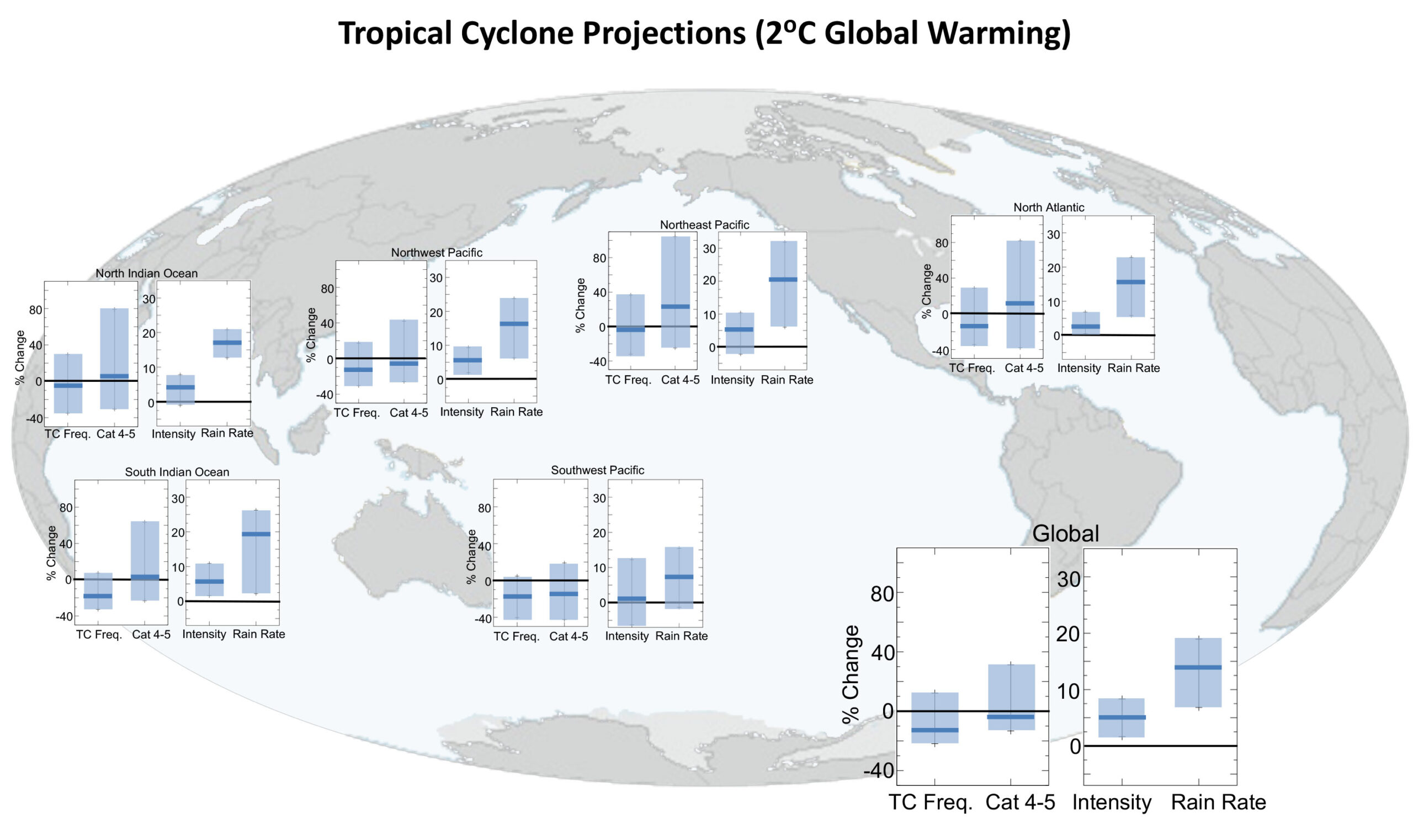
Devious Climate Attribution Studies

Patrick Brown raises the question Do Climate Attribution Studies Tell the Full Story? Excerpts in italics with my bolds and added images, his analysis concluding thusly:

How a cascade of selection effects bias
the collective output of extreme event attribution studies.

Weather and climate extremes—such as high temperatures, floods, droughts, tropical cyclones, extratropical cyclones, and severe thunderstorms—have always threatened both human and natural systems. Given their significant impacts, there is considerable interest in how human-caused climate change influences these extremes. This is the focus of the relatively new discipline of Extreme Event Attribution (EEA).

Over the past couple of decades, there has been an explosion in EEA studies focusing on (or, “triggered by”) some prior notable weather or climate extreme. Non-peer-reviewed reports from World Weather Attribution (e.g., herehere, and here) represent some of the most notable examples of these kinds of analyses, and many similar studies also populate the peer-reviewed literature. The Bulletin of the American Meteorological Society’s “Explaining Extreme Events From a Climate Perspective” annual series compiles such studies, as does the Sabin Center for Climate Change Law, and they are also synthesized in reports like those from the IPCC (IPCC WG1 AR6 Chapter 11.2.3) and the United States National Climate Assessment.

The collective output of these kinds of studies certainly gives the impression that human-caused climate change is drastically changing the frequency and intensity of all kinds of weather extremes. Indeed, Carbon Brief recently published an extensive summary of the science of EEA studies, which begins with the proclamation, “As global temperatures rise, extreme weather events are becoming more intense and more frequent all around the world.”

However, these numbers cannot be taken as an accurate quantification of the influence of climate change on extreme weather because they are heavily influenced by a cascade of selection biases originating from the physical climate system, as well as researcher and media incentives. Identifying and understanding these biases is a prerequisite for properly interpreting the collective output of EEA studies and, thus, what implications they hold for general scientific understanding, as well as political and legal questions.

The large apparent discrepancy between the size of the influence of human-caused climate change on extreme weather reported in EEA studies (like those compiled by Carbon Brief) compared to more comprehensive systematic analyses (like those compiled by the IPCC) can, in large part, be attributed to the many layers of Selection Biases that influence the EEA literature’s collective output.

Selection Bias is a broad term that refers to any bias that arises from a process that selects data for analysis in a way that fails to ensure that data is representative of the broader population that the study wishes to describe.

Selection biases in the context of EEA studies include those associated with the physical climate system itself, those concerning proclivities and incentives facing researchers/journals, and those concerning the proclivities and incentives facing the media. They include
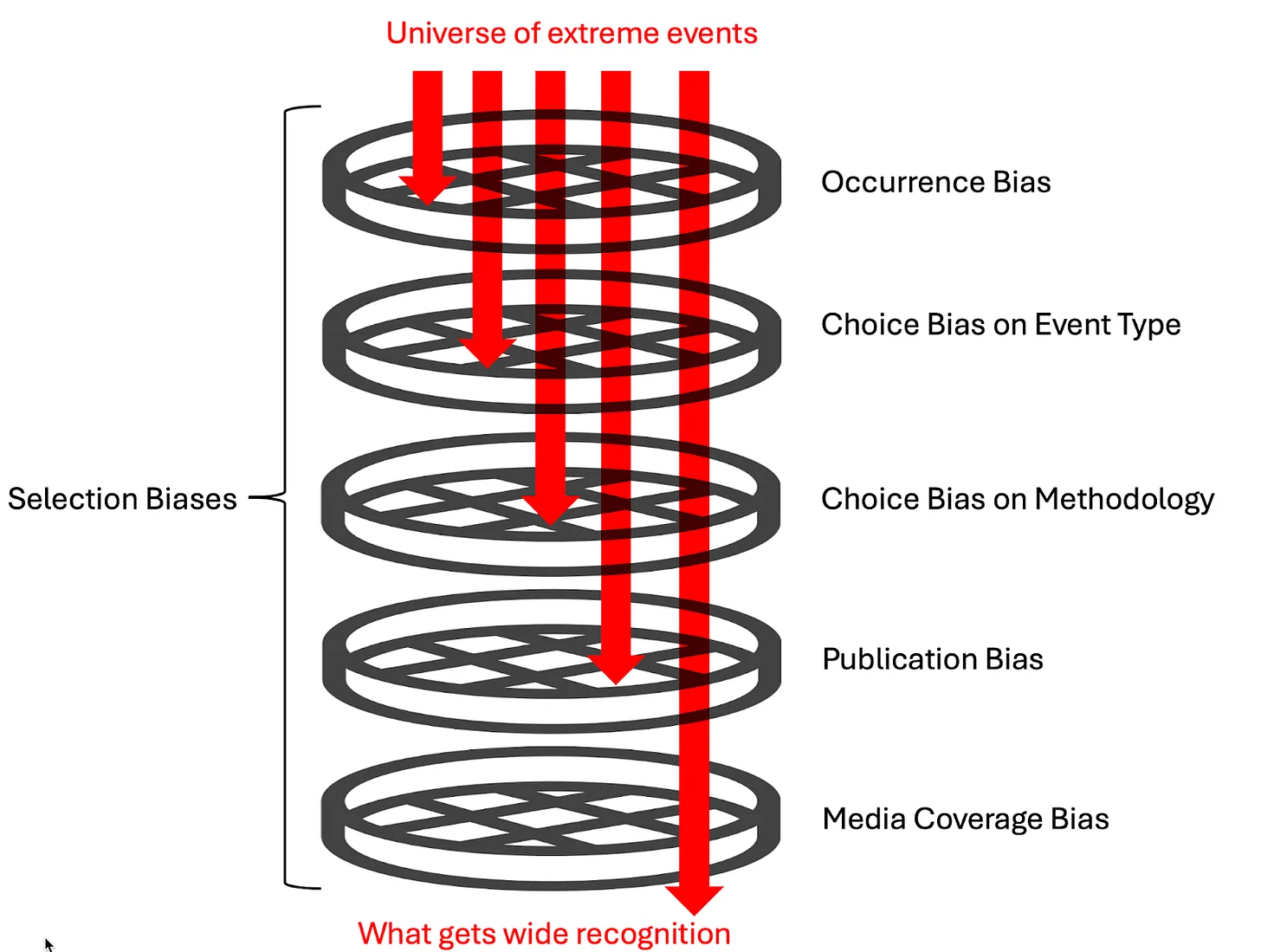
Occurrence Bias is a bias introduced by the physical climate system. Since EEA studies tend to be triggered by extreme events that have actually occurred, there is reason to believe that these studies will disproportionately sample events that are more likely than average to be exacerbated by climate change because the events occurred in the first place. Essentially, extreme events that are more likely to occur under climate change—and thus more likely to be observed—are going to be overrepresented in EEA studies, and extreme events that are less likely to occur under climate change—and thus less likely to be observed—are going to be underrepresented in EEA studies.

The map below illustrates this phenomenon. It shows changes in the magnitude of extreme drought under climate change. Specifically, it shows the fractional change in the intensity of once-per-50-year droughts (as quantified by monthly soil moisture) between a preindustrial and 21st-century run (SSP2-4.5 emissions) of the highly-regarded NCAR CESM2 Climate Model. Blue areas represent locations where the model simulates that extreme droughts become less frequent and intense with enhanced greenhouse gas concentrations, and red areas represent locations where the model simulates that extreme droughts become more frequent and intense with enhanced greenhouse gas concentrations. It is notable that overall, this model simulates that warming decreases the frequency and intensity of extreme drought in more locations than it increases it (consistent with soil moistening under warming simulated by other models).
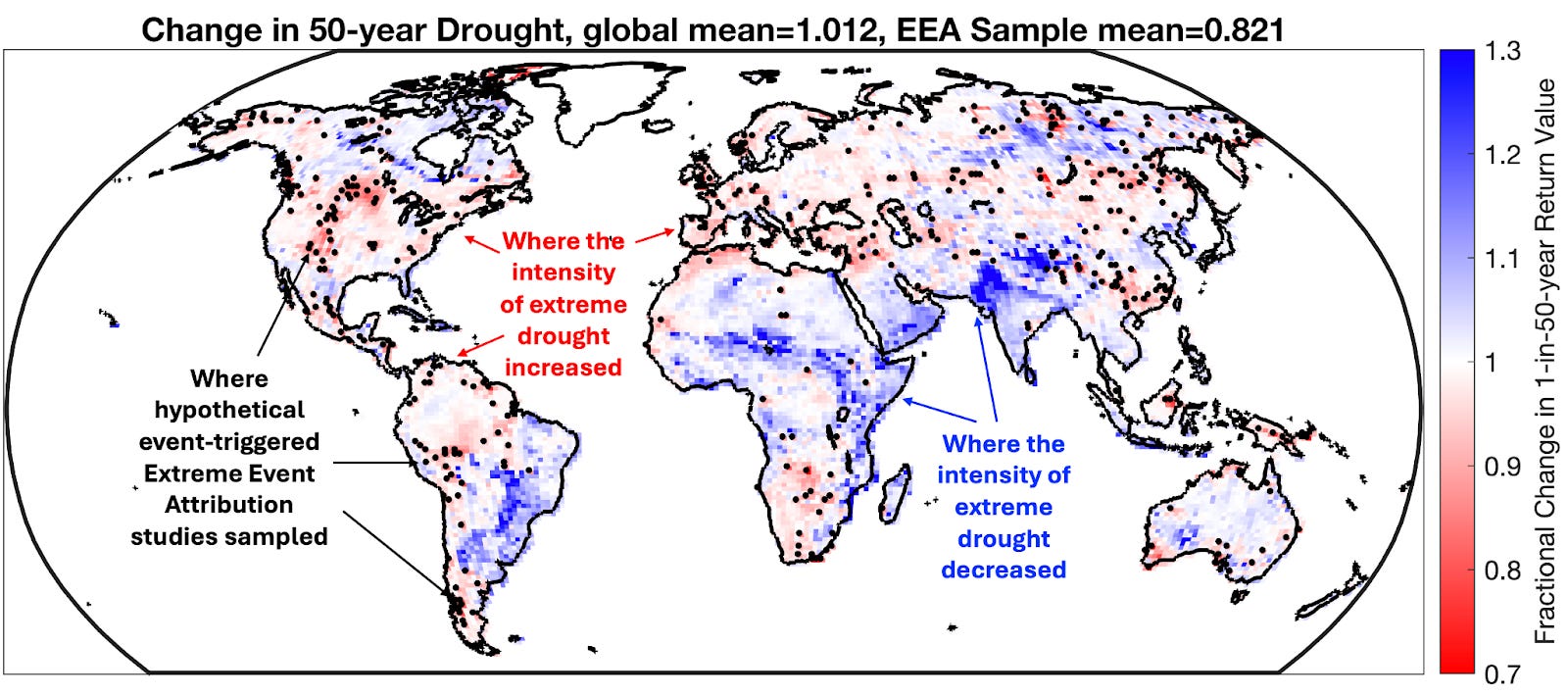
Now, here’s the kicker: The black dots show locations where once-per-50-year droughts actually occurred in the 21st-century simulation and thus represent events that would plausibly trigger EEA studies.

What do you notice about where the dots are compared to where the red is? That’s right; the simulated EEA studies overwhelmingly sample areas where droughts are getting more intense and more frequent by the very nature that those are the types of droughts that are more likely to occur in the warming climate. The result is that the EEA sample is majorly biased: warming decreased the intensity of once-per-50-year droughts by about 1% overall, but it increased their intensity within the EEA sample by 18%!

Thus, if you just relied on the EEA sample, you would come away with an
incorrect impression not only on the magnitude of change in extreme droughts
but also on the sign of the direction of change!

Choice Bias arises when researchers use prior knowledge to choose events for EEA studies that are more likely to have been made more severe by climate change. A clear example of Choice Bias pervading the Carbon Brief database is there have been 3.6 times more studies on extreme heat than there have been on extreme winter weather (205 vs. 57). Another example would be the dearth of EEA studies on extratropical cyclones (the kinds of low-pressure systems with cold and warm fronts that are responsible for most of the dramatic weather outside of the tropics). The IPCC states that the number of extratropical cyclones associated with intense surface wind speeds is expected to decrease strongly in the Northern Hemisphere with warming. Yet, it is relatively rare for EEA attribution studies to be done on these types of systems, which results in an exclusion of this good news from the EEA literature.
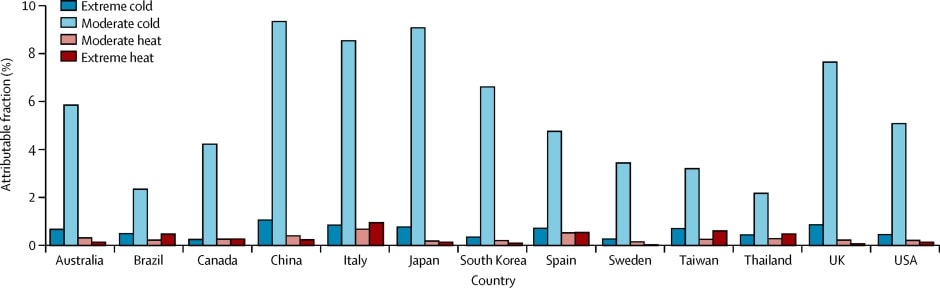
Publication Bias could be playing a role, too, where researchers are more likely to submit, and journals are likely to publish studies that report significant effects on salient events compared to studies that find null effects.
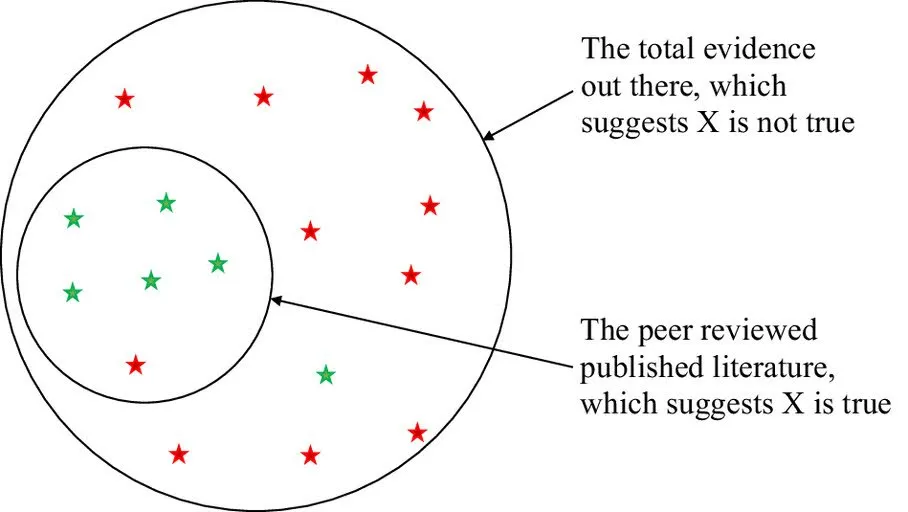
From Clark et al., 2023

Finally, the climate reporting media ecosystem is characterized by actors whose explicit mission is to raise awareness of the negative impacts of climate change, and thus, there will be a natural Media Coverage Bias with a tendency to selectively highlight EEA studies where climate change is found to be a larger driver than EEA studies that do not reach such a conclusion. These selection biases are apparent at the aggregate level, but there is also strong evidence of their presence in individual studies.
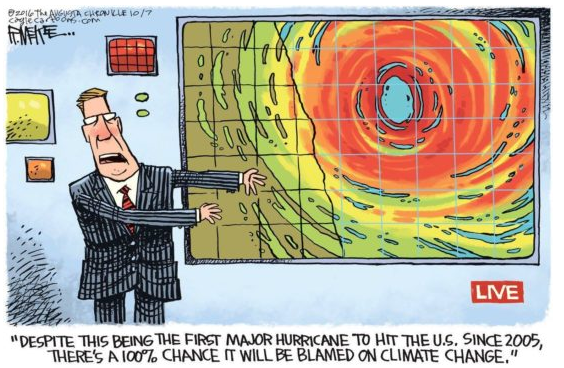
A more recent specific example suggestive of many of these dynamics is a study, Gilford et al. (2024), titled “Human-caused ocean warming has intensified recent hurricanes”. This study was conducted by three researchers at Climate Central, which summarizes the study’s findings with the following infographic:
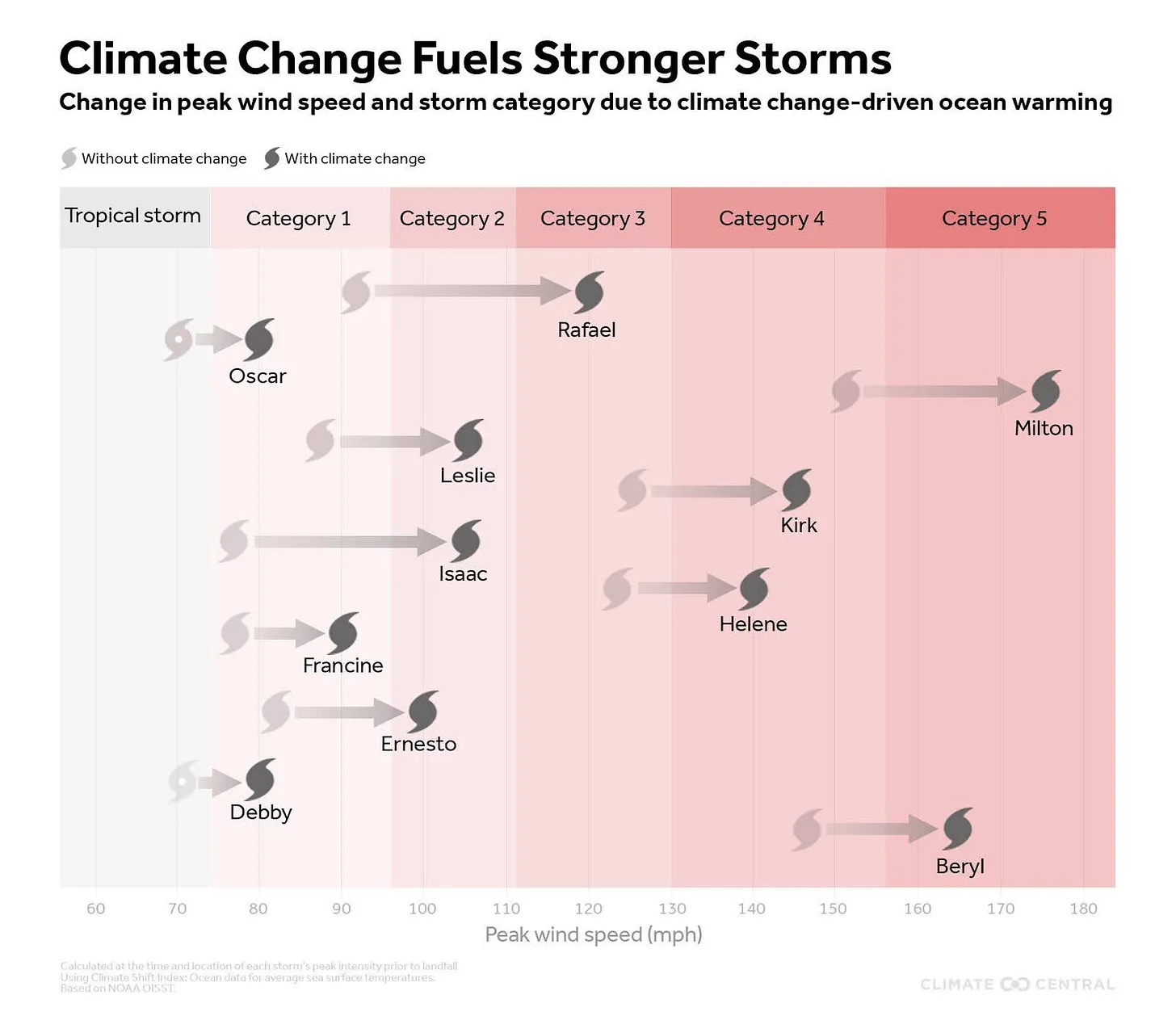
From Climate Central press release on Gilford et al. (2024).

Essentially, they claim that climate change is enhancing the intensity of all hurricanes and that the enhancement is quite large: Storms today are calculated to be an entire Category stronger than they would have been in a preindustrial climate.

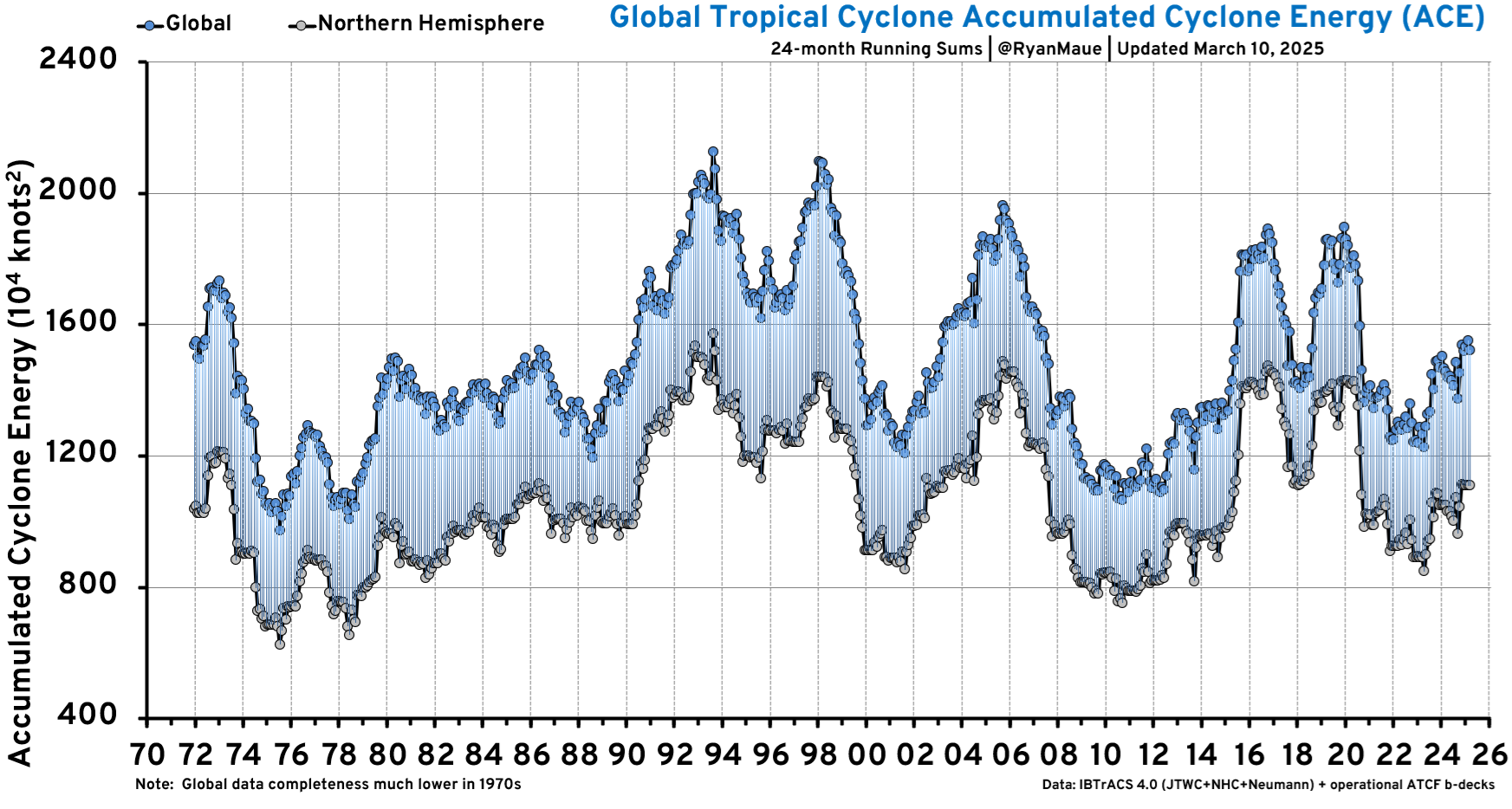
This is a huge effect, and thus, if it were real, it is reasonable to expect to see clear long-term trends in metrics of tropical cyclone (hurricane) intensity like the accumulated number of major (Category 3+) hurricane days or the accumulated cyclone energy from all tropical cyclones (which is proportional to the square of hurricane windspeed accumulated over their lifetimes). However, any long-term trends in such metrics are subtle at best, both globally and over the North Atlantic.
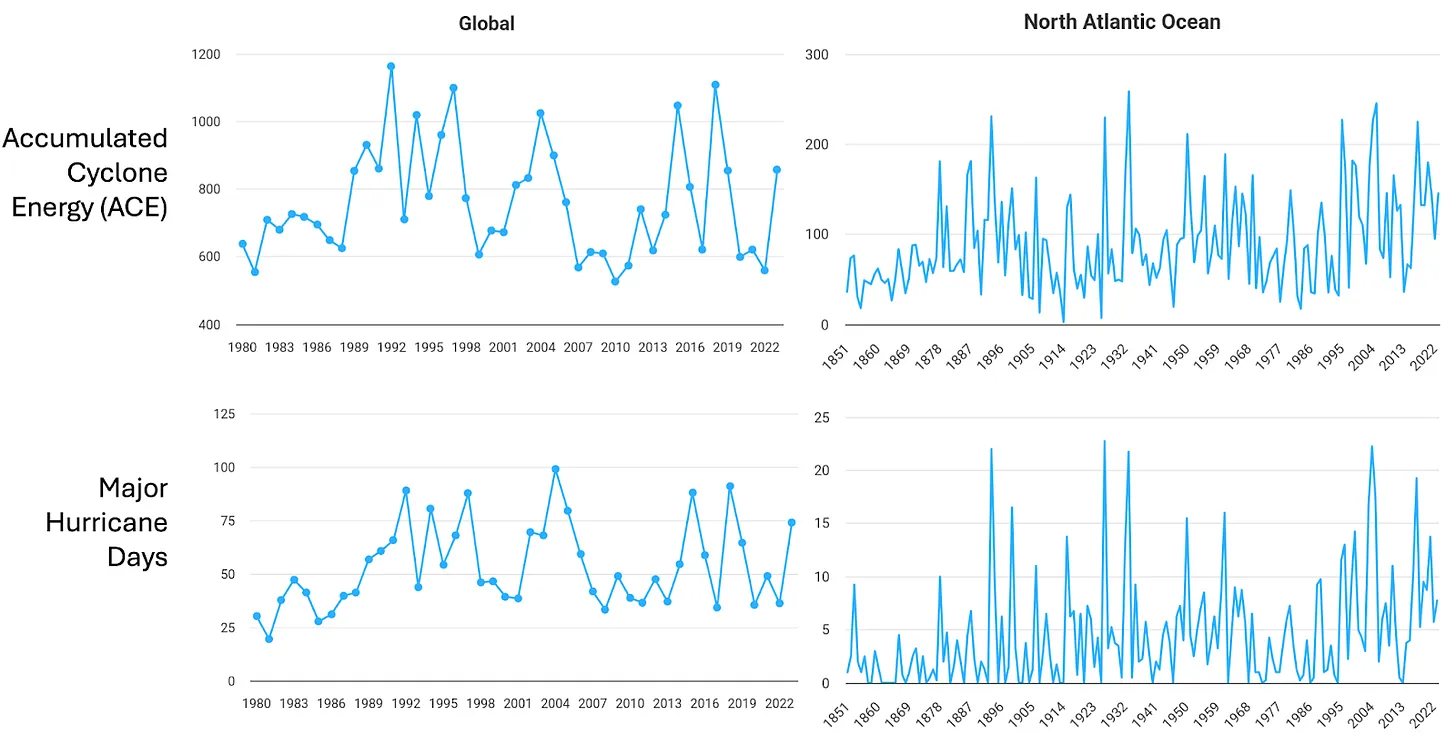
From Colorado State University Department of Atmospheric Science Tropical Meteorology Project.

So, this is a microcosm of the aforementioned apparent discrepancy between more broad quantifications of changes in extremes and their associated EEA counterparts, and again, I’d argue there are several selection biases at play affecting the production and dissemination of the EEA study.

Let’s start with Choice Bias on methodology. Human-caused warming changes the environment in some ways that work to enhance hurricanes and in other ways that diminish them. The main way that hurricanes are enhanced is via the increase in sea surface temperatures (which provides the fundamental fuel for hurricanes), and the main way that hurricanes are diminished is via changes in atmospheric wind shear and humidity.

The net result of these countervailing factors pulling in opposite directions is that we expect fewer hurricanes overall, but when hurricanes are able to form, they can be stronger than they would otherwise. These factors, though, are small relative to natural random variability, and thus, they are difficult to detect in observations.

However, the Climate Central researchers made the methodological choice
to largely exclude the influence of factors that diminish
hurricane development from the study.

Are these Choice Biases in event type and methodology an accident? There are many reasons to believe they are not.

The research paper itself spells out that the motivation of the study is to “connect the dots” between climate change and hurricanes because “landfalling hurricanes with high intensities—can act as ‘focusing events’ that draw public attention” and that “Increased attention during and in wake of storms creates opportunities for public and private discourse around climate and disaster preparedness.”
Then, there is the extensive media coverage of this study. It was picked up by 134 news outlets and ranked in the 99.95th percentile of research articles (across all journals) of similar age in terms of online attention. Further, it was immediately incorporated into seven Wikipedia articles (likely having high leverage on AI queries, which would make its findings indistinguishable from scientific “fact”). This is affected by the aforementioned Media Coverage Bias, but it is also undoubtedly directly influenced by the efforts of Climate Central, which is explicitly an advocacy organization whose self-described specialty is media placement and dissemination. 
The above sheds light on the reasons for certain choice biases in a particular study, but there is plenty of evidence that these selection biases are pervasive in the EEA field. After all, Dr. Myles Allen essentially founded the field with the motivation of answering the question, “Will it ever be possible to sue anyone for damaging the climate?”. This same motivation seems to animate many of the most high-profile scientists in the field today, like Allen’s protege, Dr. Friederike Otto (co-founder and leader of World Weather Attribution). She and her organization are frequently cited as bringing the necessary intellectual authority to credibly sue fossil fuel companies. She states the motivation of her work explicitly:

“Attributing extreme weather events to climate change, as I do
through my work as a climatologist, means we can hold
countries and companies to account for their inaction.”

Given the explicitly stated motivation of those in the EEA field, it is quite reasonable to suppose that there are major selection biases at play, and thus, it is not at all surprising that the collective output of the EEA field would look so different from more broad comprehensive assessments.


Climatists Make Their Case by Omitting Facts

One of the world’s top economists has written an expert court report that forcefully supports a group of children and young adults who have sued the federal government for failing to act on climate change. (Source: Inside Climate News  here) Excerpts in italics with my bolds.

Stiglitz, a Columbia University economics professor and former World Bank chief economist, concludes that increasing global warming will have huge costs on society and that a fossil fuel-based system “is causing imminent, significant, and irreparable harm to the Youth Plaintiffs and Affected Children more generally.” He explains in a footnote that his analysis also examines impacts on “as-yet-unborn youth, the so-called future generations.”

But, he says, acting on climate change now—by imposing a carbon tax and cutting fossil fuel subsidies, among other steps—is still manageable and would have net-negative costs. He argues that if the government were to pursue clean energy sources and energy-smart technologies, “the net benefits of a policy change outweigh the net costs of such a policy change.”

“Defendants must act with all deliberate speed and immediately cease the subsidization of fossil fuels and any new fossil fuel projects, and implement policies to rapidly transition the U.S. economy away from fossil fuels,” Stiglitz writes. “This urgent action is not only feasible, the relief requested will benefit the economy.”

Stiglitz has been examining the economic impact of global warming for many years. He was a lead author of the 1995 report of the UN’s Intergovernmental Panel on Climate Change, an authoritative assessment of climate science that won the IPCC the 2007 Nobel Peace Prize, shared with Al Gore.

The Stiglitz expert report submitted to the court is here.

An Example of Intentional Omissions

Since this is a legal proceeding, Stiglitz wrote a brief telling the plaintiffs’ side of the story. In a scientific investigation, parties would assert theories attempting to explain all of the evidence at hand. Legal theories have no such requirement to incorporate all the facts, but rather present conclusions informed by the evidence deemed strongest and most pertinent to one party’s interests.

While the Pope accuses us with the Sin of Emissions, we counter with the Sins of Omissions by him and his fellow activists.

Let’s consider the Stiglitz brief according to the three suppositions comprising the Climatist (Activists and Alarmists) position. Climate change is a bundle that depends on all three assertions to be true.

Supposition 1: Humans make the climate warmer.

As an economist, Stiglitz defers to the IPCC on this scientific point, with references to reports by those deeply involved and committed to Paris Accord and other UN climate programs. In the recent California District Court case (Cities suing Big Oil companies), both sides in a similar vein stipulated their acceptance of IPCC reports as authoritative regarding global warming/climate change.

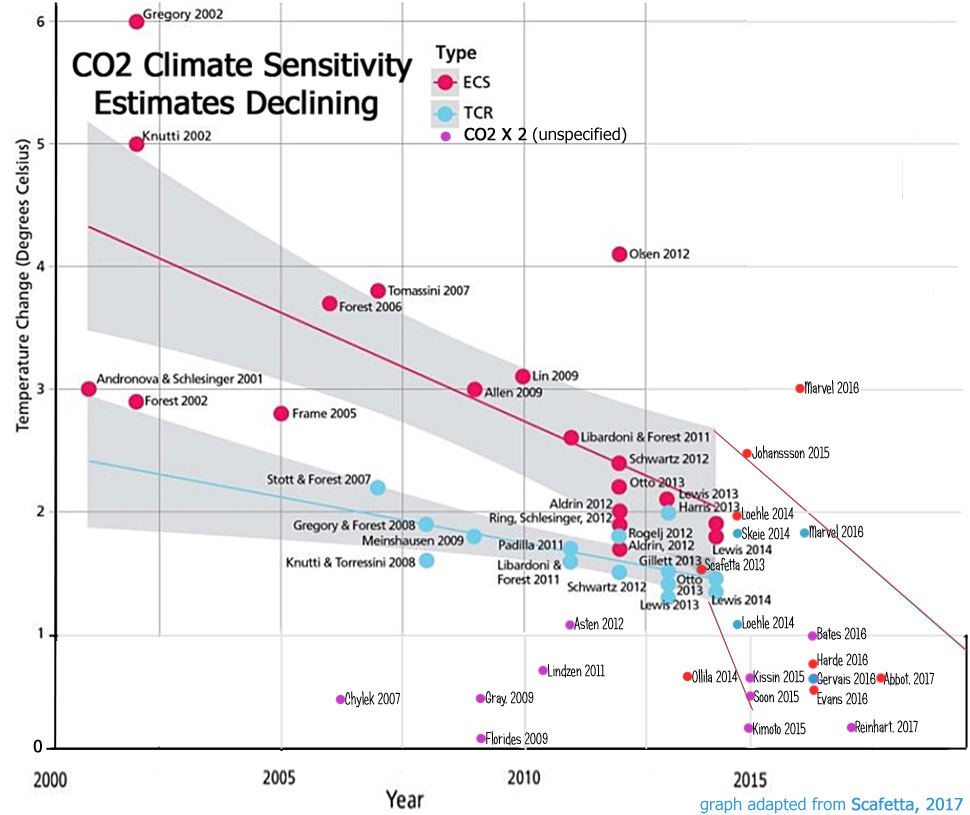
Skeptical observers must attend to the nuances of what is referenced and what is hidden or omitted in these testimonies. For example, Chevron’s attorney noted that IPCC’s reports express various opinions over time as to human influence on the climate. They noted that even today, the expected temperature effect from doubling CO2 ranges widely from 1.5C to 4.5C. No mention is made that several more recent estimates from empirical data (rather than GCMs) are at the low end or lower.

In addition, there is no mention that GCMs projections are running about twice as hot as observations. Omitted is the fact GCMs correctly replicate tropospheric temperature observations only when CO2 warming is turned off. In the effort to proclaim scientific certainty, neither Stiglitz nor IPCC discuss the lack of warming since the 1998 El Nino, despite two additional El Ninos in 2010 and 2016.

Figure 5. Simplification of IPCC AR5 shown above in Fig. 4. The colored lines represent the range of results for the models and observations. The trends here represent trends at different levels of the tropical atmosphere from the surface up to 50,000 ft. The gray lines are the bounds for the range of observations, the blue for the range of IPCC model results without extra GHGs and the red for IPCC model results with extra GHGs.The key point displayed is the lack of overlap between the GHG model results (red) and the observations (gray). The nonGHG model runs (blue) overlap the observations almost completely.

Further they exclude comparisons between fossil fuel consumption and temperature changes. The legal methodology for discerning causation regarding work environments or medicine side effects insists that the correlation be strong and consistent over time, and there be no confounding additional factors. As long as there is another equally or more likely explanation for a set of facts, the claimed causation is unproven. Such is the null hypothesis in legal terms: Things happen for many reasons unless you can prove one reason is dominant.

Finally, Stiglitz and IPCC are picking on the wrong molecule. The climate is controlled not by CO2 but by H20. Oceans make climate through the massive movement of energy involved in water’s phase changes from solid to liquid to gas and back again. From those heat transfers come all that we call weather and climate: Clouds, Snow, Rain, Winds, and Storms.

Esteemed climate scientist Richard Lindzen ended a very fine recent presentation with this description of the climate system:

I haven’t spent much time on the details of the science, but there is one thing that should spark skepticism in any intelligent reader. The system we are looking at consists in two turbulent fluids interacting with each other. They are on a rotating planet that is differentially heated by the sun. A vital constituent of the atmospheric component is water in the liquid, solid and vapor phases, and the changes in phase have vast energetic ramifications. The energy budget of this system involves the absorption and reemission of about 200 watts per square meter. Doubling CO2 involves a 2% perturbation to this budget. So do minor changes in clouds and other features, and such changes are common. In this complex multifactor system, what is the likelihood of the climate (which, itself, consists in many variables and not just globally averaged temperature anomaly) is controlled by this 2% perturbation in a single variable? Believing this is pretty close to believing in magic. Instead, you are told that it is believing in ‘science.’ Such a claim should be a tip-off that something is amiss. After all, science is a mode of inquiry rather than a belief structure.

Supposition 2: The Warming is Dangerous

Billions of dollars have been spent researching any and all negative effects from a warming world: Everything from Acne to Zika virus. Stiglitz links to a recent Climate Report that repeats the usual litany of calamities to be feared and avoided by submitting to IPCC demands. The evidence does not support these claims.

Stiglitz: It is scientifically established that human activities produce GHG emissions, which accumulate in the atmosphere and the oceans, resulting in warming of Earth’s surface and the oceans, acidification of the oceans, increased variability of climate, with a higher incidence of extreme weather events, and other changes in the climate.

Moreover, leading experts believe that there is already more than enough excess heat in the climate system to do severe damage and that 2C of warming would have very significant adverse effects, including resulting in multi-meter sea level rise.

Experts have observed an increased incidence of climate-related extreme weather events, including increased frequency and intensity of extreme heat and heavy precipitation events and more severe droughts and associated heatwaves. Experts have also observed an increased incidence of large forest fires; and reduced snowpack affecting water resources in the western U.S. The most recent National Climate Assessment projects these climate impacts will continue to worsen in the future as global temperatures increase.

Alarming Weather and Wildfires

But: Weather is not more extreme.


And Wildfires were worse in the past.
But: Sea Level Rise is not accelerating.
Litany of Changes

Seven of the ten hottest years on record have occurred within the last decade; wildfires are at an all-time high, while Arctic Sea ice is rapidly diminishing.

We are seeing one-in-a-thousand-year floods with astonishing frequency.

When it rains really hard, it’s harder than ever.

We’re seeing glaciers melting, sea level rising.

The length and the intensity of heatwaves has gone up dramatically.

Plants and trees are flowering earlier in the year. Birds are moving polewards.

We’re seeing more intense storms.

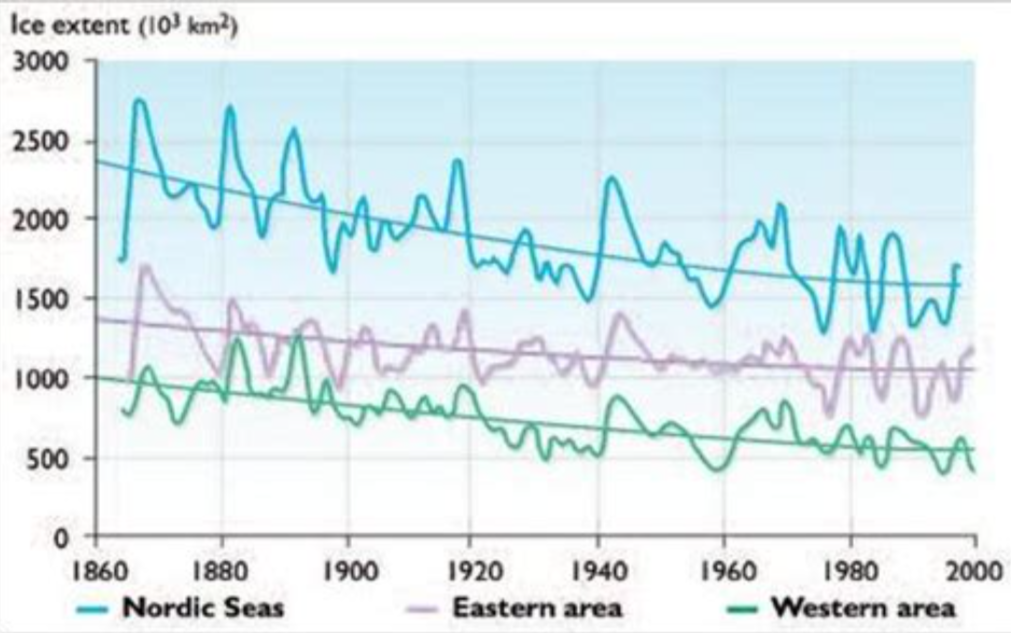
But: Arctic Ice has not declined since 2007.

But: All of these are within the range of past variability.

In fact our climate is remarkably stable.

And many aspects follow quasi-60 year cycles.

Climate is Changing the Weather

Stiglitz:  Other potential examples include agricultural losses. Whether or not insurance
reimburses farmers for their crops, there can be food shortages that lead to higher food
prices (that will be borne by consumers, that is, Youth Plaintiffs and Affected Children).
There is a further risk that as our climate and land use pattern changes, disease vectors
may also move (e.g., diseases formerly only in tropical climates move northward).36 This
could lead to material increases in public health costs

But: Actual climate zones are local and regional in scope, and they show little boundary change.

But: Ice cores show that it was warmer in the past, not due to humans.

Supposition 3:  Government Can Stop it!

Here it is blithely assumed that the court can rule the seas to stop rising, heat waves to cease, and Arctic ice to grow (though why we would want that is debatable).  All this will be achieved by leaving fossil fuels in the ground and powering civilization with windmills and solar panels.  While admitting that our way of life depends on fossil fuels, they ignore the inadequacy of renewable energy sources at their present immaturity.

Stiglitz: Conclusion
The choice between incurring manageable costs now and the incalculable, perhaps even
irreparable, burden Youth Plaintiffs and Affected Children will face if Defendants fail to
rapidly transition to a non-fossil fuel economy is clear. While the full costs of the climate
damages that would result from maintaining a fossil fuel-based economy may be
incalculable, there is already ample evidence concerning the lower bound of such costs,
and with these minimum estimates, it is already clear that the cost of transitioning to a
low/no carbon economy are far less than the benefits of such a transition. No rational
calculus could come to an alternative conclusion. Defendants must act with all deliberate
speed and immediately cease the subsidization of fossil fuels and any new fossil fuel
projects, and implement policies to rapidly transition the U.S. economy away from fossil
fuels.

But CO2 relation to Temperature is Inconsistent.

But: The planet is greener because of rising CO2.

But: Modern nations (G20) depend on fossil fuels for nearly 90% of their energy.

But: Renewables are not ready for prime time.

People need to know that adding renewables to an electrical grid presents both technical and economic challenges.  Experience shows that adding intermittent power more than 10% of the baseload makes precarious the reliability of the supply.  South Australia is demonstrating this with a series of blackouts when the grid cannot be balanced.  Germany got to a higher % by dumping its excess renewable generation onto neighboring countries until the EU finally woke up and stopped them. Texas got up to 29% by dumping onto neighboring states, and some like Georgia are having problems.

But more dangerous is the way renewables destroy the economics of electrical power.  Seasoned energy analyst Gail Tverberg writes:

In fact, I have come to the rather astounding conclusion that even if wind turbines and solar PV could be built at zero cost, it would not make sense to continue to add them to the electric grid in the absence of very much better and cheaper electricity storage than we have today. There are too many costs outside building the devices themselves. It is these secondary costs that are problematic. Also, the presence of intermittent electricity disrupts competitive prices, leading to electricity prices that are far too low for other electricity providers, including those providing electricity using nuclear or natural gas. The tiny contribution of wind and solar to grid electricity cannot make up for the loss of more traditional electricity sources due to low prices.

These issues are discussed in more detail in the post Climateers Tilting at Windmills

Footnote regarding mention of “multi-meter” sea level rise.  It is all done with computer models.  For example, below is San Francisco.  More at USCS Warnings of Coastal Floodings


US Supremes Hear Climate Lawfare Case to Stop Oil Railway

IER reports the news from December in article The Supreme Court Takes on a Case Involving the National Environmental Policy Act.  Excerpts in italics with my bolds and added images.

Key Takeaways

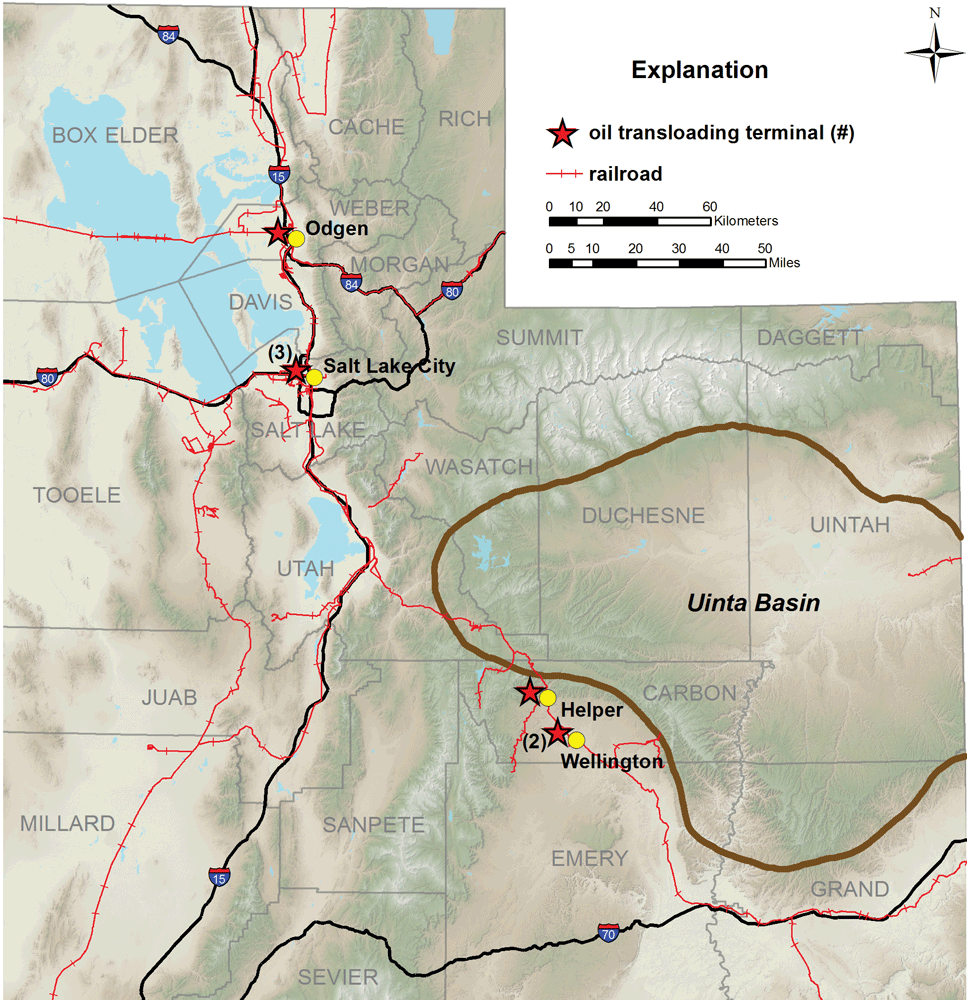
The Supreme Court recently heard a major case, Seven County Infrastructure Coalition v. Eagle County, Colorado, that will affect the scope of the National Environmental Policy Act (NEPA). The case concerns the permitting of a proposed Utah railway that would ship oil from the Uinta Basin, potentially quadrupling its oil production. The 88-mile Uinta Basin Railway would connect the oil fields of northeastern Utah to the national rail network running alongside 100 or so miles of the Colorado River to reach oil refineries on the Gulf Coast.  According to The Hill,  at issue is whether and when upstream and downstream environmental impacts should be considered as part of federal environmental reviews. The company behind the railway and a group of Utah counties appealed a lower court decision to the Supreme Court, arguing that those indirect impacts are beyond the scope of the federal reviews.

Background

The case concerns a rail line to support oil development and mineral mining. In 2021, the federal Surface Transportation Board (STB) issued a 3,600-page environmental impact statement to comply with NEPA and approved the rail line. The NEPA mandates that federal agencies assess the environmental effects of projects within their authority. Any major initiative that is managed, regulated, or authorized by the federal government must undergo a NEPA evaluation, a process that can span years and frequently exposes projects to legal challenges.

The STB analyzed the railway’s potential effects on local water resources, air quality, protected species, recreation, local economies, the Ute Indian tribe, and other factors. Environmental groups, however, sued the agency, saying that it failed to examine sufficiently how the railway might affect the risk of accidents on connecting lines hundreds of miles away and to assess emissions in “environmental justice communities” on the Gulf Coast from increased oil shipments, among other supposed shortcomings.

According to the Wall Street Journal editorial board, “a D.C. Circuit Court of Appeals panel sided with the plaintiffs and told the STB it must consider the line’s upstream and downstream effects even if they were hard to predict and beyond the control of the agency and developers. This includes the effects of oil shipments on Gulf Coast refiners and their contributions to climate change.” The appeals court ruling found that the federal STB violated the Endangered Species Act and the Interstate Commerce Commission Termination Act when it permitted the project.

Furthermore, the editorial board also explained that lower court judges—those on the D.C. and Ninth Circuits—ignored the Supreme Court’s past rulings and imposed arbitrary permitting requirements with no limiting principle. The STB lacks authority over Gulf Coast refiners and cannot prevent climate change.

Court Rulings Regarding NEPA

The Supreme Court has heard other related cases and held that agencies need not consider indirect and unpredictable impact, most recently in a 2004 case, Department of Transportation v. Public Citizen. In that case, the Supreme Court held that agencies need only analyze environmental impact with “a reasonably close causal relationship” over which they have “statutory authority” and which they can prevent.

In 2020, the Supreme Court green-lit approval for permits for the Atlantic Coast Pipeline after nearly seven years of litigation, but the pipeline was scrapped due to legal delays that raised project costs significantly. It takes an average of 4.2 years to litigate a NEPA challenge, which adds to the four or more years to obtain a federal permit. These delays are what frustrate investment in new projects, slowing job creation and economic expansion in the United States.

judge struck down a Montana coal mine permit because a federal agency did not consider the climate effects of coal combustion in Asia. Additionally, a 225-mile electric transmission line in Nebraska has been stuck in permitting for 10 years because a lower court invalidated a U.S. Fish and Wildlife permit.

Conclusion

The Supreme Court is tackling a case involving the scope of a federal environmental law, NEPA, that involves a rail line to move oil. In this case, lower courts agreed with environmental groups, who are challenging the government’s permit approval of the rail line. The case is instrumental to the issue of what should be considered when determining potential environmental damages. Congress recognizes that NEPA needs reform as delays over lawsuits have killed projects and dramatically increased their costs and it continues to debate ways to make federal permitting easier and quicker. Until that reform happens, however, Supreme Court Justices need to reign in the environmental limits of NEPA so that needed projects can progress in America.

Trump to Bury Already Dead ESG

John  Authers explains the demise of ESG in his Bloomberg article Trump Will Bury ESG, But It Was Already Dead. Excerpts in italics with my bolds and added images.

The green investing revolution never stood a chance in the US once
ensnared by the culture wars, but that wasn’t the only cause of death.

Ever So Gone

As was obvious even before voters went to the polls, ESG was already a decisive loser in the US. The concept of Environmental, Social and Governance investing became hopelessly entangled with the culture war agenda, failed to deliver on its promises, and went into retreat. Rather than attempt a technocratic, clean, green way of changing capitalism, America has opted for something more nationalist, even mercantilist.

ESG as a term has been demonized by politicians on the right, to the point that BlackRock’s Larry Fink said that it had been “weaponized” and should no longer be used. Because of Fink’s stand on ESG issues, BlackRock has become a lightning rod for conservative attacks lumped in with identity politics. Startlingly, the company shows up in a list of “decadent and rootless” institutions that should be burned to the ground in a new book by Kevin Roberts, the head of the Heritage Foundation, a distinction it bizarrely shares with the Boy Scouts of America and the Chinese Communist Party.

Supporters of the concept were already disillusioned that ESG had become little more than a marketing wheeze, and several big fund managers, including WisdomTree and Invesco, have faced fines in the US for “greenwashing” (claiming their products were greener than they really were). In France, BlackRock is under fire over allegations that 18 of its funds sold as sustainable are in fact investing in fossil fuels.

Regulator attitudes differ starkly across the Atlantic. In Europe, regulators have raised the ante by telling fund managers that they must reach minimum thresholds for environmental impact before they can use the ESG label — a move that makes it hard for them to keep investing in the US, where the best returns are, and requires them to become more active than is currently the case for many.

In the US, the Securities and Exchange Commission (SEC) has watered down its requirements on companies to disclose ESG statistics — and the whole concept is close to unworkable unless everyone has to disclose standardized statistics. In September, it quietly disbanded its task force on ESG enforcement. Now, the Trump administration is likely to make dismantling such rules one of its first acts in office.

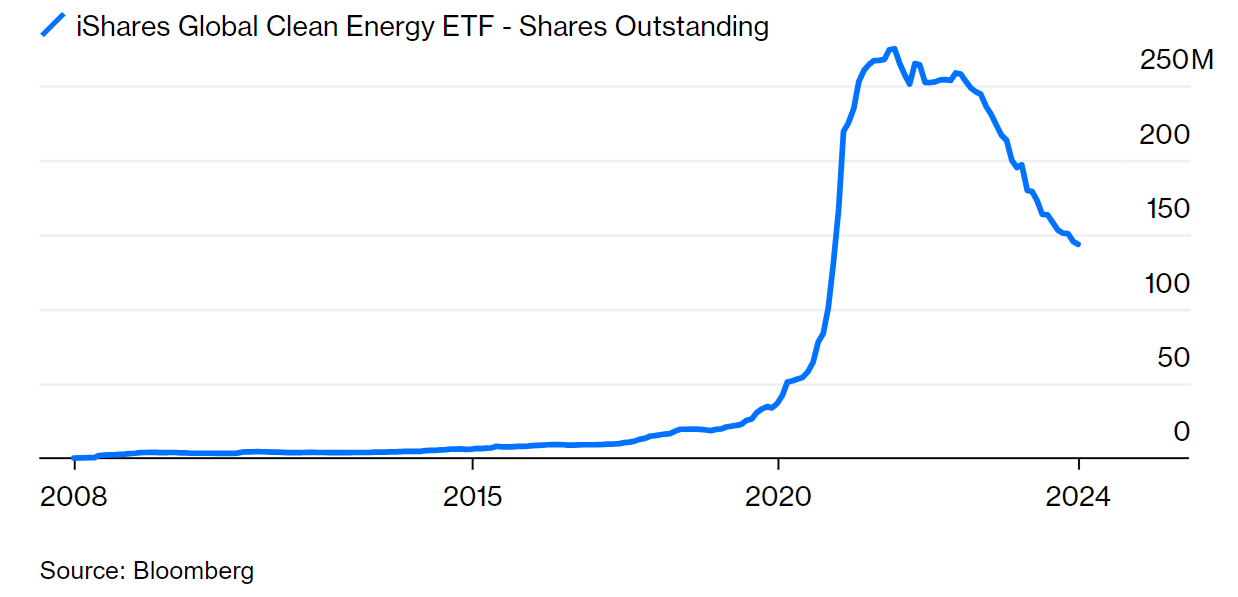
That will complete a retreat that has largely already taken place. A look at the total market cap of BlackRock’s flagship ETFs covering the global energy and clean energy sectors shows that after a boom in 2021, the clean energy fund has steadily dwindled, and is now worth slightly less than the main energy fund:

Investors Wash Their Hands of Clean Energy
There has been an exodus from clean energy stocks in the last two years

Much of this is driven by the declining share prices of clean energy stocks. However, if we look at the number of shares in the ETF, it’s clear that there were huge inflows during the pandemic, and much of that money has now been withdrawn.

Investors are losing interest in the concept, and claims that ESG would reduce
global warming, or starve fossil fuel groups of capital, look overblown.

Interest among the public has waned in the US — although not elsewhere. Google Trends shows that US searches for ESG and its synonyms tanked over the last two years, while continuing at much the same level elsewhere. The rest of the world still seems happy to give it a try, but America is no longer going along for the ride.

The pattern recurs in the news media. Counting stories published on the Bloomberg terminal from all sources shows interest peaking in 2016, when Donald Trump was first elected, and long before the flow of money went into reverse. By the time that Fink said ESG had been “weaponized,” interest was barely a third its 2016 level and has continued to dwindle.

Critically from the point of view of how capitalism is operating, the same pattern shows up in earnings call transcripts. Bloomberg’s Document Search function shows that executives — not just Larry Fink — no longer want to talk about it. This is our quarter-by-quarter measure of mentions of ESG and its various synonyms since 2010. Mentions exploded after the pandemic, and have tumbled since 2022. With this earning season roughly 90% over, interest from executives in ESG looks to be right back to pre-pandemic levels’.

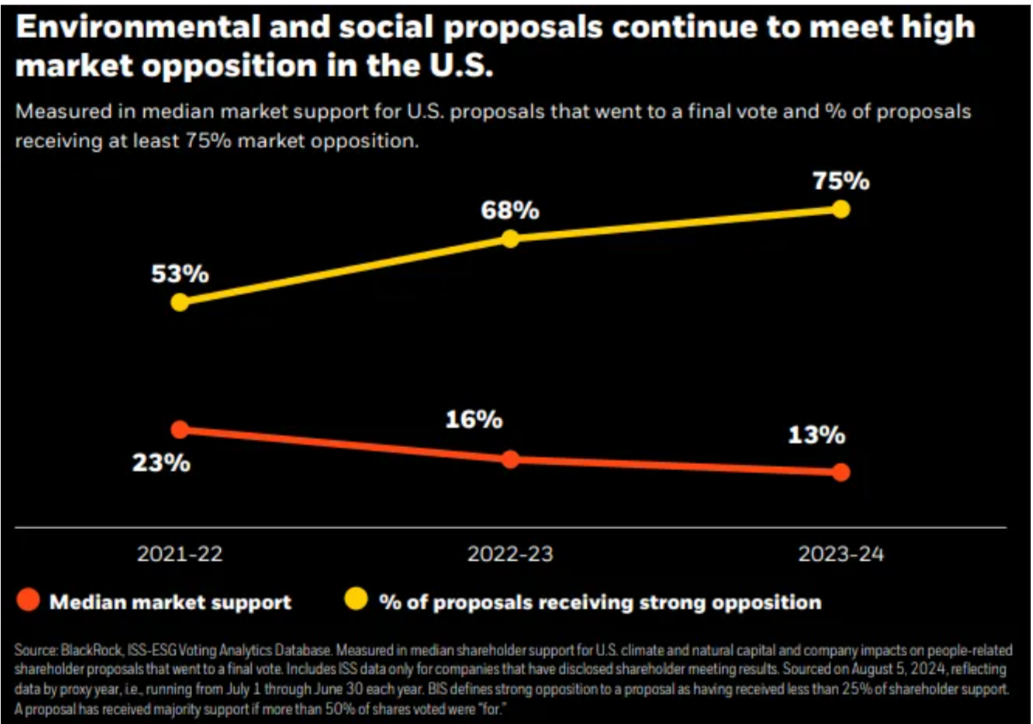
This is at least in part because fund managers are no longer forcing the issue. BlackRock is admirably transparent about the way it votes its shares, and produces regular reports; here is the latest. As this chart from the report (which is worth a read) demonstrates, the amount of support from shareholders for environmental and social proposals has declined markedly over the last three years:

BlackRock itself upped its support for corporate governance proposals, but only backed 4% of social and environmental proposals (down from 20% two years earlier). It also declined to support any of the various anti-ESG proposals that were put forward, and complained that many of them were duplicative or poorly drafted. But the notion that ESG was going to change the way companies operate seems to be in retreat.

Once Trump is back in the White House in January, we’ll learn much more about how his economic nationalism will work. Fine-tuning capitalism to make it more long-termist and take into account more than the narrowly defined interests of shareholders — the big ESG idea — has been comprehensively defeated. Now we wait to see what version of mercantilism comes in its stead.

Footnote: Fundamental Reasons People Reject ESG Were Not Addressed by Author


Biden EPA Falsely Touts First Climate Change Arrest

NY Post reports Biden admin brought unprecedented climate change prosecution against man for ‘smuggling greenhouse gases’ by transporting refrigerants.  Excerpts in italics with my bolds and added images.

The Biden administration boasted in an Environmental Protection Agency (EPA) report released Thursday about the unprecedented prosecution of a California man for “smuggling greenhouse gases” across the border from Mexico and selling them online.

Michael Hart, 58, was arrested in March and pleaded guilty in September to charges related to transporting refrigerants into the US to peddle on Facebook Marketplace, OfferUp and other online vendors between June and December 2022.

Biden’s EPA touted the crackdown on Hart, the first-ever person charged for climate change-related bootlegging of refrigerants — namely, hydrochlorofluorocarbons (HFCs) — without the agency’s approval, in its report.

When charging the San Diego resident earlier this year, US Attorney Tara McGrath vowed “it will not be the last” case of its kind.

After some investigation it appears this “victory” in the fight
against climate change is a lot of puffery with very little substance,
and worse more overreach by the EPA.

Background

The Montreal Protocol, ratified in 1987, forced the industrialized world to switch from chlorofluorocarbons (CFCs) to hydrofluorocarbons (HFCs) on the theory that CFCs break down the ozone layer.

Both the formation and depletion of the ozone layer depend on ultraviolet light from the Sun. The theory was that UV splits chlorine atoms from the CFCs. The CFCs sat around all winter, moving into position, waiting … and then just as the Sun returned, the chlorine radicals chewed up the ozone as it was being formed, producing a brief downward spike in ozone at the start of the Antarctic summer. This is the famous ozone hole.

The actual measurements look very peculiar, which means there’s more going on than just a simple chain of free-radical reactions. But NASA and the climatologists were confident that the mystery was solved. As with the AGW debate, most agree that it could theoretically happen; the debate is over how big the effect is and how important it is.

Four popular HFCs in use today as refrigerants are R-410a, R-407c, R-143a, and R-134a. The average GWP of the HFCs currently in use, weighted by usage, is about 1600. Enviros are claiming that eliminating these so-called high-GWP HFCs will prevent up to 0.5°C of warming by 2100. Due to the huge variability in the predictions of the various models, this could be anywhere from 8 to 100% of what the models predict. What is remarkable is that absolutely nobody seems to have noticed any of this until the patents ran out.

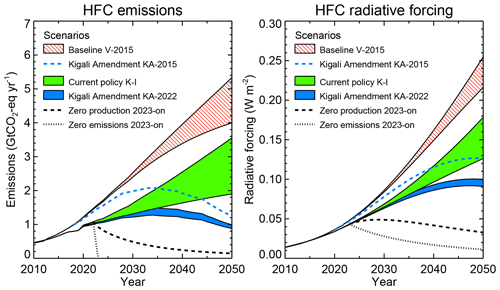
Global total HFC emissions (GtCO2eq.yr-1; left panel) and radiative forcing (right panel) from the V-2015 baseline scenarios developed in Velders et al. (2015) and the updated scenarios derived here (current policy Kigali independent (K-I) and KA-202. Figure: Velders et al., Atmospheric Chemistry and Physics, 2015

From  Chemical Sciences Laboratory

As substitutes for ozone-depleting substances, the emissions of HFCs have increased substantially over the past two decades as a result of the phaseout of ozone-depleting substances under the Montreal Protocol. Due to the growing climate impact of HFCs, the Kigali Amendment to the Montreal Protocol has scheduled a phase-down of their future production and consumption. The results show that total CO2 equivalent global HFC emissions derived from NOAA observations continue to increase through 2019, but are about 20% lower than previously projected for 2017-2019, mainly because of the lower global emissions of HFC-143a, which is one of the longer-lived HFCs in use today. Current policies reduce projected emissions in 2050 from 4.0-5.3 GtCO2eq.yr-1 in the absence of controls to 1.9-3.6 GtCO2eq.yr-1, and the added provisions of the Kigali Amendment reduce the projected emissions further to 0.9-1.0 GtCO2eq.yr-1. Without any controls, HFC emissions are projected to contribute 0.28-0.44 °C to global surface warming by 2100, compared to a contribution of about 0.04 °C by 2100 with Kigali Amendment controls.

Comment: 

The HFC emissions in the left panel are on a scale of 1 to 5 GtCO2eq.yr-1. So HFCs are estimated to have a GHG effect in single digits compared to CO2 emissions which in 2022 were ~37 Gt.  On the right panel, the warming effect is estimated to range between 0.05 and 0.25 W per m^2.  Putting this into context, The energy budget of our climate system involves the absorption and reemission of about 200 watts per square meterDoubling CO2 involves a 2% perturbation to this budget. HFCs are an order of magnitude less, taking IPCC estimates at face value.  But there’s more.

Why would HFCs and CFCs cause global warming?

Most articles merely say that HFCs cause global warming because they possess a high GWP. This is a circular argument, because GWP simply means global warming potential.

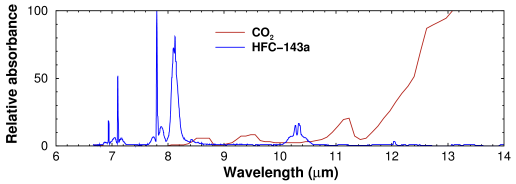
The real explanation is that they absorb thermal (mid-)infrared radiation at wavelengths that don’t overlap with carbon dioxide. The infrared spectra of HFC-125 and HFC-143a have three bands in the mid-infrared which have little overlap with carbon dioxide (CO2):

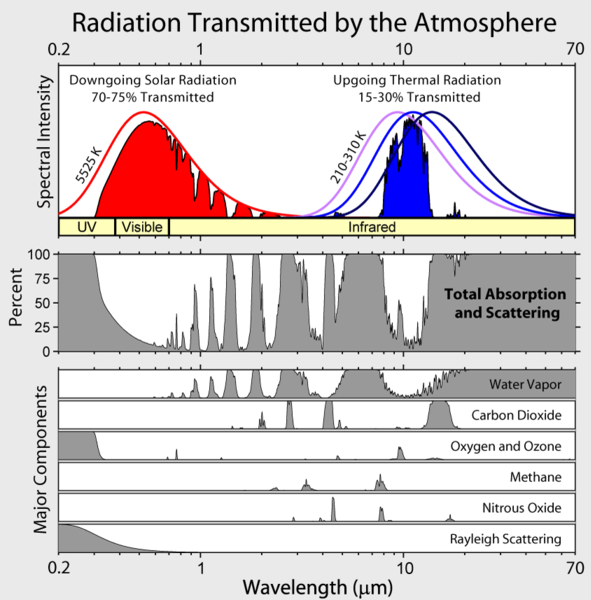
But look at the spectrum of absorption by H2O and other IR-active gases:

The absorption spikes by HFCs at  7 to 8 μm are already covered by the higher concentrations of H2O.  There’s little radiation for HFCs to absorb, so the Global Warming Potential is hypothetical.

Footnote: 

A major clarification in 2017 came from the DC Court of Appeals ordering EPA (and thus the Executive Branch Bureaucracy) to defer to Congress regarding regulation of substances claimed to cause climate change.  While the issue and arguments are somewhat obscure, the clarity of the ruling was welcome.  Basically, the EPA under Obama attempted to use ozone-depleting authority to regulate HFCs, claiming them as greenhouse gases.  The judges decided that was a stretch too far.

However a 2020 law passed by Congress prohibits importation of HFCs without allowances issued by the EPA. The law is part of a global phaseout designed to slow climate change.

Biden’s EPA Goes Rogue on HFCs


False Premises for Hague Climate Reparations Hearing

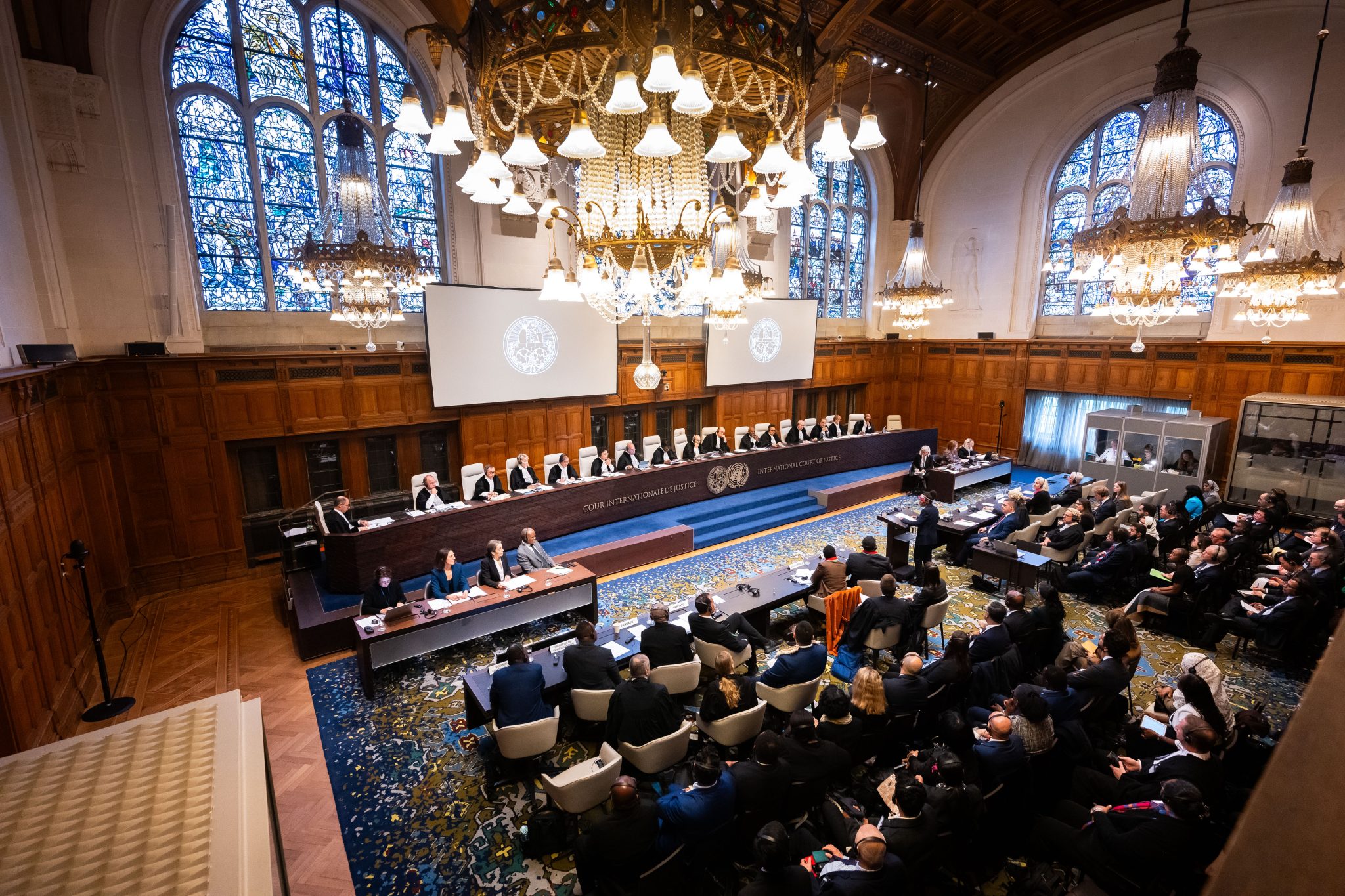
Public hearings at the International Court of Justice in The Hague on the request for an advisory opinion on the Obligations of States in respect of Climate Change, December 2024 (Photo: International Court of Justice)

After one week of the hearing at International Court of Justice (ICJ) the thrust of the event is clear.  It is an attempt to redistribute wealth from nations who developed and prospered from basing their societies on hydrocarbons to other nations who have not done so as successfully.  The “victims” claim compensation because burning hydrocarbons caused global warming which will raise sea levels and flood island nations.  This is called “Climate Justice.”

The parties, including presumably the judges, take this premise without question, so the whole proceeding is based on PR without scientific foundation.

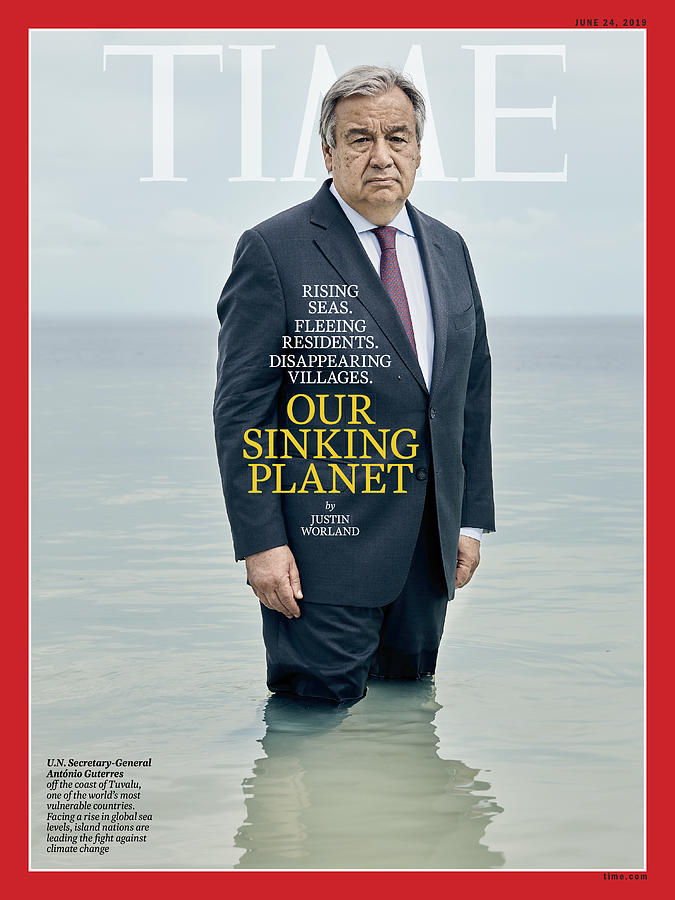
Recently green campaigners were warning that small Pacific islands would drown as sea levels rose. In 2019 United Nations Secretary-General António Guterres flew all the way to Tuvalu, in the South Pacific, for a Time magazine cover shot. Wearing a suit, he stood up to his thighs in the water behind the headline “Our Sinking Planet.” The accompanying article warned the island—and others like it—would be struck “off the map entirely” by rising sea levels.

Earlier this year, the New York Times finally shared what it called “surprising” climate news: Almost all atoll islands are stable or increasing in size. In fact, scientific literature has documented this for more than a decade. While rising sea levels do erode land, additional sand from old coral is washed up on low-lying shores. Extensive studies have long shown this accretion is stronger than climate-caused erosion, meaning the land area of Tuvalu and many other small islands is increasing.

These appeals were made previously by the Maldives and Fiji, who co-hosted the Madrid COP.  But stubborn facts undermine the credibility of the premise.

It is a widely accepted climate view—based on wild speculations from some op/ed writers and partisan politicians–is that average sea levels are increasing dangerously and rationalize an immediate governmental response. But as we shall demonstrate below, this perspective is simply not accurate.

There is a wide scientific consensus (based on satellite laser altimeter readings since 1993) that the rate of increase in overall sea levels has been approximately .12 inches per year.

To put that increase in perspective, the average sea level nine years from now (in 2029) is likely to be approximately one inch higher than it is now (2020). One inch is roughly the distance from the tip of your finger to the first knuckle. Even by the turn of the next century (in 2100), average ocean levels (at that rate of increase) should be only a foot or so higher than they are at present.


None of this sounds particularly alarming for the general society and little of it can justify any draconian regulations or costly infrastructure investments. The exception might be for very low- lying ocean communities or for properties (nuclear power plants) that, if flooded, would present a wide-ranging risk to the general population. But even here there is no reason for immediate panic. Since ocean levels are rising in small, discrete marginal increments, private and public decision makers would have reasonable amounts of time to prepare, adjust and invest (in flood abatement measures, etc.) if required.

But are sea levels actually rising at all? Empirical evidence of any substantial increases taken from land-based measurements has been ambiguous. This suggests to some scientists that laser and tidal-based measurements of ocean levels over time have not been particularly accurate.

For example, Professor Niles-Axel Morner (Stockholm University) is infamous in climate circles for arguing–based on his actual study of sea levels in the Fiji Islands–that “there are no traces of any present rise in sea levels; on the contrary, full stability.” And while Morner’s views are controversial, he has at least supplied peer reviewed empirical evidence to substantiate his nihilist position on the sea-level increase hypothesis.

The world has many important societal problems and only a limited amount of resources to address them. What we don’t need are overly dramatic climate-change claims that are unsubstantiated and arrive attached to expensive public policies that, if enacted, would fundamentally alter the foundations of our economic system.

See Also:

Fear Not For Fiji

Islands Adapting to Change: Tuvalu


Climate Lawfare Goes International

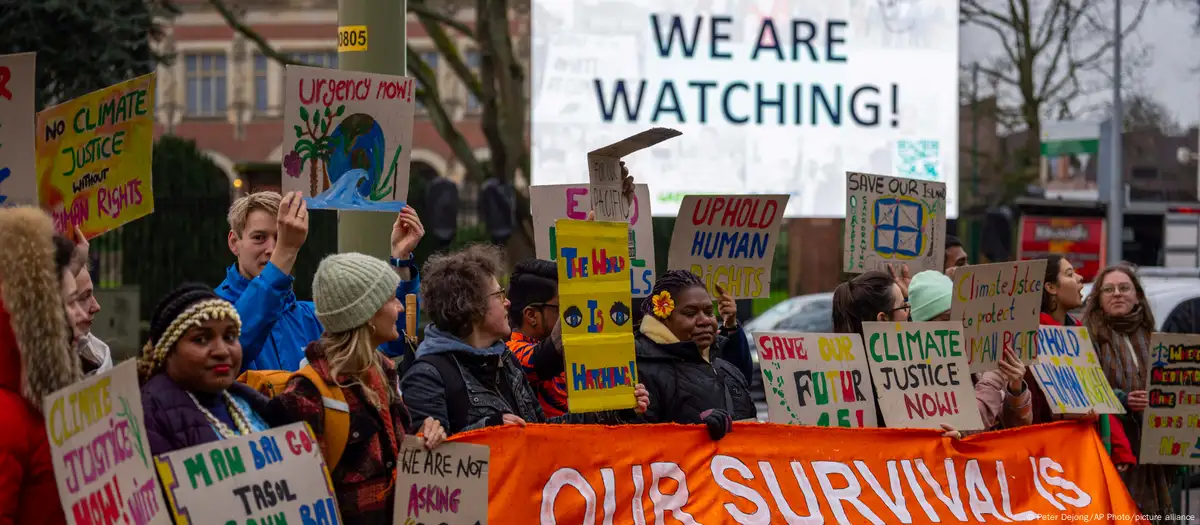
Activists hope the opinion from the ICJ’s judges will have far-reaching legal consequences in the fight against climate change Image: Peter Dejong/AP Photo/picture alliance

DW reports on hearings underway at ICJ International Court of Justice in the Hague.  Overview of the proceedings in italics with my bolds. Vanuatu urges ICJ to recognise climate change harms

The outcome of the landmark case could lead to the
establishment of legal framework for holding countries
accountable in the fight against climate change.

Vanuatu, was the first of over 100 countries and organizations to present its views in the two-week proceedings seeking an advisory opinion from the World Court.

Handful of countries responsible for climate crisis World Court told

They demand that the failure to address climate change be declared a violation of international law. Arnold Kiel Loughman, attorney- general of the Vanuatu archipelago nation said that states have obligations to act with due diligence, to prevent significant harm to the environment, to reduce emissions, and to provide support to countries like his.

Aside from small island states and numerous Western and developing countries, the court will also hear from the world’s top two emitters of greenhouse gases, China and the United States. [More on those statements later on]

While activists are hopeful the outcome of the hearings will have far-reaching legal implications for violators, others are skeptical given that the UN’s highest court might take even years to implement.

Any decision will be non-binding because the court has no concrete means to enforce its rulings.

The hearings will continue until December 13. The court’s opinion is expected to be delivered in 2025.

Public hearings at the International Court of Justice in The Hague on the request for an advisory opinion on the Obligations of States in respect of Climate Change, December 2024 (Photo: International Court of Justice)

Climate Home provides perspectives from the countries prospering from hydrocarbon energy in their article Big emitters accused of hiding behind climate treaties in international hearing.  Excerpts in italics with my bolds.

The US, Saudi Arabia and others have pushed back against a global bid
to clarify states’ legal obligations to tackle climate change.

At a landmark legal hearing in The Hague this week, wealthy countries that are big emitters of planet-heating gases have used the Paris Agreement and other existing treaties on climate change to avoid additional pressure to step up their action to tackle global warming.

Their statements at the International Court of Justice (ICJ) sparked strong criticism from top climate diplomats and advocates who argue that international accords do not place limits on state accountability over climate change.

The two-week hearing is the culmination of years of campaigning by a group of law students from Pacific nations and diplomacy led by the island state of Vanuatu.

Their efforts resulted in a UN General Assembly resolution last year calling on the ICJ to provide an advisory opinion on the legal obligations of states to address climate change and the legal consequences if they fail to do so.

The ICJ says its advisory opinions are not binding. But experts stress that they clarify, rather than create, new law and will be referred to as authoritative documents in future climate litigation and during international climate negotiations.

In total, 98 states are giving oral submissions to the court, alongside a handful of institutions including the Organization of the Petroleum Exporting Countries (OPEC).

Four days into the hearing, a clear divide is emerging between wealthy nations that are historically high emitters and vulnerable nations on the frontlines of climate change that have contributed little to planetary heating.

The event has seen powerful fossil-fuel producing countries – from the United States to Russia – resist what they regard as an attempt to force them to do more to rein in emissions and provide reparations to those suffering because of their carbon pollution.

On Wednesday, the United States – which does not fully recognise the authority of the ICJ – told the court that sufficient legal frameworks are already in place to deal with climate change.

Margaret Taylor, legal adviser to the US Department of State, described global warming as the “quintessential collective action problem” which the UN Framework Convention on Climate Change (UNFCCC) and the Paris Agreement are carefully designed to deal with.

Those treaties, she said, embody “the clearest, most specific and most current expression of states’ consent to be bound by international law in respect of climate change” – and should therefore be the “primary framework” for determining their obligations.

Taylor told the court, on behalf of the US, that the Paris Agreement does not provide any legal standard against which to judge the adequacy of an NDC or to determine if a country is doing its fair share in global terms. Nor do states breach the agreement if they fail to achieve their NDCs, she added.

Many countries believe that legal obligations should not be limited to existing climate agreements and have asked the ICJ to consider a wide range of written and unwritten international law, including rules on transboundary harm, due diligence and the duty to cooperate and to prevent harm.

The relevance and scope of human rights in the context of climate change has also been hotly debated. States particularly disagree over the applicability of the right to a clean, healthy and sustainable environment. This was acknowledged by the UN General Assembly in a 2022 resolution but has proved difficult to implement.

Mamadou Hébié, associate professor of international law at Leiden University, representing Burkina Faso at the ICJ, said the Paris Agreement does not create any exemption or derogation from the rest of international law.

Zachary Phillips, counsel for Antigua and Barbuda, said compliance with the Paris Agreement is “necessary but may not be sufficient” to comply with unwritten ‘customary’ international law, including the obligation to prevent harm.

Several of the world’s biggest economies – among those most reliant on fossil fuels – have contended this week, however, that they have no obligations beyond the Paris pact and the UNFCCC. Australia, for example, said these are “central instruments” for global cooperation while China appealed to the court to avoid “fragmenting” international climate law.

Wiebke Rückert, Germany’s director for public international law, said the Paris Agreement strikes a “careful balance” between legal and non-legal commitments and warned that attempts to change that could “seriously” endanger the willingness of states to participate in political processes.

Ghaida Bajbaa, from Saudi Arabia’s energy ministry, said the UNFCCC provides “no basis whatsoever” for the court to authorise limits to fossil fuel extraction and consumption.

This was echoed by Maksim Musikhin, director of the legal department of Russia’s Ministry of Foreign Affairs, who said the transition away from fossil fuels – agreed at COP28 in Dubai last year – is not a legal obligation but rather a political appeal.

Ashfaq Khalfan, climate justice director for Oxfam America, said it was “absurd” for the Biden administration to make arguments against clearer legal obligations on climate change given the upcoming presidency of Donald Trump, who has vowed to withdraw the US from the Paris Agreement for a second time when he takes office.

The ICJ hearing continues until December 13 in The Hague, with other big greenhouse gas emitters such as the UK still to speak.


Advance Briefing for COP29 Baku 2024

Overview from CFR. COP29 Summit in Baku: What to Expect  Excerpts in italics with my bolds and added images.

Negotiators from across the globe will gather in Baku, Azerbaijan, for the twenty-ninth annual UN climate change conference on November 11. COP29 marks the midpoint of the “COP Presidencies Troika,” a collaborative effort between the United Arab Emirates (UAE, host to COP28) and Brazil (host to COP30 in 2025) aimed at accelerating progress toward the 1.5°C goal. Unlike COP28 in Dubai last year, which hosted a record hundred thousand attendees, COP29 will be smaller, with Baku expected to host around fifty thousand participants. 

The selection of Azerbaijan as the host country has raised concerns about the credibility and integrity of the COP process. COP29 marks the third time a significant fossil fuel-producing country has hosted the conference, and the second time in two years. Azerbaijani President Ilham Aliyev has announced plans to increase gas production in part to satisfy European Union (EU) demands and referred to the country’s oil and gas reserves as “a gift from God.” 

What’s on the Agenda–Three Pledges Are Proposed

Reducing emissions and increasing green energy. The presidency has put forward a series of commitments for investing in renewable energy, such as a Global Energy Storage and Grids Pledge, which aims to enhance energy infrastructure and storage capabilities worldwide, an ambitious Hydrogen Declaration, and a Declaration on Reducing Methane from Organic Waste. With the Green Digital Action Declaration, COP29 leadership seeks to reduce emissions in the information and communication sectors. The agenda, however, makes no direct mention of a transition from fossil fuels.

Building climate resilience. The COP presidency has put forth a climate initiative for farmers and a declaration calling for integrated approaches to combating climate threats to water basins and ecosystems. Additionally, Baku aims to present the Initiative on Human Development for Climate Resilience, which focuses on education, skills, health, and well-being, and the COP29 Multisectoral Actions Pathways (MAP) Declaration that aims to enhance urban climate resilience.  

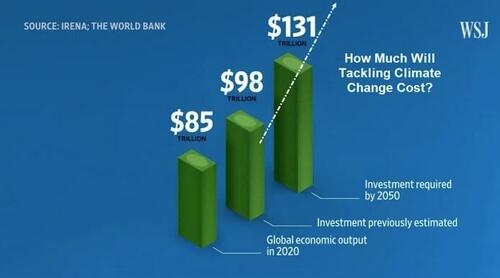
New climate finance targets. Nations are expected to replace the previous $100 billion annual commitment to developing countries from the 2009 Copenhagen Accord. The new target, known as the New Collective Quantified Goal (NCQG), will be under discussion at November’s COP and is intended to take effect from 2025 onwards. A 2022 report [PDF] by the Independent High-level Expert Group on Climate Finance found that developing countries need around $1 trillion per year by 2025, and $2.4 trillion by 2030 to meet their climate finance needs.  Among the most contentious issues that remain are how much money developed nations will provide, and who should provide climate finance. 

Yes, those are Trillions of US$ they are projecting to spend.

My Comments

Since there is a big push on climate funding, maybe they could get to the bottom of this:

Maybe donors are put off by no one knowing who gets the money and for what it is spent.  And while they are investigating, how about understanding Energy Return on Investment (EROI): you know, the notion that an energy project is worth doing if the energy produced is greater than energy spent. The windmills in the logo at the top reminded me of this:

Why a COP Briefing?

Actually, climate hysteria is like a seasonal sickness.  Each year a contagion of anxiety and fear is created by disinformation going viral in both legacy and social media in the run up to the annual autumnal COP.  Since the climatists have put themselves at the controls of the formidable US federal government, we can expect the public will be hugely hosed with alarms over the next few weeks.  Before the distress signals go full tilt, individuals need to inoculate themselves against the false claims, in order to build some herd immunity against the nonsense the media will promulgate. This post is offered as a means to that end.

Media Climate Hype is a Cover Up

Back in 2015 in the run up to Paris COP, French mathematicians published a thorough critique of the raison d’etre of the whole crusade. They said:

Fighting Global Warming is Absurd, Costly and Pointless.

  • Absurd because of no reliable evidence that anything unusual is happening in our climate.
  • Costly because trillions of dollars are wasted on immature, inefficient technologies that serve only to make cheap, reliable energy expensive and intermittent.
  • Pointless because we do not control the weather anyway.

The prestigious Société de Calcul Mathématique (Society for Mathematical Calculation) issued a detailed 195-page White Paper presenting a blistering point-by-point critique of the key dogmas of global warming. The synopsis with links to the entire document is at COP Briefing for Realists

Even without attending to their documentation, you can tell they are right because all the media climate hype is concentrated against those three points.

Finding: Nothing unusual is happening with our weather and climate.
Hype: Every metric or weather event is “unprecedented,” or “worse than we thought.”

Finding: Proposed solutions will cost many trillions of dollars for little effect or benefit.
Hype: Zero carbon will lead the world to do the right thing.  Anyway, the planet must be saved at any cost.

Finding: Nature operates without caring what humans do or think.
Hype: Any destructive natural event is blamed on humans burning fossil fuels.

How the Media Throws Up Flak to Defend False Suppositions

The Absurd Media:  Climate is Dangerous Today, Yesterday It was Ideal.

Billions of dollars have been spent researching any and all negative effects from a warming world: Everything from Acne to Zika virus.  A recent Climate Report repeats the usual litany of calamities to be feared and avoided by submitting to IPCC demands. The evidence does not support these claims. An example:

 It is scientifically established that human activities produce GHG emissions, which accumulate in the atmosphere and the oceans, resulting in warming of Earth’s surface and the oceans, acidification of the oceans, increased variability of climate, with a higher incidence of extreme weather events, and other changes in the climate.

Moreover, leading experts believe that there is already more than enough excess heat in the climate system to do severe damage and that 2C of warming would have very significant adverse effects, including resulting in multi-meter sea level rise.

Experts have observed an increased incidence of climate-related extreme weather events, including increased frequency and intensity of extreme heat and heavy precipitation events and more severe droughts and associated heatwaves. Experts have also observed an increased incidence of large forest fires; and reduced snowpack affecting water resources in the western U.S. The most recent National Climate Assessment projects these climate impacts will continue to worsen in the future as global temperatures increase.

Alarming Weather and Wildfires

But: Weather is not more extreme.


And Wildfires were worse in the past.
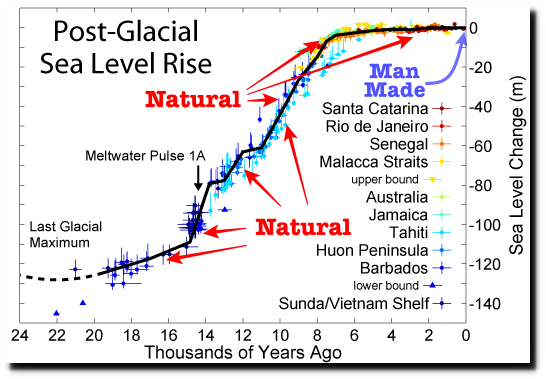
But: Sea Level Rise is not accelerating.

post-glacial_sea_level

Litany of Changes

Seven of the ten hottest years on record have occurred within the last decade; wildfires are at an all-time high, while Arctic Sea ice is rapidly diminishing.

We are seeing one-in-a-thousand-year floods with astonishing frequency.

When it rains really hard, it’s harder than ever.

We’re seeing glaciers melting, sea level rising.

The length and the intensity of heatwaves has gone up dramatically.

Plants and trees are flowering earlier in the year. Birds are moving polewards.

We’re seeing more intense storms.

But: Arctic Ice has not declined since 2007.

But: All of these are within the range of past variability.In fact our climate is remarkably stable, compared to the range of daily temperatures during a year where I live.

And many aspects follow quasi-60 year cycles.

The Impractical Media:  Money is No Object in Saving the Planet.

Here it is blithely assumed that the UN can rule the seas to stop rising, heat waves to cease, and Arctic ice to grow (though why we would want that is debatable).  All this will be achieved by leaving fossil fuels in the ground and powering civilization with windmills and solar panels.  While admitting that our way of life depends on fossil fuels, they ignore the inadequacy of renewable energy sources at their present immaturity.

An Example:
The choice between incurring manageable costs now and the incalculable, perhaps even irreparable, burden Youth Plaintiffs and Affected Children will face if Defendants fail to rapidly transition to a non-fossil fuel economy is clear. While the full costs of the climate damages that would result from maintaining a fossil fuel-based economy may be incalculable, there is already ample evidence concerning the lower bound of such costs, and with these minimum estimates, it is already clear that the cost of transitioning to a low/no carbon economy are far less than the benefits of such a transition. No rational calculus could come to an alternative conclusion. Defendants must act with all deliberate speed and immediately cease the subsidization of fossil fuels and any new fossil fuel projects, and implement policies to rapidly transition the U.S. economy away from fossil fuels.

But CO2 relation to Temperature is Inconsistent.

But: The planet is greener because of rising CO2.

But: Modern nations (G20) depend on fossil fuels for nearly 90% of their energy.

But: Renewables are not ready for prime time.

People need to know that adding renewables to an electrical grid presents both technical and economic challenges.  Experience shows that adding intermittent power more than 10% of the baseload makes precarious the reliability of the supply.  South Australia is demonstrating this with a series of blackouts when the grid cannot be balanced.  Germany got to a higher % by dumping its excess renewable generation onto neighboring countries until the EU finally woke up and stopped them. Texas got up to 29% by dumping onto neighboring states, and some like Georgia are having problems.

But more dangerous is the way renewables destroy the economics of electrical power.  Seasoned energy analyst Gail Tverberg writes:

In fact, I have come to the rather astounding conclusion that even if wind turbines and solar PV could be built at zero cost, it would not make sense to continue to add them to the electric grid in the absence of very much better and cheaper electricity storage than we have today. There are too many costs outside building the devices themselves. It is these secondary costs that are problematic. Also, the presence of intermittent electricity disrupts competitive prices, leading to electricity prices that are far too low for other electricity providers, including those providing electricity using nuclear or natural gas. The tiny contribution of wind and solar to grid electricity cannot make up for the loss of more traditional electricity sources due to low prices.

These issues are discussed in more detail in the post Climateers Tilting at Windmills

The Irrational Media:  Whatever Happens in Nature is Our Fault.

An Example:

Other potential examples include agricultural losses. Whether or not insurance
reimburses farmers for their crops, there can be food shortages that lead to higher food
prices (that will be borne by consumers, that is, Youth Plaintiffs and Affected Children).
There is a further risk that as our climate and land use pattern changes, disease vectors
may also move (e.g., diseases formerly only in tropical climates move northward).36 This
could lead to material increases in public health costs

But: Actual climate zones are local and regional in scope, and they show little boundary change.

But: Ice cores show that it was warmer in the past, not due to humans.

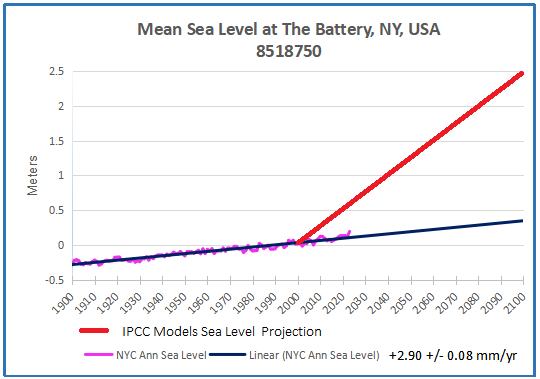
The hype is produced by computer programs designed to frighten and distract children and the uninformed.  For example, there was mention above of “multi-meter” sea level rise.  It is all done with computer models.  For example, below is San Francisco.  More at USCS Warnings of Coastal Floodings

In addition, there is no mention that GCMs projections are running about twice as hot as observations.

Omitted is the fact GCMs correctly replicate tropospheric temperature observations only when CO2 warming is turned off.

Figure 5. Simplification of IPCC AR5 shown above in Fig. 4. The colored lines represent the range of results for the models and observations. The trends here represent trends at different levels of the tropical atmosphere from the surface up to 50,000 ft. The gray lines are the bounds for the range of observations, the blue for the range of IPCC model results without extra GHGs and the red for IPCC model results with extra GHGs.The key point displayed is the lack of overlap between the GHG model results (red) and the observations (gray). The nonGHG model runs (blue) overlap the observations almost completely.

In the effort to proclaim scientific certainty, neither the media nor IPCC discuss the lack of warming since the 1998 El Nino, despite two additional El Ninos in 2010 and 2016.

Further they exclude comparisons between fossil fuel consumption and temperature changes. The legal methodology for discerning causation regarding work environments or medicine side effects insists that the correlation be strong and consistent over time, and there be no confounding additional factors. As long as there is another equally or more likely explanation for a set of facts, the claimed causation is unproven. Such is the null hypothesis in legal terms: Things happen for many reasons unless you can prove one reason is dominant.

Finally, advocates and IPCC are picking on the wrong molecule. The climate is controlled not by CO2 but by H20. Oceans make climate through the massive movement of energy involved in water’s phase changes from solid to liquid to gas and back again. From those heat transfers come all that we call weather and climate: Clouds, Snow, Rain, Winds, and Storms.
Esteemed climate scientist Richard Lindzen ended a very fine recent presentation with this description of the climate system:

I haven’t spent much time on the details of the science, but there is one thing that should spark skepticism in any intelligent reader. The system we are looking at consists in two turbulent fluids interacting with each other. They are on a rotating planet that is differentially heated by the sun. A vital constituent of the atmospheric component is water in the liquid, solid and vapor phases, and the changes in phase have vast energetic ramifications. The energy budget of this system involves the absorption and reemission of about 200 watts per square meter. Doubling CO2 involves a 2% perturbation to this budget. So do minor changes in clouds and other features, and such changes are common. In this complex multifactor system, what is the likelihood of the climate (which, itself, consists in many variables and not just globally averaged temperature anomaly) is controlled by this 2% perturbation in a single variable? Believing this is pretty close to believing in magic. Instead, you are told that it is believing in ‘science.’ Such a claim should be a tip-off that something is amiss. After all, science is a mode of inquiry rather than a belief structure.
Summary:  From this we learn three things:

Climate warms and cools without any help from humans.

Warming is good and cooling is bad.

The hypothetical warming from CO2 would be a good thing.


Legal Fight to Stop EPA Rule Closing Power Plants

Update on ominous overreach by Biden/Harris regime comes from Just the News  While the SCOTUS denies request to block EPA power plant rule, challengers vow to continue fight.  As explained below, EPA intends to require expensive and impractical CO2 Capture and Storage on all power plants using carbon fuels, thereby forcing shutdowns. Excerpts in italics with my bolds and added images,

Analysts say that if the rule is implemented, more than 5 million
people could experience blackouts, some lasting for 41 hours.

The Supreme Court ruled against a bid to block the EPA’s power plant rule while legal challenges make their way through the courts, but West Virginia, which is leading the coalition of states challenging the rule, vows the fight isn’t over. 

In a brief order, Justices Brett Kavanaugh and Neil Gorsuch said that the applicants “have shown a strong likelihood of success on the merits as to at least some of the challenges to the” EPA’s rule.

However, the justices explained, the stay wasn’t needed because compliance requirements wouldn’t begin until June 2025, which means the applicants wouldn’t “suffer irreparable harm” before the Court of Appeals for the D.C. Circuit decides the merits of the case. Injunctive relief, such as sought here, requires clear and convincing proof that the harm be immediate and irreparable.

The lower court is expediting the case, the justices noted, meaning it would be resolved in the court’s current term. Afterward, the case would still have time to return to the Supreme Court, if it’s warranted. 

The EPA rule, which was finalized in April, requires that coal-fired power plants be fitted with carbon capture technology controlling 90% of their carbon dioxide emissions by 2039, and new gas-fired power plants will need to do the same starting in 2035, depending on the amount of runtime they have.

Energy analysts Isaac Orr and Mitch Rolling revealed that the EPA failed to do a proper analysis of the impacts of the rule, and if implemented, over 5 million people will experience blackouts, some lasting for 41 hours. While the EPA has defended the rule and argues that carbon capture is “well proven,” its own modeling showed it expected only one coal plant and no gas plants to be fitted with the technology as far out as 2055.

Two dozen states led by West Virginia filed a lawsuit against the EPA in May, arguing that the agency exceeded its authority with the rule. Utilities and industry groups also filed legal challenges to the rule. In July, the U.S. Court of Appeals for the D.C. Circuit denied the parties’ requests to block the rules while the courts considered the challenges, and the court ruled the applicants wouldn’t succeed on the merits of their case.

In court filings, the EPA noted that the lower court ruled the applicants are unlikely to succeed in arguing the agency exceeded its authority, and it stood by the rule and its carbon capture requirements, arguing that the technology has been “adequately demonstrated.”

West Virginia Attorney General Patrick Morrisey said in a
statement on the high court’s ruling that the fight isn’t over.

“This is not the end of this case: we will continue to fight through the merits phase and prove this rule strips the states of important discretion while forcing plants to use technologies that don’t work in the real world,” Morrisey said.

In 2022, the Supreme Court had sided with West Virginia and other states in a challenge to the Obama-era “Clean Power Plan.” Morrisey said that the high court had made clear limits to what the EPA can do, and the Biden administration’s “green new deal agenda” is ignoring those limits.

“This rule is yet another attempt of unelected bureaucrats to push something the law doesn’t allow,” Morrisey said.

Indiana, Alabama, Alaska, Arkansas, Florida, Georgia, Idaho, Iowa, Kentucky, Louisiana, Mississippi, Missouri, Montana, Nebraska, New Hampshire, North Dakota, Oklahoma, South Carolina, South Dakota, Tennessee, Texas, Utah, Virginia, and Wyoming joined the application to the Supreme Court.

SCOTUS Must Stop Climate Extortion Lawfare

Jon Decker explains what’s at stake in the case awaiting US Supreme Court consideration.  His Real Clear Markets article is The Supreme Court Must Stop Climate Extortion Schemes.  Excerpts in itallics with my bolds and added images.

Chevron recently announced that it is moving out of California after almost a century and a half in the state. No wonder, since Sacramento sued the company, along with a number of other oil companies, for allegedly deceptive practices.

In their war on energy, progressive politicians increasingly turn to lawfare as another scheme to extract funds from productive citizens and dramatically reshape the economy. In the coming weeks, we’ll learn if the Supreme Court will stand up to them.

The critical case is Sunoco v. Honolulu, currently pending before SCOTUS. Honolulu is suing several oil companies, alleging their fossil fuel production caused significant damage to the city through rising sea levels and other climate-related infrastructure issues.

That these companies are being sued not for specific instances of purported environmental harm, but instead under “public nuisance” and “consumer fraud” laws for an alleged “multi-decadal campaign of deception” about the nature of their products is crucial. That’s because it lets progressive cities and states get around long-standing legal doctrine that kept climate cases in federal courts, where defendants are somewhat likelier to get a fair hearing.

Knowing that federal environmental law presents a more difficult path for litigation, activists instead went “venue shopping” with their climate agenda to deep blue states, knowing that a multi-jurisdictional assault would be unworkable, and potentially fatal, for American energy companies. The progressive politicians who support this approach not only see a boost for their careers and fundraising goals, but a potentially massive source of new government revenue.

Because Honolulu, like a spate of other lawsuits driven by ambitious progressive state AGs and prosecutors, models its assault on energy companies on the 90s tobacco wars. And they are unsurprisingly seeking an eye-watering settlement similar to what the tobacco industry was forced to pay (dollars that still flow to the government to this day).

But you don’t have to be a fossil fuel corporate booster or a climate change skeptic to recognize that these paydays will come at the expense of ordinary consumers and taxpayers, and of the economy as a whole.

Fossil fuels are ubiquitous in every sector, from agriculture and clothing to steel production, electricity, heating, and transportation. If this lawfare succeeds then every single one of these products and services—anything that takes energy as an input—becomes more expensive.

There’s also a kind of incoherence to the idea that a small handful of companies are alone to blame for perceived climate ills. What about the thousands of companies worldwide that are involved in the exploration, production, and distribution of fossil fuels – or the millions of companies that use fossil fuels to make their own goods and perform their services? That’s not even to mention the fact that the same few energy companies now being sued also play a critical role in the U.S. leading the world in CO2 emission reductions, through greater adoption of natural gas. How do the companies spearheading the natural gas renaissance figure into the supposed “deception” at work here?

The stakes here remind us that judges—and therefore elections—matter. Hawaii Supreme Court Chief Justice Mark Recktenwald, who ruled in favor of Honolulu and thereby triggered SCOTUS review, has been associated with the far-left Environmental Law Institute’s (ELI) Climate Judiciary Project, a group that “trains” and “educates” thousands of judges and government lawyers across the country to deliver legal outcomes favored by progressives.

The Supreme Court may be the last line of defense against
fringe activists dictating energy policy for the rest of us.

But of course, SCOTUS itself is in the crosshairs of left-wing judicial scheming, with top Democrats, including presidential nominee Kamala Harris, threatening to pack the Supreme Court if elected. No doubt with judges in the Mark Recktenwald mode.

If Honolulu succeeds in its case, and progressives in their larger campaign of lawfare, Americans can say Aloha to higher prices.

Postscript on Arguing Deception in These Cases

As noted above, the rationale for filing these cases in state rather than federal courts depends on claiming consumer fraud, I.e. oil companies deceived the public while knowing about their damaging energy products.  A good rebuttal against the “Exxon Knew” fiction is provided (with my bolds) by Randal Utech at Master Resource:

To say that Exxon knew the truth back in the early 80s is a laughable fallacy. Effectively they built a primitive model that is characteristically similar to the erroneous modern climate models of today.

Fundamentally their work is based on the poorly understood climate sensitivity (ECS) derived from radiative convective models and GCM models. To their credit, they actually acknowledged the high degree of uncertainty in these estimations. Today, even Hausfather (2022 vs 2019) is beginning to understand the climate sensitivity (ECS) is too high. CMIP6 is running still even hotter than CMIP5 and using ECS of 3 to 5° C rather than ~ 1.2° C as highlighted in Nick Lewis’s 2022 study.

CMIP6 should have been better because it incorporated solar particle forcing (Matthes et. al.) and as they incorporate more elements of natural forcing (an active area of research as we still do not have a predictive theory for climate), the effect is highlighting more underlying problems with the models.

However, Exxon investigators fell into the same trap that climate modelers of today where they build the models to history match temperatures and then wow, because they can create a model that appears to history match temperatures, they assume it is telling them something. Truth? Anyone can create a model to do this, but it would never mean the model is correct. While the models today are much more complex, they are based on a complex set of non-linear equations, and the understanding of the various sources of nonlineararity is poor. This opens up wide degrees of uncertainty yet wide opportunity for tuning. Furthermore, natural forcing is undercharacterized and deemed inconsequential.

The contrived sense of accomplishment in history matching is spurious correlation for an infinitesimally small period of time. Using Exxon’s internal analysis of CO2 climate forcing is little more than a propaganda tool. Current climate models, much more sophisticated, face the same problem of unknown, false causality.

See Background Post:

19 State AGs Ask Supremes to Block Climate Lawsuits