Stanford Jumps Suicide Climate Shark

Today’s media feeding frenzy is promoting another scary climate change report from Stanford.  Sample headlines are:

Climate change linked to increase in suicide rates USA Today

Rising heat linked to suicide spikes in U.S. and Mexico Thomson Reuters Foundation News

Climate Change May Cause 26,000 More U.S. Suicides by 2050 The Atlantic

Etc. Etc.

Some points to consider:

1. A suicide is a personal event with many contributing factors, weather and climate being the most peripheral.

2. Serious suicide researchers have identified risk factors that inform caregivers. Franklin et al. provide this analysis of experience with suicidal incidents Risk Factors for Suicidal Thoughts and Behaviors: A Meta-Analysis of 50 Years of Research
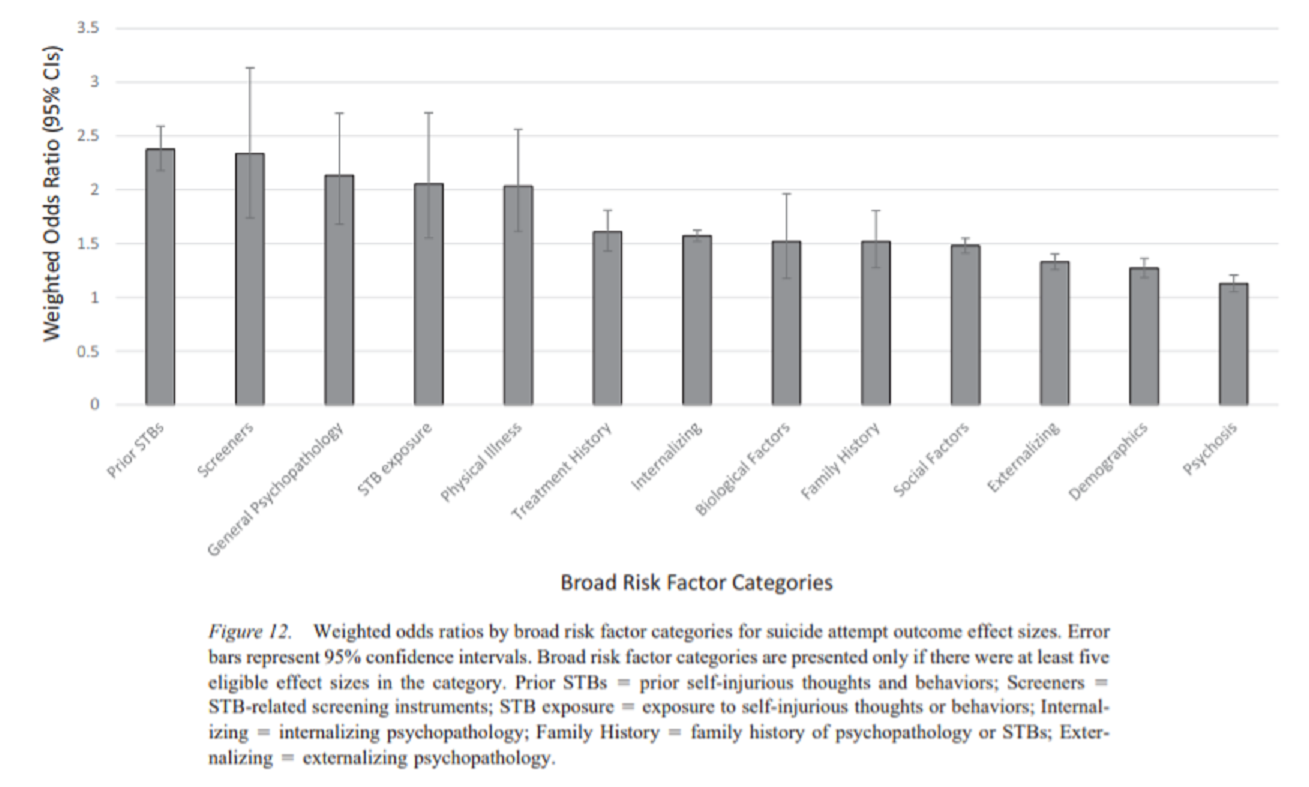
Open image in new tab to enlarge.

With such complexity of influencing factors, putting emphasis on a bit of warming is both myopic and lopsided.  For example, some places report springtime suicides are more frequent, others see more such deaths in Summer or Autumn.  The seasonal relationship is quite mixed in studies with various theories being suggested along with great uncertainty.

3. Suicides occur more frequently in colder climates than in warmer ones. For example, this European study found the highest rates in eastern European nations and lowest rates in Mediterranean countries.

Relationship of suicide rates with climate and economic variables in Europe during 2000–2012 in Annals of General Psychiatry. Excerpt below in italics with my bolds.

It is well known that suicidal rates vary considerably among European countries (Fig.  1) and the reasons for this are unknown although several theories have been proposed. The effect of climate has previously been discussed but has not been investigated in a systematic way across countries.

One of the biggest enigmas is the marked geographic variability in suicide rates found in Europe, with the highest rates being found in Eastern Europe and the lowest in the Mediterranean region

The current study reports that the climatic effect (cold climate) is stronger than the economic one, but both are present. It seems that in Europe suicidality follows the climate/temperature cline which interestingly is not from south to north but from south to north-east. 

4. Preventing suicides is a serious issue, and has nothing to do with reducing CO2.

These New Zealand researchers argue against mixing climate policies with suicide prevention programs.

Will climate change increase or decrease suicide rates? The differing effects of geographical, seasonal, and irregular variation in temperature on suicide incidence Excerpts in italics with my bolds

The effect of environmental temperature on suicide risk is an important issue given the increase in global temperatures expected over the following century. Previous research has produced conflicting findings: Studies concerned with temporal variation in temperature and suicide have tended to find a positive relationship, while those concerned with geographical variation in temperature and suicide have tended to find a negative relationship. In this study, we aimed firstly to estimate the relationship between suicide incidence and three components of variation in temperature: Irregular, seasonal, and geographical. Secondly, we aimed to critically examine what this information can (and cannot) tell us about the likely effects of anthropogenic climate change on suicide rates.

In this study, irregular variation in temperature had a positive relationship with suicide incidence, with approximately 1.8% more suicides for every 1°C increase in temperature. The size of this estimate was fairly consistent with those of previous studies (e.g., Deisenhammer 2003; Kim et al. 2011). We did not find evidence of the non-linear relationship between temperature and suicide incidence reported by Page et al. (2007). We also found no evidence for any substantial lagged effect of irregular variation in temperature, a finding similar to that of Likhvar et al. (2011) and Kim et al. (2011).

On the basis of the apparent positive effect of irregular variation in temperature, it would be tempting to conclude that global warming will increase the incidence of suicides. However, this conclusion is contradicted by our analyses of seasonal and geographical variation in temperature and suicide. Seasonal variation in suicide deaths did roughly follow the pattern generally found in the literature of a peak in spring and a trough in winter (Chew and McCleary 1995), but in accordance with a previous study in New Zealand (Yip et al. 1998), the magnitude of seasonal variation in suicide incidence was very small.

Furthermore, seasonal variation in temperature had a relationship with suicide incidence that was close to zero: That is, hotter times of the year were not consistently associated with higher suicide risk The relationship between geographical variation in temperature and suicide incidence differed even more greatly from that of irregular variation in temperature. While there was little evidence of any relationship at a bivariate level, controlling for age and ethnic differences across regions resulted in the relationship becoming negative: warmer areas had lower suicide rates. This finding was in accordance with prior studies finding a negative relationship between geographical variation in temperature and suicide rates (Rotton 1986; Souêtre et al. 1990; Lester 1999).

Counteracting the potential confounding problem relating to analyses of seasonal and (especially) geographical variation is that these analyses can potentially provide information about how humans adapt to long-term, sustained climatic differences. Indeed, the negative relationship between geographical variation in temperature and suicide incidence hints at the presence of adaptation mechanisms to warmer temperatures that inhibit suicide risk in the long term. At the very least, this finding means that we should be cautious about assuming that the positive effect of irregular variation in temperature on suicide incidence implies that climate change will increase suicide risk. Until the reasons for the apparently conflicting effect of geographical variation in temperature can be identified, such an inference does not seem well justified.

Once again alarmist researchers doing an high wire act. Claims with virtually nothing to support them.

Footnote:

“Jumping the shark” is attempting to draw attention to or create publicity for something that is perceived as not warranting the attention, especially something that is believed to be past its peak in quality or relevance. The phrase originated with the TV series “Happy Days” when an episode had Fonzie doing a water ski jump over a shark. The stunt was intended to perk up the ratings, but it marked the show’s low point ahead of its demise.
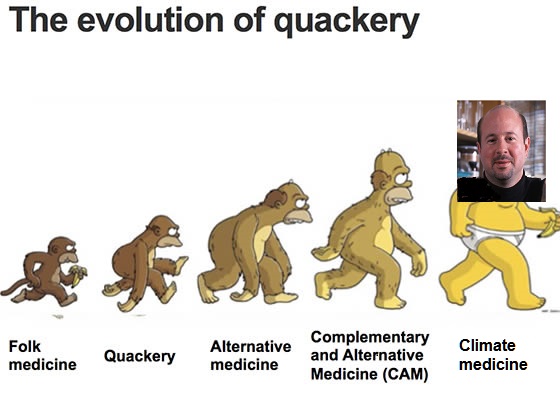
 

Climate Medicine Bonn Update

Climate Quakery

With Bonn COP23 set to start next week, the media is awash with claims that climate change is an international public health crisis.  For example, in just one day from Google news:

Climate change isn’t just hurting the planet – it’s a public health emergency–The Guardian

Climate change’s impact on human health is already here — and is ‘potentially irreversible,’ report says –USA TODAY

Climate Change Is Bad for Your Health–New York Times

From heat stress to malnutr­ition, climate change is already making us sick–The Verge

As Richard Lindzen predicted, everyone wants on the climate bandwagon, because that is where the money is.  Medical scientists are pushing for their share of the pie, as evidenced by the Met office gathering on Assessing the Global Impacts of Climate and Extreme Weather on Health and Well-Being (following Paris COP).  Not coincidentally, the 2nd Global Conference on Health and Climate was held July 7-8, 2016 in Paris.  Now we have the American Public Health Association declaring:

2017 is the Year of Climate Change and Health

“We’re committed to making sure the nation knows about the effects of climate change on health. If anyone doesn’t think this is a severe problem, they are fooling themselves.” — APHA Executive Director Georges Benjamin, in The Washington Post

The new field of Climate Medicine is evidenced by a slew of new organizations and studies.  In addition to numerous agencies set up within WHO and the UN, and governmental entities (such as the Met Office), there are many NGOs, such as:

Health Care Without Harm
Health and Environment Alliance
Health and Climate Foundation
Climate and Health Council
United States National Association of County and City Health Officials
Care International
Global Gender and Climate Alliance / Women’s Environment and   Development Organization
International Federation of Medical Students’ Associations
Climate Change and Human Health Programme, Columbia U.
Center for Health and the Global Environment, Harvard
National Center for Epidemiology and Population Health, ANC Canberra
Centre for Sustainability and the Global Environment, U of Wisconsin
Environmental Change Institute, Oxford
London School of Tropical Medicine and Hygiene, London, UK
International Human Dimensions Programme on Global Environmental Change, US National Academies of Science
US Climate and Health Alliance
Etc, etc., etc.

Of course, they are encouraged and abetted by the IPCC.

climate health threat

From the Fifth Assessment Report:

Until mid-century, projected climate change will impact human health mainly by exacerbating health problems that already exist (very high confidence). Throughout the 21st century, climate change is expected to lead to increases in ill-health in many regions and especially in developing countries with low income, as compared to a baseline without climate change (high confidence). By 2100 for RCP8.5, the combination of high temperature and humidity in some areas for parts of the year is expected to compromise common human activities, including growing food and working outdoors (high confidence). {2.3.2}

In urban areas climate change is projected to increase risks for people, assets, economies and ecosystems, including risks from heat stress, storms and extreme precipitation, inland and coastal flooding, landslides, air pollution, drought, water scarcity, sea level rise and storm surges (very high confidence). These risks are amplified for those lacking essential infrastructure and services or living in exposed areas. {2.3.2}

Feared Climate Health Impacts Are Unsupported by Scientific Research

NIPCC has a compendium of peer-reviewed studies on this issue and provides these findings (here)

Key Findings: Human Health
• Warmer temperatures lead to a decrease in temperature-related mortality, including deaths associated with cardiovascular disease, respiratory disease, and strokes. The evidence of this benefit comes from research conducted in every major country of the world.

• In the United States the average person who died because of cold temperature exposure lost in excess of 10 years of potential life, whereas the average person who died because of hot temperature exposure likely lost no more than a few days or weeks of life.

• In the U.S., some 4,600 deaths are delayed each year as people move from cold northeastern states to warm southwestern states. Between 3 and 7% of the gains in longevity experienced over the past three decades was due simply to people moving to warmer states.

• Cold-related deaths are far more numerous than heat-related deaths in the United States, Europe, and almost all countries outside the tropics. Coronary and cerebral thrombosis account for about half of all cold-related mortality.

• Global warming is reducing the incidence of cardiovascular diseases related to low temperatures and wintry weather by a much greater degree than it increases the incidence of cardiovascular diseases associated with high temperatures and summer heat waves.

• A large body of scientific examination and research contradict the claim that malaria will expand across the globe and intensify as a result of CO2 -induced warming.

• Concerns over large increases in vector-borne diseases such as dengue as a result of rising temperatures are unfounded and unsupported by the scientific literature, as climatic indices are poor predictors for dengue disease.

• While temperature and climate largely determine the geographical distribution of ticks, they are not among the significant factors determining the incidence of tick-borne diseases.

• The ongoing rise in the air’s CO2 content is not only raising the productivity of Earth’s common food plants but also significantly increasing the quantity and potency of the many healthpromoting substances found in their tissues, which are the ultimate sources of sustenance for essentially all animals and humans.

• Atmospheric CO2 enrichment positively impacts the production of numerous health-promoting substances found in medicinal or “health food” plants, and this phenomenon may have contributed to the increase in human life span that has occurred over the past century or so.

• There is little reason to expect any significant CO2 -induced increases in human-health-harming substances produced by plants as atmospheric CO2 levels continue to rise.

Source: Chapter 7. “Human Health,” Climate Change Reconsidered II: Biological Impacts (Chicago, IL: The Heartland Institute, 2014).
Full text of Chapter 7 and references on Human health begins pg. 955 of the full report here

ambulance chasers

Summary

Advances in medical science and public health have  benefited billions of people with longer and higher quality lives.  Yet this crucial social asset has joined the list of those fields corrupted by the dash for climate cash. Increasingly, medical talent and resources are diverted into inventing bogeymen and studying imaginary public health crises.

Economists Francesco Boselloa, Roberto Roson and Richard Tol conducted an exhaustive study called Economy-wide estimates of the implications of climate change: Human health

After reviewing all the research and crunching the numbers, they concluded that achieving one degree of global warming by 2050 will, on balance, save more than 800,000 lives annually.

Not only is the warming not happening, we would be more healthy if it did.

Oh, Dr. Frankenmann, what have you wrought?


Footnote:  More proof against Climate Medicine

From: Gasparrini et al: Mortality risk attributable to high and low ambient temperature: a multicountry observational study. The Lancet, May 2015

Cold weather kills 20 times as many people as hot weather, according to an international study analyzing over 74 million deaths in 384 locations across 13 countries. The findings, published in The Lancet, also reveal that deaths due to moderately hot or cold weather substantially exceed those resulting from extreme heat waves or cold spells.

“It’s often assumed that extreme weather causes the majority of deaths, with most previous research focusing on the effects of extreme heat waves,” says lead author Dr Antonio Gasparrini from the London School of Hygiene & Tropical Medicine in the UK. “Our findings, from an analysis of the largest dataset of temperature-related deaths ever collected, show that the majority of these deaths actually happen on moderately hot and cold days, with most deaths caused by moderately cold temperatures.”

Now in 2017, Lancet sets the facts aside in order to prostrate itself before the global warming altar:

Christiana Figueres, chair of the Lancet Countdown’s high-level advisory board and former executive secretary of the UN Framework Convention on Climate Change, said, “The report lays bare the impact that climate change is having on our health today. It also shows that tackling climate change directly, unequivocally and immediately improves global health. It’s as simple as that.’’

Climate Medicine

Climate Quakery

As Richard Lindzen predicted, everyone wants on the climate bandwagon, because that is where the money is.  Medical scientists are pushing for their share of the pie, as evidenced by last week’s Met office gathering on Assessing the Global Impacts of Climate and Extreme Weather on Health and Well-Being. Not coincidentally, the 2nd Global Conference on Health and Climate was held July 7-8, 2016 in Paris.

The new field of Climate Medicine is evidenced by a slew of new organizations and studies.  In addition to numerous agencies set up within WHO and the UN, and governmental entities (such as the Met Office), there are many NGOs, such as:

Health Care Without Harm
Health and Environment Alliance
Health and Climate Foundation
Climate and Health Council
United States National Association of County and City Health Officials
Care International
Global Gender and Climate Alliance / Women’s Environment and   Development Organization
International Federation of Medical Students’ Associations
Climate Change and Human Health Programme, Columbia U.
Center for Health and the Global Environment, Harvard
National Center for Epidemiology and Population Health, ANC Canberra
Centre for Sustainability and the Global Environment, U of Wisconsin
Environmental Change Institute, Oxford
London School of Tropical Medicine and Hygiene, London, UK
International Human Dimensions Programme on Global Environmental Change, US National Academies of Science
US Climate and Health Alliance
Etc, etc., etc.

Of course, they are encouraged and abetted by the IPCC.

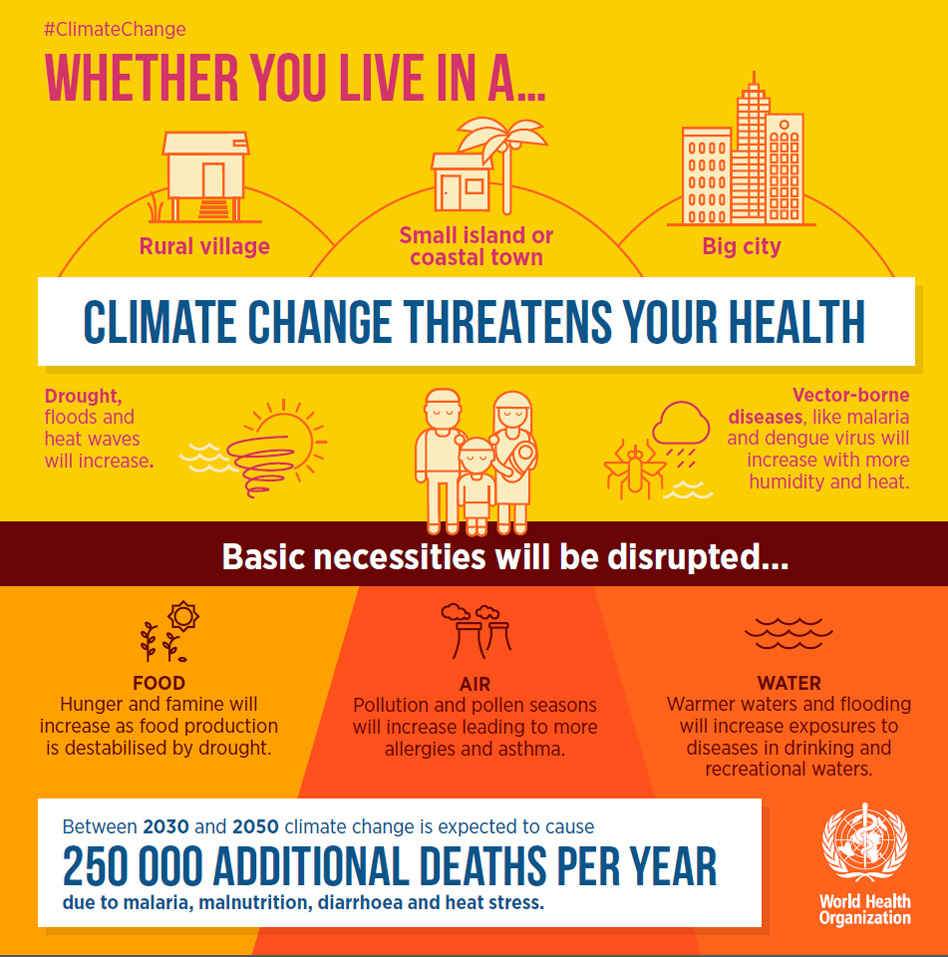
climatechange-infographic2

From the Fifth Assessment Report:

Until mid-century, projected climate change will impact human health mainly by exacerbating health problems that already exist (very high confidence). Throughout the 21st century, climate change is expected to lead to increases in ill-health in many regions and especially in developing countries with low income, as compared to a baseline without climate change (high confidence). By 2100 for RCP8.5, the combination of high temperature and humidity in some areas for parts of the year is expected to compromise common human activities, including growing food and working outdoors (high confidence). {2.3.2}

In urban areas climate change is projected to increase risks for people, assets, economies and ecosystems, including risks from heat stress, storms and extreme precipitation, inland and coastal flooding, landslides, air pollution, drought, water scarcity, sea level rise and storm surges (very high confidence). These risks are amplified for those lacking essential infrastructure and services or living in exposed areas. {2.3.2}

Feared Climate Health Impacts Are Unsupported by Scientific Research

NIPCC has a compendium of peer-reviewed studies on this issue and provides these findings (here)

Key Findings: Human Health
• Warmer temperatures lead to a decrease in temperature-related mortality, including deaths associated with cardiovascular disease, respiratory disease, and strokes. The evidence of this benefit comes from research conducted in every major country of the world.

• In the United States the average person who died because of cold temperature exposure lost in excess of 10 years of potential life, whereas the average person who died because of hot temperature exposure likely lost no more than a few days or weeks of life.

• In the U.S., some 4,600 deaths are delayed each year as people move from cold northeastern states to warm southwestern states. Between 3 and 7% of the gains in longevity experienced over the past three decades was due simply to people moving to warmer states.

• Cold-related deaths are far more numerous than heat-related deaths in the United States, Europe, and almost all countries outside the tropics. Coronary and cerebral thrombosis account for about half of all cold-related mortality.

• Global warming is reducing the incidence of cardiovascular diseases related to low temperatures and wintry weather by a much greater degree than it increases the incidence of cardiovascular diseases associated with high temperatures and summer heat waves.

• A large body of scientific examination and research contradict the claim that malaria will expand across the globe and intensify as a result of CO2 -induced warming.

• Concerns over large increases in vector-borne diseases such as dengue as a result of rising temperatures are unfounded and unsupported by the scientific literature, as climatic indices are poor predictors for dengue disease.

• While temperature and climate largely determine the geographical distribution of ticks, they are not among the significant factors determining the incidence of tick-borne diseases.

• The ongoing rise in the air’s CO2 content is not only raising the productivity of Earth’s common food plants but also significantly increasing the quantity and potency of the many healthpromoting substances found in their tissues, which are the ultimate sources of sustenance for essentially all animals and humans.

• Atmospheric CO2 enrichment positively impacts the production of numerous health-promoting substances found in medicinal or “health food” plants, and this phenomenon may have contributed to the increase in human life span that has occurred over the past century or so.

• There is little reason to expect any significant CO2 -induced increases in human-health-harming substances produced by plants as atmospheric CO2 levels continue to rise.

Source: Chapter 7. “Human Health,” Climate Change Reconsidered II: Biological Impacts (Chicago, IL: The Heartland Institute, 2014).
Full text of Chapter 7 and references on Human health begins pg. 955 of the full report here

Summary

Advances in medical science and public health have  benefited billions of people with longer and higher quality lives.  Yet this crucial social asset has joined the list of those fields corrupted by the dash for climate cash. Increasingly, medical talent and resources are diverted into inventing bogeymen and studying imaginary public health crises.

Economists Francesco Boselloa, Roberto Roson and Richard Tol conducted an exhaustive study called Economy-wide estimates of the implications of climate change: Human health

After reviewing all the research and crunching the numbers, they concluded that achieving one degree of global warming by 2050 will, on balance, save more than 800,000 lives annually.

Not only is the warming not happening, we would be more healthy if it did.

Oh, Dr. Frankenmann, what have you wrought?


Footnote:  More proof against Climate Medicine

From: Gasparrini et al: Mortality risk attributable to high and low ambient temperature: a multicountry observational study. The Lancet, May 2015

Cold weather kills 20 times as many people as hot weather, according to an international study analyzing over 74 million deaths in 384 locations across 13 countries. The findings, published in The Lancet, also reveal that deaths due to moderately hot or cold weather substantially exceed those resulting from extreme heat waves or cold spells.

“It’s often assumed that extreme weather causes the majority of deaths, with most previous research focusing on the effects of extreme heat waves,” says lead author Dr Antonio Gasparrini from the London School of Hygiene & Tropical Medicine in the UK. “Our findings, from an analysis of the largest dataset of temperature-related deaths ever collected, show that the majority of these deaths actually happen on moderately hot and cold days, with most deaths caused by moderately cold temperatures.”