Carney Directs Canada Pipeline Charade

Q: Do Leopards Change Their Spots? A: No,
because it’s chamouflage concealing their real motives.

This National Post editorial gives the game away: The Carney-Smith pipeline of uncertainty.  Excerpts in italics with my bolds and added images.

MOU adds as many roadblocks as it clears away

Prime Minister Mark Carney, right, signs an MOU with Alberta Premier Danielle Smith in Calgary, Alta., Thursday, Nov. 27, 2025. THE CANADIAN PRESS/Jeff McIntosh

Had the Great Smith-Carney Pipelines and Climate Pact of 2025 emerged say, five years ago, it would have been considered squarely within the realm of Liberal environmentalism. Instead, because former prime minister Justin Trudeau brought in several anti-business policies, the current prime minister is being feted/scorned as being pro-energy industry by disappointed Liberals and relieved conservatives alike. While Mark Carney deserves credit for negotiating this deal with Alberta Premier Danielle Smith, and bringing a rival onside, we’re skeptical at the chances a pipeline ever gets built.

There are definitely some positives in the deal that Smith can present at the UCP annual general meeting this weekend in an attempt to quell the separatist uprising within her governing party. Ottawa has officially committed to “Increasing production of Alberta oil and gas” and to the approval and construction of “one or more private sector constructed and financed pipelines.” The Liberals promise they “will not implement the Oil and Gas Emissions Cap” and will exempt Alberta from the government’s clean energy regulations. They would also consider a temporary exemption to the west coast tanker ban.

All of these regulations have been points of contention for Alberta, so it is to Smith’s credit that she was able to persuade Carney to budge.  But it’s possible this will not accomplish much more than to remove extra layers of regulation, which were unnecessary even by environmental standards. Under the Trudeau Liberals, there was to be a consumer carbon tax, industrial carbon tax, as well as the clean energy regulations and emissions cap. And it did not end there, as the Impact Assessment Act, also brought in under Trudeau, mandates onerous environmental and social review, including the consideration of “Indigenous knowledge” alongside scientific assessment, as well as considering the “intersection of sex and gender with other identity factors.”

If Carney is at all serious about kickstarting investment in Canada,
he should at minimum be willing to clear away some of these extra rules.

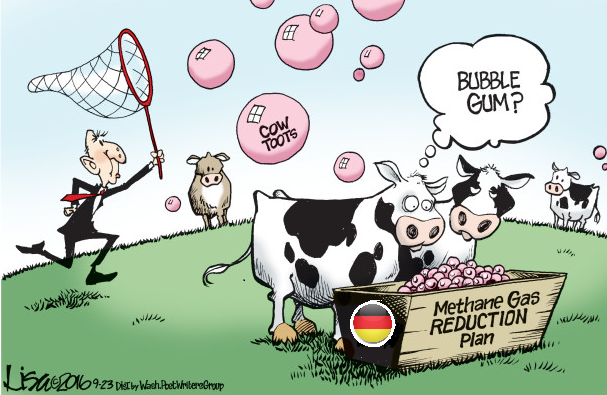
Ultimately, it seems that environmental policies and expectations are merely being shifted around. Because what is being asked of Alberta would appear to provide only the narrowest of paths for the construction of a new pipeline to the West coast. Under the memorandum of understanding between Smith and Carney, the province would have to raise its industrial carbon tax from $95/tonne to a minimum of $130/tonne, and reduce methane emissions, produced by the energy industry and farmers, to 75 per cent below 2014 levels. And in addition to the duty to consult Indigenous communities, any pipeline must have Indigenous co-ownership.

Further to that, the construction of a pipeline is entirely contingent on the simultaneous construction of a massive carbon capture project, presumably so Carney can claim the new pipeline is moving only “low emission” barrels of bitumen. Finally, while the MOU does not explicitly give B.C. a veto, that province is to be included “immediately” in a “trilateral discussion” on the project. B.C. Premier David Eby is opposed to a pipeline and was highly critical of the deal, claiming it would take priority away from other projects, specifically B.C. projects Eby supports. [

April 30, 2024 (IEEFA) – More than CAD1 billion were spent retrofitting the Boundary Dam 3 (BD3) coal plant in Saskatchewan to add carbon capture technology. After nine years, the project has a consistent history of capturing far less than the 90 per cent promised when the project was built—and all the carbon dioxide (CO2) captured at the plant is used for enhanced oil recovery (EOR) that injects captured CO2 into the ground to extract more oil..Carbon capture at Boundary Dam 3 still an underperforming failure

And the roadblocks to a new pipeline don’t end there. While it would be approved through the Major Projects Office, it isn’t at all clear what purpose that will serve. Carney’s Liberals gave themselves the authority to suspend regulatory review to expedite projects in the national interest. However, the office is electing not to use this power so far, stating on its website that “Projects will continue to be subject to all regulatory review processes.”

So being approved through the MPO may give the pipeline certainty that
it will be approved — eventually. That means every investment killing
process under the Impact Assessment Act will have to be passed.

What the Smith-Carney deal does accomplish is to buy both of them time to each satisfy their base. For Smith that is conservatives flirting with separatism, and for Carney, it is environmentalist Liberals, some of whom see this deal as a betrayal, such as former environment minister Steven Guilbeault who quit cabinet in protest. We applaud genuine attempts from Ottawa to work with, as opposed to against, Alberta, but we’re not confident this plan will deliver what is promised.

See Also:

Canada PM Carney Floats Imaginary “Decarbonized Oil” Pipeline

On Energy, Carney the Wrong Man at the Worst Time

Woke and Green Fading Away

Philip Cross writes at Financial Post Woke and Green are departing the scene.  Excerpts in italics with my bolds and added image.

2025 may mark the end for such policies as unsubsidized EV sales
collapse and impatience with DEI rises

This year is shaping up as a turning point in restoring sanity to public policy. Nowhere is the change more evident than in attitudes to green energy policies, once the rallying cry for left-wing parties in North America. Support has collapsed for three pillars of green energy advocacy:

♦  building electric vehicles to eliminate our need for oil pipelines and refineries;

♦  using the financial clout of the Net-Zero Banking Alliance to force firms
to eliminate carbon emissions; and

♦  legally mandating the shift from fossil fuels to green energy.

This turning away from green energy policies is reflected in how industrial policy underpinning electric vehicles (EV) has been discredited over the past year. Companies are delaying or abandoning the building of EV assembly and battery plants, mainly because EV sales are slumping following withdrawal of the artificial stimulus of government subsidies in both Canada and the U.S. Walking away from these investments leaves governments on the hook for billions of dollars they rashly pledged in support of EV projects.

In Quebec, Northvolt stopped work on a $7-billion battery plant, electric bus manufacturer Lion Electric filed for bankruptcy, and the Ultium CAM consortium paused plans to expand production of materials for batteries to be used in GM vehicles, which in turn led the giant mining company Vale to cancel plans for a nickel sulfate plant to supply these batteries. In Ontario, Honda delayed $15 billion of investments to build EV assembly plants and supply them with batteries, while Ford postponed its EV assembly plant plans after its EV division posted losses of $12 billion over the past two and a half years. Just last week, GM stopped producing electric delivery vans at its Ingersoll plant due to slack demand that had “nothing to do with tariffs or trade,” according to GM Canada’s president.

As investment in EV and battery plants collapses into full retreat, the outlook for fossil fuel demand improves. The International Energy Agency has reversed course and now projects demand will rise by 2.5 million barrels a day between 2024 and 2030. The under-investment in petroleum refining resulting from our having bought into the narrative that oil was past peak pushed the industry’s capacity utilization rate to 94.1 per cent in July, the highest of any industry in Canada that month. The prospect of demand exceeding capacity spurred the industry to boost investment to over $3 billion last year, double its average over the previous two decades.

The shift in public attitudes to fossil fuels provoked an abrupt about-face in Prime Minister Mark Carney’s stance on energy policy. In 2021 Carney spearheaded the launch of the Net-Zero Banking Alliance, which proposed to use access to credit to push firms to adopt policies that eliminated greenhouse gas emissions. But last month, after the world’s largest banks left it, including Canada’s, the alliance shut down. Even as it did, Carney’s government revived the Keystone XL pipeline proposal to carry Canada’s bitumen to U.S. refineries looking to replace dwindling heavy oil shipments from Mexico and Venezuela.

The tide is also turning against climate-change activists in the legal world. Just last week, a U.S. federal court ruled against claims by a group of young people that the Trump administration’s gutting of green energy initiatives violated their human rights. The court concluded such an important policy issue should be resolved at the ballot box and not in the courts, a precedent we should all hope helps Ontario courts reach the same conclusion in a similar case brought by teenagers.

The setbacks for green energy policies are reflected in disarray among left-wing parties in Canada and the U.S. In the U.S., The New York Times reports, registration of Democratic voters has fallen by two million since last year’s elections, despite high disapproval of Trump’s economic policies. While the radical left rejoices in the candidacy of self-styled Democratic Socialist Zohran Mamdani for mayor of New York, more centrist Democrats, fearing his radical agenda will hurt the party in next year’s midterm elections, have been slow to endorse him. In Canada, the NDP lost official party status in this spring’s federal election as its vote share plumbed historic lows, revealing the folly of Leap manifesto leaders forcing out Thomas Mulcair as NDP leader in 2017 because they wanted more aggressive opposition to fossil fuels.

Policies such as the Green New Deal are not the left’s only vulnerability. Support for woke social movements such as DEI (“diversity, equity and inclusion”) has also become a liability. A fundamental problem associated with both the green and woke movements is that advocates are so convinced of the righteousness of their causes that they refuse to countenance debate.

Because neither developed arguments that resonated with the public,
that same public is not alarmed to see these policies dismantled.


Cal Laws Compell PC Climate Speech, Exxon Sues for Free Speech

Tim O’Brien explains the climate lawfare in his PJ article Is California Attempting to ‘Suicide’ Big Oil and Write the Suicide Note? Excerpts in italics with my bolds and added images.

Sometimes big corporations are their own worst enemies. They say things and do things that at the moment sound good and perhaps win an immediate PR battle, but those same words or positions can come back to bite them later. Such is the case for ExxonMobil. 

Back in 2006, almost 20 years ago, the company’s then-CEO Rex Tillerson told the New York Times that a company report had acknowledged the link between the consumption of fossil fuels and rising global temperatures, saying, “We recognize that climate change is a serious issue.” He then added, “We recognize that greenhouse gas emissions are one of the factors affecting climate change.” 

This massive gesture of appeasement was a major concession, and it awarded a huge victory to climate alarmists. In that same article, the Times suggested that if Tillerson was successful, ExxonMobil would “no longer be the oil company that environmentalists love to hate.” 

Climate Activists storm the bastion of Exxon Mobil, here seen without their shareholder disguises.

How’d that work out? Did they back off of ExxonMobil and other big oil companies as a result? No, they ramped up the pressure so steadily and so heavily that over the years, “climate change” activists led ExxonMobil by the nose. It went full bore into “sustainability,” and it even supports the Paris Agreement, also known as the Paris Climate Accord. 

After years of incremental surrender to the left, the company now finds itself in the position of having to sue the state of California over a pair of 2023 “disclosure laws” that amount to the state mandating what companies can and cannot say about certain climate change matters. 

Last week, the company sued California in the U.S. District Court for the Eastern District of California on claims that Senate Bills 253 and 261 “trumpet California’s message.” The message in question, apparently, is that big oil and other major companies are “uniquely responsible for climate change.” In its lawsuit, Exxon Mobil said it considers this sort of message as “misleading.” The suit challenges both laws on grounds that they are First Amendment violations. The intent of the litigation is to stop these laws from going into effect in 2026. 

The climate alarmists and their entire sector are portraying the laws as requiring basic “climate-related transparency.” 

But if you dig into these laws, it reminds me of that old saying about free speech. It goes like this: “Communist China believes in free speech. So long as you say what the government likes, you can say whatever you want.” That pretty much sums up this situation.
More specifically, ExxonMobil contends that to comply, it would need to
rely on “frameworks that place disproportionate blame
on large companies like ExxonMobil.”

Senate Bill 253

Gov. “Slick” Newsom signed Senate Bill 253 (the Climate Corporate Data Accountability Act) into law in 2023. It requires big companies to disclose a wide range of emissions, and not just the stuff coming out of their industrial pipes and smoke stacks. They’d even have to report “direct and indirect emissions” that would include quantitative measurement of and a cost for employee business travel and product transport. 

I’ve seen some of this type of internal tracking and reporting up close, and it’s ridiculous. It’s all in line with ESG measurements and processes that are inconsistent at best. Just as often, it’s a scoring system built on “Wild A** Guesses.” 

Senate Bill 261

Senate Bill 261 (or the Climate-related Financial Risk Act ) gets even more pointedly at the First Amendment issues at play. This law requires businesses that generate more than $500 million per year to “disclose” the financial impacts and risks they face from climate change, and how they will respond. 

More to the point, ExxonMobil said that if it even tried to comply with this law, it would have to guess on things it can’t even know about in advance. Essentially, it would have to try to predict the future and put those predictions on its own website. 

At the same time, the suit points out that Exxon doesn’t even have
any crude oil or natural gas exploration, production, manufacturing,
transport or refining operations in California. 

On the First Amendment issue, in ExxonMobil’s case, the company is expected to argue that both laws require companies to speak publicly in specific ways. The laws don’t simply mandate that the company disclose factual data on past activities and results, but rather that it must speculate in ways it cannot reasonably and responsibly do. 

This is “compelled speech.” While the First Amendment protects the right to speak, it also protects the right not to have the government force you to speak, or to incorporate the government’s desired message. This is known as the “compelled speech doctrine.” While it is usually described as it pertains to individual rights, there is some history of commercial businesses running into this same issue.

What all of this amounts to is it seems that as industries go, California is attempting to “suicide” Big Oil, and it even wants to write the suicide note for the industry.

World Dodged UN Climate Bullet, thanks to US

Matthew Boyle breaks the news at Breitbart Mike Waltz Reveals How Trump Killed ‘Global Green Tax’ That Would Have Created ‘U.N. Climate Slush Fund’ at 11th Hour.  Excerpts in italics with my bolds and added images.

NEW YORK — U.S. Ambassador to the United Nations Mike Waltz told Breitbart News exclusively of how President Donald Trump and his cabinet rallied at the 11th hour to thwart globalists from creating a “global green tax” that he argued would have created a “U.N. climate slush fund.”

“They were this close to mandating that we basically have a Green New Deal in our global shipping fleet,” Waltz told Breitbart News on the floor of the U.N. General Assembly in the interview taped on Thursday, Oct. 23. “Eighty percent of our economy is based on trade. It would have been devastating. In fact, it would have added a billion dollars a month to the cost of sending our goods around the world or receiving goods. We got fired up as a cabinet — the EU, Brazil, and others thought this thing was a done deal. We got everybody involved, including the president. He came in off the top ropes, and we defeated that vote. I think we just saved the American consumer a massive, massive — what would have been the first U.N. tax in global history just this past week. So that’s the kind of fighting that we’re doing in the types of these organizations, and the kind of wins that we have to deliver for the American people.”

Waltz further explained that the tax that would have been created would have targeted U.S. ships and forced them either to pay billions in global taxes or go through retrofitting in China to use European-backed power sources — but ultimately this has been stopped. He does expect the globalists who pushed this effort to try again, but he said next time the Trump administration will be even more prepared and will stop it again.

“If we had coal fired, gas fired, oil fired ships, this global organization was going to impose a fine on those shipping companies, of course, and that would have been to the tune of a billion dollars a month globally that would have been passed on to the consumers, obviously,” Waltz said. “That money then would have would have formed a U.N.-run green climate slush fund to the tune of $12 to $15 billion a year that would have turned around and done more and more of this. It really would have been the first global green tax and I think we would have felt it through inflation. We would have felt it on our consumer shelves and it would have been yet another assault on the American oil and gas industry.

Published by European Maritime Safety Agency

“We said there will be consequences if you do this and we laid out what those consequences were. Now, we were accused of being diplomatic gangsters and bullies and what have you. But look, it was they who are being the climate bullies and we’re not going to allow them to do that to our shipping fleet. If it had happened, here was the real secret. The EU was subsidizing all the biofuels that they wanted to push to our ships and the only place we could retrofit our ships were in Chinese ports and shipyards. So this would have been a win for the EU, a win for China, a loss for the United States. We said, ‘We’re not going to have it,’ and we got in there and won.”

So, are they trying again? Of course they’re going to try again. As we came at this, frankly, a little bit last-minute, we won, but we delayed the vote until next year. We’re going to make our position crystal clear, and I don’t think this thing is going to get through now. This is just the tip of the iceberg. It’s what’s happening in these over 80 organizations around the world. What it really amounts to is a climate ideology that is nonsensical. It’s an ideology that just doesn’t make sense. For example, in AI [artificial intelligence], a big piece of that is power. You can’t power AI through wind and solar — you just can’t — and we already know the President’s problems with wind. We already know that the vast majority of solar panels are made where? In China.

But we need an all-of-the-above solution. We need nuclear, we need gas, we need oil, we need coal, and those other renewable forms of energy in order to win. But what we find is even when we reach, say, some kind of trade deal with a country or with the EU, then they try to back door these regulations in favor of them and against us through these international organizations that are often under the U.N. umbrella. That’s why we need fighters in here. I have Tammy Bruce who will be going to the Senate to be the Deputy Ambassador here. We have myself, and we have other members of the team that 100 percent believe in the President’s America first agenda. We’re going to start fighting and blocking and tackling in these organizations.”

Addendum on Biofuels, the worst energy choice, disqualified for “All of the Above”

Put simply, power density is just how much stuff it takes to get your energy; how much land or other physical resources. And we measure it by how many watts you can get per square meter, or liter, or kilogram – which, if you’re like us…probably means nothing to you.

So let’s put this in tangible terms. Just about the worst energy source America has by the standards of power density are biofuels, things like corn-based ethanol. Biofuels only provide less than 3% of America’s energy needs–and yet, because of the amount of corn that has to be grown to produce it … they require more land than every other energy source in the country combined. Lots of resources going in, not much energy coming out–which means they’re never going to be able to be a serious fuel source.  Moreover, it cannibalizes arable land needed for food.

Bill Gates Returns to Energy Pragmatism

Alex Epstein reports regarding Bill Gates latest statement downplaying climate doomsterism, and reminds us that he hasn’t changed his mind so much as he is now able to speak freely.  For example, watch this short video of Bill Gates in 2019.

Alex Epstein posted his conversation with Fox News Will Cain: Why Bill Gates is finally rejecting climate catastrophism.  Excerpts in italics with his bolds and my added images.

Will Cain:

Joining us now to continue this conversation is the founder of Center for Industrial Progress, it’s Alex Epstein. Alex, great to see you here today.

I think that, first of all, we should celebrate that Bill Gates has seen the light, has now understood the truth, but that does lead to the question: Why?

Alex Epstein:

It’s a good question, and actually I don’t think Bill’s views have changed much.

I think he’s held the view that he’s saying now, and I think he’s even less of a climate catastrophist and anti-fossil fuel person than he’s letting on now. I think what’s changed—and this is good news—is the cultural, economic, and political environment.

And in particular what we see are, one, the rise of AI and people recognizing that you’re going to need more fossil fuels to provide the reliable electricity—key: reliable electricity—that AI requires.

Number two, you’ve got a government right now that is pro-fossil fuel and very anti-climate catastrophist.

And number three, to the extent I and some others can take credit, I think we’ve advanced the pro-fossil fuel argument that shows that, hey, we do have impact on climate, but the net effect of fossil fuel use is incredibly positive, including on the livability of climate, or safety from climate.

I think those three factors have created an environment where Bill Gates—who I admire in many ways, but is a very calculating guy—where he feels like it’s in his interest to tell more of the truth about this issue than he has in recent years.

Will Cain:

All right, let’s take your three potential explanations for the change of heart for Bill Gates.

Let’s set aside your personal advocacy and persuasion, which I find compelling. And it’s not just you alone, Alex. It’s really most of the thoughtful scientists and thinkers through the last several hundred years have understood the power of fossil fuels and economic growth in helping the vast majority of people across the world.

Maybe that finally broke through to Bill Gates. Maybe he just sees the writing on the wall and understands what’s happening in modern America under President Donald Trump.

But the first is quite interesting: AI and the rise of AI. Does Gates not have significant investment in AI?

Alex Epstein:

Well, he obviously has investments. I mean, every major tech company is taking into account AI, I think validly, whether their current investment level is right or not. It’s key to their future.

But it’s not even that it’s just of interest to his company, although that’s surely a factor. He thinks it’s a big interest to humanity.

But most importantly, all these things, it’s more okay to talk about it. We already knew that the world needed way more energy, but now it’s okay to talk about it.

That’s why all these tech companies who made net zero pledges are suddenly saying, “No, we don’t need net zero”. Nothing changed really in the information environment, but the cultural environment did change.

Will Cain:

Well, I guess I’m just a little skeptical on the sincerity today and yesterday, and when I notice he can mingle his own personal net worth and benefit with that of what is best for humanity.

And if he convinces himself that AI is what’s best for humanity, and AI needs energy to grow, and therefore AI needs fossil fuels, he can convince himself that using fossil fuels is what’s best for humanity. And I think that is a little more in line with what I would suspect to be the motivation of Bill Gates.

Alex Epstein:

It’s definitely true with the broader tech industry. Again, they made “net zero” commitments just a few years ago when Biden was president, when everyone was on to ESG, and then suddenly their views changed and they never really acknowledged it.

Now I’m grateful, guys. Welcome to the party. I’m glad Zuckerberg is here. I’m glad Bezos is here. I’m glad Gates is here. These are people I admire a lot in many ways. I’m glad they’re changing their views.

But maybe stick to the truth this time instead of being so opportunistic and not really explaining how one day you’re “net zero” and then when it conflicts with your business interests, then you’re suddenly, “hey, yeah, let’s use more fossil fuels, we need it for AI”.

I thought you were worried about a climate catastrophe. It turns out there was never a climate catastrophe.

Will Cain:

I’m glad they’re here too, Alex. I just wouldn’t issue them permanent membership yet in the Club of Truth. Alex Epstein, it’s great to have you here on the show today.

See Also:

Energy Realism Marching Ahead

The Reality

Energy sources are additive and symbiotic. Coal, oil, gas, wood, nuclear
and renewables all grew together, they didn’t replace each other.

The Fantasy

Advance Briefing for COP30 Belém 2025


Overview from E Co. A summit at the crossroads

When the world gathers in Belém, Brazil, in November 2025 for COP30, it won’t be just another climate conference. It will be the first major summit after the Paris Agreement’s initial Global Stocktake at COP28, and the moment where climate ambition must decisively shift from words to delivery.

As many observers have begun to remark in the run-up to COP30, “Belém is where the climate community will be asked to prove that promises can become practice.”

What’s at stake at COP30

The Brazilian presidency has laid out a clear mandate: COP30 must focus on implementation, inclusion, and innovation. In practical terms, that means:

♦  A ‘Belém Package’ of outcomes across forests, finance, adaptation, just transition, and gender.
♦  The formal launch of the Tropical Forest Forever Facility (TFFF), a proposed $125 billion results-based finance mechanism to incentivise forest conservation.
♦  Progress on a roadmap to mobilize $1.3 trillion annually in climate finance by 2035, building on the ‘Baku to Belém’ finance commitments made at COP29.
♦  New modalities for inclusive governance, such as Brazil’s proposed ‘Global Mutirão’, bringing Indigenous peoples, local governments, and civil society closer to the heart of climate decision-making .

COP30 will not be judged by the number of new pledges it produces. As several analysts have argued, it will be remembered “for whether the world found the tools to finally deliver on them.”

The main challenges Brazil faces

While Brazil has bold ambitions for COP30, turning them into concrete outcomes will not be easy. The presidency faces several challenges:

  1. Domestic contradictions: Despite progress under President Lula, agribusiness and mining interests remain powerful drivers of deforestation. Balancing economic pressures with climate leadership will test political resolve.
  2. Financing the transition: Brazil is pushing for massive climate finance scaling, but securing commitments for the $1.3 trillion annual target will be politically contentious, especially given donor fatigue and fiscal constraints in developed economies.
  3. Geopolitical polarisation: COP30 is the first climate summit taking place without strong U.S. engagement, given Washington’s announced withdrawal from the Paris Agreement in 2026 . This leaves Brazil trying to mediate between the EU, China, BRICS, and vulnerable countries, all with diverging agendas.
  4. Institutional fragility: While Brazil champions new governance ideas like a UN Climate Change Council, consensus on reforming multilateral processes is difficult. Many countries remain wary of ceding more authority to new structures.
  5. Logistics and credibility: Hosting COP30 in Belém is symbolically powerful but practically challenging. The Amazonian city faces infrastructure constraints, raising concerns about logistics, inclusivity, and whether Brazil can deliver an event of this scale smoothly.

“Brazil has set the bar high. But if expectations outpace deliverables, COP30 risks being remembered as another missed opportunity.”

My Comments

Since there is a big push on climate funding, maybe they could get to the bottom of this.

Maybe donors are put off by no one knowing who gets the money and for what it is spent.  And while they are investigating, how about understanding Energy Return on Investment (EROI): you know, the notion that an energy project is worth doing if the energy produced is greater than energy spent.  The poster at the top reminds of people dreaming of a world free of fossil fuels.

Why a COP Briefing?

Actually, climate hysteria is like a seasonal sickness.  Each year a contagion of anxiety and fear is created by disinformation going viral in both legacy and social media in the run up to the annual autumnal COP.  Since the climatists are especially desperate with the US outspokenly against the climate movement, we can expect the public will be hugely hosed with alarms over the next few weeks.  Before the distress signals go full tilt, individuals need to inoculate themselves against the false claims, in order to build some herd immunity against the nonsense the media will promulgate. This post is offered as a means to that end.

Media Climate Hype is a Cover Up

Back in 2015 in the run up to Paris COP, French mathematicians published a thorough critique of the raison d’etre of the whole crusade. They said:

Fighting Global Warming is Absurd, Costly and Pointless.

  • Absurd because of no reliable evidence that anything unusual is happening in our climate.
  • Costly because trillions of dollars are wasted on immature, inefficient technologies that serve only to make cheap, reliable energy expensive and intermittent.
  • Pointless because we do not control the weather anyway.

The prestigious Société de Calcul Mathématique (Society for Mathematical Calculation) issued a detailed 195-page White Paper presenting a blistering point-by-point critique of the key dogmas of global warming. The synopsis with links to the entire document is at COP Briefing for Realists

Even without attending to their documentation, you can tell they are right because all the media climate hype is concentrated against those three points.

Finding: Nothing unusual is happening with our weather and climate.
Hype: Every metric or weather event is “unprecedented,” or “worse than we thought.”

Finding: Proposed solutions will cost many trillions of dollars for little effect or benefit.
Hype: Zero carbon will lead the world to do the right thing.  Anyway, the planet must be saved at any cost.

Finding: Nature operates without caring what humans do or think.
Hype: Any destructive natural event is blamed on humans burning fossil fuels.

How the Media Throws Up Flak to Defend False Suppositions

The Absurd Media:  Climate is Dangerous Today, Yesterday It was Ideal.

Billions of dollars have been spent researching any and all negative effects from a warming world: Everything from Acne to Zika virus.  A recent Climate Report repeats the usual litany of calamities to be feared and avoided by submitting to IPCC demands. The evidence does not support these claims. An example:

 It is scientifically established that human activities produce GHG emissions, which accumulate in the atmosphere and the oceans, resulting in warming of Earth’s surface and the oceans, acidification of the oceans, increased variability of climate, with a higher incidence of extreme weather events, and other changes in the climate.

Moreover, leading experts believe that there is already more than enough excess heat in the climate system to do severe damage and that 2C of warming would have very significant adverse effects, including resulting in multi-meter sea level rise.

Experts have observed an increased incidence of climate-related extreme weather events, including increased frequency and intensity of extreme heat and heavy precipitation events and more severe droughts and associated heatwaves. Experts have also observed an increased incidence of large forest fires; and reduced snowpack affecting water resources in the western U.S. The most recent National Climate Assessment projects these climate impacts will continue to worsen in the future as global temperatures increase.

Alarming Weather and Wildfires

But: Weather is not more extreme.


And Wildfires were worse in the past.
But: Sea Level Rise is not accelerating.

post-glacial_sea_level

Litany of Changes

Seven of the ten hottest years on record have occurred within the last decade; wildfires are at an all-time high, while Arctic Sea ice is rapidly diminishing.

We are seeing one-in-a-thousand-year floods with astonishing frequency.

When it rains really hard, it’s harder than ever.

We’re seeing glaciers melting, sea level rising.

The length and the intensity of heatwaves has gone up dramatically.

Plants and trees are flowering earlier in the year. Birds are moving polewards.

We’re seeing more intense storms.

But: Arctic Ice has not declined since 2007.

But: All of these are within the range of past variability.In fact our climate is remarkably stable, compared to the range of daily temperatures during a year where I live.

And many aspects follow quasi-60 year cycles.

The Impractical Media:  Money is No Object in Saving the Planet.

Here it is blithely assumed that the UN can rule the seas to stop rising, heat waves to cease, and Arctic ice to grow (though why we would want that is debatable).  All this will be achieved by leaving fossil fuels in the ground and powering civilization with windmills and solar panels.  While admitting that our way of life depends on fossil fuels, they ignore the inadequacy of renewable energy sources at their present immaturity.

An Example:
The choice between incurring manageable costs now and the incalculable, perhaps even irreparable, burden Youth Plaintiffs and Affected Children will face if Defendants fail to rapidly transition to a non-fossil fuel economy is clear. While the full costs of the climate damages that would result from maintaining a fossil fuel-based economy may be incalculable, there is already ample evidence concerning the lower bound of such costs, and with these minimum estimates, it is already clear that the cost of transitioning to a low/no carbon economy are far less than the benefits of such a transition. No rational calculus could come to an alternative conclusion. Defendants must act with all deliberate speed and immediately cease the subsidization of fossil fuels and any new fossil fuel projects, and implement policies to rapidly transition the U.S. economy away from fossil fuels.

But CO2 relation to Temperature is Inconsistent.

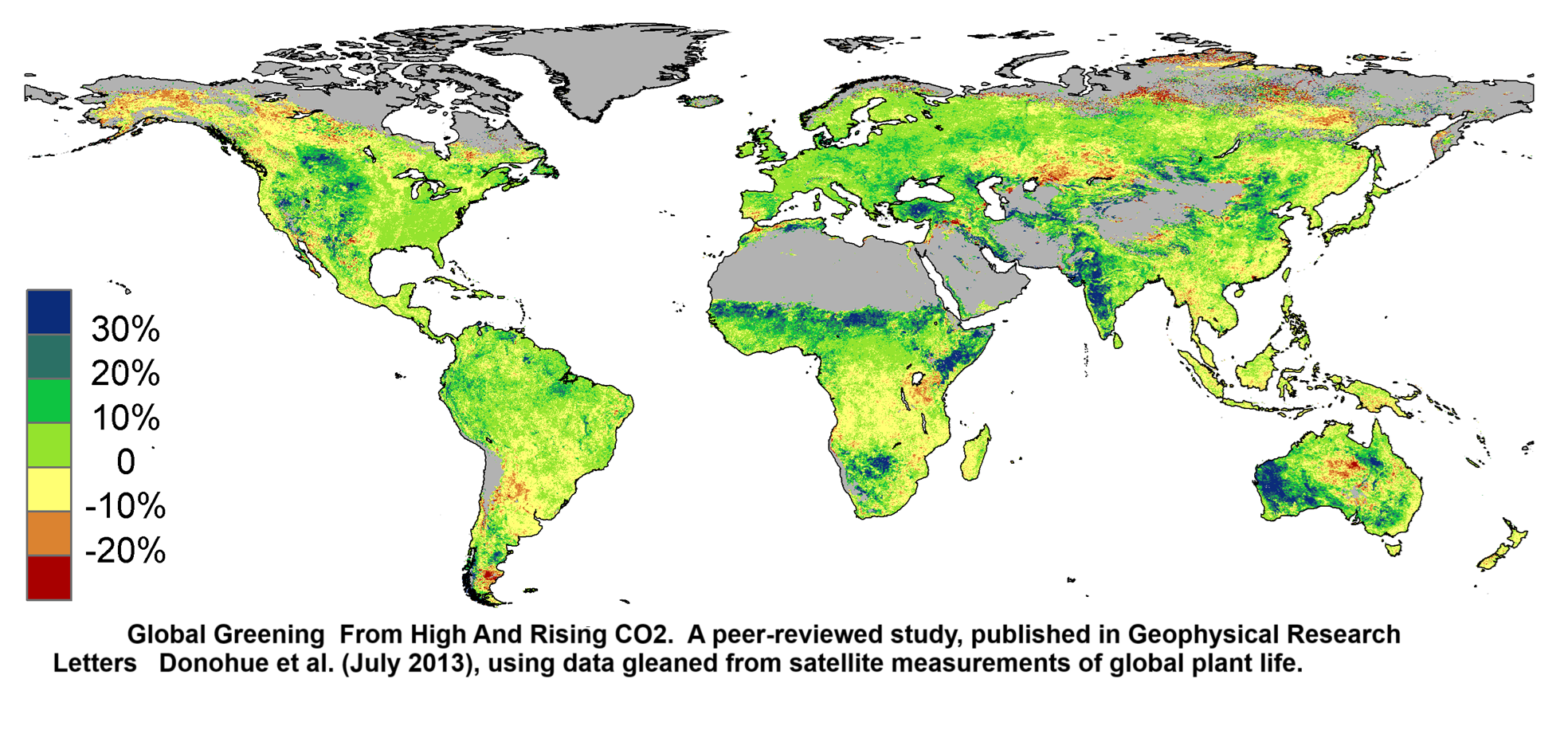
But: The planet is greener because of rising CO2.

But: Modern nations (G20) depend on fossil fuels for nearly 90% of their energy.

But: Renewables are not ready for prime time.

People need to know that adding renewables to an electrical grid presents both technical and economic challenges.  Experience shows that adding intermittent power more than 10% of the baseload makes precarious the reliability of the supply.  South Australia is demonstrating this with a series of blackouts when the grid cannot be balanced.  Germany got to a higher % by dumping its excess renewable generation onto neighboring countries until the EU finally woke up and stopped them. Texas got up to 29% by dumping onto neighboring states, and some like Georgia are having problems.

But more dangerous is the way renewables destroy the economics of electrical power.  Seasoned energy analyst Gail Tverberg writes:

In fact, I have come to the rather astounding conclusion that even if wind turbines and solar PV could be built at zero cost, it would not make sense to continue to add them to the electric grid in the absence of very much better and cheaper electricity storage than we have today. There are too many costs outside building the devices themselves. It is these secondary costs that are problematic. Also, the presence of intermittent electricity disrupts competitive prices, leading to electricity prices that are far too low for other electricity providers, including those providing electricity using nuclear or natural gas. The tiny contribution of wind and solar to grid electricity cannot make up for the loss of more traditional electricity sources due to low prices.

These issues are discussed in more detail in the post Climateers Tilting at Windmills

The Irrational Media:  Whatever Happens in Nature is Our Fault.

An Example:

Other potential examples include agricultural losses. Whether or not insurance
reimburses farmers for their crops, there can be food shortages that lead to higher food
prices (that will be borne by consumers, that is, Youth Plaintiffs and Affected Children).
There is a further risk that as our climate and land use pattern changes, disease vectors
may also move (e.g., diseases formerly only in tropical climates move northward).36 This
could lead to material increases in public health costs

But: Actual climate zones are local and regional in scope, and they show little boundary change.

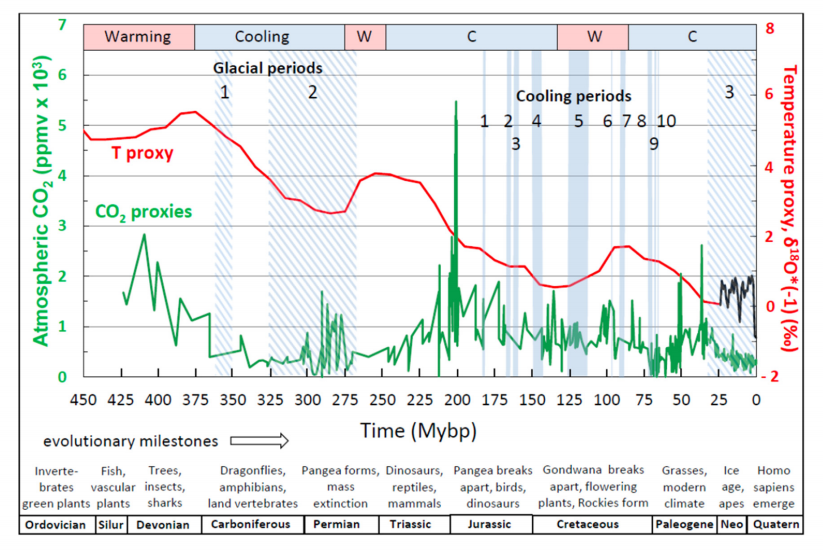
But: Ice cores show that it was warmer in the past, not due to humans.

The hype is produced by computer programs designed to frighten and distract children and the uninformed.  For example, there was mention above of “multi-meter” sea level rise.  It is all done with computer models.  For example, below is San Francisco.  More at USCS Warnings of Coastal Floodings

In addition, there is no mention that GCMs projections are running about twice as hot as observations.

Omitted is the fact GCMs correctly replicate tropospheric temperature observations only when CO2 warming is turned off.

Figure 5. Simplification of IPCC AR5 shown above in Fig. 4. The colored lines represent the range of results for the models and observations. The trends here represent trends at different levels of the tropical atmosphere from the surface up to 50,000 ft. The gray lines are the bounds for the range of observations, the blue for the range of IPCC model results without extra GHGs and the red for IPCC model results with extra GHGs.The key point displayed is the lack of overlap between the GHG model results (red) and the observations (gray). The nonGHG model runs (blue) overlap the observations almost completely.

In the effort to proclaim scientific certainty, neither the media nor IPCC discuss the lack of warming since the 1998 El Nino, despite two additional El Ninos in 2010 and 2016, plus an unexplained spike in 2023-24, now cooling off.

Further they exclude comparisons between fossil fuel consumption and temperature changes. The legal methodology for discerning causation regarding work environments or medicine side effects insists that the correlation be strong and consistent over time, and there be no confounding additional factors. As long as there is another equally or more likely explanation for a set of facts, the claimed causation is unproven. Such is the null hypothesis in legal terms: Things happen for many reasons unless you can prove one reason is dominant.

Finally, advocates and IPCC are picking on the wrong molecule. The climate is controlled not by CO2 but by H20. Oceans make climate through the massive movement of energy involved in water’s phase changes from solid to liquid to gas and back again. From those heat transfers come all that we call weather and climate: Clouds, Snow, Rain, Winds, and Storms.

Esteemed climate scientist Richard Lindzen ended a very fine recent presentation with this description of the climate system:

I haven’t spent much time on the details of the science, but there is one thing that should spark skepticism in any intelligent reader. The system we are looking at consists in two turbulent fluids interacting with each other. They are on a rotating planet that is differentially heated by the sun. A vital constituent of the atmospheric component is water in the liquid, solid and vapor phases, and the changes in phase have vast energetic ramifications. The energy budget of this system involves the absorption and reemission of about 200 watts per square meterDoubling CO2 involves a 2% perturbation to this budget. So do minor changes in clouds and other features, and such changes are common. In this complex multifactor system, what is the likelihood of the climate (which, itself, consists in many variables and not just globally averaged temperature anomaly) is controlled by this 2% perturbation in a single variable? Believing this is pretty close to believing in magic. Instead, you are told that it is believing in ‘science.’ Such a claim should be a tip-off that something is amiss. After all, science is a mode of inquiry rather than a belief structure.

Summary:  From this we learn three things:

Climate warms and cools without any help from humans.
Warming is good and cooling is bad.
The hypothetical warming from CO2 would be a good thing.


No Right to Stable Climate in Our Holocene Epoch

Leszek Marks explains how warming and cooling alternated throughout the last 12,000 years and how our modern period is no different in his paper Contemporary global warming versus climate change in the Holocene.  Excerpts in italics with my bolds and added images.  H/T No Tricks Zone

Leszek Eugeniusz Marks is a Polish geologist, professor ordinarius, currently at the Warsaw University, Department of Climate Geology; and the Polish Geological Institute-National Research Institute, president of Committee for Quaternary Research of the Polish Academy of Sciences. At present, member of editorial boards of scientific journals Boreas, “Litosfera”, “Geography and Geology”, and Studia Quaternaria.

Abstract

Cyclical climate change is characteristic of the Holocene, with successive warmings and coolings. A solar forcing mechanism has steered Holocene climate change, expressed by 9 cooling phases known as Bond events. There is reliable geological evidence that the temperatures of most warming phases in the Holocene were globally higher or similar to that of the current warming period, Arctic sea ice was less extensive and most mountain glaciers in the northern hemisphere either disappeared or were smaller.
During the African Humid Period in the Early and Middle Holocene, much stronger summer monsoons made the Sahara green with growth of savanna vegetation, huge lakes and extensive peat bogs. The modern warming is part of a climatic cycle with a progressive warming after the Little Ice Age, the last cold episode of which occurred at the beginning of the 19th century. Successive climate projections of the Intergovernmental Panel on Climate Change are based on the assumption that the modern temperature rise is steered exclusively by the increasing content of human-induced CO2 in the atmosphere. If compared with the observational data, these projected temperatures have been highly overestimated.

Overview

This paper presents the current state of knowledge of the climate change in the Holocene. The geological record of the climate change in this epoch has been verified by the results of archaeological, historical and meteorological investigations (Marks, 2016). Determination of the steering forces of modern warming is among the current scientific priorities in the world and, therefore, geological input is an important contribution to the discussion about human impact on the climate.

The current interglacial of the Holocene started 11.7 ka cal BP (Walker et al., 2018), with progressively increasing human impact on the Earth’s environment, especially strong during the past decades (Gibbard et al., 2021). Geological examination of past climate changes is crucial to distinguish the natural and the human-induced factors of the current climate change. The most important climate-steering factor is solar radiation, subjected to cyclical changes caused by the Sun’s activity that supplies with over 99% of the energy that is responsible for the climate of the Earth. Geological reconstructions show that rises and falls in the temperature on the Earth are dependent on the sunspot cycles (Table 1; Easterbrook, 2011; Usoskin et al., 2016; Usoskin,2023), and these in turn respond to the varying magnetic activity of the Sun.

The natural input of solar energy is transformed by different external and internal factors to modulate climate on the Earth. Latitudinal insolation in the Holocene depended on the Earth’s orbital parameters (Milankovič cycles). In comparison with the present values, summer temperatures in the northern hemisphere were higher in the Early and Middle Holocene (Beer, Van Geel, 2008; Beer, Wanner, 2012). Winter temperatures in the southern hemisphere were higher in the Middle Holocene, followed by higher temperatures in the northern hemisphere in the Late Holocene. In the coming 3 ka, lower temperatures are expected everywhere, except for the intertropical zone where higher winter temperatures are expected (Marks, 2016).

The natural rhythm of climate change during the Holocene was disturbed by large volcanic eruptions. Emission of dust into the atmosphere was responsible for a couple of cold events during the Holocene (Shindell et al., 2003). Such eruptions can be detected by concentrations of SO2 in polar ice core records (Zielinski et al., 1994; Castellano et al., 2004). The extent of the vegetation cover had an important, but very complex, effect on the climate (Foley et al., 2003), because the evaporative cooling by a forest mitigated warmings and limited dust mobilisation (Bonan, 2008). The atmospheric CO2 concentration decreased in the Early Holocene and started to increase since 7 ka, being independent of temperature variations (Palacios et al., 2024a). Ocean-atmosphere interchange was the main source of CO2 until the recent decades when the anthropogenic emission of CO2 became significant (Brovkin et al., 2019).

Fig. 1. Climate change in the Holocene, adapted from Palacios et al. (2024a) and modified: warm periods are in yellow and less warm in pale yellow, and cold in blue; Bond Events are after Bond et al. (1997, 2001) and geochronology after Walker et al. (2019).

Climate change after the Holocene Thermal Maximum

The temperature deduced from the oxygen isotope curve in the Greenland ice core GISP2 shows that several warmings occurred after the Holocene Thermal Maximum (Fig. 1; Drake, 2012). These were periods during which great progress in the development of human societies occurred: Late Bronze Age, Roman Warm Period and the MWP.  The separating cold Bond Events, named the Iron Age and Dark Ages Cold Periods respectively, were expressed by economic, intellectual and cultural decline. The temperature history since 900 CE was based firstly on the estimated climate history of central England (Lamb, 1977; IPCC, 1990). This showed a distinct warming of ~1.3°C when compared with the LIA (Moberg et al., 2005; D’Arrigo et al., 2006; Mann et al., 2009). This warming was a result of natural processes, because human activity could not have had any significant effect on temperature changes before 1900 CE. The Roman Warm Period (250 BC–450 CE), the MWP (950–1250 CE) and the Modern Warming Period reflect 1000-cycles with high solar radiation (Table 1; Vahrenholt, Lüning, 2014).

Discussion

The claim of the IPCC (2021) that ‘…the latest decade was warmer than any multi-century period after the Last Interglacial, around 125,000 years ago’ ignores all the knowledge about reconstructed temperatures in the Holocene, based on multi-proxy palaeoclimatic data.

Despite the extensive northern ice sheets, the increased summer insolation in the northern hemisphere caused a warming trend from the beginning of the Holocene and lasting until the Middle Holocene (Palacios et al., 2024a).  This warming trend was reversed from 6–5 ka onwards, due to decreased summer insolation in the northern hemisphere. Such general warming or cooling trends in the Holocene were interrupted by short periods with opposite and abrupt temperature changes (Fig. 1).

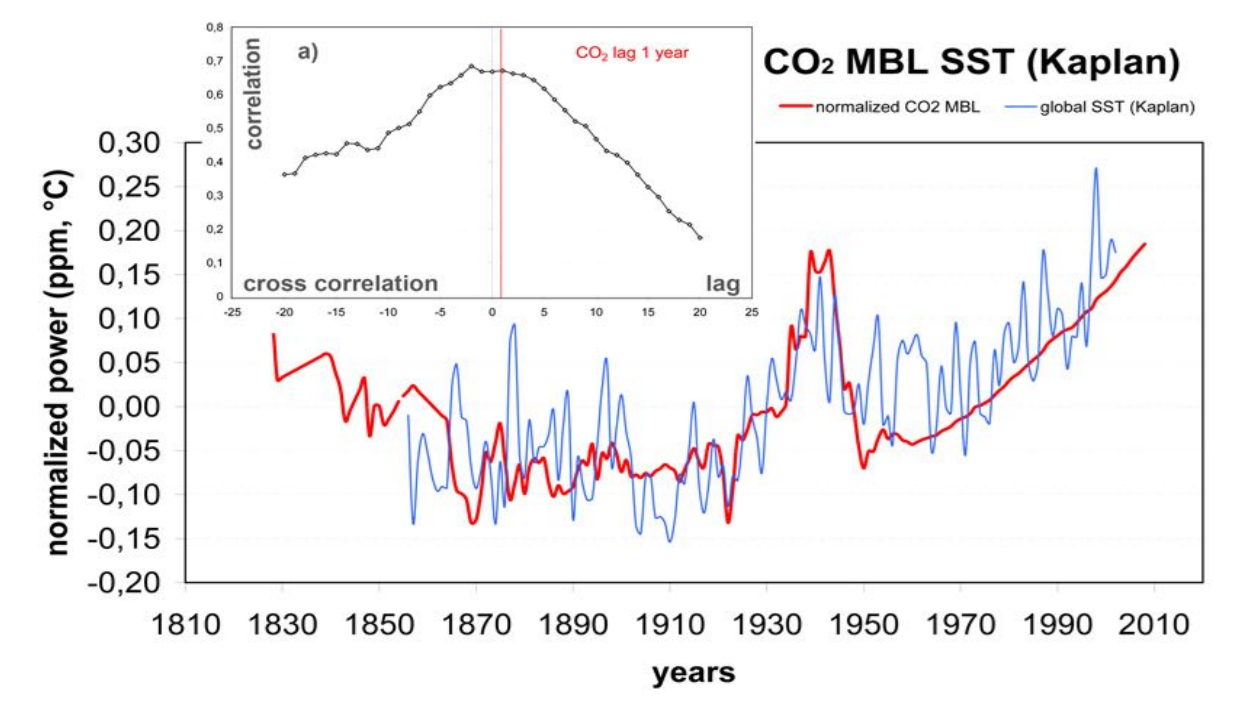
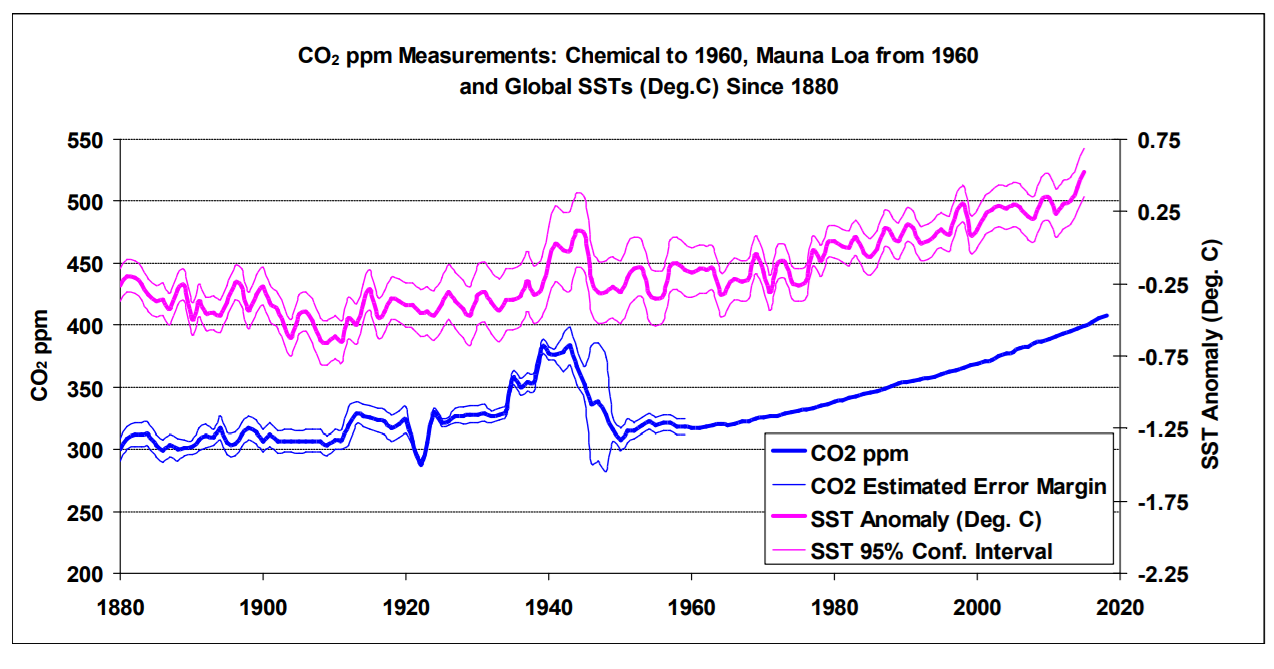
The modern warming represents a part of the cyclical climate change after the LIA, the last cold episode of which occurred at the beginning of the 19th century. The LIA with low temperatures is named the pre industrial period by the advocates of global anthropogenic warming and such an approach helps them to promote the idea that an increased human emission of CO2 (especially in the 20th century) is the only reason for rising temperatures on Earth. They do not bother with the evidence that the mutual time relations of global temperature and contents of CO2 in the atmosphere in 1980–2019 indicate a leading role of temperature, a rise of which was followed in that time by a 6-month delay in the rise of CO2 (Humlum et al., 2012; Koutsoyiannis, Kundzewicz, 2020).

The official curve of the global mean annual temperature anomalies based on regular measurements (https://data.giss.nasa.gov/gistemp/graphs_v4/) overlaps slightly with the temperature projections in reports of the IPCC (1990, 1995, 2001, 2007, 2014, 2021). These IPCC projections were created by climate models, based on the assumption that the modern temperature rise is steered exclusively by the increasing content of human-induced CO2 in the atmosphere while the role of water vapour as the main greenhouse gas is neglected (cf. Hołyst, 2020). Such an approach makes the IPCC-projected temperature highly overestimated if compared with the observational data (Fig. 3). Despite the lockdowns during the Covid-19 pandemic in 2020–2021, connected with large cutbacks in transport, travel, industrial production and energy generation, no reduction in atmospheric CO2 was noted. This fact suggests that the proposed reductions in global energy use would be most probably highly ineffective in limiting the level of atmospheric CO2.

Fig. 3. Global estimates of mean annual temperature anomalies (1880–2023), based on land and ocean data (https://data.giss.nasa.gov/gistemp/graphs_v4/) and temperature projections to AD 2100 in the successive IPCC reports (1990, 1995, 2001, 2007, 2014, 2021)

Conclusions

The Holocene climate change was characterized by cyclical warmings (such as: Holocene Thermal Maximum, Late Bronze Age, Roman Warm Period, MWP) and coolings (Bond Events: including Iron Age Cold Period, Dark Ages Cold Period and LIA). The IPCC claims that current warming is unprecedented in the last 2000 or even the last 125,000 years; this statement is very unconvincing and it is not supported by the geological data. There is good evidence that both in the last 2000 years as well during the Holocene Thermal Maximum, temperatures were higher or broadly similar to the ones in the current warming period, the Arctic sea ice was less extensive and most mountain glaciers (especially in the northern hemisphere) either disappeared or were smaller. Much stronger summer monsoons in the Early and Middle Holocene made the Sahara green with savanna vegetation, huge lakes and extensive peat bogs. The terms ‘the Holocene Thermal Maximum’ and ‘the Holocene Climatic Optimum’ are avoided by the IPCC (2021), and its popularized statements making the current warming look ‘unprecedented’ and therefore ‘unique’ are false and flatten the climate history (cf. Marcott et al., 2013).

The climate is a product of complicated interdependence of many factors that have not been yet sufficiently recognized qualitatively and quantitatively. It is a great scientific challenge that requires an extensive interdisciplinary research. There is a crucial need to make climate science less political and climate policy more scientific.


Noble Climate Cause Corruption: PIK exemplar

Thomas Kolbe explains the sordid history in his American Thinker article Potsdam climate researchers under fire. Excerpts in italics with my bolds and added images.

Critics of climate policy have long pointed to the problematic dominance of politics in climate science. A recent study from the Potsdam Institute for Climate Impact Research (PIK), which systematically exaggerated the economic consequences of climate change, has reignited the debate over scientific standards and political manipulation in the field.

On April 17, 2024, the science journal Nature published a study by PIK researchers Maximilian Kotz, Anders Levermann, and Leonie Wenz. They calculated that global GDP would shrink by 19% by 2050 due to climate change, regardless whether future emissions were reduced. This projection corresponds to an annual output loss of around $38 trillion — an economic apocalypse, given that no society has the resilience to absorb such a dramatic collapse.

A Solution Delivered Alongside the Doom

The authors also provided a ready-made “solution”: according to their math, the costs of climate damage would be at least six times higher than the expenses required to keep global warming below 2°C. The implication is clear:

This was less a scientific exercise than a political directive for policymakers
to accelerate the fight against alleged man-made climate change.

A year later, the material was “corrected” and republished with slightly toned-down results. The timing was not coincidental: peer review — the scientific quality control process — loomed in the background and threatened to spark controversy.

Peer Review Delivers a Devastating Blow

That controversy soon arrived. Three U.S.-based scientists who reviewed the PIK paper identified serious methodological flaws and faulty data — problems that had been known for over a year. According to their report, PIK’s methodology had no scientific foundation. One reviewer wrote: “I have major concerns about the uncertainty and validity of the empirical model they built and used for the forecasts. It would help this study not to follow the often-exaggerated claims found in the literature.” From the Abstract of paper  by Bearpark et al (link in red above):

Kotz, Levermann and Wenz1 (henceforth, KLW) analysed how subnational gross domestic product (GDP) growth responds to year-to-year changes in temperature and precipitation. They reported that if historical relationships continue to hold, global GDP would be lowered by roughly 62% (central estimate) in 2100 under the Representative Concentration Pathway 8.5 ‘high emissions’ scenario, an impact roughly 3 times larger than similar previous estimates,2,3. Here we show that (1) data anomalies arising from one country in KLW’s underlying GDP dataset, Uzbekistan, substantially bias their predicted impacts of climate change, (2) KLW underestimate statistical uncertainty in their future projections of climate impacts, and (3) additional data-quality concerns in KLW’s subnational GDP data warrant further investigation. When Uzbekistan’s data are removed and statistical uncertainty is corrected to account for spatial correlations, KLW’s central estimate aligns closely with previous literature and their results are no longer statistically distinguishable from mitigation costs at any time this century.

Such devastating words cast doubt not just on PIK’s work, but on the broader foundations of climate science itself. Yet papers like this are routinely used to justify green transformation policies, with their web of subsidies, NGOs, regulations, and deep intrusions into economic life.

Finance Dragged Into the Climate Matrix

The significance of this critique lies not only in the study’s flaws but also in the murky financing behind it. These alarmist reports are not just shaping public opinion; they are the cornerstone of a new “climate economy.” The goal is to channel capital flows so that state funds and private wealth are merged into politically favored projects — a carefully orchestrated fusion of financial power and ideology.

International organizations and political institutions amplify these narratives, embedding them into economic governance. The “Network for Greening the Financial System” (NGFS) — closely tied to PIK and consisting of central banks and regulators — projects future climate costs and uses them as a basis for political and financial decisions. The European Central Bank relies on such scenarios for stress tests on banks, forcing higher capital buffers and restricting lending — with direct consequences for growth.

Networks, Obfuscation, and Propaganda

Additional funding flows through organizations like Climate Works, which bankrolls both NGFS and PIK while paying for the calculation of key scenarios. This blurring of lines between sponsor and reviewer, between science and political agenda, opens the door to propaganda. Genuine public debate becomes nearly impossible under such conditions of institutionalized opacity.

The end result is soulless landscapes scarred by wind turbines, the shutdown of modern power plants, and intrusive state regulation extending into private households. The energy sector is sacrificed, home ownership turned into an ideological experiment — all justified by the apocalyptic narrative of man-made climate collapse.

The Origins of CO2 Politics

The roots of this orthodoxy can be traced back to 2009, when the Obama administration declared CO2 a “dangerous pollutant” via the EPA’s Endangerment Finding. This politically-driven decision, made without congressional approval, laid the groundwork for carbon pricing, emissions trading, and sweeping regulatory interventions.

Europe embraced the same model, perhaps even spearheaded it. As an energy-poor continent, the EU saw an opportunity: by making fossil fuels expensive and heavily regulated, it could level the playing field and prevent resource-rich competitors from exploiting their natural energy advantages.

Donald Trump briefly broke with this orthodoxy, scrapping central EPA rules, declassifying CO2 as an existential threat, and freeing coal, gas, and oil. It was a signal to the world: growth and sovereignty take precedence over panic-driven climate politics.

Politicized Science

The PIK case highlights the dangers of academia’s fusion with state agendas. The old saying applies: “Whose bread I eat, his song I sing.” It was only a matter of time before such politically tailored studies surfaced.

Just as with government-influenced modeling during the COVID crisis, climate research now faces the urgent task of disentangling politics from science. On the back of the man-made climate narrative, an entire apparatus of subsidies, NGOs, and Brussels bureaucracy has entrenched itself. Untangling this nexus is no longer just a scientific issue — it is a historic necessity.

Footnote On the Failings of PIK GDP Study

Climate study from Potsdam – how questionable forecasts misled politics and business

A controversial climate study by the Potsdam Institute for Climate Impact Research (PIK) is one of the biggest scientific scandals of recent years. Media outlets like “Tagesschau” and “Spiegel” made it headlines in 2024. “Scientifically completely invalid,” economist Richard Rosen declared. However, politicians and the financial world made far-reaching decisions based on the PIK study. The alleged annual economic damage of $38 trillion shaped global debates. (welt: 25.08.25)

The publication of the PIK study by “Nature” lent its brilliance. But internal documents show that all four reviewers reported serious deficiencies. One expert wrote: “The statistical methodology … [has] no scientific basis whatsoever.” Another emphasized that the forecasts seemed “unintuitively large.”

Roger Pielke Jr. calls it a scandal. Incorrect figures have been known for over a year, yet they continue to shape climate policy and financial decisions. Weinkle criticizes that “Nature” has “turned into a doormat.” This is how science loses credibility.

Just a few weeks after publication, Christof Schötz of the Technical University of Munich presented a detailed critique. He made it clear that the results “do not provide the robust empirical evidence required for climate policy.” Nevertheless, Nature suppressed the analysis for months.

Other researchers from Princeton and the Bank Policy Institute responded. Gregory Hopper describes his unsuccessful attempts to submit comments. Rosen described the PIK study as “completely scientifically invalid.” It has since become clear that while the criticism was suppressed, the NGFS continued to use the data. This resulted in massive economic and political damage.

Under pressure, the PIK researchers published a new version. In this “preprint,” they claimed their core findings remained intact. However, they had to swap methods to produce similar results. For Pielke, this is “a tacit admission… that the original analysis is no longer valid.”

Hopper is even more critical of the new version. “The revised climate damage model is even more flawed,” he explains. The statistical problems persist. This demonstrates that science is serving politics here rather than providing objective results.

Beware Claims Attributing Extreme Events to Hydrocarbons

RIP. You did good science and for that we are grateful.

Roger Pielke Jr. alerts us to a dangerous development in the IPCC effort claiming loss and damage from using hydrocarbons.  His blog article is A Takeover of the IPCC.

The IPCC’s longstanding framework for detection and attribution looks DOA in AR7

Pielke:  The Intergovernmental Panel on Climate Change (IPCC) has just released the names of its authors for its seventh assessment report (AR7). The author list for its Chapter 3 — Changes in regional climate and extremes, and their causes — suggests strongly that the IPCC will be shifting from its longstanding focus on detection and attribution (D&A) of extreme events to a focus on “extreme event attribution” (EEA).

The IPCC AR6 was decidedly lukewarm to freezing cold on the notion of EEA, and emphasized the traditional D&A framework. Those days may now be over.  World Weather Attribution (WWA) co-founder Frederika Otto has been put in charge of the chapter, along with another academic who focuses on extreme event attribution.

Pielke has a series of articles taking exception to EEA methods and claims.  This post is a synopsis of work by Patrick Brown on the same issue, which is likely to be featured by climatists in the days and months ahead.

How Climate Attribution Studies Become Devious and Untrustworthy

Patrick Brown raises the question Do Climate Attribution Studies Tell the Full Story? Excerpts in italics with my bolds and added images, his analysis concluding thusly:

How a cascade of selection effects bias
the collective output of extreme event attribution studies.

Weather and climate extremes—such as high temperatures, floods, droughts, tropical cyclones, extratropical cyclones, and severe thunderstorms—have always threatened both human and natural systems. Given their significant impacts, there is considerable interest in how human-caused climate change influences these extremes. This is the focus of the relatively new discipline of Extreme Event Attribution (EEA).

Over the past couple of decades, there has been an explosion in EEA studies focusing on (or, “triggered by”) some prior notable weather or climate extreme. Non-peer-reviewed reports from World Weather Attribution (e.g., herehere, and here) represent some of the most notable examples of these kinds of analyses, and many similar studies also populate the peer-reviewed literature. The Bulletin of the American Meteorological Society’s “Explaining Extreme Events From a Climate Perspective” annual series compiles such studies, as does the Sabin Center for Climate Change Law, and they are also synthesized in reports like those from the IPCC (IPCC WG1 AR6 Chapter 11.2.3) and the United States National Climate Assessment.

The collective output of these kinds of studies certainly gives the impression that human-caused climate change is drastically changing the frequency and intensity of all kinds of weather extremes. Indeed, Carbon Brief recently published an extensive summary of the science of EEA studies, which begins with the proclamation, “As global temperatures rise, extreme weather events are becoming more intense and more frequent all around the world.”

However, these numbers cannot be taken as an accurate quantification of the influence of climate change on extreme weather because they are heavily influenced by a cascade of selection biases originating from the physical climate system, as well as researcher and media incentives. Identifying and understanding these biases is a prerequisite for properly interpreting the collective output of EEA studies and, thus, what implications they hold for general scientific understanding, as well as political and legal questions.

The large apparent discrepancy between the size of the influence of human-caused climate change on extreme weather reported in EEA studies (like those compiled by Carbon Brief) compared to more comprehensive systematic analyses (like those compiled by the IPCC) can, in large part, be attributed to the many layers of Selection Biases that influence the EEA literature’s collective output.

Selection Bias is a broad term that refers to any bias that arises from a process that selects data for analysis in a way that fails to ensure that data is representative of the broader population that the study wishes to describe.

Selection biases in the context of EEA studies include those associated with the physical climate system itself, those concerning proclivities and incentives facing researchers/journals, and those concerning the proclivities and incentives facing the media. They include

Occurrence Bias is a bias introduced by the physical climate system. Since EEA studies tend to be triggered by extreme events that have actually occurred, there is reason to believe that these studies will disproportionately sample events that are more likely than average to be exacerbated by climate change because the events occurred in the first place. Essentially, extreme events that are more likely to occur under climate change—and thus more likely to be observed—are going to be overrepresented in EEA studies, and extreme events that are less likely to occur under climate change—and thus less likely to be observed—are going to be underrepresented in EEA studies.

The map below illustrates this phenomenon. It shows changes in the magnitude of extreme drought under climate change. Specifically, it shows the fractional change in the intensity of once-per-50-year droughts (as quantified by monthly soil moisture) between a preindustrial and 21st-century run (SSP2-4.5 emissions) of the highly-regarded NCAR CESM2 Climate Model. Blue areas represent locations where the model simulates that extreme droughts become less frequent and intense with enhanced greenhouse gas concentrations, and red areas represent locations where the model simulates that extreme droughts become more frequent and intense with enhanced greenhouse gas concentrations. It is notable that overall, this model simulates that warming decreases the frequency and intensity of extreme drought in more locations than it increases it (consistent with soil moistening under warming simulated by other models).

Now, here’s the kicker: The black dots show locations where once-per-50-year droughts actually occurred in the 21st-century simulation and thus represent events that would plausibly trigger EEA studies.

What do you notice about where the dots are compared to where the red is? That’s right; the simulated EEA studies overwhelmingly sample areas where droughts are getting more intense and more frequent by the very nature that those are the types of droughts that are more likely to occur in the warming climate. The result is that the EEA sample is majorly biased: warming decreased the intensity of once-per-50-year droughts by about 1% overall, but it increased their intensity within the EEA sample by 18%!

Thus, if you just relied on the EEA sample, you would come away with an
incorrect impression not only on the magnitude of change in extreme droughts
but also on the sign of the direction of change!

Choice Bias arises when researchers use prior knowledge to choose events for EEA studies that are more likely to have been made more severe by climate change. A clear example of Choice Bias pervading the Carbon Brief database is there have been 3.6 times more studies on extreme heat than there have been on extreme winter weather (205 vs. 57). Another example would be the dearth of EEA studies on extratropical cyclones (the kinds of low-pressure systems with cold and warm fronts that are responsible for most of the dramatic weather outside of the tropics). The IPCC states that the number of extratropical cyclones associated with intense surface wind speeds is expected to decrease strongly in the Northern Hemisphere with warming. Yet, it is relatively rare for EEA attribution studies to be done on these types of systems, which results in an exclusion of this good news from the EEA literature.

Publication Bias could be playing a role, too, where researchers are more likely to submit, and journals are likely to publish studies that report significant effects on salient events compared to studies that find null effects.

From Clark et al., 2023

Finally, the climate reporting media ecosystem is characterized by actors whose explicit mission is to raise awareness of the negative impacts of climate change, and thus, there will be a natural Media Coverage Bias with a tendency to selectively highlight EEA studies where climate change is found to be a larger driver than EEA studies that do not reach such a conclusion. These selection biases are apparent at the aggregate level, but there is also strong evidence of their presence in individual studies.

A more recent specific example suggestive of many of these dynamics is a study, Gilford et al. (2024), titled “Human-caused ocean warming has intensified recent hurricanes”. This study was conducted by three researchers at Climate Central, which summarizes the study’s findings with the following infographic:

From Climate Central press release on Gilford et al. (2024).

Essentially, they claim that climate change is enhancing the intensity of all hurricanes and that the enhancement is quite large: Storms today are calculated to be an entire Category stronger than they would have been in a preindustrial climate.

This is a huge effect, and thus, if it were real, it is reasonable to expect to see clear long-term trends in metrics of tropical cyclone (hurricane) intensity like the accumulated number of major (Category 3+) hurricane days or the accumulated cyclone energy from all tropical cyclones (which is proportional to the square of hurricane windspeed accumulated over their lifetimes). However, any long-term trends in such metrics are subtle at best, both globally and over the North Atlantic.

From Colorado State University Department of Atmospheric Science Tropical Meteorology Project.

So, this is a microcosm of the aforementioned apparent discrepancy between more broad quantifications of changes in extremes and their associated EEA counterparts, and again, I’d argue there are several selection biases at play affecting the production and dissemination of the EEA study.

Let’s start with Choice Bias on methodology. Human-caused warming changes the environment in some ways that work to enhance hurricanes and in other ways that diminish them. The main way that hurricanes are enhanced is via the increase in sea surface temperatures (which provides the fundamental fuel for hurricanes), and the main way that hurricanes are diminished is via changes in atmospheric wind shear and humidity.

The net result of these countervailing factors pulling in opposite directions is that we expect fewer hurricanes overall, but when hurricanes are able to form, they can be stronger than they would otherwise. These factors, though, are small relative to natural random variability, and thus, they are difficult to detect in observations.

However, the Climate Central researchers made the methodological choice
to largely exclude the influence of factors that diminish
hurricane development from the study.

Are these Choice Biases in event type and methodology an accident? There are many reasons to believe they are not.

The research paper itself spells out that the motivation of the study is to “connect the dots” between climate change and hurricanes because “landfalling hurricanes with high intensities—can act as ‘focusing events’ that draw public attention” and that “Increased attention during and in wake of storms creates opportunities for public and private discourse around climate and disaster preparedness.”

Then, there is the extensive media coverage of this study. It was picked up by 134 news outlets and ranked in the 99.95th percentile of research articles (across all journals) of similar age in terms of online attention. Further, it was immediately incorporated into seven Wikipedia articles (likely having high leverage on AI queries, which would make its findings indistinguishable from scientific “fact”). This is affected by the aforementioned Media Coverage Bias, but it is also undoubtedly directly influenced by the efforts of Climate Central, which is explicitly an advocacy organization whose self-described specialty is media placement and dissemination. 

The above sheds light on the reasons for certain choice biases in a particular study, but there is plenty of evidence that these selection biases are pervasive in the EEA field. After all, Dr. Myles Allen essentially founded the field with the motivation of answering the question, “Will it ever be possible to sue anyone for damaging the climate?”. This same motivation seems to animate many of the most high-profile scientists in the field today, like Allen’s protege, Dr. Friederike Otto (co-founder and leader of World Weather Attribution). She and her organization are frequently cited as bringing the necessary intellectual authority to credibly sue fossil fuel companies. She states the motivation of her work explicitly:

“Attributing extreme weather events to climate change, as I do
through my work as a climatologist, means we can hold
countries and companies to account for their inaction.”

Given the explicitly stated motivation of those in the EEA field, it is quite reasonable to suppose that there are major selection biases at play, and thus, it is not at all surprising that the collective output of the EEA field would look so different from more broad comprehensive assessments.

Green Energy Companies Going Down the Drain

Three reports provide data on hollowing out the alternative energy (non-hydrocarbon) sector.  Firstly an update from E2 $22 Billion in Clean Energy Projects Cancelled in First Half of 2025; $6.7 Billion Cancelled in June.  Excerpts in italics with my bolds and added images.

Clean Economy Works | total projects cancelled, closed,
downsized by sector Aug. 2022-June 2025

*totals will not match overall figures as some projects are categorized into multiple sectors

Businesses canceled, closed, and scaled back more than $22 billion worth of new factories and clean energy projects in the first half of 2025 after cancelling another $6.7 billion in June alone, according to E2’s latest monthly analysis of clean energy projects tracked by E2 and the Clean Economy Tracker.

The latest wave of cancellations — affecting five battery, storage, and electric vehicle factories in Colorado, Indiana, Michigan, New York, and Oregon — follows growing uncertainty among businesses as Congress was making the final push to effectively end federal clean energy tax credits. More than 5,000 jobs were lost to the cancellations and scales backs in June, bringing the total number of jobs lost to abandoned projects in 2025 to 16,500.

June’s cancellations were led by major automakers scaling back electric vehicle production investments. General Motors cancelled a $4.3 billion plan to expand its Orion plant in Michigan to build new electric pickups and instead shift its investments there to build 8-cylinder gas vehicles. Additionally, Toyota scaled back a $2.2 billion plan to retool a manufacturing plant in Indiana that was going to build a new three-row electric SUV, consolidating production to its Georgetown, Kentucky plant instead.

Cancellations, Closures, Downsizes

This tracking includes all projects, plants, operations, or expansions that were cancelled or closed since passage of the IRA in August 2022. This does not include announced layoffs that are not associated with a project downsizing unless there is a stated decease in production output. This list also does not include the transfer of project ownership, if production will continue under the new ownership, power purchasing agreements, or other similar type of announcements. Project delays or idling of facilities are not included unless there in an announced decrease in production or investment or unless the project will need to be restarted to proceed in the future.

A second report is from Big Green Machine  CLEAN ENERGY MANUFACTURING: TRUMP 47+ 7 MONTHS.  Excerpts in italics with my bolds and added images.

What has happened to investment in US clean energy manufacturing and supply chains since Trump took office on January 20, 2025?  Our Trump + 7 month tracker below was updated on August 20, 2025. You can also read our 6-month report below or download the report.

The Big Green Machine: Trump + 6 months report (released on July 29, 2025, based on data through July 20, 2025).

Since Donald Trump took office on January 20, 2025, newly announced investments in clean energy manufacturing projects have slowed dramatically, while the number of projects that have been paused, canceled, or closed has skyrocketed. Projects are being paused, cancelled, and closed at a rate 6 times more than during the same period in 2024 and 30 times more than during the same period in 2023.

The Big Green Machine tracks investments in the supply chain, from mine to factory, in the wind, solar, batteries, and electric vehicle industries. Over the past six months, 26 projects, totaling $27.6 billion in capital investment and creating 18,849 jobs, have been paused, canceled, or closed. During the same period, 29 new projects were announced, adding up to $3.0 billion in capital investment and 8,334 jobs.

This marks a dramatic reversal from the first six months of 2024. During that period, 54 new projects adding up to $15.9 billion in capital investment and 25,942 new jobs were announced. In comparison, 8 projects adding up to $4.1 billion in capital investment and 3,820 jobs were paused, canceled, or closed during the first six months of 2024.

That does not mean all activity in the clean energy sector has stopped. Since Trump took office, many previously announced projects have broken ground, started pilot production, or moved into full production. By our count, 39 projects adding up to $21.1 billion in capital investment and 25,269 jobs have advanced in the past six months. But the projects that are advancing are, on average, smaller in size than the projects that are slowing.

Other patterns are emerging with respect to which projects are advancing or slowing. Not surprisingly, projects counting on federal support in the form of loans and grants are more likely to be slowing. In addition, our tracking shows that projects located in communities with lower median household incomes and communities classified as disadvantaged are seeing a higher proportion of slowed projects, meaning that communities in need of opportunity are losing out.

Unlike the two above reports focusing on 2025 contractions, the third report from Canary media details the green energy bloodbath last year The cleantech companies that didn’t make it through 2024. Excerpts in italics with my bolds and added images.

From carbon removal startups to solar icons, the climate world saw a number of corporate flameouts this year. Here are some takeaways and lessons learned.

Examples included (among many others)

Solar sunsets

Arguably the most shocking cleantech corporate demise of 2024 was that of SunPower, a solar industry icon that grew from humble startup roots to a valuation in the billions, only to file for bankruptcy in August. Even as solar installations smash records in the U.S. and the federal government channels capital into onshoring solar panel production, SunPower found itself undone by China’s industrial policy might and its own boardroom missteps. High interest rates and other policy headwinds, like California’s NEM 3.0, didn’t help.  Also Ubiquitous Energy, Toledo Solar

Solar installer bloodbath

High interest rates and rooftop solar incentive shifts in leading states rippled through the long tail of residential solar installers and led to scores of bankruptcies in the past two years, an unprecedented collapse.

Here are a few of the larger casualties from this year: Sunworks, a residential and commercial solar installer, filed for bankruptcy in February. Founded in 2002, Sunworks had developed 224 megawatts of solar projects across 15 states and employed 640 people. Titan Solar operated in 16 states and abruptly shut down its operations in June. Utah-based residential solar company Lumio filed for bankruptcy in September.

Energy storage setbacks 

Armed with billions in investor capital, scores of storage startups have been aiming to dethrone energy stalwarts like lithium-ion and diesel generators — but in the words of The Wire’s Omar Little, ​If you come at the king, you best not miss.”

These companies missed.  Sweden’s Northvolt, once valued by investors at almost $12 billion, filed for bankruptcy in November in the year’s biggest battery bust.  Ambri, an energy storage aspirant with technology based on the research of MIT professor Donald Sadoway, declared bankruptcy in May.  Richmond, California–based Moxion Power laid off 101 workers in June and shuttered its doors, following a wave of hype for its 75-kilowatt portable lithium-ion batteries that it hoped would replace diesel generators.  Two other notable failures in the storage sector:  Ionic Materials, a 40-person MIT spin-out developing battery materials, Australian flow battery firm Redflow.

Removing carbon one VC dollar at a time 

Running Tide was the largest marine carbon-removal startup and the first to sell ocean carbon credits. Its initial plan of removing carbon dioxide from the atmosphere and sequestering it in the ocean by growing and sinking kelp morphed into sinking wood chips coated with lime-kiln dust. Running Tide announced that it was folding in June after raising more than $54 million.

Unsustainable aviation

Chasing a clean fuels breakthrough, Fulcrum BioEnergy promised to transform municipal waste into sustainable aviation fuel through a low-emissions gasification process. Instead, the company incinerated hundreds of millions in funding from BP, United Airlines, Cathay Pacific, and Japan Airlines — and hundreds of millions more in municipal bondsThe firm ceased operations in May.  Also Universal Hydrogen 

Charger bankruptcy

Tritium, a major provider of high-speed EV chargers, went bust in April but found a buyer for its insolvent business in India-based Exicom, which claims it will keep Tritium’s U.S. factory in business. Tritium has sold roughly 13,000 chargers in 47 countries and claimed a 30 percent U.S. market share for direct-current fast chargers in 2023.

Zero to 60 and back to zero with EVs

Luxury EV maker Fisker went bankrupt again; electric-van maker Arrival went bankrupt and sold its assets to another struggling EV maker, Canoo, which is currently furloughing employees; Cake, a Swedish e-motorcycle startup, sold 6,000 bikes but filed for bankruptcy in February after raising more than $75 million.

ArcimotoFaraday FutureMullen Automotive, and Workhorse Group are publicly traded EV companies but are facing delisting warnings, paltry revenue, and valuations that are rapidly approaching zero. Nikola stock is down by 90 percent year to date.

Comment

These reports are from green energy enthusiasts and promoters, expressing concerns without questioning the so-called transition to zero carbon.  They really do want to pave farmland over with solar and wind installations.  The rest of us understand that the whole green economy notion is delusional and needs dismantling ASAP.  The creative destruction of these misbegotten enterprises is a step in the right direction.