Tom Harris and Todd Royal explain why “official” temperature history from Canada government is distorted to invent warming where very little has actually ocurred. Their article: Is Canada basing its climate policies on ‘decision-based evidence-making?’ Excerpts in italics with my bolds and added images.
Politicians want us to believe that they base their decisions on solid, verifiable evidence. “Evidence-based decision-making,” they call it. But what if the decision is made first and then the data is selected, or left uncorrected, in order to support the now politically correct decision? That would then be “decision-based evidence-making.” In other words, a complete corruption of honest decision-making.
It seems that Environment and Climate Change Canada (ECCC) is doing exactly thatwith the country’s temperature data in order to support the government’s mantra that Canada is “warming twice as fast as the global average.” For, if the one-degree anomalous spike in Canada’s “mean temperature” in 1998 is removed from the data, as even ECCC researchers themselves advocated previously should be done to preserve data integrity in cases like this, then Canada is not warming at all and much of the $200 billion spent on the climate file by the federal Liberal government since 2015 is a complete waste.
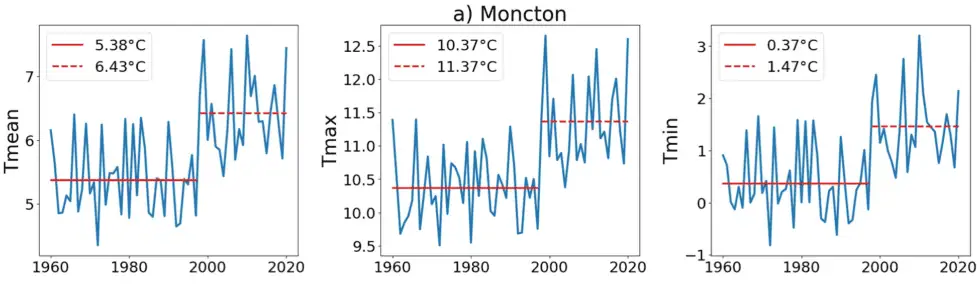
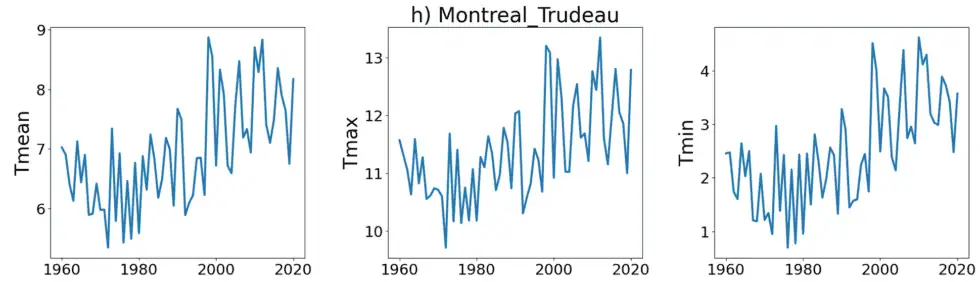
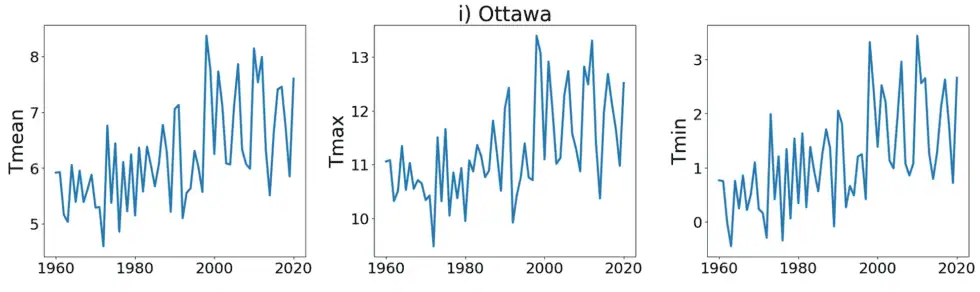
In 2021, Dr. Joseph Hickey, a data scientist with a PhD in Physics, specializing in complexity science, then an employee of the Bank of Canada, alerted ECCC to this one-degree jump in temperature data across much of Canada, and asked for an explanation. The below graphs of mean, maximum and minimum temperatures constructed with data from three Canadian cities—Moncton (on which Hickey illustrates the step change with red lines), Ottawa and Montreal—are samples of those created by Hickey using ECCC data downloaded on November 11, 2025, data that is the same as that he sent to ECCC researchers as an attachment to his email of June 24, 2021.
Ignoring their previous position about the need to remove such sudden discontinuities from the data, ECCC staff had little to say and left the anomaly in the record, asserting that it was “probably” a real sudden change in temperature.
Making matters worse, another Bank of Canada employee, economist Julien McDonald-Guimond, had already alerted ECCC by email on December 7, 2020, that he had found more than 10,000 instances of days for which the daily minimum temperature was greater than the daily maximum temperature. Again, ECCC staff had no reasonable justification.
Dr. Hickey shows that, if you apply ECCC’s trend analysis method to their data, you find an increase of 1.74° C (which is statistically significant) from 1948 to 2018. And then, he tells us, if you correct for the one-degree step increase in 1998, you find only a 0.29°C rise. That small change “is indistinguishable from zero,” explains Hickey. “There is no evidence of warming.”
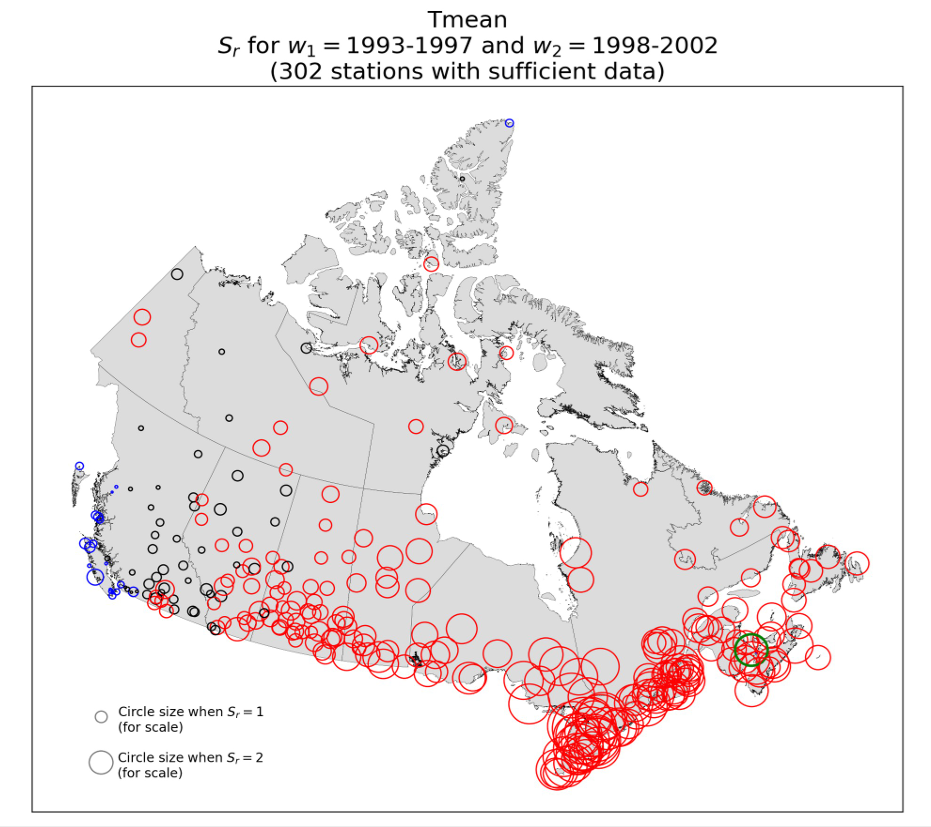
Figure 7: Map showing Sr calculated using Tmean, for the break year 1998 with two five-year windows (1993-1997 and 1998-2002) for the 302 3rd generation AHCCD stations with sufficient data. Circle radius is proportional to the absolute value of Sr. Circle colour indicates Sr ranges as follows: blue: Sr < 0; black: 0 ≤ Sr ≤ 1; red: Sr > 1. Moncton, NB (Sr = 2.74) is indicated with a green circle, for reference.
In Figure 7, AHCCD stations with Sr < 0 are coloured blue, while black indicates 0 ≤ Sr ≤ 1, and red indicates Sr > 1. The AHCCD records with the largest stepwise increases at 1998 are located in Eastern and Central Canada (including the stations listed in Table A), and there are many records with discernible steps at 1998 in the Prairies (provinces of Manitoba, Saskatchewan, and Alberta) and the north of the country. British Columbia remains the main outlier, with most ofits AHCCD stations having no discernible steps at 1998.
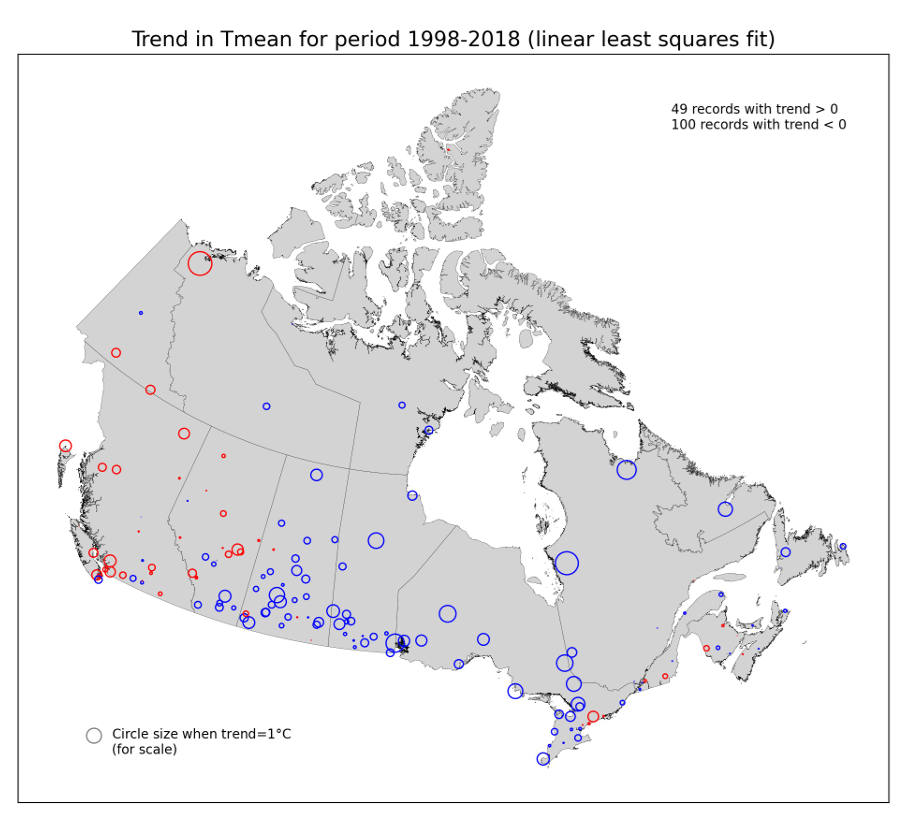
Figure 8: Map of trend in Tmean over the period 1998-2018, for the 3rd generation AHCCD stations with sufficient data, calculated using linear least-squares fitting. Circle radius is proportional to the absolute value of the trend. Blue circles correspond to negative trends (trend < 0) and red circles to positive trends (trend > 0).
In Figure 8, the trend for a particular Tmean record is equal to the slope (°C/year) from a linear least-squares fit to its data for 1998-2018, times 21 years. An AHCCD station was considered to have sufficient data if its record had at least 350 days of non-missing daily data per year for every year from 1998 2018. Approximately two thirds of the AHCCD records with sufficient data have negative trends for 1998-2018 using linear least-squares fitting.
Summation
This report demonstrates Environment Canada’s dismissive response to being alerted to a large, apparently non-climatic artifact in its flagship temperature time-series product, an artifact which could, on its own, be responsible for essentially all of the calculated warming for many Canadian locations over the past six or seven decades.
The said apparent artifact, referred to as the “1998 step-increase feature” in this report, is a stepwise increase of approximately 1°C in magnitude occurring at 1998 in the annual mean time-series of daily maximum, minimum, and mean temperatures for many stations across Canada in Environment Canada’s Adjusted and Homogenized Canadian Climate Data (AHCCD).
The agreement in question is the United Nations Framework Convention on Climate Change, or UNFCCC, which the US joined and Congress ratified in 1992, when George H.W. Bush was in the White House. The agreement does not require the US to cut fossil fuels or pollution, but rather sets a goal of stabilizing the amount of climate pollution in the atmosphere at a level that would “prevent dangerous anthropogenic (human-caused) interference with the climate system.”
It also set up a process for negotiations between countries that have come to be known as the annual UN climate summits. It was under the UNFCCC’s auspices that the Kyoto Protocol was negotiated in 1995, and the Paris Agreement in 2015 — two monumental moments of global cooperation and progress toward limiting harmful climate pollution.
In addition, the agreement requires the submission of an annual national climate pollution inventory, which the Trump administration notably skipped this year.
President Trump withdrew the US from the Paris Agreement for a second time on his first day in office. With Wednesday’s move,the US will now become the first country to withdraw from the climate treaty, since virtually every country is a member, according to the Natural Resources Defense Council, an environmental group.
Because the Senate ratified the UNFCCC in 1992, it is a legal gray area as to whether President Donald Trump can unilaterally pull the country out of it. However, if Congress plays a role, the Republican majority would presumably back the move.
If successful, the withdrawal would prevent the US from officially participating in subsequent annual climate summits and could call into question the country’s commitment to other longstanding agreements to which it is a party. It may also prompt other nations to reevaluate their commitments to the UNFCCC and UN climate talks, risking not just US climate progress but that of others.
A US withdrawal could make it difficult for a future president to rejoin the Paris Agreement, since that agreement was struck under the auspices of the UNFCCC.
Trump also moved to withdraw the US from the UN Intergovernmental Panel on Climate Change, or IPCC — a Nobel Prize-winning group that publishes reports on global warming. While the president likely can’t bar US scientists from participating in IPCC reports, the move could have ramifications for federal scientists who would otherwise contribute. A White House fact sheet stated:
“Many of these bodies promote radical climate policies, global governance, and
ideological programs that conflict with U.S. sovereignty and economic strength.”
So, it’s a trifeca: UNFCC, IPCC, and Paris Accord
“The Paris Parrot is not dead, it’s just resting.”
Richard Miller points to growing distrust of climate ideology and to receding support for impractical energy and social policies aimed at fighting global warming/climate change, but serving only to inflict energy poverty His article is The Tide Turns Against the Climate Change Agenda: A Long-Overdue Reckoning. Excerpts in italics with my bolds and added images.
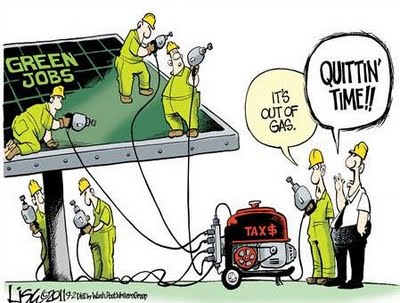
For nearly two decades, Britain’s climate lobby has held an iron grip on policy, discourse, and public imagination, promising a utopian future of cheap energy, green jobs, and global leadership. From Westminster’s corridors to the BBC’s airwaves, the mantra was clear: Net Zero would make us richer, healthier, and safer, all while saving the planet. But the cracks in this narrative are now gaping wounds. Soaring energy bills, crumbling industries, and a public fed up with unfulfilled promises signal a seismic shift. The tide is turning against the climate change agenda, and it’s about time.
The climate establishment’s dominance rested on a seductive pitch: green policies would deliver prosperity without pain. Wind turbines and solar panels would slash energy costs, insulate us from petrostates, and create a jobs bonanza. As Maurice Cousins noted in his August 2025 Artillery Row piece, this vision transformed environmentalism from a middle-class indulgence into a technocratic consensus, backed by state funding, Big Philanthropy, and celebrity endorsements.
Yet, the reality is starkly different. Britain now faces some of the highest industrial energy costs in the developed world, with electricity prices for businesses nearly double those in the U.S. Heavy industry is in retreat, steelworks and manufacturing plants are shuttering, while the UK’s reliance on energy imports has surged, exposing vulnerabilities during crises like Russia’s invasion of Ukraine.
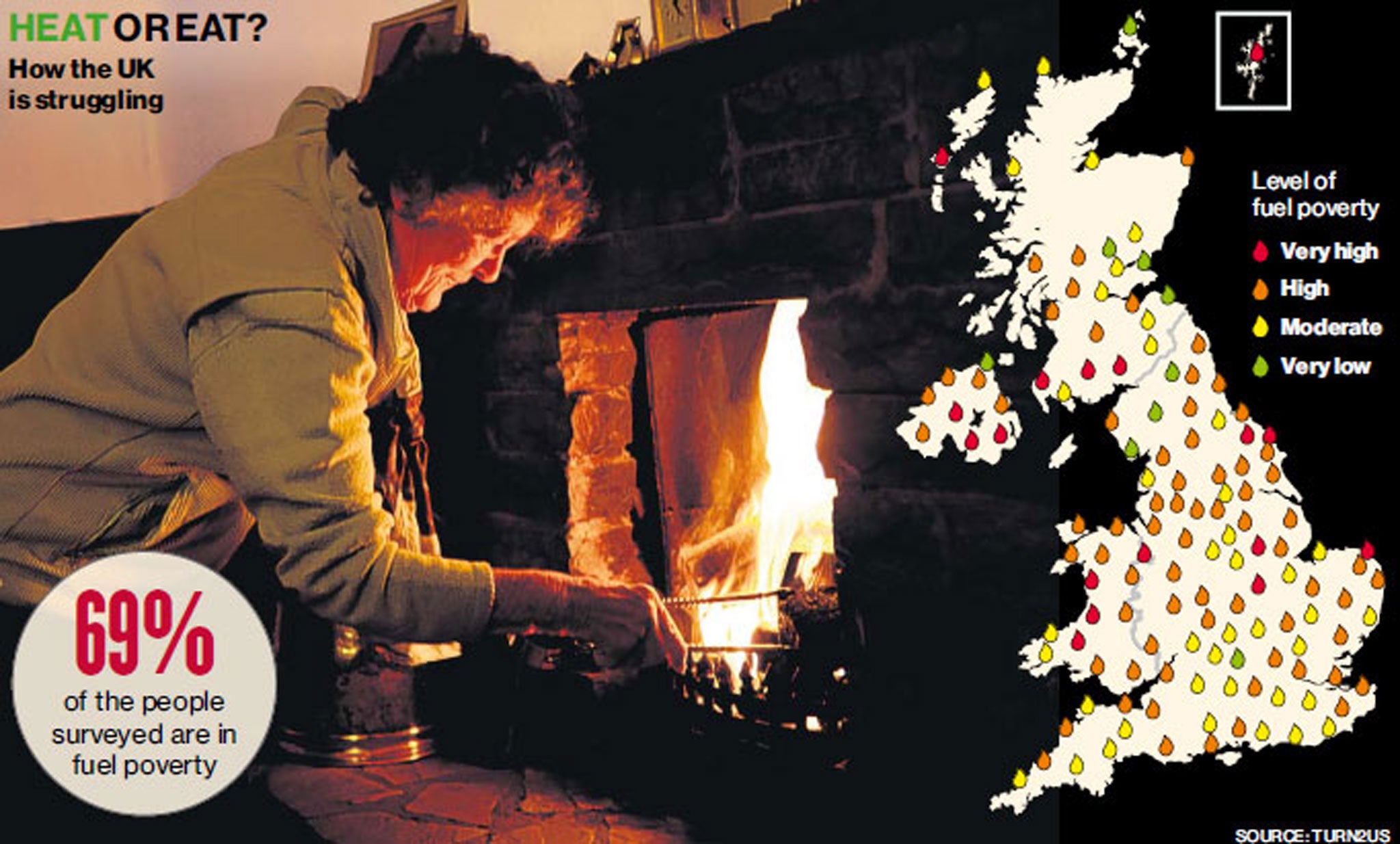
The public isn’t blind to this failure. Polls reflect a growing backlash. While abstract support for Net Zero lingers, a 2025 YouGov survey found 47% of Britons want climate policies scaled back when faced with their costs, high bills, job losses, and lifestyle constraints. Reform UK voters, with 32% endorsing reduced green measures, are leading the charge, but even mainstream figures like Tony Blair and trade unions like Unite are breaking ranks, questioning the feasibility of the green agenda. This isn’t just scepticism; it’s a revolt against a narrative that promised abundance but delivered austerity.
The climate lobby’s response? Double down and deflect. Take the recent video by Simon Clark and Carbon Brief’s Dr. Simon Evans, which Cousins critiques as a desperate attempt to “manage” dissent rather than engage with it. Acknowledging rising bills and Britain’s mere 1% of global emissions, it dismisses public concerns as misinformation fuelled by fossil-fuel propaganda. This patronising tone, epitomised by praising the “independent” Climate Change Committee, a body of unelected technocrats, only deepens distrust. It’s a tired playbook, seen in Brexit and migration debates: label critics as ignorant, pathologise their concerns, and cling to elite authority.
But the public’s lived experience, bills they can’t pay, industries they’ve lost,
trumps rhetorical window-dressing.
The folly of the climate agenda lies in its defiance of economic and physical realities. Low-density, intermittent renewables like wind and solar cannot power a modern industrial economy without massive subsidies and grid instability. The Office for Budget Responsibility has warned that Net Zero’s costs, projected at £1.4 trillion by 2050, far outstrip promised savings. Meanwhile, global competitors like China and India, responsible for over 40% of emissions, continue burning coal with little regard for Western virtue-signalling. Britain’s “lead by example” approach is not just naïve, it’s self-destructive, hamstringing its economy while others race ahead.
This reckoning is long overdue. The climate lobby’s promises were always more faith than fact, rooted in a utopian vision that ignored trade-offs. Green jobs? The UK’s renewable sector employs fewer than 75,000 people, a fraction of the 500,000 jobs lost in manufacturing since 2000. Cheaper energy? Households face bills 60% higher than a decade ago. Energy independence? The UK imports 40% of its electricity on peak days, often from fossil-heavy grids abroad.
The climate agenda’s failures are not a messaging problem,
they’re a policy disaster, colliding with
the hard limits of physics and economics.
The tide is turning because the public sees through the façade. From factory workers to suburban families, people feel the squeeze of policies that prioritise ideology over reality. The green backlash isn’t just about cost, it’s about trust. When elites lecture about “saving the planet” while ordinary citizens struggle to heat their homes, resentment festers. Reform UK’s rise and the growing chorus of mainstream dissent signal a broader awakening: the climate agenda, as it stands, is unsustainable.
It’s time to pivot. Instead of doubling down on unworkable targets, Britain needs pragmatic policies,investment in nuclear energy, which provides reliable, low-carbon power; deregulation to revive industry; and a frank acknowledgment that global emissions won’t bend to Western sacrifices alone. The climate lobby’s grip is slipping, and no amount of technocratic spin can stop the public’s demand for change. The reckoning is here, and it’s about time we embraced it.
Prime Minister Mark Carney, right, signs an MOU with Alberta Premier Danielle Smith in Calgary, Alta., Thursday, Nov. 27, 2025. THE CANADIAN PRESS/Jeff McIntosh
Had the Great Smith-Carney Pipelines and Climate Pact of 2025 emerged say, five years ago, it would have been considered squarely within the realm of Liberal environmentalism. Instead, because former prime minister Justin Trudeau brought in several anti-business policies, the current prime minister is being feted/scorned as being pro-energy industry by disappointed Liberals and relieved conservatives alike. While Mark Carney deserves credit for negotiating this deal with Alberta Premier Danielle Smith, and bringing a rival onside, we’re skeptical at the chances a pipeline ever gets built.
There are definitely some positives in the deal that Smith can present at the UCP annual general meeting this weekend in an attempt to quell the separatist uprising within her governing party. Ottawa has officially committed to “Increasing production of Alberta oil and gas”and to the approval and construction of “one or more private sector constructed and financed pipelines.”The Liberals promise they “will not implement the Oil and Gas Emissions Cap” and will exempt Alberta from the government’s clean energy regulations. They would also consider a temporary exemption to the west coast tanker ban.
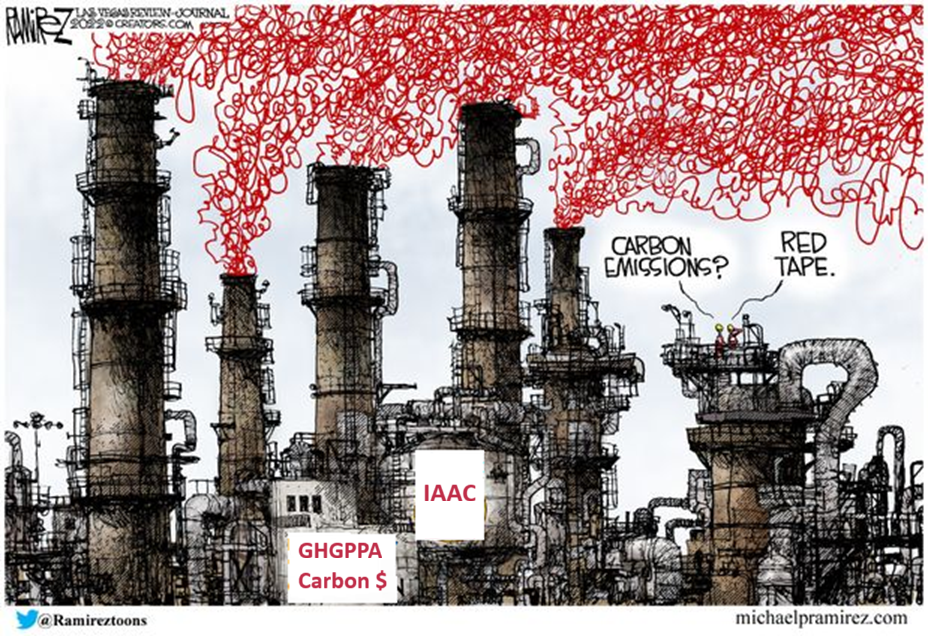
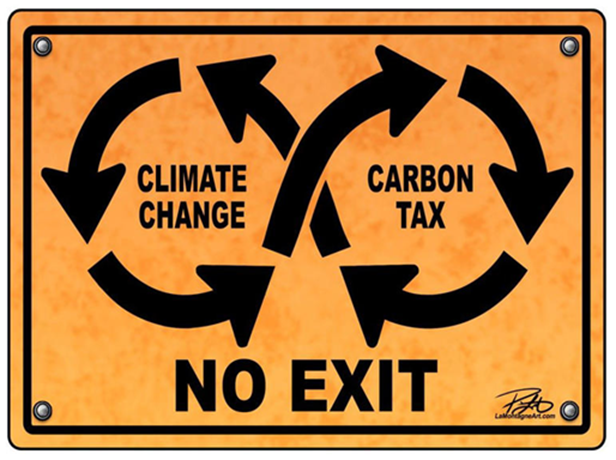
All of these regulations have been points of contention for Alberta, so it is to Smith’s credit that she was able to persuade Carney to budge. But it’s possible this will not accomplish much more than to remove extra layers of regulation, which were unnecessary even by environmental standards. Under the Trudeau Liberals, there was to be a consumer carbon tax, industrial carbon tax, as well as the clean energy regulations and emissions cap. And it did not end there, as the Impact Assessment Act, also brought in under Trudeau, mandates onerous environmental and social review, including the consideration of “Indigenous knowledge” alongside scientific assessment, as well as considering the “intersection of sex and gender with other identity factors.”
If Carney is at all serious about kickstarting investment in Canada,
he should at minimum be willing to clear away some of these extra rules.
Ultimately, it seems that environmental policies and expectations are merely being shifted around. Because what is being asked of Alberta would appear to provide only the narrowest of paths for the construction of a new pipeline to the West coast. Under the memorandum of understanding between Smith and Carney, the province would have to raise its industrial carbon tax from $95/tonne to a minimum of $130/tonne, and reduce methane emissions, produced by the energy industry and farmers, to 75 per cent below 2014 levels. And in addition to the duty to consult Indigenous communities, any pipeline must have Indigenous co-ownership.
Further to that, the construction of a pipeline is entirely contingent on the simultaneous construction of a massive carbon capture project, presumably so Carney can claim the new pipeline is moving only “low emission” barrels of bitumen. Finally, while the MOU does not explicitly give B.C. a veto, that province is to be included “immediately” in a “trilateral discussion” on the project. B.C. Premier David Eby is opposed to a pipeline and was highly critical of the deal, claiming it would take priority away from other projects, specifically B.C. projects Eby supports. [
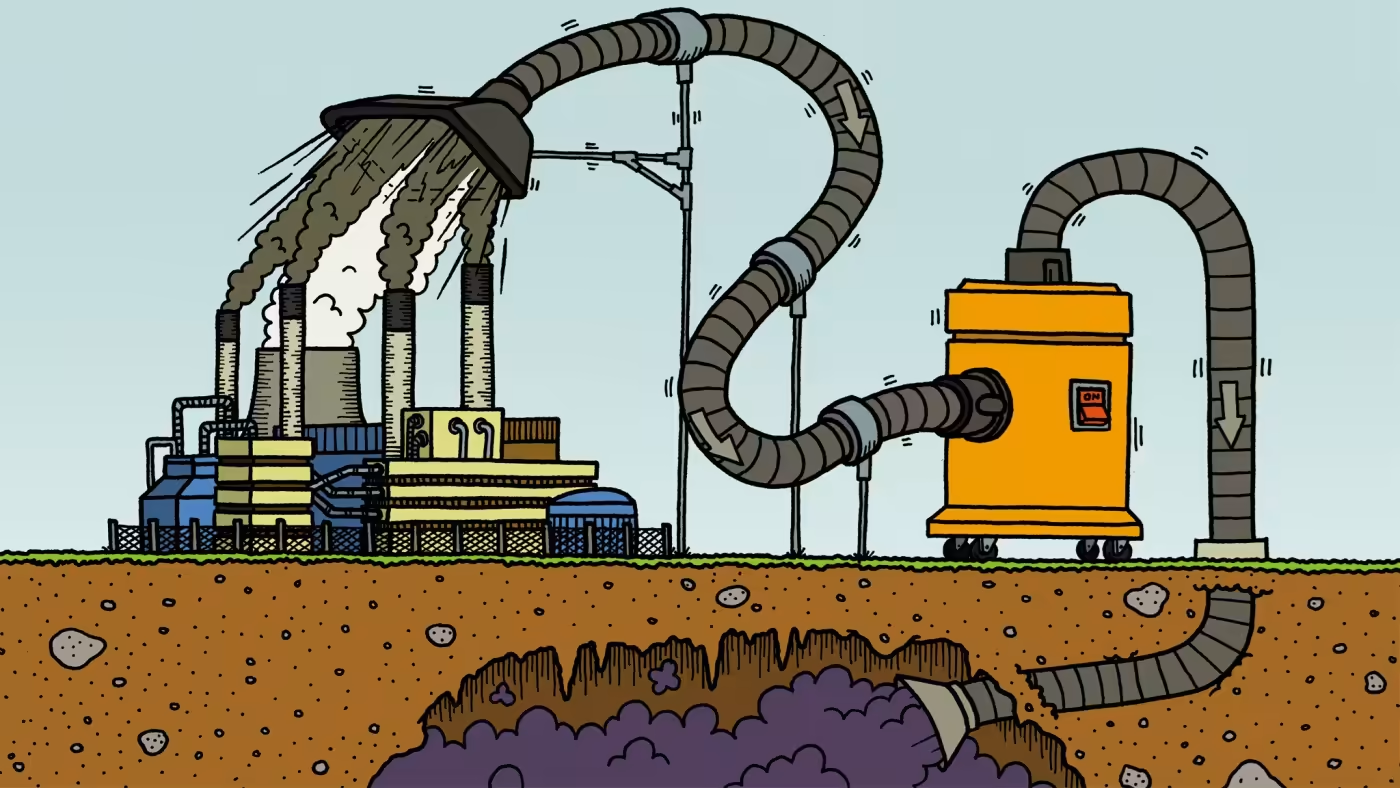
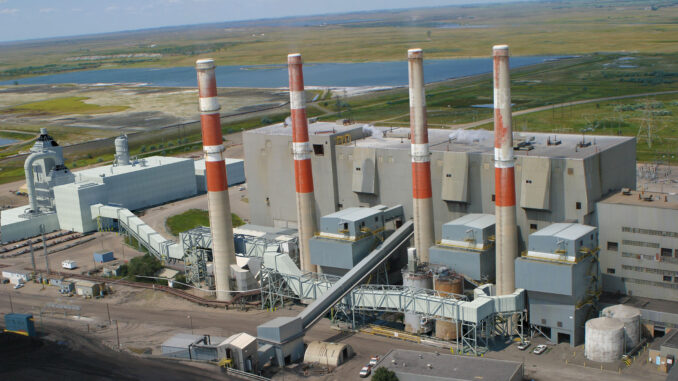
April 30, 2024 (IEEFA) – More than CAD1 billion were spent retrofitting the Boundary Dam 3 (BD3) coal plant in Saskatchewan to add carbon capture technology. After nine years, the project has a consistent history of capturing far less than the 90 per cent promised when the project was built—and all the carbon dioxide (CO2) captured at the plant is used for enhanced oil recovery (EOR) that injects captured CO2 into the ground to extract more oil..Carbon capture at Boundary Dam 3 still an underperforming failure
And the roadblocks to a new pipeline don’t end there. While it would be approved through the Major Projects Office, it isn’t at all clear what purpose that will serve. Carney’s Liberals gave themselves the authority to suspend regulatory review to expedite projects in the national interest. However, the office is electing not to use this power so far, stating on its website that “Projects will continue to be subject to all regulatory review processes.”
So being approved through the MPO may give the pipeline certainty that
it will be approved — eventually. That means every investment killing
process under the Impact Assessment Act will have to be passed.
What the Smith-Carney deal does accomplish is to buy both of them time to each satisfy their base.For Smith that is conservatives flirting with separatism, and for Carney, it is environmentalist Liberals, some of whom see this deal as a betrayal, such as former environment minister Steven Guilbeault who quit cabinet in protest. We applaud genuine attempts from Ottawa to work with, as opposed to against, Alberta, but we’re not confident this plan will deliver what is promised.
2025 may mark the end for such policies as unsubsidized EV sales
collapse and impatience with DEI rises
This year is shaping up as a turning point in restoring sanity to public policy. Nowhere is the change more evident than in attitudes to green energy policies, once the rallying cry for left-wing parties in North America. Support has collapsed for three pillars of green energy advocacy:
♦ building electric vehicles to eliminate our need for oil pipelines and refineries;
♦ using the financial clout of the Net-Zero Banking Alliance to force firms to eliminate carbon emissions; and
♦ legally mandating the shift from fossil fuels to green energy.
This turning away from green energy policies is reflected in how industrial policy underpinning electric vehicles(EV) has been discredited over the past year. Companies are delaying or abandoning the building of EV assembly and battery plants, mainly because EV sales are slumping following withdrawal of the artificial stimulus of government subsidies in both Canada and the U.S. Walking away from these investments leaves governments on the hook for billions of dollars they rashly pledged in support of EV projects.
In Quebec, Northvolt stopped work on a $7-billion battery plant,electric bus manufacturer Lion Electric filed for bankruptcy, and the Ultium CAM consortium paused plans to expand production of materials for batteries to be used in GM vehicles, which in turn led the giant mining company Vale to cancel plans for a nickel sulfate plant to supply these batteries. In Ontario, Honda delayed $15 billion of investments to build EV assembly plants and supply them with batteries, while Ford postponed its EV assembly plant plans after its EV division posted losses of $12 billion over the past two and a half years. Just last week, GM stopped producing electric delivery vans at its Ingersoll plant due to slack demand that had “nothing to do with tariffs or trade,” according to GM Canada’s president.
As investment in EV and battery plants collapses into full retreat, the outlook for fossil fuel demand improves. The International Energy Agency has reversed course and now projects demand will rise by 2.5 million barrels a day between 2024 and 2030. The under-investment in petroleum refining resulting from our having bought into the narrative that oil was past peak pushed the industry’s capacity utilization rate to 94.1 per cent in July, the highest of any industry in Canada that month. The prospect of demand exceeding capacity spurred the industry to boost investment to over $3 billion last year, double its average over the previous two decades.
The shift in public attitudes to fossil fuels provoked an abrupt about-face in Prime Minister Mark Carney’s stance on energy policy. In 2021 Carney spearheaded the launch of the Net-Zero Banking Alliance, which proposed to use access to credit to push firms to adopt policies that eliminated greenhouse gas emissions. But last month, after the world’s largest banks left it, including Canada’s,the alliance shut down. Even as it did, Carney’s government revived the Keystone XL pipeline proposal to carry Canada’s bitumen to U.S. refineries looking to replace dwindling heavy oil shipments from Mexico and Venezuela.
The tide is also turning against climate-change activists in the legal world. Just last week, a U.S. federal court ruled against claims by a group of young peoplethat the Trump administration’s gutting of green energy initiatives violated their human rights. The court concluded such an important policy issue should be resolved at the ballot box and not in the courts, a precedent we should all hope helps Ontario courts reach the same conclusion in a similar case brought by teenagers.
The setbacks for green energy policies are reflected in disarray among left-wing parties in Canada and the U.S. In the U.S., The New York Times reports, registration of Democratic voters has fallen by two million since last year’s elections, despite high disapproval of Trump’s economic policies. While the radical left rejoices in the candidacy of self-styled Democratic Socialist Zohran Mamdani for mayor of New York, more centrist Democrats, fearing his radical agenda will hurt the party in next year’s midterm elections, have been slow to endorse him. In Canada, the NDP lost official party status in this spring’s federal election as its vote share plumbed historic lows, revealing the folly of Leap manifesto leaders forcing out Thomas Mulcair as NDP leader in 2017 because they wanted more aggressive opposition to fossil fuels.
Policies such as the Green New Deal are not the left’s only vulnerability. Support for woke social movements such as DEI (“diversity, equity and inclusion”) has also become a liability. A fundamental problem associated with both the green and woke movements is that advocates are so convinced of the righteousness of their causes that they refuse to countenance debate.
Because neither developed arguments that resonated with the public,
that same public is not alarmed to see these policies dismantled.
Sometimes big corporations are their own worst enemies. They say things and do things that at the moment sound good and perhaps win an immediate PR battle, but those same words or positions can come back to bite them later. Such is the case for ExxonMobil.
Back in 2006, almost 20 years ago, the company’s then-CEO Rex Tillerson told the New York Times that a company report had acknowledged the link between the consumption of fossil fuels and rising global temperatures, saying, “We recognize that climate change is a serious issue.” He then added, “We recognize that greenhouse gas emissions are one of the factors affecting climate change.”
This massive gesture of appeasement was a major concession, and it awarded a huge victory to climate alarmists. In that same article, the Times suggested that if Tillerson was successful, ExxonMobil would “no longer be the oil company that environmentalists love to hate.”
Climate Activists storm the bastion of Exxon Mobil, here seen without their shareholder disguises.
How’d that work out? Did they back off of ExxonMobil and other big oil companies as a result? No, they ramped up the pressure so steadily and so heavily that over the years, “climate change” activists led ExxonMobil by the nose. It went full bore into “sustainability,” and it even supports the Paris Agreement, also known as the Paris Climate Accord.
After years of incremental surrender to the left, the company now finds itself in the position of having to sue the state of California over a pair of 2023 “disclosure laws” that amount to the state mandating what companies can and cannot say about certain climate change matters.
Last week, the company sued California in the U.S. District Court for the Eastern District of California on claims that Senate Bills 253 and 261 “trumpet California’s message.” The message in question, apparently, is that big oil and other major companies are “uniquely responsible for climate change.” In its lawsuit, Exxon Mobil said it considers this sort of message as “misleading.” The suit challenges both laws on grounds that they are First Amendment violations. The intent of the litigation is to stop these laws from going into effect in 2026.
The climate alarmists and their entire sector are portraying the lawsas requiring basic “climate-related transparency.”
But if you dig into these laws, it reminds me of that old saying about free speech. It goes like this: “Communist China believes in free speech. So long as you say what the government likes, you can say whatever you want.” That pretty much sums up this situation.
More specifically, ExxonMobil contends that to comply, it would need to
rely on “frameworks that place disproportionate blame
on large companies like ExxonMobil.”
Senate Bill 253
Gov. “Slick” Newsom signed Senate Bill 253 (the Climate Corporate Data Accountability Act) into law in 2023. It requires big companies to disclose a wide range of emissions, and not just the stuff coming out of their industrial pipes and smoke stacks. They’d even have to report “direct and indirect emissions” that would include quantitative measurement of and a cost for employee business travel and product transport.
I’ve seen some of this type of internal tracking and reporting up close, and it’s ridiculous. It’s all in line with ESG measurements and processes that are inconsistent at best. Just as often, it’s a scoring system built on “Wild A** Guesses.”
Senate Bill 261
Senate Bill 261 (or the Climate-related Financial Risk Act ) gets even more pointedly at the First Amendment issues at play. This law requires businesses that generate more than $500 million per year to “disclose” the financial impacts and risks they face from climate change, and how they will respond.
More to the point, ExxonMobil said that if it even tried to comply with this law, it would have to guess on things it can’t even know about in advance. Essentially, it would have to try to predict the future and put those predictions on its own website.
At the same time, the suit points out that Exxon doesn’t even have
any crude oil or natural gas exploration, production, manufacturing,
transport or refining operations in California.
On the First Amendment issue, in ExxonMobil’s case, the company is expected to argue that both laws require companies to speak publicly in specific ways. The laws don’t simply mandate that the company disclose factual data on past activities and results, but rather that it must speculate in ways it cannot reasonably and responsibly do.
This is “compelled speech.” While the First Amendment protects the right to speak, it also protects the right not to have the government force you to speak, or to incorporate the government’s desired message. This is known as the “compelled speech doctrine.” While it is usually described as it pertains to individual rights, there is some history of commercial businesses running into this same issue.
What all of this amounts to is it seems that as industries go, California is attempting to “suicide” Big Oil, and it even wants to write the suicide note for the industry.
NEW YORK — U.S. Ambassador to the United Nations Mike Waltz told Breitbart News exclusively of how President Donald Trump and his cabinet rallied at the 11th hour to thwart globalists from creating a “global green tax” that he argued would have created a “U.N. climate slush fund.”
“They were this close to mandating that we basically have a Green New Deal in our global shipping fleet,” Waltz told Breitbart News on the floor of the U.N. General Assembly in the interview taped on Thursday, Oct. 23. “Eighty percent of our economy is based on trade. It would have been devastating. In fact, it would have added a billion dollars a month to the cost of sending our goods around the world or receiving goods. We got fired up as a cabinet — the EU, Brazil, and others thought this thing was a done deal. We got everybody involved, including the president. He came in off the top ropes, and we defeated that vote. I think we just saved the American consumer a massive, massive — what would have been the first U.N. tax in global history just this past week. So that’s the kind of fighting that we’re doing in the types of these organizations, and the kind of wins that we have to deliver for the American people.”
Waltz further explained that the tax that would have been created would have targeted U.S. ships and forced them either to pay billions in global taxes or go through retrofitting in China to use European-backed power sources — but ultimately this has been stopped. He does expect the globalists who pushed this effort to try again, but he said next time the Trump administration will be even more prepared and will stop it again.
“If we had coal fired, gas fired, oil fired ships, this global organization was going to impose a fine on those shipping companies, of course, and that would have been to the tune of a billion dollars a month globally that would have been passed on to the consumers, obviously,” Waltz said. “That money then would have would have formed a U.N.-run green climate slush fund to the tune of $12 to $15 billion a year that would have turned around and done more and more of this. It really would have been the first global green tax and I think we would have felt it through inflation. We would have felt it on our consumer shelves and it would have been yet another assault on the American oil and gas industry.
Published by European Maritime Safety Agency
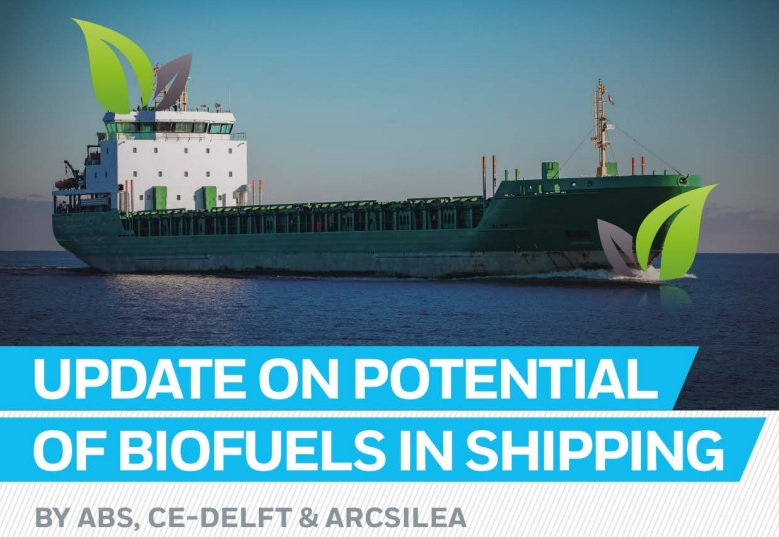
“We said there will be consequences if you do this and we laid out what those consequences were. Now, we were accused of being diplomatic gangsters and bullies and what have you. But look, it was they who are being the climate bullies and we’re not going to allow them to do that to our shipping fleet. If it had happened, here was the real secret. The EU was subsidizing all the biofuels that they wanted to push to our ships and the only place we could retrofit our ships were in Chinese ports and shipyards. So this would have been a win for the EU, a win for China, a loss for the United States. We said, ‘We’re not going to have it,’ and we got in there and won.”
So, are they trying again? Of course they’re going to try again. As we came at this, frankly, a little bit last-minute, we won, but we delayed the vote until next year. We’re going to make our position crystal clear, and I don’t think this thing is going to get through now. This is just the tip of the iceberg. It’s what’s happening in these over 80 organizations around the world. What it really amounts to is a climate ideology that is nonsensical. It’s an ideology that just doesn’t make sense. For example, in AI [artificial intelligence], a big piece of that is power. You can’t power AI through wind and solar — you just can’t — and we already know the President’s problems with wind. We already know that the vast majority of solar panels are made where? In China.
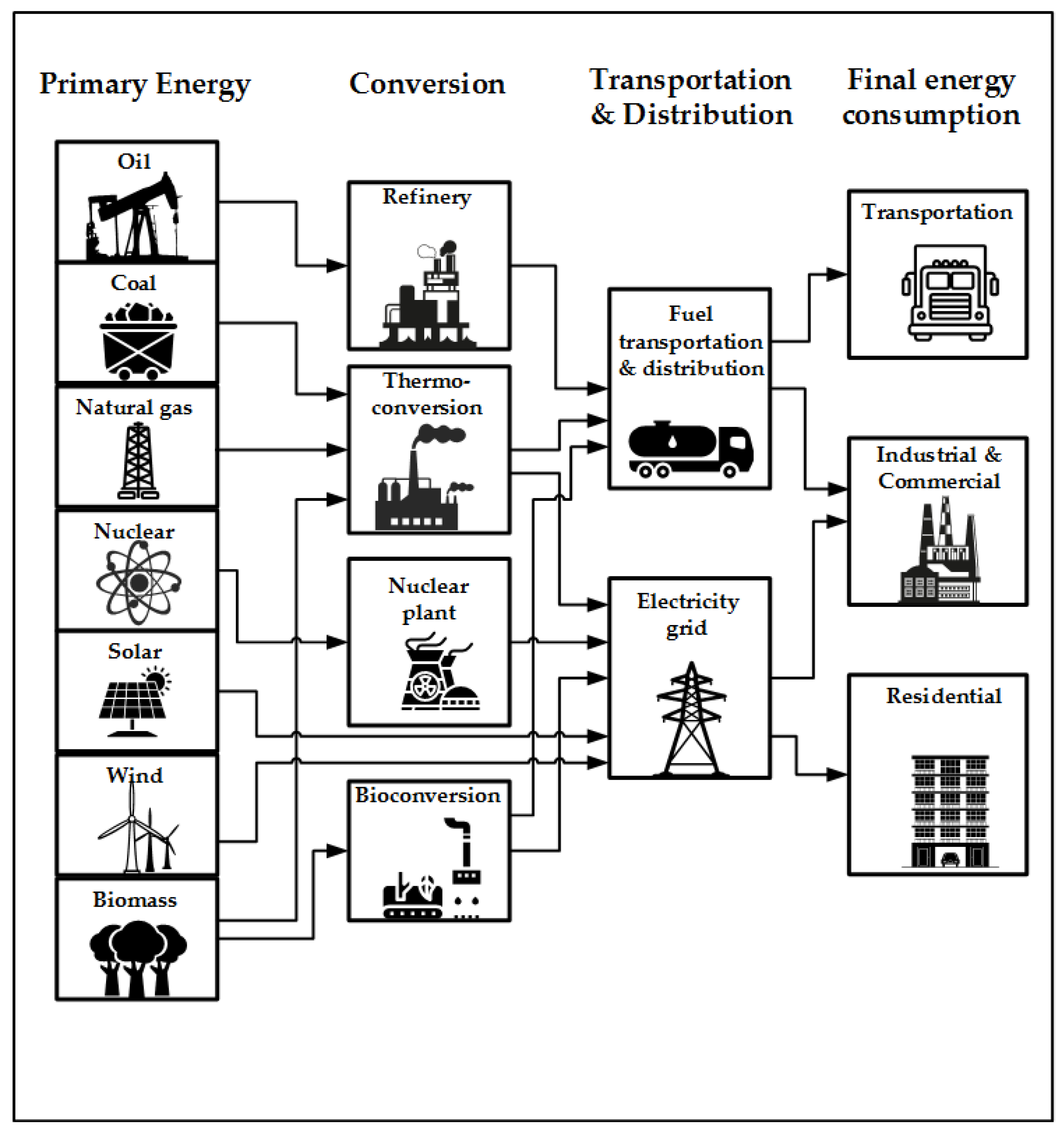
But we need an all-of-the-above solution. We need nuclear, we need gas, we need oil, we need coal, and those other renewable forms of energy in order to win. But what we find is even when we reach, say, some kind of trade deal with a country or with the EU, then they try to back door these regulations in favor of them and against us through these international organizations that are often under the U.N. umbrella. That’s why we need fighters in here. I have Tammy Bruce who will be going to the Senate to be the Deputy Ambassador here. We have myself, and we have other members of the team that 100 percent believe in the President’s America first agenda. We’re going to start fighting and blocking and tackling in these organizations.”
Addendum on Biofuels, the worst energy choice, disqualified for “All of the Above”
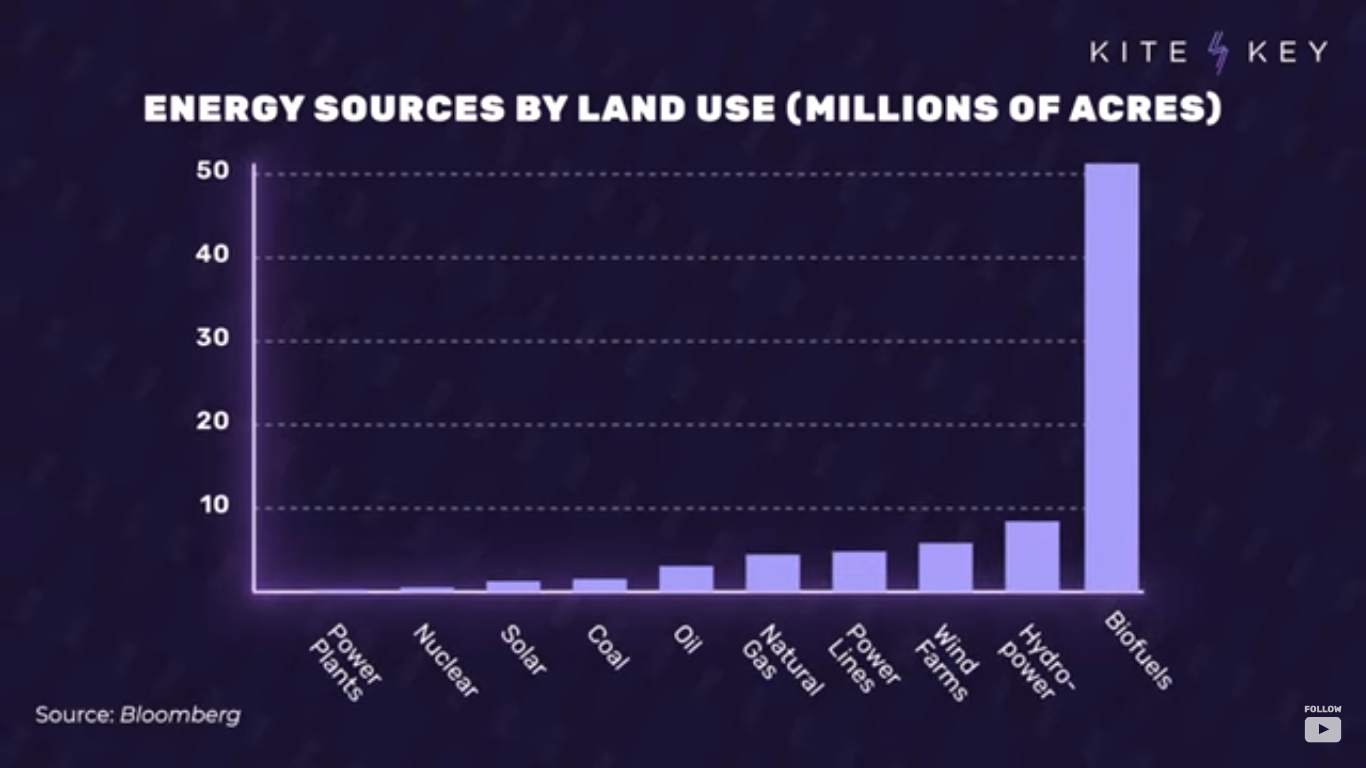
Put simply, power density is just how much stuff it takes to get your energy; how much land or other physical resources. And we measure it by how many watts you can get per square meter, or liter, or kilogram – which, if you’re like us…probably means nothing to you.
So let’s put this in tangible terms. Just about the worst energy source America has by the standards of power density are biofuels, things like corn-based ethanol. Biofuels only provide less than 3% of America’s energy needs–and yet, because of the amount of corn that has to be grown to produce it … they require more land than every other energy source in the country combined. Lots of resources going in, not much energy coming out–which means they’re never going to be able to be a serious fuel source. Moreover, it cannibalizes arable land needed for food.
Alex Epstein reports regarding Bill Gates latest statement downplaying climate doomsterism, and reminds us that he hasn’t changed his mind so much as he is now able to speak freely. For example, watch this short video of Bill Gates in 2019.
Joining us now to continue this conversation is the founder of Center for Industrial Progress, it’s Alex Epstein. Alex, great to see you here today.
I think that, first of all, we should celebrate that Bill Gates has seen the light, has now understood the truth, but that does lead to the question: Why?
Alex Epstein:
It’s a good question, and actually I don’t think Bill’s views have changed much.
I think he’s held the view that he’s saying now, and I think he’s even less of a climate catastrophist and anti-fossil fuel person than he’s letting on now. I think what’s changed—and this is good news—is the cultural, economic, and political environment.
And in particular what we see are, one, the rise of AI and people recognizing that you’re going to need more fossil fuels to provide the reliable electricity—key: reliable electricity—that AI requires.
Number two, you’ve got a government right now that is pro-fossil fuel and very anti-climate catastrophist.
And number three, to the extent I and some others can take credit, I think we’ve advanced the pro-fossil fuel argument that shows that, hey, we do have impact on climate, but the net effect of fossil fuel use is incredibly positive, including on the livability of climate, or safety from climate.
I think those three factors have created an environment where Bill Gates—who I admire in many ways, but is a very calculating guy—where he feels like it’s in his interest to tell more of the truth about this issue than he has in recent years.
Will Cain:
All right, let’s take your three potential explanations for the change of heart for Bill Gates.
Let’s set aside your personal advocacy and persuasion, which I find compelling. And it’s not just you alone, Alex. It’s really most of the thoughtful scientists and thinkers through the last several hundred years have understood the power of fossil fuels and economic growth in helping the vast majority of people across the world.
Maybe that finally broke through to Bill Gates. Maybe he just sees the writing on the wall and understands what’s happening in modern America under President Donald Trump.
But the first is quite interesting: AI and the rise of AI. Does Gates not have significant investment in AI?
Alex Epstein:
Well, he obviously has investments. I mean, every major tech company is taking into account AI, I think validly, whether their current investment level is right or not. It’s key to their future.
But it’s not even that it’s just of interest to his company, although that’s surely a factor. He thinks it’s a big interest to humanity.
But most importantly, all these things, it’s more okay to talk about it. We already knew that the world needed way more energy, but now it’s okay to talk about it.
That’s why all these tech companies who made net zero pledges are suddenly saying, “No, we don’t need net zero”. Nothing changed really in the information environment, but the cultural environment did change.
Will Cain:
Well, I guess I’m just a little skeptical on the sincerity today and yesterday, and when I notice he can mingle his own personal net worth and benefit with that of what is best for humanity.
And if he convinces himself that AI is what’s best for humanity, and AI needs energy to grow, and therefore AI needs fossil fuels, he can convince himself that using fossil fuels is what’s best for humanity. And I think that is a little more in line with what I would suspect to be the motivation of Bill Gates.
Alex Epstein:
It’s definitely true with the broader tech industry. Again, they made “net zero” commitments just a few years ago when Biden was president, when everyone was on to ESG, and then suddenly their views changed and they never really acknowledged it.
Now I’m grateful, guys. Welcome to the party. I’m glad Zuckerberg is here. I’m glad Bezos is here. I’m glad Gates is here. These are people I admire a lot in many ways. I’m glad they’re changing their views.
But maybe stick to the truth this time instead of being so opportunistic and not really explaining how one day you’re “net zero” and then when it conflicts with your business interests, then you’re suddenly, “hey, yeah, let’s use more fossil fuels, we need it for AI”.
I thought you were worried about a climate catastrophe. It turns out there was never a climate catastrophe.
Will Cain:
I’m glad they’re here too, Alex. I just wouldn’t issue them permanent membership yet in the Club of Truth. Alex Epstein, it’s great to have you here on the show today.
When the world gathers in Belém, Brazil, in November 2025 for COP30, it won’t be just another climate conference. It will be the first major summit after the Paris Agreement’s initial Global Stocktake at COP28, and the moment where climate ambition must decisively shift from words to delivery.
As many observers have begun to remark in the run-up to COP30, “Belém is where the climate community will be asked to prove that promises can become practice.”
What’s at stake at COP30
The Brazilian presidency has laid out a clear mandate: COP30 must focus on implementation, inclusion, and innovation. In practical terms, that means:
♦ A ‘Belém Package’ of outcomes across forests, finance, adaptation, just transition, and gender.
♦ The formal launch of the Tropical Forest Forever Facility (TFFF), a proposed $125 billion results-based finance mechanism to incentivise forest conservation.
♦ Progress on a roadmap to mobilize $1.3 trillion annually in climate finance by 2035, building on the ‘Baku to Belém’ finance commitments made at COP29.
♦ New modalities for inclusive governance, such as Brazil’s proposed ‘Global Mutirão’, bringing Indigenous peoples, local governments, and civil society closer to the heart of climate decision-making .
COP30 will not be judged by the number of new pledges it produces. As several analysts have argued, it will be remembered “for whether the world found the tools to finally deliver on them.”
The main challenges Brazil faces
While Brazil has bold ambitions for COP30, turning them into concrete outcomes will not be easy. The presidency faces several challenges:
Domestic contradictions: Despite progress under President Lula, agribusiness and mining interests remain powerful drivers of deforestation. Balancing economic pressures with climate leadership will test political resolve.
Financing the transition: Brazil is pushing for massive climate finance scaling, but securing commitments for the $1.3 trillion annual target will be politically contentious, especially given donor fatigue and fiscal constraints in developed economies.
Geopolitical polarisation: COP30 is the first climate summit taking place without strong U.S. engagement, given Washington’s announced withdrawal from the Paris Agreement in 2026 . This leaves Brazil trying to mediate between the EU, China, BRICS, and vulnerable countries, all with diverging agendas.
Institutional fragility: While Brazil champions new governance ideas like a UN Climate Change Council, consensus on reforming multilateral processes is difficult. Many countries remain wary of ceding more authority to new structures.
Logistics and credibility: Hosting COP30 in Belém is symbolically powerful but practically challenging. The Amazonian city faces infrastructure constraints, raising concerns about logistics, inclusivity, and whether Brazil can deliver an event of this scale smoothly.
“Brazil has set the bar high. But if expectations outpace deliverables, COP30 risks being remembered as another missed opportunity.”
My Comments
Since there is a big push on climate funding, maybe they could get to the bottom of this.
Maybe donors are put off by no one knowing who gets the money and for what it is spent. And while they are investigating, how about understanding Energy Return on Investment (EROI): you know, the notion that an energy project is worth doing if the energy produced is greater than energy spent. The poster at the top reminds of people dreaming of a world free of fossil fuels.
Why a COP Briefing?
Actually, climate hysteria is like a seasonal sickness. Each year a contagion of anxiety and fear is created by disinformation going viral in both legacy and social media in the run up to the annual autumnal COP. Since the climatists are especially desperate with the US outspokenly against the climate movement, we can expect the public will be hugely hosed with alarms over the next few weeks. Before the distress signals go full tilt, individuals need to inoculate themselves against the false claims, in order to build some herd immunity against the nonsense the media will promulgate. This post is offered as a means to that end.
Media Climate Hype is a Cover Up
Back in 2015 in the run up to Paris COP, French mathematicians published a thorough critique of the raison d’etre of the whole crusade. They said:
Fighting Global Warming is Absurd, Costly and Pointless.
Absurd because of no reliable evidence that anything unusual is happening in our climate.
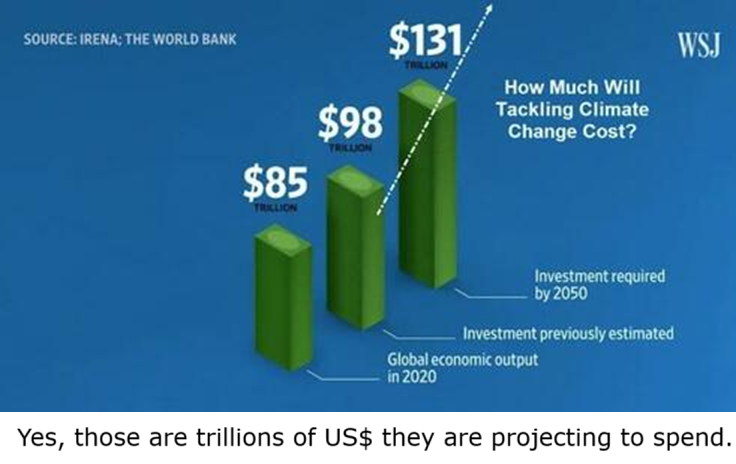
Costly because trillions of dollars are wasted on immature, inefficient technologies that serve only to make cheap, reliable energy expensive and intermittent.
Pointless because we do not control the weather anyway.
The prestigious Société de Calcul Mathématique (Society for Mathematical Calculation) issued a detailed 195-page White Paper presenting a blistering point-by-point critique of the key dogmas of global warming. The synopsis with links to the entire document is at COP Briefing for Realists
Even without attending to their documentation, you can tell they are right because all the media climate hype is concentrated against those three points.
Finding: Nothing unusual is happening with our weather and climate.
Hype: Every metric or weather event is “unprecedented,” or “worse than we thought.”
Finding: Proposed solutions will cost many trillions of dollars for little effect or benefit.
Hype: Zero carbon will lead the world to do the right thing. Anyway, the planet must be saved at any cost.
Finding: Nature operates without caring what humans do or think.
Hype: Any destructive natural event is blamed on humans burning fossil fuels.
How the Media Throws Up Flak to Defend False Suppositions
The Absurd Media: Climate is Dangerous Today, Yesterday It was Ideal.
Billions of dollars have been spent researching any and all negative effects from a warming world: Everything from Acne to Zika virus. A recent Climate Report repeats the usual litany of calamities to be feared and avoided by submitting to IPCC demands. The evidence does not support these claims. An example:
It is scientifically established that human activities produce GHG emissions, which accumulate in the atmosphere and the oceans, resulting in warming of Earth’s surface and the oceans, acidification of the oceans, increased variability of climate, with a higher incidence of extreme weather events, and other changes in the climate.
Moreover, leading experts believe that there is already more than enough excess heat in the climate system to do severe damage and that 2C of warming would have very significant adverse effects, including resulting in multi-meter sea level rise.
Experts have observed an increased incidence of climate-related extreme weather events, including increased frequency and intensity of extreme heat and heavy precipitation events and more severe droughts and associated heatwaves. Experts have also observed an increased incidence of large forest fires; and reduced snowpack affecting water resources in the western U.S. The most recent National Climate Assessment projects these climate impacts will continue to worsen in the future as global temperatures increase.
Alarming Weather and Wildfires
But: Weather is not more extreme.
And Wildfires were worse in the past. But: Sea Level Rise is not accelerating.
Litany of Changes
Seven of the ten hottest years on record have occurred within the last decade; wildfires are at an all-time high, while Arctic Sea ice is rapidly diminishing.
We are seeing one-in-a-thousand-year floods with astonishing frequency.
When it rains really hard, it’s harder than ever.
We’re seeing glaciers melting, sea level rising.
The length and the intensity of heatwaves has gone up dramatically.
Plants and trees are flowering earlier in the year. Birds are moving polewards.
We’re seeing more intense storms.
But: Arctic Ice has not declined since 2007.
But: All of these are within the range of past variability.In fact our climate is remarkably stable, compared to the range of daily temperatures during a year where I live.
And many aspects follow quasi-60 year cycles.
The Impractical Media: Money is No Object in Saving the Planet.
Here it is blithely assumed that the UN can rule the seas to stop rising, heat waves to cease, and Arctic ice to grow (though why we would want that is debatable). All this will be achieved by leaving fossil fuels in the ground and powering civilization with windmills and solar panels. While admitting that our way of life depends on fossil fuels, they ignore the inadequacy of renewable energy sources at their present immaturity.
An Example: The choice between incurring manageable costs now and the incalculable, perhaps even irreparable, burden Youth Plaintiffs and Affected Children will face if Defendants fail to rapidly transition to a non-fossil fuel economy is clear. While the full costs of the climate damages that would result from maintaining a fossil fuel-based economy may be incalculable, there is already ample evidence concerning the lower bound of such costs, and with these minimum estimates, it is already clear that the cost of transitioning to a low/no carbon economy are far less than the benefits of such a transition. No rational calculus could come to an alternative conclusion. Defendants must act with all deliberate speed and immediately cease the subsidization of fossil fuels and any new fossil fuel projects, and implement policies to rapidly transition the U.S. economy away from fossil fuels.
But CO2 relation to Temperature is Inconsistent.
But: The planet is greener because of rising CO2.
But: Modern nations (G20) depend on fossil fuels for nearly 90% of their energy.
But: Renewables are not ready for prime time.
People need to know that adding renewables to an electrical grid presents both technical and economic challenges. Experience shows that adding intermittent power more than 10% of the baseload makes precarious the reliability of the supply. South Australia is demonstrating this with a series of blackouts when the grid cannot be balanced. Germany got to a higher % by dumping its excess renewable generation onto neighboring countries until the EU finally woke up and stopped them. Texas got up to 29% by dumping onto neighboring states, and some like Georgia are having problems.
But more dangerous is the way renewables destroy the economics of electrical power. Seasoned energy analyst Gail Tverberg writes:
In fact, I have come to the rather astounding conclusion that even if wind turbines and solar PV could be built at zero cost, it would not make sense to continue to add them to the electric grid in the absence of very much better and cheaper electricity storage than we have today. There are too many costs outside building the devices themselves. It is these secondary costs that are problematic. Also, the presence of intermittent electricity disrupts competitive prices, leading to electricity prices that are far too low for other electricity providers, including those providing electricity using nuclear or natural gas. The tiny contribution of wind and solar to grid electricity cannot make up for the loss of more traditional electricity sources due to low prices.
The Irrational Media: Whatever Happens in Nature is Our Fault.
An Example:
Other potential examples include agricultural losses. Whether or not insurance reimburses farmers for their crops, there can be food shortages that lead to higher food prices (that will be borne by consumers, that is, Youth Plaintiffs and Affected Children). There is a further risk that as our climate and land use pattern changes, disease vectors may also move (e.g., diseases formerly only in tropical climates move northward).36 This could lead to material increases in public health costs
But: Actual climate zones are local and regional in scope, and they show little boundary change.
But: Ice cores show that it was warmer in the past, not due to humans.
The hype is produced by computer programs designed to frighten and distract children and the uninformed. For example, there was mention above of “multi-meter” sea level rise. It is all done with computer models. For example, below is San Francisco. More at USCS Warnings of Coastal Floodings
In addition, there is no mention that GCMs projections are running about twice as hot as observations.
Omitted is the fact GCMs correctly replicate tropospheric temperature observations only when CO2 warming is turned off.
Figure 5. Simplification of IPCC AR5 shown above in Fig. 4. The colored lines represent the range of results for the models and observations. The trends here represent trends at different levels of the tropical atmosphere from the surface up to 50,000 ft. The gray lines are the bounds for the range of observations, the blue for the range of IPCC model results without extra GHGs and the red for IPCC model results with extra GHGs.The key point displayed is the lack of overlap between the GHG model results (red) and the observations (gray). The nonGHG model runs (blue) overlap the observations almost completely.
In the effort to proclaim scientific certainty, neither the media nor IPCC discuss the lack of warming since the 1998 El Nino, despite two additional El Ninos in 2010 and 2016, plus an unexplained spike in 2023-24, now cooling off.
Further they exclude comparisons between fossil fuel consumption and temperature changes. The legal methodology for discerning causation regarding work environments or medicine side effects insists that the correlation be strong and consistent over time, and there be no confounding additional factors. As long as there is another equally or more likely explanation for a set of facts, the claimed causation is unproven. Such is the null hypothesis in legal terms: Things happen for many reasons unless you can prove one reason is dominant.
Finally, advocates and IPCC are picking on the wrong molecule. The climate is controlled not by CO2 but by H20. Oceans make climate through the massive movement of energy involved in water’s phase changes from solid to liquid to gas and back again. From those heat transfers come all that we call weather and climate: Clouds, Snow, Rain, Winds, and Storms.
Esteemed climate scientist Richard Lindzen ended a very fine recent presentation with this description of the climate system:
I haven’t spent much time on the details of the science, but there is one thing that should spark skepticism in any intelligent reader. The system we are looking at consists in two turbulent fluids interacting with each other. They are on a rotating planet that is differentially heated by the sun. A vital constituent of the atmospheric component is water in the liquid, solid and vapor phases, and the changes in phase have vast energetic ramifications. The energy budget of this system involves the absorption and reemission of about 200 watts per square meter. Doubling CO2 involves a 2% perturbation to this budget. So do minor changes in clouds and other features, and such changes are common. In this complex multifactor system, what is the likelihood of the climate (which, itself, consists in many variables and not just globally averaged temperature anomaly) is controlled by this 2% perturbation in a single variable? Believing this is pretty close to believing in magic. Instead, you are told that it is believing in ‘science.’ Such a claim should be a tip-off that something is amiss. After all, science is a mode of inquiry rather than a belief structure.
Summary: From this we learn three things:
Climate warms and cools without any help from humans.
Warming is good and cooling is bad.
The hypothetical warming from CO2 would be a good thing.

































 But: Sea Level Rise is not accelerating.






 Science Matters