IPCC Global Warming Claims Not Only Wrong, But Impossible
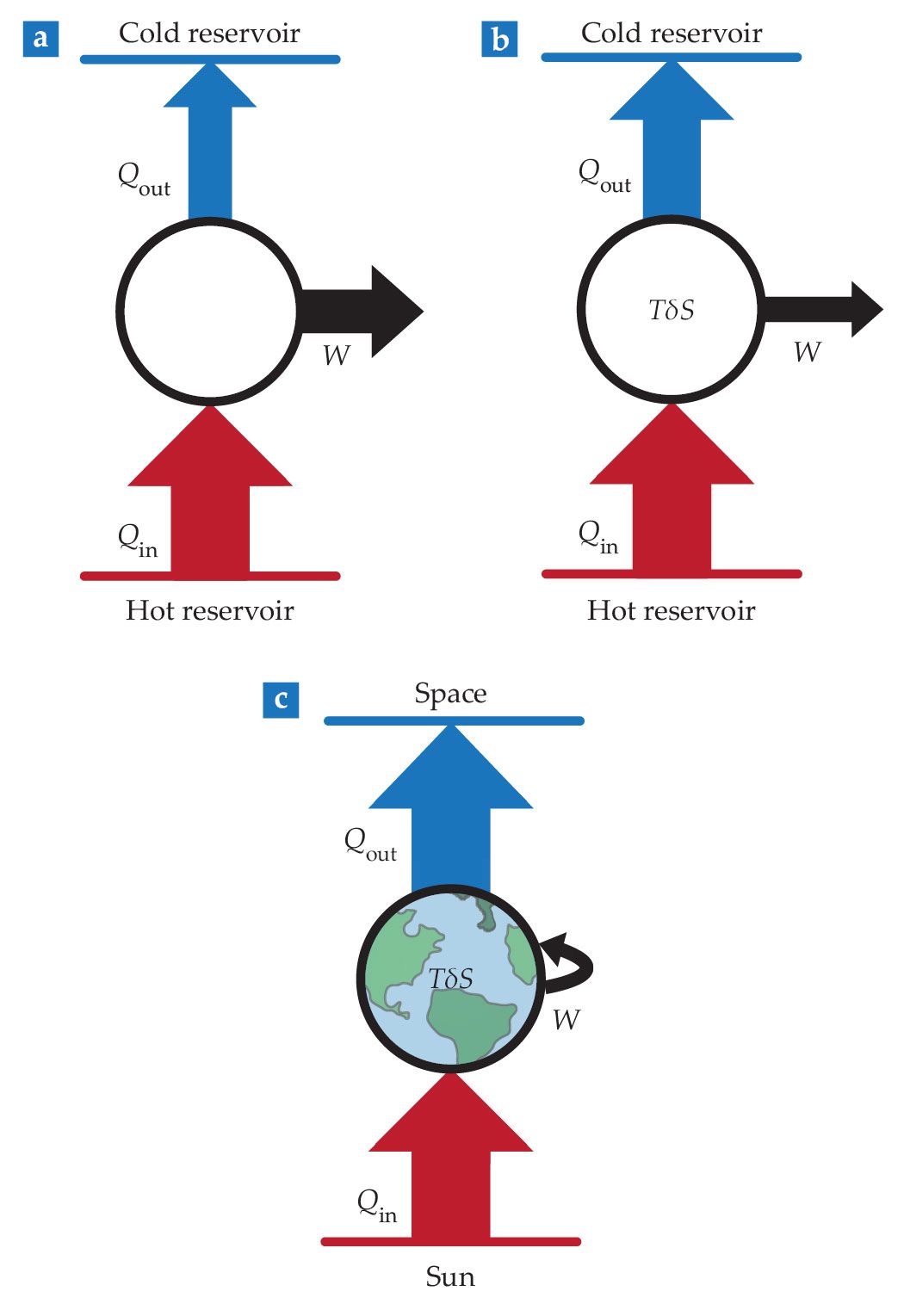
Climate as heat engine. A heat engine produces mechanical energy in the form of work W by absorbing an amount of heat Qin from a hot reservoir (the source) and depositing a smaller amount Qout into a cold reservoir (the sink). (a) An ideal Carnot heat engine does the job with the maximum possible efficiency. (b) Real heat engines are irreversible, and some work is lost via irreversible entropy production TδS. (c) For the climate system, the ultimate source is the Sun, with outer space acting as the sink. The work is performed internally and produces winds and ocean currents. As a result, Qin = Qout.

Ad Huijser recently published a paper explaining why IPCC claims about global warming are contradicted by observations of our Earth thermal system including a number of internal and external subsytems. The title Global Warming and the “impossible” Radiation Imbalance links to the pdf. This post is a synopsis to present the elements of his research findings, based on the rich detail, math and references found in the document. Excerpts in italics with my bolds and added images. H/T Kenneth Richard and No Tricks Zone.

Abstract

Any perturbation in the radiative balance at the top of the atmosphere (TOA) that induces a net energy flux into- or out of Earth’s thermal system will result in a surface temperature response until a new equilibrium is reached. According to the Anthropogenic Global Warming (AGW) hypothesis which attributes global warming solely to rising concentrations of Greenhouse gases (GHGs), the observed increase in Earth’s radiative imbalance is entirely driven by anthropogenic GHG-emissions.

However, a comparison of the observed TOA radiation imbalance with the assumed GHG forcing trend reveals that the latter is insufficient to account for the former. This discrepancy persists even when using the relatively high radiative forcing values for CO2 adopted by the Intergovernmental Panel on Climate Change (IPCC), thereby challenging the validity of attributing recent global warming exclusively to human-caused GHG emissions.
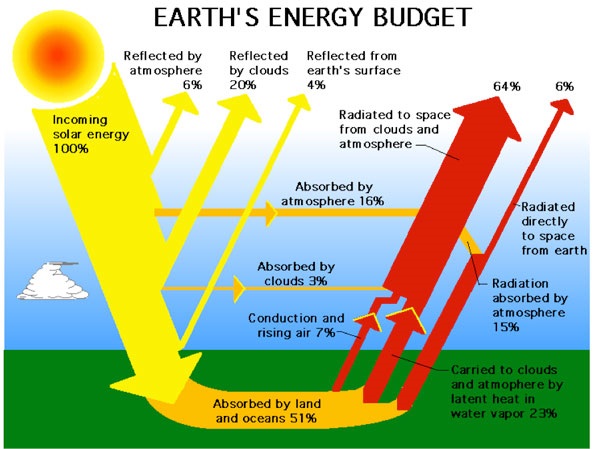
In this paper, Earth’s climate system is analyzed as a subsystem of the broader Earth Thermal System, allowing for the application of a “virtual balance” approach to distinguish between anthropogenic and other, natural contributions to global warming. Satellite-based TOA radiation data from the CERES program (since 2000), in conjunction with Ocean Heat Content (OHC) data from the ARGO float program (since 2004), indicate that natural forcings must also play a significant role. Specifically, the observed warming aligns with the net increase in incoming shortwave solar radiation (SWIN), likely due to changes in cloud cover and surface albedo. Arguments suggesting that the SWIN trend is merely a feedback response to GHG-induced warming are shown to be quantitatively insufficient.

This analysis concludes that approximately two-thirds of the observed global warming must be attributed to natural factors that increase incoming solar radiation, with only one-third attributable to rising GHG-concentrations. Taken together, these findings imply a much lower climate sensitivity than suggested by IPCC-endorsed Global Circulation Models (GCMs).

Introduction

On a global scale and over longer periods of time, the average surface temperature of our climate system reacts similarly to that of a thermal system such as a pot of water on a stove: when the incoming heat is steady and below boiling, the system stabilizes when the heat loss (via radiation and convection) equals the input. Analogously, Earth’s surface-atmosphere interface is the main absorber and emitter of heat. Reducing the “flame” (solar input) leads to cooling, regardless of the total heat already stored in the system. The system’s average temperature will drop as well, as soon as the heating stops. So, no sign of any “warming in the pipeline” for such a simple system.

The two transport mechanisms, air and ocean, operate on different timescales. Air has a low specific heat capacity, but high wind speeds make it a fast medium for heat transfer. Oceans, by contrast, have a high specific heat capacity but move more slowly. The Atlantic Meridional Overturning Circulation (AMOC) with the well-known Gulf Stream carrying warm water from south to north, can reach speeds up to about 3 m/s. But its warm current remains largely confined to surface layers due to limited solar radiation penetration and gravity-induced stratification. With a path-lengths of up to 8,000 km and an average speed of 1.5 m/s, ocean heat takes approximately 2 months to travel from the Gulf of Mexico to the Arctic. This is comparable to the 1 to 2 months delay between solar input and temperature response in the annual cycle, suggesting that oceanic heat transport is part of the climate system’s normal operation. Climate adaptation times from anthropogenic influences are estimated at 3 to 5 years. If “warming in the pipeline” exists, it must be buried in the much colder, deeper ocean layers.

ARGO float data since 2004 show substantial annual increases in Ocean Heat Content (OHC), sometimes expressed in mind-boggling terms such as 10²² joules per year (see Fig.1). While this may sound alarming [1,2], when converted to flux, it represents less than 1 W/m², a mere 0.6% of the average 160 W/m² of absorbed solar energy at the surface. All the rest is via evaporation, convection and ultimately by radiation sent back to space after globally being redistributed by wind and currents.
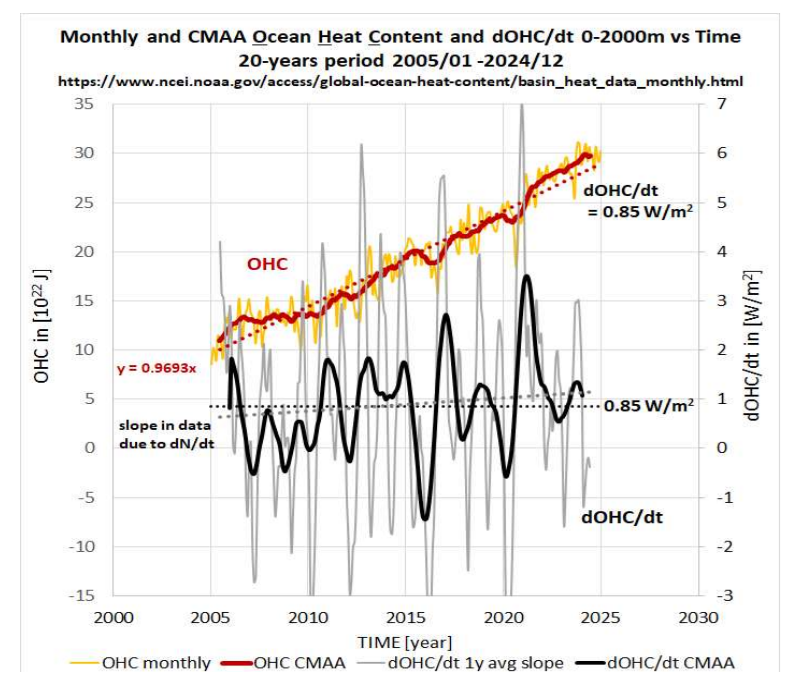
Fig. 1. Ocean Heat Content (OHC) anomaly from 0–2000 meters over time, shown as 3-month and annual moving averages (CMAA), along with their time derivatives. Notable are the relatively large variations, likely reflecting the influence of El Niño events. The average radiative imbalance at the top of the atmosphere (TOA), estimated at 0.85 W/m², corresponds approximately to the midpoint of the time series (around 2015). Data: https://www.ncei.noaa.gov/access/global-ocean-heat-content/basin_heat_data.html [7].

This raises the question: Why would extra GHGs that have only a limited effect on the 99.4% of the outgoing flux, have affected this 0.6% residue during a couple of decennia in such a way that we should be scared about all that “warming in the pipeline” as Hansen et al. [2] are warning us for? In the following sections, we examine data showing that observed trends in the radiation imbalance and OHC are better explained by the internal dynamics of the Earth’s thermal system and natural forcings such as from increasing solar radiation, rather than solely by GHG emissions.

Estimating our climate’s thermal capacity CCL

The rather fast responses of our climate indicates that the thermal capacity of our climate must be much less than the capacity of the entire Earth thermal system. This climate heat capacity CCL depends on how sunlight is being absorbed, how that heat is transferred to the atmosphere and which part of it is being stored in either land or ocean.

At continental land-area, sunlight is absorbed only at the very surface where the generated heat is also in direct contact with the atmosphere. Seasonal temperature variations don’t penetrate more than 1 to 2 meters deep in average and as a consequence, storage of heat is relatively small. Sunlight can penetrate pure water to several hundred meters deep, but in practice, penetration in the oceans is limited by scattering and absorption of organic and inorganic material. A good indication is the depth of the euphotic zone where algae and phytoplankton live, which need light to grow. In clear tropical waters where most of the sunlight hits our planet, this zone is 80 to 100 m deep [12].

Another important factor in our climate’s heat capacity is how this ocean layer of absorbed heat is in contact with the atmosphere. Tides, wind, waves and convection continuously mix the top layer of our oceans, by which heat is easily exchanged with the atmosphere. This mixed-layer is typically in the order of 25 – 100 m, dependent on season, latitude and on the definition of “well mixed” [13]. Below this ~100 m thick top-layer, where hardly any light is being absorbed and the mixing process has stopped, ocean temperatures drop quickly with depth. As the oceans’ vertical temperature gradient at that depth doesn’t support conductive nor convective heat flows going upward, climate processes at the surface will thus become isolated from the rest of the Earth’ thermal system.
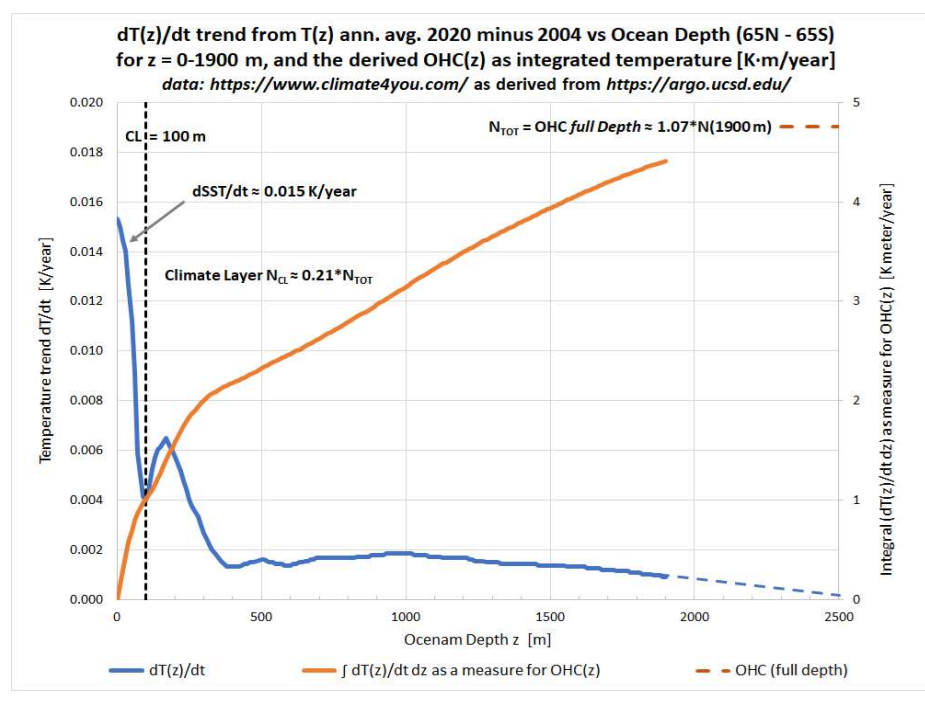
Figure 4 with the Change in Ocean Heat Content vs. Depth over the period 2004 – 2020 obtained via the ARGO-floats [6,14], offers a good indication for the average climate capacity CCL. It shows the top layer with a high surface temperature change according to the observed global warming rate of about 0.015 K/year, and a steep cut off at about 100 m depth in line with the explanation above. Below the top layer, temperature effects are small and difficult to interpret, probably due to averaging over all kinds of temperature/depth profiles in the various oceans ranging from Tropical- to Polar regions.

In case of a “perfect” equilibrium (N = 0, dTS/dt = 0), all of the absorbed sunlight up to about 100 m deep, has to leave on the ocean-atmosphere interface again. However, deep oceans are still very cold with a stable, negative temperature gradient towards the bottom. This gradient will anyhow push some of the absorbed heat downwards. Therefore, even at a climate equilibrium with dTS/dt= 0, we will observe N > 0. With the large heat capacity of the total ocean volume, that situation will not change easily, as it takes about 500 years with today’s N ≈ +1 W/m2 to raise its average temperature just 1°C.

The Earth’s climate system can thus be regarded as a subset of the total Earth’s thermal system (ETS) responding to different relaxation times. The climate relaxes to a new equilibrium within 3–5 years, while the deeper oceans operate on multidecadal or even longer timescales, related to their respective thermal capacities C for the ETS, and CCL for the climate system.

The (near) “steady state” character of current climate change

Despite the ongoing changes in climate, the current state can be considered a “near” steady-state. The GHG forcing trend has been pretty constant for decades. Other forcings, primarily in the SW channel, are also likely to change slowly and can be approximated as having constant trends over decadal timescales. Similarly, despite yearly fluctuations, the surface temperature trend has remained fairly stable since 2000.

This analysis strengthens the conclusion that the increase in both N(t) and N0(t) are not a direct consequence of greenhouse gas emissions, but rather of enhanced forcing in the SW-channel.

The preceding analysis highlights how the IPCC’s assumptions diverge significantly from observed reality. While the IPCC model components may collectively reproduce the observed warming trend, they fail to individually align with key observational data, in particular the Ocean Heat Content.
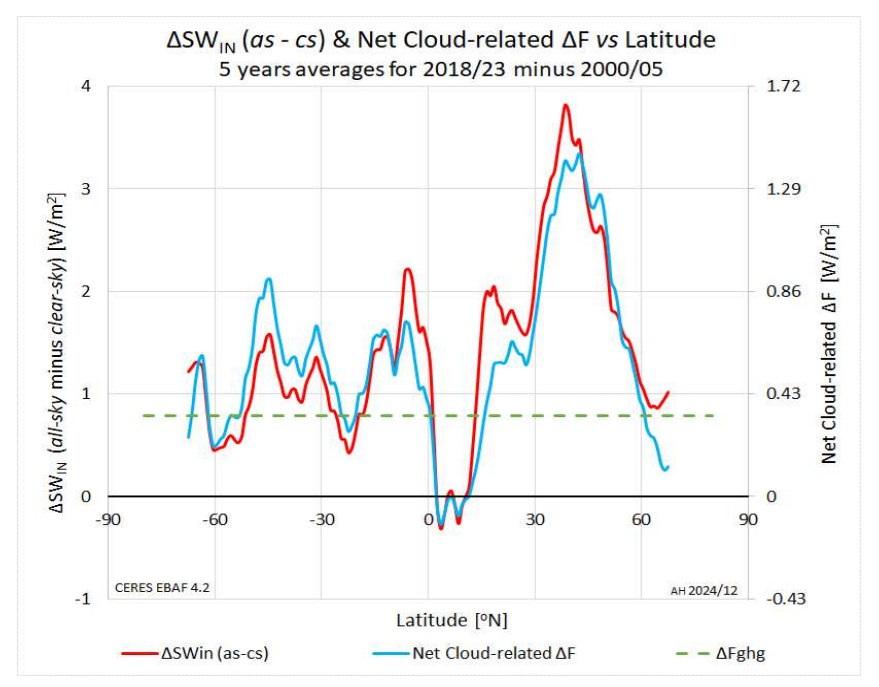
Figure 6 also illustrates that changes in cloudiness are more pronounced on the Northern Hemisphere, especially at mid-latitudes and over Western Europe. For example, the Dutch KNMI weather-station at Cabauw (51.87°N, 4.93oE), where all ground-level radiation components are monitored every 10 minutes, recorded an increase in solar radiation of almost +0.5 W/m²/year since 2000 [26]. Applying the 0.43 net-CRE factor (conservative for this latitude), we estimate a local forcing trend dFSW/dt ≈ 0.2 W/m²/year. This is an order of magnitude larger than the GHG forcing (0.019–0.037 W/m²/year). Even with the IPCC values, GHGs can just account for about 16% of the warming at this station. The average temperature trend for this rural station located in a polder largely covered by grassland, is with ~ +0.043 K/year almost 3x the global average. This, nor the other trends mentioned above can be adequately explained by the IPCC’s GHG-only model.

The IPCC places strong emphasis on the role of climate feedbacks in amplifying the warming effect of greenhouse gases (GHGs) [8]. These feedbacks are considered secondary consequences of Anthropogenic Global Warming, driven by the initial temperature increase from GHGs. Among them, Water-Vapor feedback is the most significant. A warmer atmosphere holds more water vapor (approximately +7%/K) and since water vapor is a potent GHG, even a small warming from CO2 can amplify itself through enhanced evaporation.

Other feedbacks recognized by the IPCC include Lapse Rate, Surface Albedo, and Cloud feedbacks [8], all of which are inherently tied to the presence and behavior of water in its various phases. Therefore, these feedbacks are natural responses to temperature changes, regardless of the original cause of warming, be it GHGs, incoming solar variability, or internal effects. They are not additive components to natural climate sensitivity, as treated by the IPCC, but rather integral parts of it [4].

This analysis reinforces a fundamental point: climate feedbacks are not external modifiers of climate sensitivity; rather, they are inherent to the system. Their combined effect is already embedded in the climate response function. The IPCC’s treatment of feedbacks as additive components used to “explain” high sensitivities in GCMs is conceptually flawed. Physically, Earth’s climate is governed by the mass balance of water in all its phases: ice, snow, liquid, vapor, and clouds. The dynamics between these phases are temperature-sensitive, and they constitute the feedback processes. Feedbacks aren’t just add-ons to the climate system, they are our climate.

Ocean Heat Content increase

In the introduction, the “heat in the pipeline” concept: the idea that heat stored in the deep, cold ocean layers could later resurface to significantly influence surface temperatures, was challenged. Without a substantial decrease in surface temperatures to reverse ocean stratification, this seems highly unlikely. Large and rapid temperature fluctuations during the pre-industrial era with rates up to plus, but also minus 0.05 K/year over several decennia as recorded in the Central England Temperature (CET) series [27], more than three times the rate observed today, further undermine the notion of a slow-release heat mechanism dominating surface temperature trends.
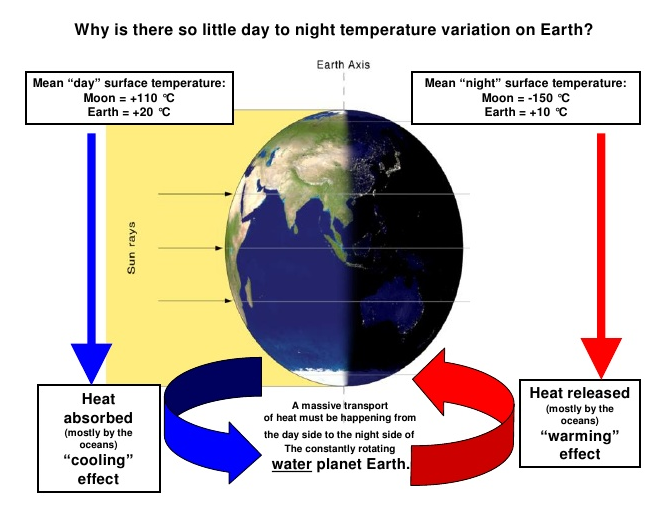
Ocean Heat Content must be related to solar energy. It is the prime source of energy heating the Earth thermal system. Almost 1 W/m2 of that 240 W/m2 solar flux that is in average entering the system, is presently remaining in the oceans. This is an order of magnitude larger than the estimated 0.1 W/m2 of geothermal heat upwelling from the Earth inner core [11]. Extra greenhouse gasses don’t add energy to the system, but just obstruct cooling. As shown in Section 5.3, this accounts for a radiation imbalance offset τ dFGHG/dt, or equivalent to a contribution to dOHC/dt of only about 0.08 W/m2.
.
As redistribution of “heat in the pipeline” will not change the total OHC, roughly 3/4 of the observed positive trend in OHC must at least be attributed to rising solar input. The oceans act in this way as our climate system’s thermal buffer. It will mitigate warming during periods of increased solar input and dampen cooling when solar input declines, underscoring its critical role in Earth’s climate stability.
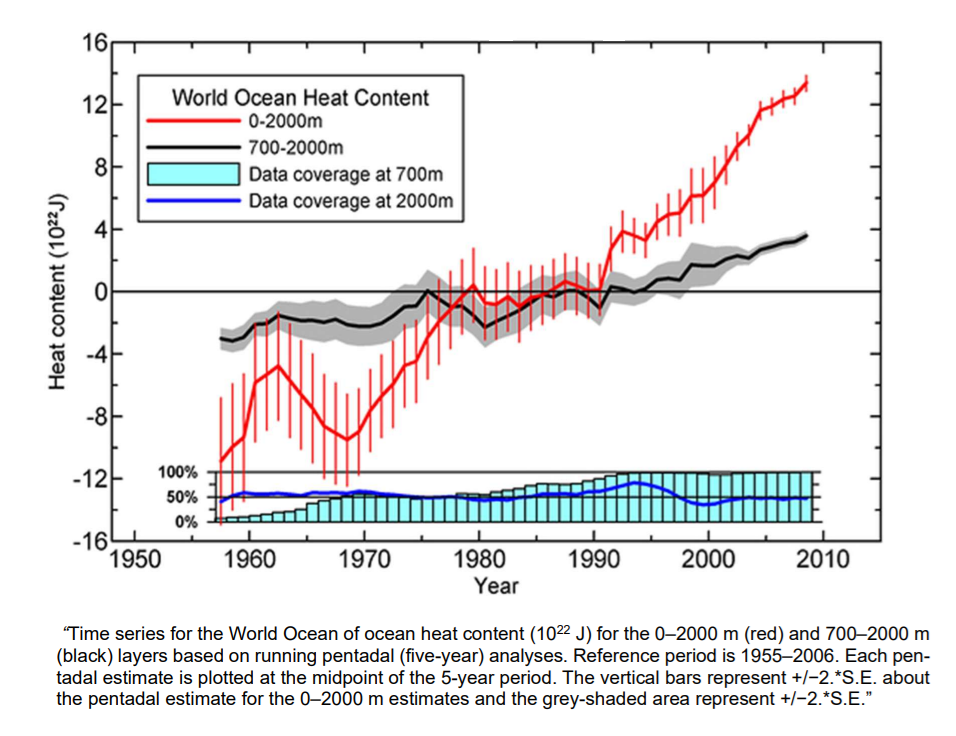
The strong downwards slope in the OHC before 1970 confirms the observation in Section 5.4 and expressed by (12) that around the turning point t = ζ, the forcing trend in the SW-channel had to be negative. Moreover, the rather slowly increasing 700-2000m OHC data in Fig.7 indicate that most of the fluctuations have occurred relatively close to the surface. Heat from e.g. seafloor volcanism as “warming from below”, is expected to show up more pronounced in this 700-2000m OHC-profile. Although we cannot rule out geothermal influences [29], this observation makes them less likely.

ERBE measurements of radiative imbalance.

As the OHC seems to be primarily coupled to SWIN, the most plausible cause would involve rapid changes in SW-forcing. A sudden drop in cloud-cover might explain such changes, but no convincing observations could be found for the 1960-1980 period. Alternatively, changes in the latitudinal distribution of cloud-cover as illustrated by Fig.6, can result in similar radiative impacts due to the stark contrast between a positive radiation imbalance in the Tropics and a very negative imbalance at the Poles. The ENSO-oscillations in the Pacific Ocean around the equator are a typical example for such influences, as also illustrated in Fig.3 [10]. Shifts in cloud distribution are linked to changes in wind patterns and/or ocean currents, reinforcing the idea as indicated in Section 1, that even minor disruptions in horizontal heat transport can trigger major shifts in our climate’s equilibrium [29, 30]. Sharp shifts in Earth’s radiation imbalance like the one around 1970 as inferred from Fig.7, may even represent one of those alleged tipping points. But in this case, certainly not one triggered by GHGs. Ironically, some climate scientists in the early 1970s predicted an impending (Little) Ice Age [31].

While additional data (e.g. radiation measurements) are needed to draw firm conclusions, the available evidence already challenges the prevailing GHG-centric narrative again. GHG emissions, with their near constant forcing rate, cannot account for the timing nor the magnitude of historical OHC trends, as NOAA explicitly suggests [32]. Similarly, claims by KNMI that “accelerations” in radiation imbalance trends are GHG-driven [1], are not supported by data. And finally, the alarms around “heat in the pipeline” must be exaggerated if not totally misplaced. Given the similarities in radiation imbalance and GHG forcing rates around 1970 with today’s situation, we must conclude that this assumed heat manifested itself at that time apparently as “cooling in the pipeline”.

However, warnings for continued warming even if we immediately stop now with emitting GHGs are nevertheless, absolutely justified. Only, it isn’t warming then from that heat in the pipeline due to historical emissions that will boost our temperatures. Warming will continue to go on as long as natural forcings will be acting. These are already today’s dominant drivers behind global temperature trends. And unfortunately, they will not be affected by the illusion of stopping global warming as created by implementing Net-Zero policies.

Summary and conclusions

This analysis demonstrates that a global warming scenario driven solely by greenhouse gases (GHGs) is inconsistent with more than 20 years of observations from space and of Ocean Heat Content. The standard anthropogenic global warming (AGW) hypothesis, which attributes all observed warming to rising GHG concentrations, particularly CO2, cannot explain the observed trends. Instead, natural factors, especially long-term increase in incoming solar radiation, appear to play a significant and likely dominant role in global warming since the mid-1970s.

The observed increase in incoming solar radiation cannot be accounted for by the possible anthropogenic side effects of Albedo- and Cloud-feedback. All evidence points to the conclusion that this “natural” forcing with a trend of about 0.035 W/m2/year is equal to, or even exceeds the greenhouse gas related forcing of about 0.019 W/m2/year. Based on these values, only 1/3rd of the observed temperature trend can be of anthropogenic origin. The remaining 2/3rd must stem from natural changes in our climate system, or more broadly, in our entire Earth’ thermal system.

Moreover, the observed increase in Earth’s radiation imbalance appears to be largely unrelated to GHGs. Instead, it correlates strongly with natural processes driving increased incoming solar radiation. Claims of “acceleration” in the radiation imbalance due to GHG emissions are not supported by the trend in accurately measured GHG concentrations. If any acceleration in global warming is occurring, it is almost certainly driven by the increasing flux of solar energy—an inherently natural phenomenon not induced by greenhouse gases.

In summary, this analysis challenges the notion that GHGs are the primary drivers of recent climate change. It underscores the importance of accounting for natural variability, especially in solar input, when interpreting warming trends and evaluating climate models.

Note: Dr. Ad Huijser, physicist and former CTO of Philips and director of the Philips Laboratories, describes himself as “amateur climatologist”. However his approach to climate physics is quite professional, I think.
See Also: 

Our Atmospheric Heat Engine


No Right to Stable Climate in Our Holocene Epoch

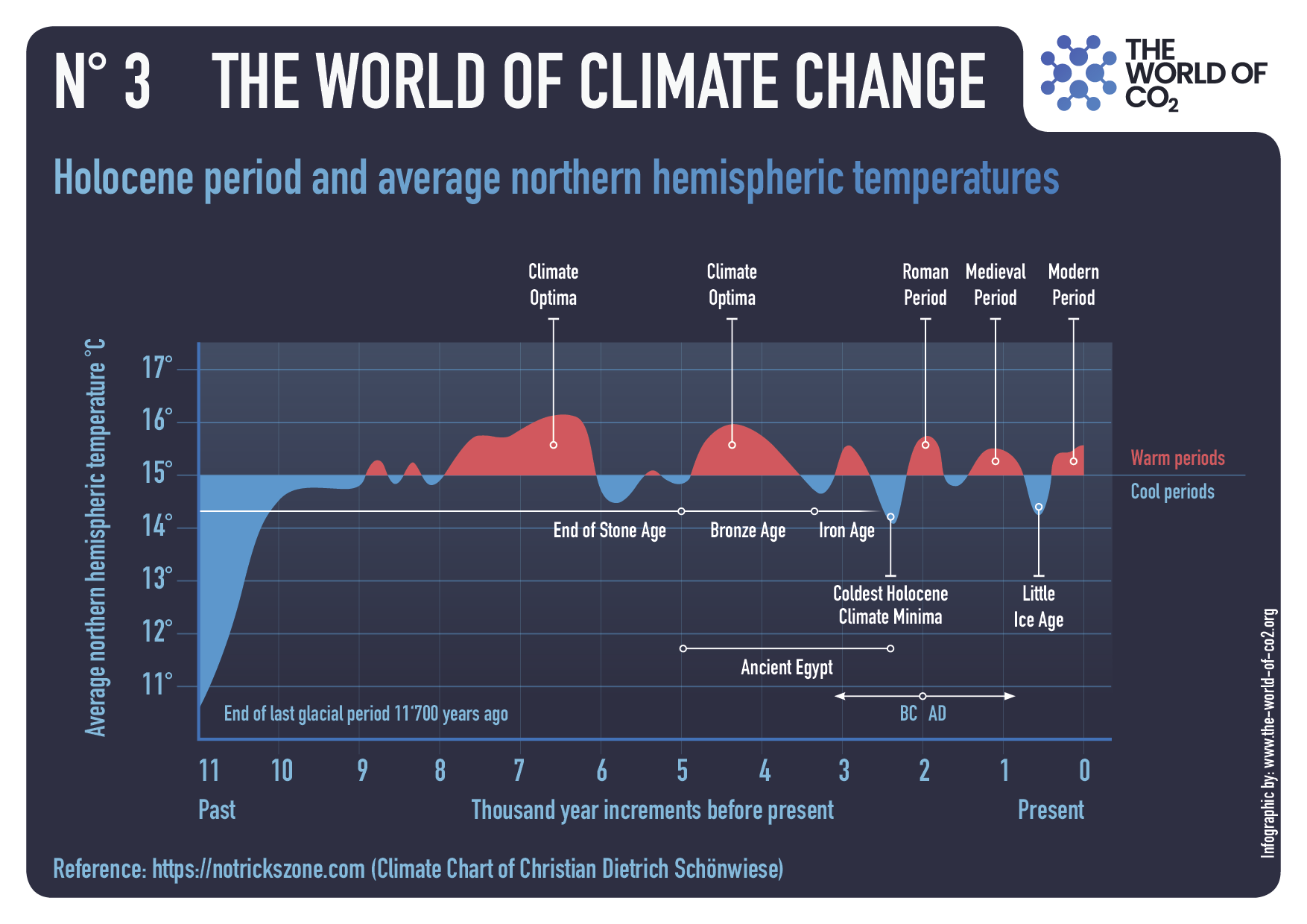
Leszek Marks explains how warming and cooling alternated throughout the last 12,000 years and how our modern period is no different in his paper Contemporary global warming versus climate change in the Holocene.  Excerpts in italics with my bolds and added images.  H/T No Tricks Zone

Leszek Eugeniusz Marks is a Polish geologist, professor ordinarius, currently at the Warsaw University, Department of Climate Geology; and the Polish Geological Institute-National Research Institute, president of Committee for Quaternary Research of the Polish Academy of Sciences. At present, member of editorial boards of scientific journals Boreas, “Litosfera”, “Geography and Geology”, and Studia Quaternaria.

Abstract

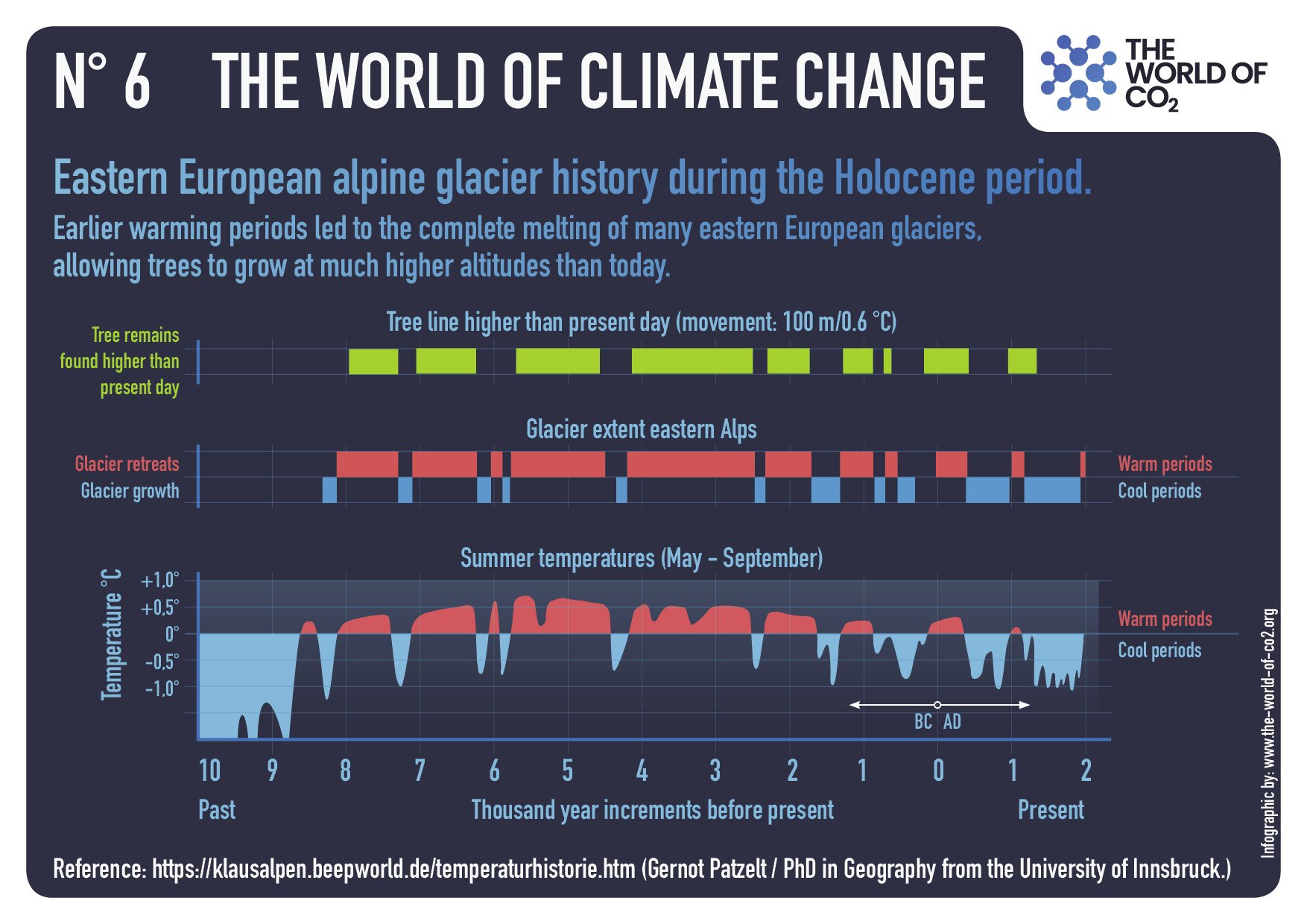
Cyclical climate change is characteristic of the Holocene, with successive warmings and coolings. A solar forcing mechanism has steered Holocene climate change, expressed by 9 cooling phases known as Bond events. There is reliable geological evidence that the temperatures of most warming phases in the Holocene were globally higher or similar to that of the current warming period, Arctic sea ice was less extensive and most mountain glaciers in the northern hemisphere either disappeared or were smaller.
During the African Humid Period in the Early and Middle Holocene, much stronger summer monsoons made the Sahara green with growth of savanna vegetation, huge lakes and extensive peat bogs. The modern warming is part of a climatic cycle with a progressive warming after the Little Ice Age, the last cold episode of which occurred at the beginning of the 19th century. Successive climate projections of the Intergovernmental Panel on Climate Change are based on the assumption that the modern temperature rise is steered exclusively by the increasing content of human-induced CO2 in the atmosphere. If compared with the observational data, these projected temperatures have been highly overestimated.

Overview

This paper presents the current state of knowledge of the climate change in the Holocene. The geological record of the climate change in this epoch has been verified by the results of archaeological, historical and meteorological investigations (Marks, 2016). Determination of the steering forces of modern warming is among the current scientific priorities in the world and, therefore, geological input is an important contribution to the discussion about human impact on the climate.

The current interglacial of the Holocene started 11.7 ka cal BP (Walker et al., 2018), with progressively increasing human impact on the Earth’s environment, especially strong during the past decades (Gibbard et al., 2021). Geological examination of past climate changes is crucial to distinguish the natural and the human-induced factors of the current climate change. The most important climate-steering factor is solar radiation, subjected to cyclical changes caused by the Sun’s activity that supplies with over 99% of the energy that is responsible for the climate of the Earth. Geological reconstructions show that rises and falls in the temperature on the Earth are dependent on the sunspot cycles (Table 1; Easterbrook, 2011; Usoskin et al., 2016; Usoskin,2023), and these in turn respond to the varying magnetic activity of the Sun.

The natural input of solar energy is transformed by different external and internal factors to modulate climate on the Earth. Latitudinal insolation in the Holocene depended on the Earth’s orbital parameters (Milankovič cycles). In comparison with the present values, summer temperatures in the northern hemisphere were higher in the Early and Middle Holocene (Beer, Van Geel, 2008; Beer, Wanner, 2012). Winter temperatures in the southern hemisphere were higher in the Middle Holocene, followed by higher temperatures in the northern hemisphere in the Late Holocene. In the coming 3 ka, lower temperatures are expected everywhere, except for the intertropical zone where higher winter temperatures are expected (Marks, 2016).

The natural rhythm of climate change during the Holocene was disturbed by large volcanic eruptions. Emission of dust into the atmosphere was responsible for a couple of cold events during the Holocene (Shindell et al., 2003). Such eruptions can be detected by concentrations of SO2 in polar ice core records (Zielinski et al., 1994; Castellano et al., 2004). The extent of the vegetation cover had an important, but very complex, effect on the climate (Foley et al., 2003), because the evaporative cooling by a forest mitigated warmings and limited dust mobilisation (Bonan, 2008). The atmospheric CO2 concentration decreased in the Early Holocene and started to increase since 7 ka, being independent of temperature variations (Palacios et al., 2024a). Ocean-atmosphere interchange was the main source of CO2 until the recent decades when the anthropogenic emission of CO2 became significant (Brovkin et al., 2019).

Fig. 1. Climate change in the Holocene, adapted from Palacios et al. (2024a) and modified: warm periods are in yellow and less warm in pale yellow, and cold in blue; Bond Events are after Bond et al. (1997, 2001) and geochronology after Walker et al. (2019).

Climate change after the Holocene Thermal Maximum

The temperature deduced from the oxygen isotope curve in the Greenland ice core GISP2 shows that several warmings occurred after the Holocene Thermal Maximum (Fig. 1; Drake, 2012). These were periods during which great progress in the development of human societies occurred: Late Bronze Age, Roman Warm Period and the MWP.  The separating cold Bond Events, named the Iron Age and Dark Ages Cold Periods respectively, were expressed by economic, intellectual and cultural decline. The temperature history since 900 CE was based firstly on the estimated climate history of central England (Lamb, 1977; IPCC, 1990). This showed a distinct warming of ~1.3°C when compared with the LIA (Moberg et al., 2005; D’Arrigo et al., 2006; Mann et al., 2009). This warming was a result of natural processes, because human activity could not have had any significant effect on temperature changes before 1900 CE. The Roman Warm Period (250 BC–450 CE), the MWP (950–1250 CE) and the Modern Warming Period reflect 1000-cycles with high solar radiation (Table 1; Vahrenholt, Lüning, 2014).

Discussion

The claim of the IPCC (2021) that ‘…the latest decade was warmer than any multi-century period after the Last Interglacial, around 125,000 years ago’ ignores all the knowledge about reconstructed temperatures in the Holocene, based on multi-proxy palaeoclimatic data.

Despite the extensive northern ice sheets, the increased summer insolation in the northern hemisphere caused a warming trend from the beginning of the Holocene and lasting until the Middle Holocene (Palacios et al., 2024a).  This warming trend was reversed from 6–5 ka onwards, due to decreased summer insolation in the northern hemisphere. Such general warming or cooling trends in the Holocene were interrupted by short periods with opposite and abrupt temperature changes (Fig. 1).

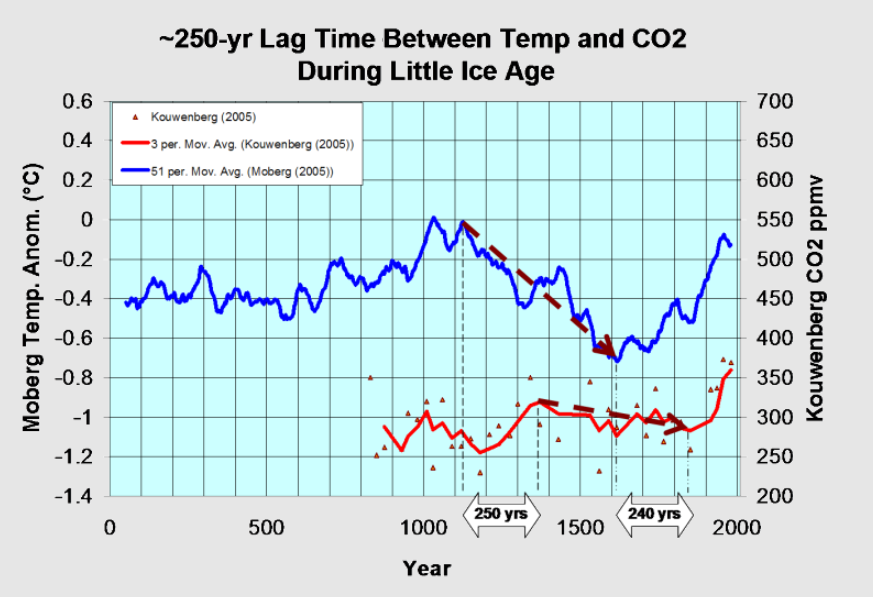
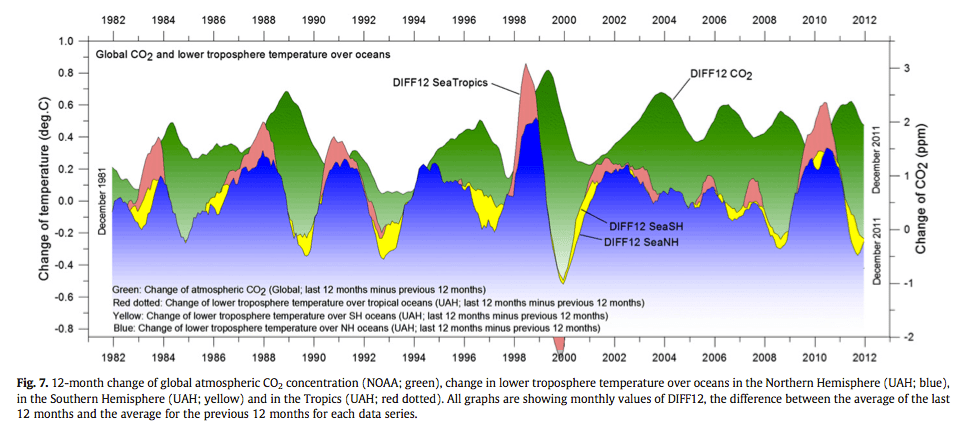
The modern warming represents a part of the cyclical climate change after the LIA, the last cold episode of which occurred at the beginning of the 19th century. The LIA with low temperatures is named the pre industrial period by the advocates of global anthropogenic warming and such an approach helps them to promote the idea that an increased human emission of CO2 (especially in the 20th century) is the only reason for rising temperatures on Earth. They do not bother with the evidence that the mutual time relations of global temperature and contents of CO2 in the atmosphere in 1980–2019 indicate a leading role of temperature, a rise of which was followed in that time by a 6-month delay in the rise of CO2 (Humlum et al., 2012; Koutsoyiannis, Kundzewicz, 2020).

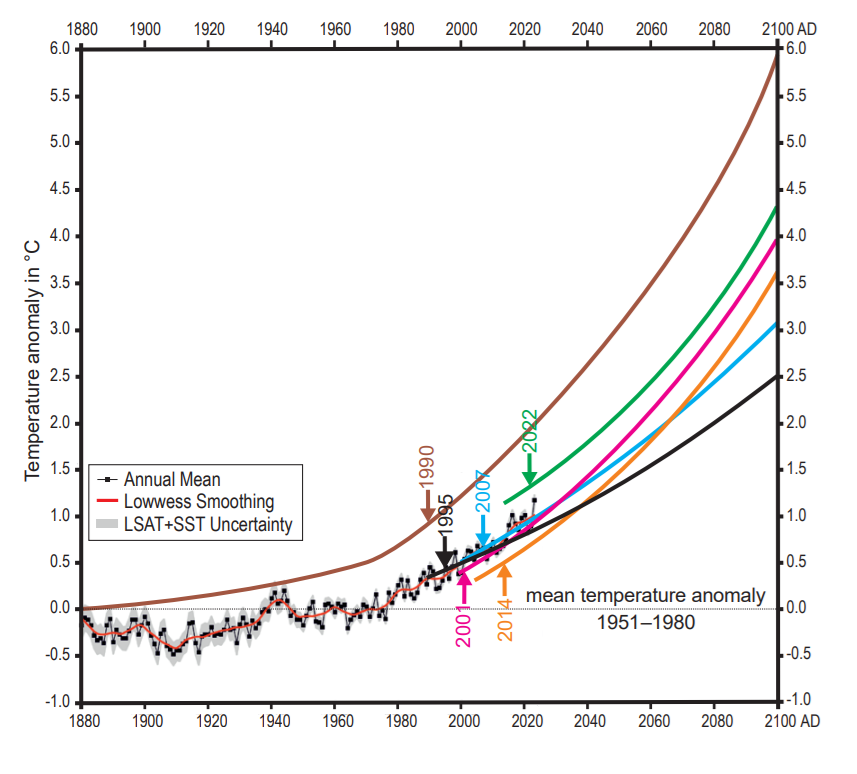
The official curve of the global mean annual temperature anomalies based on regular measurements (https://data.giss.nasa.gov/gistemp/graphs_v4/) overlaps slightly with the temperature projections in reports of the IPCC (1990, 1995, 2001, 2007, 2014, 2021). These IPCC projections were created by climate models, based on the assumption that the modern temperature rise is steered exclusively by the increasing content of human-induced CO2 in the atmosphere while the role of water vapour as the main greenhouse gas is neglected (cf. Hołyst, 2020). Such an approach makes the IPCC-projected temperature highly overestimated if compared with the observational data (Fig. 3). Despite the lockdowns during the Covid-19 pandemic in 2020–2021, connected with large cutbacks in transport, travel, industrial production and energy generation, no reduction in atmospheric CO2 was noted. This fact suggests that the proposed reductions in global energy use would be most probably highly ineffective in limiting the level of atmospheric CO2.

Fig. 3. Global estimates of mean annual temperature anomalies (1880–2023), based on land and ocean data (https://data.giss.nasa.gov/gistemp/graphs_v4/) and temperature projections to AD 2100 in the successive IPCC reports (1990, 1995, 2001, 2007, 2014, 2021)

Conclusions

The Holocene climate change was characterized by cyclical warmings (such as: Holocene Thermal Maximum, Late Bronze Age, Roman Warm Period, MWP) and coolings (Bond Events: including Iron Age Cold Period, Dark Ages Cold Period and LIA). The IPCC claims that current warming is unprecedented in the last 2000 or even the last 125,000 years; this statement is very unconvincing and it is not supported by the geological data. There is good evidence that both in the last 2000 years as well during the Holocene Thermal Maximum, temperatures were higher or broadly similar to the ones in the current warming period, the Arctic sea ice was less extensive and most mountain glaciers (especially in the northern hemisphere) either disappeared or were smaller. Much stronger summer monsoons in the Early and Middle Holocene made the Sahara green with savanna vegetation, huge lakes and extensive peat bogs. The terms ‘the Holocene Thermal Maximum’ and ‘the Holocene Climatic Optimum’ are avoided by the IPCC (2021), and its popularized statements making the current warming look ‘unprecedented’ and therefore ‘unique’ are false and flatten the climate history (cf. Marcott et al., 2013).

The climate is a product of complicated interdependence of many factors that have not been yet sufficiently recognized qualitatively and quantitatively. It is a great scientific challenge that requires an extensive interdisciplinary research. There is a crucial need to make climate science less political and climate policy more scientific.


Over the Top Guterres Claims Oil and Gas Ads Cause Global Warming

A recent post below highlights the many colorful falsehoods perpetrated by UN Chief Guterres.  Now he takes his nonsensical word salads to a new level, referring to traditional energy companies as “Godfathers of Climate Chaos,”  a label better suited to himself.  After all, those companies are only filling the demand by billions of people who depend on affordable reliable energy.  What economic demand is Guterres filling?

His lecture was reported many places, including an article at Al Jazeera ‘Godfathers of climate chaos’: UN chief calls for ban on fossil fuel ads.  Excerpts in italics with my bolds and added images.

Antonio Guterres urges a 30 percent cut in global fossil fuel
production and use by 2030 amid record high temperatures.

“The godfathers of climate chaos – the fossil fuel industry – rake in record profits and feast off trillions in taxpayer-funded subsidies,” he said.

Drawing a comparison with many governments’ restrictions on advertising for harmful substances like tobacco, he said, “I urge every country to ban advertising from fossil fuel companies, and I urge news media and tech companies to stop taking fossil fuel advertising.”

Carbon dioxide emissions from burning fossil fuels – the main cause wrongly claimed to cause climate change – hit a record high last year despite global agreements designed to curb their release and a rapid expansion in renewable energy. [My edit: see 2024 Update: Fossil Fuels ≠ Global Warming. ]

Coal, oil and gas still provide more than three-quarters of the world’s energy, with global oil demand remaining strong.

Of course Guterres can urge all he wants, without any accountability for his words, since the UN has no authority to decide who agencies take on as advertising clients. It is all bluff and bluster, threatening as though a mafia boss lacking enforcers. Even so, the evidence does not support hydrocarbon fuel emissions as causing temperature changes.  Moreover, there’s no reason to believe banning advertising of such products will reduce the demand, which comes from real people purchasing with their own money in free markets.

Background Post UN Chief Wins Junk Science Award

At Financial Post’s Junk Science Week, Terence Corcoran highlights the hysterical alarmist statements by the UN chief promoting IPCC agenda, the article being The UN emperor has no science.  Excerpts in italics with my bolds and added images.H/T John Ray.

Guterres Mangles Metaphors To Pitch Extreme Climate Alarmism

UN secretary General Antonio Guterres addresses the media during a visit to the UN office in Nairobi, Kenya, May 3, 2023. © Provided by Financial Post

History will record that the United Nations has established itself as the greatest organizational perpetrator of junk science in modern times, if not of all time, with current UN Secretary-General Antonio Guterres destined to be singled out for his personal contribution to the distorted UN climate alarmism.

Since his appointment in 2019, Guterres and the UN have lived up to our standard formal definition of junk science. It occurs when:

    • scientific facts are distorted,
    • risk is exaggerated (or underplayed), and
    • “the science” adapted and warped by politics and ideology to serve another agenda.

That definition encompasses a wide range of activities among scientists, NGOs, politicians, journalists, media outlets, cranks and quacks who manipulate science for political, environmental, economic and social purposes. It also nicely captures the entire United Nations’ climate crusade and the work of its institutional creation, the Intergovernmental Panel on Climate Change (IPCC).

But no single official can top Guterres as a purveyor of IPCC hype and doom, a living embodiment of Hans Christian Andersen’s  fabled emperor who believes he is fully, stylishly dressed but in fact has no clothes.

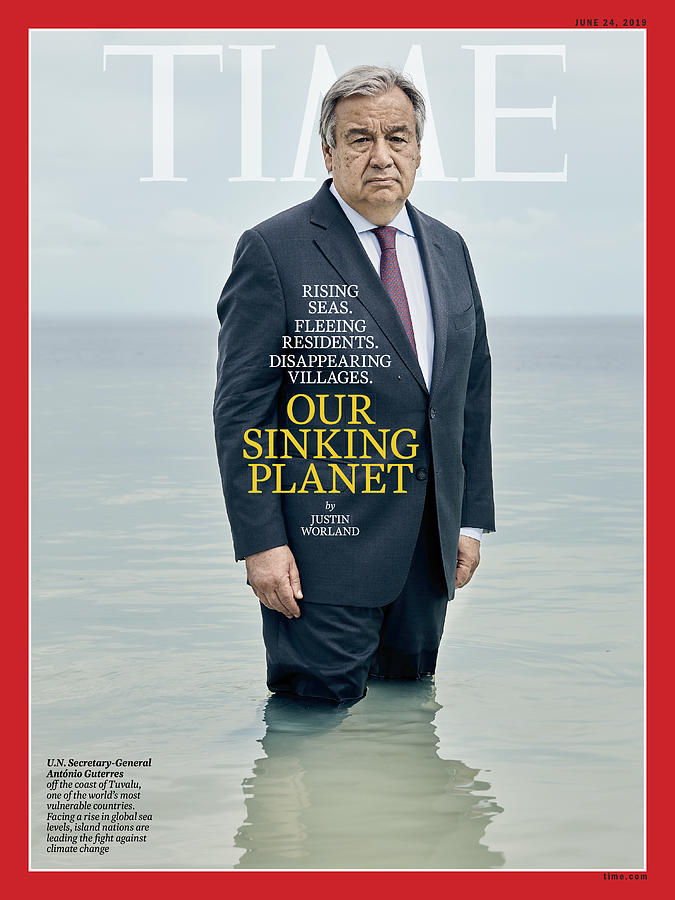
Our Sinking Planet – Antonio Guterres is a photograph by Photograph by Christopher Gregory for TIME which was uploaded on July 21st, 2020.

Guterres, a former Socialist Party prime minister of Portugal (1995-2002) and president of the Socialist International (1999-2005), was in typically ridiculous form on June 5th when he  delivered a speech  at the Museum of Natural History in Manhattan, at an event billed as “A Moment of Truth” and a “special address on climate action.” Guterres talked about a planet on a “highway to climate hell,”  rehashing a line he used in 2022 in Egypt at the COP27 climate conference: “We are on a highway to climate hell with our foot still on the accelerator.”

Guterres also has no qualms about mixing and mangling metaphors. He simultaneously told the Manhattan audience that humans are “like the meteor that wiped out the dinosaurs, we’re having an outsized impact. In the case of climate, we are not the dinosaurs. We are the meteor. We are not only in danger. We are the danger.”

The longer Guterres rambles on, the more confusing, contradictory and senseless the metaphors become:

“We are playing Russian roulette with our planet.  We need an exit ramp off the highway to climate hell. And the truth is … we have control of the wheel.”

Other Guterres’ climate spins include: “Humanity has opened the gates of hell” and “become a weapon of mass extinction.” And: “We must go into emergency mode and put out this five-alarm fire.”

Is Guterres describing reality — or the content of a new AI computer game in which some crazed teenaged human monster drives a flaming meteor through the ozone layer, knocking off dinosaurs before crashing onto a highway and plowing into a Russian Museum of Political Roulette just outside the Gates of Hell?

As UN Secretary-General, Guterres sits atop a hierarchy of agencies such as the IPCC climate science megaplex, which was created  in 1988 by two other UN agencies, the World Meteorological Organization (WMO) and the United Nations Environment Program (UNEP). UNEP was cobbled together in 1972 as the  brainchild of Maurice Strong , the late Canadian global environmental schemer, who famously mused about a fictional environmental crisis that leads a group of global insiders to decide the only hope for the planet is “that the industrialized civilizations collapse.” The current “de-growth” movement is a version of deindustrialization that reflects Guterres’ off-ramp from the highway to hell. In fact, the word “de-growth”  appears  28 times in the IPCC’s sixth and latest Assessment Report .

With these UN agencies as his guide, Guterres’ verbal jumble of science statements is no better than his mixed metaphors. His abuse of climate and environmental facts has often been commented upon, including in a YouTube video titled “Who is Antonio Guterres?,” posted earlier this year by Ottawa journalist John Robson on his Climate Discussion Nexus site. Robson reviews and highlights  some of the garbled inaccuracies and misrepresentations Guterres routinely cranks out.

For instance: “Climate-related natural disasters are becoming more frequent, more deadly, more destructive with growing human and financial cost.”  Not true . And: “The number of weather, climate and water-related disasters has increased by a factor of five over the past 50 years.”  Also not true .

When it comes to policies to deal with his fantastic vision of planetary destruction, Guterres aligns with Maurice Strong’s de-growth agenda. In his Manhattan speech, he repeated the UN call for a “fossil-fuel phase-out” since “economic logic makes the end of the fossil fuel age inevitable.” He urged financial institutions to “stop bankrolling” fossil fuel industries. “Fossil fuels are not only poisoning our planet,” he told bankers, “they’re toxic for your brand.”

The planet would be much better off if national governments stopped bankrolling Guterres and the United Nations and their constant poisoning of our science, economics and politics.

UN Chief Wins Junk Science Award

At Financial Post’s Junk Science Week, Terence Corcoran highlights the hysterical alarmist statements by the UN chief promoting IPCC agenda, the article being The UN emperor has no science.  Excerpts in italics with my bolds and added images.H/T John Ray.

Guterres Mangles Metaphors To Pitch Extreme Climate Alarmism

UN secretary General Antonio Guterres addresses the media during a visit to the UN office in Nairobi, Kenya, May 3, 2023. © Khalil Senosi, AP

History will record that the United Nations has established itself as the greatest organizational perpetrator of junk science in modern times, if not of all time, with current UN Secretary-General Antonio Guterres destined to be singled out for his personal contribution to the distorted UN climate alarmism.

Since his appointment in 2019, Guterres and the UN have lived up to our standard formal definition of junk science. It occurs when:

    • scientific facts are distorted,
    • risk is exaggerated (or underplayed), and
    • “the science” adapted and warped by politics and ideology to serve another agenda.

That definition encompasses a wide range of activities among scientists, NGOs, politicians, journalists, media outlets, cranks and quacks who manipulate science for political, environmental, economic and social purposes. It also nicely captures the entire United Nations’ climate crusade and the work of its institutional creation, the Intergovernmental Panel on Climate Change (IPCC).

But no single official can top Guterres as a purveyor of IPCC hype and doom, a living embodiment of Hans Christian Andersen’s  fabled emperor who believes he is fully, stylishly dressed but in fact has no clothes.

Our Sinking Planet – Antonio Guterres is a photograph by Photograph by Christopher Gregory for TIME which was uploaded on July 21st, 2020.

Guterres, a former Socialist Party prime minister of Portugal (1995-2002) and president of the Socialist International (1999-2005), was in typically ridiculous form on June 5th when he  delivered a speech  at the Museum of Natural History in Manhattan, at an event billed as “A Moment of Truth” and a “special address on climate action.” Guterres talked about a planet on a “highway to climate hell,”  rehashing a line he used in 2022 in Egypt at the COP27 climate conference: “We are on a highway to climate hell with our foot still on the accelerator.”

Guterres also has no qualms about mixing and mangling metaphors. He simultaneously told the Manhattan audience that humans are “like the meteor that wiped out the dinosaurs, we’re having an outsized impact. In the case of climate, we are not the dinosaurs. We are the meteor. We are not only in danger. We are the danger.”

The longer Guterres rambles on, the more confusing, contradictory and senseless the metaphors become:

“We are playing Russian roulette with our planet.  We need an exit ramp off the highway to climate hell. And the truth is … we have control of the wheel.”

Other Guterres’ climate spins include: “Humanity has opened the gates of hell” and “become a weapon of mass extinction.” And: “We must go into emergency mode and put out this five-alarm fire.”

Is Guterres describing reality — or the content of a new AI computer game in which some crazed teenaged human monster drives a flaming meteor through the ozone layer, knocking off dinosaurs before crashing onto a highway and plowing into a Russian Museum of Political Roulette just outside the Gates of Hell?

As UN Secretary-General, Guterres sits atop a hierarchy of agencies such as the IPCC climate science megaplex, which was created  in 1988 by two other UN agencies, the World Meteorological Organization (WMO) and the United Nations Environment Program (UNEP). UNEP was cobbled together in 1972 as the  brainchild of Maurice Strong , the late Canadian global environmental schemer, who famously mused about a fictional environmental crisis that leads a group of global insiders to decide the only hope for the planet is “that the industrialized civilizations collapse.” The current “de-growth” movement is a version of deindustrialization that reflects Guterres’ off-ramp from the highway to hell. In fact, the word “de-growth”  appears  28 times in the IPCC’s sixth and latest Assessment Report .

With these UN agencies as his guide, Guterres’ verbal jumble of science statements is no better than his mixed metaphors. His abuse of climate and environmental facts has often been commented upon, including in a YouTube video titled “Who is Antonio Guterres?,” posted earlier this year by Ottawa journalist John Robson on his Climate Discussion Nexus site. Robson reviews and highlights  some of the garbled inaccuracies and misrepresentations Guterres routinely cranks out.

For instance: “Climate-related natural disasters are becoming more frequent, more deadly, more destructive with growing human and financial cost.”  Not true . And: “The number of weather, climate and water-related disasters has increased by a factor of five over the past 50 years.”  Also not true .

When it comes to policies to deal with his fantastic vision of planetary destruction, Guterres aligns with Maurice Strong’s de-growth agenda. In his Manhattan speech, he repeated the UN call for a “fossil-fuel phase-out” since “economic logic makes the end of the fossil fuel age inevitable.” He urged financial institutions to “stop bankrolling” fossil fuel industries. “Fossil fuels are not only poisoning our planet,” he told bankers, “they’re toxic for your brand.”

The planet would be much better off if national governments stopped bankrolling Guterres and the United Nations and their constant poisoning of our science, economics and politics.

IPCC Still Deceiving with the Hockey Stick

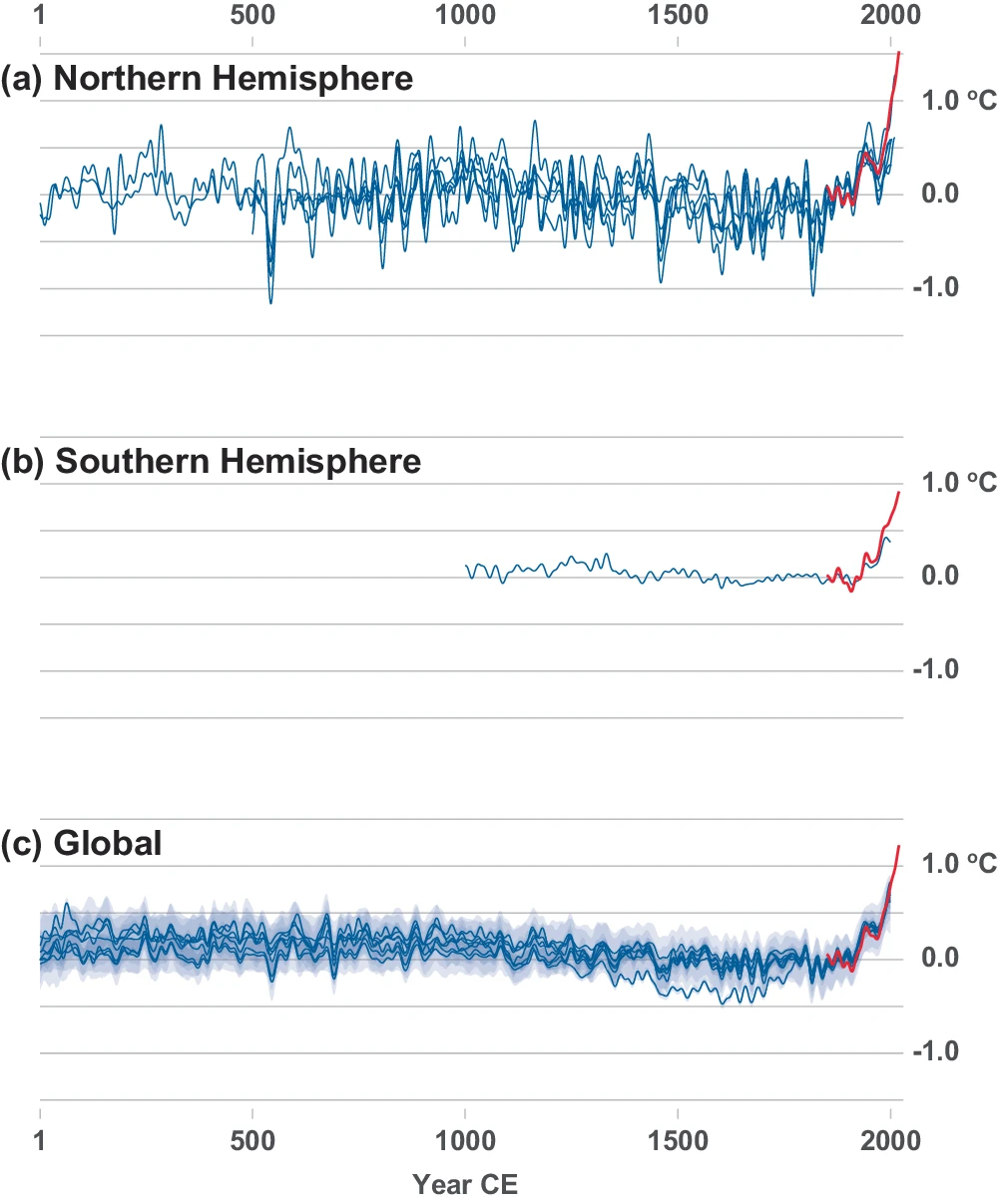
Fig. 1: Common Era temperature reconstructions
featured in IPCC reports since 2001.

Source Esper et al 2024  Note:  In each graph, instrumental global annual mean land and marine temperatures are shown in a red spike, while lower resolution proxy estimates are in blue.

Just published today at Nature Communications is this paper  The IPCC’s reductive Common Era temperature history  by Esper et al.  Excerpts in italics with my bolds and added images.

Abstract

Common Era temperature variability has been a prominent component in Intergovernmental Panel on Climate Change reports over the last several decades and was twice featured in their Summary for Policymakers. A single reconstruction of mean Northern Hemisphere temperature variability was first highlighted in the 2001 Summary for Policymakers, despite other estimates that existed at the time. Subsequent reports assessed many large-scale temperature reconstructions, but the entirety of Common Era temperature history in the most recent Sixth Assessment Report of the Intergovernmental Panel on Climate Change was restricted to a single estimate of mean annual global temperatures. We argue that this focus on a single reconstruction is an insufficient summary of our understanding of temperature variability over the Common Era. We provide a complementary perspective by offering an alternative assessment of the state of our understanding in high-resolution paleoclimatology for the Common Era and call for future reports to present a more accurate and comprehensive assessment of our knowledge about this important period of human and climate history.

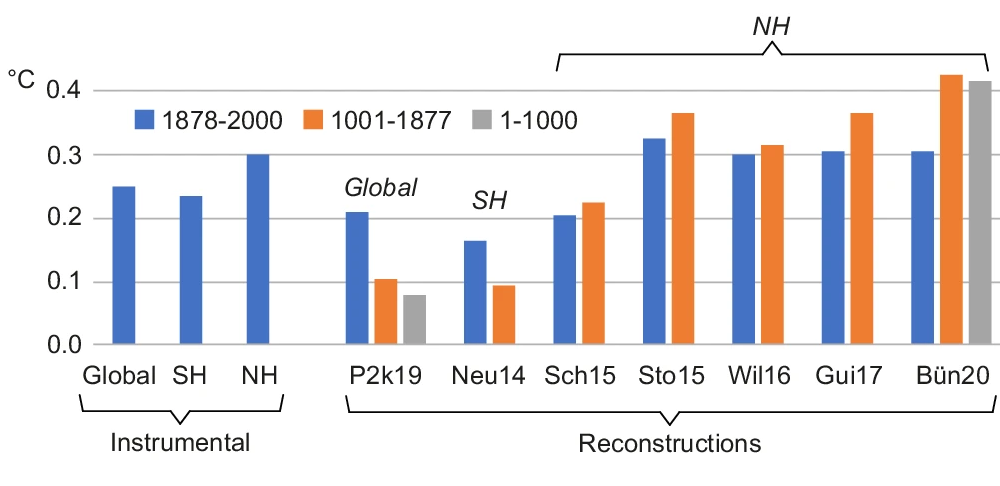
Fig. 5: Standard deviations in observed temperature data
and Common Era temperature reconstructions.

Estimates for the observed and reconstructed temperatures are determined over the 1878-2000 CE (blue), 1001-1877 CE (orange) and 1-1000 CE (gray) periods. Instrumental records shown on the left side include mean annual temperatures averaged over 90°S-90°N land and marine areas (global), mean annual temperatures averaged over 0°−90°S land and marine areas (SH), and mean summer (JJA) temperatures averaged over 30°−90°N land-only areas (NH).

While interpretations of the similarities and differences across the various domains and reconstructions, as shown in Fig. 5, remains the subject of important and interesting research, diagnosing the differences is not the focus of our commentary herein. Our primary concern is that substantial uncertainty exists. The consequence is that there are notable differences in the representation of large-scale estimates of CE temperature variability, as shown in Figs. 2 and 3, that were overlooked and poorly communicated by the 2021 IPCC WGI report. Both the different summary of the global P2k19 ensemble provided in Figs. 2b and 3c, and the inclusion of the additionally available NH and SH temperature reconstruction estimates in Fig. 3, imply substantial uncertainties in large-scale temperature reconstructions that better summarize the existing challenges associated with the science.

Fig. 3: Reconstructions of large-scale temperature variability
over the last 2000 years published since AR5 of the IPCC.

Reconstructions variably target seasonal to annual mean temperatures in the (a) Northern Hemisphere (Sch15, Sto15, Wil16, Xin16, Gui17, Bün20), and annual temperatures for the (b) Southern Hemisphere (Neu14) and (c) globally (P2k19; as shown in Fig. 2) over varying periods of the Common Era (see Table 1 for details). All reconstructions were smoothed using a 20-year low-pass filter and temperatures are shown as anomalies from their 1850–1900 means. Hemispheric and global means of land and ocean temperatures derived from HadCRUT5 instrumental analysis1 are also shown in each respective panel from 1850-2020 (red). Instrumental temperatures were also referenced to zero mean in the 1850–1900 interval and filtered with a 20-year lowpass filter. These instrumental representations are all consistent with the 2021 IPCC report.

Conclusions and future priorities

We propose that a visualization of the contemporary research, as in Fig. 3, offers a more accurate depiction of the uncertainty and temporal evolution of CE temperature variability compared to any single reconstruction. A general feature of Fig. 3 is that long-term trends during the second millennium CE are more coherent and robust, but major discrepancies still exist during the first millennium CE. These uncertainties in the first millennium are the product of severe reductions in the availability of high-resolution proxy records, which affects all large-scale temperature reconstructions. The SH also remains grossly under-sampled.

It is therefore premature, and possibly incorrect, to conclude that
the first millennium was free of centennial-scale temperature trends
and that the decadal variations were systematically smaller
than during subsequent centuries, as detailed in the 2021 SPM.

Regarding global temperature reconstructions specifically, we also highlight the following limitations that must continue to be contextualized in consensus reports on CE temperature reconstructions:

(i) warm season biases due to the dominance of tree-ring records during the CE,
(ii) spatial biases in proxy sampling, with a persistent lack of high-resolution proxy records from the tropics and SH, which are needed for accurately representing lower-latitude and SH temperatures over the past 2000 years,
(iii) the likely loss of variability when including time-uncertain and smoothed proxies in a large-scale reconstruction,
(iv) the potential limited ability of conventional tree-ring records to capture millennial-scale trends in climate, and
(v) the need to more accurately estimate reconstruction uncertainties that reflect changes in replication and statistical model fidelity of the underlying proxy network back in time (a constant uncertainty range back in time is unlikely to accurately represent the increasing uncertainties that exist).

With any set of methods, however, their outcome is ultimately dependent on the data that they incorporate and the assumptions that underpin the statistical model. A major initiative to produce new high-resolution proxy records that span the entire CE is therefore necessary if we are to fundamentally improve our understanding of pre-instrumental temperature variations at policy-relevant timescales. It otherwise remains uncertain how warm and cold first millennium CE temperatures actually were and what caused these earlier changes at hemispheric to global scales, with implications for our understanding of the true range of externally and internally forced variability.

My Comment:

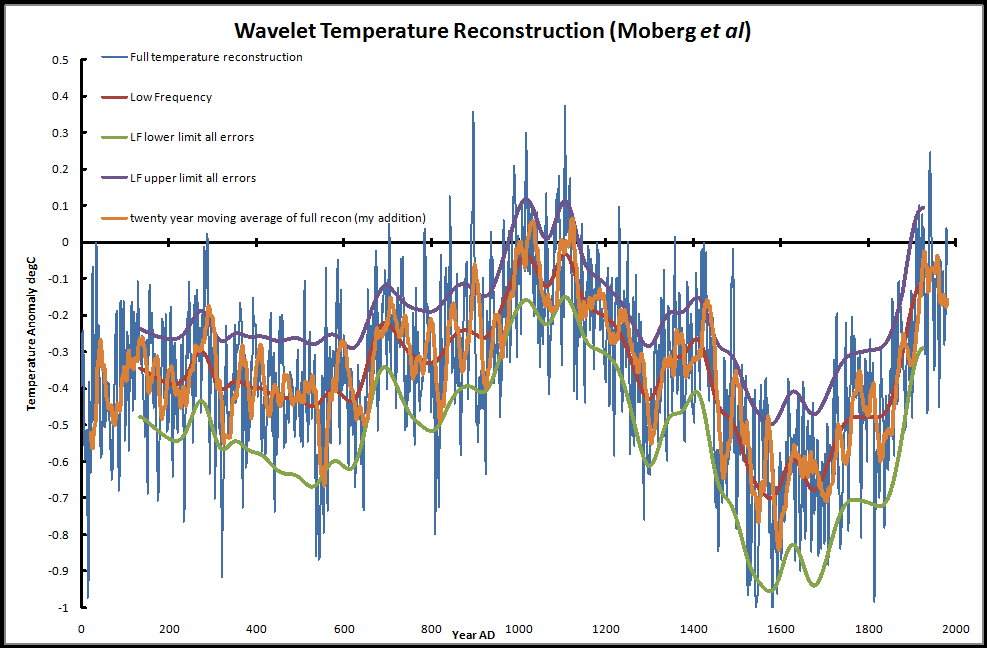
Among the references in the paper is that of Moberg et al (2005) Highly variable Northern Hemisphere temperatures reconstructed from low- and high-resolution proxy data.  The graph below shows one example of how more recent high quality reconstructions contradict the Mann depiction of a flat hockey stick handle during the centuries prior to the 20th.

Background of the Mann Hockey Stick Saga

Rise and Fall of the Modern Warming Spike

The first graph appeared in the IPCC 1990 First Assessment Report (FAR) credited to H.H.Lamb, first director of CRU-UEA. The second graph was featured in 2001 IPCC Third Assessment Report (TAR) the famous hockey stick credited to M. Mann.

Brits Run Con Game at Glasgow COP

Doomsday was predicted but failed to happen at midnight.

Vijay Jayaraj explains in his Real Clear Energy article COP26’s UK Hosts Peddle Climate Misinformation.  Excerpts in italics with my bolds.

As hosts of the Glasgow COP26 climate conference, UK leaders were models for the meeting’s steady stream of misinformation and fearmongering that came from the likes of Barack Obama and Greta Thunberg.

The clock on the doomsday device is still ticking, but we’ve got a bomb disposal team on site,” said British Prime Minister Boris Johnson. “They’re starting to snip the wires – I hope some of the right ones.” If the specter of catastrophic global warming is not sufficiently scary, how about the image of an explosion?

As for misinformation, Boris claimed that “India (is) keeping a billion tons of carbon out of the atmosphere by switching half its power grid to renewable sources.”

Actually, India is increasing emissions, not reducing them.

The country is determined to raise coal production by 50 percent — from 700 million tons to 1 billion tons a year. The country has invested heavily in the coal sector and is asking coal utilities to implement fresh strategies to achieve the new target.

Also, the claim of India’s power grid being 50 percent renewables is misleading. While the total installed renewable capacity is around 40 percent out of the total installed power generation systems in the country, only nine percent of all electricity consumed comes from wind and solar because the so-called green technologies are available much less than are baseload sources. Seventy percent of all electricity comes from coal, followed by hydroelectric and nuclear. Even if wind and solar ever achieve 80 percent of total installed capacity, the actual generation from them would be less than 20 percent.

Also, there is no imminent threat from the climate as Boris so dramatically claims. Certainly not anything thing like a ticking bomb. Antarctica has been colder during the last four years, polar bears have thrived, islands are gaining land mass, and fewer people die from climate disasters than ever before.

Of course, understanding these realities requires unbiased research of data, which seems to be too much of a bother for Boris Johnson. Perhaps, the prime minister’s aides could read him page 256 of the United Nation’s special report, “Global Warming of 1.5°C.”

The report states that if we do nothing on climate, the subsequent theoretical increase of 3.66°C in temperature by the year 2100 will cost a meager 2.6 percent of the global gross domestic product — a loss that gives no reason to panic nor any justification to declare a climate emergency. And that is assuming UN projections are not overstated, which they often are.

To balance the scare tactics of the prime minister, UK Chancellor Rishi Sunak employed alluring cliches to promote the financing of climate polices. “We’re talking about making a tangible difference to people’s lives,” said the chancellor. “About cheap, reliable and clean electricity to power schools and hospitals in rural Africa. About better coastal defenses in the Philippines and the pacific islands to protect people from storm surges. About everyone, everywhere having fresher water to drink…cleaner air to breathe.”

Instead of real-world data, the chancellor uses high-sounding language as poetic musical prelude and endnote to sell his vision of spending money on climate policies for a supposedly better world. He ignores that more people in the world have better access to clean water than ever before in modern history. The share of global population with access to safe drinking water went up from around 60 percent in the year 2000 to around 73 percent in 2020 despite a rapid increase in population and growing groundwater problems in cities.

Our World in DataImage: Improvement in access to clean water globally, Source: https://ourworldindata.org/water-access

Western economies — Europe, UK, and U.S. — that have been dependent on fossil fuels boast some of the cleanest air in the world today. This is because fossil fuels provide the fastest creation of wealth, which can be spent on reducing pollution. Average life expectancy in the world went up from just 45 in 1950 to 71 in recent years. These are all markers of improvement, not degradation.

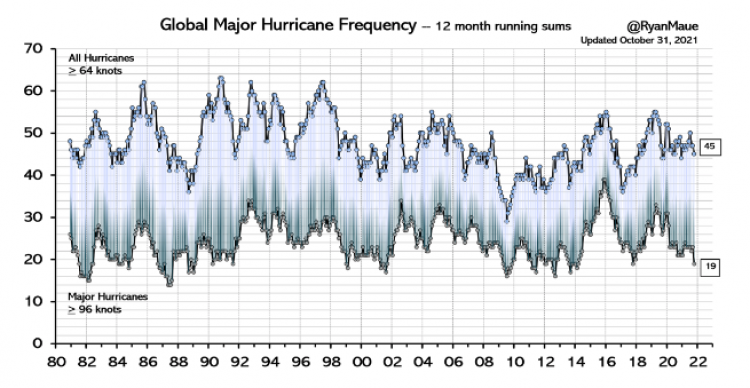
When it comes to extreme weather events, there has been no increase in the global tropical hurricane frequency, a fact that is conveniently overlooked by leaders like Sunak when they bemoan storms in cyclone-prone regions of the world.

Global Hurricane Frequency — 12-month running sums. The top time series is the number of global tropical cyclones that reached at least hurricane-force (maximum lifetime wind speed exceeds 64 knots). The bottom time series is the number of global tropical cyclones that reached major hurricane strength (96 knots+). Source: http://climatlas.com/tropical/

If the chancellor really intends to provide affordable and reliable energy to the poor in Africa, then fossil fuels, nuclear, and hydro are the only probable solutions. Wind and solar are unreliable, and available battery technologies are simply not viable for on-demand baseload.

For those who care about facts, it is frustrating to have media-enabled leaders utter absurdities with few holding them to account. Billions of energy-starved people deserve better.

Vijay Jayaraj is a Research Associate at the CO2 Coalition, Arlington, Va., and holds a master’s degree in environmental sciences from the University of East Anglia, England. He resides in Bengaluru, India.