





An Insider’s Story How Climatism Subverted Reason

Mark Keenan explains in his American Thinker article The Climate Creed: How Fear Replaced Science.  Excerpts in italics with my bolds and added images.

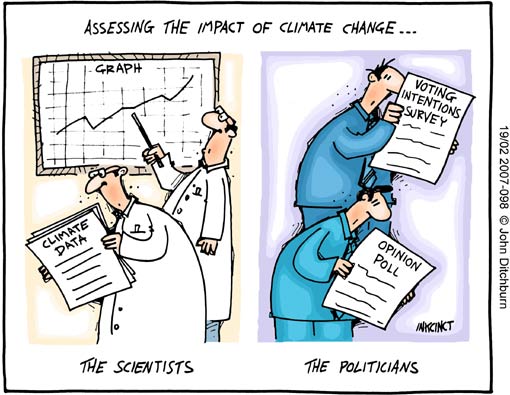
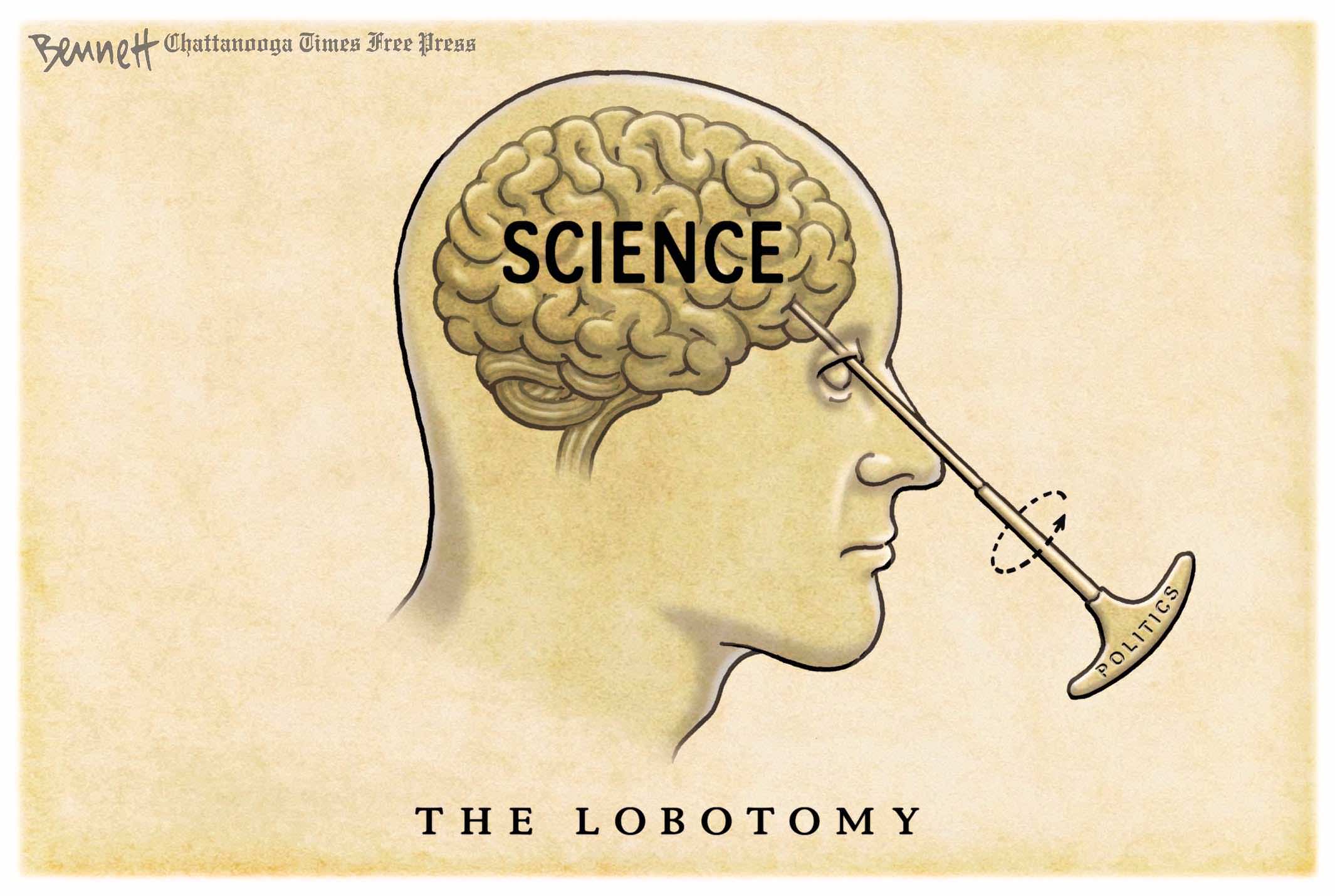
For decades, politicians and pundits have told us that “the science is settled.” Those four words have become a shield for power and a sword against dissent. But real science thrives on inquiry and investigation; not the suppression of it. What has emerged instead is not science at all, but a kind of secular faith — one that demands belief in man-made CO2-induced climate catastrophe and punishes heresy. Yet, many scientists, including scientists that have worked within the climate bureaucracy, know how fragile the claim that “climate change is caused by CO2” really is.

As a former scientist with the UK Department of Energy and Climate Change and later a technical expert for United Nations Environment, I saw firsthand how the modern climate narrative was shaped — not by evidence, but by politics. Uncertainty wasn’t treated as a question to investigate; it was treated as a threat to suppress. Entire careers and institutions came to depend on preserving a preordained conclusion: that carbon dioxide, the same gas that feeds plant life, is destroying the planet.

What began as environmental concern has hardened into climate orthodoxy — a moral creed enforced by bureaucrats, bankers, and media alike. It is a belief system that demands faith rather than understanding, obedience rather than inquiry. None of this means the climate isn’t changing. It means that the conversation about why and how has been systematically narrowed — not by discovery, but by decree.

The Rise of Climate Bureaucracy

By the 1990s, climate science had morphed from an academic discipline into a vast global bureaucracy. The Intergovernmental Panel on Climate Change (IPCC), founded in 1988, became the central authority — linking governments, corporations, and NGOs under a single mission: to define and manage “the problem.”

But the IPCC’s reports were never neutral. The “Summary for Policymakers” — the only section most journalists ever read — was often written before the science was finalized. Conclusions drove the evidence, not the other way around. Scientists who emphasized natural climate drivers such as solar cycles or ocean oscillations were quietly pushed aside. The institution that once claimed to study the climate became invested in proving a single narrative.

The Other Consensus

While the UN promotes its “consensus,” thousands of scientists disagree. In 2019, more than 2,000 experts signed the Climate Intelligence (CLINTEL) Declaration, stating bluntly:

“There is no [CO₂-induced] climate emergency. The geological record shows Earth’s climate has always varied naturally.”

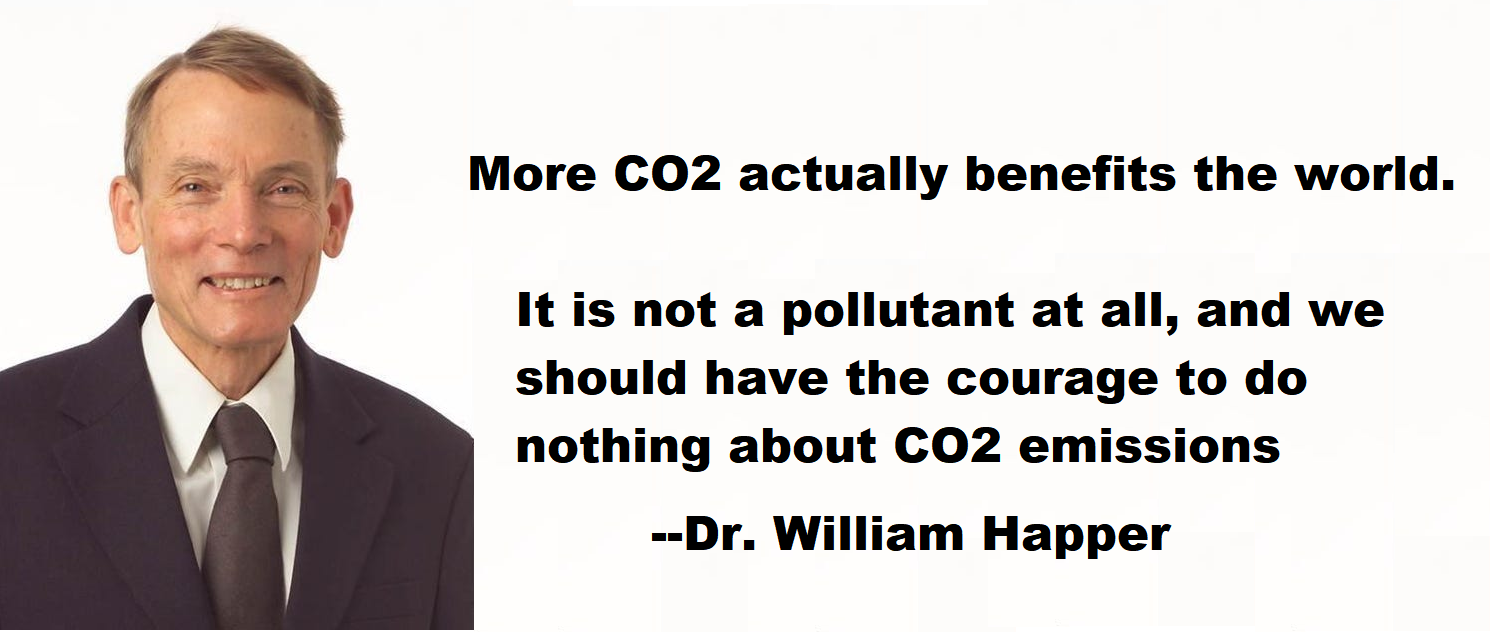
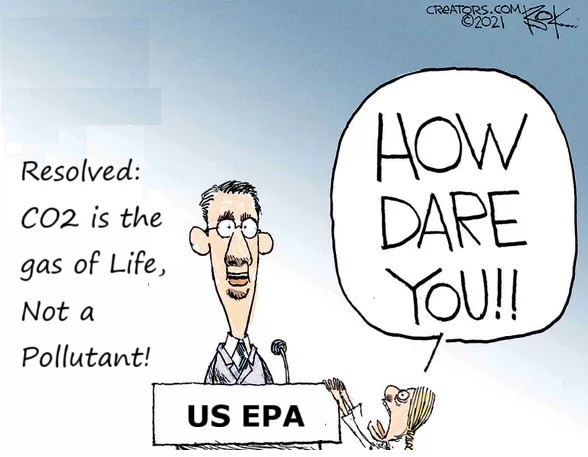
CO2 is not pollution — it is plant food, essential for life and photosynthesis. Yet the UN’s focus on carbon rather than true pollutants such as heavy metals or industrial toxins has diverted environmentalism from its original mission into politics.

I witnessed this distortion firsthand while working within the UN system. My role involved servicing the Pollution Release and Transfer Register Protocol — a multinational agreement that monitors pollutants to air, land, and water. Real pollution exists, and it’s severe. But CO2 is not the problem. Confusing the two has served political and financial ends, not ecological ones.

When Science Becomes Statecraft

The line between scientific advice and political advocacy blurred long ago. Governments needed crisis to justify regulation and taxation. NGOs needed fear to justify funding. And so “consensus science” — a contradiction in terms — entered the lexicon and became the new norm.

Real science advances through dissent and enquiry; consensus is a political construct. But once the term took hold, it became a weapon. Questioning it marked one as a heretic. The language of faith — belief, denial, salvation — replaced the language of analysis. What began as environmental concern hardened into a kind of secular theology: the carbon creed.

Complexity was the enemy. Climate models that showed alarming forecasts were amplified, while those showing uncertainty were ignored. What followed was the moralization of data. The language of faith replaced the language of evidence: belief, denial, salvation, catastrophe. Dissenters weren’t debated — they were denounced. What began as environmental concern hardened into an ideology — one that rewards fear over reason.

Scientists Who Broke Ranks

Many respected scientists have spoken out. Professor John R. Christy, Director of Atmospheric and Earth Sciences, University of Alabama, stated: “The established global warming theory significantly misrepresents the impact of extra greenhouse gases.” MIT’s Richard Lindzen observed, “In Earth’s long history, there’s been almost no correlation between climate and CO₂.” Dr. Nils-Axel Mörner, once with the IPCC, called the carbon narrative “a wonderful way to control taxation and people.” Greenpeace co-founder Patrick Moore declared the crisis “fake science” hijacked by ideology.

Such voices are rarely heard in mainstream media, not because their credentials lack merit, but because they challenge the most politically valuable story of the century.

The Money Behind the Mandate

Follow the money, and the picture becomes clearer. The financialization of carbon—
through emissions trading, carbon credits, and “green investment” funds
— transformed moral urgency into a trillion-dollar industry.

Governments pour billions into renewable subsidies, enriching banks and corporations far more than benefiting the planet. If the climate crisis were truly existential, would its management really be entrusted to those who profit from it?

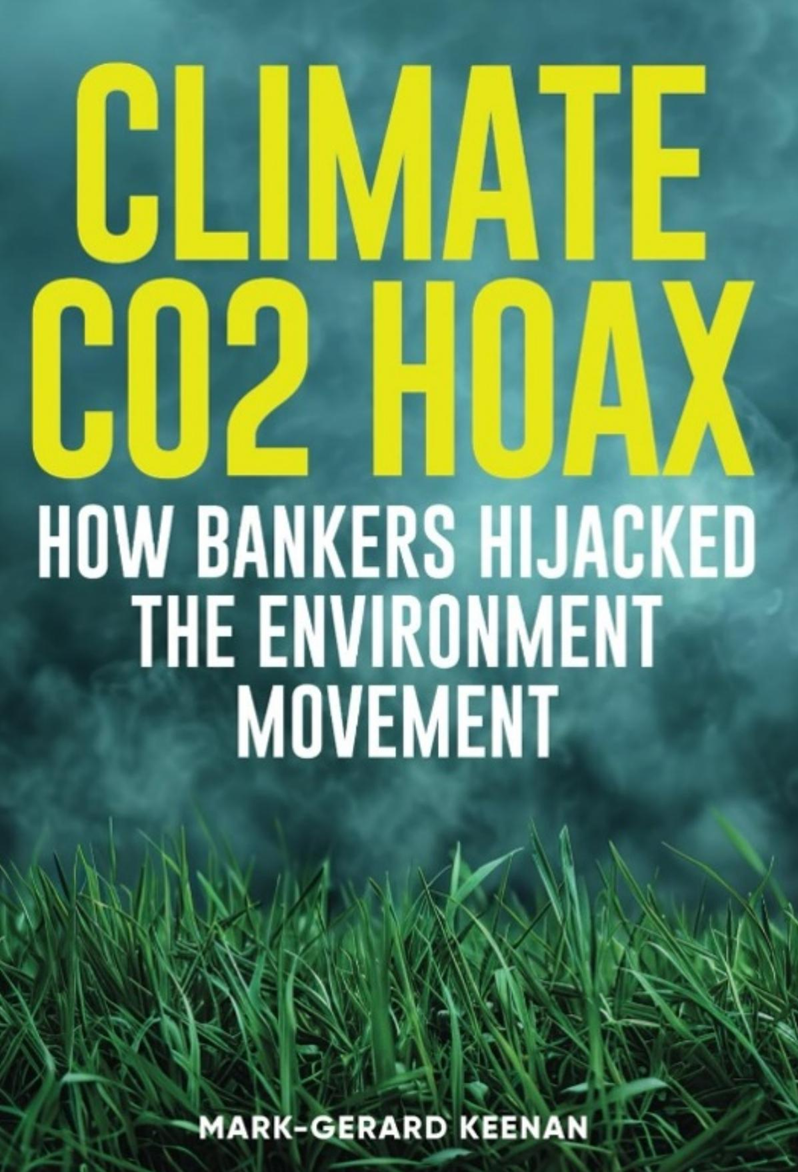
In my book Climate CO₂ Hoax – How Bankers Hijacked the Environmental Movement, I detail how the 1992 UN Earth Summit in Rio marked the turning point — when financial elites effectively captured global environmental policy. Reports and whistleblower accounts later suggested that key policies adopted at the summit were drafted without open debate — policies that subordinated national sovereignty to global ‘sustainability’ goals.”

Net Zero: The Mirage of Green Energy

The world’s economies are being restructured around “net zero,” but the irony is glaring. Building the infrastructure for so-called “green energy” — from solar panels to EV batteries — requires massive fossil-fuel use and destructive rare-earth mining.

Electric cars rely on lithium and cobalt extracted through environmentally devastating processes. The energy required to mine and refine these materials often exceeds what the vehicles save over their lifetimes.

In Germany, the green energy transition has turned a once-stable, low-cost energy grid into one of the most expensive in the industrial world. In Ireland, plans to close the coal-fired Moneypoint power station were reversed in 2022 as the government quietly converted it to burn oil instead — an unspoken admission that “renewables” can’t power modern economies.

Silencing Dissent

In this new orthodoxy, questioning the narrative is treated as blasphemy. Scientists who deviate from the CO2 script face censorship, ostracism, and blacklisting. The term “denier” — borrowed from the lexicon of moral condemnation — equates disagreement with depravity, and scepticism with sin

Dr. Roger Pielke Jr. of the University of Colorado revealed how the IPCC relies on the RCP 8.5 model — one he described as “fantasy land,” completely detached from real-world data. Yet it remains the foundation of global policy and countless policy papers and media headlines.

When truth becomes heresy, science itself collapses.

The Moralization of Carbon

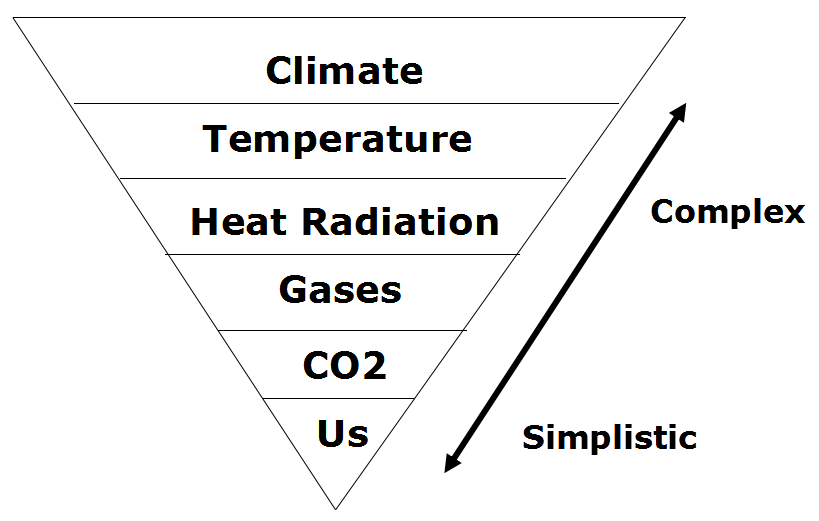
CO2 has been transformed from a molecule into a moral symbol — the embodiment of human guilt. Citizens are told to measure their “carbon footprint” as if it were a sin ledger, redeemable only through “green” consumption. Yet many of these same products — from electric cars to solar infrastructure — depend on the same industrial extraction that environmentalism once opposed.

This framing serves a purpose. Instead of questioning the powerful institutions that profit from pollution and its supposed cure, individuals are encouraged to internalize blame. The message: You are the problem — not the system. It’s an old strategy of control — rule through guilt rather than force.

The Politics of Fear

No ideology survives without fear. Apocalyptic imagery — burning forests, flooded cities, “ticking clocks” — has replaced empirical evidence as the main instrument of persuasion. Yet forest fires and floods are as old as the Earth itself.

Children now grow up believing the planet will collapse before they reach adulthood. Politicians invoke “existential threat” rhetoric to justify sweeping economic and social controls. What was once a challenge to power has become a tool of it.

The New Creed

Modern climate orthodoxy is not science but ideology — a sociopolitical construct — a fusion of fear, money, and power that rewards conformity and punishes doubt. Science must never serve politics. When data becomes dogma, truth dies — and with it, freedom. If we truly wish to “save the planet,” we must first save science itself.

Mark Keenan is a former scientist at the UK Department of Energy and Climate Change and a former Environmental Affairs Officer with United Nations Environment. 

Advance Briefing for COP30 Belém 2025


Overview from E Co. A summit at the crossroads

When the world gathers in Belém, Brazil, in November 2025 for COP30, it won’t be just another climate conference. It will be the first major summit after the Paris Agreement’s initial Global Stocktake at COP28, and the moment where climate ambition must decisively shift from words to delivery.

As many observers have begun to remark in the run-up to COP30, “Belém is where the climate community will be asked to prove that promises can become practice.”

What’s at stake at COP30

The Brazilian presidency has laid out a clear mandate: COP30 must focus on implementation, inclusion, and innovation. In practical terms, that means:

♦  A ‘Belém Package’ of outcomes across forests, finance, adaptation, just transition, and gender.
♦  The formal launch of the Tropical Forest Forever Facility (TFFF), a proposed $125 billion results-based finance mechanism to incentivise forest conservation.
♦  Progress on a roadmap to mobilize $1.3 trillion annually in climate finance by 2035, building on the ‘Baku to Belém’ finance commitments made at COP29.
♦  New modalities for inclusive governance, such as Brazil’s proposed ‘Global Mutirão’, bringing Indigenous peoples, local governments, and civil society closer to the heart of climate decision-making .

COP30 will not be judged by the number of new pledges it produces. As several analysts have argued, it will be remembered “for whether the world found the tools to finally deliver on them.”

The main challenges Brazil faces

While Brazil has bold ambitions for COP30, turning them into concrete outcomes will not be easy. The presidency faces several challenges:

  1. Domestic contradictions: Despite progress under President Lula, agribusiness and mining interests remain powerful drivers of deforestation. Balancing economic pressures with climate leadership will test political resolve.
  2. Financing the transition: Brazil is pushing for massive climate finance scaling, but securing commitments for the $1.3 trillion annual target will be politically contentious, especially given donor fatigue and fiscal constraints in developed economies.
  3. Geopolitical polarisation: COP30 is the first climate summit taking place without strong U.S. engagement, given Washington’s announced withdrawal from the Paris Agreement in 2026 . This leaves Brazil trying to mediate between the EU, China, BRICS, and vulnerable countries, all with diverging agendas.
  4. Institutional fragility: While Brazil champions new governance ideas like a UN Climate Change Council, consensus on reforming multilateral processes is difficult. Many countries remain wary of ceding more authority to new structures.
  5. Logistics and credibility: Hosting COP30 in Belém is symbolically powerful but practically challenging. The Amazonian city faces infrastructure constraints, raising concerns about logistics, inclusivity, and whether Brazil can deliver an event of this scale smoothly.

“Brazil has set the bar high. But if expectations outpace deliverables, COP30 risks being remembered as another missed opportunity.”

My Comments
Since there is a big push on climate funding, maybe they could get to the bottom of this.

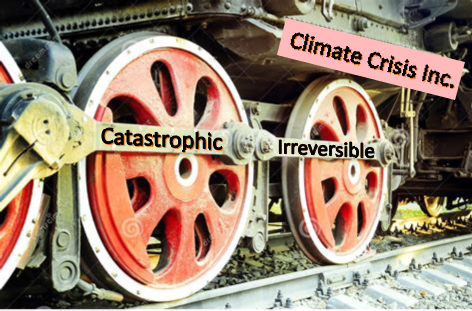
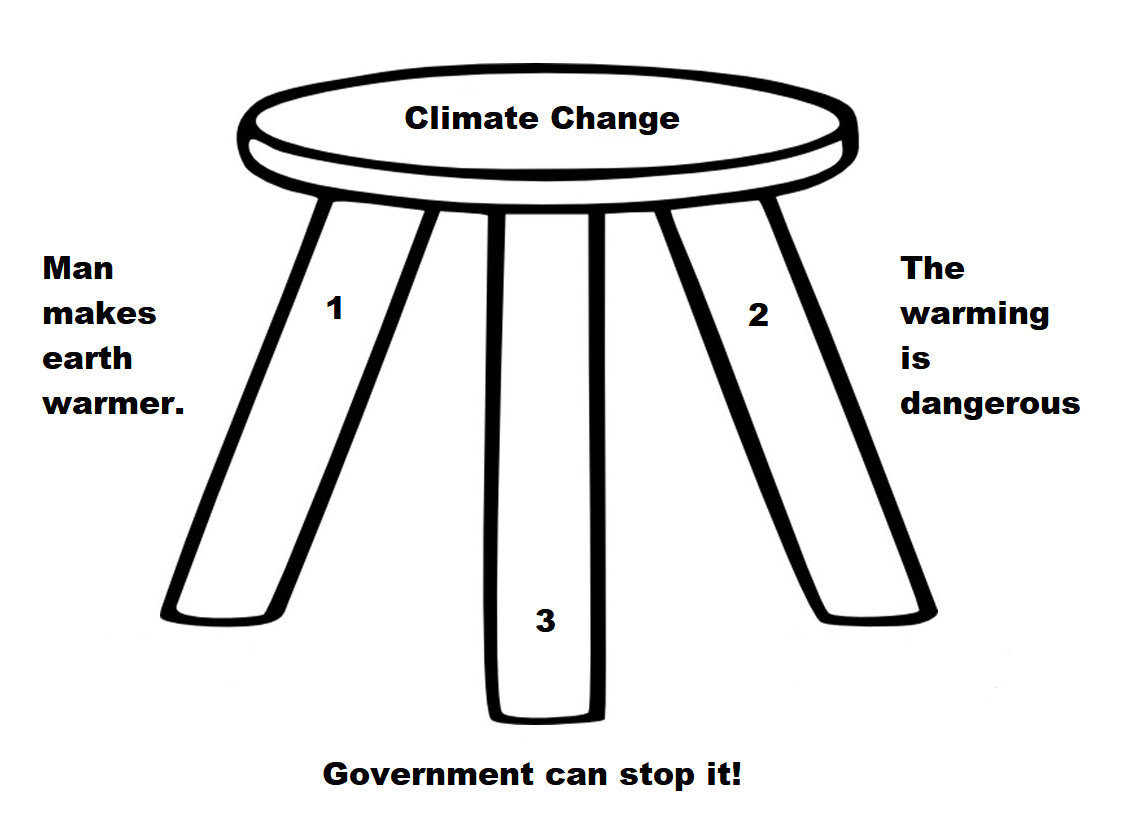
Maybe donors are put off by no one knowing who gets the money and for what it is spent.  And while they are investigating, how about understanding Energy Return on Investment (EROI): you know, the notion that an energy project is worth doing if the energy produced is greater than energy spent.  The poster at the top reminds of people dreaming of a world free of fossil fuels.

Why a COP Briefing?

Actually, climate hysteria is like a seasonal sickness.  Each year a contagion of anxiety and fear is created by disinformation going viral in both legacy and social media in the run up to the annual autumnal COP.  Since the climatists are especially desperate with the US outspokenly against the climate movement, we can expect the public will be hugely hosed with alarms over the next few weeks.  Before the distress signals go full tilt, individuals need to inoculate themselves against the false claims, in order to build some herd immunity against the nonsense the media will promulgate. This post is offered as a means to that end.

Media Climate Hype is a Cover Up

Back in 2015 in the run up to Paris COP, French mathematicians published a thorough critique of the raison d’etre of the whole crusade. They said:

Fighting Global Warming is Absurd, Costly and Pointless.

  • Absurd because of no reliable evidence that anything unusual is happening in our climate.
  • Costly because trillions of dollars are wasted on immature, inefficient technologies that serve only to make cheap, reliable energy expensive and intermittent.
  • Pointless because we do not control the weather anyway.

The prestigious Société de Calcul Mathématique (Society for Mathematical Calculation) issued a detailed 195-page White Paper presenting a blistering point-by-point critique of the key dogmas of global warming. The synopsis with links to the entire document is at COP Briefing for Realists

Even without attending to their documentation, you can tell they are right because all the media climate hype is concentrated against those three points.

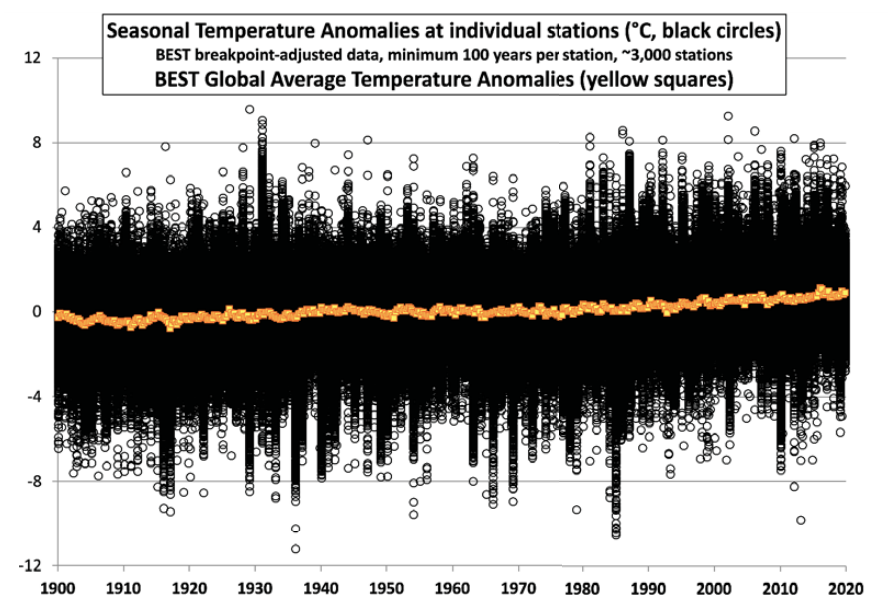
Finding: Nothing unusual is happening with our weather and climate.
Hype: Every metric or weather event is “unprecedented,” or “worse than we thought.”

Finding: Proposed solutions will cost many trillions of dollars for little effect or benefit.
Hype: Zero carbon will lead the world to do the right thing.  Anyway, the planet must be saved at any cost.

Finding: Nature operates without caring what humans do or think.
Hype: Any destructive natural event is blamed on humans burning fossil fuels.

How the Media Throws Up Flak to Defend False Suppositions

The Absurd Media:  Climate is Dangerous Today, Yesterday It was Ideal.

Billions of dollars have been spent researching any and all negative effects from a warming world: Everything from Acne to Zika virus.  A recent Climate Report repeats the usual litany of calamities to be feared and avoided by submitting to IPCC demands. The evidence does not support these claims. An example:

 It is scientifically established that human activities produce GHG emissions, which accumulate in the atmosphere and the oceans, resulting in warming of Earth’s surface and the oceans, acidification of the oceans, increased variability of climate, with a higher incidence of extreme weather events, and other changes in the climate.

Moreover, leading experts believe that there is already more than enough excess heat in the climate system to do severe damage and that 2C of warming would have very significant adverse effects, including resulting in multi-meter sea level rise.

Experts have observed an increased incidence of climate-related extreme weather events, including increased frequency and intensity of extreme heat and heavy precipitation events and more severe droughts and associated heatwaves. Experts have also observed an increased incidence of large forest fires; and reduced snowpack affecting water resources in the western U.S. The most recent National Climate Assessment projects these climate impacts will continue to worsen in the future as global temperatures increase.

Alarming Weather and Wildfires

But: Weather is not more extreme.


And Wildfires were worse in the past.
But: Sea Level Rise is not accelerating.

post-glacial_sea_level

Litany of Changes

Seven of the ten hottest years on record have occurred within the last decade; wildfires are at an all-time high, while Arctic Sea ice is rapidly diminishing.

We are seeing one-in-a-thousand-year floods with astonishing frequency.

When it rains really hard, it’s harder than ever.

We’re seeing glaciers melting, sea level rising.

The length and the intensity of heatwaves has gone up dramatically.

Plants and trees are flowering earlier in the year. Birds are moving polewards.

We’re seeing more intense storms.

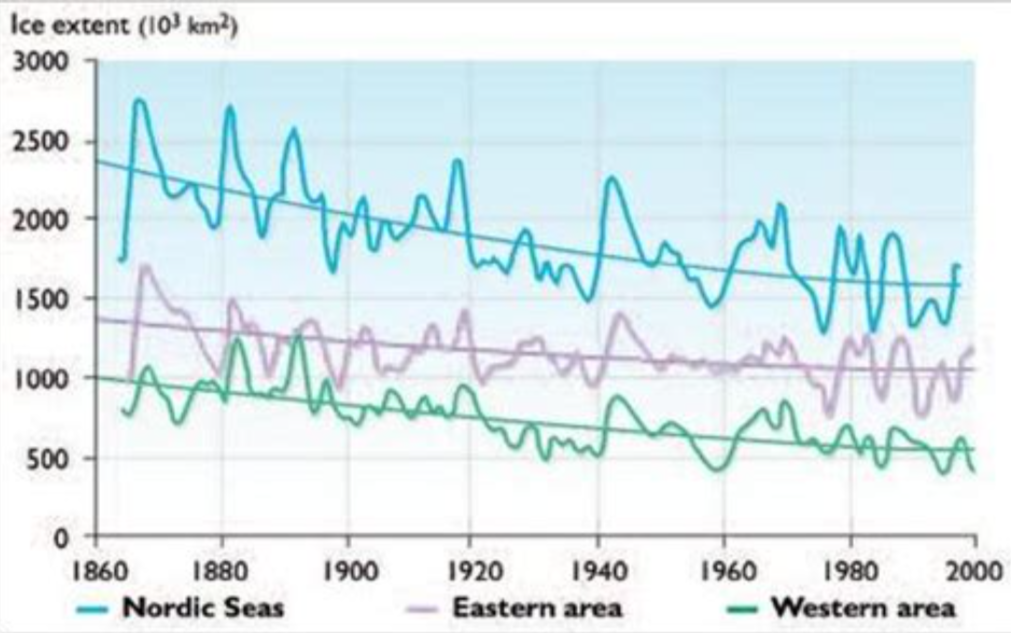
But: Arctic Ice has not declined since 2007.

But: All of these are within the range of past variability.In fact our climate is remarkably stable, compared to the range of daily temperatures during a year where I live.

And many aspects follow quasi-60 year cycles.
The Impractical Media:  Money is No Object in Saving the Planet.

Here it is blithely assumed that the UN can rule the seas to stop rising, heat waves to cease, and Arctic ice to grow (though why we would want that is debatable).  All this will be achieved by leaving fossil fuels in the ground and powering civilization with windmills and solar panels.  While admitting that our way of life depends on fossil fuels, they ignore the inadequacy of renewable energy sources at their present immaturity.

An Example:
The choice between incurring manageable costs now and the incalculable, perhaps even irreparable, burden Youth Plaintiffs and Affected Children will face if Defendants fail to rapidly transition to a non-fossil fuel economy is clear. While the full costs of the climate damages that would result from maintaining a fossil fuel-based economy may be incalculable, there is already ample evidence concerning the lower bound of such costs, and with these minimum estimates, it is already clear that the cost of transitioning to a low/no carbon economy are far less than the benefits of such a transition. No rational calculus could come to an alternative conclusion. Defendants must act with all deliberate speed and immediately cease the subsidization of fossil fuels and any new fossil fuel projects, and implement policies to rapidly transition the U.S. economy away from fossil fuels.

But CO2 relation to Temperature is Inconsistent.

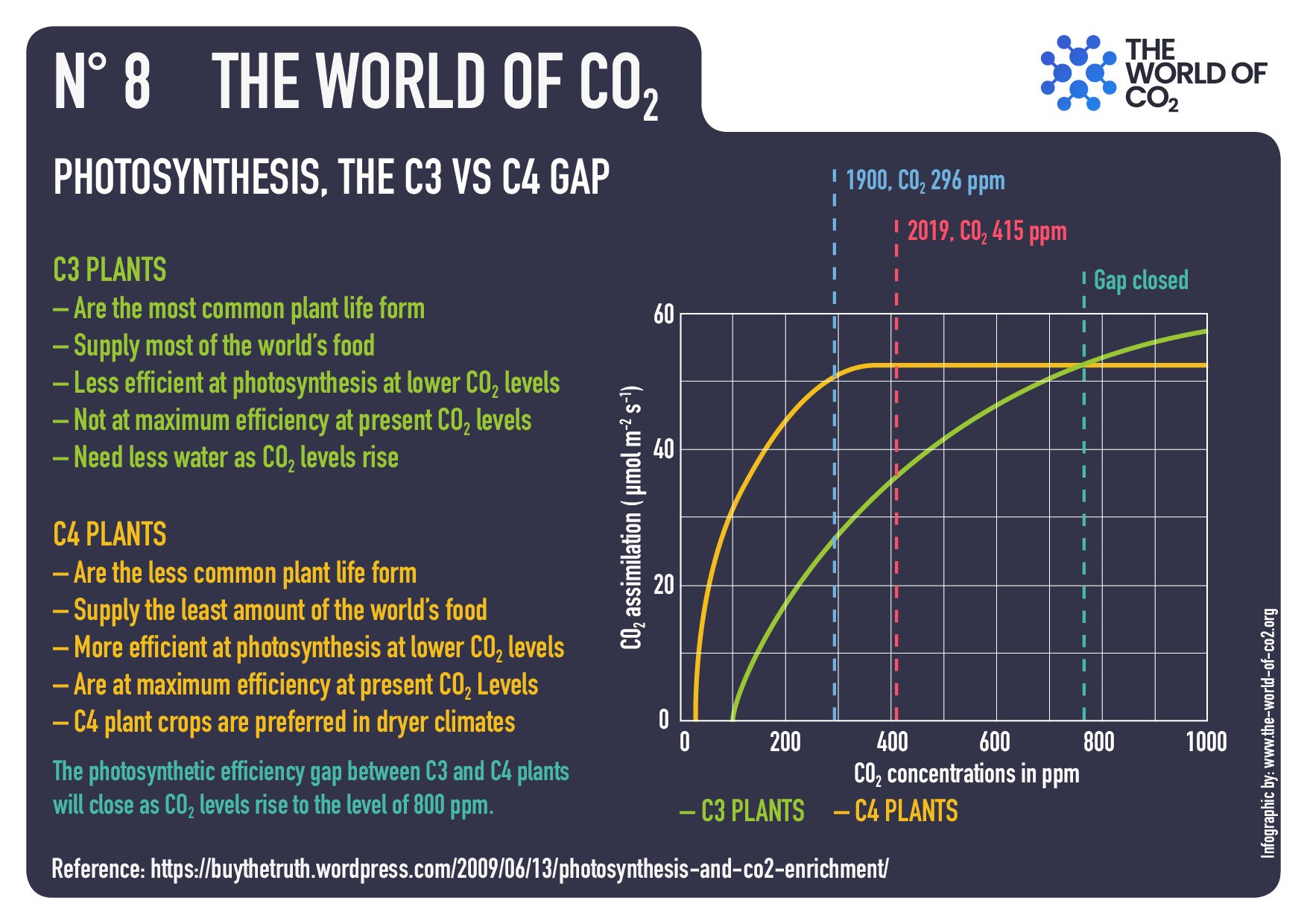
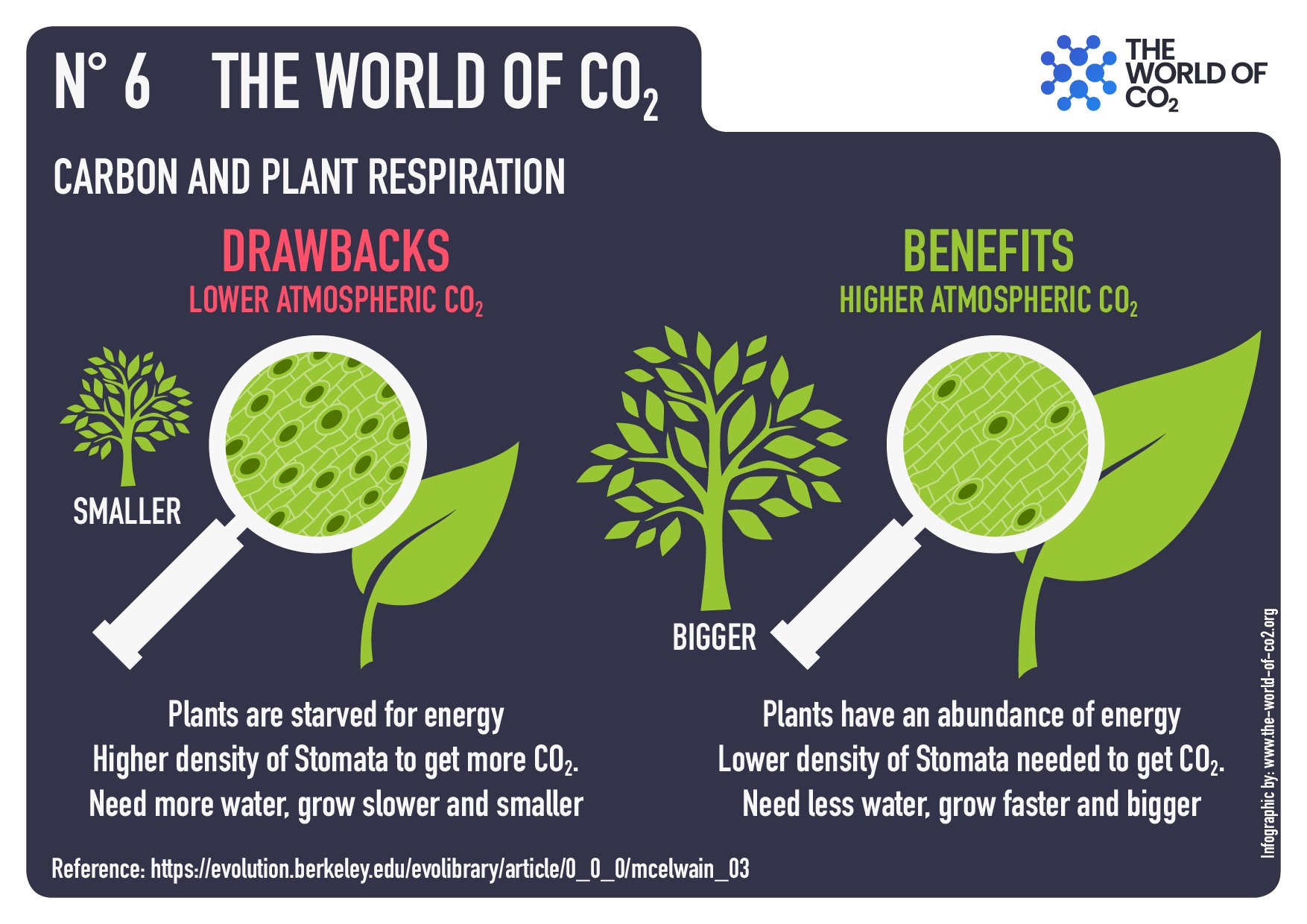
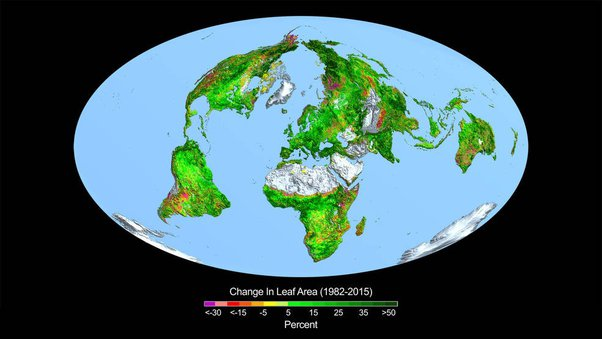
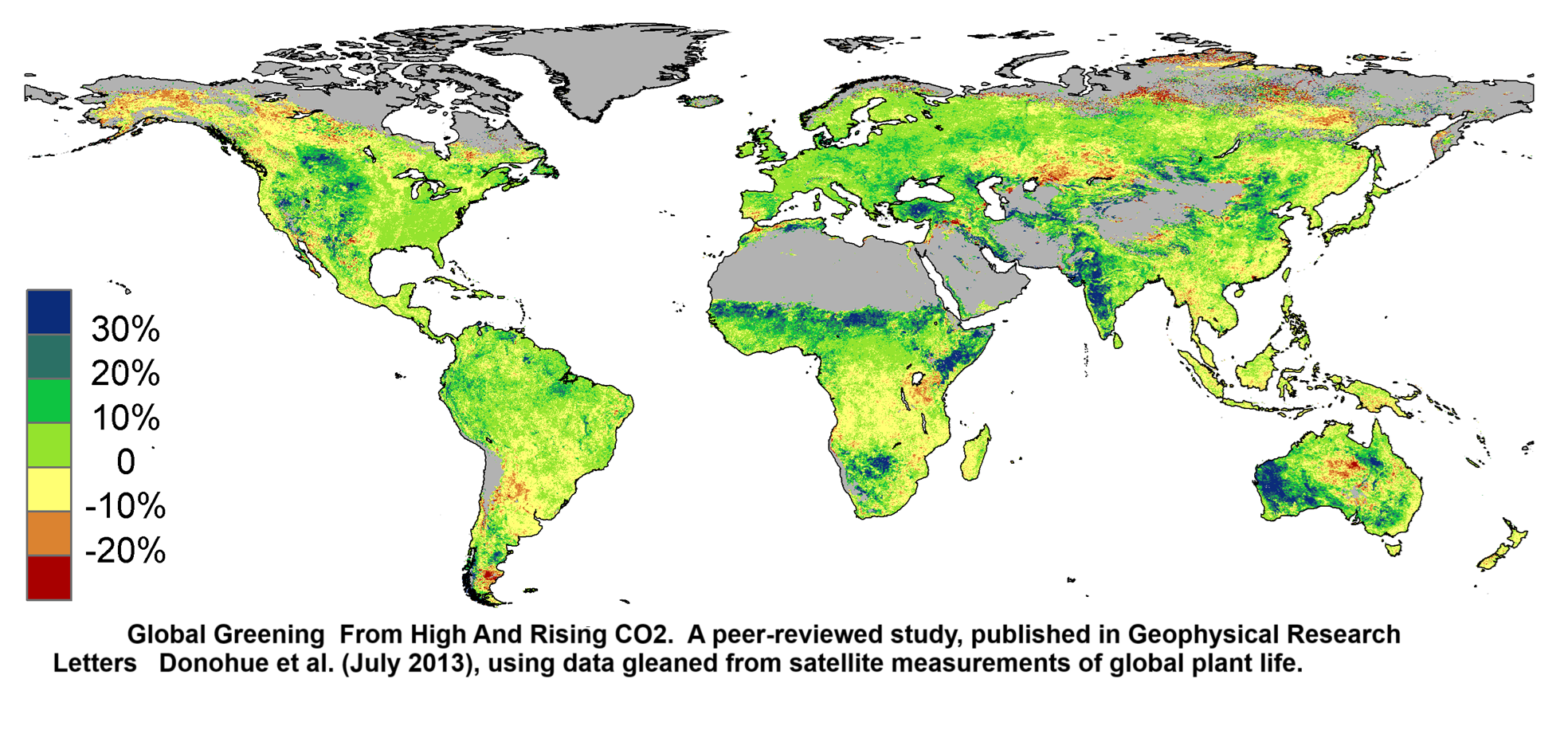
But: The planet is greener because of rising CO2.

But: Modern nations (G20) depend on fossil fuels for nearly 90% of their energy.

But: Renewables are not ready for prime time.

People need to know that adding renewables to an electrical grid presents both technical and economic challenges.  Experience shows that adding intermittent power more than 10% of the baseload makes precarious the reliability of the supply.  South Australia is demonstrating this with a series of blackouts when the grid cannot be balanced.  Germany got to a higher % by dumping its excess renewable generation onto neighboring countries until the EU finally woke up and stopped them. Texas got up to 29% by dumping onto neighboring states, and some like Georgia are having problems.

But more dangerous is the way renewables destroy the economics of electrical power.  Seasoned energy analyst Gail Tverberg writes:

In fact, I have come to the rather astounding conclusion that even if wind turbines and solar PV could be built at zero cost, it would not make sense to continue to add them to the electric grid in the absence of very much better and cheaper electricity storage than we have today. There are too many costs outside building the devices themselves. It is these secondary costs that are problematic. Also, the presence of intermittent electricity disrupts competitive prices, leading to electricity prices that are far too low for other electricity providers, including those providing electricity using nuclear or natural gas. The tiny contribution of wind and solar to grid electricity cannot make up for the loss of more traditional electricity sources due to low prices.

These issues are discussed in more detail in the post Climateers Tilting at Windmills

The Irrational Media:  Whatever Happens in Nature is Our Fault.

An Example:

Other potential examples include agricultural losses. Whether or not insurance
reimburses farmers for their crops, there can be food shortages that lead to higher food
prices (that will be borne by consumers, that is, Youth Plaintiffs and Affected Children).
There is a further risk that as our climate and land use pattern changes, disease vectors
may also move (e.g., diseases formerly only in tropical climates move northward).36 This
could lead to material increases in public health costs

But: Actual climate zones are local and regional in scope, and they show little boundary change.

But: Ice cores show that it was warmer in the past, not due to humans.

The hype is produced by computer programs designed to frighten and distract children and the uninformed.  For example, there was mention above of “multi-meter” sea level rise.  It is all done with computer models.  For example, below is San Francisco.  More at USCS Warnings of Coastal Floodings

In addition, there is no mention that GCMs projections are running about twice as hot as observations.

Omitted is the fact GCMs correctly replicate tropospheric temperature observations only when CO2 warming is turned off.

Figure 5. Simplification of IPCC AR5 shown above in Fig. 4. The colored lines represent the range of results for the models and observations. The trends here represent trends at different levels of the tropical atmosphere from the surface up to 50,000 ft. The gray lines are the bounds for the range of observations, the blue for the range of IPCC model results without extra GHGs and the red for IPCC model results with extra GHGs.The key point displayed is the lack of overlap between the GHG model results (red) and the observations (gray). The nonGHG model runs (blue) overlap the observations almost completely.

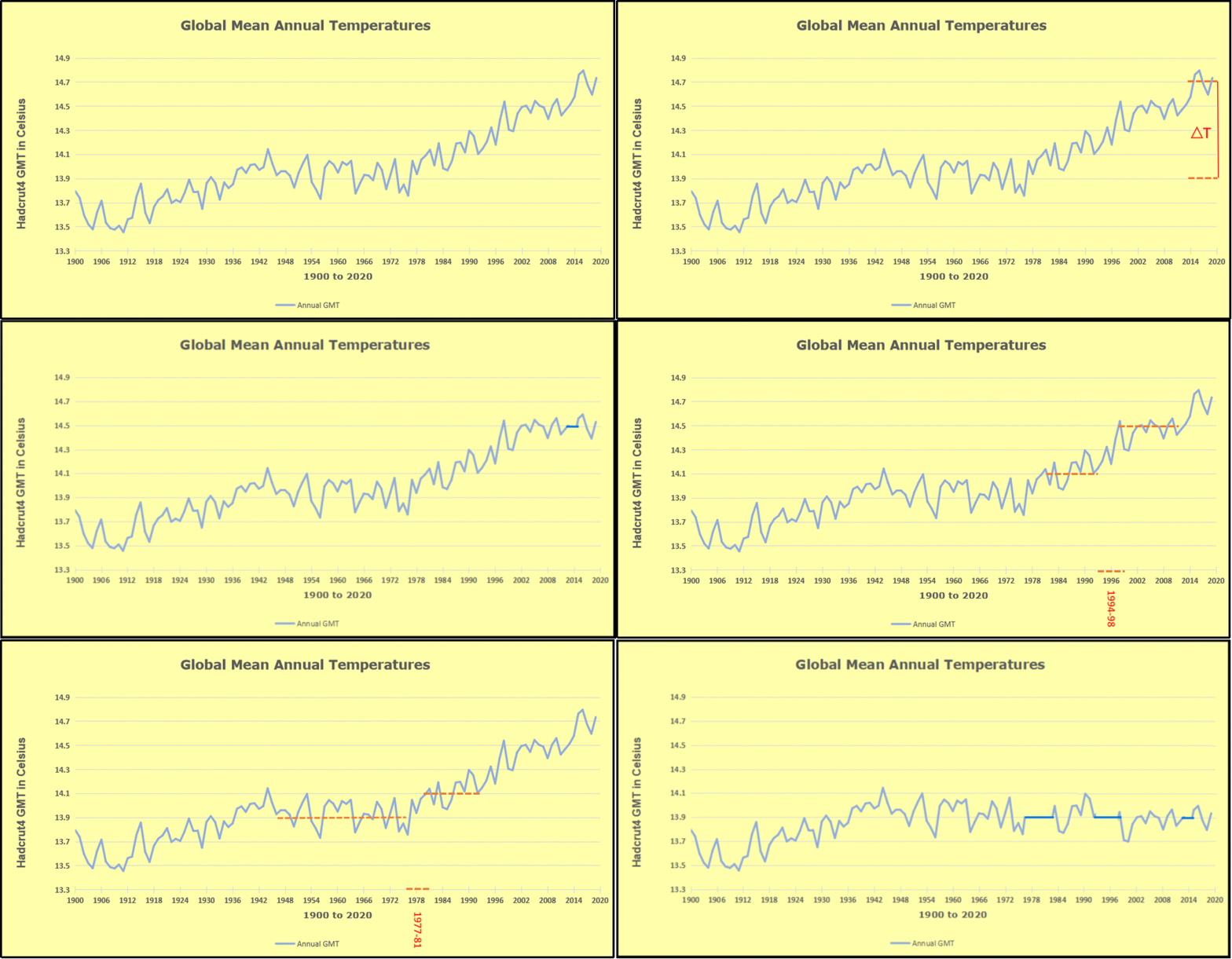
In the effort to proclaim scientific certainty, neither the media nor IPCC discuss the lack of warming since the 1998 El Nino, despite two additional El Ninos in 2010 and 2016, plus an unexplained spike in 2023-24, now cooling off.

Further they exclude comparisons between fossil fuel consumption and temperature changes. The legal methodology for discerning causation regarding work environments or medicine side effects insists that the correlation be strong and consistent over time, and there be no confounding additional factors. As long as there is another equally or more likely explanation for a set of facts, the claimed causation is unproven. Such is the null hypothesis in legal terms: Things happen for many reasons unless you can prove one reason is dominant.

Finally, advocates and IPCC are picking on the wrong molecule. The climate is controlled not by CO2 but by H20. Oceans make climate through the massive movement of energy involved in water’s phase changes from solid to liquid to gas and back again. From those heat transfers come all that we call weather and climate: Clouds, Snow, Rain, Winds, and Storms.

Esteemed climate scientist Richard Lindzen ended a very fine recent presentation with this description of the climate system:

I haven’t spent much time on the details of the science, but there is one thing that should spark skepticism in any intelligent reader. The system we are looking at consists in two turbulent fluids interacting with each other. They are on a rotating planet that is differentially heated by the sun. A vital constituent of the atmospheric component is water in the liquid, solid and vapor phases, and the changes in phase have vast energetic ramifications. The energy budget of this system involves the absorption and reemission of about 200 watts per square meterDoubling CO2 involves a 2% perturbation to this budget. So do minor changes in clouds and other features, and such changes are common. In this complex multifactor system, what is the likelihood of the climate (which, itself, consists in many variables and not just globally averaged temperature anomaly) is controlled by this 2% perturbation in a single variable? Believing this is pretty close to believing in magic. Instead, you are told that it is believing in ‘science.’ Such a claim should be a tip-off that something is amiss. After all, science is a mode of inquiry rather than a belief structure.

Summary:  From this we learn three things:

Climate warms and cools without any help from humans.
Warming is good and cooling is bad.
The hypothetical warming from CO2 would be a good thing.



Expectations Belém COP30 Nov. 2025


From November 10-21, 2025, Brazil will host COP30 in the Amazonian city of Belém, with tens of thousands of delegates, journalists, civil society, and industry representatives expected to attend the summit. The COP meeting serves as the main decision-making platform for the parties to the UNFCCC and convenes annually, unless determined otherwise. These conferences are designed to assess how well countries are meeting their climate goals and to track each party’s progress toward the overarching objectives of the Convention.  Source: COP30: What to Expect from Fiker Institute, based in Dubai.

What’s On the Agenda

COP30 must do the difficult job of restoring confidence in the process following the disappointment of COP29. In preparation for COP30, the summit’s President, Brazilian Ambassador André Corrêa do Lago, released a fourth open letter addressed to all delegates, laying out the Action Agenda for Brazil’s hosting of the conference. Rather than introducing new frameworks or making fresh promises, the Brazilian presidency has signaled a desire to focus on delivering on existing commitments, which amount to approximately 400 pledges made over the last few COPs. The letter identifies six thematic priorities:

♦  accelerating the transition in energy and transport systems;
♦  safeguarding biodiversity;
♦  overhauling agri-food systems;
♦  building climate-resilient cities;
♦  advancing human development; and
♦  unlocking finance and technology.  

What Does perplexity.ai Expect from COP30?

Q: About the IPCC COP30, what failures are likely to occur?

A: The most likely failures at IPCC COP30 will include insufficient financial commitments, lack of ambitious national climate targets, deadlocks in negotiations, and ineffective enforcement of agreed actions.

Persistent Finance Shortfalls

    • Developed countries have repeatedly failed to meet climate finance pledges, particularly the $100 billion per year commitment for developing nations.
    • Weak enforcement means finance promises often remain symbolic, undermining support for vulnerable nations.

Lack of Ambitious Climate Targets

    • Many countries are expected to delay or avoid submitting stronger climate plans (NDCs), threatening global efforts to limit warming to 1.5°C.
    • Negotiation deadlocks, such as disagreements on monitoring national progress, may stop meaningful advances.

Fragmented and Inadequate Adaptation

    • Adaptation efforts are often incremental, poorly funded, and not well-integrated into broader policy plans, leaving communities at risk.
    • Planning is prioritized over actual implementation, causing delays in urgent climate action.

Continued Fossil Fuel Dependence

    • Global fossil fuel use remains high, with little meaningful reduction, despite decades of negotiations.
    • Major emitting countries may continue to obstruct ambitious global decarbonization agreements.

Weak Enforcement and Accountability

    • With insufficient accountability or sanctions for non-compliance, many countries may not deliver on their climate promises, resulting in fragmented progress.

Inadequate Response to Deforestation and Food Systems

    • COPs have failed to effectively address tropical deforestation and emissions from food systems, both critical for climate adaptation and mitigation.
    • Lack of binding, global treaties against deforestation and food-system emissions is a major gap.

In summary, the most likely failures at COP30 will center on inadequate funding, weak and delayed national commitments, governance gaps, continued reliance on fossil fuels, and the lack of implementation for both mitigation and adaptation pledges.

Q: How could finance pledges fail again at COP30?

A: Finance pledges at COP30 could fail again due to several recurring issues: vague commitments, lack of accountability, limited transparency, under-developed reporting mechanisms, geopolitical tensions, and insufficient mobilization of private capital.

Vague and Non-Binding Commitments

    • Previous COP promises (like the $100 billion annual goal) were not legally enforceable, allowing donor nations to fall short without consequence.
    • Language in COP30 agreements may again lack concrete deadlines, binding obligations, or penalty mechanisms.

Ineffective Accountability and Transparency

    • Tracking finance flows—especially from private sources or indirect support—is technically complex and prone to inconsistent or optimistic reporting.
    • Transparency protocols, such as biennial reports, will not come into effect until 2028, meaning interim pledges may remain unverifiable or inflated.

Geopolitical and Economic Constraints

    • High debt burdens and tough capital markets in both donor and developing countries could limit new investments or redirect funds away from climate action.
    • International tensions, recession fears, or shifts in political priorities may reduce the willingness of major economies to contribute robustly.

Inadequate Mobilization of Private Sector Capital

    • COP30’s ambitious $1.3 trillion annual finance goal relies on mobilizing private investment, but there is chronic uncertainty in how private money will be counted, standardized, and guaranteed for climate impact.
    • Public sector funding alone is insufficient, and incentives for private sector participation remain weak or poorly designed.

Delayed Implementation of New Strategies

    • Key reports and strategies for unlocking climate finance (such as the “Baku to Belém Roadmap”) may not translate into immediate action, leading to a gap between pledges and real monetary flows.
    • Developing countries face challenges in preparing robust project pipelines, which delays the actual disbursement of pledged funds.

In summary, finance pledges at COP30 are at high risk of failing due to weak enforcement, slow implementation of transparency tools, geopolitical uncertainty, untested reliance on private investment, and past tendencies to over-promise and under-deliver.

Background COP Briefing Post

Nine years ago French Mathematicians spoke out prior to COP21 in Paris, and their words provide a rational briefing for COP30 beginning Belém this November. In a nutshell:

Fighting Global Warming is Absurd, Costly and Pointless.
  • Absurd because of no reliable evidence that anything unusual is happening in our climate.
  • Costly because trillions of dollars are wasted on immature, inefficient technologies that serve only to make cheap, reliable energy expensive and intermittent.
  • Pointless because we do not control the weather anyway.

The prestigious Société de Calcul Mathématique (Society for Mathematical Calculation) issued a detailed 195-page White Paper that presents a blistering point-by-point critique of the key dogmas of global warming. The synopsis is blunt and extremely well documented.  Here are extracts from the opening statements of the first three chapters of the SCM White Paper with my bolds and images.

Sisyphus at work.

Chapter 1: The crusade is absurd
There is not a single fact, figure or observation that leads us to conclude that the world‘s climate is in any way ‘disturbed.’ It is variable, as it has always been, but rather less so now than during certain periods or geological eras. Modern methods are far from being able to accurately measure the planet‘s global temperature even today, so measurements made 50 or 100 years ago are even less reliable. Concentrations of CO2 vary, as they always have done; the figures that are being released are biased and dishonest. Rising sea levels are a normal phenomenon linked to upthrust buoyancy; they are nothing to do with so-called global warming. As for extreme weather events — they are no more frequent now than they have been in the past. We ourselves have processed the raw data on hurricanes….

Chapter 2: The crusade is costly
Direct aid for industries that are completely unviable (such as photovoltaics and wind turbines) but presented as ‘virtuous’ runs into billions of euros, according to recent reports published by the Cour des Comptes (French Audit Office) in 2013. But the highest cost lies in the principle of ‘energy saving,’ which is presented as especially virtuous. Since no civilization can develop when it is saving energy, ours has stopped developing: France now has more than three million people unemployed — it is the price we have to pay for our virtue….

Chapter 3: The crusade is pointless
Human beings cannot, in any event, change the climate. If we in France were to stop all industrial activity (let’s not talk about our intellectual activity, which ceased long ago), if we were to eradicate all trace of animal life, the composition of the atmosphere would not alter in any measurable, perceptible way. To explain this, let us make a comparison with the rotation of the planet: it is slowing down. To address that, we might be tempted to ask the entire population of China to run in an easterly direction. But, no matter how big China and its population are, this would have no measurable impact on the Earth‘s rotation.

cg565e788a82606

Full text in pdf format is available in English at link below:

The battle against global warming: an absurd, costly and pointless crusade
White Paper drawn up by the Société de Calcul Mathématique SA
(Mathematical Modelling Company, Corp.)

societe-de-calcul-mathematique-logo-485x174-1

A Second report was published in 2016 entitled: Global Warming and Employment, which analyzes in depth the economic destruction from ill-advised climate change policies.

The two principal themes are that jobs are disappearing and that the destructive forces are embedded in our societies.

Jobs are Disappearing discusses issues such as:

The State is incapable of devising and implementing an industrial policy.

The fundamental absurdity of the concept of sustainable development

Biofuels an especially absurd policy leading to ridiculous taxes and job losses.

EU policy to reduce greenhouse gas emissions by 40% drives jobs elsewhere while being pointless: the planet has never asked for it, is completely unaware of it, and will never notice it!

The War against the Car and Road Maintenance undercuts economic mobility while destroying transportation sector jobs.

Solar and wind energy are weak, diffuse, and inconsistent, inadequate to power modern civilization.

Food production activities are attacked as being “bad for the planet.”

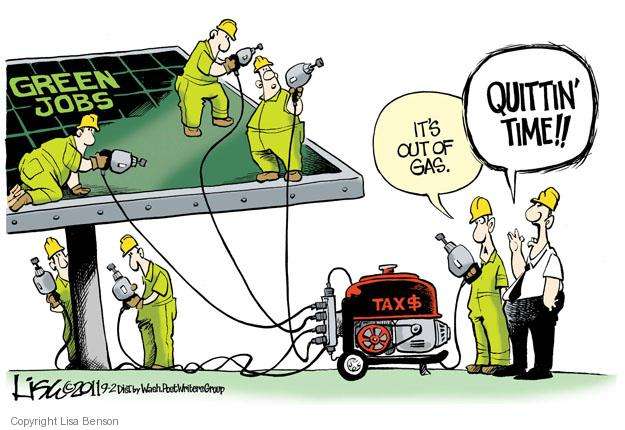
So-called Green jobs are entirely financed by subsidies.

The Brutalizing Whip discusses the damages to public finances and to social wealth and well-being, including these topics:

Taxes have never been so high

The Government is borrowing more and more

Dilapidated infrastructure

Instead of job creation, Relocations and Losses

The wastefulness associated with the new forms of energy

Return to the economy of an underdeveloped country

What is our predicament?
Four Horsemen are bringing down our societies:

  • The Ministry of Ecology (climate and environment);
  • Journalists;
  • Scientists;
  • Corporation Environmentalist Departments.

Steps required to recover from this demise:

  • Go back to the basic rules of research.
  • Go back to the basic rules of law
  • Do not trust international organizations
  • Leave the planet alone
  • Beware of any premature optimism
Conclusion

Climate lemmings

The real question is this: how have policymakers managed to make such absurd decisions, to blinker themselves to such a degree, when so many means of scientific investigation are available? The answer is simple: as soon as something is seen as being green, as being good for the planet, all discussion comes to an end and any scientific analysis becomes pointless or counterproductive. The policymakers will not listen to anyone or anything; they take all sorts of hasty, contradictory, damaging and absurd decisions. When will they finally be held to account?


Footnote:

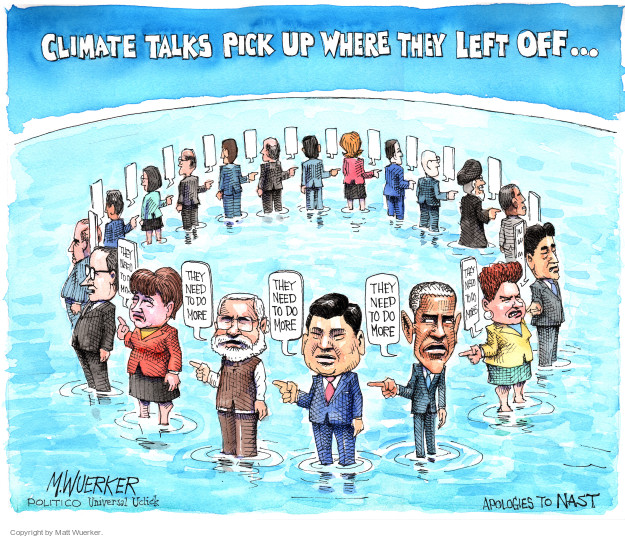
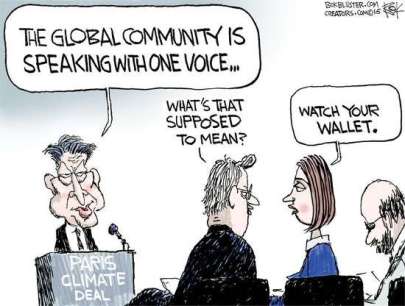
The above cartoon image of climate talks includes water rising over politicians’ feet.  But actual observations made in Fiji (presiding over 2017 talks in Bonn) show sea levels are stable (link below).

Fear Not For Fiji

In 2016 SCM issued a report Global Temperatures Available data and critical analysis

It is a valuable description of the temperature metrics and issues regarding climate analysis.   They conclude:

None of the information on global temperatures is of any scientific value, and it should not
be used as a basis for any policy decisions. It is perfectly clear that:

  • there are far too few temperature sensors to give us a picture of the planet’s temperature;
  • we do not know what such a temperature might mean because nobody has given it
    any specific physical significance;
  • the data have been subject to much dissimulation and manipulation. There is a
    clear will not to mention anything that might be reassuring, and to highlight things
    that are presented as worrying;
  • despite all this, direct use of the available figures does not indicate any genuine
    trend towards global warming!

It’s Better to be Outside Paris Accord

Chris Johnson writes at Real Clear Energy to explain Trump’s Withdrawal From the Paris Agreement Won’t Hurt the Climate.  Excerpts in italics with my bolds and added images.

President Donald Trump withdrew from the Paris Agreement. Cue the leftwing meltdown. Though everyone knew the withdrawal was coming, the left and the “international community” are still decrying America’s alleged abdication of leadership on climate.
But toothless agreements window dressed with international
summits and photo ops are not the same as leadership.
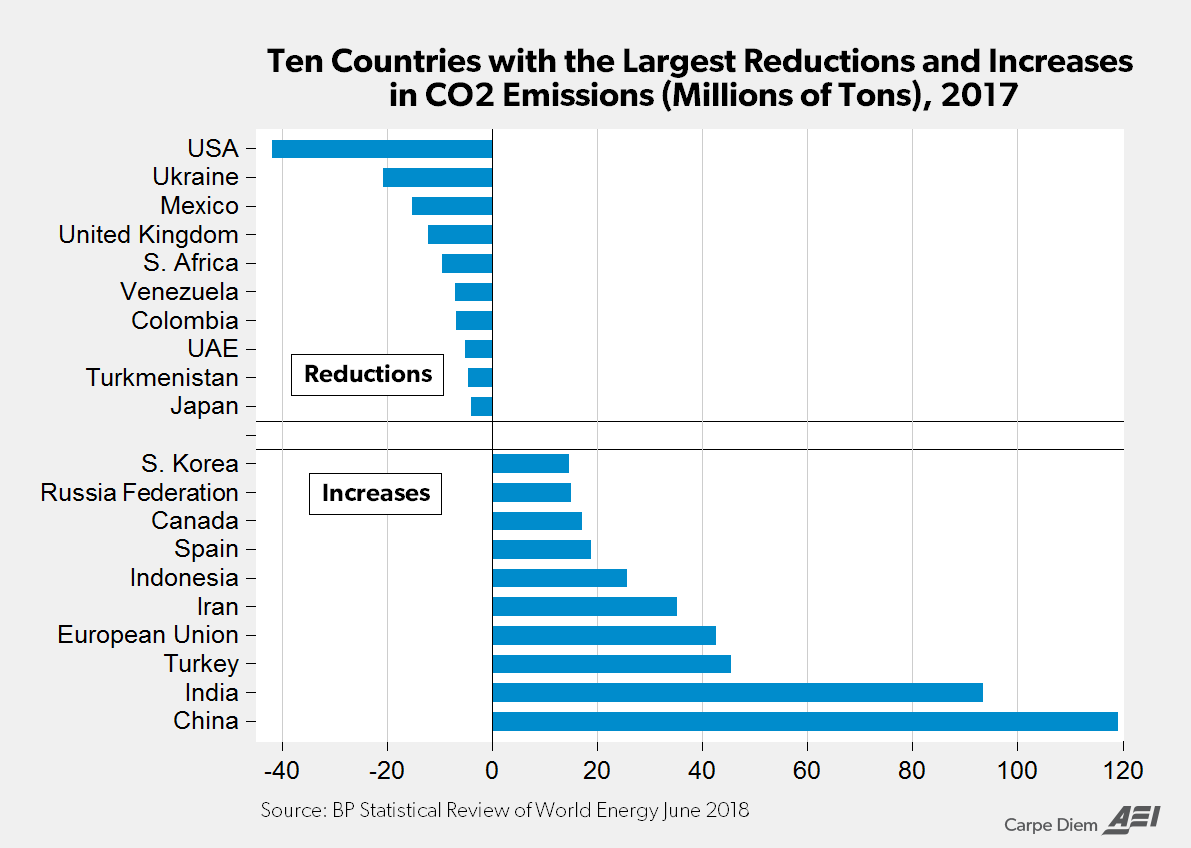
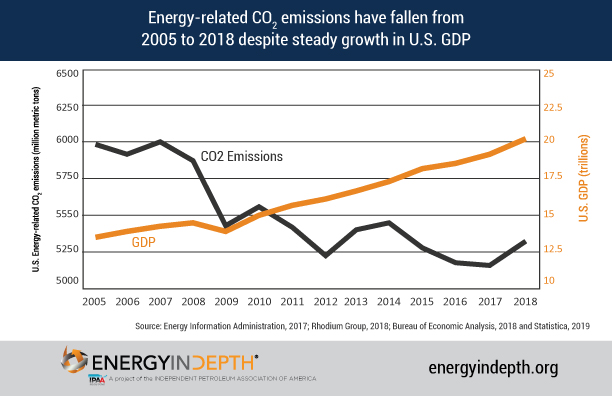
The truth is America has led the world in reducing emissions for years not because of the Paris Agreement, but because innovation and the free market facilitate the deployment of cheaper and cleaner energy.  Let’s review the record.
In recent decades, America has achieved unprecedented — and unexpected — energy production thanks to fracking and horizontal drilling. Since the early 2000s when these twin technologies began to be deployed much more expansively, U.S. natural gas production has more than doubled. By 2016, hydraulically fractured gas wells accessed through horizontal drilling accounted for nearly 70% of all oil and natural gas wells.
While the left may clutch its pearls at the increased production of a fossil fuel like natural gas, this clean energy source has been a main driver of U.S. emissions reductions. Over the past 15 years when America has massively increased natural gas output, the U.S. reduced carbon emissions more than any other country. We can see this year by year.
For example, from 2022 to 2023, America offset dirtier coal energy generation with natural gas. As coal declined by 121.9 terawatt hours of electric generation over that time, natural gas increased by 118.9 terawatt hours. At the same time, U.S. greenhouse gas emissions declined 1.9%. Notably, 80% of the U.S. carbon emissions reductions were driven by the electric power sector — precisely where natural gas has an outsized impact.
Notice what didn’t cause those emissions reductions? The Paris Agreement.
The American energy sector — powered by innovation and good-old-fashioned free market economics — has been driving down carbon emissions cheaply and effectively before the Paris Agreement was a twinkle in climate activists’ eyes. And it will continue to reduce carbon emissions long after President Trump’s decision to withdraw.
The Paris Agreement is far from the panacea some activists claim it is.
It isn’t even a particularly effective tool to
rally nations toward greater climate success.
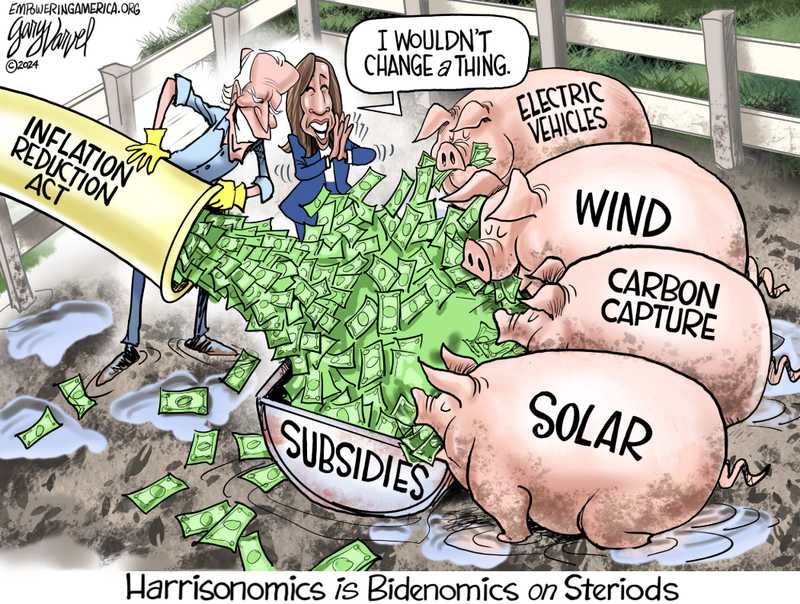
In the middle of the allegedly climate-conscious Biden administration, none of the world’s biggest emitters — America included — had reduced their emissions in accordance with the Paris goals. Apparently, the $1 trillion regulatory and subsidy regime erected by President Biden’s Inflation Reduction Act had little bang for the buck.
What Agreement supporters forget is that no number of high-profile international accords can make command-control tactics work — or instill other nations with the ambition to fulfill their empty promises.

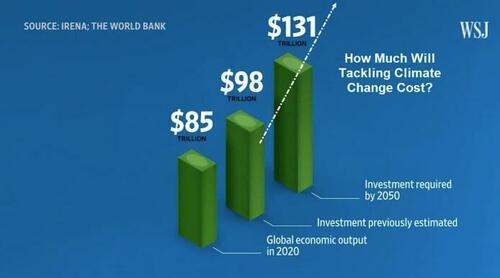
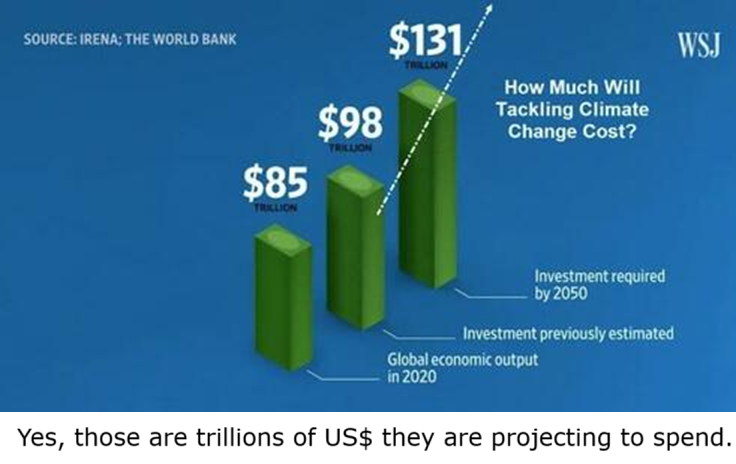
Yes, those are trillions of dollars they are projecting to spend.

The Paris Agreement is the definition of bureaucratic failure, conflating meetings, busyness, and lofty goals as success. Its only achievement is to make climate ideologues and green jetsetters feel good about themselves as they fly to international conferences.
It’s no wonder President Trump withdrew. Talk is cheap. What matters is success. On that metric, the Trump administration is set to actually achieve what Paris Agreement signatories only write on paper.
Trump entered office promising to deregulate the fossil fuel industry, increase permitting for natural gas extraction, approve the construction of energy facilities like natural gas export terminals, and re-establish American energy dominance.
By leaning into America’s carbon advantage and exporting clean American energy abroad, he will boost the U.S. economy, supplant dirty energy from nations like Russia and Venezuela with a clean American alternative, and lower emissions both at home and abroad, all without the jaw-dropping price tag of the failed Biden-era green agenda. We should combine these steps with efforts to actually hold the biggest polluters accountable (which are being discussed by President Trump’s cabinet). This approach would be the antithesis of the Paris Accords’ America-last strategy.
Of course, some are urging President Trump to go further and not just withdraw from the Paris Agreement, but also back out of the UN Framework Convention on Climate Change (UNFCCC). This may seem like an easy choice, seeing as the UNFCCC, like so many UN bodies, acts contrary to American interests. But that’s exactly why America must remain in the UNFCCC.
Climate treaties will be formed whether or not the U.S. is involved, and the UNFCCC will continue to operate as a forum for those negotiations. Staying in the UNFCCC costs America nothing while allowing Trump and his appointees to keep a seat at the table, hold the UN accountable, and counter any deal that would put America at a disadvantage. While the UNFCCC can be harmful, it’s only the Paris Agreement that’s impotent.
The breathless alarm over the withdrawal from the Paris Agreement is overwrought. When President Trump withdrew from the Paris Climate Accord during his first administration, America went on to cut carbon emissions to the lowest level in 25 years. Re-embracing the power of natural gas in his second term, he’ll do it again.
So instead of the UN and international climate activists judging the U.S., we should remind everyone that if you want to put climate first, you should actually put America first.
Chris Johnson is a GOP strategist who organizes the next generation of conservative leaders. He also serves as a senior advisor to the National Federation of College Republicans, focusing on energy issues.


Holes in IPCC Science Revealed

Graeme Weber reports from Australia on the history revealing multiple holes in IPCC claimed “settled science.” His paper is  IPCC – Miss/Diss information? shared with me by email.  Graeme is an earth scientist, retired consulting geologist and advocate for nuclear energy. His text is in italics with my bolds and added images.

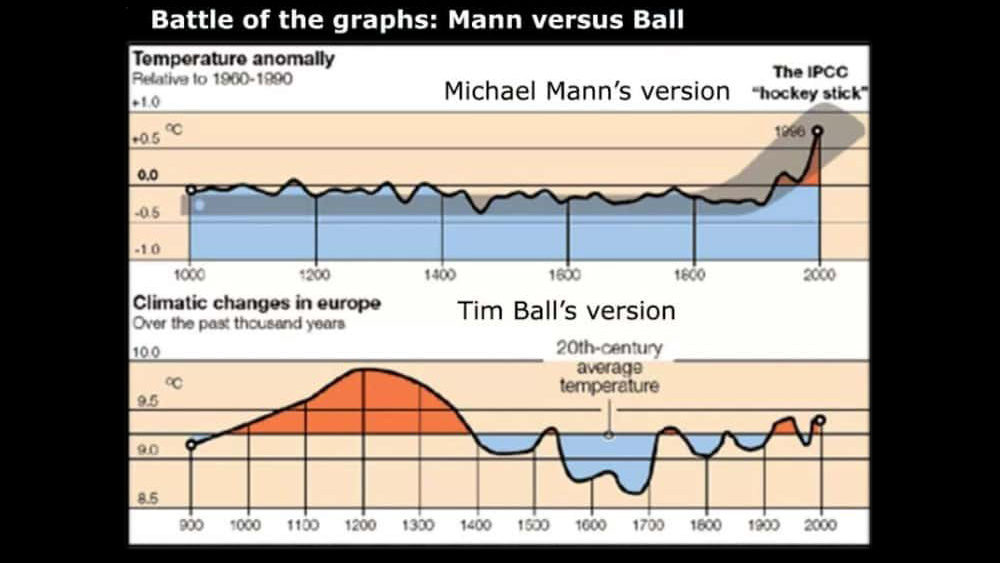
Several years ago, the cry from the IPCC (International Panel on Climate Change) was ‘the science is settled’. This should have been a ‘red flag’ to any scientists who know that science is never settled. This is especially so in such a complex system, as Mother Earth’s climate. It is now 32 years since the first IPCC Report was issued. Many claims in this and later IPCC reports have since been debunked especially the ‘Hockey Stick’ graph of Mann, Bradley and Hughes (1999) where Mann was finally taken to court to reveal his calculations that subsequently led to him losing a court case and the IPCC getting embarrassed, as monumental errors and manipulation of data was exposed.

Professor Tim Ball, who was sued by Michael Mann for defamation regarding comments he made about the integrity of the Hockey Stick Graph, succeeded in having the case thrown out and Mann ordered to pay costs. Mann had failed to comply with a court order that he produce his Hockey Stick Data! Supreme Court of British Columbia 2019

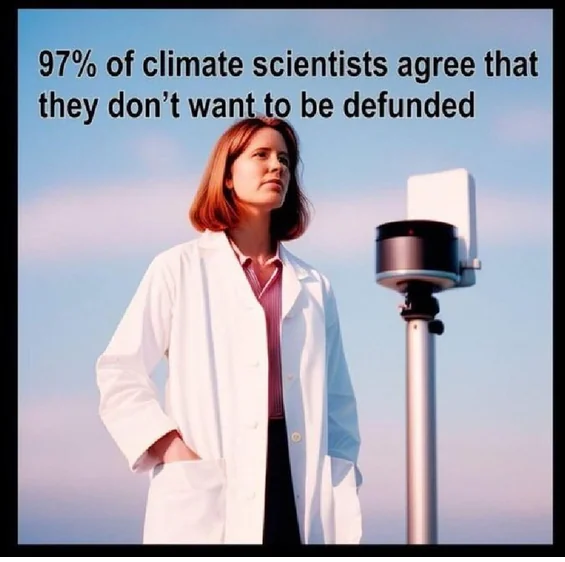
Another erroneous claim by the IPCC was that 97% of Scientists believed in Global Warming. How did they make this claim? It was based on a study  in the Proceedings of the National Academy of Sciences of the United States of America (2010) who reviewed publication and citation data for 1,372 climate researchers, 908 of whom had authored 20 or more publications on climate, and found that 97–98% of the climate researchers (the 908) most actively publishing in the field support the tenets of ACC (Anthropogenic Climate Change) outlined by the IPCC, and the relative climate expertise and scientific prominence of the researchers unconvinced of ACC are substantially below that of the convinced researchers. Well, how strange people who research in this field and rely on financial support believe in Global Warming!

A Consensus You Can Trust!

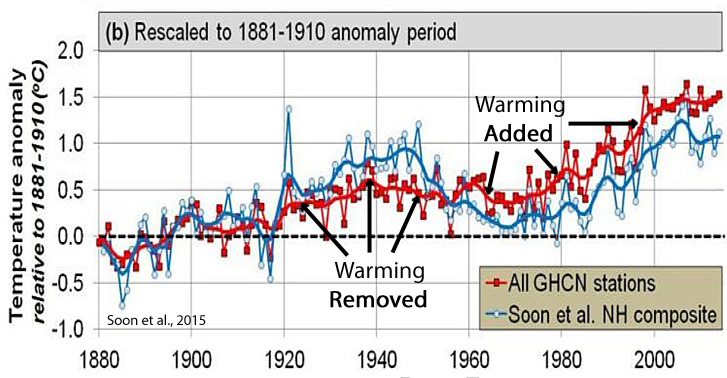
Another study by Dr Soon and Dr Michael Connolly and His son Dr. Ronan Connolly released in 2023 was on Rural and Urban temperature records in the Northern Hemisphere. This study is similar to articles reported by JoNova and Jennifer Marohasy in Australia on temperature measurement equipment and stations in Australia with encroaching buildings, air conditioners, changes to recording gear and BOM changing temperature records by outright manipulation and homogenisation. The most obvious one is changing from reading manually by a person at a set time each day to continuous recording machines every minute or so, so increasing the likelihood of higher daily temperatures. In many cases BOM (Australian Bureau of Meteorology) claimed significant warming trends by starting at a cool point rather than a warm point.

The BOM never mentions the extreme temperatures recorded throughout Australia in January 1896 nor the elevated temperature during the 1930’s decade culminating in 1939 Black Friday. In the days preceding these fires, the Victorian state capital, Melbourne, experienced some of its hottest temperatures on record at the time: 43.8 °C (110.8 °F) on 8 January and 44.7 °C (112.5 °F) on 10 January. On 13 January, the day of the fires, temperatures reached 45.6 °C (114.1 °F), which stood as the hottest day officially recorded in Melbourne for the next 70 years. Now BOM issue weather alerts when the temperature reaches 30 degrees!

The study by Soon et al clearly shows that temperature measuring stations are increasingly being influenced by solar radiation being absorbed by bitumen and concrete and released through the night. One of the most remarkable illustrations of this effect was an aerial thematic view of the City of Rome at 8.30am in the morning. Vapour trails of early aircraft take-offs are clearly visible. The airport is hot (usually site of temperature gauges) surrounding country is relatively cold

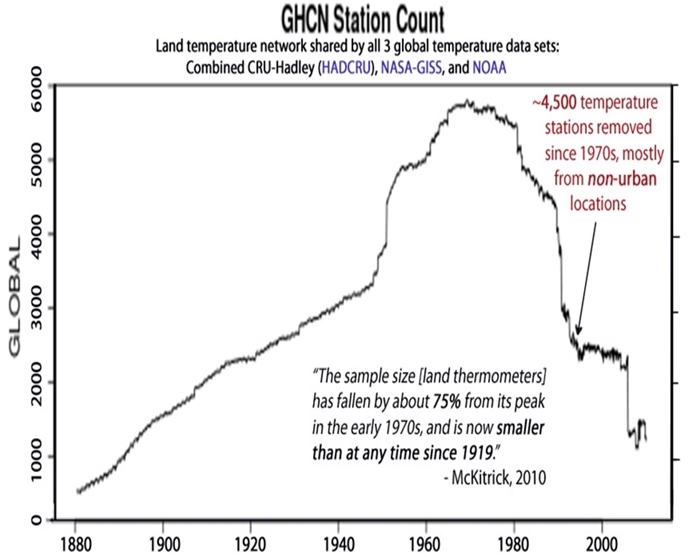
Another reveal over the last 30 years is the number of Land Temperature stations (LTS).  Total LTS in the Northern Hemisphere has declined from 5,000 to 2,000 stations but rural stations have declined from 500 to 200. This has been particularly relevant in the Northern Hemisphere where the most remote Artic stations (northern and coldest) have been closed. The product of this is the average temperature of these remote areas has risen. Mathematics 101. Soon et al have examined 4,500 temperature stations in China, USA the Artic and Ireland that show a warming trend of 0.89º C per Century in Urban areas whereas Rural Stations only show 0.55ºC per Century. This is a significant difference.

Another factor producing higher biased temperatures is the IPCC technique of ‘homogenisation’ where a particular area has all the temperature readings added together then divided by the number of stations. As is expected the number of urban stations read higher than rural ones thus increasing the overall temperature average. Taking the overall rural average the warming trend results in an increase of 0.9ºC since 1850.

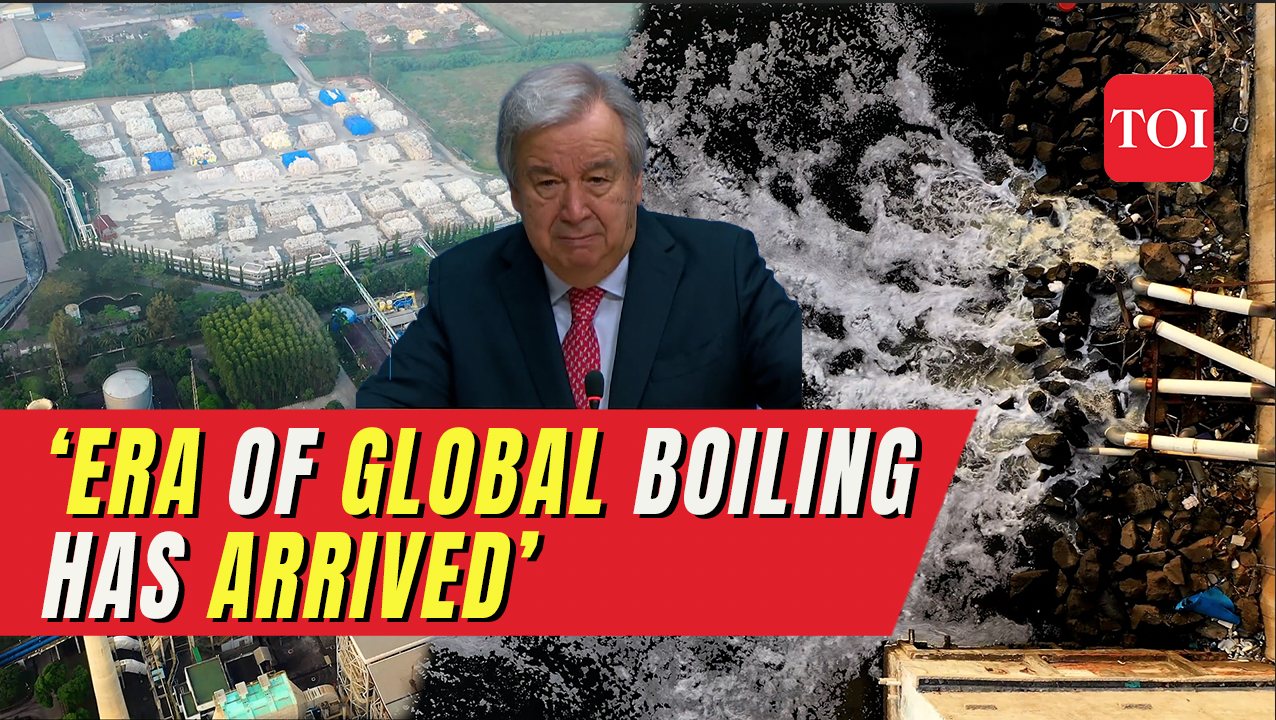
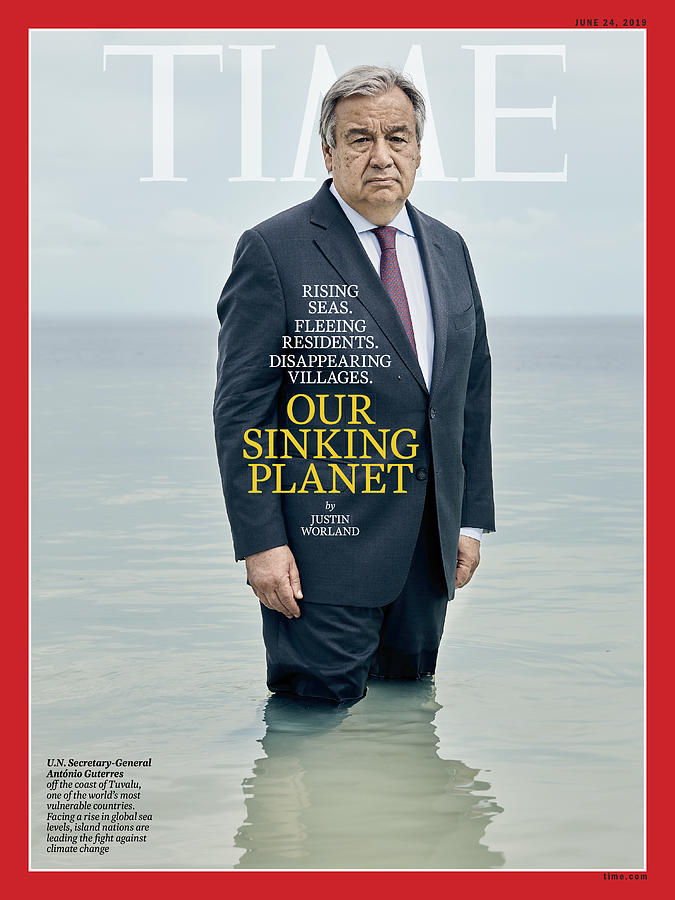
So, Antonio Guterres the UN Secretary General prognosis that the ‘World is boiling’ is wrong, stupid and farcical. Soon et al believe the warming is more likely due to Total Solar Radiance whereas the IPCC believe it is due to a trace gas CO2 a plant food. It is interesting to note that commercial greenhouses use about 1,000–1,300 ppm under ideal circumstances. A lower level (800–1,000 ppm) is recommended for raising seedlings (tomatoes, cucumbers and peppers) as well as for lettuce production. Currently the world CO2 sits at 423ppm.

Al Gore (former USA Vice Presidential candidate) has made numerous predictions in his film ‘Inconvenient Truth’ most if not all have proved false. His biggest claim was the Arctic Ocean will be ice free by 2013 or was that 2014 or even 2015! When this did not happen, the argument was that overall, the ice was drastically thinning. Last month October 2024 icebreakers were madly trying to extract ships in the northern passages some two weeks before expected, from Arctic ice closing in.

At the other end of our world in Antarctica numerous IPCC papers claimed that the West Antarctic Ice Sheet was about to, or already collapsing because of warmer waters were circulating caused by Climate change. However, a new study in 2017 found 91 new volcanic vents to add to the 47 volcanoes already known to exist under this ice sheet. As volcanic activity waxes and wanes ice melt will continue in this hot volcanic zone. Whether this ice sheet melts or not it is certainly more probable the effects are more controlled by volcanic activity rather than circulating waters. The IPPC reports also failed to acknowledge that ice buildup was occurring at other points in Antarctica.

Source: volcano foundation with glacier locations added

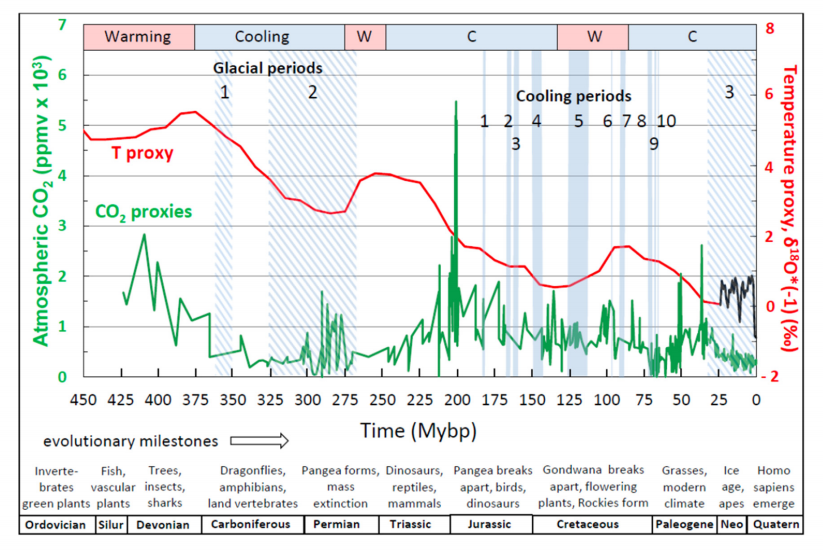
Is CO2 bad? One remarkable and observable thing is that trees and plants take in carbon dioxide through stomata in their leaves. Since plants first invaded continents (perhaps chasing higher concentrations of carbon dioxide) science has a very good record of the CO2 gas concentrations in the atmosphere. The larger the Stomata the lower the CO2 concentration.

Approximately 580 Ma years ago the concentration was just under 3000ppm. This was soon after a major ice age around 750Ma years ago. The concentration has been steadily falling, since apart from two very low CO2 events occurred around 430Ma and 280Ma and if at any stage the CO2 concentration had dropped below 150ppm then we would not be here as all plants would have died. Other scientific studies show there is a lag between periods when the Earth’s temperature increases and CO2 concentrations rise. Maybe just maybe, the Industrial Revolution saved the planet!

Other scientific papers are showing that the world climate has a natural buffering system. As temperatures rise evaporation increases over the oceans that cover 71% of the earth’s surface. Increased precipitation has a marked cooling effect and together with increased CO2 will lead to greater vegetation growth to feed the worlds increasing population. Desertification will likely decrease. Maybe Central Australia will bloom and make the central Australian Aboriginal communities wealthy.

A paper provided to the Court of Appeals, The Hague November 2023 by Richard Lindzen Professor of Earth, Atmospheric, and Planetary Sciences, Emeritus Massachusetts Institute of Technology, William Harper Professor of Physics, Emeritus Princeton University and Steven Koonin University Professor, New York University, Senior Fellow at the Hoover Institute wrote:

‘We are career physicists who have specialized in radiation physics, dynamic heat transfer and computer modelling for decades, subjects directly relevant to the global warming debate. Each of us has published over 200 peer-reviewed papers, many on the science of climate or closely related subjects. In our opinion, the District Court of The Hague findings that “dangerous” climate change and extreme weather are caused by CO2 emissions from fossil fuels are contradicted by the scientific method and only supported by the unscientific methods of government opinions, consensus, peer review, and cherry-picked or falsified data. Science demonstrates fossil fuels, and CO2 will not cause dangerous climate change. Rather, there will be disastrous consequences for people worldwide if fossil fuels and CO2 emissions are reduced to “net zero,” including mass starvation’.

What if the Net Zero fossil fuels and CO2 policy was in effect in 1750 and CO2 did not rise from 280 ppm to 420 ppm? There would be 21% less food worldwide. Therefore it can be concluded that the Earth’s surface temperature is rising but not at the rate the IPCC would have you believe. As Bjorg Lomborg is saying it is much better to prepare for this eventuality something we cannot change than try to reduce a trace gas that is essential for life.

I fear for those who have trusted governments like they did the Covid science. The false claims of Government about an approaching Armageddon causing an induced psychosis resulting in stunts paralysing normal economic industry. These stunts such as hanging from pylons or gluing to windows, throwing paint, disrupting parliament. Where will it all end? The destruction of our civilisation?


CO2 Not a Threat, But Greatly Benefits


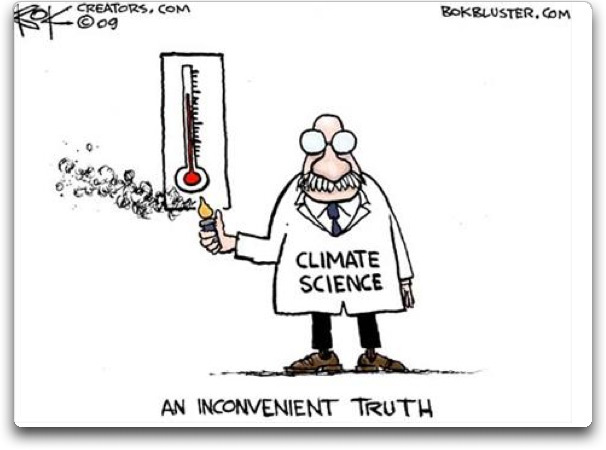
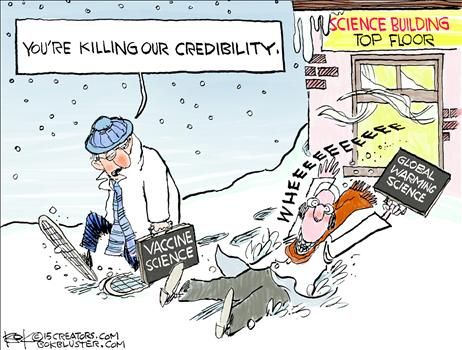
Beware false and misleading Cartoons.

First, a plain language scientific explanation is in this article: THE BENEFITS OF CO2 – PART 2: CO2 does not cause global warming.  By Teri Ciccone.  Excerpts in italics with my bolds.

THE BENEFITS OF CO2 – PART 2: CO2 does not cause global warming

Abstract: Climate alarmists, the press/media, and politicians say we must achieve net zero CO2 by 2050 to avoid catastrophic global warming. In reality, all humanity and all life on Earth benefit from the increased atmospheric CO2 and the slight temperature increase. In Part 1, we presented scientific arguments to show how increased CO2 and warmer temperatures benefit humanity and all life on Earth. In Part 2, we discuss why a growing number of independent scientists and engineers argue that CO2 does not cause any measurable global warming. Part 3 will present how and why increased CO2 does not cause extreme climate/weather conditions. in the concluding Part 4 we present recommendations for policymakers.

Introduction: In this study, we set out facts and scientific principles consistent with established laws of physics, chemistry, and thermodynamics to state that greenhouse gases (GHGs) and the greenhouse effect (GHE) do not measurably warm the Earth. The concept that it does is at best a 100-year-old myth. The absorption and re-emission of longwave infrared radiation from the Earth’s surface does not cause any measurable warming of the Earth.It also raises the particular concern that the UN IPCC and NASA/NOAA do not address all of the sources of heat that warm the Earth. Nor consider the many natural forces and cycles that cause weather and climate variations that operate at the Astronomical, Endo-Earth, and Bio-Earth levels. Their well-published and promoted Earth Energy Budget needs serious revisions or to be discarded. Two main concepts describe atmospheric physics and thermodynamics, and each plays a vital role in understanding how the Sun warms the Earth and how the Earth cools. The first is the Radiative Transfer Concept (RTC) and the second is the Heat Transport Concept (HTC). They are both important and both need to be studied to fully understand our weather and climate systems. RTC needs an understanding of quantum physics, radiation, photons, absorption/emissions, etc. HTC needs an understanding of the more mundane science of atmospheric thermodynamics, convection, latent heat, conduction, evaporation-condensation, air and ocean circulations, etc.
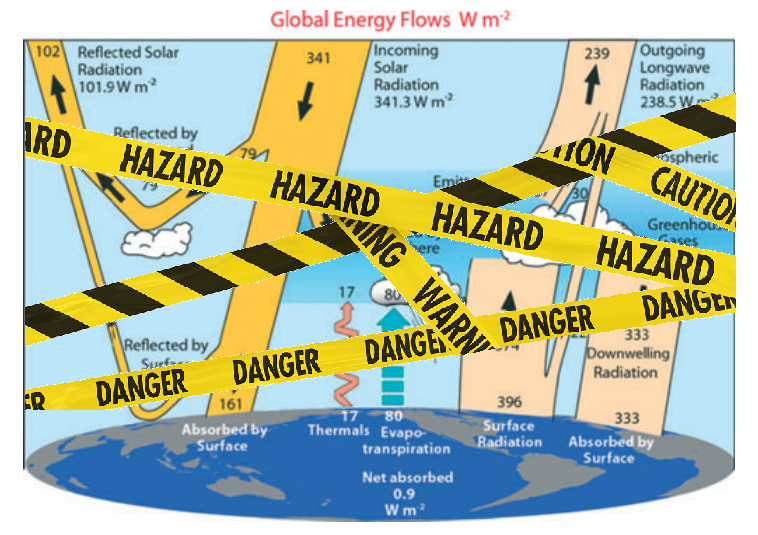
Radiation Transfer Concept-RTC. The Sun provides most of the energyneeded to warm the Earth to a comfortable and sustainable level for all life. Solar radiation (photons) readily crosses the vacuum of space and arrives at Earth’s Top Of Atmosphere (TOA) at the speed of light. We see a simplified conceptual model of this radiation in Figure 1, showing the wavelength/ frequency, amplitude, and direction of propagation. These electromagnetic energy rays are emitted over a broad set of vibrational frequencies, spanning 20 orders of magnitude, called the spectrum. This radiant energy arrives at TOA at 1,366 W/m 2 with an average of 340 Watts per square meter (W/m 2 ) when averaged over the spherical world.About 30% of the 340 W/m 2 is reflected to space leaving 240 W/m 2 for the Earth. There one-third is absorbed by the atmosphere and two-thirds by the surface (oceans + lands). The high-energy UV radiation warms the air mostly by photodissociation and photoionization. In this process, the solar radian electromagnetic energy is converted to kinetic energy, and then to physical heat through collisions with air molecules. At the surface, about 67% warms and then cools by local physical heat processes like conduction, convection, and latent heat and 33% by radiation. Most of this radiation exits directly to space through an “atmospheric window” at frequencies that are not absorbable by GHGs. It’s estimated that only about 0.09 W of the solar energy absorbed by the surface is radiated through CO2 the non-water vapor greenhouse gasses (GHGs), a trivially small amount.
In essence, the IPCC claims that these greenhouse gasses already contribute about 33 degrees C of temperature to the average global temperature, and it will continue to increase with increased quantities of human-made CO2 /GHGs. In Summary, the IPCC claim is based on three false assumptions:
1) When a photon’s electromagnetic energy is absorbed by CO2 it warms the CO2 molecule with physical heat. This heat is then shared with other air molecules and the atmosphere warms. The energized CO2 molecule will then re-emit a comparable photon, and the process is repeated hundreds/thousands of times before its heat/energy finally exits into space.
2) Half of all the re-emitted photons go upward as described in 1). But half are radiated downward and are re-absorbed by the surface and warm it.
3) The Sun provides Earth with only enough energy to give the planet an average global temperature of -18°C. But measurements tell us that the average global temperature is about 15°C, therefore they claim that CO2 and the GHE provide the missing 33°C heat.
Together these concepts allegedly warm the Earth by first converting the photon’s Electromagnetic Energy (EMI) into physical heat, and secondly, this process delays the release of the original photon energy into space allowing heat to accumulate and delaying its exit to space. The details of their false science and the errors in their explanation are provided in this article Revised Why all the fuss with CO2 and the Greenhouse effect
Heat Transport Concept, or HTC is the second step towards what happens to the EMI energy of these photons as they approach the surface. Some will be reflected to space, for example, in Antarctica, nearly 100% is reflected to space by the ice and snow. Some will be scattered in the atmosphere and cause no measurable warming of anything. Most of these photons are visible light and Infrared and are not readily absorbed by the air. Nearly all of these photons are absorbed by the surface, the dense solid matter and liquid part, and warms it. This process of photon absorption by the surface and warming is called thermalization and we now discuss the Heat Transport Concept, or HTC. In general, the atmosphere does not warm the surface because the air is normally cooler than the surface. We know this based on the established atmospheric Temperature Lapse Rates. For example, the dry air lapse rate is 9.8°C per Km of altitude. This means that the atmospheric temperature cools by 9.8°C for each kilometre of altitude up to the top of the troposphere. According to the Second Law of thermodynamics heat can only flow from a warmer object to a colder object, never the other way around. The RTC espoused by the UN IPCC violates this Second Law, thereby falsifying their point 2) above. Nitrogen, Oxygen, argon, and water vapor make up more than 99% of the atmosphere. The optical depth, or transparency of the air close to the surface is very opaque. This ensures that almost 100% of resonant Longwave Infrared Radiation (LWIR) photons emitted by the surface will be absorbed by GHGs and immediately thermalized within the first several millimetres of altitude. This means that the resonant photon will be immediately absorbed by a CO2 molecule and become energized. An energized CO2 molecule could spontaneously re-emit the absorbed photon in about half a second as described by the UN IPCC theory. In reality, however, within a millionth/billionth of a second that energised CO2 molecule will physically collide with a non-GHG molecule. The impact of the collision will heat the non-GHG molecule and de-energize the CO2 molecule. So that initial photon has disappeared, and its electromagnetic energy is changed to physical heat and is dispersed throughout the atmosphere adding a tiny bit of warmth to the air. The detailed process is described in Part 2, pages 5-6 of the paper linked above. 
Conclusion. This CO2 photon absorption and immediate collision-thermalization process dominates throughout the troposphere. This means that the CO2 resonant LWIR radiation energy radiating from the surface is saturated to extinction by an overabundance of CO2/GHG molecules. There are no resonant photons left in the troposphere for the CO2 molecule to absorb. This is readily visible in Figure 2 by the presence of the CO2 notch, the top red arrow. In the stratosphere and mesosphere where the molecules are few and far apart, we see an increase in the CO2 spontaneous re-emissions implying a reverse- thermalization and the re-emitted photons exit to space. The UN IPCC claim that CO2/GHGs is the major cause of global warming is thus falsified by the above explanation that is consistent with established laws of science, combined with the absence of any scientific test data.
This makes two powerful cases: First, we can safely abandon the goal and costs of Net Zero and Carbon Capture and Sequestration. Even in the extreme case that atmospheric CO2 doubles or quadruples there is no risk of a catastrophic, run-away global warming threat. Second, the press/media, politicians, and compromised scientists will also say that we should reduce and remove CO2 from the air just to be sure. But, there’s a fact, that there is about 50 times more CO2 dissolved in the oceans than in the air. Henry’s Law tells us nature apportions how much CO2 goes into the air and how much goes into the oceans based only on the temperature of the water’s surface. During a hot sunny day, more CO 2 flows from the oceans to the air. And in cold winters more CO 2 will flow from the air into the oceans and all water on Earth. Imagine the silliness of spending $ billions/trillions to remove CO2 from the air and then have the oceans immediately replace it.
In summary, we find out that CO2/GHG absorption of LWIR energy emitted by the surface provides a negligible amount of physical heat in the troposphere. Consequently, the GHG/GHE provides near zero of the missing heat that the IPCC attributes to the GHGs and the GHE.

Background Paper with complete discussion

Missing Link in the GHE, Greenhouse Effect, by Thomas Shula – Markus Ott,  USA – Germany
2024.  From allaboutenergy.net

Climate Headlines Claim, But IPCC Details Deny

The advertising proverb says it all: “The large print giveth, and the small print taketh away.”

Unfortunately, climate science is rife with this. A research announcement is released and the same text appears in media articles everywhere, the only difference being who can attach the scariest headline. One list of things claimed to be caused by global warming numbers 883, including many head scratchers. By 2012, the warmlist at numberwatch.co.uk had the better part of a thousand links to claims of disaster linked to “climate change.” The author of the website stopped adding links because the project was taking too much time.

For example: species extinctions.

WWF claims “The rapid loss of species we are seeing today is estimated by experts to be between 1,000 and 10,000 times higher than the natural extinction rate. MSNBC laments the “fact” that 100,000 species of flora and fauna will no longer be with us by next Christmas. And yet, WWF also estimates the number of identified unique species to be between 1.4 to 1.8 million, an uncertainty of 400,000. As someone said, “Anytime extinctions are claimed, ask for the names.” The debunking is done in detail here:

Another Example: Extreme Weather

Now an article published in the Australian does the fine print analysis regarding extreme weather events.  Logic leaves ‘The Science’ of climate in the dust  Thanks to John Ray for providing the text at his blog, excerpts in italics with my bolds and added images.

It is the gag order of the pseudo eco-scholar: “The Science is settled.” This is not science as we once understood it. In that discipline something could be proved false through observation and experiment. No, this is “The Science”: science as deity.

In the 20th century Karl Popper transformed the philosophy of science around the idea of falsifiability, saying: “It must be possible for an empirical scientific system to be refuted by experience.”

The first rule in Popper’s The Logic of Scientific Discovery is: “The game of science is, in principle, without end. He who decides one day that scientific statements do not call for any further test, and that they can be regarded as finally verified, retires from the game.”

So, you can spend a lifetime counting white swans, but find one black one and the thesis that all swans are white is destroyed. The black swan event happened when Europeans first encountered the impossible animal in Australia.

Prove one assumption wrong and a whole set of conclusions collapses. The Science is not real science. It is a set of beliefs, a faith. Those who demand we agree it’s settled are no different from a Catholic bishop declaring: “Roma locuta est; causa finita est” – Rome has spoken; the cause is finished.

The zealots who invoke The Science as a gag order have never read the research or wilfully ignore its infuriating uncertainty. This uncountably large group includes battalions of politicians, academics, activists, journalists and a few dozen billionaire energy-hobbyist carpetbaggers.

Case in Poiint: Claim Global Warming is Causing More Extreme Weather

Take the deeply entrenched belief that global warming is causing more extreme weather. This is so ubiquitous as to be unquestioned. It is an article of faith and there is almost no weather event nowadays that does not come with a blizzard of declarations it is proof of climate change.

Among myriad examples, let’s pick Tropical Cyclone Jasper, which hit far north Queensland in December. It dumped a massive amount of rain and none of what follows denies the fact it caused great damage and suffering. In its wake the Red Cross released an Instagram video declaring “Disasters like Ex-Tropical Cyclone Jasper in Far North Queensland are happening more often due to climate change”. Greenpeace called it a “frightening portent of what’s to come under climate change”. The Climate Council warned “climate change is making (tropical cyclones) more destructive”.

None of this is true.

If The Science of global warming has a bible then surely it must be the Intergovernmental Panel on Climate Change (IPCC) report Climate Change 2021: The Physical Science Basis. It is the latest accumulation of all the best research and it runs to a mind-numbing 2391 pages.

Cyclones

On page 1586 it says: “(Tropical cyclone) landfall frequency over Australia shows a decreasing trend in Eastern Australia since the 1800s, as well as in other parts of Australia since 1982. A paleoclimate proxy reconstruction shows that recent levels of (tropical cyclone) interactions along parts of the Australian coastline are the lowest in the past 550-1500 years.”

Pause on that. Not only does observation show there are fewer cyclones since the industrial revolution began belching extra carbon dioxide into the atmosphere, there is evidence to suggest cyclone activity in Australia is at its lowest ebb since the days of the Tang dynasty and the decline of the Western Roman Empire.

The CSIRO echoes that finding in its State of the Climate Report 2022 and adds: “The trend in cyclone intensity in the Australian region is harder to quantify than cyclone frequency, due to uncertainties in estimating the intensity of individual cyclones and the relatively small number of intense cyclones.”

Droughts

What of droughts? The IPCC finds southwestern Australia has been drying out since the 1950s and there is evidence that the length of droughts in southeastern Australia has “increased significantly”. But it says “the Millennium drought in eastern Australia was not unusual in the context of natural variability reconstructed over the past millennium” and concludes “there is currently low confidence that recent droughts in eastern Australia can be clearly attributed to human influence” (p1089).

In summary, on page 1663, it says there is low confidence in observed trends, or projected changes, to droughts in central and eastern Australia as the climate warms. In northern Australia there is medium confidence of a “decrease in the frequency and intensity of meteorological droughts”. So, more rain for the Top End then.

The report notes the major drivers of drought in Australia as well-known natural climate events: “During the last millennium, the combined effect of a positive (Indian Ocean Dipole) and El Nino conditions have caused severe droughts over Australia” (p1104).

Bushfires

What of bushfires? “Extreme conditions, like the 2019 Australian bushfires and African flooding, have been associated with strong positive (Indian Ocean Dipole) conditions” (p1104).

And, in case you were wondering, “There is no evidence of a trend in the Indian Ocean Dipole mode and associated anthropogenic forcing” and “The amplitude of the El Nino–Southern Oscillation variability has increased since 1950 but there is no clear evidence of human influence” (p1104).

World is Warming But Not in Crisis

Let’s be clear. There is plenty of evidence in the IPCC report demonstrating the climate is changing, that the world and Australia are getting warmer, and that industrial activity has played a part in forcing some of it. We should take that seriously. In response Australia should do its proportionate share in cutting greenhouse gas emissions without destroying our local ecology or impoverishing the nation.

But here is the good news: we are not facing a climate Armageddon. Again, this is not just my view but one shared by British professor Jim Skea, who was appointed chairman of the IPCC last year.

“The world won’t end if it warms by more than 1.5 degrees,” Skea told German weekly magazine Der Spiegel last year. “It will however be a more dangerous world. Countries will struggle with many problems, there will be social tensions.

Skea worries the zealots are doing their cause a grave disservice. “If you constantly communicate the message that we are all doomed to extinction, then that paralyses people and prevents them from taking the necessary steps to get a grip on climate change,” he said.

What it is also designed to do is scare people out of questioning absurd statements and bad policies.

Here there is another assault on reason by ideologues. In this game of witch burning, questioning a policy response to global warming is evidence of the crime of climate change denial. Their argument can be expressed as a syllogism.

Premise 1: Climate change is real.

Premise 2: Renewable energy combats climate change.

Conclusion: Therefore, to question renewable energy is to deny climate change.

This is the logical fallacy of a false dichotomy; it ignores the possibility of neutrality or nuance.

But logic, like science, has long since departed
in this debate. This is all about faith.

Resources

On this blog, Science Matters, several posts address specific misleading and exaggerated claims made in the media:

Arctic Sea Ice Factors

Lawrence Lab Report: Proof of Global Warming?

The Permafrost Bogeyman


IPCC the Worst Offender

But the IPCC Assessment Reports display the worst abuse of headline claims denied by statements in the details. The headlines are in the Summary for Policy Makers (SPM) while scientists write the details in the Working Group reports, in particular WGII.

We see again a familiar pattern in the latest AR5 round of IPCC releases. As previously, the SPM features alarming statements, which are then second-guessed (undermined) by the actual science imbedded in the report details.

Example Ocean Acidification

For example, I looked at the topic of ocean acidification and fish productivity. The SPM asserts on Page 17 that fish habitats and production will fall and that ocean acidification threatens marine ecosystems.

“Open-ocean net primary production is projected to redistribute and, by 2100, fall globally under all RCP scenarios. Climate change adds to the threats of over-fishing and other non-climatic stressors, thus complicating marine management regimes (high confidence).” Pg 17 SPM

“For medium- to high-emission scenarios (RCP4.5, 6.0, and 8.5), ocean acidification poses substantial risks to marine ecosystems, especially polar ecosystems and coral reefs, associated with impacts on the physiology, behavior, and population dynamics of individual species from phytoplankton to animals (medium to high confidence).” Pg 17 SPM

WGII Report, Chapter 6 covers Ocean Systems. There we find more nuance and objectivity:

“Few field observations conducted in the last decade demonstrate biotic responses attributable to anthropogenic ocean acidification” pg 4

“Due to contradictory observations there is currently uncertainty about the future trends of major upwelling systems and how their drivers (enhanced productivity, acidification, and hypoxia) will shape ecosystem characteristics (low confidence).” Pg 5

“Both acclimatization and adaptation will shift sensitivity thresholds but the capacity and limits of species to acclimatize or adapt remain largely unknown” Pg 23

“Production, growth, and recruitment of most but not all non-calcifying
seaweeds also increased at CO2 levels from 700 to 900 µatm Pg 25

“Contributions of anthropogenic ocean acidification to climate-induced alterations in the field have rarely been established and are limited to observations in individual species” Pg. 27

“To date, very few ecosystem-level changes in the field have been attributed to anthropogenic or local ocean acidification.” Pg 39


Ocean Chemistry on the Record

Contrast the IPCC headlines with the the Senate Testimony of John T. Everett, in which he said:

“There is no reliable observational evidence of negative trends that can be traced definitively to lowered pH of the water. . . Papers that herald findings that show negative impacts need to be dismissed if they used acids rather than CO2 to reduce alkalinity, if they simulated CO2 values beyond triple those of today, while not reporting results at concentrations of half, present, double and triple, or as pointed out in several studies, they did not investigate adaptations over many generations.”

“In the oceans, major climate warming and cooling and pH (ocean pH about 8.1) changes are a fact of life, whether it is over a few years as in an El Niño, over decades as in the Pacific Decadal Oscillation or the North Atlantic Oscillation, or over a few hours as a burst of upwelling (pH about 7.59-7.8) appears or a storm brings acidic rainwater (pH about 4-6) into an estuary.”
http://www.epw.senate.gov/public/index.cfm?FuseAction=Files.View&FileStore_id=db302137-13f6-40cc-8968-3c9aac133b16

Conclusion

Many know of the Latin phrase “caveat emptor,” meaning “Let the buyer beware”.

When it comes to climate science, remember also “caveat lector”–”Let the reader beware”.

Delusions of Davos and Dubai

Edward Ring dispells the smoke and mirrors surrounding renewables in his American Greatness article The Delusions of Davos and Dubai – Part Two: Can Wind & Solar Energy Expand 50-100 Times? Excerpts in italics with my bolds and added images.

Procuring 90+ percent of global energy from wind and solar energy is a fool’s errand.

In the most recent “Conference of the Parties,” otherwise known as the United Nations extravaganza that convenes every few years for world leaders to discuss the climate crisis, several goals were publicly proclaimed. Notable were the goals to triple production of renewable energy by 2030 and triple production of nuclear energy by 2050. Against the backdrop of current global energy production by fuel type, and as quantified in Part One, against a goal of increasing total energy production from 600 exajoules in 2022 to at least 1,000 exajoules by 2050, where does COP 28’s goals put the world’s energy economy? How much will production of renewable energy have to increase?

To answer this question, it is necessary to recognize and account for the fact that most renewable energy takes the form of electricity, generated through wind, solar, or geothermal sources. And when measuring how much the base of renewables installed so far will contribute to the target of 1,000 exajoules of energy production per year in order to realize—best-case scenario—800 exajoules of energy services, the data reported in the Statistical Review of Global Energy is profoundly misleading.

[ Ring is referring to the fanciful projections compared to realities reported in the 2022 consumption statistics from Energy Institute. For example, from that report

The graph shows that global Primary Energy (PE) consumption from all sources has grown continuously over nearly 6 decades. Since 1965  oil, gas and coal (FF, sometimes termed “Thermal”) averaged 88% of PE consumed, ranging from 93% in 1965 to 82% in 2022.  Note that in 2020, PE dropped 21 EJ (4%) below 2019 consumption, then increased 31 EJ in 2021.  WFFC for 2020 dropped 24 EJ (5%), then in 2021 gained back 26 EJ to slightly exceed 2019 WFFC consumption. For the 58 year period, the net changes were:

Oil        194%
Gas      525%
Coal     178%
WFFC  239%
PE        287%]

If we’re setting a goal of 1,000 exajoules of ultimate world energy production and assuming 80 percent of that 1,000 exajoules of energy input shall be realized as end-user energy services, then we have to examine how much usable energy wind, solar, hydro, and nuclear are actually being generated today. That means we need to know how much electricity they actually generate and send into the grid. An imputed, grossed-up number is not helpful.

It must be again emphasized that it is an extraordinary assumption to project an 80 percent retention of energy from input into the grid to actual end use. For example, we might assume that from the generating plant, 5 percent was lost in transmission, another 5 percent lost from charging and subsequently discharging the electricity to and from utility-scale storage batteries, another 5 percent in the charge/discharge cycle through an onboard battery in an EV, and another 5 percent converting that electricity into traction from the electric motor. Those are extraordinarily optimistic numbers, using a best-case example.

The point here is 1,000 exajoules represents the absolute minimum to which global energy production must grow in the next 25 years if every person on earth is to have access to enough energy to enable prosperity and security. How do we get there? Let’s take the experts at their word and assume that use of coal, oil, and gas will be completely eliminated by 2050.

On the chart below, the assumptions governing the future mix of fuels worldwide adhere to the resolutions just made at the recent Conference of the Parties. That is, nuclear energy will be tripled, and use of oil, natural gas, and coal will be eliminated. To take some of the pressure off of the required expansion of solar and wind energy, for this analysis, the sacrilegious assumption is made to double hydroelectric capacity, double geothermal production, and double biofuel production. It won’t matter much. Here goes:

There’s a lot to chew on in these data, but it’s worth the effort. Because the facts they present are immutable and carry with them significant implications for global energy policy. The first column of data shows how much fuel was burned or generated worldwide in 2022—the raw fuel inputs, which total 604 exajoules.

The second column of data shows the number of energy services that reached end-users in 2022 in the form of heating, cooling, traction, light, communications, etc. It is clear that for thermal sources of energy, the lower numbers reflect the currently estimated degree of conversion efficiency worldwide, about 40 percent. But for non-thermal sources of energy (appended to the right with “gen,” signifying generated energy), these numbers are based on terawatt-hour reports featured in individual sections of the Statistical Review dedicated to those sources of energy. Converted from terawatt-hours to exajoules, these are the actual amounts of electricity that went into transmission lines around the world to be consumed by end users.

The third column of data calculates a hypothetical 2050 global fuel mix based on the agreed COP 28 targets. As seen in column 4 “multiple,” nuclear energy is tripled in accordance with COP 28. Also, in accordance with COP 28, use of coal, oil, and gas is eliminated. Not agreed to at COP 28, but to help reach the 1,000 exajoule target, production of geothermal and biofuel energy are both doubled. That leaves the remainder of the needed power to be provided (in this example) equally by wind and solar. It is reasonable to assume, based on everything they’re saying in Dubai and Davos, that this is the model. This is the logical realization of what they’re calling for.

These calculations yield an overwhelming reality check.
Yet what assumption is incorrect?

The target of 1,000 exajoules is almost certainly too low. Nuclear power is tripled, and hydropower and biofuel are both doubled. None of that is easy; in the case of biofuel, it could be an environmental catastrophe. But even if those other non-thermal sources of energy were to increase two to three times, without coal, oil, and gas, a stupefying expansion of wind and solar would be required. “Tripling” these renewables doesn’t even get us into the ballpark.

To deliver 1,000 exajoules of power to the world by 2050, for every wind turbine we have today, expect to see more than 60 of them. For every field of photovoltaics we have today, expect to see nearly 100 more of them. Is this feasible? Because from Dubai to Davos, this is what they’re claiming we’re going to do.

Confronted with these facts, even the most enthusiastic proponents of wind and solar energy may hesitate when considering the magnitude of the task. Eliminating production of fossil fuel entirely by 2050 ought to be seen, for all practical purposes, as impossible. The uptick in mining, the land consumed, the expansion of transmission lines, the necessity for a staggering quantity of electricity storage assets to balance these intermittent sources, the vulnerability of wind and solar farms to weather events including deep freezes, tornadoes, and hail, and the stupefying task of doing it all over again every 20-30 years as the wind turbines, photovoltaic panels, and storage batteries reach the end of their useful lives—all of this suggests procuring 90+ percent of global energy from wind and solar energy is a fool’s errand.

McKitrick: COP28 Worse Threat Than You Think

A demonstration against fossil fuels at the COP28 United Nations climate summit in Dubai, United Arab Emirates. PHOTO BY PETER DEJONG/AP

Ross McKitrick writes at Financial Post: The only thing wrong with the globalist climate agenda — the people won’t have it  Excerpts in italics with my bolds and added images.

Phasing out fossil fuels is going to cost way more than ordinary people
will accept.  Delegates to COP28 clearly didn’t understand that

It’s tempting to dismiss the outcome of COP28, the recent United Nations climate change conference in the United Arab Emirates, as mere verbiage, especially the “historic” UAE Consensus about transitioning away from fossil fuels. After all, this is the 28th such conference and the previous ones all pretty much came to nothing. On a chart showing the steady rise in global CO2 emissions since 1950 you cannot spot when the 1997 Kyoto Protocol entered into force (2002), with its supposedly historic language binding developed countries to cap their CO2 emissions at five per cent below 1990 levels by 2012, which they didn’t do. The 2015 Paris Agreement also contained “historic” language that bound countries to further deep emission reductions. Yet the COP28 declaration begins with an admission that the parties are not on track for compliance.
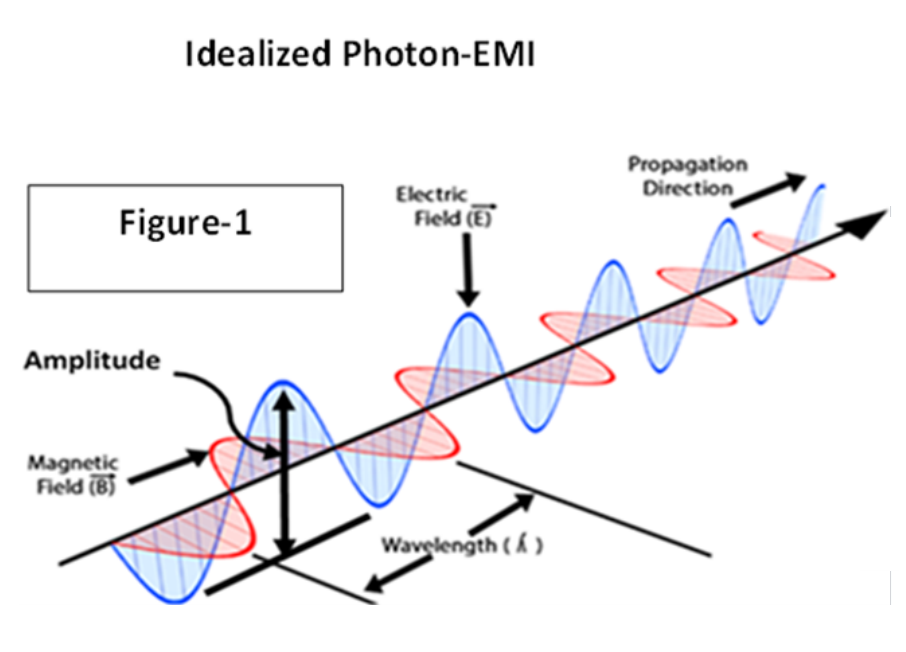
Still, we should not overlook the real meaning of the UAE Consensus.

COP agreements used to focus on one thing: targets for reducing greenhouse gases. The UAE Consensus is very different. Across its 196 paragraphs and 10 supplementary declarations it’s a manifesto for global central planning. In their own words, some 90,000 government functionaries aspire to oversee and micromanage agriculture, finance, energy, manufacturing, gender relations, health care, air conditioning, building design and countless other economic and social decisions. It’s all supposedly in the name of fighting climate change, but that’s just the pretext. Take climate away and they’d likely appeal to something else.
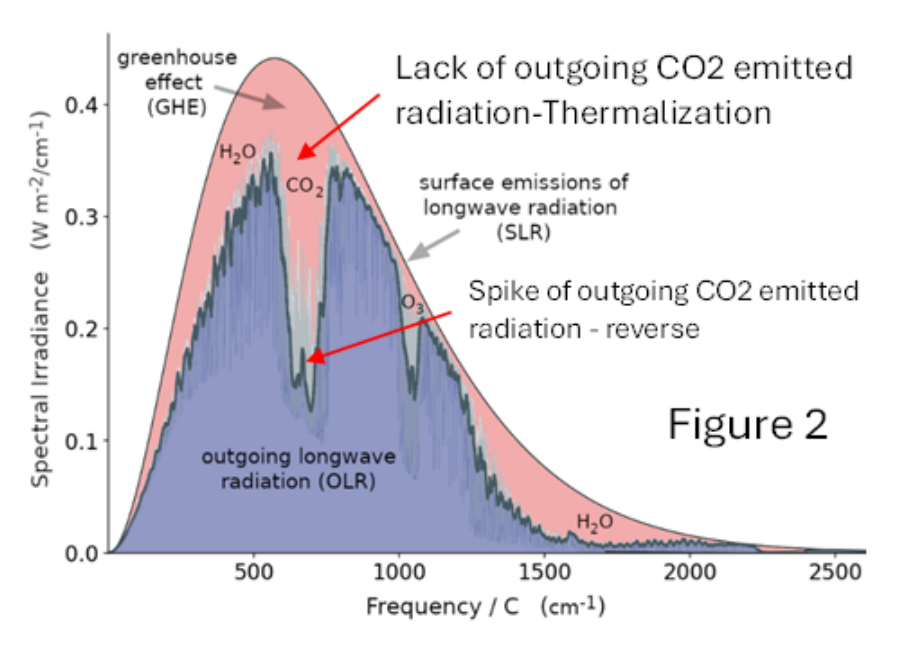
Climate change doesn’t necessitate such plans.

Economists have been studying climate change for many decades and have never considered it grounds to phase out fossil fuels, micromanage society, manage gender relations and so on. Mainstream scientific findings, coupled with mainstream economic analysis, prescribe moderate emission-pricing policies that rely much more on adaptation than mitigation.

The fact that the UAE Consensus is currently non-binding is beside the point. What matters is what the COP28 delegates have said they want to achieve. Two facts stand out: the consensus document announced plans that would cause enormous economic harm if implemented, and it was approved unanimously — yes, by everyone in the room.

The first point is best illustrated by the language around eliminating fossil fuels. Climate policy is supposed to be about optimally reducing greenhouse gas (GHG) emissions. As technology gradually allows emissions to be de-coupled from fuel use, there may eventually be no need to cut back on fuels. But activist delegates insisted on abolitionist language anyway, making elimination of fossil fuels an end in itself. Such fuels are of course essential for our economic standard of living, and 30 years of economic analysis has consistently shown that, even taking account of emissions, phasing out fuels would do humanity far more harm than good. The Consensus statement ignores this, even while claiming to be guided by “the science.”

The second point refers to the fact that all representatives of all governments worldwide endorsed policies that will, if implemented, do extraordinary harm to their own people. Where governments have made even small attempts to take these radical steps, the public has rebelled. This calls into question whom the COP28 delegates actually “represent.” A few elected officials did attend, but no one voted for the great majority of attendees. And have no doubt: even if some heads of state, whether courageous or foolhardy, did go to COP intent on opposing the overall agenda, they would almost certainly be browbeaten into signing the final package.

The UAE Consensus is the latest indication that the real fault line in contemporary society is not right versus left, it’s the people versus (for lack of a better word) the globalists. A decade ago this term was only heard on the conspiracy fringe. It has since migrated to the mainstream as the most apt descriptor of a permanent transnational bureaucracy that aspires to run everything, even to the public’s detriment, while insulating themselves from democratic limits.

A hallmark of globalists is their credo of “rules for thee but not for me.” Thousands of delegates fly to Davos or to the year’s COP, many on private jets, to be wined and dined as they advise the rest of us to learn to do without.

Two sides of the same coin.

On both COVID-19 and climate change, the same elite has invoked “the science,” not in support of good decision-making, but as a talisman to justify everything they do, including censoring public debate. Complex and uncertain matters are reduced to dogmatic slogans by technocrats who force-feed political leaders a one-sided information stream. Experts outside the process are accorded standing based solely on their obeisance to the preferred narrative, not their knowledge or qualifications. Critics are attacked as purveyors of “misinformation” and “disinformation.” Any opposition to government plans therefore proves the need to suppress free speech.

Eventually, however, the people get the last word. And despite nonstop fear-mongering about an alleged climate crisis, the people tolerate climate policy only insofar as it costs almost nothing.

The climate movement may think that by embedding itself in the globalist elite it can accelerate policy adoption without needing to win elections. In fact, the opposite is happening. Globalists have co-opted the climate issue to try to sell a grotesque central planning agenda that the public has repeatedly rejected. If the UAE Consensus is the future of climate policy, climate policy’s failure is guaranteed.

COP28 Optics: Deal to “Transition Away” not “Phase Out” Fossil Fuels

Once again equivocation rules climatists.  After the uproar over demands to “phase out” hydrocarbon fuel, the wording was changed to say “transition away.”  Thus the divide is papered over while alarmists claim agreement was reached to “leave it in the ground.”  Others will point to language such as “transition away in a just, orderly and equitable manner.”  Just like Paris COP, everyone pledges and celebrates as though something has changed

David Blackmon explains the wordplay in his Forbes article COP28 Offers ‘Transition Away’ From Fossil Fuels But No ‘Phaseout’.  Excerpts in italics with my bolds and added images.

COP28 just concluded feverish negotiations in its final hours—actually, beyond its scheduled final hours—with the announcement of a final agreement Wednesday that includes language committing its near-200 participating nations to “transition away from” fossil fuels. That is the language negotiators landed upon to replace the previous language pledging to “phase out” the use of coal, oil and natural gas across the coming decades preferred by energy transition boosters.

Many observers are no doubt left wondering what the real difference is between the two phrases, other than that the “transition away from” language was found to be less offensive to big producers and users of these energy resources than a phasing-out turned out to be. It isn’t a bad question, to be sure.

Advocates for this final language claim it is “historic” in that it is the first time any of the 28 UN Conference of the Parties climate summits have overtly mentioned moving away from the use of fossil fuels in a final agreement. But it is fair to note that countries across the globe have invested many trillions of dollars—much of it funded by costly debt—in efforts to “transition away from” fossil fuels over the last three decades now and little has changed. The world still gets roughly 80% of its primary energy from coal, oil and natural gas, only a sliver less than it did at the turn of the century. The world will use record volumes of all three fossil fuels in 2023, and most experts project it will do so again in 2024 and beyond.

So, while this language may well be “historic,” it is also merely a restatement of commitments many of the signatory governments have already embarked upon for years and failed to achieve. Honestly, it is difficult to envision how what amounts to yet another COP-generated word salad will do anything to change the undeniable global dynamic.

Reuters quotes Anne Rasmussen, lead negotiator for the Alliance of Small Island States, assessing the language as uninspiring. “We have made an incremental advancement over business as usual, when what we really need is an exponential step change in our actions,” she said.

But COP conferences involving more than 190 participating countries with widely disparate economic and energy security priorities and 70,000+ attendees are not really designed to produce exponential step changes, are they? COP rules requiring unanimous consent to all language included in each subsequent final agreement ensure that commitments will inevitably be watered down with qualifying language designed to enable each country to act upon its own unique interpretation of what phrases like “transition away from” actually mean.

Those are bold words, but everyone should recognize that “real-economy outcomes” in, say, Peru or Uganda are likely to look entirely different than those in Belgium or Canada. The same is likely true of the respective outcomes we will see in the coming years in India as compared to the United States.

The Bottom Line

As an example: If China wished to signify a zeal to “transition away from” its own massive use of fossil fuels, it might decide to cancel its new program going into effect January 1, 2024, which will subsidize the building of hundreds more coal-fired power plants. Does anyone involved in COP28 expect that or any similar action by the Xi Jinping government as a result of its signing off on this agreement? Of course not. Beijing will interpret the phrase “transition away from” as it sees fit and continue to prioritize its national energy security over any climate commitments.

At the end of the day, this final agreement from COP28 seems destined to be remembered in the same vein as all previous COPs other than COP3 (Kyoto) and COP21 (Paris) are remembered—as, to paraphrase William Shakespeare, a lot of sound and fury signifying not much at all.

Footnote:  Let the Blame Games Go Onto Steroids.