Official Censors Misinform on Covid, Climate

Ross McKitrick writes at Financial Post Policing misinformation from the misinformation police.  Excerpt in italics with my bolds and added images.
State-sponsored ‘experts’ on ‘misinformation’ are typically the worst offenders

As citizens of a liberal democracy Canadians have long believed that only the free contest of differing points of view can produce genuine intellectual progress. But now we are told we face a crisis of “misinformation” that calls for vigorous censorship of heretical opinion. On all of today’s major public controversies, we are asked to believe, all of us would enthusiastically assent to the one obviously correct view (which happens to be the view promulgated by the governing class) were it not for the pernicious influence of a shadowy conspiracy of social-media traffickers in misinformation — voices that must be suppressed for the good of society.

In his 1859 essay On Liberty, John Stuart Mill decisively rebutted this argument. “Complete liberty of contradicting and disproving our opinion,” he wrote, “is the very condition which justifies us in assuming its truth for purposes of action; and on no other terms can a being with human faculties have any rational assurance of being right.” It is one thing, Mill argues, if the holders of received opinion conclude their view is correct because, though challenged, it has not been refuted; but another thing altogether if it’s simply assumed true and challenge is therefore forbidden.

Yet that’s precisely the position of today’s would-be “misinformation” police.

In reality, state-sponsored “experts” on “misinformation” are typically the worst offenders. Presuming themselves infallible, they call for new laws to shut everyone else up.

In the climate domain, a group called the Institute for Strategic Dialogue (ISD) boasts a Climate Disinformation Team consisting of five staff members, all trained in arts or political science (none in economics or physical sciences) who have put out a long report (and follow-up) supposedly documenting these networks of online misinformation and calling for new legislation and stricter rules for social media companies to combat it.

The reports feature screenshots of social media posts that critique
alarmist climate claims or the high costs of climate policy.

The ISD does not rebut but simply displays these posts — as if their mere existence is proof censorship is needed. For instance, they say “Calling into question the viability and effectiveness of renewable energy sources is a common practice among climate sceptics and delayist actors,” and then show a series of social media posts pointing out problems associated with wind and solar power systems. But wind and solar power systems do have problems, including intermittency and the need for costly fossil-fuel backups. To suggest otherwise is itself misinformation.

Closer to home, an organization called the Council of Canadian Academies (CCA), which purports to draw on top experts in Canada to give guidance to policy-makers, recently issued a report on “science and health misinformation” that concludes society would benefit from more vigorous efforts to suppress debate and ban more people from social media.

Much of the report consists of finger-wagging against anyone
who questioned anti-COVID public health measures.

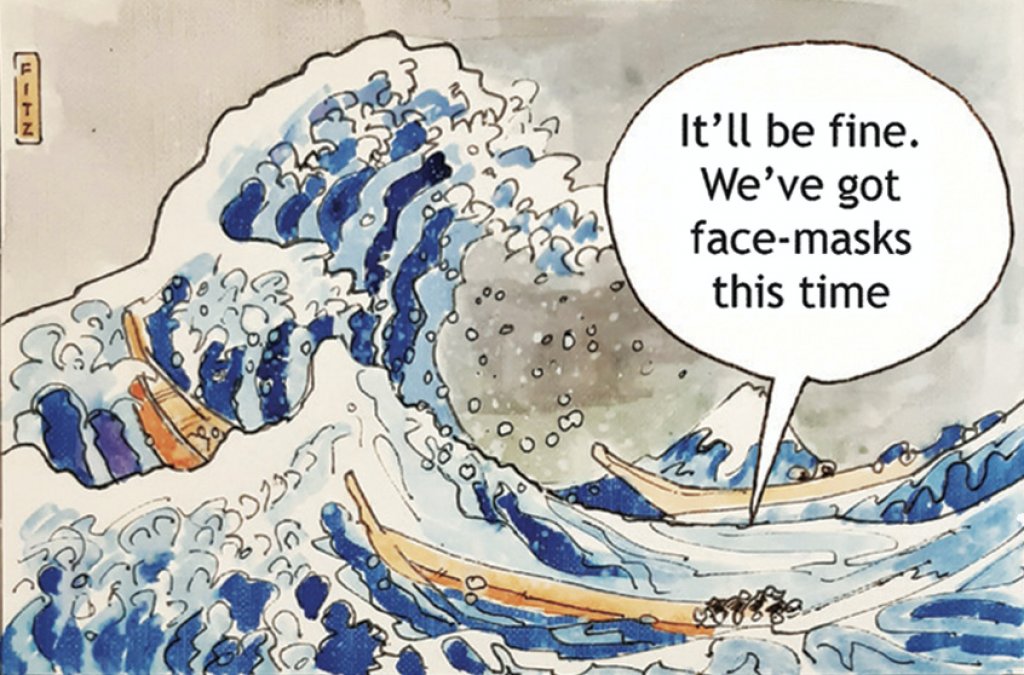
For instance: “(O)ngoing claims that mask wearing is ineffective or even harmful have shifted firmly into the realm of misinformation.” Meanwhile, back in science, a newly-published, peer-reviewed meta-analysis summarizing 10 randomized control trials involving nearly 277,000 people concludes that “Wearing masks in the community probably makes little or no difference to the outcome of influenza-like illness (ILI)/COVID-19 like illness compared to not wearing masks.” So who’s spreading misinformation?

The CCA report also has much to say about supposed climate misinformation. But again none of the authors is an economist or climate scientist. The closest they come to an “expert” is a psychologist who has spent years studying, or more precisely denigrating, skeptical climate blogs and their contributors. In several places, the CCA report relies on his 2012 article asserting that climate skepticism is correlated with a wide set of dubious conspiracies, such as believing the moon landing was a hoax. But it fails to mention a 2015 statistical critique published in the same journal that showed its conclusions “are not supported by the data.”

CCA brags about its peer review process, saying reviewers were selected for their “diverse perspectives and areas of expertise.” But again the reviewers did not include climate scientists or economists; nor is there any evidence of diversity of perspectives. As a rule, one-sided and unimpressive polemicists constitute the CCA’s “expert team.”

And yet CCA complains (at length) about the public’s declining trust in scientific institutions.

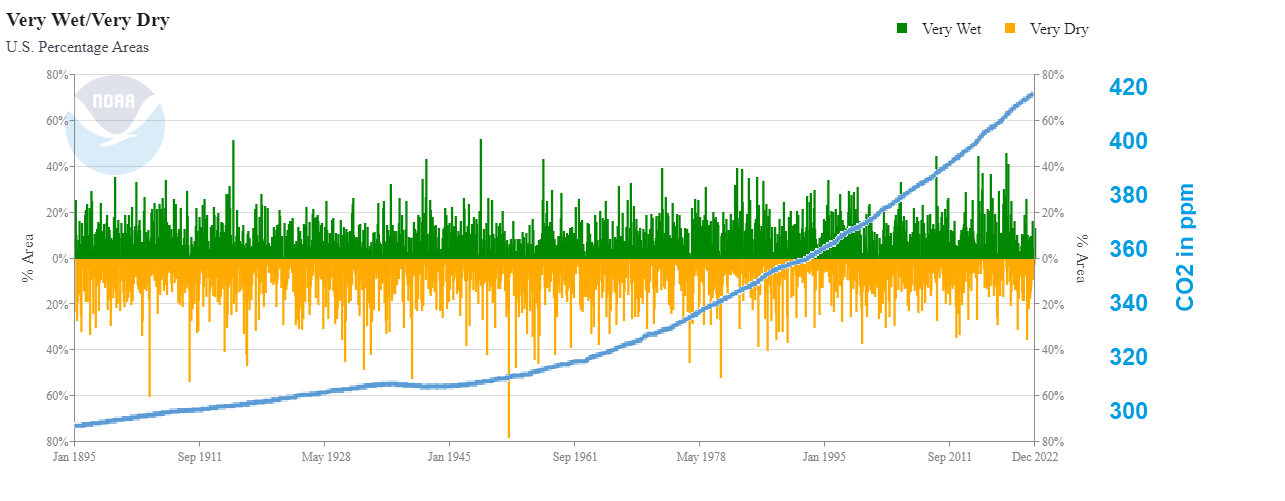
To the extent the CCA report offers any factual assertions about climate change, it points to “catastrophic events” such as “droughts, floods, and wildfires exacerbated by climate change.” It fails to mention, however, that Chapter 11 of the most recent Intergovernmental Panel on Climate Change report says, concerning droughts, that “Global studies generally show no significant trends” and that in most places around the world there’s “inconclusive evidence” tying droughts to human-induced climate change. In North America in particular there’s “low confidence in the attribution of long-term changes in meteorological drought.”

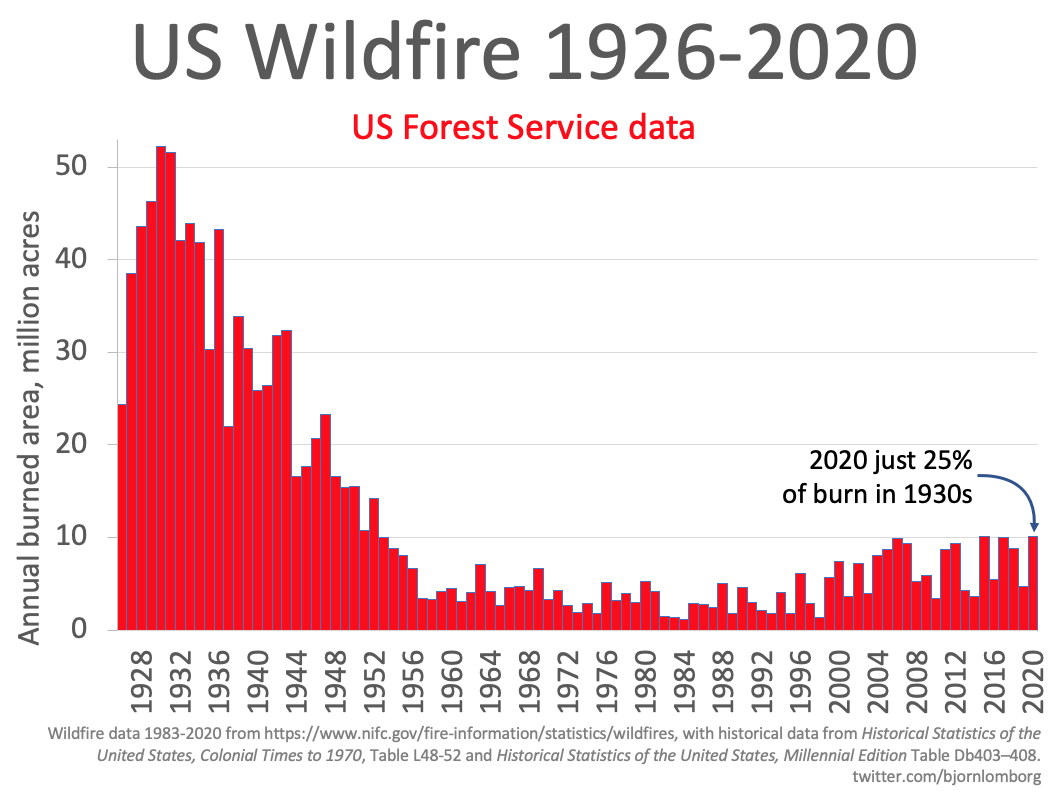
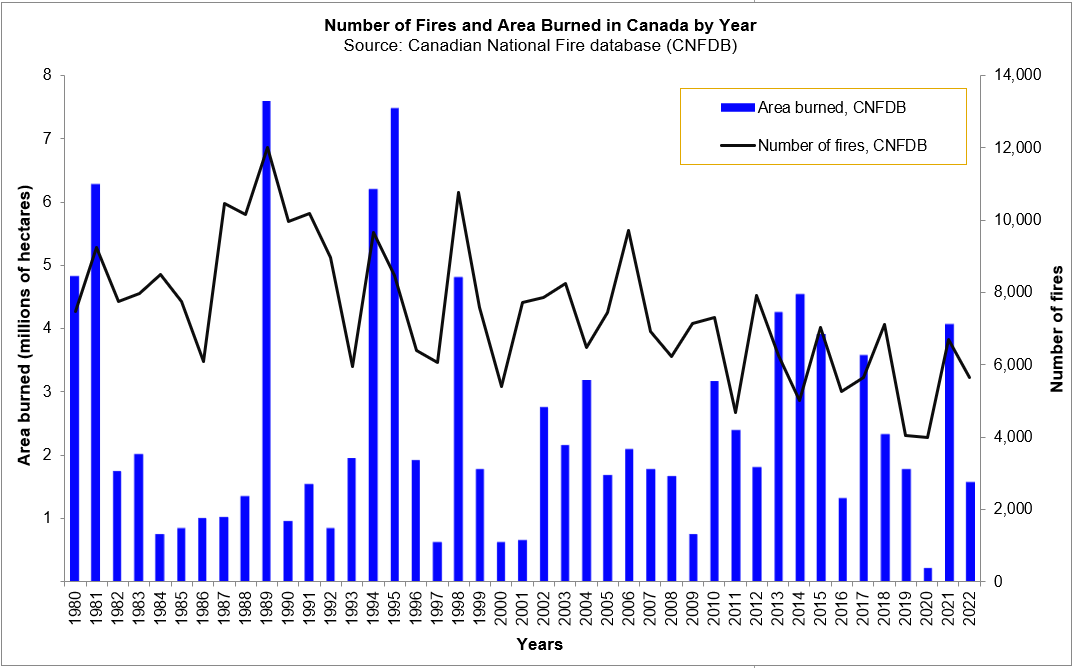
Regarding floods, “In general, there is low confidence in attributing changes in the probability or magnitude of flood events to human influence because of a limited number of studies, differences in the results of these studies and large modelling uncertainties.” As for wildfires, they have been trending down globally for the past decade. In Canada, according to the Canadian National Fire Database, both the number of forest fires and total area burned peaked in the late 1980s and has been declining ever since. Yet again the CCA offers misinformation to support its case for more censorship.

Here’s a better idea. Ignore the CCA and the ISD
and all the other would-be enforcers of orthodoxy.

Drop the fixation on “misinformation,” which is just the latest iteration of the same old desire of governments to censor their opponents. Allow the public the freedom, as Mill counselled, to hear arguments “from persons who actually believe them; who defend them in earnest, and do their very utmost for them.” A dangerous thought in 1859, and judging by the current misinformation craze, an utter heresy today; yet true nonetheless.

Ross McKitrick is a professor of economics at the University of Guelph and senior fellow of the Fraser Institute.


10 Times Covid Experts Failed Us

Marty Makary presents a list of failures in his NY Post article 10 myths told by COVID experts — and now debunked.  Excerpts in italics with my bolds and added images.

In the past few weeks, a series of analyses published by highly respected researchers have exposed a truth about public health officials during COVID:   Much of the time, they were wrong.

To be clear, public health officials were not wrong for making recommendations based on what was known at the time.  That’s understandable. You go with the data you have.

No, they were wrong because they refused to change their directives
in the face of new evidence.

When a study did not support their policies, they dismissed it and censored opposing opinions.

At the same time, the Centers for Disease Control and Prevention weaponized research itself by putting out its own flawed studies in its own non-peer-reviewed medical journal, MMWR.

In the final analysis, public health officials actively propagated misinformation
that ruined lives and forever damaged public trust in the medical profession.

Here are 10 ways they misled Americans:

Misinformation #1: Natural immunity offers little protection compared to vaccinated immunity

A Lancet study looked at 65 major studies in 19 countries on natural immunity. The researchers concluded that natural immunity was at least as effective as the primary COVID vaccine series.  In fact, the scientific data was there all along — from 160 studies, despite the findings of these studies violating Facebook’s “misinformation” policy.

Since the Athenian plague of 430 BC, it has been observed that those who recovered after infection were protected against severe disease if reinfected.  That was also the observation of nearly every practicing physician during the first 18 months of the COVID pandemic.

Most Americans who were fired for not having the COVID vaccine already had antibodies that effectively neutralized the virus, but they were antibodies that the government did not recognize.

Misinformation #2: Masks prevent COVID transmission

Cochran Reviews are considered the most authoritative and independent assessment of the evidence in medicine.  And one published last month by a highly respected Oxford research team found that masks had no significant impact on COVID transmission.

When asked about this definitive review, CDC Director Dr. Rochelle Walensky downplayed it, arguing that it was flawed because it focused on randomized controlled studies.

But that was the greatest strength of the review! Randomized studies are considered the gold standard of medical evidence.

If all the energy used by public health officials to mask toddlers could have been channeled to reduce child obesity by encouraging outdoor activities, we would be better off.

Misinformation #3: School closures reduce COVID transmission

The CDC ignored the European experience of keeping schools open, most without mask mandates. Transmission rates were no different, evidenced by studies conducted in Spain and Sweden.

Misinformation #4: Myocarditis from the vaccine is less common than from the infection

Public health officials downplayed concerns about vaccine-induced myocarditis — or inflammation of the heart muscle.  They cited poorly designed studies that under-captured complication rates.

A flurry of well-designed studies said the opposite.  We now know that myocarditis is six to 28 times more common after the COVID vaccine than after the infection among 16- to 24-year-old males.

Tens of thousands of children likely got myocarditis, mostly subclinical, from a COVID vaccine they did not need because they were entirely healthy or because they already had COVID.

Misinformation #5: Young people benefit from a vaccine booster

Boosters reduced hospitalizations in older, high-risk Americans. But the evidence was never there that they lower COVID mortality in young, healthy people.

That’s probably why the CDC chose not to publish its data on hospitalization rates among boosted Americans under 50, when it published the same rates for those over 50.

Ultimately, White House pressure to recommend boosters for all was so intense that the FDA’s two top vaccine experts left the agency in protest, writing scathing articles on how the data did not support boosters for young people.

Misinformation #6: Vaccine mandates increased vaccination rates

President Biden and other officials demanded that unvaccinated workers, regardless of their risk or natural immunity, be fired.  They demanded that soldiers be dishonorably discharged and nurses be laid off in the middle of a staffing crisis.

The mandate was based on the theory that vaccination reduced transmission rates
— a notion later proven to be false.

But after the broad recognition that vaccination does not reduce transmission, the mandates persisted, and still do to this day.

A recent study from George Mason University details how vaccine mandates in nine major US cities had no impact on vaccination rates.  They also had no impact on COVID transmission rates.

Misinformation #7: COVID originating from the Wuhan lab is a conspiracy theory

Google admitted to suppressing searches of “lab leak” during the pandemic.  Dr. Francis Collins, head of the National Institutes of Health, claimed (and still does) he didn’t believe the virus came from a lab.

Ultimately, overwhelming circumstantial evidence points to a lab leak origin — the same origin suggested to Dr. Anthony Fauci by two very prominent virologists in a January 2020 meeting he assembled at the beginning of the pandemic.

According to documents obtained by Bret Baier of Fox News, they told Fauci and Collins that the virus may have been manipulated and originated in the lab, but then suddenly changed their tune in public comments days after meeting with the NIH officials.

The virologists were later awarded nearly $9 million from Fauci’s agency.

Misinformation #8: It was important to get the second vaccine dose three or four weeks after the first dose

Data were clear in the spring of 2021, just months after the vaccine rollout, that spacing the vaccine out by three months reduces complication rates and increases immunity.

Spacing out vaccines would have also saved more lives when Americans were rationing a limited vaccine supply at the height of the epidemic.

Misinformation #9: Data on the bivalent vaccine is ‘crystal clear’

Dr. Ashish Jha famously said this, despite the bivalent vaccine being approved using data from eight mice.  To date, there has never been a randomized controlled trial of the bivalent vaccine.

In my opinion, the data are crystal clear that young people should not get the bivalent vaccine. It would have also spared many children myocarditis.

Misinformation #10: One in five people get long COVID

The Centers for Disease Control and Prevention claims that 20% of COVID infections can result in long COVID.

But a UK study found that only 3% of COVID patients had residual symptoms lasting 12 weeks. What explains the disparity?

It’s often normal to experience mild fatigue or weakness for weeks after being sick and inactive and not eating well.  Calling these cases long COVID is the medicalization of ordinary life.

Summary

What’s most amazing about all the misinformation conveyed by CDC and public health officials is that there have been no apologies for holding on to their recommendations for so long after the data became apparent that they were dead wrong.

Public health officials said “you must” when the correct answer
should have been “we’re not sure.”

Early on, in the absence of good data, public health officials chose a path of stern paternalism.

Today, they are in denial of a mountain of strong studies showing that they were wrong.


What About Affirmative Action? SCOTUS and Sowell

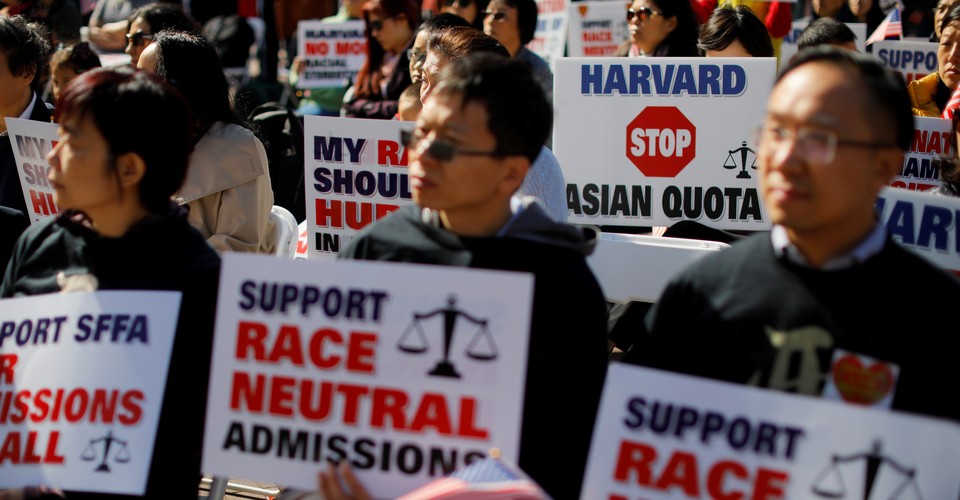
There is much consternation and anticipation regarding cases before SCOTUS (Supreme Court of the US) regarding racially biased admissions policies at universities, specifically Harvard and North Carolina.  Hearings were held last fall, and a ruling is expected in July, unless there is a leak beforehand as happened regarding the decision returning abortion policies to state voters.
For example, reports like this one reflect how this decision goes to the heart of identity politics and critical race theory. Supreme Court Affirmative Action Cases Could Bring End to Race-Conscious Admissions from Teen Vogue.  Excerpt:

A ruling that makes race-conscious admissions practices unconstitutional — or even that further narrows the weight that race can be given — doesn’t only have worrisome implications for universities; employer hiring practices and diversity in the workplace could dramatically shift if affirmative action in higher education is struck down. Given that landscape, lower courts could look at other precedents where the Court has found race to be a permissible factor under federal antidiscrimination statutes and decide they no longer apply. Doing so could potentially undermine employer recruitment and diversity initiatives and hinder the pipeline of diverse talent.

Bonus SAT points (plus and minus) awarded by university admissions staff based on racial identities.

The Court will issue its decision on these cases by July of this year. In a world where the Supreme Court grants SFFA the relief it seeks, applicants won’t be able to share the backgrounds and experiences they have that are directly connected to their racial identity. In a society where there are efforts to ban books that examine race relations, where instructors are threatened for using their classroom as a venue to discuss literature and ideas on race, a court-imposed ban on the consideration of race in admissions would be yet another blow to fostering diversity in schools.

It remains unclear what, if anything, will be salvageable from the Court’s ultimate ruling on affirmative action. But in this waiting period, some universities are thinking more intentionally about their role in and beyond this fight, and what holistic admissions programs should look like moving forward.

OTOH, others look forward to the demise of “temporary” affirmative action programs: After Affirmative Action from Real Clear Politics.  Excerpt:

Why is affirmative action in jeopardy? The main reason, ironically, might be the increasing ethnic diversity of the United States. In 1960, the U.S. was roughly 88% white and 12% black. The census category “Hispanic” did not yet exist. Similarly, the U.S. did not have a separate “Asian” category for the less than one million Americans from various nations in Asia, though the 1960 census had separate boxes for some, but not all, Asian countries. Today the U.S. is 61% white and dropping. Among American children, the white/nonwhite population is rapidly approaching 50-50.

But the interpretation of the law rapidly transformed from prohibiting categories of action to creating “protected classes” of people, to the point where it essentially pits white men – and now, with the introduction of sexual orientation as a protected class, specifically straight white men – against everyone else. Other than that shrinking group, all others are supposed to be “protected” from discrimination in our DEI (Diversity, Equity, and Inclusion) regime.

If the Supreme Court cuts the Gordian Knot and rules affirmative action illegal under the Civil Rights Act, and/or declares that it is unconstitutional, what should be the next step? Even without affirmative action, our administrative bureaucracies, dedicated to the principle of equality of outcome, will work mightily to sustain the division between protected classes of people and others. They will, after the fashion of previous supporters of racialized schools, practice massive resistance. They, like their predecessors, need to be fought.

Enter Thomas Sowell’s Wisdom and Scholarship on this Issue

Excerpts on Affirmative Action from The Thomas Sowell Reader 

Assumptions Behind Affirmative Action

With affirmative action suddenly coming under political attack from many directions, and with even liberals backing away from it, we need to question not only its underlying assumptions but also what some of the alternatives are.

At the heart of the affirmative action approach is the notion that statistical disparities
show discrimination. No dogma has taken a deeper hold with less evidence
—or in the face of more massive evidence to the contrary.

A recent story in the Wall Street Journal revealed that more than four-fifths of all the doughnut shops in California are owned by Cambodians. That is about the same proportion as blacks among basketball stars. Clearly, neither of these disparities is due to discrimination against whites.

Nor are such disparities new or peculiar to the United States. In medieval Europe, most of the inhabitants of the towns in Poland and Hungary were neither Poles nor Hungarians. In nineteenth-century Bombay, most of the shipbuilders were Parsees, a minority in Bombay and less than one percent of the population of India.

In twentieth-century Australia most of the fishermen in the port of Freemantle came from two villages in Italy. In southern Brazil, whole industries were owned by people of German ancestry and such crops as tomatoes and tea have been grown predominantly by people of Japanese ancestry.

Page after page—if not book after book—could be filled with similar statistical disparities from around the world and down through history. Such disparities have been the rule, not the exception.

Yet our courts have turned reality upside down and treated what happens
all over this planet as an anomaly and what is seldom found
anywhere—proportional representation—as a norm.

Why are such disparities so common? Because all kinds of work require particular skills, particular experience, particular locations and particular orientations. And none of these things is randomly distributed.

Local demagogues who thunder against the fact that Koreans run so many stores in black ghettoes merely betray their ignorance when they act as if this were something strange or unusual. For most of the merchants in an area to be of a different race or ethnicity from their customers has been common for centuries in Southeast Asia, Eastern Europe, West Africa, the Caribbean, Fiji, the Ottoman Empire and numerous other places.

When German and Jewish merchants moved into Eastern Europe in the Middle Ages, they brought with them much more experience in that occupation than that possessed by local Eastern European merchants, who were often wiped out by the new competition. Even when the competition takes place between people who are racially and ethnically identical, all kinds of historical, geographical and other circumstances can make one set of these people far more effective in some activities than the others.

Mountain people have often lagged behind those on the plains below, whether highland Scots versus lowland Scots or the Sinhalese in the highlands of Sri Lanka versus the Sinhalese on the plains. The Slavs living along the Adriatic coast in ports like Dubrovnik were for centuries far more advanced than Slavs living in the interior, just as coastal peoples have tended to be more advanced than peoples of the interior hinterlands in Africa or Asia.

Some disparities of course have their roots in discrimination. But the fatal mistake is to infer discrimination whenever the statistical disparities exceed what can be accounted for by random chance. Human beings are not random. They have very pronounced and complex cultural patterns.  These patterns are not unchanging. But changing them for the better requires first acknowledging that “human capital” is crucial to economic advancement.

Those who make careers out of attributing disparities to the wickedness of other people
are an obstacle to the development of more human capital among the poor.

There was a time, as late as the mid-nineteenth century, when Japan lagged far behind the Western industrial nations because it was lacking in the kind of human capital needed in a modern economy. Importing Western technology was not enough, for the Japanese lacked the knowledge and experience required to operate it effectively.

Japanese workmen damaged or ruined machinery when they tried to use it. Fabrics were also ruined when the Japanese tried to dye them without understanding chemistry. Whole factories were badly designed and had to be reconstructed at great cost.  What saved the Japanese was that they recognized their own backwardness—and worked for generations to overcome it.

They did not have cultural relativists to tell them that all cultures are equally valid
or political activists to tell them that their troubles were all somebody else’s fault.
Nor were there guilt-ridden outsiders offering them largess.

Affirmative action has been one of the great distractions from the real task of self-development. When it and the mindset that it represents passes from the scene, poorer minorities can become the biggest beneficiaries, if their attention and efforts turn toward improving themselves.

Unfortunately, a whole industry of civil rights activists, politicians and miscellaneous hustlers has every vested interest in promoting victimhood, resentment and paranoia instead.

Affirmative Action Around the World

While controversies rage over “affirmative action” policies in the United States, few Americans seem to notice the existence or relevance of similar policies in other countries around the world. Instead, the arguments pro and con both tend to invoke history and traditions that are distinctively American. Yet group preferences and quotas have existed in other countries with wholly different histories and traditions—and, in some countries, such policies have existed much longer than in the United States.  What can the experiences of these other countries tell us? Are there common patterns, common rationales, common results? Or is the American situation unique?

Ironically, a claim or assumption of national uniqueness is one of the most common patterns found in numerous countries where group preferences and quotas have existed under a variety of names. The special situation of the Maoris in New Zealand, based on the 1840 Treaty of Waitangi, is invoked as passionately in defense of preferential treatment there as the unique position of untouchables in India or of blacks in the United States.

Despite how widespread affirmative action programs have become, even the promoters of such programs have seldom been bold enough to proclaim preferences and quotas to be desirable on principle or as permanent features of society. On the contrary, considerable effort has been made to depict such policies as “temporary,” even when in fact these preferences turn out not only to persist but to grow.

Official affirmative action or group preference policies must be distinguished from whatever purely subjective preferences or prejudices may exist among individuals and groups. These subjective feelings may of course influence policies, but the primary focus here is on concrete government policies and their empirical consequences—not on their rationales, hopes, or promises, though these latter considerations will not be wholly ignored. Fundamentally, however, this is a study of what actually happens, rather than a philosophical exploration of issues that have been amply—if not more than amply—explored elsewhere.

The resurgence of group preferences in societies committed to the equality of individuals before the law has been accompanied by claims not only that these preferences would be temporary, but also that they would be limited, rather than pervasive. That is, these programs would supposedly be limited not only in time but also in scope, with equal treatment policies prevailing outside the limited domain where members of particular groups would be given special help.

Similar reasoning was applied in the United States to both employment and admissions to colleges and universities. Initially, it was proposed that there would be special “outreach” efforts to contact minority individuals with information and encouragement to apply for jobs or college admissions in places where they might not have felt welcome before, but with the proviso that they would not be given special preferences throughout the whole subsequent processes of acceptance and advancement.

Similar policies and results have also been achieved in less blatant ways. During the era of the Soviet Union, professors were pressured to give preferential grading to Central Asian students and what has been called “affirmative grading” has also occurred in the United States, in order to prevent excessive failure rates among minority students admitted under lower academic standards. In India, such practices have been referred to as “grace marks.” Similar results can be achieved indirectly by providing ethnic studies courses that give easy grades and attract disproportionately the members of one ethnic group. This too is not peculiar to the United States. There are Maori studies programs in New Zealand and special studies for Malays in Singapore.

In the job market as well, the belief that special concerns for particular groups
could be confined to an initial stage proved untenable in practice.

Initially, the term “affirmative action” arose in the United States from an executive order by President John F. Kennedy, who called for “affirmative action to ensure that the applicants are employed, and that employees are treated during employment without regard to race, color, creed, or national origin.” In short, there were to be no preferences or quotas at all, just a special concern to make sure that those who had been discriminated against in the past would no longer be discriminated against in the future—and that concrete steps should be taken so that all and sundry would be made aware of this.

However, just as academic preferences initially limited in scope continued to expand,
so did the concept of affirmative action in the job market.

A later executive order by President Lyndon Johnson in 1968 contained the fateful expressions “goals and timetables” and “representation.” In December 1971, yet another Nixon executive order specified that “goals and timetables” were meant to “increase materially the utilization of minorities and women,” with “under-utilization” being spelled out as “having fewer minorities or women in a particular job classification than would reasonably be expected by their availability.” Affirmative action was now a numerical concept, whether called “goals” or “quotas.”

This confident pronouncement, however, presupposed a degree of control which has proved illusory in country after country. Moreover, “when and where there is social and economic inequality” encompasses virtually the entire world and virtually the entire history of the human race. A “temporary” program to eliminate a centuries-old condition is almost a contradiction in terms.

Equality of opportunity might be achieved within some feasible span of time,
but that is wholly different from eliminating inequalities of results.

Even an approximate equality of “representation” of different groups in different occupations, institutions or income levels has been a very rare—or non-existent—phenomenon, except where such numerical results have been imposed artificially by quotas. As a massive scholarly study of ethnic groups around the world put it, when discussing “proportional representation” of ethnic groups, “few, if any societies have ever approximated this description.”

In short, the even representation of groups that is taken as a norm is difficult or impossible to find anywhere, while the uneven representation that is regarded as a special deviation to be corrected is pervasive across the most disparate societies. People differ—and have for centuries. It is hard to imagine how they could not differ, given the enormous range of differing historical, cultural, geographic, demographic and other factors shaping the particular skills, habits, and attitudes of different groups.

Any “temporary” policy whose duration is defined by the goal of achieving something that has never been achieved before, anywhere in the world, could more fittingly be characterized as eternal.


War on Gas Stoves Heating Up

As explained  below, the move against gas stoves is just an opening into a larger war against methane because of its CO2 emissions.  Coal was bashed as a fuel already long ago, and now activists want to disqualify gas lest it serve as a bridge energy source with much lower CO2 emissions, delaying the desired upheaval.  The current assault on domestic appliances should be seen as the thin edge of a wedge to destroy natural gas supply, in parallel with actions against coal and oil.

February 27, 2023 Update

From E & E Wire: DOE rule may block 50% of current gas stove models

Half of gas stove models sold in the United States today won’t comply with a first-ever efficiency regulation on cooking appliances, according to a new analysis from the Department of Energy.

The projection, which DOE posted online two weeks after the rule’s release Jan. 31, aims to provide more clarification on the expected impact of a proposal earlier this month that is now receiving comments from the public (Energywire, Feb. 1).

DOE says the cooking regulation will preserve some market share for gas stoves that have at least one high-input rate burner and continuous cast iron grates, two features that DOE determined are priorities for the public. Both features use a lot of energy.

If enacted, the proposed rule would be the second major DOE regulation affecting stovetops — existing standards prohibit constant burning pilots for gas cooking products. DOE is moving forward with the rule along with other efficiency standards, including for distribution transformers, washing machines and refrigerators (Energywire, Feb. 16).

Background from Previous Post:  Gas Stoves Just a Starter

Mark Krebs and Tom Tanton explain the ins and outs of this new phase encroaching upon the citizenry where they live.  Their Master Resource article is Gas Stoves: The Beloved Blue Flame is Just Better.  Some excerpts in italics with my bolds and added images and headers.

The Larger Federal Goal:  Transition Away from Natural Gas
The concern should not be about gas stove usage but the public policy of The Biden Administrative State to wean consumers off the direct use of natural gas and propane and on to electric appliances, ASAP. This “transition” includes how to heat your home, heat your water, cook, and drive.

Gas cooking is highly valued by consumers, virtually all of whom have normal taste buds. It is the one gas appliance that consumers see and use daily. The blue flame is part of home life, as is the fireplace run by gas or propane.

In contrast, the furnace and water heater usually tucked away in the basement or equipment closet and operate unseen. Also unseen are the legions of new electric power plants transmission lines and battery storage system to provide ostensibly “clean” juice for these new electric appliances and the serious environmental, strategic, and human rights impacts from mining and processing heavy metals and rare earths.

In fact, no one has done a comparative full fuel cycle analysis to document whether electrification is a good idea or a bad one; at least not a transparent analysis that has been subject to independent technical debate. Neither have the all-electrification busybodies presented a comprehensive plan to produce the millions of batteries necessary for the electrical grid to be able to handle all these new uses, while burdened by intermittent wind and solar.

Govt. Misdirection:  Claims Gas Stoves Hazardous to Indoor Air Quality

The first ploy was to claim gas stoves are unsafe concerning air pollutants.  Several problems with this attempt to regulate away these cooking appliances.

Fear mongering about the “existential threat” from Anthropogenic Global Warming (AGW) hasn’t been working as well as planned. So maybe, they hope, additional fearmongering about how parents are putting their own children at risk due to respiratory ailments, such as asthma from your stove will do the trick.

There are at least three agencies leading the Biden Administration’s whole-of-government fossil-fuel eradication efforts. These are:

  • DOE’s Office of Energy Efficiency & Renewable Energy” (EERE)
  • The Consumer Product Safety Commission (CPSC)
  • The Environmental Protection Agency (EPA)

None of these agencies have Congressional authority to regulate “indoor air pollution.” EERE has been pushing electrification at least since the Obama Administration, and it continued even throughout the Trump Administration. The Biden Administration simply removed the nominal (if any) restraints there may have been under Biden’s “whole of government” executive orders (EOs) to reduce GHG’s: e.g., Executive Order (EO) 13990.

In EERE’s case certain EO obstacles include that they still must act “as appropriate and consistent with applicable law.” The Energy Policy and Conservation Act of 1975 (EPCA) is one such law. EPCA is also supposed to promote regulatory objectivity. Under EPCA, DOE/EERE must also “consider” safety.

The science that the Biden Administration claims to guide such regulatory decisions
is far from conclusive that gas stoves are harmful.

Instead, the Biden Administration and its supporters “cherry pick” data that supports regulatory expansion. In this case, the science comes from the highly partisan Rocky Mountain Institute (RMI). A major activity (and bias) of RMI is its “Electricity Innovation Lab. It reiterates RMI’s mission to achieve a carbon-free electricity monopoly.

According to independent scientific researchers with a deep knowledge of this subject, most of the “indoor air pollution” is emitted from the food itself being cooked. Such pollution is in the form of particulates from cooking food regardless of what form of energy is doing the cooking. Those particulates may be especially harmful to adolescent asthmatics.

More Govt. Hype: Replacements More Efficient than Gas Stoves

Government Orange Gas?

What is it exactly that DOE wants to force on consumers under the guise of “energy efficiency in the case of gas stoves? It appears to be a relatively new type of gas stove burner that glows orange (infrared, a.k.a., “radiant”) instead of the blue flames present in traditional burners that consumers are accustomed to. Infrared burners have been around for a long time, especially for gas BBQ grills but they don’t last long. Infrared burner adoption for consumer kitchen cooking appliances have been limited to a few high-end “prosumer” gas ranges. Costs for such models tend to be in the vicinity of $7,000 to $9,000. One example is Wolf/Sub Zero’s Model # GR364G with a MSRP of $8,760. And only the griddle portion of that model is infrared. According to DOE, there may be one model that is all infrared but good luck finding it.

In comparison, a basic electric range can be purchased for under $500. Granted, if DOE mandates infrared gas burners, mass production could decrease cost premiums. But for cost-conscious consumers, such premiums will likely far exceed those of electric stoves, even induction electric stoves.

Forcibly moving the market via equipment costs is a typical DOE strategy.
And then they say, “let the market decide.

Part of DOE’s bag of tricks for justifying higher gas appliance efficiencies is to minimize maintenance costs and safety concerns.  At a minimum, “worst-case scenario” analyses are needed to determine how infrared burners perform in the “real world” of “messy” stoves. In messy situations, infrared burners may turn into product liabilities. And they may have to be replaced; that can quickly get expensive. It is at least possible that “dirty” infrared burners emit more pollutants than traditional blue flame burners. DOE needs to “consider” safety consequences of its energy efficiency proposals going forward.  It is not evident that they have.

Likewise, DOE tends to minimize its estimations for what the increased prices will be that consumers must bear from increased efficiency.  Taken together with other forms of analytical “trickery,” consumer cost-effectiveness can quickly become negative.

Since pictures are “worth a thousand words, see Shutterstock’s 223 images of infrared gas stoves. Several of these are pictures of infrared burners that have experienced obvious degradation from cooking spills.

There’s also movement on the electrical stove side of all this. That is, electric stoves continue to change and the technology du jour is the induction stove. Induction stoves electro-magnetically couple the stove with the pan, directly heating the pan and not the stove. They are more efficient than tradition hot coil electric resistance stoves but are also more expensive and require magnetic cookware. They too, have associated health risks (Induction stoves may not be safe to use with pacemakers; “People with pacemakers are better off avoiding induction stoves.”)

Perverse Incentives in Inflation reduction Act

The so-called Inflation Reduction Act provides perverse incentives for switching to electricity.  These incentives are summarized as follows:

DOE also needs to consider the safety feature of having a gas stove during extended electric grid blackouts that may make the difference between consumers and their water pipes freezing or not.  This benefit was widely observed in Texas during Winter Storm Uri.

To make a logical scientific argument about consumer safety concerns with gas burners, DOE must clearly and transparently demonstrate a safety issue with conventional “blue flame” burners.  Instead, DOE is proposing a one-way move to infrared burners based upon theoretical economic operating cost advantages of a few percentage points.

Meanwhile, DOE is not mandating a move from electric resistance stoves to higher efficiency  electric induction  stoves that, according to the EPA,  can be “5-10% more efficient than conventional electric resistance units.”  EPA’s verbiage following that quote states: “and about 3 times more efficient than gas.”  That latter verbiage is tantamount to professing a belief that electricity is magically created inside of the house’s electric meter. This is pretty much “par for the course” for the Biden Administration’s “Green New Deal” energy and environmental policies.

Under EPCA’s anti-backsliding provisions, once infrared burners are mandated, there is no going back to traditional (blue flame) gas burners. Thus, if consumers want to regain better cooking maintenance and reliability, they can only switch to electric stoves. We think that’s their plan! Consumers will probably choose electric resistance varieties due to their relatively low initial purchase cost. What this portends, at least for the next few decades, is that energy efficiency when measured over the complete fuel-cycle is massively reduced throughout most of the United States where fossil fuels still dominate electric grid generation. The same goes for emissions when measured along the complete fuel-cycle.

The direct use of natural gas makes the most sense economically and environmentally for consumers. Consumers are losing that choice.

Conclusion–Why The Crusade?

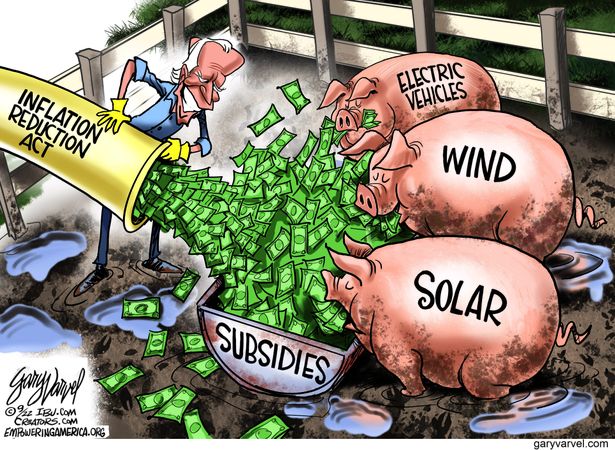
Why is the Biden Administration messing with a piece of Americana. Is it to try the hardest part first? Or because “clean” electrification is where the money is? With passage of the Inflation Reduction Act, it is definitely where the subsidies are. The enormity of these subsidies are like an all-you-can-eat buffet for Green New Deal enrichment.

Phasing out natural gas and propane is not merely for the U.S. to meet its commitments for “deep decarbonization” per the UN’s Paris accords. It’s also about “great reset” social control. With the advent of “smart” electric meters and appliances, it’s relatively easy to centrally control electricity usage.

Coupled with digital currency, it then becomes relatively easy to control behavior, such as remotely changing YOUR living room thermostat or disabling your car. Early dinner? No: you’ll cook when the power is temporarily turned on to your stove.  But if you project the correct attitude of cheerful compliance, you may be awarded with an extra ration of electricity.

DOE needs to stop politicizing energy appliances on unfounded predictions that “clean” renewable electricity will soon dominate the grid. This scenario is not at all probable given the cost and enormity of the quest. Big Brother is already running wild and must be leashed/removed. Given that DOE’s proposed rule calls for yearly energy consumption limits for cooking appliances, rationing might not be totally far-fetched. The time to expose and eradicate is now.

Appendices to Master Resource Article

Appendix A: Call To Action (Next Steps, What You Can Do)

Appendix B: Further Reading

Footnote

Obviously, bans against ICE vehicles will also prohibit those running on LNG (Liquified Natural Gas). See Consumers Report: Tesla Road Trip

As for fertilizer banning,  half of the people on Earth are alive today thanks to nitrogenous fertilizers made of and with natural gas.  So why are governments at home and abroad scrambling to cut off humanity’s natural gas supply?

See Natural Gas – Generated Nitrogenous Fertilizers Prevent Worse World Hunger

Rx for American Identity Crisis

There’s a new voice offering leadership in 2024 to reverse the US tailspin with Biden in the WH.  Vivek Ramaswamy is on to some things and his words and passion could resonate and inspire.  For those preferring to read his ideas, a transcript is below from the captions, in italics with my bolds and added images. TC is Tucker Carlson and VR is Vivek Ramaswamy.

TC: American Liberalism and Identity politics is a question that entrepreneur Vivek Ramaswamy has spent a great deal of time thinking about through two books as well as in his latest venture which he joins us to tell us about tonight. Vivek, thanks so much for coming on.

So it does seem like Don Lemon, you know just a cable host, but this is a perfect illustration of where identity politics wind up when you stray from Universal principles that bind us all under the same rules

VR: Exactly. I mean we are in the middle of this national identity crisis, Tucker where we have celebrated our diversity and our differences for so long that we forgot all of the ways we’re really just the same as Americans: Bound by a common set of ideals that set this nation into motion 250 years ago. And that’s what I’m proud to say tonight that I’m running for United States president to revive those ideals in this country. Those basic rules of the road include meritocracy–the idea that you get ahead in this country not on the color of your skin, but in the content of your character. The idea that you are allowed to speak freely, yes to be wrong sometimes, as long as your neighbor gets the same courtesy in return.

The idea that the people who we elect to run the government, by the way,
are the people who actually run the government.

Basic rules of the road are the things that bind us together. You and I have different shades of melatonin and I say so what. That’s not beautiful, that is not our strength. Our diversity is meaningless if there’s nothing greater that binds us together across that diversity. And the reason that I’m running for president is to revive those ideals, and I believe deep in my bones they still exist. Most Americans still believe in them but we need to rediscover that, and the only way we can do it is to start talking openly again.

TC: So I’m not going to ask you any political questions, because given my calls in the midterms, I don’t understand American politics. I’m not going to ask you what you’re doing in Iowa or whatever, other people can do that. Give us the bullet points of what you’re going to tell audiences as you embark from here on this campaign.

VR: I think we need to put Merit back into America in every sphere of Our Lives. I mean Merit in who gets into this country, let’s start with that okay. I think more people like my parents can be a good thing for this country, but people whose first act of entering this country as a law breaking one: We should say a hard no to that.

Merit not just who gets in but also  who gets ahead. Decimating affirmative action that has been a national cancer. One of my top priorities will be to end affirmative action in every sphere of American Life. And it’s not just meritocracy and who gets ahead, ending affirmative action yes. I mean our whole government is based on that idea. Well the funny thing Tucker, this would be an easy thing for a president to do. Lyndon Johnson issued an executive order that required anyone who does business with the US government–that covers over 20 percent of the U.S Workforce–to adopt race-based quota systems. Any Republican president since Lyndon Johnson could have taken a pen and crossed that out. We haven’t done it, yet I think that’s the kind of Courage we’re going to need to muster to go after these sacred cows from woke religion. In the form of affirmative action and to this new climate religion which is completely shackling the American economy and culture. We need to take the most sacred cows of these alternative secular religions, and I’m sorry to say this: Take them to the slaughterhouse.

Because that’s what what it’s going to take for this national revival where we stop apologizing for what it means to be American, for putting America first. But in order to put America first we have to begin by first rediscovering what America is. To me those are these basic rules of the road that set this nation into motion: from meritocracy to free speech to self-governance over aristocracy. Make the people who we elect actually run the government, rather than this cancerous Federal bureaucracy.

That’s going to be the heart of my message and I’ll tell you this we don’t have an option anymore. We face these external threats like the rise of China, which I think has got to be our top foreign policy threat to which we respond, not pointless wars somewhere else. That’s going to require some sacrifice, it’s going to require a declaration of independence from China, complete decoupling. And that’s not going to be easy; it’s going to require some inconvenience, since buying cheap stuff for so many years we got addicted to it.

But I think we can make those sacrifices if we know what we are sacrificing for. I want to see the GOP answer the question: What does it mean to be an American today? If we give an answer to that question, we dilute this woke agenda in these secular religions to irrelevance. Yes I’ve been complaining about them for the last three years because there’s a role for identifying the problem. But if we want to deliver a solution we’re need to rediscover that national identity that we all share. If we do that I still think in my bones that our best days, not in some cheesy politician kind of way, but truly I think our best days can be ahead of us. But it’s going to take that Revival to make it happen.

TC: I hope you’ll come back often because you are one of the one of the great talkers we’ve ever had. But very quickly: You identified China as the primary concern of American foreign policy; you don’t think it’s the war in Eastern Europe?

VR: Absolutely correct. Foreign policy is all about prioritization. We must wake up to the fact that China is violating our sovereignty. If that had been a Russian spy balloon, we’d have shot it down instantly, and ratcheted up sanctions. Why didn’t we do that to China?

The answer is simple: We depend on them for our modern way of life.
This economic co-dependent relationship has to end.

And the only other priority I’d add is: If you’re actually going to use the military for something, use it to decimate the cartels South of the Border in a failed Narco State that’s now actually killing people on American soil with fentanyl. That’s what a good use of a military looks like: Actually protecting American soil and American interests, not a pointless War somewhere else.

The heart of this goes to Reviving that national identity: What does it mean to be American. Then you know what you need to defend. That’s where our domestic policy vision and this cultural vision is inextricably linked to our foreign policy Vision too. And that’s why I’m running for president because I think that needs to be at the top of the GOP’s agenda. It needs to be at the top of this country’s agenda so I’m running for president to make it happen.

TC: That is so far from the current agenda it will be fascinating to see you weigh into this race, and we appreciate your announcing here tonight, thank you.

Footnote:

A second-generation Indian-American, Vivek Ramaswamy founded Roivant Sciences in 2014 and led the largest biotech IPOs of 2015 and 2016, eventually culminating in successful clinical trials in multiple disease areas that led to FDA-approved products.

He has founded other successful healthcare and technology companies, and in 2022, he launched Strive Asset Management, a new firm focused on restoring the voices of everyday citizens in the American economy by leading companies to focus on excellence over politics.

Covid Coercion Coverup in Canada

In recent months, some demonstrators in Quebec have denounced what they consider government fear campaigns over COVID-19. The new measures included a mandatory rule on wearing masks during demonstrations. Sept. 2020 (Graham Hughes/The Canadian Press)

John Hardie et al. dissect a recent publication attempting to whitewash blacken over suspension of citizens’ rights as well public health principles during the pandemic.  Their Epoch Times article is Pandemic Performance Study Blatant Attempt to Justify Feds’ Actions? Excerpts in italics with my bolds and added images.

The Public Health Agency of Canada study’s conclusions are a fantasy,
quite divorced from reality

Rather than learning from the painful lessons of the past three years, it’s obvious that we’ve entered a post-pandemic phase of government-led alarmism.

The Public Health Agency of Canada (PHAC)—including Theresa Tam—has published a study in a Canadian public health journal declaring that pandemic-inspired restrictions substantially reduced the impact of COVID-19 in Canada. “Counterfactuals of effects of vaccination and public health measures on COVID-19 cases in Canada: What could have happened?” asks us to believe an imagined story about what may have happened had Canada’s public health measures not been implemented.

However, the result is a counterfactual narrative of a fantasized Canada quite divorced from reality.

An elementary school in Montreal North is seen, Thursday, May 14, 2020 in Montreal. PHOTO BY RYAN REMIORZ /THE CANADIAN PRESS

Recent debate on the study’s findings has made it evident that Theresa Tam and her collaborators (“the authors”) are victims of common modelling pitfalls that have stripped their objectivity and, accordingly, affected the quality of their model and its output.

Instead of relying on modelling forecasts, the authors resort to “back-casting” to state “what may have happened” or “what could have been” had governments not acted on our behalf.

However, giving credence to such questionable results occurs all too often when sensational outcomes are observed. Unfortunately for any modelling study, the historical path—the one involving no interventions—was foreclosed the moment pandemic responses began. Neither the authors, nor anyone else, can ever observe the simultaneous response and non-response of Canada’s experience with COVID-19.

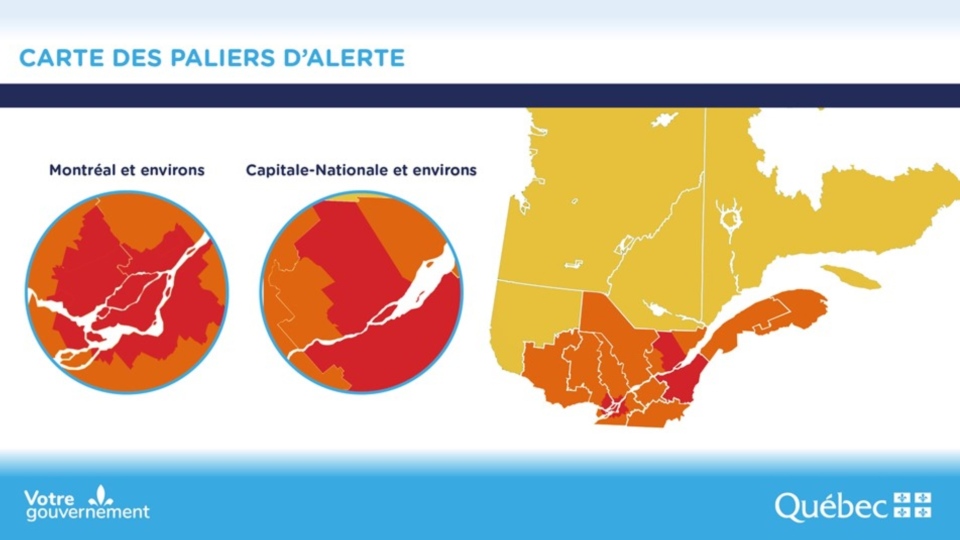
Quebec Premier François Legault says police in the province’s red zones — regions where COVID-19 cases are surging — will be issuing $1,000 fines to those who violate newly strengthened public health rules.  With fees, those fines will top $1,500 and can be issued for gathering in private residences or protesting without a face covering.

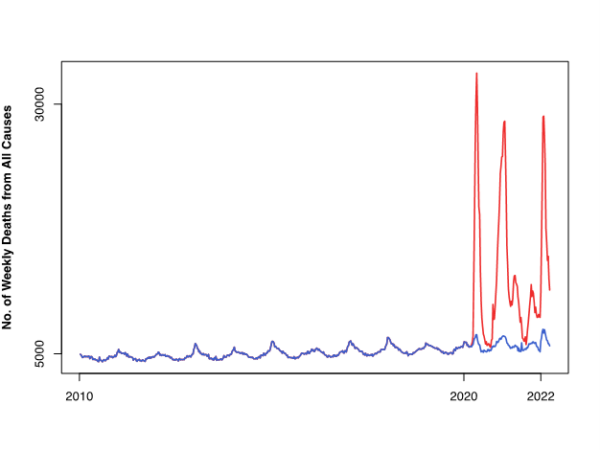
Their most dramatic claim is that, without social restrictions and vaccines, up to 800,000 COVID-related deaths could have occurred. The figure below shows 12 years of all-cause mortality data in Canada (blue line), with the authors’ “worst case” superimposed (red line).

The figure shows 12 years of all-cause mortality data in Canada (blue line), with the authors’ “worst case” superimposed (red line).

For us, two things make the authors’ assertion incompatible with any reasonable view: one, there was no obvious increase in all-cause mortality between 2020 and 2021 that exceeded historical trends (blue line), and two, the death count of “up to 800,000 people” (red line) surpasses the number of Canadians killed in the 1918 influenza pandemic and two World Wars—combined. It begs the question:

Could an infection with a survival rate >99 percent really have been
the single most devastating health event in a century?
The reader can decide if they find these results plausible, or fantastic.

All models are unrealistic to a degree (although this is not a “fatal flaw”). However, models are only as good as the assumptions upon which they are based. Unfortunately, the authors have hung their results on assumptions that underestimate the acquisition, extent, and durability of natural immunity and that very likely overestimate early viral spread and the duration of vaccine-acquired immunity.

The authors also assume that the spread of infection dropped consistently with the stringency of closures and other social restrictions: when strict, transmission was low; when relaxed, transmission increased. However, there is evidence that these measures didn’t work “as advertised.” In many provinces, their effect may have plateaued by April 2020.

Stricter measures did not translate into a proportionately slower spread.

Unfortunately, this didn’t stop the authors from forcing their model to respond as if they had. In their “worst case” scenario, large amounts of infection and disease are—conveniently—a foregone conclusion unless they get flattened by top-down government actions. The agency of Canadians and its bottom-up influences on transmission, such as people’s natural tendency to avoid contagion, are never considered.

Their least subtle omission was the failure to disclose conflicts of interest. While PHAC scientists might claim they only provide guidance on sub-national pandemic responses, the interests of many federal health-related agencies are certainly evident.

For example, the federal government’s purchase of COVID-19 vaccines preceded their approval by Health Canada, and some of the most restrictive measures imposed on Canadians (such as vaccine requirements for commercial travel) came from the federal level. As it happens, four of the authors are also directly employed by the federal government.

The study’s authors can hardly be viewed as not having competing interests
in favourably evaluating pandemic policies.

All this leads us to wonder: was their article a genuine evidence-based analysis of government policies? Or, rather, a blatant attempt to justify these policies? To their credit, the authors admit that Canada’s response to the pandemic was imperfect and any unintended consequences need to be investigated. It will truly be a measure of the honesty and integrity of PHAC and their provincial partners if the latter is ever realized.

Footnote Quebec Covid Situation October 1, 2020

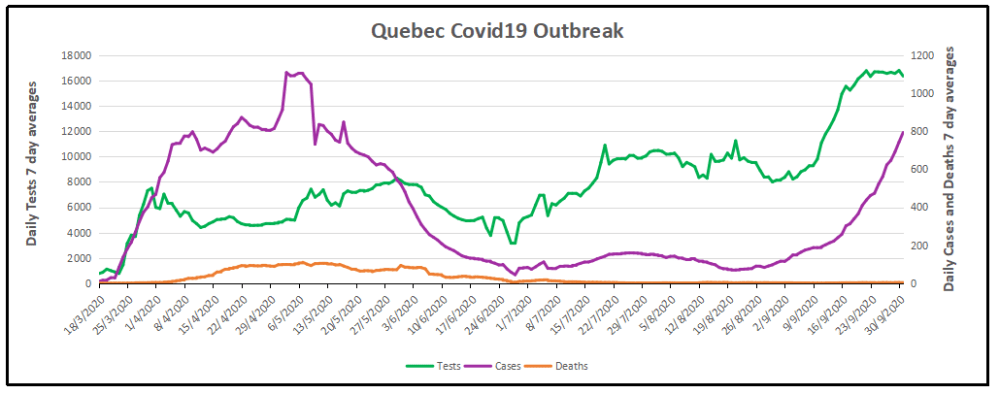
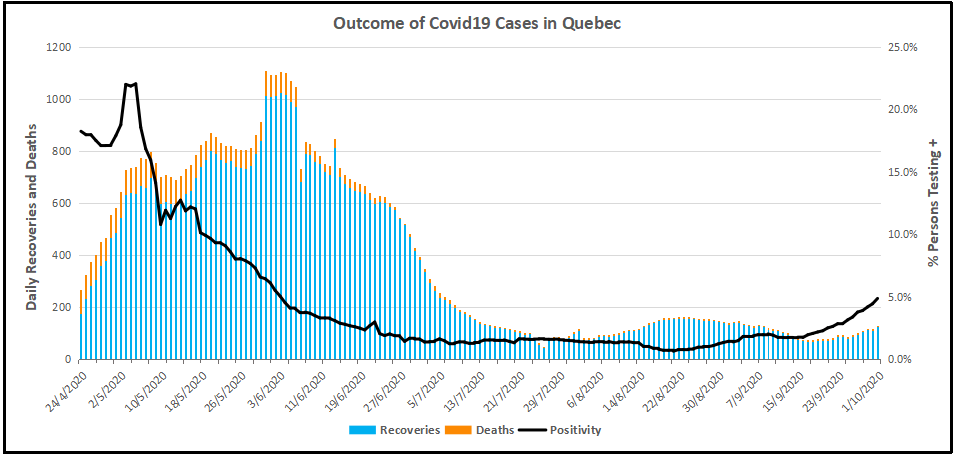
Note that testing has quadrupled since July and the number of new cases followed, especially in the last month.  Meanwhile daily deaths are unchanged at less than five a day, compared to Quebec losing 186 lives every day from all causes..  Recoveries are not reported to the public, perhaps due to the large number of people testing positive but without symptoms or only mild illness and no professional treatment.  The graph below estimates recoveries assuming that people not dying 28 days after a positive test can be counted as cured or in recovery.

Recoveries are the number of people testing positive (misleadingly termed “cases”) minus deaths 28 days later.  Obviously, the death rate was high early on, and now is barely visible.  Meanwhile the Positivity rate (% of people testing positive out of all subjects) went down to 1% for several months before rising recently.  Since there is a lag of 28 days, we don’t yet see the outcome of the rise in positives along with the increased testing.

And yet, with an edict, as of October 1 the government of Quebec put 60% of the provincial population under strict restrictions, about 4.8 million people.  The article from CBC News provides the details Quebec gives police legal tools to enter homes quickly to stop gatherings during COVID-19

Gas Stove Just a Starter

As explained  below, the move against gas stoves is just an opening into a larger war against methane because of its CO2 emissions.  Coal was bashed as a fuel already long ago, and now activists want to disqualify gas lest it serve as a bridge energy source with much lower CO2 emissions, delaying the desired upheaval.  The current assault on domestic appliances should be seen as the thin edge of a wedge to destroy natural gas supply, in parallel with actions against coal and oil.

Mark Krebs and Tom Tanton explain the ins and outs of this new phase encroaching upon the citizenry where they live.  Their Master Resource article is Gas Stoves: The Beloved Blue Flame is Just Better.  Some excerpts in italics with my bolds and added images and headers.

The Larger Federal Goal:  Transition Away from Natural Gas

The concern should not be about gas stove usage but the public policy of The Biden Administrative State to wean consumers off the direct use of natural gas and propane and on to electric appliances, ASAP. This “transition” includes how to heat your home, heat your water, cook, and drive.

Gas cooking is highly valued by consumers, virtually all of whom have normal taste buds. It is the one gas appliance that consumers see and use daily. The blue flame is part of home life, as is the fireplace run by gas or propane.

In contrast, the furnace and water heater usually tucked away in the basement or equipment closet and operate unseen. Also unseen are the legions of new electric power plants transmission lines and battery storage system to provide ostensibly “clean” juice for these new electric appliances and the serious environmental, strategic, and human rights impacts from mining and processing heavy metals and rare earths.

In fact, no one has done a comparative full fuel cycle analysis to document whether electrification is a good idea or a bad one; at least not a transparent analysis that has been subject to independent technical debate. Neither have the all-electrification busybodies presented a comprehensive plan to produce the millions of batteries necessary for the electrical grid to be able to handle all these new uses, while burdened by intermittent wind and solar.

Govt. Misdirection:  Claims Gas Stoves Hazardous to Indoor Air Quality

The first ploy was to claim gas stoves are unsafe concerning air pollutants.  Several problems with this attempt to regulate away these cooking appliances.

Fear mongering about the “existential threat” from Anthropogenic Global Warming (AGW) hasn’t been working as well as planned. So maybe, they hope, additional fearmongering about how parents are putting their own children at risk due to respiratory ailments, such as asthma from your stove will do the trick.

There are at least three agencies leading the Biden Administration’s whole-of-government fossil-fuel eradication efforts. These are:

  • DOE’s Office of Energy Efficiency & Renewable Energy” (EERE)
  • The Consumer Product Safety Commission (CPSC)
  • The Environmental Protection Agency (EPA)

None of these agencies have Congressional authority to regulate “indoor air pollution.” EERE has been pushing electrification at least since the Obama Administration, and it continued even throughout the Trump Administration. The Biden Administration simply removed the nominal (if any) restraints there may have been under Biden’s “whole of government” executive orders (EOs) to reduce GHG’s: e.g., Executive Order (EO) 13990.

In EERE’s case certain EO obstacles include that they still must act “as appropriate and consistent with applicable law.” The Energy Policy and Conservation Act of 1975 (EPCA) is one such law. EPCA is also supposed to promote regulatory objectivity. Under EPCA, DOE/EERE must also “consider” safety.

The science that the Biden Administration claims to guide such regulatory decisions
is far from conclusive that gas stoves are harmful.

Instead, the Biden Administration and its supporters “cherry pick” data that supports regulatory expansion. In this case, the science comes from the highly partisan Rocky Mountain Institute (RMI). A major activity (and bias) of RMI is its “Electricity Innovation Lab. It reiterates RMI’s mission to achieve a carbon-free electricity monopoly.

According to independent scientific researchers with a deep knowledge of this subject, most of the “indoor air pollution” is emitted from the food itself being cooked. Such pollution is in the form of particulates from cooking food regardless of what form of energy is doing the cooking. Those particulates may be especially harmful to adolescent asthmatics.

More Govt. Hype: Replacements More Efficient than Gas Stoves

Government Orange Gas?

What is it exactly that DOE wants to force on consumers under the guise of “energy efficiency in the case of gas stoves? It appears to be a relatively new type of gas stove burner that glows orange (infrared, a.k.a., “radiant”) instead of the blue flames present in traditional burners that consumers are accustomed to. Infrared burners have been around for a long time, especially for gas BBQ grills but they don’t last long. Infrared burner adoption for consumer kitchen cooking appliances have been limited to a few high-end “prosumer” gas ranges. Costs for such models tend to be in the vicinity of $7,000 to $9,000. One example is Wolf/Sub Zero’s Model # GR364G with a MSRP of $8,760. And only the griddle portion of that model is infrared. According to DOE, there may be one model that is all infrared but good luck finding it.

In comparison, a basic electric range can be purchased for under $500. Granted, if DOE mandates infrared gas burners, mass production could decrease cost premiums. But for cost-conscious consumers, such premiums will likely far exceed those of electric stoves, even induction electric stoves.

Forcibly moving the market via equipment costs is a typical DOE strategy.
And then they say, “let the market decide.

Part of DOE’s bag of tricks for justifying higher gas appliance efficiencies is to minimize maintenance costs and safety concerns.  At a minimum, “worst-case scenario” analyses are needed to determine how infrared burners perform in the “real world” of “messy” stoves. In messy situations, infrared burners may turn into product liabilities. And they may have to be replaced; that can quickly get expensive. It is at least possible that “dirty” infrared burners emit more pollutants than traditional blue flame burners. DOE needs to “consider” safety consequences of its energy efficiency proposals going forward.  It is not evident that they have.

Likewise, DOE tends to minimize its estimations for what the increased prices will be that consumers must bear from increased efficiency.  Taken together with other forms of analytical “trickery,” consumer cost-effectiveness can quickly become negative.

Since pictures are “worth a thousand words, see Shutterstock’s 223 images of infrared gas stoves. Several of these are pictures of infrared burners that have experienced obvious degradation from cooking spills.

There’s also movement on the electrical stove side of all this. That is, electric stoves continue to change and the technology du jour is the induction stove. Induction stoves electro-magnetically couple the stove with the pan, directly heating the pan and not the stove. They are more efficient than tradition hot coil electric resistance stoves but are also more expensive and require magnetic cookware. They too, have associated health risks (Induction stoves may not be safe to use with pacemakers; “People with pacemakers are better off avoiding induction stoves.”)

Perverse Incentives in Inflation reduction Act

The so-called Inflation Reduction Act provides perverse incentives for switching to electricity.  These incentives are summarized as follows:

DOE also needs to consider the safety feature of having a gas stove during extended electric grid blackouts that may make the difference between consumers and their water pipes freezing or not.  This benefit was widely observed in Texas during Winter Storm Uri.

To make a logical scientific argument about consumer safety concerns with gas burners, DOE must clearly and transparently demonstrate a safety issue with conventional “blue flame” burners.  Instead, DOE is proposing a one-way move to infrared burners based upon theoretical economic operating cost advantages of a few percentage points.

Meanwhile, DOE is not mandating a move from electric resistance stoves to higher efficiency  electric induction  stoves that, according to the EPA,  can be “5-10% more efficient than conventional electric resistance units.”  EPA’s verbiage following that quote states: “and about 3 times more efficient than gas.”  That latter verbiage is tantamount to professing a belief that electricity is magically created inside of the house’s electric meter. This is pretty much “par for the course” for the Biden Administration’s “Green New Deal” energy and environmental policies.

Under EPCA’s anti-backsliding provisions, once infrared burners are mandated, there is no going back to traditional (blue flame) gas burners. Thus, if consumers want to regain better cooking maintenance and reliability, they can only switch to electric stoves. We think that’s their plan! Consumers will probably choose electric resistance varieties due to their relatively low initial purchase cost. What this portends, at least for the next few decades, is that energy efficiency when measured over the complete fuel-cycle is massively reduced throughout most of the United States where fossil fuels still dominate electric grid generation. The same goes for emissions when measured along the complete fuel-cycle.

The direct use of natural gas makes the most sense economically and environmentally for consumers. Consumers are losing that choice.

Conclusion–Why The Crusade?

Why is the Biden Administration messing with a piece of Americana. Is it to try the hardest part first? Or because “clean” electrification is where the money is? With passage of the Inflation Reduction Act, it is definitely where the subsidies are. The enormity of these subsidies are like an all-you-can-eat buffet for Green New Deal enrichment.

Phasing out natural gas and propane is not merely for the U.S. to meet its commitments for “deep decarbonization” per the UN’s Paris accords. It’s also about “great reset” social control. With the advent of “smart” electric meters and appliances, it’s relatively easy to centrally control electricity usage.

Coupled with digital currency, it then becomes relatively easy to control behavior, such as remotely changing YOUR living room thermostat or disabling your car. Early dinner? No: you’ll cook when the power is temporarily turned on to your stove.  But if you project the correct attitude of cheerful compliance, you may be awarded with an extra ration of electricity.

DOE needs to stop politicizing energy appliances on unfounded predictions that “clean” renewable electricity will soon dominate the grid. This scenario is not at all probable given the cost and enormity of the quest. Big Brother is already running wild and must be leashed/removed. Given that DOE’s proposed rule calls for yearly energy consumption limits for cooking appliances, rationing might not be totally far-fetched. The time to expose and eradicate is now.

Appendices to Master Resource Article

Appendix A: Call To Action (Next Steps, What You Can Do)

Appendix B: Further Reading

Footnote

Obviously, bans against ICE vehicles will also prohibit those running on LNG (Liquified Natural Gas). See Consumers Report: Tesla Road Trip

As for fertilizer banning,  half of the people on Earth are alive today thanks to nitrogenous fertilizers made of and with natural gas.  So why are governments at home and abroad scrambling to cut off humanity’s natural gas supply?

See Natural Gas – Generated Nitrogenous Fertilizers Prevent Worse World Hunger


Florida to Ban Woke ESG Banking

Amber Jo Cooper reports at Florida’s Voice DeSantis proposes banning social credit scores in banking, targets ESG. Excerpts in italics with my bolds. H/T Tyler Durden

On Monday Gov. Ron DeSantis announced a proposal to target
ESG banking and investment policies 

DeSantis said he aims to enact protections for Floridians against discrimination by big banks and large financial institutions for their religious, political, or social beliefs.

ESG – environmental, social, and governance – is a business framework that determines investment based on political factors such as renewable energy and social justice initiatives.

DeSantis said ESG has developed into a “mechanism to inject political ideology into investment decisions, corporate governance, and really just the the everyday economy.”

“That is not ultimately something that is going to work out well for us here in Florida,” he said.

DeSantis said it violates the fiduciary duty that executives have to the shareholders of publicly traded companies.

Your pension money, your retirement money, is likely invested in some of these funds, and those funds should be done to try to produce the best result for you using the available investment options,” DeSantis said.

“What ESG says is no, we’re not going to do, even if it would do a better return – we’re not going to allow you to invest in certain areas, you’re not allowed to invest in oil and gas, you’re not allowed to invest in disfavored areas,” he explained.

The proposal includes prohibiting the financial sector from considering “social credit
scores” in banking and lending practices that aim to prevent Floridians
from obtaining loans, lines of credit, and bank accounts.

“That is a way to try to change people’s behavior. It’s a way to try to impose politics on what should just be economic decisions,” he said.

“We are also not going to house in either the state or local government level deposits. And we have a lot of deposit, we got a massive budget surplus in Florida, you have deposits all over the place that go in where state and local government use financial institutions, none of those deposits will be permitted to be done in institutions that are pursuing this woke ESG agenda,” he said.

The proposal would also aim to make sure ESG will not “infect decisions” at both the state and local governments, such as investment decisions, procurement and contracting, or bonds.

The Governor’s press release said the legislation would also:

  • Prohibit banks that engage in corporate activism from holding government funds as a Qualified Public Depository (QPD).
  • Prohibit the use of ESG in all investment decisions at the state and local level, ensuring that fund managers only consider financial factors that maximize the highest rate of return.
  • Prohibit all state and local entities, including direct support organizations, from considering, giving preference to, or requesting information about ESG as part of the procurement and contracting process.
  • Prohibit the use of ESG factors by state and local governments when issuing bonds, including a contract prohibition on rating agencies whose ESG ratings negatively impact the issuer’s bond ratings.
  • Direct the Attorney General and Commissioner of Financial Regulation to enforce these provisions to the fullest extent of the law.

Florida Chief Financial Officer Jimmy Patronis praised DeSantis’ proposal to crack down on ESG.

“When it comes to ESG, many of us have been boiled like a frog,” Patronis said. “The Governor is right that over time ESG has wound its way into too many aspects of American society, and pulling it back is going to take work.”

“This proposed legislation puts returns first, it puts the Constitution first, and it puts corporate America on notice that if they play politics with Florida residents, we’ll have the tools to hold them accountable. I look forward to working with the DeSantis Administration, as well as Senate President Passidomo and House Speaker Renner in getting this legislation over the finish line,” Patronis said.

Patronis previously barred ESG funds’ participation in the deferred compensation program and divested around $2 billion from BlackRock due to their utilization of ESG.

House Speaker Paul Renner said Bob Rommel, R-Naples, will introduce the bill in the House.  “The biggest thing that I think ESG represents is a total hijacking of democracy,” said Renner.

“We’re lucky here in the state of Florida, that we’ve got a governor who will stand up to things like ESG, when others will not,” he said.

“This is amazing what he’s doing for our state, our state is just rocketing,” said Senate President Kathleen Passidomo “I look forward to having the governor come back here again and again and again to sign all these bills,” she said.


There’ll Be Hell to Pay

Adam Mill writes at American Greatness There’s Going to Be Hell to Pay.  Excerpts in italics with my bolds and added images.

America is piling up civilization-ending debts, and the people incurring them for the sake of feel-good social priorities will be justifiably cursed when the consequences finally come.

It’s just a matter of how long the U.S. Government can stall before the bill finally comes due. Let’s start with the math.  The U.S. national debt now exceeds $31.5 trillion. On the day Joe Biden took office, the average interest rate on this debt was around 1.61 percent and interest payments were a mere $549 billion a year. Since then, higher spending and higher interest rates have accelerated the problem at breakneck speed. As older bonds with the historic low interest rates mature and disappear, they are replaced with the higher interest rate bonds now being issued. According to the St. Louis Federal Reserve, the annualized interest rate cost in December reached an eye-popping $853 billion.

The older, lower interest rate bonds have kept the average at around 2 percent, still much higher than normal. Econofact.org estimates that “most of the current government debt will mature within the next three years,” which means that the federal government will soon be financing most of its $31.5 trillion debt at market rates-which are approaching 4 to 5 percent.   We’re looking at a total annual interest bill of over $1 trillion in the very near future. By comparison, the total tax revenue collected by the U.S. government in 2023 is projected to be $4.6 trillion.

As soon as next year, interest will consume approximately one-fifth
or even a quarter of all government revenue.

That’s not the bad news.

The bad news is that we’re fast approaching the point at which we have to accelerate borrowing just to keep up with the interest payments. The treasury has to find buyers for its whopping $1.4 trillion in deficit spending. And for now, the Federal Reserve is saying it will not buy more treasuries, even to replace the maturing treasuries that roll off its portfolio.

Until recently, the dollar’s resilience made it possible for the government to effectively fund operations with money from the printing press. But inflation, the offspring of deficit spending, has begun to collect its due from the public. As interest payments claim increasingly more and more of the budget, the government must borrow more to make up the difference, thus accelerating the growth of the debt and inflation. This leads to still higher interest rates which lead to higher interest payments requiring even more borrowing

When you have to borrow money to pay interest on existing debt, you’re in big trouble.

Entitlements such as Social Security, Medicaid, and Medicare, make up the vast majority of the budget. Every year, the bills get bigger as drugs get more expensive and the Social Security Administration indexes existing payments to keep up with inflation.

It’s hard to say exactly when or how the federal budget will hit some sort of wall. But the scenario I consider most likely is that inflation will reignite as the Federal Reserve backs off its interest rate increases. Get ready to go long for single-digit inflation.

Unfortunately, the same geniuses who enabled politicians to run up these irresponsible debts will also be in charge of helping politicians set inflation-fighting policies. For the Left, the go-to tools never work but will always be tried because of political ideology. These include wage and price controls, tax increases, and criminalizing market pricing as “price gouging” or “hoarding.” As taxes go up and the government attempts to regulate its way out of inflation, economic output falls. If the fall is drastic enough, it can have a counterinflationary effect. But only after inflicting extreme misery on working Americans.

In the 1980s, Reagan’s formula of low taxes, less regulation, and higher interest rates created the conditions to dramatically reverse the Carter economic malaise, an era often compared to the present. While really smart economists will argue that the economy is totally dependent on government spending, this is sophistry. Government spending degrades efficient and wealth-enhancing transactions. The government gets its money by taking value out of a legitimate economic transaction and redistributing it to a political objective. Low-interest rates encourage scams and enable marginal businesses to chug along.

Profit, not borrowed money, is the key to economic revival. Produce things that legitimately add to the stock of goods and services, and you will increase national income. Shift money around with loans and government grants, and you will idle otherwise productive resources as people chase free money.

Economic freedom isn’t about helping the rich. If anything, the opposite is true. During the economic expansion that followed Reagan’s reforms, income inequality fell. The percentage of low-income houses fell from 27 percent in 1980 to 25.3 percent in 1989. In contrast, economic inequality increased under Obama’s economic policies.

The dirty little secret of leftist economic theories is that they benefit powerful people who are in a position to influence economic meddling. Who do you think got most of the COVID relief money?

Historians will scratch their heads and wonder why Americans spent so much time obsessing over Ukraine and gender identity while the debt piled up to catastrophic levels. Unfortunately, the people who govern us simply refuse to adhere to basic rules of fiscal discipline. Through ignorance or craven corruption, they continue aggressively driving up debt to unprecedented levels. These are civilization-ending debts and the people incurring them for the sake of feel-good social priorities will be justifiably cursed when the consequences finally come.


Update on Sovereign Election Fraud in US

Jay Valentine explains the threat in his American Thinker article Your Government Wants to Keep You from Seeing Voter Rolls.  Excerpts in italics with my bolds and added images.

The narrative about “free, safe, secure elections” changed 180 degrees since November 2022.  Almost nobody is crazy enough to say America has free, fair elections.

After Kari Lake and Adam Laxalt, the most wimpish George Bush RINO hesitates to say “elections are fair.”

Since our team processed billions of election roll “snapshots” taken since 2020, we run the largest election database in the world.  We concluded that U.S. elections are rigged by both parties, and they are rigged with the active help of election officials or their acquiescence.

Sovereign fraud — institutional election fraud by your government, first discussed on American Thinker — is real.  We have the data to prove it!

Fractal technology and vigilant election integrity teams in 2022 pulled back the curtain on much of this rigging — reported at www.Omega4America.com.

Why was the election fraud, which existed years before Trump became a candidate, so invisible?

Election officials of both parties do not want pesky citizens looking at voter rolls.  We know this because we have been in the room with them, virtually, demonstrating the most egregious voter roll anomalies, and they just refuse to see them.

Let’s get into just how virulent, common, widespread is the hiding of election registration info from you — the citizen.  How much does a voter roll cost?  Yeah, dollars.  In some states, it is free.  Download it, or pay a modest fee and get a CD of the entire election roll every 30 days.

In Alabama, $30,000.  You pay Alabama $30,000 for a copy of your election roll. In Wisconsin, $12,500. Why so much?  Is it a profit center? 

Well, in Alabama, they have scores of voters older than Julius Caesar — some registered in the last couple of years using a birthdate around the time St. Paul was proselytizing.  Think maybe there is a data roll cleaning problem there?

Wisconsin has voter IDs with hidden characters. 

You can find over 180,000 Wisconsin voters with the same voter ID.  Oops!  They aren’t the same IDs.  They are actually different — but you cannot tell with your software because the Wisconsin Election Commission uses a hidden character inserted that is invisible to you.  We made them admit it!

Go to our website, www.Omega4America.com, and read the expert witness reports.

In some states, you cannot get the voter roll unless you are a candidate or political party.  If you let anyone else see it, you can be prosecuted — Virginia and California.

There is North Carolina.  They insert control characters into election rolls so citizens have a hard time combining necessary rolls for analysis.

Creating databases with incorrectly inserted control characters shows one of two motivations:  massive incompetence or sinister intent.  You decide.

Our analysis of the various states, about 20 or so we have seen, is that the level of database competency is less than 8th-grade in most.  Let me state that clearly: in almost every state where we processed the election rolls, the level of database competence, from a secretary of state, spending millions of dollars a year — is less than high school level.

If the amount of undeniably false information in every state election database we have seen existed in a public company, the CEO, under Sarbanes Oxley rules, would probably go to jail.

How do you check a database?  Download it.  To what do you compare it?

Here’s an idea!  Let’s compare the county voter registration files with the state voter files.  They ought to reconcile, with a little float for registrations in transit.  Nope!  In state after state, there is a 5- to 10-percent difference between those two sets of ostensibly identical data.

Let’s check the state voter rolls with the county tax rolls.  After all, an address is an address.  The reconciliation between the voter roll and the tax roll shows hundreds into thousands of addresses that cannot, by law, house a voter.  Yet those addresses house thousands — regularly over 200,000 anomalies in a single state.

In 2022, we learned that election rolls have internal motionwaves of registrants who swell the roll up to election time — then gently slide back into the sea.

In Nevada and Arizona, we ran the rolls for several months.  Our graphical analysis shows the graph of people living in R.V. parks, hotels, other transient locations slowly rise to peak at election time, then disappear 30–60 days later.

Since we snapshot data — comparing every voter roll with every previous roll — the snapshots show mass migration to the election date, then mass de-migration afterward. This was never visible before Fractal technology, but now it is, from a phone.  Pretty soon we are going to visualize this and put up on the website for all to see.

Let’s not pick on Nevada — we see it in most states.  Harris County, Texas rivals Nevada.

If voter rolls aren’t opaque enough with hidden characters (Wisconsin), inserted control characters (North Carolina), prohibitive costs (Alabama, Wisconsin) or stupid laws that you can be prosecuted for looking at voter rolls if you are not an approved species (Virginia, California), we have a new trend.

Make it a crime to look at voter rolls!  Make it a crime to go door-to-door for election canvassing. 

Criminalize the audit of the criminalization of election rolls!  That’s a double-criminalization!  What does that mean?  Think we are kidding?  Welcome to New Mexico.

Among the army of unsung heroes, giving up jobs, risking safety to fight election fraud — which, dear reader, means they are fighting for your most cherished freedom — is David Clements in New Mexico. 

David is an attorney, professor of law, all-around patriot.  You will catch him on some obscure podcast, from his parked car on a roadside on the way to an election integrity event in the middle of nowhere.

Professor Clements, in a recent interview, reported how New Mexico is legislating to criminalize election integrity efforts.  They want to make it a felony to clean voter rolls.  Go door-to-door to see why the empty construction site has 27 registered voters?  In New Mexico, they want to put you in jail for it!

Guess which party is doing this.  Not much of a guess, is it?

While we are just data guys, we cannot hold back our admiration for guys like Clements, Seth Keshel, and an anonymous army of voter integrity teams fighting against bipartisan, government-funded, supported, and enforced phantom voter fraud.

We are stunned by the lack of support by the Republican wealthy class for these guys.  If they were leftists, trying to scam voter rolls, there would be an entire infrastructure in place to support them.  They might get book deals!

Alas, since they are patriots, the wealthy class stands aside. Well, we aren’t.  The Fractal team is giving patriots — of any party — the disruptive tools to clean voter rolls.

When you have better technology than the government, it does even things up a bit!