Identity Culture and Politics: Triumph of Style over Substance

Since the US election “identity politics” have been on full display.  It actually goes beyond politics in the sense that social media has brought us a global culture where who you are matters while what you accomplish does not.  We have had many celebrities like Paris Hilton who are famous for being famous.

In the political realm, this takes the form of identity politics, defined as (dictionary.com):
Political activity or movements based on or catering to the cultural, ethnic, gender, racial, religious, or social interests that characterize a group identity.

Thus in the last US election, Hillary’s slogan was “I’m with her.”  And when she lost, women took to the streets in protest, believing that their gender lost.  And in their shock and dismay, cyberspace is overwhelmed with messages reminding people that Trump is not “one of us.” Sadly, that refusal to identify with the victor and now President extends to his wife and children as well.

Unsurprisingly, for two months before taking office, Trump was criticized for things people imagined he would do once in power.  And that goes to the core of identity politics.  A subgroup, be they Hispanic, or LGBT, expects that one of their own should be in office, ensuring protection of their group’s interests.  The reality is, elected officials do not become competent due to an identity. Moreover, people belong to many groups, and each person has their own mix of opinions and interests.

The US used to be a merit-based society, where people were recognized and rewarded for their achievements, not simply for their style.  But recently it is more about style, not substance.  Thus the Nobel Peace Prize was awarded to Obama, not for achieving peace, but for getting elected US President while being black/white, Christian/Muslim.

I liked Obama, and thought he kept his cool guiding the US out of the 2008 financial crisis. He was re-elected not so much on identity as on achievements, referred to in his 2012 campaign slogan:  “Bin Laden is dead, General Motors is alive.”  Unfortunately, in his second term, he went off the rails on climate change, seeking to be a hero in the eyes of environmentalists, a key liberal identity group.

Hillary promised more of the same, and that is why people voted against her or abstained.

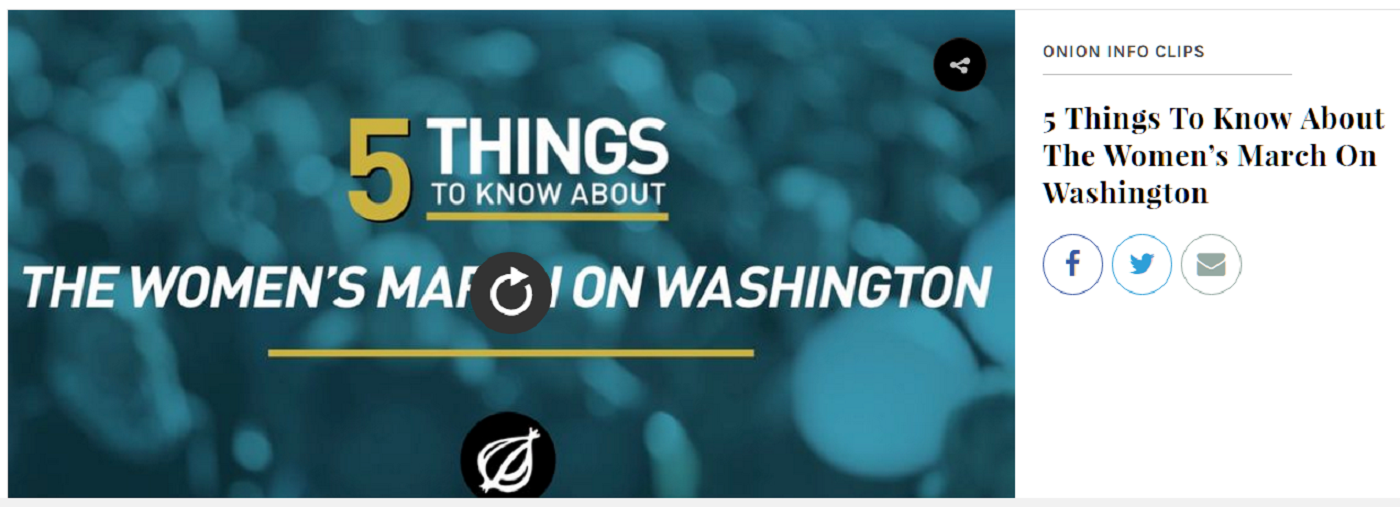
The Onion takes a humorous look at identity politics (here):

onion-march


Trump as Whisperer

There’s an old joke about a donkey trainer known far and wide for training donkeys in a gentle way, a “donkey whisperer.” One day, a man who had a defiant donkey brought him to the donkey whisperer for training. The donkey trainer immediately pulled out a two-by-four and whacked the donkey right between the eyes. The man was taken aback. “Why would you do that?, he asked. Your’re supposed to be the donkey whisperer!” he cried. “Well,” said the donkey whisperer, “before you whisper, you need to get their attention.”

After watching President Trump’s inauguration speech, I am guessing he is already thinking beyond draining the swamp. The federal bureaucracy is immense and set in its ways. Like a donkey, it digs in its heels and refuses to cooperate. Trump knows his presidency is an hostile takeover, not the first one in his business experience.

We see lots of push back from climate alarmist senators in the confirmation hearings, a torrent of trashtalking posts from Podesta’s blogs, internet sales of “Resist” T-shirts, scaremongering by journalists, along with street protests, defiant celebrities and fearful outbursts from government employees.  He seems to be getting their attention.

Let’s see how well Trump follows the advice of Teddy Roosevelt.

Damages Averted by Hillary’s Loss


Since the US election there has been much consternation and hand-wringing over what Trump may or may not do as President. Little has been said about what Hillary was promising and the ruinous effects directly upon the US and indirectly Canada, whose economic prospects would have suffered collateral damages. Kevin Libin corrects that omission in his National Post article: Cheer up, Canada — President Donald Trump just might be good for you (here)

It’s still impossible to tell which of Trump’s often-wild promises he will actually keep, given how unpredictable he has demonstrated himself to be. But the risk with Clinton was always the opposite. It was her political determination. Had she been allowed to govern as she was resolved to, Canada would have paid the price for as long as eight more difficult years — probably more than they will under even a loose-cannon amateur like Trump. A president Hillary Clinton would have implemented policies that would have been sure to drag down the economic growth of an economy upon which Canada overwhelmingly relies for its own.

She has been unapologetic about her plan to increase taxes, promising to raise the estate tax and capital gains taxes (where she planned to hike the top rate from 23.8 to 43.4 per cent) and she had proposed to tax high-frequency stock-market trades. She had said she was open even to new payroll taxes, which would have injured American competitiveness yet further. And her campaign said she would “take a look at” a carbon tax, if Congress had proposed one. Congress, still firmly in the hands of the Republicans, will now entertain no such thing.

Throughout her campaign, Clinton also distinguished herself as the candidate of multiplying regulations to rein in Wall Street, and more spending on entitlements: Where Trump said only he would not cut social security, Clinton went further and said she would “expand it.” She showed no interest in tax relief for corporations or personal incomes, focusing instead on raising tax revenues, $1.4 trillion over 10 years, another trillion dollars the following decade, in an attempt to reduce inequality through redistributionist schemes.

All of these were growth-killing policies overlooked by Canadian pundits who prioritized their distaste for Trump’s vulgarity and jingoism over the prospect of a robust American economy that could help Canada enhance its own prosperity. The U.S. GDP has been growing at not much more than two per cent a year for over a decade, much to Canada’s economic detriment; under Clinton, that seemed bound to continue.

The U.S. economy is nearly six years into its current economic expansion cycle and overall economic numbers continue to disappoint. From the US Money Reserve 

Summary

Will a Trump administration, as unhinged as some might fear it will be, prove more propitious for Canada? There is at least now some reason for optimism.

A Republican House and Senate are even more apt to stand firm for continued free trade with Canada than a Democratic Congress would have. And in the most probable scenario, if our exporters can maintain open trade with the U.S., Trump’s preference for economic growth looks far more likely to benefit Canada than Clinton’s preference for an expanded welfare state ever would have. It is too early yet to be certain whether these promising economic changes come to pass under Trump. But on Tuesday night, Canadians at least won some hope of finally escaping from the last 11 years of more muddling along, with our largest export market politically fated to remain underperforming and torpid.

blob:http://business.financialpost.com/d6df2d9f-72ba-491b-9e0a-507ede0c385e

Trump Revolution World Outlook


Lots of scorn, slurs and insults directed at Trump’s appointment of his chief advisor, Steve Bannon. The invective is so pervasive and intense, it exemplifies a new phenomenon in the global village: the Lie Swarm.  From the Streetwise Professor (here)

Bannon, and especially Trump, are primary targets of the Lie Swarm, especially since Trump had the temerity to actually prevail in the election. Don’t get me wrong–there is much about Trump to criticize. But there has been a kind of Gresham’s Law at work here: the bad criticism has driven out the good. Screeching “racist!” “Anti-Semite!” “Fascist!” on the basis of the most twisted and biased interpretation of the flimsiest evidence has overwhelmed substantive argument.

And the Swarm really hasn’t figured out that their attack will do little to get Trump supporters to change their minds. If anything, it will do the opposite, because the “deplorables” know that they are being attacked and smeared as much as Bannon and Trump. Furthermore, the Swarm seems hell-bent on living out Einstein’s definition of insanity: doing the same thing over and over, and expecting different results. Hillary’s whole campaign was based on personal attacks on Trump and his supporters, and she enlisted the Swarm in this endeavor.

Bannon in his own words

Martin Luther King said people should be judged by the quality of their character, not superficial identifiers like race, gender or religion. So someone like Steve Bannon should be evaluated by what he himself says and thinks, not by the words of others. And in fact if you listen with a mind to understand him, you discover why Trump values his advice on world realities and strategies to move America forward.

This Is How Steve Bannon Sees The Entire World is a transcript of an extended presentation by Steve Bannon from 2014, published at Buzzfeed (here). Some excerpts that struck me as particularly insightful.

Inclusive Capitalism Saved Us

That war (WWI) triggered a century of barbaric — unparalleled in mankind’s history — virtually 180 to 200 million people were killed in the 20th century, and I believe that, you know, hundreds of years from now when they look back, we’re children of that: We’re children of that barbarity. This will be looked at almost as a new Dark Age.

But the thing that got us out of it, the organizing principle that met this, was not just the heroism of our people. . . The underlying principle is an enlightened form of capitalism, that capitalism really gave us the wherewithal. It kind of organized and built the materials needed to support, whether it’s the Soviet Union, England, the United States, and eventually to take back continental Europe and to beat back a barbaric empire in the Far East.

That capitalism really generated tremendous wealth. And that wealth was really distributed among a middle class, a rising middle class, people who come from really working-class environments and created what we really call a Pax Americana. It was many, many years and decades of peace. And I believe we’ve come partly offtrack in the years since the fall of the Soviet Union and we’re starting now in the 21st century, which I believe, strongly, is a crisis both of our church, a crisis of our faith, a crisis of the West, a crisis of capitalism.

Modern Perversions of Capitalism

But there’s a strand of capitalism today — two strands of it, that are very disturbing.

One is state-sponsored capitalism. And that’s the capitalism you see in China and Russia. I believe it’s what Holy Father [Pope Francis] has seen for most of his life in places like Argentina, where you have this kind of crony capitalism of people that are involved with these military powers-that-be in the government, and it forms a brutal form of capitalism that is really about creating wealth and creating value for a very small subset of people. And it doesn’t spread the tremendous value creation throughout broader distribution patterns that were seen really in the 20th century.

The second form of capitalism that I feel is almost as disturbing, is what I call the Ayn Rand or the Objectivist School of libertarian capitalism. And, look, I’m a big believer in a lot of libertarianism. I have many many friends that’s a very big part of the conservative movement — whether it’s the UKIP movement in England, it’s many of the underpinnings of the populist movement in Europe, and particularly in the United States.

However, that form of capitalism is quite different when you really look at it to what I call the “enlightened capitalism” of the Judeo-Christian West. It is a capitalism that really looks to make people commodities, and to objectify people, and to use them almost — as many of the precepts of Marx — and that is a form of capitalism, particularly to a younger generation [that] they’re really finding quite attractive. And if they don’t see another alternative, it’s going to be an alternative that they gravitate to under this kind of rubric of “personal freedom.”

Crony Capitalism Gives Rise to a Populist Revolt

General Electric and these major corporations that are in bed with the federal government are not what we’d consider free-enterprise capitalists. We’re backers of entrepreneurial capitalists. They’re not. They’re what we call corporatist. They want to have more and more monopolistic power and they’re doing that kind of convergence with big government. And so the fight here — and that’s why the media’s been very late to this party — but the fight you’re seeing is between entrepreneur capitalism, and the Acton Institute is a tremendous supporter of, and the people like the corporatists that are closer to the people like we think in Beijing and Moscow than they are to the entrepreneurial capitalist spirit of the United States.

The underpinning of this populist revolt is the financial crisis of 2008. That revolt, the way that it was dealt with, the way that the people who ran the banks and ran the hedge funds have never really been held accountable for what they did, has fueled much of the anger in the tea party movement in the United States. . . In addition, I think you really need to go back and make banks do what they do: Commercial banks lend money, and investment banks invest in entrepreneurs and to get away from this trading — you know, the hedge fund securitization, which they’ve all become basically trading operations and securitizations and not put capital back and really grow businesses and to grow the economy.

I think it’s particularly more advanced in Europe than it is in the United States, but in the United States it’s getting pretty advanced — is that when you have this kind of crony capitalism, you have a different set of rules for the people that make the rules. It’s this partnership of big government and corporatists. I think it starts to fuel, particularly as you start to see negative job creation. If you go back, in fact, and look at the United States’ GDP, you look at a bunch of Europe. If you take out government spending, you know, we’ve had negative growth on a real basis for over a decade.

And that all trickles down to the man in the street. If you look at people’s lives, and particularly millennials, look at people under 30 — people under 30, there’s 50% really under employment of people in the United States, which is probably the most advanced economy in the West, and it gets worse in Europe.

So you can understand why middle class people having a tough go of it making $50 or $60 thousand a year and see their taxes go up, and they see that their taxes are going to pay for government sponsored bailouts, what you’ve created is really a free option. You say to this investment banking, create a free option for bad behavior. In otherwise all the upside goes to the hedge funds and the investment bank, and to the crony capitalist with stock increases and bonus increases. And their downside is limited, because middle class people are going to come and bail them out with tax dollars.

And that’s what I think is fueling this populist revolt. Whether that revolt is in the midlands of England, or whether it’s in Middle America. And I think people are fed up with it.

Secularization and the Rise of Islamic Fascism

The other (worrying) tendency is an immense secularization of the West. And I know we’ve talked about secularization for a long time, but if you look at younger people, especially millennials under 30, the overwhelming drive of popular culture is to absolutely secularize this rising iteration.

Now that call converges with something we have to face, and it’s a very unpleasant topic, but we are in an outright war against jihadist Islamic fascism. . .That war is expanding and it’s metastasizing to sub-Saharan Africa. We have Boko Haram and other groups that will eventually partner with ISIS in this global war, and it is, unfortunately, something that we’re going to have to face, and we’re going to have to face very quickly.

Because it is a crisis, and it’s not going away. You don’t have to take my word for it. All you have to do is read the news every day, see what’s coming up, see what they’re putting on Twitter, what they’re putting on Facebook, see what’s on CNN, what’s on BBC. See what’s happening, and you will see we’re in a war of immense proportions. It’s very easy to play to our baser instincts, and we can’t do that. But our forefathers didn’t do it either. And they were able to stave this off, and they were able to defeat it, and they were able to bequeath to us a church and a civilization that really is the flower of mankind, so I think it’s incumbent on all of us to do what I call a gut check, to really think about what our role is in this battle that’s before us.

I’m not justifying Vladimir Putin and the kleptocracy that he represents, because he eventually is the state capitalist of kleptocracy. However, we the Judeo-Christian West really have to look at what he’s talking about as far as traditionalism goes — particularly the sense of where it supports the underpinnings of nationalism — and I happen to think that the individual sovereignty of a country is a good thing and a strong thing. I think strong countries and strong nationalist movements in countries make strong neighbors, and that is really the building blocks that built Western Europe and the United States, and I think it’s what can see us forward.

Global Center-Right Populist Movement

Look, we believe — strongly — that there is a global tea party movement. We’ve seen that. We were the first group to get in and start reporting on things like UKIP and Front National and other center right. With all the baggage that those groups bring — and trust me, a lot of them bring a lot of baggage, both ethnically and racially — but we think that will all be worked through with time.

The central thing that binds that all together is a center-right populist movement of really the middle class, the working men and women in the world who are just tired of being dictated to by what we call the party of Davos. A group of kind of — we’re not conspiracy-theory guys, but there’s certainly — and I could see this when I worked at Goldman Sachs — there are people in New York that feel closer to people in London and in Berlin than they do to people in Kansas and in Colorado, and they have more of this elite mentality that they’re going to dictate to everybody how the world’s going to be run.

I will tell you that the working men and women of Europe and Asia and the United States and Latin America don’t believe that. They believe they know what’s best for how they will comport their lives. They think they know best about how to raise their families and how to educate their families. So I think you’re seeing a global reaction to centralized government, whether that government is in Beijing or that government is in Washington, DC, or that government is in Brussels.

And that center-right revolt is really a global revolt. I think you’re going to see it in Latin America, I think you’re going to see it in Asia, I think you’ve already seen it in India. Modi’s great victory was very much based on these Reaganesque principles, so I think this is a global revolt, and we are very fortunate and proud to be the news site that is reporting that throughout the world.

 

Good Things Trump Could Do (A Canadian View)

As liberals and Hillary supporters come to terms with Trump’s election, a few are realizing some improvements are more likely with Trump as President. Even those who thought him appalling saw changes needed, which did not fit under Hillary’s pledge of “More of the Same.”

Case in point is Margaret Wente, columnist for the Globe and Mail, whose recent article (here) was entitled:

A Trump presidency: It might not be all bad. Don’t get me wrong. I think the election of Donald Trump is a disaster. But he might actually do a few good things.

Faint praise, anyone? But I am reblogging the essay in its entirety because she makes many very good points. And I thought her comment on climate change was lucid and balanced (below with my bolds).

I was in the Y the other day, in the women’s locker room. Everybody was in mourning. Some people had begun to prepare for the worst. “We could set up abortion clinics right across the border,” I overheard one woman say. The others nodded in agreement.

Their anxiety was understandable, but perhaps premature. I honestly don’t think President Donald Trump will order a wholesale rollback of women’s rights. (If the abortion issue ever is kicked back to the states, it wouldn’t be the worst thing in the world.)

Nor do I think he’s Hitler, an analogy that’s been casually invoked by folks who are obviously clueless about history. (Apart from anything else, daughter Ivanka is an Orthodox Jew.) He’s not even a third-rate fascist. He’s more like Silvio Berlusconi – with infinitely more power to make mischief.

Mr. Trump might even do a few good things. Here are some.

He’ll boost the economy in the short run. Tax cuts and massive infrastructure spending will guarantee it. Even The New York Times columnist Paul Krugman – an implacable Trump foe – says so. “An accidental, badly designed stimulus would still, in the short run, be better than no stimulus at all,” he admitted grudgingly.

American infrastructure is in awful shape. Better airports, highways and major upgrades to the electricity grid are long overdue. Besides, infrastructure spending is exactly what our Prime Minister wants to do. So how can it possibly be bad?

He’ll approve the Keystone XL pipeline. Hey! Didn’t Justin Trudeau want Barack Obama to do that?

He’ll get rid of a lot of stupid regulations that make it hard for small businesses to get off the ground – and he’ll inspire the states to do the same. Do you really need a cosmetology licence (1,600 hours of training at an accredited school, plus a state exam) to do hair braiding? Maybe not.

He’ll get rid of the social-justice crusaders in Washington who dictate bathroom policies to local schools. And he’ll stop going after religious groups like Little Sisters of the Poor that don’t want to hand out free birth control.

He’ll roll back the Department of Education’s Office of Civil Rights, which made preventing campus sexual assault a key issue for the Obama administration. The result was the creation of kangaroo courts without due process, as well as a vast administrative apparatus to deal with matters that rightly belong in the criminal courts. This is not a setback for women’s rights. It’s a setback for the rape-crisis hysteria that’s swept across our schools of higher learning. It’s a setback for the notion that campus bureaucrats are equipped to deal with the sexual and emotional lives of their adult students.

He’ll keep Washington out of the business of micromanaging local schools. The No Child Left Behind Act, introduced in 2002 by the Bush administration, had the noblest of intentions but was a disaster for everyone concerned. It introduced an era of test craziness and much gaming of the system, without any meaningful improvement in student achievement. A sweeping rewrite of the law has shifted power back to the states. Mr. Trump will keep it there. He’s a fan of charter schools – a much better idea.

He’ll stop the flow of U.S. funds to Palestinian terrorists, via aid money that goes to the Palestinian government and Hamas. Not everyone believes that would be a good thing, but I do.

Mr. Trump will essentially repeal everything that Mr. Obama did on climate change. This may make less difference than you think – and it may inspire a much-needed dose of climate realism. The non-enforceable Paris accord is basically no more than a statement of good intentions. The coal mines aren’t coming back anyway. Climate realists (who aren’t the same as climate deniers – see Bjorn Lomborg and the Breakthrough Institute, for example) acknowledge the man-made influence on the climate, but also correctly point out that only extraordinary technological breakthroughs will significantly reduce our dependence on fossil fuels. In the meantime, we’d better think harder about adaptation – unless you think China and India will be content to forgo all hope of a decent living standard for their 2.5 billion-plus populations.

He won’t repeal gay marriage. He said so.

Don’t get me wrong. I think the election of Mr. Trump is a disaster. But there’s enough to catastrophize about without adding to the list. Breathe deeply, and think happy thoughts!

Margaret Wente is one of Canada’s leading columnists. As a writer for The Globe and Mail, she provokes heated debate with her views on health care, education, and social issues. She is a winner of the National Newspaper Award for column-writing.

Ms. Wente has had a diverse career in Canadian journalism as both a writer and an editor. She has edited two leading business magazines, Canadian Business and ROB Magazine. She has also been editor of the Globe’s business section, the ROB, and managing editor of the paper. Her columns have appeared in the Globe since 1992. She now writes full-time for the paper, and she is a frequent commentator on television and radio.

Ms. Wente was born in Chicago and moved to Toronto with her family when she was in her teens. She has won numerous journalism awards. She holds a BA from the University of Michigan, and an MA in English from the University of Toronto. She is married to Ian McLeod, a television producer.

Shy Voters Revenge on Media Bullies

Under the theme of “Suspicions Confirmed” we have a report from the few polling firms who predicted a Trump victory in the US election.

Some intriguing comments from the pollsters are excerpted from the full article Trade Secrets From the Predictors Who Called a Trump Victory at Politico (here).  From their results, we can understand the election swung on shy voters who were silent and discounted in the face of social and mass media bullying.

A handful of predictors bucked the crowd and told us something else was going on. One is Helmut Norpoth, a Stony Brook political science professor whose model suggested, all the way back in March, that Donald Trump had between an 87 and 99 percent chance at the presidency. Another is the team behind the USC-Dornsife/LA Times Daybreak poll, which followed a fixed pool of 3,200 respondents every week over the course of the campaign; their final forecast on Election Day had Trump leading 46.8 percent to 43.6 percent. Another was the Trafalgar Group, a Republican consulting firm that conducted surveys using automated phone calls to landline numbers in battleground states. They got Pennsylvania, Michigan, Wisconsin, Florida and North Carolina right—an achievement few others can claim.

We seem to see in our data that among the people that didn’t vote four years ago, there was definitely more support for Trump than among others. And even these people told us that their likelihood of voting, their self-reported likelihood of voting was lower than for those people who voted four years ago. So, you have this group that’s sort of underrepresented in many polls, and then they go to the polls a little more than expected, and then they’re also more Trump-leaning than expected.

When we went back and looked, we noticed a vast difference between those who voted in the Republican primary this year and those who voted in primaries historically. And it was one-sided [only on the Republican side].

We took that universe of those who have participated in 2006 or previous—we’re talking about people who voted for the last time in the ‘70s, in the ‘80s, in the ‘90s, and earlier 2000s, and we created the term Trump surge voters, and we added them into our call database as well as the newly registered, because in our experience, when people register to vote for the first time, the election that follows is the one that they’re most likely to participate in. So we had a good mix of newly registered voters as well as what we call our Trump surge voters.

So the big difference was the people they were surveying; and second is the fact that taking people on their face for what they were answering was not a smart move, because people were not being forthright as to who they were supporting.

There is some indication that the Trump voters were a little more uncomfortable with telling someone, but there were groups within the Trump voter camp that felt particularly uncomfortable. And one of those groups was women who planned to vote for Trump. And I think the other one—there was another paper that was done recently, it’s also college-educated Trump voters. So, there were just groups that—and I guess Latinos—groups that in the popular press, you know, people would sort of say, “Well, these groups are all going to vote for Clinton.” And, of course, within this group, you have big groups that actually wanted to vote for Trump, but they were the ones that were a little less comfortable with telling someone else.

I grew up in the South and everybody is very polite down here, and if you want to find out the truth on a hot topic, you can’t just ask the question directly. So, the neighbor is part of the mechanism to get that real answer. In the 11 battle ground states, and 3 non-battleground, there was a significant drop-off between the ballot test question [which candidate you support] and the neighbors’ question [which candidate you believe most of your neighbors support]. The neighbors question result showed a similar result in each state: Hillary dropped [relative to the ballot test question] and Trump comes up across every demographic, every geography. Hillary’s drop was between 3 and 11 percent while Trump’s increase was between 3 and 7 percent. This pattern existed everywhere from Pennsylvania to Nevada to Utah to Georgia, and it was a constant.

And so, I don’t accept that there were “shy Hillary voters.” And what we discovered is what he just said about a lot of minorities were shy voters and women were shy voters.

If you ask people that were in the field, that were out there visiting folks, they will tell you this was one of those elections where, yes, there were tons of Trump signs and Hillary signs in yards, but there were many, many millions of people who would have never put a Trump sticker on their car or a sign in their yard that literally could not wait to vote for him.

if you read something like the New York Times or you watch some of the major news shows and network shows, there was sort of a fixed notion that Hillary had this race in hand, that there was just a very difficult path for Trump to get to victory. From what I recall, there was never any notion that something like Pennsylvania or Michigan or Wisconsin would be in play. It was just going to be impossibly close for Trump to pull it off with the states Romney had and the battleground states—and I think that became such a fixed idea about this campaign and they didn’t consider an alternative.

So, I think this was sort of poll-driven, but it probably fed into a notion that Donald Trump was just unpalatable and unimaginable as a candidate. So I mean, this “it shouldn’t happen,” “couldn’t happen” sort of reinforced each other in the coverage on the New York Times and CNN and MSNBC.

We were surprised at how many people thought it was not going to be a Trump win. It was shocking to us the ridicule we were getting. I mean, you look at our Twitter as the election night unfolded, people saying, “You guys weren’t crazy,” just as much as they’ve been saying we were crazy for the three weeks before. There was one guy who simply tweeted us “bullocks” and that night he said, “May I withdraw my bullocks?”

Summary

Polling the electorate is a science, as is generating predictions of future climate. In the last US election, pollsters got it wrong as badly as have climatologists in their failed forecasts this century. However, election surveys get immediate and direct feedback from the real world when the votes are counted. Reputations take a hit when you are wrong, and you face reality, change your assumptions and methods, or go out of business. Climate alarmists have yet to see and admit the error of their ways.

Election in US Flyover Country

Many American jet set businessmen are bi-coastal, commuting between New York and LA. This week most of the people in their bubble voted heavily for Clinton and woke up shocked and distraught.

All of the states in between California and the Northeast are called “fly over country.” Here’s how elections look in the US:

County by county voting 2012 Presidential Election.

This map shows how the nation voted county by county in the 2012 Presidential election, Blue is Democrat and Red is Republican. Do you notice something of a split between rural and urban settlements? This is not new, the folks in those red counties have been in the minority culturally and nationally for decades. (2016 map at the bottom of this post)

Some journalists in those tiny blue spots (major cities like Chicago) are saying Trump is not their President because he hasn’t won the popular vote. How maniacal is that? Firstly, he may yet get more votes, Hillary is only 200,000 ahead with several states undeclared. Secondly, California gave Hillary a margin of 2,500,000 votes. By Chicago logic, none of the other states matter, just wait for California’s choice.  It is not a direct democracy; states elect the President, weighted by the number of congressmen, get over it.

The chickens have come home to roost. And it is a good thing. The disparity between urban dwellers and those in the hinterland is disgraceful, and dare I say, unsustainable. If you want to hear how life and the world looks when you live in the rust belt, or small-town America, hit the link below for an eye-opener from David Wong who came from there (here).  h/t Ivan

I was born and raised in Trump country. My family are Trump people. If I hadn’t moved away and gotten this ridiculous job, I’d be voting for him. I know I would.

That map makes it look like Obama’s blue party is some kind of fringe political faction that struggles to get 20 percent of the vote. The blue parts, however, are more densely populated — they’re the cities. In the upper left, you see the blue Seattle/Tacoma area, lower down is San Francisco and then L.A. The blue around the dick-shaped Lake Michigan is made of cities like Minneapolis, Milwaukee, and Chicago. In the northeast is, of course, New York and Boston, leading down into Philadelphia, which leads into a blue band which connects a bunch of southern cities like Charlotte and Atlanta.

Blue islands in an ocean of red. The cities are less than 4 percent of the land mass, but 62 percent of the population and easily 99 percent of the popular culture. Our movies, shows, songs, and news all radiate out from those blue islands.

And if you live in the red, that f**cking sucks.

“Nothing that happens outside the city matters!” they say at their cocktail parties, blissfully unaware of where their food is grown. Hey, remember when Hurricane Katrina hit New Orleans? Kind of weird that a big hurricane hundreds of miles across managed to snipe one specific city and avoid everything else. To watch the news (or the multiple movies and TV shows about it), you’d barely hear about how the storm utterly steamrolled rural Mississippi, killing 238 people and doing an astounding $125 billion in damage.

The Rural Areas Have Been Beaten To Shit. I know, I was there. Step outside of the city, and the suicide rate among young people f**cking doubles. The recession pounded rural communities, but all the recovery went to the cities. The rate of new businesses opening in rural areas has utterly collapsed.

See, rural jobs used to be based around one big local business — a factory, a coal mine, etc. When it dies, the town dies. Where I grew up, it was an oil refinery closing that did us in. I was raised in the hollowed-out shell of what the town had once been. The roof of our high school leaked when it rained. Cities can make up for the loss of manufacturing jobs with service jobs — small towns cannot. That model doesn’t work below a certain population density.

If you don’t live in one of these small towns, you can’t understand the hopelessness. The vast majority of possible careers involve moving to the city, and around every city is now a hundred-foot wall called “Cost of Living.”

And if you dare complain, some liberal elite will pull out their iPad and type up a rant about your racist white privilege. Already, someone has replied to this with a comment saying, “You should try living in a ghetto as a minority!” Exactly. To them, it seems like the plight of poor minorities is only used as a club to bat away white cries for help. Meanwhile, the rate of rural white suicides and overdoses skyrockets. Shit, at least politicians act like they care about the inner cities.

The rural folk with the Trump signs in their yards say their way of life is dying, and you smirk and say what they really mean is that blacks and gays are finally getting equal rights and they hate it. But I’m telling you, they say their way of life is dying because their way of life is dying. It’s not their imagination. No movie about the future portrays it as being full of traditional families, hunters, and coal mines. Well, except for Hunger Games, and that was depicted as an apocalypse.

Hillary, meet the Deplorables.

More from David Wong at Cracked (here)

Trump Appreciation: The Wisdom of Dilbert

The insightful blog of Scott Adams (creator of Dilbert cartoons like the one above) was just referred to me by John Hultquist (many thanks). Scott has blogged for more than a year on the Trump phenomenon, and his posts provide needed perspective for those who succumbed to the media brainwashing during the campaign to defeat him.

Now that Trump will be President, many people (both those pleased Hillary lost and those wanting her to win) need to step back and take a more reasoned look at the man. Think of it as a course in Trump Appreciation.  Think of the studies in Art or Music Appreciation we took as youngsters needing a context to understand what we were hearing or seeing.

The directory of Scott’s posts (here) is very informative, as suggested by these insightful observations popping up here and there:

The Two Candidates

But something is different this year. This year we don’t have an election between two candidates that offer roughly the same outcome. This time we have a swamp-draining outsider looking to institute term limits. And this outsider has been successfully branded by his opponent as the second-coming of Hitler.

Ironically, we have the two “worst” candidates of all time, according to their favorability ratings. But those two worst candidates have given us two of the best (clearest) choices we have ever had as a country.

Sure, both candidates are flawed, but both have the capability to deliver on their main propositions. Clinton probably can give you a third term of Obama(ish) and Trump probably can drain at least some of the swamp. If you step back from the negativity of the election for a moment, you can be grateful that our Republic served up these two options. That’s how it is supposed to work.

Contrasting Leadership Styles

Clinton’s message is that we are “stronger together.” That’s true, but the message is not about you. It’s about the power of a group. And in this context, unfortunately, the “stronger together” theme has mostly served to embolden Clinton’s supporters to bully Trump supporters because there is safety in numbers. Clinton also talks about her place in history as perhaps the first woman president. But that is more about Clinton, and history, than you.

Yes, Trump is a bully, but he’s offering to provide that service on behalf of the country. When leaders do it, we call it leadership. (Think LBJ or Steve Jobs.) Trump isn’t encouraging his supporters to bully Clinton supporters. But Clinton has painted Trump and his supporters as Nazi-like deplorables, and that creates moral cover for the bullying you see all over the country against Trump supporters. It wouldn’t be a bad thing to bully a Nazi, would it? That’s the dangerous situation Clinton has created.

While Obama is out talking about his legacy, and Clinton is out talking about making history as the first woman president, Trump (the narcissist) asks for the American people’s help in draining the swamp and making America great again. That’s one heckuva contrast to end on.

Why Trump Surprised

The social bullying coming from Clinton’s supporters guaranteed that lots of Trump supporters were in hiding. That created the potential for a surprise result, so long as the race was close.

The business model of the news industry guarantees lots of “scandals” on a regular schedule. Small things get inflated to big things, and I assumed there would be plenty of them. Trump has the skill to overcome medium-sized scandals and bumps in the road.

Last year, when many observers were saying Trump was a stupid, under-informed clown, I was saying he was a Master Persuader. Pundits said he ignored facts because he didn’t know them or because he was a liar. I said he ignored facts because facts are useless for persuasion. Trump could learn lots of facts if he wanted to do so. But he knew it was a waste of time.

Readers of this blog might recall that months ago I predicted that Trump would soften his immigration proposals. That’s because I saw him from the start as a Master Persuader, not a crazy person, and not a common flip-flopper.

In my opinion, Trump might be the safest president we have ever had. He can lead the dark parts of his base toward the light (as Nixon went to China) and he has no incentive for war. Claims about his “temperament” are mostly about his penchant for insults, and that isn’t a mortal danger to anyone.

The Presidential Trump

Economies are driven by psychology. If you expect things to go well tomorrow, you invest today, which causes things to go well tomorrow, as long as others are doing the same. The best kind of president for managing the psychology of citizens – and therefore the economy – is a trained persuader. You can call that persuader a con man, a snake oil salesman, a carnival barker, or full of shit. It’s all persuasion. And Trump simply does it better than I have ever seen anyone do it.

Most of the job of president is persuasion. Presidents don’t need to understand policy minutia. They need to listen to experts and then help sell the best expert solutions to the public. Trump sells better than anyone you have ever seen, even if you haven’t personally bought into him yet. You can’t deny his persuasion talents that have gotten him this far.

Clinton’s team of cognitive scientists and professional persuaders did a terrific job of framing Trump as scary. The illusion will wear off – albeit slowly – as you observe Trump going about the job of President and taking it seriously. You can expect him to adjust his tone and language going forward. You can expect foreign leaders to say they can work with him. You can expect him to focus on unifying an exhausted and nervous country. And you can expect him to succeed in doing so. (He’s persuasive.) Watch as Trump turns to healing. You’re going to be surprised how well he does it. But give it time.

Great America

Amusement park in California.

Finally, a new day and a new beginning beyond politics as usual. For the first time in decades, the “deplorables” get their turn to ride on the carousel powered by tax dollars.  As we all know, Trump’s slogan was “Make America Great Again”, while Hillary’s boiled down to “More of the Same.”

People are going to be surprised by Trump’s presidency. The US campaign is a full-contact, blood sport. Trump showed he can get down and dirty in the trenches and duke it out. But he is a man with several personas, and we will get to watch the transformation into elected leader, statesman, national governor, and commander-in-chief.  If politics is making deals in order to get things done, then let’s see in action a man who built his wealth and reputation on “The Art of The Deal.”

No doubt there will be missteps since he has never done any of this before. But for the first time in modern US history, the presidency will be re-invented by someone not schooled in the system, and little beholden to vested political interests.

One excited millennial womon in Times Square last night (before the result): “He’s not in this because he is a politician, and not because he needs the money. He’s in it because he loves this country.”

The voting pattern will be dissected and analyzed in the days ahead. So far we know that Hillary mostly matched her poll projections while Trump surpassed his by about 4%. It may turn out that advance polls based on “likely” voters missed a constituency of angry, fed-up middle-class white males who were expected to stay home as usual, but turned out in large numbers to determine Trump’s victory. I will also be curious to see what millennials did.

US politics will be fun again. No more politicians (“adults in the room”) lecturing to us what we should think, how we should talk, who we should like and dislike, and what we should care about (e.g. “climate change is a bigger threat than radical Islam”)

Fasten your seat belts for the roller coaster ride is about to begin.

Climate Alarms LOL

We skeptics enjoyed immensely the expert satire of Yes Prime Minister directed at the foibles of climate hysteria.  That clip was available at my post Laughing at Climate Change.  (That video is also now blocked, but I have added the transcript (here).

Now we find there was another even more skewering into the soft underbelly of the beast.  H/T Global Warming Policy Foundation (here).

“Computer models are no different from fashion models: seductive, unreliable, easily corrupted, and they lead sensible people to make fools of themselves.” –Jim Hacker, Yes, Prime Minister

The video was blocked by BBC in my country (Canada), but GWPF helpfully provides the transcript of the juicy bits:

Later in Act One, Scene Two
The phone rings. They all look at it.

Claire Hello? It’s the BBC again. I see. Thanks. (She hangs up.) Piling on the agony. A big new story about global warming has just broken, they’re adding that to the Sunday programme too. Global warming computer models have been proved wrong.

Humphrey How shocking!

Claire The new models show that it’s even worse than previously thought. Much more severe. And happening faster.

Jim Is that supposed to be my fault too?

Claire Everything is at the moment. They want to know why the government is dragging its feet on CO2 emission controls.

Jim (losing it) Do we have to deal with that tonight? As well as …(much has gone wrong for Jim earlier in the play)… Is there anything else, anything else we can pile on me tonight? Oh yes! Global bloody warming, thank you very much!

Claire It’s just that they’re going to add it to the catalogue of your failures. (He gives her a look.) Alleged failures, I mean.

Humphrey Meanwhile, may I suggest that you don’t worry too much about global warming?

Jim Right. I can’t do anything about that tonight, can I?

Humphrey Tell me, how do they know we’re all going to drown in years when the weather forecast was so wrong last Friday?

Jim Because all the scientists agree.

Humphrey So they say. So do the computer models. I know. But why should global warming computer models be any more accurate than financial ones?

Jim Um…

Humphrey Wall Street computer models were designed to prove sub­prime mortgage derivatives were low risk. These computer models are designed to show global warming is getting worse.

Jim Come off it, Humphrey.

Humphrey Remember mad cow disease? Computer models for that proved that we’d be dying in our hundreds of thousands by now. The only thing is, virtually nobody died, did they? Same with the salmonella-in-eggs computer models. Same with swine flu.

Jim You’re suggesting … what, exactly?

Humphrey Global-Warming models leave out nearly all the other possible causes except CO2. And then they say ‘Look, CO2 has caused all this climate change.’

Jim What other causes are there?

Humphrey If the earth were actually getting warmer, one might start by looking at the sun. Solar activity, water vapour, cosmic rays, sunspots, underwater volcanoes –

Jim If? The world is getting hotter, the science is overwhelming, everyone knows that.

Humphrey There’s been no rise in temperature since 1998.

Jim Really? But it was rising, wasn’t it?

Humphrey From 1975 to 1998, yes, absolutely.

Jim That’s what I mean.

Humphrey But it fell from 1940 to 1975. Even though that was a heavily industrialised period, when CO2 shot up. And overall the temperature isn’t rising at all: the hottest year in the twentieth century was 1934.

Jim I read that two thousand five hundred top climate scientists contributed to the last IPCC survey and they all agreed that man­made global warming is a proven fact and trapped greenhouse gases are the cause.

Humphrey Nearly fifty of them agreed. The others didn’t, actually. But their views were left out of the summaries given to the press.

Claire Haven’t you seen that film of the melting icebergs in the Antarctic?

Humphrey Yes. Beautiful, aren’t they?

Claire That’s caused by CO2.

Humphrey No, that’s caused by warm water masses from the Pacific.

Claire Why are the polar bears becoming extinct?

Humphrey Are they?

Claire The computer models say they are.

Humphrey But the people who actually go and count them have found more than there were thirty years ago.

Jim For heaven’s sake, Humphrey! If it’s all such nonsense why does everyone believe it?

Humphrey (amused) Hard to understand, I agree. But some scientists believe it, lots of others want the billions of pounds you can get for research that seems to show that global warming is caused by greenhouse gases, and most of the scientists who disagree can’t get published. Journalists love shock­horror stories, governments want to look virtuous to the voters, lefties want a way to rubbish big oil, and it makes the tree-huggers, whale-savers, anti-capitalists and everyone at the BBC feel holier than thou and warm and fuzzy inside. What’s not to like?

Jim Why hasn’t anyone else said all this?

Humphrey They have. No one wants to hear it.

Jim So wind farms don’t make sense?

Humphrey (chuckles) They certainly do, for all the businessmen who are getting enormous government grants for them. But there isn’t enough wind to be practical. The total output of all the UK wind turbines put together is one-fifth of one decent sized coal-fired power station.

Claire You don’t believe in global warming?

Humphrey My job is not to believe or disbelieve. My job is to weigh up arguments and produce answers. That’s what the Civil Service is for.

Jim I really think you must be misinformed somewhere. Al Gore got the Nobel Peace Prize for his work on global Warming.

Humphrey So did Dr Kissinger for his work on the Vietnam War.

Jim has no answer to that.

Jim You think it’s all a scam? I can’t get my head around this.

Humphrey For some people it’s a scam. For most, it’s just the greatest outbreak of collective hysteria since the witchcraft trials in the seventeenth century.

Footnote:

Apologies to anyone who didn’t know LOL is an internet reference meaning “Laughing Out Loud.”  Apparently that number includes Vladimir Putin who recently ended an interview with LOL, but he meant “Look Out Latvia.”

PS Further Wit and Wisdom from Sir Humphrey

Opposition’s about asking all the questions.
And government is about not answering them.

The less you intend to do about something, the more you have to keep talking about it.

“Open government” is a contradiction in terms. You can be open or you can have government.

Citizens don’t have a right to know, theirs is a right to be ignorant. Knowledge only means complicity and guilt, ignorance has a certain dignity.

If people don’t know what you’re doing, they don’t know what you are doing wrong.

“Under consideration” means we’ve lost the file. “Under active consideration” means we’re trying to find it.