Britain’s Royal Society Defies the Green Blob

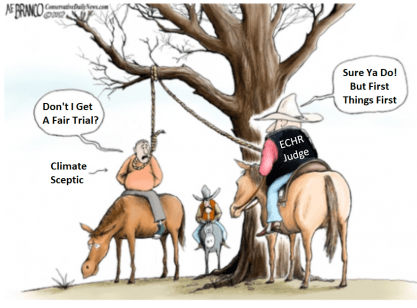
News comes from Financial Times that the prestigious scientific Royal Society is honoring it’s motto:  “Take Nobody’s Word For It” (translation of Latin phrase above.) Of course, a great many UK academics were outraged at the refusal to take for granted their claim that “Climate Science is Settled.” The article by Kenza Bryan is Royal Society and academics clash over influence of oil and gas industry.  Excerpts in italics with my bolds and added images.

Three-centuries-old institution rebuffs call to
declare fossil fuel companies culpable for global warming

A clash between Britain’s 363-year-old Royal Society and more than 2,000 UK academics has escalated over the national academy of scientists’ refusal to attribute the role of oil and gas companies in climate change.

The academics had expressed their concerns about the influence of fossil fuel companies on scientific research in a letter last year to the Royal Society, founded in 1660 as a fellowship that included the likes of Isaac Newton.

But the Royal Society has now rebuffed their request to issue an “unambiguous statement about the culpability of the fossil fuel industry in driving the climate crisis”.

Treasurer Jonathan Keating wrote in reply last week that it would “not be appropriate” to do so, as there was a need for “multiple actors” to engage with the complexity of the climate crisis.

The academics’ concerns about the influence of oil and gas companies extend to separate allegations that ties to BP were not disclosed by a Cambridge professor in a Royal Society policy briefing document produced by a working group that he chaired in 2022.

Professor Andy Woods held the title of head of the BP Institute, a research arm that it funds, which was renamed the Institute for Energy and Environmental Flows by Cambridge last year. He also has the formal title of BP professor, a position endowed by the oil and gas company. These affiliations were not included in the reference in the document.

The Royal Society briefing document called for an “enormous and continued investment” into geological carbon capture and storage, a technology promoted by the fossil fuel industry as a way to keep expanding while storing the emissions.

A CO₂ storage adviser to BP and a director for CO₂ storage at the Norwegian Petroleum Directorate also contributed to the report. Woods’s expertise in geophysical fluid flows and the BP affiliation are listed elsewhere by the Royal Society in its fellowship directory. BP and Woods did not respond to a request for comment. The Royal Society said the document gave “clear affiliations” for contributors and that it publishes a wide range of research.

The tensions reflect the discord in academia about funding or
participation in research by oil and gas companies, as well as
rising activism on campuses among the student body and staff.

The Royal Society’s decision not to call out the industry was described as “moral cowardice” by James Dyke, earth system science professor at Exeter university.

Another signatory to the original letter, Bill McGuire, professor of geophysical and climate hazards at University College London, said it was “mind-boggling” that a respected scientific organisation would not attribute the role of fossil fuel groups in climate change.

Student campaigners at Oxford university have also targeted the author of a set of green principles used by the university to help guide decisions on whether to invest in or receive grants from oil and gas companies.

Under freedom of information provisions, the student campaigners identified Myles Allen, the university’s head of atmospheric, oceanic and planetary physics, as having had 18 meetings where a representative was present from one of the major oil and gas groups, including either BP, Shell, Exxon or Equinor.

Those meetings in 2021 and 2022 included five occasions organised by Shell, three of which focused on the oil and gas group’s strategy and climate scenarios, according to the freedom of information response.

Allen, who was head of the Oxford Net Zero research initiative until earlier this year, told the Financial Times he had used the meetings to highlight the need for fossil fuel companies to pay for carbon capture and storage technologies.

It is a solution to the reduction of future carbon dioxide emissions that he has long advocated. “We all have a duty to help the fossil fuel industry not make the problem worse but to fix it,” he said.

Oxford said its “partnerships and collaborations with industry” allow for research on pressing global issues, including climate-related ones.

The campaigners called on Oxford to conduct an independent assessment about its approach to fossil fuel sector donations and investment. Cambridge university in March temporarily stopped accepting grants and donations from the sector in response to similar concerns.


Teens Impaired by Social Tech

Smartphones and social media have taken a toll on young people’s development. But one man has an idea about how to fix Gen Z. In his new book, “The Anxious Generation,” social psychologist Jonathan Haidt (JH) investigates the sudden collapse of mental health among adolescents. The author joins Hari Sreenivasan (HS) to discuss ways for parents to head off the damage.  Below is a transcript from the closed captions in italics with my bolds and added images.

HS: Jonathan thanks so much for joining us. Your latest book is called the anxious generation, How the great rewiring of childhood is causing an epidemic of mental illness. You and I have talked before and you have been very careful about not seeming alarmist. This book is fascinating to me in that you supplement so much of your ideas with empirical data and research that is proving this point. What is the epidemic of mental illness and where do we find the data for that?

JH: When you and I first spoke about this it might have been back in 2019 I was not as alarmist because we weren’t sure it was clear that something was going wrong with Teen Mental Health. We had graphs showing that around 2013 rates of anxiety depression and self harm began rising rapidly. But there was an academic debate and there still is academic debate about whether it’s caused by social media. It’s correlated with girls who use it heavily, who are three times as likely to be depressed. But you know scientists are going to debate is it causal or is it just a correlation.

Since then I have learned a lot; I’ve gathered all the studies I can find including experiments. There are now a lot of experiments showing that when you randomly assign people to different conditions, it causes them to get more depressed or less depressed. So we have experimental research. But the really shocking thing that made me an alarm ringer, not an alarmist, is the discovery that the exact same thing that what happened to us in America also happened in Canada, Britain, Australia, New Zealand and Scandinavia.

At the same time, in the the same way, it was
hitting girls hardest and young girls even harder.

So it became clear this is an international epidemic of Teen Mental Illness and it began in the early 2010s. It’s hitting girls hardest, although the boys’ story is really interesting and different but is also very bad. That’s why as you say I’m leaving my old self behind and saying we need to act now, not waiting for 2025. We need to really make changes this year because otherwise another year of kids is going to be consigned to this phone-based childhood which interferes with development.

HS: So your argument is that it’s not the technology that’s bad or the internet that’s bad. You actually try to draw kind of a timeline from getting one of these supercomputers in your pocket to the front-facing selfie camera to broadband and then social media. What have each of these kind of technological evolutions done to how our brains evolve?

JH: So the technology is great, the internet is great, but things really change in the early 2010s. I really go into this in detail in the book, but let me briefly walk you through it. In 2010 only about 20% of American teens had a smartphone, kids were still using flip phones. They did not have high-speed internet. Most of did not have unlimited data plans. You used your flip phone to text or call your friends to get together and that was it. Kids were still seeing other kids in 2010.

The beginning of what I call the great rewiring happened over the next few years. The smartphone gets a front-facing camera in 2010, Instagram comes out in 2010 but becomes super popular in 2012 when Facebook buys it. So that’s when the girls really rush on, they move their social lives on to Instagram in particular also Tumbler and a few others. So you get these super viral social media platforms, it wasn’t like that in 2005. So with front facing camera and high-speed data, you get notifications. The original iPhone didn’t interrupt you; you pulled it out when you wanted it.

So in 2010 there is no sign of a mental health crisis everything’s fine so we were all super optimistic in 2011 even up to 2012. But that’s when the mental illness crisis begins and all the numbers go way up for girls and also up substantially for boys. By 2015 we have the Millennials who just barely made it through puberty before they got this. So the Millennials were in college or late high school when they adopted this phone based life. Because we’re all doing it, we’re all dominated by our our technology.

HS: Walk us through the actual harms that’s now scientifically connected to kids use and increased use of screens and social media specifically on smartphones.

JH: First we have to establish the numbers here which are stunning. The latest data from Gallup is around 9 hours a day that they spend on their phones and screens. Of that, five hours a day is social media, another 3 to five is all the other stuff that they do. So imagine if you take nine or 10 hours out of your child’s day every single day, where’s it going to come from? They spend less time sleeping, less time with other kids, less time outside, less time exercising, a lot more time just being sedentary and solitary.

For all those reasons, and oh, very little reading of books, no Hobbies, there’s no time for anything. So that’s the first thing: it pushes out all the good things of childhood that we want our kids to have. When you give a kid a smartphone it’s likely to move to the center of her life, and that’s what she’s going to do for the rest of her life. That’s one of the main ways of harm it just deprives you of everything else.

Another thing it does is to fragment your attention. Probably you and I know we can pay attention to things, we can do our work, but it’s harder now than it was 10 years ago. There’s constant interruptions, we’re still able to do it, but it’s a struggle. A teenager just starting puberty age 10, 11, 12, the prefrontal cortex is has not yet rewired for the adult configuration. They’re not very good at paying attention and early puberty is when that skill really develops. Imagine having them trying to develop that skill while being interrupted every few minutes. One study found the average teen now gets 257 notifications a day, 257 interruptions every day. It’s very hard to focus on anything, so you get fragmented attention, and we don’t know how permanent this is.

Another harm is addiction. The brain adapts to that constant level of stimulations so that when you’re not getting it, you’re in a deficit mode: you’re irritable, you’re unhappy and feel terrible. So these devices are designed to grab hold of our kids attention and never let go, and they’re very effective at that. I could go on there are so many other avenues of harm, but those are some of the big ones that I cover in the book.

HS: Can we talk a little bit about also the data and how it forks on the impacts to girls versus boys?

JH: When I started writing the book I thought it was going to be a story primarily about what social media is doing to girls, because I’ve got a lot of data on that, and because the graphs as you said are like hockey sticks. It’s like they’re going along, nothing is happening and then all of a sudden one day in 2013 they all start shooting upwards.

The hospitalizations for self harm are the most stunning,
and they’re the same in Britain, Canada, Australia.
It’s absolutely stunning what’s happened to girls since 2013.

For boys I couldn’t find a Smoking Gun. I couldn’t say oh well it’s video games or it’s social media for boys. The rise in mental illness is slower, and the key thing about boys: It’s not so much that this Modern Age is giving them diagnosable mental illness. Working with my research partner Zach Rausch we finally figured out that for boys the issue is they’ve been withdrawing from the Real World really since the 80s and 90s. They’ve been spending much more time online, they don’t go outside, they don’t wrestle. So boys are basically blocked in their development; they’re not turning into men, they’re dropping out of school, dropping out of the workforce. We’re losing a generation of boys.

It’s not as clear when you look at wealthy educated groups, there the gender gap is not so big. Once you get to middle class and below, the girls are doing okay in terms of school and work and the boys are just not. So the problems are more diffuse but they’re extremely serious for boys now.

HS: So many parents that will tell you that if you take a smartphone away from a child that it’s almost like that you’ve broken this tractor beam that they’ve had this lock on. And they’re generally speaking really aggressive. It’s a very strange equation. If it was any other kind of an addictive substance or drug, a parent would probably say: Well, let’s get that out of the house and not use it.

JH The most powerful argument a kid can make: “Mom, I have to have a smartphone because everyone else has one, and I’ll be left out. I have to have Instagram because everyone else has it and I’ll be left out.” That’s what’s called a collective action problem; it’s hard for us as parents because everyone else is doing this. So I’m proposing that we coordinate to set some Norms. Norms that would be hard to do on our own but much easier to do if we do them together.

Go back to the the parent struggling to put limits on use or to maybe give a warning. You were describing actually quintessential withdrawal symptoms from any drug. When brain circuits are used to getting this stimulation, whether from cocaine, heroin, slot machines or or social media. If that happens every day, when you take the kid off they feel horrible for a couple of weeks. It takes three or four weeks actually to detox for the brain to reset. So it’s vital that we delay the entry into this craziness and that we give our kids time away.

HS: Let’s deal with some of the reservations that I’m sure you’ve heard. Besides my kid is going to miss out, parents are concerned about giving their kids devices to be able to get in touch with them in an emergency. What are ways to do that without necessarily giving them a full smartphone loaded with social media?

JH: As a parent of two high school kids I totally understand the desire to be able to reach your children and the desire for them to reach you if something goes wrong. So first thing, we’re not saying cut them off and don’t communicate. We’re saying don’t give them the most powerful distraction device ever invented to have in their pocket all the time, including when they’re going to sleep, when they’re in class etc. So give them a flip phone; the Millennials had flip phones and they turned out fine.

My second point though is school security experts say there are procedures in place to deal with a school shooting, and and they involve listening and cooperating and working together with the teacher and the administration. So I would ask any parents who have this concern, and we all have the concern, would you rather send your kid to a school in which when there’s when there’s a potential problem everyone stays silent, they follow directions, they do what they’re supposed to do and follow the procedure. Or would you rather have one where at the first sign of a serious problem everyone pulls out their phone. They’re crying to their parents, they’re making a lot of noise, they’re not listening.  I understand the human urge to talk to your kid if there’s a crisis. But the teacher has a phone as do all the administrators. We have to let th professionals do their job and not interfere as parents.

HS: What about the idea that there are so many different types of communities who have found each other over social media? In a section of your book you talk about how ironically some of these communities that might find the most benefit are also the ones susceptible to the largest negative effects by being on social media. Please explain that.

JH: Yes. You know we often confuse the internet and social media. You’ve described a problem that the internet largely solved. Kids who were isolated in the 90s they could find you know if you’re gay if you’re bi if you’re trans, they could find other kids beginning in the 90s the internet is amazing for that. Once you start getting communities on social media, what often happens is a move to the extreme. Look at mental health Tumblr or mental health Instagram or mental health Tik Tok. You might think if a person has a particular disorder it’s great that they can interact with other people to share their disorder. I don’t think that’s true.

There’s increasing amounts of research that social media is spreading mental illness. It’s just not a good idea to have teenagers hanging out with influencers who are motivated to be more extreme to get followers. So I don’t buy the argument that this is somehow good for members of historically marginalized communities. As I report in the book, studies show that while most kids recognize that these platforms are bad for them, LGTBQ kids are even more vociferous in saying these platforms are bad for us. These platforms lead to bullying and harassment. So the internet is amazing but social media does far more harm to kids than whatever shreds of benefit you can find from it.

HS: You have taken this message to social media companies directly. Are they getting it?

JH: Well there’s been no response certainly. I think they’re kind of hemmed in. Meta did try a small thing, they tried hiding the like counter. That didn’t work to have an effect. I’ve spoken with their research staff and with leadership there. I do believe that if they could make it healthier and not lose any users they would do it. But Meta in particular has shown it’s always prioritized growth over everything else.

Many internal whistleblowers have pointed out problems, and they generally don’t respond. They don’t do the things that would be effective. For example kicking off underage users is possible, they know how old everybody is. But you when most 11 and 12 year olds have an Instagram account they should be kicked off but meta won’t do that. Snapchat won’t do that because they’d lose most of their users. So they know what are the problems. There have been many internal reports and they don’t act. And they don’t have to because Congress gave them immunity from lawsuits. This is one of the most insane things about our country. We have this environment that is incredibly toxic for our kids development, and we can’t sue them.

HS: At a senate hearing CEO of meta Mark Zuckerberg said: “the existing body of scientific work has not shown a causal link between using social media and young people having worse mental health.” Is he misinformed by his lawyers?

JH: No he’s properly informed by his lawyers. He can point to studies that support that conclusion, such a few Meta analyses and a study by the National Academy of Science that came to that conclusion. But there is so much evidence on the other side, so they’re cherry-picking. Even that National Academy’s report that claimed that there’s not enough evidence to prove causation, in that very report people should read chapter 4. It’s an amazing catalog of of the research that shows causality. So it’s a bizarre report which itself documents dozens and dozens of avenues of harm and dozens and dozens of experiments, but yet for some reason they said well we can’t prove that it’s causal.

If you go to my substack after babel.com I’ve gone through all of the studies, we itemize them, we show how the correlational studies come out, how the longitudinal studies come out, how the experimental studies come out.

There is a ton of evidence and the preponderance of the evidence
shows it’s not just a Correlation, it’s a Cause.

Zuckerberg was pointing to the few studies he could, but in the long run I believe they’re going to lose that case because the evidence keeps mounting and by now everybody sees it, including the teachers and the parents. We saw all those parents at that Senate hearing testifying that their that their kid is dead because of something that happened on social media. Were they all wrong about that? At this point in time it just defies belief that social media isn’t contributing to this Mental Health crisis.

HS: Do you think that legislation like what Ron DeSantis is proposing in Florida or other states are thinking about doing to try to delay or ban the use of social media by a certain age will work?

JH: I think the DeSantis bill, the Florida bill is great. We have to delay the age at which they get into social media. I think 16 is the right age; I mean for health reasons it should be 18, but realistically we’re not going to get 18. I think 16 is a reasonable compromise at which we can begin treating kids like adults on the internet. Right now current law says 13. At 13 companies can do whatever the hell they want to your kids. They can take their data, they can do anything, they don’t need your permission, they can treat them like adults. That’s current law and there’s zero enforcement as long as they don’t know your kid is 10. they can do whatever they want to your kid.

So the current law is horrible: it’s not enforced, the age of 13 is too low. We need to raise that to 16 and enforce it, and that’s what the Florida bill is going to do. They have a little carve out so that if parents really want their kid to be on at 14 and 15 they can specifically sign a permission. That’ll be interesting to see how the tech companies Implement that but I’m a big fan of the Florida bill. I hope all 50 states do it because there is no way to make social media safe for middle school children.

Author and Professor Jonathan Haidt, thanks so much for joining us.


Med School Mission: Skilled Healers or Social Activists?

Henry I. Miller, MS, MD explains the either/or choice in his article Should Med Schools Strive To Produce Competent Physicians Or Social Activists?  published at ACHS (American Council on Health and Science. Excerpts in italics with my bolds and added images.

Medical schools emphasizing DEI (Diversity, Equity, and Inclusion)
as criteria for admissions is a prescription for disaster.

The late politician and sociologist Daniel Patrick Moynihan coined the phrase “defining deviancy down” to describe the tendency of societies to respond to destructive behaviors by lowering standards for what is permissible. Texas physician Dr. Yakov Gizersky described a lamentable example of this in a letter to the Wall Street Journal, expressing his surprise at the influence of Diversity, Equity, and Inclusion (DEI) initiatives on medical school admissions. 

He related that he had recently become aware of how “politicized the selection and training of …future physicians has become” while his son was applying to medical schools. Dr. Gizersky described his epiphany thusly:

Nearly all the schools requested multiple essays providing a detailed explanation of the applicant’s dedication to DEI and participating in DEI-related activism. Some schools had essays querying the applicant’s activism for or opinion of progressive border policies. Most also requested that students discuss how they have been adversely affected by systematic racism (and if they haven’t been affected, then they should discuss what they plan to do to fight systemic racism, anyway).

Finally, he noted that some medical schools have stopped requiring applicants to take the Medical College Admission Test, a useful predictor of medical school performance, for “specific applicant groups.” (Emphasis added.)

Dr. Gizerky’s observations took me back…  When I entered medical school at the University of California, San Diego, in the 1970s, a requirement for graduation was passing both parts of the medical board exams, the “med boards.” Part One tested knowledge of basic science; Part Two, clinical medicine. For several years, the medical school had conducted an aggressive program of recruiting and admitting under-qualified minority students. It turned out that they could scrape by on Part One, but many were failing Part Two.

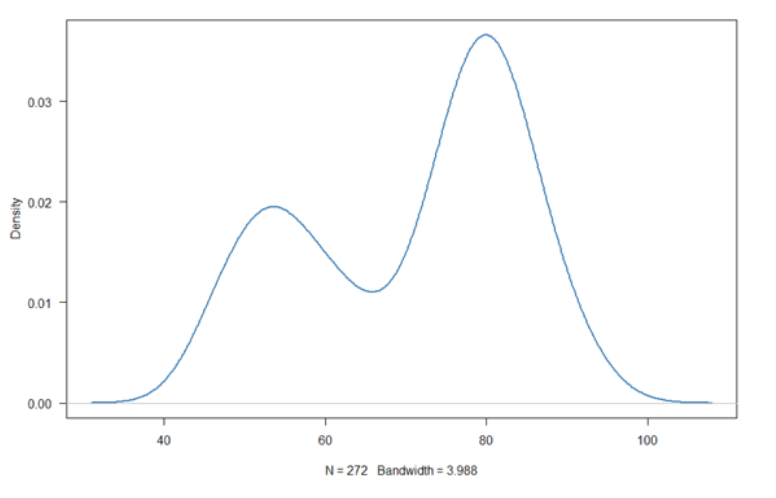
That was not a surprise to my classmates and me. Grades on exams were posted not by students’ names but as curves. Ordinarily, you would expect the grades to fall in what’s called a “standard normal distribution,” or “bell-shaped curve,” that looks something like this:

Instead, the distribution was often more like this:

That implied, correctly, that there were two distinct populations represented by the scores, and we quickly ascertained that the lower distribution consisted of the under-qualified minority students.

Instead of tightening the admissions criteria, the administration responded by lowering the graduation requirement to passing Part One and just taking, but not necessarily passing, Part Two. Nary, a peep was heard from the faculty about this lowering of standards.

This sort of social engineering at medical schools has not been uncommon. Stanley Goldfarb, M.D., a retired dean for curriculum and co-director of the renal division at the University of Pennsylvania’s medical school, has repeatedly criticized the trend toward allowing “social justice” considerations to play a dominant role in medical schools’ admissions and curricula. He founded a nonprofit called Do No Harm, which aims “to combat discriminatory practices in medicine.”

Dr. Gizersky ended his letter to the editor with this observation: “Medical students are already faced with learning more information than ever, and we can’t afford to have medical schools produce better activists than physicians.”  I agree, but I would put it somewhat differently: When you’re admitted to the hospital for complicated cardiac or neurosurgery, do you want it to be done by the most competent and accomplished surgeon or by one who was admitted to medical school and residency because he or she was a member of an underrepresented group?

My Comment

Institutional curators seem oblivious to the dangers when substituting DEI ideology for traditional western democratic values.  The DEI trinity invariably leads to standards of performance degraded, accountability unenforced, and individual merit unrewarded.  This results in mediocre medical practices and betrayal of patients’ trust. Worse it can induce professionals to focus on getting their equitable share of the pie, rather than on the magnificent obsession with best outcomes for patients.


There is no charge for content on this site, nor for subscribers to receive email notifications of postings.


Decarbonizing Religion Delusional

“Climate Activism is a Religion” – Marian Tupy.  H/T Raymond.  Excerpted transcript below in italics with my bolds and added images.

“The planet is infected with us we’re all gonna die. Isn’t that all true and and correct?

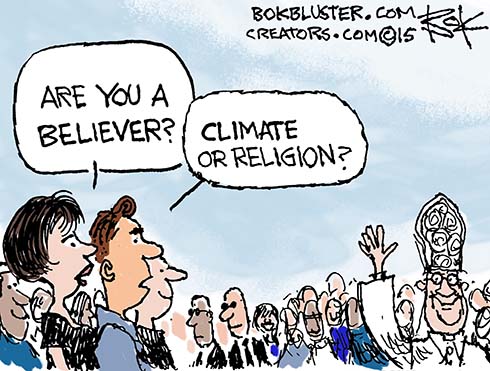
It’s certainly not true and actually the history of the relationship between population growth and abundance of Natural Resources is much more complex than people realize. It’s very interesting to see how extreme environmentalism maps onto Christian theology. On the one hand you’ve got your Garden of Eden: that’s the world before industrialization. You have your Devils: fossil fuel CEOs and people like that. You have your Saints, Greta Thunberg. Your Priesthood is the IPCC scientists. And of course you even have indulgences like back in the days before Reformation. Where you are allowed to fly around the world on a private jet, so long as you give a few thousand pounds or dollars to a green cause. All those sins are simply washed away. And one of the fundamental features of any religion is apocalypse, the end of days.

What we are saying is that if the world is going to end. it will certainly not end because we will run out of Natural Resources. The British energy problems are not an outcome of physical limits on fossil fuels or energy that can be produced in the world. They are an outcome of stupid decisions made by your politicians for the last 20 years.

Context

Our guest today is the editor of humanprogress.org, a senior fellow at the center for Global liberty and prosperity, whose latest book is called super abundance the story of population growth Innovation and human flourishing on an infinitely Bountiful Planet. Marian Tupy, welcome to triggeronometry. Please tell everybody who you are and what brings you to be sitting here talking to us

It starts with my birth in Czechoslovakia socialist republic. When I was a child my parents moved to South Africa. Later I went to Great Britain and studied at Saint Andrews University. I’ve been in Washington DC at the Cato Institute which is a Libertarian think tank for the last 20 years. And as you mentioned I run a website called viewingprogress.org which is basically just a website trying to document and promote the notion that the world is improving along many different dimensions of human well-being. That led me to writing a book about population and Innovation and natural resources.

Well speaking of all of that Marian, the the self-evident truth that everyone’s been completely persuaded about for the last God knows how many years is the planets overpopulated,  humans are the virus infecting the planet. We’re all gonna die, and as we die we’re gonna make everything terrible. Marion why is it that so many people think that overpopulation is a real danger for our planet and the future of the human race?

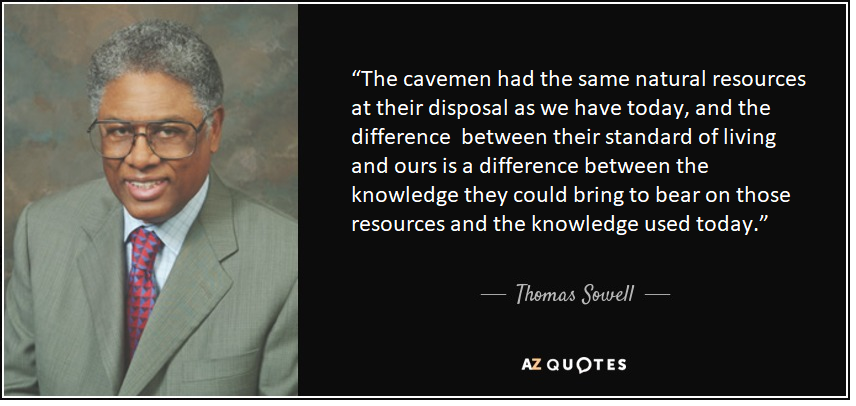
I think it’s because the notion of finitude of atoms which is absolutely true. It is common sense and intuitive to say: If you have the finite quantity of atoms but you are increasing the people using those atoms then at some point you must run out. But this ignores a very fundamental difference between human beings and other animals. We are animals who are capable of planning forward and we are animals capable of innovating out of our problems through human knowledge. So American Economist Thomas Sowell has a famous quote:

An example is iPhone, a great way of dematerializing our the world. In other words we are saving a lot of atoms that we don’t have to put into television sets, into cameras, into Maps, into campuses, into calculators and all those other things. Instead we put it on this device. I hope it goes some way into explaining why the number of atoms in the world is actually not a limiting factor for how much of value we can create.

I think that if we are looking at the source of discomfort and a sense of dejection about the future, it may come from the fact that in Britain you cannot build that many houses. Or rather you refuse to build that many houses because of governmental policy. I’m not bashing Britain I’ve spent five years in your beautiful country and I love it and we have the same problem in the United States. it’s not that all of these people living in the cities are concerned about overpopulation, just that they’ve decided that you’re not going to build in my backyard.

It’s policy driven rather than driven by some sort of fundamental physical lack of space.

People still need a search for the transcendental; they still need to commit their lives to a meaning, to some sort of a heroic vision of themselves. What is it that they are trying to accomplish with their lives aside from going to work? And I think that many people especially in secular societies have embraced Extreme Environmentalism as a substitute for religion. um it’s very interesting to see how extreme environmentalism maps onto Christian theology. So I think that there are religious overtones to environmentalism. And the number of apocalyptic movies has been growing every decade since the 1950s, even though the world has improved along very many different dimensions: we live longer, we live healthier lives, we are much richer, poverty is collapsing around the world.

But with every decade the number of apocalyptic movies is actually increasing with one exception and it was 1990s because of the peaceful resolution of the Cold War.

Whatever your view on fossil fuels, whether or not you believe that emitting ever more CO2 in the atmosphere is a problem, clearly the timeline and the plan that our politicians have invented is completely unrealistic. We are not paying a price for there being too little oil or gas or uranium in the world. We are paying a penalty for politicians forcing us into energy consumption patterns which were completely unrealistic. The book tells you that there is plenty to be used for hundreds of thousands of years. We are never going to run out of these energy sources or natural resources, but yes as a society we could certainly decide not to use them and simply to shut off the lights and close the door on Western Civilization. That choice is not going to be forced on us by physical limits of the planet.

I think there is a reasonable chance that we have seen Peak apocalyptic environmentalism, for two reasons. One is that half of the world, the underdeveloped or developing world is never going to buy into our nonsense. We just have to stop thinking that and don’t even pretend that people in India and China and Bangladesh and Africa, which are still very poor are simply going to start using windmills. It’s just not going to happen for decades, if ever. They would have to be at a completely different level of Economic Development to start playing around with wind farms and whatever. So they’re going to be reliant on oil and natural gas for a long long way to come. And even that is better than using biofuels in order to power their own societies.

So that’s one half of the population; the second half are the advanced economies like yours and our economies, which are by and large democratic. And I do not believe that with any level of brainwashing coming from Whitehall or from Greta or people who glued themselves to roads or whatever. I don’t think any level of that kind of propaganda and brainwashing will make the good people in the United Kingdom to decide that this is the future they’re going have. In other words democracy is going to win. And if it’s not going to be the Tory party which changes the green policies and the green New Deal or Net Zero, or it’s going to be somebody else. And the sooner the British political establishment awakes to the fact that the British people are suffering and their living standards are collapsing, the less likely it is that you will have a really nasty party emerging that will do it for them.

I have a concern about the democracies we still have here in the West. If our center right and center left simply refuses to acknowledge that by government design lives of our people are getting worse, somebody else is going to fill that void, and that is something I want to avoid.

The reason why the public in this country and in yours holds the politicians in utter contempt is precisely because they see the level of hypocrisy that is going on in in both societies. You see them constantly raising taxes on air travel but they themselves fly around on private jets or first class which is much more carbon intensive. You see them telling you to drive you know little EVs while they enjoy being driven around in SUVs as big as a house. You see them telling you that the world is going to be swallowed up by by the oceans while at the same time they’re buying beachfront properties.

They basically think that we are so stupid and they think that can they can basically freak us out to an extent where where any kind of policy can be can be implemented. And to that extent I was actually impressed with some of the work done in the UK by the former head of your Supreme Court Jonathan Sumption, who was deeply concerned about the kind of public reaction to covid; you know, you end up with a Chinese virus but also with a Chinese Society. If people can be freaked out enough that the world is going to implode, they would be willing to part with their civil liberties and their basic freedoms.

On the other hand all of these apocalyptic predictions have been wrong in the past. And if you again put a date on it, you say that we only have five or ten years left on the planet left, when that time expires we will be wondering why we should be believing these people. What sort of credibility do they have? Do they also realize just how extraordinarily damaging it it to our institutions? How are we supposed to believe the leadership in our societies when they get these calls wrong time and time again.

They complain about populism when they are the causes of populism because
they keep on saying things which are obviously not true.

In this book we looked at 18 different data sets with some of them going back to 1850, and we looked at hundreds of Commodities: Goods, finished goods, Services, food, fuel etc. We found that for every one percent increase in population we had one percent decrease in the price of all of these Goods, services and commodities. That tells us that human beings on average are more producers than they are consumers; that we are really able to produce more wealth than we consume, otherwise you would see the opposite: With every one percent increase in population you would see an increase in prices with greater scarcity. But that is not the fact.

We are very divided in Western countries and so while remaining optimistic: How do we manage some of the trade-offs of these technological developments? Because it seems to me in social communication, cultural programs and entertainment and particularly social media are areas where everyone knows there’s a big problem but no one quite knows what to do about it.

Any technology developed by the human brain can be can be used for good and evil. A baseball bat can be used to hit a baseball and it can be used to to bash you to death, not to mention guns and um anything else, knives and on. So what you do with your Technologies also matters. I think that any new technology from gramophones to bicycles was first met with a wall of negativism. Once it was thought writing of novels was supposed to lead to mental collapse throughout the Western World. Television, radio, all of these things were considered to be potentially world-ending events, but that didn’t happen

When it comes to social media, I don’t like them and I don’t partake. I left Facebook in 2012 when I realized that it was making me unhappy. Because what I was putting up on Facebook was a curated picture of my life, and what I was consuming was a curated picture of my life. So basically I was posting lies in consuming lies, and once I realized that I left Facebook. That was a choice, a choice which can be made independently by any number of all 8 billion people

I think that what we are going through right now is a period of adjustment to a new technology but that period of adjustment will resolve itself. You know it took us 50 years to figure out that drinking and driving was not a good idea. Now it’s sort of been internalized into us that cars are much better operated when you are sober, but it took time to to to to to square the human brain with this new technology. That will probably happen with social media as well or at least I hope that people are going to realize that much of it is simply unreal, what is making them unhappy, and they could be spending their time doing better things than than being on social media. We’ll probably figure it out in the way that we have figured it out with novels and bicycles and radio and television.

I’m basically a follower of the Enlightenment. I aspire to the ideals of the Enlightenment and one of the main features of the Enlightenment was freedom of speech. We are not putting enough emphasis on the way that freedom of speech is being destroyed by our governments, by the media, by cancel culture. Freedom of speech is not only necessary in order to produce new inventions and Innovations but also to produce new ideas. In this country we need a lot of reforms because the country is not functioning very well. Things won’t improve if ideas that I propose are canceled just because they seem too outrageous. In the same way in the United Kingdom, you need to undertake a lot of reforms and what if somebody tells you that your proposal for, let’s say, NHS reform is somehow unspeakable.

We need to preserve freedom of speech, it’s absolutely fundamental and we should be talking more about people getting canceled for joking uh for expressing wrong ideas and also for having peculiar forms of behavior. and that’s important because as we discuss in our book a lot of people on whom we rely for some of the most important Innovations and inventions in the world are also very peculiar people.

I’m rationally optimistic about the future just just to just to clarify that. So long as we don’t have a massive war caused by politicians, so long as we’re able to innovate without a precautionary principle, so long as we are able to freely speak and publish and research. And so long as we have the free markets which can tell us which inventions and Innovations are valuable and which inventions and Innovations are not valuable.

Climatists Mistake Means for Ends

Roy Gilbert exposes the fundamental mistaken thinking regarded global warming/climate change.  His Spectator Australia article is Conceptual Error in Climate Change Analysis.  H/T John Ray  Excerpts in italics with my bolds and added images.

It is often said that the ‘science is in on climate change’. Is it? We should always adhere to the principle of the ‘working hypothesis’ and have an open mind on scientific questions no matter how well-recognised the researchers are. In the study of science, there is always the chance new information can come along to cause a rethink.

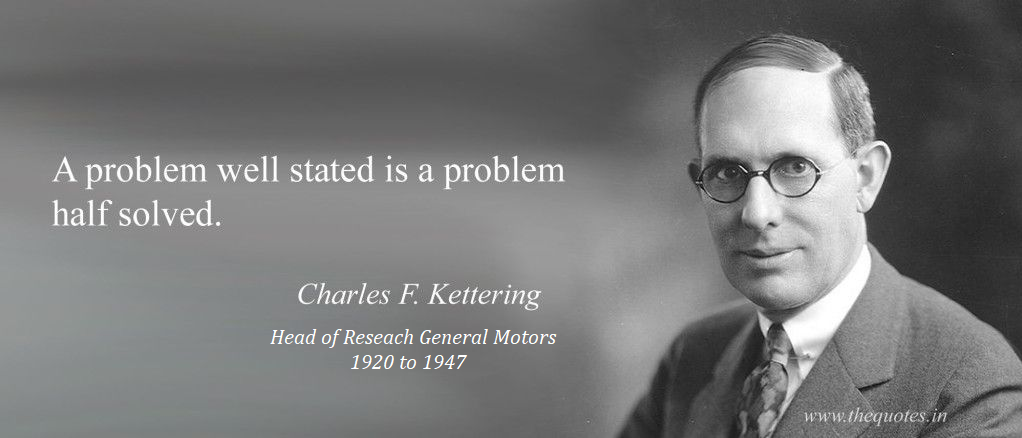
A common error in problem-solving and policy development is to confuse
a technical strategy for a desired client outcome.

Our Climate Change Minister could be accused of this. Reducing emissions is a ‘strategy’, not the fundamental desired client outcome. With the mission ‘to reduce carbon emissions’ by increasing renewable energy, the way to assess performance is to concentrate on measuring emission reduction, and then to follow this up with how quickly the renewables are built and their cost (wind farms, solar panels, transmission lines).

Instead of the current strategy-driven mission, a fundamental client outcome statement would be:To protect against, and where possible, prevent damage from extreme off-trend fluctuations in climate.’ How would you go about managing your program using this mission statement?

First, you gather accurate temperature, rainfall, and weather measurements. They are the valid and fundamental ‘outcome’ measures – not data on CO2 emissions. If there is an undeniable and dangerous increase in temperature and rainfall, more cyclones, and a clear and unabated rise in sea level, then the possible cause must be thoroughly identified. Depending on the answer, you would adopt appropriate mitigation strategies, or strategies that adapt to weather patterns and temperature levels.

Another principle of problem-solving is to map out the total picture and not be driven by ideology. The Climate Change Minister should consider possible causes other than human-induced emissions. It was announced in April 2023 that coronal cones 20 times larger than Earth have been discovered and may cause a massive outburst of energy from the sun. What could be the implications for our planet? Ask solar physicists.

Chief scientist in applied helio-physics at John Hopkins, Ian Cohen, has suggested that solar storms could take out satellites, cut power and shut down the internet. In 1972 a solar storm caused 4,000 magnetically sensitive mines in water off Vietnam to detonate. Earth is said to be entering a period of peak activity as part of an eleven-year cycle. It is suggested this potentially could be more violent than the solar cycles of the past three decades. Now that would be something for climate scientists to really worry about…

With respect to the world’s temperature, there are several sources that claim to present the precise figure. One says the 2023 average global temperature was 1.45c above the 1950-90 average. Another says since 1880, Earth’s temperature has increased by 0.08c. Another says during the last 50 years the increase is 0.13c. To the unscientific mind, these temperatures do not appear to be verging on catastrophic boiling us all to death.

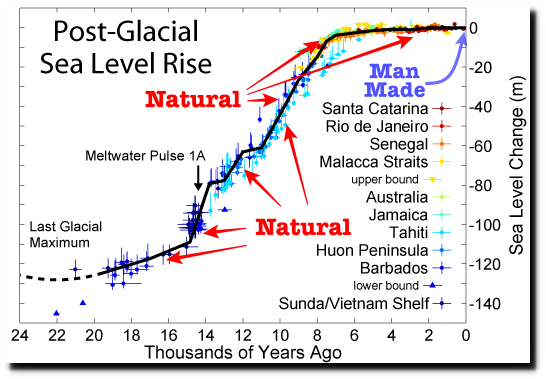
As of 2024, data on natural changes in temperature, rainfall, and sea level
do not show any statistically significant difference to historical records.

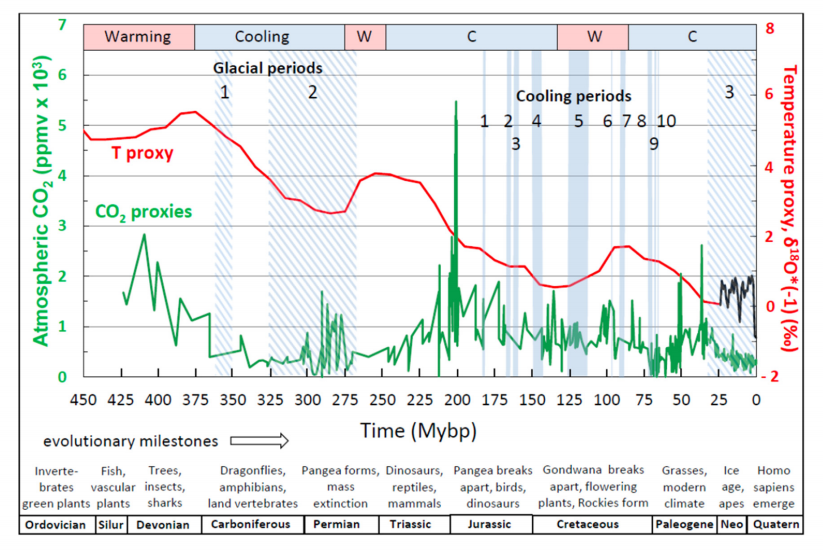
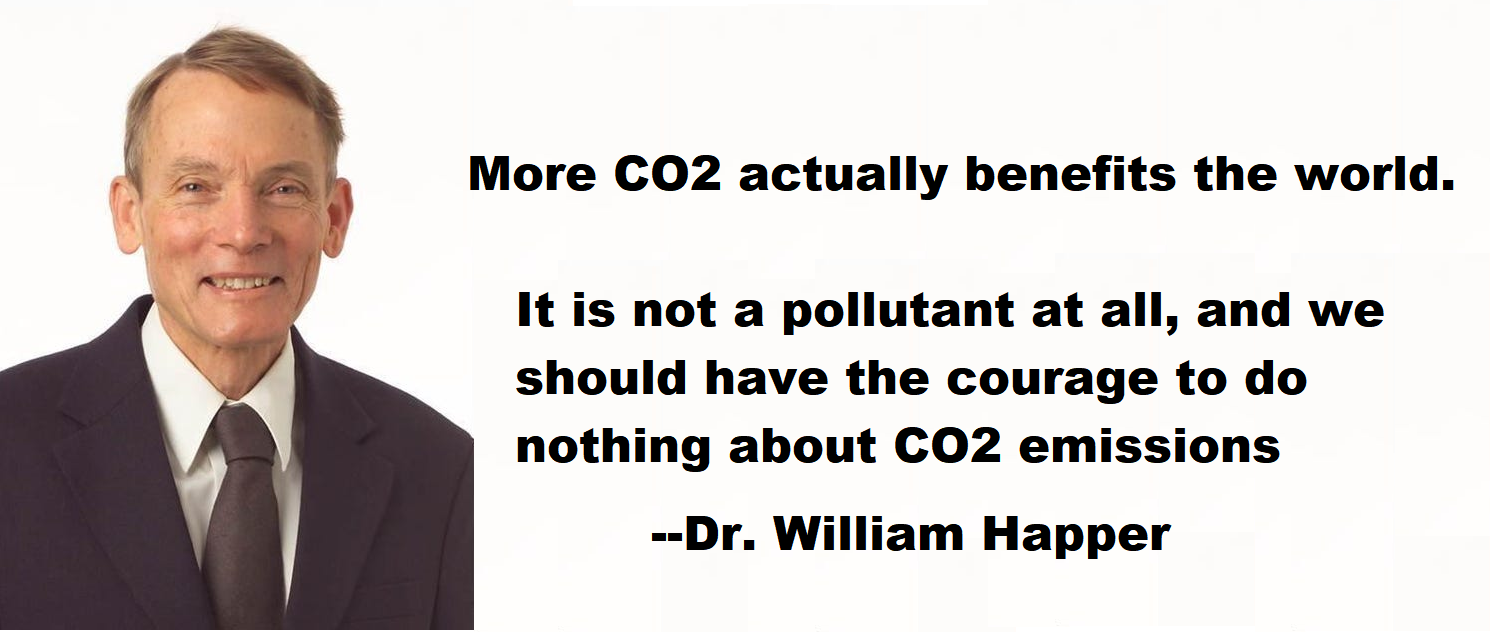
There are respected scientists who question the current climate orthodoxy. Physicist Prof. William Happer of Princeton University and Prof. Richard Lindzen, Earth, Atmospheric and Planetary Sciences at MIT have argued science demonstrates there is no climate-related risk caused by fossil fuels and CO2, and that 600 million years of CO2 and temperature data contradicts the theory that high levels of CO2 will cause catastrophic global warming. They state reliable scientific theories come from validating theoretical predictions with observations, not consensus, peer review, government opinion, or manipulated data.

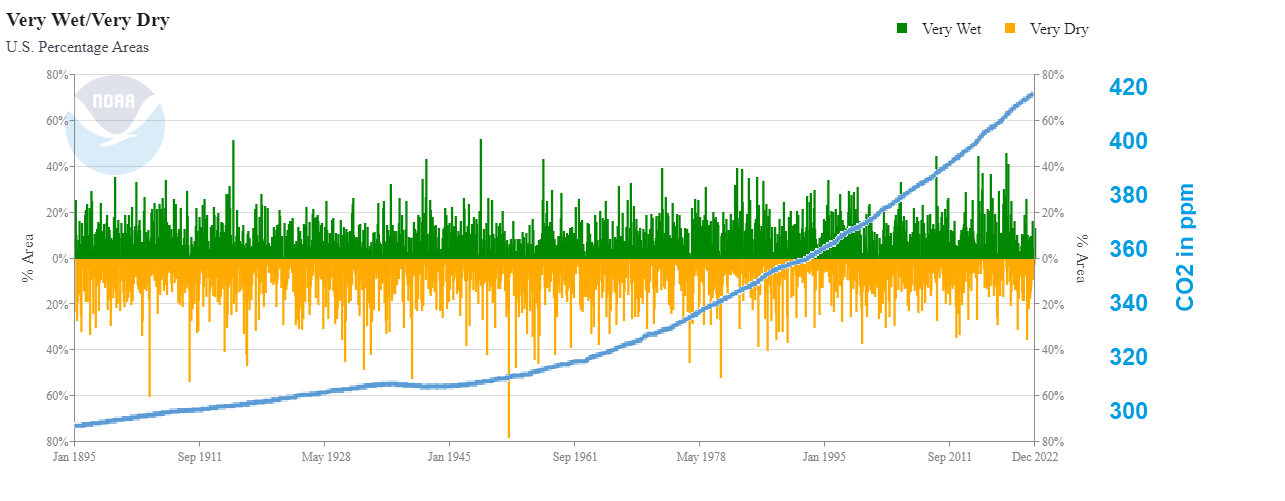
In July 2023, the International Monetary Fund cancelled a planned talk on climate change by 2022 Nobel physicist John Clauser when they learned he had stated publicly: ‘I can confidently say there is no real climate crisis, and that climate change does not cause extreme weather events. The IPCC is one of the worst sources of dangerous disinformation.’  Clauser pointed out that the US Environmental Protection Authority has charts that show a heatwave Index going back to 1895, showing heatwaves were more common before the 1960s and especially in the 1930s.

In addition to these physicists, there are eminent Australian geologists who challenge the CO2 cause theory. Emeritus Prof. Ian Pilmer of the University of Melbourne, and Prof. Michael Asten of Monash University, have argued that throughout the history of the planet, there have been long periods of major change in climate due to natural forces. This would indicate recent human-based emissions may not be the important factor that we have been led to believe.

With respect to measuring emissions (nitrous oxide and methane), there is an expectation that the Intergovernmental Panel on Climate Change would have collected accurate data. Then one reads an independent 2023 report of these greenhouse gas emissions from farm dams in Australia’s irrigation regions, that the measurements had been massively over-estimated by the IPCC by 4 to 5 per cent.

To add further confusion to the issue, a 2023 research paper submitted to the European Physical Journal Plus claimed climate science has become ‘highly politicised’. Italian scientists analysed long-term data on heat, droughts, floods, hurricanes, tornadoes, and ecosystem productivity, and found no clear trend of extreme events. The statements by these scientists would appear worthy of examination. Unfortunately, comments to the publisher by other climate scientists caused the withdrawal of the article.

If activists are correct, and if temperatures and rainfall start to show a significant increase without any influence from natural factors such as the sun or outer atmospheric disturbances, the second ‘outcome’ mission opens your mind to several strategies that could be compared against each other on cost and effectiveness – renewables, outer space satellites capturing solar energy and transmitting to Earth, small nuclear, carbon capture, examine possibility of amalgamating carbon and turning it into a useful product, lower emission coal-fired power stations, hydro, hydrogen fuel cells, a scientific search for a predator for carbon other than trees (or the planting of more trees), and so on.

A valid client ‘outcome’ statement encourages you not to jump to a conclusion
in the initial stages of critical thinking about the cause of any global warming.

If you make a mistake at that point, there are significant productivity implications. Governments could waste a significant amount of money (a catastrophic amount) on a less than optimum strategy. Rather than relying almost entirely on climate scientists who concentrate on carbon emissions, a politician with a mind focused on validity could bring together an inter-disciplinary team – climate scientists, nuclear physicists, solar physicists, atmospheric physicists, examine the moon’s behaviour, plant technologists, oceanographers, geologists, volcanologists, botanists, bushfire specialists and so on. Has any national government followed this approach? Has any Minister for Energy, in any country, expanded their vision beyond their own narrow ideology is a potential danger to their country…?

There are very obvious reasons why some politicians and many rich investors in renewable energy would oppose a serious questioning of the renewable strategy and switching to nuclear instead. If small nuclear was introduced – as is being done in many countries – it would make current renewable energy strategies redundant. That would mean all the billions of dollars spent on wind and solar would have been a waste of money. We wouldn’t need them. Admitting that would be far too embarrassing for any ideological politician and far too financially damaging to any rich wind farm investor obtaining government grants.

If the Sun is found to be the fundamental cause of the problem (variations in energy output, massive infrequent solar flares, and/or variations in distance between Earth and Sun), or if there is a slight tilting of the Earth on its axis, or the Moon changes position, or even disturbance further out in our solar system, you would evaluate adaptation strategies.

It seemed reasonable for some people to assume the vast flooding in 2022 could be attributed to human-induced climate change. There is however, a different possibility … nature. Environment analyst Graham Lloyd explained.

‘The meteorological processes at play are well understood. Three consecutive La Nina weather patterns have left the eastern seaboard soaked and prone to flooding. Triple La Ninas have happened four times in the Bureau of Meteorology’s 120-year record … The Southern Annular Mode is a climate driver that can influence rainfall and temperature. Although wet, the latest BoM figures show that 2022 was the ninth wettest year on record (not the wettest).’

fWhen the above material, stressing the need to examine the total picture in any critical thinking, was shown to a high school Principal, to a high school science teacher and to an environmental engineer, they were all surprised and quite critical that one would want to show this to students. Annoyed actually. One was emphatic…

‘Why waste the students’ time having them look at irrelevant issues?
We KNOW what the problem is. It is CO2 emissions.
And we KNOW what the solution is. It is 100 per cent renewables.’

My answer to them was:

‘The difference between you and me, is that you want to tell the students WHAT to think. I want to teach them HOW to think. I want them to understand insightful thinking. Not to be indoctrinated’.  You can be the judge as to who is on the right track.

See Also

Answers Before Climate Action


Covid19 mRNA Vaccines Fiasco 2024 Update

A thorough examination of the trials and tribulations of the mRNA shots proclaimed and sometimes forced upon people comes from a dream team of experts in the field:   The authors of this research paper are highly qualified experts, including, according to Liberty Counsel, “biologist and nutritional epidemiologist M. Nathaniel Mead; research scientist Stephanie Seneff, Ph.D.; biostatistician and epidemiologist Russ Wolfinger, Ph.D.; immunologist and biochemist Dr. Jessica Rose; biostatistician and epidemiologist Kris Denhaerynck, Ph.D.; Vaccine Safety Research Foundation Executive Director Steve Kirsch; and cardiologist, internist, and epidemiologist Dr. Peter McCullough.”

The peer reviewed paper is at Cureus COVID-19 mRNA Vaccines: Lessons Learned from the Registrational Trials and Global Vaccination Campaign.  Excerpts in italics with my bolds and added images.

Abstract

Our understanding of COVID-19 vaccinations and their impact on health and mortality has evolved substantially since the first vaccine rollouts. Published reports from the original randomized phase 3 trials concluded that the COVID-19 mRNA vaccines could greatly reduce COVID-19 symptoms. In the interim, problems with the methods, execution, and reporting of these pivotal trials have emerged. Re-analysis of the Pfizer trial data identified statistically significant increases in serious adverse events (SAEs) in the vaccine group. Numerous SAEs were identified following the Emergency Use Authorization (EUA), including death, cancer, cardiac events, and various autoimmune, hematological, reproductive, and neurological disorders.

Furthermore, these products never underwent adequate safety and toxicological testing in accordance with previously established scientific standards. Among the other major topics addressed in this narrative review are:

♦   the published analyses of serious harms to humans;
♦   quality control issues and process-related impurities;
♦   mechanisms underlying adverse events (AEs):
♦   the immunologic basis for vaccine inefficacy; and
♦   concerning mortality trends based on the registrational trial data.

The risk-benefit imbalance substantiated by the evidence to date contraindicates further booster injections and suggests that, at a minimum, the mRNA injections should be removed from the childhood immunization program until proper safety and toxicological studies are conducted. Federal agency approval of the COVID-19 mRNA vaccines on a blanket-coverage population-wide basis had no support from an honest assessment of all relevant registrational data and commensurate consideration of risks versus benefits.

Given the extensive, well-documented SAEs and unacceptably high harm-to-reward ratio, we urge governments to endorse a global moratorium on the modified mRNA products until all relevant questions pertaining to causality, residual DNA, and aberrant protein production are answered.

Background

Political and financial incentives may have played a key role in undermining the scientific evaluation process leading up to the EUA. Lalani and colleagues documented the major investments made by the US government well before authorization [18]. Even prior to the pandemic, the US National Institutes of Health invested $116 million (35%) in mRNA vaccine technology, the Biomedical Advanced Research and Development Authority (BARDA) had invested $148 million (44%), while the Department of Defense (DOD) contributed $72 million (21%) to mRNA vaccine development. BARDA and the DOD also collaborated closely in the co-development of Moderna’s mRNA vaccine, dedicating over $18 billion, which included guaranteed vaccine purchases [18]. This entailed pre-purchasing hundreds of millions of mRNA vaccine doses, alongside direct financial support for the clinical trials and the expansion of Moderna’s manufacturing capabilities. The public funding provided for developing these products through Operation Warp Speed surpassed investments in any prior public initiative [19]. Once the pandemic began, $29.2 billion (92% of which came from US public funds) was dedicated to the purchase of COVID-19 mRNA products; another $2.2 billion (7%) was channelled into supporting clinical trials, and $108 million (less than 1%) was allocated for manufacturing and basic research [18]. This profuse spending of taxpayer dollars continued throughout the pandemic: BARDA spent another $40 billion in 2021 alone [20].

Using US taxpayer money to purchase so many doses in advance would suggest that, prior to the EUA process, US federal agencies were strongly biased toward successful outcomes for the registrational trials. Moreover, it is reasonable to surmise that such extensive vested interests could have influenced the decision to prematurely halt the registrational trials. Unblinding essentially nullified the “placebo-controlled” element of the trials, eliminating the control group and thus undermining the ability to objectively assess the mRNA vaccines’ safety profile and potential serious AEs (SAEs). Thus, while the accelerated authorization showcased the government’s dedication to provide these novel products, it also raised concerns among many experts regarding risk-benefit issues and effectively eliminated the opportunity to learn about the potential long-range harms of the mRNA inoculations. The political pressures to rapidly deliver a solution may have compromised the thoroughness and integrity of the scientific evaluation process while downplaying and obfuscating scientific concerns about the potential risks associated with mRNA technology.

Concerns about inadequate safety testing extend beyond the usual regulatory approval standards and practices. Although we employ the terms “vaccine” and “vaccination” throughout this paper, the COVID-19 mRNA products are also accurately termed gene therapy products (GTPs) because, in essence, this was a case of GTP technology being applied to vaccination [21]. European regulations mandate the inclusion of an antigen in vaccines, but these immunogenic proteins are not intrinsic to the mRNA vaccines [22]. The GTP vaccine platform has been studied for over 30 years as an experimental cancer treatment, with the terms gene therapy and mRNA vaccination often used interchangeably [23]. This is due to the mRNA products’ specific mode of action: synthetic mRNA strands, encapsulated within a protective lipid nanoparticle (LNP) vehicle, are translated within the cells into a specific protein that subsequently stimulates the immune system against a specific disease. Another accurate label would be prodrugs because these products stimulate the recipient’s body to manufacture the target protein [24]. As there were no specific regulations at the time of the rapid approval process, regulatory agencies quickly “adapted” the products, generalized the definition of “vaccine” to accommodate them, and then authorized them for EUA for the first time ever against a viral disease. However, the rationale for regulating these products as vaccines and excluding them from regulatory oversight as GTPs lacks both scientific and ethical justification [21]. (Note: Throughout this review, the terms vaccines and vaccinations will be used interchangeably with injections, inoculations, biologicals, or simply, products.)

Due to the GTPs’ reclassification as vaccines, none of their components have been thoroughly evaluated for safety. The main concern, in a nutshell, is that the COVID-19 mRNA products may transform body cells into viral protein factories that have no off-switch (i.e., no built-in mechanism to stop or regulate such proliferation), with the spike protein (S-protein) being generated for prolonged periods, causing chronic, systemic inflammation and immune dysfunction [25,26]. This S-protein is the common denominator between the coronavirus and the vaccine, which helps to explain the frequent overlap in AEs generated by both the infection and the inoculation [25]. The vaccine-induced S-protein is more immunogenic than its viral counterpart; and yet, the increased antibody production is also associated with more severe immunopathology and other adverse effects [27]. The Pfizer and Moderna mRNA products contain mRNA with two modified codons that result in a version of the S-protein that is stabilized in its prefusion state [28]. This nucleoside-modified messenger RNA technology is intended to extend the synthetic mRNA’s persistence in the body. When the S-protein enters the bloodstream and disseminates systemically, it may become a contributing factor to diverse AEs in susceptible individuals [25].

Revisiting the registrational trials

Although randomized controlled trials (RCTs) are viewed as the gold standard for testing the safety and efficacy of medical products (due to minimizing bias), trials of limited scope can readily obscure the true safety and efficacy issues with respect to different segments of the population. In this case, the trials excluded key sub-groups, notably children, pregnant women, frail elderly persons, and immuno-compromised individuals, as well as those with cancer, autoimmune disease, and other chronic inflammatory conditions [45]. Whereas the founding trials did not recruit individuals with comorbidities, vaccine recipients in the rollouts showed the actual presence of these underlying conditions. Rather than assess these well-known safety and comorbid risk concerns, the focus was narrowly placed on the potential for inflammatory lung injury as had been seen in COVID-19 patients and, many years earlier, in immunized animal models infected with SARS-CoV [46]. We are now beginning to recognize the folly of this narrow safety focus, as millions of severe and life-threatening events associated with the COVID-19 vaccines continue to be documented in the medical literature [47-51].

What did the pivotal trials reveal about overall (all-cause) mortality? After carefully analyzing the ACM for the Pfizer and Moderna trials, Benn and colleagues found 61 deaths total (31 in vaccine, 30 in placebo) and a mortality RR of 1.03 (0.63-1.71), comparing the vaccinated to placebo [52]. These findings can be interpreted as “no significant difference” or no gold-standard evidence showing these mRNA vaccines reduce mortality. The lack of significant differences in deaths between the study arms is noteworthy. The true mortality impact remains unknown in this context, and this fact alone is relevant, as it would be preferable to take a vaccine with good trial evidence of reduced mortality than to take a vaccine where trial evidence does not show convincing evidence of improved survival [53]. Similarly, a subsequent analysis of the Pfizer trial data concluded that mortality rates were comparable between vaccinated and placebo groups during the initial 20-week period of the randomized trial [54]. The fact that the mRNA vaccinations did not lead to a reduction in overall mortality implies that, if the injections were indeed averting deaths specifically attributable to COVID-19, any such reduction might be offset by an increase in mortality stemming from other causes, such as SAEs.

For the Pfizer and Moderna registrational trials, Benn et al. also reported a non-significant 45% increase in cardiovascular deaths (RR=1.45; 95%CI 0.67-3.13) in the vaccine arms of the trials [52]. This outcome was consistent with numerous reports of COVID-19 vaccine-related cardiovascular pathology among both young and old segments of the population [57-63]. None of the mortality estimates from the trials are statistically significant. Nevertheless, the upward trends for both ACM and cardiovascular deaths are concerning. If the Pfizer trial had not been prematurely discontinued, and assuming death rates remain the same in both arms as observed in the first six months, the ACM difference would reach the standard threshold for statistical significance (p < 0.05) at approximately 2.8 years (34 months). The p-value is 0.065 at 2.5 years and 0.053 at 2.75 years (see Appendix 1). These calculations were independently confirmed by Masterjohn [64].

Absolute risk and the “number needed to vaccinate (NNV)”

It is imperative to carefully weigh all potential risks associated with the COVID-19 mRNA products. Should substantial harms be linked to their use, the perceived “reward” conveyed by the NNV would necessitate a re-appraisal. For example, assuming an NNV of 119 and an IFR of 0.23% (both conservative estimates), approximately 52,000 vaccinations would be needed to prevent one COVID-19-related death. Thus, for the BNT162b2 injection, a generous estimate would be two lives saved from COVID-19 for every 100,000 courses of the biological. Given the evidence of trial misconduct and data integrity problems (see next section), we conjecture that this estimate is an “upper bound”, and therefore the true benefit is likely to be much lower. Regarding potential harms, assuming 30% false-positive reports and a moderate under-reporting factor of 21, we calculate a risk of 27 deaths per 100,000 doses of BNT162b2. Thus, applying these reasonable, conservative assumptions, the estimated harms of the COVID-19 mRNA vaccines greatly outweigh the rewards: for every life saved, there were nearly 14 times more deaths caused by the modified mRNA injections (for details, see Appendix 2).

Underreporting of harms and data integrity issues

When Pfizer’s Six-Month Interim Report of Adverse Events (C4591001) revealed a total death count of 38 [35], the number seemed unexpectedly low for a clinical trial involving 44,060 participants amidst a pandemic. To investigate, Michels and colleagues estimated the anticipated deaths based on US mortality rates in 2020, presuming comparability across participating countries [54]. With 132 trial sites in the US and 80% of subjects, they estimated that 222 deaths should have occurred between July 27, 2020, and March 13, 2021, making the observed 38 deaths only 17% of the projected number. Most of the trial sites had fewer deaths than anticipated, possibly attributed to a considerable percentage of “Lost to Follow-up” subjects (4.2% of randomized subjects), including 395 unique subjects within the study period. While some sites recorded negligible losses, others exhibited substantial figures, up to 5% of the site’s subjects [54]. These numbers likely contributed to the seemingly low overall death count and should have prompted increased efforts to locate these individuals. Losing track of nearly 400 study participants in the follow-up observation period could have substantially compromised the validity and generalizability of the results. The missing data can produce biased estimates, leading to invalid conclusions. This could result in a distortion of vaccine efficacy and underestimation of SAEs (including deaths), thus misrepresenting the safety profile of the mRNA products. In short, Pfizer’s failure to minimize participant attrition seriously undermined the accuracy and reliability of the six-month study’s conclusions.

These concerns are further compounded by revelations concerning substandard research practices and inadequate data management in the pivotal trials. A whistleblower report by a former employee of the contract research organization responsible for enrolling patients in Pfizer’s pivotal trial raises significant questions regarding data integrity and the safety of trial participants [85]. Among the trial conduct issues documented were failure to report protocol deviations, improper storage of vaccines, mislabeling of laboratory specimens, and lack of timely follow-up for patients experiencing AEs, possibly leading to underreporting. In terms of regulatory oversight, the FDA inspected only nine out of the 153 study sites involved in the Pfizer trial [86].

Finally, an unblinding of participants occurred early in the trial, potentially on a wide scale across different study sites. Participants were not presented with clear information regarding potential AEs in both trial protocols and consent forms [87]. Some parts of the consent form were misleading and merely intended to elicit participation that might not otherwise have occurred if the volunteers had been made aware that what was promised in theory or “on paper” was unlikely to happen in reality [87]. As a result, participants were not being granted truly informed consent; the potential injuries and AEs most likely to be caused by the vaccinations were never openly stated.

This lack of informed consent carried over into the real-world setting following the EUA. For example, not publicly disclosing the Pfizer trial’s exclusion of pregnant women is arguably among the CDC’s most egregious oversights when asserting the safety of COVID-19 vaccine administration during pregnancy [1]. The Nuremberg Code established patients’ rights to voluntary informed consent in the aftermath of World War II [88]. US courts consistently support informed consent as a fundamental right for patients’ autonomy [89]. Informed consent procedures must provide clear distinctions between risks that are frequently observed, risks that occur rarely, and the more obvious risk of lack of effectiveness or waning immunity, which is separate from the risk of SAEs. Whether in a clinical trial or free-living real-world setting, informed consent is essential to providing a clear understanding of the potential risks associated with receiving a genetic vaccine. Throughout the pandemic, healthcare workers were duty-bound to provide clear risk-benefit information to patients. In practice, however, informed consent was non-existent, as information sheets were blank [90], and vaccinees were never informed of potential risks beforehand.

Shifting narratives, illusions of protection

The best evidence for the failure of the COVID-19 mRNA vaccine’s ability to confer protection against COVID-19 comes from two large cohort studies of employees within the Cleveland Clinic Health System (CCHS) after the bivalent mRNA boosters became available [99,100]. In the first study (n=51,017), COVID-19 occurred in 4,424 (8.7%) during the 26-week observation period [99]. In terms of preventing infections by the three prevailing Omicron subvariants, the vaccine effectiveness was 29%, 20%, and a non-significant 4%, respectively [99]. No protection was provided when the XBB lineages were dominant. Notably, the risk of “breakthrough” infection was significantly higher among those who received the earlier vaccine, and a higher frequency of vaccinations resulted in a greater risk of COVID-19 [100]. In a second CCHS cohort study (n= 48,344), adults who were “not up-to-date” by the CDC definition had a 23% lower incidence of COVID-19 than those “up-to-date” with their vaccinations [100]. These findings are further reinforced by multiple real-world studies showing rapidly waning protection against Omicron infection after the boosters [101]. The vaccine effectiveness against laboratory-confirmed Omicron infection and symptomatic disease rapidly wanes within three months of the primary vaccination cycle and booster dose [97].

In a recent study of nearly five million adults, those who had a SARS-CoV-2 infection within 21 days post injection showed an eight-fold increased risk of ischemic stroke (OR=8.00, 95%CI 4.18-15.31) and a five-fold increased risk of hemorrhagic stroke when compared to vaccinees without concurrent infection (OR=5.23, 95%CI 1.11-24.64) [121]. The risk was highest for those receiving the mRNA-1273 injections. Thus, SARS-CoV-2 infection close to the time of vaccination produced a strong association with early incidence of ischemic and hemorrhagic strokes [121]. Again, with a hybrid immunity approach, the potential harms may greatly outweigh the rewards.

Natural immunity carries none of these risks and is more than sufficient against the mild virulence of Omicron subvariants. Much evidence now indicates that natural immunity confers robust, durable, and high-level protection against COVID-19 severe illness [122-126]. A large United Kingdom (UK) study of over 30,000 healthcare workers, having a prior history of SARS-CoV-2 infection, showed an 84% reduced risk of reinfection, with a median protective period of seven months [125]. In a large observational study in Israel, previously infected individuals who remained unvaccinated were 6-13 times less likely to contract the virus compared to those who were vaccinated [122]. Among 32,000 individuals within the same healthcare system, vaccinated individuals had a 27-time higher risk of developing symptomatic COVID-19 and an eight-time higher risk of hospitalization compared to their unvaccinated counterparts [122].

After recovering from COVID-19, the body harbors long-lived memory immune cells, indicating an enduring capacity to respond to new infections, potentially lasting many years [127]. Mounting evidence suggests that the training of antibodies and induction of T-cell memory resulting from repeated natural infection with Omicron can augment the mitigation of future infections [128,129]. In a recent cohort study, children who had experienced prior infection showed long-lasting protection against reinfection with SARS-CoV-2 for a minimum of 18 months [130]. Such children between the ages of five and 11 years demonstrated no decline in protection during the entire study, while those aged 12-18 experienced a mild yet measurable decline in protection over time [130]. For these younger generations in particular, natural immunity is more than sufficient and of course vastly safer than the mRNA inoculations.

Analyses of serious harms to humans

For both the Pfizer and Moderna trials combined, there were about 125 SAEs per 100,000 vaccine recipients, which translates into one SAE for every 800 vaccinees [50]. Because the trials avoided the most frail as participants, one would expect to see even higher proportions of SAEs in the population-wide rollouts. Remarkably, the Pfizer trial exhibited a 36% higher risk of SAEs in the vaccine group compared to the placebo, with a risk difference of 18.0 (95%CI 1.2-34.9) per 10,000 vaccinated; risk ratio 1.36 (95%CI 1.02-1.83). These findings stand in sharp contrast with the FDA’s initial claim that SAEs reported by the two pivotal trials were “balanced between treatment groups” [15,50]. The discrepancy may be partly explained by the fact that the FDA was focusing only on individual participant data, and yet many of those individuals were experiencing multiple SAEs. Instead of analyzing individuals, Fraiman et al. focused on total SAEs to take into account the multiple, concurrent events [50]. When the SAEs were viewed collectively, the risks in the vaccine group were substantially elevated beyond those previously determined by the FDA.

Analyses of two large drug safety reporting systems in the US and Europe revealed over 7.8 million AEs reported by approximately 1.6 million individuals following COVID-19 vaccination [47]. When compared to individuals aged 18-64 years, the older age groups exhibited a higher frequency of death, hospitalizations, and life-threatening reactions, with RR estimates ranging from 1.49 (99%CI 1.44-1.55) to 8.61 (99%CI 8.02-9.23). Signals were identified for myocardial infarction, pulmonary embolism, cardio-respiratory arrest, cerebral infarction, and cerebral hemorrhage associated with both mRNA vaccines. These signals, along with ischemic strokes, were confirmed by a large disproportionality analysis [48]. In an independent risk-benefit analysis, BNT162b2 produced 25 times more SAEs than the number of severe COVID-19 cases prevented [51].

Finally, autopsy studies have provided additional evidence of serious harms. In a comprehensive systematic review with full independent adjudication, 74% of autopsy findings (240 out of 325 cases), were judged to have been caused by the COVID-19 mRNA products [139]. The mean time from injection to death was 14.3 days, and the vast majority of deaths had the cardiovascular system as the single fatal organ system injury to the body.

These findings help explain the wide range of well-documented COVID-19 vaccine-induced toxicities that impact the nervous, gastrointestinal, hepatic, renal, hematological, immune, and reproductive systems [25,144,145]. Post-mortem examinations are critical for identifying potential SAEs of the mRNA inoculations. However, as clinics and hospital administrations have a large vested interest in the COVID-19 vaccines’ distribution, the common administrative practice of discouraging autopsies and postponing autopsy reports only serves to undermine comprehensive risk assessment, perpetuate public misconceptions regarding safety, and weaken public health policymaking [145].

Conclusions

Based on the research presented in this narrative review, the global COVID-19 vaccination campaign should be regarded as a grave medical error. Medical errors represent a substantial threat to personal and public safety and have long constituted a leading cause of death [288-290]. Misguided political and regulatory decisions were made at the highest levels and may have been heavily influenced by financial incentives. Government agencies should have considered all reasonable treatment alternatives and deflected away pressures from the medical-pharmaceutical industry rather than allowing population-wide distribution of experimental genetic vaccines.

Had the FDA recognized the nearly four-fold increase in cardiac SAEs (including deaths) subsequently identified in the Pfizer trial’s vaccine group [54], it is doubtful that the EUA would have transpired in December 2020. An in-depth investigation of the COVID-19 vaccine’s long-term safety profile is now urgently needed. Despite the many striking revelations discussed in this review, most developed countries continue to advocate the ongoing adoption of COVID-19 mRNA boosters for the entire eligible population. US federal agencies still emphasize the safety of the vaccines in reducing severe illness and deaths caused by the coronavirus, despite the absence of any randomized, double-blind, placebo-controlled trials to support such claims. This reflects a bewildering disconnect between evidence-based scientific thinking and public health policy.

Careful, objective evaluation of COVID-19 mRNA product safety is crucial for upholding ethical standards and evidence-informed decision-making. Our narrative review concerning the registrational trials and the EUA’s aftermath offers evidence-informed insights into how these genetic vaccines were able to enter the market. In the context of the two pivotal trials, safety was never assessed in a manner commensurate with previously established scientific standards either for vaccines or for GTPs, the more accurate classification of these products. Many key trial findings were either misreported or omitted entirely from published reports. The usual safety testing protocols and toxicology requirements were bypassed by the FDA and vaccine manufacturers, and the premature termination of both trials obviated any unbiased assessment of potential SAEs due to an insufficient timeframe for proper trial evaluation.

It was only after the EUA that the serious biological consequences of rushing the trials became evident, with numerous cardiovascular, neurological, reproductive, hematological, malignant, and autoimmune SAEs identified and published in the peer-reviewed medical literature. Moreover, the COVID-19 mRNA vaccines produced via Process 1 and evaluated in the trials were not the same products eventually distributed worldwide; all of the COVID-19 mRNA products released to the public were produced via Process 2 and have been shown to have varying degrees of DNA contamination. The failure of regulatory authorities to heretofore disclose process-related impurities (e.g., SV40) has further increased concerns regarding safety and quality control oversight of mRNA vaccine manufacturing processes.

Since early 2021, excess deaths, cardiac events, strokes, and other SAEs have often been wrongly ascribed to COVID-19 rather than to the COVID-19 mRNA vaccinations. Misattribution of SAEs to COVID-19 often may be due to the amplification of adverse effects when mRNA injections are followed by SARS-CoV-2 subvariant infection. Injuries from the mRNA products overlap with both PACS and severe acute COVID-19 illness, often obscuring the vaccines’ etiologic contributions. Multiple booster injections appear to cause immune dysfunction, thereby paradoxically contributing to heightened susceptibility to COVID-19 infections with successive doses. For the vast majority of adults under the age of 50, the perceived benefits of the mRNA boosters are profoundly outweighed by their potential disabling and life-threatening harms. Potential harms to older adults appear to be excessive as well.

Given the well-documented SAEs and unacceptable harm-to-reward ratio, we urge governments to endorse and enforce a global moratorium on these modified mRNA products until all relevant questions pertaining to causality, residual DNA, and aberrant protein production are answered.


Free Climate Speech is Freedom Litmus Test

In chemistry, a litmus test is a strip of paper that turns red or blue when dipped into a liquid. Red shows the liquid is acid, while blue shows it is alkaline. The analogy in this context: Being able to openly discuss and challenge climate claims shows how healthy or toxic is the discourse in an institution or social circle.

The difference between toxic and healthy discussion spaces is indicated by this quote from eminent physicist Richard Feynman:.

Dr. Matthew Wielicki shares his personal experiences with these spaces in a brief video. I provide a transcript from the closed captions lightly edited for reading. He explains how being able to freely discuss and debate climate claims signals an air of social freedom, in the absence of which living things die like canaries in coal mines. Text is in italics with my bolds and added images.

[An Aside:  Soviet Humor:
Q: What is the difference between the Constitutions of the US and USSR? Both of them guarantee freedom of speech.
A: Yes, but the USA Constitution also guarantees freedom after the speech. (Passé?)]

Climate change is tricky.There’s a disconnect between what
the science says
and what is the narrative in the mainstream media.

My name is Matthew Wielicki and this is my story. I am a former faculty member in the department of geological Sciences at the University of Alabama. I have a doctorate in Geology and Earth Science and I am the author of Irrational Fear substack. I was born in southern Poland at a time when Poland was under the sphere of influence of the Soviet Union  and a communist government. And my parents made the decision to immigrate to Chicago, like all good Polish people do; that’s the Ellis Island for Polish people of Chicago.

Then eventually I grew up in Fresno California where we received political Asylum and eventually citizenship. I grew up on a college campus Cal State University Fresno. My father was a faculty member there at the school of business, my mother was in information technology and staff. I would ride my scooter around campus after school every day. It was something that I fell in love with. It was a place where there were these Warriors that battled in the playing field of ideas, and then they would go and have dinner together. And they would chat and be friendly, so it was this beautiful place of just intellectual discussion.

So I pretty much decided I was going to be an academic when I was 10 or 12. I was always intrigued by science. My original degrees were biochemistry and cellular biology. I was what was called a geochronologist: Geo being Rock, chronology being kind of the ages. I received my PhD from the Department of Earth Planetary and Space Sciences at UCLA. Then I was offered a 10 year track position at the Department of Geological Sciences at the University of Alabama. Taking that faculty position in Alabama was my dream, and so I was absolutely excited. I was a little nervous moving our family from California to Alabama. That’s a pretty big move but you know we were excited.
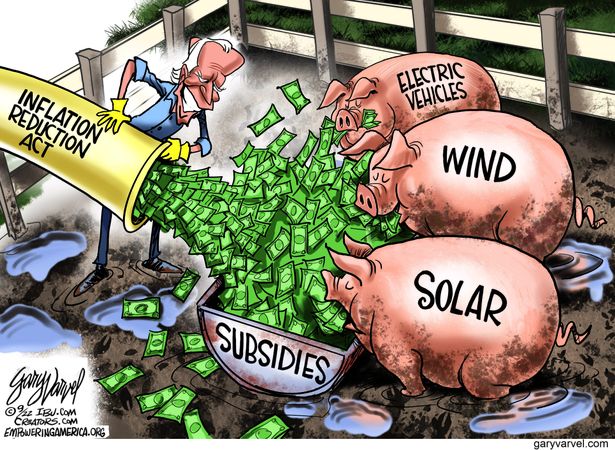
It was definitely something I wanted to do but I noticed that the campus that I grew up on and the one that my father and I would talk about was different. College campuses have always been meritocracies, we have GPA, we give grades. Now there was a shift from performance and ability to what I would say are immutable characteristics; meaning what you look like, or maybe your background or your race. And those are things that students don’t have any control over.
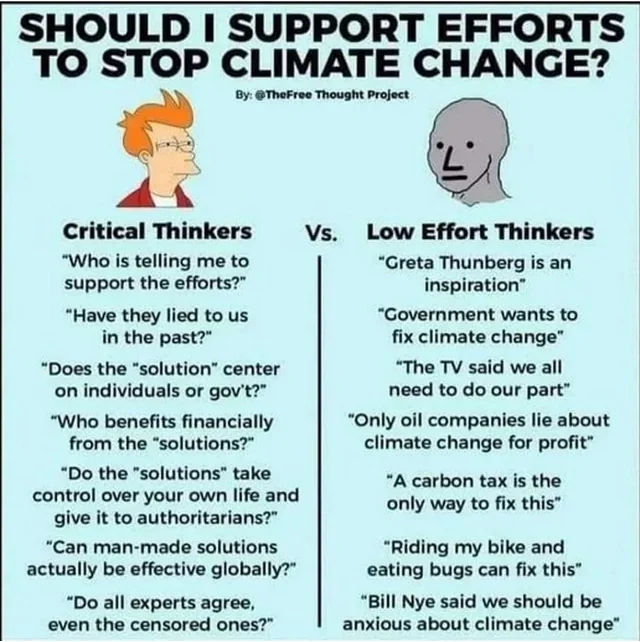
And so there was this disconnect from what I remembered, where it was this competition of ideas and everybody was on an equal playing field. And if your idea was better than your competitor’s idea, then your ideas would win. Bnd now it seemed that the ideas didn’t matter as much as characteristics of the students to appease funding agencies or whatever it was. One of the first things was they got rid of the GRE: this is The Graduate Requirement Exam. so in the name of equity they removed an entrance exam, and so I was now left with trying to understand someone’s life story from an essay without having any standardized metric to compare them to.

So I would bring this up in faculty meetings and it was clear
that they were checking a box. There were certain things
that we couldn’t discuss in Academia.

In Earth Sciences if you speak about climate change that is one of these taboo subjects. And climate change is tricky: there’s a disconnect between what the science says and what is the narrative in the mainstream media. What I would call activist scientists have been kind of pushing the narrative in the media which is doing so much damage to mental health. Climate anxiety is probably the number one anxiety issue for the college students that I talk to. And the science does not support that fear.

I think that fear is irrational, climate is a very convenient way for governments and institutions to get involved in nearly every aspect of a citizen’s life. And if you are basing your life decisions, like whether or not to have children, whether or not to raise a family, whether or not to make sacrifices today such that maybe in a decade or so you’re going to be in a better position. If you think that the planet is going to end, you don’t make those sacrifices.

I definitely love the Earth and humans have an influence on the climate and on their environment. And we should minimize that but the notion that our policy changes today will have some dramatic impact on future temperatures or weather in general is untrue. But if you speak out against it, you’re essentially a pariah in this community.

In my introductory geology class, I gave a a two-day lecture about climate realism as what I called it. The students were were were amazingly refreshed to hear that the planet wasn’t going to end in 10 or 12 years but faculty members were a little uncomfortable with it. If you push out scientists that disagree with your narrative, this isn’t an open discussion. This isn’t about finding the truth but rather silencing those that disagree with you, so that you can continue to push your narrative.

I started to publish a little bit more on social media, and the moment that those stories gained any traction, faculty members in the University of Alabama were making posts that I was was committing violence, that I was putting their jobs and their safety in Jeopardy because I was asking questions. So I decided to leave during Covid. It just wasn’t that dream job that I had been thinking about my entire life. It wasn’t this beautiful place of exchanging ideas that I wanted it to be. I don’t think I would have been able to stay if I chose to stay. I doubt that I would have been awarded tenure if I chose to stay because I had been so vocal.

The data is very clear: there is no metric that we can call the current state of the climate a crisis or an emergency or a breakdown. They’re trying to elicit fear. When people are afraid they are most vulnerable to changing their behaviors. I grew up in a household that was very aware of some of the mistakes of a communist type of government: centralized planning and the removal of the free exchange of ideas.

That makes me more vocal because I see that we’re making the same mistakes that my parents always told me we should never go down this road. It’s the lack of tolerance for ideas, what I call illiberalism; the idea that if you question certain aspects of the government or certain ideologies that you are no longer a good citizen. But if you haven’t lived it you don’t know that these are mistakes. Science is supposed to be about the discovery of the truth and the most important aspect of that is the ability to discuss. I want young people to be hopeful for their future. We should realize that there’s going to be challenges; climate will change but that shouldn’t be a reason to think that your future isn’t hopeful.

Messaging to Make Anxious Children (Example by Canada Federal Government)

What are Dissenting Scientists Saying (Clintel example)

Climate Crisis = Big Government (Example by Canada Federal Government)

These short videos from Trudeau Govt. are airing often on all TV channels and paid for by taxpayers.  And yet the last time Canadians were honestly asked about Global Warming, here’s how they responded (buried in the appendices of the survey report).

Yes, the map shows I am living in a hotbed of global warming believers around Montreal; well, it is 55%, as high as it gets in Canada. So Trudeau is not listening to more than half of Canadians, but instead using their money to promote his own WEF inspired agenda to change their minds.

Wielicki is warning about a governmental takeover
that is far advanced in North America.


Programming Judges for Woke Climate Rulings

Olivia Murray reports at American Thinker America’s judiciary is quietly receiving ‘training’ from leftwing climate group.  Excerpts in italics with my bolds and added images.

With Enlightenment came secularism, with secularism came relativism, with relativism came leftism, and with leftism comes judicial activism. No longer are Western courts viewed as a place of arbitration based upon absolute Judeo-Christian morality and standards of justice, but a vehicle to enact revolutionary change, where fairness and righteousness are in the eye of the executor.

According to a new report published by Fox News today, America’s judiciary has been quietly receiving climate change arbitration “training” from  a “little-known judicial advocacy organization” financed by “left-wing nonprofits.” Here are the details, from the article itself:

The Washington, D.C.-based Environmental Law Institute (ELI) created the Climate Judiciary Project (CJP) in 2018, establishing a first-of-its-kind resource to provide ‘reliable, up-to-date information’ about climate change litigation, according to the group. The project’s reach has extended to various state and federal courts, including powerful appellate courts….

Climate activists protesting outside the Supreme Court July 1, 2022 after the court announced its decision in West Virginia v. EPA. Francis Chung/E&E News/POLITICO

When you have a group of people who don’t believe in the foundational values of America, this is what you get—a covert operation to transform what ought to be an unbiased and nonpartisan apparatus into a biased and partisan one. When the courts become an instrument to advance an agenda, it is a serious infringement on the right of a person or party to an impartial arbiter and the development is, naturally, alarming. When judicial minds receive “quiet training” in pseudo-science to ensure “climate justice” and “equity” are taken into consideration the threat of prejudiced decisions increases, and unconstitutional laws, and bureaucratic rules and mandates become “legal” despite any fact, reason, or authority to support their implementation.

Fox also reports that in just five years, the CJP “has crafted 13 curriculum modules” and hosted dozens of events—all in all, “more than 1,700 judges” have participated in CJP’s “training” scheme.

From ELI’s website on its CJP, we find this:

As the body of climate litigation grows, judges must consider complex scientific and legal questions, many of which are developing rapidly. To address these issues, the Climate Judiciary Project of the Environmental Law Institute is collaborating with leading national judicial education institutions to meet judges’ need for basic familiarity with climate science methods and concepts.

Now this isn’t a great analogy because certain sciences are settled—embryology establishes that life begins at conception, ultrasounds unequivocally determine that babies in the womb are actually living human beings, and biological reality aligns with the real reality of two sexes (everything else is mental illness), etc.—but how would the left handle a pro-life nonprofit being a very real presence in law schools, presenting its curriculum as objective (even though it actually would be) and the institution requiring its students to take the course? Or, a Christian outfit, asserting that humans are not gendered but sexed? Obviously, the useful idiots would lose their collective mind.

I wonder how we can expect those gas stove rulings to go? What about when the tyrannical government imposes a “carbon emissions” limit on all American subjects? And when the federal bureaucracy takes away the heating and cooling elements in our home? What happens if legislators dictate that grocery store chains can only sell a limited amount of beef—or, none at all?

Will these illegal actions be upheld? Well, presumably yes,
because a “trained” judiciary will be right there to rule the “right” way.

Background 

Critical Climate Intelligence for Jurists (and others)

Advice on Cross Examining Climatists

Time to Cross Examine Climatists


Heroic Doctors Still Fighting Covid Tyranny

Larry Kaifesh explains in his American Thinker article One Doctor’s Fight for Covid Justice.  Excerpts it italics with my bolds and added images.

Background

A physician with more than 25 years of experience, Dr. Mary Talley Bowden is board-certified in otolaryngology and sleep medicine.  In 2019, she founded BreatheMD in Houston.  Educated at the University of North Carolina in Chapel Hill, the Medical College of Georgia at Augusta University, and the University of Texas Medical Branch, Dr. Bowden completed her residency at Stanford University.  She is one of the few direct care specialists in the U.S. who does not contract with any health insurance companies and strives to offer affordable care with clear pricing.

Dr. Bowden was targeted after speaking out against prescribed protocols for treating COVID-19 and the experimental COVID vaccine.  She has been a target of the Texas Medical Board, the U.S. Food and Drug Administration, and Houston Methodist Hospital for her early treatment of over 6,000 patients with COVID-19, despite her record including no deaths.

Public Health Descent into Covid Madness

In the beginning of the COVID-19 pandemic, Dr. Bowden started using monoclonal antibodies to treat her patients and had great success.  She explained that whenever she needed more, she could order them, and they would be delivered the next day.  However, the government took over the distribution of the monoclonal antibodies.  When this happened, it became harder and harder for her to get them until the government just stopped shipping them.  Dr. Bowden says this was in order to push the COVID-19 vaccine.

The monoclonal antibodies were effective, and she said patients would turn the corner the next day if they were treated early.  She emphasized that early treatments lead to better outcomes.

When she could not get any more monoclonal antibodies delivered by the government, she worried there would not be anything else as effective.  However, she discovered that ivermectin and hydroxychloroquine worked just as well.

Her results highlight the effectiveness of her protocol in direct contrast to the protocols hospitals were using.  The hospital protocols are using are connected with countless deaths, hospitalizations, and adverse effects, according to the government data found on the Vaccine Adverse Event Reporting System (VAERS).

From early on in the pandemic, Dr. Bowden, and other doctors, were using ivermectin, the Nobel Prize–winning medication, in their extremely effective treatment protocols.  In response, the FDA initiated an aggressive campaign against using ivermectin in treating COVID-19.  The FDA used the famous “horse” message stating, “Why You Should Not Use Ivermectin to Treat or Prevent COVID-19,” emphasizing that it is a horse dewormer and should not be used on people.  This message can still be found on the FDA website.

In 2021, the attacks on ivermectin and hydroxychloroquine increased exponentially.  Dr. Bowden and others believe that the more ivermectin, a generic prescription drug, threatened the lucrative pharmaceutical industry, the more enemies it accumulated.

At present, there are more than 17,000 physicians who support
early treatment and the protocol Dr. Bowden uses.

Covid Tyrants Continue to Oppress Doctors and Patients

Dr. Bowden and two other doctors sued the FDA for overstepping their authority and making suggestions for patient treatments.  Judge Don Willett agreed, declaring in his ruling that the “FDA is not a physician.  It has authority to inform, announce, and apprise — but not to endorse, denounce, or advise.”  Currently, this case is going back to the U.S. District Court in Galveston for further debate.

Dr. Bowden has also sued Houston Methodist for defamation.  Although her case was dismissed, she appealed, and the judge reviewed the case on Dec. 12, 2023.  She does not expect to hear anything back on this case for over a year.

Following Dr. Bowden’s success with her protocols, the Texas Medical Board filed a formal complaint against her for violations of the Texas Medical Practice Act.  Now, after a couple of appeals, her next hearing is scheduled to take place April 29, 2024.

Additionally, Dr. Bowden explained that there is now overwhelming data
showing that the spike proteins in the COVID-19 vaccines are causing
four major domains of disease:
cardiovascular, neurological, blood clots, and immunological abnormalities.

Because of this, her priority is to do everything she can to get the COVID-19 vaccine off the market.  She is working with elected officials and political candidates to pull these dangerous vaccines.  She said she is happy to report that every day, more and more are joining the initiative.

Dr. Bowden is also concerned about and focused on the pediatric vaccine schedule, which currently includes the COVID-19 vaccine.  This is scary, she explained, because most parents trust the government and do what they are told.  However, she is hopeful that more parents will wake up to the dangers of the COVID-19 vaccine.  In Dr. Bowden’s opinion, “there is no reason for children to get these shots. … We have no long-term safety data.”

‘Cures’ Worse than the Disease

Dr. Bowden went on to say when she looked at her new patient appointments, over seven percent are for ongoing chronic debilitating health issues that developed following individuals taking the vaccine.  She went on to say it is very hard to diagnose myocarditis in a nonverbal child.  How can a child communicate that he has chest pain, the primary symptom of myocarditis?  Dr. Bowden fears that these babies will get myocarditis — permanent scarring of the heart — and then one day they will collapse on the soccer field.  This is what we are looking at, she emphasized.

Any other vaccine with this record would have been pulled off
the market a long time ago, according to Dr. Bowden.  

She explained that in the 1976 swine flu outbreak, they stopped giving the vaccine after 25 deaths.  Currently on VAERS, there are more than 36,000 deaths reported, which is believed to be only one percent of the real number due to underreporting.  Yet they are still advertising this vaccine.

There is also significant concern with the protocol the hospitals are using to treat COVID-19 patients.  The CARES Act provides incentives for hospitals to use treatments directed solely by the federal government with the backing of the National Institute of Health.  These incentives are financial and provide payments to the hospitals for the following: a diagnosis of COVID, admission to the hospital, use of Remdesivir (a drug shown to cause kidney failure in 25 percent of the people who take it), a patient being put on a ventilator, and if the patient dies and the cause of death is listed as COVID-19.

These incentives were not designed to treat patients and facilitate their health,
but to aid in their demise, warned Dr. Bowden.

Last week, the FDA warned of a catastrophic drop in life expectancy, and in just the last nine months of this year, more than 158,000 more Americans died unexpectedly than in all of 2019, before the COVID-19 vaccine was introduced.  To put that number in context, that is more casualties than in all wars since Vietnam, combined.

Medical Profession Betrayed by Overlords

Dr. Bowden expressed deep concern about what is happening to the medical industry.  Doctors have lost their autonomy and are now employees taking orders from the government and administrators on how to treat their patients, she explained.  Many are sheep, she said, who sit quietly and do what they are told, rather than what is right by the medical doctrine “first do no harm.”  She sympathized that they have families and mortgages but said they cannot allow themselves to be controlled by nefarious forces.

Footnote: Xmas 2020: Twelve Forgotten Principles of Public Health

Dr. Martin Kulldorff, PhD, is a Professor of Medicine at Harvard Medical School. His research centers on developing new epidemiological and statistical methods for the early detection and monitoring of infectious disease outbreaks and for post-market drug and vaccine safety surveillance. This holiday gift remembrance is collected from Dr. Kulldorff’s twitter thread courtesy of AIER, which also includes links to articles adding depth to the 12 points. Tweets in italics with my bolds.

  1. Public health is about all health outcomes, not just a single disease like Covid-19. It is important to also consider harms from public health measures. More. 
  2. Public health is about the long term rather than the short term. Spring Covid lockdowns simply delayed and postponed the pandemic to the fall. More. 
  3. Public health is about everyone. It should not be used to shift the burden of disease from the affluent to the less affluent, as the lockdowns have done. More. 
  4. Public health is global. Public health scientists need to consider the global impact of their recommendations. More. 
  5. Risks and harms cannot be completely eliminated, but they can be reduced. Elimination and zero-Covid strategies backfire, making things worse. More. 
  6. Public health should focus on high-risk populations. For Covid-19, many standard public health measures were never used to protect high-risk older people, leading to unnecessary deaths. More. 
  7. While contact tracing and isolation are critically important for some infectious diseases, it is futile and counterproductive for common infections such as influenza and Covid-19. More. 
  8. A case is only a case if a person is sick. Mass testing asymptomatic individuals is harmful to public health. More. 
  9. Public health is about trust. To gain the trust of the public, public health officials and the media must be honest and trust the public. Shaming and fear should never be used in a pandemic. More. 
  10. Public health scientists and officials must be honest with what is not known. For example, epidemic models should be run with the whole range of plausible input parameters. More. 
  11. In public health, open civilized debate is profoundly critical. Censoring, silencing and smearing leads to fear of speaking, herd thinking and distrust. More. 
  12. It is important for public health scientists and officials to listen to the public, who are living the public health consequences. This pandemic has proved that many non-epidemiologists understand public health better than some epidemiologists. More.

Dr. Martin Kulldorff


Gross Errors in Textbook Climate Science

Dr. Paul Pettré provides a damning critque of textbook climate science taught to impressionable students.

Paul Pettré is Honorary Chief Meteorological Engineer. His scientific training took place at the Pierre and Marie Curie University (Paris VI) where he obtained a PhD in geophysics with Professor Paul Queney. His career developed at Météo-France by analyzing aerological campaigns on local winds and air pollution problems. At the end of his career, Paul Pettré turned to the study of atmospheric circulation and climate in Antarctica, where he carried out seven missions. Paul Pettré has published numerous articles in high-level peer-reviewed journals internationally and has established collaborations with several international research teams.

His article in French is at the blog Association des climato-réalistes Critique objective du concept d’effet de serre (Objective Critique of Greenhouse Gas Effect).  The paper in French is here as a Word Document. Below is an English translation I produced using an online translator (any mistakes you can attribute to Mr. Google).  Later on I post some insightful comments with responses from the author, which really served as a tutorial on earth’s climate system and its thermodynamics.   Dr. Pettré’s summary comment in that thread serves as an overview to the paper and discussion. (bolds are mine along with some images).

Plain Language Overview

In this paper, we discuss the radiation budget observed by satellite over an annual cycle. In this radiation budget, only two fluxes are measured: the incoming flux of 340 W and the flux emitted by the surface of the Earth + Oceans system of 240 W. All other terms of the Earth’s energy balance are estimates. The IPCC says that the Earth is in thermal equilibrium, implying that the energy emitted to the cosmos is 340 W to balance the incoming energy.

The IPCC says that the Earth + Ocean system emits to the atmosphere all the energy received from the sun estimated at 240 W, implying that the Earth + Ocean system is a black body. What physics says is that the thermodynamic system Earth + Oceans + Atmosphere is not in thermal equilibrium and that it has entropy. Physics also says that the Earth + Oceans thermodynamic system is not a black body and therefore the energy emitted from the surface of the system to the atmosphere is not equal to the energy received.

The IPCC’s energy balance is therefore wrong for these two reasons, which are purely a matter of thermodynamics. In this false assessment, a certain amount of energy is missing, which comes from hazardous estimates attributed to what the IPCC calls the “greenhouse effect”. This missing energy, estimated at 155 W, was calculated according to the “Earth’s energy budget” proposed by NASA/NOAA, which is agreed upon by the IPCC.

Objective Criticism of the Greenhouse Effect Concept

The scientific consensus introduced by the IPCC several years ago is that the Climatic warming observed since the mid-19th century would be the consequence of the increase in the concentration of “greenhouse gases” (GHGs) resulting from the concomitant increase in the industrial activities that consume the fossil fuels such as coal and oil.

For example, the chemistry textbook for university students (Th.L.Brown, H.E. LeMay, Jr. a.o. Chemistry. The Central Science. Pearson Education. 2009. ISBN 978-0-13-235-848-4. 1117 pp.) says on page 761 [1, p 761]:

“In addition to protecting us from harmful short-wavelength radiation, the atmosphere is essentially at a reasonably uniform and moderate temperature at the Earth’s surface. The Earth is in global thermal equilibrium with its environment. That means that the planet is emitting energy into space at a rate equal to the rate at which it absorbs energy from the sun. (…)

A portion of the infrared radiation that covers the surface of the the Earth is absorbed by water vapor and carbon dioxide from the atmosphere. In Absorbing this radiation, these two atmospheric gases help to maintain a uniform and livable temperature at the surface by retaining, so to speak, infrared radiation, which we feel as heat. The influence of H2O, CO2 and certain other atmospheric gases on the temperature of the Earth is called the “greenhouse effect” because, by trapping infrared radiation, these gases act like the glass in a greenhouse. The gases themselves are called “greenhouse gases” (GHG).”

This definition corresponds to the current scientific consensus of what is known as the “greenhouse effect” advocated by the IPCC and supported by most of the national scientific institutes such as NOAA in the United States or CNRS in France.

However, this definition lacks scientific rigour due to approximations or
neglect and ignorance of the physical laws that govern general circulation
of the atmosphere at the origin of what is known as the climate.

The first three sentences of the first paragraph of this definition are erroneous from a scientific point of view:

1. The atmosphere does not maintain a uniform and moderate temperature at the surface of the Earth.

The atmosphere of planet Earth is the gaseous fluid that surrounds its surface. This gas is held together by gravitational attraction and is set in motion by the unequal heating of its surface (thermodynamics) and by the rotation of the planet (force of of Coriolis).

The general circulation of the atmosphere is characterized by a very strong predominance of horizontal displacements, which are themselves generated by the predominance of meridional temperature or pressure gradients. On a global scale, it is considered that there is a close correlation between the distribution of the wind and pressure, and therefore also temperature by virtue of the hydrostatic equation.

It is therefore necessary to consider seasonal mean meridional distribution of temperature, pressure, and meridional component of the wind. In the troposphere, the average temperature decreases upwards at an average rate of 6 to 7°C per km, and horizontally towards the pole in each of the temperate zones, maximum amplitude in winter and minimum amplitude in summer. Horizontal meridional gradients are especially important in temperate zones and very low in all seasons in the equatorial zone.

As a result, the Earth’s global atmospheric circulation has bands alternating zonal circulation resulting from meridional temperature gradients, separated by areas of convergence and divergence of winds, which result from the Coriolis force generated by the rotation of the Earth on the herself. It is not scientifically possible to separate the global atmospheric circulation climate.

As a result, the control of climate models cannot be based on a criterion
that has no physical link with the overall atmospheric circulation.

Control of climate models based on an average surface temperature should, in order to be scientifically credible, be based on five meridian zones: -90° at -60°, -60° to -30°, -30° to +30°, +30° to +60° and +60° to +90°, where the – and + signs denote the southern and northern hemispheres.

2. The Earth is not in thermal equilibrium with its environment.

According to William Lowrie, the Earth’s internal heat is its greatest source of energy. It feeds into global geological processes such as the tectonics of the plates and the generation of the geomagnetic field. The Earth’s Internal Heat comes from two sources: the decay of radioactive isotopes present in rocks of the crust and mantle, and the primordial heat from the formation of the of the planet. Internal heat must find a way to remove itself from the Earth. The three main forms of heat transfer are radiation, conduction, and convection. Heat is also transferred during the transitions of composition and phase. Heat transport by conduction is the most important in solid regions of the Earth, while thermal convection occurs in the viscous mantle and the molten outer core.

According to the KamLAND collaboration, the Earth has cooled since its formation, but the decay of radiogenic isotopes, in particular uranium, thorium and potassium, in the interior of the planet, are a source of permanent heat. The current total heat flux from Earth to space is 44.2±1.0 TW, but the contribution from the primary waste heat and the radiogenic decay remains uncertain. However, the disintegration of radiogenic radiation can be estimated by the flux of geoneutrinos, electrically neutral emissions that are emitted during radio decay and that can cross the Earth practically unaffected. Here we combine precise measurements of the geoneutrino flux made by the antineutrino detector Kamioka, Japan, with existing detector measurements Borexino, Italy.

We find that the decay of uranium-238 and of Thorium-232 both contribute to the Earth’s heat flow. Neutrinos emitted by the decay of potassium 40 are below the detection limits of our experiences, but they are known to contribute 4 TW. Overall, our Observations indicate that the heat from the radioactive decay contributes to about half of the Earth’s total heat flux. We therefore conclude that the primordial heat of the Earth is not yet exhausted.

3.  The Earth emits more energy into space than it receives from the sun

The sun is not the Earth’s only source of heat. The sun provides the Earth a net solar radiation of 235 W/m2. In order for the Earth to be in thermal equilibrium, it would have to move into space as soon as possible 244 W/m2. In this case, the Earth would behave like a black body and there would be neither global warming nor cooling of the surface. For an emission of 235 W/m2 from Earth to space, that is, if the Earth were a black body, corresponds, by applying the Stefan-Boltzmann law with an albedo of 1, an average Earth’s surface temperature of -19°C.

But the Earth emits 390 W/m2 to space. So the Earth is not a black body since it emits 155 W/m2 more than it receives. For an emission of 390 W/m2, corresponds, applying the Stefan-Boltzmann law with an average albedo of 0.3, an average surface temperature of the Earth of 15°C. The mere fact that the Earth is not a black body, but a body with an average albedo has been estimated at 0.3 results in a warming of the average temperature Earth’s global surface temperature of about 30°C.

The CNRS in an article written by Marie-Antoine Mélières explains what warming by the “greenhouse effect” would provide the 155 W/m2 required for emission from the Earth’s surface of 390 W/m2. This theory assumes that the Earth and its atmosphere are two separate bodies, each in thermal equilibrium, and that all the energy received independently by one and the other is fully reissued by each one. This concept is demonstrably false since it would require that the Earth and the atmosphere be black bodies.

The Earth cannot be a black body because: on the one hand, it has an average albedo estimated at 0.3, which means that it does not re-emit all the energy received. And on the other hand that its core is made of molten material that radiates heat to the surface that it warms up. The volcanic regions are a clear proof of this. Similarly, there is no physical evidence that the atmosphere is a black body. It could not be since you can’t define its upper limit: it has no surface area above a given temperature.

As a result, it must be noted that the definition of the “greenhouse effect”
that is proposed by the IPCC and generally supported by scientific
institutions is a concept that cannot be not be scientifically proven.

We have seen that in the radiative balance of the Earth the 155 W/m2 that are emitted into the atmosphere can not be attributed to the “greenhouse effect. “That assumes the Earth behaves in a way like a black body, which it clearly is not, since it is scientifically accepted that it has a mean albedo different from 1 (O,3). And at least one can observe and evaluate locally, the heating of the surface by the Earth’s internal heat.

The CNRS statement (cited above) states: “The global effect of the greenhouse effect (is estimated): 155 watts per m2 surface heating (of which approximately 100 Watts related to the role of water vapour and 50 watts to CO2, all other remaining greenhouse gases constant”. That statement is therefore not physically demonstrated, nor is there any evidence of the effects claimed for the doubling of the concentration of CO2 in the atmosphere.

Comment Thread at Association des climato-réalistes

Various commenters participated, a few quite adversarial, and many inquisitive, with several responses provided by the author Dr.Paul Pettré.  Not surprising was the dismissing of earth internal heat as a climate factor.  The author responded accordingly.

Contrary to what you say, I do not give in my article the value of 44 TW for “the terrestrial heat flux”, but for one of the two terrestrial fluxes identified in the article cited in reference and estimated at 155 W per m2. Meteorology and climate are not exact sciences, but the mechanisms that govern them must always be able to be explained by physics. This requires working with proven scientific methods and some approximations or assumptions are permitted, but a responsible scientist must always keep in mind the assumptions on which he or she has based his or her study and be willing to examine contradictions if they arise.

Pettré provides a context regarding Earth internal heat:

Any thermodynamic system that is not in equilibrium, i.e. if a temperature gradient and/or movement is observed within the system, will necessarily tend for physical reasons to eventually reach a state of equilibrium. The Earth is no exception to this rule: it consumes energy that is not renewable and it is inexorably cooling. The problem is therefore to assess the entropy of the Earth and, knowing its energy reserve, to estimate its lifetime.

The loss of energy by radiation is not the only one to be taken into account because there is also the friction due to its rotation on itself and its displacement in the cosmos which is not empty. There may be others that I don’t know about, but I guess the energy lost through radiation is the most important. What is shocking about the very low value in mW/m2 that is proposed to us is that it leads to the Earth being almost eternal, which is probably not consistent with generally accepted astronomical theories.

I believe that the Earth’s energy reserve is evaluated on the basis of the mass of iron that constitutes the core of the Earth and its temperature, which has recently been re-evaluated, to the order of 6250°C, close to that of the surface of the sun. The objective of the referenced article was to assess the Earth’s life reserve. The authors’ conclusion is that there was no need to worry about this.

The problem we are interested in is whether the heat transfer from the centre of the Earth to the cosmos is the one identified so far of 44 TW or whether there could be another one of unidentified electromagnetic origin. The referenced article identified such a source of electromagnetic radiation measurable by complex methods and gave an approximate estimate of 155 W/m2, but this assessment was not the objective of the study and is given as a guideline. Nevertheless, it is of great value to us because it is a new result for the Earth’s energy balance.

To answer your question, we need to take into account the functioning of the Earth’s core and the influence of solar radiation on it. These questions are the subject of arduous discussions among astronomers which I cannot go into. Basically, in the center of the Earth, there is a core made of iron at a temperature of 6250°C. The energy source is nuclear fission. Around this core there is magma at a temperature between 680°C and 1200°C. Around the magma there is the Earth’s crust formed by tectonic plates.

Magma is in motion because the Earth rotates and it is subject, like the atmosphere, to the Coriolis force which varies with latitude, zero at the poles, maximum at the equator and combines with centrifugal force. It is this movement of the plasma that explains why there is a certain thrust on the Earth’s crust that displaces the tectonic plates. Over a very long period of time, on the order of billions of years, this force moves continents and modifies the climate.

Some authors believe that magma is isothermal and therefore not a source of electromagnetic radiation. Other authors consider the fact that the earth is in the atmosphere of the sun and subject to solar electromagnetic radiation which would have an effect on the magma which would be anisotropic from a magnetic point of view with an outward orientation. This electromagnetic anisotropy of the magma would explain the electromagnetic radiation observed by the authors.

Solar electromagnetic disturbances have a known period of 11 years. We are currently at the maximum of these disturbances, which may explain the increase in the frequency of some of the events currently observed. I can mention the auroras because the connection is obvious. To conclude, I would say that the discussion around these 155 W/m2 can take place, but it is not possible to dismiss this observation without serious argumentation.

Background Post Overview: Seafloor Eruptions and Ocean Warming