Ending Government’s Addiction to Junk Science

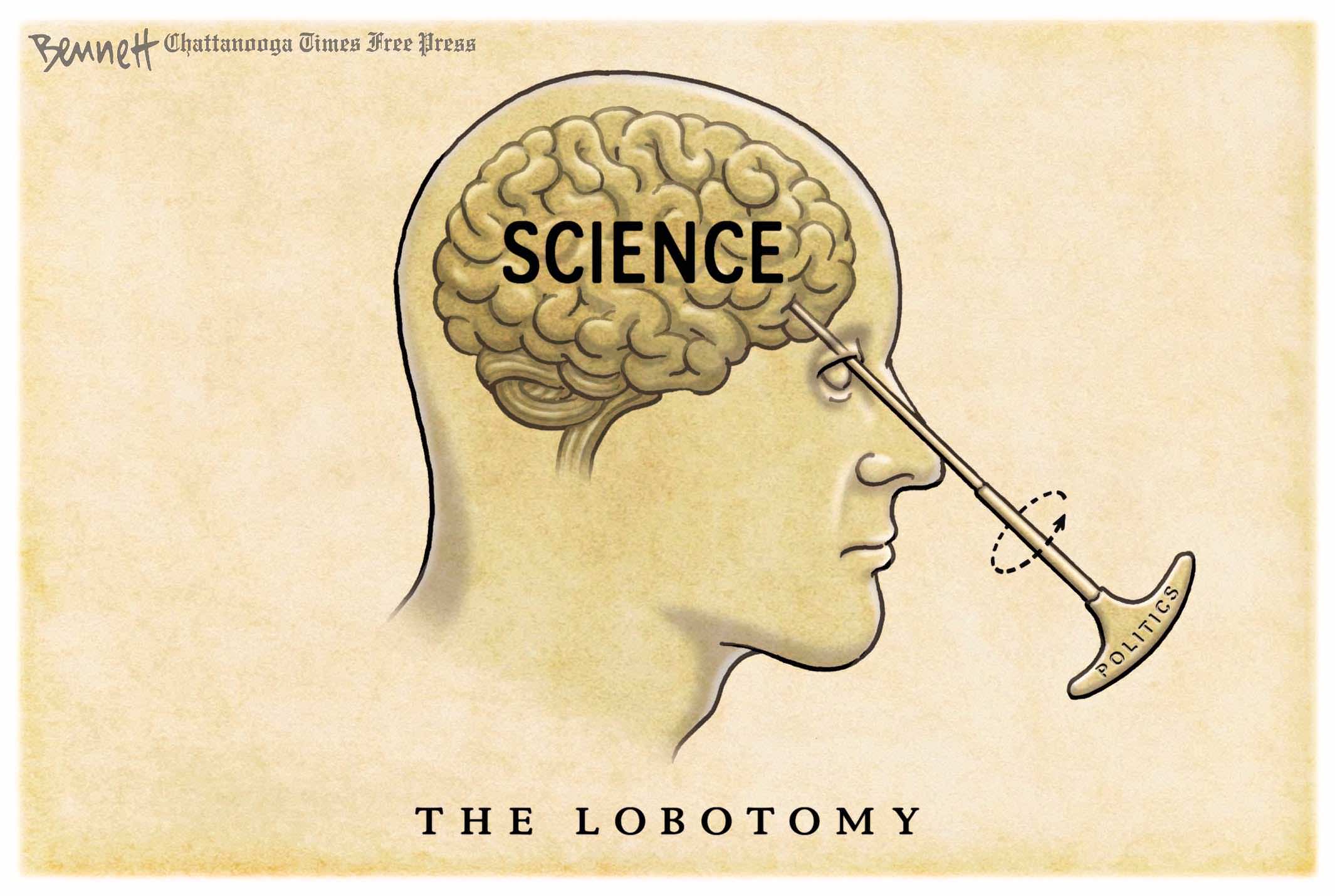
In their American Thinker article Junk science and government,  S. Stanley Young and Warren Kindzierski describe the corruption problem and a solution pathway.  The article includes links to research studies exposing how pseudoscience is employed to promote governmental agendas in fields such as climate, environment, medicine and social policies. Excerpts in italics with my bolds and added images.

Science controversies have become left-right wars fought on the internet. These days everything exists, from run-of-the-mill issues such as (fake) climate change or extreme numbers of unsafe vaccines children need to receive — up to 80 by age 18, including boosters, and COVID vaccines saving lives (hardly, but anyhow), to the Tylenol-autism dustup.

Even people with life experience and common sense have problems judging such controversies; and the internet is where sound science competes with junk science.

The National Association of Scholars (NAS) spent the past few years examining the methods of four different fields of science that lead to irreproducible (false) evidence used by governments. Flawed methods are big part of what leads to false evidence and junk science. Guess where most of this junk originates? Government-funded academia.

Academic junk science has been allowed to run amuck for decades and with little or no policing from university administrations. Elite universities, e.g., Harvard, seem to be right in there among the infestation. They would have us think they are important for science innovation. They’re wrong: more often than not — key innovations come from private industries and industrial laboratories rather than from universities.

So where does junk science fit in? It works in favor of government policymakers who mostly spend their career on our dime trying to make their jobs more important. They do this by using junk science to create irresponsible polices and regulations that are costly, meaningless, or even harmful to us.

Government policies should be built on transparent and accountable scientific research. Policies (and regulations) developed from research should clear a high barrier of proof. They should be based on reproducible science. Unsurprisingly, too many government science policies fail here.

All this points to a policy crisis in government. The current situation is win/win for government bureaucrats and universities: agency propaganda is supported and universities get grants. The citizens — us — are the ones paying for the loss of freedom.

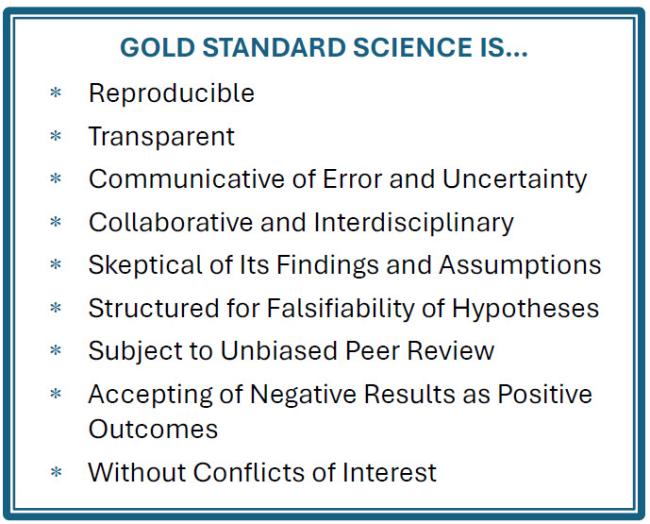
The road to fixing this mess has already started at the top — the White House, with a landmark executive order Restoring Gold Standard Science. This order is a return to foundational scientific principles in government — fostering discovery, innovation, and trust in science. To this end, we offer four reforms to help governments.

Source: NIH Publishes Plan to Drive Gold Standard Science, August 22, 2025

1. Cut the funding of junk science. Federal government agencies need to change their regulatory and funding practices to fix the irreproducibility crisis in academic science and the irresponsibility crisis in our government.

2. Sever the fraudulent relationship between government policymakers and academic junk scientists. Federal and state policymakers need to end the arbitrary procedures of using government-funded scientific research for regulation if it is irreproducible.

3. Fix the process fueling this train wreck. Federal and state policymakers need to change the teaching of undergraduate (and K‒12) science and math to educate properly a new generation of science professionals, policymakers, and informed citizens. They certainly should cover junk science and fossil fuel development, the latter which is linked to our prosperity.

4. Refocus policy institutes to dedicate themselves to sound science policy as a priority. These institutes need to be staffed with people who know the difference between sound and junk science, and the benefits of fossil fuels.

Previous administrations have allowed a cesspit of relationships between government policymakers and academic junk scientists, including radical activists disguised as scientists.

Government experts employed to judge scientific research and academics (whom mostly lean left) are naïve or sly practitioners of political groupthink. They are not our friends.

These reforms will go a long way in reversing the current situation of government bureaucrats and academics jointly using regulation based on junk science to advance corrupt, self-serving policy goals.

S. Stanley Young, PhD, is the CEO of CGStat in Raleigh, North Carolina and is Director of the National Association of Scholars’ Shifting Sands Project. Warren Kindzierski, PhD, is a retired college professor (public health) in St Albert, Alberta.

See Also

Why Federalized Science is Rotten

Government Funding Corrupts Science, How to Stop It

The Original Sin of GHG Theory

In reality, Water only spontaneously flows down a
pressure gradient (downhill).
Energy only spontaneously flows
down an energy density gradient (from high to low).

In the domain of theology, original sin refers to Adam and Eve choosing to trust the serpent’s lies rather than natural truth placed by God in the Garden of Eden.  In legal proceedings, a similar concept concerns evidence obtained under false pretences.  “The fruit of a poisonous tree” refers to analyses, interpretations or conclusions that must be excluded because they started with a falsehood.

This post delves into a fraud at the root of consensus Climate Science™, illustrated by the image above showing how both water and energy flow down their respective gradients.  William Happer alluded to the problem in a recent presentation: (See Happer: Cloud Radiation Matters, CO2 Not So Much)

As we shall see below, mischief is a very polite term for a math and science error that has poisoned most all thinking and discussion about changes in climate and weather.  In a previous post, I summarized an important empirical experiment by Thomas Allmendinger proving that a parcel of pure CO2 and a parcel of ordinary air warm exactly the same when exposed to both SW and LW radiation.  (See Experimental Proof Nil Warming from GHGs).

So we know the notion is empirically wrong, now let’s discuss how GHG theory went off the rails from the beginning.  For that I provide below a synopsis of commentary by blogger Morpheus which he posted at Tallbloke’s Talkshop.  Excerpts in italics with my bolds and added images. (Title in red is link to blog)

CAGW (Catastrophic Anthropogenic Global Warming, due to CO2)
is nothing more than a complex mathematical scam.

The takeaways:

1) The climatologists have conflated their purported “greenhouse effect” with the Kelvin-Helmholtz Gravitational Auto-Compression Effect (aka the lapse rate).

2) The climatologists purport the causative agent for their purported “greenhouse effect” to be “backradiation”.

3) The Kelvin-Helmholtz Gravitational Auto-Compression Effect’s causative agent is, of course, gravity.

4) “Backradiation” is physically impossible because energy cannot spontaneously flow up an energy density gradient.

5) The climatologists misuse the Stefan-Boltzmann (S-B) equation, using the idealized blackbody form of the equation upon graybody objects, which manufactures out of thin air their purported “backradiation”. It is only a mathematical artifact due to that aforementioned misuse of the S-B equation. It does not and cannot actually exist. Its existence would imply rampant violations of the fundamental physical laws.

6) Polyatomic molecules are net atmospheric radiative coolants, not “global warming” gases. Far from the ‘global warming gas’ claimed by the climatologists, water acts as a literal refrigerant (in the strict ‘refrigeration cycle’ sense) below the tropopause. CO2 is the most prevalent atmospheric radiative coolant above the tropopause and the second-most prevalent (behind water vapor) below the tropopause. Peer reviewed studies corroborating this are referenced in the paper at the end of this post.

As you can see, there are two forms of the Stefan-Boltzmann (S-B) equation… one for idealized blackbody objects, one for graybody objects.

The idealized blackbody form of the S-B equation assumes emission to 0 K and ε = 1 by the very definition of idealized blackbody objects. ( ε is the term for emissivity from 0 to 1).

Idealized Blackbody Object (assumes emission to 0 K and ε = 1 by definition):
q_bb = ε σ (T_h^4 – T_c^4) A_h
1 σ (T_h^4 – 0 K) 1 m^2
=    σ  T^4

The graybody form of the S-B equation assumes emission to > 0 K and ε < 1.

Graybody Object (assumes emission to > 0 K and ε < 1):
q_gb = ε σ (T_h^4 – T_c^4) A_h

The ‘A_h’ term is merely a multiplier, used if one is calculating for an area larger than unity [for instance: >1 m^2], which converts the result from radiant exitance (W m-2, radiant flux per unit area) to radiant flux (W).

One can see from the immediately-above equation that the Stefan-Boltzmann (S-B) equation is all about subtracting the radiation energy density of the cooler object from the radiation energy density of the warmer object.

So radiant exitance at its most simplified (and thus the S-B equation at its most simplified) is just the emissivity of the warmer object (because emissivity only applies to objects which are emitting, and only the warmer object will be emitting… the colder object will be unable to emit in the direction of the warmer object because energy cannot spontaneously flow up an energy density gradient) multiplied by the speed of light in vacua, multiplied by the energy density differential, all divided by 4.

For graybody objects, it is the radiation energy density differential between warmer object and cooler object which determines warmer object radiant exitance. Warmer objects don’t absorb radiation from cooler objects (a violation of 2LoT in the Clausius Statement sense and Stefan’s Law); the lower radiation energy density gradient between warmer and cooler objects (as compared to between warmer object and 0 K) lowers radiant exitance of the warmer object (as compared to its radiant exitance if it were emitting to 0 K). The radiation energy density differential between objects manifests a radiation energy density gradient, each surface’s radiation energy density manifesting a proportional radiation pressure.

The climatologists use:   q = σ T^4on graybody objects, and sometimes slap ε<1 onto that,
when they should be using:  q = ε σ (T_h^4 – T_c^4)

This has the effect of artificially inflating radiant exitance of all calculated-upon objects.

Essentially, the climatologists are treating real-world graybody objects as though they are idealized blackbody objects… with emission to 0 K and emissivity of 1 (sometimes… other times they slap emissivity onto the idealized blackbody form of the S-B equation while still assuming emission to 0 K… which is still a misuse of the S-B equation, for graybody objects).

This essentially isolates each object into its own system so it cannot interact with other objects via the ambient EM field, which grossly inflates radiant exitance of all objects, necessitating that the climatologists carry these incorrect values through their calculation and cancel them on the back end (to get their equation to balance) by subtracting a wholly-fictive ‘cooler to warmer’ energy flow from the real (but far too high because it was calculated for emission to 0 K) ‘warmer to cooler’ energy flow.

That wholly-fictive ‘cooler to warmer’ energy flow is otherwise known as ‘backradiation’... it is nothing more than a mathematical artifact due to that aforementioned misuse of the S-B equation.

As I show here and in the below-linked paper, the correct usage of the S-B equation for graybody objects is via subtracting cooler object energy density from warmer object energy density to arrive at the energy density gradient, which determines radiant exitance of the warmer object.

So we’re talking about the same concept as water only spontaneously flowing down a pressure gradient (ie: downhill) when we talk of energy (of any form) only spontaneously flowing down an energy density gradient. Energy density is pressure, an energy density gradient is a pressure gradient… for energy.

It’s a bit more complicated for gases because they can convert that energy density to a change in volume (1 J m-3 = 1 Pa), for constant-pressure processes, which means the unconstrained volume of a gas will change such that its energy density (in J m-3) will tend toward being equal to pressure (in Pa). This is the underlying mechanism for convection. It should also have clued the climatologists in to the fact that it is solar insolation and atmospheric pressure which ‘sets’ temperature, not any ‘global warming’ gases.

Since a warmer object will have higher radiation energy density at all wavelengths than a cooler object (because remember, temperature is a measure of radiation energy density, equal to the fourth root of radiation energy density divided by Stefan’s Constant):

… ‘backradiation’ can do nothing to warm the surface because energy cannot spontaneously radiatively flow from lower to higher radiation energy density, and thus CAGW is nothing more than a complex mathematical scam perpetrated to obtain multiple billions of dollars in funding for trough-grubbing line-toeing ‘scientists’ and by perfidious politicians.

“But how does that make CAGW a scam?”, some may ask… well, because we’re being lied to, based upon an unscientific premise.

The climatologists have misused the Stefan-Boltzmann (S-B) equation (and the fundamental physical laws), and in the process, have practically flipped reality on its headpolyatomics (CO2, H2O, etc.) are not “global warming gases”, they are net atmospheric radiative coolants (radiative emission to space being the only way that Earth can shed energy); monoatomics (Ar) are not inert gases that have no effect upon climate, they are the actual “greenhouse gases” (because they cannot emit IR, and thus cannot shed energy to space… they dilute the radiative coolant gases); homonuclear diatomics (N2, O2) are somewhere in between… they can radiatively emit IR (and thus shed energy from the system known as ‘Earth’), but only under certain conditions (collisional perturbation of their net-zero electric dipole, which is why homonuclear diatomic vibrational mode quantum states are meta-stable and relatively long-lived. Collisions happen exponentially less frequently as altitude increases), and thus are “greenhouse gases” like the monoatomics, just not to the same extent.

We live, at the planet’s surface, in what can be analogized to the evaporator section of a world-sized AC unit, with polyatomics being net atmospheric radiative coolants (a higher concentration of them increases thermodynamic coupling between heat source (surface) and sink (space)), and with monoatomics and homonuclear diatomics playing the same role as non-condensable gases would play in an AC unit… diluting the polyatomic radiative gases which transit the majority of the energy, thus reducing the efficiency at which energy is transited from surface to upper atmosphere, then radiatively emitted to space.

Think about it this way… we all know the air warms up during the daytime as the planet’s surface absorbs energy from the sun. Conduction of that energy when air contacts the planet’s surface is the major reason air warms up.

How does that ~99% of the atmosphere (N2, O2, Ar) cool down? It cannot effectively radiatively emit.

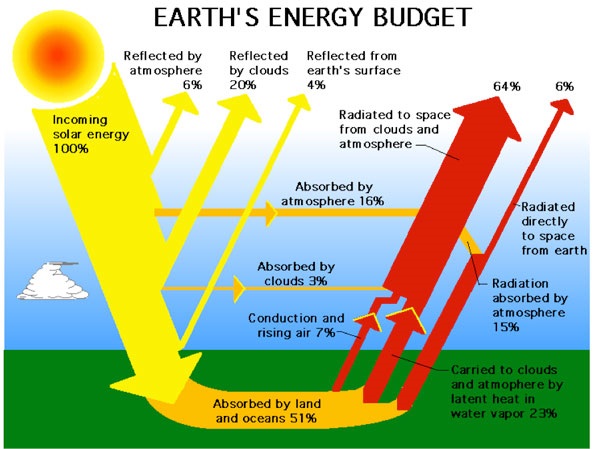
Convection moves energy around in the atmosphere, but it cannot shed energy to space. Conduction depends upon thermal contact with other matter and since space is essentially a vacuum, conduction cannot shed energy to space… this leaves only radiative emission. The only way our planet can shed energy is via radiative emission to space. Fully ~76.2% of all surface energy is removed via convection, advection and evaporation. The surface only radiatively emits ~23.8% of all surface energy to space. That ~76.2% must be emitted to space by the atmosphere.

ERBE Earth Radiation Budget Experiment

Thus, common sense dictates that the thermal energy of the constituents of the atmosphere which cannot effectively radiatively emit (N2, O2, Ar) must be transferred to the so-called ‘greenhouse gases’ (CO2 being a lesser contributor below the tropopause and the largest contributor above the tropopause, water vapor being the main contributor below the tropopause) which can radiatively emit and thus shed that energy to space. Peer-reviewed studies corroborating this are referenced in the linked file below.

So, far from being ‘greenhouse gases’ which ‘trap heat’ in the atmosphere, those polyatomic radiative gases actually shed energy from the atmosphere to space. They are net atmospheric radiative coolants.

In short, in an atmosphere sufficiently dense such that collisional energy transfer can significantly occur, all polyatomic radiative molecules play the part of atmospheric radiative coolants at and above the temperature at which the combined translational mode energy of two colliding particles (atoms or molecules) exceeds the lowest excited vibrational mode quantum state energy of the radiative molecule. Below this temperature, they act to warm the atmosphere via thermalization (the mechanism the climate alarmists claim happens all the time), but if that occurs below the tropopause, the net result is an increase of Convective Available Potential Energy, which increases convection, which is a net cooling process. It is a gradation… as temperature increases, so too does the population of vibrationally excited polyatomics, and thus increases radiative emission. For CO2, that ‘transition temperature’ (the temperature at which the molecule transitions from being ‘net warmant’ to ‘net coolant’ and vice versa) is ~288 K.

The climatologists only told people half the story (thermalization by CO2 via vibrational mode to translation mode (v-t) collisional energy transfer processes). They didn’t tell anyone about the inverse (translational mode to vibrational mode (t-v) collisional energy transfer processes, (then that energy being radiatively emitted to space)), which is a cooling process. That didn’t fit their doomsaying narrative, so they left it out.

In other words, the climatologists only told people about the warming part (thermalization), not the cooling part. In order to hew to the fundamental physical laws, one must consider energy flow both to and from the CO2 molecule.

This doesn’t just apply to CO2, however. It applies to all atmospheric polyatomic molecules. In fact, far from the ‘global warming gas’ claimed by the climatologists, water acts as a literal refrigerant (in the strict ‘refrigeration cycle’ sense) below the tropopause:

That’s why, after all, the humid adiabatic lapse rate (~3.5 to ~6.5 K km-1) is lower than the dry adiabatic lapse rate (~9.81 K km-1).

You will note that the dry adiabatic lapse rate is due to the monoatomics and homonuclear diatomics... we’ve removed in this case the predominant polyatomic which reduces lapse rate.

Remember that an actual greenhouse works by hindering convection of energy out of the greenhouse.

In an atmosphere consisting of solely monoatomics and homonuclear diatomics (ie: no polyatomic radiative molecules), the atoms / molecules could pick up energy via conduction by contacting the surface, just as the polyatomics do; they could convect just as the polyatomics do… but once in the upper atmosphere, they could not as effectively radiatively emit that energy, the upper atmosphere would warm, lending less buoyancy to convecting air, thus hindering convection… and that’s how an actual greenhouse works, by hindering convection.

For homonuclear diatomics, there would be some collisional perturbation of their net-zero electric dipole and thus some emission in the atmosphere, but by and large the atmosphere could not effectively emit (especially at higher altitudes, because the probability of collision decreases exponentially with altitude).

Thus the surface would have to radiatively emit that energy (which is currently ~76.2% of all energy removed from the surface via radiation, convection and evaporation) instead… and a higher surface radiant exitance implies a higher surface temperature.

On the contrary, in our actual atmosphere, as temperature increases, (t-v) (translational mode -to- vibrational mode) collisional energy transfer processes increase and thus spectral emission increases only because CO2 is a net atmospheric radiative coolant (transferring translational mode energy to vibrational mode energy, then radiatively emitting it). So they are attempting to claim that CO2 is a “global warming gas” and simultaneously a net atmospheric radiative coolant, a contradiction… which is why their claims make no sense upon close examination.

In fact, removing CO2 would increase upper atmosphere temperature (due to fewer emitters in the upper atmosphere), which would set the starting point of the lapse rate higher, which translates down through the lapse rate to a warmer surface. That doesn’t occur with Ar, because it is a monoatomic, has no vibrational mode quantum states and thus cannot emit (nor absorb) IR in any case, and thus it only dilutes the radiative polyatomics, reducing the efficiency by which energy is transited from surface to space.

Because we don’t live in a ‘greenhouse’ as the climatologists claim… we live in what can be analogized to a world-sized AC unit… the surface is akin to the AC unit’s evaporator section (ie: the heat source); the atmosphere is akin to the AC unit’s working fluid; space is akin to the AC unit’s condenser section (ie: the heat sink); convection is akin to the AC unit’s compressor (ie: the motive force to move the working fluid).

These concepts used to be common knowledge. Somewhere along the way, the concepts got skewed to fit a particular narrative. Eventually, the concepts described herein will be common knowledge again, whereupon CAGW and its offshoots will be dumped on the midden heap of bad scientific ideas.


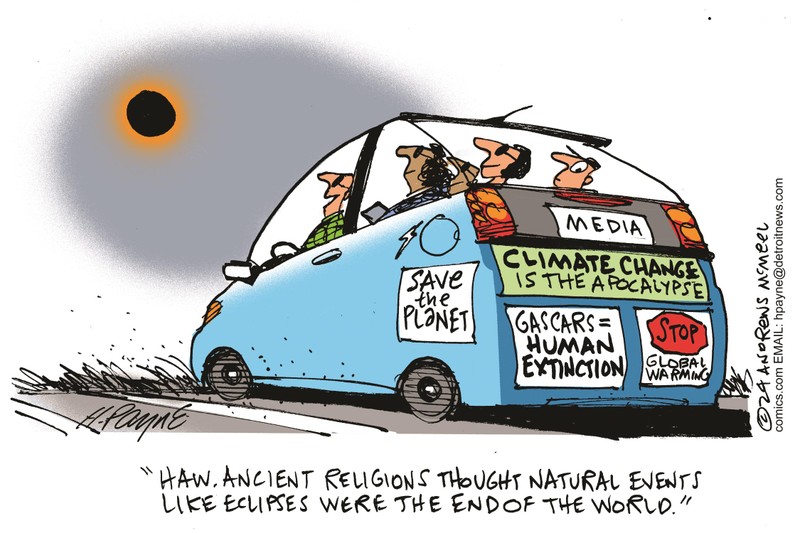
Eclipses Prove Astronomy is Science. Climate Still Unpredictable.

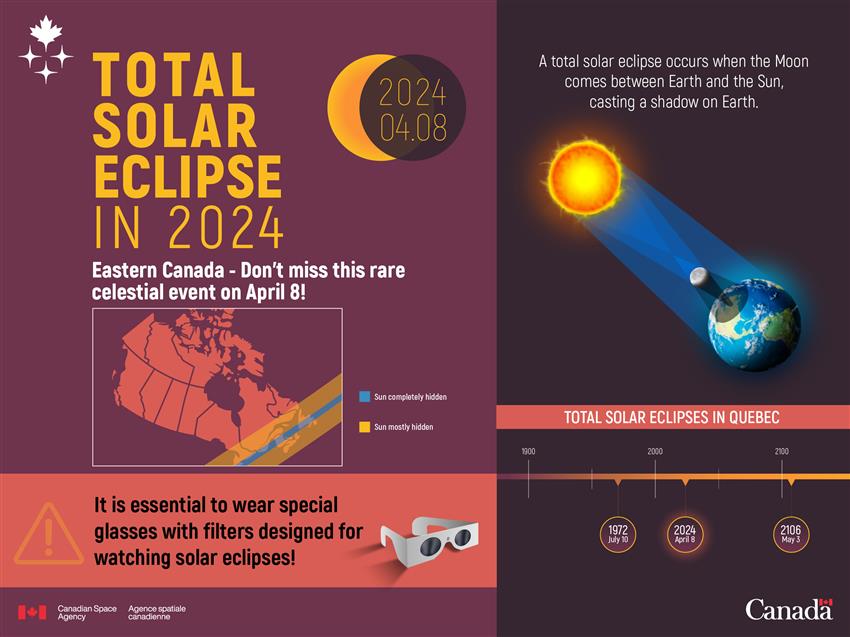
A nice tongue in cheek essay appeared in the Atlantic The Eclipse Conspiracy: Something doesn’t add up.

It is a whimsical spoof on anyone skeptical that the solar eclipse will happen tomorrow. (Excerpts)

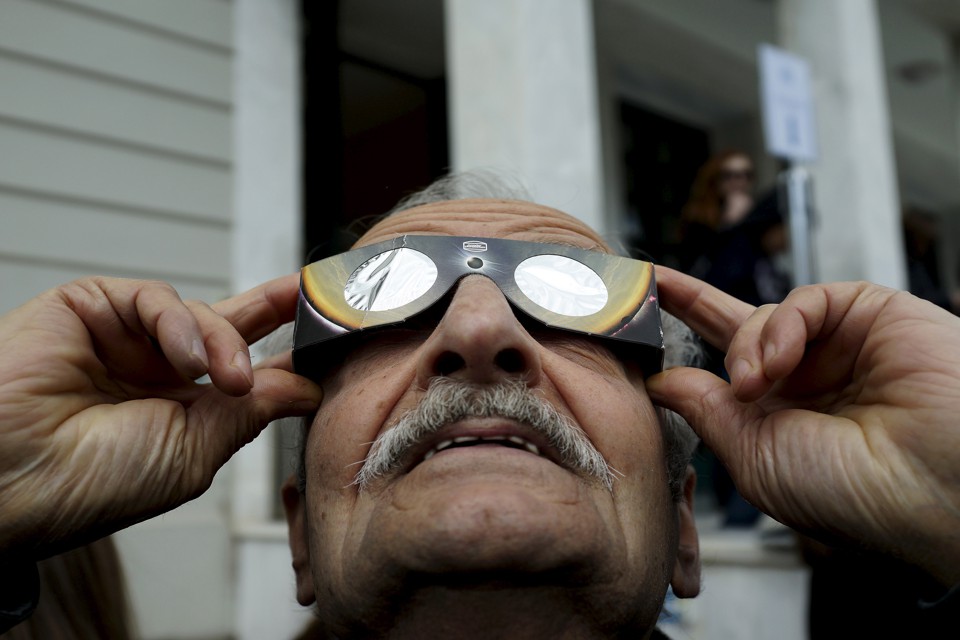
Meanwhile the scientists tell us we can’t look at it without special glasses because “looking directly at the sun is unsafe.”

That is, of course, unless we wear glasses that are on a list issued by these very same scientists. Meanwhile, corporations like Amazon are profiting from the sale of these eclipse glasses. Is anyone asking how many of these astronomers also, conveniently, belong to Amazon Prime?

Let’s follow the money a little further. Hotels along the “path of totality”—a region drawn up by Obama-era NASA scientists—have been sold out for months. Some of those hotels are owned and operated by large multinational corporations. Where else do these hotels have locations? You guessed it: Washington, D.C.

In fact the entire politico-scientifico-corporate power structure is aligned behind the eclipse. This includes the mainstream media. How many news stories have you read about how the eclipse won’t happen?

That’s a great example of “conspiracy ideation” and a subtle dig at people who don’t trust NASA on climate matters. In fact, many of the real NASA scientists are extremely critical of NASA’s participation in climate activism.  Journalists or Senators who raise NASA as evidence of climate change should be directed to The Right Climate Stuff, where esteemed NASA scientists give plenty of good reasons to doubt NASA on this topic.

Bottom Line: A Real Science Makes Predictions that Come True.

The article, perhaps unwittingly, shows why Astronomy is a real science we can trust while Climatology is faith-based, like Astrology. When the eclipse happens, it confirms Astronomers have knowledge about the behavior of planetary bodies. When numerous predictions of climate catastrophes are unfulfilled, it demonstrates scientists’ lack of knowledge about our climate system. Anyone claiming certainty about the climate is exercising their religious freedom, but not doing science.

Footnote Resource

Climatists Mistake Means for Ends

There is no charge for content on this site, nor for subscribers to receive email notifications of postings.

Climate Prime Example of Broken Science

Net Zero has published a wonderful essay by William Briggs On Broken Science.  It is a joy to read with great clarity, depth and plain talk while being delightful.  The excerpt here is the segment describing how climate science is the epitome of the wider phenomenon of broken science.

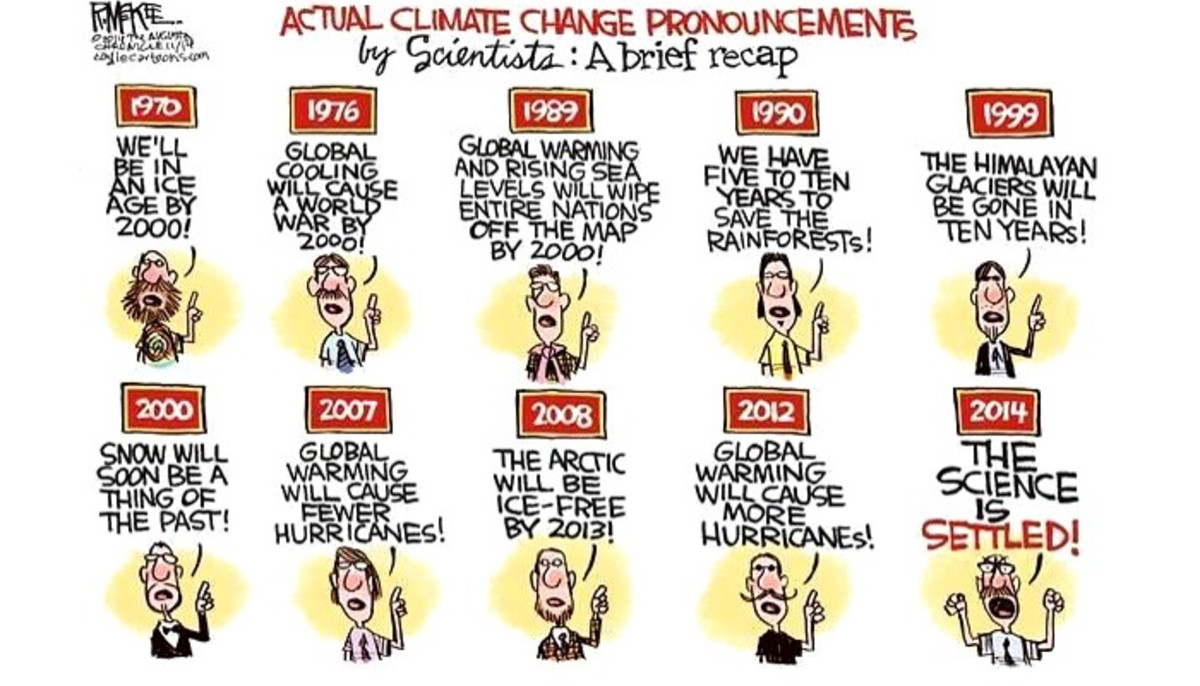
We all agree that the planet needs saving. Everybody says so. From global cooling.

When climatology was becoming a new field, they really did say a new ice age was coming.
Newsweek in 1975 reported:
There are ominous signs that the earth’s weather patterns have begun to change dramatically and that these changes may portend a drastic decline in food production.

Time in 1974 said:
Climatologist Kenneth Hare, a former president of the Royal Meteorological Society, believes that the continuing drought…gave the world a grim premonition of what might happen. Warns Hare: ‘I don’t believe the world’s present population is sustainable if [trends continue]’.

There are scores upon scores of these, the scientists and groups such as the UN warning of mass deaths by starvation and so on. Well, climatological science grew, and the temperature warmed, and then we got global warming. Caused, incidentally, by the same thing said to cause global cooling: oil.

Global warming in time became ‘climate change’: a brilliant name, because the earth’s climate changes unceasingly. Thus any change, which is inevitable, can be said to be because of ‘climate change.’ Correlation becomes causation with ease here.

‘Climate change’ was quickly married to scientism, where it came to be synonymous with ‘solutions’ to ‘climate change’. Because of this error, doubt expressed about the so-called solutions caused one to be called a ‘climate change denier’ – an asinine name, because no working scientist, not one, denies the earth’s climate changes or is unaffected by man.

US Secretary of the Treasury Janet Yellen recently said that ‘Climate change is an existential threat’ and that the ‘world will become uninhabitable’ if – you know the rest – if we don’t act. Uninhabitable is a mighty word. Rode and Fischbeck in 2021 examined environmental apocalyptic predictions and discovered that the average time until The End, for those saying we ‘Must act now’, as Yellen did, is about nine years.

Predictions of ‘only nine years left’ started gradually, in the 1970s. They now happen regularly. Funny thing about these forecasts is that failure never counts against theory. Which is another strike against falsification.

That is a story unto itself. Let’s instead peek at the science of ‘climate change.’ Not at the thermodynamics or fluid physics, which is too much for us here, but at the things which are claimed will go bad because of ‘climate change.’

Which is everything. There is no ill that will not be exacerbated by ‘climate change’, and there is no good thing that will escape degradation. ‘Climate change’ will simultaneously cause every beast and bug and weed which is a menace to flourish, and it will corrupt or kill every furry, delicious, and photogenic animal.

There is a fellow in the UK who collects these things. His ‘warm list‘ total right now is about 900 science papers, an undercount. Academics have proved, to their satisfaction, that ‘climate change’ will cause or exacerbate (just reading the first few): AIDS, Afghan poppies destroyed, African holocaust, aged deaths, poppies more potent, Africa devastated, Africa in conflict, African aid threatened, aggressive weeds, Air France crash, air pockets, air pressure changes, airport farewells virtual, airport malaria, Agulhas current, Alaskan towns slowly destroyed, Al Qaeda and Taliban Being Helped, allergy increase, allergy season longer, [and my favourite] alligators in the Thames! And we haven’t even come close to getting out of the As.

There is not one study, that I know of, that remarks on how a slight increase in globally average temperature will lead to more warm, pleasant summer afternoons. That a small change in the earth’s climate, whether caused by man or not, can only be seen as wholly and entirely bad, and can in no way be good, is sufficient proof, I think, that science has gone horribly wrong. It’s not logically impossible, of course, but it cannot be believed.

Yet this doesn’t say how these beliefs are generated. They happen by some of the reasons we’ve already mentioned, but also by forgetting the multiplication of uncertainties.

Given knowledge of coins, the chance of a head on a flip is one half. Two heads in a row is one quarter: the uncertainties are multiplied. Three in a row is one eighth; four is one in sixteen. If the event of interest is that string of four heads, we must announce the small probability of about 6%. It would be an obvious error, and a silly mathematical blunder, to say the probability is ‘one half’ because the chance of the last head is one half. And it would be outrageous if a headline were to blare ‘Earth will see a Head on last throw.’ Agreed?

But that’s exactly how ‘climate change’ scare stories are produced. We first have a model of climate change, and how man might affect the climate. There is only a chance this model is correct. It is not certain. We next have a weather model, which rides on top of the climate model, which says how the weather will change when the climate does. This model is not certain, either. We then have a third model, about how some item of importance – the welfare of some animal or the size of coffee production or whatever – is affected by the weather. This third model is not certain. We finally, or eventually, have a fourth model, which shows how a solution will stop this bad thing from happening. This model is also uncertain.

In the end, it will be announced ‘We must do X to stop Y’. This is equivalent to ‘Earth will see a Head.’ Causal language. Which we agreed was an error. The chain of uncertainties must be multiplied. The greater the chain, the more uncertain the whole must be. This is never remembered, but must be, especially when the number of claims grows almost without bound.

The Deadly Sin Of Reification: Mistaking models for Reality

We are in rugged territory here, for the closer we get to the true nature of causation, which requires a clear understanding of metaphysics, the subtler the mistakes that are made, and the more difficult they are to describe. Plus, I have detained you long enough.

It would, I hope you agree, be an obvious fallacy to say that Y was not or cannot be observed, when Y was in fact observed, because some theory X says Y is not possible. Yes?

This error abounds. X is some cherished model or theory, and Y an observation which is scoffed at, dismissed, or ‘explained’ away, because it does not accord with theory.

This happens in the least sciences, like dowsing or astrology, where practitioners reflexively explain away their mistakes. But it also happens with great and persistent frequency in the greatest sciences, like physics.

It also leads to the current mini-panic over ‘AI’, or ‘artificial intelligence.’ Which it isn’t: intelligence, that is. All models only say what they are told to say – a philosophic truth that when forgotten leads to scientism – and AI is only a model. AI is nothing more than an abacus, which does its calculations at the direction of real intelligence in wooden beads, with the beads replaced with electric potential differences.

But because the allure and love of theory is too strong, it is believed that computer intelligence will somehow ‘emerge’ into real intelligence, just like the behaviour of large objects is said to ‘emerge’ from quantum interactions.

I will upset many when I say this is always a bluff, a great grand bluff. There is no causal proof of ‘emergence’: if there was, it would be given. Talk of emergence is always wishful thinking, reflecting a desire not to question the philosophy of what philosopher Robert Koons and others call ‘microphysicalism’, the ancient Democritian idea that everything is just particles bumping into things.

There are alternatives to this philosophy, such as the revival of Aristotelian metaphysics, which would do wonders for quantum mechanics if it were better known. Unfortunately, we haven’t the time to cover any of them.

The Deadly Sin Of Reification, the mistaking of models for Reality, is much worse than I have made it sound. It leads to strange and untestable creations, such as the multiverse and ‘many worlds’ in physics, and gender theory, and all that they have wrought.

See Also Chameleon Climate Models


Goalless Solutions Make Things Worse

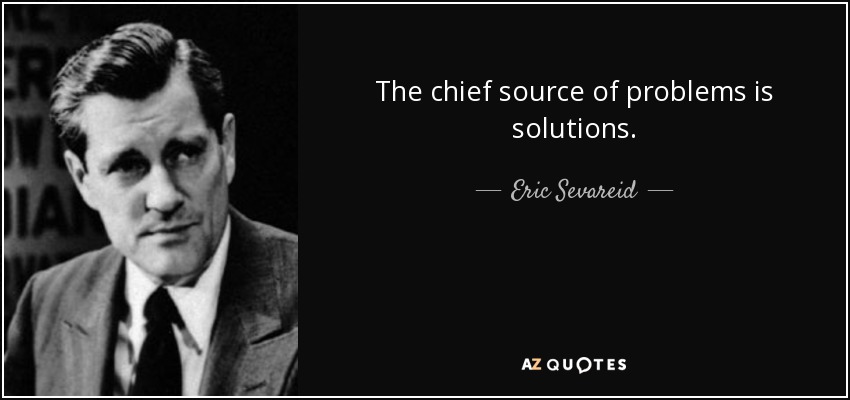
Thorsteinn Siglaugsson wrote at Brownstone Institute The Chief Cause of Problems Is Bad Solutions.  Excerpts in italics with my bolds and added images.

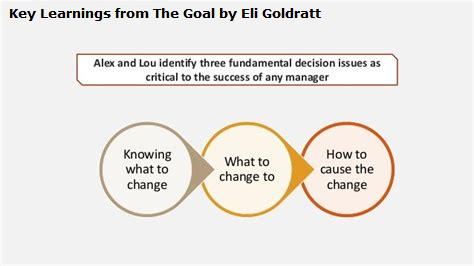
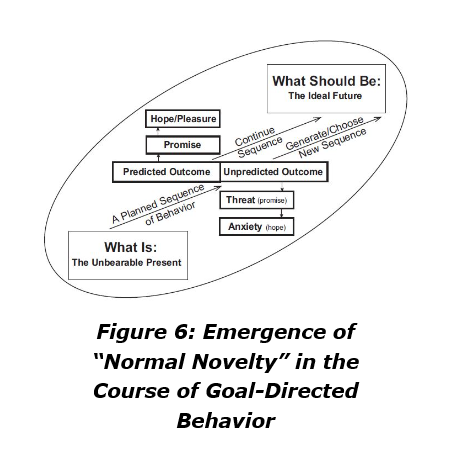
When H. William Dettmer started working with Dr. Eli Goldratt’s Thinking Process framework for solving profound problems in the 1990s, he soon realised how very often people focused on the wrong problems, and then spent their time and effort on figuring out root causes behind often trivial issues.

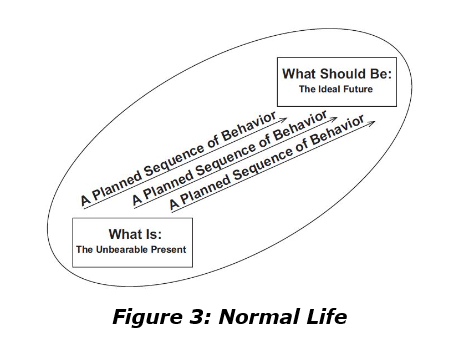
Dettmer’s solution to this was based on a simple, yet profound insight: A problem is not really a problem unless it prevents us from reaching our goal. The first step in problem-solving should therefore be to define the goal, and in Dettmer’s amended framework not only a goal but also the factors critical to achieve it. This way, focus on what actually mattered would be ensured; the problem solver could rest assured he was not wasting his time on trivialities.

Source: Jordan Peterson’s Maps of Meaning

What we perceive as important problems are often things that annoy us, but which really do not matter in the bigger context. I might perceive a cluttered inbox or a broken coffee machine in the office as a major problem, while those are totally unimportant to the long-term success of the company.

As long as I realise such issues are important only to me personally, no harm is done. But as soon as my focus shifts to the trivial problems and I become obsessed with them, I may be headed for wrong decisions, a situation exemplified by Eric Sevareid’s insight:

Eli Goldratt’s book, The Goal, is one of the most influential management books of all time and his ideas have had a profound impact, especially in production and project management. Goldratt’s first axiom is that every decision must aim at furthering the company’s overall goal. Self-evident as it may sound, all senior managers know the constant effort it takes to maintain this focus.

What happens if we have no clear goal? In that case any undesired change may come to be perceived as an important problem. The more sudden or unexpected the change, the more likely this is.

If there is no goal, we have no way to judge the importance.

Source: Jordan Peterson’s Maps of Meaning

What Goals Directed Covid Responses? 

In the summer of 2020 I had a long discussion with a consultant friend in Paris, another of Goldratt’s disciples, on the situation and outlook after the Covid-19 crisis struck. Our first instinct was of course to try and define a goal. We agreed that when it comes to public health the goal should always be to minimise the loss of life-years, or rather quality-adjusted life-years, both now and in the future.

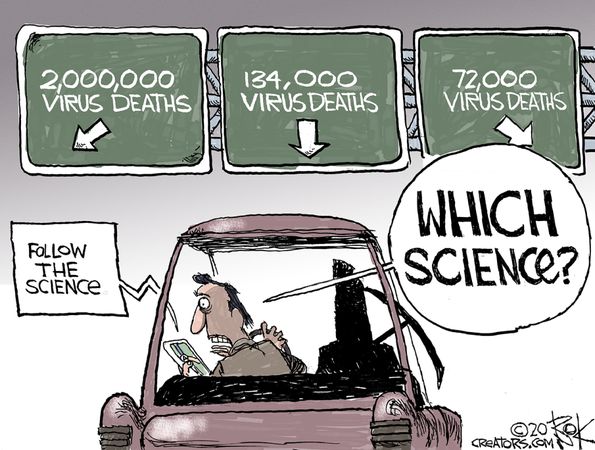
This was shortly after the governor of New York, Andrew Cuomo had claimed that any severity of measures against the coronavirus was worth it, if they saved just one life. Across the world, national leaders constantly repeated the mantra of “following the science,” meaning the whole of society should be managed based on the advice of experts in a narrow field of medical science, focusing on suppressing or even eradicating a single disease. An ethics professor I interviewed in late 2020 said it was morally right to brush aside all concerns of collateral damage because we were “in a pandemic.”

Maximising the number of life-years might well be a proper goal for healthcare. It calls for both short and long-term strategies, including prevention, treatment, even nutritional policies and many other strategies. But when we look at society as a whole, the maximum number of life-years, even when “quality-adjusted,” is hardly a proper overall goal; it focuses on physical existence only, ignoring all the other complex factors which make life worth living.

What then about the goal of “following the science” or of preventing even just one death from a coronavirus at all costs? It should be obvious how absurd it is to view those as true goals when it comes to governing a society. But for some reason, over the past 30 months, those and other similar extremely narrow objectives became the chief goals of public health authorities and governments in almost the whole world.

There is little doubt that the phenomenon of mass formation described by Mattias Desmet has played a role here. I clearly remember how many people had convinced themselves that nothing mattered except to stop the virus in its tracks, to delay infections. And when I say nothing I mean nothing. “The only thing that matters is preventing infections,” someone told me back in 2020. And when I pressed him, asking if he meant the only thing that mattered in the whole wide world was slowing the spread of the virus, if everything else was really of no consequence, education, the economy, poverty, mental health; everything else, the answer was a resounding “Yes!”

Escaping the Problem Obsession Trap

What those cases have in common is how, in the absence of a goal, our focus is diverted towards a problem, otherwise insignificant, or at least not the only problem in the world, and eliminating the problem becomes the goal.

This is why the key to successful problem-solving is to first agree on a common goal, otherwise we may end up solving the wrong problems.

The loss of focus we have experienced during the past 30 months rests on two pillars. One is the power of mass formation. But the other one, no less important, is the loss of leadership. In both Sweden and the Faroe Islands the leadership, epidemiologist Anders Tegnell in the case of Sweden, and the government in the case of the Faroe Islands, never succumbed to irrational fear. If they had, it would surely have taken over in both countries.

The chief reason it didn’t was the stance taken by the leaders who, guided by common sense. never lost sight of the goal of government; ensuring the well-being of society as a whole, or, at the individual level, ensuring man’s possibility to live a full life, as Eli Goldratt once put it. Neither is clear-cut of course, but however fuzzy and imperfect the goal statement may be, once we lose sight of it, we are in grave danger of succumbing to mass formation. It only takes a sudden change or an unforeseen threat, blown out of proportion, unrestrained by the common goal.

When almost the whole world loses sight of the common goal of human society, and the elimination of a single problem, in the end a rather unimportant one, takes precedence over everything else, thus becoming the goal – a distorted and absurd one, a disastrous and ruinous one for sure – this is an indication of a fundamental loss of common sense.

A healthy society does not succumb to mass formation. The reason this can happen is that we have no common goal any more, no common sense. To get out of this situation and to avoid it in the future, we must find our goal again, we must reestablish our focus, we must regain our common sense.

Footnote:  Preface to The Goal by Eli Goldratt

I  view science as nothing more than an understanding of the way the world is and why it is that way. At any given time our scientific knowledge is simply the current state of the art of our understanding. I do not believe in absolute truths. I fear such beliefs because they block the search for better understanding. Whenever we think we have final answers progress, science, and better understanding ceases. Understanding of our world is not something to be pursued for its own sake, however. Knowledge should be pursued, I believe, to make our world better—to make life more fulfilling.

There are several reasons I chose a novel to explain my understanding of manufacturing—how it works (reality) and why it works that way. First, I want to make these principles more understandable and show how they can bring order to the chaos that so often exists in our plants. Second, I wanted to illustrate the power of this understanding and the benefits it can bring. The results achieved are not fantasy; they have been, and are being, achieved in real plants. The western world does not have to become a second or third rate manufacturing power. If we just understand and apply the correct principles, we can compete with anyone. I also hope that readers would see the validity and value of these principles in other organizations such as banks, hospitals, insurance companies and our families. Maybe the same potential for growth and improvement exists in all organizations.

Finally, and most importantly, I wanted to show that we can all be outstanding scientists. The secret of being a good scientist, I believe, lies not in our brain power. We have enough. We simply need to look at reality and think logically and precisely about what we see. The key ingredient is to have the courage to face inconsistencies between what we see and deduce and the way things are done. This challenging of basic assumptions is essential to breakthroughs. Almost everyone who has worked in a plant is at least uneasy about the use of cost accounting efficiencies to control our actions. Yet few have challenged this sacred cow directly. Progress in understanding requires that we challenge basic assumptions about how the world is  and why it is that way. If we can better understand our world and the principles that govern it, I suspect all our lives will be better.

Good luck in your search for these principles and for your own understanding of “The Goal.”

Link to The Goal: A Process of Ongoing Improvement by Eli Goldratt

Judging Truth in the Disinformation Age

The fad of the moment is to claim that information detrimental to one’s point of view is either “Misinformation” or “Disinformation”, depending on whether you are also claiming the other person is lying in addition to being mistaken.  That presupposes that you know what’s inside someone else’s head.  

More importantly, many caught up in these insult exchanges are unable or unwilling to apply critical thinking to the subjects under discussion.  A background essay below defines the concepts of Data, Facts, and Information to help with this deficit in current discourse.  It is important to know firstly, how information depends facts and data, and secondly, that information is also based upon a value system, IOW a story about situational realities.  In this sense, information is typically part of a story, and shares the values of people committed to that story.  Many of the attacks regarding false information are really objections to an alternate story contrary to the attacker’s point of view.

Background from Previous Post Data, Facts and Information

In following many blogs related to climate science, it seems that confusion reigns regarding some fundamentals of scientific thought and practice. So this post attempts to clarify three important scientific concepts: Data, Facts, and Information.

Show Me the Data

Data pertains to observations of happenings in the world, independent of the observer. In a court of law, a witness on the stand gives his or her observations. For example, I heard person x say this, or I saw person y do that. This is evidence all right, but it is not data.  And an artist or filmmaker can capture an event as evidence, but again it is not data in that format.

By definition, data is quantitative. And applying numbers to observations means using standard measurements so that these observations can be compared, contrasted, and replicated, as well as compiled with other similar observations. Each subject of study has one or more units of measurement pertinent to that inquiry. For example, observing a moving object requires distance and time, such as kilometers per minute, or rates of acceleration, such as meters per second per second, or m/s^2.

To summarize, data are a set of observations expressed in standard units of measurement.

What are the Facts

Taiichi Ohno was the central thinker behind the Toyota way of manufacturing. In his view facts are observed “in situ” by a knowledgeable and purposeful agent, an human expert. Facts are the result of direct observation of a process, product or part, including any measured data and the correct context for such data. Context means what relevant conditions, incidents, phenomena, and situations were occurring prior, during and after the data were collected.

In science a fact is a pattern detected in a data set. Thus, a fact is a finding, a meaning supported by data. And, importantly, a fact is particular to the place and time where the data was obtained. The pattern and meaning derives from interpreting the data (observations) in the specific place and time where the happenings occurred understanding the historical situation and context.

We hear a lot these days about fake news or facts in relation to political or cultural news. There, the spin and narratives overwhelm objective observations, and the report serves only to motivate audience acceptance or rejection of the subjects, the truth is irrelevant.  Unfortunately, fact “checking” has morphed into substituting one spin for another.

In science, facts are supported by data, but each fact represents a pattern in the data seen in the context of a specific place and time. So, for example, it can be a fact that civilian deaths in Syria have increased by x% in the past year. Importantly, facts depend on persons with deep knowledge of the particular place and time.

To summarize, a scientific fact is a pattern in data in the context of a specific place and time.

The Whole Truth and Nothing But the Truth

Information stands on facts, which themselves stand on data. Information consists of conclusions from weighing and judging the importance of various sets of facts regarding a situation. Based on the above, all the facts have a basis in data, but they are not equally significant. And the significance is relative to the concerns of the information analyst.

Information is not absolute, but serves to inform action. Facts are value-free, but information is not. Information draws on facts to form a conclusion as to the direction a situation is moving, out of a concern to intervene or not, according to the interests of the observers. In that sense, information is always actionable, or intends to be so.

As an example of this facet of information, consider media charges that someone is citing “alternate facts.” Now a fact is always true, meaning it is supported by data and corresponds to reality. Or it is not a fact, but a fiction not supported by data and in contradiction to reality.

In legal proceedings, frequently there are “alternate facts.” One party, say the prosecution, presents a set of facts comprising all the information supporting their explanation or theory of a criminal event. The defense presents an alternative explanation or theory of the event supported by other facts either ignored or discounted in the prosecution’s case. Such “alternate facts” are no less true, they simply form an alternate information convincing to those who place more weight on them.

A similar process goes on in scientific disputes where each side accuses the other of “cherry-picking” by referring only to those facts which support one theory. Honest science attempts to explain all relevant facts, and sometimes (e.g. Wave vs. Particle theories of light) holds competing theories in tension while a more comprehensive meta-theory can be formed and proved.

Information results from organizing data and facts into a perspective respecting the context of the facts and supporting humans’ need to anticipate the future. Forming theories of what to expect and how to respond or intervene is fundamental to human survival.

That’s the way I see it.

For a great example of how deep knowledge applied to data leads to a productive theory and discovery see Quebec Teen Studies Stars, Discovers Ancient Maya City

Fun Footnote:

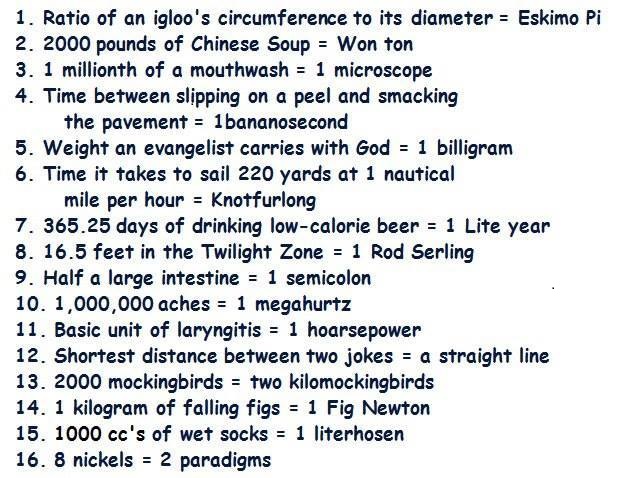
Science depends on measuring things, so you need to know the correct units for what you are studying.

Below are some obscure measures for collecting data in special situations.

17. Quantity of beauty required to launch a single ship = 1 millihelen h/t vuurklip

Why Federalized Science is Rotten

J Scott Turner writes at American Mind Modern Science’s Broken Bargain.  Excerpts in italics with my bolds and added images.

The founding manifesto of the modern scientific enterprise—Vannevar Bush’s 1945 classic Science: The Endless Frontier—laid down a promise: that federalizing the academic sciences would protect the universities as bastions of free inquiry and curiosity-driven research. Without such support, Bush argued, the academic sciences would be captured and enslaved by government and corporate political interests. That argument was persuasive to the political authorities of the time. Now, seven decades later, that promise stands broken. Science’s “endless frontier” has become Big Science, a self-aggrandizing cartel organized around the aggressive pursuit of federal money.

Science is grounded in Enlightenment virtues. Its core attributes are unfettered freedom of intellect; cultivation of curiosity; skepticism; dispassionate reason; and dedication to evidence. A robust modern science immensely enriches our society. In return, our society affords the sciences enormous privilege and prestige. This mutually beneficial bargain held for many generations. Scientists were free to roam the intellectual frontiers, the public mostly watched from a respectful distance, and both science and society flourished.

That bargain is now unraveling, damaging both science and the society that supports it.

Less and less do the sciences serve as bulwarks of reason against political and corporatist aims. To the contrary, the sciences are becoming stridently politicized, acting as a vanguard for an authoritarianism of “expertise”. Increasingly, science is being used as a cloak to shield political agendas from normal scrutiny and debate, thereby betraying the scientific ideal.

These trends, and the reasons for them, are not hard to discern. Scientists’ careers are no longer charted by the esteem of peers, but increasingly by conformity to institutional and political interests. The natural immunity of tenure, which is intended to protect university scientists’ intellectual freedom, is being systematically gutted. Adhering to science’s core virtues, listed above, is becoming a career hazard. In the face of this, fellow scientists either remain silent, or become eager participants in a masquerade of “consensus.” Public trust in science, which turns on the common perception that scientists are avatars of dispassionate and independent inquiry, is becoming increasingly tattered.

The COVID-19 spectacle is demonstrating just how fragile that public trust is.

This trend is not new, but the intrusion of identity politics into the sciences has made it toxic. Distinguished scientific careers are snuffed out in an instant. The interests of favored identity groups become the primary criteria for advancement, trumping credentials, ability, and qualification. Fealty to dogma, not respect for reason, now determines whether careers will grow, be terminated prematurely, or be aborted before they begin. Conformity and risk-aversion, behaviors once alien to the scientific enterprise, are now pervasive, enforced in Star Chamber Human Resources inquisitions.

The roots of this problem were planted in the aftermath of World War II, with the political decision to federalize scientific research. Academic science is now the client of an enormous federal spending program, dwarfing all other sources of support. This spending does not just support the work of scientists, it also provides universities a lucrative revenue stream which enables the growth of political, administrative and institutional power, to the detriment of scientists.

With the growth of the Big Science cartel, the culture of discovery that had so long been the source of scientific greatness, has been transformed into a culture of “production,” where scientists are incentivized and rewarded through bogus measures of scientific “productivity.” These metrics have only tenuous relation to intellectual innovation and discovery. They are, however, powerful conformity machines that reward grantsmanship, crowd-following, mediocrity, and allegiance to political and institutional masters. Scientific discovery has been shoved to the back of the line.

In short, the academy is no longer the vigorous custodian of the core values of a robust science. Rather, the academy has become the place where those virtues are facing their gravest threat. The academic sciences have become utterly debased, turning all members of the Big Science cartel into participants in a massive grift on the public treasury. Climate “science”, for example, is not science per se, but the stalking horse for a diversion of tens of trillions of dollars into the hands of favored political and corporate interests. There is simply no scientific basis for claiming a climate “crisis”, despite the attempts of politicians to stampede the public into thinking so. The political heavy-handedness behind COVID-19 pandemic policy has been remarkable in its suppression of science.

Lurking beneath is a barely-hidden web of collusion between governments, NGOs, universities, and self-interested scientists, all motivated by the desire to keep the money flowing.

The modern social bargain struck with science after the War was founded on the assumption that independent, skeptical, and dispassionate scholars would be an invaluable source of methodical good judgment and resistance to half-cocked political and corporate agendas. The Big Science cartel, propped up by enormous federal subsidies, has mostly subordinated those virtues. It is time to face a hard truth: the seventy year experiment to federalize the sciences has been a failure. The task now is to prevent the Big Science cartel from further dehumanizing society and delegitimizing science.

There is a second hard truth: the necessary reforms will not come from within. Rather, it will be the people and their representatives that will have to impose them. To restore science to its rightful and valuable place, break up the Big Science cartel.

J Scott Turner is an emeritus professor of biology at the SUNY College of Environmental Science & Forestry.

See also Wokeness Worms Eating Science Academies

Militant Medicine Breeds Bad Pandemic Policies

Perhaps you noticed how public health officials direct the war on coronavirus.  The generals obsess over “cases” and “deaths” while hiding numbers of “recoveries” and “cures.” The military paradigm has led pandemic policies seriously astray, as explained by Norman Doidge in his Tablet article Mad Science, Sane Science.  Excerpts in italics with my bolds.

There are more reasonable approaches to science and COVID-19 than the ‘eradication’ mentality that we lean on.

One cannot underestimate the extent to which modern medicine took up Bacon’s military metaphor of conquest and applied it to itself. This involved rejecting the ancient Hippocratic idea of healing, which—being part of that Greek worldview that saw us as of nature, and not against it—saw the physician as trying to work in alliance with nature, the patient (mind and body and spirit) and the patient’s family. But by the mid-1600s Thomas Sydenham, who became known as the “English Hippocrates,” saw medicine in a new way: “I attack the enemy within by means of cathartics and refrigerants, and by means of a diet”; he wrote, “a murderous array of disease has to be fought against, and the battle is not a battle for the sluggard …” Little has changed since. We see ourselves as engaged in endless wars: “The war against the virus,” “the war against cancer,” or against AIDS, “the war on drugs,” the “battle against heart disease,” we “combat” Alzheimer’s, and so on. As modern physicians came to see themselves as warriors and disease as “the enemy,” treatments became “weapons,” and drugs went from being healing potions to “magic bullets” and vaccines became “shots.”

We combat the enemy with “doctor’s orders,” from the medical “armamentarium,” or “arsenal” as we physicians call our bag of therapeutic tricks.

This military metaphor in medicine gives rise to a mentality that esteems invasive high-tech treatments as somehow more serious than less invasive ones—any collateral damage be damned. Of course, there is a time for a martial attitude in medicine, as, say, in emergencies: If a blood vessel in the brain bursts, the patient needs invasive surgery and a neurosurgeon with nerves of steel, to operate. But there are times when it sets us back. Today, rather than work with the patient as a key ally, we physicians often barely have time to listen to him or her speak. In this metaphor, the patient’s body is less an ally than the battlefield, and the patient is rendered passive, a helpless bystander, as he watches the confrontation that will determine his fate between the two great antagonists, the doctor (plus the scientific research establishment) and the disease (or pathogen). And of course, in the “war against the virus,” it is total “eradication” of such an enemy that is the goal. That, it would seem to us, Bacon’s offspring, as the only sensible approach.

As it turns out, so much of what ails us today are products of modern science and technology gone wild: lethal antibiotic-resistant organisms that our “total eradication of disease mentality” produced because we vastly overused the antibiotics we had (which, by the way, were originally natural products of nature, not the lab); pollution (of every element), chemicals in our baby food, toys, floors, and mattresses causing skyrocketing childhood illnesses; bioterrorism; loss of biodiversity affecting the food chain; fabulous totalitarian surveillance tools called cellphones, global networks that allow our enemies thousands of miles away to reach into the controls of our electrical grids, water systems, food delivery systems, banks, nuclear systems, computers, and control them, turning them on and off with a keystroke; 3D printers to make assault weapons in the basement, nuclear weapons to empower lunatics, industrialized death camps with cyanide showers, and, not to mention man-made environmental disruptions causing ecological catastrophes.
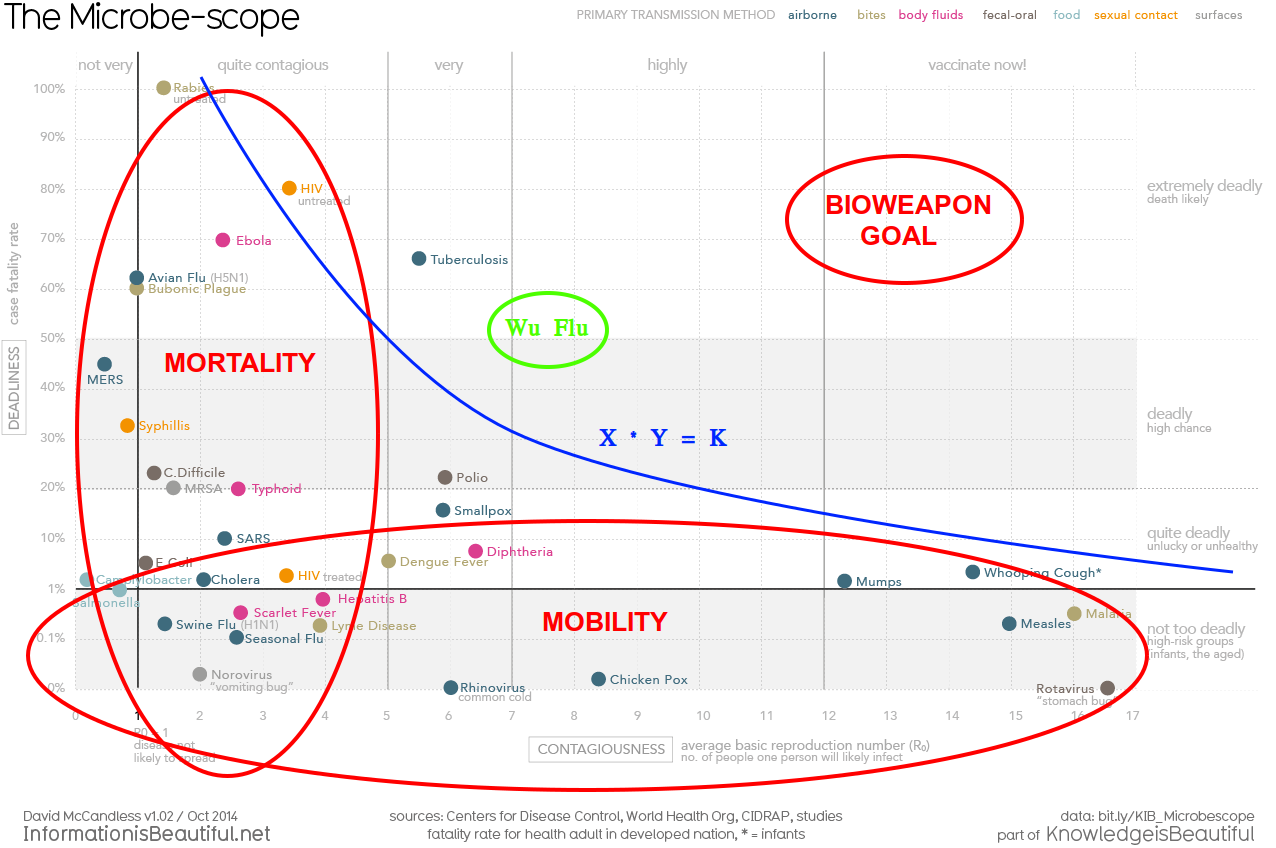
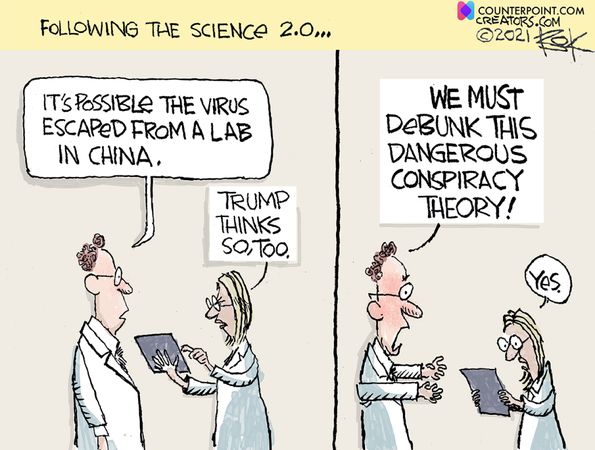
On this list of course, is also a pandemic that spread so rapidly because of air travel, and the “efficient” design of our urban centers which maximize overcrowding—and a microbe that may have originated in a lab known to be unsafe, and experimenting with bat viruses. “Just last year,” an article in Newsweek reported, “the National Institute for Allergy and Infectious Diseases, the organization led by Dr. Fauci, funded scientists at the Wuhan Institute of Virology and other institutions for work on gain-of-function research on bat coronaviruses.”

“Gain-of-function research” in this case means augmenting the virus’s contagiousness, and even lethality for the purpose of getting a head start on developing therapeutics or vaccines should it mutate in that direction. Such research is also the meat and potatoes germ-warfare research.. . . Whether or not Wuhan’s gain-of-function work involved creating an artificially enhanced coronavirus has been made almost impossible for outsiders to ascertain, because that lab’s government conveniently insisted it destroy its virus samples and records before an outside investigation could be done.

We are so reliably surprised and caught off guard by the unforeseen consequences of our technologies, and there are now so many serious cases of “science going wrong,” that it might be argued that, in practice, modern science (and the tech it produces) seems to be a machine designed to generate and maximize unintended consequences. And is hence, along with being powerful, also, quite often, ridiculous.

All of this is relevant to the current pandemic. In a way, there are three grand “strategies” to deal with a pandemic. But only one of them indulges the more lunatic strains of military metaphor in medicine.

  • The first strategy is never let it in.
  • The second, the approach most widely used at present, is to go to rather blunt lockdowns, while we develop therapeutics and vaccines to eradicate the virus.
  • The third is to resist lockdowns whenever possible, and instead focus on more differentiated measures than total societal closures, again while we develop therapeutics and vaccines to eradicate the virus.

If the virus doesn’t get in, people are not dying, there isn’t talk of eradication and the military metaphor isn’t used. That strategy has worked so far in Nauru, an island speck, in the paradise of Oceania, a country that is isolated, and small enough to walk across and around in one day, and which, along with Oceania’s Tuvalu, is tied for the record as being the least visited country in the world.

Even the relatively isolated, double-island paradise of New Zealand, was still too connected with the rest of the world to keep the virus out. When it did arrive there, New Zealand tried the second strategy, to eradicate it with a blunt lockdown.

The military metaphors began. Prime Minister Jacinda Ardern set the goal of “complete elimination of the virus.” France’s President Emmanuel Macron said, “We are at war … The enemy is there—invisible, elusive—and it is advancing.” Donald Trump described himself as “a wartime president.” War requires emergency measures, which require emergency powers, which demand the immediate suspension of civil liberties—with executives not bothering to go to legislatures because the enemy is coming at us “in waves,” and “surges,” is “killing us in droves.” We “hunker in our bunkers”—in total lockdown. Home’s the only place that’s safe. We must “mobilize” all society in immobility. Punish those who disobey orders. We do it, too, for the health care workers, the heroes on “the frontline,” who risked their lives.

But these undeniable similarities do not mean that medicine is war, any more than war is healing.

Perhaps the biggest problem with the military metaphor, is how it causes us to narrow our focus almost exclusively on “eradicating the virus,” and “cases of the infected.” This causes us to miss other important ways of dealing with it, that might help us survive it. Public health officials in the “the eradication mode” almost never mention how we can boost our immune systems with vitamins D and C, and zinc, exercise and weight loss. Not their focus. And the narrow focus on eradicating the virus is now causing serious “collateral” harm and death.

But it was not maliciousness but rather the virus eradication mindset that has caused much of the harm. That mindset has led many politicians, and also public health officials, to become oblivious to the death, illness, and devastation that have resulted from the lockdowns. Tedros’ own language speaks this obliviousness, when he says he knows people are “understandably frustrated with being confined to their homes” as though “frustration” is the extent of the problem. What is actually happening is that people’s worlds are collapsing. Fauci early on called the lockdown measure “inconvenient.”

Tedros and other lockdown supporters are almost all themselves employed, and working comfortably, many from home.

They are part of a class that has government, bureaucratic, educational, media, and corporate salaries, or are in Big Tech, which thrives in lockdown. With an often staggering indifference, they gloss over that fact that the measures they recommend “for all of us” are devastating to those working-class people, the poor, and small-business owners who are losing or have already lost their life savings, health insurance, health, and who are at risk of, or who have already been evicted from their apartments. By September we knew that nearly 60% of (mostly small) businesses that had been forced to close in lockdown were destroyed so their workers would have no jobs to return to. Many more have gone under since. They were closed by often illegal edicts, that left their large corporate competitors like Costco and Walmart open. Thus, instead of going to small widely separated community stores, that admitted a few at a time, people crowded into a few stores without social distancing—the complete reverse of a sensible, scientifically based policy. How did public health officials get away with destroying small business? This is war! Ignore that a meta-analysis of 10 countries and their regions, shows that during last spring, stringent stay and home and business closures did no better in slowing the virus than those that rely on voluntary measures (such as hand washing, social distancing, discouraging travel and large gatherings, successful case tracking, and testing). Gov. Andrew Cuomo’s own latest scientific statistics confirm that 74% of all New York COVID-19 transmission comes from indoor gatherings in private homes, and only 1.4% from in-restaurant dining (all set up for COVID now). The commander in chief says no to indoor restaurant dining in December. Now, even the WHO, which supported lockdowns, is claiming that closed Western economies are devastating poorer countries that are trading partners, and its special envoy for COVID-19, Dr. David Nabarro, has said the WHO anticipates a doubling of world poverty and a doubling of childhood malnutrition because of lockdowns.

The officials, blinded by the eradication at all costs mentality, discarded the practical wisdom required to respond to such a crisis, and endorsed an intervention that defies the standard public health practice of taking a holistic approach and always taking into account a measure’s total effects, and not just its immediate effects on the pathogen labeled as “the invisible enemy.”

“COVID denial” is real. So is “COVID-management-induced-devastation denial.”

What does a scientific approach look like, one that takes the best of our modern instruments that Bacon helped to facilitate, but which does not get us tangled up in the military metaphor, or make delusional attempts to artificially cut us off from the rest of nature?

That would be the approach of Janelle Ayres, Ph.D., a brilliantly original and constructive molecular and systems physiologist, and expert in both immunology and evolution, who heads two labs affiliated with the Salk Institute. Ayres’ work opens up a radically different approach to infectious disease—radical in the original sense of the word, meaning having to do with the root, i.e., the broader biological foundations of infectious disease and health in the “biome,” the sphere of living organisms in which we dwell, and which dwell within us. Thus, to my mind, her work has echoes with some of the ancient insights and intuitions about biological interconnectedness, though I’ve not seen her make this claim.

Ayres’ work is helping us reconceive our relationship to microbial organisms, including pathogens, and showing how they can, for instance, influence our evolution, and we theirs, and it gives us a much more detailed picture of how we actually survive serious infections. She happens to have written one of the best articles ever on COVID-19, that shows a breadth and depth of biological comprehension that is extremely rare among modern scientists who are often specialists in very circumscribed areas, who analyze things into ever smaller parts, and know an incredible amount about incredibly little. Ayres is both a first-rank specialist, and a big-think generalist.

She says, “The way we have been thinking about treating infectious diseases is that we have to annihilate the pathogens through vaccines and antimicrobials.” She completely reframes the problem, and challenges our thinking:

“Instead of asking how do we fight infections, we should be asking ‘how do we survive infections?’”

Changing that single word—“fight” to “survive”—transforms everything. Consider, for example, that new organisms, and strains are evolving all the time. A new coronavirus strain identified in December is said to be 70% more transmissible. Some new strains may be resistant to our existing vaccines and antivirals. Developing different antibiotics or vaccines to eradicate each of them, is not always possible, and when it is, generally takes a long time, and costs a fortune. But if, as is often the case, death is caused by our bodies’ own reactions to the infection, reactions which are very similar, regardless of the pathogen that caused them, learning to block the body from going into overdrive should help people survive multiple infections. As well, there is no reason to believe this approach will cause antibiotic-resistant, antiviral-resistant, or vaccine-resistant strains, because it is not targeting the pathogen per se.

In cooperative co-evolution, there is an incentive for us (or any infested animal) to develop methods to both prevent collateral damage to ourselves, as well as fix it when it occurs. That is the essence of the tolerance system. What Ayres and her colleagues are doing is describing these mechanisms—in minute molecular detail—in the body, and learning to read how organisms that are co-evolving with their hosts are communicating with them—sending signals back and forth. Ideally, the lab would ultimately learn how to use this information to enhance co-evolution in some way, to treat disease.

Ayres’ approach to COVID is not to minimize other approaches but point out that “if we can step beyond our focus on the virus,” there is much more we can learn. For instance, it was assumed early in the pandemic, that severe cases were caused by high viral load, and now we know it is the secondary collateral damage caused by our bodies that is the real killer.

Fewer and fewer medical schools now require the graduating physician to take the ancient Hippocratic oath, the first recorded articulation of medical ethics, that sanctified medical confidentiality and the idea that the doctor worked for his or her patient, and not a third party. How sad, how telling.

It is the same Hippocrates, who boiled all medicine down to two principles in his Epidemics Book I, “Practice two things in your dealing with disease: either help or do not harm the patient.”

And, in this light—of doing no harm, or at least far less—we might remember that we are part of nature, depend on it, it lives in us, and we have links to parts we think remote from us, that we often cannot even see. We might consider setting aside the utopian dream that always becomes a nightmare, because all too often we can’t conquer nature without conquering ourselves.

See Also:

The Virus Wars

Rx for Covid-fighting Politicians

Twelve Forgotten Principles of Public Health



John Christy Rebuts Climatist Fake Smear Job

The cancel culture is driven by fears that a contrary point of view might be truer than one’s own way of thinking.  Dissing the messenger, and deplatforming if possible, is easier than reflection and self-examination.  Thus has John Christy been attacked and recently responded in his quiet and reasonable manner.  The article at AL.com is John Christy: We don’t ‘attack science’.  Excerpts in italics with my bolds.

On Nov 2nd 2020 InsideClimate News (ICN) and AL.com published a fairly long (5,000 words!) profile on the climate research that Dr. Roy Spencer and I perform at The University of Alabama in Huntsville. They spent a good bit of time criticizing our satellite data as well as my personal life. The article seems schizophrenic at times, bouncing from highly critical assertions to a depiction of me as a sort of nice, hardworking, churchgoing Alabama scientist.

A major problem here is the technique of quoting antagonists of our work, without giving us a chance to respond. This is the modus operandi of advocacy-journalism. Add to that the numerous editorialized opinions such as, “… Christy’s data have been corrected repeatedly and his conclusions contradicted time and again …” A look at the record indicates this is not so.

But with all of the misleading claims, I’m able to forgive the reporters because they also say, “… he looks 69 going on 50 …” Awesome. How could a 69-year-old not love that?

Unfortunately, ICN ran the story as part of series called “The Anti-Scientists” that explores “the Trump Administration’s attacks on the science underlying environmental protections.” However, kudos to AL.com for including a link to my congressional testimony so the reader could hear my on-the-record story.

It should be clear to all that this agendized “hit-piece” (as we call it), is designed to discredit me, but the truth is, we don’t “attack science,” we “employ science.” Now, I’ve always been told, never pick a fight with someone who buys ink (cloud-storage) by the barrel (terabyte), but here it goes.

In 1990, Roy and I created and today still publish monthly values of the global temperature of three atmospheric layers from satellite measurements. A 1997 paper suggested our dataset had abrupt “downward” jumps. In response, we demonstrated the purported jumps were found in the sea water temperatures they used, not in the deep atmosphere we measured – so they were mixing apples and oranges. The next claim stating there are gaps in the satellite record is just false as every new satellite is directly calibrated to a satellite already in orbit. Later, scientists in Washington State misled the community with papers that (1) allegedly discovered “contamination” of one of our products by stratospheric influence, and (2) that our correction to account for the satellite’s east-west drift over time was wrong.

Neither complaint applied to our datasets. We had always published accurate representations of what our products measured including the stratospheric impact.

In fact, 12 years earlier we created one without the stratospheric influence to deal with this issue directly. The second complaint was moot because we had already adopted an advanced, observations-based adjustment for the east-west drift, while their proposed model-based correction had serious problems.

Early on, though, the very clever scientists at Remote Sensing Systems in California discovered two issues with our dataset, both of which were immediately remedied 15 and 20 years ago respectively with only very small impacts.

While we recognize no dataset is perfect, a detailed evaluation of our temperature products was published in 2018, demonstrating that ours outperforms other satellite products when compared against independent data. Why was this not mentioned?

Another scientist appears to refute our explicit conclusion that climate models are unrealistically aggressive in depicting the atmosphere’s warming rate. This is important because regulatory policies advocated in the media which include price-hikes for all our energy, are based on fears engendered by these models.

Again, our conclusion has stood the test of time, (that scientist published a similar result later). Even this year, more published studies continue to show climate models are poor tools for policy decision—they can’t reproduce the climate that has already happened, and they don’t agree with each other about the future.

Then, the clumsy attempt to connect me with an anti-evolution movement was misguided. The reporters would be chagrined to learn that I had testified before the Alabama State Board of Education advocating the removal of the “Evolution Disclaimer” from biology textbooks. Even the NY Times, of all places, took note and quoted me on the issue (Feb. 1, 2005.) So again, doing a little fact-checking rather than following today’s “jump-to-(my-biased)-conclusion” reporting style, would have saved us all some trouble.

Finally, a broader question to ask is this, “Why was so much effort and expense proffered to try to discredit a scientist like me?”

By the way, the title, “When Trump’s EPA needed a climate scientist, they called on Alabama’s John Christy” misinforms. I saw a federal notice asking for applications for the EPA Science Advisory Board and sent mine in, just like the others. I was eventually selected, based on my credentials, to be one of its 45 members.

But, the line that still carries the day for me is, ” … he looks 69 going on 50.”

Footnote:  Christy quote:

“The reason there is so much contention regarding “global warming” is relatively simple to understand: In climate change science we basically cannot prove anything about how the climate will change as a result of adding extra greenhouse gases to the atmosphere.

So we are left to argue about unprovable claims.”

John R. Christy | Climate science isn’t necessarily ‘settled’

See also: Christy’s Common Sense about Climate

Note: John Christy of the University of Alabama at Huntsville testified before the House of Representatives Natural Resources Committee on May 13, 2015, but his opening statement has been purged from the committee’s website.  In addition to the video above, his statement that day is available here.

In Praise of Science Skeptics

Pandemic Panic: Play or Quit? Only a skeptic gives you a choice.

Peter St. Onge writes at Mises Wire The COVID-19 Panic Shows Us Why Science Needs Skeptics Excerpts in italics with my bolds and images.

The dumpster fire of COVID predictions has shown exactly why it’s important to sustain and nurture skeptics, lest we blunder into scientific monoculture and groupthink. And yet the explosion of “cancel culture” intolerance of any opinion that doesn’t fit a shrinking “3 x 5 card” of right-think risks destroying the very tolerance and science that sustains our civilization.

Since World War II, America has suffered two respiratory pandemics comparable to COVID-19: the 1958 “Asian flu,” then the 1969 “Hong Kong flu.” In neither case did we shut down the economy—people were simply more careful. Not all that careful, of course—Jimi Hendrix was playing at Woodstock in the middle of the 1969 pandemic, and social distancing wasn’t really a thing in the “Summer of Love.”

And yet COVID-19 was very different thanks to a single “buggy mess” of a computer prediction from one Neil Ferguson, a British epidemiologist given to hysterical overestimates of deaths, from mad cow to bird flu to H1N1.

For COVID-19, Ferguson predicted 3 million deaths in America unless we basically shut down the economy. Panicked policymakers took his prediction as gospel, dressed as it was in the cloak of science.

Now, long after governments plunged half the world into a Great Depression, those panicked revisions are being quietly revised down by an order of magnitude, now suggesting a final tally comparable to 1958 and 1969.

COVID-19 would have been a deadly pandemic with or without Ferguson’s fantasies, but had we known the true scale and parameters of the threat we might have chosen better tailored means to both safeguard the elderly and at-risk, while sustaining the wider economy. After all, economists have long known that mass unemployment and widespread bankruptcies carry enormous health consequences that are very real to the victims suffering drained life savings, ruined businesses, broken families, widespread mental and physical health deterioration, even suicide. Decisions involve tradeoffs.

COVID-19 has illustrated the importance of free and robust inquiry. After all, panicked politicians facing media accusations of “killing grandma” aren’t in a very good position to evaluate these tradeoffs, and they need intellectual ammunition. Not only to show them which path is best, but to bolster them when a left-wing media establishment attacks.

Moreover, voters need this ammunition so they can actually tell the politicians what to do. This means two things: debate that is transparent, and debate that is tolerant of skeptics.

Transparency means data and computer code open to public scrutiny as the minimum requirement for any study that is used to justify policy, from lockdowns to carbon taxes to whatever comes next. These studies must be based on verifiable facts, code that does what it says it does, and the ensuing decision-making process must be transparent and open to the public.

One former Indian bureaucrat put it well: “Emergency situations like this pandemic should require a far higher—and not lower—level of scrutiny,” since policy choices have such tremendous impact. “This suggests a need for democracies to strengthen their critical thinking capacity by creating an independent ‘Black Hat’ institution whose purpose would be to question any technical foundations of government decisions.”

Even more important than transparency, debate must be tolerant of alternative opinions. This means ideas that are wrong, offensive, even dangerous, have to be tolerated, even celebrated. By all means, refute them—most alternative hypotheses are completely wrong, so it shouldn’t be hard to simply refute them without censorship. This, after all, is the essence of science—to generate hypotheses testable by anybody, not just licensed “experts.”

Whether we are faced with a new crisis, a new policy innovation, or simply designing a better mousetrap, groupthink and censorship are recipes for disaster and stagnation, while transparency and tolerance of new ideas are the very essence of progress. Indeed, it is largely this scientific tolerance that allowed us to rise up from the long, brutal darkness of poverty.

As Francis Bacon observed three hundred years ago, innovation and new knowledge do not come from prestigious “learned” insiders, rather progress comes from the questioner, the tinkerer, the skeptic.

Indeed, every major scientific advance challenged the “settled science” of its day, and was often denounced as pernicious and false, even dangerous. The modern blood transfusion, for example, was developed in the late 1600s, then banned for nearly a century by a hostile medical establishment, “canceling” tens of millions of lives at the altar of groupthink and hostility to skeptics.

It’s comforting to know that our problems are old ones, and also encouraging that our solution is both time-tested and simple: transparency and tolerance. After all, the very reason our culture elevates science is because it is built on a millennia-long evolutionary “battle of ideas” in which theories are constantly tested and retested in a delightfully endless search for ever better understanding.

This implies there is no such thing as “settled science”—the phrase itself is contrary to the scientific method. In reality, science is not some billion-dollar gleaming palace in Bethesda, rather it’s a gnarled mutant sewer rat that takes all comers because it’s been burned, cut, run over, crushed, run through the wood chipper, and survived. That ugly beast is our salvation, not the gleaming palace where we bow down to whichever random guy has the biggest degree in the room.

Only with free inquiry for the most unpopular, offensive, dangerous, and, yes, wrong ideas imaginable does that power sustain. And if we break that, we can expect a series of rapid catastrophes that, like failed golden ages of the past, return us to the nasty, brutish, and very short lives that have been humanity’s norm.

Whether pandemic, climate change, “institutional racism,” or whatever new crisis they conjure next, we have a fundamental right to tenaciously defend the transparency and tolerance that constitutes science itself so that it remains among humanity’s crowning achievements, and so that we preserve this golden age that would astound our ancestors.