Modern Educayshun

OK, this video is thoroughly depressing, but I post it because it was sent to me by my grandson who is a first year university student.  He says it is telling the truth in an exaggerated way.  I mean that the attitudes are accurately portrayed, but are less obvious and not as explicitly expressed in real classrooms.

The video is a punch in the gut.  Below is a more intellectual discussion of the same thing: The takeover of civil relations by so called “social justice.”  Peter meyers writes at The American Mind The Mask of Social Justice Slips.  Excerpts in italics with my bolds.

Beneath bogus egalitarianism courses the will to power.

In the old understanding, racism was a malady of opinion and sentiment and therefore, deeply rooted as it was, remediable. In the lately emergent view, racism (at least in majority-white societies) is universal, omnipresent, and insuperable. It is present institutionally no less than personally, in our subconscious no less than our conscious minds, in all we have and all we are. In the words of President Obama, it is “part of our DNA.”

Let us underscore the radicalism in this revision. Its claims of “the permanence of racism” notwithstanding, the racially “woke” Left seems to regard itself as the vanguard of a democratic revolution, rising in righteous wrath against a distinctively odious, white-supremacist oligarchy. The democracy so envisioned is not, however, one grounded in equal natural rights. Animated by an ethic of effectively permanent redistribution via permanent race classifications, it divides its population into the creditor and debtor races Justice Scalia decried in his Adarand opinion—a division fundamentally at odds with the principle of natural human equality.

The radicalism of the ascendant dispensation on racism runs deeper still. In Black Power, a seminal text for that new dispensation, authors Stokely Carmichael and Charles Hamilton reject altogether the appeal to principles of justice, instead invoking Lewis Carroll to indicate the new ground of blacks’ claims to moral recognition and respect. They quote a passage wherein Humpty Dumpty boasts that he can make words mean whatever he chooses. Alice then protests, “The question is whether you can make words mean so many different things,” but Humpty gets the last word: “The question is which is to be master—that’s all.”

The irony of the new dispensation on racism is that in the pursuit of “social justice” it annihilates any intelligible idea of justice. It signifies not a replacement of one partisan idea of justice by a superior, more inclusive idea, but instead the replacement, at the level of foundations, of any commitment to justice with a commitment to power, pure and simple. .  .  On the premises claimed by the vanguard of today’s anti-racism Left, moral truth reduces to “effectual truth,” politics is no more and no less than the art of war, and claims of justice are but expressions of will to power.

On its face, the recent metastasizing of this malignant social justice ideal through what many persist in calling liberalism is dispiriting. What Bill unmasks as a bait-and-switch operation on racism, however, yields a promising implication. On race as in any other issue area, the success of the social justice Left depends on the durability of an inherently fragile coalition, in which a core of extremists appears compelled to alienate the relative moderates whose support and cover they need. In the very nihilism ascendant on the Left, there is cause for hope.

Among the moderates the Left needs are many whites, sincerely anti-racist by the old definition of racism and sympathetic to reasonable efforts to assist the disadvantaged. Many of those white moderates, however, must naturally object to serving as targets in an asymmetrical war in which others are permitted to hurl insults at them and they are forbidden to respond—or even compelled to assent. They must likewise resent being told that their own struggles, however great, are insignificant in comparison with their color-privilege, let alone being told that their relative success traces to a prowess in extraction rather than production. They must resent being  told that they “didn’t build that”—with the implication that they don’t own it either but “society” does, whose representatives in the administrative state are free to redistribute its proceeds as they see fit. Also among the moderates the Left needs are increasing numbers of blacks and Latinos, desiring only to be treated justly and awakening to the alternative bigotry and cynicism whereby the Left conceives of them as crippled, effectively objectifies them, and seeks to succor them with the advice that an identity of powerlessness is their only available capital.

At what could have seemed the bleakest moment in the anti-slavery crusade, Frederick Douglass declared in response to the Dred Scottruling, “my hopes were never brighter than now.” His hopes were bright because he knew, as King and other 20th-century civil rights leaders also knew, that their cause of liberty was blessed by the character of its enemies, whose despotic will to power impelled them inevitably to overreach. Against such enemies, Douglass maintained, the triumph of liberty was “a natural and logical event.” Like yesterday’s segregationists and slaveholders, today’s identitarians may scorn the claims of nature. Yet one can hope, with the ancient poet Horace: “naturam expellas furca, tamen usque recurret”—You may drive nature out with a pitchfork, but she always returns.

Peter C. Myers is Professor of Political Science at the University of Wisconsin-Eau Claire. He is also a Visiting Scholar at the B. Kenneth Simon Center for Principles and Politics at the Heritage Foundation.

The Truth System Fail

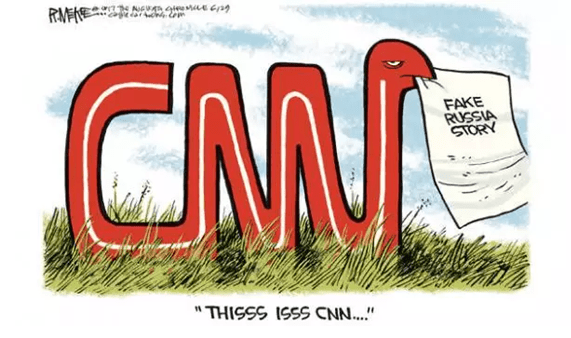
It used to be that “Pravda” was a joke in the US. (Not Prada, you airhead). Pravda means “Truth” in Russian, and everyone knew whatever you read in that rag, the opposite was more likely to be true. Now, the tables have turned: You can’t trust most of what the traditionally reputable US media publishes.

Lee Smith writes at the Tablet System Fail The Mueller Report is an unmitigated disaster for the American press and the ‘expert’ class that it promotes

First, after nearly two years, the special counsel found no credible evidence of collusion. It found no credible evidence of a plot to obstruct justice, to hide evidence of collusion. The entire collusion theory, which has formed the center of elite political discourse for over two years now, has been publicly and definitely proclaimed to be a hoax by the very person on whom news organizations and their chosen “experts” and “high-level sources” had so loudly and insistently pinned their daily, even hourly, hopes of redemption.

Mueller should have filed his report on May 18, 2017—the day after the special counsel started and he learned the FBI had opened an investigation on the sitting president of the United States because senior officials at the world’s premier law enforcement agency thought Trump was a Russian spy. Based on what evidence? A dossier compiled by a former British spy, relying on second- and third-hand sources, paid for by the Clinton campaign.

Instead, the special counsel lasted 674 days, during which millions of people who believed Mueller was going to turn up conclusive evidence of Trump’s devious conspiracies with the Kremlin have become wrapped up in a collective hallucination that has destroyed the remaining credibility of the American press and the D.C. expert class whose authority they promote.

Mueller knew that he wasn’t ever going to find “collusion” or anything like it because all the intercepts were right there on his desk. As it turned out, two of his prosecutors, including Mueller’s so-called “pit bull,” Andrew Weissman, had been briefed on the Steele dossier prior to the 2016 election and were told that it came from the Clintons, and was likely a biased political document.

And now, after all the Saturday Night Live skits, the obscenity-riddled Bill Maher and Stephen Colbert routines, the half a million news stories and tens of millions of tweets all foretelling the end of Trump, the comedians and the adult authority figures are exposed as hoaxsters, or worse, based on evidence that was always transparently phony.

The Mueller report is in. But the abuse of power that the special counsel embodied is a deadly cancer on American democracy. Two years of investigations have left families in ruins, stripping them of their savings, their homes, threatening their liberty, and dragging their names through the mud. The investigation of the century was partly based on the possibility that Michael Flynn, a combat veteran who served his country for more than three decades, might be a Russian spy—because of a dinner he once attended in Moscow, and because as incoming national security adviser he spoke to the Russian ambassador to Washington. What rot.

While the length of Mueller’s investigative process may have protected the FBI from the president’s immediate rage, the release of the report has exposed the deep corruption and personal narcissism of the press and its professional networks of “experts” and “sources.” Instead of providing medicine, the press chose instead to spread the disease through a body that was already badly weakened by the advent of “free” digital media. Only, it wasn’t free.

The media criticism of the media’s performance covering Russiagate is misleadingly anodyne—OK, sure the press did a bad job, but to be fair there really was a lot of suspicious stuff going on and now let’s all get back to doing our important work. But two years of false and misleading Russiagate coverage was not a mistake, or a symptom of lax fact-checking.

Russiagate was an information operation from the beginning, in which dozens of individual reporters and institutions actively partnered with paid political operatives like Glenn Simpson and corrupt law enforcement and intelligence officials like former FBI Deputy Director Andrew McCabe and senior DOJ official Bruce Ohr to smear Trump and his circle, and then to topple him. None of what went on the last two years would have been possible without the press, an indispensable partner in the biggest political scandal in a generation.

The campaign was waged not in hidden corners of the internet, but rather by the country’s most prestigious news organizations—including, but not only, The New York Times, the Washington Post, CNN, and MSNBC. The farce that has passed for public discourse the last two years was fueled by a concerted effort of the media and the pundit class to obscure gaping holes in logic as well as law. And yet, they all appeared to be credible because the institutions sustaining them are credible.

Michael McFaul was U.S. ambassador to Moscow—he knows everything about Russia. He wouldn’t invent stuff about national security matters out of thin air. Jane Mayer is a national treasure, one of America’s greatest living journalists who penned a long profile of Christopher Steele in the pages of the New Yorker. Susan Hennessy is a former intelligence community lawyer, who appears as an expert on TV. And how about her colleague at the Lawfare blog, Benjamin Wittes, a Brookings Institution fellow and a personal friend of James Comey? You think he didn’t have the inside dope, every time he posted a “Boom” GIF on Twitter predicting the final nail just about to be hammered in Trump’s coffin?

Many more jumped on the dog pile along with them, validating each other’s tweets and breathless insider sourcing. The point was to thicken the echo chamber, with voices from the right as well as the left in order to make it seem real. Hey, if this many experts are saying so, there must be something to it.

Except, there wasn’t—ever.

American democracy is premised on a free press that does its best to provide the public with information. Misinforming the public is like dumping toxic waste in the rivers. It poisoned our democracy—and it continues to do so. In fact, the most important thing for the public to understand is that Russiagate is not unique. It’s the way that the expert class opines on everything now, from immigration to foreign policy.

Take for instance last week’s big news that President Trump had decided to recognize Israel’s sovereignty over the Golan Heights. The decision was universally praised in Israel, by both Prime Minister Benjamin Netanyahu and by opponents like Yair Lapid. Yet Obama’s former ambassador to Israel, Dan Shapiro, insisted that the decision was politically motivated, telling the Washington Post that “the timing seems pretty transparent.” Surely, like his ambassadorial colleague, McFaul, Shapiro knew exactly what he’s talking about when he tweeted that the decision was made without “any policy planning process to consider potential reactions by Russia, Assad regime, Hezbollah, Arab states, Europe, etc., some of which may not be immediate. A decision like this should factor in such questions. No evidence it has.”

Shapiro was dead wrong. As the Atlantic noted in a detailed reported piece posted hours after Shapiro’s tweet, “the push for Trump to make such a move has been going on for more than a year, due to parallel efforts by Israeli officials and members of Congress.”

sk033119dapr20190329124533

But whatever. Experts can say anything they like—the Saudis hacked Jeff Bezos’ emails and photos of him and his girlfriend; Jamal Khashoggi was an American journalist; Jussie Smollett was nearly lynched by Trump supporters; Brett Kavanaugh was part of a rape gang, etc., etc. And reporters will print it, and editors will shrug, because that’s what the press is now—a pass-through mechanism mostly used for manipulative, ill-informed and often nonsensical propaganda.

Americans still want and need accurate information on which to base their decisions about their own lives and the path that the country should take. But neither the legacy media nor the expert class it sustains is likely to survive the post-dossier era in any recognizable form. For them, Russiagate is an extinction level event.

Lee Smith is the author of The Consequences of Syria.

Know-it-alls, Drama Queens & Control Freaks

Progressives are defined by those three deplorable qualities, and they were on full display this week as Cambridge University (UK) publicly withdrew a fellowship it previously offered to Jordan Peterson. They demonstrated once again that “university” is now defined as the opposite of “diversity of thought and expression.”  Toby Young writes at the Spectator Cambridge’s shameful decision to rescind Jordan Peterson’s visiting fellowship Excerpts in italics with my bolds.

The university’s ‘inclusive environment’ means the Canadian philosopher isn’t welcome. But of course…

According to the Equality and Human Rights Commission’s ‘Freedom of Expression’ guide for higher education providers and students’ unions in England and Wales, no speaker has a right to be invited to speak to students on a provider’s premises, but once someone has been invited they should not then be disinvited. It even suggests this may be a breach of Section 43 of the Education (No 2) Act 1986, which places a legal duty on universities to take ‘reasonably practicable’ steps to protect freedom of speech.

Please, God, let Jordan Peterson sue the University of Cambridge for having invited him to take up a visiting fellowship, only to rescind the invitation after a bunch of snowflake undergraduates said they would scweam and scweam until they made themselves sick. OK, they didn’t actually say that, but they might as well have done, the pathetic, passive-aggressive cry-bullies.

In a report in Varsity, the Cambridge student newspaper, which is so craven in its forelock-tugging obeisance to the protesting students it makes Pravda look like the work of John Milton, we learn that Peterson isn’t welcome at Cambridge because it’s – wait for it – an ‘inclusive environment’. (In case you’re not au fait with the current jargon, that means an environment in which everyone looks different but thinks exactly the same.) There then follows a laundry list of Peterson’s unforgivable sins: he believes ‘white privilege’ is a ‘Marxist lie’, that ‘the patriarchy’ is ‘predicated on competence’, that ‘the West has lost faith in masculinity’, that ‘global warming posturing is a masquerade for anti-capitalists to have a go at the Western patriarchy’ and that ‘men are victims of gender oppression’.

In other words, he’s not welcome at Europe’s number one university because he has the temerity to challenge the status quo.

As we know, today’s students cannot cope with being challenged – hence the need for ‘trigger warnings’, ‘safe spaces’ and ‘bias reporting hotlines’. In case you’re in any doubt that this is, in fact, the reason the undergraduates threw up their arms in horror and reached for the smelling salts as soon as Dr Peterson’s name was mentioned, a spokesman from Cambridge University’s Student Union spelt it out in Pravda – I mean, Varsity: ‘His work and views are not representative of the student body and as such we do not see his visit as a valuable contribution to the University, but one that works in opposition to the principles of the University.’

Silly me. There I was thinking the purpose of a university education is to introduce students to ‘work and views’ they might not be familiar with and don’t already hold. In fact, it is to expose them to just those ideas that they are firmly wedded to. An echo chamber, where privately-educated, sanctimonious Titania McGraths are constantly told by their professors that they’re absolutely right about everything.

If this principle had been applied by previous generations, I wonder what fate would have befallen some of Cambridge’s distinguished alumni whose ‘work and views’ were out of step with the prevailing orthodoxy? Presumably, Charles Darwin would have been out on his ear for daring to question the Book of Genesis and John Maynard Keynes would have been no-platformed at the students’ union for casting doubt on neo-classical economics. As for James Watson and Francis Crick, they would have been branded ‘eugenicists’ and hounded off campus.

Honestly, this is a truly shameful episode in the university’s history – up there with the Cambridge spy ring. To think that it had the opportunity to host a series of lectures by the world’s leading public intellectual, a brilliant iconoclast who sells out 5,000-seater venues from New York to Sydney. Undergraduates would have had the opportunity to study with him, to engage in dialogue and discussion. But no. He might have presented them with some thoughtful counter-arguments to their postmodern, Neo-Marxist gobbledygook and we can’t possibly have that. Not at a university, of all places.

I spent two years at Cambridge doing a PhD in Philosophy in the late 1980s, which I subsequently abandoned. Not the university’s fault – it wasn’t the left-wing madrassa it is now. There was genuine viewpoint diversity. I was even thinking of giving my old college some money this year. Not any more. Not until the university’s vice-chancellor – a spineless non-entity called Stephen Toope – flies to Toronto, falls to his knees in front of Dr Peterson and begs for his forgiveness.

Summary

No one knows how this will play out, but IMO Cambridge needs Jordan Peterson more than the other way around.

Footnote:  I recently posted a five-part series on Maps of Meaning.  It begins with Cosmic Dichotomy: Peterson’s Pearls (1)


NZ Religious Attack in Context

There is a lot of press coverage condemning the attack on two Mosques in New Zealand, and rightfully so.  It is appalling for any people to be killed for practicing their religion.  And such killing is against the teaching of Christianity, presuming that the shooter was raised in a society based on that tradition and moral code.

The larger context is that Muslims themselves are guilty of systematic slaughter of both non-Muslims and other Muslims.  Strangely, this deadly violence is not reported and not equally condemned in the media.  Here are the 2019 statistics of confirmed attacks and killings by Muslim extremists:  This bloodshed in no way justifies what happened in New Zealand.  But where is the morality in ignoring all of these victims when this issue comes up?

This is part of the list of killings in the name of Islam maintained by TheReligionofPeace.com. Most of these incidents are terror attacks. A handful are honor killings or Sharia executions.  During this time period, there were 359 Islamic attacks in 32 countries, in which 2013 people were killed and 2019 injured.

(TROP does not catch all attacks. Not all attacks are immediately posted).

I don’t claim to have an answer to all of this.  But we should start with the truth, even when (or especially when) it is politically incorrect.   Yes, there are a few Muslim victims in Christian countries, but as the table below shows, most of the time people are attacked and killed for their beliefs, the perpetrators are Muslim.

Date Country City Killed Injured Description
2019.03.15 Syria Baghouz 6 0 Three female suicide bombers strike families fleeing the caliphate, killing six members.
2019.03.15 Afghanistan Helmand 1 0 A TV journalist is shot to death in his car by suspected radicals.
2019.03.14 Cameroon Sandawadjiri 3 0 Three villagers are murdered in the middle of the night by Boko Haram.
2019.03.14 Afghanistan Sawki 1 13 Suspected Taliban clear out a bazaar with a deadly bomb blast.
2019.03.14 India Gulzarpora 1 0 A civilian is abducted and killed by Islamic militants.
2019.03.13 Iraq Qara Tapa 1 6 Women and children are among the casualties of an ISIS rocket attack.
2019.03.13 Iraq Rutba 1 0 A man collecting truffles is captured and executed by the Islamic State.
2019.03.13 Afghanistan Farah 1 0 A local official is murdered by suspected terrorists.
2019.03.13 Afghanistan Farah 10 0 The Taliban storm a checkpoint and massacre ten local security personnel.
2019.03.13 Somalia Gof-Gadud 8 40 al-Shabaab bombers murder eight patrons at a livestock market.
2019.03.13 India Pingleena 1 0 Islamic militants gun down a 25-year-old civilian.
2019.03.12 Burkina Faso Banh 1 0 Suspected Jihadists murder a local constable.
2019.03.12 Syria Amour 4 2 Four people searching for mushrooms are aerated by Sunni shrapnel.
2019.03.12 Mali Dialoube 6 0 Six local security personnel are killed by a landmine planted by extremists.
2019.03.11 Afghanistan Uzbekparida 4 4 Four policemen are shot to death by the Taliban.
2019.03.11 Nigeria Anguwan Gamu 46 0 A pastor and his wife are among forty-six villagers massacred by Fulani terrorists.
2019.03.11 Afghanistan Bala Murghab 16 13 The Taliban massacre sixteen local soldiers.
2019.03.10 Nigeria Shuwa 0 1 A girl is injured when two suicide bombers detonate prematurely during an attempt to kill church-goers.
2019.03.10 Syria Suwaiyah 1 1 Sunni shrapnel brings down a civilian.
2019.03.09 Niger Gueskerou 7 0 A Boko Haram attack on a border patrol kills seven.
2019.03.09 Syria Arak 8 11 ISIS explosives claim the lives of eight civilians.
2019.03.09 Syria Najm al-Zuhour 2 0 Two children are sectionalized by an ISIS landmine.
2019.03.09 Afghanistan Daman 1 0 A local farmer is disintegrated by an Islamist IED.
2019.03.08 DRC Beni 6 0 At least one woman is among six civilians hacked to death by ADF Islamists.
2019.03.08 DRC Virunga 1 0 A park ranger is murdered by the ADF.
2019.03.08 Afghanistan Anar Dara 3 3 A Taliban attack on a security post leaves three dead.
2019.03.08 Iraq Mosul 2 10 A child is among two Iraqis picked off by Jihadi bombers.
2019.03.07 Somalia Mogadishu 2 5 An al-Shabaab near a theater leaves two dead.
2019.03.07 Yemen Aden 1 5 Religious extremists open fire on a police patrol, killing one.
2019.03.07 India Jammu 2 32 Hizb-ul-Mujahideen throw a grenade into a bus station, killing a teenager and one other.
2019.03.07 Afghanistan Kabul 11 90 Sunni bombers strike a Shiite political gathering, killing eleven.
2019.03.07 Somalia Mogadishu 7 9 A group fighting for Sharia sets off a car bomb outside a restaurant, killing seven.
2019.03.06 Afghanistan Khewa 3 0 A schoolteacher is among three gunned down in cold blood by Islamic militants.
2019.03.06 Pakistan Abbottabad 1 0 A man is shot dead by extremists linked to an earlier honor killing.
2019.03.06 Afghanistan Jawzjan 1 0 Fundamentalists shoot an 8-year-old child to death.
2019.03.06 Iraq Makhmur 6 31 An attack by ISIS leaves six dead.
2019.03.06 Afghanistan Jalalabad 16 10 Sixteen employees at a construction company are massacred by Fedayeen in a massive suicide assault.
2019.03.06 Syria Jourin 1 6 Sunnis send a rocket into a Shiite village, killing one.
2019.03.06 Iraq Tawakol 1 3 An ISIS bomb blast leaves one dead.
2019.03.06 Nigeria Addamari 5 20 Five farmers are blown to bits by a Boko Haram landmine.
2019.03.06 Afghanistan Qala-e-Zal 10 12 The Taliban storm a government checkpost, killing ten.
2019.03.05 France Normandy 0 2 A ‘radicalized’ inmate screams “Allah Albar” as he stabs two guards with a knife smuggled to him.
2019.03.05 Syria Sha’afah 2 0 Two civilians lose their lives to an ISIS IED.
2019.03.04 Yemen Hodeidah 3 6 Children are among three family members dispatched by an Ansar Allah rocket.
2019.03.04 Afghanistan Yangi Qala 3 7 The Taliban storm a market and kill three civilians.
2019.03.04 Afghanistan Imam Sahib 10 9 Ten people are killed when Islamic militants storm a security checkpoint.
2019.03.04 Yemen Taiz 1 11 A bomb planted at a market kills one bystander.
2019.03.03 Nigeria Tse-Kuma 16 0 At least sixteen villagers are killed by Miyetti Allah.
2019.03.03 Syria Masasna 27 0 Ansar al-Tawhid Jihadists kill twenty-seven rivals in a brutal attack.
2019.03.03 Iraq Waqf 1 0 A farmer is shot to death in his grove by terrorists.
2019.03.02 Syria Karamah 3 12 A suicide bomber attacks a group of Religion of Peace rivals, killing three.
2019.03.01 Syria Bassirah 4 0 Four people at a water pump are murdered by ISIS gunmen.
2019.03.01 Syria Idlib 10 0 Ten perceived rivals are rounded up and excuted by Tahrir al-Sham
2019.03.01 Syria Idlib 9 18 A suicide bomber opens fire on a restaurant before denotating, killing nine.
2019.03.01 Somalia Mogadishu 29 80 Fundamentalists slaughter thirty civilians during an assault on a hotel.
2019.03.01 Afghanistan Shorab 23 15 A brutal attack by the Taliban on a local security base kills over two dozen.
2019.03.01 Mali Boulkessy 9 0 al-Qaeda militants plant a landmine the kills nine peacekeepers.
2019.03.01 Iraq Rutba 5 0 Five people abducted while hunting for truffles are executed in cold blood.
2019.03.01 India Handwara 4 8 Lashkar-e-Toiba members open fire on police, killing four.
2019.02.28 Nigeria Kardamari 4 3 A Boko Haram attack leaves four dead.
2019.02.28 Philippines Cotabato 1 0 A young man is shot off his motorbike by Bangsamoro Islamists.
2019.02.28 Philippines Sambolawan 2 1 A car carrying two off-duty soldiers is fired on by Muslim militants, killing both.
2019.02.28 Thailand Narathiwat 1 0 Muslim ‘rebels’ shoot a man as he is leaving a soccer game.
2019.02.28 Afghanistan Balkh 5 0 Religious radicals attack a police outpost, killing five.
2019.02.28 Somalia Mogadishu 6 20 Six people are exterminated by al-Shabaab car bombers.
2019.02.28 Iraq Mosul 4 26 Four people at a university are plowed under by a Jihadi car bomb.
2019.02.28 Yemen Hodeidah 5 0 Five children are pulled into pieces by an Ansar Allah rocket.
2019.02.27 Somalia Mogadishu 2 2 Islamists hurl a grenade into an Internet café, killing two users in mid-click.
2019.02.27 Iraq Jadida 2 4 ISIS sends mortar shells into a village, killing two residents.
2019.02.27 Kenya Girilley 3 0 Three Kenyan security personnel are brutally killed by an al-Qaeda linked group.
2019.02.27 Thailand Pattani 1 0 A civilian is shot to death by Muslim militants.
2019.02.26 Thailand Narathiwat 2 0 Two off-duty police are pulled out of a tea shop and executed by Muslim terrorists.
2019.02.26 Syria Shoula 1 10 Islamic State members pick off a civilian with a landmine.
2019.02.26 Syria Jibeh 3 1 Terrorists kill three villagers with an IED.
2019.02.26 Iraq Nuaimiya 3 3 Islamic State members bomb a bus carrying construction workers, killing three.
2019.02.26 Thailand Ban Ubae 1 1 Muslim separatists plant two bombs that kill a passing policeman.
2019.02.26 Mali Diankabou 18 15 Jihadists murder a young herdsman, then booby-trap his body with a bomb that kills seventeen others, including family.
2019.02.26 Nigeria Maro 32 0 Thirty-two people are killed in a targeted attack on a Christian community.
2019.02.25 Syria Hama 1 5 Sunni groups send rockets into populated areas, killing a resident.
2019.02.25 Somalia Lafole 9 2 Six woman are among nine street cleaners massacred by al-Shabaab.
2019.02.24 Afghanistan Torkham 1 1 Militants shoot two people on their way home from a restaurant, killing one.
2019.02.24 Syria Idlib 1 3 A car bomb blast in a city square sends a bystander to Allah.
2019.02.24 Syria Hama 24 0 Two dozen innocents are flattened by an ISIS landmine.
2019.02.24 Mali Aguelhok 8 0 Eight African peacekeepers lose their lives to a Jihadist attack on their base.
2019.02.24 Yemen al-Buqa 12 60 Ansar Allah fire a rocket at a group of local soldiers, killing twelve.
2019.02.23 Mozambique Matapata 1 0 Jihadists behead a villager.
2019.02.23 Mozambique Quelimane 3 16 Three locals are murdered by Islamic extremists.
2019.02.23 Syria Baghuz 50 0 The severed heads of fifty Yazidi sex slaves are discovered in the former caliphate stronghold.
2019.02.23 Nigeria Maiduguri 1 20 Boko Haram fire rockets into a city, killing one person.
2019.02.23 Somalia Mogadishu 1 0 An Islamist group assassinates a secular lawmaker.
2019.02.23 Iraq Therthar Lake 5 0 Five fishermen are attacked and murdered by the Islamic State.
2019.02.22 Niger Diffa 4 7 Four people are left dead after Boko Haram attack a small village.
2019.02.21 Iraq Bazwaya 26 0 Twenty-six members of the Shabak religious minority are discovered in a mass ISIS grave.
2019.02.21 Mozambique Bengaluru 1 6 An oil company worker is killed by a local Islamic group.
2019.02.21 Syria Shahil 22 10 Shahid suicide car bombers plow into a bus carrying oil workers, killing twenty-two.
2019.02.21 Tunisia Mkhalfia 1 0 A family man in his fifties is abducted and beheaded by Islamists.
2019.02.20 Iraq Arar 2 1 Two border guards are leveled by Mujahid bombers.
2019.02.20 Burkina Faso Madjori 1 0 An al-Qaeda group abducts and murders a police officer.
2019.02.20 Yemen Hodeidah 3 6 Ansar Allah drop a mortar round into a market, killing three patrons.
2019.02.20 Somalia Hodon 1 0 A prosecutor is assassinated by al-Shabaab.
2019.02.20 Afghanistan Balkh 2 2 Two civilians are shot to death by the Taliban.
2019.02.19 Thailand Raman 1 0 A 26-year-old man is shot to death in his car next to his wife.
2019.02.19 Iraq Nassaf 2 0 Islamists use an IED to disassemble two children on a playground.
2019.02.19 Afghanistan Qarghaee 6 0 Six civilians are blown to bits by a well-place Taliban bomb.
2019.02.19 Iraq Mahalibiya 47 0 Forty-seven victims of ISIS execution are discovered in a mass grave.
2019.02.19 Chad Baubaura 5 14 A group fighting for Sharia murders five villagers.
2019.02.18 Afghanistan Kabul 1 0 Militants attach a bomb to the car of a doctor, killing him as he left his clinic.
2019.02.18 Syria Idlib 24 51 Two bombs planted to kill civilians and first responders leaves two dozen of them dead, including four children.
2019.02.18 Egypt Cairo 3 3 A suicide bomber at a mosque claims three guards trying to stop him.
2019.02.18 Syria Raqqa 1 0 A pharmacist is picked off by ISIS gunmen.
2019.02.18 Iraq Haditha 1 2 Mujahideen blow up a child with a landmine.
2019.02.18 Afghanistan Batikot 8 0 A Taliban leaves eight dead.
2019.02.18 Iraq Rashad 1 0 A shepherd is brought down by Mujahid bombers.
2019.02.18 Iraq Umm Jezan 8 0 Eight people gathering mushrooms are kidnapped and executed by the Islamic State.
2019.02.18 Nigeria Koshebe 18 0 Eighteen people collecting firewood are brutally murdered by an Islamist group.
2019.02.17 Somalia Mogadishu 2 0 At least two bystanders are leveled by al-Shabaab shrapnel.
2019.02.17 Niger Bossa 4 0 Four refugees are murdered at their camp by two suicide bombers.
2019.02.17 Nigeria Banki 2 6 A medical doctor is among two killed by Boko Haram.
2019.02.17 Iraq Rashad 2 0 Two unarmed civilians make easy pickings for ISIS gunmen.
2019.02.17 Pakistan Loralai 2 1 Two guards at a market are smoked at close range by Muslim terrorists.
2019.02.17 Nigeria Buni Yadi 9 0 Jihadists attack a small town, killing ten.
2019.02.17 Saudi Arabia Asser 9 0 A cross-border attack by Ansar Allah leaves nine guards dead.
2019.02.17 Pakistan Turbat 9 11 Nine Pakistanis are sent to Allah by a Baloch Raji Ajoi Sangar suicide bomber.
2019.02.16 Afghanistan Ghazni 1 3 A civilian succumbs to injuries following a Religion of Peace bomb blast.
2019.02.16 Afghanistan Sar Asyab 6 0 The Taliban murder six guards at a gas pipeline.
2019.02.16 India Rajouri 1 1 Terrorists plant a bomb that kills a border patrol member.
2019.02.16 Syria Diban 3 0 Three men at a market are gunned down in cold blood by suspected ISIS.
2019.02.16 Afghanistan Mandesar 3 0 A child is among three aerated by a Jihadi bomb blast.
2019.02.16 Egypt Sinai 11 4 Eleven security personnel are left dead following a fundamentalist attack on a checkpoint.
2019.02.16 Iraq Nassaf 2 1 Two shepherds are disintegrated by an Islamic State landmine.
2019.02.15 Iraq Khalis 1 0 An 80-year-old shine caretaker is reportedly executed by gunshot.
2019.02.15 Nigeria Kushari 6 15 Eight worshippers are blown to bits in their mosque by two suicide bombers.
2019.02.15 Afghanistan Kandahar 32 0 Thirty-two border guards are massacred by Islamic extremists.
2019.02.15 Burkina Faso Nohao 5 0 Five customs officials are killed by rampaging Jihadis
2019.02.15 Burkina Faso Cinkansé 1 0 A Catholic missionary is shot to death by Muslim radicals.
2019.02.15 Niger Chetima Wanou 7 6 A Boko Haram raid leaves seven others dead.
2019.02.15 Nigeria Maiduguri 2 0 Two residents are shot to death in their neighborhood by Boko Haram.
2019.02.14 Burkina Faso Dijbo 2 6 Two people are killed when militants plant a bomb in a corpse.
2019.02.14 India Pulwama 49 48 A Jaish-e-Mohammad suicide bomber rams a bus carrying Jawans, killing nearly fifty.
2019.02.13 Iraq Alikhan 1 0 A religious minority is stabbed to death by suspected Islamic State.
2019.02.13 Niger Bagaji 3 0 Islamic militants kill three in an unprovoked attack on a village.
2019.02.13 Syria Raqqa 1 0 Suspected ISIS assassinate a local councilman.
2019.02.13 Iraq Rashad 2 0 Two brothers are kidnapped and murdered by ISIS members.
2019.02.13 Iran Sistan-Baluchistan 27 13 A Jaish al-Adl suicide bomber takes out twenty-seven IRG passengers on a bus.
2019.02.13 Nigeria Gajibo 5 10 Boko Haram ambush and kill five people along a highway.
2019.02.13 Pakistan Mir Ali 1 0 A tribal elder is disassembled by a Sunni IED.
2019.02.13 Yemen Mahfed 3 3 An al-Qaeda bomb blast exterminates three passersby.
2019.02.13 Yemen Hodeidah 3 0 Two women are among three family members exterminated by Ansar Allah.
2019.02.12 Egypt Rafah 2 2 Two policemen are picked off by an ISIS sniper.
2019.02.12 Somalia Mogadishu 1 0 Islamists attack a bomb to a car and kill the driver.
2019.02.12 Syria al-Rai 2 7 A suicide car bomber kills two policemen.
2019.02.12 Pakistan Dera Ismail Khan 5 2 Five local cops are machine-gunned point blank by religious radicals.
2019.02.12 Syria al-Dana 1 0 A civilian is caught in the cross-fire when two Islamist groups work out their differences.
2019.02.12 Afghanistan Takhar 3 8 A Taliban mortar round ends three lives.
2019.02.12 Mali Mopti 3 2 Jihadists are suspected of ambushing and killing three local cops.
2019.02.12 Nigeria Madagali 5 0 At least five locals are reported dead following a Boko Haram attack on a town.
2019.02.11 Pakistan Karachi 1 1 The office of a secular political party is the target of a terror attack that leaves one dead.
2019.02.11 Syria Deir Ez-Zur 6 0 Three suicide bombers exterminate a half-dozen ‘apostates.’
2019.02.10 Iraq Kanaqin 1 1 A border guard is gunned down by ISIS.
2019.02.10 India Kulgam 0 11 Terrorists lob a grenade into a packed market.
2019.02.10 Afghanistan Sayyad 8 4 Eight local cops are machine-gunned by Islamic extremists.
2019.02.10 Nigeria Effurun-Otor 2 0 Two people are killed when Miyetti Allah burn dozens of homes.
2019.02.10 Iraq Qaradar 1 2 An overnight ISIS attack on a village leaves one dead.
2019.02.10 Nigeria Angwan Barde 10 0 An unborn child is among ten Catholics massacred by Muslim militants.
2019.02.09 Philippines Maluso 1 0 A logger is shot dead by Abu Sayyaf after being unable to recite from the Quran.
2019.02.09 Afghanistan Kabul 1 0 An intel officer is assassinated by fundamentalists.
2019.02.09 Nigeria Madagali 2 0 Two others are left dead when Jihadis fire in to a village.
2019.02.09 Afghanistan Sargodar 8 0 Eight policemen are murdered in cowardly fashion by a colleague who became ‘radicalized.’
2019.02.08 Nigeria Ngwom 3 0 Boko Haram attack a security patrol, killing three members.
2019.02.08 DRC Rwangoma 7 0 Seven civilians are pulled from their beds and hacked to death by ADF Islamists.
2019.02.08 Iraq Baiji 3 0 Three brothers collecting truffles are kidnapped and murdered by the Islamic State.
2019.02.08 Syria Salamiyeh 7 1 Seven civilians are vaporized by a militant bomb blast.
2019.02.07 Iraq Baaj 46 0 Forty-six victims of ISIS execution are discovered in a mass grave.
2019.02.07 Nigeria Ago’Oyo 1 0 A young farmer is hacked to death by militant Fulanis.
2019.02.07 Saudi Arabia Medina 1 2 A Sunni cab driver beheads a young Shiite child in front of his mother after confirming their minority status.
2019.02.07 Mozambique Cabo Delgado 7 5 A group from the mosque beheads seven villagers.
2019.02.07 Israel Jerusalem 1 0 A Palestinian terrorist rapes and murders a 19-year-old woman.
2019.02.06 Somalia Sanguni 6 0 A half-dozen are killed by a well-placed al-Shabaab rocket.
2019.02.06 India Kumbakonam 1 0 A Hindu man is murdered for “resisting” a conversion to Islam.
2019.02.06 Afghanistan Nimroz 6 8 A half-dozen Afghans are laid out by Taliban gunmen.
2019.02.06 Syria Salamiyah 1 0 A civilian is killed in a suspected sectarian attack outside a Shiite school.
2019.02.05 Somalia Dhanaane 2 0 An al-Shabaab bomb blast shatters two lives.
2019.02.05 Afghanistan Jalalabad 1 0 Islamic State members gun down a local cop in cold blood at a city square.
2019.02.05 Mali Hombori 3 0 Jihadis plant a landmine that hits a public bus returning from a fair, killing three.
2019.02.05 Syria Awasi 1 2 A civilian is brought down with an IED.
2019.02.05 Afghanistan Kunduz 26 12 The Taliban stage a brutal assault on a local army base, killing twenty-six.
2019.02.05 Afghanistan Taloqan 2 0 Two radio journalists are brutally murdered in their station by suspected Jihadists.
2019.02.05 Pakistan Nandpur 2 0 A wife and daughter are honor killed by their family members after one suffers sexual assault.
2019.02.04 Thailand Sungai Kolok 1 1 A civilian is shot off his motorcycle by Muslim militants.
2019.02.04 Nigeria Shuwa 1 0 Boko Haram fire RPGs into a village, killing one resident.
2019.02.04 Nigeria Kirchana 2 0 Islamists loot shops, burn homes and kill two people.
2019.02.04 Nigeria Tubba 3 0 Three goat herders are shot full of holes by Islamic radicals.
2019.02.04 Afghanistan Baghlan-i-Markazi 11 24 Eleven local police officers are cut down by Taliban gunmen.
2019.02.04 Burkina Faso Kain 14 0 Fourteen civilians make easy prey for armed Jihadists.
2019.02.04 Burkina Faso Oudalan 5 3 An Islamic group attacks a security patrol, killing five members.
2019.02.04 Somalia Mogadishu 11 10 al-Shabaab bomber send shrapnel through a shopping mall, claiming eleven lives.
2019.02.04 Syria Tayyana 3 0 Three captives are beheaded by ISIS.
2019.02.04 Somalia Bossasso 1 0 A Maltese port manager is shot several times in the head by Religion of Peace proponents.
2019.02.03 Iraq Balad 1 3 Terrorists bomb a tourist bus, killing one passenger.
2019.02.03 Iraq Buhriz 1 0 A guard at an oil plant is murdered by the Islamic State.
2019.02.03 Iraq Karbala 1 0 A 56-year-old novelist is assassinated after criticizing the Islamic Revolution in Iran.
2019.02.02 Iraq Hafta Ghar 3 0 Three villagers are kidnapped and executed on video by the Islamic State.
2019.02.02 Afghanistan Gosfandi 1 0 An official is gunned down outside a mosque by religious radicals.
2019.02.02 Syria Manbij 1 5 One person is killed when terrorists target a bus carrying teachers.
2019.02.02 Somalia Bardhere 2 2 A Fedayeen suicide car bomber targets AU peacekeepers, killing two.
2019.02.02 Iraq Qaim 1 1 Islamic State members murder a border guard.
2019.02.02 Pakistan Saddar 1 0 A prominent Sunni is shot to death in a suspected sectarian attack.
2019.02.01 Niger Bague Djaradi 6 0 A half-dozen villagers are shot to death by Boko Haram.
2019.02.01 Iraq Zuwiya 3 5 A family picnic is interrupted by an ISIS bomb blast, killing a mother and two children.
2019.02.01 Syria Jdoua 1 0 A civilian is killed by an ISIS IED.
2019.01.31 Afghanistan Gorkab 6 7 Taliban storm a police checkpoint and kill a half dozen.
2019.01.31 India Dangerpora 1 0 Islamists kidnap a young woman and shoot her twice in the head as she is begging for her life.
2019.01.30 Philippines Maharlika 2 4 A ‘sectarian feud’ at a mosque leads to a grenade attack in which two teachers die.
2019.01.30 Yemen Taez 1 1 A 13-year-old is killed when Ansar Allah fire a shell into a school.
2019.01.30 Nigeria Dikwa 8 0 An Islamic group ambushes a local security convoy, killing eight members.
2019.01.30 Pakistan Karak 1 0 A transgender person is shot to death by an ‘armed group’.
2019.01.29 Pakistan Dera Ismail Khan 1 0 A patron is shot to death at a bazaar by terrorists.
2019.01.29 Iraq Tarmiyah 3 1 Suspected ISIS gun down three innocents at a coffee shop.
2019.01.29 Pakistan Loralai 9 21 Three suicide bombers attack a police complex, killing at least nine.
2019.01.29 Somalia Banadir 2 5 Jihadis set off a car bomb at a petrol station, incinerating two bystanders.
2019.01.29 Mali Tarkint 2 10 A Shahid suicide bomber rams a local military base, killing two Malians.
2019.01.29 Syria Idlib 1 3 A suicide bomber kills one other person.
2019.01.28 Iraq Haditha 2 1 ISIS members murder two civilians and kidnap another.
2019.01.28 Afghanistan Bodana Qala 6 3 A brutal attack by armed fundamentalists on two police checkpoints leaves six dead.
2019.01.28 Nigeria Rann 60 0 A brutal massacre of displaced citizens by Boko Haram leaves at least sixty dead.
2019.01.28 Syria Mahajah 1 2 Terrorists kill one civilian with an IED.
2019.01.28 Nigeria Molai 4 0 Islamists slit the throats of four farmers.
2019.01.28 Burkina Faso Soum 4 0 Four people are killed when Jihadists attack a security camp.
2019.01.28 Yemen Mocha 7 26 An Ansar Allah bomb targeting a restaurant crowd kills at least seven, including two children.
2019.01.28 Pakistan Sargodha 1 0 A 71-year-old imam is gunned down by suspected rivals.
2019.01.28 Niger Bossa 4 4 Sharia proponents murder four villagers and set fire to their homes.
2019.01.27 Iraq al-Shura 2 0 A husband and wife are viciously shot to death in their home by terrorists.
2019.01.27 Iraq Shirqat 4 8 Two bombs aimed at a bus and first responders leaves four dead.
2019.01.27 Philippines Jolo 27 111 Twenty-seven worshippers at a Catholic church are laid out by Muslim bombers.
2019.01.27 Burkina Faso Sirkire 10 2 Jihadists pour machine-gun fire into a village, taking out ten residents.
2019.01.27 Afghanistan Kandahar 1 0 The prosecutor for a secular court is assassinated by Sharia proponents.
2019.01.27 Syria Baghouz 11 0 Eleven people are blown up by four suicide bombers.
2019.01.26 Syria Baghouz 1 5 A female suicide bomber kills one other person.
2019.01.26 Germany Salzgitter-Lebenstedt 1 0 The shooting by a Syrian Muslim of an Iraqi Christian is said to be motivated by religious differences.
2019.01.26 Yemen Haradh 8 30 Ansar Allah members fire shells into a displaced persons camp, killing eight unfortunates.
2019.01.26 Afghanistan Tala Wa Barfak 5 20 A bomb blast at a volleyball court leaves five dead.
2019.01.26 Afghanistan Jalalabad 1 2 A girl is disassembled by a bomb blast at a university campus.
2019.01.25 Somalia Afgoye 6 0 Three women are among six people at a market gunned down by Sharia extremists.
2019.01.25 CAR Ippy 18 23 UPC terrorists pour gunfire into a funeral, killing eighteen.
2019.01.25 Mali Douentza 2 1 Two UN peacekeepers succumb to injuries following an al-Qaeda bomb blast.
2019.01.24 Afghanistan Sayyad 2 4 Sunni militants fire into a playground, killing two people.
2019.01.24 DRC Beni 3 2 Three innocents are slain by ADF Islamists.
2019.01.24 Iraq Abu Karma 1 0 An ISIS sniper brings down a civilian.
2019.01.24 Afghanistan Ghoryan 1 0 A Hajj director is assassinated by Religion of Peace rivals.
2019.01.24 Syria al-Bab 1 7 A suicide bomber takes out a civilian.
2019.01.23 Somalia Mogadishu 2 3 An al-Shabaab incendiary device toasts two civilians.
2019.01.23 Iraq Kirkuk 2 2 A suicide car bomber plow into a checkpoint, killing two local cops.
2019.01.23 Nigeria Geidam 8 12 At least eight people are left dead after a Boko Haram attack on a college town.
2019.01.22 Pakistan Ferozabad 1 0 A Shiite cleric is assassinated by Religion of Peace rivals.
2019.01.22 Syria Latakia 1 14 Terrorists kill a civilian with an IED.
2019.01.22 Syria Maar Shamarin 1 1 A civilian is murdered in cold blood by Hayat Tahrir al-Sham.
2019.01.22 Yemen Taiz 1 13 A woman is killed by the Ansar Allah group.
2019.01.22 South Africa Johannesburg 1 0 A critic of Islamic extremism is gunned down outside a mosque.
2019.01.22 Nigeria Awoyaya 1 0 A man is stabbed to death over his refusal to accept Islam.
2019.01.21 Afghanistan Kabul 36 58 A Taliban suicide attack on a military base kills thirty-six.
2019.01.21 Syria Rifqa 3 1 Three people are exterminated by a Fedayeen suicide bomber.
2019.01.21 Iraq Abu Saida 2 1 Two Iraqis are shot to death by Mujahideen.
2019.01.21 Syria Hasakeh 5 2 Fedayeen suicide car bombers kill five people.
2019.01.21 Kenya Garissa 0 1 A woman is injured when Somali Islamists attack a construction company.
2019.01.20 Iraq Khanaqin 2 0 Two local cops are murdered by Jihadists.
2019.01.20 Afghanistan Logar 10 10 Islamic fundamentals attempt to assassinate a secular governor with a suicide bomber, killing ten others.
2019.01.20 Syria Afrin 3 9 Terrorists plant a bomb on a civilian bus that kills three.
2019.01.20 Mali Aguelhoc 10 25 An al-Qaeda linked group attacks a UN peacekeeper base, killing ten.
2019.01.20 Nigeria Konduga 1 0 A motorist is slain by Boko Haram terrorists.
2019.01.20 CAR Zaoro Sangou 13 0 A pastor is among a dozen killed during Fulani violence.
2019.01.19 Syria Idlib 8 0 Eight captives are executed by Hay’at Tahrir al-Sham.
2019.01.19 Syria Idlib 1 5 A Jihadi car bomb takes out a woman.
2019.01.19 Somalia Kismayo 8 0 Eight local soldiers are killed when a group of religious radicals overrun their base.
2019.01.18 Afghanistan Nad Ali 1 3 The Taliban attack a wedding, killing one of the members.
2019.01.18 India Shopian 4 0 Four cops at a guard post are cut down by Jaish-e-Mohammed gunmen.
2019.01.18 Thailand Narathiwat 2 2 Two Buddhist monks are shot to death by Muslim ‘insurgents.’
2019.01.18 Nigeria Gamboru Ngala 3 0 Suicide bombers claim three other lives.
2019.01.18 Syria Idlib 15 20 A suicide car bomber targets a rival Islamist group, killing fifteen.
2019.01.18 Egypt al-Arish 3 1 Three people are killed when Islamic radicals kidnap a religious minority.
2019.01.17 Syria Hasakah 1 0 A civilian is kidnapped and murdered by a Sunni group.
2019.01.17 Norway Oslo 0 1 A terrorist stabs a woman at a supermarket.
2019.01.17 Nigeria Kamuya 6 14 A group fighting for Sharia puts six local security personnel in the morgue.
2019.01.17 Afghanistan Kabul 1 0 The owner of a pharmacy is targeted and killed by Sunni bombers.
2019.01.16 Syria Manbij 16 24 Four Americans are among sixteen patrons blown to bits by a Shahid suicide bomber at a restaurant.
2019.01.16 Burkina Faso Tiabongou 1 0 A Canadian mining industry worker is kidnapped and murdered by Islamic militants.
2019.01.16 Afghanistan Panjawai 4 0 Four police officers are gruesomely killed by a Taliban insider.
2019.01.15 Iraq Kirkuk 1 0 Hashd al-Shaabi is suspected in the assassination of a Kurdish official.
2019.01.15 Kenya Nairobi 21 30 Twenty-one guests and guards are slaughtered during a violent suicide attack on a luxury hotel by al-Shabaab.
2019.01.15 Afghanistan Kabul 1 0 Religious radicals blow up a Toyota Corolla, along with the driver.
2019.01.15 Pakistan Karachi 1 0 A radical cleric has his assistant killed.
2019.01.15 Mali Menaka 20 0 Elderly people are among twenty killed in Jihadist attacks on two villages.
2019.01.14 Afghanistan Kabul 4 110 Children are among the casualties when a suicide car bomber detonates along a busy road.
2019.01.14 Iraq Qausayat 1 0 A civilian is shot in his own home by suspected ISIS.
2019.01.14 Nigeria Rann 14 0 At least fourteen people are killed when Boko Haram overrun a town and burn homes.
2019.01.13 Mali Gao 3 5 A Jihadist attack on UN peacekeepers leaves three dead.
2019.01.13 Thailand Thung Phala 1 0 A Muslim drive-by shooting on a police station leaves one dead.
2019.01.13 Iraq Kirkuk 1 2 A Mujahideen bomb blast kills a woman and injures her two children.
2019.01.13 Somalia Mogadishu 2 5 Islamists hurl a grenade at a residence, killing two people.
2019.01.12 Mozambique Manilha 4 4 Four passengers in civilian vehicles are murdered by militant Islamists.
2019.01.12 Syria Raqaa 1 2 An ISIS booby-trap claims a civilian.
2019.01.12 Afghanistan Herat 5 4 Civilians and police are killed during a Taliban assault.
2019.01.12 Pakistan Loralai 1 4 Gunmen on motorcycles fire on charity workers campaigning against terrorism, killing one.
2019.01.12 Iraq Manbij 2 1 Former caliphate members kill two security personnel with a roadside bomb.
2019.01.11 Iraq Qaim 2 23 A Fedayeen suicide bomber takes out two patrons at a market.
2019.01.11 Burkina Faso Gasseliki 12 2 A dozen villagers are massacred by Muslim terrorists.
2019.01.11 Yemen Haradh 8 10 Six children and two women are blown to bits by Ansar Allah bombers.
2019.01.10 CAR Bambari 2 30 Muslim ‘rebels’ fire into a crowd, killing at least two.
2019.01.10 Syria Idlib 1 0 A Syrian is crudely beheaded by a Sharia scholar.
2019.01.10 Iraq Haramat 1 0 A village chief is assassinated by the Islamic State.
2019.01.10 Yemen Aden 6 20 Ansar Allah fly a bomb-laden drone into a military parade, killing at least six.
2019.01.10 Thailand Pattani 4 0 Four guards at a school are cut down in cold blood by Muslim ‘insurgents.’
2019.01.10 Afghanistan Khwaja Ghar 7 6 Seven cops are murdered at their station by religious radicals.
2019.01.10 Afghanistan Husainhil 9 6 Nine police are shot to death by the Taliban.
2019.01.10 Afghanistan Qala-e-Zaal 10 11 Ten Afghans are laid out by fundamentalist gunmen.
2019.01.10 Afghanistan Badghes 16 0 Sixteen Afghans are murdered by the Taliban.
2019.01.09 Syria Idlib 1 1 A suicide bomber kills a civilian.
2019.01.09 DRC Beni 7 2 Seven civilians are purged by ADF Islamists.
2019.01.09 Iraq Haftaghar 1 2 ISIS bombers take out a villager.
2019.01.09 Iraq Qabra 38 0 Thirty-eight women are discovered in a mass grave following ISIS executions.
2019.01.09 Nigeria Mwuaga 1 0 A farmer is shot dead in his field by Miyetti Allah.
2019.01.09 Pakistan Korangi 1 0 A Sunni activist is shot to death by suspected Shiite rivals.
2019.01.08 Austria Amstetten 1 0 A woman is stabbed 38 times in front of her children during an argument over wearing a burqa. The killer was previously investigated because of “religiously-motivated activities.”
2019.01.08 Thailand Songkhla 1 2 A retired teacher is hanged by Barisan Revolusi Nasional members.
2019.01.08 Syria Tal Maraga 3 5 Three civilians are cut down by ISIS shrapnel.
2019.01.08 Thailand Yarang 0 2 A 12-year-old girl is severely injured by a Muslim bomb blast at her school.
2019.01.08 Afghanistan Kabul Addah 2 20 Two civilians are disassembled by an Islamic bomb planted on a motorcycle.
2019.01.08 Yemen Mahfad 2 12 Two civilians are shredded by al-Qaeda shrapnel.
2019.01.08 Afghanistan Khost 2 26 A Sunni bomb lays out two civilians and injures twenty-six others.
2019.01.08 Syria Raqqa 1 3 A suicide car bomber takes out a bystander.
2019.01.08 Iraq Tikrit 3 4 Terrorists detonate a bomb at a checkpoint during morning commute, killing three.
2019.01.07 DRC Malvivi 10 1 Children are among ten hacked to death by ADF Islamists.
2019.01.07 Nigeria Sajeri 3 0 Sharia activists shoot a rival cleric in the head and hack two other civilians to death.
2019.01.07 Syria Raqqa 4 8 Four civilians are racked up by a Shahid suicide bomber.
2019.01.07 Afghanistan Jani Khel 10 13 A Taliban bomb claims ten civilians at a bazaar, including two children.
2019.01.07 Somalia Elasha Biyaha 2 0 An al-Shabaab bomb targeting an AU vehicle leaves two dead.
2019.01.07 Bangladesh Kismat Bidyabagis 1 0 A Hindu man is stabbed to death by the parents of Muslim woman with whom he was involved.
2019.01.07 USA Fountain Hills, AZ 0 1 A police officer is stabbed by a ‘lone wolf.’
2019.01.06 Mozambique Nailwa 1 0 A farmer is killed and cut into pieces by Religion of Peace proponents.
2019.01.06 Afghanistan Ab Kamari 7 9 Seven Afghans are shot to death by a group fighting for Sharia.
2019.01.06 Mozambique Mpundanhar 7 7 Seven civilians are hacked to death with machetes by suspected Jihadists.
2019.01.06 Afghanistan Farah 2 10 Two civilians are killed by the Taliban.
2019.01.06 Iraq Dibis 1 6 Terrorists kill a civilian in a targeted bomb attack.
2019.01.06 Afghanistan Qadis 14 0 An attack by a Sunni group leaves fourteen dead.
2019.01.06 Afghanistan Kilagi 1 0 A highway guard is murdered by the Taliban.
2019.01.05 Yemen Taiz 2 16 An elderly woman and a child are reduced to rubble by an Ansar Allah mortar round.
2019.01.05 Yemen Mudiya 2 0 An al-Qaeda attack leaves two dead.
2019.01.05 Egypt Nasr City 1 2 A bomb left outside a church kills a police officer.
2019.01.05 Pakistan Mehmoodabad 1 3 A group of radicals attack rivals at a mosque, killing one.
2019.01.04 Afghanistan Nawa 7 0 Seven border guards are cut down by Taliban gunmen.
2019.01.04 India Tral 1 0 A Sikh minority is shot to death by suspected Muslim militants.
2019.01.04 Somalia Hamar Bile 1 0 A man driving through a village is shot in his car by al-Shabaab.
2019.01.03 Iraq Mosul 3 0 Three brothers are murdered in cold blood by the Islamic State.
2019.01.03 Afghanistan Baghlan 8 2 Eight Afghan police manning a checkpoint are machine-gunned by Sunni fundamentalists.
2019.01.03 Tunisia Jilma 0 0 Two suicide bombers manage to kill only themselves.
2019.01.03 Syria Daraa 2 0 Two civilians are taken apart by Sunni shrapnel.
2019.01.03 Philippines Basilan 4 1 A Muslim gunmen takes down four civilians.
2019.01.03 Nigeria Banki 2 7 Boko Haram open fire on a group of traders, killing two guards.
2019.01.03 Pakistan Zaman 1 0 A Shiite activist is shot to death by Sunni rivals.
2019.01.02 Nigeria Damasak 5 0 Five aboard a helicopter are killed when it is fired on by Boko Haram.
2019.01.02 Nigeria Kwata 6 0 A half-dozen villagers are slaughtered by gunmen shouting praises to Allah.
2019.01.02 Libya Sabha 3 1 Three Libyans are killed by two suicide bombers.
2019.01.02 Afghanistan Maiwand 5 2 Religious radicals tunnel into a local barracks and kill five soldiers.
2019.01.01 Afghanistan Kabul 1 0 A toddler dies from horrific injuries suffered during a Taliban roadside attack.
2019.01.01 Afghanistan Chemtal 6 7 Sunni fundamentalists attack a police post, killing six officers.
2019.01.01 India Pulwama 1 0 A police officer is assassinated at his home by Islamic ‘separatists’.
2019.01.01 Pakistan Loralai 4 2 A Fedayeen suicide bomber detonates at a security camp, killing four members.

The Heavy Hand vs. The Hidden Hand

Context: Living Under the Heavy Hand

We have discussed before how the administrative state has grown like topsy under so-called progressive politicians.

The Obama administration issued a record number of new regulations on its way out the door in 2016, leaving an administrative state that saps the economy of nearly $2 trillion a year, according to a report being released in May 2017. 3,853 federal rules that were finalized in 2016 — the most for any year since 2005.

The government itself spent $63 billion in 2016 to administer and enforce all of its own regulations, the Competitive Enterprise Institute said.

Since President Obama assumed office in 2009, the EPA alone published over 3,900 rules, averaging almost 500 annually, and amounting to over 33,000 new pages in the Federal Register. The compliance costs associated with EPA regulations under Obama number in the hundreds of billions and have grown by more than $50 billion in annual costs since Obama took office.

Under climate crusading Governor Inslee of Washington State, in just 60 days last year, 300 bills were passed regulating everything from school breakfasts to workplace sexual misconduct and teenage voting rights.

California out did them by passing 1000 bills by the end of Jerry Brown’s 16th and last year as Governor. Laws included requiring 100% renewable energy by 2045, bans on sugary drinks on school menus and offering plastic straws in restaurants.

California governor-elect Gavin Newsom promised that he, after his inauguration on January 7, 2019 and with the huge Democrat majorities elected in both houses of the state Legislature, will pass a much broader social justice agenda. Newsom’s top agenda goals include “Guaranteed Health Care for All,” an affordable housing “Marshall Plan,” a “Master Plan for Aging with Dignity,” free college tuition, ending child poverty, and middle-class workforce strategy.

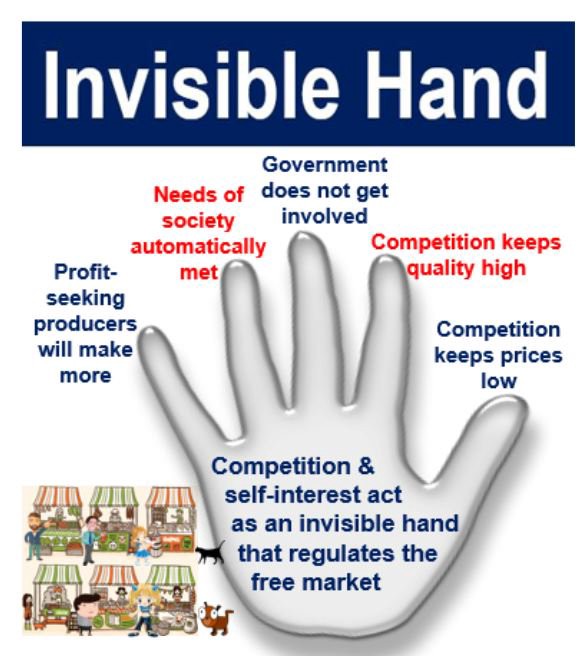
Methane Shows the Market’s Hidden Hand Works, Government’s Heavy Hand Fails

Present Trump made it a priority to cut deeply into the red tape, and claims his administration has killed 22 regulations for every new one approved. The recent action to rescind the EPA methane rule illustrates why this is the better approach. Paul Gessing writes at RealClearEnergy ‘Green Activists’ Opposing Trump’s Methane Rollback Are Full of It Excerpts in italics with my bolds

The Trump administration recently rolled back an Obama-era environmental rule that restricted oil and natural gas drilling. Almost immediately, the Environmental Defense Fund, California, and New Mexico sued to block the move. California Attorney General Xavier Becerra warned the administration’s rollback “risks the air our children breathe.”

Children can breathe easy — and so can adults, for that matter. The old “Waste Prevention Rule” governing methane emissions was counterproductive. Forcing energy firms to comply with its onerous red tape would have harmed workers and discouraged natural gas production, which benefits the environment.

Energy companies often capture methane, the main component in natural gas, when they’re drilling for crude oil. This methane byproduct is valuable, so companies try to sell it whenever possible.

But sometimes, safety concerns or a lack of available pipeline capacity compels firms to burn the gas instead. This practice, known as “flaring,” prevents dangerous gas buildups in wells. Similarly, firms sometimes have to release the gas, a practice known as “venting.”

The Waste Prevention Rule, which was finalized by the Bureau of Land Management in 2016 but delayed by the Trump administration, aimed to discourage venting and flaring. It forced energy companies on public and Indian lands to upgrade their equipment and pay royalties on any flared or vented gas.

According to the U.S. Energy Information Administration, the technology and infrastructure upgrades required by the old rule would have been prohibitively expensive for many producers. This is especially true of those operating so-called “marginal” wells — which produce no more than 90,000 cubic feet of gas per day, and thus aren’t as profitable.

More than 70 percent of oil and gas wells on federal land are classed as “marginal.” If the rule had forced these wells to close, America’s natural gas production would fall and unemployment would rise. If all marginal wells were shut down, over 240,000 Americans could have lost their jobs.

Ironically, the environment would suffer from such shutdowns. Thanks to new technologies such as fracking and horizontal drilling, America’s natural gas production has soared in the past decade. We’re now the world’s largest producer of the fuel.

This surge in natural gas supplies has caused prices to plummet. As a result, many utility companies have transitioned from using dirty, more expensive coal to cheaper, cleaner-burning natural gas to generate electricity. Thanks to this shift, domestic carbon dioxide emissions recently hit their lowest levels in 25 years.

In other words, by limiting natural gas production, the Waste Production Rule would have incentivized utilities to continue relying on dirty coal, thereby harming the environment.

The rule was also unnecessary. Controlling methane emissions is already a priority for oil and gas companies — and has been for years. Methane emissions have dropped 16 percent over the past quarter-century even as natural gas production has increased 50 percent.

In 2017, The Environmental Partnership, composed of nearly 30 domestic oil and gas companies, launched a comprehensive methane reduction program based on EPA guidelines. Similarly, the international Oil and Gas Climate Initiative, which includes BP, Shell, and Saudi Aramco, recently committed to reducing methane emissions in line with the Paris Agreement.

In short, the Trump administration is rolling back a rule that threatened our economy and our environment without delivering any significant benefits to the planet. The green activists fighting this much-needed reform need to calm down and take some deep breaths. And they needn’t worry — the air will be just as clean as before.

Paul Gessing is president of the Rio Grande Foundation, an independent, nonpartisan, tax-exempt research and educational organization dedicated to promoting liberty, opportunity and prosperity for New Mexico.

Summary: Progressive politics long ago ceased being liberal, i.e. concerned about individual freedom of choice and speech.  Progressives are increasingly a coalition of drama queens, know-it-alls, and control freaks.

See also:  MORE CALIFORNIA CRAZY LAWS

5bc132d50674d.image_

Cosmic Rebirth: Peterson’s Pearls (5)

This is the fifth and final post in a series based upon Jordan Peterson’s book Maps of Meaning, published in 1999 after 17 years of research and writing. It is rich in description and insight with many references and quotations from original sources. Reading it I began to copy passages that struck me as especially lucid and pertinent. Those paragraphs of his text are provided below in italics as excerpts selected to explain five themes emerging in my reflections while pondering his book. Cosmic Dichotomy: Peterson’s Pearls (1) provides an overview explaining why this is important to me and perhaps to others.

[Note: I use the word “cosmic” since each individual’s world is at risk, and as we see in the agitation over climate change, entire social groups can also fear for their collective world.]

Jordan Peterson on Cosmic Rebirth (Excerpts from Maps of Meaning: The Architecture of Belief Title is link to pdf)

Ideologies may be regarded as incomplete myths—as partial stories, whose compelling nature is a consequence of the appropriation of mythological ideas. The philosophy attributing individual evil to the pathology of social force constitutes one such partial story. Although society, the Great Father, has a tyrannical aspect, he also shelters, protects, trains and disciplines the developing individual—and places necessary constraints on his thought, emotion and behavior.

Subjugation to lawful authority might more reasonably be considered in light of the metaphor of the apprenticeship. Childhood dependency must be replaced by group membership, prior to the development of full maturity. Such membership provides society with another individual to utilize as a “tool,” and provides the maturing but still vulnerable individual with necessary protection (with a group-fostered “identity”). The capacity to abide by social rules, regardless of the specifics of the discipline, can therefore be regarded as a necessary transitional stage in the movement from childhood to adulthood.

Discipline should therefore be regarded as a skill that may be developed through adherence to strict ritual, or by immersion within a strict belief system or hierarchy of values. Once such discipline has been attained, it may escape the bounds of its developmental precursor. It is in this manner that true freedom is attained.

Apprenticeship is necessary, but should not on that account be glamorized. Dogmatic systems make harsh and unreasonable masters. Systems of belief and moral action—and those people who are identified with them—are concerned above all with self-maintenance and preservation of predictability and order. The (necessarily) conservative tendencies of great systems makes them tyrannical, and more than willing to crush the spirit of those they “serve.” Apprenticeship is a precursor to freedom, however, and nothing necessary and worthwhile is without danger.

We are all familiar with the story of benevolent nature, threatened by the rapacious forces of the corrupt individual and the society of the machine. The plot is solid, the characters believable, but Mother Nature is also malarial mosquitoes, parasitical worms, cancer and Sudden Infant Death Syndrome. The story of peaceful and orderly tradition, undermined by the incautious and decadent (with the ever-present threat of chaos lurking in the background) is also familiar, and compelling, and true—except that the forces of tradition, however protective, tend to be blind, and to concern themselves more with their own stability than with the well-being of those subject to them.

These stories are all ideologies (and there are many more of them). Ideologies are attractive, not least to the educated modern mind—credulous, despite its skepticism— particularly if those who embody or otherwise promote them allow the listener every opportunity to identify with the creative and positive characters of the story, and to deny their association with the negative. Ideologies are powerful and dangerous. Their power stems from their incomplete but effective appropriation of mythological ideas. Their danger stems from their attractiveness, in combination with their incompleteness. Ideologies tell only part of the story, but tell that part as if it were complete. This means that they do not take into account vast domains of the world. It is incautious to act in the world as if only a set of its constituent elements exist. The ignored elements conspire, so to speak, as a consequence of their repression, and make their existence known, inevitably, in some undesirable manner.

Anyway, the fervent hope of every undisciplined person (even an undisciplined genius) is that his current worthlessness and stupidity is someone else’s fault. If—in the best of cases—it is society’s fault, then society can be made to pay. This sleight-of-hand maneuver transforms the undisciplined into the admirable rebel, at least in his own eyes, and allows him to seek unjustified revenge in the disguise of the revolutionary hero. A more absurd parody of heroic behavior can hardly be imagined.

The maturing individual necessarily (tragically, heroically) expands past the domain of paradisal maternal protection, in the course of development; necessarily attains an apprehension whose desire for danger and need for life exceeds the capability of maternal shelter. This means that the growing child eventually comes to face problems—how to get along with peers in peer-only play groups; how to select a mate from among a myriad of potential mates—that cannot be solved (indeed, may be made more difficult) by involvement of the beneficial maternal.

A thirteen-year-old cannot use a seven-year-old’s personality—no matter how healthy—to solve the problems endemic to adolescence. The group steps in—most evidently, at the point of adolescence—and provides “permeable” protective shelter to the child too old for the mother but not old enough to stand alone. The universally disseminated rituals of initiation—induced “spiritual” death and subsequent rebirth—catalyzes the development of adult personality; follows the fundamental pattern of the cyclic, circular cosmogonic myth of the way.

Ritual initiation, for example—a ubiquitous formal feature of pre-experimental culture—takes place at or about the onset of puberty, when it is critical for further psychological development and continued tribal security that boys transcend their dependency upon their mothers. This separation often takes place under purposefully frightening and violent conditions. In the general initation pattern, the men, acting as a unit (as the embodiment of social history), separate the initiates from their mothers, who offer a certain amount of more or less dramatized resistance and some genuine sorrow (at the “death” of their children).

When the rite is successfully completed, the initiated are no longer children, dependent upon the arbitrary beneficience of nature—in the guise of their mothers—but are members of the tribe of men, active standard-bearers of their particular culture, who have had their previously personality destroyed, so to speak, by fire. They have successfully faced the worst trial they are likely ever to encounter in their lives.

That new environment is the society of men, where women are sexual partners and equals instead of sources of dependent comfort; where the provision of food and shelter is a responsibility, and not a given; where security—final authority, in the form of parent—no longer exists. As the childhood “personality” is destroyed, the adult personality—a manifestation of transmitted culture—is inculcated.

Groups are individuals, uniform in their acceptance of a collective historically determined behavioral pattern and schema of value. Internalization of this pattern, and the description thereof (the myths—and philosophies, in more abstracted cultures—which accompany it), simultaneously produces ability to act in a given (social) environment, to predict the outcomes of such action, and to determine the meaning of general events (meaning inextricably associated with behavioral outcome). Such internalization culminates in the erection of implicit procedural and explicit declarable structures of “personality,” which are more or less isomorphic in nature, which simultaneously constitute habit and moral knowledge.

The group is the historical structure that humanity has erected between the individual and the terrible unknown. Intrapsychic representation of culture— establishment of group identity—protects individuals from overwhelming fear of their own experience; from contact with the a priori meaning of things and situations.

The historical structure “protects itself” and its structure in two related manners. First, it inhibits intrinsically rewarding but “antisocial” behaviors (those which might upset the stability of the group culture) by associating them with certain punishment (or at least with the threat thereof). This punishment might include actual application of undesirable penalties or, more “subtly”—removal of “right to serve as recognized representative of the social structure.”

University of Kentucky Graduating Dentists, Class of 2018

The culturally-determined historical structure protects and maintains itself secondly by actively promoting individual participation in behavioral strategies that satisfy individual demand, and that simultaneously increase the stability of the group. The socially constructed way of a profession, for example, allows the individual who incarnates that profession opportunity for meaningful activity in a manner that supports or at least does not undermine the stability of the historically determined structure which regulates the function of his or her threat-response system. Adoption of a socially sanctioned “professional personality” therefore provides the initiated and identified individual with peer-approved opportunity for intrinsic goal-derived pleasure, and with relative freedom from punishment, shame and guilt.

The construction of a successful group, the most difficult of feats, means establishment of a society composed of individuals who act in their own interest (at least enough to render their life bearable) and who, in doing so, simultaneously maintain and advance their culture. The “demand to satisfy, protect and adapt, individually and socially”—and to do so over vast and variable stretches of time—places severe intrinsic constraints on the manner in which successful human societies can operate. It might be said that such constraints provide universal boundaries for acceptable human morality.

Balinese Trance Dance performed by male choir.

A culture is, to a large degree, a shared moral code, and deviations from that code are generally easily identified, at least post-hoc. It is still the case, however, that description of the domain of morality tends to exceed the capability of declarative thought, and that the nature of much of what we think of as moral behavior is still, therefore, embedded in unconscious procedure. As a consequence, it is easy for us to become confused about the nature of morality, and to draw inappropriate, untimely and dangerous “fixed” conclusions.

The conservative worships his culture, appropriately, as the creation of that which deserves primary allegiance, remembrance and respect. This creation is the concrete solution to the problem of adaptation: “how to behave?” (and how can that be represented and communicated?). It is very easy, in consequence, to err in attribution of value, and to worship the specific solution itself, rather than the source of that solution.

As such, a given cultural structure necessarily must meet a number of stringent and severely constrained requirements: (1) it must be self-maintaining (in that it promotes activities that allow it to retain its central form); (2) it must be sufficiently flexible to allow for constant adaptation to constantly shifting environmental circumstances; and (3) it must acquire the allegiance of the individuals who compose it. . . The second requirement—flexibility—is more difficult to fulfill, particularly in combination with the first (self-maintenance). A culture must promote activity that supports itself, but must simultaneously allow for enough innovation so that essentially unpredictable alteration in “environmental” circumstance can be met with appropriate change in behavioral activity. Cultures that attempt to maintain themselves through promotion of absolute adherence to traditional principles tend rapidly to fail the second requirement, and to collapse precipitously. Cultures that allow for unrestricted change, by contrast, tend to fail the first, and collapse equally rapidly. The third requirement (allegiance of the populace) might be considered a prerequisite for the first two.

Freemasons celebrate 150th anniversary of the Grand Lodge in Newfoundland and Labrador.

Every culture maintains certain key beliefs that are centrally important to that culture, upon which all secondary beliefs are predicated. These key beliefs cannot be easily given up, because if they are, everything falls, and the unknown once again rules. Western morality and behavior, for example, are predicated on the assumption that every individual is sacred. This belief was already extant in its nascent form among the ancient Egyptians, and provides the very cornerstone of Judeo-Christian civilization. Successful challenge to this idea would invalidate the actions and goals of the Western individual; would destroy the Western dominance hierarchy, the social context for individual action. In the absence of this central assumption, the body of Western law—formalized myth, codified morality—erodes and falls. There are no individual rights, no individual value— and the foundation of the Western social (and psychological) structure dissolves. The Second World War and Cold War were fought largely to eliminate such a challenge.

The group provides the protective structure—conditional meaning and behavioral pattern—that enables the individual to cast off the dependence of childhood, to make the transition from the maternal to the social, patriarchal world. The group is not the individual, however. Psychological development that ceases with group identification—held up as the highest attainable good by every ideologue—severely constricts individual and social potential, and dooms the group, inevitably, to sudden and catastrophic dissolution. Failure to transcend group identification is, in the final analysis, as pathological as failure to leave childhood.

Movement from the group to the individual—like that from childhood to group—follows the archetypal transformative pattern of the heroic (paradise, breach, fall, redemption; stability, incorporation, dissolution, reconstruction). Such transformation must be undertaken voluntarily, through conscious exposure to the unknown—although it may be catalyzed by sufficiently unique or traumatic experience. Failure to initiate and/or successfully complete the process of secondary maturation heightens risk for intrapsychic and social decadence, and consequent experiential chaos, depression and anxiety (including suicidal ideation), or enhances tendency toward fanaticism, and consequent intrapsychic and group aggression.

The “third mode” of adaptation—alternative to decadence and fascism—is heroic. Heroism is comparatively rare, because it requires voluntary sacrifice of group-fostered certainty, and indefinite acceptance of consequent psychological chaos, attendant upon (re)exposure to the unknown. This is nonetheless the creative path, leading to new discovery or reconfiguration, comprising the living element of culture.

Christ’s replies signified transition of morality from reliance on tradition to reliance on individual conscience—from rule of law to rule of spirit—from prohibition to exhortation. To love God means to listen to the voice of truth and to act in accordance with its messages; to love thy neighbour, as thy self. This means, not merely to be pleasant, polite and friendly, but to attribute to the other a value equivalent to the value of the self—which, despite outward appearances, is a representative of God—and to act in consequence of this valuation.

What principle is rule of spirit, rather than law, predicated upon? Respect for the innately heroic nature of man. The “unconscious” archaic man mimics particular adaptive behaviors—integrated, however, into a procedural structure containing all other adaptive behaviors, capable of compelling imitation, and accompanied by episodic/semantic representation, in myth. Pre-experimental cultures regard the act of initial establishment of adaptive behavior as divine first because it follows an archetypal and therefore transpersonal pattern—that governing creative exploration—and second because it compels imitation, and therefore appears possessed of power. All behaviors that change history, and compel imitation, follow the same pattern—that of the divine hero, the embodiment of creative human potential.

Law is a necessary precondition to salvation, so to speak; necessary, but insufficient. Law provides the borders that limit chaos, and allows for the protected maturation of the individual. Law disciplines possibility, and allows the disciplined individual to bring his or her potentialities—those intrapsychic spirits—under voluntary control. The law allows for the application of such potentiality to the task of creative and courageous existence— allows spiritual water controlled flow into the valley of the shadow of death. Law held as absolute, however, puts man in the position of the eternal adolescent, dependent upon the father for every vital decision; removes the responsibility for action from the individual, and therefore prevents him or her from discovering the potential grandeur of the soul. Life without law remains chaotic, affectively intolerable. Life that is pure law becomes sterile, equally unbearable. The domination of chaos or sterility equally breeds murderous resentment and hatred.

Christ said, put truth and regard for the divine in humanity above all else, and everything you need will follow—not everything you think you need, as such thought is fallible, and cannot serve as an accurate guide, but everything actually necessary to render acutely (self) conscious life bearable, without protection of delusion and necessary recourse to deceit, avoidance or suppression, and violence.

Existence characterized by such essence takes place, from the Oriental viewpoint, on the path of meaning, in Tao, balanced on the razor’s edge between mythic masculine and mythic feminine—balanced between the potentially stultifying safety of order, and the inherently destructive possibility of chaos. Such existence allows for introduction of sufficiently bearable meaning into blessed security; makes every individual a stalwart guardian of tradition and an intrepid explorer of the unknown; ensures simultaneous advancement and maintenance of stable, dynamic social existence; and places the individual firmly on the path to intrapsychic integrity and spiritual peace.

The late physicist, Professor Wolfgang Pauli, frequently demonstrated the extent to which modern physical sciences are in a way rooted in archetypal ideas. For instance, the idea of causality as formulated by Descartes is responsible for enormous progress in the investigation of light, of biological phenomena, and so on, but that thing which promotes knowledge becomes its prison. Great discoveries in natural sciences are generally due to the appearance of a new archetypal model by which reality can be described; that usually precedes big developments, for there is now a model which enables a much fuller explanation than was hitherto possible.

So science has progressed, but still, any model becomes a cage, for if one comes across phenomena difficult to explain, then instead of being adaptable and saying that the phenomena do not conform to the model and that a new hypothesis must be found, one clings to one’s hypotheses with a kind of emotional conviction, and cannot be objective.

The idea of projection—that is, the idea that systems of thought have “unconscious” axioms—is clearly related to the notion of “paradigmatic thinking,” as outlined by Kuhn, to wide general acclaim. Jung described the psychological consequences of paradigmatic thinking in great detail as well.

Acceptance of anomalous information brings terror and possibility, revolution and transformation. Rejection of unbearable fact stifles adaptation and strangles life. We choose one path or another at every decision point in our lives, and emerge as the sum total of our choices. In rejecting our errors, we gain short-term security—but throw away our identity with the process that allows us to transcend our weaknesses and tolerate our painfully limited lives.

Our psychology and psychiatry—our “sciences of the mind“—are devoted, at least in theory, to “empirical” evaluation and treatment of mental “disorders.” But this is mostly smoke and screen. We are aiming, always, at an ideal. We currently prefer to leave the nature of that ideal “implicit,” because that helps us sidestep any number of issues that would immediately become of overwhelming difficulty, if they were clearly apprehended. So we “define” health as that state consisting of an absence of “diseases” or “disorders” and leave it at that—as if the notion of disease or disorder (or of the absence thereof) is not by necessity a medieval concatenation of moral philosophy and empirical description. It is our implicit theory that a state of “non-anxiety” is possible, however—and desirable— that leads us to define dominance by that state as “disordered.” The same might be said for depression, for schizophrenia, for personality “disorders,” and so on. Lurking in the background is an “implicit” (that is, unconscious) ideal, against which all “insufficient” present states are necessarily and detrimentally compared. We do not know how to make that ideal explicit, either methodologically or practically (that is, without causing immense dissent in the ranks); we know, however, that we must have a concept of “not ideal” in order to begin and to justify “necessary” treatment. Sooner or later, however, we will have to come to terms with the fact that we are in fact attempting to produce the ideal man—and will have to define explicitly what that means. It would be surprising, indeed, if the ideal we come to posit bore no relationship to those constructed painstakingly, over the course of centuries of effort, in the past.

It took thousands of years of cultural development to formulate the twin notions that empirical reality existed (independent of the motivational significance of things) and that it should be systematically studied (and these ideas only emerged, initially, in the complex societies of the Orient and Europe).

The purpose of scientific methodology is, in large part, to separate the empirical facts from the motivational presumption. In the absence of such methodology, the intermingling of the two domains is inevitable.

It is thus that awareness of death, the grim reaper—the terrible face of God—compels us inexorably upwards, toward a consciousness sufficiently heightened to bear the thought of death. The point of our limitations is not suffering; it is existence itself. We have been granted the capacity to voluntarily bear the terrible weight of our mortality. We turn from that capacity and degrade ourselves because we are afraid of responsibility. In this manner, the necessarily tragic preconditions of existence are made intolerable.

It seems to me that it is not the earthquake, the flood or the cancer that makes life unbearable, horrible as those events appear. We seem capable of withstanding natural disaster, even of responding to that disaster in an honorable and decent manner. It is rather the pointless suffering that we inflict upon each other—our evil—that makes life appear corrupt beyond acceptability; that undermines our ability to manifest faith in our central natures.

The truth seems painfully simple—so simple that it is a miracle, of sorts, that it can every be forgotten. Love God, with all thy mind, and all thy acts, and all thy heart. This means, serve truth above all else, and treat your fellow man as if he were yourself—not with the pity that undermines his self-respect, and not with the justice that elevates you above him, but as a divinity, heavily burdened, who could yet see the light.

Who can believe that it is the little choices we make, every day, between good and evil, that turn the world to waste and hope to despair? But it is the case. We see our immense capacity for evil, constantly realized before us, in great things and in small, but can never seem to realize our infinite capacity for good. Who can argue with a Solzhenitsyn when he states: “One man who stops lying can bring down a tyranny”?

Christ said, the kingdom of heaven is spread out upon the earth, but men do not see it. What if it was nothing but our self-deceit, our cowardice, hatred and fear, that pollutes our experience and turns the world into hell? This is a hypothesis, at least—as good as any other, admirable and capable of generating hope. Why can’t we make the experiment, and find out if it is true?

guy-fawkes-masks-644x455-1
It has been almost twelve years since I first grasped the essence of the paradox that lies at the bottom of human motivation for evil: People need their group identification, because that identification protects them, literally, from the terrible forces of the unknown. It is for this reason that every individual who is not decadent will strive to protect his territory, actual and psychological. But the tendency to protect means hatred of the other, and the inevitability of war—and we are now too technologically powerful to engage in war. To allow victory to the other, however—or even continued existence, on his terms—means subjugation, dissolution of protective structure, and exposure to that which is most feared. For me, this meant “damned if you do, damned if you don’t”: belief systems regulate affect, but conflict between belief systems is inevitable.

The great myths of Christianity—the great myths of the past, in general—no longer speak to the majority of Westerners, who regard themselves as educated. The mythic view of history cannot be credited with reality, from the material, empirical point of view. It is nonetheless the case that all of Western ethics, including those explicitly formalized in Western law, are predicated upon a mythological worldview, which specifically attributes divine status to the individual. The modern individual is therefore in a unique position: he no longer believes that the principles upon which all his behaviors are predicated are valid. This might be considered a second fall, in that the destruction of the Western mythological barrier has re-exposed the essential tragedy of individual existence to view.

It is not the pursuit of empirical truth, however, that has wreaked havoc upon the Christian worldview. It is confusion of empirical fact with moral truth that has proved of great detriment to the latter. This has produced what might be described as a secondary gain, which has played an important role in maintaining the confusion. That gain is abdication of the absolute personal responsibility imposed in consequence of recognition of the divine in man. This responsibility means acceptance of the trials and tribulations associated with expression of unique individuality, as well as respect for such expression in others. Such acceptance, expression and respect requires courage in the absence of certainty, and discipline in the smallest matters.

The root of social and individual psychopathology, the “denial,” the “repression” is the lie. The most dangerous lie of all is devoted to denial of individual responsibility—denial of individual divinity.  The idea of the divine individual took thousands of years to fully develop, and is still constantly threatened by direct attack and insidious counter-movement. It is based upon realization that the individual is the locus of experience. All that we can know about reality we know through experience. It is therefore simplest to assume that all there is of reality is experience—its being and progressive unfolding. Furthermore, it is the subjective aspect of individuality—of experience—that is divine, not the objective. Man is an animal, from the objective viewpoint, worthy of no more consideration than the opinion and opportunities of the moment dictate. From the mythic viewpoint, however, every individual is unique—is a new set of experiences, a new universe; has been granted the ability to bring something new into being; is capable of participating in the act of creation itself. It is the expression of this capacity for creative action that makes the tragic conditions of life tolerable, bearable—remarkable, miraculous.

Footnote:

The seminal work on the struggle of individuals to rise above mass delusions was the book Extraordinary Popular Delusions And The Madness Of Crowds by Charles MacKay 1841.  Title is link to full pdf text.  Excerpts below with my bolds.

In the present state of civilization, society has often shown itself very prone to run a career of folly from the last-mentioned cases. This infatuation has seized upon whole nations in a most extraordinary manner. France, with her Mississippi madness, set the first great example, and was very soon imitated by England with her South Sea Bubble. At an earlier period, Holland made herself still more ridiculous in the eyes of the world, by the frenzy which came over her people for the love of Tulips. Melancholy as all these delusions were in their ultimate results, their history is most amusing. A more ludicrous and yet painful spectacle, than that which Holland presented in the years 1635 and 1636, or France in 1719 and 1720, can hardly be imagined.

Some delusions, though notorious to all the world, have subsisted for ages, flourishing as widely among civilized and polished nations as among the early barbarians with whom they originated, — that of duelling, for instance, and the belief in omens and divination of the future, which seem to defy the progress of knowledge to eradicate entirely from the popular mind. Money, again, has often been a cause of the delusion of multitudes. Sober nations have all at once become desperate gamblers, and risked almost their existence upon the turn of a piece of paper. To trace the history of the most prominent of these delusions is the object of the present pages. Men, it has been well said, think in herds; it will be seen that they go mad in herds, while they only recover their senses slowly, and one by one.

MacKay’s study was exhaustive for its time, comprising three volumes;

VOL I. Considered National Delusions, including:
THE MISSISSIPPI SCHEME
THE SOUTH SEA BUBBLE
THE TULIPOMANIA.
RELICS.
MODERN PROPHECIES.
POPULAR ADMIRATION FOR GREAT THIEVES.
INFLUENCE OF POLITICS AND RELIGION ON THE HAIR AND BEARD.
DUELS AND ORDEALS
THE LOVE OF THE MARVELLOUS AND THE DISBELIEF OF THE TRUE.
POPULAR FOLLIES IN GREAT CITIES
THE O.P. MANIA.
THE THUGS, or PHANSIGARS.

VOL. II described Peculiar Follies, including:
THE CRUSADES
THE WITCH MANIA.
THE SLOW POISONERS.
HAUNTED HOUSES.

VOL. III compiled more general popular madnesses under three categories:
BOOK I: Philosophical Delusions, down through history with particular recent attention to Alchemists
BOOK II: Fortune Telling
BOOK III: The Magnetisers, a fad only subsiding when the book was written.

Cosmic Evil: Peterson’s Pearls (4)

This is the fourth in a series of five posts based upon Jordan Peterson’s book Maps of Meaning, published in 1999 after 17 years of research and writing. It is rich in description and insight with many references and quotations from original sources. Reading it I began to copy passages that struck me as especially lucid and pertinent. Those paragraphs of his text are provided below in italics as excerpts selected to explain five themes emerging in my reflections while pondering his book. Cosmic Dichotomy: Peterson’s Pearls (1) provides an overview explaining why this is important to me and perhaps to others.

[Note: I use the word “cosmic” since each individual’s world is at risk, and as we see in the agitation over climate change, entire social groups can also fear for their collective world.]

Jordan Peterson on Cosmic Evil (Excerpts from Maps of Meaning: The Architecture of Belief Title is link to pdf)

No discussion of the architecture of belief can possibly be considered complete, in the absence of reference to evil. Evil is no longer a popular word, so to speak—the term is generally considered old-fashioned, not applicable in a society that has theoretically dispensed with its religious preoccupations. Acts once defined as evil are now merely considered the consequence of unjust familial, social or economic structures (although this view is not as widespread as it once was). Alternatively, the commission of incomprehensible acts of cruelty and destruction are viewed as symptomatic of some physiological weakness or disease. Seldom are acts of evil considered voluntary or purposeful—committed by someone possessed by an aesthetic that makes art of terror and pain.

Evil, like good, is not something static: it does not merely mean breaking the rules, for example, and is not simply aggression, anger, force, pain, disappointment, anxiety or horror. Life is of course endlessly complicated by the fact that what is bad in one circumstance is positively necessary in the next.

Evil is rejection of and sworn opposition to the process of creative exploration. Evil is proud repudiation of the unknown, and willful failure to understand, transcend and transform the social world. Evil is, in addition—and in consequence—hatred of the virtuous and courageous, precisely on account of their virtue and courage. Evil is the desire to disseminate darkness, for the love of darkness, where there could be light. The spirit of evil underlies all actions that speed along the decrepitude of the world, that foster God’s desire to inundate and destroy everything that exists.

Many kings are tyrants, or moral decadents, because they are people—and many people are tyrants, or moral decadents. We cannot say “never again” as a consequence of the memory of the Holocaust, because we do not understand the Holocaust, and it is impossible to remember what has not been understood. We do not understand the Holocaust because we do not comprehend ourselves. Human beings, very much like ourselves, produced the moral catastrophes of the Second World War (and of Stalin’s Soviet Union, and of Pol Pot’s Cambodia…). “Never forget” means “know thyself”: recognize and understand that evil twin, that mortal enemy, who is part and parcel of every individual.

The heroic tendency—the archetypal savior—is an eternal spirit, which is to say, a central and permanent aspect of human being. The same is true, precisely, of the “adversarial” tendency: the capacity for endless denial, and the desire to make everything suffer for the outrage of its existence, is an ineradicable intrapsychic element of the individual. The great dramatists and religious thinkers of the world have been able to grasp this fact, at least implicitly, and to transmit it in story and image; modern analytic thinkers and existential theorists have attempted to abstract these ideas upward into “higher consciousness,” and to present them in logical and purely semantic form. Sufficient material has been gathered to present a compelling portrait of evil.

2-18-1-29-12-11-1m

The image of the devil is the form that the idea of evil has taken, for better or worse, at least in the West. We have not yet developed an explicit model of evil that would allow us to forget, transcend or otherwise dispense with this mythological representation. We rationalize our lack of such understanding by presuming that the very notion of evil is archaic. This is a truly ridiculous presumption, in this century of indescribable horror. In our ignorance and complacency, we deride ancient stories about the nature of evil, equating them half-consciously with childish things best put away. This is an exceedingly arrogant position. There is no evidence whatsoever that we understand the nature of evil any better than our forebears, despite our psychology, even though our expanded technological power has made us much more dangerous when we are possessed.

It is reason’s belief in its own omniscience—manifest in procedure and image, if not in word—that “unconsciously” underlies totalitarianism in its many destructive guises. . . It is not that easy to understand why the act of presuming omniscience is reasonably construed as precisely opposite to the act of creative exploration (as the adversary is opposite to the hero). What “knowing everything” means, however—at least in practice—is that the unknown no longer exists, and that further exploration has therefore been rendered superfluous (even treacherous).

Rally organized for Nicolae Ceausescu in 1978. Photo source: fototeca.iiccr.ro

The arrogance of the totalitarian stance is ineradicably opposed to the “humility” of creative exploration. [Humility—it is only constant admission of error and capacity for error (admission of “sinful and ignorant nature”) that allows for recognition of the unknown, and then for update of knowledge and adaptation in behavior. Such humility is, somewhat paradoxically, courageous—as admission of error and possibility for error constitutes the necessary precondition for confrontation with the unknown. This makes genuine cowardice the “underground” motivation for the totalitarian presumption: the true authoritarian wants everything unpredictable to vanish. The authoritarian protects himself from knowledge of this cowardice by a show of patriotic advocacy, often at apparent cost to himself.]

It has taken mankind thousands of years of work to develop dawning awareness of the nature of evil—to produce a detailed dramatic representation of the process that makes up the core of human maladaptation and voluntarily produced misery. It seems premature to throw away the fruit of that labor or to presume that it is something other than what it appears before we understand what it signifies.

Unabomber Time

The fact of mortal vulnerability—that defining characteristic of the individual, and the “reason” for his emergent disgust with life—may be rendered even more “unjust” and “intolerable” by the specific manifestations of such vulnerability. Some are poorer than others, some weaker, some unsightlier—all less able, in some regard (and some apparently less able in all regards). Recognition of the seemingly arbitrary distribution of skill and advantage adds additional rationally “justifiable” grounds for the development of a philosophy based on resentment and antipathy—sometimes, “on behalf” of an entire class, other times, sheerly for the purposes of a specific individual. Under such circumstances, the desire for revenge on life itself may become paramount above all else, particularly for the “unfairly oppressed.”

Riots in Watts, Los Angeles 1965.

Evil is voluntary rejection of the process that makes life tolerable, justified by observation of life’s terrible difficulty. This rejection is presumptious, premature, because it is based on acceptance of a provisional judgment as final: “everything is insufficient, and is therefore without worth, and nothing whatsoever can be done to rectify the situation.” Judgment of this sort precludes all hope of cure.

The development of the adversary therefore follows a predictable path, from pride (“Pride and worse Ambition threw me down”), through envy, to revenge—to the ultimate construction of a character possessed by infinite hatred and envy.

Tolstoy’s nihilism—disgust with the individual and human society, combined with the desire for the eradication of existence—is one logical “evil” consequence of heightened self-consciousness. It is not, however, the only consequence, and may not even be the most subtle. Far more efficient—far more hidden from the perpetrator himself, and from his closest observers—is heightened identification with tradition and custom. This is envelopment in the guise of patriotism, to facilitate the turning of state power toward destruction.

Group membership, social being, represents a necessary advance over childish dependence, but the spirit of the group requires its pound of flesh. Absolute identification with the group means rejection of individual difference: means rejection of “deviation,” even “weakness,” from the group viewpoint; means repression of individuality, sacrifice of the mythic fool; means abandonment of the simple and insufficient “younger brother.” The group, of course, merely feels that it is doing its duty by insisting upon such sacrifice; it believes, with sufficient justification, that it is merely protecting its structure.

Denial of unique individuality turns the wise traditions of the past into the blind ruts of the present. Application of the letter of the law when the spirit of the law is necessary makes a mockery of culture. Following in the footsteps of others seems safe, and requires no thought—but it is useless to follow a well-trodden trail when the terrain itself has changed. The individual who fails to modify his habits and presumptions as a consequence of change is deluding himself—is denying the world—is trying to replace reality itself with his own feeble wish. By pretending things are other than they are, he undermines his own stability, destabilizes his future, and transforms the past from shelter to prison.

The Mausoleum of Dead Presidents in Pyongyang.

The individual embodiment of collective past wisdom is turned into the personification of inflexible stupidity by means of the lie. The lie is straightforward, voluntary rejection of what is currently known to be true. Nobody knows what is finally true, by definition, but honest people make the best possible use of their experience. The moral theories of the truthful, however incomplete from some hypothetical transcendent perspective, account for what they have seen and for who they are, insofar as that has been determined in the course of diligent effort.

This is to say, merely, that the truth of children and adults differs, because their experience—their reality—differs. The truthful child does not think like an adult: he thinks like a child, with his eyes open. The adult, however, who still uses the morality of the child—despite his adult capacities—he is lying, and he knows it.

The lie is willful adherence to a previously functional schema of action and interpretation—a moral paradigm—despite new experience that cannot be comprehended in terms of that schema; despite new desire, which cannot find fulfillment within that framework. The lie is willful rejection of information apprehended as anomalous on terms defined and valued by the individual doing the rejecting. That is to say: the liar chooses his own game, sets his own rules and then cheats. This cheating is failure to grow, to mature; it is rejection of the process of consciousness itself.

The unknown has to be “mined” for precise significance, before it can be said to have been experienced, let alone comprehended; has to be transformed, laboriously, from pure affect into revision of presumption and action (into “psyche” or “personality”). “Not doing” is therefore the simplest and most common lie: the individual can just “not act,” “not investigate,” and the pitfalls of error will remain unmanifest, at least temporarily. This rejection of the process of creative exploration means lack of effortful update of procedural and declarative memory, adaptation to the present as if it still were the past, refusal to think.

The identity of the individual with his culture protects him from the terrible unknown, and allows him to function as an acceptable member of society. This slavish function strengthens the group. But the group states that certain ways of thinking and acting are all that are acceptable, and these particular ways do not exhaust the unknown and necessary capabilities of the human being. The rigid, grinning social mask is the individual’s pretence that he is “the same person” as everyone else (that is, the same dead person)— that he is not a natural disaster, not a stranger, not strange—that he is not deviant, weak, cowardly, inferior and vengeful. The true individual, however—the honest fool—stands outside the protective enclave of acceptance, unredeemed—the personification of weakness, inferiority, vengefulness, cowardice, difference. He cannot make the cut, and because he cannot make the cut, he is the target of the tyranny of the group (and of his own judgment, insofar as he is that group). But man as a fool, weak, ignorant and vulnerable, is what the group is not: a true individual, truly existing, truly experiencing, truly suffering (if it could only be admitted).

The adversarial position, deceit, is predicated on the belief that the knowledge of the present comprises all necessary knowledge—is predicated on the belief that the unknown has finally been conquered. This belief is equivalent to denial of vulnerability, equivalent to the adoption of omniscience—“what I do is all there is to do, what I know is all there is to know.” Inextricably associated with the adoption of such a stance is denial, implicit or explicit, of the existence, the possibility, and the necessity of the heroic—as everything worthwhile has already been done, as all problems have been solved, as paradise has already been spread before us.

Denial of the heroic promotes fascism, absolute identification with the cultural canon. Everything that is known, is known within a particular historically determined framework, predicated upon mythologically expressed assumptions. Denial or avoidance of the unknown therefore concomitantly necessitates deification of a particular previously established viewpoint.

Denial of the heroic promotes decadence, equally—absolute rejection of the order of tradition; absolute rejection of order itself. This pattern of apprehension and behavior seems far removed from that of the fascist, but the decadent is just as arrogant as his evidently more rigid peer. He has merely identified himself absolutely with no thing, rather than with one thing. He is rigidly convinced of the belief that nothing matters— convinced that nothing is of value, despite the opinions of (clearly deluded, weak and despicable) others; convinced that nothing is worth the effort. The decadent functions in this manner like an anti-Midas—everything he touches turns to ashes.

Imelda Marcos in Manila among her 3000 pairs of shoes.

The normal individual solves his problem of adaptation to the unknown by joining a group. A group, by definition, is composed of those who have adopted a central structure of value, and who therefore behave, in the presence of other group members, identically—and if not identically, at least predictably. The fascist adapts to the group with a vengeance. He builds stronger and stronger walls around himself and those who are “like him,” in an ever more futile attempt to keep the threatening unknown at bay. He does this because his worldview is incomplete.

The decadent, by contrast, sees nothing but the tyranny of the state. Since the adversarial aspect of the individual remains conveniently hidden from his view, he cannot perceive that his “rebellion” is nothing but avoidance of discipline. He views chaos as a beneficial home, seeing the source of human evil in social regulation. . . The decadent looks to subvert the process of maturation—looks for a “way out” of group affiliation. Group membership requires adoption of at least adolescent responsibility, and this burden may seem too much to bear, as a consequence of prolonged immaturity of outlook.

The fascist and the decadent regard each other as opposites, as mortal enemies. They are in actuality two sides of the same bent coin.

This “theory of the genesis of social psychopathology”—this theory of a direct relationship obtaining between personal choice and fascistic or decadent personality and social movement—finds its precise echo in Taoist philosophy, and can be more thoroughly comprehended through application of that perspective. . . Much of ancient Chinese philosophy (cosmology, medicine, political theory, religious thinking) is predicated on the idea that pathology is caused by a relative excess of one primordial “substance” or the other. The goal of the Chinese sage—physician, spiritual leader or social administrator—is to establish or re-establish harmony between the fundamental “feminine” and “masculine” principles, and to diagnose and cure the faulty action or irresponsible inactions that led to their original discord. The schematic representation of Yin and Yang, portrayed below, utilizes the image of a circle to represent totality; the paisleys that make up that circle are opposed but balanced.

The fascist, who will not face the reality and necessity of the unknown, hides his vulnerable face in a “pathological excess of order.” The decadent, who refuses to see that existence is not possible without order, hides his immaturity from himself and others in a “pathological excess of chaos.” The fascist is willing to sacrifice painful freedom for order, and to pretend that his unredeemed misery is meaningless, so that he does not have to do anything for himself. The decadent believes that freedom can be attained without discipline and responsibility, because he is ignorant of the terrible nature of “the undifferentiated ground of reality” and is unwilling to bear the burden of order. When he starts to suffer, as he certainly will, he will not allow the reality of his suffering to prove to him that some things are real, because acceptance of that proof would force him to believe and to act (would force him as well toward painful realization of the counterproductive and wasteful stupidity of his previous position).

The decadent says, “there is no such thing as to know”—and never attempts to accomplish anything. Like his authoritarian counterpart, he makes himself “immune from error,” since mistakes are always made with regard to some valued, fixed and desired end. The decadent says, “look, here is something new, something inexplicable; that is evidence, is it not, that everything that I have been told is wrong. History is unreliable; rules are arbitrary; accomplishment is illusory. Why do anything, under such circumstances?” But he is living on borrowed time—feeding, like a parasite, on the uncomprehended body of the past.

The invention, establishment and perfection of the concentration camp, the efficient genocidal machine, might be regarded as the crowning achievement of human technological and cultural endeavor, motivated by resentment and loathing for life. Invented by the English, rendered efficient by the Germans, applied on a massive scale by the Soviets and the Chinese, revivified by the Balkan conflict—perfection of the factory whose sole product is death has required truly multinational enterprise. Such enterprise constitutes, perhaps, the prime accomplishment of the cooperative bureaucratization of hatred, cowardice and deceit.  Tens of millions of innocent people have been dehumanized, enslaved and sacrificed in these efficient disassembly lines, in the course of the last century, to help their oppressors maintain pathological stability and consistency of moral presumption, enforced through terror, motivated by adherence to the lie.

The Rwandan massacres, the killing fields in Cambodia, the tens of millions dead (by Solzhenitsyn’s estimate) as a consequence of internal repression in the Soviet Union, the untold legions butchered during China‘s Cultural Revolution [the Great Leap Forward (!), another black joke, accompanied upon occasion, in the particular, by devouring of the victim], the planned humiliation and rape of hundreds of Muslim women in Yugoslavia, the holocaust of the Nazis, the carnage perpetrated by the Japanese in mainland China— such events are not attributable to human kinship with the animal, the innocent animal, or even by the desire to protect territory, interpersonal and intrapsychic, but by a deep-rooted spiritual sickness, endemic to mankind, the consequence of unbearable self-consciousness, apprehension of destiny in suffering and limitation, and pathological refusal to face the consequences thereof.

The fact, regardless of content, is not evil; it is mere (terrible) actuality. It is the attitude to the fact that has a moral or immoral nature. There are no evil facts—although there are facts about evil; it is denial of the unacceptable fact that constitutes evil—at least insofar as human control extends. The suppression of unbearable fact transforms the conservative tendency to preserve into the authoritarian tendency to crush; transforms the liberal wish to transform into the decadent desire to subvert. Confusing evil with the unbearable fact, rather than with the tendency to deny the fact, is like equating the good with the static product of heroism, rather than with the dynamic act of heroism itself. Confusion of evil with the fact—the act of blaming the messenger—merely provides rationale for the act of denial, justification for savage repression, and mask of morality for decadence and authoritarianism.


The highest value toward which effort is devoted determines what will become elevated, and what subjugated, in the course of individual and social existence. If security or power is valued above all else, then all will become subject to the philosophy of expedience. In the long term, adoption of such a policy leads to development of rigid, weak personality (or social environment) or intrapsychic dissociation and social chaos.

The personality of this adversary comes in two forms, so to speak—although these two forms are inseparably linked. The fascist sacrifices his soul, which would enable him to confront change on his own, to the group, which promises to protect him from everything unknown. The decadent, by contrast, refuses to join the social world, and clings rigidly to his own ideas—merely because he is too undisciplined to serve as an apprentice. The fascist wants to crush everything different, and then everything; the decadent immolates himself, and builds the fascist from his ashes. The bloody excesses of the twentieth century, manifest most evidently in the culture of the concentration camp, stand as testimony to the desires of the adversary and as monument to his power.

Trotsky refers to the old principle which St. Paul states in 2 Thessalonians chapter 3:10 “We gave you this rule: if a man will not work, he shall not eat.” And before that Deuteronomy 25:4: “Do not muzzle an ox while it is treading out the grain.”

The pitfalls of fascism and decadence may be avoided through identification with the hero, the true individual. The hero organizes the demands of social being and the responsibilities of his own soul into a coherent, hierarchically arranged unit. He stands on the border between order and chaos, and serves the group as creator and agent of renewal. The hero’s voluntary contact with the unknown transforms it into something benevolent—into the eternal source, in fact, of strength and ability. Development of such strength—attendant upon faith in the conditions of experience— enables him to stand outside the group, when necessary, and to use it as a tool, rather than as armor. The hero rejects identification with the group as the ideal of life, preferring to follow the dictates of his conscience and his heart. His identification with meaning—and his refusal to sacrifice meaning for security—renders existence acceptable, despite its tragedy.

Cosmic Heroes: Peterson’s Pearls (3)

This is the third in a series of posts based upon Jordan Peterson’s book Maps of Meaning, published in 1999 after 17 years of research and writing. It is rich in description and insight with many references and quotations from original sources. Reading it I began to copy passages that struck me as especially lucid and pertinent. Those paragraphs of his text are provided below in italics as excerpts selected to explain five themes emerging in my reflections while pondering his book. Cosmic Dichotomy: Peterson’s Pearls (1) provides an overview explaining why this is important to me and perhaps to others.

[Note: I use the word “cosmic” since each individual’s world is at risk, and as we see in the agitation over climate change, entire social groups can also fear for their collective world.]

Jordan Peterson on Cosmic Heroes (Excerpts from Maps of Meaning: The Architecture of Belief Title is link to pdf)

Before the emergence of empirical methodology, which allowed for methodical separation of subject and object in description, the world-model contained abstracted inferences about the nature of existence, derived primarily from observations of human behavior. This means, in essence, that pre-experimental man observed “morality” in his behavior and inferred (through the process described previously) the existence of a source or rationale for that morality in the structure of the “universe” itself. Of course, this “universe” is the experiential field—affect, imagination and all—and not the “objective” world constructed by the post-empirical mind. This prescientific “model of reality” primarily consisted of narrative representations of behavioral patterns (and of the contexts that surround them), and was concerned primarily with the motivational significance of events and processes. As this model became more abstract—as the semantic system analyzed the information presented in narrative format, but not understood—man generated imaginative hypotheses about the nature of the ideal human behavior, in the archetypal environment.

The phenomena that we would now describe as emotions or motive forces, from the perspective of our modern, comparatively differentiated and acute self-consciousness, do not appear to have been experienced precisely as “internal” in their original form. Rather, they made their appearance as part and parcel of the experience (the event, or sequence of events) that gave rise to them, and adopted initial representational form in imaginative embodiment. The modern idea of the “stimulus” might be regarded as a vestigial remnant of this form of thinking—a form that grants the power of affective and behavioral control to the object (or which cannot distinguish between that which elicits a response, and the response itself). We no longer think “animistically” as adults, except in our weaker or more playful moments, because we attribute motivation and emotion to our own agency, and not (generally) to the stimulus that gives proximal rise to them. We can separate the thing from the implication of the thing, because we are students and beneficiaries of empirical thinking and experimental method. We can remove attribution of motive and affective power from the “object,” and leave it standing in its purely sensory and consensual aspect; can distinguish between what is us and what is world. The pre-experimental mind could not (cannot) do this, at least not consistently; could not reliably discriminate between the object and its effect on behavior. It is that object and effect which, in totality, constitute a god (more accurately, it is a class of objects and their effects that constitute a god).

Transpersonal motive forces do wage war with one another over vast spans of time; are each forced to come to terms with their powerful “opponents” in the intrapsychic hierarchy. The battles between the different “ways of life” (or different philosophies) that eternally characterize human societies can usefully be visualized as combat undertaken by different standards of value (and, therefore, by different hierarchies of motivation). The “forces” involved in such wars do not die, as they are “immortal”: the human beings acting as “pawns of the gods” during such times are not so fortunate.

Everything we know, we know because someone explored something they did not understand—explored something they were afraid of, in awe of. Everything we know, we know because someone generated something valuable in the course of an encounter with the unexpected. . . “Civilization advances by extending the number of important operations which we can perform without thinking about them.” All things that we know no longer demand our attention. To know something is to do it automatically, without thinking, to categorize it at a glance (or less than a glance), or to ignore it entirely.

The nervous system is “designed” to eliminate predictability from consideration, and to focus limited analytical resources where focus would produce useful results. We attend to the places where change is occurring; where something is happening that has not yet been modeled, where something is happening that has not yet had behaviors erected around it—where something is happening that is not yet understood. Consciousness itself might be considered as that organ which specializes in the analysis and classification of unpredictable events. Attention and concentration naturally gravitate to those elements in the experiential field that contain the highest concentration of novelty, or that are the least expected, prior to what might normally be considered higher cognitive processing. The nervous system responds to irregular change and eliminates regularity. There is limited information, positive and negative, in the predictable. The novel occurrence, by contrast, might be considered a window into the “transcendent space” where reward and punishment exist in eternal and unlimited potential.

Empirical (classical) “objects” are either one thing or another. Nature, by contrast— the great unknown—is one thing and its (affective) opposite at the same time, and in the same place. The novel, primeval experience was (and remains) much too complex to be gripped, initially, by rational understanding, as understood in the present day. Mythic imagination, “willing” to sacrifice discriminatory clarity for inclusive phenomenological accuracy, provided the necessary developmental bridge. The earliest embodiments of nature are therefore symbolic combinations of rationally irreconcilable attributes; monsters, essentially feminine, who represent animal and human, creation and destruction, birth and cessation of experience.

In the case of broader society: the “meaning” of an object—that is, the significance of that object for emotional regulation and behavioral output—is determined by the social consequences of behaviors undertaken and inferences drawn in its presence. Thus internal motivational forces vie for predominance under the influence of social control. The valence of erotic advances made by a given woman, for example—which is to say, whether her behavior invokes the “goddess of love” or the “god of fear”—will depend on her current position in a given social hierarchy. If she is single and acting in context, she may be considered desirable; if she is the intoxicated wife of a large and dangerous man, by contrast, she may be placed in the category of “something best run away from quickly.”

The culturally determined meaning of an object—apprehended, originally, as an aspect of the object—is in fact in large part implicit information about the nature of the current dominance hierarchy, which has been partially transformed into an abstract hypothesis about the relative value of things (including the self and others). Who owns what, for example, determines what things signify, and who owns what is dominance-hierarchy dependent. What an object signifies is determined by the value placed upon it, manifested in terms of the (socially determined) system of promises, rewards, threats and punishments associated with exposure to, contact with, and use or misuse of that object. This is in turn determined by the affective significance of the object (its relevance, or lack thereof, to the attainment of a particular goal), in combination with its scarcity or prevalence, and the power (or lack thereof) of those who judge its nature.

The (necessary) meaning-constraint typical of a given culture is a consequence of uniformity of behavior, imposed by that culture, toward objects and situations. The push toward uniformity is a primary characteristic of the “patriarchal” state (as everyone who acts in the same situation-specific manner has been rendered comfortably “predictable”). The state becomes increasingly tyrannical, however, as the pressure for uniformity increases. As the drive toward similarity becomes extreme, everyone becomes the “same” person—that is, imitation of the past becomes total. All behavioral and conceptual variability is thereby forced from the body politic. The state then becomes truly static: paralyzed or deadened, turned to stone, in mythological language. Lack of variability in action and ideation renders society and the individuals who compose it increasingly vulnerable to precipitous “environmental” transformation (that is, to an involuntary influx of “chaotic” changes). It is possible to engender a complete social collapse by constantly resisting incremental change. It is in this manner that the gods become displeased with their creation, man—and his willful stupidity—and wash away the world. The necessity for interchange of information between “known” and “unknown” means that the state risks its own death by requiring an excess of uniformity.

The story is making a point: when you don’t know where you are going, it is counterproductive to assume that you know how to get there. This point is a specific example of a more general moral: Arrogant (“prideful”) individuals presume they know who and what is important. This makes them too haughty to pay attention when they are in trouble—too haughty, in particular, to attend to those things or people whom they habitually hold in contempt. The “drying up of the environment” or the “senescence of the king” is a consequence of a too rigid, too arrogant value hierarchy. (“What or who can reasonably be ignored” is as much a part of such a hierarchy as “who or what must be attended too.”) When trouble arrives, the traditional value hierarchy must be revised. This means that the formerly humble and despised may suddenly hold the secret to continued life—and that those who refuse to admit to their error, like the “elder brothers,” will inevitably encounter trouble.

Anything that protects and fosters (and that is therefore predictable and powerful) necessarily has the capacity to smother and oppress (and may manifest those capacities, unpredictably, in any given situation). No static political utopia is therefore possible—and the kingdom of God remains spiritual, not worldly. Recognition of the essentially ambivalent nature of the predictable—stultifying but secure—means discarding simplistic theories which attribute the existence of human suffering and evil purely to the state, or which presume that the state is all that is good, and that the individual should exist merely as subordinate or slave.

The unknown never disappears; it is a permanent constituent element of experience. The ability to represent the terrible aspects of the unknown allow us to conceptualize what has not yet been encountered, and to practice adopting the proper attitude toward what we do not understand.

Redemptive knowledge itself springs from the generative encounter with the unknown, from exploration of aspects of novel things and novel situations; is part of the potential of things, implicit in them, intrinsic to their nature. This redemptive knowledge is wisdom, knowledge of how to act, generated as a consequence of proper relationship established with the positive aspect of the unknown, the source of all things.

Wisdom may be personified as a spirit who eternally gives, who provides to her adherents unfailing riches. She is to be valued higher than status or material possessions, as the source of all things. With the categorical inexactitude characteristic of metaphoric thought and its attendant richness of connotation, the act of valuing this spirit is also Wisdom. So the matrix itself becomes conflated with—that is, grouped into the same category as—the attitude that makes of that matrix something beneficial. This conflation occurs because primal generative capacity characterizes both the “source of all things” and the exploratory/hopeful attitudes and actions that make of that source determinate things. We would only regard the latter—the “subjective stance”—as something clearly psychological (as something akin to “wisdom” in the modern sense). The former is more likely to be considered “external,” from our perspective—something beyond subjective intervention. But it is the case that without the appropriate attitude (Ask, and it shall be given you; seek, and ye shall find; knock, and it shall be opened unto you: For every one that asketh receiveth; and he that seeketh findeth; and to him that knocketh it shall be opened” [Matthew 7:7–8].) the unknown is a sterile wasteland.

If the unknown is approached voluntarily (which is to say, “as if” it is beneficial), then its promising aspect is likely to appear more salient. If the unknown makes its appearance despite our desire, then it is likely to appear more purely in its aspect of threat. This means that if we are willing to admit to the existence of those things that we do not understand, those things are more likely to adopt a positive face. Rejection of the unknown, conversely, increases the likelihood that it will wear a terrifying visage when it inevitably manifests itself. It seems to me that this is one of the essential messages of the New Testament, with its express (although difficult-to-interpret) insistence that God should be regarded as all-good.

The beneficial aspect of the unknown is something unavailable to the “unworthy,” something eternal and pure; something that enters into relationship with those who are willing, from age to age; and something that makes friends of God.

The terrible unknown compels representation; likewise, the beneficial unknown. We are driven to represent the fact that possibility resides in every uncertain event, that promise beckons from the depths of every mystery. Transformation, attendant upon the emergence of change, means the death of everything old and decayed—means the death of everything whose continued existence would merely mean additional suffering on the part of those still striving to survive. The terrible unknown, which paralyzes when it appears, is also succour for the suffering, calm for the troubled, peace for the warrior, insight and discovery for the perplexed and curious.

Modern treatment for disorders of anxiety, to take a specific example— “desensitization”—involves exposing an individual, “ritualistically” (that is, under circumstances rendered predictable by authority), to novel or otherwise threatening stimuli (with appropriate reaction modeled by that authority. Such desensitization theoretically induces “habituation”; what is actually happening is that guided exploration, in the course of behavior therapy, produces reclassification and behavioral adjustment [such that the once terrifying thing or once again terrifying thing is turned (back) into something controllable, familiar, and known]. Voluntary exposure additionally teaches the previously anxiety-ridden individual the nontrivial lesson that he or she is capable of facing the “place of fear” and prevailing. The process of guided voluntary exposure appears to produce therapeutic benefits even when the “thing being avoided” is traumatic—when it might appear cruel, from a superficially “empathic” perspective, to insist upon exposure and “processing.”

“Fearless Felix” Baumgartner ascended to the stratosphere and stepped into the void from 24.2 miles above the Earth. His speed during the fall reached Mach 1.24, and the Austrian adventurer nailed the landing. October 14, 2012

Analysis of the much more dramatic, very widespread, but metaphorically equivalent phenomena of the sacrifical ritual—a rite whose very existence compelled one insightful author to argue for the essential insanity of man— provides additional insight into the nature of the ability to transform threat into promise. We have already discussed the fact that the valence of an object switches with context of interpretation. It is knowledge of this idea that allows for comprehension of the meaning of the sacrificial attitude. The beautiful countenance of the beneficial mother is the face the unknown adopts when approached from the proper perspective. Everything unknown is simultaneously horrifying and promising; it is courage and genius (and the grace of God) that determines which aspect dominates.

Primary religious rituals, serving a key adaptive purpose, “predicated” upon knowledge of proper approach mechanisms, evolved to suit the space surrounding the primary deity, embodiment of the unknown. The ubiquitous drama of human sacrifice, (proto)typical of primordial religious practice, enacted the idea that the essence of man was something to be offered up voluntarily to the ravages of nature—something to be juxtaposed into creative encounter with the terrible unknown. The offering, in ritual, was often devoured, in reality or symbolically, as aid to embodiment of the immortal human spirit, as aid to incorporation of the heroic process. Such rituals were abstracted and altered, as they developed—with the nature of the sacrificial entity changing (with constancy of underlying “ideation”).

The mysterious and seemingly irrational “sacrificial” ritual actually dramatizes or acts out two critically important and related ideas: first, that the essence of man—that is, the divine aspect—must constantly be “offered up” to the unknown, must present itself voluntarily to the destructive/creative power that constitutes the Great Mother, incarnation of the unpredictable (as we have seen); and second, that the “thing that is loved best” must be destroyed—that is, sacrificed—in order for the positive aspect of the unknown to manifest itself.

The former idea is “predicated” on the notion that the unknown must be encountered, voluntarily, for new information to be generated, for new behavioral patterns to be constructed; the latter idea is “predicated” on the observation that an improper or outdated or otherwise invalid attachment—such as the attachment to an inappropriate pattern of behavior or belief—turns the world into waste, by interfering with the process of adaptation itself. Rigid, inflexible attachment to “inappropriate things of value”— indicative of dominance by a pathological hierarchy of values (a “dead god”)—is tantamount to denial of the hero. Someone miserable and useless in the midst of plenty— just for the sake of illustration—is unhappy because of his or her attachments to the wrong “things.”

Unhappiness is frequently the consequence of immature or rigid thinking—a consequence of the overvaluation of phenomena that are in fact trivial. The neurotic clings to the things that make her unhappy, while devaluing the processes, opportunities and ideas that would free her, if she adopted them. The sacrifice of the “thing loved best” to “appease the gods” is the embodiment in procedure of the idea that the benevolent aspect of the unknown will return if the present schema of adaptation (the “ruling king”) is sufficiently altered (that is, destroyed and regenerated). An individual stripped of his “identification” with what he previously valued is simultaneously someone facing the unknown—and is, therefore, someone “unconsciously” imitating the hero.

The intimate relationship between clinging to the past, rejection of heroism, and denial of the unknown is most frequently explicated in narrative form (perhaps because the association is so complex that it has not yet been made explicit).

The spirit forever willing to risk personal (more abstractly, intrapsychic) destruction to gain redemptive knowledge might be considered the archetypal representative of the adaptive process as such. The pre-experimental mind considered traumatic union of this “masculine” representative with the destructive and procreative feminine unknown a necessary precedent to continual renewal and rebirth of the individual and community. This is an idea precisely as magnificent as that contained in the Osiris/Horus myth; an idea which adds additional depth to the brilliant “moral hypotheses” contained in that myth. The exploratory hero, divine son of the known and unknown, courageously faces the unknown, unites with it creatively—abandoning all pretence of pre-existent “absolute knowledge”—garners new information, returns to the community, and revitalizes his tradition.

The fundamental act of creativity in the human realm, in the concrete case, is the construction of a pattern of behavior which produces emotionally desirable results in a situation that previously reeked of unpredictability, danger and promise. Creative acts, despite their unique particulars, have an eternally identifiable structure, because they always takes place under the same conditions: what is known is “extracted,” eternally, from the unknown. In consequence, it is perpetually possible to derive and re-derive the central features of the metapattern of behavior which always and necessarily means human advancement.

During exploration, behavior and representational schema are modified in an experimental fashion, in the hopes of bringing about by ingenious means whatever outcome is currently envisioned. Such exploration also produces alteration of the sensory world—since that world changes with shift in motor output and physical locale. Exploration produces transformation in assumption guiding behavior, and in expectation of behavioral outcome: produces learning in knowing how and knowing what mode. Most generally, new learning means the application of a new means to the same end, which means that the pattern of presumptions underlying the internal model of the present and the desired future remain essentially intact. This form of readaptation might be described as normal creativity, and constitutes the bulk of human thought. However, on rare occasions, ongoing activity (specifically goal-directed or exploratory) produces more profound and unsettling mismatch. This is more stressful (and more promising), and necessitates more radical update of modeling—necessitates exploration-guided reprogramming of fundamental behavioral assumption and associated episodic or semantic representation. Such reprogramming also constitutes creativity, but of the revolutionary type, generally associated with genius. Exploration is therefore creation and re-creation of the world.

Every unmapped territory—that is, every place where what to do has not been specified—also constitutes the battleground for ancestral kings. The learned patterns of action and interpretation that vie for application when a new situation arises can be usefully regarded, metaphorically, as the current embodiments of adaptive strategies formulated as a consequence of past exploratory behavior—as adaptive strategies invented and constructed by the heroes of the past, “unconsciously” mimicked and duplicated by those currently alive.

Adaptation to new territory—that is, to the unexpected—therefore also means successful mediation of archaic or habitual strategies competing, in the new situation, for dominance over behavioral output.

We act appropriately before we understand how we act—just as children learn to behave before they can describe the reasons for their behavior. It is only through the observation of our actions, accumulated and distilled over centuries, that we come to understand our own motivations, and the patterns of behavior that characterize our cultures (and these are changing as we model them). Active adaptation precedes abstracted comprehension of the basis for such adaptation. This is necessarily the case, because we are more complex than we can understand, as is the world to which we must adjust ourselves.

First we act. Afterward, we envision the pattern that constitutes our actions. Then we use that pattern to guide our actions. It is establishment of conscious (declarative) connection between behavior and consequences of that behavior (which means establishment of a new feedback process) that enables us to abstractly posit a desired future, to act in such a way as to bring that future about, and to judge the relevance of emergent phenomena themselves on the basis of their apparent relevance to that future.

The myth of the hero has come to represent the essential nature of human possibility, as manifested in adaptive behavior, as a consequence of observation and rerepresentation of such behavior, conducted cumulatively over the course of thousands of years. The hero myth provides the structure that governs, but does not determine, the general course of history; expresses one fundamental preconception in a thousand different ways. This idea (analogous in structure to the modern hypothesis, although not explicitly formulated, nor rationally constructed in the same manner) renders individual creativity socially acceptable and provides the precondition for change. The most fundamental presumption of the myth of the hero is that the nature of human experience can be (should be) improved by voluntary alteration in individual human attitude and action. This statement—the historical hypothesis—is an expression of faith in human possibility itself and constitutes the truly revolutionary idea of historical man.

All specific adaptive behaviors (which are acts that restrict the destructive or enhance the beneficial potential of the unknown) follow a general pattern. This “pattern”—which at least produces the results intended (and therefore desired)—inevitably attracts social interest. “Interesting” or “admirable” behaviors engender imitation and description. Such imitation and description might first be of an interesting or admirable behavior, but is later of the class of interesting and admirable behaviors. The class is then imitated as a general guide to specific actions; is redescribed, redistilled and imitated once again. The image of the hero, step by step, becomes ever clearer, and ever more broadly applicable. The pattern of behavior characteristic of the hero—that is, voluntary advance in the face of the dangerous and promising unknown, generation of something of value as a consequence and, simultaneously, dissolution and reconstruction of current knowledge, of current morality—comes to form the kernel for the good story, cross-culturally. That story—which is what to do, when you no longer know what to do—defines the central pattern of behavior embedded in all genuinely religious systems (furthermore, provides the basis for the “respect due the individual” undergirding our conception of natural rights).

The hero’s quest or journey has been represented in mythology and ritual in numerous ways, but the manifold representations appear in accordance with the myth of the way, as previously described: a harmonious community or way of life, predictable and stable in structure and function, is unexpectedly threatened by the emergence of (previously harnessed) unknown and dangerous forces. An individual of humble and princely origins rises, by free choice, to counter this threat. This individual is exposed to great personal trials and risks or experiences physical and psychological dissolution. Nonetheless, he overcomes the threat, is magically restored (frequently improved) and receives a great reward, in consequence. He returns to his community with the reward, and (re)establishes social order (sometimes after a crisis engendered by his return).

We use stories to regulate our emotions and govern our behavior. They provide the present we inhabit with a determinate point of reference—the desired future. The optimal “desired future” is not a state, however, but a process: the (intrinsically compelling) process of mediating between order and chaos; the process of the incarnation of Logos—the Word— which is the world-creating principle. Identification with this process, rather than with any of its determinate outcomes (that is, with any “idols” or fixed frames of reference or ideologies) ensures that emotion will stay optimally regulated and action remain possible no matter how the environment shifts, and no matter when. In consequence of such identification, respect for belief comes to take second place to respect for the process by which belief is generated.

The “stories” by which individuals live (which comprise their schemas of interpretation, which guide their actions, which regulate their emotions) are therefore emergent structures shaped by the necessity of organizing competing internal biological demands, over variable spans of time, in the presence of others, faced with the same fate. This similarity of demand (constrained by physiological structure) and context (constrained by social reality) produces similarity of response. It is this similarity of response, in turn, that is at the base of the emergent “shared moral viewpoint” that accounts for cross-cultural similarity in myth. This means, by the way, that such “shared viewpoints” refer to something real, at least insofar as emergent properties are granted reality (and most of the things that we regard without question as real are precisely such emergent properties).

The reactions of a hypothetical firstborn child to his or her newborn sibling may serve as concrete illustration of the interactions between the individual, the interpersonal and the social. The elder sibling may be drawn positively to the newborn by natural affiliative tendencies and curiosity. At the same time, however, the new arrival may be receiving a substantial amount of parental attention, sometimes in preference to the older child.

How is the child to resolve his conflicts? He must build himself a personality to deal with his new sibling (must become a proper big brother). This means that he might subordinate his aggression to the fear, guilt and shame produced by parental adjudication on behalf of the baby. This will mean that he will at least “act like a human being” around the baby, in the direct presence of his parents. He might also learn to act as if the aggressive reaction motivated by his shift in status is less desirable, in total, than the affiliative response. His as if stance may easily be bolstered by intelligent shift in interpretation: he may reasonably gain from his younger sibling some of the attention he is no longer paid by parents—if he is diligent and genuine in his attempts to be friendly. He might also develop some more independent interests, suitable to his new position as relatively mature family member.


Although the “battle for predominance” that characterizes exchange of morally relevant information can easily be imagined as a war (and is often fought out in the guise of genuine war), it is more frequently the case that it manifests itself as a struggle between “beliefs.” In the latter case, it loss of faith, rather than life, that determines the outcome of the battle. Human beings can substitute loss of faith for death partly because they are capable of abstractly constructing their “territories” (making beliefs out of them) and of abstractly abandoning those territories once they are no longer tenable. Animals, less capable of abstraction, are also able to lose face, rather than life, although they “act out” this loss, in behavioral routines, rather than in verbal or imagistic battles (rather than through argument). It is the capacity to “symbolically capitulate” and to “symbolically destroy” that in large part underlies the ability of individual animals to organize themselves into social groups (which require a hierarchical organization) and to maintain and update those groups once established. Much the same can be said for human beings (who also engage in abstract war, at the procedural level, as well as in real war and argumentation).

The capacity to maintain territorial position when challenged is therefore indicative of the degree to which intrapsychic state is integrated with regard to current motivation (which means, indicative of how “convinced” a given animal is that it can [should] hold its ground). This integration constitutes power—charisma, in the human realm—made most evident in behavioral display. The certainty with which a position is held (whether it is a territorial position, dominance hierarchy niche, or abstract notion)— insofar as this can be inferred from observable behavior, such as absence of fear— constitutes a valid indication of the potential integrative potency of that position. . . Hence the power of the martyr, and the unwillingness of even modern totalitarians to allow their enemies to make public sacrifices of themselves.

Over the course of centuries, the actions of ancestral heroes, imitated directly and then represented in myth, become transformed, simplified, streamlined and quickened— reduced as it were ever more precisely to their “Platonic” forms. Culture is therefore the sum total of surviving historically determined hierarchically arranged behaviors and second- and third-order abstract representations, and more: it is the integration of these, in the course of endless social and intrapsychic conflict, into a single pattern of behavior—a single system of morality, simultaneously governing personal conduct, interpersonal interaction and imagistic/semantic description of such.

This pattern is the “corporeal ideal” of the culture, its mode of transforming the unbearable present into the desired future, its guiding force, its central personality. This personality, expressed in behavior, is first embodied in the king or emperor, socially (where it forms the basis for “sovereignty”). Abstractly represented—imitated, played, ritualized, and storied—it becomes something ever more psychological. This embodied and represented “cultural character” is transmitted through the generations, transmuting in form, but not in essence—transmitted by direct instruction, through imitation, and as a consequence of the human ability to incorporate personality features temporarily disembodied in narrative.

Footnote: The point about “doing things without thinking about them” reminded me of this:

Cosmic Arena: Peterson’s Pearls (2)

This is the second in a series of posts based upon Jordan Peterson’s book Maps of Meaning, published in 1999 after 17 years of research and writing. It is rich in description and insight with many references and quotations from original sources. Reading it I began to copy passages that struck me as especially lucid and pertinent. Those paragraphs of his text are provided below in italics as excerpts selected to explain five themes emerging in my reflections while pondering his book. Cosmic Dichotomy: Peterson’s Pearls (1) provides an overview explaining why this is important to me and perhaps to others.

[Note: I use the word “cosmic” since each individual’s world is at risk, and as we see in the agitation over climate change, entire social groups can also fear for their collective world.]

Jordan Peterson on the Cosmic Arena (Excerpts from Maps of Meaning: The Architecture of Belief Title is link to pdf)

Along with our animal cousins, we devote ourselves to fundamentals: will this (new) thing eat me? Can I eat it? Will it chase me? Should I chase it? Can I mate with it? We may construct models of “objective reality,” and it is no doubt useful to do so. We must model meanings, however, in order to survive. Our most fundamental maps of meaning—maps which have a narrative structure—portray the motivational value of our current state, conceived of in contrast to a hypothetical ideal, accompanied by plans of action, which are our pragmatic notions about how to get what we want.
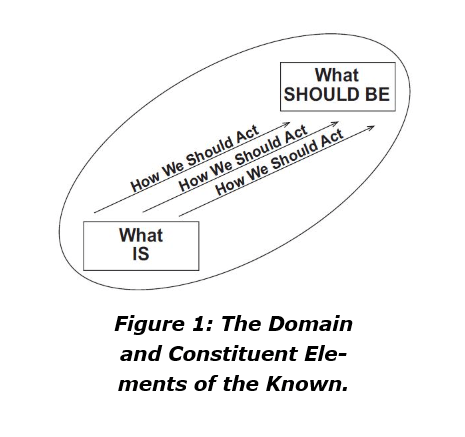
Description of these three elements—current state, ideal future state, and means of active mediation—constitute the necessary and sufficient preconditions for the weaving of the most simple narrative, which is a means for describing the valence of a given environment, in reference to a temporally and spatially bounded set of action patterns. Getting to point “b” presupposes that you are at point “a”—you can’t plan movement in the absence of an initial position. The fact that point “b” constitutes the end goal means that it is valenced more highly than point “a”—that it is a place more desirable, when considered against the necessary contrast of the current position. It is the perceived improvement of point “b” that makes the whole map meaningful or affect-laden; it is the capacity to construct hypothetical or abstract end points, such as “b”—and to contrast them against “the present”—that makes human beings capable of using their cognitive systems to modulate their affective reactions.

We know how to act in some places, and not in others. The plans we put into action sometimes work, and sometimes do not work. The experiential domains we inhabit—our “environments,” so to speak—are therefore permanently characterized by the fact of the predictable and controllable, in juxtaposition with the unpredictable and uncontrollable. The universe is composed of “order” and “chaos”—at least from the metaphorical perspective. Oddly enough, however, it is to this “metaphorical” universe that our nervous system appears to have adapted.

The unknown is, of course, defined in contradistinction to the known. Everything not understood or not explored is unknown. The relationship between the oft- (and unfairly) separated domains of “cognition” and “emotion” can be more clearly comprehended in light of this rather obvious fact. It is the absence of an expected satisfaction, for example, that is punishing, hurtful—the emotion is generated as a default response to sudden and unpredictable alteration in the theoretically comprehended structure of the world. It is the man expecting a raise because of his outstanding work—the man configuring a desired future on the basis of his understanding of the present—who is hurt when someone “less deserving” is promoted before him (“one is best punished,” after all, “for one’s virtues”). The man whose expectations have been dashed—who has been threatened and hurt—is likely to work less hard in the future, with more resentment and anger. Conversely, the child who has not completed her homework is thrilled when the bell signaling class end rings, before she is called upon. The bell signals the absence of an expected punishment, and therefore induces positive affect, relief, happiness.

The maps that configure our motivated behavior have a certain comprehensible structure. They contain two fundamental and mutually interdependent poles, one present, the other future. The present is sensory experience as it is currently manifested to us—as we currently understand it—granted motivational significance according to our current knowledge and desires. The future is an image or partial image of perfection, to which we compare the present, insofar as we understand its significance. Wherever there exists a mismatch between the two, the unexpected or novel occurs (by definition), grips our attention, and activates the intrapsychic systems that govern fear and hope.
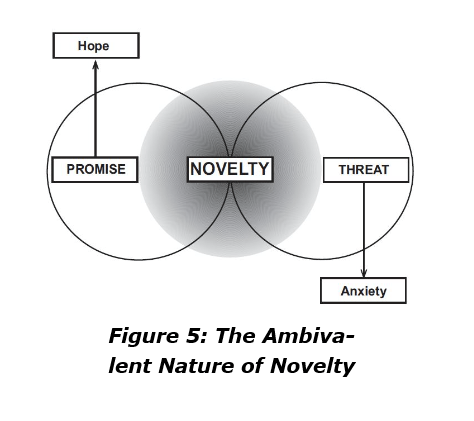
We strive to bring novel occurrences back into the realm of predictability or to exploit them for previously unconsidered potential by altering our behavior or our patterns of representation. We conceive of a path connecting present to future. This path is “composed” of the behaviors required to produce the transformations we desire— required to turn the (eternally) insufficient present into the (ever-receding) paradisal future. This path is normally conceived of as linear, so to speak, as something analogous to Thomas Kuhn’s notion of normal science, wherein known patterns of behavior operate.

What is the a priori motivational significance of the unknown? Can such a question even be asked? After all, the unknown by definition has not yet been explored. Nothing can be said, by the dictates of standard logic, about something that has not yet been encountered. We are not concerned with sensory information, however—nor with particular material attributes—but with valence. Valence, in and of itself, might be most simply considered as bipolar: negative or positive (or, of course, as neither). We are familiar enough with the ultimate potential range of valence, negative and positive, to place provisional borders around possibility. The worst the unknown could be, in general, is death (or, perhaps, lengthy suffering followed by death); the fact of our vulnerable mortality provides the limiting case. The best the unknown could be is more difficult to specify, but some generalizations might prove acceptable. We would like to be wealthy (or at least free from want), possessed of good health, wise and well-loved. The greatest good the unknown might confer, then, might be regarded as that which would allow us to transcend our innate limitations (poverty, ignorance, vulnerability), rather than to remain miserably subject to them. The emotional “area” covered by the unknown is therefore very large, ranging from that which we fear most to that which we desire most intently.

It appears, therefore, that the image of a goal (a fantasy about the nature of the desired future, conceived of in relationship to a model of the significance of the present) provides much of the framework determining the motivational significance of ongoing current events. The individual uses his or her knowledge to construct a hypothetical state of affairs, where the motivational balance of ongoing events is optimized: where there is sufficient satisfaction, minimal punishment, tolerable threat and abundant hope, all balanced together properly over the short and longer terms. This optimal state of affairs might be conceptualized as a pattern of career advancement, with a long-term state in mind, signifying perfection, as it might be attained profanely (richest drug dealer, happily married matron, chief executive officer of a large corporation, tenured Harvard professor).

Alternatively, perfection might be regarded as the absence of all unnecessary things, and the pleasures of an ascetic life. The point is that some desirable future state of affairs is conceptualized in fantasy and used as a target point for operation in the present. Such operations may be conceived of as links in a chain (with the end of the chain anchored to the desirable future state).
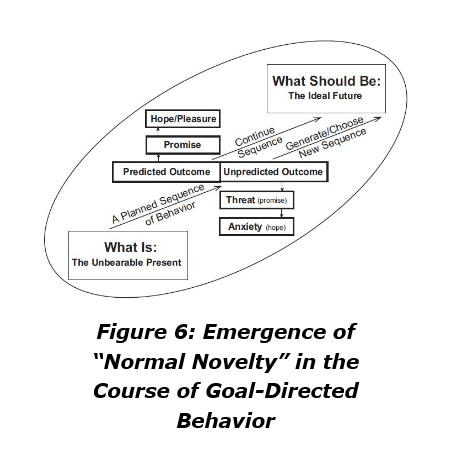
[Imagine this predicament] Your encounter with the terrible unknown has shaken the foundations of your worldview. You have been exposed, involuntarily, to the unexpected and revolutionary. Chaos has eaten your soul. This means that your long-term goals have to be reconstructed, and the motivational significance of events in your current environment reevaluated—literally revalued. This capacity for complete revaluation, in the light of new information, is even more particularly human than the aforementioned capability for exploration of the unknown and generation of new information. Sometimes, in the course of our actions, we elicit phenomena whose very existence is impossible, according to our standard methods of construal (which are at base a mode of attributing motivational significance to events). Exploration of these new phenomena, and integration of our findings into our knowledge, occasionally means reconceptualization of that knowledge (and consequent re-exposure to the unknown, no longer inhibited by our mode of classification). This means that simple movement from present to future is occasionally interrupted by a complete breakdown and reformulation, a reconstitution of what the present is and what the future should be. The ascent of the individual, so to speak, is punctuated by periods of dissolution and rebirth. The more general model of human adaptation—conceptualized most simply as steady state, breach, crisis, redress—therefore ends up looking like Figure 4: Revolutionary Adaptation.
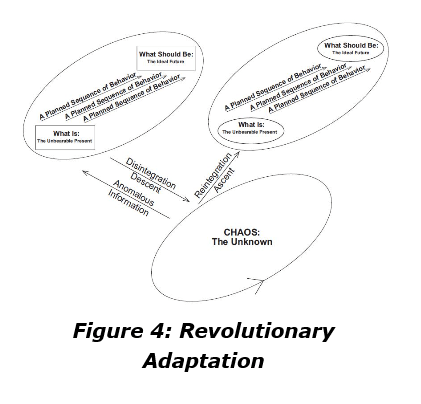
It is reasonable to regard the world, as forum for action, as a “place”—a place made up of the familiar, and the unfamiliar, in eternal juxtaposition. The brain is actually composed, in large part, of two subsystems, adapted for action in that place. The right hemisphere, broadly speaking, responds to novelty with caution, and rapid, global hypothesis formation. The left hemisphere, by contrast, tends to remain in charge when things—that is, explicitly categorized things—are unfolding according to plan. The right hemisphere draws rapid, global, valence-based, metaphorical pictures of novel things; the left, with its greater capacity for detail, makes such pictures explicit and verbal. Thus the exploratory capacity of the brain “builds” the world of the familiar (the known), from the world of the unfamiliar (the unknown).

When the world remains known and familiar—that is, when our beliefs maintain their validity—our emotions remain under control. When the world suddenly transforms itself into something new, however, our emotions are dysregulated, in keeping with the relative novelty of that transformation, and we are forced to retreat or to explore once again.

The essential similarities of our judgments of meaning can easily lead us to conclude that the goodness or badness of things or situations is something more or less fixed. However, the fact of subjective interpretation—and its effects on evaluation and behavior—complicate this simple picture. We will work, expend energy and overcome obstacles to gain a good (or to avoid something bad). But we won’t work for food, at least not very hard, if we have enough food; we won’t work for sex, if we are satisfied with our present levels of sexual activity; and we might be very pleased to go hungry, if that means our enemy will starve. Our predictions, expectations and desires condition our evaluations to a finally unspecifiable degree. Things have no absolutely fixed significance, despite our ability to generalize about their value. It is our personal preferences, therefore, that determine the import of the world (but these preferences have constraints!).

It is not possible to finally determine how or whether something is meaningful by observing the objective features of that thing. Value is not invariant, in contrast to objective reality; furthermore, it is not possible to derive an ought from an is (this is the “naturalistic fallacy” of David Hume). It is possible, however, to determine the conditional meaning of something, by observing how behavior (one’s own behavior, or someone else’s) is conducted in the presence of that thing (or in its absence). “Things” (objects, processes) emerge—into subjective experience, at least—as a consequence of behaviors.

Past experience—learning—does not merely condition; rather, such experience determines the precise nature of the framework of reference or context that will be brought to bear on the analysis of a given situation. This cognitive frame of reference acts as the intermediary between past learning, present experience and future desire. This intermediary is a valid object of scientific exploration—a phenomenon as real as anything abstracted is real—and is far more parsimonious and accessible, as such a phenomenon, than the simple noninterpreted (and nonmeasurable, in any case) sum total of reinforcement history. Frameworks of reference, influenced in their structure by learning, specify the valence of ongoing experience; determine what might be regarded, in a given time and place, as good, bad or indifferent. Furthermore, inferences about the nature of the framework of reference governing the behavior of others (that is, looking at the world through the eyes of another) may produce results that are more useful, more broadly generalizable (as “insights” into the “personality” of another), and less demanding of cognitive resources than attempts to understand the details of a given reinforcement history.

Our actual situations, however, are almost always more complex. If things or situations were straightforwardly or simply positive or negative, good or bad, we would not have to make judgments regarding them, would not have to think about our behavior, and how and when it should be modified—indeed, would not have to think at all. We are faced, however, with the constant problem of ambivalence in meaning, which is to say that a thing or situation might be bad and good simultaneously (or good in two conflicting manners; or bad, in two conflicting manners).
Nothing comes without a cost, and the cost has to be factored in, when the meaning of something is evaluated. Meaning depends on context; contexts—stories, in a word—constitute goals, desires, wishes. It is unfortunate, from the perspective of conflict-free adaptation, that we have many goals—many stories, many visions of the ideal future—and that the pursuit of one often interferes with our chances (or someone else’s chances) of obtaining another.

The plans we formulate are mechanisms designed to bring the envisioned perfect future into being. Once formulated, plans govern our behavior—until we make a mistake. A mistake, which is the appearance of a thing or situation not envisioned, provides evidence for the incomplete nature of our plans—indicates that those plans and the presumptions upon which they are erected are in error and must be updated (or, heaven forbid, abandoned). As long as everything is proceeding according to plan, we remain on familiar ground—but when we err, we enter unexplored territory.

Deviations from desired outcome constitute (relatively) novel events, indicative of errors in presumption, either at the level of analysis of current state, process or ideal future. Such mismatches—unpredictable, nonredundant or novel occurrences—constantly comprise the most intrinsically meaningful, interesting elements of the human experiential field. This interest and meaning signifies the presence of new information and constitutes a prepotent stimulus for human (and animal) action. It is where the unpredictable emerges that the possibility for all new and useful information exists. It is during the process of exploration of the unpredictable or unexpected that all knowledge and wisdom is generated, all boundaries of adaptive competence extended, all foreign territory explored, mapped and mastered.
St. George slaying the dragon.

Everything presently known to each, everything rendered predictable, was at one time unknown to all, and had to be rendered predictable—beneficial at best, irrelevant at worst—as a consequence of active exploration-driven adaptation. The matrix is of indeterminable breadth: despite our great storehouse of culture, despite the wisdom bequeathed to us by our ancestors, we are still fundamentally ignorant, and will remain so, no matter how much we learn. The domain of the unknown surrounds us like an ocean surrounds an island. We can increase the area of the island, but we never take away much from the sea.

The constant and universal presence of the incomprehensible in the world has elicited adaptive response from us and from all other creatures with highly developed nervous systems. We have evolved to operate successfully in a world eternally composed of the predictable, in paradoxical juxtaposition with the unpredictable. The combination of what we have explored and what we have still to evaluate actually comprises our environment, insofar as its nature can be broadly specified—and it is to that environment that our physiological structure has become matched. One set of the systems that comprise our brain and mind governs activity, when we are guided by our plans—when we are in the domain of the known. Another appears to operate when we face something unexpected— when we have entered the realm of the unknown.
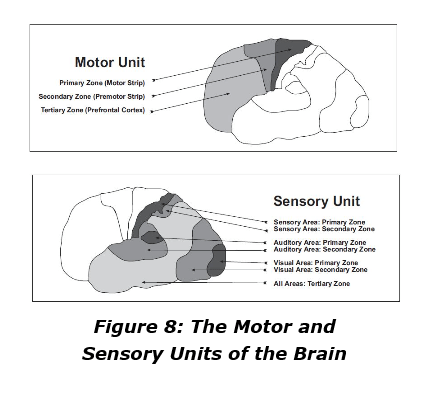
The consequence of exploration that allows for emotional regulation (that generates security, essentially) is not objective description, as the scientist might have it, but categorization of the implications of an unexpected occurrence for specification of means and ends. Such categorization is what an object “is,” from the perspective of archaic affect and subjective experience. The orienting reflex, and the exploratory behavior following its manifestation, also allows for the differentiation of the unknown into the familiar categories of objective reality. However, this ability is a late development, emerging only four hundred years ago, and cannot be considered basic to “thinking.”

The “higher” cortex controls behavior until the unknown emerges—until it makes a mistake in judgment, until memory no longer serves—until the activity it governs produces a mismatch between what is desired and what actually occurs. When such a mismatch occurs, appropriate affect (fear and curiosity) emerges.

It is the amygdala, at bottom, that appears responsible for the (disinhibited) generation of this a priori meaning—terror and curiosity. The amygdala appears to automatically respond to all things or situations, unless told not to. It is told not to—is functionally inhibited—when ongoing goal-directed behaviors produce the desired (intended) results. When an error occurs, however—indicating that current memory-guided motivated plans and goals are insufficient—the amygdala is released from inhibition and labels the unpredictable occurrence with meaning. Anything unknown is dangerous and promising, simultaneously: evokes anxiety, curiosity, excitement and hope automatically and prior to what we would normally regard as exploration or as (more context-specific) classification. The operations of the amygdala are responsible for ensuring that the unknown is regarded with respect, as the default decision.
The desired output of behavior (what should be) is initially posited; if the current strategy fails, the approach and exploration system is activated, although it remains under the governance of anxiety.

Classical behavioral psychology is wrong in the same manner our folk presumptions are wrong: fear is not secondary, not learned; security is secondary, learned. Everything not explored is tainted, a priori, with apprehension. Any thing or situation that undermines the foundations of the familiar and secure is therefore to be feared.

It might be said, with a certain amount of justification, that we devote our entire lives to making sure that we never have to face anything unknown, in the revolutionary sense—at least not accidentally. Our success in doing so deludes us about the true nature, power and intensity of our potential emotional responses. As civilized people, we are secure. We can predict the behaviors of others (that is, if they share our stories); furthermore, we can control our environments well enough to ensure that our subjection to threat and punishment remains at a minimum. It is the cumulative consequences of our adaptive struggle—our cultures—which enable this prediction and control. The existence of our cultures, however, blinds us to the nature of our true (emotional) natures—at least to the range of that nature, and to the consequences of its emergence.
Our emotional regulation depends as much (or more) on the stability and predictability of the social environment (on the maintenance of our cultures) as on “interior” processes, classically related to the strength of the ego or the personality. Social order is a necessary precondition for psychological stability: it is primarily our companions and their actions (or inactions) that stabilize or destabilize our emotions.

Modern experimental psychologists have begun to examine the response of animals to natural sources of mystery and threat. They allow the animals to set up their own environments, realistic environments, and then expose them to the kinds of surprising circumstances they might encounter in real life. The appearance of a predator in previously safe space (space previously explored, that is, and mapped as useful or irrelevant) constitutes one type of realistic surprise.

It is just as illuminating to consider the responses of rats to their kin, who constitute “explored territory,” in contrast to their attitude toward “strangers,” whose behavior is not predictable. Rats are highly social animals, perfectly capable of living with their familiar compatriots in peace. They do not like members of other kin groups, however; they will hunt them down and kill them. Accidental or purposeful intruders are dealt with in the same manner. Rats identify one another by smell. If an experimenter removes a well-loved rat from its familial surroundings, scrubs it down, provides it with a new odor, and returns it to its peers, it will be promptly dispatched by those who once loved it. The “new” rat constitutes “unexplored territory”; his presence is regarded as a threat (not unreasonably) to everything currently secure.

Chimpanzees, perfectly capable of killing “foreign devils” (even those who were once familiar), act in much the same manner.
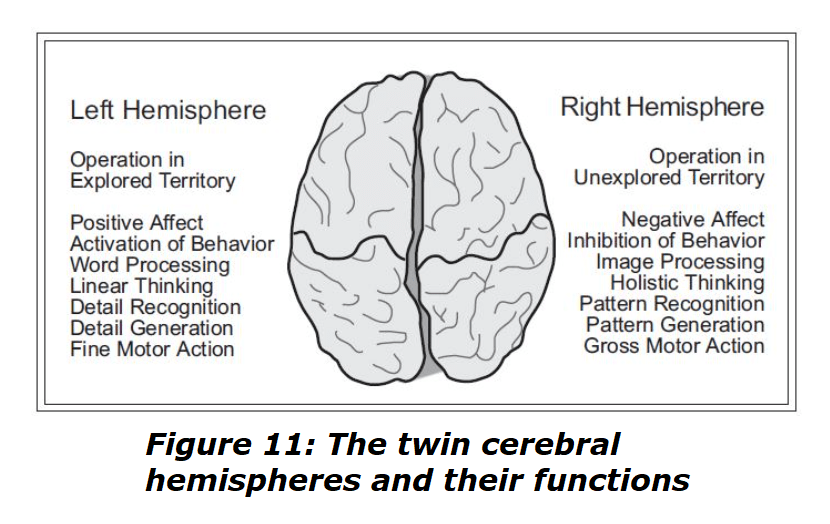
More sophistication in development of the prefrontal centers means, in part, heightened capability for abstract exploration, which means investigation in the absence of actual movement, which means the capacity to learn from the observation of others and through consideration of potential actions before they emerge in behavior. This means increasing capability for thought, considered as abstracted action and representation. Action and thought produce phenomena. Novel acts and thoughts necessarily produce new phenomena. Creative exploration, concrete and abstract, is therefore linked in a direct sense to being. Increased capacity for exploration means existence in a qualitatively different—even new—world. This entire argument implies, of course, that more complex and behaviorally flexible animals inhabit (“construct,” if you will) a more complex universe.

Combination of hand and eye enabled Homo sapiens to manipulate things in ways qualitatively different from those of any other animal. The individual can discover what things are like under various, voluntarily produced or accidentally encountered (yet considered) conditions— upside down, flying through the air, hit against other things, broken into pieces, heated in fire, and so on. The combination of hand and eye allowed human beings to experience and analyze the (emergent) nature of things. This ability, revolutionary as it was, was dramatically extended by application of hand-mediated, spoken (and written) language.

Simple animals perform simple operations and inhabit a world whose properties are equally constrained (a world where most “information” remains “latent”). Human beings can manipulate—take apart and put together—with far more facility than any other creature. Furthermore, our capacity for communication, both verbal and nonverbal, has meant almost unbelievable facilitation of exploration, and subsequent diversity of adaptation.

Thinking might in many cases be regarded as the abstracted form of exploration—as the capacity to investigate, without the necessity of direct motoric action. Abstract analysis (verbal and nonverbal) of the unexpected or novel plays a much greater role for humans than for animals—a role that generally takes primacy over action. It is only when this capacity fails partially or completely in humans—or when it plays a paradoxical role (amplifying the significance or potential danger of the unknown through definitive but “false” negative labeling)—that active exploration (or active avoidance), with its limitations and dangers, becomes necessary.

The capacity to create novel behaviors and categories of interpretation in response to the emergence of the unknown might be regarded as the primary hallmark of human consciousness—indeed, of human being. Our engagement in this process literally allows us to carve the world out of the undifferentiated mass of unobserved and unencountered “existence” (a form of existence that exists only hypothetically, as a necessary fiction; a form about which nothing can be experienced, and less accurately stated).

It is certainly the case that many of our skills and our automatized strategies of classification are “opaque” to explicit consciousness. The fact of our multiple memory systems, and their qualitatively different modes of representation—described later— ensures that such is the case. This opaqueness means, essentially, that we “understand” more than we “know”; it is for this reason that psychologists continue to depend on notions of the “unconscious” to provide explanations for behavior. This unconsciousness—the psychoanalytic god—is our capacity for the implicit storage of information about the nature and valence of things. This information is generated in the course of active exploration, and modified, often unrecognizably, by constant, multigenerational, interpersonal communication.

We know that the right hemisphere—at least its frontal portion—is specialized for response to punishment and threat. We also know that damage to the right hemisphere impairs our ability to detect patterns and to understand the meaning of stories. Is it too much to suggest that the emotional, imagistic and narrative capabilities of the right hemisphere play a key role in the initial stages of transforming something novel and complex, such as the behaviors of others (or ourselves) and the valence of new things, into something thoroughly understood?

The uniquely specialized capacities of the right hemisphere appear to allow it to derive from repeated observations of behavior images of action patterns that the verbal left can arrange, with increasingly logic and detail, into stories. A story is a map of meaning, a “strategy” for emotional regulation and behavioral output—a description of how to act in a circumstance, to ensure that the circumstance retains its positive motivational salience (or at least has its negative qualities reduced to the greatest possible degree).

The right hemisphere has the ability to decode the nonverbal and melodic aspects of speech, to empathize (or to engage, more generally, in interpersonal relationships), and the capacity to comprehend imagery, metaphor and analogy. The left-hemisphere “linguistic” systems “finish” the story, adding logic, proper temporal order, internal consistency, verbal representation, and possibility for rapid abstract explicit communication. In this way, our explicit knowledge of value is expanded, through the analysis of our own “dreams.” Interpretations that “work”—that is, that improve our capacity to regulate our own emotions (to turn the current world into the desired world, to say it differently)— qualify as valid. It is in this manner that we verify the accuracy of our increasingly abstracted presumptions.

Knowing-how information, described alternatively as procedural, habitual, dispositional, or skilled, and knowing-what information, described alternatively as declarative, episodic, factual, autobiographical, or representational, appear physiologically distinct in their material basis, and separable in course of phylo- and ontogenetic development.

Procedural knowledge develops long before declarative knowledge, in evolution and individual development, and appears represented in “unconscious” form, expressible purely in performance. Declarative knowledge, by contrast—knowledge of what—simultaneously constitutes consciously accessible and communicable episodic imagination (the world in fantasy) and subsumes even more recently developed semantic (linguistically mediated) knowledge, whose operations, in large part, allow for abstract representation and communication of the contents of the imagination.

It is only after behavioral (procedural) wisdom has become “represented” in episodic memory and portrayed in drama and narrative that it becomes accessible to “conscious” verbal formulation and potential modification in abstraction. Procedural knowledge is not representational, in its basic form. Knowing-how information, generated in the course of exploratory activity, can nonetheless be transferred from individual to individual, in the social community, through means of imitation.

Explicit (moral) philosophy arises from the mythos of culture, grounded in procedure, rendered progressively more abstract and episodic through ritual action and observation of that action. The process of increasing abstraction has allowed the knowing what “system” to generate a representation, in imagination, of the “implicit predicates” of behavior governed by the knowing how this faith.

kabuki-performance-osaka-japan-tips-averypartyof2

Kabuki performance in Japan.

Each developmental “stage”—action, imitation, play, ritual, drama, narrative, myth, religion, philosophy, rationality—offers an increasingly abstracted, generalized and detailed representation of the behavioral wisdom embedded in and established during the previous stage.

The fact that the many “stories” we live by can be coded and transmitted at different levels of “abstraction,” ranging from the purely motoric or procedural (transmitted through imitation) to the more purely semantic (transmitted through the medium of explicit ethical philosophy, say) makes comprehension of their structure and interrelationships conceptually difficult. This difficulty is compounded by the fact that different stories have different spatial-temporal “resolutions”—that is, we may be governed at one moment by short-term, simple considerations and at the next by longer term, more complex considerations.

Our stories are nested (one thing leads to another) and hierarchically arranged [pursuit “a” is superordinate to pursuit “b” (love is more important than money)]. Within this nested hierarchy, our consciousness—our apperception—appears to have a “natural” level of resolution, or categorization. This default resolution is reflected in the fact, as alluded to previously, of the basic object level. We “see” some things naturally; that is, in Roger Brown’s terminology, at a level that gives us “maximal information with minimal cognitive effort.” I don’t know what drives the mechanism that determines the appropriate level of analysis. Elements of probability and predictability must play a role. It is, after all, increasingly useless to speculate over increasingly large spatial-temporal areas, as the number of variables that must be considered increases rapidly, even exponentially (and the probability of accurate prediction, therefore, decreases). Perhaps the answer is something along the lines of “the simplest solution that does not generate additional evident problems wins,” which I suppose is a variant of Occam’s razor. So the simplest cognitive/exploratory maneuver that renders an unpredictable occurrence conditionally predictable or familiar is most likely to be adopted. This is another example of proof through utility—if a solution “works” (serves to further progress toward a given goal), then it is “right.”

Footnote:  The discussion about rats and chimps reminded me of this.
 

Cosmic Dichotomy: Peterson’s Pearls (1)

This is the first of a series of posts based upon Jordan Peterson’s book Maps of Meaning, published in 1999 after 17 years of research and writing. It is rich in description and insight with many references and quotations from original sources. Reading it I began to copy passages that struck me as especially lucid and pertinent. Those paragraphs of his text are provided below in italics as excerpts selected to explain five themes emerging in my reflections while pondering his book. This post explores one of those themes. Before that is an overview to explain why this is important to me and perhaps to others.

Introduction, Context and My Reflections

I have long been interested in the interface between science and religion, since my education includes degrees in both Organic Chemistry and Theology. The interaction between faith and fact is brought to heightened awareness by Jordan Peterson’s book Maps of Meaning bringing recent psychology and neurology insights to bear on the interrelation. As usual, Peterson surprises by staking out a position honoring and balancing seemingly contrary perspectives. The history of science is replete with examples of how observations and and discoveries were motivated by flashes of inspiration coming from hidden places. One guru I admired used to say he went to sleep with questions and in the morning he could comb the answers out of his hair. The structure of benzene was revealed long ago in just that way.

Peterson provides a framework for understanding and appreciating how myth and science serve us, how we operate in a zone between known and unknown, between what is and what should be. And he reminds us that mythological thinking is primordial for both individuals and societies. Reading this book reminded me of experiences working in community development when I would lead workshop discussions with people wanting to improve their neighborhoods or villages. At the round-table brainstorming we asked them to say what things in their community they would change to make it better. And as Peterson notes, the responses most often came out of the ideal, their community as it should be. For instance, someone might say, “There is a lack of community services.” My job as facilitator was to press that participant to describe the specific existing condition of concern. The interchange might end with a statement: “The streets are full of junk people just throw away. It just stays there and the place is mess.” Now we have an actionable item: A definite gap between “what is” and “what should be.” After an hour or more, we have a list of dozens of items that can be categorized into targets for improvement programs. In management and organizational consulting there is a saying: “A problem well-defined is halfway solved.” The next step is making a plan to get from a to b.

So the ideal or mythological provides a value set from which we choose things to study and to bring under our control either by understanding (reducing the fear of the unknown), or by actually manipulating the thing to serve our purpose. Ancient stargazers designed constellations and gave them mythological identities to make them familiar and less menacing. Astrologers provided guidance how to take advantage or precaution in our actions considering the stars and planets influences. With advances in telescopes astronomers could map the orbits, and events like eclipses could be predicted, making them them occasions of wonder rather than terror.

The field of climate is in a rudimentary state. The ancients made sacrifices to assure favorable weather for agriculture and for safety from storms. Climatology was and is the documenting of weather observations to discern patterns over seasons, years and longer. Weather forecasting makes use of such patterns and enhanced observations from airplanes, drones and satellites to give us warnings and time to prepare for destructive events. The mythological is honored by giving human names to storms, originally only female designations, respecting the unpredictable nature of the timing and location of destruction. (Q: Why is a woman like a hurricane? A: She comes in hot and steamy, and she leaves with your house and car.)

Nowadays, weather forecasts are improved but still are increasingly uncertain after a few days, being SWAGs after a week. (Scientific Wild-Ass Guess). Storms may now have male names, since men can also be out of control. Gender-neutral names are the latest development, to the point where some PC parents name a child “Storm” not to limit its gender options. If this suggests that a new mythology has overtaken the science, then you have got my drift. The whole notion that our computer models can predict future surface temperatures up to a century from now shows that climatology is closer to astrology than to astronomy.

Those who claim “The Science is Settled” are actually giving up on our understanding climate. As Peterson says, unexplored territory is approached with fear and any approach is made under anxiety, which is exactly what global warming doomsayers are manifesting. Many of these are urban dwellers who fear that nature is out of control, and they default to a mindset typical of pre-experimental people. In a primitive way they think that cities can be spared by sacrificing fossil fuels like a sacrificial lamb. In olden days people made idols in their own images and worshiped them to ensure favorable weather. Today people bow before computer models they have made, whose predictions are sure to scare the bejesus out of us.

[Note: I use the word “cosmic” since each individual’s world is at risk, and as we see in the agitation over climate change, entire social groups can also fear for their collective world.]

Jordan Peterson on the Cosmic Dichotomy (Excerpts from Maps of Meaning: The Architecture of Belief Title is link to pdf)

My religious convictions, ill-formed to begin with, disappeared when I was very young. My confidence in socialism (that is, in political utopia) vanished when I realized that the world was not merely a place of economics. My faith in ideology departed, when I began to see that ideological identification itself posed a profound and mysterious problem. I could not accept the theoretical explanations my chosen field of study had to offer, and no longer had any practical reasons to continue in my original direction. I finished my three-year bachelor’s degree, and left university. All my beliefs—which had lent order to the chaos of my existence, at least temporarily—had proved illusory; I could no longer see the sense in things. I was cast adrift; I did not know what to do or what to think.

The people I knew well were no more resolutely goal-directed or satisfied than I was. Their beliefs and modes of being seemed merely to disguise frequent doubt and profound disquietude. More disturbingly, on the more general plane, something truly insane was taking place. The great societies of the world were feverishly constructing a nuclear machine, with unimaginably destructive capabilities. Someone or something was making terrible plans. Why? Theoretically normal and well-adapted people were going about their business prosaically, as if nothing were the matter. Why weren’t they disturbed? Weren’t they paying attention? Wasn’t I?

My concern with the general social and political insanity and evil of the world— sublimated by temporary infatuation with utopian socialism and political machination— returned with a vengeance. The mysterious fact of the Cold War increasingly occupied the forefront of my consciousness. How could things have come to such ah point?

All the things I “believed” were things I thought sounded good, admirable, respectable, courageous. They weren’t my things, however—I had stolen them. Most of them I had taken from books. Having “understood” them, abstractly, I presumed I had a right to them—presumed that I could adopt them, as if they were mine: presumed that they were me. My head was stuffed full of the ideas of others; stuffed full of arguments I could not logically refute. I did not know then that an irrefutable argument is not necessarily true, nor that the right to identify with certain ideas had to be earned.

The study of “comparative mythological material” in fact made my horrible dreams disappear. The cure wrought by this study, however, was purchased at the price of complete and often painful transformation: what I believe about the world, now—and how I act, in consequence—is so much at variance with what I believed when I was younger that I might as well be a completely different person.

I discovered that beliefs make the world, in a very real way—that beliefs are the world, in a more than metaphysical sense. This discovery has not turned me into a moral relativist, however: quite the contrary. I have become convinced that the world-that-is-belief is orderly; that there are universal moral absolutes (although these are structured such that a diverse range of human opinion remains both possible and beneficial). I believe that individuals and societies who flout these absolutes—in ignorance or in willful opposition—are doomed to misery and eventual dissolution.

I hope that I can bring those who read this book to the same conclusions, without demanding any unreasonable “suspension of critical judgment”—excepting that necessary to initially encounter and consider the arguments I present.

The world can be validly construed as a forum for action, as well as a place of things. We describe the world as a place of things, using the formal methods of science. The techniques of narrative, however—myth, literature and drama—portray the world as a forum for action. The two forms of representation have been unnecessarily set at odds, because we have not yet formed a clear picture of their respective domains. The domain of the former is the objective world—what is, from the perspective of intersubjective perception. The domain of the latter is the world of value—what is and what should be, from the perspective of emotion and action.

The former manner of interpretation-more primordial, and less clearly understood-finds its expression in the arts or humanities, in ritual, drama, literature and mythology. The world as forum for action is a place of value, a place where all things have meaning. This meaning, which is shaped as a consequence of social interaction, is implication for action, or-at a higher level of analysisimplication for the configuration of the interpretive schema that produces or guides action.

The latter manner of interpretation-the world as place of things-finds its formal expression in the methods and theories of science. Science allows for increasingly precise determination of the consensually validatable properties of things, and for efficient utilization of precisely determined things as tools (once the direction such use is to take has been determined, through application of more fundamental narrative processes).

No complete world-picture can be generated without use of both modes of construal. The fact that one mode is generally set at odds with the other means only that the nature of their respective domains remains insufficiently discriminated. Adherents of the mythological worldview tend to regard the statements of their creeds as indistinguishable from empirical “fact,” even though such statements were generally formulated long before the notion of objective reality emerged. Those who, by contrast, accept the scientific perspective—who assume that it is, or might become, complete—forget that an impassable gulf currently divides what is from what should be.

We need to know four things:
what there is,
what to do about what there is,
that there is a difference between knowing what there is, and knowing what to do about what there is
and what that difference is.

Imagine that a baby girl, toddling around in the course of her initial tentative investigations, reaches up onto a countertop to touch a fragile and expensive glass sculpture. She observes its color, sees its shine, feels that it is smooth and cold and heavy to the touch. Suddenly her mother interferes, grasps her hand, tells her not to ever touch that object. The child has just learned a number of specifically consequential things about the sculpture—has identified its sensory properties, certainly. More importantly, however, she has determined that approached in the wrong manner, the sculpture is dangerous (at least in the presence of mother); has discovered as well that the sculpture is regarded more highly, in its present unaltered configuration, than the exploratory tendency—at least (once again) by mother. The baby girl has simultaneously encountered an object, from the empirical perspective, and its socioculturally determined status. The empirical object might be regarded as those sensory properties “intrinsic” to the object. The status of the object, by contrast, consists of its meaning—consists of its implication for behavior. Everything a child encounters has this dual nature, experienced by the child as part of a unified totality. Everything is something, and means something—and the distinction between essence and significance is not necessarily drawn.

The automatic attribution of meaning to things—or the failure to distinguish between them initially—is a characteristic of narrative, of myth, not of scientific thought. Narrative accurately captures the nature of raw experience. Things are scary, people are irritating, events are promising, food is satisfying—at least in terms of our basic experience. The modern mind, which regards itself as having transcended the domain of the magical, is nonetheless still endlessly capable of “irrational” (read motivated) reactions. We fall under the spell of experience whenever we attribute our frustration, aggression, devotion or lust to the person or situation that exists as the proximal “cause” of such agitation. We are not yet “objective,” even in our most clear-headed moments (and thank God for that). We become immediately immersed in a motion picture or a novel, and willingly suspend disbelief. We become impressed or terrified, despite ourselves, in the presence of a sufficiently powerful cultural figurehead (an intellectual idol, a sports superstar, a movie actor, a political leader, the pope, a famous beauty, even our superior at work)—in the presence, that is, of anyone who sufficiently embodies the oft-implicit values and ideals that protect us from disorder and lead us on.

The “natural,” pre-experimental, or mythical mind is in fact primarily concerned with meaning—which is essentially implication for action—and not with “objective” nature. . .And, in truth—in real life—to know what something is still means to know two things about it: its motivational relevance, and the specific nature of its sensory qualities. The two forms of knowing are not identical; furthermore, experience and registration of the former necessarily precedes development of the latter. Something must have emotional impact before it will attract enough attention to be explored and mapped in accordance with its sensory properties.

How, precisely, did people think, not so very long ago, before they were experimentalists? What were things before they were objective things? These are very difficult questions. The “things” that existed prior to the development of experimental science do not appear valid either as things or as the meaning of things to the modern mind.

The alchemist could not separate his subjective ideas about the nature of things—that is, his hypotheses—from the things themselves. His hypotheses, in turn—products of his imagination—were derived from the unquestioned and unrecognized “explanatory” presuppositions that made up his culture. The medieval man lived, for example, in a universe that was moral—where everything, even ores and metals, strived above all for perfection. Things, for the alchemical mind, were therefore characterized in large part by their moral nature—by their impact on what we would describe as affect, emotion or motivation; were therefore characterized by their relevance or value (which is impact on affect). Description of this relevance took narrative form, mythic form—as in the example drawn from Jung, where the sulphuric aspect of the sun’s substance is attributed negative, demonic characteristics. It was the great feat of science to strip affect from perception, so to speak, and to allow for the description of experiences purely in terms of their consensually apprehensible features. However, it is the case that the affects generated by experiences are real, as well.

We have lost the mythic universe of the pre-experimental mind, or have at least ceased to further its development. That loss has left our increased technological power ever more dangerously at the mercy of our still unconscious systems of valuation.

Prior to the time of Descartes, Bacon and Newton, man lived in an animated, spiritual world, saturated with meaning, imbued with moral purpose. The nature of this purpose was revealed in the stories people told each other—stories about the structure of the cosmos and the place of man. But now we think empirically (at least we think we think empirically), and the spirits that once inhabited the universe have vanished.

Furthermore—and more importantly—the new theories that arose to make sense of empirical reality posed a severe threat to the integrity of traditional models of reality, which had provided the world with determinate meaning. The mythological cosmos had man at its midpoint; the objective universe was heliocentric at first, and less than that later. Man no longer occupies center stage. The world is, in consequence, a completely different place.

The mythological perspective has been overthrown by the empirical; or so it appears. This should mean that the morality predicated upon such myth should have disappeared, as well, as belief in comfortable illusion vanished.

If the presuppositions of a theory have been invalidated, argues Nietzsche, then the theory has been invalidated. But in this case the “theory” survives. The fundamental tenets of the Judeo-Christian moral tradition continue to govern every aspect of the actual individual behavior and basic values of the typical Westerner—even if he is atheistic and well-educated, even if his abstract notions and utterances appear iconoclastic.

Our systems of post-experimental thought and our systems of motivation and action therefore co-exist in paradoxical union. One is “up-to-date”; the other, archaic. One is scientific; the other, traditional, even superstitious. We have become atheistic in our description, but remain evidently religious—that is, moral—in our disposition.

We have become trapped by our own capacity for abstraction: it provides us with accurate descriptive information but also undermines our belief in the utility and meaning of existence. This problem has frequently been regarded as tragic (it seems to me, at least, ridiculous)—and has been thoroughly explored in existential philosophy and literature.

Our behavior is shaped (at least in the ideal) by the same mythic rules—thou shalt not kill, thou shalt not covet—that guided our ancestors for the thousands of years they lived without benefit of formal empirical thought. This means that those rules are so powerful—so necessary, at least—that they maintain their existence (and expand their domain) even in the presence of explicit theories that undermine their validity. That is a mystery. And here is another:

How is it that complex and admirable ancient civilizations could have developed and flourished, initially, if they were predicated upon nonsense? If a culture survives, and grows, does that not indicate in some profound way that the ideas it is based upon are valid?

Our great rationalist ideologies, after all—fascist, say, or communist— demonstrated their essential uselessness within the space of mere generations, despite their intellectually compelling nature. Traditional societies, predicated on religious notions, have survived—essentially unchanged, in some cases, for tens of thousands of years. How can this longevity be understood?

We do not understand pre-experimental thinking, so we try to explain it in terms that we do understand—which means that we explain it away, define it as nonsense. After all, we think scientifically—so we believe—and we think we know what that means (since scientific thinking can in principle be defined). We are familiar with scientific thinking and value it highly—so we tend to presume that it is all there is to thinking (presume that all other “forms of thought” are approximations, at best, to the ideal of scientific thought). But this is not accurate. Thinking also and more fundamentally is specification of value, specification of implication for behavior.

The painstaking empirical process of identification, communication and comparison has proved to be a strikingly effective means for specifying the nature of the relatively invariant features of the collectively apprehensible world. Unfortunately, this useful methodology cannot be applied to determination of value—to consideration of what should be, to specification of the direction that things should take (which means, to description of the future we should construct, as a consequence of our actions). Such acts of valuation necessarily constitute moral decisions. We can use information generated in consequence of the application of science to guide those decisions, but not to tell us if they are correct. We lack a process of verification, in the moral domain, that is as powerful or as universally acceptable as the experimental (empirical) method in the realm of description.

This absence does not allow us to sidestep the problem. No functioning society or individual can avoid rendering moral judgment, regardless of what might be said or imagined about the necessity of such judgment. Action presupposes valuation, or its implicit or “unconscious” equivalent. To act is literally to manifest preference about one set of possibilities, contrasted with an infinite set of alternatives. If we wish to live, we must act. Acting, we value. Lacking omniscience, painfully, we must make decisions, in the absence of sufficient information. It is, traditionally speaking, our knowledge of good and evil, our moral sensibility, that allows us this ability. It is our mythological conventions, operating implicitly or explicitly, that guide our choices. But what are these conventions? How are we to understand the fact of their existence? How are we to understand them?

Our constant cross-cultural interchanges and our capacity for critical reasoning have undermined our faith in the traditions of our forebears, perhaps for good reason. However, the individual cannot live without belief—without action and valuation—and science cannot provide that belief. We must nonetheless put our faith into something. Are the myths we have turned to since the rise of science more sophisticated, less dangerous, and more complete than those we rejected?

The ideological structures that dominated social relations in the twentieth century appear no less absurd, on the face of it, than the older belief systems they supplanted; they lacked, in addition, any of the incomprehensible mystery that necessarily remains part of genuinely artistic and creative production. The fundamental propositions of fascism and communism were rational, logical, statable, comprehensible—and terribly wrong.

No great ideological struggle presently tears at the soul of the world, but it is difficult to believe that we have outgrown our gullibility. The rise of the New Age movement in the West, for example—as compensation for the decline of traditional spirituality—provides sufficient evidence for our continued ability to swallow a camel, while straining at a gnat.

Could we do better? Is it possible to understand what might reasonably, even admirably, be believed, after understanding that we must believe? Our vast power makes self-control (and, perhaps, self-comprehension) a necessity—so we have the motivation, at least in principle. Furthermore, the time is auspicious. The third Christian millennium is dawning—at the end of an era when we have demonstrated, to the apparent satisfaction of everyone, that certain forms of social regulation just do not work (even when judged by their own criteria for success).

Footnote: Navajos and Prairie Dogs

The intersection of folk and scientific wisdom is demonstrated in a case regarding an Arizona Navajo reservation.

Government officials in the 1950’s proposed to get rid of prairie dogs on some parts of the reservation in order to protect the roots of the sparse desert grass and thereby maintain at least marginal grazing for sheep.

Navajos objected strongly, insisting, “If you kill off all the prairie dogs, there will be no one to cry for the rain.” Of course they were assured by the amused government men that there was no conceivable connection between rain and prairie dogs, a fact that could be proven easily by a simple scientific experiment: a specific area would be set aside and all the burrowing animals there would be exterminated.

The experiment was carried out, over the continued objections of the Navajos, and its outcome was surprising only to the white scientists. Today, the area […] has become a virtual wasteland with very little grass. Apparently, without the ground-turning processes of the little burrowing animals, the sand in the area becomes solidly packed, causing a fierce runoff whenever it rains.

It would be incautious to suggest in this instance that the Navajos were possessed of a clear, conscious objective theory about water retention and absorption in packed sand. On the other hand, it would be difficult to ignore the fact that the Navajo myth system, which insists on delicate reciprocal responsibilities among elements of nature, dramatized more accurately than our science the results of an imbalance between principals in the rain process. (Barre Toelken here p. 21)

But folk wisdom is an unreliable, inconsistent kind of wisdom. For one thing, most proverbs coexist with their exact opposites, or at least with proverbs that give somewhat different advice. Now that climate change has passed into social discourse, proverbs and unsubstantiated claims are voiced among like-minded people, thereby reinforcing shared beliefs without any critical analysis to verify an objective reality to the sayings.

Disney’s portrayal of the Sorcerer’s Apprentice in over his head.

The moral of the story pertains to the arrogance of scientists who think they have empirical understanding of a natural system, and can predict its behavior. The deeper truth is that even when knowledge is added by experiment, life and the world contain other mysteries yet to be explored. Each new answer raises many new questions, if we are brave and curious enough to investigate. In later posts, Peterson gets into the perversion of turning a present scientific understanding into an ideology, i.e. freezing a relative, incomplete known into a myth, thus discouraging further analysis in order to protect the status quo.