Climate Extrasensory Perception

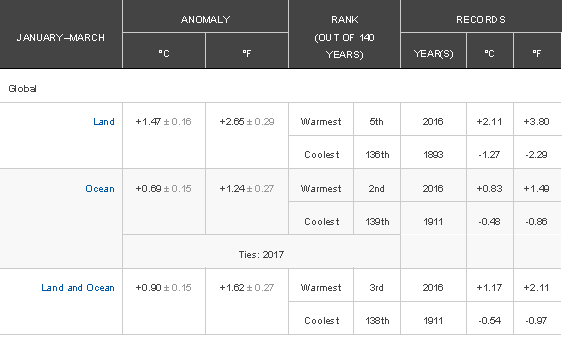
A recent post Climate Hearsay featured an article by Ross McKitrick noting how climatists rely on charts and graphs to alarm people about temperature changes too small for them to notice otherwise.  For example, NOAA each month presents temperature measurements globally and broken down in various ways.  To illustrate McKitrick’s point, let’s look at the results for Quarter 1 of 2019, January through March.  Source: Global Climate Report

So the chart informs us that for this 3 month period, the whole world had its third warmest year out of the last 140 years!  2016 was a full 0.27℃ hotter on average over those 90 days.  Well, maybe not, because the error range is given as +/- 0.15℃.  So the difference this year from the record year 2016 might have been only a few 0.01℃, and no way you could have noticed that.  In fact where I live in Montreal, it didn’t seem like a warm year at all.

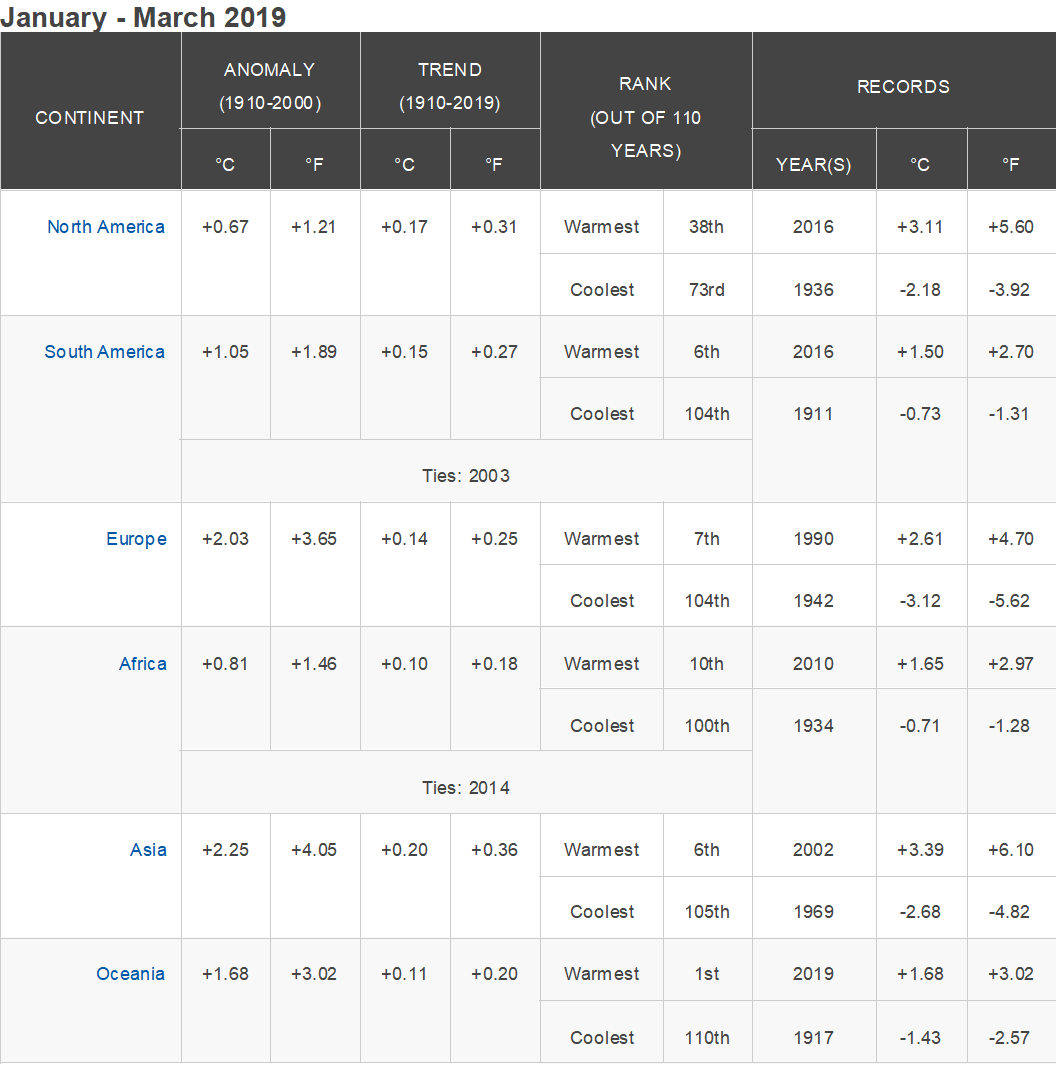
McKitrick also makes the point that claiming a country like Canada warmed more than twice the global average proves nothing.  In a cooling period, any place on land will cool faster than the global surface which is 71% ocean.  Same thing goes for warming: land temps change faster. For example, consider NOAA’s first quarter report on the major continents.

Surprise, surprise: North American temperatures ranked 38th out of 110 years, more than 2℃ cooler than 2016.  That’s more like what I experienced, though many days were much colder.  And browse the list of other land places: it was not that warm anywhere except for Oceania, with the land mass mostly in Australia.

Summary

Global warming/climate change is one of those everywhere, elsewhere phenomena.  Taking masses of temperatures and averaging them into a GMT (Global Mean Temperature Anomaly) is an abstraction, not anyone’s reality.  And in addition, minute changes in that abstraction are too small for anyone to sense.  Yet, modern civilization is presumed to be in crisis over 1.5℃ of additional warming, which we apparently already got in Canada and we are much better for it.

Some people worry Global Warming is changing how fast the Earth spins. Have you noticed?

Footnote:

Mike Hulme is a leading voice striking a rational balance between concern about the planet and careful deliberation over policy choices.  I have posted several of his articles, for example on extreme weather attribution and on attempts to link armed conflicts with climate change.  Pertinent to this post, Hulme has spoken out on the obsession with global temperature anomalies: See Obsessing Over Global Temperatures

Global temperature does not cause anything to happen. It has no material agency. It is an abstract proxy for the aggregated accumulation of heat in the surface boundary layer of the planet. It is far removed from revealing the physical realities of meteorological hazards occurring in particular places. And forecasts of global temperature threshold exceedance are even further removed from actionable early warning information upon which disaster risk management systems can work.

Global temperature offers the ultimate view of the planet—and of meteorological hazard—from nowhere.

And he has warned about the emergency rhetoric now on full display in the streets of major cities.  See Against Emergency Countdown

But as we argued a few years ago, declaring a climate emergency invokes a state of exception that carries many inherent risks: the suspension of normal governance, the use of coercive rhetoric, calls for ‘desperate measures’, shallow thinking and deliberation, and even militarization. To declare an emergency becomes an act of high moral and political significance, as it replaces the framework of ordinary politics with one of extraordinary politics.

In contrast, a little less rhetorical heat will allow for more cool-headed policy development. What is needed is clear-headed pragmatism, but without the Sword of Damocles hanging over these heads. Climate Pragmatism calls for accelerating technology innovation, including nuclear energy, for tightening local air quality standards, for sector-, regional- and local-level interventions to alter development trajectories and for major investments in improving female literacy. Not desperate measures called forth by the unstable politics of a state of emergency, but right and sensible things to do. And it is never too late to do the right thing.


Warmists Epic History Fail

epic fail

Geologist Gregory Whitestone provides a climate history lesson for warmists who skipped history classes protesting against global warming.  His article at Town Hall is Ocasio-Cortez’s Climatology Lacks Historical Context. Excerpts in italics with my bolds. H/T Climate Depot.

When Sam Cooke sang “Don’t know much about history” in 1960 he could not have had U.S. Rep. Alexandria Ocasio-Cortez in mind, but only because she lives a half century later.

Whatever Ocasio-Cortez got from history classes during her time at Boston University, it wasn’t an appreciation of historical context because it is sorely lacking in her assertions about climate and its effect on humankind. She and others promoting the Green New Deal have the facts exactly backwards when they claim that warming temperatures are an existential threat to humanity.

Ocasio-Cortez recently warned in a House Oversight Committee hearing that the United States would have “blood on our hands” if legislation to tackle climate change was not passed. In questioning former Secretary of Defense Chuck Hagel, she alleged that “denial or even delaying in that action could cost us American life.”

Is that the case? Has increasing temperature been associated with negative impacts on the human condition? Common sense would seem to dictate that higher temperatures would lead to more drought and then to famine and ultimately to loss of life.

However, the story is different upon checking several thousands of years of extensive documentation covering the most recent warming trends to see how humans fared with temperatures like those predicted to occur by 2050 or 2100.

As it turns out, there is a great correlation between the rise and fall of temperature and the rise and fall of civilization, and the human experience is not the apocalypse you are being told to expect. Very consistently, throughout the last 3,500 years, humanity has prospered and thrived during warming periods, while the intervening colder periods witnessed crop failure, famine and mass depopulation. In fact, before climate science became politicized in the late 20th century, the warm eras were known as “Climate Optima” because both people and the Earth’s ecosystems benefited.

The last three warming trends corresponded with large advances in culture, science and technology. The Minoan (Bronze Age), Roman (Iron Age) and Medieval (High Middle Ages) periods were all much warmer than our current temperature and all benefited greatly from the rising temperature. Likely the most significant factor that allowed advances in civilization was a plentiful supply of food. Crops flourished and allowed time for the citizens of each culture to think, to dream and to invent.

Lucas van Valckenborch painted a cold winter landscape set near Antwerp, Belgium, in 1575, when Europe was in the midst of the Little Ice Age. Städel/Wikimedia Commons

Contrary to what we are being told by modern prophets of climate doom, it was the intervening cold that was devastating and led to the fall of empires and the collapse of civilizations. With names like the Greek Dark Ages, the Dark Ages and the Little Ice Age, these cold periods’ accompanying crop failure, famine, and mass depopulation were horrific for people.

The most recent and best documented cold period was the Little Ice Age (1250 – 1850 AD) which brought severe hardship, primarily in the northern latitudes. The combination of bitterly cold winters and cool, wet summers led to poor harvests, hunger and widespread death. Half the population of Iceland perished, and as much as one-third of humankind was decimated.

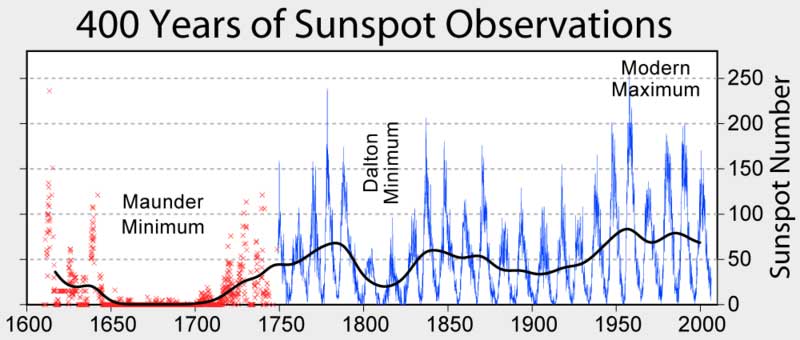
The worst cold of the Little Ice Age occurred in the late 17th century during a time known as the Maunder Minimum, which is linked to inactivity of the Sun. Based on the Central England Temperature record (the longest thermometer-based record) the depths of the cold were reached in the year 1695. For the next 40 years temperatures rose quickly and at several times the rate of warming measured in the 20th century.

The warming that began in the late 17th century continued for the next 300-plus years, ushering in an era of advancement unseen during any other period in humanity’s existence. It is what author W. Cleon Skousen called the “5,000 Year Leap” — five millennia of advances in communication, transportation, energy and exploration, and a doubling of the average length of human life, all condensed into less than 200 years. A myriad of factors were responsible, but it is certainly not clear that this progress would have occurred had Earth still been mired in the frigid temperatures of the Little Ice Age.

Last year, while Scott Pruitt was still the administrator of the EPA, he posed the question of how anyone could know what the ideal temperature of the Earth should be. Well known climate scientist Dr. Michael Mann of Penn State responded to Pruitt’s question by stating that the ideal temperature would be that which pre-dated the burning of fossil fuels. That temperature would put us squarely in the middle of the Little Ice Age’s devastating cold and history tells us that it turned out quite poorly.

History tells us that warming is very, very good, while cold is very, very bad.

Perhaps both Ocasio-Cortez and Mann should be labeled as “history deniers” for ignoring the true relationship between temperature and the human condition.

Footnote:  The obsession with a slight rise in average temperatures in the last 100 years is all the more remarkable for taking that warming totally out of context.
Any warming is good, even this small amount seen in the context of a year in the life of a typical American.  Moreover, the details of the statistics reveal that the rise is the result of cold months being warmer, while hotter months have cooled very slightly.  False Alarm.

Postscript (old soviet joke):  During soviet Russia era a professor addressed his history class, “I have good news and bad news about your final exam.  The good news is that all the questions are the same as last year.  The bad news:  Some of the answers are different.”

March Cools Seas More Than Land Warms

banner-blog

With apologies to Paul Revere, this post is on the lookout for cooler weather with an eye on both the Land and the Sea.  UAH has updated their tlt (temperatures in lower troposphere) dataset for March.   Previously I have done posts on their reading of ocean air temps as a prelude to updated records from HADSST3. This month also has a separate graph of land air temps because the comparisons and contrasts are interesting as we contemplate possible cooling in coming months and years.

Presently sea surface temperatures (SST) are the best available indicator of heat content gained or lost from earth’s climate system.  Enthalpy is the thermodynamic term for total heat content in a system, and humidity differences in air parcels affect enthalpy.  Measuring water temperature directly avoids distorted impressions from air measurements.  In addition, ocean covers 71% of the planet surface and thus dominates surface temperature estimates.  Eventually we will likely have reliable means of recording water temperatures at depth.

Recently, Dr. Ole Humlum reported from his research that air temperatures lag 2-3 months behind changes in SST.  He also observed that changes in CO2 atmospheric concentrations lag behind SST by 11-12 months.  This latter point is addressed in a previous post Who to Blame for Rising CO2?

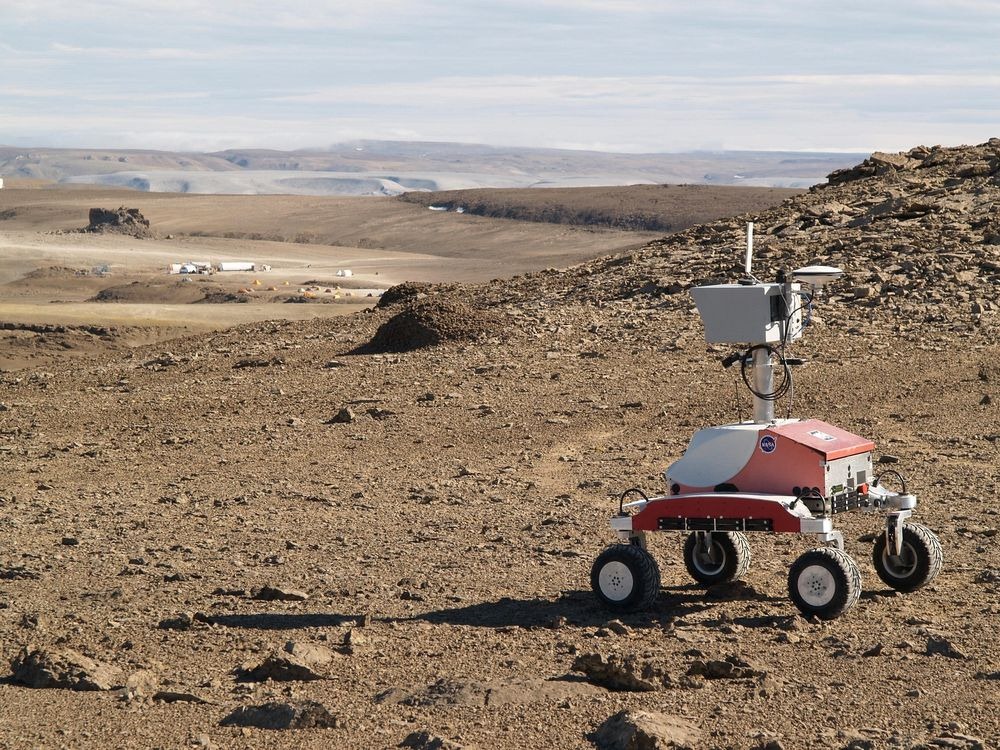
The March update to HadSST3 will appear later this month, but in the meantime we can look at lower troposphere temperatures (TLT) from UAHv6 which are already posted for March. The temperature record is derived from microwave sounding units (MSU) on board satellites like the one pictured above. This month also involved a change in UAH processing of satellite drift corrections, including dropping one platform which can no longer be corrected. The graphs below are taken from the new and current dataset.

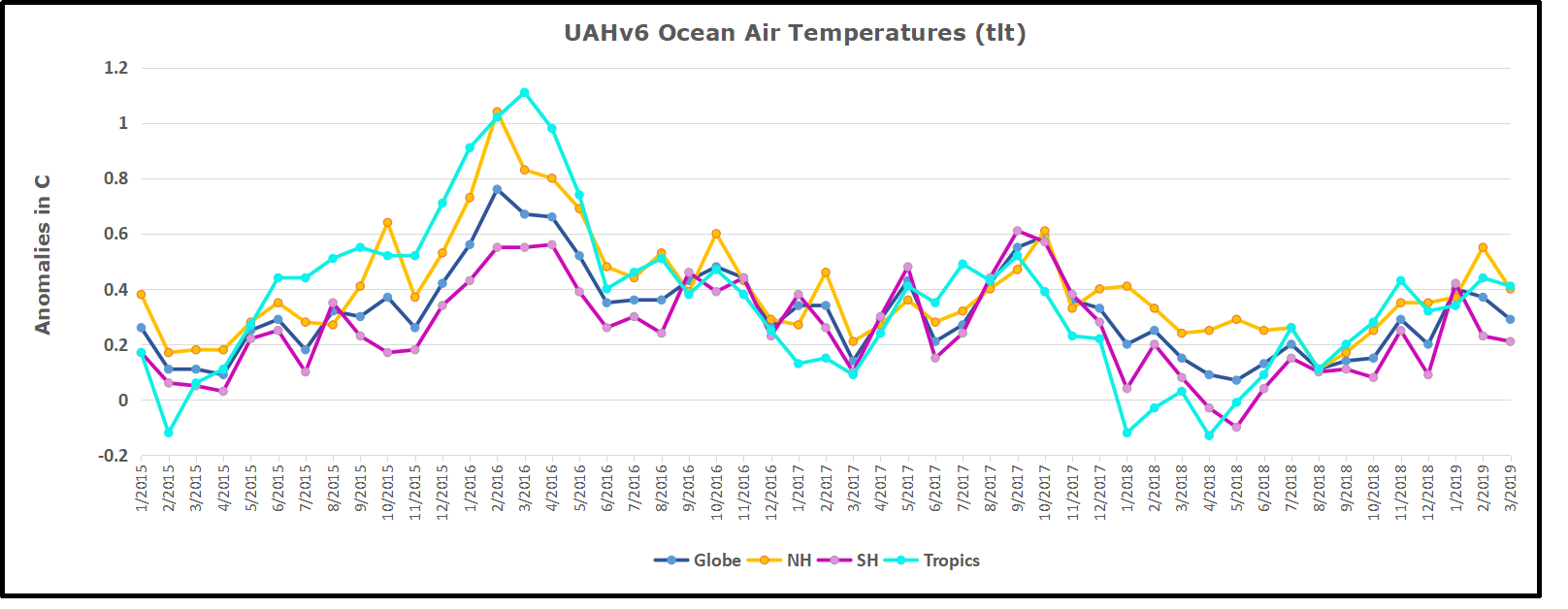
The UAH dataset includes temperature results for air above the oceans, and thus should be most comparable to the SSTs. There is the additional feature that ocean air temps avoid Urban Heat Islands (UHI).  The graph below shows monthly anomalies for ocean temps since January 2015.

Open image in new tab to enlarge.

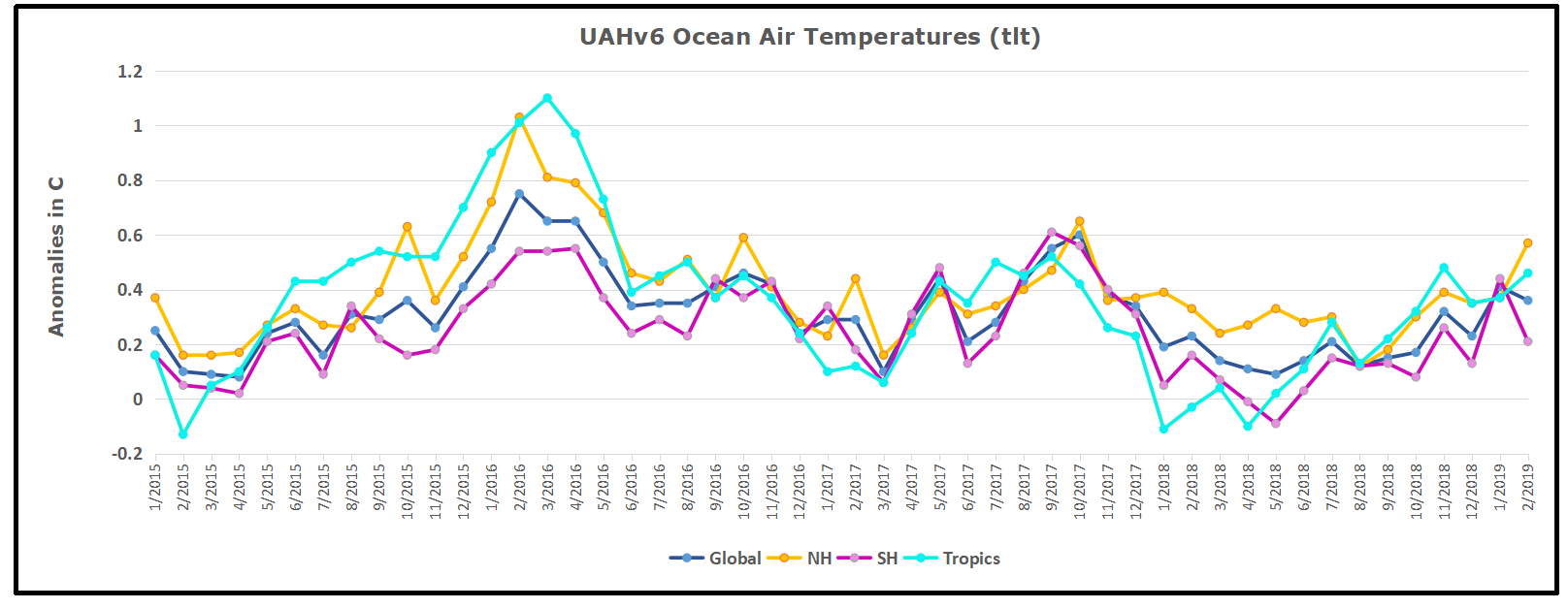
The anomalies over the entire ocean dropped to the same value, 0.11C  in August.  Warming in previous months was erased, and September added very little warming back. In October and November NH and the Tropics rose, joined by SH.  In December 2018 all regions cooled resulting in a global drop of nearly 0.1C. The upward bump in January in SH was reversed in February.  Despite some February warming in both NH and the Tropics, the Global anomaly cooled. Now in March the cooling appears in all regions resulting in a global decline in SST anomaly of 01C since 01/2019. Except for the Tropics, the ocean SSTs match those of 2015.

Land Air Temperatures Tracking Downward in Seesaw Pattern

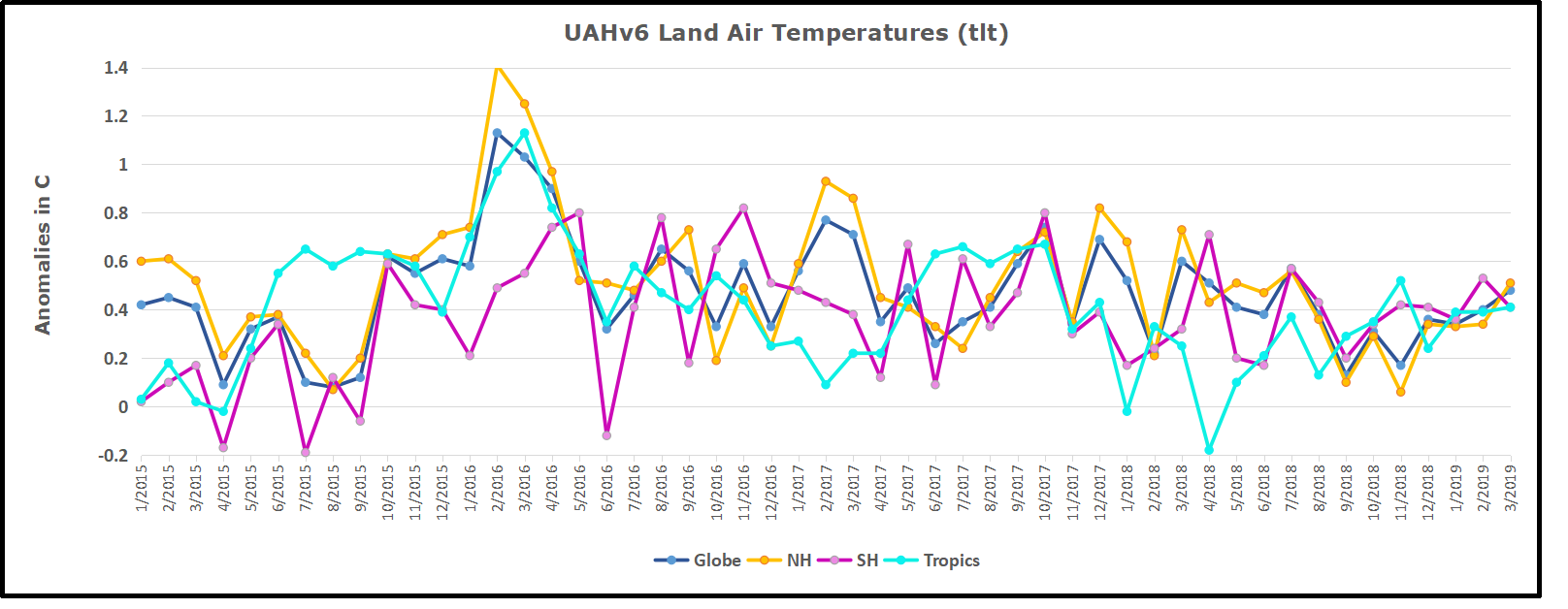
We sometimes overlook that in climate temperature records, while the oceans are measured directly with SSTs, land temps are measured only indirectly.  The land temperature records at surface stations record air temps at 2 meters above ground.  UAH gives tlt anomalies for air over land separately from ocean air temps.  The graph updated for March is below.

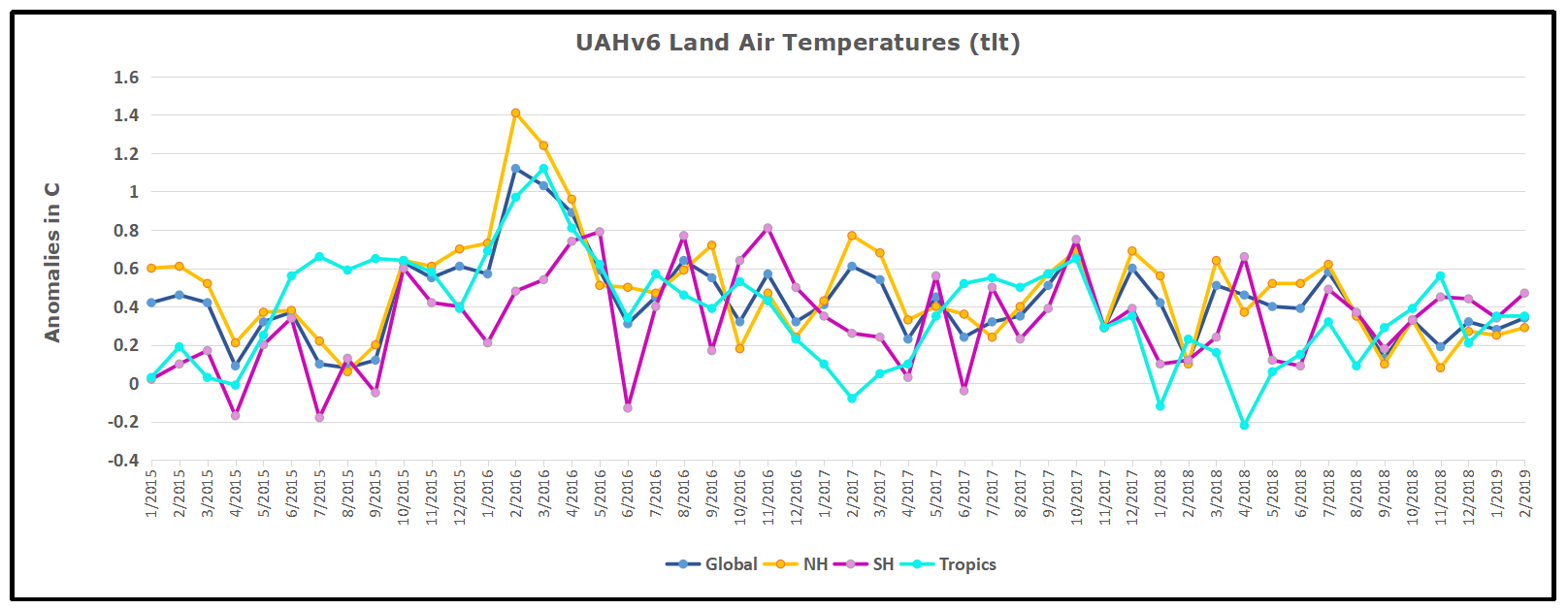
The greater volatility of the Land temperatures was evident earlier, but has calmed down recently. Also the  NH dominates, having twice as much land area as SH.  Note how global peaks mirror NH peaks.  In November air over NH land Global and surfaces bottomed.despite the Tropics.  By January  all regions had almost the same anomaly. Now in March an upward bump in NH has pulled the Global anomaly up, and both are comparable to early 2015.  SH and the Tropics air over land are currently matching other regions, in contrast to starting 2015 much cooler.

TLTs include mixing above the oceans and probably some influence from nearby more volatile land temps.  Clearly NH and Global land temps have been dropping in a seesaw pattern, now more than 1C lower than the peak in 2016.  TLT measures started the recent cooling later than SSTs from HadSST3, but are now showing the same pattern.  It seems obvious that despite the three El Ninos, their warming has not persisted, and without them it would probably have cooled since 1995.  Of course, the future has not yet been written.


About Canadian Warming: Just the Facts

Just in time for the Trudeau carbon tax taking effect, we have all the media trumpeting “Canada Warming Twice as Fast as Global Rate–Effectively Irreversible.”  That was written by some urban-dwelling climate illiterates who are woefully misinformed.  Let’s help them out with some facts surprising to people who don’t get out much.  Unfortunately ignored this week was an informative CBC publication that could have spared us “fake news” spewing across the land, from Bonavista to Vancouuver Island, as the song says.

Surprising Facts About Canada are presented in a CBC series 10 Strange Facts About Canada’s Climate  Excerpts below provide highlights in italics with my bolds.

Through blistering cold winters to hot muggy summers; torrential rain, blinding snowstorms, deadly tornados and scorching drought, Canadians experience some of the planet’s most diverse weather systems.  [ Uh oh, averaging all of that could be a problem]

Canada is as tall as it is wide, creating a wide range of climate conditions.

Canada has the largest latitude range of any country on the planet. Our southern border lies at the same latitude as northern California, while our northern edge reaches right to the top of the world. It’s rarely the same season in the same place at the same time. In early April, the Arctic may still be in the throes of a frigid winter, while the south can experience summer-like temperatures. No doubt, our weather forecasters are the busiest in the world!

Canada has an ‘iceberg alley’.

Pieces of glaciers from the coast of Greenland are picked up by the Labrador Current, a counter-clockwise vortex of waters in the North Atlantic Ocean. Those broken pieces become icebergs that float in the sea off northeast Newfoundland where Fogo Island lies. Navigating the area is risky for ships; in fact this is where the mighty Titanic sank in 1912. But it’s a boon to tourism. Iceberg seekers flock to the area to watch (safely) from the shore and boast about drinking 10,000-year-old fresh water taken from an iceberg floating in the ocean.

Cold Weather Niagara Falls

Niagra Falls (the Canadian side)

Canada is (really) cold.

It’s certainly not surprising to most Canadians that we are tied with Russia for the title of ‘coldest nation in the world.’ Over our vast country, we have an average daily temperature of -5.6C. This is deadly cold. More of us — about 108 — die from exposure to extreme cold than from any other natural event. And that’s not counting Canadian wildlife who are more susceptible to Canada’s icy climate than we are.

Calgary Golfer February 9, 2016.

Every winter, southern Alberta is the ‘Chinook’ capital.

For six months — from November to May — warm dry winds rush down the slope of the Rocky Mountains towards southern Alberta. Often moving at hurricane-force speeds of 120 km per hour, they can bring astonishing temperature changes and melt ice within a couple of hours. In 1962 Pincher Creek saw a record temperature rise of 41C, from -19 to 22 in just one hour. Chinook is also known as the ‘ice-eater’ among locals who appreciate the break from winter that the winds provide.

Newfoundland is the foggiest place in the world.

At the Grand Banks off Newfoundland, the cold water from the Labrador Current from the north meets the warmer Gulf Stream from the south. The result is a whopping 206 days of fog a year. In the summer, it’s foggy 84 per cent of the time! It’s also the richest fishery in the world, the fog is a serious hazard to ships in the region.

View of the Haughton-Mars Project Research Station (HMPRS) on Devon Island, Nunavut, Arctic Canada

Canada’s North is actually a desert

Canada’s North is very cold and dry with very little precipitation, ranging from 10-20 cm a year. Temperatures average below freezing most of the year. Together, they limit the diversity of plants and animals found in the North. And it’s huge: this polar desert covers one seventh of Canada’s total land mass.

In 1816, Canada didn’t have a summer.

If winter in Canada weren’t bad enough, in 1816 the country’s eastern population were sledding in June and thawing water cisterns in July. Trees shed their leaves and there were reports of migratory birds dropping dead in the streets.

Over in Europe, the weird weather stoked anti-American sentiment. People opposed to emigration said that North America was inhospitable and getting colder every year.

Representation of Mount Tambora 1815 eruption in Indonesia.

Ironically, as eastern Canada stayed cool, the Arctic warmed, creating flotillas of icebergs off the coasts of Nova Scotia and Newfoundland. At the time, it was thought that the icebergs were the cause of the cooling, like a giant glass of iced lemonade. What was the real reason? In 1815, the Tambora volcano erupted in Indonesia, spewing tonnes of ash and dust into the air. Less sunlight reached the earth and this caused the planet’s surface to cool. The volcanic eruption changed the climate in different ways around the world, but Eastern Canadians were treated to the summer that just didn’t come.

The Prairies face brutal temperature extremes.

It’s no surprise that Regina, Saskatchewan — which lies smack in the middle of Canada’s prairies — lays claim to both the country’s lowest recorded temperature, -50C on January 1, 1885 and the highest, 43.3C on July 5, 1937. Without the moderating effects of a large body of water, Canada’s Prairies are vulnerable to some of the worst weather Canada has to offer.

Hopewell Rocks at the Bay of fundy. Photo: gregstokinger

The Bay of Fundy has the largest tides in the world.

Twice each day, 160 billion tonnes of seawater flow in and out of this small area in Nova Scotia — more than the combined flow of the world’s freshwater rivers. The tides reach a peak of 16 metres (as high as a five-storey building) and take about six hours to come in. The most extreme tides in the Bay occur twice each month when the earth, moon and sun are in alignment and together they create a larger-than-usual gravitational pull on the ocean, creating a “spring tide” (not to be confused with the season spring).

Lightning over Lake St. Clair Photo: seebest

Windsor is the thunderstorm capital of Canada.

Hot, humid air from the Gulf of Mexico funnels up through Windsor and the Western Basin of Lake Erie creating the perfect conditions for thunderstorms. About 251 lightning flashes per 100 square kilometres happen every year when small pieces of frozen raindrops collide within thunderclouds. The clouds fill with electrical charges that are eventually funnelled to the ground as lightning.

Summary

With all that going on, all the variety of temperature, precipitation, weather events and seasonalities, no one noticed it had warmed much, and would be grateful if it had.  With all the alarms sounding about the Arctic meltdown in the last decades, let’s consider the best long-service stations in the far north.

According to the “leaked report”, Canada’s annual average temperature over land has warmed 1.7 C when looking at the data since 1948. But that claim is misleading when recent data is considered.

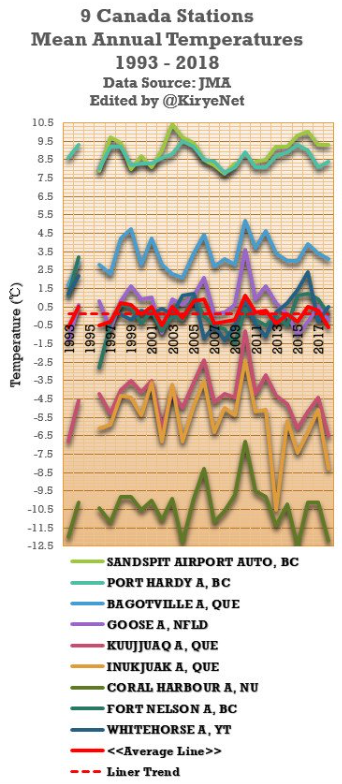
Over the past 25 years, since scientists began to warn that the planet was warming in earnest, there has not been any warming when one looks at the untampered data provided by the Japan meteorology Agency (JMA) that were measured by 9 different stations across Canada. These 9 stations have the data dating back to around 1983 or 1986, so I used their datasats.

Looking at the JMA database and plotting the stations with longer term recording, we have the following chart:

Though temperatures over Canada no doubt have risen over the past century, there has not been any real warming in over 25 years. Rather, there’s been slight cooling, though not statistically significant. Clearly there hasn’t been any Canadian warming recently.

So it is misleading — to say the least — to give the impression that Canada warming has been accelerating. Thanks to Kirye for posting this at No Tricks Zone

See also Cold Summer in Nunavut

N. Atlantic Starts Cold in 2019

RAPID Array measuring North Atlantic SSTs.

Update April 10, 2019  March AMO Results now available and included in Decadal graph below.

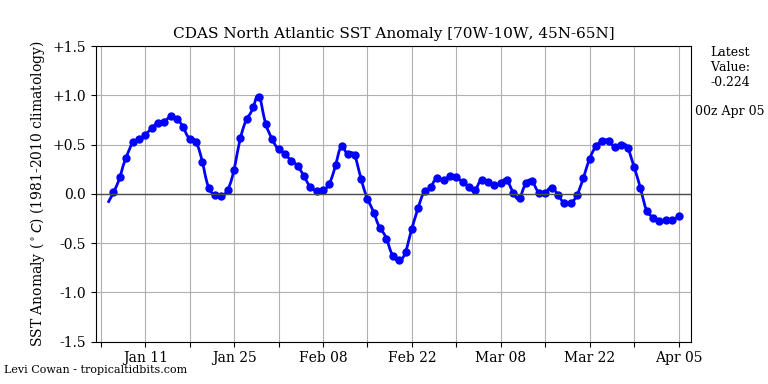
For the last few years, observers have been speculating about when the North Atlantic will start the next phase shift from warm to cold. Given the way 2018 went, this may be the onset.  First some background.

Source: Energy and Education Canada

An example is this report in May 2015 The Atlantic is entering a cool phase that will change the world’s weather by Gerald McCarthy and Evan Haigh of the RAPID Atlantic monitoring project. Excerpts in italics with my bolds.

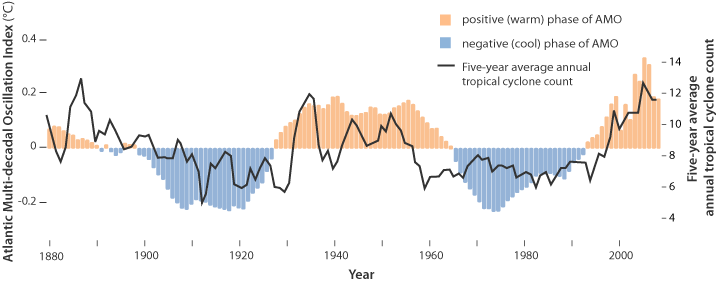
This is known as the Atlantic Multidecadal Oscillation (AMO), and the transition between its positive and negative phases can be very rapid. For example, Atlantic temperatures declined by 0.1ºC per decade from the 1940s to the 1970s. By comparison, global surface warming is estimated at 0.5ºC per century – a rate twice as slow.

In many parts of the world, the AMO has been linked with decade-long temperature and rainfall trends. Certainly – and perhaps obviously – the mean temperature of islands downwind of the Atlantic such as Britain and Ireland show almost exactly the same temperature fluctuations as the AMO.

Atlantic oscillations are associated with the frequency of hurricanes and droughts. When the AMO is in the warm phase, there are more hurricanes in the Atlantic and droughts in the US Midwest tend to be more frequent and prolonged. In the Pacific Northwest, a positive AMO leads to more rainfall.

A negative AMO (cooler ocean) is associated with reduced rainfall in the vulnerable Sahel region of Africa. The prolonged negative AMO was associated with the infamous Ethiopian famine in the mid-1980s. In the UK it tends to mean reduced summer rainfall – the mythical “barbeque summer”.Our results show that ocean circulation responds to the first mode of Atlantic atmospheric forcing, the North Atlantic Oscillation, through circulation changes between the subtropical and subpolar gyres – the intergyre region. This a major influence on the wind patterns and the heat transferred between the atmosphere and ocean.

The observations that we do have of the Atlantic overturning circulation over the past ten years show that it is declining. As a result, we expect the AMO is moving to a negative (colder surface waters) phase. This is consistent with observations of temperature in the North Atlantic.

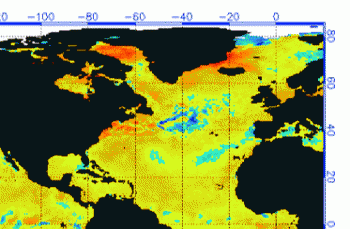
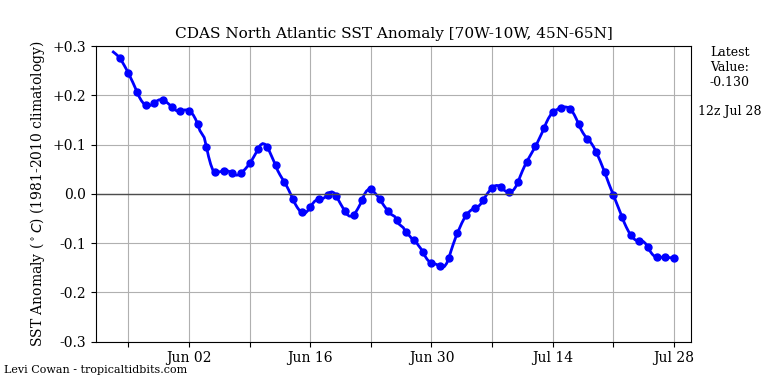
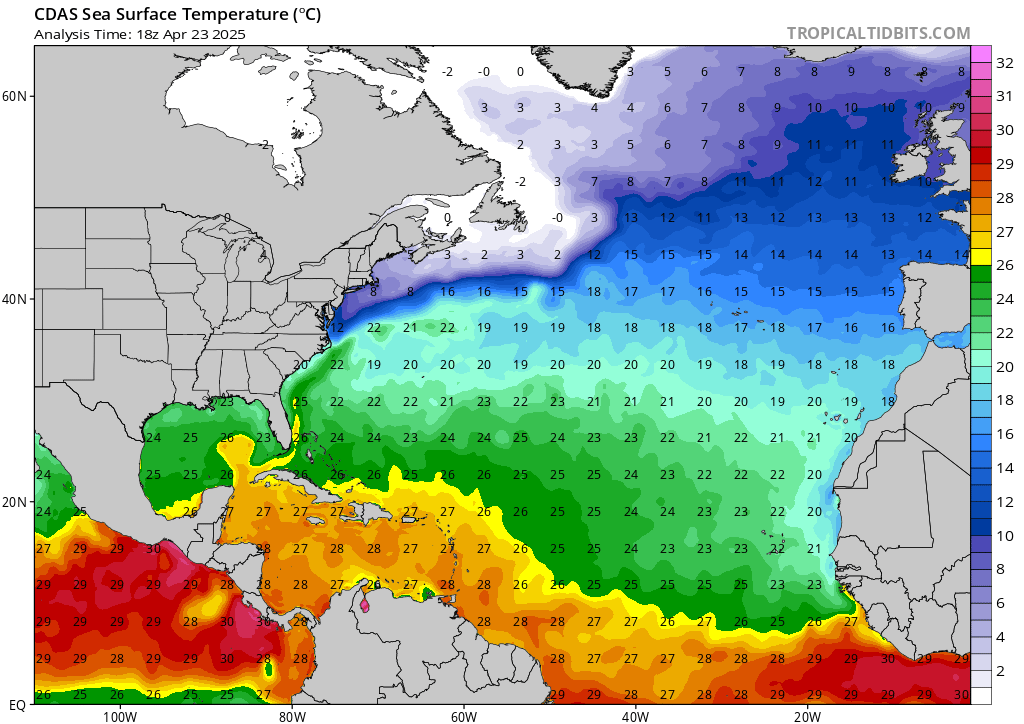
Cold “blobs” in North Atlantic have been reported, but they are usually winter phenomena. For example in April 2016, the sst anomalies looked like this

But by September, the picture changed to this

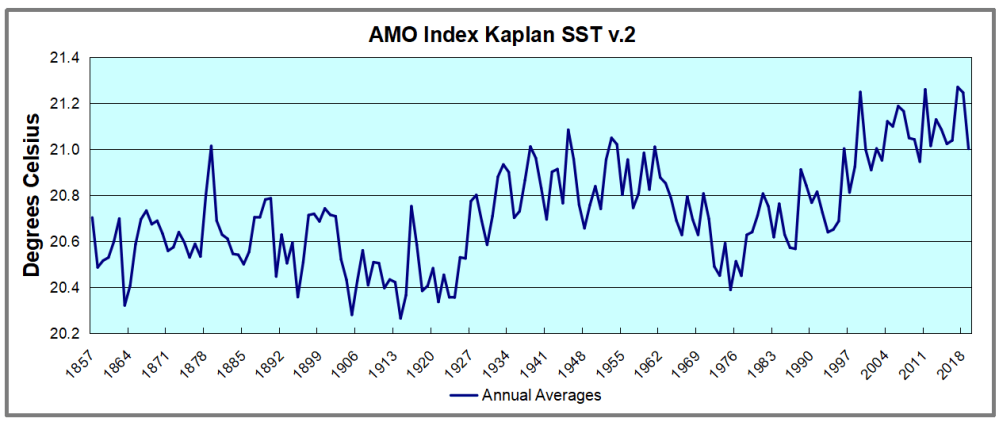
And we know from Kaplan AMO dataset, that 2016 summer SSTs were right up there with 1998 and 2010 as the highest recorded.

As the graph above suggests, this body of water is also important for tropical cyclones, since warmer water provides more energy.  But those are annual averages, and I am interested in the summer pulses of warm water into the Arctic. As I have noted in my monthly HadSST3 reports, most summers since 2003 there have been warm pulses in the north atlantic.
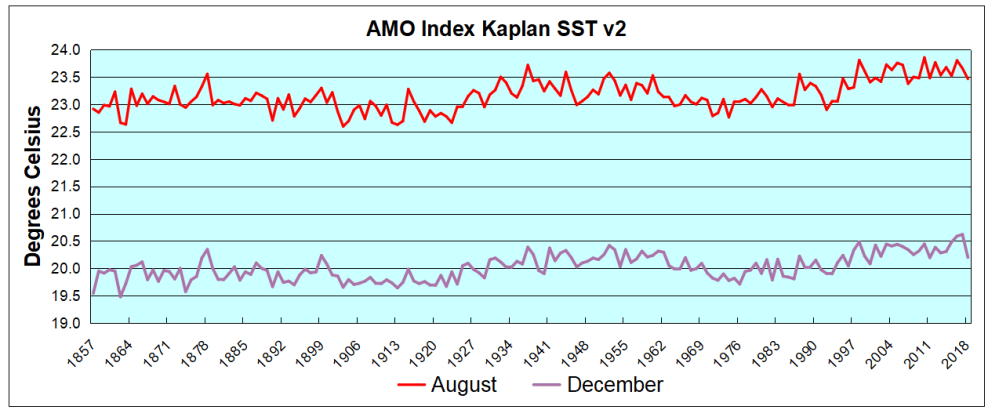
amo december 2018
The AMO Index is from from Kaplan SST v2, the unaltered and not detrended dataset. By definition, the data are monthly average SSTs interpolated to a 5×5 grid over the North Atlantic basically 0 to 70N.  The graph shows the warmest month August beginning to rise after 1993 up to 1998, with a series of matching years since.  December 2016 set a record at 20.6C, but note the plunge down to 20.2C for  December 2018, matching 2011 as the coldest years  since 2000.  Because McCarthy refers to hints of cooling to come in the N. Atlantic, let’s take a closer look at some AMO years in the last 2 decades.

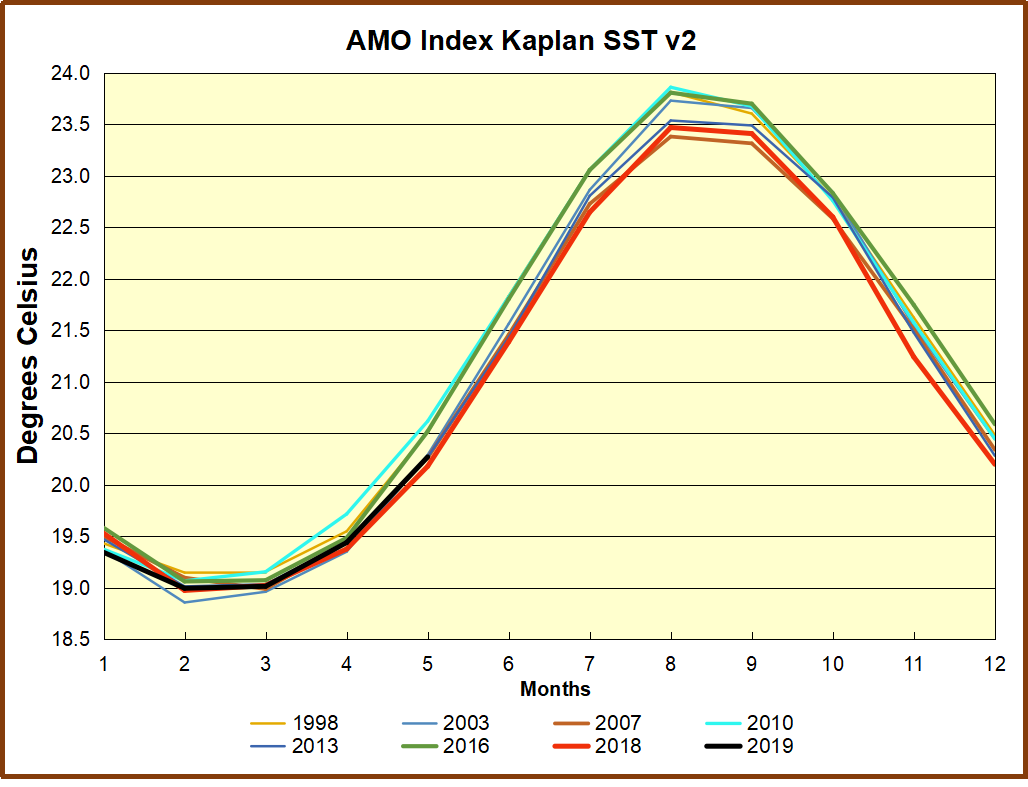
This graph shows monthly AMO temps for some important years. The Peak years were 1998, 2010 and 2016, with the latter emphasized as the most recent. The other years show lesser warming, with 2007 emphasized as the coolest in the last 20 years. Note the red 2018 line is at the bottom of all these tracks.  The short black line shows that 2019 began slightly cooler than January 2018  The February average AMO matched the low SST of the previous year, 0.14C lower than the peak year February 2017. March 2019 is also slightly lower than 2018  and 0.06C lower than peak year March 2016.

With all the talk of AMOC slowing down and a phase shift in the North Atlantic, it seems the annual average for 2018 confirms that cooling has set in.  Through December the momentum is certainly heading downward, despite the band of warming ocean  that gave rise to European heat waves last summer.

amo annual122018

natlssta

cdas-sflux_sst_atl_1


February Land and Sea Mixed Cooling

banner-blog

With apologies to Paul Revere, this post is on the lookout for cooler weather with an eye on both the Land and the Sea.  UAH has updated their tlt (temperatures in lower troposphere) dataset for January.   Previously I have done posts on their reading of ocean air temps as a prelude to updated records from HADSST3. This month I will add a separate graph of land air temps because the comparisons and contrasts are interesting as we contemplate possible cooling in coming months and years.

Presently sea surface temperatures (SST) are the best available indicator of heat content gained or lost from earth’s climate system.  Enthalpy is the thermodynamic term for total heat content in a system, and humidity differences in air parcels affect enthalpy.  Measuring water temperature directly avoids distorted impressions from air measurements.  In addition, ocean covers 71% of the planet surface and thus dominates surface temperature estimates.  Eventually we will likely have reliable means of recording water temperatures at depth.

Recently, Dr. Ole Humlum reported from his research that air temperatures lag 2-3 months behind changes in SST.  He also observed that changes in CO2 atmospheric concentrations lag behind SST by 11-12 months.  This latter point is addressed in a previous post Who to Blame for Rising CO2?

The February update to HadSST3 will appear later this month, but in the meantime we can look at lower troposphere temperatures (TLT) from UAHv6 which are already posted for February. The temperature record is derived from microwave sounding units (MSU) on board satellites like the one pictured above.

The UAH dataset includes temperature results for air above the oceans, and thus should be most comparable to the SSTs. There is the additional feature that ocean air temps avoid Urban Heat Islands (UHI).  The graph below shows monthly anomalies for ocean temps since January 2015.

The anomalies over the entire ocean dropped to the same value, 0.12C  in August (Tropics were 0.13C).  Warming in previous months was erased, and September added very little warming back. In October and November NH and the Tropics rose, joined by SH.  In December 2018 all regions cooled resulting in a global drop of nearly 0.1C. The upward bump in January in SH was reversed in February.  Despite some warming in both NH and the Tropics, the Global anomaly cooled. The trajectory is not yet set, but soon we will see if the long-expected El Nino appears in NH and Tropics SSTs.

Land Air Temperatures Tracking Downward in Seesaw Pattern

We sometimes overlook that in climate temperature records, while the oceans are measured directly with SSTs, land temps are measured only indirectly.  The land temperature records at surface stations record air temps at 2 meters above ground.  UAH gives tlt anomalies for air over land separately from ocean air temps.  The graph updated for February is below.

The greater volatility of the Land temperatures was evident earlier, but has calmed down recently. Also the  NH dominates, having twice as much land area as SH.  Note how global peaks mirror NH peaks.  In December air over Tropics fell sharply, SH slightly, while the NH land surfaces rose, pulling up the Global anomaly for the month.  In January  both NH and SH cooled slightly, pulling the Global anomaly down despite some Tropical warming. Then in February, air temps over both NH and SH land rose, pulling the Global anomaly slightly upward to match 12/2018.

TLTs include mixing above the oceans and probably some influence from nearby more volatile land temps.  Clearly NH and Global land temps have been dropping in a seesaw pattern, now more than 1C lower than the peak in 2016.  TLT measures started the recent cooling later than SSTs from HadSST3, but are now showing the same pattern.  It seems obvious that despite the three El Ninos, their warming has not persisted, and without them it would probably have cooled since 1995.  Of course, the future has not yet been written.
 

What Warming 1978 to 1997?


Flawed thermometers can lead to false results.

Those public opinion surveys on global warming/climate change often ask if you believe the world has gotten warmer in the last century. Most all of us answer “Yes,” because that is the data we have been shown by the record keepers.  Fred Singer, a distinguished climate scientist, asks a disturbing question: “What if trends in surface average temperatures (SAT) were produced by biases of the instruments themselves, rather than being a natural fact?.  He makes his case in an article at The Independent The 1978-1997 Warming Trend Is an Artifact of Instrumentation  Excerpts below in italics with my bolds.(H/T John Ray)

Now we tackle, using newly available data, what may have caused the fictitious temperature trend in the latter decades of the 20th century.

We first look at ocean data. There was a great shift, after 1980, in the way Sea Surface Temperatures (SSTs) were measured (see Goretzki and Kennedy et al. JGR 2011, Fig. 1), “Sources of SST data.” Note the drastic changes between 1980 and 2000 as global floating drifter buoys and geographic changes increasingly replaced opportunities for sampling SST with buckets.

Data taken from floating drifter buoys increased from zero to 60% between 1980 and 2000. But such buoys are heated directly by the sun, with the unheated engine inlet water in lower ocean layers. This combination leads to a spurious rise in SST when the data are mixed together.

The estimated biases for the global and hemispheric average SSTs are shown in Figure 3 (orange areas). They increase from between 0.0 and −0.2°C in the 1850s to between −0.1 and −0.6°C in 1935 as the proportion of both canvas buckets and fast ships increases. From 1935 to 1942, the proportion of ERI  (Engine Room Inlet) measurements increases (see also Figure 2) and the bias approaches zero. Between 1941 and 1945, the biases are between 0.05 and 0.2°C. The positive bias is a result of the large numbers of U.K. Navy and U.S. ERI measurements in the ICOADS database during the Second World War. In late 1945, the bias drops sharply and becomes negative again, reflecting an influx of data gathered by U.K. ships using canvas buckets. The bias then increases from 1946 to the early 1980s, becoming predominantly positive after 1975, as insulated buckets were introduced and ERI measurements become more common. After 1980, the slow decrease in the bias is caused by the increase in the number of buoy observations.

In merging them, we must note that buoy data are global, while bucket and inlet temperatures are (perforce) confined to (mostly commercial) shipping routes. Nor do we know the ocean depths that buckets sample; inlet depths depend on ship type and degree of loading.

Disentangling this mess requires data details that are not available. About all we might demonstrate is the possibility of a distinct diurnal variation in the buoy temperatures.

The land data have problems of their own. During these same decades, quite independently, by coincidence, there was a severe reduction in “superfluous” (mostly) rural stations—unless they were located at airports. As seen from Fig. 2, the number of stations decreased drastically in the 1990s, but the fraction of airport stations increased sharply…

Figure 2: Weather stations at (potential) airports. Source: NOAA.

…from ~35% to ~80%, in the fraction of “airport” weather stations, producing a spurious temperature increase from all the construction of runways and buildings. These are hard to calculate in detail. About all we can claim is a general increase in air traffic, about 5% per year worldwide (Fig. 19, “HTCS-1”).

We have, however, MSU data for the lower atmosphere over both ocean and land; they show little difference, so we can assume that both land data and ocean data contribute about equally to the fictitious surface trend reported for 1978 to 1997. The BEST (Berkeley Earth System Temperatures) data confirm our supposition.

The absence of a warming trend removes all of the IPCC’s evidence for AGW (anthropogenic global warming). Both IPCC-AR4 (2007) and IPCC-AR5 (2013), and perhaps also AR-6, rely on the spurious 1978–1997 warming trend to demonstrate AGW (see chapters on “Attribution” in their respective final reports).

Obviously, if there is no warming trend, these demonstrations fail—and so do all their proofs for AGW.

S. FRED SINGER is a Research Fellow at the Independent Institute and Professor Emeritus of Environmental Sciences at the University of Virginia.


On Climate “Signal” and Weather “Noise”

Discussions and arguments concerning global warming/climate change often get into the issue of discerning the longer term signal within the shorter term noisy temperature records. The effort to separate natural and human forcings of estimated Global Mean Temperatures reminds of the medieval quest for the Holy Grail. Skeptics of CO2 obsession have also addressed this. For example the graph above from Dr. Syun Akasofu shows a quasi-60 year oscillation on top of a steady rise since the end of the Little Ice Age (LIA). Various other studies have produced similar graphs with the main distinction being alarmists/activists attributing the linear rise to increasing atmospheric CO2 rather than to natural causes (e.g. ocean warming causing the rising CO2).

This post features a comment by rappolini from a thread at Climate Etc. and Is worth careful reading. The occasion was Ross McKitrick’s critique of Santer et al. (2019) that claimed 5-sigma certainty proof of human caused global warming. Excerpts from rappolini in italics with my bolds

Ben Santer was searching for a human footprint back in 2011. Apparently, he is still searching.

Most recent global climate models are consistent in depicting a tropical lower troposphere that warms at a rate much faster than that of the surface. Thus, the models would predict that the trend for warming of the troposphere temperature (TT) would be at a higher rate than the surface.

Douglass and Christy (2009) presented the latest tropospheric temperature measurements (at that time) that did not show this warming. (Since then, this continued lack of warming has continued for another ten years without much change, but that is getting ahead of ourselves).

Hence, in keeping with recent practice over the past few years in which alarmistsj promptly publish rebuttals to any papers that slip through their control of which manuscripts get accepted by climate journals, it was necessary for the alarmists to publish such a rebuttal.

Ben Santer took on this responsibility and the result was Santer et al. (2011). It is interesting, perhaps, that Santer included 16 co-authors in addition to himself; yet the nature of the work is such that it is difficult to imagine how 16 individuals could each contribute significant portions to the work. In other words, many names were added to give the paper political endorsement? In fact, when I redid all their work, it took me about one day!


Santer et al. (2011) were concerned with a very basic problem in climatology: how to distinguish between long-term climate change and short-term variable weather in regard to TT measurements? They treated the problem in terms of signal and noise: the signal is assumed to be a long-term linear trend of rising temperatures due increasing greenhouse gas concentrations, that is obfuscated by short-term noise. However, the climate-weather problem is innately different from a classical signal/noise problem such as a radio signal affected by atmospheric activity. In that case, if the radio signal has a sufficiently narrow frequency band, and the noise has a wider frequency spectrum, the signal-to-noise ratio (S/N) can be improved with a narrow-band receiver tuned to the frequency of the radio signal. The radio signal and the noise are separate and distinct. By contrast, in the climate-weather problem, the instantaneous weather is the noise, and the signal is the long-term trend of the noise. The noise and signal are coupled in a unique way. Furthermore, there is no evidence that it is even meaningful to talk about a “trend” since there is no evidence that the variation of TT with time is linear.

Santer et al. (2011) were primarily concerned with estimating how many years of data are necessary to provide a good estimate of the putative underlying linear trend. They were also intent on showing that short periods with no apparent trend do not violate the possibility that over a longer term, the trend is always there. They derived signal-to-noise (S/N) ratios for both the temperature data and the model average by means that are not exactly clear to this writer.

As Santer et al. (2011) showed, one can pick any starting date and any duration length and fit a straight line to that portion of the curve of TT vs. time. They did this for various 10-year and 20-year durations. In each case, depending on the start date, they derived a best straight-line fit to the TT data for that time period. They found that the range of trends for 10-year periods was greater (-0.05 to +0.44°C/decade) than the range for 20-year periods (+0.15 to +0.25°C/decade).

The trend line was steepest for a start date around 1988 (ending in the giant El Niño year of 1998). Prior to 1988 and after 1998, the trends were minimal.

Santer et al. described use of longer durations as “noise reduction”, which it is, provided that one assumes the overall signal is linear in time. It still was problematic that the trend was nil after 1998 that they rationalized by saying:

The relatively small values of overlapping 10-year TT trends during the period 1998 to 2010 are partly due to the fact that this period is bracketed (by chance) by a large El Niño (warm) event in 1997/98, and by several smaller La Niña (cool) events at the end of the … record”.

However, as Pielke pointed out, the period after 1998 was 13 years, not 10, and furthermore, the period after 1998 had roughly equal periods of El Niño and La Niña and was not dominated by La Niñas as Santer et al. claimed. What Santer et al. (2011) implied was that an unusual conflux of a large El Niño early on and multiple La Niñas later on caused the trend to minimize for that unique period as a statistical quirk. However, that is like a baseball pitcher saying that if the opponents hadn’t hit that home run, he would have won the game.

In simplistic terms, the signal-to-noise ratio can be estimated as follows. For either 10-year or 20-year durations, the signal was the mean trend derived by a straight-line fit to the TT data over that duration. The noise was the range of trends for different starting dates. For ten-year durations, the trend was 0.19 ± 0.25°C/decade. For twenty-year durations, the trend was 0.20 ± 0.05°C/decade. The signal in each case is taken as the mean trend. The distribution of trends within these ranges was similar to a normal distribution. Thus, we can roughly estimate the noise as ~ 0.7 times the full width of the range. Hence, the S/N ratio for ten-year durations can be crudely estimated to be S/N ~ 0.19/(0.7  0.5) = 0.5 and for twenty-year durations is S/N ~ 0.2/(0.7  0.1) = 2.9. Santer et al. obtained S/N = 1 for ten-year durations and S/N = 2.9 for twenty-year durations. If it can be assumed that the signal varies linearly with time, one can then estimate what level of precision for the estimated trend can be obtained for any chosen duration. Santer et al. obviously believe that the signal is linear with time for all time. By some logic that escapes me, Santer et al. concluded that

“Our results show that temperature records of at least 17 years in length are required for identifying human effects on global-mean tropospheric temperature”.

This conclusion seems to be grossly exaggerated. A more proper statement might be as follows:

Assuming that the variability of TT is characterized by a long-term upward linear trend caused by human impact on the climate, and that variability about this trend is due to yearly variability of weather, El Niños and La Niñas, and other climatological fluctuations, the recent data suggest that the trend can be estimated for any 17-year period with a S/N ratio of roughly 2.5.

Finally, we get to the nub of the paper by Santer et al. that asserted:

“Claims that minimal warming over a single decade undermine findings of a slowly-evolving externally-forced warming signal are simply incorrect”.

Here is where Santer et al. attempted to dispel the notion that minimal warming for a period contradicts the belief that underneath it all, the long-term signal continues to rise at a constant rate. Pielke Sr. argued that this was an overstatement and he concluded:

“If one accepts this statement by Santer et al. as correct, then what should have been written is that the observed lack of warming over a 10-year time period is still too short to definitely conclude that the models are failing to skillfully predict this aspect of the climate system”

However, I would go further than Pielke Sr. First of all, the period of minimal temperature rise was longer than 10 years. Second, there is no cliff at 17 years whereby trends derived from shorter periods are statistically invalid and trends derived from longer periods are valid. According to Santer et al. a trend derived from a 13-year period is associated with a S/N ~ 1.5 which though not ideal, is good enough to cast some doubt on the validity of models.

The continued almost religious belief by alarmists that the temperature always rises linearly and continuously is evidently refuted. If the alarmists would only reduce their hyperbole and argue that rising greenhouse gas concentrations produce a warming force that is one of several factors controlling the Earth’s climate, and there are periods during which the other factors overwhelm the greenhouse forces, perhaps we would have a rational description. Instead, the alarmists continue to find linear trends over various time periods, in some cases when they are not there.

Santer, B. D., C. Mears, C. Doutriaux, P. Caldwell, P. J. Gleckler, T. M. L. Wigley, S. Solomon, N. P. Gillett, D. Ivanova, T. R. Karl, J. R. Lanzante, G. A. Meehl, P. A. Stott, K. E. Taylor, P. W. Thorne, M. F. Wehner, and F. J. Wentz (2011) “Separating Signal and Noise in Atmospheric Temperature Changes: The Importance of Timescale” Journal of Geophysical Research (Atmospheres) 116, D22105.

PS.
There may not be human fingerprint on tropospheric temperatures since 1978, but there very certainly is an El Nino fingerprint. Occurrence of El Ninos dominated over La Ninas from 1978 to 1998, a period when there was more global warming than any other period in the past 150 years. After the great El Nino of 1997-8, global temperatures have meandered in consonance with the Nino 3.4 Index, rising to a new height in the great El Nino of 2015-6, only to fall back after that to about the “pause”.


January Cooling by Land, A Surprise by Sea

banner-blog

With apologies to Paul Revere, this post is on the lookout for cooler weather with an eye on both the Land and the Sea.  UAH has updated their tlt (temperatures in lower troposphere) dataset for January.   Previously I have done posts on their reading of ocean air temps as a prelude to updated records from HADSST3. This month I will add a separate graph of land air temps because the comparisons and contrasts are interesting as we contemplate possible cooling in coming months and years.

Presently sea surface temperatures (SST) are the best available indicator of heat content gained or lost from earth’s climate system.  Enthalpy is the thermodynamic term for total heat content in a system, and humidity differences in air parcels affect enthalpy.  Measuring water temperature directly avoids distorted impressions from air measurements.  In addition, ocean covers 71% of the planet surface and thus dominates surface temperature estimates.  Eventually we will likely have reliable means of recording water temperatures at depth.

Recently, Dr. Ole Humlum reported from his research that air temperatures lag 2-3 months behind changes in SST.  He also observed that changes in CO2 atmospheric concentrations lag behind SST by 11-12 months.  This latter point is addressed in a previous post Who to Blame for Rising CO2?

The January update to HadSST3 will appear later this month, but in the meantime we can look at lower troposphere temperatures (TLT) from UAHv6 which are already posted for January. The temperature record is derived from microwave sounding units (MSU) on board satellites like the one pictured above.

The UAH dataset includes temperature results for air above the oceans, and thus should be most comparable to the SSTs. There is the additional feature that ocean air temps avoid Urban Heat Islands (UHI).  The graph below shows monthly anomalies for ocean temps since January 2015.

UAH Oceans 201901The anomalies over the entire ocean dropped to the same value, 0.12C  in August (Tropics were 0.13C).  Warming in previous months was erased, and September added very little warming back. In October and November NH and the Tropics rose, joined by SH.  In December 2018 all regions cooled resulting in a global drop of nearly 0.1C. Now in January an upward jump in SH overcame slight cooling in NH and the Tropics, pulling up the Global anomaly as well.  While the trajectory is not yet set, it is the highest ocean air January since 2016.

Land Air Temperatures Tracking Downward in Seesaw Pattern

We sometimes overlook that in climate temperature records, while the oceans are measured directly with SSTs, land temps are measured only indirectly.  The land temperature records at surface stations record air temps at 2 meters above ground.  UAH gives tlt anomalies for air over land separately from ocean air temps.  The graph updated for January is below.UAH Land 201901

The greater volatility of the Land temperatures is evident, and also the dominance of NH, which has twice as much land area as SH.  Note how global peaks mirror NH peaks.  In December air over Tropics fell sharply, SH slightly, while the NH land surfaces rose, pulling up the Global anomaly for the month.  In January  both NH and SH cooled slightly, pulling the Global anomaly down despite some Tropical warming. Presently, air temps over land were the lowest January since 2014 both Globally and for the NH, despite warmer temps over SH and Tropical land areas.

Summary

TLTs include mixing above the oceans and probably some influence from nearby more volatile land temps.  Clearly NH and Global land temps have been dropping in a seesaw pattern, now more than 1C lower than the peak in 2016.  TLT measures started the recent cooling later than SSTs from HadSST3, but are now showing the same pattern.  It seems obvious that despite the three El Ninos, their warming has not persisted, and without them it would probably have cooled since 1995.  Of course, the future has not yet been written.
 

Climate Models Cover Up

Making Climate Models Look Good

Clive Best dove into climate models temperature projections and discovered how the data can be manipulated to make model projections look closer to measurements than they really are. His first post was A comparison of CMIP5 Climate Models with HadCRUT4.6 January 21, 2019. Excerpts in italics with my bolds.

Overview: Figure 1. shows a comparison of the latest HadCRUT4.6 temperatures with CMIP5 models for Representative Concentration Pathways (RCPs). The temperature data lies significantly below all RCPs, which themselves only diverge after ~2025.

Modern Climate models originate from Global Circulation models which are used for weather forecasting. These simulate the 3D hydrodynamic flow of the atmosphere and ocean on earth as it rotates daily on its tilted axis, and while orbiting the sun annually. The meridional flow of energy from the tropics to the poles generates convective cells, prevailing winds, ocean currents and weather systems. Energy must be balanced at the top of the atmosphere between incoming solar energy and out going infra-red energy. This depends on changes in the solar heating, water vapour, clouds , CO2, Ozone etc. This energy balance determines the surface temperature.

Weather forecasting models use live data assimilation to fix the state of the atmosphere in time and then extrapolate forward one or more days up to a maximum of a week or so. Climate models however run autonomously from some initial state, stepping far into the future assuming that they correctly simulate a changing climate due to CO2 levels, incident solar energy, aerosols, volcanoes etc. These models predict past and future surface temperatures, regional climates, rainfall, ice cover etc. So how well are they doing?

Fig 2. Global Surface temperatures from 12 different CMIP5 models run with RCP8.5

The disagreement on the global average surface temperature is huge – a spread of 4C. This implies that there must still be a problem relating to achieving overall energy balance at the TOA. Wikipedia tells us that the average temperature should be about 288K or 15C. Despite this discrepancy in reproducing net surface temperature the model trends in warming for RCP8.5 are similar.

Likewise weather station measurements of temperature have changed with time and place, so they too do not yield a consistent absolute temperature average. The ‘solution’ to this problem is to use temperature ‘anomalies’ instead, relative to some fixed normal monthly period (baseline). I always use the same baseline as CRU 1961-1990. Global warming is then measured by the change in such global average temperature anomalies. The implicit assumption of this is that nearby weather station and/or ocean measurements warm or cool coherently, such that the changes in temperature relative to the baseline can all be spatially averaged together. The usual example of this is that two nearby stations with different altitudes will have different temperatures but produce the similar ‘anomalies’. A similar procedure is used on the model results to produce temperature anomalies. So how do they compare to the data?

Fig 4. Model comparisons to data 1950-2050

Figure 4 shows a close up detail from 1950-2050. This shows how there is a large spread in model trends even within each RCP ensemble. The data falls below the bulk of model runs after 2005 except briefly during the recent el Nino peak in 2016.  Figure 4. shows that the data are now lower than the mean of every RCP, furthermore we won’t be able to distinguish between RCPs until after ~2030.

Zeke Hausfather’s Tricks to Make the Models Look Good

Clive’s second post is Zeke’s Wonder Plot January 25,2019. Excerpts in italics with my bolds.

Zeke Hausfather who works for Carbon Brief and Berkeley Earth has produced a plot which shows almost perfect agreement between CMIP5 model projections and global temperature data. This is based on RCP4.5 models and a baseline of 1981-2010. First here is his original plot.

I have reproduced his plot and  essentially agree that it is correct. However, I also found some interesting quirks.

The apples to apples comparison (model SSTs blended with model land 2m temperatures) reduces the model mean by about 0.06C. Zeke has also smoothed out the temperature data by using a 12 month running average. This has the effect of exaggerating peak values as compared to using the annual averages.

Effect of changing normalisation period. Cowtan & Way uses kriging to interpolate Hadcrut4.6 coverage into the Arctic and elsewhere.

Shown above is the result for a normalisation from 1961-1990. Firstly look how the lowest 2 model projections now drop further down while the data seemingly now lies below both the blended (thick black) and the original CMIP average (thin black). HadCRUT4 2016 is now below the blended value.

This improved model agreement has nothing to do with the data itself but instead is due to a reduction in warming predicted by the models. So what exactly is meant by ‘blending’?

Measurements of global average temperature anomalies use weather stations on land and sea surface temperatures (SST) over oceans. The land measurements are “surface air temperatures”(SAT) defined as the temperature 2m above ground level. The CMIP5 simulations however used SAT everywhere. The blended model projections use simulated SAT over land and TOS (temperature at surface) over oceans. This reduces all model predictions slightly, thereby marginally improving agreement with data. See also Climate-lab-book

The detailed blending calculations were done by Kevin Cowtan using a land mask and ice mask to define where TOS and SAT should be used in forming the global average. I downloaded his python scripts and checked all the algorithm, and they look good to me. His results are based on the RCP8.5 ensemble

The solid blue curve is the CMIP5 RCP4.6 ensemble average after blending. The dashed curve is the original. Click to expand.

Again the models mostly lie above the data after 1999.

This post is intended to demonstrate just how careful you must be when interpreting plots that seemingly demonstrate either full agreement of climate models with data, or else total disagreement.

In summary, Zeke Hausfather writing for Carbon Brief 1) used a clever choice of baseline, 2) of RCP for blended models and 3) by using a 12 month running average, was able to show an almost perfect agreement between data and models. His plot is 100% correct. However exactly the same data plotted with a different baseline and using annual values (exactly like those in the models), instead of 12 monthly running averages shows instead that the models are still lying consistently above the data. I know which one I think best represents reality.

Moral to the Story:
There are lots of ways to make computer models look good.Try not to be distracted.