Payback Upon Climate Grasshoppers

Grasshopper begs for food from the ant, but is turned away.

Aesop’s Fable of The Ant and the Grasshopper

In a field one summer’s day a Grasshopper was hopping about, chirping and singing to its heart’s content. An Ant passed by, bearing along with great toil an ear of corn he was taking to the nest.

“Why not come and chat with me,” said the Grasshopper, “instead of toiling and moiling in that way?”

“I am helping to lay up food for the winter,” said the Ant, “and recommend you to do the same.”

“Why bother about winter?” said the Grasshopper; “We have got plenty of food at present.” But the Ant went on its way and continued its toil.

When the winter came the Grasshopper had no food and found itself dying of hunger – while it saw the ants distributing every day corn and grain from the stores they had collected in the summer. Then the Grasshopper knew: It is best to prepare for days of need.

Children are told this story and given the moral truth that warm summer days (good times) don’t last and wise people “make hay while the sun shines.” In the longer version of the story, the starving grasshopper begs for food from the ants and is turned away.

Climate Grasshoppers

Today we are seeing climate alarmists in the role of grasshoppers. They presume future warming is certain and want to stop anyone from storing energy reserves. A post yesterday (NIMBY Wars) reported on west coast grasshoppers in Oregon and British Columbia acting against fossil fuel transport and storage. Today is a report on New England’s energy outlook facing the return of normal winters.

Dean Foreman wrote A Deeper Dive into New England’s Self-Imposed Pipeline Capacity Problem in Energy Tomorrow.  Excerpts below with my bolds.

U.S. infrastructure promises to be a top priority for the Trump administration in 2018. In his State of American Energy keynote address, API President and CEO Jack Gerard highlighted how resistance to infrastructure development has left New Englanders with some of the highest electricity costs in the nation, particularly so through extreme winters.

In December and early January, New England’s wholesale electricity prices averaged nearly three times those of equally-frigid Chicago. Over the past four years, New England’s wholesale electricity prices averaged 24 percent higher than those in Chicago and were nearly three times more volatile.

df20ng20vs20imports20volatility


While price volatility provides signals that are important to the efficiency of wholesale energy markets, the disproportionate rise of the region’s winter prices stems from New York’s beggar-thy-neighbor policies, which blocked planned, much needed and federally approved new pipeline capacity. Politics and policies that accentuate high and volatile natural gas and electricity prices, not only in New York but also in New England, harm consumers and undermine regional investment, jobs and competitiveness. It is high time that New York and New England take a collective and collaborative approach to solve the problems with permitting and incentives that utilities have to contract longer-term for natural gas.

Project abandoned in 2017

In the first week of January, contrasting headlines proclaimed natural gas got bomb-cycloned in the new year with daily New York (Transco Zone 6) prices spiking as high as $140 per million BTU (MMBtu). Yet the U.S. Energy Information Administration (EIA) reduced its 2018 price forecast to $2.88/MMBtu at Henry Hub, Louisiana. The low Henry Hub price represents a major natural gas production region and liquid trading hub. By contrast, the high New York City price reflects a major natural gas production region that could have ample low-cost natural gas, except that it is stymied by a lack of effective political and regulatory mechanisms to enable responsible resource and infrastructure development.

The rise in natural gas prices has reverberated through electricity markets. For example, the chart below compares wholesale electricity prices for December through early January between Boston and equally-frigid Chicago. Chicago is amply supplied by natural gas pipelines that flow from the U.S. Gulf Coast, Appalachia, and Rockies regions plus Canada. Based on data from Bloomberg, wholesale electricity prices between Dec. 1 and Jan. 8 averaged $31.31/MWh and had a standard deviation of more than $35/MWh. By comparison, Boston’s prices averaged $85.36/MWh with a standard deviation of $67.64/MWh over the same period. New England utilities thus paid more than twice as much for electricity and experienced about twice the price volatility.

Project abandoned in April 2016.

The region’s relatively high and volatile energy prices are rooted in the inadequacy of natural gas infrastructure to meet peak seasonal demand and, to a lesser extent, the long-standing shift in market incentives toward utilities’ reliance mainly on spot markets and very short-term contracts for gas. Specifically, natural gas-fired generators set the region’s electricity price about 75 percent of the time. Gas-fired power generation in the Northeast census region rose by 53 percent between 2007 and 2017, according to the EIA short-term energy outlook. Natural gas-fired generation contributed 38.6 percent of the region’s electricity in 2017, compared with 24.3 percent in 2007, and gained market share due to its abundance, low cost and efficient and clean-burning environmental properties.

chart2

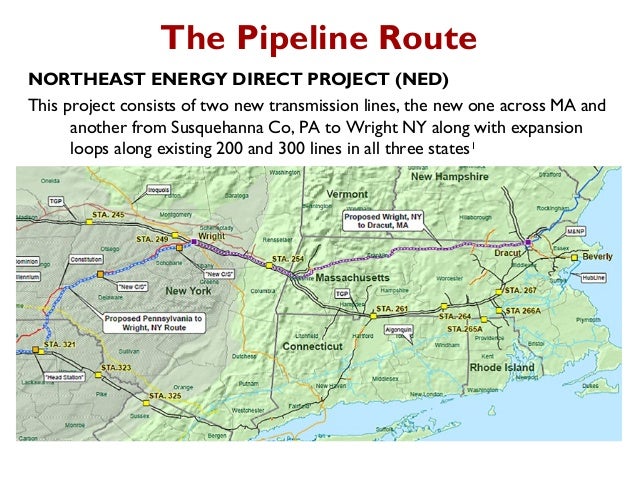
However, natural gas pipeline constraints have hampered utilization at peak times. For example, ISO New England recently highlighted that four gigawatts of natural gas-fired generation capacity – 24% of the region’s gas-fired net winter capacity – was at risk of not being able to get fuel when needed. Much of the constraint is due to New York state’s blocking the Constitution and Northern Access Pipeline projects, among others.

To compensate for New York’s un-neighborly policies, ISO New England performed triage for the past five years with its Winter Reliability Program, which has been paying as much as $32 million per year for reserves of oil and liquified natural gas (LNG) as back-up fuels. Beginning this year, ISO New England will change to a Pay for Performance plan that alters how a generation resource’s capacity payments are calculated. These costly plans might not be needed if economic rationality and the overall region’s welfare were top of the New York state of mind.

New York and New England must take a collective and collaborative approach to solve the problems with permitting and incentives that utilities have to contract longer-term for natural gas. Given policy alternatives that provide positive incentives and enable investment and infrastructure development, lower prices, and lessen price volatility, it should be a dominant strategy for the region to pursue outcomes that are less risky, better facilitate market operations and ultimately provide a win for the region’s consumers and economy.

The Bigger Picture: Energy and Human Development

At Forbes, Jude Clemente adds this perspective: More Oil And Natural Gas Invalidates ‘Keep It In The Ground’ Movement

There is a destructive “keep it in the ground” movement arising from environmental groups to block oil and natural gas development and the pipelines required to transport them. The center of this is New York and the New England states, where numerous policymakers seek to artificially constrain energy supply. Yet, despite producing none themselves, their reliance on gas electricity has surged. ISO New England now gets about 50% of its power from gas, versus 10-15% a decade ago. New York sits in the same boat: gas now generates ~45% of the state’s electricity, doubling its market share since 2005.

It’s no wonder then that blocking energy development and pipelines has established home power rates in New England and New York that are at least 50% higher than the national average. Industrial rates are more than double, and encourages companies to leave the area. This is unfortunate and illogical since U.S. natural gas prices have been at historic lows.

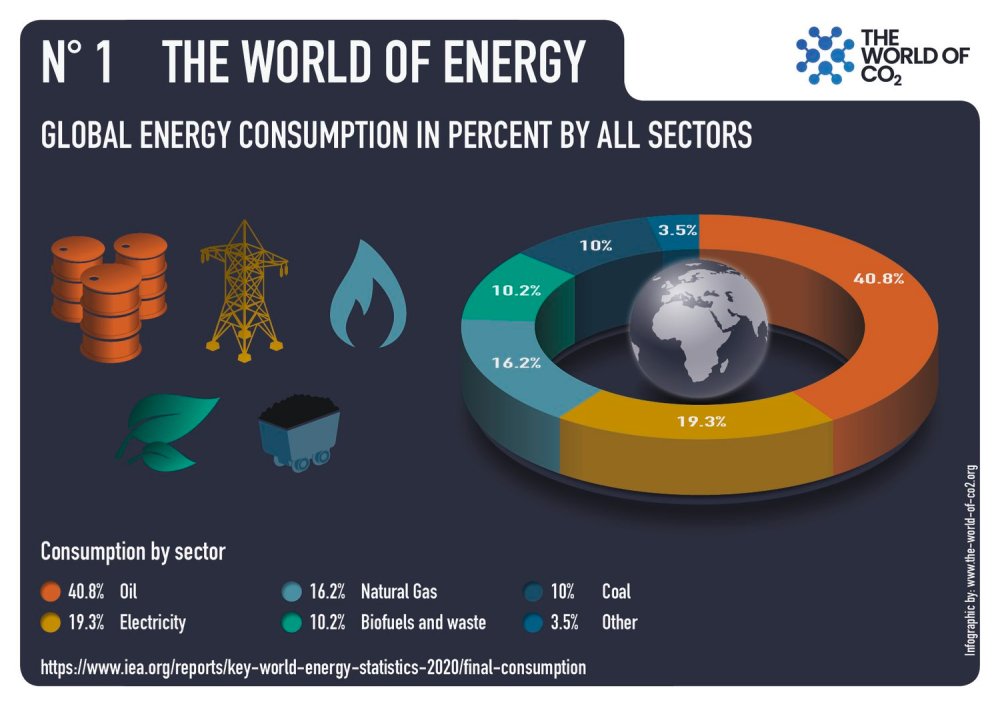
Policies intended to reduce oil and gas consumption are dubious: even if they work in the short-term, over time they just lower oil and gas prices and encourage more usage. I’ve already clearly explained it. Oil and gas are so obviously ingrained in the U.S. and global economies, supplying over 60% of all energy. In the real world, this means that more economic growth ultimately means more oil and gas demand. That’s why year after year demand continues to grow. There is no significant substitute for oil whatsoever. And know that natural gas power plants don’t get retired with more wind and solar power, but get built even more because gas is flexible backup required.

This is also why more oil and gas pipelines are so crucial, not just the most economical way to transport energy but also the safest. The Trump administration calls for a bill that gets at least $1.5 trillion for the new infrastructure investment that our country so desperately needs. It’s safe to assume that much of that would include provisions for oil and gas infrastructure. But it’s increasingly obvious that the approval process for pipelines needs expedited, now taking an average of four years for permits to be issued.

Summary

Climatists are fixated on future warming and blaming fossil fuels, the very energy which society needs to face cold or stormy weather. It is not only New York state at fault, but also obstructionists in states like Massachusetts and Connecticut. Climate change is not the problem, it’s climate policies that threaten our collective security.

NIMBY Wars: Portland Bans Fossils Fuels! Or not.

Mayor Hales and Community Activists Celebrate Unanimous Fossil Fuel Infrastructure Ban.

Lots of cheerleaders celebrated when in 2015, the City of Portland Oregon passed a city ordinance against fossil fuel infrastructure. Resilience.org published today praising Portland as the “First U.S. City to Ban Fossil Fuel Expansion Offers Roadmap for Others”. A year ago the event was proclaimed: Portland Makes History with New Protections from Fossil Fuels Dec. 14, 2016. It was a successful blow by protesters motivated by NIMBY (Not In My Back Yard). Excerpts below with my bolds.

But there’s more to the story. In July 2017 came this story from the Oregonian:

Oregon’s Land Use Board of Appeals (LUBA) on Wednesday rejected Portland’s limits on the expansion of fossil fuel infrastructure in the city, saying the ordinance violated the commerce clause of the U.S. Constitution.

The Portland Business Alliance joined fuel suppliers to appeal to the state Land Use Board of Appeals. They cited a number of grounds for the appeal, but Wednesday’s decision was based on a violation of the commerce clause, which gives the federal government the right to regulate trade between states and other nations.

The city is considering an appeal to the State Court of Appeals.

“This decision is disappointing and goes against the interests of our community,” according to a statement issued by Mayor Ted Wheeler. “It is incumbent upon us to protect our residents from the enormous risks posed by fossil fuels. The City is reviewing the ruling and exploring our options, including an appeal. Additionally, we will continue to work with environmental, energy, and resiliency experts to ensure Portland remains a leader on these issues.”

Then in January 2018 comes a ruling from the Appeals court: Portland Ban On Fossil Fuel Terminals Is Constitutional

The Oregon Court of Appeals ruled Thursday that the Portland City Council did not violate the U.S. Constitution with a 2015 resolution that banned new fossil fuel terminals.

The court reversed a significant portion of an Oregon Land Use Board of Appeals ruling, which found the ban unconstitutional.

Portland’s use of zoning laws to ban the construction and expansion of fossil fuel terminals matters for a couple reasons.

In Oregon, tanks located in North Portland supply about 90 percent of the fossil fuels used statewide.

Nationally, the ordinance also tested a new strategy for left-leaning cities that want to limit fossil fuel use as a way to combat climate change.

“Other cities were looking to the city of Portland and what they had done as a potential model for other ordinances,” said attorney Maura Fahey with the Crag Law Center.

The text of the Oregon Court of Appeal ruling is at Columbia Pacific v. City of Portland

The review concerned the July ruling by Land Use Board of Appeals (LUBA), The arguments revolve around the federal commerce principle that states are not allowed to favor their own merchants by discriminating against out of state suppliers, or favor their consumers over out of state consumers. The court decided that Portland was not guilty of that result, and also considered a precedent from Pike (US Supreme Court case):

“Where the statute regulates even-handedly to effectuate a legitimate local public interest, and its effects on interstate commerce are only incidental, it will be upheld unless the burden on such commerce is clearly excessive in relation to the putative local benefits. If a legitimate local purpose is found, then the question becomes one of degree. And the extent of the burden that will be tolerated will of course depend on the nature of the local interest involved, and on whether it could be promoted as well with a lesser impact on interstate activities.”

LUBA concluded that the amendments impose burdens on interstate commerce that are clearly excessive in relation to the putative local benefits. Columbia Pacific, ___ Or LUBA at ___ (slip op at 92). We disagree and, in contrast, conclude that Columbia Pacific did not meet its burden to demonstrate that the claimed burdens on interstate commerce are clearly excessive in relation to the putative local benefits.

However, the judges left a door open regarding the public detriment due to restricting fossil fuels for consumers.

Before LUBA, Columbia Pacific argued that that finding was essential to the city’s decision not to allow expansion of existing bulk fossil-fuel terminals and that the specific finding that use of fossil fuels may “plateau and decline” with a continued shift to other modes of transportation, more fuel efficient vehicles, electric vehicles, and other carbon reduction strategies was not supported by an adequate factual base as required by Goal 2. Columbia Pacific, ___ Or LUBA at ___ (slip op at 55). LUBA agreed with Columbia Pacific, concluding that Finding 21 was “key support for the prohibition on any expansion of existing terminals to meet * ** local or regional needs” and its conclusion that fossil-fuel use “may plateau and decline” was “not supported by substantial evidence, and hence not supported by an adequate factual base.”

The Appeals court sided with the defendants on this aspect, noting that “the only evidence in the record projecting future fossil-fuel demand cited to us by either party or LUBA are trend-based forecasts indicating that demand will moderately increase over time.”

Will reasonable people come together and set aside irrational fears?  It remains to be seen.  From the Portland Business Journal

The Portland Business Alliance, in a statement to Willamette Week, said it hopes the city sees the ruling as “an opportunity to bring parties back to the table to revisit elements of the ordinance which, as originally adopted, significantly impact fuel access and affordability” throughout the region.

The Western States Petroleum Association, asked via email if it would appeal the new ruling, sent this statement from Oyango Snell, its general counsel:

The Columbia Pacific Building Trades Council and the Western States Petroleum Association and its members are disappointed with the Oregon Court of Appeals’ decision to allow an unconstitutional ban on new fossil fuel infrastructure in Portland. The Fossil Fuel Zoning Ordinance is not only a violation of Oregon and Portland City land use laws, but punishes consumers and businesses in the city and throughout Oregon, who rely on affordable fuel to power their homes, their businesses and the economy.

Here is what they are up against on the other side:


NIMBY in Canada:  Alberta and British Columbia go to war over pipeline expansion

In a similar power struggle, BC province, led by leftist Vancouverites has moved to prevent construction of the expanded Kinder-Morgan pipeline to move bitumen from Alberta to west coast seaports serving Asian customers.  Canadian federal authorities have signed off on this, with PM Trudeau telling the greens that if they liked his carbon tax, they have to swallow this because it is a package deal.

Ironically both provinces are governed by left wing NDP politicos, but despite (or perhaps because of that) the rhetoric is going over the top.  National Post reports
Could Alberta bring B.C. to its knees by shutting off the oil?
If they don’t like pipelines, let’s see if B.C. likes having a main supply of gasoline turned off.  This comes after the Alberta premier earlier threatened to stop importation of BC wines.

Next:  Attacks on energy access on the East Coast (New England) Payback Upon Climate Grasshoppers

For more on climate issues in courts of law:

Judiciary Climate Confusion

Critical Climate Intelligence for Jurists (and others)

Climate Law Alaska Update


Green Electrical Shocks

On Sunday Feb.4, a weekly news program aired in the Netherlands on the titled subject. H/T Climate Scepticism. The video clip is below with English subtitles. For those who prefer reading, I provide the substantial excerpts from the program with my bolds.

How many of you have Green Electricity? I will estimate 69%
And how much nationally? Oh, 69%!
So we are very average, and in a good way, because the climate is very important.

Let me ask: Green electricity comes from . . .?
Yes, electricity produced from windmills and solar panels.
Nearly 2/3 of the Dutch are using it. That’s the image.

Well I have green news and bad news.
The green news: Well done!
The bad news: It is all one big lie.
Time for the Green Electrical Shocks.

Shock #1: The green electricity from your socket is not green.
When I switched to green electricity I was very proud.
I thought, Yes, well done! The climate is getting warmer, but not any more thanks to me.

Well, that turned out to be untrue.
All producers deliver to one communal grid. Green and grey electricity all mix.
The electricity you use is always a mix of various sources.
OK. It actually makes sense not to have separate green and grey cables for every house.
So it means that of all electricity, 69% is produced in a sustainable way. But then:


Shock #2: Green Electricity is mostly fake.
Most of the green electricity we think we use comes from abroad.
You may think: So what. Green is green.

But that electricity doesn’t come from abroad, it stays abroad.
If you have green electricity at home, it may mean nothing more than that your supplier has bought “green electricity certificates”.

In Europe green electricity gets an official certificate,
Instead of selling on the electricity, they sell on those certificates.
Norway, with its hydro power, has a surplus of certificates.
Dutch suppliers buy them on a massive scale, while the electricity stays in Norway.


The idea was: if countries can sell those certificates, they can make money by producing more green electricity.
But the Norwegians don’t produce more green electricity.
But they do sell certificates.

The Dutch suppliers wave with those certificates, and say Look! Our grey electricity is green.
Only one country has produced green electricity: Norway.
But two countries take the credit.
Norway, because they produce green electricity, and the Netherlands because, on paper, we have green electricity. Get it? That’s a nice deal.

More and more countries sell those certificates. Italy is now the top supplier.
We buy fake green electricity from Italy, like some kind of Karma ham.

Now, let’s look again at the green electricity we all think we use.
So the real picture isn’t 69%. If you cancel the certificates, only 21% of electricity is really green.
Nowadays you can even order it separately if you don’t want to be part of that Norway certificates scam.
You may think: 21% green is still quite a lot. But it is time for:


Shock #3: Not all energy is electricity.
If you talk about the climate, you shouldn’t just consider electricity but all energy.
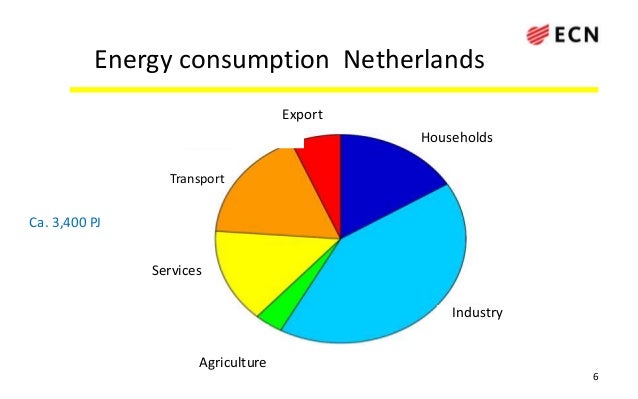
When you look at all energy, like factories, cars, trains, gas fires, then the share of consumer electricity is virtually nothing.
If you include everything in your calculation, it turns out that only 6% of all the energy we use in the Netherlands is green. It is a comedy, but wait:

Trees converted into pellets by means of petroleum powered machinery.

Shock #4: Most green energy doesn’t come from sun or wind, like you might think.
Even the 6%, our last green hope, is fake. According to the CBS we are using more sun and wind energy, but most of the green energy is produced by the burning of biomass.
Ah, more than half of the 6% green energy is biomass.

Ridiculous. What is biomass really? It is organic materials that we encounter every day.
Like the content of a compost heap. How about maize leaves or hay?
The idea behind burning organic materials is that it will grow up again.
So CO2 is released when you burn it, but it will be absorbed again by new trees.

However, there is one problem. The forest grows very slowly and our power plants burn very fast.
This is the fatal flaw in the thinking about biomass. Power plants burn trees too fast, so my solution: slow fire. Disadvantage: it doesn’t exist. So this is our next shock.

Shock#5: Biomass isn’t all that sustainable.
It’s getting worse. There aren’t enough trees in the Netherlands for biomass.
We can’t do it on our own. We don’t have enough wood, so we get it from America.

In the USA forests are cut at a high rate, Trees are shredded and compressed into pellets.
These are shipped to the Netherlands and end up in the ovens of the coal plants.
It’s a disaster for the American forests, according to environmental groups.

So we transport American forests on diesel ships to Europe.
Then throw them in the oven because it officially counts as green energy.
Only because the CO2 released this way doesn’t count for our total emissions.

In reality biomass emits more CO2 than natural gas and coal.
These are laws of nature, no matter what European laws say.
At the bottom line, how much sustainable energy do we really have in the Netherlands?
Well, the only real green energy from windmills, solar panels etc. Is only 2.2%. of all the energy we use.

In Conclusion
So the fact that 2/3 of the audience and of all Dutch people use green electricity means absolutely nothing. It’s only 2.2%, and crazier still, the government says it should be at 14% by 2020.
They promised: to us, to Europe, to planet Earth: 14 instead of 2.2.

Instead of making a serious attempt to save the climate, they are only working on accounting tricks, like buying pieces of paper in Norway and burning American forests.
They are only saving the climate on paper.

Summary Comment

As the stool above shows, the climate change package sits on three premises. The first is the science bit, consisting of an unproven claim that observed warming is caused by humans burning fossil fuels. The second part rests on impact studies from billions of research dollars spent uncovering any and all possible negatives from warming. And the third leg is climate policies showing how governments can “fight climate change.”

It is refreshing to see more and more articles by people reasoning about climate change/global warming and expressing rational positions. Increasingly, analysts are unbundling the package and questioning not only the science, but also pointing out positives from CO2 and warming.  And as the Dutch telecast shows, ineffective government policies are also fair game.

More on flawed climate policies at Reasoning About Climate

On Coastal Climate Risk

Matthew Kahn raises the question at his blog Is Oakland “Inconsistent” as it Sues Fossil Fuel Companies While Downplaying Climate Risk in its Municipal Bond Prospectus? Excerpts below with my bolds.

Wall Street Journal: California localities warn of disaster when suing oil companies. So how come they don’t tell investors?

The WSJ has published a fascinating piece that points out an inconsistency in the expressed views of the leaders of Oakland’s city government. This coastal city is suing Exxon and other fossil fuel companies for engaging in business that threatens Oakland’s future (i.e fossil fuel burning causes sea level rise that will impose costs on Oakland). Oakland’s inconsistency occurs in the municipal bond market. Oakland seeks to borrow a large amount of $ by selling bonds. In the bond risk disclosures, climate change is played down. In this setting, Oakland has a strong incentive to state that it is a low risk because low risk borrowers can borrow at a lower interest rate.

The author of the WSJ asks a simple question; which truth does Oakland believe? Is it over-exaggerating the risk it faces to win the Exxon law suit while simultaneously downplaying a possible risk in the municipal bond market? Did Oakland’s officials anticipate that they could engage in such “mixed messaging”?

In truth, Oakland will need to borrow $ to help it engage in capital upgrades to prepare for sea level rise. The market will set the equilibrium interest rate to reflect the risk. If investors know that coastal cities have an incentive to lie and understate the true risk then new risk providers such as the nascent Jupiter project will emerge to provide this information. To put this simply, when you buy a used car — do you just ask the current owner for her assessment of its quality? Don’t be a sucker, do your homework.

The Exxon lawsuit raises major issues. I understand transaction costs but why aren’t the litigants suing gasoline car makers and gasoline car buyers? This lawsuit is an indirect court induced carbon tax. If the litigants succeed, what would be the economic incidence of this tax? Would Exxon’s profit decline? (More on the legal issues below)

A good debater might argue that the municipal bonds are issued for 30 years and over this time horizon, coastal cities do not face a serious challenge and thus the bond default risk is low. But, as you make these arguments think back in time. 1988 was 30 years ago. Technology has made some progress. By the year 2048, I have a feeling that our technological frontier will have leaped forward to help us to adapt to the new normal. The coastal capital stock will be less durable and we will be prepared.

Note: By the term “durable” in the last sentence, Kahn refers to the possibility of structures in vulnerable places being movable in the face of erosion or flooding. He and Devin Bunten discuss how developers are likely to adapt to localized climate risks in their paper Optimal Real Estate Capital Durability and Localized Climate Change Disaster Risk Devin Bunten and Matthew E. Kahn January 2017
(Board of Governors of the Federal Reserve System, University of Southern California and NBER)

Abstract
The durability of the real estate capital stock could hinder climate change adaptation because past construction anchors the population in beautiful and productive but increasingly-risky coastal areas. However, coastal developers anticipate that their assets face increasing risk and this creates an incentive to seek adaptation strategies. This paper models climate change as a joint process of (1) increasingly destructive storms and (2) a risk of sea-level rise that submerges coastal property. We study how forward-looking developers and real estate investors respond to the new risks along a number of dimensions including their choices of location, capital durability, capital mobility (modular real estate), and maintenance of existing properties. The net effect of such investments is a more resilient urban population.

The above referenced WSJ article is paywalled, but this post by CEI gets at the securities fraud issue: SEC Should Investigate California Municipalities for Climate-Related Securities Fraud

It appears a variety of California municipalities have gotten themselves in hot water. To investors of their bonds, they have claimed that they are unable to predict sea level rise or other climate risks. But they recently filed suit against a variety of oil and gas companies claiming the companies are causing the sea level to rise. The municipalities in their lawsuits give very explicit predictions as to how much they think the sea level will rise.

Today CEI asked the Securities and Exchange Commission to investigate these activities as possible securities fraud. Federal law prohibits deceiving investors through untrue material facts or material omissions. The municipalities claim to the court that they are able to predict these sea level changes. If that is true, then they are deceiving investors. The SEC’s mission is to protect investors from such false statements.

A few examples of the conflicting statements:

  • The City of San Francisco to bond investors: “The City is unable to predict whether sea-level rise or other impacts of climate change or flooding from a major storm will occur, when they may occur.” But to the court, the city predicts “0.3 to as much as 0.8 feet of additional sea level rise.”
  • The City of Oakland to bond investors: “The City is unable to predict when seismic events, fires or other natural events, such as sea rise or other impacts of climate change or flooding from a major storm, could occur, when they may occur.” But to the court, the city predicts “66 inches of sea level rise.”
  • The County of San Mateo to bond investors: “County is unable to predict whether sea-level rise or other impacts of climate change or flooding from a major storm will occur, when they may occur.” But to the court, the county states: “The County anticipates and is planning for significant sea level rise.”
  • The County of Santa Cruz to bond investors states that “may be subject to unpredictable climatic conditions, such as flood.” But to the court, the county states that there is a “98% chance that the County experiences a devastating three-foot flood before the year 2050.”

There are two possible reasons why these municipalities have told the courts different statements than investors. First the municipalities may be trying to get more money from bonds then they would be able to get if they were honest about their true beliefs. For instance, the City of Oakland predicts the costs of “between $22 and $38 billion.” Would the city even be solvent trying to pay those costs? No investor would give their money to a city which expects not to be able to pay them back. If the municipalities were forced to explain what they claim are the expected impacts of climate change to their budget, they would no longer be able to raise as much money from bonds.

The second possible reason is that these municipalities are actually lying to the courts instead of investors by fabricating their predictions of sea level rise. Or perhaps they’re misrepresenting things to both investors and the courts.

Regardless, we hope the SEC can get to the bottom of this.

On the legal flaws with these lawsuits by cities: Is Global Warming A Public Nuisance?

US Election Rigged, Trump Won Anyway

Details are provided by Ross McKitrick in a background paper: The Nunes Memo and the Horowitz Report: Popcorn  Edition1 Ross McKitrick  January 29, 2018

I find the backstory to be as gripping as any paperback spy thriller. But the plot is
complicated and there are many moving parts. Herein, based on my readings, is my surmise
about what the 4 page Nunes memo contains, and also what a forthcoming report by
Department of Justice Inspector General Michael Horowitz will conclude. I have included
some source citations but left many out since there are too many to list.

Chapter 1: Benghazi and Hillary’s Emails

Chapter 2: The Clinton Email Investigation

Chapter 3: Steele Visits the FBI

Chapter 4: The DoJ Inspector General Investigation

Chapter 5: The Trump Tower Wiretap

Chapter 6: Mueller Appointed Special Counsel

Final Chapter: The Two Reports

The Onion weighs in:  

FBI Warns Republican Memo Could Undermine Faith In Massive, Unaccountable Government Secret Agencies

WASHINGTON—Stressing that such an action would be highly reckless, FBI Director Christopher Wray warned Thursday that releasing the “Nunes Memo” could potentially undermine faith in the massive, unaccountable government secret agencies of the United States. “Making this memo public will almost certainly impede our ability to conduct clandestine activities operating outside any legal or judicial system on an international scale,” said Wray, noting that it was essential that mutual trust exist between the American people and the vast, mysterious cabal given free rein to use any tactics necessary to conduct surveillance on U.S. citizens or subvert religious and political groups. “If we take away the people’s faith in this shadowy monolith exempt from any consequences, all that’s left is an extensive network of rogue, unelected intelligence officers carrying out extrajudicial missions for a variety of subjective, and occasionally personal, reasons.” At press time, Wray confirmed the massive, unaccountable government secret agencies were unaware of any wrongdoing for violating constitutional rights.


The cosmoclimatology theory


An article at GWPF provides a concise description linking solar activity to earth’s climate. It pulls together several strands of observations and thought presented in recent posts, which are referenced at the end.

The GWPF article (here) is from Deepak Lal and focuses on why India should follow the US out of the Paris accord, but I am more interested in the scientific rationale. The author nicely summarizes an alternative explanation for climate fluctuations to that of IPCC “consensus” scientists. Excerpts below with my bolds.

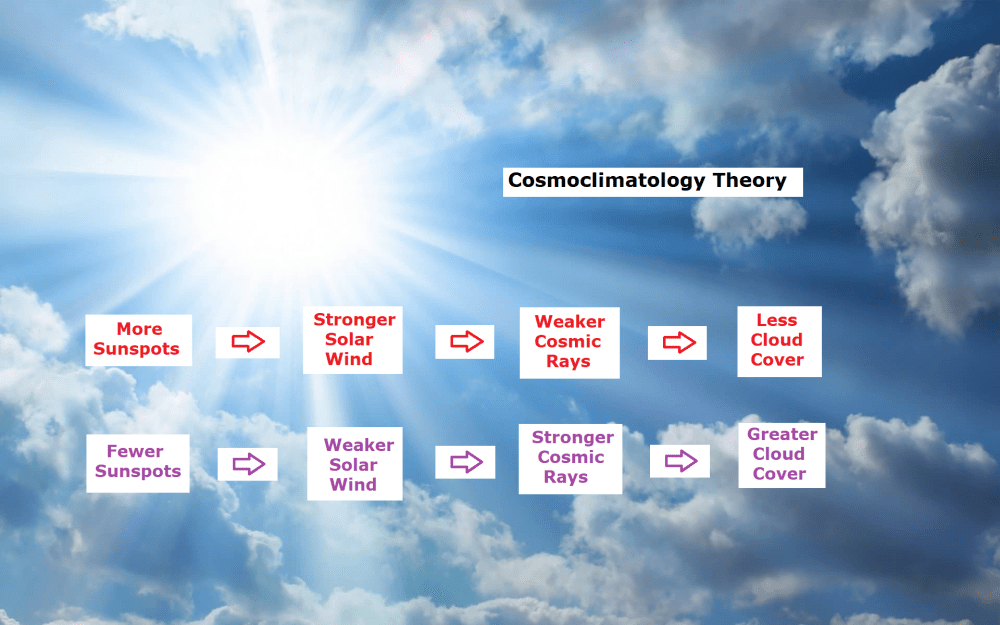
Propounded by Danish physicist Henrik Svensmark and his associates, the cosmoclimatology theory states that climate is controlled by low cloud cover, which when widespread has a cooling effect by reflecting solar energy back into space and vice versa. These low clouds, in turn, are formed when sub-atomic particles called cosmic rays, emitted by exploding stars, combine with water vapour rising from the oceans.

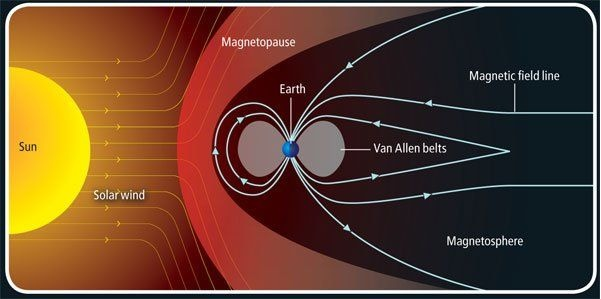
The constant bombardment of the planet by cosmic rays is modulated by the solar wind, which when it is blowing prevents cosmic rays from reaching the earth and creating low clouds. The solar wind in turn is caused by the varying sunspot activity of the sun.

When, as recently, sunspot activity decreases we get the global ‘cooling’ observed during the recent ‘pause’ in global warming. Furthermore, as noted by the Princeton physicist William Happer (see my column “Clouds of Climate Change”, September 2011), the millennial ‘ice core’ records of the correlation between CO2 and temperature show “that changes in temperature preceded changes in CO2 levels, so that CO2 levels were an effect of temperature changes.

Much of this was probably due to outgassing of CO2 from the warming oceans or the reverse in cooling” (“The truth about greenhouse gasses”). For the oceans are the primary sinks as well as emitters of CO2. Given their vastness relative to the earth’s surface, it takes a long time for the ocean to warm from rises in terrestrial temperatures (and vice versa), hence the lag between temperature and CO2 levels.

cern-cloud

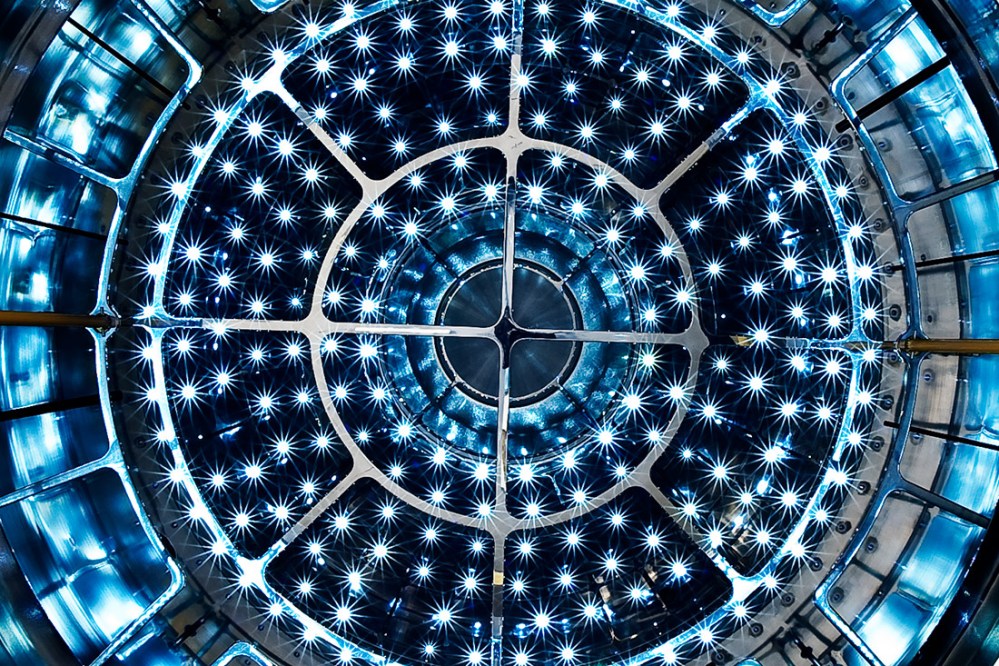
The CLOUD experiment is studying whether cosmic rays play a role in cloud formation. Maximilien Brice / CERN

The missing piece in the cosmoclimatology theory was the physical link between cosmic rays and cloud formation. The first confirmation of the basic hypothesis that “ions [cosmic rays] are fundamental for the nucleation of aerosols [tiny liquid or solid particles that provide a nucleus around which droplets can form from water vapour in the air]” was confirmed by the CLOUD experiment at CERN — the particle physics laboratory in 2011. (See Kirby et al, Nature, (2011), 476, 429-433: Cloud formation may be linked to cosmic rays  Experiment probes connection between climate change and radiation bombarding the atmosphere.

But there was still a problem with the hypothesis. It was that, even if as the CLOUD experiment showed ions helped aerosols to form and become stable against evaporation — a process called nucleation — these small aerosols “need to grow nearly a million times in mass in order to have an effect on cloud formation.”

The latest research by Svensmark and his associates (reported in H Svensmark et al. “Increased ionisation supports growth of aerosols into cloud condensation nuclei” Nature Communications 2017;8(1) shows“ both theoretically and empirically and experimentally, how interactions between ions and aerosols can accelerate the growth by adding material to the small aerosols and thereby help them survive to become cloud condensation nuclei” (David Whitehouse: “Cosmic Rays Climate Link Found”). This implies, Prof Svensmark argues, that the effect of the sun on climate could be “5-7 times stronger than that estimated due to changes in the radiant output of the sun alone.”

It also explains why over geological time, there have been much larger variations in climate correlated with changes in cosmic rays. He adds that “it also negates the idea that carbon dioxide has been controlling the climate on the se timescales. ”Thus, the Medieval Warm period around 1000 AD and the subsequent Little Ice Age between 1300AD and 1900AD fit with changes in solar activity.

It also explains climate change observed over the 20th century. Similarly, coolings and warmings around 2 degrees Celsius have occurred repeatedly over the last 10,000 years with variations in the Sun’s activity and cosmic ray influx. While over longer time periods there are much larger variations of up to 10 degrees Celsius as “the Sun and Earth travel through the Galaxy visiting regions with varying numbers of exploding stars”. Svensmark concludes that ‘finally we have the last piece of the puzzle explaining how particles from space affect climate on Earth. It gives an understanding of how changes caused by solar activity or by supernova activity can change climate”.

Surely with this confirmation of the cosmo-climatology theory a Nobel Prize in physics for Svensmark and his associates cannot be far off, and with that the end of the hubristic theory of anthropogenic CO2 generated climate change.

CC Theory1

Last word to Svensmark from his December 2017 publication

The missing link between exploding stars, clouds, and climate on Earth  Breakthrough in understanding of how cosmic rays from supernovae can influence Earth’s cloud cover and thereby climate

Summary: The study reveals how atmospheric ions, produced by the energetic cosmic rays raining down through the atmosphere, helps the growth and formation of cloud condensation nuclei — the seeds necessary for forming clouds in the atmosphere.

screenshot-2017-12-19-09.20.33

Cosmic rays interacting with the Earth’s atmosphere producing ions that helps turn small aerosols into cloud condensation nuclei — seeds on which liquid water droplets form to make clouds. A proton with energy of 100 GeV interact at the top of the atmosphere and produces a cascade of secondary particles who ionize molecules when traveling through the air. One 100 GeV proton hits every m2 at the top of the atmosphere every second.

The hypothesis in a nutshell

  • Cosmic rays, high-energy particles raining down from exploded stars, knock electrons out of air molecules. This produces ions, that is, positive and negative molecules in the atmosphere.
  • The ions help aerosols — clusters of mainly sulphuric acid and water molecules — to form and become stable against evaporation. This process is called nucleation. The small aerosols need to grow nearly a million times in mass in order to have an effect on clouds.
  • The second role of ions is that they accelerate the growth of the small aerosols into cloud condensation nuclei — seeds on which liquid water droplets form to make clouds. The more ions the more aerosols become cloud condensation nuclei. It is this second property of ions which is the new result published in Nature Communications.
  • Low clouds made with liquid water droplets cool the Earth’s surface.
  • Variations in the Sun’s magnetic activity alter the influx of cosmic rays to the Earth.
  • When the Sun is lazy, magnetically speaking, there are more cosmic rays and more low clouds, and the world is cooler.
  • When the Sun is active fewer cosmic rays reach the Earth and, with fewer low clouds, the world warms up.

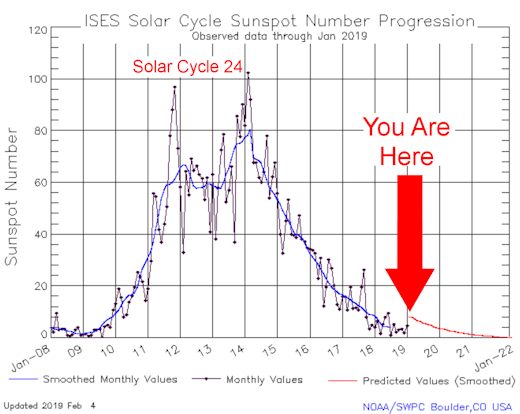
Figure 2 It is crucial to look at the baseline closely that in 2009 actually touched zero for months on end. This is not normal for the low point of the cycle. Figure 3 shows how cycle 24 was feeble compared with recent cycles. And it looks like it will have a duration of ~10 years (2009-2019) which as the low end of the normal range which is 9 to 14 years with mean of 11 years. Chart adapted from SIDC is dated 1 January 2018.

Update March 2019

sunspotcycle_strip

Additional Resources:

Nature’s Sunscreen

Magnetic Pole Swapping and Cooling

Autumnal Climate Change

Arctic Ice Watch January 31

Click on image to enlarge.

Arctic ice is growing extents slowly to approach 14M km2 with about six weeks left to reach annual maximum.  The meandering polar vortex brings warmer air north to replace the cold air sent into Canada and USA.

The image above shows Barents on the right is finally adding extent, growing 200k km2 in two weeks to reach 76% of last year’s maximum. The image below shows the ice see-saw in the Pacific.  First Okhotsk grows 100k km2 to reach average (63% of maximum) while Bering dithers.  Then Bering adds 100k km2 to reach 53% of maximum (still below average), while Okhotsk retreats, giving back its 100k.

Click on image to enlarge.

Ice extents for January appear in the graph below; 11 year average is 2007 to 2017 inclusive.

Note that 2007 caught and exceeded the 11 year average ending the month tied.  2018 is now ~300k km2 below 2017 and both lag behind average having started the year in deficit. SII 2018 is running about 200k km2 less than MASIE for the month.

Below is the analysis of regions on day 031.  Average is for 2007 to 2017 inclusive.

Region 2018031 Day 031 
Average
2018-Ave. 2017031 2018-2017
 (0) Northern_Hemisphere 13792271 14504082 -711811 14086396 -294125
 (1) Beaufort_Sea 1070445 1070210 235 1070445 0
 (2) Chukchi_Sea 965971 965960 11 966006 -35
 (3) East_Siberian_Sea 1087120 1087023 97 1087137 -18
 (4) Laptev_Sea 897845 897820 24 897845 0
 (5) Kara_Sea 895363 915975 -20612 862890 32473
 (6) Barents_Sea 481947 578898 -96950 421776 60171
 (7) Greenland_Sea 501411 622550 -121139 549359 -47948
 (8) Baffin_Bay_Gulf_of_St._Lawrence 1406903 1362611 44292 1299268 107634
 (9) Canadian_Archipelago 853109 853066 43 853214 -106
 (10) Hudson_Bay 1260838 1260818 19 1260903 -66
 (11) Central_Arctic 3184817 3219924 -35107 3232583 -47766
 (12) Bering_Sea 382207 685972 -303766 509369 -127162
 (13) Baltic_Sea 41714 76231 -34517 31706 10008
 (14) Sea_of_Okhotsk 704398 836881 -132483 1006706 -302308

The core of the Arctic is frozen solid and for the date 2018 is ~5% below average.  The difference is mainly due to Bering Sea 44% below average, Greenland 20% down, Barents 17% less, and Okhotsk 16% lower. 

Postscript:

Check out the action in Kara Sea near the mouth of the Yenisei River, as a nuclear ice breaker comes within meters of a car expedition on the ice, temperatures at -50C. January 26, 2018


Upping the Stakes for Ecoterrorists

Protesters admit to pipeline vandalism before vandalizing IUB

Previous posts have covered the trials of  “valve turners”, showing the legal maneuvers required to bring them to justice.  Now we have a report that Iowa lawmakers intend on raising the stakes for those taking this path to “save the planet” from fossil fuel energy.  From the Des Moines Register Iowa Senate bill would ban sabotage of pipelines, other ‘critical infrastructure’ Excerpts below with my bolds.

Criminal acts against pipelines, telecommunications facilities, water treatment plants, and a long list of other critical infrastructure would result in a long prison sentence and a steep fine under legislation advancing in the Iowa Senate.

Senate Study Bill 3062, proposed by the Iowa Department of Homeland Security and Emergency Management, appears to be a response to millions of dollars in damage inflicted by protesters on Iowa sections of the Dakota Access Pipeline, prior to the crude oil pipeline becoming operational last year across four states.

Explanation of the proposed legislation, Senate Study Bill 3062 from the Iowa Bill book: (full text here)

This bill creates the crime of critical infrastructure sabotage.

The bill defines critical infrastructure property as property and public utility property, both as defined in Code 9 section 716.7, that is considered critical infrastructure. The bill defines critical infrastructure to include electrical critical infrastructure, gas, oil, refined petroleum products, or chemical critical infrastructure, telecommunications or broadband critical infrastructure, wastewater critical infrastructure, and water supply critical infrastructure.

The bill additionally defines critical infrastructure sabotage to mean any unauthorized act that is intended to or does in fact cause a substantial interruption or impairment of service rendered to the public relating to critical infrastructure property. The bill provides that a person who commits critical infrastructure sabotage commits a class “B” felony, punishable by confinement for no more than 25 years. The bill also subjects a person who commits critical infrastructure sabotage to a fine of $100,000.

Jeff Boeyink, a lobbyist for Energy Transfer, the developer of the $3.8 billion Dakota Access Pipeline, told a Senate subcommittee Thursday he considers his company’s project to be the “poster child” of why the legislation is necessary.”This is not only dangerous, but it has huge monetary implications,” Boeyink said.

John Benson, a legislative liaison for the Department of Homeland Security and Emergency Management, said Iowa law currently allows criminal charges for terrorism, arson, burglary and criminal mischief. However, these charges do not specifically include “critical infrastructure,” he said, and operators of these facilities want criminal charges that are appropriate for such actions.

The Senate subcommittee voted 3-0 Thursday to advance the measure to the full Senate Judiciary Committee. Sen. Tom Shipley, R-Nodaway, said the bill needs to be amended, but he believes it’s a step in the right direction.

“There is no question about it that we have people who are looking to do others harm,” Shipley said. That’s evidenced by “terrorist activities on pipelines” and other threats to infrastructure that can damage the nation’s economy and put lives in peril, he remarked.

Hundreds of Iowans protested the construction of the Dakota Access Pipeline, and many were arrested in demonstrations along the pipeline route over the past two years. Most of the protests were peaceful, but in July 2017, two activists with a history of arrests for political dissent claimed responsibility for repeatedly damaging the Dakota Access Pipeline while the project was being built in Iowa.

Ruby Montoya, 27, and Jessica Reznicek, 35, who both resided in Des Moines at the time, described their pipeline sabotage as a “direct action” campaign that began in November 2016. They said their first incident of destruction involved burning at least five pieces of heavy equipment on the pipeline route in northwest Iowa’s Buena Vista County.

The two women said they researched how to pierce the steel pipe used for the pipeline and in March 2017 they began using oxyacetylene cutting torches to damage exposed, empty pipeline valves. They said they started deliberately vandalizing the pipeline in southeast Iowa’s Mahaska County, delaying completion for weeks.

Reznicek and Montoya said they subsequently used torches to cause damage up and down the pipeline throughout Iowa and into part of South Dakota, moving from valve to valve until running out of supplies. They said their actions were rarely reported in the media.

The bill says that a person who sabotages critical infrastructure could be charged with a Class B felony, punishable by no more than 25 years in prison, plus a $100,000 fine.

Postscript: