Takeaways from Green Fund Meltdown

From Climate Home is this post today by Megan Darby 8 takeaways from the Green Climate Fund meltdown  Excerpts in italics below with my bolds and images.

The UN’s flagship climate finance initiative had a public setback this week. What went wrong, what are the political implications and what happens next?

The UN’s flagship climate finance initiative had a major setback this week, with the board failing to agree on any big ticket decisions.

Longstanding tensions at the Green Climate Fund came to a head in Songdo, South Korea, as it opened talks on raising a new round of contributions.

On top of that, the head of the secretariat abruptly resigned, adding top level recruitment to the fund’s woes.

As the dust settled, Climate Home News spoke to several participants and observers about what went wrong, the fallout and next steps. Here are eight takeaways.

1. Absent Oquist

The meeting got off to a bad start when the Nicaraguan co-chair failed to show up. Ok, so things were pretty bad back home, with anti-government protests turning violent.

But it was ironic, given Paul Oquist had done a major U-turn to get the job. He notoriously refused to endorse the Paris Agreement in 2015, saying it was too weak. Nicaragua only joined last year when it became apparent Oquist otherwise had no chance at leading the GCF board.

In his absence, developing country board members complained they had not been properly consulted on the agenda, kicking off a protracted procedural dispute.

2. Trump towers

After president Donald Trump made clear he had no plans to put any more money into the GCF, you may wonder why the US still has a seat on the board.

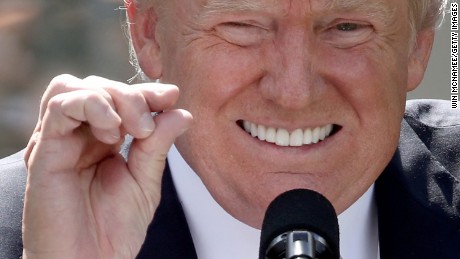
Trump sizes up the benefits were Paris Accord to actually succeed.

Well, the country has already handed over $1 billion and Geoffrey Okamoto is the Trump appointee charged with seeing it is spent wisely. But he can afford to be provocative, having no stake in the fund’s sustainability.

His insistence that the replenishment process should be “donor-driven” did not go down well, on a board deliberately structured to give the developing world an equal say. Nor did his lobbying to end talks on time, while others were trying to salvage some agreement.

3. Fundraising

If there was any doubt on where the talks got stuck, a glance at the video page should dispel it. There are no fewer than six sessions recorded on “matters related to replenishment”, spanning more than 24 hours.

At heart, it is a rich-poor fight of the kind familiar to anyone who follows UN climate negotiations. Donor countries try to attach conditions to funding, while beneficiaries demand they quit stalling and deliver.

In previous meetings, the board has tended to push through some headline outcomes – usually project approvals – at the last minute, while deferring contentious policy decisions. This time round, representatives from Canada and Finland as well as the US were not prepared to just muddle through.

4. Performance review

Before it can raise new money, the fund will need to show donors what it has done with the initial round of contributions. This and other preparatory work is expected to take six months or so.

“If there is one thing we need to decide this time, it is to start a review, because that is a precondition to replenishment processes,” said Germany’s Karsten Sach in the meeting.

The problem was in deciding who should carry out the review. Most saw it as the natural remit of the fund’s independent evaluator Jyotsna Puri, but a handful of developing countries wanted to outsource it. So here too, there was no agreement.

5. Bamsey bails

After a weary-looking chair admitted defeat on replenishment, he dropped a bombshell: the fund’s top executive Howard Bamsey resigned with immediate effect.

Nobody blamed Bamsey for the chaos, which was essentially political, or cast doubt on his explanation the move was for “pressing personal reasons”. The Songdo-based role had kept him away from his family in Australia. (He could not be reached for further comment.)

But the timing took some – including the secretariat’s communications team – by surprise. He had been expected to oversee the replenishment process before leaving. His replacement must take on the heavy lift of fundraising and resolving a backlog of governance issues, while navigating the heated boardroom politics.

6. Projects in limbo

The collapse means a three-month delay for 11 projects bidding for nearly $1 billion of GCF money. Solar panels in Tonga, water management in the Guatemalan highlands and climate finance upscaling across 17 countries are some of the interventions that will just have to wait.

“The people and communities the GCF is meant to support – those who are most vulnerable – are the ones who suffer the most when progress is delayed,” said Action Aid’s Brandon Wu.

It does nothing to help the fund’s reputation for being slow to get money moving. Then again, with a cash crunch looming, the fund cannot afford to make cavalier spending decisions.

7. Political fallout

It comes in a critical year for the UN climate process. Ministers are due to take stock of global action at the Cop24 negotiations in Katowice, Poland this December.

Climate finance is a key part of that. The industrialised world has promised to mobilise $100 billion a year by 2020. Many countries’ climate plans hinge on that support.

The GCF is not expected to deliver all that investment, but is a totem of international cooperation. If it breaks down, it bodes poorly for the Paris Agreement.

8. Optimism

Despite the public meltdown, everyone CHN contacted was hopeful of getting things back on track. There is time for the fund to redeem itself before Cop24, at the next board meeting in October. Behind the scenes, its advocates will knock some heads together in the coming months.

While finance people may be horrified at the inefficiency and game-playing, those coming from a climate negotiations background see the occasional political upset as par for the course.

“Anything about new money is always very thorny,” said Meena Raman of the Third World Network. “I don’t think we have given up on [the GCF] and I don’t think anyone should.”

Footnote:  The last takeaway is wishful thinking from Climate Home, who are desperately hopeful that Paris Accord and the Green Fund succeed, despite the obvious signs of collapse.  Staying hopeful is also a signal of virtue.

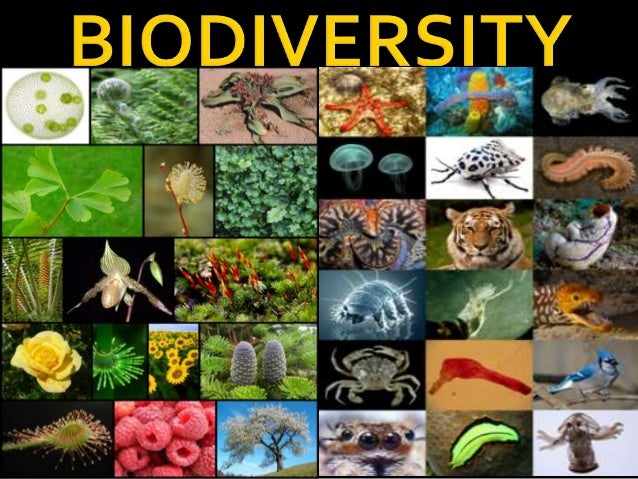
Climate Change Induces Biodiversity

Quartz reports Climate change will force species to find new homes. We have to embrace it. Excerpts in italics with my bolds.

During the last Ice Age, species adapted to warmer climes survived in refugia: places that, through some quirk of topography and geography, stayed temperate in a glacial world. By this century’s end, new refugia will emerge—locales where plants and animals will shelter from rising temperatures, protected until such time as they can proliferate again.

For that to happen, though, nature-loving people will need to be open-minded to change. After all, these places will become very different from what they are now.

“The important species turnover expected in northern protected areas emphasizes the hopelessness of trying to preserve a snapshot of today’s biodiversity,” write researchers led by biologist Dominique Berteaux of the Univery of Quebec in Rimouski. “This challenges the traditional paradigm of conserving the ecological integrity of national parks.”

In a study published in the journal Scientific Reports, Berteaux’s team model the likely near-future climate suitability of a 230,000-square-mile network of protected areas in Quebec for 529 species of birds, amphibians, plants, and trees. That’s only a portion of possible biodiversity, but it’s enough to signify larger trends—and by the year 2100, Quebec’s nature could be a jumble of existing and newly-arrived species.

The total number of species living in the region will soar by about 92%. An estimated 24% of species now found there will become locally extinct. Species turnover—a metric used by ecologists to represent these gains and losses—comes in at 55%. Those are just averages: Some places are predicted to experience less change, but others could have far more.

Reality is more complicated than models, of course, and the results are not intended to be exact predictions. Rather, they “provide the best-available indication of the strong pressure that climate change will impose on biodiversity,” write Berteaux and colleagues. There are several implications.

First and foremost, “northern protected areas should ultimately become important refuges for species tracking climate northward”—but only if they can get there. Urbanization and habitat fragmentation could block them, squeezing species between inhospitable climate to the south and impassable landscapes to the north. Protecting migration corridors is vital.

And once new species do arrive, ecological disruption is inevitable. Newcomers may degrade ecosystem function; they may also be necessary to preserve ecosystem function. These are not mutually exclusive propositions. “In this context,” write Berteaux’s team, “deciding which new species should be controlled and which should be tolerated or favored will represent an immense challenge.”

Ultimately it may make more sense to take a big-picture approach, protecting a diversity of habitats rather than worrying about particular species. It may also be sensible, says Berteaux, to be more welcoming of newcomers than conservationists now tend to be.

People tend to “see all the bad things they could bring. We forget that nature is always transient,” said Berteaux when asked about dismay over the northward expansion of beavers into the Arctic—something not discussed in this study, but emblematic of its themes. “Change has to be accepted and conservation must be thought in this context of permanent change.”

Source: Berteaux et al. “Northern protected areas will become important refuges for biodiversity tracking suitable climates.” Scientific Reports, 2018.

Berteaux et al provide a summary of results and a plan for adapting.

The Northern Biodiversity Paradox predicts that, despite its globally negative effects on biodiversity, climate change will increase biodiversity in northern regions where many species are limited by low temperatures. We assessed the potential impacts of climate change on the biodiversity of a northern network of 1,749 protected areas spread over >600,000 km2 in Quebec, Canada. Using ecological niche modeling, we calculated potential changes in the probability of occurrence of 529 species to evaluate the potential impacts of climate change on (1) species gain, loss, turnover, and richness in protected areas, (2) representativity of protected areas, and (3) extent of species ranges located in protected areas.

We predict a major species turnover over time, with 49% of total protected land area potentially experiencing a species turnover >80%. We also predict increases in regional species richness, representativity of protected areas, and species protection provided by protected areas. Although we did not model the likelihood of species colonising habitats that become suitable as a result of climate change, northern protected areas should ultimately become important refuges for species tracking climate northward. This is the first study to examine in such details the potential effects of climate change on a northern protected area network.

Conservation implications
The protected areas of Quebec are poised to becoming biodiversity refuges of continental importance, which has four imbricated conservation implications. First, the efficiency of the Quebec network of protected areas in preserving biodiversity could be compromised by limitations to species dispersal. A biodiversity deficit could occur in some areas of Quebec if many species are trapped for decades or centuries between rapid retreat at their southern edge and slow advance at their northern edge38. Therefore, increasing connectivity between protected areas and preserving and restoring potential immigration corridors are priorities.

Second, colonizing species favour protected over unprotected sites and managers of protected areas in northern regions will have to deal with an increasing number of new immigrant species. Newly arriving species can impact negatively ecosystem structure and function. At the same time, self-sustaining populations of non-native species could become necessary in some protected areas to ensure local ecosystem functions and services if historical communities are deeply modified. In this context, deciding which new species should be controlled and which should be tolerated or favored will represent an immense challenge.

Third, in Canada as in several other high-latitude countries, northern peripheral species are already a significant portion of species at risk. These species can have negative impacts on native communities locally, but from a wider point of view, genetic diversity of leading-edge peripheral populations may help species to cope with climate change. Hence, assigning conservation status to rare and recently naturalized species is a thorny issue, and conservation value of rare new species should be considered in a long-term continental perspective rather than short-term national perspective.

Fourth, the important species turnover expected in northern protected areas emphasizes the hopelessness of trying to preserve a snapshot of today’s biodiversity. This challenges the traditional paradigm of conserving the ecological integrity of National Parks. Designing conservation to preserve site resilience and a diversity of physical features and abiotic conditions that are associated with ecological diversity could be a valuable biodiversity conservation strategy under climate change.

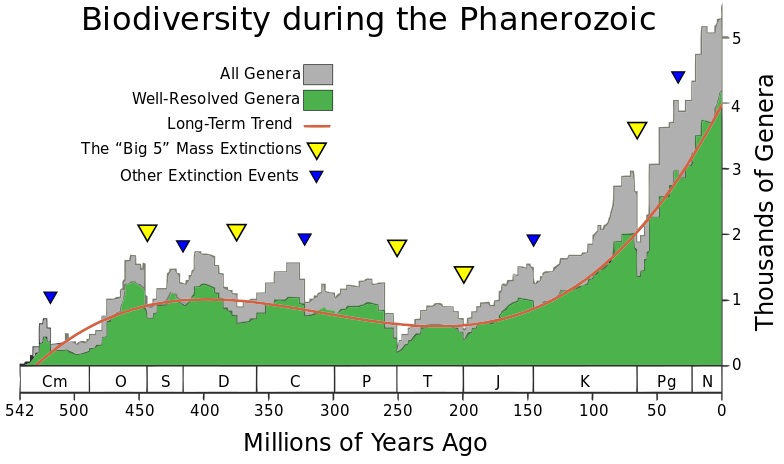
Source: Phanerozoic_Biodiversity.png Author: SVG version by Albert Mestre

See Also:  Sixth Mass Genesis, Not Extinction

Arctic Ice Resilient in July

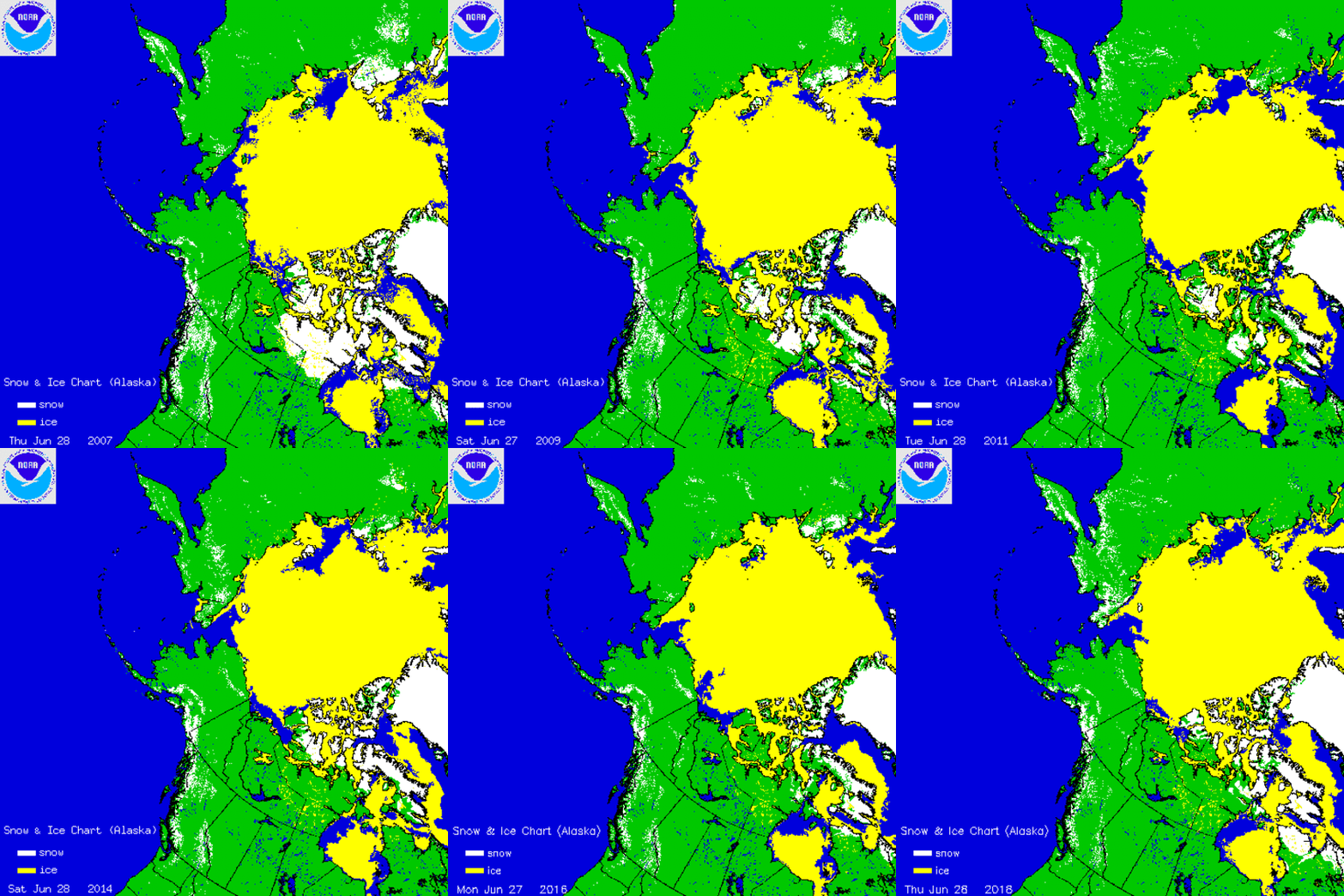
IMSSandIce07to18day179

In June 2018, Arctic ice extent held up against previous years despite the Pacific basins of Bering and Okhotsk being ice-free.  Now in July when ice extent typically declines, 2018 extents are essentially flat.  The Arctic core is showing little change, perhaps due to increased thickness (volume) as reported by DMI.  The image above shows ice extents on day 179 for years 2007 through 2018.

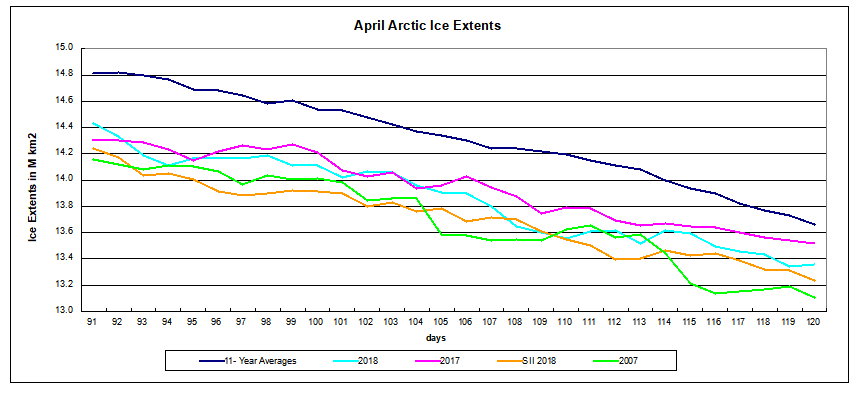
The graph below shows how the Arctic extent has faired from mid June to July 3 (yesterday) compared to the 11 year average and to some years of interest.
NH arctic ice day 184Note that 2018  was on average and comparable to other years from Mid June on.  Then recently ice extents have held steady just below 10M km2, while averages and other years declined.  2018 is now 370k km2 above the 11 year average,  535k km2 higher than 2017, and 660k km2 greater than 2007 at this date.   SII 2018 was tracking the same as MASIE in June but has now dropped 360k km2 lower.

The table below shows ice extents by regions comparing 2018 with 11-year average (2007 to 2017 inclusive) and 2017 as of day 179.

Region 2018179 Day 179
Average
2018-Ave. 2007179 2018-2007
 (0) Northern_Hemisphere 10029935 10054734 -24798 10034293 -4358
 (1) Beaufort_Sea 1015808 919074 96734 948463 67345
 (2) Chukchi_Sea 711178 732616 -21437 680534 30645
 (3) East_Siberian_Sea 1053171 1032249 20923 963850 89321
 (4) Laptev_Sea 647574 745700 -98126 663276 -15702
 (5) Kara_Sea 726226 598140 128086 665920 60307
 (6) Barents_Sea 60948 134229 -73281 177419 -116471
 (7) Greenland_Sea 356614 552157 -195543 627602 -270989
 (8) Baffin_Bay_Gulf_of_St._Lawrence 714402 552083 162319 531706 182696
 (9) Canadian_Archipelago 794355 783057 11298 775033 19322
 (10) Hudson_Bay 900609 761919 138690 777550 123058
 (11) Central_Arctic 3047677 3217803 -170125 3216654 -168977
 (12) Bering_Sea 185 6350 -6165 1080 -895
 (13) Baltic_Sea 0 4 -4 0 0
 (14) Sea_of_Okhotsk 0 17972 -17972 3531 -3531

2018 is 25k km2 below average, entirely due to Okhotsk plus Bering being ice-free.  Greenland Sea and Barents are down, offset by surpluses in Beaufort, Kara, Baffin and Hudson Bays.

Footnote: 

Arctic extents are shaped by the three Ws: Water, Wind and Weather.  This video shows how a massive cyclone in 2012 broke up the ice, moved it around and flushed much of it out through the Fram strait.The ice has recovered since then and is now quite thick.


California: World Leading Climate Hypocrite

California’s Climate Extremism
Joel Kotkin reports from the Golden State. Excerpts in italics with my bolds.

The pursuit of environmental purity in the Golden State does nothing to reverse global warming—but it’s costing the poor and middle class dearly.

Environmental extremism increasingly dominates California. The state is making a concerted attack on energy companies in the courts; a bill is pending in the legislature to fine waiters $1,000—or jail them—if they offer people plastic straws; and UCLA issued a report describing pets as a climate threat. The state has taken upon itself the mission of limiting the flatulence of cows and other farm animals. As the self-described capital of the anti-Trump resistance, California presents itself as the herald of a green, more socially and racially just society. That view has been utterly devastated by a new report from Chapman University, in which coauthors David Friedman and Jennifer Hernandez demonstrate that California’s draconian anti-climate-change regime has exacerbated economic, geographic, and racial inequality. And to make things worse, California’s efforts to save the planet have actually done little more than divert greenhouse-gas emissions (GHG) to other states and countries.

Jerry Brown’s return to Sacramento in 2011 brought back to power one of the first American politicians to embrace the “limits of growth.” Brown has long worried about resource depletion (including such debunked notions as “peak oil”), taken a Malthusian approach to population growth, and opposed middle-class suburban development. Like many climate-change activists, he has limitless confidence in the possibility for engineering a green socially just society through “the coercive power of the state,” but little faith that humans can find ways to address the challenge of climate change. If Brown’s “era of limits” message in the 1970s failed to catch on with the state’s voters, who promptly elected two Republican governors in his wake, he has found in climate change a more effective rallying cry, albeit one that often teeters at the edge of hysteria. Few politicians can outdo Brown for alarmism; recently, he predicted that climate change will cause 3 to 4 billion deaths, leading eventually to human extinction. To save the planet, he openly endorses a campaign to brainwash the masses.

The result: relentless ratcheting-up of climate-change policies. In 2016, the state committed to reduce greenhouse-gas (GHG) emissions 40 percent below 1990 levels by 2030. In response, the California Air Resource Board (CARB), tasked with making the rules required to achieve the state’s legislated goals, took the opportunity to set policies for an (unlegislated) target of an 80 percent reduction below 1990 levels by 2050.

Brown and his supporters often tout their policies as in line with the 2015 Paris Agreement, note Friedman and Hernandez, but California’s reductions under the agreement require it to make cutbacks double those pledged by Germany and other stalwart climate-committed countries, many of which have actually increased their emissions in recent years, despite their Paris pledges.

Governor Brown has preened in Paris, at the Vatican, in China, in newspapers, and on national television. But few have considered how his policies have worked out in practice. California is unlikely to achieve even its modest 2020 goals; nor is it cutting emissions faster than other states lacking such dramatic legislative mandates. Since 2007, when the Golden State’s “landmark” global-warming legislation was passed, California has accounted for barely 5 percent of the nation’s GHG reductions. The combined total reductions achieved over the past decade by Ohio, Georgia, Pennsylvania, and Indiana are about 5 times greater than California’s. Even Texas, that bogeyman of fossil-fuel excess, has been reducing its per-capita emissions more rapidly.

In fact, virtually nothing that California does will have an impact on global climate. California per-capita emissions have always been relatively low, due to the mild climate along the coast, which reduces the need for much energy consumption on heating and cooling. In 2010, the state accounted for less than 1 percent of global GHG emissions; the disproportionately large reductions sought by state activists and bureaucrats would have no discernible effect on global emissions under the Paris Agreement. “If California ceased to exist in 2030,” Friedman and Hernandez note, “global GHG emissions would be still be 99.54 percent of the Paris Agreement total.”

Many of California’s “green” policies may make matters worse. California, for example, does not encourage biomass energy use, though the state’s vast forested areas—some 33 million acres— could provide renewable energy and reduce the excessive emissions from wildfires caused by years of forest mismanagement. Similarly, California greens have been adamant in shutting down nuclear power plants, which continue to reduce emissions in France, and they refuse to count hydro-electricity as renewable energy. As a result, California now imports roughly one-third of its electricity from other states, the highest percentage of any state, up from 25 percent in 2010. This is part of what Hernandez and Friedman show to be California’s increasing propensity to export energy production and GHG emissions, while maintaining the fiction that the state has reduced its total carbon output.

Overall, California tends to send its “dirty work”—whether for making goods or in the form of fossil fuels—elsewhere. Unwanted middle- and working-class people, driven out by the high cost of California’s green policies, leave, taking their carbon footprints to other places, many of which have much higher per-capita emission rates. Net migration to other, less temperate states and countries has been large enough to offset the annual emissions cuts within the state. Similarly, the state’s regulatory policies make it difficult for industrial firms to expand or even to remain in California. Green-signaling firms like Apple produce most of their tangible products abroad, mainly in high-GHG emitting China, while other companies, like Facebook and Google, tend to place energy-intensive data centers in other, higher GHG emission states. The study estimates that GHG emissions just from California’s international imports in 2015, and not even counting imports from the rest of the U.S., amounted to about 35 percent of the state’s total emissions.

California’s green regulators predict that the implementation of ever-stricter rules related to climate will have a “small” impact on the economy. They point to strong economic and job growth in recent years as evidence that strict regulations are no barrier to prosperity. Though the state’s economic growth is slowing, and now approaches the national average, a superficial look at aggregate performance makes a seemingly plausible case for even the most draconian legislation. California, as the headquarters for three of the nation’s five largest companies by market capitalization—Alphabet, Apple, and Facebook— has enjoyed healthy GDP growth since 2010. But in past recoveries, the state’s job and income growth was widely distributed by region and economic class; since 2007, growth has been uniquely concentrated in one region—the San Francisco Bay Area, where employment has grown by nearly 17 percent, almost three times that of the rest of the state, with growth rates tumbling compared with past decades.

Some of these inequities are tied directly to policies associated with climate change. High electricity prices, and the war on carbon emissions generally, have undermined the state’s blue-collar sectors, traditionally concentrated in Los Angeles and the interior counties. These sectors have all lost jobs since 2007. Manufacturing employment, highly sensitive to energy-related and other regulations, has declined by 160,000 jobs since 2007. California has benefited far less from the national industrial resurgence, particularly this past year. Manufacturing jobs—along with those in construction and logistics, also hurt by high energy prices—have long been key to upward mobility for non-college-educated Californians.

As climate-change policies have become more stringent, California has witnessed an unprecedented level of bifurcation between a growing cadre of high-income earners and a vast, rapidly expanding poor population. Meantime, the state’s percentage of middle-income earners— people making between $75,000 and $125,000—has fallen well below the national average. This decline of the middle class even occurs in the Bay Area, notes a recent report from the California Budget and Policy Center, where in 1989 the middle class accounted for 56 percent of all households in Silicon Valley, but by 2013, only 45.7 percent. Lower-income residents accounted for 30.3 percent of Silicon Valley’s households in 1989, and that number grew to 34.8 percent in 2013.

Perhaps the most egregious impact on middle and working-class residents can be seen in housing, where environmental regulations, often tied directly to climate policies, have discouraged construction, particularly in the suburbs and exurbs. The state’s determination to undo the primarily suburban, single-family development model in order to “save the planet” has succeeded both in raising prices well beyond national norms and creating a shortfall of some 3 million homes.

As shown in a recent UC Berkeley study, even if fully realized, the state’s proposals to force denser housing would only reach about 1 percent of its 2030 emissions goals. Brown and his acolytes ignore the often-unpredictable consequences of their actions, insisting that density will reduce carbon emissions while improving affordability and boosting transit use. Yet, as Los Angeles has densified under its last two mayors, transit ridership has continued to drop, in part, notes a another UC Berkeley report, because incentives for real-estate speculation have driven the area’s predominantly poor transit riders further from trains and buses, forcing many to purchase cars.

Undaunted, California plans to impose even stricter regulations, including the mandatory installation of solar panels on new houses, which could raise prices by roughly $20,000 per home. This is only the latest in a series of actions that undermines the aspirations of people who still seek “the California dream;” since 2007, California homeownership rates have dropped far more than the national average. By 2016, the overall homeownership rate in the state was just under 54 percent, compared with 64 percent in the rest of the country.

The groups most affected by these policies, ironically, are those on whom the ruling progressives rely for electoral majorities. Millennials have seen a more rapid decline in homeownership rates compared with their cohort elsewhere. But the biggest declines have been among historically disadvantaged minorities—Latinos and African-Americans. Latino homeownership rates in California are well below the national average. In 2016, only 31 percent of African-Americans in the Bay Area owned homes, well below the already low rate of 41 percent black homeownership in the rest of nation. Worse yet, the state takes no account of the impact of these policies on poorer Californians. Overall poverty rates in California declined in the decade before 2007, but the state’s poverty numbers have risen during the current boom. Today, 8 million Californians live in poverty, including 2 million children, by far the most of any state. The state’s largest city, Los Angeles, is also now by some measurements America’s poorest big city.

To allay concerns about housing affordability, the state has allocated about $300 million from its cap-and-trade funds for housing, a meager amount given that the cost of building affordable housing in urban areas can exceed $700,000 per unit. These benefits are dwarfed by those that wealthy Californians enjoy for the purchase of electric cars and home solar: Tesla car buyers with average incomes of $320,000 per year got more than $300 million in federal and state subsidies by early 2015 alone. By contrast, in early 2018, state electricity prices were 58 percent higher, and gasoline over 90 cents per gallon higher, than the national average, disproportionately hurting ethnic minorities, the working class, and the poor. Based on cost-of-living estimation tools from the Census Bureau, 28 percent of African-Americans in the state live in poverty, compared with 22 percent nationally. Fully one-third of Latinos, now the state’s largest ethnic group, live in poverty, compared with 21 percent outside the state.

In a normal political environment, such disparities would spark debate, not only among conservatives, but also traditional Democrats. Some, like failed independent candidate and longtime environmentalist Michael Shellenberger, have expressed the view that California’s policies have made it not “the most progressive state” but “the most racist one.” Recently, some 200 veteran civil rights leaders sued CARB, on the basis that state policies are skewed against the poor and minorities. So far, their voices have been largely ignored. The state’s prospective next governor, Gavin Newsom, seems eager to embrace and expand Brown’s policies, and few in the legislature seem likely to challenge them. The Republicans, for now, look incapable of mounting a challenge.

This leaves California on a perilous path toward greater class and racial divides, increasing poverty, and ever-more strenuous regulation. Other ways to reduce greenhouse gases—such as planting trees, more efficient transportation, and making suburbs more sustainable—should be on the table. The Hernandez-Friedman report could be a first step toward addressing these issues, but however it happens, a return to rationality is needed in the Golden State.

Joel Kotkin serves as Presidential Fellow in Urban Futures at Chapman University and executive director of the Center for Opportunity Urbanism (COU).

Canada Convicts Pipeline Outlaws

CBC reports on the trials in BC: First of 202 Trans Mountain pipeline protesters await sentencing Excerpts in italics with my bolds.

Nine pipeline protesters found guilty June 18, 2018 of criminal contempt by a judge in B.C. Supreme Court are facing fines of up to $3,000 or 150 hours of community service. Fines stemming from later arrests will escalate from $500 to $5,000 as trials progress this summer.

The protesters were among the first arrested on Burnaby mountain on March 17. They will be sentenced on June 28.

Earlier this month, more than a dozen protesters arrested on the same day pleaded guilty. They were fined $500 or 25 hours of community service, because they pleaded guilty before the case went to trial.

The expected sentences are based on recommendations put forward by the B.C. Prosecution Service in May, but it will be up to the judge to actually decide the sentences.

Those recommendation include a series of escalating fines and jail time based on when protesters were arrested and how they pleaded to the charges of criminal contempt.

Trials to run all summer

The trial, which wrapped up Monday, is the first in a series of trials scheduled to run over the summer and into the fall. A second trial of four more protesters was expected to get underway Monday afternoon.

In all, about 202 protesters were arrested at Kinder Morgan’s worksite on Burnaby mountain. Those who were arrested after May 8 are facing fines of up to $5,000 or 14 days in jail.

Legal support co-ordinator Kris Hermes says no protesters have been arrested since the Crown raised the sentencing recommendation to seven days in jail for anyone arrested after May 28 even if they plead guilty before trial.

“The Crown is clearly escalating its attack on anyone protesting at the site and it has had an effect of eliminating protests outside the Kinder Morgan worksite,” said Hermes.

About half a dozen protesters are also facing Criminal Code charges of assault, mischief and obstruction of a police officer, said Hermes.

A report in the National Observer gives more details on the proceedings Judge hands down decision in first anti-pipeline protester trial  By Dylan Waisman in News, Energy, Politics | June 18th 2018

Nine anti-pipeline protesters who were trying to blockade the Kinder Morgan tank farm on Burnaby Mountain will be sentenced on June 28 after a B.C. Supreme Court judge found that they were all guilty of criminal contempt of court for violating an injunction on March 17.

Justice Kenneth Afflect said on June 18, 2018 that the BC Prosecution Service proved beyond a reasonable doubt that “the accused disobeyed a court order in a public way, with intent, knowledge or recklessness that the act will tend to depreciate the authority of the court.” He also said he was satisfied that the protesters “openly, flagrantly, and continuously” acted in a way that undermined the court’s authority.

The verdicts follow a week of testimony and cross-examination for the defendants who opted to stand trial, unlike 70 others, among more than 200 people arrested, who opted to plead guilty to avoid a hearing. Federal MPs Elizabeth May and Kennedy Stewart were among the 70 who pleaded guilty and were sentenced to pay fines for violating the injunction.

Many of those who pleaded guilty were persuaded by the court’s practice of awarding lower fines for earlier pleadings. Penalties for early guilty pleas have been as low as $500, with fines for unsuccessful trials as high as $5000, with the option of a corresponding amount of community service hours (ranging 25-240 hours) as an alternative. The court reasons that early guilty pleas take up less court time and resources, and therefore warrant lower fines.

The Crown presented video evidence for each defendant as well as testimony from RCMP and Kinder Morgan security agents. By contrast, self-representing defendants employed both humour, and ethical and environmental considerations to argue their cases, while using friends and each other as witnesses.

Some also chose to put forward largely unconventional legal arguments, cross-examining each other, and telling personal anecdotes in an attempt to sway the court.

Kat Roivas, a defendant who is also on trial for breaking the injunction on two other occasions, advanced several arguments to prove her innocence. Roivas said she had no prior knowledge of the injunction, and explained that due to dyslexia, she was not able to read it when RCMP handed copies out, nor was she able to hear it being read, due to the loud singing and drumming of the other protesters.

Roivas also told the court that she was stationed in front of the gate for spiritual reasons, to support other arrestees.

While she was on the stand during the trial, Monte Ruttan of the Crown Prosecution, was skeptical, referencing RCMP footage and asking “when I see you in the video I don’t see you outwardly doing that [prayer].”

This provoked some laughter from the gallery.

Errol Pova, a friend of Roivas and fellow defendant, cross-examined her afterwards, in an attempt to use humour to “lighten things up,” he told National Observer. He questioned her about an eagle that was in the sky that day, and asked her to provide proof. The stunt was short, but was also met by more laughter in the courtroom.

Affleck ultimately rejected the defence offered by Roivas, agreeing with Ruttan’s arguments that the law does not protect someone who chooses “to remain willfully blind and willfully ignorant” of a court order, despite knowing of its existence.

Chantler also argued that RCMP arrived at the Burnaby terminal already “expecting, and prepared to make arrests.” He added that RCMP had one to two days’ notice of a planned protest in which people would be intending to be arrested, and the RCMP “seemed to accept Trans Mountain’s conclusion that the injunction was being breached, without putting his mind to it,” referencing an affidavit from a RCMP chief constable, Andrew McCauley.

Justice Affleck was not persuaded by either argument, saying that “a higher standard of proof is not required.” He said it was enough that Contable McCauley “had a subjective believe that people were breaking the injunction, I conclude that that belief was objectively justified.”

Following the verdicts, Errol Pova, one of the defendants in the trial, stood up to address Justice Affleck.

“To say that I am disappointed is a major major understatement.”

Affleck replied, “You’re not the first person to be disappointed in the outcome of a trial.”

Sixth Mass Genesis, Not Extinction

Chris D Thomas Professor of Evolutionary Biology, University of York writes in the Conversation New species are coming into existence faster than ever thanks to humans. Excerpts below in italics with my bolds.

Animals and plants are seemingly disappearing faster than at any time since the dinosaurs died out, 66m years ago. The death knell tolls for life on Earth. Rhinos will soon be gone unless we defend them, Mexico’s final few Vaquita porpoises are drowning in fishing nets, and in America, Franklin trees survive only in parks and gardens.

Yet the survivors are taking advantage of new opportunities created by humans. Many are spreading into new parts of the world, adapting to new conditions, and even evolving into new species. In some respects, diversity is actually increasing in the human epoch, the Anthropocene. It is these biological gains that I contemplate in a new book, Inheritors of the Earth: How Nature is Thriving in an Age of Extinction, in which I argue that it is no longer credible for us to take a loss-only view of the world’s biodiversity.

The beneficiaries surround us all. Glancing out of my study window, I see poppies and camomile plants sprouting in the margins of the adjacent barley field. These plants are southern European “weeds” taking advantage of a new human-created habitat. When I visit London, I see pigeons nesting on human-built cliffs (their ancestors nested on sea cliffs) and I listen out for the cries of skyscraper-dwelling peregrine falcons which hunt them.

Climate change has brought tree bumblebees from continental Europe to my Yorkshire garden in recent years. They are joined by an influx of world travellers, moved by humans as ornamental garden plants, pets, crops, and livestock, or simply by accident, before they escaped into the wild. Neither the hares nor the rabbits in my field are “native” to Britain.

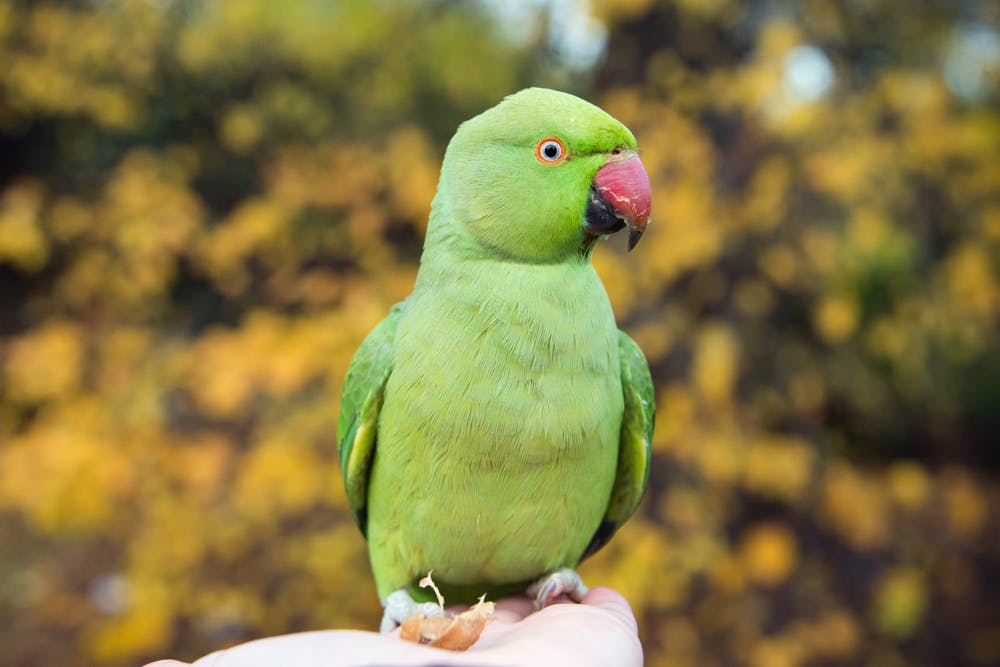
Parakeets from Asia have established themselves in cities across Britain. Alicja Korbinska / shutterstock

Many conservationists and “invasive species biologists” wring their hands at this cavalcade of “aliens”. But it is how the biological world works. Throughout the history of the Earth, species have survived by moving to new locations that permit them to flourish – today, escaped yellow-crested cockatoos are thriving in Hong Kong, while continuing to decline in their Indonesian homeland.

Nonetheless, the rate at which we are transporting species is unprecedented, converting previously separate continents and islands into one biological supercontinent. In effect, we are creating New Pangea, the greatest ecological pile-up in the Earth’s long history. A few of the imported species cause others to become extinct – rats have driven some predator-naïve island birds to extinction, for example. Ground-nesting, flightless pigeons and rails that did not recognise the danger were no match for a deadly combination of rodents and human hunters.

But despite being high-profile, these cases are fairly rare. In general, most of the newcomers fit in, with limited impacts on other species. The net result is that many more species are arriving than are dying out – in Britain alone, nearly 2,000 extra species have established populations in the past couple of thousand years.

Source: Phanerozoic_Biodiversity.png Author: SVG version by Albert Mestre

Extinction and evolution
The processes of evolution also continue, as animals, plants and microbes adjust to the way humans are altering the world around them. Fish have evolved to breed when they are smaller and younger, increasing the chances that they will escape the fisherman’s nets, and butterflies have changed their diets to make used of human-altered habitats.

Entirely new species have even come into existence. The “apple fly” has evolved in North America, thanks to European colonials bringing fruit trees to the New World. And house sparrows mated with Mediterranean “Spanish” sparrows somewhere on an Italian farm. Their descendants represent a brand new species, the Italian sparrow. Life on Earth is no longer the same as it was before humans arrived on the scene.

There is no doubt that the rate at which species are dying out is very high, and we could well be in for a “Big Sixth” mass extinction. This represents a loss of biological diversity. Yet, we also know that the Big Five mass extinctions of the past half billion years ultimately led to increases in diversity. Could this happen again? It seems so, because the current rate at which new animals and plants (such as the apple fly, the Italian sparrow and Oxford ragwort) are coming into existence is unusually high – and it may be the highest ever. We are already on the verge of Genesis Number Six – a million or so years from now, the world could end up supporting more species, not fewer, as a consequence of the evolution of Homo sapiens.

The Italian sparrow only evolved after humans caused its ancestors to meet. Chris Thomas, Author provided

The ongoing ecological and evolutionary success stories of the Anthropocene epoch require us to re-evaluate our relationship with the rest of nature. Change is ultimately the means by which species survive and turn into new species. So, perhaps we should not spend quite so much time bemoaning the losses that have already taken place, and trying to recreate some imagined past world. We cannot rewind history. It might be more effective for us to facilitate future biological gains even if, in so doing, we move further away from how the world used to be.

This does not let us off the hook – species are genuinely dying out – but it does mean that we should not regard change per se as negative. We should perhaps think of ourselves as inmates and moulders of a dynamic, changing world, rather than as despoilers of a formerly pristine land.

Footnote: I dislike the trendy word “Anthropocene”. It strikes me as hubris to claim for ourselves powers comparable to geologic or astronomical forces. I appreciate Chris Thomas pointing out human influences, both positive and negative, upon the natural world, and the responsibilities that follow from our actions. But I also appreciate what Michael Crichton wrote in State of Fear (2004):

Our planet is five billion years old, and it has been changing constantly all during that time. […] Our atmosphere is as violent as the land beneath it. At any moment there are one thousand five hundred electrical storms across the planet. Eleven lightning bolts strike the ground each second. A tornado tears across the surface every six hours. And every four days, a giant cyclonic storm, hundreds of miles in diameter, spins over the ocean and wreaks havoc on the land.

The nasty little apes that call themselves human beings can do nothing except run and hide. For these same apes to imagine they can stabilize this atmosphere is arrogant beyond belief. They can’t control the climate.

The reality is, they run from the storms.

Estimating Cost of Trudeau’s Carbon Tax

We’re finally told what the carbon tax will cost us. Are you sitting down?
Kenneth Green writes in Financial Post.  Excerpts below in italics with my bolds.
Households in Alberta, Saskatchewan and Nova Scotia will be hit with more than $1,000 of carbon tax per year, while those in British Columbia, Quebec and Manitoba will pay around $650

It took some poking and prodding and (finally) committee testimony, but now we know what the bill will be for a $50-per-tonne carbon tax, similar to one the federal Liberals plan to impose. In a report to the Senate Standing Committee on Energy, the Environment and Natural Resources, University of Calgary economics professor Jennifer Winter revealed the bottom line of a $50-per-tonne carbon price.

Tax advocates say it is a small % of GDP. But it is still $10 Billion extracted from Canadian households.

Using energy-consumption data from Statistics Canada, and imputing prices from average household expenditure on transportation fuels and provincial gasoline prices, Winter calculated the impact of a a $50-per-tonne model of a carbon tax on a typical Canadian household across different provinces. Far from being painless as advertised, the costs to households will be significant.

Three provinces — Alberta, Saskatchewan and Nova Scotia — will be hit with more than $1,000 of carbon tax per year to comply with the $50-per-tonne carbon tax Ottawa has mandated for 2022. Nova Scotia ($1,120) and Alberta ($1,111) will have the highest bills, followed by Saskatchewan ($1,032), New Brunswick ($963), Newfoundland ($859) and Prince Edward Island ($788). The average household in Ontario will pay $707 a year to comply with the carbon tax once its fully implemented.

Who gets the lowest bill? British Columbia ($603 per year), Quebec ($662) and Manitoba ($683). Simply put, households in provinces with the lowest bills will pay just a bit more than half compared to households in the hardest-hit provinces.

But it gets worse, since most experts say carbon prices must continue to increase sharply to effectively lower emissions. At $100 a tonne, for example, households in Alberta will pony up $2,223, in Saskatchewan they’ll pay $2,065 and in Nova Scotia, $2,240. In fact, at $100 a tonne, the average price for households in all provinces is well north of $1,000 per year.

Already across Canada, particularly in the Maritimes, a significant number of households fit the definition of “energy poverty” — that is, 10 per cent or more of household expenditures are spent simply procuring the energy needed to live (to power the home and transportation). In 2016, the Fraser Institute measured energy poverty in Canada and found that when you add up the costs to power the home and cars, 19.4 per cent of Canadian households devoted at least 10 per cent or more of their expenditures to energy.